

-
61 SF
- функция коммутации
- функция безопасности ядерного реактора
- с автоматической подачей
- растворимая фракция
- пропадание (потеря) сигнала
- показатель серьёзности (отказа, события)
- показатель источника
- площадь оребрённой поверхности
- плавкий предохранитель
- относительное число неудачных сканирований
- одноволоконный
- коэффициент расширения спектра
- конкретные результаты
- безопасный сбой
безопасный сбой
—
[Е.С.Алексеев, А.А.Мячев. Англо-русский толковый словарь по системотехнике ЭВМ. Москва 1993]Тематики
EN
коэффициент расширения спектра
Показатель, характеризующий степень избыточности расширенной полосы частот относительно спектра информационного сигнала. Численно определяется как отношение ширины полосы частот в радиоканале к скорости передачи информации.
[Л.М. Невдяев. Телекоммуникационные технологии. Англо-русский толковый словарь-справочник. Под редакцией Ю.М. Горностаева. Москва, 2002]Тематики
- электросвязь, основные понятия
EN
одноволоконный
(МСЭ-Т L.13).
[ http://www.iks-media.ru/glossary/index.html?glossid=2400324]Тематики
- электросвязь, основные понятия
EN
относительное число неудачных сканирований
Показывает вероятность того, что в зоне обслуживания сети WiMAX нет ни одной доступной абонентской станции.
[ http://www.morepc.ru/dict/]Тематики
EN
плавкий предохранитель
Коммутационный аппарат, который посредством плавления одного или нескольких своих специально спроектированных и калиброванных элементов размыкает цепь, в которую он включен, и отключает ток, когда он превышает заданную величину в течение достаточного времени. Плавкий предохранитель содержит все части, образующие укомплектованный аппарат.
МЭК 60050(441-18-01).
[ ГОСТ Р 50030. 1-2000 ( МЭК 60947-1-99)]
плавкий предохранитель
Аппарат, который вследствие расплавления одного или нескольких специально спроектированных и рассчитанных элементов размыкает цепь, в которую он включен, отключая ток, превышающий заданное значение в течение достаточно продолжительного времени. В состав плавкого предохранителя входят все части, образующие аппарат в комплекте
[ ГОСТ Р 50339. 0-2003 ( МЭК 60269-1-98)]
предохранитель
Коммутационный электрический аппарат, предназначенный для отключения защищаемой цепи посредством разрушения специально предусмотренных для этого токоведущих частей под действием тока, превышающего определенную величину.
[ ГОСТ 17703-72]
предохранитель
Устройство для разрыва электрических цепей при силе тока, превышающей допустимое значение
[Терминологический словарь по строительству на 12 языках (ВНИИИС Госстроя СССР)]EN
fuse
a device that by the fusing of one or more of its specially designed and proportioned components, opens the circuit in which it is inserted by breaking the current when this exceeds a given value for a sufficient time. The fuse comprises all the parts that form the complete device
[IEV number 441-18-01 ]FR
fusible
coupe-circuit à fusibles
appareil dont la fonction est d'ouvrir par la fusion d'un ou de plusieurs de ses éléments conçus et calibrés à cet effet le circuit dans lequel il est inséré en coupant le courant lorsque celui-ci dépasse pendant un temps suffisant une valeur donnée. Le fusible comprend toutes les parties qui constituent l'appareil complet
[IEV number 441-18-01 ]Настоящий стандарт распространяется на плавкие предохранители на номинальный ток от 2 до 2500 А, номинальное напряжение переменного тока до 1000 В и постоянного тока до 1200 В, устанавливаемые в комплектные устройства и предназначенные для защиты при перегрузках и коротких замыканиях силовых и вспомогательных цепей электроустановок промышленных предприятий, общественных и жилых зданий, изготовляемые для нужд народного хозяйства и экспорта и номинальное напряжение до 3000 В для защиты полупроводниковых устройств.
3.2.14. Предохранители должны быть сконструированы таким образом, чтобы отключать электрическую цепь при токах отключения в пределах: от условного тока плавления — для предохранителей с плавкими вставками типов g и gR или от наименьшего тока отключения, установленного в стандартах или технических условиях на предохранители конкретных серий и типов, для предохранителей с плавкими вставками типов а и aR — до наибольшего тока отключения
[ ГОСТ 17242-86]... токи, при которых проводят испытания, предназначенные для проверки способности данного плавкого предохранителя срабатывать удовлетворительно в диапазоне малых сверхтоков.
[ ГОСТ Р 50339.0-2003]... Если неисправность заканчивается срабатыванием плавкого предохранителя или если плавкий предохранитель не срабатывает примерно в течение 1 с, то...
[ ГОСТ Р 52319-2005]ЭЛЕКТРИЧЕСКИЕ ПАРАМЕТРЫ И ХАРАКТЕНИСТИКИ ПРЕДОХРАНИТЕЛЕЙ
(взято из ГОСТ 17242-86)-
Для держателя (или основания) предохранителя:
- номинальное напряжение;
- номинальный ток;
- род тока и номинальная частота для переменного тока;
- допустимые потери мощности;
- число полюсов, если их более одного.
-
Для плавкой вставки:
- номинальное напряжение;
- номинальный ток;
- род тока и номинальная частота для переменного тока;
- потери мощности;
- время-токовые характеристики с указанием коэффициентов K1 и K2 для плавких вставок типа а;
- перегрузочная способность;
- диапазон токов отключения;
- наибольшая отключающая способность;
- наименьший ток отключения для плавких вставок типа а;
- характеристика пропускаемого тока;
- характеристики интегралов Джоуля;
- перенапряжение и характеристика перенапряжения для плавких вставок типов aR и gR;
- условия селективности (при необходимости);
- электрическое сопротивление плавкой вставки в холодном состоянии (допускается указать в рабочих чертежах, утвержденных в установленном порядке).
-
Для предохранителя:
- степень защиты по ГОСТ 14255—69;
- номинальное напряжение, номинальный ток и коммутационная способность свободных контактов (при их наличии).
Параллельные тексты EN-RU
Check to make sure that fuse F1 on power supply module V is not fused.
If the fuse is defective, it should not be replaced without determining the cause of failure.
If a fuse is replaced without eliminating the problem, there is the danger that the damage will spread.
[Schneider Electric]Убедитесь в исправности предохранителя F1 в модуле питания V.
Если предохранитель оказался неисправным, то прежде чем заменить его необходимо установить причину возникновения неисправности.
Замена предохранителя без выяснения причины его срабатывания может привести к повторению срабатывания.
[Перевод Интент]High voltage system may embrace a fuse.
Note that a fuse may not be manually adjusted as the circuit breaker relay does so the fuse choice for the appropriate purpose/circuit adaptation is deemed most important.
[LS Industrial Systems]Высоковольтная система < электропитания> может содержать предохранители.
Обратите внимание! Предохранитель нельзя настроить, как это можно сделать с расцепителем автоматического выключателя. Поэтому предохранитель необходимо выбрать так, чтобы он как можно точнее соотвествовал конкретным условиям защиты аппарата или участка цепи.
[Перевод Интент]
Тематики
Классификация
>>>Обобщающие термины
Действия
- защищать при перегрузках и коротких замыканиях
- отключать электрическую цепь
- срабатывание предохранителя
Синонимы
EN
- cutoff
- electric fuse
- fu
- fuse
- fuse switch
- fusible cutout
- fusible plug
- fusible switch
- plug fuse
- protective fuse
- safety cutoff
- safety fuse
- safety plug
- SF
- thermal fuse
DE
FR
площадь оребрённой поверхности
—
[А.С.Гольдберг. Англо-русский энергетический словарь. 2006 г.]Тематики
EN
показатель источника
(напр. излучения)
[А.С.Гольдберг. Англо-русский энергетический словарь. 2006 г.]Тематики
EN
показатель серьёзности (отказа, события)
—
[А.С.Гольдберг. Англо-русский энергетический словарь. 2006 г.]Тематики
EN
пропадание (потеря) сигнала
Сигнал, указывающий, что соответствующие данные пропали в том смысле, что стало активным состояние дефекта перекрестной наводки (не являющееся дефектом ухудшения). (МСЭ-T G.806).
[ http://www.iks-media.ru/glossary/index.html?glossid=2400324]Тематики
- электросвязь, основные понятия
EN
с автоматической подачей
—
[А.С.Гольдберг. Англо-русский энергетический словарь. 2006 г.]Тематики
EN
функция безопасности ядерного реактора
—
[А.С.Гольдберг. Англо-русский энергетический словарь. 2006 г.]Тематики
EN
функция коммутации
(МСЭ-Т Х.145).
[ http://www.iks-media.ru/glossary/index.html?glossid=2400324]Тематики
- электросвязь, основные понятия
EN
Англо-русский словарь нормативно-технической терминологии > SF
-
62 perform
pə'fo:m1) (to do, especially with care or as a duty: The doctor performed the operation.) realizar, efectuar, ejecutar2) (to act (in the theatre etc) or do anything musical, theatrical etc to entertain an audience: The company will perform a Greek play; She performed on the violin.) representar•- performer
perform vb1. representar / interpretar2. responder / rendir / obtener buenos resultadosthe rugby team performed badly, they lost 35 2 el equipo de rugby tuvo una mala actuación, perdieron 35 2tr[pə'fɔːm]1 (task) ejecutar, llevar a cabo; (function) desempeñar, hacer, cumplir; (experiment) realizar; (operation) practicar; (miracle) hacer2 (piece of music) interpretar, tocar; (song) cantar; (play) representar, dar; (role) interpretar, representar; (sumersault, trick) hacer, ejecutar1 (actor) actuar; (singer) cantar; (musician) tocar, interpretar; (dancer) bailar; (company) dar una representaciónperform [pər'fɔrm] vt1) carry out: realizar, hacer, desempeñar2) present: representar, dar (una obra teatral, etc.)perform vi: actuar (en una obra teatral), cantar (en una ópera, etc.), tocar (en un concierto, etc.), bailar (en un ballet, etc.)v.• actuar v.• celebrar v.• cumplir v.• desempeñar v.• efectuar v.• ejecutar v.• funcionar v.• hacer v.(§pres: hago, haces...) pret: hic-pp: hechofut/c: har-•)• interpretar v.• obrar v.• practicar v.• realizar v.• representar v.• tocar v.pər'fɔːrm, pə'fɔːm
1.
1) (Mus, Theat) \<\<actor/comedian\>\> actuar*, trabajar; \<\<singer\>\> cantar; \<\<musician\>\> tocar*; \<\<dancer\>\> bailar2) (work, produce results) \<\<student/worker\>\> rendir*, trabajar; \<\<team/athlete/vehicle\>\> responder; \<\<company/stocks\>\> rendir*; \<\<economy\>\> marchar
2.
vt1) (Mus, Theat) \<\<play\>\> representar, dar*; \<\<role\>\> interpretar, representar; \<\<aria\>\> interpretar, cantar; \<\<symphony\>\> tocar*, interpretar, ejecutar2) (carry out, fulfill) \<\<function\>\> desempeñar, cumplir; \<\<role\>\> desempeñar; \<\<task\>\> ejecutar, llevar a cabo; \<\<experiment\>\> realizar*; \<\<ceremony\>\> celebrar; \<\<rites\>\> practicar*[pǝ'fɔːm]1. VT1) (Theat, Mus) [+ play] representar; [+ part, piece, song, dance] interpretarit meant a lot to her to have her music performed here — significó mucho para ella el que interpretaran su música aquí
she will perform a series of sonatas by Mozart — interpretará or ejecutará varias sonatas de Mozart
2) (=carry out) [+ task, experiment, feat] realizar, llevar a cabo; [+ operation, autopsy] practicar, realizar, llevar a cabo; [+ duty] cumplir con; [+ function, role] desempeñar, cumplir; [+ rite, ritual, ceremony] celebrar; [+ miracle] realizar, hacerto perform surgery or an operation on sb — operar a algn, practicar una operación quirúrgica a algn frm
2. VI1) (Theat, Mus) [entertainer, actor] actuar; [musician] tocar; [orchestra, pop group] actuar, tocar; [singer] cantar; [dancer] bailar; [trained animal] hacer trucos, realizar trucoshe performed brilliantly as Hamlet — interpretó brillantemente el papel de Hamlet, se lució en el papel de Hamlet
the band will be performing live — el grupo actuará or tocará en concierto
and performing for us tonight on the violin is Rebecca Hunt — y esta noche Rebecca Hunt nos tocará el violín
2) (=respond, behave) [vehicle, machine] responder, funcionar; [team, athlete, horse] responder; [investment, shares] rendir; [metal, material] comportarse; [worker] (=be productive) rendir; (=react) responderhow did the company perform last year? — ¿qué resultados dio la empresa el año pasado?
the party performed abysmally at the last election — el partido obtuvo unos resultados pésimos en las últimas elecciones
he did not perform very well in his exams — no obtuvo muy buenos resultados en los exámenes, los exámenes no le salieron muy bien
our economy has been performing well recently — últimamente, nuestra economía ha estado produciendo buenos resultados
3) * esp hum (=go to toilet) [child, dog] hacer sus menesteres4) * (sexually) cumplir ** * *[pər'fɔːrm, pə'fɔːm]
1.
1) (Mus, Theat) \<\<actor/comedian\>\> actuar*, trabajar; \<\<singer\>\> cantar; \<\<musician\>\> tocar*; \<\<dancer\>\> bailar2) (work, produce results) \<\<student/worker\>\> rendir*, trabajar; \<\<team/athlete/vehicle\>\> responder; \<\<company/stocks\>\> rendir*; \<\<economy\>\> marchar
2.
vt1) (Mus, Theat) \<\<play\>\> representar, dar*; \<\<role\>\> interpretar, representar; \<\<aria\>\> interpretar, cantar; \<\<symphony\>\> tocar*, interpretar, ejecutar2) (carry out, fulfill) \<\<function\>\> desempeñar, cumplir; \<\<role\>\> desempeñar; \<\<task\>\> ejecutar, llevar a cabo; \<\<experiment\>\> realizar*; \<\<ceremony\>\> celebrar; \<\<rites\>\> practicar* -
63 work
1. nounat work — (engaged in working) bei der Arbeit; (fig.): (operating) am Werk (see also academic.ru/23063/e">e)
be at work on something — an etwas (Dat.) arbeiten; (fig.) auf etwas (Akk.) wirken
set to work — [Person:] sich an die Arbeit machen
set somebody to work — jemanden an die Arbeit schicken
all work and no play — immer nur arbeiten
have one's work cut out — viel zu tun haben; sich ranhalten müssen (ugs.)
2) (thing made or achieved) Werk, dasis that all your own work? — hast du das alles selbst gemacht?
work of art — Kunstwerk, das
a work of reference/literature/art — ein Nachschlagewerk/literarisches Werk/Kunstwerk
5) (employment) Arbeit, dieout of work — arbeitslos; ohne Arbeit
7) in pl. (Mil.) Werke; Befestigungen8) in pl. (operations of building etc.) Arbeitenthe [whole/full] works — der ganze Kram (ugs.)
2. intransitive verb,give somebody the works — (fig.) (give somebody the best possible treatment) jemandem richtig verwöhnen (ugs.); (give somebody the worst possible treatment) jemanden fertig machen (salopp)
1) arbeitenwork for a cause — etc. für eine Sache usw. arbeiten
work against something — (impede) einer Sache (Dat.) entgegenstehen
2) (function effectively) funktionieren; [Charme:] wirken (on auf + Akk.)make the washing machine/television work — die Waschmaschine/den Fernsehapparat in Ordnung bringen
3) [Rad, Getriebe, Kette:] laufen4) (be craftsman)work in a material — mit od. (fachspr.) in einem Material arbeiten
5) [Faktoren, Einflüsse:] wirken (on auf + Akk.)work against — arbeiten gegen; see also work on
6) (make its/one's way) sich schieben3. transitive verb,work round to a question — (fig.) sich zu einer Frage vorarbeiten
1) (operate) bedienen [Maschine]; fahren [Schiff]; betätigen [Bremse]2) (get labour from) arbeiten lassen3) (get material from) ausbeuten [Steinbruch, Grube]4) (operate in or on) [Vertreter:] bereisen5) (control) steuern6) (effect) bewirken [Änderung]; wirken [Wunder]work it or things so that... — (coll.) es deichseln, dass... (ugs.)
work one's way up/into something — sich hocharbeiten/in etwas (Akk.) hineinarbeiten
8) (get gradually) bringenwork something into something — etwas zu etwas verarbeiten; (mix in) etwas unter etwas (Akk.) rühren
10) (gradually excite)work oneself into a state/a rage — sich aufregen/in einen Wutanfall hineinsteigern
12) (purchase, obtain with labour) abarbeiten; (fig.)she worked her way through college — sie hat sich (Dat.) ihr Studium selbst verdient; see also passage 6)
Phrasal Verbs:- work in- work off- work on- work out- work up* * *[wə:k] 1. noun1) (effort made in order to achieve or make something: He has done a lot of work on this project) die Arbeit2) (employment: I cannot find work in this town.) die Arbeit3) (a task or tasks; the thing that one is working on: Please clear your work off the table.) die Arbeit4) (a painting, book, piece of music etc: the works of Van Gogh / Shakespeare/Mozart; This work was composed in 1816.) das Werk5) (the product or result of a person's labours: His work has shown a great improvement lately.) die Arbeit6) (one's place of employment: He left (his) work at 5.30 p.m.; I don't think I'll go to work tomorrow.) die Arbeit2. verb1) (to (cause to) make efforts in order to achieve or make something: She works at the factory three days a week; He works his employees very hard; I've been working on/at a new project.) arbeiten2) (to be employed: Are you working just now?) arbeiten3) (to (cause to) operate (in the correct way): He has no idea how that machine works / how to work that machine; That machine doesn't/won't work, but this one's working.) funktionieren4) (to be practicable and/or successful: If my scheme works, we'll be rich!) klappen5) (to make (one's way) slowly and carefully with effort or difficulty: She worked her way up the rock face.) sich arbeiten6) (to get into, or put into, a stated condition or position, slowly and gradually: The wheel worked loose.) sich arbeiten7) (to make by craftsmanship: The ornaments had been worked in gold.) arbeiten•- -work- workable
- worker
- works 3. noun plural2) (deeds, actions etc: She's devoted her life to good works.) das Werk•- work-basket- work-box
- workbook
- workforce
- working class
- working day
- work-day
- working hours
- working-party
- work-party
- working week
- workman
- workmanlike
- workmanship
- workmate
- workout
- workshop
- at work
- get/set to work
- go to work on
- have one's work cut out
- in working order
- out of work
- work of art
- work off
- work out
- work up
- work up to
- work wonders* * *[wɜ:k, AM wɜ:rk]I. NOUNto be at \work am Werk seinforces of destruction are at \work here hier sind zerstörerische Kräfte am Werkvarious factors are at \work in this situation in dieser Situation spielen verschiedene Faktoren eine Rollegood \work! gute Arbeit!there's a lot of \work to be done yet es gibt noch viel zu tunthe garden needs a lot of \work im Garten muss [so] einiges gemacht werden\work on the tunnel has been suspended die Arbeiten am Tunnel wurden vorübergehend eingestelltdid you manage to get a bit of \work done? konntest du ein bisschen arbeiten?construction/repair \work Bau-/Reparaturarbeiten plresearch \work Forschungsarbeit fit's hard \work doing sth (strenuous) es ist anstrengend, etw zu tun; (difficult) es ist schwierig, etw zu tunto be at \work doing sth [gerade] damit beschäftigt sein, etw zu tunto make \work for sb jdm Arbeit machenwhat sort of \work do you have experience in? über welche Berufserfahrung verfügen Sie?she's got \work as a translator sie hat Arbeit [o eine Stelle] als Übersetzerin gefundento look for \work auf Arbeitssuche seinhe's looking for \work as a system analyst er sucht Arbeit [o eine Stelle] als Systemanalytikerto be in \work Arbeit [o eine Stelle] habento be out of \work arbeitslos seinto be late for \work zu spät zur Arbeit kommento have to stay late at \work lange arbeiten müssento be at \work bei der Arbeit seinto be off \work frei haben; (without permission) fehlento be off \work sick sich akk krankgemeldet habento commute to \work pendelnto get to \work by car/on the train mit dem Auto/mit dem Zug zur Arbeit fahrento go/travel to \work zur Arbeit gehen/fahrento be injured at \work einen Arbeitsunfall habento ring sb from \work jdn von der Arbeit [aus] anrufen4. (construction, repairs)▪ \works pl Arbeiten plbuilding/road \works Bau-/Straßenarbeiten plthis is the \work of professional thieves das ist das Werk professioneller Diebegood \works REL gute Werke6. ART, LIT, MUS Werk nt‘The Complete W\works of William Shakespeare’ ‚Shakespeares gesammelte Werke‘\works of art Kunstwerke pl\work in bronze Bronzearbeiten pl\work in leather aus Leder gefertigte Arbeitensb's early/later \work jds Früh-/Spätwerk ntto show one's \work in a gallery seine Arbeiten in einer Galerie ausstellen7. (factory)▪ \works + sing/pl vb Werk nt, Fabrik fsteel \works Stahlwerk nttwo large pizzas with the \works, please! esp AM zwei große Pizzen mit allem bitte!11. MIL▪ \works pl Befestigungen pl12.II. NOUN MODIFIER\work clothes Arbeitskleidung f\work speed Arbeitstempo nt2.\works premises Werksgelände ntIII. INTRANSITIVE VERB1. (do a job) arbeitenwhere do you \work? wo arbeiten Sie?to \work as an accountant als Buchhalter arbeitento \work a twelve-hour day/a forty-hour week zwölf Stunden am Tag/vierzig Stunden in der Woche arbeitento \work from home zu Hause [o von zu Hause aus] arbeitento \work at the hospital/abroad im Krankenhaus/im Ausland arbeitento \work hard hart arbeitento \work together zusammenarbeiten▪ to \work with sb mit jdm zusammenarbeitenwe're \working to prevent it happening again wir bemühen uns [o arbeiten daran], so etwas in Zukunft zu verhindernto \work towards a degree in biology einen Hochschulabschluss in Biologie anstrebenwe're \working on it wir arbeiten daranto \work at a problem an einem Problem arbeitento \work hard at doing sth hart daran arbeiten, etw zu tun3. (have an effect) sich auswirkento \work both ways sich sowohl positiv als auch negativ auswirken▪ to \work in sb's favour sich zu jds Gunsten auswirkenmy cell phone doesn't \work mein Handy geht nichtthe boiler seems to be \working okay der Boiler scheint in Ordnung zu seinI can't get this washing machine to \work ich kriege die Waschmaschine irgendwie nicht zum Laufento \work off batteries batteriebetrieben seinto \work off the mains BRIT mit Netzstrom arbeitento \work off wind power mit Windenergie arbeitento \work in practice [auch] in der Praxis funktionieren7. (be based)to \work on the assumption/idea that... von der Annahme/Vorstellung ausgehen, dass...8. (move)to \work free/loose sich lösen/lockernto \work windward NAUT gegen den Wind segeln10. NAUTto \work windward [hart] am Wind segeln11.▶ to \work like a charm [or like magic] Wunder bewirkenIV. TRANSITIVE VERB1. (make work)to \work sb/oneself hard jdm/sich viel abverlangen2. (operate)to be \worked by electricity/steam elektrisch/dampfgetrieben seinto be \worked by wind power durch Windenergie angetrieben werden3. (move)to \work one's way through an article/a book sich akk durch einen Artikel/ein Buch durcharbeitento \work one's way through a crowd/out of a crowded room sich dat einen Weg durch die Menge/aus einem überfüllten Zimmer bahnento \work one's way down a list eine Liste durchgehento \work one's way up sich akk hocharbeitenhe's \worked his way up through the firm er hat sich in der Firma hochgearbeitetto \work sth free/loose etw losbekommen/lockernto \work sth [backwards and forwards] etw [hin- und her]bewegen4. (bring about)▪ to \work sth etw bewirkenI don't know how she \worked it! ich weiß nicht, wie sie das geschafft hat!to \work oneself into a more positive frame of mind sich dat eine positivere Lebenseinstellung erarbeitento \work a cure eine Heilung herbeiführento \work a miracle ein Wunder vollbringento \work miracles [or wonders] [wahre] Wunder vollbringen5. (get)to \work oneself into a state sich akk aufregento \work sb into a state of jealousy jdn eifersüchtig machen6. (shape)▪ to \work sth etw bearbeitento \work clay Ton formen▪ to \work sth into sth etw in etw akk einarbeiten; food etw mit etw dat vermengen; (incorporate) etw in etw akk einbauen [o einfügen]to \work the ingredients together die Zutaten [miteinander] vermengento \work sth into the skin (rub) die Haut mit etw dat einreiben; (massage) etw in die Haut einmassieren8. (embroider)▪ to \work sth etw [auf]sticken9. (cultivate)to \work the land das Land bewirtschaften; (exploit)to \work a mine/quarry eine Mine/einen Steinbruch ausbeuten10. (cover)to \work the inner city [area]/the East Side für die Innenstadt/die East Side zuständig sein11. (pay for by working)to \work one's passage sich dat seine Überfahrt durch Arbeit auf dem Schiff verdienento \work one's way through university sich dat sein Studium finanzieren12.▶ to \work one's fingers to the bone [for sb] ( fam) sich dat [für jdn] den Rücken krumm arbeiten fam* * *[wɜːk]1. nto be at work (on sth) ( — an etw dat ) arbeiten
there are forces at work which... — es sind Kräfte am Werk, die...
nice or good work! — gut or super (inf) gemacht!
we've a lot of work to do before this choir can give a concert — wir haben noch viel zu tun, ehe dieser Chor ein Konzert geben kann
you need to do some more work on your accent/your technique — Sie müssen noch an Ihrem Akzent/an Ihrer Technik arbeiten
to get or set to work on sth — sich an etw (acc) machen
to put a lot of work into sth — eine Menge Arbeit in etw (acc) stecken
to make short or quick work of sb/sth — mit jdm/etw kurzen Prozess machen
time/the medicine had done its work — die Zeit/Arznei hatte ihr Werk vollbracht/ihre Wirkung getan
it was hard work for the old car to get up the hill — das alte Auto hatte beim Anstieg schwer zu schaffen
2) (= employment, job) Arbeit fhow long does it take you to get to work? — wie lange brauchst du, um zu deiner Arbeitsstelle zu kommen?
at work — an der Arbeitsstelle, am Arbeitsplatz
3) (= product) Arbeit f; (ART, LITER) Werk ntgood works — gute Werke pl
a chance for artists to show their work — eine Gelegenheit für Künstler, ihre Arbeiten or Werke zu zeigen
5) pl (MECH) Getriebe, Innere(s) nt; (of watch, clock) Uhrwerk nt6) sing or pl (Brit: factory) Betrieb m, Fabrik fgas/steel works — Gas-/Stahlwerk nt
7) (inf)pl alles Drum und Dranwe had fantastic food, wine, brandy, the works — es gab tolles Essen, Wein, Kognak, alle Schikanen (inf)
he was giving his opponent the works — er machte seinen Gegner nach allen Regeln der Kunst fertig (inf)
2. vi1) person arbeiten (at an +dat)to work toward(s)/for sth — auf etw (acc) hin/für etw arbeiten
or favor (US) — diese Faktoren, die gegen uns/zu unseren Gunsten arbeiten
2) (= function, operate) funktionieren; (plan) funktionieren, klappen (inf); (medicine, spell) wirken; (= be successful) klappen (inf)"not working" (lift etc) — "außer Betrieb"
but this arrangement will have to work both ways — aber diese Abmachung muss für beide Seiten gelten
3) (yeast) arbeiten, treiben5)(= move gradually)
to work loose — sich lockernto work round (wind, object) — sich langsam drehen (to nach)
he worked (a)round to asking her — er hat sich aufgerafft, sie zu fragen
OK, I'm working (a)round to it — okay, das mache ich schon noch
3. vtto work oneself/sb hard — sich/jdn nicht schonen
to work sth by electricity/hand — etw elektrisch/mit Hand betreiben
3) (= bring about) change, cure bewirken, herbeiführento work it ( so that...) (inf) — es so deichseln(, dass...) (inf)
See:→ work upwork the flour in gradually/the ingredients together — mischen Sie das Mehl allmählich unter/die Zutaten (zusammen)
6) (= exploit) mine ausbeuten, abbauen; land bearbeiten; smallholding bewirtschaften; (salesman) area bereisen7) muscles trainieren8)(= move gradually)
to work one's hands free — seine Hände freibekommenhe worked his way across the rock face/through the tunnel — er überquerte die Felswand/kroch durch den Tunnel
to work oneself into sb's confidence — sich in jds Vertrauen (acc) einschleichen
* * *A s1. allg Arbeit f:a) Beschäftigung f, Tätigkeit fb) Aufgabe fc) Hand-, Nadelarbeit f, Stickerei f, Näherei fd) Leistung fe) Erzeugnis n:work done geleistete Arbeit;a beautiful piece of work eine schöne Arbeit;a) bei der Arbeit,b) am Arbeitsplatz,c) in Tätigkeit, in Betrieb (Maschine etc);be at work on arbeiten an (dat);do work arbeiten;I’ve got some work to do ich muss arbeiten;do the work of three (men) für drei arbeiten;be in (out of) work (keine) Arbeit haben;(put) out of work arbeitslos (machen);set to work an die Arbeit gehen, sich an die Arbeit machen;take some work home Arbeit mit nach Hause nehmen;have one’s work cut out (for one) zu tun haben, schwer zu schaffen haben;make work Arbeit verursachen;make light work of spielend fertig werden mit;make sad work of arg wirtschaften oder hausen mit;2. PHYS Arbeit f:3. auch koll (künstlerisches etc) Werk:4. Werk n (Tat und Resultat):this is your work!;5. pla) ARCH Anlagen pl, (besonders öffentliche) Bauten plb) Baustelle f (an einer Autobahn etc)c) MIL (Festungs)Werk n, Befestigungen pl7. pl TECH (Räder-, Trieb)Werk n, Getriebe n:9. REL (gutes) Werkgive sb the works umg jemanden fertigmachen;B v/i prät und pperf worked, besonders obs oder poet wrought [rɔːt]1. (at, on) arbeiten (an dat), sich beschäftigen (mit):work at a social reform an einer Sozialreform arbeiten;make one’s money work sein Geld arbeiten lassen2. arbeiten, Arbeit haben, beschäftigt seinagainst gegen;for für eine Sache):work toward(s) hinarbeiten auf (akk)4. TECHa) funktionieren, gehen (beide auch fig)b) in Betrieb oder Gang sein:our stove works well unser Ofen funktioniert gut;your method won’t work mit Ihrer Methode werden Sie es nicht schaffen;get sth to work etwas reparieren5. fig klappen, gehen, gelingen, sich machen lassenthe poison began to work das Gift begann zu wirken8. sich gut etc bearbeiten lassen9. sich (hindurch-, hoch- etc) arbeiten:work into eindringen in (akk);work loose sich losarbeiten, sich lockern;her tights worked down die Strumpfhose rutschte ihr herunter10. in (heftiger) Bewegung sein, arbeiten, zucken ( alle:12. gären, arbeiten (beide auch fig: Gedanke etc)C v/t1. arbeiten an (dat)2. verarbeiten:a) TECH bearbeitenb) einen Teig kneteninto zu):work cotton into cloth Baumwolle zu Tuch verarbeiten4. (an-, be)treiben:worked by electricity elektrisch betrieben7. Bergbau: eine Grube abbauen, ausbeuten9. jemanden, Tiere (tüchtig) arbeiten lassen, (zur Arbeit) antreibenfor wegen):11. a) work one’s way sich (hindurch- etc) arbeitenb) erarbeiten, verdienen: → passage1 512. MATH lösen, ausarbeiten, errechnenwork o.s. into a rage sich in eine Wut hineinsteigern14. bewegen, arbeiten mit:he worked his jaws seine Kiefer mahlten15. fig (prät oft wrought) hervorbringen, -rufen, zeitigen, Veränderungen etc bewirken, Wunder wirken oder tun, führen zu, verursachen:work hardship on sb für jemanden eine Härte bedeuten17. work intoa) eine Arbeit etc einschieben in (akk),18. sl etwas herausschlagen19. US sl jemanden bescheißen20. herstellen, machen, besonders stricken, nähen21. zur Gärung bringenw. abk1. weight2. wide3. width4. wife5. withwk abk1. week Wo.2. work* * *1. noun1) no pl., no indef. art. Arbeit, dieat work — (engaged in working) bei der Arbeit; (fig.): (operating) am Werk (see also e)
be at work on something — an etwas (Dat.) arbeiten; (fig.) auf etwas (Akk.) wirken
set to work — [Person:] sich an die Arbeit machen
have one's work cut out — viel zu tun haben; sich ranhalten müssen (ugs.)
2) (thing made or achieved) Werk, daswork of art — Kunstwerk, das
3) (book, piece of music) Werk, dasa work of reference/literature/art — ein Nachschlagewerk/literarisches Werk/Kunstwerk
4) in pl. (of author or composer) Werke5) (employment) Arbeit, dieout of work — arbeitslos; ohne Arbeit
at work — (place of employment) auf der Arbeit (see also a)
7) in pl. (Mil.) Werke; Befestigungen8) in pl. (operations of building etc.) Arbeitenthe [whole/full] works — der ganze Kram (ugs.)
2. intransitive verb,give somebody the works — (fig.) (give somebody the best possible treatment) jemandem richtig verwöhnen (ugs.); (give somebody the worst possible treatment) jemanden fertig machen (salopp)
1) arbeitenwork for a cause — etc. für eine Sache usw. arbeiten
work against something — (impede) einer Sache (Dat.) entgegenstehen
2) (function effectively) funktionieren; [Charme:] wirken (on auf + Akk.)make the washing machine/television work — die Waschmaschine/den Fernsehapparat in Ordnung bringen
3) [Rad, Getriebe, Kette:] laufenwork in a material — mit od. (fachspr.) in einem Material arbeiten
5) [Faktoren, Einflüsse:] wirken (on auf + Akk.)work against — arbeiten gegen; see also work on
6) (make its/one's way) sich schieben3. transitive verb,work round to a question — (fig.) sich zu einer Frage vorarbeiten
1) (operate) bedienen [Maschine]; fahren [Schiff]; betätigen [Bremse]2) (get labour from) arbeiten lassen3) (get material from) ausbeuten [Steinbruch, Grube]4) (operate in or on) [Vertreter:] bereisen5) (control) steuern6) (effect) bewirken [Änderung]; wirken [Wunder]work it or things so that... — (coll.) es deichseln, dass... (ugs.)
7) (cause to go gradually) führenwork one's way up/into something — sich hocharbeiten/in etwas (Akk.) hineinarbeiten
8) (get gradually) bringen9) (knead, stir)work something into something — etwas zu etwas verarbeiten; (mix in) etwas unter etwas (Akk.) rühren
work oneself into a state/a rage — sich aufregen/in einen Wutanfall hineinsteigern
11) (make by needlework etc.) arbeiten; aufsticken [Muster] (on auf + Akk.)12) (purchase, obtain with labour) abarbeiten; (fig.)she worked her way through college — sie hat sich (Dat.) ihr Studium selbst verdient; see also passage 6)
Phrasal Verbs:- work in- work off- work on- work out- work up* * *(hard) for expr.erarbeiten v.sich etwas erarbeiten ausdr. v.arbeiten v.funktionieren v. n.Arbeit -en f.Werk -e n. -
64 Private
1. adjective1) (outside State system) privat; Privat[unterricht, -schule, -industrie, -klinik, -patient, -station usw.]a doctor working in private medicine — ein Arzt, der Privatpatienten hat
2) (belonging to individual, not public, not business) persönlich [Dinge]; nichtöffentlich [Versammlung, Sitzung]; privat [Telefongespräch, Schriftverkehr]; Privat[eigentum, -wagen, -flugzeug, -strand, -parkplatz, -leben, -konto]‘private’ — (on door) "Privat"; (in public building) "kein Zutritt"; (on private land) ‘Betreten verboten’
for [one's own] private use — für den persönlichen Gebrauch
3) (personal, affecting individual) persönlich [Meinung, Interesse, Überzeugung, Rache]; privat [Vereinbarung, Zweck]4) (not for public disclosure) geheim [Verhandlung, Geschäft, Tränen]; still [Gebet, Nachdenken, Grübeln]; persönlich [Gründe]; (confidential) vertraulich5) (secluded) still [Ort]; (undisturbed) ungestört2. nounprivate citizen or individual — Privatperson, die
1) (Brit. Mil.) einfacher Soldat2)in private — privat; in kleinem Kreis [feiern]; (confidentially) ganz im Vertrauen
* * *1. adjective1) (of, for, or belonging to, one person or group, not to the general public: The headmaster lives in a private apartment in the school; in my private (=personal) opinion; This information is to be kept strictly private; You shouldn't listen to private conversations.) privat2) (having no public or official position or rank: It is your duty as a private citizen to report this matter to the police.) Privat-...2. noun(in the army, an ordinary soldier, not an officer.) gewöhnlicher Soldat- academic.ru/58044/privacy">privacy- privately
- private enterprise
- private means
- in private* * *pri·vate[ˈpraɪvɪt, AM -vət]I. adj\private initiative/life Privatinitiative f/-leben nt\private joke Insiderwitz m famto speak in some \private language in seiner eigenen Sprache redensb's \private opinion jds persönliche Meinung\private papers persönliche Papiere\private beach/club/collection Privatstrand m/-klub m/-sammlung f\private function Privatveranstaltung f, private Feier\private funeral Beerdigung f in aller Stille\private land Privatgrund m\private wedding ceremony Hochzeitsfeier f im engsten Familienkreis3. (confidential) vertraulichto keep sth \private etw für sich akk behalten4. (not social) zurückhaltend, introvertiert\private business Privatwirtschaft f\private financing Privatfinanzierung f\private funds private Gelder\private hospital Privatklinik f7. (not as official)as a \private person als PrivatpersonII. n▪ \privates pl Geschlechtsteile pl* * *['praIvɪt]1. adj1) privat; (= personal) letter, reasons persönlich, privat; (= confidential) matter, affair vertraulich; conversation, meeting, interview privat, vertraulich; (= secluded) place abgelegen; dining room separat; (= not public) funeral, wedding im engsten Kreis; hearing, sitting nicht öffentlich, nichtöffentlichit's just a private joke between us —
no private jokes! — lass uns auch mitlachen!
he acted in a private capacity — er handelte als Privatperson
2)private law — Privatrecht nt
private limited company — ≈ Aktiengesellschaft f (die nicht an der Börse notiert ist)
private pupil — Privatschüler(in) m(f)
private tutor — Privatlehrer(in) m(f)
2. nprivate first class (US) — Obergefreite(r) mf
2) pl (= genitals) Geschlechtsteile pl3)in private — privat; (Jur) unter Ausschluss der Öffentlichkeit
* * ** * *1. adjective1) (outside State system) privat; Privat[unterricht, -schule, -industrie, -klinik, -patient, -station usw.]a doctor working in private medicine — ein Arzt, der Privatpatienten hat
2) (belonging to individual, not public, not business) persönlich [Dinge]; nichtöffentlich [Versammlung, Sitzung]; privat [Telefongespräch, Schriftverkehr]; Privat[eigentum, -wagen, -flugzeug, -strand, -parkplatz, -leben, -konto]‘private’ — (on door) "Privat"; (in public building) "kein Zutritt"; (on private land) ‘Betreten verboten’
for [one's own] private use — für den persönlichen Gebrauch
3) (personal, affecting individual) persönlich [Meinung, Interesse, Überzeugung, Rache]; privat [Vereinbarung, Zweck]4) (not for public disclosure) geheim [Verhandlung, Geschäft, Tränen]; still [Gebet, Nachdenken, Grübeln]; persönlich [Gründe]; (confidential) vertraulich5) (secluded) still [Ort]; (undisturbed) ungestört2. nounprivate citizen or individual — Privatperson, die
1) (Brit. Mil.) einfacher Soldat2)in private — privat; in kleinem Kreis [feiern]; (confidentially) ganz im Vertrauen
* * *(military) n.nicht öffentlich adj.persönlich adj.privat adj. -
65 private
1. adjective1) (outside State system) privat; Privat[unterricht, -schule, -industrie, -klinik, -patient, -station usw.]a doctor working in private medicine — ein Arzt, der Privatpatienten hat
2) (belonging to individual, not public, not business) persönlich [Dinge]; nichtöffentlich [Versammlung, Sitzung]; privat [Telefongespräch, Schriftverkehr]; Privat[eigentum, -wagen, -flugzeug, -strand, -parkplatz, -leben, -konto]‘private’ — (on door) "Privat"; (in public building) "kein Zutritt"; (on private land) ‘Betreten verboten’
for [one's own] private use — für den persönlichen Gebrauch
3) (personal, affecting individual) persönlich [Meinung, Interesse, Überzeugung, Rache]; privat [Vereinbarung, Zweck]4) (not for public disclosure) geheim [Verhandlung, Geschäft, Tränen]; still [Gebet, Nachdenken, Grübeln]; persönlich [Gründe]; (confidential) vertraulich5) (secluded) still [Ort]; (undisturbed) ungestört2. nounprivate citizen or individual — Privatperson, die
1) (Brit. Mil.) einfacher Soldat2)in private — privat; in kleinem Kreis [feiern]; (confidentially) ganz im Vertrauen
* * *1. adjective1) (of, for, or belonging to, one person or group, not to the general public: The headmaster lives in a private apartment in the school; in my private (=personal) opinion; This information is to be kept strictly private; You shouldn't listen to private conversations.) privat2) (having no public or official position or rank: It is your duty as a private citizen to report this matter to the police.) Privat-...2. noun(in the army, an ordinary soldier, not an officer.) gewöhnlicher Soldat- academic.ru/58044/privacy">privacy- privately
- private enterprise
- private means
- in private* * *pri·vate[ˈpraɪvɪt, AM -vət]I. adj\private initiative/life Privatinitiative f/-leben nt\private joke Insiderwitz m famto speak in some \private language in seiner eigenen Sprache redensb's \private opinion jds persönliche Meinung\private papers persönliche Papiere\private beach/club/collection Privatstrand m/-klub m/-sammlung f\private function Privatveranstaltung f, private Feier\private funeral Beerdigung f in aller Stille\private land Privatgrund m\private wedding ceremony Hochzeitsfeier f im engsten Familienkreis3. (confidential) vertraulichto keep sth \private etw für sich akk behalten4. (not social) zurückhaltend, introvertiert\private business Privatwirtschaft f\private financing Privatfinanzierung f\private funds private Gelder\private hospital Privatklinik f7. (not as official)as a \private person als PrivatpersonII. n▪ \privates pl Geschlechtsteile pl* * *['praIvɪt]1. adj1) privat; (= personal) letter, reasons persönlich, privat; (= confidential) matter, affair vertraulich; conversation, meeting, interview privat, vertraulich; (= secluded) place abgelegen; dining room separat; (= not public) funeral, wedding im engsten Kreis; hearing, sitting nicht öffentlich, nichtöffentlichit's just a private joke between us —
no private jokes! — lass uns auch mitlachen!
he acted in a private capacity — er handelte als Privatperson
2)private law — Privatrecht nt
private limited company — ≈ Aktiengesellschaft f (die nicht an der Börse notiert ist)
private pupil — Privatschüler(in) m(f)
private tutor — Privatlehrer(in) m(f)
2. nprivate first class (US) — Obergefreite(r) mf
2) pl (= genitals) Geschlechtsteile pl3)in private — privat; (Jur) unter Ausschluss der Öffentlichkeit
* * *private [ˈpraıvıt]1. privat, Privat…, eigen(er, e, es), Eigen…, persönlich:private account Privatkonto n;private army Privatarmee f;private audience Privataudienz f;private citizen Privatperson f;private collection Privatsammlung f;private consumer Privatverbraucher(in);private consumption Eigenverbrauch m;private gentleman Privatier m;private health insurance private Krankenversicherung;have private health insurance privat versichert sein;private liability persönliche Haftung;private life Privatleben n;private person Privatperson f;private secretary Privatsekretär(in);2. privat, nicht öffentlich:at private sale unter der Hand (verkauft etc);private beach eigener Strand (eines Hotels);a) JUR privatrechtliche Körperschaft,b) WIRTSCH US Gesellschaft f mit beschränkter Haftung;private enterprise privates Unternehmertum, Privatwirtschaft f;private firm Einzelfirma f;private road Privatweg m;private school Privatschule f;3. be a very private person sehr zurückgezogen leben;wish to be private den Wunsch haben, (für sich) allein zu sein oder nicht gestört zu werden;private prayer stilles Gebet4. privat, der Öffentlichkeit nicht bekannt, nicht für die Öffentlichkeit bestimmt:a) private Gründe,b) Hintergründe5. geheim:keep sth private etwas geheim halten oder vertraulich behandeln;private negotiations geheime Verhandlungen;private parts → B 26. vertraulich (Informationen etc):this is for your private ear dies sage ich Ihnen ganz im Vertrauen;be private to sth in etwas eingeweiht sein, über etwas Bescheid wissen9. JUR außergerichtlich:private arrangement gütlicher VergleichB s1. MIL (einfacher) Soldat:2. pl Geschlechtsteile pl3. in privatea) im Privatleben, privat,b) insgeheim,c) unter vier Augen,d) in privatem Kreis,e) unter Ausschluss der Öffentlichkeitpriv. abk1. private priv.* * *1. adjective1) (outside State system) privat; Privat[unterricht, -schule, -industrie, -klinik, -patient, -station usw.]a doctor working in private medicine — ein Arzt, der Privatpatienten hat
2) (belonging to individual, not public, not business) persönlich [Dinge]; nichtöffentlich [Versammlung, Sitzung]; privat [Telefongespräch, Schriftverkehr]; Privat[eigentum, -wagen, -flugzeug, -strand, -parkplatz, -leben, -konto]‘private’ — (on door) "Privat"; (in public building) "kein Zutritt"; (on private land) ‘Betreten verboten’
for [one's own] private use — für den persönlichen Gebrauch
3) (personal, affecting individual) persönlich [Meinung, Interesse, Überzeugung, Rache]; privat [Vereinbarung, Zweck]4) (not for public disclosure) geheim [Verhandlung, Geschäft, Tränen]; still [Gebet, Nachdenken, Grübeln]; persönlich [Gründe]; (confidential) vertraulich5) (secluded) still [Ort]; (undisturbed) ungestört2. nounprivate citizen or individual — Privatperson, die
1) (Brit. Mil.) einfacher Soldat2)in private — privat; in kleinem Kreis [feiern]; (confidentially) ganz im Vertrauen
* * *(military) n.nicht öffentlich adj.persönlich adj.privat adj. -
66 Language
Philosophy is written in that great book, the universe, which is always open, right before our eyes. But one cannot understand this book without first learning to understand the language and to know the characters in which it is written. It is written in the language of mathematics, and the characters are triangles, circles, and other figures. Without these, one cannot understand a single word of it, and just wanders in a dark labyrinth. (Galileo, 1990, p. 232)It never happens that it [a nonhuman animal] arranges its speech in various ways in order to reply appropriately to everything that may be said in its presence, as even the lowest type of man can do. (Descartes, 1970a, p. 116)It is a very remarkable fact that there are none so depraved and stupid, without even excepting idiots, that they cannot arrange different words together, forming of them a statement by which they make known their thoughts; while, on the other hand, there is no other animal, however perfect and fortunately circumstanced it may be, which can do the same. (Descartes, 1967, p. 116)Human beings do not live in the object world alone, nor alone in the world of social activity as ordinarily understood, but are very much at the mercy of the particular language which has become the medium of expression for their society. It is quite an illusion to imagine that one adjusts to reality essentially without the use of language and that language is merely an incidental means of solving specific problems of communication or reflection. The fact of the matter is that the "real world" is to a large extent unconsciously built on the language habits of the group.... We see and hear and otherwise experience very largely as we do because the language habits of our community predispose certain choices of interpretation. (Sapir, 1921, p. 75)It powerfully conditions all our thinking about social problems and processes.... No two languages are ever sufficiently similar to be considered as representing the same social reality. The worlds in which different societies live are distinct worlds, not merely the same worlds with different labels attached. (Sapir, 1985, p. 162)[A list of language games, not meant to be exhaustive:]Giving orders, and obeying them- Describing the appearance of an object, or giving its measurements- Constructing an object from a description (a drawing)Reporting an eventSpeculating about an eventForming and testing a hypothesisPresenting the results of an experiment in tables and diagramsMaking up a story; and reading itPlay actingSinging catchesGuessing riddlesMaking a joke; and telling itSolving a problem in practical arithmeticTranslating from one language into anotherLANGUAGE Asking, thanking, cursing, greeting, and praying-. (Wittgenstein, 1953, Pt. I, No. 23, pp. 11 e-12 e)We dissect nature along lines laid down by our native languages.... The world is presented in a kaleidoscopic flux of impressions which has to be organized by our minds-and this means largely by the linguistic systems in our minds.... No individual is free to describe nature with absolute impartiality but is constrained to certain modes of interpretation even while he thinks himself most free. (Whorf, 1956, pp. 153, 213-214)We dissect nature along the lines laid down by our native languages.The categories and types that we isolate from the world of phenomena we do not find there because they stare every observer in the face; on the contrary, the world is presented in a kaleidoscopic flux of impressions which has to be organized by our minds-and this means largely by the linguistic systems in our minds.... We are thus introduced to a new principle of relativity, which holds that all observers are not led by the same physical evidence to the same picture of the universe, unless their linguistic backgrounds are similar or can in some way be calibrated. (Whorf, 1956, pp. 213-214)9) The Forms of a Person's Thoughts Are Controlled by Unperceived Patterns of His Own LanguageThe forms of a person's thoughts are controlled by inexorable laws of pattern of which he is unconscious. These patterns are the unperceived intricate systematizations of his own language-shown readily enough by a candid comparison and contrast with other languages, especially those of a different linguistic family. (Whorf, 1956, p. 252)It has come to be commonly held that many utterances which look like statements are either not intended at all, or only intended in part, to record or impart straightforward information about the facts.... Many traditional philosophical perplexities have arisen through a mistake-the mistake of taking as straightforward statements of fact utterances which are either (in interesting non-grammatical ways) nonsensical or else intended as something quite different. (Austin, 1962, pp. 2-3)In general, one might define a complex of semantic components connected by logical constants as a concept. The dictionary of a language is then a system of concepts in which a phonological form and certain syntactic and morphological characteristics are assigned to each concept. This system of concepts is structured by several types of relations. It is supplemented, furthermore, by redundancy or implicational rules..., representing general properties of the whole system of concepts.... At least a relevant part of these general rules is not bound to particular languages, but represents presumably universal structures of natural languages. They are not learned, but are rather a part of the human ability to acquire an arbitrary natural language. (Bierwisch, 1970, pp. 171-172)In studying the evolution of mind, we cannot guess to what extent there are physically possible alternatives to, say, transformational generative grammar, for an organism meeting certain other physical conditions characteristic of humans. Conceivably, there are none-or very few-in which case talk about evolution of the language capacity is beside the point. (Chomsky, 1972, p. 98)[It is] truth value rather than syntactic well-formedness that chiefly governs explicit verbal reinforcement by parents-which renders mildly paradoxical the fact that the usual product of such a training schedule is an adult whose speech is highly grammatical but not notably truthful. (R. O. Brown, 1973, p. 330)he conceptual base is responsible for formally representing the concepts underlying an utterance.... A given word in a language may or may not have one or more concepts underlying it.... On the sentential level, the utterances of a given language are encoded within a syntactic structure of that language. The basic construction of the sentential level is the sentence.The next highest level... is the conceptual level. We call the basic construction of this level the conceptualization. A conceptualization consists of concepts and certain relations among those concepts. We can consider that both levels exist at the same point in time and that for any unit on one level, some corresponding realizate exists on the other level. This realizate may be null or extremely complex.... Conceptualizations may relate to other conceptualizations by nesting or other specified relationships. (Schank, 1973, pp. 191-192)The mathematics of multi-dimensional interactive spaces and lattices, the projection of "computer behavior" on to possible models of cerebral functions, the theoretical and mechanical investigation of artificial intelligence, are producing a stream of sophisticated, often suggestive ideas.But it is, I believe, fair to say that nothing put forward until now in either theoretic design or mechanical mimicry comes even remotely in reach of the most rudimentary linguistic realities. (Steiner, 1975, p. 284)The step from the simple tool to the master tool, a tool to make tools (what we would now call a machine tool), seems to me indeed to parallel the final step to human language, which I call reconstitution. It expresses in a practical and social context the same understanding of hierarchy, and shows the same analysis by function as a basis for synthesis. (Bronowski, 1977, pp. 127-128)t is the language donn eґ in which we conduct our lives.... We have no other. And the danger is that formal linguistic models, in their loosely argued analogy with the axiomatic structure of the mathematical sciences, may block perception.... It is quite conceivable that, in language, continuous induction from simple, elemental units to more complex, realistic forms is not justified. The extent and formal "undecidability" of context-and every linguistic particle above the level of the phoneme is context-bound-may make it impossible, except in the most abstract, meta-linguistic sense, to pass from "pro-verbs," "kernals," or "deep deep structures" to actual speech. (Steiner, 1975, pp. 111-113)A higher-level formal language is an abstract machine. (Weizenbaum, 1976, p. 113)Jakobson sees metaphor and metonymy as the characteristic modes of binarily opposed polarities which between them underpin the two-fold process of selection and combination by which linguistic signs are formed.... Thus messages are constructed, as Saussure said, by a combination of a "horizontal" movement, which combines words together, and a "vertical" movement, which selects the particular words from the available inventory or "inner storehouse" of the language. The combinative (or syntagmatic) process manifests itself in contiguity (one word being placed next to another) and its mode is metonymic. The selective (or associative) process manifests itself in similarity (one word or concept being "like" another) and its mode is metaphoric. The "opposition" of metaphor and metonymy therefore may be said to represent in effect the essence of the total opposition between the synchronic mode of language (its immediate, coexistent, "vertical" relationships) and its diachronic mode (its sequential, successive, lineal progressive relationships). (Hawkes, 1977, pp. 77-78)It is striking that the layered structure that man has given to language constantly reappears in his analyses of nature. (Bronowski, 1977, p. 121)First, [an ideal intertheoretic reduction] provides us with a set of rules"correspondence rules" or "bridge laws," as the standard vernacular has it-which effect a mapping of the terms of the old theory (T o) onto a subset of the expressions of the new or reducing theory (T n). These rules guide the application of those selected expressions of T n in the following way: we are free to make singular applications of their correspondencerule doppelgangers in T o....Second, and equally important, a successful reduction ideally has the outcome that, under the term mapping effected by the correspondence rules, the central principles of T o (those of semantic and systematic importance) are mapped onto general sentences of T n that are theorems of Tn. (P. Churchland, 1979, p. 81)If non-linguistic factors must be included in grammar: beliefs, attitudes, etc. [this would] amount to a rejection of the initial idealization of language as an object of study. A priori such a move cannot be ruled out, but it must be empirically motivated. If it proves to be correct, I would conclude that language is a chaos that is not worth studying.... Note that the question is not whether beliefs or attitudes, and so on, play a role in linguistic behavior and linguistic judgments... [but rather] whether distinct cognitive structures can be identified, which interact in the real use of language and linguistic judgments, the grammatical system being one of these. (Chomsky, 1979, pp. 140, 152-153)23) Language Is Inevitably Influenced by Specific Contexts of Human InteractionLanguage cannot be studied in isolation from the investigation of "rationality." It cannot afford to neglect our everyday assumptions concerning the total behavior of a reasonable person.... An integrational linguistics must recognize that human beings inhabit a communicational space which is not neatly compartmentalized into language and nonlanguage.... It renounces in advance the possibility of setting up systems of forms and meanings which will "account for" a central core of linguistic behavior irrespective of the situation and communicational purposes involved. (Harris, 1981, p. 165)By innate [linguistic knowledge], Chomsky simply means "genetically programmed." He does not literally think that children are born with language in their heads ready to be spoken. He merely claims that a "blueprint is there, which is brought into use when the child reaches a certain point in her general development. With the help of this blueprint, she analyzes the language she hears around her more readily than she would if she were totally unprepared for the strange gabbling sounds which emerge from human mouths. (Aitchison, 1987, p. 31)Looking at ourselves from the computer viewpoint, we cannot avoid seeing that natural language is our most important "programming language." This means that a vast portion of our knowledge and activity is, for us, best communicated and understood in our natural language.... One could say that natural language was our first great original artifact and, since, as we increasingly realize, languages are machines, so natural language, with our brains to run it, was our primal invention of the universal computer. One could say this except for the sneaking suspicion that language isn't something we invented but something we became, not something we constructed but something in which we created, and recreated, ourselves. (Leiber, 1991, p. 8)Historical dictionary of quotations in cognitive science > Language
-
67 near cash
!гос. фин. The resource budget contains a separate control total for “near cash” expenditure, that is expenditure such as pay and current grants which impacts directly on the measure of the golden rule.This paper provides background information on the framework for the planning and control of public expenditure in the UK which has been operated since the 1998 Comprehensive Spending Review (CSR). It sets out the different classifications of spending for budgeting purposes and why these distinctions have been adopted. It discusses how the public expenditure framework is designed to ensure both sound public finances and an outcome-focused approach to public expenditure.The UK's public spending framework is based on several key principles:"consistency with a long-term, prudent and transparent regime for managing the public finances as a whole;" "the judgement of success by policy outcomes rather than resource inputs;" "strong incentives for departments and their partners in service delivery to plan over several years and plan together where appropriate so as to deliver better public services with greater cost effectiveness; and"the proper costing and management of capital assets to provide the right incentives for public investment.The Government sets policy to meet two firm fiscal rules:"the Golden Rule states that over the economic cycle, the Government will borrow only to invest and not to fund current spending; and"the Sustainable Investment Rule states that net public debt as a proportion of GDP will be held over the economic cycle at a stable and prudent level. Other things being equal, net debt will be maintained below 40 per cent of GDP over the economic cycle.Achievement of the fiscal rules is assessed by reference to the national accounts, which are produced by the Office for National Statistics, acting as an independent agency. The Government sets its spending envelope to comply with these fiscal rules.Departmental Expenditure Limits ( DEL) and Annually Managed Expenditure (AME)"Departmental Expenditure Limit ( DEL) spending, which is planned and controlled on a three year basis in Spending Reviews; and"Annually Managed Expenditure ( AME), which is expenditure which cannot reasonably be subject to firm, multi-year limits in the same way as DEL. AME includes social security benefits, local authority self-financed expenditure, debt interest, and payments to EU institutions.More information about DEL and AME is set out below.In Spending Reviews, firm DEL plans are set for departments for three years. To ensure consistency with the Government's fiscal rules departments are set separate resource (current) and capital budgets. The resource budget contains a separate control total for “near cash” expenditure, that is expenditure such as pay and current grants which impacts directly on the measure of the golden rule.To encourage departments to plan over the medium term departments may carry forward unspent DEL provision from one year into the next and, subject to the normal tests for tautness and realism of plans, may be drawn down in future years. This end-year flexibility also removes any incentive for departments to use up their provision as the year end approaches with less regard to value for money. For the full benefits of this flexibility and of three year plans to feed through into improved public service delivery, end-year flexibility and three year budgets should be cascaded from departments to executive agencies and other budget holders.Three year budgets and end-year flexibility give those managing public services the stability to plan their operations on a sensible time scale. Further, the system means that departments cannot seek to bid up funds each year (before 1997, three year plans were set and reviewed in annual Public Expenditure Surveys). So the credibility of medium-term plans has been enhanced at both central and departmental level.Departments have certainty over the budgetary allocation over the medium term and these multi-year DEL plans are strictly enforced. Departments are expected to prioritise competing pressures and fund these within their overall annual limits, as set in Spending Reviews. So the DEL system provides a strong incentive to control costs and maximise value for money.There is a small centrally held DEL Reserve. Support from the Reserve is available only for genuinely unforeseeable contingencies which departments cannot be expected to manage within their DEL.AME typically consists of programmes which are large, volatile and demand-led, and which therefore cannot reasonably be subject to firm multi-year limits. The biggest single element is social security spending. Other items include tax credits, Local Authority Self Financed Expenditure, Scottish Executive spending financed by non-domestic rates, and spending financed from the proceeds of the National Lottery.AME is reviewed twice a year as part of the Budget and Pre-Budget Report process reflecting the close integration of the tax and benefit system, which was enhanced by the introduction of tax credits.AME is not subject to the same three year expenditure limits as DEL, but is still part of the overall envelope for public expenditure. Affordability is taken into account when policy decisions affecting AME are made. The Government has committed itself not to take policy measures which are likely to have the effect of increasing social security or other elements of AME without taking steps to ensure that the effects of those decisions can be accommodated prudently within the Government's fiscal rules.Given an overall envelope for public spending, forecasts of AME affect the level of resources available for DEL spending. Cautious estimates and the AME margin are built in to these AME forecasts and reduce the risk of overspending on AME.Together, DEL plus AME sum to Total Managed Expenditure (TME). TME is a measure drawn from national accounts. It represents the current and capital spending of the public sector. The public sector is made up of central government, local government and public corporations.Resource and Capital Budgets are set in terms of accruals information. Accruals information measures resources as they are consumed rather than when the cash is paid. So for example the Resource Budget includes a charge for depreciation, a measure of the consumption or wearing out of capital assets."Non cash charges in budgets do not impact directly on the fiscal framework. That may be because the national accounts use a different way of measuring the same thing, for example in the case of the depreciation of departmental assets. Or it may be that the national accounts measure something different: for example, resource budgets include a cost of capital charge reflecting the opportunity cost of holding capital; the national accounts include debt interest."Within the Resource Budget DEL, departments have separate controls on:"Near cash spending, the sub set of Resource Budgets which impacts directly on the Golden Rule; and"The amount of their Resource Budget DEL that departments may spend on running themselves (e.g. paying most civil servants’ salaries) is limited by Administration Budgets, which are set in Spending Reviews. Administration Budgets are used to ensure that as much money as practicable is available for front line services and programmes. These budgets also help to drive efficiency improvements in departments’ own activities. Administration Budgets exclude the costs of frontline services delivered directly by departments.The Budget preceding a Spending Review sets an overall envelope for public spending that is consistent with the fiscal rules for the period covered by the Spending Review. In the Spending Review, the Budget AME forecast for year one of the Spending Review period is updated, and AME forecasts are made for the later years of the Spending Review period.The 1998 Comprehensive Spending Review ( CSR), which was published in July 1998, was a comprehensive review of departmental aims and objectives alongside a zero-based analysis of each spending programme to determine the best way of delivering the Government's objectives. The 1998 CSR allocated substantial additional resources to the Government's key priorities, particularly education and health, for the three year period from 1999-2000 to 2001-02.Delivering better public services does not just depend on how much money the Government spends, but also on how well it spends it. Therefore the 1998 CSR introduced Public Service Agreements (PSAs). Each major government department was given its own PSA setting out clear targets for achievements in terms of public service improvements.The 1998 CSR also introduced the DEL/ AME framework for the control of public spending, and made other framework changes. Building on the investment and reforms delivered by the 1998 CSR, successive spending reviews in 2000, 2002 and 2004 have:"provided significant increase in resources for the Government’s priorities, in particular health and education, and cross-cutting themes such as raising productivity; extending opportunity; and building strong and secure communities;" "enabled the Government significantly to increase investment in public assets and address the legacy of under investment from past decades. Departmental Investment Strategies were introduced in SR2000. As a result there has been a steady increase in public sector net investment from less than ¾ of a per cent of GDP in 1997-98 to 2¼ per cent of GDP in 2005-06, providing better infrastructure across public services;" "introduced further refinements to the performance management framework. PSA targets have been reduced in number over successive spending reviews from around 300 to 110 to give greater focus to the Government’s highest priorities. The targets have become increasingly outcome-focused to deliver further improvements in key areas of public service delivery across Government. They have also been refined in line with the conclusions of the Devolving Decision Making Review to provide a framework which encourages greater devolution and local flexibility. Technical Notes were introduced in SR2000 explaining how performance against each PSA target will be measured; and"not only allocated near cash spending to departments, but also – since SR2002 - set Resource DEL plans for non cash spending.To identify what further investments and reforms are needed to equip the UK for the global challenges of the decade ahead, on 19 July 2005 the Chief Secretary to the Treasury announced that the Government intends to launch a second Comprehensive Spending Review (CSR) reporting in 2007.A decade on from the first CSR, the 2007 CSR will represent a long-term and fundamental review of government expenditure. It will cover departmental allocations for 2008-09, 2009-10 and 2010 11. Allocations for 2007-08 will be held to the agreed figures already announced by the 2004 Spending Review. To provide a rigorous analytical framework for these departmental allocations, the Government will be taking forward a programme of preparatory work over 2006 involving:"an assessment of what the sustained increases in spending and reforms to public service delivery have achieved since the first CSR. The assessment will inform the setting of new objectives for the decade ahead;" "an examination of the key long-term trends and challenges that will shape the next decade – including demographic and socio-economic change, globalisation, climate and environmental change, global insecurity and technological change – together with an assessment of how public services will need to respond;" "to release the resources needed to address these challenges, and to continue to secure maximum value for money from public spending over the CSR period, a set of zero-based reviews of departments’ baseline expenditure to assess its effectiveness in delivering the Government’s long-term objectives; together with"further development of the efficiency programme, building on the cross cutting areas identified in the Gershon Review, to embed and extend ongoing efficiency savings into departmental expenditure planning.The 2007 CSR also offers the opportunity to continue to refine the PSA framework so that it drives effective delivery and the attainment of ambitious national standards.Public Service Agreements (PSAs) were introduced in the 1998 CSR. They set out agreed targets detailing the outputs and outcomes departments are expected to deliver with the resources allocated to them. The new spending regime places a strong emphasis on outcome targets, for example in providing for better health and higher educational standards or service standards. The introduction in SR2004 of PSA ‘standards’ will ensure that high standards in priority areas are maintained.The Government monitors progress against PSA targets, and departments report in detail twice a year in their annual Departmental Reports (published in spring) and in their autumn performance reports. These reports provide Parliament and the public with regular updates on departments’ performance against their targets.Technical Notes explain how performance against each PSA target will be measured.To make the most of both new investment and existing assets, there needs to be a coherent long term strategy against which investment decisions are taken. Departmental Investment Strategies (DIS) set out each department's plans to deliver the scale and quality of capital stock needed to underpin its objectives. The DIS includes information about the department's existing capital stock and future plans for that stock, as well as plans for new investment. It also sets out the systems that the department has in place to ensure that it delivers its capital programmes effectively.This document was updated on 19 December 2005.Near-cash resource expenditure that has a related cash implication, even though the timing of the cash payment may be slightly different. For example, expenditure on gas or electricity supply is incurred as the fuel is used, though the cash payment might be made in arrears on aquarterly basis. Other examples of near-cash expenditure are: pay, rental.Net cash requirement the upper limit agreed by Parliament on the cash which a department may draw from theConsolidated Fund to finance the expenditure within the ambit of its Request forResources. It is equal to the agreed amount of net resources and net capital less non-cashitems and working capital.Non-cash cost costs where there is no cash transaction but which are included in a body’s accounts (or taken into account in charging for a service) to establish the true cost of all the resourcesused.Non-departmental a body which has a role in the processes of government, but is not a government public body, NDPBdepartment or part of one. NDPBs accordingly operate at arm’s length from governmentMinisters.Notional cost of a cost which is taken into account in setting fees and charges to improve comparability with insuranceprivate sector service providers.The charge takes account of the fact that public bodies donot generally pay an insurance premium to a commercial insurer.the independent body responsible for collecting and publishing official statistics about theUK’s society and economy. (At the time of going to print legislation was progressing tochange this body to the Statistics Board).Office of Government an office of the Treasury, with a status similar to that of an agency, which aims to maximise Commerce, OGCthe government’s purchasing power for routine items and combine professional expertiseto bear on capital projects.Office of the the government department responsible for discharging the Paymaster General’s statutoryPaymaster General,responsibilities to hold accounts and make payments for government departments and OPGother public bodies.Orange bookthe informal title for Management of Risks: Principles and Concepts, which is published by theTreasury for the guidance of public sector bodies.Office for NationalStatistics, ONS60Managing Public Money————————————————————————————————————————"GLOSSARYOverdraftan account with a negative balance.Parliament’s formal agreement to authorise an activity or expenditure.Prerogative powerspowers exercisable under the Royal Prerogative, ie powers which are unique to the Crown,as contrasted with common-law powers which may be available to the Crown on the samebasis as to natural persons.Primary legislationActs which have been passed by the Westminster Parliament and, where they haveappropriate powers, the Scottish Parliament and the Northern Ireland Assembly. Begin asBills until they have received Royal Assent.arrangements under which a public sector organisation contracts with a private sectorentity to construct a facility and provide associated services of a specified quality over asustained period. See annex 7.5.Proprietythe principle that patterns of resource consumption should respect Parliament’s intentions,conventions and control procedures, including any laid down by the PAC. See box 2.4.Public Accountssee Committee of Public Accounts.CommitteePublic corporationa trading body controlled by central government, local authority or other publiccorporation that has substantial day to day operating independence. See section 7.8.Public Dividend finance provided by government to public sector bodies as an equity stake; an alternative to Capital, PDCloan finance.Public Service sets out what the public can expect the government to deliver with its resources. EveryAgreement, PSAlarge government department has PSA(s) which specify deliverables as targets or aimsrelated to objectives.a structured arrangement between a public sector and a private sector organisation tosecure an outcome delivering good value for money for the public sector. It is classified tothe public or private sector according to which has more control.Rate of returnthe financial remuneration delivered by a particular project or enterprise, expressed as apercentage of the net assets employed.Regularitythe principle that resource consumption should accord with the relevant legislation, therelevant delegated authority and this document. See box 2.4.Request for the functional level into which departmental Estimates may be split. RfRs contain a number Resources, RfRof functions being carried out by the department in pursuit of one or more of thatdepartment’s objectives.Resource accountan accruals account produced in line with the Financial Reporting Manual (FReM).Resource accountingthe system under which budgets, Estimates and accounts are constructed in a similar wayto commercial audited accounts, so that both plans and records of expenditure allow in fullfor the goods and services which are to be, or have been, consumed – ie not just the cashexpended.Resource budgetthe means by which the government plans and controls the expenditure of resources tomeet its objectives.Restitutiona legal concept which allows money and property to be returned to its rightful owner. Ittypically operates where another person can be said to have been unjustly enriched byreceiving such monies.Return on capital the ratio of profit to capital employed of an accounting entity during an identified period.employed, ROCEVarious measures of profit and of capital employed may be used in calculating the ratio.Public Privatepartnership, PPPPrivate Finance Initiative, PFIParliamentaryauthority61Managing Public Money"————————————————————————————————————————GLOSSARYRoyal charterthe document setting out the powers and constitution of a corporation established underprerogative power of the monarch acting on Privy Council advice.Second readingthe second formal time that a House of Parliament may debate a bill, although in practicethe first substantive debate on its content. If successful, it is deemed to denoteParliamentary approval of the principle of the proposed legislation.Secondary legislationlaws, including orders and regulations, which are made using powers in primary legislation.Normally used to set out technical and administrative provision in greater detail thanprimary legislation, they are subject to a less intense level of scrutiny in Parliament.European legislation is,however,often implemented in secondary legislation using powers inthe European Communities Act 1972.Service-level agreement between parties, setting out in detail the level of service to be performed.agreementWhere agreements are between central government bodies, they are not legally a contractbut have a similar function.Shareholder Executive a body created to improve the government’s performance as a shareholder in businesses.Spending reviewsets out the key improvements in public services that the public can expect over a givenperiod. It includes a thorough review of departmental aims and objectives to find the bestway of delivering the government’s objectives, and sets out the spending plans for the givenperiod.State aidstate support for a domestic body or company which could distort EU competition and sois not usually allowed. See annex 4.9.Statement of Excessa formal statement detailing departments’ overspends prepared by the Comptroller andAuditor General as a result of undertaking annual audits.Statement on Internal an annual statement that Accounting Officers are required to make as part of the accounts Control, SICon a range of risk and control issues.Subheadindividual elements of departmental expenditure identifiable in Estimates as single cells, forexample cell A1 being administration costs within a particular line of departmental spending.Supplyresources voted by Parliament in response to Estimates, for expenditure by governmentdepartments.Supply Estimatesa statement of the resources the government needs in the coming financial year, and forwhat purpose(s), by which Parliamentary authority is sought for the planned level ofexpenditure and income.Target rate of returnthe rate of return required of a project or enterprise over a given period, usually at least a year.Third sectorprivate sector bodies which do not act commercially,including charities,social and voluntaryorganisations and other not-for-profit collectives. See annex 7.7.Total Managed a Treasury budgeting term which covers all current and capital spending carried out by the Expenditure,TMEpublic sector (ie not just by central departments).Trading fundan organisation (either within a government department or forming one) which is largely orwholly financed from commercial revenue generated by its activities. Its Estimate shows itsnet impact, allowing its income from receipts to be devoted entirely to its business.Treasury Minutea formal administrative document drawn up by the Treasury, which may serve a wide varietyof purposes including seeking Parliamentary approval for the use of receipts asappropriations in aid, a remission of some or all of the principal of voted loans, andresponding on behalf of the government to reports by the Public Accounts Committee(PAC).62Managing Public Money————————————————————————————————————————GLOSSARY63Managing Public MoneyValue for moneythe process under which organisation’s procurement, projects and processes aresystematically evaluated and assessed to provide confidence about suitability, effectiveness,prudence,quality,value and avoidance of error and other waste,judged for the public sectoras a whole.Virementthe process through which funds are moved between subheads such that additionalexpenditure on one is met by savings on one or more others.Votethe process by which Parliament approves funds in response to supply Estimates.Voted expenditureprovision for expenditure that has been authorised by Parliament. Parliament ‘votes’authority for public expenditure through the Supply Estimates process. Most expenditureby central government departments is authorised in this way.Wider market activity activities undertaken by central government organisations outside their statutory duties,using spare capacity and aimed at generating a commercial profit. See annex 7.6.Windfallmonies received by a department which were not anticipated in the spending review.———————————————————————————————————————— -
68 go
Ⅰ.go1 [gəʊ](game) jeu m de goⅡ.go2 [gəʊ]aller ⇒ 1A (a)-(c), 1A (e), 1A (f), 1E (a)-(c), 1G (a), 2 (a) s'en aller ⇒ 1A (d) être ⇒ 1B (a) devenir ⇒ 1B (b) tomber en panne ⇒ 1B (c) s'user ⇒ 1B (d) se détériorer ⇒ 1B (e) commencer ⇒ 1C (a) aller (+ infinitif) ⇒ 1C (b), 1C (c) marcher ⇒ 1C (d) disparaître ⇒ 1D (a), 1D (c) se passer ⇒ 1E (d) s'écouler ⇒ 1E (e) s'appliquer ⇒ 1F (b) se vendre ⇒ 1F (e) contribuer ⇒ 1G (c) aller ensemble ⇒ 1H (a) tenir le coup ⇒ 1H (c) faire ⇒ 2 (b), 2 (c) coup ⇒ 3 (a) essai ⇒ 3 (a) tour ⇒ 3 (b) dynamisme ⇒ 3 (c)A.∎ we're going to Paris/Japan/Spain nous allons à Paris/au Japon/en Espagne;∎ he went to the office/a friend's house il est allé au bureau/chez un ami;∎ I want to go home je veux rentrer;∎ the salesman went from house to house le vendeur est allé de maison en maison;∎ we went by car/on foot nous y sommes allés en voiture/à pied;∎ there goes the train! voilà le train (qui passe)!;∎ the bus goes by way of or through Dover le bus passe par Douvres;∎ does this train go to Glasgow? ce train va-t-il à Glasgow?;∎ the truck was going at 150 kilometres an hour le camion roulait à ou faisait du 150 kilomètres (à l')heure;∎ go behind those bushes va derrière ces arbustes;∎ where do we go from here? où va-t-on maintenant?; figurative qu'est-ce qu'on fait maintenant?;∎ to go to the doctor aller voir ou aller chez le médecin;∎ he went straight to the director il est allé directement voir ou trouver le directeur;∎ to go to prison aller en prison;∎ to go to the toilet aller aux toilettes;∎ to go to sb for advice aller demander conseil à qn;∎ let the children go first laissez les enfants passer devant, laissez passer les enfants d'abord;∎ I'll go next c'est à moi après;∎ who goes next? (in game) c'est à qui (le tour)?;∎ Military who goes there? qui va là?, qui vive?;∎ here we go again! ça y est, ça recommence!;∎ there he goes! le voilà!;∎ there he goes again! (there he is again) le revoilà!; (he's doing it again) ça y est, il est reparti!∎ to go shopping aller faire des courses;∎ to go fishing/hunting aller à la pêche/à la chasse;∎ to go riding aller faire du cheval;∎ let's go for a walk/bike ride/swim allons nous promener/faire un tour à vélo/nous baigner;∎ they went on a trip ils sont partis en voyage;∎ I'll go to see her or American go see her tomorrow j'irai la voir demain;∎ don't go and tell him!, don't go telling him! ne va pas le lui dire!, ne le lui dis pas!;∎ don't go bothering your sister ne va pas embêter ta sœur;∎ you had to go and tell him! il a fallu que tu le lui dises!;∎ he's gone and locked us out! il est parti et nous a laissé à la porte!;∎ you've gone and done it now! vraiment, tu as tout gâché!(c) (proceed to specified limit) aller;∎ he'll go as high as £300 il ira jusqu'à 300 livres;∎ the temperature went as high as 36° C la température est montée jusqu'à 36° C;∎ he went so far as to say it was her fault il est allé jusqu'à dire que c'était de sa faute à elle;∎ now you've gone too far! là tu as dépassé les bornes!;∎ I'll go further and say he should resign j'irai plus loin et je dirai qu'il ou j'irai jusqu'à dire qu'il devrait démissionner;∎ the temperature sometimes goes below zero la température descend ou tombe parfois au-dessous de zéro;∎ her attitude went beyond mere impertinence son comportement était plus qu'impertinent(d) (depart, leave) s'en aller, partir;∎ I must be going il faut que je m'en aille ou que je parte;∎ they went early ils sont partis tôt;∎ you may go vous pouvez partir;∎ what time does the train go? à quelle heure part le train?;∎ familiar get going! vas-y!, file!;∎ archaic be gone! allez-vous-en!;∎ either he goes or I go l'un de nous deux doit partir(e) (indicating regular attendance) aller, assister;∎ to go to church/school aller à l'église/l'école;∎ to go to a meeting aller ou assister à une réunion;∎ to go to work (to one's place of work) aller au travail(f) (indicating direction or route) aller, mener;∎ that road goes to the market square cette route va ou mène à la place du marchéB.∎ to go barefoot/naked se promener pieds nus/tout nu;∎ to go armed porter une arme;∎ her family goes in rags sa famille est en haillons;∎ the job went unfilled le poste est resté vacant;∎ to go unnoticed passer inaperçu;∎ such crimes must not go unpunished de tels crimes ne doivent pas rester impunis∎ my father is going grey mon père grisonne;∎ she went white with rage elle a blêmi de colère;∎ my hands went clammy mes mains sont devenues moites;∎ the tea's gone cold le thé a refroidi;∎ have you gone mad? tu es devenu fou?;∎ to go bankrupt faire faillite;∎ the country has gone Republican le pays est maintenant républicain∎ the battery's going la pile commence à être usée∎ his trousers are going at the knees son pantalon s'use aux genoux;∎ the jacket went at the seams la veste a craqué aux coutures∎ all his strength went and he fell to the floor il a perdu toutes ses forces et il est tombé par terre;∎ his voice is going il devient aphone;∎ his voice is gone il est aphone, il a une extinction de voix;∎ her mind has started to go elle n'a plus toute sa tête ou toutes ses facultésC.(a) (begin an activity) commencer;∎ what are we waiting for? let's go! qu'est-ce qu'on attend? allons-y!;∎ familiar here goes!, here we go! allez!, on y va!;∎ go! partez!;∎ you'd better get going on or with that report! tu ferais bien de te mettre à ou de t'attaquer à ce rapport!;∎ it won't be so hard once you get going ça ne sera pas si difficile une fois que tu seras lancé;∎ to be going to do sth (be about to) aller faire qch, être sur le point de faire qch; (intend to) avoir l'intention de faire qch;∎ you were just going to tell me about it vous étiez sur le point de ou vous alliez m'en parler;∎ I was going to visit her yesterday but her mother arrived j'avais l'intention de ou j'allais lui rendre visite hier mais sa mère est arrivée∎ are you going to be at home tonight? est-ce que vous serez chez vous ce soir?;∎ we're going to do exactly as we please nous ferons ce que nous voulons;∎ she's going to be a doctor elle va être médecin;∎ there's going to be a storm il va y avoir un orage;∎ he's going to have to work really hard il va falloir qu'il travaille très dur∎ is the fan going? est-ce que le ventilateur est en marche ou marche?;∎ the car won't go la voiture ne veut pas démarrer;∎ he had the television and the radio going il avait mis la télévision et la radio en marche;∎ the washing machine is still going la machine à laver tourne encore, la lessive n'est pas terminée;∎ her daughter kept the business going sa fille a continué à faire marcher l'affaire;∎ to keep a conversation/fire going entretenir une conversation/un feu∎ she went like this with her eyebrows elle a fait comme ça avec ses sourcils∎ to go on radio/television passer à la radio/à la télévisionD.(a) (disappear) disparaître;∎ the snow has gone la neige a fondu ou disparu;∎ all the sugar's gone il n'y a plus de sucre;∎ my coat has gone mon manteau n'est plus là ou a disparu;∎ all our money has gone (spent) nous avons dépensé tout notre argent; (lost) nous avons perdu tout notre argent; (stolen) on a volé tout notre argent;∎ I don't know where the money goes these days l'argent disparaît à une vitesse incroyable ces temps-ci;∎ gone are the days when he took her dancing elle est bien loin, l'époque où il l'emmenait danser∎ the last paragraph must go il faut supprimer le dernier paragraphe;∎ I've decided that car has to go j'ai décidé de me débarrasser de cette voiture;∎ that new secretary has got to go il va falloir se débarrasser de la nouvelle secrétaire∎ he is (dead and) gone il nous a quittés;∎ his wife went first sa femme est partie avant lui;∎ after I go... quand je ne serai plus là...E.(a) (extend, reach) aller, s'étendre;∎ our property goes as far as the forest notre propriété va ou s'étend jusqu'au bois;∎ the path goes right down to the beach le chemin descend jusqu'à la mer;∎ figurative her thinking didn't go that far elle n'a pas poussé le raisonnement aussi loin;∎ my salary doesn't go very far je ne vais pas loin avec mon salaire;∎ money doesn't go very far these days l'argent part vite à notre époque;∎ their difference of opinion goes deeper than I thought leur différend est plus profond que je ne pensais∎ the dictionaries go on that shelf les dictionnaires se rangent ou vont sur cette étagère;∎ where do the towels go? où est-ce qu'on met les serviettes?;∎ that painting goes here ce tableau se met ou va là(c) (be contained in, fit) aller;∎ this last sweater won't go in the suitcase ce dernier pull n'ira pas ou n'entrera pas dans la valise;∎ the piano barely goes through the door le piano entre ou passe de justesse par la porte;∎ this belt just goes round my waist cette ceinture est juste assez longue pour faire le tour de ma taille;∎ the lid goes on easily enough le couvercle se met assez facilement(d) (develop, turn out) se passer;∎ how did your interview go? comment s'est passé ton entretien?;∎ I'll see how things go je vais voir comment ça se passe;∎ we can't tell how things will go on ne sait pas comment ça se passera;∎ everything went well tout s'est bien passé;∎ if all goes well si tout va bien;∎ the meeting went badly/well la réunion s'est mal/bien passée;∎ the negotiations are going well les négociations sont en bonne voie;∎ the vote went against them/in their favour le vote leur a été défavorable/favorable;∎ there's no doubt as to which way the decision will go on sait ce qui sera décidé;∎ everything was going fine until she showed up tout allait ou se passait très bien jusqu'à ce qu'elle arrive;∎ everything went wrong ça a mal tourné;∎ familiar how's it going?, how are things going? (comment) ça va?;∎ the way things are going, we might both be out of a job soon au train où vont ou vu comment vont les choses, nous allons bientôt nous retrouver tous les deux au chômage∎ the journey went quickly je n'ai pas vu le temps passer pendant le voyage;∎ there were only five minutes to go before… il ne restait que cinq minutes avant…;∎ time goes so slowly when you're not here le temps me paraît tellement long quand tu n'es pas là;∎ how's the time going? combien de temps reste-t-il?F.∎ what your mother says goes! fais ce que dit ta mère!;∎ whatever the boss says goes c'est le patron qui fait la loi;∎ anything goes on fait ce qu'on veut(b) (be valid, hold true) s'appliquer;∎ that rule goes for everyone cette règle s'applique à tout le monde;∎ that goes for us too (that applies to us) ça s'applique à nous aussi; (we agree with that) nous sommes aussi de cet avis(c) (be expressed, run → report, story)∎ the story or rumour goes that she left him le bruit court qu'elle l'a quitté;∎ so the story goes du moins c'est ce que l'on dit ou d'après les on-dit;∎ how does the story go? comment c'est cette histoire?;∎ I forget how the poem goes now j'ai oublié le poème maintenant;∎ how does the tune go? c'est quoi ou c'est comment, l'air?;∎ her theory goes something like this sa théorie est plus ou moins la suivante∎ to go by or under the name of répondre au nom de;∎ he now goes by or under another name il se fait appeler autrement maintenant∎ flats are going cheap at the moment les appartements ne se vendent pas très cher en ce moment;∎ the necklace went for £350 le collier s'est vendu 350 livres;∎ going, going, gone! (at auction) une fois, deux fois, adjugé!G.∎ the contract is to go to a private firm le contrat ira à une entreprise privée;∎ credit should go to the teachers le mérite en revient aux enseignants;∎ every penny will go to charity tout l'argent va ou est destiné à une œuvre de bienfaisance∎ a small portion of the budget went on education une petite part du budget a été consacrée ou est allée à l'éducation;∎ all his money goes on drink tout son argent part dans la boisson(c) (contribute) contribuer, servir;∎ all that just goes to prove my point tout ça confirme bien ce que j'ai dit;∎ it has all the qualities that go to make a good film ça a toutes les qualités d'un bon film(d) (have recourse) avoir recours, recourir;∎ to go to arbitration recourir à l'arbitrageH.(a) (be compatible → colours, flavours) aller ensemble;∎ orange and mauve don't really go l'orange et le mauve ne vont pas vraiment ensemble∎ let me know if you hear of any jobs going faites-moi savoir si vous entendez parler d'un emploi;∎ are there any flats going for rent in this building? y a-t-il des appartements à louer dans cet immeuble?;∎ familiar any whisky going? tu as un whisky à m'offrir?□∎ we can't go much longer without water nous ne pourrons pas tenir beaucoup plus longtemps sans eau∎ we'll only stop if you're really desperate to go on ne s'arrête que si tu ne tiens vraiment plus;∎ I went before I came j'ai fait avant de venir∎ 5 into 60 goes 12 60 divisé par 5 égale 12;∎ 6 into 5 won't go 5 n'est pas divisible par 6∎ she isn't bad, as teachers go elle n'est pas mal comme enseignante;∎ as houses go, it's pretty cheap ce n'est pas cher pour une maison;∎ as things go today par les temps qui courent;∎ there goes my chance of winning a prize je peux abandonner tout espoir de gagner un prix;∎ there you go again, always blaming other people ça y est, toujours à rejeter la responsabilité sur les autres;∎ there you go, two hamburgers and a coke et voici, deux hamburgers et un Coca;∎ there you go, what did I tell you? voilà ou tiens, qu'est-ce que je t'avais dit!(a) (follow, proceed along) aller, suivre;∎ if we go this way, we'll get there much more quickly si nous passons par là, nous arriverons bien plus vite∎ we've only gone 5 kilometres nous n'avons fait que 5 kilomètres;∎ she went the whole length of the street before coming back elle a descendu toute la rue avant de revenir∎ ducks go "quack" les canards font "coin-coin";∎ the clock goes "tick tock" l'horloge fait "tic tac";∎ the gun went bang et pan! le coup est parti;∎ familiar then he goes "hand it over" puis il fait "donne-le-moi"∎ to go 10 risquer 10;∎ Cards to go no/two trumps annoncer sans/deux atout(s);∎ figurative to go one better (than sb) surenchérir (sur qn)∎ I could really go a beer je me paierais bien une bière∎ familiar how goes it? ça marche?3 noun∎ to have a go at sth/doing sth essayer qch/de faire qch;∎ he had another go il a fait une nouvelle tentative, il a ressayé;∎ have another go! encore un coup!;∎ I've never tried it but I'll give it a go je n'ai encore jamais fait l'expérience mais je vais essayer;∎ she passed her exams first go elle a eu ses examens du premier coup;∎ he knocked down all the skittles at one go il a renversé toutes les quilles d'un coup;∎ £1 a go (at fair etc) une livre la partie ou le tour;∎ to have a go on the dodgems faire un tour d'autos tamponneuses;∎ he wouldn't let me have or give me a go (on his bicycle etc) il ne voulait pas me laisser l'essayer∎ it's your go c'est ton tour ou c'est à toi (de jouer);∎ whose go is it? à qui de jouer?, à qui le tour?∎ to be full of go avoir plein d'énergie, être très dynamique;∎ she's got plenty of go elle est pleine d'entrain;∎ the new man has no go in him le nouveau manque d'entrain∎ he's made a go of the business il a réussi à faire marcher l'affaire;∎ to make a go of a marriage réussir un mariage;∎ I tried to persuade her but it was no go j'ai essayé de la convaincre mais il n'y avait rien à faire∎ short hair is all the go les cheveux courts sont le dernier cri ou font fureur∎ they had a real go at one another! qu'est-ce qu'ils se sont mis!;∎ she had a go at her boyfriend elle a passé un de ces savons à son copain;∎ British police have warned the public not to have a go, the fugitive may be armed la police a prévenu la population de ne pas s'en prendre au fugitif car il pourrait être armé;∎ it's all go ça n'arrête pas!;∎ all systems go! c'est parti!;∎ the shuttle is go for landing la navette est bonne ou est parée ou a le feu vert pour l'atterrissage∎ he must be going on fifty il doit approcher de la ou aller sur la cinquantaine;∎ it was going on (for) midnight by the time we finished quand on a terminé, il était près de minuit∎ I've been on the go all day je n'ai pas arrêté de toute la journée□ ;∎ to be always on the go être toujours à trotter ou à courir, avoir la bougeotte;∎ to keep sb on the go faire trimer qn∎ I have several projects on the go at present j'ai plusieurs projets en route en ce moment□6 to go1 adverbà faire;∎ there are only three weeks/five miles to go il ne reste plus que trois semaines/cinq miles;∎ five done, three to go cinq de faits, trois à faire➲ go about∎ policemen usually go about in pairs en général, les policiers circulent par deux;∎ you can't go about saying things like that! il ne faut pas raconter des choses pareilles!(a) (get on with) s'occuper de;∎ to go about one's business vaquer à ses occupations(b) (set about) se mettre à;∎ she showed me how to go about it elle m'a montré comment faire ou comment m'y prendre;∎ how do you go about applying for the job? comment doit-on s'y prendre ou faire pour postuler l'emploi?∎ her son goes about with an older crowd son fils fréquente des gens plus âgés que lui;∎ he's going about with Rachel these days il sort avec Rachel en ce momenttraversertraverser;∎ your brother has just gone across to the shop ton frère est allé faire un saut au magasin en face∎ he goes after all the women il court après toutes les femmes;∎ I'm going after that job je vais essayer d'obtenir cet emploi(a) (disregard) aller contre, aller à l'encontre de;∎ she went against my advice elle n'a pas suivi mon conseil;∎ I went against my mother's wishes je suis allé contre ou j'ai contrarié les désirs de ma mère(b) (conflict with) contredire;∎ that goes against what he told me c'est en contradiction avec ou ça contredit ce qu'il m'a dit;∎ the decision went against public opinion la décision est allée à l'encontre de ou a heurté l'opinion publique;∎ it goes against my principles c'est contre mes principes(c) (be unfavourable to → of luck, situation) être contraire à; (→ of opinion) être défavorable à; (→ of behaviour, evidence) nuire à, être préjudiciable à;∎ the verdict went against the defendant le verdict a été défavorable à l'accusé ou a été prononcé contre l'accusé;∎ if luck should go against him si la chance lui était contraire;∎ her divorce may go against her winning the election son divorce pourrait nuire à ses chances de gagner les élections∎ he went ahead of us il est parti avant nous;∎ I let him go ahead of me in the queue je l'ai fait passer devant moi dans la queue∎ go ahead! tell me! vas-y! dis-le-moi!;∎ the mayor allowed the demonstrations to go ahead le maire a permis aux manifestations d'avoir lieu;∎ the move had gone ahead as planned le déménagement s'était déroulé comme prévu;∎ to go ahead with sth démarrer qch;∎ they're going ahead with the project after all ils ont finalement décidé de mener le projet à bien;∎ he went ahead and did it (without hesitating) il l'a fait sans l'ombre d'une hésitation; (despite warnings) rien ne l'a arrêté(c) (advance, progress) progresser, faire des progrès(a) (move from one place to another) aller, avancer;∎ go along and ask your mother va demander à ta mère;∎ she went along with them to the fair elle les a accompagnés ou elle est allée avec eux à la foire;∎ we can talk it over as we go along nous pouvons en discuter en chemin ou en cours de route;∎ I just make it up as I go along j'invente au fur et à mesure(b) (progress) se dérouler, se passer;∎ things were going along nicely tout allait ou se passait bien(c) (go to meeting, party etc) aller(decision, order) accepter, s'incliner devant; (rule) observer, respecter;∎ that's what they decided and I went along with it c'est la décision qu'ils ont prise et je l'ai acceptée;∎ I go along with the committee on that point je suis d'accord avec ou je soutiens le comité sur ce point;∎ I can't go along with you on that je ne suis pas d'accord avec vous là-dessus;∎ he went along with his father's wishes il s'est conformé aux ou a respecté les désirs de son père(a) (habitually) passer son temps à;∎ he goes around mumbling to himself il passe son temps à radoter;∎ she just goes around annoying everyone elle passe son temps à énerver tout le monde;∎ he goes around in black leather il se promène toujours en ou il est toujours habillé en cuir noir∎ will that belt go around your waist? est-ce que cette ceinture sera assez grande pour toi?∎ they were still going at it the next day ils y étaient encore le lendemain;∎ she went at the cleaning with a will elle s'est attaquée au nettoyage avec ardeurpartir, s'en aller;∎ go away! va-t'en!;∎ I'm going away for a few days je pars pour quelques jours;∎ she's gone away to think about it elle est partie réfléchir∎ she went back to bed elle est retournée au lit, elle s'est recouchée;∎ to go back to sleep se rendormir;∎ they went back home ils sont rentrés chez eux ou à la maison;∎ I went back downstairs/upstairs je suis redescendu/remonté;∎ to go back to work (continue task) se remettre au travail; (return to place of work) retourner travailler; (return to employment) reprendre le travail;∎ to go back on one's steps rebrousser chemin, revenir sur ses pas;∎ let's go back to chapter two revenons ou retournons au deuxième chapitre;∎ we went back to the beginning nous avons recommencé;∎ let's go back to why you said that revenons à la question de savoir pourquoi vous avez dit ça;∎ the clocks go back one hour today on retarde les pendules d'une heure aujourd'hui∎ go back! recule!∎ we went back to the old system nous sommes revenus à l'ancien système;∎ he went back to his old habits il a repris ses anciennes habitudes;∎ the conversation kept going back to the same subject la conversation revenait sans cesse sur le même sujet;∎ men are going back to wearing their hair long les hommes reviennent aux cheveux longs ou se laissent à nouveau pousser les cheveux∎ our records go back to 1850 nos archives remontent à 1850;∎ this building goes back to the Revolution ce bâtiment date de ou remonte à la Révolution;∎ familiar we go back a long way, Brad and me ça remonte à loin, Brad et moi(e) (extend, reach) s'étendre;∎ the garden goes back 150 metres le jardin s'étend sur 150 mètres(fail to keep → agreement) rompre, violer; (→ promise) manquer à, revenir sur;∎ they went back on their decision ils sont revenus sur leur décision;∎ he won't go back on his word il ne manquera pas à sa parole(precede) passer devant; (happen before) précéder;∎ that question has nothing to do with what went before cette question n'a rien à voir avec ce qui précède ou avec ce qui a été dit avant;∎ the election was like nothing that had gone before l'élection ne ressemblait en rien aux précédentes;∎ euphemism those who have gone before (the dead) ceux qui nous ont précédés∎ we are indebted to those who have gone before us nous devons beaucoup à ceux qui nous ont précédés∎ your suggestion will go before the committee votre suggestion sera soumise au comité;∎ to go before a judge/jury passer devant un juge/un jury;∎ the matter went before the court l'affaire est allée devant les tribunauxNautical descendre dans l'entrepont➲ go by(pass → car, person) passer; (→ time) passer, s'écouler;∎ as the years go by avec les années, à mesure que les années passent;∎ in days or in times or in years gone by autrefois, jadis;∎ to let an opportunity go by laisser passer une occasion(a) (act in accordance with, be guided by) suivre, se baser sur;∎ don't go by the map ne vous fiez pas à la carte;∎ I'll go by what the boss says je me baserai sur ce que dit le patron;∎ he goes by the rules il suit le règlement(b) (judge by) juger d'après;∎ going by her accent, I'd say she's from New York si j'en juge d'après son accent, je dirais qu'elle vient de New York;∎ you can't go by appearances on ne peut pas juger d'après ou sur les apparences∎ to go by a different/false name être connu sous un nom différent/un faux nom;∎ the product goes by the name of "Bango" in France ce produit est vendu sous le nom de "Bango" en France➲ go down(a) (descend, move to lower level) descendre;∎ he went down on all fours or on his hands and knees il s'est mis à quatre pattes;∎ going down! (in lift) on descend!, pour descendre!(b) (proceed, travel) aller;∎ we're going down to Tours/the country/the shop nous allons à Tours/à la campagne/au magasin(c) (set → moon, sun) se coucher, tomber(e) (decrease, decline → level, price, quality) baisser; (→ amount, numbers) diminuer; (→ rate, temperature) baisser, s'abaisser; (→ fever) baisser, tomber; (→ tide) descendre;∎ the dollar is going down in value le dollar perd de sa valeur, le dollar est en baisse;∎ eggs are going down (in price) le prix des œufs baisse;∎ my weight has gone down j'ai perdu du poids;∎ he's gone down in my estimation il a baissé dans mon estime;∎ the neighbourhood's really gone down since then le quartier ne s'est vraiment pas arrangé depuis;∎ to have gone down in the world avoir connu des jours meilleurs(g) (food, medicine) descendre;∎ this wine goes down very smoothly ce vin se laisse boire (comme du petit-lait)(h) (produce specified reaction) être reçu;∎ a cup of coffee would go down nicely une tasse de café serait la bienvenue;∎ his speech went down badly/well son discours a été mal/bien reçu;∎ how will the proposal go down with the students? comment les étudiants vont-ils prendre la proposition?;∎ that kind of talk doesn't go down well with me je n'apprécie pas du tout ce genre de propos∎ Mexico went down to Germany le Mexique s'est incliné devant l'Allemagne;∎ Madrid went down to Milan by three points Milan a battu Madrid de trois points;∎ I'm not going to go down without a fight je me battrai jusqu'à la fin(j) (be relegated) descendre;∎ our team has gone down to the second division notre équipe est descendue en deuxième division∎ this day will go down in history ce jour restera une date historique;∎ she will go down in history as a woman of great courage elle entrera dans l'histoire grâce à son grand courage(l) (reach as far as) descendre, s'étendre;∎ this path goes down to the beach ce sentier va ou descend à la plage(m) (continue as far as) aller, continuer;∎ go down to the end of the street allez ou continuez jusqu'en bas de la rue∎ the computer's gone down l'ordinateur est en panne∎ how long do you think he'll go down for? il écopera de combien, à ton avis?;∎ he went down for three years il a écopé de trois ans(hill, stairs, ladder, street) descendre;∎ my food went down the wrong way j'ai avalé de travers;∎ Music the pianist went down an octave le pianiste a joué une octave plus bas ou a descendu d'une octave;∎ figurative I don't want to go down that road je ne veux pas m'engager là-dedansvulgar (fellate) sucer, tailler ou faire une pipe à; (perform cunnilingus on) sucer, brouter le cresson àtomber malade de;∎ he went down with pneumonia/the flu il a attrapé une pneumonie/la grippe∎ he went for a doctor il est allé ou parti chercher un médecin(b) (try to obtain) essayer d'obtenir, viser;∎ she's going for his job elle va essayer d'obtenir son poste;∎ familiar go for it! vas-y!;∎ I'd go for it if I were you! à ta place, je n'hésiterais pas!;∎ she was really going for it elle donnait vraiment son maximum∎ dogs usually go for the throat en général, les chiens attaquent à la gorge;∎ they went for each other (physically) ils se sont jetés l'un sur l'autre; (verbally) ils s'en sont pris l'un à l'autre;∎ the newspapers really went for the senator les journaux s'en sont pris au sénateur sans retenue;∎ go for him! (to dog) attaque!∎ I don't really go for that idea l'idée ne me dit pas grand-chose;∎ he really goes for her in a big way il est vraiment fou d'elle(e) (choose, prefer) choisir, préférer(f) (apply to, concern) concerner, s'appliquer à;∎ what I said goes for both of you ce que j'ai dit vaut pour ou s'applique à vous deux;∎ pollution is a real problem in Paris - that goes for Rome too la pollution pose un énorme problème à Paris - c'est la même chose à Rome;∎ and the same goes for me et moi aussi(g) (have as result) servir à;∎ his twenty years of service went for nothing ses vingt ans de service n'ont servi à rien∎ she has a lot going for her elle a beaucoup d'atouts;∎ that idea hasn't got much going for it frankly cette idée n'est franchement pas très convaincante∎ the army went forth into battle l'armée s'est mise en route pour la bataille;∎ Bible go forth and multiply croissez et multipliez-vous∎ the command went forth that… il fut décrété que…(s')avancer;∎ the clocks go forward tomorrow on avance les pendules demain;∎ if this scheme goes forward… si ce projet est accepté…∎ it's cold - let's go in il fait froid - entrons;∎ it's too big, it won't go in c'est trop grand, ça ne rentrera pas(b) (disappear → moon, sun) se cacher(a) (engage in → activity, hobby, sport) pratiquer, faire; (→ occupation) se consacrer à; (→ politics) s'occuper de, faire;∎ she went in for company law elle s'est lancée dans le droit commercial;∎ he thought about going in for teaching il a pensé devenir enseignant∎ I don't go in much for opera je n'aime pas trop l'opéra, l'opéra ne me dit rien;∎ he goes in for special effects in a big way il est très branché effets spéciaux;∎ we don't go in for that kind of film nous n'aimons pas ce genre de film;∎ this publisher doesn't really go in for fiction cet éditeur ne fait pas tellement dans le roman∎ they don't go in for injections so much nowadays ils ne sont pas tellement pour les piqûres de nos jours;∎ why do scientists go in for all that jargon? pourquoi est-ce que les scientifiques utilisent tout ce jargon?(e) (apply for → job, position) poser sa candidature à, postuler(a) (enter → building, house) entrer dans; (→ activity, profession) entrer à ou dans; (→ politics, business) se lancer dans;∎ she's gone into hospital elle est (r)entrée à l'hôpital;∎ to go into the army (as profession) devenir militaire de carrière; (as conscript) partir au service;∎ he went into medicine il a choisi la médecine(b) (be invested → of effort, money, time)∎ a lot of care had gone into making her feel at home on s'était donné beaucoup de peine pour la mettre à l'aise;∎ two months of research went into our report nous avons mis ou investi deux mois de recherche dans notre rapport(c) (embark on → action) commencer à; (→ explanation, speech) se lancer ou s'embarquer dans, (se mettre à) donner; (→ problem) aborder;∎ I'll go into the problem of your taxes later j'aborderai le problème de vos impôts plus tard;∎ the car went into a skid la voiture a commencé à déraper;∎ to go into hysterics avoir une crise de nerfs;∎ to go into fits of laughter être pris d'un fou rire(d) (examine, investigate) examiner, étudier;∎ you need to go into the question more deeply vous devez examiner le problème de plus près;∎ the matter is being gone into l'affaire est à l'étude(e) (explain in depth) entrer dans;∎ the essay goes into the moral aspects of the question l'essai aborde les aspects moraux de la question;∎ I won't go into details je ne vais pas entrer dans les détails;∎ let's not go into that ne parlons pas de ça(f) (begin to wear) se mettre à porter;∎ to go into mourning prendre le deuil(g) (hit, run into) entrer dans;∎ a car went into him une voiture lui est rentrée dedans∎ to go into a file aller dans un fichier➲ go off∎ she went off to work elle est partie travailler;∎ her husband has gone off and left her son mari l'a quittée;∎ Theatre the actors went off les acteurs ont quitté la scène(b) (stop operating → light, radio) s'éteindre; (→ heating) s'éteindre, s'arrêter; (→ pain) partir, s'arrêter;∎ the electricity went off l'électricité a été coupée∎ the grenade went off in her hand la grenade a explosé dans sa main;∎ the gun didn't go off le coup n'est pas parti;∎ figurative to go off into fits of laughter être pris d'un fou rire(d) (have specified outcome) se passer;∎ the interview went off badly/well l'entretien s'est mal/bien passé;∎ her speech went off well son discours a été bien reçu(e) (fall asleep) s'endormir(f) British (deteriorate → food) s'avarier, se gâter; (→ milk) tourner; (→ butter) rancir; (→ athlete, sportsperson) perdre sa forme;∎ the play goes off in the second half la pièce se gâte pendant la seconde partie∎ he's gone off classical music/smoking il n'aime plus la musique classique/fumer, la musique classique/fumer ne l'intéresse plus;∎ I've gone off the idea cette idée ne me dit plus rien;∎ she's gone off her boyfriend son copain ne l'intéresse plus;∎ funny how you can go off people c'est drôle comme on se lasse des gens parfois(a) (leave with) partir avec;∎ he went off with the woman next door il est parti avec la voisine(b) (make off with) partir avec;∎ someone has gone off with his keys quelqu'un est parti avec ses clés;∎ he went off with the jewels il s'est enfui avec les bijoux➲ go on(a) (move, proceed) aller; (without stopping) poursuivre son chemin; (after stopping) repartir, se remettre en route;∎ you go on, I'll catch up allez-y, je vous rattraperai (en chemin);∎ they went on without us ils sont partis sans nous;∎ after dinner they went on to Susan's house après le dîner, ils sont allés chez Susan;∎ we went on home nous sommes rentrés(b) (continue action) continuer;∎ she went on (with her) reading elle a continué à ou de lire;∎ the chairman went on speaking le président a continué son discours;∎ "and that's not all", he went on "et ce n'est pas tout", a-t-il poursuivi;∎ you can't go on being a student for ever! tu ne peux pas être étudiant toute ta vie!;∎ go on looking! cherchez encore!;∎ go on, ask her vas-y, demande-lui;∎ familiar go on, be a devil vas-y, laisse-toi tenter!;∎ go on, I'm listening continuez, je vous écoute;∎ I can't go on like this! je ne peux plus continuer comme ça!;∎ if he goes on like this, he'll get fired s'il continue comme ça, il va se faire renvoyer;∎ their affair has been going on for years leur liaison dure depuis des années;∎ the party went on into the small hours la soirée s'est prolongée jusqu'à très tôt le matin;∎ life goes on la vie continue ou va son train;∎ they have enough (work) to be going on with ils ont du pain sur la planche ou de quoi faire pour le moment;∎ here's £25 to be going on with voilà 25 livres pour te dépanner∎ he went on to explain why il a ensuite expliqué pourquoi;∎ to go on to another question passer à une autre question;∎ she went on to become a doctor elle est ensuite devenue médecin(d) (be placed, fit) aller;∎ the lid goes on this way le couvercle se met comme ça;∎ I can't get the lid to go on je n'arrive pas à mettre le couvercle;∎ the cap goes on the other end le bouchon se met ou va sur l'autre bout(e) (happen, take place) se passer;∎ what's going on here? qu'est-ce qui se passe ici?;∎ there was a fight going on il y avait une bagarre;∎ a lot of cheating goes on during the exams on triche beaucoup pendant les examens;∎ several conversations were going on at once il y avait plusieurs conversations à la fois;∎ while the war was going on pendant la guerre∎ as the week went on au fur et à mesure que la semaine passait;∎ as time goes on avec le temps, à mesure que le temps passe∎ she does go on! elle n'arrête pas de parler!, c'est un vrai moulin à paroles!;∎ he goes on and on about politics il parle politique sans cesse;∎ don't go on about it! ça va, on a compris!;∎ I don't want to go on about it, but... je ne voudrais pas avoir l'air d'insister, mais...;∎ what are you going on about now? qu'est-ce que vous racontez?∎ what a way to go on! en voilà des manières!(i) (start operating → light, radio, television) s'allumer; (→ heating, motor, power) s'allumer, se mettre en marche∎ he's going on for forty il va sur ses quarante ans(a) (enter → boat, train) monter dans∎ to go on a journey/a holiday partir en voyage/en vacances;∎ to go on a diet se mettre au régime(c) (be guided by) se laisser guider par, se fonder ou se baser sur;∎ the detective didn't have much to go on le détective n'avait pas grand-chose sur quoi s'appuyer ou qui puisse le guider;∎ she goes a lot on instinct elle se fie beaucoup à ou se fonde beaucoup sur son instinct∎ he's going on forty-five il va sur ses quarante-cinq ans;∎ humorous she's fifteen going on forty-five (wise) elle a quinze ans mais elle est déjà très mûre; (old beyond her years) elle a quinze ans mais elle est vieille avant l'âge∎ I don't go much on abstract art l'art abstrait ne me dit pas grand-chose∎ the boss went on and on at her at the meeting le patron n'a pas cessé de s'en prendre à elle pendant la réunion;∎ he's always going on at his wife about money il est toujours sur le dos de sa femme avec les questions d'argent;∎ I went on at my mother to go and see the doctor j'ai embêté ma mère pour qu'elle aille voir le médecin;∎ don't go on at me! laisse-moi tranquille!∎ my parents made us go out of the room mes parents nous ont fait sortir de la pièce ou quitter la pièce;∎ to go out for a meal aller au restaurant;∎ to go out to dinner sortir dîner;∎ to go out for a walk aller se promener, aller faire une promenade;∎ she's gone out to get a paper elle est sortie (pour) acheter un journal;∎ they went out to the country ils sont allés ou ils ont fait une sortie à la campagne;∎ she goes out to work elle travaille en dehors de la maison ou hors de chez elle;∎ he went out of her life il est sorti de sa vie;∎ she was dressed to go out (ready to leave) elle était prête à sortir; (dressed up) elle était très habillée∎ they went out to Africa (travelled) ils sont partis en Afrique; (emigrated) ils sont partis vivre ou ils ont émigré en Afrique∎ to go out with sb sortir avec qn;∎ we've been going out together for a month ça fait un mois que nous sortons ensemble(d) (fire, light) s'éteindre(e) (disappear) disparaître;∎ the joy went out of her eyes la joie a disparu de son regard;∎ the spring went out of his step il a perdu sa démarche légère;∎ all the heart went out of her elle a perdu courage(f) (cease to be fashionable) passer de mode, se démoder;∎ to go out of style/fashion ne plus être le bon style/à la mode;∎ familiar that hairstyle went out with the ark cette coiffure remonte au déluge∎ the tide has gone out la marée est descendue, la mer s'est retirée;∎ the tide goes out 6 kilometres la mer se retire sur 6 kilomètres∎ I went out to see for myself j'ai décidé de voir par moi-même;∎ we have to go out and do something about this il faut que nous prenions des mesures ou que nous fassions quelque chose(i) (be sent → letter) être envoyé; (be published → brochure, pamphlet) être distribué; (be broadcast → radio or television programme) être diffusé(j) (feelings, sympathies) aller;∎ our thoughts go out to all those who suffer nos pensées vont vers tous ceux qui souffrent;∎ my heart goes out to her je suis de tout cœur avec elle dans son chagrin∎ Agassi went out to Henman Agassi s'est fait sortir par Henman∎ she went all out to help us elle a fait tout son possible pour nous aider□➲ go over(a) (move overhead) passer;∎ I just saw a plane go over je viens de voir passer un avion∎ I went over to see her je suis allé la voir;∎ they went over to talk to her ils sont allés lui parler;∎ to go over to Europe aller en Europe(d) (change, switch) changer;∎ I've gone over to another brand of washing powder je viens de changer de marque de lessive;∎ when will we go over to the metric system? quand est-ce qu'on va passer au système métrique?(e) (change allegiance) passer, se joindre;∎ he's gone over to the Socialists il est passé dans le camp des socialistes;∎ she went over to the enemy elle est passée à l'ennemi(f) (be received) passer;∎ the speech went over badly/well le discours a mal/bien passé(a) (move, travel over) passer par-dessus;∎ the horse went over the fence le cheval a sauté (par-dessus) la barrière;∎ we went over a bump on a pris une bosse∎ would you go over my report? voulez-vous regarder mon rapport?(c) (repeat) répéter; (review → notes, speech) réviser, revoir; (→ facts) récapituler, revoir; School réviser;∎ she went over the interview in her mind elle a repassé l'entretien dans son esprit;∎ I kept going over everything leading up to the accident je continuais de repenser à tous les détails qui avaient conduit à l'accident;∎ let's go over it again reprenons, récapitulons;∎ he goes over and over the same stories il rabâche les mêmes histoires∎ let's go over now to our Birmingham studios passons l'antenne à notre studio de Birmingham;∎ we're going over live now to Paris nous allons maintenant à Paris où nous sommes en direct(move in front of) passer devant; (move beyond) dépasser➲ go round∎ is there enough cake to go round? est-ce qu'il y a assez de gâteau pour tout le monde?;∎ to make the food go round ménager la nourriture∎ we went round to his house nous sommes allés chez lui;∎ I'm going round there later on j'y vais plus tard(d) (be continuously present → idea, tune)∎ that song keeps going round in my head j'ai cette chanson dans la tête(e) (spin → wheel) tourner;∎ figurative my head's going round j'ai la tête qui tourne(f) (make a detour) faire un détour;∎ to go round the long way faire un long détour(tour → museum) faire le tour de;∎ I hate going round the shops j'ai horreur de faire les boutiques(a) (crowd, tunnel) traverser;∎ figurative a shiver went through her un frisson l'a parcourue ou traversée(b) (endure, experience) subir, souffrir;∎ he's going through hell c'est l'enfer pour lui;∎ we all have to go through it sometime on doit tous y passer un jour ou l'autre;∎ I can't face going through all that again je ne supporterais pas de passer par là une deuxième fois;∎ after everything she's gone through après tout ce qu'elle a subi ou enduré;∎ we've gone through a lot together nous avons vécu beaucoup de choses ensemble∎ she goes through a pair of tights a week elle use une paire de collants par semaine;∎ I've gone through the toes of my socks j'ai usé ou troué mes chaussettes au bout;∎ humorous how many assistants has he gone through now? combien d'assistants a-t-il déjà eus?;∎ his novel has gone through six editions il y a déjà eu six éditions de son roman(d) (examine → accounts, document) examiner, vérifier; (→ list, proposal) éplucher; (→ mail) dépouiller; (→ drawer, pockets) fouiller (dans); (→ files) chercher dans; (sort) trier;∎ we went through the contract together nous avons regardé ou examiné le contrat ensemble;∎ did customs go through your suitcase? est-ce qu'ils ont fouillé votre valise à la douane?;∎ he went through her pockets il a fouillé ses poches(e) (of bill, law) être voté;∎ the bill went through Parliament last week le projet de loi a été voté la semaine dernière au Parlement∎ Music let's go through the introduction again reprenons l'introduction;∎ we had to go through the whole business of applying for a visa nous avons dû nous farcir toutes les démarches pour obtenir un visa∎ let's go through it again from the beginning reprenons dès le début(a) (travel through, penetrate) passer, traverser(b) (offer, proposal) être accepté; (business deal) être conclu, se faire; (bill, law) passer, être voté; (divorce) être prononcé;∎ the adoption finally went through l'adoption s'est faite finalement∎ to go through with sth aller jusqu'au bout de qch, exécuter qch;∎ he'll never go through with it il n'ira jamais jusqu'au bout;∎ they went through with their threat ils ont exécuté leur menace∎ the two things often go together les deux choses vont souvent de pair(a) (move towards) aller vers(b) (effort, money) être consacré à;∎ all her energy went towards fighting illiteracy elle a dépensé toute son énergie à combattre l'analphabétisme➲ go under(b) figurative (fail → business) couler, faire faillite; (→ project) couler, échouer; (→ person) échouer, sombrer(c) (under anaesthetic) s'endormir(a) (move, travel underneath) passer par-dessous∎ to go under a false/different name utiliser ou prendre un faux nom/un nom différent;∎ a glue that goes under the name of Stikit une colle qui s'appelle Stikit➲ go up∎ to go up to town aller en ville;∎ I'm going up to bed je monte me coucher;∎ have you ever gone up in an aeroplane? êtes-vous déjà monté en avion?;∎ going up! (in lift) on monte!;∎ to go up in the world faire son chemin(b) (increase → amount, numbers) augmenter, croître; (→ price) monter, augmenter; (→ temperature) monter, s'élever;∎ rents are going up les loyers sont en hausse;∎ meat is going up (in price) (le prix de) la viande augmente;∎ to go up in sb's estimation monter dans l'estime de qn(c) (sudden noise) s'élever;∎ a shout went up un cri s'éleva∎ new buildings are going up all over town de nouveaux immeubles surgissent dans toute la ville(e) (explode, be destroyed) sauter, exploser∎ before the curtain goes up avant le lever du rideau∎ she went up to Oxford in 1950 elle est entrée à Oxford en 1950∎ he went up for murder il a fait de la taule pour meurtre∎ they look set to go up to the First Division ils ont l'air prêts à entrer en première divisionmonter;∎ to go up a hill/ladder monter une colline/sur une échelle;∎ Music the pianist went up an octave le pianiste a monté d'une octave;∎ to go up to sb/sth se diriger vers qn/qch;∎ the path goes up to the front door le chemin mène à la porte d'entrée∎ the book only goes up to the end of the war le livre ne va que jusqu'à la fin de la guerre;∎ I will go up to £100 je veux bien aller jusqu'à 100 livres(a) (accompany, escort) accompagner, aller avec;∎ figurative to go with the crowd suivre la foule ou le mouvement;∎ you have to go with the times il faut vivre avec son temps(b) (be compatible → colours, flavours) aller avec;∎ that hat doesn't go with your suit ce chapeau ne va pas avec ton ensemble;∎ a white Burgundy goes well with snails le bourgogne blanc se marie bien ou va bien avec les escargots(c) (be part of) aller avec;∎ the flat goes with the job l'appartement va avec le poste;∎ the sense of satisfaction that goes with having done a good job le sentiment de satisfaction qu'apporte le travail bien fait;∎ mathematical ability usually goes with skill at chess des capacités en mathématiques vont souvent de pair avec un don pour les échecs∎ euphemism he's been going with other women (having sex) il a été avec d'autres femmesse passer de, se priver de;∎ he went without sleep or without sleeping for two days il n'a pas dormi pendant deux jourss'en passer;∎ we'll just have to go without il faudra s'en passer, c'est toutⓘ Do not pass go, (do not collect £200/$200) Au Monopoly les joueurs tirent parfois une carte qui les envoie sur la case "prison". Sur cette carte sont inscrits les mots do not pass go, do not collect £200 (ou bien do not collect $200 s'il s'agit de la version américaine). Cette phrase, dont la version française est "ne passez pas par la case départ, ne recevez pas 20 000 francs", est utilisée de façon allusive et sur le mode humoristique dans différents contextes: on dira par exemple you do that again and you're going straight to jail, Bill. Do not pass go, do not collect $200 ("refais ça, Bill, et je t'assure que tu iras droit en prison). On peut également utiliser cette expression lorsque quelqu'un essaie de mener un projet à bien mais rencontre des obstacles: the country is trying hard to get back on its feet but because of the civil war it has not even been allowed to pass go, let alone collect £200 ("le pays fait de son mieux pour se rétablir mais la guerre civile n'arrange rien, bien au contraire").ⓘ Go ahead, make my day C'est la formule prononcée par l'inspecteur Harry Callahan (incarné par Clint Eastwood) dans le film Sudden Impact (1983) lorsqu'il se trouve confronté à un gangster. Il s'agit d'une façon d'encourager le bandit à se servir de son arme afin de pouvoir l'abattre en état de légitime défense: "allez, vas-y, fais-moi plaisir". On utilise cette formule par allusion au film et en réaction à une personne qui vient de proférer des menaces. Ainsi, le président Reagan s'en servit en s'adressant à des travailleurs qui menaçaient de se mettre en grève. -
69 действовать
несовер. - действовать;
совер. - подействовать без доп.
1) act, work, operate;
run (о машине) ;
function( о механизме) сильно действовать (о яде) ≈ to act violently действовать совместно, действовать сообща ≈ to concur действовать не спеша ≈ to take one's time
2) (на кого-л./что-л.;
совер. Подействовать;
влиять) affect, have an effect (on, upon), act (on) действовать на нервы кому-л. ≈ to get on smb.'s nerves лекарство хорошо действует ≈ the medicine is very efficaciousдейств|овать -, подействовать
1. тк. несов. (совершать что-л.) act;
(о войсках) be* in action, operate;
~ решительно take* firm action, act resolutely;
~ нерешительно hesitate to take action, act irresolutely;
~уй(те) !;
go ahead!;
2. тк. несов. (функционировать) work, function;
(о машине тж.) run*;
~ безотказно work/run* perfectly;
прибор не ~ует the instrument is out of order, the instrument does not work;
3. тк. несов. (иметь силу - о законах и т. п.) be* in force, be* valid;
4. тк. несов. (тв.) разг. (двигать, управлять) use (smth.) ;
~ вёслами use one`s oars, row;
~ лопатой use a spade;
5. (на вн.;
влиять) work (on), have* an effect (on), effect (smb.) ;
не ~ have* no effect;
~ благотворно have* a good/favourable effect;
средство не ~ует the remedy doesn`t work;
это лекарство хорошо ~ует this medicine is effective;
на меня это (нисколько) не ~ует it doest`t effect me (in the least) ;
на него никакие уговоры не ~уют he is not to be prevailed upon, nothing will sway him;
~ кому-л. на нервы get* on smb. `s nerves.Большой англо-русский и русско-английский словарь > действовать
-
70 button
ˈbʌtn
1. сущ.
1) пуговица to sew on a button ≈ пришивать пуговицу to lose a button ≈ потерять пуговицу to rip off, tear off a button ≈ оторвать пуговицу boy in buttons ≈ мальчик-посыльный в отеле (одетый в ливрею)
2) кнопка to press the button ≈ нажать кнопку;
перен. нажать все кнопки, пустить в ход связи He reached for the remote control and pressed the 'play' button. ≈ Он потянулся за пультом и нажал кнопку "Воспроизведение". button switch
3) любой предмет, напоминающий по форме пуговку или кнопку a mandarin of any considerable button ≈ мандарин с любой значительной пуговкой на шапке (материал пуговки на шапке китайского чиновника указывает на его ранг) Demonstrators wore a Mao button. ≈ На демонстрантах были нацеплены значки с изображением Мао.
4) все, что имеет небольшое значение He did not care a button for cock-fighting. ≈ Он плевать хотел на петушиные бои.
5) почка( на дереве) ;
нераспустившийся бутон;
молодой гриб( с нераскрытой шляпкой)
6) подбородок( особ. как место удара в боксе) ∙ not to care a (brass) button ≈ относиться с полным равнодушием;
наплевать he has not all his buttons разг. ≈ у него винтика не хватает not worth a button ≈ гроша ломаного не стоит
2. гл.
1) пришивать пуговицы, украшать пуговицами
2) застегивать на пуговицы, застегиваться Ferguson stood up and buttoned his coat. ≈ Фергюсон встал и застегнул пальто.
3) непер. застегиваться This dress buttons at the back. ≈ Это платье застегивается сзади.
4) перен. крепко стиснуть, сдерживать to button (a person's) mouth ≈ заставить( кого-л.) замолчать to button (up) one's lip, face ≈ замолчать, отказываться говорить Syn: fasten, confine
5) спорт нанести укол( в фехтовании) ∙ button up button through пуговица - to sew on *s пришивать пуговицы кнопка, пуговка - * switch (электротехника) кнопочный выключатель - * torch( военное) карманный фонарь - to press the * нажать кнопку (звонка, механизма, машины) то, что имеет форму пуговки, кнопки - * nose нос пуговкой почка (на дереве) нераспустившийся бутон молодой, маленький грибок и т. п.( спортивное) шишечка на острие рапиры королек( спортивное) манжета( кожаная) на весле (круглый) нагрудный значок;
бляха( с эмблемой компании, портретом кандидата на выборах и т. п.) завертка (род оконной задвижки) подбородок (в боксе) pl (разговорное) "орешки", овечий помет pl (разговорное) мальчик-посыльный (в отеле) мескаль (водка из сока алоэ) > on the * (сленг) выполненный четко > the timing of each action is right on the * все было сделано точно в срок /вовремя/ > (to have) a * loose /missing/, (to be) a * short винтика не хватает > not to have all one's *s шариков не хватает > not worth a * гроша ломаного не стоит > to press the * пустить в ход связи, нажать на все кнопки > to touch the * "нажать кнопку", пустить в ход машину > not to care a * относиться с полным равнодушием;
плевать > to take smb. by the * задерживать кого-л. для разговоров, долго и нудно изливаться кому-л. застегивать (на пуговицы;
обыкн. * up) застегиваться - this dress *s down the back у этого платья застежка на спине - my collar won't * воротничок не застегивается (разговорное) плотно закрывать - I *ed my mouth and refused to talk я наотрез отказался говорить нашивать пуговицы;
украшать пуговицами нанести укол противнику (фехтование) activate ~ вчт. пусковая кнопка button бутон ~ застегивать(ся) на пуговицы ~ кнопка;
to press the button нажать кнопку;
перен. нажать все кнопки, пустить в ход связи ~ вчт. кнопка ~ молодой, неразвившийся гриб ~ пришивать пуговицы ~ пуговица ~ спорт. шишечка (на острие рапиры) ~ attr. кнопочный;
button switch кнопочный выключатель ~ attr. кнопочный;
button switch кнопочный выключатель ~ up закрыть(ся), запереть(ся) (внутри помещения) ~ up застегнуть(ся) на все пуговицы ~ up воен. приводить в порядок войска to ~ up one's mouth разг. хранить молчание;
to button up one's purse( или pockets) разг. скупиться to ~ up one's mouth разг. хранить молчание;
to button up one's purse (или pockets) разг. скупиться choice ~ вчт. клавиша выбора control ~ вчт. кнопка управления emergency ~ вчт. аварийная кнопка fire ~ вчт. пусковая кнопка function ~ вчт. функциональная клавиша not to care a (brass) ~ относиться с полным равнодушием;
наплевать;
he has not all his buttons разг. у него винтика не хватает initiate ~ вчт. пусковая кнопка intervention ~ вчт. аварийная кнопка light ~ вчт. световая кнопка( на экране) mouse ~ вчт. кнопка мыши not to care a (brass) ~ относиться с полным равнодушием;
наплевать;
he has not all his buttons разг. у него винтика не хватает ~ кнопка;
to press the button нажать кнопку;
перен. нажать все кнопки, пустить в ход связи push ~ вчт. кнопка radio ~ вчт. зависимая клавиша( от состояния связанных с ней других кнопок, часто - на экране в окне диалога) re-boost ~ вчт. кнопка перезапуска reset ~ вчт. кнопка сброса restart ~ вчт. кнопка рестарта -
71 probability
ˌprɔbəˈbɪlɪtɪ сущ.
1) возможное, осуществимое, правдоподобное His return to power was discussed openly as a probability. ≈ Его возвращение к власти открыто обсуждалось как вполне вероятное. in all probability ≈ по всей вероятности, по всей видимости Syn: likelihood
2) вероятность (некоторого события - в математическом смысле, или близком к нему) There is not much probability of his retirement ≈ Его отставка не слишком вероятна. There is little probability that he will succeed ≈ Маловероятно, что он преуспеет. There is a strong probability that the problem will recur if we do not solve it now ≈ Есть большая вероятность, что эта проблема вновь встанет, если не решить ее сейчас
3) вероятность реализоваться, шанс What are our probabilities? ≈ Каковы наши шансы? вероятность - calculus /calculation/ of * (математика) теория вероятностей - conditional /transition(al) / * (математика) условная вероятность - absolute * безусловная вероятность - a priory * априорная вероятность - * function( математика) вероятностная функция - in all * по всей вероятности - there is every * of success можно почти не сомневаться в успехе - what are the probabilities? насколько это вероятно? - the * is that he won't come скорее всего, он не придет - there is a strong * that... весьма /очень даже/ вероятно, что... правдоподобность;
правдоподобие - reports devoid of all * сообщения, лишенные всякого правдоподобия a posteriori ~ апостериорная вероятность absolute ~ безусловная вероятность basic theorems of ~ основные теоремы теории вероятностей conditional ~ условная вероятность conditional ~ density плотность условного распределения confidence ~ доверительная вероятность corrected ~ скорректированная вероятность cumulative ~ накопленная вероятность empiric ~ эмпирическая вероятность empirical ~ эмпирическая вероятность estimated ~ оценка вероятности finite ~ конечная вероятность probability вероятность;
in all probability по всей вероятности inverse ~ обратная вероятность math ~ теоретическая вероятность mathematical ~ теоретическая вероятность objective ~ объективная вероятность prior ~ априорная вероятность probability вероятность;
in all probability по всей вероятности ~ вероятность ~ правдоподобие ~ density function плотность вероятности ~ of customer loss вероятность потери требования ~ of damage вероятность ущерба ~ of loss вероятность потери ~ of loss or damage вероятность убытков или ущерба ~ of no-arrivals вероятность отсутствия требований ~ of rejection вероятность отклонения specified ~ заданная вероятность stationary ~ стационарная вероятность steady-state ~ установившееся значение вероятности true ~ истинная вероятность unconditional ~ безусловная вероятность variable ~ переменная вероятность zero ~ нулевая вероятностьБольшой англо-русский и русско-английский словарь > probability
-
72 word
wə:d
1. сущ.
1) слово to write a word ≈ сделать запись to coin a word ≈ создать/придумать новое слово to mispronounce слово ≈ неправильно произнести слово to distort smb.'s words ≈ переиначить чьи-л. слова, исказить смысл чьих-л. слов to hang on (to) smb. 's words ≈ придираться к чьим-л. словам of few words ≈ немногословно She took the words right out of my mouth. ≈ Она читает мои мысли (говорит то, о чем я хотел сказать) to get a word in edgewise ≈ ввернуть словечко, сделать дельное замечание to have the last word ≈ сказать послпеднее слово (положить конец спору, распре) to take smb. at her/his word ≈ поймать на слове кого-л. Don't breathe a word about it to anyone. ≈ Об этом никому ни слова. There was no word of the incident in the newspapers. ≈ В газетах нет ни слова о происшествии. She would like to say a few words about the incident. ≈ Она хотела бы сказать несколько слов о происшествии. not to mince any words ≈ рассказать все без утайки angry words cross words sharp words choice word harsh word hasty words high-sounding words hollow words hypocritical words sincere words weasel words archaic words obsolete words borrowed words compound word dialectal words regional words foreign words four-letter words obscene words monosyllabic words nonce words portmanteau word simple words taboo word guide word household word in a word in one word put in a word say a word word in one's ear it is not the word take at his word on the word with the word
2) часто мн. разговор, речь to put in a good word for smb. ≈ произнести оправдательную речь в адрес кого-л. to have words ≈ крупно поговорить, поссориться с кем-л. (with smb.) warm words, hot words ≈ брань, крупный разговор fair words ≈ комплименты
3) замечание
4) обещание, слово to break one's word ≈ не сдержать обещание, нарушить клятву one's solemn word ≈ торжественное обещание one's word of honor ≈ слово чести She gave me her word that she would deliver the message. ≈ Она пообещала мне, что отправит сообщение. She's a woman of her word. ≈ Она человек слова. man of his word ≈ человек слова upon my word ≈ Честное слово!
5) вести;
известие, сообщение
6) приказание to give word ≈ отдать распоряжение word of command ≈ команда
7) пароль
8) девиз;
лозунг ∙ hard words break no bones посл. ≈ брань на вороту не виснет a word spoken is past recalling посл. ≈ слово не воробей, вылетит - не поймаешь a word to the wise ≈ умный с полуслова понимает big words last word sharp's the word! in so many words code word
2. гл. выражать словами;
подбирать выражения слово - primary * корневое слово - half a * полслова - to be not the * for it быть недостаточным для выражения или определения чего-л. - tactlessness is not the * for it! "бестактность" - это не то слово /это слишком слабо сказано/! - I am repeating his very /actual/ *s я повторяю его собственные слова, я дословно передаю сказанное им часто pl речь, разговор, слова - concluding *s заключительное слово - to have a * with smb. поговорить с кем-л. - to take (up) the * заговорить;
перебить( кого-л.) - to put smth. into *s, to give *s to smth. выразить что-л. словами - to put one's thoughts into *s высказать /сформулировать/ свои мысли - to get /to put/ in a * вставить слово, вмешаться в разговор - *s fail me у меня не хватает слов - I have no *s to express my gratitude мне не хватает слов, чтобы выразить благодарность - a truer * was never spoken совершенно верно!;
лучше не скажешь - bold in * only смелый только на словах - "A * to the Reader" "К читателю" (введение к книге) pl размолвка, ссора - high /hard/ *s разговор на повышенных тонах, крупный разговор - they had *s, *s passed between them они поссорились, между ними произошла ссора замечание, совет - a * in season своевременный совет - a * in smb.'s ear намек (тк. в ед. ч.) вести;
известие, сообщение - to receive * of smb.'s coming получить известие о чьем-л. приезде - please send me * as soon as possible пожалуйста, известите меня как можно скорее - please leave * for me at the office пожалуйста, оставьте мне записку в канцелярии (тк. в ед. ч.) обещание, заверение - to give one's * дать слово;
обещать - to keep one's * сдержать слово - a man of his * человек слова - to be as good as one's * сдержать слово - to be better than one's * сделать больше обещанного - to take smb. at his * поверить кому-л. на слово;
принять чьи-л. слова всерьез - his * is as good as his bond на его слово можно положиться;
его слово - лучшая гарантия - take my * for it (разговорное) уверяю вас, поверьте мне рекомендация, совет - to say /to put in/ a good * for smb. хвалить или отстаивать кого-л.;
замолвить за кого-л. словечко - to give smb. one's good * рекомендовать кого-л. (на должность и т. п.) (тк. в ед. ч.) приказ, приказание - * of command( военное) команда - to give the *, to say the * отдать приказание /распоряжение, команду/ - * to be passed! (военное) (морское) слушайте все! - his * is law его слово - закон - sharp's the *! поторапливайся, живей! - mum's the *! тихо!, ни слова об этом! пароль, пропуск пословица, поговорка слух, молва( the W.) (религия) Слово господне (о священном писании, особ. о Евангелии;
тж. W. of God, God's W.) - to preach the W. проповедывать евангелие /христианство/ Слово, Бог-слово, Христос (тж. Eternal W.) - ministers of the W. (христианское) духовенство pl (музыкальное) (театроведение) текст, слова ( песни) ;
либретто( оперы) ;
текст (роли) (полиграфия) слово (условная единица объема, равная 5 печатным знакам) - 8000 *s = 1 печатный лист - a book of 160000 *s книга в 20 печатных листов (компьютерное) слово;
код;
кодовая группа;
группа символов (биология) кодовое слово (в генетическом коде) > for *, to a * дословно, буквально, слово в слово > a man of few *s немногословный человек > a man of many *s велеречивый человек;
болтун > by * of mouth на словах, устно > in a /one/ * одним словом, короче говоря > in other *s другими словами, иначе говоря > in a few *s в нескольких словах, вкратце > without many *s без лишних слов > not a *! (разговорное) ни слова!, ни гу-гу!, молчок! > in * and deed на словах и на деле > a play on /upon/ *s игра слов, каламбур > big *s хвастовство > upon /on/ my * (даю) честное слово > my *! подумать только! > in the *s of... говоря словами /по выражению, по словам/ такого-то... > in so many *s определенно, ясно, недвусмысленно;
прямо, откровенно > on /with/ the * как только было сказано;
без промедления;
тут же, сейчас же > to hang on smb.'s *s ловить чьи-л. слова;
внимательно прислушиваться к кому-л. > beyond *s неописуемый, невыразимый > conduct beyond *s поведение, не поддающееся описанию > a * and a blow необдуманный поступок, скоропалительное действие > to eat /to swallow/ one's *s брать свои слова обратно;
извиняться за сказанное > fair /good/ *s комплименты > fine *s красивые слова > fine /fair, soft/ *s butter no parsnips, *s are but wind (красивые) слова ничего не стоят > he has a kind /a good/ * for everyone у него для каждого человека найдется доброе слово > last *s последние /предсмертные/ слова > the last * (in smth.) последнее слово, новейшее достижение > the last * has not yet been said on this matter последнее слово по этому поводу еще не сказано, вопрос еще окончательно не решен > to have the last * сказать последнее слово (в споре) > not to know the first * about smth. ничего не понимать в чем-л., не знать азов чего-л. > he hasn't a * to throw at a dog от него слова не добьешься > to suit the action to the * смотреть, чтобы слово не расходилось с делом;
сказано - сделано > a * spoken is past recalling слово - не воробей, вылетит - не поймаешь > *s are the wise man's counters and the fool's money только дурак верит на слово > a * to the wise умный с полуслова понимает > hard *s break no bones брань на вороту не виснет выражать словами;
подбирать слова, выражения;
формулировать - I should rather * it differently я бы сказал /сформулировал/ это иначе - how should it be *ed? как бы это выразить? address ~ вчт. адресное слово alphabetic ~ вчт. буквенное слово associatively located ~ вчт. слово найденное ассоциативным поиском banner ~ вчт. начальное слово I should ~ it rather differently я сказал бы это, пожалуй, иначе;
a beautifully worded address прекрасно составленная речь ~ девиз;
лозунг;
big words хвастовство binary ~ вчт. двоичное слово block descriptor ~ вчт. дескриптор блока buzz ~ вчт. основное слово call ~ вчт. вызывающее слово ~ (часто pl) речь, разговор;
can I have a word with you? мне надо поговорить с вами check ~ вчт. контрольное слово code ~ кодированное слово command ~ вчт. имя команды comparand ~ вчт. характеристический признак computer ~ вчт. машинное слово constant ~ вчт. константное слово control ~ вчт. управляющее слово data ~ вчт. слово данных descriptor ~ вчт. дескриптор digital ~ вчт. цифровое слово double ~ вчт. двойное слово edit ~ вчт. редактирующее слово empty ~ вчт. пустое слово entry ~ док. порядковое слово описания warm (или hot) ~s брань, крупный разговор;
fair words комплименты full ~ вчт. слово function ~ вчт. функциональная команда ~ пароль;
to give the word сказать пароль ~ приказание;
word of command воен. команда;
to give (или to send) word отдать распоряжение half ~ вчт. полуслово in so many ~s ясно, недвусмысленно;
hard words break no bones посл. = брань на вороту не виснет to have words (with smb.) крупно поговорить, поссориться (с кем-л.) he hasn't a ~ to throw at a dog он и разговаривать не желает;
a word spoken is past recalling посл. = слово не воробей, вылетит - не поймаешь he hasn't a ~ to throw at a dog от него слова не добьешься I should ~ it rather differently я сказал бы это, пожалуй, иначе;
a beautifully worded address прекрасно составленная речь identifier ~ вчт. идентификатор in a ~, in one ~ одним словом;
короче говоря;
to put in (или to say) a word (for smb.) замолвить (за кого-л.) словечко in a ~, in one ~ одним словом;
короче говоря;
to put in (или to say) a word (for smb.) замолвить (за кого-л.) словечко in so many ~s ясно, недвусмысленно;
hard words break no bones посл. = брань на вороту не виснет index ~ вчт. модификатор information ~ вчт. информационное слово isolated ~ вчт. выбранное слово a ~ in one's ear на ухо, по секрету;
it is not the word не то слово, это еще слабо сказано key ~ вчт. ключевое слово the last ~ (in (или on) smth.) последнее слово (в какой-л. области) the last ~ (in (или on) smth.) = последний крик моды the last ~ has not yet been said on this subject вопрос еще не решен;
sharp's the word! поторапливайся!, живей! lock ~ вчт. блокировочное слово long ~ вчт. двойное слово matching ~ вчт. слово с совпавшим признаком nonreserved ~ вчт. незарезервированное слово numeric ~ вчт. цифровое слово offensive ~ оскорбительное слово to take (smb.) at his ~ поймать (кого-л.) на слове;
on (или with) the word вслед за словами optional ~ вчт. дополнительное слово packed ~ вчт. упакованное слово parameter ~ вчт. параметр partial ~ вчт. часть слова primary ~ вчт. встроенная операция processor status ~ вчт. слово состояния процессора program status ~ вчт. слово состояния программы in a ~, in one ~ одним словом;
короче говоря;
to put in (или to say) a word (for smb.) замолвить (за кого-л.) словечко word вести;
известие, сообщение;
to receive word of (smb.'s) coming получить известие о (чьем-л.) приезде request ~ вчт. слово запроса reserved ~ вчт. зарезервированное слово ~ замечание;
to say a few words высказать несколько замечаний (по поводу чего-л. - на собрании и т. п.) search ~ вчт. признак secondary ~ вчт. вторичная команда selected ~ вчт. выбранное слово the last ~ has not yet been said on this subject вопрос еще не решен;
sharp's the word! поторапливайся!, живей! she had the last ~ ее слово было последним, = она в долгу не осталась spoken ~ вчт. произносимое слово status ~ вчт. слово состояния to take (smb.) at his ~ поймать (кого-л.) на слове;
on (или with) the word вслед за словами test ~ вчт. тестовое слово unmarked ~ вчт. непомеченное слово ~ обещание, слово;
to give one's word обещать;
a man of his word человек слова;
upon my word! честное слово! upper half of ~ вчт. старшее полуслово warm (или hot) ~s брань, крупный разговор;
fair words комплименты wide ~ вчт. длинное слово word вести;
известие, сообщение;
to receive word of (smb.'s) coming получить известие о (чьем-л.) приезде ~ выражать словами;
подбирать выражения;
to word a telegram составить телеграмму ~ выражать словами ~ девиз;
лозунг;
big words хвастовство ~ заверение ~ замечание;
to say a few words высказать несколько замечаний (по поводу чего-л. - на собрании и т. п.) ~ замечание ~ известие ~ обещание, слово;
to give one's word обещать;
a man of his word человек слова;
upon my word! честное слово! ~ обещание ~ пароль;
to give the word сказать пароль ~ пароль ~ приказ ~ приказание;
word of command воен. команда;
to give (или to send) word отдать распоряжение ~ приказание ~ пропуск ~ (часто pl) речь, разговор;
can I have a word with you? мне надо поговорить с вами ~ слово;
word for word слово в слово;
буквально;
by word of mouth устно;
на словах ~ слово ~ вчт. слово ~ совет ~ сообщение ~ формулировыать ~ элемент информации ~ выражать словами;
подбирать выражения;
to word a telegram составить телеграмму ~ слово;
word for word слово в слово;
буквально;
by word of mouth устно;
на словах a ~ in one's ear на ухо, по секрету;
it is not the word не то слово, это еще слабо сказано ~ приказание;
word of command воен. команда;
to give (или to send) word отдать распоряжение he hasn't a ~ to throw at a dog он и разговаривать не желает;
a word spoken is past recalling посл. = слово не воробей, вылетит - не поймаешь a ~ to the wise = умный с полуслова понимает written-in ~ вчт. записанное слово -
73 male
[meil]noun, adjective1) ((a person, animal etc) of the sex having testes or an organ or organs performing a similar function; not (of) the sex which carries the young until birth etc: the male of the species; the male rabbit.) han; han-; -han2) ((a plant) having flowers with stamens which can fertilize female flowers.) hanblomst* * *[meil]noun, adjective1) ((a person, animal etc) of the sex having testes or an organ or organs performing a similar function; not (of) the sex which carries the young until birth etc: the male of the species; the male rabbit.) han; han-; -han2) ((a plant) having flowers with stamens which can fertilize female flowers.) hanblomst -
74 set
[set] 1. present participle - setting; verb1) (to put or place: She set the tray down on the table.) sætte2) (to put plates, knives, forks etc on (a table) for a meal: Please would you set the table for me?) dække3) (to settle or arrange (a date, limit, price etc): It's difficult to set a price on a book when you don't know its value.) fastsætte4) (to give a person (a task etc) to do: The witch set the prince three tasks; The teacher set a test for her pupils; He should set the others a good example.) give; statuere5) (to cause to start doing something: His behaviour set people talking.) få til6) ((of the sun etc) to disappear below the horizon: It gets cooler when the sun sets.) gå ned7) (to become firm or solid: Has the concrete set?) stivne8) (to adjust (eg a clock or its alarm) so that it is ready to perform its function: He set the alarm for 7.00 a.m.) stille9) (to arrange (hair) in waves or curls.) sætte10) (to fix in the surface of something, eg jewels in a ring.) indfatte11) (to put (broken bones) into the correct position for healing: They set his broken arm.) sætte på plads2. adjective1) (fixed or arranged previously: There is a set procedure for doing this.) allerede fastlagt2) ((often with on) ready, intending or determined (to do something): He is set on going.) besluttet på3) (deliberate: He had the set intention of hurting her.) bestemt4) (stiff; fixed: He had a set smile on his face.) stiv5) (not changing or developing: set ideas.) fastlåst6) ((with with) having something set in it: a gold ring set with diamonds.) indfattet3. noun1) (a group of things used or belonging together: a set of carving tools; a complete set of (the novels of) Jane Austen.) sæt2) (an apparatus for receiving radio or television signals: a television/radio set.) apparat; modtager3) (a group of people: the musical set.) gruppe; -gruppe4) (the process of setting hair: a shampoo and set.) føn5) (scenery for a play or film: There was a very impressive set in the final act.) kulisse6) (a group of six or more games in tennis: She won the first set and lost the next two.) sæt•- setting- setback
- set phrase
- set-square
- setting-lotion
- set-to
- set-up
- all set
- set about
- set someone against someone
- set against someone
- set someone against
- set against
- set aside
- set back
- set down
- set in
- set off
- set something or someone on someone
- set on someone
- set something or someone on
- set on
- set out
- set to
- set up
- set up camp
- set up house
- set up shop
- set upon* * *[set] 1. present participle - setting; verb1) (to put or place: She set the tray down on the table.) sætte2) (to put plates, knives, forks etc on (a table) for a meal: Please would you set the table for me?) dække3) (to settle or arrange (a date, limit, price etc): It's difficult to set a price on a book when you don't know its value.) fastsætte4) (to give a person (a task etc) to do: The witch set the prince three tasks; The teacher set a test for her pupils; He should set the others a good example.) give; statuere5) (to cause to start doing something: His behaviour set people talking.) få til6) ((of the sun etc) to disappear below the horizon: It gets cooler when the sun sets.) gå ned7) (to become firm or solid: Has the concrete set?) stivne8) (to adjust (eg a clock or its alarm) so that it is ready to perform its function: He set the alarm for 7.00 a.m.) stille9) (to arrange (hair) in waves or curls.) sætte10) (to fix in the surface of something, eg jewels in a ring.) indfatte11) (to put (broken bones) into the correct position for healing: They set his broken arm.) sætte på plads2. adjective1) (fixed or arranged previously: There is a set procedure for doing this.) allerede fastlagt2) ((often with on) ready, intending or determined (to do something): He is set on going.) besluttet på3) (deliberate: He had the set intention of hurting her.) bestemt4) (stiff; fixed: He had a set smile on his face.) stiv5) (not changing or developing: set ideas.) fastlåst6) ((with with) having something set in it: a gold ring set with diamonds.) indfattet3. noun1) (a group of things used or belonging together: a set of carving tools; a complete set of (the novels of) Jane Austen.) sæt2) (an apparatus for receiving radio or television signals: a television/radio set.) apparat; modtager3) (a group of people: the musical set.) gruppe; -gruppe4) (the process of setting hair: a shampoo and set.) føn5) (scenery for a play or film: There was a very impressive set in the final act.) kulisse6) (a group of six or more games in tennis: She won the first set and lost the next two.) sæt•- setting- setback
- set phrase
- set-square
- setting-lotion
- set-to
- set-up
- all set
- set about
- set someone against someone
- set against someone
- set someone against
- set against
- set aside
- set back
- set down
- set in
- set off
- set something or someone on someone
- set on someone
- set something or someone on
- set on
- set out
- set to
- set up
- set up camp
- set up house
- set up shop
- set upon -
75 there
1. adverbsomebody has been there before — (fig. coll.) jemand weiß Bescheid
there or thereabouts — so ungefähr
be down/in/up there — da unten/drin/oben sein
there goes... — da geht/fährt usw....
are you there? — (on telephone) sind Sie noch da od. (ugs.) dran?
2) (calling attention)hello or hi there! — hallo!
there's a good etc. boy/girl — das ist lieb [von dir, mein Junge/Mädchen]
3) (in that respect) daso there — und damit basta (ugs.)
there you are wrong — da irrst du dich
there, it is a loose wire — da haben wir's - ein loser Draht
there it is — (nothing can be done about it) da kann man nichts machen
there you are — (giving something) [da,] bitte schön (see also 2. 2))
4) (to that place) dahin, dorthin [gehen, gelangen, fahren, rücken, stellen]we got there and back in two hours — wir brauchten für Hin- und Rückweg [nur] zwei Stunden
down/in/up there — dort hinunter/hinein/hinauf
get there first — jemandem/den anderen zuvorkommen
get there — (fig.) (achieve) es [schon] schaffen; (understand) es verstehen
was there anything in it? — war da irgendetwas drin? (ugs.)
there are many kinds of... — es gibt viele Arten von...
there was once an old woman who... — es war einmal eine alte Frau, die...
there was no beer left — es gab kein Bier mehr
there's no time for that now — dafür haben wir/habe ich jetzt keine Zeit
2. interjection... if ever there was one —... wie er/sie/es im Buche steht
2) (expr. triumph or dismay)there [you are]! — da, siehst du! (see also 1. 3))
3. nounthere, you've dropped it! — da, jetzt hast du es doch fallen lassen!
da, dortnear there — da od. dort in der Nähe
* * *[ðeəʳ, ðəʳ, AM ðer, ðɚ]1. (in, at that place) dort, dawhere are my glasses? — right \there beside you! wo ist meine Brille? — gleich dort neben dir!\there's that book you were looking for hier ist das Buch, das du gesucht hasthere and \there hier und da\there and then [or then and \there] auf der Stelle, sofortto be \there to do sth dazu da sein, etw zu tun▶ to be \there for sb für jdn da sein\there or thereabouts (at or near place) in der Gegend dort, dort irgendwo fam; (approximately) so ungefährforty years, \there or thereabouts, had elapsed so ungefähr vierzig Jahre waren vergangen2. (at the place indicated) dort, daI've left the boxes under \there ich habe die Schachteln dort unten hingestelltif anyone wants out, \there's the door! wenn jemand gehen möchte, dort ist die Tür!that girl \there has it das Mädchen dort hat esin \there da drin[nen]out \there da draußenover \there da [o dort] drübenup \there dort oben3. (to a place) dahin, dorthinput the chair \there stell den Stuhl dahinthe museum was closed today — we'll go \there tomorrow das Museum ist heute zu — wir gehen morgen hinwe'll never get \there in time wir kommen niemals rechtzeitig hintry again, you'll get \there in the end versuch es nochmal, du schaffst es schonyou'll get \there if you think about it hard enough du verstehst es schon, wenn du lange genug darüber nachdenkst\there and back hin und zurückin \there dort hineinread out the rest of the letter, don't stop \there! lies' den Brief fertig, hör' nicht hier aufI'd have to disagree with you \there in diesem Punkt [o da] muss ich Ihnen leider widersprechen5. (to introduce sentences)\there's Linda coming da kommt Linda\there's a good boy/girl/dog braver Junge/braves Mädchen/braver Hundtie your shoelaces, \there's a good girl binde dir die Schnürsenkel zu, sei ein liebes Mädchen\there appears [or seems] to be... anscheinend gibt es...\there appeared to be some difficulty in fixing a date for the meeting es scheint Schwierigkeiten zu geben, einen Termin für die Sitzung zu finden6. (to express existence)▪ \there is es gibt\there's someone on the phone for you [da ist jemand am] Telefon für dich\there's no doubt as to who is the best candidate es besteht kein Zweifel, wer der beste Kandidat/die beste Kandidatin ist\there are lives at stake es stehen Leben auf dem Spielis \there any food left? ist noch etwas zu essen da?\there being no other possibility,... da es keine andere Möglichkeit gab,...I don't want \there to be any problems ich will nicht, dass es irgendwelche Probleme gibt7. (said to attract attention)hello \there! hallo!\there goes the phone das ist das Telefon8.▶ to not be all \there ( fam: mentally lacking) nicht ganz da sein fam; (no longer mentally fit) nicht mehr ganz auf der Höhe sein fam▶ \there you are [or go] ( fam: what you wanted) hier bitte; (expressing confirmation, triumph or resignation) aber bitte\there you are — that'll be £3.80 please hier bitte — das macht 3,80 Pfundyou press the button and \there you are du drückst auf den Knopf, das ist alleswe didn't win the competition, but \there you go — we can always try again next year wir haben den Wettkampf zwar nicht gewonnen, aber bitte — wir können es nächstes Jahr noch einmal versuchen\there you are! I knew you'd forget if you didn't write it down da haben wir's! ich wusste, dass du es vergessen würdest, wenn du es dir nicht aufschreibstsometimes it is embarrassing, but \there you go manchmal ist es peinlich, aber so ist es nun malat the end of the day we are \there to make money schließlich sind wir dazu da, Geld zu verdienenbest friends are [always] \there for each other in times of trouble gute Freunde sind in schweren Zeiten [immer] füreinander an▶ \there you go again das übliche Spiel\there she goes again — she never knows when to stop es ist immer dasselbe — sie weiß nie, wann es genug ist\there goes my career das war's wohl mit meiner Karriere! fam▶ \there you have it na siehst dusimply turn the handle three times and \there you have it drehe einfach dreimal den Griff und schon geht's▶ to be neither here nor \there keine Rolle spielen▶ \there it is was soll'spretty ridiculous, I know, but \there it is ziemlich lächerlich, ich weiß, aber was soll's▶ to not be \there yet noch nicht bereit seinII. interj1. (expressing sympathy) da!, schau!\there, \there! [or \there now!] ganz ruhig!, schon gut!\there, \there, don't cry, it won't hurt for long schon gut, weine nicht, es wird nicht lang weh tun2. (expressing satisfaction) na bitte!, siehst du!\there, I've made it work at last na also, ich hab's wieder repariert\there, I told you she wouldn't mind! siehst du, ich habe dir gesagt, dass es ihr nichts ausmacht3. (annoyance) also bitte4. ( fam)so \there! und damit basta!you can't share, so \there! du kannst nicht teilen, und damit basta!* * *[ðɛə(r)]1. adv1) dort, da; (with movement) dorthin, dahinlook, there's Joe/there's Joe coming — guck mal, da ist/kommt Joe
it's under/over/in there — es liegt dort or da drunter/drüben/drin
put it under/over/in/on there — stellen Sie es dort or da drunter/rüber or hinüber/rein or hinein/drauf or hinauf
let's stop there — hören wir doch da auf; (travelling) halten wir doch da or dort an
2) (fig: on this point) dayou've got me there —
3)there is/are — es or da ist/sindthere was once a castle here — hier war or stand einmal eine Burg
there is dancing afterwards — danach ist Tanz, danach wird getanzt
there's a book I want to read — da ist ein Buch, das ich lesen möchte
is there any wine left? – well, there was — ist noch Wein da? – gerade war noch welcher da
there isn't any food/time/point, is there? – yes there is — es gibt wohl nichts zu essen/dazu haben wir wohl keine Zeit/das hat wohl keinen Sinn, oder? – doch!
there seems to be no-one at home —
there comes a time when... — es kommt eine Zeit, wo...
there being no alternative solution —
there will be an opportunity for shopping God said: let there be light, and there was light — es wird Gelegenheit zum Einkaufen geben und Gott sprach: es werde Licht! und es ward Licht
there you are (giving sb sth) — hier(, bitte)!; (on finding sb) da sind Sie ja!
there you or we are, you see, I knew he'd say that — na, sehen Sie, ich habe es ja gewusst, dass er das sagen würde
wait, I'll help you... there you are! — warten Sie, ich helfe Ihnen,... so(, das wärs)!
you press the switch and there you are! — Sie brauchen nur den Schalter zu drücken, das ist alles
I can't dance, but there again, I never could — ich kann nicht tanzen, aber das habe ich eigentlich noch nie gekonnt
2. interjthere! there! — na, na!
stop crying now, there's a good boy —
drop it, there's a good dog — lass das fallen, komm, sei brav
now there's a good boy, don't tease your sister — komm, sei ein braver Junge und ärgere deine Schwester nicht
hurry up there (inf) — Beeilung!, Tempo, Tempo!
make way there — Platz da!, machen Sie mal Platz!
there, take this to your mother —
but there, what's the good of talking about it? — was solls, es hat doch keinen Zweck, darüber zu reden
there! I knew it would break! — da! ich habs ja gewusst, dass es kaputtgehen würde!
* * *there [ðeə(r)]A adv1. da, dort:the authorities there die dortigen Behörden;are you still there? TEL hören Sie?;I have been there before umg das weiß ich alles schon, ich weiß (genau) Bescheid;a) hier und jetzt,b) auf der Stelle, sofort;a) da ist es,b) fig so steht es, so stehen die Dinge;a) (da,) bitte schön,b) siehst du, da hast du’s;there you go umg da kann man nichts machen;2. (da-, dort)hin:there and back hin und zurück;a) hingelangen, -kommen,b) fig umg es schaffen;go there hingehen3. darin, in dieser Sache oder Hinsicht:there I agree with you darin stimme ich mit dir überein4. fig da, hier, an dieser Stelle (in einer Rede etc)5. es:there was once a king es war einmal ein König;there was dancing es wurde getanzt;there is sth between these two die beiden haben etwas miteinander;there is sth in that da ist etwas dran;there arises the question es erhebt sich die Frage;there are friends and there are friends unter den Freunden gibt es solche und solche;there was considerable confusion es herrschte beträchtliche Verwirrung;I thought there would be tears ich dachte, es würde Tränen geben;there’s a good boy sei schön brav!B int1. da!, schau (her)!, na!:there, there! (tröstend) na, komm!;there now! na, bitte!2. (wenn etwas beendet ist) so!* * *1. adverb1) (in/at that place) da; dort; (fairly close) dasomebody has been there before — (fig. coll.) jemand weiß Bescheid
be down/in/up there — da unten/drin/oben sein
there goes... — da geht/fährt usw....
are you there? — (on telephone) sind Sie noch da od. (ugs.) dran?
hello or hi there! — hallo!
there's a good etc. boy/girl — das ist lieb [von dir, mein Junge/Mädchen]
3) (in that respect) daso there — und damit basta (ugs.)
there, it is a loose wire — da haben wir's - ein loser Draht
there it is — (nothing can be done about it) da kann man nichts machen
there you are — (giving something) [da,] bitte schön (see also 2. 2))
4) (to that place) dahin, dorthin [gehen, gelangen, fahren, rücken, stellen]we got there and back in two hours — wir brauchten für Hin- und Rückweg [nur] zwei Stunden
down/in/up there — dort hinunter/hinein/hinauf
get there first — jemandem/den anderen zuvorkommen
get there — (fig.) (achieve) es [schon] schaffen; (understand) es verstehen
there are many kinds of... — es gibt viele Arten von...
there was once an old woman who... — es war einmal eine alte Frau, die...
there's no time for that now — dafür haben wir/habe ich jetzt keine Zeit
2. interjection... if ever there was one —... wie er/sie/es im Buche steht
1) (to soothe child etc.)there, there — na, na (ugs.)
2) (expr. triumph or dismay)there [you are]! — da, siehst du! (see also 1. 3))
3. nounthere, you've dropped it! — da, jetzt hast du es doch fallen lassen!
da, dortnear there — da od. dort in der Nähe
* * *adv.da adv.dort adv.dorthin adv. -
76 province
1. n область, провинция2. n провинция, периферия3. n архиепископская епархия, архиепископство; митрополия4. n сфера деятельности; компетенцияit is not my province, it does not fall within my province, it is outside my province — это не в моей компетенции, я этим не занимаюсь
Синонимический ряд:1. field (noun) area; bailiwick; champaign; demesne; domain; dominion; field; precinct; realm; sphere; terrain; walk2. function (noun) business; duty; function; office; role3. round (noun) beat; circuit; round; route4. territory (noun) colony; dependency; district; division; locality; possession; region; section; sector; state; territory; zone -
77 run
1. n бег, пробегto break into a run — побежать, пуститься бегом
2. n бегство; беспорядочное отступлениеto be on the run — поспешно отступать, бежать
3. n побег; нахождение в бегах4. n короткая прогулка; пробежка5. n короткая поездка6. n рейс, маршрутmilk run — рейсовый перелёт; рейс
7. n переход8. n ж. -д. перегон, прогонrun time — время прогона; время счета
dry run — пробный прогон; формальный прогон
9. n ав. полёт; перелёт10. n пройденное расстояние; отрезок пути11. n ав. отрезок трассы12. n ав. пробег; разбег13. n тропа14. n колея15. n период, отрезок, полосаa run of ill luck — несчастливая полоса, полоса невезения
16. n направление17. n геол. направление рудной жилы18. n тиражbackup run — тираж, напечатанный начиная с оборотной стороны
run length — величина тиража, тираж
19. n спорт. единица счёта20. n спорт. перебежка21. n спорт. очко за перебежкуrun about — суетиться, сновать взад и вперёд
22. n спорт. стадо23. n спорт. стая24. n спорт. косяк25. n спорт. карт. ряд, серияa run of cards — карты одной масти, идущие подряд по достоинству; «стрит»
26. n спорт. средний тип, сорт или разрядout of the run — необыкновенный, из ряда вон выходящий, незаурядный
27. n спорт. спрос28. n спорт. разг. разрешение, право пользоваться29. n спорт. загон30. n спорт. вольер31. n спорт. австрал. пастбище,32. n спорт. австрал. скотоводческая ферма33. n спорт. амер. ручей, поток34. n спорт. сильный прилив, приток35. n спорт. амер. ток; истечение36. n спорт. уклон, трасса37. n спорт. обвал, оползень38. n спорт. труба, жёлоб, лоток39. n спорт. длинаa 500 ft run of pipe — пятисотфутовый отрезок трубы; труба длиной в пятьсот футов
40. n спорт. размер41. n спорт. ход рыбы на нерестrun idle — работать впустую; работать на холостом ходу
run flat — шина, остающаяся безопасной после прокола
42. n спорт. нерестящаяся рыба43. n спорт. мор. кормовое заострение44. n спорт. муз. рулада45. a жидкий; расплавленный; растопленный46. a вылитый в расплавленном состоянии; литой47. a отцеженный, отфильтрованный48. a разг. контрабандный49. a нерестящийсяrun fish — рыба, пришедшая в пресную воду на нерест
50. a спец. мягкийrun coal — мягкий или сыпучий уголь; мягкий битуминозный уголь; рядовой уголь
51. a диал. свернувшийся, скисший52. v бежать, бегатьto run mute — бежать за добычей, не подавая голоса
53. v гнать, подгонятьhe ran me breathless — он меня совершенно загнал, он меня загнал до изнеможения
54. v убегать, спасаться бегствомto run for it — удирать, спасаться, искать спасения в бегстве
run away — убегать, удирать
run off — убегать, удирать
55. v двигаться, катиться, скользить56. v амер. разг. катать в автомобиле57. v ходить, следовать, курсировать, плаватьto run behind schedule — опаздывать, отставать от расписания
run up to — доходить; дойти
58. v двигаться, идтиto run the venture — рисковать, идти на риск
59. v съездить на короткий срок60. v ав. совершать пробег, разбег61. v ав. заходить на цель62. v бежать, лететь, протекатьrun in — заглянуть; забежать; заехать
63. v идти, происходить64. v проноситься, мелькать65. v распространяться66. v тянуться, простираться, расстилатьсяthis line runs from … to … — этот маршрут проходит от … до …, эта линия соединяет …
67. v ползти, витьсяa rambling rose ran all over the wall — роза оплетала всю проводить, прокладывать
68. v быть действительным на определённый срок69. v распространяться на определённую территорию, действовать на определённой территорииso far as British justice runs — там, где действует британское правосудие
70. v иметь хождениеoutside the United States where our writ does not run — за пределами Соединённых Штатов, где наши законы не имеют силы
71. v сопровождать в качестве непременного условияa right-of-way that runs with the land — земля, через которую проходит полоса отчуждения
to run back over the past — перебирать всё то, что было в прошлом
72. v течь, литься, сочиться, струитьсяwait till the water runs hot — подожди, пока не пойдёт горячая вода
her eyes ran with tears — её глаза наполнились слезами; из её глаз потекли слёзы
73. v протекать, течьhis nose was running, he was running at the nose — у него текло из носу
74. v разливаться, расплываться75. v таять, течь76. v сливаться, переходитьto run into one — сливаться, объединяться воедино
to run into one another — переходить один в другой, сливаться в одно
77. v лить, наливать78. v вращаться79. v касаться, слегка дотрагиваться до80. v гласитьthe story runs that — говорят, что
81. v проходить; преодолевать82. v линять83. v амер. австрал. дразнить, приставать, дёргать84. v стр. покрывать штукатуркойСинонимический ряд:1. brook (noun) branch; brook; creek2. continuance (noun) continuance; continuation; duration; persistence3. course (noun) course; field; route; track; way4. group (noun) bevy; covey; crowd; flock; gaggle; group; herd; pack; school5. order (noun) chain; order; round; sequence; string; succession; suite; train6. period (noun) interval; period; spell7. series (noun) extent; motion; passage; progress; series; set8. standard (noun) average; ordinary; regular; standard9. stream (noun) burn; channel; rill; rivulet; runnel; stream10. tendency (noun) current; drift; tendency; tenor; trend11. trip (noun) trip12. become (verb) become; come; get; grow; wax13. bolt (verb) bolt; flee; fly; make off; skedaddle; skip; skirr14. carry (verb) carry; convey; ferry; transport15. challenge (verb) campaign; challenge; compete; contend; oppose16. chase (verb) chase; hunt; pursue; stalk17. climb (verb) climb; creep; trail18. continue (verb) carry on; conduct; continue; direct; keep; ordain; persevere19. drive (verb) drive; dug; maneuver; plunge; propel; rammed; stab; stuck; sunk; thrust20. driven (verb) driven; herded21. extend (verb) carried; cover; encompass; extend; led; make; reach; spread; stretch22. flow (verb) circulate; course; flood; flow; leak; pour; proceed; roll; stream23. flux (verb) dissolve; flux; fuse; melt; thaw24. function (verb) act; function; go25. functioned (verb) acted; functioned26. gone (verb) depart; exit; get away; go away; gone; left; pull out; quit; retire; run along; withdraw27. head (verb) administer; administrate; control; govern; head; manage; superintend28. herd (verb) herd; prod29. hunted (verb) chased; hunted30. hurried (verb) barreled; bucketed; bustled; fleeted; flitted; hasted; hastened; hurried; hustled; pelted; rocked; rocketed; rushed; scooted; scoured; skinned; smoked; sped or speeded; staved or stove; whirled; whisked; whizzed; zipped31. hurry (verb) barrel; barrelhouse; beeline; bucket; bullet; bustle; dart; dash; fled; fleet; flit; flown; get out; haste; hasten; highball; hotfoot; hurry; hustle; pelt; race; rock; rocket; rush; sail; scamper; scoot; scour; scramble; scurried; scurry; shin; shot; skin; smoke; speed; sprint; stave; whirl; whish; whisk; whiz; zip32. liquefied (verb) deliquesced; dissolved; fluxed; fused; liquefied; melted; thawed33. move (verb) actuate; impel; mobilise; move; propel34. number (verb) aggregate; amount; number; total35. place (verb) come in; finish; place36. play (verb) play; show37. range (verb) range; varied38. smuggle (verb) bootleg; smuggle39. turn (verb) refer; repair; resort to; turn40. used (verb) handle; operate; used; work -
78 document
документ
Объект информационного взаимодействия в социальной среде, предназначен-ный для формального выражения социальных отношений между другими объектами этой среды.
[ ГОСТ Р 52292-2004]
документ
Текст, имеющий наименование, определенную структуру и обозначение, который может быть сохранен, отредактирован, найден и заменен как единое целое.
[ ГОСТ Р ИСО/МЭК 2382-23-2004]
документ
документированная информация
Зафиксированная на материальном носителе информация с реквизитами, позволяющими ее идентифицировать.
[ ГОСТ Р 51141-98]
документ
Зафиксированная на материальном носителе информация с реквизитами, позволяющими ее идентифицировать. Документ может иметь бумажную, электронную (или другую) форму представления и изменять ее в процессе документооборота.
[ОАО РАО "ЕЭС России" СТО 17330282.27.010.001-2008]
документ
Материальный объект, содержащий в зафиксированном виде информацию, оформленную установленным образом на определенном языке и носителе информации, имеющий в соответствии с действующим законодательством правовое значение.
[МУ 64-01-001-2002]
документ
Информация, представленная на соответствующем носителе.
Пример
Записи, спецификация, процедурный документ, чертеж, отчет, стандарт.
Примечания
1. Носитель может быть бумажным, магнитным, электронным или оптическим, компьютерным диском, фотографией или эталонным образцом, или их комбинацией.
2. Комплект документов, например, спецификаций и записей, часто называется "документацией".
3. Некоторые требования (например, требование к разборчивости текста) относятся ко всем видам документов, однако могут быть особые требования к спецификациям(например, требование к управлению пересмотрами) и записям (например, требование к восстановлению).
[ ГОСТ Р ИСО 9000-2008]
документ
Объединяющее звено разнотипной информации, присутствующее на всех стадиях цифровой печати и меняющее свою форму от физического оригинала или цифрового файла в электронных средах до тиражируемой твердой копии на бумаге.
Материальный объект, содержащий в зафиксированном виде информацию, оформленную установленным порядком и имеющую в соответствии с действующим законодательством правовое значение [http://www.rol.ru/files/dict/internet/].
[ http://www.morepc.ru/dict/]
документ
Информационный объект в виде текста. В качестве документов могут выступать: нормативные, распорядительные, организационные, договорные, плановые, другие внутренние и внешние документы.
[Департамент лингвистических услуг Оргкомитета «Сочи 2014». Глоссарий терминов]
документ
Информация, представленная в удобной для чтения форме. Документ может быть бумажным или электронным. Например, политика, соглашение об уровне услуги, запись об инциденте или план компьютерного зала. См. тж. запись.
[Словарь терминов ITIL версия 1.0, 29 июля 2011 г.]
документ
1. Носитель информации, используемый в любых системах управления, в том числе и автоматизированных. Их информационная база — документы разного вида (плановая, статистическая, бухгалтерская, техническая документация и т.д.). 2. В информационно-поисковых системах (ИПС) документом называют любой объект, внесенный в «память» системы: книгу, Д. в обычном смысле слова, статистическую таблицу, заметку из газеты, патент, чертеж и т.д. Каждый Д. в ИПС имеет «поисковый образ«, по которому при поступлении соответствующего запроса его и находит компьютер.
[ http://slovar-lopatnikov.ru/]EN
document
fixed and structured amount of information intended for human perception that can be managed and interchanged as a unit between users and systems
NOTE 1 The term document is not restricted to its meaning in a legal sense.
NOTE 2 A document can be designated in accordance with the type of information and the form of presentation, for example overview diagram, connection table, function chart.
[IEC 61082-1, ed. 2.0 (2006-04)]
document
information on a data medium
NOTE 1 The term document is not restricted to its meaning in a legal sense.
NOTE 2 Normally a document is designated in accordance with the type of information and the form of presentation, for example overview diagram, connection table, function chart.
NOTE 3 Information may appear in a static manner on paper and microform or dynamically on (video) display devices.
[IEC 62023, ed. 1.0 (2000-04)]
document
Information object in textual form. Documents can be regulatory, administrative, organizing, contractual, planning or other internal and external documents.
[Департамент лингвистических услуг Оргкомитета «Сочи 2014». Глоссарий терминов]
document
Information in readable form. A document may be paper or electronic – for example, a policy statement, service level agreement, incident record or diagram of a computer room layout. See also record.
[Словарь терминов ITIL версия 1.0, 29 июля 2011 г.]FR
document
quantité d'informations fixe et structurée destinée à être perçue par les personnes et qui peut être gérée et échangée comme un tout entre utilisateurs et systèmes
NOTE 1 Le terme document n'est pas réduit à sa signification au sens légal.
NOTE 2 Un document peut être désigné selon le type d'information et la forme de présentation, par exemple schéma d'ensemble, tableau de connexion, diagramme fonctionnel.
[IEC 61082-1, ed. 2.0 (2006-04)]
document
information sur un support de données
NOTE 1 Le terme «document» n’est pas réduit à son sens légal.
NOTE 2 Normalement, un document est désigné conformément au type d’information et à la forme de présentation, par exemple schéma de système, tableau des connexions, diagramme fonctionnel.
NOTE 3 Les informations peuvent apparaître d’une manière statique sur papier et microforme ou d’une manière dynamique sur des dispositifs d’affichage (vidéo).
[IEC 62023, ed. 1.0 (2000-04)]
Тематики
- делопроизводство и архивное дело
- информационные технологии в целом
- обработка текста
- производство лекарственных средств
- системы менеджмента качества
- экономика
- электронный обмен информацией
Синонимы
EN
FR
4.10 документ (document): См. элемент документации (4.26).
Источник: ГОСТ Р ИСО/МЭК 15910-2002: Информационная технология. Процесс создания документации пользователя программного средства оригинал документа
2.6 документ (document): Информация и поддерживающий ее носитель.
Примечания
1 В настоящем стандарте записи (см. 2.9) отличаются от документов тем, что они являются свидетельством деятельности, а не свидетельством намерений.
2 Примеры документов включают утверждения политики, планы, процедуры, соглашения об уровнях услуг и контракты.
Источник: ГОСТ Р ИСО/МЭК 20000-1-2010: Информационная технология. Менеджмент услуг. Часть 1. Спецификация оригинал документа
3.4 документ (document): Информация и соответствующий носитель.
Примечание 1 - Носитель может быть бумажным, магнитным, электронным носителем или оптическим компьютерным диском, фотографией или эталонным образцом, или их комбинацией.
Примечание 2 - Определение соответствует ИСО 9000:2000, 3.7.2.
Источник: ГОСТ Р ИСО 14001-2007: Системы экологического менеджмента. Требования и руководство по применению оригинал документа
3.7.2 документ (document): Информация (3.7.1), представленная на соответствующем носителе.
Пример - Записи (3.7.6), спецификация (3.7.3), процедурный документ, чертеж, отчет, стандарт.
Примечания
1 Носитель может быть бумажным, магнитным, электронным или оптическим, компьютерным диском, фотографией или эталонным образцом, или их комбинацией.
2 Комплект документов, например, спецификаций и записей, часто называется «документацией».
3 Некоторые требования (3.1.2) (например, требование к разборчивости текста) относятся ко всем видам документов, однако могут быть особые требования к спецификациям (например, требование к управлению пересмотрами) и записям (например, требование к восстановлению).
Источник: ГОСТ Р ИСО 9000-2008: Системы менеджмента качества. Основные положения и словарь оригинал документа
3.5 документ (document): Информация, приведенная на соответствующем носителе.
Примечание 1 - Носитель может быть бумажным, магнитным, электронным или оптическим компьютерным диском, фотографией или эталонным образцом, или их комбинацией.
Примечание 2 - Определение соответствует приведенному в ИСО 9000:2000, 3.7.2.
[ИСО 14001:2004, 3.4]
Источник: ГОСТ Р ИСО 14004-2007: Системы экологического менеджмента. Общее руководство по принципам, системам и методам обеспечения функционирования оригинал документа
3.4 документ (document): Информация и соответствующий носитель.
Примечание 1 - Носитель может быть бумажным, магнитным, электронным или оптическим компьютерным диском, фотографией или эталонным образцом, или их комбинацией.
Примечание 2 - Определение соответствует ИСО 9000:2000, 3.7.2.
Источник: ГОСТ Р 54336-2011: Системы экологического менеджмента в организациях, выпускающих нанопродукцию. Требования оригинал документа
3.7.2 документ (document): Информация (3.7.1), представленная на соответствующем носителе.
Пример - Записи (3.7.6), спецификация (3.7.3), процедурный документ, чертеж, отчет, стандарт.
Примечания
1 Носитель может быть бумажным, магнитным, электронным или оптическим, компьютерным диском, фотографией или эталонным образцом, или их комбинацией.
2 Комплект документов, например спецификаций и записей, часто называется «документацией».
3 Некоторые требования (3.1.2) (например, требование к разборчивости текста) относятся ко всем видам документов, однако могут быть особые требования к спецификациям (например, требование к управлению пересмотрами) и записям (например, требование к восстановлению).
Источник: ГОСТ ISO 9000-2011: Системы менеджмента качества. Основные положения и словарь
3.5 документ (document): Информация и соответствующий носитель.
Примечание - Носитель может быть бумажным, магнитным, электронным или оптическим компьютерным диском, фотографией или эталонным образцом, или их комбинацией.
[ИСО 14001:2004, пункт 3.4]
Источник: ГОСТ Р 54934-2012: Системы менеджмента безопасности труда и охраны здоровья. Требования оригинал документа
3.5 документ (document): Информация и соответствующий носитель.
Примечание - Носитель может быть бумажным, магнитным, электронным носителем или оптическим компьютерным диском, фотографией или эталонным образцом, или их комбинацией.
[ ГОСТ Р ИСО 14001-2007, статья 3.4]
Источник: ГОСТ Р 54337-2011: Системы менеджмента охраны труда в организациях, выпускающих нанопродукцию. Требования оригинал документа
3.2.51 документ (document): Информация и соответствующий носитель.
Источник: ГОСТ Р 54147-2010: Стратегический и инновационный менеджмент. Термины и определения оригинал документа
4.5 документ (document): Информация и ее носители.
Примечание 1 - Носитель может быть бумажным, магнитным, электронным или оптическим компьютерным диском, фотографией или контрольным образцом, или их комбинацией.
Примечание 2 - Термин установлен в ИСО 9000:2006, статья 3.7.2.
[ИСО 14001:2004]
Источник: ГОСТ Р ИСО 14050-2009: Менеджмент окружающей среды. Словарь оригинал документа
Англо-русский словарь нормативно-технической терминологии > document
-
79 protected starter
защищенный пускатель
Комбинация пускателя, коммутационного аппарата с ручным управлением и аппарата защиты от коротких замыканий в оболочке или без нее, смонтированных и соединенных по инструкции изготовителя.
Примечание. Коммутационный аппарат с ручным управлением и аппарат защиты от коротких замыканий могут представлять собой единый аппарат и оснащаться дополнительно защитой от перегрузок.
[ ГОСТ Р 50030.4.1-2002 (МЭК 60947-4-1-2000)]EN
protected starter
equipment consisting of a starter, a manually-operated switching device and a short-circuit protective device, rated as a unit by the manufacturer
NOTE 1 - The protected starter may or may not be enclosed.
NOTE 2 - In the context of this standard, the term “manufacturer“ means any person, company or organization with ultimate responsibility as follows:
– to verify compliance with the appropriate standard;
– to provide the product information according to Clause 6.
NOTE 3 - The manually operated switching device and the short-circuit protective device may be just one device and may also incorporate the starter overload protection.
[IEC 60947-4-1, ed. 3.0 (2009-09)]FR
démarreur protégé
matériel comprenant un démarreur, un appareil de connexion à commande manuelle et un dispositif de protection contre les courts-circuits, caractérisé comme une unité par le fabricant
NOTE 1 - Le démarreur protégé peut ou non être sous enveloppe.
NOTE 2 - Dans le contexte de la présente norme, le terme «fabricant» signifie toute personne, entreprise ou organisation ayant la responsabilité ultime:
– de vérifier la conformité avec la norme appropriée;
– de fournir l’information sur le matériel selon l’Article 6.
NOTE 3 - L'appareil de connexion à commande manuelle et le dispositif de protection contre les courts-circuits peuvent être seulement un appareil et peuvent également incorporer la protection contre les surcharges du démarreur.
[IEC 60947-4-1, ed. 3.0 (2009-09)]Тематики
- аппарат, изделие, устройство...
- контакторы и пускатели
EN
FR
комбинированный пускатель
Комбинация пускателя, коммутационного аппарата с наружным органом ручного управления и аппарата защиты от коротких замыканий, смонтированных и соединенных в предусмотренной для этого оболочке. Функции коммутационного аппарата и аппарата защиты от коротких замыканий могут выполнять комбинация с плавкими предохранителями, выключатель с плавкими предохранителями или автоматический выключатель, пригодный или непригодный для разъединения.
Примечания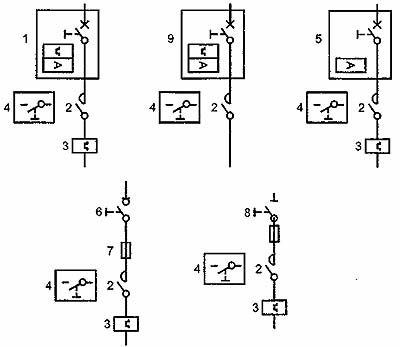
1 — автоматический выключатель; 2 — контактор; 3 — реле перегрузки; 4 — выключатель цепи управления; 5 — автоматический выключатель с одним только магнитным расцепителем; 6 — выключатель-разъединитель; 7 — плавкий предохранитель; 8 — разъединитель с плавким предохранителем; 9— автоматический выключатель с расцепителем перегрузки, соответствующим настоящему стандарту
1 Предусмотренная оболочка — это специально спроектированная и рассчитанная для данного применения оболочка, в которой проводят все испытания.
2 Коммутационный аппарат с ручным управлением и устройство защиты от коротких замыканий могут представлять собой единый аппарат и оснащаться дополнительно защитой от перегрузок.
[ ГОСТ Р 50030.4.1-2002 (МЭК 60947-4-1-2000)]EN
protected starter
equipment consisting of a starter, a manually-operated switching device and a short-circuit protective device, rated as a unit by the manufacturer
NOTE 1 The protected starter may or may not be enclosed.
NOTE 2 In the context of this standard, the term “manufacturer“ means any person, company or organization with ultimate responsibility as follows:
– to verify compliance with the appropriate standard;
– to provide the product information according to Clause 6.
NOTE 3 The manually operated switching device and the short-circuit protective device may be just one device and may also incorporate the starter overload protection.
[IEC 60947-4-1, ed. 3.0 (2009-09)]
combination starter
equipment consisting of a protected starter incorporating an isolating function
NOTE Also called "combination motor controller".
[IEC 60947-4-1, ed. 3.0 (2009-09)]FR
démarreur protégé
matériel comprenant un démarreur, un appareil de connexion à commande manuelle et un dispositif de protection contre les courts-circuits, caractérisé comme une unité par le fabricant
NOTE 1 Le démarreur protégé peut ou non être sous enveloppe.
NOTE 2 Dans le contexte de la présente norme, le terme «fabricant» signifie toute personne, entreprise ou organisation ayant la responsabilité ultime:
– de vérifier la conformité avec la norme appropriée;
– de fournir l’information sur le matériel selon l’Article 6.
NOTE 3 L'appareil de connexion à commande manuelle et le dispositif de protection contre les courts-circuits peuvent être seulement un appareil et peuvent également incorporer la protection contre les surcharges du démarreur.
[IEC 60947-4-1, ed. 3.0 (2009-09)]
combiné de démarrage
matériel comprenant un démarreur protégé incorporant une fonction de sectionnement
NOTE Également appelé «combiné contrôleur de moteur».
[IEC 60947-4-1, ed. 3.0 (2009-09)]Параллельные тексты EN-RU
Combination starter
Equipment consisting of a starter and a short-circuit protective device, mounted and wired in a dedicated enclosure. The switching and short-circuit protective devices may be a fuse combination unit, a switch with fuses or a circuit-breaker with or without an isolating function.
[ABB]Комбинированный пускатель
Комбинация пускателя и аппарата защиты от коротких замыканий, смонтированных и соединенных в предусмотренной для этого оболочке. Функции коммутационного аппарата и аппарата защиты от коротких замыканий могут выполнять комбинация с плавкими предохранителями, выключатель с плавкими предохранителями или автоматический выключатель, пригодный или непригодный для разъединения.
[Перевод Интент]Тематики
EN
FR
Англо-русский словарь нормативно-технической терминологии > protected starter
-
80 reliability of protection
надежность защиты
Вероятность выполнения защитой требуемой функции в заданных условиях в течение заданного интервала времени.
Примечание - Требуемой функцией для защиты является: срабатывать, когда предусмотрено срабатывание, и не срабатывать, когда срабатывание не предусмотрено.
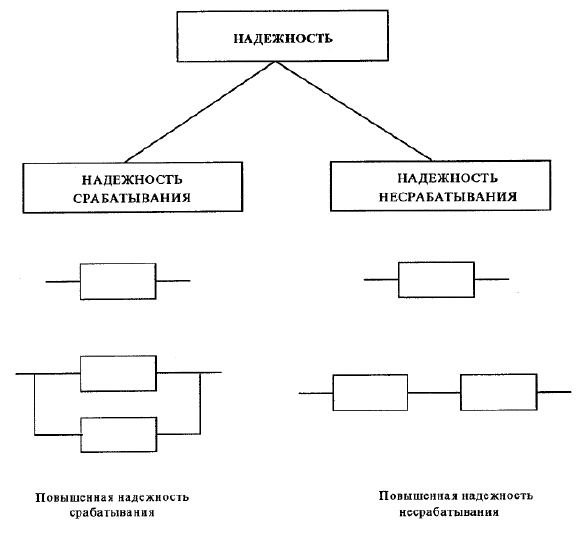
[Разработка типовых структурных схем микропроцессорных устройств РЗА на объектах ОАО "ФКС ЕЭС". Пояснительная записка. Новосибирск 2006 г.]EN
reliability of protection
reliability of relay system (US)
the probability that a protection can perform a required function under given conditions for a given time interval
Note – The required function for protection is to operate when required to do so and not to operate when not required to do so.
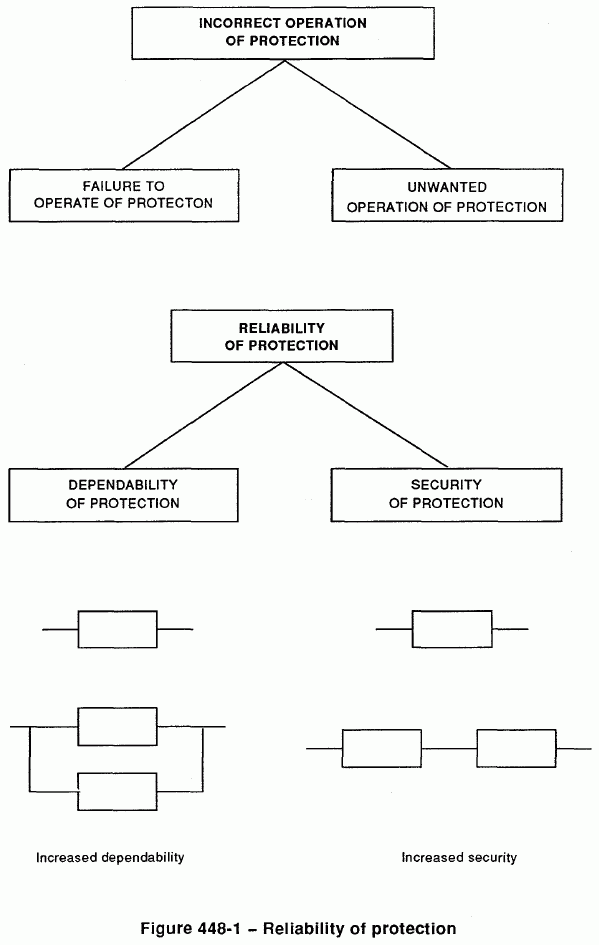
[IEV ref 448-12-05]FR
fiabilité d'une protection
probabilité pour qu'une protection puisse accomplir une fonction requise, dans des conditions données, pendant un intervalle de temps donné
Note – La fonction requise pour une protection est de fonctionner lorsqu'elle doit le faire et de ne pas fonctionner lorsqu'elle ne doit pas le faire.
[IEV ref 448-12-05]Тематики
EN
DE
- Überlebenswahrscheinlichkeit des Selektivschutzes, f
FR
Англо-русский словарь нормативно-технической терминологии > reliability of protection
См. также в других словарях:
NOT function — neigimo funkcija statusas T sritis automatika atitikmenys: angl. NOT function vok. NICHT Funktion, f rus. функция НЕ, f pranc. fonction barre, f; fonction de négation, f; fonction NON, f … Automatikos terminų žodynas
NOT function — noun A function that is equivalent to the NOT operator … Wiktionary
Alas the Madonna Does Not Function — Infobox Album Name = Alas the Madonna Does Not Function Type = ep Artist = Nurse with Wound Released = 1988 Recorded = Genre = Industrial Length = Label = Producer = Reviews = Last album = This album = Next album = Alas the Madonna Does Not… … Wikipedia
Function word — Function words (or grammatical words) are words that have little lexical meaning or have ambiguous meaning, but instead serve to express grammatical relationships with other words within a sentence, or specify the attitude or mood of the speaker … Wikipedia
function — 1 / fVN kSFn/ noun 1 (C) the purpose that something is made for, or the job that someone does: The function of a cash machine is to provide people with cash when the bank is shut. | perform a function: In your new job you will be expected to… … Longman dictionary of contemporary English
function — n 1 Function, office, duty, province are comparable when they mean the act, acts, activities, or operations expected of a person or thing by virtue of his or its nature, structure, status, or position. Function is the most comprehensive of these… … New Dictionary of Synonyms
function — function, functionalism Although the use of the concepts of function and functionalism is usually associated with the work of Talcott Parsons in modern sociology, there is a long tradition of functional explanation in studying societies, and a… … Dictionary of sociology
Function overloading — or method overloading is a feature found in various programming languages such as Ada, C#, VB.NET, C++, D and Java that allows the creation of several methods with the same name which differ from each other in terms of the type of the input and… … Wikipedia
function — 1. The noun has a number of technical meanings in mathematics and information technology, and has acquired general meanings that caused Fowler (1926) to categorize it as a popularized technicality. As a noun, it is often used somewhat… … Modern English usage
function — [fuŋk′shən] n. [OFr < L functio < pp. of fungi, to perform < IE base * bheug , to enjoy > Sans bhuṅktē, (he) enjoys] 1. the normal or characteristic action of anything; esp., any of the natural, specialized actions of a system, organ … English World dictionary
Function cost analysis — (FСА) (sometimes named function value analysis (FVA)) is the a method of technical and economic research of the systems for purpose to optimize a parity between system s (as product or service) consumer functions or properties (also known as… … Wikipedia
