

-
1 this is just an example of ...
• это лишь пример...English-Russian dictionary of phrases and cliches for a specialist researcher > this is just an example of ...
-
2 example
example [ɪg'zɑ:mpəl]1 noun(a) (illustration) exemple m;∎ can you give me an example? pouvez-vous me donner un exemple?;∎ to give just one example,… pour ne donner ou citer qu'un exemple,…;∎ this is an excellent example of what I meant ceci illustre parfaitement ce que je voulais dire;∎ it's a classic example of 1960s architecture c'est un exemple classique de l'architecture des années 60(b) (person or action to be imitated) exemple m, modèle m;∎ you're an example to us all vous êtes un modèle pour nous tous;∎ to follow sb's example suivre l'exemple de qn;∎ I followed your example and complained about the poor service j'ai fait comme vous et me suis plaint de la médiocrité du service;∎ following France's example, Britain has introduced sanctions à l'exemple ou à l'instar de la France, la Grande-Bretagne a pris des sanctions;∎ to set an example montrer l'exemple;∎ she sets us all an example elle nous montre l'exemple à tous;∎ to set a good/bad example montrer le bon/mauvais exemple;∎ you're setting your little brother a bad example tu montres le mauvais exemple à ton petit frère;∎ to hold sb up as an example citer qn en exemple∎ let this be an example to you que ça te serve d'exemple;∎ to make an example of sb punir qn pour l'exemplepar exemple;∎ large cities, (as) for example London les grandes villes, telles que Londres (par exemple) -
3 dead letter
«Мёртвая буква» — это словосочетание, обозначающее законы, правила или инструкции, которые ещё формально существуют, но не соблюдаются или не выполняются. Смертная казнь может по праву называться a dead letter в любой стране, т. к. это наказание остаётся в законодательном акте, хотя уже не применяется многие годы. Но этот термин не может относиться к тому, что просто вышло из моды (например, гусиные перья или паровые локомотивы), т. к. их существование не было закреплено ни указом, ни законом.It is still against the law to ride a bicycle on the pavement, but I have never heard of anyone being prosecuted for doing it. I suspect that this is just another example of a law that has become a dead letter. — Езда на велосипеде по тротуару всё ещё является противозаконной, но я никогда не слышал о том, чтобы кто-нибудь был наказан за это. Я подозреваю, что это стало ещё одним примером того, как закон остаётся только на бумаге.
-
4 business letter format
бизн. формат делового письма, формат служебного письма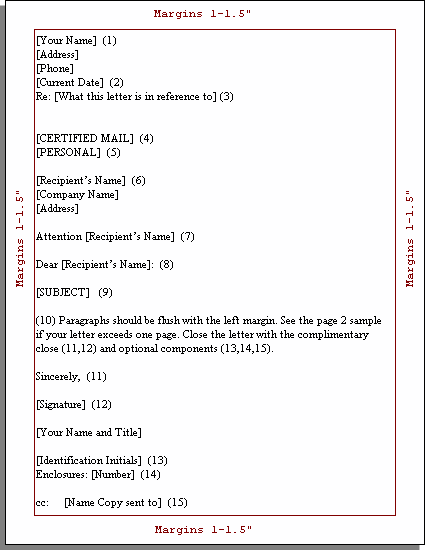 Комментарии к формату (см. рис.)If your stationery includes a letterhead, skip this block. Type your name and address along with other relevant contact information such as e-mail or fax number.If your stationery includes a letterhead, type the date from 2 to 6 lines under the letterhead. Otherwise type it under the return address.Use this block to identify what the letter is in regards to. Examples are: "Re: Invoice 12345" or "Re: Your letter dated January 15, 2010.".Always in caps. Examples include SPECIAL DELIVERY, CERTIFIED MAIL, AIRMAIL, VIA FACSIMILE.Notation on private correspondence if needed such as PERSONAL or CONFIDENTIAL. This goes just above the recipient.Type the name and address of the person and / or company. If you are using an attention line (block 7) then skip the person's name. Address the envelope similarly.Type the name of the personType the recipient's name. Use Mr. or Ms. [Last Name] to show respect, but don't try to guess spelling or gender if you are not sure. Some common salutations are: "Dear [Full Name]:", "To Whom it May Concern:".Type a short description on what the letter is about. If you used a reference line, then you likely do not need a subject line.Type two spaces between sentences.Completing the LetterIt depends on the tone and degree of formality as to what you write here. Can vary from the very formal "Respectfully yours" to the typical "Sincerely" to the friendly "Cordially yours".Leave four blank lines after the Complimentary Close (block 11) to sign your name. Type your name and (optional) title under that signature.If someone else has typed the letter for you, it is common for them to indicate so with initials. Typically it is your initials in upper case followed by the other initials in lower case. For example "BCT/gt". If you typed your own letter, skip this block.If you are including other things with the letter such as brochures, this line tells the reader how many to expect. Common styles include "Enclosures: 3".If you are distributing copies of the letter to others, indicate so using a copies block. the code "cc:" used to indicate carbon copies but now is commonly called courtesy copies.Don't type the brackets. The brackets [ ] in the examples are for narrative purposes only.Try to keep your letters to one page.Use letterhead only for the first page. Just use a blank sheet of paper for continuation pages.You have some freedom in how many blank lines to use between blocks and in the margin sizes in order to fit a letter onto a single page.Not all letters need every block identified in this article. If you leave one out, do not leave blank lines where the blocks would have been.
Англо-русский универсальный дополнительный практический переводческий словарь И. Мостицкого > business letter format
-
5 noun
------------------------------------------------------------[English Word] common noun[English Plural] common nouns[Swahili Word] nomino ya jumla[Swahili Plural] nomino za jumla[Part of Speech] noun[Class] 9/10[Derived Language] Latin[Derived Word] nomino[Related Words] jumla[English Definition] a noun that refers to any person, animal, place, thing, event or idea that is not specific[Swahili Definition] jina la jumla[Terminology] grammar------------------------------------------------------------[English Word] common noun[English Plural] common nouns[Swahili Word] nomino ya jamii[Swahili Plural] nomino za jamii[Part of Speech] noun[Class] 9/10[Derived Language] Latin[Derived Word] nomino[Related Words] jamii[English Definition] a noun that refers to any person, animal, place, thing, event or idea that is not specific[Swahili Definition] jina la jamii[Terminology] grammar------------------------------------------------------------[English Word] compound noun[English Plural] compound nouns[Swahili Word] nomino ambatani[Swahili Plural] nomino ambatani[Part of Speech] noun[Class] 9/10[Derived Language] Latin[Derived Word] nomino[Related Words] ambata[English Definition] a noun that is made up of two words[Swahili Definition] jina ambatani[English Example] just as it is for other compound nouns, these nouns have related adjectives: Simba Mla watu [Lion Eater (of) People] (that is a lion whose reputation is eating people)[Swahili Example] kama ilivyo kwa nomino ambatani nyingine, nomino hizi zina kivumishi husisho: Simba Mla watu (yaani simba ambaye sifa yake ni kula watu). http://www.njas.helsinki.fi/pdf-files/vol6num1/kabuta.pdf Ngo Semzara Kabuta, "Isimu-Ushairi: Muundo wa Majigambo", Nordic Journal of African Studies 6:1 (36-60), 1997.[Terminology] grammar------------------------------------------------------------[English Word] noun[English Plural] nouns[Swahili Word] jina[Swahili Plural] majina[Part of Speech] noun[Class] 5/6[Related Words] kijina[Terminology] grammar------------------------------------------------------------[English Word] noun[English Plural] nouns[Swahili Word] nomino[Swahili Plural] nomino[Part of Speech] noun[Class] 9/10[Derived Language] Latin[English Definition] person, animal, place, thing, event or idea[Swahili Definition] jina[English Example] morphologically the structure of Swahili nouns makes this pattern clear.[Swahili Example] kimofolojia muundo wa nomino za Kiswahili hudhihirisha ruwaza hii. [ http://research.yale.edu/swahili/software/Training/mochiwa.sdw Ukuzaji wa Istilahi][Terminology] grammar------------------------------------------------------------[English Word] noun class[English Plural] noun classes[Swahili Word] ngeli[Swahili Plural] ngeli[Part of Speech] noun[Class] 9/10------------------------------------------------------------[English Word] noun class[English Plural] noun class[Swahili Word] namna[Swahili Plural] namna[Part of Speech] noun[Class] 9/10[Terminology] grammar[Note] See G.W. Broomfield, Sarufi ya Kiswahili (London: Sheldon Press, 1931): 40-47.------------------------------------------------------------[English Word] plural noun[English Plural] plural nouns[Swahili Word] jina la wingi[Swahili Plural] majina ya wingi[Part of Speech] noun[Class] 5/6[Derived Language] Swahili[Derived Word] jina, ingi[Terminology] grammar------------------------------------------------------------[English Word] proper noun[English Plural] proper nouns[Swahili Word] nomino kamili[Swahili Plural] nomino kamili[Part of Speech] noun[Class] 9/10[Derived Language] Latin[Derived Word] nomino[Related Words] kamili[English Definition] a noun that names a particular person, animal, place, thing, event or idea[Swahili Definition] jina kamili[Terminology] grammar------------------------------------------------------------[English Word] proper noun[English Plural] proper nouns[Swahili Word] nomino ya pekee[Swahili Plural] nomino za pekee[Part of Speech] noun[Class] 9/10[Derived Language] Latin[Derived Word] nomino[Related Words] pekee[English Definition] a noun that names a particular person, animal, place, thing, event or idea[Swahili Definition] jina la pekee[Terminology] grammar------------------------------------------------------------[English Word] singular noun[English Plural] singular nouns[Swahili Word] jina la umoja[Swahili Plural] majina ya umoja[Part of Speech] noun[Class] 5/6[Derived Language] Swahili[Derived Word] jina, umoja[Terminology] grammar------------------------------------------------------------ -
6 use
1. III1) use smth. use tools (an kinds of instruments, a plow, weapons, a pen, a chair, dictionaries, etc.) пользоваться инструментами и т.д., использовать инструменты и т.д.; use queer words применять странные-слова, пользоваться странными словами; are you using this book? вы пользуетесь этой книгой?; вы работаете по этой книге?; are you using this knife? вам сейчас нужен этот нож?; use strong language (gross words) употреблять сильные выражения (грубые слова); may I use your piano (your telephone, your hammer, etc.)? можно мне воспользоваться вашим инструментом и т.д.?; use my house as if it were your own располагайтесь у меня как дома; use one's legs ходить пешком; use one's hands уметь что-л. делать собственными руками; use your ears! слушать надо!; use your eyes смотри лучше, раскрой глаза; use your brains /your wits/ подумай, пошевели мозгами; use one's strength (one's violence, one's force, one's disguise, one's artifice, one's trickery, one's fraud, etc.) прибегать к силе и т.д., применять силу и т.д.; use one's opportunities воспользоваться предоставившейся возможностью; use one's influence (one's authority, one's experience, etc.) использовать свое влияние и т.д.; воспользоваться своим влиянием и т.д.; you must use your skill ты должен пустить в ход [все] свое умение; use every (fair, etc.) means применять все и т.д. средства /приемы/; use facts (arguments) приводить факты (доводы /аргументы/); use more саге (patience, tact, etc.) действовать более осторожно и т.д.; use more diligence быть более старательным; use precautions принимать меры предосторожности; use moderation проявлять умеренность; use one's intelligence шевелить мозгами; use your discretion действуйте по собственному разумению; use smb. use a typist (one's friends, one's sister, the in laws, etc.) прибегать к помощи машинистки и т.д.; use the choicest troops бросать в бой отборные войска /части/2) use smth. use coal (a great deal of butter, most of the money, etc.) использовать /израсходовать/ уголь и т.д.; use margarine потреблять маргарин; he used tobacco all his life он всегда /всю жизнь/ курил3) use smb. use others as you would have them use you обращайтесь с другими /относитесь к другим/ так, как вы хотели бы, чтобы обращались с вами /относились к вам/2. IV1) use smth. in some manner use smth. regularly (habitually, freely, extensively, universally, deliberately, effectively, sensibly, economically, etc.) регулярно /постоянно/ и т.д. пользоваться чем-л. /использовать что-л./; we use the telephone widely мы широко пользуемся телефоном; this ticket cannot be useed again билет действителен только на одну поездку; use one's spare time well хорошо проводить или разумно использовать свободное время; he uses money wisely он разумно расходует /тратит/ деньги2) use smb. in some manner use smb. well (badly, ill, roughly, severely, cruelly, etc.) обходиться /обращаться/ с кем-л. хороню и т.д.3. VIIuse smth. to do smth. use a knife to cut the meat (peanut butter to make sandwiches, money to rebuild one's house, etc.) использовать нож [для того], чтобы разрезать мясо и т.д.; use some information to serve one's ends (smb.'s absence to poison everyone against him, etc.) воспользоваться информацией для достижения своих целей и т.д.4. XIbe used for smth. a knife was used for opening the door для того, чтобы открыть дверь, воспользовались ножом; oil was used for rubbing his chest ему растерли грудь маслом; castor oil used for medicine касторовое масло применяется в медицине; musk is used for perfumes мускус используется для производства духов; plants are used for food растения употребляются в пищу; what is this tool used for? для чего применяется этот инструмент?, что делают этим инструментом?; а jeep is а саг to be used for general purposes джип use [это] машина многоцелевого использования; "queer" is a word often used for "mad" слово "queer" часто употребляется вместо слова "mad"; be used on smb. clubs were used on the crowd против толпы были пущены в ход дубинки; be used in some manner be used (in)correctly (commonly, customarily, internally and externally, figuratively, etc.) (не)правильно и т.д. применяться /использоваться/; the word (this expression) is not used now /is no longer used/ это слово (выражение) вышло из употребления; these words are used interchangeably эти слова взаимозаменяемы5. XXI11) use smth. for smth. use the seal's fur for hats использовать мех морского котика на шапки /для шапок/; let's use this expression for an example [давайте] возьмем это выражение в качестве примера || use smth. to the best advantage использовать что-л. наилучшим образом; use a word (an expression) in the figurative sense использовать /употребить/ слово (выражение) в переносном смысле2) use smth. on /for/ smth. use paint on the gate (paste on the woodwork, yards and yards on just one dress, etc.) потратить /употребить/ краску на ворота и т.д.; they did not use enough paint on this fence они пожалели краски на забор; how many eggs has he used for this omelette? сколько яиц ушло у него на омлет?6. XXIV1use smth. as smth. use smb.'s home as headquarters (a newspaper as a table-cloth, a stone as a hammer, a root as food, etc.) использовать чей-л. дом в качестве штаба и т.д.; may I use your name as a reference? можно мне сослаться на вас? -
7 like
I
1.
adjective(the same or similar: They're as like as two peas.) parecido, igual
2. preposition(the same as or similar to; in the same or a similar way as: He climbs like a cat; She is like her mother.) como
3. noun(someone or something which is the same or as good etc as another: You won't see his like / their like again.) cosa igual
4. conjunction((especially American) in the same or a similar way as: No-one does it like he does.) como- likely- likelihood
- liken
- likeness
- likewise
- like-minded
- a likely story!
- as likely as not
- be like someone
- feel like
- he is likely to
- look like
- not likely!
II
verb1) (to be pleased with; to find pleasant or agreeable: I like him very much; I like the way you've decorated this room.) gustar2) (to enjoy: I like gardening.) gustar•- likeable- likable
- liking
- should/would like
- take a liking to
like1 prep como / igual quelike2 vb gustardo you like swimming? ¿te gusta nadar?tr[laɪk]1 (the same as) como■ what's the new boss like? ¿cómo es el nuevo jefe?2 (typical of) propio,-a de3 familiar como1 (such as) como2 formal use semejante, parecido,-a1 familiar (as it were) pues■ so I thought, like, what'll happen next? y yo pensé, pues, ¿qué pasará ahora?1 familiar como1 algo parecido\SMALLIDIOMATIC EXPRESSION/SMALLand the like y cosas así(as) like as not familiar seguramenteto be as like as two peas in a pod ser como dos gotas de agualike enough familiar seguramentelike father, like son de tal palo tal astillathat's more like it! familiar ¡eso está mejor!, ¡así me gusta!to look like somebody parecerse a alguiento look like something parecer algosomething like that algo así, algo por el estiloto be of like mind formal use ser del mismo parecerto feel like tener ganas de————————tr[laɪk]1 (enjoy) gustar■ how do you like Barcelona? ¿te gusta Barcelona?2 (want) querer, gustar■ would you like me to leave? ¿quieres que me vaya?■ how would you like your egg, boiled or fried? ¿cómo quieres el huevo, pasado por agua o frito?1 querer1 gustos nombre masculino plural\SMALLIDIOMATIC EXPRESSION/SMALLto like something better preferir algowhether you like it or not quieras o no (quieras), a la fuerza1) : agradar, gustarle (algo a uno)he likes rice: le gusta el arrozshe doesn't like flowers: a ella no le gustan las floresI like you: me caes bien2) want: querer, desearI'd like a hamburger: quiero una hamburguesahe would like more help: le gustaría tener más ayudalike vi: quererdo as you like: haz lo que quieraslike adj: parecido, semejante, similarlike n1) preference: preferencia f, gusto m2)the like : cosa f parecida, cosas fpl por el estiloI've never seen the like: nunca he visto cosa parecidalike conj1) as if: como sithey looked at me like I was crazy: se me quedaron mirando como si estuviera loca2) as: como, igual queshe doesn't love you like I do: ella no te quiere como yolike prep1) : como, parecido ashe acts like my mother: se comporta como mi madrehe looks like me: se parece a mí2) : propio de, típico dethat's just like her: eso es muy típico de ella3) : comoanimals like cows: animales como vacas4)like this, like that : asído it like that: hazlo asíadj.• parecido, -a adj.• parejo, -a adj.• semejante adj.• vecino, -a adj.adv.• como adv.• del mismo modo adv.n.• semejante s.m.v.• bienquerer v.(§pret: -quis-) fut/c: -querr-•)• gustar v.• querer v.(§pret: quis-) fut/c: querr-•)
I
1. laɪk1) (enjoy, be fond of)I/we like tennis — me/nos gusta el tenis
she likes him, but she doesn't love him — le resulta simpático pero no lo quiere
how do you like my dress? — ¿qué te parece mi vestido?
how would you like an ice-cream? — ¿quieres or (Esp tb) te apetece un helado?
I like it! — ( joke) muy bueno!; ( suggestion) buena idea!
I like that! — (iro) muy bonito! (iró), habráse visto!
do as o what you like — haz lo que quieras or lo que te parezca
to like -ING/to + INF: I like dancing me gusta bailar; she likes to have breakfast before eight le gusta desayunar antes de las ocho; I don't like to mention it, but... no me gusta (tener que) decírtelo pero...; to like somebody to + INF: we like him to write to us every so often — nos gusta que nos escriba de vez en cuando
2) (in requests, wishes) querer*would you like a cup of tea/me to help you? — ¿quieres una taza de té/que te ayude?
I'd like two melons, please — (me da) dos melones, por favor
2.
vi querer*if you like — si quieres, si te parece
II
1) ( something liked)her/his likes and dislikes — sus preferencias or gustos, lo que le gusta y no le gusta
2) (similar thing, person)the like: judges, lawyers and the like jueces, abogados y (otra) gente or (otras) personas por el estilo; I've never seen/heard the like (of this) nunca he visto/oído cosa igual; he doesn't mix with the likes of me/us — (colloq) no se codea con gente como yo/nosotros
III
adjective (dated or frml) parecido, similarpeople of like minds — gente f con ideas afines; pea
IV
1)a) ( similar to) comoshe's very like her mother — se parece mucho or es muy parecida a su madre
try this one - now, that's more like it! — prueba éste - ah, esto ya es otra cosa
come on, stop crying!... that's more like it! — vamos, para de llorar... ahí está! or así me gusta!
what's the food like? — ¿cómo or (fam) qué tal es la comida?
it cost £20, or something like that — costó 20 libras o algo así or o algo por el estilo
b) ( typical of)it's just like you to think of food — típico! or cuándo no! tú pensando en comida!
2) ( indicating manner)like this/that — así
3) (such as, for example) comodon't do anything silly, like running away — no vayas a hacer una tontería, como escaparte por ejemplo
V
conjunction (crit)a) ( as if)she looks like she knows what she's doing — parece que or da la impresión de que sabe lo que hace
b) (as, in same way) como
VI
a) ( likely)as like as not, she won't come — lo más probable es que no venga
b) ( nearly)this film is nothing like as good as the first — esta película no es tan buena como la primera ni mucho menos
I [laɪk]1.ADJ frm (=similar) parecido, semejantesnakes, lizards and like creatures — serpientes fpl, lagartos mpl y criaturas fpl parecidas or semejantes
he was very intolerant towards people not of a like mind — era muy intransigente con las personas que no le daban la razón
- they are as like as two peas2. PREP1) (=similar to) comowhat's he like? — ¿cómo es (él)?
you know what she's like — ya la conoces, ya sabes cómo es
what's Spain like? — ¿cómo es España?
what's the weather like? — ¿qué tiempo hace?
a house like mine — una casa como la mía, una casa parecida a la mía
I found one like it — encontré uno parecido or igual
we heard a noise like someone sneezing — nos pareció oír a alguien estornudar, oímos como un estornudo
•
I never saw anything like it — nunca he visto cosa igual or semejante•
what's he like as a teacher? — ¿qué tal es como profesor?•
to be like sth/sb — parecerse a algo/algn, ser parecido a algo/algnyou're so like your father — (in looks, character) te pareces mucho a tu padre, eres muy parecido a tu padre
•
it was more like a prison than a house — se parecía más a una cárcel que a una casawhy can't you be more like your sister? — ¿por qué no aprendes de tu hermana?
that's more like it! * — ¡así está mejor!, ¡así me gusta!
•
there's nothing like real silk — no hay nada como la seda natural•
something like that — algo así, algo por el estiloI was thinking of giving her something like a doll — pensaba en regalarle algo así como una muñeca, pensaba en regalarle una muñeca o algo por el estilo
they earn something like £50,000 a year — ganan alrededor de 50.000 libras al año
feel 2., 3), look 2., 4), smell 3., 1), sound I, 3., 2), a), taste 3.•
people like that can't be trusted — esa clase or ese tipo de gente no es de fiar2) (=typical of)isn't it just like him! — ¡no cambia!, ¡eso es típico de él!
(it's) just like you to grab the last cake! — ¡qué típico que tomes or (Sp) cojas tú el último pastelito!
3) (=similarly to) comolike me, he is fond of Brahms — igual que a mí, le gusta Brahms
•
just like anybody else — igual que cualquier otroit wasn't like that — no fue así, no ocurrió así
anything, crazy 1., 1), hell 1., 2), mad 1., 1), b)he got up and left, just like that — se levantó y se marchó, así, sin más
4) (=such as) comothe basic necessities of life, like food and drink — las necesidades básicas de la vida, como la comida y la bebida
3. ADV1) (=comparable)•
on company advice, well, orders, more like — siguiendo los consejos de la empresa, bueno, más bien sus órdenes•
it's nothing like as hot as it was yesterday — no hace tanto calor como ayer, ni mucho menos£500 will be nothing like enough — 500 libras no serán suficientes, ni mucho menos
2) (=likely)•
(as) like as not, they'll be down the pub (as) like as not — lo más probable es que estén en el bar4. CONJ*1) (=as) como- tell it like it is2) (=as if) como si5.Nwe shall not see his like again — frm, liter no volveremos a ver otro igual
•
the exchange was done on a like- for-like basis — el intercambio se hizo basándose en dos cosas parecidas•
did you ever see the like (of it)? — ¿has visto cosa igual?sparrows, starlings and the like or and such like — gorriones, estorninos y otras aves por el estilo
•
to compare like with like — comparar dos cosas semejantes
II [laɪk]1. VT1) (=find pleasant)I like dancing/football — me gusta bailar/el fútbol
which do you like best? — ¿cuál es el que más te gusta?
I like him — me cae bien or simpático
I don't like him at all — me resulta antipático, no me cae nada bien
I've come to like him — le he llegado a tomar or (Sp) coger cariño
don't you like me just a little bit? — ¿no me quieres un poquitín?
you know he likes you very much — sabes que te tiene mucho cariño or que te quiere mucho
•
I don't like the look of him — no me gusta su aspecto, no me gusta la pinta que tiene *•
I like your nerve! * — ¡qué frescura!, ¡qué cara tienes!•
well, I like that! * — iro ¡será posible!, ¡habráse visto!•
she is well liked here — aquí se la quiere mucho2) (=feel about)how do you like Cadiz? — ¿qué te parece Cádiz?
how do you like it here? — ¿qué te parece este sitio?
how would you like to go to the cinema? — ¿te apetece or (LAm) se te antoja ir al cine?
how would you like it if somebody did the same to you? — ¿cómo te sentirías si alguien te hiciera lo mismo?
how do you like that! I've been here five years and he doesn't know my name — ¡qué te parece!, llevo cinco años trabajando aquí y no sabe ni cómo me llamo
3) (=have a preference for)I like to know the facts before I form opinions — me gusta conocer los hechos antes de formarme una opinión
4) (=want)I didn't like to say no — no quise decir que no; (because embarrassed) me dio vergüenza decir que no
•
take as much as you like — toma or coge todo lo que quierashe thinks he can do as he likes — cree que puede hacer lo que quiera, cree que puede hacer lo que le de la gana *
•
whether he likes it or not — le guste o no (le guste), quiera o no (quiera)•
whenever you like — cuando quieras5)a) (specific request, offer, desire)would you like a drink? — ¿quieres tomar algo?
would you like me to wait? — ¿quiere que espere?
I'd or I would or frm I should like an explanation — quisiera una explicación, me gustaría que me dieran una explicación
I'd like to take this opportunity to thank you all — quisiera aprovechar esta oportunidad para darles las gracias a todos
I'd like the roast chicken, please — (me trae) el pollo asado, por favor
I'd like three pounds of tomatoes, please — (me da) tres libras de tomates, por favor
b) (wishes, preferences)I should like to have been there, I should have liked to be there — frm me hubiera gustado estar allí
2.VI querer•
as you like — como quieras•
"shall we go now?" - "if you like" — -¿nos vamos ya? -si quieres3.Nlikes gustos mplLIKEhe has distinct likes and dislikes where food is concerned — con respecto a la comida tiene claras preferencias or sabe muy bien lo que le gusta y lo que no (le gusta)
Verb
"Gustar" better avoided ► While gustar is one of the main ways of translating like, its use is not always appropriate. Used to refer to people, it may imply sexual attraction. Instead, use expressions like caer bien or parecer/ resultar simpático/ agradable. These expressions work like gustar and need an indirect object:
I like Francis very much Francis me cae muy bien or me parece muy simpático or agradable
She likes me, but that's all (A ella) le caigo bien, pero nada más
Like + verb ► Translate to like doing sth and to like to do sth using gustar + ((infinitive)):
Doctors don't like having to go out to visit patients at night A los médicos no les gusta tener que salir a visitar pacientes por la noche
My brother likes to rest after lunch A mi hermano le gusta descansar después de comer ► Translate to like sb doing sth and to like sb to do sth using gustar + que + ((subjunctive)):
My wife likes me to do the shopping A mi mujer le gusta que haga la compra
I don't like Irene living so far away No me gusta que Irene viva tan lejos
"How do you like...?" ► Use qué + parecer to translate how do/ did you like when asking someone's opinion:
How do you like this coat? ¿Qué te parece este abrigo?
How did you like the concert? ¿Qué te ha parecido el concierto? ► But use cómo + gustar when using how do you like more literally:
How do you like your steak? ¿Cómo le gusta la carne?
Would like ► When translating would like, use querer with requests and offers and gustar to talk about preferences and wishes:
Would you like a glass of water? ¿Quiere un vaso de agua?
What would you like me to do about the tickets? ¿Qué quieres que haga respecto a los billetes?
I'd very much like to go to Spain this summer Me gustaría mucho ir a España este verano Literal translations of I'd like are better avoided when making requests in shops and restaurants. Use expressions like the following:
I'd like steak and chips ¿Me pone un filete con patatas fritas?, (Yo) quiero un filete con patatas fritas For further uses and examples, see main entry* * *
I
1. [laɪk]1) (enjoy, be fond of)I/we like tennis — me/nos gusta el tenis
she likes him, but she doesn't love him — le resulta simpático pero no lo quiere
how do you like my dress? — ¿qué te parece mi vestido?
how would you like an ice-cream? — ¿quieres or (Esp tb) te apetece un helado?
I like it! — ( joke) muy bueno!; ( suggestion) buena idea!
I like that! — (iro) muy bonito! (iró), habráse visto!
do as o what you like — haz lo que quieras or lo que te parezca
to like -ING/to + INF: I like dancing me gusta bailar; she likes to have breakfast before eight le gusta desayunar antes de las ocho; I don't like to mention it, but... no me gusta (tener que) decírtelo pero...; to like somebody to + INF: we like him to write to us every so often — nos gusta que nos escriba de vez en cuando
2) (in requests, wishes) querer*would you like a cup of tea/me to help you? — ¿quieres una taza de té/que te ayude?
I'd like two melons, please — (me da) dos melones, por favor
2.
vi querer*if you like — si quieres, si te parece
II
1) ( something liked)her/his likes and dislikes — sus preferencias or gustos, lo que le gusta y no le gusta
2) (similar thing, person)the like: judges, lawyers and the like jueces, abogados y (otra) gente or (otras) personas por el estilo; I've never seen/heard the like (of this) nunca he visto/oído cosa igual; he doesn't mix with the likes of me/us — (colloq) no se codea con gente como yo/nosotros
III
adjective (dated or frml) parecido, similarpeople of like minds — gente f con ideas afines; pea
IV
1)a) ( similar to) comoshe's very like her mother — se parece mucho or es muy parecida a su madre
try this one - now, that's more like it! — prueba éste - ah, esto ya es otra cosa
come on, stop crying!... that's more like it! — vamos, para de llorar... ahí está! or así me gusta!
what's the food like? — ¿cómo or (fam) qué tal es la comida?
it cost £20, or something like that — costó 20 libras o algo así or o algo por el estilo
b) ( typical of)it's just like you to think of food — típico! or cuándo no! tú pensando en comida!
2) ( indicating manner)like this/that — así
3) (such as, for example) comodon't do anything silly, like running away — no vayas a hacer una tontería, como escaparte por ejemplo
V
conjunction (crit)a) ( as if)she looks like she knows what she's doing — parece que or da la impresión de que sabe lo que hace
b) (as, in same way) como
VI
a) ( likely)as like as not, she won't come — lo más probable es que no venga
b) ( nearly) -
8 like
I 1. adjective1) (resembling) wiein a case like that — in so einem Fall
there was nothing like it — es gab nichts Vergleichbares
what is somebody/something like? — wie ist jemand/etwas?
that's [a bit] more like it — (coll.): (better) das ist schon [etwas] besser; (coll.): (nearer the truth) das stimmt schon eher
they are nothing like each other — sie sind sich (Dat.) nicht im geringsten ähnlich
nothing like as or so good/bad/many etc. as... — bei weitem nicht so gut/schlecht/viele usw. wie...
2) (characteristic of) typisch für [dich, ihn usw.]it's just like you to be late! — du musst natürlich wieder zu spät kommen!
3) (similar) ähnlichbe as like as two peas in a pod — sich (Dat.) gleichen wie ein Ei dem andern
2. prepositionlike father, like son — (prov.) der Apfel fällt nicht weit vom Stamm (Spr.)
(in the manner of) wie3. conjunction[just] like that — [einfach] so
(coll.)1) (in same or similar manner as) wiehe is not shy like he used to be — er ist nicht mehr so schüchtern wie früher
2) (coll.): (for example) etwa; beispielsweise4. noun1) (equal)his/her like — seines-/ihresgleichen
II 1. transitive verbthe likes of me/you — (coll.) meines-/deinesgleichen
(be fond of, wish for) mögenlike it or not — ob es dir/ihm usw. gefällt oder nicht
like vegetables — Gemüse mögen; gern Gemüse essen
would you like a drink/to borrow the book? — möchtest du etwas trinken/dir das Buch leihen?
would you like me to do it? — möchtest du, dass ich es tue?
I'd like it back soon — ich hätte es gern bald zurück
I didn't like to disturb you — ich wollte dich nicht stören
I like that! — (iron.) so was hab' ich gern! (ugs. iron.)
2. noun, in pl.if you like — (expr. assent) wenn du willst od. möchtest; (expr. limited assent) wenn man so will
* * *I 1. adjective(the same or similar: They're as like as two peas.) wie2. preposition(the same as or similar to; in the same or a similar way as: He climbs like a cat; She is like her mother.) wie3. noun(someone or something which is the same or as good etc as another: You won't see his like / their like again.) der/die/das Gleiche4. conjunction((especially American) in the same or a similar way as: No-one does it like he does.) so wie- academic.ru/43012/likely">likely- likelihood
- liken
- likeness
- likewise
- like-minded
- a likely story! - as likely as not
- be like someone
- feel like
- he is likely to
- look like
- not likely! II verb1) (to be pleased with; to find pleasant or agreeable: I like him very much; I like the way you've decorated this room.) mögen2) (to enjoy: I like gardening.) mögen•- likeable- likable
- liking
- should/would like
- take a liking to* * *like1[laɪk]I. prep1. (similar to) wie\like most people wie die meisten Leute\like father, \like son wie der Vater, so der Sohnshe smokes \like a chimney sie raucht wie ein Schlot famwhat was your holiday \like? wie war dein Urlaub?what does it taste \like? wie schmeckt es?what's it \like to be a fisherman? wie ist das Leben als Fischer?you're acting \like a complete idiot! du benimmst dich wie ein Vollidiot!it feels \like ages since we last spoke ich habe das Gefühl, wir haben schon ewig nicht mehr miteinander gesprochenhe looks \like his brother er sieht seinem Bruder ähnlichhe's going to grow big \like his father er wird so groß wie sein Vater werdenhe's been looking for someone \like her er hat so jemanden wie sie gesuchtshe looked nothing \like the Queen sie sah überhaupt nicht wie die Queen aushe's nothing \like as fat as his father er ist noch lange nicht so dick wie sein Vaterthere were nothing \like enough people dort waren viel zu wenig Leutethere's nothing \like a good cup of coffee es geht doch nichts über eine gute Tasse Kaffeeor something \like that oder etwas in der Richtungjust \like sb/sth genau wie jd/etwthat's just \like him! das sieht ihm ähnlich!you've already got a shirt that's just \like it? du hast genau dasselbe Hemd schon einmal?▪ to be \like sb/sth wie jd/etw seinwhat colour did you want? — is it anything \like this? welche Farbe wollten Sie? — ungefähr wie diese hier?2. (such as) wienatural materials \like cotton and wool Naturstoffe wie Baumwolle oder Schafwollewhy are you talking to me \like that? warum sprichst du so mit mir?3. (normal for)▪ to be \like/not be \like sb to do sth:that's just \like Patricia to be late! das sieht Patricia wieder ähnlich, zu spät zu kommen!4.▶ it looks \like rain/snow es sieht nach Regen/Schnee aus▶ that's more \like it! das ist schon besser!1. (the same as) wie\like I said wie ich schon sagtedo it \like I do mach es so wie ichlet's go swimming in the lake \like we used to lass uns im See schwimmen gehen wie früher2. (as if) als obit sounds to me \like you ought to change jobs das hört sich für mich so an, als solltest du den Job wechselnyou look \like you've just got out of bed du siehst aus, als wärst du gerade aufgestandenit looks \like it's going to rain es sieht nach Regen ausshe acts \like she's the boss sie tut so, als sei sie die Chefinhe spoke \like he was foreign er sprach, als wäre er ein AusländerIII. nI have not seen his \like for many years [so] jemanden wie ihn habe ich schon seit vielen Jahren nicht mehr gesehenhave you ever seen the \like? hast du so was schon gesehen?I don't like politicians and their \like ich kann Politiker und dergleichen nicht ausstehen; ( fam)you'll never be able to go out with the \likes of him! mit so einem wie ihm wirst du nie ausgehen!in \like manner auf gleiche Weise, gleichermaßento be of [a] \like mind gleicher Meinung seinit was kind of funny \like es war irgendwie schon komisch, neif there's nothing you can do to change the situation, it's \like... why bother? also, warum sich aufregen, wenn man die Situation sowieso nicht ändern kann? fameverybody called her Annie and my mom was \like “it's Anne” alle sagten zu ihr Annie, aber meine Mutter meinte: „sie heißt Anne!“I was like, “what are you guys doing here?” ich sagte nur, „was macht ihr hier eigentlich?“he was \like, totally off his rocker er stand völlig neben sich fam, er war so total neben der Kappe BRD sl4.to do sth [as] \like as not etw sehr wahrscheinlich tunlike2[laɪk]I. vt1. (enjoy)▪ to \like sb/sth jdn/etw mögenhow do you \like my new shoes? wie gefallen dir meine neuen Schuhe?I \like it when... ich hab's gern [o mag es], wenn...I \like the way he just assumes we'll listen to him when he doesn't take in a word anyone else says! das hab ich ja vielleicht gern! — wir sollen ihm zuhören, aber was andere sagen, das geht ihm zum einen Ohr rein und zum anderen wieder rausI \like that! na, das hab ich gern! iron2. (want)wether you like it or not ob es dir passt oder nicht, ob du willst oder nicht▪ sb would/should \like sth jd hätte gerne etwwould you \like a drink? möchten Sie etwas trinken?▪ sb would/should \like to do sth jd möchte etw tun [o hätte gern[e] etw getan]I should really \like to see you again ich möchte dich wirklich gern[e] wiedersehenI'd \like to go to Moscow for my holidays ich würde gern[e] nach Moskau in Urlaub fahrenwould you \like to join us for dinner tonight? möchten Sie heute Abend mit uns essen?I'd \like to see him bring up children and go to work at the same time ich möchte wirklich [ein]mal sehen, wie er das machen würde — die Kinder großziehen und dann auch noch zur Arbeit gehenyou can drink a pint in two seconds? I'd \like to see that! du kannst einen halben Liter in zwei Sekunden austrinken? na, das möchte ich [doch mal] sehen!▪ sb would/should \like sb to do sth jd möchte, dass jd etw tutI'd \like you to send this for me first class könnten Sie das als Sonderzustellung für mich verschicken?would you \like me to take you in the car? kann ich Sie ein Stück mitnehmen?▪ sb would/should \like sth done jd möchte, dass etw getan wirdI would \like the whole lot finished by the weekend ich hätte das Ganze gern[e] bis zum Wochenende fertig3. (prefer)he \likes his steak rare er isst sein Steak gern englischhow do you \like your tea? wie magst du deinen Tee?/wie trinken Sie Ihren Tee?I \like to get up early ich stehe gerne früh aufshe \likes her men big sie mag [lieber] große Männer4. (feel)how would you \like to have a big boy pull your hair? wie würde es dir denn gefallen, wenn ein großer Junge dich am Haar ziehen würde?II. vias you \like wie Sie wollen [o möchten]you can do as you \like du kannst machen was du möchtestif you \like wenn Sie wollen [o möchten]we can leave now if you \like wir können jetzt gehen, wenn du möchtestIII. n▪ \likes pl Neigungen plsb's \likes and dislikes jds Vorlieben [o Neigungen] und Abneigungen* * *I [laɪk]1. adj1) (= similar) ähnlichthe two boys are very like — die beiden Jungen sind sich (dat) sehr ähnlich
2)(= same)
of like origin — gleicher Herkunft2. prepwiethey are very like each other — sie sind sich (dat) sehr ähnlich
to look like sb —
who(m) is he like? — wem sieht er ähnlich?, wem gleicht er?
he's just bought a new car - what is it like? —
that's just like him! — das sieht ihm ähnlich!, das ist typisch!
I never saw anything like it — so ( et)was habe ich noch nie gesehen
it's on company advice - orders, more like (inf) — es ist auf Anraten der Firma - besser gesagt auf Anordnung
is this what you had in mind? – it's something/nothing like it —
that's something like a steak! — das ist vielleicht ein Steak!, das nenne ich ein Steak!
a car like that — so ein Auto, ein solches Auto
one exactly like it — eines, das genau gleich ist
it will cost something like £10 — es wird etwa or so ungefähr £ 10 kosten
I was thinking of something like a doll — ich habe an so etwas wie eine Puppe gedacht
like anything (inf) — wie verrückt (inf) or wild (inf)
like that — so
he thinks like us —
A, like B, thinks that... — A wie (auch) B meinen, dass...
3. adv (inf)(as) like as not, very like, like enough — höchstwahrscheinlich, sehr wahrscheinlich
I found this money, like (dial) — ich hab da das Geld gefunden, nich (sl) or wa (dial) or gell (S Ger)
4. conj (strictly incorrect)like I said — wie ich schon sagte, wie gesagt
it's just like I say — das sage ich ja immer
do it like I do — mach es so wie ich
5. n(= equal etc)we shall not see his like again — einen Mann or so etwas (inf) wie ihn bekommen wir nicht wieder
IIand the like, and such like — und dergleichen
1. n usu pl(= taste) Geschmack mshe tried to find out his likes and dislikes — sie wollte herausbekommen, was er mochte und was nicht
2. vt1) person mögen, gernhabenI don't like him — ich kann ihn nicht leiden, ich mag ihn nicht
2)(= find pleasure in)
I like black shoes — ich mag schwarze Schuhe, mir gefallen schwarze SchuheI like chocolate — ich mag Schokolade, ich esse gern Schokolade
that's one of the things I like about you — das ist eines der Dinge, die ich an dir mag
I like wine but wine doesn't like me (inf) — ich trinke gern Wein, aber er bekommt mir nicht
how would you like a black eye? —
well, I like that! (inf) — das ist ein starkes Stück! (inf)
(well) how do you like that? (inf) — wie findest du denn das? (inf)
3)I should like to know why — ich wüsste (gerne), warum
I should like you to do it — ich möchte, dass du es tust
whether he likes it or not — ob es ihm passt oder nicht, ob er will oder nicht
what would you like? — was hätten or möchten Sie gern?, was darf es sein?
would you like a drink? —
I would like to take this opportunity to welcome Dr Allan — ich möchte diese Gelegenheit ergreifen, um Dr. Allan willkommen zu heißen
3. vihe is free to act as he likes — es steht ihm frei, zu tun, was er will
* * *like1 [laık]A adj1. gleich (dat), wie:she is just like her sister sie ist geradeso wie ihre Schwester;a man like you ein Mann wie du;what is he like? wie ist er?;he is like that er ist nun einmal so;he was not like that before so war er doch früher nicht;what does it look like? wie sieht es aus?;what will the weather be like tomorrow? wie wird das Wetter morgen?;a fool like that ein derartiger oder so ein Dummkopf;he felt like a criminal er kam sich wie ein Verbrecher vor;that’s more like it umg das lässt sich (schon) eher hören; → master A 5 c, nothing C und Bes Redew, something B 12. ähnlich (dat), bezeichnend für:that is just like him! das sieht ihm ähnlich!;that’s not like him das ist nicht seine Art4. gleich (Betrag etc):a) auf gleiche Weise,b) gleichermaßen;of like mind gleich gesinnt;like signs MATH gleiche Vorzeichen;like terms MATH gleichnamige Glieder;like unto his brethren BIBEL seinen Brüdern gleich5. ähnlich:he is very much like his father er sieht seinem Vater sehr ähnlich;they are (as) like as two eggs, they are (as) like as two peas (in a pod) sie gleichen sich wie ein Ei dem anderen, sie sehen sich zum Verwechseln ähnlich6. ähnlich, gleichartig, derartig:… and other like problems … und andere derartige Probleme7. umg wahrscheinlichB präp (siehe auch adv und adv, die oft wie eine präp gebraucht werden) wie:do not shout like that schrei nicht so;a thing like that so etwasC adv (siehe auch präp)1. (so) wie:like every teacher he has … so wie jeder Lehrer hat auch er …;I cannot play like you (do) ich kann nicht so gut spielen wie du2. umg wahrscheinlich:like enough, as like as not, very like höchstwahrscheinlich, sehr wahrscheinlich3. sl irgendwie, merkwürdig, ziemlich4. obs so:like as so wieD konj1. umg wie, (eben)so wie2. dial als ob:his like seinesgleichen;did you ever see the like(s) of that girl? hast du jemals so etwas wie dieses Mädchen gesehen?;the likes of me umg meinesgleichen, unsereiner, Leute wie ich;like attracts like gleich und gleich gesellt sich gern;the like dergleichen;peas, beans, and the like Erbsen, Bohnen und dergleichen;cocoa or the like Kakao oder so etwas (Ähnliches);like2 [laık]A v/t gernhaben, (gern) mögen, (gut) leiden können, gern tun, essen, trinken etc:I don’t like it when … ich mag es nicht, wenn …;I like him ich mag ihn gern, ich kann ihn gut leiden, er ist mir sympathisch;how do you like it? wie gefällt es dir?, wie findest du es?;how do you like London? wie gefällt es dir in London?;what I like about him is … was ich an ihm mag, ist …;do you like oysters? mögen Sie Austern (gern)?;I should much like to come ich würde sehr gern kommen;what do you like better? was hast du lieber?, was gefällt dir besser?;I do not like such things discussed ich habe es nicht gern, dass solche Dinge erörtert werden;he doesn’t like to be kept waiting er hat es nicht gern, wenn man ihn warten lässt;I like whisky, but it does not like me umg ich trinke gern Whisky, aber er bekommt mir nicht;(much) liked (sehr) beliebtB v/i1. wollen:as often as I liked sooft ich wollte;(just) as you like (ganz) wie du willst, (ganz) nach Belieben;do as you like mach, was du willst;a) wenn du willst,b) wenn Sie so wollen;I am stupid if you like but ich bin vielleicht dumm, aber2. obs gefallen3. obs gedeihenC s Neigung f, Vorliebe f:likes and dislikes Neigungen und Abneigungen;I know his likes and dislikes ich weiß, was er mag und was nicht* * *I 1. adjective1) (resembling) wiewhat is somebody/something like? — wie ist jemand/etwas?
that's [a bit] more like it — (coll.): (better) das ist schon [etwas] besser; (coll.): (nearer the truth) das stimmt schon eher
they are nothing like each other — sie sind sich (Dat.) nicht im geringsten ähnlich
nothing like as or so good/bad/many etc. as... — bei weitem nicht so gut/schlecht/viele usw. wie...
2) (characteristic of) typisch für [dich, ihn usw.]3) (similar) ähnlichbe as like as two peas in a pod — sich (Dat.) gleichen wie ein Ei dem andern
2. prepositionlike father, like son — (prov.) der Apfel fällt nicht weit vom Stamm (Spr.)
3. conjunction[just] like that — [einfach] so
(coll.)2) (coll.): (for example) etwa; beispielsweise4. noun1) (equal)his/her like — seines-/ihresgleichen
II 1. transitive verbthe likes of me/you — (coll.) meines-/deinesgleichen
(be fond of, wish for) mögenlike it or not — ob es dir/ihm usw. gefällt oder nicht
like vegetables — Gemüse mögen; gern Gemüse essen
would you like a drink/to borrow the book? — möchtest du etwas trinken/dir das Buch leihen?
would you like me to do it? — möchtest du, dass ich es tue?
I like that! — (iron.) so was hab' ich gern! (ugs. iron.)
2. noun, in pl.if you like — (expr. assent) wenn du willst od. möchtest; (expr. limited assent) wenn man so will
* * *(Poles, electricity) adj.gleichnamig (Pole) adj. adj.gernhaben adj.gleich adj.wie adv.ähnlich adj. v.gernhaben v.lieben v.mögen v.(§ p.,pp.: mochte, gemocht) -
9 modular data center
модульный центр обработки данных (ЦОД)
-
[Интент]Параллельные тексты EN-RU
[ http://dcnt.ru/?p=9299#more-9299]
Data Centers are a hot topic these days. No matter where you look, this once obscure aspect of infrastructure is getting a lot of attention. For years, there have been cost pressures on IT operations and this, when the need for modern capacity is greater than ever, has thrust data centers into the spotlight. Server and rack density continues to rise, placing DC professionals and businesses in tighter and tougher situations while they struggle to manage their IT environments. And now hyper-scale cloud infrastructure is taking traditional technologies to limits never explored before and focusing the imagination of the IT industry on new possibilities.
В настоящее время центры обработки данных являются широко обсуждаемой темой. Куда ни посмотришь, этот некогда малоизвестный аспект инфраструктуры привлекает все больше внимания. Годами ИТ-отделы испытывали нехватку средств и это выдвинуло ЦОДы в центр внимания, в то время, когда необходимость в современных ЦОДах стала как никогда высокой. Плотность серверов и стоек продолжают расти, все больше усложняя ситуацию для специалистов в области охлаждения и организаций в их попытках управлять своими ИТ-средами. И теперь гипермасштабируемая облачная инфраструктура подвергает традиционные технологии невиданным ранее нагрузкам, и заставляет ИТ-индустрию искать новые возможности.
At Microsoft, we have focused a lot of thought and research around how to best operate and maintain our global infrastructure and we want to share those learnings. While obviously there are some aspects that we keep to ourselves, we have shared how we operate facilities daily, our technologies and methodologies, and, most importantly, how we monitor and manage our facilities. Whether it’s speaking at industry events, inviting customers to our “Microsoft data center conferences” held in our data centers, or through other media like blogging and white papers, we believe sharing best practices is paramount and will drive the industry forward. So in that vein, we have some interesting news to share.
В компании MicroSoft уделяют большое внимание изучению наилучших методов эксплуатации и технического обслуживания своей глобальной инфраструктуры и делятся результатами своих исследований. И хотя мы, конечно, не раскрываем некоторые аспекты своих исследований, мы делимся повседневным опытом эксплуатации дата-центров, своими технологиями и методологиями и, что важнее всего, методами контроля и управления своими объектами. Будь то доклады на отраслевых событиях, приглашение клиентов на наши конференции, которые посвящены центрам обработки данных MicroSoft, и проводятся в этих самых дата-центрах, или использование других средств, например, блоги и спецификации, мы уверены, что обмен передовым опытом имеет первостепенное значение и будет продвигать отрасль вперед.
Today we are sharing our Generation 4 Modular Data Center plan. This is our vision and will be the foundation of our cloud data center infrastructure in the next five years. We believe it is one of the most revolutionary changes to happen to data centers in the last 30 years. Joining me, in writing this blog are Daniel Costello, my director of Data Center Research and Engineering and Christian Belady, principal power and cooling architect. I feel their voices will add significant value to driving understanding around the many benefits included in this new design paradigm.
Сейчас мы хотим поделиться своим планом модульного дата-центра четвертого поколения. Это наше видение и оно будет основанием для инфраструктуры наших облачных дата-центров в ближайшие пять лет. Мы считаем, что это одно из самых революционных изменений в дата-центрах за последние 30 лет. Вместе со мной в написании этого блога участвовали Дэниел Костелло, директор по исследованиям и инжинирингу дата-центров, и Кристиан Белади, главный архитектор систем энергоснабжения и охлаждения. Мне кажется, что их авторитет придаст больше веса большому количеству преимуществ, включенных в эту новую парадигму проектирования.
Our “Gen 4” modular data centers will take the flexibility of containerized servers—like those in our Chicago data center—and apply it across the entire facility. So what do we mean by modular? Think of it like “building blocks”, where the data center will be composed of modular units of prefabricated mechanical, electrical, security components, etc., in addition to containerized servers.
Was there a key driver for the Generation 4 Data Center?Наши модульные дата-центры “Gen 4” будут гибкими с контейнерами серверов – как серверы в нашем чикагском дата-центре. И гибкость будет применяться ко всему ЦОД. Итак, что мы подразумеваем под модульностью? Мы думаем о ней как о “строительных блоках”, где дата-центр будет состоять из модульных блоков изготовленных в заводских условиях электрических систем и систем охлаждения, а также систем безопасности и т.п., в дополнение к контейнеризованным серверам.
Был ли ключевой стимул для разработки дата-центра четвертого поколения?
If we were to summarize the promise of our Gen 4 design into a single sentence it would be something like this: “A highly modular, scalable, efficient, just-in-time data center capacity program that can be delivered anywhere in the world very quickly and cheaply, while allowing for continued growth as required.” Sounds too good to be true, doesn’t it? Well, keep in mind that these concepts have been in initial development and prototyping for over a year and are based on cumulative knowledge of previous facility generations and the advances we have made since we began our investments in earnest on this new design.Если бы нам нужно было обобщить достоинства нашего проекта Gen 4 в одном предложении, это выглядело бы следующим образом: “Центр обработки данных с высоким уровнем модульности, расширяемости, и энергетической эффективности, а также возможностью постоянного расширения, в случае необходимости, который можно очень быстро и дешево развертывать в любом месте мира”. Звучит слишком хорошо для того чтобы быть правдой, не так ли? Ну, не забывайте, что эти концепции находились в процессе начальной разработки и создания опытного образца в течение более одного года и основываются на опыте, накопленном в ходе развития предыдущих поколений ЦОД, а также успехах, сделанных нами со времени, когда мы начали вкладывать серьезные средства в этот новый проект.
One of the biggest challenges we’ve had at Microsoft is something Mike likes to call the ‘Goldilock’s Problem’. In a nutshell, the problem can be stated as:
The worst thing we can do in delivering facilities for the business is not have enough capacity online, thus limiting the growth of our products and services.Одну из самых больших проблем, с которыми приходилось сталкиваться Майкрософт, Майк любит называть ‘Проблемой Лютика’. Вкратце, эту проблему можно выразить следующим образом:
Самое худшее, что может быть при строительстве ЦОД для бизнеса, это не располагать достаточными производственными мощностями, и тем самым ограничивать рост наших продуктов и сервисов.The second worst thing we can do in delivering facilities for the business is to have too much capacity online.
А вторым самым худшим моментом в этой сфере может слишком большое количество производственных мощностей.
This has led to a focus on smart, intelligent growth for the business — refining our overall demand picture. It can’t be too hot. It can’t be too cold. It has to be ‘Just Right!’ The capital dollars of investment are too large to make without long term planning. As we struggled to master these interesting challenges, we had to ensure that our technological plan also included solutions for the business and operational challenges we faced as well.
So let’s take a high level look at our Generation 4 designЭто заставило нас сосредоточиваться на интеллектуальном росте для бизнеса — refining our overall demand picture. Это не должно быть слишком горячим. И это не должно быть слишком холодным. Это должно быть ‘как раз, таким как надо!’ Нельзя делать такие большие капиталовложения без долгосрочного планирования. Пока мы старались решить эти интересные проблемы, мы должны были гарантировать, что наш технологический план будет также включать решения для коммерческих и эксплуатационных проблем, с которыми нам также приходилось сталкиваться.
Давайте рассмотрим наш проект дата-центра четвертого поколенияAre you ready for some great visuals? Check out this video at Soapbox. Click here for the Microsoft 4th Gen Video.
It’s a concept video that came out of my Data Center Research and Engineering team, under Daniel Costello, that will give you a view into what we think is the future.
From a configuration, construct-ability and time to market perspective, our primary goals and objectives are to modularize the whole data center. Not just the server side (like the Chicago facility), but the mechanical and electrical space as well. This means using the same kind of parts in pre-manufactured modules, the ability to use containers, skids, or rack-based deployments and the ability to tailor the Redundancy and Reliability requirements to the application at a very specific level.
Посмотрите это видео, перейдите по ссылке для просмотра видео о Microsoft 4th Gen:
Это концептуальное видео, созданное командой отдела Data Center Research and Engineering, возглавляемого Дэниелом Костелло, которое даст вам наше представление о будущем.
С точки зрения конфигурации, строительной технологичности и времени вывода на рынок, нашими главными целями и задачами агрегатирование всего дата-центра. Не только серверную часть, как дата-центр в Чикаго, но также системы охлаждения и электрические системы. Это означает применение деталей одного типа в сборных модулях, возможность использования контейнеров, салазок, или стоечных систем, а также возможность подстраивать требования избыточности и надежности для данного приложения на очень специфичном уровне.Our goals from a cost perspective were simple in concept but tough to deliver. First and foremost, we had to reduce the capital cost per critical Mega Watt by the class of use. Some applications can run with N-level redundancy in the infrastructure, others require a little more infrastructure for support. These different classes of infrastructure requirements meant that optimizing for all cost classes was paramount. At Microsoft, we are not a one trick pony and have many Online products and services (240+) that require different levels of operational support. We understand that and ensured that we addressed it in our design which will allow us to reduce capital costs by 20%-40% or greater depending upon class.
Нашими целями в области затрат были концептуально простыми, но трудно реализуемыми. В первую очередь мы должны были снизить капитальные затраты в пересчете на один мегаватт, в зависимости от класса резервирования. Некоторые приложения могут вполне работать на базе инфраструктуры с резервированием на уровне N, то есть без резервирования, а для работы других приложений требуется больше инфраструктуры. Эти разные классы требований инфраструктуры подразумевали, что оптимизация всех классов затрат имеет преобладающее значение. В Майкрософт мы не ограничиваемся одним решением и располагаем большим количеством интерактивных продуктов и сервисов (240+), которым требуются разные уровни эксплуатационной поддержки. Мы понимаем это, и учитываем это в своем проекте, который позволит нам сокращать капитальные затраты на 20%-40% или более в зависимости от класса.For example, non-critical or geo redundant applications have low hardware reliability requirements on a location basis. As a result, Gen 4 can be configured to provide stripped down, low-cost infrastructure with little or no redundancy and/or temperature control. Let’s say an Online service team decides that due to the dramatically lower cost, they will simply use uncontrolled outside air with temperatures ranging 10-35 C and 20-80% RH. The reality is we are already spec-ing this for all of our servers today and working with server vendors to broaden that range even further as Gen 4 becomes a reality. For this class of infrastructure, we eliminate generators, chillers, UPSs, and possibly lower costs relative to traditional infrastructure.
Например, некритичные или гео-избыточные системы имеют низкие требования к аппаратной надежности на основе местоположения. В результате этого, Gen 4 можно конфигурировать для упрощенной, недорогой инфраструктуры с низким уровнем (или вообще без резервирования) резервирования и / или температурного контроля. Скажем, команда интерактивного сервиса решает, что, в связи с намного меньшими затратами, они будут просто использовать некондиционированный наружный воздух с температурой 10-35°C и влажностью 20-80% RH. В реальности мы уже сегодня предъявляем эти требования к своим серверам и работаем с поставщиками серверов над еще большим расширением диапазона температур, так как наш модуль и подход Gen 4 становится реальностью. Для подобного класса инфраструктуры мы удаляем генераторы, чиллеры, ИБП, и, возможно, будем предлагать более низкие затраты, по сравнению с традиционной инфраструктурой.
Applications that demand higher level of redundancy or temperature control will use configurations of Gen 4 to meet those needs, however, they will also cost more (but still less than traditional data centers). We see this cost difference driving engineering behavioral change in that we predict more applications will drive towards Geo redundancy to lower costs.
Системы, которым требуется более высокий уровень резервирования или температурного контроля, будут использовать конфигурации Gen 4, отвечающие этим требованиям, однако, они будут также стоить больше. Но все равно они будут стоить меньше, чем традиционные дата-центры. Мы предвидим, что эти различия в затратах будут вызывать изменения в методах инжиниринга, и по нашим прогнозам, это будет выражаться в переходе все большего числа систем на гео-избыточность и меньшие затраты.
Another cool thing about Gen 4 is that it allows us to deploy capacity when our demand dictates it. Once finalized, we will no longer need to make large upfront investments. Imagine driving capital costs more closely in-line with actual demand, thus greatly reducing time-to-market and adding the capacity Online inherent in the design. Also reduced is the amount of construction labor required to put these “building blocks” together. Since the entire platform requires pre-manufacture of its core components, on-site construction costs are lowered. This allows us to maximize our return on invested capital.
Еще одно достоинство Gen 4 состоит в том, что он позволяет нам разворачивать дополнительные мощности, когда нам это необходимо. Как только мы закончим проект, нам больше не нужно будет делать большие начальные капиталовложения. Представьте себе возможность более точного согласования капитальных затрат с реальными требованиями, и тем самым значительного снижения времени вывода на рынок и интерактивного добавления мощностей, предусматриваемого проектом. Также снижен объем строительных работ, требуемых для сборки этих “строительных блоков”. Поскольку вся платформа требует предварительного изготовления ее базовых компонентов, затраты на сборку также снижены. Это позволит нам увеличить до максимума окупаемость своих капиталовложений.
Мы все подвергаем сомнениюIn our design process, we questioned everything. You may notice there is no roof and some might be uncomfortable with this. We explored the need of one and throughout our research we got some surprising (positive) results that showed one wasn’t needed.
В своем процессе проектирования мы все подвергаем сомнению. Вы, наверное, обратили внимание на отсутствие крыши, и некоторым специалистам это могло не понравиться. Мы изучили необходимость в крыше и в ходе своих исследований получили удивительные результаты, которые показали, что крыша не нужна.
Серийное производство дата центров
In short, we are striving to bring Henry Ford’s Model T factory to the data center. http://en.wikipedia.org/wiki/Henry_Ford#Model_T. Gen 4 will move data centers from a custom design and build model to a commoditized manufacturing approach. We intend to have our components built in factories and then assemble them in one location (the data center site) very quickly. Think about how a computer, car or plane is built today. Components are manufactured by different companies all over the world to a predefined spec and then integrated in one location based on demands and feature requirements. And just like Henry Ford’s assembly line drove the cost of building and the time-to-market down dramatically for the automobile industry, we expect Gen 4 to do the same for data centers. Everything will be pre-manufactured and assembled on the pad.Мы хотим применить модель автомобильной фабрики Генри Форда к дата-центру. Проект Gen 4 будет способствовать переходу от модели специализированного проектирования и строительства к товарно-производственному, серийному подходу. Мы намерены изготавливать свои компоненты на заводах, а затем очень быстро собирать их в одном месте, в месте строительства дата-центра. Подумайте о том, как сегодня изготавливается компьютер, автомобиль или самолет. Компоненты изготавливаются по заранее определенным спецификациям разными компаниями во всем мире, затем собираются в одном месте на основе спроса и требуемых характеристик. И точно так же как сборочный конвейер Генри Форда привел к значительному уменьшению затрат на производство и времени вывода на рынок в автомобильной промышленности, мы надеемся, что Gen 4 сделает то же самое для дата-центров. Все будет предварительно изготавливаться и собираться на месте.
Невероятно энергоэффективный ЦОД
And did we mention that this platform will be, overall, incredibly energy efficient? From a total energy perspective not only will we have remarkable PUE values, but the total cost of energy going into the facility will be greatly reduced as well. How much energy goes into making concrete? Will we need as much of it? How much energy goes into the fuel of the construction vehicles? This will also be greatly reduced! A key driver is our goal to achieve an average PUE at or below 1.125 by 2012 across our data centers. More than that, we are on a mission to reduce the overall amount of copper and water used in these facilities. We believe these will be the next areas of industry attention when and if the energy problem is solved. So we are asking today…“how can we build a data center with less building”?А мы упоминали, что эта платформа будет, в общем, невероятно энергоэффективной? С точки зрения общей энергии, мы получим не только поразительные значения PUE, но общая стоимость энергии, затраченной на объект будет также значительно снижена. Сколько энергии идет на производство бетона? Нам нужно будет столько энергии? Сколько энергии идет на питание инженерных строительных машин? Это тоже будет значительно снижено! Главным стимулом является достижение среднего PUE не больше 1.125 для всех наших дата-центров к 2012 году. Более того, у нас есть задача сокращения общего количества меди и воды в дата-центрах. Мы думаем, что эти задачи станут следующей заботой отрасли после того как будет решена энергетическая проблема. Итак, сегодня мы спрашиваем себя…“как можно построить дата-центр с меньшим объемом строительных работ”?
Строительство дата центров без чиллеровWe have talked openly and publicly about building chiller-less data centers and running our facilities using aggressive outside economization. Our sincerest hope is that Gen 4 will completely eliminate the use of water. Today’s data centers use massive amounts of water and we see water as the next scarce resource and have decided to take a proactive stance on making water conservation part of our plan.
Мы открыто и публично говорили о строительстве дата-центров без чиллеров и активном использовании в наших центрах обработки данных технологий свободного охлаждения или фрикулинга. Мы искренне надеемся, что Gen 4 позволит полностью отказаться от использования воды. Современные дата-центры расходуют большие объемы воды и так как мы считаем воду следующим редким ресурсом, мы решили принять упреждающие меры и включить экономию воды в свой план.
By sharing this with the industry, we believe everyone can benefit from our methodology. While this concept and approach may be intimidating (or downright frightening) to some in the industry, disclosure ultimately is better for all of us.
Делясь этим опытом с отраслью, мы считаем, что каждый сможет извлечь выгоду из нашей методологией. Хотя эта концепция и подход могут показаться пугающими (или откровенно страшными) для некоторых отраслевых специалистов, раскрывая свои планы мы, в конечном счете, делаем лучше для всех нас.
Gen 4 design (even more than just containers), could reduce the ‘religious’ debates in our industry. With the central spine infrastructure in place, containers or pre-manufactured server halls can be either AC or DC, air-side economized or water-side economized, or not economized at all (though the sanity of that might be questioned). Gen 4 will allow us to decommission, repair and upgrade quickly because everything is modular. No longer will we be governed by the initial decisions made when constructing the facility. We will have almost unlimited use and re-use of the facility and site. We will also be able to use power in an ultra-fluid fashion moving load from critical to non-critical as use and capacity requirements dictate.
Проект Gen 4 позволит уменьшить ‘религиозные’ споры в нашей отрасли. Располагая базовой инфраструктурой, контейнеры или сборные серверные могут оборудоваться системами переменного или постоянного тока, воздушными или водяными экономайзерами, или вообще не использовать экономайзеры. Хотя можно подвергать сомнению разумность такого решения. Gen 4 позволит нам быстро выполнять работы по выводу из эксплуатации, ремонту и модернизации, поскольку все будет модульным. Мы больше не будем руководствоваться начальными решениями, принятыми во время строительства дата-центра. Мы сможем использовать этот дата-центр и инфраструктуру в течение почти неограниченного периода времени. Мы также сможем применять сверхгибкие методы использования электрической энергии, переводя оборудование в режимы критической или некритической нагрузки в соответствии с требуемой мощностью.
Gen 4 – это стандартная платформаFinally, we believe this is a big game changer. Gen 4 will provide a standard platform that our industry can innovate around. For example, all modules in our Gen 4 will have common interfaces clearly defined by our specs and any vendor that meets these specifications will be able to plug into our infrastructure. Whether you are a computer vendor, UPS vendor, generator vendor, etc., you will be able to plug and play into our infrastructure. This means we can also source anyone, anywhere on the globe to minimize costs and maximize performance. We want to help motivate the industry to further innovate—with innovations from which everyone can reap the benefits.
Наконец, мы уверены, что это будет фактором, который значительно изменит ситуацию. Gen 4 будет представлять собой стандартную платформу, которую отрасль сможет обновлять. Например, все модули в нашем Gen 4 будут иметь общепринятые интерфейсы, четко определяемые нашими спецификациями, и оборудование любого поставщика, которое отвечает этим спецификациям можно будет включать в нашу инфраструктуру. Независимо от того производите вы компьютеры, ИБП, генераторы и т.п., вы сможете включать свое оборудование нашу инфраструктуру. Это означает, что мы также сможем обеспечивать всех, в любом месте земного шара, тем самым сводя до минимума затраты и максимальной увеличивая производительность. Мы хотим создать в отрасли мотивацию для дальнейших инноваций – инноваций, от которых каждый сможет получать выгоду.
Главные характеристики дата-центров четвертого поколения Gen4To summarize, the key characteristics of our Generation 4 data centers are:
Scalable
Plug-and-play spine infrastructure
Factory pre-assembled: Pre-Assembled Containers (PACs) & Pre-Manufactured Buildings (PMBs)
Rapid deployment
De-mountable
Reduce TTM
Reduced construction
Sustainable measuresНиже приведены главные характеристики дата-центров четвертого поколения Gen 4:
Расширяемость;
Готовая к использованию базовая инфраструктура;
Изготовление в заводских условиях: сборные контейнеры (PAC) и сборные здания (PMB);
Быстрота развертывания;
Возможность демонтажа;
Снижение времени вывода на рынок (TTM);
Сокращение сроков строительства;
Экологичность;Map applications to DC Class
We hope you join us on this incredible journey of change and innovation!
Long hours of research and engineering time are invested into this process. There are still some long days and nights ahead, but the vision is clear. Rest assured however, that we as refine Generation 4, the team will soon be looking to Generation 5 (even if it is a bit farther out). There is always room to get better.
Использование систем электропитания постоянного тока.
Мы надеемся, что вы присоединитесь к нам в этом невероятном путешествии по миру изменений и инноваций!
На этот проект уже потрачены долгие часы исследований и проектирования. И еще предстоит потратить много дней и ночей, но мы имеем четкое представление о конечной цели. Однако будьте уверены, что как только мы доведем до конца проект модульного дата-центра четвертого поколения, мы вскоре начнем думать о проекте дата-центра пятого поколения. Всегда есть возможность для улучшений.So if you happen to come across Goldilocks in the forest, and you are curious as to why she is smiling you will know that she feels very good about getting very close to ‘JUST RIGHT’.
Generations of Evolution – some background on our data center designsТак что, если вы встретите в лесу девочку по имени Лютик, и вам станет любопытно, почему она улыбается, вы будете знать, что она очень довольна тем, что очень близко подошла к ‘ОПИМАЛЬНОМУ РЕШЕНИЮ’.
Поколения эволюции – история развития наших дата-центровWe thought you might be interested in understanding what happened in the first three generations of our data center designs. When Ray Ozzie wrote his Software plus Services memo it posed a very interesting challenge to us. The winds of change were at ‘tornado’ proportions. That “plus Services” tag had some significant (and unstated) challenges inherent to it. The first was that Microsoft was going to evolve even further into an operations company. While we had been running large scale Internet services since 1995, this development lead us to an entirely new level. Additionally, these “services” would span across both Internet and Enterprise businesses. To those of you who have to operate “stuff”, you know that these are two very different worlds in operational models and challenges. It also meant that, to achieve the same level of reliability and performance required our infrastructure was going to have to scale globally and in a significant way.
Мы подумали, что может быть вам будет интересно узнать историю первых трех поколений наших центров обработки данных. Когда Рэй Оззи написал свою памятную записку Software plus Services, он поставил перед нами очень интересную задачу. Ветра перемен двигались с ураганной скоростью. Это окончание “plus Services” скрывало в себе какие-то значительные и неопределенные задачи. Первая заключалась в том, что Майкрософт собиралась в еще большей степени стать операционной компанией. Несмотря на то, что мы управляли большими интернет-сервисами, начиная с 1995 г., эта разработка подняла нас на абсолютно новый уровень. Кроме того, эти “сервисы” охватывали интернет-компании и корпорации. Тем, кому приходится всем этим управлять, известно, что есть два очень разных мира в области операционных моделей и задач. Это также означало, что для достижения такого же уровня надежности и производительности требовалось, чтобы наша инфраструктура располагала значительными возможностями расширения в глобальных масштабах.
It was that intense atmosphere of change that we first started re-evaluating data center technology and processes in general and our ideas began to reach farther than what was accepted by the industry at large. This was the era of Generation 1. As we look at where most of the world’s data centers are today (and where our facilities were), it represented all the known learning and design requirements that had been in place since IBM built the first purpose-built computer room. These facilities focused more around uptime, reliability and redundancy. Big infrastructure was held accountable to solve all potential environmental shortfalls. This is where the majority of infrastructure in the industry still is today.
Именно в этой атмосфере серьезных изменений мы впервые начали переоценку ЦОД-технологий и технологий вообще, и наши идеи начали выходить за пределы общепринятых в отрасли представлений. Это была эпоха ЦОД первого поколения. Когда мы узнали, где сегодня располагается большинство мировых дата-центров и где находятся наши предприятия, это представляло весь опыт и навыки проектирования, накопленные со времени, когда IBM построила первую серверную. В этих ЦОД больше внимания уделялось бесперебойной работе, надежности и резервированию. Большая инфраструктура была призвана решать все потенциальные экологические проблемы. Сегодня большая часть инфраструктуры все еще находится на этом этапе своего развития.
We soon realized that traditional data centers were quickly becoming outdated. They were not keeping up with the demands of what was happening technologically and environmentally. That’s when we kicked off our Generation 2 design. Gen 2 facilities started taking into account sustainability, energy efficiency, and really looking at the total cost of energy and operations.
Очень быстро мы поняли, что стандартные дата-центры очень быстро становятся устаревшими. Они не поспевали за темпами изменений технологических и экологических требований. Именно тогда мы стали разрабатывать ЦОД второго поколения. В этих дата-центрах Gen 2 стали принимать во внимание такие факторы как устойчивое развитие, энергетическая эффективность, а также общие энергетические и эксплуатационные.
No longer did we view data centers just for the upfront capital costs, but we took a hard look at the facility over the course of its life. Our Quincy, Washington and San Antonio, Texas facilities are examples of our Gen 2 data centers where we explored and implemented new ways to lessen the impact on the environment. These facilities are considered two leading industry examples, based on their energy efficiency and ability to run and operate at new levels of scale and performance by leveraging clean hydro power (Quincy) and recycled waste water (San Antonio) to cool the facility during peak cooling months.
Мы больше не рассматривали дата-центры только с точки зрения начальных капитальных затрат, а внимательно следили за работой ЦОД на протяжении его срока службы. Наши объекты в Куинси, Вашингтоне, и Сан-Антонио, Техас, являются образцами наших ЦОД второго поколения, в которых мы изучали и применяли на практике новые способы снижения воздействия на окружающую среду. Эти объекты считаются двумя ведущими отраслевыми примерами, исходя из их энергетической эффективности и способности работать на новых уровнях производительности, основанных на использовании чистой энергии воды (Куинси) и рециклирования отработанной воды (Сан-Антонио) для охлаждения объекта в самых жарких месяцах.
As we were delivering our Gen 2 facilities into steel and concrete, our Generation 3 facilities were rapidly driving the evolution of the program. The key concepts for our Gen 3 design are increased modularity and greater concentration around energy efficiency and scale. The Gen 3 facility will be best represented by the Chicago, Illinois facility currently under construction. This facility will seem very foreign compared to the traditional data center concepts most of the industry is comfortable with. In fact, if you ever sit around in our container hanger in Chicago it will look incredibly different from a traditional raised-floor data center. We anticipate this modularization will drive huge efficiencies in terms of cost and operations for our business. We will also introduce significant changes in the environmental systems used to run our facilities. These concepts and processes (where applicable) will help us gain even greater efficiencies in our existing footprint, allowing us to further maximize infrastructure investments.
Так как наши ЦОД второго поколения строились из стали и бетона, наши центры обработки данных третьего поколения начали их быстро вытеснять. Главными концептуальными особенностями ЦОД третьего поколения Gen 3 являются повышенная модульность и большее внимание к энергетической эффективности и масштабированию. Дата-центры третьего поколения лучше всего представлены объектом, который в настоящее время строится в Чикаго, Иллинойс. Этот ЦОД будет выглядеть очень необычно, по сравнению с общепринятыми в отрасли представлениями о дата-центре. Действительно, если вам когда-либо удастся побывать в нашем контейнерном ангаре в Чикаго, он покажется вам совершенно непохожим на обычный дата-центр с фальшполом. Мы предполагаем, что этот модульный подход будет способствовать значительному повышению эффективности нашего бизнеса в отношении затрат и операций. Мы также внесем существенные изменения в климатические системы, используемые в наших ЦОД. Эти концепции и технологии, если применимо, позволят нам добиться еще большей эффективности наших существующих дата-центров, и тем самым еще больше увеличивать капиталовложения в инфраструктуру.
This is definitely a journey, not a destination industry. In fact, our Generation 4 design has been under heavy engineering for viability and cost for over a year. While the demand of our commercial growth required us to make investments as we grew, we treated each step in the learning as a process for further innovation in data centers. The design for our future Gen 4 facilities enabled us to make visionary advances that addressed the challenges of building, running, and operating facilities all in one concerted effort.
Это определенно путешествие, а не конечный пункт назначения. На самом деле, наш проект ЦОД четвертого поколения подвергался серьезным испытаниям на жизнеспособность и затраты на протяжении целого года. Хотя необходимость в коммерческом росте требовала от нас постоянных капиталовложений, мы рассматривали каждый этап своего развития как шаг к будущим инновациям в области дата-центров. Проект наших будущих ЦОД четвертого поколения Gen 4 позволил нам делать фантастические предположения, которые касались задач строительства, управления и эксплуатации объектов как единого упорядоченного процесса.
Тематики
Синонимы
EN
Англо-русский словарь нормативно-технической терминологии > modular data center
-
10 near cash
!гос. фин. The resource budget contains a separate control total for “near cash” expenditure, that is expenditure such as pay and current grants which impacts directly on the measure of the golden rule.This paper provides background information on the framework for the planning and control of public expenditure in the UK which has been operated since the 1998 Comprehensive Spending Review (CSR). It sets out the different classifications of spending for budgeting purposes and why these distinctions have been adopted. It discusses how the public expenditure framework is designed to ensure both sound public finances and an outcome-focused approach to public expenditure.The UK's public spending framework is based on several key principles:"consistency with a long-term, prudent and transparent regime for managing the public finances as a whole;" "the judgement of success by policy outcomes rather than resource inputs;" "strong incentives for departments and their partners in service delivery to plan over several years and plan together where appropriate so as to deliver better public services with greater cost effectiveness; and"the proper costing and management of capital assets to provide the right incentives for public investment.The Government sets policy to meet two firm fiscal rules:"the Golden Rule states that over the economic cycle, the Government will borrow only to invest and not to fund current spending; and"the Sustainable Investment Rule states that net public debt as a proportion of GDP will be held over the economic cycle at a stable and prudent level. Other things being equal, net debt will be maintained below 40 per cent of GDP over the economic cycle.Achievement of the fiscal rules is assessed by reference to the national accounts, which are produced by the Office for National Statistics, acting as an independent agency. The Government sets its spending envelope to comply with these fiscal rules.Departmental Expenditure Limits ( DEL) and Annually Managed Expenditure (AME)"Departmental Expenditure Limit ( DEL) spending, which is planned and controlled on a three year basis in Spending Reviews; and"Annually Managed Expenditure ( AME), which is expenditure which cannot reasonably be subject to firm, multi-year limits in the same way as DEL. AME includes social security benefits, local authority self-financed expenditure, debt interest, and payments to EU institutions.More information about DEL and AME is set out below.In Spending Reviews, firm DEL plans are set for departments for three years. To ensure consistency with the Government's fiscal rules departments are set separate resource (current) and capital budgets. The resource budget contains a separate control total for “near cash” expenditure, that is expenditure such as pay and current grants which impacts directly on the measure of the golden rule.To encourage departments to plan over the medium term departments may carry forward unspent DEL provision from one year into the next and, subject to the normal tests for tautness and realism of plans, may be drawn down in future years. This end-year flexibility also removes any incentive for departments to use up their provision as the year end approaches with less regard to value for money. For the full benefits of this flexibility and of three year plans to feed through into improved public service delivery, end-year flexibility and three year budgets should be cascaded from departments to executive agencies and other budget holders.Three year budgets and end-year flexibility give those managing public services the stability to plan their operations on a sensible time scale. Further, the system means that departments cannot seek to bid up funds each year (before 1997, three year plans were set and reviewed in annual Public Expenditure Surveys). So the credibility of medium-term plans has been enhanced at both central and departmental level.Departments have certainty over the budgetary allocation over the medium term and these multi-year DEL plans are strictly enforced. Departments are expected to prioritise competing pressures and fund these within their overall annual limits, as set in Spending Reviews. So the DEL system provides a strong incentive to control costs and maximise value for money.There is a small centrally held DEL Reserve. Support from the Reserve is available only for genuinely unforeseeable contingencies which departments cannot be expected to manage within their DEL.AME typically consists of programmes which are large, volatile and demand-led, and which therefore cannot reasonably be subject to firm multi-year limits. The biggest single element is social security spending. Other items include tax credits, Local Authority Self Financed Expenditure, Scottish Executive spending financed by non-domestic rates, and spending financed from the proceeds of the National Lottery.AME is reviewed twice a year as part of the Budget and Pre-Budget Report process reflecting the close integration of the tax and benefit system, which was enhanced by the introduction of tax credits.AME is not subject to the same three year expenditure limits as DEL, but is still part of the overall envelope for public expenditure. Affordability is taken into account when policy decisions affecting AME are made. The Government has committed itself not to take policy measures which are likely to have the effect of increasing social security or other elements of AME without taking steps to ensure that the effects of those decisions can be accommodated prudently within the Government's fiscal rules.Given an overall envelope for public spending, forecasts of AME affect the level of resources available for DEL spending. Cautious estimates and the AME margin are built in to these AME forecasts and reduce the risk of overspending on AME.Together, DEL plus AME sum to Total Managed Expenditure (TME). TME is a measure drawn from national accounts. It represents the current and capital spending of the public sector. The public sector is made up of central government, local government and public corporations.Resource and Capital Budgets are set in terms of accruals information. Accruals information measures resources as they are consumed rather than when the cash is paid. So for example the Resource Budget includes a charge for depreciation, a measure of the consumption or wearing out of capital assets."Non cash charges in budgets do not impact directly on the fiscal framework. That may be because the national accounts use a different way of measuring the same thing, for example in the case of the depreciation of departmental assets. Or it may be that the national accounts measure something different: for example, resource budgets include a cost of capital charge reflecting the opportunity cost of holding capital; the national accounts include debt interest."Within the Resource Budget DEL, departments have separate controls on:"Near cash spending, the sub set of Resource Budgets which impacts directly on the Golden Rule; and"The amount of their Resource Budget DEL that departments may spend on running themselves (e.g. paying most civil servants’ salaries) is limited by Administration Budgets, which are set in Spending Reviews. Administration Budgets are used to ensure that as much money as practicable is available for front line services and programmes. These budgets also help to drive efficiency improvements in departments’ own activities. Administration Budgets exclude the costs of frontline services delivered directly by departments.The Budget preceding a Spending Review sets an overall envelope for public spending that is consistent with the fiscal rules for the period covered by the Spending Review. In the Spending Review, the Budget AME forecast for year one of the Spending Review period is updated, and AME forecasts are made for the later years of the Spending Review period.The 1998 Comprehensive Spending Review ( CSR), which was published in July 1998, was a comprehensive review of departmental aims and objectives alongside a zero-based analysis of each spending programme to determine the best way of delivering the Government's objectives. The 1998 CSR allocated substantial additional resources to the Government's key priorities, particularly education and health, for the three year period from 1999-2000 to 2001-02.Delivering better public services does not just depend on how much money the Government spends, but also on how well it spends it. Therefore the 1998 CSR introduced Public Service Agreements (PSAs). Each major government department was given its own PSA setting out clear targets for achievements in terms of public service improvements.The 1998 CSR also introduced the DEL/ AME framework for the control of public spending, and made other framework changes. Building on the investment and reforms delivered by the 1998 CSR, successive spending reviews in 2000, 2002 and 2004 have:"provided significant increase in resources for the Government’s priorities, in particular health and education, and cross-cutting themes such as raising productivity; extending opportunity; and building strong and secure communities;" "enabled the Government significantly to increase investment in public assets and address the legacy of under investment from past decades. Departmental Investment Strategies were introduced in SR2000. As a result there has been a steady increase in public sector net investment from less than ¾ of a per cent of GDP in 1997-98 to 2¼ per cent of GDP in 2005-06, providing better infrastructure across public services;" "introduced further refinements to the performance management framework. PSA targets have been reduced in number over successive spending reviews from around 300 to 110 to give greater focus to the Government’s highest priorities. The targets have become increasingly outcome-focused to deliver further improvements in key areas of public service delivery across Government. They have also been refined in line with the conclusions of the Devolving Decision Making Review to provide a framework which encourages greater devolution and local flexibility. Technical Notes were introduced in SR2000 explaining how performance against each PSA target will be measured; and"not only allocated near cash spending to departments, but also – since SR2002 - set Resource DEL plans for non cash spending.To identify what further investments and reforms are needed to equip the UK for the global challenges of the decade ahead, on 19 July 2005 the Chief Secretary to the Treasury announced that the Government intends to launch a second Comprehensive Spending Review (CSR) reporting in 2007.A decade on from the first CSR, the 2007 CSR will represent a long-term and fundamental review of government expenditure. It will cover departmental allocations for 2008-09, 2009-10 and 2010 11. Allocations for 2007-08 will be held to the agreed figures already announced by the 2004 Spending Review. To provide a rigorous analytical framework for these departmental allocations, the Government will be taking forward a programme of preparatory work over 2006 involving:"an assessment of what the sustained increases in spending and reforms to public service delivery have achieved since the first CSR. The assessment will inform the setting of new objectives for the decade ahead;" "an examination of the key long-term trends and challenges that will shape the next decade – including demographic and socio-economic change, globalisation, climate and environmental change, global insecurity and technological change – together with an assessment of how public services will need to respond;" "to release the resources needed to address these challenges, and to continue to secure maximum value for money from public spending over the CSR period, a set of zero-based reviews of departments’ baseline expenditure to assess its effectiveness in delivering the Government’s long-term objectives; together with"further development of the efficiency programme, building on the cross cutting areas identified in the Gershon Review, to embed and extend ongoing efficiency savings into departmental expenditure planning.The 2007 CSR also offers the opportunity to continue to refine the PSA framework so that it drives effective delivery and the attainment of ambitious national standards.Public Service Agreements (PSAs) were introduced in the 1998 CSR. They set out agreed targets detailing the outputs and outcomes departments are expected to deliver with the resources allocated to them. The new spending regime places a strong emphasis on outcome targets, for example in providing for better health and higher educational standards or service standards. The introduction in SR2004 of PSA ‘standards’ will ensure that high standards in priority areas are maintained.The Government monitors progress against PSA targets, and departments report in detail twice a year in their annual Departmental Reports (published in spring) and in their autumn performance reports. These reports provide Parliament and the public with regular updates on departments’ performance against their targets.Technical Notes explain how performance against each PSA target will be measured.To make the most of both new investment and existing assets, there needs to be a coherent long term strategy against which investment decisions are taken. Departmental Investment Strategies (DIS) set out each department's plans to deliver the scale and quality of capital stock needed to underpin its objectives. The DIS includes information about the department's existing capital stock and future plans for that stock, as well as plans for new investment. It also sets out the systems that the department has in place to ensure that it delivers its capital programmes effectively.This document was updated on 19 December 2005.Near-cash resource expenditure that has a related cash implication, even though the timing of the cash payment may be slightly different. For example, expenditure on gas or electricity supply is incurred as the fuel is used, though the cash payment might be made in arrears on aquarterly basis. Other examples of near-cash expenditure are: pay, rental.Net cash requirement the upper limit agreed by Parliament on the cash which a department may draw from theConsolidated Fund to finance the expenditure within the ambit of its Request forResources. It is equal to the agreed amount of net resources and net capital less non-cashitems and working capital.Non-cash cost costs where there is no cash transaction but which are included in a body’s accounts (or taken into account in charging for a service) to establish the true cost of all the resourcesused.Non-departmental a body which has a role in the processes of government, but is not a government public body, NDPBdepartment or part of one. NDPBs accordingly operate at arm’s length from governmentMinisters.Notional cost of a cost which is taken into account in setting fees and charges to improve comparability with insuranceprivate sector service providers.The charge takes account of the fact that public bodies donot generally pay an insurance premium to a commercial insurer.the independent body responsible for collecting and publishing official statistics about theUK’s society and economy. (At the time of going to print legislation was progressing tochange this body to the Statistics Board).Office of Government an office of the Treasury, with a status similar to that of an agency, which aims to maximise Commerce, OGCthe government’s purchasing power for routine items and combine professional expertiseto bear on capital projects.Office of the the government department responsible for discharging the Paymaster General’s statutoryPaymaster General,responsibilities to hold accounts and make payments for government departments and OPGother public bodies.Orange bookthe informal title for Management of Risks: Principles and Concepts, which is published by theTreasury for the guidance of public sector bodies.Office for NationalStatistics, ONS60Managing Public Money————————————————————————————————————————"GLOSSARYOverdraftan account with a negative balance.Parliament’s formal agreement to authorise an activity or expenditure.Prerogative powerspowers exercisable under the Royal Prerogative, ie powers which are unique to the Crown,as contrasted with common-law powers which may be available to the Crown on the samebasis as to natural persons.Primary legislationActs which have been passed by the Westminster Parliament and, where they haveappropriate powers, the Scottish Parliament and the Northern Ireland Assembly. Begin asBills until they have received Royal Assent.arrangements under which a public sector organisation contracts with a private sectorentity to construct a facility and provide associated services of a specified quality over asustained period. See annex 7.5.Proprietythe principle that patterns of resource consumption should respect Parliament’s intentions,conventions and control procedures, including any laid down by the PAC. See box 2.4.Public Accountssee Committee of Public Accounts.CommitteePublic corporationa trading body controlled by central government, local authority or other publiccorporation that has substantial day to day operating independence. See section 7.8.Public Dividend finance provided by government to public sector bodies as an equity stake; an alternative to Capital, PDCloan finance.Public Service sets out what the public can expect the government to deliver with its resources. EveryAgreement, PSAlarge government department has PSA(s) which specify deliverables as targets or aimsrelated to objectives.a structured arrangement between a public sector and a private sector organisation tosecure an outcome delivering good value for money for the public sector. It is classified tothe public or private sector according to which has more control.Rate of returnthe financial remuneration delivered by a particular project or enterprise, expressed as apercentage of the net assets employed.Regularitythe principle that resource consumption should accord with the relevant legislation, therelevant delegated authority and this document. See box 2.4.Request for the functional level into which departmental Estimates may be split. RfRs contain a number Resources, RfRof functions being carried out by the department in pursuit of one or more of thatdepartment’s objectives.Resource accountan accruals account produced in line with the Financial Reporting Manual (FReM).Resource accountingthe system under which budgets, Estimates and accounts are constructed in a similar wayto commercial audited accounts, so that both plans and records of expenditure allow in fullfor the goods and services which are to be, or have been, consumed – ie not just the cashexpended.Resource budgetthe means by which the government plans and controls the expenditure of resources tomeet its objectives.Restitutiona legal concept which allows money and property to be returned to its rightful owner. Ittypically operates where another person can be said to have been unjustly enriched byreceiving such monies.Return on capital the ratio of profit to capital employed of an accounting entity during an identified period.employed, ROCEVarious measures of profit and of capital employed may be used in calculating the ratio.Public Privatepartnership, PPPPrivate Finance Initiative, PFIParliamentaryauthority61Managing Public Money"————————————————————————————————————————GLOSSARYRoyal charterthe document setting out the powers and constitution of a corporation established underprerogative power of the monarch acting on Privy Council advice.Second readingthe second formal time that a House of Parliament may debate a bill, although in practicethe first substantive debate on its content. If successful, it is deemed to denoteParliamentary approval of the principle of the proposed legislation.Secondary legislationlaws, including orders and regulations, which are made using powers in primary legislation.Normally used to set out technical and administrative provision in greater detail thanprimary legislation, they are subject to a less intense level of scrutiny in Parliament.European legislation is,however,often implemented in secondary legislation using powers inthe European Communities Act 1972.Service-level agreement between parties, setting out in detail the level of service to be performed.agreementWhere agreements are between central government bodies, they are not legally a contractbut have a similar function.Shareholder Executive a body created to improve the government’s performance as a shareholder in businesses.Spending reviewsets out the key improvements in public services that the public can expect over a givenperiod. It includes a thorough review of departmental aims and objectives to find the bestway of delivering the government’s objectives, and sets out the spending plans for the givenperiod.State aidstate support for a domestic body or company which could distort EU competition and sois not usually allowed. See annex 4.9.Statement of Excessa formal statement detailing departments’ overspends prepared by the Comptroller andAuditor General as a result of undertaking annual audits.Statement on Internal an annual statement that Accounting Officers are required to make as part of the accounts Control, SICon a range of risk and control issues.Subheadindividual elements of departmental expenditure identifiable in Estimates as single cells, forexample cell A1 being administration costs within a particular line of departmental spending.Supplyresources voted by Parliament in response to Estimates, for expenditure by governmentdepartments.Supply Estimatesa statement of the resources the government needs in the coming financial year, and forwhat purpose(s), by which Parliamentary authority is sought for the planned level ofexpenditure and income.Target rate of returnthe rate of return required of a project or enterprise over a given period, usually at least a year.Third sectorprivate sector bodies which do not act commercially,including charities,social and voluntaryorganisations and other not-for-profit collectives. See annex 7.7.Total Managed a Treasury budgeting term which covers all current and capital spending carried out by the Expenditure,TMEpublic sector (ie not just by central departments).Trading fundan organisation (either within a government department or forming one) which is largely orwholly financed from commercial revenue generated by its activities. Its Estimate shows itsnet impact, allowing its income from receipts to be devoted entirely to its business.Treasury Minutea formal administrative document drawn up by the Treasury, which may serve a wide varietyof purposes including seeking Parliamentary approval for the use of receipts asappropriations in aid, a remission of some or all of the principal of voted loans, andresponding on behalf of the government to reports by the Public Accounts Committee(PAC).62Managing Public Money————————————————————————————————————————GLOSSARY63Managing Public MoneyValue for moneythe process under which organisation’s procurement, projects and processes aresystematically evaluated and assessed to provide confidence about suitability, effectiveness,prudence,quality,value and avoidance of error and other waste,judged for the public sectoras a whole.Virementthe process through which funds are moved between subheads such that additionalexpenditure on one is met by savings on one or more others.Votethe process by which Parliament approves funds in response to supply Estimates.Voted expenditureprovision for expenditure that has been authorised by Parliament. Parliament ‘votes’authority for public expenditure through the Supply Estimates process. Most expenditureby central government departments is authorised in this way.Wider market activity activities undertaken by central government organisations outside their statutory duties,using spare capacity and aimed at generating a commercial profit. See annex 7.6.Windfallmonies received by a department which were not anticipated in the spending review.———————————————————————————————————————— -
11 as
1. adverb in main sentence(in same degree)as... [as...] — so... [wie...]
they did as much as they could — sie taten, was sie konnten
2. relative adverb or conjunction in subordinate clauseas good a player [as he] — ein so guter Spieler [wie er]
1) (expr. degree)[as or so]... as... — [so...] wie...
as quickly as possible — so schnell wie möglich
as... as you can — so...[, wie] Sie können
come as quickly as you can — kommen Sie, so schnell Sie können
2) (though)... as he etc. is/was — obwohl er usw.... ist/war
intelligent as she is,... — obwohl sie ziemlich intelligent ist,...
safe as it might be,... — obwohl es vielleicht ungefährlich ist,...
3) (however much)try as he might/would, he could not concentrate — sosehr er sich auch bemühte, er konnte sich nicht konzentrieren
4) (expr. manner) wieas it were — sozusagen; gewissermaßen
5) (expr. time) als; währendas we climbed the stairs — als wir die Treppe hinaufgingen
6) (expr. reason) da7) (expr. result)so... as to... — so... zu
8) (expr. purpose)so as to... — um... zu...
9) (expr. illustration) wie [zum Beispiel]3. prepositionindustrial areas, as the north-east of England for example — Industriegebiete wie zum Beispiel der Nordosten Englands
1) (in the function of) alsspeaking as a parent,... — als Mutter/Vater...
2) (like) wie4. relative pronoun(which)they danced, as was the custom there — sie tanzten, wie es dort Sitte war
he was shocked, as were we all — er war wie wir alle schockiert
the same as... — der-/die-/dasselbe wie...
5.they enjoy such foreign foods as... — sie essen gern ausländische Lebensmittel wie...
as for... — was... angeht
as from... — von... an
as is — wie die Dinge liegen; wie es aussieht
the place is untidy enough as it is — es ist schon liederlich genug[, wie es jetzt ist]
as of... — (Amer.) von... an
as to — hinsichtlich (+ Gen.)
* * *[æz] 1. conjunction2) (because: As I am leaving tomorrow, I've bought you a present.) weil3) (in the same way that: If you are not sure how to behave, do as I do.) so wie4) (used to introduce a statement of what the speaker knows or believes to be the case: As you know, I'll be leaving tomorrow.) wie5) (though: Old as I am, I can still fight; Much as I want to, I cannot go.) obgleich6) (used to refer to something which has already been stated and apply it to another person: Tom is English, as are Dick and Harry.) so wie2. adverb(used in comparisons, eg the first as in the following example: The bread was as hard as a brick.) so...wie3. preposition1) (used in comparisons, eg the second as in the following example: The bread was as hard as a brick.) so...wie2) (like: He was dressed as a woman.) wie3) (with certain verbs eg regard, treat, describe, accept: I am regarded by some people as a bit of a fool; He treats the children as adults.) wie4) (in the position of: He is greatly respected both as a person and as a politician.) als•- as for- as if / as though
- as to* * *as[æz, əz]I. conj1. (while) alsshe sat watching him \as he cooked the dinner sie saß da und schaute ihm dabei zu, wie er das Abendessen kochtehe gets more and more attractive \as he gets older er wird mit zunehmendem Alter immer attraktiver\as I was getting into the car, I noticed a piece of paper on the seat beim Einsteigen bemerkte ich ein Stück Papier auf dem Autositzknowing him \as I do, he won't do it wie ich ihn kenne, wird er es nicht tun\as is often the case with children,... wie das bei Kindern oft ist,...she is an actor, \as is her brother sie ist Schauspielerin, wie ihr Bruderall merchandise is sold \as is esp AM alle Waren werden verkauft, wie sie sinddo \as I say! mach, was ich sage!I'd never seen him looking so miserable \as he did that day ich habe ihn noch nie so traurig gesehen wie an dem Tag\as things happened [or stood] [or turned out],... wie sich zeigte,...\as it stood at the time,... so wie die Dinge damals standen,...exactly \as genauso wiejust \as so wie\as it is (already) sowieso schonI've spent far too much money \as it is ich habe sowieso schon zu viel Geld ausgegeben\as it were sozusagenhe's a little on the large side, \as it were er ist, sagen wir [ein]mal, ein bisschen groß geraten\as it happens rein zufällig\as it happens, I met him this morning rein zufällig [o wie der Zufall will], habe ich ihn heute Morgen getroffen\as if [or though] als obshe looked at me \as if she didn't understand a word sie schaute mich als, als würde sie kein Wort verstehenit isn't \as if she wasn't warned es ist ja nicht so, dass sie nicht gewarnt worden wäre, schließlich war sie ja gewarnt\as if I care[d]! als ob mich das interessieren würde!\as you were out, I left a message weil du nicht da warst, habe ich eine Nachricht hinterlassenhe may need some help \as he's new er braucht vielleicht Hilfe, weil er neu ist4. (used to add a comment) wie\as already mentioned,... wie bereits erwähnt,...\as you know,... wie du weißt,...she smiled and I smiled back, \as you do sie lächelte und ich lächelte zurück, du weißt schon5. (though)such riches \as he has, he is still not happy so reich er auch ist, glücklich ist er noch immer nichtangry \as he was,... so verärgert er auch war,...sweet \as he is,... so süß er auch ist,...try \as he might,... so sehr er es auch versucht,...6.▶ \as for... was... betriffthe wasn't thrilled, \as for me, I thought it a good idea er war nicht begeistert, ich dagegen hielt es für eine gute Idee▶ \as from [or of] ab\as from [or of] her 18th birthday, she is free to use the money nach der Vollendung des 18. Lebensjahres kann sie frei über das Geld verfügen\as of [or from] tomorrow/the first/next Monday ab morgen/dem Ersten/nächsten [o nächstem] Monat\as of [or from] now/today von jetzt/heute an, ab jetzt/heute▶ \as to... was... angeht\as to her manual skills, we'll have to work on them was ihre handwerklichen Fähigkeiten angeht, daran müssen wir noch arbeiten\as to where we'll get the money from, we'll talk about that later wir müssen später noch besprechen, wo wir das Geld hernehmenhe was uncertain \as to which road to take er war sich nicht sicher, welche Straße er nehmen sollteyou can revise them \as and when I send them to you du kannst sie redigieren, sobald ich sie dir schickeII. prephe was often ill \as a child als Kind war er oft krank2. (in the capacity, function of) alsshe was praised \as an actress, but less so \as a director als Schauspielerin wurde sie sehr gelobt, aber als Regisseurin weitaus wenigerspeaking \as a mother, I cannot accept that als Mutter kann ich das nicht akzeptierenwhat do you think of his book \as a basis for a film? was hältst du von seinem Buch als Grundlage für einen Film?3. (like, being) alshe went to the fancy-dress party dressed \as a banana er kam als Banane verkleidet zum Kostümfestthe news came \as no surprise die Nachricht war keine Überraschunguse your coat \as a blanket nimm deinen Mantel als Deckesuch big names \as... so große Namen wie...such agricultural states \as Kansas and Oklahoma Agrarstaaten wie Kansas und Oklahomathe necklace was reported \as having been stolen die Kette war als gestohlen gemeldetI always thought of myself \as a good mother ich habe mich immer für eine gute Mutter gehaltendo you regard punishment \as being essential in education? hältst du Strafen für unerlässlich in der Erziehung?\as a matter of principle aus Prinzip1. (in comparisons) wiethey live in the same town \as my parents sie wohnen in derselben Stadt wie meine Eltern▪ [just] \as... \as... [genau]so... wie...he's \as tall \as Peter er ist so groß wie PeterI can run just \as fast \as you ich kann genauso schnell laufen wie duhalf \as... \as... halb so... wie...she's not half \as self-confident \as people think sie ist bei Weitem nicht so selbstbewusst, wie alle denken\as much \as so viel wieI don't earn \as much \as Paul ich verdiene nicht so viel wie Paultwice/three times \as much [\as] zweimal/dreimal so viel [wie]\as usual wie gewöhnlichyou're late, \as usual du bist wie immer zu spät\as... \as that so...if you play \as well \as that,... wenn du so gut spielst,...he's not \as handsome \as that! so gut sieht er nun auch wieder nicht aus!2. (indicating an extreme)these sunflowers can grow \as tall \as 8 ft diese Sonnenblumen können bis zu 8 Fuß hoch werden\as many/much \as immerhin; (even) sogarthe decision could affect \as many \as 2 million people die Entscheidung könnte immerhin 2 Millionen Menschen betreffenprices have risen by \as much \as 50% die Preise sind um ganze [o beachtliche] 50 % gestiegen\as little \as nuryou can pick up a second-hand machine for \as little \as £20 ein gebrauchtes Gerät kriegt man schon für 20 Pfund* * *[z, əz]1. conjhe got deafer as he got older —
as a child he would... — als Kind hat er immer...
2) (= since) da3)(= although)
rich as he is I won't marry him — obwohl er reich ist, werde ich ihn nicht heiratenstupid as he is, he... — so dumm er auch sein mag,... er
big as he is I'll... — so groß, wie er ist, ich...
much as I admire her,... — sosehr ich sie auch bewundere,...
be that as it may — wie dem auch sei or sein mag
try as he might — sosehr er sich auch bemüht/bemühte
4) (manner) wiedo as you like — machen Sie, was Sie wollen
leave it as it is — lass das so
the first door as you go upstairs/as you go in — die erste Tür oben/, wenn Sie hereinkommen
knowing him as I do —
as you yourself said... — wie Sie selbst gesagt haben...
as it is, I'm heavily in debt — ich bin schon tief verschuldet
as it were — sozusagen, gleichsam
as you were! (Mil) — weitermachen!; (fig) lassen Sie sich nicht stören; (in dictation, speaking) streichen Sie das
my husband as was (inf) — mein verflossener or (late) verstorbener Mann
5)he rose as if to go — er erhob sich, als wollte er gehen
as for him/you — (und) was ihn/dich anbetrifft or angeht
as from or of the 5th — vom Fünften an, ab dem Fünften
as from now — von jetzt an, ab jetzt
he's not so silly as to do that — er ist nicht so dumm, das zu tun, so dumm ist er nicht
2. advas... as — so... wie
not as... as — nicht so... wie
is it as difficult as that? —
as recently as yesterday — erst gestern
she is very clever, as is her brother — sie ist sehr intelligent, genau(so) wie ihr Bruder
she was as nice as could be (inf) — sie war so freundlich wie nur was (inf)
as many/much as I could — so viele/so viel ich (nur) konnte
this one is just as good — diese(r, s) ist genauso gut
as often happens, he was... — wie so oft, war er...
3. rel pron1) (with same, such) der/die/das; (pl) diethe same man as was here yesterday — derselbe Mann, der gestern hier war
See:→ such4. prep1) (= in the capacity of) als2) (esp = such as) wie (zum Beispiel)* * *A adv1. so, ebenso, geradeso:I ran as fast as I could ich lief so schnell ich konnte;just as good ebenso gut;twice as large zweimal so groß2. wie (zum Beispiel):statesmen, as ChurchillB konj1. (gerade) wie, so wie:as often as they wish sooft (wie) sie wünschen;as you wish wie Sie wünschen;as is the case wie es der Fall ist;a) (so) wie die Dinge liegen,b) schon;as and when wann immer;(as) soft as butter butterweich;as requested wunschgemäß;as I said before wie ich vorher oder schon sagte;as was their habit wie es ihre Gewohnheit war2. ebenso wie, genauso wie:then as now damals wie jetzt;you will reap as you sow wie man sät, so erntet man3. als, während, indem:as he entered als er eintrat, bei seinem Eintritt4. obwohl, obgleich, wenn auch, wie sehr, sosehr, wie:late as he was, he attended the session trotz seiner Verspätung nahm er noch an der Sitzung teil;old as I am so alt wie ich bin;try as he would sosehr er sich auch mühte;improbable as it seems so unwahrscheinlich es auch scheint5. da, weil:as you are sorry I’ll forgive you6. (als oder so) dass:so clearly guilty as to leave no doubt so offensichtlich schuldig, dass kein Zweifel bleibtC pronsuch as need our help diejenigen, welche unsere Hilfe brauchen;the same man as was here yesterday derselbe Mann, der gestern hier war2. was, welche Tatsache, wie:his health is not good, as he himself admits seine Gesundheit lässt zu wünschen übrig, was oder wie er selbst zugibtD präp als:as sweet as can be so süß wie nur möglich;as cheap as fifty pence the bottle für nur fünfzig Pence die Flasche;as recently as last week erst letzte Woche;as far as can be ascertained soweit es sich feststellen lässt;as is im gegenwärtigen Zustand;the car was sold as is der Wagen wurde, so wie er war, verkauft;as it were sozusagen, gewissermaßen, gleichsam;b) nach, gemäß (dat);as to this question was diese Frage betrifft;he is taxed as to his earnings er wird nach seinem Verdienst besteuert;as you were!a) MIL Kommando zurück!,b) allg alles zurück!; → against A 8, far Bes Redew, follow C 1, for A 23, good C 2, if1 A 1, invoice A, kind2 1, long1 B 1, much Bes Redew, per 3, though A 4, usual A, well1 A 12, yet A 1* * *1. adverb in main sentenceas... [as...] — so... [wie...]
they did as much as they could — sie taten, was sie konnten
2. relative adverb or conjunction in subordinate clauseas good a player [as he] — ein so guter Spieler [wie er]
1) (expr. degree)[as or so]... as... — [so...] wie...
as... as you can — so...[, wie] Sie können
come as quickly as you can — kommen Sie, so schnell Sie können
2) (though)... as he etc. is/was — obwohl er usw.... ist/war
intelligent as she is,... — obwohl sie ziemlich intelligent ist,...
safe as it might be,... — obwohl es vielleicht ungefährlich ist,...
try as he might/would, he could not concentrate — sosehr er sich auch bemühte, er konnte sich nicht konzentrieren
4) (expr. manner) wieas it were — sozusagen; gewissermaßen
5) (expr. time) als; während6) (expr. reason) da7) (expr. result)so... as to... — so... zu
8) (expr. purpose)so as to... — um... zu...
9) (expr. illustration) wie [zum Beispiel]3. prepositionindustrial areas, as the north-east of England for example — Industriegebiete wie zum Beispiel der Nordosten Englands
1) (in the function of) alsspeaking as a parent,... — als Mutter/Vater...
2) (like) wie4. relative pronounthey danced, as was the custom there — sie tanzten, wie es dort Sitte war
he was shocked, as were we all — er war wie wir alle schockiert
the same as... — der-/die-/dasselbe wie...
5.they enjoy such foreign foods as... — sie essen gern ausländische Lebensmittel wie...
as for... — was... angeht
as from... — von... an
as is — wie die Dinge liegen; wie es aussieht
the place is untidy enough as it is — es ist schon liederlich genug[, wie es jetzt ist]
as of... — (Amer.) von... an
as to — hinsichtlich (+ Gen.)
* * *adv.als adv.da adv.ebenso/allso adv.indem (zeitlich) adv.obgleich konj.so adv.weil adv.wie adv.während adv. -
12 AS
1. adverb in main sentence(in same degree)as... [as...] — so... [wie...]
they did as much as they could — sie taten, was sie konnten
2. relative adverb or conjunction in subordinate clauseas good a player [as he] — ein so guter Spieler [wie er]
1) (expr. degree)[as or so]... as... — [so...] wie...
as quickly as possible — so schnell wie möglich
as... as you can — so...[, wie] Sie können
come as quickly as you can — kommen Sie, so schnell Sie können
2) (though)... as he etc. is/was — obwohl er usw.... ist/war
intelligent as she is,... — obwohl sie ziemlich intelligent ist,...
safe as it might be,... — obwohl es vielleicht ungefährlich ist,...
3) (however much)try as he might/would, he could not concentrate — sosehr er sich auch bemühte, er konnte sich nicht konzentrieren
4) (expr. manner) wieas it were — sozusagen; gewissermaßen
5) (expr. time) als; währendas we climbed the stairs — als wir die Treppe hinaufgingen
6) (expr. reason) da7) (expr. result)so... as to... — so... zu
8) (expr. purpose)so as to... — um... zu...
9) (expr. illustration) wie [zum Beispiel]3. prepositionindustrial areas, as the north-east of England for example — Industriegebiete wie zum Beispiel der Nordosten Englands
1) (in the function of) alsspeaking as a parent,... — als Mutter/Vater...
2) (like) wie4. relative pronoun(which)they danced, as was the custom there — sie tanzten, wie es dort Sitte war
he was shocked, as were we all — er war wie wir alle schockiert
the same as... — der-/die-/dasselbe wie...
5.they enjoy such foreign foods as... — sie essen gern ausländische Lebensmittel wie...
as for... — was... angeht
as from... — von... an
as is — wie die Dinge liegen; wie es aussieht
the place is untidy enough as it is — es ist schon liederlich genug[, wie es jetzt ist]
as of... — (Amer.) von... an
as to — hinsichtlich (+ Gen.)
* * *[æz] 1. conjunction2) (because: As I am leaving tomorrow, I've bought you a present.) weil3) (in the same way that: If you are not sure how to behave, do as I do.) so wie4) (used to introduce a statement of what the speaker knows or believes to be the case: As you know, I'll be leaving tomorrow.) wie5) (though: Old as I am, I can still fight; Much as I want to, I cannot go.) obgleich6) (used to refer to something which has already been stated and apply it to another person: Tom is English, as are Dick and Harry.) so wie2. adverb(used in comparisons, eg the first as in the following example: The bread was as hard as a brick.) so...wie3. preposition1) (used in comparisons, eg the second as in the following example: The bread was as hard as a brick.) so...wie2) (like: He was dressed as a woman.) wie3) (with certain verbs eg regard, treat, describe, accept: I am regarded by some people as a bit of a fool; He treats the children as adults.) wie4) (in the position of: He is greatly respected both as a person and as a politician.) als•- as for- as if / as though
- as to* * *as[æz, əz]I. conj1. (while) alsshe sat watching him \as he cooked the dinner sie saß da und schaute ihm dabei zu, wie er das Abendessen kochtehe gets more and more attractive \as he gets older er wird mit zunehmendem Alter immer attraktiver\as I was getting into the car, I noticed a piece of paper on the seat beim Einsteigen bemerkte ich ein Stück Papier auf dem Autositzknowing him \as I do, he won't do it wie ich ihn kenne, wird er es nicht tun\as is often the case with children,... wie das bei Kindern oft ist,...she is an actor, \as is her brother sie ist Schauspielerin, wie ihr Bruderall merchandise is sold \as is esp AM alle Waren werden verkauft, wie sie sinddo \as I say! mach, was ich sage!I'd never seen him looking so miserable \as he did that day ich habe ihn noch nie so traurig gesehen wie an dem Tag\as things happened [or stood] [or turned out],... wie sich zeigte,...\as it stood at the time,... so wie die Dinge damals standen,...exactly \as genauso wiejust \as so wie\as it is (already) sowieso schonI've spent far too much money \as it is ich habe sowieso schon zu viel Geld ausgegeben\as it were sozusagenhe's a little on the large side, \as it were er ist, sagen wir [ein]mal, ein bisschen groß geraten\as it happens rein zufällig\as it happens, I met him this morning rein zufällig [o wie der Zufall will], habe ich ihn heute Morgen getroffen\as if [or though] als obshe looked at me \as if she didn't understand a word sie schaute mich als, als würde sie kein Wort verstehenit isn't \as if she wasn't warned es ist ja nicht so, dass sie nicht gewarnt worden wäre, schließlich war sie ja gewarnt\as if I care[d]! als ob mich das interessieren würde!\as you were out, I left a message weil du nicht da warst, habe ich eine Nachricht hinterlassenhe may need some help \as he's new er braucht vielleicht Hilfe, weil er neu ist4. (used to add a comment) wie\as already mentioned,... wie bereits erwähnt,...\as you know,... wie du weißt,...she smiled and I smiled back, \as you do sie lächelte und ich lächelte zurück, du weißt schon5. (though)such riches \as he has, he is still not happy so reich er auch ist, glücklich ist er noch immer nichtangry \as he was,... so verärgert er auch war,...sweet \as he is,... so süß er auch ist,...try \as he might,... so sehr er es auch versucht,...6.▶ \as for... was... betriffthe wasn't thrilled, \as for me, I thought it a good idea er war nicht begeistert, ich dagegen hielt es für eine gute Idee▶ \as from [or of] ab\as from [or of] her 18th birthday, she is free to use the money nach der Vollendung des 18. Lebensjahres kann sie frei über das Geld verfügen\as of [or from] tomorrow/the first/next Monday ab morgen/dem Ersten/nächsten [o nächstem] Monat\as of [or from] now/today von jetzt/heute an, ab jetzt/heute▶ \as to... was... angeht\as to her manual skills, we'll have to work on them was ihre handwerklichen Fähigkeiten angeht, daran müssen wir noch arbeiten\as to where we'll get the money from, we'll talk about that later wir müssen später noch besprechen, wo wir das Geld hernehmenhe was uncertain \as to which road to take er war sich nicht sicher, welche Straße er nehmen sollteyou can revise them \as and when I send them to you du kannst sie redigieren, sobald ich sie dir schickeII. prephe was often ill \as a child als Kind war er oft krank2. (in the capacity, function of) alsshe was praised \as an actress, but less so \as a director als Schauspielerin wurde sie sehr gelobt, aber als Regisseurin weitaus wenigerspeaking \as a mother, I cannot accept that als Mutter kann ich das nicht akzeptierenwhat do you think of his book \as a basis for a film? was hältst du von seinem Buch als Grundlage für einen Film?3. (like, being) alshe went to the fancy-dress party dressed \as a banana er kam als Banane verkleidet zum Kostümfestthe news came \as no surprise die Nachricht war keine Überraschunguse your coat \as a blanket nimm deinen Mantel als Deckesuch big names \as... so große Namen wie...such agricultural states \as Kansas and Oklahoma Agrarstaaten wie Kansas und Oklahomathe necklace was reported \as having been stolen die Kette war als gestohlen gemeldetI always thought of myself \as a good mother ich habe mich immer für eine gute Mutter gehaltendo you regard punishment \as being essential in education? hältst du Strafen für unerlässlich in der Erziehung?\as a matter of principle aus Prinzip1. (in comparisons) wiethey live in the same town \as my parents sie wohnen in derselben Stadt wie meine Eltern▪ [just] \as... \as... [genau]so... wie...he's \as tall \as Peter er ist so groß wie PeterI can run just \as fast \as you ich kann genauso schnell laufen wie duhalf \as... \as... halb so... wie...she's not half \as self-confident \as people think sie ist bei Weitem nicht so selbstbewusst, wie alle denken\as much \as so viel wieI don't earn \as much \as Paul ich verdiene nicht so viel wie Paultwice/three times \as much [\as] zweimal/dreimal so viel [wie]\as usual wie gewöhnlichyou're late, \as usual du bist wie immer zu spät\as... \as that so...if you play \as well \as that,... wenn du so gut spielst,...he's not \as handsome \as that! so gut sieht er nun auch wieder nicht aus!2. (indicating an extreme)these sunflowers can grow \as tall \as 8 ft diese Sonnenblumen können bis zu 8 Fuß hoch werden\as many/much \as immerhin; (even) sogarthe decision could affect \as many \as 2 million people die Entscheidung könnte immerhin 2 Millionen Menschen betreffenprices have risen by \as much \as 50% die Preise sind um ganze [o beachtliche] 50 % gestiegen\as little \as nuryou can pick up a second-hand machine for \as little \as £20 ein gebrauchtes Gerät kriegt man schon für 20 Pfund* * *[z, əz]1. conjhe got deafer as he got older —
as a child he would... — als Kind hat er immer...
2) (= since) da3)(= although)
rich as he is I won't marry him — obwohl er reich ist, werde ich ihn nicht heiratenstupid as he is, he... — so dumm er auch sein mag,... er
big as he is I'll... — so groß, wie er ist, ich...
much as I admire her,... — sosehr ich sie auch bewundere,...
be that as it may — wie dem auch sei or sein mag
try as he might — sosehr er sich auch bemüht/bemühte
4) (manner) wiedo as you like — machen Sie, was Sie wollen
leave it as it is — lass das so
the first door as you go upstairs/as you go in — die erste Tür oben/, wenn Sie hereinkommen
knowing him as I do —
as you yourself said... — wie Sie selbst gesagt haben...
as it is, I'm heavily in debt — ich bin schon tief verschuldet
as it were — sozusagen, gleichsam
as you were! (Mil) — weitermachen!; (fig) lassen Sie sich nicht stören; (in dictation, speaking) streichen Sie das
my husband as was (inf) — mein verflossener or (late) verstorbener Mann
5)he rose as if to go — er erhob sich, als wollte er gehen
as for him/you — (und) was ihn/dich anbetrifft or angeht
as from or of the 5th — vom Fünften an, ab dem Fünften
as from now — von jetzt an, ab jetzt
he's not so silly as to do that — er ist nicht so dumm, das zu tun, so dumm ist er nicht
2. advas... as — so... wie
not as... as — nicht so... wie
is it as difficult as that? —
as recently as yesterday — erst gestern
she is very clever, as is her brother — sie ist sehr intelligent, genau(so) wie ihr Bruder
she was as nice as could be (inf) — sie war so freundlich wie nur was (inf)
as many/much as I could — so viele/so viel ich (nur) konnte
this one is just as good — diese(r, s) ist genauso gut
as often happens, he was... — wie so oft, war er...
3. rel pron1) (with same, such) der/die/das; (pl) diethe same man as was here yesterday — derselbe Mann, der gestern hier war
See:→ such4. prep1) (= in the capacity of) als2) (esp = such as) wie (zum Beispiel)* * *AS abk1. Anglo-Saxon* * *1. adverb in main sentenceas... [as...] — so... [wie...]
they did as much as they could — sie taten, was sie konnten
2. relative adverb or conjunction in subordinate clauseas good a player [as he] — ein so guter Spieler [wie er]
1) (expr. degree)[as or so]... as... — [so...] wie...
as... as you can — so...[, wie] Sie können
come as quickly as you can — kommen Sie, so schnell Sie können
2) (though)... as he etc. is/was — obwohl er usw.... ist/war
intelligent as she is,... — obwohl sie ziemlich intelligent ist,...
safe as it might be,... — obwohl es vielleicht ungefährlich ist,...
try as he might/would, he could not concentrate — sosehr er sich auch bemühte, er konnte sich nicht konzentrieren
4) (expr. manner) wieas it were — sozusagen; gewissermaßen
5) (expr. time) als; während6) (expr. reason) da7) (expr. result)so... as to... — so... zu
8) (expr. purpose)so as to... — um... zu...
9) (expr. illustration) wie [zum Beispiel]3. prepositionindustrial areas, as the north-east of England for example — Industriegebiete wie zum Beispiel der Nordosten Englands
1) (in the function of) alsspeaking as a parent,... — als Mutter/Vater...
2) (like) wie4. relative pronounthey danced, as was the custom there — sie tanzten, wie es dort Sitte war
he was shocked, as were we all — er war wie wir alle schockiert
the same as... — der-/die-/dasselbe wie...
5.they enjoy such foreign foods as... — sie essen gern ausländische Lebensmittel wie...
as for... — was... angeht
as from... — von... an
as is — wie die Dinge liegen; wie es aussieht
the place is untidy enough as it is — es ist schon liederlich genug[, wie es jetzt ist]
as of... — (Amer.) von... an
as to — hinsichtlich (+ Gen.)
* * *adv.als adv.da adv.ebenso/allso adv.indem (zeitlich) adv.obgleich konj.so adv.weil adv.wie adv.während adv. -
13 same
------------------------------------------------------------[English Word] all the same[Swahili Word] mamoja[Part of Speech] adverb[Derived Word] moja N------------------------------------------------------------[English Word] all the same[Swahili Word] mamoja[Part of Speech] adverb[English Example] whether you come or not is one and the same thing.[Swahili Example] ukija usije, kwangu ni mamoja------------------------------------------------------------[English Word] at the same time[Swahili Word] kadhalika[Part of Speech] adverb[Swahili Example] na kadhalika------------------------------------------------------------[English Word] at the same time[Swahili Word] sare[Part of Speech] adverb------------------------------------------------------------[English Word] at the same time[Swahili Word] sululu[Part of Speech] adverb------------------------------------------------------------[English Word] be the same[Swahili Word] -lingana[Part of Speech] verb[Derived Word] linga V------------------------------------------------------------[English Word] be the same[Swahili Word] -wafiki[Part of Speech] verb------------------------------------------------------------[English Word] be the same as[Swahili Word] -afiki[Part of Speech] verb------------------------------------------------------------[English Word] in just the same way[Swahili Word] v.h.[Part of Speech] abbreviation[Derived Word] vivyo hivyo------------------------------------------------------------[English Word] in just the same way[Swahili Word] vivyo[Part of Speech] adverb[Swahili Example] vivyo hivyo------------------------------------------------------------[English Word] in the same place[Swahili Word] palepale[Part of Speech] adverb------------------------------------------------------------[English Word] in the same way[Swahili Word] vilevile[Part of Speech] adverb[Derived Language] Swahili[Derived Word] -le[English Example] sew this shirt in the same way[Swahili Example] shati hili lishone vilevile [Rec]------------------------------------------------------------[English Word] in the same way[Swahili Word] vivi hivi[Part of Speech] adverb[Derived Word] -vi pron------------------------------------------------------------[English Word] just the same[Swahili Word] sawa[Part of Speech] adverb[English Example] do it just the same[Swahili Example] fanya sawa------------------------------------------------------------[English Word] one and the same[Swahili Word] mamoja[Part of Speech] adverb------------------------------------------------------------[English Word] one and the same kind[Swahili Word] kumoja[Part of Speech] noun[Derived Word] moja------------------------------------------------------------[English Word] same as[Swahili Word] shabaha[Part of Speech] adverb[English Example] the fruit tree is the same as a mango[Swahili Example] mtunda shabaha embe.------------------------------------------------------------[English Word] same as[Swahili Word] shabihi[Part of Speech] adverb------------------------------------------------------------[English Word] the same[Swahili Word] sawa[Part of Speech] adjective------------------------------------------------------------[English Word] the same[Swahili Word] sawasawa[Part of Speech] adverb------------------------------------------------------------ -
14 take
I [teɪk]1) cinem. ripresa f.2) (catch) (of fish) pesca f.; (of game) carniere m.••II 1. [teɪk]to be on the take — colloq. prendere bustarelle
1) (take hold of) prendere [object, money]to take sb. by the hand — prendere qcn. per (la) mano
to take sth. out of — tirare fuori qcs. da [ box]
to take a knife to sb. — vibrare coltellate contro qcn
I'll take some apples, please — vorrei delle mele, per favore
3) (carry along) portare [ object]to take sb. sth. to take sth. to sb. portare qcs. a qcn.; to take the car to the garage portare la macchina dal meccanico; did he take an umbrella (with him)? — ha preso l'ombrello?
4) (accompany, lead)to take sb. to school — accompagnare qcn. a scuola
you can't take him anywhere! — scherz. non si può andare in giro con uno così!
7) (accept) [ machine] prendere [ coin]; [ shop] accettare [ credit card]; [ person] accettare, prendere [ bribe]; prendere [patients, pupils]; accettare [ job]; prendere [ phone call]; sopportare [pain, criticism]; accettare [ punishment]he can't take a joke — non accetta le battute, non sta allo scherzo
8) (require) [activity, course of action] richiedere [skill, courage]9) ling. reggere [object, case]10) (react to)to take sth. well, badly, seriously — prendere qcs. bene, male, sul serio
11) (adopt) adottare [measures, steps]12) (assume)to take sb. for o to be sth. prendere qcn. per; what do you take me for? per chi mi prendi? what do you take this poem to mean? — che significato dai a questa poesia?
13) (consider) fare [ example]; prendere (in esempio) [person, case]take John (for example),... — prendi John (per esempio)
14) (record) prendere [ notes]; prendere nota di [ statement]; misurare [temperature, blood pressure]; prendere, sentire [ pulse]to take sb.'s measurements — (for clothes) prendere le misure a qcn
15) (hold) [hall, bus, tank, container] (potere) contenere16) (wear) (in clothes) portare, avere [ size]to take a size 4 — (in shoes) portare il 37
17) fot. prendere, fare [ photograph]19) scol. univ. (study) studiare, prendere [ subject]; seguire [ course]; prendere [ lessons] (in di); (sit) dare [ exam]; fare [ test]; (teach) [ teacher] fare lezione a [ students]to take sb. for French — fare lezione di francese a qcn
20) (officiate at) [ priest] celebrare [ service]21) (capture) [ army] prendere, espugnare [fortress, city]; (in chess) [ player] mangiare [ piece]; (in cards) [ person] prendere, vincere [ prize]2.verbo intransitivo (pass. took; p.pass. taken) (have desired effect) [ drug] fare effetto; [ dye] prendere; (grow successfully) [ plant] attecchire- take in- take off- take on- take out- take to- take up••to take it o a lot out of sb. chiedere tanto a qcn.; to take it upon oneself to do farsi carico di fare; to take sb. out of himself fare distrarre o divertire qcn.; you can take it from me,... — credimi
* * *(to take or keep (someone) as a hostage: The police were unable to attack the terrorists because they were holding three people hostage.) prendere/tenere in ostaggio* * *take /teɪk/n.1 il prendere; presa2 quantità di selvaggina (di pesce, ecc.) presa; carniere (fig.): It was an excellent take, siamo tornati (sono tornati, ecc.) col carniere pieno; a great take of fish, una pesca eccezionale4 (cinem., TV) ripresa5 (fam.) guadagno; profitto; ricavo8 (fam.) bustarella; pizzo; tangente● (fam.) to be on the take, prendere la bustarella (o il pizzo); farsi corrompere.♦ (to) take /teɪk/A v. t.1 prendere; pigliare; afferrare; cogliere, sorprendere; catturare; conquistare, impadronirsi di; conquistare; guadagnare; ricevere; comprare; sottrarre; togliere; rubare: Will you take a glass of wine?, prendi (o vuoi) un bicchiere di vino?; to take st. (up) with one's hands, prendere qc. con le mani; to take sb. 's hand, prendere (o afferrare) la mano a q.; Let me take your coat!, posso prenderti il cappotto? ( lo metto a posto io, ecc.); I took the flat for a year, presi l'appartamento (in affitto) per un anno; Take what you like, piglia quello che vuoi!; He was taken in the act, è stato colto (o preso) in flagrante; The fortress was taken by the enemy, la fortezza fu conquistata (o presa) dal nemico; to take a Senate seat, conquistare un seggio al Senato (in Italia, ecc.); He takes three hundred pounds a month, guadagna (o prende) trecento sterline al mese; The thief took all the silver, il ladro ha rubato tutta l'argenteria; The shopkeeper took 10 p off the price, il negoziante tolse dieci penny dal prezzo; We take two newspapers daily, compriamo due giornali tutti i giorni2 prendere con sé; portare via; portare; condurre; accompagnare: Take your umbrella with you, prenditi l'ombrello!; Take these parcels to the post office, will you?, mi porti questi pacchi alla posta?; This path will take you to the river, questo sentiero ti porterà al fiume; I took my guest home, accompagnai a casa l'ospite; Take the children for a walk, porta i bambini a fare una passeggiata! NOTA D'USO: - to bring o to take?-3 prendere; accettare; assumere; accollarsi: Do you take credit cards?, accettate le carte di credito?; DIALOGO → - Paying 1- Which credit cards do you take?, quali carte di credito accettate?; to take holy orders, prendere gli ordini sacri; to take one's degree, prendere la laurea; They won't take our advice, non accettano i nostri consigli; He took the job, ha accettato il posto; They cannot take defeat, non riescono ad accettare la sconfitta; to take the blame, accollarsi (o assumersi) la colpa4 prendere; assumere; ingerire: to take a medicine, prendere una medicina; to take one's meals at a restaurant, prendere i pasti (o mangiare) al ristorante; to take drugs, assumere droga; drogarsi5 prendere; prendere in esame; considerare; giudicare; ritenere; reputare; valutare; supporre: to take sb. at his word, prendere q. in parola; to take st. as done, considerare qc. come già fatto; to take sb. as a swindler, prendere q. per un imbroglione; Let's take John, for instance, prendiamo John, per esempio; to take sb. at his face value, valutare q. per quello che sembra; I take it you're the person in charge here, se non sbaglio è lei che comanda qui; DIALOGO → - Wedding- I take it she said yes then?, suppongo che abbia detto di sì, quindi6 comprendere, intendere: Do you take my meaning?, intendi quel che voglio dire?8 fare: to take a walk [a bath], fare una passeggiata [un bagno]; to take a nap, fare un sonnellino; to take a picture (o a photograph) fare una fotografia; to take an exam, fare (o dare, sostenere) un esame; (stat.) to take a census, fare un censimento; The horse took the jump, il cavallo ha fatto il salto ( non ha rifiutato l'ostacolo)9 attirare; attrarre; trasportare (fig.); incantare; cattivarsi; affascinare: I was not much taken by ( o with) his behaviour, sono stato tutt'altro che attratto dal suo comportamento; This author takes his readers with him, quest'autore affascina (o trasporta) i lettori10 (spesso impers.) impiegare; metterci; volerci; richiedere; occorrere: I took three days to finish my work, impiegai tre giorni per finire il mio lavoro; DIALOGO → - Building work- The builders said the job would take six to eight weeks, max, i muratori dicono che per i lavori ci vorranno da sei a otto settimane al massimo; How long did it take you to go there?, quanto tempo ci hai messo per andare là?; These things take time, ci vuol tempo per queste cose; It takes a lot of patience, ci vuole molta pazienza15 (gramm.) reggere; prendere: Transitive verbs take a direct object, i verbi transitivi reggono il complemento oggetto17 misurare; rilevare; prendere: to take sb. 's temperature, misurare la temperatura (fam.: la febbre) a q.19 ( di un recipiente, un locale, un veicolo) contenere; portare: This bottle only takes half a litre, questa bottiglia contiene solo mezzo litro; The hall can take 200 people, la sala può contenere 200 persone; The coach takes (up) 50 passengers, il pullman porta 50 passeggeri20 tirare, sferrare; dare: to take a shot at a bird, tirare un colpo (o sparare) a un uccello; to take a punch at sb., tirare (o sferrare) un pugno a q.21 portare ( una misura d'indumento): What size do you take, madam?, che misura (o numero) porta, signora?22 ( sport) vincere: ( boxe) to take nearly every round, vincere quasi tutte le riprese; ( tennis) to take the set, vincere il set24 (fam.) darle (o suonarle) a (q.); battere (q.) ( a pugni, o in una gara): The champion took the challenger in the first round, il detentore del titolo batté lo sfidante nel primo round26 ( calcio, ecc.) fare, effettuare, eseguire ( un tiro, una rimessa, ecc.); dare ( un calcio); battere; segnare ( un gol, un canestro): to take a penalty, tirare (o battere) un rigore; ( cricket) to take a run, effettuare una corsa ( verso il wicket); to take a free kick, battere (o tirare) una punizione27 (fam.) imbrogliare; truffare; fregare (fam.): The salesman tried to take me, il commesso ha cercato di fregarmi28 (fam.; al passivo) defraudare; derubare: The old lady was taken for all her money, la vecchia signora è stata derubata di tutti i soldiB v. i.1 ( anche mecc.) prendere; far presa; attaccare: This gear won't take, quest'ingranaggio non prende (o non fa presa); The fire took rapidly, il fuoco prese subito; This paint takes well, questa vernice attacca bene● to take advantage of, approfittare di; sfruttare □ (mil.) to take aim, prendere la mira; mirare; puntare □ to take all the fun out of st., guastare la festa; rovinare tutto □ to take sb. 's arm, prendere il braccio di q.; prender q. per il braccio □ to take st. as read, dare qc. per letto □ (fig.) to take a back seat, occupare un posto di scarsa importanza; accontentarsi di un ruolo secondario □ (leg.) to take bankruptcy, accettare di essere messo in fallimento □ (autom., ecc.) to take a bend, prendere una curva: to take a bend as tightly as possible, stringere una curva al massimo □ to take bets, accettare scommesse □ (fig.) to take the bit between one's teeth, stringere i denti (fig.) □ to take breath, prendere (o ripigliare) fiato □ to take by surprise, cogliere di sorpresa; prendere (o conquistare) di sorpresa □ to take care, stare attento; fare attenzione; badare; guardarsi: Take care what you say, fa' attenzione a quel che dici!; Take care not to break it, bada di non romperlo! □ to take care of, badare a; prendersi cura di, aver cura di; (fam. eufem.) sistemare, eliminare, uccidere: Who will take care of the baby?, chi si prenderà cura del bambino?; Take care of yourself! abbi cura di te!; riguardati! □ (fig.) to take the chair, assumere la presidenza; presiedere una seduta □ to take a chair, prendere posto; accomodarsi; sedersi □ to take a chance, correre un rischio; tentare la sorte □ to take one's chances, correre il rischio; arrischiare, azzardare; tentare la sorte; stare al gioco (fig.) □ to take no chances, non volere correre rischi; andare sul sicuro □ to take charge of st., prendere in consegna qc.; occuparsi di qc.; assumere il comando (la direzione) di qc.: The new commander took charge of the garrison, il nuovo comandante assunse (o prese) il comando della guarnigione □ to take command, prendere il comando □ (relig.) to take communion, fare la comunione □ to take courage, farsi coraggio; farsi animo □ to take a deep breath, tirare un lungo respiro □ to take a different view, essere di tutt'altro avviso; essere di parere contrario □ to take effect, ( di una medicina, ecc.) avere (o fare) effetto; ( di una legge e sim.) entrare in vigore; essere attuato; andare in porto (fig.): The new law takes effect as of July 1st, la nuova legge entra in vigore dal primo di luglio □ to take a fever, contrarre una febbre ( malarica, ecc.) □ to take fright, prendersi paura; spaventarsi □ to take hold of sb., impadronirsi di q.: A great tenderness took hold of him, una grande tenerezza si è impadronita di lui □ to take hold of st., afferrare qc.: He took hold of the bar, ha afferrato la sbarra □ to take a holiday, andare in vacanza □ to take st. in hand, prendere in mano qc. (fig.); intraprendere qc. □ to take an interest in st., interessarsi a qc. □ to take into account, tener presente; tener conto di; prendere in considerazione: We must take his youth into account, dobbiamo tener conto della sua giovinezza □ to take sb. into one's confidence, concedere a q. la propria fiducia; mettere q. a parte dei propri segreti □ (fam.) to take it, tener duro; non batter ciglio □ to take it easy, prendersela comoda, non strapazzarsi; ( anche) non prendersela, restare calmo □ to take it into one's head (o mind), mettersi in testa, figgersi in capo ( un'idea, ecc.) □ to take a joke in earnest, prender sul serio uno scherzo □ to take a leap (o a jump), fare un salto □ to take leave of sb., prendere congedo (o commiato) da q.; accomiatarsi da q. □ to take leave of one's senses, impazzire □ (leg.) to take legal action, adire le vie legali □ to take legal advice, consultare un avvocato; rivolgersi a un legale per un parere □ to take a letter, ( anche) battere una lettera sotto dettatura □ to take sb. 's life, togliere la vita a q.; uccidere q. □ (fam.) to take one's life in one's hands, rischiare la vita □ to take a look at st., dare un'occhiata a qc. □ to take a look round, dare un'occhiata in giro; guardarsi attorno (o intorno) □ (fam.) to take the mickey out of sb., prendere in giro q.; sfottere q. (fam.) □ to take minutes, mettere a verbale; verbalizzare □ to take the nonsense out of sb., togliere i grilli dalla testa a q. □ to take notes, prendere appunti □ to take notice of st., fare attenzione a qc.; occuparsi (o interessarsi) di qc.; rendersi conto di qc. □ to take an oath, fare (o prestare) un giuramento □ to take offence, offendersi □ to take other people's ideas, appropriarsi delle idee altrui □ to take pains, darsi (o prendersi) pena (di fare qc.); sforzarsi; darsi da fare; fare il possibile: to take pains to do a job well, sforzarsi di fare bene un lavoro □ to take part in st., prendere parte, partecipare a qc. □ to take place, aver luogo; accadere; avvenire; verificarsi □ (polit.) to take power, salire al potere; andare al governo □ to take pride in st., andare orgoglioso di qc. □ (mil.) to take sb. prisoner, far prigioniero q. □ ( boxe) to take punishment, subire una punizione; incassare colpi durissimi □ (fam.) to take the rap, essere incolpato (spec. per colpe altrui); prendersi la colpa □ to take refuge, trovar rifugio; rifugiarsi; riparare □ to take a seat, prendere posto; mettersi a sedere; accomodarsi □ to take sides with sb., parteggiare per q.; schierarsi con q. □ to take stock, (comm.) fare l'inventario; (fig.) valutare la situazione (e sim.) □ to take things as they are, prendere il mondo come viene □ to take things coolly, conservare il sangue freddo; mantenere la calma; non agitarsi □ to take things easy, prender le cose alla leggera; tirare a campare; fare il proprio comodo; prendersela comoda □ to take things seriously, prender le cose sul serio □ to take one's time, prendersela comoda; andare adagio: He took his time over the job, se la prese comoda col lavoro □ to take its toll on sb. [st.], farsi sentire su q. [qc.] ( in senso negativo) □ to take the train, prendere il treno; servirsi del treno ( e non dell'autobus, ecc.): DIALOGO → - Asking about routine 2- I usually take the bus, but sometimes I go by train, di solito prendo l'autobus, ma a volte vado in treno □ to take the trouble to do st., prendersi il disturbo di fare qc.; darsi la pena di fare qc. □ to take turns, fare a turno, alternarsi: (autom.) to take turns at the wheel, alternarsi al volante □ to take a vow, fare un voto □ to take a wife, prender moglie □ to take wing, levarsi a volo □ to be taken ill, ammalarsi; sentirsi male □ (fam.) to be taken short, avere un bisognino ( un bisogno impellente) □ It took a lot of doing, ci volle del bello e del buono □ Take your seats!, seduti!, a posto!; ( anche, ferr.) in carrozza! □ How old do you take me to be?, quanti anni mi dai? □ (fam.) I can take him or leave him, non mi è né simpatico né antipatico; mi lascia indifferente □ Take it or leave it!, prendere o lasciare! □ (fam.) I am not taking any, grazie, no!; ( anche) non ci sto!NOTA D'USO: - to take o to get?-* * *I [teɪk]1) cinem. ripresa f.2) (catch) (of fish) pesca f.; (of game) carniere m.••II 1. [teɪk]to be on the take — colloq. prendere bustarelle
1) (take hold of) prendere [object, money]to take sb. by the hand — prendere qcn. per (la) mano
to take sth. out of — tirare fuori qcs. da [ box]
to take a knife to sb. — vibrare coltellate contro qcn
I'll take some apples, please — vorrei delle mele, per favore
3) (carry along) portare [ object]to take sb. sth. to take sth. to sb. portare qcs. a qcn.; to take the car to the garage portare la macchina dal meccanico; did he take an umbrella (with him)? — ha preso l'ombrello?
4) (accompany, lead)to take sb. to school — accompagnare qcn. a scuola
you can't take him anywhere! — scherz. non si può andare in giro con uno così!
7) (accept) [ machine] prendere [ coin]; [ shop] accettare [ credit card]; [ person] accettare, prendere [ bribe]; prendere [patients, pupils]; accettare [ job]; prendere [ phone call]; sopportare [pain, criticism]; accettare [ punishment]he can't take a joke — non accetta le battute, non sta allo scherzo
8) (require) [activity, course of action] richiedere [skill, courage]9) ling. reggere [object, case]10) (react to)to take sth. well, badly, seriously — prendere qcs. bene, male, sul serio
11) (adopt) adottare [measures, steps]12) (assume)to take sb. for o to be sth. prendere qcn. per; what do you take me for? per chi mi prendi? what do you take this poem to mean? — che significato dai a questa poesia?
13) (consider) fare [ example]; prendere (in esempio) [person, case]take John (for example),... — prendi John (per esempio)
14) (record) prendere [ notes]; prendere nota di [ statement]; misurare [temperature, blood pressure]; prendere, sentire [ pulse]to take sb.'s measurements — (for clothes) prendere le misure a qcn
15) (hold) [hall, bus, tank, container] (potere) contenere16) (wear) (in clothes) portare, avere [ size]to take a size 4 — (in shoes) portare il 37
17) fot. prendere, fare [ photograph]19) scol. univ. (study) studiare, prendere [ subject]; seguire [ course]; prendere [ lessons] (in di); (sit) dare [ exam]; fare [ test]; (teach) [ teacher] fare lezione a [ students]to take sb. for French — fare lezione di francese a qcn
20) (officiate at) [ priest] celebrare [ service]21) (capture) [ army] prendere, espugnare [fortress, city]; (in chess) [ player] mangiare [ piece]; (in cards) [ person] prendere, vincere [ prize]2.verbo intransitivo (pass. took; p.pass. taken) (have desired effect) [ drug] fare effetto; [ dye] prendere; (grow successfully) [ plant] attecchire- take in- take off- take on- take out- take to- take up••to take it o a lot out of sb. chiedere tanto a qcn.; to take it upon oneself to do farsi carico di fare; to take sb. out of himself fare distrarre o divertire qcn.; you can take it from me,... — credimi
-
15 way
1. noun1) (road etc., lit. or fig.) Weg, deracross or over the way — gegenüber
2) (route) Weg, derask the way to... — fragen od. sich erkundigen, wo es nach... geht
pick one's way — sich (Dat.) einen Weg suchen
lead the way — vorausgehen; (fig.): (show how to do something) es vormachen
find a way out — (fig.) einen Ausweg finden
I'll take the letter to the post office - it's on my way — ich bringe den Brief zur Post - sie liegt auf meinem Weg
‘Way In/Out’ — "Ein-/Ausgang"
go to Italy by way of Switzerland — über die Schweiz nach Italien fahren
there's no way out — (fig.) es gibt keinen Ausweg
the way back/down/up — der Weg zurück/nach unten/nach oben
go one's own way/their separate ways — (fig.) eigene/getrennte Wege gehen
be going somebody's way — (coll.) denselben Weg wie jemand haben
things are really going my way at the moment — (fig.) im Moment läuft [bei mir] alles so, wie ich es mir vorgestellt habe
money came his way — er kam zu Geld
go out of one's way to collect something for somebody — einen Umweg machen, um etwas für jemanden abzuholen
go out of one's way to be helpful — sich (Dat.) besondere Mühe geben, hilfsbereit zu sein
3) (method) Art und Weise, diethere is a right way and a wrong way of doing it — es gibt einen richtigen und einen falschen Weg, es zu tun
that is not the way to do it — so macht man das nicht
do it this way — mach es so
do it my way — mach es wie ich
that's no way to speak to a lady — so spricht man nicht mit einer Dame
he has a strange way of talking — er hat eine seltsame Sprechweise od. Art zu sprechen
from or by the way [that] she looked at me, I knew that there was something wrong — an ihrem Blick konnte ich erkennen, dass etwas nicht stimmte
find a or some way of doing something — einen Weg finden, etwas zu tun
there are no two ways about it — da gibt es gar keinen Zweifel
Are you going to give me that money? - No way! — (coll.) Gibst du mir das Geld? - Nichts da! (ugs.)
no way is he coming with us — es kommt überhaupt nicht in Frage, dass er mit uns kommt
ways and means [to do something or of doing something] — Mittel und Wege, etwas zu tun
be built or made that way — (fig. coll.) so gestrickt sein (fig. ugs.)
be that way — (coll.) so sein
4) (desired course of action) Wille, derget or have one's [own] way, have it one's [own] way — seinen Willen kriegen
all right, have it your own way[, then]! — na gut od. schön, du sollst deinen Willen haben!
a little way — ein kleines Stück[chen]; (fig.) ein klein[es] bisschen
it's a long way off or a long way from here — es ist ein ganzes Stück von hier aus; es ist weit weg von hier
the summer holidays are only a little way away — bis zu den Sommerferien ist es nicht mehr lange
there's [still] some way to go yet — es ist noch ein ganzes Stück; (fig.) es dauert noch ein Weilchen
I went a little/a long/some way to meet him — ich bin ihm ein kleines/ganzes/ziemliches Stück entgegengegangen/-gefahren usw., um mich mit ihm zu treffen; (fig.) ich bin ihm etwas/sehr/ziemlich entgegengekommen
have gone/come a long way — (fig.) es weit gebracht haben
go a long way toward something/doing something — viel zu etwas beitragen/viel dazu beitragen, etwas zu tun
a little kindness goes a long way — ein bisschen Freundlichkeit ist viel wert od. hilft viel
go all the way [with somebody] — (fig.) [jemandem] in jeder Hinsicht zustimmen; (coll.): (have full sexual intercourse) es [mit jemandem] richtig machen (salopp)
6) (room for progress) Weg, derleave the way open for something — (fig.) etwas möglich machen
clear the way [for something] — (lit. or fig.) [einer Sache (Dat.)] den Weg freimachen
be in somebody's or the way — [jemandem] im Weg sein
get in somebody's way — (lit. or fig.) jemandem im Wege stehen
put difficulties/obstacles in somebody's way — (fig.) jemandem Schwierigkeiten bereiten/Hindernisse in den Weg legen
make way for something — für etwas Platz schaffen od. (fig.) machen
[get] out of the/my way! — [geh] aus dem Weg!
get something out of the way — (settle something) etwas erledigen
7) (journey)on his way to the office/London — auf dem Weg ins Büro/nach London
on the way out to Singapore — auf dem Hinweg/der Hinfahrt/dem Hinflug nach Singapur
on the way back from Nigeria — auf dem Rückweg/der Rückfahrt/dem Rückflug von Nigeria
she is just on the or her way in/out — sie kommt/geht gerade
be on the way out — (fig. coll.) (be losing popularity) passee sein (ugs.); (be reaching end of life) [Hund, Auto, Person:] es nicht mehr lange machen (ugs.)
[be] on your way! — nun geh schon!
all this is by the way — das alles nur nebenbei
8) (specific direction) Richtung, dieshe went this/that/the other way — sie ist in diese/die/die andere Richtung gegangen
look this way, please — sieh/seht bitte hierher!
I will call next time I'm [down] your way — wenn ich das nächste Mal in deiner Gegend bin, komme ich [bei dir] vorbei
look the other way — (lit. or fig.) weggucken
the other way about or round — andersherum
this/which way round — so/wie herum
stand something the right/wrong way up — etwas richtig/falsch herum stellen
‘this way up’ — "hier oben"
9) (advance) Weg, derfight/push etc. one's way through — sich durchkämpfen/-drängen
be under way — [Person:] aufgebrochen sein; [Fahrzeug:] abgefahren sein; (fig.): (be in progress) [Besprechung, Verhandlung, Tagung:] im Gange sein
get something under way — (fig.) etwas in Gang bringen
make one's way to Oxford/the station — nach Oxford/zum Bahnhof gehen/fahren
Do you need a lift? - No, I'll make my own way — Soll ich dich mitnehmen? - Nein, ich komme alleine
make one's [own] way in the world — seinen Weg gehen (fig.)
make or pay its way — ohne Verlust arbeiten
10) (respect) Hinsicht, diein [exactly] the same way — [ganz] genauso
in more ways than one — auf mehr als eine Art
in no way — auf keinen Fall; durchaus nicht
11) (state) Verfassung, dieby way of illustration / greeting / apology / introduction — zur Illustration / Begrüßung / Entschuldigung/Einführung
12) (custom) Art, dieget into/out of the way of doing something — sich (Dat.) etwas an-/abgewöhnen
he has a way of leaving his bills unpaid — es ist so seine Art, seine Rechnungen nicht zu bezahlen
in its way — auf seine/ihre Art
way of life — Lebensstil, der
way of thinking — Denkungsart, die
13) (normal course of events)be the way — so od. üblich sein
14) (ability to charm somebody or attain one's object)she has a way with children/animals — sie kann mit Kindern/Tieren gut umgehen
15) (specific manner) Eigenart, diefall into bad ways — schlechte [An]gewohnheiten annehmen
16) (ordinary course) Rahmen, der2. adverbway off/ahead/above — weit weg von/weit voraus/weit über
way back — (coll.) vor langer Zeit
way back in the early fifties/before the war — vor langer Zeit, Anfang der fünfziger Jahre/vor dem Krieg
he was way out with his guess, his guess was way out — er lag mit seiner Schätzung gewaltig daneben
way down south/in the valley — tief [unten] im Süden/Tal
* * *[wei] 1. noun1) (an opening or passageway: This is the way in/out; There's no way through.) der Weg2) (a route, direction etc: Which way shall we go?; Which is the way to Princes Street?; His house is on the way from here to the school; Will you be able to find your/the way to my house?; Your house is on my way home; The errand took me out of my way; a motorway.) der Weg3) (used in the names of roads: His address is 21 Melville Way.) der Weg4) (a distance: It's a long way to the school; The nearest shops are only a short way away.) der Weg5) (a method or manner: What is the easiest way to write a book?; I know a good way of doing it; He's got a funny way of talking; This is the quickest way to chop onions.) die Art und Weise6) (an aspect or side of something: In some ways this job is quite difficult; In a way I feel sorry for him.) die Hinsicht7) (a characteristic of behaviour; a habit: He has some rather unpleasant ways.) die Eigenart8) (used with many verbs to give the idea of progressing or moving: He pushed his way through the crowd; They soon ate their way through the food.) der Weg2. adverb((especially American) by a long distance or time; far: The winner finished the race way ahead of the other competitors; It's way past your bedtime.) weit- academic.ru/81440/wayfarer">wayfarer- wayside
- be/get on one's way
- by the way
- fall by the wayside
- get/have one's own way
- get into / out of the way of doing something
- get into / out of the way of something
- go out of one's way
- have a way with
- have it one's own way
- in a bad way
- in
- out of the/someone's way
- lose one's way
- make one's way
- make way for
- make way
- under way
- way of life
- ways and means* * *[weɪ]I. NOUNthe W\way of the Cross der Kreuzwegone-\way street Einbahnstraße fexcuse me, which \way is the train station? Entschuldigung, wie geht es hier zum Bahnhof?could you tell me the \way to the post office, please? könnten Sie mir bitte sagen, wie ich zur Post komme?there's no \way through the centre of town in a vehicle das Stadtzentrum ist für Autos gesperrtwill you get some bread on your \way home? kannst du auf dem Heimweg [etwas] Brot mitbringen?oh, I must be on my \way oh, ich muss mich auf den Weg machen!on the \way in/out... beim Hineingehen/Hinausgehen...on the \way back from India,... auf dem Rückweg/Rückflug von Indien...sorry, I'm on my \way out tut mir leid, ich bin gerade am Gehenwe stopped on the \way to ask for directions wir hielten unterwegs, um nach dem Weg zu fragen“\way In/Out” „Eingang/Ausgang“we have to go by \way of Copenhagen wir müssen über Kopenhagen fahrento ask the \way [to the airport/station] nach dem Weg [zum Flughafen/Bahnhof] fragento be on the \way letter, baby unterwegs seinto be on the [or one's] \way [to sth] auf dem Weg [o unterwegs] [zu etw dat] seinno problem, it's on my \way kein Problem, das liegt auf meinem Wegto be out of the \way abgelegen seinto be out of sb's \way für jdn ein Umweg seinwe stopped to have lunch but within half an hour we were under \way again wir machten eine Mittagspause, waren aber nach einer halben Stunde bereits wieder unterwegsto find one's \way home nach Hause findenhow did my ring find its \way into your pockets? wie kommt denn mein Ring in deine Taschen?to get under \way in Gang kommento give \way einem anderen Fahrzeug die Vorfahrt gebenremember to give \way vergiss nicht, auf die Vorfahrt zu achten!on roundabouts, you have to give \way to cars already on the roundabout im Kreisverkehr haben die Autos Vorfahrt, die sich bereits im Kreisverkehr befinden“give \way” BRIT „Vorfahrt [beachten]“to go on one's \way sich akk auf den Weg machento go out of one's \way to do sth einen Umweg machen, um etw zu tun; ( fig) sich akk bei etw dat besondere Mühe gebenplease don't go out of your \way! bitte machen Sie sich doch keine Umstände!to go one's own \way ( fig) seinen eigenen Weg gehento go one's own sweet \way ( fig) rücksichtslos seinen eigenen Weg verfolgento go separate \ways getrennte Wege gehento lead the \way vorausgehen; ( fig)the research group is leading the \way in developing new types of computer memory die Forschungsgruppe ist führend in der Entwicklung neuartiger Computerspeicherto lose one's \way sich akk verirrento make one's own \way to sth alleine irgendwohin kommenwe should make our \way home wir sollten uns auf den Heimweg machento make one's \way in the world seinen Weg gehento show sb the \way jdm den Weg zeigencan you show me the \way out, please? können Sie mir bitte zeigen, wo es hier zum Ausgang geht?to be [well] on the \way to doing sth auf dem besten Weg[e] sein, etw zu tunI'm well on the \way to completing the report! der Bericht ist so gut wie fertig! famshe's well on her \way of becoming an alcoholic sie ist auf dem besten Weg[e], Alkoholikerin zu werden▪ to be on the \way in [or up] /out im Kommen/am Verschwinden seinkeep going straight and after a \ways, you'll see the house fahr immer geradeaus und nach ein paar Metern siehst du dann das Hausall the \way den ganzen Wegshe stayed with him in the ambulance all the \way to the hospital sie blieb während der ganzen Fahrt bis zum Krankenhaus bei ihm im Krankenwagen; ( fig)I agree with you all the \way ich stimme dir voll und ganz zu; ( fig)I'll take my complaint all the \way to the managing director if I have to wenn ich muss, gehe ich mit meiner Beschwerde noch bis zum Generaldirektor; ( fig)I'll support you all the \way du hast meine volle Unterstützunga long \way weita long \way back vor langer ZeitChristmas is just a short \way off bis Weihnachten ist es nicht mehr lange hinto go a long \way ( fig) lange reichento have a [long] \way to go einen [weiten] Weg vor sich dat habento have come a long \way ( fig) es weit gebracht habenhe's still a long \way off perfection er ist noch weit davon entfernt, perfekt zu seina little kindness goes a long \way wenn man ein bisschen freundlich ist, hilft das doch gleich viel[not] by long \way ( fig) bei Weitem [nicht]which \way up should this box be? wie herum soll die Kiste stehen?“this \way up” „hier oben“this \way round so herumno, it's the other \way round! nein, es ist gerade andersherum!to be the wrong \way up auf dem Kopf stehenwhich \way are you going? in welche Richtung gehst du?this \way, please! hier entlang bitte!look this \way, please bitte hierher schauen; ( fam)they live out Manchester \way sie wohnen draußen bei ManchesterI really didn't know which \way to look ich wusste wirklich nicht mehr, wo ich hinschauen sollteafter applying for a job, many offers came her \way nachdem sie sich beworben hatte, bekam sie viele AngeboteI'd take any job that comes my \way ich würde jeden Job nehmen, der sich mir bietetall of a sudden, money came her \way plötzlich kam sie zu Geldwhen something like this comes your \way... wenn dir so etwas passiert,...when a girl like this comes your \way... wenn dir so ein Mädchen über den Weg läuft,... famto go this/that \way hier/da entlanggehento go the other \way in die andere Richtung gehendown my \way bei mir in der Nähedown your \way in deiner GegendI liked the \way he asked for a date mir gefiel [die Art und Weise], wie er um ein Rendezvous batI don't like the \way he looks at me ich mag es nicht, wie er mich anschautit's terrifying the \way prices have gone up in the last few months es ist beängstigend, wie die Preise in den letzten Monaten gestiegen sindthat's just the \way it is so ist das nun einmalthe \way things are going... so wie sich die Dinge entwickeln...trust me, it's better that \way glaub mir, es ist besser so!I did it my \way ich habe es gemacht, [so] wie ich es für richtig hieltdo it my \way mach es wie ichthis is definitely not the \way to do it so macht man das auf gar keinen Fall!he looked at me in a sinister \way er sah mich finster anshe's got a funny \way of asking for help sie hat eine komische Art, einen um Hilfe zu bittenhe's got a very strange \way of behaving er benimmt sich schon ziemlich seltsam famyou could tell by the \way he looked man konnte es schon an seinem Blick erkennenthat's no \way to speak to your boss! so redet man nicht mit seinem Vorgesetzten!the \way he looked at me... so wie er mich angeschaut hat...the \way we were wie wir einmal warenit's always the \way! [or isn't it always the \way!] es ist doch echt immer dasselbe! famI wouldn't have it any other \way ich würde es nicht anders haben wollenwhat a \way to talk! so etwas sagt man nicht!what a \way to behave! so benimmt man sich nicht!just leave it the \way it is, will you lass einfach alles so, wie es ist, ja?to see the error of one's \ways seine Fehler einsehento be in the family \way in anderen Umständen sein euph\way of life Lebensweise f\way of thinking Denkweise fto sb's \way of thinking jds Meinung nachthis \way socome on, do it this \way! komm, mach es so! famthat \way, I'll save a lot of money auf diese [Art und] Weise spare ich viel Geldlooking at it in that \way, I was lucky after all so gesehen hatte ich sogar noch Glückin a big \way im großen Stilin a small \way im kleinen Rahmenhe started off in a small \way er fing klein anone \way or another so oder soone \way or another, we've got to... so oder so, irgendwie müssen wir...either \way so oder sono \way auf keinen Fallthere's no \way to get me on this ship keine zehn Pferde kriegen mich auf dieses Schiff! famthere's no \way I'll give in ich gebe auf gar keinen Fall nach!no \way! ausgeschlossen!, kommt nicht in die Tüte! famto show sb the \way to do sth jdm zeigen, wie etw gehtin a \way in gewisser Weisein every [possible]\way in jeder Hinsichtin many/some \ways in vielerlei/gewisser Hinsichtin more \ways than one in mehr als nur einer Hinsichtin no \way in keinster Weisein which \ways does a zebra resemble a horse? worin ähnelt ein Zebra einem Pferd?not in any \way in keiner Weiseto be in sb's \way jdm im Weg sein a. figto block the way den Weg versperrenmay nothing stand in the \way of your future happiness together! möge nichts eurem zukünftigen gemeinsamen Glück im Wege stehen!she's determined to succeed and she won't let anything stand in her \way sie ist entschlossen, ihr Ziel zu erreichen, und wird sich durch nichts aufhalten lassento get out of sb's/sth's \way jdm/etw aus dem Weg gehencan you put your stuff out of the \way, please? kannst du bitte deine Sachen woanders hintun?to get sb/sth out of the \way jdn/etw loswerdencould you get this out of the \way, please? könntest du das bitte wegtun?please get the children out of the \way while I... sorge bitte dafür, dass die Kinder nicht stören, während ich...to give \way ( fig) nachgebenmake \way! Platz da!to make \way [for sb] [für jdn] Platz machen a. figto want sb out of the \way jdn aus dem Weg haben wollenby \way of an introduction to the subject,... als Einführung zum Thema...my mother has a \way of knowing exactly what I need meine Mutter weiß irgendwie immer genau, was ich braucheshe just has a \way with her sie hat einfach so eine gewisse Artthere are \ways of making you talk, you know Sie werden schon noch Reden!don't worry, we'll find a \way! keine Sorge, wir werden einen Weg finden!\ways and means Mittel und Wegewith today's technology everybody has the \ways and means to produce professional-looking documents mit der heutigen Technologie hat jeder die Möglichkeit, professionell aussehende Dokumente zu erstellento have a \way with children gut mit Kindern umgehen könnenover the years we've got used to his funny little \ways im Lauf der Jahre haben wir uns an seine kleinen Marotten gewöhntthat's the \way of the world das ist nun mal der Lauf der Dingeto fall into bad \ways in schlechte Angewohnheiten verfallento get into/out of the \way of doing sth sich dat etw an-/abgewöhnento be in a bad \way in schlechter Verfassung seinhe's been in a bad \way ever since the operation seit der Operation geht's ihm schlechtshe's in a terrible \way sie ist in einer schrecklichen Verfassung14. (desire)if I had my \way, we'd eat fish every day wenn es nach mir ginge, würden wir jeden Tag Fisch essen16. NAUTto gather/lose \way Fahrt aufnehmen/verlieren17. NAUT▪ \ways pl Helling f18.▶ by the \way übrigensand, by the \way, this wasn't the first time I... und das war, nebenbei bemerkt, nicht das erste Mal, dass ich...▶ to fall by the \way auf der Strecke bleiben▶ to have it/sth both \ways beides habenyou can't have it both \ways du kannst nicht beides haben▶ the \way to a man's heart is through his stomach ( prov) [die] Liebe [des Mannes] geht durch den Magen prov▶ to see/find out which \way the wind blows/is blowing ( fig) sehen/herausfinden, woher der Wind weht▶ there are no two \ways about it daran gibt es keinen ZweifelII. ADVERBit would be \way better for you to... es wäre weit[aus] besser für dich,...she spends \way too much money on clothes sie gibt viel zu viel Geld für Kleidung ausyou're \way out if you think... wenn du denkst, dass..., liegst du voll daneben!to be \way down with one's guess mit seiner Schätzung völlig danebenliegen\way back vor langer Zeit\way back in the early twenties damals in den frühen Zwanzigernto be \way past sb's bedtime ( fam) für jdn allerhöchste Zeit zum Schlafengehen sein\way up in the sky weit oben am Himmel\way cool/hot total [o voll] cool/heiß fam* * *[weɪ]1. NOUN1) = road Weg macross or over the way — gegenüber, vis-à-vis; (motion) rüber
2) = route Weg mto go the wrong way — sich verlaufen; (in car) sich verfahren
the way up/down — der Weg nach oben/unten; (climbing) der Auf-/Abstieg
the way there/back — der Hin-/Rückweg
prices are on the way up/down — die Preise steigen/fallen
by way of an answer/excuse — als Antwort/Entschuldigung
can you tell me the way to the town hall, please? — können Sie mir bitte sagen, wie ich zum Rathaus komme?
the shop is on the/your way — der Laden liegt auf dem/deinem Weg
there's another baby on the way — da ist wieder ein Kind unterwegs
he's on the way to becoming an alcoholic — er ist dabei or auf dem besten Weg, Alkoholiker zu werden
she's well on the way to being a first-rate singer —
I haven't finished it yet but it's on the way — ich bin noch nicht damit fertig, aber es ist im Werden (inf)
to go out of one's way to do sth (fig) — sich besonders anstrengen, um etw zu tun
please, don't go out of your way for us (fig) — machen Sie sich (dat) bitte unsertwegen keine Umstände
to get under way — in Gang kommen, losgehen (inf); (Naut) Fahrt aufnehmen or machen
to be (well) under way — im Gang/in vollem Gang sein; (Naut) in (voller) Fahrt sein; (with indication of place) unterwegs sein
on the way in — beim Hereingehen; (in car) beim Hineinfahren
please show me the way out — bitte zeigen Sie mir, wo es hinausgeht (inf) or wie ich hinauskomme
on the way out — beim Hinausgehen; (in car) beim Hinausfahren
to be on the way out (fig inf) — am Verschwinden or Aussterben sein → easy
I know my way around the town —
to lose/gather way (Naut) — Fahrt verlieren/aufnehmen
to make/fight/push one's way through the crowd — sich einen Weg durch die Menge bahnen, sich durch die Menge (durch)drängen/-kämpfen/-schieben
to make one's way in the world — seinen Weg machen, sich durchsetzen
to pay one's way — für sich selbst bezahlen; (company, project, machine)
to prepare the way (fig) — den Weg bereiten (for sb/sth jdm/einer Sache)
3) = path Weg mto leave the way open (fig) — die Möglichkeit offenlassen, einen Weg frei lassen (for sth für etw)
to be in sb's way — jdm im Weg stehen or sein; (fig also) jdn stören
to get in the way — in den Weg kommen; (fig) stören
her job gets in the way of her leisure interests — ihr Beruf stört sie nur bei ihren Freizeitvergnügungen
he lets nothing stand in his way —
now nothing stands in our way — jetzt steht uns (dat) nichts mehr im Weg, jetzt haben wir freie Bahn
get out of the/my way! — (geh) aus dem Weg!, weg da!
to get sth out of the way (work) — etw hinter sich (acc) bringen; difficulties, problems etc etw loswerden (inf), etw aus dem Weg räumen, etw beseitigen
to get sth out of the way of sb —
they got the children out of the way of the firemen — sie sorgten dafür, dass die Kinder den Feuerwehrleuten nicht im Weg waren
get those people out of the way of the trucks — sieh zu, dass die Leute den Lastwagen Platz machen or aus der Bahn gehen
keep or stay out of the way! — weg da!, zurück!
to keep sb/sth out of the way of sb — jdn/etw nicht in jds Nähe or Reichweite (acc) kommen lassen __diams; to make way for sb/sth (lit, fig) für jdn/etw Platz machen; (fig also)
make way! — mach Platz!, Platz machen!, Platz da!
4) = direction Richtung fdown our way (inf) — bei uns (in der Nähe), in unserer Gegend or Ecke (inf)
to look the other way (fig) — wegschauen, wegsehen
each way, both ways (Racing) — auf Sieg und Platz
we'll split it three/ten ways — wir werden es dritteln/in zehn Teile (auf)teilen or durch zehn teilen
she didn't know which way to look (fig) — sie wusste nicht, wo sie hinschauen or hinsehen sollte
this way, please — hier(her) or hier entlang, bitte
look this way —
"this way for the lions" — "zu den Löwen"
he went that way — er ging dorthin or in diese Richtung __diams; this way and that hierhin und dorthin __diams; every which way
5)= side
it's the wrong way up — es steht verkehrt herum or auf dem Kopf (inf)"this way up" — "hier oben"
put it the right way up/the other way (a)round — stellen Sie es richtig (herum) hin/andersherum or andersrum (inf) hin
6) = distance Weg m, Strecke fa little/good way away or off — nicht/sehr weit weg or entfernt, ein kleines/ganzes or gutes Stück weit weg or entfernt
that's a long way away — bis dahin ist es weit or (time) noch lange
a long way out of town — weit von der Stadt weg; (live also) weit draußen or außerhalb
that's a long way back —
a long way back, in 1942, when... — vor langer Zeit, im Jahre 1942, als...
to have a long way to go (lit, fit) — weit vom Ziel entfernt sein; (with work) bei Weitem nicht fertig sein
it should go a long way toward(s) solving the problem — das sollte or müsste bei dem Problem schon ein gutes Stück weiterhelfen
7) = manner Art f, Weise fthat's his way of saying thank you — das ist seine Art, sich zu bedanken
the French way of doing it — (die Art,) wie man es in Frankreich macht
way of thinking — Denk(ungs)art f, Denkweise f
to my way of thinking —
to go on in the same old way — wie vorher weitermachen, auf die alte Tour weitermachen (inf)
in a small way — in kleinem Ausmaß, im Kleinen __diams; one way or another/the other so oder so
it does not matter (to me) one way or the other — es macht (mir) so oder so nichts aus, es ist mir gleich __diams; either way
either way, we're bound to lose — (so oder so,) wir verlieren auf jeden Fall or auf alle Fälle
no way! — nichts drin! (inf), was? (inf), ausgeschlossen!
there's no way I'm going to agree/you'll persuade him — auf keinen Fall werde ich zustimmen/werden Sie ihn überreden können
there's no way that's a Porsche — ausgeschlossen, dass das ein Porsche ist
you can't have it both ways — du kannst nicht beides haben, beides (zugleich) geht nicht (inf)
this one is better, there are no two ways about it (inf) — dieses hier ist besser, da gibt es gar keinen Zweifel or das steht fest
do it this way it was this way... — machen Sie es so or auf diese (Art und) Weise es war so or folgendermaßen...
I've always had a job, I've been lucky that way — ich hatte immer einen Job, in dieser Hinsicht habe ich Glück gehabt
the way she walks/talks — (so) wie sie geht/spricht
I don't like the way (that) he's looking at you —
do you understand the way things are developing? do you remember the way it was/we were? — verstehst du, wie sich die Dinge entwickeln? erinnerst du dich noch (daran), wie es war/wie wir damals waren?
you could tell by the way he was dressed —
it's just the way you said it — es ist die Art, wie du es gesagt hast
do it any way you like — machen Sie es, wie Sie wollen
that's the way it goes! — so ist das eben, so ist das nun mal!
the way things are — so, wie es ist or wie die Dinge liegen
the way things are going — so, wie die Dinge sich entwickeln
it's not what you do, it's the way (that) you do it — es kommt nicht darauf an, was man macht, sondern wie man es macht = exactly as so, wie
leave everything the way it is — lass alles so, wie es ist
it was all the way you said it would be — es war alles so, wie du (es) gesagt hattest
to show sb the way to do sth — jdm zeigen, wie or auf welche Art und Weise etw gemacht wird
show me the way to do it — zeig mir, wie (ich es machen soll)
that's not the right way to do it — so geht das nicht, so kann man das nicht machen
there is only one way to speak to him — man kann mit ihm nur auf (die) eine Art und Weise reden __diams; ways and means Mittel und Wege pl
Ways and Means Committee (US) — Steuerausschuss m
8) = means Weg m9) = method, technique Art fhe has a way of knowing what I'm thinking — er hat eine Art zu wissen, was ich denke
we have ways of making you talk — wir haben gewisse Mittel, um Sie zum Reden zu bringen
there are many ways of solving the problem —
ha, that's one way of solving it! — ja, so kann man das auch machen!
the best way is to put it in the freezer for ten minutes — am besten legt man es für zehn Minuten ins Gefrierfach
he has a way with children — er versteht es, mit Kindern umzugehen, er hat eine geschickte Art (im Umgang) mit Kindern
10) = habit Art fit is not/only his way to... — es ist nicht/eben seine Art, zu...
to get out of/into the way of doing sth — sich (dat) ab-/angewöhnen, etw zu tun
the ways of the Spaniards —
the ways of Providence/God — die Wege der Vorsehung/Gottes
as is the way with... — wie das mit... so ist
way of life — Lebensstil m; (of nation) Lebensart f
11) = respect Hinsicht fin many/some ways — in vieler/gewisser Hinsicht
in every possible way —
what have you got in the way of drink/food? — was haben Sie an Getränken or zu trinken/an Lebensmitteln or zu essen?
12)= desire
to get or have one's (own) way —our team had it all their own way in the second half — in der zweiten Halbzeit ging für unsere Mannschaft alles nach Wunsch
13) = state Zustand m2. PLURAL NOUN(NAUT = slipway) Helling f, Ablaufbahn f3. ADVERB(inf)way over/up — weit drüben/oben
way back when — vor langer Zeit, als
that was way back — das ist schon lange her, das war schon vor langer Zeit
he was way out with his guess — er hatte weit daneben- or vorbeigeraten, er hatte weit gefehlt or er lag weit daneben (inf) mit seiner Annahme
you're way out if you think... — da liegst du aber schief (inf) or da hast du dich aber gewaltig geirrt, wenn du glaubst,...
* * *way1 [weı] s1. Weg m:way back Rückweg;on the way back from auf dem Rückweg von;way home Heimweg;the way of the cross REL der Kreuzweg;a) Mittel und Wege,lose one’s way sich verlaufen oder verirren;send sb on their way (Fußball) jemanden schicken;2. Straße f, Weg m:3. fig Gang m, Lauf m:4. Richtung f, Seite f:which way is he looking? wohin schaut er?;look the other way wegschauen;a) hierher,b) hier entlang ( → 9);the other way round umgekehrt5. Weg m, Entfernung f, Strecke f:a good way off ziemlich weit entfernt;Easter is still a long way off bis Ostern ist es noch lang;a long way up weit oder hoch hinauf;a little (long, good) way ein kleines (weites, gutes) Stück Wegs;a long way off perfection alles andere als vollkommen;go a long way back fig (weit) ausholen6. (freie) Bahn, Raum m, Platz m:a) (zurück)weichen,b) nachgeben (to dat) (Person od Sache),c) sich hingeben ( to despair der Verzweiflung);give way to a car AUTO einem Auto die Vorfahrt lassen;out of the way! aus dem Weg!7. Weg m, Durchgang m, Öffnung f:8. Vorwärtskommen n:9. Art f und Weise f, Weg m, Methode f, Verfahren n:any way you please ganz wie Sie wollen;in a big (small) way im Großen (Kleinen);one way or another irgendwie, auf irgendeine (Art und) Weise;in more ways than one in mehr als einer Beziehung;some way or other auf die eine oder andere Weise, irgendwie;to my way of thinking nach meiner Meinung;the right (wrong) way (to do it) richtig (falsch);the same way genauso;the way he does it so wie er es macht;the way I am feeling so wie ich mich im Moment fühle;I like the way she laughs ich mag ihr Lachen;the way I see it nach meiner Einschätzung;that’s the way to do it so macht man das;if that’s the way you feel about it wenn Sie so darüber denken;in a polite (friendly) way höflich (freundlich);in its way auf seine Art;10. Gewohnheit f, Brauch m, Sitte f:the good old ways die guten alten Bräuche11. Eigenheit f, -art f:funny ways komische Manieren;it is not his way es ist nicht seine Art oder Gewohnheit;she has a winning way sie hat eine gewinnende Art;that’s always the way with him so macht er es oder geht es ihm immer12. (Aus)Weg m:13. Hinsicht f, Beziehung f:in a way in gewisser Hinsicht, irgendwie;in every way in jeder Hinsicht oder Beziehung;in one way in einer Beziehung;in some ways in mancher Hinsicht;in the way of food was Essen anbelangt, an Lebensmittelnin a bad way in einer schlimmen Lage oder Verfassung;live in a great (small) way auf großem Fuß (in kleinen Verhältnissen oder sehr bescheiden) leben15. Berufszweig m, Fach n:it is not in his way, it does not fall in his way das schlägt nicht in sein Fach;he is in the oil way er ist im Ölhandel (beschäftigt)16. umg Umgebung f, Gegend f:somewhere London way irgendwo in der Gegend von London18. pl TECH Führungen pl (bei Maschinen)20. pl Schiffsbau:a) Helling fa) im Vorbeigehen, unterwegs,b) am Weg(esrand), an der Straße,c) fig übrigens, nebenbei (bemerkt),d) zufällig but that’s by the way aber dies nur nebenbei;a) (auf dem Weg) über (akk), durch,b) fig in der Absicht zu, um zu,by way of exchange auf dem Tauschwege;by way of grace JUR auf dem Gnadenweg;be by way of being angry im Begriff sein, wütend zu werden;a) dabei sein, etwas zu tun,b) pflegen oder es gewohnt sein oder die Aufgabe haben, etwas zu tun not by a long way noch lange nicht;a) auf dem Weg oder dabei zu,no way! umg auf (gar) keinen Fall!, kommt überhaupt nicht infrage!;no way can we accept that das können wir auf gar keinen Fall akzeptieren;die on one’s way to hospital auf dem Weg ins Krankenhaus sterben;on the way to victory auf der Siegesstraße;be on the way sich andeuten;well on one’s way in vollem Gange, schon weit vorangekommen (a. fig);a) abgelegen, abseits, abgeschieden,b) ungewöhnlich, ausgefallen,a) SCHIFF in Fahrt,get sth under way etwas in Gang bringen;be in a fair way auf dem besten Wege sein;come in sb’s way jemandem über den Weg laufen;find its way into Eingang finden in (akk);force one’s way sich einen Weg bahnen;go sb’s waya) den gleichen Weg gehen wie jemand,b) jemanden begleiten go one’s way(s) seinen Weg gehen, fig seinen Lauf nehmen;go the whole way fig ganze Arbeit leisten;have a way with sb mit jemandem gut zurechtkommen, gut umgehen können mit jemandem;he’s got a way with words er ist sehr wortgewandt;have one’s (own) way seinen Kopf oder Willen durchsetzen;if I had my (own) way wenn es nach mir ginge;learn the hard way Lehrgeld zahlen (müssen);a) Platz machen,b) vorwärtskommen they made way for the ambulance to pass sie machten dem Krankenwagen Platz;make one’s way sich durchsetzen, seinen Weg machen;put sb in the way (of doing sth) jemandem die Möglichkeit geben(, etwas zu tun);put out of the way aus dem Weg räumen (auch töten);see one’s way to do sth eine Möglichkeit sehen, etwas zu tun;way2 [weı] adv weit oben, unten etc:way back in 1902 (schon) damals im Jahre 1902;we’re friends from way back wir sind uralte Freunde;way down South weit unten im Süden;this is way off his personal best SPORT das ist weit entfernt von seiner persönlichen Bestleistung;you are way off with your remark du liegst mit deiner Bemerkung völlig daneben* * *1. noun1) (road etc., lit. or fig.) Weg, deracross or over the way — gegenüber
2) (route) Weg, derask the or one's way — nach dem Weg fragen
ask the way to... — fragen od. sich erkundigen, wo es nach... geht
pick one's way — sich (Dat.) einen Weg suchen
lead the way — vorausgehen; (fig.): (show how to do something) es vormachen
find the or one's way in/out — den Eingang/Ausgang finden
find a way out — (fig.) einen Ausweg finden
I'll take the letter to the post office - it's on my way — ich bringe den Brief zur Post - sie liegt auf meinem Weg
‘Way In/Out’ — "Ein-/Ausgang"
there's no way out — (fig.) es gibt keinen Ausweg
the way back/down/up — der Weg zurück/nach unten/nach oben
go one's own way/their separate ways — (fig.) eigene/getrennte Wege gehen
be going somebody's way — (coll.) denselben Weg wie jemand haben
things are really going my way at the moment — (fig.) im Moment läuft [bei mir] alles so, wie ich es mir vorgestellt habe
go out of one's way to collect something for somebody — einen Umweg machen, um etwas für jemanden abzuholen
go out of one's way to be helpful — sich (Dat.) besondere Mühe geben, hilfsbereit zu sein
3) (method) Art und Weise, diethere is a right way and a wrong way of doing it — es gibt einen richtigen und einen falschen Weg, es zu tun
he has a strange way of talking — er hat eine seltsame Sprechweise od. Art zu sprechen
from or by the way [that] she looked at me, I knew that there was something wrong — an ihrem Blick konnte ich erkennen, dass etwas nicht stimmte
find a or some way of doing something — einen Weg finden, etwas zu tun
Are you going to give me that money? - No way! — (coll.) Gibst du mir das Geld? - Nichts da! (ugs.)
no way is he coming with us — es kommt überhaupt nicht in Frage, dass er mit uns kommt
ways and means [to do something or of doing something] — Mittel und Wege, etwas zu tun
be built or made that way — (fig. coll.) so gestrickt sein (fig. ugs.)
be that way — (coll.) so sein
4) (desired course of action) Wille, derget or have one's [own] way, have it one's [own] way — seinen Willen kriegen
all right, have it your own way[, then]! — na gut od. schön, du sollst deinen Willen haben!
a little way — ein kleines Stück[chen]; (fig.) ein klein[es] bisschen
it's a long way off or a long way from here — es ist ein ganzes Stück von hier aus; es ist weit weg von hier
there's [still] some way to go yet — es ist noch ein ganzes Stück; (fig.) es dauert noch ein Weilchen
I went a little/a long/some way to meet him — ich bin ihm ein kleines/ganzes/ziemliches Stück entgegengegangen/-gefahren usw., um mich mit ihm zu treffen; (fig.) ich bin ihm etwas/sehr/ziemlich entgegengekommen
have gone/come a long way — (fig.) es weit gebracht haben
go a long way toward something/doing something — viel zu etwas beitragen/viel dazu beitragen, etwas zu tun
go all the way [with somebody] — (fig.) [jemandem] in jeder Hinsicht zustimmen; (coll.): (have full sexual intercourse) es [mit jemandem] richtig machen (salopp)
6) (room for progress) Weg, derleave the way open for something — (fig.) etwas möglich machen
clear the way [for something] — (lit. or fig.) [einer Sache (Dat.)] den Weg freimachen
be in somebody's or the way — [jemandem] im Weg sein
get in somebody's way — (lit. or fig.) jemandem im Wege stehen
put difficulties/obstacles in somebody's way — (fig.) jemandem Schwierigkeiten bereiten/Hindernisse in den Weg legen
make way for something — für etwas Platz schaffen od. (fig.) machen
[get] out of the/my way! — [geh] aus dem Weg!
get something out of the way — (settle something) etwas erledigen
7) (journey)on his way to the office/London — auf dem Weg ins Büro/nach London
on the way out to Singapore — auf dem Hinweg/der Hinfahrt/dem Hinflug nach Singapur
on the way back from Nigeria — auf dem Rückweg/der Rückfahrt/dem Rückflug von Nigeria
she is just on the or her way in/out — sie kommt/geht gerade
be on the way out — (fig. coll.) (be losing popularity) passee sein (ugs.); (be reaching end of life) [Hund, Auto, Person:] es nicht mehr lange machen (ugs.)
[be] on your way! — nun geh schon!
8) (specific direction) Richtung, dieshe went this/that/the other way — sie ist in diese/die/die andere Richtung gegangen
look this way, please — sieh/seht bitte hierher!
I will call next time I'm [down] your way — wenn ich das nächste Mal in deiner Gegend bin, komme ich [bei dir] vorbei
look the other way — (lit. or fig.) weggucken
the other way about or round — andersherum
this/which way round — so/wie herum
stand something the right/wrong way up — etwas richtig/falsch herum stellen
‘this way up’ — "hier oben"
9) (advance) Weg, derfight/push etc. one's way through — sich durchkämpfen/-drängen
be under way — [Person:] aufgebrochen sein; [Fahrzeug:] abgefahren sein; (fig.): (be in progress) [Besprechung, Verhandlung, Tagung:] im Gange sein
get something under way — (fig.) etwas in Gang bringen
make one's way to Oxford/the station — nach Oxford/zum Bahnhof gehen/fahren
Do you need a lift? - No, I'll make my own way — Soll ich dich mitnehmen? - Nein, ich komme alleine
make one's [own] way in the world — seinen Weg gehen (fig.)
make or pay its way — ohne Verlust arbeiten
10) (respect) Hinsicht, diein [exactly] the same way — [ganz] genauso
in no way — auf keinen Fall; durchaus nicht
11) (state) Verfassung, dieby way of — (as a kind of) als; (for the purpose of) um … zu
by way of illustration / greeting / apology / introduction — zur Illustration / Begrüßung / Entschuldigung/Einführung
12) (custom) Art, dieget into/out of the way of doing something — sich (Dat.) etwas an-/abgewöhnen
he has a way of leaving his bills unpaid — es ist so seine Art, seine Rechnungen nicht zu bezahlen
in its way — auf seine/ihre Art
way of life — Lebensstil, der
way of thinking — Denkungsart, die
be the way — so od. üblich sein
14) (ability to charm somebody or attain one's object)she has a way with children/animals — sie kann mit Kindern/Tieren gut umgehen
15) (specific manner) Eigenart, diefall into bad ways — schlechte [An]gewohnheiten annehmen
16) (ordinary course) Rahmen, der2. adverbway off/ahead/above — weit weg von/weit voraus/weit über
way back — (coll.) vor langer Zeit
way back in the early fifties/before the war — vor langer Zeit, Anfang der fünfziger Jahre/vor dem Krieg
he was way out with his guess, his guess was way out — er lag mit seiner Schätzung gewaltig daneben
way down south/in the valley — tief [unten] im Süden/Tal
* * *(of doing something) n.Manier -en f. n.Art und Weise f.Bahn -en f.Gang ¨-e m.Straße -n f.Strecke -n f.Weg -e m.Weise -n f. -
16 так
1. нареч.
1) so;
thus, like this, (in) this way;
in such a way;
(указание на точное соответствие оригиналу) sic лат. вот так! ≈ that's the way!, that's right! вся неделя так прошла ≈ the whole week passed thus, the whole week passed like that сделайте так! ≈ do it like this! дело обстоит так ≈ this is how matters stand он говорил так, как будто ≈ he spoke as though он так говорил, что ≈ he spoke in such a way that я так и сказал ему, что ≈ I told him in so many words that пусть так останется ≈ let it remain as it is так выйти нельзя ≈ you cannot go out this way он отвечал так ≈ he answered thus, he answers as follows, this is the answer he gave здесь что-то не так ≈ there is smth. wrong here так ли я говорю? ≈ am I right? так ли я делаю? ≈ am I doing right? так, как это было ≈ how it was, the it was будьте так добры (повел.) ≈ please( повел.) будьте так добры (делать что-л.) ≈ would you be so kind (to do smth.) так ли? ≈ is that so? так ли это? ≈ is that (really) the case?, is that so? не так ли? ≈ isn't that so? так и есть ≈ so it is он так и не пришел ≈ he never came он так и не сделал ≈ he never did it я так и не узнал ≈ I never found out, I never learnt так много ≈ so many так страшно ≈ so terrible так необходимо ≈ so necessary так важно ≈ so important точно так ≈ in exactly the same way именно так ≈ just so так же ≈ (как) just as;
the same way as так чтобы ≈ so as так чтобы не ≈ so as not так и не ≈ never
2) then (в таком случае, тогда) ;
so (итак) ты не пойдешь, так я пойду ≈ if you don't go, then I shall не тут, так там ≈ if (it is) not here, then (it is) there так он приехал! ≈ so he has come! так вы его знаете! ≈ so you know him! так вот где ≈ so that is where
2. союз
1) then (иногда не переводится) ты не спросишь его, так я спрошу ≈ if you won't ask him, then I will ехать, так ехать ≈ if we are going, let's go не сегодня, так завтра ≈ if not today, then tomorrow
2) so так вы знаете друг друга? ≈ so you know one another?
3. частица
1) (в ответе на вопрос) nothing in particular, nothing special что тебе не понравилось там? - так, общее положение ≈ what did you not like there? - Nothing in particular, just the set-up in general
2) (для подчеркивания выразительности) ее глаза так и сверкали гневом ≈ her eyes were simply blazing with anger я так и забыл принести книгу ≈ I have gone and forgotten to bring the book мы и так задержались ≈ we've stayed too long as it is так и и так
3) (утвердительная или эмфатическая частица) yes так точно ≈ yes (в речи военных) ∙ так или иначе ≈ in any event, in any case;
one way or another;
in either event (в том и другом случае) так ему и надо! ≈ (it) serves him right! разг. как так? ≈ how is that?, how do you mean? и так и сяк, и так и этак ≈ this way and that, this way, that way and every way и т.д. ≈ etc. книжка эта так себе ≈ this book is not up to much как бы не так! ≈ not likely!;
nothing of the kind так-то так, но ≈ that's true, but так бы...! (взять бы да и..) ≈ wouldn't I just...! так он это и сделает ≈ you actually think he'll do it! и так далее ≈ etceteras, and so on/forth так и так а так так называемый так сказать так например так и быть так себе если так так и знайте
1. нареч. ( таким образом) like this/that, in such a way;
thus;
(в сравнительных предложениях) so;
дело обстоит ~ the facts are as follows;
~ прошёл день and thus the day passed;
мы сделаем ~ this is what we`ll do;
это не ~ делается that`s not the way to do it;
вы это не ~ делаете you`re doing it wrong;
он не ~ делал это he did it differently;
делать что-л. не ~ (как надо) not do smth. properly, do* smth. wrong;
~, чтобы не опоздать so as not to be late;
случилось ~, что... it so happened that...;
2. нареч. (без последствий, даром) like that;
это тебе ~ не пройдёт you won`t get away with it like that;
3. нареч. (без особых намерений) just;
сказал просто ~ he just said it;
4. нареч. (до такой степени, настолько) so;
он ~ много ходил, что устал he walked so much that it made him tired;
~ давно such a long time ago, so long ago;
~ тихо so quiet;
~ скоро so soon;
5. нареч. (в таком случае, тогда) then;
вы не хотите, ~ я пойду if you don`t want to go, then I will;
6. частица (ничего, ничего особенного) nothing (much) ;
(при оценке чьих-л. качеств) just;
эта книга ~, ничего особенного it`s just a rather mediocre book;
7. частица (следовательно, значит) so, then;
(в начале реплики, возобновляющей прерванный разговор) well, now, so;
~ вы его знаете? so you know him?;
~ о чём я говорил? now, what was I saying?;
~ вы придёте? well, are you coming?;
8. союз (вследствие этого, потому) so;
сегодня холодно, ~ ты оденься потеплей it`s cold today, so dress up warmly;
9. союз (но, однако) but;
говорила я, ~ ты слушать не хотел I told you, but you wouldn`t listen;
10. усил. частица that is;
вот это лошадь ~ лошадь! that`s a horse, that is!;
11. частица (указывает на приблизительное количество) about;
лет ~ десять тому назад about ten years ago;
12. частица (например, к примеру) for instance;
~, например (thus,) for example;
~ и есть! just as I thought!;
~ и быть! very well, then!;
так себе so-so;
чувствовать себя так себе not feel very well;
~ и не never;
он ~ и не пришёл and he never came;
~ ли (это) ? indeed?;
не ~ ли? didn`t (wasn`t, etc.) he, etc. ?;
~-то all right, then;
~-то (оно) ~, но... that`s true of course, but...;
мы и ~ (уж) опаздываем we`re late as it is;
давно бы ~! and high time!;
как бы не ~! no fear!;
~... как as... as;
~ как as, because, since;
~ что so that;
~ и знайте now understand me;
get this straight разг. ;
как на работе, ~ и дома both at work and at home, at home as well as at work;
не ~ чтобы очень прост. not all that much;
~ или иначе any way at any rate;
nevertheless;
anyhow;
~ на ~ прост. identical;
обменять ~ на ~ make an even trade;
~ вот well (used parenthetically at the beginning of an utterance) ;
~ держать! разг. keep it up! -
17 show
ʃəu
1. past tense - showed; verb1) (to allow or cause to be seen: Show me your new dress; Please show your membership card when you come to the club; His work is showing signs of improvement.) enseñar, mostrar2) (to be able to be seen: The tear in your dress hardly shows; a faint light showing through the curtains.) notarse, verse3) (to offer or display, or to be offered or displayed, for the public to look at: Which picture is showing at the cinema?; They are showing a new film; His paintings are being shown at the art gallery.) exhibir4) (to point out or point to: He showed me the road to take; Show me the man you saw yesterday.) indicar, mostrar5) ((often with (a)round) to guide or conduct: Please show this lady to the door; They showed him (a)round (the factory).) conducir, acompañar6) (to demonstrate to: Will you show me how to do it?; He showed me a clever trick.) enseñar7) (to prove: That just shows / goes to show how stupid he is.) demostrar8) (to give or offer (someone) kindness etc: He showed him no mercy.) mostrar
2. noun1) (an entertainment, public exhibition, performance etc: a horse-show; a flower show; the new show at the theatre; a TV show.) exposición, espectáculo2) (a display or act of showing: a show of strength.) exhibición, demostración, alarde3) (an act of pretending to be, do etc (something): He made a show of working, but he wasn't really concentrating.) ostentación, apariencia4) (appearance, impression: They just did it for show, in order to make themselves seem more important than they are.) ostentación, apariencia5) (an effort or attempt: He put up a good show in the chess competition.) actuación•- showy- showiness
- show-business
- showcase
- showdown
- showground
- show-jumping
- showman
- showroom
- give the show away
- good show!
- on show
- show off
- show up
show1 n1. espectáculo2. programa3. feria / exposiciónshow2 vb1. mostrar / enseñar2. demostrar3. verse / notarse
show /ʃou/, /tʃou/ sustantivo masculino (pl
show sustantivo masculino show Locuciones: fam pey (llamar la atención) montar/dar un show, to make a scene ' show' also found in these entries: Spanish: acusar - acusarse - adorno - alzada - alzado - amable - aparentar - arrojar - boato - charlatán - charlatana - chula - chulo - concurso - dar - decir - delicia - demostrar - demostración - desarrollarse - desfile - despliegue - deterioro - echar - ensañarse - enseñar - espectáculo - estimable - evidencia - evidenciar - exhibir - exhibirse - expuesta - expuesto - exteriorizar - fanfarrón - fanfarrona - fanfarronear - fantasma - fastuosa - fastuoso - gala - guiñol - horterada - indicar - lucir - lucirse - manifestar - mano - marcar English: chat show - colour - delight - door - embarrassing - fashion show - favor - favour - flop - grandiose - guide - hand - mill about - mill around - parody - peep show - puppet show - quiz - rope - sensitivity - show - show in - show off - show out - show round - show up - show-jumper - show-jumping - show-off - show-stopper - shown - sign - sought-after - spectacle - spectacular - steal - talk-show - variety show - all - bear - belie - bristle - chat - comedy - demonstrate - display - dog - editor - entertainment - fashiontr[ʃəʊ]3 (exhibition) exposición nombre femenino4 (display) muestra, demostración nombre femenino■ a show of strength una demostración de fuerza, una exhibición de fuerza5 (outward appearance, pretence) apariencia6 (ostentation, pomp) alarde nombre masculino■ it's all for show es pura fachada, todo es para aparentar7 familiar (organization) negocio, tinglado■ who runs this show? ¿quién manda aquí?1 (display -gen) enseñar; (- things for sale) mostrar, enseñar2 (point out) indicar, señalar■ do you want me to show you the way? ¿quieres que te indique el camino?3 (reveal - feelings) demostrar, expresar; (- interest, enthusiasm, etc) demostrar, mostrar4 (allow to be seen) dejar ver5 (measurement etc) marcar; (profit, loss) indicar, registrar, arrojar■ the clock showed 4.25 el reloj marcaba las 4.25■ the thermometer shows a temperature of 20 degrees el termómetro marca una temperatura de 20 grados■ figures out today show that inflation is up by 2% cifras publicadas hoy indican que la inflación ha subido un 2%■ I'll show him! ¡se va a enterar!7 (prove, demonstrate) demostrar■ research has shown that the common cold can be cured las investigaciones han demostrado que se puede curar el resfriado común8 (depict, present) representar, mostrar9 (guide) llevar, acompañar■ will you show Mr. Smith out please? ¿quieres acompañar al Sr. Smith a la puerta por favor?10 (painting etc) exponer, exhibir; (film) dar, poner, pasar, proyectar; (slides) pasar, proyectar; (on TV) dar, poner■ they're showing "Dracula" at the Rex dan "Drácula" en el Rex■ are they showing the match live? ¿dan el partido en directo?1 (be perceptible) verse, notarse■ I did it quickly - yes, it shows! lo hice deprisa - ¡sí, se nota!2 SMALLCINEMA/SMALL poner, dar, echar, proyectar, exhibir■ what's showing at the Odeon? ¿qué dan en el Odeon?, ¿qué echan en el Odeon?3 familiar (appear, turn up) aparecer, presentarse\SMALLIDIOMATIC EXPRESSION/SMALLit just goes to show! ¡hay que ver!let's get this show on the road! ¡manos a la obra!the show must go on el espectáculo debe continuartime will show el tiempo lo diráto be all show ser puro teatro, ser fingido,-ato be on show estar expuesto,-ato have nothing to show for something no reportarle a uno ningún beneficio■ he had nothing to show for a life's work except a stupid watch lo único que tenía como recompensa a una vida dedicada al trabajo era un estúpido relojto have something to show for something tener algo que recompensa■ at least you've got something to show for it al menos tienes algo que recompensa el esfuerzo que has hecho■ and what have you got to show for it? ¿y qué tienes como recompensa?, ¿y qué beneficio te ha reportado?to put on/up a good show hacer un buen papel, estar muy biento show a leg levantarseto show one's age notársele los años a unoto show one's face asomar la carato show one's teeth mostrar los dientes, enseñar los dientesto show somebody the door echar a alguien (a la calle)to show signs of something dar señales de algo, dar muestras de algoto show the way (set an example) dar ejemploto steal the show llevarse la palmaagricultural show feria del campoboat show salón nombre masculino náuticofashion show desfile nombre masculino de modeloshorse show concurso hípicoquiz show programa nombre masculino concursoshow business el mundo del espectáculoshow house casa pilotoshow trial juicio amañado (para influir en la opinión pública)1) display: mostrar, enseñar2) reveal: demostrar, manifestar, revelarhe showed himself to be a coward: se reveló como cobarde3) teach: enseñar4) prove: demostrar, probar5) conduct, direct: llevar, acompañarto show someone the way: indicarle el camino a alguien6) : proyectar (una película), dar (un programa de televisión)show vi1) : notarse, versethe stain doesn't show: la mancha no se ve2) appear: aparecer, dejarse vershow n1) : demostración fa show of force: una demostración de fuerza2) exhibition: exposición f, exhibición fflower show: exposición de floresto be on show: estar expuesto3) : espectáculo m (teatral), programa m (de televisión, etc.)to go to a show: ir al teatron.• actuación s.f.• atuendo s.m.• bambolla s.f.• boato s.m.• celebridad s.f.• demostración s.f.• espectáculo s.m.• exhibición s.f.• función s.f.• lucimiento s.m.• manifestación s.f.• ostensión s.f.• pompa s.f.v.(§ p.,p.p.: showed) or p.p.: shown•) = demostrar v.• denotar v.• enseñar v.• exhibir v.• exponer v.• lucir v.• manifestarse v.• mostrar v.• ostentar v.• presentar v.• probar v.• representar v.• revelar v.• señalar v.
I
1. ʃeʊ1)a) \<\<photograph/passport\>\> mostrar*, enseñarto show somebody something, to show something TO somebody — mostrarle* algo a alguien
to have nothing/something to show for something: they had little/nothing to show for their years of work vieron poco/no vieron recompensados sus años de trabajo; she has something to show for her efforts — sus esfuerzos han dado fruto or le han reportado algo
b) \<\<feelings\>\> demostrar*, exteriorizar*; \<\<interest/enthusiasm/taste\>\> demostrar*, mostrar*; \<\<courage\>\> demostrar* (tener)he shows her no respect — no le tiene ningún respeto, le falta al respeto
could you show me the way? — ¿me podría indicar el camino?
c) ( allow to be seen)2)a) (depict, present)does the map show places of interest? — ¿están señalados or marcados en el mapa los lugares de interés?
as shown in fig. 2 — como se indica or se muestra en la figura 2
b) (record, register) \<\<barometer/dial/indicator\>\> marcar*, señalar, indicar*; \<\<profit/loss\>\> arrojar3)a) ( demonstrate) \<\<truth/importance\>\> demostrar*it just goes to show how wrong you can be about people — eso te demuestra cómo te puedes equivocar con la gente
b) ( teach) enseñarI'll show them! — (colloq) ya van a ver!
4) ( by accompanying) (+ adv compl)he showed us to our seats — nos llevó or nos acompañó hasta nuestros asientos
to show somebody in — hacer* pasar a alguien
to show somebody over a building — mostrarle* or enseñarle a alguien un edificio
5)a) ( screen) \<\<movie\>\> dar*, pasar, proyectar (frml), poner* (Esp); \<\<program\>\> dar*, poner* (Esp), emitir (frml); \<\<slides\>\> pasar, proyectar (frml)b) ( exhibit) \<\<paintings/sculpture\>\> exponer*, exhibir; \<\<horse/dog\>\> presentar, exponer*
2.
vi1) ( be visible) \<\<dirt/stain\>\> verse*, notarse; \<\<emotion/scar\>\> notarseI did it in a hurry - yes, it shows! — lo hice deprisa y corriendo - sí, se nota! or sí, y así quedó!
to show through — verse*
2)a) ( be screened) ( Cin)it's showing at the Trocadero — la están dando en el Trocadero, la ponen en el Trocadero (Esp)
b) ( exhibit) \<\<artist\>\> exponer*, exhibir3) ( turn up) (colloq) aparecer*
3.
v refla) ( become visible) \<\<person\>\> asomarse, dejarse verb) ( prove to be) demostrar* ser; ( turn out to be) resultar serPhrasal Verbs:- show off- show up
II
agricultural show — feria f agrícola y ganadera, exposición f rural (RPl)
to be on show — estar* expuesto or en exhibición
to put something on show — exponer* algo; (before n)
show house — (BrE) casa f piloto
2) ca) ( stage production) espectáculo mto get the show on the road — (colloq) poner* manos a la obra
let's get this show on the road — manos a la obra!
to steal the show — \<\<actor\>\> robarse el espectáculo, llevarse todos los aplausos
b) (on television, radio) programa m3) (no pl)a) ( display) muestra f, demostración fb) ( outward appearance)I made a show of enthusiasm — fingí estar entusiasmado; alarde m
4) (colloq) (no pl)a) (activity, organization) asunto mto run the show — llevar la voz cantante, llevar la batuta (fam), ser* el amo del cotarro (fam)
b) ( performance) (BrE)to put up a good/poor show — hacer* un buen/mal papel, defenderse* bien/mal
[ʃǝʊ] (vb: pt showed) (pp shown)good show! — espléndido!, bravo!
1. N1) (=showing) demostración f, manifestación f2) (=exhibition) exposición f ; [of trade] feria fflower 3., horse 2., Lord Mayor•
to be on show — estar expuesto3) (=sight)4) (Theat)a) (=performance) espectáculo m, función f•
to go to a show — ir al teatro•
the last show starts at 11 — la última función empieza a las 11•
there is no show on Sundays — el domingo no hay función•
to stage a show — montar un espectáculob) (fig)•
bad show! — ¡malo!•
good show! * — ¡muy bien hecho!to put up a good show * — dar buena cuenta de sí, hacer un buen papel
•
on with the show!, the show must go on! — ¡que siga el espectáculo!•
to put up a poor show * — no dar buena cuenta de sí, hacer un mal papel- give the show away- steal the show5) (Rad, TV) programa m6) (=outward appearance) apariencia f•
it's all show with him — en su caso todo es apariencia, todo lo hace para impresionar•
to do sth for show — hacer algo para impresionarit's just for show — (behaviour) es para impresionar nada más; (object) (=for decoration) es solo un adorno; (=not real) es de adorno
•
the party made a show of unity at its conference — el partido presentó una fachada de gran unidad en su congreso7) (=affected display) alarde m8) * (=organization)•
who's in charge of this show? — ¿quién manda aquí?•
this is my show — aquí mando yo•
he runs the show — manda él, él es el amo2. VT1) (gen) enseñar, mostrarto show sb sth, show sth to sb — enseñar or mostrar algo a algn
have I shown you my hat? — ¿te he enseñado or mostrado ya mi sombrero?
he showed me his new car — me enseñó or mostró su nuevo coche
to show o.s.: she won't show herself here again — no volverá a dejarse ver por aquí
come on, show yourself! — vamos, ¡sal de ahí!
it shows itself in his speech — se revela en su forma de hablar, se le nota en el habla
•
don't show your face here again — no te vuelvas a dejar ver por aquí•
he had nothing to show for his trouble — no vió recompensado su esfuerzo, no le lució nada el esfuerzo2) (=exhibit) [+ paintings] exhibir; [+ goods] exponer; [+ film] proyectar, pasar; [+ slides] proyectar; (Theat) representar, dar *3) (=indicate) [dial, gauge, instrument] marcarthe speedometer shows a speed of... — el velocímetro marca...
it shows 200 degrees — marca or indica 200 grados
•
the clock shows two o'clock — el reloj marca las dos•
the figures show a rise — las cifras arrojan un aumento•
to show a loss/ profit — (Comm) arrojar un saldo negativo/positivo4) (=demonstrate) demostrarto show that... — demostrar que..., hacer ver que...
it just goes to show (that)... — queda demostrado (que)...
I showed him that this could not be true — le hice ver or demostré que esto no podía ser cierto
•
this shows him to be a coward — esto deja manifiesto lo cobarde que es, esto demuestra que es un cobarde•
I'll show him! * — ¡ya va a ver!, ¡ese se va a enterar!•
to show what one is made of — demostrar de lo que uno es capaz5) (=express, manifest) demostrar•
to show his disagreement, he... — para mostrar su disconformidad, él...•
he showed no fear — no demostró tener miedo, no mostró ningún miedo•
she showed great intelligence — demostró ser muy inteligente, mostró gran inteligencia•
the choice of dishes shows excellent taste — la selección de platos demuestra or muestra un gusto muy fino6) (=reveal)•
to show o.s. incompetent — descubrir su incompetencia, mostrarse incompetente7) (=direct, conduct)to show sb the door — (fig) echar a algn con cajas destempladas
•
to show sb into a room — hacer que pase algn, hacer entrar a algn en un cuartothey showed us round the garden — nos mostraron or enseñaron el jardín
who is going to show us round? — ¿quién actuará de guía?, ¿quién será nuestro guía?
3. VI1) [stain, emotion, underskirt] notarse, verseit doesn't show — no se ve, no se nota
fear showed on her face — se le notaba or frm manifestaba el miedo en la cara
don't worry, it won't show — no te preocupes, no se notará
"I've never been riding before" - "it shows" — -nunca había montado a caballo antes -se nota
2) [film]there's a horror film showing at the Odeon — están pasando or (LAm) dando una película de horror en el Odeón
3) (=demonstrate)it just goes to show that...! — ¡hay que ver que...!
4.CPDshow apartment N — (Brit) apartamento m modelo, piso m piloto (Sp), departamento m piloto or modelo (LAm)
showbiz column, showbiz reportershow biz *, show business N — el mundo del espectáculo
show flat N — (Brit) apartamento m modelo, piso m piloto (Sp), departamento m piloto or modelo (LAm)
show home, show house N — (Brit) casa f modelo, casa f piloto
show jumper N — participante mf en concursos de saltos or de hípica
show jumping N — concursos mpl de saltos or de hípica
show trial N — proceso m organizado con fines propagandísticos
show window N — escaparate m
- show in- show off- show out- show up* * *
I
1. [ʃeʊ]1)a) \<\<photograph/passport\>\> mostrar*, enseñarto show somebody something, to show something TO somebody — mostrarle* algo a alguien
to have nothing/something to show for something: they had little/nothing to show for their years of work vieron poco/no vieron recompensados sus años de trabajo; she has something to show for her efforts — sus esfuerzos han dado fruto or le han reportado algo
b) \<\<feelings\>\> demostrar*, exteriorizar*; \<\<interest/enthusiasm/taste\>\> demostrar*, mostrar*; \<\<courage\>\> demostrar* (tener)he shows her no respect — no le tiene ningún respeto, le falta al respeto
could you show me the way? — ¿me podría indicar el camino?
c) ( allow to be seen)2)a) (depict, present)does the map show places of interest? — ¿están señalados or marcados en el mapa los lugares de interés?
as shown in fig. 2 — como se indica or se muestra en la figura 2
b) (record, register) \<\<barometer/dial/indicator\>\> marcar*, señalar, indicar*; \<\<profit/loss\>\> arrojar3)a) ( demonstrate) \<\<truth/importance\>\> demostrar*it just goes to show how wrong you can be about people — eso te demuestra cómo te puedes equivocar con la gente
b) ( teach) enseñarI'll show them! — (colloq) ya van a ver!
4) ( by accompanying) (+ adv compl)he showed us to our seats — nos llevó or nos acompañó hasta nuestros asientos
to show somebody in — hacer* pasar a alguien
to show somebody over a building — mostrarle* or enseñarle a alguien un edificio
5)a) ( screen) \<\<movie\>\> dar*, pasar, proyectar (frml), poner* (Esp); \<\<program\>\> dar*, poner* (Esp), emitir (frml); \<\<slides\>\> pasar, proyectar (frml)b) ( exhibit) \<\<paintings/sculpture\>\> exponer*, exhibir; \<\<horse/dog\>\> presentar, exponer*
2.
vi1) ( be visible) \<\<dirt/stain\>\> verse*, notarse; \<\<emotion/scar\>\> notarseI did it in a hurry - yes, it shows! — lo hice deprisa y corriendo - sí, se nota! or sí, y así quedó!
to show through — verse*
2)a) ( be screened) ( Cin)it's showing at the Trocadero — la están dando en el Trocadero, la ponen en el Trocadero (Esp)
b) ( exhibit) \<\<artist\>\> exponer*, exhibir3) ( turn up) (colloq) aparecer*
3.
v refla) ( become visible) \<\<person\>\> asomarse, dejarse verb) ( prove to be) demostrar* ser; ( turn out to be) resultar serPhrasal Verbs:- show off- show up
II
agricultural show — feria f agrícola y ganadera, exposición f rural (RPl)
to be on show — estar* expuesto or en exhibición
to put something on show — exponer* algo; (before n)
show house — (BrE) casa f piloto
2) ca) ( stage production) espectáculo mto get the show on the road — (colloq) poner* manos a la obra
let's get this show on the road — manos a la obra!
to steal the show — \<\<actor\>\> robarse el espectáculo, llevarse todos los aplausos
b) (on television, radio) programa m3) (no pl)a) ( display) muestra f, demostración fb) ( outward appearance)I made a show of enthusiasm — fingí estar entusiasmado; alarde m
4) (colloq) (no pl)a) (activity, organization) asunto mto run the show — llevar la voz cantante, llevar la batuta (fam), ser* el amo del cotarro (fam)
b) ( performance) (BrE)to put up a good/poor show — hacer* un buen/mal papel, defenderse* bien/mal
good show! — espléndido!, bravo!
-
18 take
(to take or keep (someone) as a hostage: The police were unable to attack the terrorists because they were holding three people hostage.) tomar/coger a alguien como rehéntake vb1. cogertake your umbrella, it's raining coge el paraguas, que está lloviendo2. llevarcould you take this to the post office? ¿podrías llevar esto a la oficina de correos?3. llevarsesomeone's taken my bicycle! ¡alguien se ha llevado mi bicicleta!4. tomar5. llevar / tardar / durarto take place tener lugar / ocurrirtr[teɪk]1 SMALLCINEMA/SMALL toma1 (carry, bring) llevar■ take your umbrella, it might rain lleva el paraguas, puede que llueva2 (drive, escort) llevar■ shall I take you to the station? ¿quieres que te lleve a la estación?3 (remove) llevarse, quitar, coger■ who's taken my pencil? ¿quién ha cogido mi lápiz?4 (hold, grasp) tomar, coger■ do you want me to take your suitcase? ¿quieres que te coja la maleta?5 (accept - money etc) aceptar, coger; (- criticism, advice, responsibility) aceptar, asumir; (- patients, clients) aceptar■ do you take cheques? ¿aceptáis cheques?6 (win prize, competition) ganar; (earn) ganar, hacer■ how much have we taken today? ¿cuánto hemos hecho hoy de caja?7 (medicine, drugs) tomar■ have you ever taken drugs? ¿has tomado drogas alguna vez?■ do you take sugar? ¿te pones azúcar?8 (subject) estudiar; (course of study) seguir, cursar9 (teach) dar clase a10 (bus, train, etc) tomar, coger11 (capture) tomar, capturar; (in board games) comer12 (time) tardar, llevar■ how long does it take to get to Madrid? ¿cuánto se tarda en llegar a Madrid?13 (hold, contain) tener cabida, acoger■ how many people does your car take? ¿cuántas personas caben en tu coche?14 (size of clothes) usar, gastar; (size of shoes) calzar■ what size do you take? ¿qué talla usas?, ¿cuál es tu talla?■ what size shoe does he take? ¿qué número calza?15 (measurement, temperature, etc) tomar; (write down) anotar16 (need, require) requerir, necesitar17 (buy) quedarse con, llevar(se)18 (bear) aguantar, soportar19 (react) tomarse; (interpret) interpretar■ she took it the wrong way lo interpretó mal, se lo tomó a mal20 (perform, adopt) tomar, adoptar; (exercise) hacer■ she takes the view that... opina que...21 (have) tomar(se)22 (suppose) suponer■ I take it that... supongo que...23 (consider) considerar, mirar24 SMALLLINGUISTICS/SMALL regir25 (rent) alquilar2 (fish) picar3 (in draughts etc) comer\SMALLIDIOMATIC EXPRESSION/SMALLnot to take no for an answer no aceptar una respuesta negativatake it from me escucha lo que te digotake it or leave it lo tomas o lo dejastake my word for it créemeto be hard to take ser difícil de aceptarto be on the take dejarse sobornarto have what it takes tener lo que hace faltato take five descansar cinco minutosto take it out of somebody dejar a uno sin ganas de nadato take somebody out of himself hacer que alguien se olvide de sus propias penasto take something as read dar algo por sentado,-a1) capture: capturar, apresar2) grasp: tomar, agarrarto take the bull by the horns: tomar al toro por los cuernos3) catch: tomar, agarrartaken by surprise: tomado por sorpresa4) captivate: encantar, fascinar5) ingest: tomar, ingerirtake two pills: tome dos píldoras6) remove: sacar, extraertake an orange: saca una naranja7) : tomar, coger (un tren, un autobús, etc.)8) need, require: tomar, requirirthese things take time: estas cosas toman tiempo9) bring, carry: llevar, sacar, cargartake them with you: llévalos contigotake the trash out: saca la basura10) bear, endure: soportar, aguantar (dolores, etc.)11) accept: aceptar (un cheque, etc.), seguir (consejos), asumir (la responsabilidad)12) suppose: suponerI take it that...: supongo que...to take a walk: dar un paseoto take a class: tomar una claseto take place happen: tener lugar, suceder, ocurrirtake vi: agarrar (dícese de un tinte), prender (dícese de una vacuna)take n1) proceeds: recaudación f, ingresos mpl, ganancias fpl2) : toma f (de un rodaje o una grabación)n.• taquilla s.f.• toma (Film) s.f.• toma s.f. (time)expr.• tardar expr.v.(§ p.,p.p.: took, taken) = aceptar v.• asir v.• calzar v.• cautivar v.• coger v.• ganar v.• llevar v.• quedarse con v.• tener v.(§pres: tengo, tienes...tenemos) pret: tuv-fut/c: tendr-•)• tomar v.
I
1. teɪk2) (carry, lead, drive) llevarshall I take the chairs inside/upstairs? — ¿llevo las sillas adentro/arriba?, ¿meto/subo las sillas?
I'll take you up/down to the third floor — subo/bajo contigo al tercer piso, te llevo al tercer piso
to take the dog (out) for a walk — sacar* el perro a pasear
this path takes you to the main road — este camino lleva or por este camino se llega a la carretera
3)a) \<\<train/plane/bus/taxi\>\> tomar, coger* (esp Esp)are you taking the car? — ¿vas a ir en coche?
we took the elevator (AmE) o (BrE) lift to the restaurant — tomamos or (esp Esp) cogimos el ascensor para subir/bajar al restaurante
b) \<\<road/turning\>\> tomar, agarrar (esp AmL), coger* (esp Esp)c) \<\<bend\>\> tomar, coger* (esp Esp); \<\<fence\>\> saltar4)a) (grasp, seize) tomar, agarrar (esp AmL), coger* (esp Esp)he took her by the hand — la tomó or (esp AmL) la agarró or (esp Esp) la cogió de la mano
b) ( take charge of)may I take your coat? — ¿me permite el abrigo?
would you mind taking the baby for a moment? — ¿me tienes al niño un momento?
c) ( occupy)take a seat — siéntese, tome asiento (frml)
5) (remove, steal) llevarse6) ( catch)he was taken completely unawares — lo agarró or (esp Esp) lo cogió completamente desprevenido
to be taken ill — caer* enfermo
7)a) ( capture) \<\<town/fortress/position\>\> tomar; \<\<pawn/piece\>\> comerb) ( win) \<\<prize/title\>\> llevarse, hacerse* con; \<\<game/set\>\> ganarc) ( receive as profit) hacer*, sacar*8) \<\<medicine/drugs\>\> tomarhave you taken your tablets? — ¿te has tomado las pastillas?
9)a) (buy, order) llevar(se)I'll take 12 ounces — déme or (Esp tb) póngame 12 onzas
b) ( buy regularly) comprarwe take The Globe — nosotros compramos or leemos The Globe
c) ( rent) \<\<cottage/apartment\>\> alquilar, coger* (Esp)10)a) ( acquire) \<\<lover\>\> buscarse*to take a wife/husband — casarse
b) ( sexually) (liter) \<\<woman\>\> poseer*11) ( of time) \<\<job/task\>\> llevar; \<\<process\>\> tardar; \<\<person\>\> tardar, demorar(se) (AmL)it took longer than expected — llevó or tomó más tiempo de lo que se creía
the letter took a week to arrive — la carta tardó or (AmL tb) se demoró una semana en llegar
12) ( need)it takes courage to do a thing like that — hay que tener or hace falta or se necesita valor para hacer algo así
to have (got) what it takes — (colloq) tener* lo que hay que tener or lo que hace falta
13)a) ( wear)what size shoes do you take? — ¿qué número calzas?
she takes a 14 — usa la talla or (RPl) el talle 14
b) ( Auto)c) ( Ling) construirse* con, regir*14) ( accept) \<\<money/bribes/job\>\> aceptardo you take checks? — ¿aceptan cheques?
take it or leave it — (set phrase) lo tomas o lo dejas
take that, you scoundrel! — (dated) toma, canalla!
15)a) (hold, accommodate)the tank takes/will take 42 liters — el tanque tiene una capacidad de 42 litros
b) (admit, receive) \<\<patients/pupils\>\> admitir, tomar, coger* (Esp)we don't take telephone reservations o (BrE) bookings — no aceptamos reservas por teléfono
16)a) (withstand, suffer) \<\<strain/weight\>\> aguantar; \<\<beating/blow\>\> recibirb) (tolerate, endure) aguantarI can't take it any longer! — no puedo más!, ya no aguanto más!
he can't take a joke — no sabe aceptar or no se le puede hacer una broma
c) ( bear)how is he taking it? — ¿qué tal lo lleva?
17)a) (understand, interpret) tomarseshe took it the wrong way — se lo tomó a mal, lo interpretó mal
to take something as read/understood — dar* algo por hecho/entendido
I take it that you didn't like him much — por lo que veo no te cayó muy bien; see also take for
b) ( consider) (in imperative) mirartake Japan, for example — mira el caso del Japón, por ejemplo
18)a) \<\<steps/measures\>\> tomar; \<\<exercise\>\> hacer*to take a walk/a step forward — dar* un paseo/un paso adelante
b) (supervise, deal with)would you take that call, please? — ¿puede atender esa llamada por favor?
19) ( Educ)a) ( teach) (BrE) darle* clase ab) ( learn) \<\<subject\>\> estudiar, hacer*; \<\<course\>\> hacer*to take an exam — hacer* or dar* or (CS) rendir* or (Méx) tomar un examen, examinarse (Esp)
20)a) ( record) tomarwe took regular readings — tomamos nota de la temperatura (or presión etc) a intervalos regulares
b) ( write down) \<\<notes\>\> tomar21) ( adopt)he takes the view that... — opina que..., es de la opinión de que...
she took an instant dislike to him — le tomó antipatía inmediatamente; see also liking a), offense 2) b), shape I 1) a)
2.
vi1)a) \<\<seed\>\> germinar; \<\<cutting\>\> prenderb) \<\<dye\>\> agarrar (esp AmL), coger* (esp Esp)2) ( receive) recibirall you do is take, take, take — no piensas más que en ti
•Phrasal Verbs:- take for- take in- take off- take on- take out- take to- take up
II
1) ( Cin) toma f2)a) ( earnings) ingresos mpl, recaudación fb) ( share) parte f; ( commission) comisión f[teɪk] (vb: pt took) (pp taken)1. VT1) (=remove) llevarse; (=steal) robar, llevarsewho took my beer? — ¿quién se ha llevado mi cerveza?
someone's taken my handbag — alguien se ha llevado mi bolso, alguien me ha robado el bolso
•
I picked up the letter but he took it from me — cogí la carta pero él me la quitó2) (=take hold of, seize) tomar, coger, agarrar (LAm)let me take your case/coat — permíteme tu maleta/abrigo
I'll take the blue one, please — me llevaré el azul
•
the devil take it! — ¡maldición! †•
take five! * — ¡hagan una pausa!, ¡descansen un rato!•
take your partners for a waltz — saquen a su pareja a bailar un vals•
please take a seat — tome asiento, por favoris this seat taken? — ¿está ocupado este asiento?
•
it took me by surprise — me cogió desprevenido, me pilló or agarró desprevenido (LAm)•
take ten! — (US) * ¡hagan una pausa!, ¡descansen un rato!•
to take a wife — † casarse, contraer matrimonio3) (=lead, transport) llevarher work took her to Bonn — su trabajó la destinó or llevó a Bonn
•
he took me home in his car — me llevó a casa en su coche•
they took me over the factory — me mostraron la fábrica, me acompañaron en una visita a la fábrica4) [+ bus, taxi] (=travel by) ir en; (at specified time) coger, tomar (esp LAm); [+ road, short cut] ir porwe took the five o'clock train — cogimos or tomamos el tren de las cinco
take the first on the right — vaya por or tome la primera calle a la derecha
5) (=capture) [+ person] coger, agarrar (LAm); [+ town, city] tomar; (Chess) comer6) (=obtain, win) [+ prize] ganar, llevarse; [+ 1st place] conseguir, obtener; [+ trick] ganar, hacerwe took £500 today — (Brit) (Comm) hoy hemos ganado 500 libras
7) (=accept, receive) [+ money] aceptar; [+ advice] seguir; [+ news, blow] tomar, recibir; [+ responsibility] asumir; [+ bet] aceptar, hacertake my advice, tell her the truth — sigue mi consejo or hazme caso y dile la verdad
what will you take for it? — ¿cuál es tu mejor precio?
•
London took a battering in 1941 — Londres recibió una paliza en 1941, Londres sufrió terriblemente en 1941•
will you take a cheque? — ¿aceptaría un cheque?•
you must take us as you find us — nos vas a tener que aceptar tal cual•
take it from me! — ¡escucha lo que te digo!you can take it from me that... — puedes tener la seguridad de que...
•
losing is hard to take — es difícil aceptar la derrota•
it's £50, take it or leave it! — son 50 libras, lo toma o lo dejawhisky? I can take it or leave it — ¿el whisky? ni me va ni me viene
•
I won't take no for an answer — no hay pero que valga•
he took a lot of punishment — (fig) le dieron muy duro•
take that! — ¡toma!8) (=rent) alquilar, tomar; (=buy regularly) [+ newspaper] comprar, leer9) (=have room or capacity for) tener cabida para; (=support weight of) aguantara car that takes five passengers — un coche con cabida para or donde caben cinco personas
can you take two more? — ¿puedes llevar dos más?, ¿caben otros dos?
10) (=wear) [+ clothes size] gastar, usar (LAm); [+ shoe size] calzarwhat size do you take? — (clothes) ¿qué talla usas?; (shoes) ¿qué número calzas?
11) (=call for, require) necesitar, requeririt takes a lot of courage — exige or requiere gran valor
•
it takes two to make a quarrel — uno solo no puede reñir•
she's got what it takes — tiene lo que hace falta12) (of time)•
I'll just iron this, it won't take long — voy a planchar esto, no tardaré or no me llevará mucho tiempotake your time! — ¡despacio!
13) (=conduct) [+ meeting, church service] presidir; (=teach) [+ course, class] enseñar; [+ pupils] tomar; (=study) [+ course] hacer; [+ subject] dar, estudiar; (=undergo) [+ exam, test] presentarse a, pasarwhat are you taking next year? — ¿qué vas a hacer or estudiar el año que viene?
•
to take a degree in — licenciarse en14) (=record) [+ sb's name, address] anotar, apuntar; [+ measurements] tomar15) (=understand, assume)I take it that... — supongo que..., me imagino que...
am I to take it that you refused? — ¿he de suponer que te negaste?
how old do you take him to be? — ¿cuántos años le das?
•
I took him for a doctor — lo tenía por médico, creí que era médicowhat do you take me for? — ¿por quién me has tomado?
•
I don't quite know how to take that — no sé muy bien cómo tomarme eso16) (=consider) [+ case, example] tomarnow take Ireland, for example — tomemos, por ejemplo, el caso de Irlanda, pongamos como ejemplo Irlanda
let us take the example of a family with three children — tomemos el ejemplo de una familia con tres hijos
take John, he never complains — por ejemplo John, él nunca se queja
taking one thing with another... — considerándolo todo junto..., considerándolo en conjunto...
17) (=put up with, endure) [+ treatment, climate] aguantar, soportarwe can take it — lo aguantamos or soportamos todo
•
I can't take any more! — ¡no aguanto más!, ¡no soporto más!•
I won't take any nonsense! — ¡no quiero oír más tonterías!18) (=eat) comer; (=drink) tomarwill you take sth before you go? — ¿quieres tomar algo antes de irte?
•
he took no food for four days — estuvo cuatro días sin comer•
he takes sugar in his tea — toma or pone azúcar en el té•
to take tea (with sb) — † tomar té (con algn)19) (=negotiate) [+ bend] tomar; [+ fence] saltar, saltar por encima de20) (=acquire)•
to be taken ill — ponerse enfermo, enfermar•
he took great pleasure in teasing her — se regodeaba tomándole el pelo•
I do not take any satisfaction in knowing that... — no experimento satisfacción alguna sabiendo que...21) (Ling) [+ case] regir22)• to be taken with sth/sb (=attracted) —
I'm not at all taken with the idea — la idea no me gusta nada or no me hace gracia
23) † liter (=have sexual intercourse with) tener relaciones sexuales con24) (as function verb) [+ decision, holiday] tomar; [+ step, walk] dar; [+ trip] hacer; [+ opportunity] aprovechar2. VI1) (=be effective) [dye] coger, agarrar (LAm); [vaccination, fire] prender; [glue] pegar2) (Bot) [cutting] arraigar3) (=receive)giveshe's all take, take, take — ella mucho dame, dame, pero luego no da nada
3. N1) (Cine) toma f3)- be on the take4) (=share) parte f ; (=commission) comisión f, tajada * f5) * (=opinion) opinión fwhat's your take on the new government? — ¿qué piensas de or qué opinión te merece el nuevo gobierno?
- take in- take off- take on- take out- take to- take upTAKE Both t ardar and llevar can be used to translate take with {time}. ► Use tar dar (en + ((infinitive))) to describe how long someone or something will take to do something. The subject of tardar is the person or thing that has to complete the activity or undergo the process:
How long do letters take to get to Spain? ¿Cuánto (tiempo) tardan las cartas en llegar a España?
How much longer will it take you to do it? ¿Cuánto más vas a tardar en hacerlo?
It'll take us three hours to get to Douglas if we walk Tardaremos tres horas en llegar a Douglas si vamos andando ► Use lle var to describe how long an activity, task or process takes to complete. The subject of llevar is the activity or task:
The tests will take at least a month Las pruebas llevarán por lo menos un mes
How long will it take? ¿Cuánto tiempo llevará? ► Compare the different focus in the alternative translations of the following example:
It'll take me two more days to finish this job Me llevará dos días más terminar este trabajo, Tardaré dos días más en terminar este trabajo For further uses and examples, see main entry* * *
I
1. [teɪk]2) (carry, lead, drive) llevarshall I take the chairs inside/upstairs? — ¿llevo las sillas adentro/arriba?, ¿meto/subo las sillas?
I'll take you up/down to the third floor — subo/bajo contigo al tercer piso, te llevo al tercer piso
to take the dog (out) for a walk — sacar* el perro a pasear
this path takes you to the main road — este camino lleva or por este camino se llega a la carretera
3)a) \<\<train/plane/bus/taxi\>\> tomar, coger* (esp Esp)are you taking the car? — ¿vas a ir en coche?
we took the elevator (AmE) o (BrE) lift to the restaurant — tomamos or (esp Esp) cogimos el ascensor para subir/bajar al restaurante
b) \<\<road/turning\>\> tomar, agarrar (esp AmL), coger* (esp Esp)c) \<\<bend\>\> tomar, coger* (esp Esp); \<\<fence\>\> saltar4)a) (grasp, seize) tomar, agarrar (esp AmL), coger* (esp Esp)he took her by the hand — la tomó or (esp AmL) la agarró or (esp Esp) la cogió de la mano
b) ( take charge of)may I take your coat? — ¿me permite el abrigo?
would you mind taking the baby for a moment? — ¿me tienes al niño un momento?
c) ( occupy)take a seat — siéntese, tome asiento (frml)
5) (remove, steal) llevarse6) ( catch)he was taken completely unawares — lo agarró or (esp Esp) lo cogió completamente desprevenido
to be taken ill — caer* enfermo
7)a) ( capture) \<\<town/fortress/position\>\> tomar; \<\<pawn/piece\>\> comerb) ( win) \<\<prize/title\>\> llevarse, hacerse* con; \<\<game/set\>\> ganarc) ( receive as profit) hacer*, sacar*8) \<\<medicine/drugs\>\> tomarhave you taken your tablets? — ¿te has tomado las pastillas?
9)a) (buy, order) llevar(se)I'll take 12 ounces — déme or (Esp tb) póngame 12 onzas
b) ( buy regularly) comprarwe take The Globe — nosotros compramos or leemos The Globe
c) ( rent) \<\<cottage/apartment\>\> alquilar, coger* (Esp)10)a) ( acquire) \<\<lover\>\> buscarse*to take a wife/husband — casarse
b) ( sexually) (liter) \<\<woman\>\> poseer*11) ( of time) \<\<job/task\>\> llevar; \<\<process\>\> tardar; \<\<person\>\> tardar, demorar(se) (AmL)it took longer than expected — llevó or tomó más tiempo de lo que se creía
the letter took a week to arrive — la carta tardó or (AmL tb) se demoró una semana en llegar
12) ( need)it takes courage to do a thing like that — hay que tener or hace falta or se necesita valor para hacer algo así
to have (got) what it takes — (colloq) tener* lo que hay que tener or lo que hace falta
13)a) ( wear)what size shoes do you take? — ¿qué número calzas?
she takes a 14 — usa la talla or (RPl) el talle 14
b) ( Auto)c) ( Ling) construirse* con, regir*14) ( accept) \<\<money/bribes/job\>\> aceptardo you take checks? — ¿aceptan cheques?
take it or leave it — (set phrase) lo tomas o lo dejas
take that, you scoundrel! — (dated) toma, canalla!
15)a) (hold, accommodate)the tank takes/will take 42 liters — el tanque tiene una capacidad de 42 litros
b) (admit, receive) \<\<patients/pupils\>\> admitir, tomar, coger* (Esp)we don't take telephone reservations o (BrE) bookings — no aceptamos reservas por teléfono
16)a) (withstand, suffer) \<\<strain/weight\>\> aguantar; \<\<beating/blow\>\> recibirb) (tolerate, endure) aguantarI can't take it any longer! — no puedo más!, ya no aguanto más!
he can't take a joke — no sabe aceptar or no se le puede hacer una broma
c) ( bear)how is he taking it? — ¿qué tal lo lleva?
17)a) (understand, interpret) tomarseshe took it the wrong way — se lo tomó a mal, lo interpretó mal
to take something as read/understood — dar* algo por hecho/entendido
I take it that you didn't like him much — por lo que veo no te cayó muy bien; see also take for
b) ( consider) (in imperative) mirartake Japan, for example — mira el caso del Japón, por ejemplo
18)a) \<\<steps/measures\>\> tomar; \<\<exercise\>\> hacer*to take a walk/a step forward — dar* un paseo/un paso adelante
b) (supervise, deal with)would you take that call, please? — ¿puede atender esa llamada por favor?
19) ( Educ)a) ( teach) (BrE) darle* clase ab) ( learn) \<\<subject\>\> estudiar, hacer*; \<\<course\>\> hacer*to take an exam — hacer* or dar* or (CS) rendir* or (Méx) tomar un examen, examinarse (Esp)
20)a) ( record) tomarwe took regular readings — tomamos nota de la temperatura (or presión etc) a intervalos regulares
b) ( write down) \<\<notes\>\> tomar21) ( adopt)he takes the view that... — opina que..., es de la opinión de que...
she took an instant dislike to him — le tomó antipatía inmediatamente; see also liking a), offense 2) b), shape I 1) a)
2.
vi1)a) \<\<seed\>\> germinar; \<\<cutting\>\> prenderb) \<\<dye\>\> agarrar (esp AmL), coger* (esp Esp)2) ( receive) recibirall you do is take, take, take — no piensas más que en ti
•Phrasal Verbs:- take for- take in- take off- take on- take out- take to- take up
II
1) ( Cin) toma f2)a) ( earnings) ingresos mpl, recaudación fb) ( share) parte f; ( commission) comisión f -
19 like
I 1. [laɪk]1) (in the same manner as) comelike the liar that he is, he... — da bugiardo quale è,...
like me, he loves swimming — come me, adora nuotare
"how do I do it?" - "like this" — "come si fa?" - "così"
2) (similar to) cometo be like sb., sth. — essere come qcn., qcs.
3) (typical of)it's not like her, it's just like her to be late — non è da lei, è da lei essere in ritardo
4) (close to)2.1) (in the same way as) come2) colloq. (as if) come se3.1) form. similecooking, ironing and like chores — cucinare, stirare e lavori simili
2) - like in composti4.child-like — infantile, da bambino
avverbio (akin to, near)5."the figures are 10% more than last year" - "20%, more like!" — colloq. "le cifre sono superiori del 10% rispetto all'anno scorso" - "del 20%, direi!"
earthquakes, floods and the like — terremoti, alluvioni e simili
I've never seen its like o the like of it non ho mai visto una cosa simile; the like(s) of Al Capone — la gente come Al Capone
••••like enough (as) like as not probabilmente; like father like son — prov. tale padre tale figlio
Note:When like is used as a preposition ( like a child; you know what she's like!), it can generally be translated by come: come un bambino; sai com'è fatta lei! - Note however that be like and look like meaning resemble are translated by assomigliare a: she's like her father or she looks like her father = assomiglia a suo padre. - Like is used after certain other verbs in English to express particular kinds of resemblance ( taste like, feel like, smell like etc.): for translations, consult the appropriate verb entry ( taste, feel, smell etc.). - When like is used as a conjunction, it is translated by come: songs like my mother sings = canzoni come quelle che canta mia madre. - When like is used to introduce an illustrative example ( big cities like London), it is translated by come: le grandi città come Londra. - For particular usages of like as a preposition or conjunction and for noun and adverb uses, see the entry belowII [laɪk]I like cats, music — mi piacciono i gatti, mi piace la musica
what I like about him is... — cosa mi piace di lui è...
I don't like the sound of that — non mi piace, non mi convince tanto
he hasn't phoned for weeks, I don't like it — non telefona da settimane, la cosa non mi piace
I like cheese but it doesn't like me — colloq. mi piace il formaggio ma non mi fa bene
I like doing, I like to do mi piace fare; that's what I like to see! così mi piace! I like it when mi piace quando; I likeed it better when we did preferivo quando facevamo; how do you like your new job, living in London? — ti piace il tuo nuovo lavoro, vivere a Londra?
3) (approve of)4) (wish) volereI would o should like a ticket vorrei un biglietto; I would o should like to do vorrei fare; would you like to come to dinner? cosa ne direste di venire a cena? I wouldn't like to think I'd upset her non vorrei averla sconvolta; we'd like her to do vorremmo che o ci piacerebbe facesse; would you like me to come? vuoi che venga? if you like se vuoi; he's a bit of a rebel if you like è un po' ribelle, se vogliamo; you can do what you like puoi fare quello che vuoi; say what you like, I think it's a good idea di' quel che vuoi, per me è una buona idea; sit (any)where you like — si sieda dove vuole
* * *I 1. adjective(the same or similar: They're as like as two peas.)2. preposition(the same as or similar to; in the same or a similar way as: He climbs like a cat; She is like her mother.)3. noun(someone or something which is the same or as good etc as another: You won't see his like / their like again.)4. conjunction((especially American) in the same or a similar way as: No-one does it like he does.)- likely- likelihood
- liken
- likeness
- likewise
- like-minded
- a likely story!
- as likely as not
- be like someone
- feel like
- he is likely to
- look like
- not likely! II verb1) (to be pleased with; to find pleasant or agreeable: I like him very much; I like the way you've decorated this room.)2) (to enjoy: I like gardening.)•- likeable- likable
- liking
- should/would like
- take a liking to* * *I 1. [laɪk]1) (in the same manner as) comelike the liar that he is, he... — da bugiardo quale è,...
like me, he loves swimming — come me, adora nuotare
"how do I do it?" - "like this" — "come si fa?" - "così"
2) (similar to) cometo be like sb., sth. — essere come qcn., qcs.
3) (typical of)it's not like her, it's just like her to be late — non è da lei, è da lei essere in ritardo
4) (close to)2.1) (in the same way as) come2) colloq. (as if) come se3.1) form. similecooking, ironing and like chores — cucinare, stirare e lavori simili
2) - like in composti4.child-like — infantile, da bambino
avverbio (akin to, near)5."the figures are 10% more than last year" - "20%, more like!" — colloq. "le cifre sono superiori del 10% rispetto all'anno scorso" - "del 20%, direi!"
earthquakes, floods and the like — terremoti, alluvioni e simili
I've never seen its like o the like of it non ho mai visto una cosa simile; the like(s) of Al Capone — la gente come Al Capone
••••like enough (as) like as not probabilmente; like father like son — prov. tale padre tale figlio
Note:When like is used as a preposition ( like a child; you know what she's like!), it can generally be translated by come: come un bambino; sai com'è fatta lei! - Note however that be like and look like meaning resemble are translated by assomigliare a: she's like her father or she looks like her father = assomiglia a suo padre. - Like is used after certain other verbs in English to express particular kinds of resemblance ( taste like, feel like, smell like etc.): for translations, consult the appropriate verb entry ( taste, feel, smell etc.). - When like is used as a conjunction, it is translated by come: songs like my mother sings = canzoni come quelle che canta mia madre. - When like is used to introduce an illustrative example ( big cities like London), it is translated by come: le grandi città come Londra. - For particular usages of like as a preposition or conjunction and for noun and adverb uses, see the entry belowII [laɪk]I like cats, music — mi piacciono i gatti, mi piace la musica
what I like about him is... — cosa mi piace di lui è...
I don't like the sound of that — non mi piace, non mi convince tanto
he hasn't phoned for weeks, I don't like it — non telefona da settimane, la cosa non mi piace
I like cheese but it doesn't like me — colloq. mi piace il formaggio ma non mi fa bene
I like doing, I like to do mi piace fare; that's what I like to see! così mi piace! I like it when mi piace quando; I likeed it better when we did preferivo quando facevamo; how do you like your new job, living in London? — ti piace il tuo nuovo lavoro, vivere a Londra?
3) (approve of)4) (wish) volereI would o should like a ticket vorrei un biglietto; I would o should like to do vorrei fare; would you like to come to dinner? cosa ne direste di venire a cena? I wouldn't like to think I'd upset her non vorrei averla sconvolta; we'd like her to do vorremmo che o ci piacerebbe facesse; would you like me to come? vuoi che venga? if you like se vuoi; he's a bit of a rebel if you like è un po' ribelle, se vogliamo; you can do what you like puoi fare quello che vuoi; say what you like, I think it's a good idea di' quel che vuoi, per me è una buona idea; sit (any)where you like — si sieda dove vuole
-
20 hold
hold [həʊld]tenir ⇒ 1A (a), 1A (f), 1B (a), 1B (b), 1D (b), 1D (d), 2 (d) avoir ⇒ 1A (c) retenir ⇒ 1A (e), 1C (b) contenir ⇒ 1A (f) exercer ⇒ 1A (g) réserver ⇒ 1A (e), 1A (h) conserver ⇒ 1A (i) stocker ⇒ 1A (i) maintenir ⇒ 1B (a) détenir ⇒ 1A (i), 1C (a) croire ⇒ 1D (a) continuer ⇒ 1D (e) se tenir ⇒ 2 (a) tenir bon ⇒ 2 (b) durer ⇒ 2 (c) attendre ⇒ 2 (f) prise ⇒ 3D (a)-(c) en attente ⇒ 4D(pt & pp held [held])A.(a) (clasp, grasp) tenir;∎ to hold sth in one's hand (book, clothing, guitar) avoir qch à la main; (key, money) tenir qch dans la main;∎ to hold sth with both hands tenir qch à deux mains;∎ will you hold my coat a second? peux-tu prendre ou tenir mon manteau un instant?;∎ to hold the door for sb tenir la porte à ou pour qn;∎ also figurative to hold sb's hand tenir la main à qn;∎ to hold hands se donner la main, se tenir (par) la main;∎ hold my hand while we cross the street donne-moi la main pour traverser la rue;∎ to hold sb in one's arms tenir qn dans ses bras;∎ to hold sb close or tight serrer qn contre soi;∎ hold it tight and don't let go tiens-le bien et ne le lâche pas;∎ to hold one's nose se boucher le nez;∎ to hold one's sides with laughter se tenir les côtes de rire(b) (keep, sustain)∎ to hold sb's attention/interest retenir l'attention de qn;∎ the film doesn't hold the attention for long le film ne retient pas l'attention très longtemps;∎ to hold an audience tenir un auditoire;∎ to hold one's serve (in tennis) défendre son service;∎ to hold one's own se défendre, bien se débrouiller;∎ the Prime Minister held her own during the debate le Premier ministre a tenu bon ou ferme pendant le débat;∎ she is well able to hold her own elle sait se défendre;∎ he can hold his own in chess il se défend bien aux échecs;∎ our products hold their own against the competition nos produits se tiennent bien par rapport à la concurrence;∎ to hold the floor garder la parole;∎ the senator held the floor for an hour le sénateur a gardé la parole pendant une heure∎ do you hold a clean driving licence? avez-vous déjà été sanctionné pour des infractions au code de la route?;∎ she holds the post of treasurer elle occupe le poste de trésorière;∎ to hold office (chairperson, deputy) être en fonction, remplir sa fonction; (minister) détenir ou avoir un portefeuille; (political party, president) être au pouvoir ou au gouvernement;∎ Religion to hold a living jouir d'un bénéfice;∎ Finance to hold stock or shares détenir ou avoir des actions;∎ to hold 5 percent of the shares in a company détenir 5 pour cent du capital d'une société;∎ also figurative to hold a record détenir un record;∎ she holds the world record for the javelin elle détient le record mondial du javelot∎ the guerrillas held the bridge for several hours les guérilleros ont tenu le pont plusieurs heures durant;∎ Military to hold the enemy contenir l'ennemi;∎ figurative to hold centre stage occuper le centre de la scène;(e) (reserve, set aside) retenir, réserver;∎ we'll hold the book for you until next week nous vous réserverons le livre ou nous vous mettrons le livre de côté jusqu'à la semaine prochaine;∎ will the restaurant hold the table for us? est-ce que le restaurant va nous garder la table?∎ this bottle holds 2 litres cette bouteille contient 2 litres;∎ will this suitcase hold all our clothes? est-ce que cette valise sera assez grande pour tous nos vêtements?;∎ the car is too small to hold us all la voiture est trop petite pour qu'on y tienne tous;∎ the hall holds a maximum of 250 people la salle peut accueillir ou recevoir 250 personnes au maximum, il y a de la place pour 250 personnes au maximum dans cette salle;∎ to hold one's drink bien supporter l'alcool;∎ the letter holds the key to the murder la lettre contient la clé du meurtre(g) (have, exercise) exercer;∎ the subject holds a huge fascination for some people le sujet exerce une énorme fascination sur certaines personnes;∎ sport held no interest for them pour eux, le sport ne présentait aucun intérêt(h) (have in store) réserver;∎ who knows what the future may hold? qui sait ce que nous réserve l'avenir?∎ we can't hold this data forever nous ne pouvons pas conserver ou stocker ces données éternellement;∎ how much data will this disk hold? quelle quantité de données cette disquette peut-elle stocker?;∎ the commands are held in the memory/in a temporary buffer les instructions sont gardées en mémoire/sont enregistrées dans une mémoire intermédiaire;∎ my lawyer holds a copy of my will mon avocat détient ou conserve un exemplaire de mon testament;∎ this photo holds fond memories for me cette photo me rappelle de bons souvenirs∎ the new car holds the road well la nouvelle voiture tient bien la routeB.(a) (maintain in position) tenir, maintenir;∎ she held her arms by her sides elle avait les bras le long du corps;∎ her hair was held in place with hairpins des épingles (à cheveux) retenaient ou maintenaient ses cheveux;∎ what's holding the picture in place? qu'est-ce qui tient ou maintient le tableau en place?;∎ hold the picture a bit higher tenez le tableau un peu plus haut∎ to hold oneself upright or erect se tenir droit;∎ also figurative to hold one's head high garder la tête hauteC.(a) (confine, detain) détenir;∎ the police are holding him for questioning la police l'a gardé à vue pour l'interroger;∎ they're holding him for murder ils l'ont arrêté pour meurtre;∎ she was held without trial for six weeks elle est restée en prison six semaines sans avoir été jugée(b) (keep back, retain) retenir;∎ Law to hold sth in trust for sb tenir qch par fidéicommis pour qn;∎ the post office will hold my mail for me while I'm away la poste gardera mon courrier pendant mon absence;∎ figurative once she starts talking politics there's no holding her! dès qu'elle commence à parler politique, rien ne peut l'arrêter!;∎ don't hold dinner for me ne m'attendez pas pour dîner;∎ they held the plane another thirty minutes ils ont retenu l'avion au sol pendant encore trente minutes;∎ hold all decisions on the project until I get back attendez mon retour pour prendre des décisions concernant le projet;∎ hold the front page! ne lancez pas la une tout de suite!;∎ hold the lift! ne laissez pas les portes de l'ascenseur se refermer, j'arrive!∎ we have held costs to a minimum nous avons limité nos frais au minimum;∎ inflation has been held at the same level for several months le taux d'inflation est maintenu au même niveau depuis plusieurs mois;∎ they held their opponents to a goalless draw ils ont réussi à imposer le match nulD.∎ formal I hold that teachers should be better paid je considère ou j'estime que les enseignants devraient être mieux payés;∎ the Constitution holds that all men are free la Constitution stipule que tous les hommes sont libres;∎ he holds strong beliefs on the subject of abortion il a de solides convictions en ce qui concerne l'avortement;∎ she holds strong views on the subject elle a une opinion bien arrêtée sur le sujet;∎ her statement is held to be true sa déclaration passe pour vraie(b) (consider, regard) tenir, considérer;∎ to hold sb responsible for sth tenir qn pour responsable de qch;∎ I'll hold you responsible if anything goes wrong je vous tiendrai pour responsable ou je vous considérerai responsable s'il y a le moindre incident;∎ the president is to be held accountable for his actions le président doit répondre de ses actes;∎ to hold sb in contempt mépriser ou avoir du mépris pour qn;∎ to hold sb in high esteem avoir beaucoup d'estime pour qn, tenir qn en haute estime∎ the appeal court held the evidence to be insufficient la cour d'appel a considéré que les preuves étaient insuffisantes∎ to hold an election/elections procéder à une élection/à des élections;∎ the book fair is held in Frankfurt la foire du livre se tient ou a lieu à Francfort;∎ the classes are held in the evening les cours ont lieu le soir;∎ interviews will be held in early May les entretiens auront lieu au début du mois de mai ou début mai;∎ to hold talks être en pourparlers;∎ the city is holding a service for Armistice Day la ville organise un office pour commémorer le 11 novembre;∎ mass is held at eleven o'clock la messe est célébrée à onze heures(e) (continue without deviation) continuer;∎ Nautical to hold course tenir la route;∎ we held our southerly course nous avons maintenu le cap au sud, nous avons continué notre route vers le sud;∎ Music to hold a note tenir une note∎ will you hold (the line)? voulez-vous patienter?;∎ hold the line! ne quittez pas!;∎ the line's busy just now - I'll hold le poste est occupé pour le moment - je patiente ou je reste en ligne;∎ hold all my calls ne me passez aucun appel(a) (cling → person) se tenir, s'accrocher;∎ she held tight to the railing elle s'est cramponnée ou accrochée à la rampe;∎ hold fast!, hold tight! accrochez-vous bien!;∎ figurative their resolve held fast or firm in the face of fierce opposition ils ont tenu bon face à une opposition acharnée(b) (remain in place → nail, fastening) tenir bon;∎ the rope won't hold for long la corde ne tiendra pas longtemps∎ prices held at the same level as last year les prix se sont maintenus au même niveau que l'année dernière;∎ the pound held firm against the dollar la livre s'est maintenue par rapport au dollar;∎ we might buy him a guitar if his interest in music holds nous lui achèterons peut-être une guitare s'il continue à s'intéresser à la musique∎ to hold good (invitation, offer) tenir; (promises) tenir, valoir; (argument, theory) rester valable;∎ the principle still holds good le principe tient ou vaut toujours;∎ that theory only holds if you consider... cette théorie n'est valable que si vous prenez en compte...;∎ the same holds for Spain il en est de même pour l'Espagne∎ hold still! ne bougez pas!□(f) (on telephone) attendre;∎ the line's British engaged or American busy, will you hold? la ligne est occupée, voulez-vous patienter?3 noun∎ to catch or to grab or to seize or to take hold of sth se saisir de ou saisir qch;∎ she caught hold of the rope elle a saisi la corde;∎ grab (a) hold of that towel tiens! prends cette serviette;∎ there was nothing for me to grab hold of il n'y avait rien à quoi m'accrocher ou me cramponner;∎ get a good or take a firm hold on or of the railing tenez-vous bien à la balustrade;∎ I still had hold of his hand je le tenais toujours par la main;∎ to get hold of sth (find) se procurer ou trouver qch;∎ it's difficult to get hold of this book ce livre est difficile à trouver;∎ we got hold of the book you wanted nous avons trouvé le livre que tu voulais;∎ where did you get hold of that idea? où est-ce que tu es allé chercher cette idée?;∎ to get hold of sb trouver qn;∎ I've been trying to get hold of you all week! je t'ai cherché toute la semaine!;∎ just wait till the newspapers get hold of the story attendez un peu que les journaux s'emparent de la nouvelle;∎ she kept hold of the rope elle n'a pas lâché la corde;∎ you'd better keep hold of the tickets tu ferais bien de garder les billets;∎ get a hold on yourself ressaisis-toi, ne te laisse pas aller;∎ Sport & figurative no holds barred tous les coups sont permis(b) (controlling force or influence) prise f, influence f;∎ the Church still exerts a strong hold on the country l'Église a toujours une forte mainmise sur le pays;∎ to have a hold over sb avoir de l'influence sur qn;∎ I have no hold over him je n'ai aucune prise ou influence sur lui;∎ the Mafia obviously has some kind of hold over him de toute évidence, la Mafia le tient d'une manière ou d'une autre(c) (in climbing) prise f(d) (delay, pause) pause f, arrêt m;∎ the company has put a hold on all new orders l'entreprise a suspendu ou gelé toutes les nouvelles commandes∎ the association put a hold on all the hotel rooms l'association a réservé toutes les chambres de l'hôtel(gen) & Telecommunications en attente;∎ to put sb on hold mettre qn en attente;∎ we've put the project on hold nous avons mis le projet en attente;∎ the operator kept me on hold for ten minutes le standardiste m'a mis en attente pendant dix minutes∎ to hold sth against sb en vouloir à qn de qch;∎ his collaboration with the enemy will be held against him sa collaboration avec l'ennemi lui sera préjudiciable;∎ he lied to her and she still holds it against him il lui a menti et elle lui en veut toujours;∎ I hope you won't hold it against me if I decide not to accept j'espère que tu ne m'en voudras pas si je décide de ne pas accepter(a) (control, restrain → animal, person) retenir, tenir; (→ crowd, enemy forces) contenir; (→ anger, laughter, tears) retenir, réprimer; (→ inflation) contenir;∎ the government has succeeded in holding back inflation le gouvernement a réussi à contenir l'inflation∎ she's holding something back from me elle me cache quelque chose∎ they held her back a year ils lui ont fait redoubler une classe, ils l'ont fait redoubler(d) (prevent progress of) empêcher de progresser;∎ his difficulties with maths are holding him back ses difficultés en maths l'empêchent de progresser;∎ lack of investment is holding industry back l'absence d'investissements freine l'industrie∎ he has held back from making a commitment il s'est abstenu de s'engager;∎ the president held back before sending in the army le président a hésité avant d'envoyer les troupes;∎ don't hold back, tell me everything vas-y, dis-moi tout(a) (keep in place → paper, carpet) maintenir en place; (→ person) forcer à rester par terre, maintenir au sol;∎ it took four men to hold him down il a fallu quatre hommes pour le maîtriser ou pour le maintenir au sol(b) (keep to limit) restreindre, limiter;∎ they're holding unemployment down to 4 percent ils maintiennent le taux de chômage à 4 pour cent;∎ to hold prices down empêcher les prix de monter, empêcher la montée des prix∎ he's never managed to hold down a job il n'a jamais pu garder un emploi bien longtemps;∎ although she's a student, she holds down a full-time job bien qu'elle étudie, elle occupe un poste à plein tempspérorer, disserter;∎ he held forth on the evils of drink il a fait un long discours sur les conséquences néfastes de l'alcool➲ hold off(a) (keep at distance) tenir à distance ou éloigné;∎ the troops held off the enemy les troupes ont tenu l'ennemi à distance;∎ they managed to hold off the attack ils ont réussi à repousser l'attaque;∎ I can't hold the reporters off any longer je ne peux plus faire attendre ou patienter les journalistes(b) (delay, put off) remettre à plus tard;∎ he held off going to see the doctor until May il a attendu le mois de mai pour aller voir le médecin;∎ I held off making a decision j'ai remis la décision à plus tard∎ at least the rain held off au moins il n'a pas plu∎ hold off from smoking for a few weeks abstenez-vous de fumer ou ne fumez pas pendant quelques semaines➲ hold on(a) (grasp, grip) tenir bien, s'accrocher;∎ to hold on to sth bien tenir qch, s'accrocher à qch, se cramponner à qch;∎ hold on! accrochez-vous!;∎ hold on to your hat! tenez votre chapeau (sur la tête)!(b) (keep possession of) garder;∎ hold on to this contract for me (keep it) garde-moi ce contrat;∎ all politicians try to hold on to power tous les hommes politiques essaient de rester au pouvoir;∎ hold on to your dreams/ideals accrochez-vous à vos rêves/idéaux(c) (continue, persevere) tenir, tenir le coup;∎ how long can you hold on? combien de temps pouvez-vous tenir (le coup)?;∎ I can't hold on much longer je ne peux pas tenir (le coup) beaucoup plus longtemps∎ hold on, how do I know I can trust you? attends un peu! qu'est-ce qui me prouve que je peux te faire confiance?;∎ Telecommunications hold on please! ne quittez pas!;∎ I had to hold on for several minutes j'ai dû patienter plusieurs minutes(maintain in place) tenir ou maintenir en place;∎ her hat is held on with pins son chapeau est maintenu (en place) par des épingles➲ hold out(a) (last → supplies, stocks) durer;∎ will the car hold out till we get home? la voiture tiendra-t-elle (le coup) jusqu'à ce qu'on rentre?(b) (refuse to yield) tenir bon, tenir le coup;∎ the garrison held out for weeks la garnison a tenu bon pendant des semaines;∎ the management held out against any suggested changes la direction a refusé tous les changements proposés(extend) tendre;∎ she held out the book to him elle lui a tendu le livre;∎ also figurative to hold out one's hand to sb tendre la main à qn;∎ I held out my hand j'ai tendu la main;∎ his mother held her arms out to him sa mère lui a ouvert ou tendu les bras(offer) offrir;∎ I can't hold out any promise of improvement je ne peux promettre aucune amélioration;∎ the doctors hold out little hope for him les médecins ont peu d'espoir pour lui;∎ science holds out some hope for cancer patients la science offre un espoir pour les malades du cancerexiger;∎ the workers held out for a shorter working week les ouvriers réclamaient une semaine de travail plus courte;∎ we're holding out for a higher offer nous attendons qu'on nous en offre un meilleur prix∎ you're holding out on me! tu me caches quelque chose!□(a) (position) tenir au-dessus de;∎ she held the glass over the sink elle tenait le verre au-dessus de l'évier;∎ figurative they hold the threat of redundancy over their workers ils maintiennent la menace de licenciement sur leurs ouvriers(b) (postpone) remettre, reporter;∎ we'll hold these items over until the next meeting on va remettre ces questions à la prochaine réunion;∎ payment was held over for six months le paiement a été différé pendant six mois∎ they're holding the show over for another month ils vont laisser le spectacle à l'affiche encore un mois➲ hold to(promise, tradition) s'en tenir à, rester fidèle à; (decision) maintenir, s'en tenir à;∎ you must hold to your principles vous devez rester fidèle à vos principes∎ we held him to his promise nous lui avons fait tenir parole;∎ if I win, I'll buy you lunch - I'll hold you to that! si je gagne, je t'invite à déjeuner - je te prends au mot!∎ the two pieces of wood are held together by nails les deux morceaux de bois sont cloués ensemble;∎ we need a leader who can hold the workers together il nous faut un chef qui puisse rallier les ouvriers➲ hold up(a) (lift, raise) lever, élever;∎ I held up my hand j'ai levé la main;∎ hold the picture up to the light tenez la photo à contre-jour;∎ to hold up one's head redresser la tête;∎ figurative she felt she would never be able to hold her head up again elle pensait qu'elle ne pourrait plus jamais marcher la tête haute∎ my trousers were held up with safety pins mon pantalon était maintenu par des épingles de sûreté∎ they were held up as an example of efficient local government on les présentaient comme un exemple de gouvernement local compétent;∎ to hold sb up to ridicule tourner qn en ridicule∎ the traffic held us up la circulation nous a mis en retard;∎ the accident held up traffic for an hour l'accident a bloqué la circulation pendant une heure;∎ our departure was held up by bad weather notre départ a été retardé par le mauvais temps;∎ I was held up j'ai été retenu;∎ the project was held up for lack of funds (before it started) le projet a été mis en attente faute de financement; (after it started) le projet a été interrompu faute de financement;∎ the goods were held up at customs les marchandises ont été immobilisées à la douane∎ to hold up a bank faire un hold-up dans une banque∎ the car held up well during the trip la voiture a bien tenu le coup pendant le voyage;∎ she's holding up well under the pressure elle supporte bien la pression;∎ my finances are holding up well je tiens le coup financièrement∎ I don't hold with her ideas on socialism je ne suis pas d'accord avec ou je ne partage pas ses idées concernant le socialisme;∎ his mother doesn't hold with private schools sa mère est contre ou désapprouve les écoles privées
См. также в других словарях:
Just intonation — In music, just intonation is any musical tuning in which the frequencies of notes are related by ratios of whole numbers. Any interval tuned in this way is called a just interval; in other words, the two notes are members of the same harmonic… … Wikipedia
just — I [[t]ʤʌ̱st[/t]] ADVERB USES ♦ (Please look at category 25 to see if the expression you are looking for is shown under another headword.) 1) ADV: ADV before v You use just to say that something happened a very short time ago, or is starting to… … English dictionary
Just Don't Give a Fuck — Single infobox Name = Just Don t Give a Fuck Artist = Eminem Album = The Slim Shady EP and The Slim Shady LP Released = August 13, 1998 Format = CD Genre = hip hop Length = 4:02 Label = Aftermath/Interscope Producer = Marky Jeff Bass Last single … Wikipedia
Just like a Pill — Infobox Single Name = Just like a Pill Artist = P!nk from Album = M!ssundaztood Released = June 10, 2002 (U.S.) Format = 12 maxi single Recorded = 2001 Genre = Pop rock Length = 3:57 Label = Arista Writer = P!nk, Dallas Austin Producer = Dallas… … Wikipedia
Just-in-time (business) — Just in time (JIT) is an inventory strategy implemented to improve the return on investment of a business by reducing in process inventory and its associated carrying costs. In order to achieve JIT the process must have signals of what is going… … Wikipedia
This Morning with Richard Not Judy — Genre Comedy Starring Stewart Lee Richard Herring Country … Wikipedia
Just in Sequence — (JIS) is an inventory strategy that is at once Just In Time and in sequence, that is, component parts arrive at a production line moments before they are needed and in the sequence in which they will be used. The manufacturing sequence signal is… … Wikipedia
Just BASIC — is a dialect of the highly popular BASIC programming language of the 1970 s for 32 bit Windows computer systems. It s the freeware version of Liberty BASIC, popular since 1992. It allows you to create programs with a comprehensive tutorial, help… … Wikipedia
This Is Spinal Tap — This article is about the film. For the soundtrack album, see This Is Spinal Tap (album). This Is Spinal Tap 2000 theatrical rerelease poster Directed by Rob R … Wikipedia
this - these — This and these are used in a number of different ways when you are referring to people, things, situations, events, or periods of time. They can both be used as determiners or pronouns. These is the plural form of this. ◊ referring back You can… … Useful english dictionary
Just Shoot Me! — Genre Sitcom Format Workplace comedy Created by Steven Levitan … Wikipedia
