

-
1 factor
1. коэффициент (see also coefficient)2. показатель (see also index)3. фактор4. множительassurance factor — коэффициент запаса ( прочности)
breaking factor — коэффициент сопротивления разрыву
bulk factor — 1) объёмный фактор 2) коэффициент уплотнения
compacting factor — коэффициент уплотнения
compressibility factor — коэффициент сжимаемости
coupling factor — коэффициент сцепления [связи]
damping factor — коэффициент демпфирования
decontamination factor — коэффициент очистки
dielectric loss factor — коэффициент потерь в диэлектрике
dielectric power factor — коэффициент потерь в диэлектрике
dynamic factor — 1) коэффициент перегрузки 2) динамический коэффициент
elastic stress concentration factor — коэффициент концентраций упругих напряжений
environmental factor — фактор окружающей среды
erosion factor — эрозионный коэффициент
expansion factor — коэффициент расширения
fatigue notch factor — отношение усталостной прочности образца без надреза к усталостной прочности образца с надрезом
filling factor — коэффициент заполнения
flexibility factor — коэффициент жёсткости
friction factor — коэффициент трения
heat-stretch factor — коэффициент теплового удлинения
irradiation factor — фактор облучения
mass-transfer factor — коэффициент переноса массы
material factor — коэффициент запаса ( прочности)
notch factor — 1) коэффициент надреза 2) фактор надреза
orientation factor — фактор ориентации ( волокон)
packing factor — коэффициент упаковки
plastic constraint factor — коэффициент пластического стеснения
plasticity factor — коэффициент [показатель] пластичности
plastic stress concentration factor — коэффициент концентрации пластических напряжений
processing factor — технологический фактор
quality factor — 1) качественный фактор 2) коэффициент качества
recovery factor — коэффициент восстановления
reflection factor — коэффициент отражения
resilience factor — коэффициент упругости
rigidity factor — жёсткость
roughness factor — коэффициент шероховатости
safety factor — коэффициент безопасности, запас прочности
sensitivity factor — коэффициент чувствительности ( материала)
shrinkage factor — коэффициент усадки
slip factor — коэффициент скольжения
solar irradiation factor — фактор солнечного облучения
solubility factor — коэффициент растворимости
sound absorption factor — коэффициент звукопоглощения
space factor — коэффициент заполнения [упаковки]
static fatigue factor — характеристика статической усталости
stiffness factor — жёсткость
strength factor — коэффициент прочности
strengthening factor — коэффициент упрочнения
stress concentration factor — коэффициент концентрации напряжений
stress intensity factor — коэффициент интенсивности напряжений
surface quality factor — коэффициент качества поверхности
tear factor — показатель сопротивления раздиранию
temperature factor — температурный коэффициент
theoretical stress concentration factor — теоретический коэффициент концентрации напряжений
thermal diffusion factor — коэффициент термодиффузии
thermal stress concentration factor — коэффициент концентрации термических напряжений
void factor — коэффициент уплотнённости [пустотности], процент пустот
English-Russian dictionary of aviation and space materials > factor
-
2 displacement power factor
- коэффициент мощности, не учитывающий высшие гармоники
коэффициент мощности, не учитывающий высшие гармоники
-
[Интент]EN
displacement power factor
DPF
The displacement power factor is the power factor due to the phase shift between voltage and current at the fundamental line frequency. For sinusoidal (non-distorted) currents, the displacement power factor is the same as the apparent power factor.
[ http://www.ccontrolsys.com/w/Power_Factor]
displacement power factor
The ratio of real to apparent power for an inductive or capacitive linear load. (Displacement Power Factor= kilowatts60 Hz / kilovoltamps60 Hz, or FP (displacement) = kW60Hz / kVA60 Hz). For an inductive load the current lags the voltage and the power factor is called “lagging.” For a capacitive load the current leads the voltage and the power factor is called leading. In all cases if the current and voltage are in phase, the displacement power factor is unity (1). Displacement power factor ranges from unity to zero. The value of displacement power factor is also given by the cosine of the angle by which the current lags or leads the voltage. (see: Leading; Lagging; Linear Load; Power Factor.)
[ http://harmonicslimited.com/glossary/term/40]
displacement power factor
Displacement factor is equal to the power factor for linear loads with sinusoidal voltages and currents.
pf = cos (angle1 - angle2)
[ http://wiki.answers.com/Q/What_is_displacement_factor]Тематики
EN
- displacement P.F.
- displacement PF
- displacement power factor
- DPF
Англо-русский словарь нормативно-технической терминологии > displacement power factor
-
3 types of power factor correction
виды коррекции коэффициента мощности
-There are 2 types of power factor correction: fixed or automatic.
Fixed power factor correction consists of inserting, in parallel on the network, a capacitor bank whose total power is provided by the assembly of capacitors of identical or different ratings. The bank is energized by a contactor that simultaneously supplies all the capacitors (a single step).
The inrush current peak, in the case of fixed correction, can reach 30 times the nominal current of the capacitor bank.
An automatic power factor correction system, on the other hand, consists of several capacitor banks of identical or different ratings (several steps), energized separately according to the value of the power factor to be corrected.
An electronic device automatically determines the power of the steps to be energized and activates the relevant contactors.
The inrush current peak, in the case of automatic correction, depends on the power of the steps already on duty, and can reach 100 times the nominal current of the step to be energized.
[ABB]
PFC Types
There are two types of Power Factor Correction - Passive PFC and Active PFC.
Passive PFC uses passive elements like a ferrite core inductor on the AC input. It is very easy to implement in existing power circuits although the power factor is low at 60-80%. The proper AC input voltage (115V or 230V) must also be chosen manually. In addition, significant EMI can still result with a 115V AC source. Of course, a 230V AC source will not have this problem!.
Active PFC, on the other hand, uses a switching regulator with active elements like an IC, FETs (Field Effect Transistors) and diodes to create an active PFC circuit. This circuit allows the power supply to achieve a power factor of up to 95%, significantly reduce harmonics and automatically adjusts the AC input voltage. This means you do not have to manually select the AC input voltage. It works with all voltages from 110V to 240V.
[ http://www.techarp.com/showarticle.aspx?artno=81&pgno=1]
Тематики
EN
Англо-русский словарь нормативно-технической терминологии > types of power factor correction
-
4 partial factor for material properties, also accounting for model uncertainties and dimensional variations
частный коэффициент надёжности по материалу
gM
—
[Англо-русский словарь по проектированию строительных конструкций. МНТКС, Москва, 2011]Тематики
Синонимы
- gM
EN
- partial factor for material properties, also accounting for model uncertainties and dimensional variations
Англо-русский словарь нормативно-технической терминологии > partial factor for material properties, also accounting for model uncertainties and dimensional variations
-
5 abiotic factor
абиотический фактор
—
[ http://www.eionet.europa.eu/gemet/alphabetic?langcode=en]EN
abiotic factor
Physical, chemical and other non-living environmental factors. They are essential for living plants and animals of an ecosystem, providing the essential elements and nutrients that are necessary for growth. The abiotic elements also include the climatic and pedologic components of the ecosystem. (Source: LBC / WRIGHT)
[http://www.eionet.europa.eu/gemet/alphabetic?langcode=en]Тематики
EN
DE
FR
Англо-русский словарь нормативно-технической терминологии > abiotic factor
-
6 power factor compensation
компенсация коэффициента мощности
—
[Я.Н.Лугинский, М.С.Фези-Жилинская, Ю.С.Кабиров. Англо-русский словарь по электротехнике и электроэнергетике, Москва, 1999 г.]Тематики
- электротехника, основные понятия
EN
компенсация реактивной мощности
-EN
reactive power compensation
an action to optimize the transmission of reactive power in the network as a whole
[МЭС 603-04-28]FR
compensation de l'énergie réactive
action dont le but est d'optimiser globalement le transport d'énergie réactive dans le réseau
[МЭС 603-04-28]Параллельные тексты EN-RU
Reactive energy management
In electrical networks, reactive energy results in increased line currents for a given active energy transmitted to loads.
The main consequences are:
• Need for oversizing of transmission and distribution networks by utilities,
• Increased voltage drops and sags along the distribution lines,
• Additional power losses.
This results in increased electricity bills for industrial customers because of:• Penalties applied by most utilities on reactive energy,
• Increased overall kVA demand,
• Increased energy consumption within the installations.
Reactive energy management aims to optimize your electrical installation by reducing energy consumption, and to improve power availability.
Total CO2 emissions are also reduced.
Utility power bills are typically reduced by 5 % to 10 %.
[Schneider Electric]Компенсация реактивной мощности
Передача по электрической сети реактивной энергии приводит к увеличению линейных токов (по сравнению токами, протекающими при передаче нагрузкам только активной энергии).
Основные последствия этого явления:
● необходимость увеличения сечения проводников в сетях передачи и распределения электроэнергии;
● повышенное падение и провалы напряжения в распределительных линиях;
● дополнительные потери электроэнергии;
Для промышленных потребителей такие потери приводят к возрастанию расходов на оплату электроэнергии, что вызвано:● штрафами, накладываемыми поставщиками электроэнергии за избыточную реактивную мощность;
● увеличением потребления полной мощности (измеряемой в кВА);
● повышенным энергопотреблением электроустановок.Цель компенсации реактивной мощности (КРМ) – оптимизация работы электроустановки за счет сокращения потребления энергии и увеличения надежности электроснабжения. Кроме того, КРМ позволяет уменьшить выбросы CO2 и сократить расходы на электроэнергию в среднем на 5-10 %.
[Перевод Интент]Наиболее эффективным способом снижения потребляемой из сети реактивной мощности является применение установок компенсации реактивной мощности (конденсаторных установок).
Использование конденсаторных установок позволяет:- разгрузить питающие линии электропередачи, трансформаторы и распределительные устройства;
- снизить расходы на оплату электроэнергии;
- при использовании определенного типа установок снизить уровень высших гармоник;
- подавить сетевые помехи, снизить несимметрию фаз;
- увеличить надежность и экономичность распределительных сетей.
На практике коэффициент мощности после компенсации находится в пределах от 0,93 до 0,99.
Наибольший экономический эффект достигается при размещении компенсирующих устройств вблизи электроприемников, потребляющих реактивную мощность.
Различают следующие виды компенсации:-
индивидуальная (нерегулируемая) компенсация
Целесообразна, если мощность электроприемника больше 20 кВт и потребляемая мощность постоянна в течение длительного времени.
Компенсирующая нерегулируемая установка подключается непосредственно у потребителя. Как правило, применяется для компенсации реактивной мощности таких потребителей, как мощные компрессоры, вентиляторы и насосы, силовые трансформаторы. - групповая (нерегулируемая) компенсация
- централизованная компенсация
Для ламп типа ДРЛ, ДРИ, ДРИЗ, ДНаТ может применяться как групповая, так и индивидуальная компенсация реактивной мощности
[ПУЭ]Тематики
Синонимы
Сопутствующие термины
- конденсатор компенсации реактивной мощности
- конденсаторная батарея компенсации реактивной мощности
- контроллер компенсации реактивной мощности
- недостаточная компенсация реактивной мощности
- перекомпенсация реактивной мощности
- потребляемая реактивная мощность
- ступень компенсации реактивной мощности
- установка КРМ
- устройства динамической компенсации реактивной мощности
EN
- energy compensation
- management of reactive energy
- power factor compensation
- reactive energy management
- reactive power compensation
DE
FR
Англо-русский словарь нормативно-технической терминологии > power factor compensation
-
7 excitement factor
фактор восхищения
(ITIL Service Strategy)
Атрибут, добавляемый к чему-либо для того, чтобы сделать это более притягательным для заказчика. Например, ресторан может подавать бесплатный напиток каждому блюду.
См. тж. дополняющая услуга.
[Словарь терминов ITIL версия 1.0, 29 июля 2011 г.]EN
excitement factor
(ITIL Service Strategy)
An attribute added to something to make it more attractive or more exciting to the customer. For example, a restaurant may provide a free drink with every meal.
See also enhancing service.
[Словарь терминов ITIL версия 1.0, 29 июля 2011 г.]Тематики
EN
Англо-русский словарь нормативно-технической терминологии > excitement factor
-
8 platelet activating factor
фактор активации тромбоцитовsee also: cholineАнгло-русский словарь по биотехнологиям > platelet activating factor
-
9 dpf
- устройство секретности данных (для выделенных линий связи)
- плотный плазменный фокус
- коэффициент мощности, не учитывающий высшие гармоники
- выделенное электропитание
выделенное электропитание
Выделенное электропитание это электропитание, обеспеченное выделенным кабелем (МСЭ-Т K.44).
[ http://www.iks-media.ru/glossary/index.html?glossid=2400324]Тематики
- электросвязь, основные понятия
EN
коэффициент мощности, не учитывающий высшие гармоники
-
[Интент]EN
displacement power factor
DPF
The displacement power factor is the power factor due to the phase shift between voltage and current at the fundamental line frequency. For sinusoidal (non-distorted) currents, the displacement power factor is the same as the apparent power factor.
[ http://www.ccontrolsys.com/w/Power_Factor]
displacement power factor
The ratio of real to apparent power for an inductive or capacitive linear load. (Displacement Power Factor= kilowatts60 Hz / kilovoltamps60 Hz, or FP (displacement) = kW60Hz / kVA60 Hz). For an inductive load the current lags the voltage and the power factor is called “lagging.” For a capacitive load the current leads the voltage and the power factor is called leading. In all cases if the current and voltage are in phase, the displacement power factor is unity (1). Displacement power factor ranges from unity to zero. The value of displacement power factor is also given by the cosine of the angle by which the current lags or leads the voltage. (see: Leading; Lagging; Linear Load; Power Factor.)
[ http://harmonicslimited.com/glossary/term/40]
displacement power factor
Displacement factor is equal to the power factor for linear loads with sinusoidal voltages and currents.
pf = cos (angle1 - angle2)
[ http://wiki.answers.com/Q/What_is_displacement_factor]Тематики
EN
- displacement P.F.
- displacement PF
- displacement power factor
- DPF
плотный плазменный фокус
—
[А.С.Гольдберг. Англо-русский энергетический словарь. 2006 г.]Тематики
EN
устройство секретности данных (для выделенных линий связи)
—
[Л.Г.Суменко. Англо-русский словарь по информационным технологиям. М.: ГП ЦНИИС, 2003.]Тематики
EN
Англо-русский словарь нормативно-технической терминологии > dpf
-
10 displacement P.F.
- коэффициент мощности, не учитывающий высшие гармоники
коэффициент мощности, не учитывающий высшие гармоники
-
[Интент]EN
displacement power factor
DPF
The displacement power factor is the power factor due to the phase shift between voltage and current at the fundamental line frequency. For sinusoidal (non-distorted) currents, the displacement power factor is the same as the apparent power factor.
[ http://www.ccontrolsys.com/w/Power_Factor]
displacement power factor
The ratio of real to apparent power for an inductive or capacitive linear load. (Displacement Power Factor= kilowatts60 Hz / kilovoltamps60 Hz, or FP (displacement) = kW60Hz / kVA60 Hz). For an inductive load the current lags the voltage and the power factor is called “lagging.” For a capacitive load the current leads the voltage and the power factor is called leading. In all cases if the current and voltage are in phase, the displacement power factor is unity (1). Displacement power factor ranges from unity to zero. The value of displacement power factor is also given by the cosine of the angle by which the current lags or leads the voltage. (see: Leading; Lagging; Linear Load; Power Factor.)
[ http://harmonicslimited.com/glossary/term/40]
displacement power factor
Displacement factor is equal to the power factor for linear loads with sinusoidal voltages and currents.
pf = cos (angle1 - angle2)
[ http://wiki.answers.com/Q/What_is_displacement_factor]Тематики
EN
- displacement P.F.
- displacement PF
- displacement power factor
- DPF
Англо-русский словарь нормативно-технической терминологии > displacement P.F.
-
11 displacement PF
- коэффициент мощности, не учитывающий высшие гармоники
коэффициент мощности, не учитывающий высшие гармоники
-
[Интент]EN
displacement power factor
DPF
The displacement power factor is the power factor due to the phase shift between voltage and current at the fundamental line frequency. For sinusoidal (non-distorted) currents, the displacement power factor is the same as the apparent power factor.
[ http://www.ccontrolsys.com/w/Power_Factor]
displacement power factor
The ratio of real to apparent power for an inductive or capacitive linear load. (Displacement Power Factor= kilowatts60 Hz / kilovoltamps60 Hz, or FP (displacement) = kW60Hz / kVA60 Hz). For an inductive load the current lags the voltage and the power factor is called “lagging.” For a capacitive load the current leads the voltage and the power factor is called leading. In all cases if the current and voltage are in phase, the displacement power factor is unity (1). Displacement power factor ranges from unity to zero. The value of displacement power factor is also given by the cosine of the angle by which the current lags or leads the voltage. (see: Leading; Lagging; Linear Load; Power Factor.)
[ http://harmonicslimited.com/glossary/term/40]
displacement power factor
Displacement factor is equal to the power factor for linear loads with sinusoidal voltages and currents.
pf = cos (angle1 - angle2)
[ http://wiki.answers.com/Q/What_is_displacement_factor]Тематики
EN
- displacement P.F.
- displacement PF
- displacement power factor
- DPF
Англо-русский словарь нормативно-технической терминологии > displacement PF
-
12 PFC types
виды коррекции коэффициента мощности
-There are 2 types of power factor correction: fixed or automatic.
Fixed power factor correction consists of inserting, in parallel on the network, a capacitor bank whose total power is provided by the assembly of capacitors of identical or different ratings. The bank is energized by a contactor that simultaneously supplies all the capacitors (a single step).
The inrush current peak, in the case of fixed correction, can reach 30 times the nominal current of the capacitor bank.
An automatic power factor correction system, on the other hand, consists of several capacitor banks of identical or different ratings (several steps), energized separately according to the value of the power factor to be corrected.
An electronic device automatically determines the power of the steps to be energized and activates the relevant contactors.
The inrush current peak, in the case of automatic correction, depends on the power of the steps already on duty, and can reach 100 times the nominal current of the step to be energized.
[ABB]
PFC Types
There are two types of Power Factor Correction - Passive PFC and Active PFC.
Passive PFC uses passive elements like a ferrite core inductor on the AC input. It is very easy to implement in existing power circuits although the power factor is low at 60-80%. The proper AC input voltage (115V or 230V) must also be chosen manually. In addition, significant EMI can still result with a 115V AC source. Of course, a 230V AC source will not have this problem!.
Active PFC, on the other hand, uses a switching regulator with active elements like an IC, FETs (Field Effect Transistors) and diodes to create an active PFC circuit. This circuit allows the power supply to achieve a power factor of up to 95%, significantly reduce harmonics and automatically adjusts the AC input voltage. This means you do not have to manually select the AC input voltage. It works with all voltages from 110V to 240V.
[ http://www.techarp.com/showarticle.aspx?artno=81&pgno=1]
Тематики
EN
Англо-русский словарь нормативно-технической терминологии > PFC types
-
13 common
ˈkɔmən
1. прил.
1) принадлежащий всем, один на всех а) общий, всеобщий Both that which is general or common, and that also which is peculiar unto itself. ≈ То, что является общим, а также и то, что является специфичным. Between "Yes" and "No" there is nothing common. ≈ Между "да" и "нет" нет ничего общего. by common consent make common cause common lot Common Market Syn: general б) грам. общий - common case common gender common noun в) мат. общий These two triangles have DE as a common base. ≈ Отрезок DE является общим основанием этих двух треугольников. common factor common multiple
2) принадлежащий социуму, принятый социумом а) общественный, публичный common land common membership common criminal common lodgings common right common good Syn: public б) общепринятый, распространенный common knowledge ≈ нечто общеизвестное common fame Syn: general
3) неуникальный, неотмеченный а) обыкновенный, простой;
неспециальный Here at least was no common mind. ≈ Это был человек незаурядного ума. common labour common fraction common soldier common sailor common people common stock Syn: ordinary б) частый, обыкновенный;
обычный This word in not common among us. ≈ Мы редко употребляем это слово. - common salt Syn: frequent, prevalent, ordinary, usual в) простой, грубый;
плохого качества Tobacco of the commoner sort. ≈ Дрянной табачишко. Syn: mean, cheap г) банальный, вульгарный;
грубый, хамский common manners Syn: mean, vulgar, unrefined д) церк. будний, непраздничный (о дне) ;
профанный, секулярный, несакральный;
неосвященный Syn: secular, lay ∙ common or garden common sense common woman
2. сущ.
1) в отношении социума а) общинная земля, общественный выгон (территория, принадлежащая сообществу людей в целом), также переносно Papers, about inclosing a common upon his estate. ≈ Бумаги, в которых шла речь о присоединении общественной земли к его поместью. There is a common of language to which both poetry and prose have the freest access. ≈ В языке существует "общая земля", куда имеют доступ равно поэзия и проза. б) юр. право на общественное пользование землей, находящейся в частной собственности кого-л. common of pasture common of piscary common of turbary common of estovers в) пустырь( принадлежащий всем сразу, т.е., никому)
2) церковные термины а) то же, что ordinary 4а) б) часть проприя, общая для нескольких церковных праздников, см. proper
2.
3) а) общее, распространенное;
общее в противоположность уникальному To see the miraculous in the common. ≈ Видеть в обычном чудесное. out of the common - in common nothing out of the common б) быт Too excellent an axe to be used in common. ≈ Слишком хорошо сделанный топор, чтобы использовать его по назначению. в) сл. сокращение от common sense, может прямо не переводиться Use a bit of common. ≈ Головой поработай! общинная земля;
общинный выгон (историческое) община право на общественное пользование;
право на совместное пользование;
- * of pasturage право на общественный выгон неогороженная, неиспользованная земля > in * совместно, сообща;
подобно( чему-л) ;
> to hold property in * владеть имуществом сообща;
> to have nothing in * with smth., smb. не иметь ничего общего с чем-л, кем-л;
> nothing out of the * ничего особенного общий;
совместный;
- * language общий язык;
- * efforts общие усилия;
- * interests общие интересы;
- * advantage общая выгода, всеобщее благо;
- by * consent с общего согласия;
- a contribution to the * cause вклад в общее дело;
- to make * cause действовать сообща общий, имеющий общее происхождение или источник;
- * parentage общее происхождение, общая родословная общественнный, общинный, пуббличный;
- * property общинная земля;
(юридическое) общая собственность;
всеобщее достояние( о новостях) ;
- * land общинный выгон;
- * kitchen общая кухня широко распространенный;
общеизвестный, общепринятый;
- * error обычная ошибка;
- this word is in * use in English это слово очень употребительно в английском языке;
- it is * knowledge that... общеизвестно, что... обыкновенный, обычный, простой;
- * the * people простые люди;
- * salt поваренная соль;
- * species (биология) обыкновенный вид;
- * year невисокосный год;
- * soldier( военное) рядовой;
- man of no * abilities человек незаурядных способностей;
- * labour неквалифицированый труд;
- * sight обычное зрешище;
- * honesty элементарная честность;
- this sort of weather is quite * такая погода - обычное явление (математика) простой;
- * fraction простая дробь;
- * logarithm десятичный логарифм грубый, вульгарный;
простонародный;
- * manners грубые манеры;
- * expression грубое выражение;
- she has a * look у нее вульгарный вид простой, грубо сделанный;
простоватый;
- * clothes простая одежда;
- * wool грубая шерсть (грамматика) общий;
- * case общий падеж( математика) общий;
- * multiple общий множитель > * woman проститутка;
> * shell( военное) фугасный артиллерийский снаряд;
> at the * rate по рыночной цене;
> (as) * as dirt самый обычный, заурядный blank ~ вчт. непомеченный общий блок ~ общий;
common lot общий удел;
common interests общие интересы;
by common consent с общего согласия;
to make common cause действовать сообща consent: by common (или with one) ~ с общего согласия common вульгарный, банальный;
common manners грубые манеры ~ долевой (о праве) ~ народ, "третье сословие" ~ общее;
обычное;
in common совместно;
to have nothing in common (with smb.) не иметь ничего общего (с кем-л.) ~ общеизвестный ~ общепринятый, распространенный;
it is common knowledge это общеизвестно, это всем известно ~ общепринятый ~ общественный, публичный;
common land общественный выгон;
common membership коллективное членство;
Common Market "Общий Рынок" ~ общественный ~ мат. общий;
common factor общий делитель;
common multiple общий множитель;
common or garden разг. обычный, известный;
шаблонный, избитый ~ грам. общий;
common gender общий род;
common case общий падеж;
common noun имя нарицательное ~ общий;
common lot общий удел;
common interests общие интересы;
by common consent с общего согласия;
to make common cause действовать сообща ~ общий ~ общинная земля, выгон ~ общинная земля;
выгон;
пустырь ~ обыкновенный ~ право на общественное пользование землей;
common of pasturage право на общественный выгон ~ право на пользование землей ~ простой, грубый;
дурно сделанный (об одежде) ~ простой, обыкновенный;
common honesty элементарная честность;
the common man обыкновенный человек;
common soldier воен. рядовой ~ простой, обыкновенный ~ простой ~ публичный ~ совместный ~ универсальный ~ широко распространенный market: market (the M.) = common ~ грам. общий;
common gender общий род;
common case общий падеж;
common noun имя нарицательное ~ мат. общий;
common factor общий делитель;
common multiple общий множитель;
common or garden разг. обычный, известный;
шаблонный, избитый ~ fraction мат. простая дробь fraction: ~ дробь;
common fraction простая дробь;
proper (improper) fraction правильная (неправильная) дробь ~ грам. общий;
common gender общий род;
common case общий падеж;
common noun имя нарицательное ~ простой, обыкновенный;
common honesty элементарная честность;
the common man обыкновенный человек;
common soldier воен. рядовой ~ общий;
common lot общий удел;
common interests общие интересы;
by common consent с общего согласия;
to make common cause действовать сообща ~ labour неквалифицированный труд;
черная работа ~ общественный, публичный;
common land общественный выгон;
common membership коллективное членство;
Common Market "Общий Рынок" land: common ~ общинная земля ~ общий;
common lot общий удел;
common interests общие интересы;
by common consent с общего согласия;
to make common cause действовать сообща ~ простой, обыкновенный;
common honesty элементарная честность;
the common man обыкновенный человек;
common soldier воен. рядовой common вульгарный, банальный;
common manners грубые манеры ~ общественный, публичный;
common land общественный выгон;
common membership коллективное членство;
Common Market "Общий Рынок" Market: Market: Common ~ Европейское экономическое сообщество Common ~ Общий рынок ~ общественный, публичный;
common land общественный выгон;
common membership коллективное членство;
Common Market "Общий Рынок" ~ мат. общий;
common factor общий делитель;
common multiple общий множитель;
common or garden разг. обычный, известный;
шаблонный, избитый ~ грам. общий;
common gender общий род;
common case общий падеж;
common noun имя нарицательное ~ право на общественное пользование землей;
common of pasturage право на общественный выгон ~ of pasturage право на выгон ~ мат. общий;
common factor общий делитель;
common multiple общий множитель;
common or garden разг. обычный, известный;
шаблонный, избитый ~ sense здравый смысл sense: common ~ здравый смысл common ~ практический ум ~ простой, обыкновенный;
common honesty элементарная честность;
the common man обыкновенный человек;
common soldier воен. рядовой ~ woman вульгарная женщина ~ woman проститутка ~ общее;
обычное;
in common совместно;
to have nothing in common (with smb.) не иметь ничего общего (с кем-л.) ~ общее;
обычное;
in common совместно;
to have nothing in common (with smb.) не иметь ничего общего (с кем-л.) ~ общепринятый, распространенный;
it is common knowledge это общеизвестно, это всем известно labeled ~ вчт. помеченный общий блок a man of no ~ abilities человек незаурядных способностей nothing out of the ~ ничего особенного, так себе out of the ~ незаурядный, из ряда вон выходящий -
14 dimension
- устанавливать размеры
- размерность физической величины
- размерность (величины)
- размерность (векторного пространства)
- размерность
- размер
- протяжённость (во времени)
- мн. габариты
- габариты (мн.)
габариты (мн.)
—
[А.С.Гольдберг. Англо-русский энергетический словарь. 2006 г.]Тематики
EN
мн. габариты
—
[А.С.Гольдберг. Англо-русский энергетический словарь. 2006 г.]Тематики
EN
протяжённость (во времени)
—
[А.С.Гольдберг. Англо-русский энергетический словарь. 2006 г.]Тематики
EN
размер
Значение линейной, угловой или какой-либо другой величины в принятых единицах измерения
[Терминологический словарь по строительству на 12 языках (ВНИИИС Госстроя СССР)]EN
DE
FR
размерность
—
[ http://www.iks-media.ru/glossary/index.html?glossid=2400324]Тематики
- электросвязь, основные понятия
EN
размерность (векторного пространства)
—
[http://www.rfcmd.ru/glossword/1.8/index.php?a=index&d=23]Тематики
EN
размерность физической величины
размерность величины
Выражение в форме степенного одночлена, составленного из произведений символов основных физических величин в различных степенях и отражающее связь данной физической величины с физическими величинами, принятыми в данной системе величин за основные с коэффициентом пропорциональности, равным 1.
Примечания
1. Степени символов основных величин, входящих в одночлен, в зависимости от связи рассматриваемой физической величины с основными, могут быть целыми, дробными, положительными и отрицательными. Понятие размерность распространяется и на основные величины. Размерность основной величины в отношении самой себя равна единице, т.е. формула размерности основной величины совпадает с ее символом.
2. В соответствии с международным стандартом ИСО 31/0, размерность величин следует обозначать знаком dim [2]. В системе величин LMT размерность величины.x будет: dim х = LlMmTt, где L, М, Т - символы, величин, принятых за основные (соответственно длины, массы, времени).
[РМГ 29-99]EN
dimension of a quantity
quantity dimension
dimension
expression of the dependence of a quantity on the base quantities of a system of quantities as a product of powers of factors corresponding to the base quantities, omitting any numerical factor
NOTE 1 – A power of a factor is the factor raised to an exponent. Each factor is the dimension of a base quantity.
NOTE 2 – The conventional symbolic representation of the dimension of a base quantity is a single upper case letter in roman (upright) sans-serif type. The conventional symbolic representation of the dimension of a derived quantity is the product of powers of the dimensions of the base quantities according to the definition of the derived quantity. The dimension of a quantity Q is denoted by dim Q.
NOTE 3 – In deriving the dimension of a quantity, no account is taken of its scalar, vector or tensor character.
NOTE 4 – In a given system of quantities, – quantities of the same kind have the same dimension, – quantities of different dimensions are always of different kinds, and – quantities having the same dimension are not necessarily of the same kind. For example, in the ISQ, pressure and energy density (volumic energy) have the same dimension L–1MT–2. See also note 5.
NOTE 5 – In the International System of Quantities (ISQ), the symbols representing the dimensions of the base quantities are:
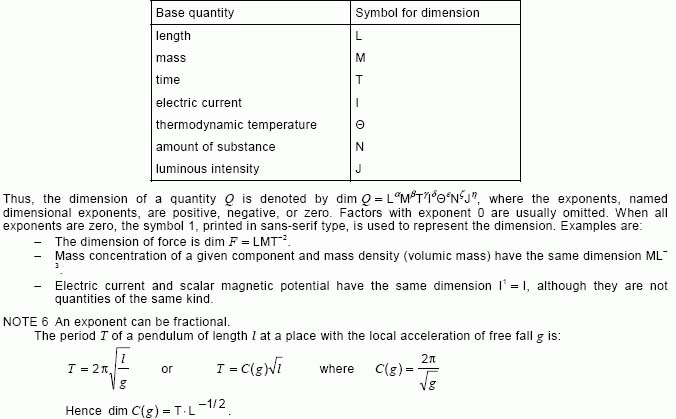
[IEV number 112-01-11]FR
dimension, f
dimension d'une grandeur, f
expression de la dépendance d’une grandeur par rapport aux grandeurs de base d'un système de grandeurs sous la forme d'un produit de puissances de facteurs correspondant aux grandeurs de base, en omettant tout facteur numérique
NOTE 1 – Une puissance d'un facteur est le facteur muni d'un exposant. Chaque facteur exprime la dimension d'une grandeur de base.
NOTE 2 – Par convention, la représentation symbolique de la dimension d'une grandeur de base est une lettre majuscule unique en caractère romain (droit) sans empattement. Par convention, la représentation symbolique de la dimension d'une grandeur dérivée est le produit de puissances des dimensions des grandeurs de base conformément à la définition de la grandeur dérivée. La dimension de la grandeur Q est notée dim Q.
NOTE 3 – Pour établir la dimension d'une grandeur, on ne tient pas compte du caractère scalaire, vectoriel ou tensoriel.
NOTE 4 – Dans un système de grandeurs donné, – les grandeurs de même nature ont la même dimension, – des grandeurs de dimensions différentes sont toujours de nature différente, – des grandeurs ayant la même dimension ne sont pas nécessairement de même nature. Par exemple, dans l'ISQ, la pression et l'énergie volumique ont la même dimension L–1MT–2. Voir aussi la note 5.
NOTE 5 – Dans le Système international de grandeurs (ISQ), les symboles représentant les dimensions des grandeurs de base sont:
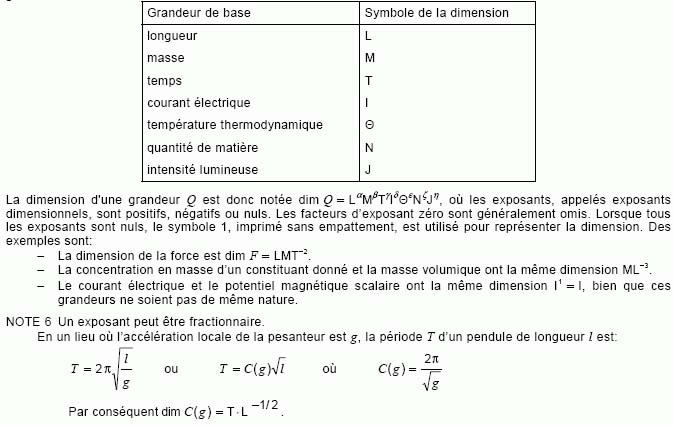
[IEV number 112-01-11]Тематики
- метрология, основные понятия
Синонимы
EN
DE
- Dimension einer Grösse
- Dimension, f
- Größendimension, f
FR
- dimension d'une grandeur, f
- dimension, f
устанавливать размеры
задавать размеры
—
[А.С.Гольдберг. Англо-русский энергетический словарь. 2006 г.]Тематики
Синонимы
EN
Англо-русский словарь нормативно-технической терминологии > dimension
-
15 dimension of a quantity
размерность величины
Выражение в форме степенного одночлена, составленного из произведений символов основных величин в различных степенях, отражающее связь данной величины с основными величинами и имеющее коэффициент пропорциональности, равный 1 (ОСТ 45.159-2000.1 Термины и определения (Минсвязи России)).
[ http://www.iks-media.ru/glossary/index.html?glossid=2400324]Тематики
- электросвязь, основные понятия
EN
размерность физической величины
размерность величины
Выражение в форме степенного одночлена, составленного из произведений символов основных физических величин в различных степенях и отражающее связь данной физической величины с физическими величинами, принятыми в данной системе величин за основные с коэффициентом пропорциональности, равным 1.
Примечания
1. Степени символов основных величин, входящих в одночлен, в зависимости от связи рассматриваемой физической величины с основными, могут быть целыми, дробными, положительными и отрицательными. Понятие размерность распространяется и на основные величины. Размерность основной величины в отношении самой себя равна единице, т.е. формула размерности основной величины совпадает с ее символом.
2. В соответствии с международным стандартом ИСО 31/0, размерность величин следует обозначать знаком dim [2]. В системе величин LMT размерность величины.x будет: dim х = LlMmTt, где L, М, Т - символы, величин, принятых за основные (соответственно длины, массы, времени).
[РМГ 29-99]EN
dimension of a quantity
quantity dimension
dimension
expression of the dependence of a quantity on the base quantities of a system of quantities as a product of powers of factors corresponding to the base quantities, omitting any numerical factor
NOTE 1 – A power of a factor is the factor raised to an exponent. Each factor is the dimension of a base quantity.
NOTE 2 – The conventional symbolic representation of the dimension of a base quantity is a single upper case letter in roman (upright) sans-serif type. The conventional symbolic representation of the dimension of a derived quantity is the product of powers of the dimensions of the base quantities according to the definition of the derived quantity. The dimension of a quantity Q is denoted by dim Q.
NOTE 3 – In deriving the dimension of a quantity, no account is taken of its scalar, vector or tensor character.
NOTE 4 – In a given system of quantities, – quantities of the same kind have the same dimension, – quantities of different dimensions are always of different kinds, and – quantities having the same dimension are not necessarily of the same kind. For example, in the ISQ, pressure and energy density (volumic energy) have the same dimension L–1MT–2. See also note 5.
NOTE 5 – In the International System of Quantities (ISQ), the symbols representing the dimensions of the base quantities are:
[IEV number 112-01-11]FR
dimension, f
dimension d'une grandeur, f
expression de la dépendance d’une grandeur par rapport aux grandeurs de base d'un système de grandeurs sous la forme d'un produit de puissances de facteurs correspondant aux grandeurs de base, en omettant tout facteur numérique
NOTE 1 – Une puissance d'un facteur est le facteur muni d'un exposant. Chaque facteur exprime la dimension d'une grandeur de base.
NOTE 2 – Par convention, la représentation symbolique de la dimension d'une grandeur de base est une lettre majuscule unique en caractère romain (droit) sans empattement. Par convention, la représentation symbolique de la dimension d'une grandeur dérivée est le produit de puissances des dimensions des grandeurs de base conformément à la définition de la grandeur dérivée. La dimension de la grandeur Q est notée dim Q.
NOTE 3 – Pour établir la dimension d'une grandeur, on ne tient pas compte du caractère scalaire, vectoriel ou tensoriel.
NOTE 4 – Dans un système de grandeurs donné, – les grandeurs de même nature ont la même dimension, – des grandeurs de dimensions différentes sont toujours de nature différente, – des grandeurs ayant la même dimension ne sont pas nécessairement de même nature. Par exemple, dans l'ISQ, la pression et l'énergie volumique ont la même dimension L–1MT–2. Voir aussi la note 5.
NOTE 5 – Dans le Système international de grandeurs (ISQ), les symboles représentant les dimensions des grandeurs de base sont:
[IEV number 112-01-11]Тематики
- метрология, основные понятия
Синонимы
EN
DE
- Dimension einer Grösse
- Dimension, f
- Größendimension, f
FR
- dimension d'une grandeur, f
- dimension, f
Англо-русский словарь нормативно-технической терминологии > dimension of a quantity
-
16 quantity dimension
размерность физической величины
размерность величины
Выражение в форме степенного одночлена, составленного из произведений символов основных физических величин в различных степенях и отражающее связь данной физической величины с физическими величинами, принятыми в данной системе величин за основные с коэффициентом пропорциональности, равным 1.
Примечания
1. Степени символов основных величин, входящих в одночлен, в зависимости от связи рассматриваемой физической величины с основными, могут быть целыми, дробными, положительными и отрицательными. Понятие размерность распространяется и на основные величины. Размерность основной величины в отношении самой себя равна единице, т.е. формула размерности основной величины совпадает с ее символом.
2. В соответствии с международным стандартом ИСО 31/0, размерность величин следует обозначать знаком dim [2]. В системе величин LMT размерность величины.x будет: dim х = LlMmTt, где L, М, Т - символы, величин, принятых за основные (соответственно длины, массы, времени).
[РМГ 29-99]EN
dimension of a quantity
quantity dimension
dimension
expression of the dependence of a quantity on the base quantities of a system of quantities as a product of powers of factors corresponding to the base quantities, omitting any numerical factor
NOTE 1 – A power of a factor is the factor raised to an exponent. Each factor is the dimension of a base quantity.
NOTE 2 – The conventional symbolic representation of the dimension of a base quantity is a single upper case letter in roman (upright) sans-serif type. The conventional symbolic representation of the dimension of a derived quantity is the product of powers of the dimensions of the base quantities according to the definition of the derived quantity. The dimension of a quantity Q is denoted by dim Q.
NOTE 3 – In deriving the dimension of a quantity, no account is taken of its scalar, vector or tensor character.
NOTE 4 – In a given system of quantities, – quantities of the same kind have the same dimension, – quantities of different dimensions are always of different kinds, and – quantities having the same dimension are not necessarily of the same kind. For example, in the ISQ, pressure and energy density (volumic energy) have the same dimension L–1MT–2. See also note 5.
NOTE 5 – In the International System of Quantities (ISQ), the symbols representing the dimensions of the base quantities are:
[IEV number 112-01-11]FR
dimension, f
dimension d'une grandeur, f
expression de la dépendance d’une grandeur par rapport aux grandeurs de base d'un système de grandeurs sous la forme d'un produit de puissances de facteurs correspondant aux grandeurs de base, en omettant tout facteur numérique
NOTE 1 – Une puissance d'un facteur est le facteur muni d'un exposant. Chaque facteur exprime la dimension d'une grandeur de base.
NOTE 2 – Par convention, la représentation symbolique de la dimension d'une grandeur de base est une lettre majuscule unique en caractère romain (droit) sans empattement. Par convention, la représentation symbolique de la dimension d'une grandeur dérivée est le produit de puissances des dimensions des grandeurs de base conformément à la définition de la grandeur dérivée. La dimension de la grandeur Q est notée dim Q.
NOTE 3 – Pour établir la dimension d'une grandeur, on ne tient pas compte du caractère scalaire, vectoriel ou tensoriel.
NOTE 4 – Dans un système de grandeurs donné, – les grandeurs de même nature ont la même dimension, – des grandeurs de dimensions différentes sont toujours de nature différente, – des grandeurs ayant la même dimension ne sont pas nécessairement de même nature. Par exemple, dans l'ISQ, la pression et l'énergie volumique ont la même dimension L–1MT–2. Voir aussi la note 5.
NOTE 5 – Dans le Système international de grandeurs (ISQ), les symboles représentant les dimensions des grandeurs de base sont:
[IEV number 112-01-11]Тематики
- метрология, основные понятия
Синонимы
EN
DE
- Dimension einer Grösse
- Dimension, f
- Größendimension, f
FR
- dimension d'une grandeur, f
- dimension, f
Англо-русский словарь нормативно-технической терминологии > quantity dimension
-
17 effectiveness
коэффициент полезного действия
Отношение отдаваемой мощности к потребляемой активной мощности.
[ОСТ 45.55-99]
коэффициент полезного действия
КПД
Величина, характеризующая совершенство процессов превращения, преобразования или передачи энергии, являющаяся отношением полезной энергии к подведенной.
[РД 01.120.00-КТН-228-06]
коэффициент полезного действия
-
[IEV number 151-15-25]EN
efficiency
ratio of output power to input power of a device
NOTE – If the output power and/or input power is electric, active power is meant.
[IEV number 151-15-25]FR
rendement, m
rapport de la puissance de sortie à la puissance d'entrée d’un dispositif
NOTE – Lorsque la puissance d’entrée ou de sortie est électrique, il s’agit de puissance active.
[IEV number 151-15-25]Тематики
- электротехника, основные понятия
Синонимы
EN
- coefficient of efficiency
- coefficient of performance
- degree of efficiency
- effectiveness
- efficiency
- efficiency coefficient
- efficiency factor
- efficiency output
- performance
- performance factor
DE
FR
- rendement, m
результативность
Степень реализации запланированной деятельности и достижения запланированных результатов.
[ ГОСТ Р ИСО 9000-2008]
результативность
(ITIL Continual Service Improvement)
Мера достижения целей процесса, услуги или деятельности. Процесс или деятельность результативны, если достигнуты поставленные цели.
См. тж. ключевой показатель эффективности.
[Словарь терминов ITIL версия 1.0, 29 июля 2011 г.]EN
effectiveness
(ITIL Continual Service Improvement)
A measure of whether the objectives of a process, service or activity have been achieved. An effective process or activity is one that achieves its agreed objectives.
See also key performance indicator.
[Словарь терминов ITIL версия 1.0, 29 июля 2011 г.]Тематики
EN
эффективность
Связь между достигнутым результатом и использованными ресурсами.
[ ГОСТ Р ИСО 9000-2008]
эффективность
Свойство объекта удовлетворять требованиям к услуге с заданными количественными характеристиками [12].
Примечание
Это свойство зависит от сочетания возможностей и готовности объекта.
[12] Международный стандарт СЕI IЕС 50 (191). Глава 191. Надежность и качество услуг.
[ОСТ 45.127-99]
эффективность
Экономическая категория, характеризующая соотношение экономических, социальных и научно-технических результатов с затратами на их достижение
[Терминологический словарь по строительству на 12 языках (ВНИИИС Госстроя СССР)]
эффективность
(ITIL Continual Service Improvement)
Мера целесообразности использования ресурсов для реализации процесса, услуги или деятельности. Эффективный процесс достигает своих целей с минимальными затратами времени, денег, людских и других ресурсов.
См. тж. ключевой показатель эффективности.
[Словарь терминов ITIL версия 1.0, 29 июля 2011 г.]
эффективность
1. Одно из наиболее общих экономических понятий, не имеющих пока, по-видимому, единого общепризнанного определения. По нашему мнению, это одна из возможных (важнейшая, но не единственная!) характеристик качества некоторой системы, в частности, — экономической: а именно, ее характеристика с точки зрения соотношения затрат и результатов функционирования системы. В зависимости от того, какие затраты и особенно — какие результаты принимаются во внимание, можно говорить об экономической, социально-экономической, социальной, экологической Э. Однако границы между этими понятиями расплывчаты и вокруг них ведутся активные дискуссии. См. Экономическая эффективность, Эффективность капитальных вложений (инвестиционных проектов), Эффективность потребления благ, Эффективность производства, Эффективность экономических решений (мероприяий), Эффективность экономического развития. 2. В экономико-математической литературе слова эффективность, эффективный используются также в составе терминов типа эффективная точка, эффективная технология, эффективная граница. Здесь рассматриваемый термин означает наибольшую степень достижения некоторой цели, выражения какого-то понятия, реализации потенциальной возможности, выполнения задачи и т.п. Например, принимается, что распределение ресурсов, порождаемое экономикой совершенной конкуренции, является эффективным по Парето. 3. То же, что полезность. 4. В математической статистике эффективная статистическая оценка – та, которая имеет минимальную дисперсию.
[ http://slovar-lopatnikov.ru/]EN
efficiency
(ITIL Continual Service Improvement)
A measure of whether the right amount of resource has been used to deliver a process, service or activity. An efficient process achieves its objectives with the minimum amount of time, money, people or other resources.
See also key performance indicator.
[Словарь терминов ITIL версия 1.0, 29 июля 2011 г.]Тематики
EN
DE
FR
3.2.14 результативность (effectiveness): Степень реализации запланированной деятельности и достижения запланированных результатов.
Источник: ГОСТ Р ИСО 9000-2008: Системы менеджмента качества. Основные положения и словарь оригинал документа
2.3 результативность (effectiveness): Степень реализации запланированной деятельности и достижения запланированных результатов.
[ИСО 9241-11:1998]
Источник: ГОСТ Р ИСО 9241-210-2012: Эргономика взаимодействия человек-система. Часть 210. Человеко-ориентированное проектирование интерактивных систем оригинал документа
4.6 результативность (effectiveness): Степень реализации запланированной деятельности и достижения запланированных результатов.
[ИСО 9241-11:1998, определение 3.2]
Примечание - Для целей метода испытаний, установленного в настоящем стандарте, результативность управления измеряют как процент пользователей, которые достигли основной цели (целей) использования изделия с необходимой точностью и полнотой. Измерения результативности управления основаны на успехе в достижении конечного результата независимо от того, достигнут он наиболее эффективным путем или нет.
Источник: ГОСТ Р 55236.2-2012: Эргономика изделий повседневного использования. Часть 2. Метод испытаний изделий с интуитивно понятным управлением оригинал документа
2.13 эффективность (effectiveness): Степень, в которой реализуются планируемые мероприятия и достигаются планируемые результаты.
[ИСО 9000:2005]
Источник: ГОСТ Р ИСО 24511-2009: Деятельность, связанная с услугами питьевого водоснабжения и удаления сточных вод. Руководящие указания для менеджмента коммунальных предприятий и оценке услуг удаления сточных вод оригинал документа
2.13 эффективность (effectiveness): Степень, в которой реализуются планируемые мероприятия и достигаются планируемые результаты.
[ИСО 9000:2005]
Источник: ГОСТ Р ИСО 24512-2009: Деятельность, связанная с услугами питьевого водоснабжения и удаления сточных вод. Руководящие указания для менеджмента систем питьевого водоснабжения и оценке услуг питьевого водоснабжения оригинал документа
3.2 результативность (effectiveness): Степень реализации запланированной деятельности и достижения запланированных результатов.
Источник: ГОСТ Р ИСО 9241-11-2010: Эргономические требования к проведению офисных работ с использованием видеодисплейных терминалов (VDT). Часть 11. Руководство по обеспечению пригодности использования оригинал документа
3.2.3 результативность (effectiveness): Точность и полнота достижения запланированных целей.
[ИСО 9241-11]
Источник: ГОСТ Р ИСО 9241-4-2009: Эргономические требования к проведению офисных работ с использованием видеодисплейных терминалов (VDT). Часть 4. Требования к клавиатуре оригинал документа
2.13 эффективность (effectiveness): Степень, в которой реализуются планируемые мероприятия и достигаются планируемые результаты.
[ИСО 9000:2005]
Источник: ГОСТ Р ИСО 24510-2009: Деятельность, связанная с услугами питьевого водоснабжения и удаления сточных вод. Руководящие указания по оценке и улучшению услуги, оказываемой потребителям оригинал документа
3.2.14 результативность (effectiveness): Степень реализации запланированной деятельности и достижения запланированных результатов.
Источник: ГОСТ ISO 9000-2011: Системы менеджмента качества. Основные положения и словарь
4.6 результативность (effectiveness): Степень реализации запланированной деятельности и достижения запланированных результатов.
[ИСО 9241-11:1998, определение 3.2]
Примечание - Для целей метода испытаний, установленного в настоящем стандарте, результативность управления измеряют как процент пользователей, которые достигли основной цели (целей) использования изделия с необходимой точностью и полнотой. Измерения результативности управления основаны на успехе в достижении конечного результата независимо от того, достигнут он наиболее эффективным путем или нет.
Источник: ГОСТ Р 55236.3-2012: Эргономика изделий повседневного использования. Часть 3. Метод испытаний потребительских товаров оригинал документа
3.2.19 результативность (effectiveness): Степень реализации запланированной деятельности и достижения запланированных результатов.
Источник: ГОСТ Р 54147-2010: Стратегический и инновационный менеджмент. Термины и определения оригинал документа
Англо-русский словарь нормативно-технической терминологии > effectiveness
-
18 voltage drop or rise for a specified load condition
падение или повышение напряжения при заданном режиме нагрузки
Разность между напряжением холостого хода обмотки и напряжением на ее выводах при заданных нагрузке и коэффициенте мощности при условии, что к другой (или к одной из других) обмотке(ок) подведено напряжение, равное:
- номинальному, если трансформатор включен на основное ответвление (в этом случае напряжение холостого хода рассматриваемой обмотки равно номинальному);
- напряжению другого ответвления, на которое включен трансформатор. Падение или повышение напряжения обычно выражают в процентах напряжения холостого хода рассматриваемой обмотки.
Примечание — В многообмоточном трансформаторе падение или повышение напряжения зависит от нагрузки и коэффициента мощности не только данной обмотки, но и других обмоток
(МЭС 421-07-03).
[ ГОСТ 30830-2002]EN
voltage drop or rise for a specified load condition
voltage regulation for a specified load condition
the arithmetic difference between the no-load voltage of a winding and the voltage developed at the terminals of the same winding at a specified load and power factor, the voltage supplied to (one of) the other winding(s) being equal to:
- its rated value if the transformer is connected on the principal tapping (the no-load voltage of the former winding is then equal to its rated value);
- the tapping voltage if the transformer is connected on another tapping.
This difference is generally expressed as a percentage of the no-load voltage of the former winding
NOTE – For multi-winding transformers, the voltage drop or rise depends not only on the load and power factor of the winding itself, but also on the load and power factor of the other windings
[IEV number 421-07-03]FR
hute ou augmentation de tension pour une condition de charge spécifiée
différence arithmétique entre la tension à vide d'un enroulement et la tension en charge aux bornes du même enroulement pour un courant de charge et un facteur de puissance spécifiés, la tension appliquée à l'autre (ou à l'un des autres) enroulement(s) étant égale:
- à sa valeur assignée, si le transformateur est connecté sur la prise principale (la tension à vide du premier enroulement étant alors égale à sa valeur assignée);
- à la tension de prise si le transformateur est connecté sur une autre prise.
Cette différence s'exprime généralement sous la forme d'un pourcentage de la tension à vide du premier enroulement
NOTE – Pour les transformateurs à plus de deux enroulements, la chute ou l'augmentation de tension dépend non seulement de la charge et du facteur de puissance de l'enroulement lui-même, mais aussi de la charge et du facteur de puissance des autres enroulements.
[IEV number 421-07-03]Тематики
Классификация
>>>EN
- voltage drop or rise for a specified load condition
- voltage regulation for a specified load condition
DE
FR
Англо-русский словарь нормативно-технической терминологии > voltage drop or rise for a specified load condition
-
19 voltage regulation for a specified load condition
падение или повышение напряжения при заданном режиме нагрузки
Разность между напряжением холостого хода обмотки и напряжением на ее выводах при заданных нагрузке и коэффициенте мощности при условии, что к другой (или к одной из других) обмотке(ок) подведено напряжение, равное:
- номинальному, если трансформатор включен на основное ответвление (в этом случае напряжение холостого хода рассматриваемой обмотки равно номинальному);
- напряжению другого ответвления, на которое включен трансформатор. Падение или повышение напряжения обычно выражают в процентах напряжения холостого хода рассматриваемой обмотки.
Примечание — В многообмоточном трансформаторе падение или повышение напряжения зависит от нагрузки и коэффициента мощности не только данной обмотки, но и других обмоток
(МЭС 421-07-03).
[ ГОСТ 30830-2002]EN
voltage drop or rise for a specified load condition
voltage regulation for a specified load condition
the arithmetic difference between the no-load voltage of a winding and the voltage developed at the terminals of the same winding at a specified load and power factor, the voltage supplied to (one of) the other winding(s) being equal to:
- its rated value if the transformer is connected on the principal tapping (the no-load voltage of the former winding is then equal to its rated value);
- the tapping voltage if the transformer is connected on another tapping.
This difference is generally expressed as a percentage of the no-load voltage of the former winding
NOTE – For multi-winding transformers, the voltage drop or rise depends not only on the load and power factor of the winding itself, but also on the load and power factor of the other windings
[IEV number 421-07-03]FR
hute ou augmentation de tension pour une condition de charge spécifiée
différence arithmétique entre la tension à vide d'un enroulement et la tension en charge aux bornes du même enroulement pour un courant de charge et un facteur de puissance spécifiés, la tension appliquée à l'autre (ou à l'un des autres) enroulement(s) étant égale:
- à sa valeur assignée, si le transformateur est connecté sur la prise principale (la tension à vide du premier enroulement étant alors égale à sa valeur assignée);
- à la tension de prise si le transformateur est connecté sur une autre prise.
Cette différence s'exprime généralement sous la forme d'un pourcentage de la tension à vide du premier enroulement
NOTE – Pour les transformateurs à plus de deux enroulements, la chute ou l'augmentation de tension dépend non seulement de la charge et du facteur de puissance de l'enroulement lui-même, mais aussi de la charge et du facteur de puissance des autres enroulements.
[IEV number 421-07-03]Тематики
Классификация
>>>EN
- voltage drop or rise for a specified load condition
- voltage regulation for a specified load condition
DE
FR
Англо-русский словарь нормативно-технической терминологии > voltage regulation for a specified load condition
-
20 discount
1. сущ.1)а) торг. скидка (с цены), ценовая скидка (денежная сумма или процент, на который поставщик снижает стандартную цену товара или услуги; напр., снижение стандартной цены товара в рамках кампании по стимулированию сбыта или снижение прейскурантной цены в качестве вознаграждения за быстрый или наличный платеж, за покупку в большом количестве и т. п.; также снижение стандартного тарифа на услуги для клиентов, удовлетворяющих определенным требованиям, напр., уменьшение величины страховой премии в связи с особенностями данного риска, отсутствием аварий или других страховых случаев в течение определенного времени, либо уменьшение стоимости туристической путевки при приобретении общей путевки для группы лиц и т. п.)ATTRIBUTES:
cumulative 2), aggregate 2)
one-time discount — единовременная [разовая\] скидка
COMBS:
discount in the amount of— скидка в сумме
At the purchase of 6-10 titles you will obtain the discount in the amount of 5%.
discount of $125, $125 discount — скидка в размере 125 долл.
10% discount, discount of 10% — скидка в размере 10%, десятипроцентная скидка
1% discount for cash — скидка 1% за расчет наличными
15% discount for quantity purchases — 15-процентная скидка за покупку в большом количестве
less discount of 5% — со сидкой в 5%, за вычетом 5%
A discount of up to 40% may apply to Physical Damage Coverage for your boat, if the boat is less than 11 years old.
a discount of 10 to 40 percent — скидка (в размере) от 10% до 40%
a discount (of) between 10% and 20% — скидка (в размере) от 10% до 20%, скидка между 10% и 20%
discount on [below, to, off, from\] — скидка с (цены, тарифной ставки)
50% discount below the normal retail price — 50% скидка с обычной розничной цены
You can get 50% discount off the regular ticket price!
Click here to order this book at a discount from the regular list price.
discount on (smth.) — скидка на (что-л.)
Members will receive special discounts on all products. — Участники получат специальные скидки на все товары.
special discount to students, special students discounts — специальные скидки для студентов, специальные скидки студентам, специальные студенческие скидки
50% discount for children under 12 — 50% скидка для детей в возрасте до 12 лет
to give [to grant, to allow\] a discount — предоставить скидку
Discounts are given for quantity purchases.
First, they commit all participants to grant discounts of the same type to buyers who meet the same conditions of eligibility.
The producer usually establishes a list price and then allows discounts from it to various types of intermediate customers.
Later in the century, as competition for customers increased, some booksellers offered discounts of 20 percent and more.
to get [to receive, to obtain\] a discount — получить скидку
Club members get special discount off the normal rates. — Члены клуба получают специальную скидку с обычных тарифов.
He received cash discount of 3%. — Он получил скидку в размере 3% за оплату наличными.
to earn a discount — получить [заслужить, заработать\] скидку
When purchases must be placed within a specified period to earn a discount, the prospective contractor must indicate the required time period.
Those who purchase for cash are allowed a discount of 2%, while those who pay within one month can claim a discount of 1%.
to ask for a discount — просить [требовать\] скидку, обращаться за скидкой
If you're going to pay cash, ask for a discount.
It could be very useful to be able to negotiate a discount for cash if you are buying luxury items like a fur coat or an expensive piece of jewellery.
Large volume orders may be subject to a discount. — Крупные заказы могут подлежать скидке. [По крупным заказам может предоставляться скидка.\]
to qualify for a discount — иметь право на скидку; получить право на скидку; давать право на скидку
To qualify for discount all orders must be received by 30th June. — Чтобы иметь право на скидку, все заказы должны быть получены до 30 июня.
to be eligible for [to be entitled to\] a discount — иметь право на скидку
Find out if you are entitled to a discount. — Выясните, имеете ли вы право на скидку.
to lose a discount — терять скидку, терять право на скидку
This means that you can make 1 claim in any year or 2 claims in any 3-year period, and you won't lose the discount earned for your previous years of safe driving. — Это означает, что вы можете предъявить одно требование в течение любого года или два требования в течение любого трехлетнего периода, и вы не потеряете скидку, заработанную за предыдущие года безопасного вождения.
To find the sale price of the item, you calculate the discount and subtract the discount from the original price.
to reduce/to increase discount — уменьшать/увеличивать скидку
ThyssenKrupp Nirosta reduces cash discount.
Under the Local Government Act 2003, all District Councils have been allowed to reduce their Council Tax discount on second homes from 50% to 10%.
American Airlines also has increased its discount from 21 percent to 22 percent on all domestic fares and international full fares.
They've increased the tax discount on the house.
Syn:Ant:See:advertising discount, aggregated discount, bulk discount а), bulk purchase discount, cash discount, chain discount, commercial discount, cumulative discount, deep discount 2) а), deferred discount, discount allowed, discount earned, discount for cash, discount for cash payment, discount for early payment, discount for paying cash, discount for prompt payment, discount for quantity, discount for quantity purchases, discount from price, discount on price, discount received, discounts lost, early payment discount, functional discount, group discount 1) а), insurance discount, insurance premium discount, invoice discount 1) а), long discount, lost discounts, loyalty discount, net name discount, noncumulative discount, off-invoice discount, patronage discount, premium discount, prepayment discount, price discount а), prompt payment discount, purchase discount, quantity discount, quantity purchase discount, renewal discount, retail discount, retro discount, retrodiscount, retrospective discount, sales discount, series discount 1) а), short discount, special discount, staff discount, trade discount, trade-in discount, unearned discount а), volume discount, wholesale discount, amount of discount, discount amount а), discount broker а), discount brokerage, discount card, discount chain, discount coupon, discount drugstore, discount fare, discount goods, discount house 2) а), discount loss, discount market 2) а), discount merchandiser, discount period 1) а), discount policy 1) а), discount price, discount pricing, discount retailer, discount retailing, discount sale, discount scale, discount series, discount schedule, discount store, discount supermarket, discount table, discount terms, percentage of discount, scale of discounts, table of discounts, allowance 1. 3) discounted price а), discounted goods, premium price а), trade credit, EOM, ROG, discounter б), discountable 2) б), regular price, list price, off-price product, at a discount 1) а) IDIOM: five-finger discountб) фин., бирж. дисконт (сумма, на которую номинал или цена погашения ценной бумаги больше цены ее первоначального размещения или текущей рыночной цены)ATTRIBUTES:
accrued 2), amortizable 2) б)
deep discount — глубокий дисконт, значительный дисконт*
COMBS:
discount in the amount of— дисконт в сумме
discount of $125, $125 discount — дисконт в размере 125 долл.
As a result, X treats the loan as having original issue discount in the amount of $130000.
10% discount, discount of 10% — дисконт в размере 10%, десятипроцентный дисконт
For example, if a $1000 par bond was bought at a discount of $900, at maturity there would be a $100 gain.
a discount of 10 to 40 percent — дисконт (в размере) от 10% до 40%
a discount (of) between 10% and 20% — скидка (в размере) от 10% до 20%, скидка между 10% и 20%
discount on [below, to, off, from\] — дисконт к (цене, номиналу), дисконт с [от\] (цены, номинала)
Coupons are sold at a discount to maturity value.
The Company amortizes any discount or premium as part of interest expense on the related debt using the effective interest method.
Although the issuer will calculate original issue discount, if any, based on its determination of the accrual periods, a bondholder may, subject to some restrictions, elect other accrual periods.
All taxable discount securities, including Corporate and Government Bonds, Federal STRIPs, Eurobonds, and Taxable Municipal securities.
Ant:See:accrued discount, acquisition discount а), amortized discount, bond discount, debt discount, deep discount 1) а), discount from price, discount on price, Discount on Notes Payable, Discount on Notes Receivable, market discount а), original issue discount, price discount 1) б), share discount, unamortized discount, accretion of discount, accrual of discount, accumulation of discount, amortization of discount, amount of discount, discount accretion, discount amortization, discount amount б), discount bond, discount percentage 1) б), discount price, discount securities, discount yield, percentage of discount, discounted price б) premium price б) at a discount 1) б)в) фин., банк. дисконт, скидка (разница между номиналом векселя и суммой, получаемой векселедержателем при учете векселя до наступления срока его погашения)See:bank discount а), banker's discount, amount of discount, discount amount в), discount basis, discount interest rate, discount market 1) в), discount percentage 2) в), discount policy 2) в), discount rate 1) а), 1) б), discount rate of interest, percentage of discount, rate of discount, discounting 1)г) фин., бирж. дисконт, скидка (отклонение в меньшую сторону от официального курса валюты, т. е. ситуация, когда цена одной валюты занижена по отношению к цене другой валюты, напр., франк может продаваться со скидкой к фунту)д) фин., банк. дисконт (разница между базовой согласованной суммой кредита и суммой, фактически получаемой заемщиком; в обычных дисконтных кредитах соответствует величине процентов, подлежащих уплате по кредиту; в некоторых кредитах из базовой суммы кредита могут вычитаться дисконтные пункты или другие единовременные вознаграждения и комиссионные, причитающиеся кредитору)See:е) фин. дисконт, скидка (при оценке стоимости предприятия или крупных пакетов акций: разница, на которую фактически согласованная цена предприятия/пакета акций меньше базовой рыночной цены; такой дисконт может использоваться в качестве компенсации за узость вторичного рынка для акций, недостаточный размер продаваемого пакета акций для приобретения контроля за предприятием и т. п.)See:discount for lack of control, discount for lack of marketability, key person discount, lack of control discount, lack of marketability discount, marketability discount, minority discount, minority interest discountж) фин. скидка, дисконт (в самом общем смысле: сумма, на которую уменьшена базовая стоимость или другая базовая величина)Ant:See:acquisition discount б), compound discount, forward discount, interest discount, interest rate discount, loan discount 1) б), 2) б), merchant discount, reinvestment discount, tax discount, underwriter's discount, discount fee 1), 2), discount interest rate, discount mortgage, discount points, discount rate 1) в), 1) г), discount rate of interest, merchant discount fee, rate of discount, discounted mortgage, at a discount 2)2) банк., фин. учет, операция по учету [по дисконту\] (операция, в ходе которой банк или другое финансовое учреждение выкупает вексель или иное долговое обязательство у его держателя по цене, равной номиналу долгового обязательства за вычетом вознаграждения за оставшийся до погашения срок, напр., вексель с номиналом в 100 долл. может продаваться за 90 долл.; впоследствии банк взыскивает полную номинальную стоимость долгового обязательства с лица, выписавшего это долговое обязательство)Syn:discounting 1)See:invoice discount 2) discount broker б), discount credit, discount factoring, discount fee 3) б), discount house 1) б), discount market 1) б), discount period 2) б), discount window, discounter а), discountability, discountable 1) а), bill broker, rediscount 1.3) фин. дисконтирование (определение текущей стоимости актива или текущей стоимости будущих потоков доходов и расходов)Syn:discounting 2)See:discount coefficient, discount factor, discount interest rate, discount rate 2), discount rate of interest, dividend discount model, rate of discount4)а) торг. процент скидки (величина скидки, выраженная в процентах к цене)Syn:б) фин. учетная ставка; ставка дисконта [дисконтирования\]Syn:discount rate 1) а), 1) а), 2) а)See:2. гл.1) торг. предоставлять [делать\] скидку, снижать цену (уменьшать обычную прейскурантную цену для покупателя, приобретающего значительное количество товара, рассчитывающегося наличными и т. п.); продавать со скидкой (уценивать товары, уменьшать цену продаваемых товаров)The shop discounted goods. — Магазин сделал скидку на товары.
to discount from [off\] price — сделать скидку с цены
to discount (by) 10% — делать скидку в размере 10%
Companies discount their goods by 10%-75% only to sell more volume. — Компании предоставляют скидку на свои товары в размере 10-75% [компании снижают цену своих товаров на 10-75%\] только для того, чтобы увеличить объем продаж.
If an item has not sold within two weeks the store discounts the item by 25% for the third week, 50% for the fourth week, and 75% for the fifth week. — Если предмет не продается в течении двух недель, то в течение третьей недели предмет предлагается со скидкой в 25%, в течение четвертой — со скидкой 50%, а в течение пятой — со скидкой 75%.
All items were discounted about 20% from the suggested list prices. — Цена всех товаров была снижена на 20% по сравнению с рекомендованной прейскурантной ценой.
The company discounted prices on its products. — Компания сделала скидку с цены на свои товары.
United discounts the fare by 50%. — "Юнайтед" делает скидку с тарифа в размере 50%.
The one-way fares are now discounted 15% off regular fares. — Стоимость проезда в один конец в настоящее время снижена на 15% по сравнению с обычными тарифами.
This interest rate is discounted from the published bank standard variable rate for an agreed period from the start of the mortgage. — Эта процентная ставка снижена по сравнению с опубликованной стандартной плавающей процентной ставкой банка на оговоренный период, считая от начала действия ипотечного кредита.
discounted mortgage — ипотека с дисконтом*, дисконтная ипотека*
discounted period — период скидки [скидок\]*, период действия скидки*
discounted price — цена со скидкой [с дисконтом\], дисконтная цена
See:discount period 1) б), discounted bond, discounted goods, discounted mortgage, discounted period, discounted price, discounter б), discountable 2) б), non-discountable, undiscounted 1) а), 1) б), discounting 3) б)2) фин., банк. учитыватьа) (приобретать векселя или счета-фактуры по цене ниже их номинала, т. е. с дисконтом, с целью последующего взыскания суммы долга с должника)to discount at the rate of 10% — учитывать по ставке 10%
In the same way, circumstances often forced discount houses themselves to discount fine trade bills at the rate for fine bank bills. — Точно также, обстоятельства часто вынуждают сами дисконтные дома учитывать первоклассные торговые векселя по ставке, установленной для первоклассных банковских векселей.
The Federal Reserve was given the right to discount “eligible paper” for member banks, that is lend money to the banks on the basis of the commercial paper arising from loan transactions with their customers. — Федеральной резервной системе было предоставлено право учитывать "приемлемые бумаги" для банков-членов, т. е. давать банкам деньги взаймы на базе коммерческих бумаг, возникающих в связи с кредитными операциями с их клиентами.
б) (продавать векселя или счета-фактуры по цене ниже их номинала специализированному финансовому учреждению)to discount the note at 10% — учитывать долговое обязательство под 10%
The company discounted the note at a bank at 10%. — Компания учла долговое обязательство в банке под 10%.
If the vendor receives a note, he may discount it at the bank. — Если торговец получает простой вексель, он может учесть его в банке.
to get a bill discounted — учесть вексель, произвести учет векселя
See:accounts receivable discounted, discounted bill, discounting 1), discountability, discountable 1), discounter 1) а), rediscount 2. 1) а)3) фин., банк. предоставлять дисконтный заем* (получать проценты вперед при даче денег взаймы, т. е. выдавать заемщику не полную оговоренную сумму кредита, а ее часть, оставшуюся после вычета определенного дисконта, и взамен сокращать или аннулировать процентную ставку на весь или часть срока кредита; употребляется всегда с дополнением в виде названия кредита)to discount the loan — предоставлять дисконтный заем, делать заем дисконтным
Negotiate the terms of the loan ( amount, interest rates) first and then lender discounts the loan by charging a fee which will be deducted from the loan amount before being dispersed to the borrower. — Договоритесь об условиях кредитования (сумма, процентные ставки) и потом кредитор сделает заем дисконтным путем взимания платы, которая будет вычтена из суммы займа перед выдачей заемщику.
See:4) фин. дисконтировать ( приводить будущие значения экономических показателей к текущей стоимости)to discount at a rate of 10% — дисконтировать по ставке 10%
Discount future cash flows to the present using the firm's cost of capital. — Приведите будущие денежные потоки к текущей стоимости, используя стоимость капитала фирмы.
To adjust for the time value of money, we discounted future costs to present value. — Чтобы осуществить корректировку на временную стоимость денег, мы привели будущие затраты к текущей стоимости.
We discount future cash flows by an interest rate that has been adjusted for risk. — Мы дисконтируем будущие денежные потоки, используя процентную ставку, скорректированную на риск.
The taxpayer must continue to discount the unpaid losses attributable to proportional reinsurance from pre-1988 accident years using the discount factors that were used in determining tax reserves for the 1987 tax year. — Налогоплательщик должен продолжать дисконтировать неоплаченные убытки, относящиеся к пропорциональному перестрахованию за годы убытка, предшествующие 1988 г., используя коэффициенты дисконтирования, которые применялись при определении налоговых резервов на 1987 налоговый год.
When comparing projects with different risk levels, it is best to discount each project's cash flows at its own discount rate and then compare the NPVs. — При сравнении проектов с разным уровнем риска, лучше всего произвести дисконтирование [продисконтировать\] денежные потоки каждого проекта по своей собственной ставке дисконтирования и затем сравнить чистую приведенную стоимость.
discounted cash flow — дисконтированный [приведенный\] денежный поток
discounted payback period — дисконтированный срок [период\] окупаемости
See:discounted cash flow, discounted game, discounted payback, discounted payback period, discounted present value, discounted value, present discounted value, discounting 2), discount rate 2), present value, discounted future earnings method, discounting 2), undiscounted 2)5) общ. не принимать в расчет, игнорировать, пропускать, опускать; относиться скептически, не принимать на веру, сомневаться в правдивостиto discount smb's opinion — игнорировать чье-л. мнение
They discount my opinion. — Они не принимают в расчет мое мнение.
We had already discounted the theory that they were involved. — Мы уже оставили идею об их причастности.
By stressing one factor, each theory discounts the others. — Выделяя один фактор, каждая теория оставляет без внимания остальные.
Democratic theory discounts the notion that allocation of scarce resources is the result of natural forces. — Демократическая теория игнорирует представление о том, что распределение редких ресурсов является результатом действия естественных сил.
Knowing his political bias they discounted most of his story. — Зная о его политических пристрастиях, они сомневались в правдивости большей части его истории.
Many people discount the value of statistical analysis. — Многие люди недооценивают статистический анализ.
6) бирж. учитывать* (обычно используется в биржевом контексте, указывая на то, что плохие или хорошие новости о компании-эмитенте, отдельной отрасли, экономике в целом либо ожидания получения таких новостей учитываются участниками рынка при определении курсов ценных бумаг, вызывая соответственно понижение или повышение курсов)Many traders don't realize the news they hear and read has, in many cases, already been discounted by the market. — Многие трейдеры не осознают, что новости, о которых они услышали или прочитали, уже были учтены рынком.
Technology stocks discounted a lot of bad news from abroad. — Акции технологических компаний отреагировали на обилие плохих новостей из-за границы.
The bear market ends when at least most of the bad news is finally discounted by the market. — "Медвежий" рынок заканчивается, когда, по крайней мере, большая часть из плохих новостей наконец учитывается рынком.
In the United States, the stock market double discounts expected inflation, first through long term bond yields and second through relative stock prices. — В Соединенных Штатах, фондовый рынок дважды учитывает ожидаемую инфляцию, во-первых, в доходности долгосрочных облигаций, а во-вторых, в ценах на соответствующие акции.
These stock prices are discounting anticipated massive increases in profits for the S&P 500 companies in the future. — Цены акций учитывают ожидаемый в будущем массовый рост прибылей компаний, включаемых в расчет индекса "Стандард энд Пурз 500".
Today’s prices are discounting all future events, not only today’s news. — Сегодняшние цены учитывают все будущие события, а не только сегодняшние новости.
See:
* * *
discount (Dis; Disct) 1) дисконт, скидка: разница между ценой эмиссии ценной бумаги или кредита (номиналом или ценой погашения) и ее текущей рыночной ценой или разница между наличным и срочным валютными курсами; 2) учет векселей: операция купли-продажи векселей по номиналу минус вознаграждение за оставшийся до погашения срок (напр., вексель с номиналом в 100 долл. продается за 90 долл.); 3) скидка с цены товара (или возврат, напр., в качестве вознаграждения за быстрый или наличный платеж); см. cash discount; 4) учет информации об определенном событии в движении цен, ставок, в т. ч. до его наступления; 5) соотношение между двумя валютами; напр., франк может продаваться со скидкой к фунту; 6) определить текущую стоимость актива, который имеет определенную стоимость на определенную дату в будущем.* * *вычет (процентов); дисконт; скидка; учет (векселя), учетный процент. Относится к цене продажи облигации. Цена ниже номинальной стоимости. См. также Premium (премия) . (1) The amount a price would be reduced to purchase a commodity of lesser grade; (2) sometimes used to refer to the price differences between futures of different delivery months, as in the phrase "July is trading at a discount to May," indicating that the price of the July future is lower than that of May; (3) applied to cash grain prices that are below the futures price. Словарь экономических терминов .* * *особое условие договора купли-продажи, определяющее размер снижения (уменьшения) исходной (базисной) цены сделки-----Финансы/Кредит/Валюта1. учет векселя2. процент, взимаемый банками при учете векселей3. скидка с цены валюты в валютных сделках
См. также в других словарях:
Factor VIII — Coagulation factor VIII, procoagulant component PDB rendering based on 1d7p … Wikipedia
Factor — A financial institution that buys a firm s accounts receivables and collects the debt. The New York Times Financial Glossary * * * ▪ I. factor fac‧tor 1 [ˈfæktə ǁ ər] noun 1. [countable] one of many things that influence or affect a situation: •… … Financial and business terms
factor — (1) The percent of the original face of an MBS pool that remains outstanding at any given time is called the current factor. Principal payments, made by the borrowers, reduce the original face every month. Thus there is a new current factor each… … Financial and business terms
Factor analysis — is a statistical method used to describe variability among observed, correlated variables in terms of a potentially lower number of unobserved, uncorrelated variables called factors. In other words, it is possible, for example, that variations in … Wikipedia
Factor VIII — Factor eight, a key factor in the process of blood coagulation (clotting). Lack of normal factor VIII causes hemophilia (hemophilia A). The gene for classic hemophilia was long known to be on the X chromosome. Females carry the gene and transmit… … Medical dictionary
FACTOR, MAX — (1877–1938), U.S. cosmetics manufacturer. Factor was born in Lodz, Poland, where at the age of eight he served an apprenticeship to a dentist pharmacist. Years of mixing potions instilled in him a fascination with the human form. Factor opened… … Encyclopedia of Judaism
Factor price equalization — is an economic theory, which states that the relative prices for two identical factors of production in the same market will eventually equal each other because of competition. The price for each single factor need not become equal, but relative… … Wikipedia
Factor X (disambiguation) — Factor X, also known as Stuart Prower factor or as thrombokinase, is an enzyme.Factor X may also refer to: * Factor X (Ailyn album), a 2007 album by Ailyn * Factor X (Spain), a TV show * Factor X may refer to protoporphyrin IX or to haemin when… … Wikipedia
factor — aside from its technical senses, means ‘a fact or circumstance that contributes to a result’, and the notion of cause lies at the heart of its use, as in Gladstone s sentence (1878) The first factor in the making of a nation is its religion. A… … Modern English usage
factor — fac·tor n [Medieval Latin, doer, maker, agent, from Latin, maker, from facere to do, make] 1: one who acts or transacts business for another: as a: a commercial agent who buys or sells goods for others on commission b: one that lends money to… … Law dictionary
FACTOR — may also refer to the Object Oriented programming requirements caputre acronym Functionality, Application domain, Conditions, Technology, Objects and Responsibility; FACTOR (the Foundation to Assist Canadian Talent on Records) is a private non… … Wikipedia
