

-
1 needs-based
fondé sur les besoins;∎ the grant is needs-based le montant de la bourse est établi selon les besoins du demandeur►► Marketing needs-based market marché m fondé sur les besoins;Marketing needs-based segmentation segmentation f fondée sur les besoinsUn panorama unique de l'anglais et du français > needs-based
-
2 needs-based
MARKETING fondé(e) sur les besoinsneeds-based market marché m fondé sur les besoins;needs-based segmentation segmentation f fondée sur les besoins -
3 needs-based market
marché m fondé sur les besoins -
4 needs-based segmentation
segmentation f fondée sur les besoinsEnglish-French business dictionary > needs-based segmentation
-
5 training needs analysis (TNA)
анализ потребностей в обучении
Процесс определения разницы между фактическим и желаемым состоянием подготовки людей с точки зрения знаний, навыков и установок. Сюда входит оценка требований стейкхолдеров в отношении обучения, основанная на сравнительном анализе существующих навыков и уровня подготовки и тех, которые требуются для проведения Игр, включая определение числа участников.
[Департамент лингвистических услуг Оргкомитета «Сочи 2014». Глоссарий терминов]EN
training needs analysis (TNA)
Process of determination of the differences between the actual condition and the desired condition in human performance in terms of human knowledge, skills and attitudes. This comprises of and assessment of stakeholder training requirements based on a gap analysis of extant skills and training versus those required for the conduct of the games, including number of participants.
[Департамент лингвистических услуг Оргкомитета «Сочи 2014». Глоссарий терминов]Тематики
EN
Англо-русский словарь нормативно-технической терминологии > training needs analysis (TNA)
-
6 near cash
!гос. фин. The resource budget contains a separate control total for “near cash” expenditure, that is expenditure such as pay and current grants which impacts directly on the measure of the golden rule.This paper provides background information on the framework for the planning and control of public expenditure in the UK which has been operated since the 1998 Comprehensive Spending Review (CSR). It sets out the different classifications of spending for budgeting purposes and why these distinctions have been adopted. It discusses how the public expenditure framework is designed to ensure both sound public finances and an outcome-focused approach to public expenditure.The UK's public spending framework is based on several key principles:"consistency with a long-term, prudent and transparent regime for managing the public finances as a whole;" "the judgement of success by policy outcomes rather than resource inputs;" "strong incentives for departments and their partners in service delivery to plan over several years and plan together where appropriate so as to deliver better public services with greater cost effectiveness; and"the proper costing and management of capital assets to provide the right incentives for public investment.The Government sets policy to meet two firm fiscal rules:"the Golden Rule states that over the economic cycle, the Government will borrow only to invest and not to fund current spending; and"the Sustainable Investment Rule states that net public debt as a proportion of GDP will be held over the economic cycle at a stable and prudent level. Other things being equal, net debt will be maintained below 40 per cent of GDP over the economic cycle.Achievement of the fiscal rules is assessed by reference to the national accounts, which are produced by the Office for National Statistics, acting as an independent agency. The Government sets its spending envelope to comply with these fiscal rules.Departmental Expenditure Limits ( DEL) and Annually Managed Expenditure (AME)"Departmental Expenditure Limit ( DEL) spending, which is planned and controlled on a three year basis in Spending Reviews; and"Annually Managed Expenditure ( AME), which is expenditure which cannot reasonably be subject to firm, multi-year limits in the same way as DEL. AME includes social security benefits, local authority self-financed expenditure, debt interest, and payments to EU institutions.More information about DEL and AME is set out below.In Spending Reviews, firm DEL plans are set for departments for three years. To ensure consistency with the Government's fiscal rules departments are set separate resource (current) and capital budgets. The resource budget contains a separate control total for “near cash” expenditure, that is expenditure such as pay and current grants which impacts directly on the measure of the golden rule.To encourage departments to plan over the medium term departments may carry forward unspent DEL provision from one year into the next and, subject to the normal tests for tautness and realism of plans, may be drawn down in future years. This end-year flexibility also removes any incentive for departments to use up their provision as the year end approaches with less regard to value for money. For the full benefits of this flexibility and of three year plans to feed through into improved public service delivery, end-year flexibility and three year budgets should be cascaded from departments to executive agencies and other budget holders.Three year budgets and end-year flexibility give those managing public services the stability to plan their operations on a sensible time scale. Further, the system means that departments cannot seek to bid up funds each year (before 1997, three year plans were set and reviewed in annual Public Expenditure Surveys). So the credibility of medium-term plans has been enhanced at both central and departmental level.Departments have certainty over the budgetary allocation over the medium term and these multi-year DEL plans are strictly enforced. Departments are expected to prioritise competing pressures and fund these within their overall annual limits, as set in Spending Reviews. So the DEL system provides a strong incentive to control costs and maximise value for money.There is a small centrally held DEL Reserve. Support from the Reserve is available only for genuinely unforeseeable contingencies which departments cannot be expected to manage within their DEL.AME typically consists of programmes which are large, volatile and demand-led, and which therefore cannot reasonably be subject to firm multi-year limits. The biggest single element is social security spending. Other items include tax credits, Local Authority Self Financed Expenditure, Scottish Executive spending financed by non-domestic rates, and spending financed from the proceeds of the National Lottery.AME is reviewed twice a year as part of the Budget and Pre-Budget Report process reflecting the close integration of the tax and benefit system, which was enhanced by the introduction of tax credits.AME is not subject to the same three year expenditure limits as DEL, but is still part of the overall envelope for public expenditure. Affordability is taken into account when policy decisions affecting AME are made. The Government has committed itself not to take policy measures which are likely to have the effect of increasing social security or other elements of AME without taking steps to ensure that the effects of those decisions can be accommodated prudently within the Government's fiscal rules.Given an overall envelope for public spending, forecasts of AME affect the level of resources available for DEL spending. Cautious estimates and the AME margin are built in to these AME forecasts and reduce the risk of overspending on AME.Together, DEL plus AME sum to Total Managed Expenditure (TME). TME is a measure drawn from national accounts. It represents the current and capital spending of the public sector. The public sector is made up of central government, local government and public corporations.Resource and Capital Budgets are set in terms of accruals information. Accruals information measures resources as they are consumed rather than when the cash is paid. So for example the Resource Budget includes a charge for depreciation, a measure of the consumption or wearing out of capital assets."Non cash charges in budgets do not impact directly on the fiscal framework. That may be because the national accounts use a different way of measuring the same thing, for example in the case of the depreciation of departmental assets. Or it may be that the national accounts measure something different: for example, resource budgets include a cost of capital charge reflecting the opportunity cost of holding capital; the national accounts include debt interest."Within the Resource Budget DEL, departments have separate controls on:"Near cash spending, the sub set of Resource Budgets which impacts directly on the Golden Rule; and"The amount of their Resource Budget DEL that departments may spend on running themselves (e.g. paying most civil servants’ salaries) is limited by Administration Budgets, which are set in Spending Reviews. Administration Budgets are used to ensure that as much money as practicable is available for front line services and programmes. These budgets also help to drive efficiency improvements in departments’ own activities. Administration Budgets exclude the costs of frontline services delivered directly by departments.The Budget preceding a Spending Review sets an overall envelope for public spending that is consistent with the fiscal rules for the period covered by the Spending Review. In the Spending Review, the Budget AME forecast for year one of the Spending Review period is updated, and AME forecasts are made for the later years of the Spending Review period.The 1998 Comprehensive Spending Review ( CSR), which was published in July 1998, was a comprehensive review of departmental aims and objectives alongside a zero-based analysis of each spending programme to determine the best way of delivering the Government's objectives. The 1998 CSR allocated substantial additional resources to the Government's key priorities, particularly education and health, for the three year period from 1999-2000 to 2001-02.Delivering better public services does not just depend on how much money the Government spends, but also on how well it spends it. Therefore the 1998 CSR introduced Public Service Agreements (PSAs). Each major government department was given its own PSA setting out clear targets for achievements in terms of public service improvements.The 1998 CSR also introduced the DEL/ AME framework for the control of public spending, and made other framework changes. Building on the investment and reforms delivered by the 1998 CSR, successive spending reviews in 2000, 2002 and 2004 have:"provided significant increase in resources for the Government’s priorities, in particular health and education, and cross-cutting themes such as raising productivity; extending opportunity; and building strong and secure communities;" "enabled the Government significantly to increase investment in public assets and address the legacy of under investment from past decades. Departmental Investment Strategies were introduced in SR2000. As a result there has been a steady increase in public sector net investment from less than ¾ of a per cent of GDP in 1997-98 to 2¼ per cent of GDP in 2005-06, providing better infrastructure across public services;" "introduced further refinements to the performance management framework. PSA targets have been reduced in number over successive spending reviews from around 300 to 110 to give greater focus to the Government’s highest priorities. The targets have become increasingly outcome-focused to deliver further improvements in key areas of public service delivery across Government. They have also been refined in line with the conclusions of the Devolving Decision Making Review to provide a framework which encourages greater devolution and local flexibility. Technical Notes were introduced in SR2000 explaining how performance against each PSA target will be measured; and"not only allocated near cash spending to departments, but also – since SR2002 - set Resource DEL plans for non cash spending.To identify what further investments and reforms are needed to equip the UK for the global challenges of the decade ahead, on 19 July 2005 the Chief Secretary to the Treasury announced that the Government intends to launch a second Comprehensive Spending Review (CSR) reporting in 2007.A decade on from the first CSR, the 2007 CSR will represent a long-term and fundamental review of government expenditure. It will cover departmental allocations for 2008-09, 2009-10 and 2010 11. Allocations for 2007-08 will be held to the agreed figures already announced by the 2004 Spending Review. To provide a rigorous analytical framework for these departmental allocations, the Government will be taking forward a programme of preparatory work over 2006 involving:"an assessment of what the sustained increases in spending and reforms to public service delivery have achieved since the first CSR. The assessment will inform the setting of new objectives for the decade ahead;" "an examination of the key long-term trends and challenges that will shape the next decade – including demographic and socio-economic change, globalisation, climate and environmental change, global insecurity and technological change – together with an assessment of how public services will need to respond;" "to release the resources needed to address these challenges, and to continue to secure maximum value for money from public spending over the CSR period, a set of zero-based reviews of departments’ baseline expenditure to assess its effectiveness in delivering the Government’s long-term objectives; together with"further development of the efficiency programme, building on the cross cutting areas identified in the Gershon Review, to embed and extend ongoing efficiency savings into departmental expenditure planning.The 2007 CSR also offers the opportunity to continue to refine the PSA framework so that it drives effective delivery and the attainment of ambitious national standards.Public Service Agreements (PSAs) were introduced in the 1998 CSR. They set out agreed targets detailing the outputs and outcomes departments are expected to deliver with the resources allocated to them. The new spending regime places a strong emphasis on outcome targets, for example in providing for better health and higher educational standards or service standards. The introduction in SR2004 of PSA ‘standards’ will ensure that high standards in priority areas are maintained.The Government monitors progress against PSA targets, and departments report in detail twice a year in their annual Departmental Reports (published in spring) and in their autumn performance reports. These reports provide Parliament and the public with regular updates on departments’ performance against their targets.Technical Notes explain how performance against each PSA target will be measured.To make the most of both new investment and existing assets, there needs to be a coherent long term strategy against which investment decisions are taken. Departmental Investment Strategies (DIS) set out each department's plans to deliver the scale and quality of capital stock needed to underpin its objectives. The DIS includes information about the department's existing capital stock and future plans for that stock, as well as plans for new investment. It also sets out the systems that the department has in place to ensure that it delivers its capital programmes effectively.This document was updated on 19 December 2005.Near-cash resource expenditure that has a related cash implication, even though the timing of the cash payment may be slightly different. For example, expenditure on gas or electricity supply is incurred as the fuel is used, though the cash payment might be made in arrears on aquarterly basis. Other examples of near-cash expenditure are: pay, rental.Net cash requirement the upper limit agreed by Parliament on the cash which a department may draw from theConsolidated Fund to finance the expenditure within the ambit of its Request forResources. It is equal to the agreed amount of net resources and net capital less non-cashitems and working capital.Non-cash cost costs where there is no cash transaction but which are included in a body’s accounts (or taken into account in charging for a service) to establish the true cost of all the resourcesused.Non-departmental a body which has a role in the processes of government, but is not a government public body, NDPBdepartment or part of one. NDPBs accordingly operate at arm’s length from governmentMinisters.Notional cost of a cost which is taken into account in setting fees and charges to improve comparability with insuranceprivate sector service providers.The charge takes account of the fact that public bodies donot generally pay an insurance premium to a commercial insurer.the independent body responsible for collecting and publishing official statistics about theUK’s society and economy. (At the time of going to print legislation was progressing tochange this body to the Statistics Board).Office of Government an office of the Treasury, with a status similar to that of an agency, which aims to maximise Commerce, OGCthe government’s purchasing power for routine items and combine professional expertiseto bear on capital projects.Office of the the government department responsible for discharging the Paymaster General’s statutoryPaymaster General,responsibilities to hold accounts and make payments for government departments and OPGother public bodies.Orange bookthe informal title for Management of Risks: Principles and Concepts, which is published by theTreasury for the guidance of public sector bodies.Office for NationalStatistics, ONS60Managing Public Money————————————————————————————————————————"GLOSSARYOverdraftan account with a negative balance.Parliament’s formal agreement to authorise an activity or expenditure.Prerogative powerspowers exercisable under the Royal Prerogative, ie powers which are unique to the Crown,as contrasted with common-law powers which may be available to the Crown on the samebasis as to natural persons.Primary legislationActs which have been passed by the Westminster Parliament and, where they haveappropriate powers, the Scottish Parliament and the Northern Ireland Assembly. Begin asBills until they have received Royal Assent.arrangements under which a public sector organisation contracts with a private sectorentity to construct a facility and provide associated services of a specified quality over asustained period. See annex 7.5.Proprietythe principle that patterns of resource consumption should respect Parliament’s intentions,conventions and control procedures, including any laid down by the PAC. See box 2.4.Public Accountssee Committee of Public Accounts.CommitteePublic corporationa trading body controlled by central government, local authority or other publiccorporation that has substantial day to day operating independence. See section 7.8.Public Dividend finance provided by government to public sector bodies as an equity stake; an alternative to Capital, PDCloan finance.Public Service sets out what the public can expect the government to deliver with its resources. EveryAgreement, PSAlarge government department has PSA(s) which specify deliverables as targets or aimsrelated to objectives.a structured arrangement between a public sector and a private sector organisation tosecure an outcome delivering good value for money for the public sector. It is classified tothe public or private sector according to which has more control.Rate of returnthe financial remuneration delivered by a particular project or enterprise, expressed as apercentage of the net assets employed.Regularitythe principle that resource consumption should accord with the relevant legislation, therelevant delegated authority and this document. See box 2.4.Request for the functional level into which departmental Estimates may be split. RfRs contain a number Resources, RfRof functions being carried out by the department in pursuit of one or more of thatdepartment’s objectives.Resource accountan accruals account produced in line with the Financial Reporting Manual (FReM).Resource accountingthe system under which budgets, Estimates and accounts are constructed in a similar wayto commercial audited accounts, so that both plans and records of expenditure allow in fullfor the goods and services which are to be, or have been, consumed – ie not just the cashexpended.Resource budgetthe means by which the government plans and controls the expenditure of resources tomeet its objectives.Restitutiona legal concept which allows money and property to be returned to its rightful owner. Ittypically operates where another person can be said to have been unjustly enriched byreceiving such monies.Return on capital the ratio of profit to capital employed of an accounting entity during an identified period.employed, ROCEVarious measures of profit and of capital employed may be used in calculating the ratio.Public Privatepartnership, PPPPrivate Finance Initiative, PFIParliamentaryauthority61Managing Public Money"————————————————————————————————————————GLOSSARYRoyal charterthe document setting out the powers and constitution of a corporation established underprerogative power of the monarch acting on Privy Council advice.Second readingthe second formal time that a House of Parliament may debate a bill, although in practicethe first substantive debate on its content. If successful, it is deemed to denoteParliamentary approval of the principle of the proposed legislation.Secondary legislationlaws, including orders and regulations, which are made using powers in primary legislation.Normally used to set out technical and administrative provision in greater detail thanprimary legislation, they are subject to a less intense level of scrutiny in Parliament.European legislation is,however,often implemented in secondary legislation using powers inthe European Communities Act 1972.Service-level agreement between parties, setting out in detail the level of service to be performed.agreementWhere agreements are between central government bodies, they are not legally a contractbut have a similar function.Shareholder Executive a body created to improve the government’s performance as a shareholder in businesses.Spending reviewsets out the key improvements in public services that the public can expect over a givenperiod. It includes a thorough review of departmental aims and objectives to find the bestway of delivering the government’s objectives, and sets out the spending plans for the givenperiod.State aidstate support for a domestic body or company which could distort EU competition and sois not usually allowed. See annex 4.9.Statement of Excessa formal statement detailing departments’ overspends prepared by the Comptroller andAuditor General as a result of undertaking annual audits.Statement on Internal an annual statement that Accounting Officers are required to make as part of the accounts Control, SICon a range of risk and control issues.Subheadindividual elements of departmental expenditure identifiable in Estimates as single cells, forexample cell A1 being administration costs within a particular line of departmental spending.Supplyresources voted by Parliament in response to Estimates, for expenditure by governmentdepartments.Supply Estimatesa statement of the resources the government needs in the coming financial year, and forwhat purpose(s), by which Parliamentary authority is sought for the planned level ofexpenditure and income.Target rate of returnthe rate of return required of a project or enterprise over a given period, usually at least a year.Third sectorprivate sector bodies which do not act commercially,including charities,social and voluntaryorganisations and other not-for-profit collectives. See annex 7.7.Total Managed a Treasury budgeting term which covers all current and capital spending carried out by the Expenditure,TMEpublic sector (ie not just by central departments).Trading fundan organisation (either within a government department or forming one) which is largely orwholly financed from commercial revenue generated by its activities. Its Estimate shows itsnet impact, allowing its income from receipts to be devoted entirely to its business.Treasury Minutea formal administrative document drawn up by the Treasury, which may serve a wide varietyof purposes including seeking Parliamentary approval for the use of receipts asappropriations in aid, a remission of some or all of the principal of voted loans, andresponding on behalf of the government to reports by the Public Accounts Committee(PAC).62Managing Public Money————————————————————————————————————————GLOSSARY63Managing Public MoneyValue for moneythe process under which organisation’s procurement, projects and processes aresystematically evaluated and assessed to provide confidence about suitability, effectiveness,prudence,quality,value and avoidance of error and other waste,judged for the public sectoras a whole.Virementthe process through which funds are moved between subheads such that additionalexpenditure on one is met by savings on one or more others.Votethe process by which Parliament approves funds in response to supply Estimates.Voted expenditureprovision for expenditure that has been authorised by Parliament. Parliament ‘votes’authority for public expenditure through the Supply Estimates process. Most expenditureby central government departments is authorised in this way.Wider market activity activities undertaken by central government organisations outside their statutory duties,using spare capacity and aimed at generating a commercial profit. See annex 7.6.Windfallmonies received by a department which were not anticipated in the spending review.———————————————————————————————————————— -
7 switchboard
- распределительный щит
- распределительное устройство
- НКУ распределения и управления
- коммутационный щит
- коммутаторная панель
- коммутатор
коммутатор
Устройство, обеспечивающее посредством включения, отключения и переключения электрических цепей выбор требуемой выходной цепи и соединение с ней входной цепи
[Терминологический словарь по строительству на 12 языках (ВНИИИС Госстроя СССР)]Тематики
- аппарат, изделие, устройство...
EN
DE
FR
коммутаторная панель
распределительный щит
Устройство, конструктивно объединяющее несколько коммутационных элементов, предназначенных для включения, отключения и переключения электрических цепей и каналов связи в ручном режиме.
[Л.М. Невдяев. Телекоммуникационные технологии. Англо-русский толковый словарь-справочник. Под редакцией Ю.М. Горностаева. Москва, 2002]Тематики
- электросвязь, основные понятия
Синонимы
EN
коммутационный щит
—
[Я.Н.Лугинский, М.С.Фези-Жилинская, Ю.С.Кабиров. Англо-русский словарь по электротехнике и электроэнергетике, Москва, 1999 г.]Тематики
- электротехника, основные понятия
EN
низковольтное устройство распределения и управления (НКУ)
Низковольтные коммутационные аппараты и устройства управления, измерения, сигнализации, защиты, регулирования, собранные совместно, со всеми внутренними электрическими и механическими соединениями и конструктивными элементами.
[ ГОСТ Р МЭК 61439-1-2012]
низковольтное устройство распределения и управления
Комбинация низковольтных коммутационных аппаратов с устройствами управления, измерения, сигнализации, защиты, регулирования и т. п., полностью смонтированных изготовителем НКУ (под его ответственность на единой конструктивной основе) со всеми внутренними электрическими и механическими соединениями с соответствующими конструктивными элементами
Примечания
1. В настоящем стандарте сокращение НКУ используют для обозначения низковольтных комплектных устройств распределения и управления.
2. Аппараты, входящие в состав НКУ, могут быть электромеханическими или электронными.
3. По различным причинам, например по условиям транспортирования или изготовления, некоторые операции сборки могут быть выполнены на месте установки, вне предприятия-изготовителя.
[ ГОСТ Р 51321. 1-2000 ( МЭК 60439-1-92)]EN
power switchgear and controlgear assembly (PSC-assembly)
low-voltage switchgear and controlgear assembly used to distribute and control energy for all types of loads, intended for industrial, commercial and similar applications where operation by ordinary persons is not intended
[IEC 61439-2, ed. 1.0 (2009-01)]
low-voltage switchgear and controlgear assembly
combination of one or more low-voltage switching devices together with associated control, measuring, signalling, protective, regulation equipment, etc., completely assembled under the responsibility of the manufacturer with all the internal electrical and mechanical interconnections and structural parts.
[IEC 61892-3, ed. 2.0 (2007-11)]
switchgear and controlgear
a general term covering switching devices and their combination with associated control, measuring, protective and regulating equipment, also assemblies of such devices and equipment with associated interconnections, accessories, enclosures and supporting structures
[IEV number 441-11-01]
switchgear and controlgear
electric equipment intended to be connected to an electric circuit for the purpose of carrying out one or more of the following functions: protection, control, isolation, switching
NOTE – The French and English terms can be considered as equivalent in most cases. However, the French term has a broader meaning than the English term and includes for example connecting devices, plugs and socket-outlets, etc. In English, these latter devices are known as accessories.
[IEV number 826-16-03 ]
switchboard
A large single electric control panel, frame, or assembly of panels on which are mounted (either on the back or on the face, or both) switches, overcurrent and other protective devices, buses, and usually instruments; not intended for installation in a cabinet but may be completely enclosed in metal; usually is accessible from both the front and rear.
[ McGraw-Hill Dictionary of Architecture & Construction]
switchboard
One or more panels accommodating control switches, indicators, and other apparatus for operating electric circuits
[ The American Heritage Dictionary of the English Language]FR
ensemble d'appareillage de puissance (ensemble PSC)
ensemble d'appareillage à basse tension utilisé pour répartir et commander l'énergie pour tous les types de charges et prévu pour des applications industrielles, commerciales et analogues dans lesquelles l'exploitation par des personnes ordinaires n'est pas prévue
[IEC 61439-2, ed. 1.0 (2009-01)]
appareillage, m
matériel électrique destiné à être relié à un circuit électrique en vue d'assurer une ou plusieurs des fonctions suivantes: protection, commande, sectionnement, connexion
NOTE – Les termes français et anglais peuvent être considérés comme équivalents dans la plupart des cas. Toutefois, le terme français couvre un domaine plus étendu que le terme anglais, et comprend notamment les dispositifs de connexion, les prises de courant, etc. En anglais, ces derniers sont dénommés "accessories".
[IEV number 826-16-03 ]
appareillage
terme général applicable aux appareils de connexion et à leur combinaison avec des appareils de commande, de mesure, de protection et de réglage qui leur sont associés, ainsi qu'aux ensembles de tels appareils avec les connexions, les accessoires, les enveloppes et les charpentes correspondantes
[IEV number 441-11-01]
A switchboard as defined in the National Electrical Code is a large single panel, frame, or assembly of panels on which are mounted, on the face or back or both switches, overcurrent and other protective devices, buses, and, usually, instruments.
Switchboards are generally accessible from the rear as well as from the front and are not intended to be installed in cabinets.
The types of switchboards, classified by basic features of construction, are as follows:
1. Live-front vertical panels
2. Dead-front boards
3. Safety enclosed boards( metal-clad)
[American electricians’ handbook]
The switchboard plays an essential role in the availability of electric power, while meeting the needs of personal and property safety.
Its definition, design and installation are based on precise rules; there is no place for improvisation.
The IEC 61439 standard aims to better define " low-voltage switchgear and controlgear assemblies", ensuring that the specified performances are reached.
It specifies in particular:
> the responsibilities of each player, distinguishing those of the original equipment manufacturer - the organization that performed the original design and associated verification of an assembly in accordance with the standard, and of the assembly manufacturer - the organization taking responsibility for the finished assembly;
> the design and verification rules, constituting a benchmark for product certification.
All the component parts of the electrical switchboard are concerned by the IEC 61439 standard.
Equipment produced in accordance with the requirements of this switchboard standard ensures the safety and reliability of the installation.
A switchboard must comply with the requirements of standard IEC 61439-1 and 2 to guarantee the safety and reliability of the installation.
Managers of installations, fully aware of the professional and legal liabilities weighing on their company and on themselves, demand a high level of safety for the electrical installation.
What is more, the serious economic consequences of prolonged halts in production mean that the electrical switchboard must provide excellent continuity of service, whatever the operating conditions.
[Schneider Electric]НКУ играет главную роль в обеспечении электроэнергией, удовлетворяя при этом всем требованиям по безопасности людей и сохранности имущества.
Выбор конструкции, проектирование и монтаж основаны на чётких правилах, не допускающих никакой импровизации.
Требования к низковольтным комплектным устройствам распределения и управления сформулированы в стандарте МЭК 61439 (ГОСТ Р 51321. 1-2000).
В частности, он определяет:
> распределение ответственности между изготовителем НКУ - организацией, разработавшей конструкцию НКУ и проверившей его на соответствие требованиям стандарта, и сборщиком – организацией, выполнившей сборку НКУ;
> конструкцию, технические характеристики, виды и методы испытаний НКУ.
В стандарте МЭК 61439 (ГОСТ Р 51321. 1-2000) описываются все компоненты НКУ.
Оборудование, изготовленное в соответствии с требованиями этого стандарта, обеспечивает безопасность и надежность электроустановки.
Для того чтобы гарантировать безопасность эксплуатации и надежность работы электроустановки, распределительный щит должен соответствовать требованиям стандарта МЭК 61439-1 и 2.
Лица, ответственные за электроустановки, должны быть полностью осведомлены о профессиональной и юридической ответственности, возложенной на их компанию и на них лично, за обеспечение высокого уровня безопасности эксплуатации этих электроустановок.
Кроме того, поскольку длительные перерывы производства приводят к серьезным экономическим последствиям, электрический распределительный щит должен обеспечивать надежную и бесперебойную работу независимо от условий эксплуатации.
[Перевод Интент]LV switchgear assemblies are undoubtedly the components of the electric installation more subject to the direct intervention of personnel (operations, maintenance, etc.) and for this reason users demand from them higher and higher safety requirements.
The compliance of an assembly with the state of the art and therefore, presumptively, with the relevant technical Standard, cannot be based only on the fact that the components which constitute it comply with the state of the art and therefore, at least presumptively, with the relevant technical standards.
In other words, the whole assembly must be designed, built and tested in compliance with the state of the art.
Since the assemblies under consideration are low voltage equipment, their rated voltage shall not exceed 1000 Va.c. or 1500 Vd.c. As regards currents, neither upper nor lower limits are provided in the application field of this Standard.
The Standard IEC 60439-1 states the construction, safety and maintenance requirements for low voltage switchgear and controlgear assemblies, without dealing with the functional aspects which remain a competence of the designer of the plant for which the assembly is intended.
[ABB]Низковольтные комплектные устройства (НКУ), вне всякого сомнения, являются частями электроустановок, которые наиболее подвержены непосредственному вмешательству оперативного, обслуживающего и т. п. персонала. Вот почему требования потребителей к безопасности НКУ становятся все выше и выше.
Соответствие НКУ современному положению дел и вследствие этого, гипотетически, соответствующим техническим стандартам, не может основываться только на том факте, что составляющие НКУ компоненты соответствуют современному состоянию дел и поэтому, по крайней мере, гипотетически, - соответствующим техническим стандартам
Другими словами, НКУ должно быть разработано, изготовлено и испытано в соответствии с современными требованиями.
Мы рассматриваем низковольтные комплектные устройства и это означает, что их номинальное напряжение не превышает 1000 В переменного тока или 1500 В постоянного тока. Что касается тока, то ни верхнее, ни нижнее значение стандартами, относящимися к данной области, не оговариваются
Стандарт МЭК 60439-1 устанавливает требования к конструкции, безопасности и техническому обслуживанию низковольтных комплектных устройств без учета их функций, полагая, что функции НКУ являются компетенцией проектировщиков электроустановки, частью которых эти НКУ являются.
[Перевод Интент]Тематики
- НКУ (шкафы, пульты,...)
Классификация
>>>Действия
Синонимы
Сопутствующие термины
EN
- assembly
- electrical switchboard
- low voltage controlgear and assembly
- low voltage switchboard
- low voltage switchgear and controlgear assembly
- low-voltage switchgear and controlgear assembly
- LV switchgear and controlgear assembly
- LV switchgear assembly
- panel
- power switchgear and controlgear assembly
- PSC-assembly
- switchboard
- switchgear and controlgear
- switchgear/controlgear
DE
- Schaltanlagen und/oder Schaltgeräte
FR
распределительное устройство
Распределительным устройством (РУ) называется электроустановка, служащая для приема и распределения электроэнергии и содержащая сборные и соединительные шины, коммутационные аппараты, вспомогательные устройства (компрессорные, аккумуляторные и др.), а также устройства защиты, автоматики и измерительные приборы.
[РД 34.20.185-94]
распределительное устройство
Электроустановка, предназначенная для приема и распределения электрической энергии на одном напряжении и содержащая коммутационные аппараты и соединяющие их сборные шины [секции шин], устройства управления и защиты.
Примечание. К устройствам управления относятся аппараты и связывающие их элементы обеспечивающие контроль, измерение, сигнализацию и выполнение команд.
[ ГОСТ 24291-90]
[ ГОСТ Р 53685-2009]
электрическое распределительное устройство
распределительное устройство
Устройство, предназначенное для приема и распределения электроэнергии на одном напряжении и содержащее коммутационные аппараты и соединяющие их сборные соединительные устройства.
Примечание. В состав распределительного устройства дополнительно могут входить устройства защиты и управления
[ОСТ 45.55-99]
распределительное устройство
Электроустановка, служащая для приема и распределения электроэнергии и содержащая коммутационные аппараты, сборные и соединительные шины, вспомогательные устройства (компрессорные, аккумуляторные и др.), а также устройства защиты, автоматики и измерительные приборы.
[ПОТ Р М-016-2001]
[РД 153-34.0-03.150-00]
устройство распределительное
Совокупность аппаратов и приборов для приёма и распределения электроэнергии одного напряжения, вырабатываемой электростанцией или преобразуемой подстанцией
[Терминологический словарь по строительству на 12 языках (ВНИИИС Госстроя СССР)]EN
switching substation
a substation which includes switchgear and usually busbars, but no power transformers
[IEV number 605-01-02]FR
poste de sectionnement
poste de coupure
poste comprenant des organes de manoeuvre et généralement des jeux de barres, à l'exclusion de transformateurs de puissance
[IEV number 605-01-02]В качестве РУ 6—10 кВ используется сборка высокого напряжения с однополюсными разъединителями и вертикальным расположением фаз одного присоединения и одна камера КСО с выключателем нагрузки и предохранителями для подключения трансформатора. Для РУ 0,4 кВ применяются сборки низкого напряжения с предохранителями и вертикальным расположением фаз одного присоединения.
На ПС применяются открытые (ОРУ), закрытые (ЗРУ) или комплектные (КРУ) распределительные устройства.
[ http://energy-ua.com/elektricheskie-p/klassifikatsiya.html]
В общем случае ПС и РУ являются составной частью электроустановок, которые различаются:
-
по назначению:
- генерирующие,
- преобразовательно-распределительные,
-
потребительские.
Генерирующие электроустановки служат для выработки электроэнергии, преобразовательно-распределительные электроустановки преобразуют электроэнергию в удобный для передачи и потребления вид, передают ее и распределяют между потребителями;
-
по роду тока:
- постоянного тока,
- переменного тока.
-
по напряжению:
- до 1000 В,
- выше 1000 В.
Шкала номинальных напряжений ограничена сравнительно небольшим числом стандартных значений, благодаря чему изготавливается небольшое число типоразмеров машин и оборудования, а электросети выполняются более экономичными. В установках трехфазного тока номинальным напряжением принято считать напряжение между фазами (междуфазовое напряжение). Согласно ГОСТ 29322—92 установлена следующая шкала номинальных напряжений:
для электросетей переменного тока частотой 50 Гц междуфазовое напряжение должно быть: 12, 24, 36, 42, 127, 220, 380 В; 3, 6, 10, 20, 35, 110, 150, 220, 330, 500, 750 и 1150 кВ;
для электросетей постоянного тока: 12, 24, 36, 48, 60, 110, 220, 440, 660, 825, 3000 В и выше.-
по способу присоединения к электросети ПС разделяются на:
- тупиковые (блочные),
- ответвительные (блочные),
- проходные (транзитные)
- узловые.
Тупиковые ПС получают питание по одной или двум тупиковым ВЛ.
Ответвительные ПС присоединяются ответвлением к одной или двум проходящим ВЛ с односторонним или двухсторонним питанием.
Проходные ПС включаются в рассечку одной или двух проходящих ВЛ с односторонним или двухсторонним питанием.
Узловые ПС кроме питающих имеют отходящие радиальные или транзитные ВЛ.-
по способу управления ПС могут быть:
- только с телесигнализацией,
- телеуправляемыми с телесигнализацией,
- с телесигнализацией и управлением с общеподстанционного пункта управления (ОПУ).
Подстанции оперативно обслуживаются постоянным дежурным персоналом на щите управления, дежурными на дому или оперативно-выездными бригадами (ОВБ). Ремонт ПС осуществляется специализированными выездными бригадами централизованного ремонта или местным персоналом подстанции.
В РУ напряжением до 1000 В провода, шины, аппараты, приборы и конструкции выбирают как по нормальным условиям работы (напряжению и току), так и по термическим и динамическим воздействиям токов коротких замыканий (КЗ) или предельно допустимой отключаемой мощности.
В РУ и ПС напряжением выше 1000 В расстояния между электрооборудованием, аппаратами, токоведущими частями, изоляторами, ограждениями и конструкциями устанавливаются так, чтобы при нормальном режиме работы электроустановки возникающие физические явления (температура нагрева, электрическая дуга, выброс газов, искрение и др.) не могли привести к повреждению оборудования и КЗ.[ http://energy-ua.com/elektricheskie-p/klassifikatsiya.html]
Several different classifications of switchgear can be made:- By the current rating.
-
By interrupting rating (maximum short circuit current that the device can safely interrupt)
- Circuit breakers can open and close on fault currents
- Load-break/Load-make switches can switch normal system load currents
- Isolators may only be operated while the circuit is dead, or the load current is very small.
-
By voltage class:
- Low voltage (less than 1,000 volts AC)
- Medium voltage (1,000–35,000 volts AC)
- High voltage (more than 35,000 volts AC)
-
By insulating medium:
-
By construction type:
- Indoor (further classified by IP (Ingress Protection) class or NEMA enclosure type)
- Outdoor
- Industrial
- Utility
- Marine
- Draw-out elements (removable without many tools)
- Fixed elements (bolted fasteners)
- Live-front
- Dead-front
- Open
- Metal-enclosed
- Metal-clad
- Metal enclosed & Metal clad
- Arc-resistant
-
By IEC degree of internal separation
- No Separation (Form 1)
- Busbars separated from functional units (Form 2a, 2b, 3a, 3b, 4a, 4b)
- Terminals for external conductors separated from busbars (Form 2b, 3b, 4a, 4b)
- Terminals for external conductors separated from functional units but not from each other (Form 3a, 3b)
- Functional units separated from each other (Form 3a, 3b, 4a, 4b)
- Terminals for external conductors separated from each other (Form 4a, 4b)
- Terminals for external conductors separate from their associated functional unit (Form 4b)
-
By interrupting device:
-
By operating method:
- Manually operated
- Motor/stored energy operated
- Solenoid operated
-
By type of current:
-
By application:
-
By purpose
- Isolating switches (disconnectors)
- Load-break switches.
- Grounding (earthing) switches
A single line-up may incorporate several different types of devices, for example, air-insulated bus, vacuum circuit breakers, and manually operated switches may all exist in the same row of cubicles.
Ratings, design, specifications and details of switchgear are set by a multitude of standards. In North America mostly IEEE and ANSI standards are used, much of the rest of the world uses IEC standards, sometimes with local national derivatives or variations.
[Robert W. Smeaton (ed) Switchgear and Control Handbook 3rd Ed., Mc Graw Hill, new York 1997]
[ http://en.wikipedia.org/wiki/High_voltage_switchgear]Тематики
- электрификация, электроснабж. железных дорог
- электроагрегаты генераторные
- электробезопасность
- электроснабжение в целом
Синонимы
EN
- distribution
- energy distribution board
- gear
- switch-gear
- switchboard
- switchgear
- switching substation
- switchyard
DE
FR
распределительный щит
Комплектное устройство, содержащее различную коммутационную аппаратуру, соединенное с одной или более отходящими электрическими цепями, питающееся от одной или более входящих цепей, вместе с зажимами для присоединения нейтральных и защитных проводников.
[ ГОСТ Р МЭК 60050-826-2009]
щит распределительный
Электротехническое устройство, объединяющее коммутационную, регулирующую и защитную аппаратуру, а также контрольно-измерительные и сигнальные приборы
[Терминологический словарь по строительству на 12 языках (ВНИИИС Госстроя СССР)]
распределительный щит
—
[А.С.Гольдберг. Англо-русский энергетический словарь. 2006 г.]EN
distribution board
assembly containing different types of switchgear and controlgear associated with one or more outgoing electric circuits fed from one or more incoming electric circuits, together with terminals for the neutral and protective conductors.
[IEV number 826-16-08]FR
tableau de répartition, m
ensemble comportant différents types d'appareillage associés à un ou plusieurs circuits électriques de départ alimentés par un ou plusieurs circuits électriques d'arrivée, ainsi que des bornes pour les conducteurs neutre et de protection.
[IEV number 826-16-08]Distribution switchboards, including the Main LV Switchboard (MLVS), are critical to the dependability of an electrical installation. They must comply with well-defined standards governing the design and construction of LV switchgear assemblies
A distribution switchboard is the point at which an incoming-power supply divides into separate circuits, each of which is controlled and protected by the fuses or switchgear of the switchboard. A distribution switchboard is divided into a number of functional units, each comprising all the electrical and mechanical elements that contribute to the fulfilment of a given function. It represents a key link in the dependability chain.
Consequently, the type of distribution switchboard must be perfectly adapted to its application. Its design and construction must comply with applicable standards and working practises.
[Schneider Electric]Распределительные щиты, включая главный распределительный щит низкого напряжения (ГРЩ), играют решающую роль в обеспечении надежности электроустановки. Они должны отвечать требованиям соответствующих стандартов, определяющих конструкцию и порядок изготовления НКУ распределения электроэнергии.
В распределительном щите выполняется прием электроэнергии и ее распределение по отдельным цепям, каждая из которых контролируется и защищается плавкими предохранителями или автоматическими выключателями.
Распределительный щит состоит из функциональных блоков, включающих в себя все электрические и механические элементы, необходимые для выполнения требуемой функции. Распределительный щит представляет собой ключевое звено в цепи обеспечения надежности.
Тип распределительного щита должен соответствовать области применения. Конструкция и изготовление распределительного щита должны удовлетворять требованиям применимых стандартов и учитывать накопленную практику применения.
[Перевод Интент]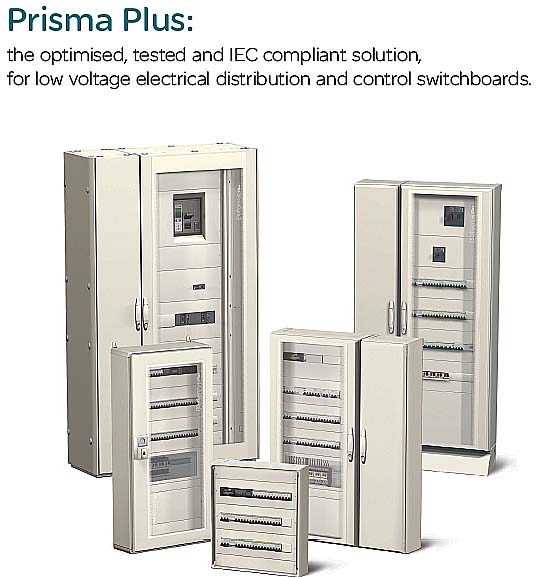
Рис. Schneider Electric
With Prisma Plus G you can be sure to build 100% Schneider Electric switchboards that are safe, optimised:
> All components (switchgear, distribution blocks, prefabricated connections, etc.) are perfectly rated and coordinated to work together;
> All switchboard configurations, even the most demanding ones, have been tested.
You can prove that your switchboard meets the current standards, at any time.
You can be sure to build a reliable electrical installation and give your customers full satisfaction in terms of dependability and safety for people and the installation.
Prisma Plus G with its discreet design, blends harmoniously into all tertiary and industrial buildings, including in entrance halls and passageways.
With Prisma Plus G you can build just the right switchboard for your customer, sized precisely to fit costs and needs.
With this complete, prefabricated and tested system, it's easy to upgrade your installation and still maintain the performance levels.
> The wall-mounted and floor-standing enclosures combine easily with switchboards already in service.
> Devices can be replaced or added at any time.
[Schneider Electric]С помощью оболочек Prisma Plus G можно создавать безопасные распределительные щиты, на 100 % состоящие из изделий Schneider Electric:
> все изделия (коммутационная аппаратура, распределительные блоки, готовые заводские соединения и т. д.) полностью совместимы механически и электрически;
> все варианты компоновки распределительных щитов, в том числе для наиболее ответственных применений, прошли испытания.В любое время вы можете доказать, что ваши распределительные щиты полностью соответствуют требованиям действующих стандартов.
Вы можете быть полностью уверены в том, что создаете надежные электроустановки, удовлетворяющие всем требованиям безопасности для людей и оборудования
Благодаря строгому дизайну, распределительные щиты Prisma Plus G гармонично сочетаются с интерьером любого общественного или промышленного здания. Они хорошо смотрятся и в вестибюле, и в коридоре.
Применяя оболочки Prisma Plus G можно создавать распределительные щиты, точно соответствующие требованиям заказчика как с точки зрения технических характеристик, так и стоимости.
С помощью данной испытанной системы, содержащей все необходимые компоненты заводского изготовления можно легко модернизировать существующую электроустановку и поддерживать её уровни производительности.> Навесные и напольные оболочки можно легко присоединить к уже эксплуатируемым распределительным щитам.
> Аппаратуру можно заменять или добавлять в любое время.
[Перевод Интент]The switchboard, central to the electrical installation.
Both the point of arrival of energy and a device for distribution to the site applications, the LV switchboard is the intelligence of the system, central to the electrical installation.
[Schneider Electric]Распределительный щит – «сердце» электроустановки.
Низковольтное комплектное устройство распределения является «сердцем» электроустановки, поскольку именно оно принимает электроэнергию из сети и распределяет её по территориально распределенным нагрузкам.
[Перевод Интент]Тематики
- НКУ (шкафы, пульты,...)
- электроснабжение в целом
EN
- branch distribution panel
- distributing board
- distributing panel
- distributing switchboard
- distribution bench
- distribution board
- distribution panel
- distribution switchboard
- gear
- keyboard
- PNL
- SB
- sw & d
- switchboard
- switchboard panel
DE
- elektrischer Verteiler, m
- Schalttafel
- Verteiler, m
FR
- tableau de distribution
- tableau de répartition, m
Англо-русский словарь нормативно-технической терминологии > switchboard
-
8 on
1.[ɒn]prepositionput something on the table — etwas auf den Tisch legen od. stellen
be on the table — auf dem Tisch sein
write something on the wall — etwas an die Wand schreiben
be hanging on the wall — an der Wand hängen
have something on one — etwas bei sich (Dat.) haben
be on the board/committee — im Vorstand/Ausschuss sein
2) (with basis, motive, etc. of)on the evidence — aufgrund des Beweismaterials
on the assumption/hypothesis that... — angenommen,...
3) in expressions of time an [einem Abend, Tag usw.]it's just on nine — es ist gerade neun
on [his] arrival — bei seiner Ankunft
on entering the room... — beim Betreten des Zimmers...
on time or schedule — pünktlich
4) expr. state etcthe drinks are on me — (coll.) die Getränke gehen auf mich
be on £20,000 a year — 20 000 Pfund im Jahr kriegen od. haben
5) (concerning, about) über (+ Akk.)2. adverb1)with/without a hat/coat on — mit/ohne Hut/Mantel
boil something with/without the lid on — etwas in geschlossenem/offenem Topf kochen
2) (in some direction)the light/radio etc. is on — das Licht/Radio usw. ist an
4) (arranged)is Sunday's picnic on? — findet das Picknick am Sonntag statt?
5) (being performed)what's on at the cinema? — was gibt es od. was läuft im Kino?
his play is currently on in London — sein Stück wird zur Zeit in London aufgeführt od. gespielt
6) (on duty)come/be on — seinen Dienst antreten/Dienst haben
7)something is on (feasible) /not on — etwas ist möglich/ausgeschlossen
you're on! — (coll.): (I agree) abgemacht!; (making bet) die Wette gilt!
be on about somebody/something — (coll.) [dauernd] über jemanden/etwas sprechen
what is he on about? — was will er [sagen]?
be on at/keep on and on at somebody — (coll.) jemandem in den Ohren/dauernd in den Ohren liegen (ugs.)
on to, onto — auf (+ Akk.)
be on to something — (have discovered something) etwas ausfindig gemacht haben. See also academic.ru/62377/right">right 4. 4)
* * *[on] 1. preposition1) (touching, fixed to, covering etc the upper or outer side of: The book was lying on the table; He was standing on the floor; She wore a hat on her head.) auf, in3) (at or during a certain day, time etc: on Monday; On his arrival, he went straight to bed.) an, bei4) (about: a book on the theatre.) über5) (in the state or process of: He's on holiday.) in6) (supported by: She was standing on one leg.) auf7) (receiving, taking: on drugs; on a diet.) auf9) (towards: They marched on the town.) zu10) (near or beside: a shop on the main road.) an12) (being carried by: The thief had the stolen jewels on him.) mit13) (when (something is, or has been, done): On investigation, there proved to be no need to panic.) als14) (followed by: disaster on disaster.) auf2. adverb1) ((especially of something being worn) so as to be touching, fixed to, covering etc the upper or outer side of: She put her hat on.) auf2) (used to show a continuing state etc, onwards: She kept on asking questions; They moved on.) weiter3) (( also adjective) (of electric light, machines etc) working: The television is on; Turn/Switch the light on.) an4) (( also adjective) (of films etc) able to be seen: There's a good film on at the cinema this week.) hinein5) (( also adjective) in or into a vehicle, train etc: The bus stopped and we got on.) im Gange3. adjective1) (in progress: The game was on.) stattfinden2) (not cancelled: Is the party on tonight?) stattfinden•- oncoming- ongoing
- onwards
- onward
- be on to someone
- be on to
- on and on
- on time
- on to / onto* * *on[ɒn, AM ɑ:n]I. prepthere are many books \on my desk auf meinem Tisch sind viele Bücherlook at that cat \on the chair! schau dir die Katze auf dem Stuhl an!\on top of sth [ganz] oben auf etw datput the pot \on the table! stell den Topf auf den Tisch!he had to walk out \on the roof er musste auf das Dach hinaufshe hung their washing \on the line to dry sie hängte ihre Wäsche zum Trocknen auf die Leinelet's hang a picture \on the wall lass uns ein Bild an die Wand hängento get \on a horse auf ein Pferd aufsteigen, aufsitzen, auf + datour house is \on Sturton Street unser Haus ist in der Sturton Streetthey lay \on the beach sie lagen am Strandthe town is \on the island die Stadt ist auf der Inselher new house is \on the river ihr neues Haus liegt am Fluss\on the balcony/her estate auf dem Balkon/ihrem Gut\on the border an der Grenzethe shop \on the corner der Laden an der Ecke\on the hill/mountain auf dem Hügel/Berg\on the left/right auf der linken/rechten Seite\on track two an Gleis zweiseveral bird houses hung \on the branches an den Ästen hingen mehrere Nistkästena huge chandelier hung \on the ceiling ein großer Kronleuchter hing von der Decke herabwith shoes \on his feet mit Schuhen an den Füßenthe wedding ring \on the ring finger der Ehering am RingfingerI hit my head \on the shelf ich habe mir den Kopf am Regal angestoßenshe tripped \on the wire sie blieb an dem Kabel hängenhe cut his foot \on some glass er hat sich den Fuß an einer Glasscherbe verletztto stumble \on sth über etw akk stolpernto lie \on one's back auf dem Rücken liegento stand \on one's head auf dem Kopf stehento have sth \on one etw bei sich dat habenI thought I had my driver's licence \on me ich dachte, ich hätte meinen Führerschein dabeihave you got a spare cigarette \on you? hast du eine Zigarette für mich übrig?how did you get that blood \on your shirt? wie kommt das Blut auf Ihr Hemd?he had a scratch \on his arm er hatte einen Kratzer am Armthere was a smile \on her face ein Lächeln lag auf ihrem Gesichta documentary \on volcanoes ein Dokumentarfilm über Vulkanehe needs some advice \on how to dress er braucht ein paar Tipps, wie er sich anziehen sollessays \on a wide range of issues Aufsätze zu einer Vielzahl von Themenhe commented \on the allegations er nahm Stellung zu den Vorwürfenhe advised her \on her taxes er beriet sie [o gab ihr Ratschläge] in Sachen SteuernI'll say more \on that subject later ich werde später mehr dazu sagenthey settled \on a price sie einigten sich auf einen Preisto congratulate sb \on sth jdn zu etw dat gratulierento frown \on sth etw missbilligento have something/anything \on sb etw gegen jdn in der Hand habendo the police have anything \on you? hat die Polizei etwas Belastendes gegen dich in der Hand?he reacted \on a hunch er reagierte auf ein Ahnung hinhe quit his job \on the principle that he did not want to work for an oil company er kündigte seine Stelle, weil er nicht für eine Ölgesellschaft arbeiten wolltethey cancelled all flights \on account of the bad weather sie sagten alle Flüge wegen des schlechten Wetters ab\on purpose mit Absicht, absichtlichdependent/reliant \on sb/sth abhängig von jdm/etwto be based \on sth auf etw dat basierento be based \on the ideas of freedom and equality auf den Ideen von Freiheit und Gleichheit basierento rely \on sb sich akk auf jdn verlassenhow many people are \on your staff? wie viele Mitarbeiter haben Sie?have you ever served \on a jury? warst du schon einmal Mitglied in einer Jury?whose side are you \on in this argument? auf welcher Seite stehst du in diesem Streit?a writer \on a women's magazine eine Autorin bei einer Frauenzeitschriftthe dog turned \on its own master der Hund ging auf seinen eigenes Herrchen losthe gangsters pulled a gun \on him die Gangster zielten mit der Pistole auf ihnthousands were marching \on Cologne Tausenden marschierten auf Köln zudon't be so hard \on him! sei nicht so streng mit ihm!criticism has no effect \on him Kritik kann ihm nichts anhabenhe didn't know it but the joke was \on him er wusste nicht, dass es ein Witz über ihn wartwo air raids \on Munich zwei Luftangriffe auf Münchenthey placed certain restrictions \on large companies großen Unternehmen wurden bestimmte Beschränkungen auferlegtthere is a new ban \on the drug die Droge wurde erneut verbotento place a limit \on sth etw begrenzento force one's will \on sb jdm seinen Willen aufzwingento cheat \on sb jdn betrügenhe's \on the phone er ist am Telefonshe weaved the cloth \on the loom sie webte das Tuch auf dem WebstuhlChris is \on drums Chris ist am Schlagzeugwe work \on flexitime wir arbeiten Gleitzeit\on the piano am KlavierI'd like to see that offer \on paper ich hätte dieses Angebot gerne schriftlichI saw myself \on film ich sah mich selbst im Filmwhat's \on TV tonight? was kommt heute Abend im Fernsehen?do you like the jazz \on radio? gefällt dir der Jazz im Radio?I heard the story \on the news today ich habe die Geschichte heute in den Nachrichten gehörta 10-part series \on Channel 3 eine zehnteilige Serie im 3. Programmto be available \on cassette auf Kassette erhältlich seinto store sth \on the computer etw im Computer speichernto put sth down \on paper etw aufschreiben [o BRD, ÖSTERR zu Papier bringen]to come out \on video als Video herauskommen\on the way to town auf dem Weg in die Stadt, mit + datI love travelling \on buses/trains ich fahre gerne mit Bussen/Zügenwe went to France \on the ferry wir fuhren mit der Fähre nach Frankreichhe got some sleep \on the plane er konnte im Flugzeug ein wenig schlafen\on foot/horseback zu Fuß/auf dem Pferdmany shops don't open \on Sundays viele Läden haben an Sonntagen geschlossenwhat are you doing \on Friday? was machst du am Freitag?we always go bowling \on Thursdays wir gehen donnerstags immer kegelnmy birthday's \on the 30th of May ich habe am 30. Mai Geburtstag\on a very hot evening in July an einem sehr heißen Abend im Juli\on Saturday morning/Wednesday evening am Samstagvormittag/Mittwochabend\on his brother's death beim Tod seines Bruders\on the count of three, start running! bei drei lauft ihr los!trains to London leave \on the hour every hour die Züge nach London fahren jeweils zur vollen Stundethe professor entered the room at 1:00 \on the minute der Professor betrat den Raum auf die Minute genau um 13.00 Uhr\on receiving her letter als ich ihren Brief erhielt\on arriving at the station bei der Ankunft im Bahnhof\on arrival/departure bei der Ankunft/Abreise\on the dot [auf die Sekunde] pünktlichto be finished \on schedule planmäßig fertig werdenwe were \on page 42 wir waren auf Seite 42he was out \on errands er machte ein paar Besorgungenwe made a big profit \on that deal wir haben bei diesem Geschäft gut verdient\on business geschäftlich, beruflichto work \on sth an etw dat arbeiten21. (regularly taking)▪ to be \on sth etw nehmenmy doctor put me \on antibiotics mein Arzt setzte mich auf Antibiotikahe lived \on berries and roots er lebte von Beeren und WurzelnRichard lives \on a diet of junk food Richard ernährt sich ausschließlich von Junkfoodto be \on drugs unter Drogen stehen, Drogen nehmento be \on medication Medikamente einnehmenshe wants it done \on the National Health Service sie möchte, dass die gesetzliche Krankenkasse die Kosten übernimmtthis meal is \on me das Essen bezahle ichthe drinks are \on me die Getränke gebe ich austo buy sth \on credit/hire purchase etw auf Kredit/Raten kaufen, von + datdoes this radio run \on batteries? läuft dieses Radio mit Batterien?I've only got £50 a week to live \on ich lebe von nur 50 Pfund pro Wochethey are living \on their savings sie leben von ihren Ersparnissento go \on the dole stempeln gehento live \on welfare von Sozialhilfe lebenI've wasted a lot of money \on this car ich habe für dieses Auto eine Menge Geld ausgegebenhow much interest are you paying \on the loan? wie viel Zinsen zahlst du für diesen Kredit?a few pence \on the electricity bill ein paar Pfennige mehr bei der Stromrechnungdogs should be kept \on their leads Hunde sollten an der Leine geführt werdento be \on the phone AUS, BRIT ans Telefonnetz angeschlossen sein, telefonisch erreichbar seinwe've just moved and we're not \on the phone yet wir sind gerade umgezogen und haben noch kein Telefon\on the agenda/list auf der Tagesordnung/Liste\on the whole im Ganzen, insgesamt\on the whole, it was a good year alles in allem war es ein gutes Jahrit's been \on my mind ich muss immer daran denkenshe had something \on her heart sie hatte etwas auf dem Herzenthat lie has been \on his conscience diese Lüge lastete auf seinem Gewissenthis is \on your shoulders das liegt in deiner Hand, die Verantwortung liegt bei dirthe future of the company is \on your shoulders du hast die Verantwortung für die Zukunft der Firma29. (experiencing)crime is \on the increase again die Verbrechen nehmen wieder zuI'll be away \on a training course ich mache demnächst einen Ausbildungslehrganghe's out \on a date with a woman er hat gerade eine Verabredung mit einer FrauI was \on a long journey ich habe eine lange Reise gemachtwe're going \on vacation in two weeks wir fahren in zwei Wochen in Urlaubto set sth \on fire etw anzündendid you know that she's got a new book \on the go? hast du gewusst, dass sie gerade ein neues Buch schreibt?to be \on strike streiken30. (compared with)I can't improve \on my final offer dieses Angebot ist mein letztes Wortsales are up \on last year der Umsatz ist höher als im letzten Jahrto have nothing [or not have anything] \on sth kein Vergleich mit etw dat seinmy new bike has nothing \on the one that was stolen mein neues Fahrrad ist bei Weitem nicht so gut wie das, das mir gestohlen wurde31. (by chance)▪ \on sb ohne jds Verschuldenshe was really worried when the phone went dead \on her sie machte sich richtig Sorgen, als das Telefon ausfiel, ohne dass sie etwas getan hattethe fire went out \on me das Feuer ist mir einfach ausgegangento chance \on sb jdn [zufällig] treffen, jdm [zufällig] begegnenthe government suffered defeat \on defeat die Regierung erlitt eine Niederlage nach der anderenwave \on wave of refugees has crossed the border immer neue Flüchtlingswellen strömten über die GrenzeClive's team is \on five points while Joan's is \on seven das Team von Clive hat fünf Punkte, das von Joan hat sieben34.▶ to be \on sth BRIT, AUS etw verdienen▶ \on the board in Planung▶ to have time \on one's hands noch genug Zeit haben1. (in contact with) aufmake sure the lid's \on properly pass auf, dass der Deckel richtig zu istthey sewed the man's ear back \on sie haben das Ohr des Mannes wieder angenähtto screw sth \on etw anschraubenI wish you wouldn't screw the lid \on so tightly schraube den Deckel bitte nicht immer so fest2. (on body) anput a jumper \on! zieh einen Pullover drüber!get your shoes \on! zieh dir die Schuhe an!to have/try sth \on etw anhaben/anprobierenwith nothing \on nackt3. (indicating continuance) weiterto get \on with sth mit etw dat weitermachento keep \on doing sth etw weitermachenif the phone's engaged, keep \on trying! wenn besetzt ist, probier es weiter!\on and \on immer weiterthe noise just went \on and \on der Lärm hörte gar nicht mehr aufhe talked \on and \on er redete pausenlos4. (in forward direction) vorwärtswould you pass it \on to Paul? würdest du es an Paul weitergeben?time's getting \on die Zeit vergehtfrom that day \on von diesem Tag anthey never spoke to each other from that day \on seit diesem Tag haben sie kein Wort mehr miteinander gewechseltlater \on späterwhat are you doing later \on? was hast du nachher vor?to urge sb \on jdn anspornenI'd never have managed this if my friend hadn't urged me \on ich hätte das nie geschafft, wenn mein Freund mich nicht dazu gedrängt hätte5. (being shown)▪ to be \on auf dem Programm stehenare there any good films \on at the cinema this week? laufen in dieser Woche irgendwelche guten Filme im Kino?what's \on at the festival? was ist für das Festival geplant?there's a good film \on this afternoon heute Nachmittag kommt ein guter Film6. (scheduled) geplantis the party still \on for tomorrow? ist die Party noch für morgen geplant?I've got nothing \on next week ich habe nächste Woche nichts vorI've got a lot \on this week ich habe mir für diese Woche eine Menge vorgenommen7. (functioning) anthe brakes are \on die Bremsen sind angezogenis the central heating \on? ist die Zentralheizung an?to put the kettle \on das Wasser aufsetzento leave the light \on das Licht anlassento switch/turn sth \on etw einschaltencould you switch \on the radio? könntest du das Radio anmachen?8. (aboard)the horse galloped off as soon as she was \on kaum war sie aufgesessen, da galoppierte das Pferd schon los9. (due to perform)you're \on! du bist dran!10.12.what are you \on about? wovon redest du denn nun schon wieder?he knows what he's \on about er weiß, wovon er redetI never understand what she's \on about ich verstehe nie, wovon sie es hat famshe's still \on at me to get my hair cut sie drängt mich dauernd, mir die Haare schneiden zu lassen▶ to be \on AM aufpassen▶ to hang \on warten▶ head \on frontal▶ \on and off, off and \on hin und wieder, ab und zuthe bike hit our car side \on das Rad prallte von der Seite auf unser Auto▶ this way \on AUS, BRIT auf diese Weise▶ to be well \on spät sein▶ to be well \on in years nicht mehr der Jüngste seinIII. adj inv, attrthis seems to be one of her \on days es scheint einer von ihren guten Tagen zu sein2. ELEC, TECH\on switch Einschalter m* * *[ɒn]1. PREPOSITIONWhen on is the second element in a phrasal verb, eg live on, lecture on, look up the verb. When it is part of a set combination, eg on the right, on request, on occasion, look up the other word.1) indicating place, position auf (+dat); (with vb of motion) auf (+acc); (on vertical surface, part of body) an (+dat); (with vb of motion) an (+acc)he hung it on the wall/nail — er hängte es an die Wand/den Nagel
a house on the coast/main road — ein Haus am Meer/an der Hauptstraße
he hit his head on the table/on the ground — er hat sich (dat) den Kopf am Tisch/auf dem or am Boden angeschlagen
on TV/the radio — im Fernsehen/Radio
held on computer — auf Computer (dat) gespeichert
2)= by means of, using
we went on the train/bus — wir fuhren mit dem Zug/Buson a bicycle — mit dem ( Fahr)rad
on foot/horseback — zu Fuß/Pferd
3) = about, concerning über (+acc)a book on German grammar we read Stalin on Marx — ein Buch über deutsche Grammatik wir lasen Stalins Ausführungen zu Marx
4) in expressions of time an (+dat)stars visible on clear nights — Sterne, die in klaren Nächten sichtbar sind
5)= earning, getting
I'm on £18,000 a year — ich bekomme £ 18.000 im Jahr6) = at the time of bei (+dat)on hearing this he left — als er das hörte, ging er
7) = as a result of auf... (acc) hin8) indicating membership in (+dat)he is on the committee/the board — er gehört dem Ausschuss/Vorstand an, er sitzt im Ausschuss/Vorstand
he is on the "Evening News" — er ist bei der "Evening News"
9)10)= at the expense of
this round is on me — diese Runde geht auf meine Kostenhave it on me — das spendiere ich (dir), ich gebe (dir) das aus
See:→ house11) = compared with im Vergleich zuprices are up on last year( 's) — im Vergleich zum letzten Jahr sind die Preise gestiegen
12)= taking
to be on drugs/the pill — Drogen/die Pille nehmen13)he made mistake on mistake — er machte einen Fehler nach dem anderen14)he played (it) on the violin/trumpet — er spielte (es) auf der Geige/Trompeteon drums/piano — am Schlagzeug/Klavier
Roland Kirk on tenor sax — Roland Kirk, Tenorsaxofon
15) = according to nach (+dat)on your theory — Ihrer Theorie nach or zufolge, nach Ihrer Theorie
2. ADVERB1)= in place, covering
he screwed the lid on — er schraubte den Deckel draufshe had nothing on —
2)put it this way on — stellen/legen Sie es so herum (darauf)3)move on! — gehen Sie weiter!, weitergehen!4)from now on — von jetzt anit was well on in the night — es war zu vorgerückter Stunde, es war spät in der Nacht
5)to keep on talking — immer weiterreden, in einem fort reden6)__diams; on and on they talked on and on — sie redeten und redeten, sie redeten unentwegtshe went on and on — sie hörte gar nicht mehr auf __diams; to be on at sb
he's always on at me — er hackt dauernd auf mir herum, er meckert dauernd an mir herum (inf)
he's always on at me to get my hair cut — er liegt mir dauernd in den Ohren, dass ich mir die Haare schneiden lassen soll
he's been on at me about that several times — er ist mir ein paar Mal damit gekommen (inf) __diams; to be on about sth
she's always on about her experiences in Italy — sie kommt dauernd mit ihren Italienerfahrungen (inf)
what's he on about? —
he knows what he's on about — er weiß, wovon er redet
3. ADJECTIVEthe "on" switch — der Einschalter
in the "on" position —
2) = in place lid, cover draufhis hat/tie was on crookedly — sein Hut saß/sein Schlips hing schief
his hat/coat was already on — er hatte den Hut schon auf/den Mantel schon an
3)= taking place
there's a tennis match on at the moment — ein Tennismatch ist gerade im Gangwhat's on in London? —
4)= being performed, performing
to be on (in theatre, cinema) — gegeben or gezeigt werden; (on TV, radio) gesendet or gezeigt werdenwho's on tonight? (Theat, Film) — wer spielt heute Abend?, wer tritt heute Abend auf?; (TV) wer kommt heute Abend (im Fernsehen)?
you're on now (Theat, Rad, TV) — Ihr Auftritt!, Sie sind (jetzt) dran (inf)
tell me when the English team is on — sagen Sie mir, wenn die englische Mannschaft dran ist or drankommt
5)you're on! —
are you on? ( inf = are you with us ) —,, machst du mit?
you're/he's not on ( Brit inf ) — das ist nicht drin (inf)
* * *on [ɒn; US auch ɑn]A präpthe scar on his face die Narbe in seinem Gesicht;a ring on one’s finger ein Ring am Finger;have you got a lighter on you? haben Sie ein Feuerzeug bei sich?;find sth on sb etwas bei jemandem finden4. (Richtung, Ziel) auf (akk) … (hin), an (akk), zu:a blow on the chin ein Schlag ans Kinn;drop sth on the floor etwas auf den Fußboden oder zu Boden fallen lassen;hang sth on a peg etwas an einen Haken hängen5. fig (auf der Grundlage von) auf (akk) … (hin):based on facts auf Tatsachen begründet;live on air von (der) Luft leben;this car runs on petrol dieser Wagen fährt mit Benzin;a scholar on a foundation ein Stipendiat (einer Stiftung);borrow on jewels sich auf Schmuck(stücke) Geld borgen;a duty on silk (ein) Zoll auf Seide;interest on one’s capital Zinsen auf sein Kapitalloss on loss Verlust auf oder über Verlust, ein Verlust nach dem andern;be on one’s second glass bei seinem zweiten Glas seinbe on a committee (the jury, the general staff) zu einem Ausschuss (zu den Geschworenen, zum Generalstab) gehören;be on the “Daily Mail” bei der „Daily Mail“ (beschäftigt) seinbe on sth etwas (ein Medikament etc) (ständig) nehmen;be on pills tablettenabhängig oder -süchtig seina joke on me ein Spaß auf meine Kosten;shut (open) the door on sb jemandem die Tür verschließen (öffnen);the strain tells severely on him die Anstrengung nimmt ihn sichtlich mit;a) jemandem nichts voraus haben,b) jemandem nichts anhaben können;have sth on sb umg eine Handhabe gegen jemanden haben, etwas Belastendes über jemanden wissenan agreement (a lecture, an opinion) on sth;on Sunday, on the 1st of April, on April 1st;on or after April 1st ab oder mit Wirkung vom 1. April;on or before April 1st bis zum oder bis spätestens am 1. April;on being asked als ich etc (danach) gefragt wurde12. nachdem:on leaving school, he … nachdem er die Schule verlassen hatte, …13. gegenüber, im Vergleich zu:losses were £100,000 down on the previous yearB adva) an…:b) auf…:keep one’s hat on3. (a in Zusammensetzungen mit Verben) weiter(…):and so on und so weiter;on and on immer weiter;a) ab und zu,b) ab und an, mit Unterbrechungen;from that day on von dem Tage an;on with the show! weiter im Programm!;C adj präd1. be ona) im Gange sein (Spiel etc), vor sich gehen:what’s on? was ist los?;what’s on in London? was ist in London los?, was tut sich in London?;have you anything on tomorrow? haben Sie morgen etwas vor?;that’s not on! das ist nicht drin! umgb) an sein umg (Licht, Radio, Wasser etc), an-, eingeschaltet sein, laufen, auf sein umg (Hahn):on - off TECH An - Aus;the light is on das Licht brennt oder ist an(geschaltet);the brakes are on die Bremsen sind angezogen;the race is on SPORT das Rennen ist gestartet;you are on! abgemacht!d) d(a)ran (an der Reihe) seine) (mit) dabei sein, mitmachenbe well on ganz schön blau seinabout wegen)* * *1.[ɒn]prepositionput something on the table — etwas auf den Tisch legen od. stellen
have something on one — etwas bei sich (Dat.) haben
on the bus/train — im Bus/Zug; (by bus/train) mit dem Bus/Zug
be on the board/committee — im Vorstand/Ausschuss sein
2) (with basis, motive, etc. of)on the assumption/hypothesis that... — angenommen,...
3) in expressions of time an [einem Abend, Tag usw.]on [his] arrival — bei seiner Ankunft
on entering the room... — beim Betreten des Zimmers...
on time or schedule — pünktlich
4) expr. state etcthe drinks are on me — (coll.) die Getränke gehen auf mich
be on £20,000 a year — 20 000 Pfund im Jahr kriegen od. haben
5) (concerning, about) über (+ Akk.)2. adverb1)with/without a hat/coat on — mit/ohne Hut/Mantel
boil something with/without the lid on — etwas in geschlossenem/offenem Topf kochen
the light/radio etc. is on — das Licht/Radio usw. ist an
4) (arranged)what's on at the cinema? — was gibt es od. was läuft im Kino?
6) (on duty)come/be on — seinen Dienst antreten/Dienst haben
7)something is on (feasible) /not on — etwas ist möglich/ausgeschlossen
you're on! — (coll.): (I agree) abgemacht!; (making bet) die Wette gilt!
be on about somebody/something — (coll.) [dauernd] über jemanden/etwas sprechen
what is he on about? — was will er [sagen]?
be on at/keep on and on at somebody — (coll.) jemandem in den Ohren/dauernd in den Ohren liegen (ugs.)
on to, onto — auf (+ Akk.)
be on to something — (have discovered something) etwas ausfindig gemacht haben. See also right 4. 4)
* * *adj.eingeschaltet adj.in adj. prep.an präp.auf präp.bei präp.über präp. -
9 modular data center
модульный центр обработки данных (ЦОД)
-
[Интент]Параллельные тексты EN-RU
[ http://dcnt.ru/?p=9299#more-9299]
Data Centers are a hot topic these days. No matter where you look, this once obscure aspect of infrastructure is getting a lot of attention. For years, there have been cost pressures on IT operations and this, when the need for modern capacity is greater than ever, has thrust data centers into the spotlight. Server and rack density continues to rise, placing DC professionals and businesses in tighter and tougher situations while they struggle to manage their IT environments. And now hyper-scale cloud infrastructure is taking traditional technologies to limits never explored before and focusing the imagination of the IT industry on new possibilities.
В настоящее время центры обработки данных являются широко обсуждаемой темой. Куда ни посмотришь, этот некогда малоизвестный аспект инфраструктуры привлекает все больше внимания. Годами ИТ-отделы испытывали нехватку средств и это выдвинуло ЦОДы в центр внимания, в то время, когда необходимость в современных ЦОДах стала как никогда высокой. Плотность серверов и стоек продолжают расти, все больше усложняя ситуацию для специалистов в области охлаждения и организаций в их попытках управлять своими ИТ-средами. И теперь гипермасштабируемая облачная инфраструктура подвергает традиционные технологии невиданным ранее нагрузкам, и заставляет ИТ-индустрию искать новые возможности.
At Microsoft, we have focused a lot of thought and research around how to best operate and maintain our global infrastructure and we want to share those learnings. While obviously there are some aspects that we keep to ourselves, we have shared how we operate facilities daily, our technologies and methodologies, and, most importantly, how we monitor and manage our facilities. Whether it’s speaking at industry events, inviting customers to our “Microsoft data center conferences” held in our data centers, or through other media like blogging and white papers, we believe sharing best practices is paramount and will drive the industry forward. So in that vein, we have some interesting news to share.
В компании MicroSoft уделяют большое внимание изучению наилучших методов эксплуатации и технического обслуживания своей глобальной инфраструктуры и делятся результатами своих исследований. И хотя мы, конечно, не раскрываем некоторые аспекты своих исследований, мы делимся повседневным опытом эксплуатации дата-центров, своими технологиями и методологиями и, что важнее всего, методами контроля и управления своими объектами. Будь то доклады на отраслевых событиях, приглашение клиентов на наши конференции, которые посвящены центрам обработки данных MicroSoft, и проводятся в этих самых дата-центрах, или использование других средств, например, блоги и спецификации, мы уверены, что обмен передовым опытом имеет первостепенное значение и будет продвигать отрасль вперед.
Today we are sharing our Generation 4 Modular Data Center plan. This is our vision and will be the foundation of our cloud data center infrastructure in the next five years. We believe it is one of the most revolutionary changes to happen to data centers in the last 30 years. Joining me, in writing this blog are Daniel Costello, my director of Data Center Research and Engineering and Christian Belady, principal power and cooling architect. I feel their voices will add significant value to driving understanding around the many benefits included in this new design paradigm.
Сейчас мы хотим поделиться своим планом модульного дата-центра четвертого поколения. Это наше видение и оно будет основанием для инфраструктуры наших облачных дата-центров в ближайшие пять лет. Мы считаем, что это одно из самых революционных изменений в дата-центрах за последние 30 лет. Вместе со мной в написании этого блога участвовали Дэниел Костелло, директор по исследованиям и инжинирингу дата-центров, и Кристиан Белади, главный архитектор систем энергоснабжения и охлаждения. Мне кажется, что их авторитет придаст больше веса большому количеству преимуществ, включенных в эту новую парадигму проектирования.
Our “Gen 4” modular data centers will take the flexibility of containerized servers—like those in our Chicago data center—and apply it across the entire facility. So what do we mean by modular? Think of it like “building blocks”, where the data center will be composed of modular units of prefabricated mechanical, electrical, security components, etc., in addition to containerized servers.
Was there a key driver for the Generation 4 Data Center?Наши модульные дата-центры “Gen 4” будут гибкими с контейнерами серверов – как серверы в нашем чикагском дата-центре. И гибкость будет применяться ко всему ЦОД. Итак, что мы подразумеваем под модульностью? Мы думаем о ней как о “строительных блоках”, где дата-центр будет состоять из модульных блоков изготовленных в заводских условиях электрических систем и систем охлаждения, а также систем безопасности и т.п., в дополнение к контейнеризованным серверам.
Был ли ключевой стимул для разработки дата-центра четвертого поколения?
If we were to summarize the promise of our Gen 4 design into a single sentence it would be something like this: “A highly modular, scalable, efficient, just-in-time data center capacity program that can be delivered anywhere in the world very quickly and cheaply, while allowing for continued growth as required.” Sounds too good to be true, doesn’t it? Well, keep in mind that these concepts have been in initial development and prototyping for over a year and are based on cumulative knowledge of previous facility generations and the advances we have made since we began our investments in earnest on this new design.Если бы нам нужно было обобщить достоинства нашего проекта Gen 4 в одном предложении, это выглядело бы следующим образом: “Центр обработки данных с высоким уровнем модульности, расширяемости, и энергетической эффективности, а также возможностью постоянного расширения, в случае необходимости, который можно очень быстро и дешево развертывать в любом месте мира”. Звучит слишком хорошо для того чтобы быть правдой, не так ли? Ну, не забывайте, что эти концепции находились в процессе начальной разработки и создания опытного образца в течение более одного года и основываются на опыте, накопленном в ходе развития предыдущих поколений ЦОД, а также успехах, сделанных нами со времени, когда мы начали вкладывать серьезные средства в этот новый проект.
One of the biggest challenges we’ve had at Microsoft is something Mike likes to call the ‘Goldilock’s Problem’. In a nutshell, the problem can be stated as:
The worst thing we can do in delivering facilities for the business is not have enough capacity online, thus limiting the growth of our products and services.Одну из самых больших проблем, с которыми приходилось сталкиваться Майкрософт, Майк любит называть ‘Проблемой Лютика’. Вкратце, эту проблему можно выразить следующим образом:
Самое худшее, что может быть при строительстве ЦОД для бизнеса, это не располагать достаточными производственными мощностями, и тем самым ограничивать рост наших продуктов и сервисов.The second worst thing we can do in delivering facilities for the business is to have too much capacity online.
А вторым самым худшим моментом в этой сфере может слишком большое количество производственных мощностей.
This has led to a focus on smart, intelligent growth for the business — refining our overall demand picture. It can’t be too hot. It can’t be too cold. It has to be ‘Just Right!’ The capital dollars of investment are too large to make without long term planning. As we struggled to master these interesting challenges, we had to ensure that our technological plan also included solutions for the business and operational challenges we faced as well.
So let’s take a high level look at our Generation 4 designЭто заставило нас сосредоточиваться на интеллектуальном росте для бизнеса — refining our overall demand picture. Это не должно быть слишком горячим. И это не должно быть слишком холодным. Это должно быть ‘как раз, таким как надо!’ Нельзя делать такие большие капиталовложения без долгосрочного планирования. Пока мы старались решить эти интересные проблемы, мы должны были гарантировать, что наш технологический план будет также включать решения для коммерческих и эксплуатационных проблем, с которыми нам также приходилось сталкиваться.
Давайте рассмотрим наш проект дата-центра четвертого поколенияAre you ready for some great visuals? Check out this video at Soapbox. Click here for the Microsoft 4th Gen Video.
It’s a concept video that came out of my Data Center Research and Engineering team, under Daniel Costello, that will give you a view into what we think is the future.
From a configuration, construct-ability and time to market perspective, our primary goals and objectives are to modularize the whole data center. Not just the server side (like the Chicago facility), but the mechanical and electrical space as well. This means using the same kind of parts in pre-manufactured modules, the ability to use containers, skids, or rack-based deployments and the ability to tailor the Redundancy and Reliability requirements to the application at a very specific level.
Посмотрите это видео, перейдите по ссылке для просмотра видео о Microsoft 4th Gen:
Это концептуальное видео, созданное командой отдела Data Center Research and Engineering, возглавляемого Дэниелом Костелло, которое даст вам наше представление о будущем.
С точки зрения конфигурации, строительной технологичности и времени вывода на рынок, нашими главными целями и задачами агрегатирование всего дата-центра. Не только серверную часть, как дата-центр в Чикаго, но также системы охлаждения и электрические системы. Это означает применение деталей одного типа в сборных модулях, возможность использования контейнеров, салазок, или стоечных систем, а также возможность подстраивать требования избыточности и надежности для данного приложения на очень специфичном уровне.Our goals from a cost perspective were simple in concept but tough to deliver. First and foremost, we had to reduce the capital cost per critical Mega Watt by the class of use. Some applications can run with N-level redundancy in the infrastructure, others require a little more infrastructure for support. These different classes of infrastructure requirements meant that optimizing for all cost classes was paramount. At Microsoft, we are not a one trick pony and have many Online products and services (240+) that require different levels of operational support. We understand that and ensured that we addressed it in our design which will allow us to reduce capital costs by 20%-40% or greater depending upon class.
Нашими целями в области затрат были концептуально простыми, но трудно реализуемыми. В первую очередь мы должны были снизить капитальные затраты в пересчете на один мегаватт, в зависимости от класса резервирования. Некоторые приложения могут вполне работать на базе инфраструктуры с резервированием на уровне N, то есть без резервирования, а для работы других приложений требуется больше инфраструктуры. Эти разные классы требований инфраструктуры подразумевали, что оптимизация всех классов затрат имеет преобладающее значение. В Майкрософт мы не ограничиваемся одним решением и располагаем большим количеством интерактивных продуктов и сервисов (240+), которым требуются разные уровни эксплуатационной поддержки. Мы понимаем это, и учитываем это в своем проекте, который позволит нам сокращать капитальные затраты на 20%-40% или более в зависимости от класса.For example, non-critical or geo redundant applications have low hardware reliability requirements on a location basis. As a result, Gen 4 can be configured to provide stripped down, low-cost infrastructure with little or no redundancy and/or temperature control. Let’s say an Online service team decides that due to the dramatically lower cost, they will simply use uncontrolled outside air with temperatures ranging 10-35 C and 20-80% RH. The reality is we are already spec-ing this for all of our servers today and working with server vendors to broaden that range even further as Gen 4 becomes a reality. For this class of infrastructure, we eliminate generators, chillers, UPSs, and possibly lower costs relative to traditional infrastructure.
Например, некритичные или гео-избыточные системы имеют низкие требования к аппаратной надежности на основе местоположения. В результате этого, Gen 4 можно конфигурировать для упрощенной, недорогой инфраструктуры с низким уровнем (или вообще без резервирования) резервирования и / или температурного контроля. Скажем, команда интерактивного сервиса решает, что, в связи с намного меньшими затратами, они будут просто использовать некондиционированный наружный воздух с температурой 10-35°C и влажностью 20-80% RH. В реальности мы уже сегодня предъявляем эти требования к своим серверам и работаем с поставщиками серверов над еще большим расширением диапазона температур, так как наш модуль и подход Gen 4 становится реальностью. Для подобного класса инфраструктуры мы удаляем генераторы, чиллеры, ИБП, и, возможно, будем предлагать более низкие затраты, по сравнению с традиционной инфраструктурой.
Applications that demand higher level of redundancy or temperature control will use configurations of Gen 4 to meet those needs, however, they will also cost more (but still less than traditional data centers). We see this cost difference driving engineering behavioral change in that we predict more applications will drive towards Geo redundancy to lower costs.
Системы, которым требуется более высокий уровень резервирования или температурного контроля, будут использовать конфигурации Gen 4, отвечающие этим требованиям, однако, они будут также стоить больше. Но все равно они будут стоить меньше, чем традиционные дата-центры. Мы предвидим, что эти различия в затратах будут вызывать изменения в методах инжиниринга, и по нашим прогнозам, это будет выражаться в переходе все большего числа систем на гео-избыточность и меньшие затраты.
Another cool thing about Gen 4 is that it allows us to deploy capacity when our demand dictates it. Once finalized, we will no longer need to make large upfront investments. Imagine driving capital costs more closely in-line with actual demand, thus greatly reducing time-to-market and adding the capacity Online inherent in the design. Also reduced is the amount of construction labor required to put these “building blocks” together. Since the entire platform requires pre-manufacture of its core components, on-site construction costs are lowered. This allows us to maximize our return on invested capital.
Еще одно достоинство Gen 4 состоит в том, что он позволяет нам разворачивать дополнительные мощности, когда нам это необходимо. Как только мы закончим проект, нам больше не нужно будет делать большие начальные капиталовложения. Представьте себе возможность более точного согласования капитальных затрат с реальными требованиями, и тем самым значительного снижения времени вывода на рынок и интерактивного добавления мощностей, предусматриваемого проектом. Также снижен объем строительных работ, требуемых для сборки этих “строительных блоков”. Поскольку вся платформа требует предварительного изготовления ее базовых компонентов, затраты на сборку также снижены. Это позволит нам увеличить до максимума окупаемость своих капиталовложений.
Мы все подвергаем сомнениюIn our design process, we questioned everything. You may notice there is no roof and some might be uncomfortable with this. We explored the need of one and throughout our research we got some surprising (positive) results that showed one wasn’t needed.
В своем процессе проектирования мы все подвергаем сомнению. Вы, наверное, обратили внимание на отсутствие крыши, и некоторым специалистам это могло не понравиться. Мы изучили необходимость в крыше и в ходе своих исследований получили удивительные результаты, которые показали, что крыша не нужна.
Серийное производство дата центров
In short, we are striving to bring Henry Ford’s Model T factory to the data center. http://en.wikipedia.org/wiki/Henry_Ford#Model_T. Gen 4 will move data centers from a custom design and build model to a commoditized manufacturing approach. We intend to have our components built in factories and then assemble them in one location (the data center site) very quickly. Think about how a computer, car or plane is built today. Components are manufactured by different companies all over the world to a predefined spec and then integrated in one location based on demands and feature requirements. And just like Henry Ford’s assembly line drove the cost of building and the time-to-market down dramatically for the automobile industry, we expect Gen 4 to do the same for data centers. Everything will be pre-manufactured and assembled on the pad.Мы хотим применить модель автомобильной фабрики Генри Форда к дата-центру. Проект Gen 4 будет способствовать переходу от модели специализированного проектирования и строительства к товарно-производственному, серийному подходу. Мы намерены изготавливать свои компоненты на заводах, а затем очень быстро собирать их в одном месте, в месте строительства дата-центра. Подумайте о том, как сегодня изготавливается компьютер, автомобиль или самолет. Компоненты изготавливаются по заранее определенным спецификациям разными компаниями во всем мире, затем собираются в одном месте на основе спроса и требуемых характеристик. И точно так же как сборочный конвейер Генри Форда привел к значительному уменьшению затрат на производство и времени вывода на рынок в автомобильной промышленности, мы надеемся, что Gen 4 сделает то же самое для дата-центров. Все будет предварительно изготавливаться и собираться на месте.
Невероятно энергоэффективный ЦОД
And did we mention that this platform will be, overall, incredibly energy efficient? From a total energy perspective not only will we have remarkable PUE values, but the total cost of energy going into the facility will be greatly reduced as well. How much energy goes into making concrete? Will we need as much of it? How much energy goes into the fuel of the construction vehicles? This will also be greatly reduced! A key driver is our goal to achieve an average PUE at or below 1.125 by 2012 across our data centers. More than that, we are on a mission to reduce the overall amount of copper and water used in these facilities. We believe these will be the next areas of industry attention when and if the energy problem is solved. So we are asking today…“how can we build a data center with less building”?А мы упоминали, что эта платформа будет, в общем, невероятно энергоэффективной? С точки зрения общей энергии, мы получим не только поразительные значения PUE, но общая стоимость энергии, затраченной на объект будет также значительно снижена. Сколько энергии идет на производство бетона? Нам нужно будет столько энергии? Сколько энергии идет на питание инженерных строительных машин? Это тоже будет значительно снижено! Главным стимулом является достижение среднего PUE не больше 1.125 для всех наших дата-центров к 2012 году. Более того, у нас есть задача сокращения общего количества меди и воды в дата-центрах. Мы думаем, что эти задачи станут следующей заботой отрасли после того как будет решена энергетическая проблема. Итак, сегодня мы спрашиваем себя…“как можно построить дата-центр с меньшим объемом строительных работ”?
Строительство дата центров без чиллеровWe have talked openly and publicly about building chiller-less data centers and running our facilities using aggressive outside economization. Our sincerest hope is that Gen 4 will completely eliminate the use of water. Today’s data centers use massive amounts of water and we see water as the next scarce resource and have decided to take a proactive stance on making water conservation part of our plan.
Мы открыто и публично говорили о строительстве дата-центров без чиллеров и активном использовании в наших центрах обработки данных технологий свободного охлаждения или фрикулинга. Мы искренне надеемся, что Gen 4 позволит полностью отказаться от использования воды. Современные дата-центры расходуют большие объемы воды и так как мы считаем воду следующим редким ресурсом, мы решили принять упреждающие меры и включить экономию воды в свой план.
By sharing this with the industry, we believe everyone can benefit from our methodology. While this concept and approach may be intimidating (or downright frightening) to some in the industry, disclosure ultimately is better for all of us.
Делясь этим опытом с отраслью, мы считаем, что каждый сможет извлечь выгоду из нашей методологией. Хотя эта концепция и подход могут показаться пугающими (или откровенно страшными) для некоторых отраслевых специалистов, раскрывая свои планы мы, в конечном счете, делаем лучше для всех нас.
Gen 4 design (even more than just containers), could reduce the ‘religious’ debates in our industry. With the central spine infrastructure in place, containers or pre-manufactured server halls can be either AC or DC, air-side economized or water-side economized, or not economized at all (though the sanity of that might be questioned). Gen 4 will allow us to decommission, repair and upgrade quickly because everything is modular. No longer will we be governed by the initial decisions made when constructing the facility. We will have almost unlimited use and re-use of the facility and site. We will also be able to use power in an ultra-fluid fashion moving load from critical to non-critical as use and capacity requirements dictate.
Проект Gen 4 позволит уменьшить ‘религиозные’ споры в нашей отрасли. Располагая базовой инфраструктурой, контейнеры или сборные серверные могут оборудоваться системами переменного или постоянного тока, воздушными или водяными экономайзерами, или вообще не использовать экономайзеры. Хотя можно подвергать сомнению разумность такого решения. Gen 4 позволит нам быстро выполнять работы по выводу из эксплуатации, ремонту и модернизации, поскольку все будет модульным. Мы больше не будем руководствоваться начальными решениями, принятыми во время строительства дата-центра. Мы сможем использовать этот дата-центр и инфраструктуру в течение почти неограниченного периода времени. Мы также сможем применять сверхгибкие методы использования электрической энергии, переводя оборудование в режимы критической или некритической нагрузки в соответствии с требуемой мощностью.
Gen 4 – это стандартная платформаFinally, we believe this is a big game changer. Gen 4 will provide a standard platform that our industry can innovate around. For example, all modules in our Gen 4 will have common interfaces clearly defined by our specs and any vendor that meets these specifications will be able to plug into our infrastructure. Whether you are a computer vendor, UPS vendor, generator vendor, etc., you will be able to plug and play into our infrastructure. This means we can also source anyone, anywhere on the globe to minimize costs and maximize performance. We want to help motivate the industry to further innovate—with innovations from which everyone can reap the benefits.
Наконец, мы уверены, что это будет фактором, который значительно изменит ситуацию. Gen 4 будет представлять собой стандартную платформу, которую отрасль сможет обновлять. Например, все модули в нашем Gen 4 будут иметь общепринятые интерфейсы, четко определяемые нашими спецификациями, и оборудование любого поставщика, которое отвечает этим спецификациям можно будет включать в нашу инфраструктуру. Независимо от того производите вы компьютеры, ИБП, генераторы и т.п., вы сможете включать свое оборудование нашу инфраструктуру. Это означает, что мы также сможем обеспечивать всех, в любом месте земного шара, тем самым сводя до минимума затраты и максимальной увеличивая производительность. Мы хотим создать в отрасли мотивацию для дальнейших инноваций – инноваций, от которых каждый сможет получать выгоду.
Главные характеристики дата-центров четвертого поколения Gen4To summarize, the key characteristics of our Generation 4 data centers are:
Scalable
Plug-and-play spine infrastructure
Factory pre-assembled: Pre-Assembled Containers (PACs) & Pre-Manufactured Buildings (PMBs)
Rapid deployment
De-mountable
Reduce TTM
Reduced construction
Sustainable measuresНиже приведены главные характеристики дата-центров четвертого поколения Gen 4:
Расширяемость;
Готовая к использованию базовая инфраструктура;
Изготовление в заводских условиях: сборные контейнеры (PAC) и сборные здания (PMB);
Быстрота развертывания;
Возможность демонтажа;
Снижение времени вывода на рынок (TTM);
Сокращение сроков строительства;
Экологичность;Map applications to DC Class
We hope you join us on this incredible journey of change and innovation!
Long hours of research and engineering time are invested into this process. There are still some long days and nights ahead, but the vision is clear. Rest assured however, that we as refine Generation 4, the team will soon be looking to Generation 5 (even if it is a bit farther out). There is always room to get better.
Использование систем электропитания постоянного тока.
Мы надеемся, что вы присоединитесь к нам в этом невероятном путешествии по миру изменений и инноваций!
На этот проект уже потрачены долгие часы исследований и проектирования. И еще предстоит потратить много дней и ночей, но мы имеем четкое представление о конечной цели. Однако будьте уверены, что как только мы доведем до конца проект модульного дата-центра четвертого поколения, мы вскоре начнем думать о проекте дата-центра пятого поколения. Всегда есть возможность для улучшений.So if you happen to come across Goldilocks in the forest, and you are curious as to why she is smiling you will know that she feels very good about getting very close to ‘JUST RIGHT’.
Generations of Evolution – some background on our data center designsТак что, если вы встретите в лесу девочку по имени Лютик, и вам станет любопытно, почему она улыбается, вы будете знать, что она очень довольна тем, что очень близко подошла к ‘ОПИМАЛЬНОМУ РЕШЕНИЮ’.
Поколения эволюции – история развития наших дата-центровWe thought you might be interested in understanding what happened in the first three generations of our data center designs. When Ray Ozzie wrote his Software plus Services memo it posed a very interesting challenge to us. The winds of change were at ‘tornado’ proportions. That “plus Services” tag had some significant (and unstated) challenges inherent to it. The first was that Microsoft was going to evolve even further into an operations company. While we had been running large scale Internet services since 1995, this development lead us to an entirely new level. Additionally, these “services” would span across both Internet and Enterprise businesses. To those of you who have to operate “stuff”, you know that these are two very different worlds in operational models and challenges. It also meant that, to achieve the same level of reliability and performance required our infrastructure was going to have to scale globally and in a significant way.
Мы подумали, что может быть вам будет интересно узнать историю первых трех поколений наших центров обработки данных. Когда Рэй Оззи написал свою памятную записку Software plus Services, он поставил перед нами очень интересную задачу. Ветра перемен двигались с ураганной скоростью. Это окончание “plus Services” скрывало в себе какие-то значительные и неопределенные задачи. Первая заключалась в том, что Майкрософт собиралась в еще большей степени стать операционной компанией. Несмотря на то, что мы управляли большими интернет-сервисами, начиная с 1995 г., эта разработка подняла нас на абсолютно новый уровень. Кроме того, эти “сервисы” охватывали интернет-компании и корпорации. Тем, кому приходится всем этим управлять, известно, что есть два очень разных мира в области операционных моделей и задач. Это также означало, что для достижения такого же уровня надежности и производительности требовалось, чтобы наша инфраструктура располагала значительными возможностями расширения в глобальных масштабах.
It was that intense atmosphere of change that we first started re-evaluating data center technology and processes in general and our ideas began to reach farther than what was accepted by the industry at large. This was the era of Generation 1. As we look at where most of the world’s data centers are today (and where our facilities were), it represented all the known learning and design requirements that had been in place since IBM built the first purpose-built computer room. These facilities focused more around uptime, reliability and redundancy. Big infrastructure was held accountable to solve all potential environmental shortfalls. This is where the majority of infrastructure in the industry still is today.
Именно в этой атмосфере серьезных изменений мы впервые начали переоценку ЦОД-технологий и технологий вообще, и наши идеи начали выходить за пределы общепринятых в отрасли представлений. Это была эпоха ЦОД первого поколения. Когда мы узнали, где сегодня располагается большинство мировых дата-центров и где находятся наши предприятия, это представляло весь опыт и навыки проектирования, накопленные со времени, когда IBM построила первую серверную. В этих ЦОД больше внимания уделялось бесперебойной работе, надежности и резервированию. Большая инфраструктура была призвана решать все потенциальные экологические проблемы. Сегодня большая часть инфраструктуры все еще находится на этом этапе своего развития.
We soon realized that traditional data centers were quickly becoming outdated. They were not keeping up with the demands of what was happening technologically and environmentally. That’s when we kicked off our Generation 2 design. Gen 2 facilities started taking into account sustainability, energy efficiency, and really looking at the total cost of energy and operations.
Очень быстро мы поняли, что стандартные дата-центры очень быстро становятся устаревшими. Они не поспевали за темпами изменений технологических и экологических требований. Именно тогда мы стали разрабатывать ЦОД второго поколения. В этих дата-центрах Gen 2 стали принимать во внимание такие факторы как устойчивое развитие, энергетическая эффективность, а также общие энергетические и эксплуатационные.
No longer did we view data centers just for the upfront capital costs, but we took a hard look at the facility over the course of its life. Our Quincy, Washington and San Antonio, Texas facilities are examples of our Gen 2 data centers where we explored and implemented new ways to lessen the impact on the environment. These facilities are considered two leading industry examples, based on their energy efficiency and ability to run and operate at new levels of scale and performance by leveraging clean hydro power (Quincy) and recycled waste water (San Antonio) to cool the facility during peak cooling months.
Мы больше не рассматривали дата-центры только с точки зрения начальных капитальных затрат, а внимательно следили за работой ЦОД на протяжении его срока службы. Наши объекты в Куинси, Вашингтоне, и Сан-Антонио, Техас, являются образцами наших ЦОД второго поколения, в которых мы изучали и применяли на практике новые способы снижения воздействия на окружающую среду. Эти объекты считаются двумя ведущими отраслевыми примерами, исходя из их энергетической эффективности и способности работать на новых уровнях производительности, основанных на использовании чистой энергии воды (Куинси) и рециклирования отработанной воды (Сан-Антонио) для охлаждения объекта в самых жарких месяцах.
As we were delivering our Gen 2 facilities into steel and concrete, our Generation 3 facilities were rapidly driving the evolution of the program. The key concepts for our Gen 3 design are increased modularity and greater concentration around energy efficiency and scale. The Gen 3 facility will be best represented by the Chicago, Illinois facility currently under construction. This facility will seem very foreign compared to the traditional data center concepts most of the industry is comfortable with. In fact, if you ever sit around in our container hanger in Chicago it will look incredibly different from a traditional raised-floor data center. We anticipate this modularization will drive huge efficiencies in terms of cost and operations for our business. We will also introduce significant changes in the environmental systems used to run our facilities. These concepts and processes (where applicable) will help us gain even greater efficiencies in our existing footprint, allowing us to further maximize infrastructure investments.
Так как наши ЦОД второго поколения строились из стали и бетона, наши центры обработки данных третьего поколения начали их быстро вытеснять. Главными концептуальными особенностями ЦОД третьего поколения Gen 3 являются повышенная модульность и большее внимание к энергетической эффективности и масштабированию. Дата-центры третьего поколения лучше всего представлены объектом, который в настоящее время строится в Чикаго, Иллинойс. Этот ЦОД будет выглядеть очень необычно, по сравнению с общепринятыми в отрасли представлениями о дата-центре. Действительно, если вам когда-либо удастся побывать в нашем контейнерном ангаре в Чикаго, он покажется вам совершенно непохожим на обычный дата-центр с фальшполом. Мы предполагаем, что этот модульный подход будет способствовать значительному повышению эффективности нашего бизнеса в отношении затрат и операций. Мы также внесем существенные изменения в климатические системы, используемые в наших ЦОД. Эти концепции и технологии, если применимо, позволят нам добиться еще большей эффективности наших существующих дата-центров, и тем самым еще больше увеличивать капиталовложения в инфраструктуру.
This is definitely a journey, not a destination industry. In fact, our Generation 4 design has been under heavy engineering for viability and cost for over a year. While the demand of our commercial growth required us to make investments as we grew, we treated each step in the learning as a process for further innovation in data centers. The design for our future Gen 4 facilities enabled us to make visionary advances that addressed the challenges of building, running, and operating facilities all in one concerted effort.
Это определенно путешествие, а не конечный пункт назначения. На самом деле, наш проект ЦОД четвертого поколения подвергался серьезным испытаниям на жизнеспособность и затраты на протяжении целого года. Хотя необходимость в коммерческом росте требовала от нас постоянных капиталовложений, мы рассматривали каждый этап своего развития как шаг к будущим инновациям в области дата-центров. Проект наших будущих ЦОД четвертого поколения Gen 4 позволил нам делать фантастические предположения, которые касались задач строительства, управления и эксплуатации объектов как единого упорядоченного процесса.
Тематики
Синонимы
EN
Англо-русский словарь нормативно-технической терминологии > modular data center
-
10 rest
I
1. rest noun1) (a (usually short) period of not working etc after, or between periods of, effort; (a period of) freedom from worries etc: Digging the garden is hard work - let's stop for a rest; Let's have/take a rest; I need a rest from all these problems - I'm going to take a week's holiday.) descanso, reposo2) (sleep: He needs a good night's rest.) descanso, sueño3) (something which holds or supports: a book-rest; a headrest on a car seat.) apoyo, soporte4) (a state of not moving: The machine is at rest.) en reposo
2. verb1) (to (allow to) stop working etc in order to get new strength or energy: We've been walking for four hours - let's stop and rest; Stop reading for a minute and rest your eyes; Let's rest our legs.) descansar, reposar2) (to sleep; to lie or sit quietly in order to get new strength or energy, or because one is tired: Mother is resting at the moment.) descansar, reposar(se)3) (to (make or allow to) lean, lie, sit, remain etc on or against something: Her head rested on his shoulder; He rested his hand on her arm; Her gaze rested on the jewels.) descansar sobre, apoyar(se)4) (to relax, be calm etc: I will never rest until I know the murderer has been caught.) relajarse, estar tranquilo5) (to (allow to) depend on: Our hopes now rest on him, since all else has failed.) depender de6) ((with with) (of a duty etc) to belong to: The choice rests with you.) corresponder•- restful- restfully
- restfulness
- restless
- restlessly
- restlessness
- rest-room
- at rest
- come to rest
- lay to rest
- let the matter rest
- rest assured
- set someone's mind at rest
II rest- the restrest1 n1. descanso / reposoI'm tired, I need a rest estoy cansado, necesito un descanso2. los demáswhere are the rest of the players? ¿dónde están los demás jugadores?3. el restorest2 vb1. descansar2. apoyartr[rest]1 quedar■ you may rest assured that... puede tener la seguridad de que...1 el resto■ I spent half of the money and put the rest in the bank gasté la mitad del dinero y metí el resto en el banco■ Tom came, but the rest stayed at home vino Tom, pero los demás se quedaron en casa————————tr[rest]1 (repose) descanso, reposo3 (support) soporte nombre masculino; (in snooker etc) diablo; (for head) reposacabezas nombre masculino; (for arms) apoyabrazos nombre masculino1 (relax) descansar2 (lean) apoyar1 (relax) descansar2 (be calm) quedarse tranquilo,-a3 (depend) depender (on, de)1 (lean) apoyar\SMALLIDIOMATIC EXPRESSION/SMALLat rest en reposogive it a rest! ¡déjalo ya!, ¡basta ya!Rest in peace Descanse en pazto come to rest pararseto lay to rest enterrarto set somebody's mind at rest tranquilizar a alguienrest cure cura de reposorest ['rɛst] vi1) repose: reposar, descansar2) relax: quedarse tranquilo3) stop: pararse, detenerse4) depend: basarse (en), descansar (sobre), depender (de)the decision rests with her: la decisión pesa sobre ella5)to rest on : apoyarse en, descansar sobreto rest on one's arm: apoyarse en el brazorest vt1) relax: descansar2) support: apoyar3)to rest one's eyes on : fijar la mirada enrest n1) relaxation, repose: reposo m, descanso m2) support: soporte m, apoyo m3) : silencio m (en música)4) remainder: resto m5)to come to rest : pararsen.• descanso s.m.• espera s.f.• feria s.f.• huelga s.f.• parada s.f.• pausa s.f.• paz s.f.• poso s.m.• reposo s.m.• restante s.m.• resto s.m.• silencio s.m.v.• apoyarse v.• descansar v.• quedar v.• reposar v.• sestear v.• sosegar v.rest
I
1) noun2)a) c ( break) descanso mrest FROM something: I need a rest from cooking/work necesito descansar de la cocina/de mi trabajo; to give something a rest (colloq) dejar de hacer algo; give it a rest! — basta ya!, cambia de disco! (fam)
b) u ( relaxation) descanso m, reposo mtry to get some/a good night's rest — trata de descansar un poco/de dormir bien esta noche
to lay somebody to rest — (euph) enterrar* or (frml) dar* sepultura a alguien
to lay something to rest — enterrar* algo; (before n) <day, period> de descanso
3) u ( motionlessness) reposo mto come to rest — detenerse*
4) c ( support) apoyo m5) c ( Mus) silencio m6) ( remainder)the rest: the rest of the money el resto del dinero, el dinero restante; the rest of them have finished los demás han terminado; the rest of the children los demás niños, los otros niños; and all the rest of it — y todo eso, etcétera, etcétera
II
1.
1)a) ( relax) descansarto rest easy — estar* tranquilo
b) ( lie buried) (liter) descansar (liter)2)a) ( be supported)to rest ON something: his head rested on my shoulder tenía la cabeza recostada en or apoyada sobre mi hombro; the structure rests on eight massive pillars — la estructura descansa sobre ocho columnas gigantescas
b) (be based, depend)to rest ON something — \<\<argument/theory\>\> estar* basado or basarse en algo, descansar sobre algo
c) ( stop)to rest ON something/somebody — \<\<eyes/gaze\>\> detenerse* or (liter) posarse sobre algo/alguien
3)a) ( remain)let the matter rest — mejor no decir (or hacer etc) nada más
b) ( be responsibility of)to rest WITH somebody — \<\<responsibility\>\> recaer* sobre alguien
c) ( Law)the prosecution/defense rests — ha terminado el alegato del fiscal/de la defensa
2.
vt1) ( relax) descansarI stopped for a while to rest my feet/eyes — paré un rato para descansar los pies/ojos; case I 5)
2) ( place for support) apoyarshe rested her elbows on the table — apoyó or puso los codos sobre la mesa
•Phrasal Verbs:- rest up
I [rest]1. N1) (=repose) descanso mI need a rest — necesito descansar, me hace falta un descanso
•
to be at rest — (=not moving) estar en reposo; euph (=dead) descansar•
I need a rest from gardening — me hace falta descansar de la jardinería•
try to get some rest — intenta descansar•
to give sth a rest — dejar algo (por un tiempo)give it a rest! * — ¡déjalo ya!, ¡vale ya! *
why don't you have or take a rest? — (=take a break) ¿por qué no te tomas un descanso?; (=lie down) ¿por qué no descansas un rato?
•
to lay sb to rest — enterrar a algnbed 3., change 1., 1), mind 1., 1), wickedhis speech should lay those fears to rest — su discurso debería acabar con or enterrar esos temores
2) (Mus) silencio m3) (=support) apoyo m, soporte m ; (Billiards) soporte m ; (Telec) horquilla f2. VT1) (=give rest to) descansar•
to rest o.s. — descansar•
God rest his soul! — ¡Dios le acoja en su seno!2) (=support) apoyar (on en, sobre) ( against contra)3) (=settle)•
to rest one's eyes/ gaze on sth — posar la mirada en algo4) (Jur)I rest my case — concluyo mi alegato; (fig) hum he dicho
3. VI1) (=repose) descansarlaurel•
may he rest in peace — euph que en paz descanse2) (=lean, be supported) [person] apoyarse (on en); [roof, structure] estar sostenido (on por); (fig) [responsibility] pesar (on sobre)3) (=alight) [eyes, gaze] posarse4) (=depend, be based) [argument, case] basarse (on en); [sb's future] depender (on de)the future of the country rests on how we teach our children — el futuro del país depende de la enseñanza que demos a nuestros hijos
5) (=be, remain) quedarassure, easy 1., 2)•
the decision rests with her, it rests with her to decide — la decisión la tiene que tomar ella, ella es la que tiene que decidir, la decisión es suya6) (Theat)euph7) (Jur)the defence/prosecution rests — la defensa/el fiscal concluye su alegato
4.CPDrest area N — (Aut) área f de descanso
rest home N — residencia f de ancianos, asilo m (de ancianos)
rest period N — período m de descanso
(Aut) = rest arearest stop N — (=pause) parada f para descansar, parada f de descanso
- rest up
II
[rest]Nthe rest — (=remainder) [of money, food, month] el resto; [of people, things] el resto, los/las demás
I'm taking the rest of the week off — me tomaré el resto or lo que queda de la semana libre
the dog ate the rest — el perro se comió el resto or lo que sobró
you go home - I'll do the rest — tú vete a casa, yo hago lo demás or lo que queda
I'll take half of the money - you keep the rest — yo me llevo la mitad del dinero, tú te quedas con el resto
the rest of the boys — los otros chicos, los demás chicos
the rest of them couldn't care less — a los demás or a los otros les trae sin cuidado
what shall we give the rest of them? — ¿qué les daremos a los otros?
the rest of the soldiers — los otros soldados, los demás soldados
all the rest of the books — todos los demás libros, todos los otros libros
it was just another grave like all the rest — no era más que otra tumba, como todas las demás or todas las otras
and all the rest (of it) * — etcétera, etcétera *
he was from a wealthy family, went to Eton, Oxford and all the rest of it — era de familia rica, estudió en Eton, Oxford etcétera, etcétera *
historyonly there did his age show, for the rest, he might have been under seventy — solo en eso se le notaba la edad, por lo demás, podía haber tenido menos de setenta años
* * *[rest]
I
1) noun2)a) c ( break) descanso mrest FROM something: I need a rest from cooking/work necesito descansar de la cocina/de mi trabajo; to give something a rest (colloq) dejar de hacer algo; give it a rest! — basta ya!, cambia de disco! (fam)
b) u ( relaxation) descanso m, reposo mtry to get some/a good night's rest — trata de descansar un poco/de dormir bien esta noche
to lay somebody to rest — (euph) enterrar* or (frml) dar* sepultura a alguien
to lay something to rest — enterrar* algo; (before n) <day, period> de descanso
3) u ( motionlessness) reposo mto come to rest — detenerse*
4) c ( support) apoyo m5) c ( Mus) silencio m6) ( remainder)the rest: the rest of the money el resto del dinero, el dinero restante; the rest of them have finished los demás han terminado; the rest of the children los demás niños, los otros niños; and all the rest of it — y todo eso, etcétera, etcétera
II
1.
1)a) ( relax) descansarto rest easy — estar* tranquilo
b) ( lie buried) (liter) descansar (liter)2)a) ( be supported)to rest ON something: his head rested on my shoulder tenía la cabeza recostada en or apoyada sobre mi hombro; the structure rests on eight massive pillars — la estructura descansa sobre ocho columnas gigantescas
b) (be based, depend)to rest ON something — \<\<argument/theory\>\> estar* basado or basarse en algo, descansar sobre algo
c) ( stop)to rest ON something/somebody — \<\<eyes/gaze\>\> detenerse* or (liter) posarse sobre algo/alguien
3)a) ( remain)let the matter rest — mejor no decir (or hacer etc) nada más
b) ( be responsibility of)to rest WITH somebody — \<\<responsibility\>\> recaer* sobre alguien
c) ( Law)the prosecution/defense rests — ha terminado el alegato del fiscal/de la defensa
2.
vt1) ( relax) descansarI stopped for a while to rest my feet/eyes — paré un rato para descansar los pies/ojos; case I 5)
2) ( place for support) apoyarshe rested her elbows on the table — apoyó or puso los codos sobre la mesa
•Phrasal Verbs:- rest up -
11 on
there are many books \on my desk auf meinem Tisch sind viele Bücher;he had to walk out \on the roof er musste auf das Dach raus;to get \on a horse auf ein Pferd aufsteigen [o aufsitzen];\on top of sth [ganz] oben auf etw dat;look at that cat \on the chair! schau dir die Katze auf dem Stuhl an!she hung their washing \on the line to dry sie hängte ihre Wäsche zum Trocknen auf die Leine;several bird houses hung \on the branches an den Ästen hingen mehrere Nistkästen;to hang a picture \on the wall ein Bild an die Wand hängen;a huge chandelier hung \on the ceiling ein großer Kronenleuchter hing von der Deckewith shoes \on your feet mit Schuhen an deinen Füßen;the wedding ring \on the ring finger der Hochzeitsring am Ringfingerour house is \on Sturton Street unser Haus ist in der Sturton Street;\on the hill/ mountain auf dem Hügel/Berg;they lay \on the beach sie lagen am Strand;the town is \on the island die Stadt ist auf der Insel;her new house is \on the river ihr neues Haus liegt am Fluss;\on her estate auf ihrem Gut;on the border an der Grenze;\on the corner an der Ecke;they waited for their train \on platform three sie warteten auf Bahnsteig drei auf ihren Zug;\on track two an Gleis zwei;our house is the first \on the left unser Haus ist das erste auf der linken Seite;\on the balcony auf dem BalkonI hit my head \on the shelf ich stieß mir den Kopf am Regal an;she tripped \on the wire sie blieb an dem Kabel hängen;he cut his foot \on some glass er schnitt sich den Fuß an Glas aufto stand \on one's head auf dem Kopf stehen;he was lying \on his back er lag auf seinem Rückento have sth \on one etw bei sich dat haben;have you got a spare cigarette \on you? hast du noch eine Zigarette für mich?;I thought I had my driver's licence \on me ich dachte, ich hätte meinen Führerschein dabeihow did you get that blood \on your shirt? wie kommt das Blut auf Ihr Hemd?;a scratch \on her arm ein Kratzer an ihrem Arm;a smile \on her face ein Lächeln in ihrem Gesichta debate \on the crisis eine Debatte über die Krise;to comment \on the allegations Vorwürfe kommentieren;he advised her \on her taxes er gab ihr Ratschläge für ihre Steuern;I'll say more \on that subject later ich werde später mehr dazu sagen after pronto have something/anything \on sb etw gegen jdn in der Hand haben;do the police have anything \on you? hat die Polizei etwas Belastendes gegen dich in der Hand? after na documentary \on volcanoes ein Dokumentarfilm über Vulkane;he needs some advice \on how to dress er braucht ein paar Tipps, wie er sich anziehen soll;essays \on a wide range of issues Aufsätze zu einer Vielzahl von Themenhe reacted \on a hunch er reagierte auf ein Ahnung hin;he swore \on his word er gab ihr sein Wort;\on account of sb/ sth wegen jdm/etw;they cancelled all flights \on account of the weather sie sagten alle Flüge wegen dem Wetter ab;\on purpose mit Absicht, absichtlich;to be based \on sth auf etw dat basieren;he quit his job \on the principle that he did not want to work for an oil company er kündigte seine Stelle, weil er nicht für eine Ölgesellschaft arbeiten wollte;to be based \on the ideas of freedom and equality auf den Ideen von Freiheit und Gleichheit basierenhave you ever served \on a jury? warst du schon einmal Mitglied in einer Jury?;how many people are \on your staff? wie viele Mitarbeiter haben Sie?;whose side are you \on in this argument? auf welcher Seite stehst du in diesem Streit?;a writer \on a women's magazine eine Autorin bei einer Frauenzeitschrift;to work \on a farm auf einem Bauernhof arbeitenthe dog turned \on its own master der Hund ging auf seinen eigenes Herrchen los;the gangsters pulled a gun \on him die Gangster zielten mit der Pistole auf ihn;her eyes were fixed \on his dark profile sie fixiert mit ihren Augen sein düsteres Profil;to force one's will \on sb jdm seinen Willen aufzwingen after nthe attack \on the village der Angriff auf das Dorf;they placed certain restrictions \on large companies großen Unternehmen wurden bestimmte Beschränkungen auferlegt;there is a new ban \on the drug die Droge wurde erneut verboten;to place a limit \on the number of items die Anzahl der Positionen begrenzen;he didn't know it but the joke was \on him er wusste nicht, dass es ein Witz über ihn warhe's \on the phone er ist am Telefon;they weaved the cloth \on the loom sie webte das Tuch auf dem Webstuhl;Chris is \on drums Chris ist am Schlagzeug;\on the piano auf dem [o am] Klavier;we work \on flexitime wir arbeiten Gleitzeitwhich page is that curry recipe \on? auf welcher Seite ist das Curry-Rezept?;I'd like to see that offer \on paper ich hätte dieses Angebot gerne schriftlich;to edit sth \on the computer etw im [o auf dem] Computer bearbeiten;to be available \on cassette auf Kassette erhältlich sein;to come out \on video als Video herauskommen;I saw myself \on film ich sah mich selbst im Film;what's \on TV tonight? was kommt heute Abend im Fernsehen?;the jazz \on radio der Jazz im Radio;I heard the story \on the news today ich hörte die Geschichte heute in den Nachrichten\on the way to town auf dem Weg in die StadtI love travelling \on buses/ trains ich reise gerne in Bussen/Zügen;we went to France \on the ferry wir fuhren auf der Fähre nach Frankreich;he got some sleep \on the plane er konnte im Flugzeug ein wenig schlafen;\on foot/ horseback zu Fuß/auf dem Pferdmany shops don't open \on Sundays viele Läden haben an Sonntagen geschlossen;what are you doing \on Friday? was machst du am Freitag?;we always go bowling \on Thursdays wir gehen donnerstags immer kegeln;my birthday's \on the 30th of May ich habe am 30. Mai Geburtstag;I'm free \on Saturday morning ich habe am Samstagvormittag nichts vor;I always go shopping \on Wednesday morning ich gehe jeden Mittwochvormittag einkaufen;\on a very hot evening in July an einem sehr heißen Abend im Juli\on his mother's death beim Tod seiner Mutter;\on your arrival/ departure bei Ihrer Ankunft/Abreise;\on the count of three, start running! bei drei lauft ihr los!;trains to London leave \on the hour every hour die Züge nach London fahren jeweils zur vollen Stunde;the professor entered the room at 1:00 \on the minute der Professor betrat den Raum auf die Minute genau um 13.00 Uhr;\on the dot [auf die Sekunde] pünktlich;\on receiving her letter als ich ihren Brief erhielt;\on arriving at the station bei der Ankunft im Bahnhofwe were on page 42 wir waren auf Seite 42;he was out \on errands er machte ein paar Besorgungen;\on business geschäftlich, beruflich;to work \on sth an etw dat arbeiten20) ( medicated by)to be \on sth etw nehmen;to be \on drugs unter Drogen stehen, Drogen nehmen;my doctor put me \on antibiotics mein Arzt setzte mich auf Antibiotika;to be \on medication Medikamente einnehmenthey bought that TV \on credit sie kauften diesen Fernseher auf Kredit;we bought the furniture \on time wir kauften die Möbel auf Raten;( Brit)she wants it done \on the National Health Service sie möchte, das der National Health Service die Kosten übernimmt ( fam);this meal is \on me das Essen bezahle ich;the drinks are \on me die Getränke gehen auf meine Rechnunga few pence \on the electricity bill ein paar Pfennige mehr bei der Stromrechnungdogs should be kept \on their leads Hunde sollten an der Leine geführt werden;\on the phone (Aus, Brit) telefonisch [o am Telefon] erreichbar;we've just moved and we're not \on the phone yet wir sind gerade umgezogen und haben noch kein Telefon\on the list auf der Liste;a point \on the agenda ein Punkt auf der Tagesordnung;to be finished \on schedule planmäßig fertig werden;\on the whole im Ganzen, insgesamt;\on the whole, it was a good year alles in allem war es ein gutes Jahrit's been \on my mind ich muss immer daran denken;she had something \on her heart sie hatte etwas auf dem Herzen;that lie has been \on his conscience er hatte wegen dieser Lüge ein schlechtes Gewissendoes this radio run \on batteries? läuft dieses Radio mit Batterien?;what do mice live \on? wovon leben Mäuse?;he lived \on berries and roots er lebte von Beeren und Wurzeln;I've only got £50 a week to live \on ich lebe von nur 50 Pfund pro Woche;people \on average salaries Menschen mit Durchschnittseinkommen;they are living \on their savings sie leben von ihren Ersparnissen;to live \on welfare von Sozialhilfe leben;to go \on the dole stempeln gehen;to be \on sth (Brit, Aus) etw verdienen27) ( experiencing)to go \on strike streiken;to set sth \on fire etw anzünden;crime is \on the increase again die Verbrechen nehmen wieder zu;to be \on sth ( undertake) etw machen;I'll be away \on a training course ich mache einen Ausbildungslehrgang;he's out \on a date with a woman er hat gerade eine Verabredung mit einer Frau;we're going \on vacation in two weeks wir gehen in zwei Wochen in Urlaub;I was \on a long journey ich habe eine lange Reise gemacht;did you know that she's got a new book \on the go? hast du gewusst, dass sie gerade ein neues Buch schreibt?28) ( compared with)I can't improve \on my final offer dieses Angebot ist mein letztes Wort;the productivity figures are down \on last week's die Produktivitätszahlen sind dieselben wie letzte Woche;my new bike has nothing \on the one that was stolen mein neues Fahrrad ist bei weitem nicht so gut wie das, das mir gestohlen wurdeto frown \on sth etw missbilligen;they settled \on a price sie einigten sich auf einen Preis;to congratulate sb \on sth jdn zu etw dat gratulieren;he cheated \on her twice er betrog sie zweimal after adjshe was bent \on getting the job sie war entschlossen, die Stelle zu bekommen;don't be so hard \on him! sei nicht so streng mit ihm! after ncriticism has no effect \on him Kritik kann ihm nichts anhabenI've wasted a lot of money \on this car ich habe für dieses Auto eine Menge Geld ausgegeben after nwe made a big profit \on that deal wir haben bei diesem Geschäft gut verdient;how much interest are you paying \on the loan? wie viel Zinsen zahlst du für diesen Kredit?this is \on your shoulders das liegt in deiner Hand, die Verantwortung liegt bei dir;the future of the company is \on your shoulders du hast die Verantwortung für die Zukunft der Firma\on sb ohne jds Verschulden;she was really worried when the phone went dead \on her sie machte sich richtig Sorgen, als das Telefon ausfiel, ohne dass sie etwas getan hatte;the fire went out \on me das Feuer ging ohne ihr Zutun austo stumble \on sth über etw akk stolpern;to chance \on sb jdn [zufällig] treffen, jdm [zufällig] begegnenthe government suffered defeat \on defeat die Regierung erlitt eine Niederlage nach der anderen;wave \on wave of refugees has crossed the border in Wellen überquerten die Flüchtlinge die GrenzeClive's team is \on five points while Joan's is \on seven das Team von Clive hat fünf Punkte, das von Joan hat siebenPHRASES:to have blood \on one's hands Blut an den Händen haben;\on the board in Planung;\on the fly schnell;to be out \on a limb alleine dastehen;\on the shelf auf der langen Bank ( fig)we've had to put that project \on the shelf wir mussten das Projekt auf die lange Bank schieben ( fig)\on side loyal;to have time \on one's hands noch genug Zeit haben;\on a whim spontan, aus einer Laune heraus;to border \on sth an etw akk grenzen;1) ( in contact with) auf;make sure the top's \on properly pass auf, dass der Deckel richtig zu ist;they sewed the man's ear back \on sie haben das Ohr des Mannes wieder angenäht;to screw sth \on etw anschrauben;I wish you wouldn't screw the lid \on so tightly schraube den Deckel bitte nicht immer so fest2) ( on body) an;put a jumper \on! zieh einen Pullover drüber!;with nothing \on nackt;to put clothes \on Kleider anziehen;to have/try sth \on etw anhaben/anprobieren3) ( indicating continuance) weiter;to get \on with sth mit etw dat weitermachen;to keep \on doing sth etw weitermachen;if the phone's engaged, keep \on trying! wenn besetzt ist, probier es weiter!;\on and \on immer weiter;the noise just went \on and \on der Lärm hörte gar nicht mehr auf;we talked \on and \on wir redeten pausenlos4) ( in forward direction) vorwärts;would you pass it \on to Paul? würdest du es an Paul weitergeben?;time's getting \on die Zeit vergeht;from that day \on von diesem Tag an;they never spoke to each other from that day \on seit diesem Tag haben sie kein Wort mehr miteinander gewechselt;later \on später;what are you doing later \on? was hast du nachher vor?;to move \on ( move forward) weitergehen;( transfer to another place) umziehen;to urge sb \on jdn anspornen;I'd never have managed this if my friend hadn't urged me \on ich hätte das nie geschafft, wenn mein Freund mich nicht dazu gedrängt hätte5) ( being shown)to be \on auf dem Programm stehen;are there any good films \on at the cinema this week? laufen in dieser Woche irgendwelche guten Filme im Kino?;what's \on at the festival? was ist für das Festival geplant?;there's a good film \on this afternoon heute Nachmittag kommt ein guter Film6) ( scheduled) geplant;is the party still \on for tomorrow? ist die Party noch für morgen geplant?;I've got nothing \on next week ich habe nächste Woche nichts vor;I've got a lot \on this week ich habe mir für diese Woche eine Menge vorgenommen7) ( functioning) an;the brakes are \on die Bremsen sind angezogen;is the central heating \on? ist die Zentralheizung an?;to put the kettle \on das Wasser aufsetzen;to leave the light \on das Licht anlassen;the \on switch der Einschalter;to switch/turn sth \on etw einschalten;could you switch \on the radio? könntest du das Radio anmachen?8) ( aboard)the horse galloped off as soon as she was \on das Pferd galoppierte davon, sobald sie darauf saß;9) ( due to perform)you're \on! du bist dran!to be \on Dienst haben, im Dienst seinto be \on gut drauf sein ( fam)PHRASES:head \on frontal;side \on (Aus, Brit) seitlich;the bike hit our car side \on das Rad prallte von der Seite auf unser Auto;this way \on (Aus, Brit) auf diese Weise;it might fit better if you put it this way \on es passt vielleicht besser, wenn du es so anziehst;to be well \on in years nicht mehr der Jüngste sein;\on and off;off and \on hin und wieder, ab und zu;sideways \on (Aus, Brit) seitlich;to be well \on spät sein;to be \on (Am) aufpassen;to hang \on warten;I never understand what she's \on about ich verstehe nicht, wovon sie es dauernd hat ( fam)she's still \on at me to get my hair cut sie drängt mich dauernd, mir die Haare schneiden zu lassen;to be \on to sb ( fam) jds Absichten durchschauen;this seems to be one of her \on days es scheint einer von ihren guten Tagen zu sein -
12 Artificial Intelligence
In my opinion, none of [these programs] does even remote justice to the complexity of human mental processes. Unlike men, "artificially intelligent" programs tend to be single minded, undistractable, and unemotional. (Neisser, 1967, p. 9)Future progress in [artificial intelligence] will depend on the development of both practical and theoretical knowledge.... As regards theoretical knowledge, some have sought a unified theory of artificial intelligence. My view is that artificial intelligence is (or soon will be) an engineering discipline since its primary goal is to build things. (Nilsson, 1971, pp. vii-viii)Most workers in AI [artificial intelligence] research and in related fields confess to a pronounced feeling of disappointment in what has been achieved in the last 25 years. Workers entered the field around 1950, and even around 1960, with high hopes that are very far from being realized in 1972. In no part of the field have the discoveries made so far produced the major impact that was then promised.... In the meantime, claims and predictions regarding the potential results of AI research had been publicized which went even farther than the expectations of the majority of workers in the field, whose embarrassments have been added to by the lamentable failure of such inflated predictions....When able and respected scientists write in letters to the present author that AI, the major goal of computing science, represents "another step in the general process of evolution"; that possibilities in the 1980s include an all-purpose intelligence on a human-scale knowledge base; that awe-inspiring possibilities suggest themselves based on machine intelligence exceeding human intelligence by the year 2000 [one has the right to be skeptical]. (Lighthill, 1972, p. 17)4) Just as Astronomy Succeeded Astrology, the Discovery of Intellectual Processes in Machines Should Lead to a Science, EventuallyJust as astronomy succeeded astrology, following Kepler's discovery of planetary regularities, the discoveries of these many principles in empirical explorations on intellectual processes in machines should lead to a science, eventually. (Minsky & Papert, 1973, p. 11)5) Problems in Machine Intelligence Arise Because Things Obvious to Any Person Are Not Represented in the ProgramMany problems arise in experiments on machine intelligence because things obvious to any person are not represented in any program. One can pull with a string, but one cannot push with one.... Simple facts like these caused serious problems when Charniak attempted to extend Bobrow's "Student" program to more realistic applications, and they have not been faced up to until now. (Minsky & Papert, 1973, p. 77)What do we mean by [a symbolic] "description"? We do not mean to suggest that our descriptions must be made of strings of ordinary language words (although they might be). The simplest kind of description is a structure in which some features of a situation are represented by single ("primitive") symbols, and relations between those features are represented by other symbols-or by other features of the way the description is put together. (Minsky & Papert, 1973, p. 11)[AI is] the use of computer programs and programming techniques to cast light on the principles of intelligence in general and human thought in particular. (Boden, 1977, p. 5)The word you look for and hardly ever see in the early AI literature is the word knowledge. They didn't believe you have to know anything, you could always rework it all.... In fact 1967 is the turning point in my mind when there was enough feeling that the old ideas of general principles had to go.... I came up with an argument for what I called the primacy of expertise, and at the time I called the other guys the generalists. (Moses, quoted in McCorduck, 1979, pp. 228-229)9) Artificial Intelligence Is Psychology in a Particularly Pure and Abstract FormThe basic idea of cognitive science is that intelligent beings are semantic engines-in other words, automatic formal systems with interpretations under which they consistently make sense. We can now see why this includes psychology and artificial intelligence on a more or less equal footing: people and intelligent computers (if and when there are any) turn out to be merely different manifestations of the same underlying phenomenon. Moreover, with universal hardware, any semantic engine can in principle be formally imitated by a computer if only the right program can be found. And that will guarantee semantic imitation as well, since (given the appropriate formal behavior) the semantics is "taking care of itself" anyway. Thus we also see why, from this perspective, artificial intelligence can be regarded as psychology in a particularly pure and abstract form. The same fundamental structures are under investigation, but in AI, all the relevant parameters are under direct experimental control (in the programming), without any messy physiology or ethics to get in the way. (Haugeland, 1981b, p. 31)There are many different kinds of reasoning one might imagine:Formal reasoning involves the syntactic manipulation of data structures to deduce new ones following prespecified rules of inference. Mathematical logic is the archetypical formal representation. Procedural reasoning uses simulation to answer questions and solve problems. When we use a program to answer What is the sum of 3 and 4? it uses, or "runs," a procedural model of arithmetic. Reasoning by analogy seems to be a very natural mode of thought for humans but, so far, difficult to accomplish in AI programs. The idea is that when you ask the question Can robins fly? the system might reason that "robins are like sparrows, and I know that sparrows can fly, so robins probably can fly."Generalization and abstraction are also natural reasoning process for humans that are difficult to pin down well enough to implement in a program. If one knows that Robins have wings, that Sparrows have wings, and that Blue jays have wings, eventually one will believe that All birds have wings. This capability may be at the core of most human learning, but it has not yet become a useful technique in AI.... Meta- level reasoning is demonstrated by the way one answers the question What is Paul Newman's telephone number? You might reason that "if I knew Paul Newman's number, I would know that I knew it, because it is a notable fact." This involves using "knowledge about what you know," in particular, about the extent of your knowledge and about the importance of certain facts. Recent research in psychology and AI indicates that meta-level reasoning may play a central role in human cognitive processing. (Barr & Feigenbaum, 1981, pp. 146-147)Suffice it to say that programs already exist that can do things-or, at the very least, appear to be beginning to do things-which ill-informed critics have asserted a priori to be impossible. Examples include: perceiving in a holistic as opposed to an atomistic way; using language creatively; translating sensibly from one language to another by way of a language-neutral semantic representation; planning acts in a broad and sketchy fashion, the details being decided only in execution; distinguishing between different species of emotional reaction according to the psychological context of the subject. (Boden, 1981, p. 33)Can the synthesis of Man and Machine ever be stable, or will the purely organic component become such a hindrance that it has to be discarded? If this eventually happens-and I have... good reasons for thinking that it must-we have nothing to regret and certainly nothing to fear. (Clarke, 1984, p. 243)The thesis of GOFAI... is not that the processes underlying intelligence can be described symbolically... but that they are symbolic. (Haugeland, 1985, p. 113)14) Artificial Intelligence Provides a Useful Approach to Psychological and Psychiatric Theory FormationIt is all very well formulating psychological and psychiatric theories verbally but, when using natural language (even technical jargon), it is difficult to recognise when a theory is complete; oversights are all too easily made, gaps too readily left. This is a point which is generally recognised to be true and it is for precisely this reason that the behavioural sciences attempt to follow the natural sciences in using "classical" mathematics as a more rigorous descriptive language. However, it is an unfortunate fact that, with a few notable exceptions, there has been a marked lack of success in this application. It is my belief that a different approach-a different mathematics-is needed, and that AI provides just this approach. (Hand, quoted in Hand, 1985, pp. 6-7)We might distinguish among four kinds of AI.Research of this kind involves building and programming computers to perform tasks which, to paraphrase Marvin Minsky, would require intelligence if they were done by us. Researchers in nonpsychological AI make no claims whatsoever about the psychological realism of their programs or the devices they build, that is, about whether or not computers perform tasks as humans do.Research here is guided by the view that the computer is a useful tool in the study of mind. In particular, we can write computer programs or build devices that simulate alleged psychological processes in humans and then test our predictions about how the alleged processes work. We can weave these programs and devices together with other programs and devices that simulate different alleged mental processes and thereby test the degree to which the AI system as a whole simulates human mentality. According to weak psychological AI, working with computer models is a way of refining and testing hypotheses about processes that are allegedly realized in human minds.... According to this view, our minds are computers and therefore can be duplicated by other computers. Sherry Turkle writes that the "real ambition is of mythic proportions, making a general purpose intelligence, a mind." (Turkle, 1984, p. 240) The authors of a major text announce that "the ultimate goal of AI research is to build a person or, more humbly, an animal." (Charniak & McDermott, 1985, p. 7)Research in this field, like strong psychological AI, takes seriously the functionalist view that mentality can be realized in many different types of physical devices. Suprapsychological AI, however, accuses strong psychological AI of being chauvinisticof being only interested in human intelligence! Suprapsychological AI claims to be interested in all the conceivable ways intelligence can be realized. (Flanagan, 1991, pp. 241-242)16) Determination of Relevance of Rules in Particular ContextsEven if the [rules] were stored in a context-free form the computer still couldn't use them. To do that the computer requires rules enabling it to draw on just those [ rules] which are relevant in each particular context. Determination of relevance will have to be based on further facts and rules, but the question will again arise as to which facts and rules are relevant for making each particular determination. One could always invoke further facts and rules to answer this question, but of course these must be only the relevant ones. And so it goes. It seems that AI workers will never be able to get started here unless they can settle the problem of relevance beforehand by cataloguing types of context and listing just those facts which are relevant in each. (Dreyfus & Dreyfus, 1986, p. 80)Perhaps the single most important idea to artificial intelligence is that there is no fundamental difference between form and content, that meaning can be captured in a set of symbols such as a semantic net. (G. Johnson, 1986, p. 250)Artificial intelligence is based on the assumption that the mind can be described as some kind of formal system manipulating symbols that stand for things in the world. Thus it doesn't matter what the brain is made of, or what it uses for tokens in the great game of thinking. Using an equivalent set of tokens and rules, we can do thinking with a digital computer, just as we can play chess using cups, salt and pepper shakers, knives, forks, and spoons. Using the right software, one system (the mind) can be mapped into the other (the computer). (G. Johnson, 1986, p. 250)19) A Statement of the Primary and Secondary Purposes of Artificial IntelligenceThe primary goal of Artificial Intelligence is to make machines smarter.The secondary goals of Artificial Intelligence are to understand what intelligence is (the Nobel laureate purpose) and to make machines more useful (the entrepreneurial purpose). (Winston, 1987, p. 1)The theoretical ideas of older branches of engineering are captured in the language of mathematics. We contend that mathematical logic provides the basis for theory in AI. Although many computer scientists already count logic as fundamental to computer science in general, we put forward an even stronger form of the logic-is-important argument....AI deals mainly with the problem of representing and using declarative (as opposed to procedural) knowledge. Declarative knowledge is the kind that is expressed as sentences, and AI needs a language in which to state these sentences. Because the languages in which this knowledge usually is originally captured (natural languages such as English) are not suitable for computer representations, some other language with the appropriate properties must be used. It turns out, we think, that the appropriate properties include at least those that have been uppermost in the minds of logicians in their development of logical languages such as the predicate calculus. Thus, we think that any language for expressing knowledge in AI systems must be at least as expressive as the first-order predicate calculus. (Genesereth & Nilsson, 1987, p. viii)21) Perceptual Structures Can Be Represented as Lists of Elementary PropositionsIn artificial intelligence studies, perceptual structures are represented as assemblages of description lists, the elementary components of which are propositions asserting that certain relations hold among elements. (Chase & Simon, 1988, p. 490)Artificial intelligence (AI) is sometimes defined as the study of how to build and/or program computers to enable them to do the sorts of things that minds can do. Some of these things are commonly regarded as requiring intelligence: offering a medical diagnosis and/or prescription, giving legal or scientific advice, proving theorems in logic or mathematics. Others are not, because they can be done by all normal adults irrespective of educational background (and sometimes by non-human animals too), and typically involve no conscious control: seeing things in sunlight and shadows, finding a path through cluttered terrain, fitting pegs into holes, speaking one's own native tongue, and using one's common sense. Because it covers AI research dealing with both these classes of mental capacity, this definition is preferable to one describing AI as making computers do "things that would require intelligence if done by people." However, it presupposes that computers could do what minds can do, that they might really diagnose, advise, infer, and understand. One could avoid this problematic assumption (and also side-step questions about whether computers do things in the same way as we do) by defining AI instead as "the development of computers whose observable performance has features which in humans we would attribute to mental processes." This bland characterization would be acceptable to some AI workers, especially amongst those focusing on the production of technological tools for commercial purposes. But many others would favour a more controversial definition, seeing AI as the science of intelligence in general-or, more accurately, as the intellectual core of cognitive science. As such, its goal is to provide a systematic theory that can explain (and perhaps enable us to replicate) both the general categories of intentionality and the diverse psychological capacities grounded in them. (Boden, 1990b, pp. 1-2)Because the ability to store data somewhat corresponds to what we call memory in human beings, and because the ability to follow logical procedures somewhat corresponds to what we call reasoning in human beings, many members of the cult have concluded that what computers do somewhat corresponds to what we call thinking. It is no great difficulty to persuade the general public of that conclusion since computers process data very fast in small spaces well below the level of visibility; they do not look like other machines when they are at work. They seem to be running along as smoothly and silently as the brain does when it remembers and reasons and thinks. On the other hand, those who design and build computers know exactly how the machines are working down in the hidden depths of their semiconductors. Computers can be taken apart, scrutinized, and put back together. Their activities can be tracked, analyzed, measured, and thus clearly understood-which is far from possible with the brain. This gives rise to the tempting assumption on the part of the builders and designers that computers can tell us something about brains, indeed, that the computer can serve as a model of the mind, which then comes to be seen as some manner of information processing machine, and possibly not as good at the job as the machine. (Roszak, 1994, pp. xiv-xv)The inner workings of the human mind are far more intricate than the most complicated systems of modern technology. Researchers in the field of artificial intelligence have been attempting to develop programs that will enable computers to display intelligent behavior. Although this field has been an active one for more than thirty-five years and has had many notable successes, AI researchers still do not know how to create a program that matches human intelligence. No existing program can recall facts, solve problems, reason, learn, and process language with human facility. This lack of success has occurred not because computers are inferior to human brains but rather because we do not yet know in sufficient detail how intelligence is organized in the brain. (Anderson, 1995, p. 2)Historical dictionary of quotations in cognitive science > Artificial Intelligence
-
13 economy
n1) экономика; хозяйство2) экономия; бережливость•to build up national economy — строить / создавать национальную экономику
to improve one's economy — улучшать состояние экономики
to meet the needs of the national economy for smth — удовлетворять потребности национальной экономики в чем-л.
to rebuild a country's economy — восстанавливать / реконструировать экономику страны
to rehabilitate the war-ravaged national economy — восстанавливать разрушенную войной экономику страны
to remodel the economy — переделывать / изменять экономику
to revitalize / to revive the economy — возрождать / оживлять экономику
to satisfy the needs of the national economy for smth — удовлетворять потребности национальной экономики в чем-л.
to stimulate one's domestic economy — стимулировать рост экономики внутри страны
- adversely affected branches of economyto tighten one's economy hold — усиливать свое экономическое влияние
- agricultural economy
- ailing economy
- ailing economies of the Third World
- all-embracing economy
- appalling state of the economy
- balanced development of the branches of economy
- barter economy
- beleaguered economy
- black economy
- buoyancy in a country's economy
- buoyant economy
- business economy
- capitalist economy
- centralized economy
- centrally planned economy
- closed economy
- cohesive economy
- collapsing economy
- colonialist economy
- command economy
- commanding heights of the economy
- competitive economy
- complementary economies
- consumer economy
- controlled economy
- crippled economy
- crisis-free economy
- critical state of the economy
- day-to-day running of economy
- debt-ridden economy
- defense economy
- developed economy
- developed national economy
- developing economy
- dire state of the economy
- disrupted economy
- domestic economy
- economy catches its breath
- economy constricts
- economy expands
- economy goes deeper into crisis
- economy goes into a decline
- economy is buoyant
- economy is close to collapse
- economy is coming out of recession
- economy is crumbling
- economy is diving into a recession
- economy is facing a slump
- economy is faltering
- economy is headed upward
- economy is in a dreadful state
- economy is in a state of collapse
- economy is in bad condition
- economy is in recession
- economy is in the doldrums
- economy is not out of the woods yet
- economy is rolling downhill
- economy is sagging
- economy is seriously unbalanced
- economy is shrinking
- economy of disarmament
- economy of fuel
- economy of one-sided development
- economy of scarcity
- economy recovers
- economy undergoing charges
- economy will undergo drastic surgical measures
- economy with a high rate of growth in per capita output
- economies of industrialized countries are booming
- economies of scale
- economies on labor
- economies on social services
- emerging economy
- engineering economy
- exchange economy
- expanding economy
- fast developing economy
- flagging economy
- fragile economy
- frail economy
- free economy
- free enterprise economy
- freewheeling economy
- full employment economy
- ghost economy
- gilt-edged economy
- global economy
- gray economy
- green economy
- gross mismanagement of economy
- growth of the economy
- growth rate of the economy
- healthy economy
- high employment economy
- high interest rates further dampen down the economy
- highly developed branches of the economy
- home economy
- humane economy
- industrial economy
- inflationary pressures on the economy
- intensification of economy
- laissez-faire economy
- less centralized grip on the economy
- lop-sided economy
- low pressure economy
- major economy
- management of the economy
- market economy
- market-oriented economy
- mature economy
- mechanics of economy
- militarization of the economy
- militarized economy
- military economy
- mixed economy
- modernization of the economy
- monetary economy
- moribund economy
- multibranch economy
- multisectoral economy
- multistructrural economy
- national economy
- no-growth period of economy
- ongoing trends in the world economy
- overheated economy
- peace-time economy
- peasant economy
- plan-based economy
- planless economy
- plan-market economy
- planned economy
- pluralistic economy - powerful economy
- private economy
- private enterprise economy
- private sector of the economy
- progressive transformation of the economy
- protected economy
- public sector of the economy
- rapid expansion of the economy
- ravaged economy
- recovery in economy
- reforming of the economy along western lines
- regulated market economy
- retooling of the national economy
- revitalization of the economy
- robber economy
- robust economy
- run-down economy
- rural economy
- sagging economy
- sane economy
- self-sustained economy
- shadow economy
- shaky economy
- shattered economy
- shift away from central control of the economy
- shift to a market economy
- sick economy
- siege economy
- simple commodity economy
- size of the economy
- slide in the economy
- slowing of economy
- sluggish economy
- socialist economy
- socialist system of economy
- socialized economy
- sound economy
- Soviet-style economy
- spaceman economy
- spontaneous economy
- stability of economy
- stagnant economy - state-run economy
- stationary economy
- steady-state economy
- strict economy
- strong economy
- study of world economy
- subsistence economy
- sustained growth of economy
- swift transition to market economy
- swiss-cheese economy
- switchover to a market economy
- the country's economy grew by 10 per cent
- the country's economy has been in better shape than before
- the country's economy is in a pretty bad way
- the country's economy is in dire trouble
- tottering economy
- transition to market economy
- troubled economy
- turnaround in the economy
- two interlined economies
- unbalanced economy
- under-the-table economy
- unstable economy
- viable economy
- war economy
- war-ravaged economy
- war-time economy
- weakening of the economy
- world economy -
14 client service requirements
требования клиентских сервисов
Потребности клиентов Игр, включающие общее описание требуемых сервисов. Потребности клиента основываются на контрактных обязательствах, опыте предыдущих Игр и ожиданиях клиента.
[Департамент лингвистических услуг Оргкомитета «Сочи 2014». Глоссарий терминов]EN
client service requirements
Needs of Games clients, including general description of service required. Client needs are based on contractual obligations, previous Games experience and client expectations.
[Департамент лингвистических услуг Оргкомитета «Сочи 2014». Глоссарий терминов]Тематики
EN
Англо-русский словарь нормативно-технической терминологии > client service requirements
-
15 market
1. сущ.1) эк. рынок; базар (специальное место, где осуществляется торговля)COMBS:
It is cheaper to buy vegetables from the market than from a shop. — Овощи дешевле покупать на рынке, чем в магазине.
Syn:marketplace 1), bazaar 1)See:2) эк. рынок (совокупность продавцов и покупателей какого-л. товара)to place [to put\] goods on the market, to bring goods to market — предлагать товар к продаже
In 1930 the first home laundry machine and refrigerator were put on the market. — В 1930 г. на рынке появилась первая бытовая стиральная машина и холодильник.
ATTRIBUTES [structure\]: actual 1. 1), auction 1. 1), call 1. 1), n6б, captive 1. 1), n4, classical 1. 3), concentrated 1. 1) а), continuous 1. 1) а), first 2. 3) а), forward 1. 1), n4, fourth, imperfect 1. 1), б, inside 2. 1) а), intermediate 2. 2) а), inverted 1. 3), monopolistic, oligopolistic, one-sided 1. 3), one-way 2. 4) а), open outcry, outcry, over-the-counter 2. 1) а), over-the-telephone, parallel 2. 1) а), perfect 1. 1), n2б, pitching, physical 2. 1) а), public 1. 1), n4, pure 1. 1) а), retail 2. 1) а), screen-based, second 1. 1), n2, sideways 2. 6) а), spot 2. 1) а), third 2. 3) а), wholesale 2. 1) а)
ATTRIBUTES [legality\]: administered 1), bear 1. 2), black 1. 3) а), blocked 1. 2) а), controlled, democratic 1), formal 1. 1) а), free 1. 1) а), informal 1), б, illicit, kerb, organized 1), в, overt 1. 2) а), regulated, rigged 1. 2) а)
See:CHILD [product\]: product market, financial market, services market, political market, pollution permit market, related markets CHILD [structure\]: actual market 2), 3), aftermarket 1), auction market, call market, carrying market, cash market, 1), 1), continuous market, double auction market, double-auction market, first market, forward market, fourth market, imperfect market, inside market 2), inter-dealer market, intermediate market, inverted market, monopolistic market, non-exchange market, off-board market, oligopolistic market, one-sided market, one-way market, open outcry market, OTC market, outcry market, 2), over-the-counter market, over-the-counter securities market, over-the-telephone market, parallel market, perfect market, physical market, public market 2), pure market, retail market, screen-based market, second market, spot market, street market 1), third market, upstairs market 2), wholesale market CHILD [legality\]: administered market, bear market 2), black market 1) а), blocked market, closed market, controlled market, formal market, free market, free and open market, informal market, grey market 1) а), illicit market, kerb market, organized market, price-making market, regulated market 1) а), rigged market, self-regulated market, access to market, market access, market disruption, inside market 1), 1), market-determined price3)а) эк. спрос; объем спроса, размер рынка (наличие желающих купить товар; часто используется как характеристика определенной территории)COMBS:
The European market for this product is estimated at $10 billions during next 5 years. — По оценкам, объем европейского рынка этого продукта будет равен 10 млрд долл. в течение ближайших пяти лет.
ATTRIBUTES: actual 1. 1), assured 1. 2), brisk 1. 1), business 1. 4) а), commercial 1. 1), consumer 1. 1), consumers, customer 1. 1), dealer 1. 1), б, enterprise 1. 2) а), government 1. 7) а), heavy user, industrial 1. 1), а, institutional 1. 1), а, manufacturing 2. 1) а), organizational, personal 1. 2) а), potential, producer 1. 1), professional 1. 1), promising, ready 1. 1), reseller, trade 1. 2), world 2. 1) а)
See:actual market 1), assured market, brisk market, business market, commercial market, consumer market, consumers market, consumers' market, customer market, dealer market, enterprise market, government market, heavy-user market, industrial market, institutional market, large-volume market, manufacturing market, organizational market, personal market 1), potential market 1) б), producer market, professional market, promising market, ready market, reseller market, trade market, world market 2) б)б) эк. потребителиATTRIBUTES: brand-loyal, control 3. 1), conventional 3. 2), core 2. 2), exploratory, intended, main 1. 1), mass 3. 1), personal 3. 2), potential, primary 2. 2), n2, principal 2. 2), n1, prospective, target 3. 1), test 3. 1), traditional
Syn:See:brand-loyal market, control market, conventional market, core market, exploratory market, intended market, main market 2), personal market 2), potential market 2) а), primary market 2), principal market 1) а), prospective market, target market, test market, traditional market, market acceptance, market attritionв) марк. рынок сбыта ( географический район)ATTRIBUTES: colonial, domestic 2) а), export 3. 2) а), external 1. 2) а), foreign 1. 1) а), global 1. 1) а), home 2. 2) а), internal 1. 2) а), international 1. 1) а), dispersed, distant 1. 1) а), local 1. 1) а), national 1. 1) а), nation-wide, nationwide, overseas 1. 2) а), regional, scattered 1. 1) а), world 2. 1) а), world-wide
Syn:See:colonial market, domestic market 1), export market, external market 1), foreign market 1), global market, home market, internal market 1), 2), international market, dispersed market, distant market, local market, national market, nation-wide market, overseas market, regional market, scattered market, world market 1), worldwide market, new-to-market, old-to-marketг) марк. = market segmentATTRIBUTES:
ATTRIBUTES: concentrated 1) а), craft 1. 1) а), demographic, downscale 1. 2) а), heterogeneous, homogeneous, high-income, low-end, metro, metropolitan, middle-aged, middle-class, mid-range, military, rural, specialized, specialty, silver 2. 3) а), upscale 1. 2) а), youth 2. 4) а)
See:black market 2), 2), craft market, demographic market, downmarket, down-market, downscale market, heterogeneous market, homogeneous market, high-income market, low-end market, lower end of the market, middle-aged market, middle-class market, mid-range market, military market 2) б), specialized market, specialty market, silver market 1) б), upscale market, youth market4) эк. конъюнктура, уровень цен, состояние рынка (состояние рынка в значении 2, с точки зрения активности продавцов и покупателей и соответствующей динамики изменения цен)ATTRIBUTES: active 1. 3), advancing, bid 1. 3), bear 1. 2), barren 1. 3), broad 1. 1), bull 1. 2), close II 2. 3) в), competitive II 2. 2) а), complete 1. 2), confident II 2. 1) а), congested, contango, contestable, crossed II 2. 2) а), crowded II 2. 1) а), а, dead 1. 2), declining, deep II 2. 2) а), depressed II 2. 2) а), б, differentiated, dull II 2. 1) а), efficient II 2. 1) а), б, emerging, established II 2. 1) а), expanding, falling, fast II 1. 2) а), fertile II 2. 1) а), firm I 1. 1) а), flat I 2. 4) а), graveyard, growing 1. 1), growth II 2. 1) а), heavy II 2. 1) а), inactive II 2. 2) а), increasing, jumpy II 2. 1) а), б, languid II 2. 2) а), limited II 2. 1) а), liquid I 2. 6) а), locked II 2. 2) а), lucrative, mature 1. 2), narrow 1. 1), nervous I 2. 5) б), normal I 1. 5) б), offered, overstocked II 2. 1) а), а, pegged I 1. 3) б), present I 2. 2) б), price-sensitive, productive I 1. 3) б), profitable II 2. 1) а), protected, recession-hit, restricted II 2. 1) а), restrictive II 2. 1) а), rising, sagging I 2. 2) б), saturated I 1. 3) б), seller II 2. 1) а), а, selective I 2. 5) б), sensitive I 2. 4) б), short 1. 1), shrinking, slack I 2. 2) б), sluggish II 2. 2) а), soft I 2. 4) б), sold-out, stable I 2. 1) б), stagnant II 2. 1) а), static I 2. 2) б), steady 1. 1), stiff 1. 1), б, strong II 2. 2) а), technically strong, technically weak, tight I 2. 4) б), wide II 2. 1) а)
See:active market, advancing market, bid market, bear market 1), Big Emerging Markets, broad market, bull market, buyers' market, close market, competitive market, complete market, contango market, contestable market, crossed market, crowded market, dead market, declining market, deep market, depressed market, differentiated market, dull market, efficient market, emerging market, established market, expanding market, fast market, fertile market, firm market, flat market, growing market, inactive market, jumpy market, languid market, lemons market, limited market, liquid market, locked market, lucrative market, market of lemons, mature market, narrow market, normal market, offered market, overstocked market, pegged market, present market, price-sensitive market, productive market, profitable market, protected market, recession-hit market, restricted market, restrictive market, rising market, sagging market, saturated market, sellers market, seller's market, sellers' market, selective market, sensitive market, short market, shrinking market, slack market, sluggish market, soft market, sold-out market, stable market, stagnant market, static market, steady market, stiff market, strong market, technically strong market, technically weak market, tight market, wide market5) эк., амер. розничный магазин (обычно специализированный, напр., мясной, рыбный)6) эк., пол. рынок (принцип устройства экономической системы, предусматривающий свободное формирование цен под воздействием спроса и предложения)See:7) межд. эк. рынок (экономический союз нескольких стран, в основе которого лежит создание единого торгового пространства для товаров, услуг и факторов производства)ATTRIBUTES: common 1) а), single 2) а)
See:common market, single market, Andean Common Market, Arab Common Market, Central American Common Market, Central American Common Market, common market, Common Market for Eastern and Southern Africa2. гл.1) эк. продавать, реализовывать, распространятьto receive approval from X agency to market the product — получить разрешение от органа Х на распространение продукта
2) марк. осуществлять маркетинг, позиционировать, продвигатьE-mail is recognized as the easiest and cheapest way to market your organization, your programs, and your issues. — Электронная почта считается самым легким и недорогим способом продвижения [рекламирования\] вашей организации, ваших программ и вашей работы.
See:3. прил.1) эк. рыночныйAnt:market age, market animal, market livestock, market output, market place, market quality 1), market services, market stall, market weight 1)See:market activity 1), market behaviour 2), market capitalism, 1), market competition, market conduct, market discipline, market economy, market exchange, market fundamentalism, market ideology, market mechanism, market mode of coordination, market order of worth, market political culture, market sector 3), market socialism, market system, market transactionSee:market absorption, market acceptance, market activity 2), market appraisal, market area, market attractiveness, market attrition, market audience, market basket, market behaviour 1), market breadth, market break, market breakdown, market cap, market capacity, market capitalization, market challenger, 2), market clearance 2), market clearing, market communications, market composition, market concentration, market condition, market conditions 2), market coverage, market decline, market definition, market demand, market depth, market disequilibrium, market dominance, market dynamics, market equilibrium, market expectation, market expectations, market failure, market focus, market follower, market form, market glut, market grade, 1), market growth, market homogeneity, market interest rate, market intermediary, market jitters, market leader, market leadership, market level 2), market maker, market making, market needs, market nicher, market organization, market out, market participant, market partnership, market pattern, market position, market potential, market power, market presence, market pressure, market price, market profile, market quality 2), market quotation, market rate, market rate of interest, market range, market reaction, market requirements, market resistance, market response, market return, market satisfaction, market saturation, market segment, market selection, market sensitivity, market sentiment, market share, market situation 1), market size, market stability, market standard, market standing, market structure, market supply, market tone, market trader, market trend, market undertone, market user, market value, market value added, market volume, market weight 2) Market EyeSee:market analysis, market analyst, market approach, market arbitrage, market audit, market average, market barrier, market build-up, market channel, market clearance 1), market closing, market conditions 1), market conversion price, market cycle, market data, market development, market discount, market entry, market evidence, market exit, market expansion, market experiment, market exploration, market exposure, market factor, market fluctuation, market fluctuations, market forces, market forecast, market forecasting, 2), market hours, market incentive, market index, market indicator, market information, market inroad, market intelligence, market interface, market investigation, market letter, market level 1), market liquidity, market manager, market mapping, market matching, market maximization, market model, market modification, market movement, market multiple, market niche, market node, market opening, market opportunity, market order, market orientation, market outlet, market penetration, market performance, market period, market plan, market planning, market portfolio, market positioning, market prognosis, market ratio, market report, market research, market researcher, market reversal, market review, market risk, market rollout, market sector 1), &2, market segmentation, market selectivity, market sharing, market signal, market situation 2), market skimming, market specialist, market specialization, market stimulant, market strategy, market study, market survey, market sweep, market target, market targeting, market test, market testing, market timer, market timing2) эк. товарный, рыночный ( предназначенный для продажи на рынке)market fish — товарная рыба, рыба для продажи
market stock — товарный скот, скот для продажи
market vegetables — товарные овощи, овощи для продажи
Syn:marketable 3)See:market age, market animal, market livestock, market output, market place, market quality 1), market services, market stall, market weight 1)
* * *
market; Mkt; mart 1) рынок: организованная или неформальная система торговли товарами, услугами или финансовыми инструментами на основе четких правил (напр., фондовая биржа); 2) рыночные цены, состояние конъюнктуры; 3) совокупность людей или юридических лиц, предъявляющих текущий или потенциальный спрос на товары услуги; равнозначно спросу; 4) основные участники финансового рынка: дилеры, торгующие за свой счет, посредники и покупатели; 5) = marketplace; 6) рынок как столкновение спроса и предложения покупателей и продавцов, в результате которого определяется цена товара; 7) (to) продавать; см. marketing; 8) = market value; 9) "The Market"= Dow Jones Industrial Average.* * *рынок; рыночное хозяйство; рыночная экономика; рыночный механизм; спрос; конъюнктура. Как правило, употребляется применительно к фондовому рынку. 'Сегодня рынок упал' означает, что в этот день стоимость сделок на фондовом рынке снизилась . Инвестиционная деятельность .* * *организованное собрание/встреча людей, на которой происходит торговля ценными бумагами-----территория, на которой встречаются продавцы и покупатели, чтобы обменяться тем, что представляет ценность-----конъюнктурный обзор; бюллетень о состоянии рынка -
16 rest
I 1. intransitive verb1) (lie, lit. or fig.) ruhenrest on — ruhen auf (+ Dat.); (fig.) [Argumentation:] sich stützen auf (+ Akk.); [Ruf:] beruhen auf (+ Dat.)
rest against something — an etwas (Dat.) lehnen
I won't rest until... — ich werde nicht ruhen noch rasten, bis...
tell somebody to rest — [Arzt:] jemandem Ruhe verordnen
3) (be left)let the matter rest — die Sache ruhen lassen
rest assured that... — seien Sie versichert, dass...
4)2. transitive verbrest with somebody — [Verantwortung, Entscheidung, Schuld:] bei jemandem liegen
1) (place for support)rest something against something — etwas an etwas (Akk.) lehnen
rest something on something — (lit. or fig.) etwas auf etwas (Akk.) stützen
2) (give relief to) ausruhen lassen [Pferd, Person]; ausruhen [Augen]; schonen [Stimme, Körperteil]3. noun1) (repose) Ruhe, diebe at rest — (euphem.): (be dead) ruhen (geh.)
lay to rest — (euphem.): (bury) zur letzten Ruhe betten (geh. verhüll.)
take a rest — sich ausruhen ( from von)
tell somebody to take a rest — [Arzt:] jemandem Ruhe verordnen
set somebody's mind at rest — jemanden beruhigen ( about hinsichtlich)
3) (pause)have or take a rest — [eine] Pause machen
give somebody/ something a rest — ausruhen lassen [Person, Nutztier]; (fig.) ruhen lassen [Thema, Angelegenheit]
give it a rest! — (coll.) hör jetzt mal auf damit!
4) (stationary position)come to rest — zum Stehen kommen; (have final position) landen
5) (Mus.) Pause, dieII nounshe's no different from the rest — sie ist nicht besser als die anderen
and [all] the rest of it — und so weiter
for the rest — im übrigen; sonst
* * *I 1. [rest] noun1) (a (usually short) period of not working etc after, or between periods of, effort; (a period of) freedom from worries etc: Digging the garden is hard work - let's stop for a rest; Let's have/take a rest; I need a rest from all these problems - I'm going to take a week's holiday.) die Ruhepause2) (sleep: He needs a good night's rest.) die Ruhe3) (something which holds or supports: a book-rest; a headrest on a car seat.) die Stütze4) (a state of not moving: The machine is at rest.) die Ruhelage2. verb1) (to (allow to) stop working etc in order to get new strength or energy: We've been walking for four hours - let's stop and rest; Stop reading for a minute and rest your eyes; Let's rest our legs.) ausruhen2) (to sleep; to lie or sit quietly in order to get new strength or energy, or because one is tired: Mother is resting at the moment.) ruhen3) (to (make or allow to) lean, lie, sit, remain etc on or against something: Her head rested on his shoulder; He rested his hand on her arm; Her gaze rested on the jewels.) ruhen4) (to relax, be calm etc: I will never rest until I know the murderer has been caught.) ruhen•- academic.ru/61860/restful">restful- restfully
- restfulness
- restless
- restlessly
- restlessness
- rest-room
- at rest
- come to rest
- lay to rest
- let the matter rest
- rest assured
- set someone's mind at rest II [rest]- the rest* * *rest1[rest]n + sing/pl vb▪ the \rest der Restthe \rest is silence der Rest ist Schweigenrest2[rest]I. nto have a \rest eine Pause machen [o einlegen]to need a \rest eine Pause brauchenI feel like I need a \rest from all my problems ich könnte eine Verschnaufpause von allen meinen Problemen gebrauchenfor a \rest zur Erholungarm/foot/book \rest Arm-/Fuß-/Buchstütze f5.▶ to come to \rest zur Ruhe kommen▶ to give sth a \rest etw ruhenlassenII. vt1. (repose)to \rest one's eyes/legs seine Augen/Beine ausruhento \rest oneself sich akk ausruhen2. (support)she \rested her head on my shoulder sie lehnte den Kopf an meine Schulterto \rest one's case seine Beweisführung abschließenIII. vito not \rest until... [so lange] nicht ruhen, bis...2. (not to mention sth)to let sth \rest etw ruhenlassen; ( fam)let it \rest! lass es doch auf sich beruhen!why won't you let me come with you? — oh, let it \rest! warum darf ich nicht mitkommen? — ach, hör doch endlich auf!the problem cannot be allowed to \rest das Problem darf nicht aufgeschoben werdenit \rests on her to decide die Entscheidung liegt bei ihr4. (be supported) ruhenthe child's head \rested in her lap der Kopf des Kindes ruhte in ihrem Schoß5. (depend on)the prosecution's case \rests almost entirely on circumstantial evidence die Anklage gründet sich fast ausschließlich auf Indizienbeweisethe final decision \rests with the planning committee die endgültige Entscheidung ist Sache des Planungskomitees7.▶ [you can] \rest assured [or easy] [that...] seien Sie versichert, dass...▶ \rest in peace ruhe in Friedenmay he/she \rest in peace möge er/sie in Frieden ruhen* * *I [rest]1. n1) (= relaxation) Ruhe f; (= pause) Pause f, Unterbrechung f; (in rest cure, on holiday etc) Erholung fI need a rest — ich muss mich ausruhen
take a rest! — mach mal Pause!
to give one's eyes a rest —
to give sb/the horses a rest — jdn/die Pferde ausruhen lassen
2)to set at rest (fears, doubts) — beschwichtigen
you can set or put your mind at rest — Sie können sich beruhigen, Sie können beruhigt sein
to come to rest (ball, car etc) — zum Stillstand kommen; (bird, insect) sich niederlassen; (gaze, eyes) hängen bleiben (upon an +dat )
See:→ armrest, footrest2. vi1) (= lie down, take rest) ruhen (geh); (= relax, be still) sich ausruhen; (= pause) Pause machen, eine Pause einlegen; (on walk, in physical work) rasten, Pause machen; (euph = be buried) ruhenhe will not rest until he discovers the truth — er wird nicht ruhen (und rasten), bis er die Wahrheit gefunden hat
to rest easy (in one's bed) — beruhigt schlafen
to be resting — ruhen (geh); ( euph
(the case for) the prosecution rests — das Plädoyer der Anklage ist abgeschlossen
may he rest in peace —
2) (= remain decision, authority, blame, responsibility etc) liegen (with bei)the matter must not rest there —
(you may) rest assured that... — Sie können versichert sein, dass...
3) (= lean person, head, ladder) lehnen (on an +dat, against gegen= be supported roof etc) ruhen (on auf +dat fig eyes, gaze) ruhen (on auf +dat fig = be based, argument, case) sich stützen (on auf +acc); (reputation) beruhen (on auf +dat); (responsibility) liegen, ruhen (on auf +dat)her elbows were resting on the table — ihre Ellbogen waren auf den Tisch gestützt
her head was resting on the table — ihr Kopf lag auf dem Tisch
3. vtto feel rested —
2) (= lean) ladder lehnen (against gegen, on an +acc); elbow stützen (on auf +acc); (fig) theory, suspicions stützen (on auf +acc)IIn(= remainder) Rest mthe rest of the money/meal — der Rest des Geldes/Essens, das übrige Geld/Essen
the rest of the boys —
you go off and the rest of us will wait here — ihr geht, und der Rest von uns wartet hier
he was as drunk as the rest of them — er war so betrunken wie der Rest or die übrigen
all the rest of the money — der ganze Rest des Geldes, das ganze übrige Geld
and all the rest of it (inf) — und so weiter und so fort
Mary, Jane and all the rest of them — Mary, Jane und wie sie alle heißen
* * *rest1 [rest]A s1. (Nacht)Ruhe f:have a good night’s rest gut schlafen;2. Ruhe f, Rast f, Ruhepause f, Erholung f:day of rest Ruhetag m;a) jemanden, ein Pferd etc ausruhen lassen, die Beine etc ausruhen,b) eine Maschine etc ruhen lassen,c) umg etwas auf sich beruhen lassen;take a rest, get some rest sich ausruhen3. Ruhe f (Untätigkeit):volcano at rest untätiger Vulkan4. Ruhe f (Frieden):a) (aus)ruhen,b) beruhigt sein;a) jemanden beruhigen,b) jemandem die Befangenheit nehmen;set a matter at rest eine Sache (endgültig) erledigen5. ewige oder letzte Ruhe:be at rest ruhen (Toter);lay to rest zur letzten Ruhe betten6. PHYS, TECH Ruhe(lage) f:be at rest TECH sich in Ruhelage befinden7. Ruheplatz m (auch Grab)8. Raststätte f9. Herberge f, Heim n10. Wohnstätte f, Aufenthalt m11. a) TECH Auflage f, Stütze fd) Support m (einer Drehbank)g) TEL Gabel f12. MUS Pause f13. LIT Zäsur fB v/i1. ruhen (auch Toter):may he rest in peace er ruhe in Frieden;rest (up)ona) ruhen auf (dat) (auch Last, Blick etc),c) fig sich verlassen auf (akk);let a matter rest fig eine Sache auf sich beruhen lassen;the matter cannot rest there damit kann es nicht sein Bewenden haben2. (sich) ausruhen, rasten, eine Pause einlegen:rest from toil von der Arbeit ausruhen;he never rested until er ruhte (u. rastete) nicht, bis;rest up US umg (sich) ausruhen, sich erholen;the fault rests with you die Schuld liegt bei Ihnen;it rests with you to propose terms es bleibt Ihnen überlassen oder es liegt an Ihnen, Bedingungen vorzuschlagen6. sich verlassen (on, upon auf akk)7. vertrauen (in auf akk):8. JUR US → C 7C v/t1. (aus)ruhen lassen:rest one’s legs die Beine ausruhen2. seine Augen, seine Stimme etc schonen3. Frieden geben (dat):God rest his soul Gott hab ihn selig5. lehnen, stützen ( beide:against gegen;on auf akk)on auf akk)rest2 [rest]A s1. Rest m:and all the rest of it und alles Übrige;and the rest of it und dergleichen;he is like all the rest er ist wie alle anderen;the rest of it das Weitere;the rest of us wir Übrigen;for the rest im Übrigen3. WIRTSCH Br Reservefonds m4. WIRTSCH Bra) Bilanzierung fb) Restsaldo mB v/i in einem Zustand bleiben, weiterhin sein:rest3 [rest] s MIL, HIST Rüsthaken m (Widerlager für Turnierlanze):* * *I 1. intransitive verb1) (lie, lit. or fig.) ruhenrest on — ruhen auf (+ Dat.); (fig.) [Argumentation:] sich stützen auf (+ Akk.); [Ruf:] beruhen auf (+ Dat.)
rest against something — an etwas (Dat.) lehnen
I won't rest until... — ich werde nicht ruhen noch rasten, bis...
tell somebody to rest — [Arzt:] jemandem Ruhe verordnen
3) (be left)rest assured that... — seien Sie versichert, dass...
4)2. transitive verbrest with somebody — [Verantwortung, Entscheidung, Schuld:] bei jemandem liegen
rest something against something — etwas an etwas (Akk.) lehnen
rest something on something — (lit. or fig.) etwas auf etwas (Akk.) stützen
2) (give relief to) ausruhen lassen [Pferd, Person]; ausruhen [Augen]; schonen [Stimme, Körperteil]3. noun1) (repose) Ruhe, diebe at rest — (euphem.): (be dead) ruhen (geh.)
lay to rest — (euphem.): (bury) zur letzten Ruhe betten (geh. verhüll.)
take a rest — sich ausruhen ( from von)
tell somebody to take a rest — [Arzt:] jemandem Ruhe verordnen
set somebody's mind at rest — jemanden beruhigen ( about hinsichtlich)
3) (pause)have or take a rest — [eine] Pause machen
give somebody/ something a rest — ausruhen lassen [Person, Nutztier]; (fig.) ruhen lassen [Thema, Angelegenheit]
give it a rest! — (coll.) hör jetzt mal auf damit!
come to rest — zum Stehen kommen; (have final position) landen
5) (Mus.) Pause, dieII nounand [all] the rest of it — und so weiter
for the rest — im übrigen; sonst
* * *n.Auflage f.Lehne -n f.Rast -en f.Rest -e m.Ruhe nur sing. f.Stütze -n f. v.ausruhen v.bleiben v.(§ p.,pp.: blieb, ist geblieben)rasten v.ruhen v. -
17 Historical Portugal
Before Romans described western Iberia or Hispania as "Lusitania," ancient Iberians inhabited the land. Phoenician and Greek trading settlements grew up in the Tagus estuary area and nearby coasts. Beginning around 202 BCE, Romans invaded what is today southern Portugal. With Rome's defeat of Carthage, Romans proceeded to conquer and rule the western region north of the Tagus, which they named Roman "Lusitania." In the fourth century CE, as Rome's rule weakened, the area experienced yet another invasion—Germanic tribes, principally the Suevi, who eventually were Christianized. During the sixth century CE, the Suevi kingdom was superseded by yet another Germanic tribe—the Christian Visigoths.A major turning point in Portugal's history came in 711, as Muslim armies from North Africa, consisting of both Arab and Berber elements, invaded the Iberian Peninsula from across the Straits of Gibraltar. They entered what is now Portugal in 714, and proceeded to conquer most of the country except for the far north. For the next half a millennium, Islam and Muslim presence in Portugal left a significant mark upon the politics, government, language, and culture of the country.Islam, Reconquest, and Portugal Created, 714-1140The long frontier struggle between Muslim invaders and Christian communities in the north of the Iberian peninsula was called the Reconquista (Reconquest). It was during this struggle that the first dynasty of Portuguese kings (Burgundian) emerged and the independent monarchy of Portugal was established. Christian forces moved south from what is now the extreme north of Portugal and gradually defeated Muslim forces, besieging and capturing towns under Muslim sway. In the ninth century, as Christian forces slowly made their way southward, Christian elements were dominant only in the area between Minho province and the Douro River; this region became known as "territorium Portu-calense."In the 11th century, the advance of the Reconquest quickened as local Christian armies were reinforced by crusading knights from what is now France and England. Christian forces took Montemor (1034), at the Mondego River; Lamego (1058); Viseu (1058); and Coimbra (1064). In 1095, the king of Castile and Léon granted the country of "Portu-cale," what became northern Portugal, to a Burgundian count who had emigrated from France. This was the foundation of Portugal. In 1139, a descendant of this count, Afonso Henriques, proclaimed himself "King of Portugal." He was Portugal's first monarch, the "Founder," and the first of the Burgundian dynasty, which ruled until 1385.The emergence of Portugal in the 12th century as a separate monarchy in Iberia occurred before the Christian Reconquest of the peninsula. In the 1140s, the pope in Rome recognized Afonso Henriques as king of Portugal. In 1147, after a long, bloody siege, Muslim-occupied Lisbon fell to Afonso Henriques's army. Lisbon was the greatest prize of the 500-year war. Assisting this effort were English crusaders on their way to the Holy Land; the first bishop of Lisbon was an Englishman. When the Portuguese captured Faro and Silves in the Algarve province in 1248-50, the Reconquest of the extreme western portion of the Iberian peninsula was complete—significantly, more than two centuries before the Spanish crown completed the Reconquest of the eastern portion by capturing Granada in 1492.Consolidation and Independence of Burgundian Portugal, 1140-1385Two main themes of Portugal's early existence as a monarchy are the consolidation of control over the realm and the defeat of a Castil-ian threat from the east to its independence. At the end of this period came the birth of a new royal dynasty (Aviz), which prepared to carry the Christian Reconquest beyond continental Portugal across the straits of Gibraltar to North Africa. There was a variety of motives behind these developments. Portugal's independent existence was imperiled by threats from neighboring Iberian kingdoms to the north and east. Politics were dominated not only by efforts against the Muslims inPortugal (until 1250) and in nearby southern Spain (until 1492), but also by internecine warfare among the kingdoms of Castile, Léon, Aragon, and Portugal. A final comeback of Muslim forces was defeated at the battle of Salado (1340) by allied Castilian and Portuguese forces. In the emerging Kingdom of Portugal, the monarch gradually gained power over and neutralized the nobility and the Church.The historic and commonplace Portuguese saying "From Spain, neither a good wind nor a good marriage" was literally played out in diplomacy and war in the late 14th-century struggles for mastery in the peninsula. Larger, more populous Castile was pitted against smaller Portugal. Castile's Juan I intended to force a union between Castile and Portugal during this era of confusion and conflict. In late 1383, Portugal's King Fernando, the last king of the Burgundian dynasty, suddenly died prematurely at age 38, and the Master of Aviz, Portugal's most powerful nobleman, took up the cause of independence and resistance against Castile's invasion. The Master of Aviz, who became King João I of Portugal, was able to obtain foreign assistance. With the aid of English archers, Joao's armies defeated the Castilians in the crucial battle of Aljubarrota, on 14 August 1385, a victory that assured the independence of the Portuguese monarchy from its Castilian nemesis for several centuries.Aviz Dynasty and Portugal's First Overseas Empire, 1385-1580The results of the victory at Aljubarrota, much celebrated in Portugal's art and monuments, and the rise of the Aviz dynasty also helped to establish a new merchant class in Lisbon and Oporto, Portugal's second city. This group supported King João I's program of carrying the Reconquest to North Africa, since it was interested in expanding Portugal's foreign commerce and tapping into Muslim trade routes and resources in Africa. With the Reconquest against the Muslims completed in Portugal and the threat from Castile thwarted for the moment, the Aviz dynasty launched an era of overseas conquest, exploration, and trade. These efforts dominated Portugal's 15th and 16th centuries.The overseas empire and age of Discoveries began with Portugal's bold conquest in 1415 of the Moroccan city of Ceuta. One royal member of the 1415 expedition was young, 21-year-old Prince Henry, later known in history as "Prince Henry the Navigator." His part in the capture of Ceuta won Henry his knighthood and began Portugal's "Marvelous Century," during which the small kingdom was counted as a European and world power of consequence. Henry was the son of King João I and his English queen, Philippa of Lancaster, but he did not inherit the throne. Instead, he spent most of his life and his fortune, and that of the wealthy military Order of Christ, on various imperial ventures and on voyages of exploration down the African coast and into the Atlantic. While mythology has surrounded Henry's controversial role in the Discoveries, and this role has been exaggerated, there is no doubt that he played a vital part in the initiation of Portugal's first overseas empire and in encouraging exploration. He was naturally curious, had a sense of mission for Portugal, and was a strong leader. He also had wealth to expend; at least a third of the African voyages of the time were under his sponsorship. If Prince Henry himself knew little science, significant scientific advances in navigation were made in his day.What were Portugal's motives for this new imperial effort? The well-worn historical cliche of "God, Glory, and Gold" can only partly explain the motivation of a small kingdom with few natural resources and barely 1 million people, which was greatly outnumbered by the other powers it confronted. Among Portuguese objectives were the desire to exploit known North African trade routes and resources (gold, wheat, leather, weaponry, and other goods that were scarce in Iberia); the need to outflank the Muslim world in the Mediterranean by sailing around Africa, attacking Muslims en route; and the wish to ally with Christian kingdoms beyond Africa. This enterprise also involved a strategy of breaking the Venetian spice monopoly by trading directly with the East by means of discovering and exploiting a sea route around Africa to Asia. Besides the commercial motives, Portugal nurtured a strong crusading sense of Christian mission, and various classes in the kingdom saw an opportunity for fame and gain.By the time of Prince Henry's death in 1460, Portugal had gained control of the Atlantic archipelagos of the Azores and Madeiras, begun to colonize the Cape Verde Islands, failed to conquer the Canary Islands from Castile, captured various cities on Morocco's coast, and explored as far as Senegal, West Africa, down the African coast. By 1488, Bar-tolomeu Dias had rounded the Cape of Good Hope in South Africa and thereby discovered the way to the Indian Ocean.Portugal's largely coastal African empire and later its fragile Asian empire brought unexpected wealth but were purchased at a high price. Costs included wars of conquest and defense against rival powers, manning the far-flung navel and trade fleets and scattered castle-fortresses, and staffing its small but fierce armies, all of which entailed a loss of skills and population to maintain a scattered empire. Always short of capital, the monarchy became indebted to bankers. There were many defeats beginning in the 16th century at the hands of the larger imperial European monarchies (Spain, France, England, and Holland) and many attacks on Portugal and its strung-out empire. Typically, there was also the conflict that arose when a tenuously held world empire that rarely if ever paid its way demanded finance and manpower Portugal itself lacked.The first 80 years of the glorious imperial era, the golden age of Portugal's imperial power and world influence, was an African phase. During 1415-88, Portuguese navigators and explorers in small ships, some of them caravelas (caravels), explored the treacherous, disease-ridden coasts of Africa from Morocco to South Africa beyond the Cape of Good Hope. By the 1470s, the Portuguese had reached the Gulf of Guinea and, in the early 1480s, what is now Angola. Bartolomeu Dias's extraordinary voyage of 1487-88 to South Africa's coast and the edge of the Indian Ocean convinced Portugal that the best route to Asia's spices and Christians lay south, around the tip of southern Africa. Between 1488 and 1495, there was a hiatus caused in part by domestic conflict in Portugal, discussion of resources available for further conquests beyond Africa in Asia, and serious questions as to Portugal's capacity to reach beyond Africa. In 1495, King Manuel and his council decided to strike for Asia, whatever the consequences. In 1497-99, Vasco da Gama, under royal orders, made the epic two-year voyage that discovered the sea route to western India (Asia), outflanked Islam and Venice, and began Portugal's Asian empire. Within 50 years, Portugal had discovered and begun the exploitation of its largest colony, Brazil, and set up forts and trading posts from the Middle East (Aden and Ormuz), India (Calicut, Goa, etc.), Malacca, and Indonesia to Macau in China.By the 1550s, parts of its largely coastal, maritime trading post empire from Morocco to the Moluccas were under siege from various hostile forces, including Muslims, Christians, and Hindi. Although Moroccan forces expelled the Portuguese from the major coastal cities by 1550, the rival European monarchies of Castile (Spain), England, France, and later Holland began to seize portions of her undermanned, outgunned maritime empire.In 1580, Phillip II of Spain, whose mother was a Portuguese princess and who had a strong claim to the Portuguese throne, invaded Portugal, claimed the throne, and assumed control over the realm and, by extension, its African, Asian, and American empires. Phillip II filled the power vacuum that appeared in Portugal following the loss of most of Portugal's army and its young, headstrong King Sebastião in a disastrous war in Morocco. Sebastiao's death in battle (1578) and the lack of a natural heir to succeed him, as well as the weak leadership of the cardinal who briefly assumed control in Lisbon, led to a crisis that Spain's strong monarch exploited. As a result, Portugal lost its independence to Spain for a period of 60 years.Portugal under Spanish Rule, 1580-1640Despite the disastrous nature of Portugal's experience under Spanish rule, "The Babylonian Captivity" gave birth to modern Portuguese nationalism, its second overseas empire, and its modern alliance system with England. Although Spain allowed Portugal's weakened empire some autonomy, Spanish rule in Portugal became increasingly burdensome and unacceptable. Spain's ambitious imperial efforts in Europe and overseas had an impact on the Portuguese as Spain made greater and greater demands on its smaller neighbor for manpower and money. Portugal's culture underwent a controversial Castilianization, while its empire became hostage to Spain's fortunes. New rival powers England, France, and Holland attacked and took parts of Spain's empire and at the same time attacked Portugal's empire, as well as the mother country.Portugal's empire bore the consequences of being attacked by Spain's bitter enemies in what was a form of world war. Portuguese losses were heavy. By 1640, Portugal had lost most of its Moroccan cities as well as Ceylon, the Moluccas, and sections of India. With this, Portugal's Asian empire was gravely weakened. Only Goa, Damão, Diu, Bombay, Timor, and Macau remained and, in Brazil, Dutch forces occupied the northeast.On 1 December 1640, long commemorated as a national holiday, Portuguese rebels led by the duke of Braganza overthrew Spanish domination and took advantage of Spanish weakness following a more serious rebellion in Catalonia. Portugal regained independence from Spain, but at a price: dependence on foreign assistance to maintain its independence in the form of the renewal of the alliance with England.Restoration and Second Empire, 1640-1822Foreign affairs and empire dominated the restoration era and aftermath, and Portugal again briefly enjoyed greater European power and prestige. The Anglo-Portuguese Alliance was renewed and strengthened in treaties of 1642, 1654, and 1661, and Portugal's independence from Spain was underwritten by English pledges and armed assistance. In a Luso-Spanish treaty of 1668, Spain recognized Portugal's independence. Portugal's alliance with England was a marriage of convenience and necessity between two monarchies with important religious, cultural, and social differences. In return for legal, diplomatic, and trade privileges, as well as the use during war and peace of Portugal's great Lisbon harbor and colonial ports for England's navy, England pledged to protect Portugal and its scattered empire from any attack. The previously cited 17th-century alliance treaties were renewed later in the Treaty of Windsor, signed in London in 1899. On at least 10 different occasions after 1640, and during the next two centuries, England was central in helping prevent or repel foreign invasions of its ally, Portugal.Portugal's second empire (1640-1822) was largely Brazil-oriented. Portuguese colonization, exploitation of wealth, and emigration focused on Portuguese America, and imperial revenues came chiefly from Brazil. Between 1670 and 1740, Portugal's royalty and nobility grew wealthier on funds derived from Brazilian gold, diamonds, sugar, tobacco, and other crops, an enterprise supported by the Atlantic slave trade and the supply of African slave labor from West Africa and Angola. Visitors today can see where much of that wealth was invested: Portugal's rich legacy of monumental architecture. Meanwhile, the African slave trade took a toll in Angola and West Africa.In continental Portugal, absolutist monarchy dominated politics and government, and there was a struggle for position and power between the monarchy and other institutions, such as the Church and nobility. King José I's chief minister, usually known in history as the marquis of Pombal (ruled 1750-77), sharply suppressed the nobility and theChurch (including the Inquisition, now a weak institution) and expelled the Jesuits. Pombal also made an effort to reduce economic dependence on England, Portugal's oldest ally. But his successes did not last much beyond his disputed time in office.Beginning in the late 18th century, the European-wide impact of the French Revolution and the rise of Napoleon placed Portugal in a vulnerable position. With the monarchy ineffectively led by an insane queen (Maria I) and her indecisive regent son (João VI), Portugal again became the focus of foreign ambition and aggression. With England unable to provide decisive assistance in time, France—with Spain's consent—invaded Portugal in 1807. As Napoleon's army under General Junot entered Lisbon meeting no resistance, Portugal's royal family fled on a British fleet to Brazil, where it remained in exile until 1821. In the meantime, Portugal's overseas empire was again under threat. There was a power vacuum as the monarch was absent, foreign armies were present, and new political notions of liberalism and constitutional monarchy were exciting various groups of citizens.Again England came to the rescue, this time in the form of the armies of the duke of Wellington. Three successive French invasions of Portugal were defeated and expelled, and Wellington succeeded in carrying the war against Napoleon across the Portuguese frontier into Spain. The presence of the English army, the new French-born liberal ideas, and the political vacuum combined to create revolutionary conditions. The French invasions and the peninsular wars, where Portuguese armed forces played a key role, marked the beginning of a new era in politics.Liberalism and Constitutional Monarchy, 1822-1910During 1807-22, foreign invasions, war, and civil strife over conflicting political ideas gravely damaged Portugal's commerce, economy, and novice industry. The next terrible blow was the loss of Brazil in 1822, the jewel in the imperial crown. Portugal's very independence seemed to be at risk. In vain, Portugal sought to resist Brazilian independence by force, but in 1825 it formally acknowledged Brazilian independence by treaty.Portugal's slow recovery from the destructive French invasions and the "war of independence" was complicated by civil strife over the form of constitutional monarchy that best suited Portugal. After struggles over these issues between 1820 and 1834, Portugal settled somewhat uncertainly into a moderate constitutional monarchy whose constitution (Charter of 1826) lent it strong political powers to exert a moderating influence between the executive and legislative branches of the government. It also featured a new upper middle class based on land ownership and commerce; a Catholic Church that, although still important, lived with reduced privileges and property; a largely African (third) empire to which Lisbon and Oporto devoted increasing spiritual and material resources, starting with the liberal imperial plans of 1836 and 1851, and continuing with the work of institutions like the Lisbon Society of Geography (established 1875); and a mass of rural peasants whose bonds to the land weakened after 1850 and who began to immigrate in increasing numbers to Brazil and North America.Chronic military intervention in national politics began in 19th-century Portugal. Such intervention, usually commencing with coups or pronunciamentos (military revolts), was a shortcut to the spoils of political office and could reflect popular discontent as well as the power of personalities. An early example of this was the 1817 golpe (coup) attempt of General Gomes Freire against British military rule in Portugal before the return of King João VI from Brazil. Except for a more stable period from 1851 to 1880, military intervention in politics, or the threat thereof, became a feature of the constitutional monarchy's political life, and it continued into the First Republic and the subsequent Estado Novo.Beginning with the Regeneration period (1851-80), Portugal experienced greater political stability and economic progress. Military intervention in politics virtually ceased; industrialization and construction of railroads, roads, and bridges proceeded; two political parties (Regenerators and Historicals) worked out a system of rotation in power; and leading intellectuals sparked a cultural revival in several fields. In 19th-century literature, there was a new golden age led by such figures as Alexandre Herculano (historian), Eça de Queirós (novelist), Almeida Garrett (playwright and essayist), Antero de Quental (poet), and Joaquim Oliveira Martins (historian and social scientist). In its third overseas empire, Portugal attempted to replace the slave trade and slavery with legitimate economic activities; to reform the administration; and to expand Portuguese holdings beyond coastal footholds deep into the African hinterlands in West, West Central, and East Africa. After 1841, to some extent, and especially after 1870, colonial affairs, combined with intense nationalism, pressures for economic profit in Africa, sentiment for national revival, and the drift of European affairs would make or break Lisbon governments.Beginning with the political crisis that arose out of the "English Ultimatum" affair of January 1890, the monarchy became discredtted and identified with the poorly functioning government, political parties splintered, and republicanism found more supporters. Portugal participated in the "Scramble for Africa," expanding its African holdings, but failed to annex territory connecting Angola and Mozambique. A growing foreign debt and state bankruptcy as of the early 1890s damaged the constitutional monarchy's reputation, despite the efforts of King Carlos in diplomacy, the renewal of the alliance in the Windsor Treaty of 1899, and the successful if bloody colonial wars in the empire (1880-97). Republicanism proclaimed that Portugal's weak economy and poor society were due to two historic institutions: the monarchy and the Catholic Church. A republic, its stalwarts claimed, would bring greater individual liberty; efficient, if more decentralized government; and a stronger colonial program while stripping the Church of its role in both society and education.As the monarchy lost support and republicans became more aggressive, violence increased in politics. King Carlos I and his heir Luís were murdered in Lisbon by anarchist-republicans on 1 February 1908. Following a military and civil insurrection and fighting between monarchist and republican forces, on 5 October 1910, King Manuel II fled Portugal and a republic was proclaimed.First Parliamentary Republic, 1910-26Portugal's first attempt at republican government was the most unstable, turbulent parliamentary republic in the history of 20th-century Western Europe. During a little under 16 years of the republic, there were 45 governments, a number of legislatures that did not complete normal terms, military coups, and only one president who completed his four-year term in office. Portuguese society was poorly prepared for this political experiment. Among the deadly legacies of the monarchy were a huge public debt; a largely rural, apolitical, and illiterate peasant population; conflict over the causes of the country's misfortunes; and lack of experience with a pluralist, democratic system.The republic had some talented leadership but lacked popular, institutional, and economic support. The 1911 republican constitution established only a limited democracy, as only a small portion of the adult male citizenry was eligible to vote. In a country where the majority was Catholic, the republic passed harshly anticlerical laws, and its institutions and supporters persecuted both the Church and its adherents. During its brief disjointed life, the First Republic drafted important reform plans in economic, social, and educational affairs; actively promoted development in the empire; and pursued a liberal, generous foreign policy. Following British requests for Portugal's assistance in World War I, Portugal entered the war on the Allied side in March 1916 and sent armies to Flanders and Portuguese Africa. Portugal's intervention in that conflict, however, was too costly in many respects, and the ultimate failure of the republic in part may be ascribed to Portugal's World War I activities.Unfortunately for the republic, its time coincided with new threats to Portugal's African possessions: World War I, social and political demands from various classes that could not be reconciled, excessive military intervention in politics, and, in particular, the worst economic and financial crisis Portugal had experienced since the 16th and 17th centuries. After the original Portuguese Republican Party (PRP, also known as the "Democrats") splintered into three warring groups in 1912, no true multiparty system emerged. The Democrats, except for only one or two elections, held an iron monopoly of electoral power, and political corruption became a major issue. As extreme right-wing dictatorships elsewhere in Europe began to take power in Italy (1922), neighboring Spain (1923), and Greece (1925), what scant popular support remained for the republic collapsed. Backed by a right-wing coalition of landowners from Alentejo, clergy, Coimbra University faculty and students, Catholic organizations, and big business, career military officers led by General Gomes da Costa executed a coup on 28 May 1926, turned out the last republican government, and established a military government.The Estado Novo (New State), 1926-74During the military phase (1926-32) of the Estado Novo, professional military officers, largely from the army, governed and administered Portugal and held key cabinet posts, but soon discovered that the military possessed no magic formula that could readily solve the problems inherited from the First Republic. Especially during the years 1926-31, the military dictatorship, even with its political repression of republican activities and institutions (military censorship of the press, political police action, and closure of the republic's rowdy parliament), was characterized by similar weaknesses: personalism and factionalism; military coups and political instability, including civil strife and loss of life; state debt and bankruptcy; and a weak economy. "Barracks parliamentarism" was not an acceptable alternative even to the "Nightmare Republic."Led by General Óscar Carmona, who had replaced and sent into exile General Gomes da Costa, the military dictatorship turned to a civilian expert in finance and economics to break the budget impasse and bring coherence to the disorganized system. Appointed minister of finance on 27 April 1928, the Coimbra University Law School professor of economics Antônio de Oliveira Salazar (1889-1970) first reformed finance, helped balance the budget, and then turned to other concerns as he garnered extraordinary governing powers. In 1930, he was appointed interim head of another key ministry (Colonies) and within a few years had become, in effect, a civilian dictator who, with the military hierarchy's support, provided the government with coherence, a program, and a set of policies.For nearly 40 years after he was appointed the first civilian prime minister in 1932, Salazar's personality dominated the government. Unlike extreme right-wing dictators elsewhere in Europe, Salazar was directly appointed by the army but was never endorsed by a popular political party, street militia, or voter base. The scholarly, reclusive former Coimbra University professor built up what became known after 1932 as the Estado Novo ("New State"), which at the time of its overthrow by another military coup in 1974, was the longest surviving authoritarian regime in Western Europe. The system of Salazar and the largely academic and technocratic ruling group he gathered in his cabinets was based on the central bureaucracy of the state, which was supported by the president of the republic—always a senior career military officer, General Óscar Carmona (1928-51), General Craveiro Lopes (1951-58), and Admiral Américo Tómaz (1958-74)—and the complicity of various institutions. These included a rubber-stamp legislature called the National Assembly (1935-74) and a political police known under various names: PVDE (1932-45), PIDE (1945-69),and DGS (1969-74). Other defenders of the Estado Novo security were paramilitary organizations such as the National Republican Guard (GNR); the Portuguese Legion (PL); and the Portuguese Youth [Movement]. In addition to censorship of the media, theater, and books, there was political repression and a deliberate policy of depoliticization. All political parties except for the approved movement of regime loyalists, the União Nacional or (National Union), were banned.The most vigorous and more popular period of the New State was 1932-44, when the basic structures were established. Never monolithic or entirely the work of one person (Salazar), the New State was constructed with the assistance of several dozen top associates who were mainly academics from law schools, some technocrats with specialized skills, and a handful of trusted career military officers. The 1933 Constitution declared Portugal to be a "unitary, corporative Republic," and pressures to restore the monarchy were resisted. Although some of the regime's followers were fascists and pseudofascists, many more were conservative Catholics, integralists, nationalists, and monarchists of different varieties, and even some reactionary republicans. If the New State was authoritarian, it was not totalitarian and, unlike fascism in Benito Mussolini's Italy or Adolf Hitler's Germany, it usually employed the minimum of violence necessary to defeat what remained a largely fractious, incoherent opposition.With the tumultuous Second Republic and the subsequent civil war in nearby Spain, the regime felt threatened and reinforced its defenses. During what Salazar rightly perceived as a time of foreign policy crisis for Portugal (1936-45), he assumed control of the Ministry of Foreign Affairs. From there, he pursued four basic foreign policy objectives: supporting the Nationalist rebels of General Francisco Franco in the Spanish Civil War (1936-39) and concluding defense treaties with a triumphant Franco; ensuring that General Franco in an exhausted Spain did not enter World War II on the Axis side; maintaining Portuguese neutrality in World War II with a post-1942 tilt toward the Allies, including granting Britain and the United States use of bases in the Azores Islands; and preserving and protecting Portugal's Atlantic Islands and its extensive, if poor, overseas empire in Africa and Asia.During the middle years of the New State (1944-58), many key Salazar associates in government either died or resigned, and there was greater social unrest in the form of unprecedented strikes and clandestine Communist activities, intensified opposition, and new threatening international pressures on Portugal's overseas empire. During the earlier phase of the Cold War (1947-60), Portugal became a steadfast, if weak, member of the US-dominated North Atlantic Treaty Organization alliance and, in 1955, with American support, Portugal joined the United Nations (UN). Colonial affairs remained a central concern of the regime. As of 1939, Portugal was the third largest colonial power in the world and possessed territories in tropical Africa (Angola, Mozambique, Guinea-Bissau, and São Tomé and Príncipe Islands) and the remnants of its 16th-century empire in Asia (Goa, Damão, Diu, East Timor, and Macau). Beginning in the early 1950s, following the independence of India in 1947, Portugal resisted Indian pressures to decolonize Portuguese India and used police forces to discourage internal opposition in its Asian and African colonies.The later years of the New State (1958-68) witnessed the aging of the increasingly isolated but feared Salazar and new threats both at home and overseas. Although the regime easily overcame the brief oppositionist threat from rival presidential candidate General Humberto Delgado in the spring of 1958, new developments in the African and Asian empires imperiled the authoritarian system. In February 1961, oppositionists hijacked the Portuguese ocean liner Santa Maria and, in following weeks, African insurgents in northern Angola, although they failed to expel the Portuguese, gained worldwide media attention, discredited the New State, and began the 13-year colonial war. After thwarting a dissident military coup against his continued leadership, Salazar and his ruling group mobilized military repression in Angola and attempted to develop the African colonies at a faster pace in order to ensure Portuguese control. Meanwhile, the other European colonial powers (Britain, France, Belgium, and Spain) rapidly granted political independence to their African territories.At the time of Salazar's removal from power in September 1968, following a stroke, Portugal's efforts to maintain control over its colonies appeared to be successful. President Americo Tomás appointed Dr. Marcello Caetano as Salazar's successor as prime minister. While maintaining the New State's basic structures, and continuing the regime's essential colonial policy, Caetano attempted wider reforms in colonial administration and some devolution of power from Lisbon, as well as more freedom of expression in Lisbon. Still, a great deal of the budget was devoted to supporting the wars against the insurgencies in Africa. Meanwhile in Asia, Portuguese India had fallen when the Indian army invaded in December 1961. The loss of Goa was a psychological blow to the leadership of the New State, and of the Asian empire only East Timor and Macau remained.The Caetano years (1968-74) were but a hiatus between the waning Salazar era and a new regime. There was greater political freedom and rapid economic growth (5-6 percent annually to late 1973), but Caetano's government was unable to reform the old system thoroughly and refused to consider new methods either at home or in the empire. In the end, regime change came from junior officers of the professional military who organized the Armed Forces Movement (MFA) against the Caetano government. It was this group of several hundred officers, mainly in the army and navy, which engineered a largely bloodless coup in Lisbon on 25 April 1974. Their unexpected action brought down the 48-year-old New State and made possible the eventual establishment and consolidation of democratic governance in Portugal, as well as a reorientation of the country away from the Atlantic toward Europe.Revolution of Carnations, 1974-76Following successful military operations of the Armed Forces Movement against the Caetano government, Portugal experienced what became known as the "Revolution of Carnations." It so happened that during the rainy week of the military golpe, Lisbon flower shops were featuring carnations, and the revolutionaries and their supporters adopted the red carnation as the common symbol of the event, as well as of the new freedom from dictatorship. The MFA, whose leaders at first were mostly little-known majors and captains, proclaimed a three-fold program of change for the new Portugal: democracy; decolonization of the overseas empire, after ending the colonial wars; and developing a backward economy in the spirit of opportunity and equality. During the first 24 months after the coup, there was civil strife, some anarchy, and a power struggle. With the passing of the Estado Novo, public euphoria burst forth as the new provisional military government proclaimed the freedoms of speech, press, and assembly, and abolished censorship, the political police, the Portuguese Legion, Portuguese Youth, and other New State organizations, including the National Union. Scores of political parties were born and joined the senior political party, the Portuguese Community Party (PCP), and the Socialist Party (PS), founded shortly before the coup.Portugal's Revolution of Carnations went through several phases. There was an attempt to take control by radical leftists, including the PCP and its allies. This was thwarted by moderate officers in the army, as well as by the efforts of two political parties: the PS and the Social Democrats (PPD, later PSD). The first phase was from April to September 1974. Provisional president General Antonio Spínola, whose 1974 book Portugal and the Future had helped prepare public opinion for the coup, met irresistible leftist pressures. After Spinola's efforts to avoid rapid decolonization of the African empire failed, he resigned in September 1974. During the second phase, from September 1974 to March 1975, radical military officers gained control, but a coup attempt by General Spínola and his supporters in Lisbon in March 1975 failed and Spínola fled to Spain.In the third phase of the Revolution, March-November 1975, a strong leftist reaction followed. Farm workers occupied and "nationalized" 1.1 million hectares of farmland in the Alentejo province, and radical military officers in the provisional government ordered the nationalization of Portuguese banks (foreign banks were exempted), utilities, and major industries, or about 60 percent of the economic system. There were power struggles among various political parties — a total of 50 emerged—and in the streets there was civil strife among labor, military, and law enforcement groups. A constituent assembly, elected on 25 April 1975, in Portugal's first free elections since 1926, drafted a democratic constitution. The Council of the Revolution (CR), briefly a revolutionary military watchdog committee, was entrenched as part of the government under the constitution, until a later revision. During the chaotic year of 1975, about 30 persons were killed in political frays while unstable provisional governments came and went. On 25 November 1975, moderate military forces led by Colonel Ramalho Eanes, who later was twice elected president of the republic (1976 and 1981), defeated radical, leftist military groups' revolutionary conspiracies.In the meantime, Portugal's scattered overseas empire experienced a precipitous and unprepared decolonization. One by one, the former colonies were granted and accepted independence—Guinea-Bissau (September 1974), Cape Verde Islands (July 1975), and Mozambique (July 1975). Portugal offered to turn over Macau to the People's Republic of China, but the offer was refused then and later negotiations led to the establishment of a formal decolonization or hand-over date of 1999. But in two former colonies, the process of decolonization had tragic results.In Angola, decolonization negotiations were greatly complicated by the fact that there were three rival nationalist movements in a struggle for power. The January 1975 Alvor Agreement signed by Portugal and these three parties was not effectively implemented. A bloody civil war broke out in Angola in the spring of 1975 and, when Portuguese armed forces withdrew and declared that Angola was independent on 11 November 1975, the bloodshed only increased. Meanwhile, most of the white Portuguese settlers from Angola and Mozambique fled during the course of 1975. Together with African refugees, more than 600,000 of these retornados ("returned ones") went by ship and air to Portugal and thousands more to Namibia, South Africa, Brazil, Canada, and the United States.The second major decolonization disaster was in Portugal's colony of East Timor in the Indonesian archipelago. Portugal's capacity to supervise and control a peaceful transition to independence in this isolated, neglected colony was limited by the strength of giant Indonesia, distance from Lisbon, and Portugal's revolutionary disorder and inability to defend Timor. In early December 1975, before Portugal granted formal independence and as one party, FRETILIN, unilaterally declared East Timor's independence, Indonesia's armed forces invaded, conquered, and annexed East Timor. Indonesian occupation encountered East Timorese resistance, and a heavy loss of life followed. The East Timor question remained a contentious international issue in the UN, as well as in Lisbon and Jakarta, for more than 20 years following Indonesia's invasion and annexation of the former colony of Portugal. Major changes occurred, beginning in 1998, after Indonesia underwent a political revolution and allowed a referendum in East Timor to decide that territory's political future in August 1999. Most East Timorese chose independence, but Indonesian forces resisted that verdict untilUN intervention in September 1999. Following UN rule for several years, East Timor attained full independence on 20 May 2002.Consolidation of Democracy, 1976-2000After several free elections and record voter turnouts between 25 April 1975 and June 1976, civil war was averted and Portugal's second democratic republic began to stabilize. The MFA was dissolved, the military were returned to the barracks, and increasingly elected civilians took over the government of the country. The 1976 Constitution was revised several times beginning in 1982 and 1989, in order to reempha-size the principle of free enterprise in the economy while much of the large, nationalized sector was privatized. In June 1976, General Ram-alho Eanes was elected the first constitutional president of the republic (five-year term), and he appointed socialist leader Dr. Mário Soares as prime minister of the first constitutional government.From 1976 to 1985, Portugal's new system featured a weak economy and finances, labor unrest, and administrative and political instability. The difficult consolidation of democratic governance was eased in part by the strong currency and gold reserves inherited from the Estado Novo, but Lisbon seemed unable to cope with high unemployment, new debt, the complex impact of the refugees from Africa, world recession, and the agitation of political parties. Four major parties emerged from the maelstrom of 1974-75, except for the Communist Party, all newly founded. They were, from left to right, the Communists (PCP); the Socialists (PS), who managed to dominate governments and the legislature but not win a majority in the Assembly of the Republic; the Social Democrats (PSD); and the Christian Democrats (CDS). During this period, the annual growth rate was low (l-2 percent), and the nationalized sector of the economy stagnated.Enhanced economic growth, greater political stability, and more effective central government as of 1985, and especially 1987, were due to several developments. In 1977, Portugal applied for membership in the European Economic Community (EEC), now the European Union (EU) since 1993. In January 1986, with Spain, Portugal was granted membership, and economic and financial progress in the intervening years has been significantly influenced by the comparatively large investment, loans, technology, advice, and other assistance from the EEC. Low unemployment, high annual growth rates (5 percent), and moderate inflation have also been induced by the new political and administrative stability in Lisbon. Led by Prime Minister Cavaco Silva, an economist who was trained abroad, the PSD's strong organization, management, and electoral support since 1985 have assisted in encouraging economic recovery and development. In 1985, the PSD turned the PS out of office and won the general election, although they did not have an absolute majority of assembly seats. In 1986, Mário Soares was elected president of the republic, the first civilian to hold that office since the First Republic. In the elections of 1987 and 1991, however, the PSD was returned to power with clear majorities of over 50 percent of the vote.Although the PSD received 50.4 percent of the vote in the 1991 parliamentary elections and held a 42-seat majority in the Assembly of the Republic, the party began to lose public support following media revelations regarding corruption and complaints about Prime Minister Cavaco Silva's perceived arrogant leadership style. President Mário Soares voiced criticism of the PSD's seemingly untouchable majority and described a "tyranny of the majority." Economic growth slowed down. In the parliamentary elections of 1995 and the presidential election of 1996, the PSD's dominance ended for the time being. Prime Minister Antônio Guterres came to office when the PS won the October 1995 elections, and in the subsequent presidential contest, in January 1996, socialist Jorge Sampaio, the former mayor of Lisbon, was elected president of the republic, thus defeating Cavaco Silva's bid. Young and popular, Guterres moved the PS toward the center of the political spectrum. Under Guterres, the PS won the October 1999 parliamentary elections. The PS defeated the PSD but did not manage to win a clear, working majority of seats, and this made the PS dependent upon alliances with smaller parties, including the PCP.In the local elections in December 2001, the PSD's criticism of PS's heavy public spending allowed the PSD to take control of the key cities of Lisbon, Oporto, and Coimbra. Guterres resigned, and parliamentary elections were brought forward from 2004 to March 2002. The PSD won a narrow victory with 40 percent of the votes, and Jose Durão Barroso became prime minister. Having failed to win a majority of the seats in parliament forced the PSD to govern in coalition with the right-wing Popular Party (PP) led by Paulo Portas. Durão Barroso set about reducing government spending by cutting the budgets of local authorities, freezing civil service hiring, and reviving the economy by accelerating privatization of state-owned enterprises. These measures provoked a 24-hour strike by public-sector workers. Durão Barroso reacted with vows to press ahead with budget-cutting measures and imposed a wage freeze on all employees earning more than €1,000, which affected more than one-half of Portugal's work force.In June 2004, Durão Barroso was invited by Romano Prodi to succeed him as president of the European Commission. Durão Barroso accepted and resigned the prime ministership in July. Pedro Santana Lopes, the leader of the PSD, became prime minister. Already unpopular at the time of Durão Barroso's resignation, the PSD-led government became increasingly unpopular under Santana Lopes. A month-long delay in the start of the school year and confusion over his plan to cut taxes and raise public-sector salaries, eroded confidence even more. By November, Santana Lopes's government was so unpopular that President Jorge Sampaio was obliged to dissolve parliament and hold new elections, two years ahead of schedule.Parliamentary elections were held on 20 February 2005. The PS, which had promised the electorate disciplined and transparent governance, educational reform, the alleviation of poverty, and a boost in employment, won 45 percent of the vote and the majority of the seats in parliament. The leader of the PS, José Sôcrates became prime minister on 12 March 2005. In the regularly scheduled presidential elections held on 6 January 2006, the former leader of the PSD and prime minister, Aníbal Cavaco Silva, won a narrow victory and became president on 9 March 2006. With a mass protest, public teachers' strike, and street demonstrations in March 2008, Portugal's media, educational, and social systems experienced more severe pressures. With the spreading global recession beginning in September 2008, Portugal's economic and financial systems became more troubled.Owing to its geographic location on the southwestern most edge of continental Europe, Portugal has been historically in but not of Europe. Almost from the beginning of its existence in the 12th century as an independent monarchy, Portugal turned its back on Europe and oriented itself toward the Atlantic Ocean. After carving out a Christian kingdom on the western portion of the Iberian peninsula, Portuguese kings gradually built and maintained a vast seaborne global empire that became central to the way Portugal understood its individuality as a nation-state. While the creation of this empire allows Portugal to claim an unusual number of "firsts" or distinctions in world and Western history, it also retarded Portugal's economic, social, and political development. It can be reasonably argued that the Revolution of 25 April 1974 was the most decisive event in Portugal's long history because it finally ended Portugal's oceanic mission and view of itself as an imperial power. After the 1974 Revolution, Portugal turned away from its global mission and vigorously reoriented itself toward Europe. Contemporary Portugal is now both in and of Europe.The turn toward Europe began immediately after 25 April 1974. Portugal granted independence to its African colonies in 1975. It was admitted to the European Council and took the first steps toward accession to the European Economic Community (EEC) in 1976. On 28 March 1977, the Portuguese government officially applied for EEC membership. Because of Portugal's economic and social backwardness, which would require vast sums of EEC money to overcome, negotiations for membership were long and difficult. Finally, a treaty of accession was signed on 12 June 1985. Portugal officially joined the EEC (the European Union [EU] since 1993) on 1 January 1986. Since becoming a full-fledged member of the EU, Portugal has been steadily overcoming the economic and social underdevelopment caused by its imperial past and is becoming more like the rest of Europe.Membership in the EU has speeded up the structural transformation of Portugal's economy, which actually began during the Estado Novo. Investments made by the Estado Novo in Portugal's economy began to shift employment out of the agricultural sector, which, in 1950, accounted for 50 percent of Portugal's economically active population. Today, only 10 percent of the economically active population is employed in the agricultural sector (the highest among EU member states); 30 percent in the industrial sector (also the highest among EU member states); and 60 percent in the service sector (the lowest among EU member states). The economically active population numbers about 5,000,000 employed, 56 percent of whom are women. Women workers are the majority of the workforce in the agricultural and service sectors (the highest among the EU member states). The expansion of the service sector has been primarily in health care and education. Portugal has had the lowest unemployment rates among EU member states, with the overall rate never being more than 10 percent of the active population. Since joining the EU, the number of employers increased from 2.6 percent to 5.8 percent of the active population; self-employed from 16 to 19 percent; and employees from 65 to 70 percent. Twenty-six percent of the employers are women. Unemployment tends to hit younger workers in industry and transportation, women employed in domestic service, workers on short-term contracts, and poorly educated workers. Salaried workers earn only 63 percent of the EU average, and hourly workers only one-third to one-half of that earned by their EU counterparts. Despite having had the second highest growth of gross national product (GNP) per inhabitant (after Ireland) among EU member states, the above data suggest that while much has been accomplished in terms of modernizing the Portuguese economy, much remains to be done to bring Portugal's economy up to the level of the "average" EU member state.Membership in the EU has also speeded up changes in Portuguese society. Over the last 30 years, coastalization and urbanization have intensified. Fully 50 percent of Portuguese live in the coastal urban conurbations of Lisbon, Oporto, Braga, Aveiro, Coimbra, Viseu, Évora, and Faro. The Portuguese population is one of the oldest among EU member states (17.3 percent are 65 years of age or older) thanks to a considerable increase in life expectancy at birth (77.87 years for the total population, 74.6 years for men, 81.36 years for women) and one of the lowest birthrates (10.59 births/1,000) in Europe. Family size averages 2.8 persons per household, with the strict nuclear family (one or two generations) in which both parents work being typical. Common law marriages, cohabitating couples, and single-parent households are more and more common. The divorce rate has also increased. "Youth Culture" has developed. The young have their own meeting places, leisure-time activities, and nightlife (bars, clubs, and discos).All Portuguese citizens, whether they have contributed or not, have a right to an old-age pension, invalidity benefits, widowed persons' pension, as well as payments for disabilities, children, unemployment, and large families. There is a national minimum wage (€385 per month), which is low by EU standards. The rapid aging of Portugal's population has changed the ratio of contributors to pensioners to 1.7, the lowest in the EU. This has created deficits in Portugal's social security fund.The adult literacy rate is about 92 percent. Illiteracy is still found among the elderly. Although universal compulsory education up to grade 9 was achieved in 1980, only 21.2 percent of the population aged 25-64 had undergone secondary education, compared to an EU average of 65.7 percent. Portugal's higher education system currently consists of 14 state universities and 14 private universities, 15 state polytechnic institutions, one Catholic university, and one military academy. All in all, Portugal spends a greater percentage of its state budget on education than most EU member states. Despite this high level of expenditure, the troubled Portuguese education system does not perform well. Early leaving and repetition rates are among the highest among EU member states.After the Revolution of 25 April 1974, Portugal created a National Health Service, which today consists of 221 hospitals and 512 medical centers employing 33,751 doctors and 41,799 nurses. Like its education system, Portugal's medical system is inefficient. There are long waiting lists for appointments with specialists and for surgical procedures.Structural changes in Portugal's economy and society mean that social life in Portugal is not too different from that in other EU member states. A mass consumption society has been created. Televisions, telephones, refrigerators, cars, music equipment, mobile phones, and personal computers are commonplace. Sixty percent of Portuguese households possess at least one automobile, and 65 percent of Portuguese own their own home. Portuguese citizens are more aware of their legal rights than ever before. This has resulted in a trebling of the number of legal proceeding since 1960 and an eight-fold increase in the number of lawyers. In general, Portuguese society has become more permissive and secular; the Catholic Church and the armed forces are much less influential than in the past. Portugal's population is also much more culturally, religiously, and ethnically diverse, a consequence of the coming to Portugal of hundreds of thousands of immigrants, mainly from former African colonies.Portuguese are becoming more cosmopolitan and sophisticated through the impact of world media, the Internet, and the World Wide Web. A prime case in point came in the summer and early fall of 1999, with the extraordinary events in East Timor and the massive Portuguese popular responses. An internationally monitored referendum in East Timor, Portugal's former colony in the Indonesian archipelago and under Indonesian occupation from late 1975 to summer 1999, resulted in a vote of 78.5 percent for rejecting integration with Indonesia and for independence. When Indonesian prointegration gangs, aided by the Indonesian military, responded to the referendum with widespread brutality and threatened to reverse the verdict of the referendum, there was a spontaneous popular outpouring of protest in the cities and towns of Portugal. An avalanche of Portuguese e-mail fell on leaders and groups in the UN and in certain countries around the world as Portugal's diplomats, perhaps to compensate for the weak initial response to Indonesian armed aggression in 1975, called for the protection of East Timor as an independent state and for UN intervention to thwart Indonesian action. Using global communications networks, the Portuguese were able to mobilize UN and world public opinion against Indonesian actions and aided the eventual independence of East Timor on 20 May 2002.From the Revolution of 25 April 1974 until the 1990s, Portugal had a large number of political parties, one of the largest Communist parties in western Europe, frequent elections, and endemic cabinet instability. Since the 1990s, the number of political parties has been dramatically reduced and cabinet stability increased. Gradually, the Portuguese electorate has concentrated around two larger parties, the right-of-center Social Democrats (PSD) and the left-of-center Socialist (PS). In the 1980s, these two parties together garnered 65 percent of the vote and 70 percent of the seats in parliament. In 2005, these percentages had risen to 74 percent and 85 percent, respectively. In effect, Portugal is currently a two-party dominant system in which the two largest parties — PS and PSD—alternate in and out of power, not unlike the rotation of the two main political parties (the Regenerators and the Historicals) during the last decades (1850s to 1880s) of the liberal constitutional monarchy. As Portugal's democracy has consolidated, turnout rates for the eligible electorate have declined. In the 1970s, turnout was 85 percent. In Portugal's most recent parliamentary election (2005), turnout had fallen to 65 percent of the eligible electorate.Portugal has benefited greatly from membership in the EU, and whatever doubts remain about the price paid for membership, no Portuguese government in the near future can afford to sever this connection. The vast majority of Portuguese citizens see membership in the EU as a "good thing" and strongly believe that Portugal has benefited from membership. Only the Communist Party opposed membership because it reduces national sovereignty, serves the interests of capitalists not workers, and suffers from a democratic deficit. Despite the high level of support for the EU, Portuguese voters are increasingly not voting in elections for the European Parliament, however. Turnout for European Parliament elections fell from 40 percent of the eligible electorate in the 1999 elections to 38 percent in the 2004 elections.In sum, Portugal's turn toward Europe has done much to overcome its backwardness. However, despite the economic, social, and political progress made since 1986, Portugal has a long way to go before it can claim to be on a par with the level found even in Spain, much less the rest of western Europe. As Portugal struggles to move from underde-velopment, especially in the rural areas away from the coast, it must keep in mind the perils of too rapid modern development, which could damage two of its most precious assets: its scenery and environment. The growth and future prosperity of the economy will depend on the degree to which the government and the private sector will remain stewards of clean air, soil, water, and other finite resources on which the tourism industry depends and on which Portugal's world image as a unique place to visit rests. Currently, Portugal is investing heavily in renewable energy from solar, wind, and wave power in order to account for about 50 percent of its electricity needs by 2010. Portugal opened the world's largest solar power plant and the world's first commercial wave power farm in 2006.An American documentary film on Portugal produced in the 1970s described this little country as having "a Past in Search of a Future." In the years after the Revolution of 25 April 1974, it could be said that Portugal is now living in "a Present in Search of a Future." Increasingly, that future lies in Europe as an active and productive member of the EU. -
18 Grammar
I think that the failure to offer a precise account of the notion "grammar" is not just a superficial defect in linguistic theory that can be remedied by adding one more definition. It seems to me that until this notion is clarified, no part of linguistic theory can achieve anything like a satisfactory development.... I have been discussing a grammar of a particular language here as analogous to a particular scientific theory, dealing with its subject matter (the set of sentences of this language) much as embryology or physics deals with its subject matter. (Chomsky, 1964, p. 213)Obviously, every speaker of a language has mastered and internalized a generative grammar that expresses his knowledge of his language. This is not to say that he is aware of the rules of grammar or even that he can become aware of them, or that his statements about his intuitive knowledge of his language are necessarily accurate. (Chomsky, 1965, p. 8)Much effort has been devoted to showing that the class of possible transformations can be substantially reduced without loss of descriptive power through the discovery of quite general conditions that all such rules and the representations they operate on and form must meet.... [The] transformational rules, at least for a substantial core grammar, can be reduced to the single rule, "Move alpha" (that is, "move any category anywhere"). (Mehler, Walker & Garrett, 1982, p. 21)4) The Relationship of Transformational Grammar to Semantics and to Human Performancehe implications of assuming a semantic memory for what we might call "generative psycholinguistics" are: that dichotomous judgments of semantic well-formedness versus anomaly are not essential or inherent to language performance; that the transformational component of a grammar is the part most relevant to performance models; that a generative grammar's role should be viewed as restricted to language production, whereas sentence understanding should be treated as a problem of extracting a cognitive representation of a text's message; that until some theoretical notion of cognitive representation is incorporated into linguistic conceptions, they are unlikely to provide either powerful language-processing programs or psychologically relevant theories.Although these implications conflict with the way others have viewed the relationship of transformational grammars to semantics and to human performance, they do not eliminate the importance of such grammars to psychologists, an importance stressed in, and indeed largely created by, the work of Chomsky. It is precisely because of a growing interdependence between such linguistic theory and psychological performance models that their relationship needs to be clarified. (Quillian, 1968, p. 260)here are some terminological distinctions that are crucial to explain, or else confusions can easily arise. In the formal study of grammar, a language is defined as a set of sentences, possibly infinite, where each sentence is a string of symbols or words. One can think of each sentence as having several representations linked together: one for its sound pattern, one for its meaning, one for the string of words constituting it, possibly others for other data structures such as the "surface structure" and "deep structure" that are held to mediate the mapping between sound and meaning. Because no finite system can store an infinite number of sentences, and because humans in particular are clearly not pullstring dolls that emit sentences from a finite stored list, one must explain human language abilities by imputing to them a grammar, which in the technical sense is a finite rule system, or programme, or circuit design, capable of generating and recognizing the sentences of a particular language. This "mental grammar" or "psychogrammar" is the neural system that allows us to speak and understand the possible word sequences of our native tongue. A grammar for a specific language is obviously acquired by a human during childhood, but there must be neural circuitry that actually carries out the acquisition process in the child, and this circuitry may be called the language faculty or language acquisition device. An important part of the language faculty is universal grammar, an implementation of a set of principles or constraints that govern the possible form of any human grammar. (Pinker, 1996, p. 263)A grammar of language L is essentially a theory of L. Any scientific theory is based on a finite number of observations, and it seeks to relate the observed phenomena and to predict new phenomena by constructing general laws in terms of hypothetical constructs.... Similarly a grammar of English is based on a finite corpus of utterances (observations), and it will contain certain grammatical rules (laws) stated in terms of the particular phonemes, phrases, etc., of English (hypothetical constructs). These rules express structural relations among the sentences of the corpus and the infinite number of sentences generated by the grammar beyond the corpus (predictions). (Chomsky, 1957, p. 49)Historical dictionary of quotations in cognitive science > Grammar
-
19 switchgear and controlgear
- НКУ распределения и управления
- коммутационная аппаратура и аппаратура управления
- аппаратура распределения и управления
аппаратура распределения и управления
Общий термин для коммутационных аппаратов и их комбинации с относящимися к ним устройствами управления, измерения, защиты и регулирования, а также для узлов, в которых такие аппараты и устройства соединяются с соответствующими фидерами, комплектующим оборудованием, оболочками и опорными конструкциями.
МЭК 60050 (441-11-01) [1].
[ ГОСТ Р 50030. 1-2000 ( МЭК 60947-1-99)]EN
switchgear and controlgear
general term covering switching devices and their combination with associated control, measuring, protective and regulating equipment, also assemblies of such devices and equipment with associated interconnections, accessories, enclosures and supporting structures
[IEC 62271-1, ed. 1.0 (2007-10)]FR
appareillage
terme général applicable aux appareils de connexion et à leur combinaison avec des appareils de commande, de mesure, de protection et de réglage qui leur sont associés, ainsi qu’aux ensembles de tels appareils avec les connexions, les accessoires, les enveloppes et les charpentes correspondantes
[IEC 62271-1, ed. 1.0 (2007-10)]Тематики
- аппарат, изделие, устройство...
EN
DE
- Schaltanlagen und/oder Schaltgeräte
FR
коммутационная аппаратура и аппаратура управления
Электрическое оборудование, предназначенное для присоединения к электрической цепи с целью выполнения одной или более следующих функций: защиты, управления, разъединения, коммутации.
[ ГОСТ Р МЭК 60050-826-2009]EN
switchgear and controlgear
electric equipment intended to be connected to an electric circuit for the purpose of carrying out one or more of the following functions: protection, control, isolation, switching
NOTE – The French and English terms can be considered as equivalent in most cases. However, the French term has a broader meaning than the English term and includes for example connecting devices, plugs and socket-outlets, etc. In English, these latter devices are known as accessories.
[IEV number 826-16-03]FR
appareillage, m
matériel électrique destiné à être relié à un circuit électrique en vue d'assurer une ou plusieurs des fonctions suivantes: protection, commande, sectionnement, connexion
NOTE – Les termes français et anglais peuvent être considérés comme équivalents dans la plupart des cas. Toutefois, le terme français couvre un domaine plus étendu que le terme anglais, et comprend notamment les dispositifs de connexion, les prises de courant, etc. En anglais, ces derniers sont dénommés "accessories".
[IEV number 826-16-03]Тематики
- аппарат, изделие, устройство...
- электроустановки
EN
DE
- Schaltgerät, n
- Steuergerät, n
FR
- appareillage, m
низковольтное устройство распределения и управления (НКУ)
Низковольтные коммутационные аппараты и устройства управления, измерения, сигнализации, защиты, регулирования, собранные совместно, со всеми внутренними электрическими и механическими соединениями и конструктивными элементами.
[ ГОСТ Р МЭК 61439-1-2012]
низковольтное устройство распределения и управления
Комбинация низковольтных коммутационных аппаратов с устройствами управления, измерения, сигнализации, защиты, регулирования и т. п., полностью смонтированных изготовителем НКУ (под его ответственность на единой конструктивной основе) со всеми внутренними электрическими и механическими соединениями с соответствующими конструктивными элементами
Примечания
1. В настоящем стандарте сокращение НКУ используют для обозначения низковольтных комплектных устройств распределения и управления.
2. Аппараты, входящие в состав НКУ, могут быть электромеханическими или электронными.
3. По различным причинам, например по условиям транспортирования или изготовления, некоторые операции сборки могут быть выполнены на месте установки, вне предприятия-изготовителя.
[ ГОСТ Р 51321. 1-2000 ( МЭК 60439-1-92)]EN
power switchgear and controlgear assembly (PSC-assembly)
low-voltage switchgear and controlgear assembly used to distribute and control energy for all types of loads, intended for industrial, commercial and similar applications where operation by ordinary persons is not intended
[IEC 61439-2, ed. 1.0 (2009-01)]
low-voltage switchgear and controlgear assembly
combination of one or more low-voltage switching devices together with associated control, measuring, signalling, protective, regulation equipment, etc., completely assembled under the responsibility of the manufacturer with all the internal electrical and mechanical interconnections and structural parts.
[IEC 61892-3, ed. 2.0 (2007-11)]
switchgear and controlgear
a general term covering switching devices and their combination with associated control, measuring, protective and regulating equipment, also assemblies of such devices and equipment with associated interconnections, accessories, enclosures and supporting structures
[IEV number 441-11-01]
switchgear and controlgear
electric equipment intended to be connected to an electric circuit for the purpose of carrying out one or more of the following functions: protection, control, isolation, switching
NOTE – The French and English terms can be considered as equivalent in most cases. However, the French term has a broader meaning than the English term and includes for example connecting devices, plugs and socket-outlets, etc. In English, these latter devices are known as accessories.
[IEV number 826-16-03 ]
switchboard
A large single electric control panel, frame, or assembly of panels on which are mounted (either on the back or on the face, or both) switches, overcurrent and other protective devices, buses, and usually instruments; not intended for installation in a cabinet but may be completely enclosed in metal; usually is accessible from both the front and rear.
[ McGraw-Hill Dictionary of Architecture & Construction]
switchboard
One or more panels accommodating control switches, indicators, and other apparatus for operating electric circuits
[ The American Heritage Dictionary of the English Language]FR
ensemble d'appareillage de puissance (ensemble PSC)
ensemble d'appareillage à basse tension utilisé pour répartir et commander l'énergie pour tous les types de charges et prévu pour des applications industrielles, commerciales et analogues dans lesquelles l'exploitation par des personnes ordinaires n'est pas prévue
[IEC 61439-2, ed. 1.0 (2009-01)]
appareillage, m
matériel électrique destiné à être relié à un circuit électrique en vue d'assurer une ou plusieurs des fonctions suivantes: protection, commande, sectionnement, connexion
NOTE – Les termes français et anglais peuvent être considérés comme équivalents dans la plupart des cas. Toutefois, le terme français couvre un domaine plus étendu que le terme anglais, et comprend notamment les dispositifs de connexion, les prises de courant, etc. En anglais, ces derniers sont dénommés "accessories".
[IEV number 826-16-03 ]
appareillage
terme général applicable aux appareils de connexion et à leur combinaison avec des appareils de commande, de mesure, de protection et de réglage qui leur sont associés, ainsi qu'aux ensembles de tels appareils avec les connexions, les accessoires, les enveloppes et les charpentes correspondantes
[IEV number 441-11-01]
A switchboard as defined in the National Electrical Code is a large single panel, frame, or assembly of panels on which are mounted, on the face or back or both switches, overcurrent and other protective devices, buses, and, usually, instruments.
Switchboards are generally accessible from the rear as well as from the front and are not intended to be installed in cabinets.
The types of switchboards, classified by basic features of construction, are as follows:
1. Live-front vertical panels
2. Dead-front boards
3. Safety enclosed boards( metal-clad)
[American electricians’ handbook]
The switchboard plays an essential role in the availability of electric power, while meeting the needs of personal and property safety.
Its definition, design and installation are based on precise rules; there is no place for improvisation.
The IEC 61439 standard aims to better define " low-voltage switchgear and controlgear assemblies", ensuring that the specified performances are reached.
It specifies in particular:
> the responsibilities of each player, distinguishing those of the original equipment manufacturer - the organization that performed the original design and associated verification of an assembly in accordance with the standard, and of the assembly manufacturer - the organization taking responsibility for the finished assembly;
> the design and verification rules, constituting a benchmark for product certification.
All the component parts of the electrical switchboard are concerned by the IEC 61439 standard.
Equipment produced in accordance with the requirements of this switchboard standard ensures the safety and reliability of the installation.
A switchboard must comply with the requirements of standard IEC 61439-1 and 2 to guarantee the safety and reliability of the installation.
Managers of installations, fully aware of the professional and legal liabilities weighing on their company and on themselves, demand a high level of safety for the electrical installation.
What is more, the serious economic consequences of prolonged halts in production mean that the electrical switchboard must provide excellent continuity of service, whatever the operating conditions.
[Schneider Electric]НКУ играет главную роль в обеспечении электроэнергией, удовлетворяя при этом всем требованиям по безопасности людей и сохранности имущества.
Выбор конструкции, проектирование и монтаж основаны на чётких правилах, не допускающих никакой импровизации.
Требования к низковольтным комплектным устройствам распределения и управления сформулированы в стандарте МЭК 61439 (ГОСТ Р 51321. 1-2000).
В частности, он определяет:
> распределение ответственности между изготовителем НКУ - организацией, разработавшей конструкцию НКУ и проверившей его на соответствие требованиям стандарта, и сборщиком – организацией, выполнившей сборку НКУ;
> конструкцию, технические характеристики, виды и методы испытаний НКУ.
В стандарте МЭК 61439 (ГОСТ Р 51321. 1-2000) описываются все компоненты НКУ.
Оборудование, изготовленное в соответствии с требованиями этого стандарта, обеспечивает безопасность и надежность электроустановки.
Для того чтобы гарантировать безопасность эксплуатации и надежность работы электроустановки, распределительный щит должен соответствовать требованиям стандарта МЭК 61439-1 и 2.
Лица, ответственные за электроустановки, должны быть полностью осведомлены о профессиональной и юридической ответственности, возложенной на их компанию и на них лично, за обеспечение высокого уровня безопасности эксплуатации этих электроустановок.
Кроме того, поскольку длительные перерывы производства приводят к серьезным экономическим последствиям, электрический распределительный щит должен обеспечивать надежную и бесперебойную работу независимо от условий эксплуатации.
[Перевод Интент]LV switchgear assemblies are undoubtedly the components of the electric installation more subject to the direct intervention of personnel (operations, maintenance, etc.) and for this reason users demand from them higher and higher safety requirements.
The compliance of an assembly with the state of the art and therefore, presumptively, with the relevant technical Standard, cannot be based only on the fact that the components which constitute it comply with the state of the art and therefore, at least presumptively, with the relevant technical standards.
In other words, the whole assembly must be designed, built and tested in compliance with the state of the art.
Since the assemblies under consideration are low voltage equipment, their rated voltage shall not exceed 1000 Va.c. or 1500 Vd.c. As regards currents, neither upper nor lower limits are provided in the application field of this Standard.
The Standard IEC 60439-1 states the construction, safety and maintenance requirements for low voltage switchgear and controlgear assemblies, without dealing with the functional aspects which remain a competence of the designer of the plant for which the assembly is intended.
[ABB]Низковольтные комплектные устройства (НКУ), вне всякого сомнения, являются частями электроустановок, которые наиболее подвержены непосредственному вмешательству оперативного, обслуживающего и т. п. персонала. Вот почему требования потребителей к безопасности НКУ становятся все выше и выше.
Соответствие НКУ современному положению дел и вследствие этого, гипотетически, соответствующим техническим стандартам, не может основываться только на том факте, что составляющие НКУ компоненты соответствуют современному состоянию дел и поэтому, по крайней мере, гипотетически, - соответствующим техническим стандартам
Другими словами, НКУ должно быть разработано, изготовлено и испытано в соответствии с современными требованиями.
Мы рассматриваем низковольтные комплектные устройства и это означает, что их номинальное напряжение не превышает 1000 В переменного тока или 1500 В постоянного тока. Что касается тока, то ни верхнее, ни нижнее значение стандартами, относящимися к данной области, не оговариваются
Стандарт МЭК 60439-1 устанавливает требования к конструкции, безопасности и техническому обслуживанию низковольтных комплектных устройств без учета их функций, полагая, что функции НКУ являются компетенцией проектировщиков электроустановки, частью которых эти НКУ являются.
[Перевод Интент]Тематики
- НКУ (шкафы, пульты,...)
Классификация
>>>Действия
Синонимы
Сопутствующие термины
EN
- assembly
- electrical switchboard
- low voltage controlgear and assembly
- low voltage switchboard
- low voltage switchgear and controlgear assembly
- low-voltage switchgear and controlgear assembly
- LV switchgear and controlgear assembly
- LV switchgear assembly
- panel
- power switchgear and controlgear assembly
- PSC-assembly
- switchboard
- switchgear and controlgear
- switchgear/controlgear
DE
- Schaltanlagen und/oder Schaltgeräte
FR
Англо-русский словарь нормативно-технической терминологии > switchgear and controlgear
-
20 assembly
- узел оборудования
- сборочная единица
- сборка (монтаж)
- сборка
- подузел
- НКУ распределения и управления
- конструкция
- клеевое соединение
- ассемблирование
ассемблирование
Компиляция программ с языка ассемблера.
[ ГОСТ 19781-90]Тематики
- обеспеч. систем обраб. информ. программное
EN
клеевое соединение
Ндп. клеенное соединение
Соединение частей изделия склеиванием.
[ ГОСТ 28780-90]Недопустимые, нерекомендуемые
Тематики
EN
конструкция
Устройство, взаимное расположение частей и состав машины, механизма или сооружения.
[ http://sl3d.ru/o-slovare.html]Параллельные тексты EN-RU
The new valve profile is design to ensure smooth and precise control at low capacities for improved part load performances.
[Lennox]Вентиль новой конструкции обеспечивает плавное и точное регулирование при низкой производительности холодильного контура, что увеличивает его эффективность при неполной нагрузке.
[Интент]
Тематики
EN
низковольтное устройство распределения и управления (НКУ)
Низковольтные коммутационные аппараты и устройства управления, измерения, сигнализации, защиты, регулирования, собранные совместно, со всеми внутренними электрическими и механическими соединениями и конструктивными элементами.
[ ГОСТ Р МЭК 61439-1-2012]
низковольтное устройство распределения и управления
Комбинация низковольтных коммутационных аппаратов с устройствами управления, измерения, сигнализации, защиты, регулирования и т. п., полностью смонтированных изготовителем НКУ (под его ответственность на единой конструктивной основе) со всеми внутренними электрическими и механическими соединениями с соответствующими конструктивными элементами
Примечания
1. В настоящем стандарте сокращение НКУ используют для обозначения низковольтных комплектных устройств распределения и управления.
2. Аппараты, входящие в состав НКУ, могут быть электромеханическими или электронными.
3. По различным причинам, например по условиям транспортирования или изготовления, некоторые операции сборки могут быть выполнены на месте установки, вне предприятия-изготовителя.
[ ГОСТ Р 51321. 1-2000 ( МЭК 60439-1-92)]EN
power switchgear and controlgear assembly (PSC-assembly)
low-voltage switchgear and controlgear assembly used to distribute and control energy for all types of loads, intended for industrial, commercial and similar applications where operation by ordinary persons is not intended
[IEC 61439-2, ed. 1.0 (2009-01)]
low-voltage switchgear and controlgear assembly
combination of one or more low-voltage switching devices together with associated control, measuring, signalling, protective, regulation equipment, etc., completely assembled under the responsibility of the manufacturer with all the internal electrical and mechanical interconnections and structural parts.
[IEC 61892-3, ed. 2.0 (2007-11)]
switchgear and controlgear
a general term covering switching devices and their combination with associated control, measuring, protective and regulating equipment, also assemblies of such devices and equipment with associated interconnections, accessories, enclosures and supporting structures
[IEV number 441-11-01]
switchgear and controlgear
electric equipment intended to be connected to an electric circuit for the purpose of carrying out one or more of the following functions: protection, control, isolation, switching
NOTE – The French and English terms can be considered as equivalent in most cases. However, the French term has a broader meaning than the English term and includes for example connecting devices, plugs and socket-outlets, etc. In English, these latter devices are known as accessories.
[IEV number 826-16-03 ]
switchboard
A large single electric control panel, frame, or assembly of panels on which are mounted (either on the back or on the face, or both) switches, overcurrent and other protective devices, buses, and usually instruments; not intended for installation in a cabinet but may be completely enclosed in metal; usually is accessible from both the front and rear.
[ McGraw-Hill Dictionary of Architecture & Construction]
switchboard
One or more panels accommodating control switches, indicators, and other apparatus for operating electric circuits
[ The American Heritage Dictionary of the English Language]FR
ensemble d'appareillage de puissance (ensemble PSC)
ensemble d'appareillage à basse tension utilisé pour répartir et commander l'énergie pour tous les types de charges et prévu pour des applications industrielles, commerciales et analogues dans lesquelles l'exploitation par des personnes ordinaires n'est pas prévue
[IEC 61439-2, ed. 1.0 (2009-01)]
appareillage, m
matériel électrique destiné à être relié à un circuit électrique en vue d'assurer une ou plusieurs des fonctions suivantes: protection, commande, sectionnement, connexion
NOTE – Les termes français et anglais peuvent être considérés comme équivalents dans la plupart des cas. Toutefois, le terme français couvre un domaine plus étendu que le terme anglais, et comprend notamment les dispositifs de connexion, les prises de courant, etc. En anglais, ces derniers sont dénommés "accessories".
[IEV number 826-16-03 ]
appareillage
terme général applicable aux appareils de connexion et à leur combinaison avec des appareils de commande, de mesure, de protection et de réglage qui leur sont associés, ainsi qu'aux ensembles de tels appareils avec les connexions, les accessoires, les enveloppes et les charpentes correspondantes
[IEV number 441-11-01]
A switchboard as defined in the National Electrical Code is a large single panel, frame, or assembly of panels on which are mounted, on the face or back or both switches, overcurrent and other protective devices, buses, and, usually, instruments.
Switchboards are generally accessible from the rear as well as from the front and are not intended to be installed in cabinets.
The types of switchboards, classified by basic features of construction, are as follows:
1. Live-front vertical panels
2. Dead-front boards
3. Safety enclosed boards( metal-clad)
[American electricians’ handbook]
The switchboard plays an essential role in the availability of electric power, while meeting the needs of personal and property safety.
Its definition, design and installation are based on precise rules; there is no place for improvisation.
The IEC 61439 standard aims to better define " low-voltage switchgear and controlgear assemblies", ensuring that the specified performances are reached.
It specifies in particular:
> the responsibilities of each player, distinguishing those of the original equipment manufacturer - the organization that performed the original design and associated verification of an assembly in accordance with the standard, and of the assembly manufacturer - the organization taking responsibility for the finished assembly;
> the design and verification rules, constituting a benchmark for product certification.
All the component parts of the electrical switchboard are concerned by the IEC 61439 standard.
Equipment produced in accordance with the requirements of this switchboard standard ensures the safety and reliability of the installation.
A switchboard must comply with the requirements of standard IEC 61439-1 and 2 to guarantee the safety and reliability of the installation.
Managers of installations, fully aware of the professional and legal liabilities weighing on their company and on themselves, demand a high level of safety for the electrical installation.
What is more, the serious economic consequences of prolonged halts in production mean that the electrical switchboard must provide excellent continuity of service, whatever the operating conditions.
[Schneider Electric]НКУ играет главную роль в обеспечении электроэнергией, удовлетворяя при этом всем требованиям по безопасности людей и сохранности имущества.
Выбор конструкции, проектирование и монтаж основаны на чётких правилах, не допускающих никакой импровизации.
Требования к низковольтным комплектным устройствам распределения и управления сформулированы в стандарте МЭК 61439 (ГОСТ Р 51321. 1-2000).
В частности, он определяет:
> распределение ответственности между изготовителем НКУ - организацией, разработавшей конструкцию НКУ и проверившей его на соответствие требованиям стандарта, и сборщиком – организацией, выполнившей сборку НКУ;
> конструкцию, технические характеристики, виды и методы испытаний НКУ.
В стандарте МЭК 61439 (ГОСТ Р 51321. 1-2000) описываются все компоненты НКУ.
Оборудование, изготовленное в соответствии с требованиями этого стандарта, обеспечивает безопасность и надежность электроустановки.
Для того чтобы гарантировать безопасность эксплуатации и надежность работы электроустановки, распределительный щит должен соответствовать требованиям стандарта МЭК 61439-1 и 2.
Лица, ответственные за электроустановки, должны быть полностью осведомлены о профессиональной и юридической ответственности, возложенной на их компанию и на них лично, за обеспечение высокого уровня безопасности эксплуатации этих электроустановок.
Кроме того, поскольку длительные перерывы производства приводят к серьезным экономическим последствиям, электрический распределительный щит должен обеспечивать надежную и бесперебойную работу независимо от условий эксплуатации.
[Перевод Интент]LV switchgear assemblies are undoubtedly the components of the electric installation more subject to the direct intervention of personnel (operations, maintenance, etc.) and for this reason users demand from them higher and higher safety requirements.
The compliance of an assembly with the state of the art and therefore, presumptively, with the relevant technical Standard, cannot be based only on the fact that the components which constitute it comply with the state of the art and therefore, at least presumptively, with the relevant technical standards.
In other words, the whole assembly must be designed, built and tested in compliance with the state of the art.
Since the assemblies under consideration are low voltage equipment, their rated voltage shall not exceed 1000 Va.c. or 1500 Vd.c. As regards currents, neither upper nor lower limits are provided in the application field of this Standard.
The Standard IEC 60439-1 states the construction, safety and maintenance requirements for low voltage switchgear and controlgear assemblies, without dealing with the functional aspects which remain a competence of the designer of the plant for which the assembly is intended.
[ABB]Низковольтные комплектные устройства (НКУ), вне всякого сомнения, являются частями электроустановок, которые наиболее подвержены непосредственному вмешательству оперативного, обслуживающего и т. п. персонала. Вот почему требования потребителей к безопасности НКУ становятся все выше и выше.
Соответствие НКУ современному положению дел и вследствие этого, гипотетически, соответствующим техническим стандартам, не может основываться только на том факте, что составляющие НКУ компоненты соответствуют современному состоянию дел и поэтому, по крайней мере, гипотетически, - соответствующим техническим стандартам
Другими словами, НКУ должно быть разработано, изготовлено и испытано в соответствии с современными требованиями.
Мы рассматриваем низковольтные комплектные устройства и это означает, что их номинальное напряжение не превышает 1000 В переменного тока или 1500 В постоянного тока. Что касается тока, то ни верхнее, ни нижнее значение стандартами, относящимися к данной области, не оговариваются
Стандарт МЭК 60439-1 устанавливает требования к конструкции, безопасности и техническому обслуживанию низковольтных комплектных устройств без учета их функций, полагая, что функции НКУ являются компетенцией проектировщиков электроустановки, частью которых эти НКУ являются.
[Перевод Интент]Тематики
- НКУ (шкафы, пульты,...)
Классификация
>>>Действия
Синонимы
Сопутствующие термины
EN
- assembly
- electrical switchboard
- low voltage controlgear and assembly
- low voltage switchboard
- low voltage switchgear and controlgear assembly
- low-voltage switchgear and controlgear assembly
- LV switchgear and controlgear assembly
- LV switchgear assembly
- panel
- power switchgear and controlgear assembly
- PSC-assembly
- switchboard
- switchgear and controlgear
- switchgear/controlgear
DE
- Schaltanlagen und/oder Schaltgeräte
FR
подузел
узел
сборная деталь
собранный узел
блок
агрегат
—
[ http://slovarionline.ru/anglo_russkiy_slovar_neftegazovoy_promyishlennosti/]Тематики
Синонимы
EN
сборка
Процесс соединения и закрепления элементов и деталей в готовые узлы, монтажные блоки, конструкции или изделия
[Терминологический словарь по строительству на 12 языках (ВНИИИС Госстроя СССР)]
сборка
Образование соединений составных частей изделия.
Примечания:
1. Примером видов сборки является клепка, сварка заготовок и т.д.
2. Соединение может быть разъемным или неразъемным
[ГОСТ 3.1109-82]Тематики
EN
DE
FR
узел оборудования
компоновочный узел
компоновка
ассемблирование
—
[Л.Г.Суменко. Англо-русский словарь по информационным технологиям. М.: ГП ЦНИИС, 2003.]Тематики
Синонимы
EN
3.2.10 сборочная единица (assembly): Изделие, которое разлагаемо на множество комплектующих или других сборочных единиц с точки зрения конкретного приложения предметной области;
Источник: ГОСТ Р ИСО 10303-1-99: Системы автоматизации производства и их интеграция. Представление данных об изделии и обмен этими данными. Часть 1. Общие представления и основополагающие принципы оригинал документа
3.3.1 конструкция (assembly) предназначена для того, чтобы:
а) удерживать каскетку на голове;
б) поглощать кинетическую энергию, возникающую при ударе, и распределять усилие по поверхности головы.
Примечание - Внутренняя оснастка может состоять из элементов, указанных в 3.3.2 - 3.3.5.
Источник: ГОСТ Р 12.4.245-2007: Система стандартов безопасности труда. Каскетки защитные. Общие технические требования. Методы испытаний оригинал документа
52. Ассемблирование
Assembly
Компиляция программ с языка ассемблера
Источник: ГОСТ 19781-90: Обеспечение систем обработки информации программное. Термины и определения оригинал документа
39. Сборка
D. Fügen
E. Assembly
F. Assemblage
Источник: ГОСТ 3.1109-82: Единая система технологической документации. Термины и определения основных понятий оригинал документа
Англо-русский словарь нормативно-технической терминологии > assembly
См. также в других словарях:
Needs assessment — is a systematic process for determining and addressing needs, or gaps between current conditions and desired conditions or wants . The discrepancy between the current condition and wanted condition must be measured to appropriately identify the… … Wikipedia
Needs analysis — is the formal process defined by K Tara Smith[1] that sits alongside Requirements analysis and focuses on the human elements of the requirements. Contents 1 Introduction 2 Underlying principles of needs analysis 3 … Wikipedia
Needs Convenience — is a chain of convenience stores throughout eastern Canada. The Needs logo and trademark are owned by Sobeys Inc.. Individual stores are operated by independent franchisees. Sobeys is the exclusive supplier to the chain. Many stores operate from… … Wikipedia
Basic needs — The basic needs approach is one of the major approaches to the measurement of absolute poverty. It attempts to define the absolute minimum resources necessary for long term physical well being, usually in terms of consumption goods. The poverty… … Wikipedia
Evidence-Based Nursing — or EBN is a method of identifying solid research findings and implementing them in nursing practices to further increase the quality of patient care. Overview Evidenced based nursing/evidence based practice (EBN/EBP) is a nursing process that… … Wikipedia
Mars Needs Moms — Theatrical release poster Directed by Simon Wells Produced by … Wikipedia
Space-based solar power — Left: Part of the solar energy is lost on its way through the atmosphere by the effects of reflection and absorption. Right: Space based solar power systems convert sunlight to microwaves outside the atmosphere, avoiding these losses, and the… … Wikipedia
Competency-based learning — Once organizations have used a Competency dictionary to define the competency requirements for groups, areas, or the whole organization, it becomes possible to develop learning strategies targeted to close major gaps in organizational… … Wikipedia
Community-based monitoring — (CBM) is a form of public oversight, ideally driven by local information needs and community values, to increase the accountability and quality of social services or to contribute to the management of ecological resources. Within the CBM… … Wikipedia
Outcome-based education — (OBE) is a recurring education reform model. It is a student centered learning philosophy that focuses on empirically measuring student performance, which are called outcomes. OBE contrasts with traditional education, which primarily focuses on… … Wikipedia
Evidence-based pharmacy in developing countries — Pharmaceutical services in developing countries face particular challenges that are significantly different from those faced by pharmacists in the so called developed world.Medicines that are normally restricted to prescription in the developed… … Wikipedia
