

-
41 assez
assez [ase]adverba. ( = suffisamment) enough• il est assez idiot pour refuser ! he's stupid enough to refuse!• ça a assez duré ! this has gone on long enough!• est-ce que 50 € c'est assez ? is 50 euros enough?• assez parlé ! that's enough talk!• avez-vous acheté assez de pain/d'oranges ? have you bought enough bread/oranges?b. ( = plutôt) quite* * *aseNote: Lorsqu'il signifie ‘suffisamment’, assez se traduit par enough: les pommes ne sont pas assez mûres = the apples are not ripe enough; tu ne manges pas assez = you don't eat enoughOn notera la place de enough avec un adjectif: assez grand (pour faire) = tall enough (to do). 1 ci-dessousLorsqu'il est utilisé pour atténuer un jugement assez se traduit par quite: il est assez grand = he's quite tall. 2 ci-dessous1) ( évaluation) enoughen avoir assez — (colloq) to be fed up (colloq) (de with)
2) ( jugement) quiteassez souvent — quite often, fairly often
* * *ase adv1) (= suffisamment) enoughtravailler assez — to work hard enough, to do enough work
Nous n'avons pas assez de temps. — We don't have enough time.
2) (= passablement) quite, fairlyIl est assez fort. — He's quite strong., He's fairly strong.
C'est assez bon. — It's quite good., It's fairly good.
Il est passé assez vite. — He went past quite quickly., He went past fairly quickly.
Il faisait assez beau. — The weather was quite nice., The weather was fairly nice.
Ça me plaît assez. — I quite like it.
assez! — enough!, that'll do!
* * *assez ⇒ Les quantités adv❢ Lorsqu'il signifie ‘suffisamment’, assez se traduit par enough: les pommes ne sont pas assez mûres = the apples are not ripe enough; tu ne manges pas assez = you don't eat enough. On notera la place de enough avec un adjectif: assez grand (pour faire) = tall enough (to do). ⇒ 1 ci-dessous. Lorsqu'il est utilisé pour atténuer un jugement assez se traduit par quite: il est assez grand = he's quite tall. ⇒ 2 ci-dessous.1 ( évaluation) enough; assez fort strong enough; assez fort/stupide pour faire strong/stupid enough to do; tu n'es pas assez grand pour atteindre l'interrupteur you're not tall enough to reach the switch; assez bien/couramment well/fluently enough; avoir assez de temps/tasses pour tout le monde to have enough time/cups for everybody; assez de temps pour finir enough time to finish; est-ce qu'il y a assez de potage pour tout le monde? is there enough soup for everyone?; il y en avait à peine assez there was barely ou hardly enough; nous avons bien assez de soucis comme ça we've got quite enough problems as it is; assez! that's enough (of that)!; assez de promesses, nous voulons des actes that's enough talk, we want action; serons-nous assez? will there be enough of us?; il ne travaille pas assez he doesn't work hard enough; j'en aurai assez de quatre four will be quite enough (for me); en avoir assez to be fed up○ (de with); j'en ai assez de tes mensonges I've had enough of ou I'm fed up○ with your lies; j'en ai assez qu'il pleuve tous les jours I'm getting fed up○ with it raining every day; il a fini par en avoir assez he eventually got fed up with it; il n'y en avait ni trop ni pas assez there was neither too much nor too little; je ne vous dirai jamais assez toute ma reconnaissance I can't thank you enough; avez-vous assez mangé? have you had enough to eat?;2 ( jugement) quite; assez jeune/lourd quite young/heavy; assez souvent quite often, fairly often; je suis assez pressé I'm in rather a hurry; leurs notes sont assez bonnes their grades are quite or fairly good; il cuisine assez bien he cooks quite well, he's quite a good cook; ( plus positif) he cooks rather well; l'hôtel coûte assez cher hotels are rather expensive; je suis assez d'accord I tend to agree; je les trouve assez ennuyeux I find them rather boring.[ase] adverbe1. [suffisamment] enoughassez parlé, agissons! that's enough talk ou talking, let's do something!en voilà ou c'(en) est assez! that's enough!, enough's enough!c'est un assez bon exemple de ce qu'il ne faut pas faire it's a pretty good example of what not to do————————assez de locution déterminanteil y en a assez there is/are enoughil n'a pas besoin de venir, nous sommes (bien) assez de deux he doesn't need to come, two of us will be (quite) enough -
42 attaquer
attaquer [atake]➭ TABLE 11. transitive verba. to attack ; [+ jugement, testament] to contestb. ( = affronter) [+ difficulté] to tackle ; [+ chapitre] to make a start on ; [+ discours] to launch into ; [+ dossier, projet] to start work on ; [+ morceau de musique] to strike up2. intransitive verb3. reflexive verb* * *atake
1.
1) Armée to attack [troupe, pays]2) ( agresser) to attack [personne]; to raid [banque, magasin, train]3) ( critiquer) to attack4) Droit to contest [contrat, testament]attaquer quelqu'un en justice — to bring an action against somebody GB, to lawsuit somebody US
5) [acide] to attack6) ( commencer) to launch into [discours]; to make a start on [lecture, rédaction]; to get going on [tâche]; to attack [plat]; to attempt [escalade]7) to tackle [problème]8) Musique to strike up [air]; to attack [note]
2.
verbe intransitif1) (au football, rugby) to break; ( au tennis) to drive2) ( commencer à parler) to begin (brusquely)
3.
s'attaquer verbe pronominals'attaquer à — to attack [personne, œuvre, politique]; to make a start on [tâche]; to tackle [problème]
* * *atake1. vt1) (= agresser) to attack2) (en justice) to bring an action against, to sue3) [travail] to tackle, to set about2. vi* * *attaquer verb table: aimerA vtr1 Mil to attack [troupe, pays]; attaquer de front/par derrière/sur tous les fronts to attack from the front/from behind/on all sides; nous avons été attaqués par surprise a surprise attack was made on us; nos positions sont attaquées au sud our positions are under attack from the south;2 ( agresser) to attack [personne]; to raid [banque, magasin, train]; ‘attaque!’ dit-il à son chien ‘at 'em’ GB ou ‘sic!’ US he said to his dog;3 ( critiquer) to attack [ministre, projet];4 Jur to contest [contrat, testament]; attaquer qn en justice to bring an action against sb GB, to lawsuit sb US;5 ( dégrader) [produit chimique, médicament] to attack;6 ( commencer) to launch into [discours]; to make a start on [lecture, rédaction]; to get going on [tâche]; to attack [plat, dessert]; to attempt [escalade];7 ( affronter) to tackle [problème, difficulté];B vi2 ( commencer) to begin (brusquely); ‘personne ne possède la vérité,’ attaqua-t-il ‘nobody has an exclusive right to the truth,’ he began brusquely.C s'attaquer vpr s'attaquer à to attack [personne, œuvre, politique]; to make a start on [tâche, lecture]; to tackle [problème, difficulté]; tu t'attaques à plus fort que toi you're taking on sb who is more than a match for you.[atake] verbe transitif1. [assaillir - ennemi, pays, forteresse] to attack, to launch an attack upon ; [ - passant, touriste] to mugil s'est fait attaquer par deux hommes he was attacked ou assaulted by two menmadame, c'est lui qui m'a attaqué! please Miss, he started it!attaquer quelqu'un en justice to bring an action against somebody, to take somebody to courtprêt à attaquer le travail? ready to get ou to settle down to work?5. (familier) [commencer - repas, bouteille]7. JEUX————————s'attaquer à verbe pronominal plus prépositions'attaquer aux préjugés to attack ou to fight ou to tackle prejudice2. [agir sur] to attack -
43 comité
comité [kɔmite]masculine noun• comité de défense/soutien protection/support committee• se réunir en petit comité to meet in a small group ; (petite réception) to have a small get-together━━━━━━━━━━━━━━━━━All French companies with more than fifty employees must have a comité d'entreprise, whose members are elected by the staff and whose budget is a mandatory percentage of the wage bill. In practice, its main function is to arrange company-subsidized benefits for the staff such as canteen lunches, cut-price cinema tickets, holidays and even Christmas presents for employees' children.* * *kɔmitenom masculin1) Administration committeecomité directeur — executive ou management committee
2) ( groupe)•Phrasal Verbs:* * *kɔmite nmen petit comité (dîner, rencontres) — with a few friends, (réunion) small, [se réunir, se retrouver] in a small group
* * *comité nm1 Admin committee; comité exécutif/d'organisation executive/steering committee; comité directeur executive ou management committee; réunion du comité committee meeting; se réunir en comité to hold a committee meeting; faire partie d'un comité to sit on a committee;2 ( groupe) group; comité restreint small group; un dîner en petit comité an intimate little dinner; nous sommes en petit comité there aren't many of us.comité d'accueil welcoming committee; comité central Pol Central Committee; comité d'entreprise, CE works council GB; comité des fêtes events committee; comité de gestion management committee; comité de lecture selection panel.ⓘ Comité d'entreprise A representative body of workers and management, required by law in any business with more than 50 employees, and entitled to an annual report from the owners, and consultation on all proposed changes. The comité d'entreprise also organizes social activities and holiday packages and arranges discount prices on selected goods and services.[kɔmite] nom masculin————————en comité secret locution adverbialeen petit comité locution adverbiale,en comité restreint locution adverbialeIn a company with more than 50 employees, the CE looks after the general welfare of company employees and organizes subsidised leisure activities, outings, holidays etc.. It also deals with industrial problems. -
44 demander
demander [d(ə)mɑ̃de]➭ TABLE 11. transitive verba. ( = solliciter) to ask for ; [+ indemnité] to claim• demander un service or une faveur à qn to ask sb a favour• demander à voir qn/à parler à qn to ask to see sb/to speak to sb• demander à qn de faire or qu'il fasse qch to ask sb to do sth• puis-je vous demander (de me passer) du pain ? would you mind passing me some bread?b. ( = appeler) [+ médecin, prêtre] to send forc. (au téléphone, au bureau) [+ personne, numéro] to ask for• qui demandez-vous ? who do you wish to speak to?d. ( = désirer) to be asking for• ils demandent 80 € de l'heure they are asking for 80 euros an hour• je demande à voir ! (inf) I'll believe it when I see it!• je ne demande pas mieux ! I'll be only too pleased!e. ( = s'enquérir de) [+ nom, chemin] to ask• je ne t'ai rien demandé ! I didn't ask you!f. ( = nécessiter) [travail, décision] to requireg. ( = exiger) demander qch à or de qn to ask sth of sb• il ne faut pas trop lui en demander ! you mustn't ask too much of him!h. [commerçant] il (en) demande 500 € he's asking 500 euros (for it)• « on demande: électricien » "electrician required"2. reflexive verb► se demander ( = douter) to wonder• je me demandais si... I was wondering whether...━━━━━━━━━━━━━━━━━* * *dəmɑ̃de
1.
1) ( solliciter) to ask for [conseil, argent, aide]‘le numéro que vous demandez n'est plus en service’ — ‘the number you have dialled [BrE] is unobtainable’
on demande un plombier — ( dans une offre d'emploi) plumber wanted
je demande à voir — (colloq) that'll be the day (colloq)
2) ( interroger sur)je ne t'ai rien demandé! — (colloq) I wasn't talking to you!
3) ( faire venir) to send for [médecin, prêtre]‘un vendeur est demandé à l'accueil’ — ‘would a salesman please come to reception’
le patron vous demande — ( dans son bureau) the boss wants to see you; ( au téléphone) the boss wants to speak to you
4) ( nécessiter) [travail, tâche] to require [effort, qualification]; [plante, animal] to need [attention]demander à être revu — [sujet, texte] to need revision
5) ( requérir) to call for [peine, réformes]; Droit to sue for [divorce, dommages-intérêts]
2.
se demander verbe pronominal1) ( s'interroger)se demander si/pourquoi — to wonder whether/why
2) ( être demandé)* * *d(ə)mɑ̃de vt1) [heure, chemin, prix, dimensions] to askNous avons demandé notre chemin à un chauffeur de taxi. — We asked a taxi driver the way.
demander si... — to ask if..., to ask whether...
Va demander si c'est gratuit. — Go and ask if it's free.
2) [service, permission, aide] to ask forJ'ai demandé la permission. — I've asked for permission.
Je lui ai demandé un renseignement concernant... — I asked him for some information about...
ne pas demander la lune fig Je ne demande pas la lune. — I'm not asking for the moon.
demander la main de qn — to ask for sb's hand, to ask for sb's hand in marriage
demander à faire qch — to ask if one can do sth, to ask to do sth
Elle a demandé à parler au directeur. — She asked if she could speak to the headteacher., She asked to speak to the headteacher.
Je lui ai demandé de m'aider. — I asked him to help me.
demander que; Ils ont demandé qu'on leur rembourse le prix du voyage. — They asked to be reimbursed for the cost of the journey.
3) [personnel] to be looking forIls demandent 2 secrétaires et un ingénieur. — They're looking for 2 secretaries and an engineer.
En ce moment on demande beaucoup de linguistes. — Linguists are very much in demand at the moment.
4) (au téléphone) [interlocuteur] to ask forIl vous demande, qu'est-ce que je dis? — He's asking for you, what shall I say?, He wants to speak to you, what shall I say?
On vous demande au téléphone. — You're wanted on the phone., There's someone on the phone for you.
Il demande M. Duval, qu'est-ce que je dis? — He wants to see M. Duval, what shall I say?
6) (= requérir, nécessiter) to require* * *demander verb table: aimerA vtr1 ( solliciter) to ask for [conseil, argent, aide, permission]; demander l'addition or la note to ask for the bill GB ou check US; demander la démission de qn to ask for sb's resignation; demander la parole to ask for permission to speak; demander de l'argent à qn to ask sb for money; demander des renforts Mil to ask for reinforcements; fig to ask for support; demander l'autorisation or la permission à qn to ask sb's permission (de faire to do); demander conseil à qn to ask sb's advice; demander le report/l'annulation de la réunion, demander que la réunion soit reportée/annulée to request that the meeting be postponed/cancelledGB; il a demandé que tout le monde assiste à la réunion he asked everybody to attend the meeting; demander que le travail soit terminé to ask for the work to be completed; demander l'asile politique to apply for political asylum; demander la libération/condamnation de qn to call for sb's release/conviction; le policier m'a demandé mes papiers the policeman asked to see my papers; demander la main de qn to ask for sb's hand; demander qn en mariage to propose to sb; ‘le numéro que vous demandez n'est plus en service’ ‘the number you have dialledGB is unobtainable’; on demande un plombier/ingénieur ( dans une offre d'emploi) plumber/engineer required GB ou wanted; elle a demandé à rester/sortir she asked if she could stay/go out; demander à rencontrer qn to ask to meet sb; ⇒ reste;2 ( enjoindre) demander à qn de faire to ask sb to do; nous vous demandons de ne pas fumer/prendre de photos may we ask you not to smoke/take photographs; on a demandé aux spectateurs de rester calme the audience was told to stay calm; fais ce qu'on te demande! do as you're told!; tout ce que je te demande c'est de faire un effort all I ask is that you make an effort;3 ( souhaiter) il demande beaucoup de son personnel he expects a lot of his staff; il n'en demandait pas tant he didn't expect all that; je/il ne demande pas mieux que de partir there's nothing I/he would like better than to go; aller au théâtre? je ne demande pas mieux! go to the theatreGB? I'd love to!; les aider? mais je ne demande pas mieux help them? but I'd be delighted to; je ne demande que ça! that's exactly what I want!; il ne demande qu'à travailler/te croire he'd really like to work/to believe you; je demande à voir○ that'll be the day○; il ne faut pas trop leur en demander you mustn't expect too much of them;4 ( interroger sur) demander qch à qn to ask sb sth; demander son chemin (à qn) to ask (sb) the way; demander l'heure to ask the time; il m'a demandé de tes nouvelles he asked me how you were getting on GB ou along; demande-lui son nom ask him/her his name/her name; demander à qn comment/pourquoi/si to ask sb how/why/whether; j'ai demandé à Paul s'il viendrait I asked Paul if he was coming; demande-lui comment il a fait ask him how he did it; ‘est-il parti?’ demanda-t-il ‘has he left?’ he asked; je ne t'ai rien demandé○! I wasn't talking to you!; de qui se moque-t-on, je vous le demande○! what do they think they're playing at?, I ask you! GB;5 ( faire venir) to send for [médecin, prêtre]; ‘un vendeur est demandé à l'accueil’ ‘would a salesman please come to the reception’; le patron vous demande ( dans son bureau) the boss wants to see you ou is asking for you; ( au téléphone) the boss wants to speak to you; on vous demande au parloir/téléphone you're wanted in the visitors' room/on the phone;6 ( nécessiter) [travail, tâche] to require [effort, attention, qualification]; [plante, animal] to need [attention]; le tennis demande une grande énergie/concentration tennis requires a lot of energy/concentration; mon travail demande une attention constante/une formation spécifique my work requires total concentration/special training; demander à être revu/discuté/approfondi [sujet, texte] to need revision/discussion/more in-depth treatment;7 Jur [tribunal] to call for [peine, expertise]; [personne] to sue ou ask for [divorce]; to sue for [dommages-intérêts]; elle a décidé de demander le divorce/des dommages-intérêts she's decided to sue for divorce/damages.B se demander vpr1 ( s'interroger) se demander si/pourquoi/comment/où/ce que to wonder whether/why/how/where/what; il se demande quel sera son prochain travail he wonders what his next job will be; je me demande ce qu'elle a bien pu devenir I wonder what on earth○ became of her; ‘tu crois qu'elle l'a fait exprès?’-‘je me demande’ ‘do you think she did it on purpose?’-‘I wonder’; c'est à se demander si le bonheur existe it makes you wonder whether there's such a thing as happiness; tu ne t'es jamais demandé pourquoi? have you ever wondered why ou asked yourself why?;2 ( être demandé) ce genre de choses ne se demande pas it's not the kind of thing you ask; cela ne se demande même pas! ( c'est évident) what a stupid question![dəmɑ̃de] verbe transitif1. [solliciter - rendez-vous, conseil, addition] to ask for (inseparable), to request ; [ - emploi, visa] to apply fordemander l'aumône ou la charité to ask for charity, to beg for almsdemander le divorce to petition ou to file for divorcedemander grâce to ask ou to beg for mercyje vous demande pardon, mais c'est ma place I beg your pardon, but this is my seatdemander quelque chose à quelqu'un: demander une faveur ou un service à quelqu'un to ask somebody a favourdemander à quelqu'un de faire: il m'a demandé de lui prêter ma voiture he asked me to lend him my caril suffisait de demander you only had to ou all you had to do was askdemander justice to demand justice ou fair treatmenten demander: il ne faut pas trop m'en demander/lui en demander you mustn't ask too much of me/him, you shouldn't expect too much of me/himil en demande 500 euros he wants ou he's asking 500 euros for itdemander que: tout ce que je demande, c'est qu'on me laisse seul all I want ou ask is to be left alonequi ne demande rien n'a rien if you don't ask, you don't getje ne demande que ça ou pas mieux! I'd be only too pleased!tu es riche et célèbre, que demande le peuple? (familier) you're rich and famous, what more do you want?partir sans demander son compte ou son reste to leave without further ado ou without so much as a by-your-leave (humoristique)3. [réclamer la présence de - généralement] to want ; [ - médecin] to send for (inseparable), to call (for) ; [ - prêtre] to ask for (inseparable)on te demande au téléphone/aux urgences you're wanted on the telephone/in casualty[au téléphone]demandez-moi le siège à Paris/M. Blanc get me the head office in Paris/Mr Blanc4. [chercher à savoir] to askj'ai demandé de tes nouvelles à Marie I asked for news of you from Marie, I asked Marie about youon ne t'a rien demandé (à toi)! nobody asked YOU, nobody asked for YOUR opinion!à quoi sert la police, je vous le demande ou je vous demande un peu! (familier) what are the police for, I ask you?‘on demande un livreur’ ‘delivery boy wanted ou required’on demande beaucoup de secrétaires there's a great demand for secretaries, secretaries are in great demandça demande réflexion it needs thinking about, it needs some thought————————demander à verbe plus prépositionje ne demande qu'à vous embaucher/aider I'm more than willing to hire/help you————————demander après verbe plus prépositiona. [ils t'ont réclamé] they asked for youb. [pour avoir de tes nouvelles] they asked how you were ou after you————————se demander verbe pronominal (emploi passif)————————se demander verbe pronominal intransitifon est en droit de se demander pourquoi/comment/si... one may rightfully ask oneself why/how/whether... -
45 titre
titre [titʀ(ə)]masculine nouna. [d'œuvre] title ; ( = manchette de journal) headlineb. (honorifique, de fonction, sportif) title ; ( = formule de politesse) form of addressc. ( = document) titlee. ( = preuve de capacité, diplôme) qualificationf. [d'or, argent] fineness ; [de solution] titre• titre d'alcool or alcoolique alcohol content• à quel titre ? on what grounds?• à titre privé/personnel in a private/personal capacity• à titre permanent/provisoire on a permanent/temporary basis• à titre gratuit or gracieux free of charge* * *titʀnom masculin1) ( d'œuvre) title; ( de chapitre) heading; ( dans un journal) headline2) ( rang) titletitre nobiliaire or de noblesse — title
en titre — [professeur, directeur] titular; [fournisseur] appointed; [maîtresse, rival] official
titres universitaires — ( diplômes) university qualifications
3) (motif, qualité)à titre gracieux or gratuit — free
5) ( en Bourse) security6) Économie item7) ( de solution) titre [BrE]; ( de vins et spiritueux) strength; ( de métal précieux) fineness•Phrasal Verbs:* * *titʀ nm1) [œuvre, film] title2) (dans un journal) headline3) (= diplôme) qualification4) FINANCE security5) CHIMIE titre6) [fonction] titleIl portait le titre de directeur adjoint. — His title was assistant manager.
7) [champion] titleà juste titre — with just cause, rightly
au titre de; Il y est allé au titre de la coopération. — He went there on a development mission.
Cette somme est prélevée au titre de... — This amount is deducted for...
à titre de (= en tant que) — as
Il en bénéficie à titre d'ancien directeur. — He is entitled to it as a former managing director.
à titre d'exemple — as an example, by way of an example
à titre d'information — for information, for your information
* * *1 (de film, livre, chanson, d'article) title; ( de chapitre) heading; page de titre title page; un autre titre pour un article another title for an article; donner un titre à to give [sth] a title [livre, article, film]; au titre évocateur/de circonstance [film, ouvrage] with an evocative/appropriate title; avoir pour titre to be entitled; sous le titre (de) entitled; ⇒ faux, rôle, sous;2 Presse headline; les titres de l'actualité the headlines; lire les gros titres to read the headlines;3 ( rang) title; titre honorifique honorary title; titre mondial world title; titre nobiliaire or de noblesse title; pr étendre au titre de… to aspire to the title of…; le titre de comte/ministre/docteur/champion du monde the title of count/minister/doctor/world champion; défendre son titre [sportif] to defend one's title; donner à qn le titre de to address sb as; elle a le titre de docteur en linguistique she's got a doctorate in linguistics; le titre d'ingénieur the status of qualified engineer; en titre [professeur, directeur] titular; [fournisseur] appointed; [maîtresse, rival] official; [chef d'orchestre] resident; [acteur, danseur] regular; champion du monde en titre world title holder; titres universitaires ( diplômes) university qualifications; promotion sur titre promotion on the basis of one's qualifications; ils n'ont pas droit au titre de réfugié(s) they have no right to refugee status; revendiquer le titre de résistant to claim the status of a resistance fighter;4 ( motif) à juste titre quite rightly; à plus d'un titre in many respects; à titre d'exemple/de précaution as an example/a precaution; à titre expérimental/de comparaison by way of experiment/of comparison; à titre définitif/provisoire on a permanent/temporary basis; à titre privé in a private capacity; à titre gracieux or gratuit free; à titre onéreux for a fee; participer à qch à titre officiel/personnel to take part in sth in an official/a private capacity; à titre indicatif as a rough guide; ce prix n'est donné qu'à titre indicatif or d'indication this price is only a guideline; à quel titre a-t-il été invité? why was he invited?; au même titre que vous in the same capacity as yourself; elle a, à ce titre, rencontré le président she met the president in that capacity; à double titre on two counts; au titre de l'aide économique in economic aid; somme déduite au titre de frais de représentation sum deducted as representing entertainment expenses; perçu au titre de droits d'auteur received as royalties;6 Fin ( valeur) security; titre au porteur bearer security; titre nominatif registered security; titre de placement investment security;7 Écon item; titre budgétaire budgetary item;8 Chimie titreGB;9 Vin ( de vins et spiritueux) strength;10 ( de métal précieux) fineness.titre courant Édition running title; titre de créance proof of debt; titre ecclésiastique ecclesiastical title; titre de gloire claim to fame; titre participatif non-voting share (in public sector companies); titre de participation equity share; titre de propriété title deed; titre de saisie distraining order; titre de transport ticket; titre universel de paiement, TUP universal payment order.[titr] nom masculinA.1. [d'un roman, d'un poème] title2. IMPRIMERIEfaire les gros titres des quotidiens to hit ou to make the front page of the daily newspapersB.1. [désignation d'un rang, d'une dignité] titleporter un titre to have a title, to be titledun titre de noblesse ou nobiliaire a title2. [nom de charge, de grade] qualificationconférer le titre de docteur à quelqu'un to confer the title of doctor on ou upon somebodyC.1. [certificat] credentialsvoici les titres à présenter à l'appui de votre demande the following documents must accompany your applicationdécliner ses titres universitaires to list one's academic ou university qualifications2. (figuré)son titre de gloire est d'avoir introduit l'informatique dans l'entreprise his proudest achievement is to have computerized the companyavance sur titres advance on ou against securities4. BOURSE [certificat] certificate[valeur] securityles titres securities, bondsa. [action] bearer shareb. [obligation] floater ou bearer securitytitre de propriété title deed, document of title6. FINANCEtitre budgétaire ≃ budget item (one of the seven categories into which public spending is divided in the French budget)D.le titre des monnaies d'or et d'argent est fixé par la loi the precious metal content of gold and silver coins is determined by lawE. [locutions]à titre privé/professionnel in a private/professional capacityà titre gracieux free of charge, without chargeà titre onéreux for a fee ou considerationa. [en vertu de quel droit] in what capacity?b. [pour quelle raison] on what grounds?a. [généralement] in what capacity are you looking after his affairs?b. [avec irritation] who told you you could ou who gave you permission to look after his affairs?————————à aucun titre locution adverbiale————————à ce titre locution adverbialel'accord est signé et à ce titre je suis satisfait the agreement has been signed and for this reason I am satisfied————————à de nombreux titres locution adverbiale,à divers titres locution adverbialeje me félicite à plus d'un titre du résultat de ces négociations I have more than one reason to be pleased with the outcome of these negotiationsà juste titre locution adverbialeelle s'est emportée, (et) à juste titre she lost her temper and understandably ou rightly so→ link=àà de nombreux titres————————au même titre locution adverbialeelle a obtenu une prime, j'en réclame une au même titre she got a bonus, I think I should have one too for the same reasons————————au même titre que locution conjonctive————————en titre locution adjectivalele fournisseur en titre de la cour de Hollande the official ou appointed supplier to the Dutch Court -
46 compter
compter [kɔ̃te]━━━━━━━━━━━━━━━━━━➭ TABLE 11. <a. ( = calculer) to count• combien en avez-vous compté ? how many did you count?• 40 cm ? j'avais compté 30 40cm? I made it 30• on peut compter sur les doigts de la main ceux qui comprennent vraiment you can count on the fingers of one hand the people who really understandb. ( = prévoir) to reckonc. ( = inclure) to include• nous étions dix, sans compter le professeur there were ten of us, not counting the teacherd. ( = facturer) to charge fore. ( = prendre en considération) to take into account• il aurait dû venir, sans compter qu'il n'avait rien à faire he ought to have come, especially as he had nothing to dof. ( = classer) to consider• on compte ce livre parmi les meilleurs de l'année this book is considered among the best of the yearg. ( = avoir l'intention de) to intend to ; ( = s'attendre à) to expect to• j'y compte bien ! I should hope so!2. <a. ( = calculer) to countb. ( = être économe) to economize• dépenser sans compter ( = être dépensier) to spend extravagantly ; ( = donner généreusement) to give without counting the costc. ( = avoir de l'importance) to countd. ( = valoir) to counte. ( = figurer) compter parmi to rank amongf. (locutions)• cette loi prendra effet à compter du 30 septembre this law will take effect as from 30 September► compter avec ( = tenir compte de) to take account of• un nouveau parti avec lequel il faut compter a new party that has to be taken into account► compter sans* * *kɔ̃te
1.
1) ( dénombrer) to counton ne compte plus ses victoires — he/she has had countless victories
je ne compte plus les lettres anonymes que je reçois — I've lost count of the anonymous letters I have received
sans compter — [donner, dépenser] freely
2) ( évaluer)il faut compter environ 100 euros — you should reckon on GB ou count on paying about 100 euros
3) ( faire payer)4) ( inclure) to countje vous ai compté dans le nombre des participants — I've counted you as one of ou among the participants
5) ( projeter)6) ( s'attendre à)‘je vais t'aider’ - ‘j'y compte bien’ — ‘I'll help you’ - ‘I should hope so too’
2.
verbe intransitif1) ( dire les nombres) to count2) ( calculer) to count, to add upil sait très bien compter, il compte très bien — he's very good at counting
3) ( avoir de l'importance) to matter ( pour quelqu'un to somebody)c'est l'intention or le geste qui compte — it's the thought that counts
le salaire compte beaucoup dans le choix d'une carrière — pay is an important factor in the choice of a career
4) ( avoir une valeur) to countcompter double/triple — to count double/triple
5) ( figurer)compter au nombre de, compter parmi — to be counted among
6)compter avec — ( faire face) to reckon with [difficultés, concurrence]; ( ne pas oublier) to take [sb/sth] into account [personne, chose]
7)compter sans — ( négliger) not to take [sb/sth] into account [personne, chose]
8)compter sur — ( attendre) to count on [personne, aide]; (dépendre, faire confiance) to rely on [personne, ressource]; ( prévoir) to reckon on [somme, revenu]
vous pouvez compter sur moi, je vais m'en occuper — you can rely ou count on me, I'll see to it
ne compte pas sur moi — (pour venir, participer) count me out
je vais leur dire ce que j'en pense, tu peux compter là- dessus (colloq) or sur moi! — I'll tell them what I think, you can be sure of that!
quand il s'agit de faire des bêtises, on peut compter sur toi! — (colloq) hum trust you to do something silly!
3.
se compter verbe pronominalles faillites dans la région ne se comptent plus — there have been countless bankruptcies in the area
4.
à compter de locution prépositive as from
5.
sans compter que locution conjonctive ( en outre) and what is more; ( d'autant plus que) especially as* * *kɔ̃te1. vt1) (établir le nombre de) to count2) (= inclure, dans une liste) to includesans compter qch — not counting sth, not including sth
On sera dix-huit, sans compter les enfants. — There'll be eighteen of us, not counting the children.
3) (= facturer) to charge forIl n'a pas compté le deuxième café. — He didn't charge us for the second coffee.
4) (= avoir à son actif, comporter) to haveL'institut compte trois prix Nobel. — The institute has three Nobel prizewinners.
5) (prévoir: une certaine quantité, un certain temps) to allow, to reckon onIl faut compter environ deux heures. — You have to allow about two hours., You have to reckon on about two hours.
6) (= avoir l'intention de)Je compte bien réussir. — I fully intend to succeed.
Je compte partir début mai. — I intend to leave at the beginning of May.
2. vi1) (calculer) to countIl savait compter à l'âge de trois ans. — He could count when he was three years old.
à compter du 10 janvier COMMERCE — from 10 January, as from 10 January
2) (= être non négligeable) to count, to matterL'honnêteté, ça compte quand même. — Honesty counts after all.
3) (qu'on peut prendre en compte) to countÇa ne compte pas - il s'est fait aider. — That doesn't count - he had help.
4) (= figurer)compter parmi — to be among, to rank among
compter avec qch/qn — to reckon with sth/sb
compter sans qch/qn — to reckon without sth/sb
6)compter sur [personne] — to count on, to rely on, [aide] to count on
7) (= être économe) to watch every penny, to count the penniesPendant longtemps, il a fallu compter. — For a long time we had to watch every penny.
* * *compter verb table: aimerA vtr1 ( dénombrer) to count; compter les jours to count the days; ‘j'ai compté cinq coups à l'horloge’-‘j'en ai compté six’ ‘I counted five strokes of the clock’-‘I counted six’; ‘combien y a-t-il de bouteilles?’-‘j'en compte 24’ ‘how many bottles are there?’-‘I make it 24’; on compte deux millions de chômeurs/3 000 cas de malaria there is a total of two million unemployed/3,000 cases of malaria; une heure après le début de l'attaque on comptait déjà 40 morts an hour after the attack started 40 deaths had already been recorded; on ne compte plus ses victoires he/she has had countless victories; je ne compte plus les lettres anonymes que je reçois I've lost count of the anonymous letters I have received; j'ai compté qu'il y avait 52 fenêtres/500 euros I counted a total of 52 windows/500 euros; as-tu compté combien il reste d'œufs? have you counted how many eggs are left?;2 ( évaluer) compter une bouteille pour trois to allow a bottle between three people; pour aller à Caen il faut compter cinq heures you must allow five hours to get to Caen; il faut compter environ 100 euros you should reckon on GB ou count on paying about 100 euros; compter large/très large/trop large to allow plenty/more than enough/far too much; j'ai pris une tarte pour huit, je préfère compter large I got a tart for eight, I prefer to be on the safe side;3 ( faire payer) compter qch à qn to charge sb for sth; il m'a compté la livre à 1,71 euro he charged me 1.71 euros to the pound; il m'a compté 50 euros de déplacement he charged a 50 euro call-out fee;4 ( inclure) to count; je vous ai compté dans le nombre des participants I've counted you as one of ou among the participants; nous t'avons déjà compté pour le repas de la semaine prochaine we've already counted you (in) for the meal next week; as-tu compté la TVA? have you counted the VAT?; 2 000 euros par mois sans compter les primes 2,000 euros a month not counting bonuses; sans compter les soucis not to mention the worry; j'ai oublié de compter le col et la ceinture quand j'ai acheté le tissu I forgot to allow for the collar and the waistband when I bought the fabric; je le comptais au nombre de mes amis I counted him among my friends ou as a friend; s'il fallait compter le temps que j'y passe if I had to work out how much time I'm spending on it;5 ( avoir) to have [habitants, chômeurs, alliés]; to have [sth] to one's credit [victoire, succès]; notre club compte des gens célèbres our club has some well-known people among its members; un sportif qui compte de nombreuses victoires à son actif a sportsman who has many victories to his credit; il compte 15 ans de présence dans l'entreprise he has been with the company for 15 years;6 ( projeter) compter faire to intend to do; ‘comptez-vous y aller?’-‘j'y compte bien’ ‘do you intend to go?’-‘yes, I certainly do’; je compte m'acheter un ordinateur I'm hoping to buy myself a computer;7 ( s'attendre à) il comptait que je lui prête de l'argent he expected me to lend him some money; ‘je vais t'aider’-‘j'y compte bien’ ‘I'll help you’-‘I should hope so too’;8 ( donner avec parcimonie) il a toujours compté ses sous he has always watched the pennies; compter jusqu'au moindre centime to count every penny; sans compter [donner, dépenser] freely; se dépenser sans compter pour (la réussite de) qch to put everything one's got into sth.B vi1 ( dire les nombres) to count; compter jusqu'à 20 to count up to 20; il ne sait pas compter he can't count; il a trois ans mais il compte déjà bien he's three but he's already good at counting; compter sur ses doigts to count on one's fingers;2 ( calculer) to count, to add up; il sait très bien compter, il compte très bien he's very good at counting; cela fait 59 non pas 62, tu ne sais pas compter! that makes 59 not 62, you can't count!; compter sur ses doigts to work sums out on one's fingers;3 ( avoir de l'importance) [avis, diplôme, apparence] to matter (pour qn to sb); ce qui compte c'est qu'ils se sont réconciliés what matters is that they have made it up; c'est l'intention or le geste qui compte it's the thought that counts; 40 ans dans la même entreprise ça compte/ça commence à compter 40 years in the same company, that's quite something/it's beginning to add up; ça compte beaucoup pour moi it means a lot to me; je ne compte pas plus pour elle que son chien I mean no more to her than her dog; compter dans to be a factor in [réussite, échec]; le salaire compte beaucoup dans le choix d'une carrière pay is an important factor in the choice of a career; cela a beaucoup compté dans leur faillite it was a major factor in their bankruptcy; ça fait longtemps que je ne compte plus dans ta vie it's been a long time since I have meant anything to you; il connaît tout ce qui compte dans le milieu du cinéma he knows everybody who is anybody in film circles;4 ( avoir une valeur) [épreuve, faute] to count; compter double/triple to count double/triple; compter double/triple par rapport à to count for twice/three times as much as; ça ne compte pas, il a triché it doesn't count, he cheated; le dernier exercice ne compte pas dans le calcul de la note the last exercise isn't counted in the calculation of the grade; la lettre ‘y’ compte pour combien? how much is the letter ‘y’ worth?; la lettre ‘z’ compte pour combien de points? how many points is the letter ‘z’ worth?; une faute de grammaire compte pour quatre points four marks are deducted for a grammatical error;6 compter avec ( faire face) to reckon with [difficultés, concurrence, belle-mère]; ( ne pas oublier) to take [sb/sth] into account [personne, chose]; ( prévoir) to allow for [retard, supplément]; il doit compter avec les syndicats he has to reckon with the unions; il faut compter avec l'opinion publique one must take public opinion into account; il faut compter avec le brouillard dans cette région you should allow for fog in that area;7 compter sans ( négliger) to reckon without [risque, gêne]; ( oublier) not to take [sb/sth] into account [personne, chose]; c'était compter sans le brouillard that was without allowing for the fog; j'avais compté sans la TVA I hadn't taken the VAT into account;8 compter sur ( attendre) to count on [personne, aide]; (dépendre, faire confiance) to rely on [personne, ressource]; ( prévoir) to reckon on [somme, revenu]; vous pouvez compter sur moi, je viendrai you can count on me, I'll be there; tu peux compter sur ma présence you can count on me ou on my being there; vous pouvez compter sur moi, je vais m'en occuper you can rely ou count on me, I'll see to it; ne compte pas sur moi (pour venir, participer) count me out; ne compte pas sur moi pour payer tes dettes/faire la cuisine don't rely on me to pay your debts/do the cooking; ne compte pas sur eux pour le faire don't count on them to do it; le pays peut compter sur des stocks de vivres en provenance de… the country can count on stocks of food supplies coming from…; le pays peut compter sur ses réserves de blé the country can rely on its stock of wheat; je ne peux compter que sur moi-même I can only rely on myself; je leur ferai la commission, compte sur moi I'll give them the message, you can count on me; je vais leur dire ce que j'en pense, tu peux compter là-dessus○ or sur moi! I'll tell them what I think, you can be sure of that!; quand il s'agit de faire des bêtises, on peut compter sur toi○! iron trust you to do something silly!; compter sur la discrétion de qn to rely on sb's discretion; je compte dessus I'm counting ou relying on it.C se compter vpr leurs victoires se comptent par douzaines they have had dozens of victories; les défections se comptent par milliers there have been thousands of defections; leurs chansons à succès ne se comptent plus they've had countless hits; les faillites dans la région ne se comptent plus there have been countless bankruptcies in the area.D à compter de loc prép as from; réparations gratuites pendant 12 mois à compter de la date de vente free repairs for 12 months with effect from the date of sale.E sans compter que loc conj ( en outre) and what is more; ( d'autant plus que) especially as; c'est dangereux sans compter que ça pollue it's dangerous and what's more it causes pollution.compte là-dessus et bois de l'eau fraîche○ that'll be the day.[kɔ̃te] verbe transitif1. [dénombrer - objets, argent, personnes] to counton ne compte plus ses crimes she has committed countless ou innumerable crimesj'ai compté qu'il restait 200 euros dans la caisse according to my reckoning there are 200 euros left in the tillcompter les heures/jours [d'impatience] to be counting the hours/days2. [limiter] to count (out)a. [il va mourir] his days are numberedb. [pour accomplir quelque chose] he's running out of timeil ne comptait pas sa peine/ses efforts he spared no pains/effort3. [faire payer] to charge fornous ne vous compterons pas la pièce détachée we won't charge you ou there'll be no charge for the spare partle serveur nous a compté deux euros de trop the waiter has overcharged us by two euros, the waiter has charged us 15 francs too much4. [payer, verser] to pay6. [classer - dans une catégorie]compter quelque chose/quelqu'un parmi to count something/somebody among, to number something/somebody amongcompter quelqu'un/quelque chose pour: nous devons compter sa contribution pour quelque chose we must take some account of her contribution8. [avoir - membres, habitants] to havenous sommes heureux de vous compter parmi nous ce soir we're happy to have ou to welcome you among us tonightil compte beaucoup d'artistes au nombre de ou parmi ses amis he numbers many artists among his friends9. [s'attendre à] to expect10. [avoir l'intention de] to intendcompter faire quelque chose to intend to do something, to mean to do something, to plan to do something11. [prévoir] to allowil faut compter entre 14 et 20 euros pour un repas you have to allow between 14 and 20 euros for a mealje compte qu'il y a un bon quart d'heure de marche/une journée de travail I reckon there's a good quarter of an hour's walk/there's a day's workil faudra deux heures pour y aller, en comptant large it will take two hours to get there, at the most————————[kɔ̃te] verbe intransitifsi je compte bien, tu me dois 345 francs if I've counted right ou according to my calculations, you owe me 345 francstu as dû mal compter you must have got your calculations wrong, you must have miscalculated2. [limiter ses dépenses] to be careful (with money)ce qui compte, c'est ta santé/le résultat the important thing is your health/the end result40 ans d'ancienneté, ça compte! 40 years' service counts for something!je prendrai ma décision seule! — alors moi, je ne compte pas? I'll make my own decision! — so I don't count ou matter, then?tu as triché, ça ne compte pas you cheated, it doesn't countà l'examen, la philosophie ne compte presque pas philosophy is a very minor subject in the examcompter double/triple to count double/triplecompter pour quelque chose/rien to count for something/nothingquand il est invité à dîner, il compte pour trois! when he's invited to dinner he eats enough for three!4. [figurer]elle compte parmi les plus grands pianistes de sa génération she is one of the greatest pianists of her generation————————compter avec verbe plus prépositiondésormais, il faudra compter avec l'opposition from now on, the opposition will have to be reckoned with————————compter sans verbe plus préposition————————compter sur verbe plus préposition[faire confiance à] to count ou to rely ou to depend on (inseparable)[espérer - venue, collaboration, événement] to count on (inseparable)c'est quelqu'un sur qui tu peux compter he's/she's a reliable personne compte pas trop sur la chance don't count ou rely too much on luckje peux sortir demain soir? — n'y compte pas! can I go out tomorrow night? — don't count ou bank on it!il ne faut pas trop y compter don't count on it, I wouldn't count on itcompter sur quelqu'un/quelque chose pour: compte sur lui pour aller tout répéter au patron! you can rely on him to go and tell the boss everything!si c'est pour lui jouer un mauvais tour, ne comptez pas sur moi! if you want to play a dirty trick on him, you can count me out!————————se compter verbe pronominalses succès ne se comptent plus her successes are innumerable ou are past counting————————se compter verbe pronominal (emploi réfléchi)1. [s'estimer] to count ou to consider oneself2. [s'inclure dans un calcul] to count ou to include oneself————————à compter de locution prépositionnelleas from ou ofà compter du 7 mai as from ou of May 7thà compter de ce jour, nous ne nous sommes plus revus from that day on, we never saw each other again————————en comptant locution prépositionnelleil faut deux mètres de tissu en comptant l'ourlet you need two metres of material including ou if you include the hem————————sans compter locution adverbiale[généralementéreusement]donner sans compter to give generously ou without counting the cost————————sans compter locution prépositionnelle[sans inclure] not counting————————sans compter que locution conjonctiveil est trop tôt pour aller dormir, sans compter que je n'ai pas du tout sommeil it's too early to go to bed, quite apart from the fact that I'm not at all sleepy————————tout bien compté locution adverbiale -
47 grand
grand, e [gʀɑ̃, gʀɑ̃d]1. adjectivea. ( = de haute taille) tall• quand il sera grand [enfant] when he grows up• tu es grand/grande maintenant you're a big boy/girl nowd. (en nombre, en quantité) [vitesse, poids, valeur, puissance] great ; [nombre, quantité] large ; [famille] large, bige. ( = intense) [bruit, cri] loud ; [froid, chaleur] intense ; [vent] strong ; [danger, plaisir, pauvreté] greatf. ( = riche, puissant) [pays, firme, banquier, industriel] leadingg. ( = important) great ; [ville, travail] big• je t'annonce une grande nouvelle ! I've got some great news!h. ( = principal) main• la grande difficulté consiste à... the main difficulty lies in...i. (intensif) [travailleur, collectionneur, ami, rêveur] great ; [buveur, fumeur] heavy ; [mangeur] bigj. ( = remarquable) greatk. ( = de gala) [réception, dîner] grandl. ( = noble) [âme] noble ; [pensée, principe] loftym. ( = exagéré) faire de grandes phrases to voice high-flown sentimentsn. ( = beaucoup de) cela te fera (le plus) grand bien it'll do you the world of good• grand bien vous fasse ! much good may it do you!2. adverb3. masculine nouna. ( = élève) senior boyb. (terme d'affection) viens, mon grand come here, sonc. ( = personne puissante) les grands de ce monde men in high places4. feminine nouna. ( = élève) senior girl5. compounds━━━━━━━━━━━━━━━━━The grandes écoles are competitive-entrance higher education establishments where engineering, business administration and other subjects are taught to a very high standard. The most prestigious include « l'École Polytechnique » (engineering), the three « Écoles normales supérieures » (arts and sciences), « l'ÉNA » (the civil service college), and « HEC » (business administration).Pupils prepare for entrance to the grandes écoles after their « baccalauréat » in two years of « classes préparatoires ». → CLASSES PRÉPARATOIRES CONCOURS ÉCOLE NATIONALE D'ADMINISTRATION* * *
1.
grande gʀɑ̃, gʀɑ̃d adjectif1) ( de dimensions importantes) ( en hauteur) tall; (en longueur, durée) long; ( en largeur) wide; (en étendue, volume) big2) (nombreux, abondant) large, biglaver à grande eau — to wash [something] in plenty of running water [légumes]; to wash [something] down [sol]
3) ( à un degré élevé) [rêveur, collectionneur, ami] great; [tricheur, joueur] big; [buveur, fumeur] heavy4) ( important) [découverte, expédition, nouvelle] great; [date] important; [rôle] major; [problème, décision] bigla grande majorité — the great ou vast majority
5) ( principal) main6) ( de premier plan) [société, marque] leading7) (brillant, remarquable) [peintre, vin, cause] great; [cœur, âme] nobleLouis le Grand — Louis the Great; esprit
les grandes classes — École the senior forms GB, the upper classes US
9) ( qualifiant une mesure) [hauteur, longueur, distance, valeur] great; [pointure, quantité, étendue] large; [vitesse] high10) (extrême, fort) [bonté, amitié, danger, intérêt] great; [bruit] loud; [froid] severe; [chaleur] intense; [vent] strong, high; [tempête] big, violentà grands cris — loudly; cas, remède
11) ( de rang social élevé) [famille, nom] great12) ( grandiose) [réception, projet] grand13) ( emphatique) [mot] big; [phrase] high-soundinget voilà, tout de suite les grands mots — there you go, straight off the deep end
2.
3.
adverbe wideouvrir grand ses oreilles — fig to prick up one's ears
4.
nom masculinles cinq grands — Politique the Big Five
5.
en grand locution adverbialePhrasal Verbs:* * *ɡʀɑ̃, ɡʀɑ̃d grand, -e1. adj1) (= de haute taille) tallIl est grand pour son âge. — He's tall for his age.
2) (= aîné)C'est sa grande sœur. — She's his big sister.
3) (= adulte)Il est assez grand pour... — He's old enough to...
4) (= gros, vaste, large) big, large5) (importance, stature) greatC'est un grand ami à moi. — He's a great friend of mine.
les grandes lignes CHEMINS DE FER — the main lines
6) (ampleur, degré)les grands blessés; Les grands blessés ont été emmenés à l'hôpital en hélicoptère. — The severely injured were taken to hospital by helicopter.
7) (intensif)Ça te fera beaucoup de bien d'être au grand air. — It'll be very good for you to be out in the open air.
2. adv3. nm/f1) (= élève, enfant) big boy, big girlIl est chez les grands maintenant. — He's in the senior school now.
C'est une grande, elle peut y aller seule. — She's a big girl now, she can go on her own.
2) (= personnage)4. nm* * *A adj1 ( de dimensions importantes) ( en hauteur) [personne, arbre, tour, cierge] tall; (en longueur, durée) [bras, enjambée, promenade, voyage] long; ( en largeur) [angle, marge] wide; (en étendue, volume) [lac, ville, salle, trou, édifice, paquet] large, big; [tas, feu] big; ( démesuré) [pied, nez, bouche] big; un homme (très) grand a (very) tall man; un grand homme brun, un homme grand et brun a tall dark man; plus grand que nature larger than life; ouvrir de grands yeux to open one's eyes wide;2 (nombreux, abondant) [famille, foule] large, big; [fortune] large; grande braderie big sale; pas grand monde not many people; faire de grandes dépenses to spend a lot of money; il fait grand jour it's broad daylight; laver à grande eau to wash [sth] in plenty of running water [légumes]; to wash [sth] down [sol]; à grand renfort de publicité with much publicity;3 ( à un degré élevé) [rêveur, collectionneur, travailleur, ami, ennemi, pécheur] great; [tricheur, joueur, lâcheur, idiot] big; [buveur, fumeur] heavy; grand amateur de ballet great ballet lover; c'est un grand timide he's very shy; les grands malades very sick people; c'est un grand cardiaque he has a serious heart condition;4 ( important) [découverte, migration, expédition, événement, nouvelle, honneur] great; [date] important; [rôle] major; [problème, décision] big; ( principal) main; c'est un grand jour pour elle it's a big day for her; une grande partie de la maison a large part of the house; une grande partie des habitants many of the inhabitants; la grande majorité the great ou vast majority; ⇒ scène;5 ( principal) main; le grand escalier the main staircase; le grand problème/obstacle the main ou major problem/obstacle; les grands axes routiers the main ou trunk GB roads; les grands points du discours the main points of the speech; les grandes lignes d'une politique the broad lines of a policy;6 ( de premier plan) Écon, Pol [pays, société, industriel, marque] leading; les grandes industries the big industries;7 (brillant, remarquable) [peintre, œuvre, civilisation, vin, cause] great; [cœur, âme] noble; c'est un grand homme he's a great man; les grands écrivains great authors; un grand nom de la musique a great musician; un grand monsieur du théâtre a great gentleman of the stage; Louis/Pierre le Grand Louis/Peter the Great; les grands noms du cinéma/de la littérature indienne the big names of the cinema/of Indian literature; de grande classe [produit] high-class; [exploit] admirable; ⇒ esprit;8 ( âgé) [frère, sœur] elder; [élève] senior GB, older; ( adulte) grown-up; mon grand frère my elder brother; les grandes classes Scol the senior forms GB, the upper classes US; quand il sera grand when he grows up; mes enfants sont grands my children are quite old; une grande fille comme toi! a big girl like you!; 12 ans! tu es assez grand pour te débrouiller 12 years old! you're old enough to cope;9 ( qualifiant une mesure) [hauteur, longueur, distance, poids, valeur, âge] great; [dimensions, taille, pointure, quantité, nombre, étendue] large; [vitesse] high; [kilomètre, mois, heure] good; il est grand temps que tu partes it's high time you were off ou you went;10 (intense, extrême, fort) [bonté, lâcheté, pauvreté, amitié, chagrin, faim, danger, différence, intérêt] great; [bruit] great, loud; [froid] severe; [chaleur] intense; [vent] strong, high; [tempête] big, violent; avec grand plaisir with great ou much pleasure; dans le plus grand secret in great secrecy; d'une grande bêtise/timidité very ou extremely stupid/shy; à ma grande honte/surprise much to my shame/surprise; sans grand espoir/enthousiasme without much hope/enthusiasm; sans grande importance not very important; il n'y a pas grand mal à cela/à faire there isn't much harm in that/in doing; avoir grand faim/soif to be very hungry/thirsty; avoir grand besoin de to be badly in need of; ça te ferait le plus grand bien it would do you a world of good; à grands cris loudly; ⇒ cas, remède;11 ( de rang social élevé) [famille, nom] great; grande dame great lady; la grande bourgeoisie the upper middle class;12 ( grandiose) [réception] grand; grands projets grand designs; avoir grande allure, avoir grand air to look very impressive;13 ( emphatique) [mot] big; [phrase] high-sounding; un grand merci a big thank you; faire de grands gestes to wave one's arms about; et voilà, tout de suite les grands mots there you go, straight off the deep end.B nm,f1 ( enfant) big boy/girl; Scol senior GB ou older pupil; il a fait ça tout seul comme un grand he did it all by himself like a big boy; il fait le ménage comme un grand he does the housework like a grown-up; pour les grands et les petits for old and young alike;C adv wide; ouvrir grand la bouche to open one's mouth wide; ouvrir tout grand les bras to throw one's arms open; les fenêtres sont grand(es) ouvertes the windows are wide open; ouvrir la porte toute grande to open the door wide; ouvrir grand ses oreilles fig to prick up one's ears; ouvrir tout grand son cœur fig to open one's heart; les bottes chaussent grand the boots are large-fitting; leurs vêtements taillent grand their clothes are cut on the large side; voir grand fig to think big.D nm ( pays) big power; ( entreprise) leader, big name; les grands de ce monde the great and the good; Pol the world's leaders; les cinq grands Pol the Big Five; les grands de l'automobile the top car manufacturers; c'est un grand de la publicité he's big in advertising.E en grand loc adv [ouvrir] wide, completely; faire de l'élevage en grand to breed animals on a large scale; quand ils reçoivent, ils font les choses en grand when they entertain they do things on the grand scale or they really go to town○.grand argentier Hist royal treasurer; hum keeper of the nation's purse, Finance minister; le grand art alchemy; grand banditisme organized crime; grand bassin ( de piscine) main pool; Anat upper pelvis; grand cacatois main royal sail; grand caniche standard poodle; le grand capital Écon big money, big investors pl; grand commis de l'État top civil servant; grand coq de bruyère capercaillie; grand corbeau raven; grand couturier couturier; grand débutant absolute beginner; grand duc Zool eagle owl; grand écart Danse, Sport splits (sg); faire le grand écart to do the splits; le grand écran the big screen; grand électeur ( en France) elector who votes in the elections for the French Senate; ( aux États-Unis) presidential elector; grand ensemble high-density housing complex; la vie dans les grands ensembles high-rise living; grand d'Espagne Spanish grandee; grand foc outer jib; grand frais Météo moderate gale; grand hunier main topsail; grand hunier fixe lower main topsail; grand hunier volant upper main topsail; grand invalide civil, GIC civilian who is registered severely disabled; grand invalide de guerre, GIG Prot Soc ex-serviceman who is registered severely disabled; le grand large Naut the high seas (pl); grand magasin Comm department store; grand maître ( aux échecs) grand master; grand maître de l'ordre des Templiers Hist Grand Master of the Knights Templar; grand mât Naut mainmast; le grand monde high society; le Grand Nord Géog the Far North; Grand Œuvre Great Work; grand officier de la Légion d'Honneur high-ranking officer of the Legion of HonourGB; le Grand Orient the Grand Lodge of France; grand panda giant panda; Grand Pardon Day of Atonement; grand patron Méd senior consultant GB, head doctor US; grand perroquet Naut main topgallant sail; grand prêtre Relig, fig high priest; grand prix Courses Aut, Sport grand prix; le grand public the general public; Comm produit grand public consumer product; grand quart Naut six-hour watch; Grand quartier général, GQG Mil General Headquarters, GHQ; grand quotidien Presse big national daily; grand roque Jeux ( aux échecs) castling long; le Grand Siècle Hist the 17th century (in France); grand teint colourfastGB; grand tétras capercaillie; grand tourisme Courses Aut, Aut GT, gran turismo; le Grand Turc the Sultan; grand veneur Chasse master of the hounds; grande Armée Hist Grande Armée (Napoleon's army); grande Baie Australienne Géog Great Australian Bight; la grande banlieue the outer suburbs (pl); Grande Barrière (de Corail) Géog Great Barrier Reef; la grande bleue the sea; la grande cuisine Culin haute cuisine; grande distribution Écon volume retailing; grand école higher education institution; la Grande Guerre Hist the First World War; grande gueule○ loud mouth○; grande hune Naut maintop; la grande muette the army; la grande muraille de Chine Géog the Great Wall of China; grande personne grown-up, adult; la grande presse Presse the popular dailies (pl); grande puissance Pol superpower; grande roue ( de foire) big wheel GB, Ferris wheel US; grande série Comm mass production; fabriqué en grande série mass-produced; grande surface Comm supermarket; grandes eaux fountains; fig ( pleurs) waterworks; dès qu'on la gronde, ce sont les grandes eaux the minute you tell her off, she turns on the waterworks; grandes lignes Rail main train routes; grandes marées spring tides; grandes ondes Radio long wave (sg); Grandes Plaines Géog Great Plains; les grands blessés the seriously injured; grands corps de l'État Admin senior branches of the civil service; grands espaces Écol open spaces; grands fauves Zool big cats; grands fonds Naut ocean depths; les grands froids the cold of winter; Grands Lacs Géog Great Lakes; grands singes Zool great apes; ⇒ école, voyage.ⓘ Grande école A prestigious third-level institution where admission is usually by competitive entrance examination or concours. Places are much sought after as they are widely considered to guarantee more promising career prospects than the standard university institutions. Many grandes écoles specialize in particular disciplines or fields of study, e.g. ENA, Sciences Po, etc.( féminin grande) [grɑ̃, grɑ̃d] (devant nom masculin commençant par voyelle ou h muet [grɑ̃t]) adjectifA.[ASPECT QUANTITATIF]grand A/B/C capital A/B/Cune grande tour a high ou tall towerun grand fleuve a long ou big riveravoir de grands pieds to have big ou large feetmarcher à grands pas to walk with great ou long strides3. [d'un certain âge - être humain] big[aîné - frère, sœur] big4. [qui dure longtemps] long5. [intense, considérable] greatpendant les grandes chaleurs in high summer, in ou at the height of summerun grand incendie a major ou great firela grande majorité de the great ou vast majority ofils plongent à une grande profondeur they dive very deep ou to a great depth7. [entier]elle m'a fait attendre une grande heure/semaine she made me wait a good hour/a good week9. GÉOGRAPHIE10. ZOOLOGIEB.[ASPECT QUALITATIF]les grands problèmes de notre temps the main ou major ou key issues of our timece sont de grands amis they're great ou very good friendsles grands blessés/brûlés/invalides the seriously wounded/burned/disabled3. [puissant, influent - banque] top ; [ - industriel] top, leading, major ; [ - propriétaire, famille] important ; [ - personnage] great4. [dans une hiérarchie]les grands dignitaires du régime the leading ou important dignitaries of the regime5. [noble]avoir grand air ou grande allure to carry oneself well, to be imposing6. [généralementéreux]il a un grand cœur he's big-hearted, he has a big heart7. [exagéré] biggrands mots high-sounding words, high-flown language8. [fameux, reconnu] greatun grand journaliste a great ou top journalistil ne descend que dans les grands hôtels he only stays in the best hotels ou the most luxurious hotelsle grand film de la soirée tonight's big ou feature filmles grandes dates de l'histoire de France the great ou most significant dates in French history9. HISTOIRE10. [omnipotent, suprême] greatC.[EN INTENSIF]sans grand enthousiasme/intérêt without much enthusiasm/interestsa grande fierté, c'est son jardin he's very proud of ou he takes great pride in his gardenun grand merci à ta sœur lots of thanks to ou a big thank you to your sistercette cuisine a grand besoin d'être nettoyée this kitchen really needs ou is in dire need of a cleantoute la famille au grand complet the whole family, every single member of the familyjamais, au grand jamais je n'accepterai never in a million years will I acceptà sa grande surprise much to his surprise, to his great surprise————————, grande [grɑ̃, grɑ̃d] (devant nom masculin commençant par voyelle ou h muet [grɑ̃t]) nom masculin, nom féminin1. [enfant - d'un certain âge][en appellatif]merci mon grand! thanks, son!allons, ma grande, ne pleure pas! come on now, love, don't cry!comme un grand: je me débrouillerai tout seul, comme un grand/toute seule, comme une grande I'll manage on my own, like a big boy/a big girl[en appellatif]alors, ma grande, tu as pu te reposer un peu? well dear, did you manage to get some rest?[personne de grande taille]pour la photo, les grands se mettront derrière for the photo, tall people ou the taller people will stand at the back————————adverbe1. [vêtement]2. (locution)3. [largement]4. ART————————nom masculin1. PHILOSOPHIE → link=infiniment infiniment2. [entrepreneur, industriel]les grands de l'automobile the major ou leading car manufacturers————————grands nom masculin plurielÉCONOMIE & POLITIQUEles grands [les puissants] the rich (and powerful)les grands de ce monde the people in (positions of) power ou in high places————————en grand locution adverbiale[complètement] on a large scaleil faut aérer la maison en grand the house needs a thorough ou good airinggrande école nom féminingrand ensemble nom masculingrande surface nom fémininThe grandes écoles are relatively small and highly respected higher education establishments. Admission is usually only possible after two years of intensive preparatory studies and a competitive entrance examination. Most have close links with industry. The grandes écoles include l'École des hautes études commerciales or HEC (management and business), l'École polytechnique or l'X (engineering) and l'École normale supérieure (teacher training). -
48 pas
I.pas1 [pα]1. masculine noun• revenir or retourner sur ses pas to retrace one's stepsb. ( = distance) pace• « roulez au pas » "dead slow"d. ( = démarche) tread• prendre le pas sur [+ considérations, préoccupations] to override ; [+ théorie, méthode] to supplant ; [+ personne] to steal a march over2. compounds► le pas de Calais ( = détroit) the Straits of DoverII.pas2 [pα]adverba. (avec ne: formant négation verbale) not• ils n'ont pas de voiture/d'enfants they don't have a car/any childrenb. (indiquant ou renforçant opposition) elle travaille, (mais) lui pas she works, but he doesn't• il aime ça, pas toi ? he likes it, don't you?• pas de sucre, merci ! no sugar, thanks!• qui l'a prévenu ? -- pas moi who told him? -- not med. (devant adjectif, nom, dans exclamations) (inf) il est dans une situation pas ordinaire he's in an unusual situation• pas possible ! no!• pas vrai ? isn't that so?• tu es content ? eh bien pas moi ! are you satisfied? well I'm not!• t'es pas un peu fou ? you're crazy! (inf)• si c'est pas malheureux ! isn't that disgraceful!• pas de ça ! we'll have none of that!• ah non, pas lui ! oh no, not him!* * *Note: Dans la langue parlée ou familière, not utilisé avec un auxiliaire ou un modal prend parfois la forme n't qui est alors accolée à l'auxiliaire: he hasn't finished, he couldn't come. On notera que will not devient won't, que shall not devient shan't et cannot devient can't
I pa1) génc'est un Autrichien, pas un Allemand — he's an Austrian, not a German
ce n'est pas un lâche — gén he isn't a coward; ( pour insister) he's no coward
je ne pense pas — I don't think so, I think not sout
elle a aimé le film, mais lui pas — she liked the film but he didn't
une radio pas chère — (colloq) a cheap radio
non mais t'es pas dingue? — (sl) are you mad or what?
2) (dans des expressions, exclamations)pas le moins du monde — not in the slightest ou in the least
pas d'histoires! — I don't want any arguments ou fuss!
pas vrai? — (colloq) gén isn't that so?; ( n'est-ce pas)
on a bien travaillé, pas vrai? — (colloq) we did good work, didn't we?
II panom masculin invariable1) ( enjambée) stepfaire ses premiers pas — [enfant] to take one's first steps
faire le premier pas — fig to make the first move
de là à dire qu'il s'en fiche (colloq), il n'y a qu'un pas — there's only a fine line between that and saying he doesn't care
2) ( allure) pacemarcher au pas — ( à pied) to march; ( à cheval) to walk
marquer le pas — Armée to mark time
‘roulez au pas’ — ( panneau) ‘dead slow’ GB, ‘(very) slow’ US
partir au pas de course — to rush off, to race off
3) ( bruit) footstep4) ( trace de pied) footprintrevenir or retourner sur ses pas — lit to retrace one's steps; fig to backtrack
marcher sur les pas de quelqu'un — fig to follow in somebody's footsteps
5) ( de danse) step•Phrasal Verbs:••tirer quelqu'un/se tirer d'un mauvais pas — to get somebody/to get out of a tight corner
faire or sauter le pas — to take the plunge
prendre le pas sur quelque chose/quelqu'un — to overtake something/somebody
* * *
I pɒ adv1) (avec `ne' et `non') notIl ne pleure pas. (habituellement) — He doesn't cry., (maintenant) He's not crying., He isn't crying.
Il ne pleut pas. — It's not raining.
Je ne mange pas de viande. — I don't eat meat.
Il n'a pas pleuré. — He didn't cry.
Il ne pleurera pas. — He won't cry.
Elle n'est pas venue. — She didn't come.
Ils n'ont pas de voiture. — They haven't got a car., They have no car.
Ils n'ont pas d'enfants. — They haven't got any children., They have no children.
Ce n'est pas mal pour un début. — That's not bad for a first attempt.
Il m'a dit de ne pas le faire. — He told me not to do it.
non pas que... — not that...
Je n'aime pas du tout ça. — I don't like that at all.
n'est-ce pas; Vous viendrez à notre soirée, n'est-ce pas? — You're coming to our party, aren't you?
C'est Harry qui a gagné, n'est-ce pas? — Harry won, didn't he?
2) (employé sans `ne')pas moi — not me, not I
pas de sucre, merci — no sugar, thanks
Elle travaille, lui pas.; Elle travaille, mais pas lui. — She works but he doesn't.
Elle veut aller au cinéma, pas moi. — She wants to go to the cinema, but I don't.
une pomme pas mûre — an apple that isn't ripe, an unripe apple
... ou pas? —... or not?
Ceci est à vous ou pas? — Is this yours or not?, Is this yours or isn't it?
3)comment ça va? — pas mal — how are things? — not bad
Il y avait pas mal de monde au concert. — There were quite a lot of people at the concert.
II pɒ nm1) (= allure) pace, [cheval] walkIl marchait d'un pas rapide. — He walked at a fast pace.
Le cheval est parti au pas. — The horse set off at walking pace.
de ce pas — straight away, at once
J'y vais de ce pas. — I'll go straight away
2) (= démarche) tread3) (= enjambée) stepFaites trois pas en avant. — Take three steps forward.
retourner sur ses pas; revenir sur ses pas — to retrace one's steps
Il faisait les cent pas dans le corridor. — He was pacing up and down the corridor.
4) (= bruit) step, footstepJ'entends des pas dans l'escalier. — I can hear footsteps on the stairs.
5) (= trace de pas) footprint6) (mesure) paceà deux pas de... — just round the corner from...
7) DANSE step8) fig (= étape) step9) TECHNIQUE, [vis, écrou] threadse tirer d'un mauvais pas fig — to get o.s. out of a tight spot
* * *I.pas adv❢ Dans la langue parlée ou familière, not utilisé avec un auxiliaire ou un modal prend parfois la forme n't qui est alors accolée à l'auxiliaire: he hasn't finished, he couldn't come. On notera que will not devient won't, que shall not devient shan't et cannot devient can't.1 gén sur les 15 employés, pas un ne parle anglais out of the 15 employees not one speaks English; c'est un Autrichien, pas un Allemand he's an Austrian, not a German; je ne prends pas de sucre avec mon café I don't take sugar in coffee; ils n'ont pas le téléphone they haven't got a phone; ils n'ont pas d'enfants/de principes they haven't got any children/principles, they have no children/principles; il n'y a pas de café dans le placard there isn't any coffee in the cupboard, there's no coffee in the cupboard; ce n'est pas de l'amour, c'est de la possessivité it isn't love, it's possessiveness; ce n'est pas du cuir, c'est du plastique it isn't leather, it's plastic; ce n'est pas un lâche gén he isn't a coward; ( pour insister) he's no coward; ce n'est pas un ami à moi gén he isn't a friend of mine; ( pour insister) he's no friend of mine; ce n'est pas une raison pour crier comme ça! that's no reason to shout like that!; ce n'est pas une vie pour un gamin de son âge it's no life for a child of his age; ce n'est pas un endroit pour s'arrêter it's no place to stop; ce n'est pas qu'il soit désagréable, mais il est tellement ennuyeux! it's not that he's unpleasant, but he's so boring!; elle n'est pas très bavarde she's not very talkative; il n'est pas plus intelligent qu'un autre he's no brighter than anybody else; je ne pense pas I don't think so, I think not sout; alors, tu viens ou pas○? so, are you coming or not?; elle a aimé le film, mais lui pas or mais pas lui○ she liked the film but he didn't; ma voiture a un toit ouvrant, la leur pas or pas la leur○ gén my car has a sunroof, theirs doesn't; ( pour rectifier une erreur) my car has a sunroof, not theirs; il m'a dit de ne pas y aller he told me not to go there; du pain pas cuit unbaked bread; des tomates pas mûres unripe tomatoes; des chaussures pas cirées unpolished shoes; une radio pas chère○ a cheap radio set; je fouille dans ma poche… pas de portefeuille! I searched in my pocket… no wallet!; pas d'augmentation pour vous, Pichon! no raise for you, Pichon!; non mais t'es pas dingue○? are you mad or what?;2 (dans des expressions, exclamations) pas du tout not at all; pas le moins du monde not in the slightest ou in the least; absolument pas absolutely not; pas vraiment not really; pas tellement not much; pas tant que ça not all that much; pas plus que ça so-so○, not all that much; pas d'histoires! I don't want any arguments ou fuss about it!; pas de chance! hard luck!, tough luck!; pas possible! I can't believe it!; pas croyable! incredible!; pas vrai○? gén isn't that so?;3 ( n'est-ce pas) elle est jolie la petite Pivachon, pas○? the Pivachon girl is pretty, isn't she?; on s'est bien amusé, pas○? we had a good time, didn't we?; on a bien travaillé, pas vrai○? we did good work, didn't we?II.pas nm inv1 ( enjambée) step; faire un grand/petit pas to take a long/small step; faire des petits pas to take small steps; faire des grands pas to stride along; marcher or avancer à grands pas to stride along; marcher or avancer à petits pas to edge forward; faire un pas en avant/en arrière to take a step forward/backward; l'industrie a fait un grand pas en avant industry has taken a big step forward; l'hiver arrive à grands pas winter is fast approaching; avancer à pas de géant (dans qch) to make giant strides (in sth); avancer à pas de fourmi (dans qch) to progress at a snail's pace (in sth); marcher à pas de loup or de velours to move stealthily; marcher à pas feutrés to walk softly; marcher à pas comptés to walk with measured steps; faire ses premiers pas [enfant] to take one's first steps; faire ses premiers pas dans la société mondaine to make one's debut in society; faire le premier pas fig to make the first move; suivre qn pas à pas to follow sb everywhere; avancer pas à pas dans une enquête to proceed step by step in an inquiry; il n'y a qu'un pas there's a fine line; de là à dire qu'il s'en fiche○, il n'y a qu'un pas there's only a fine line between that and saying he doesn't care; j'habite à deux pas (d'ici) I live just a step away (from here); le magasin est à deux pas de chez elle the shop is just a step away from her house; ⇒ cent;2 ( allure) pace; marcher d'un bon pas to walk at a brisk pace; allonger or hâter le pas to quicken one's pace; marcher d'un pas lourd to walk with a heavy tread; marcher d'un pas hésitant/gracieux to walk hesitantly/gracefully; se diriger vers sa voiture d'un pas pressé to walk hurriedly toward(s) one's car; marcher du même pas to walk in step; ralentir le pas to slow down; marcher au pas Mil to march; Équit to walk; marquer le pas Mil to mark time; rouler or circuler au pas to crawl (along); ‘roulez au pas’ ( sur panneau) ‘dead slow’ GB, ‘(very) slow’ US; mettre qn au pas to bring sb to heel; partir au pas de course to rush off, to race off; faire qch au pas de charge to do sth in double-quick time; j'y vais de ce pas I'll do it straightaway;3 ( bruit) footstep; j'ai entendu un bruit de pas I heard footsteps; reconnaître le pas de qn to recognize sb's (foot)step;4 ( trace de pied) footprint; des pas dans la neige/sur le sable footprints in the snow/in the sand; revenir or retourner sur ses pas lit, fig to retrace one's steps, to backtrack; marcher sur les pas de qn fig to follow in sb's footsteps;5 Danse step; un pas de danse a dance step; le pas de valse the waltz step; apprendre les pas du tango to learn how to tango;pas accéléré quick march; pas cadencé slow time; marcher au pas cadencé to march in slow time; pas de deux Danse pas de deux; pas de l'oie goosestep; marcher au pas de l'oie to goosestep; pas de patineur ( au ski) skating; pas de porte doorstep; rester sur le pas de la porte to stay on the doorstep; pas redoublé double time, quick march; marcher au pas redoublé to quick march; pas de route walking pace; pas de tir Mil Sport shooting range; Astronaut launch(ing) pad; pas de vis Tech thread.tirer qn/se tirer d'un mauvais pas to get sb/to get out of a tight corner; faire or sauter le pas to take the plunge; céder le pas à qn to make way for sb; prendre le pas sur qch/qn to overtake sth/sb.I[pa] adverbe1. [avec 'ne', pour exprimer la négation]ils n'ont pas de problèmes/d'avenir they have no problems/no future, they haven't got any problems/a futurece n'est pas que je ne veuille pas, mais... it's not that I don't want to, but...[avec omission du 'ne'] (familier)a. [pas comique] it's not in the least ou slightest bit funnyb. [ennuyeux] it's no fun at allnon, j'aime pas no, I don't like it2. [avec 'non', pour renforcer la négation]3. [employé seul]les garçons voulaient danser, les filles pas the boys wanted to dance, the girls didn't4. [dans des réponses négatives]pas de dessert pour moi, merci no dessert for me, thank youqui l'a pris? — pas moi, en tout cas! who took it? — not me, that's for sure!c'est toi qui as fini les chocolats? — pas du tout! was it you who finished the chocolates? — certainly not!pas le moins du monde not in the least ou slightest, not at all————————pas mal (familier) locution adjectivale invariable————————pas mal (familier) locution adverbiale1. [bien]2. [très]————————pas mal de locution déterminante[suivi d'un nom non comptable] quite a lot of————————pas plus mal locution adverbialeil a maigri — c'est pas plus mal he's lost weight — good thing too ou that's not such a bad thing ou just as wellpas un locution déterminante,pas une locution déterminantepas un loc pron,pas une loc pronparmi elles, pas une qui ne veuille y aller every one of them wants to go thereil s'y entend comme pas un pour déranger les gens à 2 h du matin he's a specialist at disturbing you at 2 in the morningII[pa] nom masculin1. [déplacement] stepje vais faire quelques pas dans le parc I'm going for a short ou little walk in the parkrevenir ou retourner sur ses pas to retrace one's steps ou path, to turn backarriver sur les pas de quelqu'un to follow close on somebody's heels, to arrive just after somebodyavancer à ou faire de petits pas to take short stepsfaire un pas sur le côté to take a step to the ou to one sidefaire un pas en avant to step forward, to take a step ou pace forwardil a fait ses premiers pas de comédien dans un film de Hitchcock (figuré) he made his debut as an actor in a Hitchcock film2. [progrès]a. [enquête] to make great progressb. [technique, science] to take big steps forwardc. [échéance, événement] to be loomingavancer à pas comptés ou mesurésa. [lentement] to make slow progressb. [prudemment] to tread carefullyfaire un grand pas en avant to take a great step ou leap forwardfaire un pas en arrière to take a step back ou backwardsfaire un pas en avant et deux (pas) en arrière to take one step forward and two steps back ou backwardsb. [étape] stepc'est un pas difficile pour lui que de te parler directement talking to you directly is a difficult step for him to takec'est un grand pas à faire ou franchir it's a big step to takefranchir ou sauter le pas to take the plunge3. [empreinte] footprint4. [allure] paceallonger ou doubler le pas to quicken one's step ou pacehâter ou presser le pas to hurry onralentir le pas to slow one's pace, to slow downaller ou marcher d'un bon pas to walk at a good ou brisk paceavancer ou marcher d'un pas lent to walk slowlymarcher d'un pas alerte/léger/élastique to walk with a sprightly/light/bouncy treadavancer d'un pas lourd ou pesant to tread heavily, to walk with a heavy treadelle entendait son pas irrégulier/feutré sur la terrasse she could hear his irregular/soft footfall on the terracepas battu/tombé pas battu/tombé8. SPORTpas de patinage ou patineur [en ski] skatingpas de canard/de l'escalier [en ski] herringbone/side stepping climba. at a runb. (figuré) at a run, on the doublefaire des pas tournants [en ski] to skate a turn9. [mesure] paceà quelques pas de là a few steps ou paces awayà deux ou trois ou quelques pas: l'église est à deux pas the church is very close at hand ou is only a stone's throw from herele restaurant n'est qu'à deux pas (de la gare) the restaurant is (only) just round the corner (from the station)il n'y a qu'un pas (figuré) : entre la consommation de drogue et la vente, il n'y a qu'un pas there's only a small ou short step from taking drugs to selling them10. [marche d'escalier] stepne reste pas sur le pas de la porte don't stand at the door ou on the doorstep ou in the doorway11. GÉOGRAPHIE [en montagne] pass[en mer] strait12. TECHNOLOGIE [d'une vis] thread[d'une denture, d'un engrenage] pitch13. AÉRONAUTIQUE pitch14. MATHÉMATIQUES pitch15. (locution)prendre le pas (sur quelqu'un/quelque chose) to take precedence (over somebody/something), to dominate (somebody/something)————————à chaque pas locution adverbiale2. [constamment] at every turn ou step————————au pas locution adverbiale1. [en marchant] at a walking pacene courez pas, allez au pas don't run, walk2. AUTOMOBILEaller ou rouler au pasa. [dans un embouteillage] to crawl alongmettre quelqu'un/quelque chose au pas to bring somebody/something to heelde ce pas locution adverbialeje vais de ce pas lui dire ma façon de penser I'm going to waste no time in telling him what I thinkpas à pas locution adverbiale1. [de très près] step by step -
49 La capacité
British liquid measurements20 fl oz = 0,57l (litre)1 qt = 1,13l* (litres)1 pt = 0,57l1 gal = 4,54l* There are three ways of saying 1,13l, and other measurements like it: un virgule treize litres, or (less formally) un litre virgule treize, or un litre treize. For more details on how to say numbers ⇒ Les nombres.American liquid measurements16 fl oz = 0,47l1 qt = 0,94l1 pt = 0,47l1 gal = 3,78lPhraseswhat does the tank hold?= combien le réservoir contient-il?what’s its capacity?= quelle est sa contenance?it’s 200 litres= il fait 200 litresits capacity is 200 litres= il fait 200 litresmy car does 28 miles to the gallon= ma voiture fait dix litres aux cent† or ma voiture fait du dix litres aux centthey use 20,000 litres a day= ils utilisent 20000 litres par jour† Note that the French calculate petrol consumption in litres per 100 km. To convert miles per gallon to litres per 100 km and vice versa simply divide the factor 280 by theknown figure.A holds more than B= A contient plus que BB holds less than A= B contient moins que AA has a greater capacity than B= A a une plus grande contenance que BB has a smaller capacity than A= B a une moins grande contenance que AA and B have the same capacity= A et B ont la même contenance20 litres of wine= 20 litres de vinit’s sold by the litre= cela se vend au litreNote the French construction with de, coming after the noun it describes:a 200-litre tank= un réservoir de 200 litres -
50 ballon
ballon mObjet sphérique, en cuir ou dans une autre matière adéquate, qui a une circonférence de 70 cm au plus et de 68 cm au moins, un poids de 450 g au plus et de 410 g au moins au début du match et une pression se situant entre 0,6 et 1,1 atmosphère (600 – 1100 g/cm2).Spherical object which is, according to the Laws of the Game, made of leather or other suitable material, of a circumference of not more than 70 cm (28 ins) and not less than 68 cm (27 ins), not more than 450 g (16 oz) in weight and not less than 410 g (14 oz) at the start of the match and of a pressure equal to 0.6 – 1.1 atmosphere (600 – 1100 g/cm2).♦ Play, touch, kick, place, drop the ball. -
51 espérer
espérer [εspeʀe]➭ TABLE 6 transitive verb[+ succès, récompense, aide] to hope for• viendra-t-il ? -- j'espère (bien) will he come? -- I (certainly) hope so* * *ɛspeʀe
1.
1) ( appeler de ses vœux)j'espère que oui/que non — I hope so/not
2) ( escompter) to expect (de from)
2.
verbe intransitif to hope* * *ɛspeʀe1. vtJe l'espère. — I hope so.
2. vi1)j'espère bien. — I hope so.
Tu penses avoir réussi? - Oui, j'espère bien. — Do you think you've passed? - Yes, I hope so.
2)* * *espérer verb table: céderA vtr1 ( appeler de ses vœux) espérer qch to hope for sth; il n'y a plus rien/grand-chose à espérer there's nothing left/not much left to hope for; espérer faire to hope to do; j'espère avoir fait I hope (that) I have done; espérer que to hope (that); ceci, je l'espère, te conviendra this, I hope, will suit you; il comprendra, j'espère? he will understand, I hope?; ‘il comprendra?’-‘je l'espère/j'espère bien’ ‘will he understand?’-‘I hope so/I should hope so’; j'espère que oui/que non I hope so/not; que peut-on espérer de plus? what more can you hope for?; laisser espérer que to raise hopes that; laisser espérer une guérison rapide to raise hopes of a rapid recovery;2 ( escompter) to expect (de from); je n' en espérais pas tant it's more than I expected; laisser espérer qch à qn to lead sb to expect sth; je ne t'espérais plus I had given up on you.[ɛspere] verbe transitif1. [souhaiter] to hopeespérer le succès to hope for success, to hope to succeedj'espère (bien)! I (do ou certainly) hope so!2. [escompter] to expect————————[ɛspere] verbe intransitifespérer en Dieu to have faith ou to trust in God -
52 aller
aller [ale]━━━━━━━━━━━━━━━━━━➭ TABLE 9━━━━━━━━━━━━━━━━━━━━━━━━━━━━━━━━━━1. <• où vas-tu ? where are you going?• vas-y ! go on!• allons-y ! let's go!━━━━━━━━━━━━━━━━━► aller se traduit souvent par un verbe plus spécifique en anglais.━━━━━━━━━━━━━━━━━► aller + préposition• je vais sur or vers Lille (en direction de) I'm going towards Lille ; (but du voyage) I'm going to Lille━━━━━━━━━━━━━━━━━► Lorsque être allé à/en signifie avoir visité, il se traduit par to have been to.━━━━━━━━━━━━━━━━━• étiez-vous déjà allés en Sicile ? had you been to Sicily before?• plus ça va, plus les gens s'inquiètent people are getting more and more worried• plus ça va, plus je me dis que j'ai eu tort the more I think about it, the more I realize how wrong I was► aller en + participe présentd. (état, santé) comment allez-vous ? how are you?• comment ça va ? -- ça va how are you doing? -- fine• comment vont les affaires ? -- elles vont bien how's business? -- finee. ( = convenir) ça ira comme ça ? is it all right like that?• aller bien ensemble [couleurs, styles] to go well together• ils vont bien ensemble [personnes] they make a nice couple• cette robe te va très bien (couleur, style) that dress really suits you ; (taille) that dress fits you perfectlyf. (exclamations) allons !• allez ! go on!• allez la France ! come on France!• allons, allons, il ne faut pas pleurer come on, don't cry• ce n'est pas grave, allez ! come on, it's not so bad!• va donc, eh crétin ! you stupid idiot! (inf)• allez-y, c'est votre tour go on, it's your turn• allez-y, vous ne risquez rien go on, you've nothing to lose• non mais vas-y, insulte-moi ! (inf) go on, insult me!► allons bon !• allons bon ! qu'est-ce qui t'est encore arrivé ? now what's happened?• allons bon, j'ai oublié mon sac ! oh dear, I've left my bag behind!► ça va ! (inf) ( = assez) that's enough! ; ( = d'accord) OK, OK! (inf)• tes remarques désobligeantes, ça va comme ça ! I've had just about enough of your nasty comments!• ça fait dix fois que je te le dis -- ça va, je vais le faire ! I've told you ten times -- look, I'll do it, OK? (inf)► va pour (inf)va pour 30 € ! OK, 30 euros then!• j'aimerais aller à Tokyo -- alors va pour Tokyo ! I'd like to go to Tokyo -- Tokyo it is then!2. <• ça y va le whisky chez eux ! they certainly get through a lot of whisky!• ça y allait les insultes ! you should have heard the abuse!3. <► aller + infinitifa. (futur)━━━━━━━━━━━━━━━━━► Lorsque aller + infinitif sert à exprimer le futur, il se traduit par will + infinitif ; will est souvent abrégé en 'll.━━━━━━━━━━━━━━━━━━━━━━━━━━━━━━━━━━► La forme du futur to be going to s'utilise pour mettre qn en garde.━━━━━━━━━━━━━━━━━b. (intention) il est allé se renseigner he's gone to get some information ; (a obtenu les informations) he went and got some informationc. (locutions) n'allez pas vous imaginer que... don't you go imagining that...• allez savoir ! (inf) who knows?• va lui expliquer ça, toi ! you try explaining that to him!4. <a. ( = partir) to go• bon, je m'en vais right, I'm going• va-t'en ! go away!5. <b. ( = trajet) outward journey• l'aller et retour Paris-New York coûte 2 500 € Paris-New York is 2,500 euros return (Brit) or round-trip (US)• j'ai fait plusieurs allers et retours entre chez moi et la pharmacie I made several trips to the chemist's• le dossier a fait plusieurs allers et retours entre nos services the file has been shuttled between departments* * *
I
1. aleverbe auxiliaire1) ( marque le futur)ça va aller mal — (colloq) there'll be trouble
3) ( marque le mouvement)aller atterrir (colloq) sur mon bureau — to end up on my desk
4) ( marque l'inclination)5) ( marque l'évolution)
2.
verbe intransitif1) (se porter, se dérouler, fonctionner)comment vas-tu, comment ça va? — how are you?
bois ça, ça ira mieux — drink this, you'll feel better
ça ne va pas très fort — ( ma santé) I'm not feeling very well; ( la vie) things aren't too good; ( le moral) I'm feeling a bit low
ne pas aller sans peine or mal — not to be easy
ça va de soi or sans dire — it goes without saying
ça va tout seul — ( c'est facile) it's a doddle (colloq) GB, it's easy as pie
on fait aller — (colloq) struggling on (colloq)
ça peut aller — (colloq)
ça ira — (colloq) could be worse (colloq)
ça va pas, non (colloq) or la tête? — (colloq) are you mad (colloq) GB ou crazy? (colloq)
2) ( se déplacer) to goaller et venir — ( dans une pièce) to pace up and down; ( d'un lieu à l'autre) to run in and out
où vas-tu? — where are you going?, where are you off (colloq) to?
aller en Pologne/au marché — to go to Poland/to the market
aller sur or vers Paris — to head for Paris
j'y vais — ( je m'en occupe) I'll get it; ( je pars) (colloq) I'm going, I'm off (colloq)
où va-t-il? — where is he off to? (colloq)
où va-t-on? — (colloq)
où allons-nous? — (colloq) fig what are things coming to?, what's the world coming to?
aller au pain — (colloq) to go and get the bread
aller aux courses (colloq) or commissions — (colloq) to go shopping
4) ( s'étendre dans l'espace)5) ( convenir)ma robe, ça va? — is my dress all right?
ça va, ça peut aller — (colloq) ( en quantité) that'll do; ( en qualité) it'll do
une soupe, ça (te) va? — how about some soup?
va pour une soupe — (colloq) soup is okay (colloq)
si le contrat ne te va pas, ne le signe pas — don't sign the contract if you're not happy with it
si ça va pour toi, ça va pour moi — (colloq) if it's okay by you, it's okay by me (colloq)
ça te va bien de faire la morale — (colloq) iron you're hardly the person to preach
6) (être de la bonne taille, de la bonne forme)7) (flatter, mettre en valeur)je trouve que ta sœur et son petit ami vont très bien ensemble — I think your sister and her boyfriend are ideally suited
8) ( se ranger) to go9) ( faculté)10) ( dans une évaluation)la voiture peut aller jusqu'à 200 km/h — the car can do up to 200 kph
certains modèles peuvent aller jusqu'à 1000 francs — some models can cost up to 1,000 francs
11) ( en arriver à)12) ( dans le temps)13) (agir, raisonner)vas-y doucement, le tissu est fragile — careful, the fabric is delicate
vas-y, demande-leur! — ( incitation) go on, ask them!
vas-y, dis-le! — ( provocation) come on, out with it!
allons, allez! — (pour encourager, inciter) come on!
si tu vas par là, rien n'est entièrement vrai — if you take that line, nothing is entirely true
14) ( contribuer)15) (colloq) ( se succéder)16) ( servir)17) ( enfreindre)aller contre la loi — [personne] to break the law; [acte] to be against the law
3.
s'en aller verbe pronominal1) (partir, se rendre)il faut que je m'en aille — I must go ou leave
2) ( disparaître)avec le temps, tout s'en va — everything fades with time
4) (avoir l'intention de, essayer)
4.
verbe impersonnel1) ( être en jeu)2) ( se passer)3) Mathématique
II alenom masculin1) ( trajet)j'ai pris le bus à l'aller — ( en allant là) I took the bus there; ( en venant ici) I took the bus here
il n'arrête pas de faire des allers et retours entre chez lui et son bureau — he keeps running to and fro from his house to the office
billet aller — gén single ticket GB, one-way ticket US; ( d'avion) one-way ticket
billet aller (et) retour — return ticket GB, round trip (ticket) US
2) ( ticket)aller (simple) — single (ticket) GB, one-way ticket ( pour to)
••
Lorsque aller fait partie d'une expression figée comme aller dans le sens de, aller de pair avec etc, l'expression est traitée sous l'entrée sens, pair etcOn notera les différentes traductions de aller verbe de mouvement indiquant: un déplacement unique dans le temps: je vais au théâtre ce soir = I'm going to the theatre [BrE] this evening; ou une habitude: je vais au théâtre tous les lundis = I go to the theatre [BrE] every Mondayaller + infinitifla traduction dépend du temps: je vais apprendre l'italien = I'm going to learn Italian; il est allé voir l'exposition = he went to see the exhibition; j'allais me marier quand la guerre a éclaté = I was going to get married when the war broke out; va voir = go and see; va leur parler = go and speak to them; j'irai voir l'exposition demain = I'll go and see the exhibition tomorrow; je vais souvent m'asseoir au bord de la rivière = I often go and sit by the river; il ne va jamais voir une exposition = he never goes to see exhibitionsOn notera que pour les activités sportives on peut avoir: aller nager/faire du vélo = to go swimming/cycling ou to go for a swim/on a bike rideOn trouvera ci-dessous des exemples et des exceptions illustrant aller dans ses différentes fonctions verbales* * *ale1. nm1) (= trajet) outward journeyL'aller nous a pris trois heures. — The journey there took us three hours., The outward journey took us three hours.
2) (= billet) single Grande-Bretagne ticket, one-way ticketJe voudrais un aller pour Angers. — I'd like a single to Angers.
2. vi1) (déplacement) to goJe suis allé à Londres. — I went to London.
Elle ira le voir. — She'll go and see him.
La boulangerie? Je dois justement y aller. — The baker's? That's just where I need to go.
2) (= convenir)aller à qn [couleur, style] — to suit sb, [forme, pointure] to fit sb, [dispositions, date] to suit sb
cela me va [couleur, vêtement] — it suits me, (pointure, taille) it fits me, [projet, dispositions] it suits me, that's OK by me
Cette robe te va bien. — That dress suits you.
aller avec qch [couleurs, style] — to go with sth
3) (= se sentir)"Comment allez-vous? " - - "Je vais bien." — "How are you?" - - "I'm fine."
Il va bien. — He's fine.
Il va mal. — He's not well.
4) (= marcher, se passer)comment ça va? — how are you?, how are things?
"ça va?" - - "oui ça va!" — "how are things?" - - "fine!"
allez! (encouragement) — go on!, (avec impatience) come on!
Allez! Dépêche-toi! — Come on, hurry up!
allez, au revoir — OK then, bye-bye
y aller; allons-y! — let's go!
Je dois y aller. — I've got to go.
Tu y vas un peu fort. — You're going a bit too far., You're going a bit far.
Nous sommes allés jusqu'à Angers. — We went as far as Angers.
J'irais jusqu'à dire qu'il est trop tard. — I would go so far as to say that it's too late.
se laisser aller — to let o.s. go
ça va de soi; ça va sans dire — that goes without saying
ça va comme ça (= c'est suffisant) — that's fine, (impatience) that's enough
3. vb auxJe vais le faire. — I'm going to do it.
Je vais me fâcher. — I'm going to get angry.
Je vais écrire à mes cousins. — I'm going to write to my cousins.
* * *I.aller ⇒ Note d'usage verb table: allerA v aux1 ( marque le futur) je vais partir I'm leaving; je vais rentrer chez moi/me coucher I'm going home/to bed; j'allais partir I was just leaving; j'allais partir quand il est arrivé I was about to leave when he arrived; l'homme qui allait inventer la bombe atomique the man who was to invent the atomic bomb; il allait le regretter he was to regret it; il va le regretter he'll regret it; elle va avoir un an she'll soon be one; il va faire nuit it'll soon be dark; ça va aller mal○ there'll be trouble; tu vas me laisser tranquille? will you please leave me alone!;2 ( marque le futur programmé) je vais leur dire ce que je pense I'm going to tell them what I think; elle va peindre sa cuisine en bleu she's going to paint her kitchen blue; j'allais te le dire I was just going to tell you;3 ( marque le mouvement) aller rouler de l'autre côté de la rue to go rolling across the street; aller valser○ à l'autre bout de la pièce to go flying across the room; aller atterrir○ en plein champ/sur mon bureau to end up in the middle of a field/on my desk;4 (marque l'inclination, l'initiative) qu'est-ce que tu vas imaginer là? what a ridiculous idea!; va savoir! who knows?; va or allez (donc) savoir ce qui s'est passé who knows what happened?; qu'es-tu allé te mettre en tête? where did you pick up that idea?; qui irait le soupçonner? who would suspect him?; vous n'iriez pas leur dire ça? you're not going to go and say that, are you?; pourquoi es-tu allé faire ça? why did you have to go and do that?; n'allez pas croire une chose pareille! ( pour réfuter) don't you believe it!; ( pour tempérer l'enthousiasme) don't get carried away!; allez y comprendre quelque chose! just try and work that out!;5 ( marque l'évolution) la situation va (en) se compliquant the situation is getting more and more complicated; aller (en) s'améliorant/s'aggravant to be improving/getting worse; la tristesse ira (en) s'atténuant the grief will diminish.B vi1 (se porter, se dérouler, fonctionner) comment vas-tu, comment ça va? how are you?; ça va (bien) I'm fine; les enfants vont bien? are the children all right?; et ta femme/ton épaule, comment ça va? how's your wife/your shoulder?; comment va la santé? how are you keeping?; ça va la vie○? how's life○?; ça va les amours○? how's the love life going?; aller beaucoup mieux to be much better; bois ça, ça ira mieux drink this, you'll feel better; tout va bien pour toi? is everything going all right?; si tout va bien if everything goes all right; vous êtes sûr que ça va? are you sure you're all right?; les affaires vont bien/mal business is good/bad; ça va l'école? how are things at school?; ça ne va pas très fort or bien ( ma santé) I'm not feeling very well; ( la vie) things aren't too good; ( le moral) I'm feeling a bit low; ça pourrait aller mieux, ça va plus ou moins ( réponse) so-so; ça va mal entre eux things aren't too good between them; qu'est-ce qui ne va pas? what's the matter?; la voiture a quelque chose qui ne va pas there's something wrong with the car; tout va pour le mieux everything's fine; tout est allé si vite! it all happened so quickly!; ne pas aller sans peine or mal not to be easy; ne pas aller sans hésitations to take some thinking about; ça va de soi or sans dire it goes without saying; ça devrait aller de soi it should be obvious; ainsi vont les choses that's the way it goes; ainsi va le monde that's the way of the world; ainsi allait la France this was the state of affairs in France; l'amour ne va jamais de soi love is never straightforward; ça va tout seul ( c'est facile) it's a doddle○ GB, it's as easy as pie; ça ne va pas tout seul it's not that easy, it's no picnic○; les choses vont très vite things are moving fast; on fait aller○ struggling on○; ça peut aller○, ça ira○ could be worse○; ça va pas, non○ or la tête○? are you mad○ GB ou crazy○?; ça va pas, non, de crier or gesticuler comme ça○? what's the matter with you, carrying on like that○?; ⇒ pis;2 ( se déplacer) to go; tu vas trop vite you're going too fast; allez tout droit go straight ahead; aller et venir ( dans une pièce) to pace up and down; ( d'un lieu à l'autre) to run in and out; la liberté d'aller et venir the freedom to come and go at will; je préfère aller à pied/en avion I'd rather walk/fly; les nouvelles vont vite news travels fast; aller d'un pas rapide to walk quickly; je sais aller à bicyclette/cheval I can ride a bike/horse; où vas-tu? where are you going?, where are you off○ to?; je vais en Pologne I'm going to Poland; aller au marché/en ville to go to the market/into town; aller chez le médecin/dentiste to go to the doctor's/dentist's; va dans ta chambre go to your room; je suis allé de Bruxelles à Anvers I went from Brussels to Antwerp; je suis allé jusqu'en Chine/au marché ( et pas plus loin) I went as far as China/the market; ( et c'était loin) I went all the way to China/the market; je préfère ne pas y aller I'd rather not go; allons-y! let's go!; je l'ai rencontré en allant au marché I met him on the way to the market; aller vers le nord to head north; j'y vais ( je m'en occupe) I'll get it; ( je pars)○ I'm going, I'm off○; où va-t-il encore? where is he off to now○?; aller sur or vers Paris to head for Paris; où va-t-on○?, où allons-nous○? fig what are things coming to?, what's the world coming to?; va donc, eh, abruti○! get lost○, you idiot!; ⇒ cruche;3 (pour se livrer à une activité, chercher un produit) aller à l'école/au travail to go to school/to work; aller à la chasse/pêche to go hunting/fishing; allez-vous à la piscine? do you go to the swimming pool?; il est allé au golf/tennis he's gone to play golf/tennis; aller aux champignons/framboises to go mushroom-/raspberry-picking; aller au pain○ to go and get the bread; dans quelle boulangerie allez-vous? which bakery do you go to?; aller aux courses○ or commissions○ to go shopping; aller au ravitaillement to go and stock up; aller aux nouvelles or informations to go and see if there's any news;4 ( s'étendre dans l'espace) la route va au village the road leads to the village; la rue va de la gare à l'église the street goes from the station to the church;5 ( convenir) ma robe/la traduction, ça va? is my dress/the translation all right?; ça va, ça ira○, ça peut aller○ ( en quantité) that'll do; ( en qualité) it'll do; ça va comme ça it's all right as it is; ça ne va pas du tout that's no good at all; ça ne va pas du tout, tu dois mettre une cravate you can't go like that, you have to wear a tie; la traduction n'allait pas the translation was no good; lundi ça (te) va? would Monday suit you ou be okay○?; une soupe, ça (te) va? how about some soup?; va pour une soupe○ soup is okay○; ça irait si on se voyait demain? would it it be all right if we met tomorrow?; ça va si je porte un jean? can I wear jeans?; si le contrat ne te va pas, ne le signe pas don't sign the contract if you're not happy with it; si ça va pour toi, ça va pour moi○ or ça me va○ if it's okay by you, it's okay by me○; ça n'irait pas du tout ( inacceptable) that would never do; ma scie ne va pas pour le métal my saw is no good for metal; ça te va bien de faire la morale/parler comme ça○ iron you're hardly the person to preach/make that sort of remark;6 (être de la bonne taille, de la bonne forme) aller à qn to fit sb; tes chaussures sont trop grandes, elles ne me vont pas your shoes are too big, they don't fit me; cette vis/clé ne va pas this screw/key doesn't fit;7 (flatter, mettre en valeur) aller à qn to suit sb; le rouge ne me va pas or me va mal red doesn't suit me; sa robe lui allait (très) bien her dress really suited her; le rôle t'irait parfaitement the part would suit you perfectly; ta cravate ne va pas avec ta chemise your tie doesn't go with your shirt; les tapis vont bien ensemble the rugs go together well; les meubles vont bien ensemble the furniture all matches; je trouve que ta sœur et son petit ami vont très bien ensemble I think your sister and her boyfriend are ideally suited;8 ( se ranger) to go; les assiettes vont dans le placard the plates go in the cupboard; la chaise pliante va derrière la porte de la cuisine the folding chair goes behind the kitchen door;9 ( faculté) pouvoir aller dans l'eau to be waterproof; le plat ne va pas au four the dish is not ovenproof;10 ( dans une évaluation) la voiture peut aller jusqu'à 200 km/h the car can do up to 200 km/h; certains modèles peuvent aller jusqu'à 1 000 euros some models can cost up to 1,000 euros; une peine allant jusqu'à cinq ans de prison a sentence of up to five years in prison;11 ( en arriver à) aller jusqu'au président to take it right up to the president; aller jusqu'à mentir/tuer to go as far as to lie/kill; leur amour est allé jusqu'à la folie their love bordered on madness;12 ( dans le temps) aller jusqu'en 1914 to go up to 1914; pendant la période qui va du 8 février au 13 mars between 8 February and 13 March; la période qui va de 1918 à 1939 the period between 1918 and 1939; l'offre va jusqu'à jeudi the offer lasts until Thursday; le contrat allait jusqu'en 1997 the contract ran until 1997; va-t-on vers une nouvelle guerre? are we heading for another war?; aller sur ses 17 ans to be going on 17;13 (agir, raisonner) vas-y doucement or gentiment, le tissu est fragile careful, the fabric is delicate; ils n'y sont pas allés doucement avec les meubles○ they were rather rough with the furniture; tu vas trop vite you're going too fast; vas-y, demande-leur! ( incitation) go on, ask them!; vas-y, dis-le! ( provocation) come on, out with it!; allons, allez! (pour encourager, inciter) come on!; j'y vais○ ( je vais agir) here we go!; si tu vas par là or comme ça, rien n'est entièrement vrai if you take that line, nothing is entirely true;14 ( contribuer) y aller de sa petite larme to shed a little tear; y aller de sa petite chanson to do one's party piece; y aller de ses économies to dip into one's savings; y aller de sa personne to pitch in; y aller de 100 euros Jeux to put in 100 euros;15 ○( se succéder) ça y va la vodka avec lui he certainly gets through the vodka; ça y allait les coups the fur was flying○;16 ( servir) où est allé l'argent? where has the money gone?; l'argent ira à la réparation de l'église the money will go toward(s) repairing the church; l'argent est allé dans leurs poches they pocketed the money;17 ( enfreindre) aller contre la loi [personne] to break the law; [acte] to be against the law; je ne peux pas aller contre ce qu'il a décidé I can't go against his decision.C s'en aller vpr1 (partir, se rendre) il faut que je m'en aille I must go ou leave; je m'en vais en Italie cet été I'm going to Italy this summer; je m'en vais du Japon l'année prochaine I'll be leaving Japan next year; va-t'en! go away!; s'en aller faire les courses/en vacances/au travail to go off to do the shopping/on vacation/to work; ils s'en allaient chantant† they went off singing;2 ( disparaître) les nuages vont s'en aller the clouds will clear away; la tache ne s'en va pas the stain won't come out; avec le temps, tout s'en va everything fades with time; les années s'en vont the years go by;4 (avoir l'intention de, essayer) je m'en vais leur dire ce que je pense I'm going to tell them what I think; ne t'en va pas imaginer une chose pareille ( pour réfuter) don't you believe it!; ( pour tempérer l'enthousiasme) don't get carried away!; va-t'en savoir ce qu'il a voulu dire! who knows what he meant?D v impers1 ( être en jeu) il y va de ma réputation my reputation is at stake; il y va de ta santé your health is at stake, you're putting your health at risk;2 ( se passer) il en va souvent ainsi that's often what happens; tout le monde doit aider et il en va de même pour toi everyone must help, and that goes for you too; il en ira de même pour eux the same goes for them; il en va autrement en Corée things are different in Korea; il en ira de lui comme de ses prédécesseurs he'll go the same way as his predecessors;3 Math 40 divisé par 12 il y va 3 fois et il reste 4 12 into 40 goes 3 times with 4 left over.II.aller nm1 ( trajet) j'ai fait une escale à l'aller I made a stopover on the way out; j'ai pris le bus à l'aller ( en allant là) I took the bus there; ( en venant ici) I took the bus here; l'aller a pris trois heures the journey there took three hours; il n'arrête pas de faire des allers et retours entre chez lui et son bureau he keeps running to and fro from his house to the office; je suis pressé, je ne fais que l'aller et le retour○ I'm in a hurry, I've just popped in○; billet aller gén single ticket GB, one-way ticket US; ( d'avion) one-way ticket; billet aller (et) retour return ticket GB, round trip (ticket) US;2 ( ticket) aller (simple) single (ticket); deux allers (pour) Lille two singles to Lille; aller (et) retour return ticket;I[ale] nom masculin1. [voyage] outward journeyfaire des allers et retours [personne, document] to go back and forth, to shuttle back and forthne faire qu'un ou que l'aller et retour: je vais à la banque mais je ne fais qu'un aller et retour I'm going to the bank, but I'll be right back2. [billet]3. (familier)aller et retour [gifle] slapII[ale] verbe auxiliaire1. (suivi de l'infinitif) [exprime le futur proche] to be going ou about totu vas tomber! you're going to fall!, you'll fall!attendez-le, il va arriver wait for him, he'll be here any minute nowj'allais justement te téléphoner I was just going to phone you, I was on the point of phoning you[pour donner un ordre]tu vas faire ce que je te dis, oui ou non? will you do as I say or won't you?2. (suivi de l'infinitif) [en intensif] to gone va pas croire/penser que... don't go and believe/think that...tu ne vas pas me faire croire que tu ne savais rien! you can't fool me into thinking that you didn't know anything!allez expliquer ça à un enfant de 5 ans! try and explain ou try explaining that to a 5-year-old!3. [exprime la continuité] (suivi du gérondif)a. [tension] to be risingb. [nombre] to be rising ou increasing————————[ale] verbe intransitifA.[EXPRIME LE MOUVEMENT]1. [se déplacer] to goa. hurry up!b. [à un enfant] run along (now)!vous alliez à plus de 90 km/h [en voiture] you were driving at ou doing more than 90 km/ha. [de long en large] to pace up and downb. [entre deux destinations] to come and go, to go to and fro2. [se rendre - personne]aller à la mer/à la montagne to go to the seaside/mountainsa. [bâtiment] to go to the universityb. [institution] to go to university ou collegealler à la chasse/pêche to go hunting/fishingj'irai en avion/voiture I'll fly/drive, I'll go by plane/cartu n'iras plus chez eux, tu m'entends? you will not visit them again, do you hear me?aller en haut/bas to go up/down3. (suivi de l'infinitif) [pour se livrer à une activité]va te faire voir (très familier) ou te faire foutre! (vulgaire) get lost! ou (UK) stuffed! (très familier), go to hell!4. [mener - véhicule, chemin] to go7. [être remis]l'argent collecté ira à une œuvre the collection will go ou be given to a charityB.[S'ÉTENDRE]1. [dans l'espace]aller de... à...: leur propriété va de la rivière à la côte their land stretches from the river to the coasta. [vers le haut] to go ou to reach up tob. [vers le bas] to go ou to reach down toc. [en largeur, en longueur] to go to, to stretch as far as2. [dans le temps]aller de... à... to go from... to...aller jusqu'à [bail, contrat] to run till3. [dans une série]aller de... à... to go ou to range from... to...C.[PROGRESSER]1. [se dérouler]aller vite/lentement to go fast/slowplus ça va...: plus ça va, moins je comprends la politique the more I see of politics, the less I understand itplus ça va, plus je l'aime I love her more each day2. [personne]aller jusqu'à: j'irai jusqu'à 1.000 euros pour le fauteuil I'll pay ou go up to 1,000 euros for the armchairj'irais même jusqu'à dire que... I would even go so far as to say that...aller sur ou vers [approcher de]: il va sur ou vers la cinquantaine he's getting on for ou going on 50elle va sur ses cinq ans she's nearly ou almost five, she'll be five soonaller à la faillite/l'échec to be heading for bankruptcy/failureoù va-t-on ou allons-nous s'il faut se barricader chez soi? what's the world coming to if people have to lock themselves in nowadays?D.[ÊTRE DANS TELLE OU TELLE SITUATION]1. [en parlant de l'état de santé]bonjour, comment ça va? — ça va hello, how are you? — all rightça va? [après un choc] are you all right?2. [se passer]les choses vont ou ça va mal things aren't too good ou aren't going too wellcomment ça va dans ton nouveau service? how are you getting on ou how are things in the new department?quelque chose ne va pas? is there anything wrong ou the matter?ça ne va pas tout seul ou sans problème it's not an ou it's no easy jobE.[EXPRIME L'ADÉQUATION]1. [être seyant]a. [taille d'un vêtement] to fit somebodyb. [style d'un vêtement] to suit somebodyle bleu lui va blue suits her, she looks good in bluecela te va à ravir ou à merveille that looks wonderful on you, you look wonderful in that2. [être en harmonie]j'ai acheté un chapeau pour aller avec ma veste I bought a hat to go with ou to match my jacketa. [couleurs, styles] to go well together, to matchb. [éléments d'une paire] to belong togetherils vont bien ensemble, ces deux-là! those two make quite a pair!je trouve qu'ils vont très mal ensemble I think (that) they're an ill-matched couple ou they make a very odd pair3. [convenir]tu veux de l'aide? — non, ça ira! do you want a hand? — no, I'll manage ou it's OK!tu ne rajoutes pas de crème? — ça ira comme ça don't you want to add some cream? — that'll do (as it is) ou it's fine like thisça ira pour aujourd'hui that'll be all for today, let's call it a dayaller à quelqu'un: on dînera après le spectacle — ça me va we'll go for dinner after the show — that's all right ou fine by me ou that suits me (fine)F.[LOCUTIONS]allez, un petit effort come on, put some effort into itallez, je m'en vais! right, I'm going now!zut, j'ai cassé un verre! — et allez (donc), le troisième en un mois! damn! I've broken a glass! — well done, that's the third in a month!allez-y! go on!, off you go!allons bon, j'ai perdu ma clef maintenant! oh no, now I've lost my key!allons bon, voilà qu'il recommence à pleurer! here we go, he's crying again!c'est mieux comme ça, va! it's better that way, you know!je t'aurai prévenu! — ça va, ça va! don't say I didn't warn you! — OK, OK!ça va comme ça hein, j'en ai assez de tes jérémiades! just shut up will you, I'm fed up with your moaning!y aller (familier) : une fois que tu es sur le plongeoir, il faut y aller! once you're on the diving board, you've got to jump!quand faut y aller, faut y aller when you've got to go, you've got to gocomme tu y vas (familier) /vous y allez (familier) : j'en veux 30 euros — comme tu y vas! I want 30 euros for it — isn't that a bit much?ça y va: (familier) ça y va, les billets de 10 euros! 10 euro notes are going as if there was no tomorrow!y aller de: aux réunions de famille, il y va toujours d'une ou de sa chansonnette every time there's a family gathering, he sings a little songil ou cela ou ça va de soi (que) it goes without saying (that)il ou cela ou ça va sans dire (que) it goes without saying (that)il en va de... comme de...: il en va de la littérature comme de la peinture it's the same with literature as with paintingil en va autrement: il en irait autrement si ta mère était encore là things would be very different if your mother was still heretout le monde est égoïste, si tu vas par là! everybody's selfish, if you look at it like that!————————s'en aller verbe pronominal intransitif1. [partir - personne] to go2. [se défaire, se détacher] to come undone4. [disparaître - tache] to come off, to go (away) ; [ - son] to fade away ; [ - forces] to fail ; [ - jeunesse] to pass ; [ - lumière, soleil, couleur] to fade (away) ; [ - peinture, vernis] to come offça s'en ira au lavage/avec du savon it'll come off in the wash/with soap5. (suivi de l'infinitif) [en intensif] -
53 décuple
décuple [dekypl]1. adjective2. masculine noun* * *dekypl
1.
2.
nom masculin* * *dekypl nm* * *A adj une somme décuple d'une autre an amount ten times more than another.B nm sa mise lui a rapporté le décuple he/she got back ten times more than what he/she had bet.[dekypl] nom masculin————————au décuple locution adverbiale -
54 entendre
entendre [ɑ̃tɑ̃dʀ]➭ TABLE 411. transitive verba. [+ voix, bruit] to hear• qu'est-ce que j'entends ? am I hearing right?• tu vas être sage, tu entends ! (menace) you're to be good, do you hear!b. (par ouï-dire) entendre parler de qn/qch to hear of sb/sth• entendre dire que... to hear it said that...c. ( = écouter) to listen to• à l'entendre, c'est lui qui a tout fait to hear him talk you'd think he had done everything• si ça continue, il va m'entendre ! (menace) if he doesn't stop I'll give him a piece of my mind!d. (formal = comprendre) to understand• oui, j'entends bien, mais... yes, I quite understand but...• laisser entendre à qn que... to give sb to understand that...f. ( = vouloir dire) to mean• qu'entendez-vous par là ? what do you mean by that?2. reflexive verba. ( = être en bons termes) to get onb. ( = être d'accord) to agree• hier tu m'as dit le contraire, il faudrait s'entendre ! yesterday you told me exactly the opposite, make up your mind!c. (soi-même) tu ne t'entends pas ! you don't realize what you sound like!d. ( = s'y connaître) s'y entendre pour faire qch to be very good at doing sthe. ( = se comprendre) quand je dis magnifique, je m'entends, disons que c'est très joli when I say it's magnificent, what I really mean is that it's very attractive• entendons-nous bien ! let's be quite clear about thisf. ( = être entendu) le bruit s'entendait depuis la route the noise could be heard from the road* * *ɑ̃tɑ̃dʀ
1.
1) ( percevoir par l'ouïe) to hear [bruit, mot]entendre quelqu'un pleurer, entendre quelqu'un qui pleure — to hear somebody crying
vous entendrez parler de moi! — ( menace) you haven't heard the last of it!
2) ( prêter attention à) [juge, police] to hear [témoin, témoignage]; [dieu] to hear [prières, croyant]à t'entendre, tout va bien — according to you, everything is fine
3) fml ( comprendre) to understandelle m'a laissé or donné à or fait entendre que — she gave me to understand that
ils ne l'entendent pas de la sorte or de cette oreille — they don't see it that way
4) ( signifier) to mean5) fml ( avoir l'intention de)
2.
s'entendre verbe pronominal1) ( sympathiser) to get on ou along ( avec with)2) ( se mettre d'accord) to agree ( sur on)on leur dit la vérité ou pas? il faudrait s'entendre — shall we tell them the truth or not? let's get it straight
3) ( être perçu par l'oreille) [bruit] to be heard; ( soi-même) to hear oneself; ( les uns les autres) to hear each other4) ( être compris)phrase qui peut s'entendre de plusieurs façons — sentence which can be taken in several different ways
5) ( être compétent)pour te faire culpabiliser, elle s'y entend! — (colloq) when it comes to making you feel guilty, she's an expert!
* * *ɑ̃tɑ̃dʀ vt1) [son, bruit, conversation] to hearJe vous entends très mal. — I can hardly hear you.
J'ai mal entendu. — I didn't hear., I didn't hear properly.
Je ne t'entends pas. — I can't hear you.
On entend parler à côté. — You can hear people talking next door.
J'ai entendu dire qu'il est dangereux de nager ici. — I've heard that it's dangerous to swim here.
J'ai entendu dire qu'il est très malade. — I've heard that he is very ill.
Je suis heureux de vous l'entendre dire. — I'm pleased to hear you say it.
entendre raison — to see sense, to listen to reason
2) (= comprendre) to understandne rien entendre à... — not to know anything about...
Il n'entend rien à l'informatique. — He doesn't know anything about computers.
laisser entendre que; faire entendre que — to imply that
Ne recommence pas, tu entends! — Don't do it again, do you hear?
4) (= vouloir dire) to meanJ'entends qu'il faut savoir se débrouiller. — What I mean is you have to be able to stand on your own two feet.
5) (= vouloir)entendre faire — to intend to do, to mean to do
J'entends bien récupérer cet argent. — I fully intend to get the money back.
* * *entendre verb table: rendreA vtr1 ( percevoir par l'ouïe) to hear [bruit, mot]; entendre qn pleurer, entendre qn qui pleure to hear sb crying; il pleure-oui, je l'entends he is crying-yes, I can hear him; tu n'entends pas? c'est pourtant net can't you hear it? it's quite clear; réussir à se faire entendre to manage to make oneself heard; tu as entendu? did you hear that?; j'ai mal entendu I didn't hear properly; si j'ai bien entendu if I heard correctly; une expression qu'on entend à la campagne an expression you hear in the country; entendre qch de ses propres oreilles to hear sth with one's own ears; qu'est-ce que j'entends? tu nous quittes? what's this I hear? you're leaving (us)?; elle entend mal she's hard of hearing; faire entendre un cri/gémissement to give a cry/groan; une explosion se fit entendre there was the sound of an explosion; j'ai entendu dire que I've heard (say) that; je n'en ai jamais entendu parler I've never heard of it; je ne veux plus en entendre parler I don't want to hear another word about it; vous entendrez parler de moi! ( menace) you haven't heard the last of it!; on n'entend plus parler de ce projet nothing more has been heard about the project; on n'entend plus parler de lui his name is never mentioned any more; ⇒ mouche;2 ( prêter attention à) [juge, police] to hear [témoin, témoignage]; [dieu] to hear [prières, croyant]; entendre la messe to attend mass; à t'entendre, tout va bien according to you, everything is fine; raconter qch à qui veut l'entendre to tell sth to anyone who'll listen; qu'est- ce qu'il ne faut pas entendre! I've never heard such nonsense!; elle ne veut rien entendre she won't listen; (que) le ciel vous entende! let's hope that's how it turns out!;3 fml ( comprendre) to understand [concept, expression]; je n'y entends pas grand-chose I don't understand much about it; ‘c'est confidentiel’-‘j'entends bien’ ‘it's confidential’-‘I quite understand’; il agit comme il l'entend he does as he likes; fais comme tu l'entends do as you think best; ne pas arriver à se faire entendre not to be able to make oneself understood; ne pas arriver à se faire entendre de qn not to be able to get through to sb; elle m'a laissé or donné à or fait entendre que she gave me to understand that; elle a laissé entendre que she intimated that; ils ne l'entendent pas de la sorte or de cette oreille they don't see it that way;4 ( signifier) to mean; qu'entends-tu par là? what do you mean by that? ; ce n'est pas douloureux, j'entends, pas plus qu'une piqûre it isn't painful, I mean, no more than an injection; le marxisme entendu comme une philosophie marxism as a philosophy;5 fml ( avoir l'intention de) entendre faire to intend doing, to have the intention of doing; j'entends bien rester ici I have every intention of staying here; j'entends qu'on fasse ce que je dis I expect people to do what I say.B s'entendre vpr1 ( sympathiser) to get on ou along (avec with); ils s'entendent très bien they get on ou along really well; ils ne s'entendent pas they don't get on ou along; ⇒ chat, larron;2 ( se mettre d'accord) to agree (sur on); s'entendre sur une heure to agree on a time; on leur dit la vérité ou pas? il faudrait s'entendre shall we tell them the truth or not? let's get it straight; entendons-nous bien, personne ne doit leur dire la vérité it goes without saying, nobody must tell them the truth;3 ( être perçu par l'oreille) [bruit] to be heard; ( soi-même) to hear oneself; ( les uns les autres) to hear each other; cela s'entendait à l'autre bout de la ville you could hear it on the other side of town;4 ( être compris) phrase qui peut s'entendre de plusieurs façons sentence which can be taken in several different ways; après paiement, s'entend! after payment, of course!; cela or il s'entend fml ( c'est évident) of course; ce n'est pas tout à fait ça mais je m'entends it's not exactly that, but I know what I mean;5 ( être compétent) s'y entendre en meubles anciens to know about antiques; s'entendre or s'y entendre à peindre des portraits to be good at portraits; pour te faire culpabiliser, elle s'y entend! hum when it comes to making you feel guilty, she's an expert (at it) ou she's got it down to a fine art.[ɑ̃tɑ̃dr] verbe transitif1. [percevoir par l'ouïe] to hearparlez plus fort, on n'entend rien speak up, we can't hear a word (you're saying)silence, je ne veux pas vous entendre! quiet, I don't want to hear a sound from you!je ne connais l'Islande que par ce que j'en ai entendu dire I only know Iceland through what I've heard other people say about iton n'entend parler que de lui/de sa pièce he's/his play's the talk of the townon entendrait/on aurait entendu voler une mouche you could hear/could have heard a pin dropj'en ai entendu de belles ou de bonnes ou des vertes et des pas mûres sur son compte (familier) I've heard a thing or two about himce qu'il faut entendre!, ce qu'il faut pas entendre! (familier) the things some people come out with!, the things you hear!à l'entendre, à les entendre: à les entendre tout serait de ma faute to hear them talk ou according to them it's all my faultfaire entendre raison à quelqu'un to make somebody listen to reason, to bring somebody to his/her senses4. RELIGIONentendre la messe to attend ou to hear massentendre une confession to hear ou to take a confession6. (soutenu) [comprendre] to understandil doit être bien entendu que... it must be properly understood that...donner quelque chose à entendre ou laisser entendre quelque chose à quelqu'un: elle m'a laissé ou donné à entendre que... she gave me to understand that...n'y entendre rien ou goutte (vieilli) : je n'y entends rien en politique I don't understand a thing about politics7. [apprendre] to hear8. [vouloir dire] to meanfais comme tu l'entends do as you wish ou pleasej'entends qu'on m'obéisse I intend to ou I mean to ou I will be obeyed————————s'entendre verbe pronominal (emploi passif)1. [être perçu] to be heardcela s'entend de loin you can hear it ou it can be heard from far off[être utilisé - mot, expression] to be heardcela s'entend encore dans la région you can still hear it said ou used around here2. [être compris] to be understood(cela) s'entend [c'est évident] obviously, it's obvious, that much is clearaprès l'hiver, (cela) s'entend when the winter is over, of course ou it goes without saying————————s'entendre verbe pronominal (emploi réciproque)1. [pouvoir s'écouter] to hear each other ou one another2. [s'accorder] to agree3. [sympathiser] to get on————————s'entendre verbe pronominal (emploi réfléchi)1. [percevoir sa voix] to hear oneselfon ne s'entend plus tellement il y a de bruit there's so much noise, you can't hear yourself thinktu ne t'entends pas! you should hear yourself (talking)!, if (only) you could hear yourself!2. (locution)quand je dis qu'il est grand, je m'entends, il est plus grand que moi when I say he's tall I really mean he's taller than myself————————s'entendre verbe pronominal intransitifs'y entendre [s'y connaître]: il s'y entend en mécanique he's good at ou he knows (a lot) about mechanics————————s'entendre avec verbe pronominal plus préposition1. [s'accorder avec] to reach an agreement withparvenir à s'entendre avec quelqu'un sur quelque chose to come to an understanding ou to reach an agreement with somebody about something2. [sympathiser avec] to get on with -
55 porter
porter [pɔʀte]➭ TABLE 11. transitive verba. [+ parapluie, paquet, valise] to carry ; [+ responsabilité] to bearb. ( = apporter) to take• porter l'affaire sur la place publique/devant les tribunaux to take the matter into the public arena/before the courts• porter une œuvre à l'écran/à la scène to make a film/stage a play based on a workd. ( = montrer) [+ signe, trace, blessure, inscription, date] to beare. ( = inscrire) [+ nom] to put downh. ( = conduire, amener) to carry ; ( = entraîner) [foi] to carry alongi. ( = inciter) porter qn à faire qch to lead sb to do sth• tout (nous) porte à croire que... everything leads us to believe that...2. intransitive verba. [bruit, voix, canon] to carryb. [reproche, coup] to hit homec. ( = frapper) c'est la tête qui a porté his head took the blowd. ( = reposer) [poids] porter sur to be supported bye. ► porter sur ( = concerner) [débat, cours] to be about ; [revendications, objection] to concern ; [étude, effort] to be concerned with ; [accent] to fall on3. reflexive verba. [personne]se porter bien/mal to be well/unwellb. ( = se présenter comme) se porter candidat to run as a candidatec. ( = aller) to go• se porter sur ( = se diriger vers) [soupçon, choix] to fall ond. ( = être porté) [vêtement] les jupes se portent très courtes the fashion is for very short skirts* * *pɔʀte
1.
1) ( transporter) to carry [chose, personne]2) ( apporter)3) ( soutenir) [mur, chaise] to carry, to bear [poids]porter quelqu'un à bout de bras — fig to take on somebody's problems
4) ( avoir sur soi) to wear [robe, bijou, verres de contact]; to have [cheveux longs, moustache]5) ( avoir) to have [initiales, date, titre]; to bear [sceau]le document porte la mention ‘secret’ — the document is marked ‘secret’
6) ( produire) to bear [fleurs]porter des fruits — lit
porter ses fruits — fig to bear fruit
7) ( amener)cela porte le prix du billet à... — this brings the price of the ticket to...
porter la température de l'eau à 80°C — to heat the water to 80°C
8) ( diriger)9) ( inscrire)se faire porter malade or pâle — (colloq) to go (colloq) ou report sick
10) ( inciter)11) (donner, causer)porter bonheur or chance — to be lucky
2.
porter sur verbe transitif indirect1) ( concerner)porter sur — [débat, article] to be about; [mesure, interdiction] to apply to
2) ( reposer sur)porter sur — [structure] to be resting on
3) ( heurter)
3.
verbe intransitifun canon qui porte à 500 mètres — a cannon with a range of 500 metres [BrE]
4.
se porter verbe pronominal1) ( se sentir)se porter bien/mal — [personne] to be well/ill; [affaire] to be going well/badly
2) ( être mis)3) ( se diriger)se porter sur — [soupçon] to fall on
le choix se porta sur le vase — they/she etc chose the vase
tous les regards se sont portés vers le ciel/vers lui — everyone looked toward(s) the sky/in his direction
4) ( se propager)* * *pɔʀte1. vt1) [charge, sac, valise, colis] to carryIl portait une valise. — He was carrying a suitcase.
2) (= apporter)3) (sur soi) [vêtement, barbe, bague] to wearElle porte une jolie robe bleue. — She's wearing a lovely blue dress.
4) (= mettre)porter un fait à la connaissance de qn — to bring a fact to sb's attention, to bring a fact to sb's notice
5) (= inciter)6) [fruits, fleurs] [arbre] to bear7) [enfant] [femme enceinte] to carry8) [responsabilité] to bear, to carry9) [inscription, titre] to bearElle portait le nom de Rosalie. — She went by the name of Rosalie.
10) (= inscrire)porter qch sur [registre] — to write sth down in, to enter sth in
11) [jugement] to pass2. vi1) [voix] to carry2) [coup, argument] to hit homeporter sur [conférence] — to be about, (= peser) to rest on, [accent] to fall on, (= heurter) [choc] to strike
* * *porter verb table: aimerA vtr1 ( transporter) to carry [chose, personne]; porter qn sur son lit to get sb into bed; porter qn sur son dos to carry sb on one's back, to give sb a piggyback○; tu ne dois rien porter you mustn't carry anything heavy;2 ( apporter) porter qch quelque part to take sth somewhere [lettre, paquet]; porter qch à qn to take sb sth, to bring sb sth US; porter des messages to run messages; porter la bonne nouvelle to spread the word; porter une affaire devant les tribunaux to bring a case to court;3 ( soutenir) [mur, chaise] to carry, to bear [poids]; mes jambes ne me portent plus my legs are giving out; l'eau te portera the water will hold you up; être porté par le vent [sable, papier] to be blown along by the wind; porter qn à bout de bras fig to take on sb's problems; mes parents sont lourds à porter my parents are emotionally demanding; porter l'espoir de millions d'hommes to be the focus for the hopes of millions; être porté par un mouvement d'espoir to be carried along by a surge of optimism;4 ( avoir sur soi) to wear [robe, bijou, verres de contact]; to have [cheveux longs, balafre]; to have, to wear [barbe, moustache]; porter les armes to bear arms; porter une arme to be armed;5 ( avoir) to have [initiales, date, titre]; to bear [sceau]; ne pas porter de date not to have a date, to be undated; ne pas porter de titre not to have a title, to be untitled; portant le numéro 300 with the number 300; le document porte la mention ‘secret ’ the document is marked ‘secret’; ils ne portent pas le même nom they have different names; quel prénom porte-t-elle? what's her first name?; elle porte le nom de son mari she has taken her husband's name; le nom que je porte est celui de ma grand-mère I'm named after my grandmother; il porte bien son nom the name suits him; bien porter son âge to look good for one's age; porter des traces de sang to be blood-stained; l'arbre ne portait plus de feuilles the tree was bare of leaves; portant une expression de découragement sur son visage looking discouraged; porter en soi une grande volonté de réussir to be full of ambition; cela porter en soi quelques risques it's inherently risky;6 ( produire) to bear [fleurs]; porter des fruits lit, fig to bear fruit; l'enfant qu'elle porte the child she is carrying; le roman qu'il porte en lui his great unwritten novel;7 ( amener) porter qch à [situation, événement] to bring sth to; [personne, entreprise, administration] to put sth up to; cela porte la cotisation/le prix du billet d'avion/le nombre des victimes à… this brings the subscription/the price of the plane ticket/the death toll to…; porter un taux/une cotisation à to put a rate/a subscription up to; porter la température de l'eau à 80°C to heat the water to 80°C; porter qn au pouvoir to bring sb to power; porter qn à la tête d'une entreprise to take sb to the top of a company;8 ( diriger) porter son regard vers to look at; porter qch à sa bouche to raise sth to one's lips; porter qch à son oreille to hold sth to one's ear; porter la main à son chapeau to lift one's hat; si tu portes la main sur elle if you lay a finger on her; porter de l'intérêt à qch to be interested in sth; l'estime/l'amour qu'elle te porte her respect/love for you; porter ses efforts sur qch to devote one's energies to sth; porter un jugement sur qch to pass judgment on sth; faire porter ses accusations sur to direct one's accusations at;9 ( inscrire) porter qch sur un registre to enter sth on a register; porter une somme au crédit de qn to credit a sum to sb's account; être porté disparu to be reported missing; se faire porter malade or pâle○ to go○ ou report sick; porter témoignage to bear witness; porter plainte to lodge a complaint;10 ( inciter) porter qn à être méfiant or à se méfier to make sb cautious; tout le porte à la méfiance everything inclines him to caution; tout nous porte à croire que everything leads us to believe that;11 (donner, causer) porter partout la mort et la destruction to spread death and destruction; porter bonheur or chance to be lucky; porter malheur to be unlucky; ça m'a porté bonheur it brought me luck; ça m'a porté malheur it was unlucky; ⇒ nuit.B porter sur vtr ind1 ( concerner) porter sur [débat, article] to be about; [mesure, accord] to concern, to apply to; [interdiction] to apply to; l'impôt porte sur les objets de luxe the tax applies to luxury goods; l'accent porte sur la deuxième syllabe the accent is on the second syllable;2 ( reposer sur) porter sur [structure] to be resting on;3 ( heurter) porter sur to hit.C vi une voix qui porte a voice that carries; des arguments qui portent convincing arguments; ta critique a porté your criticism hit home; le coup a porté the blow hit home; porter contre un mur to hit a wall; un canon qui porte à 500 mètres a cannon with a range of 500 metresGB; les mortiers ne portent pas jusqu'ici we are out of mortar range.D se porter vpr1 ( se sentir) elle se porte bien/mal/mieux [personne] she is well/ill/better; [affaire] it's going well/badly/better; comment se porte votre femme? how is your wife?; je ne m'en porte pas plus mal I'm none the worse for it; je me porte à merveille I'm absolutely fine;2 ( être mis) [vêtement, bijou, chapeau] cela se porte avec des chaussures plates you wear it with flat shoes; les jupes se portent juste au-dessus du genou cet hiver skirts are being worn just above the knee this year; cela ne se porte plus it has gone out of fashion;3 (aller, se diriger) se porter à la rencontre de qn ( aller) to go to meet sb; ( venir) to come to meet sb; se porter sur [soupçon] to fall on; le choix se porta sur le vase bleu they/she etc chose the blue vase; tous les regards se sont portés vers le ciel/vers lui everyone looked toward(s) the sky/in his direction; se porter à des excès to overindulge;I[pɔrte] verbe transitifA.[TENIR, SUPPORTER]1. [soutenir - colis, fardeau, meuble] to carry ; [ - bannière, pancarte, cercueil] to carry, to beardeux piliers portent le toit two pillars take the weight of ou support the roofporter quelqu'un sur son dos/dans ses bras to carry somebody on one's back/in one's armsB.[METTRE, AMENER][mettre]porter une œuvre à l'écran/à la scène to adapt a work for the screen/the stageporter une affaire devant les tribunaux to take ou to bring a matter before the courtsles frais d'inscription ont été portés à 25 euros the registration fees have been increased ou raised to 25 euros2. [diriger]porter sa ou la main à sa tête to raise one's hand to one's headporter son regard vers ou sur to look towards ou in the direction ofporter ses pas vers to make one's way towards, to head for3. [enregistrer - donnée] to write ou to put down (separable)se faire porter absent/malade to go absent/sickporter 200 euros au crédit de quelqu'un to credit somebody's account with 200 euros, to credit 200 euros to somebody's accountporter son attention sur to focus one's attention on, to turn one's attention toil a fait porter tout son effort ou ses efforts sur la réussite du projet he did his utmost to make the project successfula. [pour accomplir une tâche] to have somebody in mind (for a job)b. [pour l'épouser] to have one's eye on somebody5. [inciter]porter quelqu'un à quelque chose: mon intervention l'a portée à plus de clémence my intervention made her inclined ou prompted her to be more lenientl'alcool peut porter les gens à des excès/à la violence alcohol can drive people to excesses/induce people to be violenttout porte à croire que... everything leads one to believe that...tous les indices portent à penser que c'est lui le coupable all the evidence suggests he is the guilty one6. [éprouver]porter de l'intérêt à quelqu'un/quelque chose to be interested in somebody/somethingC.[AVOIR SUR SOI, EN SOI][badge, décoration] to wear[barbe, couettes, moustache, perruque] to have[pistolet, stylo] to carryelle porte toujours du noir she always dresses in ou wears blackporter les cheveux longs/courts/relevés to wear one's hair long/short/upla signature que porte le tableau the signature (which) appears ou is on the painting3. [nom, prénom, patronyme] to havel'espoir/la rancune que je portais en moi the hope/resentment I bore within me6. [enfant, petit, portée] to carry————————[pɔrte] verbe intransitif1. [son, voix] to carry[canon, fusil]2. [faire mouche - critique, mot, plaisanterie] to hit ou to strike home ; [ - observation] to be heard ou heeded ; [ - coup] to hit home, to tell3. [cogner]c'est le crâne qui a porté the skull took the impact ou the full forceporter sur ou contre to hit4. [dans l'habillement masculin]porter à droite/gauche to dress on the right/left————————porter sur verbe plus préposition1. [concerner - suj: discussion, discours, chapitre, recherches] to be about, to be concerned with ; [ - suj: critiques] to be aimed at ; [ - suj: loi, mesures] to concern ; [ - suj: dossier, reportage] to be about ou onle détournement porte sur plusieurs millions d'euros the embezzlement concerns several million euros2. [reposer sur - suj: charpente] to rest onl'accent porte sur la deuxième syllabe LINGUISTIQUE the accent falls on the second syllable, the second syllable is stressed————————se porter verbe pronominal (emploi passif)[bijou, chaussures, vêtement] to be worn————————se porter verbe pronominal intransitif1. [personne]comment vous portez-vous? how do you feel?, how are you (feeling)?à bientôt, portez-vous bien! see you soon, look after yourself!il va bientôt s'en aller, je ne m'en porterai que mieux he's going to leave soon and I'll feel all the better for itnos parents ne prenaient pas de congés et ne s'en portaient pas plus mal our parents never took time off and they were none the worse for it2. [se proposer comme]3. [aller]se porter en tête d'une procession/course to take the lead in a procession/race————————se porter à verbe pronominal plus préposition————————se porter sur verbe pronominal plus préposition[choix, soupçon] to fall on[conversation] to turn toII[pɔrte]→ link=porté porté[pɔrtɛr] nom masculin[bière] porter -
56 quand
c black quand [kɑ̃]c black1. conjunction━━━━━━━━━━━━━━━━━✦ The d is silent, except before a vowel sound, when it is pronounced t, eg quand elle m'a vu.━━━━━━━━━━━━━━━━━ when• quand ce sera fini, nous irons prendre un café when it's finished we'll go and have a coffee• sais-tu de quand était sa dernière lettre ? do you know when his last letter was written?• quand je pense que... ! when I think that...!• pourquoi vivre ici quand tu pourrais avoir une belle maison ? why live here when you could have a beautiful house?2. adverb• quand pars-tu ?• quand est-ce que tu pars ?• tu pars quand ? when are you leaving?• c'est pour quand ? (devoir) when is it for? ; (rendez-vous) when is it? ; (naissance) when is it to be?* * *Note: when traduisant quand conjonction ne peut pas être suivi du futur: quand il aura terminé = when he has finished; quand je serai guérie, j'irai te voir = when I'm better, I'll come and see youkɑ̃, kɑ̃t
1.
1) ( lorsque) whenquand il arrivera, vous lui annoncerez la nouvelle — when he gets here, you can tell him the news
quand il prend son poste en 1980, la situation est déjà catastrophique — when he took up his post in 1980, the situation was already catastrophic
tu auras ton dessert quand tu auras fini ta viande — you'll have your dessert when you have finished your meat
emporte une pomme pour quand tu auras faim — (colloq) take an apple with you in case you get hungry
2) ( valeur exclamative)3) ( toutes les fois que) wheneverquand il pleut plus de trois jours la cave est inondée — whenever it rains for more than three days, the cellar floods
son attitude change quand il s'agit de son fils — his/her attitude changes when it comes to his/her son
4) ( alors que) whentu oses te plaindre quand des gens meurent de faim! — you dare to complain when there are people starving!
5) ( même si) even ifquand (bien même) la terre s'écroulerait, il continuerait à dormir — he'd sleep through an earthquake
2.
adverbe whenquand arrive-t-il/viendras-tu? — when does he arrive/will you come?
ça date de quand cette histoire? — (colloq) when did all this happen?
à quand (colloq) la semaine de 30 heures? — when will we get a 30-hour working week?
3.
quand même locution adverbiale stillils étaient occupés mais ils nous ont quand même rendu visite — they were busy but they still came to visit us
ils ne veulent pas de moi, mais j'irai quand même! — they don't want me, but I'm still going!
elle est quand même bête (colloq) d'avoir fait ça! — it's really stupid of her to have done that!
quand même (colloq), tu exagères! — ( tu n'es pas objectif) come on, you're exaggerating!; ( tu vas trop loin) come on, that's going too far!
tu ne vas pas faire ça quand même? — (colloq) you're not going to do that, are you?
* * *kɑ̃1. conj1) whenQuand je serai riche, j'achèterai une belle maison. — When I'm rich, I'll buy a nice house.
quand même (= pourtant) — nevertheless, (= tout de même) all the same
Je ne voulais pas de dessert, mais j'en ai mangé quand même. — I didn't want any dessert, but I had some all the same.
C'est quand même un sacré joueur. — All the same, he's a great player.
2. advIl ne m'a pas dit quand il partirait. — He didn't tell me when he was going to leave.
* * *❢ When traduisant quand conjonction ne peut pas être suivi du futur: quand il aura terminé = when he has finished; quand je serai guérie, j'irai te voir = when I'm better, I'll come and see you.A conj1 ( lorsque) when; quand il arrivera, vous lui annoncerez la nouvelle when he gets here, you can tell him the news; appelez-moi quand la voiture sera prête call me when the car is ready; quand il arriva sur place, il comprit when he got there, he understood; quand il prend son poste en 1980, la situation est déjà catastrophique when he took up his post in 1980, the situation was already catastrophic; quand il termine son repas, nous partons when he has finished his meal, we're going; tu auras ton dessert quand tu auras fini ta viande you'll have your dessert when you have finished your meat; quand il est fatigué et qu'il boit when he is tired and he drinks; cela date de quand j'étais étudiante it goes back to when I was a student, it goes back to my student days; emporte une pomme pour quand tu auras faim○ take an apple with you in case you get hungry;2 ( valeur exclamative) quand je pense que ma fille va avoir dix ans! to think that my daughter's almost ten (years old)!; quand je vous le disais! I told you so!;3 ( toutes les fois que) whenever; quand elle doit prendre l'avion elle est toujours très nerveuse whenever she has to fly she gets nervous; quand il pleut plus de trois jours la cave est inondée whenever it rains for more than three days, the cellar floods; quand il se mettait en colère, tout le monde tremblait everybody shook with fear whenever he got angry; quand il s'agit de boire un verre, il ne dit jamais non when he's offered a drink, he never refuses it; son attitude change quand il s'agit de son fils his attitude changes when it comes to his son; savoir sévir quand il faut to be strict when necessary;4 ( alors que) fml when; pourquoi partir quand tout nous incite à rester? why leave when there's every reason to stay?; tu oses te plaindre quand des gens meurent de faim! you dare to complain when there are people starving!; elle l'a laissé tomber quand elle aurait dû l'aider she let him down when she should have helped him;5 ( même si) fml even if; quand (bien même) la terre s'écroulerait, il continuerait à dormir even if the earth opened up, he'd carry on GB ou keep on sleeping; ‘tu ne vas pas faire ça?’-‘et quand bien même?’ ‘you're not going to do that?’-‘what if I do?’B adv when; quand arrive-t-il/viendras-tu? when does he arrive/will you come?; quand est-ce que tu reviens?, tu reviens quand○? when are you coming back?; je ne sais pas quand elle arrivera I don't know when she'll get here; depuis quand habitez-vous ici? how long have you been living here?; ça date de quand cette histoire? when did all this happen?; de quand date votre dernière réunion? when was your last meeting?; de quand est la lettre? what is the date on the letter?; je me demande pour quand est prévue la publication du dictionnaire I wonder when the dictionary is due to be published; c'est prévu pour quand? when is it scheduled for?; c'est pour quand le bébé? when is the baby due?; à quand la semaine de 30 heures? when will we have the 30-hour week?C quand même loc adv ils étaient occupés mais ils nous ont quand même rendu visite they were busy but even so they came to visit us; ils ne veulent pas de moi, mais j'irai quand même! they don't want me, but I'll go all the same; elle est quand même bête d'avoir fait ça! it's really stupid of her to have done that!; quand même, tu as vu ça? really, did you see that?; quand même, tu exagères! ( tu n'es pas objectif) come on, you're exaggerating!; ( tu vas trop loin) come on, that's going too far!; tu ne vas pas faire ça quand même? you're not going to do that, are you?[kɑ̃] conjonction1. [lorsque] whenquand je pense à l'argent que j'ai dépensé! when I think ou to think of the money I spent!2. [alors que] whenpourquoi rester enfermé quand il fait si beau dehors? why stay cooped up when it's so lovely outside?3. [introduisant une hypothèse] even ifet quand ce serait, j'ai bien le droit de rêver even if that is the case, I'm allowed to dream, aren't I?————————[kɑ̃] adverbec'est pour quand, ce mariage? when is this wedding going to happen?————————quand bien même locution conjonctive————————quand même locution conjonctive————————quand même locution adverbialec'était quand même bien it was still good, it was good all the sameje pense qu'il ne viendra pas, mais je l'inviterai quand même I don't think he'll come but I'll invite him all the same2. [en intensif] -
57 servir
servir [sεʀviʀ]➭ TABLE 141. transitive verba. ( = être au service de) [+ pays, cause] to serve ; ( = être soldat) to serveb. [domestique] to serve• elle aime se faire servir she likes to be waited on (PROV) on n'est jamais si bien servi que par soi-même if you want something doing, do it yourselfc. ( = aider) [+ personne] to be of service to• servir les ambitions/intérêts de qn to serve sb's ambitions/interests• le boucher m'a bien servi (en qualité) the butcher has given me good meat ; (en quantité) the butcher has given me a good amount for my money• on vous sert, Madame ? are you being served?• « Madame est servie » "dinner is served"• ils voulaient de la neige, ils ont été servis ! they wanted snow - and they certainly weren't disappointed!e. ( = donner) [+ rafraîchissement, plat] to serve• servir le déjeuner/dîner to serve (up) lunch/dinner• « servir frais » "serve chilled"2. intransitive verb• ne jette pas cette boîte, ça peut toujours servir don't throw that box away - it may still come in handy• est-ce que cela pourrait vous servir ? could this be of any use to you?• à quoi sert cet objet ? what's this thing used for?• cela ne servirait pas à grand-chose de dire... it wouldn't be much use saying...► servir de ( = être utilisé comme) [personne] to act as ; [ustensile, objet] to serve as3. reflexive verba. (à table, dans une distribution) to help o.s.b.se servir de ( = utiliser) to use* * *sɛʀviʀ
1.
1) gén to serveservir quelque chose à quelqu'un, servir quelqu'un en quelque chose — to serve somebody (with) something
‘Madame est servie’ — ‘dinner is served Madam’
‘servir frais’ — ‘serve chilled’
2) fig ( être utile à) [situation] to help [personne, cause]; to serve [intérêt]; [personne] to further [ambition, intérêt]3) (colloq) ( donner)4) Jeux to deal [cartes]
2.
servir à verbe transitif indirect1) litservir à quelqu'un — [pièce, maison, salle] to be used by somebody
2) fig to come in usefulcela ne sert à rien — ( objet) it's useless; ( action) it's no good
3.
servir de verbe transitif indirect ( avoir la fonction)
4.
verbe intransitif1) Armée3) ( être employé)servir dans un café — gén to work as a waiter in a café; ( au bar) to work as a barman
4) ( être utilisé) to be used
5.
se servir verbe pronominal1) (à boire, à manger) to help oneself2) ( dans un magasin) to serve oneself; ( faire ses courses)3) ( faire usage de)se servir de quelque chose/quelqu'un — to use something/somebody
4) Culinaire to be served
6.
verbe impersonnel••on n'est jamais si bien servi que par soi-même — Proverbe if you want something done it's better to do it yourself
* * *sɛʀviʀ1. vt1) (en tant que sujet, citoyen) [autorité, idéal, patrie] to serve2) (au restaurant) [dîneur, consommateur] to wait on, to serve3) (à table) [invité] to serveservir qn de qch — to help sb to sth, to serve sb with sth
4) [vin, plats] to serveIls ont servi un plat délicieux. — They served a delicious meal.
servir qch à qn — to serve sb with sth, to help sb to sth
5) (au magasin) [client] to serve, to attend to6) (= être avantageux à)7) COMMERCE, [rente] to pay8)servir à qn [diplôme, livre] — to be of use to sb
Cette perceuse m'a beaucoup servi. — I've used this drill a lot.
ça m'a servi pour réparer... — I used it to fix...
Ça m'a beaucoup servi pour mes examens. — It was very useful for my exams.
9)servir à qch/à faire [outil] — to be used for sth/for doing
à quoi cela sert de faire...? — what's the use of doing...?
Ça ne sert à rien d'insister. — It's no use insisting.
10)Le dictionnaire a servi de cale. — The dictionary was used as a wedge., The dictionary served as a wedge.
Le dictionnaire m'a servi de cale. — I used the dictionary as a wedge.
2. vi1) [chose] (= être utile) to come in useful, to be of useÇa peut encore servir. — It might still come in useful., It might still come in handy.
2) (en tant que domestique) to be in serviceIl a servi pendant plus de vingt ans chez les McDuff. — He was in service for more than twenty years at the McDuffs'.
3) (en tant que soldat) to serveIl a servi dans l'infanterie. — He served in the infantry.
4) (au restaurant) to serveOn ne sert plus après 14h. — We don't serve after 2 pm.
servir à dîner à qn — to serve dinner to sb, to serve sb dinner
5) TENNIS to serveÀ toi de servir. — It's your serve.
6) CARTES to deal* * *servir verb table: partirA vtr1 ( être au service de) to serve [État, maître, société];2 ( fournir) [commerçant, serveur] to serve; il n'y a personne pour servir there's nobody to serve; le boucher m'a mal servi aujourd'hui the butcher didn't give me very good meat today; je suis toujours très bien servi dans leur magasin I'm always very happy with what I buy in their shop GB ou store US; moi qui voulais du changement, je suis servie! iron well I wanted a change and I certainly got it!;3 (donner à boire, à manger) to serve [invité, plat, boisson]; servir qch à qn to serve sb (with) sth; servir qn à table to serve sb at table; servir à manger/à dîner à qn to serve food/dinner to sb; qu'est-ce que je vous sers (à boire)? what would you like to drink?; servir qn en qch (en légumes, viande) to serve sb sth; il m'a servi une grosse part de gâteau he served me a large slice of cake; tu es mal servi you haven't got much; tu es bien servi? have you got enough?; tu as été bien servi en gâteau you've been given a generous helping of cake; ‘Madame est servie’ ‘dinner is served Madam’; au moment de servir before serving; ‘servir frais’ ‘serve chilled’;4 ( être utile à) [situation] to help [personne, projet, cause]; to serve [intérêt]; [personne] to further [cause, ambition, intérêt]; servir un but or une fin to serve an end;5 ○( donner) servir qch comme argument/excuse to use sth as an argument/excuse;6 Relig servir la messe to serve mass;8 Jeux to deal [cartes];9 Mil to serve [arme].B servir à vtr ind1 ( être utilisé) servir à qn [pièce, maison, salle] to be used by sb; cela sert à mon père my father uses it; cette casserole me sert pour faire des confitures I use this pan for making jam; servir à qch to be used for sth; servir à la fabrication de qch to be used for making sth; cela ne sert à rien it's not used for anything; ces matériaux nous servent à fabriquer… we use these materials for manufacturing…; les exercices m'ont servi à comprendre la règle the exercises helped me to understand the rule;2 ( être utile) [connaissances, objet] to come in useful; cela te servira it will come in useful (for you); cela ne m'a servi à rien this was of no use to me; cela ne sert à rien [objet] it's useless; [action] it's no good; je les ai menacés mais cela n'a servi à rien I threatened them but it didn't do any good; cela ne sert à rien de faire there's no point in doing; servir à quelque chose to serve a useful purpose; servir à faire to be used for doing.C servir de vtr ind ( avoir la fonction) servir de [personne] to act as; servir d'intermédiaire/d'interprète à qn to act as an intermediary/an interpreter for sb; servir d'arme to be used as a weapon; la table nous sert de bureau we use the table as a desk; ⇒ courir.D vi3 ( être employé comme domestique) il a servi dix ans chez madame de la Poya he was in Mrs de la Poya's service for ten years; il a servi sous Turenne he served under Turenne;4 ( être utilisé) to be used; ne jette pas la boîte, elle peut encore servir don't throw the box away, it might come in useful ou handy for something;5 ( travailler comme serveur) servir dans un café gén to work as a waiter in a café; ( au bar) to work as a barman.E se servir vpr1 (à boire, à manger) to help oneself; servez-vous help yourself ou yourselves; se servir un verre de vin/une part de gâteau to help oneself to a glass of wine/a slice of cake; sers-toi bien take plenty;2 ( faire ses courses) se servir chez le boucher du coin to shop at the local butcher's; pour le fromage nous nous servons chez Pauchon we buy cheese at ou from Pauchon's;3 ( faire usage de) se servir de qch/qn to use sth/sb (comme as); se servir d'un stratagème to employ a stratagem; se servir d'une situation to make use of a situation;5 ( dans magasin) to help oneself (de qch to sth).F v impers à quoi sert-il de faire? what's the point ou use of doing?; il ne sert à rien de crier there's no point in shouting.on n'est jamais si bien servi que par soi même Prov if you want something done it's better to do it yourself.[sɛrvir] verbe transitif1. [dans un magasin] to serveservir quelqu'un de ou en quelque chose to serve somebody with something, to serve something to somebodyc'est une bonne cliente, sers-la biena. [en poids] be generous, she's a good customerb. [en qualité] give her the best, she's a good customertu voulais du changement, tu es ou te voilà servi! (figuré) you wanted some changes, now you've got more than you bargained for ou now how do you like it?[approvisionner]2. [donner - boisson, mets] to serve[dans le verre] to pour (out) (separable)elle nous a servi un très bon cassoulet she gave us ou served up some lovely cassouletle dîner est servi! dinner's ready ou served!servir quelque chose à quelqu'un to serve somebody with ou to help somebody to somethingsers-moi à boire give ou pour me a drinknous ne servons plus après 23 h we don't take orders after 11 p.m., last orders are at 11 p.m3. (familier) [raconter] to giveils nous servent toujours les mêmes histoires aux informations they always dish out the same old stories on the news4. [travailler pour - famille] to be in service with ; [ - communauté, pays, parti] to serve ; [ - justice] to be at the service of ; [ - patrie, cause] to servevous avez bien/mal servi votre entreprise you have served your company well/haven't given your company good servicea. [loi, mesure] to be in the public interestb. [personne] to serve the public interestb. [être fonctionnaire] to be employed by the stateon n'est jamais si bien servi que par soi-même (proverbe) if you want something doing, do it yourselfservir les ambitions de quelqu'un to serve ou to aid ou to further somebody's ambitionsle mauvais temps l'a servi the bad weather served him well ou worked to his advantage ou was on his side6. [payer - pension, rente] to pay (out) (separable)8. [préparer - arme] to serve9. RELIGION11. CHASSE to dispatch————————[sɛrvir] verbe intransitifgarde la malle, ça peut toujours servir keep the trunk, you might need it ou it might come in handy one dayil a servi, ce manteau! I got a lot of use out of this coat!2. [travailler]elle sert au château depuis 40 ans she's worked as a servant ou been in service at the castle for 40 yearsservir dans un café/restauranta. [homme] to be a waiter (in a) café/restaurantb. [femme] to be a waitress (in a) café/restaurantà toi de servir! your serve ou service!a. [généralement] she has a good service ou serveb. [dans ce match] she's serving well————————servir à verbe plus préposition1. [être destiné à] to be used for2. [avoir pour conséquence]servir à quelque chose: ça ne sert à rien de lui en parler it's useless ou of no use to talk about it with himne pleure pas, ça ne sert à rien don't cry, it won't make any differenceà quoi servirait de lui en parler? what would be the good ou point of killing him?tu vois bien que ça a servi à quelque chose de faire une pétition! as you see, getting up a petition did serve some purpose!ça n'a servi qu'à le rendre encore plus furieux it only served to make him ou it only made him even more furious3. [être utile à]sa connaissance du russe lui a servi dans son métier her knowledge of Russian helped her ou was of use to her in her job————————servir de verbe plus préposition[article, appareil] to be used as————————se servir verbe pronominal (emploi réfléchi)[à table, dans un magasin] to help oneselfservez-vous de ou en légumes help yourself to vegetables[s'approvisionner]————————se servir verbe pronominal (emploi passif)————————se servir de verbe pronominal plus prépositionse servir de quelqu'un to make use of ou to use somebody -
58 Front National
, FNExtreme right-wing and xenophobic political party, founded by Jean Marie Le Pen in 1972. The party is strongly Eurosceptic, anti-immigration, and traditionalist; party members, including Le Pen, have been prosecuted for racist remarks, negationism, and the downplaying of war-crimes.The Front National has been a significant force in French politics since the 1980's, particularly where they have been aided by proportional representation. They won 10 seats at the European Parliament in 1984, and then 35 seats in the French general election of 1986, after François Mitterrand introduced a degree of proportional representation into the voting system. PR was quickly dropped again after this, and the FN has never since had more than a single Député. However, in European elections, where PR has remained, the FN has continued to pick up seats, most recently with 7 in the 2004 election.In 1995, the Front National won municipal elections in three towns in the south of France, Orange, Vitrolles and Marignane, in "triangular" second rounds for which neither the socialists (PS) nor the main conservative party would withdraw their candidates.Perhaps the FN's most visible success was that of its leader, Jean-Marie Le Pen, in the 2002 Presidential election, when he obtained second place in the first round, thus securing a place in the runoff. It is interesting to note that in this second round, which was a massive victory for Jacques Chirac, le Pen took less than 1% more of the vote than in the first round.The high profile of the FN in French politics surprises many foreign observers, but it is not really a surprise in a country with a fragmented party political structure. France's biggest mainstream political parties have a tradition of instrumentalising whatever means possible in order to damage their opponents, and for a long time French left-wing parties have sought to portray the Front National as the natural ally of other conservative parties. Yet by blurring the distinction between this far right party other mainstream conservative parties, they paradoxically helped to legitimise the FN. Mitterrand's introduction of PR into the voting system for general elections in 1984, which propelled the FN into the limelight, was actually intended to stop the mainstream conservative parties from winning. The policy backfired, since the conservatives won anyway, and the FN obtained its own "group" in the French parliament.Currently (2008) the FN is in decline. The party has lost voters to other right-wing parties, and has had to sell off its flagship headquarters building in Neuilly-sur-Seine, in order to pay its debts. See Political Parties in FranceDictionnaire Français-Anglais. Agriculture Biologique > Front National
-
59 câble multiconducteur
многожильный кабель
многожильный провод
многожильный шнур
Кабель (провод, шнур), в котором число жил более трех.
[ ГОСТ 15845-80]EN
multicore cable
cable having more than one core
Note – The French term «câble multipolaire» is more specifically used to designate the cable constituting the phases of a multiphase system (example: three-core cable).
[EV ref 461-06-04]
multiconductor cable
cable having more than one conductor, some of which may be uninsulated
[IEV ref 461-06-03]FR
câble multiconducteur
câble multipolaire
câble comprenant plus d'un conducteur isolé
Note – Le terme câble multipolaire est plus particulièrement utilisé pour désigner le câble constituant les phases d'un système polyphasé (exemple: câble tripolaire).
[EV ref 461-06-04]
câble multiconducteur
câble multipolaire
câble comprenant plus d'une âme, dont éventuellement certaines non isolées
[IEV ref 461-06-03]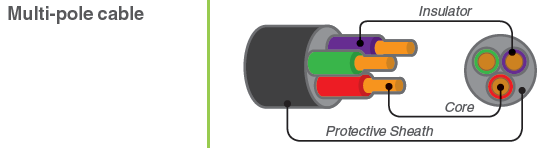
Core - (токопроводящая) жила;
Insulator - изоляция жилы;
Protective Sheath - оболочка кабеля.Недопустимые, нерекомендуемые
Примечание(1) Мнение автора карточкиТематики
- кабели, провода...
EN
- bundled cable
- multi-pole cable
- multiconductor cable
- multicore cable
- multiple cable
- multiple-conductor cable
- multiple-core cable
- multistrand cable
- N-conductor cable
- polycore cable
DE
- mehradriges Kabel, n
- Mehrleiterkabel, n
FR
Франко-русский словарь нормативно-технической терминологии > câble multiconducteur
-
60 câble multipolaire
многожильный кабель
многожильный провод
многожильный шнур
Кабель (провод, шнур), в котором число жил более трех.
[ ГОСТ 15845-80]EN
multicore cable
cable having more than one core
Note – The French term «câble multipolaire» is more specifically used to designate the cable constituting the phases of a multiphase system (example: three-core cable).
[EV ref 461-06-04]
multiconductor cable
cable having more than one conductor, some of which may be uninsulated
[IEV ref 461-06-03]FR
câble multiconducteur
câble multipolaire
câble comprenant plus d'un conducteur isolé
Note – Le terme câble multipolaire est plus particulièrement utilisé pour désigner le câble constituant les phases d'un système polyphasé (exemple: câble tripolaire).
[EV ref 461-06-04]
câble multiconducteur
câble multipolaire
câble comprenant plus d'une âme, dont éventuellement certaines non isolées
[IEV ref 461-06-03]Core - (токопроводящая) жила;
Insulator - изоляция жилы;
Protective Sheath - оболочка кабеля.Недопустимые, нерекомендуемые
Примечание(1) Мнение автора карточкиТематики
- кабели, провода...
EN
- bundled cable
- multi-pole cable
- multiconductor cable
- multicore cable
- multiple cable
- multiple-conductor cable
- multiple-core cable
- multistrand cable
- N-conductor cable
- polycore cable
DE
- mehradriges Kabel, n
- Mehrleiterkabel, n
FR
Франко-русский словарь нормативно-технической терминологии > câble multipolaire
См. также в других словарях:
More Than Us — Single by Travis featuring Anne Dudley from the album Good Feeling Rel … Wikipedia
more than — adjective (comparative of much used with mass nouns) a quantifier meaning greater in size or amount or extent or degree more land more support more rain fell more than a gallon • Syn: ↑more • Ant: ↑less … Useful english dictionary
more than — used before a number or amount for saying that the actual number or amount is larger than this The Whitewater Committee interviewed more than forty witnesses. not much more than...: There s not much more than ten minutes left. no more than...: He … English dictionary
more than — and similar expressions, such as greater than and less than, call for some care when being positioned in sentences at least more than was exercised here: It is a more than 200 percent increase on the 15 million square feet planned in 1984… … Dictionary of troublesome word
more than — {adv.} Over what you might expect; very. * /They were more than glad to help./ * /He was more than upset by the accident./ Contrast: LESS THAN … Dictionary of American idioms
more than — {adv.} Over what you might expect; very. * /They were more than glad to help./ * /He was more than upset by the accident./ Contrast: LESS THAN … Dictionary of American idioms
more\ than — adv Over what you might expect; very. They were more than glad to help. He was more than upset by the accident. Contrast: less than … Словарь американских идиом
More Than a Woman (Aaliyah song) — More Than a Woman Single by Aaliyah from the album Aaliyah A side … Wikipedia
More Than a Feeling — Single by Boston from the album Boston B side … Wikipedia
More Than a Woman (album) — More Than a Woman Studio album by Toni Braxton Released November 19 … Wikipedia
More Than Physical — Single by Bananarama from the album True Confessions B side … Wikipedia
