

-
1 also
Adv.1. (folglich) so, therefore, consequently; also blieb er zu Hause so he stayed at home; sie war jung, also auch unerfahren she was young, and therefore inexperienced; ich denke, also bin ich I think, therefore I am2. zusammenfassend: lassen wir’s also let’s leave it then; du kommst also nicht? you’re not coming then?; es ist also wahr? it’s true then (, is it)?; du gehst also doch? so you’re going after all?; er mag modernere Komponisten, also Berio, Cage... he likes more modern composers ─ Berio, Cage...3. umg.; empört: also bitte! well really!; abschließend: also dann! right then!; nachgebend: also gut oder schön! all right (then), Am. umg. alright (then), okay (then); also, los! let’s get going then; also, wie gesagt so, as I was saying ( oder I say); also, wenn du mich fragst (well,) if you ask me; na also! what did I say?; anerkennend: auch there you go; na also(, da haben wir’s ja)! there we are (, see?)4. altm. (so) thus, so allg.* * *then (Adv.); so (Konj.)* * *ạl|so ['alzo]1. conj1) (= folglich) so, thereforeer war Künstler, ein hochsensibler Mensch also — he was an artist, (and) therefore a highly sensitive person
2) (old = so, folgendermaßen) thus2. advso; (nach Unterbrechung anknüpfend) well; (zusammenfassend, erklärend) that isdu machst es also? — so you'll do it then?
also wie ich schon sagte — well (then), as I said before
3. interj(verwundert, entrüstet, auffordernd) well; (drohend) justalso, dass du dich ordentlich benimmst! — (you) just see that you behave yourself!
also doch! — so he/they etc did!
na also! — there you are!, you see?
also, ich habs doch gewusst! — I knew it!
also nein! — (oh) no!
also nein, dass sie sich das gefallen lässt — my God, she can't put up with that!
also gut or schön — well all right then
* * *1) (an expression used for calming people etc: `Now then,' said the policeman, `what's going on here?') now then2) ((and) therefore: John had a bad cold, so I took him to the doctor; `So you think you'd like this job, then?' `Yes.'; And so they got married and lived happily ever after.) so* * *al·so[ˈalzo]es regnet, \also bleiben wir zu Hause it's raining, so we'll stay at homeII. part1. (nun ja) well[ja] \also, zuerst gehen Sie geradeaus und dann... ok, first you go straight ahead and then...2. (tatsächlich) soer hat \also doch nicht die Wahrheit gesagt! so he wasn't telling the truth after all!kommst du \also mit? so are you coming [then]?3. (aber)\also, dass du dich ordentlich benimmst! now, see that you behave yourself!\also so was! well [I never]!\also, jetzt habe ich langsam genug von deinen Eskapaden! now look here, I've had enough of your escapades!4. (na)\also warte, Bürschchen, wenn ich dich kriege! just you wait, sunshine, till I get my hands on you!\also gut [o schön] well, OK, [well,] all right\also dann,...! so..., well then...\also dann, mach's gut! oh well, take care!5.▶ \also doch! you see!\also doch, wie ich's mir dachte! you see! just as I thought!▶ na \also! just as I thought!wird's bald? na \also! get moving! at last!▶ \also nein! no!* * *1.Adverb (folglich) so; therefore2.1) (das heißt) that is2) (nach Unterbrechung) well [then]also, wie ich schon sagte — well [then], as I was saying
also, kommst du jetzt oder nicht? — well, are you coming now or not?
na also! — there you are[, you see]
also so was/nein! — well, I don't know; well, really
also, gute Nacht — goodnight then
* * *also adv1. (folglich) so, therefore, consequently;also blieb er zu Hause so he stayed at home;sie war jung, also auch unerfahren she was young, and therefore inexperienced;ich denke, also bin ich I think, therefore I am2. zusammenfassend:lassen wir’s also let’s leave it then;du kommst also nicht? you’re not coming then?;es ist also wahr? it’s true then (, is it)?;du gehst also doch? so you’re going after all?;er mag modernere Komponisten, also Berio, Cage … he likes more modern composers — Berio, Cage …also bitte! well really!; abschließend:also dann! right then!; nachgebend:also, los! let’s get going then;also, wie gesagt so, as I was saying ( oder I say);also, wenn du mich fragst (well,) if you ask me;na also! what did I say?; anerkennend: auch there you go;4. obs (so) thus, so allg* * *1.Adverb (folglich) so; therefore2.1) (das heißt) that is2) (nach Unterbrechung) well [then]also, wie ich schon sagte — well [then], as I was saying
also, kommst du jetzt oder nicht? — well, are you coming now or not?
na also! — there you are[, you see]
also so was/nein! — well, I don't know; well, really
also, gute Nacht — goodnight then
* * *adv.so adv. -
2 See also: o
(an expression of surprise, admiration etc: Oh, what a lovely present!) oh -
3 unbeteiligt
I Adj.1. (teilnahmslos) indifferent, unconcerned; er schien seltsam unbeteiligt he seemed strangely unconcerned2. an einer Tat etc.: uninvolved; an einer Sache unbeteiligt sein not be involved in s.th.; WIRTS. have no interest in s.th.; ein Unbeteiligter an onlooker, a bystander; (Außenseiter) an outsider; (Unschuldiger) an innocent party; völlig unbeteiligte Personen people who have nothing at all to do with s.th.; bei einem Angriff, Unfall etc.: completely innocent people* * *ụn|be|tei|ligtadj1) (= uninteressiert) indifferent; (bei Diskussion) uninterested2) (= nicht teilnehmend) uninvolved no adv (an +dat, bei in); (JUR, COMM) disinterested* * *un·be·tei·ligt[ˈʊnbətailɪçt]1. (an etw nicht beteiligt) uninvolved, non-participating[innerlich] \unbeteiligt sein to be absent-minded* * *1.1) uninvolvedein Unbeteiligter — someone who is/was not involved; an outsider; (ein Unschuldiger) an innocent party
2) (gleichgültig) indifferent; detached <manner, expression>2.adverbial with a detached or indifferent air* * *A. adj1. (teilnahmslos) indifferent, unconcerned;er schien seltsam unbeteiligt he seemed strangely unconcerned2. an einer Tat etc: uninvolved;an einer Sache unbeteiligt sein not be involved in sth; WIRTSCH have no interest in sth;ein Unbeteiligter an onlooker, a bystander; (Außenseiter) an outsider; (Unschuldiger) an innocent party;völlig unbeteiligte Personen people who have nothing at all to do with sth; bei einem Angriff, Unfall etc: completely innocent people* * *1.1) uninvolvedein Unbeteiligter — someone who is/was not involved; an outsider; (ein Unschuldiger) an innocent party
2) (gleichgültig) indifferent; detached <manner, expression>2.adverbial with a detached or indifferent air -
4 Dimension einer Grösse
размерность физической величины
размерность величины
Выражение в форме степенного одночлена, составленного из произведений символов основных физических величин в различных степенях и отражающее связь данной физической величины с физическими величинами, принятыми в данной системе величин за основные с коэффициентом пропорциональности, равным 1.
Примечания
1. Степени символов основных величин, входящих в одночлен, в зависимости от связи рассматриваемой физической величины с основными, могут быть целыми, дробными, положительными и отрицательными. Понятие размерность распространяется и на основные величины. Размерность основной величины в отношении самой себя равна единице, т.е. формула размерности основной величины совпадает с ее символом.
2. В соответствии с международным стандартом ИСО 31/0, размерность величин следует обозначать знаком dim [2]. В системе величин LMT размерность величины.x будет: dim х = LlMmTt, где L, М, Т - символы, величин, принятых за основные (соответственно длины, массы, времени).
[РМГ 29-99]EN
dimension of a quantity
quantity dimension
dimension
expression of the dependence of a quantity on the base quantities of a system of quantities as a product of powers of factors corresponding to the base quantities, omitting any numerical factor
NOTE 1 – A power of a factor is the factor raised to an exponent. Each factor is the dimension of a base quantity.
NOTE 2 – The conventional symbolic representation of the dimension of a base quantity is a single upper case letter in roman (upright) sans-serif type. The conventional symbolic representation of the dimension of a derived quantity is the product of powers of the dimensions of the base quantities according to the definition of the derived quantity. The dimension of a quantity Q is denoted by dim Q.
NOTE 3 – In deriving the dimension of a quantity, no account is taken of its scalar, vector or tensor character.
NOTE 4 – In a given system of quantities, – quantities of the same kind have the same dimension, – quantities of different dimensions are always of different kinds, and – quantities having the same dimension are not necessarily of the same kind. For example, in the ISQ, pressure and energy density (volumic energy) have the same dimension L–1MT–2. See also note 5.
NOTE 5 – In the International System of Quantities (ISQ), the symbols representing the dimensions of the base quantities are:
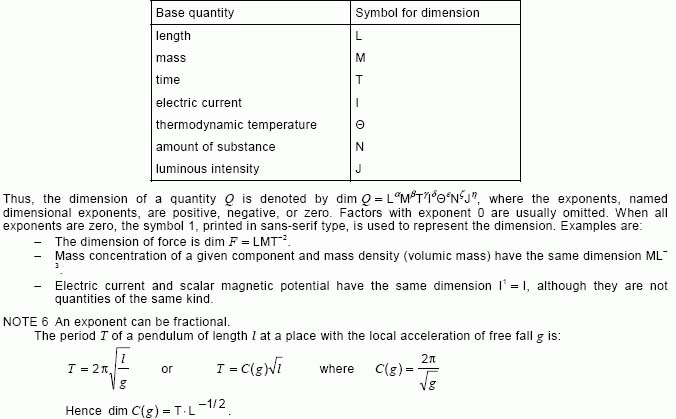
[IEV number 112-01-11]FR
dimension, f
dimension d'une grandeur, f
expression de la dépendance d’une grandeur par rapport aux grandeurs de base d'un système de grandeurs sous la forme d'un produit de puissances de facteurs correspondant aux grandeurs de base, en omettant tout facteur numérique
NOTE 1 – Une puissance d'un facteur est le facteur muni d'un exposant. Chaque facteur exprime la dimension d'une grandeur de base.
NOTE 2 – Par convention, la représentation symbolique de la dimension d'une grandeur de base est une lettre majuscule unique en caractère romain (droit) sans empattement. Par convention, la représentation symbolique de la dimension d'une grandeur dérivée est le produit de puissances des dimensions des grandeurs de base conformément à la définition de la grandeur dérivée. La dimension de la grandeur Q est notée dim Q.
NOTE 3 – Pour établir la dimension d'une grandeur, on ne tient pas compte du caractère scalaire, vectoriel ou tensoriel.
NOTE 4 – Dans un système de grandeurs donné, – les grandeurs de même nature ont la même dimension, – des grandeurs de dimensions différentes sont toujours de nature différente, – des grandeurs ayant la même dimension ne sont pas nécessairement de même nature. Par exemple, dans l'ISQ, la pression et l'énergie volumique ont la même dimension L–1MT–2. Voir aussi la note 5.
NOTE 5 – Dans le Système international de grandeurs (ISQ), les symboles représentant les dimensions des grandeurs de base sont:
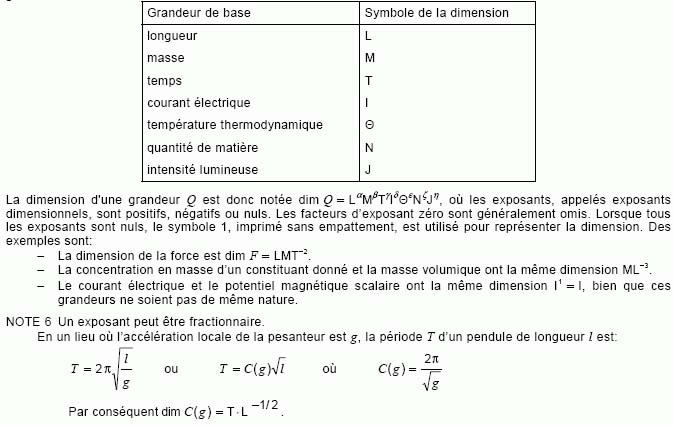
[IEV number 112-01-11]Тематики
- метрология, основные понятия
Синонимы
EN
DE
- Dimension einer Grösse
- Dimension, f
- Größendimension, f
FR
- dimension d'une grandeur, f
- dimension, f
Немецко-русский словарь нормативно-технической терминологии > Dimension einer Grösse
-
5 Dimension, f
размерность физической величины
размерность величины
Выражение в форме степенного одночлена, составленного из произведений символов основных физических величин в различных степенях и отражающее связь данной физической величины с физическими величинами, принятыми в данной системе величин за основные с коэффициентом пропорциональности, равным 1.
Примечания
1. Степени символов основных величин, входящих в одночлен, в зависимости от связи рассматриваемой физической величины с основными, могут быть целыми, дробными, положительными и отрицательными. Понятие размерность распространяется и на основные величины. Размерность основной величины в отношении самой себя равна единице, т.е. формула размерности основной величины совпадает с ее символом.
2. В соответствии с международным стандартом ИСО 31/0, размерность величин следует обозначать знаком dim [2]. В системе величин LMT размерность величины.x будет: dim х = LlMmTt, где L, М, Т - символы, величин, принятых за основные (соответственно длины, массы, времени).
[РМГ 29-99]EN
dimension of a quantity
quantity dimension
dimension
expression of the dependence of a quantity on the base quantities of a system of quantities as a product of powers of factors corresponding to the base quantities, omitting any numerical factor
NOTE 1 – A power of a factor is the factor raised to an exponent. Each factor is the dimension of a base quantity.
NOTE 2 – The conventional symbolic representation of the dimension of a base quantity is a single upper case letter in roman (upright) sans-serif type. The conventional symbolic representation of the dimension of a derived quantity is the product of powers of the dimensions of the base quantities according to the definition of the derived quantity. The dimension of a quantity Q is denoted by dim Q.
NOTE 3 – In deriving the dimension of a quantity, no account is taken of its scalar, vector or tensor character.
NOTE 4 – In a given system of quantities, – quantities of the same kind have the same dimension, – quantities of different dimensions are always of different kinds, and – quantities having the same dimension are not necessarily of the same kind. For example, in the ISQ, pressure and energy density (volumic energy) have the same dimension L–1MT–2. See also note 5.
NOTE 5 – In the International System of Quantities (ISQ), the symbols representing the dimensions of the base quantities are:
[IEV number 112-01-11]FR
dimension, f
dimension d'une grandeur, f
expression de la dépendance d’une grandeur par rapport aux grandeurs de base d'un système de grandeurs sous la forme d'un produit de puissances de facteurs correspondant aux grandeurs de base, en omettant tout facteur numérique
NOTE 1 – Une puissance d'un facteur est le facteur muni d'un exposant. Chaque facteur exprime la dimension d'une grandeur de base.
NOTE 2 – Par convention, la représentation symbolique de la dimension d'une grandeur de base est une lettre majuscule unique en caractère romain (droit) sans empattement. Par convention, la représentation symbolique de la dimension d'une grandeur dérivée est le produit de puissances des dimensions des grandeurs de base conformément à la définition de la grandeur dérivée. La dimension de la grandeur Q est notée dim Q.
NOTE 3 – Pour établir la dimension d'une grandeur, on ne tient pas compte du caractère scalaire, vectoriel ou tensoriel.
NOTE 4 – Dans un système de grandeurs donné, – les grandeurs de même nature ont la même dimension, – des grandeurs de dimensions différentes sont toujours de nature différente, – des grandeurs ayant la même dimension ne sont pas nécessairement de même nature. Par exemple, dans l'ISQ, la pression et l'énergie volumique ont la même dimension L–1MT–2. Voir aussi la note 5.
NOTE 5 – Dans le Système international de grandeurs (ISQ), les symboles représentant les dimensions des grandeurs de base sont:
[IEV number 112-01-11]Тематики
- метрология, основные понятия
Синонимы
EN
DE
- Dimension einer Grösse
- Dimension, f
- Größendimension, f
FR
- dimension d'une grandeur, f
- dimension, f
Немецко-русский словарь нормативно-технической терминологии > Dimension, f
-
6 Größendimension, f
размерность физической величины
размерность величины
Выражение в форме степенного одночлена, составленного из произведений символов основных физических величин в различных степенях и отражающее связь данной физической величины с физическими величинами, принятыми в данной системе величин за основные с коэффициентом пропорциональности, равным 1.
Примечания
1. Степени символов основных величин, входящих в одночлен, в зависимости от связи рассматриваемой физической величины с основными, могут быть целыми, дробными, положительными и отрицательными. Понятие размерность распространяется и на основные величины. Размерность основной величины в отношении самой себя равна единице, т.е. формула размерности основной величины совпадает с ее символом.
2. В соответствии с международным стандартом ИСО 31/0, размерность величин следует обозначать знаком dim [2]. В системе величин LMT размерность величины.x будет: dim х = LlMmTt, где L, М, Т - символы, величин, принятых за основные (соответственно длины, массы, времени).
[РМГ 29-99]EN
dimension of a quantity
quantity dimension
dimension
expression of the dependence of a quantity on the base quantities of a system of quantities as a product of powers of factors corresponding to the base quantities, omitting any numerical factor
NOTE 1 – A power of a factor is the factor raised to an exponent. Each factor is the dimension of a base quantity.
NOTE 2 – The conventional symbolic representation of the dimension of a base quantity is a single upper case letter in roman (upright) sans-serif type. The conventional symbolic representation of the dimension of a derived quantity is the product of powers of the dimensions of the base quantities according to the definition of the derived quantity. The dimension of a quantity Q is denoted by dim Q.
NOTE 3 – In deriving the dimension of a quantity, no account is taken of its scalar, vector or tensor character.
NOTE 4 – In a given system of quantities, – quantities of the same kind have the same dimension, – quantities of different dimensions are always of different kinds, and – quantities having the same dimension are not necessarily of the same kind. For example, in the ISQ, pressure and energy density (volumic energy) have the same dimension L–1MT–2. See also note 5.
NOTE 5 – In the International System of Quantities (ISQ), the symbols representing the dimensions of the base quantities are:
[IEV number 112-01-11]FR
dimension, f
dimension d'une grandeur, f
expression de la dépendance d’une grandeur par rapport aux grandeurs de base d'un système de grandeurs sous la forme d'un produit de puissances de facteurs correspondant aux grandeurs de base, en omettant tout facteur numérique
NOTE 1 – Une puissance d'un facteur est le facteur muni d'un exposant. Chaque facteur exprime la dimension d'une grandeur de base.
NOTE 2 – Par convention, la représentation symbolique de la dimension d'une grandeur de base est une lettre majuscule unique en caractère romain (droit) sans empattement. Par convention, la représentation symbolique de la dimension d'une grandeur dérivée est le produit de puissances des dimensions des grandeurs de base conformément à la définition de la grandeur dérivée. La dimension de la grandeur Q est notée dim Q.
NOTE 3 – Pour établir la dimension d'une grandeur, on ne tient pas compte du caractère scalaire, vectoriel ou tensoriel.
NOTE 4 – Dans un système de grandeurs donné, – les grandeurs de même nature ont la même dimension, – des grandeurs de dimensions différentes sont toujours de nature différente, – des grandeurs ayant la même dimension ne sont pas nécessairement de même nature. Par exemple, dans l'ISQ, la pression et l'énergie volumique ont la même dimension L–1MT–2. Voir aussi la note 5.
NOTE 5 – Dans le Système international de grandeurs (ISQ), les symboles représentant les dimensions des grandeurs de base sont:
[IEV number 112-01-11]Тематики
- метрология, основные понятия
Синонимы
EN
DE
- Dimension einer Grösse
- Dimension, f
- Größendimension, f
FR
- dimension d'une grandeur, f
- dimension, f
Немецко-русский словарь нормативно-технической терминологии > Größendimension, f
-
7 Elektrizität (1)
электричество (1)
-
[IEV number 151-11-01]EN
electricity (1)
set of phenomena associated with electric charges and electric currents
NOTE 1 – Examples of usage of this concept: static electricity, biological effects of electricity.
NOTE 2 – In English, the term "electricity" is also used to denote electric energy. In French, the usage of the term "électricité" in this sense is deprecated. For example, the expression "distribution of electricity" is used in English, but "distribution d'énergie électrique" is used in French.
Source: 121-11-76 MOD
[IEV number 151-11-01]FR
électricité (1), f
ensemble de phénomènes associés à des charges électriques et à des courants électriques
NOTE 1 – Exemples d’emploi de ce concept: électricité statique, effets biologiques de l’électricité.
NOTE 2 – En anglais, le terme "electricity" est aussi utilisé au sens d'énergie électrique. En français, l'emploi du terme "électricité" est déconseillé dans ce sens. Par exemple, l'expression "distribution of electricity", employée en anglais, correspond en français à "distribution d'énergie électrique".
Source: 121-11-76 MOD
[IEV number 151-11-01]электричество (2)
-
[IEV number 151-11-02]EN
electricity (2)
branch of science dealing with electric phenomena
NOTE – Examples of usage of this concept: handbook of electricity, school of electricity.
[IEV number 151-11-02]FR
électricité (2), f
branche de la science traitant des phénomènes électriques
NOTE – Exemples d’emploi de ce concept: manuel d’électricité, école d’électricité.
[IEV number 151-11-02]EN
DE
FR
Немецко-русский словарь нормативно-технической терминологии > Elektrizität (1)
-
8 Elektrizitätslehre (2)
электричество (1)
-
[IEV number 151-11-01]EN
electricity (1)
set of phenomena associated with electric charges and electric currents
NOTE 1 – Examples of usage of this concept: static electricity, biological effects of electricity.
NOTE 2 – In English, the term "electricity" is also used to denote electric energy. In French, the usage of the term "électricité" in this sense is deprecated. For example, the expression "distribution of electricity" is used in English, but "distribution d'énergie électrique" is used in French.
Source: 121-11-76 MOD
[IEV number 151-11-01]FR
électricité (1), f
ensemble de phénomènes associés à des charges électriques et à des courants électriques
NOTE 1 – Exemples d’emploi de ce concept: électricité statique, effets biologiques de l’électricité.
NOTE 2 – En anglais, le terme "electricity" est aussi utilisé au sens d'énergie électrique. En français, l'emploi du terme "électricité" est déconseillé dans ce sens. Par exemple, l'expression "distribution of electricity", employée en anglais, correspond en français à "distribution d'énergie électrique".
Source: 121-11-76 MOD
[IEV number 151-11-01]электричество (2)
-
[IEV number 151-11-02]EN
electricity (2)
branch of science dealing with electric phenomena
NOTE – Examples of usage of this concept: handbook of electricity, school of electricity.
[IEV number 151-11-02]FR
électricité (2), f
branche de la science traitant des phénomènes électriques
NOTE – Exemples d’emploi de ce concept: manuel d’électricité, école d’électricité.
[IEV number 151-11-02]EN
DE
FR
Немецко-русский словарь нормативно-технической терминологии > Elektrizitätslehre (2)
-
9 Demonstration
f; -, -en3. geh. (Veranschaulichung) demonstration; zur Demonstration (+ Gen oder von) to demonstrate ( oder illustrate) s.th.* * *die Demonstration(Kundgebung) demonstration* * *De|monst|ra|ti|on [demɔnstra'tsioːn]f -, -en(alle Bedeutungen) demonstrationzur Demonstratión seiner Friedfertigkeit... — as a demonstration of or to demonstrate his peaceful intentions...
eine Demonstratión für/gegen etw — a demonstration in support of/against sth
* * *((also demo - plural demos) a public expression of opinion by holding meetings and processions, showing placards etc.) demonstration* * *De·mons·tra·ti·on<-, -en>[demɔnstraˈtsi̯o:n]feine \Demonstration der Macht a show of force* * ** * *für/gegen for oder in favo[u]r of/against)von of); von Macht, gutem Willen etc: auch show (of)3. geh (Veranschaulichung) demonstration;zur Demonstration (+gen oder* * ** * *f.demonstration n. -
10 d. h.
heißen; heißt, hieß, hat geheißenA. v/iich heiße … my name is …;wie heißt du? what’s your name?;früher hat sie anders geheißen she used to have a different name, she used to be called something else;so wahr ich … heiße as sure as my name’s …; wenn das stimmt,will ich … heißen then I’m …;… und wie sie alle heißen and so on, and all that sort of thing;wie heißt das? what’s that called?;wie heißt die Straße? what’s the name of this street?, what street is this?2. (bedeuten) mean;würde heißen that would mean;das will (et)was heißen that’s saying something;das will nicht viel heißen that doesn’t mean much;was heißt das schon? so?, that doesn’t mean a thing;das soll nicht heißen, dass … that doesn’t mean (to say) that …;soll das heißen, dass …? oderdas heißt doch nicht etwa, dass …? you don’t mean to say (that) …?;was soll das denn heißen? what’s that supposed to mean?;was heißt hier: gleich? what do you mean, “straight away?”es heißt, dass … they say that …, apparently …;es soll nachher nicht heißen, dass … I don’t want it to be said that …;damit es nicht (nachher) heißt, … so that nobody can say …;es hieß doch (ausdrücklich), dass … it was (specifically oder expressly) stated that …;es heißt in dem Brief it says in the letter, the letter says;wie heißt es doch gleich bei Schiller/in der Bibel? what does it say in Schiller/the Bible?, what does Schiller/the Bible say?4. unpers:Vorsicht! then you’d etc better watch out!B. v/t1. (nennen) call;das heiße ich eine gute Nachricht that’s what I call good news;jemanden einen Lügner/Feigling heißen call sb a liar/coward2.jemanden willkommen heißen welcome sb3. geh (auffordern zu):er hieß sie schweigen he bade her be silent;wer hat dich denn kommen heißen? verärgert: who invited you? -
11 Fernstudium
n1. UNIV. correspondence degree course2. Unterricht: distance learning3. HIST., ehem. DDR: part-time university level course* * *A Fernstudium is a university-level course that does not require the student to attend a particular place of study. The best-known centre for distance learning is the university at Hagen. The expression Fernstudium is also used colloquially for any sort of teaching where the student does not attend regular classes. See: → Gesamthochschule* * *Fern·stu·di·umnt correspondence course* * *das correspondence course* * *1. UNIV correspondence degree course2. Unterricht: distance learning3. hist DDR: part-time university level course* * *das correspondence course* * *n.university correspondence course n. -
12 heißen
(benennen) to call;(hissen) to hoist;(sich nennen) to be called* * *hei|ßen ['haisn] pret hieß [hiːs] ptp geheißen [gə'haisn]1. vtjdn einen Lügner etc héíßen — to call sb a liar etc
oder wie heißt man das? (inf) —... or what do you call it?
... oder wie man das heißt —... or whatever it's called
2) (geh = auffordern) to tell, to bid (form)jdn etw tun héíßen — to tell sb to do sth, to bid sb do sth
jdn willkommen héíßen — to bid sb welcome
2. vi1) (= den Namen haben, bezeichnet werden) to be called (Brit) or named; (= als Titel haben) to be titledwie héíßen Sie/heißt die Straße? — what are you/is the street called?, what's your name/the name of the street?
wie kann man nur Gotthelf/so héíßen? — how can anyone have a name like Gotthelf/like that?
eigentlich heißt es richtig X — actually the correct word is X
... und wie sie alle héíßen —... and the rest of them
... so wahr ich Franz-Josef heiße (als Bekräftigung) —... as sure as I'm standing here
... dann will ich Fridolin héíßen —... then I'm a Dutchman (Brit) or a monkey's uncle
2) (= bestimmte Bedeutung haben) to mean3) (= lauten) to be; (Spruch, Gedicht etc) to go4)3. vi impers1)es soll nicht héíßen, dass... — never let it be said that...
2)(= zu lesen sein)
in der Bibel/im Gesetz/in seinem Brief heißt es, dass... — the Bible/the law/his letter says that..., in the Bible etc it says that...bei Hegel/Goethe etc heißt es... — Hegel/Goethe says...
3)* * *(to (cause a word, phrase etc to) be replaced by another, eg in a document or manuscript: There is one error on this page - For `two yards', read `two metres'; `Two yards long' should read `two metres long'.) read* * *hei·ßen< hieß, geheißen>[ˈhaisn̩]I. vi1. (den Namen haben) to be calledwie \heißen Sie? what's your name?ich heiße Schmitz my name is Schmitzwie soll das Baby denn \heißen? what shall we call [or will we name] the baby?er heißt jetzt anders he has changed his nameso heißt der Ort, in dem ich geboren wurde that's the name of the place where I was bornich glaube, der Bach heißt Kinsbeke oder so ähnlich I think the stream is called Kinsbeke or something like thatwie hieß die Straße noch, wo Sie wohnen? what did you say was the name of the street where you live?wie heißt das Buch? what is the title of the book?▪ nach jdm \heißen to be named after sb... und wie sie alle \heißen... and the rest of them2. (entsprechen) to mean„ja“ heißt auf Japanisch „hai“ “hai” is Japanese for “yes”was heißt eigentlich „Liebe“ auf Russisch? tell me, what's the Russian [word] for “love”?ich kann die Schrift nicht lesen, was soll das \heißen? I can't read the script, what is that meant to read?gut, er will sich darum kümmern, aber was heißt das schon good, he wants to take care of it, but that doesn't mean anythingheißt das, Sie wollen mehr Geld? does that mean you want more money?was soll das [denn] \heißen? what does that mean?, what's that supposed to mean?das will nicht viel \heißen that doesn't really mean muchwas heißt das schon that doesn't mean anythingdas will schon etwas \heißen that's saying somethingich weiß, was es heißt, allein zu sein I know what it means to be alonedas heißt,... that is to say...; (vorausgesetzt) that is,...; (sich verbessernd) or should I say,..., or what I really mean is,...4. (lauten)▪ irgendwie \heißen to go somehowdu irrst dich, das Sprichwort heißt anders you're wrong, the proverb goes something elsejetzt fällt mir wieder ein, wie der Spruch heißt now I remember how the motto goes5.II. vi impers1. (zu lesen sein)▪ irgendwo heißt es... it says somewhere...in ihrem Brief heißt es, dass sie die Prüfung bestanden hat it says in her letter that she's passed the examAuge um Auge, wie es im Alten Testament heißt an eye for an eye, as it says in the Old Testamentwie es im Faust heißt to quote from Faust2. (als Gerücht kursieren)▪ es heißt, dass... they say [or there is a rumour [or AM rumor]] that...bisher hieß es doch immer, dass wir eine Gehaltserhöhung bekommen sollen it has always been said up to now that we were to get a pay risein der Firma heißt es, dass Massenentlassungen geplant sind there's talk in the company that mass redundancies are plannedhier hast du fünfzig Euro, es soll nicht \heißen, dass ich geizig bin here's fifty euros for you, never let it be said that I'm tight-fisted▪ es heißt, etw zu tun I/we/you must do sthnun heißt es handeln now is the time for actionda heißt es auf der Hut sein you'd better watch out1. (nennen)▪ jdn/etw irgendwie \heißen to call sb/sth sther hieß ihn einen Lügner he called him a liardas heiße ich Pünktlichkeit that's what I call punctuality2. (auffordern)sie hieß ihn hereinkommen she asked him to come in* * *I 1.unregelmäßiges intransitives Verb1) (den Namen tragen) be calledso wahr ich... heiße — (ugs.) as sure as I'm standing here
dann will ich Emil heißen — (ugs.) then I'm a Dutchman (coll.)
2) (bedeuten) meanwas heißt ‘danke’ auf Französisch? — what's the French for ‘thanks’?
das will viel/nicht viel heißen — that means a lot/doesn't mean much
was heißt hier: morgen? — what do you mean, tomorrow?
das heißt — that is [to say]
der Titel/sein Motto heißt... — the title/his motto is...
4) unperses heißt, dass... — they say or it is said that...
es heißt, dass sie unheilbar krank ist — she is said to be incurably ill
es soll nicht heißen, dass... — never let it be said that...
5) unpersin dem Gedicht/Roman/Artikel heißt es... — in the poem/novel/article it says that...
6) unpers2.jetzt heißt es aufgepasst! — (geh.) you'd better watch out now!
unregelmäßiges transitives Verb1) (geh.): (auffordern) tell; bidjemanden etwas tun heißen — tell somebody to do something; bid somebody do something
2) (geh.): (bezeichnen als) call3) (veralt.): (nennen) name; callIItransitives Verb s. hissen* * *heißen1; heißt, hieß, hat geheißenA. v/i1. mit Name, Bezeichnung: be called;ich heiße … my name is …;wie heißt du? what’s your name?;sie heißt (Gertrud) nach ihrer Tante she’s called (Gertrude) after her aunt;früher hat sie anders geheißen she used to have a different name, she used to be called something else;so wahr ich … heiße as sure as my name’s …; wenn das stimmt,will ich … heißen then I’m …;… und wie sie alle heißen and so on, and all that sort of thing;wie heißt das? what’s that called?;wie heißt die Straße? what’s the name of this street?, what street is this?2. (bedeuten) mean;wie heißt das auf Englisch? what’s that (called) in English?;was heißt … auf Englisch? what’s … in English?, what’s the English (word oder expression) for …?;würde heißen that would mean;das will (et)was heißen that’s saying something;das will nicht viel heißen that doesn’t mean much;was heißt das schon? so?, that doesn’t mean a thing;das soll nicht heißen, dass … that doesn’t mean (to say) that …;soll das heißen, dass …? oderdas heißt also, dass … does that mean (that) …?, do you mean to say (that) …?;das heißt doch nicht etwa, dass …? you don’t mean to say (that) …?;was soll das denn heißen? what’s that supposed to mean?;was heißt hier: gleich? what do you mean, “straight away?”es heißt, dass … they say that …, apparently …;es soll nachher nicht heißen, dass … I don’t want it to be said that …;damit es nicht (nachher) heißt, … so that nobody can say …;es hieß doch (ausdrücklich), dass … it was (specifically oder expressly) stated that …;es heißt in dem Brief it says in the letter, the letter says;wie heißt es doch gleich bei Schiller/in der Bibel? what does it say in Schiller/the Bible?, what does Schiller/the Bible say?4. unpers:Vorsicht! then you’d etc better watch out!B. v/t1. (nennen) call;das heiße ich eine gute Nachricht that’s what I call good news;jemanden einen Lügner/Feigling heißen call sb a liar/coward2.jemanden willkommen heißen welcome sb3. geh (auffordern zu):er hieß sie schweigen he bade her be silent;wer hat dich denn kommen heißen? verärgert: who invited you?heißen2 v/t SCHIFF hoist* * *I 1.unregelmäßiges intransitives Verb1) (den Namen tragen) be calledich heiße Hans — I am called Hans; my name is Hans
so wahr ich... heiße — (ugs.) as sure as I'm standing here
dann will ich Emil heißen — (ugs.) then I'm a Dutchman (coll.)
2) (bedeuten) meanwas heißt ‘danke’ auf Französisch? — what's the French for ‘thanks’?
das will viel/nicht viel heißen — that means a lot/doesn't mean much
was heißt hier: morgen? — what do you mean, tomorrow?
das heißt — that is [to say]
der Titel/sein Motto heißt... — the title/his motto is...
4) unperses heißt, dass... — they say or it is said that...
es heißt, dass sie unheilbar krank ist — she is said to be incurably ill
es soll nicht heißen, dass... — never let it be said that...
5) unpersin dem Gedicht/Roman/Artikel heißt es... — in the poem/novel/article it says that...
6) unpers2.jetzt heißt es aufgepasst! — (geh.) you'd better watch out now!
unregelmäßiges transitives Verb1) (geh.): (auffordern) tell; bidjemanden etwas tun heißen — tell somebody to do something; bid somebody do something
2) (geh.): (bezeichnen als) call3) (veralt.): (nennen) name; callIItransitives Verb s. hissen* * *v.(§ p.,pp.: hieß, geheißen)= to call (give a name to) v.to mean v.(§ p.,p.p.: meant)to name v. -
13 Kunst
f; -, Künste1. KUNST art; die schönen / freien Künste the fine / liberal arts; die griechische Kunst Greek art; die bildende Kunst the fine arts Pl.; was macht die Kunst? umg. how’s things?; brotlos2. (Geschicklichkeit) auch skill; (Kniff) trick; die Kunst des Reitens the art of riding; alle Künste der Überredung all the tricks of persuasion; jetzt bin ich mit meiner Kunst am Ende I give up, I’ve tried everything; nach allen Regeln der Kunst umg. good and proper; das ist keine Kunst! umg. that’s no big deal, there’s nothing to it* * *die Kunstart* * *Kụnst [kʊnst]f -, -e['kʏnstə]1) artdie schönen Künste — fine art sing, the fine arts
See:2) (= Können, Fertigkeit) art, skillseine Kunst an jdm versuchen — to try or practise (Brit) or practice (US) one's skills on sb
seine Kunst zeigen — to show what one can do
mit seiner Kunst am or zu Ende sein — to be at one's wits' end
die Kunst besteht darin,... — the art or knack is in...
See:→ Regel3) (= Kunststück) tricker wandte alle Künste der Rhetorik an — he used all the arts or tricks of rhetoric
sie versuchte all ihre Künste an ihm — she used all her charms and wiles on him
so einfach ist das, das ist die ganze Kunst — it's that easy, that's all there is to it
4) (inf)das ist eine brotlose Kunst — there's no money in that
was macht die Kunst? — how are things?, how's tricks? (Brit inf)
* * *die1) (painting and sculpture: I'm studying art at school; Do you like modern art?; ( also adjective) an art gallery, an art college.) art2) (any of various creative forms of expression: painting, music, dancing, writing and the other arts.) art3) (an ability or skill; the (best) way of doing something: the art of conversation/war.) art4) (artistic skill: the musician's artistry.) artistry5) (an art or skill: the craft of wood-carving.) craft* * *Kunst1<-, Künste>[kʊnst, pl ˈkʏnstə]f1. KUNST artabstrakte \Kunst abstract artdie bildende \Kunst graphic artdie schönen Künste the fine arts3. (Fertigkeit) art, skilldas ist eine \Kunst für sich that's an art in itselfdie schwarze \Kunst black magiceine brotlose \Kunst sein (fam) to be unprofitableDichten ist eine brotlose \Kunst there's no money in poetrymit seiner \Kunst am Ende sein to be at a total loss4.▶ das ist [o darin besteht] die ganze \Kunst that's all there is to itKunst2<->* * *die; Kunst, Künste1) artdie Schwarze Kunst — (Magie) the black art; (Buchdruck) [the art of] printing
die schönen Künste — [the] fine arts; fine art sing.
was macht die Kunst? — (ugs.) how are things?; how's tricks? (sl.)
2) (das Können) skilldie Kunst des Reitens/der Selbstverteidigung — the art of riding/selfdefence
das ist keine Kunst! — (ugs.) there's nothing 'to it
mit seiner Kunst am Ende sein — be at a complete loss; s. auch Regel 1)
* * *1. KUNST art;die schönen/freien Künste the fine/liberal arts;die griechische Kunst Greek art;die bildende Kunst the fine arts pl;die Kunst des Reitens the art of riding;alle Künste der Überredung all the tricks of persuasion;jetzt bin ich mit meiner Kunst am Ende I give up, I’ve tried everything;nach allen Regeln der Kunst umg good and proper;3.* * *die; Kunst, Künste1) artdie Schwarze Kunst — (Magie) the black art; (Buchdruck) [the art of] printing
die schönen Künste — [the] fine arts; fine art sing.
was macht die Kunst? — (ugs.) how are things?; how's tricks? (sl.)
2) (das Können) skilldie Kunst des Reitens/der Selbstverteidigung — the art of riding/selfdefence
das ist keine Kunst! — (ugs.) there's nothing 'to it
mit seiner Kunst am Ende sein — be at a complete loss; s. auch Regel 1)
* * *¨-e f.art n.skill n.trick n. -
14 überlegen
to think ( Verb); to consider ( Verb); to think about ( Verb); to look at ( Verb); to reflect ( Verb); to reason ( Verb); to cud ( Verb); to deliberate ( Verb); prevailing (Adj.); superior (Adj.); to think over ( Verb);sich überlegento reflect; to think about; to think over* * *über|le|gen I [yːbɐ'leːgn] ptp überlegt insep1. vi(= nachdenken) to thinkhin und her überlégen — to deliberate
ohne zu überlégen — without thinking
2. vt(= überdenken, durchdenken) to think over or about, to considerdas werde ich mir überlégen — I'll think it over, I'll (have a) think about it, I'll give it some thought
nicht noch einmal überlégen? — won't you think it over again?, won't you reconsider?
das muss ich mir noch sehr überlégen — I'll have to think it over or consider it very carefully
vorher überlégen müssen — you should have thought of or about that before or sooner
II ['yːbɐleːgn]es wäre zu überlégen — it should be considered
1. adjsuperior; (= hochmütig auch) superciliousjdm überlégen sein — to be superior to sb
das war ein überlégener Sieg — that was a good or convincing victory
2. advin a superior manner or fashionBayern München hat überlégen gesiegt — Bayern Munich won convincingly
* * *1) (to think about or talk about something before coming to a decision: We debated whether to go by bus or train.) debate2) (to think carefully: Give him a minute to reflect (on what he should do).) reflect3) ((of a person or his attitude) contemptuous or disdainful: a superior smile.) superior4) (to intend or plan (to do something), usually without making a final decision: I must think what to do; I was thinking of/about going to London next week.) think* * *über·le·gen *1[y:bɐˈle:gn̩]I. vi to think [about it]nach kurzem/langem Ü\überlegen after a short time of thinking/after long deliberationwas gibt es denn da zu \überlegen? what's there to think about?ohne zu \überlegen without thinkingüberleg [doch] mal! just [stop and] think about it!II. vtich will es mir noch einmal \überlegen I'll think it over again, I'll reconsider itdas wäre zu \überlegen it is worth consideringwenn ich es mir recht [o genau] überlege on second thoughts [or AM also thought], come [or BRIT coming] to think about itüber|le·gen2[ˈy:bɐle:gn̩]vt▪ jdm etw \überlegen to put [or lay] sth over sbüber·le·gen3[y:bɐˈle:gn̩]I. adj1. (jdn weit übertreffend) superiorein \überlegener Sieg a good [or convincing] victory▪ jdm [auf etw dat/in etw dat] \überlegen sein to be superior to sb [in sth], to be sb's superior [in sth]dem Feind im Verhältnis von 3:1 \überlegen sein to outnumber the enemy by 3 to 1mit \überlegener Miene with an expression of superiority, with a supercilious look [on one's face] pejII. adv1. (mit großem Vorsprung) convincingly* * *Itransitives VerbII 1.transitives Verb consider; think over or about2.wenn ich es mir recht überlege,... — now I come to think of it,...
intransitives Verb think; reflectIII 1.ohne zu überlegen — (unbedacht) without thinking; (spontan) without a moment's thought
1) superior; clear, convincing <win, victory>jemandem überlegen sein — be superior to somebody (an + Dat. in)
2) (herablassend) supercilious; superior2.1) in a superior manner; < play> much the better: <win, argue> convincingly2) (herablassend) superciliously; superiorly* * *sich (+dat) etwasüberleg mal! just think about it!;überlegen, ob/wie etc consider whether/how etc;etwas noch einmal überlegen reconsider sth;es sich (dat)anders überlegen change one’s mind;wenn ich es mir recht überlege when I think about it;sich (dat)etwas genau überlegen think carefully about sth;ich habe mir etwas überlegt (habe einen Plan) I’ve thought of sth;das würde ich mir zweimal überlegen I’d think twice about that ( oder before doing that);(lange) hin und her überlegen umg deliberate (for ages);ohne lange zu überlegen without thinking twice;wir überlegen noch we are still thinking about it;überleg noch mal you should think about it again;ich würde nicht lange überlegen I wouldn’t waste too much time thinking about it;ich hätte nicht lange überlegt I wouldn’t have given it a second thoughtein Kind überlegen umg put a child over one’s kneeA. adj1. superior (+dat to;an +dat in);in Mathe ist sie mir überlegen she’s better than me at math(s);jemandem weit überlegen sein be more than a match for sb, be head and shoulders above sb;(dem Gegner) haushoch überlegen sein SPORT be vastly superior (to one’s opponent);2. Benehmen: superior, supercilious;überlegenes Lächeln/überlegene Miene superior smile/airB. advüberlegen siegen win in style ( oder convincingly)2. (überheblich) in a superior manner, in a supercilious way* * *Itransitives VerbII 1.transitives Verb consider; think over or about2.wenn ich es mir recht überlege,... — now I come to think of it,...
intransitives Verb think; reflectIII 1.ohne zu überlegen — (unbedacht) without thinking; (spontan) without a moment's thought
1) superior; clear, convincing <win, victory>jemandem überlegen sein — be superior to somebody (an + Dat. in)
2) (herablassend) supercilious; superior2.1) in a superior manner; < play> much the better: <win, argue> convincingly2) (herablassend) superciliously; superiorly* * *adj.predominant adj.superior adj. v.to consider v.to deliberate v.to ponder v.to reason v. -
15 du meine Güte!
Goodness me!* * *((also my goodness) an expression of surprise etc.) good* * *ausdr.Bless my heart! expr. -
16 heißen1;
heißt, hieß, hat geheißenI v/i1. mit Name, Bezeichnung: be called; ich heiße... my name is...; wie heißt du? what’s your name?; sie heißt ( Gertrud) nach ihrer Tante she’s called (Gertrude) after her aunt; früher hat sie anders geheißen she used to have a different name, she used to be called something else; so wahr ich... heiße as sure as my name’s...; wenn das stimmt, will ich... heißen then I’m...; ... und wie sie alle heißen and so on, and all that sort of thing; wie heißt das? what’s that called?; wie heißt die Straße? what’s the name of this street?, what street is this?2. (bedeuten) mean; wie heißt das auf Englisch? what’s that (called) in English?; was heißt... auf Englisch? what’s... in English?, what’s the English (word oder expression) for...?; das heißt (abgek. d. h.) einschränkend oder erläuternd: that is (to say) (Abk. i.e.); das hieße oder würde heißen that would mean; das will (et) was heißen that’s saying something; das will nicht viel heißen that doesn’t mean much; was heißt das schon? so?, that doesn’t mean a thing; das soll nicht heißen, dass... that doesn’t mean (to say) that...; soll das heißen, dass...? oder das heißt also, dass... does that mean (that)...?, do you mean to say (that)...?; das heißt doch nicht etwa, dass...? you don’t mean to say (that)...?; was soll das denn heißen? what’s that supposed to mean?; was soll das eigentlich heißen? what’s this all about?, what’s the big idea? umg.; was heißt hier: gleich? what do you mean, „straight away“?3. unpers.; (gesagt werden): es heißt, dass... they say that..., apparently...; es soll nachher nicht heißen, dass... I don’t want it to be said that...; damit es nicht ( nachher) heißt,... so that nobody can say...; es hieß doch ( ausdrücklich), dass... it was (specifically oder expressly) stated that...; es heißt in dem Brief it says in the letter, the letter says; wie heißt es doch gleich bei Schiller / in der Bibel? what does it say in Schiller / the Bible?, what does Schiller / the Bible say?4. unpers.: nun heißt es handeln etc. the situation calls for action etc., it’s time to act etc.; da heißt es aufpassen oder Vorsicht! then you’d etc. better watch out!II v/t1. (nennen) call; das heiße ich eine gute Nachricht that’s what I call good news; jemanden einen Lügner / Feigling heißen call s.o. a liar / coward2. jemanden willkommen heißen welcome s.o.3. geh. (auffordern zu): er hieß sie schweigen he bade her be silent; wer hat dich denn kommen heißen? verärgert: who invited you?—v/t NAUT. hoist -
17 Gfrieß
n.face, knob – rather unfriendly. Sometimes also a description of a pouty facial expression.Gesicht, Fresse - eher unfreundlich. Mitunter auch Bezeichnung für einen schmollenden Gesichtsausdruck; Beispiel: "Dua wos i da sog und mach koa so a Gfrieß." -
18 Hendl
n.grilled chicken; in Niederbayern the expression "Giggerl" is also used. At the Oktoberfest known as "Wiesn-Hendls".gegrilltes Huhn; in Niederbayern auch "Giggerl", auf dem Oktoberfest in Form des "Wiesn-Hendls"
См. также в других словарях:
Expression Encoder — Desarrollador Microsoft Sitio Oficial Español Información general Última versión estable … Wikipedia Español
Expression — Ex*pres sion ([e^]ks*pr[e^]sh [u^]n), n. [L. expressio: cf. F. expression.] 1. The act of expressing; the act of forcing out by pressure; as, the expression of juices or oils; also, of extorting or eliciting; as, a forcible expression of truth.… … The Collaborative International Dictionary of English
Expression cloning — is a technique in DNA cloning that uses expression vectors to generate a library of clones, with each clone expressing one protein. This expression library is then screened for the property of interest and clones of interest recovered for further … Wikipedia
Expression Templates — sind eine C++ Metaprogrammiertechnik und waren ursprünglich nicht im C++ Standard vorgesehen. Sie werden verwendet, um bereits zur Kompilierzeit bestimmte Ausdrücke durch Templatecode zu ersetzen. Todd Veldhuizen stellte diese Technik im Juni… … Deutsch Wikipedia
Expression Language — (EL) is a scripting language which allows access to Java components (JavaBeans) through JSP. Since JSP 2.0, it has been used inside JSP tags to separate Java code from JSP, and to allow easier access to Java components (than in Java… … Wikipedia
expression — early 15c., action of pressing out; later (mid 15c.) action of manifesting a feeling; (late 15c.) a putting into words, from M.Fr. expression (14c.), from L.L. expressionem (nom. expressio), noun of action from pp. stem of exprimere (see EXPRESS… … Etymology dictionary
Expression Direkt — is a French rap group.A famous song of theirs is Mon esprit part en couiIIe . (1995/96) The original version (Which you can hear in a scene in La Haine )is different from the MCM clip which you can also find around.… … Wikipedia
Expression (mathematics) — In mathematics, an expression is a finite combination of symbols that is well formed according to rules that depend on the context. Symbols can designate numbers (constants), variables, operations, functions, and other mathematical symbols, as… … Wikipedia
expression — by Claire Colebrook Expression is one of Deleuze s most intense concepts. If we take Deleuze s definition of a concept that it is a philosophical creation that produces an intensive set of ordinates then expression can be understood as… … The Deleuze dictionary
expression — by Claire Colebrook Expression is one of Deleuze s most intense concepts. If we take Deleuze s definition of a concept that it is a philosophical creation that produces an intensive set of ordinates then expression can be understood as… … The Deleuze dictionary
Expression (programming) — An expression in a programming language is a combination of values, variables, operators, and functions that are interpreted ( evaluated ) according to the particular rules of precedence and of association for a particular programming language,… … Wikipedia
