

-
1 code coverage
A metric used to describe the degree to which the source code of a program has been tested. Code coverage is expressed as a percentage of the blocks of code tested over the total blocks of code. -
2 blocks of the code
Компьютерная техника: блоки программы -
3 blocks of the code
English-Russian dictionary of computer science > blocks of the code
-
4 Group of Blocks Start Code (GBSC)
код начала группы блоковEnglish-Russian dictionary of modern telecommunications > Group of Blocks Start Code (GBSC)
-
5 anonymous method
A practical language construct that allows programmers to create code blocks that can be encapsulated in a delegate and executed at a later time. They are based on a language concept called a lambda function and are similar to those found in Lisp and Python. -
6 block
blɔk
1. сущ.
1) а) блок;
глыба;
строительный блок Syn: brick, bar б) колода, чурбан building block ≈ блок для строительства concrete block ≈ бетонный блок The garage was made of concrete blocks. ≈ Гараж был построен из бетонных блоков. в) ист. плаха
2) а) квартал (города) ;
жилищный массив The building occupies an entire city block. ≈ Здание занимало целый городской квартал. around the block ≈ по кварталу in/on a block ≈ в квартале They went around the block. ≈ Они прошлись по кварталу. They live in this block. ≈ Они живут в этом районе (города). Syn: square б) многоквартирный дом
3) группа, масса однородных предметов cinder block ≈ куча пепла a block of cigarettes ≈ блок сигарет block of shares in block
4) деревянная печатная форма
5) болванка, форма для шляпы
6) блокнот
7) что-л. напоминающее кирпич, кубик а) кубик (концентрата) б) мн. кубики;
'строитель' (игрушка)
8) а) преграда;
барьер;
затор, пробка( на дороге) ;
блокировка б) ж.-д. блокпост в) амер.;
спорт блокировка ∙ Syn: obstruction, barrier, obstacle, blockade, bar, impediment;
hindrance, interference, blockage
9) мед. блокада heart block ≈ сердечная блокада nerve block ≈ нервная блокада
10) шашка( подрывная, дымовая)
11) разг. тупица, бревно
12) тех. блок, шкив
13) горн. целик ∙ to cut blocks with a razor ≈ тратить впустую силы
2. гл.
1) а) заграждать, преграждать, препятствовать;
блокировать;
задерживать;
устраивать, образовывать пробки на дорогах Snowdrifts blocked our progress. ≈ Снежные заносы задержали наше продвижение. The traffic was so thick that a whole row of cars got blocked in. ≈ Поток был такой плотный, что в одном ряду образовалась пробка. to block the access ≈ закрыть доступ б) препятствовать, создавать препятствия to block progress ≈ стоять на пути прогресса to block in ≈ препятствовать в) спорт блокировать ∙ Syn: obstruct, blockade, bar, choke, stop, jam;
hinder, impede, check, halt, prevent, thwart
2) парл. задерживать прохождение законопроекта (в законодательном органе)
3) фин. блокировать, задерживать, замораживать (счета и т. п.)
4) придавать форму;
надевать на болванку (о шляпе) Hats cleaned and blocked. ≈ Шляпы чистятся и надеваются на болванку. Syn: shape, form;
reshape, re-form
5) а) засорять, забивать б) засоряться, забиваться
6) мед. блокировать ∙ block in block off block out block upчурбан;
колода;
- starting *s (спортивное) стартовые колодки (каменная) глыба (историческое) плаха;
- the * казнь на плахе - to be sent to the * быть приговоренным к смерти жилищный массив преим. (американизм) квартал;
- walk three *s пройдите три квартала;
- he lives two *s from us он живет в двух кварталах от нас;
- to do the *s (австралийское) прогуливаться( городская) площадь многоквартирный дом преграда;
затор (движения и т. п.) - there was a * in the pipe and the water could not flow away труба засорилась, и вода не сходила дорожная пробка, дорожный затор обструкция( в парламенте) (спортивное) перехват( инициативы) - natural * заслон (волейбол) строительный блок (американизм) большой полый кирпич кубик, игрушечный кирпичик кубик (концентрата) что-л имеющее форму кирпича, кубика и т. п. - a * of soap кусок мыла;
- a * of cigarettes блок сигарет (полиграфия) деревянная печатная форма (полиграфия) клише, штамп болван(ка), форма для шляпы (разговорное) болван, тупица, "бревно" (сленг) башка группа однородных предметов;
- a * of seats in a theatre несколько рядов в театре (между проходами) - in (the) * целиком, чохом блок, объединение блокнот (техническое) блок, шкив (техническое) сухарь, колодка( техническое) блок цилиндров( военное) шашка (подрывная, дымовая) (американизм) подставка на аукционе;
- to go to the * продаваться на аукционе насест( для сокола) (железнодорожное) блокпост (медицина) блокада (электроника) внезапное прекращение колебания осциллятора;
- * diagram блок-схема( горное) целик (австралийское) геодезический участок( морское) кильблок, стапель-блок блок, глыба ( породы) (психологическое) тормоз;
заторможенность;
- writer's * творческий тупик писателя;
временная утрата способности писать( психологическое) неспособность запомнить, заучить что-д;
- he has a mental * about spelling ему никак не дается орфография > to cut *s with a razor тратить силы впустую;
стрелять из пушек по воробьям преграждать, препятствовать, блокировать;
- to * the access закрыть доступ;
- all the roads were *ed by the heavy snowfalls из-за сильных снегопадов по дорогам нельзя было проехать;
- they *ed up the entrance to the cave они завалили вход в пещеру мешать, препятствовать, создавать трудности;
- the commander succeeded in *ing the enemy's plan командиру удалось сорвать план противника;
- to * an appointment помешать назначению (спортивное) блокировать задерживать прохождение законопроекта (в парламенте и т. п.) надевать на болванку, придавать форму поддерживать, подпирать( специальное) нарезать на блоки, брикеты набрасывать (рисунок, схему) набрасывать вчерне, намечать( финансовое) блокировать;
задерживать, замораживать (кредиты) (железнодорожное) блокировать (техническое) подклинивать, заклинивать закупоривать, засорять закупориваться, засоряться (радиотехника) забивать, глушить, заглушать( химическое) лишать активности (медицина) прекращать проводимость( в нервном стволе) ;
блокировать (психологическое) прерывать ассоциации печатать без отступов (театроведение) планировать мизансцены;
расставлять актеровanalysis ~ вчт. блок анализаbase ~ вчт. базовый блокblock тех. блок, шкив ~ вчт. блок ~ мед. блокада ~ фин. блокировать, задерживать, замораживать ~ вчт. блокировать ~ блокировать ~ ж.-д. блокировка;
блокпост ~ блокнот ~ болван, форма (для шляп) ~ глыба (камня) ;
блок (для стройки) ~ группа, масса однородных предметов;
block of shares фин. пакет акций;
in block все вместе, целиком ~ группа ~ деревянная печатная форма ~ жилищный массив ~ парл. задерживать (прохождение законопроекта) ~ засорять(ся) ~ квартал (города) ;
жилищный массив ~ квартал ~ полигр. клише ~ кубик (концентрата) ~ pl кубики;
"строитель" (игрушка) ~ набрасывать вчерне (обыкн. block in, block out) ~ пакет ценных бумаг ~ партия акций ~ партия облигаций ~ переписной участок ~ плаха;
the block казнь на плахе ~ плаха;
the block казнь на плахе ~ преграда;
затор (движения) ~ преграждать;
задерживать;
блокировать (обыкн. block up) ;
to block the access закрыть доступ ~ преграждать ~ препятствовать, создавать препятствия;
to block progress стоять на пути прогресса ~ узел ~ горн. целик ~ чурбан, колода ~ шашка (подрывная, дымовая)~ attr.: ~ grant единовременная субсидия~ attr.: ~ grant единовременная субсидия grant: block ~ пакет субсидий~ of bonds пакет облигаций~ of code вчт. блок программы~ of data вчт. набор данных ~ of data вчт. совокупность данных~ группа, масса однородных предметов;
block of shares фин. пакет акций;
in block все вместе, целиком ~ of shares пакет акций~ of the code вчт. блок программы~ of words вчт. группа слов ~ of words вчт. кодовая группа~ препятствовать, создавать препятствия;
to block progress стоять на пути прогресса~ преграждать;
задерживать;
блокировать (обыкн. block up) ;
to block the access закрыть доступblocks of words вчт. кодовые группыbootstrap ~ вчт. блок начальной загрузкиbuilding ~ вчт. компоновочный блокbuilding ~ concept вчт. блочный принципcolumn ~ вчт. участок столбцаcolumn ~s вчт. участки столбцаcommon ~ вчт. общий блокconceptual ~ вчт. смысловой блокcontrol ~ вчт. блок управленияdata ~ вчт. блок данныхdead ~ вчт. пассивный блокdecision ~ вчт. блок ветвленияEastern ~ Восточный блокevent control ~ вчт. блок управления событиемhome ~ вчт. начальный блок~ группа, масса однородных предметов;
block of shares фин. пакет акций;
in block все вместе, целикомin ~s группамиinput ~ вчт. входной блокinput-output ~ вчт. блок ввода-выводаinternal ~ вчт. вложенный блокlabel ~ вчт. блок меткиlabeled ~ вчт. помеченный блокline ~ вчт. участок строкиlogical ~ вчт. логический блокlogical ~ number вчт. логический номер блокаmemory ~ вчт. блок памятиmessage ~ вчт. блок сообщенияmultirecord ~ вчт. блок с несколькими записямиoutput ~ вчт. выходное устройствоparameter ~ вчт. блок параметровphysical ~ вчт. физический блокprimitive ~ вчт. элементарный компонентprocedure ~ вчт. процедурный блокprocessing ~ вчт. блок обработкиprogram ~ вчт. программный блокrecord ~ вчт. блок записейrequest ~ вчт. блок запросаstation control ~ вчт. блок управления станциейtry ~ вчт. блок повторных попытокunit control ~ вчт. блок управления устройствомvariable ~ вчт. блок переменной длиныvariable-length ~ вчт. блок переменной длины -
7 block
[blɔk]analysis block вчт. блок анализа base block вчт. базовый блок block тех. блок, шкив block вчт. блок block мед. блокада block фин. блокировать, задерживать, замораживать block вчт. блокировать block блокировать block ж.-д. блокировка; блокпост block блокнот block болван, форма (для шляп) block глыба (камня); блок (для стройки) block группа, масса однородных предметов; block of shares фин. пакет акций; in block все вместе, целиком block группа block деревянная печатная форма block жилищный массив block парл. задерживать (прохождение законопроекта) block засорять(ся) block квартал (города); жилищный массив block квартал block полигр. клише block кубик (концентрата) block pl кубики; "строитель" (игрушка) block набрасывать вчерне (обыкн. block in, block out) block пакет ценных бумаг block партия акций block партия облигаций block переписной участок block плаха; the block казнь на плахе block плаха; the block казнь на плахе block преграда; затор (движения) block преграждать; задерживать; блокировать (обыкн. block up); to block the access закрыть доступ block преграждать block препятствовать, создавать препятствия; to block progress стоять на пути прогресса block узел block горн. целик block чурбан, колода block шашка (подрывная, дымовая) block attr.: block grant единовременная субсидия block attr.: block grant единовременная субсидия grant: block block пакет субсидий block of bonds пакет облигаций block of code вчт. блок программы block of commercials рекламный ролик block of data вчт. набор данных block of data вчт. совокупность данных block of flats блок квартир block of flats квартирный комплекс block of flats многоквартирный дом block группа, масса однородных предметов; block of shares фин. пакет акций; in block все вместе, целиком block of shares пакет акций block of the code вчт. блок программы block of words вчт. группа слов block of words вчт. кодовая группа block препятствовать, создавать препятствия; to block progress стоять на пути прогресса block преграждать; задерживать; блокировать (обыкн. block up); to block the access закрыть доступ blocks of words вчт. кодовые группы bootstrap block вчт. блок начальной загрузки building block вчт. компоновочный блок building block concept вчт. блочный принцип column block вчт. участок столбца column blocks вчт. участки столбца common block вчт. общий блок conceptual block вчт. смысловой блок control block вчт. блок управления data block вчт. блок данных dead block вчт. пассивный блок decision block вчт. блок ветвления defective block вчт. дефектный блок Eastern block Восточный блок event control block вчт. блок управления событием extended attribute block вчт. блок дополнительных атрибутов external block вчт. внешний блок home block вчт. начальный блок block группа, масса однородных предметов; block of shares фин. пакет акций; in block все вместе, целиком in blocks группами input block вчт. входной блок input-output block вчт. блок ввода-вывода internal block вчт. вложенный блок label block вчт. блок метки labeled block вчт. помеченный блок line block вчт. участок строки linked-list data block вчт. блок данных в виде связного списка logical block вчт. логический блок logical block number вчт. логический номер блока memory block вчт. блок памяти message block вчт. блок сообщения multirecord block вчт. блок с несколькими записями output block вчт. выходное устройство parameter block вчт. блок параметров physical block вчт. физический блок primitive block вчт. элементарный компонент procedure block вчт. процедурный блок processing block вчт. блок обработки program block вчт. программный блок record block вчт. блок записей request block вчт. блок запроса service block служебный блок short block вчт. короткий блок state block вчт. блок состояния station control block вчт. блок управления станцией try block вчт. блок повторных попыток typed block вчт. типовой блок unit control block вчт. блок управления устройством variable block вчт. блок переменной длины variable-length block вчт. блок переменной длины -
8 business letter format
бизн. формат делового письма, формат служебного письма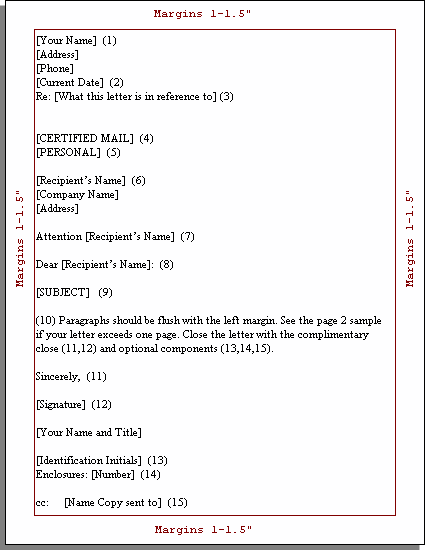 Комментарии к формату (см. рис.)If your stationery includes a letterhead, skip this block. Type your name and address along with other relevant contact information such as e-mail or fax number.If your stationery includes a letterhead, type the date from 2 to 6 lines under the letterhead. Otherwise type it under the return address.Use this block to identify what the letter is in regards to. Examples are: "Re: Invoice 12345" or "Re: Your letter dated January 15, 2010.".Always in caps. Examples include SPECIAL DELIVERY, CERTIFIED MAIL, AIRMAIL, VIA FACSIMILE.Notation on private correspondence if needed such as PERSONAL or CONFIDENTIAL. This goes just above the recipient.Type the name and address of the person and / or company. If you are using an attention line (block 7) then skip the person's name. Address the envelope similarly.Type the name of the personType the recipient's name. Use Mr. or Ms. [Last Name] to show respect, but don't try to guess spelling or gender if you are not sure. Some common salutations are: "Dear [Full Name]:", "To Whom it May Concern:".Type a short description on what the letter is about. If you used a reference line, then you likely do not need a subject line.Type two spaces between sentences.Completing the LetterIt depends on the tone and degree of formality as to what you write here. Can vary from the very formal "Respectfully yours" to the typical "Sincerely" to the friendly "Cordially yours".Leave four blank lines after the Complimentary Close (block 11) to sign your name. Type your name and (optional) title under that signature.If someone else has typed the letter for you, it is common for them to indicate so with initials. Typically it is your initials in upper case followed by the other initials in lower case. For example "BCT/gt". If you typed your own letter, skip this block.If you are including other things with the letter such as brochures, this line tells the reader how many to expect. Common styles include "Enclosures: 3".If you are distributing copies of the letter to others, indicate so using a copies block. the code "cc:" used to indicate carbon copies but now is commonly called courtesy copies.Don't type the brackets. The brackets [ ] in the examples are for narrative purposes only.Try to keep your letters to one page.Use letterhead only for the first page. Just use a blank sheet of paper for continuation pages.You have some freedom in how many blank lines to use between blocks and in the margin sizes in order to fit a letter onto a single page.Not all letters need every block identified in this article. If you leave one out, do not leave blank lines where the blocks would have been.
Англо-русский универсальный дополнительный практический переводческий словарь И. Мостицкого > business letter format
-
9 block
1) блок, узел || блокировать || блочный2) группа, блок (напр., слов, чисел знаков) || разбивать на блоки, преобразовывать в блочную форму•- alternate capacity jumper block
- analysis block
- basic block
- block of code
- block of decomposition
- block of punch pins
- block of words
- building block
- command control block
- control block
- data block
- dead block
- decision block
- distributed recovery block
- entry block
- erroneous block
- file access block
- fixed block
- fixed-lehgth block
- forged block
- functional block
- guard block
- in blocks
- input block
- jumper block
- labeled block
- linked-list data block
- memory block
- message block
- multirecord block
- operated block
- output block
- page control block
- parameter block
- primitive block
- procedure block
- processing block
- program block
- queue control block
- reassembly blocks
- record block
- short block
- spare block
- standby block
- storage block
- store block
- store-and-forward block
- supervisor request block
- table block
- unilabel block
- unirecord block
- unit control block
- upper memory block
- variable block
- variable-length blockEnglish-Russian dictionary of computer science and programming > block
-
10 ABC
1) Общая лексика: hum. сокр. Across Breed Comparison, алфавитный указатель (железнодорожный), атомный, биологический и химический, букварь, железнодорожный алфавитный указатель, начатки, простейший, простой, самые простые знания и понятия, азбука, алфавит, азбука, алфавит, основы2) Компьютерная техника: Abstract Base Class, Approximate Bootstrap Confidence, Atanasoff Berry Computer4) Спорт: Adventure Balance And Challenge, Agility Balance And Coordination, American Bowling Congress, Another Blowout Coming, Anybody But Carolina, Association Of Boxing Commissions5) Военный термин: Advanced Blade Concept, Air Bridge to Canada, Airborne Command, Airborne Corps, All Blocks Covered, Allied Baltic Command, American, British, and Canadian, American-British-Canadian, Army Battle Command, Asian Brown Cloud, Atomic Bacterial Chemical, advanced basing concept, advanced biomedical capsule, air bubble craft, airborne cigar, airborne control, assistant beach commander6) Техника: ABC method, American bibliographic benter, absolute binary code, after bottom center, after bottom dead center, air-blast cooled, augmented bibliographic citation, automatic bass control, automatic bias compensation, automatic blip counter, блок питания накала, анода и сетки, справочник железнодорожных станций с расписанием поездов7) Сельское хозяйство: abscess8) Шутливое выражение: A Bored Capitalist, A Boring Channel, Absolute Best Channel, Absolutely Boring Comedy, All Bout Cancellations, Already Been Cancelled, Always Be Cool, Always Burn Colorado, Americas Bin Collapsed, Another Bad Choice, Another Book Club, Anything But Chaos, Anything But Competence, The Almost Broadcasting Company9) Химия: Alkali Bearing Carrier10) Религия: A Better Chance, About Bethlehem Centers, Adult Bible Community, Agape Book Club, All Believe Confess, American Bible Channel, Arts Based Church, грамота, азы11) Железнодорожный термин: Air Brakes And Chain12) Юридический термин: A Big Clue, Alcohol Beverage Control, Always Be Careful, Attorneys, Bankers, And Cpas, transaction13) Бухгалтерия: Accountability Basics And Control, Analyze Bill And Control14) Фармакология: abacavir (абакавир)15) Финансы: анализ затрат по видам16) Австралийский сленг: Australian Broadcasting Corporation, австралийский государственный телерадиоканал17) Ветеринария: Agricultural Biotechnology Center18) Грубое выражение: A Big Cockup, Absolute Bullshit Channel, Absolutely Bloody Crap, Always Be Caucasian, Always Been Crappy, Anything But Crap19) Горное дело: наставление, памятка, руководство, элементарный курс20) Кино: Эй-би-си21) Политика: Anybody But Clinton22) Презрительное выражение: American Born Chinese23) Телевидение: automatic brightness limiter24) Сокращение: Activity Based Costing (2002), Activity Based Costing, Advanced Ballistic Concept, Advanced Bar Code: 62 bar POSTNET code representing 11 digit ZIP (see DPBC), Advanced/ing Blade Concept, Aerated Bread Company, Alcoholic Beverage Control, All-purpose Ballastable Crawler, All-purpose Battle Computer, America, Britain & Canada, American Broadcast Company, American Broadcasting Corporation, Argentina, Brazil, Chile, Aruba, Bonaire, And Curacao, Associated British Pictures Corporation, Atomic, Bacteriological, Chemical (warfare), Atomic, Biological / Bacteriological & Chemical, Audit Bureau of Circulations Inc. (for 2nd class permit audits), Australian Broadcasting Commission, Automatic Boost Control, Automatic Brightness Control, atomic, bacteriological and chemical, atomic, biological and chemical, American Broadcasting Company, вычислительная машина Атанасова - Берри (Atanasoff-Berry Computer - first digital calculating machine that used vacuum tubes), American Brahma Club (Американский клуб специалистов по разведению кур породы бра(х)мапутра), American Bowling Congress (Американский конгресс (федерация клубов) игры в боулинг (кегли)), Arab Banking Corporation (Арабская банковская ассоциация), Automotive Booster Clubs International (Международная федерация клубов продавцов автомобильных запасных частей (США)), Associated British Cinemas (Объединение английских кинотеатров), automatic bass compensation (автоматическая коррекция нижних (звуковых) частот), automatic background control (автоматическая регулировка яркости( фона)), automatic blade control (автоматическое управление отвалом (плуга, бульдозера и т.п.)), accounting and budgetary control (бухгалтерско-бюджетный контроль), automatic binary computer (двоичная автоматическая вычислительная машина (устаревший термин)), air blast cooled (с воздушным охлаждением), aggregate base course (щебеночный подстилающий слой), Already Been Chewed, Absorbing boundary condition25) Университет: About Basic Composition, Academics Business And Community, Anchorage Basic Curriculum, Atlantic Baptist College26) Физиология: Absolute Brain Control, Abstinence Behavioral Change, Airway Breathing And Circulation, Airway Breathing Circulation, Airway Breathing Cold, Always Breastfeed Children, Aspiration, Biopsy, Cytology, Atp Binding Cassette, Automated Blood Collection27) Электроника: Already Been Converted, Automatic Background Calibration28) Вычислительная техника: Atanasoff-Berry Computer (First digital calculating machine that used vacuum tubes), activity-based costing, analog boundary cell, American Broadcasting Company (Corporate name), классы построения приложения, оплата на базе фактического использования, функционально-стоимостный анализ29) Нефть: automatic bandwidth control, control30) Иммунология: Adaptive Behavior Center, Antibody Binding Capacity, antigen-binding capacity, Avidin and Biotinylated horseradish peroxidase macro-molecular Complex31) Онкология: Advanced Breast Cancer32) Португальский язык: Бразильская академия наук (сокр. от Academia Brasileira de Ciências = Brazilian Academy of Sciences)33) Транспорт: Air Brake Converted, Aluminum Brass Chrome34) Пищевая промышленность: Absolute Best Chewy, All Beer Cleaning, Apples, Bananas, And Carrots, Applesauce, Bran, and Cinnamon35) Воздухоплавание: Advance Booking Charter36) Двигатели внутреннего сгорания: после нижней мёртвой точки, за нижней мёртвой точкой (сокр. от after bottom (dead) centre)37) Фирменный знак: Alpha Beta Camera, Antwerp Book Capital, Associated British Corporation38) Экология: Association of Boards of Certification for Operating Personnel in Water and Wastewater Utilities, Association of British Climatologists39) Реклама: Бюро по Исследованию Тиражей США40) СМИ: Access Beauty And Character, Always Be Canceling my favorite shows, American Broadcasting Companies, Associated British Cinemas, Audit Bureau Of Circulation, Audit Bureau Of Circulations, Australian Broadcasting Company41) Деловая лексика: A Better Company, A Board Committed, A Business Commitment, Allocation Budget And Contract, Always Be Closing, Always Bring Cash, Analysis Building And Cleaning, Appropriate Business Casual, расчёт себестоимости по объёму хозяйственной стоимости (Activity Based Costing)42) Глоссарий компании Сахалин Энерджи: type of fire extinguisher43) Образование: Anti Bullying Commitee, Attentional Behavioral Cognitive, Attitude Behavior Consistency44) Сетевые технологии: Application Building Classes45) Полимеры: assisted biological coagulation46) Макаров: начальные положения, элементарный, элементы47) Аэродинамика: концепция набегающей (идущей вперёд) лопасти (летательного аппарата с вращающимися крыльями) (сокр. от advancing-blade concept)48) Военно-морской флот: главный старшина авиационной боцманской команды (на авианосце) (сокр. от Chief Aviation Boatswain's Mate)49) Расширение файла: ABC FlowCharter Document, ABC programming language General filename extension, Musical notation language file (folk melodies)50) Нефть и газ: advanced blending control51) Электротехника: armored bushing cable52) Молекулярная биология: adenosine triphosphate-binding cassette53) ООН: A Bunch of Communists54) Общественная организация: American Bird Conservancy55) НАСА: Active Body Control56) Библиотечное дело: American Bibliographical Center57) Базы данных: Alphabetically Based Computerized58) Альпинизм: advanced base camp -
11 abc
1) Общая лексика: hum. сокр. Across Breed Comparison, алфавитный указатель (железнодорожный), атомный, биологический и химический, букварь, железнодорожный алфавитный указатель, начатки, простейший, простой, самые простые знания и понятия, азбука, алфавит, азбука, алфавит, основы2) Компьютерная техника: Abstract Base Class, Approximate Bootstrap Confidence, Atanasoff Berry Computer4) Спорт: Adventure Balance And Challenge, Agility Balance And Coordination, American Bowling Congress, Another Blowout Coming, Anybody But Carolina, Association Of Boxing Commissions5) Военный термин: Advanced Blade Concept, Air Bridge to Canada, Airborne Command, Airborne Corps, All Blocks Covered, Allied Baltic Command, American, British, and Canadian, American-British-Canadian, Army Battle Command, Asian Brown Cloud, Atomic Bacterial Chemical, advanced basing concept, advanced biomedical capsule, air bubble craft, airborne cigar, airborne control, assistant beach commander6) Техника: ABC method, American bibliographic benter, absolute binary code, after bottom center, after bottom dead center, air-blast cooled, augmented bibliographic citation, automatic bass control, automatic bias compensation, automatic blip counter, блок питания накала, анода и сетки, справочник железнодорожных станций с расписанием поездов7) Сельское хозяйство: abscess8) Шутливое выражение: A Bored Capitalist, A Boring Channel, Absolute Best Channel, Absolutely Boring Comedy, All Bout Cancellations, Already Been Cancelled, Always Be Cool, Always Burn Colorado, Americas Bin Collapsed, Another Bad Choice, Another Book Club, Anything But Chaos, Anything But Competence, The Almost Broadcasting Company9) Химия: Alkali Bearing Carrier10) Религия: A Better Chance, About Bethlehem Centers, Adult Bible Community, Agape Book Club, All Believe Confess, American Bible Channel, Arts Based Church, грамота, азы11) Железнодорожный термин: Air Brakes And Chain12) Юридический термин: A Big Clue, Alcohol Beverage Control, Always Be Careful, Attorneys, Bankers, And Cpas, transaction13) Бухгалтерия: Accountability Basics And Control, Analyze Bill And Control14) Фармакология: abacavir (абакавир)15) Финансы: анализ затрат по видам16) Австралийский сленг: Australian Broadcasting Corporation, австралийский государственный телерадиоканал17) Ветеринария: Agricultural Biotechnology Center18) Грубое выражение: A Big Cockup, Absolute Bullshit Channel, Absolutely Bloody Crap, Always Be Caucasian, Always Been Crappy, Anything But Crap19) Горное дело: наставление, памятка, руководство, элементарный курс20) Кино: Эй-би-си21) Политика: Anybody But Clinton22) Презрительное выражение: American Born Chinese23) Телевидение: automatic brightness limiter24) Сокращение: Activity Based Costing (2002), Activity Based Costing, Advanced Ballistic Concept, Advanced Bar Code: 62 bar POSTNET code representing 11 digit ZIP (see DPBC), Advanced/ing Blade Concept, Aerated Bread Company, Alcoholic Beverage Control, All-purpose Ballastable Crawler, All-purpose Battle Computer, America, Britain & Canada, American Broadcast Company, American Broadcasting Corporation, Argentina, Brazil, Chile, Aruba, Bonaire, And Curacao, Associated British Pictures Corporation, Atomic, Bacteriological, Chemical (warfare), Atomic, Biological / Bacteriological & Chemical, Audit Bureau of Circulations Inc. (for 2nd class permit audits), Australian Broadcasting Commission, Automatic Boost Control, Automatic Brightness Control, atomic, bacteriological and chemical, atomic, biological and chemical, American Broadcasting Company, вычислительная машина Атанасова - Берри (Atanasoff-Berry Computer - first digital calculating machine that used vacuum tubes), American Brahma Club (Американский клуб специалистов по разведению кур породы бра(х)мапутра), American Bowling Congress (Американский конгресс (федерация клубов) игры в боулинг (кегли)), Arab Banking Corporation (Арабская банковская ассоциация), Automotive Booster Clubs International (Международная федерация клубов продавцов автомобильных запасных частей (США)), Associated British Cinemas (Объединение английских кинотеатров), automatic bass compensation (автоматическая коррекция нижних (звуковых) частот), automatic background control (автоматическая регулировка яркости( фона)), automatic blade control (автоматическое управление отвалом (плуга, бульдозера и т.п.)), accounting and budgetary control (бухгалтерско-бюджетный контроль), automatic binary computer (двоичная автоматическая вычислительная машина (устаревший термин)), air blast cooled (с воздушным охлаждением), aggregate base course (щебеночный подстилающий слой), Already Been Chewed, Absorbing boundary condition25) Университет: About Basic Composition, Academics Business And Community, Anchorage Basic Curriculum, Atlantic Baptist College26) Физиология: Absolute Brain Control, Abstinence Behavioral Change, Airway Breathing And Circulation, Airway Breathing Circulation, Airway Breathing Cold, Always Breastfeed Children, Aspiration, Biopsy, Cytology, Atp Binding Cassette, Automated Blood Collection27) Электроника: Already Been Converted, Automatic Background Calibration28) Вычислительная техника: Atanasoff-Berry Computer (First digital calculating machine that used vacuum tubes), activity-based costing, analog boundary cell, American Broadcasting Company (Corporate name), классы построения приложения, оплата на базе фактического использования, функционально-стоимостный анализ29) Нефть: automatic bandwidth control, control30) Иммунология: Adaptive Behavior Center, Antibody Binding Capacity, antigen-binding capacity, Avidin and Biotinylated horseradish peroxidase macro-molecular Complex31) Онкология: Advanced Breast Cancer32) Португальский язык: Бразильская академия наук (сокр. от Academia Brasileira de Ciências = Brazilian Academy of Sciences)33) Транспорт: Air Brake Converted, Aluminum Brass Chrome34) Пищевая промышленность: Absolute Best Chewy, All Beer Cleaning, Apples, Bananas, And Carrots, Applesauce, Bran, and Cinnamon35) Воздухоплавание: Advance Booking Charter36) Двигатели внутреннего сгорания: после нижней мёртвой точки, за нижней мёртвой точкой (сокр. от after bottom (dead) centre)37) Фирменный знак: Alpha Beta Camera, Antwerp Book Capital, Associated British Corporation38) Экология: Association of Boards of Certification for Operating Personnel in Water and Wastewater Utilities, Association of British Climatologists39) Реклама: Бюро по Исследованию Тиражей США40) СМИ: Access Beauty And Character, Always Be Canceling my favorite shows, American Broadcasting Companies, Associated British Cinemas, Audit Bureau Of Circulation, Audit Bureau Of Circulations, Australian Broadcasting Company41) Деловая лексика: A Better Company, A Board Committed, A Business Commitment, Allocation Budget And Contract, Always Be Closing, Always Bring Cash, Analysis Building And Cleaning, Appropriate Business Casual, расчёт себестоимости по объёму хозяйственной стоимости (Activity Based Costing)42) Глоссарий компании Сахалин Энерджи: type of fire extinguisher43) Образование: Anti Bullying Commitee, Attentional Behavioral Cognitive, Attitude Behavior Consistency44) Сетевые технологии: Application Building Classes45) Полимеры: assisted biological coagulation46) Макаров: начальные положения, элементарный, элементы47) Аэродинамика: концепция набегающей (идущей вперёд) лопасти (летательного аппарата с вращающимися крыльями) (сокр. от advancing-blade concept)48) Военно-морской флот: главный старшина авиационной боцманской команды (на авианосце) (сокр. от Chief Aviation Boatswain's Mate)49) Расширение файла: ABC FlowCharter Document, ABC programming language General filename extension, Musical notation language file (folk melodies)50) Нефть и газ: advanced blending control51) Электротехника: armored bushing cable52) Молекулярная биология: adenosine triphosphate-binding cassette53) ООН: A Bunch of Communists54) Общественная организация: American Bird Conservancy55) НАСА: Active Body Control56) Библиотечное дело: American Bibliographical Center57) Базы данных: Alphabetically Based Computerized58) Альпинизм: advanced base camp -
12 BBB
1) Общая лексика: (Baa) степень надёжности ниже средней2) Компьютерная техника: Bare Bones Basic3) Биология: blood-brain barrier4) Медицина: Гематоэнцефалический барьер (blood-brain barrier)5) Спорт: Baseball Bat Bag, Bruised Belly Brigade6) Военный термин: bags, barrels, or boxes, basic boxed base7) Сельское хозяйство: Broad-Breasted Bronze8) Шутливое выражение: Bad Bagger Boyz, Bad Boy Bennington, Bed Bud And Breakfast, Best British Briar, Big Bad Brad, Big Boys Beer, Bull Baffles Brains9) Религия: Before Babel Brigade10) Юридический термин: Big Black Or Blue11) Страхование: banker's blanket bond12) Грубое выражение: Bathroom Bedroom And Barn, Beautiful Black Babes, Beautiful Black Bitches, Big Bad Bitches, Big Black And Beautiful, Bitchin Badass Bunch, Bitchy Blonde Babes13) Сокращение: Bankers' Blanket Bond, body-bound bolts, Better Business Bureau, best-best-best, bundle branch block, treble best, Bè, Baby Beehinds Bamboo (Australian modern cloth nappy), Baby Boomer Bistro (chat site), Bach, Beethoven, and Brahms, Bad Blue Boys, Balik-Bayan Box (Filipino overseas delivery system), Balintawak Beer Brewery (Philippines), Bam Bam Bigelow (wrestler), Bare Bottom Boys (band), Baruga (SIL code, New Guinea), Baseball Bat, Basic Brown Bear (San Francisco), Basic Building Block, Bassoon Bulletin Board, Beach Boys Band, Beans, Bullets, Bandaids (Military 3 Bs), Bed Bath & Beyond, Bed and Breakfast Bureau, Beetles Bugs and Butterflies, Before Breaking Bulk (freight), Belgrade-Bucharest-Budapest, Benson Municipal Airport, Beta Beta Beta, Bevel Buddybox, Bewitched Bothered and Bewildered, Beyond Black Boxes, Big Bad Bow (game), Big Barbeque Bacon (McDonald's), Big Beautiful Backgrounds, Big Big Brother (Elite Clan), Big Black Boots (band), Big Blue Box (gaming), Big Boy Boards, Big Brother Brasil (TV show; Brazil), Big Butt Buffet (Christian rap band, Canada), Big, the Bad and the Beautiful, Biological Basis of Behaviour, Biotic Baking Brigade, Birmingham Bizarre Bazaar (UK fetish market), Birmingham Black Barons (Negro-league baseball team), Bit by Bit, Bluegrass by the Bay (magazine, CA), Bob's Big Boy (US restaurant chain), Body Bound Bolt, Bonsal Blues Bands (Woodbury, NJ), Booking, Billing, Backlog, Bookmark for Banska' Bystrica, Books Before Boys, Booze, Broads, and Bucars, Bop'n'blues Band, Bored Beyond Belief, Boston Baked Beans (candy), Bottles Blocks and Books, Boulder Big Band (Boulder, CO), Bouncing Baby Boy, Branch Behavior Buffer, Bredbandsbolaget (Swedish ISP, fiber to the home), Brigittes Bretonischer Basar (German), Brisbin, Brook, Beynon (architectural firm), Broadband Box, Broadcast Based Broadband, Bueno Bonito y Barato, Building Bright Beginnings, Bullshit Baffles Brains, Bullstuff Baffles Brains (polite form), Bunker Busting Bomb, Burn Baby Burn, Burn Burn Burn (record company), Buses By the Bridge, Business Bulletin Board, Busy Beyond Belief, Bykez, Bordz and Bladz, taBedrijvenBeurs14) Физиология: Body Balanced Board15) Электроника: Big Bad Box16) Банковское дело: комплексное страхование банков (Bankers Blanket Bond)17) Транспорт: Big Blue Book, Big Bum Bus18) Пищевая промышленность: Bertie Botts Beans, Britain's Best Briars19) Фирменный знак: Blades By Brown20) СМИ: Big Bad Book21) Деловая лексика: Before Big Bucks, Best Book For Business22) Авиационная медицина: birthday-based biorhythm23) Чат: Big Black Book24) СМС: Blah Blah Blah25) Базы данных: Big Blue Blob -
13 bbb
1) Общая лексика: (Baa) степень надёжности ниже средней2) Компьютерная техника: Bare Bones Basic3) Биология: blood-brain barrier4) Медицина: Гематоэнцефалический барьер (blood-brain barrier)5) Спорт: Baseball Bat Bag, Bruised Belly Brigade6) Военный термин: bags, barrels, or boxes, basic boxed base7) Сельское хозяйство: Broad-Breasted Bronze8) Шутливое выражение: Bad Bagger Boyz, Bad Boy Bennington, Bed Bud And Breakfast, Best British Briar, Big Bad Brad, Big Boys Beer, Bull Baffles Brains9) Религия: Before Babel Brigade10) Юридический термин: Big Black Or Blue11) Страхование: banker's blanket bond12) Грубое выражение: Bathroom Bedroom And Barn, Beautiful Black Babes, Beautiful Black Bitches, Big Bad Bitches, Big Black And Beautiful, Bitchin Badass Bunch, Bitchy Blonde Babes13) Сокращение: Bankers' Blanket Bond, body-bound bolts, Better Business Bureau, best-best-best, bundle branch block, treble best, Bè, Baby Beehinds Bamboo (Australian modern cloth nappy), Baby Boomer Bistro (chat site), Bach, Beethoven, and Brahms, Bad Blue Boys, Balik-Bayan Box (Filipino overseas delivery system), Balintawak Beer Brewery (Philippines), Bam Bam Bigelow (wrestler), Bare Bottom Boys (band), Baruga (SIL code, New Guinea), Baseball Bat, Basic Brown Bear (San Francisco), Basic Building Block, Bassoon Bulletin Board, Beach Boys Band, Beans, Bullets, Bandaids (Military 3 Bs), Bed Bath & Beyond, Bed and Breakfast Bureau, Beetles Bugs and Butterflies, Before Breaking Bulk (freight), Belgrade-Bucharest-Budapest, Benson Municipal Airport, Beta Beta Beta, Bevel Buddybox, Bewitched Bothered and Bewildered, Beyond Black Boxes, Big Bad Bow (game), Big Barbeque Bacon (McDonald's), Big Beautiful Backgrounds, Big Big Brother (Elite Clan), Big Black Boots (band), Big Blue Box (gaming), Big Boy Boards, Big Brother Brasil (TV show; Brazil), Big Butt Buffet (Christian rap band, Canada), Big, the Bad and the Beautiful, Biological Basis of Behaviour, Biotic Baking Brigade, Birmingham Bizarre Bazaar (UK fetish market), Birmingham Black Barons (Negro-league baseball team), Bit by Bit, Bluegrass by the Bay (magazine, CA), Bob's Big Boy (US restaurant chain), Body Bound Bolt, Bonsal Blues Bands (Woodbury, NJ), Booking, Billing, Backlog, Bookmark for Banska' Bystrica, Books Before Boys, Booze, Broads, and Bucars, Bop'n'blues Band, Bored Beyond Belief, Boston Baked Beans (candy), Bottles Blocks and Books, Boulder Big Band (Boulder, CO), Bouncing Baby Boy, Branch Behavior Buffer, Bredbandsbolaget (Swedish ISP, fiber to the home), Brigittes Bretonischer Basar (German), Brisbin, Brook, Beynon (architectural firm), Broadband Box, Broadcast Based Broadband, Bueno Bonito y Barato, Building Bright Beginnings, Bullshit Baffles Brains, Bullstuff Baffles Brains (polite form), Bunker Busting Bomb, Burn Baby Burn, Burn Burn Burn (record company), Buses By the Bridge, Business Bulletin Board, Busy Beyond Belief, Bykez, Bordz and Bladz, taBedrijvenBeurs14) Физиология: Body Balanced Board15) Электроника: Big Bad Box16) Банковское дело: комплексное страхование банков (Bankers Blanket Bond)17) Транспорт: Big Blue Book, Big Bum Bus18) Пищевая промышленность: Bertie Botts Beans, Britain's Best Briars19) Фирменный знак: Blades By Brown20) СМИ: Big Bad Book21) Деловая лексика: Before Big Bucks, Best Book For Business22) Авиационная медицина: birthday-based biorhythm23) Чат: Big Black Book24) СМС: Blah Blah Blah25) Базы данных: Big Blue Blob -
14 GBSC
см. Group of Blocks Start CodeEnglish-Russian dictionary of modern telecommunications > GBSC
-
15 back
1. n спина, спинка2. n спинной хребет; позвоночникback fat — шпиг, спинной жир, хребтовый шпиг, хребтовое сало
3. n поясница, крестец4. n задняя, тыльная часть5. n тех. задняя грань; затылок или обух инструмента6. n задняя часть; задний планat the back of — сзади, позади
7. n оборотная сторона; оборот, изнанкаkeep back — держаться сзади, в стороне, в отдалении
8. n гребень9. n нагота, неприкрытое тело; одежда10. n спорт. защитник11. n мор. киль; кильсон12. n нижняя дека13. a заднийback elevation — вид сзади, задний фасад
back pay — уплата задним числом; задержанная зарплата
14. a отдалённый, дальний15. a обратный16. a запоздалый, отсталыйto feel oneself a back number — чувствовать, что отстал от жизни
17. a старый18. a преим. амер. задержанный, просроченный; уплачиваемый за прошлое времяreach back — уходить назад, в прошлое
19. a воен. тыловойback areas — тыл, тыловые районы
20. adv сзади, позадиkeep back! — не подходи!, отойди!
back hang — вис сзади,
21. adv обратно, назадback there! — осади!; назад!
I knew him back home — я знал его, когда жил на родине
to sit back — откинуться на спинку кресла; удобно усесться
back pullover — три четверти (/сальто назад со спины на ноги
22. adv снова, опять23. adv тех. против часовой стрелки24. adv назадif we go back a few years … — если вернуться к тому, что было несколько лет назад …
25. adv с опозданием; с отставанием26. v поддерживать, подкреплять27. v закреплять28. v укреплять; подпирать29. v наклонять; прислонять30. v субсидировать; финансировать31. v ставить32. v надеяться наI backed on his ability to get out of scrapes — я рассчитывал на его способность выходить сухим из воды
33. v двигать в обратном направлении; осаживать; отводить34. v двигаться в обратном направлении; идти задним ходом; отходить; отступать; пятитьсяhe backed a step or two to let them pass — он отступил на несколько шагов, чтобы пропустить их
35. v садиться на лошадь; ехать верхом; объезжать лошадьdrive back — возвращаться, ехать обратно
36. v покрывать; снабжать спинкой37. v ставить на подкладкуturn back — заставить повернуть назад, прогнать
38. v примыкатьthe hills backed the town — за городом раскинулись холмы, город стоял у подножия холмов
39. v подписывать, скреплять подписью; утверждать; визироватьback a bill — поставить подпись на оборотной стороне векселя; подпись на оборотной стороне векселя; гарантировать оплату векселя
40. v фин. индоссироватьto back a bill — поставить свою подпись на оборотной стороне векселя, гарантировать оплату векселя
41. v аккомпанировать; сопровождать музыкой42. n корыто; чан; большой бакСинонимический ряд:1. delayed (adj.) delayed; late; overdue2. frontier (adj.) frontier; outlandish; unsettled3. minor (adj.) minor; remote; untraveled4. old (adj.) old; out-of-date; past; previous5. posterior (adj.) after; hind; hinder; hindmost; posterior; postern; rear; retral6. flip side (noun) flip side; reverse7. rear (noun) end; heel; hind part; posterior; rear; rearward8. spine (noun) backbone; rachis; spinal column; spine; vertebrae; vertebral column9. capitalize (verb) bankroll; capitalize; grubstake; stake10. finance (verb) finance; sponsor; subsidize11. fund (verb) capitalise; fund; subsidise12. justify (verb) attest; authenticate; bear out; confirm; corroborate; justify; substantiate; testify; validate; verify; warrant13. mount (verb) bestride; mount14. recede (verb) backtrack; fall back; recede; retract; retreat; retrocede; retrograde; retrogress15. reverse (verb) go backward; move backward; push backward; repel; repulse; retire; reverse; withdraw16. support (verb) abet; advocate; aid; assist; backstop; champion; endorse; favor; favour; further; get behind; help; plump for; promote; side with; stand behind; succor; support; uphold17. about (other) about; again; around; in reverse; round; round about18. away (other) away; far-off; off; out19. backward (other) away; backward; backwards; off; rearward; rearwards; to the rearАнтонимический ряд:advance; anterior; contradict; current; fore; front; major; oppose; repudiate -
16 kernel
"The core of layered architecture that manages the most basic operations of the operating system and the computer's processor. The kernel schedules different blocks of executing code, called threads, for the processor to keep it as busy as possible and coordinates multiple processors to optimize performance. The kernel also synchronizes activities among Executive-level subcomponents, such as I/O Manager and Process Manager, and handles hardware exceptions and other hardware-dependent functions. The kernel works closely with the hardware abstraction layer." -
17 Bibliography
■ Aitchison, J. (1987). Noam Chomsky: Consensus and controversy. New York: Falmer Press.■ Anderson, J. R. (1980). Cognitive psychology and its implications. San Francisco: W. H. Freeman.■ Anderson, J. R. (1983). The architecture of cognition. Cambridge, MA: Harvard University Press.■ Anderson, J. R. (1995). Cognitive psychology and its implications (4th ed.). New York: W. H. Freeman.■ Archilochus (1971). In M. L. West (Ed.), Iambi et elegi graeci (Vol. 1). Oxford: Oxford University Press.■ Armstrong, D. M. (1990). The causal theory of the mind. In W. G. Lycan (Ed.), Mind and cognition: A reader (pp. 37-47). Cambridge, MA: Basil Blackwell. (Originally published in 1981 in The nature of mind and other essays, Ithaca, NY: University Press).■ Atkins, P. W. (1992). Creation revisited. Oxford: W. H. Freeman & Company.■ Austin, J. L. (1962). How to do things with words. Cambridge, MA: Harvard University Press.■ Bacon, F. (1878). Of the proficience and advancement of learning divine and human. In The works of Francis Bacon (Vol. 1). Cambridge, MA: Hurd & Houghton.■ Bacon, R. (1928). Opus majus (Vol. 2). R. B. Burke (Trans.). Philadelphia, PA: University of Pennsylvania Press.■ Bar-Hillel, Y. (1960). The present status of automatic translation of languages. In F. L. Alt (Ed.), Advances in computers (Vol. 1). New York: Academic Press.■ Barr, A., & E. A. Feigenbaum (Eds.) (1981). The handbook of artificial intelligence (Vol. 1). Reading, MA: Addison-Wesley.■ Barr, A., & E. A. Feigenbaum (Eds.) (1982). The handbook of artificial intelligence (Vol. 2). Los Altos, CA: William Kaufman.■ Barron, F. X. (1963). The needs for order and for disorder as motives in creative activity. In C. W. Taylor & F. X. Barron (Eds.), Scientific creativity: Its rec ognition and development (pp. 153-160). New York: Wiley.■ Bartlett, F. C. (1932). Remembering: A study in experimental and social psychology. Cambridge: Cambridge University Press.■ Bartley, S. H. (1969). Principles of perception. London: Harper & Row.■ Barzun, J. (1959). The house of intellect. New York: Harper & Row.■ Beach, F. A., D. O. Hebb, C. T. Morgan & H. W. Nissen (Eds.) (1960). The neu ropsychology of Lashley. New York: McGraw-Hill.■ Berkeley, G. (1996). Principles of human knowledge: Three Dialogues. Oxford: Oxford University Press. (Originally published in 1710.)■ Berlin, I. (1953). The hedgehog and the fox: An essay on Tolstoy's view of history. NY: Simon & Schuster.■ Bierwisch, J. (1970). Semantics. In J. Lyons (Ed.), New horizons in linguistics. Baltimore: Penguin Books.■ Black, H. C. (1951). Black's law dictionary. St. Paul, MN: West Publishing.■ Bloom, A. (1981). The linguistic shaping of thought: A study in the impact of language on thinking in China and the West. Hillsdale, NJ: Erlbaum.■ Bobrow, D. G., & D. A. Norman (1975). Some principles of memory schemata. In D. G. Bobrow & A. Collins (Eds.), Representation and understanding: Stud ies in Cognitive Science (pp. 131-149). New York: Academic Press.■ Boden, M. A. (1977). Artificial intelligence and natural man. New York: Basic Books.■ Boden, M. A. (1981). Minds and mechanisms. Ithaca, NY: Cornell University Press.■ Boden, M. A. (1990a). The creative mind: Myths and mechanisms. London: Cardinal.■ Boden, M. A. (1990b). The philosophy of artificial intelligence. Oxford: Oxford University Press.■ Boden, M. A. (1994). Precis of The creative mind: Myths and mechanisms. Behavioral and brain sciences 17, 519-570.■ Boden, M. (1996). Creativity. In M. Boden (Ed.), Artificial Intelligence (2nd ed.). San Diego: Academic Press.■ Bolter, J. D. (1984). Turing's man: Western culture in the computer age. Chapel Hill, NC: University of North Carolina Press.■ Bolton, N. (1972). The psychology of thinking. London: Methuen.■ Bourne, L. E. (1973). Some forms of cognition: A critical analysis of several papers. In R. Solso (Ed.), Contemporary issues in cognitive psychology (pp. 313324). Loyola Symposium on Cognitive Psychology (Chicago 1972). Washington, DC: Winston.■ Bransford, J. D., N. S. McCarrell, J. J. Franks & K. E. Nitsch (1977). Toward unexplaining memory. In R. Shaw & J. D. Bransford (Eds.), Perceiving, acting, and knowing (pp. 431-466). Hillsdale, NJ: Lawrence Erlbaum Associates.■ Breger, L. (1981). Freud's unfinished journey. London: Routledge & Kegan Paul.■ Brehmer, B. (1986). In one word: Not from experience. In H. R. Arkes & K. Hammond (Eds.), Judgment and decision making: An interdisciplinary reader (pp. 705-719). Cambridge: Cambridge University Press.■ Bresnan, J. (1978). A realistic transformational grammar. In M. Halle, J. Bresnan & G. A. Miller (Eds.), Linguistic theory and psychological reality (pp. 1-59). Cambridge, MA: MIT Press.■ Brislin, R. W., W. J. Lonner & R. M. Thorndike (Eds.) (1973). Cross- cultural research methods. New York: Wiley.■ Bronowski, J. (1977). A sense of the future: Essays in natural philosophy. P. E. Ariotti with R. Bronowski (Eds.). Cambridge, MA: MIT Press.■ Bronowski, J. (1978). The origins of knowledge and imagination. New Haven, CT: Yale University Press.■ Brown, R. O. (1973). A first language: The early stages. Cambridge, MA: Harvard University Press.■ Brown, T. (1970). Lectures on the philosophy of the human mind. In R. Brown (Ed.), Between Hume and Mill: An anthology of British philosophy- 1749- 1843 (pp. 330-387). New York: Random House/Modern Library.■ Bruner, J. S., J. Goodnow & G. Austin (1956). A study of thinking. New York: Wiley.■ Calvin, W. H. (1990). The cerebral symphony: Seashore reflections on the structure of consciousness. New York: Bantam.■ Campbell, J. (1982). Grammatical man: Information, entropy, language, and life. New York: Simon & Schuster.■ Campbell, J. (1989). The improbable machine. New York: Simon & Schuster.■ Carlyle, T. (1966). On heroes, hero- worship and the heroic in history. Lincoln: University of Nebraska Press. (Originally published in 1841.)■ Carnap, R. (1959). The elimination of metaphysics through logical analysis of language [Ueberwindung der Metaphysik durch logische Analyse der Sprache]. In A. J. Ayer (Ed.), Logical positivism (pp. 60-81) A. Pap (Trans). New York: Free Press. (Originally published in 1932.)■ Cassirer, E. (1946). Language and myth. New York: Harper and Brothers. Reprinted. New York: Dover Publications, 1953.■ Cattell, R. B., & H. J. Butcher (1970). Creativity and personality. In P. E. Vernon (Ed.), Creativity. Harmondsworth, England: Penguin Books.■ Caudill, M., & C. Butler (1990). Naturally intelligent systems. Cambridge, MA: MIT Press/Bradford Books.■ Chandrasekaran, B. (1990). What kind of information processing is intelligence? A perspective on AI paradigms and a proposal. In D. Partridge & R. Wilks (Eds.), The foundations of artificial intelligence: A sourcebook (pp. 14-46). Cambridge: Cambridge University Press.■ Charniak, E., & McDermott, D. (1985). Introduction to artificial intelligence. Reading, MA: Addison-Wesley.■ Chase, W. G., & H. A. Simon (1988). The mind's eye in chess. In A. Collins & E. E. Smith (Eds.), Readings in cognitive science: A perspective from psychology and artificial intelligence (pp. 461-493). San Mateo, CA: Kaufmann.■ Cheney, D. L., & R. M. Seyfarth (1990). How monkeys see the world: Inside the mind of another species. Chicago: University of Chicago Press.■ Chi, M.T.H., R. Glaser & E. Rees (1982). Expertise in problem solving. In R. J. Sternberg (Ed.), Advances in the psychology of human intelligence (pp. 7-73). Hillsdale, NJ: Lawrence Erlbaum Associates.■ Chomsky, N. (1957). Syntactic structures. The Hague: Mouton. Janua Linguarum.■ Chomsky, N. (1964). A transformational approach to syntax. In J. A. Fodor & J. J. Katz (Eds.), The structure of language: Readings in the philosophy of lan guage (pp. 211-245). Englewood Cliffs, NJ: Prentice-Hall.■ Chomsky, N. (1965). Aspects of the theory of syntax. Cambridge, MA: MIT Press.■ Chomsky, N. (1972). Language and mind (enlarged ed.). New York: Harcourt Brace Jovanovich.■ Chomsky, N. (1979). Language and responsibility. New York: Pantheon.■ Chomsky, N. (1986). Knowledge of language: Its nature, origin and use. New York: Praeger Special Studies.■ Churchland, P. (1979). Scientific realism and the plasticity of mind. New York: Cambridge University Press.■ Churchland, P. M. (1989). A neurocomputational perspective: The nature of mind and the structure of science. Cambridge, MA: MIT Press.■ Churchland, P. S. (1986). Neurophilosophy. Cambridge, MA: MIT Press/Bradford Books.■ Clark, A. (1996). Philosophical Foundations. In M. A. Boden (Ed.), Artificial in telligence (2nd ed.). San Diego: Academic Press.■ Clark, H. H., & T. B. Carlson (1981). Context for comprehension. In J. Long & A. Baddeley (Eds.), Attention and performance (Vol. 9, pp. 313-330). Hillsdale, NJ: Lawrence Erlbaum Associates.■ Clarke, A. C. (1984). Profiles of the future: An inquiry into the limits of the possible. New York: Holt, Rinehart & Winston.■ Claxton, G. (1980). Cognitive psychology: A suitable case for what sort of treatment? In G. Claxton (Ed.), Cognitive psychology: New directions (pp. 1-25). London: Routledge & Kegan Paul.■ Code, M. (1985). Order and organism. Albany, NY: State University of New York Press.■ Collingwood, R. G. (1972). The idea of history. New York: Oxford University Press.■ Coopersmith, S. (1967). The antecedents of self- esteem. San Francisco: W. H. Freeman.■ Copland, A. (1952). Music and imagination. London: Oxford University Press.■ Coren, S. (1994). The intelligence of dogs. New York: Bantam Books.■ Cottingham, J. (Ed.) (1996). Western philosophy: An anthology. Oxford: Blackwell Publishers.■ Cox, C. (1926). The early mental traits of three hundred geniuses. Stanford, CA: Stanford University Press.■ Craik, K.J.W. (1943). The nature of explanation. Cambridge: Cambridge University Press.■ Cronbach, L. J. (1990). Essentials of psychological testing (5th ed.). New York: HarperCollins.■ Cronbach, L. J., & R. E. Snow (1977). Aptitudes and instructional methods. New York: Irvington. Paperback edition, 1981.■ Csikszentmihalyi, M. (1993). The evolving self. New York: Harper Perennial.■ Culler, J. (1976). Ferdinand de Saussure. New York: Penguin Books.■ Curtius, E. R. (1973). European literature and the Latin Middle Ages. W. R. Trask (Trans.). Princeton, NJ: Princeton University Press.■ D'Alembert, J.L.R. (1963). Preliminary discourse to the encyclopedia of Diderot. R. N. Schwab (Trans.). Indianapolis: Bobbs-Merrill.■ Dampier, W. C. (1966). A history of modern science. Cambridge: Cambridge University Press.■ Darwin, C. (1911). The life and letters of Charles Darwin (Vol. 1). Francis Darwin (Ed.). New York: Appleton.■ Davidson, D. (1970) Mental events. In L. Foster & J. W. Swanson (Eds.), Experience and theory (pp. 79-101). Amherst: University of Massachussetts Press.■ Davies, P. (1995). About time: Einstein's unfinished revolution. New York: Simon & Schuster/Touchstone.■ Davis, R., & J. J. King (1977). An overview of production systems. In E. Elcock & D. Michie (Eds.), Machine intelligence 8. Chichester, England: Ellis Horwood.■ Davis, R., & D. B. Lenat (1982). Knowledge- based systems in artificial intelligence. New York: McGraw-Hill.■ Dawkins, R. (1982). The extended phenotype: The gene as the unit of selection. Oxford: W. H. Freeman.■ deKleer, J., & J. S. Brown (1983). Assumptions and ambiguities in mechanistic mental models (1983). In D. Gentner & A. L. Stevens (Eds.), Mental modes (pp. 155-190). Hillsdale, NJ: Lawrence Erlbaum Associates.■ Dennett, D. C. (1978a). Brainstorms: Philosophical essays on mind and psychology. Montgomery, VT: Bradford Books.■ Dennett, D. C. (1978b). Toward a cognitive theory of consciousness. In D. C. Dennett, Brainstorms: Philosophical Essays on Mind and Psychology. Montgomery, VT: Bradford Books.■ Dennett, D. C. (1995). Darwin's dangerous idea: Evolution and the meanings of life. New York: Simon & Schuster/Touchstone.■ Descartes, R. (1897-1910). Traite de l'homme. In Oeuvres de Descartes (Vol. 11, pp. 119-215). Paris: Charles Adam & Paul Tannery. (Originally published in 1634.)■ Descartes, R. (1950). Discourse on method. L. J. Lafleur (Trans.). New York: Liberal Arts Press. (Originally published in 1637.)■ Descartes, R. (1951). Meditation on first philosophy. L. J. Lafleur (Trans.). New York: Liberal Arts Press. (Originally published in 1641.)■ Descartes, R. (1955). The philosophical works of Descartes. E. S. Haldane and G.R.T. Ross (Trans.). New York: Dover. (Originally published in 1911 by Cambridge University Press.)■ Descartes, R. (1967). Discourse on method (Pt. V). In E. S. Haldane and G.R.T. Ross (Eds.), The philosophical works of Descartes (Vol. 1, pp. 106-118). Cambridge: Cambridge University Press. (Originally published in 1637.)■ Descartes, R. (1970a). Discourse on method. In E. S. Haldane & G.R.T. Ross (Eds.), The philosophical works of Descartes (Vol. 1, pp. 181-200). Cambridge: Cambridge University Press. (Originally published in 1637.)■ Descartes, R. (1970b). Principles of philosophy. In E. S. Haldane & G.R.T. Ross (Eds.), The philosophical works of Descartes (Vol. 1, pp. 178-291). Cambridge: Cambridge University Press. (Originally published in 1644.)■ Descartes, R. (1984). Meditations on first philosophy. In J. Cottingham, R. Stoothoff & D. Murduch (Trans.), The philosophical works of Descartes (Vol. 2). Cambridge: Cambridge University Press. (Originally published in 1641.)■ Descartes, R. (1986). Meditations on first philosophy. J. Cottingham (Trans.). Cambridge: Cambridge University Press. (Originally published in 1641 as Med itationes de prima philosophia.)■ deWulf, M. (1956). An introduction to scholastic philosophy. Mineola, NY: Dover Books.■ Dixon, N. F. (1981). Preconscious processing. London: Wiley.■ Doyle, A. C. (1986). The Boscombe Valley mystery. In Sherlock Holmes: The com plete novels and stories (Vol. 1). New York: Bantam.■ Dreyfus, H., & S. Dreyfus (1986). Mind over machine. New York: Free Press.■ Dreyfus, H. L. (1972). What computers can't do: The limits of artificial intelligence (revised ed.). New York: Harper & Row.■ Dreyfus, H. L., & S. E. Dreyfus (1986). Mind over machine: The power of human intuition and expertise in the era of the computer. New York: Free Press.■ Edelman, G. M. (1992). Bright air, brilliant fire: On the matter of the mind. New York: Basic Books.■ Ehrenzweig, A. (1967). The hidden order of art. London: Weidenfeld & Nicolson.■ Einstein, A., & L. Infeld (1938). The evolution of physics. New York: Simon & Schuster.■ Eisenstein, S. (1947). Film sense. New York: Harcourt, Brace & World.■ Everdell, W. R. (1997). The first moderns. Chicago: University of Chicago Press.■ Eysenck, M. W. (1977). Human memory: Theory, research and individual difference. Oxford: Pergamon.■ Eysenck, M. W. (1982). Attention and arousal: Cognition and performance. Berlin: Springer.■ Eysenck, M. W. (1984). A handbook of cognitive psychology. Hillsdale, NJ: Lawrence Erlbaum Associates.■ Fancher, R. E. (1979). Pioneers of psychology. New York: W. W. Norton.■ Farrell, B. A. (1981). The standing of psychoanalysis. New York: Oxford University Press.■ Feldman, D. H. (1980). Beyond universals in cognitive development. Norwood, NJ: Ablex.■ Fetzer, J. H. (1996). Philosophy and cognitive science (2nd ed.). New York: Paragon House.■ Finke, R. A. (1990). Creative imagery: Discoveries and inventions in visualization. Hillsdale, NJ: Lawrence Erlbaum Associates.■ Flanagan, O. (1991). The science of the mind. Cambridge MA: MIT Press/Bradford Books.■ Fodor, J. (1983). The modularity of mind. Cambridge, MA: MIT Press/Bradford Books.■ Frege, G. (1972). Conceptual notation. T. W. Bynum (Trans.). Oxford: Clarendon Press. (Originally published in 1879.)■ Frege, G. (1979). Logic. In H. Hermes, F. Kambartel & F. Kaulbach (Eds.), Gottlob Frege: Posthumous writings. Chicago: University of Chicago Press. (Originally published in 1879-1891.)■ Freud, S. (1959). Creative writers and day-dreaming. In J. Strachey (Ed.), The standard edition of the complete psychological works of Sigmund Freud (Vol. 9, pp. 143-153). London: Hogarth Press.■ Freud, S. (1966). Project for a scientific psychology. In J. Strachey (Ed.), The stan dard edition of the complete psychological works of Sigmund Freud (Vol. 1, pp. 295-398). London: Hogarth Press. (Originally published in 1950 as Aus den AnfaЁngen der Psychoanalyse, in London by Imago Publishing.)■ Freud, S. (1976). Lecture 18-Fixation to traumas-the unconscious. In J. Strachey (Ed.), The standard edition of the complete psychological works of Sigmund Freud (Vol. 16, p. 285). London: Hogarth Press.■ Galileo, G. (1990). Il saggiatore [The assayer]. In S. Drake (Ed.), Discoveries and opinions of Galileo. New York: Anchor Books. (Originally published in 1623.)■ Gassendi, P. (1970). Letter to Descartes. In "Objections and replies." In E. S. Haldane & G.R.T. Ross (Eds.), The philosophical works of Descartes (Vol. 2, pp. 179-240). Cambridge: Cambridge University Press. (Originally published in 1641.)■ Gazzaniga, M. S. (1988). Mind matters: How mind and brain interact to create our conscious lives. Boston: Houghton Mifflin in association with MIT Press/Bradford Books.■ Genesereth, M. R., & N. J. Nilsson (1987). Logical foundations of artificial intelligence. Palo Alto, CA: Morgan Kaufmann.■ Ghiselin, B. (1952). The creative process. New York: Mentor.■ Ghiselin, B. (1985). The creative process. Berkeley, CA: University of California Press. (Originally published in 1952.)■ Gilhooly, K. J. (1996). Thinking: Directed, undirected and creative (3rd ed.). London: Academic Press.■ Glass, A. L., K. J. Holyoak & J. L. Santa (1979). Cognition. Reading, MA: AddisonWesley.■ Goody, J. (1977). The domestication of the savage mind. Cambridge: Cambridge University Press.■ Gruber, H. E. (1980). Darwin on man: A psychological study of scientific creativity (2nd ed.). Chicago: University of Chicago Press.■ Gruber, H. E., & S. Davis (1988). Inching our way up Mount Olympus: The evolving systems approach to creative thinking. In R. J. Sternberg (Ed.), The nature of creativity: Contemporary psychological perspectives. Cambridge: Cambridge University Press.■ Guthrie, E. R. (1972). The psychology of learning. New York: Harper. (Originally published in 1935.)■ Habermas, J. (1972). Knowledge and human interests. Boston: Beacon Press.■ Hadamard, J. (1945). The psychology of invention in the mathematical field. Princeton, NJ: Princeton University Press.■ Hand, D. J. (1985). Artificial intelligence and psychiatry. Cambridge: Cambridge University Press.■ Harris, M. (1981). The language myth. London: Duckworth.■ Haugeland, J. (Ed.) (1981). Mind design: Philosophy, psychology, artificial intelligence. Cambridge, MA: MIT Press/Bradford Books.■ Haugeland, J. (1981a). The nature and plausibility of cognitivism. In J. Haugeland (Ed.), Mind design: Philosophy, psychology, artificial intelligence (pp. 243-281). Cambridge, MA: MIT Press.■ Haugeland, J. (1981b). Semantic engines: An introduction to mind design. In J. Haugeland (Ed.), Mind design: Philosophy, psychology, artificial intelligence (pp. 1-34). Cambridge, MA: MIT Press/Bradford Books.■ Haugeland, J. (1985). Artificial intelligence: The very idea. Cambridge, MA: MIT Press.■ Hawkes, T. (1977). Structuralism and semiotics. Berkeley: University of California Press.■ Hebb, D. O. (1949). The organisation of behaviour. New York: Wiley.■ Hebb, D. O. (1958). A textbook of psychology. Philadelphia: Saunders.■ Hegel, G.W.F. (1910). The phenomenology of mind. J. B. Baille (Trans.). London: Sonnenschein. (Originally published as Phaenomenologie des Geistes, 1807.)■ Heisenberg, W. (1958). Physics and philosophy. New York: Harper & Row.■ Hempel, C. G. (1966). Philosophy of natural science. Englewood Cliffs, NJ: PrenticeHall.■ Herman, A. (1997). The idea of decline in Western history. New York: Free Press.■ Herrnstein, R. J., & E. G. Boring (Eds.) (1965). A source book in the history of psy chology. Cambridge, MA: Harvard University Press.■ Herzmann, E. (1964). Mozart's creative process. In P. H. Lang (Ed.), The creative world of Mozart (pp. 17-30). London: Oldbourne Press.■ Hilgard, E. R. (1957). Introduction to psychology. London: Methuen.■ Hobbes, T. (1651). Leviathan. London: Crooke.■ Holliday, S. G., & M. J. Chandler (1986). Wisdom: Explorations in adult competence. Basel, Switzerland: Karger.■ Horn, J. L. (1986). In R. J. Sternberg (Ed.), Advances in the psychology of human intelligence (Vol. 3). Hillsdale, NJ: Erlbaum.■ Hull, C. (1943). Principles of behavior. New York: Appleton-Century-Crofts.■ Hume, D. (1955). An inquiry concerning human understanding. New York: Liberal Arts Press. (Originally published in 1748.)■ Hume, D. (1975). An enquiry concerning human understanding. In L. A. SelbyBigge (Ed.), Hume's enquiries (3rd. ed., revised P. H. Nidditch). Oxford: Clarendon. (Spelling and punctuation revised.) (Originally published in 1748.)■ Hume, D. (1978). A treatise of human nature. L. A. Selby-Bigge (Ed.), Hume's enquiries (3rd. ed., revised P. H. Nidditch). Oxford: Clarendon. (With some modifications of spelling and punctuation.) (Originally published in 1690.)■ Hunt, E. (1973). The memory we must have. In R. C. Schank & K. M. Colby (Eds.), Computer models of thought and language. (pp. 343-371) San Francisco: W. H. Freeman.■ Husserl, E. (1960). Cartesian meditations. The Hague: Martinus Nijhoff.■ Inhelder, B., & J. Piaget (1958). The growth of logical thinking from childhood to adolescence. New York: Basic Books. (Originally published in 1955 as De la logique de l'enfant a` la logique de l'adolescent. [Paris: Presses Universitaire de France])■ James, W. (1890a). The principles of psychology (Vol. 1). New York: Dover Books.■ James, W. (1890b). The principles of psychology. New York: Henry Holt.■ Jevons, W. S. (1900). The principles of science (2nd ed.). London: Macmillan.■ Johnson, G. (1986). Machinery of the mind: Inside the new science of artificial intelli gence. New York: Random House.■ Johnson-Laird, P. N. (1983). Mental models: Toward a cognitive science of language, inference, and consciousness. Cambridge, MA: Harvard University Press.■ Johnson-Laird, P. N. (1988). The computer and the mind: An introduction to cognitive science. Cambridge, MA: Harvard University Press.■ Jones, E. (1961). The life and work of Sigmund Freud. L. Trilling & S. Marcus (Eds.). London: Hogarth.■ Jones, R. V. (1985). Complementarity as a way of life. In A. P. French & P. J. Kennedy (Eds.), Niels Bohr: A centenary volume. Cambridge, MA: Harvard University Press.■ Kant, I. (1933). Critique of Pure Reason (2nd ed.). N. K. Smith (Trans.). London: Macmillan. (Originally published in 1781 as Kritik der reinen Vernunft.)■ Kant, I. (1891). Solution of the general problems of the Prolegomena. In E. Belfort (Trans.), Kant's Prolegomena. London: Bell. (With minor modifications.) (Originally published in 1783.)■ Katona, G. (1940). Organizing and memorizing: Studies in the psychology of learning and teaching. New York: Columbia University Press.■ Kaufman, A. S. (1979). Intelligent testing with the WISC-R. New York: Wiley.■ Koestler, A. (1964). The act of creation. New York: Arkana (Penguin).■ Kohlberg, L. (1971). From is to ought. In T. Mischel (Ed.), Cognitive development and epistemology. (pp. 151-235) New York: Academic Press.■ KoЁhler, W. (1925). The mentality of apes. New York: Liveright.■ KoЁhler, W. (1927). The mentality of apes (2nd ed.). Ella Winter (Trans.). London: Routledge & Kegan Paul.■ KoЁhler, W. (1930). Gestalt psychology. London: G. Bell.■ KoЁhler, W. (1947). Gestalt psychology. New York: Liveright.■ KoЁhler, W. (1969). The task of Gestalt psychology. Princeton, NJ: Princeton University Press.■ Kuhn, T. (1970). The structure of scientific revolutions (2nd ed.). Chicago: University of Chicago Press.■ Langer, E. J. (1989). Mindfulness. Reading, MA: Addison-Wesley.■ Langer, S. (1962). Philosophical sketches. Baltimore: Johns Hopkins University Press.■ Langley, P., H. A. Simon, G. L. Bradshaw & J. M. Zytkow (1987). Scientific dis covery: Computational explorations of the creative process. Cambridge, MA: MIT Press.■ Lashley, K. S. (1951). The problem of serial order in behavior. In L. A. Jeffress (Ed.), Cerebral mechanisms in behavior, the Hixon Symposium (pp. 112-146) New York: Wiley.■ LeDoux, J. E., & W. Hirst (1986). Mind and brain: Dialogues in cognitive neuroscience. Cambridge: Cambridge University Press.■ Lehnert, W. (1978). The process of question answering. Hillsdale, NJ: Lawrence Erlbaum Associates.■ Leiber, J. (1991). Invitation to cognitive science. Oxford: Blackwell.■ Lenat, D. B., & G. Harris (1978). Designing a rule system that searches for scientific discoveries. In D. A. Waterman & F. Hayes-Roth (Eds.), Pattern directed inference systems (pp. 25-52) New York: Academic Press.■ Levenson, T. (1995). Measure for measure: A musical history of science. New York: Touchstone. (Originally published in 1994.)■ Leґvi-Strauss, C. (1963). Structural anthropology. C. Jacobson & B. Grundfest Schoepf (Trans.). New York: Basic Books. (Originally published in 1958.)■ Levine, M. W., & J. M. Schefner (1981). Fundamentals of sensation and perception. London: Addison-Wesley.■ Lewis, C. I. (1946). An analysis of knowledge and valuation. LaSalle, IL: Open Court.■ Lighthill, J. (1972). A report on artificial intelligence. Unpublished manuscript, Science Research Council.■ Lipman, M., A. M. Sharp & F. S. Oscanyan (1980). Philosophy in the classroom. Philadelphia: Temple University Press.■ Lippmann, W. (1965). Public opinion. New York: Free Press. (Originally published in 1922.)■ Locke, J. (1956). An essay concerning human understanding. Chicago: Henry Regnery Co. (Originally published in 1690.)■ Locke, J. (1975). An essay concerning human understanding. P. H. Nidditch (Ed.). Oxford: Clarendon. (Originally published in 1690.) (With spelling and punctuation modernized and some minor modifications of phrasing.)■ Lopate, P. (1994). The art of the personal essay. New York: Doubleday/Anchor Books.■ Lorimer, F. (1929). The growth of reason. London: Kegan Paul. Machlup, F., & U. Mansfield (Eds.) (1983). The study of information. New York: Wiley.■ Manguel, A. (1996). A history of reading. New York: Viking.■ Markey, J. F. (1928). The symbolic process. London: Kegan Paul.■ Martin, R. M. (1969). On Ziff's "Natural and formal languages." In S. Hook (Ed.), Language and philosophy: A symposium (pp. 249-263). New York: New York University Press.■ Mazlish, B. (1993). The fourth discontinuity: the co- evolution of humans and machines. New Haven, CT: Yale University Press.■ McCarthy, J., & P. J. Hayes (1969). Some philosophical problems from the standpoint of artificial intelligence. In B. Meltzer & D. Michie (Eds.), Machine intelligence 4. Edinburgh: Edinburgh University Press.■ McClelland, J. L., D. E. Rumelhart & G. E. Hinton (1986). The appeal of parallel distributed processing. In D. E. Rumelhart, J. L. McClelland & the PDP Research Group (Eds.), Parallel distributed processing: Explorations in the mi crostructure of cognition (Vol. 1, pp. 3-40). Cambridge, MA: MIT Press/ Bradford Books.■ McCorduck, P. (1979). Machines who think. San Francisco: W. H. Freeman.■ McLaughlin, T. (1970). Music and communication. London: Faber & Faber.■ Mednick, S. A. (1962). The associative basis of the creative process. Psychological Review 69, 431-436.■ Meehl, P. E., & C. J. Golden (1982). Taxometric methods. In Kendall, P. C., & Butcher, J. N. (Eds.), Handbook of research methods in clinical psychology (pp. 127-182). New York: Wiley.■ Mehler, J., E.C.T. Walker & M. Garrett (Eds.) (1982). Perspectives on mental rep resentation: Experimental and theoretical studies of cognitive processes and ca pacities. Hillsdale, NJ: Lawrence Erlbaum Associates.■ Mill, J. S. (1900). A system of logic, ratiocinative and inductive: Being a connected view of the principles of evidence and the methods of scientific investigation. London: Longmans, Green.■ Miller, G. A. (1979, June). A very personal history. Talk to the Cognitive Science Workshop, Cambridge, MA.■ Miller, J. (1983). States of mind. New York: Pantheon Books.■ Minsky, M. (1975). A framework for representing knowledge. In P. H. Winston (Ed.), The psychology of computer vision (pp. 211-277). New York: McGrawHill.■ Minsky, M., & S. Papert (1973). Artificial intelligence. Condon Lectures, Oregon State System of Higher Education, Eugene, Oregon.■ Minsky, M. L. (1986). The society of mind. New York: Simon & Schuster.■ Mischel, T. (1976). Psychological explanations and their vicissitudes. In J. K. Cole & W. J. Arnold (Eds.), Nebraska Symposium on motivation (Vol. 23). Lincoln, NB: University of Nebraska Press.■ Morford, M.P.O., & R. J. Lenardon (1995). Classical mythology (5th ed.). New York: Longman.■ Murdoch, I. (1954). Under the net. New York: Penguin.■ Nagel, E. (1959). Methodological issues in psychoanalytic theory. In S. Hook (Ed.), Psychoanalysis, scientific method, and philosophy: A symposium. New York: New York University Press.■ Nagel, T. (1979). Mortal questions. London: Cambridge University Press.■ Nagel, T. (1986). The view from nowhere. Oxford: Oxford University Press.■ Neisser, U. (1967). Cognitive psychology. New York: Appleton-Century-Crofts.■ Neisser, U. (1972). Changing conceptions of imagery. In P. W. Sheehan (Ed.), The function and nature of imagery (pp. 233-251). London: Academic Press.■ Neisser, U. (1976). Cognition and reality. San Francisco: W. H. Freeman.■ Neisser, U. (1978). Memory: What are the important questions? In M. M. Gruneberg, P. E. Morris & R. N. Sykes (Eds.), Practical aspects of memory (pp. 3-24). London: Academic Press.■ Neisser, U. (1979). The concept of intelligence. In R. J. Sternberg & D. K. Detterman (Eds.), Human intelligence: Perspectives on its theory and measurement (pp. 179-190). Norwood, NJ: Ablex.■ Nersessian, N. (1992). How do scientists think? Capturing the dynamics of conceptual change in science. In R. N. Giere (Ed.), Cognitive models of science (pp. 3-44). Minneapolis: University of Minnesota Press.■ Newell, A. (1973a). Artificial intelligence and the concept of mind. In R. C. Schank & K. M. Colby (Eds.), Computer models of thought and language (pp. 1-60). San Francisco: W. H. Freeman.■ Newell, A. (1973b). You can't play 20 questions with nature and win. In W. G. Chase (Ed.), Visual information processing (pp. 283-310). New York: Academic Press.■ Newell, A., & H. A. Simon (1963). GPS: A program that simulates human thought. In E. A. Feigenbaum & J. Feldman (Eds.), Computers and thought (pp. 279-293). New York & McGraw-Hill.■ Newell, A., & H. A. Simon (1972). Human problem solving. Englewood Cliffs, NJ: Prentice-Hall.■ Nietzsche, F. (1966). Beyond good and evil. W. Kaufmann (Trans.). New York: Vintage. (Originally published in 1885.)■ Nilsson, N. J. (1971). Problem- solving methods in artificial intelligence. New York: McGraw-Hill.■ Nussbaum, M. C. (1978). Aristotle's Princeton University Press. De Motu Anamalium. Princeton, NJ:■ Oersted, H. C. (1920). Thermo-electricity. In Kirstine Meyer (Ed.), H. C. Oersted, Natuurvidenskabelige Skrifter (Vol. 2). Copenhagen: n.p. (Originally published in 1830 in The Edinburgh encyclopaedia.)■ Ong, W. J. (1982). Orality and literacy: The technologizing of the word. London: Methuen.■ Onians, R. B. (1954). The origins of European thought. Cambridge, MA: Cambridge University Press.■ Osgood, C. E. (1960). Method and theory in experimental psychology. New York: Oxford University Press. (Originally published in 1953.)■ Osgood, C. E. (1966). Language universals and psycholinguistics. In J. H. Greenberg (Ed.), Universals of language (2nd ed., pp. 299-322). Cambridge, MA: MIT Press.■ Palmer, R. E. (1969). Hermeneutics. Evanston, IL: Northwestern University Press.■ Peirce, C. S. (1934). Some consequences of four incapacities-Man, a sign. In C. Hartsborne & P. Weiss (Eds.), Collected papers of Charles Saunders Peirce (Vol. 5, pp. 185-189). Cambridge, MA: Harvard University Press.■ Penfield, W. (1959). In W. Penfield & L. Roberts, Speech and brain mechanisms. Princeton, NJ: Princeton University Press.■ Penrose, R. (1994). Shadows of the mind: A search for the missing science of conscious ness. Oxford: Oxford University Press.■ Perkins, D. N. (1981). The mind's best work. Cambridge, MA: Harvard University Press.■ Peterfreund, E. (1986). The heuristic approach to psychoanalytic therapy. In■ J. Reppen (Ed.), Analysts at work, (pp. 127-144). Hillsdale, NJ: Analytic Press.■ Piaget, J. (1952). The origin of intelligence in children. New York: International Universities Press. (Originally published in 1936.)■ Piaget, J. (1954). Le langage et les opeґrations intellectuelles. Proble` mes de psycho linguistique. Symposium de l'Association de Psychologie Scientifique de Langue Francёaise. Paris: Presses Universitaires de France.■ Piaget, J. (1977). Problems of equilibration. In H. E. Gruber & J. J. Voneche (Eds.), The essential Piaget (pp. 838-841). London: Routlege & Kegan Paul. (Originally published in 1975 as L'eґquilibration des structures cognitives [Paris: Presses Universitaires de France].)■ Piaget, J., & B. Inhelder. (1973). Memory and intelligence. New York: Basic Books.■ Pinker, S. (1994). The language instinct. New York: Morrow.■ Pinker, S. (1996). Facts about human language relevant to its evolution. In J.-P. Changeux & J. Chavaillon (Eds.), Origins of the human brain. A symposium of the Fyssen foundation (pp. 262-283). Oxford: Clarendon Press. Planck, M. (1949). Scientific autobiography and other papers. F. Gaynor (Trans.). New York: Philosophical Library.■ Planck, M. (1990). Wissenschaftliche Selbstbiographie. W. Berg (Ed.). Halle, Germany: Deutsche Akademie der Naturforscher Leopoldina.■ Plato (1892). Meno. In The Dialogues of Plato (B. Jowett, Trans.; Vol. 2). New York: Clarendon. (Originally published circa 380 B.C.)■ Poincareґ, H. (1913). Mathematical creation. In The foundations of science. G. B. Halsted (Trans.). New York: Science Press.■ Poincareґ, H. (1921). The foundations of science: Science and hypothesis, the value of science, science and method. G. B. Halstead (Trans.). New York: Science Press.■ Poincareґ, H. (1929). The foundations of science: Science and hypothesis, the value of science, science and method. New York: Science Press.■ Poincareґ, H. (1952). Science and method. F. Maitland (Trans.) New York: Dover.■ Polya, G. (1945). How to solve it. Princeton, NJ: Princeton University Press.■ Polanyi, M. (1958). Personal knowledge. London: Routledge & Kegan Paul.■ Popper, K. (1968). Conjectures and refutations: The growth of scientific knowledge. New York: Harper & Row/Basic Books.■ Popper, K., & J. Eccles (1977). The self and its brain. New York: Springer-Verlag.■ Popper, K. R. (1959). The logic of scientific discovery. London: Hutchinson.■ Putnam, H. (1975). Mind, language and reality: Philosophical papers (Vol. 2). Cambridge: Cambridge University Press.■ Putnam, H. (1987). The faces of realism. LaSalle, IL: Open Court.■ Pylyshyn, Z. W. (1981). The imagery debate: Analog media versus tacit knowledge. In N. Block (Ed.), Imagery (pp. 151-206). Cambridge, MA: MIT Press.■ Pylyshyn, Z. W. (1984). Computation and cognition: Towards a foundation for cog nitive science. Cambridge, MA: MIT Press/Bradford Books.■ Quillian, M. R. (1968). Semantic memory. In M. Minsky (Ed.), Semantic information processing (pp. 216-260). Cambridge, MA: MIT Press.■ Quine, W.V.O. (1960). Word and object. Cambridge, MA: Harvard University Press.■ Rabbitt, P.M.A., & S. Dornic (Eds.). Attention and performance (Vol. 5). London: Academic Press.■ Rawlins, G.J.E. (1997). Slaves of the Machine: The quickening of computer technology. Cambridge, MA: MIT Press/Bradford Books.■ Reid, T. (1970). An inquiry into the human mind on the principles of common sense. In R. Brown (Ed.), Between Hume and Mill: An anthology of British philosophy- 1749- 1843 (pp. 151-178). New York: Random House/Modern Library.■ Reitman, W. (1970). What does it take to remember? In D. A. Norman (Ed.), Models of human memory (pp. 470-510). London: Academic Press.■ Ricoeur, P. (1974). Structure and hermeneutics. In D. I. Ihde (Ed.), The conflict of interpretations: Essays in hermeneutics (pp. 27-61). Evanston, IL: Northwestern University Press.■ Robinson, D. N. (1986). An intellectual history of psychology. Madison: University of Wisconsin Press.■ Rorty, R. (1979). Philosophy and the mirror of nature. Princeton, NJ: Princeton University Press.■ Rosch, E. (1977). Human categorization. In N. Warren (Ed.), Studies in cross cultural psychology (Vol. 1, pp. 1-49) London: Academic Press.■ Rosch, E. (1978). Principles of categorization. In E. Rosch & B. B. Lloyd (Eds.), Cognition and categorization (pp. 27-48). Hillsdale, NJ: Lawrence Erlbaum Associates.■ Rosch, E., & B. B. Lloyd (1978). Principles of categorization. In E. Rosch & B. B. Lloyd (Eds.), Cognition and categorization. Hillsdale, NJ: Lawrence Erlbaum Associates.■ Rose, S. (1970). The chemistry of life. Baltimore: Penguin Books.■ Rose, S. (1976). The conscious brain (updated ed.). New York: Random House.■ Rose, S. (1993). The making of memory: From molecules to mind. New York: Anchor Books. (Originally published in 1992)■ Roszak, T. (1994). The cult of information: A neo- Luddite treatise on high- tech, artificial intelligence, and the true art of thinking (2nd ed.). Berkeley: University of California Press.■ Royce, J. R., & W. W. Rozeboom (Eds.) (1972). The psychology of knowing. New York: Gordon & Breach.■ Rumelhart, D. E. (1977). Introduction to human information processing. New York: Wiley.■ Rumelhart, D. E. (1980). Schemata: The building blocks of cognition. In R. J. Spiro, B. Bruce & W. F. Brewer (Eds.), Theoretical issues in reading comprehension. Hillsdale, NJ: Lawrence Erlbaum Associates.■ Rumelhart, D. E., & J. L. McClelland (1986). On learning the past tenses of English verbs. In J. L. McClelland & D. E. Rumelhart (Eds.), Parallel distributed processing: Explorations in the microstructure of cognition (Vol. 2). Cambridge, MA: MIT Press.■ Rumelhart, D. E., P. Smolensky, J. L. McClelland & G. E. Hinton (1986). Schemata and sequential thought processes in PDP models. In J. L. McClelland, D. E. Rumelhart & the PDP Research Group (Eds.), Parallel Distributed Processing (Vol. 2, pp. 7-57). Cambridge, MA: MIT Press.■ Russell, B. (1927). An outline of philosophy. London: G. Allen & Unwin.■ Russell, B. (1961). History of Western philosophy. London: George Allen & Unwin.■ Russell, B. (1965). How I write. In Portraits from memory and other essays. London: Allen & Unwin.■ Russell, B. (1992). In N. Griffin (Ed.), The selected letters of Bertrand Russell (Vol. 1), The private years, 1884- 1914. Boston: Houghton Mifflin. Ryecroft, C. (1966). Psychoanalysis observed. London: Constable.■ Sagan, C. (1978). The dragons of Eden: Speculations on the evolution of human intel ligence. New York: Ballantine Books.■ Salthouse, T. A. (1992). Expertise as the circumvention of human processing limitations. In K. A. Ericsson & J. Smith (Eds.), Toward a general theory of expertise: Prospects and limits (pp. 172-194). Cambridge: Cambridge University Press.■ Sanford, A. J. (1987). The mind of man: Models of human understanding. New Haven, CT: Yale University Press.■ Sapir, E. (1921). Language. New York: Harcourt, Brace, and World.■ Sapir, E. (1964). Culture, language, and personality. Berkeley: University of California Press. (Originally published in 1941.)■ Sapir, E. (1985). The status of linguistics as a science. In D. G. Mandelbaum (Ed.), Selected writings of Edward Sapir in language, culture and personality (pp. 160166). Berkeley: University of California Press. (Originally published in 1929).■ Scardmalia, M., & C. Bereiter (1992). Literate expertise. In K. A. Ericsson & J. Smith (Eds.), Toward a general theory of expertise: Prospects and limits (pp. 172-194). Cambridge: Cambridge University Press.■ Schafer, R. (1954). Psychoanalytic interpretation in Rorschach testing. New York: Grune & Stratten.■ Schank, R. C. (1973). Identification of conceptualizations underlying natural language. In R. C. Schank & K. M. Colby (Eds.), Computer models of thought and language (pp. 187-248). San Francisco: W. H. Freeman.■ Schank, R. C. (1976). The role of memory in language processing. In C. N. Cofer (Ed.), The structure of human memory. (pp. 162-189) San Francisco: W. H. Freeman.■ Schank, R. C. (1986). Explanation patterns: Understanding mechanically and creatively. Hillsdale, NJ: Lawrence Erlbaum Associates.■ Schank, R. C., & R. P. Abelson (1977). Scripts, plans, goals, and understanding. Hillsdale, NJ: Lawrence Erlbaum Associates.■ SchroЁdinger, E. (1951). Science and humanism. Cambridge: Cambridge University Press.■ Searle, J. R. (1981a). Minds, brains, and programs. In J. Haugeland (Ed.), Mind design: Philosophy, psychology, artificial intelligence (pp. 282-306). Cambridge, MA: MIT Press.■ Searle, J. R. (1981b). Minds, brains and programs. In D. Hofstadter & D. Dennett (Eds.), The mind's I (pp. 353-373). New York: Basic Books.■ Searle, J. R. (1983). Intentionality. New York: Cambridge University Press.■ Serres, M. (1982). The origin of language: Biology, information theory, and thermodynamics. M. Anderson (Trans.). In J. V. Harari & D. F. Bell (Eds.), Hermes: Literature, science, philosophy (pp. 71-83). Baltimore: Johns Hopkins University Press.■ Simon, H. A. (1966). Scientific discovery and the psychology of problem solving. In R. G. Colodny (Ed.), Mind and cosmos: Essays in contemporary science and philosophy (pp. 22-40). Pittsburgh: University of Pittsburgh Press.■ Simon, H. A. (1979). Models of thought. New Haven, CT: Yale University Press.■ Simon, H. A. (1989). The scientist as a problem solver. In D. Klahr & K. Kotovsky (Eds.), Complex information processing: The impact of Herbert Simon. Hillsdale, N.J.: Lawrence Erlbaum Associates.■ Simon, H. A., & C. Kaplan (1989). Foundations of cognitive science. In M. Posner (Ed.), Foundations of cognitive science (pp. 1-47). Cambridge, MA: MIT Press.■ Simonton, D. K. (1988). Creativity, leadership and chance. In R. J. Sternberg (Ed.), The nature of creativity. Cambridge: Cambridge University Press.■ Skinner, B. F. (1974). About behaviorism. New York: Knopf.■ Smith, E. E. (1988). Concepts and thought. In J. Sternberg & E. E. Smith (Eds.), The psychology of human thought (pp. 19-49). Cambridge: Cambridge University Press.■ Smith, E. E. (1990). Thinking: Introduction. In D. N. Osherson & E. E. Smith (Eds.), Thinking. An invitation to cognitive science. (Vol. 3, pp. 1-2). Cambridge, MA: MIT Press.■ Socrates. (1958). Meno. In E. H. Warmington & P. O. Rouse (Eds.), Great dialogues of Plato W.H.D. Rouse (Trans.). New York: New American Library. (Original publication date unknown.)■ Solso, R. L. (1974). Theories of retrieval. In R. L. Solso (Ed.), Theories in cognitive psychology. Potomac, MD: Lawrence Erlbaum Associates.■ Spencer, H. (1896). The principles of psychology. New York: Appleton-CenturyCrofts.■ Steiner, G. (1975). After Babel: Aspects of language and translation. New York: Oxford University Press.■ Sternberg, R. J. (1977). Intelligence, information processing, and analogical reasoning. Hillsdale, NJ: Lawrence Erlbaum Associates.■ Sternberg, R. J. (1994). Intelligence. In R. J. Sternberg, Thinking and problem solving. San Diego: Academic Press.■ Sternberg, R. J., & J. E. Davidson (1985). Cognitive development in gifted and talented. In F. D. Horowitz & M. O'Brien (Eds.), The gifted and talented (pp. 103-135). Washington, DC: American Psychological Association.■ Storr, A. (1993). The dynamics of creation. New York: Ballantine Books. (Originally published in 1972.)■ Stumpf, S. E. (1994). Philosophy: History and problems (5th ed.). New York: McGraw-Hill.■ Sulloway, F. J. (1996). Born to rebel: Birth order, family dynamics, and creative lives. New York: Random House/Vintage Books.■ Thorndike, E. L. (1906). Principles of teaching. New York: A. G. Seiler.■ Thorndike, E. L. (1970). Animal intelligence: Experimental studies. Darien, CT: Hafner Publishing Co. (Originally published in 1911.)■ Titchener, E. B. (1910). A textbook of psychology. New York: Macmillan.■ Titchener, E. B. (1914). A primer of psychology. New York: Macmillan.■ Toulmin, S. (1957). The philosophy of science. London: Hutchinson.■ Tulving, E. (1972). Episodic and semantic memory. In E. Tulving & W. Donaldson (Eds.), Organisation of memory. London: Academic Press.■ Turing, A. (1946). In B. E. Carpenter & R. W. Doran (Eds.), ACE reports of 1946 and other papers. Cambridge, MA: MIT Press.■ Turkle, S. (1984). Computers and the second self: Computers and the human spirit. New York: Simon & Schuster.■ Tyler, S. A. (1978). The said and the unsaid: Mind, meaning, and culture. New York: Academic Press.■ van Heijenoort (Ed.) (1967). From Frege to Goedel. Cambridge: Harvard University Press.■ Varela, F. J. (1984). The creative circle: Sketches on the natural history of circularity. In P. Watzlawick (Ed.), The invented reality (pp. 309-324). New York: W. W. Norton.■ Voltaire (1961). On the Penseґs of M. Pascal. In Philosophical letters (pp. 119-146). E. Dilworth (Trans.). Indianapolis: Bobbs-Merrill.■ Wagman, M. (1991a). Artificial intelligence and human cognition: A theoretical inter comparison of two realms of intellect. Westport, CT: Praeger.■ Wagman, M. (1991b). Cognitive science and concepts of mind: Toward a general theory of human and artificial intelligence. Westport, CT: Praeger.■ Wagman, M. (1993). Cognitive psychology and artificial intelligence: Theory and re search in cognitive science. Westport, CT: Praeger.■ Wagman, M. (1995). The sciences of cognition: Theory and research in psychology and artificial intelligence. Westport, CT: Praeger.■ Wagman, M. (1996). Human intellect and cognitive science: Toward a general unified theory of intelligence. Westport, CT: Praeger.■ Wagman, M. (1997a). Cognitive science and the symbolic operations of human and artificial intelligence: Theory and research into the intellective processes. Westport, CT: Praeger.■ Wagman, M. (1997b). The general unified theory of intelligence: Central conceptions and specific application to domains of cognitive science. Westport, CT: Praeger.■ Wagman, M. (1998a). Cognitive science and the mind- body problem: From philosophy to psychology to artificial intelligence to imaging of the brain. Westport, CT: Praeger.■ Wagman, M. (1998b). Language and thought in humans and computers: Theory and research in psychology, artificial intelligence, and neural science. Westport, CT: Praeger.■ Wagman, M. (1998c). The ultimate objectives of artificial intelligence: Theoretical and research foundations, philosophical and psychological implications. Westport, CT: Praeger.■ Wagman, M. (1999). The human mind according to artificial intelligence: Theory, re search, and implications. Westport, CT: Praeger.■ Wagman, M. (2000). Scientific discovery processes in humans and computers: Theory and research in psychology and artificial intelligence. Westport, CT: Praeger.■ Wall, R. (1972). Introduction to mathematical linguistics. Englewood Cliffs, NJ: Prentice-Hall.■ Wallas, G. (1926). The Art of Thought. New York: Harcourt, Brace & Co.■ Wason, P. (1977). Self contradictions. In P. Johnson-Laird & P. Wason (Eds.), Thinking: Readings in cognitive science. Cambridge: Cambridge University Press.■ Wason, P. C., & P. N. Johnson-Laird. (1972). Psychology of reasoning: Structure and content. Cambridge, MA: Harvard University Press.■ Watson, J. (1930). Behaviorism. New York: W. W. Norton.■ Watzlawick, P. (1984). Epilogue. In P. Watzlawick (Ed.), The invented reality. New York: W. W. Norton, 1984.■ Weinberg, S. (1977). The first three minutes: A modern view of the origin of the uni verse. New York: Basic Books.■ Weisberg, R. W. (1986). Creativity: Genius and other myths. New York: W. H. Freeman.■ Weizenbaum, J. (1976). Computer power and human reason: From judgment to cal culation. San Francisco: W. H. Freeman.■ Wertheimer, M. (1945). Productive thinking. New York: Harper & Bros.■ Whitehead, A. N. (1925). Science and the modern world. New York: Macmillan.■ Whorf, B. L. (1956). In J. B. Carroll (Ed.), Language, thought and reality: Selected writings of Benjamin Lee Whorf. Cambridge, MA: MIT Press.■ Whyte, L. L. (1962). The unconscious before Freud. New York: Anchor Books.■ Wiener, N. (1954). The human use of human beings. Boston: Houghton Mifflin.■ Wiener, N. (1964). God & Golem, Inc.: A comment on certain points where cybernetics impinges on religion. Cambridge, MA: MIT Press.■ Winograd, T. (1972). Understanding natural language. New York: Academic Press.■ Winston, P. H. (1987). Artificial intelligence: A perspective. In E. L. Grimson & R. S. Patil (Eds.), AI in the 1980s and beyond (pp. 1-12). Cambridge, MA: MIT Press.■ Winston, P. H. (Ed.) (1975). The psychology of computer vision. New York: McGrawHill.■ Wittgenstein, L. (1953). Philosophical investigations. Oxford: Basil Blackwell.■ Wittgenstein, L. (1958). The blue and brown books. New York: Harper Colophon.■ Woods, W. A. (1975). What's in a link: Foundations for semantic networks. In D. G. Bobrow & A. Collins (Eds.), Representations and understanding: Studies in cognitive science (pp. 35-84). New York: Academic Press.■ Woodworth, R. S. (1938). Experimental psychology. New York: Holt; London: Methuen (1939).■ Wundt, W. (1904). Principles of physiological psychology (Vol. 1). E. B. Titchener (Trans.). New York: Macmillan.■ Wundt, W. (1907). Lectures on human and animal psychology. J. E. Creighton & E. B. Titchener (Trans.). New York: Macmillan.■ Young, J. Z. (1978). Programs of the brain. New York: Oxford University Press.■ Ziman, J. (1978). Reliable knowledge: An exploration of the grounds for belief in science. Cambridge: Cambridge University Press.Historical dictionary of quotations in cognitive science > Bibliography
-
18 switchboard
- распределительный щит
- распределительное устройство
- НКУ распределения и управления
- коммутационный щит
- коммутаторная панель
- коммутатор
коммутатор
Устройство, обеспечивающее посредством включения, отключения и переключения электрических цепей выбор требуемой выходной цепи и соединение с ней входной цепи
[Терминологический словарь по строительству на 12 языках (ВНИИИС Госстроя СССР)]Тематики
- аппарат, изделие, устройство...
EN
DE
FR
коммутаторная панель
распределительный щит
Устройство, конструктивно объединяющее несколько коммутационных элементов, предназначенных для включения, отключения и переключения электрических цепей и каналов связи в ручном режиме.
[Л.М. Невдяев. Телекоммуникационные технологии. Англо-русский толковый словарь-справочник. Под редакцией Ю.М. Горностаева. Москва, 2002]Тематики
- электросвязь, основные понятия
Синонимы
EN
коммутационный щит
—
[Я.Н.Лугинский, М.С.Фези-Жилинская, Ю.С.Кабиров. Англо-русский словарь по электротехнике и электроэнергетике, Москва, 1999 г.]Тематики
- электротехника, основные понятия
EN
низковольтное устройство распределения и управления (НКУ)
Низковольтные коммутационные аппараты и устройства управления, измерения, сигнализации, защиты, регулирования, собранные совместно, со всеми внутренними электрическими и механическими соединениями и конструктивными элементами.
[ ГОСТ Р МЭК 61439-1-2012]
низковольтное устройство распределения и управления
Комбинация низковольтных коммутационных аппаратов с устройствами управления, измерения, сигнализации, защиты, регулирования и т. п., полностью смонтированных изготовителем НКУ (под его ответственность на единой конструктивной основе) со всеми внутренними электрическими и механическими соединениями с соответствующими конструктивными элементами
Примечания
1. В настоящем стандарте сокращение НКУ используют для обозначения низковольтных комплектных устройств распределения и управления.
2. Аппараты, входящие в состав НКУ, могут быть электромеханическими или электронными.
3. По различным причинам, например по условиям транспортирования или изготовления, некоторые операции сборки могут быть выполнены на месте установки, вне предприятия-изготовителя.
[ ГОСТ Р 51321. 1-2000 ( МЭК 60439-1-92)]EN
power switchgear and controlgear assembly (PSC-assembly)
low-voltage switchgear and controlgear assembly used to distribute and control energy for all types of loads, intended for industrial, commercial and similar applications where operation by ordinary persons is not intended
[IEC 61439-2, ed. 1.0 (2009-01)]
low-voltage switchgear and controlgear assembly
combination of one or more low-voltage switching devices together with associated control, measuring, signalling, protective, regulation equipment, etc., completely assembled under the responsibility of the manufacturer with all the internal electrical and mechanical interconnections and structural parts.
[IEC 61892-3, ed. 2.0 (2007-11)]
switchgear and controlgear
a general term covering switching devices and their combination with associated control, measuring, protective and regulating equipment, also assemblies of such devices and equipment with associated interconnections, accessories, enclosures and supporting structures
[IEV number 441-11-01]
switchgear and controlgear
electric equipment intended to be connected to an electric circuit for the purpose of carrying out one or more of the following functions: protection, control, isolation, switching
NOTE – The French and English terms can be considered as equivalent in most cases. However, the French term has a broader meaning than the English term and includes for example connecting devices, plugs and socket-outlets, etc. In English, these latter devices are known as accessories.
[IEV number 826-16-03 ]
switchboard
A large single electric control panel, frame, or assembly of panels on which are mounted (either on the back or on the face, or both) switches, overcurrent and other protective devices, buses, and usually instruments; not intended for installation in a cabinet but may be completely enclosed in metal; usually is accessible from both the front and rear.
[ McGraw-Hill Dictionary of Architecture & Construction]
switchboard
One or more panels accommodating control switches, indicators, and other apparatus for operating electric circuits
[ The American Heritage Dictionary of the English Language]FR
ensemble d'appareillage de puissance (ensemble PSC)
ensemble d'appareillage à basse tension utilisé pour répartir et commander l'énergie pour tous les types de charges et prévu pour des applications industrielles, commerciales et analogues dans lesquelles l'exploitation par des personnes ordinaires n'est pas prévue
[IEC 61439-2, ed. 1.0 (2009-01)]
appareillage, m
matériel électrique destiné à être relié à un circuit électrique en vue d'assurer une ou plusieurs des fonctions suivantes: protection, commande, sectionnement, connexion
NOTE – Les termes français et anglais peuvent être considérés comme équivalents dans la plupart des cas. Toutefois, le terme français couvre un domaine plus étendu que le terme anglais, et comprend notamment les dispositifs de connexion, les prises de courant, etc. En anglais, ces derniers sont dénommés "accessories".
[IEV number 826-16-03 ]
appareillage
terme général applicable aux appareils de connexion et à leur combinaison avec des appareils de commande, de mesure, de protection et de réglage qui leur sont associés, ainsi qu'aux ensembles de tels appareils avec les connexions, les accessoires, les enveloppes et les charpentes correspondantes
[IEV number 441-11-01]
A switchboard as defined in the National Electrical Code is a large single panel, frame, or assembly of panels on which are mounted, on the face or back or both switches, overcurrent and other protective devices, buses, and, usually, instruments.
Switchboards are generally accessible from the rear as well as from the front and are not intended to be installed in cabinets.
The types of switchboards, classified by basic features of construction, are as follows:
1. Live-front vertical panels
2. Dead-front boards
3. Safety enclosed boards( metal-clad)
[American electricians’ handbook]
The switchboard plays an essential role in the availability of electric power, while meeting the needs of personal and property safety.
Its definition, design and installation are based on precise rules; there is no place for improvisation.
The IEC 61439 standard aims to better define " low-voltage switchgear and controlgear assemblies", ensuring that the specified performances are reached.
It specifies in particular:
> the responsibilities of each player, distinguishing those of the original equipment manufacturer - the organization that performed the original design and associated verification of an assembly in accordance with the standard, and of the assembly manufacturer - the organization taking responsibility for the finished assembly;
> the design and verification rules, constituting a benchmark for product certification.
All the component parts of the electrical switchboard are concerned by the IEC 61439 standard.
Equipment produced in accordance with the requirements of this switchboard standard ensures the safety and reliability of the installation.
A switchboard must comply with the requirements of standard IEC 61439-1 and 2 to guarantee the safety and reliability of the installation.
Managers of installations, fully aware of the professional and legal liabilities weighing on their company and on themselves, demand a high level of safety for the electrical installation.
What is more, the serious economic consequences of prolonged halts in production mean that the electrical switchboard must provide excellent continuity of service, whatever the operating conditions.
[Schneider Electric]НКУ играет главную роль в обеспечении электроэнергией, удовлетворяя при этом всем требованиям по безопасности людей и сохранности имущества.
Выбор конструкции, проектирование и монтаж основаны на чётких правилах, не допускающих никакой импровизации.
Требования к низковольтным комплектным устройствам распределения и управления сформулированы в стандарте МЭК 61439 (ГОСТ Р 51321. 1-2000).
В частности, он определяет:
> распределение ответственности между изготовителем НКУ - организацией, разработавшей конструкцию НКУ и проверившей его на соответствие требованиям стандарта, и сборщиком – организацией, выполнившей сборку НКУ;
> конструкцию, технические характеристики, виды и методы испытаний НКУ.
В стандарте МЭК 61439 (ГОСТ Р 51321. 1-2000) описываются все компоненты НКУ.
Оборудование, изготовленное в соответствии с требованиями этого стандарта, обеспечивает безопасность и надежность электроустановки.
Для того чтобы гарантировать безопасность эксплуатации и надежность работы электроустановки, распределительный щит должен соответствовать требованиям стандарта МЭК 61439-1 и 2.
Лица, ответственные за электроустановки, должны быть полностью осведомлены о профессиональной и юридической ответственности, возложенной на их компанию и на них лично, за обеспечение высокого уровня безопасности эксплуатации этих электроустановок.
Кроме того, поскольку длительные перерывы производства приводят к серьезным экономическим последствиям, электрический распределительный щит должен обеспечивать надежную и бесперебойную работу независимо от условий эксплуатации.
[Перевод Интент]LV switchgear assemblies are undoubtedly the components of the electric installation more subject to the direct intervention of personnel (operations, maintenance, etc.) and for this reason users demand from them higher and higher safety requirements.
The compliance of an assembly with the state of the art and therefore, presumptively, with the relevant technical Standard, cannot be based only on the fact that the components which constitute it comply with the state of the art and therefore, at least presumptively, with the relevant technical standards.
In other words, the whole assembly must be designed, built and tested in compliance with the state of the art.
Since the assemblies under consideration are low voltage equipment, their rated voltage shall not exceed 1000 Va.c. or 1500 Vd.c. As regards currents, neither upper nor lower limits are provided in the application field of this Standard.
The Standard IEC 60439-1 states the construction, safety and maintenance requirements for low voltage switchgear and controlgear assemblies, without dealing with the functional aspects which remain a competence of the designer of the plant for which the assembly is intended.
[ABB]Низковольтные комплектные устройства (НКУ), вне всякого сомнения, являются частями электроустановок, которые наиболее подвержены непосредственному вмешательству оперативного, обслуживающего и т. п. персонала. Вот почему требования потребителей к безопасности НКУ становятся все выше и выше.
Соответствие НКУ современному положению дел и вследствие этого, гипотетически, соответствующим техническим стандартам, не может основываться только на том факте, что составляющие НКУ компоненты соответствуют современному состоянию дел и поэтому, по крайней мере, гипотетически, - соответствующим техническим стандартам
Другими словами, НКУ должно быть разработано, изготовлено и испытано в соответствии с современными требованиями.
Мы рассматриваем низковольтные комплектные устройства и это означает, что их номинальное напряжение не превышает 1000 В переменного тока или 1500 В постоянного тока. Что касается тока, то ни верхнее, ни нижнее значение стандартами, относящимися к данной области, не оговариваются
Стандарт МЭК 60439-1 устанавливает требования к конструкции, безопасности и техническому обслуживанию низковольтных комплектных устройств без учета их функций, полагая, что функции НКУ являются компетенцией проектировщиков электроустановки, частью которых эти НКУ являются.
[Перевод Интент]Тематики
- НКУ (шкафы, пульты,...)
Классификация
>>>Действия
Синонимы
Сопутствующие термины
EN
- assembly
- electrical switchboard
- low voltage controlgear and assembly
- low voltage switchboard
- low voltage switchgear and controlgear assembly
- low-voltage switchgear and controlgear assembly
- LV switchgear and controlgear assembly
- LV switchgear assembly
- panel
- power switchgear and controlgear assembly
- PSC-assembly
- switchboard
- switchgear and controlgear
- switchgear/controlgear
DE
- Schaltanlagen und/oder Schaltgeräte
FR
распределительное устройство
Распределительным устройством (РУ) называется электроустановка, служащая для приема и распределения электроэнергии и содержащая сборные и соединительные шины, коммутационные аппараты, вспомогательные устройства (компрессорные, аккумуляторные и др.), а также устройства защиты, автоматики и измерительные приборы.
[РД 34.20.185-94]
распределительное устройство
Электроустановка, предназначенная для приема и распределения электрической энергии на одном напряжении и содержащая коммутационные аппараты и соединяющие их сборные шины [секции шин], устройства управления и защиты.
Примечание. К устройствам управления относятся аппараты и связывающие их элементы обеспечивающие контроль, измерение, сигнализацию и выполнение команд.
[ ГОСТ 24291-90]
[ ГОСТ Р 53685-2009]
электрическое распределительное устройство
распределительное устройство
Устройство, предназначенное для приема и распределения электроэнергии на одном напряжении и содержащее коммутационные аппараты и соединяющие их сборные соединительные устройства.
Примечание. В состав распределительного устройства дополнительно могут входить устройства защиты и управления
[ОСТ 45.55-99]
распределительное устройство
Электроустановка, служащая для приема и распределения электроэнергии и содержащая коммутационные аппараты, сборные и соединительные шины, вспомогательные устройства (компрессорные, аккумуляторные и др.), а также устройства защиты, автоматики и измерительные приборы.
[ПОТ Р М-016-2001]
[РД 153-34.0-03.150-00]
устройство распределительное
Совокупность аппаратов и приборов для приёма и распределения электроэнергии одного напряжения, вырабатываемой электростанцией или преобразуемой подстанцией
[Терминологический словарь по строительству на 12 языках (ВНИИИС Госстроя СССР)]EN
switching substation
a substation which includes switchgear and usually busbars, but no power transformers
[IEV number 605-01-02]FR
poste de sectionnement
poste de coupure
poste comprenant des organes de manoeuvre et généralement des jeux de barres, à l'exclusion de transformateurs de puissance
[IEV number 605-01-02]В качестве РУ 6—10 кВ используется сборка высокого напряжения с однополюсными разъединителями и вертикальным расположением фаз одного присоединения и одна камера КСО с выключателем нагрузки и предохранителями для подключения трансформатора. Для РУ 0,4 кВ применяются сборки низкого напряжения с предохранителями и вертикальным расположением фаз одного присоединения.
На ПС применяются открытые (ОРУ), закрытые (ЗРУ) или комплектные (КРУ) распределительные устройства.
[ http://energy-ua.com/elektricheskie-p/klassifikatsiya.html]
В общем случае ПС и РУ являются составной частью электроустановок, которые различаются:
-
по назначению:
- генерирующие,
- преобразовательно-распределительные,
-
потребительские.
Генерирующие электроустановки служат для выработки электроэнергии, преобразовательно-распределительные электроустановки преобразуют электроэнергию в удобный для передачи и потребления вид, передают ее и распределяют между потребителями;
-
по роду тока:
- постоянного тока,
- переменного тока.
-
по напряжению:
- до 1000 В,
- выше 1000 В.
Шкала номинальных напряжений ограничена сравнительно небольшим числом стандартных значений, благодаря чему изготавливается небольшое число типоразмеров машин и оборудования, а электросети выполняются более экономичными. В установках трехфазного тока номинальным напряжением принято считать напряжение между фазами (междуфазовое напряжение). Согласно ГОСТ 29322—92 установлена следующая шкала номинальных напряжений:
для электросетей переменного тока частотой 50 Гц междуфазовое напряжение должно быть: 12, 24, 36, 42, 127, 220, 380 В; 3, 6, 10, 20, 35, 110, 150, 220, 330, 500, 750 и 1150 кВ;
для электросетей постоянного тока: 12, 24, 36, 48, 60, 110, 220, 440, 660, 825, 3000 В и выше.-
по способу присоединения к электросети ПС разделяются на:
- тупиковые (блочные),
- ответвительные (блочные),
- проходные (транзитные)
- узловые.
Тупиковые ПС получают питание по одной или двум тупиковым ВЛ.
Ответвительные ПС присоединяются ответвлением к одной или двум проходящим ВЛ с односторонним или двухсторонним питанием.
Проходные ПС включаются в рассечку одной или двух проходящих ВЛ с односторонним или двухсторонним питанием.
Узловые ПС кроме питающих имеют отходящие радиальные или транзитные ВЛ.-
по способу управления ПС могут быть:
- только с телесигнализацией,
- телеуправляемыми с телесигнализацией,
- с телесигнализацией и управлением с общеподстанционного пункта управления (ОПУ).
Подстанции оперативно обслуживаются постоянным дежурным персоналом на щите управления, дежурными на дому или оперативно-выездными бригадами (ОВБ). Ремонт ПС осуществляется специализированными выездными бригадами централизованного ремонта или местным персоналом подстанции.
В РУ напряжением до 1000 В провода, шины, аппараты, приборы и конструкции выбирают как по нормальным условиям работы (напряжению и току), так и по термическим и динамическим воздействиям токов коротких замыканий (КЗ) или предельно допустимой отключаемой мощности.
В РУ и ПС напряжением выше 1000 В расстояния между электрооборудованием, аппаратами, токоведущими частями, изоляторами, ограждениями и конструкциями устанавливаются так, чтобы при нормальном режиме работы электроустановки возникающие физические явления (температура нагрева, электрическая дуга, выброс газов, искрение и др.) не могли привести к повреждению оборудования и КЗ.[ http://energy-ua.com/elektricheskie-p/klassifikatsiya.html]
Several different classifications of switchgear can be made:- By the current rating.
-
By interrupting rating (maximum short circuit current that the device can safely interrupt)
- Circuit breakers can open and close on fault currents
- Load-break/Load-make switches can switch normal system load currents
- Isolators may only be operated while the circuit is dead, or the load current is very small.
-
By voltage class:
- Low voltage (less than 1,000 volts AC)
- Medium voltage (1,000–35,000 volts AC)
- High voltage (more than 35,000 volts AC)
-
By insulating medium:
-
By construction type:
- Indoor (further classified by IP (Ingress Protection) class or NEMA enclosure type)
- Outdoor
- Industrial
- Utility
- Marine
- Draw-out elements (removable without many tools)
- Fixed elements (bolted fasteners)
- Live-front
- Dead-front
- Open
- Metal-enclosed
- Metal-clad
- Metal enclosed & Metal clad
- Arc-resistant
-
By IEC degree of internal separation
- No Separation (Form 1)
- Busbars separated from functional units (Form 2a, 2b, 3a, 3b, 4a, 4b)
- Terminals for external conductors separated from busbars (Form 2b, 3b, 4a, 4b)
- Terminals for external conductors separated from functional units but not from each other (Form 3a, 3b)
- Functional units separated from each other (Form 3a, 3b, 4a, 4b)
- Terminals for external conductors separated from each other (Form 4a, 4b)
- Terminals for external conductors separate from their associated functional unit (Form 4b)
-
By interrupting device:
-
By operating method:
- Manually operated
- Motor/stored energy operated
- Solenoid operated
-
By type of current:
-
By application:
-
By purpose
- Isolating switches (disconnectors)
- Load-break switches.
- Grounding (earthing) switches
A single line-up may incorporate several different types of devices, for example, air-insulated bus, vacuum circuit breakers, and manually operated switches may all exist in the same row of cubicles.
Ratings, design, specifications and details of switchgear are set by a multitude of standards. In North America mostly IEEE and ANSI standards are used, much of the rest of the world uses IEC standards, sometimes with local national derivatives or variations.
[Robert W. Smeaton (ed) Switchgear and Control Handbook 3rd Ed., Mc Graw Hill, new York 1997]
[ http://en.wikipedia.org/wiki/High_voltage_switchgear]Тематики
- электрификация, электроснабж. железных дорог
- электроагрегаты генераторные
- электробезопасность
- электроснабжение в целом
Синонимы
EN
- distribution
- energy distribution board
- gear
- switch-gear
- switchboard
- switchgear
- switching substation
- switchyard
DE
FR
распределительный щит
Комплектное устройство, содержащее различную коммутационную аппаратуру, соединенное с одной или более отходящими электрическими цепями, питающееся от одной или более входящих цепей, вместе с зажимами для присоединения нейтральных и защитных проводников.
[ ГОСТ Р МЭК 60050-826-2009]
щит распределительный
Электротехническое устройство, объединяющее коммутационную, регулирующую и защитную аппаратуру, а также контрольно-измерительные и сигнальные приборы
[Терминологический словарь по строительству на 12 языках (ВНИИИС Госстроя СССР)]
распределительный щит
—
[А.С.Гольдберг. Англо-русский энергетический словарь. 2006 г.]EN
distribution board
assembly containing different types of switchgear and controlgear associated with one or more outgoing electric circuits fed from one or more incoming electric circuits, together with terminals for the neutral and protective conductors.
[IEV number 826-16-08]FR
tableau de répartition, m
ensemble comportant différents types d'appareillage associés à un ou plusieurs circuits électriques de départ alimentés par un ou plusieurs circuits électriques d'arrivée, ainsi que des bornes pour les conducteurs neutre et de protection.
[IEV number 826-16-08]Distribution switchboards, including the Main LV Switchboard (MLVS), are critical to the dependability of an electrical installation. They must comply with well-defined standards governing the design and construction of LV switchgear assemblies
A distribution switchboard is the point at which an incoming-power supply divides into separate circuits, each of which is controlled and protected by the fuses or switchgear of the switchboard. A distribution switchboard is divided into a number of functional units, each comprising all the electrical and mechanical elements that contribute to the fulfilment of a given function. It represents a key link in the dependability chain.
Consequently, the type of distribution switchboard must be perfectly adapted to its application. Its design and construction must comply with applicable standards and working practises.
[Schneider Electric]Распределительные щиты, включая главный распределительный щит низкого напряжения (ГРЩ), играют решающую роль в обеспечении надежности электроустановки. Они должны отвечать требованиям соответствующих стандартов, определяющих конструкцию и порядок изготовления НКУ распределения электроэнергии.
В распределительном щите выполняется прием электроэнергии и ее распределение по отдельным цепям, каждая из которых контролируется и защищается плавкими предохранителями или автоматическими выключателями.
Распределительный щит состоит из функциональных блоков, включающих в себя все электрические и механические элементы, необходимые для выполнения требуемой функции. Распределительный щит представляет собой ключевое звено в цепи обеспечения надежности.
Тип распределительного щита должен соответствовать области применения. Конструкция и изготовление распределительного щита должны удовлетворять требованиям применимых стандартов и учитывать накопленную практику применения.
[Перевод Интент]
Рис. Schneider Electric
With Prisma Plus G you can be sure to build 100% Schneider Electric switchboards that are safe, optimised:
> All components (switchgear, distribution blocks, prefabricated connections, etc.) are perfectly rated and coordinated to work together;
> All switchboard configurations, even the most demanding ones, have been tested.
You can prove that your switchboard meets the current standards, at any time.
You can be sure to build a reliable electrical installation and give your customers full satisfaction in terms of dependability and safety for people and the installation.
Prisma Plus G with its discreet design, blends harmoniously into all tertiary and industrial buildings, including in entrance halls and passageways.
With Prisma Plus G you can build just the right switchboard for your customer, sized precisely to fit costs and needs.
With this complete, prefabricated and tested system, it's easy to upgrade your installation and still maintain the performance levels.
> The wall-mounted and floor-standing enclosures combine easily with switchboards already in service.
> Devices can be replaced or added at any time.
[Schneider Electric]С помощью оболочек Prisma Plus G можно создавать безопасные распределительные щиты, на 100 % состоящие из изделий Schneider Electric:
> все изделия (коммутационная аппаратура, распределительные блоки, готовые заводские соединения и т. д.) полностью совместимы механически и электрически;
> все варианты компоновки распределительных щитов, в том числе для наиболее ответственных применений, прошли испытания.В любое время вы можете доказать, что ваши распределительные щиты полностью соответствуют требованиям действующих стандартов.
Вы можете быть полностью уверены в том, что создаете надежные электроустановки, удовлетворяющие всем требованиям безопасности для людей и оборудования
Благодаря строгому дизайну, распределительные щиты Prisma Plus G гармонично сочетаются с интерьером любого общественного или промышленного здания. Они хорошо смотрятся и в вестибюле, и в коридоре.
Применяя оболочки Prisma Plus G можно создавать распределительные щиты, точно соответствующие требованиям заказчика как с точки зрения технических характеристик, так и стоимости.
С помощью данной испытанной системы, содержащей все необходимые компоненты заводского изготовления можно легко модернизировать существующую электроустановку и поддерживать её уровни производительности.> Навесные и напольные оболочки можно легко присоединить к уже эксплуатируемым распределительным щитам.
> Аппаратуру можно заменять или добавлять в любое время.
[Перевод Интент]The switchboard, central to the electrical installation.
Both the point of arrival of energy and a device for distribution to the site applications, the LV switchboard is the intelligence of the system, central to the electrical installation.
[Schneider Electric]Распределительный щит – «сердце» электроустановки.
Низковольтное комплектное устройство распределения является «сердцем» электроустановки, поскольку именно оно принимает электроэнергию из сети и распределяет её по территориально распределенным нагрузкам.
[Перевод Интент]Тематики
- НКУ (шкафы, пульты,...)
- электроснабжение в целом
EN
- branch distribution panel
- distributing board
- distributing panel
- distributing switchboard
- distribution bench
- distribution board
- distribution panel
- distribution switchboard
- gear
- keyboard
- PNL
- SB
- sw & d
- switchboard
- switchboard panel
DE
- elektrischer Verteiler, m
- Schalttafel
- Verteiler, m
FR
- tableau de distribution
- tableau de répartition, m
Англо-русский словарь нормативно-технической терминологии > switchboard
См. также в других словарях:
Code::Blocks — Code::Blocks … Википедия
Code::Blocks — Entwicklungsumgebung Code::Blocks Basisdaten Entwickler The Code::Blocks Team Aktuelle … Deutsch Wikipedia
Code::Blocks — sur MacOs … Wikipédia en Français
Code::Blocks — Not to be confused with the computer programming term code block. Code::Blocks Code::Blocks 10.05 running on Windows Vista … Wikipedia
Code::Blocks — No debe confundirse con codeblock. Code::Blocks Code::Blocks Desarrollador The Code::Blocks tea … Wikipedia Español
Code Blocks — … Википедия
Code Folding — Code Faltung oder Code Folding bezeichnet eine Funktion in Editoren, insbesondere in modernen integrierten Entwicklungsumgebungen, um logisch zusammengehörende Quelltextabschnitte wie Klassen oder Methoden in sogenannten Folds bzw. Falten zu… … Deutsch Wikipedia
Code morphing — is one of the approaches to protect software applications from reverse engineering, analysis, modifications, and cracking used in obfuscating software. This technology protects intermediate level code such as compiled from Java and .NET languages … Wikipedia
Code folding — is a feature of some text editors, source code editors and IDEs that allows the user to selectively hide and display sections of a currently edited file as a part of routine edit operations. This allows the user to manage large amounts of text… … Wikipedia
Code-Faltung — oder Code Folding bezeichnet eine Funktion in Editoren, insbesondere in modernen integrierten Entwicklungsumgebungen, um logisch zusammengehörende Quelltextabschnitte wie Klassen oder Methoden in sogenannten Folds bzw. Falten zu gruppieren. Man… … Deutsch Wikipedia
Code Age Commanders: Tsugu Mono Tsuga Reru Mono — Developer(s) Square Enix Publisher(s) Square Enix Director(s) … Wikipedia
