

-
21 way
1. noun1) (road etc., lit. or fig.) Weg, deracross or over the way — gegenüber
2) (route) Weg, derask the way to... — fragen od. sich erkundigen, wo es nach... geht
pick one's way — sich (Dat.) einen Weg suchen
lead the way — vorausgehen; (fig.): (show how to do something) es vormachen
find a way out — (fig.) einen Ausweg finden
I'll take the letter to the post office - it's on my way — ich bringe den Brief zur Post - sie liegt auf meinem Weg
‘Way In/Out’ — "Ein-/Ausgang"
go to Italy by way of Switzerland — über die Schweiz nach Italien fahren
there's no way out — (fig.) es gibt keinen Ausweg
the way back/down/up — der Weg zurück/nach unten/nach oben
go one's own way/their separate ways — (fig.) eigene/getrennte Wege gehen
be going somebody's way — (coll.) denselben Weg wie jemand haben
things are really going my way at the moment — (fig.) im Moment läuft [bei mir] alles so, wie ich es mir vorgestellt habe
money came his way — er kam zu Geld
go out of one's way to collect something for somebody — einen Umweg machen, um etwas für jemanden abzuholen
go out of one's way to be helpful — sich (Dat.) besondere Mühe geben, hilfsbereit zu sein
3) (method) Art und Weise, diethere is a right way and a wrong way of doing it — es gibt einen richtigen und einen falschen Weg, es zu tun
that is not the way to do it — so macht man das nicht
do it this way — mach es so
do it my way — mach es wie ich
that's no way to speak to a lady — so spricht man nicht mit einer Dame
he has a strange way of talking — er hat eine seltsame Sprechweise od. Art zu sprechen
from or by the way [that] she looked at me, I knew that there was something wrong — an ihrem Blick konnte ich erkennen, dass etwas nicht stimmte
find a or some way of doing something — einen Weg finden, etwas zu tun
there are no two ways about it — da gibt es gar keinen Zweifel
Are you going to give me that money? - No way! — (coll.) Gibst du mir das Geld? - Nichts da! (ugs.)
no way is he coming with us — es kommt überhaupt nicht in Frage, dass er mit uns kommt
ways and means [to do something or of doing something] — Mittel und Wege, etwas zu tun
be built or made that way — (fig. coll.) so gestrickt sein (fig. ugs.)
be that way — (coll.) so sein
4) (desired course of action) Wille, derget or have one's [own] way, have it one's [own] way — seinen Willen kriegen
all right, have it your own way[, then]! — na gut od. schön, du sollst deinen Willen haben!
a little way — ein kleines Stück[chen]; (fig.) ein klein[es] bisschen
it's a long way off or a long way from here — es ist ein ganzes Stück von hier aus; es ist weit weg von hier
the summer holidays are only a little way away — bis zu den Sommerferien ist es nicht mehr lange
there's [still] some way to go yet — es ist noch ein ganzes Stück; (fig.) es dauert noch ein Weilchen
I went a little/a long/some way to meet him — ich bin ihm ein kleines/ganzes/ziemliches Stück entgegengegangen/-gefahren usw., um mich mit ihm zu treffen; (fig.) ich bin ihm etwas/sehr/ziemlich entgegengekommen
have gone/come a long way — (fig.) es weit gebracht haben
go a long way toward something/doing something — viel zu etwas beitragen/viel dazu beitragen, etwas zu tun
a little kindness goes a long way — ein bisschen Freundlichkeit ist viel wert od. hilft viel
go all the way [with somebody] — (fig.) [jemandem] in jeder Hinsicht zustimmen; (coll.): (have full sexual intercourse) es [mit jemandem] richtig machen (salopp)
6) (room for progress) Weg, derleave the way open for something — (fig.) etwas möglich machen
clear the way [for something] — (lit. or fig.) [einer Sache (Dat.)] den Weg freimachen
be in somebody's or the way — [jemandem] im Weg sein
get in somebody's way — (lit. or fig.) jemandem im Wege stehen
put difficulties/obstacles in somebody's way — (fig.) jemandem Schwierigkeiten bereiten/Hindernisse in den Weg legen
make way for something — für etwas Platz schaffen od. (fig.) machen
[get] out of the/my way! — [geh] aus dem Weg!
get something out of the way — (settle something) etwas erledigen
7) (journey)on his way to the office/London — auf dem Weg ins Büro/nach London
on the way out to Singapore — auf dem Hinweg/der Hinfahrt/dem Hinflug nach Singapur
on the way back from Nigeria — auf dem Rückweg/der Rückfahrt/dem Rückflug von Nigeria
she is just on the or her way in/out — sie kommt/geht gerade
be on the way out — (fig. coll.) (be losing popularity) passee sein (ugs.); (be reaching end of life) [Hund, Auto, Person:] es nicht mehr lange machen (ugs.)
[be] on your way! — nun geh schon!
all this is by the way — das alles nur nebenbei
8) (specific direction) Richtung, dieshe went this/that/the other way — sie ist in diese/die/die andere Richtung gegangen
look this way, please — sieh/seht bitte hierher!
I will call next time I'm [down] your way — wenn ich das nächste Mal in deiner Gegend bin, komme ich [bei dir] vorbei
look the other way — (lit. or fig.) weggucken
the other way about or round — andersherum
this/which way round — so/wie herum
stand something the right/wrong way up — etwas richtig/falsch herum stellen
‘this way up’ — "hier oben"
9) (advance) Weg, derfight/push etc. one's way through — sich durchkämpfen/-drängen
be under way — [Person:] aufgebrochen sein; [Fahrzeug:] abgefahren sein; (fig.): (be in progress) [Besprechung, Verhandlung, Tagung:] im Gange sein
get something under way — (fig.) etwas in Gang bringen
make one's way to Oxford/the station — nach Oxford/zum Bahnhof gehen/fahren
Do you need a lift? - No, I'll make my own way — Soll ich dich mitnehmen? - Nein, ich komme alleine
make one's [own] way in the world — seinen Weg gehen (fig.)
make or pay its way — ohne Verlust arbeiten
10) (respect) Hinsicht, diein [exactly] the same way — [ganz] genauso
in more ways than one — auf mehr als eine Art
in no way — auf keinen Fall; durchaus nicht
11) (state) Verfassung, dieby way of illustration / greeting / apology / introduction — zur Illustration / Begrüßung / Entschuldigung/Einführung
12) (custom) Art, dieget into/out of the way of doing something — sich (Dat.) etwas an-/abgewöhnen
he has a way of leaving his bills unpaid — es ist so seine Art, seine Rechnungen nicht zu bezahlen
in its way — auf seine/ihre Art
way of life — Lebensstil, der
way of thinking — Denkungsart, die
13) (normal course of events)be the way — so od. üblich sein
14) (ability to charm somebody or attain one's object)she has a way with children/animals — sie kann mit Kindern/Tieren gut umgehen
15) (specific manner) Eigenart, diefall into bad ways — schlechte [An]gewohnheiten annehmen
16) (ordinary course) Rahmen, der2. adverbway off/ahead/above — weit weg von/weit voraus/weit über
way back — (coll.) vor langer Zeit
way back in the early fifties/before the war — vor langer Zeit, Anfang der fünfziger Jahre/vor dem Krieg
he was way out with his guess, his guess was way out — er lag mit seiner Schätzung gewaltig daneben
way down south/in the valley — tief [unten] im Süden/Tal
* * *[wei] 1. noun1) (an opening or passageway: This is the way in/out; There's no way through.) der Weg2) (a route, direction etc: Which way shall we go?; Which is the way to Princes Street?; His house is on the way from here to the school; Will you be able to find your/the way to my house?; Your house is on my way home; The errand took me out of my way; a motorway.) der Weg3) (used in the names of roads: His address is 21 Melville Way.) der Weg4) (a distance: It's a long way to the school; The nearest shops are only a short way away.) der Weg5) (a method or manner: What is the easiest way to write a book?; I know a good way of doing it; He's got a funny way of talking; This is the quickest way to chop onions.) die Art und Weise6) (an aspect or side of something: In some ways this job is quite difficult; In a way I feel sorry for him.) die Hinsicht7) (a characteristic of behaviour; a habit: He has some rather unpleasant ways.) die Eigenart8) (used with many verbs to give the idea of progressing or moving: He pushed his way through the crowd; They soon ate their way through the food.) der Weg2. adverb((especially American) by a long distance or time; far: The winner finished the race way ahead of the other competitors; It's way past your bedtime.) weit- academic.ru/81440/wayfarer">wayfarer- wayside
- be/get on one's way
- by the way
- fall by the wayside
- get/have one's own way
- get into / out of the way of doing something
- get into / out of the way of something
- go out of one's way
- have a way with
- have it one's own way
- in a bad way
- in
- out of the/someone's way
- lose one's way
- make one's way
- make way for
- make way
- under way
- way of life
- ways and means* * *[weɪ]I. NOUNthe W\way of the Cross der Kreuzwegone-\way street Einbahnstraße fexcuse me, which \way is the train station? Entschuldigung, wie geht es hier zum Bahnhof?could you tell me the \way to the post office, please? könnten Sie mir bitte sagen, wie ich zur Post komme?there's no \way through the centre of town in a vehicle das Stadtzentrum ist für Autos gesperrtwill you get some bread on your \way home? kannst du auf dem Heimweg [etwas] Brot mitbringen?oh, I must be on my \way oh, ich muss mich auf den Weg machen!on the \way in/out... beim Hineingehen/Hinausgehen...on the \way back from India,... auf dem Rückweg/Rückflug von Indien...sorry, I'm on my \way out tut mir leid, ich bin gerade am Gehenwe stopped on the \way to ask for directions wir hielten unterwegs, um nach dem Weg zu fragen“\way In/Out” „Eingang/Ausgang“we have to go by \way of Copenhagen wir müssen über Kopenhagen fahrento ask the \way [to the airport/station] nach dem Weg [zum Flughafen/Bahnhof] fragento be on the \way letter, baby unterwegs seinto be on the [or one's] \way [to sth] auf dem Weg [o unterwegs] [zu etw dat] seinno problem, it's on my \way kein Problem, das liegt auf meinem Wegto be out of the \way abgelegen seinto be out of sb's \way für jdn ein Umweg seinwe stopped to have lunch but within half an hour we were under \way again wir machten eine Mittagspause, waren aber nach einer halben Stunde bereits wieder unterwegsto find one's \way home nach Hause findenhow did my ring find its \way into your pockets? wie kommt denn mein Ring in deine Taschen?to get under \way in Gang kommento give \way einem anderen Fahrzeug die Vorfahrt gebenremember to give \way vergiss nicht, auf die Vorfahrt zu achten!on roundabouts, you have to give \way to cars already on the roundabout im Kreisverkehr haben die Autos Vorfahrt, die sich bereits im Kreisverkehr befinden“give \way” BRIT „Vorfahrt [beachten]“to go on one's \way sich akk auf den Weg machento go out of one's \way to do sth einen Umweg machen, um etw zu tun; ( fig) sich akk bei etw dat besondere Mühe gebenplease don't go out of your \way! bitte machen Sie sich doch keine Umstände!to go one's own \way ( fig) seinen eigenen Weg gehento go one's own sweet \way ( fig) rücksichtslos seinen eigenen Weg verfolgento go separate \ways getrennte Wege gehento lead the \way vorausgehen; ( fig)the research group is leading the \way in developing new types of computer memory die Forschungsgruppe ist führend in der Entwicklung neuartiger Computerspeicherto lose one's \way sich akk verirrento make one's own \way to sth alleine irgendwohin kommenwe should make our \way home wir sollten uns auf den Heimweg machento make one's \way in the world seinen Weg gehento show sb the \way jdm den Weg zeigencan you show me the \way out, please? können Sie mir bitte zeigen, wo es hier zum Ausgang geht?to be [well] on the \way to doing sth auf dem besten Weg[e] sein, etw zu tunI'm well on the \way to completing the report! der Bericht ist so gut wie fertig! famshe's well on her \way of becoming an alcoholic sie ist auf dem besten Weg[e], Alkoholikerin zu werden▪ to be on the \way in [or up] /out im Kommen/am Verschwinden seinkeep going straight and after a \ways, you'll see the house fahr immer geradeaus und nach ein paar Metern siehst du dann das Hausall the \way den ganzen Wegshe stayed with him in the ambulance all the \way to the hospital sie blieb während der ganzen Fahrt bis zum Krankenhaus bei ihm im Krankenwagen; ( fig)I agree with you all the \way ich stimme dir voll und ganz zu; ( fig)I'll take my complaint all the \way to the managing director if I have to wenn ich muss, gehe ich mit meiner Beschwerde noch bis zum Generaldirektor; ( fig)I'll support you all the \way du hast meine volle Unterstützunga long \way weita long \way back vor langer ZeitChristmas is just a short \way off bis Weihnachten ist es nicht mehr lange hinto go a long \way ( fig) lange reichento have a [long] \way to go einen [weiten] Weg vor sich dat habento have come a long \way ( fig) es weit gebracht habenhe's still a long \way off perfection er ist noch weit davon entfernt, perfekt zu seina little kindness goes a long \way wenn man ein bisschen freundlich ist, hilft das doch gleich viel[not] by long \way ( fig) bei Weitem [nicht]which \way up should this box be? wie herum soll die Kiste stehen?“this \way up” „hier oben“this \way round so herumno, it's the other \way round! nein, es ist gerade andersherum!to be the wrong \way up auf dem Kopf stehenwhich \way are you going? in welche Richtung gehst du?this \way, please! hier entlang bitte!look this \way, please bitte hierher schauen; ( fam)they live out Manchester \way sie wohnen draußen bei ManchesterI really didn't know which \way to look ich wusste wirklich nicht mehr, wo ich hinschauen sollteafter applying for a job, many offers came her \way nachdem sie sich beworben hatte, bekam sie viele AngeboteI'd take any job that comes my \way ich würde jeden Job nehmen, der sich mir bietetall of a sudden, money came her \way plötzlich kam sie zu Geldwhen something like this comes your \way... wenn dir so etwas passiert,...when a girl like this comes your \way... wenn dir so ein Mädchen über den Weg läuft,... famto go this/that \way hier/da entlanggehento go the other \way in die andere Richtung gehendown my \way bei mir in der Nähedown your \way in deiner GegendI liked the \way he asked for a date mir gefiel [die Art und Weise], wie er um ein Rendezvous batI don't like the \way he looks at me ich mag es nicht, wie er mich anschautit's terrifying the \way prices have gone up in the last few months es ist beängstigend, wie die Preise in den letzten Monaten gestiegen sindthat's just the \way it is so ist das nun einmalthe \way things are going... so wie sich die Dinge entwickeln...trust me, it's better that \way glaub mir, es ist besser so!I did it my \way ich habe es gemacht, [so] wie ich es für richtig hieltdo it my \way mach es wie ichthis is definitely not the \way to do it so macht man das auf gar keinen Fall!he looked at me in a sinister \way er sah mich finster anshe's got a funny \way of asking for help sie hat eine komische Art, einen um Hilfe zu bittenhe's got a very strange \way of behaving er benimmt sich schon ziemlich seltsam famyou could tell by the \way he looked man konnte es schon an seinem Blick erkennenthat's no \way to speak to your boss! so redet man nicht mit seinem Vorgesetzten!the \way he looked at me... so wie er mich angeschaut hat...the \way we were wie wir einmal warenit's always the \way! [or isn't it always the \way!] es ist doch echt immer dasselbe! famI wouldn't have it any other \way ich würde es nicht anders haben wollenwhat a \way to talk! so etwas sagt man nicht!what a \way to behave! so benimmt man sich nicht!just leave it the \way it is, will you lass einfach alles so, wie es ist, ja?to see the error of one's \ways seine Fehler einsehento be in the family \way in anderen Umständen sein euph\way of life Lebensweise f\way of thinking Denkweise fto sb's \way of thinking jds Meinung nachthis \way socome on, do it this \way! komm, mach es so! famthat \way, I'll save a lot of money auf diese [Art und] Weise spare ich viel Geldlooking at it in that \way, I was lucky after all so gesehen hatte ich sogar noch Glückin a big \way im großen Stilin a small \way im kleinen Rahmenhe started off in a small \way er fing klein anone \way or another so oder soone \way or another, we've got to... so oder so, irgendwie müssen wir...either \way so oder sono \way auf keinen Fallthere's no \way to get me on this ship keine zehn Pferde kriegen mich auf dieses Schiff! famthere's no \way I'll give in ich gebe auf gar keinen Fall nach!no \way! ausgeschlossen!, kommt nicht in die Tüte! famto show sb the \way to do sth jdm zeigen, wie etw gehtin a \way in gewisser Weisein every [possible]\way in jeder Hinsichtin many/some \ways in vielerlei/gewisser Hinsichtin more \ways than one in mehr als nur einer Hinsichtin no \way in keinster Weisein which \ways does a zebra resemble a horse? worin ähnelt ein Zebra einem Pferd?not in any \way in keiner Weiseto be in sb's \way jdm im Weg sein a. figto block the way den Weg versperrenmay nothing stand in the \way of your future happiness together! möge nichts eurem zukünftigen gemeinsamen Glück im Wege stehen!she's determined to succeed and she won't let anything stand in her \way sie ist entschlossen, ihr Ziel zu erreichen, und wird sich durch nichts aufhalten lassento get out of sb's/sth's \way jdm/etw aus dem Weg gehencan you put your stuff out of the \way, please? kannst du bitte deine Sachen woanders hintun?to get sb/sth out of the \way jdn/etw loswerdencould you get this out of the \way, please? könntest du das bitte wegtun?please get the children out of the \way while I... sorge bitte dafür, dass die Kinder nicht stören, während ich...to give \way ( fig) nachgebenmake \way! Platz da!to make \way [for sb] [für jdn] Platz machen a. figto want sb out of the \way jdn aus dem Weg haben wollenby \way of an introduction to the subject,... als Einführung zum Thema...my mother has a \way of knowing exactly what I need meine Mutter weiß irgendwie immer genau, was ich braucheshe just has a \way with her sie hat einfach so eine gewisse Artthere are \ways of making you talk, you know Sie werden schon noch Reden!don't worry, we'll find a \way! keine Sorge, wir werden einen Weg finden!\ways and means Mittel und Wegewith today's technology everybody has the \ways and means to produce professional-looking documents mit der heutigen Technologie hat jeder die Möglichkeit, professionell aussehende Dokumente zu erstellento have a \way with children gut mit Kindern umgehen könnenover the years we've got used to his funny little \ways im Lauf der Jahre haben wir uns an seine kleinen Marotten gewöhntthat's the \way of the world das ist nun mal der Lauf der Dingeto fall into bad \ways in schlechte Angewohnheiten verfallento get into/out of the \way of doing sth sich dat etw an-/abgewöhnento be in a bad \way in schlechter Verfassung seinhe's been in a bad \way ever since the operation seit der Operation geht's ihm schlechtshe's in a terrible \way sie ist in einer schrecklichen Verfassung14. (desire)if I had my \way, we'd eat fish every day wenn es nach mir ginge, würden wir jeden Tag Fisch essen16. NAUTto gather/lose \way Fahrt aufnehmen/verlieren17. NAUT▪ \ways pl Helling f18.▶ by the \way übrigensand, by the \way, this wasn't the first time I... und das war, nebenbei bemerkt, nicht das erste Mal, dass ich...▶ to fall by the \way auf der Strecke bleiben▶ to have it/sth both \ways beides habenyou can't have it both \ways du kannst nicht beides haben▶ the \way to a man's heart is through his stomach ( prov) [die] Liebe [des Mannes] geht durch den Magen prov▶ to see/find out which \way the wind blows/is blowing ( fig) sehen/herausfinden, woher der Wind weht▶ there are no two \ways about it daran gibt es keinen ZweifelII. ADVERBit would be \way better for you to... es wäre weit[aus] besser für dich,...she spends \way too much money on clothes sie gibt viel zu viel Geld für Kleidung ausyou're \way out if you think... wenn du denkst, dass..., liegst du voll daneben!to be \way down with one's guess mit seiner Schätzung völlig danebenliegen\way back vor langer Zeit\way back in the early twenties damals in den frühen Zwanzigernto be \way past sb's bedtime ( fam) für jdn allerhöchste Zeit zum Schlafengehen sein\way up in the sky weit oben am Himmel\way cool/hot total [o voll] cool/heiß fam* * *[weɪ]1. NOUN1) = road Weg macross or over the way — gegenüber, vis-à-vis; (motion) rüber
2) = route Weg mto go the wrong way — sich verlaufen; (in car) sich verfahren
the way up/down — der Weg nach oben/unten; (climbing) der Auf-/Abstieg
the way there/back — der Hin-/Rückweg
prices are on the way up/down — die Preise steigen/fallen
by way of an answer/excuse — als Antwort/Entschuldigung
can you tell me the way to the town hall, please? — können Sie mir bitte sagen, wie ich zum Rathaus komme?
the shop is on the/your way — der Laden liegt auf dem/deinem Weg
there's another baby on the way — da ist wieder ein Kind unterwegs
he's on the way to becoming an alcoholic — er ist dabei or auf dem besten Weg, Alkoholiker zu werden
she's well on the way to being a first-rate singer —
I haven't finished it yet but it's on the way — ich bin noch nicht damit fertig, aber es ist im Werden (inf)
to go out of one's way to do sth (fig) — sich besonders anstrengen, um etw zu tun
please, don't go out of your way for us (fig) — machen Sie sich (dat) bitte unsertwegen keine Umstände
to get under way — in Gang kommen, losgehen (inf); (Naut) Fahrt aufnehmen or machen
to be (well) under way — im Gang/in vollem Gang sein; (Naut) in (voller) Fahrt sein; (with indication of place) unterwegs sein
on the way in — beim Hereingehen; (in car) beim Hineinfahren
please show me the way out — bitte zeigen Sie mir, wo es hinausgeht (inf) or wie ich hinauskomme
on the way out — beim Hinausgehen; (in car) beim Hinausfahren
to be on the way out (fig inf) — am Verschwinden or Aussterben sein → easy
I know my way around the town —
to lose/gather way (Naut) — Fahrt verlieren/aufnehmen
to make/fight/push one's way through the crowd — sich einen Weg durch die Menge bahnen, sich durch die Menge (durch)drängen/-kämpfen/-schieben
to make one's way in the world — seinen Weg machen, sich durchsetzen
to pay one's way — für sich selbst bezahlen; (company, project, machine)
to prepare the way (fig) — den Weg bereiten (for sb/sth jdm/einer Sache)
3) = path Weg mto leave the way open (fig) — die Möglichkeit offenlassen, einen Weg frei lassen (for sth für etw)
to be in sb's way — jdm im Weg stehen or sein; (fig also) jdn stören
to get in the way — in den Weg kommen; (fig) stören
her job gets in the way of her leisure interests — ihr Beruf stört sie nur bei ihren Freizeitvergnügungen
he lets nothing stand in his way —
now nothing stands in our way — jetzt steht uns (dat) nichts mehr im Weg, jetzt haben wir freie Bahn
get out of the/my way! — (geh) aus dem Weg!, weg da!
to get sth out of the way (work) — etw hinter sich (acc) bringen; difficulties, problems etc etw loswerden (inf), etw aus dem Weg räumen, etw beseitigen
to get sth out of the way of sb —
they got the children out of the way of the firemen — sie sorgten dafür, dass die Kinder den Feuerwehrleuten nicht im Weg waren
get those people out of the way of the trucks — sieh zu, dass die Leute den Lastwagen Platz machen or aus der Bahn gehen
keep or stay out of the way! — weg da!, zurück!
to keep sb/sth out of the way of sb — jdn/etw nicht in jds Nähe or Reichweite (acc) kommen lassen __diams; to make way for sb/sth (lit, fig) für jdn/etw Platz machen; (fig also)
make way! — mach Platz!, Platz machen!, Platz da!
4) = direction Richtung fdown our way (inf) — bei uns (in der Nähe), in unserer Gegend or Ecke (inf)
to look the other way (fig) — wegschauen, wegsehen
each way, both ways (Racing) — auf Sieg und Platz
we'll split it three/ten ways — wir werden es dritteln/in zehn Teile (auf)teilen or durch zehn teilen
she didn't know which way to look (fig) — sie wusste nicht, wo sie hinschauen or hinsehen sollte
this way, please — hier(her) or hier entlang, bitte
look this way —
"this way for the lions" — "zu den Löwen"
he went that way — er ging dorthin or in diese Richtung __diams; this way and that hierhin und dorthin __diams; every which way
5)= side
it's the wrong way up — es steht verkehrt herum or auf dem Kopf (inf)"this way up" — "hier oben"
put it the right way up/the other way (a)round — stellen Sie es richtig (herum) hin/andersherum or andersrum (inf) hin
6) = distance Weg m, Strecke fa little/good way away or off — nicht/sehr weit weg or entfernt, ein kleines/ganzes or gutes Stück weit weg or entfernt
that's a long way away — bis dahin ist es weit or (time) noch lange
a long way out of town — weit von der Stadt weg; (live also) weit draußen or außerhalb
that's a long way back —
a long way back, in 1942, when... — vor langer Zeit, im Jahre 1942, als...
to have a long way to go (lit, fit) — weit vom Ziel entfernt sein; (with work) bei Weitem nicht fertig sein
it should go a long way toward(s) solving the problem — das sollte or müsste bei dem Problem schon ein gutes Stück weiterhelfen
7) = manner Art f, Weise fthat's his way of saying thank you — das ist seine Art, sich zu bedanken
the French way of doing it — (die Art,) wie man es in Frankreich macht
way of thinking — Denk(ungs)art f, Denkweise f
to my way of thinking —
to go on in the same old way — wie vorher weitermachen, auf die alte Tour weitermachen (inf)
in a small way — in kleinem Ausmaß, im Kleinen __diams; one way or another/the other so oder so
it does not matter (to me) one way or the other — es macht (mir) so oder so nichts aus, es ist mir gleich __diams; either way
either way, we're bound to lose — (so oder so,) wir verlieren auf jeden Fall or auf alle Fälle
no way! — nichts drin! (inf), was? (inf), ausgeschlossen!
there's no way I'm going to agree/you'll persuade him — auf keinen Fall werde ich zustimmen/werden Sie ihn überreden können
there's no way that's a Porsche — ausgeschlossen, dass das ein Porsche ist
you can't have it both ways — du kannst nicht beides haben, beides (zugleich) geht nicht (inf)
this one is better, there are no two ways about it (inf) — dieses hier ist besser, da gibt es gar keinen Zweifel or das steht fest
do it this way it was this way... — machen Sie es so or auf diese (Art und) Weise es war so or folgendermaßen...
I've always had a job, I've been lucky that way — ich hatte immer einen Job, in dieser Hinsicht habe ich Glück gehabt
the way she walks/talks — (so) wie sie geht/spricht
I don't like the way (that) he's looking at you —
do you understand the way things are developing? do you remember the way it was/we were? — verstehst du, wie sich die Dinge entwickeln? erinnerst du dich noch (daran), wie es war/wie wir damals waren?
you could tell by the way he was dressed —
it's just the way you said it — es ist die Art, wie du es gesagt hast
do it any way you like — machen Sie es, wie Sie wollen
that's the way it goes! — so ist das eben, so ist das nun mal!
the way things are — so, wie es ist or wie die Dinge liegen
the way things are going — so, wie die Dinge sich entwickeln
it's not what you do, it's the way (that) you do it — es kommt nicht darauf an, was man macht, sondern wie man es macht = exactly as so, wie
leave everything the way it is — lass alles so, wie es ist
it was all the way you said it would be — es war alles so, wie du (es) gesagt hattest
to show sb the way to do sth — jdm zeigen, wie or auf welche Art und Weise etw gemacht wird
show me the way to do it — zeig mir, wie (ich es machen soll)
that's not the right way to do it — so geht das nicht, so kann man das nicht machen
there is only one way to speak to him — man kann mit ihm nur auf (die) eine Art und Weise reden __diams; ways and means Mittel und Wege pl
Ways and Means Committee (US) — Steuerausschuss m
8) = means Weg m9) = method, technique Art fhe has a way of knowing what I'm thinking — er hat eine Art zu wissen, was ich denke
we have ways of making you talk — wir haben gewisse Mittel, um Sie zum Reden zu bringen
there are many ways of solving the problem —
ha, that's one way of solving it! — ja, so kann man das auch machen!
the best way is to put it in the freezer for ten minutes — am besten legt man es für zehn Minuten ins Gefrierfach
he has a way with children — er versteht es, mit Kindern umzugehen, er hat eine geschickte Art (im Umgang) mit Kindern
10) = habit Art fit is not/only his way to... — es ist nicht/eben seine Art, zu...
to get out of/into the way of doing sth — sich (dat) ab-/angewöhnen, etw zu tun
the ways of the Spaniards —
the ways of Providence/God — die Wege der Vorsehung/Gottes
as is the way with... — wie das mit... so ist
way of life — Lebensstil m; (of nation) Lebensart f
11) = respect Hinsicht fin many/some ways — in vieler/gewisser Hinsicht
in every possible way —
what have you got in the way of drink/food? — was haben Sie an Getränken or zu trinken/an Lebensmitteln or zu essen?
12)= desire
to get or have one's (own) way —our team had it all their own way in the second half — in der zweiten Halbzeit ging für unsere Mannschaft alles nach Wunsch
13) = state Zustand m2. PLURAL NOUN(NAUT = slipway) Helling f, Ablaufbahn f3. ADVERB(inf)way over/up — weit drüben/oben
way back when — vor langer Zeit, als
that was way back — das ist schon lange her, das war schon vor langer Zeit
he was way out with his guess — er hatte weit daneben- or vorbeigeraten, er hatte weit gefehlt or er lag weit daneben (inf) mit seiner Annahme
you're way out if you think... — da liegst du aber schief (inf) or da hast du dich aber gewaltig geirrt, wenn du glaubst,...
* * *way1 [weı] s1. Weg m:way back Rückweg;on the way back from auf dem Rückweg von;way home Heimweg;the way of the cross REL der Kreuzweg;a) Mittel und Wege,lose one’s way sich verlaufen oder verirren;send sb on their way (Fußball) jemanden schicken;2. Straße f, Weg m:3. fig Gang m, Lauf m:4. Richtung f, Seite f:which way is he looking? wohin schaut er?;look the other way wegschauen;a) hierher,b) hier entlang ( → 9);the other way round umgekehrt5. Weg m, Entfernung f, Strecke f:a good way off ziemlich weit entfernt;Easter is still a long way off bis Ostern ist es noch lang;a long way up weit oder hoch hinauf;a little (long, good) way ein kleines (weites, gutes) Stück Wegs;a long way off perfection alles andere als vollkommen;go a long way back fig (weit) ausholen6. (freie) Bahn, Raum m, Platz m:a) (zurück)weichen,b) nachgeben (to dat) (Person od Sache),c) sich hingeben ( to despair der Verzweiflung);give way to a car AUTO einem Auto die Vorfahrt lassen;out of the way! aus dem Weg!7. Weg m, Durchgang m, Öffnung f:8. Vorwärtskommen n:9. Art f und Weise f, Weg m, Methode f, Verfahren n:any way you please ganz wie Sie wollen;in a big (small) way im Großen (Kleinen);one way or another irgendwie, auf irgendeine (Art und) Weise;in more ways than one in mehr als einer Beziehung;some way or other auf die eine oder andere Weise, irgendwie;to my way of thinking nach meiner Meinung;the right (wrong) way (to do it) richtig (falsch);the same way genauso;the way he does it so wie er es macht;the way I am feeling so wie ich mich im Moment fühle;I like the way she laughs ich mag ihr Lachen;the way I see it nach meiner Einschätzung;that’s the way to do it so macht man das;if that’s the way you feel about it wenn Sie so darüber denken;in a polite (friendly) way höflich (freundlich);in its way auf seine Art;10. Gewohnheit f, Brauch m, Sitte f:the good old ways die guten alten Bräuche11. Eigenheit f, -art f:funny ways komische Manieren;it is not his way es ist nicht seine Art oder Gewohnheit;she has a winning way sie hat eine gewinnende Art;that’s always the way with him so macht er es oder geht es ihm immer12. (Aus)Weg m:13. Hinsicht f, Beziehung f:in a way in gewisser Hinsicht, irgendwie;in every way in jeder Hinsicht oder Beziehung;in one way in einer Beziehung;in some ways in mancher Hinsicht;in the way of food was Essen anbelangt, an Lebensmittelnin a bad way in einer schlimmen Lage oder Verfassung;live in a great (small) way auf großem Fuß (in kleinen Verhältnissen oder sehr bescheiden) leben15. Berufszweig m, Fach n:it is not in his way, it does not fall in his way das schlägt nicht in sein Fach;he is in the oil way er ist im Ölhandel (beschäftigt)16. umg Umgebung f, Gegend f:somewhere London way irgendwo in der Gegend von London18. pl TECH Führungen pl (bei Maschinen)20. pl Schiffsbau:a) Helling fa) im Vorbeigehen, unterwegs,b) am Weg(esrand), an der Straße,c) fig übrigens, nebenbei (bemerkt),d) zufällig but that’s by the way aber dies nur nebenbei;a) (auf dem Weg) über (akk), durch,b) fig in der Absicht zu, um zu,by way of exchange auf dem Tauschwege;by way of grace JUR auf dem Gnadenweg;be by way of being angry im Begriff sein, wütend zu werden;a) dabei sein, etwas zu tun,b) pflegen oder es gewohnt sein oder die Aufgabe haben, etwas zu tun not by a long way noch lange nicht;a) auf dem Weg oder dabei zu,no way! umg auf (gar) keinen Fall!, kommt überhaupt nicht infrage!;no way can we accept that das können wir auf gar keinen Fall akzeptieren;die on one’s way to hospital auf dem Weg ins Krankenhaus sterben;on the way to victory auf der Siegesstraße;be on the way sich andeuten;well on one’s way in vollem Gange, schon weit vorangekommen (a. fig);a) abgelegen, abseits, abgeschieden,b) ungewöhnlich, ausgefallen,a) SCHIFF in Fahrt,get sth under way etwas in Gang bringen;be in a fair way auf dem besten Wege sein;come in sb’s way jemandem über den Weg laufen;find its way into Eingang finden in (akk);force one’s way sich einen Weg bahnen;go sb’s waya) den gleichen Weg gehen wie jemand,b) jemanden begleiten go one’s way(s) seinen Weg gehen, fig seinen Lauf nehmen;go the whole way fig ganze Arbeit leisten;have a way with sb mit jemandem gut zurechtkommen, gut umgehen können mit jemandem;he’s got a way with words er ist sehr wortgewandt;have one’s (own) way seinen Kopf oder Willen durchsetzen;if I had my (own) way wenn es nach mir ginge;learn the hard way Lehrgeld zahlen (müssen);a) Platz machen,b) vorwärtskommen they made way for the ambulance to pass sie machten dem Krankenwagen Platz;make one’s way sich durchsetzen, seinen Weg machen;put sb in the way (of doing sth) jemandem die Möglichkeit geben(, etwas zu tun);put out of the way aus dem Weg räumen (auch töten);see one’s way to do sth eine Möglichkeit sehen, etwas zu tun;way2 [weı] adv weit oben, unten etc:way back in 1902 (schon) damals im Jahre 1902;we’re friends from way back wir sind uralte Freunde;way down South weit unten im Süden;this is way off his personal best SPORT das ist weit entfernt von seiner persönlichen Bestleistung;you are way off with your remark du liegst mit deiner Bemerkung völlig daneben* * *1. noun1) (road etc., lit. or fig.) Weg, deracross or over the way — gegenüber
2) (route) Weg, derask the or one's way — nach dem Weg fragen
ask the way to... — fragen od. sich erkundigen, wo es nach... geht
pick one's way — sich (Dat.) einen Weg suchen
lead the way — vorausgehen; (fig.): (show how to do something) es vormachen
find the or one's way in/out — den Eingang/Ausgang finden
find a way out — (fig.) einen Ausweg finden
I'll take the letter to the post office - it's on my way — ich bringe den Brief zur Post - sie liegt auf meinem Weg
‘Way In/Out’ — "Ein-/Ausgang"
there's no way out — (fig.) es gibt keinen Ausweg
the way back/down/up — der Weg zurück/nach unten/nach oben
go one's own way/their separate ways — (fig.) eigene/getrennte Wege gehen
be going somebody's way — (coll.) denselben Weg wie jemand haben
things are really going my way at the moment — (fig.) im Moment läuft [bei mir] alles so, wie ich es mir vorgestellt habe
go out of one's way to collect something for somebody — einen Umweg machen, um etwas für jemanden abzuholen
go out of one's way to be helpful — sich (Dat.) besondere Mühe geben, hilfsbereit zu sein
3) (method) Art und Weise, diethere is a right way and a wrong way of doing it — es gibt einen richtigen und einen falschen Weg, es zu tun
he has a strange way of talking — er hat eine seltsame Sprechweise od. Art zu sprechen
from or by the way [that] she looked at me, I knew that there was something wrong — an ihrem Blick konnte ich erkennen, dass etwas nicht stimmte
find a or some way of doing something — einen Weg finden, etwas zu tun
Are you going to give me that money? - No way! — (coll.) Gibst du mir das Geld? - Nichts da! (ugs.)
no way is he coming with us — es kommt überhaupt nicht in Frage, dass er mit uns kommt
ways and means [to do something or of doing something] — Mittel und Wege, etwas zu tun
be built or made that way — (fig. coll.) so gestrickt sein (fig. ugs.)
be that way — (coll.) so sein
4) (desired course of action) Wille, derget or have one's [own] way, have it one's [own] way — seinen Willen kriegen
all right, have it your own way[, then]! — na gut od. schön, du sollst deinen Willen haben!
a little way — ein kleines Stück[chen]; (fig.) ein klein[es] bisschen
it's a long way off or a long way from here — es ist ein ganzes Stück von hier aus; es ist weit weg von hier
there's [still] some way to go yet — es ist noch ein ganzes Stück; (fig.) es dauert noch ein Weilchen
I went a little/a long/some way to meet him — ich bin ihm ein kleines/ganzes/ziemliches Stück entgegengegangen/-gefahren usw., um mich mit ihm zu treffen; (fig.) ich bin ihm etwas/sehr/ziemlich entgegengekommen
have gone/come a long way — (fig.) es weit gebracht haben
go a long way toward something/doing something — viel zu etwas beitragen/viel dazu beitragen, etwas zu tun
go all the way [with somebody] — (fig.) [jemandem] in jeder Hinsicht zustimmen; (coll.): (have full sexual intercourse) es [mit jemandem] richtig machen (salopp)
6) (room for progress) Weg, derleave the way open for something — (fig.) etwas möglich machen
clear the way [for something] — (lit. or fig.) [einer Sache (Dat.)] den Weg freimachen
be in somebody's or the way — [jemandem] im Weg sein
get in somebody's way — (lit. or fig.) jemandem im Wege stehen
put difficulties/obstacles in somebody's way — (fig.) jemandem Schwierigkeiten bereiten/Hindernisse in den Weg legen
make way for something — für etwas Platz schaffen od. (fig.) machen
[get] out of the/my way! — [geh] aus dem Weg!
get something out of the way — (settle something) etwas erledigen
7) (journey)on his way to the office/London — auf dem Weg ins Büro/nach London
on the way out to Singapore — auf dem Hinweg/der Hinfahrt/dem Hinflug nach Singapur
on the way back from Nigeria — auf dem Rückweg/der Rückfahrt/dem Rückflug von Nigeria
she is just on the or her way in/out — sie kommt/geht gerade
be on the way out — (fig. coll.) (be losing popularity) passee sein (ugs.); (be reaching end of life) [Hund, Auto, Person:] es nicht mehr lange machen (ugs.)
[be] on your way! — nun geh schon!
8) (specific direction) Richtung, dieshe went this/that/the other way — sie ist in diese/die/die andere Richtung gegangen
look this way, please — sieh/seht bitte hierher!
I will call next time I'm [down] your way — wenn ich das nächste Mal in deiner Gegend bin, komme ich [bei dir] vorbei
look the other way — (lit. or fig.) weggucken
the other way about or round — andersherum
this/which way round — so/wie herum
stand something the right/wrong way up — etwas richtig/falsch herum stellen
‘this way up’ — "hier oben"
9) (advance) Weg, derfight/push etc. one's way through — sich durchkämpfen/-drängen
be under way — [Person:] aufgebrochen sein; [Fahrzeug:] abgefahren sein; (fig.): (be in progress) [Besprechung, Verhandlung, Tagung:] im Gange sein
get something under way — (fig.) etwas in Gang bringen
make one's way to Oxford/the station — nach Oxford/zum Bahnhof gehen/fahren
Do you need a lift? - No, I'll make my own way — Soll ich dich mitnehmen? - Nein, ich komme alleine
make one's [own] way in the world — seinen Weg gehen (fig.)
make or pay its way — ohne Verlust arbeiten
10) (respect) Hinsicht, diein [exactly] the same way — [ganz] genauso
in no way — auf keinen Fall; durchaus nicht
11) (state) Verfassung, dieby way of — (as a kind of) als; (for the purpose of) um … zu
by way of illustration / greeting / apology / introduction — zur Illustration / Begrüßung / Entschuldigung/Einführung
12) (custom) Art, dieget into/out of the way of doing something — sich (Dat.) etwas an-/abgewöhnen
he has a way of leaving his bills unpaid — es ist so seine Art, seine Rechnungen nicht zu bezahlen
in its way — auf seine/ihre Art
way of life — Lebensstil, der
way of thinking — Denkungsart, die
be the way — so od. üblich sein
14) (ability to charm somebody or attain one's object)she has a way with children/animals — sie kann mit Kindern/Tieren gut umgehen
15) (specific manner) Eigenart, diefall into bad ways — schlechte [An]gewohnheiten annehmen
16) (ordinary course) Rahmen, der2. adverbway off/ahead/above — weit weg von/weit voraus/weit über
way back — (coll.) vor langer Zeit
way back in the early fifties/before the war — vor langer Zeit, Anfang der fünfziger Jahre/vor dem Krieg
he was way out with his guess, his guess was way out — er lag mit seiner Schätzung gewaltig daneben
way down south/in the valley — tief [unten] im Süden/Tal
* * *(of doing something) n.Manier -en f. n.Art und Weise f.Bahn -en f.Gang ¨-e m.Straße -n f.Strecke -n f.Weg -e m.Weise -n f. -
22 lesson
1. n урок, занятие2. n урок, заданиеdemonstration lesson — открытый, показательный урок
3. n занятия4. n муз. этюд5. n урок, предостережение6. n нотация, наставление, нагоняй7. n церк. поучение, отрывок из Библии8. v учить, обучать9. v читать нотацию; поучать; отчитыватьСинонимический ряд:1. example (noun) caution; example; warning2. exercise (noun) assignment; drill; exercise; reading; recitation; study3. good example (noun) good example; guide; helpful word; message; model4. instruction (noun) education; explanation; instruction; lecture; schooling; teaching; tutoring5. moral (noun) moral; precept6. reprove (verb) admonish; call down; chide; monish; rebuke; reprimand; reproach; reprove; tick off -
23 step compensation
"A compensation level structure that defines discrete amounts of pay per level. Pay is described as a specific amount, and frequency is usually expressed as hourly. For example, one step may have ten increasing, specific rates of hourly pay. Pay increases move an employee from one rate to another within a step for a specific reason, such as the length of tenure or improved skills." -
24 specimen
noun1) (example) Exemplar, dasspecimen signature — Unterschriftsprobe, die
2) (sample) Probe, diea specimen of his urine was required — es wurde eine Urinprobe von ihm benötigt
* * *['spesimin](something used as a sample (of a group or kind of something, especially an object to be studied or to be put in a collection): We looked at specimens of different types of rock under the microscope.) das Exemplar* * *speci·men[ˈspesəmɪn, AM -mən]ncollection of rare insect \specimens Sammlung f seltener Insekten\specimen of earth Bodenprobe f\specimen of blood/urine Blut-/Urinprobe fto provide/take a \specimen eine Probe abliefern/nehmena fine \specimen ein Prachtexemplar nt, ein Prachtkerl m a. humto be a miserable \specimen ein jämmerlicher Kauz sein* * *['spesImɪn]1. nExemplar nt; (of urine, blood etc) Probe f; (= sample) Muster ntyou're a pretty poor specimen (inf) — du hast ja nicht viel zu bieten (inf)
2. adj attrProbe-* * *specimen [ˈspesımın] s1. Exemplar n:a specimen of sb’s handwriting eine Handschriftenprobe (von jemandem)of gen):specimen signature Unterschriftsprobe4. umg peja) Muster n (of an dat, von)b) Typ msp. abk1. special spez.2. species3. specific spezif.4. specimen* * *noun1) (example) Exemplar, dasspecimen signature — Unterschriftsprobe, die
2) (sample) Probe, die* * *n.Muster - n.Probe -n f. -
25 amortization
Fin1. a method of recovering (deducting or writing off) the capital costs of intangible assets over a fixed period of time.EXAMPLEFor tax purposes, the distinction is not always made between amortization and depreciation, yet amortization remains a viable financial accounting concept in its own right.It is computed using the straight-line method of depreciation: divide the initial cost of the intangible asset by the estimated useful life of that asset.Initial cost/useful life = amortization per yearFor example, if it costs $10,000 to acquire a patent and it has an estimated useful life of 10 years, the amortized amount per year is $1,000.$10,000/10 = $1,000 per yearThe amount of amortization accumulated since the asset was acquired appears on the organization’s balance sheet as a deduction under the amortized asset.While that formula is straightforward, amortization can also incorporate a variety of noncash charges to net earnings and/or asset values, such as depletion, write-offs, prepaid expenses, and deferred charges. Accordingly, there are many rules to regulate how these charges appear on financial statements. The rules are different in each country, and are occasionally changed, so it is necessary to stay abreast of them and rely on expert advice.For financial reporting purposes, an intangible asset is amortized over a period of years. The amortizable life—“useful life”—of an intangible asset is the period over which it gives economic benefit.Intangibles that can be amortized can include:Copyrights, based on the amount paid either to purchase them or to develop them internally, plus the costs incurred in producing the work (wages or materials, for example). At present, a copyright is granted to a corporation for 75 years, and to an individual for the life of the author plus 50 years. However, the estimated useful life of a copyright is usually far less than its legal life, and it is generally amortized over a fairly short period;Cost of a franchise, including any fees paid to the franchiser, as well legal costs or expenses incurred in the acquisition. A franchise granted for a limited period should be amortized over its life. If the franchise has an indefinite life, it should be amortized over a reasonable period not to exceed 40 years;Covenants not to compete: an agreement by the seller of a business not to engage in a competing business in a certain area for a specific period of time. The cost of the not-tocompete covenant should be amortized over the period covered by the covenant unless its estimated economic life is expected to be less;Easement costs that grant a right of way may be amortized if there is a limited and specified life; Organization costs incurred when forming a corporation or a partnership, including legal fees, accounting services, incorporation fees, and other related services.Organization costs are usually amortized over 60 months;Patents, both those developed internally and those purchased. If developed internally, a patent’s “amortizable basis” includes legal fees incurred during the application process. A patent should be amortized over its legal life or its economic life, whichever is the shorter;Trademarks, brands, and trade names, which should be written off over a period not to exceed 40 years;Other types of property that may be amortized include certain intangible drilling costs, circulation costs, mine development costs, pollution control facilities, and reforestation expenditures;Certain intangibles cannot be amortized, but may be depreciated using a straight-line approach if they have “determinable” useful life. Because the rules are different in each country and are subject to change, it is essential to rely on specialist advice.2. the repayment of the principal and interest on a loan in equal amounts over a period of time -
26 lien
сущ.эк., юр. право удержания ( имущества должника до погашения задолженности), право наложения ареста (на имущество должника, напр., право государства на удержание имущества лиц, имеющих задолженность по уплате налогов); залоговое правоto have a lien on smth. — иметь право на арест какого-л. имущества
to put a lien on smth. — арестовать какое-л. имущество
lien on revenue [on the cargo\] — право удержания дохода [груза\]
See:accountant's lien, agent's lien, banker's lien, blanket lien, carrier's lien, first lien, general lien, involuntary lien, judgement lien, junior lien bond, mechanic's lien, mortgage lien, non-possessory lien, perfected lien, possessory lien, prior lien bond, second lien bond, specific lien, tax lien, unperfected lien, vendor's lien, voluntary lien, lien creditor, lienee, lienor, discharge of lien, attachment 3)
* * *
1) требование кредитора на какую-либо собственность, в т. ч. использовавшуюся в качестве обеспечения (напр., ипотека является требованием на дом или квартиру, облигация - требованием на активы эмитента); право ареста кредитором имущества должника до выплаты долга; 2) право государства на собственность лица, не уплатившего федеральные налоги; = federal tax lien; 3) залог; см. blanket lien;* * *1) право удержания имущества; 2) залог* * *. Право кредитора вступить во владение собственностью, предложенной в качестве обеспечения, предоставляемое кредиторам в связи с гарантированным финансированием путем привлечения займа . A type of encumbrance that makes designated property security for a debt or for an obligation. For example, a mortgage or a tax judgment. Инвестиционная деятельность .* * *Финансы/Кредит/ВалютаФинансы/Кредит/Валюта2. залог -
27 concrete
1. adjective(specific) konkret2. nounconcrete noun — (Ling.) Konkretum, das
Beton, der; attrib. Beton-; aus Beton präd.3. transitive verbbetonieren; (embed in concrete)concrete [in] — einbetonieren
* * *['koŋkri:t] 1. adjective1) (made of concrete: concrete slabs.) Beton-...2. noun(a mixture of cement with sand etc used in building.) der Beton3. verb(to spread with concrete: We'll have to concrete the garden path.) betonieren- academic.ru/15057/concreteness">concreteness* * *con·crete[ˈkɒŋkri:t, AM ˈkɑ:n-]reinforced \concrete Stahlbeton m, Eisenbeton m▶ to be cast [or set] in \concrete fest ausgemacht seinthese regulations are set in \concrete an diesen Bestimmungen gibt es nichts zu rütteln\concrete path betonierter WegIII. adj idea, suggestion, term konkret; evidence, proof eindeutigIV. vt▪ to \concrete sth etw betonieren▪ to \concrete sth ⇆ over etw zubetonieren* * *I ['kɒŋkriːt]adjobject, evidence, example, proposals, measures konkretIIa chair is a concrete object — ein Stuhl ist gegenständlich or etwas Gegenständliches
1. n (BUILD)Beton m2. adjBeton-3. vtwall, floor betonieren* * *A v/t [kɑnˈkrıːt; US ˈkɒnˌkriːt; kɑnˈk-]1. zu einer kompakten Masse formen oder verbinden3. fig konkretisieren4. fig festigen5. [Br ˈkɒnkriːt] TECH betonieren:concrete sth over etwas zubetonierenB v/i sich zu einer kompakten Masse vereinigen, fest werdenC adj [Br ˈkɒnkriːt] (adv concretely)1. fest, dicht, massig, kompakt2. TECH betoniert, Beton…:concrete construction Betonbau m;concrete jungle Betonwüste f;concrete steel Stahlbeton mconcrete proposals konkrete Vorschläge4. MATH benanntconcrete poetry konkrete Literatur oder DichtungD s [Br ˈkɒnkriːt]in the concrete im konkreten Sinne, in Wirklichkeit2. feste oder kompakte Masse3. TECH Beton m4. US Betondecke f (einer Straße etc)* * *1. adjective(specific) konkret2. nounconcrete noun — (Ling.) Konkretum, das
Beton, der; attrib. Beton-; aus Beton präd.3. transitive verbbetonieren; (embed in concrete)concrete [in] — einbetonieren
* * *n.Beton nur sing. m. -
28 BIOS
['baios] n. shkurtesë nga b asic i nput o utput s ystem ( BIOS) sistemi themelor për hyrje-dalje ( informatikë)What is BIOS?BIOS is an acronym for Basic Input/Output System. It is the boot firmware program on a PC, and controls the computer from the time you start it up until the operating system takes over. When you turn on a PC, the BIOS first conducts a basic hardware check, called a Power-On Self Test (POST), to determine whether all of the attachments are present and working. Then it loads the operating system into your computer's random access memory, or RAM.The BIOS also manages data flow between the computer's operating system and attached devices such as the hard disk, video card, keyboard, mouse, and printer.The BIOS stores the date, the time, and your system configuration information in a battery-powered, non-volatile memory chip, called a CMOS (Complementary Metal Oxide Semiconductor) after its manufacturing process.Although the BIOS is standardized and should rarely require updating, some older BIOS chips may not accommodate new hardware devices. Before the early 1990s, you couldn't update the BIOS without removing and replacing its ROM chip. Contemporary BIOS resides on memory chips such as flash chips or EEPROM (Electrically Erasable Programmable Read-Only Memory), so that you can update the BIOS yourself if necessary.For detailed information about BIOS updates, visit:What is firmware?Firmware consists of programs installed semi-permanently into memory, using various types of programmable ROM chips, such as PROMS, EPROMs, EEPROMs, and flash chips.Firmware is non-volatile, and will remain in memory after you turn the system off.Often, the term firmware is used to refer specifically to boot firmware, which controls a computer from the time that it is turned on until the primary operating system has taken over. Boot firmware's main function is to initialize the hardware and then to boot (load and execute) the primary operating system. On PCs, the boot firmware is usually referred to as the BIOS.What is the difference between memory and disk storage?Memory and disk storage both refer to internal storage space in a computer.The term memory usually means RAM (Random Access Memory). To refer to hard drive storage, the terms disk space or storage are usually used.Typically, computers have much less memory than disk space, because RAM is much more expensive per megabyte than a hard disk. Today, a typical desktop computer might come with 512MB of RAM, and a 40 gigabyte hard disk.Virtual memory is disk space that has been designated to act like RAM.Computers also contain a small amount of ROM, or read-only memory, containing permanent or semi-permanent (firmware) instructions for checking hardware and starting up the computer. On a PC, this is called the BIOS.What is RAM?RAM stands for Random Access Memory. RAM provides space for your computer to read and write data to be accessed by the CPU (central processing unit). When people refer to a computer's memory, they usually mean its RAM.New computers typically come with at least 256 megabytes (MB) of RAM installed, and can be upgraded to 512MB or even a gigabyte or more.If you add more RAM to your computer, you reduce the number of times your CPU must read data from your hard disk. This usually allows your computer to work considerably faster, as RAM is many times faster than a hard disk.RAM is volatile, so data stored in RAM stays there only as long as your computer is running. As soon as you turn the computer off, the data stored in RAM disappears.When you turn your computer on again, your computer's boot firmware (called BIOS on a PC) uses instructions stored semi-permanently in ROM chips to read your operating system and related files from the disk and load them back into RAM.Note: On a PC, different parts of RAM may be more or less easily accessible to programs. For example, cache RAM is made up of very high-speed RAM chips which sit between the CPU and main RAM, storing (i.e., caching) memory accesses by the CPU. Cache RAM helps to alleviate the gap between the speed of a CPU's megahertz rating and the ability of RAM to respond and deliver data. It reduces how often the CPU must wait for data from main memory.What is ROM?ROM is an acronym for Read-Only Memory. It refers to computer memory chips containing permanent or semi-permanent data. Unlike RAM, ROM is non-volatile; even after you turn off your computer, the contents of ROM will remain.Almost every computer comes with a small amount of ROM containing the boot firmware. This consists of a few kilobytes of code that tell the computer what to do when it starts up, e.g., running hardware diagnostics and loading the operating system into RAM. On a PC, the boot firmware is called the BIOS.Originally, ROM was actually read-only. To update the programs in ROM, you had to remove and physically replace your ROM chips. Contemporary versions of ROM allow some limited rewriting, so you can usually upgrade firmware such as the BIOS by using installation software. Rewritable ROM chips include PROMs (programmable read-only memory), EPROMs (erasable read-only memory), EEPROMs (electrically erasable programmable read-only memory), and a common variation of EEPROMs called flash memory.What is an ACPI BIOS?ACPI is an acronym that stands for Advanced Configuration and Power Interface, a power management specification developed by Intel, Microsoft, and Toshiba. ACPI support is built into Windows 98 and later operating systems. ACPI is designed to allow the operating system to control the amount of power provided to each device or peripheral attached to the computer system. This provides much more stable and efficient power management and makes it possible for the operating system to turn off selected devices, such as a monitor or CD-ROM drive, when they are not in use.ACPI should help eliminate computer lockup on entering power saving or sleep mode. This will allow for improved power management, especially in portable computer systems where reducing power consumption is critical for extending battery life. ACPI also allows for the computer to be turned on and off by external devices, so that the touch of a mouse or the press of a key will "wake up" the computer. This new feature of ACPI, called OnNow, allows a computer to enter a sleep mode that uses very little power.In addition to providing power management, ACPI also evolves the existing Plug and Play BIOS (PnP BIOS) to make adding and configuring new hardware devices easier. This includes support for legacy non-PnP devices and improved support for combining older devices with ACPI hardware, allowing both to work in a more efficient manner in the same computer system. The end result of this is to make the BIOS more PnP compatible.What is CMOS?CMOS, short for Complementary Metal Oxide Semiconductor, is a low-power, low-heat semiconductor technology used in contemporary microchips, especially useful for battery-powered devices. The specific technology is explained in detail at:http://searchsmb.techtarget.com/sDefinition/0,,sid44_gci213860,00.htmlMost commonly, though, the term CMOS is used to refer to small battery-powered configuration chips on system boards of personal computers, where the BIOS stores the date, the time, and system configuration details.How do I enter the Setup program in my BIOS?Warning: Your BIOS Setup program is very powerful. An incorrect setting could cause your computer not to boot properly. You should make sure you understand what a setting does before you change it.You can usually run Setup by pressing a special function key or key combination soon after turning on the computer, during its power-on self test (POST), before the operating system loads (or before the operating system's splash screen shows). During POST, the BIOS usually displays a prompt such as:Press F2 to enter SetupMany newer computers display a brief screen, usually black and white, with the computer manufacturer's logo during POST.Entering the designated keystroke will take you into the BIOS Setup. Common keystrokes to enter the BIOS Setup are F1, F2, F10, and Del.On some computers, such as some Gateway or Compaq computers, graphics appear during the POST, and the BIOS information is hidden. You must press Esc to make these graphics disappear. Your monitor will then display the correct keystroke to enter.Note: If you press the key too early or too often, the BIOS may display an error message. To avoid this, wait about five seconds after turning the power on, and then press the key once or twice.What's the difference between BIOS and CMOS?Many people use the terms BIOS (basic input/output system) and CMOS (complementary metal oxide semiconductor) to refer to the same thing. Though they are related, they are distinct and separate components of a computer. The BIOS is the program that starts a computer up, and the CMOS is where the BIOS stores the date, time, and system configuration details it needs to start the computer.The BIOS is a small program that controls the computer from the time it powers on until the time the operating system takes over. The BIOS is firmware, which means it cannot store variable data.CMOS is a type of memory technology, but most people use the term to refer to the chip that stores variable data for startup. A computer's BIOS will initialize and control components like the floppy and hard drive controllers and the computer's hardware clock, but the specific parameters for startup and initializing components are stored in the CMOS. -
29 niche market
Mktga very specific market segment within a broader segment. A niche market involves specialist goods or services with relatively few or no competitors. Niche consumers often look for exclusiveness or some other differentiating factor such as high status. Alternatively, they may have a specific requirement not satisfied by standard products. Allergy sufferers, for example, may require specially formulated soaps and detergents. Niche markets are often targeted by small companies that produce specialized goods and services. -
30 Quarantine Enforcement Client
A component in a Network Access Protection (NAP) Client Architecture defined for a specific type of network access (for example DHCP configuration or VPN connections) and matched to a specific type of NAP server.English-Arabic terms dictionary > Quarantine Enforcement Client
-
31 QEC
A component in a Network Access Protection (NAP) Client Architecture defined for a specific type of network access (for example DHCP configuration or VPN connections) and matched to a specific type of NAP server. -
32 Group Policy client-side extension
"A component responsible for implementing a specific portion of Group Policy on the client computer. For example, Registry client-side extension processes registry-specific information within Group Policy."English-Arabic terms dictionary > Group Policy client-side extension
-
33 equipment
- электрооборудование
- специальное устройство
- система [электроустановка, оборудование, устройство] питания (аппаратуры железнодорожной электросвязи)
- основное оборудование (в электроэнергетике)
- оснастка
- оборудование (коммерческая деятельность)
- оборудование
- аппаратура
аппаратура
-
[Интент]FR
-
виды аппаратуры
- низковольтная аппаратура
- аппаратура распределения
- аппаратура управления
- аппаратура распределения и управления
- аппаратура для цепей управления
- коммутационная аппаратура
- контрльно-измерительная аппаратура (КИП)
- электронная аппаратура
- радиоэлектронная аппаратура
- закрытая аппаратура без вентиляции, охлаждаемая естественной конвекцией воздуха
- закрытая вентилируемая аппаратура
- открытая аппаратура
- периферийная аппаратура
- переносная аппаратура
- портативная аппаратура
Тематики
- аппарат, изделие, устройство...
EN
оборудование
оборудование
Совокупность связанных между собой частей или устройств, из которых по крайней мере одно движется, а также элементы привода, управления и энергетические узлы, которые предназначены для определенного применения, в частности для обработки, производства, перемещения или упаковки материала. К термину «оборудование» относят также машину и совокупность машин, которые так устроены и управляемы, что они функционируют как единое целое для достижения одной и той же цели.
[ГОСТ ЕН 1070-2003]
-
[IEV number 151-11-25 ]
оборудование
Оснащение, материалы, приспособления, устройства, механизмы, приборы, инструменты и другие принадлежности, используемые в качестве частей электрической установки или в соединении с ней.
[ ГОСТ Р МЭК 60204-1-2007]EN
equipment
single apparatus or set of devices or apparatuses, or the set of main devices of an installation, or all devices necessary to perform a specific task
NOTE – Examples of equipment are a power transformer, the equipment of a substation, measuring equipment.
[IEV number 151-11-25 ]
equipment
material, fittings, devices, components, appliances, fixtures, apparatus, and the like used as part of, or in connection with, the electrical equipment of machines
[IEC 60204-1-2006]FR
équipement, m
matériel, m
appareil unique ou ensemble de dispositifs ou appareils, ou ensemble des dispositifs principaux d'une installation, ou ensemble des dispositifs nécessaires à l'accomplissement d'une tâche particulière
NOTE – Des exemples d’équipement ou de matériel sont un transformateur de puissance, l’équipement d’une sous-station, un équipement de mesure.
[IEV number 151-11-25]Тематики
EN
- accessories
- apparatus
- appliance
- assets
- environment
- equipment
- facility
- fitment
- fixing
- gear
- H/W
- hardware
- hardware environment
- HW
- installation
- instrument
- instrumentation
- layout
- machinery
- outfit
- paraphernalia
- plant
- plant stock
- product
- provisions
- rig
- rigging
- set-up
- stock-in-trade
- tackle
- technical equipment
- technique
DE
FR
- machine
- matériel, m
- équipement, m
оборудование
Все предметы, используемые концессионером/поставщиком услуг по организации питания с целью приготовления, раздачи, подачи, хранения или продажи своей продукции (напр., холодильник со стеклянной дверью, позволяющей видеть продукты, или кран для торговли пивом в розлив).
[Департамент лингвистических услуг Оргкомитета «Сочи 2014». Глоссарий терминов]EN
equipment
All items used by a concessionaire / caterer that are deemed necessary for making, dispensing, serving, storing or selling of products (e.g., a visi-cooler, which is a refrigeration unit with glass doors through which product is visible, or a beer tap from which the beer is poured).
[Департамент лингвистических услуг Оргкомитета «Сочи 2014». Глоссарий терминов]Тематики
EN
оснастка
Набор монтажных приспособлений для временного закрепления и выверки конструкций зданий и сооружений
[Терминологический словарь по строительству на 12 языках (ВНИИИС Госстроя СССР)]Тематики
- строит. машины, оборуд., инструмент прочие
EN
DE
FR
основное оборудование (в электроэнергетике)
Физический объект, выполняющий функцию передачи энергии.
[ ГОСТ Р 54325-2011 (IEC/TS 61850-2:2003)]EN
equipment
entity that performs an energy transport function for example transformer, circuit breaker, line. It may be stand alone or interfaced to an automation system via an integral device or associated external device
[IEC 61850-2, ed. 1.0 (2003-08)]Тематики
EN
система [электроустановка, оборудование, устройство] питания (аппаратуры железнодорожной электросвязи)
Совокупность электроустановок [совокупность электрооборудования; электрооборудование; электротехническое устройство], предназначенная [предназначенное] для электропитания аппаратуры железнодорожной электросвязи.
[ ГОСТ Р 53953-2010]Тематики
EN
- power supply system [electrical installation
- equipment
- device] (for railway telecommunication equipment)
электрооборудование
Совокупность электротехнических изделий и (или) электротехнических устройств, предназначенных для выполнения заданной работы. Электрооборудование в зависимости от объекта установки имеет соответствующее наименование, например, электрооборудование автомобиля и др.
[Макаров Е.Ф. Справочник по электрическим сетям 0,4-35 кВ и 110-1150 кВ]
электрооборудование
Совокупность электротехнических устройств, объединенных общими признаками.
Примечание.
Признаками объединения в зависимости от задачи могут быть: назначение, например, технологическое; условия применения, например, тропическое; принадлежность к объекту, например, станку, цеху.
[ ГОСТ 18311-80]
электрооборудование
Любое оборудование, предназначенное для производства, преобразования, передачи, аккумулирования, распределения или потребления электрической энергии, например машины, трансформаторы, аппараты, измерительные приборы, устройства защиты, кабельная продукция, бытовые электроприборы
(МЭС 826-07-01).
[ ГОСТ Р МЭК 61140-2000]
электрическое оборудование
Оборудование, используемое для производства, преобразования, передачи, распределения или потребления электрической энергии.
Примечание - Примерами электрического оборудования могут быть электрические машины, трансформаторы, коммутационная аппаратура и аппаратура управления, измерительные приборы, защитные устройства, электропроводки, электроприемники
[ ГОСТ Р МЭК 60050-826-2009]
электрооборудование
Оборудование, предназначенное для производства, передачи и изменения характеристик электрической энергии, а также для её преобразования в другой вид энергии.
К электрооборудованию нормативные и правовые документы относят электродвигатели, трансформаторы, коммутационную аппаратуру, аппаратуру управления, защитные устройства, измерительные приборы, кабельные изделия, бытовые электрические приборы и другие электротехнические изделия. Электрооборудование используют для производства электрической энергии, изменения её характеристик (напряжения, частоты, вида электрического тока и др.), передачи, распределения электроэнергии и, в конечном итоге, – для её преобразования в другой вид энергии. Электрооборудование, применяемое в электроустановках зданий, обычно предназначено для преобразования электрической энергии в механическую, тепловую и световую энергию, то есть оно представляет собой электроприёмники.
[ http://www.volt-m.ru/glossary/letter/%DD/view/96/]N
equipment
single apparatus or set of devices or apparatuses, or the set of main devices of an installation, or all devices necessary to perform a specific task
NOTE – Examples of equipment are a power transformer, the equipment of a substation, measuring equipment.
[IEV number 151-11-25]
electric equipment
item used for such purposes as generation, conversion, transmission, distribution or utilization of electric energy, such as electric machines, transformers, switchgear and controlgear, measuring instruments, protective devices, wiring systems, current-using equipment
[IEV number 826-16-01]FR
équipement, m
matériel, m
appareil unique ou ensemble de dispositifs ou appareils, ou ensemble des dispositifs principaux d'une installation, ou ensemble des dispositifs nécessaires à l'accomplissement d'une tâche particulière
NOTE – Des exemples d’équipement ou de matériel sont un transformateur de puissance, l’équipement d’une sous-station, un équipement de mesure.
[IEV number 151-11-25]
matériel électrique, m
matériel utilisé pour la production, la transformation, le transport, la distribution ou l'utilisation de l'énergie électrique, tel que machine, transformateur, appareillage, appareil de mesure, dispositif de protection, canalisation électrique, matériels d'utilisation
[IEV number 151-11-25]Тематики
Синонимы
EN
DE
- Ausrüstung
- Betriebsmittel
- elektrisches Betriebsmittel, n
FR
- matériel
- matériel électrique, m
- équipement
3.14 оборудование (equipment): Машины, оборудование, фиксированные или передвижные устройства, управляющие элементы и средства измерений, регистрирующая или предотвращающая система, которые, отдельно или совместно, предназначены для генерирования, передачи, измерения, регулирования и преобразования энергии или обработки материала и потенциальные источники воспламенения которых могут вызвать взрыв.
Источник: ГОСТ Р МЭК 61241-10-2007: Электрооборудование, применяемое в зонах, опасных по воспламенению горючей пыли. Часть 10. Классификация зон, где присутствует или может присутствовать горючая пыль оригинал документа
3.7 оборудование (equipment): Машины, аппараты, стационарные или передвижные установки и устройства, элементы их систем управления и контрольно-измерительные приборы, системы обнаружения или предупреждения, которые совместно или раздельно предназначаются для выработки, передачи, хранения, измерения, контроля и преобразования энергии, а также для обработки материалов, способные вызвать взрыв от собственных потенциальных источников воспламенения.
3.1 оборудование (equipment): Машины, аппараты, стационарные или передвижные установки и устройства, элементы их систем управления и контрольно-измерительные приборы, системы обнаружения или предупреждения, которые совместно или раздельно предназначаются для выработки, передачи, хранения, измерения, контроля и преобразования энергии, а также для обработки материалов, способных вызвать взрыв от собственных источников воспламенения (ЕН 13237 [4] и ГОСТ Р ЕН 1127-2).
Примечание - Если оборудование, поставленное потребителю, включает в себя взаимосвязанные части, например крепежные детали, трубы и т.п., то они рассматриваются как часть оборудования.
3.14 оборудование (equipment): Машины, оборудование, фиксированные или передвижные устройства, управляющие элементы и средства измерений, регистрирующая или предотвращающая система, которые, отдельно или совместно, предназначены для генерирования, передачи, измерения, регулирования и преобразования энергии или обработки материала и потенциальные источники воспламенения которых могут вызвать взрыв.
Источник: ГОСТ Р МЭК 61241.10-2007: Электрооборудование, применяемое в зонах, опасных по воспламенению горючей пыли. Часть 10. Классификация зон, где присутствует или может присутствовать горючая пыль оригинал документа
3.2 оборудование (equipment): Машины, аппараты, стационарные или передвижные устройства, составляющие систем управления и аппаратура, устройства обнаружения и предупреждения, которые совместно или как отдельные единицы предназначены для генерирования, передачи, хранения, измерения, контроля и преобразования энергии и/или переработки материала и которые способны инициировать взрыв через свой собственный источник воспламенения.
Примечание - В настоящем стандарте термин «оборудование» включает в себя системы, предназначенные для поставок потребителю в качестве законченного объекта. Он также включает внешние электрические кабели и/или трубопроводы, образующие части таких систем. Искробезопасность электрических аппаратов и систем также входит в данное выше определение.
3.6 оборудование (equipment): Одна или несколько частей системы; элемент оборудования является единицей продукции производства, способной выполнять заданные функции самостоятельно или в составе системы.
(МЭК 61513, статья 3.17, модифицированное)
Источник: ГОСТ Р МЭК 61226-2011: Атомные станции. Системы контроля и управления, важные для безопасности. Классификация функций контроля и управления оригинал документа
3.1 оборудование (equipment): Машины или группы машин, включая элементы управления.
Источник: ГОСТ Р ИСО 17359-2009: Контроль состояния и диагностика машин. Общее руководство по организации контроля состояния и диагностирования оригинал документа
3.17 оборудование (equipment): Одна или более частей системы. Элемент оборудования - отдельная (обычно заменяемая) часть системы.
[МЭК 61226, модифицировано]
Примечание 1 - См. также «компонент», «система контроля и управления».
Примечание 2 - Оборудование может включать в себя программное обеспечение.
Примечание 3 - Термины «оборудование», «компонент» и «модуль» часто применяют как синонимы. Отношение между ними пока не стандартизованы.
Источник: ГОСТ Р МЭК 61513-2011: Атомные станции. Системы контроля и управления, важные для безопасности. Общие требования оригинал документа
3.14 оборудование (equipment): Машины, оборудование, фиксированные или передвижные устройства, управляющие элементы и средства измерений, регистрирующая или предотвращающая система, которые, отдельно или совместно, предназначены для генерирования, передачи, измерения, регулирования и преобразования энергии или обработки материала, и потенциальные источники воспламенения которых могут вызвать взрыв.
3.1.5 специальное устройство (equipment): Сменное приспособление специального назначения, которым снабжена машина.
Источник: ГОСТ 16519-2006: Вибрация. Определение параметров вибрационной характеристики ручных машин и машин с ручным управлением. Общие требования оригинал документа
3.63 оборудование (equipment): Сущность, которая является автономной или связанной с автоматизированной системой и которая выполняет функции обработки, транспортирования или хранения материалов.
Источник: ГОСТ Р 54136-2010: Системы промышленной автоматизации и интеграция. Руководство по применению стандартов, структура и словарь оригинал документа
Англо-русский словарь нормативно-технической терминологии > equipment
-
34 object name
имя объекта (сети и системы связи)
Уникальный полный идентификатор ссылки конкретного объекта данных, который является однозначным внутри домена системы автоматизации подстанции.
Примечание. Имя объекта создается методом конкатенации с использованием точки "." в качестве разделителя до необходимого количества иерархических уровней, например "Basic Data Class. Structured Component. X.X.X. etc".
[ ГОСТ Р 54325-2011 (IEC/TS 61850-2:2003)]EN
object name
unique full reference identifier of a specific data object that is unique within the SAS domain, or within a specific domain.
It is constructed by concatenation, using dot ‘.’ deliminators, to as many hierarchical levels as required, for example
‘BasicDataClass.StructuredComponent.X.X.X.etc’
[IEC 61850-2, ed. 1.0 (2003-08)]Тематики
EN
Англо-русский словарь нормативно-технической терминологии > object name
-
35 like
I
1.
adjective(the same or similar: They're as like as two peas.) parecido, igual
2. preposition(the same as or similar to; in the same or a similar way as: He climbs like a cat; She is like her mother.) como
3. noun(someone or something which is the same or as good etc as another: You won't see his like / their like again.) cosa igual
4. conjunction((especially American) in the same or a similar way as: No-one does it like he does.) como- likely- likelihood
- liken
- likeness
- likewise
- like-minded
- a likely story!
- as likely as not
- be like someone
- feel like
- he is likely to
- look like
- not likely!
II
verb1) (to be pleased with; to find pleasant or agreeable: I like him very much; I like the way you've decorated this room.) gustar2) (to enjoy: I like gardening.) gustar•- likeable- likable
- liking
- should/would like
- take a liking to
like1 prep como / igual quelike2 vb gustardo you like swimming? ¿te gusta nadar?tr[laɪk]1 (the same as) como■ what's the new boss like? ¿cómo es el nuevo jefe?2 (typical of) propio,-a de3 familiar como1 (such as) como2 formal use semejante, parecido,-a1 familiar (as it were) pues■ so I thought, like, what'll happen next? y yo pensé, pues, ¿qué pasará ahora?1 familiar como1 algo parecido\SMALLIDIOMATIC EXPRESSION/SMALLand the like y cosas así(as) like as not familiar seguramenteto be as like as two peas in a pod ser como dos gotas de agualike enough familiar seguramentelike father, like son de tal palo tal astillathat's more like it! familiar ¡eso está mejor!, ¡así me gusta!to look like somebody parecerse a alguiento look like something parecer algosomething like that algo así, algo por el estiloto be of like mind formal use ser del mismo parecerto feel like tener ganas de————————tr[laɪk]1 (enjoy) gustar■ how do you like Barcelona? ¿te gusta Barcelona?2 (want) querer, gustar■ would you like me to leave? ¿quieres que me vaya?■ how would you like your egg, boiled or fried? ¿cómo quieres el huevo, pasado por agua o frito?1 querer1 gustos nombre masculino plural\SMALLIDIOMATIC EXPRESSION/SMALLto like something better preferir algowhether you like it or not quieras o no (quieras), a la fuerza1) : agradar, gustarle (algo a uno)he likes rice: le gusta el arrozshe doesn't like flowers: a ella no le gustan las floresI like you: me caes bien2) want: querer, desearI'd like a hamburger: quiero una hamburguesahe would like more help: le gustaría tener más ayudalike vi: quererdo as you like: haz lo que quieraslike adj: parecido, semejante, similarlike n1) preference: preferencia f, gusto m2)the like : cosa f parecida, cosas fpl por el estiloI've never seen the like: nunca he visto cosa parecidalike conj1) as if: como sithey looked at me like I was crazy: se me quedaron mirando como si estuviera loca2) as: como, igual queshe doesn't love you like I do: ella no te quiere como yolike prep1) : como, parecido ashe acts like my mother: se comporta como mi madrehe looks like me: se parece a mí2) : propio de, típico dethat's just like her: eso es muy típico de ella3) : comoanimals like cows: animales como vacas4)like this, like that : asído it like that: hazlo asíadj.• parecido, -a adj.• parejo, -a adj.• semejante adj.• vecino, -a adj.adv.• como adv.• del mismo modo adv.n.• semejante s.m.v.• bienquerer v.(§pret: -quis-) fut/c: -querr-•)• gustar v.• querer v.(§pret: quis-) fut/c: querr-•)
I
1. laɪk1) (enjoy, be fond of)I/we like tennis — me/nos gusta el tenis
she likes him, but she doesn't love him — le resulta simpático pero no lo quiere
how do you like my dress? — ¿qué te parece mi vestido?
how would you like an ice-cream? — ¿quieres or (Esp tb) te apetece un helado?
I like it! — ( joke) muy bueno!; ( suggestion) buena idea!
I like that! — (iro) muy bonito! (iró), habráse visto!
do as o what you like — haz lo que quieras or lo que te parezca
to like -ING/to + INF: I like dancing me gusta bailar; she likes to have breakfast before eight le gusta desayunar antes de las ocho; I don't like to mention it, but... no me gusta (tener que) decírtelo pero...; to like somebody to + INF: we like him to write to us every so often — nos gusta que nos escriba de vez en cuando
2) (in requests, wishes) querer*would you like a cup of tea/me to help you? — ¿quieres una taza de té/que te ayude?
I'd like two melons, please — (me da) dos melones, por favor
2.
vi querer*if you like — si quieres, si te parece
II
1) ( something liked)her/his likes and dislikes — sus preferencias or gustos, lo que le gusta y no le gusta
2) (similar thing, person)the like: judges, lawyers and the like jueces, abogados y (otra) gente or (otras) personas por el estilo; I've never seen/heard the like (of this) nunca he visto/oído cosa igual; he doesn't mix with the likes of me/us — (colloq) no se codea con gente como yo/nosotros
III
adjective (dated or frml) parecido, similarpeople of like minds — gente f con ideas afines; pea
IV
1)a) ( similar to) comoshe's very like her mother — se parece mucho or es muy parecida a su madre
try this one - now, that's more like it! — prueba éste - ah, esto ya es otra cosa
come on, stop crying!... that's more like it! — vamos, para de llorar... ahí está! or así me gusta!
what's the food like? — ¿cómo or (fam) qué tal es la comida?
it cost £20, or something like that — costó 20 libras o algo así or o algo por el estilo
b) ( typical of)it's just like you to think of food — típico! or cuándo no! tú pensando en comida!
2) ( indicating manner)like this/that — así
3) (such as, for example) comodon't do anything silly, like running away — no vayas a hacer una tontería, como escaparte por ejemplo
V
conjunction (crit)a) ( as if)she looks like she knows what she's doing — parece que or da la impresión de que sabe lo que hace
b) (as, in same way) como
VI
a) ( likely)as like as not, she won't come — lo más probable es que no venga
b) ( nearly)this film is nothing like as good as the first — esta película no es tan buena como la primera ni mucho menos
I [laɪk]1.ADJ frm (=similar) parecido, semejantesnakes, lizards and like creatures — serpientes fpl, lagartos mpl y criaturas fpl parecidas or semejantes
he was very intolerant towards people not of a like mind — era muy intransigente con las personas que no le daban la razón
- they are as like as two peas2. PREP1) (=similar to) comowhat's he like? — ¿cómo es (él)?
you know what she's like — ya la conoces, ya sabes cómo es
what's Spain like? — ¿cómo es España?
what's the weather like? — ¿qué tiempo hace?
a house like mine — una casa como la mía, una casa parecida a la mía
I found one like it — encontré uno parecido or igual
we heard a noise like someone sneezing — nos pareció oír a alguien estornudar, oímos como un estornudo
•
I never saw anything like it — nunca he visto cosa igual or semejante•
what's he like as a teacher? — ¿qué tal es como profesor?•
to be like sth/sb — parecerse a algo/algn, ser parecido a algo/algnyou're so like your father — (in looks, character) te pareces mucho a tu padre, eres muy parecido a tu padre
•
it was more like a prison than a house — se parecía más a una cárcel que a una casawhy can't you be more like your sister? — ¿por qué no aprendes de tu hermana?
that's more like it! * — ¡así está mejor!, ¡así me gusta!
•
there's nothing like real silk — no hay nada como la seda natural•
something like that — algo así, algo por el estiloI was thinking of giving her something like a doll — pensaba en regalarle algo así como una muñeca, pensaba en regalarle una muñeca o algo por el estilo
they earn something like £50,000 a year — ganan alrededor de 50.000 libras al año
feel 2., 3), look 2., 4), smell 3., 1), sound I, 3., 2), a), taste 3.•
people like that can't be trusted — esa clase or ese tipo de gente no es de fiar2) (=typical of)isn't it just like him! — ¡no cambia!, ¡eso es típico de él!
(it's) just like you to grab the last cake! — ¡qué típico que tomes or (Sp) cojas tú el último pastelito!
3) (=similarly to) comolike me, he is fond of Brahms — igual que a mí, le gusta Brahms
•
just like anybody else — igual que cualquier otroit wasn't like that — no fue así, no ocurrió así
anything, crazy 1., 1), hell 1., 2), mad 1., 1), b)he got up and left, just like that — se levantó y se marchó, así, sin más
4) (=such as) comothe basic necessities of life, like food and drink — las necesidades básicas de la vida, como la comida y la bebida
3. ADV1) (=comparable)•
on company advice, well, orders, more like — siguiendo los consejos de la empresa, bueno, más bien sus órdenes•
it's nothing like as hot as it was yesterday — no hace tanto calor como ayer, ni mucho menos£500 will be nothing like enough — 500 libras no serán suficientes, ni mucho menos
2) (=likely)•
(as) like as not, they'll be down the pub (as) like as not — lo más probable es que estén en el bar4. CONJ*1) (=as) como- tell it like it is2) (=as if) como si5.Nwe shall not see his like again — frm, liter no volveremos a ver otro igual
•
the exchange was done on a like- for-like basis — el intercambio se hizo basándose en dos cosas parecidas•
did you ever see the like (of it)? — ¿has visto cosa igual?sparrows, starlings and the like or and such like — gorriones, estorninos y otras aves por el estilo
•
to compare like with like — comparar dos cosas semejantes
II [laɪk]1. VT1) (=find pleasant)I like dancing/football — me gusta bailar/el fútbol
which do you like best? — ¿cuál es el que más te gusta?
I like him — me cae bien or simpático
I don't like him at all — me resulta antipático, no me cae nada bien
I've come to like him — le he llegado a tomar or (Sp) coger cariño
don't you like me just a little bit? — ¿no me quieres un poquitín?
you know he likes you very much — sabes que te tiene mucho cariño or que te quiere mucho
•
I don't like the look of him — no me gusta su aspecto, no me gusta la pinta que tiene *•
I like your nerve! * — ¡qué frescura!, ¡qué cara tienes!•
well, I like that! * — iro ¡será posible!, ¡habráse visto!•
she is well liked here — aquí se la quiere mucho2) (=feel about)how do you like Cadiz? — ¿qué te parece Cádiz?
how do you like it here? — ¿qué te parece este sitio?
how would you like to go to the cinema? — ¿te apetece or (LAm) se te antoja ir al cine?
how would you like it if somebody did the same to you? — ¿cómo te sentirías si alguien te hiciera lo mismo?
how do you like that! I've been here five years and he doesn't know my name — ¡qué te parece!, llevo cinco años trabajando aquí y no sabe ni cómo me llamo
3) (=have a preference for)I like to know the facts before I form opinions — me gusta conocer los hechos antes de formarme una opinión
4) (=want)I didn't like to say no — no quise decir que no; (because embarrassed) me dio vergüenza decir que no
•
take as much as you like — toma or coge todo lo que quierashe thinks he can do as he likes — cree que puede hacer lo que quiera, cree que puede hacer lo que le de la gana *
•
whether he likes it or not — le guste o no (le guste), quiera o no (quiera)•
whenever you like — cuando quieras5)a) (specific request, offer, desire)would you like a drink? — ¿quieres tomar algo?
would you like me to wait? — ¿quiere que espere?
I'd or I would or frm I should like an explanation — quisiera una explicación, me gustaría que me dieran una explicación
I'd like to take this opportunity to thank you all — quisiera aprovechar esta oportunidad para darles las gracias a todos
I'd like the roast chicken, please — (me trae) el pollo asado, por favor
I'd like three pounds of tomatoes, please — (me da) tres libras de tomates, por favor
b) (wishes, preferences)I should like to have been there, I should have liked to be there — frm me hubiera gustado estar allí
2.VI querer•
as you like — como quieras•
"shall we go now?" - "if you like" — -¿nos vamos ya? -si quieres3.Nlikes gustos mplLIKEhe has distinct likes and dislikes where food is concerned — con respecto a la comida tiene claras preferencias or sabe muy bien lo que le gusta y lo que no (le gusta)
Verb
"Gustar" better avoided ► While gustar is one of the main ways of translating like, its use is not always appropriate. Used to refer to people, it may imply sexual attraction. Instead, use expressions like caer bien or parecer/ resultar simpático/ agradable. These expressions work like gustar and need an indirect object:
I like Francis very much Francis me cae muy bien or me parece muy simpático or agradable
She likes me, but that's all (A ella) le caigo bien, pero nada más
Like + verb ► Translate to like doing sth and to like to do sth using gustar + ((infinitive)):
Doctors don't like having to go out to visit patients at night A los médicos no les gusta tener que salir a visitar pacientes por la noche
My brother likes to rest after lunch A mi hermano le gusta descansar después de comer ► Translate to like sb doing sth and to like sb to do sth using gustar + que + ((subjunctive)):
My wife likes me to do the shopping A mi mujer le gusta que haga la compra
I don't like Irene living so far away No me gusta que Irene viva tan lejos
"How do you like...?" ► Use qué + parecer to translate how do/ did you like when asking someone's opinion:
How do you like this coat? ¿Qué te parece este abrigo?
How did you like the concert? ¿Qué te ha parecido el concierto? ► But use cómo + gustar when using how do you like more literally:
How do you like your steak? ¿Cómo le gusta la carne?
Would like ► When translating would like, use querer with requests and offers and gustar to talk about preferences and wishes:
Would you like a glass of water? ¿Quiere un vaso de agua?
What would you like me to do about the tickets? ¿Qué quieres que haga respecto a los billetes?
I'd very much like to go to Spain this summer Me gustaría mucho ir a España este verano Literal translations of I'd like are better avoided when making requests in shops and restaurants. Use expressions like the following:
I'd like steak and chips ¿Me pone un filete con patatas fritas?, (Yo) quiero un filete con patatas fritas For further uses and examples, see main entry* * *
I
1. [laɪk]1) (enjoy, be fond of)I/we like tennis — me/nos gusta el tenis
she likes him, but she doesn't love him — le resulta simpático pero no lo quiere
how do you like my dress? — ¿qué te parece mi vestido?
how would you like an ice-cream? — ¿quieres or (Esp tb) te apetece un helado?
I like it! — ( joke) muy bueno!; ( suggestion) buena idea!
I like that! — (iro) muy bonito! (iró), habráse visto!
do as o what you like — haz lo que quieras or lo que te parezca
to like -ING/to + INF: I like dancing me gusta bailar; she likes to have breakfast before eight le gusta desayunar antes de las ocho; I don't like to mention it, but... no me gusta (tener que) decírtelo pero...; to like somebody to + INF: we like him to write to us every so often — nos gusta que nos escriba de vez en cuando
2) (in requests, wishes) querer*would you like a cup of tea/me to help you? — ¿quieres una taza de té/que te ayude?
I'd like two melons, please — (me da) dos melones, por favor
2.
vi querer*if you like — si quieres, si te parece
II
1) ( something liked)her/his likes and dislikes — sus preferencias or gustos, lo que le gusta y no le gusta
2) (similar thing, person)the like: judges, lawyers and the like jueces, abogados y (otra) gente or (otras) personas por el estilo; I've never seen/heard the like (of this) nunca he visto/oído cosa igual; he doesn't mix with the likes of me/us — (colloq) no se codea con gente como yo/nosotros
III
adjective (dated or frml) parecido, similarpeople of like minds — gente f con ideas afines; pea
IV
1)a) ( similar to) comoshe's very like her mother — se parece mucho or es muy parecida a su madre
try this one - now, that's more like it! — prueba éste - ah, esto ya es otra cosa
come on, stop crying!... that's more like it! — vamos, para de llorar... ahí está! or así me gusta!
what's the food like? — ¿cómo or (fam) qué tal es la comida?
it cost £20, or something like that — costó 20 libras o algo así or o algo por el estilo
b) ( typical of)it's just like you to think of food — típico! or cuándo no! tú pensando en comida!
2) ( indicating manner)like this/that — así
3) (such as, for example) comodon't do anything silly, like running away — no vayas a hacer una tontería, como escaparte por ejemplo
V
conjunction (crit)a) ( as if)she looks like she knows what she's doing — parece que or da la impresión de que sabe lo que hace
b) (as, in same way) como
VI
a) ( likely)as like as not, she won't come — lo más probable es que no venga
b) ( nearly) -
36 capacity utilization
1. Econthe output of an economy, firm, or plant divided by its output when working at full capacity2. Gen Mgt, Opsa measure of the plant and equipment of a company or industry that is actually being used to produce goods or services. Capacity utilization usually is the measure of output over a specific period, for example, the average output for a month, or at a given point in time, for example, on a given date. It can be expressed as a ratio, where utilization = actual output/design capacity. This measure is used in both capacity planning and capacity requirements planning processes. -
37 broad band
"A structure of compensation levels that includes broad ranges of pay per level and is generally defined by grouping jobs with similar aggregate levels of responsibility. Pay for individual jobs is often linked to the external market. Bands are also typically differentiated by the variable compensation awards available at each band. Broad banding eliminates the hierarchy and narrow ranges of graded structures and allows ranges to overlap (for example, the 90th percentile of Band B equals the 10th percentile of Band C). Broad bands do not contain midpoints and generally do not have fixed minimums or maximums (for example, allowing pay that is either below a minimum or above a maximum rate within a band because the external market determines a specific job rate). Companies can store additional reference points for a band, such as a 50th percentile (or Control Point), 25th and 75th percentile, and base variable compensation on one of those points." -
38 Computer Metaphors
Within the AI community there is a growing dissatisfaction concerning the adequacy of sequential models to simulate the cognitive processes....For an example of the dissimilarity between computers and nervous systems, consider that in conventional computers... each piece of data [is] located in its own special space in the memory bank [and] can be retrieved only by a central processor that knows the address in the memory bank for each datum. Human memory appears to be organized along entirely different lines. For one thing, from a partial or a degraded stimulus human memory can "reconstruct" the rest, and there are associative relationships among stored pieces of information based on considerations of context rather than on considerations of location.... t now appears doubtful that individual neurons are so specific that they are tuned to respond to a single item and nothing else. Thus, connectionist models tend to devise and use distributed principles, which means that elements may be selective to a range of stimuli and there are no "grandmother cells."...Information storage, it appears, is in some ill-defined sense a function of connectivity among sets of neurons. This implies that there is something fundamentally wrong in understanding the brain's memory on the model of individual symbols stored at unique addresses in a data bank....A further source of misgivings about the computer metaphor concerns real-time constraints. Although the signal velocities in nervous systems are quite slow in comparison to those in computers, brains are nonetheless far, far faster than electronic devices in the execution of their complex tasks. For example, human brains are incomparably faster than any computer in word-nonword recognition tasks. (P. S. Churchland, 1986, pp. 458-459)Historical dictionary of quotations in cognitive science > Computer Metaphors
-
39 plate
- толстый лист металла
- толстый лист (металла)
- тарелка
- табличка электротехнического изделия
- сланцевая порода
- плита (строительная конструкция)
- плита
- пластинка
- пластина (металлургия)
- пластина
- пластин(к)а
- перегородка (в подогревателе)
- обкладка конденсатора
- обкладка (конденсатора)
- наносить покрытие электролитическим методом
- наносить покрытие
- наносить гальваническое покрытие
- монтажная панель
- металлический электрод аккумулятора
- металлический электрод (аккумулятора)
- крышка-диск
- заводская марка (на станке)
- жесть
- доска
- вкладная иллюстрация
- анод
анод (устройства)
электрод, через который электрический ток входит в среду, имеющую удельную проводимость, отличную от удельной проводимости анода
[СТ МЭК50(151)-78]
анод
-
[IEV number 151-13-02]EN
anode
electrode capable of emitting positive charge carriers to and/or receiving negative charge carriers from the medium of lower conductivity
NOTE 1 – The direction of electric current is from the external circuit, through the anode, to the medium of lower conductivity.
NOTE 2 – In some cases (e.g. electrochemical cells), the term "anode" is applied to one or another electrode, depending on the electric operating condition of the device. In other cases (e.g. electronic tubes and semiconductor devices), the term "anode" is assigned to a specific electrode.
[IEV number 151-13-02]FR
anode, f
électrode capable d’émettre des porteurs de charge positifs vers le milieu de plus faible conductivité ou de collecter des porteurs de charge négatifs qui en proviennent
NOTE 1 – Le sens du courant électrique va du circuit extérieur vers le milieu de plus faible conductivité à travers l’anode.
NOTE 2 – Dans certains cas (par exemple pour les éléments électrochimiques), le terme "anode" désigne l’une ou l’autre électrode selon le régime électrique du dispositif. Dans d’autres cas (par exemple pour les tubes électroniques et les dispositifs semiconducteurs), le terme "anode" désigne une électrode particulière.
[IEV number 151-13-02]Тематики
- электротехника, основные понятия
EN
DE
FR
- anode, f
вкладная иллюстрация
Иллюстрация, помещенная на отдельном листе, не включенном в пагинацию или фолиацию документа.
[ГОСТ 7.76-96]Тематики
- комплектование, библиографирование, каталогизация
Обобщающие термины
EN
DE
FR
доска
Пиломатериал толщиной до 100 мм и шириной более двойной толщины
[ ГОСТ 18288-87]
[Терминологический словарь по строительству на 12 языках (ВНИИИС Госстроя СССР)]Тематики
EN
DE
FR
жесть
Тонколистовая (0,1— 0,5 мм) холоднокатаная сталь для легких штампов, и сварных изделий в пищевой (для произ-ва консервных банок и др. упаковочной тары для пищевых продуктов), легкой и электротехнич. промышл-ти, машиностроения. Различают ж. черную, не покрытую к.-л. защитным материалом, луженую, хромиров., алюминиров. и т.д., а тж. одинарной и двойной прокатки. Ж., покрытую слоем олова, называют белой или луженой. В России изготовляют из малоуглерод. стали 08кп, 08пс, Юкп: черную холоднокат. ж. (ЧЖ), белую ж. горячего (ГЖ) и электролитического (ЭЖ) лужения, хромиров. лакиров. Ж. (ХЛЖ); при этом в зависимости от кач-ва стальной основы и состояния защ. покрытий ж. подразделяют на сорта: первый - ЖК (ж. консервная) и второй - ЖР (ж. разная).
[ http://metaltrade.ru/abc/a.htm]Тематики
EN
заводская марка (на станке)
—
[ http://slovarionline.ru/anglo_russkiy_slovar_neftegazovoy_promyishlennosti/]Тематики
EN
крышка-диск
Высечка из алюминиевой фольги с термолаковым покрытием в форме диска.
Примечание
Допускается применять термин "платинка".
[ ГОСТ Р 53128-2008]Тематики
- упаковка, упаковывание
Обобщающие термины
EN
DE
FR
металлический электрод (аккумулятора)
—
[Я.Н.Лугинский, М.С.Фези-Жилинская, Ю.С.Кабиров. Англо-русский словарь по электротехнике и электроэнергетике, Москва]Тематики
- электротехника, основные понятия
EN
металлический электрод аккумулятора
—
[ http://slovarionline.ru/anglo_russkiy_slovar_neftegazovoy_promyishlennosti/]Тематики
EN
наносить гальваническое покрытие
плакировать
—
[ http://slovarionline.ru/anglo_russkiy_slovar_neftegazovoy_promyishlennosti/]Тематики
Синонимы
EN
наносить покрытие
—
[А.С.Гольдберг. Англо-русский энергетический словарь. 2006 г.]Тематики
EN
- plate
- PL
наносить покрытие электролитическим методом
—
[Я.Н.Лугинский, М.С.Фези-Жилинская, Ю.С.Кабиров. Англо-русский словарь по электротехнике и электроэнергетике, Москва, 1999]Тематики
- электротехника, основные понятия
EN
обкладка (конденсатора)
—
[А.С.Гольдберг. Англо-русский энергетический словарь. 2006 г.]Тематики
EN
- plate
- PL
обкладка конденсатора
—
[Я.Н.Лугинский, М.С.Фези-Жилинская, Ю.С.Кабиров. Англо-русский словарь по электротехнике и электроэнергетике, Москва, 1999]Тематики
- электротехника, основные понятия
EN
перегородка (в подогревателе)
—
[А.С.Гольдберг. Англо-русский энергетический словарь. 2006 г.]Тематики
EN
- plate
- PL
пластин(к)а
плита
—
[Я.Н.Лугинский, М.С.Фези-Жилинская, Ю.С.Кабиров. Англо-русский словарь по электротехнике и электроэнергетике, Москва, 1999 г.]Тематики
- электротехника, основные понятия
Синонимы
EN
пластина
Плоский продукт проката некоторой минимальной толщины и ширины, произвольно зависящих от типа металла. Толщины пластин обычно составляют от 6 до 300 мм (от 0,25 до 12 дюймов); ширина от 200 до 2000 мм (от 8 до 80 дюйма).
[ http://www.manual-steel.ru/eng-a.html]Тематики
EN
пластинка
Конструкционное тело, ограниченное двумя параллельными плоскостями, расстояние между которыми мало по сравнению с прочими размерами
[Терминологический словарь по строительству на 12 языках (ВНИИИС Госстроя СССР)]EN
DE
FR
плита
Горизонтальная тонкая пластинка, полностью или частично опёртая по своему контуру и нагруженная силами, перпендикулярными её срединной плоскости.
[Терминологический словарь по строительству на 12 языках (ВНИИИС Госстроя СССР)]Тематики
EN
DE
FR
сланцевая порода
(с крупной отдельностью)
[ http://slovarionline.ru/anglo_russkiy_slovar_neftegazovoy_promyishlennosti/]Тематики
EN
табличка электротехнического изделия
Часть электротехнического изделия, на которой расположены надписи и (или) знаки, содержащие информацию, относящуюся к изделию.
Примечание. Табличку, содержащую номинальные данные, рекомендуется называть «паспортная табличка».
[ ГОСТ 18311-80]
заводская табличка с паспортными данными
заводская табличка
—
[Я.Н.Лугинский, М.С.Фези-Жилинская, Ю.С.Кабиров. Англо-русский словарь по электротехнике и электроэнергетике, Москва, 1999 г.]
паспортная табличка
Название набора данных, обычно указываемых на элементе оборудования, которое однозначно отражает идентичность и атрибуты этого устройства.
[ ГОСТ Р 54325-2011 (IEC/TS 61850-2:2003)]
табличка номинальных данных (оборудования)
табличка с основными характеристиками (оборудования)
—
[А.С.Гольдберг. Англо-русский энергетический словарь. 2006 г.]EN
name plate
rating plate
plate, permanently affixed on an electric device, which indelibly states the rating and other information as required by the relevant standard
[IEV number 151-16-12]
name plate
name for the set of data typically found on an item of a plant for example a power transformer, or an IED for example a protection relay, that uniquely describes that device’s identity and attributes
[IEC 61850-2, ed. 1.0 (2003-08)]FR
plaque signalétique, f
plaque, fixée de façon permanente sur un dispositif électrique, où sont inscrites de façon indélébile les caractéristiques assignées et d'autres informations, selon les exigences de la norme applicable
[IEV number 151-16-12]
Рис. Schneider ElectricНа заводской табличке должна быть приведена полная информация...
[ ГОСТ 30830-2002]
6.1.2 Требования к паспортной табличке
Табличка должна быть долговечной, это касается как материала, так и надписи. Надпись должна быть стойкой к истиранию. При нормальных условиях табличка не должна выцветать до такой степени, чтобы информация стала неразборчивой.
Самоклеящиеся таблички не должны открепляться из-за высокой влажности и температуры.
[ ГОСТ Р 51382-99]
Значение вторичной нагрузки, указанное на паспортной табличке трансформатора тока...
[ ГОСТ 18685-73]Паспортная табличка
На каждое НКУ должна быть прикреплена одна или несколько табличек со стойкой к внешним воздействиям маркировкой, которые после установки НКУ должны быть расположены на видном месте.
[ ГОСТ Р 51321. 1-2007 ( МЭК 60439-1: 2004)]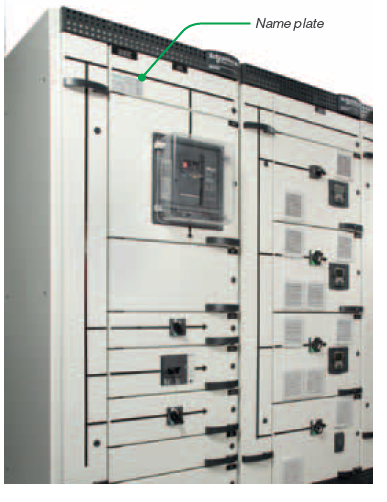
Рис. Schneider Electric
Паспортная табличка НКУНедопустимые, нерекомендуемые
Тематики
Синонимы
- заводская табличка
- заводская табличка аппарата
- заводская табличка с паспортными данными
- паспортная табличка
EN
- data plate
- designation label
- device name plate
- escutcheon plate
- label plate
- name plate
- nameplate
- plate
- rating nameplate
- rating plate
- rating/performance label
- type identification label
DE
FR
тарелка
(напр. клапана, деаэратора)
[А.С.Гольдберг. Англо-русский энергетический словарь. 2006 г.]Тематики
EN
- plate
- PL
толстый лист (металла)
листовая сталь
листовое железо
плющить (металл)
—
[ http://slovarionline.ru/anglo_russkiy_slovar_neftegazovoy_promyishlennosti/]Тематики
Синонимы
EN
толстый лист металла
толстый листовой металл
—
[А.С.Гольдберг. Англо-русский энергетический словарь. 2006 г.]Тематики
Синонимы
EN
- plate
- pi
монтажная панель
Панель, служащая для размещения комплектующих элементов и предназначенная для установки в НКУ.
Примечание - Если этот конструктивный элемент содержит аппаратуру, то он может рассматриваться как отдельное самостоятельное НКУ.
[ ГОСТ Р 51321. 1-2000 ( МЭК 60439-1-92)]
монтажная панель
Панель, предназначенная для размещения комплектующих элементов, устанавливаемая в НКУ
[ ГОСТ Р МЭК 61439.1-2013]
монтажная панель
Отдельный внутренний комплектующий элемент оболочки, предназначенный для установки и крепления на нем аппаратуры распределения и управления.
[ ГОСТ Р 52796- 2007( МЭК 62208: 2002)]EN
mounting plate
separate internal accessory of the enclosure intended for the mounting of electrical components
[IEC 62208, ed. 1.0 (2002-11)]FR
platine
élément interne séparé de l'enveloppe destiné au montage de l'appareillage
[IEC 62208, ed. 1.0 (2002-11)]

Установка неперфорированной монтажной панели в оболочку шкафа
Неразборная сварная оболочка ящика с установленной перфорированной оцинкованной монтажной панелью
На предприятии, выполняющем электромонтаж НКУ, монтажную панель обычно извлекают из оболочки, выполняют электромонтаж, а затем монтажную панель с установленными аппаратами и выполненным электромонтажом вставляют в оболочку.
[Интент]
Недопустимые, нерекомендуемые
Тематики
- НКУ (шкафы, пульты,...)
Обобщающие термины
EN
FR
3.9 пластина (plate): Прецизионный отштампованный лист, имеющий гофрированную форму.
Источник: ГОСТ Р ИСО 15547-1-2009: Нефтяная и газовая промышленность. Пластинчатые теплообменники. Технические требования оригинал документа
Англо-русский словарь нормативно-технической терминологии > plate
-
40 device
аппарат
Устройство, в котором за счёт внешних механических, химических и электромеханических, термических или других воздействий производится полезная работа
[Терминологический словарь по строительству на 12 языках (ВНИИИС Госстроя СССР)]
аппарат
-
[IEV number 151-11-22]EN
apparatus
device or assembly of devices which can be used as an independent unit for specific functions
NOTE – In English, the term "apparatus" sometimes implies use by skilled persons for professional purposes.
[IEV number 151-11-22]FR
appareil, m
dispositif ou assemblage de dispositifs qui peut être utilisé comme unité indépendante pour remplir des fonctions particulières
NOTE – En anglais, le terme "apparatus" implique quelquefois une utilisation par des personnes qualifiées dans un but professionnel.
[IEV number 151-11-22]Сопутствующие термины
EN
DE
FR
прибор
оборудование
[ http://www.dunwoodypress.com/148/PDF/Biotech_Eng-Rus.pdf]Тематики
Синонимы
EN
приспособление
Технологическая оснастка, предназначенная для установки или направления предмета труда или инструмента при выполнении технологической операции
[ГОСТ 3.1109-82]
приспособление
Техническое устройство, присоединяемое к машине или применяемое самостоятельно для базирования и закрепления предметов производства при выполнении технологических операций
[Терминологический словарь по строительству на 12 языках (ВНИИИС Госстроя СССР)]Тематики
EN
DE
FR
процедура
Упорядоченная совокупность взаимосвязанных определенными отношениями действий, направленных на решение задачи.
[МУ 64-01-001-2002]
процедура
Установленный способ осуществления деятельности или процесса.
Примечания
1. Процедуры могут быть документированными или недокументированными.
2. Если процедура документирована, часто используется термин "письменная процедура" или "документированная процедура". Документ, содержащий процедуру, может называться "процедурный документ".
[ ГОСТ Р ИСО 9000-2008]
процедура
Документ, содержащий шаги, которые предписывают способ выполнения деятельности. Процедуры определяются как части процессов. См. тж. рабочая инструкция.
[Словарь терминов ITIL версия 1.0, 29 июля 2011 г.]EN
procedure
A document containing steps that specify how to achieve an activity. Procedures are defined as part of processes. See also work instruction.
[Словарь терминов ITIL версия 1.0, 29 июля 2011 г.]Тематики
EN
устройство
-
[IEV number 151-11-20 ]
устройство
Элемент или блок элементов, который выполняет одну или более функций.
[ ГОСТ Р 41.48-2004]
[ ГОСТ Р 52388-2005]
устройство
Совокупность элементов, представляющая единую конструкцию (многоконтактное реле, набор транзисторов, плата, блок, шкаф, механизм, разделительная панель и т. п.).
Устройство может не иметь в изделии определенного функционального назначения.
[ГОСТ 2.701-84]
устройство
Изделие, являющееся конструктивным элементом или совокупностью конструктивных элементов, находящихся в функционально-конструктивном единстве
[ ГОСТ 16382-87]EN
device
material element or assembly of such elements intended to perform a required function
NOTE – A device may form part of a larger device.
[IEV number 151-11-20 ]FR
dispositif, m
élément matériel ou assemblage d'éléments matériels destiné à remplir une fonction déterminée
NOTE – Un dispositif peut faire partie d'un dispositif plus important.
[IEV number 151-11-20 ]Тематики
- электротехника, основные понятия
EN
DE
FR
устройство (сети и системы связи)
Элемент или совокупность элементов, выполняющих установленную функцию.
Примечание 1. Устройство может являться частью другого, большего устройства.
Примечание 2. В контексте распределительного устройства подстанции устройством называется физическая единица первичного оборудования, например трансформатор или выключатель. В контексте автоматики подстанций устройством является интеллектуальное электронное устройство.
[ ГОСТ Р 54325-2011 (IEC/TS 61850-2:2003)]EN
device
element or assembly of elements performing a required function
Note A device may form part of a larger device.
(Source: IEV 151)
mechanism or piece of equipment designed to serve a purpose or perform a function for example, circuit breaker, relay or substation computer
(Source: IEEE Std. 100–1996, IEEE dictionary of electrical and electronic terms)
in the context of a switchyard, a device is a physical plant item for example transformer or circuit breaker; in the context of substation automation a device is an IED
(Source: IEC 61850-1)
[IEC 61850-2, ed. 1.0 (2003-08)]Тематики
EN
3.6.8 устройство (device): Любое идентифицированное оборудование, система или подсистема, не относящиеся к программному обеспечению, комплекту данных или классу человеческих ресурсов.
Примечание - Устройство, тем не менее, может включать программное обеспечение.
Источник: ГОСТ Р ИСО 15531-1-2008: Промышленные автоматизированные системы и интеграция. Данные по управлению промышленным производством. Часть 1. Общий обзор оригинал документа
3.102 прибор (device): Сущность, выполняющая функции управления, приведения в действие и считывания и связанная с другими такими сущностями в автоматизированной системе.
Примечание - Сам по себе прибор не выполняет функции обработки, транспортирования или хранения материалов.
Источник: ГОСТ Р 54136-2010: Системы промышленной автоматизации и интеграция. Руководство по применению стандартов, структура и словарь оригинал документа
Англо-русский словарь нормативно-технической терминологии > device
См. также в других словарях:
specific — spe|cif|ic1 W1S1 [spıˈsıfık] adj [Date: 1600 1700; : Late Latin; Origin: specificus, from Latin species; SPECIES] 1.) [only before noun] a specific thing, person, or group is one particular thing, person, or group ▪ games suitable for specific… … Dictionary of contemporary English
Specific heat capacity — Specific heat capacity, also known simply as specific heat, is the measure of the heat energy required to increase the temperature of a unit quantity of a substance by a certain temperature interval. The term originated primarily through the work … Wikipedia
Specific impulse — (usually abbreviated I sp) is a way to describe the efficiency of rocket and jet engines. It represents the impulse (change in momentum) per unit of propellant. The higher the specific impulse, the less propellant is needed to gain a given amount … Wikipedia
specific gravity — specific gravity, adj. Physics. the ratio of the density of any substance to the density of some other substance taken as standard, water being the standard for liquids and solids, and hydrogen or air being the standard for gases. Also called… … Universalium
specific performance — see performance Merriam Webster’s Dictionary of Law. Merriam Webster. 1996. specific performance … Law dictionary
specific finding — A decision on a fact made by a jury in its verdict at the judge s request. Often the judge gives a jury a list of decisions to be made on specific findings of fact to help the jurors focus on the issues. For example, a judge may ask the jury to… … Law dictionary
Specific gravity — is defined as the ratio of the density of a given solid or liquid substance to the density of water at a specific temperature and pressure, typically at 4°C (39°F) and convert|1|atm|inHg|2|abbr=on|lk=on , making it a dimensionless quantity (see… … Wikipedia
Specific State Memory Recall — (SSMR) The theory explores the notion that the memory pathways forged under the influence of specific chemicals, drugs such as alcohol, can be more effectively accessed again when under the influence of that drug.This explains the apparent… … Wikipedia
specific legacy — see legacy Merriam Webster’s Dictionary of Law. Merriam Webster. 1996. specific legacy … Law dictionary
specific intent — see intent Merriam Webster’s Dictionary of Law. Merriam Webster. 1996. specific intent … Law dictionary
Specific fuel consumption (thrust) — Specific fuel consumption, often shortened to SFC, or TSFC is an engineering term that is used to describe the fuel efficiency of an engine design with respect to thrust output. It allows the efficiency of different sized engines to be directly… … Wikipedia
