

-
61 служба
1. (работа) post, position, situation, employment, job, work; serviceна държавна служба in a government officeна държавна служба съм work for the government, be a state employee, be in the civil service, be employed as a government official, have a government jobпостъпвам на служба begin/start workingподавам заявление за служба apply for a position/jobвземам/приемам на своя служба take in/accept into o.'s serviceпремествам на друга служба transfer to another job/to other dutiesуволнявам в интереса на службата dismiss on disciplinary grounds2. воен. (military) serviceдействителна служба active service, service with the coloursслужба във войската army serviceбойна/караулна служба field/guard dutyпостъпвам на военна служба enter the service, join upкарам военната си служба do o.'s military service, do national service in the army3. (отделение, бюро) office, bureau, service4. църк. (divine) service5. (предназначение, роля) function, use6. (полза) serviceпоставям в служба на науката и пр. place at the service of science, etc* * *слу̀жба,ж., -и 1. ( работа) post, position, situation, employment, job, work; service; в \службаата ми at my office/work, etc., where I work; заемам \службаа hold office; на държавна \службаа съм work for the government, be a state employee, be in the civil service, be employed as a government official, have a government job; на \службаа in work, employed; на \службаа съм при някого be in s.o.’s employment/employ; на \службаа у (за слуга, агент) in the service/pay of; напускам \службаа leave/resign office; по \службаа on business; подавам заявление за \службаа apply for a position/job; получавам \службаа get a place/post/position; постъпвам на \службаа begin/start working; премествам на друга \службаа transfer to another job/to other duties;2. воен. (military) service; бойна/караулна \службаа field/guard duty; действителна \службаа active service, service with the colours; карам военната си \службаа do o.’s military service, do national service in the army; постъпвам на военна \службаа enter the service, join up; свързочна \службаа signal/communication service; \службаа във войската army service; строева \службаа service with the troops;3. ( отделение, бюро) office, bureau, service; консулска \службаа consular service; \службаа на президента Office of President; \службаа по заетостта employment services;4. църк. (divine) service;5. ( предназначение, роля) function, use;6. ( полза) service; поставям в \службаа на науката и пр. place at the service of science, etc.* * *post (работа); position ; employment ; (отдел): bureau ; service {`sq;rvis} (и църк.); duty ; function ; military service* * *1. (отделение, бюро) office, bureau, service 2. (полза) service 3. (предназначение, роля) function, use 4. (работа) post, position, situation, employment, job, work;service 5. СЛУЖБА във войската army service 6. бойна/ караулна СЛУЖБА field/guard duty 7. вземам/приемам на своя СЛУЖБА take in/accept into o.'s service 8. воен. (military) service 9. действителна СЛУЖБА active service, service with the colours 10. заемам СЛУЖБА hold office 11. карам военната си СЛУЖБА do o.'s military service, do national service in the army 12. на СЛУЖБА in work, employed 13. на СЛУЖБА съм при някого be in s.o.'s employment/employ 14. на СЛУЖБА у (за слуга, агент) in the service/pay of 15. на голяма СЛУЖБА съм hold high office 16. на държавна СЛУЖБА съм work for the government, be a state employee, be in the civil service, be employed as a government official, have a government job 17. на държавнаСЛУЖБА in a government office 18. по СЛУЖБАon business 19. подавам заявление за СЛУЖБА apply for a position/job 20. поставям в СЛУЖБА на науката и пр. place at the service of science, etc 21. постъпвам на СЛУЖБА begin/ start working 22. постъпвам на военнаСЛУЖБА enter the service, join up 23. премествам на друга СЛУЖБА transfer to another job/to other duties 24. свързочна СЛУЖБА signal/ communication service 25. строева СЛУЖБА service with the troops 26. уволнявам в интереса на СЛУЖБАта dismiss on disciplinary grounds 27. цьрк. (divine) service -
62 oficio
m.1 trade.de oficio by trade2 job (trabajo).no tener oficio ni beneficio to have no trade3 official minute (document).4 service (religion) (ceremonia).el Santo oficio the Holy Office, the Inquisitionoficio de difuntos funeral service5 function, role.6 occupation, job, profession, service.7 craft.pres.indicat.1st person singular (yo) present indicative of spanish verb: oficiar.* * *1 (ocupación) job, occupation; (especializado) trade2 (función) role, function3 (comunicado oficial) official letter, official note4 RELIGIÓN service\de oficio by tradeser del oficio to be in the tradeno tener ni oficio ni beneficio to be idleoficio de difuntos funeral massoficio divino divine officeel Santo Oficio the Holy Office, the Inquisition* * *noun m.1) occupation, trade2) craft* * *SM1) (=profesión) tradesin oficio ni beneficio —
un pobre temporero sin oficio ni beneficio — just a poor seasonal worker without a penny to his name
se encontró sin oficio ni beneficio al salir del colegio — he found himself with no means of earning a living when he left school
2) (=función) functionel oficio de esta pieza es de... — what this part does is...
3)abogado 1)de oficio: miembro de oficio — ex officio member
4) (=comunicado) official letter5) (Rel) service, massoficio de difuntos — funeral service, mass for the dead, office for the dead
6)Santo Oficio — ( Hist) Holy Office, Inquisition
7)8) (=trascocina) scullery* * *1) ( trabajo) tradeser del oficio — (fam) to be a hooker (sl), to be on the game (BrE colloq)
sin oficio ni beneficio: un vago sin oficio ni beneficio — a lazy bum (AmE colloq), a good-for-nothing layabout (BrE)
2)a) ( comunicación oficial) official lettertamaño oficio — (AmS) foolscap
b) (Der)3) (Relig) service, office•* * *= craft, occupation, trade.Ex. He draws a distinction between a craft, based on customary activities and modified by the trial and error of individual practice, and a profession.Ex. Headings such as SALESMEN AND SALESMANSHIP and FIREMEN, since they are assigned to works covering the activities of both men and women in these occupations, are not specific.Ex. Non-bibliographic data bases are particularly used for businesses and industry to extract information in the fields of business, economics, trade and commerce.----* abogado de oficio = legal aid.* aprender los trucos del oficio = learn + the ropes.* aprendizaje de un oficio = apprenticeship.* casa de oficios = vocational school.* ejercer un oficio = ply + Posesivo + trade.* envío de oficio = blanket order.* ex oficio = ex officio.* gaje del oficio = occupational hazard.* riesgo del oficio = occupational hazard.* truco del oficio = trade trick, trick of the trade.* trucos del oficio = tips of the trade.* * *1) ( trabajo) tradeser del oficio — (fam) to be a hooker (sl), to be on the game (BrE colloq)
sin oficio ni beneficio: un vago sin oficio ni beneficio — a lazy bum (AmE colloq), a good-for-nothing layabout (BrE)
2)a) ( comunicación oficial) official lettertamaño oficio — (AmS) foolscap
b) (Der)3) (Relig) service, office•* * *= craft, occupation, trade.Ex: He draws a distinction between a craft, based on customary activities and modified by the trial and error of individual practice, and a profession.
Ex: Headings such as SALESMEN AND SALESMANSHIP and FIREMEN, since they are assigned to works covering the activities of both men and women in these occupations, are not specific.Ex: Non-bibliographic data bases are particularly used for businesses and industry to extract information in the fields of business, economics, trade and commerce.* abogado de oficio = legal aid.* aprender los trucos del oficio = learn + the ropes.* aprendizaje de un oficio = apprenticeship.* casa de oficios = vocational school.* ejercer un oficio = ply + Posesivo + trade.* envío de oficio = blanket order.* ex oficio = ex officio.* gaje del oficio = occupational hazard.* riesgo del oficio = occupational hazard.* truco del oficio = trade trick, trick of the trade.* trucos del oficio = tips of the trade.* * *A (trabajo) tradeera carpintero de oficio he was a carpenter by tradeaprender un oficio to learn a tradeB1 (comunicación oficial) official letterdespachar or mandar un oficio to send an official lettertamaño oficio (Col, CS); foolscap2actuar de oficio to act on one's own initiativeC ( Relig) service, officelos oficios de Semana Santa the Holy Week services o officesCompuesto:mass o office for the deadD ( Arquit) utility room* * *
Del verbo oficiar: ( conjugate oficiar)
oficio es:
1ª persona singular (yo) presente indicativo
ofició es:
3ª persona singular (él/ella/usted) pretérito indicativo
Multiple Entries:
oficiar
oficio
oficio sustantivo masculino
1 ( trabajo) trade;
2 (Der)
3 (Relig) service, office
oficio sustantivo masculino
1 trade
(profesión) job, occupation
2 (comunicación oficial) official letter o note
abogado de oficio, state-appointed lawyer
3 Rel service
' oficio' also found in these entries:
Spanish:
abogacía
- abogada
- abogado
- albañilería
- alfarería
- artesanía
- auditoría
- basurero
- carpintería
- censor
- censora
- contabilidad
- costura
- de
- ejercer
- encuadernación
- enfermería
- equivocar
- ser
- escribanía
- gajes
- grabada
- grabado
- gremio
- maestra
- maestro
- peletería
- peluquería
- repostería
- soldador
- soldadora
- truco
- vaquera
- vaquero
- artilugio
- funeral
English:
craft
- occupational
- office
- ply
- priesthood
- service
- trade
- trick
- apprenticeship
- inquisition
* * *oficio nm1. [profesión manual] trade;de oficio by trade2. [trabajo] job;Famno tener oficio ni beneficio to have no trade;Euf el oficio más viejo del mundo the oldest profession (in the world) [diligencia] judicial proceedings4. [documento] official minutese llegó a un acuerdo gracias a los buenos oficios del ministro an agreement was reached thanks to the good offices of the ministeroficio de difuntos funeral service7. [función] function, role8. [comunicación] communiqué, official notice* * *m1 trabajo trade;sin oficio ni beneficio fam with no trade2:abogado de oficio public defender, Br duty solicitor3:Santo Oficio HIST Holy Office, Inquisition* * *oficio nm1) : trade, professiones electricista de oficio: he's an electrician by trade2) : function, role3) : official communication4) : experiencetener oficio: to be experienced5) : religious ceremony* * *oficio n1. (profesión) job2. (trabajo manual) trade3. (acto religioso) service -
63 ayuda
f.1 help, assistance (asistencia).acudir en ayuda de alguien to come/go to somebody's assistancenos fuiste de gran ayuda you were a great help to usno me sirvió de mucha ayuda it wasn't much help to meprestar ayuda to help, to assistayuda en carretera breakdown service2 aid.ayuda al desarrollo development aidayuda humanitaria humanitarian aidpres.indicat.3rd person singular (él/ella/ello) present indicative of spanish verb: ayudar.* * *1 help, aid, assistance2 (lavativa) enema\ir en ayuda de alguien to come to somebody's assistanceprestar ayuda to help (a, -)ayuda de cámara valet* * *noun f.help, assistance, aid* * *1. SF1) (=asistencia) help, assistance más frmayuda a domicilio — home help, home helper (EEUU)
ayudas a la navegación — aids to navigation, navigational aids
ayuda compensatoria — ≈ income support, welfare (EEUU)
2) (Med) (=enema) enema; LAm (=laxante) laxative2.SM (=paje) page* * *1) ( asistencia) helpnadie fue or acudió en su ayuda — nobody went to his aid
2) (fam & euf) ( enema) enema* * *= aid, assistance, guidance, help, helpfulness, support, relief, enhancer, helper, facilitator, bursary, good offices, jump-start [jumpstart], helping hand, succour [succor, -USA].Ex. Indexing may be conducted entirely without the aid of a computer, or may rely to varying extents upon the facilities for the manipulation and ordering of data offered by the computer.Ex. Most information about terms and their relationships that could be of assistance to the user of the index will be transferred from the list to the index or catalogue.Ex. The command function 'HELP' is used to obtain guidance online when in difficulty.Ex. The entry is first located with the help of searching.Ex. Sometimes, in the interest of comprehension or helpfulness, modifications to the standard pattern are desirable.Ex. BSO was prepared by the International Federation for Documentation with the support of UNESCO (United Nations Educational, Scientific, and Cultural Organization), and was published in 1978/79.Ex. The report concluded that the problems of rural populations 'do not differ greatly from those of the urban population though the difficulties in obtaining help and relief can be exacerbated by isolation'.Ex. The low regard that many publishers have shown for indexers as enhancers of book sales and profitability may well have been justified in the past.Ex. Once again careful planning pays dividends, and plenty of time and helpers are needed.Ex. Information technology may have acted as a catalyst or facilitator for some of the changes which have occurred.Ex. This article describes a 12 week study tour of the UK undertaken with the help of a bursary from the EU by a lecturer in library studies from Papua New Guinea.Ex. This enables the library to use the MPEs' good offices and contacts to influence the national government on projects which are important for the area.Ex. No hospital creates a healthier community all by itself but it can give its neighbors a jump-start.Ex. Fish hawks needed a helping hand and their comeback is one of the great wildlife success stories of our time.Ex. The Government has vowed to provide 'all possible succour' to the people affected by the cyclone that has left a trail of death and devastation.----* ayuda a las víctimas de una catástrofe = disaster relief.* ayuda al desarrollo = development aid.* ayuda alimentaria = food aid.* ayuda con la declaración de hacienda = income tax assistance.* ayuda de asistencia = attendance grant.* ayuda de asistencia a congreso = conference attendance grant.* ayuda de cámara = valet.* ayuda de emergencia = emergency relief.* ayuda del gobierno = state aid, state support.* ayuda doméstica = domestic help.* ayuda económica = grant, financial support, fund assistance, financial assistance, grant money, cash grant.* ayuda educativa = educational aid.* ayuda en caso de catástrofe = disaster relief.* ayuda en pantalla = aid page.* ayuda estatal = state aid, state support.* ayuda familiar = family income supplement, family worker.* ayuda financiera = financial assistance, fund assistance.* ayuda humanitaria = humanitarian aid, disaster relief, humanitarian assistance.* Ayuda Internacional de Libros (BAI) = Book Aid International (BAI).* ayuda legal = legal assistance.* ayuda memoria = aide-mémoire.* ayuda mutua = mutual help, mutual aid.* ayuda para dormir = sleeping aid.* ayuda para el desplazamiento = travel grant.* ayuda para la memoria = memory aid.* ayuda para recordar = memory aid.* ayudas = monies [money, -sing.].* ayuda sensible al contexto = context-sensitive help.* ayuda social = welfare benefits.* ayudas para la escritura = writing tools.* ayuda visual = visual aid.* buscar ayuda = seek + assistance, seek + help.* centro de ayuda al empleo = job-help centre.* con la ayuda de = under the guidance of.* con + Posesivo + ayuda = under + Posesivo + guidance.* conseguir ayuda = secure + help.* dispositivo de ayuda a usuarios con necesidades especiales = assistive device.* hacerlo sin la ayuda de nadie = do + it + on + Posesivo + own.* herramienta de ayuda a la escritura = writing aid.* herramienta de ayuda a la lectura = reading aid.* herramientas de ayuda = helper utility.* herramientas de ayuda para la búsqueda = searching aid.* instrumento de ayuda a la enseñanza = teaching aid.* material de ayuda = help pack.* mostrador de ayuda = help desk [helpdesk].* ofrecer ayuda = offer + guidance, offer + assistance, provide + support.* ojo humano sin ayuda de lente, el = unaided eye, the.* pantalla de ayuda = help screen.* pedir ayuda = seek + assistance, seek + help.* pedir ayuda a = enlist + the cooperation of.* política de ayuda = assistance policy.* prestar ayuda = provide + assistance, render + assistance, offer + guidance, offer + assistance, lend + a (helping) hand.* proyecto de ayuda = aid project.* proyecto de ayuda humanitaria = relief project.* recabar ayuda = solicit + help, solicit + support.* ser de ayuda = be of assistance.* ser de gran ayuda para = be a boon to.* ser una gran ayuda = be a tower of strength.* servicio de ayuda = help desk [helpdesk], help facility.* servir de ayuda = be of assistance.* sin ayuda = unaided, unassisted.* sin ayuda de nadie = all by + Reflexivo, by + Reflexivo.* sin la ayuda de nadie = single-handedly.* sistema de ayuda = help system.* sistema de ayuda a la gestión = management support system (MSS).* solicitar ayuda = summon + help, seek + assistance, seek + help.* tecla de ayuda = help key.* teléfono de ayuda = help desk [helpdesk], help line, telephone help line.* * *1) ( asistencia) helpnadie fue or acudió en su ayuda — nobody went to his aid
2) (fam & euf) ( enema) enema* * *= aid, assistance, guidance, help, helpfulness, support, relief, enhancer, helper, facilitator, bursary, good offices, jump-start [jumpstart], helping hand, succour [succor, -USA].Ex: Indexing may be conducted entirely without the aid of a computer, or may rely to varying extents upon the facilities for the manipulation and ordering of data offered by the computer.
Ex: Most information about terms and their relationships that could be of assistance to the user of the index will be transferred from the list to the index or catalogue.Ex: The command function 'HELP' is used to obtain guidance online when in difficulty.Ex: The entry is first located with the help of searching.Ex: Sometimes, in the interest of comprehension or helpfulness, modifications to the standard pattern are desirable.Ex: BSO was prepared by the International Federation for Documentation with the support of UNESCO (United Nations Educational, Scientific, and Cultural Organization), and was published in 1978/79.Ex: The report concluded that the problems of rural populations 'do not differ greatly from those of the urban population though the difficulties in obtaining help and relief can be exacerbated by isolation'.Ex: The low regard that many publishers have shown for indexers as enhancers of book sales and profitability may well have been justified in the past.Ex: Once again careful planning pays dividends, and plenty of time and helpers are needed.Ex: Information technology may have acted as a catalyst or facilitator for some of the changes which have occurred.Ex: This article describes a 12 week study tour of the UK undertaken with the help of a bursary from the EU by a lecturer in library studies from Papua New Guinea.Ex: This enables the library to use the MPEs' good offices and contacts to influence the national government on projects which are important for the area.Ex: No hospital creates a healthier community all by itself but it can give its neighbors a jump-start.Ex: Fish hawks needed a helping hand and their comeback is one of the great wildlife success stories of our time.Ex: The Government has vowed to provide 'all possible succour' to the people affected by the cyclone that has left a trail of death and devastation.* ayuda a las víctimas de una catástrofe = disaster relief.* ayuda al desarrollo = development aid.* ayuda alimentaria = food aid.* ayuda con la declaración de hacienda = income tax assistance.* ayuda de asistencia = attendance grant.* ayuda de asistencia a congreso = conference attendance grant.* ayuda de cámara = valet.* ayuda de emergencia = emergency relief.* ayuda del gobierno = state aid, state support.* ayuda doméstica = domestic help.* ayuda económica = grant, financial support, fund assistance, financial assistance, grant money, cash grant.* ayuda educativa = educational aid.* ayuda en caso de catástrofe = disaster relief.* ayuda en pantalla = aid page.* ayuda estatal = state aid, state support.* ayuda familiar = family income supplement, family worker.* ayuda financiera = financial assistance, fund assistance.* ayuda humanitaria = humanitarian aid, disaster relief, humanitarian assistance.* Ayuda Internacional de Libros (BAI) = Book Aid International (BAI).* ayuda legal = legal assistance.* ayuda memoria = aide-mémoire.* ayuda mutua = mutual help, mutual aid.* ayuda para dormir = sleeping aid.* ayuda para el desplazamiento = travel grant.* ayuda para la memoria = memory aid.* ayuda para recordar = memory aid.* ayudas = monies [money, -sing.].* ayuda sensible al contexto = context-sensitive help.* ayuda social = welfare benefits.* ayudas para la escritura = writing tools.* ayuda visual = visual aid.* buscar ayuda = seek + assistance, seek + help.* centro de ayuda al empleo = job-help centre.* con la ayuda de = under the guidance of.* con + Posesivo + ayuda = under + Posesivo + guidance.* conseguir ayuda = secure + help.* dispositivo de ayuda a usuarios con necesidades especiales = assistive device.* hacerlo sin la ayuda de nadie = do + it + on + Posesivo + own.* herramienta de ayuda a la escritura = writing aid.* herramienta de ayuda a la lectura = reading aid.* herramientas de ayuda = helper utility.* herramientas de ayuda para la búsqueda = searching aid.* instrumento de ayuda a la enseñanza = teaching aid.* material de ayuda = help pack.* mostrador de ayuda = help desk [helpdesk].* ofrecer ayuda = offer + guidance, offer + assistance, provide + support.* ojo humano sin ayuda de lente, el = unaided eye, the.* pantalla de ayuda = help screen.* pedir ayuda = seek + assistance, seek + help.* pedir ayuda a = enlist + the cooperation of.* política de ayuda = assistance policy.* prestar ayuda = provide + assistance, render + assistance, offer + guidance, offer + assistance, lend + a (helping) hand.* proyecto de ayuda = aid project.* proyecto de ayuda humanitaria = relief project.* recabar ayuda = solicit + help, solicit + support.* ser de ayuda = be of assistance.* ser de gran ayuda para = be a boon to.* ser una gran ayuda = be a tower of strength.* servicio de ayuda = help desk [helpdesk], help facility.* servir de ayuda = be of assistance.* sin ayuda = unaided, unassisted.* sin ayuda de nadie = all by + Reflexivo, by + Reflexivo.* sin la ayuda de nadie = single-handedly.* sistema de ayuda = help system.* sistema de ayuda a la gestión = management support system (MSS).* solicitar ayuda = summon + help, seek + assistance, seek + help.* tecla de ayuda = help key.* teléfono de ayuda = help desk [helpdesk], help line, telephone help line.* * *A (asistencia, auxilio) helple prestaron toda la ayuda necesaria they gave him all the help he needednadie fue or acudió en su ayuda nobody went to help him o went to his aidno quiso pedir ayuda she didn't want to ask for helpayudas para los proyectos de inversión incentives for investment projectsofrecieron ayuda económica a los damnificados they offered financial help o aid o assistance to the victimsorganizaciones de ayuda internacional international aid agenciesno tiene ninguna ayuda en casa she has no help at homeha sido de gran ayuda it has been a great helppoca ayuda no es estorbo every little helpscon ayuda de un vecino mató mi padre un cochino well, with a little help from my/your/his friends …Compuestos:( Esp) home-help service● ayuda audiovisual/visualaudiovisual/visual aidmasculine valethumanitarian aidmasculine aide-mémoireregional aid* * *
Del verbo ayudar: ( conjugate ayudar)
ayuda es:
3ª persona singular (él/ella/usted) presente indicativo2ª persona singular (tú) imperativo
Multiple Entries:
ayuda
ayudar
ayuda sustantivo femenino ( asistencia) help;
ayudas para la inversión incentives for investment;
ha sido de gran ayuda it has been a great help
ayudar ( conjugate ayudar) verbo transitivo
to help;
ayuda al prójimo to help one's neighbor;
¿te ayudo? do you need any help?;
vino a ayudame she came to help me out;
ayúdame a poner la mesa help me (to) set the table
verbo intransitivo
to help;
¿puedo ayuda en algo? can I do anything to help?
ayuda sustantivo femenino help, assistance, aid: un joven vino en ayuda de los accidentados, a young man came to the aid of the injured people
ayudar verbo transitivo to help: ¿puedes ayudarme a mover la mesa?, can you help me to move the table? ➣ Ver nota en help
' ayuda' also found in these entries:
Spanish:
abogada
- abogado
- acudir
- asistencia
- balón
- beneficio
- blandengue
- colaboración
- confiar
- demanda
- espaldarazo
- estimar
- facilidad
- fortalecimiento
- goteo
- gratificación
- nos
- nunca
- ofrecer
- paliar
- prestación
- prioritaria
- prioritario
- recabar
- retirar
- sola
- solo
- urgir
- utilidad
- vital
- agradecer
- apreciar
- auxilio
- beca
- becar
- contar
- desechar
- desinteresado
- despreciar
- dispensar
- disponer
- espontáneo
- evaporarse
- favor
- gracia
- gritar
- implorar
- inapreciable
- inestimable
- material
English:
aid
- appreciate
- appreciative
- ask for
- assistance
- backing
- bat
- bird
- bootstrap
- by
- canvass
- contribute
- contribution
- deny
- do without
- dramatically
- foreign aid
- forthcoming
- give
- grateful
- greatly
- help
- hesitate
- immediate
- instrumental
- major
- navigate
- own
- quarter
- relief
- seek
- service
- single-handed
- summon
- support
- supportive
- unaided
- valet
- virtually
- volunteer
- without
- afield
- any
- boon
- deserving
- hand
- position
- public
- shape
- single
* * *♦ nf1. [asistencia] help, assistance;acudir en ayuda de alguien to come/go to sb's assistance;nos fuiste de gran ayuda you were a great help to us;no me sirvió de mucha ayuda it wasn't much help to me;prestar ayuda to help, to assistayuda en carretera Br breakdown service, US emergency road service; Informát ayuda en línea on-line help; Informát ayuda en pantalla onscreen help2. [económica, alimenticia] aid;un paquete de ayudas a la pequeña empresa a package of measures to help small businessesayuda al desarrollo development aid;ayuda exterior foreign aid;ayuda extranjera foreign aid;ayuda humanitaria humanitarian aid;un convoy de ayuda humanitaria a relief convoy3. [limosna]una ayuda, por favor could you spare me some change, please?4. [enema] enema♦ nmHist ayuda de cámara royal valet* * *I f help, assistance;assistance;con la ayuda de with the help of;prestar ayuda help;pedir ayuda a alguien ask s.o. for help;venir en ayuda de come to the aid o help ofII m aide* * *ayuda nf1) : help, assistance2)ayuda de cámara : valet* * *ayuda n1. (en general) help2. (cosa material) aid -
64 Funktion
Funktion f COMP, GEN, STAT function • als Funktion von GEN as a function of* * *f <Comp, Geschäft, Math> function ■ als Funktion von < Geschäft> as a function of* * *Funktion
function, office, role, duty;
• mit beratender Funktion in an advisory capacity;
• mit schiedsrichterlicher Funktion ausgestattet arbitrative;
• voneinander abhängige Funktionen interdependent functions;
• absatzwirtschaftliche Funktionen marketing functions;
• ausgelagerte Funktion outsourced function;
• außergewöhnliche Funktion offbeat role;
• beratende Funktion advisory function;
• betriebsleitende Funktionen managerial functions;
• gesetzgeberische Funktion legislative function;
• hoheitsrechtliche Funktionen sovereign powers;
• richterliche Funktionen functions of a judge;
• staatliche Funktionen governmental functions;
• treuhänderische Funktion fiduciary duty;
• Funktion von Angebot und Nachfrage mechanism of supply and demand;
• Funktion eines Beamten function of an officer of state;
• Funktion ausüben to occupy a position, to carry out a function, to play a role;
• richterliche Funktionen ausüben to act the part of a judge;
• Funktionen auf einen Ausschuss übertragen to put an office into commission. -
65 БИБЛИОГРАФИЯ
Мы приняли следующие сокращения для наиболее часто упоминаемых книг и журналов:IJP - International Journal of Psycho-analysisJAPA - Journal of the American Psychoanalytic AssociationSE - Standard Edition of the Complete Psychological Works of Sigmund Freud, ed. James Strachey (London: Hogarth Press and the Institute of Psycho-Analysis, 1953—74.)PSOC - Psychoanalytic Study of the Child (New Haven: Yale University Press)PQ - Psychoanalytic QuarterlyWAF - The Writings of Anna Freud, ed. Anna Freud (New York: International Universities Press, 1966—74)PMC - Psychoanalysis The Major Concepts ed. Burness E. Moore and Bernard D. Fine (New Haven: Yale University Press)\О словаре: _about - Psychoanalytic Terms and Concepts\1. Abend, S. M. Identity. PMC. Forthcoming.2. Abend, S. M. (1974) Problems of identity. PQ, 43.3. Abend, S. M., Porder, M. S. & Willick, M. S. (1983) Borderline Patients. New York: Int. Univ. Press.4. Abraham, K. (1916) The first pregenital stage of libido. Selected Papers. London, Hogarth Press, 1948.5. Abraham, K. (1917) Ejaculatio praecox. In: selected Papers. New York Basic Books.6. Abraham, K. (1921) Contributions to the theory of the anal character. Selected Papers. New York: Basic Books, 1953.7. Abraham, K. (1924) A Short study of the development of the libido, viewed in the light of mental disorders. In: Selected Papers. London: Hogarth Press, 1927.8. Abraham, K. (1924) Manic-depressive states and the pre-genital levels of the libido. In: Selected Papers. London: Hogarth Press, 1949.9. Abraham, K. (1924) Selected Papers. London: Hogarth Press, 1948.10. Abraham, K. (1924) The influence of oral erotism on character formation. Ibid.11. Abraham, K. (1925) The history of an impostor in the light of psychoanalytic knowledge. In: Clinical Papers and Essays on Psychoanalysis. New York: Basic Books, 1955, vol. 2.12. Abrams, S. (1971) The psychoanalytic unconsciousness. In: The Unconscious Today, ed. M. Kanzer. New York: Int. Univ. Press.13. Abrams, S. (1981) Insight. PSOC, 36.14. Abse, D W. (1985) The depressive character In Depressive States and their Treatment, ed. V. Volkan New York: Jason Aronson.15. Abse, D. W. (1985) Hysteria and Related Mental Disorders. Bristol: John Wright.16. Ackner, B. (1954) Depersonalization. J. Ment. Sci., 100.17. Adler, A. (1924) Individual Psychology. New York: Harcourt, Brace.18. Akhtar, S. (1984) The syndrome of identity diffusion. Amer. J. Psychiat., 141.19. Alexander, F. (1950) Psychosomatic Medicine. New York: Norton.20. Allen, D. W. (1974) The Feat- of Looking. Charlottesvill, Va: Univ. Press of Virginia.21. Allen, D. W. (1980) Psychoanalytic treatment of the exhibitionist. In: Exhibitionist, Description, Assessment, and Treatment, ed. D. Cox. New York: Garland STPM Press.22. Allport, G. (1937) Personality. New York: Henry Holt.23. Almansi, R. J. (1960) The face-breast equation. JAPA, 6.24. Almansi, R. J. (1979) Scopophilia and object loss. PQ, 47.25. Altman, L. Z. (1969) The Dream in Psychoanalysis. New York: Int. Univ. Press.26. Altman, L. Z. (1977) Some vicissitudes of love. JAPA, 25.27. American Psychiatric Association. (1987) Diagnostic and Statistical Manual of Mental Disorders, 3d ed. revised. Washington, D. C.28. Ansbacher, Z. & Ansbacher, R. (1956) The Individual Psychology of Alfred Adler. New York: Basic Books.29. Anthony, E. J. (1981) Shame, guilt, and the feminine self in psychoanalysis. In: Object and Self, ed. S. Tuttman, C. Kaye & M. Zimmerman. New York: Int. Univ. Press.30. Arlow. J. A. (1953) Masturbation and symptom formation. JAPA, 1.31. Arlow. J. A. (1959) The structure of the deja vu experience. JAPA, 7.32. Arlow. J. A. (1961) Ego psychology and the study of mythology. JAPA, 9.33. Arlow. J. A. (1963) Conflict, regression and symptom formation. IJP, 44.34. Arlow. J. A. (1966) Depersonalization and derealization. In: Psychoanalysis: A General Psychology, ed. R. M. Loewenstein, L. M. Newman, M. Schur & A. J. Solnit. New York: Int. Univ. Press.35. Arlow. J. A. (1969) Fantasy, memory and reality testing. PQ, 38.36. Arlow. J. A. (1969) Unconscious fantasy and disturbances of mental experience. PQ, 38.37. Arlow. J. A. (1970) The psychopathology of the psychoses. IJP, 51.38. Arlow. J. A. (1975) The structural hypothesis. PQ, 44.39. Arlow. J. A. (1977) Affects and the psychoanalytic situation. IJP, 58.40. Arlow. J. A. (1979) Metaphor and the psychoanalytic situation. PQ, 48.41. Arlow. J. A. (1979) The genesis of interpretation. JAPA, 27 (suppl.).42. Arlow. J. A. (1982) Problems of the superego concept. PSOC, 37.43. Arlow. J. A. (1984) Disturbances of the sense of time. PQ, 53.44. Arlow. J. A. (1985) Some technical problems of countertransference. PQ, 54.45. Arlow, J. A. & Brenner, C. (1963) Psychoanalytic Concepts and the Structural Theory, New York: Int. Univ. Press.46. Arlow, J. A. & Brenner, C. (1969) The psychopathology of the psychoses. IJP, 50.47. Asch, S. S. (1966) Depression. PSOC, 21.48. Asch, S. S. (1976) Varieties of negative therapeutic reactions and problems of technique. JAPA, 24.49. Atkins, N. (1970) The Oedipus myth. Adolescence, and the succession of generations. JAPA, 18.50. Atkinson, J. W. & Birch, D. (1970) The Dynamics of Action. New York: Wiley.51. Bachrach, H. M. & Leaff, L. A. (1978) Analyzability. JAPA, 26.52. Bacon, C. (1956) A developmental theory of female homosexuality. In: Perversions,ed, S. Lorand & M. Balint. New York: Gramercy.53. Bak, R. C. (1953) Fetishism. JAPA. 1.54. Bak, R. C. (1968) The phallic woman. PSOC, 23.55. Bak, R. C. & Stewart, W. A. (1974) Fetishism, transvestism, and voyeurism. An American Handbook of Psychiatry, ed. S. Arieti. New York: Basic Books, vol. 3.56. Balint, A. (1949) Love for mother and mother-love. IJP, 30.57. Balter, L., Lothane, Z. & Spencer, J. H. (1980) On the analyzing instrument, PQ, 49.58. Basch, M. F. (1973) Psychoanalysis and theory formation. Ann. Psychoanal., 1.59. Basch, M. F. (1976) The concept of affect. JAPA, 24.60. Basch, M. F. (1981) Selfobject disorders and psychoanalytic theory. JAPA, 29.61. Basch, M. F. (1983) Emphatic understanding. JAPA. 31.62. Balldry, F. Character. PMC. Forthcoming.63. Balldry, F. (1983) The evolution of the concept of character in Freud's writings. JAPA. 31.64. Begelman, D. A. (1971) Misnaming, metaphors, the medical model and some muddles. Psychiatry, 34.65. Behrends, R. S. & Blatt, E. J. (1985) Internalization and psychological development throughout the life cycle. PSOC, 40.66. Bell, A. (1961) Some observations on the role of the scrotal sac and testicles JAPA, 9.67. Benedeck, T. (1949) The psychosomatic implications of the primary unit. Amer. J. Orthopsychiat., 19.68. Beres, C. (1958) Vicissitudes of superego functions and superego precursors in childhood. FSOC, 13.69. Beres, D. Conflict. PMC. Forthcoming.70. Beres, D. (1956) Ego deviation and the concept of schizophrenia. PSOC, 11.71. Beres, D. (1960) Perception, imagination and reality. IJP, 41.72. Beres, D. (1960) The psychoanalytic psychology of imagination. JAPA, 8.73. Beres, D. & Joseph, E. D. (1965) Structure and function in psychoanalysis. IJP, 46.74. Beres, D. (1970) The concept of mental representation in psychoanalysis. IJP, 51.75. Berg, M D. (1977) The externalizing transference. IJP, 58.76. Bergeret, J. (1985) Reflection on the scientific responsi bilities of the International Psychoanalytical Association. Memorandum distributed at 34th IPA Congress, Humburg.77. Bergman, A. (1978) From mother to the world outside. In: Grolnick et. al. (1978).78. Bergmann, M. S. (1980) On the intrapsychic function of falling in love. PQ, 49.79. Berliner, B. (1966) Psychodynamics of the depressive character. Psychoanal. Forum, 1.80. Bernfeld, S. (1931) Zur Sublimierungslehre. Imago, 17.81. Bibring, E. (1937) On the theory of the therapeutic results of psychoanalysis. IJP, 18.82. Bibring, E. (1941) The conception of the repetition compulsion. PQ, 12.83. Bibring, E. (1953) The mechanism of depression. In: Affective Disorders, ed. P. Greenacre. New York: Int. Univ. Press.84. Bibring, E. (1954) Psychoanalysis and the dynamic psychotherapies. JAPA, 2.85. Binswanger, H. (1963) Positive aspects of the animus. Zьrich: Spring.86. Bion Francesca Abingdon: Fleetwood Press.87. Bion, W. R. (1952) Croup dynamics. IJP, 33.88. Bion, W. R. (1961) Experiences in Groups. London: Tavistock.89. Bion, W. R. (1962) A theory of thinking. IJP, 40.90. Bion, W. R. (1962) Learning from Experience. London: William Heinemann.91. Bion, W. R. (1963) Elements of Psychoanalysis. London: William Heinemann.92. Bion, W. R. (1965) Transformations. London: William Heinemann.93. Bion, W. R. (1970) Attention and Interpretation. London: Tavistock.94. Bion, W. R. (1985) All My Sins Remembered, ed. Francesca Bion. Adingdon: Fleetwood Press.95. Bird, B. (1972) Notes on transference. JAPA, 20.96. Blanck, G. & Blanck, R. (1974) Ego Psychology. New York: Columbia Univ. Press.97. Blatt, S. J. (1974) Levels of object representation in anaclitic and introjective depression. PSOC, 29.98. Blau, A. (1955) A unitary hypothesis of emotion. PQ, 24.99. Bleuler, E. (1911) Dementia Praecox or the Group of Schizophrenias. New York: Int. Univ. Press, 1951.100. Blos, P. (1954) Prolonged adolescence. Amer. J. Orthopsychiat., 24.101. Blos, P. (1962) On Adolescence. New York: Free Press.102. Blos, P. (1972) The epigenesia of the adult neurosis. 27.103. Blos, P. (1979) Modification in the traditional psychoanalytic theory of adolescent development. Adolescent Psychiat., 8.104. Blos, P. (1984) Son and father. JAPA_. 32.105. Blum, G. S. (1963) Prepuberty and adolescence, In Studies ed. R. E. Grinder. New York: McMillan.106. Blum, H. P. Symbolism. FMC. Forthcoming.107. Blum, H. P. (1976) Female Psychology. JAPA, 24 (suppl.).108. Blum, H. P. (1976) Masochism, the ego ideal and the psychology of women. JAPA, 24 (suppl.).109. Blum, H. P. (1980) The value of reconstruction in adult psychoanalysis. IJP, 61.110. Blum, H. P. (1981) Forbidden quest and the analytic ideal. PQ, 50.111. Blum, H. P. (1983) Defense and resistance. Foreword. JAFA, 31.112. Blum, H. P., Kramer, Y., Richards, A. K. & Richards, A. D., eds. (1988) Fantasy, Myth and Reality: Essays in Honor of Jacob A. Arlow. Madison, Conn.: Int. Univ. Press.113. Boehm, F. (1930) The femininity-complex In men. IJP,11.114. Boesky, D. Structural theory. PMC. Forthcoming.115. Boesky, D. (1973) Deja raconte as a screen defense. PQ, 42.116. Boesky, D. (1982) Acting out. IJP, 63.117. Boesky, D. (1986) Questions about Sublimation In Psychoanalysis the Science of Mental Conflict, ed. A. D. Richards & M. S. Willick. Hillsdale, N. J.: Analytic Press.118. Bornstein, B. (1935) Phobia in a 2 1/2-year-old child. PQ, 4.119. Bornstein, B. (1951) On latency. PSOC, 6.120. Bornstein, M., ed. (1983) Values and neutrality in psychoanalysis. Psychoanal. Inquiry, 3.121. Bowlby, J. (1960) Grief and morning in infancy and early childhood. PSOC. 15.122. Bowlby, J. (1961) Process of mourning. IJP. 42.123. Bowlby, J. (1980) Attachment and Loss, vol. 3. New York: Basic Books.124. Bradlow, P. A. (1973) Depersonalization, ego splitting, non-human fantasy and shame. IJP, 54.125. Brazelton, T. B., Kozlowsky, B. & Main, M. (1974) The early motherinfant interaction. In: The Effect of the Infant on Its Caregiver, ed. M. Lewis & L. Rosenblum New York Wiley.126. Brenner, C. (1957) The nature and development of the concept of repression in Freud's writings. PSOC, 12.127. Brenner, C. (1959) The masochistic character. JAPA, 7.128. Brenner, C. (1973) An Elementary Textbook of Psycho-analysis. New York Int. Univ. Press.129. Brenner, C. (1974) On the nature and development of affects PQ, 43.130. Brenner, C. (1976) Psychoanalytic Technique and Psychic Conflict. New York: Int. Univ. Press.131. Brenner, C. (1979) The Mind in Conflict. New York: Int. Univ. Press.132. Brenner, C. (1979) Working alliance, therapeutic alliance and transference. JAPA, 27.133. Brenner, C. (1981) Defense and defense mechanisms. PQ, 50.134. Brenner, C. (1983) Defense. In: the Mind in Conflict. New York Int. Univ. Press.135. Bressler, B. (1965) The concept of the self. Psychoanalytic Review, 52.136. Breuer, J. & Freud, S. (1983—95) Studies on Hysteria. SE, 3.137. Breznitz, S., ed. (1983) The Denial of Stress. New York: Int. Univ. Press.138. Brody, S. (1964) Passivity. New York: Int. Univ. Press.139. Brown, H. (1970) Psycholinquistics. New York: Free Press.140. Bruner, J. S. (1964) The course of cognitive growth. Amer. Psychologist. 19.141. Bruner, J., Jolly, A. & Sylva, K. (1976) Play. New York Basic Books.142. Bruner, J. E., Olver, R. R. &Greenfield, P. M. (1966) Studies in Cognitive Growth. New York: Wiley.143. Buie, D H. (1981) Empathy. JAPA, 29.144. Burgner, M. & Edgeumble, R. (1972) Some problems in the conceptualization of early object relationships. PSOC, 27.145. Call, J. ed. (1979) Basic Handbook of Child Psychiatry. New York: Basic Books.146. Carroll, G. (1956) Language, Thought and Reality. Cambridge & London: M. I. T. Press & John Wiley.147. Cavenar, J. O. & Nash, J. L. (1976) The effects of Combat on the normal personality. Comprehensive Psychiat., 17.148. Chassequet-Smirgel, J. (1978) Reflections on the connection between perversion and sadism. IJP, 59.149. Chomsky, N. (1978) Language and unconscious knowledge. In: Psychoanalysis and Language, ed. J. H. Smith. New Haven: Yale Univ. Press, vol. 3.150. Clower, V. (1975) Significance of masturbation in female sexual development and function. In: Masturbation from Infancy to Senescence, ed. I. Marcus & J. Francis. New York: Int. Uni" Press.151. Coen, S. J. & Bradlow, P. A. (1982) Twin transference as a compromise formation. JAPA, 30.152. Compton, A. Object and relationships. PMC. Forthcoming.153. Cullen, W. (1777) First Lines of the Practice of Psysic. Edinburgh: Bell, Brandfute.154. Curtis, B. C. (1969) Psychoanalytic understanding and treatment of impotence. In: Sexual Function and Dysfunction, ed. P. J. Fink & V. B. O. Hummett. Philadelphia: F. A. Davis.155. Darwin, C. (1874) The Descent of Man. New York: Hurst.156. Davidoff-Hirsch, H. (1985) Oedipal and preoedipal phenomena. JAPA, 33.157. Davis, M. & Wallbridge, D. (1981) Boundary and Space. New York: Brunner-Mazel.158. Deutsch, H. (1932) Homosexuality in women. PQ, 1.159. Deutsch, H. (1934) Some forms of emotional disturbance and their relationship to schizophrenia. PQ, 11.160. Deutsch, H. (1937) Absence of grief. PQ, 6.161. Deutsch, H. (1942) Some forms of emotional disturbance and their relationship to schizophrenia. PQ, 11.162. Deutsch, H. (1955) The impostor. In: Neuroses and Character Types. New York: Int. Univ. Press, 1965.163. Devereux, G. (1953) Why Oedipus killed Lains. IJP, 34.164. Dewald, P. (1982) Psychoanalytic perspectives On resistance. In: resistance, Psychodynamics. and Behavioral Approaches, ed. P. Wachtel. New York: Plenum Press.165. Dickes, R. (1963) Fetishistic behavior. JAPA. 11.166. Dickes, R. (1965) The defensive function of an altered state of consciousness. JAPA, 13.167. Dickes, R. (1967) Severe regressive disruption of the therapeutic alliance. JAPA, 15.168. Dickes, R. (1981) Sexual myths and misinformation. In: Understanding Human Behaviour in Health and Illness, ed. R. C. Simon & H. Pardes. Baltimore: Williams & Wilkins.169. Dorpat, T. L. (1985) Denial and Defense in the Therapeutic Situation. New York: Jason Aronson.170. Downey, T. W. (1978) Transitional phenomena in the analysis of early adolescent males. PSOC, 33.171. Dunbar, F. (1954) Emotions and Bodily Functions. New York: Columbia Univ. Press.172. Easson, W. M. (1973) The earliest ego development, primitive memory traces, and the Isakower phenomenon. PQ, 42.173. Edelheit, H. (1971) Mythopoiesis and the primal scene. Psychoanal. Study Society, 5.174. Edgcumbe, R. & Burgner, M. (1972) Some problems in the conceptualization of early object relation ships, part I. PSOC, 27.175. Edgcumbe, R. & Burgner, M. (1975) The phallicnarcissistic phase. PSOC, 30.176. Eidelberg, L. (1960) A third contribution to the study of slips of the tongue. IJP, 41.177. Eidelberg, L. (1968) Encyclopedia of Psychoanalysis. New York: The Free Press; London: Collier-MacMillan.178. Eissler, K. R. (1953) The effect of the structure of the ego on psychoanalytic technique. JAPA, 1.179. Ellenberg, H. F. (1970) The Discovery of the Unconscious. New York: Basic Books.180. Emde, R. N. (1980) Toward a psychoanalytic theory of affect: I. & G. H. Pollock. Washington NYMH.181. Emde R., Gaensbaner, T. & Harmon R. (1976) Emotional Expression in Infancy. New York: Int. Univ. Press.182. Erode R. & Harmon, R. J. (1972) Endogenous and exogenous smiling systems in early infancy. J. Amer. Acad. Child Psychiat., 11.183. Engel, G. L. (1962) Psychological Development in Health and Disease. New York Saunders.184. Engel, G. L. (1967) Psychoanalytic theory of somatic disorder. JAPA, 15.185. Engel, G. L. (1968) A reconsideration of the role of conversion in somatic disease. Compr. Psychiat., 94.186. English, H. B. & English, A. C. (1958) A comprehensive Dictionary of Psychological and Psychoanalytical Terms. New York: David McKay.187. Erard, R. (1983) New wine in old skins. Int. Rev. Psychoanal., 10.188. Erdelyi, M. H. (1985) Psychoanalysis. New York: W. H. Freeman.189. Erikson, E. H. (1950) Childhood and Society. New York: Norton.190. Erikson, E. H. (1956) The concept of ego identity. JAPA, 4.191. Erikson, E. H. (1956) The problem of ego identity. JAPA, 4.192. Esman, A. H. (1973) The primal scene. PSOC, 28.193. Esman, A. H. (1975) The Psychology of Adolescence. New York: Int. Univ. Press.194. Esman, A. H. (1979) Some reflections on boredom. JAPA, 27.195. Esman, A. H. (1983) The "stimulus barrier": a review and reconsideration. PSOC, 38.196. Fairbairn, W. R. D. (1952) Psychoanalytic Studies of the Personality. London: Routledge & Kegan Paul.197. Fairbairn, W. R. D. (1954) An Object-Relations Theory of the Personality. New York: Basic Books.198. Fairbairn, W. R. D. (1963) Synopsis of an Object-Relations theory of the personality. IJP, 44.199. Fawcett, J., Clark, D. C., Scheftner, W. H. & Hedecker, D. (1983) Differences between anhedonia and normal hedonic depressive states. Arch. Gen. Psychiat., 40.200. Fenichel, O. (1934) On the psychology of boredom. Collected Papers. New York: Norton, 1953, vol. 1.201. Fenichel, O. (1941) Problems of Psychoanalytic Technique. Albany, N. Y.: Psychoanalytic Quaterly.202. Fenichel, O. (1945) Character disorders. In: The Psychoanalytic Theory of the Neurosis. New York: Norton.203. Fenichel, O. (1945) The Psychoanalytic Theory of Neurosis New York: Norton.204. Fenichel, O. (1954) Ego strength and ego weakness. Collected Papers. New York: Norton, vol. 2.205. Ferenczi, S. (1909) Introjection and transference. In: Sex in Psychoanalysis. New York: Basic Books.206. Ferenczi, S. (191617) Disease or patho-neurosis. The Theory and Technique of Psychoanalysis. London: Hogarth Press, 1950.207. Ferenczi, S. (1925) Psychoanalysis of sexual habits. In: The Theory and Technique of Psychoanalysis. New York: Basic Books.208. Fine, B. D., Joseph, E. D. & Waldhorn, H. F., eds. (1971) Recollection and Reconstruction in Psychoanalysis. Monograph 4, Kris Study Group. New York: Int. Univ. Press.209. Fink, G. (1967) Analysis of the Isakower phenomenon. JAPA, 15.210. Fink, P. J. (1970) Correlation between "actual" neurosis and the work of Masters and Johson. P. Q, 39.211. Finkenstein, L. (1975) Awe premature ejaculation. P. Q, 44.212. Firestein, S. K. (1978) A review of the literature. In: Termination in Psychoanalysis. New York: Int. Univ. Press.213. Fisher, C. et. al. (1957) A study of the preliminary stages of the construction of dreams and images. JAPA, 5.214. Fisher, C. et. al. (1968) Cycle of penile erection synchronous with dreaming (REM) sleep. Arch. Gen. Psychiat., 12.215. Fliess, R. (1942) The metapsychology of the analyst. PQ, 12.216. Fliess, R. (1953) The Revival of Interest in the Dream. New York: Int. Univ. Press.217. Fodor, N. & Gaynor, F. (1950) Freud: Dictionary of Psycho-analysis. New York: Philosophical Library.218. Fordham, M. (1969) Children as Individuals. London: Hodder & Stoughton.219. Fordham, M. (1976) The Self and Autism. London: Academic Press.220. Fraiberg, S. (1969) Object constancy and mental representation. PSOC, 24.221. Frank, A. Metapsychology. PMS. Forthcoming.222. Frank, A. & Muslin, H. (1967) The development of Freud's concept of primal repression. PSOC, 22.223. Frank, H. (1977) Dynamic patterns for failure in college students. Can. Psychiat. Ass. J., 22.224. French, T. & Fromm, E. (1964) Dream Interpretation. New York: Basic Books.225. Freud, A. (1936) The Ego and the Mechanisms of Defense. New York Int. Univ. Press.226. Freud, A. (1951) Observations on child development. PSOC, 6.227. Freud, A. (1952) The mutual influences in the development of ego and id. WAF, 4.228. Freud, A. (1958) Adolescence. WAF, 5.229. Freud, A. (1962) Assessment of childhood disturbances. PSOC, 17.230. Freud, A. (1962) Comments on psychic trauma. In: Furst (1967).231. Freud, A. (1963) The concept of developmental lines. PSOC, 18.232. Freud, A. (1965) Assessment of pathology, part 2. WAF, 6.233. Freud, A. (1965) Normality and Pathology in Childhood. New York: Int. Univ. Press.234. Freud, A. (1970) The infantile neurosis. WAF, 7.235. Freud, A. (1971) Comments on aggression. IJP, 53.236. Freud, A. (1971) The infantile neurosis. PSOC, 26.237. Freud, A. (1981) Insight. PSOC, 36.238. Freud, S. (1887—1902) Letters to Wilhelm Fliess. New York: Basic Books, 1954.239. Freud, S. (1891) On the interpretation of the aphasias. SE, 3.240. Freud, S. (1893—95) Studies on hysteria. SE, 2.241. Freud, S. (1894) The neuropsychoses of defence. SE, 3.242. Freud, S. (1895) On the ground for detaching a particular syndrome from neurasthenia under the description "anxiety neurosis". SE, 3.243. Freud, S. (1895) Project for a scientific psychology. SE, 1.244. Freud, S. (1896) Draft K, Jameary 1, 1896, Neuroses of defense (A Christmas fairytale). In: Extracts from the Fliess papers (1892—99).245. Freud, S. (1896) Further remarks on the neuropsychosis of defense. SE, 3.246. Freud, S. (1896) Heredity and aetiology of neurosis. SE, 3.247. Freud, S. (1898) Sexuality in the aetiology of the neurosis. SE, 3.248. Freud, S. (1899) Screen memories. SE, 3.249. Freud, S. (1900) The interpretation of dreams. SE, 4—5.250. Freud, S. (1901) Childhood memories and screen memories SE, 6.251. Freud, S. (1901) On dreams. SE, 5.252. Freud, S. (1901) The psychopathology of everyday life. SE, 6.253. Freud, S. (1905) Fragments of an analysis of a case of hysteria. SE, 7.254. Freud, S. (1905) Jokes and their relation to the unconscious. SE, 8.255. Freud, S. (1905) Psysical (or mental) treatment. SE, 7.256. Freud, S. (1905) Three essays on the theory of sexuality. SE. 7.257. Freud, S. (1908) Character and anal erotism. SE, 9.258. Freud, S. (1908) On the sexual theories of children. SE, 9.259. Freud, S. (1908) Preface to Wilhelm Stekel's Nervous Anxiety-States and Their Treatment. SE, 9.260. Freud, S. (1909) Analysis of a phobia in a five-year-old boy. SE, 10.261. Freud, S. (1909) Family romances. SE, 9.262. Freud, S. (1909) Notes upon a case of obsessional neurosis. SE, 10.263. Freud, S. (1910) A special type of choice of object made by men. SE, 11.264. Freud, S. (1910) The autithentical meaning of primal words. SE, 11.265. Freud, S. (1910) The future prospects of psychoanalytic therapy. SE, 11.266. Freud, S. (1910) The psychoanalytic view of psychogenic disturbance of vision. SE, 11.267. Freud, S. (1911) Formulations on the two principles of mental functioning. SE, 12.268. Freud, S. (1911) Notes on a case of paranoia. SE, 12.269. Freud, S. (1911) Psychoanalytic notes on an autobiographical account of a case of paranoia. SE, 12.270. Freud, S. (1911—15) Papers on technique. SE, 12.271. Freud, S. (1912) Contribution to a discussion on masturbation. SE, 12.272. Freud, S. (1912) On the universal tendency to abasement in the sphere of love. SE, 11.273. Freud, S. (1912) The dynamics of transference. SE, 12.274. Freud, S. (1913) Editor's note The disposition to obsessional neurosis. SE, 12.275. Freud, S. (1913) On beginning the treatment. SE, 12.276. Freud, S. (1913) Totem and taboo. SE, 13.277. Freud, S. (1914) Fausse reconnaissance (deja reconte) in psychoanalytic treatment. SE, 13.278. Freud, S. (1914) Mourning and melancholia. SE, 15.279. Freud, S. (1914) Observations on transference love. SE, 12.280. Freud, S. (1914) On narcissism. SE. 14.281. Freud, S. (1914) On the history of the psychoanalytic movement. SE, 14.282. Freud, S. (1914) Remembering, repeating, and working-through. SE, 12.283. Freud, S. (1914—16) Some character types met with in psychoanalysis. (II) Those wrecked by success SE, 14.284. Freud, S. (1915) Das UnbewuЯte. Gesammelte Werke, 10.285. Freud, S. (1915) Instincts and their vicissitudes. SE, 14.286. Freud, S. (1915) Observation on transference-love. SE, I2.287. Freud, S. (1915) Repression. SE, 14.288. Freud, S. (1915) The unconscious. SE, 14.289. Freud, S. (1915—17) Introductory lectures on psychoanalysis. SE, 15 & 16.290. Freud, S. (1916) Introductory lectures on psychoanalysis. SE, 16.291. Freud, S. (1916) Some character types met with in psychoanalytic work. SE, 16.292. Freud, S. (1917) A metapsychological supplement to the theory of dreams. SE, 14.293. Freud, S. (1917) Introductory lectures on psychoanalysis. SE, 16.294. Freud, S. (1917) Mourning and melancholia. SE, 14.295. Freud, S. (1917) On transformations of instinct as exemplified in anal erotism. SE, 17.296. Freud, S. (1918) From the history of an infantile neurosis. SE, 17.297. Freud, S. (1919) "A child is being beaten". SE, 17.298. Freud, S. (1919) Lines of advance in psychoanalytic therapy. SE, 17.299. Freud, S. (1919) The uncanny. SE, 17.300. Freud, S. (1920) Beyond the pleasure principle. SE, 18.301. Freud, S. (1920) The Psychogenesis of a case of homosexuality in a woman. SE, 18.302. Freud, S. (1921) Group psychology and the analysis of the ego. SE, 18.303. Freud, S. (1923) The ego and the id. SE, 19.304. Freud, S. (1923) The infantile genital organization. SE, 19.305. Freud, S. (1924) A short account of psychoanalysis. SE, 19.306. Freud, S. (1924) Neurosis and psychosis. SE, 19.307. Freud, S. (1924) The dissolution of the Oedipus complex SE, 19.308. Freud, S. (1924) The economic problem of masochism. SE, 19.309. Freud, S. (1924) The loss of reality in neurosis and psychosis. SE, 19.310. Freud, S. (1925) Negation. SE, 19.311. Freud, S. (1925) Some psychical consequences of the anatomical distinction between the sexes. SE, 19.312. Freud, S. (1926) Inhibitions, symptoms and anxiety. SE, 20.313. Freud, S. (1926) The question of lay analysis. SE, 20.314. Freud, S. (1927) Fetishism. SE, 21.315. Freud, S. (1930) Civilization and its discontents. SE, 21.316. Freud, S. (1931) Female sexuality. SE, 21.317. Freud, S. (1931) Libidinal types. SE, 21.318. Freud, S. (1933) Femininity. SE, 22,.319. Freud, S. (1933) New introductory lectures on psycho-analysis. SE, 22.320. Freud, S. (1933) The psychology of women. New introductory lectures on psychoanalysis. SE, 22.321. Freud, S. (1936) A disturbance of memory on the Acropolis. SE, 22.322. Freud, S. (1937) Analysis terminable and interminable. SE, 23.323. Freud, S. (1937) Constructions in analysis. SE, 23.324. Freud, S. (1938) An outline on psychoanalysis. SE, 23.325. Freud, S. (1938) Splitting of the ego in the process of defense. SE, 23.326. Freud, S. (1939) Moses and monotheism. SE, 23.327. Freud, S. (1940) An outline of psychoanalysis. SE, 23.328. Frosch, J. (1966) A note on reality constancy. In: Psychoanalysis — A General Psychology, ed. R. M. Loewenstein, L. M. Newman, M. Schur & A. J. Solnit. New York: Int. Univ. Press.329. Frosch, J. (1967) Delusional fixity sense of conviction and the psychotic conflict. IJP, 48.330. Frosch, J. (1977) The relation between acting out and disorders of impulse control. Psychiatry, 40.331. Frosch, J. (1980) Neurosis and psychosis. In: The Course of Life, ed. S. J. Greenspan & G. H. Pollock. Washington, D. C.: National Institute of Health, vol. 3.332. Frosch, J. (1983) The Psychotic Process. New York: Int. Univ. Press.333. Furer, M. (1972) The history of the superego concept in psychoanalysis. In: Moral Value and the Superego concept in Psychoanalysis, ed. S. C. Fost. New York: Int. Univ. Press.334. Furman, E. (1974) A Child s Parent Dies. New Heaven: Yale Univ. Press.335. Furman, E. (1980) Transference and externalization. PSOC, 35.336. Furst, S. Trauma. PMC, Forthcoming.337. Furst, S. (1967) Psychic trauma. In: Psychic Trauma, ed. S. S. Furst. New York: Basic Books.338. Furst, S. (1978) The stimulus barrier and the pathogenecity of trauma. IJP, 59.339. Gaddini, R. (1978) Transitional object and the psychosomatic symptom. In: Grolnich et. al. (1978).340. Galenson, E. & Roiphe, H. (1976) Some suggested revisions concerning early female development. JAPA, 24(5).341. Galenson, E. & Roiphe, H. (1980) The preoedipal development of the boy. JAPA, 28.342. Galenson, E. & Roiphe, H. (1981) Infantile Origins of Sexual Identity. New York: Int. Univ. Press.343. Ganzarain, R. Group psychology. PMC. Forthcoming.344. Ganzarain, R. (1980) Psychotic-like anxieties and primitive defenses. Issues on Ego Psychology, 3(2).345. Ganzarain, R. (1988) A comparative study of Bion's concepts about groups. In: Object Relations Group Psychotherapy. Madison, Ct.: Int. Univ. Press.346. Gediman, H. K. (1971) The concept of the stimulus barrier. IJP, 52.347. Gedo, J. & Goldberg, A. (1973) Models of the Mind. Chicago & London: Univ. of Chicago Press.348. Geerts, A. E. & Prechardt, E., reporters (1978) Colloquium on "trauma". IJP, 59.349. Gero, G. (1943) The idea of psychogenesis in modern psychiatry and in psychoanalysis. Psychoanal. Rev., 30.350. Gill. M. M. (1963) Topography and Systems in Psychoanalytic Theory. Psychol. Issues, Monogr. 10. New York: Int. Univ. Press.351. Gill. M. M. (1967) The primary process in motives and thought. In: Motives and Thought, ed. R. R. Holt. New York: Int. Univ. Press.352. Gill. M. M. (1974) Psychoanalysis and psychotherapy. Int. Rev. Psychoanal., 11.353. Gill, M. M & Rapaport, D. (1942) A case of amnesia and its bearing on the theory of memory. Character and Personality, 11.354. Gillespie, W. (1956) The general theory of Sexual perversion. IJP, 37.355. Glenn, J. (in press) A parameter. In: Annu. Psychoanal.356. Glenn, J. & Kaplan, E. H. (1968) Types of orgasm in women. JAPA, 16.357. Glower, E. (1929) The "screening" function of traumatic memories. IJP, 4.358. Glower, E. (1931) Sublimation, substitution, and social anxiety. IJP, 12.359. Glower, E. (1933) The relation of perversion-formation to the development of reality sense. IJP, 14.360. Glower, E. (1955) The terminal phase. In: The Technique of Psychoanalysis. New York: Int. Univ. Press.361. Goldberg, A. (1975) The evolution of psychoanalytic concepts of depression. In: Depression and Human Existence, ed. E. J. Anthony & T. Benedeck. Boston: Little, Brown.362. Goldberg, A. ed. (1978) The Psychology of the Self. New York: Int. Univ. Press.363. Goldberg, A. (1983) Self psychology and alternate perspectives on internalization. In: Reflections on Self Psychology, ed. J. Lichtenberg & S. Kaplan. Hillsdale, N. J.: Analytic Press.364. Green, A. (1978) Potential space in Psychoanalysis. In: Grolnich et. al. (1978).365. Greenacre, P. (1949) A contribution to the study of screen memories. FSOC, 3/4.366. Greenacre, P. (1950) General problems of acting out. PQ, 19.367. Greenacre, P. (1950) Special problems of early female sexual development. In: Trauma, Growth and Personality New York: Int. Univ. Press.368. Greenacre, P. (1952) Pregenital patterning. IJP, 33.369. Greenacre, P. (1953) Penis awe and its relation to penis envy. In: Drives, Affects, Behavior, ed. R. M. Loewenstein. New York: Int. Univ. Press.370. Greenacre, P. (1956) Experiences of awe in childhood. PSOC,11.371. Greenacre, P. (1957) The childhood of the artist. PSOC, 12.372. Greenacre, P. (1958) The family romance of the artist. In: Emotional Growth. New York: Int. Univ. Press, 1971, vol. 2.373. Greenacre, P. (1958) The relation of the impostor to the artist. In: Emotional Growth. New York: Int. Univ. Press, 1971, vol. 1.374. Greenacre, P. (1968) Perversions. PSOC, 23.375. Greenacre, P. (1969) The fetish and the transitional object, part 1. PSOC, 24.376. Greenacre, P. (1970) The fetish and the transitional object, part 2. IJP 51, vol. 4.377. Greenacre, P. (1970) The transitional object and the fetish. In: Emotional Growth. New York: Int. Univ. Press.378. Greenacre, P. (1972) Crowds and crisis. PSOC, 27.379. Greenacre, P. (1973) The primal scene and the sense of reality. PQ, 42.380. Greenacre, P. (1975) On reconstruction. JAPA, 21.381. Greenberg, J. R. & Mitchell, S. A. (1983) Object Relations in Psychoanalytic Theory. Cambridge: Harvard Univ. Press.382. Greenson, R. R. (1949) The psychology of apathy. PQ, 18.383. Greenson, R. R. (1953) On boredom. JAPA, 1.384. Greenson, R. R. (1960) Empathy and its vicissitudes. IJP, 41.385. Greenson, R. R. (1962) On enthusiasm. JAPA, 10.386. Greenson, R. R. (1965) The working alliance and the transference neurosis. PQ, 34.387. Greenson, R. R. (1967) The technique and Practice of Psycho-analysis. New York: Int. Univ. Press.388. Greenson, R. R. (1978) Exploration in Psychoanalysis. New York: Int. Univ. Press.389. Greenspan, S. & Pollock, G., eds. (1980) The Course of Life. Vol. I. Washington, D. C.: U. S. Government Printing office.390. Grinberg, L., Sor, D. & Tabak de Bianchedi, E. (1975) Introduction to the Work of Bion, trans. A. Hahn. Scotland: Clunie Press.391. Grinker, E. R (1945) Psychiatric disorders in combat crews overseas and in returnees. Med. Clin. North. Amer., 29.392. Grinstein, A. (1983) Freud's Rules of Dream Interpretation. New York: Int. Univ. Press.393. Grolnick, S., Barkin, L. & Muensterberger, W., eds. (1978) Between Reality and Fantasy. New York: Jason Aronson.394. Grosskurth, P. (1986) Melanie Klein. New York: Alfred Knopf.395. Grossman, W. E. & Stewart, W. A. (1976) Penis envy. JAPA, 24 (5).396. Grotstein, J. S. (1981) Splitting and Projective Indentification. New York: Jason Aronson.397. Guntrip, H. (1961) Personality Structure and Human Interaction. New York: Int. Univ. Press.398. Guntrip, H. (1968) Schizoid Phenomena, Object-Relations and the Self. London: Hogarth Press.399. Harley, M. (1967) Transference developments in a five-year old child. In: the Child Analyst at Work, ed. E. Geleerd. New York: Int. Univ. Press.400. Harley, M. (1974) Analyst and Adolescent at Work. New York: Quadrangle.401. Harley, M. (1986) Child analysis, 1947—1984, a retrospective. PSOC, 41.402. Harre, R. and Lamb, R. (1983) The Encyclopedia Dictionary of Psychology. Cambridge: M. I. T. Press.403. Harrison, J. B. (1975) On the maternal origins of awe. PSOC, 30.404. Harrison, J. B. (1979) On Freud's view of the infant-mother relationship and of the oceanic feeling. JAPA, 27.405. Harrison, S. J. (1970) Is psychoanalysis "our science?". JAPA, 18.406. Hartmann, H. PSOC, 5.407. Hartmann, H. (1937) Ego Psychology and the Problem of Adaptation. New York: Int. Univ. Press.408. Hartmann, H. (1939) Ego Psychology and the Problem of Adaptation. New York: Int. Univ. Press, 1958.409. Hartmann, H. (1939) Psychoanalysis and the concept of health. In: Hartmann (1964).410. Hartmann, H. (1947) On rational and irrational action. In: Essays on Ego Psychology. New York: Int. Univ. Press, 1964.411. Hartmann, H. (1948) Comments on the theory of instinctual drives. PQ, 17.412. Hartmann, H. (1950) Comments on the psychoanalytic theory of the ego. New York: Int. Univ. Press.413. Hartmann, H. (1951) Technical implications of ego psychology PQ, 20.414. Hartmann, H. (1952) The mutual influences in the development of ego and id. PSOC, 7.415. Hartmann, H. (1953) Contribution to the metapsychology of schizophrenia. In: Hartmann, PSOC, 8.416. Hartmann, H. (1953) The metapsychology of schizophrenia. PSOC, 8.417. Hartmann, H. (1955) Notes on the theory of sublimation. PSOC, 10.418. Hartmann, H. (1956) The development of the ego concept in Freud's work. IJP, 37.419. Hartmann, H. (1964) Essays in Ego Psychology. New York Int. Univ. Press.420. Hartmann, H. (1964) The development of the ego concept in Freud's work. IJP, 37.421. Hartmann, H., Kris, E. & Loewenstein, R. M. (1946) Comments in the formation of psychic structure. PSOC, 2.422. Hartmann, H., Kris, E. & Loewenstein, R. M. (1949) Notes on the theory of aggression. PSOC, 3/4.423. Hartmann, H. & Loewenstein, R. M. (1962) Notes on the superego. PSOC, 17.424. Hassler, A. D. (1960) Guideposts of migrating fish. Science, 122.425. Hastings, D. W. (1963) Impotence and Frigidity. Boston: Little, Brown.426. Heimann, P. (1952) Certain functions of introjection and projection in early infancy. In: Klein et al. (1952).427. Heimann, P. & Valenstein, A. F. (1962) Notes on the anal stage IJP, 43.428. Heimann, P. & Valenstein, A. F. (1972) The psychoanalytical concept of aggression. IJP, 53.429. Hendrick, I. (1958) Facts and Theories of Psychoanalysis, 3rd ed. New York: Alfred Knopf.430. Hill, M. (1982) Analysis of transference. In: Theory and Technique, vol. 1. New York: Int. Univ. Press.431. Hoffer, W. (1949) Mouth, hand, and ego integration. PSOC, 3/4.432. Holder, A. (1982) Preoedipal contributions to the formation of the superego. PSOC, 37.433. Holt, R. R. (1964) The emergence of cognitive psychology JAPA, 12.434. Holt, R. R. (1967) Beyond vitalism and mechanism. In: Science and Psychoanalysis, ed. J. H. Masserman. Hew York: Grune & Stratton, vol. 2.435. Hook, S. (1959) Psychoanalysis, Scientific Method and Philosophy. New York: Grove Press.436. Horney, K. (1924) On the genesis of the castration complex in women. IJP, 5.437. Horney, K. (1926) The flight from womanhood. IJP, 7.438. Horowitz, M. J. (1972) Modes of representation of thought. JAFA, 20.439. Horowitz, M. J. (1979) States of Mind, 2d. ed. New York: Plenum, 1987, chap. 3.440. Hurvich, M. (1970) On the concept of reality testing. IJP, 51.441. Isaacs, S. (1952) The nature and function of phantasy. In: Klein et. al. (1952).442. Isakower, O. (1938) A contribution to the pathopsychology of phenomena associated with falling asleep. IJP, 19.443. Isakower, O. (1963) Minutes of the faculty meeting. New York Psychoanalytic Institute, Oct. 14—Nov. 20. A. Z. Pteffer, reporter.444. Isay, R. A. (1986) Homosexuality in homosexual and heterosexual men. In: The Psychology of Men, ed. G. Fogel, F. Lane & R. Liebert. New York: Basic Books.445. Jacobi, J. (1959) Complex (Archetype) Symbol in the Work of C. G. Jung. Princeton, N. J.: Princeton Univ. Press.446. Jacobs, T. J. (1986) Transference relationships, relationships between transferences and reconstruction. In: Psycho-analysis, the Science of Mental Conflict, ed. A. D. Richards & M. S. Willick. Hillsdale N. J.: Analytic Press.447. Jacobson, E. (1953) Contribution to the metapsychology of cyclothymic depression. In: Affective Disorders, ed. P. Greenacre. New York: Int. Univ. Press.448. Jacobson, E. (1954) Contribution to the metapsychology of psychotic identifications. JAPA, 2.449. Jacobson, E. (1957) Normal and pathological moods. PSOC, 12.450. Jacobson, E. (1959) Depersonalization. JAPA, 7.451. Jacobson, E. (1964) The Self and the Object World. New York: Int. Univ. Press.452. Jacobson, E. (1967) Psychotic Conflict and Reality. New York: Int. Univ. Press.453. Jacobson, E. (1971) Depression. New York: Int. Univ. Press.454. Jacobson, E. (1971) Depression: Comparative Studies of Normal, Neurotic and Psychotic Conditions. Madison, Conn.: Int. Univ. Press.455. Jacobson, E. (1971) Normal and pathological moods. In: Depression. New York: Int. Univ. Press.456. Jacobson, E. (1975) The regulation of self-esteem. In: Depression and Human Existence. ed. E. J. Anthony & T. Benedeck. Boston: Little, Brown.457. Jaffe, A. (1971) The Myth of Meaning. New York: Putnam.458. Jaffe, D. S. (1970) Forgetting and remembering. P. Q, 39.459. Janet, Dr. Pierre (1924) Principles of Psychotherapy. New York: Macmillan.460. John, E. R. (1976) A model of consciousness. In: Consciousness and Self-Regulation, ed. G. E. Schwartz & D. Shapiro. New York: Plenum Press, 1976, vol. 1.461. Jones, E. (1908) Rationalization in everyday life J Abnorm. Psychol., 3: 161—169.462. Jones, E. (1918) Anal-erotic character traits. In: Papers on Psychoanalysis London— Balliere Tindall & Cox, 1948.463. Jones, E. (1931) The concept of a normal mind. In: Papers on Psychoanalysis, 5th ed., London. Bailliйre, Tindall & Cox, 1948.464. Jones, E. (1933) The phallic phase. IJP, 14.465. Jones, E. (1934) Editorial preface to the Collected Papers of Sigmund Freud, 4. London— Hogarth Press.466. Jones, E. (1941) Evolution and revolution. IJP, 22.467. Jones, E. (1949) Hamlet and Oedipus. New York: Norton.468. Jones, E. (1957) The life and work of Sigmund Freud, vol. 3. New York: Basic Books.469. Joseph, E. D. (1965) Regressive Ego Phenomena in Psychoanalysis. Monograph I, Kris Study Group. New York Int. Univ. Press.470. Joseph, E. D. (1966) Memory and conflict. PQ, 35.471. Joseph, E. D. & Wallerstein, R. S (1982) Psychotherapy. New York: Int. Univ. Press.472. Jung, C. G. (1921—57) Collected Works of C. G. Jung Princeton, N. J.: Princeton Univ. Press.473. Jung, C. G. (1938) Psychological aspects of the mother archetype. In: Collected Works, vol. 9, pt. 1.474. Jung, C. G. (1957) Animus and Anima. Zurich: Spring.475. Jung, C. G. (1963) Memories Dreams, Reflections. New York Pantheon.476. Kamyer, M. (1985) Identification and its vicissitudes. IJP, 66.477. Kandell, E (1976) Cellular Basis of Behavior. San Francisco— W H. Freeman.478. Kanzer, M. (1948) The passing of the Oedipus complex' in Greek drama. IJP, 29.479. Kanzer, M. (1964) On interpreting the Oedipus plays Psychoanal Study Society, 3.480. Kanzer, M. (1981) Freud's "analytic pact". JAPA, 29.481. Kardiner, A. (1941) The Traumatic Neurosis of War New. York: Hoeber.482. Karma, L. (1981) A clinical report of penis envy. JAPA, 29.483. Karush, A., Daniels, C. E., Flood, C. & O'Connor, J. F. (1977) Psychotherapy in Chronic Ulcerative Colitis. Philadelphia: Sannders.484. Katan, A. (1972) The infant's first reaction to strangers. IJP, 53.485. Katan, M. (1940) The role of the word in mania. Bull. Phi la. Assn. Psychoanal., 22.486. Katz, J. (1963) On primary gain and secondary gain. PSOC, 18.487. Katz, J. (1985) Book review of Melanie Klein by Hanna Segal. New York: Viking Press. 1980 JAPA, 33 (suppl.).488. Kaywin, L. (1966) Problems of sublimation. JAPA, 14.489. Kernberg, O. F. (1966) Structural derivations of object relationships. IJP, 47.490. Kernberg, O. F. (1967) Borderline personality organization. JAPA, 15.491. Kernberg, O. F. (1975) Borderline Conditions and Pathological Narcissism. New York: Jason Aronson.492. Kernberg, O. F. (1976) Object Relations Theory and Clinical Psychoanalysis. New York: Jason Aronson.493. Kernberg, O. F. (1977) Boundaries and structure in love relations. JAPA, 25.494. Kernberg, O. F. (1980) Fairbairn's theory and challenge. In: Internal World and External Reality: Object Relations Theory Applied. New York: Jason Aronson.495. Kernberg, O. F. (1980) Internal World and External Reality. New York: Jason Aronson.496. Kernberg, O. F. (1984) Severe Personality Disorders. New Haven: Yale Univ. Press.497. Kessler, J. W. (1970) Contributions of the mentally retarded toward a theory of cognitive development. In: Cognitive Studies, ed. J. Hellmuth. New York Brunner/Mazel.498. Kestenberg, J. S. (1967) Phases of adolescence. J. Amer. Acad. Child. Psychiat., 6.499. Khan, M. (1982) Introduction. In: D. W. Winnicott, Through Paediatrics to Psychoanalysis. London: Hogarth Press.500. Klein, G. S. (1966) The several grades of memory. In: Psychoanalysis. A General Psychology, pd. H. M. Lowenstein, L M. Newman, M. Schur & A. J. Solnit. New York Int. Univ. Press.501. Klein, M. (1932) The Psychoanalysis of Children London: Hogarth Press.502. Klein, M. (1946) Notes on some schizoid mechanisms IJP, 27.503. Klein, M. (1948) Contributions to Psychoanalysis, 1921—45. London: Hogarth Press.504. Klein, M. (1950) Narrative of a Child Analysis. New York Basic Books.505. Klein, M. (1957) Envy and Gratitude. New York: Basic Books.506. Klein, M. (1957) On identification. In: New Directions in Psychoanalysis, ed. M. Klein, P. Heimann & R. Money-Kyrle. New York: Basic Books.507. Klein, M. (1959) On the development of Mental functioning. In: Envy and Gratitude London: Delacorte Press, 1975.508. Klein, M., Heimann, P., Isaacs, S. & Riviere J. (eds.) (1952) Developments in Psychoanalysis. London: Hogarth Press.509. Knight, R. P. (1953) Borderline states. Bull. Menn. Clin., 17.510. Knight, R. P. (1972) Clinician and Therapist: Selected Papers of Robert P. Knight, ed. Stuart C. Miller. New York: Basic Books.511. Kohut, H. (1959) Introspection, empathy, and psycho-analysis. JAPA, 7.512. Kohut, H. (1971) The Analysis of the Self. New York: Int. Univ. Press.513. Kohut, H. (1977) The Restoration of the Self. New York Int. Univ. Press.514. Kohut, H. (1978) The Search for the Self, ed. P. Ornstein. New York: Int. Univ. Press.515. Kohut, H. (1984) How Does Analysis Cure? ed. A Goldben & P. Stepansky. Chicago: Univ. Chicago Press.516. Kohut, H. & Wolf, E. S. (1978) The disorders of the self and their treatment. IJP, 59.517. Krapf, E. E. (1961) The concept of normality and mental, health in psychoanalysis. IJP, 59.518. Kreisler, L. (1984) Fundamentals for a psychosomatic pathology of infants. In: Frontiers of Infant Psychiatry, ed. J. D. Call, E. Galenson & R. L. Tyson. New York: Basic Books, vol. 2.519. Kris, A. O. (1982) Free Association. New Haven: Yale Univ. Press.520. Kris, A. O. (1984) The conflicts of ambivalence. PSOC, 39.521. Kris, E. (1951) Ego psychology and interpretation in psychoanalytic therapy. P. Q, 20.522. Kris, E. (1952) Psychoanalytic Exploration in Art. New York: Int. Univ. Press.523. Kris, E. (1956) On some vicissitudes of insight in psychoanalysis. IJP, 37.524. Kris, E. (1956) The personal myth. JAPA, 4.525. Kris, E. (1956) The recovery of childhood memories in psychoanalysis. PSOC, 11.526. Krupuick, J. L. & Horowitz, M. J. (1981) Stress response syndromes. Arch. Gen. Psychiat., 38.527. Krystal, H. ed. (1968) Massive Psychic Trauma. New York: Int. Univ. Press.528. Krystal, H. (1978) Trauma and affects. PSOC, 33.529. Krystal, H. (1981) The hedonic element in affectivity. J. Psychoanal., 9.530. Krystal, H. (1982) Alexithymia and the affectiveness of psychoanalytic treatment. Int. J. Psychoanal. Psychother., 9.531. Kubie, L. S. (1947) The fallacious use of quantitative concepts in dynamic psychology. P. Q, 16.532. Kubie, L. S. (1962) The fallacious misuse of the concept of sublimation. PQ, 31.533. Kubie, L. S. (1972) Personal communication.534. Kubie, L. S. (1975) The language tools of psychoanalysis. Int. Rev. Psychoanal., 2.535. Labov, W. (1972) Language in the Inner City. Philadelphia: Univ. Penn. Press.536. Lagache, D. (1953) Behavior and psychoanalytic experience In Drives. Affects, Behavior, ed. R. Loewenstein. New York: Int. Univ. Press.537. Langer, S. K. (1962) Problems and techniques of psychoanalytic validation and progress. In: Psychoanalysis as Science, ed. E. Pumplan-Mindlin. Stanford: Stanford Univ. Press.538. Langer, W. (1958) The next assignment. Amer. Imago, 15.539. Langhlin, H. P. (1967) The Neurosis. Washington: Butterworth.540. Laplanche, J. & Pontalis, J. B. (1967) Vocabulaire de la Psychoanalyse. Paris: Presses Universitaires de France.541. Laplanche, J. & Pontalis, J. B. (1973) The Language of Psychoanalysis. London: Hogarth Press.542. Laplanche, J. & Pontalis, J. B. (1983) The Language of psychoanalysis. London: Hogarth Press.543. Laseque, C. (1977) Les exhibitionnistes. L'Union Medicale, Froisieme Serie, 23.544. Leaff, L. A. (1971) Affect versus feeling. JAPA, 19.545. Leon, I. G. (1984) Psychoanalysis, Piaget and attachment. Int. Rev. Psychoanal., 11.546. Lerner, H. E. (1976) Parental Mislabeling of female genitals as a determinant of penis envy and learning inhibitions in women. JAPA, 24 (suppl.).547. Levey, M. (1985) The concept structure in psychoanalysis. Annu. Psychoanal. 12—13.548. Levy, D. (1983) Wittgenstein on the form of psychoanalytic interpretation. Int. Rev. Psycho-anal., 10.549. Levy, S. T. (1984) Principles of Interpretaion. New York: Aronson.550. Levy, S. T. (1984) Psychoanalytic perspectives on emptiness. JAPA, 32.551. Levy, S. T. (1985) Empathy and psychoanalytic technique. JAPA, 33.552. Lewin, B. D. (1933) The body as phallus. PQ, 2.553. Lewin, B. D. (1946) Sleep, the mouth, and the dream screen. PQ, 15.554. Lewin, B. D. (1950) The Psychoanalysis of Elation. New York: Norton.555. Lewin, B. D. (1953) Reconslde ration of the dream screen. PQ, 22.556. Lewis, H. B. (1971) Shame and Guilt in Neurosis. New York: Int. Univ. Press.557. Lichtenberg, J., Bornstein, M. & Silver, D., eds. (1984) Empathy, vols. 1—2. Hillsdale & London: Analytic Press.558. Lichtenberg, J. D. & Kaplan, S. (1983) Reflections on Self Psychology. Hillsdale, N. J.: Analytic Press.559. Lichtenberg, J. D. & Slap, J. W. (1973) Notes on the concept of splitting and defense mechanism of splitting of representations. JAPA, 21.560. Lichtenstein, H. (1961) Identity and sexuality. JAPA, 9.561. Lichtenstein, H. (1970) Changing implications of the concept of psychosexual development. JAPA, 18.562. Lidz, T., Fleck, S. & Cornelison. A. R. (1965) Schizophrenia and the Family. New York: Int. Univ. Press.563. Lifschutz, J. E. (1976) A critique of reporting and assessment in the training analysis. JAPA, 24.564. Limentani, A. (1979) The significance of transsexualism in relation to some basic psychoanalytic concepts. Int. Rev. Psychoanal., 6.565. Loewald, H. W. (1951) Ego and reality. IJP, 32.566. Loewald, H. W. (1959) The waning of the Oedipus complex. JAPA, 27.567. Loewald, H. W. (1962) Internalization, separation, mourning, and the superego. PQ, 31.568. Loewald, H. W. (1971) Some considerations on repetition and repetition compulsion. IJP, 52.569. Loewald, H. W. (1973) On internalization. IJP, 54.570. Loewenstein, R. M. (1951—72) Practice and Precept in Psycho analytic Technique. New Haven: Yale Univ. Press, 1982.571. Loewenstein, R. M. (1951) The problem of interpretation. PQ, 20.572. Loewenstein, R. M. (1957) A contribution to the psychoanalytic theory of masochism. JAPA, 5.573. Loewenstein, R. M., Newman, L. M., Schur, M. & Solnit, A. J., eds. (1966) Psychoanalysis — A General Psychology. New York: Int. Univ. Press.574. Lorand, S. (1950) Clinical Studies in Psychoanalysis. New York: Int. Univ. Press.575. Lowinger, J. (1976) Ego Development. San Francisco: Jossey Bass.576. Luria, A. R. (1978) The human brain and conscious activity. In: Consciousness and Self-Regulation, ed. G. E. Shwarta & D. Shapiro. New York: Plenum Press, 1978, vol. 2.577. Lustman, J. (1977) On splitting. PSOC, 32.578. Lynd, H. M. (1961) On Shame and the Search for Identity New York: Science Editions.579. Madow, Z. & Snow, L. H., eds. (1970) The Psychodynamic Implications of the Physiological Studies on Dreams. Springfield, III: Thomas.580. Mahler, M. S. (1952) On child psychosis and schizophrenia. PSOC, 7.581. Mahler, M. S. (1963) Thoughts and development and individuation. PSOC. 12.582. Mahler, M. S. (1966) Notes on the development of basic moods: the depressive affect in psychoanalysis. In: Psychoanalysis — A General Psychology, ed. R. M. Loewenstein, L. M. Newman, M. Schuz & A. J. Solnit. New York: Int. Univ. Press.583. Mahler, M. S. (1968) On Human Symbiosis and the Vicissitudes of Individuation. New York: Int. Univ. Press.584. Mahler, M. S. (1975) Discussion on Bernard L. Pacella's paper. JAPA, 23.585. Mahler, M. S. (1975) On the current status of infantile neurosis. JAPA, 23.586. Mahler, M. S. (1979) Selected Papers of Margaret S. Mahler, vol. 2. New York: Jason Aronson.587. Mahler, M. S. & Purer, M. (1968) On Human Symbiosis and the Vicissitudes of Individuation. New York: Int. Univ. Press.588. Mahler, M. S. & Gosliner, B. J. (1955) On Symbiotic child psychosis. PSOC, 10.589. Mahler, M. S., Pine, F. & Bergman, A. (1975) The Psychological Birth of the Human Infant. New York: Basic Books.590. Mahony, P. (1979) The boundaries of free association. Psychoanal. Contemp. Thought, 2.591. Malcove, L. (1975) The analytic situation (and Panel discussion). J. Phila. Assn. Psychoanal., 2.592. Marcovitz, E. (1973) On confidentiality in psychoanalysis. Bull. Phila. Assn. Psychoanal., 23.593. Marcus, I. M. & Francis, J. J. (1975) Masturbation. New York: Int. Univ. Press.594. Marty, P. & de M'Uzan, M. (1963) La pensйe opйratoire. Rev. Psychoanaltique, 27 suppl.595. Masson, J. M. (1980) The Oceanic Feeling. Boston: D. Reidel Publishing Company.596. Masters, W. H. & Johnson, V. E. (1966) Human Sexual Response. Boston: Little, Brown.597. McDaugall, J. (1984) The "dis-affected" patient. PQ, 53.598. McDevitt, J. B. (1975) Separation-individuation and object constancy. JAPA, 23.599. Meehl, P. E. (1962) Hedonic capacity. Bull. Menn. Clin., 39.600. Meissner, W. H. (1978) The Paranoid Process. New York: Aronson.601. Meissner, W. W. (1979) Internalization and object relations. JAPA, 27.602. Meissner, W. W. (1981) Internalization in Psychoanalysis. New York: Int. Univ. Press.603. Meissner, W. W. (1981) Metapsychology: who needs it. JAPA, 29.604. Meissner, W. W., Mack, J. E. & Semrad, E. V. (1975) Classical Psychoanalysis. In: Comprehensive Textbook of Psychiatry, ed. A. M. Freedman, H. I. Kaplan & J. Sadock. Baltimore: Williams & Wilkins.605. Menninger, W. (1943) Characterologic and symptomatic expressions related to the anal phase of psycho sexual development. PQ, 12.606. Mesmer, Franz Anton (1965) The Nature of Hypnosis, ed. Ronald E. Shor and Martin T. Orne. New York: Holt, Rinehart and Winston.607. Metcalf, D. & Spitz, R. A. (1978) The transitional object. In: Grolnick et al. (1978).608. Meyer, B. C. (1972) The contribution of psychoanalysis to biography. Psychoanal. Contemp. Sci., 1.609. Meyer, J. (1982) The theory of gender identity disorders. JAPA, 30.610. Meyer, J. (1985) Ego-dystonic homosexuality. In: Comprehensive Textbook of Psychiatry, 4th ed., ed. H. Kaplan & B. Sadock. Baltimore: Williams & Wilkins.611. Meyer, J. (1985) Paraphilia. In: Comprehensive Textbook of Psychiatry, ed. H. Kaplan & B. Sadock. Baltimore, Williams & Wilkins, 4th ed.612. Michaels, R. & Gaeger, R. K. Adaptation. PMC. Forthcoming.613. Milrod, D. (1982) The wished-for-self-image. PSOC, 37.614. Modell, A. H. (1958) The Theoretical implications of hallucinatory experiences in schizophrenia. JAFA, 6.615. Modell, A. H. (1965) Object Love and Reality. New York: Int. Univ. Press.616. Modell, A. H. (1970) The transitional object and the creative act. PQ, 39.617. Modell, A. H. (1975) The ego and the id. IJP, 56.618. Money, J. & Green, R. (1969) Transsexualism and Sex Reassignment. Baltimore: Johns Hopkins Univ. Press.619. Monroe, R. R (1970) Episodic Behavior Disorders. Cambridge: Harvard Univ. Press.620. Moore, B. E. (164) Frigidity. PQ. 33.621. Moore, B. E. (1975) Freud and female sexuality. IJP, 57.622. Moore, B. E. (1975) Toward a clarification on the concept of narcissism. PSOC, 30.623. Moore, B. E. (1976) Freud and female sexuality. IJP, 57.624. Moore, B. E. (1977) Psychic representation and female orgasm. In: Female Psychology, ed. H. P. Blum. New York: Int. Univ. Press.625. Moore, B. E. & Fine, B. D., eds. (1967) A Glossary of Psychoanalytic Terms and Concepts. New York: Amer. Psychoanal. Assn.626. Moore, B. E. & Rubinfine, D. Z. (1969) The mechanism of denial. Kris Study Group Monographs, New York: Int. Univ. Press, vol. 3.627. Moses, R. (1978) Adult psychic trauma. IJP, 59.628. Murray, C. D. (1930) Psychogenic factors in the etiology of ulcerative colitis and bloody diarrhea. Amer. J. Med. Sci., 180.629. Nagera, H., ed. (1966) Early Childhood Disturbances, the Infantile Neurosis, and the Adulthood Disturbances. New York: Int. Univ. Press.630. Nagera, H. (1967) The concepts of structure and structuralization. PSOC, 22.631. Nagera, H. (1969—71) Basic Psychoanalytic Concepts. New York: Int. Univ. Press.632. Nagera, H. (1976) Obsessional Neuroses. New York: Aronson.633. Natterson, J. M. (1980) The Dream in Clinical Practice. New York: Jason Aronson.634. Nemiah, J. C. & Sifneos, P. E. (1970) Affect and fantasy in patients with psychosomatic disorders. In: Modern Trends in Psychosomatic Medicine, ed. O. W. Hill. London: Butterworths, vol. 2.635. Neubaner, P. B. (1979) The role of insight in psychoanalysis JAPA, 27.636. Neubaner, P. B. (1982) Rivalry, envy, and Jealousy. PSOC, 37.637. Novick, J. (1982) Varieties of transference in the analysis of an adolescent. IJP, 42.638. Novick, J. & Kelly, K. (1970) Projection and externalization. PSOC, 25.639. Noy, P. Wollstein, S. & Kaplan-de-Nour, A. (1966) Clinical observations of the psychogenesis of impotence. Brit. J. Med. Psychol., 39.640. Nunberg, H. (1948) The synthetic function of the ego. In: Practice and Theory of Psychoanalysis. New York: Int. Univ. Press, vol. 1.641. Nunberg, H. (1954) Evaluation of the results of psychoanalytic treatment. IJP, 35.642. Nunberg, H. (1955) Principles of Psychoanalysis. New York: Int. Univ. Press.643. Ogden, T. (1982) Projective Identification and Psycho-therapeutic Technique. New York: Jason Aronson.644. Olinick, S. Z. (1964) The negative therapeutic reaction. IJP, 45.645. Olinick, S. Z. (1980) The Psychotheraputic Instrument. New York: Jason Aronson.646. Ornston, D. G. (1978) On projection. PSOC, 33.647. Ornston, D. G. (1982) Strachey's influence. IJP, 63.648. Ornston, D. G. (1985a) Freud's conception is different from Strachey's. JAPA, 33.649. Ornston, D. G. (1985b) The invention of "cathexes" and Strachey's strategy. Int. Rev. Psychoanal., 12.650. Ornston, D. G. (1988) How standard is the "Standard Edition? In Freud in Exile, ed. E. Timns & N. Segal. New Haven: Yale Univ. Press.651. Orr, D. W. (1954) Transference and countertransference. JAPA, 2.652. Ostow, M. (1974) Sexual Deviation. New York: Quadrangle.653. Pacella, B. (1975) Early ego development and the deja vu. JAPA, 23.654. Panel (1957) Acting out and its relation to impulse disorders. M. Kanzer, reporter. JAPA, 5.655. Panel (1958) Problems of identity. D. Z. Rubinfine, reporter. JAPA, 6.656. Panel (1958) Technical aspects of regression during psychoanalysis. K. T. Calder, reporter. JAFA, 11.657. Panel (1963) The concept of the id. E. Marcovitz, reporter. JAPA, 11.658. Panel (1964) Depersonalization. W. A. Stewart, reporter. JAPA, 12.,.659. Panel (1966) Clinical and theoretical aspects of "as-if" characters. J. Weiss, reporter. JAPA, 11.660. Panel (1969) The theory of genital primacy in the light of ego psychology. M. Berezin, reporter. JAPA, 17.661. Panel (1971) Action, acting out, and the symptomatic act. N. Actins, reporter. JAPA, 18.662. Panel (1970) Psychoanalytic theory of affects. L. B. Lofgren, reporter. JAPA, 16.663. Panel (1970) The development of the child's sense of his sexual identity. Virginia, L. Glower, reporter. JAPA, 18.664. Panel (1970) The negative therapeutic reaction. S. L. Olinick, reporter. JAPA, 18.665. Panel (1972) Levels of confidentiality in the psychoanalytic situation. A. S. Watson, reporter JAPA, 20.666. Panel (1974) Toward a theory of affects. P. Castelneuvo-Tedesco, reporter. JAPA, 22. W.667. Panel (1975) The analytic situation. S. T. Shapiro, reporter. J. Phila. Aasn. Psychoanal.,2.668. Panel (1980) New directions in affect theory. E. P. Lester, reporter. JAPA, 30.669. Panel (1981) Insight. K. H. Blacker, reporter. JAPA, 29.670. Panel (1981) Masochism. W. Fischer, reporter. JAPA, 29.671. Panel (1982) Beyond lay analysis. H. Fischer, reporter. JAPA, 30.672. Panel (1983) Clinical aspects of character. M. Willick, reporter. JAPA, 31.673. Panel (1983) Theory of character. S. M. Abend, reporter. JAPA, 31.674. Panel (1984) The neutrality of the analyst in the analytic situation, R. J. Leider, reporter. JAPA, 32. (1985) Perspectives on the nature of psychic reality. E. Roughton, reporter. JAPA, 33.675. Panel (1987) Toward the further understanding of homosexual women. A Wolfson, reporter. JAPA, 35.676. Pao, P.-N. (1971) Elation, hypomania and mania. JAFA, 19.677. Parens, H. (1979) The Development of Aggression in Early Childhood. New York: Jason Aronson.678. Parens, H. (1980) Psychic development during the second and third years of life. In: The Course of Life, ed. S. Greenspan & G. Pollock. Washington: Nat. Inst. Health.679. Parens, H. & Saul, L. J. (1971) Dependence in Man. New York: Int. Univ. Press.680. Person, E. & Ovesey, L. (1974) The transsexual syndrome in males. Amer. J. Psychother., 28.681. Person, E. & Ovesey, L. (1983) Psychoanalytic theories of gender identity. J. Amer. Acad. Psychoanal., 2.682. Peterfreund, E. & Schwartz, J. T. (1971) Information, systems, and Psychoanalysis. New York: Int. Univ. Press.683. Peto, A. (1976) The etiological significance of the primal scene in perversions. PQ, 44.684. Pfeffer, A. Z. (1984) Modes of obsessional thinking. Presented at the New York Psychoanalytic Society, October 23.685. Piaget, J. (1937) The Construction of Reality in the Child. New York: Basic Books, 1954.686. Piaget, J. (1962) Play, Dreams and Imitation in Childhood New York: Norton.687. Piers, G. & Singer, M. B. (1953) Shame and Guilt. Springfield: Thomas; New ed., New York: Norton.688. Pine, F. (1985) Developmental Theory and Clinical Process. New Haven: Yale Univ. Press.689. Poland, W. S. (1984) On the analyst's neutrality. JAFA, 32.690. Pollock, G. H. (1961) Mourning and adaptation. IJP, 42.691. Pollock, G. H. (1978) Process and affect. IJP, 59.692. Potamianau, A. (1985) The personal myth. PSOC, 40.693. Provence, S. & Lipton, R. (1962) Infants in Institutions. New York: Int. Univ. Press.694. Pulver, S. E. Symptomatology. PMC. Forthcoming.695. Pulver, S. E. (1970) Narcissism. JAPA, 18.696. Rado, S. (1949) An adaptational view of sexual behavior In Psychosexual Development in Health and Disease, ed. P. H. Hock & J. Lubin. New York: Grune & Stratton.697. Rangell, L. Affects. PMC. Forthcoming.698. Rangell, L. (1959) The nature of conversion. JAPA, 7.699. Rangell, L. (1963) Structural problems in intrapsychic conflict. PSOC, 18.700. Rangell, L. (1966) An overview of the ending of an analysis. In: Psychoanalysis in Americas, ed. R. E. Litman. New York: Int. Univ. Press.701. Rangell, L. (1968) A point of view on acting out. IJP, 49.702. Rangell, L. (1981) From insight to change. JAPA, 29.703. Rangell, L. (1981) Psychoanalysis and dynamic psychotherapy. PQ, 50.704. Rangell, L. (1983) Defense and resistance in psychoanalysis and life. JAPA, 31 (suppl.).705. Rangell, L. (1985) The object in psychoanalytic theory. JAPA, 33.706. Rank, O. (1909) The Myth of the Birth of the Hero. New York: Nerv. Ment. Dis. Monogr., 18.707. Rank, O. (1924) The Trauma of Birth. New York: Robert Brunner, 1952.708. Rapaport, D. (1942) Emotions and Memory. New York: Int. Univ. Press, 1950.709. Rapaport, D. (1960) The structure of Psychoanalytic Theory. Psychol. Issues, monogr. 6, New York: Int. Univ. Press.710. Rapaport, D. & Gill, M. M. (1959) The points of view and assumptions of metapsychology. In: The Collected Papers of David Rapaport. New York: Basic Books, 1967.711. Rapoport, A. (1955) The role of symbols in human behavior. Psychiatric Research Reports, vol. 2, ed. J. S. Gottlieb et al. Washington: Amer. Psychiat. Assn.712. Rappaport, E. A. (1968) Beyond traumatic neurosis. IJP, 49.713. Reich, A. (1951) On countertransference. In: Psychoanalytic Contributions. New York: Int. Univ. Press, 1973.714. Reich, A. (1953) Narcissistic object choice in women. JAPA, 1.715. Reich, A. (1954) Early identifications as archaic elements in the superego. JAPA, 2.716. Reich, A. (1960) Pathologic forms of self-esteem regulation. PSOC, 15.717. Reich, W. (1933) Character Analysis. New York: Orgone Press, 1949.718. Reich, W. (1933) Some circumscribed character forms. In: Character Analysis. New York: Orgone Institute Press.719. Reik, T. (1919) Ritual. New York: Int. Univ. Press.720. Reiser, M. (1984) Mind, Brain and Body New York: Basic Books.721. Richards, A. D. (1985) Isakower-like experience on the couch. PQ. 54.722. Ricoeur, P. (1970) Freud and Philosophy. New Haven — Yale Univ. Press.723. Ricoeur, P. (1976) Interpretation Theory. Forth Worth-Texas Christian Univ. Press.724. Rinsley, D. B. (1982) Fairbairn's object relations and classical concepts of dynamics and structure. In: Borderline and Other Self Disorders' A Developmental and Object-Relations Respective New York: Jason Aronson.725. Rioch, M. (1970) The work of W. R Bion on groups. Psychiatry, 33.726. Ritvo, S. (1971) Late adolescence. PSOC, 18.727. Ritvo, S. (1974) Current status of the concept of infantile neurosis. PSOC, 29.728. Robbins, F & Sadow, L (1974) A developmental hypothesis of reality processing. JAPA, 22.729. Rodman, F. R. (1987) Introduction In the Spontaneous Gesture — Selected Letters of D. W. Winnicott, ed. F. R. Rodman Cambridge—Harvard Univ. Press.730. Roiphe, H. (1968) On an early genital phase. PSOC, 23.731. Roiphe, H. & Galenson, E. (1981) Infantile Roots of Sexual Identity. New York: Int. Univ. Press.732. Rose, G. (1978) The creativity of everyday life. In: Grolnick et al (1978).733. Rose, H. (1928) A Handbook of Greek Mythology. London: Methuen.734. Rosenblatt, A. D. & Thickstun, J T. (1970) A study of the concept of psychic energy. IJP, 51.735. Rosenthal, S. M. (1968) The involutional depressive syndrome. Amer J. Psychiat., 124.736. Ross, N. (1967) The "as-if" concept. JAPA, 15.737. Ross, N. (1970) The primacy of genitality in the light of ego psychology. JAPA, 18.738. Rothstein, A. (1983) The Structural Hypothesis. New York: Int., Univ. Press.739. Roughton, R. Action and acting out. FMC. Forthcoming.740. Rubinstein, B. B. (1972) On metaphor and related phenomena. In: Psychoanalysis and Contemporary Science, ed. A. R. Holt & E. Peterfreund., New York: Int. Univ. Press, vol. 1.741. Rutter, M. (1972) Maternal Deprivation. Baltimore: Penguin Books.742. Rycroft, C. (1968) A critical Dictionary of Psychoanalysis New York: Basic Books.743. Sachs, D. M. (1979) On the relationship between psycho-analysis and psychoanalytic psychotherapy. Bull. Phila Assn. Psychoanal, 6.744. Sachs, H. (1942) The Creative Unconscious Cambridge, Mass.: Sci. Art. Publishers.745. Samuels, A. (1985) Jung and the Post-Jungians London — Routledge & Kegan Paul.746. Sandler, J. (1960) On the concept of the superego. PSOC, 15.747. Sandler, J., Dare, C. & Holder, A (1973) The negative therapeutic reaction. In: The Patient and the Analyst New York: Int. Univ. Press.748. Sandler, J. & Freud, A. (1985) The Analysis of Defense. New York: Int. Univ. Press.749. Sandler, J., Hodler, A. & Meers, D. (1963) The ego ideal and the ideal self. PSOC, 18.750. Sandler, J., Kennedy, H & Tyson, R. L (1980) The Technique of Child Psychoanalysis. Cambridge—Harvard Univ. Press.751. Sandler, J. & Rosenblatt, B. (1962) The concept of the representational world. PSOC, 17.752. Sandler, J. & Sandier, A. M. (1978) On the development of object relationships and affects. IJP, 59.753. Sarlin, C. N. (1962) Depersonalization and derealization. JAPA, 10.754. Sarlin, C. N. (1970) The current status of the concept of genital primacy. JAPA. 18.755. Sarnoff, C. A. (1978) Latency. New York: Aronson.756. Saussure de, F. (1911) Course in General Linguistic. New York: McGraw Hill.757. Schafer. R. (1968) Aspects of Internalization. New York: Int. Univ. Press.758. Schafer. R. (1974) Problems in Freud's psychology of women. JAPA, 22.759. Schafer. R. (1975) Psychoanalysis without psychodynamics. IJP, 56.760. Schafer. R. (1976) A New Language for Psychoanalysis. New Haven: Yale Univ. Press.761. Schafer. R. (1983) The Analytic Attitude. New York: Basic Books.762. Schechner, R. & Schuman, M. (1976) Ritual, Play and Performance New York: Seabury Press.763. Schlesinger, N. & Robbins, F. P. (1983) A Developmental View of the Psychoanalytic Process. New York; Int. Univ. Press.764. Schneirla, T. C. (1959) An evolutionary and developmental theory of biphasic processes underlying approach and withdrawal. In: Nebraska Symposium on Motivation, ed. H. R. Jones. London: Univ. Nebraska Press.765. Schur, M. (1955) Comments on the metapsychology of somatization. PSOC, 10.766. Schur, M. (1966) The Id and the Regulatory Principles of Mental Functioning. New York: Int. Univ. Press.767. Schuster. D. B. (1969) Bisexuality and body as phallus. PQ, 38.768. Schwartz, H. J., ed. (1984) Psychotherapy of the Combat Veteran. New York: SP Medical and Scientific Books.769. Segal, H. (1957) Notes on symbol formation. IJP, 39.770. Segal, H. (1964) Introduction to the Work of Melanie Klein. London: Hogarth Press, 1973.771. Segal, H. (1973) Introduction to the work of Melanie Klein. London: W. Heinemann.772. Segal, H. (1981) The Work of Hanna Segal. New York: Jason Aronson.773. Segal, H. (1986) Illumination of the dim, shadowy era. Sunday Times, London, May 11, 1986.774. Shane, M. Shane, E. (1982) Psychoanalytic theories of aggression. Psychoanal. Inquiry, 2.775. Shane, M. Shane, E. (1984) The end phase of analysis. JAPA, 32.776. Shane, M. Shane, E. (1985) Change and integration in psychoanalytic developmental theory. In: New Ideas in Psychoanalysis, ed. C. F. Settlage & R. Brockbank. Hillsdale, N. J. Analytic Press.777. Shapiro, T. (1979) Clinical Psycholinguistics. New York: Plenum Press.778. Shapiro, T. (1984) On neutrality. JAPA, 32.779. Shengold, L. (1967) The effects of overstimulation. IJP, 48.780. Shopper, M. (1979) The (re)discovery of the vagina and the importance of the menstrual tampon. In: Female Adolescent Development, ed. M. Sugar. New York: Brunner/Mazel.781. Sifneos, P. E. (1975) Problems of psychotherapy of patients with alexithymic characteristics and physical disease Psychother & Psychosom., 26.782. Slap, J. & Saykin, J. (1984) On the nature and organization of the repressed. Psychoanal. Inquiry, 4.783. Slovenko, R. (1973) Psychiatry and Law. Boston: Little, Brown.784. Smith, J. H. (1976) Language and the genealogy of the absent object. In: Psychiatry and the Humanities, vol. 1, ed. J. H. Smith. New Haven-Yale Univ. Press.785. Smith, J. H. ed. (1978) Psychoanalysis and Language. New Haven: Yale Univ. Press.786. Smith, W. R. (1894) The Religion of the Semites. New York: Meridian Library, 1956.787. Socarides, C. W. (1963) The historical development of theoretical and clinical aspects of female homosexuality. JAPA, 11.788. Socarides, C. W. (1970) A psychoanalytic study of the desire for sexual transformation ("transsexualism"). IJP, 51.789. Socarides, C. W. (1978) Homosexuality. New York: Jason Aronson.790. Socarides, C. W. (1982) Abdication fathers, Homosexual Sons. In: Father and Child, ed. S. H. Cath, A. R. Gurwitt & J. M. Ross. Boston: Little, Brown.791. Solnit, A. J. & Ritvo, S. Instinct theory. PMC. Forthcoming.792. Sophocles. The Oedipus Cycle, tr. D. Fitts & R. Fitzgerald. New York: Harcourt, Brace & World, 1969.793. Sours, J. A. (1974) The anorexia nervosa syndrome. IJP, 55.794. Sours, J. A. (1980) Starving to Death in a Sia of Objects. New York: Aronson.795. Spence, J. T. & Helmrich, R. L. (1978) Masculinity and Femininity. Austin and London: Univ. of Texas Press.796. Sperber, D. (1974) Rethinking Symbolism. Cambridge: Cambridge Univ. Press.797. Sperling, M. (1976) Anorexia nervosa. In: Psychosomatic Disorders in Childhood, ed. O. Sperling. New York: Aronson.798. Spitz, R. A. (1945) Hospitalism. FSOC. 1.799. Spitz, R. A. (1946) Anaclitic depression. PSOC, 2.800. Spitz, R. A. (1946) Hospitalism: A follow-up report. PSOC, 2.801. Spitz, R. A. (1946) The smiling response. Genet. Psychol. Monagr. 34.802. Spitz, R. A. (1955) The primal cavity. PSOC, 10.803. Spitz, R. A. (1957) No and Yes. New York: Int. Univ. Press.804. Spitz, R. A. (1959) A Genetic Field Theory of Ego Formation. New York: Int. Univ. Press.805. Spitz, R. A. (1965) The First Year of Life. New York:Int. Univ. Press.806. Spitz, R. A. & Wolf, K. M. (1946) The smiling response. Genet. Psycholol. Monogr., 34.807. Spruiell, V. The self. PMC. Forthcoming.808. Stamm, J. L. (1962) Altered ego states allied to the depersonalization. JAPA, 10.809. Stein, M. (1971) The principle of multiple function. Bull. Phila. Assn. Psychoanal., 21.810. Stekely, L. (1960) Success, success neurosis and the self. Brit. J. Med. Psychol., 33.811. Sterba, R. E. (1936—37) Hardwцrterbuch der Psychoanalyse. Vienna: Int. Psychoanal. Verlag.812. Stern, D. N. (1974) The goal and structure of mother-infant play. J. Amer. Acad. Child Psychiat., 13.813. Stern, D. N. (1984) Affect attunement. In: Frontiers of Infant Psychiatry. New York: Basic Books, vol. 2.814. Stern, D. N. (1985) The Interpersonal World of the Infant New York: Basic Books.815. Stevens, A. (1982) Archetype. London: Rouledge & Kegan Paul.816. Stoller, R. J. (1971) The term "transvestism". Arch. Gen. Psychiat., 24.817. Stoller, R. J. (1972) The "bedrock" of masculinity and femininity: bisexuality. Arch. Gen. Psychiat., 26.818. Stoller, R. J. (1974) Hostility and mystery in perversion. IJP, 55.819. Stoller, R. J. (1975) Sex and Gender, vol. 2. New York: Jason Aronson.820. Stoller, R. J. (1976) Primary femininity. JAPA, 24 (5).821. Stoller, R. J. (1982) Hear miss. In: Eating, Sleeping, and Sexuality, ed. M. Zalea. New York: Brunner/ Mazel.822. Stoller, R. J. (1985) Observing the Erotic Imagination. New Haven: Yale Univ. Press.823. Stolorow, R. (1984) Self psychology — a structural psychology. In: Reflections on Self Psychology, ed. J. Lichtenberg & S. Kaplan Hillsdale, N. J.: Analytic Press.824. Stolorow, R. Transference. PMC. Forthcoming.825. Stone, L. (1954) The widening scope of indications for psychoanalysis. JAPA, 2.826. Stone, L. (1961) The Psychoanalytic Situation. New York: Int. Univ. Press.827. Stone, L. (1967) The psychoanalytic situation and transference. JAPA, 15.828. Stone, L. (1971) Reflections on the psychoanalytic concept of aggression. FQ, 40.829. Stone, L. (1973) On resistance to the psychoanalytic process. In: Psychoanalysis and Contemporary Science, ed. B. B. Rubinstein. New York: Macmillan, vol. 2.830. Stone, M. H. (1980) Borderline Syndromes. New York: McGrow Hill.831. Strachey, J. (1934) The nature of the therapeutic action of psychoanalysis. IJP, 15.832. Strachey, J. (1962) The emergence of Freud's fundamental hypothesis. SE, 3.833. Strachey, J. (1963) Obituary (Joan Riviere). IJP, 44.834. Strachey, J. (1966) General preface. SE, 1.835. Swank, R. L. (1949) Combat exhaustion. J. Nerv. Ment. Dis., 109.836. Szekely, L. (1960) Success, success neurosis and the self. Brit. J. Med. Psychol., 33.837. Taylor, G. J. (1977) Alexithymia and countertranceference. Psychother & Psychosom., 28.838. Ticho, E. (1972) Termination of psychoanalysis. PQ, 41.839. Tolpin, M. (1970) The infantile neurosis. PSOC, 25.840. Tolpin, M. (1971) On the beginnings of a cohesive self. PSOC. 26.841. Tolpin, M. & Kohut, H. (1980) The disorders of the self. In: The Course of Life, ed. S. Greenspan & G. Pollock. Washington, B. C.: U. S. Dept. Health and Human Services.842. Turkle, S. (1986) A review of Grosskurth, P.: Molanie Klein. New York: Times Books, Review, May 18, 1986.843. Tyson, P. Development. PMC. Forthcoming.844. Tyson, P. (1982) A developmental line of gender identity, gender role, and choice of love object. JAPA, 30.845. Tyson, P. & Tyson, R. L. Development. PMC. Forthcoming.846. Tyson, P. & Tyson, R. L. The psychoanalitic theory of development. PMC. Forthcoming.847. Tyson, P. & Tyson, R. L. (1984) Narcissism and superego development. JAPA, 34.848. Tyson, R. & Sundler, J. (1971) Problems in the selection of patients for psychoanalysis. Brit. J. Med. Psychol., 44.849. Valenstein, A. F. (1979) The concept of "classical" psycho-analysis. JAPA. 27. (suppl.).850. Volkan, V. D. (1981) Linking Objects and Linking Phenomena. New York: Int. Univ. Press.851. Waelder, R. (1930) The principle of multiple function. PQ, 5.852. Waelder, R. (1962) Book review of Psychoanalysis, Scientific Method and Philosophy, ed. S. Hook. JAPA, 10.853. Waelder, R. (1962) Psychoanalysis scientific method, and philosophy. JAPA, 10.854. Waelder, R. (1963) Psychic determinism and the possibility of prediction. PQ, 32.855. Waelder, R. (1967) Trauma and the variety of extraordinary challenges. In: Fuest (1967).856. Waelder, R. (1967) Inhibitions, symptoms and anxiety: forty years later. PQ, 36.857. Waldhorn, H. F. (1960) Assessment of analyzability. PQ, 29.858. Waldhorn, H. F. & Fine, B. (1971) Trauma and symbolism. Kris Study Group monogr. New York: Int. Univ. Press.859. Wallace, E. R. (1983) Freud and Anthropology. New York: Int. Univ. Press.860. Wallerstein, R. Reality. PMC. Forthcoming.861. Wallerstein, R. (1965) The goals of psychoanalysis. JAPA, 13.862. Wallerstein, R. (1975) Psychotherapy and Psychoanalysis. New York: Int. Univ. Press.863. Wallerstein, R. (1983) Defenses, defense mechanisms and the structure of the mind. JAPA, 31 (suppl.).864. Wallerstein, R. (1988) One psychoanalysis or many? IJP, 69.865. Wangh, M. (1979) Some psychoanalytic observations on boredom. IJP, 60.866. Weinshel, E. M. (1968) Some psychoanalytic considerations on moods. IJP, 51.867. Weinshel, E. M. (1971) The ego in health and normality. JAPA, 18.868. Weisman, A. D. (1972) On Dying and Denying. New York: Behavioral Publications.869. Weinstock, H. J. (1962) Successful treatment of ulcerative colitis by psychoanalysis. Brit. J. Psychoanal. Res., 6.870. Welmore, R. J. (1963) The role of grief in psychoanalysis. IJP. 44.871. Werner, H. & Kaplan, B. (1984) Symbol Formation. Hillsdale N. J.: Lawrence Eribaum.872. White. R. W. (1963) Ego and Reality in Psychoanalytic Theory. Psychol. Issues, 3.873. Whitman, R. M. (1963) Remembering and forgetting dreams in psychoanalysis. JAPA, 11.874. Wiedeman, G. Sexuality. PMC. Forthcoming.875. Wiedeman, G. (1962) Survey of psychoanalytic literature on overt male homosexuality. JAPA, 10.876. Wieder, H. (1966) Intellectuality. PSOC, 21.877. Wieder, H. (1978) The psychoanalytic treatment of preadolescents In Child Analysis and Therapy, ed. J. Glenn. New York Aronson.878. Willick, M. S. Defense. PMC. Forthcoming.879. Wilson, C. P. (1967) Stone as a symbol of teeth. PQ, 36.880. Wilson, C. P Hohan, C. & Mintz, I. (1983) Fear of Being Fat. New York: Aronson.881. Wilson, C. P. S Mintz, I. (1982) Abstaining and bulimic anorexics. Primary Care, 9.882. Wilson, E. O. (1978) On Human Nature. Cambridge: Harvard Univ. Press.883. Winnicott, C. (1978) D. W. W.: a reflection. In: Between Reality and Fantasy. New York: Jason Aronson.884. Winnicott, D. W. (1953) Transitional object and transitional phenomena. In: Collected Papers. New York Basic Books, 1958.885. Winnicott, D. W. (1956) Primary maternal preoccupation. In: Winnicott (1958).886. Winnicott, D. W. (1958) Collected Papers. New York: Basic Books, Inc.887. Winnicott, D. W. (1960) Ego distortions in terms of true and false self. In: The Maturational Processes and the Facilitating Environment. New York: Int. Univ. Press, 1965.888. Winnicott, D. W. (1960) The theory of the parent-infant relationship. In: Winnicott (1965).889. Winnicott, D. W. (1965) The Maturational Processes and the Facilitating Environment. New York: Int. Univ. Press.890. Winnicott, D. W. (1971) Playing and Reality. New York: Basic Books.891. Winnicott, D. W. (1971) Therapeutic Consultations in Child Psychiatry. New York: Basic Books.892. Winnicott, D. W. (1977) The Piggle. New York: Int. Univ. Press.893. Winson, J. (1985) Brain and Psyche. New York: Anchor Press.894. Wolf, E. S. (1976) Ambience and abstinence. Annu. Psycho-anal., 4.895. Wolf, E. S. (1980) On the developmental line of self-object relations. In: Advances in Self Psychology, ed. A. Goldberg. New York: Int. Univ. Press.896. Wolf, E. S. (1983) Empathy and countertransference. In: The Future of Psychoanalysis, ed. A. Coldberg. New York: Int. Univ. Press.897. Wolf, E. S. (1984) Disruptions in the psychoanalytic treatment of disorders of the self. In: Kohut's Legacy, ed. P. Stepansky & A. Coldberg, Hillsdale, H. J.: Analytic Press, 1984.898. Wolf, E. S. (1984) Selfobject relations disorders. In: Character Pathology, ed. M. Zales. New York: Bruner/Mazel.899. Wolf, E. S. & Trosman, H. (1974) Freud and Popper-Lynkeus. JAPA, 22.900. Wolfenstein, M. (1966) How is mourning possible? PSOC, 21.901. Wolman, B. B. ed. (1977) The International Encyclopedia of Psychiatry, Psychology, Psychoanalysis, and Neurology. New York: Aesculapius.902. Wolpert, E. A. (1980) Major affective disorders. In: Comprehensive Textbook of Psychiatry, ed. H. I. Kaplan, A. M. Freedman & B. J. Saddock. Boston: Williams & Wilkins, vol. 2.903. Wurmser, L. (1977) A defense of the use of metaphor in analytic theory formation. PQ, 46.904. Wurmser, L. (1981) The Mask of Shame. Baltimore: Johns Hopkins Univ. Press.905. Zetzel, E. R. (1956) Current concepts of transference. TJP, 37.Словарь психоаналитических терминов и понятий > БИБЛИОГРАФИЯ
-
66 Bundespräsident
1. German / Austrian ( oder Federal) President2. Schweiz: President of the Confederation* * *The Bundespräsident, elected by the Bundesversammlung, is the head of state of the Federal Republic of Germany. The term of office is five years and the President can be re-elected only once. The Bundespräsident's main task is to represent Germany at home and abroad. Since the office is non-party political, presidents can make use of their status to draw attention to social problems and abuses of power. The Austrian Bundespräsident is also the head of state, but is elected by the people. The term of office is six years, with a possible second term. The President can dissolve the Nationalrat and appoints and dismisses the Bundeskanzler. In Switzerland the Bundespräsident is the chairman of the Bundesrat and is in office for a period of one year only. The President is not head of state, but he represents the country abroad. See: → Bundeskanzler, Bundesrat, Bundesversammlung, Nationalrat* * *Bun·des·prä·si·dent(in)m(f) BRD, ÖSTERR President [or Head of State] of the Federal Republic of Germany/Austria; SCHWEIZ President of the Confederation* * *1) [Federal] President2) (schweiz.) President of the Confederation•• Cultural note:The Federal Government consists of the Bundeskanzler and the Bundesminister (Federal Ministers).The Chancellor appoints ministers and determines their number and responsibilities in the Cabinet. Ministers run their ministries independently but within the framework of the guidelines of the Chancellor's policy.The President is the head of state in Germany and Austria. The German president is elected for five years by the MPs and delegates from the Länder. He (so far there have not been any women) acts mainly as a figurehead, representing Germany abroad, and does not get involved in party politics, although he often takes a moral lead in major issues and can exercise personal authority through his neutral mediating function. The Bundespräsident can only be re-elected once* * *1. German/Austrian ( oder Federal) President2. Schweiz: President of the Confederation* * *1) [Federal] President2) (schweiz.) President of the Confederation•• Cultural note:The Federal Government consists of the Bundeskanzler and the Bundesminister (Federal Ministers).The Chancellor appoints ministers and determines their number and responsibilities in the Cabinet. Ministers run their ministries independently but within the framework of the guidelines of the Chancellor's policy.The President is the head of state in Germany and Austria. The German president is elected for five years by the MPs and delegates from the Länder. He (so far there have not been any women) acts mainly as a figurehead, representing Germany abroad, and does not get involved in party politics, although he often takes a moral lead in major issues and can exercise personal authority through his neutral mediating function. The Bundespräsident can only be re-elected once -
67 estar
v.1 to be.estamos a veinte grados (expresa valores, grados) it's twenty degrees hereel dólar está a 10 pesos the dollar is at 10 pesosestán a dos euros el kilo they're two euros a kiloestá terminado it's finished2 to be.¿dónde está la llave? where is the key?¿está María? — no, no está is Maria there? — no, she's not hereElla estuvo aburrida She was bored.El edificio está en la calle tres The building is on third street.3 to be (expresa cualidad, estado).los pasteles están ricos the cakes are deliciousesta calle está sucia this street is dirty4 to be (expresa estado).estar de mudanza to be (in the process of) movingestamos de suerte we're in luckestar de vacaciones to be on holidayestar de viaje to be on a tripestar en uso to be in useestar en guardia to be on guardestamos sin agua we have no water, we're without water5 to be.están golpeando la puerta they're banging on the door6 to stay, to be.estaré un par de horas y me iré I'll stay a couple of hours and then I'll go7 to be ready (hallarse listo).¿aún no está ese trabajo? is that piece of work still not ready?8 to be for.Me estuvo difícil el examen The exam was difficult for me.* * *Present Indicativeestoy, estás, está, estamos, estáis, están.Imperfect Indicativeestaba, estabas, estaba, estábamos, estabais, estaban.Past IndicativeFuture Indicativeestaré, estarás, estará, estaremos, estaréis, estarán.Conditionalestaría, estarías, estaría, estaríamos, estaríais, estarían.Present Subjunctiveesté, estés, esté, estemos, estéis, estén.Imperfect SubjunctiveFuture SubjunctiveImperativeestá (tú), esté (él/Vd.), estemos (nos.), estad (vos.), estén (ellos/Vds.).* * *verb- estarse* * *Para las expresiones estar bien, estar mal, ver la otra entrada.1. VERBO INTRANSITIVO1) [indicando situación] to be¿dónde estabas? — where were you?
-las tijeras están en el cajón -no, aquí no están — "the scissors are in the drawer" - "no, they're not in here"
-hola, ¿está Carmen? -no, no está — "hello, is Carmen in?" - "no, I'm afraid she isn't"
•
está [fuera] — [de casa] she's out; [de la ciudad/en el extranjero] she's away•
[ya que] estamos — while we are at it2) [indicando un estado transitorio]a) + adj, adv to beestar enfermo {o} malo — to be ill
¿estás casado o soltero? — are you married or single?
¿cómo estamos? — [gen] how are we doing?; [a otra persona] how are you?
con este frío, aquí no se puede estar — it's unbearably cold here
¡qué bueno está este café! — this coffee's really good!
¿está libre el baño? — is the bathroom free?
¿qué tal {o} cómo estás? — how are you?
el récord anterior estaba en 33 segundos — the previous record was {o} stood at 33 seconds
b) + participio to bec) + gerundio to bevenga, ya nos estamos yendo, que es tarde — come on, it's time to go, it's late
3) (=existir) to be•
[dejar] estar, déjalo estar — just leave him be4) [indicando el aspecto de algo] to look¡qué elegante estás! — you're looking really smart!
estás más delgado — you've lost weight, you look slimmer
ese tío está muy bueno — * that guy's gorgeous *, that guy's a bit of all right *
5) (=estar listo) to be ready¡ya está! ya sé lo que podemos hacer — that's it! I know what we can do
ya estoy — I'm done, that's me *
¡ya estamos! — [después de hacer algo] that's it!; [dicho con enfado] that's enough!
¿estamos? — [al estar listo] ready?; [para pedir conformidad] are we agreed?, right?, OK? *
¡ya estuvo! — Méx that's it!
6) [indicando fecha, distancia, temperatura]cuando estemos en verano — when it's summer, in the summer
7) [en estructuras con preposición]estar aestamos a 8 de junio — it is 8 June {or} the 8th of June, today is 8 June {o} the 8th of June
estábamos a 40°C — it was 40°C
¿a cuántos estamos? — what's the date?
¿a cuánto estamos de Madrid? — how far are we from Madrid?
las uvas están a 1,60 euros — the grapes are one euro 60 cents
estar con¿a cuánto está el kilo de naranjas? — how much are oranges per kilo?
está con la gripe — he's down with flu, he's got the flu
estuvo con la enfermedad durante dos años — she had {o} suffered from the disease for two years
estar de•
estar con [algn], yo estoy con él — I'm with himestá de jefe temporalmente — he is acting as boss, he is the acting boss
estar en¡estoy de nervioso! — I'm so nervous!
el problema está en que... — the problem lies in the fact that...
estar parayo estoy en que... — (=creer) I believe that...
para eso estamos — [gen] that's why we're here, that's what we're here for; [respondiendo a gracias] don't mention it
•
estar para [hacer] algo — (=a punto de) to be about to do sth, be on the point of doing sth•
[no] estoy para bromas — I'm not in the mood for jokingestar por (=en favor de) [+ política] to be in favour {o} (EEUU) favor of; [+ persona] to support hueso 1) estar por ({+ infin})si alguien llama, no estoy para nadie — if anyone calls, I'm not in
la historia de ese hallazgo está por escribir — the story of that discovery is still to be written {o} has yet to be written
está todavía por hacer — it remains to be done, it is still to be done
yo estoy por dejarlo — I'm for leaving it, I'm in favour of leaving it
estar sin ({+ infin})está por llover — LAm it's going to rain
las camas estaban sin hacer — the beds were unmade, the beds hadn't been made
estar sobre algn/algo¿todavía estás sin peinar? — haven't you brushed your hair yet?
hay que estar sobre el arroz para que no se pegue — you need to keep a close eye on the rice to make sure it doesn't stick to the pan
estar sobre sí — to be in control of o.s.
8) [en oraciones ponderativas]•
está [que] rabia — * he's hopping mad *, he's furiousestoy que me caigo de sueño — I'm terribly sleepy, I can't keep my eyes open
2.See:* * *I 1.1) ( seguido de adjetivos) [ Estar denotes a changed condition or state as opposed to identity or nature, which is normally expressed by ser. Estar is also used when the emphasis is on the speaker's perception of things, of their appearance, taste, etc. The examples given below should be contrasted with those to be found in ser 1 cópula 1] to bequé gordo está! — isn't he fat!, hasn't he got(ten) fat!
la sopa está deliciosa/muy caliente — the soup is delicious/very hot
está muy simpático conmigo — he's being o he's been so nice to me (recently)
todo está tan caro! — things are o have become so expensive!
está cansada/furiosa/embarazada — she is tired/furious/pregnant
2) (con bien, mal, mejor, peor)están todos bien, gracias — they're all fine, thanks
está mal que no se lo perdones — it's wrong of you not to forgive him; ver tb bien, mal, mejor, peor
3) ( hablando de estado civil) to be4) ( seguido de participios)estar sentado/echado/arrodillado — to be sitting/lying/kneeling (down)
estaban abrazados — they had their arms around each other; ver tb verbo auxiliar 2
5) ( con predicado introducido por preposición) to be; (para más ejemplos ver tb la preposición o el nombre correspondiente)¿a cómo está la uva? — how much are the grapes?
están de limpieza/viaje — they're spring-cleaning/on a trip
estar con alguien — ( estar de acuerdo) to agree with somebody; ( apoyar) to support somebody, be on somebody's side
estar en algo: no lo hemos solucionado pero estamos en ello or eso — we haven't solved it but we're working on it
6) ( introducido por que)2.estar vi1) ( en un lugar)edificio/pueblo ( estar ubicado) to be¿dónde está Chiapas? — where's Chiapas?
2)a) persona/objeto ( hallarse en cierto momento) to be¿sabes dónde está Pedro? — do you know where Pedro is?
¿a qué hora tienes que estar allí? — what time do you have to be there?
¿dónde estábamos la clase pasada? — where did we get to in the last class?
b) ( figurar) to beyo no estaba en la lista — I wasn't on the list, my name didn't appear on the list
¿está Rodrigo? — is Rodrigo in?
¿estamos todos? — are we all here?
4)a) (quedarse, permanecer)¿cuánto tiempo estarás en Londres? — how long are you going to be in London (for)?
b) ( vivir)ahora estamos en Soca — we're in o we live in Soca now
5) ( en el tiempo)¿a qué (día) estamos? — what day is it today?
¿a cuánto estamos hoy? — what's the date today?
estamos a 28 de mayo — it's May 28th (AmE) o (BrE) the 28th of May
¿en qué mes estamos? — what month are we in o is it?
6) (existir, haber)y después está el problema de... — and then there's the problem of...
luego están los niños, hay que pensar en ellos — then there are the children to think about
7) (tener como función, cometido)estar para algo: para eso están los amigos that's what friends are for; estamos para ayudarlos — we're here to help them
8) ( radicar)estar en algo: en eso está el problema that's where the problem lies; todo está en que él quiera — it all depends on whether he wants to or not
9) (estar listo, terminado)lo atas con un nudo y ya está — you tie a knot in it and that's it o there you are
10) ( quedar entendido)que no vuelva a suceder ¿estamos? — don't let it happen again, understand? o (colloq) got it?
11)ya que estamos/estás — while we're/you're at it
12) (Esp) ( quedar) (+ me/te/le etc) (+ compl)3.te está grande/pequeña — it's too big/too small for you
estar v aux1) ( con gerundio)2) ( con participio)4.ya está hecho un hombrecito — he's a proper young man now; ver tb estar cópula 4)
estarse v pron1) (enf) ( permanecer) to stay¿no te puedes estar quieto? — can't you stay o keep still?
2) (enf) ( llegar) to beIImasculino (esp AmL) living room* * *= be, become, live with.Ex. Systems such as Dialog, IRS, ORBIT and BLAISE may be accessed by libraries and information units.Ex. Some degree of ignorance of this kind is not unusual since the usual objective in consulting an information source is to become better informed.Ex. Medical advances are improving the lives of people living with HIV/AIDS, while prevention remains the key to stopping the spread of this disease.----* ¡cómo se nota que no está el jefe! = while the cat's away, the mice will play.* ahí está el problema = herein lies the rub, there's the rub.* ahí está la dificultad = herein lies the rub, there's the rub.* creer que estar bien = feel + right.* creer que estar mal = feel + wrong.* dar la señal de estar listo = prompt.* dejar como + estar = leave + untouched.* dejar las cosas como están = let + sleeping dogs lie.* de tal forma que + ser/estar = in such form as to + be.* el diablo está en los detalles = the devil (is/lives) in the details.* el futuro + estar + justo a la vuelta de la esquina = the future + be + just around the corner.* esperanza + estar = hope + lie.* estando de acuerdo = approvingly.* estando de servicio = while on the job.* estando sentado = from a seated position.* estar a años de distancia = be years away.* estar abierto a = be open to.* estar abocado a ser = be doomed.* estar absorto en = be wrapped up in.* estar aburridísimo = be bored stiff, be bored to death, be bored to tears, be bored out of + Posesivo + mind.* estar aburrido como una ostra = be bored stiff.* estar a caballo entre = stand + midway between, straddle (between).* estar a caballo entre... y... = lie + midway between... and..., tread + a fine line between... and, tread + the thin line between... and, tread + a delicate line between... and.* estar acabando con = eat away at.* estar acabándose = be on the way out, be on + Posesivo + last legs.* estar a + Cantidad + de distancia = Cantidad + distant from.* estar a cargo de = man, be the responsibility of.* estar accesible = be up.* estar accesible en línea = go + online.* estar accesible en red = go + online.* estar acertado = be right on track.* estar acostumbrado a = be familiar with, be no stranger to, be used to.* estar acostumbrado a + Infinitivo = be accustomed to + Gerundio.* estar a dos velas = not have a bean.* estar a + Expresión Numérica + de distancia = be + Número + away.* estar a favor de = be for, be in favour (of), come down in + favour of.* estar a favor de una idea = favour + idea.* estar a favor o en contra = be for or against.* estar agobiado de = be snowed under with.* estar agradecido = be thankful.* estar a la alerta de = be wary of.* estar a la altura de = live up to, be equal to.* estar a la altura de la circunstancias = make + the cut.* estar a la altura de las circunstancias = come up with + the goods.* estar a la altura de las circunstancias = rise (up) to + challenge.* estar a la altura de las circunstancias = be up to the mark, be up to scratch, be equal to the occasion, rise (up) to + the occasion, deliver + the goods, measure up (to), be up to snuff.* estar a la altura de las expectativas = live up to + Posesivo + expectations.* estar a la altura de las posibilidades = live up to + Posesivo + potential.* estar a la altura de lo que se espera = live up to + Posesivo + expectations.* estar a la baja = be down.* estar al acecho = lie in + wait.* estar a la entera disposición de Alguien = be at + Posesivo + feet.* estar al alcance de la mano = be at hand.* estar a la misma altura que = rank with.* estar a la orden del día = be the order of the day.* estar a la par de = rank with.* estar a la vuelta de la esquina = be just around the corner.* estar al borde de = teeter + on the edge of.* estar al completo = overbook.* estar al corriente = monitor + developments.* estar al día = monitor + developments, stay on top of + the game, stay on top of, stay on + top of things, keep on + top of things, be on top of things.* estar alejado + Expresión Numérica = be + Número + away.* estar al lado de = stand by + Lugar.* estar al loro de = be on the lookout for, keep + Posesivo + eyes (wide) open, keep + Posesivo + eyes peeled, keep + Posesivo + eyes skinned.* estar al máximo = overstretch.* estar al mismo nivel = be on a par.* estar al tanto = monitor + developments.* estar al tanto de = be on the lookout for, keep + track of, keep + Posesivo + eyes peeled, keep + Posesivo + eyes skinned.* estar al tanto de las cosas = stay on + top of things, keep on + top of things, be on top of things.* estar a mano = be on hand, be around.* estar a medio camino entre... y... = lie + midway between... and....* estar a merced de = be at the mercy of.* estar ansioso por = be eager to.* estar ante = be faced with.* estar apagado = be off.* estar a punto de = be poised to, be about to, be on the point of, stand + poised, come + very close to.* estar a punto de cascarlas = be on + Posesivo + last legs.* estar a punto de decir = be on the tip of + Posesivo + tongue to say.* estar a punto de + Infinitivo = be about + Infinitivo.* estar aquí ya = be upon us.* estar a resultas de = keep + track of.* estar arraigado en = be rooted in.* estar arrestado = be under arrest.* estar arriba = sit on + top.* estar a salvo = be in safe hands.* estar asociado a = be associated with, be bound up with.* estar atado a = hold + hostage to.* estar atareado = be tied up.* estar atento a = be on the lookout for, keep + Posesivo + eyes peeled, keep + Posesivo + eyes skinned.* estar aterrorizado = be petrified of, be frightened to death, be scared stiff, be terrified.* estar a tope = overstretch.* estar atrancado = be stuck.* estar atrasado en el pago = be in arrears.* estar aumentando = be on the increase.* estár aún más alejados = be one step further removed.* estar aún por llegar = be yet to come.* estar ausente = lack.* estar ausente de = be absent (from).* estar avanzado = be well under way.* estar avergonzado = be ashamed.* estar averiado = be out of order.* estar aviado = be (in) a mess.* estar bajo arresto = be under arrest.* estar bajo la tutela de = fall under + the auspices of.* estar bastante acostumbrado a = be all too familiar with.* estar bastante alejado = be a distance apart.* estar bien = be okay, be in good shape, be in good health.* estar bien de salud = be in good health.* estar bien encaminado = be on the right track.* estar bien pensado = be carefully thought out.* estar borracho = be drunk, see + double.* estar callado = keep + quiet.* estar cansado de = be sick and tired of.* estar capacitado para = be qualified to.* estar casi finalizado = near + completion.* estar casi terminado = be nearing completion, reach + near completion.* estar castigado = be in the doghouse.* estar cerca = be at hand, be on hand, be around.* estar cerca de = be close to.* estar chalado = be off + Posesivo + rocker.* estar chiflado = be off + Posesivo + rocker.* estar chiflado por = have + a crush on.* estar chupado = be a cinch, be a doddle, be a breeze, be a snap, be a picnic, be duck soup.* estar clarísimo = be patently clear.* estar claro = be plain, be out in the open.* estar colado por = have + a crush on.* estar como una cabra = be a real nutter.* estar completamente borracho = be drunk and incapable.* estar completamente de acuerdo con = agree + wholeheartedly with.* estar completamente equivocado = be way off.* estar comprometido a = hold + hostage to.* estar comprometido a + Infinitivo = be committed to + Gerundio.* estar con amigos en la calle pasando el rato sin hacer nada = hang out + on the street.* estar condenado a ser = be doomed.* estar conectado = be on.* estar con el alma en vilo = put + Posesivo + life on hold, Posesivo + life + be + on hold.* estar con el tema = be on the topic.* estar confinado = be confined.* estar confuso = blur, be at sixes and sevens with, be at a nonplus, be all at sea.* estar congelado = be frozen stiff.* estar con la espalda contra la pared = Posesivo + back + be + against the wall.* estar contentísimo = thrill + Nombre + to bits, be chuffed to bits, be tickled pink.* estar contraindicado = be contraindicated.* estar contra las cuertas = be against the ropes.* estar convencido = there + be + strong feeling.* estar convencido de la idea de que = be committed to the idea that.* estar convirtiéndose rápidamente = be fast becoming.* estar correcto = be correct.* estar correlacionado con = be correlated with.* estar de acorde con = be commensurate with.* estar de acuerdo = approve, be in agreement, concur (with), be agreed.* estar de acuerdo con = accord with, conform to, fit, go along with, fit with, be in conformity with, mesh with, see + eye to eye (with/on), jive with.* estar de acuerdo (con/en) = see + eye to eye (with/on).* estar de acuerdo con una idea = subscribe to + idea.* estar de acuerdo en que no + estar + de acuerdo = agree to + disagree.* estar de acuerdo sobre = agree (on/upon).* estar de acuerdo unánimemente = agree on + all hands.* estar de baja = be off work.* estar de baja por enfermedad = be off work sick.* estar debatiéndose = be under discussion.* estar de brazos cruzados = stand + idle, sit + idle.* estar de buen humor = be high.* estar de camino a = be on the road to.* estar de capa caída = be in the doldrums.* estar de cháchara = chinwag.* estar decidido a = be determined to, be of a mind to, be intent on, be all set to.* estar decidido a continuar = be set to continue.* estar decidido a + Infinitivo = be set to + Infinitivo.* estar demasiado representado = overrepresent.* estar de moda = be in.* estar densamente poblado de = be dense with.* estar dentro de = fall within/into.* estar dentro de la competencia = be the province of.* estar dentro de las posibilidades de uno = lie within + Posesivo + power.* estar de palique = chinwag.* estar de parloteo = chinwag.* estar de pie = stand.* estar de pie por encima de = stand over.* estar desacertado = miss + the mark, miss + the point.* estar desacreditado = hold in + disrepute.* estar desapareciendo = be on the way out.* estar desasosegado = put + Posesivo + life on hold, Posesivo + life + be + on hold.* estar desbordado de = be snowed under with.* estar desbordante de = spill over with.* estar descaminado = be on the wrong track, be headed down the wrong track.* estar descontento con = express + dissatisfaction with.* estar deseoso de = be anxious to, be more than ready for.* estar desesperado = Posesivo + back + be + against the wall.* estar desocupado = stand + idle.* estar desordenado = be out of order.* estar desquiciado = be a shambles, be (in) a mess.* estar destinado a = be intended for/to.* estar destrozado = be + wreck, be a shambles.* estar de suerte = be in luck.* estar detenido = be under arrest.* estar de vacaciones = be on vacation, be off on vacation.* estar de vuelta = be back.* estar de vuelta dentro de = be back in + Expresión Temporal.* estar directamente relacionado con = be directly correlated to.* estar disgustado por = feel deeply about.* estar disperso = lie + scattered.* estar disponible = be available, be forthcoming, be at hand.* estar dispuestísimo a = be more than willing to.* estar dispuesto = be game.* estar dispuesto a = be keen to, be prepared to, be willing to, be of a mind to, be willing and able to, be ready, willing and able.* estar dispuesto a todo = be ready, willing and able.* estar dispuesto y deseoso a = be willing and able to.* estar dominado por Alguien = be under + Posesivo + thumb.* estar ducho en = be adept at.* estar dudoso = be doubtful.* estar embarazada = be up the spout, have + a bun in the oven.* estar emocionado = be thrilled.* estar empachado = have + indigestion.* estar empeorando = be in decline.* estar en = be in the course of.* estar en alza = be up.* estar enamorado de = carry + a torch for + Nombre, have + a crush on.* estar en apuros = be in trouble, be in a fix.* estar en ascuas = put + Posesivo + life on hold, Posesivo + life + be + on hold, sit on + the edge of + Posesivo + seat.* estar en auge = go + strong.* estar en Babia = be in cloud cuckoo land, live in + cloud cuckoo land.* estar en barbecho = lie + fallow.* estar en buenas manos = be in safe hands.* estar encaminado a = be on the road to.* estar en camino de = be on the way to.* estar encantadísimo = thrill + Nombre + to bits, be chuffed to bits, be tickled pink.* estar encantado = be thrilled.* estar encantado de Hacer Algo = be more than happy to + Infinitivo.* estar en casa = be in.* estar en celo = be on heat, be in heat.* estar encendido = be on.* estar enchufado = be on.* estar encinta = be up the spout, have + a bun in the oven.* estar en consonancia con = be consonant with, attune to, align + Reflexivo + with.* estar en contacto (con) = stay in + touch (with), be in touch (with).* estar en contra de = be against.* estar en debate = be under discussion.* estar en decadencia = be in decline, be in retreat.* estar en declive = be in decline.* estar en desacuerdo = be at variance, disagree, quarrel with, beg to differ, be at sixes and sevens with each other.* estar en desacuerdo con = be at odds with, be at loggerheads with.* estar en desacuerdo sobre = be at odds over.* estar en desigualdad = be under par.* estar en desventaja = be disadvantaged, be at a disadvantage.* estar en deuda = be in debt.* estar en deuda con = be beholden to.* estar endeudado = be in debt.* estar en dificultades = be in trouble.* estar en duda = be in question.* estar en el lugar adecuado en el momento adecuado = be in the right place at the right time.* estar en el lugar indicado en el momento indicado = be in the right place at the right time.* estar en el lugar oportuno en el momento oportuno = be in the right place at the right time.* estar en el séptimo cielo = be on cloud nine, float on + air.* estar en el sitio justo en el momento preciso = be on the spot.* estar enemistados = be at loggerheads.* estar en estado = be up the spout, have + a bun in the oven.* estar en estado de buena esperanza = be up the spout, have + a bun in the oven.* estar en estado de cambio = be in flux.* estar enfermo de amor = be lovesick.* estar en flor = be in bloom, be in flower.* estar en floración = be in bloom, be in flower.* estar en forma = be in shape, be in good shape.* estar enfrascado en Algo = have + Nombre + on the go.* estar enfrentados = be at loggerheads.* estar en funcionamiento = be up.* estar en función de = be a function of.* estar en guardia = be on guard (against), be on + Posesivo + guard.* estar en guerra con = be at war with.* estar en igualdad de condiciones con = be on (an) equal footing with.* estar en inferioridad de condiciones = punch above + Posesivo + weight.* estar en juego = be at stake.* estar en la gloria = be on cloud nine, float on + air.* estar en la inopia = live in + cloud cuckoo land.* estar en la mejor posición para = be best positioned to.* estar en la misma categoria que = rank with.* estar en la onda = attune to + wavelength.* estar en las mismas = be back to square one.* estar en las últimas = be on + Posesivo + last legs.* estar en lo cierto = hit + the truth.* estar en manos privadas = hold in + private hands.* estar en marcha = tick over.* estar en mayoría = be in the majority.* estar en medio de = caught in the middle.* estar en minoría = be in the minority.* estar en misa y repicando = have + a finger in every pie.* estar enojado = get + Posesivo + knickers in a twist, get + Posesivo + knickers in a bundle, get + Posesivo + panties in a bundle.* estar en paz = pay + Posesivo + dues.* estar en peligro = be in jeopardy, be in question, be endangered, be at risk, be at stake.* estar en peligro (de) = be in danger (of).* estar en posición de = be in a position to.* estar en proceso de = be on the way to, be in the process of, be in the course of.* estar en proceso de cambio = be in flux.* estar en proceso de + Infinitivo = be on to + Infinitivo.* estar en retirada = be in retreat.* estar en ruinas = be a shambles, be (in) a mess.* estar en sintonía con = attune to.* estar en situación de = be in a position to.* estar en suspense = sit on + the edge of + Posesivo + seat.* estar en tensión = sit on + the edge of + Posesivo + seat.* estar en todo = have + a finger in every pie.* estar en trance de = be in the process of.* estar entre = fall between.* estar entre la espada y la pared = be on the horns of a dilemma.* estar entre los primeros = stay on top.* estar entre rejas = be behind bars.* estar entusiasmado = be thrilled.* estar en un aprieto = be in a fix.* estar en una situación diferente = be on a different track.* estar en un berenjenal = be (in) a mess.* estar en un mar de dudas = feel at + sea, be all at sea.* estar en un momento clave = be at a watershed.* estar en un momento decisivo = be at a watershed.* estar en un sinvivir = put + Posesivo + life on hold, Posesivo + life + be + on hold.* estar en venta = be up for sale.* estar en vías de = be on the road to, be in the process of.* estar en vías de conseguir = be on the road to.* estar en vilo = put + Posesivo + life on hold, Posesivo + life + be + on hold, sit on + the edge of + Posesivo + seat.* estar equivoado = miss + the point.* estar equivocado = be mistaken, be wide of the mark, be wrong, be in error, miss + the mark, be in the wrong.* estar equivocado en + Número + cosas = be wrong on + Número + count(s).* estar erróneo = be in error.* estar esparcido = lie + scattered.* estar estrechamente ligado a = be closely tied to.* estar estropeado = be kaput.* estar estropeándose = be on the way out.* estar exento de pagar impuestos = write off.* estar falto de = be short of.* estar falto de práctica = get + rusty.* estar familiarizado con = have + familiarity with.* estar firmemente convencido = strongly held opinion.* estar frenético = be furious.* estar frito de sed = be parched, spit + feathers, be parched with thirst.* estar fuera = be out.* estar fuera con los amigos = be out with the guys.* estar fuera de contienda = be out of contention.* estar fuera del alcance = lie outside + the scope of.* estar fuera de las posibilidades de Alguien = be out of + Posesivo + league.* estar fuera del interés = lie outside + the scope of.* estar fuera del interés de uno = lie beyond + concern.* estar fuera de lugar = be out of place, be out of order.* estar fuera de quicio = be beside + Reflexivo.* estar fuera de rumbo = be off course.* estar fuera de secuencia = be out of order.* estar fuera de sí = be beside + Reflexivo.* estar funcionando = be in place.* estar furioso = fume.* estar + Gerundio = be on the way to.* estar hablando del tema = be on the topic.* estar haciendo = be up to.* estar haciendo Algo = have + Nombre + on the go.* estar haciendo algo que no se debe = be up to no good, get up to + no good.* estar hambriento = starve.* estar harto = have had enough.* estar harto de = be all too familiar with, be sick and tired of.* estar hasta la coronilla de = be sick and tired of.* estar hecho a escala = be to scale.* estar hecho con la intención de = be intended for/to.* estar hecho con la mismas dimensiones que el original = be to scale.* estar hecho el uno para el otro = be well suited to each other, be two of a kind, be a right pair.* estar hecho para = be geared to, be intended for/to, mean, be cut out for.* estar hecho polvo = be + wreck.* estar hecho un desastre = look like + a wreck, be a shambles, look like + the wreck of the Hesperus, look like + drag + through a hedge backwards, be (in) a mess.* estar hecho un esqueleto = be a bag of bones.* estar hecho un flan = shake like + a leaf, tremble like + a leaf.* estar hecho un lío = be at sixes and sevens with.* estar hecho un perla = be a bit of a lad.* estar hecho un pinta = be a bit of a lad.* estar hecho un prenda = be a bit of a lad.* estar helado = be frozen stiff.* estar implícito en = run through.* estar inactivo = lie + fallow, lie + dormant.* estar incluido = be embedded.* estar indeciso = be hesitant (to).* estar indeciso entre... o... = be torn between... and....* estar inerte = lie + fallow.* estar informado puntualmente sobre = monitor + information on.* estar inmune a = be immune against.* estar inquieto = be disturbed.* estar interesado en = be interested in, be keen to.* estar inundado de = be snowed under with.* estar junto a = stand by + Lugar.* estar juntos = be together, stand + together.* estar justo en medio de = stand + squarely in.* estar la mar de contento = be over the moon.* estar lejos de (ser) + Infinitivo = be far from + Gerundio.* estar levantado = be up.* estar libre de = be free from.* estar ligado a = be bound up with.* estar listo = stand + ready, be ready.* estar listo para = be poised to, stand + poised, be all set to.* estar lleno de problemas = bristle with + problems.* estar localizable = be locatable.* estar loco = be off + Posesivo + rocker.* estar loco de alegría = be chuffed to bits, thrill + Nombre + to bits, be tickled pink.* estar loco de contento = be beside + Reflexivo + with joy, be over the moon, be over the moon.* estar loco de remate = be a real nutter.* estar loco por = have + a crush on.* estar majareta = be off + Posesivo + rocker.* estar mal = be wrong, feel under + the weather, be under the weather.* estar mal comunicado con = have + poor connections with.* estar mal encaminado = be on the wrong track, be headed down the wrong track.* estar mal visto = frown on/upon.* estar manga por hombro = be a shambles, be (in) a mess.* estar marcado por = be pockmarked with.* estar mareado de tanto trabajo = be reeling.* estar mejor = be better off, be better served by.* estar metido en todo = have + a finger in every pie.* estar molesto = be displeased, get + Posesivo + knickers in a twist, get + Posesivo + knickers in a bundle, get + Posesivo + panties in a bundle, put off.* estar motivado = be motivated, have + motivation.* estar moviéndose en terreno seguro = be on secure ground.* estar muerto de asco = be bored to death, be bored stiff, be bored to tears, be bored out of + Posesivo + mind.* estar muerto de frío = be frozen stiff.* estar muerto de hambre = be starving to death.* estar muerto de miedo = be scared stiff, be frightened to death, be petrified of, be terrified.* estar muerto de sed = spit + feathers, be parched, be parched with thirst.* estar muy acostumbrado a = be all too familiar with.* estar muy agradecido a = be indebted to.* estar muy alejado de = be a long way from.* estar muy arraigado en = be well embedded in.* estar muy bajo = be way down.* estar muy cerca de = be one step away from, be steps away from, come + very close to.* estar muy convencido de = have + strong feelings about.* estar muy emocionado con/por = be excited about.* estar muy esparcido = spread + Nombre + thinly.* estar muy lejano = be far off.* estar muy lejos = be far off, be a long way off.* estar muy por delante de = be way out ahead of.* estar muy por delante de su tiempo = be years ahead of + Posesivo + time.* estar muy puesto = stay on top of + the game, stay on top.* estar muy separado = set + far apart.* estar muy usado = be well thumbed.* estar nervioso = be in a tizz(y), have + butterflies in + Posesivo + stomach.* estar oculto = lie + hidden.* estar ocupado = busyness, be engaged, be tied up.* estar ordenado en forma circular = be on a wheel.* estar orgulloso de = be proud (of/to).* estar orientado a/para = be geared to.* estar orientado hacia = target.* estar orientado hacia + Nombre = be + Nombre + driven.* estar patas arriba = be a shambles, be (in) a mess.* estar pendiente de = be on the lookout for, pay + attention to, keep + an eye on, keep + Posesivo + eyes peeled, keep + Posesivo + eyes skinned.* estar pendiente de todo = stay on + top of things, keep on + top of things, be on top of things.* estar perdido = be out of + Posesivo + league, be out of + Posesivo + depth, be in over + Posesivo + head, be all at sea.* estar permitido = be permissible.* estar plagado de = be rife with.* estar plenamente convencido de Algo = feel (it) in + Posesivo + bones.* estar pluriempleado = moonlight, work + a second job.* estar pluriempleado, tener un segundo trabajo, tener un segundo empleo = work + a second job.* estar poco dispuesto = be reluctant.* estar poco representado = underrepresent [under-represent].* estar por delante de = be ahead of.* estar por demostrar = be unproven.* estar por detrás = be behind.* estar por encima de = overlay, overlie.* estar por las nubes = be through the roof.* estar por ver = be an open question.* estar poseído por los espíritus = haunt.* estar precavido = be on + Posesivo + guard, be on guard (against).* estar predestinado a = be predestined to.* estar predispuesto = feel + partial.* estar predispuesto a = be predisposed to/toward(s).* estar preñada = be up the spout, have + a bun in the oven.* estar preocupadísimo = be worried stiff (about), be worried sick.* estar preocupado por = be anxious to.* estar preparado = be readied, stand + ready, be ready.* estar preparado para = be geared up for/to, stand + poised.* estar preparado y dispuesto a = be willing and able to.* estar preparado y dispuesto a todo = be ready, willing and able.* estar presente = be manifest, be present, be in evidence.* estar presionado = be under the gun.* estar propuesto a = be intent on.* estar próximo = be at hand.* estar quedándose sin = run + low (on).* estar que + subirse + por las paredes = tear + Posesivo + hair out.* estar realizándose = underway [under way], be in progress, be in hand.* estar rebosante de = spill over with.* estar rebosante de salud = fit as a fiddle.* estar relacionado con = be associated with, regard.* estar relacionado con el trabajo = be work related.* estar resentido = carry + a chip on + Posesivo + shoulder.* estar resfriado = have + a cold.* estar respaldado por Alguien = have + Nombre + behind + Pronombre.* estar restringido = be constrained.* estar resuelto a = be intent on, be all set to.* estar saliendo con alguien = be in a dating relationship.* estar salpicado de = be dotted with.* estar sano y salvo = be alive and well.* estar satisfecho (de) = be satisfied (with).* estar saturado de trabajo = work to + capacity.* estar sediento = be thirsty, spit + feathers, be parched, be parched with thirst.* estar seguro = be sure, make + sure, set + your watch by.* estar seguro de = be certain (of), be confident about, feel + confident.* estar seguro de que = be confident that.* estar sentado sin hacer o decir nada = sit by.* estar separado = set + apart.* estar separado de = be remote from.* estar sesgado = bias, slant.* estar siempre + Adjetivo = be ever + Adjetivo.* estar siempre buscando = be on the lookout for.* estar siempre dispuesto a ayudar = be always willing to assist.* estar siendo + Participio = be in process of + Nombre.* estar sin blanca = not have a bean.* estar sin hacer nada = sit + idle, stand + idle.* estar sin trabajo = stay out of + work.* estar sin una pela = not have a bean.* estar sin un centavo = not have a bean.* estar sin un céntimo = not have a bean.* * *I 1.1) ( seguido de adjetivos) [ Estar denotes a changed condition or state as opposed to identity or nature, which is normally expressed by ser. Estar is also used when the emphasis is on the speaker's perception of things, of their appearance, taste, etc. The examples given below should be contrasted with those to be found in ser 1 cópula 1] to bequé gordo está! — isn't he fat!, hasn't he got(ten) fat!
la sopa está deliciosa/muy caliente — the soup is delicious/very hot
está muy simpático conmigo — he's being o he's been so nice to me (recently)
todo está tan caro! — things are o have become so expensive!
está cansada/furiosa/embarazada — she is tired/furious/pregnant
2) (con bien, mal, mejor, peor)están todos bien, gracias — they're all fine, thanks
está mal que no se lo perdones — it's wrong of you not to forgive him; ver tb bien, mal, mejor, peor
3) ( hablando de estado civil) to be4) ( seguido de participios)estar sentado/echado/arrodillado — to be sitting/lying/kneeling (down)
estaban abrazados — they had their arms around each other; ver tb verbo auxiliar 2
5) ( con predicado introducido por preposición) to be; (para más ejemplos ver tb la preposición o el nombre correspondiente)¿a cómo está la uva? — how much are the grapes?
están de limpieza/viaje — they're spring-cleaning/on a trip
estar con alguien — ( estar de acuerdo) to agree with somebody; ( apoyar) to support somebody, be on somebody's side
estar en algo: no lo hemos solucionado pero estamos en ello or eso — we haven't solved it but we're working on it
6) ( introducido por que)2.estar vi1) ( en un lugar)edificio/pueblo ( estar ubicado) to be¿dónde está Chiapas? — where's Chiapas?
2)a) persona/objeto ( hallarse en cierto momento) to be¿sabes dónde está Pedro? — do you know where Pedro is?
¿a qué hora tienes que estar allí? — what time do you have to be there?
¿dónde estábamos la clase pasada? — where did we get to in the last class?
b) ( figurar) to beyo no estaba en la lista — I wasn't on the list, my name didn't appear on the list
¿está Rodrigo? — is Rodrigo in?
¿estamos todos? — are we all here?
4)a) (quedarse, permanecer)¿cuánto tiempo estarás en Londres? — how long are you going to be in London (for)?
b) ( vivir)ahora estamos en Soca — we're in o we live in Soca now
5) ( en el tiempo)¿a qué (día) estamos? — what day is it today?
¿a cuánto estamos hoy? — what's the date today?
estamos a 28 de mayo — it's May 28th (AmE) o (BrE) the 28th of May
¿en qué mes estamos? — what month are we in o is it?
6) (existir, haber)y después está el problema de... — and then there's the problem of...
luego están los niños, hay que pensar en ellos — then there are the children to think about
7) (tener como función, cometido)estar para algo: para eso están los amigos that's what friends are for; estamos para ayudarlos — we're here to help them
8) ( radicar)estar en algo: en eso está el problema that's where the problem lies; todo está en que él quiera — it all depends on whether he wants to or not
9) (estar listo, terminado)lo atas con un nudo y ya está — you tie a knot in it and that's it o there you are
10) ( quedar entendido)que no vuelva a suceder ¿estamos? — don't let it happen again, understand? o (colloq) got it?
11)ya que estamos/estás — while we're/you're at it
12) (Esp) ( quedar) (+ me/te/le etc) (+ compl)3.te está grande/pequeña — it's too big/too small for you
estar v aux1) ( con gerundio)2) ( con participio)4.ya está hecho un hombrecito — he's a proper young man now; ver tb estar cópula 4)
estarse v pron1) (enf) ( permanecer) to stay¿no te puedes estar quieto? — can't you stay o keep still?
2) (enf) ( llegar) to beIImasculino (esp AmL) living room* * *= be, become, live with.Ex: Systems such as Dialog, IRS, ORBIT and BLAISE may be accessed by libraries and information units.
Ex: Some degree of ignorance of this kind is not unusual since the usual objective in consulting an information source is to become better informed.Ex: Medical advances are improving the lives of people living with HIV/AIDS, while prevention remains the key to stopping the spread of this disease.* ¡cómo se nota que no está el jefe! = while the cat's away, the mice will play.* ahí está el problema = herein lies the rub, there's the rub.* ahí está la dificultad = herein lies the rub, there's the rub.* creer que estar bien = feel + right.* creer que estar mal = feel + wrong.* dar la señal de estar listo = prompt.* dejar como + estar = leave + untouched.* dejar las cosas como están = let + sleeping dogs lie.* de tal forma que + ser/estar = in such form as to + be.* el diablo está en los detalles = the devil (is/lives) in the details.* el futuro + estar + justo a la vuelta de la esquina = the future + be + just around the corner.* esperanza + estar = hope + lie.* estando de acuerdo = approvingly.* estando de servicio = while on the job.* estando sentado = from a seated position.* estar a años de distancia = be years away.* estar abierto a = be open to.* estar abocado a ser = be doomed.* estar absorto en = be wrapped up in.* estar aburridísimo = be bored stiff, be bored to death, be bored to tears, be bored out of + Posesivo + mind.* estar aburrido como una ostra = be bored stiff.* estar a caballo entre = stand + midway between, straddle (between).* estar a caballo entre... y... = lie + midway between... and..., tread + a fine line between... and, tread + the thin line between... and, tread + a delicate line between... and.* estar acabando con = eat away at.* estar acabándose = be on the way out, be on + Posesivo + last legs.* estar a + Cantidad + de distancia = Cantidad + distant from.* estar a cargo de = man, be the responsibility of.* estar accesible = be up.* estar accesible en línea = go + online.* estar accesible en red = go + online.* estar acertado = be right on track.* estar acostumbrado a = be familiar with, be no stranger to, be used to.* estar acostumbrado a + Infinitivo = be accustomed to + Gerundio.* estar a dos velas = not have a bean.* estar a + Expresión Numérica + de distancia = be + Número + away.* estar a favor de = be for, be in favour (of), come down in + favour of.* estar a favor de una idea = favour + idea.* estar a favor o en contra = be for or against.* estar agobiado de = be snowed under with.* estar agradecido = be thankful.* estar a la alerta de = be wary of.* estar a la altura de = live up to, be equal to.* estar a la altura de la circunstancias = make + the cut.* estar a la altura de las circunstancias = come up with + the goods.* estar a la altura de las circunstancias = rise (up) to + challenge.* estar a la altura de las circunstancias = be up to the mark, be up to scratch, be equal to the occasion, rise (up) to + the occasion, deliver + the goods, measure up (to), be up to snuff.* estar a la altura de las expectativas = live up to + Posesivo + expectations.* estar a la altura de las posibilidades = live up to + Posesivo + potential.* estar a la altura de lo que se espera = live up to + Posesivo + expectations.* estar a la baja = be down.* estar al acecho = lie in + wait.* estar a la entera disposición de Alguien = be at + Posesivo + feet.* estar al alcance de la mano = be at hand.* estar a la misma altura que = rank with.* estar a la orden del día = be the order of the day.* estar a la par de = rank with.* estar a la vuelta de la esquina = be just around the corner.* estar al borde de = teeter + on the edge of.* estar al completo = overbook.* estar al corriente = monitor + developments.* estar al día = monitor + developments, stay on top of + the game, stay on top of, stay on + top of things, keep on + top of things, be on top of things.* estar alejado + Expresión Numérica = be + Número + away.* estar al lado de = stand by + Lugar.* estar al loro de = be on the lookout for, keep + Posesivo + eyes (wide) open, keep + Posesivo + eyes peeled, keep + Posesivo + eyes skinned.* estar al máximo = overstretch.* estar al mismo nivel = be on a par.* estar al tanto = monitor + developments.* estar al tanto de = be on the lookout for, keep + track of, keep + Posesivo + eyes peeled, keep + Posesivo + eyes skinned.* estar al tanto de las cosas = stay on + top of things, keep on + top of things, be on top of things.* estar a mano = be on hand, be around.* estar a medio camino entre... y... = lie + midway between... and....* estar a merced de = be at the mercy of.* estar ansioso por = be eager to.* estar ante = be faced with.* estar apagado = be off.* estar a punto de = be poised to, be about to, be on the point of, stand + poised, come + very close to.* estar a punto de cascarlas = be on + Posesivo + last legs.* estar a punto de decir = be on the tip of + Posesivo + tongue to say.* estar a punto de + Infinitivo = be about + Infinitivo.* estar aquí ya = be upon us.* estar a resultas de = keep + track of.* estar arraigado en = be rooted in.* estar arrestado = be under arrest.* estar arriba = sit on + top.* estar a salvo = be in safe hands.* estar asociado a = be associated with, be bound up with.* estar atado a = hold + hostage to.* estar atareado = be tied up.* estar atento a = be on the lookout for, keep + Posesivo + eyes peeled, keep + Posesivo + eyes skinned.* estar aterrorizado = be petrified of, be frightened to death, be scared stiff, be terrified.* estar a tope = overstretch.* estar atrancado = be stuck.* estar atrasado en el pago = be in arrears.* estar aumentando = be on the increase.* estár aún más alejados = be one step further removed.* estar aún por llegar = be yet to come.* estar ausente = lack.* estar ausente de = be absent (from).* estar avanzado = be well under way.* estar avergonzado = be ashamed.* estar averiado = be out of order.* estar aviado = be (in) a mess.* estar bajo arresto = be under arrest.* estar bajo la tutela de = fall under + the auspices of.* estar bastante acostumbrado a = be all too familiar with.* estar bastante alejado = be a distance apart.* estar bien = be okay, be in good shape, be in good health.* estar bien de salud = be in good health.* estar bien encaminado = be on the right track.* estar bien pensado = be carefully thought out.* estar borracho = be drunk, see + double.* estar callado = keep + quiet.* estar cansado de = be sick and tired of.* estar capacitado para = be qualified to.* estar casi finalizado = near + completion.* estar casi terminado = be nearing completion, reach + near completion.* estar castigado = be in the doghouse.* estar cerca = be at hand, be on hand, be around.* estar cerca de = be close to.* estar chalado = be off + Posesivo + rocker.* estar chiflado = be off + Posesivo + rocker.* estar chiflado por = have + a crush on.* estar chupado = be a cinch, be a doddle, be a breeze, be a snap, be a picnic, be duck soup.* estar clarísimo = be patently clear.* estar claro = be plain, be out in the open.* estar colado por = have + a crush on.* estar como una cabra = be a real nutter.* estar completamente borracho = be drunk and incapable.* estar completamente de acuerdo con = agree + wholeheartedly with.* estar completamente equivocado = be way off.* estar comprometido a = hold + hostage to.* estar comprometido a + Infinitivo = be committed to + Gerundio.* estar con amigos en la calle pasando el rato sin hacer nada = hang out + on the street.* estar condenado a ser = be doomed.* estar conectado = be on.* estar con el alma en vilo = put + Posesivo + life on hold, Posesivo + life + be + on hold.* estar con el tema = be on the topic.* estar confinado = be confined.* estar confuso = blur, be at sixes and sevens with, be at a nonplus, be all at sea.* estar congelado = be frozen stiff.* estar con la espalda contra la pared = Posesivo + back + be + against the wall.* estar contentísimo = thrill + Nombre + to bits, be chuffed to bits, be tickled pink.* estar contraindicado = be contraindicated.* estar contra las cuertas = be against the ropes.* estar convencido = there + be + strong feeling.* estar convencido de la idea de que = be committed to the idea that.* estar convirtiéndose rápidamente = be fast becoming.* estar correcto = be correct.* estar correlacionado con = be correlated with.* estar de acorde con = be commensurate with.* estar de acuerdo = approve, be in agreement, concur (with), be agreed.* estar de acuerdo con = accord with, conform to, fit, go along with, fit with, be in conformity with, mesh with, see + eye to eye (with/on), jive with.* estar de acuerdo (con/en) = see + eye to eye (with/on).* estar de acuerdo con una idea = subscribe to + idea.* estar de acuerdo en que no + estar + de acuerdo = agree to + disagree.* estar de acuerdo sobre = agree (on/upon).* estar de acuerdo unánimemente = agree on + all hands.* estar de baja = be off work.* estar de baja por enfermedad = be off work sick.* estar debatiéndose = be under discussion.* estar de brazos cruzados = stand + idle, sit + idle.* estar de buen humor = be high.* estar de camino a = be on the road to.* estar de capa caída = be in the doldrums.* estar de cháchara = chinwag.* estar decidido a = be determined to, be of a mind to, be intent on, be all set to.* estar decidido a continuar = be set to continue.* estar decidido a + Infinitivo = be set to + Infinitivo.* estar demasiado representado = overrepresent.* estar de moda = be in.* estar densamente poblado de = be dense with.* estar dentro de = fall within/into.* estar dentro de la competencia = be the province of.* estar dentro de las posibilidades de uno = lie within + Posesivo + power.* estar de palique = chinwag.* estar de parloteo = chinwag.* estar de pie = stand.* estar de pie por encima de = stand over.* estar desacertado = miss + the mark, miss + the point.* estar desacreditado = hold in + disrepute.* estar desapareciendo = be on the way out.* estar desasosegado = put + Posesivo + life on hold, Posesivo + life + be + on hold.* estar desbordado de = be snowed under with.* estar desbordante de = spill over with.* estar descaminado = be on the wrong track, be headed down the wrong track.* estar descontento con = express + dissatisfaction with.* estar deseoso de = be anxious to, be more than ready for.* estar desesperado = Posesivo + back + be + against the wall.* estar desocupado = stand + idle.* estar desordenado = be out of order.* estar desquiciado = be a shambles, be (in) a mess.* estar destinado a = be intended for/to.* estar destrozado = be + wreck, be a shambles.* estar de suerte = be in luck.* estar detenido = be under arrest.* estar de vacaciones = be on vacation, be off on vacation.* estar de vuelta = be back.* estar de vuelta dentro de = be back in + Expresión Temporal.* estar directamente relacionado con = be directly correlated to.* estar disgustado por = feel deeply about.* estar disperso = lie + scattered.* estar disponible = be available, be forthcoming, be at hand.* estar dispuestísimo a = be more than willing to.* estar dispuesto = be game.* estar dispuesto a = be keen to, be prepared to, be willing to, be of a mind to, be willing and able to, be ready, willing and able.* estar dispuesto a todo = be ready, willing and able.* estar dispuesto y deseoso a = be willing and able to.* estar dominado por Alguien = be under + Posesivo + thumb.* estar ducho en = be adept at.* estar dudoso = be doubtful.* estar embarazada = be up the spout, have + a bun in the oven.* estar emocionado = be thrilled.* estar empachado = have + indigestion.* estar empeorando = be in decline.* estar en = be in the course of.* estar en alza = be up.* estar enamorado de = carry + a torch for + Nombre, have + a crush on.* estar en apuros = be in trouble, be in a fix.* estar en ascuas = put + Posesivo + life on hold, Posesivo + life + be + on hold, sit on + the edge of + Posesivo + seat.* estar en auge = go + strong.* estar en Babia = be in cloud cuckoo land, live in + cloud cuckoo land.* estar en barbecho = lie + fallow.* estar en buenas manos = be in safe hands.* estar encaminado a = be on the road to.* estar en camino de = be on the way to.* estar encantadísimo = thrill + Nombre + to bits, be chuffed to bits, be tickled pink.* estar encantado = be thrilled.* estar encantado de Hacer Algo = be more than happy to + Infinitivo.* estar en casa = be in.* estar en celo = be on heat, be in heat.* estar encendido = be on.* estar enchufado = be on.* estar encinta = be up the spout, have + a bun in the oven.* estar en consonancia con = be consonant with, attune to, align + Reflexivo + with.* estar en contacto (con) = stay in + touch (with), be in touch (with).* estar en contra de = be against.* estar en debate = be under discussion.* estar en decadencia = be in decline, be in retreat.* estar en declive = be in decline.* estar en desacuerdo = be at variance, disagree, quarrel with, beg to differ, be at sixes and sevens with each other.* estar en desacuerdo con = be at odds with, be at loggerheads with.* estar en desacuerdo sobre = be at odds over.* estar en desigualdad = be under par.* estar en desventaja = be disadvantaged, be at a disadvantage.* estar en deuda = be in debt.* estar en deuda con = be beholden to.* estar endeudado = be in debt.* estar en dificultades = be in trouble.* estar en duda = be in question.* estar en el lugar adecuado en el momento adecuado = be in the right place at the right time.* estar en el lugar indicado en el momento indicado = be in the right place at the right time.* estar en el lugar oportuno en el momento oportuno = be in the right place at the right time.* estar en el séptimo cielo = be on cloud nine, float on + air.* estar en el sitio justo en el momento preciso = be on the spot.* estar enemistados = be at loggerheads.* estar en estado = be up the spout, have + a bun in the oven.* estar en estado de buena esperanza = be up the spout, have + a bun in the oven.* estar en estado de cambio = be in flux.* estar enfermo de amor = be lovesick.* estar en flor = be in bloom, be in flower.* estar en floración = be in bloom, be in flower.* estar en forma = be in shape, be in good shape.* estar enfrascado en Algo = have + Nombre + on the go.* estar enfrentados = be at loggerheads.* estar en funcionamiento = be up.* estar en función de = be a function of.* estar en guardia = be on guard (against), be on + Posesivo + guard.* estar en guerra con = be at war with.* estar en igualdad de condiciones con = be on (an) equal footing with.* estar en inferioridad de condiciones = punch above + Posesivo + weight.* estar en juego = be at stake.* estar en la gloria = be on cloud nine, float on + air.* estar en la inopia = live in + cloud cuckoo land.* estar en la mejor posición para = be best positioned to.* estar en la misma categoria que = rank with.* estar en la onda = attune to + wavelength.* estar en las mismas = be back to square one.* estar en las últimas = be on + Posesivo + last legs.* estar en lo cierto = hit + the truth.* estar en manos privadas = hold in + private hands.* estar en marcha = tick over.* estar en mayoría = be in the majority.* estar en medio de = caught in the middle.* estar en minoría = be in the minority.* estar en misa y repicando = have + a finger in every pie.* estar enojado = get + Posesivo + knickers in a twist, get + Posesivo + knickers in a bundle, get + Posesivo + panties in a bundle.* estar en paz = pay + Posesivo + dues.* estar en peligro = be in jeopardy, be in question, be endangered, be at risk, be at stake.* estar en peligro (de) = be in danger (of).* estar en posición de = be in a position to.* estar en proceso de = be on the way to, be in the process of, be in the course of.* estar en proceso de cambio = be in flux.* estar en proceso de + Infinitivo = be on to + Infinitivo.* estar en retirada = be in retreat.* estar en ruinas = be a shambles, be (in) a mess.* estar en sintonía con = attune to.* estar en situación de = be in a position to.* estar en suspense = sit on + the edge of + Posesivo + seat.* estar en tensión = sit on + the edge of + Posesivo + seat.* estar en todo = have + a finger in every pie.* estar en trance de = be in the process of.* estar entre = fall between.* estar entre la espada y la pared = be on the horns of a dilemma.* estar entre los primeros = stay on top.* estar entre rejas = be behind bars.* estar entusiasmado = be thrilled.* estar en un aprieto = be in a fix.* estar en una situación diferente = be on a different track.* estar en un berenjenal = be (in) a mess.* estar en un mar de dudas = feel at + sea, be all at sea.* estar en un momento clave = be at a watershed.* estar en un momento decisivo = be at a watershed.* estar en un sinvivir = put + Posesivo + life on hold, Posesivo + life + be + on hold.* estar en venta = be up for sale.* estar en vías de = be on the road to, be in the process of.* estar en vías de conseguir = be on the road to.* estar en vilo = put + Posesivo + life on hold, Posesivo + life + be + on hold, sit on + the edge of + Posesivo + seat.* estar equivoado = miss + the point.* estar equivocado = be mistaken, be wide of the mark, be wrong, be in error, miss + the mark, be in the wrong.* estar equivocado en + Número + cosas = be wrong on + Número + count(s).* estar erróneo = be in error.* estar esparcido = lie + scattered.* estar estrechamente ligado a = be closely tied to.* estar estropeado = be kaput.* estar estropeándose = be on the way out.* estar exento de pagar impuestos = write off.* estar falto de = be short of.* estar falto de práctica = get + rusty.* estar familiarizado con = have + familiarity with.* estar firmemente convencido = strongly held opinion.* estar frenético = be furious.* estar frito de sed = be parched, spit + feathers, be parched with thirst.* estar fuera = be out.* estar fuera con los amigos = be out with the guys.* estar fuera de contienda = be out of contention.* estar fuera del alcance = lie outside + the scope of.* estar fuera de las posibilidades de Alguien = be out of + Posesivo + league.* estar fuera del interés = lie outside + the scope of.* estar fuera del interés de uno = lie beyond + concern.* estar fuera de lugar = be out of place, be out of order.* estar fuera de quicio = be beside + Reflexivo.* estar fuera de rumbo = be off course.* estar fuera de secuencia = be out of order.* estar fuera de sí = be beside + Reflexivo.* estar funcionando = be in place.* estar furioso = fume.* estar + Gerundio = be on the way to.* estar hablando del tema = be on the topic.* estar haciendo = be up to.* estar haciendo Algo = have + Nombre + on the go.* estar haciendo algo que no se debe = be up to no good, get up to + no good.* estar hambriento = starve.* estar harto = have had enough.* estar harto de = be all too familiar with, be sick and tired of.* estar hasta la coronilla de = be sick and tired of.* estar hecho a escala = be to scale.* estar hecho con la intención de = be intended for/to.* estar hecho con la mismas dimensiones que el original = be to scale.* estar hecho el uno para el otro = be well suited to each other, be two of a kind, be a right pair.* estar hecho para = be geared to, be intended for/to, mean, be cut out for.* estar hecho polvo = be + wreck.* estar hecho un desastre = look like + a wreck, be a shambles, look like + the wreck of the Hesperus, look like + drag + through a hedge backwards, be (in) a mess.* estar hecho un esqueleto = be a bag of bones.* estar hecho un flan = shake like + a leaf, tremble like + a leaf.* estar hecho un lío = be at sixes and sevens with.* estar hecho un perla = be a bit of a lad.* estar hecho un pinta = be a bit of a lad.* estar hecho un prenda = be a bit of a lad.* estar helado = be frozen stiff.* estar implícito en = run through.* estar inactivo = lie + fallow, lie + dormant.* estar incluido = be embedded.* estar indeciso = be hesitant (to).* estar indeciso entre... o... = be torn between... and....* estar inerte = lie + fallow.* estar informado puntualmente sobre = monitor + information on.* estar inmune a = be immune against.* estar inquieto = be disturbed.* estar interesado en = be interested in, be keen to.* estar inundado de = be snowed under with.* estar junto a = stand by + Lugar.* estar juntos = be together, stand + together.* estar justo en medio de = stand + squarely in.* estar la mar de contento = be over the moon.* estar lejos de (ser) + Infinitivo = be far from + Gerundio.* estar levantado = be up.* estar libre de = be free from.* estar ligado a = be bound up with.* estar listo = stand + ready, be ready.* estar listo para = be poised to, stand + poised, be all set to.* estar lleno de problemas = bristle with + problems.* estar localizable = be locatable.* estar loco = be off + Posesivo + rocker.* estar loco de alegría = be chuffed to bits, thrill + Nombre + to bits, be tickled pink.* estar loco de contento = be beside + Reflexivo + with joy, be over the moon, be over the moon.* estar loco de remate = be a real nutter.* estar loco por = have + a crush on.* estar majareta = be off + Posesivo + rocker.* estar mal = be wrong, feel under + the weather, be under the weather.* estar mal comunicado con = have + poor connections with.* estar mal encaminado = be on the wrong track, be headed down the wrong track.* estar mal visto = frown on/upon.* estar manga por hombro = be a shambles, be (in) a mess.* estar marcado por = be pockmarked with.* estar mareado de tanto trabajo = be reeling.* estar mejor = be better off, be better served by.* estar metido en todo = have + a finger in every pie.* estar molesto = be displeased, get + Posesivo + knickers in a twist, get + Posesivo + knickers in a bundle, get + Posesivo + panties in a bundle, put off.* estar motivado = be motivated, have + motivation.* estar moviéndose en terreno seguro = be on secure ground.* estar muerto de asco = be bored to death, be bored stiff, be bored to tears, be bored out of + Posesivo + mind.* estar muerto de frío = be frozen stiff.* estar muerto de hambre = be starving to death.* estar muerto de miedo = be scared stiff, be frightened to death, be petrified of, be terrified.* estar muerto de sed = spit + feathers, be parched, be parched with thirst.* estar muy acostumbrado a = be all too familiar with.* estar muy agradecido a = be indebted to.* estar muy alejado de = be a long way from.* estar muy arraigado en = be well embedded in.* estar muy bajo = be way down.* estar muy cerca de = be one step away from, be steps away from, come + very close to.* estar muy convencido de = have + strong feelings about.* estar muy emocionado con/por = be excited about.* estar muy esparcido = spread + Nombre + thinly.* estar muy lejano = be far off.* estar muy lejos = be far off, be a long way off.* estar muy por delante de = be way out ahead of.* estar muy por delante de su tiempo = be years ahead of + Posesivo + time.* estar muy puesto = stay on top of + the game, stay on top.* estar muy separado = set + far apart.* estar muy usado = be well thumbed.* estar nervioso = be in a tizz(y), have + butterflies in + Posesivo + stomach.* estar oculto = lie + hidden.* estar ocupado = busyness, be engaged, be tied up.* estar ordenado en forma circular = be on a wheel.* estar orgulloso de = be proud (of/to).* estar orientado a/para = be geared to.* estar orientado hacia = target.* estar orientado hacia + Nombre = be + Nombre + driven.* estar patas arriba = be a shambles, be (in) a mess.* estar pendiente de = be on the lookout for, pay + attention to, keep + an eye on, keep + Posesivo + eyes peeled, keep + Posesivo + eyes skinned.* estar pendiente de todo = stay on + top of things, keep on + top of things, be on top of things.* estar perdido = be out of + Posesivo + league, be out of + Posesivo + depth, be in over + Posesivo + head, be all at sea.* estar permitido = be permissible.* estar plagado de = be rife with.* estar plenamente convencido de Algo = feel (it) in + Posesivo + bones.* estar pluriempleado = moonlight, work + a second job.* estar pluriempleado, tener un segundo trabajo, tener un segundo empleo = work + a second job.* estar poco dispuesto = be reluctant.* estar poco representado = underrepresent [under-represent].* estar por delante de = be ahead of.* estar por demostrar = be unproven.* estar por detrás = be behind.* estar por encima de = overlay, overlie.* estar por las nubes = be through the roof.* estar por ver = be an open question.* estar poseído por los espíritus = haunt.* estar precavido = be on + Posesivo + guard, be on guard (against).* estar predestinado a = be predestined to.* estar predispuesto = feel + partial.* estar predispuesto a = be predisposed to/toward(s).* estar preñada = be up the spout, have + a bun in the oven.* estar preocupadísimo = be worried stiff (about), be worried sick.* estar preocupado por = be anxious to.* estar preparado = be readied, stand + ready, be ready.* estar preparado para = be geared up for/to, stand + poised.* estar preparado y dispuesto a = be willing and able to.* estar preparado y dispuesto a todo = be ready, willing and able.* estar presente = be manifest, be present, be in evidence.* estar presionado = be under the gun.* estar propuesto a = be intent on.* estar próximo = be at hand.* estar quedándose sin = run + low (on).* estar que + subirse + por las paredes = tear + Posesivo + hair out.* estar realizándose = underway [under way], be in progress, be in hand.* estar rebosante de = spill over with.* estar rebosante de salud = fit as a fiddle.* estar relacionado con = be associated with, regard.* estar relacionado con el trabajo = be work related.* estar resentido = carry + a chip on + Posesivo + shoulder.* estar resfriado = have + a cold.* estar respaldado por Alguien = have + Nombre + behind + Pronombre.* estar restringido = be constrained.* estar resuelto a = be intent on, be all set to.* estar saliendo con alguien = be in a dating relationship.* estar salpicado de = be dotted with.* estar sano y salvo = be alive and well.* estar satisfecho (de) = be satisfied (with).* estar saturado de trabajo = work to + capacity.* estar sediento = be thirsty, spit + feathers, be parched, be parched with thirst.* estar seguro = be sure, make + sure, set + your watch by.* estar seguro de = be certain (of), be confident about, feel + confident.* estar seguro de que = be confident that.* estar sentado sin hacer o decir nada = sit by.* estar separado = set + apart.* estar separado de = be remote from.* estar sesgado = bias, slant.* estar siempre + Adjetivo = be ever + Adjetivo.* estar siempre buscando = be on the lookout for.* estar siempre dispuesto a ayudar = be always willing to assist.* estar siendo + Participio = be in process of + Nombre.* estar sin blanca = not have a bean.* estar sin hacer nada = sit + idle, stand + idle.* estar sin trabajo = stay out of + work.* estar sin una pela = not have a bean.* estar sin un centavo = not have a bean.* estar sin un céntimo = not have a bean* * *■ estar (cópula)A seguido de adjetivosB estar bien, mal, mejor, peorC hablando de estado civilD seguido de participiosE con preposición + predicadoF con que + predicado■ estar (verbo intransitivo)A quedar ubicadoB1 hallarse en cierto momento2 figurarC1 hallarse en determinado lugar2 acudirD1 quedarse, permanecer2 vivirSentido II en el tiempoA existir, haberB tener como función etcC radicarD estar listo, terminadoE quedar entendidoF quedar grande, pequeño etcG Derecho■ estar (verbo auxiliar)A con gerundioB con participio■ estarse (verbo pronominal)A permanecerB acudirA (seguido de adjetivos) [ Estar denotes a changed condition or state as opposed to identity or nature, which is normally expressed by ser1 (↑ ser (1)) . Estar is also used when the emphasis is on the speaker's perception of things, of their appearance, taste, etc. The examples given below should be contrasted with those to be found in ser1 (↑ ser (1)) ] to be¡qué gordo está! isn't he fat!, hasn't he got(ten) fat! o put on a lot of weight!¡qué alto está Ignacio! isn't Ignacio tall now!, hasn't Ignacio got(ten) tall o grown!¡pobre abuelo! está viejo poor grandpa! he's really agedel rape está delicioso ¿qué le has puesto? the monkfish is delicious, how did you cook it?está muy simpático con nosotros ¿qué querrá? he's being o he's been so nice to us (recently), what do you think he's after?no estuvo grosero contigo — sí, lo estuvo he wasn't rude to you — yes, he wasestás muy callado ¿qué te pasa? you're very quiet, what's the matter?¡pero tú estás casi calvo! but you're almost bald, but you've gone almost bald o you've lost almost all your hair!¿no me oyes? ¿estás sorda? can't you hear me? are you deaf?¿está muerto/vivo? is he dead/alive?está cansada/furiosa/embarazada she is tired/furious/pregnant¿cómo están por tu casa? — están todos bien, gracias how's everybody at home? — they're all fine, thanks¡qué bien estás en esta foto! you look great in this photo!está mal que no se lo perdones it's wrong of you not to forgive himC (hablando de estado civil) to beestá casada con un primo mío she's married to a cousin of minesus padres están divorciados her parents are divorcedD(seguido de participios): estaba sentado/echado en la cama he was sitting/lying on the bedestá colgado de una rama it's hanging from a branchestaban abrazados they had their arms around each otherestaba arrodillada she was kneeling (down)E (con predicado introducido por preposición) to be (para más ejemplos ver tb la preposición o el nombre correspondiente)estoy a régimen I'm on a diet¿a cómo está la uva? how much are the grapes?estamos como al principio we're back to where we startedestá con el sarampión she has (the) measlesestoy con muchas ganas de empezar I'm really looking forward to startingsiempre está con lo mismo/con que es un incomprendido he's always going on about the same thing/about how nobody understands himestaba de luto/de uniforme he was in mourning/uniformhoy está de mejor humor she's in a better mood todayestán de limpieza/viaje they're spring-cleaning/on a tripestoy de cocinera hasta que vuelva mi madre I'm doing the cooking until my mother comes backestuvo de secretaria en una empresa internacional she worked as a secretary in an international companyestás en un error you're mistakenno estoy para fiestas/bromas I'm not in the mood for parties/jokingestamos sin electricidad we don't have any electricity at the moment, the electricity is off at the momentéste está sin pintar this one hasn't been painted yetyo estoy contigo, creo que ella está equivocada I agree with you o ( colloq) I'm with you, I think she's mistakennuestro partido está con el pueblo our party supports o is on the side of the peopleel pueblo está con nosotros the people are with usestar en algo: todavía no hemos solucionado el problema, pero estamos en ello or eso we still haven't solved the problem, but we're working on itestá que no hay quien lo aguante he's (being) unbearableel agua está que pela the water's scalding hotviA «edificio/pueblo» (quedar, estar ubicado) ; to bela agencia está en el centro the agency is in the center¿dónde está Camagüey? where's Camagüey?el pueblo está a 20 kilómetros de aquí the town's 20 kilometers from hereB1 «persona/objeto» (hallarse en cierto momento) to be¿a qué hora tienes que estar allí? what time do you have to be there?estando allí conoció a Micaela he met Micaela while he was there¿dónde estábamos la clase pasada? where did we get to o had we got(ten) to in the last class?2 (figurar) to beesa palabra no está en el diccionario that word isn't in the dictionaryyo no estaba en la lista I wasn't on the list, my name didn't appear on the listC1(hallarse en determinado lugar): fui a verla pero no estaba I went to see her but she wasn't there¿está Rodrigo? is Rodrigo in?¿estamos todos? are we all here?, is everyone here?2D1(quedarse, permanecer): sólo estaré unos días I'll only be staying a few days, I'll only be here/there a few days¿cuánto tiempo estuviste en Londres? how long were you in London?2(vivir): ya no vivimos allí, ahora estamos en Soca we don't live there anymore, we're in o we live in Soca nowde momento estoy con mi hermana at the moment I'm staying with my sister(en el tiempo): ¿a qué (día) estamos? what day is it today?¿a cuánto estamos hoy? what's the date today o today's date?, what date is it today?estamos a mediados de mes we're halfway through the monthestamos en primavera it's spring, spring has come¿en qué mes estamos? what month are we in o is it?ellos están en primavera ahora it's spring for them now, it's their spring nowA(existir, haber): y después está el problema de la financiación and then there's the problem of financeB (tener como función, cometido) estar PARA algo:para eso estamos that's what we're here forpara eso están los amigos that's what friends are forya que estamos/estás while we're/you're at it o ( BrE) about itC(radicar): ahí está el quid del asunto that's the crux of the matterestar EN algo:la dificultad está en hacerlo sin mirar the difficult thing is to do it o the difficulty lies in doing it without lookingtodo está en que él quiera ayudarnos it all depends on whether he wants to help us or notD(estar listo, terminado): la carne todavía no está the meat's not ready yetlo atas con un nudo aquí y ya está you tie a knot in it here and that's it o there you areenseguida estoy I'll be with you in a minute o in a second, I'll be right with you¡ya está! ¡ya sé lo que podemos hacer! I've got it! I know what we can do!¡ahí está! that's it!E(quedar entendido): quiero que estés de vuelta a las diez ¿estamos? or (Ur) ¿está? I want you to be back by ten, all right?que no vuelva a suceder ¿estamos? don't let it happen again, understand? o is that understood? o ( colloq) got it?F( Esp) (quedar) (+ me/te/le etc), (+ compl): esa falda te está grande/pequeña that skirt's too big/too small for youla 46 te está mejor the 46 fits you betterse estará a lo estipulado en la cláusula 20 the stipulations of clause 20 will apply■A(con gerundio): está lloviendo it's rainingno hagas ruido, están durmiendo don't make any noise, they're asleepse está afeitando/duchando or está afeitándose/duchándose he's shaving/taking a showerestuve un rato hablando con él I was talking o I talked to him for a while¿qué estará pensando? I wonder what she's thinkingya estoy viendo que va a ser imposible I'm beginning to see that it's going to be impossibleya te estás quitando de ahí, que ése es mi lugar ( fam); OK, out of there/off there, that's my place ( colloq)B(con participio): ¿esta ropa está planchada? have these clothes been ironed?, are these clothes ironed?la foto estaba tomada desde muy lejos the photo had been taken from a long way away o from a great distanceese asiento está ocupado that seat is takenya está hecho un hombrecito he's a proper young man nowestá hecha una vaga she's got(ten) o become lazy■ estarseA ( enf) (permanecer) to stayse estuvo horas ahí sentado sin moverse he remained sitting there for hours without moving, he sat there for hours without moving¿no te puedes estar quieto un momento? can't you stay o keep still for a minute?estése tranquilo don't worryestáte allí media hora antes be there o arrive half an hour before( esp AmL)living room* * *
estar 1 ( conjugate estar) cópula
1a) ( seguido de adjetivos)◊ Estar denotes a changed condition or state as opposed to identity or nature, which is normally expressed by ser. Estar is also used when the emphasis is on the speaker's perception of things, of their appearance, taste, etc. The examples given below should be contrasted with those to be found in ser 1 cópula 1 to be;
estás más gordo you've put on weight;
estoy cansada I'm tired;
está muy simpático conmigo he's being o he's been so nice to me (recently);
¡todo está tan caro! things are o have become so expensive!b) ( con◊ bien, mal, mejor, peor): están todos bien, gracias they're all fine, thanks;
¡qué bien estás en esta foto! you look great in this photo!;
está mal que no se lo perdones it's wrong of you not to forgive him;
ver tb bien, mal, mejor, peor
2 ( hablando de estado civil) to be;
3 ( seguido de participios)
estaban abrazados they had their arms around each other;
ver tb v aux 2
4 ( seguido de preposición) to be;
(para más ejemplos ver tb la preposición o el nombre correspondiente);
¿a cómo está la uva? how much are the grapes?;
está con el sarampión she has (the) measles;
estoy de cocinera I'm doing the cooking;
estamos sin electricidad the electricity is off at the moment;
está sin pintar it hasn't been painted yet
verbo intransitivo
1 ( en un lugar) to be;◊ ¿dónde está Chiapas? where's Chiapas?;
está a 20 kilómetros de aquí it's 20 kilometers from here;
¿sabes dónde está Pedro? do you know where Pedro is?;
¿está Rodrigo? is Rodrigo in?;
solo estaré unos días I'll only be staying a few days;
¿cuánto tiempo estarás en Londres? how long are you going to be in London (for)?
2 ( en el tiempo):◊ ¿a qué (día) estamos? what day is it today?;
¿a cuánto estamos hoy? what's the date today?;
estamos a 28 de mayo it's May 28th (AmE) o (BrE) the 28th of May;
estamos en primavera it's spring
3a) (tener como función, cometido):
estamos para ayudarlos we're here to help them
4 (estar listo, terminado):
lo atas con un nudo y ya está you tie a knot in it and that's it o there you are;
enseguida estoy I'll be right with you
5 (Esp) ( quedar) (+ me/te/le etc) (+ compl):
la 46 te está mejor the 46 fits you better
estar v aux
1 ( con gerundio):
estoy viendo que va a ser imposible I'm beginning to see that it's going to be impossible
2 ( con participio):
ya está hecho un hombrecito he's a proper young man now;
ver tb estar cópula 3
estarse verbo pronominal ( enf) ( permanecer) to stay;◊ ¿no te puedes estar quieto? can't you stay o keep still?;
estese tranquilo don't worry
estar 2 sustantivo masculino (esp AmL) living room
estar verbo intransitivo
1 (existir, hallarse) to be: está al norte, it is to the north
¿estarás en casa?, will you be at home?
no está en ningún lado, it isn't anywhere
estamos aquí para servirle, we are at your service
su pedido aún no está, your order isn't ready yet
2 (permanecer) to stay: estos días estoy en casa de mis padres, these days I'm staying at my parents' place
estoy en la oficina de ocho a dos, I'm at the office from eight to two
quiero que estés aquí un minuto, ahora vuelvo, stay here, I'll be right back
3 (tener una situación actual determinada: con adjetivo o participio) estaba blanco como la cera, he had turned as white as a sheet
está dormido, he's asleep
está teñida de rubio, her hair's dyed blonde
(con gerundio) está estudiando, he is studying
estaba preparando la comida, I was cooking
(con adverbio) estoy tan lejos, I'm so far away
está muy mal, (enfermo) he is very ill
4 (quedar, sentar) el jersey me está pequeño, the sweater is too small for me
5 (para indicar precio, grados, fecha) (+ a: fecha) to be: ¿a qué día estamos?, what's the date?
estamos a 1 de Julio, it is the first of July
(: precio) to be at: ¿a cómo/cuánto están las manzanas?, how much are the apples?
están a setenta pesetas el kilo, they're seventy pesetas a kilo
(: grados) en Madrid estamos a cuarenta grados, it's forty degrees in Madrid
♦ Locuciones: ¿estamos?, agreed?
estar a disposición de, to be at the disposal of
estar a la que salta, to be ready to take advantage of an opportunity
estar a las duras y a las maduras, to take the bad with the good
estar al caer, to be just round the corner
estar en baja, to be waning
estar en todo, to be on top of everything
estaría bueno, whatever next
ESTAR CON: (de acuerdo con) estoy con María, I agree with Mary
ESTAR DE: estoy de broma, I'm joking
está de camarero, he's working as a waiter
estaba de Dios que las cosas sucedieran así, it was God's will that things turned out this way, está de vacaciones, he's on holiday
me voy a marchar porque está claro que aquí estoy de más, I'm going to go because it's obvious that I'm in the way
ESTAR ENCIMA: su madre siempre está encima de él, his mother is always on top of him
ESTAR PARA: no estamos para bromas, we are in no mood for jokes
esa ropa está para planchar, these clothes are ready to be ironed
cuando estaba para salir, me llamaron, when I was just about to leave, they called me
ESTAR POR: la casa está por construir, the house has still to be built
estuve por decirle lo que pensaba, I was tempted to tell him what I thought
estoy por la igualdad de derechos, I'm for equal rights
ESTAR QUE: está que no puede con su alma, he is exhausted
familiar está que trina, he's hopping mad
ESTAR TRAS: está tras el ascenso, he is after promotion
estoy tras una blusa blanca, I'm looking for a white blouse
El uso del verbo to stay como traducción de estar en un lugar es incorrecto, a menos que quieras expresar lo contrario de irse o marcharse (no me voy a la playa, estaré en casa todo el verano, I'm not going to the beach, I'm staying at home all summer) o te refieras a alojarse: Estoy en el Palace. I'm staying at the Palace.
' estar' also found in these entries:
Spanish:
abismo
- acatarrada
- acatarrado
- acecho
- acomplejada
- acomplejado
- acostada
- acostado
- acostumbrada
- acostumbrado
- activa
- activo
- afónica
- afónico
- agradecer
- agua
- aire
- ajo
- ala
- alero
- alerta
- amiga
- amigo
- andar
- antena
- apañada
- apañado
- apogeo
- ascua
- atar
- aviar
- azotea
- Babia
- baja
- bandera
- banquillo
- barco
- blanca
- bordear
- borracha
- borracho
- bote
- braga
- brecha
- brete
- buena
- bueno
- cabal
- cabeza
- cabo
English:
about
- accustom
- action
- agree
- agreement
- ahead
- air
- alert
- alive
- alone
- aloof
- amenable
- amiss
- antsy
- anxious
- approve
- associate
- attend
- away
- back
- ball
- barbecue
- be
- bean
- beck
- beg
- behind
- believe in
- beside
- best
- board
- boil
- book
- boom
- bored
- brain
- breath
- bristle with
- broke
- brown
- bulge
- burn
- by
- cake
- call
- change
- charge
- cheese off
- clash
- close
* * *♦ vi1. [hallarse] to be;¿dónde está la llave? where is the key?;¿está María? – no, no está is Maria there? – no, she's not here2. [con fechas]¿a qué estamos hoy? what's the date today?;hoy estamos a martes/a 15 de julio today is Tuesday/15 July;estábamos en octubre it was October;estamos en invierno it's winter3. [quedarse] to stay, to be;estaré un par de horas y me iré I'll stay a couple of hours and then I'll go;¿cuánto tiempo piensas estar? how long do you plan on staying?;estuvimos una semana en su casa we stayed with her for a week, we spent a week at her placeel dólar está a 10 pesos the dollar is at 10 pesos;están a dos euros el kilo they're two euros a kilo5. [hallarse listo] to be ready;¿aún no está ese trabajo? is that piece of work still not ready?;¿ya estás? pues, vámonos are you ready? let's go thenpara eso están los amigos that's what friends are for;para eso estoy that's what I'm here for;la vida está para vivirla life is for living;no tires eso al suelo, que las papeleras están para algo don't throw that on the floor, the wastepaper bins are there for a reason7. (antes de gerundio) [expresa duración] to be;están golpeando la puerta they're banging on the door8. (antes de “sin” + infinitivo) [expresa negación]estoy sin dormir desde ayer I haven't slept since yesterday;está sin acabar it's not finished;estuve sin voz dos días I had no voice o I lost my voice for two dayseso está por ver that remains to be seen;todavía está por hacer it hasn't been done yetel problema está en la fecha the problem is the date;el truco está en no mirar nunca al suelo the trick o secret is not to look at the ground[acontecimiento] to be about to happen;estar por hacer algo to be on the verge of doing sth;estuve por pegarle I was on the verge of hitting him;estoy por no ir I'm not so sure I want to go;estuve por llamarte I was about to phone you, I was just going to phone youno estoy para bromas I'm not in the mood for jokes;el enfermo no está para ver a nadie the patient is in no condition to see anyoneestoy por la libertad de expresión I'm in favour of o for freedom of speechestuvieron a visitarlo they went to visit him♦ v copulativo1. (antes de adj) [expresa cualidad, estado] to be;los pasteles están ricos the cakes are delicious;esta calle está sucia this street is dirty;¡qué alta estás! you've really grown!;estoy cansado/enfadado I'm tired/angry;¿qué tal estás? how are you?;está muy irritable últimamente she's been very irritable lately;está divorciado he's divorced;estoy enfermo/mareado I am ill/I feel sick;Andescuando estaba chiquito when I was little2. (antes de “con” o “sin” + sustantivo) [expresa estado] to be;estamos sin agua we have no water, we're without water;Famestoy sin blanca I'm broke, Br I'm skintestar de viaje to be on a trip;estar de mudanza to be (in the process of) moving;estamos de suerte we're in luck;estar de mal humor to be in a (bad) mood;¿has cambiado la rueda? – estoy en ello have you changed the tyre? – I'm working on it o I'm doing it right now;¡ya está bien! that's enough (of that)!estar en guardia to be on guardyo he estado de portero toda la primera parte I've been in goal all of the first halfesa falda te está corta that skirt's too short for you;¿cómo me está? how does this look?8. (antes de “que” + verbo) [expresa actitud]está que muerde porque ha suspendido he's furious because he failed♦ v aux1. (antes de gerundio) to be;estuvo nevando it was snowing;se está peinando she's brushing her hair;estuvieron discutiendo durante toda la reunión they spent the whole meeting arguing, they were arguing throughout the whole meeting;mañana a estas horas estaré bañándome en la playa this time tomorrow I'll be swimming at the beach2. (antes de participio)está terminado it's finished;está organizado por el ayuntamiento it's organized by the town council* * *v/i¿cómo está Vd.? how are you?;estoy mejor I’m (feeling) better;estoy bien/mal I’m fine/I’m not feeling too great;estar de tres meses be three months pregnant;estar sin dinero have no money;¡ya estoy! I’m ready!:¿está Javier? is Javier in?;mi padre no está my father isn’t here;¡ahí está! there it is!;ahora estoy con Vd. I’ll be with you in just a moment;¿dónde estábamos? where were we?3:estar haciendo algo be doing sth;estoy leyendo I’m reading4 ( sentar):te está grande it's too big for you;el vestido te está bien the dress suits you5:está de camarero he’s working as a waiter6 ( padecer de):estar del corazón/estómago have heart/stomach problems:estamos a 3 de enero it’s January 3rd;el kilo está a un peso they’re one peso a kilo8:estar con alguien agree with s.o.; ( apoyar) support s.o.;estar a bien/mal con alguien be on good/bad terms with s.o.;estar en algo be working on sth;estar para hacer algo be about to do sth;no estar para algo not be in a mood for sth;estar por algo be in favor of sth;está por hacer it hasn’t been done yet;¡ya está! that’s it!* * *estar {34} v aux: to beestoy aprendiendo inglés: I'm learning Englishestá terminado: it's finishedestar viestá muy alto: he's so tall, he's gotten very tall¿ya estás mejor?: are you feeling better now?estoy casado: I'm marriedestán en la mesa: they're on the tableestamos en la página 2: we're on page 23) : to be at home¿está María?: is Maria in?4) : to remainestaré aquí 5 días: I'll be here for 5 days5) : to be ready, to be doneestará para las diez: it will be ready by ten o'clock6) : to agree¿estamos?: are we in agreement?estoy contigo: I'm with you7)¿cómo estás? : how are you?8)¡está bien! : all right!, that's fine!9)estar a : to costestar a : to be¿a qué dia estamos?: what's today's date?estar con : to haveestá con fiebre: she has a feverestar de : to beestoy de vacaciones: I'm on vacationestá de director hoy: he's acting as director todayestar bien (mal) : to be well (sick)estar para : to be in the mood forestar por : to be in favor ofestar por : to be about toestá por cerrar: it's on the verge of closingestar de más : to be unnecessaryestar que : to be (in a state or condition)está que echa chispas: he's hopping mad* * *estar vb1. (en general) to be¿estás cansada? are you tired?2. (uso auxiliar) to be3. (en casa, en el trabajo) to be in / to be there / to be here¿está Pepe? is Pepe in? / is Pepe there?¿está tu madre en casa? is your mother in?4. (listo, preparado) to be ready5. (aspecto) to look¡qué guapo estás! you look very smart!estar a... to be...¿a cuánto están los tomates? how much are the tomatoes?estar de... to be... -
68 grupo de debate
(n.) = discussion group, focus group, discussion list, electronic forum, panel discussion, panel debateEx. Begun in 1973, CONSER was conceived by an ad hoc discussion group on Serials Data Bases of American and Canadian librarians.Ex. While lunches and exhibit booth encounters at ALA and state conferences help, neither replaces a good, structured focus group.Ex. Internet users may also derive articles and other information from electronic journals and newsletters and from the many electronic bulletin boards (EEB) and discussion lists.Ex. Information World en Espanol (IWETEL), the first electronic forum for information professionals in Spain, was launched in Nov 93.Ex. The workshop consisted of an inaugural function, a series of lectures, a panel discussion and a valedictory function.Ex. The confeence offers a variety of activities, such as workshops, tutorials, panel debates etc.* * *(n.) = discussion group, focus group, discussion list, electronic forum, panel discussion, panel debateEx: Begun in 1973, CONSER was conceived by an ad hoc discussion group on Serials Data Bases of American and Canadian librarians.
Ex: While lunches and exhibit booth encounters at ALA and state conferences help, neither replaces a good, structured focus group.Ex: Internet users may also derive articles and other information from electronic journals and newsletters and from the many electronic bulletin boards (EEB) and discussion lists.Ex: Information World en Espanol (IWETEL), the first electronic forum for information professionals in Spain, was launched in Nov 93.Ex: The workshop consisted of an inaugural function, a series of lectures, a panel discussion and a valedictory function.Ex: The confeence offers a variety of activities, such as workshops, tutorials, panel debates etc. -
69 miembro
f. & m.1 member, supporter, fellow member.2 limb, member, extremity, extremitas.3 associate.m.1 member (integrante).miembro fundador founder membermiembro de pleno derecho full member2 limb, member.miembros superiores/inferiores upper/lower limbsmiembro (viril) penis* * *1 (extremidad) limb2 (viril) member3 (socio) member4 MATEMÁTICAS member\estado miembro member statemiembro viril male member, penis* * *noun m.1) member2) limb* * *1. SM1) (Anat) limb, membermiembro viril — male member, penis
2) (Ling, Mat) member2.SMF [de club] member; [de institución, academia] fellow, associatehacerse miembro de — to become a member of, join
3.ADJ member antes de s* * *1)a) (de organización, asociación) memberb) (como adj) <estado/países> member (before n)c) (Mat) member2) (Anat) limbmiembros anteriores/posteriores — fore/back limbs
•* * *= fellow, member, subscriber, insider.Ex. He was also Council on Library Resources fellow, and he's published several articles, the most recent with Whitney Coe.Ex. Its primary function is to provide a centre for software and hardware expertise for its members.Ex. Access is available from any suitable terminal to BLAISE subscribers.Ex. All libraries, particularly those with rare book or manuscript collections, should take steps to minimise insider thefts.----* asociación miembro = associate member.* biblioteca miembro de una cooperativa = member library.* entre los miembros de la familia = intergenerational.* estado miembro = member government, member state.* familia en la que los dos miembros trabajan = two-parent working family.* institución compuesta de miembros = membership organisation.* institución miembro de una asociación = partner institution.* miembro asociado = affiliated member, associateship.* miembro correspondiente = corresponding member.* miembro de honor = honorary member.* miembro de la Comunidad = community member, Community member.* miembro de la familia = family member.* miembro delantero = forelimb.* miembro de la plantilla = staffer.* miembro de la resistencia = resister.* miembro de la tripulación = crew member.* miembro del Congreso = congressman [congresswoman, -fem.], congresswoman [congressman, -masc.].* miembro del consejo de administración = trustee.* miembro del cuerpo = limb.* miembro del panel = panellist [panelist, -USA].* miembro del personal = staff member, staffer.* miembro destacado = leading member.* miembro de una comisión = commissioner.* miembro de una cuadrilla = crew member.* miembro de una milicia = militiaman [militiamen, -pl.].* miembro de un comité = committeeman [committeemen, -pl.].* miembro de un sindicato = unionist, trade unionist.* miembro electo = elected member.* miembro fundador = founder member, founding member.* miembro honorario = honorary member.* miembro institucional = institutional member, member institution.* miembro invitado = co-opted member.* miembro nato = ex officio.* miembro personal = personal member.* miembros = membership.* miembros inferiores = lower extremities, lower limbs.* miembros superiores = upper extremities, upper limbs.* miembro tipo A = A-member.* miembro tipo B = B-member.* miembro tipo C = C-member.* no miembro = non-member [nonmember].* nuevo miembro = entrant.* organización miembro de una asociación = partner organisation.* países miembro de la Comunidad = Community partner.* país miembro = member country.* país miembro de la Comunidad = Community member state.* seguro por pérdida de un miembro del cuerpo = dismemberment insurance.* todos los miembros de la agencia = agency-wide.* * *1)a) (de organización, asociación) memberb) (como adj) <estado/países> member (before n)c) (Mat) member2) (Anat) limbmiembros anteriores/posteriores — fore/back limbs
•* * *= fellow, member, subscriber, insider.Ex: He was also Council on Library Resources fellow, and he's published several articles, the most recent with Whitney Coe.
Ex: Its primary function is to provide a centre for software and hardware expertise for its members.Ex: Access is available from any suitable terminal to BLAISE subscribers.Ex: All libraries, particularly those with rare book or manuscript collections, should take steps to minimise insider thefts.* asociación miembro = associate member.* biblioteca miembro de una cooperativa = member library.* entre los miembros de la familia = intergenerational.* estado miembro = member government, member state.* familia en la que los dos miembros trabajan = two-parent working family.* institución compuesta de miembros = membership organisation.* institución miembro de una asociación = partner institution.* miembro asociado = affiliated member, associateship.* miembro correspondiente = corresponding member.* miembro de honor = honorary member.* miembro de la Comunidad = community member, Community member.* miembro de la familia = family member.* miembro delantero = forelimb.* miembro de la plantilla = staffer.* miembro de la resistencia = resister.* miembro de la tripulación = crew member.* miembro del Congreso = congressman [congresswoman, -fem.], congresswoman [congressman, -masc.].* miembro del consejo de administración = trustee.* miembro del cuerpo = limb.* miembro del panel = panellist [panelist, -USA].* miembro del personal = staff member, staffer.* miembro destacado = leading member.* miembro de una comisión = commissioner.* miembro de una cuadrilla = crew member.* miembro de una milicia = militiaman [militiamen, -pl.].* miembro de un comité = committeeman [committeemen, -pl.].* miembro de un sindicato = unionist, trade unionist.* miembro electo = elected member.* miembro fundador = founder member, founding member.* miembro honorario = honorary member.* miembro institucional = institutional member, member institution.* miembro invitado = co-opted member.* miembro nato = ex officio.* miembro personal = personal member.* miembros = membership.* miembros inferiores = lower extremities, lower limbs.* miembros superiores = upper extremities, upper limbs.* miembro tipo A = A-member.* miembro tipo B = B-member.* miembro tipo C = C-member.* no miembro = non-member [nonmember].* nuevo miembro = entrant.* organización miembro de una asociación = partner organisation.* países miembro de la Comunidad = Community partner.* país miembro = member country.* país miembro de la Comunidad = Community member state.* seguro por pérdida de un miembro del cuerpo = dismemberment insurance.* todos los miembros de la agencia = agency-wide.* * *A1 (de una organización, asociación) memberdos de los miembros de la expedición two members of the expedition3 ( Mat) memberCompuestos:full memberfull memberB( Anat) limbmiembros anteriores/posteriores fore/back limbsCompuesto:* * *
miembro sustantivo masculino
1
2 (Anat) limb;◊ miembros anteriores/posteriores fore/back limbs
miembro sustantivo masculino
1 (parte integrante) member
los miembros de mi familia, the members of my family
2 Anat limb
(pene) penis
' miembro' also found in these entries:
Spanish:
alargar
- cafre
- decana
- decano
- ecologista
- empresaria
- empresario
- II
- militar
- paralizarse
- plena
- pleno
- readmitir
- realeza
- turgente
- adormecimiento
- anquilosarse
- apéndice
- director
- muñón
- rigidez
- seleccionador
- socio
- vitalicio
English:
artificial
- congressman
- congresswoman
- contra
- fellow
- foot
- juror
- limb
- member
- membership
- on
- pleb
- Satanist
- serve
- sever
- stump
- trustee
- commissioner
- congress
- disqualify
- elder
- governor
- marshal
- Member
- tribe
* * *miembro nm1. [integrante] member;los países miembros de la OTAN NATO's member statesmiembro fundador founder member;miembro de pleno derecho full member2. [extremidad] limb, membermiembros inferiores lower limbs;miembros superiores upper limbs* * *m1 ( socio) member;estado/país miembro member state/country2 ( extremidad) limb, member fml ;* * *miembro nm1) : member2) extremidad: limb, extremity* * *miembro n1. (persona) member2. (extremidad del cuerpo) limb -
70 parar
v.1 to stop.¿paramos a o para comer algo? shall we stop and o to have something to eat?parar de hacer algo to stop doing somethingno para de molestarme he keeps annoying me¡para ya! stop it!¡para ya de hacer ruido! stop that noise!¡no para quieto un momento! he won't stay still for a single moment!sin parar non-stopElla paró el tren She stopped the train.Ella paró la pelea She stopped=suspended the fight.El tren paró de repente The train stopped suddenly.2 to stay.paro poco en o por casa I'm not at home much3 to end up.¿en qué parará este lío? where will it all end?ir a parar a to end up in¿dónde habrán ido a parar mis gafas? where can my glasses have got to?4 to go on strike. ( Latin American Spanish)5 to raise. ( Latin American Spanish)6 to put in a vertical position, to lift up, to put erect.Ella paró la escalera She put the ladder erect.* * *1 to stop2 DEPORTE to save, catch1 to stop■ ¡para de gritar! stop shouting!2 (alojarse) to stay■ ¿dónde estás parando? where are you staying?3 (hallarse) to be1 to stop\no parar (quieto,-a) (ser activo, viajar) to be always be on the go 2 (ser inquieto) not to stop movingpararse a to stop topararse en seco to stop deadsin parar nonstop¿dónde vamos a parar? what's the world coming to?* * *verb1) to stop2) halt* * *1. VT1) [+ persona, coche, respiración] to stop2) [+ tiro, penalti, gol] to save, stop; [+ pase] to intercept, cut off; [+ golpe] to ward off; (Esgrima) to parry3) [+ atención] to fix (en on)mientes4) (Naipes) to bet, stake5) † (=conducir) to lead6) † (=arreglar) to prepare, arrange8)pararla con algn — And * to take it out on sb
2. VI1) (=detenerse, terminar) to stop¡pare! — stop!
•
¡no para! siempre está haciendo algo — he never stops! he's always doing something¡y no para! — [hablante] he just goes on and on!
no parará hasta conseguirlo — he won't stop o give up until he gets it
•
sin parar, los teléfonos sonaban sin parar — the phones never stopped ringingfumaba sin parar — she smoked non-stop, she chain-smoked
estuvo una semana lloviendo sin parar — it rained uninterruptedly o without a break for a week
¡dónde va a parar! * —
es mucho mejor este ¡dónde va a parar! — this one's much better, there's no comparison!
2)• parar de hacer algo — to stop doing sth
no para de quejarse — he never stops complaining, he complains all the time
3)• ir a parar — to end up
nos equivocamos de tren y fuimos a parar a Manchester — we got on the wrong train and ended up in Manchester
¿dónde habrá ido a parar todo aquel dinero? — what can have become of o happened to all that money?
¿dónde vamos a ir a parar? — where's it all going to end?, what is the world coming to?
4) (=hospedarse) to stay (en at)5) (=hacer huelga) to go on strike6)parar con algn — And * to hang about with sb
7) [perro] to point3.See:* * *1.verbo intransitivo1) ( detenerse) to stopdónde vas a parar! — (Esp fam) there's no comparison!
ir/venir a parar — to end up
¿a dónde habrá ido a parar aquella foto? — what can have happened to that photo?
a dónde iremos a parar! — I don't know what the world's coming to
2) ( cesar) to stopel ruido no paró en toda la noche — the noise didn't let up o stop all night
parar DE + INF — to stop -ing
y para de contar — (fam) and that's it
3) ( hospedarse) to stay; (en bar, club) (fam) to hang out (colloq)4) (AmL) obreros/empleados to go on strike2.parar vt1)a) <coche/tráfico/persona> to stop; <motor/máquina> to stop, switch offcuando se pone a hablar no hay quien lo pare — once he starts talking, there's no stopping him
b) < hemorragia> to stanch (AmE), to staunch (BrE)c) <balón/tiro> to save, stop; < golpe> to block, ward offpararla(s) — (Chi, Per fam) to catch on (colloq)
¿no la(s) paras? — don't you get it? (colloq)
2) (AmL)a) ( poner de pie) to standb) ( poner vertical) <vaso/libro> to stand... up3.pararse v pron1) ( detenerse)a) persona to stop¿te has parado alguna vez a pensar por qué? — have you ever stopped to think why?
b) reloj/máquina to stop; coche/motor to stall2)a) (AmL) ( ponerse de pie) to stand up¿te puedes parar de cabeza/de manos? — can you do headstands/handstands?
b) (AmL) pelo ( hacia arriba) to stick up; ( en los lados) to stick outc) (Méx, Ven) ( levantarse de la cama) to get up3) (Chi) (Rels Labs) obreros/empleados to (go on) strike* * *= halt, stop, check, break off, shut down, pull up, go + cold turkey, leave off, give + it a rest, let + it drop, pull over, stop over.Ex. Consequently, a freeze-frame or still-picture effect can be achieved by simply halting the movement of the head across the disc.Ex. Program function key 1 (FP1) tells DOBIS/LIBIS to stop whatever it is doing and go back to the function selection screen.Ex. They concluded that 'our citizens may rationally prefer to check crime and disorder by ounces of educational prevention, than by pounds of cure in the shape of large 'lockups' and expensive suits before the law'.Ex. During this period the compositors worked non-stop, breaking off only to eat, for the almost incredible period of fifty hours: two days and two nights without rest 'in an atmosphere that would poison a vulture'.Ex. Cyberattacks involve routers acting at a predesignated time or trigger time and flooding various targeted Web sites with data -- effectively shutting down the Web site.Ex. Trucks started pulling up every hour, day and night, to the library's loading dock and depositing heaps of unordered and unwanted books.Ex. Judging by the critical responses to the article so far, it looks like the world isn't quite ready to go cold turkey on its religion addiction.Ex. This book takes up the thread where Volume One left off.Ex. Anyway after a few minutes of being told to give it a rest, she let it drop.Ex. Anyway after a few minutes of being told to give it a rest, she let it drop.Ex. Since cops were given the go-ahead to pull over people for not wearing seat belts, state troopers have become creative about spotting scofflaws.Ex. With luck the lapwings will now be able to stop over in Syria without coming to further harm.----* decir rápidamente sin parar = rattle off.* hablar sin parar = burble on.* no parar mucho en un sitio = live out of + a suitcase.* on the go = on-the-go.* parar a un taxi = hail + a cab.* pararse = stall.* pararse a + Infinitivo = take + the time to + Infinitivo.* pararse a mitad de = stop in + midstream during.* pararse a pensar = pause + to think, step back, take + a step back.* pararse en el lado del camino = pull over.* pararse por completo = come to + a standstill, be at a standstill.* sin parar = steadily, non-stop, without a break, without (a) rest, without respite, without stopping.* sin parar a pensárselo = off-hand [offhand].* sin pararse a pensar = off-the-cuff, off the top of + Posesivo + head.* trabajar sin parar = work (a)round + the clock.* * *1.verbo intransitivo1) ( detenerse) to stopdónde vas a parar! — (Esp fam) there's no comparison!
ir/venir a parar — to end up
¿a dónde habrá ido a parar aquella foto? — what can have happened to that photo?
a dónde iremos a parar! — I don't know what the world's coming to
2) ( cesar) to stopel ruido no paró en toda la noche — the noise didn't let up o stop all night
parar DE + INF — to stop -ing
y para de contar — (fam) and that's it
3) ( hospedarse) to stay; (en bar, club) (fam) to hang out (colloq)4) (AmL) obreros/empleados to go on strike2.parar vt1)a) <coche/tráfico/persona> to stop; <motor/máquina> to stop, switch offcuando se pone a hablar no hay quien lo pare — once he starts talking, there's no stopping him
b) < hemorragia> to stanch (AmE), to staunch (BrE)c) <balón/tiro> to save, stop; < golpe> to block, ward offpararla(s) — (Chi, Per fam) to catch on (colloq)
¿no la(s) paras? — don't you get it? (colloq)
2) (AmL)a) ( poner de pie) to standb) ( poner vertical) <vaso/libro> to stand... up3.pararse v pron1) ( detenerse)a) persona to stop¿te has parado alguna vez a pensar por qué? — have you ever stopped to think why?
b) reloj/máquina to stop; coche/motor to stall2)a) (AmL) ( ponerse de pie) to stand up¿te puedes parar de cabeza/de manos? — can you do headstands/handstands?
b) (AmL) pelo ( hacia arriba) to stick up; ( en los lados) to stick outc) (Méx, Ven) ( levantarse de la cama) to get up3) (Chi) (Rels Labs) obreros/empleados to (go on) strike* * *= halt, stop, check, break off, shut down, pull up, go + cold turkey, leave off, give + it a rest, let + it drop, pull over, stop over.Ex: Consequently, a freeze-frame or still-picture effect can be achieved by simply halting the movement of the head across the disc.
Ex: Program function key 1 (FP1) tells DOBIS/LIBIS to stop whatever it is doing and go back to the function selection screen.Ex: They concluded that 'our citizens may rationally prefer to check crime and disorder by ounces of educational prevention, than by pounds of cure in the shape of large 'lockups' and expensive suits before the law'.Ex: During this period the compositors worked non-stop, breaking off only to eat, for the almost incredible period of fifty hours: two days and two nights without rest 'in an atmosphere that would poison a vulture'.Ex: Cyberattacks involve routers acting at a predesignated time or trigger time and flooding various targeted Web sites with data -- effectively shutting down the Web site.Ex: Trucks started pulling up every hour, day and night, to the library's loading dock and depositing heaps of unordered and unwanted books.Ex: Judging by the critical responses to the article so far, it looks like the world isn't quite ready to go cold turkey on its religion addiction.Ex: This book takes up the thread where Volume One left off.Ex: Anyway after a few minutes of being told to give it a rest, she let it drop.Ex: Anyway after a few minutes of being told to give it a rest, she let it drop.Ex: Since cops were given the go-ahead to pull over people for not wearing seat belts, state troopers have become creative about spotting scofflaws.Ex: With luck the lapwings will now be able to stop over in Syria without coming to further harm.* decir rápidamente sin parar = rattle off.* hablar sin parar = burble on.* no parar mucho en un sitio = live out of + a suitcase.* on the go = on-the-go.* parar a un taxi = hail + a cab.* pararse = stall.* pararse a + Infinitivo = take + the time to + Infinitivo.* pararse a mitad de = stop in + midstream during.* pararse a pensar = pause + to think, step back, take + a step back.* pararse en el lado del camino = pull over.* pararse por completo = come to + a standstill, be at a standstill.* sin parar = steadily, non-stop, without a break, without (a) rest, without respite, without stopping.* sin parar a pensárselo = off-hand [offhand].* sin pararse a pensar = off-the-cuff, off the top of + Posesivo + head.* trabajar sin parar = work (a)round + the clock.* * *parar [A1 ]viA (detenerse) to stop¿el 65 para aquí? does the 65 stop here?paró en seco she stopped deadel autobús iba muy lleno y no nos paró the bus was very full and didn't stop for us¡dónde vas a parar! ( fam); there's no comparison!ir a parar to end upsi sigue así irá a parar a la cárcel if he goes on like this he'll end up in prison¿a dónde habrá ido a parar aquella foto? what can have happened to that photograph? o where's that photograph got to?el documento fue a parar a manos de la policía the document found its way into o ended up in the hands of the police¡a dónde vamos a ir a parar! I don't know what the world's coming tovenir a parar to end upno sé cómo ha podido venir a parar aquí I don't know how it got in here o how it ended up in hereB (cesar) to stoppara un momento, que no te entiendo hang on a minute, I don't quite follow youel ruido no paró en toda la noche the noise didn't let up o stop all nightno parará hasta lograr su meta she won't give up o stop until she's achieved her goalha estado llorando toda la noche sin parar he hasn't stopped crying all nightparar DE + INF to stop -INGaún no ha parado de llover it still hasn't stopped rainingno para de comer she does nothing but eat, she never stops eatingno para de criticar a los demás he's always criticizing othersno he parado en toda la mañana I've been on the go all morning ( colloq)no pararás hasta que rompas algún cristal you won't be happy until you've broken a windowno para en casa ni un momento she's never at home, she never spends any time at homeC1 (hospedarse) to staysiempre paramos en el mismo hotel we always stay at the same hotelD ( AmL) «obreros/empleados» to go on strikelos obreros de la construcción pararán el jueves construction workers are going on strike o are striking on Thursdaypararon a mediodía they went on strike o ( BrE) they downed tools at noon■ pararvt1 ‹coche› to stop; ‹motor/máquina› to stop, switch offparó el tráfico para que pasara la ambulancia he stopped the traffic to let the ambulance past2 ‹persona› to stopme paró para preguntarme la hora he stopped me to ask me the timecuando se pone a hablar no hay quien lo pare once he starts talking, there's no stopping him4 ‹balón/tiro› to save, stop, block; ‹golpe› to block, ward off, parryde inmediato la(s) paró que querían robarle he caught on o twigged right away that they were out to rob him ( colloq)¿no la(s) paras? don't you get it? ( colloq)B ( AmL)1 (poner de pie) to standpáralo en la silla para que vea mejor stand him on the chair so he can see better2 (poner vertical) ‹vaso/libro› to stand … upel perro paró las orejas the dog pricked up its ears■ pararse1 «persona» to stopse paró a hablar con una vecina she stopped to talk to a neighbor¿te has parado alguna vez a pensar por qué? have you ever stopped to think why?2 «reloj/máquina» to stopse me ha parado el reloj my watch has stoppedel coche se nos paró en la cuesta the car stalled o the engine stopped as we were going up the hillB ( AmL)1 (ponerse de pie) to stand uppárate derecho stand up straightse paró en una silla she stood on a chairlos niños se pararon para saludar a la directora the children stood up to welcome the principal¿te puedes parar de cabeza/de manos? can you do headstands/handstands?se paró de un salto y siguió corriendo she jumped up o jumped back onto her feet and carried on running2( AmL) «pelo»: se le paró el pelo del susto he was so scared it made his hair stand on endeste mechón se me para this tuft of hair won't stay down o keeps sticking up3 (Méx, Ven) (levantarse de la cama) to get up* * *
parar ( conjugate parar) verbo intransitivo
1 ( detenerse) to stop;
ir/venir a parar to end up;
fue a parar a la cárcel he ended up in prison;
¿a dónde habrá ido a parar aquella foto? what can have happened to that photo?;
¡a dónde iremos a parar! I don't know what the world's coming to
2 ( cesar) to stop;
ha estado lloviendo sin parar it hasn't stopped raining;
no para quieto ni un momento he can't keep still for a minute;
no para en casa she's never at home;
parar DE + INF to stop -ing;
paró de llover it stopped raining
3 (AmL) [obreros/empleados] to go on strike
verbo transitivo
1
‹motor/máquina› to stop, switch off
‹ golpe› to block, ward off
2 (AmL)
pararse verbo pronominal
1 ( detenerse)
[coche/motor] to stall;
2
se paró en una silla she stood on a chair;
¿te puedes parar de cabeza/de manos? can you do headstands/handstands?
( en los lados) to stick out
parar
I verbo intransitivo
1 to stop: para de saltar, stop jumping
para un momento en la farmacia, stop a minute at the chemist's
no pares de hablar, por favor, keep talking, please
2 (alojarse) to stay
3 (finalizar, terminar) el cuadro fue a parar al rastro, the painting ended up in the flea market
II verbo transitivo
1 to stop
2 Dep to save
3 LAm to stand up
♦ Locuciones: dónde va a parar, by far: mi hija es muchísmo más inteligente que la suya, dónde va a parar, my daughter is far more intelligent than theirs
' parar' also found in these entries:
Spanish:
atajar
- caer
- callar
- casa
- cesar
- cuestión
- dejarse
- erradicación
- ir
- tirón
- tren
- contener
- detener
- parado
- seco
English:
away
- break
- call
- call at
- catch
- come to
- directly
- draw
- end up
- field
- go
- go on
- halt
- harp on
- jaw
- jerk
- land up
- nonstop
- pull
- pull in
- pull over
- pull up
- save
- screech
- short
- stop
- straight
- talk away
- talk on
- way
- cock
- dead
- flag
- knock
- land
- next
- parry
- prick
- quit
- rattle
- stall
- stand
- steadily
- stretch
- through
- up
- world
* * *♦ vi1. [detenerse, interrumpirse] to stop;este tren para en todas las estaciones this train stops at all stations;párenos aquí [al taxista, conductor] drop us off here;no abra la lavadora hasta que (no) pare por completo do not open the washing machine until it has come to a complete stop;los obreros pararon diez minutos en señal de protesta the workers stopped work for ten minutes as a protest;¡no para callado/quieto un momento! he won't be quiet/stay still for a single moment!;parar de hacer algo to stop doing sth;no ha parado de llover desde que llegamos it hasn't stopped raining since we arrived;no para de molestarme she keeps annoying me;no para de llamarme por teléfono he keeps ringing me up, he's always ringing me up;no parará hasta conseguirlo she won't stop until she gets it;Famno para [está siempre liado] he's always on the go;Famhoy no he parado un momento I've been on the go all day;Famser un no parar [trabajo, vida] to be hectic;¡para ya! stop it!;¡para ya de hacer ruido! stop that noise!;un perro, dos gatos y para de contar a dog, two cats and that's it;parar en seco to stop dead;sin parar non-stop2. [alojarse] to stay;siempre paro en el mismo hotel I always stay at the same hotel;Fam3. [acabar] to end up;¿en qué parará este lío? where will it all end?;ir a parar a to end up in;todos fuimos a parar al mismo lugar we all ended up in the same place;ese camino va a parar a la carretera this path leads to the road;¿dónde habrán ido a parar mis llaves? where can my keys have got to?;¡dónde iremos a parar! [¡es increíble!] whatever next!;Fam¡dónde va a parar! [¡no compares!] there's no comparison!5. Am [ir a la huelga] to go on strike;los médicos paran mañana doctors are on strike tomorrow♦ vt1. [detener, interrumpir] to stop;[asalto] to repel; [golpe] to parry; [penalti, tiro] to save; [balón] to stop;para el motor turn the engine off, stop the engine;nos paró la policía we were stopped by the police;parar (a) un taxi to hail o stop a taxi;cuando le da por hablar no hay quien la pare once she starts talking, there's no stopping her;Perú, RP Fampararle el carro a alguien to put sb in his/her place;Méx Fam2. Am [poner de pie] to stand;pará a la nena, así la peino stand the baby up so I can comb her hair3. Am [levantar] to raise;paré el espejo para verme mejor I lifted the mirror up so I could see myself better* * *I v/t1 ( detener) stopII v/i1 stop;parar de llover stop raining;ha estado lloviendo tres horas sin parar it’s been raining for three hours non-stop2 en alojamiento stay;no sé dónde para I don’t know where he’s staying3:ir a parar end up;¿cómo va a parar todo eso? where is this all going to end?;¿dónde quieres ir a parar? what are you getting at?* * *parar vt1) detener: to stop2) : to stand, to propparar vi1) cesar: to stop2) : to stay, to put up3)ir a parar : to end up, to wind up* * *parar vb¡para ya de hablar! stop talking!2. (gol, penalti) to save3. (estar) to be¿sabes dónde paran mis llaves? do you know where my keys are? -
71 Instituto de Cartografía Estatal
(n.) = State Geological SurveyEx. The 50 State Geological Surveys vary as institutions but each is a government agency with the dual function of basic research and public service.* * *(n.) = State Geological SurveyEx: The 50 State Geological Surveys vary as institutions but each is a government agency with the dual function of basic research and public service.
Spanish-English dictionary > Instituto de Cartografía Estatal
-
72 acto
m.1 act.no es responsable de sus actos he's not responsible for his actionshacer acto de presencia to show one's faceacto de fe act of faithacto reflejo reflex actionacto sexual sexual act2 ceremony (ceremonia).actos culturales cultural eventsacto electoral election rally3 act (Teatro).* * *1 act, action2 (ceremonia) ceremony, meeting, public function3 TEATRO act4 RELIGIÓN Act\acto seguido immediately afterwardsen acto de servicio in actionen el acto at onceacto de fe act of faithacto reflejo reflex actionacto sexual sexual intercourseActos de los Apóstoles Acts of the Apostles* * *noun m.act, deed* * *SM1) (=acción) act, actionel acto de escribir es un tipo de terapia — the act o action of writing is a kind of therapy
la atraparon en el acto de falsificar la firma — they caught her in the act of forging the signature
hacer acto de presencia — (=asistir) to attend, be present; (=aparecer) to appear; (=dejarse ver brevemente) put in an appearance
el acto sexual — the sexual o sex act
2) (=ceremonia)3) (Teat) act4)en el acto — (=inmediatamente) there and then
la ingresaron y la operaron en el acto — she was admitted and operated on there and then o on the spot
5)acto seguido, acto continuo — frm immediately after(wards)
* * *1)a) ( acción) actb) (en locs)en el acto: murió en el acto he died instantly; lo despidieron en el acto he was fired on the spot; acudieron en el acto they arrived immediately; fotocopias en el acto — photocopies while you wait
2) ( ceremonia)los actos conmemorativos de... — the celebrations to commemorate...
3) (Teatr) act* * *= act, event, deed.Ex. The sheer act of preservation renders the material permanent rather than transitory.Ex. The concept of corporate body includes named occasional groups and events, such as meetings, conferences, congresses, expeditions, exhibitions, festivals, and fairs.Ex. Books were kept for historical records of deeds done by the inhabitants: their worthy acts as well as their sins.----* acto barbárico = barbaric act.* acto comunicativo = communication act.* acto de cobardía = act of cowardice.* acto de evitar = avoidance.* acto de fé = act of faith.* acto delictivo = delinquent act, criminal act.* acto de piratería = piracy.* acto de publicar = publication.* acto de rebeldía = act of opposition.* acto de traición = treasonable, treasonable, act of treachery, act of treason.* acto espontáneo de = random act of.* acto extraño = weirdness.* acto ilícito = wrongful act.* acto irracional = irrational act.* acto oficial = official act, public engagement.* acto racional = rational act.* acto raro = weirdness.* acto reflejo = knee-jerk reaction.* acto relacionado con el libro = book event.* acto seguido = thereupon [thereon].* acto sexual = sexual act.* actos heróicos = heroics.* acto social = networking event.* acto terrorista = act of terror.* cometer un acto de traición = commit + an act of treason.* cometer un acto violento = commit + violence.* en el acto = ipso facto, outright, on the spot, while-you-wait [while-u-wait], at the drop of a hat.* fusilar en el acto = shoot on + sight.* organizar un acto = hold + event.* organizar un acto público = organise + function.* presidir un acto = preside over + act.* realizar un acto = commit + act.* * *1)a) ( acción) actb) (en locs)en el acto: murió en el acto he died instantly; lo despidieron en el acto he was fired on the spot; acudieron en el acto they arrived immediately; fotocopias en el acto — photocopies while you wait
2) ( ceremonia)los actos conmemorativos de... — the celebrations to commemorate...
3) (Teatr) act* * *= act, event, deed.Ex: The sheer act of preservation renders the material permanent rather than transitory.
Ex: The concept of corporate body includes named occasional groups and events, such as meetings, conferences, congresses, expeditions, exhibitions, festivals, and fairs.Ex: Books were kept for historical records of deeds done by the inhabitants: their worthy acts as well as their sins.* acto barbárico = barbaric act.* acto comunicativo = communication act.* acto de cobardía = act of cowardice.* acto de evitar = avoidance.* acto de fé = act of faith.* acto delictivo = delinquent act, criminal act.* acto de piratería = piracy.* acto de publicar = publication.* acto de rebeldía = act of opposition.* acto de traición = treasonable, treasonable, act of treachery, act of treason.* acto espontáneo de = random act of.* acto extraño = weirdness.* acto ilícito = wrongful act.* acto irracional = irrational act.* acto oficial = official act, public engagement.* acto racional = rational act.* acto raro = weirdness.* acto reflejo = knee-jerk reaction.* acto relacionado con el libro = book event.* acto seguido = thereupon [thereon].* acto sexual = sexual act.* actos heróicos = heroics.* acto social = networking event.* acto terrorista = act of terror.* cometer un acto de traición = commit + an act of treason.* cometer un acto violento = commit + violence.* en el acto = ipso facto, outright, on the spot, while-you-wait [while-u-wait], at the drop of a hat.* fusilar en el acto = shoot on + sight.* organizar un acto = hold + event.* organizar un acto público = organise + function.* presidir un acto = preside over + act.* realizar un acto = commit + act.* * *A1 (acción) act2 ( en locs):acto seguido immediately after, immediately afterward(s)en el acto: murió en el acto he died instantlyme cambiaron la rueda en el acto they changed my wheel there and then o then and therelos bomberos acudieron en el acto the firefighters arrived immediately[ S ] llaves/fotocopias en el acto keys cut/photocopies while you waitCompuestos:act of war( frml):el acto carnal the sexual act ( frml)act of contritionact of atonementact of faithact of warhacer acto de precencia to put in an appearancemorir en acto de servicio «soldado» to die on active service;«policía/bombero» to die in the course of one's dutyFreudian sliplegally binding actpublic engagementreligious servicereflex actionsexual act ( frml)durante el acto sexual during sexual intercourse o the sexual actB(ceremonia): acto inaugural/de clausura opening/closing ceremonylos actos conmemorativos de … the celebrations to commemorate …asiste a todos los actos oficiales he attends all official functionsC ( Teatr) actuna comedia en tres actos a comedy in three acts* * *
acto sustantivo masculino
1
[policía/bombero] to die in the course of one's duty;◊ acto sexual sexual act (frml)b) ( en locs)
en el acto ‹ morir› instantly;
‹ acudir› immediately;
2
b) (Teatr) act
acto sustantivo masculino
1 act, action: es un acto impropio de su carácter, the behaviour is out of character for him
acto reflejo, reflex action
acto sexual, sexual intercourse
2 (evento público) ceremony: el acto de inauguración fue muy aburrido, the opening ceremony was really boring
3 Teat act
♦ Locuciones: hacer acto de presencia, to put in an appearance
acto seguido, immediately afterwards
Mil en acto de servicio, in action
en el acto, at once: vinieron en el acto, they came immediately
"se reparan zapatos en el acto", "shoes repaired while you wait"
' acto' also found in these entries:
Spanish:
acción
- alevosa
- alevoso
- amarre
- coordinador
- coordinadora
- deplorable
- desarrollo
- deslucir
- escena
- fastos
- impresión
- presencia
- responder
- robar
- seca
- seco
- sumisión
- vandalismo
- abrir
- amor
- asistir
- atrocidad
- barbaridad
- cerrar
- cívico
- clausurar
- comienzo
- cultural
- desarrollar
- descortesía
- disparatado
- duración
- emotivo
- entierro
- estupidez
- extravagancia
- gamberrada
- hecho
- homenaje
- injusticia
- introducir
- lícito
- ligereza
- majadería
- maldad
- necedad
- obra
- patrocinador
- patrocinar
English:
act
- afterwards
- appearance
- benefit
- deed
- do
- formal
- function
- ill-considered
- impure
- impurity
- mindless
- mount
- on
- opening
- outright
- presence
- proceedings
- reception
- restoration
- roll call
- sober
- spot
- state
- stay away
- then
- action
- defiance
- intercourse
- most
- there
* * *♦ nm1. [acción] act;no es responsable de sus actos she's not responsible for her actions;lo acusaron de cometer actos terroristas he was charged with committing acts of terrorism;lo cazaron en el acto de huir con el dinero they caught him just as he was making off with the moneyacto de conciliación = formal attempt to reach an out-of-court settlement;acto de fe act of faith;Ling acto de habla speech act; Ling acto ilocutivo illocution, illocutionary act; Ling acto perlocutivo perlocution, perlocutionary act;acto de presencia: [m5] hacer acto de presencia to attend;acto reflejo reflex action;[policía] he was killed in the course of his duty;acto sexual sexual act;acto de solidaridad show of solidarity2. [ceremonia] ceremony;un acto conmemorativo del Día de la Independencia an Independence Day celebration, an event to mark Independence Day;es responsable de la organización de actos culturales she is responsible for organizing cultural events;asistió a todos los actos electorales de su partido he attended all his party's election rallies;su último acto oficial fue la inauguración de un hospital her last official engagement was the opening of a hospital3. Teatro act;una comedia en dos actos a comedy in two acts♦ acto seguido loc advimmediately after♦ en el acto loc advon the spot, there and then;reparaciones en el acto repairs done while you wait;murió en el acto she died instantly* * *m1 TEA act2 ( ceremonia) ceremony3 ( acción):acto violento act of violence;en acto de servicio on active service;hacer acto de presencia put in an appearance4:acto seguido immediately afterward(s);en el acto instantly, there and then* * *acto nm1) acción: act, deed2) : act (in a play)3)el acto sexual : sexual intercourse4)en el acto : right away, on the spot5)acto seguido : immediately after* * *acto n1. (en general) act -
73 anquilosado
adj.1 stagnant; paralyzed.2 stagnant, paralyzed in time, paralysed in time, retrograde.past part.past participle of spanish verb: anquilosar.* * *1→ link=anquilosar anquilosar► adjetivo1 ankylosed, anchylosed2 figurado stagnated, paralysed* * *ADJ1) [músculo, miembro] stiff; (Med) ankylosed frm2) [pensamiento, sociedad] stagnant* * *- da adjetivoa) < articulación> ( atrofiado) ankylosed; ( entumecido) stiffb) <ideas/economía> stagnant* * *= fossilised [fossilized, -USA], stagnant, sclerotic, stunted, stale, in (the) doldrums.Ex. The article deals with matters of image and status, professional associations, cultural policies, collections, censorship, outdated infrastructure and fossilised mentalities.Ex. Rejuvenation of listless, stagnant, or failing library operations is possible through renewal methods dependent on strengthening the communication function.Ex. Brazil has finally embraced modern capitalism and broken decisively with a sclerotic old economic model.Ex. Cretinism is a condition of severely stunted physical and mental growth due to untreated congenital deficiency of thyroid hormones (hypothyroidism).Ex. Does the library continue a stale tradition, or does it interpret social change?.Ex. Thanks to the skewed-up policies of the state government the state's finances are in doldrums.* * *- da adjetivoa) < articulación> ( atrofiado) ankylosed; ( entumecido) stiffb) <ideas/economía> stagnant* * *= fossilised [fossilized, -USA], stagnant, sclerotic, stunted, stale, in (the) doldrums.Ex: The article deals with matters of image and status, professional associations, cultural policies, collections, censorship, outdated infrastructure and fossilised mentalities.
Ex: Rejuvenation of listless, stagnant, or failing library operations is possible through renewal methods dependent on strengthening the communication function.Ex: Brazil has finally embraced modern capitalism and broken decisively with a sclerotic old economic model.Ex: Cretinism is a condition of severely stunted physical and mental growth due to untreated congenital deficiency of thyroid hormones (hypothyroidism).Ex: Does the library continue a stale tradition, or does it interpret social change?.Ex: Thanks to the skewed-up policies of the state government the state's finances are in doldrums.* * *anquilosado -da1 ‹articulación› (atrofiado) ankylosed; (entumecido) stiff2 ‹ideas/economía› stagnant* * *
Del verbo anquilosar: ( conjugate anquilosar)
anquilosado es:
el participio
Multiple Entries:
anquilosado
anquilosar
anquilosado◊ -da adjetivo
( entumecido) stiff
anquilosar verbo transitivo
1 Med (producir anquilosis) to cause ankylosis
2 fig (dificultar) to halt: las trabas burocráticas anquilosaron la puesta en marcha del proyecto, bureaucratic difficulties halted the start-up of the project
' anquilosado' also found in these entries:
Spanish:
anquilosarse
English:
stiff
- rut
* * *anquilosado, -a adj1. [articulación] [paralizado] paralysed;[entumecido] stiff2. [economía, ciencia] stagnant* * *anquilosado, -da adj1) : stiff-jointed2) : stagnated, stale -
74 cumplir
v.1 to do, to carry out, to perform.los candidatos deben cumplir los siguientes requisitos the candidates shall meet o satisfy the following requirements2 to keep (promesa).cumplió su deseo de subir al Aconcagua she fulfilled her wish of climbing the AconcaguaElla cumple la ley She obeys the law.3 to reach (años).mañana cumplo 20 años I'm 20 o it's my 20th birthday tomorrowcumple años la próxima semana it's her birthday next week, she has her birthday next week¡que cumplas muchos más! many happy returns!4 to serve (condena).5 to expire.6 to do one's duty.cumplir con alguien to do one's duty by somebodypara o por cumplir out of politenesscumplir con el deber to do one's dutycumplir con la palabra to keep one's wordyo me limito a cumplir con mi trabajo I'm just doing my job7 to comply.este producto no cumple con la normativa europea this product doesn't comply with o meet European standards8 to fulfill, to carry out, to accomplish, to achieve.Ella cumple sus obligaciones She fulfills her duties.9 to do one's job, to comply.Ella cumple siempre She does her job always.10 to reach the age of, to get to the age of, to reach, to be.Ella cumplió cinco años She got to the age of five years.* * *2 (promesa) to keep4 (años) to be, turn■ ¡que cumplas muchos más! many happy returns!5 (satisfacer) to do, carry out, fulfil (US fulfill)1 (plazo) to expire, end2 (deuda, pago) to fall due1 (realizarse) to be fulfilled, come true2 (fecha) to be\cumplir con alguien to keep one's promise to somebodycumplir con el deber to do one's dutycumplir con la Iglesia to fulfil (US fulfill) one's religious obligationscumplir con la ley to abide by the lawcumplir con las obligaciones to fulfil (US fulfill) one's obligationscumplir con su palabra to keep one's wordpara cumplir / por cumplir as a formality* * *verb1) to accomplish, carry out2) fulfill, comply with3) expire•* * *1. VT1) (=llevar a cabo) [+ amenaza] to carry out; [+ promesa] to keep; [+ objetivo, sueño] to achieve; [+ ambición] to fulfil, fulfill (EEUU), achieve; [+ papel] to playlos contratan para cumplir las misiones más difíciles — they are hired to carry out o do the most difficult tasks
•
la cárcel no cumple su función preventiva — prison is failing to fulfil its role as o failing to act as a deterrentlos parques naturales cumplen la función de proteger nuestro patrimonio natural — nature reserves serve to protect our natural heritage
•
cumplió su palabra de aumentarnos el sueldo — he kept his promise to give us a pay riseles ha acusado de no cumplir su palabra — he has accused them of failing to keep o breaking their word
2) (=obedecer) [+ ley, norma, sentencia] to observe, obey; [+ orden] to carry out, obeysolo estoy cumpliendo órdenes — I'm only carrying out o obeying orders
•
hacer cumplir la ley/un acuerdo — to enforce the law/an agreement3) (=alcanzar) [+ condición, requisito] to comply with, fulfil, fulfill (EEUU), meetestos productos no cumplen las condiciones sanitarias exigidas — these products do not comply with o fulfil o meet the necessary health requirements
4) (=realizar) [+ condena, pena] to serve; [+ servicio militar] to do, completetiene el servicio militar cumplido — he has done o completed his military service
5) [con periodos de tiempo]a) [+ años]hoy cumple ocho años — she's eight today, it's her eighth birthday today
cuando cumplas los 21 años — when you're 21, when you reach the age of 21
¿cuántos años va a cumplir? — how old is he going to be?
¡que cumplas muchos más! — many happy returns!
b) [+ aniversario, días]6) (Naipes) [+ contrato] to make2. VI1) (=terminar) [plazo] to end, expire; [pago] to fall due2) (=hacer lo correcto) to do one's dutytengo la tranquilidad de haber cumplido — at least I can say that I did my duty o what was expected of me
mi marido no cumple en la cama — hum my husband isn't performing (in bed)
prepárales una sopita y con eso cumples — just make them a bit of soup, that's as much as can be expected of you
3)• cumplir con — [+ compromiso, acuerdo] to honour, honor (EEUU); [+ ley] to observe, obey; [+ condición, requisito, criterio] to fulfil, fulfill (EEUU), comply with, meet
tendrá que cumplir con lo estipulado en el acuerdo — he will have to comply with what was stipulated in the agreement
tendrán que cumplir con el calendario acordado — they will have to comply with the schedule we agreed on
para cumplir con los criterios de Maastricht — in order to comply with o meet the Maastricht criteria
4)5) frm (=corresponder)lo he recibido dos veces, con la amabilidad que me cumple — I've received him twice, with the friendliness that is expected of me
6) (Mil) to finish one's military service3.See:* * *1.verbo transitivo1)b) <promesa/palabra> to keep; < compromiso> to honor*, fulfill*; <obligación/contrato> to fulfill*c) ( alcanzar) <objetivo/ambición> to achievela solicitud debe cumplir los siguientes requisitos — the application must fulfill the following conditions
el edificio no cumple las condiciones mínimas de seguridad — the building does not comply with minimum safety standards
d) ( desempeñar) < papel> to perform, fulfill*2) <condena/sentencia> to serve; < servicio militar> to do3) <años/meses>mañana cumple 20 años — she'll be o she's 20 tomorrow
¿cuándo cumples años? — when's your birthday?
2.mañana cumplimos 20 años de casados — (AmL) tomorrow we'll have been married 20 years
cumplir vi1)a)cumplir con algo — con obligación to fulfill* something, satisfy something; con tarea to carry out something; con trámite to comply with something; con requisito/condición to fulfill* something
cumple con su trabajo/deber — he does his job/duty
lo invité a comer, creo que cumplí — I took him out for lunch, so I think I've done my duty o (colloq) my bit
2) (en 3a pers) (frml) ( corresponder)3.me/nos cumple informarle que... — (Corresp) I am/we are writing to inform you that... (frml)
cumplirse v pron1) deseo/predicción to come true; ambición to be realized, be fulfilled2) plazo* * *= abide by, be due, fulfil [fulfill, -USA], satisfy, make + good, uphold.Nota: Verbo irregular: pasado y participio upheld.Ex. Any library coming into OCLC has to agree to abide by those standards.Ex. The date due calculated by the circulation programs is always checked against the list of dates the library is closed to ensure that a document is not due when it cannot be returned.Ex. We can only depend upon a rectangular building to fulfil this if it has a small floor area.Ex. This will satisfy the second objective of an author catalogue, in that it becomes easy to review the extent of a library's collection of works by a specific author.Ex. The British Library has announced a wide ranging programme using digital and networking technologies to make good its commitment to expedite access to its unparalleled collections.Ex. It's about time that we go back to these principles and make sure that the quality of cataloging is upheld.----* al cumplir la fecha = at term.* cumplir con = comply (with), conform to.* cumplir con la responsabilidad de Uno = do + Posesivo + share.* cumplir (con) lo convenido = fill + Posesivo + agreement.* cumplir (con) lo prometido = deliver + the goods, come up with + the goods, keep + Posesivo + word, live up to + Posesivo + word.* cumplir (con) + Posesivo + palabra = keep + Posesivo + word, live up to + Posesivo + word.* cumplir (con) + Posesivo + promesa = keep + Posesivo + word, live up to + Posesivo + word.* cumplir (con) un acuerdo = honour + commitment, honour + agreement, fill + Posesivo + agreement.* cumplir con una obligación = live up to + Posesivo + obligation, fulfil + obligation, honour + obligation.* cumplir (con) un compromiso = live up to + commitment.* cumplir (con) un criterio = meet + standard.* cumplir (con) un deber = discharge + duty.* cumplir (con) un plazo = meet + deadline, comply with + deadline.* cumplir con un principio = comport with + principle.* cumplir el turno de Uno en = take + Posesivo + turn at.* cumplir la condición de la búsqueda = match + request specification.* cumplir la ley = observe + the law.* cumplir la palabra = keep + Posesivo + word, live up to + Posesivo + word.* cumplir las condiciones para = be eligible for.* cumplir las expectativas = come up to + expectations.* cumplir las normas = abide by + rules and regulations.* cumplir lo que se dice = live up to + Posesivo + claim.* cumplir los requisitos = come up to + requirements.* cumplir los requisitos para = be eligible for.* cumplir + Posesivo + responsabilidad = carry out + Posesivo + responsibility.* cumplirse = hold + true, hold.* cumplir una condena = serve + time, serve + sentence.* cumplir una condición = meet + condition, satisfy + condition, fill + requirement.* cumplir una función = fulfil + function.* cumplir una misión = accomplish + mission.* cumplir una política = uphold + policy.* cumplir una promesa = fulfil + promise, live up to + Posesivo + promise, keep + Posesivo + promise.* cumplir una regla = observe + rule, comply with + rule.* cumplir una responsabilidad = accomplish + responsibility.* cumplir una sentencia = serve + sentence.* cumplir una tarea = accomplish + task.* cumplir un enunciado lógico de búsqueda = satisfy + logic statement.* cumplir un objetivo = fulfil + goal, meet + objective, meet + purpose, satisfy + purpose, serve + function, serve + purpose, meet + target, fulfil + objective.* cumplir un requisito = match + criterion, meet + criterion, meet + specification, satisfy + requirement, fill + requirement.* hacer cumplir = uphold.* hacer cumplir la disciplina = enforce + discipline.* hacer cumplir la legislación = enforce + legislation.* hacer cumplir la ley = law enforcement, enforce + law, legal enforcement.* hacer cumplir una norma = enforce + standard.* hacer cumplir una política = uphold + policy.* hacer cumplir unas normas = enforce + policy.* no cumplir = fall + short of, welsh on.* no cumplir con el plazo de publicación = miss + publication deadline.* no cumplir con + Posesivo + deber = be remiss.* no cumplir las expectativas = fall + short of expectations.* no cumplir lo esperado = fall + short of expectations.* no cumplir lo prometido = fall + short of + Posesivo + promise.* no cumplir una norma = fall (far) short of + norm.* no cumplir un objetivo = fall + short of goal.* no cumplir unos criterios = fall (far) short of + criteria.* no cumplir unos requisitos = fall + short of requirements.* organismo encargado de hacer cumplir la ley = law enforcing agency.* que cumple los requisitos = qualifying.* que no se puede hacer cumplir = unenforceable.* que se puede hacer cumplir = enforceable.* tener un deber que cumplir con = have + a responsibility to.* * *1.verbo transitivo1)b) <promesa/palabra> to keep; < compromiso> to honor*, fulfill*; <obligación/contrato> to fulfill*c) ( alcanzar) <objetivo/ambición> to achievela solicitud debe cumplir los siguientes requisitos — the application must fulfill the following conditions
el edificio no cumple las condiciones mínimas de seguridad — the building does not comply with minimum safety standards
d) ( desempeñar) < papel> to perform, fulfill*2) <condena/sentencia> to serve; < servicio militar> to do3) <años/meses>mañana cumple 20 años — she'll be o she's 20 tomorrow
¿cuándo cumples años? — when's your birthday?
2.mañana cumplimos 20 años de casados — (AmL) tomorrow we'll have been married 20 years
cumplir vi1)a)cumplir con algo — con obligación to fulfill* something, satisfy something; con tarea to carry out something; con trámite to comply with something; con requisito/condición to fulfill* something
cumple con su trabajo/deber — he does his job/duty
lo invité a comer, creo que cumplí — I took him out for lunch, so I think I've done my duty o (colloq) my bit
2) (en 3a pers) (frml) ( corresponder)3.me/nos cumple informarle que... — (Corresp) I am/we are writing to inform you that... (frml)
cumplirse v pron1) deseo/predicción to come true; ambición to be realized, be fulfilled2) plazo* * *= abide by, be due, fulfil [fulfill, -USA], satisfy, make + good, uphold.Nota: Verbo irregular: pasado y participio upheld.Ex: Any library coming into OCLC has to agree to abide by those standards.
Ex: The date due calculated by the circulation programs is always checked against the list of dates the library is closed to ensure that a document is not due when it cannot be returned.Ex: We can only depend upon a rectangular building to fulfil this if it has a small floor area.Ex: This will satisfy the second objective of an author catalogue, in that it becomes easy to review the extent of a library's collection of works by a specific author.Ex: The British Library has announced a wide ranging programme using digital and networking technologies to make good its commitment to expedite access to its unparalleled collections.Ex: It's about time that we go back to these principles and make sure that the quality of cataloging is upheld.* al cumplir la fecha = at term.* cumplir con = comply (with), conform to.* cumplir con la responsabilidad de Uno = do + Posesivo + share.* cumplir (con) lo convenido = fill + Posesivo + agreement.* cumplir (con) lo prometido = deliver + the goods, come up with + the goods, keep + Posesivo + word, live up to + Posesivo + word.* cumplir (con) + Posesivo + palabra = keep + Posesivo + word, live up to + Posesivo + word.* cumplir (con) + Posesivo + promesa = keep + Posesivo + word, live up to + Posesivo + word.* cumplir (con) un acuerdo = honour + commitment, honour + agreement, fill + Posesivo + agreement.* cumplir con una obligación = live up to + Posesivo + obligation, fulfil + obligation, honour + obligation.* cumplir (con) un compromiso = live up to + commitment.* cumplir (con) un criterio = meet + standard.* cumplir (con) un deber = discharge + duty.* cumplir (con) un plazo = meet + deadline, comply with + deadline.* cumplir con un principio = comport with + principle.* cumplir el turno de Uno en = take + Posesivo + turn at.* cumplir la condición de la búsqueda = match + request specification.* cumplir la ley = observe + the law.* cumplir la palabra = keep + Posesivo + word, live up to + Posesivo + word.* cumplir las condiciones para = be eligible for.* cumplir las expectativas = come up to + expectations.* cumplir las normas = abide by + rules and regulations.* cumplir lo que se dice = live up to + Posesivo + claim.* cumplir los requisitos = come up to + requirements.* cumplir los requisitos para = be eligible for.* cumplir + Posesivo + responsabilidad = carry out + Posesivo + responsibility.* cumplirse = hold + true, hold.* cumplir una condena = serve + time, serve + sentence.* cumplir una condición = meet + condition, satisfy + condition, fill + requirement.* cumplir una función = fulfil + function.* cumplir una misión = accomplish + mission.* cumplir una política = uphold + policy.* cumplir una promesa = fulfil + promise, live up to + Posesivo + promise, keep + Posesivo + promise.* cumplir una regla = observe + rule, comply with + rule.* cumplir una responsabilidad = accomplish + responsibility.* cumplir una sentencia = serve + sentence.* cumplir una tarea = accomplish + task.* cumplir un enunciado lógico de búsqueda = satisfy + logic statement.* cumplir un objetivo = fulfil + goal, meet + objective, meet + purpose, satisfy + purpose, serve + function, serve + purpose, meet + target, fulfil + objective.* cumplir un requisito = match + criterion, meet + criterion, meet + specification, satisfy + requirement, fill + requirement.* hacer cumplir = uphold.* hacer cumplir la disciplina = enforce + discipline.* hacer cumplir la legislación = enforce + legislation.* hacer cumplir la ley = law enforcement, enforce + law, legal enforcement.* hacer cumplir una norma = enforce + standard.* hacer cumplir una política = uphold + policy.* hacer cumplir unas normas = enforce + policy.* no cumplir = fall + short of, welsh on.* no cumplir con el plazo de publicación = miss + publication deadline.* no cumplir con + Posesivo + deber = be remiss.* no cumplir las expectativas = fall + short of expectations.* no cumplir lo esperado = fall + short of expectations.* no cumplir lo prometido = fall + short of + Posesivo + promise.* no cumplir una norma = fall (far) short of + norm.* no cumplir un objetivo = fall + short of goal.* no cumplir unos criterios = fall (far) short of + criteria.* no cumplir unos requisitos = fall + short of requirements.* organismo encargado de hacer cumplir la ley = law enforcing agency.* que cumple los requisitos = qualifying.* que no se puede hacer cumplir = unenforceable.* que se puede hacer cumplir = enforceable.* tener un deber que cumplir con = have + a responsibility to.* * *cumplir [I1 ]vtA1 (ejecutar) ‹orden› to carry outpara hacer cumplir la ley to ensure that the law is upheld o enforcedlos inquilinos que no cumplen estas normas tenants who do not abide by o comply with o observe these rulesla satisfacción del deber cumplido the satisfaction of having done one's duty, the satisfaction of having performed o ( frml) discharged one's dutyno se cumplió el calendario previsto they failed to adhere to the proposed schedule2 ‹promesa/palabra› to keepno cumple sus compromisos he doesn't honor o fulfill his obligations3(llenar, alcanzar): la solicitud debe cumplir los siguientes requisitos the application must fulfill the following conditionsel edificio no cumple las condiciones mínimas de seguridad the building does not comply with o come up to o meet minimum safety standardslos objetivos económicos que han de cumplirse cada año the financial goals which have to be met o must be achieved each yearnunca llegó a cumplir esta ambición he never achieved o managed to achieve this ambition4 (desempeñar) ‹papel› to perform, fulfill*la organización no cumple su cometido the organization is not fulfilling its functioncumplimos todos nuestros objetivos we achieved o accomplished all our aimsB ‹condena/sentencia› to serveestá cumpliendo el servicio militar he is doing his military serviceC [ Grammar notes (Spanish) ]‹años/meses› mañana cumple 20 años she'll be o she's 20 tomorrow¿cuándo cumples años? when's your birthday?¡que cumplas muchos más! many happy returns!¡que los cumplas muy feliz! have a very happy birthday!mañana cumplimos 20 años de casados ( AmL); tomorrow we'll have been married 20 years, tomorrow is our 20th wedding anniversaryla huelga cumple hoy su tercer día this is the third day of the strike■ cumplirviA1 cumplir CON algo ‹con un deber/una obligación›cumplimos con nuestro deber we did our dutyyo cumplí con lo que se me había asignado I carried out the task assigned to me, I carried out o performed o ( frml) discharged the duties assigned to meno cumplió con los trámites legales previstos he failed to comply with the relevant legal procedurecumple con su trabajo he does his job2(con una obligación social): lo invité a comer, creo que cumplí I took him out for lunch, so I think I've done my duty o ( colloq) my bita ver si por una vez cumples I hope you'll do as you say o you'll keep your word for oncenos invitó sólo por cumplir she only invited us because she felt she ought to o she felt it was the thing to do o she felt it was expected of her, she only invited us out of dutycumplir CON algn:con los Pieri ya hemos cumplido as far as the Pieris are concerned, we've done what was expected of us o we've done our duty by them(en sentido sexual): se queja de que ya no cumple she complains that he doesn't do his duty as a husband o doesn't fulfill his conjugal duties any more ( euphor hum)B ( en tercera persona)1 ( frml)(corresponder): me/nos cumple informarle que … ( Corresp) I am/we are writing to inform you that … ( frml)2 ( frml)(convenir): le cumple esforzarse más it behooves ( AmE) o ( BrE) behoves you to make more of an effort ( datedor frml), it is in your best interest that you should make more of an effortA «profecía/predicción» to come truese cumplieron sus deseos her wishes came truese cumplió su gran ambición her great ambition was realized o fulfilledB«plazo»: mañana se cumple el plazo para pagar el impuesto tomorrow is the last day o is the deadline for paying the taxhoy se cumple el primer aniversario de su muerte today marks o is the first anniversary of her death* * *
cumplir ( conjugate cumplir) verbo transitivo
1
‹ ley› to obey;
‹ compromiso› to honor( conjugate honor), fulfill( conjugate fulfill);
‹obligación/contrato› to fulfill( conjugate fulfill)
‹ requisitos› fulfill( conjugate fulfill);◊ ¡misión cumplida! mission accomplished
2 ‹condena/sentencia› to serve;
‹ servicio militar› to do
3 ‹años/meses›:
¡que cumplas muchos más! many happy returns!;
mañana cumplimos 20 años de casados (AmL) tomorrow we'll have been married 20 years
verbo intransitivo
‹ con tarea› to carry out sth;
‹ con trámite› to comply with sth;
‹con requisito/condición› to fulfill( conjugate fulfill) sth;
b) ( con una obligación social):
con los Lara ya hemos cumplido we've done our bit as far as the Laras are concerned (colloq)
cumplirse verbo pronominal
[ ambición] to be realized, be fulfilledb) [ plazo]:
hoy se cumple el primer aniversario de … today marks the first anniversary of …
cumplir
I verbo transitivo
1 (un proyecto, tarea) to carry out, fulfil, US fulfill
2 (un deseo) to fulfil
(promesa) to keep
3 (sentencia) to serve
4 (años) ayer cumplí treinta años, I was thirty (years old) yesterday
II verbo intransitivo
4 (actuar de acuerdo con) cumplir con lo pactado, to carry out an agreement
5 (quedar bien) to do the right thing (by): tenemos que cumplir con tu madre, we have to do our bit for your mother
6 (plazo) to expire, end
' cumplir' also found in these entries:
Spanish:
deber
- ejecutar
- hacer
- informal
- limitarse
- rito
- atender
- cumplido
- faltar
- mantener
- pacto
- portar
- prometido
English:
abide by
- achieve
- carry out
- comply
- conform
- discharge
- do
- enforce
- execute
- fulfil
- fulfill
- honour
- keep
- law
- live up to
- meet
- neglect
- obey
- observe
- order
- promise
- qualify
- reach
- satisfy
- serve
- serve out
- time
- turn
- act
- binding
- break
- carry
- community
- complete
- deliver
- follow
- function
- go
- hold
- honor
- infringe
- live
- word
* * *♦ vt1. [realizar] [deber] to do, to carry out, to perform;[contrato, obligaciones] to fulfil; [ley] to observe; [orden, amenaza] to carry out; [promesa] to keep;cumplir los mandamientos to keep o obey the commandments;cumplí las instrucciones al pie de la letra I followed the instructions to the letter;los que no cumplan las normas serán sancionados anyone failing to comply with o abide by the rules will be punished;el ministerio no está cumpliendo su cometido de fomentar el empleo the ministry is failing in its task of creating jobs, the ministry is not carrying out its brief of creating jobs;cumplió su deseo de subir al Aconcagua she fulfilled her wish of climbing Aconcagua;esta máquina cumple todos los requisitos técnicos this machine complies with o meets all the technical requirements;los candidatos deben cumplir los siguientes requisitos the candidates must meet o satisfy the following requirements2. [años] to reach;mañana cumplo veinte años I'm twenty o it's my twentieth birthday tomorrow;cumple años la próxima semana it's her birthday next week, she has her birthday next week;cuando cumplas los dieciocho te regalaremos una moto we'll give you a motorbike when you're eighteen o for your eighteenth (birthday);¡que cumplas muchos más! many happy returns!;tal y como está de salud, el abuelo no cumplirá los ochenta in his current state of health, it's unlikely that grandad will see his eightieth birthday;la Feria del Automóvil cumple este año su décimo aniversario the Motor Show celebrates its tenth anniversary this year3. [terminar] [condena] to serve;[servicio militar] to do♦ vi1. [plazo, garantía] to expire;el plazo de matriculación ya ha cumplido the deadline for registration is already up o has already expired2.cumplir con [norma, condición] [m5] este producto no cumple con la normativa europea this product doesn't comply with o meet European standards;varios países cumplen con los requisitos para acceder al mercado único several countries fulfil the criteria o meet the terms for joining the single market;yo me limito a cumplir con mi trabajo I'm just doing my job;cumplir con su deber to do one's duty;cumplir con su palabra to keep one's word3. [por cortesía]con el ramo de flores que le enviamos ya cumplimos I think we've done our duty o all that's expected of us by sending her a bunch of flowers;lo dijo por cumplir she said it because she felt she had to o out of politeness;acudió a la boda por cumplir con su hermano she went to the wedding out of a sense of duty to her brother4. Fam Euf [satisfacer sexualmente]acusó a su marido de no cumplir she accused her husband of failing to fulfil his marital o conjugal duties* * *I v/tfulfil2 condena serve3:cumplir diez años reach the age of ten, turn tenII v/i1:cumplir con algo carry sth out;cumplir con su deber do one’s duty2:te invita sólo por cumplir he’s only inviting you out of politeness* * *cumplir vt1) : to accomplish, to carry out2) : to comply with, to fulfill3) : to attain, to reachsu hermana cumple los 21 el viernes: her sister will be 21 on Fridaycumplir vi1) : to expire, to fall due2) : to fulfill one's obligationscumplir con el deber: to do one's dutycumplir con la palabra: to keep one's word* * *cumplir vb4. (pena) to serve5. (años) to be6. (plazo) to expire / to end -
75 en
prep.viven en la capital they live in the capitaltiene el dinero en el banco he keeps his money in the banken la mesa/el plato on the table/plateen casa/el trabajo at home/work2 into.el avión cayó en el mar the plane fell into the seaentraron en la habitación they came/went into the room3 in (time) (month, year).nació en 1953/marzo she was born in 1953/Marchen Nochebuena on Christmas Eveen Navidades at Christmasen aquella época at that time, in those daysen un par de días in a couple of days4 by (medio de transporte).ir en tren/coche/avión/barco to go by train/car/plane/boat5 in (modo).en voz baja in a low voicelo dijo en inglés she said it in Englishpagar en libras to pay in poundsla inflación aumentó en un 10 por ciento inflation increased by 10 percenttodo se lo gasta en ropa he spends everything on clothes6 in (price).las ganancias se calculan en millones profits are calculated in millionste lo dejo en 5.000 I'll let you have it for 5,0007 from (causa).lo detecté en su forma de hablar I could tell from the way he was speaking8 in, made of (materia).en seda in silk9 in terms of.lo supera en inteligencia she is more intelligent than he is10 on, over, upon.11 at, over at, in, over in.En ese momento ...at that moment.12 to.* * *en1 (lugar - gen) in, at2 (- en el interior) in, inside3 (lugar - sobre) on5 (dirección) into6 (transporte) by7 (tema, materia) at, in8 (modo, manera) in9 (porcentaje) by■ los valores aumentaron en un 6% securities increased by 6%10 en + gerund upon■ en llegando el maestro, los niños se levantan upon the teacher's arrival, the children stand up\de casa en casa from house to houseen cuanto as soon asen camino on the way* * *prep.1) in2) on3) at4) by5) inside6) into* * *PREP1) [indicando lugar]a) (=dentro de) inestá en el cajón/en el armario — it's in the drawer/in the wardrobe
b) (=encima de) onc) [con países, ciudades, calles]d) [con edificios]2) [indicando movimiento] into3) [indicando modo] in4) [indicando proporción] by5) [indicando tiempo]ayer en la mañana — LAm yesterday morning
en la mañana del accidente — LAm on the morning of the accident
6) [indicando tema, ocupación]Hugo en Segismundo — (Cine, Teat) Hugo as Segismundo, Hugo in the role of Segismundo
7) [con medios de transporte] by8) [con cantidades] at, forlo vendió en cinco dólares — he sold it at o for five dollars
estimaron las ganancias en unos trescientos mil euros — they estimated the profits to be around three hundred thousand euros
9) [con infinitivo]10) † [con gerundio]EN Como preposición de lugar, en se traduce normalmente por on, in o at. La elección de una de estas tres preposiciones depende a menudo de cómo percibe el hablante la relación espacial. He aquí unas líneas generales: ► Se traduce por on cuando en equivale a encima de o nos referimos a algo que se percibe como una superficie o una línea, por ejemplo una mesa, una carretera {etc}: "¿Has visto mi vestido?" - "Está en la tabla de planchar" "Have you seen my dress?" - "It's on the ironing-board" Estaban tumbados en la playa They were lying on the beach Está construyendo una casa en la colina He's building a house on the hill ... un pueblo en la costa oeste...... a village on the west coast... La gasolinera está en la carretera que va a Motril The petrol station is on the road to Motril Dibujó un león en la hoja de papel He drew a lion on the piece of paper Tiene un grano en la nariz He has a spot on his nose Lo vi en la tele I saw him on TV ► Se usa in cuando equivale a dentro de o cuando nos referimos a un espacio que se percibe como limitado (calle, montañas, etc): Tus gafas están en mi bolso Your glasses are in my bag Tienes una pestaña en el ojo You've got an eyelash in your eye Lo leí en un libro I read it in a book Se han comprado un chalet en la sierra They've bought a chalet in the mountains Viven en la calle de Serrano They live in the Calle de Serrano ► Lo traducimos por at para referirnos a un edificio cuando hablamos de la actividad que normalmente se realiza en él o cuando en indica un lugar concreto. También se traduce por at cuando en la dirección incluimos el número o el nombre de la casa: ¿Por qué no comemos en el restaurante de tu hermano? Why don't we have lunch at your brother's restaurant? Voy a pasar el día en el museo I'm going to spend the day at the museum Te espero en la parada del autobús I'll meet you at the bus-stop Vivimos en la calle Dale nº 12 We live at 12 Dale Street Para otros usos y ejemplos ver la entrada* * *1) ( en expresiones de lugar)a) (refiriéndose a ciudad, edificio)viven en París/en una granja/en el número diez/en un hotel — they live in Paris/on a farm/at number ten/in a hotel
viven en la calle Goya — they live on o (BrE) in Goya Street
nos quedamos en casa — we stayed home (AmE), we stayed at home (BrE)
b) ( dentro de) inc) ( sobre) on2) (expresando circunstancias, ambiente, medio) in3)a) (indicando tema, especialidad, cualidad)b) (indicando proporción, precio)lo vendió en $30 — he sold it for $30
las pérdidas se calcularon en $50.000 — the losses were calculated at $50,000
4)a) (indicando estado, manera) inen buenas/malas condiciones — in good/bad condition
en llamas — in flames, on fire
b) ( en forma de)colóquense en círculo — get into o in a circle
c) ( en el papel de) asd) ( con medios de transporte) byir en taxi/barco — to go by taxi/by boat
fueron en bicicleta — they cycled, they went on their bikes
5)a) ( expresando el material)¿lo tienen en azul? — do you have it in blue?
en la mañana/tarde/noche — (esp AmL) in the morning/afternoon/at night
7)a) ( con construcciones verbales) inb) ( con complementos de persona) in* * *= in, onto, into, at, throughout.Ex. The first institute, 'The Catalog: Its Nature and Prospects,' was held in New York City on October 9 and 10, 1975.Ex. When one is in place, the depression of a lever causes it to be photographed onto the next blank space.Ex. The application of a classification scheme to a set of documents should result in the ordering or arranging of that set of documents into groups or classes according to their subject content.Ex. He also resolved to talk with Cleo Passantino, a young librarian who had been at the library for three years and with whom he had had little contact.Ex. Throughout this chapter the term 'document' is used to refer to any item which might be found in a library or information center or data base.----* en absoluto = at all, in the slightest, whatsoever, not at all, in any shape or form.* en abstracto = abstractly.* en abundancia = in plenty, liberally, in abundance, exuberantly, in profusion, aplenty [a-plenty], prodigiously, plentifully.* en activo = practising [practicing, -USA].* en adelante = forward [forwards].* en agradecimiento por = appreciative of.* en alerta roja = on red alert.* en alguna ocasión = on any one occasion.* en alguna parte = someplace.* en alguna parte de + Nombre = some way down + Nombre.* en algún lugar = somewhere, at some point.* en algún lugar (de por ahí) = somewhere out there.* en algún momento = somewhere along the line, sometime, at sometime, at some point, at some point in time, at one time or another.* en algunos casos = in some cases.* en algunos grupos = in some quarters.* en algunos grupos de la población = in some quarters.* en algunos sectores = in some quarters.* en algunos sectores de la población = in some quarters.* en algunos sentidos = in some respects.* en algunos sitios = in places.* en alquiler = rented.* en alta mar = on the open sea, offshore, on the high seas.* en alza = on the upswing.* en ambas direcciones = two-way.* en ambos casos = in either case, in either instance.* en ángulo = angled.* en ángulo recto = at right angles.* en antaño = in olden times, in olden days.* en antelación = anticipatory.* en anticipación = anticipatory.* en años anteriores = in prior years, in years past, in past years.* en apariencia = apparently, looking, seemingly, on the face of it, on the surface, ostensibly.* en apenas nada = in no time at all, in next to no time, in no time.* en apoyo a = in support of.* en apuros = hard-pressed, beleaguered, in deep trouble, in difficulties, if it comes to the crunch, when push comes to shove, when it comes to the crunch, when the worst comes to the worst, if the worst comes to the worst, in deep water, in hot water, in dire straits.* en aquel entonces = at the time, the then + Nombre, by this time, at that time, in the course of events, during the course of events, back then, in those days.* en aquella época = at the time, at that time, in those days.* en aquellas ocasiones cuando = on occasions when.* en aquellos casos = in those cases.* en aquellos casos en los que = in those cases where.* en aquellos tiempos = at the time, the then + Nombre, by this time, in those days.* en aquel momento = at the time, the then + Nombre, by this time, at that time.* en aras a = in the name of.* en aras de = in the interest(s) of.* en armonía = harmoniously, in harmony.* en armonía con = in harmony with, in harness with, in keeping with, in tune with, in sync with.* en ascuas = on tenterhooks.* en auge = in ascendancy, buoyant, booming, on the rise, at high tide.* en aumento = burgeoning, growing, increasing, mounting, rising, on the rise, heightening.* en aumento gradual = gradually quickening.* en Babia = absent-minded.* en balde = in vain, vainly, to no avail, of no avail.* en bandada = in full force.* en bandadas = in droves.* en base a = in terms of, on the grounds that/of, on the basis of.* en beneficio de = for the benefit of, to the benefit of.* en beneficio propio = to + Posesivo + advantage.* en bisel = angled.* en blanco = blankly, blank.* en blanco y negro = b&w (black and white).* en bloque = en bloc.* en boga = in vogue, in fashion, voguish.* en bolas = stark naked, in the nod, in the buff.* en breve = shortly, the long and (the) short of, soon [sooner -comp., soonest -sup.].* en broma = teasingly.* en buena compañía = in good company.* en buena condición = in good condition, in good shape, in good nick.* en buena forma = in good nick.* en buena parte = for the most part.* en buenas condiciones para navegar = seaworthy.* en buenas manos = in a safe place, in safekeeping.* en buen estado = in good condition, in good working condition, in good shape, in good nick.* en buen estado de funcionamiento = in good working condition.* en busca de quimeras = in pursuit of + windmills.* en búsqueda de = a quest for.* en cada fase = at each stage.* en caída = flowing.* en caja = boxed.* en caliente = in the heat of the moment, on the spur of the moment.* en cama = abed.* en cambio = by contrast, in contrast, instead, shifting, by comparison.* en camino = on the way.* en cantidad = bulk.* en + Cantidad + años = in + Cantidad + years' time.* en capilla = on tenterhooks, in suspense.* en carnavales = carnivalistically.* en carne y hueso = in the flesh.* en casa = in the home.* en casa de herrero cuchillo de palo = the cobbler's children run barefoot.* en casi nada = in no time at all, in next to no time, in no time.* en casi todos los + Nombre = in just about every + Nombre.* en caso de darse circunstancias ajenas a + Posesivo + control = in the event of circumstances beyond + Posesivo + control.* en caso de emergencia = in an emergency, in an emergency situation.* en caso de fuerza mayor = in the event of circumstances beyond + Posesivo + control.* en CD-ROM = CD-ROM-based.* en chirona = behind bars.* en ciernes = developing, budding, in the making.* en cierta medida = to some extent, to a certain extent, to some degree.* en ciertas circunstancias = in certain circumstances.* en ciertas ocasiones = at certain times.* en cierto grado = something of.* en cierto modo = to some extent, after a fashion, to a certain extent, in a manner of speaking, so to speak, to some degree.* en cierto modo + Verbo = sort of + Verbo.* en ciertos casos = in certain cases.* en cierto sentido = in several respects, to some extent, in a sense, in some respects, to some degree.* en circuito cerrado = looped.* en círcuitos de segunda categoría = in the provinces.* en circuitos de segundo orden = in the provinces.* en circumstancias difíciles = under difficult circumstances.* en circunstancias misteriosas = in mysterious circumstances.* en circunstancias normales = in the course of events, during the course of events, under normal circumstances.* en circusntancias normales = in the normal run of things.* en coche = drive.* en colaboración = collaborative, cooperative [co-operative], jointly, participatory, in concert, in consort, collaboratively, synergistic, synergistically, in tandem, in a tandem fashion, in partnership.* en colaboración con = in concert with, in consultation with, in collaboration with, in alliance with, in conjunction with, in partnership with.* en colaboración con, junto con, de manera conjunta con = in partnership with.* en color = coloured [colored, -USA], full-colour.* en columnas = columnar.* en colusión con = in collusion with, in complicity with, in connivance with.* en coma = comatose.* en combinación con = in parallel to/with, in combination with.* en comisión de servicios = seconded.* en comparación = by comparison.* en comparación con = against, as compared to, set against, in comparison with, in comparison to.* en compensación = compensatory.* en complicidad con = in cahoots (with), in complicity with, in complicity with, in collusion with, in connivance with.* en común con = in common with.* en conciencia = in good conscience.* en conclusión = in conclusion.* en concordancia con = in accordance with, in accord with.* en concreto = in particular, to be specific.* en condiciones = decent.* en condiciones de = in the position to.* en condiciones de igualdad = on an equal footing, on equal terms, on an equal basis.* en condiciones difíciles = under difficult conditions.* en conexión con = in respect of.* en confidencia = in confidence.* en conflicto (con) = in conflict (with).* en conformidad con = in conformity with, in keeping with.* en conjunción con = in conjunction with, in tandem with.* en conjunto = altogether, on balance, bulk, all in all, overall, overall.* en conmemoración de = in celebration of, commemorative.* en connivencia = colluding.* en connivencia con = in collusion with, in cahoots (with), in complicity with, in connivance with.* en consecuencia = accordingly, consequently, hence, in consequence, as a consequence (of), it follows that, on this basis, on that basis, in doing so.* en consecuencia lógica = by implication.* en consideración = under consideration.* en consideración a = for the sake of, out of consideration for, out of respect for.* en consonacia con = in line with.* en consonancia con = in concert with, in keeping with, in step with, in tune with, in consonance with.* en constante cambio = ever-changing [ever changing], ever-fluid, on the move, fast changing [fast-changing], ever-shifting.* en constante expansión = ever-expanding, ever-growing.* en constante movimiento = on the move, on the go.* en construcción = under development, under construction.* en contacto = in communication.* en contacto con la realidad = in touch with + reality.* en contadas ocasiones = rarely, seldom, on rare occasions.* en contenedor = containerised [containerized, -USA].* en continua expansión = expanding.* en continuo aumento = ever-increasing.* en continuo cambio = constantly shifting, ever-changing [ever changing], ever-shifting.* en contra = counterpoint, against.* en contra de la guerra = antiwar [anti-war].* en contra de la opinión general = contrary to popular belief.* en contra de la raza blanca = anti-white [antiwhite].* en contra de la raza negra = antiblack [anti-black].* en contra de las circunstancias = against circumstances.* en contra de las instituciones = anti-establishment.* en contra del gobierno = anti-government.* en contraposición a = as opposed to, in contrast (to/with), in contradistinction to.* en contraste con = in contrast (to/with).* en contravención de = in contravention of.* en contubernio (con) = in cahoots (with).* en cooperación = cooperative [co-operative].* en cooperación con = in cooperation with.* en cooperativa = cooperatively [co-operatively].* en costras = caked.* en crisis = depressed, crisis-ridden, on the rocks.* en cuadernillo = in booklet form.* en cualquier caso = for that matter, in any event, in any case, in either case.* en cualquier domingo = on any given Sunday.* en cualquier lugar = everywhere, anywhere.* en cualquier momento = anytime, at any one time, at any point, at any point in time, at any time, at any moment, at any given point, at any moment in time, at any given moment, momentarily, on any given Sunday.* en cualquier momento en el futuro = at some stage.* en cualquier orden = either way round.* en cualquier otra circunstancia = in the normal run of things, in the normal run of events.* en cualquier otra parte = anywhere else, everywhere else.* en cualquier otra situación = in the normal run of things, in the normal run of events.* en cualquier otro lugar = anywhere else, everywhere else.* en cualquier otro momento = some other time.* en cualquier otro sitio = anywhere else.* en cualquier parte = anywhere, everywhere.* en cualquier sitio = everywhere, anywhere.* en cualquier situación = in any given situation.* en + Cuantificador + aspectos = in + Cuantificador + respects.* en + Cuantificador + sentidos = in + Cuantificador + respects.* en cuanto a = as to, in extent of, in regard to, in terms of, in the way of, with regard(s) to, as for, as regards, as to the matter of, in reference to, now as to, moving on to.* en cuanto a él = as for him.* en cuanto a ella = as for her.* en cuanto a ellos = as for them.* en cuanto a los hechos = factually.* en cuanto a mí = as for me.* en cuanto a nosotros = as for us.* en cuanto a ti = as for you.* en cuanto a usted = as for you.* en cuanto a vosotros = as for you.* en cuanto + nacer = at birth.* en cuanto que = in that.* en cuarto lugar = fourthly.* en cuatro niveles = quadraplaner.* en cuclicllas = in a squatting position.* en cuclillas = squat, in a squat position, in a crouching position.* en cueros = in the buff, in the nod, stark naked.* en cuestión = at hand, concerned, in hand, individual, at issue, of concern.* en cuestión de minutos = within minutes, in a matter of minutes.* en cuestión de segundos = within seconds, in a matter of seconds.* en cuestión de + Tiempo = in a matter of + Tiempo, within a matter of + Tiempo.* en cuestiones de = in matters of.* en cumplimiento con = in line with, in compliance with.* en cursiva = in italic type.* en curso = in process, underway [under way], in progress, ongoing [on-going], afoot, current, under preparation.* en curso de = in course of.* en cuyo caso = in which case.* en danza = on the run.* en decadencia = bankrupt.* en defensa propia = in self-defence.* en definitiva = in all, all in all, in the last analysis, in the final analysis, all things considered.* en definitiva, bien mirado, bien considerado = all things considered.* en demanda = in-demand.* en demasía = excess, to excess, excessively.* en desacuerdo = disapproving, at odds.* en desacuerdo con = at odds with.* en desarmonía con = out of tune with, out of keeping with.* en desarrollo = evolving, under development.* en descomposición = decaying, putrefying.* en desesperación = despairing, in despair.* en desuso = obsolete, disused.* en detalle = at length.* en deterioro = deteriorating, crumbling, decaying, dilapidated, disintegrating.* en determinadas ocasiones = sometimes, on particular occasions.* en detrimento de = to the detriment of, to + Posesivo + detriment, to the neglect of.* en diagonal = herringbone.* en días alternos = every other day.* en diferente grado = differing, in varying measures.* en diferente medida = differing, in varying measures.* en diferentes momentos = at various times, at different times.* en diferentes ocasiones = at different times, at various times.* en dificultades = stranded.* en dinero = monetised [monetized, -pl.].* en dirección de la proa = abaft.* en dirección este = eastward(s), eastbound.* en dirección norte = northbound.* en dirección oeste = westbound, westward(s).* en dirección sur = southward(s), southbound.* en disco = ondisc.* en disminución = dwindling, on the wane.* en + Distancia + a la redonda = within + Distancia.* en distinta medida = differing, in varying measures.* en distintas ocasiones = at different times, at various times, on several occasions.* en distinto grado = in varying measures, differing, to varying degrees.* en distintos formatos = multiform.* en distintos momentos = at different times, at various times.* en diversas lenguas = multilingually.* en diversas ocasiones = on several occasions.* en diverso grado = to varying extents, to varying degrees.* en diversos formatos = multiform.* en donde = where, wherein.* en dos años = over a two-year period.* en dos lenguas = bilingually.* en dos niveles = split-level.* en dos palabras = in a nutshell, in a nutshell.* en dos volúmenes = two-volume.* en duda = in doubt.* en edad de trabajar = working-age.* en efecto = to all intents and purposes, for all intents and purposes.* en ejercicio = incumbent, practising [practicing, -USA].* en el abandono = in the wilderness.* en el acto = ipso facto, outright, on the spot, while-you-wait [while-u-wait], at the drop of a hat.* en el aire = in mid-air, airborne.* en el ámbito de = in the realm of.* en el año catapún = in the dim and distant past.* en el año del Señor = in the year of our Lord.* en el año entrante = in the coming year.* en el año próximo = in the coming year.* en el año venidero = in the coming year.* en el área de + Lugar = Lugar + area.* en el asiento de atrás = in the back seat.* en el asiento trasero = in the back seat.* en el aula de clase = classroom-based.* en el banquillo = on the bench.* en el blanco de mira = in the spotlight, in the crosshairs.* en el camino = along the way, en route, in the process.* en el campo de = in the realm of, in the field of.* en el campus universitario = campus-based.* en el candelero = in the spotlight.* en el cargo = in the saddle, in office.* en el caso de = for, in association with, in the case of, in the event of, in case of, in the context of.* en (el) caso de que = in the event that, should, in case.* en el caso poco probable de que = in the unlikely case (that).* en el centro de = at the heart of.* en el cine = at the movies.* en el clima actual de = in the present climate of.* en el contexto de = in the realm of.* en el culo = in the bottom.* en el culo del mundo = in the arse of nowhere.* en el curso de la historia = in the course of history.* en el curso normal de = in the mainstream of.* en el curso normal de las cosas = in the normal run of things, in the normal run of events.* en el curso normal de las cosas, en el curso normal de los acontecimientos, = in the normal run of things.* en el curso normal de los acontecimientos = in the normal run of events, in the normal run of things.* en el desierto = in the wilderness.* en el detalle = in detail.* en el día a día = in the day to day, in the trenches.* en el dique seco = in dry dock, in the wilderness.* en el eje = at the core (of).* en el entorno de = in the realm of.* en el escenario = on stage.* en el escenario mundial = on the world stage.* en el espacio = spatially.* en el estricto sentido de la palabra = strictly speaking.* en el estudio = at study, at study.* en el extranjero = abroad, overseas, offshore.* en el extremo opuesto = at the far end.* en el fin de semana = over the weekend, over the weekend, at the weekend.* en el foco de atención = in the spotlight.* en el fondo = at heart, deep down, in the back of + Posesivo + mind, in the back of + Posesivo + head, at the back of + Posesivo + head, bottom line, the, in the bottom.* en el fondo de = at the root of.* en el futuro = Número + Tiempo + ahead, down the road, in future, in time(s) to come, at + future date, in (the) years to come, at some future time, in the years to come, in the years ahead, in years to come, at some future point, in the future, for future reference, for the years to come.* en el futuro a largo plazo = in the long-term future.* en el futuro cercano = in the foreseeable future.* en el futuro inmediato = in the offing, in the foreseeable future.* en el futuro lejano = further in the future.* en el haber de Uno = under + Posesivo + belt.* en el horario de trabajo = on company time.* en el horizonte = on the horizon.* en el hospital = at the bedside.* en el improbable caso de que = in the unlikely case (that).* en el instante en que + Subjuntivo = the moment + Verbo.* en el ínterin = in the interim, in the intervening years, in the intervening period, ad interim.* en el juego = at play.* en el lado negativo = on the debit side, on the negative side, on the downside.* en el lado positivo = on the credit side, on the positive side, on the plus side, on the bright side.* en ello = therein, thereupon [thereon].* en el lugar del accidente = at the scene, at the scene of the accident.* en el lugar de los hechos = at the scene.* en el mandato = in office.* en el mando = at the wheel.* en el mar = at sea.* en el marco de = within the ambit of, within the bounds of.* en el más allá = dead and gone.* en el mayor secreto = a veil of secrecy.* en el mejor de los casos = at best, at most, ideally, in the best of circumstances, the best case scenario, at the most, at the best of times, at the very best.* en el mejor momento de Uno = at + Posesivo + (very) best.* en el mismo centro (de) = plumb in the middle (of).* en el mismo número de años = in as many years.* en el mismo orden que = in sync with.* en el momento = on the spot.* en el momento actual = in this day and age, at the present time.* en el momento adecuado = at the right time.* en el momento de = at the time (that/of).* en el momento de escribir estas líneas = at the time of writing.* en el momento de la impresión = at the time of going to print.* en el momento en que se necesita = at the point-of-need, at the point of use, point of use.* en el momento en que + Subjuntivo = the moment + Verbo.* en el momento justo = on cue.* en el momento más débil de Alguien = at + Posesivo + weakest.* en el momento oportuno = at the right time, not a moment too soon, not a minute too soon.* en el momento peor de Alguien = at + Posesivo + weakest.* en el mundo = on the face of the earth, on the world stage.* en el mundo antiguo = in antiquity.* en el mundo entero = all over the world, worldwide [world-wide], all around the world, throughout the world, around the planet, the world over.* en el mundo que nos rodea = out there.* en el nivel básico = at grass roots level.* en el nivel intermedio de = in the middle range of.* en el nivel medio de = in the middle range of.* en el norte del estado = upstate.* en el núcleo = at the core (of).* en el ocaso = over the hill.* en el ojo del huracán = in the eye of the storm, in the eye of the hurricane.* en el orden del día = on the agenda.* en el origen (de) = in the early days (of).* en el otro extremo = at the other extreme.* en el otro extremo de la escala = at the other end of the scale, at the other end of the spectrum, at the other extreme.* en el país de los ciegos el tuerto es el rey = in the land of the blind, the one-eyed man is king, in the country of the blind, the one-eyed man is king, in the kingdom of the blind, the one-eyed man is king.* en el país de los ciegos el tuerto es el rey = be a case of the blind leading the blind.* en el pasado = in the past, in past eras, at some point in the past, in years gone by, in days gone by, in former times.* en el pasado remoto = in the dim and distant past.* en el peor de los casos = at worst, in the worst of circumstances, at + Posesivo + very worst, the worst case scenario, at + Posesivo + worst, in the worst case.* en el período penoso de = in the throes of.* en el período previo a = in the run up to, during the run up to.* en el piso de abajo = downstairs.* en el piso de arriba = upstairs.* en el poder = in office.* en el primer caso = in the former case.* en el proceso = in the process.* en el propio campus universitario = campus-based.* en el propio cortijo = on-farm.* en el próximo año = in the year ahead, in the coming year.* en el puesto de dirección = in the hot seat.* en el punto álgido de = at the height of.* en el punto de mira = in the spotlight, in the crosshairs.* en el que = wherein.* en el que se puede buscar = searchable.* en el quinto coño = in the arse of nowhere.* en el quinto pino = in the arse of nowhere.* en el quirófano = under the knife.* en el resto = everywhere else.* en el resto de = elsewhere.* en el seguimiento de = in the pursuit of.* en el segundo caso = in the latter case.* en el seno de = within, among.* en el sentido de las agujas del reloj = clockwise.* en el sentido de que = in the sense that, along the lines that, in that.* en el sentido más amplio = in the broadest sense, in the widest sense.* en el sentido más general = in the broadest sense.* en el sentido que = in which.* en el timón = in the saddle.* en el trabajo = on-the-job, at work.* en el transcurso de = throughout the course of, throughout the course of, in the course of, during the course of, over the course of, throughout.* en el transcurso de algunos años = over a period of years.* en el transcurso de la historia = in the course of history.* en el transcurso de los siglos = over the course of the centuries.* en el transcurso normal de + Posesivo + vida(s) = in the normal course of + Posesivo + life/lives.* en el trasfondo de = at the root of.* en el último caso = in the latter case.* en el último minuto = last minute [last-minute], at the last minute.* en el último momento = at the eleventh hour, at the very last minute, at the very last moment, at the very last, at the last minute.* en el umbral de = on the threshold of.* en el vuelo = in-flight.* en entrante = recessed.* en entredicho = under challenge.* en episodios = episodic.* en época de carnaval = carnivalistically.* en época de feria = carnivalistically.* en época de paz = in peacetime, during peacetime.* en épocas anteriores = in former times, in past eras.* en épocas de = in times of.* en épocas de guerra = in time(s) of war.* en épocas de paz = in time(s) of peace.* en épocas de prosperidad económica = in affluent times.* en épocas difíciles = in times of need.* en épocas pasadas = in past ages.* en escamas = flaky.* en ese caso = in that case.* en ese mismo instante = at that very moment.* en ese mismo momento = at that very moment.* en ese momento = at that point, at this point, at that time, just then, at that point in time.* en esencia = in essence, essentially.* en ese sentido = on that score, to that effect.* en esos casos = in those cases.* en espacios cerrados = indoors.* en especial = especially (specially), notably, specially (especially).* en especie = in kind.* en espera = on hold.* en espiga = herringbone.* en esta coyuntura = at this juncture.* en estado = pregnant, in the family way.* en estado de abandono = decaying, dilapidated, dilapidated.* en estado de alerta = on alert.* en estado de alerta, de guardia = on standby.* en estado de buena esperanza = pregnant, in the family way.* en estado de cambio = in a state of flux.* en estado de descomposición = decaying.* en estado de deterioro = decaying, dilapidated.* en estado de reserva = on standby.* en estado de reserva, en estado de alerta, de guardia = on standby.* en estado de sitio = in a state of siege, under siege.* en estado embrionario = embryo, embryonic, in embryonic stage, in embryo, in the embryo stage.* en esta época del año = around this time of year.* en esta ocasión = on this occasion.* en estas circunstancias = under these circumstances.* en esta situación = at this juncture.* en este caso = in this case.* en este contexto = against this background.* en este documento = herein, herewith, hereto.* en este extremo = to this extent.* en este grado = to this extent.* en este mismo sentido = along the same lines.* en este momento = at this point, at this stage, at this juncture, at this time, at this moment in time, right now.* en este período = in the course of events, during the course of events.* en este sentido = along these lines, in this connection, in this direction, in this sense, in this vein, in this spirit, in this regard, in this effort, in that spirit, on this score, to that effect.* en estos casos = in these cases.* en estos días = today, these days.* en estos tiempos = in these times, in this day and age.* en estrecha colaboración = in close collaboration.* en estrecha colaboración con = hand-in-glove with.* en estuche = boxed.* en excelente estado = in tip-top condition, in tip-top form.* en excelentes condiciones = in tip-top condition, in tip-top form.* en exceso = overflow, overflowing, excessively, excess, to excess.* en exclusiva = exclusively.* en existencia = in existence.* en expansión = expanded.* en exposición = on exhibit, on show, on display.* en + Expresión Temporal = as of + Expresión Temporal, come + Expresión Temporal.* en extensión = in length.* en extenso = at length, in full.* en extremo = no end, to no end.* en fase terminal = terminally ill.* en favor de = in favour of.* en flor = in full blossom, in blossom.* en forma = fit [fitter -comp., fittest -sup.], toned.* en forma de = in the form of, in the shape of.* en forma de A = A-shaped.* en forma de arco = arched, bowed.* en forma de capa = cape-like.* en forma de cruz = cross-shaped.* en forma de cuadrado = square-shaped.* en forma de cuña = wedge-shaped.* en forma de cúpula = dome-shaped, domed.* en forma de D = d-shaped.* en forma de estrella = star-shaped [star shaped].* en forma de L = L-shaped.* en forma de libro = in book form.* en forma de medialuna = crescent-shaped.* en forma de parásito = parasitically.* en forma de pera = pear-shaped.* en forma de pirámide = pyramidal-shaped.* en forma de trompeta = trumpet-shaped.* en forma de U = U-shaped.* en forma de V = V-shaped.* en forma física = physically fit.* en forma física y mental = physically and mentally fit.* en forma ovalada = oval-shaped.* en forma piramidal = pyramidal-shaped.* en formato de libro moderno = in codex form.* en formato digital = digitally.* en formato electrónico = in electronic form.* en formato MARC = in MARC form.* en formato papel = paper-based, in hard copy.* en frente = ahead, in front.* en frente de = in front of.* en funcionamiento = in operation.* en función de = according to, as a function of, depending on/upon.* en general = at large, by and large, for the most part, generally, in general, in the main, on balance, on the whole, overall, all in all, broadly, as a whole, generally speaking.* en germinación = budding.* en gestación = in the making.* en grado mínimo = minimally.* en gran cantidad = prodigiously.* en grandes cantidades = en masse, in good number, in record numbers, in bulk.* en grandes números = in record numbers.* en gran formato = oversize, oversized.* en gran medida = broadly, by and large, extensively, greatly, heavily, largely, to a considerable extent, to a high degree, to a large extent, tremendously, vastly, very much, keenly, in no small way, to any great degree, in many ways, in large part, in large measure, in no small measure, to a great extent, to a large degree, to a great degree.* en gran número = numerously.* en gran parte* * *1) ( en expresiones de lugar)a) (refiriéndose a ciudad, edificio)viven en París/en una granja/en el número diez/en un hotel — they live in Paris/on a farm/at number ten/in a hotel
viven en la calle Goya — they live on o (BrE) in Goya Street
nos quedamos en casa — we stayed home (AmE), we stayed at home (BrE)
b) ( dentro de) inc) ( sobre) on2) (expresando circunstancias, ambiente, medio) in3)a) (indicando tema, especialidad, cualidad)b) (indicando proporción, precio)lo vendió en $30 — he sold it for $30
las pérdidas se calcularon en $50.000 — the losses were calculated at $50,000
4)a) (indicando estado, manera) inen buenas/malas condiciones — in good/bad condition
en llamas — in flames, on fire
b) ( en forma de)colóquense en círculo — get into o in a circle
c) ( en el papel de) asd) ( con medios de transporte) byir en taxi/barco — to go by taxi/by boat
fueron en bicicleta — they cycled, they went on their bikes
5)a) ( expresando el material)¿lo tienen en azul? — do you have it in blue?
en la mañana/tarde/noche — (esp AmL) in the morning/afternoon/at night
7)a) ( con construcciones verbales) inb) ( con complementos de persona) in* * *= in, onto, into, at, throughout.Ex: The first institute, 'The Catalog: Its Nature and Prospects,' was held in New York City on October 9 and 10, 1975.
Ex: When one is in place, the depression of a lever causes it to be photographed onto the next blank space.Ex: The application of a classification scheme to a set of documents should result in the ordering or arranging of that set of documents into groups or classes according to their subject content.Ex: He also resolved to talk with Cleo Passantino, a young librarian who had been at the library for three years and with whom he had had little contact.Ex: Throughout this chapter the term 'document' is used to refer to any item which might be found in a library or information center or data base.* en absoluto = at all, in the slightest, whatsoever, not at all, in any shape or form.* en abstracto = abstractly.* en abundancia = in plenty, liberally, in abundance, exuberantly, in profusion, aplenty [a-plenty], prodigiously, plentifully.* en activo = practising [practicing, -USA].* en adelante = forward [forwards].* en agradecimiento por = appreciative of.* en alerta roja = on red alert.* en alguna ocasión = on any one occasion.* en alguna parte = someplace.* en alguna parte de + Nombre = some way down + Nombre.* en algún lugar = somewhere, at some point.* en algún lugar (de por ahí) = somewhere out there.* en algún momento = somewhere along the line, sometime, at sometime, at some point, at some point in time, at one time or another.* en algunos casos = in some cases.* en algunos grupos = in some quarters.* en algunos grupos de la población = in some quarters.* en algunos sectores = in some quarters.* en algunos sectores de la población = in some quarters.* en algunos sentidos = in some respects.* en algunos sitios = in places.* en alquiler = rented.* en alta mar = on the open sea, offshore, on the high seas.* en alza = on the upswing.* en ambas direcciones = two-way.* en ambos casos = in either case, in either instance.* en ángulo = angled.* en ángulo recto = at right angles.* en antaño = in olden times, in olden days.* en antelación = anticipatory.* en anticipación = anticipatory.* en años anteriores = in prior years, in years past, in past years.* en apariencia = apparently, looking, seemingly, on the face of it, on the surface, ostensibly.* en apenas nada = in no time at all, in next to no time, in no time.* en apoyo a = in support of.* en apuros = hard-pressed, beleaguered, in deep trouble, in difficulties, if it comes to the crunch, when push comes to shove, when it comes to the crunch, when the worst comes to the worst, if the worst comes to the worst, in deep water, in hot water, in dire straits.* en aquel entonces = at the time, the then + Nombre, by this time, at that time, in the course of events, during the course of events, back then, in those days.* en aquella época = at the time, at that time, in those days.* en aquellas ocasiones cuando = on occasions when.* en aquellos casos = in those cases.* en aquellos casos en los que = in those cases where.* en aquellos tiempos = at the time, the then + Nombre, by this time, in those days.* en aquel momento = at the time, the then + Nombre, by this time, at that time.* en aras a = in the name of.* en aras de = in the interest(s) of.* en armonía = harmoniously, in harmony.* en armonía con = in harmony with, in harness with, in keeping with, in tune with, in sync with.* en ascuas = on tenterhooks.* en auge = in ascendancy, buoyant, booming, on the rise, at high tide.* en aumento = burgeoning, growing, increasing, mounting, rising, on the rise, heightening.* en aumento gradual = gradually quickening.* en Babia = absent-minded.* en balde = in vain, vainly, to no avail, of no avail.* en bandada = in full force.* en bandadas = in droves.* en base a = in terms of, on the grounds that/of, on the basis of.* en beneficio de = for the benefit of, to the benefit of.* en beneficio propio = to + Posesivo + advantage.* en bisel = angled.* en blanco = blankly, blank.* en blanco y negro = b&w (black and white).* en bloque = en bloc.* en boga = in vogue, in fashion, voguish.* en bolas = stark naked, in the nod, in the buff.* en breve = shortly, the long and (the) short of, soon [sooner -comp., soonest -sup.].* en broma = teasingly.* en buena compañía = in good company.* en buena condición = in good condition, in good shape, in good nick.* en buena forma = in good nick.* en buena parte = for the most part.* en buenas condiciones para navegar = seaworthy.* en buenas manos = in a safe place, in safekeeping.* en buen estado = in good condition, in good working condition, in good shape, in good nick.* en buen estado de funcionamiento = in good working condition.* en busca de quimeras = in pursuit of + windmills.* en búsqueda de = a quest for.* en cada fase = at each stage.* en caída = flowing.* en caja = boxed.* en caliente = in the heat of the moment, on the spur of the moment.* en cama = abed.* en cambio = by contrast, in contrast, instead, shifting, by comparison.* en camino = on the way.* en cantidad = bulk.* en + Cantidad + años = in + Cantidad + years' time.* en capilla = on tenterhooks, in suspense.* en carnavales = carnivalistically.* en carne y hueso = in the flesh.* en casa = in the home.* en casa de herrero cuchillo de palo = the cobbler's children run barefoot.* en casi nada = in no time at all, in next to no time, in no time.* en casi todos los + Nombre = in just about every + Nombre.* en caso de darse circunstancias ajenas a + Posesivo + control = in the event of circumstances beyond + Posesivo + control.* en caso de emergencia = in an emergency, in an emergency situation.* en caso de fuerza mayor = in the event of circumstances beyond + Posesivo + control.* en CD-ROM = CD-ROM-based.* en chirona = behind bars.* en ciernes = developing, budding, in the making.* en cierta medida = to some extent, to a certain extent, to some degree.* en ciertas circunstancias = in certain circumstances.* en ciertas ocasiones = at certain times.* en cierto grado = something of.* en cierto modo = to some extent, after a fashion, to a certain extent, in a manner of speaking, so to speak, to some degree.* en cierto modo + Verbo = sort of + Verbo.* en ciertos casos = in certain cases.* en cierto sentido = in several respects, to some extent, in a sense, in some respects, to some degree.* en circuito cerrado = looped.* en círcuitos de segunda categoría = in the provinces.* en circuitos de segundo orden = in the provinces.* en circumstancias difíciles = under difficult circumstances.* en circunstancias misteriosas = in mysterious circumstances.* en circunstancias normales = in the course of events, during the course of events, under normal circumstances.* en circusntancias normales = in the normal run of things.* en coche = drive.* en colaboración = collaborative, cooperative [co-operative], jointly, participatory, in concert, in consort, collaboratively, synergistic, synergistically, in tandem, in a tandem fashion, in partnership.* en colaboración con = in concert with, in consultation with, in collaboration with, in alliance with, in conjunction with, in partnership with.* en colaboración con, junto con, de manera conjunta con = in partnership with.* en color = coloured [colored, -USA], full-colour.* en columnas = columnar.* en colusión con = in collusion with, in complicity with, in connivance with.* en coma = comatose.* en combinación con = in parallel to/with, in combination with.* en comisión de servicios = seconded.* en comparación = by comparison.* en comparación con = against, as compared to, set against, in comparison with, in comparison to.* en compensación = compensatory.* en complicidad con = in cahoots (with), in complicity with, in complicity with, in collusion with, in connivance with.* en común con = in common with.* en conciencia = in good conscience.* en conclusión = in conclusion.* en concordancia con = in accordance with, in accord with.* en concreto = in particular, to be specific.* en condiciones = decent.* en condiciones de = in the position to.* en condiciones de igualdad = on an equal footing, on equal terms, on an equal basis.* en condiciones difíciles = under difficult conditions.* en conexión con = in respect of.* en confidencia = in confidence.* en conflicto (con) = in conflict (with).* en conformidad con = in conformity with, in keeping with.* en conjunción con = in conjunction with, in tandem with.* en conjunto = altogether, on balance, bulk, all in all, overall, overall.* en conmemoración de = in celebration of, commemorative.* en connivencia = colluding.* en connivencia con = in collusion with, in cahoots (with), in complicity with, in connivance with.* en consecuencia = accordingly, consequently, hence, in consequence, as a consequence (of), it follows that, on this basis, on that basis, in doing so.* en consecuencia lógica = by implication.* en consideración = under consideration.* en consideración a = for the sake of, out of consideration for, out of respect for.* en consonacia con = in line with.* en consonancia con = in concert with, in keeping with, in step with, in tune with, in consonance with.* en constante cambio = ever-changing [ever changing], ever-fluid, on the move, fast changing [fast-changing], ever-shifting.* en constante expansión = ever-expanding, ever-growing.* en constante movimiento = on the move, on the go.* en construcción = under development, under construction.* en contacto = in communication.* en contacto con la realidad = in touch with + reality.* en contadas ocasiones = rarely, seldom, on rare occasions.* en contenedor = containerised [containerized, -USA].* en continua expansión = expanding.* en continuo aumento = ever-increasing.* en continuo cambio = constantly shifting, ever-changing [ever changing], ever-shifting.* en contra = counterpoint, against.* en contra de la guerra = antiwar [anti-war].* en contra de la opinión general = contrary to popular belief.* en contra de la raza blanca = anti-white [antiwhite].* en contra de la raza negra = antiblack [anti-black].* en contra de las circunstancias = against circumstances.* en contra de las instituciones = anti-establishment.* en contra del gobierno = anti-government.* en contraposición a = as opposed to, in contrast (to/with), in contradistinction to.* en contraste con = in contrast (to/with).* en contravención de = in contravention of.* en contubernio (con) = in cahoots (with).* en cooperación = cooperative [co-operative].* en cooperación con = in cooperation with.* en cooperativa = cooperatively [co-operatively].* en costras = caked.* en crisis = depressed, crisis-ridden, on the rocks.* en cuadernillo = in booklet form.* en cualquier caso = for that matter, in any event, in any case, in either case.* en cualquier domingo = on any given Sunday.* en cualquier lugar = everywhere, anywhere.* en cualquier momento = anytime, at any one time, at any point, at any point in time, at any time, at any moment, at any given point, at any moment in time, at any given moment, momentarily, on any given Sunday.* en cualquier momento en el futuro = at some stage.* en cualquier orden = either way round.* en cualquier otra circunstancia = in the normal run of things, in the normal run of events.* en cualquier otra parte = anywhere else, everywhere else.* en cualquier otra situación = in the normal run of things, in the normal run of events.* en cualquier otro lugar = anywhere else, everywhere else.* en cualquier otro momento = some other time.* en cualquier otro sitio = anywhere else.* en cualquier parte = anywhere, everywhere.* en cualquier sitio = everywhere, anywhere.* en cualquier situación = in any given situation.* en + Cuantificador + aspectos = in + Cuantificador + respects.* en + Cuantificador + sentidos = in + Cuantificador + respects.* en cuanto a = as to, in extent of, in regard to, in terms of, in the way of, with regard(s) to, as for, as regards, as to the matter of, in reference to, now as to, moving on to.* en cuanto a él = as for him.* en cuanto a ella = as for her.* en cuanto a ellos = as for them.* en cuanto a los hechos = factually.* en cuanto a mí = as for me.* en cuanto a nosotros = as for us.* en cuanto a ti = as for you.* en cuanto a usted = as for you.* en cuanto a vosotros = as for you.* en cuanto + nacer = at birth.* en cuanto que = in that.* en cuarto lugar = fourthly.* en cuatro niveles = quadraplaner.* en cuclicllas = in a squatting position.* en cuclillas = squat, in a squat position, in a crouching position.* en cueros = in the buff, in the nod, stark naked.* en cuestión = at hand, concerned, in hand, individual, at issue, of concern.* en cuestión de minutos = within minutes, in a matter of minutes.* en cuestión de segundos = within seconds, in a matter of seconds.* en cuestión de + Tiempo = in a matter of + Tiempo, within a matter of + Tiempo.* en cuestiones de = in matters of.* en cumplimiento con = in line with, in compliance with.* en cursiva = in italic type.* en curso = in process, underway [under way], in progress, ongoing [on-going], afoot, current, under preparation.* en curso de = in course of.* en cuyo caso = in which case.* en danza = on the run.* en decadencia = bankrupt.* en defensa propia = in self-defence.* en definitiva = in all, all in all, in the last analysis, in the final analysis, all things considered.* en definitiva, bien mirado, bien considerado = all things considered.* en demanda = in-demand.* en demasía = excess, to excess, excessively.* en desacuerdo = disapproving, at odds.* en desacuerdo con = at odds with.* en desarmonía con = out of tune with, out of keeping with.* en desarrollo = evolving, under development.* en descomposición = decaying, putrefying.* en desesperación = despairing, in despair.* en desuso = obsolete, disused.* en detalle = at length.* en deterioro = deteriorating, crumbling, decaying, dilapidated, disintegrating.* en determinadas ocasiones = sometimes, on particular occasions.* en detrimento de = to the detriment of, to + Posesivo + detriment, to the neglect of.* en diagonal = herringbone.* en días alternos = every other day.* en diferente grado = differing, in varying measures.* en diferente medida = differing, in varying measures.* en diferentes momentos = at various times, at different times.* en diferentes ocasiones = at different times, at various times.* en dificultades = stranded.* en dinero = monetised [monetized, -pl.].* en dirección de la proa = abaft.* en dirección este = eastward(s), eastbound.* en dirección norte = northbound.* en dirección oeste = westbound, westward(s).* en dirección sur = southward(s), southbound.* en disco = ondisc.* en disminución = dwindling, on the wane.* en + Distancia + a la redonda = within + Distancia.* en distinta medida = differing, in varying measures.* en distintas ocasiones = at different times, at various times, on several occasions.* en distinto grado = in varying measures, differing, to varying degrees.* en distintos formatos = multiform.* en distintos momentos = at different times, at various times.* en diversas lenguas = multilingually.* en diversas ocasiones = on several occasions.* en diverso grado = to varying extents, to varying degrees.* en diversos formatos = multiform.* en donde = where, wherein.* en dos años = over a two-year period.* en dos lenguas = bilingually.* en dos niveles = split-level.* en dos palabras = in a nutshell, in a nutshell.* en dos volúmenes = two-volume.* en duda = in doubt.* en edad de trabajar = working-age.* en efecto = to all intents and purposes, for all intents and purposes.* en ejercicio = incumbent, practising [practicing, -USA].* en el abandono = in the wilderness.* en el acto = ipso facto, outright, on the spot, while-you-wait [while-u-wait], at the drop of a hat.* en el aire = in mid-air, airborne.* en el ámbito de = in the realm of.* en el año catapún = in the dim and distant past.* en el año del Señor = in the year of our Lord.* en el año entrante = in the coming year.* en el año próximo = in the coming year.* en el año venidero = in the coming year.* en el área de + Lugar = Lugar + area.* en el asiento de atrás = in the back seat.* en el asiento trasero = in the back seat.* en el aula de clase = classroom-based.* en el banquillo = on the bench.* en el blanco de mira = in the spotlight, in the crosshairs.* en el camino = along the way, en route, in the process.* en el campo de = in the realm of, in the field of.* en el campus universitario = campus-based.* en el candelero = in the spotlight.* en el cargo = in the saddle, in office.* en el caso de = for, in association with, in the case of, in the event of, in case of, in the context of.* en (el) caso de que = in the event that, should, in case.* en el caso poco probable de que = in the unlikely case (that).* en el centro de = at the heart of.* en el cine = at the movies.* en el clima actual de = in the present climate of.* en el contexto de = in the realm of.* en el culo = in the bottom.* en el culo del mundo = in the arse of nowhere.* en el curso de la historia = in the course of history.* en el curso normal de = in the mainstream of.* en el curso normal de las cosas = in the normal run of things, in the normal run of events.* en el curso normal de las cosas, en el curso normal de los acontecimientos, = in the normal run of things.* en el curso normal de los acontecimientos = in the normal run of events, in the normal run of things.* en el desierto = in the wilderness.* en el detalle = in detail.* en el día a día = in the day to day, in the trenches.* en el dique seco = in dry dock, in the wilderness.* en el eje = at the core (of).* en el entorno de = in the realm of.* en el escenario = on stage.* en el escenario mundial = on the world stage.* en el espacio = spatially.* en el estricto sentido de la palabra = strictly speaking.* en el estudio = at study, at study.* en el extranjero = abroad, overseas, offshore.* en el extremo opuesto = at the far end.* en el fin de semana = over the weekend, over the weekend, at the weekend.* en el foco de atención = in the spotlight.* en el fondo = at heart, deep down, in the back of + Posesivo + mind, in the back of + Posesivo + head, at the back of + Posesivo + head, bottom line, the, in the bottom.* en el fondo de = at the root of.* en el futuro = Número + Tiempo + ahead, down the road, in future, in time(s) to come, at + future date, in (the) years to come, at some future time, in the years to come, in the years ahead, in years to come, at some future point, in the future, for future reference, for the years to come.* en el futuro a largo plazo = in the long-term future.* en el futuro cercano = in the foreseeable future.* en el futuro inmediato = in the offing, in the foreseeable future.* en el futuro lejano = further in the future.* en el haber de Uno = under + Posesivo + belt.* en el horario de trabajo = on company time.* en el horizonte = on the horizon.* en el hospital = at the bedside.* en el improbable caso de que = in the unlikely case (that).* en el instante en que + Subjuntivo = the moment + Verbo.* en el ínterin = in the interim, in the intervening years, in the intervening period, ad interim.* en el juego = at play.* en el lado negativo = on the debit side, on the negative side, on the downside.* en el lado positivo = on the credit side, on the positive side, on the plus side, on the bright side.* en ello = therein, thereupon [thereon].* en el lugar del accidente = at the scene, at the scene of the accident.* en el lugar de los hechos = at the scene.* en el mandato = in office.* en el mando = at the wheel.* en el mar = at sea.* en el marco de = within the ambit of, within the bounds of.* en el más allá = dead and gone.* en el mayor secreto = a veil of secrecy.* en el mejor de los casos = at best, at most, ideally, in the best of circumstances, the best case scenario, at the most, at the best of times, at the very best.* en el mejor momento de Uno = at + Posesivo + (very) best.* en el mismo centro (de) = plumb in the middle (of).* en el mismo número de años = in as many years.* en el mismo orden que = in sync with.* en el momento = on the spot.* en el momento actual = in this day and age, at the present time.* en el momento adecuado = at the right time.* en el momento de = at the time (that/of).* en el momento de escribir estas líneas = at the time of writing.* en el momento de la impresión = at the time of going to print.* en el momento en que se necesita = at the point-of-need, at the point of use, point of use.* en el momento en que + Subjuntivo = the moment + Verbo.* en el momento justo = on cue.* en el momento más débil de Alguien = at + Posesivo + weakest.* en el momento oportuno = at the right time, not a moment too soon, not a minute too soon.* en el momento peor de Alguien = at + Posesivo + weakest.* en el mundo = on the face of the earth, on the world stage.* en el mundo antiguo = in antiquity.* en el mundo entero = all over the world, worldwide [world-wide], all around the world, throughout the world, around the planet, the world over.* en el mundo que nos rodea = out there.* en el nivel básico = at grass roots level.* en el nivel intermedio de = in the middle range of.* en el nivel medio de = in the middle range of.* en el norte del estado = upstate.* en el núcleo = at the core (of).* en el ocaso = over the hill.* en el ojo del huracán = in the eye of the storm, in the eye of the hurricane.* en el orden del día = on the agenda.* en el origen (de) = in the early days (of).* en el otro extremo = at the other extreme.* en el otro extremo de la escala = at the other end of the scale, at the other end of the spectrum, at the other extreme.* en el país de los ciegos el tuerto es el rey = in the land of the blind, the one-eyed man is king, in the country of the blind, the one-eyed man is king, in the kingdom of the blind, the one-eyed man is king.* en el país de los ciegos el tuerto es el rey = be a case of the blind leading the blind.* en el pasado = in the past, in past eras, at some point in the past, in years gone by, in days gone by, in former times.* en el pasado remoto = in the dim and distant past.* en el peor de los casos = at worst, in the worst of circumstances, at + Posesivo + very worst, the worst case scenario, at + Posesivo + worst, in the worst case.* en el período penoso de = in the throes of.* en el período previo a = in the run up to, during the run up to.* en el piso de abajo = downstairs.* en el piso de arriba = upstairs.* en el poder = in office.* en el primer caso = in the former case.* en el proceso = in the process.* en el propio campus universitario = campus-based.* en el propio cortijo = on-farm.* en el próximo año = in the year ahead, in the coming year.* en el puesto de dirección = in the hot seat.* en el punto álgido de = at the height of.* en el punto de mira = in the spotlight, in the crosshairs.* en el que = wherein.* en el que se puede buscar = searchable.* en el quinto coño = in the arse of nowhere.* en el quinto pino = in the arse of nowhere.* en el quirófano = under the knife.* en el resto = everywhere else.* en el resto de = elsewhere.* en el seguimiento de = in the pursuit of.* en el segundo caso = in the latter case.* en el seno de = within, among.* en el sentido de las agujas del reloj = clockwise.* en el sentido de que = in the sense that, along the lines that, in that.* en el sentido más amplio = in the broadest sense, in the widest sense.* en el sentido más general = in the broadest sense.* en el sentido que = in which.* en el timón = in the saddle.* en el trabajo = on-the-job, at work.* en el transcurso de = throughout the course of, throughout the course of, in the course of, during the course of, over the course of, throughout.* en el transcurso de algunos años = over a period of years.* en el transcurso de la historia = in the course of history.* en el transcurso de los siglos = over the course of the centuries.* en el transcurso normal de + Posesivo + vida(s) = in the normal course of + Posesivo + life/lives.* en el trasfondo de = at the root of.* en el último caso = in the latter case.* en el último minuto = last minute [last-minute], at the last minute.* en el último momento = at the eleventh hour, at the very last minute, at the very last moment, at the very last, at the last minute.* en el umbral de = on the threshold of.* en el vuelo = in-flight.* en entrante = recessed.* en entredicho = under challenge.* en episodios = episodic.* en época de carnaval = carnivalistically.* en época de feria = carnivalistically.* en época de paz = in peacetime, during peacetime.* en épocas anteriores = in former times, in past eras.* en épocas de = in times of.* en épocas de guerra = in time(s) of war.* en épocas de paz = in time(s) of peace.* en épocas de prosperidad económica = in affluent times.* en épocas difíciles = in times of need.* en épocas pasadas = in past ages.* en escamas = flaky.* en ese caso = in that case.* en ese mismo instante = at that very moment.* en ese mismo momento = at that very moment.* en ese momento = at that point, at this point, at that time, just then, at that point in time.* en esencia = in essence, essentially.* en ese sentido = on that score, to that effect.* en esos casos = in those cases.* en espacios cerrados = indoors.* en especial = especially (specially), notably, specially (especially).* en especie = in kind.* en espera = on hold.* en espiga = herringbone.* en esta coyuntura = at this juncture.* en estado = pregnant, in the family way.* en estado de abandono = decaying, dilapidated, dilapidated.* en estado de alerta = on alert.* en estado de alerta, de guardia = on standby.* en estado de buena esperanza = pregnant, in the family way.* en estado de cambio = in a state of flux.* en estado de descomposición = decaying.* en estado de deterioro = decaying, dilapidated.* en estado de reserva = on standby.* en estado de reserva, en estado de alerta, de guardia = on standby.* en estado de sitio = in a state of siege, under siege.* en estado embrionario = embryo, embryonic, in embryonic stage, in embryo, in the embryo stage.* en esta época del año = around this time of year.* en esta ocasión = on this occasion.* en estas circunstancias = under these circumstances.* en esta situación = at this juncture.* en este caso = in this case.* en este contexto = against this background.* en este documento = herein, herewith, hereto.* en este extremo = to this extent.* en este grado = to this extent.* en este mismo sentido = along the same lines.* en este momento = at this point, at this stage, at this juncture, at this time, at this moment in time, right now.* en este período = in the course of events, during the course of events.* en este sentido = along these lines, in this connection, in this direction, in this sense, in this vein, in this spirit, in this regard, in this effort, in that spirit, on this score, to that effect.* en estos casos = in these cases.* en estos días = today, these days.* en estos tiempos = in these times, in this day and age.* en estrecha colaboración = in close collaboration.* en estrecha colaboración con = hand-in-glove with.* en estuche = boxed.* en excelente estado = in tip-top condition, in tip-top form.* en excelentes condiciones = in tip-top condition, in tip-top form.* en exceso = overflow, overflowing, excessively, excess, to excess.* en exclusiva = exclusively.* en existencia = in existence.* en expansión = expanded.* en exposición = on exhibit, on show, on display.* en + Expresión Temporal = as of + Expresión Temporal, come + Expresión Temporal.* en extensión = in length.* en extenso = at length, in full.* en extremo = no end, to no end.* en fase terminal = terminally ill.* en favor de = in favour of.* en flor = in full blossom, in blossom.* en forma = fit [fitter -comp., fittest -sup.], toned.* en forma de = in the form of, in the shape of.* en forma de A = A-shaped.* en forma de arco = arched, bowed.* en forma de capa = cape-like.* en forma de cruz = cross-shaped.* en forma de cuadrado = square-shaped.* en forma de cuña = wedge-shaped.* en forma de cúpula = dome-shaped, domed.* en forma de D = d-shaped.* en forma de estrella = star-shaped [star shaped].* en forma de L = L-shaped.* en forma de libro = in book form.* en forma de medialuna = crescent-shaped.* en forma de parásito = parasitically.* en forma de pera = pear-shaped.* en forma de pirámide = pyramidal-shaped.* en forma de trompeta = trumpet-shaped.* en forma de U = U-shaped.* en forma de V = V-shaped.* en forma física = physically fit.* en forma física y mental = physically and mentally fit.* en forma ovalada = oval-shaped.* en forma piramidal = pyramidal-shaped.* en formato de libro moderno = in codex form.* en formato digital = digitally.* en formato electrónico = in electronic form.* en formato MARC = in MARC form.* en formato papel = paper-based, in hard copy.* en frente = ahead, in front.* en frente de = in front of.* en funcionamiento = in operation.* en función de = according to, as a function of, depending on/upon.* en general = at large, by and large, for the most part, generally, in general, in the main, on balance, on the whole, overall, all in all, broadly, as a whole, generally speaking.* en germinación = budding.* en gestación = in the making.* en grado mínimo = minimally.* en gran cantidad = prodigiously.* en grandes cantidades = en masse, in good number, in record numbers, in bulk.* en grandes números = in record numbers.* en gran formato = oversize, oversized.* en gran medida = broadly, by and large, extensively, greatly, heavily, largely, to a considerable extent, to a high degree, to a large extent, tremendously, vastly, very much, keenly, in no small way, to any great degree, in many ways, in large part, in large measure, in no small measure, to a great extent, to a large degree, to a great degree.* en gran número = numerously.* en gran parte* * *en1(refiriéndose a una ciudad, un edificio): viven en París/en una granja/en el número diez/en un hotel they live in Paris/on a farm/at number ten/in a hotelviven en la calle Goya they live on o ( BrE) in Goya Street2 (dentro de) inmétete en la cama get into bedlo puso en una caja he put it in a boxmetió la mano en el conducto she stuck her hand into ( o down etc) the pipe3 (sobre) onlo puso en la mesa/pared he put it on the table/wallse sentó en una silla/en un sillón she sat down on a chair/in an armchairtendrás que dormir en el suelo you'll have to sleep on the floorse le nota en la cara you can see it in his faceB1 (expresando circunstancias, ambiente, medio) invivir en armonía con la naturaleza to live in harmony with nature2de … en …: van de casa en casa/de puerta en puerta pidiendo dinero they go from house to house/from door to door asking for moneynos tienes de sorpresa en sorpresa you're full of surprisesC1 ‹un tema/una especialidad/una cualidad›es licenciado en filosofía he has a degree in philosophyes un experto en la materia he's an expert on the subjectes muy bueno en historia he's very good at historysupera a su hermana en inteligencia she surpasses her sister in intelligence2 ‹una proporción/un precio›ha aumentado en un diez por ciento it has gone up by ten per centme lo vendió en $30 he sold it to me for $30las pérdidas se calcularon en $50.000 the losses were calculated at $50,000D1 ‹un estado/una manera› inen buenas/malas condiciones in good/bad conditionun edificio en llamas a building in flames o on firenos recibió en camisón he received us in his nightshirtcon los músculos en tensión with (his) muscles tenseden posición vertical in an upright position2(con forma de): termina en punta it's pointed, it ends in o comes to a pointcolóquense en círculo get into o in a circle3 (en el papel de) asLuis Girón en el Alcalde Luis Girón as the Mayorpensamos ir en taxi/en coche/en barco we plan to go by taxi/by car/by boat¿fueron en tren? — no, en avión did you go by train? — no, by plane o no, we flewfueron en bicicleta they cycled, they went on their bikesfuimos a dar una vuelta en coche we went for a drive o we went for a ride in the carE1(expresando el material): un modelo realizado en seda natural an outfit in natural silkcapa para la lluvia en plástico plastic raincape¿lo tienen en azul/(un) 38? do you have it in blue/a 38?una obra en tres actos a play in three acts¿cuánto pesas en kilos? how much do you weigh in kilos?en ruso/en el código Morse in Russian/in Morse CodeF(en expresiones de tiempo): en verano in (the) summeren mayo/1947 in May/1947en varias ocasiones on several occasionsllegó justo en ese momento she arrived just at that moment, just then she arriveden la mañana/tarde ( esp AmL); in the morning/afternoonen la noche ( esp AmL); at nightno vi a nadie en todo el día I didn't see anybody all dayGno hay nada de malo en lo que hacen there's nothing wrong in what they're doingen + INF:tardó media hora en resolverlo it took her half an hour to work it outsiempre es el último en salir he's always the last to leave2(con complementos de persona): en él ha encontrado un amigo she's found a friend in himproblemas que se dan en las personas de edad problems which affect old people* * *
Multiple Entries:
en
en.
en preposición
1 ( en expresiones de lugar)a) (refiriéndose a ciudad, edificio):◊ viven en París/en el número diez/en un hotel they live in Paris/at number ten/in a hotel;
en el último piso on the top floor;
está en la calle Goya it's on o (BrE) in Goya Street;
en casa at home
se le nota en la cara you can see it in his face
2 (expresando circunstancias, ambiente) in;
3a) (indicando tema, especialidad):
doctor en derecho Doctor of Lawb) (indicando proporción, precio):
en dólares in dollars
4a) (indicando estado, manera) in;
en llamas in flames, on fireb) ( en forma de):
colóquense en círculo get into o in a circle
fueron en bicicleta they cycled, they went on their bikes;
dimos una vuelta en coche we went for a ride in the car
5a) ( indicando el material):
una escultura en bronce a bronze (sculpture)
◊ en azul/ruso in blue/Russian
6 ( con expresiones de tiempo):
en varias ocasiones on several occasions;
en la mañana/noche (esp AmL) in the morning/at night
7
fuí el último en salir I was the last to leave
en preposición
1 (lugar) in, on, at: nos encontramos en el autobús, we met on the bus
en Barcelona/Río, in Barcelona/Rio
en el cajón, in the drawer
en casa/el trabajo, at home/work
(sobre) en la mesa, on the table
2 (tiempo) in, on, at: cae en lunes, it falls on a Monday
en 1975, in 1975
en ese preciso instante, at that very moment
en un minuto, in a minute
en primavera, in spring
LAm en la mañana, in the morning
3 (modo) en bata, in a dressing gown
en francés, in French
en serio, seriously
4 (medio) by, in: puede venir en avión/ coche/metro/tren, she can come by air/car/tube/train
¿por qué no vienes en avión?, why don't you fly?
5 (movimiento) into: entró en la habitación, he went into the room
entró en escena, he went on stage
6 (tema, materia) at, in
es muy bueno en matemáticas, he's very good at maths
experto en finanzas, expert in finances
7 (partición, fases) in: hicimos el viaje en dos etapas, we did the journey in two stages
8 (de... en...) entraremos de tres en tres, we shall go in three by three
9 (con infinitivo) fue rápido en desenfundar, he was quick to pull out
se le nota la timidez en el hablar, you can notice his shyness by the way he speaks
'en' also found in these entries:
Spanish:
A
- abajo
- abarrotada
- abarrotado
- abasto
- abatimiento
- abdicar
- abierta
- abierto
- abogar
- abogada
- abogado
- abominar
- abonada
- abonado
- abordar
- abrir
- abreviar
- absoluta
- absoluto
- absorta
- absorto
- abstracta
- abstracto
- abstraída
- abstraído
- abuela
- abundar
- abundancia
- abundante
- abusar
- acabar
- academia
- acariciar
- acceder
- acentuar
- achantarse
- achatamiento
- achuchar
- acoger
- acomodar
- acompañar
- aconsejar
- acontecer
- acordar
- acordarse
- acostada
- acostado
- acostumbrada
- acostumbrado
English:
A
- aback
- abdicate
- abide
- ablaze
- able
- above
- above-board
- abreast
- abroad
- abscess
- absence
- absent
- absolutely
- absorbed
- abstract
- abundant
- academic
- academy
- accent
- access
- account
- accustom
- acknowledgement
- acquiesce
- acquire
- act
- acting
- action
- active
- actually
- add
- add in
- addition
- adept
- adequate
- administration
- admission
- admit
- advance
- advantage
- adventure
- advertise
- advertising
- affair
- affect
- afford
- afloat
- afraid
- after
* * *EN nm (abrev de Encuentro Nacional)= Paraguayan political party* * *enprp1 ( dentro de) in;en un mes in a month;en junio in June;en casa at home;en el cielo in heaven2 ( sobre) on;en la mesa on the table;en la calle on the street, Br tb in the street:en coche/tren by car/train4:en inglés in English;póngamelo en la cuenta put it on my account;aumentar en un 10 % grow (by) 10%, increase (by) 10%* * *en prep1) : inen el bolsillo: in one's pocketen una semana: in a week2) : onen la mesa: on the table3) : aten casa: at homeen el trabajo: at worken ese momento: at that moment* * *en prep1. (en general) in¿en qué calle vives? which street do you live in?2. (edificios, fiestas específicas) at3. (superficies, días concretos) on4. (medio de transporte) by -
76 estancado
adj.stagnant, bogged-down, deadlocked, in the doldrums.past part.past participle of spanish verb: estancar.* * *1→ link=estancar estancar► adjetivo1 (agua) stagnant2 figurado (asunto, negocio) at a standstill; (negociaciones) deadlocked; (persona) stuck, bogged down* * *ADJ1) [agua] stagnant2) [negociaciones] at a standstill* * *- da adjetivoa) < agua> stagnantb) ( detenido)c) ( con un problema) stuck, bogged down* * *= stagnant, stagnating, moribund, in (the) doldrums.Ex. Rejuvenation of listless, stagnant, or failing library operations is possible through renewal methods dependent on strengthening the communication function.Ex. Library budgets have stopped growing in the present climate of a stagnating economy.Ex. Libraries must show that they are not moribund institutions sinking into obsolescence but community catalysts.Ex. Thanks to the skewed-up policies of the state government the state's finances are in doldrums.----* agua estancada = stagnant water.* quedarse estancado = stagnate.* * *- da adjetivoa) < agua> stagnantb) ( detenido)c) ( con un problema) stuck, bogged down* * *= stagnant, stagnating, moribund, in (the) doldrums.Ex: Rejuvenation of listless, stagnant, or failing library operations is possible through renewal methods dependent on strengthening the communication function.
Ex: Library budgets have stopped growing in the present climate of a stagnating economy.Ex: Libraries must show that they are not moribund institutions sinking into obsolescence but community catalysts.Ex: Thanks to the skewed-up policies of the state government the state's finances are in doldrums.* agua estancada = stagnant water.* quedarse estancado = stagnate.* * *estancado -da1 ‹agua› stagnant2(detenido): las negociaciones están estancadas negotiations are at a standstill3 (con un problema) stuck, bogged down* * *
Del verbo estancar: ( conjugate estancar)
estancado es:
el participio
Multiple Entries:
estancado
estancar
estancado◊ -da adjetivo
b) ( detenido):
estancado,-a adjetivo
1 (agua) stagnant
2 (situación) static: la investigación está estancada, the investigation is at a standstill
tu madre se quedó estancada en los años sesenta, your mother is stuck back in the sixties
estancar verbo transitivo
1 (agua) hold back
2 fig (un asunto) to block
(proceso, investigación) to bring to a standstill
' estancado' also found in these entries:
Spanish:
encharcada
- encharcado
- estancada
English:
stagnant
* * *estancado, -a adj1. [agua] stagnant2. [economía] stagnant;[situación] at an impasse, in (a) deadlock; [negociación] in (a) deadlock, at a standstill; [proyecto] at a standstillen este trabajo estoy estancado I'm in a rut in this job* * *adj agua stagnant; figat a standstill* * *estancado, -da adj: stagnant -
77 πρᾶξις
πρᾶξις, εως, ἡ (πράσσω; Hom.+).① a function implying sustained activity, acting, activity, function κατὰ τὴν πρᾶξιν αὐτοῦ in accordance with his activity or what he did Mt 16:27. τὰ μέλη πάντα οὐ τὴν αὐτὴν ἔχει πρᾶξιν the parts do not all have the same function Ro 12:4. ἐν πάσῃ πράξει αὐτοῦ Hm 5, 2, 7; cp. 7:1; Hs 4:4.② way of conducting oneself, way of acting, course of action αὕτη ἡ πρᾶξις ἐπὶ γυναικὶ καὶ ἀνδρὶ κεῖται this is the proper course of action for the wife and for the husband Hm 4, 1, 8; cp. 11.③ engagement in a project that involves planning, plan of action, undertaking (Jos., Bell. 1, 230, Vi. 271) περὶ πράξεώς τινος concerning any undertaking Hm 11:4.④ performance of some deed, act, action, deedⓐ gener. (Diod S 10, 19, 5=deed; Just., A I, 17, 4 κατʼ ἀξίαν τῶν πράξεων) Hm 10, 2, 2 and 4b. ἡ ἀγαθὴ πρᾶξις 1 Cl 30:7. μεγάλαι καὶ ἔνδοξοι πράξεις great and glorious deeds 19:2.—This is also the place for the title of Ac πράξεις (ἀποστόλων); cp. 2 Ch 12:15; 13:22; 28:26 and the transl. of Res Gestae Divi Augusti: IGR III, 159 πράξεις τε καὶ δωρεαὶ Σεβαστοῦ Θεοῦ; Socrat., Ep. 28, 1 [Malherbe p. 284, 23f] Ἀντίπατρος … γράφει τὰς Ἑλληνικὰς πράξεις; Diod S 3, 1, 1 of the first two books of Diodorus ἡ πρώτη contains the πράξεις τῶν βασιλέων; 16, 1, 1 πόλεων ἢ βασιλέων πράξεις=the story of cities or kings; Jos., Ant. 14, 68 οἱ τὰς κατὰ Πομπήιον πράξεις ἀναγράψαντες; Tat. 38, 1 τὰς τῶν βασιλέων πράξεις. Also the exx. in AWikenhauser, Die AG 1921, 94–104: D. antike Praxeis-Lit. The sing., πρᾶξις (ἀποστόλων), which is also attested, views the deeds collectively, work.—For lit. on Ac s. EGrässer, TRu 26, ’60, 91–167; also comm.ⓑ evil or disgraceful deed (Polyb. 2, 7, 9; 2, 9, 2; 4, 71, 6; Diod S 3, 57, 4; 4, 49, 3; 4, 63, 4) Lk 23:51; Hm 4, 2, 2. Pl. Ro 8:13; Col 3:9; Hm 4, 2, 1.—In Ac 19:18, because of the context, it is poss. that πρᾶξις is specif. a t.t. for certain magical practices (PGM 4, 1227 πρᾶξις γενναία ἐκβάλλουσα δαίμονας. Cp. PGM 1, 276; 4, 159; 1317 and oft.; Ps.-Clem., Hom. 2, 26; Acta Pilati A 1, 1 [Ea 215, 2]; πράσσειν=‘practice magic’ PGM 3, 125).⑤ customary daily activity, undertaking, business (so Aesop, Fab. 236 P.=312 H./256 Ch/227 H-H.; very oft. in Vett. Val., s. index; PGM 4, 2366; loanw. in rabb.) pl. Hm 6, 2, 5; 10, 1, 4; Hs 6, 3, 5. αἱ βιωτικαὶ πρ. the affairs of everyday living Hv 1, 3, 1 (Ps-Lucian, Halc. 5 αἱ κατὰ τὸν βίον πρ.).⑥ a state of being, state, condition, situation (Pind., Hdt. et al.) τὴν πρᾶξιν, ἣν ἕχουσιν ἐν ἑαυτοῖς Hs 9, 26, 8; also in the pl. (Soph., Ant. 1305 κακαὶ πράξεις) ἀπὸ τῶν προτέρων αὐτοῦ πράξεων from his former condition Hv 3, 12, 2. ἑτέραις πολλαῖς πράξεσι πάσχοντες suffering in many other situations Hs 6, 3, 4.—DELG s.v. πράσσω. M-M. Sv. -
78 корректирующее техническое обслуживание
корректирующее техническое обслуживание
корректирующее ТО
Техническое обслуживание, проводимое после обнаружения отказа с целью возвращения объекта в работоспособное состояние.
[ОСТ 45.152-99 ]EN
corrective maintenance
Параллельные тексты EN-RU
Maintenance actions carried out to restore a defective item to a specified condition.
[Dictionary of Military and Associated Terms. US Department of Defense 2005]Maintenance is the combination of all technical and administrative measures intended to keep equipment in, or restore it to a state in which it can required function.
Maintenance comprises:
-
scheduled maintenance carried out in accordance with an established schedule and as a function of the number of operating cycles,
-
corrective maintenance carried out after fault recognition and intended to put an item into a state in which it can perform a required function.
Техническое обслуживание представляет собой сочетание технических и административных мер, направленных на поддержание оборудования в исправном состоянии, обеспечивающим выполнение заданных функций.
Техническое обслуживание включает в себя:
-
плановое техническое, обслуживание, выполняемое в соответствии с установленным графиком в зависимости от числа выполненных коммутационных циклов,
-
корректирующее техническое обслуживание, выполняемое после обнаружения отказа с целью возвращения КРУЭ в работоспособное состояние.
Тематики
- тех. обсл. и ремонт средств электросвязи
Обобщающие термины
Синонимы
EN
Русско-английский словарь нормативно-технической терминологии > корректирующее техническое обслуживание
-
scheduled maintenance carried out in accordance with an established schedule and as a function of the number of operating cycles,
-
79 presentar
v.1 to present.Ella presenta soluciones She presents solutions.Ella le presenta a Ricardo un regalo She presents Richard a gift.Ellos presentan a los candidatos They present=field the candidates.2 to make (ofrecer) (disculpas, excusas).3 to introduce (person).me presentó a sus amigos she introduced me to her friendsme parece que no nos han presentado I don't think we've been introducedJuan, te presento a Carmen Juan, this is Carmenpermítame que le presente a nuestra directora allow me to introduce you to our manager, I'd like you to meet our managerElla presenta a los invitados She introduces the guests.4 to have, to show (tener) (aspecto).presenta difícil solución it's going to be difficult to solveElla le presenta al público una obra She shows the public a play.5 to host, to be the host of, to act as a compere for, to compere.Ella presenta el programa She hosts the program.* * *2 (entregar) to hand in3 (sacar al mercado) to launch4 (personas) to introduce■ ¿te han presentado ya? have you been introduced yet?5 TELEVISIÓN to present6 (ofrecer) to offer, show1 (comparecer) to turn up2 (para elección) to stand; (en un concurso) to enter\presentar una denuncia to lodge a complaintpresentar una ponencia to present a paper* * *verb1) to present2) introduce3) submit4) make a gift•* * *1. VT1) (=enseñar, exponer) [gen] to present; [+ moción, candidato] to propose, put forward; [+ pruebas, informe] to submit; [+ documento, pasaporte] to showpresentar una propuesta — to make o present a proposal
presentar algo al cobro o al pago — (Com) to present sth for payment
2) (=entregar) to hand inpresentó la dimisión — he handed in his resignation, he resigned
3) (=mostrar) [+ señal, síntoma] to show4) (=exponer al público) [+ producto, disco, libro] to launch5) [en espectáculo] [+ obra] to perform; [+ actor, actriz] to present, feature6) (=ser presentador de) [+ programa televisivo] to present, hostJ. Pérez presenta el programa — the programme is presented o hosted by J. Pérez
¿quién presenta ahora las noticias de las nueve? — who presents o reads the nine o'clock news now?
7) (=tener) to haveel ferrocarril presenta ventajas evidentes — the train offers o has obvious advantages
8) [+ persona] to introducea ver si te presento a mi amiga Jacinta — you must meet my friend Jacinta, I must introduce you to my friend Jacinta
ser presentada en sociedad — to come out, make one's début
9) (=ofrecer) [+ disculpa] to offer, makele presento mis consideraciones — [en carta] yours faithfully
10) (Mil)presentar batalla — (lit) to draw up in battle array; (fig) to offer resistance
2.See:* * *1.verbo transitivo1)a) ( mostrar) to presentb) ( exponer por primera vez) <libro/disco> to launch; < obra de arte> to present; < colección de moda> to present, exhibitc) ( entregar) <informe/solicitud> to submitle presenté el pasaporte — I gave him my passport, I presented my passport to him
d) ( enseñar) to showpresentaron una denuncia — they reported the matter (to the police), they made an official complaint
f) (Mil)2) (TV) < programa> to present, introduce3) < persona> to introducete presento a mi hermana — I'd like you to meet my sister, this is my sister
4) <novedad/ventaja> to offer; < síntoma> to show2.presentarse v pron1)a) ( en lugar) to turn up, appearb) (a concurso, examen)se presentó al examen — she took o (BrE) sat the exam
se presenta como candidato independiente — he's running (AmE) o (BrE) he's standing as an independent
2) dificultad/problema to arise, come up, crop up (colloq)si se me presenta la oportunidad — if I get the opportunity, if the opportunity arises
3) ( darse a conocer) to introduce oneself* * *= bring to + the attention, display, draw, exhibit, expose, feature, introduce, open up, pose, present, provide with, set out, subject, throw up, render, put before, produce, table, submit, unveil, showcase, surrender, lay out, roll out, construct, tender, come up with, report, bring forward, deliver.Ex. Many displays are changed from time to time (for example, once a week, or once a month) so that various sections of the stock may be brought to the attention of the library's public over a period of time.Ex. The command function 'DISPLAY' is used to display a list of alphabetically linked terms.Ex. For example, when setting up the format for records in a data base, the user can draw a form on the screen, complete with headings for each field, and then, the data is entered into the form.Ex. These headings, therefore, in addition to exhibiting a bias in favor of the majority, actively hinder access.Ex. The reputation of the information and its authority will be more exposed to examination.Ex. Other catalogues and bibliographies only feature added entries under title where it is deemed that the author main entry heading is not likely to be obvious to the users.Ex. The report introduced a range of ideas which have influenced subsequent code construction.Ex. Here is a key paper by a non librarian which opens up a new and constructive approach to library purpose.Ex. This illustrates the puzzle that differential policies pose for users.Ex. Informative abstract present as much as possible of the quantitative or qualitative information contained in a document.Ex. Many libraries provide users with photocopies of contents pages of selected journals.Ex. A short score is a sketch made by a composer for an ensemble work, with the main features of the composition set out on a few staves.Ex. Author abstracts are the abstracts prepared by authors of the document that has been subjected to abstracting.Ex. Demands from clients will often throw up an occurrence of similar problems, revealing perhaps the operation of an injustice, the lack of an amenity in the neighbourhood, or simply bureaucratic inefficiency.Ex. The eventuality is, admittedly, remote but it is also necessary to render the imprint statement in this amount of detail.Ex. The art of documentation is the process by which the documentalist is enabled to put before the creative specialist the existing literature bearing on the subject of his investigation.Ex. The perfect librarian may be defined as one who produces the information a reader requires as soon as the reader asks for it.Ex. This list indicates the dates the reports were tabled and any further action take.Ex. Most publications are probably free distribution material and whilst that does not absolve the publishers from the obligation of legal deposit it is probable that many local authorities do not submit their materials.Ex. Here is an institution which knows, neither rank nor wealth within its walls, which stops the ignorant peer or the ignorant monarch at its threshold, and declines to unveil to him its treasures, or to waste time upon him, and yet welcomes the workman according to his knowledge or thirst for knowledge.Ex. Officially known as SOLEX, this exhibition showcases mainly IT based products for the legal profession.Ex. The book's date label is stamped in the usual way, and the reader must surrender one token for each book he is borrowing.Ex. There should be plenty of space to lay out all the books attractively and for people to move about without feeling too crowded.Ex. I don't need to tell those of you from higher education institutions how course management systems are starting to really proliferate and roll out in higher education.Ex. It is argued that newspaper reporting of bigamy constructs bigamists as being a threat to the institution of marriage.Ex. This address was tendered at the State Library of Victoria, Nov 88, to mark the retirement of Professor Jean Whyte.Ex. Derfer corroborated her: 'I'd be very proud of you if you could come up with the means to draft a model collection development policy'.Ex. Criticism is not appropriate in a style which aims to report, but not comment upon the content of the original document.Ex. They also intend to bring forward legislation to provide that the maximum amount of compensation should be £500,000.Ex. The result could be termed a full-provision data base -- a data base including both text and reference, and delivering much more than the 2 added together.----* argumento que presenta sólo un punto de vista = one-sided argument.* oportunidad + presentarse = opportunity + knock, opportunity + present + Reflexivo.* presentar Algo desde una nueva óptica = throw + Nombre + in a new light, throw + new light on.* presentar Algo desde un nuevo ángulo = throw + new light on.* presentar argumentos a favor = make + a case for.* presentar argumentos a favor de = present + arguments in favour of.* presentar como = make + Nombre + out to be.* presentar conclusiones = provide + conclusions.* presentar conocimiento = package + knowledge.* presentar deficiencias = fall + short.* presentar de manera esquemática = give + overview.* presentar dentro de = package.* presentar Algo desde una nueva perspectiva = shed + new light on, throw + new light on.* presentar detalladamente = spread out.* presentar dificultad = present + difficulty.* presentar en forma de tabla = tabulate.* presentar en pantalla = call up, print + online, bring up, screen.* presentar evidencia a favor de = present + case for.* presentar información = submit + information, package + information.* presentar información de varios modos = repackage + information.* presentar la evolución de Algo = chart + the history.* presentar la oportunidad = allow + the opportunity to.* presentar las pruebas ante = lay + evidence before.* presentar peligro = present + danger.* presentar + Posesivo + respetos = pay + Posesivo + respects.* presentar posibilidades = present + possibilities, open (up) + avenues.* presentar problemas = present + problems.* presentar pruebas = give + evidence.* presentar resultados = report + findings, report + results.* presentar reto = defy.* presentarse = come in, manifest + Reflexivo, turn up, show up, unfold, come forward, come with.* presentarse a = stand for.* presentarse a una elección = stand for + election, run for + election.* presentarse desde una nueva perspectiva = stand in + a new light.* presentar (según) = cast (in/into).* presentarse una ocasión = occasion + arise.* presentar similitudes = share + similarities.* presentar una amenaza = pose + threat.* presentar una comunicación = deliver + paper, give + paper, present + paper.* presentar una contribución = present + contribution.* presentar una demanda = file + suit against, file + lawsuit against.* presentar una demanda judicial = take + legal action, take + legal proceedings.* presentar una denuncia = file + police report.* presentar una factura = submit + bill.* presentar una idea = make + point, put forward + idea, offer + perspective, present + idea.* presentar una imagen = present + picture, paint + a picture, present + an image.* presentar una oportunidad = afford + opportunity.* presentar una petición = submit + petition.* presentar una ponencia = give + paper, read + paper.* presentar una propuesta = submit + proposal.* presentar una queja = register + complaint, lodge + complaint, file + complaint, file + grievance.* presentar una reclamación = enter + complaint, place + claim, file + complaint.* presentar un argumento = advance + argument.* presentar una solicitud = submit + application.* presentar un aspecto = present + a picture.* presentar un aspecto de = wear + a look of.* presentar una visión = present + a picture.* presentar una visión global = give + overview, present + an overview, present + an overall picture, give + an overall picture, overview.* presentar un buen aspecto = look + good.* presentar un dilema = present + dilemma.* presentar un frente común = present + common front.* presentar un informe = give + a report, present + report.* presentar un obstáculo = pose + obstacle.* presentar un peligro = pose + danger.* presentar un problema = pose + problem, air + problem.* presentar un programa = present + programme.* presentar un proyecto = submit + project, present + project.* presentar un resumen = give + summary.* presentar un reto = present + challenge, provide + challenge.* presentar un riesgo = pose + risk.* presentar vestigios de = bear + traces of.* seleccionar y presentar en un documento = package.* volver a presentar = resubmit [re-submit].* * *1.verbo transitivo1)a) ( mostrar) to presentb) ( exponer por primera vez) <libro/disco> to launch; < obra de arte> to present; < colección de moda> to present, exhibitc) ( entregar) <informe/solicitud> to submitle presenté el pasaporte — I gave him my passport, I presented my passport to him
d) ( enseñar) to showpresentaron una denuncia — they reported the matter (to the police), they made an official complaint
f) (Mil)2) (TV) < programa> to present, introduce3) < persona> to introducete presento a mi hermana — I'd like you to meet my sister, this is my sister
4) <novedad/ventaja> to offer; < síntoma> to show2.presentarse v pron1)a) ( en lugar) to turn up, appearb) (a concurso, examen)se presentó al examen — she took o (BrE) sat the exam
se presenta como candidato independiente — he's running (AmE) o (BrE) he's standing as an independent
2) dificultad/problema to arise, come up, crop up (colloq)si se me presenta la oportunidad — if I get the opportunity, if the opportunity arises
3) ( darse a conocer) to introduce oneself* * *presentar (según)(v.) = cast (in/into)Ex: Which of the following subject analyses is cast in the citation order PMEST?.
= bring to + the attention, display, draw, exhibit, expose, feature, introduce, open up, pose, present, provide with, set out, subject, throw up, render, put before, produce, table, submit, unveil, showcase, surrender, lay out, roll out, construct, tender, come up with, report, bring forward, deliver.Ex: Many displays are changed from time to time (for example, once a week, or once a month) so that various sections of the stock may be brought to the attention of the library's public over a period of time.
Ex: The command function 'DISPLAY' is used to display a list of alphabetically linked terms.Ex: For example, when setting up the format for records in a data base, the user can draw a form on the screen, complete with headings for each field, and then, the data is entered into the form.Ex: These headings, therefore, in addition to exhibiting a bias in favor of the majority, actively hinder access.Ex: The reputation of the information and its authority will be more exposed to examination.Ex: Other catalogues and bibliographies only feature added entries under title where it is deemed that the author main entry heading is not likely to be obvious to the users.Ex: The report introduced a range of ideas which have influenced subsequent code construction.Ex: Here is a key paper by a non librarian which opens up a new and constructive approach to library purpose.Ex: This illustrates the puzzle that differential policies pose for users.Ex: Informative abstract present as much as possible of the quantitative or qualitative information contained in a document.Ex: Many libraries provide users with photocopies of contents pages of selected journals.Ex: A short score is a sketch made by a composer for an ensemble work, with the main features of the composition set out on a few staves.Ex: Author abstracts are the abstracts prepared by authors of the document that has been subjected to abstracting.Ex: Demands from clients will often throw up an occurrence of similar problems, revealing perhaps the operation of an injustice, the lack of an amenity in the neighbourhood, or simply bureaucratic inefficiency.Ex: The eventuality is, admittedly, remote but it is also necessary to render the imprint statement in this amount of detail.Ex: The art of documentation is the process by which the documentalist is enabled to put before the creative specialist the existing literature bearing on the subject of his investigation.Ex: The perfect librarian may be defined as one who produces the information a reader requires as soon as the reader asks for it.Ex: This list indicates the dates the reports were tabled and any further action take.Ex: Most publications are probably free distribution material and whilst that does not absolve the publishers from the obligation of legal deposit it is probable that many local authorities do not submit their materials.Ex: Here is an institution which knows, neither rank nor wealth within its walls, which stops the ignorant peer or the ignorant monarch at its threshold, and declines to unveil to him its treasures, or to waste time upon him, and yet welcomes the workman according to his knowledge or thirst for knowledge.Ex: Officially known as SOLEX, this exhibition showcases mainly IT based products for the legal profession.Ex: The book's date label is stamped in the usual way, and the reader must surrender one token for each book he is borrowing.Ex: There should be plenty of space to lay out all the books attractively and for people to move about without feeling too crowded.Ex: I don't need to tell those of you from higher education institutions how course management systems are starting to really proliferate and roll out in higher education.Ex: It is argued that newspaper reporting of bigamy constructs bigamists as being a threat to the institution of marriage.Ex: This address was tendered at the State Library of Victoria, Nov 88, to mark the retirement of Professor Jean Whyte.Ex: Derfer corroborated her: 'I'd be very proud of you if you could come up with the means to draft a model collection development policy'.Ex: Criticism is not appropriate in a style which aims to report, but not comment upon the content of the original document.Ex: They also intend to bring forward legislation to provide that the maximum amount of compensation should be £500,000.Ex: The result could be termed a full-provision data base -- a data base including both text and reference, and delivering much more than the 2 added together.* argumento que presenta sólo un punto de vista = one-sided argument.* oportunidad + presentarse = opportunity + knock, opportunity + present + Reflexivo.* presentar Algo desde una nueva óptica = throw + Nombre + in a new light, throw + new light on.* presentar Algo desde un nuevo ángulo = throw + new light on.* presentar argumentos a favor = make + a case for.* presentar argumentos a favor de = present + arguments in favour of.* presentar como = make + Nombre + out to be.* presentar conclusiones = provide + conclusions.* presentar conocimiento = package + knowledge.* presentar deficiencias = fall + short.* presentar de manera esquemática = give + overview.* presentar dentro de = package.* presentar Algo desde una nueva perspectiva = shed + new light on, throw + new light on.* presentar detalladamente = spread out.* presentar dificultad = present + difficulty.* presentar en forma de tabla = tabulate.* presentar en pantalla = call up, print + online, bring up, screen.* presentar evidencia a favor de = present + case for.* presentar información = submit + information, package + information.* presentar información de varios modos = repackage + information.* presentar la evolución de Algo = chart + the history.* presentar la oportunidad = allow + the opportunity to.* presentar las pruebas ante = lay + evidence before.* presentar peligro = present + danger.* presentar + Posesivo + respetos = pay + Posesivo + respects.* presentar posibilidades = present + possibilities, open (up) + avenues.* presentar problemas = present + problems.* presentar pruebas = give + evidence.* presentar resultados = report + findings, report + results.* presentar reto = defy.* presentarse = come in, manifest + Reflexivo, turn up, show up, unfold, come forward, come with.* presentarse a = stand for.* presentarse a una elección = stand for + election, run for + election.* presentarse desde una nueva perspectiva = stand in + a new light.* presentar (según) = cast (in/into).* presentarse una ocasión = occasion + arise.* presentar similitudes = share + similarities.* presentar una amenaza = pose + threat.* presentar una comunicación = deliver + paper, give + paper, present + paper.* presentar una contribución = present + contribution.* presentar una demanda = file + suit against, file + lawsuit against.* presentar una demanda judicial = take + legal action, take + legal proceedings.* presentar una denuncia = file + police report.* presentar una factura = submit + bill.* presentar una idea = make + point, put forward + idea, offer + perspective, present + idea.* presentar una imagen = present + picture, paint + a picture, present + an image.* presentar una oportunidad = afford + opportunity.* presentar una petición = submit + petition.* presentar una ponencia = give + paper, read + paper.* presentar una propuesta = submit + proposal.* presentar una queja = register + complaint, lodge + complaint, file + complaint, file + grievance.* presentar una reclamación = enter + complaint, place + claim, file + complaint.* presentar un argumento = advance + argument.* presentar una solicitud = submit + application.* presentar un aspecto = present + a picture.* presentar un aspecto de = wear + a look of.* presentar una visión = present + a picture.* presentar una visión global = give + overview, present + an overview, present + an overall picture, give + an overall picture, overview.* presentar un buen aspecto = look + good.* presentar un dilema = present + dilemma.* presentar un frente común = present + common front.* presentar un informe = give + a report, present + report.* presentar un obstáculo = pose + obstacle.* presentar un peligro = pose + danger.* presentar un problema = pose + problem, air + problem.* presentar un programa = present + programme.* presentar un proyecto = submit + project, present + project.* presentar un resumen = give + summary.* presentar un reto = present + challenge, provide + challenge.* presentar un riesgo = pose + risk.* presentar vestigios de = bear + traces of.* seleccionar y presentar en un documento = package.* volver a presentar = resubmit [re-submit].* * *presentar [A1 ]vtA1 (mostrar) to presentun producto bien presentado a well-presented product2 (exponer por primera vez) ‹libro/disco› to launchpresentó sus nuevos cuadros she presented her new paintingspresentará su colección de otoño en Londres he will present o exhibit his autumn collection in Londonel nuevo XS34 se presentará al público en el salón de Turín the new XS34 will be on display (to the public) for the first time at the Turin show3 (entregar) ‹informe/solicitud› to submitle presenté el pasaporte para que me lo sellara I gave him my passport for stamping, I presented my passport to him for stampingtengo que presentar los planes mañana I have to submit o present the plans tomorrow4 (enseñar) to showhay que presentar el carné para entrar you have to show your membership card to get in5 ‹disculpas/excusas› to makefui a presentar mis respetos I went to pay my respectspresentó su dimisión she handed in o submitted her resignation, she resignedpienso presentar una queja I intend filing o making a complaintpresentaron una denuncia they reported the matter (to the police), they made an official complaintpresentar pruebas to present evidencepresentar cargos to bring chargespresentar una demanda to bring a lawsuit6 ( Mil):presentar armas to present armsB (TV) ‹programa› to present, introduceC [ Vocabulary notes (Spanish) ] ‹persona› to introduceel director presentó al conferenciante the director introduced the speakerme presentó a su familia he introduced me to his familyte presento a mi hermana I'd like you to meet my sister/this is my sisterD(mostrar, ofrecer): el nuevo modelo presenta algunas novedades the latest model has o offers some new featurespresenta muchas ventajas para el consumidor it offers the consumer many advantagesel paciente no presentaba síntomas de intoxicación the patient showed no signs of food poisoningel cadáver presenta un impacto de bala en el costado ( frml); there is a bullet wound in the side of the body, the body has a bullet wound in the sideA1 (en un lugar) to turn up, appearse presentó en casa sin avisar he turned up o showed up o appeared at the house unexpectedlyse presentó (como) voluntario he volunteeredse presentó voluntariamente a la policía he turned himself in to the policetendrá que presentarse ante el juez he will have to appear before the judge2me presenté al concurso I entered the competitionse presenta como candidato independiente he's an independent candidate, he's running as an independent ( AmE), he's standing as an independent ( BrE)se presentó para el cargo de director he applied for the post of directorB «dificultad/problema» to arise, come up, crop up ( colloq)estaré allí salvo que se presente algún impedimento I'll be there unless something crops up o comes upsi se me presenta la oportunidad if I get the opportunity, if the opportunity arisesel futuro se presenta prometedor the future looks promisingel asunto se presenta muy mal things are looking very badC (darse a conocer) to introduce oneselfpermítame que me presente allow me to introduce myselfpresentarse en sociedad to make one's debut (in society)* * *
presentar ( conjugate presentar) verbo transitivo
1
‹ obra de arte› to present;
‹ colección de moda› to present, exhibit
‹ trabajo› to hand in;
‹ renuncia› to hand in, submit
‹ queja› to file, make;
‹ cargos› to bring;◊ presentaron una denuncia they reported the matter (to the police), they made an official complaint;
presentar pruebas to present evidencef) (Mil):
2 (TV) ‹ programa› to present, introduce
3 ‹ persona› to introduce;
4 ‹novedad/ventaja› to offer;
‹ síntoma› to show
presentarse verbo pronominal
1
‹ a concurso› to enter sth;
‹ a elecciones› to take part in sth;◊ se presenta como candidato independiente he's running (AmE) o (BrE) he's standing as an independent;
presentarse para un cargo to apply for a post
2 [dificultad/problema] to arise, come up;
[ oportunidad] to arise
3 ( darse a conocer) to introduce oneself
presentar verbo transitivo
1 (un programa, pruebas, etc) to present
2 (un producto) to launch
3 (a una persona) to introduce
4 (síntomas, características, etc) to have, show
5 (disculpas) to give, present
(condolencias) to give, pay
6 (la dimisión) to hand in
7 (una queja) to file, make
' presentar' also found in these entries:
Spanish:
alegar
- compeler
- convenir
- dimisión
- esquema
- revestir
- dar
- demanda
- denuncia
- introducir
- licitar
- moción
- queja
- querella
- renuncia
English:
bring forward
- charge
- claim
- field
- file
- hand in
- host
- introduce
- lay
- lodge
- make out
- model
- pay
- present
- press
- produce
- put in
- put on
- put up
- register
- render
- replay
- report
- represent
- rerun
- respect
- serve up
- set out
- show
- slant
- star
- submit
- table
- this
- bring
- come
- display
- enter
- exhibit
- float
- hand
- notice
- propose
- put
- retake
- sponsor
- tender
* * *♦ vt1. [mostrar, entregar] to present;[dimisión] to tender, to hand in; [tesis] to hand in, to submit; [pruebas, propuesta] to submit; [recurso, denuncia] to lodge; [solicitud] to make; [moción] to propose;presente su pasaporte en la ventanilla show your passport at the window;presentar cargos/una demanda contra alguien to bring charges/an action against sb;¡presenten armas! [en ejército] present arms!;es un trabajo muy bien presentado it is a very well presented piece of work2. [dar a conocer] to introduce;me presentó a sus amigos she introduced me to her friends;Juan, te presento a Carmen Juan, this is Carmen;me parece que no nos han presentado I don't think we've been introduced;permítame que le presente a nuestra directora allow me to introduce you to our manager, I'd like you to meet our manager;no se conocían, pero yo los presenté they didn't know each other, but I introduced them (to each other)3. [anunciar] [programa de radio o televisión] to present;[espectáculo] to compere;la mujer que presenta el telediario the woman who reads the news on TV4. [proponer para competición] [obra] to enter;presentar una novela a un premio literario to enter a novel for a literary prize;presentar una película a concurso to enter a film at a film festival;presentar a alguien para algo to propose sb for sth, to put sb forward for sth;el partido presentará a la señora Cruz para la alcaldía the party is putting Mrs Cruz forward for the office of mayor, Mrs Cruz will be the party's candidate for the office of mayor5. [exhibir por primera vez] [planes, presupuestos] to present;[película] to premiere; [libro, disco] to launch;el club presentó a su último fichaje ante la prensa the club introduced its new signing to the press6. [ofrecer] [disculpas, excusas] to make;[respetos] to pay;nos presentó (sus) disculpas he made his excuses to us7. [tener] [aspecto, características, novedades] to have;este fondo de inversión presenta grandes ventajas this investment fund offers o has big advantages;la playa presenta un aspecto deplorable the beach is in a terrible state;presenta difícil solución it's going to be difficult to solve;el paciente presentaba síntomas de deshidratación the patient presented symptoms of dehydration* * *v/t1 TV present2 a alguien introduce3 producto launch4 solicitud submit* * *presentar vt1) : to present, to show2) : to offer, to give3) : to submit (a document), to launch (a product)4) : to introduce (a person)* * *presentar vb1. (personas) to introducete presento a Iván this is Iván / meet Iván2. (programa, idea, propuesta) to present3. (un producto) to launch -
80 неработоспособное состояние
неработоспособное состояние
Состояние объекта, при котором значение хотя бы одного параметра, характеризующего способность выполнять заданные функции, не соответствует требованиям нормативно-технической и (или) конструкторской (проектной) документации.
Примечание. Для сложных объектов возможно деление их неработоспособных состояний. При этом из множества неработоспособных состояний выделяют частично неработоспособные состояния, при которых объект способен частично выполнять требуемые функции.
[ ГОСТ 27.002-89]
неработоспособное состояние
Состояние объекта, при котором значение хотя бы одного параметра, характеризующего способность выполнять заданные функции, не соответствует требованиям нормативно-технической и/или конструкторской (проектной) документации (ГОСТ 27. 002).
[ОСТ 45.152-99]EN
down state
internal disabled state
a state of an item characterized either by a fault, or by a possible inability to perform a required function during preventive maintenance
NOTE 1 – This state relates to availability performance.
NOTE 2 – In French, the adjective "indisponible" qualifies an item in a down state.
NOTE 3 – In French, in the field of electric power systems, the term "état d'indisponibilité" is used for any disabled state and not only for a down state.
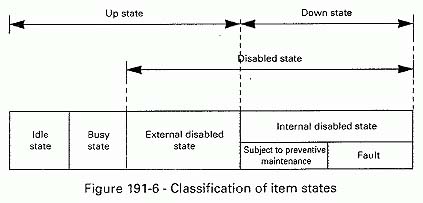
[IEV number 191-06-07]FR
état d'indisponibilité
état d'incapacité interne
état d'une entité caractérisé soit par une panne soit par l'inaptitude éventuelle à accomplir une fonction requise pendant l'entretien
NOTE 1 – Cet état est lié à la notion de disponibilité en tant qu'aptitude.
NOTE 2 – En français, l'adjectif "indisponible" qualifie une entité en état d'indisponibilité.
NOTE 3 – En français, dans le domaine des réseaux d'énergie électrique, le terme "état d'indisponibilité" désigne tout état d'incapacité et non seulement un état d'incapacité interne.
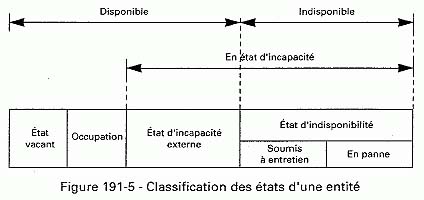
[IEV number 191-06-07]Тематики
- надежность, основные понятия
- тех. обсл. и ремонт средств электросвязи
Обобщающие термины
Синонимы
EN
DE
- nicht verfügbarer Zustand wegen interner Ursachen
- Unbrauchbarkeit wegen interner Ursachen
- Unklarzustand
FR
3.4 неработоспособное состояние (failed state): Состояние системы (элемента), в котором система (элемент) не исполняет требуемую функцию.
Примечание - Система может иметь несколько различных неработоспособных состояний.
Источник: ГОСТ Р 51901.15-2005: Менеджмент риска. Применение марковских методов оригинал документа
2.4. Неработоспособное состояние
Down state
Состояние объекта, при котором значение хотя бы одного параметра, характеризующего способность выполнять заданные функции, не соответствует требованиям нормативно-технической и (или) конструкторской (проектной) документации.
Примечание. Для сложных объектов возможно деление их неработоспособных состояний. При этом из множества неработоспособных состояний выделяют частично неработоспособные состояния, при которых объект способен частично выполнять требуемые функции
Источник: ГОСТ 27.002-89: Надежность в технике. Основные понятия. Термины и определения оригинал документа
Русско-английский словарь нормативно-технической терминологии > неработоспособное состояние
См. также в других словарях:
State function — In thermodynamics, a state function, state quantity , or a function of state , is a property of a system that depends only on the current state of the system, not on the way in which the system got to that state. A state function describes the… … Wikipedia
state function — būsenos funkcija statusas T sritis Standartizacija ir metrologija apibrėžtis Termodinaminė funkcija, kurios vertė priklauso tik nuo sistemos pradinės ir galinės būsenos. atitikmenys: angl. state function vok. Zustandsfunktion, f rus. функция… … Penkiakalbis aiškinamasis metrologijos terminų žodynas
state function — būsenos funkcija statusas T sritis chemija apibrėžtis Termodinaminė funkcija, kurios vertė priklauso tik nuo sistemos pradinės ir galinės būsenos. atitikmenys: angl. state function rus. функция состояния … Chemijos terminų aiškinamasis žodynas
state function — būsenos funkcija statusas T sritis fizika atitikmenys: angl. state function vok. Zustandsfunktion, f rus. функция состояния, f pranc. fonction d’état, f … Fizikos terminų žodynas
Characteristic state function — The characteristic state function in statistical mechanics refers to a particular relationship between the partition function of an ensemble. In particular, if the partition function P satisfies P = exp( − βQ) or P = exp( + βQ) in which Q is a… … Wikipedia
Configuration state function — In quantum chemistry, a configuration state function (CSF), is a symmetry adapted linear combination of Slater determinants. A CSF must not be confused with a configuration. Contents 1 Definition 2 From Configurations to Configuration State… … Wikipedia
a segment by state function — veiklos segmentas pagal valstybės funkciją statusas Aprobuotas sritis buhalterinė apskaita ir finansinė atskaitomybė apibrėžtis Veiklos dalis, apimanti vienos valstybės funkcijos, nustatytos Lietuvos Respublikos valstybės ir savivaldybių biudžetų … Lithuanian dictionary (lietuvių žodynas)
State — Состояние (англ. State) шаблон проектирования. Используется в тех случаях, когда во время выполнения программы объект должен менять свое поведение в зависимости от своего состояния. Паттерн состоит из 3 блоков: Widget класс, объекты которого… … Википедия
State (polity) — This article is about the general concept of the state. For the subjects of international law, see Sovereign state. For other uses, see State (disambiguation). The frontispiece of Thomas Hobbes Leviathan A state is an organised political… … Wikipedia
State actor — A state actor is a term used in United States civil rights law to describe a person who is acting on behalf of a governmental body, and is therefore subject to regulation under the United States bill of rights including the First, Fifth and… … Wikipedia
State diagram — State diagrams is a diagram used in the field of computer science, representing the behavior of a system, which is composed of a finite number of states. There are many forms of state diagrams, which differ slightly and have different semantics.… … Wikipedia
