

-
21 specimen
['spɛsɪmən]n( single example) okaz m; ( MED) próbka f* * *['spesimin](something used as a sample (of a group or kind of something, especially an object to be studied or to be put in a collection): We looked at specimens of different types of rock under the microscope.) okaz, egzemplarz -
22 solitary
solitary, US [transcription][-terI]A n1 ( loner) solitaire mf ;2 ○ ( isolation) mitard ○ m prisoners' slang, isolement m cellulaire ; to be in solitary être au mitard ○, être en isolement cellulaire.B adj1 ( unaccompanied) [drinking, occupation, walk, walker] solitaire ;2 ( lonely) [person] très seul, esseulé ;3 ( isolated) [farm, village] isolé ;4 ( single) [example, incident, person, question] seul ; with the solitary exception of à la seule exception de ; a solitary case of un cas unique de. -
23 specimen
specimen ['spesɪmən]1 noun(a) (sample → of work, handwriting) spécimen m; (→ of blood) prélèvement m; (→ of urine) échantillon m(b) (single example) spécimen m;∎ this butterfly is a superb specimen ce papillon est un superbe spécimen;∎ a fine specimen of Gothic architecture un bel exemple d'architecture gothique;∎ the finest specimens in his collection les plus belles pièces de sa collection∎ he's a peculiar specimen c'est un drôle de spécimen;∎ that pathetic specimen is her husband ce triste spécimen est son mari(page, letter, reply) spécimen;∎ they will ask you for a specimen signature ils vous demanderont un exemplaire de votre signature►► specimen bottle flacon-échantillon m;specimen copy spécimen m (livre, magazine) -
24 partially type-tested low-voltage switchgear and controlgear assemblies
- НКУ распределения и управления, прошедшее частичные типовые испытания
НКУ распределения и управления, прошедшее частичные типовые испытания
НКУ распределения и управления, включающее в себя узлы, прошедшие типовые испытания, и узлы, не подвергаемые типовым испытаниям, при условии, что технические характеристики последних являются производными (полученными, например, расчетом) от технических характеристик подобных узлов, прошедших типовые испытания.
Примечание — В настоящем стандарте сокращение ЧИ НКУ используют для обозначения частично испытанных НКУ.
[ ГОСТ Р 51321. 1-2000 ( МЭК 60439-1-92)]EN
partially type-tested low-voltage switchgear and controlgear assemblies PTTA
low-voltage switchgear and controlgear assembly, containing both type-tested and non-type-tested arrangements provided that the latter are derived (e.g. by calculation) from type-tested arrangements which have complied with the relevant tests
[IEC 61892-3, ed. 2.0 (2007-11)]FR
-
Параллельные тексты EN-RU
The Standard IEC 60439-1 differentiates between two categories of assemblies:
• TTA (Type-Tested Assembly)
• PTTA (Partially Type-Tested Assembly)
The term Type-Tested Assembly (TTA) is used to mean an assembly “conforming to an established type or system without deviations likely to significantly influence the performance from the typical assembly verified to be in accordance with this standard”.
To be declared TTA an assembly shall meet at least one of the following conditions:
1. it is manufactured in a single example and subject to all the type tests required by the Standard;
2. it is similar to another assembly which has been subjected to all the type tests, that is it differs from the tested one only for details considered irrelevant for the results of the same tests and, consequently, for its performances, that is for its nominal characteristics;
3. it is part of a pre-established structural system subjected to type tests in some of the many possible arrangements chosen among the most significative ones which can be obtained by combining the system elements. It is the typical case of assemblies sold as loose components.
The term Partially Type-Tested Assembly (PTTA) is used to mean an assembly “containing both type-tested and non-type-tested arrangements, provided that the latter are derived (e.g. by calculation) from type-tested arrangements which have complied with the relevant tests”.
A PTTA is an assembly which has been subjected to one part of the type tests, whereas the other ones have been replaced by some extrapolations (calculations) based on the experimental results obtained on assemblies which have already passed the type tests.
The distinction between TTA and PTTA is of no weight with respect to the declaration of conformity with the Standard IEC 60439-1, since the assembly must simply comply with it apart from its having been subject - totally (TTA) or partially (PTTA) - to type tests.
[ABB]Стандарт МЭК 60439-1 различат две категории НКУ:
• ПИ НКУ (НКУ, прошедшие типовые испытания);
• ЧИ НКУ (НКУ, прошедшие частичные типовые испытания).
Термин «НКУ, прошедшие типовые испытания (ПИ НКУ) означает, что данное НКУ «соответствует без значительных отклонений типичному НКУ, испытанному согласно настоящему стандарту».
В соответствии с этим, ПИ НКУ должны отвечать, по крайней мере, одному из следующих условий:
1. НКУ изготовлено в одном экземпляре и прошло все типовые испытания согласно настоящему стандарту;
2. Данное НКУ аналогично другому НКУ, которое прошло все типовые испытания, и что отличия от испытанного НКУ, не влияют на результаты типовых испытаний и следовательно не влияют на эксплуатационные качества и номинальные характеристики.
3. Данное НКУ является частью сборки, подвергаемой таким же самым типовым испытаниям в одном из возможных вариантов монтажа, выбранного среди наиболее значимых путем комбинирования системных элементов. Это типичный случай НКУ, поставляемых в виде несмонтированных компонентов.
Термин «НКУ, прошедшие частичные типовые испытания (ЧИ НКУ)» обозначает НКУ «включающее в себя узлы, прошедшие типовые испытания, и узлы, не подвергаемые типовым испытаниям, при условии, что технические характеристики последних являются производными (полученными, например, расчетом) от технических характеристик подобных узлов, прошедших типовые испытания».
ЧИ НКУ являются НКУ, в которых часть узлов прошла типовые испытания, а вместо испытания других узлов использованы результаты экстраполяции (вычисления) их технических характеристик, которые основаны на экспериментальных значениях характеристик тех узлов, которые ранее прошли требуемые типовые испытания.
Различие между ПИ НКУ и ЧИ НКУ не оказывают влияния на декларацию соответствия требованиям стандарта МЭК 60439-1, поскольку данные НКУ должны просто удовлетворять требованиям стандарта без учет того, являются ли они полностью испытанными (ПИ) или частично испытанными (ЧИ).
[Перевод Интент]Тематики
- НКУ (шкафы, пульты,...)
Классификация
>>>Синонимы
EN
Англо-русский словарь нормативно-технической терминологии > partially type-tested low-voltage switchgear and controlgear assemblies
-
25 PTTA
- НКУ распределения и управления, прошедшее частичные типовые испытания
НКУ распределения и управления, прошедшее частичные типовые испытания
НКУ распределения и управления, включающее в себя узлы, прошедшие типовые испытания, и узлы, не подвергаемые типовым испытаниям, при условии, что технические характеристики последних являются производными (полученными, например, расчетом) от технических характеристик подобных узлов, прошедших типовые испытания.
Примечание — В настоящем стандарте сокращение ЧИ НКУ используют для обозначения частично испытанных НКУ.
[ ГОСТ Р 51321. 1-2000 ( МЭК 60439-1-92)]EN
partially type-tested low-voltage switchgear and controlgear assemblies PTTA
low-voltage switchgear and controlgear assembly, containing both type-tested and non-type-tested arrangements provided that the latter are derived (e.g. by calculation) from type-tested arrangements which have complied with the relevant tests
[IEC 61892-3, ed. 2.0 (2007-11)]FR
-
Параллельные тексты EN-RU
The Standard IEC 60439-1 differentiates between two categories of assemblies:
• TTA (Type-Tested Assembly)
• PTTA (Partially Type-Tested Assembly)
The term Type-Tested Assembly (TTA) is used to mean an assembly “conforming to an established type or system without deviations likely to significantly influence the performance from the typical assembly verified to be in accordance with this standard”.
To be declared TTA an assembly shall meet at least one of the following conditions:
1. it is manufactured in a single example and subject to all the type tests required by the Standard;
2. it is similar to another assembly which has been subjected to all the type tests, that is it differs from the tested one only for details considered irrelevant for the results of the same tests and, consequently, for its performances, that is for its nominal characteristics;
3. it is part of a pre-established structural system subjected to type tests in some of the many possible arrangements chosen among the most significative ones which can be obtained by combining the system elements. It is the typical case of assemblies sold as loose components.
The term Partially Type-Tested Assembly (PTTA) is used to mean an assembly “containing both type-tested and non-type-tested arrangements, provided that the latter are derived (e.g. by calculation) from type-tested arrangements which have complied with the relevant tests”.
A PTTA is an assembly which has been subjected to one part of the type tests, whereas the other ones have been replaced by some extrapolations (calculations) based on the experimental results obtained on assemblies which have already passed the type tests.
The distinction between TTA and PTTA is of no weight with respect to the declaration of conformity with the Standard IEC 60439-1, since the assembly must simply comply with it apart from its having been subject - totally (TTA) or partially (PTTA) - to type tests.
[ABB]Стандарт МЭК 60439-1 различат две категории НКУ:
• ПИ НКУ (НКУ, прошедшие типовые испытания);
• ЧИ НКУ (НКУ, прошедшие частичные типовые испытания).
Термин «НКУ, прошедшие типовые испытания (ПИ НКУ) означает, что данное НКУ «соответствует без значительных отклонений типичному НКУ, испытанному согласно настоящему стандарту».
В соответствии с этим, ПИ НКУ должны отвечать, по крайней мере, одному из следующих условий:
1. НКУ изготовлено в одном экземпляре и прошло все типовые испытания согласно настоящему стандарту;
2. Данное НКУ аналогично другому НКУ, которое прошло все типовые испытания, и что отличия от испытанного НКУ, не влияют на результаты типовых испытаний и следовательно не влияют на эксплуатационные качества и номинальные характеристики.
3. Данное НКУ является частью сборки, подвергаемой таким же самым типовым испытаниям в одном из возможных вариантов монтажа, выбранного среди наиболее значимых путем комбинирования системных элементов. Это типичный случай НКУ, поставляемых в виде несмонтированных компонентов.
Термин «НКУ, прошедшие частичные типовые испытания (ЧИ НКУ)» обозначает НКУ «включающее в себя узлы, прошедшие типовые испытания, и узлы, не подвергаемые типовым испытаниям, при условии, что технические характеристики последних являются производными (полученными, например, расчетом) от технических характеристик подобных узлов, прошедших типовые испытания».
ЧИ НКУ являются НКУ, в которых часть узлов прошла типовые испытания, а вместо испытания других узлов использованы результаты экстраполяции (вычисления) их технических характеристик, которые основаны на экспериментальных значениях характеристик тех узлов, которые ранее прошли требуемые типовые испытания.
Различие между ПИ НКУ и ЧИ НКУ не оказывают влияния на декларацию соответствия требованиям стандарта МЭК 60439-1, поскольку данные НКУ должны просто удовлетворять требованиям стандарта без учет того, являются ли они полностью испытанными (ПИ) или частично испытанными (ЧИ).
[Перевод Интент]Тематики
- НКУ (шкафы, пульты,...)
Классификация
>>>Синонимы
EN
Англо-русский словарь нормативно-технической терминологии > PTTA
-
26 file
------------------------------------------------------------[English Word] file[English Plural] files[Swahili Word] faili[Swahili Plural] mafaili[Part of Speech] noun[Class] 5/6------------------------------------------------------------[English Word] file[English Plural] files[Swahili Word] kwaruzo[Swahili Plural] makwaruzo[Part of Speech] noun[Class] 5/6[Derived Word] kwaruza V------------------------------------------------------------[English Word] file[English Plural] files[Swahili Word] mkururo[Swahili Plural] mikururo[Part of Speech] noun[Class] 3/4[Derived Word] kuruta V------------------------------------------------------------[English Word] file[English Plural] files[Swahili Word] tupa[Swahili Plural] tupa[Part of Speech] noun[Class] 9/10[English Example] file through something[Swahili Example] kata kwa tupa------------------------------------------------------------[English Word] file[Swahili Word] -kereza[Part of Speech] verb[Derived Word] kerezo, mkereza[Swahili Example] (fig.) kereza meno[Note] grind the teeth------------------------------------------------------------[English Word] file[Swahili Word] -piga tupa[Part of Speech] verb[Related Words] piga------------------------------------------------------------[English Word] file (of people)[English Plural] files[Swahili Word] mwandamo[Swahili Plural] miandamo[Part of Speech] noun[Class] 3/4[Derived Word] andama V------------------------------------------------------------[English Word] file (of people)[English Plural] files[Swahili Word] ufuatano[Swahili Plural] fuatano[Part of Speech] noun[Class] 11/10------------------------------------------------------------[English Word] file the teeth (as a family or ethnic marker)[Swahili Word] -panya[Part of Speech] verb------------------------------------------------------------[English Word] file through something[Swahili Word] -kata kwa tupa[Part of Speech] verb[Related Words] kata, kwa------------------------------------------------------------[English Word] in single file[Swahili Word] chanjari[Part of Speech] adverb[Swahili Definition] kwa taratibu moja------------------------------------------------------------[English Word] in single file[Swahili Word] sanjari[Part of Speech] adverb[Derived Word] pers[English Example] the soldiers stood in a single file in front of the President[Swahili Example] Wanajeshi walisimama sanjari mbele ya rais------------------------------------------------------------[English Word] in single file[Swahili Word] shanjari[Part of Speech] adverb[Derived Word] pers[English Example] the students stood in a single file as they received the awards[Swahili Example] Wanafunzi walisimama shanjari walipopokea zawadi------------------------------------------------------------[English Word] Indian file[English Plural] Indian files[Swahili Word] mpororo[Swahili Plural] mipororo[Part of Speech] noun[Class] 3/4------------------------------------------------------------[English Word] single file[English Plural] single files[Swahili Word] mpoporo[Swahili Plural] mipoporo[Part of Speech] noun[Class] 3/4------------------------------------------------------------[English Word] single file[English Plural] single files[Swahili Word] mpororo[Swahili Plural] mipororo[Part of Speech] noun[Class] 3/4------------------------------------------------------------[English Word] single file (of people etc.)[English Plural] single files[Swahili Word] mpururo[Swahili Plural] mipururo[Part of Speech] noun[Class] 3/4[Derived Word] pura V------------------------------------------------------------[English Word] wood file[English Plural] wood files[Swahili Word] tungu[Part of Speech] noun------------------------------------------------------------[English Word] wood file[English Plural] wood files[Swahili Word] tupa ya tunga[Swahili Plural] tupa za tunga[Part of Speech] noun[Class] 9/10[Related Words] tunga------------------------------------------------------------ -
27 near cash
!гос. фин. The resource budget contains a separate control total for “near cash” expenditure, that is expenditure such as pay and current grants which impacts directly on the measure of the golden rule.This paper provides background information on the framework for the planning and control of public expenditure in the UK which has been operated since the 1998 Comprehensive Spending Review (CSR). It sets out the different classifications of spending for budgeting purposes and why these distinctions have been adopted. It discusses how the public expenditure framework is designed to ensure both sound public finances and an outcome-focused approach to public expenditure.The UK's public spending framework is based on several key principles:"consistency with a long-term, prudent and transparent regime for managing the public finances as a whole;" "the judgement of success by policy outcomes rather than resource inputs;" "strong incentives for departments and their partners in service delivery to plan over several years and plan together where appropriate so as to deliver better public services with greater cost effectiveness; and"the proper costing and management of capital assets to provide the right incentives for public investment.The Government sets policy to meet two firm fiscal rules:"the Golden Rule states that over the economic cycle, the Government will borrow only to invest and not to fund current spending; and"the Sustainable Investment Rule states that net public debt as a proportion of GDP will be held over the economic cycle at a stable and prudent level. Other things being equal, net debt will be maintained below 40 per cent of GDP over the economic cycle.Achievement of the fiscal rules is assessed by reference to the national accounts, which are produced by the Office for National Statistics, acting as an independent agency. The Government sets its spending envelope to comply with these fiscal rules.Departmental Expenditure Limits ( DEL) and Annually Managed Expenditure (AME)"Departmental Expenditure Limit ( DEL) spending, which is planned and controlled on a three year basis in Spending Reviews; and"Annually Managed Expenditure ( AME), which is expenditure which cannot reasonably be subject to firm, multi-year limits in the same way as DEL. AME includes social security benefits, local authority self-financed expenditure, debt interest, and payments to EU institutions.More information about DEL and AME is set out below.In Spending Reviews, firm DEL plans are set for departments for three years. To ensure consistency with the Government's fiscal rules departments are set separate resource (current) and capital budgets. The resource budget contains a separate control total for “near cash” expenditure, that is expenditure such as pay and current grants which impacts directly on the measure of the golden rule.To encourage departments to plan over the medium term departments may carry forward unspent DEL provision from one year into the next and, subject to the normal tests for tautness and realism of plans, may be drawn down in future years. This end-year flexibility also removes any incentive for departments to use up their provision as the year end approaches with less regard to value for money. For the full benefits of this flexibility and of three year plans to feed through into improved public service delivery, end-year flexibility and three year budgets should be cascaded from departments to executive agencies and other budget holders.Three year budgets and end-year flexibility give those managing public services the stability to plan their operations on a sensible time scale. Further, the system means that departments cannot seek to bid up funds each year (before 1997, three year plans were set and reviewed in annual Public Expenditure Surveys). So the credibility of medium-term plans has been enhanced at both central and departmental level.Departments have certainty over the budgetary allocation over the medium term and these multi-year DEL plans are strictly enforced. Departments are expected to prioritise competing pressures and fund these within their overall annual limits, as set in Spending Reviews. So the DEL system provides a strong incentive to control costs and maximise value for money.There is a small centrally held DEL Reserve. Support from the Reserve is available only for genuinely unforeseeable contingencies which departments cannot be expected to manage within their DEL.AME typically consists of programmes which are large, volatile and demand-led, and which therefore cannot reasonably be subject to firm multi-year limits. The biggest single element is social security spending. Other items include tax credits, Local Authority Self Financed Expenditure, Scottish Executive spending financed by non-domestic rates, and spending financed from the proceeds of the National Lottery.AME is reviewed twice a year as part of the Budget and Pre-Budget Report process reflecting the close integration of the tax and benefit system, which was enhanced by the introduction of tax credits.AME is not subject to the same three year expenditure limits as DEL, but is still part of the overall envelope for public expenditure. Affordability is taken into account when policy decisions affecting AME are made. The Government has committed itself not to take policy measures which are likely to have the effect of increasing social security or other elements of AME without taking steps to ensure that the effects of those decisions can be accommodated prudently within the Government's fiscal rules.Given an overall envelope for public spending, forecasts of AME affect the level of resources available for DEL spending. Cautious estimates and the AME margin are built in to these AME forecasts and reduce the risk of overspending on AME.Together, DEL plus AME sum to Total Managed Expenditure (TME). TME is a measure drawn from national accounts. It represents the current and capital spending of the public sector. The public sector is made up of central government, local government and public corporations.Resource and Capital Budgets are set in terms of accruals information. Accruals information measures resources as they are consumed rather than when the cash is paid. So for example the Resource Budget includes a charge for depreciation, a measure of the consumption or wearing out of capital assets."Non cash charges in budgets do not impact directly on the fiscal framework. That may be because the national accounts use a different way of measuring the same thing, for example in the case of the depreciation of departmental assets. Or it may be that the national accounts measure something different: for example, resource budgets include a cost of capital charge reflecting the opportunity cost of holding capital; the national accounts include debt interest."Within the Resource Budget DEL, departments have separate controls on:"Near cash spending, the sub set of Resource Budgets which impacts directly on the Golden Rule; and"The amount of their Resource Budget DEL that departments may spend on running themselves (e.g. paying most civil servants’ salaries) is limited by Administration Budgets, which are set in Spending Reviews. Administration Budgets are used to ensure that as much money as practicable is available for front line services and programmes. These budgets also help to drive efficiency improvements in departments’ own activities. Administration Budgets exclude the costs of frontline services delivered directly by departments.The Budget preceding a Spending Review sets an overall envelope for public spending that is consistent with the fiscal rules for the period covered by the Spending Review. In the Spending Review, the Budget AME forecast for year one of the Spending Review period is updated, and AME forecasts are made for the later years of the Spending Review period.The 1998 Comprehensive Spending Review ( CSR), which was published in July 1998, was a comprehensive review of departmental aims and objectives alongside a zero-based analysis of each spending programme to determine the best way of delivering the Government's objectives. The 1998 CSR allocated substantial additional resources to the Government's key priorities, particularly education and health, for the three year period from 1999-2000 to 2001-02.Delivering better public services does not just depend on how much money the Government spends, but also on how well it spends it. Therefore the 1998 CSR introduced Public Service Agreements (PSAs). Each major government department was given its own PSA setting out clear targets for achievements in terms of public service improvements.The 1998 CSR also introduced the DEL/ AME framework for the control of public spending, and made other framework changes. Building on the investment and reforms delivered by the 1998 CSR, successive spending reviews in 2000, 2002 and 2004 have:"provided significant increase in resources for the Government’s priorities, in particular health and education, and cross-cutting themes such as raising productivity; extending opportunity; and building strong and secure communities;" "enabled the Government significantly to increase investment in public assets and address the legacy of under investment from past decades. Departmental Investment Strategies were introduced in SR2000. As a result there has been a steady increase in public sector net investment from less than ¾ of a per cent of GDP in 1997-98 to 2¼ per cent of GDP in 2005-06, providing better infrastructure across public services;" "introduced further refinements to the performance management framework. PSA targets have been reduced in number over successive spending reviews from around 300 to 110 to give greater focus to the Government’s highest priorities. The targets have become increasingly outcome-focused to deliver further improvements in key areas of public service delivery across Government. They have also been refined in line with the conclusions of the Devolving Decision Making Review to provide a framework which encourages greater devolution and local flexibility. Technical Notes were introduced in SR2000 explaining how performance against each PSA target will be measured; and"not only allocated near cash spending to departments, but also – since SR2002 - set Resource DEL plans for non cash spending.To identify what further investments and reforms are needed to equip the UK for the global challenges of the decade ahead, on 19 July 2005 the Chief Secretary to the Treasury announced that the Government intends to launch a second Comprehensive Spending Review (CSR) reporting in 2007.A decade on from the first CSR, the 2007 CSR will represent a long-term and fundamental review of government expenditure. It will cover departmental allocations for 2008-09, 2009-10 and 2010 11. Allocations for 2007-08 will be held to the agreed figures already announced by the 2004 Spending Review. To provide a rigorous analytical framework for these departmental allocations, the Government will be taking forward a programme of preparatory work over 2006 involving:"an assessment of what the sustained increases in spending and reforms to public service delivery have achieved since the first CSR. The assessment will inform the setting of new objectives for the decade ahead;" "an examination of the key long-term trends and challenges that will shape the next decade – including demographic and socio-economic change, globalisation, climate and environmental change, global insecurity and technological change – together with an assessment of how public services will need to respond;" "to release the resources needed to address these challenges, and to continue to secure maximum value for money from public spending over the CSR period, a set of zero-based reviews of departments’ baseline expenditure to assess its effectiveness in delivering the Government’s long-term objectives; together with"further development of the efficiency programme, building on the cross cutting areas identified in the Gershon Review, to embed and extend ongoing efficiency savings into departmental expenditure planning.The 2007 CSR also offers the opportunity to continue to refine the PSA framework so that it drives effective delivery and the attainment of ambitious national standards.Public Service Agreements (PSAs) were introduced in the 1998 CSR. They set out agreed targets detailing the outputs and outcomes departments are expected to deliver with the resources allocated to them. The new spending regime places a strong emphasis on outcome targets, for example in providing for better health and higher educational standards or service standards. The introduction in SR2004 of PSA ‘standards’ will ensure that high standards in priority areas are maintained.The Government monitors progress against PSA targets, and departments report in detail twice a year in their annual Departmental Reports (published in spring) and in their autumn performance reports. These reports provide Parliament and the public with regular updates on departments’ performance against their targets.Technical Notes explain how performance against each PSA target will be measured.To make the most of both new investment and existing assets, there needs to be a coherent long term strategy against which investment decisions are taken. Departmental Investment Strategies (DIS) set out each department's plans to deliver the scale and quality of capital stock needed to underpin its objectives. The DIS includes information about the department's existing capital stock and future plans for that stock, as well as plans for new investment. It also sets out the systems that the department has in place to ensure that it delivers its capital programmes effectively.This document was updated on 19 December 2005.Near-cash resource expenditure that has a related cash implication, even though the timing of the cash payment may be slightly different. For example, expenditure on gas or electricity supply is incurred as the fuel is used, though the cash payment might be made in arrears on aquarterly basis. Other examples of near-cash expenditure are: pay, rental.Net cash requirement the upper limit agreed by Parliament on the cash which a department may draw from theConsolidated Fund to finance the expenditure within the ambit of its Request forResources. It is equal to the agreed amount of net resources and net capital less non-cashitems and working capital.Non-cash cost costs where there is no cash transaction but which are included in a body’s accounts (or taken into account in charging for a service) to establish the true cost of all the resourcesused.Non-departmental a body which has a role in the processes of government, but is not a government public body, NDPBdepartment or part of one. NDPBs accordingly operate at arm’s length from governmentMinisters.Notional cost of a cost which is taken into account in setting fees and charges to improve comparability with insuranceprivate sector service providers.The charge takes account of the fact that public bodies donot generally pay an insurance premium to a commercial insurer.the independent body responsible for collecting and publishing official statistics about theUK’s society and economy. (At the time of going to print legislation was progressing tochange this body to the Statistics Board).Office of Government an office of the Treasury, with a status similar to that of an agency, which aims to maximise Commerce, OGCthe government’s purchasing power for routine items and combine professional expertiseto bear on capital projects.Office of the the government department responsible for discharging the Paymaster General’s statutoryPaymaster General,responsibilities to hold accounts and make payments for government departments and OPGother public bodies.Orange bookthe informal title for Management of Risks: Principles and Concepts, which is published by theTreasury for the guidance of public sector bodies.Office for NationalStatistics, ONS60Managing Public Money————————————————————————————————————————"GLOSSARYOverdraftan account with a negative balance.Parliament’s formal agreement to authorise an activity or expenditure.Prerogative powerspowers exercisable under the Royal Prerogative, ie powers which are unique to the Crown,as contrasted with common-law powers which may be available to the Crown on the samebasis as to natural persons.Primary legislationActs which have been passed by the Westminster Parliament and, where they haveappropriate powers, the Scottish Parliament and the Northern Ireland Assembly. Begin asBills until they have received Royal Assent.arrangements under which a public sector organisation contracts with a private sectorentity to construct a facility and provide associated services of a specified quality over asustained period. See annex 7.5.Proprietythe principle that patterns of resource consumption should respect Parliament’s intentions,conventions and control procedures, including any laid down by the PAC. See box 2.4.Public Accountssee Committee of Public Accounts.CommitteePublic corporationa trading body controlled by central government, local authority or other publiccorporation that has substantial day to day operating independence. See section 7.8.Public Dividend finance provided by government to public sector bodies as an equity stake; an alternative to Capital, PDCloan finance.Public Service sets out what the public can expect the government to deliver with its resources. EveryAgreement, PSAlarge government department has PSA(s) which specify deliverables as targets or aimsrelated to objectives.a structured arrangement between a public sector and a private sector organisation tosecure an outcome delivering good value for money for the public sector. It is classified tothe public or private sector according to which has more control.Rate of returnthe financial remuneration delivered by a particular project or enterprise, expressed as apercentage of the net assets employed.Regularitythe principle that resource consumption should accord with the relevant legislation, therelevant delegated authority and this document. See box 2.4.Request for the functional level into which departmental Estimates may be split. RfRs contain a number Resources, RfRof functions being carried out by the department in pursuit of one or more of thatdepartment’s objectives.Resource accountan accruals account produced in line with the Financial Reporting Manual (FReM).Resource accountingthe system under which budgets, Estimates and accounts are constructed in a similar wayto commercial audited accounts, so that both plans and records of expenditure allow in fullfor the goods and services which are to be, or have been, consumed – ie not just the cashexpended.Resource budgetthe means by which the government plans and controls the expenditure of resources tomeet its objectives.Restitutiona legal concept which allows money and property to be returned to its rightful owner. Ittypically operates where another person can be said to have been unjustly enriched byreceiving such monies.Return on capital the ratio of profit to capital employed of an accounting entity during an identified period.employed, ROCEVarious measures of profit and of capital employed may be used in calculating the ratio.Public Privatepartnership, PPPPrivate Finance Initiative, PFIParliamentaryauthority61Managing Public Money"————————————————————————————————————————GLOSSARYRoyal charterthe document setting out the powers and constitution of a corporation established underprerogative power of the monarch acting on Privy Council advice.Second readingthe second formal time that a House of Parliament may debate a bill, although in practicethe first substantive debate on its content. If successful, it is deemed to denoteParliamentary approval of the principle of the proposed legislation.Secondary legislationlaws, including orders and regulations, which are made using powers in primary legislation.Normally used to set out technical and administrative provision in greater detail thanprimary legislation, they are subject to a less intense level of scrutiny in Parliament.European legislation is,however,often implemented in secondary legislation using powers inthe European Communities Act 1972.Service-level agreement between parties, setting out in detail the level of service to be performed.agreementWhere agreements are between central government bodies, they are not legally a contractbut have a similar function.Shareholder Executive a body created to improve the government’s performance as a shareholder in businesses.Spending reviewsets out the key improvements in public services that the public can expect over a givenperiod. It includes a thorough review of departmental aims and objectives to find the bestway of delivering the government’s objectives, and sets out the spending plans for the givenperiod.State aidstate support for a domestic body or company which could distort EU competition and sois not usually allowed. See annex 4.9.Statement of Excessa formal statement detailing departments’ overspends prepared by the Comptroller andAuditor General as a result of undertaking annual audits.Statement on Internal an annual statement that Accounting Officers are required to make as part of the accounts Control, SICon a range of risk and control issues.Subheadindividual elements of departmental expenditure identifiable in Estimates as single cells, forexample cell A1 being administration costs within a particular line of departmental spending.Supplyresources voted by Parliament in response to Estimates, for expenditure by governmentdepartments.Supply Estimatesa statement of the resources the government needs in the coming financial year, and forwhat purpose(s), by which Parliamentary authority is sought for the planned level ofexpenditure and income.Target rate of returnthe rate of return required of a project or enterprise over a given period, usually at least a year.Third sectorprivate sector bodies which do not act commercially,including charities,social and voluntaryorganisations and other not-for-profit collectives. See annex 7.7.Total Managed a Treasury budgeting term which covers all current and capital spending carried out by the Expenditure,TMEpublic sector (ie not just by central departments).Trading fundan organisation (either within a government department or forming one) which is largely orwholly financed from commercial revenue generated by its activities. Its Estimate shows itsnet impact, allowing its income from receipts to be devoted entirely to its business.Treasury Minutea formal administrative document drawn up by the Treasury, which may serve a wide varietyof purposes including seeking Parliamentary approval for the use of receipts asappropriations in aid, a remission of some or all of the principal of voted loans, andresponding on behalf of the government to reports by the Public Accounts Committee(PAC).62Managing Public Money————————————————————————————————————————GLOSSARY63Managing Public MoneyValue for moneythe process under which organisation’s procurement, projects and processes aresystematically evaluated and assessed to provide confidence about suitability, effectiveness,prudence,quality,value and avoidance of error and other waste,judged for the public sectoras a whole.Virementthe process through which funds are moved between subheads such that additionalexpenditure on one is met by savings on one or more others.Votethe process by which Parliament approves funds in response to supply Estimates.Voted expenditureprovision for expenditure that has been authorised by Parliament. Parliament ‘votes’authority for public expenditure through the Supply Estimates process. Most expenditureby central government departments is authorised in this way.Wider market activity activities undertaken by central government organisations outside their statutory duties,using spare capacity and aimed at generating a commercial profit. See annex 7.6.Windfallmonies received by a department which were not anticipated in the spending review.———————————————————————————————————————— -
28 take
1.1) (get hold of, grasp, seize) nehmentake somebody's arm — jmds. Arm nehmen
take somebody by the hand/arm — jemanden bei der Hand/am Arm nehmen
3) (gain, earn) [Laden:] einbringen; [Film, Stück:] einspielen; (win) gewinnen [Satz, Spiel, Preis, Titel]; erzielen [Punkte]; (Cards) machen [Stich]take first/second etc. place — den ersten/zweiten usw. Platz belegen; (fig.) an erster/zweiter usw. Stelle kommen
take the biscuit (Brit. coll.) or (coll.) cake — (fig.) alle/alles übertreffen
4) (assume possession of) nehmen; (take away with one) mitnehmen; (steal) mitnehmen (verhüll.); (obtain by purchase) kaufen, (by rent) mieten [Auto, Wohnung, Haus]; nehmen [Klavier-, Deutsch-, Fahrstunden]; mitmachen [Tanzkurs]; (buy regularly) nehmen; lesen [Zeitung, Zeitschrift]; (subscribe to) beziehen; (obtain) erwerben [akademischen Grad]; (form a relationship with) sich (Dat.) nehmen [Frau, Geliebten usw.]that woman took my purse — die Frau hat mir meinen Geldbeutel gestohlen
he took his degree at Sussex University — er hat sein Examen an der Universität von Sussex gemacht
take place — stattfinden; (spontaneously) sich ereignen; [Wandlung:] sich vollziehen
I'll take this handbag/the curry, please — ich nehme diese Handtasche/das Curry
5) (avail oneself of, use) nehmen; machen [Pause, Ferien, Nickerchen]; nehmen [Beispiel, Zitat usw.] ( from aus)take the opportunity to do/of doing something — die Gelegenheit dazu benutzen, etwas zu tun
take the car/bus into town — mit dem Auto/Bus in die Stadt fahren
take two eggs — etc. (in recipe) man nehme zwei Eier usw.
take all the time you want — nimm dir ruhig Zeit
[let's] take a more recent example/my sister [for example] — nehmen wir ein Beispiel neueren Datums/einmal meine Schwester
take somebody's shoes to the mender['s]/somebody's coat to the cleaner's — jmds. Schuhe zum Schuster/jmds. Mantel in die Reinigung bringen
take somebody to school/hospital — jemanden zur Schule/ins Krankenhaus bringen
take somebody to the zoo/cinema/to dinner — mit jemandem in den Zoo/ins Kino/zum Abendessen gehen
take somebody into one's home/house — jemanden bei sich aufnehmen
the road takes you/the story takes us to London — die Straße führt nach/die Erzählung führt uns nach London
his ability will take him far/to the top — mit seinen Fähigkeiten wird er es weit bringen/wird er ganz nach oben kommen
take somebody/something with one — jemanden/etwas mitnehmen
take home — mit nach Hause nehmen; (earn) nach Hause bringen [Geld]; (accompany) nach Hause bringen od. begleiten; (to meet one's parents etc.) mit nach Hause bringen
take somebody through/over something — (fig.) mit jemandem etwas durchgehen
take in hand — (begin) in Angriff nehmen; (assume responsibility for) sich kümmern um
take somebody into partnership [with one]/into the business — jemanden zu seinem Teilhaber machen/in sein Geschäft aufnehmen
take a stick etc. to somebody — den Stock usw. bei jemandem gebrauchen
take something to pieces or bits — etwas auseinander nehmen
you can/can't take somebody anywhere — (fig. coll.) man kann jemanden überallhin/nirgendwohin mitnehmen
you can't take it 'with you — (coll.) man kann es ja nicht mitnehmen
take something/somebody from somebody — jemandem etwas/jemanden wegnehmen
take all the fun/hard work out of something — einem alle Freude an etwas (Dat.) nehmen/einem die schwere Arbeit bei etwas ersparen
8)somebody takes courage from something — etwas macht jemandem Mut; see also academic.ru/34054/heart">heart 1)
9)be taken ill or (coll.) sick — krank werden
10) (make) machen [Foto, Kopie]; (photograph) aufnehmen11) (perform, execute) aufnehmen [Brief, Diktat]; machen [Prüfung, Sprung, Spaziergang, Reise, Umfrage]; durchführen [Befragung, Volkszählung]; ablegen [Gelübde, Eid]; übernehmen [Rolle, Part]; treffen [Entscheidung]take a fall/tumble — stürzen/straucheln
take a step forward/backward — einen Schritt vor-/zurücktreten
take a turn for the better/worse — eine Wende zum Besseren/Schlechteren nehmen
12) (negotiate) nehmen [Zaun, Mauer, Hürde, Kurve, Hindernis]13) (conduct) halten [Gottesdienst, Andacht, Unterricht]14) (be taught)15) (consume) trinken [Tee, Kaffee, Kognak usw.]; nehmen [Zucker, Milch, Überdosis, Tabletten, Medizin]what can I take for a cold? — was kann ich gegen eine Erkältung nehmen?
not to be taken [internally] — nicht zur innerlichen Anwendung
16) (occupy) einnehmen [Sitz im Parlament]; übernehmen, antreten [Amt]take somebody's seat — sich auf jmds. Platz setzen
is that/this seat taken? — ist da/hier noch frei?
17) (need, require) brauchen [Platz, Zeit]; haben [Kleider-, Schuhgröße usw.]; (Ling.) haben [Objekt, Plural-s]; gebraucht werden mit [Kasus]this verb takes "sein" — dieses Verb wird mit "sein" konjugiert
the wound will take some time to heal — es braucht einige Zeit, bis die Wunde geheilt ist
the ticket machine takes 20p and 50p coins — der Fahrkartenautomat nimmt 20-Pence- und 50-Pence-Stücke
as long as it takes — so lange wie nötig
something takes an hour/a year/all day — etwas dauert eine Stunde/ein Jahr/einen ganzen Tag
it takes an hour etc. to do something — es dauert eine Stunde usw., [um] etwas zu tun
somebody takes or it takes somebody a long time/an hour etc. to do something — jmd. braucht lange/eine Stunde usw., um etwas zu tun
what took you so long? — was hast du denn so lange gemacht?
take a lot of work/effort/courage — viel Arbeit/Mühe/Mut kosten
have [got] what it takes — das Zeug dazu haben
it will take [quite] a lot of explaining — es wird schwer zu erklären sein
that story of his takes some believing — die Geschichte, die er da erzählt, ist kaum zu glauben
it takes a thief to know a thief — nur ein Dieb kennt einen Dieb
it takes all sorts [to make a world] — es gibt solche und solche
19) (ascertain and record) notieren [Namen, Adresse, Autonummer usw.]; fühlen [Puls]; messen [Temperatur, Größe usw.]take the minutes of a meeting — bei einer Sitzung [das] Protokoll führen
take somebody's meaning/drift — verstehen, was jmd. meint
take somebody's point — jmds. Standpunkt verstehen
take it [that]... — annehmen, [dass]...
can I take it that...? — kann ich davon ausgehen, dass...?
take something to mean something — etwas so verstehen, dass...
take something as settled/as a compliment/refusal — etwas als erledigt betrachten/als eine Ablehnung/ein Kompliment auffassen
take somebody/something for/to be something — jemanden/etwas für etwas halten
21) (treat or react to in a specified manner) aufnehmentake something well/badly/hard — etwas gut/schlecht/nur schwer verkraften
somebody takes something very badly/hard — etwas trifft jemanden sehr
take something calmly or coolly — etwas gelassen [auf- od. hin]nehmen
you can/may take it as read that... — du kannst sicher sein, dass...
taking it all in all, taking one thing with another — alles in allem
22) (accept) annehmentake money etc. [from somebody/for something] — Geld usw. [von jemandem/für etwas] [an]nehmen
will you take £500 for the car? — wollen Sie den Wagen für 500 Pfund verkaufen?
[you can] take it or leave it — entweder du bist damit einverstanden, oder du lässt es bleiben
take somebody's word for it — sich auf jemanden od. jmds. Wort[e] verlassen
take things as they come, take it as it comes — es nehmen, wie es kommt
23) (receive, submit to) einstecken [müssen] [Schlag, Tritt, Stoß]; (Boxing) nehmen [müssen] [Schlag]; (endure, tolerate) aushalten; vertragen [Klima, Alkohol, Kaffee, Knoblauch]; verwinden [Schock]; (put up with) sich (Dat.) gefallen lassen [müssen] [Kritik, Grobheit]take one's punishment bravely — seine Strafe tapfer ertragen
take no nonsense — sich (Dat.) nichts bieten lassen
24) (adopt, choose) ergreifen [Maßnahmen]; unternehmen [Schritte]; einschlagen [Weg]; sich entschließen zu [Schritt, Handlungsweise]take the wrong road — die falsche Straße fahren/gehen
take a firm etc. stand [with somebody/on or over something] — jemandem gegenüber/hinsichtlich einer Sache nicht nachgeben
25) (receive, accommodate) [an]nehmen [Bewerber, Schüler]; aufnehmen [Gäste]26) (swindle)he was taken for £500 by the conman — (coll.) der Schwindler hat ihm 500 Pfund abgeknöpft (ugs.)
27)2. intransitive verb,be taken with somebody/something — von jemandem/etwas angetan sein
took, taken1) (be successful, effective) [Transplantat:] vom Körper angenommen werden; [Impfung:] anschlagen; [Pfropfreis:] anwachsen; [Sämling, Pflanze:] angehen; [Feuer:] zu brennen beginnen; [Fisch:] [an]beißen2) (detract)3. noun(Telev., Cinemat.) Einstellung, die; Take, der od. das (fachspr.)Phrasal Verbs:- take in- take off- take on- take out- take to- take up* * *(to take or keep (someone) as a hostage: The police were unable to attack the terrorists because they were holding three people hostage.) (jemanden) als Geisel festhalten* * *[teɪk]I. NOUN3.II. TRANSITIVE VERB<took, taken>1. (accept)▪ to \take sth etw annehmenthis restaurant \takes credit cards dieses Restaurant akzeptiert Kreditkartenwould you \take an offer? darf ich Ihnen ein Angebot machen?to \take sb's advice jds Rat annehmennot to \take no for an answer ein Nein nicht akzeptierento \take a bet eine Wette annehmento \take criticism Kritik akzeptierento \take responsibility [for sth] die Verantwortung [für etw akk] übernehmen\take my word for it [or \take it from me] das kannst du mir glaubento \take sth badly/well etw schlecht/gut aufnehmento \take sth seriously etw ernst nehmen2. (transport)▪ to \take sb/sth somewhere jdn/etw irgendwohin bringenwill you \take me swimming tomorrow? nimmst du mich morgen zum Schwimmen mit?to \take sb to hospital/the station/home jdn ins Krankenhaus/zum Bahnhof/nach Hause fahrento \take sb to the cinema jdn ins Kino einladento \take sb for a meal jdn zum Essen einladen (im Restaurant)3. (seize)▪ to \take sth etw nehmenhe took my arm and led me to the door er nahm meinen Arm und führte mich zur Türmay I \take your coat? darf ich Ihnen den Mantel abnehmen?to \take sb by the hand/throat jdn bei der Hand nehmen/am Kragen packento \take hold of sb ( fig) jdn ergreifen4. (tolerate)▪ to \take sth etw ertragen [o verkraften]; abuse, insults etw hinnehmenyou don't have to take his insults, you know du brauchst dir seine Beleidigungen nicht gefallen lassenI just can't take it anymore ich bin am Ende, ich kann einfach nicht mehrhe couldn't \take it anymore er konnte es nicht länger ertragento be able to \take a joke einen Spaß verstehen [o fam vertragen5. (hold)▪ to \take sth etw aufnehmenmy car \takes five people mein Auto hat Platz für fünf Leute6. (require)▪ to \take sth etw erfordern [o benötigen]his story took some believing seine Geschichte ist kaum zu glaubenI \take [a] size five (in shoes) ich habe Schuhgröße fünfto \take one's time sich dat Zeit lassen7.▪ it \takes... man braucht...it \takes more than that to convince me das überzeugt mich noch lange nichtit \takes me an hour ich brauche eine Stundeit took me a long time [to...] es hat lange gedauert [bis...]hold on, it won't \take long warten Sie, es dauert nicht langeit will \take some persuasion er/sie wird schwer zu überreden seinit took a lot of courage dazu gehörte viel Mut8. LING▪ to \take sth:here, ‘sich’ \takes the dative hier wird ‚sich‘ mit dem Dativ gebrauchtthis verb \takes ‘haben’ dieses Verb wird mit ‚haben‘ konjugiert9. (receive)▪ to \take sth etw erhalten [o bekommen]we've stopped taking the newspaper wir beziehen die Zeitung nicht mehr10. (remove)▪ to \take sth etw [weg]nehmen; (steal a.) etw stehlen\take three from five ziehe drei von fünf abto \take a chesspiece eine Schachfigur schlagen11. (travel by)▪ to \take sth taxi, train etw nehmenshe took the 10.30 flight to Edinburgh sie nahm den Flug um 10:30 Uhr nach Edinburg\take the M1 motorway up to Newcastle nehmen Sie die Autobahn M1 bis Newcastlehe took that last bend too fast er nahm die letzte Kurve zu schnellto \take the bus/car mit dem Bus/Auto fahren\take a sip trink [o nimm] einen Schluckwe'll \take the tea in the sitting room wir trinken den Tee im Wohnzimmernot to be \taken internally MED nur zur äußerlichen Anwendungto \take a flat/house eine Wohnung/ein Haus mieten14. (let stay)▪ to \take sb jdn [auf]nehmenmy mother takes lodgers meine Mutter vermietet [ein] Zimmer15. (capture)▪ to \take sb jdn gefangen nehmento \take prisoners Gefangene machenthe terrorists took him prisoner die Terroristen nahmen ihn gefangento \take a city eine Stadt einnehmento \take power die Macht ergreifen16. (assume)to \take office ein Amt antreten▪ to \take sth etw unterrichtenshe \takes private pupils sie gibt Privatstunden18. (officiate at)to \take a church service einen Gottesdienst halten19. (have)to \take a rest eine Pause machento \take a walk einen Spaziergang machento \take a cold sich erkälten20. (tackle)to \take a hurdle/fence eine Hürde/einen Zaun überspringento \take an obstacle ein Hindernis nehmento \take a test einen Test machento \take an exam eine Prüfung ablegenshe took her degree in May sie hat im Mai [ihr] Examen gemacht22. (achieve)to \take first prize den ersten Preis erhalten23. (feel)to \take notice of sb/sth jdn/etw beachtento \take offence beleidigt seinto \take pity on sb/sth mit jdm/etw Mitleid habento \take the view that... der Ansicht sein, dass..., auf dem Standpunkt stehen, dass...24. (earn)▪ to \take sth etw einnehmenshe \takes £300 a week sie nimmt 300 Pfund die Woche ein25. (write)to \take notes sich dat Notizen machen26. (photograph)to \take pictures [or photos] Bilder machen, fotografierenthis photo was taken last summer dieses Foto ist vom letzten Sommerto have one's photo \taken sich akk fotografieren lassen27. THEAT, MUS, FILMlet's \take that scene again lass uns die Szene nochmal machencan you \take me through my lines? kannst du mit mir meine Rolle durchgehen?let's \take it from the third act fangen wir mit dem dritten Akt an28. (for example)\take last week/me,... letzte Woche/ich zum Beispiel...29. (assume to be)▪ to \take sb/sth for sb/sth [or to be sb/sth] jdn/etw für jdn/etw haltenI took him to be more intelligent than he turned out to be ich hielt ihn für intelligenter, als er tatsächlich warI \take it [that]... ich nehme an, [dass]...I \take it that you're coming with us ich nehme an, du kommst mit30. (understand)to \take sb's/the point jds/den Standpunkt verstehenI \take your point, but... ich verstehe, was du meinst, aber...point \taken [habe] verstandenif you \take my meaning BRIT wenn du verstehst, was ich meine31.▶ to \take it as it comes es nehmen, wie es kommt▶ \take it from me das kannst du mir glauben▶ to \take sth lying down etw stillschweigend hinnehmen▶ to \take sb by surprise [or unawares] jdn überraschen▶ to \take one thing at a time eins nach dem anderen erledigenIII. INTRANSITIVE VERB<took, taken>the ink won't take on this paper dieses Papier nimmt die Tinte nicht an2. (become)to \take ill krank werden3. (detract)▪ to \take from sth etw schmälernwill that not \take from it's usefulness? würde das nicht den Gebrauchswert vermindern?* * *take [teık]A s2. JAGDa) Beute fb) Erbeutung f3. umg Anteil m (of an dat)4. besonders US umg Einnahme(n) f(pl)5. Take m/n:a) FILM Szene(naufnahme) fb) RADIO etc Aufnahme f6. TYPO Portion f (eines Manuskripts)7. MEDa) Reaktion f (auf eine Impfung)b) Anwachsen n (eines Hauttransplantats)9. besonders Br Pachtland n10. Schach etc: Schlagen n (einer Figur)B v/t prät took [tʊk], pperf taken [ˈteıkən]1. allg, z. B. Abschied, Unterricht etc nehmen:take it or leave it umg mach, was du willst;taken all in all im Großen (u.) Ganzen;taking one thing with the other im Großen (u.) Ganzen (siehe die Verbindungen mit den betreffenden Substantiven)2. (weg)nehmen:take one’s foot off the clutch AUTO den Fuß von der Kupplung nehmen;take that silly grin off your face umg hör auf, so blöd zu grinsen!;he took three seconds off the record SPORT er verbesserte den Rekord um drei Sekunden3. a) nehmen, fassen, packen, ergreifenb) SPORT einen Pass etc aufnehmen4. Fische etc fangen5. einen Verbrecher etc fangen, ergreifenstealing beim Stehlen;in a lie bei einer Lüge)10. a) eine Gabe etc (an-, entgegen)nehmen, empfangen11. bekommen, erhalten, Geld, Steuern etc einnehmen, einen Preis etc gewinnen, Geld einspielen (Film): → trick A 7I take it from sb who knows ich habe (weiß) es von jemandem, der es genau weiß;today’s text is taken from … der heutige Text stammt aus …;take a single from an album eine Single aus einem Album auskoppeln;be taken from … eine Auskopplung aus … sein15. nehmen:a) auswählen:I’m not taking any sl ohne mich!b) kaufenc) mietend) eine Eintritts-, Fahrkarte lösene) eine Frau heiratenf) mit einer Frau schlafeng) einen Weg wählen16. mitnehmen:don’t forget to take your umbrella;take me with you nimm mich mit;you can’t take it with you fig im Grab nützt (dir) aller Reichtum nichts mehr, das letzte Hemd hat keine TaschenI took her some flowers ich brachte ihr Blumen18. jemanden (durch den Tod) wegraffen21. ein Hindernis nehmenbe taken with a disease eine Krankheit bekommen;be taken with fear von Furcht gepackt werden23. ein Gefühl haben, bekommen, Mitleid etc empfinden, Mut fassen, Anstoß nehmen, Ab-, Zuneigung fassen (to gegen, für):24. Feuer fangen25. eine Bedeutung, einen Sinn, eine Eigenschaft, Gestalt annehmen, bekommen, einen Namen, eine Staatsbürgerschaft annehmen26. eine Farbe, einen Geruch oder Geschmack annehmenb) einen Stein schlagenc) eine Karte stechend) einen Satz etc gewinnen:he took bronze medal er gewann die Bronzemedaillee) einen Eckstoß etc ausführen30. nehmen, verwenden:take four eggs man nehme vier Eier31. einen Zug, ein Taxi etc nehmen, benutzen33. (als Beispiel) nehmen34. a) einen Platz einnehmen:35. fig jemanden, das Auge, den Sinn gefangen nehmen, fesseln, (für sich) einnehmen:36. den Befehl, die Führung, eine Rolle, eine Stellung, den Vorsitz, JUR jemandes Verteidigung übernehmen37. eine Mühe, Verantwortung auf sich nehmen38. leisten:a) eine Arbeit, einen Dienst verrichten39. eine Notiz, Aufzeichnungen machen, niederschreiben, ein Diktat, Protokoll aufnehmen41. eine Messung, Zählung etc vornehmen, durchführen42. wissenschaftlich ermitteln, eine Größe, die Temperatur etc messen, Maß nehmen: → blood pressure, temperature 243. machen, tun:44. eine Maßnahme ergreifen, treffen45. eine Auswahl treffen46. einen Entschluss fassen47. eine Fahrt, einen Spaziergang, auch einen Sprung, eine Verbeugung, Wendung etc machen, Anlauf nehmen49. a) verstehenb) auffassen, auslegen ( beide:as als)c) etwas gut etc aufnehmen:do you take me? verstehen Sie(, was ich meine)?;I take it that … ich nehme an, dass …;may we take it that …? dürfen wir es so verstehen, dass …?;50. ansehen, betrachten ( beide:as als), halten ( for für):what do you take me for? wofür halten Sie mich eigentlich?51. sich Rechte, Freiheiten (heraus)nehmen52. a) einen Rat, eine Auskunft einholenb) einen Rat annehmen, befolgen53. eine Wette, ein Angebot annehmen54. glauben:you may take it from me verlass dich drauf!55. eine Beleidigung, einen Verlust etc, auch jemanden hinnehmen, eine Strafe, Folgen auf sich nehmen, sich etwas gefallen lassen:take people as they are die Leute nehmen, wie sie (eben) sind;take life as it comes das Leben so nehmen, wie es kommt;I’m not taking this das lass ich mir nicht gefallen56. etwas ertragen, aushalten:he can take a lot er ist hart im Nehmen;take it umg es kriegen, es ausbaden (müssen)57. MED sich einer Behandlung etc unterziehen59. eine Rast, Ferien etc machen, Urlaub, auch ein Bad nehmen60. Platz, Raum ein-, wegnehmen, beanspruchen61. a) Zeit, Material etc, auch fig Geduld, Mut etc brauchen, erfordern, kosten, eine gewisse Zeit dauern:it took a long time es dauerte oder brauchte lange;the book takes a long time to read man braucht viel Zeit, um das Buch zu lesen;the project took two years to plan die Planung des Projekts dauerte zwei Jahre oder nahm zwei Jahre in Anspruch;take some minutes einige Minuten brauchen ( doing sth um etwas zu tun);it takes a lot of courage to do a thing like that es gehört viel Mut dazu, so etwas zu tun;it takes a man to do that das kann nur ein Mann (fertigbringen);he took a little convincing es bedurfte (bei ihm) einiger Überredungit took him a long time to get over it er brauchte lange, um darüber hinwegzukommen63. LINGb) einen Akzent, eine Endung, ein Objekt etc bekommen64. aufnehmen, fassen, Platz bieten für65. ein Gewicht tragen, aushaltenC v/i1. BOT Wurzeln schlagen2. BOT, MED anwachsen (Pfropfreis, Steckling, Transplantat)3. MED wirken, anschlagen (Medikament etc)4. umg ankommen, ziehen, einschlagen, Anklang finden (Buch, Theaterstück etc)6. sich gut etc fotografieren (lassen)7. Feuer fangen8. anbeißen (Fisch)9. TECH an-, eingreifen* * *1.1) (get hold of, grasp, seize) nehmentake somebody's arm — jmds. Arm nehmen
take somebody by the hand/arm — jemanden bei der Hand/am Arm nehmen
3) (gain, earn) [Laden:] einbringen; [Film, Stück:] einspielen; (win) gewinnen [Satz, Spiel, Preis, Titel]; erzielen [Punkte]; (Cards) machen [Stich]take first/second etc. place — den ersten/zweiten usw. Platz belegen; (fig.) an erster/zweiter usw. Stelle kommen
take the biscuit (Brit. coll.) or (coll.) cake — (fig.) alle/alles übertreffen
4) (assume possession of) nehmen; (take away with one) mitnehmen; (steal) mitnehmen (verhüll.); (obtain by purchase) kaufen, (by rent) mieten [Auto, Wohnung, Haus]; nehmen [Klavier-, Deutsch-, Fahrstunden]; mitmachen [Tanzkurs]; (buy regularly) nehmen; lesen [Zeitung, Zeitschrift]; (subscribe to) beziehen; (obtain) erwerben [akademischen Grad]; (form a relationship with) sich (Dat.) nehmen [Frau, Geliebten usw.]take place — stattfinden; (spontaneously) sich ereignen; [Wandlung:] sich vollziehen
I'll take this handbag/the curry, please — ich nehme diese Handtasche/das Curry
5) (avail oneself of, use) nehmen; machen [Pause, Ferien, Nickerchen]; nehmen [Beispiel, Zitat usw.] ( from aus)take the opportunity to do/of doing something — die Gelegenheit dazu benutzen, etwas zu tun
take the car/bus into town — mit dem Auto/Bus in die Stadt fahren
take two eggs — etc. (in recipe) man nehme zwei Eier usw.
[let's] take a more recent example/my sister [for example] — nehmen wir ein Beispiel neueren Datums/einmal meine Schwester
6) (carry, guide, convey) bringentake somebody's shoes to the mender['s]/somebody's coat to the cleaner's — jmds. Schuhe zum Schuster/jmds. Mantel in die Reinigung bringen
take somebody to school/hospital — jemanden zur Schule/ins Krankenhaus bringen
take somebody to the zoo/cinema/to dinner — mit jemandem in den Zoo/ins Kino/zum Abendessen gehen
take somebody into one's home/house — jemanden bei sich aufnehmen
the road takes you/the story takes us to London — die Straße führt nach/die Erzählung führt uns nach London
his ability will take him far/to the top — mit seinen Fähigkeiten wird er es weit bringen/wird er ganz nach oben kommen
take somebody/something with one — jemanden/etwas mitnehmen
take home — mit nach Hause nehmen; (earn) nach Hause bringen [Geld]; (accompany) nach Hause bringen od. begleiten; (to meet one's parents etc.) mit nach Hause bringen
take somebody through/over something — (fig.) mit jemandem etwas durchgehen
take in hand — (begin) in Angriff nehmen; (assume responsibility for) sich kümmern um
take somebody into partnership [with one]/into the business — jemanden zu seinem Teilhaber machen/in sein Geschäft aufnehmen
take a stick etc. to somebody — den Stock usw. bei jemandem gebrauchen
take something to pieces or bits — etwas auseinander nehmen
you can/can't take somebody anywhere — (fig. coll.) man kann jemanden überallhin/nirgendwohin mitnehmen
you can't take it 'with you — (coll.) man kann es ja nicht mitnehmen
take something/somebody from somebody — jemandem etwas/jemanden wegnehmen
take all the fun/hard work out of something — einem alle Freude an etwas (Dat.) nehmen/einem die schwere Arbeit bei etwas ersparen
8)somebody takes courage from something — etwas macht jemandem Mut; see also heart 1)
9)be taken ill or (coll.) sick — krank werden
10) (make) machen [Foto, Kopie]; (photograph) aufnehmen11) (perform, execute) aufnehmen [Brief, Diktat]; machen [Prüfung, Sprung, Spaziergang, Reise, Umfrage]; durchführen [Befragung, Volkszählung]; ablegen [Gelübde, Eid]; übernehmen [Rolle, Part]; treffen [Entscheidung]take a fall/tumble — stürzen/straucheln
take a step forward/backward — einen Schritt vor-/zurücktreten
take a turn for the better/worse — eine Wende zum Besseren/Schlechteren nehmen
12) (negotiate) nehmen [Zaun, Mauer, Hürde, Kurve, Hindernis]13) (conduct) halten [Gottesdienst, Andacht, Unterricht]14) (be taught)15) (consume) trinken [Tee, Kaffee, Kognak usw.]; nehmen [Zucker, Milch, Überdosis, Tabletten, Medizin]not to be taken [internally] — nicht zur innerlichen Anwendung
16) (occupy) einnehmen [Sitz im Parlament]; übernehmen, antreten [Amt]take somebody's seat — sich auf jmds. Platz setzen
is that/this seat taken? — ist da/hier noch frei?
17) (need, require) brauchen [Platz, Zeit]; haben [Kleider-, Schuhgröße usw.]; (Ling.) haben [Objekt, Plural-s]; gebraucht werden mit [Kasus]this verb takes "sein" — dieses Verb wird mit "sein" konjugiert
the wound will take some time to heal — es braucht einige Zeit, bis die Wunde geheilt ist
the ticket machine takes 20p and 50p coins — der Fahrkartenautomat nimmt 20-Pence- und 50-Pence-Stücke
something takes an hour/a year/all day — etwas dauert eine Stunde/ein Jahr/einen ganzen Tag
it takes an hour etc. to do something — es dauert eine Stunde usw., [um] etwas zu tun
somebody takes or it takes somebody a long time/an hour etc. to do something — jmd. braucht lange/eine Stunde usw., um etwas zu tun
take a lot of work/effort/courage — viel Arbeit/Mühe/Mut kosten
have [got] what it takes — das Zeug dazu haben
it will take [quite] a lot of explaining — es wird schwer zu erklären sein
that story of his takes some believing — die Geschichte, die er da erzählt, ist kaum zu glauben
it takes all sorts [to make a world] — es gibt solche und solche
18) (contain, hold) fassen; (support) tragen19) (ascertain and record) notieren [Namen, Adresse, Autonummer usw.]; fühlen [Puls]; messen [Temperatur, Größe usw.]take the minutes of a meeting — bei einer Sitzung [das] Protokoll führen
20) (apprehend, grasp)take somebody's meaning/drift — verstehen, was jmd. meint
take somebody's point — jmds. Standpunkt verstehen
take it [that]... — annehmen, [dass]...
can I take it that...? — kann ich davon ausgehen, dass...?
take something to mean something — etwas so verstehen, dass...
take something as settled/as a compliment/refusal — etwas als erledigt betrachten/als eine Ablehnung/ein Kompliment auffassen
take somebody/something for/to be something — jemanden/etwas für etwas halten
21) (treat or react to in a specified manner) aufnehmentake something well/badly/hard — etwas gut/schlecht/nur schwer verkraften
somebody takes something very badly/hard — etwas trifft jemanden sehr
take something calmly or coolly — etwas gelassen [auf- od. hin]nehmen
you can/may take it as read that... — du kannst sicher sein, dass...
taking it all in all, taking one thing with another — alles in allem
22) (accept) annehmentake money etc. [from somebody/for something] — Geld usw. [von jemandem/für etwas] [an]nehmen
will you take £500 for the car? — wollen Sie den Wagen für 500 Pfund verkaufen?
[you can] take it or leave it — entweder du bist damit einverstanden, oder du lässt es bleiben
take somebody's word for it — sich auf jemanden od. jmds. Wort[e] verlassen
take things as they come, take it as it comes — es nehmen, wie es kommt
23) (receive, submit to) einstecken [müssen] [Schlag, Tritt, Stoß]; (Boxing) nehmen [müssen] [Schlag]; (endure, tolerate) aushalten; vertragen [Klima, Alkohol, Kaffee, Knoblauch]; verwinden [Schock]; (put up with) sich (Dat.) gefallen lassen [müssen] [Kritik, Grobheit]take no nonsense — sich (Dat.) nichts bieten lassen
take it — (coll.) es verkraften; (referring to criticism, abuse) damit fertigwerden
24) (adopt, choose) ergreifen [Maßnahmen]; unternehmen [Schritte]; einschlagen [Weg]; sich entschließen zu [Schritt, Handlungsweise]take the wrong road — die falsche Straße fahren/gehen
take a firm etc. stand [with somebody/on or over something] — jemandem gegenüber/hinsichtlich einer Sache nicht nachgeben
25) (receive, accommodate) [an]nehmen [Bewerber, Schüler]; aufnehmen [Gäste]26) (swindle)he was taken for £500 by the conman — (coll.) der Schwindler hat ihm 500 Pfund abgeknöpft (ugs.)
27)2. intransitive verb,be taken with somebody/something — von jemandem/etwas angetan sein
took, taken1) (be successful, effective) [Transplantat:] vom Körper angenommen werden; [Impfung:] anschlagen; [Pfropfreis:] anwachsen; [Sämling, Pflanze:] angehen; [Feuer:] zu brennen beginnen; [Fisch:] [an]beißen2) (detract)3. noun(Telev., Cinemat.) Einstellung, die; Take, der od. das (fachspr.)Phrasal Verbs:- take in- take off- take on- take out- take to- take up* * *(do) one's driving test expr.seinen Führerschein machen ausdr. (in) shorthand expr.stenographieren v. (lift) from an album expr.auskoppeln (Titel von einem Album) v. (the) responsibility for expr.verantworten v. (advice) v.befolgen (Rat) v. v.(§ p.,p.p.: took, taken)= einnehmen v.ergreifen v.nehmen v.nehmen v.(§ p.,pp.: nahm, genommen)vornehmen v.wegnehmen v. -
29 time
------------------------------------------------------------[English Word] (established) time (for something)[Swahili Word] wakaa[Part of Speech] noun------------------------------------------------------------[English Word] (established) time (for something).[Swahili Word] wasaa[Part of Speech] noun------------------------------------------------------------[English Word] all the time[Swahili Word] kila kukicha[Part of Speech] phrase[Derived Language] Swahili[Derived Word] -cha[Related Words] kila[English Example] our economy now is getting worse all the time[Swahili Example] uchumi wetu sasa unakuwa mbaya kila kukicha------------------------------------------------------------[English Word] at that time[Swahili Word] sawia[Part of Speech] adverb[English Example] and (s)he arrived at that time[Swahili Example] naye akafika sawia------------------------------------------------------------[English Word] at that very time[Swahili Word] papo[Part of Speech] adjective[English Example] at that very time[Swahili Example] papo hapo------------------------------------------------------------[English Word] at the same time[Swahili Word] pamoja[Part of Speech] adjective------------------------------------------------------------[English Word] at this very time[Swahili Word] papa hapa[Part of Speech] adverb[Related Words] hapa------------------------------------------------------------[English Word] at this very time[Swahili Word] papa hapa[Part of Speech] adverb------------------------------------------------------------[English Word] at what time?[Swahili Word] lini[Part of Speech] pronoun------------------------------------------------------------[English Word] be high time to[Swahili Word] -wadi[Part of Speech] verb[Swahili Example] saa yake ya kusafiri imewadia------------------------------------------------------------[English Word] be in good time for[Swahili Word] -wahi[Part of Speech] verb[Derived Language] Arabic[Related Words] -wahia, -wahiwa, uwahi------------------------------------------------------------[English Word] be in time[Swahili Word] -wadia[Part of Speech] verb------------------------------------------------------------[English Word] be in time (for something)[Swahili Word] -tadaraki[Part of Speech] verb------------------------------------------------------------[English Word] be in time to[Swahili Word] -diriki[Part of Speech] verb------------------------------------------------------------[English Word] be on time[Swahili Word] -wahi[Part of Speech] verb[Derived Language] Arabic[Related Words] -wahia, -wahiwa, uwahi[English Example] I need <b>to be on time</b> to class or my teacher will be angry.[Swahili Example] Lazima ni<b>wahi</b> darasani au mwalimu wangu atakasirika.------------------------------------------------------------[English Word] for some time[Swahili Word] tangu majuzi yale[Part of Speech] phrase[Derived Language] Swahili[Derived Word] juzi[Related Words] tangu, yale------------------------------------------------------------[English Word] for the time being[Swahili Word] kipindi[Part of Speech] adverb[Derived Word] pinda V------------------------------------------------------------[English Word] free time[Swahili Word] wasaa[Part of Speech] noun------------------------------------------------------------[English Word] from time to time[Swahili Word] mara kwa mara[Part of Speech] phrase[Swahili Example] ghasia za gari na pitapita za watu mara kwa mara zilimzindua mtoto [Sul]------------------------------------------------------------[English Word] in no time[Swahili Word] muda si muda[Part of Speech] phrase[Swahili Example] mwanzoni Shangwe alistuka, lakini muda si muda akazoea [Muk]------------------------------------------------------------[English Word] in the mean time[Swahili Word] katika kipindi hicho[Part of Speech] conjunction------------------------------------------------------------[English Word] pass time[Swahili Word] -pitisha wakati[Part of Speech] verb[Class] causative------------------------------------------------------------[English Word] period of time[Swahili Word] nafasi[Swahili Plural] nafasi[Part of Speech] noun[Class] 9/10------------------------------------------------------------[English Word] set time[English Plural] set times[Swahili Word] kipindi[Swahili Plural] vipindi[Part of Speech] noun[Class] 7/8[Derived Word] pinda V[English Example] lower arm.------------------------------------------------------------[English Word] single time[Swahili Word] wakaa[Swahili Plural] nyakaa[Part of Speech] noun[Class] 11/10[Derived Word] Arabic[Swahili Example] wakaa tatu kila siku [Abd]------------------------------------------------------------[English Word] take a long time (in agreeing on a price when making a purchase)[Swahili Word] -dolola[Part of Speech] verb------------------------------------------------------------[English Word] that time[Swahili Word] mara ile[Part of Speech] adverb------------------------------------------------------------[English Word] this time[Swahili Word] mara hii[Part of Speech] adverb------------------------------------------------------------[English Word] this time[Swahili Word] mara ile[Part of Speech] adverb[Swahili Example] bali moyo wa Subira mara hii haukutaka hata shahidi [Sul], furaha yake, mara ile, imepotea [Sul]------------------------------------------------------------[English Word] time[Swahili Word] defa[Part of Speech] noun[Note] rare------------------------------------------------------------[English Word] time[English Plural] times[Swahili Word] kipindi[Swahili Plural] vipindi[Part of Speech] noun[Class] 7/8[Derived Word] pinda V[Terminology] sport------------------------------------------------------------[English Word] time[Swahili Word] mara[Swahili Plural] mara[Part of Speech] noun[Class] 9/10------------------------------------------------------------[English Word] time[Swahili Word] nafasi[Swahili Plural] nafasi[Part of Speech] noun[Class] 9/10------------------------------------------------------------[English Word] time[Swahili Word] saa[Part of Speech] noun[Class] 9[Derived Language] Arabic[English Example] what time is it?[Swahili Example] ni saa ngapi?------------------------------------------------------------[English Word] time[English Plural] times[Swahili Word] safari[Swahili Plural] safari[Part of Speech] noun[Class] 9/10[Derived Language] Arabic[English Example] last time[Swahili Example] safari iliyopita------------------------------------------------------------[English Word] time[Swahili Word] taimu[Swahili Plural] taimu[Part of Speech] noun[Class] 9/10[Derived Word] Engl.[Terminology] sport------------------------------------------------------------[English Word] time[Swahili Word] umri[Part of Speech] noun[Class] 14------------------------------------------------------------[English Word] time[Swahili Word] wakaa[Swahili Plural] nyakaa[Part of Speech] noun[Class] 11/10------------------------------------------------------------[English Word] time[Swahili Word] wasaa[Part of Speech] noun[Class] 11[Derived Word] Arabic------------------------------------------------------------[English Word] time (division or interval of)[English Plural] times[Swahili Word] pindi[Swahili Plural] pindi[Part of Speech] noun[Class] 9/10[Derived Language] Swahili[Derived Word] -pinda[English Example] the times of the day[Swahili Example] pindi za mchana------------------------------------------------------------[English Word] time (in gen.)[Swahili Word] wakati[Part of Speech] noun------------------------------------------------------------[English Word] time (long ago)[Swahili Word] zama[Part of Speech] noun[Class] 9------------------------------------------------------------[English Word] time has come[Swahili Word] wakati umewadia[Swahili Plural] nyakati zimewadia[Part of Speech] noun[Class] 11/10[Derived Word] wakati N, wadia V------------------------------------------------------------[English Word] time is up[Swahili Word] saa tayari[Part of Speech] phrase[Related Words] saa------------------------------------------------------------[English Word] time limit[English Plural] time limits[Swahili Word] mpaka[Swahili Plural] mipaka[Part of Speech] noun[Class] 3/4[Related Words] paka------------------------------------------------------------[English Word] time of coming away from mosque after prayers[Swahili Word] mshuko[Swahili Plural] mishuko[Part of Speech] noun[Class] 3/4[Derived Word] shuka V------------------------------------------------------------[English Word] time of life[Swahili Word] hirimu[Part of Speech] noun------------------------------------------------------------[English Word] time of life[Swahili Word] herimu[Part of Speech] noun------------------------------------------------------------[English Word] time of life[Swahili Word] umri[Part of Speech] noun[Class] 14------------------------------------------------------------[English Word] time period of the day[English Plural] time periods of the day[Swahili Word] pindi ya mchana[Swahili Plural] pindi za mchana[Part of Speech] noun[Class] 11------------------------------------------------------------[English Word] time point[English Plural] time points[Swahili Word] majira[Swahili Plural] majira[Part of Speech] noun[Class] 6/6[Derived Language] Arabic[English Example] clock-time[Swahili Example] majira ya saa------------------------------------------------------------[English Word] what time is it?[Swahili Word] saa ngapi?[Part of Speech] pronoun------------------------------------------------------------ -
30 hold
------------------------------------------------------------[English Word] be held[Swahili Word] -shikwa[Part of Speech] verb[Class] passive[English Example] Bahati was held by the urge to see Idi[Swahili Example] Bahati alishikwa na hamu ya kutaka kumwona Idi [Sul], Bi Tamima alishikwa na uchungu [Moh]------------------------------------------------------------[English Word] get hold (of)[Swahili Word] -nasa[Part of Speech] verb[Related Words] mnaso, -nata, -nasia, -nasika, -nasana, -nasisha, -nasua, -naswa------------------------------------------------------------[English Word] get hold of (with a hook)[Swahili Word] -pemba[Part of Speech] verb[English Example] pull down coconuts.[Swahili Example] pemba minazi------------------------------------------------------------[English Word] get hold of something (fruit etc) with a hook[Swahili Word] -ngoeka[Part of Speech] verb[Derived Word] ugoe------------------------------------------------------------[English Word] hold[Swahili Word] mkamato[Swahili Plural] mikamato[Part of Speech] noun[Class] 3/4[Derived Word] kamata V------------------------------------------------------------[English Word] hold[Swahili Word] -bamba[Part of Speech] verb------------------------------------------------------------[English Word] hold[Swahili Word] -kamata[Part of Speech] verb[Related Words] -kamatia, -kamatika, -kamatana, -kamatisha, -kamatwa------------------------------------------------------------[English Word] hold[Swahili Word] -shika[Part of Speech] verb------------------------------------------------------------[English Word] hold (of a ship)[Swahili Word] falka[Part of Speech] noun------------------------------------------------------------[English Word] hold (of a vessel)[Swahili Word] ngama[Swahili Plural] ngama[Part of Speech] noun[Class] 9/10[Terminology] nautical------------------------------------------------------------[English Word] hold back[Swahili Word] -nyima[Part of Speech] verb[English Example] you must restrain yourselve somewhat.[Swahili Example] lazima ujinyime nafsi yako------------------------------------------------------------[English Word] hold back[Swahili Word] -ziwia[Part of Speech] verb[Note] rare------------------------------------------------------------[English Word] hold back[Swahili Word] -zuia[Part of Speech] verb------------------------------------------------------------[English Word] hold back[Swahili Word] -zuwia[Part of Speech] verb------------------------------------------------------------[English Word] hold by pressure[Swahili Word] -bana[Part of Speech] verb[Related Words] bano, banzi, kibaniko, kibanzi, mbano, -bania, -banika, -banana, -banisha, -banua, -banwa------------------------------------------------------------[English Word] hold each other[Swahili Word] -shikana[Part of Speech] verb[Class] reciprocal[English Example] holding each other's hand under the table[Swahili Example] hushikana mikono chini ya meza [Ya]------------------------------------------------------------[English Word] hold fast[Swahili Word] -bana[Part of Speech] verb[Related Words] bano, banzi, kibaniko, kibanzi, mbano, -bania, -banika, -banana, -banisha, -banua, -banwa------------------------------------------------------------[English Word] hold fast[Swahili Word] -guya[Part of Speech] verb[Note] rare------------------------------------------------------------[English Word] hold fast[Swahili Word] -nasa[Part of Speech] verb[Related Words] mnaso, -nata, -nasia, -nasika, -nasana, -nasisha, -nasua, -naswa[English Example] his eyes held fast when he once again came away from that girl[Swahili Example] [macho yake] yalinasa alipotokea tena huyu msichana [Mt]------------------------------------------------------------[English Word] hold fast[Swahili Word] -ng'ang'ama[Part of Speech] verb------------------------------------------------------------[English Word] hold in gunwale of boat for oarlock rope loop[Swahili Word] shalaka[Swahili Plural] shalaka[Part of Speech] noun[Class] 9/10[Terminology] nautical------------------------------------------------------------[English Word] hold in the mouth[Swahili Word] -vuata[Part of Speech] verb------------------------------------------------------------[English Word] hold on the knee or lap[Swahili Word] -pakata[Part of Speech] verb[English Example] (s)he held that gown on the knee[Swahili Example] kalipakata lile gauni [Muk]------------------------------------------------------------[English Word] hold on to[Swahili Word] -nasa[Part of Speech] verb[Related Words] mnaso, -nata, -nasia, -nasika, -nasana, -nasisha, -nasua, -naswa------------------------------------------------------------[English Word] hold on to[Swahili Word] -zingatia[Part of Speech] verb------------------------------------------------------------[English Word] hold on to (obstinately or persistently)[Swahili Word] -shikilia[Part of Speech] verb[Class] applicative[English Example] "I have said I did note take even a single oath", Nuka held on to that[Swahili Example] "Nimesema sijala kiapo hata kimoja", alishikilia Nunga [Ng]------------------------------------------------------------[English Word] hold oneself back[Swahili Word] -jinyima[Part of Speech] verb[Swahili Definition] kujikataa kitu wewe mwenyewe------------------------------------------------------------[English Word] hold onto[Swahili Word] -shika[Part of Speech] verb------------------------------------------------------------[English Word] hold out[Swahili Word] -himili[Part of Speech] verb[Derived Language] Arabic[Related Words] hamali------------------------------------------------------------[English Word] hold the tongue[Swahili Word] -fyata (ulimi)[Part of Speech] verb[Swahili Example] wote waliufyata [Moh]------------------------------------------------------------[English Word] hold tight[Swahili Word] -ganda[Part of Speech] verb------------------------------------------------------------[English Word] hold tight[Swahili Word] -kaza[Part of Speech] verb[Derived Word] kikaza, kikazo, mkazo[Swahili Example] kaza kamba; kaza sukurubu[Note] tighten the rope; exert pressure.------------------------------------------------------------[English Word] hold tight[Swahili Word] -zingatia[Part of Speech] verb------------------------------------------------------------[English Word] hold together[Swahili Word] -ambika[Part of Speech] verb[Derived Language] Swahili[Derived Word] amba[Related Words] ambata, ambo, ambua, ambukizo, chamba, chambo, chambua, gamba, ngambi, uambukizo, wamba, wambiso------------------------------------------------------------[English Word] hold up[Swahili Word] -kawilisha[Part of Speech] verb[Class] appl-caus[Derived Language] Swahili[Derived Word] -kawa------------------------------------------------------------[English Word] ship's hold[Swahili Word] feuli[Part of Speech] noun[Terminology] nautical------------------------------------------------------------[English Word] take hold of[Swahili Word] -kamata[Part of Speech] verb[Related Words] -kamatia, -kamatika, -kamatana, -kamatisha, -kamatwa------------------------------------------------------------[English Word] take hold of[Swahili Word] -paramia[Part of Speech] verb------------------------------------------------------------ -
31 coconut
------------------------------------------------------------[English Word] braided coconut leaf used for fencing[Swahili Word] kumba[Swahili Plural] kumba[Part of Speech] noun[Class] 9/10------------------------------------------------------------[English Word] break open a coconut[Swahili Word] -fua nazi[Part of Speech] verb------------------------------------------------------------[English Word] central rib or stem of coconut leaf or similar.[Swahili Word] upongoo[Swahili Plural] pongoo[Part of Speech] noun[Class] 11/10------------------------------------------------------------[English Word] central stem of the coconut palm leaf[Swahili Word] ujukuti[Swahili Plural] njukuti[Part of Speech] noun------------------------------------------------------------[English Word] central vein of the coconut palm leaf[Swahili Word] unjukuti[Part of Speech] noun------------------------------------------------------------[English Word] central vein or stem of the coconut palm leaf[Swahili Word] uchukuti[Swahili Plural] chukuti[Part of Speech] noun------------------------------------------------------------[English Word] central vein or stem of the coconut-palm leaf[Swahili Word] chukuti[Swahili Plural] chukuti[Part of Speech] noun------------------------------------------------------------[English Word] coconut[English Plural] coconuts[Swahili Word] nazi[Swahili Plural] nazi[Part of Speech] noun[Class] 9/10[English Example] A bad coconut destroys the good one.[Swahili Example] nazi mbovu harabu ya nzima------------------------------------------------------------[English Word] coconut (almost ripe)[English Plural] coconuts[Swahili Word] kikoromeo[Swahili Plural] vikoromeo[Part of Speech] noun[Class] 7/8[Derived Language] Swahili[Derived Word] koroma------------------------------------------------------------[English Word] coconut (almost ripe)[Swahili Word] koroma[Swahili Plural] makoroma[Part of Speech] noun[Class] 5/6------------------------------------------------------------[English Word] coconut (grated) ??[Swahili Word] chicha[Swahili Plural] machicha[Part of Speech] noun[Class] 5/6------------------------------------------------------------[English Word] coconut (in the first stages of growth)[English Plural] coconuts[Swahili Word] kidaka[Swahili Plural] vidaka[Part of Speech] noun[Class] 7/8------------------------------------------------------------[English Word] coconut (unripe with much milk)[English Plural] coconuts[Swahili Word] dafu[Swahili Plural] madafu[Part of Speech] noun[Class] 5/6[English Example] coconut milk[Swahili Example] maji ya dafu [Rec]------------------------------------------------------------[English Word] coconut (when full of milk and in late stage)[Swahili Word] tonga[Swahili Plural] matonga[Part of Speech] noun[Class] 5/6------------------------------------------------------------[English Word] coconut cream[Swahili Word] kasimile[Swahili Plural] kasimile[Part of Speech] noun[Class] 9/10------------------------------------------------------------[English Word] coconut disease[Swahili Word] mkwachuro[Swahili Plural] mikwachuro[Part of Speech] noun[Class] 3/4------------------------------------------------------------[English Word] coconut husk[English Plural] coconut husks[Swahili Word] kifuu[Swahili Plural] vifuu[Part of Speech] noun[Class] 7/8[Related Words] fuu------------------------------------------------------------[English Word] coconut juice[Swahili Word] tuwi[Swahili Plural] tuwi[Part of Speech] noun[Class] 9/10------------------------------------------------------------[English Word] coconut leaf (used for roof thatching and fences)[English Plural] coconut leaves[Swahili Word] kuti[Swahili Plural] makuti[Part of Speech] noun[Class] 5/6[Related Words] ukuti[English Example] the coconut leaves on the roof gleam[Swahili Example] makuti juu ya paa yaking'aa [Ya]------------------------------------------------------------[English Word] coconut meat residue[Swahili Word] takizi[Swahili Plural] takizi[Part of Speech] noun[Class] 9/10[Derived Word] taki N, zake pron[Terminology] poetic------------------------------------------------------------[English Word] coconut milk (from grating nutty part)[Swahili Word] tui[Swahili Plural] tui[Part of Speech] noun[Class] 9/10------------------------------------------------------------[English Word] coconut mixed in a mortar[Swahili Word] kipondwe[Swahili Plural] vipondwe[Part of Speech] noun[Class] 7/8[Derived Word] ponda V------------------------------------------------------------[English Word] coconut palm[English Plural] coconut palms[Taxonomy] Cocos nucifera[Swahili Word] mnazi[Swahili Plural] minazi[Part of Speech] noun[Class] 3/4[Related Words] nazi[Terminology] botany------------------------------------------------------------[English Word] coconut palm (Cocos mucifera)[Swahili Word] mkitamli[Swahili Plural] mikitamli[Part of Speech] noun[Derived Word] kitamli------------------------------------------------------------[English Word] coconut solids (after boiling to produce oil)[Swahili Word] shata[Swahili Plural] mashata[Part of Speech] noun[Class] 5/6[English Example] (s)he squeezed (milked) the coconut solids to produce oil[Swahili Example] Alikamua shata la nazi kupata mafuta------------------------------------------------------------[English Word] coconut that has dried up inside[English Plural] dried up coconuts[Swahili Word] kiziwi[Swahili Plural] viziwi[Part of Speech] noun[Class] 7/8[Derived Word] ziwi, ukiziwi N------------------------------------------------------------[English Word] cocunut-palm branch[Swahili Word] kole[Swahili Plural] makole[Part of Speech] noun[Derived Word] mkole N------------------------------------------------------------[English Word] cream squeezed from coconut[Swahili Word] tuwi[Swahili Plural] tuwi[Part of Speech] noun[Class] 9/10------------------------------------------------------------[English Word] disease of coconuts[Swahili Word] mkwachuro[Swahili Plural] mikwachuro[Part of Speech] noun------------------------------------------------------------[English Word] early stage in the growth of the coconut when the meat is still quite soft or the meat itself at this stage.[Swahili Word] ulambilambi[Part of Speech] noun------------------------------------------------------------[English Word] early stage in the growth of the coconut when the meat is still quite soft.[Swahili Word] urambirambi[Part of Speech] noun------------------------------------------------------------[English Word] empty coconut[Swahili Word] bunde[Part of Speech] noun------------------------------------------------------------[English Word] fiber (of young coconut leaves)[English Plural] fibers[Swahili Word] difu[Swahili Plural] madifu[Part of Speech] noun[Class] 5/6[Derived Language] Arabic------------------------------------------------------------[English Word] fiber from inner skin of coconut leaf stalk[Swahili Word] ununu[Part of Speech] noun[Class] 11------------------------------------------------------------[English Word] flesh of a grated ripe coconut after the oil has been pressed out[Swahili Word] chicha[Swahili Plural] chicha[Part of Speech] noun[Swahili Definition] kitu cheupe kinachobaki katika nazi iliyokunwa na kukamuliwa [Masomo 407][English Example] to sell what remains after grating and squeezing the liquid out of the flesh of a coconut[Swahili Example] kuuza chicha za nazi [Amana, Masomo 407]------------------------------------------------------------[English Word] fully ripe coconut[Swahili Word] mbata[Part of Speech] noun------------------------------------------------------------[English Word] hard inner shell of a coconut[Swahili Word] ufuu[Part of Speech] noun[Note] rare------------------------------------------------------------[English Word] joya (coconut with spongy shell)[Swahili Word] joya[Swahili Plural] majoya[Part of Speech] noun[Swahili Example] kama joya------------------------------------------------------------[English Word] juice squeezed from coconut[Swahili Word] tui[Swahili Plural] tui[Part of Speech] noun[Class] 9/10------------------------------------------------------------[English Word] leaf-stem of the coconut palm[Swahili Word] gubi[Swahili Plural] magubi[Part of Speech] noun[Class] 5/6------------------------------------------------------------[English Word] leathery sheath of coconut flower-stem[Swahili Word] kalala[Swahili Plural] makalala[Part of Speech] noun[Class] 5/6------------------------------------------------------------[English Word] male flowers of the coconut palm[Swahili Word] upunga[Swahili Plural] punga[Part of Speech] noun------------------------------------------------------------[English Word] one who makes a business of climbing coconut trees to pick nuts[Swahili Word] mkwezi[Swahili Plural] wakwezi[Part of Speech] noun[Derived Word] kwea V------------------------------------------------------------[English Word] pointed stake fixed in ground for dehusking coconuts[English Plural] pointed stakes[Swahili Word] kifuo[Swahili Plural] vifuo[Part of Speech] noun[Class] 7/8[Derived Language] Swahili[Derived Word] -fua------------------------------------------------------------[English Word] processed fibres of the coconut husk[Swahili Word] usumba[Part of Speech] noun[Class] 11[Swahili Example] kuangusha kichwa chake juu ya mto wa usumba [Sul]------------------------------------------------------------[English Word] remove the husk from a coconut[Swahili Word] -fua nazi[Part of Speech] verb------------------------------------------------------------[English Word] residue of coconut left after the white part has been scraped out of the shell[Swahili Word] panza[Swahili Plural] panza[Part of Speech] noun[Class] 9/10------------------------------------------------------------[English Word] round basket for squeezing coconut for tui[English Plural] round baskets[Swahili Word] kifumbu[Swahili Plural] vifumbu[Part of Speech] noun[Class] 7/8[Related Words] tui, fumba, kifumba------------------------------------------------------------[English Word] single frond of a coconut-palm leaf[English Plural] fronds[Swahili Word] ukuti[Swahili Plural] kuti[Part of Speech] noun[Class] 11/10------------------------------------------------------------[English Word] small coconut palm leaf[English Plural] small coconut palm leaves[Swahili Word] kikuti[Swahili Plural] vikuti[Part of Speech] noun[Class] 7/8[Derived Language] Swahili[Derived Word] kuti------------------------------------------------------------[English Word] spongy substance (inside coconut shell)[Swahili Word] joya[Swahili Plural] majoya[Part of Speech] noun[Class] 5/6------------------------------------------------------------[English Word] strip of coconut-palm leaf (used for weaving mats)[English Plural] strips of coconut-palm leaves[Swahili Word] ukili[Swahili Plural] kili[Part of Speech] noun[Class] 11/10------------------------------------------------------------[English Word] very young coconut bud[Swahili Word] kokochi[Swahili Plural] kokochi[Part of Speech] noun[Class] 9/10[Swahili Example] alipofumbua kokochi za kifua [Moh]------------------------------------------------------------[English Word] woody covering of the flower-stem of the coconut (used as firewood)[Swahili Word] kalala[Swahili Plural] makalala[Part of Speech] noun------------------------------------------------------------[English Word] young coconut in the stage of milk-formation[Swahili Word] tale[Swahili Plural] matale[Part of Speech] noun[Class] 5/6------------------------------------------------------------[English Word] young coconut palm[English Plural] palms[Swahili Word] mnazi mkinda[Swahili Plural] minazi mikinda[Part of Speech] noun[Class] 3/4[Related Words] nazi[Terminology] botany------------------------------------------------------------[English Word] young coconut palm[English Plural] young coconut palms[Swahili Word] mnazi mkinda[Swahili Plural] minazi mikinda[Part of Speech] noun[Class] 3/4------------------------------------------------------------ -
32 round
------------------------------------------------------------[English Word] be round[Swahili Word] -viringana[Part of Speech] verb[Derived Word] viringa V------------------------------------------------------------[English Word] be round(ed)[Swahili Word] -viringana[Part of Speech] verb[Class] reciprocal[Derived Word] viringa V[Swahili Example] mmoja anapiga uluzi na [...] midomo yake iliyoviringana... [Ma]------------------------------------------------------------[English Word] be rounded[Swahili Word] -viringa[Part of Speech] verb------------------------------------------------------------[English Word] become round[Swahili Word] -biringa[Part of Speech] verb------------------------------------------------------------[English Word] cause to go round[Swahili Word] -zungusha[Part of Speech] verb[Derived Word] zunguka V------------------------------------------------------------[English Word] go round[Swahili Word] -duru[Part of Speech] verb[English Example] he has lost his mind[Swahili Example] fig. akili zimemduru------------------------------------------------------------[English Word] go round[Swahili Word] -epa[Part of Speech] verb------------------------------------------------------------[English Word] go round and round[Swahili Word] -zungukazunguka[Part of Speech] verb[Derived Word] zungua V------------------------------------------------------------[English Word] make round[Swahili Word] -viringisha[Part of Speech] verb[Derived Word] viringa V------------------------------------------------------------[English Word] put round someone or something[Swahili Word] -zungushia[Part of Speech] verb[Class] appl-caus[Swahili Example] Idi alimjongelea tena na kumzungushia mkono [Sul]------------------------------------------------------------[English Word] round[Swahili Word] duara[Part of Speech] adjective------------------------------------------------------------[English Word] round[Swahili Word] duwara[Part of Speech] adjective[English Example] the steering wheel is round[Swahili Example] usukani ni mduwara------------------------------------------------------------[English Word] round[Swahili Word] mduara[Part of Speech] adjective------------------------------------------------------------[English Word] round[Swahili Word] -a mviringo[Part of Speech] adjective[Related Words] -viringa, mviringano, uviringo[English Example] geography experts say that the world is round[Swahili Example] wataalamu wa jiografia husema kwamba eti dunia ni mviringo [Masomo 416]------------------------------------------------------------[English Word] round[English Plural] rounds[Swahili Word] mzungusho[Swahili Plural] mizungusho[Part of Speech] noun[Class] 3/4[Derived Word] zungua V------------------------------------------------------------[English Word] round[English Plural] rounds[Swahili Word] duru[Swahili Plural] duru[Part of Speech] noun[Class] 9/10[English Example] during the first round, the votes were as follows[Swahili Example] katika duru ya kwanza kura zilikuwa kama ifuatavyo [ http://www.uhuru.info/KUELEKEA%20UCHAGUZI%20MKUU.htm Uhuru]------------------------------------------------------------[English Word] round (a corner)[Swahili Word] -zunguka[Part of Speech] verb------------------------------------------------------------[English Word] round (of a sentry or policeperson)[English Plural] rounds[Swahili Word] mazunguko[Swahili Plural] mazunguko[Part of Speech] noun[Derived Word] zungua V------------------------------------------------------------[English Word] round (of ammunition)[English Plural] rounds[Swahili Word] kiasi[Swahili Plural] viasi[Part of Speech] noun[Class] 7/8[Derived Language] Arabic[Related Words] risasi[English Definition] a charge of ammunition for a single shot[Terminology] military------------------------------------------------------------[English Word] round (of ammunition)[English Plural] rounds[Swahili Word] ramia[Swahili Plural] ramia[Part of Speech] noun[Class] 9/10------------------------------------------------------------[English Word] round off[Swahili Word] -viringisha[Part of Speech] verb------------------------------------------------------------[English Word] round thing[English Plural] round things[Swahili Word] kiviringisho[Swahili Plural] viviringisho[Part of Speech] noun[Class] 7/8[Derived Word] viringa V------------------------------------------------------------[English Word] something round[English Plural] round things[Swahili Word] mviringano[Swahili Plural] miviringano[Part of Speech] noun[Class] 3/4[Derived Word] viringa, mviringo, uviringo[English Example] A ball is round.------------------------------------------------------------ -
33 child
------------------------------------------------------------[English Word] big child[English Plural] big children[Swahili Word] toto[Swahili Plural] matoto[Part of Speech] noun[Class] 5/6an[Derived Word] -toto N------------------------------------------------------------[English Word] bring up a child[Swahili Word] -tamia[Part of Speech] verb------------------------------------------------------------[English Word] child[English Plural] children[Swahili Word] mtoto[Swahili Plural] watoto[Part of Speech] noun[Class] 1/2[Related Words] toto, kitoto, utoto------------------------------------------------------------[English Word] child[English Plural] children[Swahili Word] mwana[Swahili Plural] wana[Part of Speech] noun[Class] 1/2[Related Words] jana, kijana, uana, ujana[English Example] illegitimate child; a single hand can not nurse a child (proverb)[Swahili Example] mwana haramu; mkono moja haulei mwana (methali)------------------------------------------------------------[English Word] child[English Plural] children[Swahili Word] mzawa[Swahili Plural] wazawa[Part of Speech] noun[Class] 1/2[Dialect] dialectical[Derived Word] zaa[Swahili Definition] mtoto[English Example] the relationship between a parent and a child[Swahili Example] uhusiano kati ya mzazi na mzawa (Mkangi, Ukiwa)------------------------------------------------------------[English Word] child (of a human being or an animal)[Swahili Word] mzao[Swahili Plural] wazao[Part of Speech] noun[Class] 1/2[Derived Word] zaa V------------------------------------------------------------[English Word] child of a concubine[Swahili Word] suriama[Swahili Plural] masuriama[Part of Speech] noun[Class] 5/6an[Derived Word] suria N------------------------------------------------------------[English Word] child with upper teeth grown first[English Plural] children with upper teeth grown first[Swahili Word] kigego[Swahili Plural] vigego[Part of Speech] noun[Class] 7/8an------------------------------------------------------------[English Word] dependent child[English Plural] dependent children[Swahili Word] mtoto mtegemea[Swahili Plural] watoto wategemea[Part of Speech] noun[Class] 1/2[Related Words] tegemea------------------------------------------------------------[English Word] fine child[English Plural] fine children[Swahili Word] jana[Swahili Plural] majana[Part of Speech] noun[Class] 5/6an[Derived Language] Swahili[Derived Word] mwana[Related Words] kijana------------------------------------------------------------[English Word] firstborn child[English Plural] firstborn children[Swahili Word] kifungua mimba[Swahili Plural] vifungua mimba[Part of Speech] noun[Class] 7/8an[Derived Language] Swahili[Derived Word] -fungua, mimba[Swahili Definition] mtoto aliyezaliwa kabla ya ndugu zake[English Example] the first born child is Jumanne, and the next one is Halima.[Swahili Example] kifungua mimba ni Jumanne, na aliyemfuata ni Halima (Moshi Tuimarishe 56)------------------------------------------------------------[English Word] large child[English Plural] large children[Swahili Word] jana[Swahili Plural] majana[Part of Speech] noun[Class] 5/6an[Derived Language] Swahili[Derived Word] mwana------------------------------------------------------------[English Word] last born child[English Plural] last born children[Swahili Word] kitinda mimba[Swahili Plural] vitinda mimba[Part of Speech] noun[Class] 7/8an[Swahili Definition] mtoto aliyezaliwa baada ya ndugu zake[English Example] The third one is Bakari. He is the last born child.[Swahili Example] Wa tatu ni Bakari. Yeye ni kitinda mimba. (Moshi Tuimarishe 56).------------------------------------------------------------[English Word] last child (that a woman is capable of bearing[Swahili Word] mziwanda[Swahili Plural] waziwanda[Part of Speech] noun[Class] 1/2------------------------------------------------------------[English Word] last child (that a woman is capable of bearing[Swahili Word] mzuwanda[Swahili Plural] waziwanda[Part of Speech] noun[Class] 1/2------------------------------------------------------------[English Word] my child[Swahili Word] mwanangu[Swahili Plural] wanangu[Part of Speech] pronoun[Derived Word] mwana N, -angu pron------------------------------------------------------------[English Word] only child (as precious as the eye of a one-eyed person)[Swahili Word] chongo[Swahili Plural] chongo[Part of Speech] noun[Class] 9/10an[Swahili Example] maskini Msimu, chongo yangu moja [Sul]------------------------------------------------------------[English Word] small child (fig.)[Swahili Word] malaika[Swahili Plural] malaika[Part of Speech] noun[Class] 9/10an[Derived Word] Arabic------------------------------------------------------------[English Word] young child[English Plural] young children[Swahili Word] malaika[Swahili Plural] malaika[Part of Speech] noun[Class] 9/10an------------------------------------------------------------ -
34 hair
------------------------------------------------------------[English Word] hair[English Plural] hairs[Swahili Word] nywele[Swahili Plural] nywele[Part of Speech] noun[Class] 9/10------------------------------------------------------------[English Word] hair (human)[English Plural] hairs[Swahili Word] unywele[Swahili Plural] nywele[Part of Speech] noun[Class] 11/10[English Example] The woman will cut his <b>hair</b> the day after tomorrow.[Swahili Example] Mwanamke atakata <b>nywele</b> zake kesho kutwa.------------------------------------------------------------[English Word] hair (human)[Swahili Word] unyele[Swahili Plural] nyele[Part of Speech] noun------------------------------------------------------------[English Word] facial hair[English Plural] facial hairs[Swahili Word] udevu[Swahili Plural] ndevu[Part of Speech] noun[Class] 11/10[Related Words] kidevu------------------------------------------------------------[English Word] hair on the face[Swahili Word] devu[Swahili Plural] madevu[Part of Speech] noun------------------------------------------------------------[English Word] downy hair[Swahili Word] laika[Swahili Plural] malaika[Part of Speech] noun[Class] 5/6[Swahili Example] malaika yamemsimama [Moh]------------------------------------------------------------[English Word] body hair (usually on the arms and legs)[Swahili Word] malaika[Part of Speech] noun------------------------------------------------------------[English Word] body hair (on the hands and arms)[Swahili Word] ulaika[Swahili Plural] malaika[Part of Speech] noun------------------------------------------------------------[English Word] body hair (armpits or pubic etc)[Swahili Word] vuzi[Swahili Plural] mavuzi[Part of Speech] noun------------------------------------------------------------[English Word] body hair (armpits and genitals)[Swahili Word] mavuzi[Swahili Plural] mavuzi[Part of Speech] noun[Derived Word] vuzi N, uvuzi N------------------------------------------------------------[English Word] armpit hair[Swahili Word] uvuzi[Swahili Plural] mavuzi[Part of Speech] noun------------------------------------------------------------[English Word] hair (of animal)[Swahili Word] unyoya[Swahili Plural] manyoya[Part of Speech] noun[Class] 11/6------------------------------------------------------------[English Word] hair (animal)[Swahili Word] unyoya[Swahili Plural] nyoya, manyoya[Part of Speech] noun------------------------------------------------------------[English Word] animal hair[Swahili Word] nyoya[Swahili Plural] manyoya[Part of Speech] noun[Class] 5/6------------------------------------------------------------[English Word] animal hair[Swahili Word] ugoya[Part of Speech] noun------------------------------------------------------------[English Word] gray hair[Swahili Word] mvi[Part of Speech] noun[English Example] gray-haired person.[Swahili Example] nywele za mvi------------------------------------------------------------[English Word] thick unkempt hair[Swahili Word] mavunga ya nywele[Part of Speech] noun------------------------------------------------------------[English Word] ruffled hair[Swahili Word] timutimu[Part of Speech] adjective[Derived Word] timka V------------------------------------------------------------[English Word] tuft of hair (left on top of a shaven head)[English Plural] tufts of hair[Swahili Word] bwenzi[Swahili Plural] mabwenzi[Part of Speech] noun[Class] 5/6------------------------------------------------------------[English Word] style of cutting the hair (one tuft is left long)[Swahili Word] kinjorinjori[Part of Speech] noun[Class] 7[English Example] he has a haircut with one tuft left long[Swahili Example] ana kinjorinjori------------------------------------------------------------[English Word] cut the hair[Swahili Word] -nyoa[Part of Speech] verb------------------------------------------------------------[English Word] dress the hair[Swahili Word] -nyoa[Part of Speech] verb------------------------------------------------------------[English Word] sticky substance used for dressing women's hair.[Swahili Word] bedani[Part of Speech] noun------------------------------------------------------------[English Word] sticky substance used for dressing women's hair[Swahili Word] behedani[Part of Speech] noun------------------------------------------------------------------------------------------------------------------------Item(s) below have not yet been grouped within the headword hair[English Word] hair (single)[English Plural] long straight hair[Swahili Word] usinga[Swahili Plural] singa[Part of Speech] noun[Class] 10[English Example] the worker was a dignified man, dark, with long straight hair[Swahili Example] mwenye kazi alikuwa bwana mmoja makamu, hadharani, mwenye nywele za singa [Sul][Note] often refers to animal hair------------------------------------------------------------[English Word] long thick hair[English Plural] long thick hair[Swahili Word] kivunga cha nywele[Swahili Plural] vivunga vya nywele[Part of Speech] noun[Class] 7/8[Related Words] nywele------------------------------------------------------------ -
35 space
------------------------------------------------------------[English Word] (outer) space[Swahili Word] angani[Part of Speech] noun[Class] 17------------------------------------------------------------[English Word] empty space (in gen.)[Swahili Word] behewa[Swahili Plural] mabehewa[Part of Speech] noun[English Example] this house consists of a single room [i.e. is not divided up by partitions.[Swahili Example] nyumba hii ni behewa------------------------------------------------------------[English Word] lack of space[Swahili Word] udhiki[Part of Speech] noun------------------------------------------------------------[English Word] open space[Swahili Word] uwanda[Swahili Plural] nyanda[Part of Speech] noun[Class] 11/10[Derived Word] wanda V------------------------------------------------------------[English Word] open space[Swahili Word] uwazi[Part of Speech] noun[Class] 14[Derived Word] wazi adv------------------------------------------------------------[English Word] space[Swahili Word] anga[Part of Speech] noun[Class] 5[Related Words] -angaa[Terminology] meteorology / aviation------------------------------------------------------------[English Word] space[English Plural] spaces[Swahili Word] nafasi[Swahili Plural] nafasi[Part of Speech] noun[Class] 9/10[English Example] And Rehema got the space to heal herself[Swahili Example] Rehema akapata nafasi ya kujiponya [Sul]------------------------------------------------------------[English Word] space[Swahili Word] wasaa[Part of Speech] noun[Class] 11[Derived Word] Arabic[Swahili Example] twende Bi Tamima, dunia wasaa [Moh]------------------------------------------------------------[English Word] space flight[English Plural] space flights[Swahili Word] safari ya angani[Swahili Plural] safari za angani[Part of Speech] noun[Class] 7/8[Related Words] anga, angani------------------------------------------------------------[English Word] space outside house covered by projecting roof[Swahili Word] upenu[Swahili Plural] penu[Part of Speech] noun[Class] 11/10[Swahili Example] nyumba ikajaa nyakanyaka ya watu, halafu ikatapika mpaka katika penu za majirani [Sul]------------------------------------------------------------[English Word] space under something[Swahili Word] mvungu[Swahili Plural] mivungu[Part of Speech] noun[Derived Word] vungu[English Example] Space under a table (bed).[Swahili Example] mvungu wa meza [kitanda]------------------------------------------------------------ -
36 switchboard
- распределительный щит
- распределительное устройство
- НКУ распределения и управления
- коммутационный щит
- коммутаторная панель
- коммутатор
коммутатор
Устройство, обеспечивающее посредством включения, отключения и переключения электрических цепей выбор требуемой выходной цепи и соединение с ней входной цепи
[Терминологический словарь по строительству на 12 языках (ВНИИИС Госстроя СССР)]Тематики
- аппарат, изделие, устройство...
EN
DE
FR
коммутаторная панель
распределительный щит
Устройство, конструктивно объединяющее несколько коммутационных элементов, предназначенных для включения, отключения и переключения электрических цепей и каналов связи в ручном режиме.
[Л.М. Невдяев. Телекоммуникационные технологии. Англо-русский толковый словарь-справочник. Под редакцией Ю.М. Горностаева. Москва, 2002]Тематики
- электросвязь, основные понятия
Синонимы
EN
коммутационный щит
—
[Я.Н.Лугинский, М.С.Фези-Жилинская, Ю.С.Кабиров. Англо-русский словарь по электротехнике и электроэнергетике, Москва, 1999 г.]Тематики
- электротехника, основные понятия
EN
низковольтное устройство распределения и управления (НКУ)
Низковольтные коммутационные аппараты и устройства управления, измерения, сигнализации, защиты, регулирования, собранные совместно, со всеми внутренними электрическими и механическими соединениями и конструктивными элементами.
[ ГОСТ Р МЭК 61439-1-2012]
низковольтное устройство распределения и управления
Комбинация низковольтных коммутационных аппаратов с устройствами управления, измерения, сигнализации, защиты, регулирования и т. п., полностью смонтированных изготовителем НКУ (под его ответственность на единой конструктивной основе) со всеми внутренними электрическими и механическими соединениями с соответствующими конструктивными элементами
Примечания
1. В настоящем стандарте сокращение НКУ используют для обозначения низковольтных комплектных устройств распределения и управления.
2. Аппараты, входящие в состав НКУ, могут быть электромеханическими или электронными.
3. По различным причинам, например по условиям транспортирования или изготовления, некоторые операции сборки могут быть выполнены на месте установки, вне предприятия-изготовителя.
[ ГОСТ Р 51321. 1-2000 ( МЭК 60439-1-92)]EN
power switchgear and controlgear assembly (PSC-assembly)
low-voltage switchgear and controlgear assembly used to distribute and control energy for all types of loads, intended for industrial, commercial and similar applications where operation by ordinary persons is not intended
[IEC 61439-2, ed. 1.0 (2009-01)]
low-voltage switchgear and controlgear assembly
combination of one or more low-voltage switching devices together with associated control, measuring, signalling, protective, regulation equipment, etc., completely assembled under the responsibility of the manufacturer with all the internal electrical and mechanical interconnections and structural parts.
[IEC 61892-3, ed. 2.0 (2007-11)]
switchgear and controlgear
a general term covering switching devices and their combination with associated control, measuring, protective and regulating equipment, also assemblies of such devices and equipment with associated interconnections, accessories, enclosures and supporting structures
[IEV number 441-11-01]
switchgear and controlgear
electric equipment intended to be connected to an electric circuit for the purpose of carrying out one or more of the following functions: protection, control, isolation, switching
NOTE – The French and English terms can be considered as equivalent in most cases. However, the French term has a broader meaning than the English term and includes for example connecting devices, plugs and socket-outlets, etc. In English, these latter devices are known as accessories.
[IEV number 826-16-03 ]
switchboard
A large single electric control panel, frame, or assembly of panels on which are mounted (either on the back or on the face, or both) switches, overcurrent and other protective devices, buses, and usually instruments; not intended for installation in a cabinet but may be completely enclosed in metal; usually is accessible from both the front and rear.
[ McGraw-Hill Dictionary of Architecture & Construction]
switchboard
One or more panels accommodating control switches, indicators, and other apparatus for operating electric circuits
[ The American Heritage Dictionary of the English Language]FR
ensemble d'appareillage de puissance (ensemble PSC)
ensemble d'appareillage à basse tension utilisé pour répartir et commander l'énergie pour tous les types de charges et prévu pour des applications industrielles, commerciales et analogues dans lesquelles l'exploitation par des personnes ordinaires n'est pas prévue
[IEC 61439-2, ed. 1.0 (2009-01)]
appareillage, m
matériel électrique destiné à être relié à un circuit électrique en vue d'assurer une ou plusieurs des fonctions suivantes: protection, commande, sectionnement, connexion
NOTE – Les termes français et anglais peuvent être considérés comme équivalents dans la plupart des cas. Toutefois, le terme français couvre un domaine plus étendu que le terme anglais, et comprend notamment les dispositifs de connexion, les prises de courant, etc. En anglais, ces derniers sont dénommés "accessories".
[IEV number 826-16-03 ]
appareillage
terme général applicable aux appareils de connexion et à leur combinaison avec des appareils de commande, de mesure, de protection et de réglage qui leur sont associés, ainsi qu'aux ensembles de tels appareils avec les connexions, les accessoires, les enveloppes et les charpentes correspondantes
[IEV number 441-11-01]
A switchboard as defined in the National Electrical Code is a large single panel, frame, or assembly of panels on which are mounted, on the face or back or both switches, overcurrent and other protective devices, buses, and, usually, instruments.
Switchboards are generally accessible from the rear as well as from the front and are not intended to be installed in cabinets.
The types of switchboards, classified by basic features of construction, are as follows:
1. Live-front vertical panels
2. Dead-front boards
3. Safety enclosed boards( metal-clad)
[American electricians’ handbook]
The switchboard plays an essential role in the availability of electric power, while meeting the needs of personal and property safety.
Its definition, design and installation are based on precise rules; there is no place for improvisation.
The IEC 61439 standard aims to better define " low-voltage switchgear and controlgear assemblies", ensuring that the specified performances are reached.
It specifies in particular:
> the responsibilities of each player, distinguishing those of the original equipment manufacturer - the organization that performed the original design and associated verification of an assembly in accordance with the standard, and of the assembly manufacturer - the organization taking responsibility for the finished assembly;
> the design and verification rules, constituting a benchmark for product certification.
All the component parts of the electrical switchboard are concerned by the IEC 61439 standard.
Equipment produced in accordance with the requirements of this switchboard standard ensures the safety and reliability of the installation.
A switchboard must comply with the requirements of standard IEC 61439-1 and 2 to guarantee the safety and reliability of the installation.
Managers of installations, fully aware of the professional and legal liabilities weighing on their company and on themselves, demand a high level of safety for the electrical installation.
What is more, the serious economic consequences of prolonged halts in production mean that the electrical switchboard must provide excellent continuity of service, whatever the operating conditions.
[Schneider Electric]НКУ играет главную роль в обеспечении электроэнергией, удовлетворяя при этом всем требованиям по безопасности людей и сохранности имущества.
Выбор конструкции, проектирование и монтаж основаны на чётких правилах, не допускающих никакой импровизации.
Требования к низковольтным комплектным устройствам распределения и управления сформулированы в стандарте МЭК 61439 (ГОСТ Р 51321. 1-2000).
В частности, он определяет:
> распределение ответственности между изготовителем НКУ - организацией, разработавшей конструкцию НКУ и проверившей его на соответствие требованиям стандарта, и сборщиком – организацией, выполнившей сборку НКУ;
> конструкцию, технические характеристики, виды и методы испытаний НКУ.
В стандарте МЭК 61439 (ГОСТ Р 51321. 1-2000) описываются все компоненты НКУ.
Оборудование, изготовленное в соответствии с требованиями этого стандарта, обеспечивает безопасность и надежность электроустановки.
Для того чтобы гарантировать безопасность эксплуатации и надежность работы электроустановки, распределительный щит должен соответствовать требованиям стандарта МЭК 61439-1 и 2.
Лица, ответственные за электроустановки, должны быть полностью осведомлены о профессиональной и юридической ответственности, возложенной на их компанию и на них лично, за обеспечение высокого уровня безопасности эксплуатации этих электроустановок.
Кроме того, поскольку длительные перерывы производства приводят к серьезным экономическим последствиям, электрический распределительный щит должен обеспечивать надежную и бесперебойную работу независимо от условий эксплуатации.
[Перевод Интент]LV switchgear assemblies are undoubtedly the components of the electric installation more subject to the direct intervention of personnel (operations, maintenance, etc.) and for this reason users demand from them higher and higher safety requirements.
The compliance of an assembly with the state of the art and therefore, presumptively, with the relevant technical Standard, cannot be based only on the fact that the components which constitute it comply with the state of the art and therefore, at least presumptively, with the relevant technical standards.
In other words, the whole assembly must be designed, built and tested in compliance with the state of the art.
Since the assemblies under consideration are low voltage equipment, their rated voltage shall not exceed 1000 Va.c. or 1500 Vd.c. As regards currents, neither upper nor lower limits are provided in the application field of this Standard.
The Standard IEC 60439-1 states the construction, safety and maintenance requirements for low voltage switchgear and controlgear assemblies, without dealing with the functional aspects which remain a competence of the designer of the plant for which the assembly is intended.
[ABB]Низковольтные комплектные устройства (НКУ), вне всякого сомнения, являются частями электроустановок, которые наиболее подвержены непосредственному вмешательству оперативного, обслуживающего и т. п. персонала. Вот почему требования потребителей к безопасности НКУ становятся все выше и выше.
Соответствие НКУ современному положению дел и вследствие этого, гипотетически, соответствующим техническим стандартам, не может основываться только на том факте, что составляющие НКУ компоненты соответствуют современному состоянию дел и поэтому, по крайней мере, гипотетически, - соответствующим техническим стандартам
Другими словами, НКУ должно быть разработано, изготовлено и испытано в соответствии с современными требованиями.
Мы рассматриваем низковольтные комплектные устройства и это означает, что их номинальное напряжение не превышает 1000 В переменного тока или 1500 В постоянного тока. Что касается тока, то ни верхнее, ни нижнее значение стандартами, относящимися к данной области, не оговариваются
Стандарт МЭК 60439-1 устанавливает требования к конструкции, безопасности и техническому обслуживанию низковольтных комплектных устройств без учета их функций, полагая, что функции НКУ являются компетенцией проектировщиков электроустановки, частью которых эти НКУ являются.
[Перевод Интент]Тематики
- НКУ (шкафы, пульты,...)
Классификация
>>>Действия
Синонимы
Сопутствующие термины
EN
- assembly
- electrical switchboard
- low voltage controlgear and assembly
- low voltage switchboard
- low voltage switchgear and controlgear assembly
- low-voltage switchgear and controlgear assembly
- LV switchgear and controlgear assembly
- LV switchgear assembly
- panel
- power switchgear and controlgear assembly
- PSC-assembly
- switchboard
- switchgear and controlgear
- switchgear/controlgear
DE
- Schaltanlagen und/oder Schaltgeräte
FR
распределительное устройство
Распределительным устройством (РУ) называется электроустановка, служащая для приема и распределения электроэнергии и содержащая сборные и соединительные шины, коммутационные аппараты, вспомогательные устройства (компрессорные, аккумуляторные и др.), а также устройства защиты, автоматики и измерительные приборы.
[РД 34.20.185-94]
распределительное устройство
Электроустановка, предназначенная для приема и распределения электрической энергии на одном напряжении и содержащая коммутационные аппараты и соединяющие их сборные шины [секции шин], устройства управления и защиты.
Примечание. К устройствам управления относятся аппараты и связывающие их элементы обеспечивающие контроль, измерение, сигнализацию и выполнение команд.
[ ГОСТ 24291-90]
[ ГОСТ Р 53685-2009]
электрическое распределительное устройство
распределительное устройство
Устройство, предназначенное для приема и распределения электроэнергии на одном напряжении и содержащее коммутационные аппараты и соединяющие их сборные соединительные устройства.
Примечание. В состав распределительного устройства дополнительно могут входить устройства защиты и управления
[ОСТ 45.55-99]
распределительное устройство
Электроустановка, служащая для приема и распределения электроэнергии и содержащая коммутационные аппараты, сборные и соединительные шины, вспомогательные устройства (компрессорные, аккумуляторные и др.), а также устройства защиты, автоматики и измерительные приборы.
[ПОТ Р М-016-2001]
[РД 153-34.0-03.150-00]
устройство распределительное
Совокупность аппаратов и приборов для приёма и распределения электроэнергии одного напряжения, вырабатываемой электростанцией или преобразуемой подстанцией
[Терминологический словарь по строительству на 12 языках (ВНИИИС Госстроя СССР)]EN
switching substation
a substation which includes switchgear and usually busbars, but no power transformers
[IEV number 605-01-02]FR
poste de sectionnement
poste de coupure
poste comprenant des organes de manoeuvre et généralement des jeux de barres, à l'exclusion de transformateurs de puissance
[IEV number 605-01-02]В качестве РУ 6—10 кВ используется сборка высокого напряжения с однополюсными разъединителями и вертикальным расположением фаз одного присоединения и одна камера КСО с выключателем нагрузки и предохранителями для подключения трансформатора. Для РУ 0,4 кВ применяются сборки низкого напряжения с предохранителями и вертикальным расположением фаз одного присоединения.
На ПС применяются открытые (ОРУ), закрытые (ЗРУ) или комплектные (КРУ) распределительные устройства.
[ http://energy-ua.com/elektricheskie-p/klassifikatsiya.html]
В общем случае ПС и РУ являются составной частью электроустановок, которые различаются:
-
по назначению:
- генерирующие,
- преобразовательно-распределительные,
-
потребительские.
Генерирующие электроустановки служат для выработки электроэнергии, преобразовательно-распределительные электроустановки преобразуют электроэнергию в удобный для передачи и потребления вид, передают ее и распределяют между потребителями;
-
по роду тока:
- постоянного тока,
- переменного тока.
-
по напряжению:
- до 1000 В,
- выше 1000 В.
Шкала номинальных напряжений ограничена сравнительно небольшим числом стандартных значений, благодаря чему изготавливается небольшое число типоразмеров машин и оборудования, а электросети выполняются более экономичными. В установках трехфазного тока номинальным напряжением принято считать напряжение между фазами (междуфазовое напряжение). Согласно ГОСТ 29322—92 установлена следующая шкала номинальных напряжений:
для электросетей переменного тока частотой 50 Гц междуфазовое напряжение должно быть: 12, 24, 36, 42, 127, 220, 380 В; 3, 6, 10, 20, 35, 110, 150, 220, 330, 500, 750 и 1150 кВ;
для электросетей постоянного тока: 12, 24, 36, 48, 60, 110, 220, 440, 660, 825, 3000 В и выше.-
по способу присоединения к электросети ПС разделяются на:
- тупиковые (блочные),
- ответвительные (блочные),
- проходные (транзитные)
- узловые.
Тупиковые ПС получают питание по одной или двум тупиковым ВЛ.
Ответвительные ПС присоединяются ответвлением к одной или двум проходящим ВЛ с односторонним или двухсторонним питанием.
Проходные ПС включаются в рассечку одной или двух проходящих ВЛ с односторонним или двухсторонним питанием.
Узловые ПС кроме питающих имеют отходящие радиальные или транзитные ВЛ.-
по способу управления ПС могут быть:
- только с телесигнализацией,
- телеуправляемыми с телесигнализацией,
- с телесигнализацией и управлением с общеподстанционного пункта управления (ОПУ).
Подстанции оперативно обслуживаются постоянным дежурным персоналом на щите управления, дежурными на дому или оперативно-выездными бригадами (ОВБ). Ремонт ПС осуществляется специализированными выездными бригадами централизованного ремонта или местным персоналом подстанции.
В РУ напряжением до 1000 В провода, шины, аппараты, приборы и конструкции выбирают как по нормальным условиям работы (напряжению и току), так и по термическим и динамическим воздействиям токов коротких замыканий (КЗ) или предельно допустимой отключаемой мощности.
В РУ и ПС напряжением выше 1000 В расстояния между электрооборудованием, аппаратами, токоведущими частями, изоляторами, ограждениями и конструкциями устанавливаются так, чтобы при нормальном режиме работы электроустановки возникающие физические явления (температура нагрева, электрическая дуга, выброс газов, искрение и др.) не могли привести к повреждению оборудования и КЗ.[ http://energy-ua.com/elektricheskie-p/klassifikatsiya.html]
Several different classifications of switchgear can be made:- By the current rating.
-
By interrupting rating (maximum short circuit current that the device can safely interrupt)
- Circuit breakers can open and close on fault currents
- Load-break/Load-make switches can switch normal system load currents
- Isolators may only be operated while the circuit is dead, or the load current is very small.
-
By voltage class:
- Low voltage (less than 1,000 volts AC)
- Medium voltage (1,000–35,000 volts AC)
- High voltage (more than 35,000 volts AC)
-
By insulating medium:
-
By construction type:
- Indoor (further classified by IP (Ingress Protection) class or NEMA enclosure type)
- Outdoor
- Industrial
- Utility
- Marine
- Draw-out elements (removable without many tools)
- Fixed elements (bolted fasteners)
- Live-front
- Dead-front
- Open
- Metal-enclosed
- Metal-clad
- Metal enclosed & Metal clad
- Arc-resistant
-
By IEC degree of internal separation
- No Separation (Form 1)
- Busbars separated from functional units (Form 2a, 2b, 3a, 3b, 4a, 4b)
- Terminals for external conductors separated from busbars (Form 2b, 3b, 4a, 4b)
- Terminals for external conductors separated from functional units but not from each other (Form 3a, 3b)
- Functional units separated from each other (Form 3a, 3b, 4a, 4b)
- Terminals for external conductors separated from each other (Form 4a, 4b)
- Terminals for external conductors separate from their associated functional unit (Form 4b)
-
By interrupting device:
-
By operating method:
- Manually operated
- Motor/stored energy operated
- Solenoid operated
-
By type of current:
-
By application:
-
By purpose
- Isolating switches (disconnectors)
- Load-break switches.
- Grounding (earthing) switches
A single line-up may incorporate several different types of devices, for example, air-insulated bus, vacuum circuit breakers, and manually operated switches may all exist in the same row of cubicles.
Ratings, design, specifications and details of switchgear are set by a multitude of standards. In North America mostly IEEE and ANSI standards are used, much of the rest of the world uses IEC standards, sometimes with local national derivatives or variations.
[Robert W. Smeaton (ed) Switchgear and Control Handbook 3rd Ed., Mc Graw Hill, new York 1997]
[ http://en.wikipedia.org/wiki/High_voltage_switchgear]Тематики
- электрификация, электроснабж. железных дорог
- электроагрегаты генераторные
- электробезопасность
- электроснабжение в целом
Синонимы
EN
- distribution
- energy distribution board
- gear
- switch-gear
- switchboard
- switchgear
- switching substation
- switchyard
DE
FR
распределительный щит
Комплектное устройство, содержащее различную коммутационную аппаратуру, соединенное с одной или более отходящими электрическими цепями, питающееся от одной или более входящих цепей, вместе с зажимами для присоединения нейтральных и защитных проводников.
[ ГОСТ Р МЭК 60050-826-2009]
щит распределительный
Электротехническое устройство, объединяющее коммутационную, регулирующую и защитную аппаратуру, а также контрольно-измерительные и сигнальные приборы
[Терминологический словарь по строительству на 12 языках (ВНИИИС Госстроя СССР)]
распределительный щит
—
[А.С.Гольдберг. Англо-русский энергетический словарь. 2006 г.]EN
distribution board
assembly containing different types of switchgear and controlgear associated with one or more outgoing electric circuits fed from one or more incoming electric circuits, together with terminals for the neutral and protective conductors.
[IEV number 826-16-08]FR
tableau de répartition, m
ensemble comportant différents types d'appareillage associés à un ou plusieurs circuits électriques de départ alimentés par un ou plusieurs circuits électriques d'arrivée, ainsi que des bornes pour les conducteurs neutre et de protection.
[IEV number 826-16-08]Distribution switchboards, including the Main LV Switchboard (MLVS), are critical to the dependability of an electrical installation. They must comply with well-defined standards governing the design and construction of LV switchgear assemblies
A distribution switchboard is the point at which an incoming-power supply divides into separate circuits, each of which is controlled and protected by the fuses or switchgear of the switchboard. A distribution switchboard is divided into a number of functional units, each comprising all the electrical and mechanical elements that contribute to the fulfilment of a given function. It represents a key link in the dependability chain.
Consequently, the type of distribution switchboard must be perfectly adapted to its application. Its design and construction must comply with applicable standards and working practises.
[Schneider Electric]Распределительные щиты, включая главный распределительный щит низкого напряжения (ГРЩ), играют решающую роль в обеспечении надежности электроустановки. Они должны отвечать требованиям соответствующих стандартов, определяющих конструкцию и порядок изготовления НКУ распределения электроэнергии.
В распределительном щите выполняется прием электроэнергии и ее распределение по отдельным цепям, каждая из которых контролируется и защищается плавкими предохранителями или автоматическими выключателями.
Распределительный щит состоит из функциональных блоков, включающих в себя все электрические и механические элементы, необходимые для выполнения требуемой функции. Распределительный щит представляет собой ключевое звено в цепи обеспечения надежности.
Тип распределительного щита должен соответствовать области применения. Конструкция и изготовление распределительного щита должны удовлетворять требованиям применимых стандартов и учитывать накопленную практику применения.
[Перевод Интент]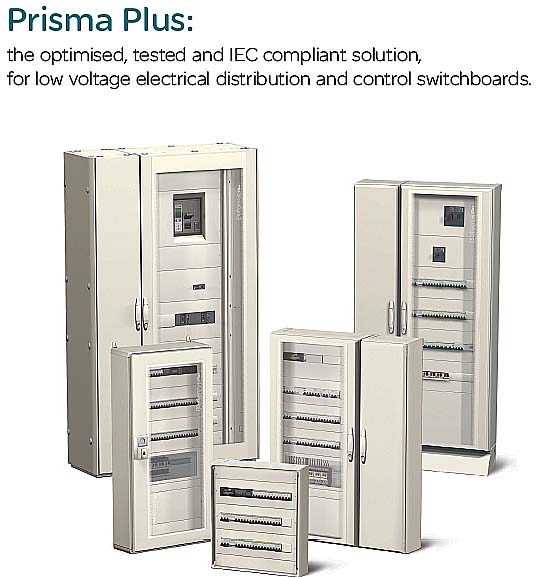
Рис. Schneider Electric
With Prisma Plus G you can be sure to build 100% Schneider Electric switchboards that are safe, optimised:
> All components (switchgear, distribution blocks, prefabricated connections, etc.) are perfectly rated and coordinated to work together;
> All switchboard configurations, even the most demanding ones, have been tested.
You can prove that your switchboard meets the current standards, at any time.
You can be sure to build a reliable electrical installation and give your customers full satisfaction in terms of dependability and safety for people and the installation.
Prisma Plus G with its discreet design, blends harmoniously into all tertiary and industrial buildings, including in entrance halls and passageways.
With Prisma Plus G you can build just the right switchboard for your customer, sized precisely to fit costs and needs.
With this complete, prefabricated and tested system, it's easy to upgrade your installation and still maintain the performance levels.
> The wall-mounted and floor-standing enclosures combine easily with switchboards already in service.
> Devices can be replaced or added at any time.
[Schneider Electric]С помощью оболочек Prisma Plus G можно создавать безопасные распределительные щиты, на 100 % состоящие из изделий Schneider Electric:
> все изделия (коммутационная аппаратура, распределительные блоки, готовые заводские соединения и т. д.) полностью совместимы механически и электрически;
> все варианты компоновки распределительных щитов, в том числе для наиболее ответственных применений, прошли испытания.В любое время вы можете доказать, что ваши распределительные щиты полностью соответствуют требованиям действующих стандартов.
Вы можете быть полностью уверены в том, что создаете надежные электроустановки, удовлетворяющие всем требованиям безопасности для людей и оборудования
Благодаря строгому дизайну, распределительные щиты Prisma Plus G гармонично сочетаются с интерьером любого общественного или промышленного здания. Они хорошо смотрятся и в вестибюле, и в коридоре.
Применяя оболочки Prisma Plus G можно создавать распределительные щиты, точно соответствующие требованиям заказчика как с точки зрения технических характеристик, так и стоимости.
С помощью данной испытанной системы, содержащей все необходимые компоненты заводского изготовления можно легко модернизировать существующую электроустановку и поддерживать её уровни производительности.> Навесные и напольные оболочки можно легко присоединить к уже эксплуатируемым распределительным щитам.
> Аппаратуру можно заменять или добавлять в любое время.
[Перевод Интент]The switchboard, central to the electrical installation.
Both the point of arrival of energy and a device for distribution to the site applications, the LV switchboard is the intelligence of the system, central to the electrical installation.
[Schneider Electric]Распределительный щит – «сердце» электроустановки.
Низковольтное комплектное устройство распределения является «сердцем» электроустановки, поскольку именно оно принимает электроэнергию из сети и распределяет её по территориально распределенным нагрузкам.
[Перевод Интент]Тематики
- НКУ (шкафы, пульты,...)
- электроснабжение в целом
EN
- branch distribution panel
- distributing board
- distributing panel
- distributing switchboard
- distribution bench
- distribution board
- distribution panel
- distribution switchboard
- gear
- keyboard
- PNL
- SB
- sw & d
- switchboard
- switchboard panel
DE
- elektrischer Verteiler, m
- Schalttafel
- Verteiler, m
FR
- tableau de distribution
- tableau de répartition, m
Англо-русский словарь нормативно-технической терминологии > switchboard
-
37 knock
------------------------------------------------------------[English Word] knock[Swahili Word] -bisha[Part of Speech] verb[Swahili Example] bisha mlango [hodi]------------------------------------------------------------[English Word] knock[Swahili Word] -bisha hodi[Part of Speech] verb------------------------------------------------------------[English Word] knock[Swahili Word] -dodosa[Part of Speech] verb------------------------------------------------------------[English Word] knock[Swahili Word] -dunda[Part of Speech] verb[Swahili Example] moyo wake ulianza kudunda [Kez]------------------------------------------------------------[English Word] knock[Swahili Word] -fusa[Part of Speech] verb------------------------------------------------------------[English Word] knock[Swahili Word] -gonga[Part of Speech] verb------------------------------------------------------------[English Word] knock[Swahili Word] -gota[Part of Speech] verb------------------------------------------------------------[English Word] knock[Swahili Word] -piga hodi[Part of Speech] verb[Swahili Definition] ngonga, kwa mfano, mlango ili kutaka ruhusa ya kuingia ndani ya nyumba------------------------------------------------------------[English Word] knock[Swahili Word] -piga hodi[Part of Speech] verb[Swahili Definition] ngonga, kwa mfano, mlango ili kutaka ruhusa ya kuingia ndani ya nyumba------------------------------------------------------------[English Word] knock (on the door)[Swahili Word] bisho[Part of Speech] noun------------------------------------------------------------[English Word] knock against each other[Swahili Word] -gongana[Part of Speech] verb[Swahili Example] anavaa haraka haraka huku shanga kichwani zikigongana [Muk], akabaki anaona baridi, [...] meno yakigongana [Sul]------------------------------------------------------------[English Word] knock down (birds with stones)[Swahili Word] -dengua[Part of Speech] verb------------------------------------------------------------[English Word] knock down (fruit from a tree with a stick or stone)[Swahili Word] -pua[Part of Speech] verb------------------------------------------------------------[English Word] knock down (fruit from a tree with a stick or stone)[Swahili Word] -pura[Part of Speech] verb[English Example] (s)he knocked down fruits (from a tree)[Swahili Example] Alipura matunda------------------------------------------------------------[English Word] knock down (fruit from a tree with a stick or stone)[Swahili Word] -purura[Part of Speech] verb------------------------------------------------------------[English Word] knock down (with a single blow)[Swahili Word] -pangua[Part of Speech] verb------------------------------------------------------------[English Word] knock down (with a stick)[Swahili Word] -pemba[Part of Speech] verb------------------------------------------------------------[English Word] knock fruit off a tree with a stick[Swahili Word] -popoa[Part of Speech] verb[English Example] knock mangoes off a tree[Swahili Example] popoa maembe------------------------------------------------------------[English Word] knock in[Swahili Word] -kokomea[Part of Speech] verb[Derived Word] kongomea V------------------------------------------------------------[English Word] knock off[Swahili Word] -pemba[Part of Speech] verb------------------------------------------------------------[English Word] knock someone down[Swahili Word] -keta[Part of Speech] verb------------------------------------------------------------[English Word] knock to pieces[Swahili Word] -ekua[Part of Speech] verb------------------------------------------------------------[English Word] knock to pieces[Swahili Word] -wekua[Part of Speech] verb------------------------------------------------------------ -
38 story
------------------------------------------------------------[English Word] story[English Plural] stories[Swahili Word] hadithi[Swahili Plural] hadithi[Part of Speech] noun[Class] 9/10[English Example] If you tell him a <b>story</b>, the child will fall sleep.[Swahili Example] Ukimwambia <b>hadithi</b>, mtoto atasinzia.------------------------------------------------------------[English Word] story[English Plural] stories[Swahili Word] hekaya[Swahili Plural] hekaya[Part of Speech] noun[Class] 9/10[Derived Language] Arabic------------------------------------------------------------[English Word] story[English Plural] stories[Swahili Word] kisa[Swahili Plural] visa[Part of Speech] noun[Class] 7/8[Swahili Example] Subira alikumbuka kisa cha wahalifu wawili [Sul]------------------------------------------------------------[English Word] story[English Plural] stories[Swahili Word] ngano[Swahili Plural] ngano[Part of Speech] noun[Class] 9/10[Terminology] literary------------------------------------------------------------[English Word] story[English Plural] stories[Swahili Word] simulizi[Swahili Plural] masimulizi[Part of Speech] noun[Class] 5/6[Derived Word] simulia V------------------------------------------------------------[English Word] story (of a building)[English Plural] stories[Swahili Word] gorofa[Swahili Plural] gorofa[Part of Speech] noun[Class] 9/10[Swahili Definition] shehemu ya nyumba iliyojengwa juu ya nyingine[English Example] a four-story house.------------------------------------------------------------[English Word] story (of a building)[Swahili Word] orofa[Swahili Plural] orofa[Part of Speech] noun[Class] 9/10[English Example] a four-story house.[Swahili Example] nyumba ya orofa nne------------------------------------------------------------[English Word] story (or a building)[Swahili Word] ghorofa[Swahili Plural] ghorofa[Part of Speech] noun[Class] 9/10[Swahili Definition] shehemu ya nyumba iliyojengwa juu ya nyingine[English Example] a four-story house.------------------------------------------------------------[English Word] story (upper floor)[English Plural] stories[Swahili Word] ghorofa[Swahili Plural] ghorofa[Part of Speech] noun[Class] 9/10[English Definition] Structure consisting of a room or set of rooms comprising a single level of a multilevel building------------------------------------------------------------[English Word] tell a story[Swahili Word] -simulia hadithi[Part of Speech] verb[Swahili Definition] eleza habari za mambo yaliyotukia; eleza kisa, ngano, masimulizi, riwaya------------------------------------------------------------[English Word] upper story[English Plural] upper stories[Swahili Word] gorofa[Swahili Plural] gorofa[Part of Speech] noun[Class] 5/6------------------------------------------------------------ -
39 biased multivibrator
ждущий мультивибратор
—
[Я.Н.Лугинский, М.С.Фези-Жилинская, Ю.С.Кабиров. Англо-русский словарь по электротехнике и электроэнергетике, Москва, 1999 г.]Тематики
- электротехника, основные понятия
EN
моностабильный элемент
одновибратор
-
[ГОСТ 2.743-91]Одновибраторы -"ждущие мультивибраторы" представляют собой микросхемы, которые в ответ на входной сигнал (логический уровень или фронт) формируют выходной импульс заданной длительности.
Длительность определяется внешними времязадающими резисторами и конденсаторами.
То есть можно считать, что у одновибраторов есть внутренняя память, но эта память хранит информацию о входном сигнале строго заданное время, а потом информация исчезает.
В стандартные серии микросхем входят одновибраторы двух основных типов:
- одновибраторы без перезапуска;
- одновибраторы с перезапуском
Одновибратор без перезапуска не реагирует на входной сигнал до окончания своего выходного импульса.
Одновибратор с перезапуском начинает отсчет нового времени выдержки Т с каждым новым входным сигналом независимо от того, закончилось ли предыдущее время выдержки.
В случае, когда период следования входных сигналов меньше времени выдержки Т, выходной импульс одновибратора сперезапуском не прерывается.
Если период следования входных запускающих импульсов больше времени выдержки одновибратора Т, то оба типа одновибраторов работают одинаково.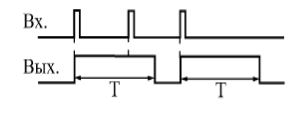
Одновибратор без перезапуска
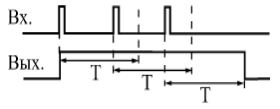
Одновибратор с перезапуском
[Ю.В. Новиков. Введение в цифровую схемотехнику]
Параллельные тексты EN-RU
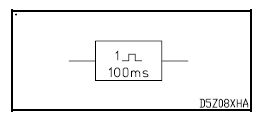
Monostable flip-flop
The output variable will be 1 only if the input variable changes to 1.
The output variable will remain 1 for 100 ms, regardless of the duration of the input value 1 (non-retriggerable).
Without a 1 in the function block, the monostable flip-flop is retriggerable.
The time is 100 ms in this example, but it may be changed to any other duration.
[Schneider Electric]Одновибратор
Значение переменной на выходе равно 1, если входная переменная становится равной 1.
Выходная переменная сохраняет значение 1 в течение 100 мс независимо от времени, в течение которого входная переменная продолжает оставаться равной 1 (без выполнения повторного запуска элемента).
Если в обозначении функции элемента не стоит "1", то это одновибратор с перезапуском.
В данном примере время выходного импульса составляет 100 мс, но его можно изменить на любое другое.
[Перевод Интент]Тематики
- Булева алгебра, элементы цифровой техники
Синонимы
EN
- biased multivibrator
- delay multivibrator
- gate multivibrator
- gated multivibrator
- kipp oscillator
- kipp relay
- latching circuit
- mono
- monoflop
- monostable
- monostable circuit
- monostable flip-flop
- monostable multivibrator
- monostable trigger circuit
- monovibrator
- one-cycle multivibrator
- one-shot
- one-shot generator
- one-shot multivibrator
- single flip-flop oscillator
- single vibrator
- single-shot flip-flop
- single-shot multivibrator
- single-shot trigger
- single-shot trigger circuit
- single-trip multivibrator
- single-trip trigger
- single-trip trigger circuit
- start-stop multivibrator
- trigger circuit
- univibrator
Англо-русский словарь нормативно-технической терминологии > biased multivibrator
-
40 gate multivibrator
ждущий мультивибратор
—
[Я.Н.Лугинский, М.С.Фези-Жилинская, Ю.С.Кабиров. Англо-русский словарь по электротехнике и электроэнергетике, Москва, 1999 г.]Тематики
- электротехника, основные понятия
EN
моностабильный элемент
одновибратор
-
[ГОСТ 2.743-91]Одновибраторы -"ждущие мультивибраторы" представляют собой микросхемы, которые в ответ на входной сигнал (логический уровень или фронт) формируют выходной импульс заданной длительности.
Длительность определяется внешними времязадающими резисторами и конденсаторами.
То есть можно считать, что у одновибраторов есть внутренняя память, но эта память хранит информацию о входном сигнале строго заданное время, а потом информация исчезает.
В стандартные серии микросхем входят одновибраторы двух основных типов:
- одновибраторы без перезапуска;
- одновибраторы с перезапуском
Одновибратор без перезапуска не реагирует на входной сигнал до окончания своего выходного импульса.
Одновибратор с перезапуском начинает отсчет нового времени выдержки Т с каждым новым входным сигналом независимо от того, закончилось ли предыдущее время выдержки.
В случае, когда период следования входных сигналов меньше времени выдержки Т, выходной импульс одновибратора сперезапуском не прерывается.
Если период следования входных запускающих импульсов больше времени выдержки одновибратора Т, то оба типа одновибраторов работают одинаково.
Одновибратор без перезапуска
Одновибратор с перезапуском
[Ю.В. Новиков. Введение в цифровую схемотехнику]
Параллельные тексты EN-RU
Monostable flip-flop
The output variable will be 1 only if the input variable changes to 1.
The output variable will remain 1 for 100 ms, regardless of the duration of the input value 1 (non-retriggerable).
Without a 1 in the function block, the monostable flip-flop is retriggerable.
The time is 100 ms in this example, but it may be changed to any other duration.
[Schneider Electric]Одновибратор
Значение переменной на выходе равно 1, если входная переменная становится равной 1.
Выходная переменная сохраняет значение 1 в течение 100 мс независимо от времени, в течение которого входная переменная продолжает оставаться равной 1 (без выполнения повторного запуска элемента).
Если в обозначении функции элемента не стоит "1", то это одновибратор с перезапуском.
В данном примере время выходного импульса составляет 100 мс, но его можно изменить на любое другое.
[Перевод Интент]Тематики
- Булева алгебра, элементы цифровой техники
Синонимы
EN
- biased multivibrator
- delay multivibrator
- gate multivibrator
- gated multivibrator
- kipp oscillator
- kipp relay
- latching circuit
- mono
- monoflop
- monostable
- monostable circuit
- monostable flip-flop
- monostable multivibrator
- monostable trigger circuit
- monovibrator
- one-cycle multivibrator
- one-shot
- one-shot generator
- one-shot multivibrator
- single flip-flop oscillator
- single vibrator
- single-shot flip-flop
- single-shot multivibrator
- single-shot trigger
- single-shot trigger circuit
- single-trip multivibrator
- single-trip trigger
- single-trip trigger circuit
- start-stop multivibrator
- trigger circuit
- univibrator
Англо-русский словарь нормативно-технической терминологии > gate multivibrator
См. также в других словарях:
single — /sing geuhl/, adj., v., singled, singling, n. adj. 1. only one in number; one only; unique; sole: a single example. 2. of, pertaining to, or suitable for one person only: a single room. 3. solitary or sole; lone: He was the single survivor. 4.… … Universalium
single — sin•gle [[t]ˈsɪŋ gəl[/t]] adj. v. gled, gling, n. 1) only one in number; one only; unique; sole: a single example[/ex] 2) of, pertaining to, or suitable for one person only: a single room[/ex] 3) solitary or sole; lone: He was the single… … From formal English to slang
Single source publishing — Single source publishing, also known as single sourcing, allows the same content to be used in different documents or in various formats. For example, a software company may have several products with user guides that share a common procedure,… … Wikipedia
Single-elimination tournament — Example of a single elimination tournament bracket A single elimination tournament, also called a knockout, cup or sudden death tournament, is a type of elimination tournament where the loser of each match or bracket is immediately eliminated… … Wikipedia
Single-molecule magnet — Single molecule magnets or SMMs are a class of metalorganic compounds, that show superparamagnetic behavior below a certain blocking temperature at the molecular scale. In this temperature range, SMMs exhibit magnetic hysteresis of purely… … Wikipedia
Single-wire earth return — (SWER) or single wire ground return is a single wire transmission line for supplying single phase electrical power from an electrical grid to remote areas at low cost. It is principally used for rural electrification, but also finds use for… … Wikipedia
Single-payer health care — is an American term describing the payment for doctors, hospitals and other providers of health care from a single fund. The Canadian health care system, the British National Health Service, Australia s Medicare, and Medicare in the U.S. for the… … Wikipedia
Single Minute Exchange of Die — (SMED) is one of the many lean production methods for reducing waste in a manufacturing process. It provides a rapid and efficient way of converting a manufacturing process from running the current product to running the next product. This rapid… … Wikipedia
Single-board computer — Single board computers (SBCs) are complete computers built on a single circuit board. The design is centered on a single or dual microprocessor with RAM, IO and all other features needed to be a functional computer on the one board. The first… … Wikipedia
Single-issue politics — involves political campaigning or political support based on one essential policy area or idea. Contents 1 Political expression 2 Groups and voters 3 Single issue parties 4 … Wikipedia
Single parent homeschooling — is the practice of conducting homeschool by a parent who is the sole breadwinner for the family. According to the peer review journal Education Policy Analysis, based on the findings of the National Household Education Survey, of the National… … Wikipedia
