

-
1 angepasste Technik (Technologietransfer)
приемлемая технология
—
[ http://www.eionet.europa.eu/gemet/alphabetic?langcode=en]EN
appropriate technology
1) A flexible and participatory approach to developing economically viable, regionally applicable and sustainable technology.
2) Technology designed to be used in developing countries. Typical requirements are that it should: be easy to use by the unskilled; have no difficult-to-get parts; be easily repaired on the spot. Typical example: a simple windmill to pump water rather than a diesel-driven pump. The terms `alternative', `intermediate' and `appropriate' are often used interchangeably.
(Source: IISD / VCN)
[http://www.eionet.europa.eu/gemet/alphabetic?langcode=en]Тематики
EN
DE
FR
Немецко-русский словарь нормативно-технической терминологии > angepasste Technik (Technologietransfer)
-
2 typisch
I Adj. typical ( für of); ein typisches Beispiel auch a classic example; typische Symptome classic symptoms; das ist wieder mal typisch umg. that’s just typical(, isn’t it); typischer Fall von denkste umg. no such luckII Adv.: typisch englisch! that’s typically English, that’s the English for you umg.; das ist typisch Bernd umg. that’s just like Bernd, that’s Bernd all over; typisch Mann / Frau! umg. typical male / female!, that’s just typical of a man / woman* * *typical; specific* * *ty|pisch ['tyːpɪʃ]1. adjtypical (für of)(das ist ein) týpischer Fall von denkste! (inf) — no such luck! (inf)
2. advtýpisch deutsch/Mann/Frau — typically German/male/female
ein týpisch deutsches Gericht — a typical German dish
týpisch Claire — that's so typical of Claire
* * *1) typically2) ((negative untypical) having or showing the usual characteristics (of): He is a typical Englishman; They're typical civil servants.) typical* * *ty·pisch[ˈty:pɪʃ]I. adj typical▪ \typisch für jdn sein to be typical of sb[das ist] \typisch! (fam) [that's] [just] typical!II. adv▪ \typisch jd [that's] typical of sb, that's sb all over\typisch Frau/Mann! typical woman/man!▪ \typisch etw typically sth\typisch britisch/deutsch typically British/Germansein unterkühlter Humor ist \typisch hamburgisch his dry humour is typical of a person from [or the people of] Hamburg* * *1. 2.adverbial typically* * *A. adj typical (für of);ein typisches Beispiel auch a classic example;typische Symptome classic symptoms;das ist wieder mal typisch umg that’s just typical(, isn’t it);typischer Fall von denkste umg no such luckB. adv:typisch englisch! that’s typically English, that’s the English for you umg;das ist typisch Bernd umg that’s just like Bernd, that’s Bernd all over;typisch Mann/Frau! umg typical male/female!, that’s just typical of a man/woman* * *1. 2.adverbial typically* * *adj.typical adj. adv.typically adv. -
3 exemplarisch
geh.I Adj. (musterhaft) exemplary; für jemanden / etw. exemplarisch sein be typical of s.o. / s.th.II Adv. erklären etc.: by means of an example ( oder of examples); jemanden exemplarisch bestrafen make an example of s.o.* * *ex|emp|la|risch [Eksɛm'plaːrɪʃ]1. adjexemplaryexemplárisches Lehren/Lernen — teaching/learning by example
das Urteil wurde exemplárisch für alle folgenden Fälle — the verdict set a precedent for all subsequent cases
2. advetw exemplárisch durcharbeiten — to work through sth as an example
jdm etw exemplárisch zeigen — to give sb a perfect example of sth
jdn exemplárisch bestrafen — to punish sb as an example (to others)
* * *ex·em·pla·risch[ɛksɛmˈpla:rɪʃ]I. adj2. (typisch)▪ \exemplarisch für jdn/etw sein to be typical [or characteristic] of sb/sthII. adv as an examplejdn \exemplarisch bestrafen to punish sb as an example [to others]* * *Adjektiv exemplary* * *exemplarisch gehA. adj (musterhaft) exemplary;für jemanden/etwas exemplarisch sein be typical of sb/sthjemanden exemplarisch bestrafen make an example of sb* * *Adjektiv exemplary* * *adj.exemplary adj. adv.exemplarily adv. -
4 Anwendungsbeispiel
n <tech.allg> (für ein Produkt etc.) ■ typical application; typical case of application; application example -
5 repräsentativ
Adj.1. auch POL. representative ( für of); nicht repräsentativ sein Ergebnis etc.: not be representative ( oder typical)2. (imposant) impressive, imposing; attr. Auto etc.: prestige..., status...; das Modell ist ihm nicht repräsentativ genug that model isn’t showy enough for him* * *representative* * *re|prä|sen|ta|tiv [reprEzɛnta'tiːf]1. adj1) (= stellvertretend, typisch) representative (für of)repräsentatíve Umfrage — representative survey
2) Haus, Auto, Ausstattung prestigious; Erscheinung presentabledie repräsentatíven Pflichten eines Botschafters — the social duties of an ambassador
der repräsentatíve Aufwand des Königshauses/der Firma — the expenditure for maintaining the royal household's/company's image
ein großes Konferenzzimmer für repräsentatíve Zwecke — a large conference room to provide a suitable setting for functions
2. advbauen prestigiouslysie sind sehr repräsentatív eingerichtet — their decor is very impressive
* * *(being a good example (of something); typical: We need opinions from a representative sample of people; Is this poem representative of his work?) representative* * *re·prä·sen·ta·tiv[reprɛzɛntaˈti:f]I. adj1. (aussagekräftig) representativeein \repräsentativer Querschnitt a representative cross-section2. (etwas Besonderes darstellend) prestigiousII. adv imposingly* * *2) (ansehnlich) imposing; (mit hohem Prestigewert) prestigious* * *repräsentativ adjfür of);das Modell ist ihm nicht repräsentativ genug that model isn’t showy enough for him* * *1) (auch Politik) representative ( für of)2) (ansehnlich) imposing; (mit hohem Prestigewert) prestigious* * *adj.representative adj. -
6 beispielhaft
I Adj. exemplary; nur attr. model...II Adv.: sich beispielhaft benehmen behave impeccably; beispielhaft vorangehen set a positive example* * *bei|spiel|haft1. adjexemplary2. advexemplarily* * *bei·spiel·haftI. adj1. (vorbildlich) exemplary▪ [für jdn] \beispielhaft sein to be an example [to sb]sich akk \beispielhaft benehmen/verhalten to show exemplary behaviour [or AM -or]/to prove oneself exemplary* * *Adjektiv exemplary* * *A. adj exemplary; nur attr model …B. adv:sich beispielhaft benehmen behave impeccably;beispielhaft vorangehen set a positive example* * *Adjektiv exemplary* * *adj.exemplary adj. -
7 Fall
m; -(e)s, kein Pl.1. fall; im Fallschirm: descent; freier Fall PHYS. free fall; sich bei einem Fall verletzen be hurt in a fall; zu Fall bringen cause s.o. to fall; im Kampf: bring down; durch Beinstellen: trip up, zu Fall kommen fall3. fig. downfall; einer Regierung etc.: auch fall, collapse; einer Festung etc.: fall; zu Fall bringen (Regierung etc.) bring down; (Pläne etc.) thwart; (Gesetzentwurf etc.) defeat; zu Fall kommen Person: come to grief; Regierung auch: be brought down; Plan: be wrecked ( oder thwarted); Gesetzentwurf etc.: be defeated; Hochmut—m; -(e)s, Fälle1. case (auch MED., JUR.); (Angelegenheit) auch matter, affair; (Einzelbeispiel) instance; (Vorkommnis) occurrence; der Fall Graf the Graf case; ein Fall von Typhus a typhoid case, a case of typhoid; ein typischer Fall von... a typical case of...; in vielen Fällen in many cases, often; im besten oder günstigsten Fall at best; im schlimmsten Fall at worst; in diesem / im anderen Fall(e) in that ( oder this) case / otherwise; im Falle eines Falles umg. if (the) worst comes to (the) worst; für alle Fälle just in case, to be on the safe side; auf alle Fälle oder auf jeden Fall anyway; (ganz bestimmt) definitely; lass den Schlüssel auf alle Fälle oder in jedem Fall da whatever you do, leave the key behind; auf keinen Fall on no account, under no circumstances; (ganz bestimmt nicht) definitely not; sag es ihm auf keinen Fall don’t tell him whatever you do; ist das der Fall? is that the case (here)?; das ist nicht der Fall that is not the case; das ist auch bei ihm der Fall it’s the same with him; der Fall liegt so the situation is as follows; für den oder im Fall, dass er kommen sollte in case he should come; gesetzt den Fall suppose, supposing, let’s assume; wenn der Fall zutrifft oder wenn das der Fall ist if that is the case; wenn der Fall zutrifft oder wenn es der Fall ist, dass er... if this is a case of his ( oder him) (+ Ger.) das ist von Fall zu Fall verschieden that varies from case to case; das muss man von Fall zu Fall entscheiden auch you have to decide each case on its merits; klarer Fall, dass er das nicht kann umg. it’s obvious he can’t do it; klarer Fall! umg. (oh,) sure!; das ist ganz / nicht ganz mein Fall umg. that’s right up my street / not exactly my cup of tea; er ist genau / nicht ganz mein Fall umg. he’s just / not exactly my type; hoffnungslos2. LING. case; erster / zweiter / dritter / vierter Fall nominative / genitive / dative / accusative case; der fünfte Fall the instrumental case; im Lateinischen: the ablative case; der sechste Fall the prepositional case; (Vokativ) the vocative case; im dritten Fall stehen be in the dative; nach „durch“ steht der vierte Fall „durch“ is followed by the accusative—n; -(e)s, -en; NAUT. halyard* * *das Fall(Segel) halyard;der Fall(Grammatik) case;(Sachverhalt) instance; case;(Sturz) cropper; fall; downfall* * *Fạll I [fal]m -(e)s, ordm; e['fɛlə]1) (= das Hinunterfallen) fallim/beim Fall hat er... — when/as he fell he...
See:→ frei2) (= das Zufallkommen) fall; (fig) (von Menschen, Regierung) downfall; (von Plänen, Gesetz etc) failurezu Fall kommen (lit geh) — to fall
über die Affäre ist er zu Fall gekommen (fig) — the affair was or caused his downfall
zu Fall bringen (lit geh) — to make fall, to trip up; (fig) Menschen to cause the downfall of; Regierung to bring down; Gesetz, Plan etc to thwart; Tabu to break down
4) (von Kurs, Temperatur etc) drop, fall (+gen in)IIm -(e)s, ordm; e1) ['fɛlə](= Umstand)
gesetzt den Fall — assuming or supposing (that)für den Fall, dass ich... — in case I...
für den Fall meines Todes, im Falle meines Todes — in case I die
für alle Fälle — just in case
auf jeden Fall — at any rate, at all events
auf keinen Fall — on no account
auf alle Fälle — in any case, anyway
im günstigsten/schlimmsten Fall(e) — at best/worst
im Falle eines Falles — if it comes to it
wenn dieser Fall eintritt — if this should be the case, if this should arise
2) (= gegebener Sachverhalt) caseein Fall von... — a case or an instance of...
von Fall zu Fall — from case to case, from one case to the next; (hin und wieder) periodically
in diesem Fall(e) will ich noch einmal von einer Bestrafung absehen, aber... — I won't punish you on this occasion, but...
jds Fall sein (inf) — to be sb's cup of tea (inf)
klarer Fall! (inf) — sure thing! (esp US inf), you bet! (inf)
4) (GRAM = Kasus) caseIIIder erste/zweite/dritte/vierte Fall — the nominative/genitive/dative/accusative case
nt -(e)s, -en (NAUT)halyard* * *der1) (an instance or example: another case of child-beating; a bad case of measles.) case2) (a particular situation: It's different in my case.) case3) (a legal trial: The judge in this case is very fair.) case4) (an argument or reason: There's a good case for thinking he's wrong.) case5) ((usually with the) a fact: I don't think that's really the case.) case6) (a form of a pronoun (eg he or him), noun or adjective showing its relation to other words in the sentence.) case7) (an act of falling: a drop in temperature.) drop8) ((a quantity of) something that has fallen: a fall of snow.) fall9) (capture or (political) defeat: the fall of Rome.) fall* * *Fall1<-[e]s, Fälle>[fal, pl ˈfɛlə]mder freie \Fall free fallim freien \Fall in free fall2. (Sturz) fallzu \Fall kommen (geh) to fallAufstieg und \Fall rise and falletw zu \Fall bringen to bring down sth sepein Gesetz zu \Fall bringen to defeat a billjds Pläne zu \Fall bringen to thwart sb's planseine Regierung zu \Fall bringen to bring down [or overthrow] a governmentFall2<-[e]s, Fälle>[fal, pl ˈfɛlə]m1. (Umstand, Angelegenheit) case, circumstance, instanceein hoffnungsloser/schwieriger \Fall sein to be a hopeless/difficult case[nicht] der \Fall sein [not] to be the caseauf alle Fälle in any case; (unbedingt) at all eventsauf keinen [o in keinem] \Fall never, under no circumstancesfür alle Fälle just in casefür den \Fall einer Notlage in case of emergency [or pl emergencies]für den \Fall meines/seines Todes in case I die/he diesfür den \Fall, dass jd etw tut in case sb does sthgesetzt den \Fall, dass... assuming [or supposing] [that]...im äußersten \Fall[e] at the worstim günstigsten/schlimmsten [o ungünstigsten] \Fall[e] at best/worstim \Falle eines \Falles if it comes [down] to itin diesem/dem \Fall in this/that casein so einem \Fall in a case like thatvon \Fall zu \Fall from case to case, as the case may beschwebender \Fall pending case, lis pendensvorliegender \Fall case at issueeinen \Fall übernehmen to take on a caseeinen \Fall verhandeln to hear [or try] a caseseinen \Fall vortragen to plead one's case3. MED caseder erste/zweite \Fall the nominative/genitive case5.* * *der; Fall[e]s, Fälle1) (Sturz) fallzu Fall kommen — have a fall; (fig.) come to grief
jemanden zu Fall bringen — (fig.) bring about somebody's downfall
etwas zu Fall bringen — (fig.) stop something
der Fall einer Stadt — (fig.) the fall of a town
3) (Ereignis, Vorkommnis) case; (zu erwartender Umstand) eventualityfür den äußersten od. schlimmsten Fall, im schlimmsten Fall — if the worst comes to the worst
es ist [nicht] der Fall — it is [not] the case
gesetzt den Fall — assuming; supposing
auf jeden Fall, in jedem Fall, auf alle Fälle — in any case
nicht jemandes Fall sein — (fig. ugs.) not be somebody's cup of tea
4) (Rechtsw., Med., Grammatik) caseder 1./2./3./4. Fall — (Grammatik) the nominative/genitive/dative/accusative case
* * *Fall1 m; -(e)s, kein pl1. fall; im Fallschirm: descent;freier Fall PHYS free fall;sich bei einem Fall verletzen be hurt in a fall;zu Fall kommen fall3. fig downfall; einer Regierung etc: auch fall, collapse; einer Festung etc: fall;zu Fall kommen Person: come to grief; Regierung auch: be brought down; Plan: be wrecked ( oder thwarted); Gesetzentwurf etc: be defeated; → HochmutFall2 m; -(e)s, Fälle1. case ( auch MED, JUR); (Angelegenheit) auch matter, affair; (Einzelbeispiel) instance; (Vorkommnis) occurrence;der Fall Graf the Graf case;ein Fall von Typhus a typhoid case, a case of typhoid;ein typischer Fall von … a typical case of …;in vielen Fällen in many cases, often;günstigsten Fall at best;im schlimmsten Fall at worst;in diesem/im anderen Fall(e) in that ( oder this) case/otherwise;im Falle eines Falles umg if (the) worst comes to (the) worst;für alle Fälle just in case, to be on the safe side;auf jeden Fall anyway; (ganz bestimmt) definitely;in jedem Fall da whatever you do, leave the key behind;auf keinen Fall on no account, under no circumstances; (ganz bestimmt nicht) definitely not;sag es ihm auf keinen Fall don’t tell him whatever you do;ist das der Fall? is that the case (here)?;das ist nicht der Fall that is not the case;das ist auch bei ihm der Fall it’s the same with him;der Fall liegt so the situation is as follows;im Fall, dass er kommen sollte in case he should come;gesetzt den Fall suppose, supposing, let’s assume;wenn das der Fall ist if that is the case;das ist von Fall zu Fall verschieden that varies from case to case;das muss man von Fall zu Fall entscheiden auch you have to decide each case on its merits;klarer Fall, dass er das nicht kann umg it’s obvious he can’t do it;das ist ganz/nicht ganz mein Fall umg that’s right up my street/not exactly my cup of tea;2. LING case;erster/zweiter/dritter/vierter Fall nominative/genitive/dative/accusative case;der fünfte Fall the instrumental case; im Lateinischen: the ablative case;der sechste Fall the prepositional case; (Vokativ) the vocative case;im dritten Fall stehen be in the dative;nach „durch“ steht der vierte Fall “durch” is followed by the accusativeFall3 n; -(e)s, -en; SCHIFF halyard* * *der; Fall[e]s, Fälle1) (Sturz) fallzu Fall kommen — have a fall; (fig.) come to grief
jemanden zu Fall bringen — (fig.) bring about somebody's downfall
etwas zu Fall bringen — (fig.) stop something
der Fall einer Stadt — (fig.) the fall of a town
2) (das Fallen) descent3) (Ereignis, Vorkommnis) case; (zu erwartender Umstand) eventualityfür den äußersten od. schlimmsten Fall, im schlimmsten Fall — if the worst comes to the worst
es ist [nicht] der Fall — it is [not] the case
gesetzt den Fall — assuming; supposing
auf jeden Fall, in jedem Fall, auf alle Fälle — in any case
nicht jemandes Fall sein — (fig. ugs.) not be somebody's cup of tea
4) (Rechtsw., Med., Grammatik) caseder 1./2./3./4. Fall — (Grammatik) the nominative/genitive/dative/accusative case
* * *¨-e m.case n.fall n.halyard n.issue n. -
8 Applikationsbeispiel
n rar <tech.allg> (für ein Produkt etc.) ■ typical application; typical case of application; application example -
9 Einsatzbeispiel
n rar <tech.allg> (für ein Produkt etc.) ■ typical application; typical case of application; application example -
10 exemplarisch
-
11 beispielhaft
bei·spiel·haft adj1) ( vorbildlich) exemplary;[für jdn] \beispielhaft sein to be an example [to sb]( vorbildlich)sich \beispielhaft benehmen/ verhalten to show exemplary behaviour [or (Am) -or] /to prove oneself exemplary -
12 Serientaktspannung
напряжение помехи последовательного вида
-
[IEV number 312-01-04]EN
series mode voltage
unwanted part of the input voltage which is superimposed on the voltage due to the measurand
NOTE – Typical examples of a series mode voltage are induced voltages, for example a ripple on a direct current signal, or thermopotentials.
[IEV number 312-01-04]FR
tension de mode série
partie indésirable de la tension d'entrée qui est superposée à la tension causée par le mesurande
NOTE – Des exemples typiques de tension de mode série sont les tensions induites, par exemple une ondulation sur une tension continue, ou les tensions d'origine thermoélectrique.
[IEV number 312-01-04]EN
DE
FR
Немецко-русский словарь нормативно-технической терминологии > Serientaktspannung
-
13 Anlauf mit direktem Einschalten
прямой пуск вращающегося электродвигателя
Пуск вращающегося электродвигателя путем непосредственного подключения его к питающей сети.
[ ГОСТ 27471-87]EN
direct-on-line starting
across-the-line starting (US)
the process of starting a motor by connecting it directly to the supply at rated voltage
[IEV number 411-52-15]FR
démarrage direct
mode de démarrage d'un moteur, consistant à lui appliquer directement sa pleine tension assignée
[IEV number 411-52-15]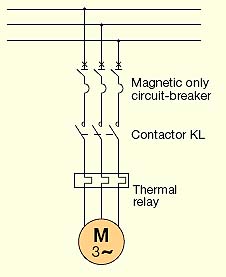
Рис. ABB
Схема прямого пуска электродвигателяMagnetic only circuit-breaker - Автоматический выключатель с электромагнитным расцепителем
Contactor KL - Контактор KL
Thermal relay - Тепловое реле
Параллельные тексты EN-RU
Direct-on-line starting
Direct-on-line starting, which is often abbreviated as DOL, is perhaps the most traditional system and consists in connecting the motor directly to the supply network, thus carrying out starting at full voltage.Direct-on-line starting represents the simplest and the most economical system to start a squirrel-cage asynchronous motor and it is the most used.
As represented in Figure 5, it provides the direct connection to the supply network and therefore starting is carried out at full voltage and with constant frequency, developing a high starting torque with very reduced acceleration times.
The typical applications are relevant to small power motors also with full load starting.
These advantages are linked to some problems such as, for example, the high inrush current, which - in the first instants - can reach values of about 10 to 12 times the rated current, then can decrease to about 6 to 8 times the rated current and can persist to reach the maximum torque speed.The effects of such currents can be identified with the high electro-dynamical stresses on the motor connection cables and could affect also the windings of the motor itself; besides, the high inrush torques can cause violent accelerations which stress the transmission components (belts and joints) generating distribution problems with a reduction in the mechanical life of these elements.
Finally, also the possible electrical problems due to voltage drops on the supply line of the motor or of the connected equipment must be taken into consideration.
[ABB]Прямой пуск
Прямой пуск, который по-английски часто сокращенно обозначают как DOL, является, пожалуй наиболее распространенным способом пуска. Он заключается в непосредственном (т. е. прямом) подключении двигателя к питающей сети. Это означает, что пуск двигателя осуществляется при полном напряжении.Схема прямого пуска является наиболее простым, экономичным и чаще всего применяемым решением для электродвигателей с короткозамкнутым ротором.
Схема прямого подключения к сети представлена на рисунке 5. Пуск осуществляется при полном напряжении и постоянной частоте сети. Электродвигатель развивает высокий пусковой момент при коротком времени разгона.
Типичные области применения – маломощные электродвигатели, в том числе с пуском при полной нагрузке.
Однако, наряду с преимуществами имеются и определенные недостатки, например, бросок пускового тока, достигающий в первоначальный момент 10…12-кратного значения от номинального тока электродвигателя. Затем ток двигателя уменьшается примерно до 6…8-кратного значения номинального тока и будет держаться на этом уровне до тех пор, пока скорость двигателя не достигнет максимального значения.
Такое изменение тока оказывает значительное электродинамическое воздействие на кабель, подключенный к двигателю. Кроме того пусковой ток воздействует на обмотки двигателя. Высокий начальный пусковой момент может привести к значительному ускорению и следовательно к значительной нагрузке элементов привода (ремней, крепления узлов), что вызывает сокращение их срока службы.
И, наконец, следует принять во внимание возможное возникновение проблем, связанных с падением напряжения в линии питания двигателя и подключенного к этой линии оборудования.
[Перевод Интент]
Тематики
Синонимы
EN
- across-the-line starting (US)
- direct line starting
- direct operation of a motor
- direct starting
- direct-on-line starting
- DOL
- full voltage starter application
DE
FR
Немецко-русский словарь нормативно-технической терминологии > Anlauf mit direktem Einschalten
См. также в других словарях:
typical example — index representative (example), sample Burton s Legal Thesaurus. William C. Burton. 2006 … Law dictionary
example — n. 1) to cite, give, provide an example 2) to set an example for 3) to make an example of 4) to follow smb. s example 5) a classic; concrete; extreme; glaring, striking; illustrative; impressive; prime, shining; typical example 6) (misc.) to lead … Combinatory dictionary
typical — typ|i|cal W2S2 [ˈtıpıkəl] adj [Date: 1600 1700; : Medieval Latin; Origin: typicalis, from Latin typicus, from Greek typikos, from typos; TYPE1] 1.) having the usual features or qualities of a particular group or thing ▪ typical British weather… … Dictionary of contemporary English
example — noun (C) 1 for example used before mentioning a specific thing, person, place etc in order to explain what you mean or to support an argument: Many countries, for example, Mexico and Japan, have a lot of earthquakes. | Look at John, for example,… … Longman dictionary of contemporary English
example*/*/*/ — [ɪgˈzɑːmp(ə)l] noun [C] 1) something that you mention in order to show the type of thing that you are talking about and to help to explain what you mean Many sports are still dominated by men – football is an obvious example.[/ex] He gave several … Dictionary for writing and speaking English
typical — adjective 1) a typical example of art deco Syn: representative, classic, quintessential, archetypal, model, prototypical, stereotypical, paradigmatic Ant: atypical, unusual, abnormal 2) a fairly typical day … Thesaurus of popular words
example — Synonyms and related words: admonishment, admonition, alarm, archetype, as an example, benchmark, call to mind, case, case in point, caution, caveat, citation, cite, cite a particular, criterion, cross reference, cross section, demonstrate,… … Moby Thesaurus
typical — adjective 1) a typical example of art deco Syn: representative, characteristic, classic, quintessential, archetypal 2) a fairly typical day Syn: normal, average, ordinary, standard, regular … Synonyms and antonyms dictionary
example — [eg zam′pəl, igzam′pəl; eg′zämpəl, igzämpəl] n. [ME < OFr example, essample < L exemplum, sample, example < eximere, to take out < ex , out + emere, to buy < IE base * em , to take > Lith imù] 1. something selected to show the… … English World dictionary
typical instance — index example, representative (example) Burton s Legal Thesaurus. William C. Burton. 2006 … Law dictionary
typical — [tip′i kəl] adj. [ML typicalis < L typicus < Gr typikos] 1. serving as a type; symbolic 2. having or showing the characteristics, qualities, etc. of a kind, class, or group so fully as to be a representative example 3. of or belonging to a… … English World dictionary
