

-
1 operations system function
English-Russian dictionary of modern telecommunications > operations system function
-
2 operations system function (OSF) block
функциональный блок операционной системы
—
[ http://www.iks-media.ru/glossary/index.html?glossid=2400324]Тематики
- электросвязь, основные понятия
EN
Англо-русский словарь нормативно-технической терминологии > operations system function (OSF) block
-
3 Operations System Function (OSF)
функция операционной системы.Функция обработки управляющей информации для контроля и управления сетью СЦИ.English-Russian dictionary of modern telecommunications > Operations System Function (OSF)
-
4 city operations center (COC)
городской центр управления (ГЦУ)
Городская структура, выполняющая функции координации и принятия решений, позволяющая властям города-организатора и его партнерам/посредникам эффективно управлять деятельностью города во время Игр.
[Департамент лингвистических услуг Оргкомитета «Сочи 2014». Глоссарий терминов]EN
city operations center (COC)
City venue, which function is to provide a centralized information, coordination, reporting and decision-making system, allowing the Host City authorities and its partners/agencies to manage the effective holding of the Games-time city operations.
[Департамент лингвистических услуг Оргкомитета «Сочи 2014». Глоссарий терминов]Тематики
EN
Англо-русский словарь нормативно-технической терминологии > city operations center (COC)
-
5 OSF
1) Общая лексика: Open Society Institute( Soros Foundations Network)2) Компьютерная техника: Office of Space Flight3) Военный термин: Object Strike Force, Observed Support Frequency, ordnance storage facility, Operational Support Facility (Orlando)4) Техника: optical signal filtering5) Математика: Optimal Solutions Found6) Религия: Order Of Saint Francis7) Метеорология: Operational Support Facility8) Грубое выражение: One Sick Fuck9) Оптика: optically shaped film10) Сокращение: Open Systems Foundation, Optronique Sectuer Frontale (Optronic Sector System for Rafale (France)), Order of St Francis11) Вычислительная техника: output field separator, Open Software Foundation (HP, DEC, IBM, organization), Operations System Function (IN), Oppose Sun Forever (aka Open Software Foundation, Slang, organization)13) Фирменный знак: Open Source Folks14) СМИ: Old Style Figures15) Глоссарий компании Сахалин Энерджи: Onshore Stabilization Facility, внешнее поверхностное трение (Outside Surface Friction)16) Сетевые технологии: Фонд открытого программного обеспечения, консорциум OSF17) Сахалин Р: Onshore Stabilization Facilities, Outside Surface Friction18) Океанография: Operation Support Facility19) Расширение файла: Open Software Foundation, Outrage Sound Format20) NYSE. Osaka Stock Futures 50 -
6 OSF
1) фонд открытого программного обеспечения; 2) функция оперирующей системы* * *English-Russian dictionary of modern telecommunications > OSF
-
7 n-osf
функция оперирующей системы уровня управления сетью (Network Management Layer-Operations System Function)English-Russian dictionary of modern telecommunications > n-osf
-
8 operate
operate [ˈɒpəreɪt]• commercial banks can now operate in the country les banques commerciales peuvent maintenant opérer dans ce paysb. ( = have effect) [drug, medicine, propaganda] faire effetc. ( = perform surgery) opérer[person] [+ machine, switchboard, brakes] faire marcher ; [+ system] pratiquer ; [+ business, factory] diriger* * *['ɒpəreɪt] 1.transitive verb1) ( run) faire marcher [appliance, vehicle]2) ( enforce) pratiquer [policy, system]; mettre [quelque chose] en vigueur [ban]3) ( manage) gérer [service, radio station]; exploiter [mine, racket]; [bank] avoir [pension plan]2.1) ( do business) opérer2) ( function) marcher3) ( take effect) agir5) ( run) [service] fonctionner6) Medicine opérerto operate on — opérer [person]
to operate on somebody's leg/on somebody for appendicitis — opérer quelqu'un à la jambe/quelqu'un de l'appendicite
-
9 operate
A vtr1 ( run) faire marcher [appliance, machine, vehicle] ;3 ( manage) gérer, diriger [service, radio station] ; exploiter [mine, racket] ; [bank] avoir [pension plan, savings scheme].B vi1 (do business, engage in criminal activity) opérer ; they operate out of London ils ont Londres comme base d'opérations ;2 ( function) marcher, fonctionner ;3 ( take effect) agir ;4 Mil opérer ;6 ( run) fonctionner ; does the shuttle service operate on Saturdays? est-ce que la navette fonctionne le samedi? ;7 Med opérer ; we shall have to operate il faudra opérer ; to operate on opérer [person] ; to be operated on être opéré ; to operate on sb's leg/ear opérer qn à la jambe/l'oreille ; to operate on sb for appendicitis opérer qn de l'appendicite. -
10 Thinking
But what then am I? A thing which thinks. What is a thing which thinks? It is a thing which doubts, understands, [conceives], affirms, denies, wills, refuses, which also imagines and feels. (Descartes, 1951, p. 153)I have been trying in all this to remove the temptation to think that there "must be" a mental process of thinking, hoping, wishing, believing, etc., independent of the process of expressing a thought, a hope, a wish, etc.... If we scrutinize the usages which we make of "thinking," "meaning," "wishing," etc., going through this process rids us of the temptation to look for a peculiar act of thinking, independent of the act of expressing our thoughts, and stowed away in some particular medium. (Wittgenstein, 1958, pp. 41-43)Analyse the proofs employed by the subject. If they do not go beyond observation of empirical correspondences, they can be fully explained in terms of concrete operations, and nothing would warrant our assuming that more complex thought mechanisms are operating. If, on the other hand, the subject interprets a given correspondence as the result of any one of several possible combinations, and this leads him to verify his hypotheses by observing their consequences, we know that propositional operations are involved. (Inhelder & Piaget, 1958, p. 279)In every age, philosophical thinking exploits some dominant concepts and makes its greatest headway in solving problems conceived in terms of them. The seventeenth- and eighteenth-century philosophers construed knowledge, knower, and known in terms of sense data and their association. Descartes' self-examination gave classical psychology the mind and its contents as a starting point. Locke set up sensory immediacy as the new criterion of the real... Hobbes provided the genetic method of building up complex ideas from simple ones... and, in another quarter, still true to the Hobbesian method, Pavlov built intellect out of conditioned reflexes and Loeb built life out of tropisms. (S. Langer, 1962, p. 54)Experiments on deductive reasoning show that subjects are influenced sufficiently by their experience for their reasoning to differ from that described by a purely deductive system, whilst experiments on inductive reasoning lead to the view that an understanding of the strategies used by adult subjects in attaining concepts involves reference to higher-order concepts of a logical and deductive nature. (Bolton, 1972, p. 154)There are now machines in the world that think, that learn and create. Moreover, their ability to do these things is going to increase rapidly until-in the visible future-the range of problems they can handle will be coextensive with the range to which the human mind has been applied. (Newell & Simon, quoted in Weizenbaum, 1976, p. 138)But how does it happen that thinking is sometimes accompanied by action and sometimes not, sometimes by motion, and sometimes not? It looks as if almost the same thing happens as in the case of reasoning and making inferences about unchanging objects. But in that case the end is a speculative proposition... whereas here the conclusion which results from the two premises is an action.... I need covering; a cloak is a covering. I need a cloak. What I need, I have to make; I need a cloak. I have to make a cloak. And the conclusion, the "I have to make a cloak," is an action. (Nussbaum, 1978, p. 40)It is well to remember that when philosophy emerged in Greece in the sixth century, B.C., it did not burst suddenly out of the Mediterranean blue. The development of societies of reasoning creatures-what we call civilization-had been a process to be measured not in thousands but in millions of years. Human beings became civilized as they became reasonable, and for an animal to begin to reason and to learn how to improve its reasoning is a long, slow process. So thinking had been going on for ages before Greece-slowly improving itself, uncovering the pitfalls to be avoided by forethought, endeavoring to weigh alternative sets of consequences intellectually. What happened in the sixth century, B.C., is that thinking turned round on itself; people began to think about thinking, and the momentous event, the culmination of the long process to that point, was in fact the birth of philosophy. (Lipman, Sharp & Oscanyan, 1980, p. xi)The way to look at thought is not to assume that there is a parallel thread of correlated affects or internal experiences that go with it in some regular way. It's not of course that people don't have internal experiences, of course they do; but that when you ask what is the state of mind of someone, say while he or she is performing a ritual, it's hard to believe that such experiences are the same for all people involved.... The thinking, and indeed the feeling in an odd sort of way, is really going on in public. They are really saying what they're saying, doing what they're doing, meaning what they're meaning. Thought is, in great part anyway, a public activity. (Geertz, quoted in J. Miller, 1983, pp. 202-203)Everything should be made as simple as possible, but not simpler. (Einstein, quoted in Minsky, 1986, p. 17)What, in effect, are the conditions for the construction of formal thought? The child must not only apply operations to objects-in other words, mentally execute possible actions on them-he must also "reflect" those operations in the absence of the objects which are replaced by pure propositions. Thus, "reflection" is thought raised to the second power. Concrete thinking is the representation of a possible action, and formal thinking is the representation of a representation of possible action.... It is not surprising, therefore, that the system of concrete operations must be completed during the last years of childhood before it can be "reflected" by formal operations. In terms of their function, formal operations do not differ from concrete operations except that they are applied to hypotheses or propositions [whose logic is] an abstract translation of the system of "inference" that governs concrete operations. (Piaget, quoted in Minsky, 1986, p. 237)[E]ven a human being today (hence, a fortiori, a remote ancestor of contemporary human beings) cannot easily or ordinarily maintain uninterrupted attention on a single problem for more than a few tens of seconds. Yet we work on problems that require vastly more time. The way we do that (as we can observe by watching ourselves) requires periods of mulling to be followed by periods of recapitulation, describing to ourselves what seems to have gone on during the mulling, leading to whatever intermediate results we have reached. This has an obvious function: namely, by rehearsing these interim results... we commit them to memory, for the immediate contents of the stream of consciousness are very quickly lost unless rehearsed.... Given language, we can describe to ourselves what seemed to occur during the mulling that led to a judgment, produce a rehearsable version of the reaching-a-judgment process, and commit that to long-term memory by in fact rehearsing it. (Margolis, 1987, p. 60)Historical dictionary of quotations in cognitive science > Thinking
-
11 work
1. nounat work — (engaged in working) bei der Arbeit; (fig.): (operating) am Werk (see also academic.ru/23063/e">e)
be at work on something — an etwas (Dat.) arbeiten; (fig.) auf etwas (Akk.) wirken
set to work — [Person:] sich an die Arbeit machen
set somebody to work — jemanden an die Arbeit schicken
all work and no play — immer nur arbeiten
have one's work cut out — viel zu tun haben; sich ranhalten müssen (ugs.)
2) (thing made or achieved) Werk, dasis that all your own work? — hast du das alles selbst gemacht?
work of art — Kunstwerk, das
a work of reference/literature/art — ein Nachschlagewerk/literarisches Werk/Kunstwerk
5) (employment) Arbeit, dieout of work — arbeitslos; ohne Arbeit
7) in pl. (Mil.) Werke; Befestigungen8) in pl. (operations of building etc.) Arbeitenthe [whole/full] works — der ganze Kram (ugs.)
2. intransitive verb,give somebody the works — (fig.) (give somebody the best possible treatment) jemandem richtig verwöhnen (ugs.); (give somebody the worst possible treatment) jemanden fertig machen (salopp)
1) arbeitenwork for a cause — etc. für eine Sache usw. arbeiten
work against something — (impede) einer Sache (Dat.) entgegenstehen
2) (function effectively) funktionieren; [Charme:] wirken (on auf + Akk.)make the washing machine/television work — die Waschmaschine/den Fernsehapparat in Ordnung bringen
3) [Rad, Getriebe, Kette:] laufen4) (be craftsman)work in a material — mit od. (fachspr.) in einem Material arbeiten
5) [Faktoren, Einflüsse:] wirken (on auf + Akk.)work against — arbeiten gegen; see also work on
6) (make its/one's way) sich schieben3. transitive verb,work round to a question — (fig.) sich zu einer Frage vorarbeiten
1) (operate) bedienen [Maschine]; fahren [Schiff]; betätigen [Bremse]2) (get labour from) arbeiten lassen3) (get material from) ausbeuten [Steinbruch, Grube]4) (operate in or on) [Vertreter:] bereisen5) (control) steuern6) (effect) bewirken [Änderung]; wirken [Wunder]work it or things so that... — (coll.) es deichseln, dass... (ugs.)
work one's way up/into something — sich hocharbeiten/in etwas (Akk.) hineinarbeiten
8) (get gradually) bringenwork something into something — etwas zu etwas verarbeiten; (mix in) etwas unter etwas (Akk.) rühren
10) (gradually excite)work oneself into a state/a rage — sich aufregen/in einen Wutanfall hineinsteigern
12) (purchase, obtain with labour) abarbeiten; (fig.)she worked her way through college — sie hat sich (Dat.) ihr Studium selbst verdient; see also passage 6)
Phrasal Verbs:- work in- work off- work on- work out- work up* * *[wə:k] 1. noun1) (effort made in order to achieve or make something: He has done a lot of work on this project) die Arbeit2) (employment: I cannot find work in this town.) die Arbeit3) (a task or tasks; the thing that one is working on: Please clear your work off the table.) die Arbeit4) (a painting, book, piece of music etc: the works of Van Gogh / Shakespeare/Mozart; This work was composed in 1816.) das Werk5) (the product or result of a person's labours: His work has shown a great improvement lately.) die Arbeit6) (one's place of employment: He left (his) work at 5.30 p.m.; I don't think I'll go to work tomorrow.) die Arbeit2. verb1) (to (cause to) make efforts in order to achieve or make something: She works at the factory three days a week; He works his employees very hard; I've been working on/at a new project.) arbeiten2) (to be employed: Are you working just now?) arbeiten3) (to (cause to) operate (in the correct way): He has no idea how that machine works / how to work that machine; That machine doesn't/won't work, but this one's working.) funktionieren4) (to be practicable and/or successful: If my scheme works, we'll be rich!) klappen5) (to make (one's way) slowly and carefully with effort or difficulty: She worked her way up the rock face.) sich arbeiten6) (to get into, or put into, a stated condition or position, slowly and gradually: The wheel worked loose.) sich arbeiten7) (to make by craftsmanship: The ornaments had been worked in gold.) arbeiten•- -work- workable
- worker
- works 3. noun plural2) (deeds, actions etc: She's devoted her life to good works.) das Werk•- work-basket- work-box
- workbook
- workforce
- working class
- working day
- work-day
- working hours
- working-party
- work-party
- working week
- workman
- workmanlike
- workmanship
- workmate
- workout
- workshop
- at work
- get/set to work
- go to work on
- have one's work cut out
- in working order
- out of work
- work of art
- work off
- work out
- work up
- work up to
- work wonders* * *[wɜ:k, AM wɜ:rk]I. NOUNto be at \work am Werk seinforces of destruction are at \work here hier sind zerstörerische Kräfte am Werkvarious factors are at \work in this situation in dieser Situation spielen verschiedene Faktoren eine Rollegood \work! gute Arbeit!there's a lot of \work to be done yet es gibt noch viel zu tunthe garden needs a lot of \work im Garten muss [so] einiges gemacht werden\work on the tunnel has been suspended die Arbeiten am Tunnel wurden vorübergehend eingestelltdid you manage to get a bit of \work done? konntest du ein bisschen arbeiten?construction/repair \work Bau-/Reparaturarbeiten plresearch \work Forschungsarbeit fit's hard \work doing sth (strenuous) es ist anstrengend, etw zu tun; (difficult) es ist schwierig, etw zu tunto be at \work doing sth [gerade] damit beschäftigt sein, etw zu tunto make \work for sb jdm Arbeit machenwhat sort of \work do you have experience in? über welche Berufserfahrung verfügen Sie?she's got \work as a translator sie hat Arbeit [o eine Stelle] als Übersetzerin gefundento look for \work auf Arbeitssuche seinhe's looking for \work as a system analyst er sucht Arbeit [o eine Stelle] als Systemanalytikerto be in \work Arbeit [o eine Stelle] habento be out of \work arbeitslos seinto be late for \work zu spät zur Arbeit kommento have to stay late at \work lange arbeiten müssento be at \work bei der Arbeit seinto be off \work frei haben; (without permission) fehlento be off \work sick sich akk krankgemeldet habento commute to \work pendelnto get to \work by car/on the train mit dem Auto/mit dem Zug zur Arbeit fahrento go/travel to \work zur Arbeit gehen/fahrento be injured at \work einen Arbeitsunfall habento ring sb from \work jdn von der Arbeit [aus] anrufen4. (construction, repairs)▪ \works pl Arbeiten plbuilding/road \works Bau-/Straßenarbeiten plthis is the \work of professional thieves das ist das Werk professioneller Diebegood \works REL gute Werke6. ART, LIT, MUS Werk nt‘The Complete W\works of William Shakespeare’ ‚Shakespeares gesammelte Werke‘\works of art Kunstwerke pl\work in bronze Bronzearbeiten pl\work in leather aus Leder gefertigte Arbeitensb's early/later \work jds Früh-/Spätwerk ntto show one's \work in a gallery seine Arbeiten in einer Galerie ausstellen7. (factory)▪ \works + sing/pl vb Werk nt, Fabrik fsteel \works Stahlwerk nttwo large pizzas with the \works, please! esp AM zwei große Pizzen mit allem bitte!11. MIL▪ \works pl Befestigungen pl12.II. NOUN MODIFIER\work clothes Arbeitskleidung f\work speed Arbeitstempo nt2.\works premises Werksgelände ntIII. INTRANSITIVE VERB1. (do a job) arbeitenwhere do you \work? wo arbeiten Sie?to \work as an accountant als Buchhalter arbeitento \work a twelve-hour day/a forty-hour week zwölf Stunden am Tag/vierzig Stunden in der Woche arbeitento \work from home zu Hause [o von zu Hause aus] arbeitento \work at the hospital/abroad im Krankenhaus/im Ausland arbeitento \work hard hart arbeitento \work together zusammenarbeiten▪ to \work with sb mit jdm zusammenarbeitenwe're \working to prevent it happening again wir bemühen uns [o arbeiten daran], so etwas in Zukunft zu verhindernto \work towards a degree in biology einen Hochschulabschluss in Biologie anstrebenwe're \working on it wir arbeiten daranto \work at a problem an einem Problem arbeitento \work hard at doing sth hart daran arbeiten, etw zu tun3. (have an effect) sich auswirkento \work both ways sich sowohl positiv als auch negativ auswirken▪ to \work in sb's favour sich zu jds Gunsten auswirkenmy cell phone doesn't \work mein Handy geht nichtthe boiler seems to be \working okay der Boiler scheint in Ordnung zu seinI can't get this washing machine to \work ich kriege die Waschmaschine irgendwie nicht zum Laufento \work off batteries batteriebetrieben seinto \work off the mains BRIT mit Netzstrom arbeitento \work off wind power mit Windenergie arbeitento \work in practice [auch] in der Praxis funktionieren7. (be based)to \work on the assumption/idea that... von der Annahme/Vorstellung ausgehen, dass...8. (move)to \work free/loose sich lösen/lockernto \work windward NAUT gegen den Wind segeln10. NAUTto \work windward [hart] am Wind segeln11.▶ to \work like a charm [or like magic] Wunder bewirkenIV. TRANSITIVE VERB1. (make work)to \work sb/oneself hard jdm/sich viel abverlangen2. (operate)to be \worked by electricity/steam elektrisch/dampfgetrieben seinto be \worked by wind power durch Windenergie angetrieben werden3. (move)to \work one's way through an article/a book sich akk durch einen Artikel/ein Buch durcharbeitento \work one's way through a crowd/out of a crowded room sich dat einen Weg durch die Menge/aus einem überfüllten Zimmer bahnento \work one's way down a list eine Liste durchgehento \work one's way up sich akk hocharbeitenhe's \worked his way up through the firm er hat sich in der Firma hochgearbeitetto \work sth free/loose etw losbekommen/lockernto \work sth [backwards and forwards] etw [hin- und her]bewegen4. (bring about)▪ to \work sth etw bewirkenI don't know how she \worked it! ich weiß nicht, wie sie das geschafft hat!to \work oneself into a more positive frame of mind sich dat eine positivere Lebenseinstellung erarbeitento \work a cure eine Heilung herbeiführento \work a miracle ein Wunder vollbringento \work miracles [or wonders] [wahre] Wunder vollbringen5. (get)to \work oneself into a state sich akk aufregento \work sb into a state of jealousy jdn eifersüchtig machen6. (shape)▪ to \work sth etw bearbeitento \work clay Ton formen▪ to \work sth into sth etw in etw akk einarbeiten; food etw mit etw dat vermengen; (incorporate) etw in etw akk einbauen [o einfügen]to \work the ingredients together die Zutaten [miteinander] vermengento \work sth into the skin (rub) die Haut mit etw dat einreiben; (massage) etw in die Haut einmassieren8. (embroider)▪ to \work sth etw [auf]sticken9. (cultivate)to \work the land das Land bewirtschaften; (exploit)to \work a mine/quarry eine Mine/einen Steinbruch ausbeuten10. (cover)to \work the inner city [area]/the East Side für die Innenstadt/die East Side zuständig sein11. (pay for by working)to \work one's passage sich dat seine Überfahrt durch Arbeit auf dem Schiff verdienento \work one's way through university sich dat sein Studium finanzieren12.▶ to \work one's fingers to the bone [for sb] ( fam) sich dat [für jdn] den Rücken krumm arbeiten fam* * *[wɜːk]1. nto be at work (on sth) ( — an etw dat ) arbeiten
there are forces at work which... — es sind Kräfte am Werk, die...
nice or good work! — gut or super (inf) gemacht!
we've a lot of work to do before this choir can give a concert — wir haben noch viel zu tun, ehe dieser Chor ein Konzert geben kann
you need to do some more work on your accent/your technique — Sie müssen noch an Ihrem Akzent/an Ihrer Technik arbeiten
to get or set to work on sth — sich an etw (acc) machen
to put a lot of work into sth — eine Menge Arbeit in etw (acc) stecken
to make short or quick work of sb/sth — mit jdm/etw kurzen Prozess machen
time/the medicine had done its work — die Zeit/Arznei hatte ihr Werk vollbracht/ihre Wirkung getan
it was hard work for the old car to get up the hill — das alte Auto hatte beim Anstieg schwer zu schaffen
2) (= employment, job) Arbeit fhow long does it take you to get to work? — wie lange brauchst du, um zu deiner Arbeitsstelle zu kommen?
at work — an der Arbeitsstelle, am Arbeitsplatz
3) (= product) Arbeit f; (ART, LITER) Werk ntgood works — gute Werke pl
a chance for artists to show their work — eine Gelegenheit für Künstler, ihre Arbeiten or Werke zu zeigen
5) pl (MECH) Getriebe, Innere(s) nt; (of watch, clock) Uhrwerk nt6) sing or pl (Brit: factory) Betrieb m, Fabrik fgas/steel works — Gas-/Stahlwerk nt
7) (inf)pl alles Drum und Dranwe had fantastic food, wine, brandy, the works — es gab tolles Essen, Wein, Kognak, alle Schikanen (inf)
he was giving his opponent the works — er machte seinen Gegner nach allen Regeln der Kunst fertig (inf)
2. vi1) person arbeiten (at an +dat)to work toward(s)/for sth — auf etw (acc) hin/für etw arbeiten
or favor (US) — diese Faktoren, die gegen uns/zu unseren Gunsten arbeiten
2) (= function, operate) funktionieren; (plan) funktionieren, klappen (inf); (medicine, spell) wirken; (= be successful) klappen (inf)"not working" (lift etc) — "außer Betrieb"
but this arrangement will have to work both ways — aber diese Abmachung muss für beide Seiten gelten
3) (yeast) arbeiten, treiben5)(= move gradually)
to work loose — sich lockernto work round (wind, object) — sich langsam drehen (to nach)
he worked (a)round to asking her — er hat sich aufgerafft, sie zu fragen
OK, I'm working (a)round to it — okay, das mache ich schon noch
3. vtto work oneself/sb hard — sich/jdn nicht schonen
to work sth by electricity/hand — etw elektrisch/mit Hand betreiben
3) (= bring about) change, cure bewirken, herbeiführento work it ( so that...) (inf) — es so deichseln(, dass...) (inf)
See:→ work upwork the flour in gradually/the ingredients together — mischen Sie das Mehl allmählich unter/die Zutaten (zusammen)
6) (= exploit) mine ausbeuten, abbauen; land bearbeiten; smallholding bewirtschaften; (salesman) area bereisen7) muscles trainieren8)(= move gradually)
to work one's hands free — seine Hände freibekommenhe worked his way across the rock face/through the tunnel — er überquerte die Felswand/kroch durch den Tunnel
to work oneself into sb's confidence — sich in jds Vertrauen (acc) einschleichen
* * *A s1. allg Arbeit f:a) Beschäftigung f, Tätigkeit fb) Aufgabe fc) Hand-, Nadelarbeit f, Stickerei f, Näherei fd) Leistung fe) Erzeugnis n:work done geleistete Arbeit;a beautiful piece of work eine schöne Arbeit;a) bei der Arbeit,b) am Arbeitsplatz,c) in Tätigkeit, in Betrieb (Maschine etc);be at work on arbeiten an (dat);do work arbeiten;I’ve got some work to do ich muss arbeiten;do the work of three (men) für drei arbeiten;be in (out of) work (keine) Arbeit haben;(put) out of work arbeitslos (machen);set to work an die Arbeit gehen, sich an die Arbeit machen;take some work home Arbeit mit nach Hause nehmen;have one’s work cut out (for one) zu tun haben, schwer zu schaffen haben;make work Arbeit verursachen;make light work of spielend fertig werden mit;make sad work of arg wirtschaften oder hausen mit;2. PHYS Arbeit f:3. auch koll (künstlerisches etc) Werk:4. Werk n (Tat und Resultat):this is your work!;5. pla) ARCH Anlagen pl, (besonders öffentliche) Bauten plb) Baustelle f (an einer Autobahn etc)c) MIL (Festungs)Werk n, Befestigungen pl7. pl TECH (Räder-, Trieb)Werk n, Getriebe n:9. REL (gutes) Werkgive sb the works umg jemanden fertigmachen;B v/i prät und pperf worked, besonders obs oder poet wrought [rɔːt]1. (at, on) arbeiten (an dat), sich beschäftigen (mit):work at a social reform an einer Sozialreform arbeiten;make one’s money work sein Geld arbeiten lassen2. arbeiten, Arbeit haben, beschäftigt seinagainst gegen;for für eine Sache):work toward(s) hinarbeiten auf (akk)4. TECHa) funktionieren, gehen (beide auch fig)b) in Betrieb oder Gang sein:our stove works well unser Ofen funktioniert gut;your method won’t work mit Ihrer Methode werden Sie es nicht schaffen;get sth to work etwas reparieren5. fig klappen, gehen, gelingen, sich machen lassenthe poison began to work das Gift begann zu wirken8. sich gut etc bearbeiten lassen9. sich (hindurch-, hoch- etc) arbeiten:work into eindringen in (akk);work loose sich losarbeiten, sich lockern;her tights worked down die Strumpfhose rutschte ihr herunter10. in (heftiger) Bewegung sein, arbeiten, zucken ( alle:12. gären, arbeiten (beide auch fig: Gedanke etc)C v/t1. arbeiten an (dat)2. verarbeiten:a) TECH bearbeitenb) einen Teig kneteninto zu):work cotton into cloth Baumwolle zu Tuch verarbeiten4. (an-, be)treiben:worked by electricity elektrisch betrieben7. Bergbau: eine Grube abbauen, ausbeuten9. jemanden, Tiere (tüchtig) arbeiten lassen, (zur Arbeit) antreibenfor wegen):11. a) work one’s way sich (hindurch- etc) arbeitenb) erarbeiten, verdienen: → passage1 512. MATH lösen, ausarbeiten, errechnenwork o.s. into a rage sich in eine Wut hineinsteigern14. bewegen, arbeiten mit:he worked his jaws seine Kiefer mahlten15. fig (prät oft wrought) hervorbringen, -rufen, zeitigen, Veränderungen etc bewirken, Wunder wirken oder tun, führen zu, verursachen:work hardship on sb für jemanden eine Härte bedeuten17. work intoa) eine Arbeit etc einschieben in (akk),18. sl etwas herausschlagen19. US sl jemanden bescheißen20. herstellen, machen, besonders stricken, nähen21. zur Gärung bringenw. abk1. weight2. wide3. width4. wife5. withwk abk1. week Wo.2. work* * *1. noun1) no pl., no indef. art. Arbeit, dieat work — (engaged in working) bei der Arbeit; (fig.): (operating) am Werk (see also e)
be at work on something — an etwas (Dat.) arbeiten; (fig.) auf etwas (Akk.) wirken
set to work — [Person:] sich an die Arbeit machen
have one's work cut out — viel zu tun haben; sich ranhalten müssen (ugs.)
2) (thing made or achieved) Werk, daswork of art — Kunstwerk, das
3) (book, piece of music) Werk, dasa work of reference/literature/art — ein Nachschlagewerk/literarisches Werk/Kunstwerk
4) in pl. (of author or composer) Werke5) (employment) Arbeit, dieout of work — arbeitslos; ohne Arbeit
at work — (place of employment) auf der Arbeit (see also a)
7) in pl. (Mil.) Werke; Befestigungen8) in pl. (operations of building etc.) Arbeitenthe [whole/full] works — der ganze Kram (ugs.)
2. intransitive verb,give somebody the works — (fig.) (give somebody the best possible treatment) jemandem richtig verwöhnen (ugs.); (give somebody the worst possible treatment) jemanden fertig machen (salopp)
1) arbeitenwork for a cause — etc. für eine Sache usw. arbeiten
work against something — (impede) einer Sache (Dat.) entgegenstehen
2) (function effectively) funktionieren; [Charme:] wirken (on auf + Akk.)make the washing machine/television work — die Waschmaschine/den Fernsehapparat in Ordnung bringen
3) [Rad, Getriebe, Kette:] laufenwork in a material — mit od. (fachspr.) in einem Material arbeiten
5) [Faktoren, Einflüsse:] wirken (on auf + Akk.)work against — arbeiten gegen; see also work on
6) (make its/one's way) sich schieben3. transitive verb,work round to a question — (fig.) sich zu einer Frage vorarbeiten
1) (operate) bedienen [Maschine]; fahren [Schiff]; betätigen [Bremse]2) (get labour from) arbeiten lassen3) (get material from) ausbeuten [Steinbruch, Grube]4) (operate in or on) [Vertreter:] bereisen5) (control) steuern6) (effect) bewirken [Änderung]; wirken [Wunder]work it or things so that... — (coll.) es deichseln, dass... (ugs.)
7) (cause to go gradually) führenwork one's way up/into something — sich hocharbeiten/in etwas (Akk.) hineinarbeiten
8) (get gradually) bringen9) (knead, stir)work something into something — etwas zu etwas verarbeiten; (mix in) etwas unter etwas (Akk.) rühren
work oneself into a state/a rage — sich aufregen/in einen Wutanfall hineinsteigern
11) (make by needlework etc.) arbeiten; aufsticken [Muster] (on auf + Akk.)12) (purchase, obtain with labour) abarbeiten; (fig.)she worked her way through college — sie hat sich (Dat.) ihr Studium selbst verdient; see also passage 6)
Phrasal Verbs:- work in- work off- work on- work out- work up* * *(hard) for expr.erarbeiten v.sich etwas erarbeiten ausdr. v.arbeiten v.funktionieren v. n.Arbeit -en f.Werk -e n. -
12 EOF
1) Компьютерная техника: End Of Field, End Of Files, конец файла (end of file)2) Военный термин: emergency operating facility3) Техника: end of file character, end of file mark4) Химия: Electro-osmotic flow5) Сокращение: Earth Orbit Flight, End Of File, electroosmotic flow6) Университет: Engineers Of The Future7) Вычислительная техника: Enterprise Object Framework, Enterprise Objects Framework (NeXT), End Of Frame (S-ATA)8) Иммунология: endogenous opiate peptides9) Транспорт: Emergency Operations Facility, Emergency Operating Facility (US)10) Экология: experimental ocean frontal analysis11) Деловая лексика: Equal Opportunity Fund12) Глоссарий компании Сахалин Энерджи: Entirely Oil Free (drain system LNG), entirely oil free (drain system at LNG), End of Facility13) Образование: Educational Opportunity Fund14) Сетевые технологии: end of frame, end of message, конец кадра, признак конца файла15) Океанография: Empirical Orthogonal Function16) Расширение файла: Enterprise Objects Framework (Next Computer)17) Чат: End Of Friday18) НАСА: Experimenter's Operations Facility -
13 Mind
It becomes, therefore, no inconsiderable part of science... to know the different operations of the mind, to separate them from each other, to class them under their proper heads, and to correct all that seeming disorder in which they lie involved when made the object of reflection and inquiry.... It cannot be doubted that the mind is endowed with several powers and faculties, that these powers are distinct from one another, and that what is really distinct to the immediate perception may be distinguished by reflection and, consequently, that there is a truth and falsehood which lie not beyond the compass of human understanding. (Hume, 1955, p. 22)Let us then suppose the mind to be, as we say, white Paper, void of all Characters, without any Ideas: How comes it to be furnished? Whence comes it by that vast store, which the busy and boundless Fancy of Man has painted on it, with an almost endless variety? Whence has it all the materials of Reason and Knowledge? To this I answer, in one word, from Experience. (Locke, quoted in Herrnstein & Boring, 1965, p. 584)The kind of logic in mythical thought is as rigorous as that of modern science, and... the difference lies, not in the quality of the intellectual process, but in the nature of things to which it is applied.... Man has always been thinking equally well; the improvement lies, not in an alleged progress of man's mind, but in the discovery of new areas to which it may apply its unchanged and unchanging powers. (Leґvi-Strauss, 1963, p. 230)MIND. A mysterious form of matter secreted by the brain. Its chief activity consists in the endeavor to ascertain its own nature, the futility of the attempt being due to the fact that it has nothing but itself to know itself with. (Bierce, quoted in Minsky, 1986, p. 55)[Philosophy] understands the foundations of knowledge and it finds these foundations in a study of man-as-knower, of the "mental processes" or the "activity of representation" which make knowledge possible. To know is to represent accurately what is outside the mind, so to understand the possibility and nature of knowledge is to understand the way in which the mind is able to construct such representation.... We owe the notion of a "theory of knowledge" based on an understanding of "mental processes" to the seventeenth century, and especially to Locke. We owe the notion of "the mind" as a separate entity in which "processes" occur to the same period, and especially to Descartes. We owe the notion of philosophy as a tribunal of pure reason, upholding or denying the claims of the rest of culture, to the eighteenth century and especially to Kant, but this Kantian notion presupposed general assent to Lockean notions of mental processes and Cartesian notions of mental substance. (Rorty, 1979, pp. 3-4)Under pressure from the computer, the question of mind in relation to machine is becoming a central cultural preoccupation. It is becoming for us what sex was to Victorians-threat, obsession, taboo, and fascination. (Turkle, 1984, p. 313)7) Understanding the Mind Remains as Resistant to Neurological as to Cognitive AnalysesRecent years have been exciting for researchers in the brain and cognitive sciences. Both fields have flourished, each spurred on by methodological and conceptual developments, and although understanding the mechanisms of mind is an objective shared by many workers in these areas, their theories and approaches to the problem are vastly different....Early experimental psychologists, such as Wundt and James, were as interested in and knowledgeable about the anatomy and physiology of the nervous system as about the young science of the mind. However, the experimental study of mental processes was short-lived, being eclipsed by the rise of behaviorism early in this century. It was not until the late 1950s that the signs of a new mentalism first appeared in scattered writings of linguists, philosophers, computer enthusiasts, and psychologists.In this new incarnation, the science of mind had a specific mission: to challenge and replace behaviorism. In the meantime, brain science had in many ways become allied with a behaviorist approach.... While behaviorism sought to reduce the mind to statements about bodily action, brain science seeks to explain the mind in terms of physiochemical events occurring in the nervous system. These approaches contrast with contemporary cognitive science, which tries to understand the mind as it is, without any reduction, a view sometimes described as functionalism.The cognitive revolution is now in place. Cognition is the subject of contemporary psychology. This was achieved with little or no talk of neurons, action potentials, and neurotransmitters. Similarly, neuroscience has risen to an esteemed position among the biological sciences without much talk of cognitive processes. Do the fields need each other?... [Y]es because the problem of understanding the mind, unlike the wouldbe problem solvers, respects no disciplinary boundaries. It remains as resistant to neurological as to cognitive analyses. (LeDoux & Hirst, 1986, pp. 1-2)Since the Second World War scientists from different disciplines have turned to the study of the human mind. Computer scientists have tried to emulate its capacity for visual perception. Linguists have struggled with the puzzle of how children acquire language. Ethologists have sought the innate roots of social behaviour. Neurophysiologists have begun to relate the function of nerve cells to complex perceptual and motor processes. Neurologists and neuropsychologists have used the pattern of competence and incompetence of their brain-damaged patients to elucidate the normal workings of the brain. Anthropologists have examined the conceptual structure of cultural practices to advance hypotheses about the basic principles of the mind. These days one meets engineers who work on speech perception, biologists who investigate the mental representation of spatial relations, and physicists who want to understand consciousness. And, of course, psychologists continue to study perception, memory, thought and action.... [W]orkers in many disciplines have converged on a number of central problems and explanatory ideas. They have realized that no single approach is likely to unravel the workings of the mind: it will not give up its secrets to psychology alone; nor is any other isolated discipline-artificial intelligence, linguistics, anthropology, neurophysiology, philosophy-going to have any greater success. (Johnson-Laird, 1988, p. 7)Historical dictionary of quotations in cognitive science > Mind
-
14 near cash
!гос. фин. The resource budget contains a separate control total for “near cash” expenditure, that is expenditure such as pay and current grants which impacts directly on the measure of the golden rule.This paper provides background information on the framework for the planning and control of public expenditure in the UK which has been operated since the 1998 Comprehensive Spending Review (CSR). It sets out the different classifications of spending for budgeting purposes and why these distinctions have been adopted. It discusses how the public expenditure framework is designed to ensure both sound public finances and an outcome-focused approach to public expenditure.The UK's public spending framework is based on several key principles:"consistency with a long-term, prudent and transparent regime for managing the public finances as a whole;" "the judgement of success by policy outcomes rather than resource inputs;" "strong incentives for departments and their partners in service delivery to plan over several years and plan together where appropriate so as to deliver better public services with greater cost effectiveness; and"the proper costing and management of capital assets to provide the right incentives for public investment.The Government sets policy to meet two firm fiscal rules:"the Golden Rule states that over the economic cycle, the Government will borrow only to invest and not to fund current spending; and"the Sustainable Investment Rule states that net public debt as a proportion of GDP will be held over the economic cycle at a stable and prudent level. Other things being equal, net debt will be maintained below 40 per cent of GDP over the economic cycle.Achievement of the fiscal rules is assessed by reference to the national accounts, which are produced by the Office for National Statistics, acting as an independent agency. The Government sets its spending envelope to comply with these fiscal rules.Departmental Expenditure Limits ( DEL) and Annually Managed Expenditure (AME)"Departmental Expenditure Limit ( DEL) spending, which is planned and controlled on a three year basis in Spending Reviews; and"Annually Managed Expenditure ( AME), which is expenditure which cannot reasonably be subject to firm, multi-year limits in the same way as DEL. AME includes social security benefits, local authority self-financed expenditure, debt interest, and payments to EU institutions.More information about DEL and AME is set out below.In Spending Reviews, firm DEL plans are set for departments for three years. To ensure consistency with the Government's fiscal rules departments are set separate resource (current) and capital budgets. The resource budget contains a separate control total for “near cash” expenditure, that is expenditure such as pay and current grants which impacts directly on the measure of the golden rule.To encourage departments to plan over the medium term departments may carry forward unspent DEL provision from one year into the next and, subject to the normal tests for tautness and realism of plans, may be drawn down in future years. This end-year flexibility also removes any incentive for departments to use up their provision as the year end approaches with less regard to value for money. For the full benefits of this flexibility and of three year plans to feed through into improved public service delivery, end-year flexibility and three year budgets should be cascaded from departments to executive agencies and other budget holders.Three year budgets and end-year flexibility give those managing public services the stability to plan their operations on a sensible time scale. Further, the system means that departments cannot seek to bid up funds each year (before 1997, three year plans were set and reviewed in annual Public Expenditure Surveys). So the credibility of medium-term plans has been enhanced at both central and departmental level.Departments have certainty over the budgetary allocation over the medium term and these multi-year DEL plans are strictly enforced. Departments are expected to prioritise competing pressures and fund these within their overall annual limits, as set in Spending Reviews. So the DEL system provides a strong incentive to control costs and maximise value for money.There is a small centrally held DEL Reserve. Support from the Reserve is available only for genuinely unforeseeable contingencies which departments cannot be expected to manage within their DEL.AME typically consists of programmes which are large, volatile and demand-led, and which therefore cannot reasonably be subject to firm multi-year limits. The biggest single element is social security spending. Other items include tax credits, Local Authority Self Financed Expenditure, Scottish Executive spending financed by non-domestic rates, and spending financed from the proceeds of the National Lottery.AME is reviewed twice a year as part of the Budget and Pre-Budget Report process reflecting the close integration of the tax and benefit system, which was enhanced by the introduction of tax credits.AME is not subject to the same three year expenditure limits as DEL, but is still part of the overall envelope for public expenditure. Affordability is taken into account when policy decisions affecting AME are made. The Government has committed itself not to take policy measures which are likely to have the effect of increasing social security or other elements of AME without taking steps to ensure that the effects of those decisions can be accommodated prudently within the Government's fiscal rules.Given an overall envelope for public spending, forecasts of AME affect the level of resources available for DEL spending. Cautious estimates and the AME margin are built in to these AME forecasts and reduce the risk of overspending on AME.Together, DEL plus AME sum to Total Managed Expenditure (TME). TME is a measure drawn from national accounts. It represents the current and capital spending of the public sector. The public sector is made up of central government, local government and public corporations.Resource and Capital Budgets are set in terms of accruals information. Accruals information measures resources as they are consumed rather than when the cash is paid. So for example the Resource Budget includes a charge for depreciation, a measure of the consumption or wearing out of capital assets."Non cash charges in budgets do not impact directly on the fiscal framework. That may be because the national accounts use a different way of measuring the same thing, for example in the case of the depreciation of departmental assets. Or it may be that the national accounts measure something different: for example, resource budgets include a cost of capital charge reflecting the opportunity cost of holding capital; the national accounts include debt interest."Within the Resource Budget DEL, departments have separate controls on:"Near cash spending, the sub set of Resource Budgets which impacts directly on the Golden Rule; and"The amount of their Resource Budget DEL that departments may spend on running themselves (e.g. paying most civil servants’ salaries) is limited by Administration Budgets, which are set in Spending Reviews. Administration Budgets are used to ensure that as much money as practicable is available for front line services and programmes. These budgets also help to drive efficiency improvements in departments’ own activities. Administration Budgets exclude the costs of frontline services delivered directly by departments.The Budget preceding a Spending Review sets an overall envelope for public spending that is consistent with the fiscal rules for the period covered by the Spending Review. In the Spending Review, the Budget AME forecast for year one of the Spending Review period is updated, and AME forecasts are made for the later years of the Spending Review period.The 1998 Comprehensive Spending Review ( CSR), which was published in July 1998, was a comprehensive review of departmental aims and objectives alongside a zero-based analysis of each spending programme to determine the best way of delivering the Government's objectives. The 1998 CSR allocated substantial additional resources to the Government's key priorities, particularly education and health, for the three year period from 1999-2000 to 2001-02.Delivering better public services does not just depend on how much money the Government spends, but also on how well it spends it. Therefore the 1998 CSR introduced Public Service Agreements (PSAs). Each major government department was given its own PSA setting out clear targets for achievements in terms of public service improvements.The 1998 CSR also introduced the DEL/ AME framework for the control of public spending, and made other framework changes. Building on the investment and reforms delivered by the 1998 CSR, successive spending reviews in 2000, 2002 and 2004 have:"provided significant increase in resources for the Government’s priorities, in particular health and education, and cross-cutting themes such as raising productivity; extending opportunity; and building strong and secure communities;" "enabled the Government significantly to increase investment in public assets and address the legacy of under investment from past decades. Departmental Investment Strategies were introduced in SR2000. As a result there has been a steady increase in public sector net investment from less than ¾ of a per cent of GDP in 1997-98 to 2¼ per cent of GDP in 2005-06, providing better infrastructure across public services;" "introduced further refinements to the performance management framework. PSA targets have been reduced in number over successive spending reviews from around 300 to 110 to give greater focus to the Government’s highest priorities. The targets have become increasingly outcome-focused to deliver further improvements in key areas of public service delivery across Government. They have also been refined in line with the conclusions of the Devolving Decision Making Review to provide a framework which encourages greater devolution and local flexibility. Technical Notes were introduced in SR2000 explaining how performance against each PSA target will be measured; and"not only allocated near cash spending to departments, but also – since SR2002 - set Resource DEL plans for non cash spending.To identify what further investments and reforms are needed to equip the UK for the global challenges of the decade ahead, on 19 July 2005 the Chief Secretary to the Treasury announced that the Government intends to launch a second Comprehensive Spending Review (CSR) reporting in 2007.A decade on from the first CSR, the 2007 CSR will represent a long-term and fundamental review of government expenditure. It will cover departmental allocations for 2008-09, 2009-10 and 2010 11. Allocations for 2007-08 will be held to the agreed figures already announced by the 2004 Spending Review. To provide a rigorous analytical framework for these departmental allocations, the Government will be taking forward a programme of preparatory work over 2006 involving:"an assessment of what the sustained increases in spending and reforms to public service delivery have achieved since the first CSR. The assessment will inform the setting of new objectives for the decade ahead;" "an examination of the key long-term trends and challenges that will shape the next decade – including demographic and socio-economic change, globalisation, climate and environmental change, global insecurity and technological change – together with an assessment of how public services will need to respond;" "to release the resources needed to address these challenges, and to continue to secure maximum value for money from public spending over the CSR period, a set of zero-based reviews of departments’ baseline expenditure to assess its effectiveness in delivering the Government’s long-term objectives; together with"further development of the efficiency programme, building on the cross cutting areas identified in the Gershon Review, to embed and extend ongoing efficiency savings into departmental expenditure planning.The 2007 CSR also offers the opportunity to continue to refine the PSA framework so that it drives effective delivery and the attainment of ambitious national standards.Public Service Agreements (PSAs) were introduced in the 1998 CSR. They set out agreed targets detailing the outputs and outcomes departments are expected to deliver with the resources allocated to them. The new spending regime places a strong emphasis on outcome targets, for example in providing for better health and higher educational standards or service standards. The introduction in SR2004 of PSA ‘standards’ will ensure that high standards in priority areas are maintained.The Government monitors progress against PSA targets, and departments report in detail twice a year in their annual Departmental Reports (published in spring) and in their autumn performance reports. These reports provide Parliament and the public with regular updates on departments’ performance against their targets.Technical Notes explain how performance against each PSA target will be measured.To make the most of both new investment and existing assets, there needs to be a coherent long term strategy against which investment decisions are taken. Departmental Investment Strategies (DIS) set out each department's plans to deliver the scale and quality of capital stock needed to underpin its objectives. The DIS includes information about the department's existing capital stock and future plans for that stock, as well as plans for new investment. It also sets out the systems that the department has in place to ensure that it delivers its capital programmes effectively.This document was updated on 19 December 2005.Near-cash resource expenditure that has a related cash implication, even though the timing of the cash payment may be slightly different. For example, expenditure on gas or electricity supply is incurred as the fuel is used, though the cash payment might be made in arrears on aquarterly basis. Other examples of near-cash expenditure are: pay, rental.Net cash requirement the upper limit agreed by Parliament on the cash which a department may draw from theConsolidated Fund to finance the expenditure within the ambit of its Request forResources. It is equal to the agreed amount of net resources and net capital less non-cashitems and working capital.Non-cash cost costs where there is no cash transaction but which are included in a body’s accounts (or taken into account in charging for a service) to establish the true cost of all the resourcesused.Non-departmental a body which has a role in the processes of government, but is not a government public body, NDPBdepartment or part of one. NDPBs accordingly operate at arm’s length from governmentMinisters.Notional cost of a cost which is taken into account in setting fees and charges to improve comparability with insuranceprivate sector service providers.The charge takes account of the fact that public bodies donot generally pay an insurance premium to a commercial insurer.the independent body responsible for collecting and publishing official statistics about theUK’s society and economy. (At the time of going to print legislation was progressing tochange this body to the Statistics Board).Office of Government an office of the Treasury, with a status similar to that of an agency, which aims to maximise Commerce, OGCthe government’s purchasing power for routine items and combine professional expertiseto bear on capital projects.Office of the the government department responsible for discharging the Paymaster General’s statutoryPaymaster General,responsibilities to hold accounts and make payments for government departments and OPGother public bodies.Orange bookthe informal title for Management of Risks: Principles and Concepts, which is published by theTreasury for the guidance of public sector bodies.Office for NationalStatistics, ONS60Managing Public Money————————————————————————————————————————"GLOSSARYOverdraftan account with a negative balance.Parliament’s formal agreement to authorise an activity or expenditure.Prerogative powerspowers exercisable under the Royal Prerogative, ie powers which are unique to the Crown,as contrasted with common-law powers which may be available to the Crown on the samebasis as to natural persons.Primary legislationActs which have been passed by the Westminster Parliament and, where they haveappropriate powers, the Scottish Parliament and the Northern Ireland Assembly. Begin asBills until they have received Royal Assent.arrangements under which a public sector organisation contracts with a private sectorentity to construct a facility and provide associated services of a specified quality over asustained period. See annex 7.5.Proprietythe principle that patterns of resource consumption should respect Parliament’s intentions,conventions and control procedures, including any laid down by the PAC. See box 2.4.Public Accountssee Committee of Public Accounts.CommitteePublic corporationa trading body controlled by central government, local authority or other publiccorporation that has substantial day to day operating independence. See section 7.8.Public Dividend finance provided by government to public sector bodies as an equity stake; an alternative to Capital, PDCloan finance.Public Service sets out what the public can expect the government to deliver with its resources. EveryAgreement, PSAlarge government department has PSA(s) which specify deliverables as targets or aimsrelated to objectives.a structured arrangement between a public sector and a private sector organisation tosecure an outcome delivering good value for money for the public sector. It is classified tothe public or private sector according to which has more control.Rate of returnthe financial remuneration delivered by a particular project or enterprise, expressed as apercentage of the net assets employed.Regularitythe principle that resource consumption should accord with the relevant legislation, therelevant delegated authority and this document. See box 2.4.Request for the functional level into which departmental Estimates may be split. RfRs contain a number Resources, RfRof functions being carried out by the department in pursuit of one or more of thatdepartment’s objectives.Resource accountan accruals account produced in line with the Financial Reporting Manual (FReM).Resource accountingthe system under which budgets, Estimates and accounts are constructed in a similar wayto commercial audited accounts, so that both plans and records of expenditure allow in fullfor the goods and services which are to be, or have been, consumed – ie not just the cashexpended.Resource budgetthe means by which the government plans and controls the expenditure of resources tomeet its objectives.Restitutiona legal concept which allows money and property to be returned to its rightful owner. Ittypically operates where another person can be said to have been unjustly enriched byreceiving such monies.Return on capital the ratio of profit to capital employed of an accounting entity during an identified period.employed, ROCEVarious measures of profit and of capital employed may be used in calculating the ratio.Public Privatepartnership, PPPPrivate Finance Initiative, PFIParliamentaryauthority61Managing Public Money"————————————————————————————————————————GLOSSARYRoyal charterthe document setting out the powers and constitution of a corporation established underprerogative power of the monarch acting on Privy Council advice.Second readingthe second formal time that a House of Parliament may debate a bill, although in practicethe first substantive debate on its content. If successful, it is deemed to denoteParliamentary approval of the principle of the proposed legislation.Secondary legislationlaws, including orders and regulations, which are made using powers in primary legislation.Normally used to set out technical and administrative provision in greater detail thanprimary legislation, they are subject to a less intense level of scrutiny in Parliament.European legislation is,however,often implemented in secondary legislation using powers inthe European Communities Act 1972.Service-level agreement between parties, setting out in detail the level of service to be performed.agreementWhere agreements are between central government bodies, they are not legally a contractbut have a similar function.Shareholder Executive a body created to improve the government’s performance as a shareholder in businesses.Spending reviewsets out the key improvements in public services that the public can expect over a givenperiod. It includes a thorough review of departmental aims and objectives to find the bestway of delivering the government’s objectives, and sets out the spending plans for the givenperiod.State aidstate support for a domestic body or company which could distort EU competition and sois not usually allowed. See annex 4.9.Statement of Excessa formal statement detailing departments’ overspends prepared by the Comptroller andAuditor General as a result of undertaking annual audits.Statement on Internal an annual statement that Accounting Officers are required to make as part of the accounts Control, SICon a range of risk and control issues.Subheadindividual elements of departmental expenditure identifiable in Estimates as single cells, forexample cell A1 being administration costs within a particular line of departmental spending.Supplyresources voted by Parliament in response to Estimates, for expenditure by governmentdepartments.Supply Estimatesa statement of the resources the government needs in the coming financial year, and forwhat purpose(s), by which Parliamentary authority is sought for the planned level ofexpenditure and income.Target rate of returnthe rate of return required of a project or enterprise over a given period, usually at least a year.Third sectorprivate sector bodies which do not act commercially,including charities,social and voluntaryorganisations and other not-for-profit collectives. See annex 7.7.Total Managed a Treasury budgeting term which covers all current and capital spending carried out by the Expenditure,TMEpublic sector (ie not just by central departments).Trading fundan organisation (either within a government department or forming one) which is largely orwholly financed from commercial revenue generated by its activities. Its Estimate shows itsnet impact, allowing its income from receipts to be devoted entirely to its business.Treasury Minutea formal administrative document drawn up by the Treasury, which may serve a wide varietyof purposes including seeking Parliamentary approval for the use of receipts asappropriations in aid, a remission of some or all of the principal of voted loans, andresponding on behalf of the government to reports by the Public Accounts Committee(PAC).62Managing Public Money————————————————————————————————————————GLOSSARY63Managing Public MoneyValue for moneythe process under which organisation’s procurement, projects and processes aresystematically evaluated and assessed to provide confidence about suitability, effectiveness,prudence,quality,value and avoidance of error and other waste,judged for the public sectoras a whole.Virementthe process through which funds are moved between subheads such that additionalexpenditure on one is met by savings on one or more others.Votethe process by which Parliament approves funds in response to supply Estimates.Voted expenditureprovision for expenditure that has been authorised by Parliament. Parliament ‘votes’authority for public expenditure through the Supply Estimates process. Most expenditureby central government departments is authorised in this way.Wider market activity activities undertaken by central government organisations outside their statutory duties,using spare capacity and aimed at generating a commercial profit. See annex 7.6.Windfallmonies received by a department which were not anticipated in the spending review.———————————————————————————————————————— -
15 switchboard
- распределительный щит
- распределительное устройство
- НКУ распределения и управления
- коммутационный щит
- коммутаторная панель
- коммутатор
коммутатор
Устройство, обеспечивающее посредством включения, отключения и переключения электрических цепей выбор требуемой выходной цепи и соединение с ней входной цепи
[Терминологический словарь по строительству на 12 языках (ВНИИИС Госстроя СССР)]Тематики
- аппарат, изделие, устройство...
EN
DE
FR
коммутаторная панель
распределительный щит
Устройство, конструктивно объединяющее несколько коммутационных элементов, предназначенных для включения, отключения и переключения электрических цепей и каналов связи в ручном режиме.
[Л.М. Невдяев. Телекоммуникационные технологии. Англо-русский толковый словарь-справочник. Под редакцией Ю.М. Горностаева. Москва, 2002]Тематики
- электросвязь, основные понятия
Синонимы
EN
коммутационный щит
—
[Я.Н.Лугинский, М.С.Фези-Жилинская, Ю.С.Кабиров. Англо-русский словарь по электротехнике и электроэнергетике, Москва, 1999 г.]Тематики
- электротехника, основные понятия
EN
низковольтное устройство распределения и управления (НКУ)
Низковольтные коммутационные аппараты и устройства управления, измерения, сигнализации, защиты, регулирования, собранные совместно, со всеми внутренними электрическими и механическими соединениями и конструктивными элементами.
[ ГОСТ Р МЭК 61439-1-2012]
низковольтное устройство распределения и управления
Комбинация низковольтных коммутационных аппаратов с устройствами управления, измерения, сигнализации, защиты, регулирования и т. п., полностью смонтированных изготовителем НКУ (под его ответственность на единой конструктивной основе) со всеми внутренними электрическими и механическими соединениями с соответствующими конструктивными элементами
Примечания
1. В настоящем стандарте сокращение НКУ используют для обозначения низковольтных комплектных устройств распределения и управления.
2. Аппараты, входящие в состав НКУ, могут быть электромеханическими или электронными.
3. По различным причинам, например по условиям транспортирования или изготовления, некоторые операции сборки могут быть выполнены на месте установки, вне предприятия-изготовителя.
[ ГОСТ Р 51321. 1-2000 ( МЭК 60439-1-92)]EN
power switchgear and controlgear assembly (PSC-assembly)
low-voltage switchgear and controlgear assembly used to distribute and control energy for all types of loads, intended for industrial, commercial and similar applications where operation by ordinary persons is not intended
[IEC 61439-2, ed. 1.0 (2009-01)]
low-voltage switchgear and controlgear assembly
combination of one or more low-voltage switching devices together with associated control, measuring, signalling, protective, regulation equipment, etc., completely assembled under the responsibility of the manufacturer with all the internal electrical and mechanical interconnections and structural parts.
[IEC 61892-3, ed. 2.0 (2007-11)]
switchgear and controlgear
a general term covering switching devices and their combination with associated control, measuring, protective and regulating equipment, also assemblies of such devices and equipment with associated interconnections, accessories, enclosures and supporting structures
[IEV number 441-11-01]
switchgear and controlgear
electric equipment intended to be connected to an electric circuit for the purpose of carrying out one or more of the following functions: protection, control, isolation, switching
NOTE – The French and English terms can be considered as equivalent in most cases. However, the French term has a broader meaning than the English term and includes for example connecting devices, plugs and socket-outlets, etc. In English, these latter devices are known as accessories.
[IEV number 826-16-03 ]
switchboard
A large single electric control panel, frame, or assembly of panels on which are mounted (either on the back or on the face, or both) switches, overcurrent and other protective devices, buses, and usually instruments; not intended for installation in a cabinet but may be completely enclosed in metal; usually is accessible from both the front and rear.
[ McGraw-Hill Dictionary of Architecture & Construction]
switchboard
One or more panels accommodating control switches, indicators, and other apparatus for operating electric circuits
[ The American Heritage Dictionary of the English Language]FR
ensemble d'appareillage de puissance (ensemble PSC)
ensemble d'appareillage à basse tension utilisé pour répartir et commander l'énergie pour tous les types de charges et prévu pour des applications industrielles, commerciales et analogues dans lesquelles l'exploitation par des personnes ordinaires n'est pas prévue
[IEC 61439-2, ed. 1.0 (2009-01)]
appareillage, m
matériel électrique destiné à être relié à un circuit électrique en vue d'assurer une ou plusieurs des fonctions suivantes: protection, commande, sectionnement, connexion
NOTE – Les termes français et anglais peuvent être considérés comme équivalents dans la plupart des cas. Toutefois, le terme français couvre un domaine plus étendu que le terme anglais, et comprend notamment les dispositifs de connexion, les prises de courant, etc. En anglais, ces derniers sont dénommés "accessories".
[IEV number 826-16-03 ]
appareillage
terme général applicable aux appareils de connexion et à leur combinaison avec des appareils de commande, de mesure, de protection et de réglage qui leur sont associés, ainsi qu'aux ensembles de tels appareils avec les connexions, les accessoires, les enveloppes et les charpentes correspondantes
[IEV number 441-11-01]
A switchboard as defined in the National Electrical Code is a large single panel, frame, or assembly of panels on which are mounted, on the face or back or both switches, overcurrent and other protective devices, buses, and, usually, instruments.
Switchboards are generally accessible from the rear as well as from the front and are not intended to be installed in cabinets.
The types of switchboards, classified by basic features of construction, are as follows:
1. Live-front vertical panels
2. Dead-front boards
3. Safety enclosed boards( metal-clad)
[American electricians’ handbook]
The switchboard plays an essential role in the availability of electric power, while meeting the needs of personal and property safety.
Its definition, design and installation are based on precise rules; there is no place for improvisation.
The IEC 61439 standard aims to better define " low-voltage switchgear and controlgear assemblies", ensuring that the specified performances are reached.
It specifies in particular:
> the responsibilities of each player, distinguishing those of the original equipment manufacturer - the organization that performed the original design and associated verification of an assembly in accordance with the standard, and of the assembly manufacturer - the organization taking responsibility for the finished assembly;
> the design and verification rules, constituting a benchmark for product certification.
All the component parts of the electrical switchboard are concerned by the IEC 61439 standard.
Equipment produced in accordance with the requirements of this switchboard standard ensures the safety and reliability of the installation.
A switchboard must comply with the requirements of standard IEC 61439-1 and 2 to guarantee the safety and reliability of the installation.
Managers of installations, fully aware of the professional and legal liabilities weighing on their company and on themselves, demand a high level of safety for the electrical installation.
What is more, the serious economic consequences of prolonged halts in production mean that the electrical switchboard must provide excellent continuity of service, whatever the operating conditions.
[Schneider Electric]НКУ играет главную роль в обеспечении электроэнергией, удовлетворяя при этом всем требованиям по безопасности людей и сохранности имущества.
Выбор конструкции, проектирование и монтаж основаны на чётких правилах, не допускающих никакой импровизации.
Требования к низковольтным комплектным устройствам распределения и управления сформулированы в стандарте МЭК 61439 (ГОСТ Р 51321. 1-2000).
В частности, он определяет:
> распределение ответственности между изготовителем НКУ - организацией, разработавшей конструкцию НКУ и проверившей его на соответствие требованиям стандарта, и сборщиком – организацией, выполнившей сборку НКУ;
> конструкцию, технические характеристики, виды и методы испытаний НКУ.
В стандарте МЭК 61439 (ГОСТ Р 51321. 1-2000) описываются все компоненты НКУ.
Оборудование, изготовленное в соответствии с требованиями этого стандарта, обеспечивает безопасность и надежность электроустановки.
Для того чтобы гарантировать безопасность эксплуатации и надежность работы электроустановки, распределительный щит должен соответствовать требованиям стандарта МЭК 61439-1 и 2.
Лица, ответственные за электроустановки, должны быть полностью осведомлены о профессиональной и юридической ответственности, возложенной на их компанию и на них лично, за обеспечение высокого уровня безопасности эксплуатации этих электроустановок.
Кроме того, поскольку длительные перерывы производства приводят к серьезным экономическим последствиям, электрический распределительный щит должен обеспечивать надежную и бесперебойную работу независимо от условий эксплуатации.
[Перевод Интент]LV switchgear assemblies are undoubtedly the components of the electric installation more subject to the direct intervention of personnel (operations, maintenance, etc.) and for this reason users demand from them higher and higher safety requirements.
The compliance of an assembly with the state of the art and therefore, presumptively, with the relevant technical Standard, cannot be based only on the fact that the components which constitute it comply with the state of the art and therefore, at least presumptively, with the relevant technical standards.
In other words, the whole assembly must be designed, built and tested in compliance with the state of the art.
Since the assemblies under consideration are low voltage equipment, their rated voltage shall not exceed 1000 Va.c. or 1500 Vd.c. As regards currents, neither upper nor lower limits are provided in the application field of this Standard.
The Standard IEC 60439-1 states the construction, safety and maintenance requirements for low voltage switchgear and controlgear assemblies, without dealing with the functional aspects which remain a competence of the designer of the plant for which the assembly is intended.
[ABB]Низковольтные комплектные устройства (НКУ), вне всякого сомнения, являются частями электроустановок, которые наиболее подвержены непосредственному вмешательству оперативного, обслуживающего и т. п. персонала. Вот почему требования потребителей к безопасности НКУ становятся все выше и выше.
Соответствие НКУ современному положению дел и вследствие этого, гипотетически, соответствующим техническим стандартам, не может основываться только на том факте, что составляющие НКУ компоненты соответствуют современному состоянию дел и поэтому, по крайней мере, гипотетически, - соответствующим техническим стандартам
Другими словами, НКУ должно быть разработано, изготовлено и испытано в соответствии с современными требованиями.
Мы рассматриваем низковольтные комплектные устройства и это означает, что их номинальное напряжение не превышает 1000 В переменного тока или 1500 В постоянного тока. Что касается тока, то ни верхнее, ни нижнее значение стандартами, относящимися к данной области, не оговариваются
Стандарт МЭК 60439-1 устанавливает требования к конструкции, безопасности и техническому обслуживанию низковольтных комплектных устройств без учета их функций, полагая, что функции НКУ являются компетенцией проектировщиков электроустановки, частью которых эти НКУ являются.
[Перевод Интент]Тематики
- НКУ (шкафы, пульты,...)
Классификация
>>>Действия
Синонимы
Сопутствующие термины
EN
- assembly
- electrical switchboard
- low voltage controlgear and assembly
- low voltage switchboard
- low voltage switchgear and controlgear assembly
- low-voltage switchgear and controlgear assembly
- LV switchgear and controlgear assembly
- LV switchgear assembly
- panel
- power switchgear and controlgear assembly
- PSC-assembly
- switchboard
- switchgear and controlgear
- switchgear/controlgear
DE
- Schaltanlagen und/oder Schaltgeräte
FR
распределительное устройство
Распределительным устройством (РУ) называется электроустановка, служащая для приема и распределения электроэнергии и содержащая сборные и соединительные шины, коммутационные аппараты, вспомогательные устройства (компрессорные, аккумуляторные и др.), а также устройства защиты, автоматики и измерительные приборы.
[РД 34.20.185-94]
распределительное устройство
Электроустановка, предназначенная для приема и распределения электрической энергии на одном напряжении и содержащая коммутационные аппараты и соединяющие их сборные шины [секции шин], устройства управления и защиты.
Примечание. К устройствам управления относятся аппараты и связывающие их элементы обеспечивающие контроль, измерение, сигнализацию и выполнение команд.
[ ГОСТ 24291-90]
[ ГОСТ Р 53685-2009]
электрическое распределительное устройство
распределительное устройство
Устройство, предназначенное для приема и распределения электроэнергии на одном напряжении и содержащее коммутационные аппараты и соединяющие их сборные соединительные устройства.
Примечание. В состав распределительного устройства дополнительно могут входить устройства защиты и управления
[ОСТ 45.55-99]
распределительное устройство
Электроустановка, служащая для приема и распределения электроэнергии и содержащая коммутационные аппараты, сборные и соединительные шины, вспомогательные устройства (компрессорные, аккумуляторные и др.), а также устройства защиты, автоматики и измерительные приборы.
[ПОТ Р М-016-2001]
[РД 153-34.0-03.150-00]
устройство распределительное
Совокупность аппаратов и приборов для приёма и распределения электроэнергии одного напряжения, вырабатываемой электростанцией или преобразуемой подстанцией
[Терминологический словарь по строительству на 12 языках (ВНИИИС Госстроя СССР)]EN
switching substation
a substation which includes switchgear and usually busbars, but no power transformers
[IEV number 605-01-02]FR
poste de sectionnement
poste de coupure
poste comprenant des organes de manoeuvre et généralement des jeux de barres, à l'exclusion de transformateurs de puissance
[IEV number 605-01-02]В качестве РУ 6—10 кВ используется сборка высокого напряжения с однополюсными разъединителями и вертикальным расположением фаз одного присоединения и одна камера КСО с выключателем нагрузки и предохранителями для подключения трансформатора. Для РУ 0,4 кВ применяются сборки низкого напряжения с предохранителями и вертикальным расположением фаз одного присоединения.
На ПС применяются открытые (ОРУ), закрытые (ЗРУ) или комплектные (КРУ) распределительные устройства.
[ http://energy-ua.com/elektricheskie-p/klassifikatsiya.html]
В общем случае ПС и РУ являются составной частью электроустановок, которые различаются:
-
по назначению:
- генерирующие,
- преобразовательно-распределительные,
-
потребительские.
Генерирующие электроустановки служат для выработки электроэнергии, преобразовательно-распределительные электроустановки преобразуют электроэнергию в удобный для передачи и потребления вид, передают ее и распределяют между потребителями;
-
по роду тока:
- постоянного тока,
- переменного тока.
-
по напряжению:
- до 1000 В,
- выше 1000 В.
Шкала номинальных напряжений ограничена сравнительно небольшим числом стандартных значений, благодаря чему изготавливается небольшое число типоразмеров машин и оборудования, а электросети выполняются более экономичными. В установках трехфазного тока номинальным напряжением принято считать напряжение между фазами (междуфазовое напряжение). Согласно ГОСТ 29322—92 установлена следующая шкала номинальных напряжений:
для электросетей переменного тока частотой 50 Гц междуфазовое напряжение должно быть: 12, 24, 36, 42, 127, 220, 380 В; 3, 6, 10, 20, 35, 110, 150, 220, 330, 500, 750 и 1150 кВ;
для электросетей постоянного тока: 12, 24, 36, 48, 60, 110, 220, 440, 660, 825, 3000 В и выше.-
по способу присоединения к электросети ПС разделяются на:
- тупиковые (блочные),
- ответвительные (блочные),
- проходные (транзитные)
- узловые.
Тупиковые ПС получают питание по одной или двум тупиковым ВЛ.
Ответвительные ПС присоединяются ответвлением к одной или двум проходящим ВЛ с односторонним или двухсторонним питанием.
Проходные ПС включаются в рассечку одной или двух проходящих ВЛ с односторонним или двухсторонним питанием.
Узловые ПС кроме питающих имеют отходящие радиальные или транзитные ВЛ.-
по способу управления ПС могут быть:
- только с телесигнализацией,
- телеуправляемыми с телесигнализацией,
- с телесигнализацией и управлением с общеподстанционного пункта управления (ОПУ).
Подстанции оперативно обслуживаются постоянным дежурным персоналом на щите управления, дежурными на дому или оперативно-выездными бригадами (ОВБ). Ремонт ПС осуществляется специализированными выездными бригадами централизованного ремонта или местным персоналом подстанции.
В РУ напряжением до 1000 В провода, шины, аппараты, приборы и конструкции выбирают как по нормальным условиям работы (напряжению и току), так и по термическим и динамическим воздействиям токов коротких замыканий (КЗ) или предельно допустимой отключаемой мощности.
В РУ и ПС напряжением выше 1000 В расстояния между электрооборудованием, аппаратами, токоведущими частями, изоляторами, ограждениями и конструкциями устанавливаются так, чтобы при нормальном режиме работы электроустановки возникающие физические явления (температура нагрева, электрическая дуга, выброс газов, искрение и др.) не могли привести к повреждению оборудования и КЗ.[ http://energy-ua.com/elektricheskie-p/klassifikatsiya.html]
Several different classifications of switchgear can be made:- By the current rating.
-
By interrupting rating (maximum short circuit current that the device can safely interrupt)
- Circuit breakers can open and close on fault currents
- Load-break/Load-make switches can switch normal system load currents
- Isolators may only be operated while the circuit is dead, or the load current is very small.
-
By voltage class:
- Low voltage (less than 1,000 volts AC)
- Medium voltage (1,000–35,000 volts AC)
- High voltage (more than 35,000 volts AC)
-
By insulating medium:
-
By construction type:
- Indoor (further classified by IP (Ingress Protection) class or NEMA enclosure type)
- Outdoor
- Industrial
- Utility
- Marine
- Draw-out elements (removable without many tools)
- Fixed elements (bolted fasteners)
- Live-front
- Dead-front
- Open
- Metal-enclosed
- Metal-clad
- Metal enclosed & Metal clad
- Arc-resistant
-
By IEC degree of internal separation
- No Separation (Form 1)
- Busbars separated from functional units (Form 2a, 2b, 3a, 3b, 4a, 4b)
- Terminals for external conductors separated from busbars (Form 2b, 3b, 4a, 4b)
- Terminals for external conductors separated from functional units but not from each other (Form 3a, 3b)
- Functional units separated from each other (Form 3a, 3b, 4a, 4b)
- Terminals for external conductors separated from each other (Form 4a, 4b)
- Terminals for external conductors separate from their associated functional unit (Form 4b)
-
By interrupting device:
-
By operating method:
- Manually operated
- Motor/stored energy operated
- Solenoid operated
-
By type of current:
-
By application:
-
By purpose
- Isolating switches (disconnectors)
- Load-break switches.
- Grounding (earthing) switches
A single line-up may incorporate several different types of devices, for example, air-insulated bus, vacuum circuit breakers, and manually operated switches may all exist in the same row of cubicles.
Ratings, design, specifications and details of switchgear are set by a multitude of standards. In North America mostly IEEE and ANSI standards are used, much of the rest of the world uses IEC standards, sometimes with local national derivatives or variations.
[Robert W. Smeaton (ed) Switchgear and Control Handbook 3rd Ed., Mc Graw Hill, new York 1997]
[ http://en.wikipedia.org/wiki/High_voltage_switchgear]Тематики
- электрификация, электроснабж. железных дорог
- электроагрегаты генераторные
- электробезопасность
- электроснабжение в целом
Синонимы
EN
- distribution
- energy distribution board
- gear
- switch-gear
- switchboard
- switchgear
- switching substation
- switchyard
DE
FR
распределительный щит
Комплектное устройство, содержащее различную коммутационную аппаратуру, соединенное с одной или более отходящими электрическими цепями, питающееся от одной или более входящих цепей, вместе с зажимами для присоединения нейтральных и защитных проводников.
[ ГОСТ Р МЭК 60050-826-2009]
щит распределительный
Электротехническое устройство, объединяющее коммутационную, регулирующую и защитную аппаратуру, а также контрольно-измерительные и сигнальные приборы
[Терминологический словарь по строительству на 12 языках (ВНИИИС Госстроя СССР)]
распределительный щит
—
[А.С.Гольдберг. Англо-русский энергетический словарь. 2006 г.]EN
distribution board
assembly containing different types of switchgear and controlgear associated with one or more outgoing electric circuits fed from one or more incoming electric circuits, together with terminals for the neutral and protective conductors.
[IEV number 826-16-08]FR
tableau de répartition, m
ensemble comportant différents types d'appareillage associés à un ou plusieurs circuits électriques de départ alimentés par un ou plusieurs circuits électriques d'arrivée, ainsi que des bornes pour les conducteurs neutre et de protection.
[IEV number 826-16-08]Distribution switchboards, including the Main LV Switchboard (MLVS), are critical to the dependability of an electrical installation. They must comply with well-defined standards governing the design and construction of LV switchgear assemblies
A distribution switchboard is the point at which an incoming-power supply divides into separate circuits, each of which is controlled and protected by the fuses or switchgear of the switchboard. A distribution switchboard is divided into a number of functional units, each comprising all the electrical and mechanical elements that contribute to the fulfilment of a given function. It represents a key link in the dependability chain.
Consequently, the type of distribution switchboard must be perfectly adapted to its application. Its design and construction must comply with applicable standards and working practises.
[Schneider Electric]Распределительные щиты, включая главный распределительный щит низкого напряжения (ГРЩ), играют решающую роль в обеспечении надежности электроустановки. Они должны отвечать требованиям соответствующих стандартов, определяющих конструкцию и порядок изготовления НКУ распределения электроэнергии.
В распределительном щите выполняется прием электроэнергии и ее распределение по отдельным цепям, каждая из которых контролируется и защищается плавкими предохранителями или автоматическими выключателями.
Распределительный щит состоит из функциональных блоков, включающих в себя все электрические и механические элементы, необходимые для выполнения требуемой функции. Распределительный щит представляет собой ключевое звено в цепи обеспечения надежности.
Тип распределительного щита должен соответствовать области применения. Конструкция и изготовление распределительного щита должны удовлетворять требованиям применимых стандартов и учитывать накопленную практику применения.
[Перевод Интент]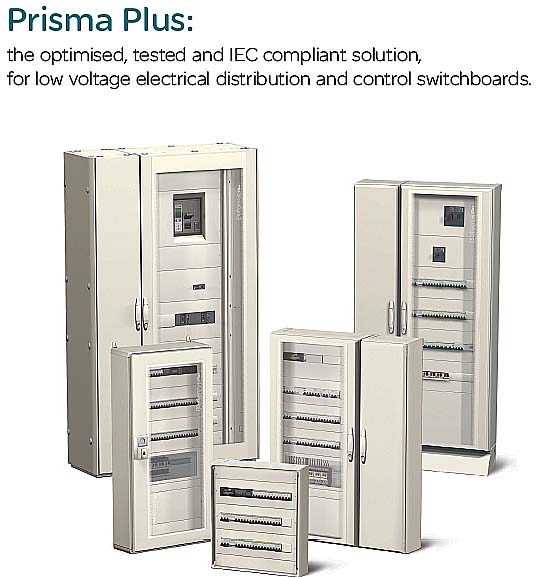
Рис. Schneider Electric
With Prisma Plus G you can be sure to build 100% Schneider Electric switchboards that are safe, optimised:
> All components (switchgear, distribution blocks, prefabricated connections, etc.) are perfectly rated and coordinated to work together;
> All switchboard configurations, even the most demanding ones, have been tested.
You can prove that your switchboard meets the current standards, at any time.
You can be sure to build a reliable electrical installation and give your customers full satisfaction in terms of dependability and safety for people and the installation.
Prisma Plus G with its discreet design, blends harmoniously into all tertiary and industrial buildings, including in entrance halls and passageways.
With Prisma Plus G you can build just the right switchboard for your customer, sized precisely to fit costs and needs.
With this complete, prefabricated and tested system, it's easy to upgrade your installation and still maintain the performance levels.
> The wall-mounted and floor-standing enclosures combine easily with switchboards already in service.
> Devices can be replaced or added at any time.
[Schneider Electric]С помощью оболочек Prisma Plus G можно создавать безопасные распределительные щиты, на 100 % состоящие из изделий Schneider Electric:
> все изделия (коммутационная аппаратура, распределительные блоки, готовые заводские соединения и т. д.) полностью совместимы механически и электрически;
> все варианты компоновки распределительных щитов, в том числе для наиболее ответственных применений, прошли испытания.В любое время вы можете доказать, что ваши распределительные щиты полностью соответствуют требованиям действующих стандартов.
Вы можете быть полностью уверены в том, что создаете надежные электроустановки, удовлетворяющие всем требованиям безопасности для людей и оборудования
Благодаря строгому дизайну, распределительные щиты Prisma Plus G гармонично сочетаются с интерьером любого общественного или промышленного здания. Они хорошо смотрятся и в вестибюле, и в коридоре.
Применяя оболочки Prisma Plus G можно создавать распределительные щиты, точно соответствующие требованиям заказчика как с точки зрения технических характеристик, так и стоимости.
С помощью данной испытанной системы, содержащей все необходимые компоненты заводского изготовления можно легко модернизировать существующую электроустановку и поддерживать её уровни производительности.> Навесные и напольные оболочки можно легко присоединить к уже эксплуатируемым распределительным щитам.
> Аппаратуру можно заменять или добавлять в любое время.
[Перевод Интент]The switchboard, central to the electrical installation.
Both the point of arrival of energy and a device for distribution to the site applications, the LV switchboard is the intelligence of the system, central to the electrical installation.
[Schneider Electric]Распределительный щит – «сердце» электроустановки.
Низковольтное комплектное устройство распределения является «сердцем» электроустановки, поскольку именно оно принимает электроэнергию из сети и распределяет её по территориально распределенным нагрузкам.
[Перевод Интент]Тематики
- НКУ (шкафы, пульты,...)
- электроснабжение в целом
EN
- branch distribution panel
- distributing board
- distributing panel
- distributing switchboard
- distribution bench
- distribution board
- distribution panel
- distribution switchboard
- gear
- keyboard
- PNL
- SB
- sw & d
- switchboard
- switchboard panel
DE
- elektrischer Verteiler, m
- Schalttafel
- Verteiler, m
FR
- tableau de distribution
- tableau de répartition, m
Англо-русский словарь нормативно-технической терминологии > switchboard
-
16 Bibliography
■ Aitchison, J. (1987). Noam Chomsky: Consensus and controversy. New York: Falmer Press.■ Anderson, J. R. (1980). Cognitive psychology and its implications. San Francisco: W. H. Freeman.■ Anderson, J. R. (1983). The architecture of cognition. Cambridge, MA: Harvard University Press.■ Anderson, J. R. (1995). Cognitive psychology and its implications (4th ed.). New York: W. H. Freeman.■ Archilochus (1971). In M. L. West (Ed.), Iambi et elegi graeci (Vol. 1). Oxford: Oxford University Press.■ Armstrong, D. M. (1990). The causal theory of the mind. In W. G. Lycan (Ed.), Mind and cognition: A reader (pp. 37-47). Cambridge, MA: Basil Blackwell. (Originally published in 1981 in The nature of mind and other essays, Ithaca, NY: University Press).■ Atkins, P. W. (1992). Creation revisited. Oxford: W. H. Freeman & Company.■ Austin, J. L. (1962). How to do things with words. Cambridge, MA: Harvard University Press.■ Bacon, F. (1878). Of the proficience and advancement of learning divine and human. In The works of Francis Bacon (Vol. 1). Cambridge, MA: Hurd & Houghton.■ Bacon, R. (1928). Opus majus (Vol. 2). R. B. Burke (Trans.). Philadelphia, PA: University of Pennsylvania Press.■ Bar-Hillel, Y. (1960). The present status of automatic translation of languages. In F. L. Alt (Ed.), Advances in computers (Vol. 1). New York: Academic Press.■ Barr, A., & E. A. Feigenbaum (Eds.) (1981). The handbook of artificial intelligence (Vol. 1). Reading, MA: Addison-Wesley.■ Barr, A., & E. A. Feigenbaum (Eds.) (1982). The handbook of artificial intelligence (Vol. 2). Los Altos, CA: William Kaufman.■ Barron, F. X. (1963). The needs for order and for disorder as motives in creative activity. In C. W. Taylor & F. X. Barron (Eds.), Scientific creativity: Its rec ognition and development (pp. 153-160). New York: Wiley.■ Bartlett, F. C. (1932). Remembering: A study in experimental and social psychology. Cambridge: Cambridge University Press.■ Bartley, S. H. (1969). Principles of perception. London: Harper & Row.■ Barzun, J. (1959). The house of intellect. New York: Harper & Row.■ Beach, F. A., D. O. Hebb, C. T. Morgan & H. W. Nissen (Eds.) (1960). The neu ropsychology of Lashley. New York: McGraw-Hill.■ Berkeley, G. (1996). Principles of human knowledge: Three Dialogues. Oxford: Oxford University Press. (Originally published in 1710.)■ Berlin, I. (1953). The hedgehog and the fox: An essay on Tolstoy's view of history. NY: Simon & Schuster.■ Bierwisch, J. (1970). Semantics. In J. Lyons (Ed.), New horizons in linguistics. Baltimore: Penguin Books.■ Black, H. C. (1951). Black's law dictionary. St. Paul, MN: West Publishing.■ Bloom, A. (1981). The linguistic shaping of thought: A study in the impact of language on thinking in China and the West. Hillsdale, NJ: Erlbaum.■ Bobrow, D. G., & D. A. Norman (1975). Some principles of memory schemata. In D. G. Bobrow & A. Collins (Eds.), Representation and understanding: Stud ies in Cognitive Science (pp. 131-149). New York: Academic Press.■ Boden, M. A. (1977). Artificial intelligence and natural man. New York: Basic Books.■ Boden, M. A. (1981). Minds and mechanisms. Ithaca, NY: Cornell University Press.■ Boden, M. A. (1990a). The creative mind: Myths and mechanisms. London: Cardinal.■ Boden, M. A. (1990b). The philosophy of artificial intelligence. Oxford: Oxford University Press.■ Boden, M. A. (1994). Precis of The creative mind: Myths and mechanisms. Behavioral and brain sciences 17, 519-570.■ Boden, M. (1996). Creativity. In M. Boden (Ed.), Artificial Intelligence (2nd ed.). San Diego: Academic Press.■ Bolter, J. D. (1984). Turing's man: Western culture in the computer age. Chapel Hill, NC: University of North Carolina Press.■ Bolton, N. (1972). The psychology of thinking. London: Methuen.■ Bourne, L. E. (1973). Some forms of cognition: A critical analysis of several papers. In R. Solso (Ed.), Contemporary issues in cognitive psychology (pp. 313324). Loyola Symposium on Cognitive Psychology (Chicago 1972). Washington, DC: Winston.■ Bransford, J. D., N. S. McCarrell, J. J. Franks & K. E. Nitsch (1977). Toward unexplaining memory. In R. Shaw & J. D. Bransford (Eds.), Perceiving, acting, and knowing (pp. 431-466). Hillsdale, NJ: Lawrence Erlbaum Associates.■ Breger, L. (1981). Freud's unfinished journey. London: Routledge & Kegan Paul.■ Brehmer, B. (1986). In one word: Not from experience. In H. R. Arkes & K. Hammond (Eds.), Judgment and decision making: An interdisciplinary reader (pp. 705-719). Cambridge: Cambridge University Press.■ Bresnan, J. (1978). A realistic transformational grammar. In M. Halle, J. Bresnan & G. A. Miller (Eds.), Linguistic theory and psychological reality (pp. 1-59). Cambridge, MA: MIT Press.■ Brislin, R. W., W. J. Lonner & R. M. Thorndike (Eds.) (1973). Cross- cultural research methods. New York: Wiley.■ Bronowski, J. (1977). A sense of the future: Essays in natural philosophy. P. E. Ariotti with R. Bronowski (Eds.). Cambridge, MA: MIT Press.■ Bronowski, J. (1978). The origins of knowledge and imagination. New Haven, CT: Yale University Press.■ Brown, R. O. (1973). A first language: The early stages. Cambridge, MA: Harvard University Press.■ Brown, T. (1970). Lectures on the philosophy of the human mind. In R. Brown (Ed.), Between Hume and Mill: An anthology of British philosophy- 1749- 1843 (pp. 330-387). New York: Random House/Modern Library.■ Bruner, J. S., J. Goodnow & G. Austin (1956). A study of thinking. New York: Wiley.■ Calvin, W. H. (1990). The cerebral symphony: Seashore reflections on the structure of consciousness. New York: Bantam.■ Campbell, J. (1982). Grammatical man: Information, entropy, language, and life. New York: Simon & Schuster.■ Campbell, J. (1989). The improbable machine. New York: Simon & Schuster.■ Carlyle, T. (1966). On heroes, hero- worship and the heroic in history. Lincoln: University of Nebraska Press. (Originally published in 1841.)■ Carnap, R. (1959). The elimination of metaphysics through logical analysis of language [Ueberwindung der Metaphysik durch logische Analyse der Sprache]. In A. J. Ayer (Ed.), Logical positivism (pp. 60-81) A. Pap (Trans). New York: Free Press. (Originally published in 1932.)■ Cassirer, E. (1946). Language and myth. New York: Harper and Brothers. Reprinted. New York: Dover Publications, 1953.■ Cattell, R. B., & H. J. Butcher (1970). Creativity and personality. In P. E. Vernon (Ed.), Creativity. Harmondsworth, England: Penguin Books.■ Caudill, M., & C. Butler (1990). Naturally intelligent systems. Cambridge, MA: MIT Press/Bradford Books.■ Chandrasekaran, B. (1990). What kind of information processing is intelligence? A perspective on AI paradigms and a proposal. In D. Partridge & R. Wilks (Eds.), The foundations of artificial intelligence: A sourcebook (pp. 14-46). Cambridge: Cambridge University Press.■ Charniak, E., & McDermott, D. (1985). Introduction to artificial intelligence. Reading, MA: Addison-Wesley.■ Chase, W. G., & H. A. Simon (1988). The mind's eye in chess. In A. Collins & E. E. Smith (Eds.), Readings in cognitive science: A perspective from psychology and artificial intelligence (pp. 461-493). San Mateo, CA: Kaufmann.■ Cheney, D. L., & R. M. Seyfarth (1990). How monkeys see the world: Inside the mind of another species. Chicago: University of Chicago Press.■ Chi, M.T.H., R. Glaser & E. Rees (1982). Expertise in problem solving. In R. J. Sternberg (Ed.), Advances in the psychology of human intelligence (pp. 7-73). Hillsdale, NJ: Lawrence Erlbaum Associates.■ Chomsky, N. (1957). Syntactic structures. The Hague: Mouton. Janua Linguarum.■ Chomsky, N. (1964). A transformational approach to syntax. In J. A. Fodor & J. J. Katz (Eds.), The structure of language: Readings in the philosophy of lan guage (pp. 211-245). Englewood Cliffs, NJ: Prentice-Hall.■ Chomsky, N. (1965). Aspects of the theory of syntax. Cambridge, MA: MIT Press.■ Chomsky, N. (1972). Language and mind (enlarged ed.). New York: Harcourt Brace Jovanovich.■ Chomsky, N. (1979). Language and responsibility. New York: Pantheon.■ Chomsky, N. (1986). Knowledge of language: Its nature, origin and use. New York: Praeger Special Studies.■ Churchland, P. (1979). Scientific realism and the plasticity of mind. New York: Cambridge University Press.■ Churchland, P. M. (1989). A neurocomputational perspective: The nature of mind and the structure of science. Cambridge, MA: MIT Press.■ Churchland, P. S. (1986). Neurophilosophy. Cambridge, MA: MIT Press/Bradford Books.■ Clark, A. (1996). Philosophical Foundations. In M. A. Boden (Ed.), Artificial in telligence (2nd ed.). San Diego: Academic Press.■ Clark, H. H., & T. B. Carlson (1981). Context for comprehension. In J. Long & A. Baddeley (Eds.), Attention and performance (Vol. 9, pp. 313-330). Hillsdale, NJ: Lawrence Erlbaum Associates.■ Clarke, A. C. (1984). Profiles of the future: An inquiry into the limits of the possible. New York: Holt, Rinehart & Winston.■ Claxton, G. (1980). Cognitive psychology: A suitable case for what sort of treatment? In G. Claxton (Ed.), Cognitive psychology: New directions (pp. 1-25). London: Routledge & Kegan Paul.■ Code, M. (1985). Order and organism. Albany, NY: State University of New York Press.■ Collingwood, R. G. (1972). The idea of history. New York: Oxford University Press.■ Coopersmith, S. (1967). The antecedents of self- esteem. San Francisco: W. H. Freeman.■ Copland, A. (1952). Music and imagination. London: Oxford University Press.■ Coren, S. (1994). The intelligence of dogs. New York: Bantam Books.■ Cottingham, J. (Ed.) (1996). Western philosophy: An anthology. Oxford: Blackwell Publishers.■ Cox, C. (1926). The early mental traits of three hundred geniuses. Stanford, CA: Stanford University Press.■ Craik, K.J.W. (1943). The nature of explanation. Cambridge: Cambridge University Press.■ Cronbach, L. J. (1990). Essentials of psychological testing (5th ed.). New York: HarperCollins.■ Cronbach, L. J., & R. E. Snow (1977). Aptitudes and instructional methods. New York: Irvington. Paperback edition, 1981.■ Csikszentmihalyi, M. (1993). The evolving self. New York: Harper Perennial.■ Culler, J. (1976). Ferdinand de Saussure. New York: Penguin Books.■ Curtius, E. R. (1973). European literature and the Latin Middle Ages. W. R. Trask (Trans.). Princeton, NJ: Princeton University Press.■ D'Alembert, J.L.R. (1963). Preliminary discourse to the encyclopedia of Diderot. R. N. Schwab (Trans.). Indianapolis: Bobbs-Merrill.■ Dampier, W. C. (1966). A history of modern science. Cambridge: Cambridge University Press.■ Darwin, C. (1911). The life and letters of Charles Darwin (Vol. 1). Francis Darwin (Ed.). New York: Appleton.■ Davidson, D. (1970) Mental events. In L. Foster & J. W. Swanson (Eds.), Experience and theory (pp. 79-101). Amherst: University of Massachussetts Press.■ Davies, P. (1995). About time: Einstein's unfinished revolution. New York: Simon & Schuster/Touchstone.■ Davis, R., & J. J. King (1977). An overview of production systems. In E. Elcock & D. Michie (Eds.), Machine intelligence 8. Chichester, England: Ellis Horwood.■ Davis, R., & D. B. Lenat (1982). Knowledge- based systems in artificial intelligence. New York: McGraw-Hill.■ Dawkins, R. (1982). The extended phenotype: The gene as the unit of selection. Oxford: W. H. Freeman.■ deKleer, J., & J. S. Brown (1983). Assumptions and ambiguities in mechanistic mental models (1983). In D. Gentner & A. L. Stevens (Eds.), Mental modes (pp. 155-190). Hillsdale, NJ: Lawrence Erlbaum Associates.■ Dennett, D. C. (1978a). Brainstorms: Philosophical essays on mind and psychology. Montgomery, VT: Bradford Books.■ Dennett, D. C. (1978b). Toward a cognitive theory of consciousness. In D. C. Dennett, Brainstorms: Philosophical Essays on Mind and Psychology. Montgomery, VT: Bradford Books.■ Dennett, D. C. (1995). Darwin's dangerous idea: Evolution and the meanings of life. New York: Simon & Schuster/Touchstone.■ Descartes, R. (1897-1910). Traite de l'homme. In Oeuvres de Descartes (Vol. 11, pp. 119-215). Paris: Charles Adam & Paul Tannery. (Originally published in 1634.)■ Descartes, R. (1950). Discourse on method. L. J. Lafleur (Trans.). New York: Liberal Arts Press. (Originally published in 1637.)■ Descartes, R. (1951). Meditation on first philosophy. L. J. Lafleur (Trans.). New York: Liberal Arts Press. (Originally published in 1641.)■ Descartes, R. (1955). The philosophical works of Descartes. E. S. Haldane and G.R.T. Ross (Trans.). New York: Dover. (Originally published in 1911 by Cambridge University Press.)■ Descartes, R. (1967). Discourse on method (Pt. V). In E. S. Haldane and G.R.T. Ross (Eds.), The philosophical works of Descartes (Vol. 1, pp. 106-118). Cambridge: Cambridge University Press. (Originally published in 1637.)■ Descartes, R. (1970a). Discourse on method. In E. S. Haldane & G.R.T. Ross (Eds.), The philosophical works of Descartes (Vol. 1, pp. 181-200). Cambridge: Cambridge University Press. (Originally published in 1637.)■ Descartes, R. (1970b). Principles of philosophy. In E. S. Haldane & G.R.T. Ross (Eds.), The philosophical works of Descartes (Vol. 1, pp. 178-291). Cambridge: Cambridge University Press. (Originally published in 1644.)■ Descartes, R. (1984). Meditations on first philosophy. In J. Cottingham, R. Stoothoff & D. Murduch (Trans.), The philosophical works of Descartes (Vol. 2). Cambridge: Cambridge University Press. (Originally published in 1641.)■ Descartes, R. (1986). Meditations on first philosophy. J. Cottingham (Trans.). Cambridge: Cambridge University Press. (Originally published in 1641 as Med itationes de prima philosophia.)■ deWulf, M. (1956). An introduction to scholastic philosophy. Mineola, NY: Dover Books.■ Dixon, N. F. (1981). Preconscious processing. London: Wiley.■ Doyle, A. C. (1986). The Boscombe Valley mystery. In Sherlock Holmes: The com plete novels and stories (Vol. 1). New York: Bantam.■ Dreyfus, H., & S. Dreyfus (1986). Mind over machine. New York: Free Press.■ Dreyfus, H. L. (1972). What computers can't do: The limits of artificial intelligence (revised ed.). New York: Harper & Row.■ Dreyfus, H. L., & S. E. Dreyfus (1986). Mind over machine: The power of human intuition and expertise in the era of the computer. New York: Free Press.■ Edelman, G. M. (1992). Bright air, brilliant fire: On the matter of the mind. New York: Basic Books.■ Ehrenzweig, A. (1967). The hidden order of art. London: Weidenfeld & Nicolson.■ Einstein, A., & L. Infeld (1938). The evolution of physics. New York: Simon & Schuster.■ Eisenstein, S. (1947). Film sense. New York: Harcourt, Brace & World.■ Everdell, W. R. (1997). The first moderns. Chicago: University of Chicago Press.■ Eysenck, M. W. (1977). Human memory: Theory, research and individual difference. Oxford: Pergamon.■ Eysenck, M. W. (1982). Attention and arousal: Cognition and performance. Berlin: Springer.■ Eysenck, M. W. (1984). A handbook of cognitive psychology. Hillsdale, NJ: Lawrence Erlbaum Associates.■ Fancher, R. E. (1979). Pioneers of psychology. New York: W. W. Norton.■ Farrell, B. A. (1981). The standing of psychoanalysis. New York: Oxford University Press.■ Feldman, D. H. (1980). Beyond universals in cognitive development. Norwood, NJ: Ablex.■ Fetzer, J. H. (1996). Philosophy and cognitive science (2nd ed.). New York: Paragon House.■ Finke, R. A. (1990). Creative imagery: Discoveries and inventions in visualization. Hillsdale, NJ: Lawrence Erlbaum Associates.■ Flanagan, O. (1991). The science of the mind. Cambridge MA: MIT Press/Bradford Books.■ Fodor, J. (1983). The modularity of mind. Cambridge, MA: MIT Press/Bradford Books.■ Frege, G. (1972). Conceptual notation. T. W. Bynum (Trans.). Oxford: Clarendon Press. (Originally published in 1879.)■ Frege, G. (1979). Logic. In H. Hermes, F. Kambartel & F. Kaulbach (Eds.), Gottlob Frege: Posthumous writings. Chicago: University of Chicago Press. (Originally published in 1879-1891.)■ Freud, S. (1959). Creative writers and day-dreaming. In J. Strachey (Ed.), The standard edition of the complete psychological works of Sigmund Freud (Vol. 9, pp. 143-153). London: Hogarth Press.■ Freud, S. (1966). Project for a scientific psychology. In J. Strachey (Ed.), The stan dard edition of the complete psychological works of Sigmund Freud (Vol. 1, pp. 295-398). London: Hogarth Press. (Originally published in 1950 as Aus den AnfaЁngen der Psychoanalyse, in London by Imago Publishing.)■ Freud, S. (1976). Lecture 18-Fixation to traumas-the unconscious. In J. Strachey (Ed.), The standard edition of the complete psychological works of Sigmund Freud (Vol. 16, p. 285). London: Hogarth Press.■ Galileo, G. (1990). Il saggiatore [The assayer]. In S. Drake (Ed.), Discoveries and opinions of Galileo. New York: Anchor Books. (Originally published in 1623.)■ Gassendi, P. (1970). Letter to Descartes. In "Objections and replies." In E. S. Haldane & G.R.T. Ross (Eds.), The philosophical works of Descartes (Vol. 2, pp. 179-240). Cambridge: Cambridge University Press. (Originally published in 1641.)■ Gazzaniga, M. S. (1988). Mind matters: How mind and brain interact to create our conscious lives. Boston: Houghton Mifflin in association with MIT Press/Bradford Books.■ Genesereth, M. R., & N. J. Nilsson (1987). Logical foundations of artificial intelligence. Palo Alto, CA: Morgan Kaufmann.■ Ghiselin, B. (1952). The creative process. New York: Mentor.■ Ghiselin, B. (1985). The creative process. Berkeley, CA: University of California Press. (Originally published in 1952.)■ Gilhooly, K. J. (1996). Thinking: Directed, undirected and creative (3rd ed.). London: Academic Press.■ Glass, A. L., K. J. Holyoak & J. L. Santa (1979). Cognition. Reading, MA: AddisonWesley.■ Goody, J. (1977). The domestication of the savage mind. Cambridge: Cambridge University Press.■ Gruber, H. E. (1980). Darwin on man: A psychological study of scientific creativity (2nd ed.). Chicago: University of Chicago Press.■ Gruber, H. E., & S. Davis (1988). Inching our way up Mount Olympus: The evolving systems approach to creative thinking. In R. J. Sternberg (Ed.), The nature of creativity: Contemporary psychological perspectives. Cambridge: Cambridge University Press.■ Guthrie, E. R. (1972). The psychology of learning. New York: Harper. (Originally published in 1935.)■ Habermas, J. (1972). Knowledge and human interests. Boston: Beacon Press.■ Hadamard, J. (1945). The psychology of invention in the mathematical field. Princeton, NJ: Princeton University Press.■ Hand, D. J. (1985). Artificial intelligence and psychiatry. Cambridge: Cambridge University Press.■ Harris, M. (1981). The language myth. London: Duckworth.■ Haugeland, J. (Ed.) (1981). Mind design: Philosophy, psychology, artificial intelligence. Cambridge, MA: MIT Press/Bradford Books.■ Haugeland, J. (1981a). The nature and plausibility of cognitivism. In J. Haugeland (Ed.), Mind design: Philosophy, psychology, artificial intelligence (pp. 243-281). Cambridge, MA: MIT Press.■ Haugeland, J. (1981b). Semantic engines: An introduction to mind design. In J. Haugeland (Ed.), Mind design: Philosophy, psychology, artificial intelligence (pp. 1-34). Cambridge, MA: MIT Press/Bradford Books.■ Haugeland, J. (1985). Artificial intelligence: The very idea. Cambridge, MA: MIT Press.■ Hawkes, T. (1977). Structuralism and semiotics. Berkeley: University of California Press.■ Hebb, D. O. (1949). The organisation of behaviour. New York: Wiley.■ Hebb, D. O. (1958). A textbook of psychology. Philadelphia: Saunders.■ Hegel, G.W.F. (1910). The phenomenology of mind. J. B. Baille (Trans.). London: Sonnenschein. (Originally published as Phaenomenologie des Geistes, 1807.)■ Heisenberg, W. (1958). Physics and philosophy. New York: Harper & Row.■ Hempel, C. G. (1966). Philosophy of natural science. Englewood Cliffs, NJ: PrenticeHall.■ Herman, A. (1997). The idea of decline in Western history. New York: Free Press.■ Herrnstein, R. J., & E. G. Boring (Eds.) (1965). A source book in the history of psy chology. Cambridge, MA: Harvard University Press.■ Herzmann, E. (1964). Mozart's creative process. In P. H. Lang (Ed.), The creative world of Mozart (pp. 17-30). London: Oldbourne Press.■ Hilgard, E. R. (1957). Introduction to psychology. London: Methuen.■ Hobbes, T. (1651). Leviathan. London: Crooke.■ Holliday, S. G., & M. J. Chandler (1986). Wisdom: Explorations in adult competence. Basel, Switzerland: Karger.■ Horn, J. L. (1986). In R. J. Sternberg (Ed.), Advances in the psychology of human intelligence (Vol. 3). Hillsdale, NJ: Erlbaum.■ Hull, C. (1943). Principles of behavior. New York: Appleton-Century-Crofts.■ Hume, D. (1955). An inquiry concerning human understanding. New York: Liberal Arts Press. (Originally published in 1748.)■ Hume, D. (1975). An enquiry concerning human understanding. In L. A. SelbyBigge (Ed.), Hume's enquiries (3rd. ed., revised P. H. Nidditch). Oxford: Clarendon. (Spelling and punctuation revised.) (Originally published in 1748.)■ Hume, D. (1978). A treatise of human nature. L. A. Selby-Bigge (Ed.), Hume's enquiries (3rd. ed., revised P. H. Nidditch). Oxford: Clarendon. (With some modifications of spelling and punctuation.) (Originally published in 1690.)■ Hunt, E. (1973). The memory we must have. In R. C. Schank & K. M. Colby (Eds.), Computer models of thought and language. (pp. 343-371) San Francisco: W. H. Freeman.■ Husserl, E. (1960). Cartesian meditations. The Hague: Martinus Nijhoff.■ Inhelder, B., & J. Piaget (1958). The growth of logical thinking from childhood to adolescence. New York: Basic Books. (Originally published in 1955 as De la logique de l'enfant a` la logique de l'adolescent. [Paris: Presses Universitaire de France])■ James, W. (1890a). The principles of psychology (Vol. 1). New York: Dover Books.■ James, W. (1890b). The principles of psychology. New York: Henry Holt.■ Jevons, W. S. (1900). The principles of science (2nd ed.). London: Macmillan.■ Johnson, G. (1986). Machinery of the mind: Inside the new science of artificial intelli gence. New York: Random House.■ Johnson-Laird, P. N. (1983). Mental models: Toward a cognitive science of language, inference, and consciousness. Cambridge, MA: Harvard University Press.■ Johnson-Laird, P. N. (1988). The computer and the mind: An introduction to cognitive science. Cambridge, MA: Harvard University Press.■ Jones, E. (1961). The life and work of Sigmund Freud. L. Trilling & S. Marcus (Eds.). London: Hogarth.■ Jones, R. V. (1985). Complementarity as a way of life. In A. P. French & P. J. Kennedy (Eds.), Niels Bohr: A centenary volume. Cambridge, MA: Harvard University Press.■ Kant, I. (1933). Critique of Pure Reason (2nd ed.). N. K. Smith (Trans.). London: Macmillan. (Originally published in 1781 as Kritik der reinen Vernunft.)■ Kant, I. (1891). Solution of the general problems of the Prolegomena. In E. Belfort (Trans.), Kant's Prolegomena. London: Bell. (With minor modifications.) (Originally published in 1783.)■ Katona, G. (1940). Organizing and memorizing: Studies in the psychology of learning and teaching. New York: Columbia University Press.■ Kaufman, A. S. (1979). Intelligent testing with the WISC-R. New York: Wiley.■ Koestler, A. (1964). The act of creation. New York: Arkana (Penguin).■ Kohlberg, L. (1971). From is to ought. In T. Mischel (Ed.), Cognitive development and epistemology. (pp. 151-235) New York: Academic Press.■ KoЁhler, W. (1925). The mentality of apes. New York: Liveright.■ KoЁhler, W. (1927). The mentality of apes (2nd ed.). Ella Winter (Trans.). London: Routledge & Kegan Paul.■ KoЁhler, W. (1930). Gestalt psychology. London: G. Bell.■ KoЁhler, W. (1947). Gestalt psychology. New York: Liveright.■ KoЁhler, W. (1969). The task of Gestalt psychology. Princeton, NJ: Princeton University Press.■ Kuhn, T. (1970). The structure of scientific revolutions (2nd ed.). Chicago: University of Chicago Press.■ Langer, E. J. (1989). Mindfulness. Reading, MA: Addison-Wesley.■ Langer, S. (1962). Philosophical sketches. Baltimore: Johns Hopkins University Press.■ Langley, P., H. A. Simon, G. L. Bradshaw & J. M. Zytkow (1987). Scientific dis covery: Computational explorations of the creative process. Cambridge, MA: MIT Press.■ Lashley, K. S. (1951). The problem of serial order in behavior. In L. A. Jeffress (Ed.), Cerebral mechanisms in behavior, the Hixon Symposium (pp. 112-146) New York: Wiley.■ LeDoux, J. E., & W. Hirst (1986). Mind and brain: Dialogues in cognitive neuroscience. Cambridge: Cambridge University Press.■ Lehnert, W. (1978). The process of question answering. Hillsdale, NJ: Lawrence Erlbaum Associates.■ Leiber, J. (1991). Invitation to cognitive science. Oxford: Blackwell.■ Lenat, D. B., & G. Harris (1978). Designing a rule system that searches for scientific discoveries. In D. A. Waterman & F. Hayes-Roth (Eds.), Pattern directed inference systems (pp. 25-52) New York: Academic Press.■ Levenson, T. (1995). Measure for measure: A musical history of science. New York: Touchstone. (Originally published in 1994.)■ Leґvi-Strauss, C. (1963). Structural anthropology. C. Jacobson & B. Grundfest Schoepf (Trans.). New York: Basic Books. (Originally published in 1958.)■ Levine, M. W., & J. M. Schefner (1981). Fundamentals of sensation and perception. London: Addison-Wesley.■ Lewis, C. I. (1946). An analysis of knowledge and valuation. LaSalle, IL: Open Court.■ Lighthill, J. (1972). A report on artificial intelligence. Unpublished manuscript, Science Research Council.■ Lipman, M., A. M. Sharp & F. S. Oscanyan (1980). Philosophy in the classroom. Philadelphia: Temple University Press.■ Lippmann, W. (1965). Public opinion. New York: Free Press. (Originally published in 1922.)■ Locke, J. (1956). An essay concerning human understanding. Chicago: Henry Regnery Co. (Originally published in 1690.)■ Locke, J. (1975). An essay concerning human understanding. P. H. Nidditch (Ed.). Oxford: Clarendon. (Originally published in 1690.) (With spelling and punctuation modernized and some minor modifications of phrasing.)■ Lopate, P. (1994). The art of the personal essay. New York: Doubleday/Anchor Books.■ Lorimer, F. (1929). The growth of reason. London: Kegan Paul. Machlup, F., & U. Mansfield (Eds.) (1983). The study of information. New York: Wiley.■ Manguel, A. (1996). A history of reading. New York: Viking.■ Markey, J. F. (1928). The symbolic process. London: Kegan Paul.■ Martin, R. M. (1969). On Ziff's "Natural and formal languages." In S. Hook (Ed.), Language and philosophy: A symposium (pp. 249-263). New York: New York University Press.■ Mazlish, B. (1993). The fourth discontinuity: the co- evolution of humans and machines. New Haven, CT: Yale University Press.■ McCarthy, J., & P. J. Hayes (1969). Some philosophical problems from the standpoint of artificial intelligence. In B. Meltzer & D. Michie (Eds.), Machine intelligence 4. Edinburgh: Edinburgh University Press.■ McClelland, J. L., D. E. Rumelhart & G. E. Hinton (1986). The appeal of parallel distributed processing. In D. E. Rumelhart, J. L. McClelland & the PDP Research Group (Eds.), Parallel distributed processing: Explorations in the mi crostructure of cognition (Vol. 1, pp. 3-40). Cambridge, MA: MIT Press/ Bradford Books.■ McCorduck, P. (1979). Machines who think. San Francisco: W. H. Freeman.■ McLaughlin, T. (1970). Music and communication. London: Faber & Faber.■ Mednick, S. A. (1962). The associative basis of the creative process. Psychological Review 69, 431-436.■ Meehl, P. E., & C. J. Golden (1982). Taxometric methods. In Kendall, P. C., & Butcher, J. N. (Eds.), Handbook of research methods in clinical psychology (pp. 127-182). New York: Wiley.■ Mehler, J., E.C.T. Walker & M. Garrett (Eds.) (1982). Perspectives on mental rep resentation: Experimental and theoretical studies of cognitive processes and ca pacities. Hillsdale, NJ: Lawrence Erlbaum Associates.■ Mill, J. S. (1900). A system of logic, ratiocinative and inductive: Being a connected view of the principles of evidence and the methods of scientific investigation. London: Longmans, Green.■ Miller, G. A. (1979, June). A very personal history. Talk to the Cognitive Science Workshop, Cambridge, MA.■ Miller, J. (1983). States of mind. New York: Pantheon Books.■ Minsky, M. (1975). A framework for representing knowledge. In P. H. Winston (Ed.), The psychology of computer vision (pp. 211-277). New York: McGrawHill.■ Minsky, M., & S. Papert (1973). Artificial intelligence. Condon Lectures, Oregon State System of Higher Education, Eugene, Oregon.■ Minsky, M. L. (1986). The society of mind. New York: Simon & Schuster.■ Mischel, T. (1976). Psychological explanations and their vicissitudes. In J. K. Cole & W. J. Arnold (Eds.), Nebraska Symposium on motivation (Vol. 23). Lincoln, NB: University of Nebraska Press.■ Morford, M.P.O., & R. J. Lenardon (1995). Classical mythology (5th ed.). New York: Longman.■ Murdoch, I. (1954). Under the net. New York: Penguin.■ Nagel, E. (1959). Methodological issues in psychoanalytic theory. In S. Hook (Ed.), Psychoanalysis, scientific method, and philosophy: A symposium. New York: New York University Press.■ Nagel, T. (1979). Mortal questions. London: Cambridge University Press.■ Nagel, T. (1986). The view from nowhere. Oxford: Oxford University Press.■ Neisser, U. (1967). Cognitive psychology. New York: Appleton-Century-Crofts.■ Neisser, U. (1972). Changing conceptions of imagery. In P. W. Sheehan (Ed.), The function and nature of imagery (pp. 233-251). London: Academic Press.■ Neisser, U. (1976). Cognition and reality. San Francisco: W. H. Freeman.■ Neisser, U. (1978). Memory: What are the important questions? In M. M. Gruneberg, P. E. Morris & R. N. Sykes (Eds.), Practical aspects of memory (pp. 3-24). London: Academic Press.■ Neisser, U. (1979). The concept of intelligence. In R. J. Sternberg & D. K. Detterman (Eds.), Human intelligence: Perspectives on its theory and measurement (pp. 179-190). Norwood, NJ: Ablex.■ Nersessian, N. (1992). How do scientists think? Capturing the dynamics of conceptual change in science. In R. N. Giere (Ed.), Cognitive models of science (pp. 3-44). Minneapolis: University of Minnesota Press.■ Newell, A. (1973a). Artificial intelligence and the concept of mind. In R. C. Schank & K. M. Colby (Eds.), Computer models of thought and language (pp. 1-60). San Francisco: W. H. Freeman.■ Newell, A. (1973b). You can't play 20 questions with nature and win. In W. G. Chase (Ed.), Visual information processing (pp. 283-310). New York: Academic Press.■ Newell, A., & H. A. Simon (1963). GPS: A program that simulates human thought. In E. A. Feigenbaum & J. Feldman (Eds.), Computers and thought (pp. 279-293). New York & McGraw-Hill.■ Newell, A., & H. A. Simon (1972). Human problem solving. Englewood Cliffs, NJ: Prentice-Hall.■ Nietzsche, F. (1966). Beyond good and evil. W. Kaufmann (Trans.). New York: Vintage. (Originally published in 1885.)■ Nilsson, N. J. (1971). Problem- solving methods in artificial intelligence. New York: McGraw-Hill.■ Nussbaum, M. C. (1978). Aristotle's Princeton University Press. De Motu Anamalium. Princeton, NJ:■ Oersted, H. C. (1920). Thermo-electricity. In Kirstine Meyer (Ed.), H. C. Oersted, Natuurvidenskabelige Skrifter (Vol. 2). Copenhagen: n.p. (Originally published in 1830 in The Edinburgh encyclopaedia.)■ Ong, W. J. (1982). Orality and literacy: The technologizing of the word. London: Methuen.■ Onians, R. B. (1954). The origins of European thought. Cambridge, MA: Cambridge University Press.■ Osgood, C. E. (1960). Method and theory in experimental psychology. New York: Oxford University Press. (Originally published in 1953.)■ Osgood, C. E. (1966). Language universals and psycholinguistics. In J. H. Greenberg (Ed.), Universals of language (2nd ed., pp. 299-322). Cambridge, MA: MIT Press.■ Palmer, R. E. (1969). Hermeneutics. Evanston, IL: Northwestern University Press.■ Peirce, C. S. (1934). Some consequences of four incapacities-Man, a sign. In C. Hartsborne & P. Weiss (Eds.), Collected papers of Charles Saunders Peirce (Vol. 5, pp. 185-189). Cambridge, MA: Harvard University Press.■ Penfield, W. (1959). In W. Penfield & L. Roberts, Speech and brain mechanisms. Princeton, NJ: Princeton University Press.■ Penrose, R. (1994). Shadows of the mind: A search for the missing science of conscious ness. Oxford: Oxford University Press.■ Perkins, D. N. (1981). The mind's best work. Cambridge, MA: Harvard University Press.■ Peterfreund, E. (1986). The heuristic approach to psychoanalytic therapy. In■ J. Reppen (Ed.), Analysts at work, (pp. 127-144). Hillsdale, NJ: Analytic Press.■ Piaget, J. (1952). The origin of intelligence in children. New York: International Universities Press. (Originally published in 1936.)■ Piaget, J. (1954). Le langage et les opeґrations intellectuelles. Proble` mes de psycho linguistique. Symposium de l'Association de Psychologie Scientifique de Langue Francёaise. Paris: Presses Universitaires de France.■ Piaget, J. (1977). Problems of equilibration. In H. E. Gruber & J. J. Voneche (Eds.), The essential Piaget (pp. 838-841). London: Routlege & Kegan Paul. (Originally published in 1975 as L'eґquilibration des structures cognitives [Paris: Presses Universitaires de France].)■ Piaget, J., & B. Inhelder. (1973). Memory and intelligence. New York: Basic Books.■ Pinker, S. (1994). The language instinct. New York: Morrow.■ Pinker, S. (1996). Facts about human language relevant to its evolution. In J.-P. Changeux & J. Chavaillon (Eds.), Origins of the human brain. A symposium of the Fyssen foundation (pp. 262-283). Oxford: Clarendon Press. Planck, M. (1949). Scientific autobiography and other papers. F. Gaynor (Trans.). New York: Philosophical Library.■ Planck, M. (1990). Wissenschaftliche Selbstbiographie. W. Berg (Ed.). Halle, Germany: Deutsche Akademie der Naturforscher Leopoldina.■ Plato (1892). Meno. In The Dialogues of Plato (B. Jowett, Trans.; Vol. 2). New York: Clarendon. (Originally published circa 380 B.C.)■ Poincareґ, H. (1913). Mathematical creation. In The foundations of science. G. B. Halsted (Trans.). New York: Science Press.■ Poincareґ, H. (1921). The foundations of science: Science and hypothesis, the value of science, science and method. G. B. Halstead (Trans.). New York: Science Press.■ Poincareґ, H. (1929). The foundations of science: Science and hypothesis, the value of science, science and method. New York: Science Press.■ Poincareґ, H. (1952). Science and method. F. Maitland (Trans.) New York: Dover.■ Polya, G. (1945). How to solve it. Princeton, NJ: Princeton University Press.■ Polanyi, M. (1958). Personal knowledge. London: Routledge & Kegan Paul.■ Popper, K. (1968). Conjectures and refutations: The growth of scientific knowledge. New York: Harper & Row/Basic Books.■ Popper, K., & J. Eccles (1977). The self and its brain. New York: Springer-Verlag.■ Popper, K. R. (1959). The logic of scientific discovery. London: Hutchinson.■ Putnam, H. (1975). Mind, language and reality: Philosophical papers (Vol. 2). Cambridge: Cambridge University Press.■ Putnam, H. (1987). The faces of realism. LaSalle, IL: Open Court.■ Pylyshyn, Z. W. (1981). The imagery debate: Analog media versus tacit knowledge. In N. Block (Ed.), Imagery (pp. 151-206). Cambridge, MA: MIT Press.■ Pylyshyn, Z. W. (1984). Computation and cognition: Towards a foundation for cog nitive science. Cambridge, MA: MIT Press/Bradford Books.■ Quillian, M. R. (1968). Semantic memory. In M. Minsky (Ed.), Semantic information processing (pp. 216-260). Cambridge, MA: MIT Press.■ Quine, W.V.O. (1960). Word and object. Cambridge, MA: Harvard University Press.■ Rabbitt, P.M.A., & S. Dornic (Eds.). Attention and performance (Vol. 5). London: Academic Press.■ Rawlins, G.J.E. (1997). Slaves of the Machine: The quickening of computer technology. Cambridge, MA: MIT Press/Bradford Books.■ Reid, T. (1970). An inquiry into the human mind on the principles of common sense. In R. Brown (Ed.), Between Hume and Mill: An anthology of British philosophy- 1749- 1843 (pp. 151-178). New York: Random House/Modern Library.■ Reitman, W. (1970). What does it take to remember? In D. A. Norman (Ed.), Models of human memory (pp. 470-510). London: Academic Press.■ Ricoeur, P. (1974). Structure and hermeneutics. In D. I. Ihde (Ed.), The conflict of interpretations: Essays in hermeneutics (pp. 27-61). Evanston, IL: Northwestern University Press.■ Robinson, D. N. (1986). An intellectual history of psychology. Madison: University of Wisconsin Press.■ Rorty, R. (1979). Philosophy and the mirror of nature. Princeton, NJ: Princeton University Press.■ Rosch, E. (1977). Human categorization. In N. Warren (Ed.), Studies in cross cultural psychology (Vol. 1, pp. 1-49) London: Academic Press.■ Rosch, E. (1978). Principles of categorization. In E. Rosch & B. B. Lloyd (Eds.), Cognition and categorization (pp. 27-48). Hillsdale, NJ: Lawrence Erlbaum Associates.■ Rosch, E., & B. B. Lloyd (1978). Principles of categorization. In E. Rosch & B. B. Lloyd (Eds.), Cognition and categorization. Hillsdale, NJ: Lawrence Erlbaum Associates.■ Rose, S. (1970). The chemistry of life. Baltimore: Penguin Books.■ Rose, S. (1976). The conscious brain (updated ed.). New York: Random House.■ Rose, S. (1993). The making of memory: From molecules to mind. New York: Anchor Books. (Originally published in 1992)■ Roszak, T. (1994). The cult of information: A neo- Luddite treatise on high- tech, artificial intelligence, and the true art of thinking (2nd ed.). Berkeley: University of California Press.■ Royce, J. R., & W. W. Rozeboom (Eds.) (1972). The psychology of knowing. New York: Gordon & Breach.■ Rumelhart, D. E. (1977). Introduction to human information processing. New York: Wiley.■ Rumelhart, D. E. (1980). Schemata: The building blocks of cognition. In R. J. Spiro, B. Bruce & W. F. Brewer (Eds.), Theoretical issues in reading comprehension. Hillsdale, NJ: Lawrence Erlbaum Associates.■ Rumelhart, D. E., & J. L. McClelland (1986). On learning the past tenses of English verbs. In J. L. McClelland & D. E. Rumelhart (Eds.), Parallel distributed processing: Explorations in the microstructure of cognition (Vol. 2). Cambridge, MA: MIT Press.■ Rumelhart, D. E., P. Smolensky, J. L. McClelland & G. E. Hinton (1986). Schemata and sequential thought processes in PDP models. In J. L. McClelland, D. E. Rumelhart & the PDP Research Group (Eds.), Parallel Distributed Processing (Vol. 2, pp. 7-57). Cambridge, MA: MIT Press.■ Russell, B. (1927). An outline of philosophy. London: G. Allen & Unwin.■ Russell, B. (1961). History of Western philosophy. London: George Allen & Unwin.■ Russell, B. (1965). How I write. In Portraits from memory and other essays. London: Allen & Unwin.■ Russell, B. (1992). In N. Griffin (Ed.), The selected letters of Bertrand Russell (Vol. 1), The private years, 1884- 1914. Boston: Houghton Mifflin. Ryecroft, C. (1966). Psychoanalysis observed. London: Constable.■ Sagan, C. (1978). The dragons of Eden: Speculations on the evolution of human intel ligence. New York: Ballantine Books.■ Salthouse, T. A. (1992). Expertise as the circumvention of human processing limitations. In K. A. Ericsson & J. Smith (Eds.), Toward a general theory of expertise: Prospects and limits (pp. 172-194). Cambridge: Cambridge University Press.■ Sanford, A. J. (1987). The mind of man: Models of human understanding. New Haven, CT: Yale University Press.■ Sapir, E. (1921). Language. New York: Harcourt, Brace, and World.■ Sapir, E. (1964). Culture, language, and personality. Berkeley: University of California Press. (Originally published in 1941.)■ Sapir, E. (1985). The status of linguistics as a science. In D. G. Mandelbaum (Ed.), Selected writings of Edward Sapir in language, culture and personality (pp. 160166). Berkeley: University of California Press. (Originally published in 1929).■ Scardmalia, M., & C. Bereiter (1992). Literate expertise. In K. A. Ericsson & J. Smith (Eds.), Toward a general theory of expertise: Prospects and limits (pp. 172-194). Cambridge: Cambridge University Press.■ Schafer, R. (1954). Psychoanalytic interpretation in Rorschach testing. New York: Grune & Stratten.■ Schank, R. C. (1973). Identification of conceptualizations underlying natural language. In R. C. Schank & K. M. Colby (Eds.), Computer models of thought and language (pp. 187-248). San Francisco: W. H. Freeman.■ Schank, R. C. (1976). The role of memory in language processing. In C. N. Cofer (Ed.), The structure of human memory. (pp. 162-189) San Francisco: W. H. Freeman.■ Schank, R. C. (1986). Explanation patterns: Understanding mechanically and creatively. Hillsdale, NJ: Lawrence Erlbaum Associates.■ Schank, R. C., & R. P. Abelson (1977). Scripts, plans, goals, and understanding. Hillsdale, NJ: Lawrence Erlbaum Associates.■ SchroЁdinger, E. (1951). Science and humanism. Cambridge: Cambridge University Press.■ Searle, J. R. (1981a). Minds, brains, and programs. In J. Haugeland (Ed.), Mind design: Philosophy, psychology, artificial intelligence (pp. 282-306). Cambridge, MA: MIT Press.■ Searle, J. R. (1981b). Minds, brains and programs. In D. Hofstadter & D. Dennett (Eds.), The mind's I (pp. 353-373). New York: Basic Books.■ Searle, J. R. (1983). Intentionality. New York: Cambridge University Press.■ Serres, M. (1982). The origin of language: Biology, information theory, and thermodynamics. M. Anderson (Trans.). In J. V. Harari & D. F. Bell (Eds.), Hermes: Literature, science, philosophy (pp. 71-83). Baltimore: Johns Hopkins University Press.■ Simon, H. A. (1966). Scientific discovery and the psychology of problem solving. In R. G. Colodny (Ed.), Mind and cosmos: Essays in contemporary science and philosophy (pp. 22-40). Pittsburgh: University of Pittsburgh Press.■ Simon, H. A. (1979). Models of thought. New Haven, CT: Yale University Press.■ Simon, H. A. (1989). The scientist as a problem solver. In D. Klahr & K. Kotovsky (Eds.), Complex information processing: The impact of Herbert Simon. Hillsdale, N.J.: Lawrence Erlbaum Associates.■ Simon, H. A., & C. Kaplan (1989). Foundations of cognitive science. In M. Posner (Ed.), Foundations of cognitive science (pp. 1-47). Cambridge, MA: MIT Press.■ Simonton, D. K. (1988). Creativity, leadership and chance. In R. J. Sternberg (Ed.), The nature of creativity. Cambridge: Cambridge University Press.■ Skinner, B. F. (1974). About behaviorism. New York: Knopf.■ Smith, E. E. (1988). Concepts and thought. In J. Sternberg & E. E. Smith (Eds.), The psychology of human thought (pp. 19-49). Cambridge: Cambridge University Press.■ Smith, E. E. (1990). Thinking: Introduction. In D. N. Osherson & E. E. Smith (Eds.), Thinking. An invitation to cognitive science. (Vol. 3, pp. 1-2). Cambridge, MA: MIT Press.■ Socrates. (1958). Meno. In E. H. Warmington & P. O. Rouse (Eds.), Great dialogues of Plato W.H.D. Rouse (Trans.). New York: New American Library. (Original publication date unknown.)■ Solso, R. L. (1974). Theories of retrieval. In R. L. Solso (Ed.), Theories in cognitive psychology. Potomac, MD: Lawrence Erlbaum Associates.■ Spencer, H. (1896). The principles of psychology. New York: Appleton-CenturyCrofts.■ Steiner, G. (1975). After Babel: Aspects of language and translation. New York: Oxford University Press.■ Sternberg, R. J. (1977). Intelligence, information processing, and analogical reasoning. Hillsdale, NJ: Lawrence Erlbaum Associates.■ Sternberg, R. J. (1994). Intelligence. In R. J. Sternberg, Thinking and problem solving. San Diego: Academic Press.■ Sternberg, R. J., & J. E. Davidson (1985). Cognitive development in gifted and talented. In F. D. Horowitz & M. O'Brien (Eds.), The gifted and talented (pp. 103-135). Washington, DC: American Psychological Association.■ Storr, A. (1993). The dynamics of creation. New York: Ballantine Books. (Originally published in 1972.)■ Stumpf, S. E. (1994). Philosophy: History and problems (5th ed.). New York: McGraw-Hill.■ Sulloway, F. J. (1996). Born to rebel: Birth order, family dynamics, and creative lives. New York: Random House/Vintage Books.■ Thorndike, E. L. (1906). Principles of teaching. New York: A. G. Seiler.■ Thorndike, E. L. (1970). Animal intelligence: Experimental studies. Darien, CT: Hafner Publishing Co. (Originally published in 1911.)■ Titchener, E. B. (1910). A textbook of psychology. New York: Macmillan.■ Titchener, E. B. (1914). A primer of psychology. New York: Macmillan.■ Toulmin, S. (1957). The philosophy of science. London: Hutchinson.■ Tulving, E. (1972). Episodic and semantic memory. In E. Tulving & W. Donaldson (Eds.), Organisation of memory. London: Academic Press.■ Turing, A. (1946). In B. E. Carpenter & R. W. Doran (Eds.), ACE reports of 1946 and other papers. Cambridge, MA: MIT Press.■ Turkle, S. (1984). Computers and the second self: Computers and the human spirit. New York: Simon & Schuster.■ Tyler, S. A. (1978). The said and the unsaid: Mind, meaning, and culture. New York: Academic Press.■ van Heijenoort (Ed.) (1967). From Frege to Goedel. Cambridge: Harvard University Press.■ Varela, F. J. (1984). The creative circle: Sketches on the natural history of circularity. In P. Watzlawick (Ed.), The invented reality (pp. 309-324). New York: W. W. Norton.■ Voltaire (1961). On the Penseґs of M. Pascal. In Philosophical letters (pp. 119-146). E. Dilworth (Trans.). Indianapolis: Bobbs-Merrill.■ Wagman, M. (1991a). Artificial intelligence and human cognition: A theoretical inter comparison of two realms of intellect. Westport, CT: Praeger.■ Wagman, M. (1991b). Cognitive science and concepts of mind: Toward a general theory of human and artificial intelligence. Westport, CT: Praeger.■ Wagman, M. (1993). Cognitive psychology and artificial intelligence: Theory and re search in cognitive science. Westport, CT: Praeger.■ Wagman, M. (1995). The sciences of cognition: Theory and research in psychology and artificial intelligence. Westport, CT: Praeger.■ Wagman, M. (1996). Human intellect and cognitive science: Toward a general unified theory of intelligence. Westport, CT: Praeger.■ Wagman, M. (1997a). Cognitive science and the symbolic operations of human and artificial intelligence: Theory and research into the intellective processes. Westport, CT: Praeger.■ Wagman, M. (1997b). The general unified theory of intelligence: Central conceptions and specific application to domains of cognitive science. Westport, CT: Praeger.■ Wagman, M. (1998a). Cognitive science and the mind- body problem: From philosophy to psychology to artificial intelligence to imaging of the brain. Westport, CT: Praeger.■ Wagman, M. (1998b). Language and thought in humans and computers: Theory and research in psychology, artificial intelligence, and neural science. Westport, CT: Praeger.■ Wagman, M. (1998c). The ultimate objectives of artificial intelligence: Theoretical and research foundations, philosophical and psychological implications. Westport, CT: Praeger.■ Wagman, M. (1999). The human mind according to artificial intelligence: Theory, re search, and implications. Westport, CT: Praeger.■ Wagman, M. (2000). Scientific discovery processes in humans and computers: Theory and research in psychology and artificial intelligence. Westport, CT: Praeger.■ Wall, R. (1972). Introduction to mathematical linguistics. Englewood Cliffs, NJ: Prentice-Hall.■ Wallas, G. (1926). The Art of Thought. New York: Harcourt, Brace & Co.■ Wason, P. (1977). Self contradictions. In P. Johnson-Laird & P. Wason (Eds.), Thinking: Readings in cognitive science. Cambridge: Cambridge University Press.■ Wason, P. C., & P. N. Johnson-Laird. (1972). Psychology of reasoning: Structure and content. Cambridge, MA: Harvard University Press.■ Watson, J. (1930). Behaviorism. New York: W. W. Norton.■ Watzlawick, P. (1984). Epilogue. In P. Watzlawick (Ed.), The invented reality. New York: W. W. Norton, 1984.■ Weinberg, S. (1977). The first three minutes: A modern view of the origin of the uni verse. New York: Basic Books.■ Weisberg, R. W. (1986). Creativity: Genius and other myths. New York: W. H. Freeman.■ Weizenbaum, J. (1976). Computer power and human reason: From judgment to cal culation. San Francisco: W. H. Freeman.■ Wertheimer, M. (1945). Productive thinking. New York: Harper & Bros.■ Whitehead, A. N. (1925). Science and the modern world. New York: Macmillan.■ Whorf, B. L. (1956). In J. B. Carroll (Ed.), Language, thought and reality: Selected writings of Benjamin Lee Whorf. Cambridge, MA: MIT Press.■ Whyte, L. L. (1962). The unconscious before Freud. New York: Anchor Books.■ Wiener, N. (1954). The human use of human beings. Boston: Houghton Mifflin.■ Wiener, N. (1964). God & Golem, Inc.: A comment on certain points where cybernetics impinges on religion. Cambridge, MA: MIT Press.■ Winograd, T. (1972). Understanding natural language. New York: Academic Press.■ Winston, P. H. (1987). Artificial intelligence: A perspective. In E. L. Grimson & R. S. Patil (Eds.), AI in the 1980s and beyond (pp. 1-12). Cambridge, MA: MIT Press.■ Winston, P. H. (Ed.) (1975). The psychology of computer vision. New York: McGrawHill.■ Wittgenstein, L. (1953). Philosophical investigations. Oxford: Basil Blackwell.■ Wittgenstein, L. (1958). The blue and brown books. New York: Harper Colophon.■ Woods, W. A. (1975). What's in a link: Foundations for semantic networks. In D. G. Bobrow & A. Collins (Eds.), Representations and understanding: Studies in cognitive science (pp. 35-84). New York: Academic Press.■ Woodworth, R. S. (1938). Experimental psychology. New York: Holt; London: Methuen (1939).■ Wundt, W. (1904). Principles of physiological psychology (Vol. 1). E. B. Titchener (Trans.). New York: Macmillan.■ Wundt, W. (1907). Lectures on human and animal psychology. J. E. Creighton & E. B. Titchener (Trans.). New York: Macmillan.■ Young, J. Z. (1978). Programs of the brain. New York: Oxford University Press.■ Ziman, J. (1978). Reliable knowledge: An exploration of the grounds for belief in science. Cambridge: Cambridge University Press.Historical dictionary of quotations in cognitive science > Bibliography
-
17 Intentionality
Mental states are both caused by the operations of the brain and realized in the structure of the brain (and the rest of the central nervous system). Once the possibility of mental and physical phenomena standing in both these relations is understood we have removed at least one major obstacle to seeing how mental states which are caused by brain states can also cause further brain states and mental states.But this model of "caused by" and "realized in" only raises the next question, how can Intentionality function causally? Granted that Intentional states can themselves be caused by and realized in the structure of the brain, how can Intentionality itself have any causal efficacy? When I raise my arm my intention in action causes my arm to go up. This is a case of a mental event causing a physical event. But, one might ask, how could such a thing occur? My arm going up is caused entirely by a series of neuron firings. We do not know where in the brain these firings originate, but they go at some point through the motor cortex and control a series of arm muscles which contract when the appropriate neurons fire. Now what has any mental event got to do with all of this? As with our previous questions, I want to answer this one by appealing to different levels of description of a substance, where the phenomena at each of the different levels function causally. (Searle, 1983, pp. 265, 268)Historical dictionary of quotations in cognitive science > Intentionality
-
18 program
программа; управляющая программа, УП || программировать; готовить УП- 3D machining programto download programs to individual machine controls — вводить УП ( из центральной ЭВМ системы) в УЧПУ отдельных станков
- absolute program
- ACC programs
- analysis programs
- application design automation program
- APT program
- APT source program
- assembly language program
- assembly program
- automated data preparation evaluation program
- automatic NC machining data generation programs
- automatic offset program
- auxiliary program
- axis driver scaling program
- basic control program
- BCL program
- benchmark program
- bureau computer program
- CAD program
- CAD/NC programs
- CAM-generated program
- canned generic NC program
- canned program
- cellular conversion program
- channel program
- circuit analysis program
- CNC inspection program
- CNC program
- CNC turning-center program
- collision-free program
- communication control program
- communications control program
- companion program
- compensation program
- complex tooling cost program
- component program
- computer program
- computer-aided design and evaluation program
- computer-stored part program
- consultation program
- contingency program
- continuous NC program
- contour milling program
- control I/O program
- control program
- control-resident program
- conversational program
- coolant-dispensing program
- cutter path program
- cutting program
- data editor program
- data fetch program
- data I/O program
- DCS program
- declarative program
- dexel program
- diagnosis program
- diagnostic program
- DMIS program
- DNC programs
- DOS program
- download program
- draft program
- edited program
- error-correcting program
- ESPRIT program
- evaluation program
- execute program
- executive program
- extension program
- externally generated program
- family program
- fault diagnosis program
- finished program
- finite-element program
- fixture-building program
- Fortran-based program
- functions program
- general program
- general-purpose program
- geometric modeling program
- goal-oriented program
- graphics program
- grinding program
- grinding wheel wear compensation program
- hard program
- hardwired program
- high priority program
- higher priority program
- ICAM programs
- implementation program
- incremental program
- initial loading program
- inspection program
- integer program
- interface program
- interpretative program
- interpreter program
- interpretive program
- jaw change program
- ladder logic program
- logic program
- low priority program
- lower priority program
- machine cutting program
- machine program
- machine tool program
- machining program
- main program
- maintenance programs
- malfunction analysis program
- management program
- manipulator-level program
- master program
- master software program
- MDI program
- measuring machine program
- mirror program
- MMS programs
- mode control program
- modeling program
- modified program
- monitoring program
- MS program
- MS-DOS programs
- multisequence program
- NC data generation programs
- NC program
- NC tape program
- NC verification program
- nonresident diagnostic program
- nonresident diagnostics program
- numerical control program
- numerically intensive program
- occupational health program
- occupational safety program
- off-line diagnostic program
- one-to-one program
- operator-activated program
- optimizing program
- order-picking program
- palletizing program
- part inspection program
- part program
- part-family program
- part-plan program
- pass through program
- path calculation program
- PC vision programs
- peripheral support program
- pilot program
- plain language program
- plugboard program
- postprocessor programs
- preprepared program
- preselected program
- preset program
- priority program
- production program
- proved program
- proven part program
- punched tape program
- quality programs
- read-in program
- refining program
- requesting part program
- returning control program
- reverse program
- robot control program
- robot execution program
- robot program
- rule-based program
- running program
- scaling program
- scheduling program
- sequential program
- service program
- simulation program
- SMSG program
- software control programs
- software programs
- source program
- SPC program
- spreadsheet program
- spreadsheet-based program
- standard machining program
- standard program
- stored program
- stress analysis program
- structural optimization program
- swarf-clearing program
- system program
- system's executive program
- tape program
- task program
- task-level program
- teaching operations function program
- temporary diagnostic program
- test program
- testing program
- thread program
- three-dimensional surface program
- time program
- tolerancing program
- tool animation program
- tool management program
- tooling program
- tool-plan program
- tool-setting program
- tool-tracking program
- tracing program
- trajectory translator program
- turnkey programs
- type-related program
- unproved program
- upload program
- up-to-date program
- user friendly program
- user I/O program
- user-extension program
- user-written program
- utility program
- vehicular behavior analysis program
- work program
- working program
- workpiece program
- workstation programEnglish-Russian dictionary of mechanical engineering and automation > program
-
19 planning
сущ.1) упр. планирование, проектирование, составление плана [проекта, программы\] (составление плана деятельности какого-л. лица или организации на будущий период; одна из функций менеджмента)planning flow — процесс планирования, последовательность процесса планирования
See:CHILD [agent\]: governmental planning, local planning, state planning CHILD [object\]: advanced product quality planning, advertising planning, administrative planning 2), budget planning, business planning, business continuity planning, capacity planning, career planning, contingency planning, corporate planning, cost planning, day-to-day production planning, directive planning, enterprise resource planning, entrepreneurial planning, estate planning, financial planning, human resource planning, insurance planning, inventory planning, investment planning, journey planning, manpower planning, marketing planning, master planning, media planning, new product planning, operational planning, operations planning, pension planning, personnel planning, planning department, price planning, product planning, profit planning, recruitment planning, risk response planning, rough-cut capacity planning, shift planning, social planning, strategic planning, tax planning, urban planning CHILD [method\]: adaptive planning, aggregate planning, backward planning, bottom-up planning, decomposition planning, forward planning, Hoshin planning, network planning, retrospective planning, scenario planning, top-down planning, top-down/bottom-up planning CHILD [time\]: long-term planning, medium-term planning, short-term planning, planning period, planning bureau, planning manager, planning and control cycle, management, programming, plan2) эк. планирование (экономики), экономическое планирование (метод регулирования экономики с помощью постановки долговременных целей развития и выработки программ, направленных на достижение этих целей)See:* * *. . Словарь экономических терминов . -
20 work
work [wɜ:k]travail ⇒ 1 (a)-(e), 1 (g) œuvre ⇒ 1 (a), 1 (f) besogne ⇒ 1 (b) emploi ⇒ 1 (c) ouvrage ⇒ 1 (f) recherches ⇒ 1 (g) travailler ⇒ 2A (a)-(e), 3A (b), 3A (c), 3A (e), 3C (a) fonctionner ⇒ 2B (a) marcher ⇒ 2B (a), 2B (b) réussir ⇒ 2B (b) agir ⇒ 2B (c), 2B (d) faire travailler ⇒ 3A (a) faire marcher ⇒ 3B (a) façonner ⇒ 3C (a) mécanisme ⇒ 4 1 (a) travaux ⇒ 4 1 (b) usine ⇒ 4 2 (a)1 noun(a) (effort, activity) travail m, œuvre f;∎ computers take some of the work out of filing les ordinateurs facilitent le classement;∎ this report needs more work il y a encore du travail à faire sur ce rapport, ce rapport demande plus de travail;∎ she's done a lot of work for charity elle a beaucoup travaillé pour des associations caritatives;∎ it will take a lot of work to make a team out of them ça va être un drôle de travail de faire d'eux une équipe;∎ keep up the good work! continuez comme ça!;∎ nice or good work! c'est du bon travail!, bravo!;∎ that's fine work or a fine piece of work c'est du beau travail;∎ your work has been useful vous avez fait du travail utile;∎ work on the tunnel is to start in March (existing tunnel) les travaux sur le tunnel doivent commencer en mars; (new tunnel) la construction du tunnel doit commencer en mars;∎ work in progress Administration travail en cours; Accountancy travaux mpl en cours, inventaire m de production; (sign) travaux en cours;∎ she put a lot of work into that book elle a beaucoup travaillé sur ce livre;∎ to make work for sb compliquer la vie à qn;∎ to start work, to set to work se mettre au travail;∎ she set or she went to work on the contract elle a commencé à travailler sur le contrat;∎ he set to work undermining their confidence il a entrepris de saper leur confiance;∎ I set him to work (on) painting the kitchen je lui ai donné la cuisine à peindre;∎ they put him to work in the kitchen ils l'ont mis au travail dans la cuisine;∎ let's get (down) to work! (mettons-nous) au travail!;∎ proverb all work and no play makes Jack a dull boy beaucoup de travail et peu de loisirs ne réussissent à personne(b) (duty, task) travail m, besogne f;∎ I've got loads of work to do j'ai énormément de travail à faire;∎ she gave us too much work elle nous a donné trop de travail;∎ he's trying to get some work done il essaie de travailler un peu;∎ they do their work well ils travaillent bien, ils font du bon travail;∎ it's hard work c'est du travail, ce n'est pas facile;∎ it's thirsty work ça donne soif;∎ to make short or light work of sth expédier qch;∎ figurative to make short work of sb ne faire qu'une bouchée de qn;∎ familiar it's nice work if you can get it! c'est une bonne planque, encore faut-il la trouver!(c) (paid employment) travail m, emploi m;∎ what (kind of) work do you do? qu'est-ce que vous faites dans la vie?, quel travail faites-vous?;∎ I do translation work je suis traducteur, je fais des traductions;∎ to find work trouver du travail;∎ to look for work chercher du travail ou un emploi;∎ to be in work travailler, avoir un emploi;∎ to be out of work être au chômage ou sans travail ou sans emploi;∎ he had a week off work (holiday) il a pris une semaine de vacances; (illness) il n'est pas allé au travail pendant une semaine;∎ to take time off work prendre des congés;∎ she's off work today elle ne travaille pas aujourd'hui;∎ to do a full day's work faire une journée entière de travail;∎ I go to work by bus je vais au travail en bus;∎ I'm late for work je suis en retard pour le travail;∎ he's a friend from work c'est un collègue;∎ where is your (place of) work? où travaillez-vous?, quel est votre lieu de travail?;∎ on her way home from work en rentrant du travail(e) (papers, material etc being worked on) travail m;∎ to take work home prendre du travail à la maison;∎ her work was all over the table son travail était étalé sur la table∎ it's all my own work j'ai tout fait moi-même;∎ it's an interesting piece of work (gen) c'est un travail intéressant; Art, Literature & Music c'est une œuvre intéressante;∎ very detailed/delicate work (embroidery, carving etc) ouvrage très détaillé/délicat;∎ these formations are the work of the wind ces formations sont l'œuvre du vent;∎ the silversmith sells much of his work to hotels l'orfèvre vend une grande partie de ce qu'il fait ou de son travail à des hôtels;∎ the complete works of Shakespeare les œuvres complètes ou l'œuvre de Shakespeare;∎ a new work on Portugal un nouvel ouvrage sur le Portugal;∎ a work of art une œuvre d'art;∎ works of fiction des ouvrages de fiction(g) (research) travail m, recherches fpl;∎ there hasn't been a lot of work done on the subject peu de travail a été fait ou peu de recherches ont été faites sur le sujet∎ good works bonnes œuvres fpl;∎ each man will be judged by his works chaque homme sera jugé selon ses œuvres;∎ charitable works actes mpl de charité, actes mpl charitables;∎ the murder is the work of a madman le meurtre est l'œuvre d'un fou∎ wait until the medicine has done its work attendez que le médicament ait agi ou ait produit son effetA.(a) (exert effort on a specific task, activity etc) travailler;∎ we worked for hours cleaning the house nous avons passé des heures à faire le ménage;∎ they worked in the garden ils ont fait du jardinage;∎ we work hard nous travaillons dur;∎ she's working on a novel just now elle travaille à un roman en ce moment;∎ a detective is working on this case un détective est sur cette affaire;∎ he works at or on keeping himself fit il fait de l'exercice pour garder la forme;∎ we have to work to a deadline nous devons respecter des délais dans notre travail;∎ we have to work to a budget nous devons travailler avec un certain budget;∎ I've worked with the handicapped before j'ai déjà travaillé avec les handicapés;∎ I work with the Spanish on that project je travaille (en collaboration) avec les Espagnols sur ce projet(b) (be employed) travailler;∎ he works as a teacher il a un poste d'enseignant;∎ I work in advertising je travaille dans la publicité;∎ who do you work for? chez qui est-ce que vous travaillez?;∎ she works in or for a bank elle travaille dans ou pour une banque;∎ I work a forty-hour week je travaille quarante heures par semaine, je fais une semaine de quarante heures;∎ to work for a living travailler pour gagner sa vie;∎ Industry to work to rule faire la grève du zèle∎ to work for a good cause travailler pour une bonne cause;∎ they're working for better international relations ils s'efforcent d'améliorer les relations internationales∎ you're going to have to work if you want to pass the exam il va falloir que tu travailles ou que tu étudies si tu veux avoir ton examen(e) (use a specified substance) travailler;∎ this sculptor works in or with copper ce sculpteur travaille avec le cuivre;∎ she has always worked in or with watercolours elle a toujours travaillé avec de la peinture à l'eauB.(a) (function, operate → machine, brain, system) fonctionner, marcher;∎ the lift doesn't work at night l'ascenseur ne marche pas la nuit;∎ the lift never works l'ascenseur est toujours en panne;∎ the radio works off batteries la radio fonctionne avec des piles;∎ a pump worked by hand une pompe actionnée à la main ou manuellement;∎ they soon got or had it working ils sont vite parvenus à le faire fonctionner;∎ she sat still, her brain or her mind working furiously elle était assise immobile, le cerveau en ébullition;∎ figurative everything worked smoothly tout s'est déroulé comme prévu;∎ your idea just won't work ton idée ne peut pas marcher;∎ this relationship isn't working cette relation ne marche pas;∎ that argument works both ways ce raisonnement est à double tranchant;∎ how does the law work exactly? comment la loi fonctionne-t-elle exactement?(b) (produce results, succeed) marcher, réussir;∎ it worked brilliantly ça a très bien marché;∎ their scheme didn't work leur complot a échoué;∎ that/flattery won't work with me ça/la flatterie ne prend pas avec moi(c) (drug, medicine) agir, produire ou faire son effet∎ the acid works as a catalyst l'acide agit comme ou sert de catalyseur;∎ events have worked against us/in our favour les événements ont agi contre nous/en notre faveur;∎ I'm working on the assumption that they'll sign the contract je pars du principe qu'ils signeront le contratC.∎ to work loose se desserrer;∎ to work free se libérer;∎ the nail worked through the sole of my shoe le clou est passé à travers la semelle de ma chaussure(b) (face, mouth) se contracter, se crisperA.(a) (worker, employee, horse) faire travailler;∎ the boss works his staff hard le patron exige beaucoup de travail de ses employés;∎ you work yourself too hard tu te surmènes;∎ to work oneself to death se tuer à la tâche;∎ to work one's fingers to the bone s'user au travail∎ they worked their passage to India ils ont payé leur passage en Inde en travaillant;∎ I worked my way through college j'ai travaillé pour payer mes études à l'université∎ he works the southern sales area il travaille pour le service commercial de la région sud;∎ the pollster worked both sides of the street le sondeur a enquêté des deux côtés de la rue;∎ figurative the candidate worked the crowd le candidat s'efforçait de soulever l'enthousiasme de la foule;∎ a real-estate agent who works the phones un agent immobilier qui fait de la prospection par téléphone;∎ she works the bars (prostitute) elle travaille dans les bars(d) (achieve, accomplish)∎ the new policy will work major changes la nouvelle politique opérera ou entraînera des changements importants;∎ the story worked its magic or its charm on the public l'histoire a enchanté le public;∎ to work a spell on sb jeter un sort à qn;∎ to work miracles faire ou accomplir des miracles;∎ to work wonders faire merveille;∎ she has worked wonders with the children elle a fait des merveilles avec les enfantsB.∎ this switch works the furnace ce bouton actionne ou commande la chaudière;∎ he knows how to work the drill il sait se servir de la perceuse∎ I worked the handle up and down j'ai remué la poignée de haut en bas;∎ to work one's hands free parvenir à dégager ses mains;∎ she worked the ropes loose elle a réussi à desserrer les cordes petit à petit∎ I worked my way along the ledge j'ai longé la saillie avec précaution;∎ he worked his way down/up the cliff il a descendu/monté la falaise lentement;∎ the beggar worked his way towards us le mendiant s'est approché de nous;∎ they worked their way through the list ils ont traité chaque élément de la liste tour à tour;∎ he's worked his way through the whole grant il a épuisé toute la subvention;∎ a band of rain working its way across the country un front de pluie qui traverse le pays;∎ they have worked themselves into a corner ils se sont mis dans une impasse∎ she managed to work a few days off elle s'est arrangée ou s'est débrouillée pour avoir quelques jours de congé;∎ I worked it or worked things so that she's never alone j'ai fait en sorte qu'elle ou je me suis arrangé pour qu'elle ne soit jamais seuleC.(a) (shape → leather, metal, stone) travailler, façonner; (→ clay, dough) travailler, pétrir; (→ object, sculpture) façonner; Sewing (design, initials) broder;∎ she worked the silver into earrings elle a travaillé l'argent pour en faire des boucles d'oreilles;∎ she worked a figure out of the wood elle a sculpté une silhouette dans le bois;∎ the flowers are worked in silk les fleurs sont brodées en soie;∎ work the putty into the right consistency travaillez le mastic pour lui donner la consistance voulue∎ gently work the cream into your hands massez-vous les mains pour faire pénétrer la crème;∎ work the dye into the surface of the leather faites pénétrer la teinture dans le cuir(c) (excite, provoke)∎ the orator worked the audience into a frenzy l'orateur a enflammé ou a galvanisé le public;∎ she worked herself into a rage elle s'est mise dans une colère noire4 works∎ familiar to foul up or to gum up the works tout foutre en l'air∎ road works travaux mpl; (sign) travaux;∎ Minister/Ministry of Works ministre m/ministère m des Travaux publics2 noun∎ a printing works une imprimerie;∎ a gas works une usine à gaz;∎ price ex works prix m sortie usine∎ the (whole) works tout le bataclan ou le tralala;∎ they had eggs, bacon, toast, the works ils mangeaient des œufs, du bacon, du pain grillé, tout, quoi!;∎ American to shoot the works jouer le grand jeu;∎ American we shot the works on the project nous avons mis le paquet sur le projet;∎ to give sb the works (special treatment) dérouler le tapis rouge pour qn; (beating) passer qn à tabac5 at work∎ to be at work on sth/(on) doing sth travailler (à) qch/à faire qch;∎ he's at work on a new book il travaille à un nouveau livre;∎ they're hard at work painting the house ils sont en plein travail, ils repeignent la maison∎ there are several factors at work here il y a plusieurs facteurs qui entrent en jeu ou qui jouent ici;∎ there are evil forces at work des forces mauvaises sont en action2 adverb∎ she's at work (gen) elle est au travail; (office) elle est au bureau; (factory) elle est à l'usine;∎ I'll phone you at work je t'appellerai au travail;∎ we met at work on s'est connus au travailworks band fanfare m (d'une entreprise);American work coat blouse f;works committee, works council comité m d'entreprise;work ethic = exaltation des valeurs liées au travail;work experience stage m (en entreprise);∎ the course includes two months' work experience le programme comprend un stage en entreprise de deux mois;American work farm = camp de travail forcé où les détenus travaillent la terre;Computing work file fichier m de travail;work flow déroulement m des opérations;work group groupe m de travail;works manager directeur(trice) m,f d'usine;work permit permis m de travail;Computing work sheet feuille f de travail;∎ I need more work space j'ai besoin de plus d'espace pour travailler;work surface surface f de travail;American work week semaine f de travailtravailler;∎ while he worked away at fixing the furnace tandis qu'il travaillait à réparer la chaudière;∎ we worked away all evening nous avons passé la soirée à travaillerglisser;∎ her socks had worked down around her ankles ses chaussettes étaient tombées sur ses chevilles(a) (incorporate) incorporer;∎ work the ointment in thoroughly faites bien pénétrer la pommade;∎ Cookery work the butter into the flour incorporez le beurre à la farine∎ he worked in a few sly remarks about the boss il a réussi à glisser quelques réflexions sournoises sur le patron;∎ I'll try and work the translation in some time this week (into schedule) j'essayerai de (trouver le temps de) faire la traduction dans le courant de la semaine(a) (dispose of → fat, weight) se débarrasser de, éliminer; (→ anxiety, frustration) passer, assouvir;∎ I worked off my excess energy chopping wood j'ai dépensé mon trop-plein d'énergie en cassant du bois;∎ he worked off his tensions by running il s'est défoulé en faisant du jogging;∎ to work off one's anger on sb passer sa colère sur qn(b) (debt, obligation)∎ it took him three months to work off his debt il a dû travailler trois mois pour rembourser son emprunt➲ work on∎ we've been working on him but he still won't go nous avons essayé de le persuader mais il ne veut toujours pas y aller;∎ I'll work on her je vais m'occuper d'elle(b) (task, problem)∎ the police are working on who stole the jewels la police s'efforce de retrouver celui qui a volé les bijoux;∎ he's been working on his breaststroke/emotional problems il a travaillé sa brasse/essayé de résoudre ses problèmes sentimentaux;∎ have you got any ideas? - I'm working on it as-tu des idées? - je cherche∎ have you any data to work on? avez-vous des données sur lesquelles vous fonder?(continue to work) continuer à travailler➲ work out(a) (discharge fully) acquitter en travaillant;∎ to work out one's notice faire son préavis∎ I work it out at £22 d'après mes calculs, ça fait 22 livres∎ have they worked out their differences? est-ce qu'ils ont réglé ou résolu leurs différends?;∎ I'm sure we can work this thing out (your problem) je suis sûr que nous pouvons arranger ça; (our argument) je suis sûr que nous finirons par nous mettre d'accord;∎ things will work themselves out les choses s'arrangeront toutes seules ou d'elles-mêmes∎ to work out a solution trouver une solution;∎ have you worked out yet when it's due to start? est-ce que tu sais quand ça doit commencer?;∎ she had it all worked out elle avait tout planifié;∎ we worked out an easier route nous avons trouvé un itinéraire plus facile(e) (figure out) arriver à comprendre;∎ I finally worked out why he was acting so strangely j'ai enfin découvert ou compris pourquoi il se comportait si bizarrement;∎ the dog had worked out how to open the door le chien avait compris comment ouvrir la porte;∎ I can't work her out je n'arrive pas à la comprendre;∎ I can't work their relationship out leurs rapports me dépassent(f) (mine, well) épuiser∎ it depends on how things work out ça dépend de la façon dont les choses se passent;∎ the trip worked out as planned le voyage s'est déroulé comme prévu;∎ I wonder how it will all work out je me demande comment tout cela va s'arranger;∎ it all worked out for the best tout a fini par s'arranger pour le mieux;∎ but it didn't work out that way mais il en a été tout autrement;∎ it worked out badly for them les choses ont mal tourné pour eux∎ she worked out fine as personnel director elle s'est bien débrouillée comme directeur du personnel;∎ are things working out for you OK? est-ce que ça se passe bien pour toi?;∎ did the new job work out? ça a marché pour le nouveau boulot?;∎ it didn't work out between them les choses ont plutôt mal tourné entre eux;∎ their project didn't work out leur projet est tombé à l'eau∎ how much does it all work out at? ça fait combien en tout?;∎ the average price for an apartment works out to or at $5,000 per square metre le prix moyen d'un appartement s'élève ou revient à 5000 dollars le mètre carré;∎ that works out at three hours a week ça fait trois heures par semaine;∎ electric heating works out expensive le chauffage électrique revient cher∎ the wind worked round to the north le vent a tourné au nord petit à petit∎ he finally worked round to the subject of housing il a fini par aborder le sujet du logement;∎ what's she working round to? où veut-elle en venir?∎ (bring round) I worked the conversation round to my salary j'ai amené la conversation sur la question de mon salaire∎ we worked our way through the crowd nous nous sommes frayé un chemin à travers la foule;∎ he worked his way through the book il a lu le livre du début à la fin;∎ figurative I worked the problem through j'ai étudié le problème sous tous ses aspects∎ she worked through lunch elle a travaillé pendant l'heure du déjeuner∎ he worked through his emotional problems il a réussi à assumer ses problèmes affectifs➲ work up(a) (stir up, rouse) exciter, provoquer;∎ he worked up the crowd il a excité la foule;∎ he worked the crowd up into a frenzy il a rendu la foule frénétique;∎ he works himself up or he gets himself worked up over nothing il s'énerve pour rien;∎ she had worked herself up into a dreadful rage elle s'était mise dans une rage terrible∎ I want to work these ideas up into an article je veux développer ces idées pour en faire un article;∎ to work up an appetite se mettre en appétit;∎ we worked up a sweat/a thirst playing tennis jouer au tennis nous a donné chaud/soif;∎ I can't work up any enthusiasm for this work je n'arrive pas à avoir le moindre enthousiasme pour ce travail;∎ he tried to work up an interest in the cause il a essayé de s'intéresser à la cause∎ to work one's way up faire son chemin;∎ she worked her way up from secretary to managing director elle a commencé comme secrétaire et elle a fait son chemin jusqu'au poste de P-DG;∎ I worked my way up from nothing je suis parti de rien(a) (clothing) remonter∎ the film was working up to a climax le film approchait de son point culminant;∎ things were working up to a crisis une crise se préparait, on était au bord d'une crise;∎ she's working up to what she wanted to ask elle en vient à ce qu'elle voulait demander;∎ what are you working up to? où veux-tu en venir?
См. также в других словарях:
System — (from Latin systēma , in turn from Greek polytonic|σύστημα systēma) is a set of interacting or interdependent entities, real or abstract, forming an integrated whole. The concept of an integrated whole can also be stated in terms of a system… … Wikipedia
System X (telephony) — System X was the name of the UK s first national digital telephone exchange system.HistorySystem X was developed by the UK Post Office (later to become British Telecom), GEC, Plessey, and Standard Telephones and Cables (STC), and first shown in… … Wikipedia
operations research — the analysis, usually involving mathematical treatment, of a process, problem, or operation to determine its purpose and effectiveness and to gain maximum efficiency. [1940 45, Amer.] * * * Application of scientific methods to management and… … Universalium
Function (mathematics) — f(x) redirects here. For the band, see f(x) (band). Graph of example function, In mathematics, a function associates one quantity, the a … Wikipedia
function — ▪ I. function func‧tion 1 [ˈfʌŋkʆn] noun 1. [countable] the purpose for which something is made or used, or the job that someone does; =role: • The main function of a cash machine is to provide people with cash when the bank is shut. • He was… … Financial and business terms
Operations room — Plan position indicator (PPI) display showing polar display and radar sweep. A real radar display would show hard terrain features and look recognizably map like, and from the sea, match well with land features of local nautical charts matching… … Wikipedia
System safety — The system safety concept calls for a risk management strategy based on identification, analysis of hazards and application of remedial controls using a systems based approach.cite book|title= System Safety Engineering and… … Wikipedia
Function object — A function object, also called a functor or functional, is a computer programming construct allowing an object to be invoked or called as if it were an ordinary function, usually with the same syntax.Function objects are unrelated to functors in… … Wikipedia
System Center Operations Manager Command Shell — Windows PowerShell Screenshot von PowerShell 1.0 Basisdaten Entwickler: Microsoft Corporation Aktuelle Version … Deutsch Wikipedia
System context diagram — Example of a System context diagram.[1] A System Context Diagram (SCD) in software engineering and systems engineering is a diagram that represents the actors outside a system that could interact with that system … Wikipedia
Function composition — For function composition in computer science, see function composition (computer science). g ∘ f, the composition of f and g. For example, (g ∘ f)(c) = #. In mathematics, function composition is the application of one function to the resul … Wikipedia
