

-
1 operating needs
эксплуатационные требования
эксплуатационные нужды
—
[Я.Н.Лугинский, М.С.Фези-Жилинская, Ю.С.Кабиров. Англо-русский словарь по электротехнике и электроэнергетике, Москва, 1999 г.]Тематики
- электротехника, основные понятия
Синонимы
EN
Англо-русский словарь нормативно-технической терминологии > operating needs
-
2 operating needs
1) Техника: эксплуатационные нужды, эксплуатационные требования2) Контроль качества: нужды эксплуатации, требования эксплуатации -
3 operating needs
Англо-русский словарь по электроэнергетике > operating needs
-
4 operating needs
-
5 operating needs
требования, нужды эксплуатации -
6 operating
операционный; операторный; рабочий; эксплуатационный; действующий; функциональный; находящийся в эксплуатации- operating agreement - operating air - operating arm - operating availability - operating capabilities - operating card - operating center distance - operating check - operating clearance - operating crew - operating efficiency - operating expenses - operating experience - operating force - operating overload - operating personnel - operating power - operating pressure - operating range - operating repair - operating revenue - operating shaft - operating temperature - automatic operating - electro-pneumatic operating - emergency operating - field operating - full-speed operating - hand operating - no-load operating - parallel operating -
7 need
1) потребность, нужда2) мн. ч. потребности•- housing needs - long-standing needs - operating needs - water needs* * *потребность, нужда- long-standing need
- water need -
8 BIOS
['baios] n. shkurtesë nga b asic i nput o utput s ystem ( BIOS) sistemi themelor për hyrje-dalje ( informatikë)What is BIOS?BIOS is an acronym for Basic Input/Output System. It is the boot firmware program on a PC, and controls the computer from the time you start it up until the operating system takes over. When you turn on a PC, the BIOS first conducts a basic hardware check, called a Power-On Self Test (POST), to determine whether all of the attachments are present and working. Then it loads the operating system into your computer's random access memory, or RAM.The BIOS also manages data flow between the computer's operating system and attached devices such as the hard disk, video card, keyboard, mouse, and printer.The BIOS stores the date, the time, and your system configuration information in a battery-powered, non-volatile memory chip, called a CMOS (Complementary Metal Oxide Semiconductor) after its manufacturing process.Although the BIOS is standardized and should rarely require updating, some older BIOS chips may not accommodate new hardware devices. Before the early 1990s, you couldn't update the BIOS without removing and replacing its ROM chip. Contemporary BIOS resides on memory chips such as flash chips or EEPROM (Electrically Erasable Programmable Read-Only Memory), so that you can update the BIOS yourself if necessary.For detailed information about BIOS updates, visit:What is firmware?Firmware consists of programs installed semi-permanently into memory, using various types of programmable ROM chips, such as PROMS, EPROMs, EEPROMs, and flash chips.Firmware is non-volatile, and will remain in memory after you turn the system off.Often, the term firmware is used to refer specifically to boot firmware, which controls a computer from the time that it is turned on until the primary operating system has taken over. Boot firmware's main function is to initialize the hardware and then to boot (load and execute) the primary operating system. On PCs, the boot firmware is usually referred to as the BIOS.What is the difference between memory and disk storage?Memory and disk storage both refer to internal storage space in a computer.The term memory usually means RAM (Random Access Memory). To refer to hard drive storage, the terms disk space or storage are usually used.Typically, computers have much less memory than disk space, because RAM is much more expensive per megabyte than a hard disk. Today, a typical desktop computer might come with 512MB of RAM, and a 40 gigabyte hard disk.Virtual memory is disk space that has been designated to act like RAM.Computers also contain a small amount of ROM, or read-only memory, containing permanent or semi-permanent (firmware) instructions for checking hardware and starting up the computer. On a PC, this is called the BIOS.What is RAM?RAM stands for Random Access Memory. RAM provides space for your computer to read and write data to be accessed by the CPU (central processing unit). When people refer to a computer's memory, they usually mean its RAM.New computers typically come with at least 256 megabytes (MB) of RAM installed, and can be upgraded to 512MB or even a gigabyte or more.If you add more RAM to your computer, you reduce the number of times your CPU must read data from your hard disk. This usually allows your computer to work considerably faster, as RAM is many times faster than a hard disk.RAM is volatile, so data stored in RAM stays there only as long as your computer is running. As soon as you turn the computer off, the data stored in RAM disappears.When you turn your computer on again, your computer's boot firmware (called BIOS on a PC) uses instructions stored semi-permanently in ROM chips to read your operating system and related files from the disk and load them back into RAM.Note: On a PC, different parts of RAM may be more or less easily accessible to programs. For example, cache RAM is made up of very high-speed RAM chips which sit between the CPU and main RAM, storing (i.e., caching) memory accesses by the CPU. Cache RAM helps to alleviate the gap between the speed of a CPU's megahertz rating and the ability of RAM to respond and deliver data. It reduces how often the CPU must wait for data from main memory.What is ROM?ROM is an acronym for Read-Only Memory. It refers to computer memory chips containing permanent or semi-permanent data. Unlike RAM, ROM is non-volatile; even after you turn off your computer, the contents of ROM will remain.Almost every computer comes with a small amount of ROM containing the boot firmware. This consists of a few kilobytes of code that tell the computer what to do when it starts up, e.g., running hardware diagnostics and loading the operating system into RAM. On a PC, the boot firmware is called the BIOS.Originally, ROM was actually read-only. To update the programs in ROM, you had to remove and physically replace your ROM chips. Contemporary versions of ROM allow some limited rewriting, so you can usually upgrade firmware such as the BIOS by using installation software. Rewritable ROM chips include PROMs (programmable read-only memory), EPROMs (erasable read-only memory), EEPROMs (electrically erasable programmable read-only memory), and a common variation of EEPROMs called flash memory.What is an ACPI BIOS?ACPI is an acronym that stands for Advanced Configuration and Power Interface, a power management specification developed by Intel, Microsoft, and Toshiba. ACPI support is built into Windows 98 and later operating systems. ACPI is designed to allow the operating system to control the amount of power provided to each device or peripheral attached to the computer system. This provides much more stable and efficient power management and makes it possible for the operating system to turn off selected devices, such as a monitor or CD-ROM drive, when they are not in use.ACPI should help eliminate computer lockup on entering power saving or sleep mode. This will allow for improved power management, especially in portable computer systems where reducing power consumption is critical for extending battery life. ACPI also allows for the computer to be turned on and off by external devices, so that the touch of a mouse or the press of a key will "wake up" the computer. This new feature of ACPI, called OnNow, allows a computer to enter a sleep mode that uses very little power.In addition to providing power management, ACPI also evolves the existing Plug and Play BIOS (PnP BIOS) to make adding and configuring new hardware devices easier. This includes support for legacy non-PnP devices and improved support for combining older devices with ACPI hardware, allowing both to work in a more efficient manner in the same computer system. The end result of this is to make the BIOS more PnP compatible.What is CMOS?CMOS, short for Complementary Metal Oxide Semiconductor, is a low-power, low-heat semiconductor technology used in contemporary microchips, especially useful for battery-powered devices. The specific technology is explained in detail at:http://searchsmb.techtarget.com/sDefinition/0,,sid44_gci213860,00.htmlMost commonly, though, the term CMOS is used to refer to small battery-powered configuration chips on system boards of personal computers, where the BIOS stores the date, the time, and system configuration details.How do I enter the Setup program in my BIOS?Warning: Your BIOS Setup program is very powerful. An incorrect setting could cause your computer not to boot properly. You should make sure you understand what a setting does before you change it.You can usually run Setup by pressing a special function key or key combination soon after turning on the computer, during its power-on self test (POST), before the operating system loads (or before the operating system's splash screen shows). During POST, the BIOS usually displays a prompt such as:Press F2 to enter SetupMany newer computers display a brief screen, usually black and white, with the computer manufacturer's logo during POST.Entering the designated keystroke will take you into the BIOS Setup. Common keystrokes to enter the BIOS Setup are F1, F2, F10, and Del.On some computers, such as some Gateway or Compaq computers, graphics appear during the POST, and the BIOS information is hidden. You must press Esc to make these graphics disappear. Your monitor will then display the correct keystroke to enter.Note: If you press the key too early or too often, the BIOS may display an error message. To avoid this, wait about five seconds after turning the power on, and then press the key once or twice.What's the difference between BIOS and CMOS?Many people use the terms BIOS (basic input/output system) and CMOS (complementary metal oxide semiconductor) to refer to the same thing. Though they are related, they are distinct and separate components of a computer. The BIOS is the program that starts a computer up, and the CMOS is where the BIOS stores the date, time, and system configuration details it needs to start the computer.The BIOS is a small program that controls the computer from the time it powers on until the time the operating system takes over. The BIOS is firmware, which means it cannot store variable data.CMOS is a type of memory technology, but most people use the term to refer to the chip that stores variable data for startup. A computer's BIOS will initialize and control components like the floppy and hard drive controllers and the computer's hardware clock, but the specific parameters for startup and initializing components are stored in the CMOS. -
9 switchboard
- распределительный щит
- распределительное устройство
- НКУ распределения и управления
- коммутационный щит
- коммутаторная панель
- коммутатор
коммутатор
Устройство, обеспечивающее посредством включения, отключения и переключения электрических цепей выбор требуемой выходной цепи и соединение с ней входной цепи
[Терминологический словарь по строительству на 12 языках (ВНИИИС Госстроя СССР)]Тематики
- аппарат, изделие, устройство...
EN
DE
FR
коммутаторная панель
распределительный щит
Устройство, конструктивно объединяющее несколько коммутационных элементов, предназначенных для включения, отключения и переключения электрических цепей и каналов связи в ручном режиме.
[Л.М. Невдяев. Телекоммуникационные технологии. Англо-русский толковый словарь-справочник. Под редакцией Ю.М. Горностаева. Москва, 2002]Тематики
- электросвязь, основные понятия
Синонимы
EN
коммутационный щит
—
[Я.Н.Лугинский, М.С.Фези-Жилинская, Ю.С.Кабиров. Англо-русский словарь по электротехнике и электроэнергетике, Москва, 1999 г.]Тематики
- электротехника, основные понятия
EN
низковольтное устройство распределения и управления (НКУ)
Низковольтные коммутационные аппараты и устройства управления, измерения, сигнализации, защиты, регулирования, собранные совместно, со всеми внутренними электрическими и механическими соединениями и конструктивными элементами.
[ ГОСТ Р МЭК 61439-1-2012]
низковольтное устройство распределения и управления
Комбинация низковольтных коммутационных аппаратов с устройствами управления, измерения, сигнализации, защиты, регулирования и т. п., полностью смонтированных изготовителем НКУ (под его ответственность на единой конструктивной основе) со всеми внутренними электрическими и механическими соединениями с соответствующими конструктивными элементами
Примечания
1. В настоящем стандарте сокращение НКУ используют для обозначения низковольтных комплектных устройств распределения и управления.
2. Аппараты, входящие в состав НКУ, могут быть электромеханическими или электронными.
3. По различным причинам, например по условиям транспортирования или изготовления, некоторые операции сборки могут быть выполнены на месте установки, вне предприятия-изготовителя.
[ ГОСТ Р 51321. 1-2000 ( МЭК 60439-1-92)]EN
power switchgear and controlgear assembly (PSC-assembly)
low-voltage switchgear and controlgear assembly used to distribute and control energy for all types of loads, intended for industrial, commercial and similar applications where operation by ordinary persons is not intended
[IEC 61439-2, ed. 1.0 (2009-01)]
low-voltage switchgear and controlgear assembly
combination of one or more low-voltage switching devices together with associated control, measuring, signalling, protective, regulation equipment, etc., completely assembled under the responsibility of the manufacturer with all the internal electrical and mechanical interconnections and structural parts.
[IEC 61892-3, ed. 2.0 (2007-11)]
switchgear and controlgear
a general term covering switching devices and their combination with associated control, measuring, protective and regulating equipment, also assemblies of such devices and equipment with associated interconnections, accessories, enclosures and supporting structures
[IEV number 441-11-01]
switchgear and controlgear
electric equipment intended to be connected to an electric circuit for the purpose of carrying out one or more of the following functions: protection, control, isolation, switching
NOTE – The French and English terms can be considered as equivalent in most cases. However, the French term has a broader meaning than the English term and includes for example connecting devices, plugs and socket-outlets, etc. In English, these latter devices are known as accessories.
[IEV number 826-16-03 ]
switchboard
A large single electric control panel, frame, or assembly of panels on which are mounted (either on the back or on the face, or both) switches, overcurrent and other protective devices, buses, and usually instruments; not intended for installation in a cabinet but may be completely enclosed in metal; usually is accessible from both the front and rear.
[ McGraw-Hill Dictionary of Architecture & Construction]
switchboard
One or more panels accommodating control switches, indicators, and other apparatus for operating electric circuits
[ The American Heritage Dictionary of the English Language]FR
ensemble d'appareillage de puissance (ensemble PSC)
ensemble d'appareillage à basse tension utilisé pour répartir et commander l'énergie pour tous les types de charges et prévu pour des applications industrielles, commerciales et analogues dans lesquelles l'exploitation par des personnes ordinaires n'est pas prévue
[IEC 61439-2, ed. 1.0 (2009-01)]
appareillage, m
matériel électrique destiné à être relié à un circuit électrique en vue d'assurer une ou plusieurs des fonctions suivantes: protection, commande, sectionnement, connexion
NOTE – Les termes français et anglais peuvent être considérés comme équivalents dans la plupart des cas. Toutefois, le terme français couvre un domaine plus étendu que le terme anglais, et comprend notamment les dispositifs de connexion, les prises de courant, etc. En anglais, ces derniers sont dénommés "accessories".
[IEV number 826-16-03 ]
appareillage
terme général applicable aux appareils de connexion et à leur combinaison avec des appareils de commande, de mesure, de protection et de réglage qui leur sont associés, ainsi qu'aux ensembles de tels appareils avec les connexions, les accessoires, les enveloppes et les charpentes correspondantes
[IEV number 441-11-01]
A switchboard as defined in the National Electrical Code is a large single panel, frame, or assembly of panels on which are mounted, on the face or back or both switches, overcurrent and other protective devices, buses, and, usually, instruments.
Switchboards are generally accessible from the rear as well as from the front and are not intended to be installed in cabinets.
The types of switchboards, classified by basic features of construction, are as follows:
1. Live-front vertical panels
2. Dead-front boards
3. Safety enclosed boards( metal-clad)
[American electricians’ handbook]
The switchboard plays an essential role in the availability of electric power, while meeting the needs of personal and property safety.
Its definition, design and installation are based on precise rules; there is no place for improvisation.
The IEC 61439 standard aims to better define " low-voltage switchgear and controlgear assemblies", ensuring that the specified performances are reached.
It specifies in particular:
> the responsibilities of each player, distinguishing those of the original equipment manufacturer - the organization that performed the original design and associated verification of an assembly in accordance with the standard, and of the assembly manufacturer - the organization taking responsibility for the finished assembly;
> the design and verification rules, constituting a benchmark for product certification.
All the component parts of the electrical switchboard are concerned by the IEC 61439 standard.
Equipment produced in accordance with the requirements of this switchboard standard ensures the safety and reliability of the installation.
A switchboard must comply with the requirements of standard IEC 61439-1 and 2 to guarantee the safety and reliability of the installation.
Managers of installations, fully aware of the professional and legal liabilities weighing on their company and on themselves, demand a high level of safety for the electrical installation.
What is more, the serious economic consequences of prolonged halts in production mean that the electrical switchboard must provide excellent continuity of service, whatever the operating conditions.
[Schneider Electric]НКУ играет главную роль в обеспечении электроэнергией, удовлетворяя при этом всем требованиям по безопасности людей и сохранности имущества.
Выбор конструкции, проектирование и монтаж основаны на чётких правилах, не допускающих никакой импровизации.
Требования к низковольтным комплектным устройствам распределения и управления сформулированы в стандарте МЭК 61439 (ГОСТ Р 51321. 1-2000).
В частности, он определяет:
> распределение ответственности между изготовителем НКУ - организацией, разработавшей конструкцию НКУ и проверившей его на соответствие требованиям стандарта, и сборщиком – организацией, выполнившей сборку НКУ;
> конструкцию, технические характеристики, виды и методы испытаний НКУ.
В стандарте МЭК 61439 (ГОСТ Р 51321. 1-2000) описываются все компоненты НКУ.
Оборудование, изготовленное в соответствии с требованиями этого стандарта, обеспечивает безопасность и надежность электроустановки.
Для того чтобы гарантировать безопасность эксплуатации и надежность работы электроустановки, распределительный щит должен соответствовать требованиям стандарта МЭК 61439-1 и 2.
Лица, ответственные за электроустановки, должны быть полностью осведомлены о профессиональной и юридической ответственности, возложенной на их компанию и на них лично, за обеспечение высокого уровня безопасности эксплуатации этих электроустановок.
Кроме того, поскольку длительные перерывы производства приводят к серьезным экономическим последствиям, электрический распределительный щит должен обеспечивать надежную и бесперебойную работу независимо от условий эксплуатации.
[Перевод Интент]LV switchgear assemblies are undoubtedly the components of the electric installation more subject to the direct intervention of personnel (operations, maintenance, etc.) and for this reason users demand from them higher and higher safety requirements.
The compliance of an assembly with the state of the art and therefore, presumptively, with the relevant technical Standard, cannot be based only on the fact that the components which constitute it comply with the state of the art and therefore, at least presumptively, with the relevant technical standards.
In other words, the whole assembly must be designed, built and tested in compliance with the state of the art.
Since the assemblies under consideration are low voltage equipment, their rated voltage shall not exceed 1000 Va.c. or 1500 Vd.c. As regards currents, neither upper nor lower limits are provided in the application field of this Standard.
The Standard IEC 60439-1 states the construction, safety and maintenance requirements for low voltage switchgear and controlgear assemblies, without dealing with the functional aspects which remain a competence of the designer of the plant for which the assembly is intended.
[ABB]Низковольтные комплектные устройства (НКУ), вне всякого сомнения, являются частями электроустановок, которые наиболее подвержены непосредственному вмешательству оперативного, обслуживающего и т. п. персонала. Вот почему требования потребителей к безопасности НКУ становятся все выше и выше.
Соответствие НКУ современному положению дел и вследствие этого, гипотетически, соответствующим техническим стандартам, не может основываться только на том факте, что составляющие НКУ компоненты соответствуют современному состоянию дел и поэтому, по крайней мере, гипотетически, - соответствующим техническим стандартам
Другими словами, НКУ должно быть разработано, изготовлено и испытано в соответствии с современными требованиями.
Мы рассматриваем низковольтные комплектные устройства и это означает, что их номинальное напряжение не превышает 1000 В переменного тока или 1500 В постоянного тока. Что касается тока, то ни верхнее, ни нижнее значение стандартами, относящимися к данной области, не оговариваются
Стандарт МЭК 60439-1 устанавливает требования к конструкции, безопасности и техническому обслуживанию низковольтных комплектных устройств без учета их функций, полагая, что функции НКУ являются компетенцией проектировщиков электроустановки, частью которых эти НКУ являются.
[Перевод Интент]Тематики
- НКУ (шкафы, пульты,...)
Классификация
>>>Действия
Синонимы
Сопутствующие термины
EN
- assembly
- electrical switchboard
- low voltage controlgear and assembly
- low voltage switchboard
- low voltage switchgear and controlgear assembly
- low-voltage switchgear and controlgear assembly
- LV switchgear and controlgear assembly
- LV switchgear assembly
- panel
- power switchgear and controlgear assembly
- PSC-assembly
- switchboard
- switchgear and controlgear
- switchgear/controlgear
DE
- Schaltanlagen und/oder Schaltgeräte
FR
распределительное устройство
Распределительным устройством (РУ) называется электроустановка, служащая для приема и распределения электроэнергии и содержащая сборные и соединительные шины, коммутационные аппараты, вспомогательные устройства (компрессорные, аккумуляторные и др.), а также устройства защиты, автоматики и измерительные приборы.
[РД 34.20.185-94]
распределительное устройство
Электроустановка, предназначенная для приема и распределения электрической энергии на одном напряжении и содержащая коммутационные аппараты и соединяющие их сборные шины [секции шин], устройства управления и защиты.
Примечание. К устройствам управления относятся аппараты и связывающие их элементы обеспечивающие контроль, измерение, сигнализацию и выполнение команд.
[ ГОСТ 24291-90]
[ ГОСТ Р 53685-2009]
электрическое распределительное устройство
распределительное устройство
Устройство, предназначенное для приема и распределения электроэнергии на одном напряжении и содержащее коммутационные аппараты и соединяющие их сборные соединительные устройства.
Примечание. В состав распределительного устройства дополнительно могут входить устройства защиты и управления
[ОСТ 45.55-99]
распределительное устройство
Электроустановка, служащая для приема и распределения электроэнергии и содержащая коммутационные аппараты, сборные и соединительные шины, вспомогательные устройства (компрессорные, аккумуляторные и др.), а также устройства защиты, автоматики и измерительные приборы.
[ПОТ Р М-016-2001]
[РД 153-34.0-03.150-00]
устройство распределительное
Совокупность аппаратов и приборов для приёма и распределения электроэнергии одного напряжения, вырабатываемой электростанцией или преобразуемой подстанцией
[Терминологический словарь по строительству на 12 языках (ВНИИИС Госстроя СССР)]EN
switching substation
a substation which includes switchgear and usually busbars, but no power transformers
[IEV number 605-01-02]FR
poste de sectionnement
poste de coupure
poste comprenant des organes de manoeuvre et généralement des jeux de barres, à l'exclusion de transformateurs de puissance
[IEV number 605-01-02]В качестве РУ 6—10 кВ используется сборка высокого напряжения с однополюсными разъединителями и вертикальным расположением фаз одного присоединения и одна камера КСО с выключателем нагрузки и предохранителями для подключения трансформатора. Для РУ 0,4 кВ применяются сборки низкого напряжения с предохранителями и вертикальным расположением фаз одного присоединения.
На ПС применяются открытые (ОРУ), закрытые (ЗРУ) или комплектные (КРУ) распределительные устройства.
[ http://energy-ua.com/elektricheskie-p/klassifikatsiya.html]
В общем случае ПС и РУ являются составной частью электроустановок, которые различаются:
-
по назначению:
- генерирующие,
- преобразовательно-распределительные,
-
потребительские.
Генерирующие электроустановки служат для выработки электроэнергии, преобразовательно-распределительные электроустановки преобразуют электроэнергию в удобный для передачи и потребления вид, передают ее и распределяют между потребителями;
-
по роду тока:
- постоянного тока,
- переменного тока.
-
по напряжению:
- до 1000 В,
- выше 1000 В.
Шкала номинальных напряжений ограничена сравнительно небольшим числом стандартных значений, благодаря чему изготавливается небольшое число типоразмеров машин и оборудования, а электросети выполняются более экономичными. В установках трехфазного тока номинальным напряжением принято считать напряжение между фазами (междуфазовое напряжение). Согласно ГОСТ 29322—92 установлена следующая шкала номинальных напряжений:
для электросетей переменного тока частотой 50 Гц междуфазовое напряжение должно быть: 12, 24, 36, 42, 127, 220, 380 В; 3, 6, 10, 20, 35, 110, 150, 220, 330, 500, 750 и 1150 кВ;
для электросетей постоянного тока: 12, 24, 36, 48, 60, 110, 220, 440, 660, 825, 3000 В и выше.-
по способу присоединения к электросети ПС разделяются на:
- тупиковые (блочные),
- ответвительные (блочные),
- проходные (транзитные)
- узловые.
Тупиковые ПС получают питание по одной или двум тупиковым ВЛ.
Ответвительные ПС присоединяются ответвлением к одной или двум проходящим ВЛ с односторонним или двухсторонним питанием.
Проходные ПС включаются в рассечку одной или двух проходящих ВЛ с односторонним или двухсторонним питанием.
Узловые ПС кроме питающих имеют отходящие радиальные или транзитные ВЛ.-
по способу управления ПС могут быть:
- только с телесигнализацией,
- телеуправляемыми с телесигнализацией,
- с телесигнализацией и управлением с общеподстанционного пункта управления (ОПУ).
Подстанции оперативно обслуживаются постоянным дежурным персоналом на щите управления, дежурными на дому или оперативно-выездными бригадами (ОВБ). Ремонт ПС осуществляется специализированными выездными бригадами централизованного ремонта или местным персоналом подстанции.
В РУ напряжением до 1000 В провода, шины, аппараты, приборы и конструкции выбирают как по нормальным условиям работы (напряжению и току), так и по термическим и динамическим воздействиям токов коротких замыканий (КЗ) или предельно допустимой отключаемой мощности.
В РУ и ПС напряжением выше 1000 В расстояния между электрооборудованием, аппаратами, токоведущими частями, изоляторами, ограждениями и конструкциями устанавливаются так, чтобы при нормальном режиме работы электроустановки возникающие физические явления (температура нагрева, электрическая дуга, выброс газов, искрение и др.) не могли привести к повреждению оборудования и КЗ.[ http://energy-ua.com/elektricheskie-p/klassifikatsiya.html]
Several different classifications of switchgear can be made:- By the current rating.
-
By interrupting rating (maximum short circuit current that the device can safely interrupt)
- Circuit breakers can open and close on fault currents
- Load-break/Load-make switches can switch normal system load currents
- Isolators may only be operated while the circuit is dead, or the load current is very small.
-
By voltage class:
- Low voltage (less than 1,000 volts AC)
- Medium voltage (1,000–35,000 volts AC)
- High voltage (more than 35,000 volts AC)
-
By insulating medium:
-
By construction type:
- Indoor (further classified by IP (Ingress Protection) class or NEMA enclosure type)
- Outdoor
- Industrial
- Utility
- Marine
- Draw-out elements (removable without many tools)
- Fixed elements (bolted fasteners)
- Live-front
- Dead-front
- Open
- Metal-enclosed
- Metal-clad
- Metal enclosed & Metal clad
- Arc-resistant
-
By IEC degree of internal separation
- No Separation (Form 1)
- Busbars separated from functional units (Form 2a, 2b, 3a, 3b, 4a, 4b)
- Terminals for external conductors separated from busbars (Form 2b, 3b, 4a, 4b)
- Terminals for external conductors separated from functional units but not from each other (Form 3a, 3b)
- Functional units separated from each other (Form 3a, 3b, 4a, 4b)
- Terminals for external conductors separated from each other (Form 4a, 4b)
- Terminals for external conductors separate from their associated functional unit (Form 4b)
-
By interrupting device:
-
By operating method:
- Manually operated
- Motor/stored energy operated
- Solenoid operated
-
By type of current:
-
By application:
-
By purpose
- Isolating switches (disconnectors)
- Load-break switches.
- Grounding (earthing) switches
A single line-up may incorporate several different types of devices, for example, air-insulated bus, vacuum circuit breakers, and manually operated switches may all exist in the same row of cubicles.
Ratings, design, specifications and details of switchgear are set by a multitude of standards. In North America mostly IEEE and ANSI standards are used, much of the rest of the world uses IEC standards, sometimes with local national derivatives or variations.
[Robert W. Smeaton (ed) Switchgear and Control Handbook 3rd Ed., Mc Graw Hill, new York 1997]
[ http://en.wikipedia.org/wiki/High_voltage_switchgear]Тематики
- электрификация, электроснабж. железных дорог
- электроагрегаты генераторные
- электробезопасность
- электроснабжение в целом
Синонимы
EN
- distribution
- energy distribution board
- gear
- switch-gear
- switchboard
- switchgear
- switching substation
- switchyard
DE
FR
распределительный щит
Комплектное устройство, содержащее различную коммутационную аппаратуру, соединенное с одной или более отходящими электрическими цепями, питающееся от одной или более входящих цепей, вместе с зажимами для присоединения нейтральных и защитных проводников.
[ ГОСТ Р МЭК 60050-826-2009]
щит распределительный
Электротехническое устройство, объединяющее коммутационную, регулирующую и защитную аппаратуру, а также контрольно-измерительные и сигнальные приборы
[Терминологический словарь по строительству на 12 языках (ВНИИИС Госстроя СССР)]
распределительный щит
—
[А.С.Гольдберг. Англо-русский энергетический словарь. 2006 г.]EN
distribution board
assembly containing different types of switchgear and controlgear associated with one or more outgoing electric circuits fed from one or more incoming electric circuits, together with terminals for the neutral and protective conductors.
[IEV number 826-16-08]FR
tableau de répartition, m
ensemble comportant différents types d'appareillage associés à un ou plusieurs circuits électriques de départ alimentés par un ou plusieurs circuits électriques d'arrivée, ainsi que des bornes pour les conducteurs neutre et de protection.
[IEV number 826-16-08]Distribution switchboards, including the Main LV Switchboard (MLVS), are critical to the dependability of an electrical installation. They must comply with well-defined standards governing the design and construction of LV switchgear assemblies
A distribution switchboard is the point at which an incoming-power supply divides into separate circuits, each of which is controlled and protected by the fuses or switchgear of the switchboard. A distribution switchboard is divided into a number of functional units, each comprising all the electrical and mechanical elements that contribute to the fulfilment of a given function. It represents a key link in the dependability chain.
Consequently, the type of distribution switchboard must be perfectly adapted to its application. Its design and construction must comply with applicable standards and working practises.
[Schneider Electric]Распределительные щиты, включая главный распределительный щит низкого напряжения (ГРЩ), играют решающую роль в обеспечении надежности электроустановки. Они должны отвечать требованиям соответствующих стандартов, определяющих конструкцию и порядок изготовления НКУ распределения электроэнергии.
В распределительном щите выполняется прием электроэнергии и ее распределение по отдельным цепям, каждая из которых контролируется и защищается плавкими предохранителями или автоматическими выключателями.
Распределительный щит состоит из функциональных блоков, включающих в себя все электрические и механические элементы, необходимые для выполнения требуемой функции. Распределительный щит представляет собой ключевое звено в цепи обеспечения надежности.
Тип распределительного щита должен соответствовать области применения. Конструкция и изготовление распределительного щита должны удовлетворять требованиям применимых стандартов и учитывать накопленную практику применения.
[Перевод Интент]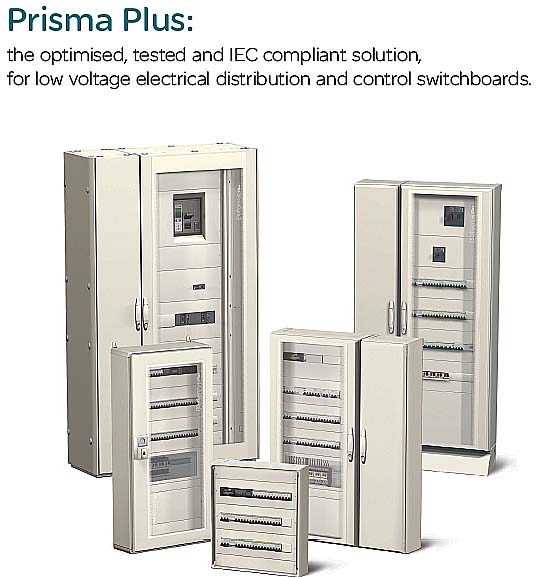
Рис. Schneider Electric
With Prisma Plus G you can be sure to build 100% Schneider Electric switchboards that are safe, optimised:
> All components (switchgear, distribution blocks, prefabricated connections, etc.) are perfectly rated and coordinated to work together;
> All switchboard configurations, even the most demanding ones, have been tested.
You can prove that your switchboard meets the current standards, at any time.
You can be sure to build a reliable electrical installation and give your customers full satisfaction in terms of dependability and safety for people and the installation.
Prisma Plus G with its discreet design, blends harmoniously into all tertiary and industrial buildings, including in entrance halls and passageways.
With Prisma Plus G you can build just the right switchboard for your customer, sized precisely to fit costs and needs.
With this complete, prefabricated and tested system, it's easy to upgrade your installation and still maintain the performance levels.
> The wall-mounted and floor-standing enclosures combine easily with switchboards already in service.
> Devices can be replaced or added at any time.
[Schneider Electric]С помощью оболочек Prisma Plus G можно создавать безопасные распределительные щиты, на 100 % состоящие из изделий Schneider Electric:
> все изделия (коммутационная аппаратура, распределительные блоки, готовые заводские соединения и т. д.) полностью совместимы механически и электрически;
> все варианты компоновки распределительных щитов, в том числе для наиболее ответственных применений, прошли испытания.В любое время вы можете доказать, что ваши распределительные щиты полностью соответствуют требованиям действующих стандартов.
Вы можете быть полностью уверены в том, что создаете надежные электроустановки, удовлетворяющие всем требованиям безопасности для людей и оборудования
Благодаря строгому дизайну, распределительные щиты Prisma Plus G гармонично сочетаются с интерьером любого общественного или промышленного здания. Они хорошо смотрятся и в вестибюле, и в коридоре.
Применяя оболочки Prisma Plus G можно создавать распределительные щиты, точно соответствующие требованиям заказчика как с точки зрения технических характеристик, так и стоимости.
С помощью данной испытанной системы, содержащей все необходимые компоненты заводского изготовления можно легко модернизировать существующую электроустановку и поддерживать её уровни производительности.> Навесные и напольные оболочки можно легко присоединить к уже эксплуатируемым распределительным щитам.
> Аппаратуру можно заменять или добавлять в любое время.
[Перевод Интент]The switchboard, central to the electrical installation.
Both the point of arrival of energy and a device for distribution to the site applications, the LV switchboard is the intelligence of the system, central to the electrical installation.
[Schneider Electric]Распределительный щит – «сердце» электроустановки.
Низковольтное комплектное устройство распределения является «сердцем» электроустановки, поскольку именно оно принимает электроэнергию из сети и распределяет её по территориально распределенным нагрузкам.
[Перевод Интент]Тематики
- НКУ (шкафы, пульты,...)
- электроснабжение в целом
EN
- branch distribution panel
- distributing board
- distributing panel
- distributing switchboard
- distribution bench
- distribution board
- distribution panel
- distribution switchboard
- gear
- keyboard
- PNL
- SB
- sw & d
- switchboard
- switchboard panel
DE
- elektrischer Verteiler, m
- Schalttafel
- Verteiler, m
FR
- tableau de distribution
- tableau de répartition, m
Англо-русский словарь нормативно-технической терминологии > switchboard
-
10 time
время; период; продолжительность || устанавливать время; распределять время; рассчитывать по времени; согласовывать во времени; синхронизироватьtime in use — время использования; время работы (напр. инструмента)
time on machine — время пребывания ( обрабатываемой детали) на станке
- acceleration timeto cut time — сокращать время (напр. обработки)
- access time
- activation time
- active maintenance time
- active repair time
- activity time
- actual in-cut time
- addition time
- additional time
- adjustable laser ramp-up time
- administrative time
- aggregate travel time
- air-cutting time
- arcing time of pole
- assembly time
- assessed mean time to failure
- ATC time
- attended running time
- attenuation time
- auxiliary time
- available machine time
- available machining time
- available time
- average access time
- average time
- base cycle time
- batch change time
- batch lead time
- batch run time
- block execution time
- block processing time
- bounce time
- braking time to standstill
- braking time
- break time
- breakdown time
- bridging time
- build time
- build-up time
- cam idle time
- cell production time
- changeover cut-to-cut time
- changeover time
- characteristic time
- charge time
- chip-cutting time
- chip-making time
- chip-to-chip toolchange time
- clock cycle time
- closing time
- combined travel/load time
- commissioning time
- component cycle time
- component inspection time
- component time
- computed machine time
- computing time
- control flow time
- control time
- conversion time
- correction time
- corrective maintenance time
- c-percentile storageability time
- c-percentile time to failure
- cumulative cutting time
- cure time
- current fall time
- current rise time
- cut time
- cutting time
- cut-to-cut time
- cycle time
- dead cycle time
- dead time
- debugging time
- delay time
- delivery time
- depalletizing time
- derivative action time
- derricking time
- detection time
- direct manufacture time
- disengaging time
- division time
- door-to-door time
- double-stroke time
- down time
- dry-cycle time
- dwell time
- effective cutting time
- effective dead time
- empty running time
- end-of-job time
- equispaced times
- equivalent running time for wear
- eroding time
- erosion time
- estimation time
- execution time
- exposure time
- fall time
- fast response time
- finishing time
- first-off machining time
- fitting time
- fixture lead time
- floor-to-floor time
- flow time
- forward recovery time
- frame time
- full brazing time
- full operating time
- full soldering time
- gate controlled turn-off delay time
- gate controlled turn-off fall time
- gate controlled turn-off time
- grinding time
- gripper-changing time
- head-changing time
- hobbing time
- holding time
- idle time
- index time
- indexing time
- innovation time
- in-process time
- integral action time
- interarrival time
- interoperation time
- interpolation delay time
- jaw-adjusting time
- job completion time
- job finish time
- laser interaction time
- laser shutter opening time
- laser weld tempering time
- laser-beam dwell time
- laser-beam interaction time
- lead time
- learning time
- loading time
- machine down time
- machine repair time
- machine run time
- machine slack time
- machine wait time
- machine-setting time
- machine-setup time
- machining floor-to-floor time
- machining time
- machining-cycle time
- maintenance down time
- maintenance time
- make time
- manual machining time
- manufacturing cycle time
- manufacturing lead time
- material to end product lead time
- maximum resetting time
- mean time between failures
- mean time to failure
- mean time to repair
- measuring run time
- metal-to-metal time
- minimum accelerating time
- minimum braking time
- move time
- moving time
- multiplication time
- NC machining time
- NC program debug time
- no-failure operating time
- noncut time
- noncutting time
- nonmachining time
- nonproductive machine time
- nonrequired time
- numerical processing time
- observed mean time to failure
- off-machine process time
- off-shift machine down time
- off-shift slack time
- opening time
- operate time
- operating spindle time
- operating time
- operation cycle time
- operation time
- operator's attention time
- operator's reaction time
- operator's time
- optimized contact time
- out-of-cut machine time
- out-of-cut time
- output cycle time
- overall cycle time
- overall lead time
- pallet change time
- pallet processing time
- pallet shuttle time
- parasitic time
- part turnaround time
- partial operating time
- part-waiting time
- payback time
- periodic time
- pickup time
- piece sequence time
- piece time
- planned loading time
- planning lead time
- planning time
- predicted mean time to failure
- preparatory time
- preset operating time before corrective adjustment
- preset operating time
- preset time
- probing time
- process response time
- process time
- processing time
- product development lead time
- product flow time
- product lead time
- production lead time
- production time per piece
- production time per unit
- production time
- productive time
- profiling time
- programming time
- prorated time
- protective power time
- pulse decay time
- pulse response time
- pulse rise time
- pulse time
- queue time
- queueing time
- rapid response time
- reading time
- readout time
- real time
- rechucking time
- recognition time
- recovery time
- release time
- releasing time
- remaining life time
- repair/down cost time
- required time
- reset time
- residence time of materials
- response time
- restoration time
- return time
- reverse recovery current fall time
- reverse recovery current rise time
- reverse recovery time
- rise time
- robot down time
- roughing time
- run time
- running time
- running-in time
- safety lead time
- sampling time
- scan time
- schedule time
- scheduled time
- sensing time
- series machining time
- service time of the tool
- servicing time
- servo update time
- setter time
- setting time
- settling time
- setup time
- ship time
- slack time
- soaking time
- software execution time
- specified no-failure operating time
- specified operating time
- specified time
- spindle cutting time
- spindle run time
- stabilization time
- stand time
- standard handling time
- standard piece time
- starting time
- start-up time
- station time
- station-to-station time
- step response time
- stopping time
- storage cycle time
- storage time
- storageability time
- switching time
- switch-over time
- system time
- table-indexing time
- tape-preparation time
- tape-turnaround time
- target build time
- target time
- teach time
- throughput time
- time of starting
- tool change time
- tool exchange time
- tool index time
- tool life time
- tool-cutting time
- tool-in-cut time
- tooling-response time
- tool-setup time
- tool-to-tool changing time
- total access time
- total changeover time
- total equivalent running time for strength
- total equivalent running time for wear
- total manufacturing cycle time
- total running time
- total sequence time
- to-the-minute time
- transfer time
- transient time
- transit time
- transition time
- traveling time
- turnaround time
- turn-off time
- turn-on time
- undetected failure time
- unit cycle time
- unit production time
- unit time
- up time
- update time
- updating time
- vehicle time per hour
- vehicle-use time
- waiting time
- wakeup time
- warm-up time
- wasted time
- work-change time
- work-cycle time
- work-in-process time
- wrench time
- zero ATC timeEnglish-Russian dictionary of mechanical engineering and automation > time
-
11 income
n1) доход; заработок, доходы; поступления2) амер. прибыль
- accounting income
- accrued income
- accrued coupon income
- accumulated income
- accumulated taxable income
- active income
- actual income
- additional income
- adjusted income
- adjusted gross income
- after-tax income
- agency income
- aggregate income
- alternative minimum taxable income
- annual income
- assessable income
- average income
- average annual income
- before-tax income
- blocked income
- book income
- business income
- capital income
- cash income
- casual income
- combined income
- commission income
- community property income
- consolidated taxable income
- constant income
- consumer income
- cumulative taxable income
- current income
- declared income
- deferred income
- derivative income
- determinable income
- discretionary income
- disposable income
- disposable personal income
- dividend income
- earned income
- excessive income
- expected income
- export income
- extra income
- extraordinary income
- factor income
- family income
- farm income
- fiduciary accounting income
- financial income
- financial services income
- fixed income
- foregone income
- foreign earned income
- foreign exchange trading income
- foreign source income
- franked income
- gambling income
- gift income
- gross income
- gross national income
- gross operating income
- guaranteed minimum income
- habitual income
- hidden income
- household income
- illegal income
- imputed income
- individual income
- interest income
- interest income on advances to customers
- interest income on commercial loans
- interest income on loans
- investment income
- invisible income
- irregular income
- labour income
- large income
- licensing income
- life income
- low income
- manufacturing income
- marginal income
- minimum income
- miscellaneous income
- money income
- national income
- negative income
- net income
- net income before exemptions
- net income of society
- net income per share
- net capital income
- net interest income
- net operating income
- net operating income before provisions for losses
- nominal income
- noninterest income
- noninterest operating income
- nonoperating income
- nontaxable income
- nontrading income
- notional income
- operating income
- operational income
- ordinary income
- ordinary gross income
- original income
- other income
- ownership incomes
- passive income
- passive activity income
- passive investment income
- per capita income
- per head income
- periodical income
- permanent income
- personal income
- portfolio income
- premium income
- pretax income
- primary income
- private income
- professional income
- projected income
- property income
- psychic income
- real income
- regular income
- relative income
- rent income
- rental income
- rentier income
- residual income
- retained income
- retained taxable income
- retirement income
- sales income
- self-employment income
- separate taxable income
- service income
- settled income
- sheltered income
- social income
- spendable income
- steady income
- supplementary income
- take home income
- taxable income
- tax-exempt income
- tax-exempt interest income
- tax-free income
- total income
- trading income
- transitory income
- undistributed income
- unearned income
- unexpected income
- unreported income
- wage and salary income
- yearly income
- income for the year
- income from affiliates
- income from business
- income from capital
- income from commercial activities
- income from currency transactions
- income from customer transactions
- income from entrepreneurship
- income from finance leases
- income from investment of capital
- income from investments
- income from off-balance-sheet transactions
- income from operations
- income from property
- income from rentals
- income from sales
- income from self-employment
- income from treasury and interbank transactions
- income from work
- income in foreign currency
- income in kind
- income of an enterprise
- income of investment
- incomes of the population
- income on currency operations
- income on securities transactions
- income on trust activities
- income per head
- income and expenditure
- income and expense
- income attributable to gross receipts from foreign trade
- income exempt from taxes
- income generated by
- income liable to tax
- income subject to tax
- accumulate income beyond the reasonable needs of business
- assign income to another person for tax purposes
- boost income
- bring in an income
- compute taxable income
- conceal income from taxation
- declare income
- defer income
- derive income from activities
- detect illegal income
- draw income
- earn income
- ensure income
- exclude income
- gain income
- generate an income
- redistribute the income
- reflect taxable income inaccurately
- report income
- split the income
- tax income
- underreport incomeEnglish-russian dctionary of contemporary Economics > income
-
12 income
1) доход; заработок, доходы; поступления2) амер. прибыль•Income fluctuates over the years. — Доход колеблется из года в год.
-
13 near cash
!гос. фин. The resource budget contains a separate control total for “near cash” expenditure, that is expenditure such as pay and current grants which impacts directly on the measure of the golden rule.This paper provides background information on the framework for the planning and control of public expenditure in the UK which has been operated since the 1998 Comprehensive Spending Review (CSR). It sets out the different classifications of spending for budgeting purposes and why these distinctions have been adopted. It discusses how the public expenditure framework is designed to ensure both sound public finances and an outcome-focused approach to public expenditure.The UK's public spending framework is based on several key principles:"consistency with a long-term, prudent and transparent regime for managing the public finances as a whole;" "the judgement of success by policy outcomes rather than resource inputs;" "strong incentives for departments and their partners in service delivery to plan over several years and plan together where appropriate so as to deliver better public services with greater cost effectiveness; and"the proper costing and management of capital assets to provide the right incentives for public investment.The Government sets policy to meet two firm fiscal rules:"the Golden Rule states that over the economic cycle, the Government will borrow only to invest and not to fund current spending; and"the Sustainable Investment Rule states that net public debt as a proportion of GDP will be held over the economic cycle at a stable and prudent level. Other things being equal, net debt will be maintained below 40 per cent of GDP over the economic cycle.Achievement of the fiscal rules is assessed by reference to the national accounts, which are produced by the Office for National Statistics, acting as an independent agency. The Government sets its spending envelope to comply with these fiscal rules.Departmental Expenditure Limits ( DEL) and Annually Managed Expenditure (AME)"Departmental Expenditure Limit ( DEL) spending, which is planned and controlled on a three year basis in Spending Reviews; and"Annually Managed Expenditure ( AME), which is expenditure which cannot reasonably be subject to firm, multi-year limits in the same way as DEL. AME includes social security benefits, local authority self-financed expenditure, debt interest, and payments to EU institutions.More information about DEL and AME is set out below.In Spending Reviews, firm DEL plans are set for departments for three years. To ensure consistency with the Government's fiscal rules departments are set separate resource (current) and capital budgets. The resource budget contains a separate control total for “near cash” expenditure, that is expenditure such as pay and current grants which impacts directly on the measure of the golden rule.To encourage departments to plan over the medium term departments may carry forward unspent DEL provision from one year into the next and, subject to the normal tests for tautness and realism of plans, may be drawn down in future years. This end-year flexibility also removes any incentive for departments to use up their provision as the year end approaches with less regard to value for money. For the full benefits of this flexibility and of three year plans to feed through into improved public service delivery, end-year flexibility and three year budgets should be cascaded from departments to executive agencies and other budget holders.Three year budgets and end-year flexibility give those managing public services the stability to plan their operations on a sensible time scale. Further, the system means that departments cannot seek to bid up funds each year (before 1997, three year plans were set and reviewed in annual Public Expenditure Surveys). So the credibility of medium-term plans has been enhanced at both central and departmental level.Departments have certainty over the budgetary allocation over the medium term and these multi-year DEL plans are strictly enforced. Departments are expected to prioritise competing pressures and fund these within their overall annual limits, as set in Spending Reviews. So the DEL system provides a strong incentive to control costs and maximise value for money.There is a small centrally held DEL Reserve. Support from the Reserve is available only for genuinely unforeseeable contingencies which departments cannot be expected to manage within their DEL.AME typically consists of programmes which are large, volatile and demand-led, and which therefore cannot reasonably be subject to firm multi-year limits. The biggest single element is social security spending. Other items include tax credits, Local Authority Self Financed Expenditure, Scottish Executive spending financed by non-domestic rates, and spending financed from the proceeds of the National Lottery.AME is reviewed twice a year as part of the Budget and Pre-Budget Report process reflecting the close integration of the tax and benefit system, which was enhanced by the introduction of tax credits.AME is not subject to the same three year expenditure limits as DEL, but is still part of the overall envelope for public expenditure. Affordability is taken into account when policy decisions affecting AME are made. The Government has committed itself not to take policy measures which are likely to have the effect of increasing social security or other elements of AME without taking steps to ensure that the effects of those decisions can be accommodated prudently within the Government's fiscal rules.Given an overall envelope for public spending, forecasts of AME affect the level of resources available for DEL spending. Cautious estimates and the AME margin are built in to these AME forecasts and reduce the risk of overspending on AME.Together, DEL plus AME sum to Total Managed Expenditure (TME). TME is a measure drawn from national accounts. It represents the current and capital spending of the public sector. The public sector is made up of central government, local government and public corporations.Resource and Capital Budgets are set in terms of accruals information. Accruals information measures resources as they are consumed rather than when the cash is paid. So for example the Resource Budget includes a charge for depreciation, a measure of the consumption or wearing out of capital assets."Non cash charges in budgets do not impact directly on the fiscal framework. That may be because the national accounts use a different way of measuring the same thing, for example in the case of the depreciation of departmental assets. Or it may be that the national accounts measure something different: for example, resource budgets include a cost of capital charge reflecting the opportunity cost of holding capital; the national accounts include debt interest."Within the Resource Budget DEL, departments have separate controls on:"Near cash spending, the sub set of Resource Budgets which impacts directly on the Golden Rule; and"The amount of their Resource Budget DEL that departments may spend on running themselves (e.g. paying most civil servants’ salaries) is limited by Administration Budgets, which are set in Spending Reviews. Administration Budgets are used to ensure that as much money as practicable is available for front line services and programmes. These budgets also help to drive efficiency improvements in departments’ own activities. Administration Budgets exclude the costs of frontline services delivered directly by departments.The Budget preceding a Spending Review sets an overall envelope for public spending that is consistent with the fiscal rules for the period covered by the Spending Review. In the Spending Review, the Budget AME forecast for year one of the Spending Review period is updated, and AME forecasts are made for the later years of the Spending Review period.The 1998 Comprehensive Spending Review ( CSR), which was published in July 1998, was a comprehensive review of departmental aims and objectives alongside a zero-based analysis of each spending programme to determine the best way of delivering the Government's objectives. The 1998 CSR allocated substantial additional resources to the Government's key priorities, particularly education and health, for the three year period from 1999-2000 to 2001-02.Delivering better public services does not just depend on how much money the Government spends, but also on how well it spends it. Therefore the 1998 CSR introduced Public Service Agreements (PSAs). Each major government department was given its own PSA setting out clear targets for achievements in terms of public service improvements.The 1998 CSR also introduced the DEL/ AME framework for the control of public spending, and made other framework changes. Building on the investment and reforms delivered by the 1998 CSR, successive spending reviews in 2000, 2002 and 2004 have:"provided significant increase in resources for the Government’s priorities, in particular health and education, and cross-cutting themes such as raising productivity; extending opportunity; and building strong and secure communities;" "enabled the Government significantly to increase investment in public assets and address the legacy of under investment from past decades. Departmental Investment Strategies were introduced in SR2000. As a result there has been a steady increase in public sector net investment from less than ¾ of a per cent of GDP in 1997-98 to 2¼ per cent of GDP in 2005-06, providing better infrastructure across public services;" "introduced further refinements to the performance management framework. PSA targets have been reduced in number over successive spending reviews from around 300 to 110 to give greater focus to the Government’s highest priorities. The targets have become increasingly outcome-focused to deliver further improvements in key areas of public service delivery across Government. They have also been refined in line with the conclusions of the Devolving Decision Making Review to provide a framework which encourages greater devolution and local flexibility. Technical Notes were introduced in SR2000 explaining how performance against each PSA target will be measured; and"not only allocated near cash spending to departments, but also – since SR2002 - set Resource DEL plans for non cash spending.To identify what further investments and reforms are needed to equip the UK for the global challenges of the decade ahead, on 19 July 2005 the Chief Secretary to the Treasury announced that the Government intends to launch a second Comprehensive Spending Review (CSR) reporting in 2007.A decade on from the first CSR, the 2007 CSR will represent a long-term and fundamental review of government expenditure. It will cover departmental allocations for 2008-09, 2009-10 and 2010 11. Allocations for 2007-08 will be held to the agreed figures already announced by the 2004 Spending Review. To provide a rigorous analytical framework for these departmental allocations, the Government will be taking forward a programme of preparatory work over 2006 involving:"an assessment of what the sustained increases in spending and reforms to public service delivery have achieved since the first CSR. The assessment will inform the setting of new objectives for the decade ahead;" "an examination of the key long-term trends and challenges that will shape the next decade – including demographic and socio-economic change, globalisation, climate and environmental change, global insecurity and technological change – together with an assessment of how public services will need to respond;" "to release the resources needed to address these challenges, and to continue to secure maximum value for money from public spending over the CSR period, a set of zero-based reviews of departments’ baseline expenditure to assess its effectiveness in delivering the Government’s long-term objectives; together with"further development of the efficiency programme, building on the cross cutting areas identified in the Gershon Review, to embed and extend ongoing efficiency savings into departmental expenditure planning.The 2007 CSR also offers the opportunity to continue to refine the PSA framework so that it drives effective delivery and the attainment of ambitious national standards.Public Service Agreements (PSAs) were introduced in the 1998 CSR. They set out agreed targets detailing the outputs and outcomes departments are expected to deliver with the resources allocated to them. The new spending regime places a strong emphasis on outcome targets, for example in providing for better health and higher educational standards or service standards. The introduction in SR2004 of PSA ‘standards’ will ensure that high standards in priority areas are maintained.The Government monitors progress against PSA targets, and departments report in detail twice a year in their annual Departmental Reports (published in spring) and in their autumn performance reports. These reports provide Parliament and the public with regular updates on departments’ performance against their targets.Technical Notes explain how performance against each PSA target will be measured.To make the most of both new investment and existing assets, there needs to be a coherent long term strategy against which investment decisions are taken. Departmental Investment Strategies (DIS) set out each department's plans to deliver the scale and quality of capital stock needed to underpin its objectives. The DIS includes information about the department's existing capital stock and future plans for that stock, as well as plans for new investment. It also sets out the systems that the department has in place to ensure that it delivers its capital programmes effectively.This document was updated on 19 December 2005.Near-cash resource expenditure that has a related cash implication, even though the timing of the cash payment may be slightly different. For example, expenditure on gas or electricity supply is incurred as the fuel is used, though the cash payment might be made in arrears on aquarterly basis. Other examples of near-cash expenditure are: pay, rental.Net cash requirement the upper limit agreed by Parliament on the cash which a department may draw from theConsolidated Fund to finance the expenditure within the ambit of its Request forResources. It is equal to the agreed amount of net resources and net capital less non-cashitems and working capital.Non-cash cost costs where there is no cash transaction but which are included in a body’s accounts (or taken into account in charging for a service) to establish the true cost of all the resourcesused.Non-departmental a body which has a role in the processes of government, but is not a government public body, NDPBdepartment or part of one. NDPBs accordingly operate at arm’s length from governmentMinisters.Notional cost of a cost which is taken into account in setting fees and charges to improve comparability with insuranceprivate sector service providers.The charge takes account of the fact that public bodies donot generally pay an insurance premium to a commercial insurer.the independent body responsible for collecting and publishing official statistics about theUK’s society and economy. (At the time of going to print legislation was progressing tochange this body to the Statistics Board).Office of Government an office of the Treasury, with a status similar to that of an agency, which aims to maximise Commerce, OGCthe government’s purchasing power for routine items and combine professional expertiseto bear on capital projects.Office of the the government department responsible for discharging the Paymaster General’s statutoryPaymaster General,responsibilities to hold accounts and make payments for government departments and OPGother public bodies.Orange bookthe informal title for Management of Risks: Principles and Concepts, which is published by theTreasury for the guidance of public sector bodies.Office for NationalStatistics, ONS60Managing Public Money————————————————————————————————————————"GLOSSARYOverdraftan account with a negative balance.Parliament’s formal agreement to authorise an activity or expenditure.Prerogative powerspowers exercisable under the Royal Prerogative, ie powers which are unique to the Crown,as contrasted with common-law powers which may be available to the Crown on the samebasis as to natural persons.Primary legislationActs which have been passed by the Westminster Parliament and, where they haveappropriate powers, the Scottish Parliament and the Northern Ireland Assembly. Begin asBills until they have received Royal Assent.arrangements under which a public sector organisation contracts with a private sectorentity to construct a facility and provide associated services of a specified quality over asustained period. See annex 7.5.Proprietythe principle that patterns of resource consumption should respect Parliament’s intentions,conventions and control procedures, including any laid down by the PAC. See box 2.4.Public Accountssee Committee of Public Accounts.CommitteePublic corporationa trading body controlled by central government, local authority or other publiccorporation that has substantial day to day operating independence. See section 7.8.Public Dividend finance provided by government to public sector bodies as an equity stake; an alternative to Capital, PDCloan finance.Public Service sets out what the public can expect the government to deliver with its resources. EveryAgreement, PSAlarge government department has PSA(s) which specify deliverables as targets or aimsrelated to objectives.a structured arrangement between a public sector and a private sector organisation tosecure an outcome delivering good value for money for the public sector. It is classified tothe public or private sector according to which has more control.Rate of returnthe financial remuneration delivered by a particular project or enterprise, expressed as apercentage of the net assets employed.Regularitythe principle that resource consumption should accord with the relevant legislation, therelevant delegated authority and this document. See box 2.4.Request for the functional level into which departmental Estimates may be split. RfRs contain a number Resources, RfRof functions being carried out by the department in pursuit of one or more of thatdepartment’s objectives.Resource accountan accruals account produced in line with the Financial Reporting Manual (FReM).Resource accountingthe system under which budgets, Estimates and accounts are constructed in a similar wayto commercial audited accounts, so that both plans and records of expenditure allow in fullfor the goods and services which are to be, or have been, consumed – ie not just the cashexpended.Resource budgetthe means by which the government plans and controls the expenditure of resources tomeet its objectives.Restitutiona legal concept which allows money and property to be returned to its rightful owner. Ittypically operates where another person can be said to have been unjustly enriched byreceiving such monies.Return on capital the ratio of profit to capital employed of an accounting entity during an identified period.employed, ROCEVarious measures of profit and of capital employed may be used in calculating the ratio.Public Privatepartnership, PPPPrivate Finance Initiative, PFIParliamentaryauthority61Managing Public Money"————————————————————————————————————————GLOSSARYRoyal charterthe document setting out the powers and constitution of a corporation established underprerogative power of the monarch acting on Privy Council advice.Second readingthe second formal time that a House of Parliament may debate a bill, although in practicethe first substantive debate on its content. If successful, it is deemed to denoteParliamentary approval of the principle of the proposed legislation.Secondary legislationlaws, including orders and regulations, which are made using powers in primary legislation.Normally used to set out technical and administrative provision in greater detail thanprimary legislation, they are subject to a less intense level of scrutiny in Parliament.European legislation is,however,often implemented in secondary legislation using powers inthe European Communities Act 1972.Service-level agreement between parties, setting out in detail the level of service to be performed.agreementWhere agreements are between central government bodies, they are not legally a contractbut have a similar function.Shareholder Executive a body created to improve the government’s performance as a shareholder in businesses.Spending reviewsets out the key improvements in public services that the public can expect over a givenperiod. It includes a thorough review of departmental aims and objectives to find the bestway of delivering the government’s objectives, and sets out the spending plans for the givenperiod.State aidstate support for a domestic body or company which could distort EU competition and sois not usually allowed. See annex 4.9.Statement of Excessa formal statement detailing departments’ overspends prepared by the Comptroller andAuditor General as a result of undertaking annual audits.Statement on Internal an annual statement that Accounting Officers are required to make as part of the accounts Control, SICon a range of risk and control issues.Subheadindividual elements of departmental expenditure identifiable in Estimates as single cells, forexample cell A1 being administration costs within a particular line of departmental spending.Supplyresources voted by Parliament in response to Estimates, for expenditure by governmentdepartments.Supply Estimatesa statement of the resources the government needs in the coming financial year, and forwhat purpose(s), by which Parliamentary authority is sought for the planned level ofexpenditure and income.Target rate of returnthe rate of return required of a project or enterprise over a given period, usually at least a year.Third sectorprivate sector bodies which do not act commercially,including charities,social and voluntaryorganisations and other not-for-profit collectives. See annex 7.7.Total Managed a Treasury budgeting term which covers all current and capital spending carried out by the Expenditure,TMEpublic sector (ie not just by central departments).Trading fundan organisation (either within a government department or forming one) which is largely orwholly financed from commercial revenue generated by its activities. Its Estimate shows itsnet impact, allowing its income from receipts to be devoted entirely to its business.Treasury Minutea formal administrative document drawn up by the Treasury, which may serve a wide varietyof purposes including seeking Parliamentary approval for the use of receipts asappropriations in aid, a remission of some or all of the principal of voted loans, andresponding on behalf of the government to reports by the Public Accounts Committee(PAC).62Managing Public Money————————————————————————————————————————GLOSSARY63Managing Public MoneyValue for moneythe process under which organisation’s procurement, projects and processes aresystematically evaluated and assessed to provide confidence about suitability, effectiveness,prudence,quality,value and avoidance of error and other waste,judged for the public sectoras a whole.Virementthe process through which funds are moved between subheads such that additionalexpenditure on one is met by savings on one or more others.Votethe process by which Parliament approves funds in response to supply Estimates.Voted expenditureprovision for expenditure that has been authorised by Parliament. Parliament ‘votes’authority for public expenditure through the Supply Estimates process. Most expenditureby central government departments is authorised in this way.Wider market activity activities undertaken by central government organisations outside their statutory duties,using spare capacity and aimed at generating a commercial profit. See annex 7.6.Windfallmonies received by a department which were not anticipated in the spending review.———————————————————————————————————————— -
14 action
noun1) (doing something) Handeln, dastake action — Schritte od. etwas unternehmen
put a plan into action — einen Plan in die Tat umsetzen
be/be put out of action — außer Betrieb sein/gesetzt werden
a film full of action — ein Film mit viel Handlung
2) (effect)3) (act) Tat, diewhere the action is — (coll.) wo was los ist (ugs.)
5) (legal process) [Gerichts]verfahren, dasbring an action against somebody — eine Klage od. ein Verfahren gegen jemanden anstrengen
he died in action — er ist [im Kampf] gefallen
7) (movement) Bewegung, die* * *['ækʃən]1) (something done: Action, not talking, is necessary if we are to defeat the enemy; Take action immediately; The firemen are ready to go into action.) das Handeln2) (movement: Tennis needs a good wrist action.) die Bewegung3) (a legal case: He brought an action for divorce against his wife.) Klage4) (the events (of a play, film etc): The action of the play takes place on an island.) die Handlung5) (a battle; fighting: He was killed in action; Our troops fought an action against the enemy.) das Gefecht•- academic.ru/116764/in_action">in action- out of action* * *ac·tion[ˈækʃən]nwhat we need is \action wir brauchen Tatenwe need firm \action wir müssen entschlossen vorgehenonly decisive \action will stop the crisis from escalating nur ein entschlossenes Vorgehen wird eine Eskalation der Krise verhindernso, what's the plan of \action? wie sieht also der Plan aus?come on lazy things, let's see some \action [around here]! ( fam) auf, ihr Faulpelze, legt euch ins Zeug! famwhat [kind of] \action is necessary to reduce unemployment? wie kann man die Arbeitslosigkeit senken?course of \action Vorgehensweise fcould you tell me what the best course of \action is? wie soll ich Ihrer Meinung nach am besten vorgehen?freedom of \action Handlungsfreiheit fa man/woman of \action ein Mann/eine Frau der Tatprompt \action promptes Handelnto be out of \action außer Gefecht seinto come into \action in die Tat umgesetzt werdento put sth into \action etw in die Tat umsetzento put sb out of \action jdn außer Gefecht setzento take \action handeln, etwas unternehmenno \action was taken es wurde nichts unternommenwe must take \action to deal with the problem wir müssen etwas unternehmen, um mit dem Problem fertig zu werdenin \action in Aktionyou're responsible for your own \actions now du bist jetzt selbst für das, was du tust, verantwortlichyour \action in releasing the caged animals was highly irresponsible es war höchst unverantwortlich von Ihnen, die eingesperrten Tiere freizulassenthe [main] \action die [Haupt]handlunglights, camera, \action! Beleuchtung, Kamera und Action!his films have a lot of \action and not much dialogue seine Filme sind voller Action und arm an Dialogento be missing in \action vermisst seinto be in \action im Einsatz seinto be destroyed by enemy \action durch Feindeinwirkung zerstört werdento go into \action ins Gefecht ziehento be killed in \action fallento see \action im Einsatz sein7. no pllet's go where the \action is lass uns hingehen, wo was los ist famI'll say the words and you can mime the \actions ich spreche den Text und du kannst die Bewegungen dazu machenthe fibres are broken down by chemical \action die Fasern werden durch chemische Vorgänge zersetztto be out of \action außer Betrieb seinto put sth out of \action etw außer Betrieb setzenin \action in Betriebhe's got a very awkward bowling \action er verfügt über einen eigenartigen Wurfstilclass \action Gruppenklage fcourt \action Prozess m\action for damages Schadenersatzklage f\action in personam/rem obligatorische/dingliche Klage fachspr\action in tort Schadenersatzklage fto bring an \action [for sth] against sb gegen jdn Klage [wegen einer S. gen] erheben, jdn [wegen einer S. gen] verklagento bring an \action for damages against sb jdn auf Schadenersatz verklagento take [industrial] \action streiken15.▶ the wheels of bureaucracy creaked into \action esp BRIT ( hum) die Mühlen der Bürokratie setzten sich langsam in Bewegung* * *['kSən]nto take action — etwas or Schritte unternehmen
have you taken any action on his letter? — haben Sie auf seinen Brief hin irgendetwas or irgendwelche Schritte unternommen?
course of action — Vorgehen nt
"action" (on office tray) — "zur Bearbeitung"
no further action — keine weiteren Maßnahmen; (label on file etc) abgeschlossen
the action of the play/novel takes place... — das Stück/der Roman spielt...
2) (= deed) Tat fhis first action was to phone me to suit the action to the word — als Erstes rief er mich an dem Wort die Tat folgen lassen, sein Wort in die Tat umsetzen
3)he's been out of action since he broke his leg — er ist nicht mehr in Aktion gewesen or war nicht mehr einsatzfähig, seit er sich das Bein gebrochen hat
he needs prodding into action — man muss ihm immer erst einen Stoß geben
there's no action in this film — in dem Film passiert nichts, dem Film fehlt die Action (inf)
to go where the action is (inf) — hingehen, wo was los ist (inf)
that's where the action is (inf) — da ist was los (inf)
5) (MIL) (= fighting) Aktionen pl; (= battle) Kampf m, Gefecht nt6) (= way of operating) (of machine) Arbeitsweise f; (of piano etc) Mechanik f; (of watch, gun) Mechanismus m; (= way of moving) (of athlete etc) Bewegung f; (of horse) Aktion f7) (ESP CHEM, PHYS: effect) Wirkung f (on auf +acc)9) (FIN inf)a piece or slice of the action — ein Stück nt aus dem Kuchen (sl)
* * *action [ˈækʃn] s1. a) Handeln, Handlung f, Maßnahme(n) f(pl), Tat f, Aktion f:man of action Mann m der Tat;full of action aktiv;bring into action ins Spiel bringen, einsetzen;call into action auf den Plan rufen;come into action in Aktion treten;put into action in die Tat umsetzen;see sb in action jemanden in Aktion sehen;actions speak louder than words Taten zählen mehr als Worte;take action Maßnahmen treffen, Schritte unternehmen, handeln;we must take action before it is too late wir müssen etwas unternehmen, bevor es zu spät ist;the police took no action die Polizei griff nicht ein;take action against vorgehen gegen ( → 12);course of action Handlungs-, Vorgehensweise f;for further action zur weiteren Veranlassungb) Handlung f, engS. Action f:there is no action in this play in diesem Stück tut sich oder passiert nichts;where the action is sl wo sich alles abspielt; wo was los ist; if you are interested in good food, Paris is where the action is musst du unbedingt nach Paris fahren2. auch PHYSIOL, TECH Tätigkeit f, Funktion f, Gang m (einer Maschine), Funktionieren n (eines Mechanismus):action of the heart Herztätigkeit, -funktion;action (of the bowels) Stuhlgang m;in action TECH in Betrieb, im Einsatz;put in action in Gang oder in Betrieb setzen;be out of action außer Betrieb sein ( → 13);put out of action außer Betrieb setzen ( → 13)3. a) TECH Mechanismus m, Werk nb) Arbeitsweise fa) (Ein)Wirkung f, Wirksamkeit f, Einfluss m:the action of this acid on metal die Einwirkung dieser Säure auf Metall;action of presence Kontaktwirkungb) Vorgang m, Prozess m5. Handlung f (eines Dramas etc):the action of the play takes place in das Stück spielt in (dat);the action takes place in London Ort der Handlung ist London6. KUNSTa) Bewegung f, Aktion f:b) Stellung f, Haltung f (einer Figur auf einem Bild)7. Bewegung f, Gangart f (eines Pferdes)8. Vortrag(sweise) m(f), Ausdruck m (eines Schauspielers)9. fig Benehmen n, Führung f, Haltung f10. SOZIOL Umwelteinflüsse pl11. WIRTSCH Preisbewegung f, Konjunktur(verlauf) f(m)12. JUR Klage f, Prozess m, (Rechts-, Gerichts)Verfahren n:action for annulment Nichtigkeitsklage;action for damages Schadenersatzklage;bring ( oder file, institute) an action against sb, take action against sb jemanden verklagen, gegen jemanden Klage erheben oder ein Gerichtsverfahren einleiten ( → 1); → debt 2, detinue, trespass B 5, trover 213. MIL Gefecht n, Gefechts-, Kampfhandlung f, Unternehmen n, Einsatz m:killed (missing, wounded) in action gefallen (vermisst, verwundet);go into action eingreifen;be out of action außer Gefecht sein (a. fig)( → 2);he saw action er war im Einsatz oder an der Front14. POL etc USa) Beschluss m, Entscheidung fb) Maßnahme(n) f(pl)15. MUS, TECHa) (Spiel)Mechanik fb) Traktur f (der Orgel)* * *noun1) (doing something) Handeln, dastake action — Schritte od. etwas unternehmen
be/be put out of action — außer Betrieb sein/gesetzt werden
2) (effect)3) (act) Tat, diewhere the action is — (coll.) wo was los ist (ugs.)
5) (legal process) [Gerichts]verfahren, dasbring an action against somebody — eine Klage od. ein Verfahren gegen jemanden anstrengen
he died in action — er ist [im Kampf] gefallen
7) (movement) Bewegung, die* * *n.Akt -e m.Aktion -en f.Arbeitsgang m.Gang ¨-e m.Handlung -en f.Prozess -e m.Tat -en f.Wirkung -en f. -
15 work
1. nounat work — (engaged in working) bei der Arbeit; (fig.): (operating) am Werk (see also academic.ru/23063/e">e)
be at work on something — an etwas (Dat.) arbeiten; (fig.) auf etwas (Akk.) wirken
set to work — [Person:] sich an die Arbeit machen
set somebody to work — jemanden an die Arbeit schicken
all work and no play — immer nur arbeiten
have one's work cut out — viel zu tun haben; sich ranhalten müssen (ugs.)
2) (thing made or achieved) Werk, dasis that all your own work? — hast du das alles selbst gemacht?
work of art — Kunstwerk, das
a work of reference/literature/art — ein Nachschlagewerk/literarisches Werk/Kunstwerk
5) (employment) Arbeit, dieout of work — arbeitslos; ohne Arbeit
7) in pl. (Mil.) Werke; Befestigungen8) in pl. (operations of building etc.) Arbeitenthe [whole/full] works — der ganze Kram (ugs.)
2. intransitive verb,give somebody the works — (fig.) (give somebody the best possible treatment) jemandem richtig verwöhnen (ugs.); (give somebody the worst possible treatment) jemanden fertig machen (salopp)
1) arbeitenwork for a cause — etc. für eine Sache usw. arbeiten
work against something — (impede) einer Sache (Dat.) entgegenstehen
2) (function effectively) funktionieren; [Charme:] wirken (on auf + Akk.)make the washing machine/television work — die Waschmaschine/den Fernsehapparat in Ordnung bringen
3) [Rad, Getriebe, Kette:] laufen4) (be craftsman)work in a material — mit od. (fachspr.) in einem Material arbeiten
5) [Faktoren, Einflüsse:] wirken (on auf + Akk.)work against — arbeiten gegen; see also work on
6) (make its/one's way) sich schieben3. transitive verb,work round to a question — (fig.) sich zu einer Frage vorarbeiten
1) (operate) bedienen [Maschine]; fahren [Schiff]; betätigen [Bremse]2) (get labour from) arbeiten lassen3) (get material from) ausbeuten [Steinbruch, Grube]4) (operate in or on) [Vertreter:] bereisen5) (control) steuern6) (effect) bewirken [Änderung]; wirken [Wunder]work it or things so that... — (coll.) es deichseln, dass... (ugs.)
work one's way up/into something — sich hocharbeiten/in etwas (Akk.) hineinarbeiten
8) (get gradually) bringenwork something into something — etwas zu etwas verarbeiten; (mix in) etwas unter etwas (Akk.) rühren
10) (gradually excite)work oneself into a state/a rage — sich aufregen/in einen Wutanfall hineinsteigern
12) (purchase, obtain with labour) abarbeiten; (fig.)she worked her way through college — sie hat sich (Dat.) ihr Studium selbst verdient; see also passage 6)
Phrasal Verbs:- work in- work off- work on- work out- work up* * *[wə:k] 1. noun1) (effort made in order to achieve or make something: He has done a lot of work on this project) die Arbeit2) (employment: I cannot find work in this town.) die Arbeit3) (a task or tasks; the thing that one is working on: Please clear your work off the table.) die Arbeit4) (a painting, book, piece of music etc: the works of Van Gogh / Shakespeare/Mozart; This work was composed in 1816.) das Werk5) (the product or result of a person's labours: His work has shown a great improvement lately.) die Arbeit6) (one's place of employment: He left (his) work at 5.30 p.m.; I don't think I'll go to work tomorrow.) die Arbeit2. verb1) (to (cause to) make efforts in order to achieve or make something: She works at the factory three days a week; He works his employees very hard; I've been working on/at a new project.) arbeiten2) (to be employed: Are you working just now?) arbeiten3) (to (cause to) operate (in the correct way): He has no idea how that machine works / how to work that machine; That machine doesn't/won't work, but this one's working.) funktionieren4) (to be practicable and/or successful: If my scheme works, we'll be rich!) klappen5) (to make (one's way) slowly and carefully with effort or difficulty: She worked her way up the rock face.) sich arbeiten6) (to get into, or put into, a stated condition or position, slowly and gradually: The wheel worked loose.) sich arbeiten7) (to make by craftsmanship: The ornaments had been worked in gold.) arbeiten•- -work- workable
- worker
- works 3. noun plural2) (deeds, actions etc: She's devoted her life to good works.) das Werk•- work-basket- work-box
- workbook
- workforce
- working class
- working day
- work-day
- working hours
- working-party
- work-party
- working week
- workman
- workmanlike
- workmanship
- workmate
- workout
- workshop
- at work
- get/set to work
- go to work on
- have one's work cut out
- in working order
- out of work
- work of art
- work off
- work out
- work up
- work up to
- work wonders* * *[wɜ:k, AM wɜ:rk]I. NOUNto be at \work am Werk seinforces of destruction are at \work here hier sind zerstörerische Kräfte am Werkvarious factors are at \work in this situation in dieser Situation spielen verschiedene Faktoren eine Rollegood \work! gute Arbeit!there's a lot of \work to be done yet es gibt noch viel zu tunthe garden needs a lot of \work im Garten muss [so] einiges gemacht werden\work on the tunnel has been suspended die Arbeiten am Tunnel wurden vorübergehend eingestelltdid you manage to get a bit of \work done? konntest du ein bisschen arbeiten?construction/repair \work Bau-/Reparaturarbeiten plresearch \work Forschungsarbeit fit's hard \work doing sth (strenuous) es ist anstrengend, etw zu tun; (difficult) es ist schwierig, etw zu tunto be at \work doing sth [gerade] damit beschäftigt sein, etw zu tunto make \work for sb jdm Arbeit machenwhat sort of \work do you have experience in? über welche Berufserfahrung verfügen Sie?she's got \work as a translator sie hat Arbeit [o eine Stelle] als Übersetzerin gefundento look for \work auf Arbeitssuche seinhe's looking for \work as a system analyst er sucht Arbeit [o eine Stelle] als Systemanalytikerto be in \work Arbeit [o eine Stelle] habento be out of \work arbeitslos seinto be late for \work zu spät zur Arbeit kommento have to stay late at \work lange arbeiten müssento be at \work bei der Arbeit seinto be off \work frei haben; (without permission) fehlento be off \work sick sich akk krankgemeldet habento commute to \work pendelnto get to \work by car/on the train mit dem Auto/mit dem Zug zur Arbeit fahrento go/travel to \work zur Arbeit gehen/fahrento be injured at \work einen Arbeitsunfall habento ring sb from \work jdn von der Arbeit [aus] anrufen4. (construction, repairs)▪ \works pl Arbeiten plbuilding/road \works Bau-/Straßenarbeiten plthis is the \work of professional thieves das ist das Werk professioneller Diebegood \works REL gute Werke6. ART, LIT, MUS Werk nt‘The Complete W\works of William Shakespeare’ ‚Shakespeares gesammelte Werke‘\works of art Kunstwerke pl\work in bronze Bronzearbeiten pl\work in leather aus Leder gefertigte Arbeitensb's early/later \work jds Früh-/Spätwerk ntto show one's \work in a gallery seine Arbeiten in einer Galerie ausstellen7. (factory)▪ \works + sing/pl vb Werk nt, Fabrik fsteel \works Stahlwerk nttwo large pizzas with the \works, please! esp AM zwei große Pizzen mit allem bitte!11. MIL▪ \works pl Befestigungen pl12.II. NOUN MODIFIER\work clothes Arbeitskleidung f\work speed Arbeitstempo nt2.\works premises Werksgelände ntIII. INTRANSITIVE VERB1. (do a job) arbeitenwhere do you \work? wo arbeiten Sie?to \work as an accountant als Buchhalter arbeitento \work a twelve-hour day/a forty-hour week zwölf Stunden am Tag/vierzig Stunden in der Woche arbeitento \work from home zu Hause [o von zu Hause aus] arbeitento \work at the hospital/abroad im Krankenhaus/im Ausland arbeitento \work hard hart arbeitento \work together zusammenarbeiten▪ to \work with sb mit jdm zusammenarbeitenwe're \working to prevent it happening again wir bemühen uns [o arbeiten daran], so etwas in Zukunft zu verhindernto \work towards a degree in biology einen Hochschulabschluss in Biologie anstrebenwe're \working on it wir arbeiten daranto \work at a problem an einem Problem arbeitento \work hard at doing sth hart daran arbeiten, etw zu tun3. (have an effect) sich auswirkento \work both ways sich sowohl positiv als auch negativ auswirken▪ to \work in sb's favour sich zu jds Gunsten auswirkenmy cell phone doesn't \work mein Handy geht nichtthe boiler seems to be \working okay der Boiler scheint in Ordnung zu seinI can't get this washing machine to \work ich kriege die Waschmaschine irgendwie nicht zum Laufento \work off batteries batteriebetrieben seinto \work off the mains BRIT mit Netzstrom arbeitento \work off wind power mit Windenergie arbeitento \work in practice [auch] in der Praxis funktionieren7. (be based)to \work on the assumption/idea that... von der Annahme/Vorstellung ausgehen, dass...8. (move)to \work free/loose sich lösen/lockernto \work windward NAUT gegen den Wind segeln10. NAUTto \work windward [hart] am Wind segeln11.▶ to \work like a charm [or like magic] Wunder bewirkenIV. TRANSITIVE VERB1. (make work)to \work sb/oneself hard jdm/sich viel abverlangen2. (operate)to be \worked by electricity/steam elektrisch/dampfgetrieben seinto be \worked by wind power durch Windenergie angetrieben werden3. (move)to \work one's way through an article/a book sich akk durch einen Artikel/ein Buch durcharbeitento \work one's way through a crowd/out of a crowded room sich dat einen Weg durch die Menge/aus einem überfüllten Zimmer bahnento \work one's way down a list eine Liste durchgehento \work one's way up sich akk hocharbeitenhe's \worked his way up through the firm er hat sich in der Firma hochgearbeitetto \work sth free/loose etw losbekommen/lockernto \work sth [backwards and forwards] etw [hin- und her]bewegen4. (bring about)▪ to \work sth etw bewirkenI don't know how she \worked it! ich weiß nicht, wie sie das geschafft hat!to \work oneself into a more positive frame of mind sich dat eine positivere Lebenseinstellung erarbeitento \work a cure eine Heilung herbeiführento \work a miracle ein Wunder vollbringento \work miracles [or wonders] [wahre] Wunder vollbringen5. (get)to \work oneself into a state sich akk aufregento \work sb into a state of jealousy jdn eifersüchtig machen6. (shape)▪ to \work sth etw bearbeitento \work clay Ton formen▪ to \work sth into sth etw in etw akk einarbeiten; food etw mit etw dat vermengen; (incorporate) etw in etw akk einbauen [o einfügen]to \work the ingredients together die Zutaten [miteinander] vermengento \work sth into the skin (rub) die Haut mit etw dat einreiben; (massage) etw in die Haut einmassieren8. (embroider)▪ to \work sth etw [auf]sticken9. (cultivate)to \work the land das Land bewirtschaften; (exploit)to \work a mine/quarry eine Mine/einen Steinbruch ausbeuten10. (cover)to \work the inner city [area]/the East Side für die Innenstadt/die East Side zuständig sein11. (pay for by working)to \work one's passage sich dat seine Überfahrt durch Arbeit auf dem Schiff verdienento \work one's way through university sich dat sein Studium finanzieren12.▶ to \work one's fingers to the bone [for sb] ( fam) sich dat [für jdn] den Rücken krumm arbeiten fam* * *[wɜːk]1. nto be at work (on sth) ( — an etw dat ) arbeiten
there are forces at work which... — es sind Kräfte am Werk, die...
nice or good work! — gut or super (inf) gemacht!
we've a lot of work to do before this choir can give a concert — wir haben noch viel zu tun, ehe dieser Chor ein Konzert geben kann
you need to do some more work on your accent/your technique — Sie müssen noch an Ihrem Akzent/an Ihrer Technik arbeiten
to get or set to work on sth — sich an etw (acc) machen
to put a lot of work into sth — eine Menge Arbeit in etw (acc) stecken
to make short or quick work of sb/sth — mit jdm/etw kurzen Prozess machen
time/the medicine had done its work — die Zeit/Arznei hatte ihr Werk vollbracht/ihre Wirkung getan
it was hard work for the old car to get up the hill — das alte Auto hatte beim Anstieg schwer zu schaffen
2) (= employment, job) Arbeit fhow long does it take you to get to work? — wie lange brauchst du, um zu deiner Arbeitsstelle zu kommen?
at work — an der Arbeitsstelle, am Arbeitsplatz
3) (= product) Arbeit f; (ART, LITER) Werk ntgood works — gute Werke pl
a chance for artists to show their work — eine Gelegenheit für Künstler, ihre Arbeiten or Werke zu zeigen
5) pl (MECH) Getriebe, Innere(s) nt; (of watch, clock) Uhrwerk nt6) sing or pl (Brit: factory) Betrieb m, Fabrik fgas/steel works — Gas-/Stahlwerk nt
7) (inf)pl alles Drum und Dranwe had fantastic food, wine, brandy, the works — es gab tolles Essen, Wein, Kognak, alle Schikanen (inf)
he was giving his opponent the works — er machte seinen Gegner nach allen Regeln der Kunst fertig (inf)
2. vi1) person arbeiten (at an +dat)to work toward(s)/for sth — auf etw (acc) hin/für etw arbeiten
or favor (US) — diese Faktoren, die gegen uns/zu unseren Gunsten arbeiten
2) (= function, operate) funktionieren; (plan) funktionieren, klappen (inf); (medicine, spell) wirken; (= be successful) klappen (inf)"not working" (lift etc) — "außer Betrieb"
but this arrangement will have to work both ways — aber diese Abmachung muss für beide Seiten gelten
3) (yeast) arbeiten, treiben5)(= move gradually)
to work loose — sich lockernto work round (wind, object) — sich langsam drehen (to nach)
he worked (a)round to asking her — er hat sich aufgerafft, sie zu fragen
OK, I'm working (a)round to it — okay, das mache ich schon noch
3. vtto work oneself/sb hard — sich/jdn nicht schonen
to work sth by electricity/hand — etw elektrisch/mit Hand betreiben
3) (= bring about) change, cure bewirken, herbeiführento work it ( so that...) (inf) — es so deichseln(, dass...) (inf)
See:→ work upwork the flour in gradually/the ingredients together — mischen Sie das Mehl allmählich unter/die Zutaten (zusammen)
6) (= exploit) mine ausbeuten, abbauen; land bearbeiten; smallholding bewirtschaften; (salesman) area bereisen7) muscles trainieren8)(= move gradually)
to work one's hands free — seine Hände freibekommenhe worked his way across the rock face/through the tunnel — er überquerte die Felswand/kroch durch den Tunnel
to work oneself into sb's confidence — sich in jds Vertrauen (acc) einschleichen
* * *A s1. allg Arbeit f:a) Beschäftigung f, Tätigkeit fb) Aufgabe fc) Hand-, Nadelarbeit f, Stickerei f, Näherei fd) Leistung fe) Erzeugnis n:work done geleistete Arbeit;a beautiful piece of work eine schöne Arbeit;a) bei der Arbeit,b) am Arbeitsplatz,c) in Tätigkeit, in Betrieb (Maschine etc);be at work on arbeiten an (dat);do work arbeiten;I’ve got some work to do ich muss arbeiten;do the work of three (men) für drei arbeiten;be in (out of) work (keine) Arbeit haben;(put) out of work arbeitslos (machen);set to work an die Arbeit gehen, sich an die Arbeit machen;take some work home Arbeit mit nach Hause nehmen;have one’s work cut out (for one) zu tun haben, schwer zu schaffen haben;make work Arbeit verursachen;make light work of spielend fertig werden mit;make sad work of arg wirtschaften oder hausen mit;2. PHYS Arbeit f:3. auch koll (künstlerisches etc) Werk:4. Werk n (Tat und Resultat):this is your work!;5. pla) ARCH Anlagen pl, (besonders öffentliche) Bauten plb) Baustelle f (an einer Autobahn etc)c) MIL (Festungs)Werk n, Befestigungen pl7. pl TECH (Räder-, Trieb)Werk n, Getriebe n:9. REL (gutes) Werkgive sb the works umg jemanden fertigmachen;B v/i prät und pperf worked, besonders obs oder poet wrought [rɔːt]1. (at, on) arbeiten (an dat), sich beschäftigen (mit):work at a social reform an einer Sozialreform arbeiten;make one’s money work sein Geld arbeiten lassen2. arbeiten, Arbeit haben, beschäftigt seinagainst gegen;for für eine Sache):work toward(s) hinarbeiten auf (akk)4. TECHa) funktionieren, gehen (beide auch fig)b) in Betrieb oder Gang sein:our stove works well unser Ofen funktioniert gut;your method won’t work mit Ihrer Methode werden Sie es nicht schaffen;get sth to work etwas reparieren5. fig klappen, gehen, gelingen, sich machen lassenthe poison began to work das Gift begann zu wirken8. sich gut etc bearbeiten lassen9. sich (hindurch-, hoch- etc) arbeiten:work into eindringen in (akk);work loose sich losarbeiten, sich lockern;her tights worked down die Strumpfhose rutschte ihr herunter10. in (heftiger) Bewegung sein, arbeiten, zucken ( alle:12. gären, arbeiten (beide auch fig: Gedanke etc)C v/t1. arbeiten an (dat)2. verarbeiten:a) TECH bearbeitenb) einen Teig kneteninto zu):work cotton into cloth Baumwolle zu Tuch verarbeiten4. (an-, be)treiben:worked by electricity elektrisch betrieben7. Bergbau: eine Grube abbauen, ausbeuten9. jemanden, Tiere (tüchtig) arbeiten lassen, (zur Arbeit) antreibenfor wegen):11. a) work one’s way sich (hindurch- etc) arbeitenb) erarbeiten, verdienen: → passage1 512. MATH lösen, ausarbeiten, errechnenwork o.s. into a rage sich in eine Wut hineinsteigern14. bewegen, arbeiten mit:he worked his jaws seine Kiefer mahlten15. fig (prät oft wrought) hervorbringen, -rufen, zeitigen, Veränderungen etc bewirken, Wunder wirken oder tun, führen zu, verursachen:work hardship on sb für jemanden eine Härte bedeuten17. work intoa) eine Arbeit etc einschieben in (akk),18. sl etwas herausschlagen19. US sl jemanden bescheißen20. herstellen, machen, besonders stricken, nähen21. zur Gärung bringenw. abk1. weight2. wide3. width4. wife5. withwk abk1. week Wo.2. work* * *1. noun1) no pl., no indef. art. Arbeit, dieat work — (engaged in working) bei der Arbeit; (fig.): (operating) am Werk (see also e)
be at work on something — an etwas (Dat.) arbeiten; (fig.) auf etwas (Akk.) wirken
set to work — [Person:] sich an die Arbeit machen
have one's work cut out — viel zu tun haben; sich ranhalten müssen (ugs.)
2) (thing made or achieved) Werk, daswork of art — Kunstwerk, das
3) (book, piece of music) Werk, dasa work of reference/literature/art — ein Nachschlagewerk/literarisches Werk/Kunstwerk
4) in pl. (of author or composer) Werke5) (employment) Arbeit, dieout of work — arbeitslos; ohne Arbeit
at work — (place of employment) auf der Arbeit (see also a)
7) in pl. (Mil.) Werke; Befestigungen8) in pl. (operations of building etc.) Arbeitenthe [whole/full] works — der ganze Kram (ugs.)
2. intransitive verb,give somebody the works — (fig.) (give somebody the best possible treatment) jemandem richtig verwöhnen (ugs.); (give somebody the worst possible treatment) jemanden fertig machen (salopp)
1) arbeitenwork for a cause — etc. für eine Sache usw. arbeiten
work against something — (impede) einer Sache (Dat.) entgegenstehen
2) (function effectively) funktionieren; [Charme:] wirken (on auf + Akk.)make the washing machine/television work — die Waschmaschine/den Fernsehapparat in Ordnung bringen
3) [Rad, Getriebe, Kette:] laufenwork in a material — mit od. (fachspr.) in einem Material arbeiten
5) [Faktoren, Einflüsse:] wirken (on auf + Akk.)work against — arbeiten gegen; see also work on
6) (make its/one's way) sich schieben3. transitive verb,work round to a question — (fig.) sich zu einer Frage vorarbeiten
1) (operate) bedienen [Maschine]; fahren [Schiff]; betätigen [Bremse]2) (get labour from) arbeiten lassen3) (get material from) ausbeuten [Steinbruch, Grube]4) (operate in or on) [Vertreter:] bereisen5) (control) steuern6) (effect) bewirken [Änderung]; wirken [Wunder]work it or things so that... — (coll.) es deichseln, dass... (ugs.)
7) (cause to go gradually) führenwork one's way up/into something — sich hocharbeiten/in etwas (Akk.) hineinarbeiten
8) (get gradually) bringen9) (knead, stir)work something into something — etwas zu etwas verarbeiten; (mix in) etwas unter etwas (Akk.) rühren
work oneself into a state/a rage — sich aufregen/in einen Wutanfall hineinsteigern
11) (make by needlework etc.) arbeiten; aufsticken [Muster] (on auf + Akk.)12) (purchase, obtain with labour) abarbeiten; (fig.)she worked her way through college — sie hat sich (Dat.) ihr Studium selbst verdient; see also passage 6)
Phrasal Verbs:- work in- work off- work on- work out- work up* * *(hard) for expr.erarbeiten v.sich etwas erarbeiten ausdr. v.arbeiten v.funktionieren v. n.Arbeit -en f.Werk -e n. -
16 analysis
1) анализ; исследование; подробное рассмотрение2) бухг. метод расчёта -
17 analysis
n1) (pl analyses)2) анализ, изучение, исследование3) статистическая таблица (цифровой материал)
- accuracy analysis
- activity analysis
- aggregate analysis
- approximate analysis
- balance-sheet analysis
- batch analysis
- benefit-risk analysis
- break-even analysis
- budget analysis
- business analysis
- business cycle analysis
- careful analysis
- cash flow analysis
- check analysis
- commodity analysis
- comparative analysis
- competitiveness analysis
- complete analysis
- complex analysis
- comprehensive analysis
- computer-aided analysis
- consumer analysis
- continuous analysis
- contrastive analysis
- cost analysis
- correlation analysis
- cost-benefit analysis
- cost-effectiveness analysis
- cost-performance analysis
- cost-sensitivity analysis
- country collectibility analysis
- critical path analysis
- cross-impact analysis
- cyclical analysis
- data analysis
- decision analysis
- decision-flow analysis
- demand analysis
- demand-consumption analysis
- demand-supply analysis
- design analysis
- detailed analysis
- diagnostic analysis
- discriminant analysis
- discriminatory analysis
- downward analysis
- ecological analysis
- economic analysis
- economical analysis
- empirical analysis
- end-point analysis
- engineering analysis
- engineering-economic analysis
- environmental analysis
- equipment quality analysis
- error analysis
- ex ante analysis
- expenses analysis
- ex post analysis
- express analysis
- factor analysis
- failure analysis
- feasibility analysis
- field analysis
- field complaint analysis
- field return analysis
- financial analysis
- financial ratio analysis
- financial statement analysis
- fiscal analysis
- flow-of-funds analysis
- formal analysis
- functional-cost analysis
- fundamental analysis
- funds analysis
- game-theoretic analysis
- gap analysis
- global analysis
- graphical analysis
- gross profit analysis
- horizontal analysis
- income analysis
- income-expenditure analysis
- in-depth analysis
- indicator analysis
- input-output analysis
- interaction analysis
- interindustry analysis
- inventory analysis
- investment analysis
- job analysis
- laboratory analysis
- least-square
- liquidity preference analysis
- long-run analysis
- loss analysis
- lot analysis
- macroeconomic analysis
- maintainability analysis
- maintenance analysis
- marginal analysis
- market analysis
- marketing cost analysis
- marketing plan analysis
- market opportunity analysis
- market situation analysis
- market structure analysis
- market trend analysis
- mechanical analysis
- media analysis
- money-flow analysis
- motion analysis
- motivation research analysis
- needs analysis
- network analysis
- normative analysis
- numerical analysis
- observational analysis
- on-line analysis
- operating analysis
- operating cost analysis
- operation analysis
- opportunity analysis
- order analysis
- organizational structure analysis
- overhead analysis
- partial analysis
- performance analysis
- performance degradation analysis
- periodic analysis
- pilot analysis
- population analysis
- portfolio analysis
- preinvestment analysis
- preliminary analysis
- price analysis
- primary analysis
- priority analysis
- process analysis
- product analysis
- product quality analysis
- profit analysis
- profitability analysis
- qualitative analysis
- quality analysis
- quality cost analysis
- quantitative analysis
- queueing analysis
- quick analysis
- ranging analysis
- rapid analysis
- ratio analysis
- real-time analysis
- relevance analysis
- reliability analysis
- reliability variation analysis
- risk analysis
- safety analysis
- sales analysis
- sales mix analysis
- sample analysis
- sampling analysis
- savings-investment analysis
- scrap-cost analysis
- sensitivity analysis
- sequential analysis
- short-cut analysis
- short-run analysis
- short-term analysis
- simulation analysis
- solvency analysis
- statement analysis
- statistical analysis
- stock analysis
- structural analysis
- subjective analysis
- supply analysis
- system's analysis
- tabular analysis
- team analysis
- thorough analysis
- time analysis
- time-series analysis
- total time analysis
- trade-off analysis
- trend analysis
- transaction cost analysis
- upward trend analysis
- value analysis
- value engineering analysis
- variance analysis
- vector analysis
- weather analysis
- worst-case analysis
- workload analysis
- X-ray analysis
- analysis by economic sector
- analysis of accounts
- analysis of assets and liabilities by maturities
- analysis of business activity
- analysis of corporate cash flows
- analysis of economic activity
- analysis of the economic performance of an enterprise
- analysis of feasibility
- analysis of foreign currency position
- analysis of the future development
- analysis of indices dynamics
- analysis of the market situation
- analysis of prediction
- analysis of profitability
- analysis of results
- carry out analysis
- make analysisEnglish-russian dctionary of contemporary Economics > analysis
-
18 switchgear and controlgear
- НКУ распределения и управления
- коммутационная аппаратура и аппаратура управления
- аппаратура распределения и управления
аппаратура распределения и управления
Общий термин для коммутационных аппаратов и их комбинации с относящимися к ним устройствами управления, измерения, защиты и регулирования, а также для узлов, в которых такие аппараты и устройства соединяются с соответствующими фидерами, комплектующим оборудованием, оболочками и опорными конструкциями.
МЭК 60050 (441-11-01) [1].
[ ГОСТ Р 50030. 1-2000 ( МЭК 60947-1-99)]EN
switchgear and controlgear
general term covering switching devices and their combination with associated control, measuring, protective and regulating equipment, also assemblies of such devices and equipment with associated interconnections, accessories, enclosures and supporting structures
[IEC 62271-1, ed. 1.0 (2007-10)]FR
appareillage
terme général applicable aux appareils de connexion et à leur combinaison avec des appareils de commande, de mesure, de protection et de réglage qui leur sont associés, ainsi qu’aux ensembles de tels appareils avec les connexions, les accessoires, les enveloppes et les charpentes correspondantes
[IEC 62271-1, ed. 1.0 (2007-10)]Тематики
- аппарат, изделие, устройство...
EN
DE
- Schaltanlagen und/oder Schaltgeräte
FR
коммутационная аппаратура и аппаратура управления
Электрическое оборудование, предназначенное для присоединения к электрической цепи с целью выполнения одной или более следующих функций: защиты, управления, разъединения, коммутации.
[ ГОСТ Р МЭК 60050-826-2009]EN
switchgear and controlgear
electric equipment intended to be connected to an electric circuit for the purpose of carrying out one or more of the following functions: protection, control, isolation, switching
NOTE – The French and English terms can be considered as equivalent in most cases. However, the French term has a broader meaning than the English term and includes for example connecting devices, plugs and socket-outlets, etc. In English, these latter devices are known as accessories.
[IEV number 826-16-03]FR
appareillage, m
matériel électrique destiné à être relié à un circuit électrique en vue d'assurer une ou plusieurs des fonctions suivantes: protection, commande, sectionnement, connexion
NOTE – Les termes français et anglais peuvent être considérés comme équivalents dans la plupart des cas. Toutefois, le terme français couvre un domaine plus étendu que le terme anglais, et comprend notamment les dispositifs de connexion, les prises de courant, etc. En anglais, ces derniers sont dénommés "accessories".
[IEV number 826-16-03]Тематики
- аппарат, изделие, устройство...
- электроустановки
EN
DE
- Schaltgerät, n
- Steuergerät, n
FR
- appareillage, m
низковольтное устройство распределения и управления (НКУ)
Низковольтные коммутационные аппараты и устройства управления, измерения, сигнализации, защиты, регулирования, собранные совместно, со всеми внутренними электрическими и механическими соединениями и конструктивными элементами.
[ ГОСТ Р МЭК 61439-1-2012]
низковольтное устройство распределения и управления
Комбинация низковольтных коммутационных аппаратов с устройствами управления, измерения, сигнализации, защиты, регулирования и т. п., полностью смонтированных изготовителем НКУ (под его ответственность на единой конструктивной основе) со всеми внутренними электрическими и механическими соединениями с соответствующими конструктивными элементами
Примечания
1. В настоящем стандарте сокращение НКУ используют для обозначения низковольтных комплектных устройств распределения и управления.
2. Аппараты, входящие в состав НКУ, могут быть электромеханическими или электронными.
3. По различным причинам, например по условиям транспортирования или изготовления, некоторые операции сборки могут быть выполнены на месте установки, вне предприятия-изготовителя.
[ ГОСТ Р 51321. 1-2000 ( МЭК 60439-1-92)]EN
power switchgear and controlgear assembly (PSC-assembly)
low-voltage switchgear and controlgear assembly used to distribute and control energy for all types of loads, intended for industrial, commercial and similar applications where operation by ordinary persons is not intended
[IEC 61439-2, ed. 1.0 (2009-01)]
low-voltage switchgear and controlgear assembly
combination of one or more low-voltage switching devices together with associated control, measuring, signalling, protective, regulation equipment, etc., completely assembled under the responsibility of the manufacturer with all the internal electrical and mechanical interconnections and structural parts.
[IEC 61892-3, ed. 2.0 (2007-11)]
switchgear and controlgear
a general term covering switching devices and their combination with associated control, measuring, protective and regulating equipment, also assemblies of such devices and equipment with associated interconnections, accessories, enclosures and supporting structures
[IEV number 441-11-01]
switchgear and controlgear
electric equipment intended to be connected to an electric circuit for the purpose of carrying out one or more of the following functions: protection, control, isolation, switching
NOTE – The French and English terms can be considered as equivalent in most cases. However, the French term has a broader meaning than the English term and includes for example connecting devices, plugs and socket-outlets, etc. In English, these latter devices are known as accessories.
[IEV number 826-16-03 ]
switchboard
A large single electric control panel, frame, or assembly of panels on which are mounted (either on the back or on the face, or both) switches, overcurrent and other protective devices, buses, and usually instruments; not intended for installation in a cabinet but may be completely enclosed in metal; usually is accessible from both the front and rear.
[ McGraw-Hill Dictionary of Architecture & Construction]
switchboard
One or more panels accommodating control switches, indicators, and other apparatus for operating electric circuits
[ The American Heritage Dictionary of the English Language]FR
ensemble d'appareillage de puissance (ensemble PSC)
ensemble d'appareillage à basse tension utilisé pour répartir et commander l'énergie pour tous les types de charges et prévu pour des applications industrielles, commerciales et analogues dans lesquelles l'exploitation par des personnes ordinaires n'est pas prévue
[IEC 61439-2, ed. 1.0 (2009-01)]
appareillage, m
matériel électrique destiné à être relié à un circuit électrique en vue d'assurer une ou plusieurs des fonctions suivantes: protection, commande, sectionnement, connexion
NOTE – Les termes français et anglais peuvent être considérés comme équivalents dans la plupart des cas. Toutefois, le terme français couvre un domaine plus étendu que le terme anglais, et comprend notamment les dispositifs de connexion, les prises de courant, etc. En anglais, ces derniers sont dénommés "accessories".
[IEV number 826-16-03 ]
appareillage
terme général applicable aux appareils de connexion et à leur combinaison avec des appareils de commande, de mesure, de protection et de réglage qui leur sont associés, ainsi qu'aux ensembles de tels appareils avec les connexions, les accessoires, les enveloppes et les charpentes correspondantes
[IEV number 441-11-01]
A switchboard as defined in the National Electrical Code is a large single panel, frame, or assembly of panels on which are mounted, on the face or back or both switches, overcurrent and other protective devices, buses, and, usually, instruments.
Switchboards are generally accessible from the rear as well as from the front and are not intended to be installed in cabinets.
The types of switchboards, classified by basic features of construction, are as follows:
1. Live-front vertical panels
2. Dead-front boards
3. Safety enclosed boards( metal-clad)
[American electricians’ handbook]
The switchboard plays an essential role in the availability of electric power, while meeting the needs of personal and property safety.
Its definition, design and installation are based on precise rules; there is no place for improvisation.
The IEC 61439 standard aims to better define " low-voltage switchgear and controlgear assemblies", ensuring that the specified performances are reached.
It specifies in particular:
> the responsibilities of each player, distinguishing those of the original equipment manufacturer - the organization that performed the original design and associated verification of an assembly in accordance with the standard, and of the assembly manufacturer - the organization taking responsibility for the finished assembly;
> the design and verification rules, constituting a benchmark for product certification.
All the component parts of the electrical switchboard are concerned by the IEC 61439 standard.
Equipment produced in accordance with the requirements of this switchboard standard ensures the safety and reliability of the installation.
A switchboard must comply with the requirements of standard IEC 61439-1 and 2 to guarantee the safety and reliability of the installation.
Managers of installations, fully aware of the professional and legal liabilities weighing on their company and on themselves, demand a high level of safety for the electrical installation.
What is more, the serious economic consequences of prolonged halts in production mean that the electrical switchboard must provide excellent continuity of service, whatever the operating conditions.
[Schneider Electric]НКУ играет главную роль в обеспечении электроэнергией, удовлетворяя при этом всем требованиям по безопасности людей и сохранности имущества.
Выбор конструкции, проектирование и монтаж основаны на чётких правилах, не допускающих никакой импровизации.
Требования к низковольтным комплектным устройствам распределения и управления сформулированы в стандарте МЭК 61439 (ГОСТ Р 51321. 1-2000).
В частности, он определяет:
> распределение ответственности между изготовителем НКУ - организацией, разработавшей конструкцию НКУ и проверившей его на соответствие требованиям стандарта, и сборщиком – организацией, выполнившей сборку НКУ;
> конструкцию, технические характеристики, виды и методы испытаний НКУ.
В стандарте МЭК 61439 (ГОСТ Р 51321. 1-2000) описываются все компоненты НКУ.
Оборудование, изготовленное в соответствии с требованиями этого стандарта, обеспечивает безопасность и надежность электроустановки.
Для того чтобы гарантировать безопасность эксплуатации и надежность работы электроустановки, распределительный щит должен соответствовать требованиям стандарта МЭК 61439-1 и 2.
Лица, ответственные за электроустановки, должны быть полностью осведомлены о профессиональной и юридической ответственности, возложенной на их компанию и на них лично, за обеспечение высокого уровня безопасности эксплуатации этих электроустановок.
Кроме того, поскольку длительные перерывы производства приводят к серьезным экономическим последствиям, электрический распределительный щит должен обеспечивать надежную и бесперебойную работу независимо от условий эксплуатации.
[Перевод Интент]LV switchgear assemblies are undoubtedly the components of the electric installation more subject to the direct intervention of personnel (operations, maintenance, etc.) and for this reason users demand from them higher and higher safety requirements.
The compliance of an assembly with the state of the art and therefore, presumptively, with the relevant technical Standard, cannot be based only on the fact that the components which constitute it comply with the state of the art and therefore, at least presumptively, with the relevant technical standards.
In other words, the whole assembly must be designed, built and tested in compliance with the state of the art.
Since the assemblies under consideration are low voltage equipment, their rated voltage shall not exceed 1000 Va.c. or 1500 Vd.c. As regards currents, neither upper nor lower limits are provided in the application field of this Standard.
The Standard IEC 60439-1 states the construction, safety and maintenance requirements for low voltage switchgear and controlgear assemblies, without dealing with the functional aspects which remain a competence of the designer of the plant for which the assembly is intended.
[ABB]Низковольтные комплектные устройства (НКУ), вне всякого сомнения, являются частями электроустановок, которые наиболее подвержены непосредственному вмешательству оперативного, обслуживающего и т. п. персонала. Вот почему требования потребителей к безопасности НКУ становятся все выше и выше.
Соответствие НКУ современному положению дел и вследствие этого, гипотетически, соответствующим техническим стандартам, не может основываться только на том факте, что составляющие НКУ компоненты соответствуют современному состоянию дел и поэтому, по крайней мере, гипотетически, - соответствующим техническим стандартам
Другими словами, НКУ должно быть разработано, изготовлено и испытано в соответствии с современными требованиями.
Мы рассматриваем низковольтные комплектные устройства и это означает, что их номинальное напряжение не превышает 1000 В переменного тока или 1500 В постоянного тока. Что касается тока, то ни верхнее, ни нижнее значение стандартами, относящимися к данной области, не оговариваются
Стандарт МЭК 60439-1 устанавливает требования к конструкции, безопасности и техническому обслуживанию низковольтных комплектных устройств без учета их функций, полагая, что функции НКУ являются компетенцией проектировщиков электроустановки, частью которых эти НКУ являются.
[Перевод Интент]Тематики
- НКУ (шкафы, пульты,...)
Классификация
>>>Действия
Синонимы
Сопутствующие термины
EN
- assembly
- electrical switchboard
- low voltage controlgear and assembly
- low voltage switchboard
- low voltage switchgear and controlgear assembly
- low-voltage switchgear and controlgear assembly
- LV switchgear and controlgear assembly
- LV switchgear assembly
- panel
- power switchgear and controlgear assembly
- PSC-assembly
- switchboard
- switchgear and controlgear
- switchgear/controlgear
DE
- Schaltanlagen und/oder Schaltgeräte
FR
Англо-русский словарь нормативно-технической терминологии > switchgear and controlgear
-
19 assembly
- узел оборудования
- сборочная единица
- сборка (монтаж)
- сборка
- подузел
- НКУ распределения и управления
- конструкция
- клеевое соединение
- ассемблирование
ассемблирование
Компиляция программ с языка ассемблера.
[ ГОСТ 19781-90]Тематики
- обеспеч. систем обраб. информ. программное
EN
клеевое соединение
Ндп. клеенное соединение
Соединение частей изделия склеиванием.
[ ГОСТ 28780-90]Недопустимые, нерекомендуемые
Тематики
EN
конструкция
Устройство, взаимное расположение частей и состав машины, механизма или сооружения.
[ http://sl3d.ru/o-slovare.html]Параллельные тексты EN-RU
The new valve profile is design to ensure smooth and precise control at low capacities for improved part load performances.
[Lennox]Вентиль новой конструкции обеспечивает плавное и точное регулирование при низкой производительности холодильного контура, что увеличивает его эффективность при неполной нагрузке.
[Интент]
Тематики
EN
низковольтное устройство распределения и управления (НКУ)
Низковольтные коммутационные аппараты и устройства управления, измерения, сигнализации, защиты, регулирования, собранные совместно, со всеми внутренними электрическими и механическими соединениями и конструктивными элементами.
[ ГОСТ Р МЭК 61439-1-2012]
низковольтное устройство распределения и управления
Комбинация низковольтных коммутационных аппаратов с устройствами управления, измерения, сигнализации, защиты, регулирования и т. п., полностью смонтированных изготовителем НКУ (под его ответственность на единой конструктивной основе) со всеми внутренними электрическими и механическими соединениями с соответствующими конструктивными элементами
Примечания
1. В настоящем стандарте сокращение НКУ используют для обозначения низковольтных комплектных устройств распределения и управления.
2. Аппараты, входящие в состав НКУ, могут быть электромеханическими или электронными.
3. По различным причинам, например по условиям транспортирования или изготовления, некоторые операции сборки могут быть выполнены на месте установки, вне предприятия-изготовителя.
[ ГОСТ Р 51321. 1-2000 ( МЭК 60439-1-92)]EN
power switchgear and controlgear assembly (PSC-assembly)
low-voltage switchgear and controlgear assembly used to distribute and control energy for all types of loads, intended for industrial, commercial and similar applications where operation by ordinary persons is not intended
[IEC 61439-2, ed. 1.0 (2009-01)]
low-voltage switchgear and controlgear assembly
combination of one or more low-voltage switching devices together with associated control, measuring, signalling, protective, regulation equipment, etc., completely assembled under the responsibility of the manufacturer with all the internal electrical and mechanical interconnections and structural parts.
[IEC 61892-3, ed. 2.0 (2007-11)]
switchgear and controlgear
a general term covering switching devices and their combination with associated control, measuring, protective and regulating equipment, also assemblies of such devices and equipment with associated interconnections, accessories, enclosures and supporting structures
[IEV number 441-11-01]
switchgear and controlgear
electric equipment intended to be connected to an electric circuit for the purpose of carrying out one or more of the following functions: protection, control, isolation, switching
NOTE – The French and English terms can be considered as equivalent in most cases. However, the French term has a broader meaning than the English term and includes for example connecting devices, plugs and socket-outlets, etc. In English, these latter devices are known as accessories.
[IEV number 826-16-03 ]
switchboard
A large single electric control panel, frame, or assembly of panels on which are mounted (either on the back or on the face, or both) switches, overcurrent and other protective devices, buses, and usually instruments; not intended for installation in a cabinet but may be completely enclosed in metal; usually is accessible from both the front and rear.
[ McGraw-Hill Dictionary of Architecture & Construction]
switchboard
One or more panels accommodating control switches, indicators, and other apparatus for operating electric circuits
[ The American Heritage Dictionary of the English Language]FR
ensemble d'appareillage de puissance (ensemble PSC)
ensemble d'appareillage à basse tension utilisé pour répartir et commander l'énergie pour tous les types de charges et prévu pour des applications industrielles, commerciales et analogues dans lesquelles l'exploitation par des personnes ordinaires n'est pas prévue
[IEC 61439-2, ed. 1.0 (2009-01)]
appareillage, m
matériel électrique destiné à être relié à un circuit électrique en vue d'assurer une ou plusieurs des fonctions suivantes: protection, commande, sectionnement, connexion
NOTE – Les termes français et anglais peuvent être considérés comme équivalents dans la plupart des cas. Toutefois, le terme français couvre un domaine plus étendu que le terme anglais, et comprend notamment les dispositifs de connexion, les prises de courant, etc. En anglais, ces derniers sont dénommés "accessories".
[IEV number 826-16-03 ]
appareillage
terme général applicable aux appareils de connexion et à leur combinaison avec des appareils de commande, de mesure, de protection et de réglage qui leur sont associés, ainsi qu'aux ensembles de tels appareils avec les connexions, les accessoires, les enveloppes et les charpentes correspondantes
[IEV number 441-11-01]
A switchboard as defined in the National Electrical Code is a large single panel, frame, or assembly of panels on which are mounted, on the face or back or both switches, overcurrent and other protective devices, buses, and, usually, instruments.
Switchboards are generally accessible from the rear as well as from the front and are not intended to be installed in cabinets.
The types of switchboards, classified by basic features of construction, are as follows:
1. Live-front vertical panels
2. Dead-front boards
3. Safety enclosed boards( metal-clad)
[American electricians’ handbook]
The switchboard plays an essential role in the availability of electric power, while meeting the needs of personal and property safety.
Its definition, design and installation are based on precise rules; there is no place for improvisation.
The IEC 61439 standard aims to better define " low-voltage switchgear and controlgear assemblies", ensuring that the specified performances are reached.
It specifies in particular:
> the responsibilities of each player, distinguishing those of the original equipment manufacturer - the organization that performed the original design and associated verification of an assembly in accordance with the standard, and of the assembly manufacturer - the organization taking responsibility for the finished assembly;
> the design and verification rules, constituting a benchmark for product certification.
All the component parts of the electrical switchboard are concerned by the IEC 61439 standard.
Equipment produced in accordance with the requirements of this switchboard standard ensures the safety and reliability of the installation.
A switchboard must comply with the requirements of standard IEC 61439-1 and 2 to guarantee the safety and reliability of the installation.
Managers of installations, fully aware of the professional and legal liabilities weighing on their company and on themselves, demand a high level of safety for the electrical installation.
What is more, the serious economic consequences of prolonged halts in production mean that the electrical switchboard must provide excellent continuity of service, whatever the operating conditions.
[Schneider Electric]НКУ играет главную роль в обеспечении электроэнергией, удовлетворяя при этом всем требованиям по безопасности людей и сохранности имущества.
Выбор конструкции, проектирование и монтаж основаны на чётких правилах, не допускающих никакой импровизации.
Требования к низковольтным комплектным устройствам распределения и управления сформулированы в стандарте МЭК 61439 (ГОСТ Р 51321. 1-2000).
В частности, он определяет:
> распределение ответственности между изготовителем НКУ - организацией, разработавшей конструкцию НКУ и проверившей его на соответствие требованиям стандарта, и сборщиком – организацией, выполнившей сборку НКУ;
> конструкцию, технические характеристики, виды и методы испытаний НКУ.
В стандарте МЭК 61439 (ГОСТ Р 51321. 1-2000) описываются все компоненты НКУ.
Оборудование, изготовленное в соответствии с требованиями этого стандарта, обеспечивает безопасность и надежность электроустановки.
Для того чтобы гарантировать безопасность эксплуатации и надежность работы электроустановки, распределительный щит должен соответствовать требованиям стандарта МЭК 61439-1 и 2.
Лица, ответственные за электроустановки, должны быть полностью осведомлены о профессиональной и юридической ответственности, возложенной на их компанию и на них лично, за обеспечение высокого уровня безопасности эксплуатации этих электроустановок.
Кроме того, поскольку длительные перерывы производства приводят к серьезным экономическим последствиям, электрический распределительный щит должен обеспечивать надежную и бесперебойную работу независимо от условий эксплуатации.
[Перевод Интент]LV switchgear assemblies are undoubtedly the components of the electric installation more subject to the direct intervention of personnel (operations, maintenance, etc.) and for this reason users demand from them higher and higher safety requirements.
The compliance of an assembly with the state of the art and therefore, presumptively, with the relevant technical Standard, cannot be based only on the fact that the components which constitute it comply with the state of the art and therefore, at least presumptively, with the relevant technical standards.
In other words, the whole assembly must be designed, built and tested in compliance with the state of the art.
Since the assemblies under consideration are low voltage equipment, their rated voltage shall not exceed 1000 Va.c. or 1500 Vd.c. As regards currents, neither upper nor lower limits are provided in the application field of this Standard.
The Standard IEC 60439-1 states the construction, safety and maintenance requirements for low voltage switchgear and controlgear assemblies, without dealing with the functional aspects which remain a competence of the designer of the plant for which the assembly is intended.
[ABB]Низковольтные комплектные устройства (НКУ), вне всякого сомнения, являются частями электроустановок, которые наиболее подвержены непосредственному вмешательству оперативного, обслуживающего и т. п. персонала. Вот почему требования потребителей к безопасности НКУ становятся все выше и выше.
Соответствие НКУ современному положению дел и вследствие этого, гипотетически, соответствующим техническим стандартам, не может основываться только на том факте, что составляющие НКУ компоненты соответствуют современному состоянию дел и поэтому, по крайней мере, гипотетически, - соответствующим техническим стандартам
Другими словами, НКУ должно быть разработано, изготовлено и испытано в соответствии с современными требованиями.
Мы рассматриваем низковольтные комплектные устройства и это означает, что их номинальное напряжение не превышает 1000 В переменного тока или 1500 В постоянного тока. Что касается тока, то ни верхнее, ни нижнее значение стандартами, относящимися к данной области, не оговариваются
Стандарт МЭК 60439-1 устанавливает требования к конструкции, безопасности и техническому обслуживанию низковольтных комплектных устройств без учета их функций, полагая, что функции НКУ являются компетенцией проектировщиков электроустановки, частью которых эти НКУ являются.
[Перевод Интент]Тематики
- НКУ (шкафы, пульты,...)
Классификация
>>>Действия
Синонимы
Сопутствующие термины
EN
- assembly
- electrical switchboard
- low voltage controlgear and assembly
- low voltage switchboard
- low voltage switchgear and controlgear assembly
- low-voltage switchgear and controlgear assembly
- LV switchgear and controlgear assembly
- LV switchgear assembly
- panel
- power switchgear and controlgear assembly
- PSC-assembly
- switchboard
- switchgear and controlgear
- switchgear/controlgear
DE
- Schaltanlagen und/oder Schaltgeräte
FR
подузел
узел
сборная деталь
собранный узел
блок
агрегат
—
[ http://slovarionline.ru/anglo_russkiy_slovar_neftegazovoy_promyishlennosti/]Тематики
Синонимы
EN
сборка
Процесс соединения и закрепления элементов и деталей в готовые узлы, монтажные блоки, конструкции или изделия
[Терминологический словарь по строительству на 12 языках (ВНИИИС Госстроя СССР)]
сборка
Образование соединений составных частей изделия.
Примечания:
1. Примером видов сборки является клепка, сварка заготовок и т.д.
2. Соединение может быть разъемным или неразъемным
[ГОСТ 3.1109-82]Тематики
EN
DE
FR
узел оборудования
компоновочный узел
компоновка
ассемблирование
—
[Л.Г.Суменко. Англо-русский словарь по информационным технологиям. М.: ГП ЦНИИС, 2003.]Тематики
Синонимы
EN
3.2.10 сборочная единица (assembly): Изделие, которое разлагаемо на множество комплектующих или других сборочных единиц с точки зрения конкретного приложения предметной области;
Источник: ГОСТ Р ИСО 10303-1-99: Системы автоматизации производства и их интеграция. Представление данных об изделии и обмен этими данными. Часть 1. Общие представления и основополагающие принципы оригинал документа
3.3.1 конструкция (assembly) предназначена для того, чтобы:
а) удерживать каскетку на голове;
б) поглощать кинетическую энергию, возникающую при ударе, и распределять усилие по поверхности головы.
Примечание - Внутренняя оснастка может состоять из элементов, указанных в 3.3.2 - 3.3.5.
Источник: ГОСТ Р 12.4.245-2007: Система стандартов безопасности труда. Каскетки защитные. Общие технические требования. Методы испытаний оригинал документа
52. Ассемблирование
Assembly
Компиляция программ с языка ассемблера
Источник: ГОСТ 19781-90: Обеспечение систем обработки информации программное. Термины и определения оригинал документа
39. Сборка
D. Fügen
E. Assembly
F. Assemblage
Источник: ГОСТ 3.1109-82: Единая система технологической документации. Термины и определения основных понятий оригинал документа
Англо-русский словарь нормативно-технической терминологии > assembly
-
20 panel
- филенка
- подкомиссия
- плата (с монтажом)
- панель (элемент здания)
- НКУ распределения и управления
- монтажная панель
- заготовка печатной платы
заготовка печатной платы
заготовка
Материал основания печатной платы определенного размера, который подвергается обработке на всех производственных операциях.
[ ГОСТ 20406-75]
заготовка печатной платы
Базовый материал печатной платы определенного размера, подвергаемый обработке в процессе изготовления печатной платы.
[ ГОСТ Р 53386-2009]Тематики
Синонимы
EN
FR
низковольтное устройство распределения и управления (НКУ)
Низковольтные коммутационные аппараты и устройства управления, измерения, сигнализации, защиты, регулирования, собранные совместно, со всеми внутренними электрическими и механическими соединениями и конструктивными элементами.
[ ГОСТ Р МЭК 61439-1-2012]
низковольтное устройство распределения и управления
Комбинация низковольтных коммутационных аппаратов с устройствами управления, измерения, сигнализации, защиты, регулирования и т. п., полностью смонтированных изготовителем НКУ (под его ответственность на единой конструктивной основе) со всеми внутренними электрическими и механическими соединениями с соответствующими конструктивными элементами
Примечания
1. В настоящем стандарте сокращение НКУ используют для обозначения низковольтных комплектных устройств распределения и управления.
2. Аппараты, входящие в состав НКУ, могут быть электромеханическими или электронными.
3. По различным причинам, например по условиям транспортирования или изготовления, некоторые операции сборки могут быть выполнены на месте установки, вне предприятия-изготовителя.
[ ГОСТ Р 51321. 1-2000 ( МЭК 60439-1-92)]EN
power switchgear and controlgear assembly (PSC-assembly)
low-voltage switchgear and controlgear assembly used to distribute and control energy for all types of loads, intended for industrial, commercial and similar applications where operation by ordinary persons is not intended
[IEC 61439-2, ed. 1.0 (2009-01)]
low-voltage switchgear and controlgear assembly
combination of one or more low-voltage switching devices together with associated control, measuring, signalling, protective, regulation equipment, etc., completely assembled under the responsibility of the manufacturer with all the internal electrical and mechanical interconnections and structural parts.
[IEC 61892-3, ed. 2.0 (2007-11)]
switchgear and controlgear
a general term covering switching devices and their combination with associated control, measuring, protective and regulating equipment, also assemblies of such devices and equipment with associated interconnections, accessories, enclosures and supporting structures
[IEV number 441-11-01]
switchgear and controlgear
electric equipment intended to be connected to an electric circuit for the purpose of carrying out one or more of the following functions: protection, control, isolation, switching
NOTE – The French and English terms can be considered as equivalent in most cases. However, the French term has a broader meaning than the English term and includes for example connecting devices, plugs and socket-outlets, etc. In English, these latter devices are known as accessories.
[IEV number 826-16-03 ]
switchboard
A large single electric control panel, frame, or assembly of panels on which are mounted (either on the back or on the face, or both) switches, overcurrent and other protective devices, buses, and usually instruments; not intended for installation in a cabinet but may be completely enclosed in metal; usually is accessible from both the front and rear.
[ McGraw-Hill Dictionary of Architecture & Construction]
switchboard
One or more panels accommodating control switches, indicators, and other apparatus for operating electric circuits
[ The American Heritage Dictionary of the English Language]FR
ensemble d'appareillage de puissance (ensemble PSC)
ensemble d'appareillage à basse tension utilisé pour répartir et commander l'énergie pour tous les types de charges et prévu pour des applications industrielles, commerciales et analogues dans lesquelles l'exploitation par des personnes ordinaires n'est pas prévue
[IEC 61439-2, ed. 1.0 (2009-01)]
appareillage, m
matériel électrique destiné à être relié à un circuit électrique en vue d'assurer une ou plusieurs des fonctions suivantes: protection, commande, sectionnement, connexion
NOTE – Les termes français et anglais peuvent être considérés comme équivalents dans la plupart des cas. Toutefois, le terme français couvre un domaine plus étendu que le terme anglais, et comprend notamment les dispositifs de connexion, les prises de courant, etc. En anglais, ces derniers sont dénommés "accessories".
[IEV number 826-16-03 ]
appareillage
terme général applicable aux appareils de connexion et à leur combinaison avec des appareils de commande, de mesure, de protection et de réglage qui leur sont associés, ainsi qu'aux ensembles de tels appareils avec les connexions, les accessoires, les enveloppes et les charpentes correspondantes
[IEV number 441-11-01]
A switchboard as defined in the National Electrical Code is a large single panel, frame, or assembly of panels on which are mounted, on the face or back or both switches, overcurrent and other protective devices, buses, and, usually, instruments.
Switchboards are generally accessible from the rear as well as from the front and are not intended to be installed in cabinets.
The types of switchboards, classified by basic features of construction, are as follows:
1. Live-front vertical panels
2. Dead-front boards
3. Safety enclosed boards( metal-clad)
[American electricians’ handbook]
The switchboard plays an essential role in the availability of electric power, while meeting the needs of personal and property safety.
Its definition, design and installation are based on precise rules; there is no place for improvisation.
The IEC 61439 standard aims to better define " low-voltage switchgear and controlgear assemblies", ensuring that the specified performances are reached.
It specifies in particular:
> the responsibilities of each player, distinguishing those of the original equipment manufacturer - the organization that performed the original design and associated verification of an assembly in accordance with the standard, and of the assembly manufacturer - the organization taking responsibility for the finished assembly;
> the design and verification rules, constituting a benchmark for product certification.
All the component parts of the electrical switchboard are concerned by the IEC 61439 standard.
Equipment produced in accordance with the requirements of this switchboard standard ensures the safety and reliability of the installation.
A switchboard must comply with the requirements of standard IEC 61439-1 and 2 to guarantee the safety and reliability of the installation.
Managers of installations, fully aware of the professional and legal liabilities weighing on their company and on themselves, demand a high level of safety for the electrical installation.
What is more, the serious economic consequences of prolonged halts in production mean that the electrical switchboard must provide excellent continuity of service, whatever the operating conditions.
[Schneider Electric]НКУ играет главную роль в обеспечении электроэнергией, удовлетворяя при этом всем требованиям по безопасности людей и сохранности имущества.
Выбор конструкции, проектирование и монтаж основаны на чётких правилах, не допускающих никакой импровизации.
Требования к низковольтным комплектным устройствам распределения и управления сформулированы в стандарте МЭК 61439 (ГОСТ Р 51321. 1-2000).
В частности, он определяет:
> распределение ответственности между изготовителем НКУ - организацией, разработавшей конструкцию НКУ и проверившей его на соответствие требованиям стандарта, и сборщиком – организацией, выполнившей сборку НКУ;
> конструкцию, технические характеристики, виды и методы испытаний НКУ.
В стандарте МЭК 61439 (ГОСТ Р 51321. 1-2000) описываются все компоненты НКУ.
Оборудование, изготовленное в соответствии с требованиями этого стандарта, обеспечивает безопасность и надежность электроустановки.
Для того чтобы гарантировать безопасность эксплуатации и надежность работы электроустановки, распределительный щит должен соответствовать требованиям стандарта МЭК 61439-1 и 2.
Лица, ответственные за электроустановки, должны быть полностью осведомлены о профессиональной и юридической ответственности, возложенной на их компанию и на них лично, за обеспечение высокого уровня безопасности эксплуатации этих электроустановок.
Кроме того, поскольку длительные перерывы производства приводят к серьезным экономическим последствиям, электрический распределительный щит должен обеспечивать надежную и бесперебойную работу независимо от условий эксплуатации.
[Перевод Интент]LV switchgear assemblies are undoubtedly the components of the electric installation more subject to the direct intervention of personnel (operations, maintenance, etc.) and for this reason users demand from them higher and higher safety requirements.
The compliance of an assembly with the state of the art and therefore, presumptively, with the relevant technical Standard, cannot be based only on the fact that the components which constitute it comply with the state of the art and therefore, at least presumptively, with the relevant technical standards.
In other words, the whole assembly must be designed, built and tested in compliance with the state of the art.
Since the assemblies under consideration are low voltage equipment, their rated voltage shall not exceed 1000 Va.c. or 1500 Vd.c. As regards currents, neither upper nor lower limits are provided in the application field of this Standard.
The Standard IEC 60439-1 states the construction, safety and maintenance requirements for low voltage switchgear and controlgear assemblies, without dealing with the functional aspects which remain a competence of the designer of the plant for which the assembly is intended.
[ABB]Низковольтные комплектные устройства (НКУ), вне всякого сомнения, являются частями электроустановок, которые наиболее подвержены непосредственному вмешательству оперативного, обслуживающего и т. п. персонала. Вот почему требования потребителей к безопасности НКУ становятся все выше и выше.
Соответствие НКУ современному положению дел и вследствие этого, гипотетически, соответствующим техническим стандартам, не может основываться только на том факте, что составляющие НКУ компоненты соответствуют современному состоянию дел и поэтому, по крайней мере, гипотетически, - соответствующим техническим стандартам
Другими словами, НКУ должно быть разработано, изготовлено и испытано в соответствии с современными требованиями.
Мы рассматриваем низковольтные комплектные устройства и это означает, что их номинальное напряжение не превышает 1000 В переменного тока или 1500 В постоянного тока. Что касается тока, то ни верхнее, ни нижнее значение стандартами, относящимися к данной области, не оговариваются
Стандарт МЭК 60439-1 устанавливает требования к конструкции, безопасности и техническому обслуживанию низковольтных комплектных устройств без учета их функций, полагая, что функции НКУ являются компетенцией проектировщиков электроустановки, частью которых эти НКУ являются.
[Перевод Интент]Тематики
- НКУ (шкафы, пульты,...)
Классификация
>>>Действия
Синонимы
Сопутствующие термины
EN
- assembly
- electrical switchboard
- low voltage controlgear and assembly
- low voltage switchboard
- low voltage switchgear and controlgear assembly
- low-voltage switchgear and controlgear assembly
- LV switchgear and controlgear assembly
- LV switchgear assembly
- panel
- power switchgear and controlgear assembly
- PSC-assembly
- switchboard
- switchgear and controlgear
- switchgear/controlgear
DE
- Schaltanlagen und/oder Schaltgeräte
FR
панель
Крупный элемент сборных конструкций в виде пластинки, размеры которого соответствуют основным объёмно-планировочным членениям сооружения
[Терминологический словарь по строительству на 12 языках (ВНИИИС Госстроя СССР)]Тематики
EN
DE
FR
плата (с монтажом)
—
[Я.Н.Лугинский, М.С.Фези-Жилинская, Ю.С.Кабиров. Англо-русский словарь по электротехнике и электроэнергетике, Москва, 1999 г.]Тематики
- электротехника, основные понятия
EN
подкомиссия
группа экспертов
специальный комитет (комиссия)
—
[ http://slovarionline.ru/anglo_russkiy_slovar_neftegazovoy_promyishlennosti/]Тематики
Синонимы
EN
филенка
Выделенный тонкими профилированными рамками участок, щиток из тонких досок, фанеры или пластика, закрывающий просвет в каркасе полотна двери
[ http://na-dveri.ru/polezno-znati/termini-i-opredeleniya.html]Тематики
EN
монтажная панель
Панель, служащая для размещения комплектующих элементов и предназначенная для установки в НКУ.
Примечание - Если этот конструктивный элемент содержит аппаратуру, то он может рассматриваться как отдельное самостоятельное НКУ.
[ ГОСТ Р 51321. 1-2000 ( МЭК 60439-1-92)]
монтажная панель
Панель, предназначенная для размещения комплектующих элементов, устанавливаемая в НКУ
[ ГОСТ Р МЭК 61439.1-2013]
монтажная панель
Отдельный внутренний комплектующий элемент оболочки, предназначенный для установки и крепления на нем аппаратуры распределения и управления.
[ ГОСТ Р 52796- 2007( МЭК 62208: 2002)]EN
mounting plate
separate internal accessory of the enclosure intended for the mounting of electrical components
[IEC 62208, ed. 1.0 (2002-11)]FR
platine
élément interne séparé de l'enveloppe destiné au montage de l'appareillage
[IEC 62208, ed. 1.0 (2002-11)]

Установка неперфорированной монтажной панели в оболочку шкафа
Неразборная сварная оболочка ящика с установленной перфорированной оцинкованной монтажной панелью
На предприятии, выполняющем электромонтаж НКУ, монтажную панель обычно извлекают из оболочки, выполняют электромонтаж, а затем монтажную панель с установленными аппаратами и выполненным электромонтажом вставляют в оболочку.
[Интент]
Недопустимые, нерекомендуемые
Тематики
- НКУ (шкафы, пульты,...)
Обобщающие термины
EN
FR
Англо-русский словарь нормативно-технической терминологии > panel
См. также в других словарях:
Operating model — is a term that is used in many contexts. An operating model is the abstract representation of how an organization operates across process, organization, technology domains in order to deliver value defined by the organization in scope. Any… … Wikipedia
Operating system — Operating systems … Wikipedia
Operating Department Practitioners — (ODPs) are a type of health care provider involved with the overall planning and delivery of a patient s perioperative care. They are mainly employed in surgical operating departments but can be found in other clinical areas including Accident… … Wikipedia
Operating system development — is one of the more involved and technical options for a computer hobbyist. A hobby operating system is classified as one with little or no support from other developers. [1] Development begins with an existing operating system[citation needed].… … Wikipedia
operating system — operating systems N COUNT The operating system of a computer is its most basic program, which it needs in order to function and run other programs … English dictionary
Operating room management — An operating theatre (gynecological hospital of Medical University of Silesia in Bytom) Operating room management is the science of how to run an Operating Room Suite. Operational operating room management focuses on maximizing operational… … Wikipedia
Operating margin — In business, operating margin, operating income margin, operating profit margin or return on sales (ROS) is the ratio of operating income (operating profit in the UK) divided by net sales, usually presented in percent. Net profit measures the… … Wikipedia
Operating System Abstraction Layer — An Operating System Abstraction Layer (OSAL) provides an application programming interface (API) to an abstract operating system making it easier and quicker to develop code for multiple software or hardware platforms. OS abstraction layers deal… … Wikipedia
Mobile operating system — A mobile operating system, also known as a mobile OS, mobile software platform or a handheld operating system, is the operating system that controls a mobile device or information appliance similar in principle to an operating system such as… … Wikipedia
Distributed operating system — A distributed operating system is the logical aggregation of operating system software over a collection of independent, networked, communicating, and spatially disseminated computational nodes.[1] Individual system nodes each hold a discrete… … Wikipedia
Spring (operating system) — Spring was an experimental microkernel based object oriented operating system developed at Sun Microsystems in the early 1990s. Using technology substantially similar to concepts developed in the Mach kernel, Spring concentrated on providing a… … Wikipedia
