

-
1 juste
juste [ʒyst]1. adjectivea. ( = équitable) [personne, notation] fair ; [sentence, guerre, cause] justb. ( = légitime) [revendication, vengeance, fierté] just ; [colère] justifiable• il en est fier, et à juste titre he's proud of it and rightly soc. ( = précis) right ; [appareil, montre] accurated. ( = pertinent) [idée, raisonnement] sound ; [remarque, expression] apt• très juste ! good point!e. [note, voix] true ; [instrument] in tunef. ( = insuffisant) [vêtement, chaussure] tight ; (en longueur, hauteur) on the short side• 1 kg pour six, c'est un peu juste 1 kg for six people is not really enough• trois heures pour faire cette traduction, c'est juste three hours to do that translation is not really enough2. adverba. ( = avec précision) [compter, viser] accurately ; [raisonner] soundly ; [deviner] correctly ; [chanter] in tune• juste à temps [arriver] just in timeb. ( = exactement) just• que veut-il au juste ? what exactly does he want?c. ( = seulement) justd. ( = pas assez) [compter, prévoir] not quite enough* * *ʒyst
1.
1) ( impartial) [personne] fair2) ( équitable) [règlement, partage] fair; [récompense, sanction, cause] justjuste retour des choses, il a été renvoyé — it was poetic justice that he got expelled
juste ciel! — (dated) good heavens!
3) ( légitime) [colère, certitude] righteous (épith); [revendication] legitimate; [crainte] justifiable; [raisonnement, remarque, comparaison] validà juste raison or titre — with good reason
4) ( adéquat) rightcomme de juste (colloq) il était en retard — of course, he was late
5) ( exact) [calcul, proportion, heure, analyse] correctle juste prix des choses — fig the true value of things
6) ( précis) [instrument de mesure] accurate7) Musique [piano, voix] in tune (jamais épith); [note] true8) ( trop ajusté) [vêtement, chaussure] tight9) ( à la limite)nous sommes un peu justes (colloq) en ce moment — money is a bit tight (colloq) at the moment
2.
1) ( sans erreur) [chanter] in tune; [sonner] true; [deviner] rightviser juste — lit to aim straight; fig to hit the nail on the head
2) ( précisément) just3) ( seulement) just4) ( depuis peu)5) ( à peine) hardlyj'ai réussi à éviter le bus mais ça a été juste — (colloq) I managed to avoid the bus but it was a close shave (colloq)
3.
au juste locution adverbiale exactly
4.
nom masculin righteous man* * *ʒyst1. adj1) (= équitable) (personne, partage) fairIl est sévère, mais juste. — He's strict but fair.
2) (= légitime) (réclamation) just, justifiedà juste titre — justifiably, rightfully
On peut se demander à juste titre s'ils n'ont pas été trop loin. — We may justifiably ask ourselves if they have gone too far.
Il a réclamé, à juste titre. — He complained, and rightfully so.
3) (= exact) (compte) right4) (= étroit) tightCette veste est un peu juste. — This jacket is a bit tight.
5) (= insuffisant)Ce sera un peu juste, tu aurais dû prendre plus de vin. — It's only just going to be enough, you should have got more wine.
2. adv1) (= seulement) just2) [aller, être] (vêtement, budget) tight3) [chanter] in tune4) [prévoir, calculer] right3. nm1) (= personne)2)comme de juste — of course, naturally
au juste — exactly, actually
* * *A adj1 ( impartial) [personne] fair;2 ( équitable) [règlement, partage] fair; [récompense, sanction, cause] just; ce n'est pas juste! it's not fair!; il est juste que/de faire it is fair that/to do; il est juste qu'il ait réussi it is fair that he succeeded; il ne serait pas juste de tout te donner it wouldn't be fair to give you everything; juste retour des choses, il a été dédommagé it was poetic justice that he got compensation; trouver un juste milieu to find a happy medium; juste ciel†! good heavens!;3 ( légitime) [colère, certitude] righteous ( épith); [revendication] legitimate; [raison] good; [crainte] justifiable; [raisonnement, remarque, comparaison] valid; j'ai de justes raisons de ne pas le croire I have good reason not to believe him; à juste raison or titre quite rightly, with good reason; ta remarque est très juste your remark is very valid; dire des choses justes to make some valid points;4 ( adéquat) right; trouver le mot juste to find the right word; c'est (très) juste! that's (quite) right!; comme de juste il était en retard as one might expect ou as per usual, he was late;5 ( exact) [calcul, proportion, heure, analyse] correct; j'ai tout juste I've got everything right; avoir l'heure juste to have the correct time; connaître le juste prix des choses fig to know the true value of things; apprécier qn/qch à sa juste valeur to appreciate sb fully/the true value of sth;6 ( précis) [instrument de mesure] accurate; ma montre n'est pas très juste my watch is not very accurate;7 Mus [piano, voix] in tune ( jamais épith); [note] true; ton piano n'est pas juste your piano is out of tune;9 ( à la limite) un poulet pour six c'est un peu juste one chicken for six people is stretching it a bit; une heure pour y aller c'est un peu juste one hour to get there is cutting it a bit fine; nous sommes un peu justes en ce moment○ money is a bit tight○ at the moment; j'ai réussi à éviter le bus mais ça a été juste○ I managed to avoid the bus but it was a close shave○.B adv1 ( sans erreur) [chanter] in tune; [sonner] true; [deviner] right; elle a vu juste dans ses prévisions she was right in her forecasts; viser juste lit to aim straight; fig to hit the nail on the head;2 ( précisément) just; juste quand j'arrivais just as I was arriving; c'est juste ce qu'il me faut that is just or exactly what I need; c'est juste avant/après la poste it's just before/after the post office; juste après les informations just ou straight after the news; j'ai juste assez (d'argent) I've got just enough (money); juste à temps just in time; ‘tu as eu ton train?’-‘oui mais tout juste’ ‘did you catch your train?’-‘yes, but only just’;3 ( seulement) just; j'en prends juste un I'm just taking one; ils ont juste eu le temps de manger they just had time to eat;4 ( depuis peu) (tout) juste only just; j'arrive juste I've only just arrived; il vient juste de partir he's only just left; il a tout juste vingt ans he's only just twenty;5 ( à peine) hardly; c'est tout juste s'il sait lire/tient debout he can hardly read/stand;6 ( parcimonieusement) j'ai prévu trop/un peu juste pour le repas I didn't prepare enough/quite enough food; calculer les prix au plus juste to calculate the prices down to the last penny.C au juste loc adv exactly; que s'est-il passé au juste? what happened exactly?; je ne sais pas au juste combien nous serons I don't know exactly how many of us there will be.[ʒyst] adverbe1. [avec justesse]tomber juste to guess right, to hit the nail on the headtu as vu ou deviné juste! you guessed correctly ou right!juste quand ou comme le téléphone sonnait just as ou when the phone was ringing3. [à peine, seulement] justil est juste 9 h, vous n'allez pas partir déjà it's only 9 o'clock, you're not going to leave alreadytout juste: j'ai tout juste le temps de prendre un café I've just about enough ou I've just got enough time to have a cup of coffeec'est tout juste s'il ne m'a pas frappé he very nearly ou all but hit mec'est tout juste s'il dit bonjour he hardly bothers to say hello, you're lucky if he says hello4. [en quantité insuffisante]un gâteau pour 8, ça fait (un peu) juste one cake for 8 people, that won't go very far————————[ʒyst] adjectif1. [équitable - partage, décision, personne] fairêtre juste envers ou avec quelqu'un to be fair to somebodyil ne serait que juste qu'il soit remboursé it would only be fair ou right for him to get his money back(avant le nom) [justifié - cause, récompense, punition] just ; [ - requête] legitimate ; [ - colère] just, legitimate2. (après le nom) [exact - calcul, compte, réponse] rightas-tu l'heure juste? have you got the right ou exact time?la nappe est un peu juste en longueur/largeur the tablecloth is a bit on the short/narrow sideune heure pour aller à l'aéroport, c'est trop juste an hour to get to the airport, that's not enoughses notes sont trop justes pour que vous le laissiez passer his marks are too borderline for you to pass him[de justesse]elle a réussi l'examen, mais c'était juste she passed her exam, but it was a close thing5. (après le nom) [compétent] goodavoir l'oreille/le coup d'œil juste to have a good ear/eyetrès juste! quite right!, good point!j'ai moins d'expérience que lui — c'est juste I'm less experienced than he is — that's true ou right6. (avant le nom) [approprié]apprécier quelque chose à son juste prix to appreciate the true value ou worth of somethingapprécier quelqu'un à sa juste valeur to appreciate the true worth ou value of somebody————————[ʒyst] nom masculin————————au juste locution adverbiale————————au plus juste locution adverbialecomme de juste locution adverbialecomme de juste, elle avait oublié she'd forgotten, of coursejuste ciel, juste Dieu interjection -
2 argent
argent [aʀʒɑ̃]1. masculine noun• il a de l'argent ( = il est riche) he's got money• jeter l'argent par les fenêtres to throw money down the drain (PROV) l'argent ne fait pas le bonheur money can't buy happinessb. ( = métal, couleur) silver2. compounds* * *aʀʒɑ̃nom masculin1) ( monnaie) money2) ( métal) silveren argent, d'argent — silver (épith)
•Phrasal Verbs:••prendre pour argent comptant — to take [something] at face value
* * *aʀʒɑ̃ nm1) (monnaie) moneyJe n'ai pas d'argent sur moi. — I don't have any money on me.
Je n'ai plus d'argent. — I don't have any more money., I have no money left.
Ils ont beaucoup d'argent. — They have a lot of money.
argent liquide — ready money, cash
2) (= métal) silver3) (= couleur) silver* * *1 ( monnaie) money; argent facile/frais/sale easy/ready/dirty money; argent public public funds (pl) ou money; déposer de l'argent à la banque to deposit money in the bank; retirer de l'argent à la banque to withdraw money from the bank; l'argent me fond dans les mains money just runs through my fingers; ça rapporte peu d'argent it doesn't bring in much money; faire de l'argent to make money; se faire de l'argent en vendant qch/par la spéculation/sur le dos des autres to make money by selling sth/through speculation/at the expense of others; dépenser son argent sans compter to spend one's money like water○; pour de l'argent for money; perdre son argent au jeu to gamble one's money away; en avoir/vouloir pour son argent to get/to want one's money's worth; parler d'argent to talk about money (matters); l'argent de la drogue drug money; ⇒ bonheur, fenêtre, odeur, serviteur;2 ( métal) silver; en argent [bracelet, couvert] silver ( épith); d'argent [fil, feuille] silver ( épith);3 Hérald argent.argent liquide cash; argent de poche pocket money.le temps c'est de l'argent time is money; prendre qch pour argent comptant to take sth at face value.[arʒɑ̃] nom masculin1. [métal] silver2. [monnaie] moneyavoir de l'argent to have money, to be wealthyaccepter ou prendre quelque chose pour argent comptant to take something at face valueargent liquide ready cash ou moneyen avoir pour son argent: tu en auras pour ton argent you'll get your money's worth, you'll get value for moneyjeter l'argent par les fenêtres to throw money down the drain, to squander money3. [couleur] silver colour4. HÉRALDIQUE argent————————[arʒɑ̃] adjectif invariable————————d'argent locution adjectivale1. [en métal] silver (modificateur)3. [pécuniaire] money (modificateur)4. [intéressé]homme/femme d'argent man/woman for whom money mattersen argent locution adjectivalesilver (modificateur) -
3 déclencheur à maximum de courant à temps inverse
максимальное реле или максимальный расцепитель тока с обратнозависимой выдержкой времени
Максимальное реле или максимальный расцепитель тока, срабатывающие с выдержкой времени, находящейся в обратной зависимости от значения сверхтока.
Примечание. Такие реле или расцепитель могут быть спроектированы так, чтобы при высоких значениях сверхтока выдержка времени достигала определенного минимального значения.
[ ГОСТ Р 50030. 1-2000 ( МЭК 60947-1-99)]
максимальный расцепитель тока с обратно-зависимой выдержкой времени
Максимальный расцепитель тока, срабатывающий после выдержки времени, находящейся в обратной зависимости от значения сверхтока.
Примечание — Такой расцепитель может быть спроектирован так, чтобы эта выдержка времени при высоких значениях сверхтока достигала определенного минимального значения
[ ГОСТ Р 50345-99( МЭК 60898-95)]EN
inverse time-delay over-current release
an over-current release which operates after a time-delay inversely dependent upon the value of the over-current
NOTE - Such a release may be designed so that the time-delay approaches a definite minimum value for high values of over-current.
[IEV number 441-16-35]
[IEC 62271-100, ed. 2.0 (2008-04)]
inverse time-delay overcurrent release
overcurrent release which operates after a time-delay inversely dependent upon the value of the overcurrent
NOTE - Such a release may be designed so that the time-delay approaches a definite minimum for high values of overcurrent.
[IEV number 441-16-35]
[IEC 60898-1, ed. 1.0 (2002-01)]FR
déclencheur à maximum de courant à temps inverse
déclencheur à maximum de courant qui fonctionne après un intervalle de temps qui varie en raison inverse de la valeur de la surintensité
NOTE - Un tel déclencheur peut être prévu pour que le retard atteigne une valeur minimale définie pour les valeurs élevées de la surintensité.
[IEV number 441-16-35]
[IEC 62271-100, ed. 2.0 (2008-04)]
[IEC 60898-1, ed. 1.0 (2002-01)]Недопустимые, нерекомендуемые
Тематики
- выключатель автоматический
- расцепитель, тепловое реле
Классификация
>>>EN
DE
FR
Франко-русский словарь нормативно-технической терминологии > déclencheur à maximum de courant à temps inverse
-
4 valeur mesurée d'une temporisation
действительное значение выдержки времени электрического реле
Значение выдержки времени электрического реле, полученное в заданных условиях
[ ГОСТ 16022-83]EN
actual value of a specified time
the value of a time interval obtained under specified conditions
[IEV number 446-17-17]FR
valeur mesurée d'une temporisation
valeur d'une temporisation obtenue dans des conditions spécifiées
[IEV number 446-17-17]Тематики
EN
DE
FR
Франко-русский словарь нормативно-технической терминологии > valeur mesurée d'une temporisation
-
5 composante interharmonique
интергармоника
Интергармониками называют токи (напряжения) частота которых не кратна частоте основной гармоники.EN
interharmonic component
sinusoidal component of a periodic quantity having a an interharmonic frequency
NOTE 1 For brevity, such a component may be referred to simply as an interharmonic.
NOTE 2 For practical analysis, an approximation of the periodicity may be necessary.
NOTE 3 The value is normally expressed as an r.m.s. value.
NOTE 4 As stated in IEC 61000-4-7, the time window has a width of 10 fundamental periods (50 Hz systems) or 12 fundamental periods (60 Hz systems), i.e. approximately 200 ms. The difference in frequency between two consecutive interharmonic components is, therefore, approximately 5 Hz. In the case of other fundamental frequencies, the time window should be selected between 6 fundamental periods (approximately 1 000 ms at 6 Hz) and 18 fundamental periods (approximately 100 ms at 180 Hz).
[IEC 60146-1-1, ed. 4.0 (2009-06)]FR
composante interharmonique
composante sinusoïdale d’une grandeur périodique dont la fréquence est une fréquence interharmonique
NOTE 1 Pour des raisons de concision, ce type de composante peut être désigné simplement par le terme « interharmonique ».
NOTE 2 Pour l’analyse pratique, il peut être nécessaire de procéder à une approximation de la périodicité.
NOTE 3 La valeur est normalement exprimée comme une valeur efficace.
NOTE 4 Comme indiqué dans la CEI 61000-4-7, la fenêtre temporelle a une largeur de 10 périodes fondamentales (systèmes de 50 Hz) ou de 12 périodes fondamentales (systèmes de 60 Hz), c’est-à-dire approximativement 200 ms. La différence de fréquence entre deux composantes interharmoniques consécutives est, par conséquent, d’environ 5 Hz. Dans le cas d’autres fréquences fondamentales, il convient de choisir la fenêtre temporelle entre 6 périodes fondamentales (environ 1 000 ms à 6 Hz) et 18 périodes fondamentales (environ 100 ms à 180 Hz). [IEC 60146-1-1, ed. 4.0 (2009-06)]
Токи и напряжения интергармоник могут возникать как в низковольтных электрических сетях, так и в сетях среднего и высокого напряжения. Интергармоники, возникающие в электрических сетях среднего и высокого напряжения, передаются в питаемые ими низковольтные электрические сети. Возможен обратный процесс передачи интергармоник из электрических сетей низкого напряжения в сети среднего и высокого напряжения. [ ГОСТ Р 51317.4.13-2006]
На частотах, расположенных между частотами гармонических составляющих тока и напряжения, могут наблюдаться интергармоники. Интергармоники могут возникать на дискретных частотах или иметь спектральные составляющие в достаточно широкой полосе частот. Суммарное воздействие различных источников интергармоник маловероятно и в настоящем стандарте не учитывается.
Полного понимания природы электромагнитных возмущений, ассоциирующихся с интергармониками, еще нет, и в настоящее время к этому явлению возник повышенный интерес. Интергармоники всегда присутствуют в системе электроснабжения, но в последнее время с резким увеличением силовых электронных систем их практическое влияние стало более ощутимым.
[Збигнев Ханзелка (Zbigniew Hanzelka), Анжей Бьень (Andrzej Bien) AGH-UST, Краков, Республика Польша. Энергосбережение №7/2005]Тематики
Действия
Синонимы
EN
FR
интергармоническая составляющая
Составляющая на частоте интергармоники.
Значение интергармонической составляющей обычно выражается среднеквадратическим значением. Для краткости вместо термина "интергармоническая составляющая" допускается применение термина "интергармоника".
[ ГОСТ Р 51317.4.30-2008 (МЭК 61000-4-30:2008)]EN
interharmonic component
component having an interharmonic frequency
NOTE Its value is normally expressed as an r.m.s. value. For brevity, such a component may be referred to simply as an interharmonic.
[IEC 61000-4-30, ed. 2.0 (2008-10)]FR
composante interharmonique
composante ayant une fréquence interharmonique
NOTE Sa valeur est en général exprimée sous la forme d’une valeur efficace. Pour des raisons de concision, cette composante peut être simplement appelée interharmonique
[IEC 61000-4-30, ed. 2.0 (2008-10)]Тематики
Синонимы
EN
FR
Франко-русский словарь нормативно-технической терминологии > composante interharmonique
-
6 déclencheur à maximum de courant
максимальный расцепитель тока
Расцепитель, вызывающий срабатывание аппарата при значении тока больше определенного значения.
[ ГОСТ 17703-72]
максимальное реле или максимальный расцепитель тока
Реле или расцепитель, вызывающие размыкание контактного коммутационного аппарата с выдержкой времени или без нее, когда ток в реле или расцепителе превышает заданное значение.
Примечание — В некоторых случаях это значение может зависеть от скорости нарастания тока.
[ ГОСТ Р 50030. 1-2000 ( МЭК 60947-1-99)]EN
over-current release
a release which permits a mechanical switching device to open with or without time-delay when the current in the release exceeds a predetermined value
NOTE - This value can in some cases depend upon the rate-of-rise of current.
[IEC 62271-100, ed. 2.0 (2008-04)]FR
déclencheur à maximum de courant
déclencheur qui permet l’ouverture, avec ou sans retard, d’un appareil mécanique de connexion, lorsque le courant dans le déclencheur dépasse une valeur prédéterminée
NOTE - Cette valeur peut, dans certains cas, dépendre de la vitesse d’accroissement du courant.
[IEC 62271-100, ed. 2.0 (2008-04)]
Недопустимые, нерекомендуемые
Тематики
- выключатель автоматический
- расцепитель, тепловое реле
Классификация
>>>EN
FR
максимальный раcцепитель тока
Расцепитель, вызывающий срабатывание автоматического выключателя с выдержкой времени или без нее, когда ток в этом расцепителе превышает заданное значение.
Примечание — В некоторых случаях эта величина может зависеть от скорости нарастания тока
[ ГОСТ Р 50345-99( МЭК 60898-95)]EN
overcurrent release
release which causes a circuit-breaker to open, with or without time-delay, when the current in the release exceeds a pre-determined value
NOTE - In some cases this value can depend upon the rate of rise of current.
[IEC 60898-1, ed. 1.0 (2002-01)]FR
déclencheur à maximum de courant
déclencheur qui actionne avec ou sans retard un disjoncteur lorsque le courant dans le déclencheur dépasse une valeur prédéterminée
NOTE - Cette valeur peut, dans certains cas, dépendre de la vitesse d'accroissement du courant.
[IEC 60898-1, ed. 1.0 (2002-01)]Тематики
- аппарат, изделие, устройство...
- выключатель автоматический
- расцепитель, тепловое реле
EN
FR
Франко-русский словарь нормативно-технической терминологии > déclencheur à maximum de courant
-
7 disjoncteur
автоматический выключатель
Механический коммутационный аппарат1), способный включать, проводить и отключать токи при нормальном состоянии электрической цепи, а также включать, проводить в течение заданного времени и автоматически отключать токи в указанном аномальном состоянии электрической цепи, например, при коротком замыкании.
(МЭС 441-14-20)
[ ГОСТ Р 50030. 2-99 ( МЭК 60947-2-98)]
автоматический выключатель
-
[IEV number 442-05-01]EN
circuit breaker
a mechanical switching device, capable of making, carrying and breaking currents under normal circuit conditions and also making, carrying for a specified time and breaking currents under specified abnormal circuit conditions such as those of short circuit.
[IEC 62271-100, ed. 2.0 (2008-04)]
[IEV number 442-05-01]
circuit breaker
A device designed to open and close a circuit by nonautomatic means and to open the circuit automatically on a predetermined overcurrent without damage to itself when properly applied within its rating.
NOTE The automatic opening means can be integral, direct acting with the circuit breaker, or remote from the circuit breaker.
Adjustable (as applied to circuit breakers). A qualifying term indicating that the circuit breaker can be set to trip at various values of current, time, or both within a predetermined range. Instantaneous-trip (as applied to circuit breakers). A qualifying term indicating that no delay is purposely introduced in the tripping action of the circuit breaker.
Inverse-time (as applied to circuit breakers). A qualifying term indicating a delay is purposely introduced in the tripping action of the circuit breaker, which delay decreases as the magnitude of the current increases.
Nonadjustable (as applied to circuit breakers). A qualifying term indicating that the circuit breaker does not have any adjustment to alter the value of current at which it will trip or the time required for its operation.
Setting (of a circuit breaker). The value of current, time, or both at which an adjustable circuit breaker is set to trip.
[National Electrical Cod]FR
disjoncteur
1) Должно быть контактный коммутационный аппарат
appareil mécanique de connexion capable d’établir, de supporter et d’interrompre des courants dans les conditions normales du circuit, ainsi que d’établir, de supporter pendant une durée spécifiée et d’in- terrompre des courants dans des conditions anormales spécifiées du circuit telles que celles du court-circuit.
[IEC 62271-100, ed. 2.0 (2008-04)]
[IEV number 442-05-01]
[Интент]КЛАССИФИКАЦИЯ
- По роду тока
- По напряжению
- По числу полюсов
- По виду корпуса
- По месту установки
- По изолирующей среде
- По установленным расцепителям
- По дополнительным защитам
- По назначению
- По категории применения
- По виду привода взвода пружины
- По выполняемой функции
-
По влиянию монтажного положения
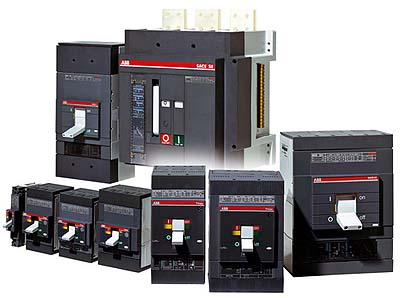 Автоматические выключатели ABB
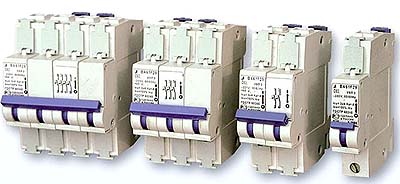 Модульные автоматические выключатели
1. НЕКОТОРЫЕ СВЕДЕНИЯ ОБ АВТОМАТИЧЕСКИХ ВЫКЛЮЧАТЕЛЯХ Автоматический выключатель — это электрический аппарат, который автоматически отключает (и тем самым защищает) электрическую цепь при возникновении в ней аномального режима. Режим становится аномальным, когда в цепи начинает недопустимо изменяться (т. е. увеличиваться или уменьшаться относительно номинального значения) ток или напряжение.
Другими словами (более "инженерно") можно сказать, что автоматический выключатель защищает от токов короткого замыкания и токов перегрузки отходящую от него питающую линию, например, кабель и приемник(и) электрической энергии (осветительную сеть, розетки, электродвигатель и т. п.).
Как правило, автоматический выключатель может применятся также для нечастого (несколько раз в сутки) включения и отключения защищаемых электроприемников (защищаемой нагрузки).
[Интент]Выключатель предназначен для проведения тока в нормальном режиме и отключения тока при коротких замыканиях, перегрузках, недопустимых снижениях напряжения, а также до 30 оперативных включений и отключений электрических цепей в сутки и рассчитан для эксплуатации в электроустановках с номинальным рабочим напряжением до 660 В переменного тока частоты 50 и 60 Гц и до 440 В постоянного тока.
[Типовая фраза из российской технической документации] 2. ПРИНЦИП ДЕЙСТВИЯ Для защиты цепи от короткого замыкания применяется автоматический выключатель с электромагнитным расцепителем.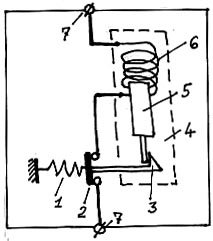
1 - Пружина (в данном случае во взведенном положении растянута)
Автоматический выключатель устроен таким образом, что сначала необходимо взвести пружину и только после этого его можно включить. У многих автоматических выключателей для взвода пружины необходимо перевести ручку вниз. После этого ручку переводят вверх. При этом замыкаются главные контакты.
2 - Главный контакт автоматического выключателя
3 - Удерживающее устройство
4 - Электромагнитный расцепитель;
5 - Сердечник
6 - Катушка
7 - Контактные зажимы автоматического выключателя
На рисунке показан один полюс автоматического выключателя во включенном положении: пружина 1 взведена, а главный контакт 2 замкнут.
Как только в защищаемой цепи возникнет короткое замыкание, ток, протекающий через соответствующий полюс автоматического выключателя, многократно возрастет. В катушке 6 сразу же возникнет сильное магнитное поле. Сердечник 5 втянется в катушку и освободит удерживающее устройство. Под действием пружины 1 главный контакт 2 разомкнется, в результате чего автоматический выключатель отключит и тем самым защитит цепь, в которой возникло короткое замыкание. Такое срабатывание автоматического выключателя происходит практически мгновенно (за сотые доли секунды).
Для защиты цепи от тока перегрузки применяют автоматические выключатели с тепловым расцепителем.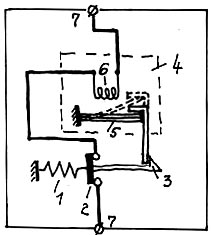
1 - Пружина (в данном случае во взведенном положении растянута)
Принцип действия такой же как и в первом случае, с той лишь разницей, что удерживающее устройство 3 освобождается под действием биметаллической пластины 5, которая изгибается от тепла, выделяемого нагревательным элементом 6. Количество тепла определяется током, протекающим через защищаемую цепь.
2 - Главный контакт автоматического выключателя
3 - Удерживающее устройство
4 - Тепловой расцепитель
5 - Биметаллическая пластина
6 - Нагревательный элемент
7 - Контактные зажимы автоматического выключателя
[Интент]Недопустимые, нерекомендуемые
Тематики
Классификация
>>>Обобщающие термины
Действия
- включение автоматического выключателя
- оперирование автоматического выключателя
- отключение автоматического выключателя
- срабатывание автоматического выключателя
EN
- auto-cutout
- automatic circuit breaker
- automatic cutout
- automatic switch
- breaker
- CB
- circuit breaker
- circuit-breaker
- cutout
DE
FR
Смотри также
выключатель
Коммутационный электрический аппарат, имеющий два коммутационных положения или состояния и предназначенный для включении и отключения тока.
Примечание. Под выключателем обычно понимают контактный аппарат без самовозврата. В остальных случаях термин должен быть дополнен поясняющими словами, например, «выключатель с самовозвратом», «выключатель тиристорный» и т. д.
[ ГОСТ 17703-72]
выключатель
Контактный коммутационный аппарат, способный включать, проводить и отключать токи при нормальных условиях в цепи, а также включать, проводить в течение нормированного времени и отключать токи при нормированных анормальных условиях в цепи, таких как короткое замыкание.
[ ГОСТ Р 52565-2006]
выключатель
Устройство для включения и отключения тока и напряжения в одной или более электрических цепях.
Примечание. При отсутствии других указаний под понятиями «напряжение» и «ток» подразумевают их среднеквадратичные значения.
[ ГОСТ Р 51324.1-2005]
выключатель
Прибор для включения и отключения электрического оборудования и устройств
[Терминологический словарь по строительству на 12 языках (ВНИИИС Госстроя СССР)]EN
(on-off) switch
switch for alternatively closing and opening one or more electric circuits
Source: 581-10-01 MOD
[IEV number 151-12-23]FR
interrupteur, m
commutateur destiné à fermer et ouvrir alternativement un ou plusieurs circuits électriques
Source: 581-10-01 MOD
[IEV number 151-12-23]При отключении воздушных и кабельных линий тупикового питания первым рекомендуется отключать выключатель со стороны нагрузки, вторым — со стороны питания.
[РД 153-34.0-20.505-2001]
... так чтобы она с меньшей выдержкой времени отключала выключатели с той стороны, на которой защита отсутствует;
[ПУЭ]
б) блокировка между выключателями нагрузки или разъединителем и заземляющим разъединителем, не позволяющая включать выключатель нагрузки или разъединитель при включенном заземляющем разъединителе и включать заземляющий разъединитель при включенном выключателе нагрузки или разъединителе;
[ ГОСТ 12.2.007.4-75]
Испытания изоляции выключателей и разъединителей должны быть проведены при включенном и отключенном положениях.
[ ГОСТ 1516_1-76]
Выключатели предназначены для оперативной и аварийной коммутации в энергосистемах, т.е. выполнения операций включения и отключения отдельных цепей при ручном или автоматическом управлении. Во включенном состоянии выключатели должны беспрепятственно пропускать токи нагрузки. Характер режима работы этих аппаратов несколько необычен: нормальным для них считается как включенное состояние, когда они обтекаются током нагрузки, так и отключенное, при котором они обеспечивают необходимую электрическую изоляцию между разомкнутыми участками цепи. Коммутация цепи, осуществляемая при переключении выключателя из одного положения в другое, производится нерегулярно, время от времени, а выполнение им специфических требований по отключению возникающего в цепи короткого замыкания чрезвычайно редко. Выключатели должны надежно выполнять свои функции в течение срока службы, находясь в любом из указанных состояний, и одновременно быть всегда готовыми к мгновенному эффективному выполнению любых коммутационных операций, часто после длительного пребывания в неподвижном состоянии. Отсюда следует, что они должны иметь очень высокий коэффициент готовности: при малой продолжительности процессов коммутации (несколько минут в год) должна быть обеспечена постоянная готовность к осуществлению коммутаций.
[ http://relay-protection.ru/content/view/46/8/]Тематики
- выключатель, переключатель
- релейная защита
Действия
Сопутствующие термины
EN
DE
FR
силовой выключатель
-
[Интент]EN
circuit-breaker
a mechanical switching device, capable of making, carrying and breaking currents under normal circuit conditions and also making, carrying for a specified time and breaking currents under specified abnormal circuit conditions such as those of short circuit
[IEV ref 441-14-20]FR
disjoncteur
appareil mécanique de connexion capable d'établir, de supporter et d'interrompre des courants dans les conditions normales du circuit, ainsi que d'établir, de supporter pendant une durée spécifiée et d'interrompre des courants dans des conditions anormales spécifiées du circuit telles que celles du court-circuit
[IEV ref 441-14-20]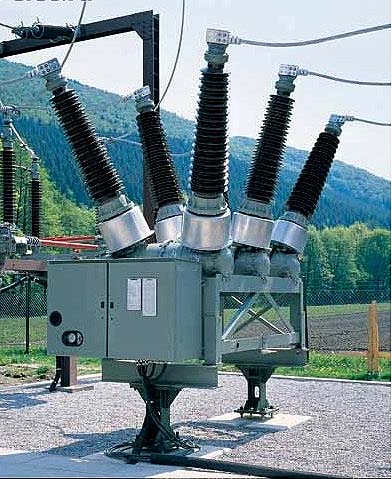
Рис. Siemens
Силовой ( баковый элегазовый) выключатель 3AP1 DT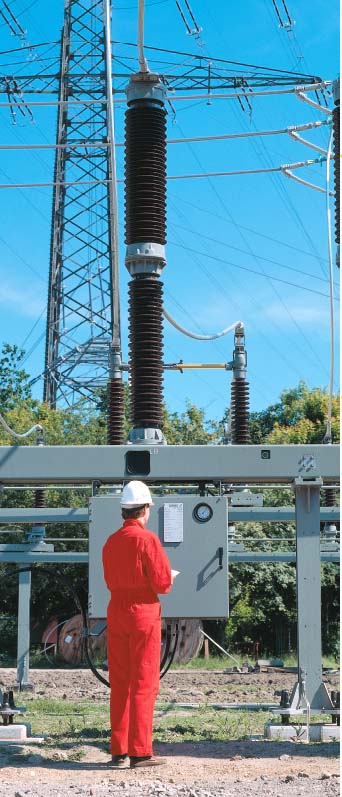
Рис. Siemens
Силовой (колонковый элегазовый) выключательТематики
- высоковольтный аппарат, оборудование...
- комплектное распред. устройство (КРУ)
EN
DE
FR
Франко-русский словарь нормативно-технической терминологии > disjoncteur
8 durée
durée [dyʀe]feminine noun* * *dyʀe1) ( période) (de spectacle, séjour, règne, d'études) length; ( de contrat) term; (de disque, cassette) playing timepour or pendant (toute) la durée de — for the duration of
pendant une durée limitée/fixée — over a limited/set period
de courte durée — [amitié, paix, reprise économique] short-lived; [orage, absence] brief; [bail, prêt] short-term
de longue durée — [bail, prêt, chômage, contrat] long-term; [absence] long
2) ( longévité)4) Philosophie duration* * *dyʀe nf(= temps) [spectacle, opération, maladie, peine de prison] duration, [pile] lifede courte durée (séjour, répit) — brief, short
pendant la durée de; Le service sera perturbé pendant toute la durée des opérations de maintenance. — The service will be disrupted for as long as maintenance work continues.
* * *durée nf1 ( période) (de spectacle, séjour, règne, d'études) length; ( de contrat) term; (de disque, cassette) playing time; pour or pendant (toute) la durée de for the duration of; durée de travail/hebdomadaire de travail working time/week; durée de la semaine scolaire school week; séjour/contrat d'une durée de trois mois three-month stay/contract; d'une durée de trois mois, le séjour comprend un cours intensif lasting three months, the stay includes an intensive course; ils n'ont pas précisé la durée du projet they didn't specify how long the project would last; pour/pendant une durée limitée/déterminée/fixée for/over a limited/specified/set period; pour une durée indéterminée [suspendu, employé] for an unlimited period; [fermé] until further notice; dépôt/contrat à durée déterminée fixed-term deposit/contract; de courte durée [amitié, paix, reprise économique] short-lived; [orage, absence] brief; [bail, prêt] short-term; de longue durée [bail, prêt, chômage, contrat] long-term; [absence] long;2 ( longévité) durée (de vie) life; durée d'utilisation useful life; pile/ampoule longue durée long-life battery/bulb;4 Philos duration.[dyre] nom fémininpendant la durée de during, for the duration ofdurée de conservation ≃ sell-by date2. [persistance] lasting qualityde courte durée locution adjectivalede longue durée locution adjectivale[chômeur, chômage] long-term9 conjoncteur-disjoncteur
автоматический выключатель
Механический коммутационный аппарат1), способный включать, проводить и отключать токи при нормальном состоянии электрической цепи, а также включать, проводить в течение заданного времени и автоматически отключать токи в указанном аномальном состоянии электрической цепи, например, при коротком замыкании.
(МЭС 441-14-20)
[ ГОСТ Р 50030. 2-99 ( МЭК 60947-2-98)]
автоматический выключатель
-
[IEV number 442-05-01]EN
circuit breaker
a mechanical switching device, capable of making, carrying and breaking currents under normal circuit conditions and also making, carrying for a specified time and breaking currents under specified abnormal circuit conditions such as those of short circuit.
[IEC 62271-100, ed. 2.0 (2008-04)]
[IEV number 442-05-01]
circuit breaker
A device designed to open and close a circuit by nonautomatic means and to open the circuit automatically on a predetermined overcurrent without damage to itself when properly applied within its rating.
NOTE The automatic opening means can be integral, direct acting with the circuit breaker, or remote from the circuit breaker.
Adjustable (as applied to circuit breakers). A qualifying term indicating that the circuit breaker can be set to trip at various values of current, time, or both within a predetermined range. Instantaneous-trip (as applied to circuit breakers). A qualifying term indicating that no delay is purposely introduced in the tripping action of the circuit breaker.
Inverse-time (as applied to circuit breakers). A qualifying term indicating a delay is purposely introduced in the tripping action of the circuit breaker, which delay decreases as the magnitude of the current increases.
Nonadjustable (as applied to circuit breakers). A qualifying term indicating that the circuit breaker does not have any adjustment to alter the value of current at which it will trip or the time required for its operation.
Setting (of a circuit breaker). The value of current, time, or both at which an adjustable circuit breaker is set to trip.
[National Electrical Cod]FR
disjoncteur
1) Должно быть контактный коммутационный аппарат
appareil mécanique de connexion capable d’établir, de supporter et d’interrompre des courants dans les conditions normales du circuit, ainsi que d’établir, de supporter pendant une durée spécifiée et d’in- terrompre des courants dans des conditions anormales spécifiées du circuit telles que celles du court-circuit.
[IEC 62271-100, ed. 2.0 (2008-04)]
[IEV number 442-05-01]
[Интент]КЛАССИФИКАЦИЯ
- По роду тока
- По напряжению
- По числу полюсов
- По виду корпуса
- По месту установки
- По изолирующей среде
- По установленным расцепителям
- По дополнительным защитам
- По назначению
- По категории применения
- По виду привода взвода пружины
- По выполняемой функции
-
По влиянию монтажного положения
Автоматические выключатели ABB
Модульные автоматические выключатели
1. НЕКОТОРЫЕ СВЕДЕНИЯ ОБ АВТОМАТИЧЕСКИХ ВЫКЛЮЧАТЕЛЯХ Автоматический выключатель — это электрический аппарат, который автоматически отключает (и тем самым защищает) электрическую цепь при возникновении в ней аномального режима. Режим становится аномальным, когда в цепи начинает недопустимо изменяться (т. е. увеличиваться или уменьшаться относительно номинального значения) ток или напряжение.
Другими словами (более "инженерно") можно сказать, что автоматический выключатель защищает от токов короткого замыкания и токов перегрузки отходящую от него питающую линию, например, кабель и приемник(и) электрической энергии (осветительную сеть, розетки, электродвигатель и т. п.).
Как правило, автоматический выключатель может применятся также для нечастого (несколько раз в сутки) включения и отключения защищаемых электроприемников (защищаемой нагрузки).
[Интент]Выключатель предназначен для проведения тока в нормальном режиме и отключения тока при коротких замыканиях, перегрузках, недопустимых снижениях напряжения, а также до 30 оперативных включений и отключений электрических цепей в сутки и рассчитан для эксплуатации в электроустановках с номинальным рабочим напряжением до 660 В переменного тока частоты 50 и 60 Гц и до 440 В постоянного тока.
[Типовая фраза из российской технической документации] 2. ПРИНЦИП ДЕЙСТВИЯ Для защиты цепи от короткого замыкания применяется автоматический выключатель с электромагнитным расцепителем.1 - Пружина (в данном случае во взведенном положении растянута)
Автоматический выключатель устроен таким образом, что сначала необходимо взвести пружину и только после этого его можно включить. У многих автоматических выключателей для взвода пружины необходимо перевести ручку вниз. После этого ручку переводят вверх. При этом замыкаются главные контакты.
2 - Главный контакт автоматического выключателя
3 - Удерживающее устройство
4 - Электромагнитный расцепитель;
5 - Сердечник
6 - Катушка
7 - Контактные зажимы автоматического выключателя
На рисунке показан один полюс автоматического выключателя во включенном положении: пружина 1 взведена, а главный контакт 2 замкнут.
Как только в защищаемой цепи возникнет короткое замыкание, ток, протекающий через соответствующий полюс автоматического выключателя, многократно возрастет. В катушке 6 сразу же возникнет сильное магнитное поле. Сердечник 5 втянется в катушку и освободит удерживающее устройство. Под действием пружины 1 главный контакт 2 разомкнется, в результате чего автоматический выключатель отключит и тем самым защитит цепь, в которой возникло короткое замыкание. Такое срабатывание автоматического выключателя происходит практически мгновенно (за сотые доли секунды).
Для защиты цепи от тока перегрузки применяют автоматические выключатели с тепловым расцепителем.1 - Пружина (в данном случае во взведенном положении растянута)
Принцип действия такой же как и в первом случае, с той лишь разницей, что удерживающее устройство 3 освобождается под действием биметаллической пластины 5, которая изгибается от тепла, выделяемого нагревательным элементом 6. Количество тепла определяется током, протекающим через защищаемую цепь.
2 - Главный контакт автоматического выключателя
3 - Удерживающее устройство
4 - Тепловой расцепитель
5 - Биметаллическая пластина
6 - Нагревательный элемент
7 - Контактные зажимы автоматического выключателя
[Интент]Недопустимые, нерекомендуемые
Тематики
Классификация
>>>Обобщающие термины
Действия
- включение автоматического выключателя
- оперирование автоматического выключателя
- отключение автоматического выключателя
- срабатывание автоматического выключателя
EN
- auto-cutout
- automatic circuit breaker
- automatic cutout
- automatic switch
- breaker
- CB
- circuit breaker
- circuit-breaker
- cutout
DE
FR
Смотри также
Франко-русский словарь нормативно-технической терминологии > conjoncteur-disjoncteur
10 coupe-circuit
автоматический выключатель
Механический коммутационный аппарат1), способный включать, проводить и отключать токи при нормальном состоянии электрической цепи, а также включать, проводить в течение заданного времени и автоматически отключать токи в указанном аномальном состоянии электрической цепи, например, при коротком замыкании.
(МЭС 441-14-20)
[ ГОСТ Р 50030. 2-99 ( МЭК 60947-2-98)]
автоматический выключатель
-
[IEV number 442-05-01]EN
circuit breaker
a mechanical switching device, capable of making, carrying and breaking currents under normal circuit conditions and also making, carrying for a specified time and breaking currents under specified abnormal circuit conditions such as those of short circuit.
[IEC 62271-100, ed. 2.0 (2008-04)]
[IEV number 442-05-01]
circuit breaker
A device designed to open and close a circuit by nonautomatic means and to open the circuit automatically on a predetermined overcurrent without damage to itself when properly applied within its rating.
NOTE The automatic opening means can be integral, direct acting with the circuit breaker, or remote from the circuit breaker.
Adjustable (as applied to circuit breakers). A qualifying term indicating that the circuit breaker can be set to trip at various values of current, time, or both within a predetermined range. Instantaneous-trip (as applied to circuit breakers). A qualifying term indicating that no delay is purposely introduced in the tripping action of the circuit breaker.
Inverse-time (as applied to circuit breakers). A qualifying term indicating a delay is purposely introduced in the tripping action of the circuit breaker, which delay decreases as the magnitude of the current increases.
Nonadjustable (as applied to circuit breakers). A qualifying term indicating that the circuit breaker does not have any adjustment to alter the value of current at which it will trip or the time required for its operation.
Setting (of a circuit breaker). The value of current, time, or both at which an adjustable circuit breaker is set to trip.
[National Electrical Cod]FR
disjoncteur
1) Должно быть контактный коммутационный аппарат
appareil mécanique de connexion capable d’établir, de supporter et d’interrompre des courants dans les conditions normales du circuit, ainsi que d’établir, de supporter pendant une durée spécifiée et d’in- terrompre des courants dans des conditions anormales spécifiées du circuit telles que celles du court-circuit.
[IEC 62271-100, ed. 2.0 (2008-04)]
[IEV number 442-05-01]
[Интент]КЛАССИФИКАЦИЯ
- По роду тока
- По напряжению
- По числу полюсов
- По виду корпуса
- По месту установки
- По изолирующей среде
- По установленным расцепителям
- По дополнительным защитам
- По назначению
- По категории применения
- По виду привода взвода пружины
- По выполняемой функции
-
По влиянию монтажного положения
Автоматические выключатели ABB
Модульные автоматические выключатели
1. НЕКОТОРЫЕ СВЕДЕНИЯ ОБ АВТОМАТИЧЕСКИХ ВЫКЛЮЧАТЕЛЯХ Автоматический выключатель — это электрический аппарат, который автоматически отключает (и тем самым защищает) электрическую цепь при возникновении в ней аномального режима. Режим становится аномальным, когда в цепи начинает недопустимо изменяться (т. е. увеличиваться или уменьшаться относительно номинального значения) ток или напряжение.
Другими словами (более "инженерно") можно сказать, что автоматический выключатель защищает от токов короткого замыкания и токов перегрузки отходящую от него питающую линию, например, кабель и приемник(и) электрической энергии (осветительную сеть, розетки, электродвигатель и т. п.).
Как правило, автоматический выключатель может применятся также для нечастого (несколько раз в сутки) включения и отключения защищаемых электроприемников (защищаемой нагрузки).
[Интент]Выключатель предназначен для проведения тока в нормальном режиме и отключения тока при коротких замыканиях, перегрузках, недопустимых снижениях напряжения, а также до 30 оперативных включений и отключений электрических цепей в сутки и рассчитан для эксплуатации в электроустановках с номинальным рабочим напряжением до 660 В переменного тока частоты 50 и 60 Гц и до 440 В постоянного тока.
[Типовая фраза из российской технической документации] 2. ПРИНЦИП ДЕЙСТВИЯ Для защиты цепи от короткого замыкания применяется автоматический выключатель с электромагнитным расцепителем.1 - Пружина (в данном случае во взведенном положении растянута)
Автоматический выключатель устроен таким образом, что сначала необходимо взвести пружину и только после этого его можно включить. У многих автоматических выключателей для взвода пружины необходимо перевести ручку вниз. После этого ручку переводят вверх. При этом замыкаются главные контакты.
2 - Главный контакт автоматического выключателя
3 - Удерживающее устройство
4 - Электромагнитный расцепитель;
5 - Сердечник
6 - Катушка
7 - Контактные зажимы автоматического выключателя
На рисунке показан один полюс автоматического выключателя во включенном положении: пружина 1 взведена, а главный контакт 2 замкнут.
Как только в защищаемой цепи возникнет короткое замыкание, ток, протекающий через соответствующий полюс автоматического выключателя, многократно возрастет. В катушке 6 сразу же возникнет сильное магнитное поле. Сердечник 5 втянется в катушку и освободит удерживающее устройство. Под действием пружины 1 главный контакт 2 разомкнется, в результате чего автоматический выключатель отключит и тем самым защитит цепь, в которой возникло короткое замыкание. Такое срабатывание автоматического выключателя происходит практически мгновенно (за сотые доли секунды).
Для защиты цепи от тока перегрузки применяют автоматические выключатели с тепловым расцепителем.1 - Пружина (в данном случае во взведенном положении растянута)
Принцип действия такой же как и в первом случае, с той лишь разницей, что удерживающее устройство 3 освобождается под действием биметаллической пластины 5, которая изгибается от тепла, выделяемого нагревательным элементом 6. Количество тепла определяется током, протекающим через защищаемую цепь.
2 - Главный контакт автоматического выключателя
3 - Удерживающее устройство
4 - Тепловой расцепитель
5 - Биметаллическая пластина
6 - Нагревательный элемент
7 - Контактные зажимы автоматического выключателя
[Интент]Недопустимые, нерекомендуемые
Тематики
Классификация
>>>Обобщающие термины
Действия
- включение автоматического выключателя
- оперирование автоматического выключателя
- отключение автоматического выключателя
- срабатывание автоматического выключателя
EN
- auto-cutout
- automatic circuit breaker
- automatic cutout
- automatic switch
- breaker
- CB
- circuit breaker
- circuit-breaker
- cutout
DE
FR
Смотри также
Франко-русский словарь нормативно-технической терминологии > coupe-circuit
11 interrupteur automatique
автоматический выключатель
Механический коммутационный аппарат1), способный включать, проводить и отключать токи при нормальном состоянии электрической цепи, а также включать, проводить в течение заданного времени и автоматически отключать токи в указанном аномальном состоянии электрической цепи, например, при коротком замыкании.
(МЭС 441-14-20)
[ ГОСТ Р 50030. 2-99 ( МЭК 60947-2-98)]
автоматический выключатель
-
[IEV number 442-05-01]EN
circuit breaker
a mechanical switching device, capable of making, carrying and breaking currents under normal circuit conditions and also making, carrying for a specified time and breaking currents under specified abnormal circuit conditions such as those of short circuit.
[IEC 62271-100, ed. 2.0 (2008-04)]
[IEV number 442-05-01]
circuit breaker
A device designed to open and close a circuit by nonautomatic means and to open the circuit automatically on a predetermined overcurrent without damage to itself when properly applied within its rating.
NOTE The automatic opening means can be integral, direct acting with the circuit breaker, or remote from the circuit breaker.
Adjustable (as applied to circuit breakers). A qualifying term indicating that the circuit breaker can be set to trip at various values of current, time, or both within a predetermined range. Instantaneous-trip (as applied to circuit breakers). A qualifying term indicating that no delay is purposely introduced in the tripping action of the circuit breaker.
Inverse-time (as applied to circuit breakers). A qualifying term indicating a delay is purposely introduced in the tripping action of the circuit breaker, which delay decreases as the magnitude of the current increases.
Nonadjustable (as applied to circuit breakers). A qualifying term indicating that the circuit breaker does not have any adjustment to alter the value of current at which it will trip or the time required for its operation.
Setting (of a circuit breaker). The value of current, time, or both at which an adjustable circuit breaker is set to trip.
[National Electrical Cod]FR
disjoncteur
1) Должно быть контактный коммутационный аппарат
appareil mécanique de connexion capable d’établir, de supporter et d’interrompre des courants dans les conditions normales du circuit, ainsi que d’établir, de supporter pendant une durée spécifiée et d’in- terrompre des courants dans des conditions anormales spécifiées du circuit telles que celles du court-circuit.
[IEC 62271-100, ed. 2.0 (2008-04)]
[IEV number 442-05-01]
[Интент]КЛАССИФИКАЦИЯ
- По роду тока
- По напряжению
- По числу полюсов
- По виду корпуса
- По месту установки
- По изолирующей среде
- По установленным расцепителям
- По дополнительным защитам
- По назначению
- По категории применения
- По виду привода взвода пружины
- По выполняемой функции
-
По влиянию монтажного положения
Автоматические выключатели ABB
Модульные автоматические выключатели
1. НЕКОТОРЫЕ СВЕДЕНИЯ ОБ АВТОМАТИЧЕСКИХ ВЫКЛЮЧАТЕЛЯХ Автоматический выключатель — это электрический аппарат, который автоматически отключает (и тем самым защищает) электрическую цепь при возникновении в ней аномального режима. Режим становится аномальным, когда в цепи начинает недопустимо изменяться (т. е. увеличиваться или уменьшаться относительно номинального значения) ток или напряжение.
Другими словами (более "инженерно") можно сказать, что автоматический выключатель защищает от токов короткого замыкания и токов перегрузки отходящую от него питающую линию, например, кабель и приемник(и) электрической энергии (осветительную сеть, розетки, электродвигатель и т. п.).
Как правило, автоматический выключатель может применятся также для нечастого (несколько раз в сутки) включения и отключения защищаемых электроприемников (защищаемой нагрузки).
[Интент]Выключатель предназначен для проведения тока в нормальном режиме и отключения тока при коротких замыканиях, перегрузках, недопустимых снижениях напряжения, а также до 30 оперативных включений и отключений электрических цепей в сутки и рассчитан для эксплуатации в электроустановках с номинальным рабочим напряжением до 660 В переменного тока частоты 50 и 60 Гц и до 440 В постоянного тока.
[Типовая фраза из российской технической документации] 2. ПРИНЦИП ДЕЙСТВИЯ Для защиты цепи от короткого замыкания применяется автоматический выключатель с электромагнитным расцепителем.1 - Пружина (в данном случае во взведенном положении растянута)
Автоматический выключатель устроен таким образом, что сначала необходимо взвести пружину и только после этого его можно включить. У многих автоматических выключателей для взвода пружины необходимо перевести ручку вниз. После этого ручку переводят вверх. При этом замыкаются главные контакты.
2 - Главный контакт автоматического выключателя
3 - Удерживающее устройство
4 - Электромагнитный расцепитель;
5 - Сердечник
6 - Катушка
7 - Контактные зажимы автоматического выключателя
На рисунке показан один полюс автоматического выключателя во включенном положении: пружина 1 взведена, а главный контакт 2 замкнут.
Как только в защищаемой цепи возникнет короткое замыкание, ток, протекающий через соответствующий полюс автоматического выключателя, многократно возрастет. В катушке 6 сразу же возникнет сильное магнитное поле. Сердечник 5 втянется в катушку и освободит удерживающее устройство. Под действием пружины 1 главный контакт 2 разомкнется, в результате чего автоматический выключатель отключит и тем самым защитит цепь, в которой возникло короткое замыкание. Такое срабатывание автоматического выключателя происходит практически мгновенно (за сотые доли секунды).
Для защиты цепи от тока перегрузки применяют автоматические выключатели с тепловым расцепителем.1 - Пружина (в данном случае во взведенном положении растянута)
Принцип действия такой же как и в первом случае, с той лишь разницей, что удерживающее устройство 3 освобождается под действием биметаллической пластины 5, которая изгибается от тепла, выделяемого нагревательным элементом 6. Количество тепла определяется током, протекающим через защищаемую цепь.
2 - Главный контакт автоматического выключателя
3 - Удерживающее устройство
4 - Тепловой расцепитель
5 - Биметаллическая пластина
6 - Нагревательный элемент
7 - Контактные зажимы автоматического выключателя
[Интент]Недопустимые, нерекомендуемые
Тематики
Классификация
>>>Обобщающие термины
Действия
- включение автоматического выключателя
- оперирование автоматического выключателя
- отключение автоматического выключателя
- срабатывание автоматического выключателя
EN
- auto-cutout
- automatic circuit breaker
- automatic cutout
- automatic switch
- breaker
- CB
- circuit breaker
- circuit-breaker
- cutout
DE
FR
Смотри также
Франко-русский словарь нормативно-технической терминологии > interrupteur automatique
12 temps de fermeture (d'ouverture) stable
время устойчивого замыкания (размыкания) контакта электрического реле
Интервал времени от момента достижения входной воздействующей величины электрического реле определенного значения до момента, когда цепь контакта электрического реле замкнется (разомкнется)
[ ГОСТ 16022-83]EN
time to stable closed condition
the time interval between the instant when a specified value of the input energizing quantity is applied and the instant when a contact is closed and fulfils specified requirements
[IEV number 446-17-24]
time to stable open condition
the time interval between the instant when a specified value of the input energizing quantity is applied and the instant when a contact is open and fulfils specified requirements
[IEV number 446-17-25]FR
temps de fermeture stable
temps écoulé entre l'instant d'application d'une valeur spécifiée de la grandeur d'alimentation d'entrée et l'instant où un circuit de contact est fermé et répond aux prescriptions spécifiées
[IEV number 446-17-24]
temps d'ouverture stable
temps écoulé entre l'instant d'application d'une valeur spécifiée de la grandeur d'alimentation d'entrée et l'instant où un circuit de contact est ouvert et répond aux prescriptions spécifiées
[IEV number 446-17-25]
Тематики
EN
DE
FR
Франко-русский словарь нормативно-технической терминологии > temps de fermeture (d'ouverture) stable
13 relais ou déclencheur à maximum de courant à temps inverse
- максимальное реле или максимальный расцепитель тока с обратнозависимой выдержкой времени
максимальное реле или максимальный расцепитель тока с обратнозависимой выдержкой времени
Максимальное реле или максимальный расцепитель тока, срабатывающие с выдержкой времени, находящейся в обратной зависимости от значения сверхтока.
Примечание. Такие реле или расцепитель могут быть спроектированы так, чтобы при высоких значениях сверхтока выдержка времени достигала определенного минимального значения.
[ ГОСТ Р 50030. 1-2000 ( МЭК 60947-1-99)]EN
inverse time-delay over-current relay or release
over-current relay or release which operates after a time-delay inversely dependent upon the value of the over-current
NOTE Such a relay or release may be designed so that the time-delay approaches a definite minimum value for high values of over-current.
[IEC 60947-1, ed. 5.0 (2007-06)]FR
relais ou déclencheur à maximum de courant à temps inverse
relais ou déclencheur à maximum de courant qui fonctionne après un intervalle de temps qui varie en raison inverse de la valeur de la surintensité
NOTE Un tel relais ou déclencheur peut être prévu pour que le retard atteigne une valeur minimale définie pour les valeurs élevées de la surintensité.
[IEC 60947-1, ed. 5.0 (2007-06)]Тематики
- расцепитель, тепловое реле
- реле электрическое
Классификация
>>>EN
FR
Франко-русский словарь нормативно-технической терминологии > relais ou déclencheur à maximum de courant à temps inverse
14 courant conventionnel de non-déclenchement
условный ток нерасцепления Int
Установленное значение тока, который автоматический выключатель для электрооборудования способен проводить заданное (условное) время без расцепления.
[ ГОСТ Р 50031-99( МЭК 60934-93)]
условный ток нерасцепления (максимального реле или расцепителя тока)
Установленное значение тока, который реле или расцепитель способны проводить, не срабатывая, в течение заданного (условного) времени.
[ ГОСТ Р 50030. 1-2000 ( МЭК 60947-1-99)]EN
conventional non-tripping current
a specified value of current which the circuit-breaker is capable of carrying for a specified time designated as conventional time, without tripping
[IEV number 442-05-54]
conventional non-tripping current (of an over-current release)
a specified value of current which the release can carry for a specified time (conventional time) without operating
[IEV number 441-17-22]FR
courant conventionnel de non-déclenchement
valeur spécifiée du courant que le disjoncteur peut supporter sans déclencher pendant un temps spécifié appelé temps conventionnel
[IEV number 442-05-54]
courant conventionnel de non-déclenchement (d'un déclencheur à maximum de courant)
valeur spécifiée de courant que peut supporter un déclencheur pendant une durée spécifiée (durée conventionnelle) sans fonctionner
[IEV number 441-17-22]Тематики
Синонимы
EN
DE
- Nichtauslösestrom (eines Überlastauslösers)
- vereinbarte Nichtauslösestromstärke
- vereinbarter Nichtauslösestrom
FR
Франко-русский словарь нормативно-технической терминологии > courant conventionnel de non-déclenchement
15 courant de choc de manœuvre d'un parafoudre
коммутационный импульс тока ОПН
Максимальное (амплитудное) значение тока с условной длительностью фронта не менее 30, но не более 100 мкс и условной длительностью импульса, равной удвоенному времени условного фронта импульса.
[ ГОСТ Р 52725-2007]EN
switching current impulse of an arrester
peak value of discharge current having a virtual front time greater than 30 ms but less than 100 ms and a virtual time to half-value on the tail of roughly twice the virtual front time
[IEC 60099-4, ed. 2.0 (2004-05)]FR
courant de choc de manœuvre d'un parafoudre
valeur de crête du courant de décharge dont la durée conventionnelle du front est comprise entre 30 ms et 100 ms, et dont la durée conventionnelle jusqu'à mi-valeur sur la queue est d'environ deux fois la durée conventionnelle du front
[IEC 60099-4, ed. 2.0 (2004-05)]Тематики
- высоковольтный аппарат, оборудование...
EN
FR
Франко-русский словарь нормативно-технической терминологии > courant de choc de manœuvre d'un parafoudre
16 dispositif différentiel temporisé
устройство дифференциального тока с выдержкой времени
-
[IEV number 442-05-05]EN
time-delay residual current device
residual current device specially designed to attain a predetermined value of limiting non-actuating time, corresponding to a given value of residual current
[IEV number 442-05-05]FR
dispositif différentiel temporisé
dispositif de coupure différentiel spécialement conçu pour obtenir une valeur prédéterminée du temps limite de non-réponse correspondant à une valeur donnée du courant différentiel
[IEV number 442-05-05]Тематики
- аппарат, изделие, устройство...
- электроустановки
Обобщающие термины
EN
DE
FR
Франко-русский словарь нормативно-технической терминологии > dispositif différentiel temporisé
17 disjoncteur limiteur de courant
токоограничивающий автоматический выключатель
Выключатель с чрезвычайно малым временем отключения, в течение которого ток короткого замыкания не успевает достичь своего максимального значения.
[МЭК 60947-1]En
current-limiting circuit breaker
Circuit-breaker with a break-time short enough to prevent the short-circuit current reaching its otherwise attainable peak value.
[< size="2">IEC 60077-3, ed. 1.0 (2001-12)]
Circuit-breaker that, within a specified range of current, prevents the let-through current reaching the prospective peak value and which limits the let-through energy (I2t) to a value less than the let-through energy of a half-cycle wave of the symmetrical prospective current
NOTE 1 - Reference may be made to either the symmetrical or asymmetrical prospective peak value of let-through current.
NOTE 2 - The let-through current is also referred to as the cut-off current (see IEV 441-17-12).
NOTE 3 - Templates for the graphical representation of the cut-off current characteristic and the let-through energy characteristic are given in Figures K.2 to K.5 and examples of the use of the templates in Figures K.6 and K.7.
[IEC 60947-2, ed. 4.0, amd. 1 (2009-01)]Fr
disjoncteur limiteur de courant
Disjoncteur dont la durée de coupure est particulièrement brève en vue d’obtenir que le courant de court-circuit ne puisse atteindre son amplitude maximale
[< size="2">IEC 60077-3, ed. 1.0 (2001-12)]
Disjoncteur qui, à l'intérieur d'un domaine de courant spécifié, empêche le courant coupé limité d'atteindre la valeur crête présumée et qui limite l'énergie limitée (I2t) à une valeur inférieure à l'énergie limitée d'une demi-période du courant présumé symétrique
NOTE 1 Il peut être fait référence à la valeur crête présumée symétrique ou assymétrique du courant coupé limité.
NOTE 2 Le courant coupé limité (let-through current) est aussi nommé "cut-off current" (voir VEI 441-17-12).
NOTE 3 Les modèles de représentation graphique des caractéristiques de courant coupé limité et d'énergie limitée sont illustrés dans les Figures K.2 à K.5 et les exemples d'utilisation des modèles dans les Figures K.6 et K.7.
[IEC 60947-2, ed. 4.0, amd. 1 (2009-01)]Токоограничивающий автоматический выключатель имеет чрезвычайно малое время отключения, в течение которого ток КЗ не успевает достичь максимального значения.
Токоограничивающие автоматические выключатели ограничивают ток КЗ с помощью быстрого введения в цепь дополнительного сопротивления электрической дуги (в первый же полупериод, до того, как ток КЗ значительно возрастет) и последующего быстрого отключения КЗ, при этом ток КЗ не достигает ожидаемого расчетного максимального значения. Токоограничение начинается с некоторого значения тока, определяемого характеристикой токоогранияения.
В токоограничивающих автоматических выключателях при больших ожидаемых токах КЗ контакты, сразу же отбрасываются электродинамическими силами, вводя в цепь сопротивление дуги, и затем уже не соприкасаются, так как своевременно срабатывает электромагнитный расцепитель.
При малых токах КЗ контакты не отбрасываются, а отключение производится электромагнитным расцепителем.
[А.В.Беляев. Выбор аппаратуры, защит и кабелей в сетях 0,4 кВ. - Л.: Энергоатомиздат. 1988.]Тематики
Классификация
>>>Обобщающие термины
EN
- current limiting circuitbreaker
- current-limiting circuit breaker
- current-limiting circuit-breaker
- limiting circuit breaker
- limiting circuit-breaker
DE
FR
Франко-русский словарь нормативно-технической терминологии > disjoncteur limiteur de courant
18 prendre
prendre [pʀɑ̃dʀ]━━━━━━━━━━━━━━━━━━➭ TABLE 58━━━━━━━━━━━━━━━━━► Lorsque prendre fait partie d'une locution comme prendre en photo, prendre en charge, reportez-vous aussi à l'autre mot.━━━━━━━━━━━━━━━━━1. <• avec lui, il faut en prendre et en laisser you can't believe half of what he says• tiens, prends ce marteau here, use this hammer• si tu sors, prends ton parapluie if you go out, take your umbrella• j'ai pris l'avion/le train de 4 heures I caught the 4 o'clock plane/trainc. ( = s'emparer de, surprendre) [+ poisson, voleur] to catch• se faire prendre [voleur] to be caught• qu'est-ce qui te prend ? (inf) what's the matter with you?• ça te prend souvent ? (inf) are you often like this?• je vous y prends ! caught you!d. ( = duper) to take ine. ( = manger, boire) [+ aliment, boisson] to have ; [+ médicament] to take• prenez-vous du sucre ? do you take sugar?• est-ce que vous prendrez du café ? would you like some coffee?f. ( = acheter) [+ billet, essence] to get ; ( = réserver) [+ couchette, place] to book• peux-tu me prendre du pain ? can you get me some bread?g. ( = accepter) [+ client, locataire] to take ; [+ passager] to pick uph. ( = noter) [+ renseignement, adresse, nom, rendez-vous] to write down ; [+ mesures, température, empreintes] to takei. ( = adopter) [+ air, ton] to put on ; [+ décision, risque, mesure] to takej. ( = acquérir) prendre de l'autorité to gain authorityk. ( = faire payer) to charge• qu'est-ce qu'on a pris ! (reproches) we really got it in the neck! (inf) ; (averse) we got drenched!m. ( = réagir à) [+ nouvelle] to taken. ( = manier) [+ personne] to handle ; [+ problème] to deal witho. (locutions)► prendre qn/qch pour ( = considérer comme) to take sb/sth for ; ( = utiliser comme) to take sb/sth as• pour qui me prenez-vous ? what do you take me for?• prendre qch pour cible to make sth a target► prendre sur soi ( = se maîtriser) to grin and bear it ; ( = assumer) to take responsibility• savoir prendre sur soi to keep a grip on o.s.2. <a. ( = durcir) [ciment, pâte, crème] to setb. ( = réussir) [mouvement, mode] to catch onc. ( = commencer à brûler) [feu] to take ; (accidentellement) to start ; [allumette] to light ; [bois] to catch fired. ( = passer) to go3. <a. ( = se considérer)• pour qui se prend-il ? who does he think he is?• se prendre au sérieux to take o.s. seriouslyb. ( = accrocher, coincer) to catchc. (locutions)► s'en prendre à ( = passer sa colère sur) to take it out on ; ( = blâmer) to put the blame on ; ( = attaquer) to attack* * *pʀɑ̃dʀ
1.
1) ( saisir) to takeprendre un vase sur l'étagère/dans le placard — to take a vase off the shelf/out of the cupboard
2) (se donner, acquérir)prendre un accent — ( involontairement) to pick up an accent; ( volontairement) to put on an accent
prendre une habitude — to develop ou pick up a habit
3) ( dérober) to takeon m'a pris tous mes bijoux — I had all my jewellery GB ou jewelry US stolen
4) ( apporter) to bring5) ( emporter) to take6) ( retirer)7) ( consommer) to have [boisson, aliment, repas]; to take [médicament, drogue]aller prendre un café/une bière — to go for a coffee/a beer
je prends des calmants depuis la guerre — I've been on tranquillizers [BrE] since the war
8) ( s'accorder) to takeje vais prendre mon mercredi — (colloq) I'm going to take Wednesday off
9) ( choisir) to take [objet]; to choose [sujet, question]prendre quelqu'un pour époux/épouse — to take somebody to be one's husband/wife
10) ( faire payer) to chargeil prend 15% au passage — (colloq) he takes a cut of 15%
11) ( nécessiter) to take [temps]; ( user) to take up [espace, temps]12) (acheter, réserver, louer) to get [aliments, essence, place]13) ( embaucher) ( durablement) to take [somebody] on [employé, assistant, apprenti]; ( pour une mission) to engage [personne]prendre un avocat/guide — to engage a lawyer/guide
14) ( accueillir) to takeprendre un client — [taxi] to pick up a customer
15) ( ramasser au passage) to pick up [personne, pain, clé, journal, ticket]16) ( emmener) to take [personne]je peux te prendre — ( en voiture) I can give you a lift
17) ( attraper) to catch [personne, animal]je vous y prends! — (colloq) caught you!
on ne m'y prendra plus! — (colloq) ( à faire) you won't catch me doing that again!; ( à croire) I won't be taken in (colloq) again!
je ne me suis pas laissé prendre — ( tromper) I wasn't going to be taken in (colloq)
18) (colloq) ( assaillir)ça te/leur prend souvent? — are you/they often like this?
19) ( captiver) to involve [spectateur, lecteur]être pris par un livre/film — to get involved in a book/film
20) ( subir) to get [gifle, coup de soleil, décharge, contravention]; to catch [rhume]21) ( utiliser) to take [autobus, métro, train, ferry, autoroute]22) ( envisager) to takeprenons par exemple Nina — take Nina, for example
23) ( considérer) to takepour qui me prends-tu? — ( grossière erreur) what do you take me for?; ( manque de respect) who do you think you're talking to?
excusez-moi, je vous ai pris pour quelqu'un d'autre — I'm sorry, I thought you were someone else
24) ( traiter) to handle25) ( mesurer) to take [mensurations, température, tension, pouls]26) ( noter) to take down27) ( apprendre)où a-t-il pris qu'ils allaient divorcer? — where did he get the idea they were going to get divorced?
28) ( accepter) to take29) ( endosser) to take over [direction, pouvoir]; to assume [contrôle, poste]prendre sur soi de faire — to take it upon oneself to do, to undertake to do
30) ( accumuler) to put on [poids]; to gain [avance]31) ( contracter) to take on [bail]; to take [emploi]32) ( défier) to take [somebody] on [concurrent]33) ( conquérir) Armée to take, to seize [ville, forteresse]; to capture [navire, tank]; Jeux to take [pièce, carte]
2.
verbe intransitif1) ( aller)prendre à gauche/vers le nord — to go left/north
2) ( s'enflammer) [feu, bois, mèche] to catch; [incendie] to break out3) ( se solidifier) [gelée, flan, glace, ciment, plâtre, colle] to set; [blancs d'œufs] to stiffen; [mayonnaise] to thicken4) ( réussir) [grève, innovation] to be a success; [idée, mode] to catch on; [teinture, bouture, vaccination, greffe] to take; [leçon] to sink in5) ( prélever)6) ( se contraindre)7) (colloq) ( être cru)ça ne prend pas! — it won't wash (colloq) ou work!
8) (colloq) ( subir)
3.
se prendre verbe pronominal1) (devoir être saisi, consommé, mesuré)2) ( pouvoir être acquis)3) ( se tenir l'un l'autre)4) ( se coincer)5) (colloq) ( recevoir)6) ( commencer)7) ( se considérer)8)s'en prendre à — ( par des reproches ou des critiques) to attack [personne, presse, parti]; ( pour passer sa colère) to take it out on [personne]; ( agresser verbalement ou physiquement) to go for [personne]; ( blâmer) to blame [personne, groupe, institution]
9) ( se comporter)savoir s'y prendre avec — to have a way with [enfants, femmes, vieux]; to know how to handle [employés, élèves]
10) ( agir)elle s'y prend bien/mal — she goes about it the right/wrong way
••* * *pʀɑ̃dʀ1. vt1) (= saisir) to take2) (= se procurer) to getJ'ai pris du lait en rentrant. — I got some milk on the way home.
J'ai pris des places pour le concert. — I got some tickets for the concert.
3) (= aller chercher) to get, to fetch Grande-Bretagne, [passager] to pick uppasser prendre — to pick up, to go and fetch
Je passerai te prendre. — I'll come and pick you up., I'll come and fetch you.
Je dois passer prendre Richard. — I have to pick Richard up., I have to go and fetch Richard.
4) [train, bus] to takeNous avons pris le train de huit heures. — We took the eight o'clock train.
Je prends toujours le train pour aller à Paris. — I always go to Paris by train., I always take the train when I go to Paris.
5) (= prélever) [pourcentage, argent] to take off6) (= acquérir) [du poids] to put on, to gainprendre goût à qch — to develop a taste for sth, to acquire a taste for sth
7) (= adopter) [voix, ton] to put on8) (= attraper) [malfaiteur, poisson] to catch9) [personnel] to take on, [locataire] to take in10) (= s'y prendre avec) [enfant, problème] to handleprendre sur soi de faire qch — to take it upon o.s. to do sth
prendre sa source [rivière] — to rise, to have its source
être pris à partie par qn (= interpellé par qn) — to be taken to task by sb
être violemment pris à partie par qn (= molesté par qn) — to be violently set upon by sb
2. vi1) [liquide, ciment] to set2) [greffe, vaccin] to take3) [ruse] to be successful4) [feu] to go, [incendie] to start, [allumette] to light5) (= se diriger)Prenez à gauche en arrivant au rond-point. — Turn left at the roundabout.
6) * (= être preneur)* * *prendre verb table: prendreA vtr1 ( saisir) to take; prendre un vase sur l'étagère/dans le placard to take a vase off the shelf/out of the cupboard; prendre le bras de son mari to take one's husband's arm; prendre qn par la taille ( des deux mains) to take sb by the waist; ( d'un bras) to put one's arm around sb's waist; puis-je prendre votre manteau? may I take your coat?; prenez donc une chaise do have ou take a seat; ⇒ clique, courage, jambe;2 (se donner, acquérir) prendre un air/une expression to put on an air/an expression; prendre le nom de son mari to take one's husband's name; prendre une identité to assume an identity; prendre un accent ( involontairement) to pick up an accent; ( volontairement) to put on an accent; prendre une habitude to develop ou pick up a habit; prendre une voix grave to adopt a solemn tone; prendre un rôle to assume a role; ta remarque prend tout son sens you comment begins to make sense; prendre une nuance to take on a particular nuance;3 ( dérober) to take; prendre de l'argent dans la caisse/à ses parents to take money from the till GB ou cash register/from one's parents; on m'a pris tous mes bijoux I had all my jewellery GB ou jewelry US stolen; il m'a pris ma petite amie he stole my girlfriend; la guerre leur a pris deux fils they lost two sons in the war; la guerre leur a pris tout ce qui leur était cher the war robbed them of all they held most dear;4 ( apporter) to bring; n'oublie pas de prendre des bottes don't forget to bring boots; je n'ai pas pris assez d'argent I haven't brought enough money;5 ( emporter) to take; j'ai pris ton parapluie I took your umbrella; ne prends rien sans demander don't take anything without asking; prends ton écharpe, il fait froid take your scarf, it's cold;6 ( retirer) prendre de l'argent au distributeur to get some money out of the cash dispenser; prendre de l'eau au puits to get water from the well; prendre quelques livres à la bibliothèque to get a few books out of the library;7 ( consommer) to have [boisson, aliment, repas]; to take [médicament, drogue]; vous prendrez bien quelque chose/un peu de gâteau? won't you have something to eat or drink/some cake?; je vais prendre du poisson I'll have fish; mais tu n'as rien pris! you've hardly taken any!; aller prendre un café/une bière to go for a coffee/a beer; je prends des calmants depuis la guerre I've been on tranquillizersGB since the war; le médecin me fait prendre des antibiotiques the doctor has put me on antibiotics; je ne prends jamais d'alcool/de drogue I never touch alcohol/take drugs;8 ( s'accorder) to take; prendre un congé to take a vacation; je vais prendre mon mercredi○ I'm going to take Wednesday off; ⇒ temps;9 ( choisir) to take [objet]; to choose [sujet, question]; prendre la rouge/le moins cher des deux/la chambre double to take the red one/the cheaper one/the double room; j'ai pris la question sur Zola I chose the question on Zola; la romancière a pris comme sujet une histoire vraie the writer based her novel on a true story; prendre qn pour époux/épouse to take sb to be one's husband/wife;10 ( faire payer) to charge; elle prend combien de l'heure/pour une coupe? how much does she charge an hour/for a cut?; on m'a pris très cher I was charged a lot; il prend 15% au passage he takes a cut of 15%;11 ( nécessiter) to take [temps]; ( user) to take up [espace, temps]; le voyage m'a pris moins de deux heures the trip took me less than two hours; tes livres prennent trop de place your books take up too much room; mes enfants me prennent tout mon temps/toute mon énergie my children take up all my time/all my energy;12 (acheter, réserver, louer) to get [aliments, essence, place]; prends aussi du jambon get some ham too; j'ai pris deux places pour ce soir I've got two tickets for tonight; prendre une chambre en ville to get a room in town; j'en prendrai un kilo I'll have a kilo;13 ( embaucher) ( durablement) to take [sb] on [employé, assistant, apprenti]; ( pour une mission) to engage [personne]; ils ne m'ont pas pris they didn't take me on; prendre qn comme nourrice to take sb on as a nanny; prendre un avocat/guide to engage a lawyer/guide; être pris chez or par Hachette to get a job with Hachette; prendre une maîtresse to take a mistress;14 ( accueillir) to take; ils ont pris la petite chez eux they took the little girl in; l'école n'a pas voulu la prendre the school wouldn't take her; ce train ne prend pas de voyageurs this train doesn't take passengers; prendre un client [taxi] to pick up a customer; [prostituée] to pick up a client; [coiffeur] to take a customer; prendre un patient [médecin] to see a patient; prendre un nouveau patient [médecin, dentiste] to take on a new patient; prendre un élève [professeur] to take on a student;15 ( ramasser au passage) to pick up [personne, pain, clé, journal, ticket]; je passe te prendre à midi I'll come and pick you up at 12; prendre un auto-stoppeur to pick up a hitchhiker; prendre les enfants à l'école to collect the children from school;16 ( emmener) to take [personne]; je prends les enfants cet après-midi I'll take the children this afternoon; je peux te prendre ( en voiture) I can give you a lift;17 ( attraper) to catch [personne, animal]; elle s'est fait prendre en train de voler she got caught stealing; prendre un papillon avec ses doigts to pick up a butterfly; prendre un papillon entre ses mains to cup a butterfly in one's hands; je vous y prends○! caught you!; on ne m'y prendra plus○! I won't be taken in○ again!; se laisser prendre par un attrape-nigauds/une histoire to fall for a trick/a story; je ne me suis pas laissé prendre ( tromper) I wasn't going to be taken in○; se laisser prendre dans une bagarre to get drawn into a fight; se faire prendre par l'ennemi to be captured by the enemy; prendre un poisson to catch a fish; ⇒ flagrant, sac, taureau, vinaigre;18 ( assaillir) une douleur le prit he felt a sudden pain; qu'est-ce qui te prend○? what's the matter with you?; ça te/leur prend souvent○? are you/they often like this? ça te prend souvent de gueuler○ comme ça? do you often yell○ like that?;19 ( captiver) to involve [spectateur, lecteur]; être pris par un livre/film to be involved in a book/film;20 ( subir) to get [gifle, coup de soleil, décharge, contravention]; to catch [rhume]; j'ai pris le marteau sur le pied the hammer hit me on the foot; qu'est-ce qu'ils ont pris○! (coups, défaite) what a beating○ they got!; ( reproches) what a telling-off○ they got!; prendre une quinte de toux to have a coughing fit;21 Transp ( utiliser) to take [autobus, métro, train, ferry, autoroute]; prendre le train/la voiture/l'avion to take the train/the car/the plane; prendre le or un taxi to take a taxi; il a pris l'avion pour aller à Bruxelles he went to Brussels by air; je ne prends plus la voiture pour aller à Paris I've given up driving to Paris; s'il fait beau, je prendrai la bicyclette if the weather's nice, I'll cycle; en général je prends mon vélo pour aller travailler I usually cycle to work;22 ( envisager) to take; prenons par exemple Nina take Nina, for example; si je prends une langue comme le chinois/un pays comme la Chine if we take a language like Chinese/a country like China; à tout prendre all in all;23 ( considérer) to take; ne le prends pas mal don't take it the wrong way; il a plutôt bien pris ta remarque he took your comment rather well; il me prend pour un imbécile he takes me for a fool; pour qui me prends-tu? ( grossière erreur) what do you take me for?; ( manque de respect) who do you think you're talking to?; tu me prends pour ton esclave? I'm not your slave, you know!; excusez-moi, je vous ai pris pour quelqu'un d'autre I'm sorry, I thought you were someone else; ⇒ argent, canard, vessie;24 ( traiter) to handle; il est très gentil quand on sait le prendre he's very nice when you know how to handle him; savoir prendre son enfant to know how to handle one's child; on ne sait jamais par où la prendre○ you never know how to handle her;25 ( mesurer) to take [mensurations, température, tension, pouls]; je vais prendre votre pointure let me measure your foot;26 ( noter) to take down; je vais prendre votre adresse let me just take down your address; il s'est enfui mais j'ai pris le numéro de sa voiture he drove off but I took down his registration GB ou license US number;27 ( apprendre) prendre que to get the idea (that); où a-t-il pris qu'ils allaient divorcer? where did he get the idea they were going to get divorced?;28 ( accepter) to take; prendre les cartes de crédit to take credit cards; il a refusé de prendre l'argent he refused to take the money; il faut prendre les gens comme ils sont you must take people as you find them; prendre les choses comme elles sont to take things as they come; à 1 500, je prends, mais pas plus at 1,500, I'll take it, but that's my best offer;29 ( endosser) to take over [direction, pouvoir]; to assume [contrôle, poste]; je prends ça sur moi I'll see to it; prendre sur soi de faire to take it upon oneself to do, to undertake to do; elle a pris sur elle de leur parler/de leur cacher la vérité she took it upon herself to talk to them/to hide the truth from them; je prends sur moi tes dépenses I'll cover your expenses;30 ( accumuler) to put on [poids]; to gain [avance]; prendre trois minutes (d'avance) to gain three minutes; prendre des forces to build up one's strength;32 ( défier) to take [sb] on [concurrent]; je prends le gagnant/le perdant I'll take on the winner/the loser;33 ( conquérir) Mil to take, to seize [ville, forteresse]; to capture [navire, tank]; Jeux to take [pièce, carte];34 ( posséder sexuellement) to take [femme].B vi1 ( aller) prendre à gauche/vers le nord to go left/north; prenez tout droit keep straight on; prendre à travers champs to strike out GB ou head off across the fields; prendre au plus court to take the shortest route; prendre par le littoral to follow the coast;2 ( s'enflammer) [feu, bois, mèche] to catch; [incendie] to break out;3 ( se solidifier) [gelée, flan, glace, ciment, plâtre, colle] to set; [blancs d'œufs] to stiffen; [mayonnaise] to thicken;4 ( réussir) [grève, innovation] to be a success; [idée, mode] to catch on; [teinture, bouture, vaccination, greffe] to take; [leçon] to sink in;5 ( prélever) prendre sur ses économies pour entretenir un neveu to draw on one's savings to support a nephew; prendre sur son temps libre pour traduire un roman to translate a novel in one's spare time;6 ( se contraindre) prendre sur soi to take a hold on oneself; prendre sur soi pour faire to make oneself do; prendre sur soi pour ne pas faire to keep oneself from doing; j'ai pris sur moi pour les écouter I made myself listen to them; j'ai pris sur moi pour ne pas les insulter I kept myself from insulting them;7 ○( être cru) ça ne prend pas! it won't wash○ ou work!; ton explication ne prendra pas avec moi that explanation won't wash with me○;8 ○( subir) prendre pour qn to take the rap○ for sb; c'est toujours moi qui prends! I'm always the one who gets it in the neck○!; tu vas prendre! you'll catch it○!; il en a pris pour 20 ans he got 20 years.C se prendre vpr1 (devoir être saisi, consommé, mesuré) un marteau se prend par le manche you hold a hammer by the handle; les pâtes ne se prennent pas avec les doigts you don't eat pasta with your fingers; en Chine le thé se prend sans sucre in China they don't put sugar in their tea; la vitamine C se prend de préférence le matin vitamin C is best taken in the morning; la température se prend le matin your temperature should be taken in the morning;2 (pouvoir être acquis, conquis, utilisé, attrapé) les mauvaises habitudes se prennent vite bad habits are easily picked up; le roi ne se prend jamais ( aux échecs) the king can't be taken; un avion ne se prend pas sans réservation you can't take a plane without making reservation;3 ( s'attraper) se prendre le pied gauche avec la main droite to take one's left foot in one's right hand; certains singes se prennent aux arbres avec leur queue some monkeys can swing from trees by their tails;4 ( se tenir l'un l'autre) se prendre par la taille to hold each other around the waist;5 ( se coincer) se prendre les doigts dans la porte to catch one's fingers in the door; mon écharpe s'est prise dans les rayons my scarf got caught in the spokes;6 ○( recevoir) il s'est pris quinze jours de prison/une gifle he got two weeks in prison/a smack in the face; tu vas te prendre l'étagère sur la tête the shelf is going to come down on your head; je me suis pris une averse I got caught in a shower;7 ( commencer) se prendre à faire to find oneself doing; elle s'est prise à aimer she found herself falling in love; se prendre de sympathie pour qn to take to sb;8 ( se considérer) elle se prend pour un génie she thinks she's a genius; il se prend pour James Dean he fancies himself as James Dean; pour qui est-ce que tu te prends? who do you think you are?; ⇒ Dieu;9 ( agresser) s'en prendre à qn ( par des reproches ou des coups) to set about sb; ( pour passer sa colère) to take it out on sb; s'en prendre à qch ( habituellement) to carry on about sth; ( à l'occasion) to lay into sth;10 ( se comporter) savoir s'y prendre avec to have a way with [enfants, femmes, vieux]; to know how to handle [employés, élèves];11 ( agir) il faut s'y prendre à l'avance pour avoir des places you have to book ahead to get seats; tu t'y es pris trop tard you left it too late (pour faire to do); il s'y est pris à plusieurs fois he tried several times; ils s'y sont pris à trois contre lui it was three against one; on s'y est pris à trois pour faire it took the three of us to do; regarde comment elle s'y prend look how she's doing it; elle s'y prend bien/mal she sets ou goes about it the right/wrong way; j'aime bien ta façon de t'y prendre I like the way you go about it; comment vas-tu t'y prendre? how will you go about it?; comment vas-tu t'y prendre pour les convaincre? how will you go about convincing them?c'est toujours ça de pris○ that's something at least; il y a à prendre et à laisser it's like the curate's egg; c'est à prendre ou à laisser take it or leave it; tel est pris qui croyait prendre the tables are turned; bien m'en a pris○ it was a good job○; mal m'en a pris○ it was a mistake.[prɑ̃dr] verbe transitifA.[SAISIR, ACQUÉRIR]1. [saisir] to takela chatte prend ses chatons par la peau du cou the cat picks up her kittens by the scruff of the neckprenez cette médaille qui vous est offerte par tous vos collègues accept this medal as a gift from all your colleaguesprendre un siège to take a seat, to sit down2. [emporter - lunettes, document, en-cas] to takeinutile de prendre un parapluie there's no need to take ou no need for an umbrella[emmener] to take (along)(passer) prendre quelqu'un: je suis passé la prendre chez elle à midi I picked her up at ou collected her from her home at midday3. [trouver] to getoù as-tu pris cette idée/cette citation/ces manières? where did you get that idea/this quotation/those manners?4. [se procurer]5. [acheter - nourriture, billet de loterie] to get, to buy ; [ - abonnement, assurance] to take out (separable)[réserver - chambre d'hôtel, place de spectacle] to bookj'ai pris des artichauts pour ce soir I've got ou bought some artichokes for tonightje vais vous prendre un petit poulet aujourd'hui I'll have ou take a small chicken today6. [demander - argent] to chargeje prends une commission de 3 % I take a 3% commissionmon coiffeur ne prend pas cher (familier) my hairdresser isn't too expensive ou doesn't charge too muchelle l'a réparé sans rien nous prendre she fixed it free of charge ou without charging us (anything) for it7. [retirer]prendre de l'argent sur son compte to withdraw money from one's account, to take money out of one's accountB.[AVOIR RECOURS À, SE SERVIR DE]1. [utiliser - outil] to useprends un marteau, ce sera plus facile use a hammer, you'll find it's easierje peux prendre ta voiture? can I take ou borrow your car?2. [consommer - nourriture] to eat ; [ - boisson] to drink, to have ; [ - médicament] to take ; [ - sucre] to takequ'est-ce que tu prends? what would you like to drink, what will it be?à prendre matin, midi et soir to be taken three times a day[comme ingrédient] to takeprendre l'avion to take the plane, to flyprendre le bateau to take the boat, to sail, to go by boatprendre le bus/le train to take the bus/train, to go by bus/train5. [louer]6. [suivre - voie] to takej'ai pris un sens interdit I drove ou went down a one-way streetC.[PRENDRE POSSESSION DE, CONTRÔLER]2. [voler] to takeprendre une citation dans un livre [sans permission] to lift ou to poach a quotation from a bookelle m'a pris mon idée/petit ami she stole my idea/boyfriendpousse-toi, tu prends toute la place move up, you're taking up all the spaceça prend du temps de chercher un appartement it takes time to find a flat, flat-hunting is time-consuming4. [envahir - suj: malaise, rage] to come over (inseparable) ; [ - suj: peur] to seize, to take hold ofl'envie le ou lui prit d'aller nager he felt like going for a swimqu'est-ce qui te prend? what's wrong with ou what's the matter with ou what's come over you?qu'est-ce qui le ou lui prend de ne pas répondre? why on earth isn't he answering?quand ça le ou lui prend, il casse tout (familier) when he gets into this state, he just smashes everything in sightil est rentré chez lui et bien/mal lui en a pris he went home and it was just as well he did/, but he'd have done better to stay where he was5. [surprendre - voleur, tricheur] to catchsi tu veux le voir, il faut le prendre au saut du lit if you want to see him, you must catch him as he gets upje t'y prends, petit galopin! caught ou got you, you little rascal!7. SPORTa. [pendant la course] he moved into second placeb. [à l'arrivée] he came in secondD.[ADMETTRE, RECEVOIR]1. [recevoir]le docteur ne pourra pas vous prendre avant demain the doctor won't be able to see you before tomorrowaprès 22 heures, nous ne prenons plus de clients after 10 pm, we don't let anymore customers in2. [cours] to take[engager - employé, candidat] to take on (separable)nous ne prenons pas les cartes de crédit/les bagages en cabine we don't take credit cards/cabin baggageprendre un comptable to take on ou to hire an accountant4. [acquérir, gagner]prendre de l'avance/du retard to be earlier/later than scheduledquand le gâteau commence à prendre une jolie couleur dorée when the cake starts to take on a nice golden colour[terminaison] to take5. [subir] to geta. (familier) [coups, reproches] she got the worst ou took the brunt of itb. [éclaboussures] she got most ou the worst of ita. [averse] we got soaked ou drenched!b. [réprimande] we got a real dressing down!c. [critique] we got panned!d. [défaite] we got thrashed!c'est toujours les mêmes qui prennent! (familier) they always pick on the same ones, it's always the same ones who get it in the neck!E.[CONSIDÉRER DE TELLE MANIÈRE]1. [accepter] to takebien/mal prendre quelque chose to take something well/badly[interpréter]ne prends pas ça pour toi [ne te sens pas visé] don't take it personallyprendre quelque chose en bien/en mal to take something as a compliment/badlyprenons un exemple let's take ou consider an exampleprendre quelque chose/quelqu'un poura. [par méprise] to mistake something/somebody forb. [volontairement] to take something/somebody for, to consider something/somebody to bepour qui me prenez-vous? what do you take me for?, who do you think I am?prendre quelque chose/quelqu'un comme to take something/somebody asà tout prendre all in all, by and large, all things consideredF.[ENREGISTRER]1. [consigner - notes] to take ou to write down (separable) ; [ - empreintes, mesures, température, tension] to take2. PHOTOGRAPHIEprendre quelque chose/quelqu'un (en photo) to take a picture ou photo ou photograph of something/somebodyG.[DÉCIDER DE, ADOPTER]prendre un jour de congé to take ou to have the day off2. [s'engager dans - mesure, risque] to takea. [généralement] to make a decisionb. [après avoir hésité] to make up one's mind, to come to a decisionprendre la décision de to make up one's mind to, to decide toprendre l'initiative de faire quelque chose to take the initiative in doing something, to take it upon oneself to do somethingils n'ont pris que les 20 premiers they only took ou selected the top 20il y a à prendre et à laisser dans son livre his book is a bit of a curate's egg (UK) ou is good in partsj'ai un appel pour toi, tu le prends? I've got a call for you, will you take it?————————[prɑ̃dr] verbe intransitif1. [se fixer durablement - végétal] to take (root) ; [ - bouture, greffe, vaccin] to take ; [ - mode, slogan] to catch onça ne prendra pas avec elle [mensonge] it won't work with her, she won't be taken in2. [durcir - crème, ciment, colle] to set ; [ - lac, étang] to freeze (over) ; [ - mayonnaise] to thicken3. [passer]prends à gauche [tourne à gauche] turn leftprendre à travers bois/champs to cut through the woods/fieldsje n'arrive pas à faire prendre le feu/les brindilles I can't get the fire going/the twigs to catch5. MUSIQUE & THÉÂTREprenons avant la sixième mesure/à la scène 2 let's take it from just before bar six/from scene 2————————prendre sur verbe plus préposition1. [entamer] to use (some of)je ne prendrai pas sur mon week-end pour finir le travail! I'm not going to give up ou to sacrifice part of my weekend to finish the job!2. (locution)————————se prendre verbe pronominal (emploi passif)————————se prendre verbe pronominal (emploi réciproque)————————se prendre verbe pronominal intransitifto get caught ou trappedle foulard s'est pris dans la portière the scarf got caught ou shut in the door————————se prendre verbe pronominal transitif1. [se coincer]attention, tu vas te prendre les doigts dans la charnière! careful, you'll trap your fingers ou get your fingers caught in the hinge!2. (familier) [choisir]————————se prendre à verbe pronominal plus préposition1. [se laisser aller à]2. (locution)il faut s'y prendre deux mois à l'avance pour avoir des places you have to book two months in advance to be sure of getting seatselle s'y est prise à trois fois pour faire démarrer la tondeuse she made three attempts before the lawn mower would starts'y prendre bien/mal: s'y prendre bien/mal avec quelqu'un to handle somebody the right/wrong wayelle s'y prend bien ou sait s'y prendre avec les enfants she's good with childrenje n'arrive pas à repasser le col — c'est parce que tu t'y prends mal I can't iron the collar properly — that's because you're going about it the wrong way ou doing it wrong————————se prendre de verbe pronominal plus prépositionse prendre d'amitié pour quelqu'un to grow fond of somebody, to feel a growing affection for somebody————————se prendre pour verbe pronominal plus prépositionil ne se prend pas pour rien ou pour n'importe qui he thinks he's God's gift to humanitytu te prends pour qui pour me parler sur ce ton? who do you think you are, talking to me like that?————————s'en prendre à verbe pronominal plus prépositions'en prendre à quelqu'un/quelque chosea. [l'attaquer] to attack somebody/somethingb. [le rendre responsable] to put the blame on somebody/something19 pouvoir
pouvoir [puvwaʀ]━━━━━━━━━6. compounds━━━━━━━━━➭ TABLE 331. <a. (permission)━━━━━━━━━━━━━━━━━► Lorsque pouvoir sert à donner la permission de faire quelque chose, il peut se traduire par can ou may ; can est le plus courant et couvre la majorité des cas.━━━━━━━━━━━━━━━━━• maintenant, tu peux aller jouer now you can go and play━━━━━━━━━━━━━━━━━► On emploie can lorsque la permission dépend d'une tierce personne ou d'une autorité ; can étant un verbe défectif, to be able to le remplace aux temps où il ne peut être conjugué.━━━━━━━━━━━━━━━━━• elle ne pourra lui rendre visite qu'une fois par semaine she'll only be able to visit him once a weekb. (demande)━━━━━━━━━━━━━━━━━► Lorsque l'on demande à quelqu'un la permission de faire quelque chose, qu'on lui demande un service ou qu'on lui donne un ordre poli, on utilise can ou la forme plus polie could.━━━━━━━━━━━━━━━━━• est-ce que je peux fermer la fenêtre ? can I shut the window?• puis-je emprunter votre stylo ? could I borrow your pen?• pourrais-je vous parler ? could I have a word with you?• puis-je vous être utile ? can I be of assistance?• tu peux m'ouvrir la porte, s'il te plaît ? can you or could you open the door for me, please?• pourriez-vous nous apporter du thé ? could you bring us some tea?━━━━━━━━━━━━━━━━━► Lorsque pouvoir exprime une possibilité ou une capacité, il se traduit généralement par can ou par to be able to ; can étant un verbe défectif, to be able to le remplace aux temps où il ne peut être conjugué.━━━━━━━━━━━━━━━━━• peut-il venir ? can he come?• ne peut-il pas venir ? can't he come?━━━━━━━━━━━━━━━━━━━━━━━━━━━━━━━━━━• tu as pu lui téléphoner ? did you manage to phone him?• j'ai essayé de le joindre, mais je n'ai pas pu I tried to get in touch with him but I didn't manage tod. (probabilité, hypothèse)━━━━━━━━━━━━━━━━━► Lorsque pouvoir exprime une probabilité, une éventualité ou une hypothèse, il se traduit par could ; might implique une plus grande incertitude.━━━━━━━━━━━━━━━━━• il pourrait être italien he could or might be Italian• ça aurait pu être un voleur ! it could or might have been a burglar!► bien + pouvoir• où ai-je bien pu mettre mon stylo ? where on earth can I have put my pen?• qu'est-ce qu'il peut bien faire ? what can he be doing?• il a très bien pu entrer sans qu'on le voie he could very well have come in without anyone seeing him• tu aurais pu me dire ça plus tôt ! you could have told me sooner!f. (souhaits) puisse-t-il guérir rapidement ! let's hope he makes a speedy recovery!• puissiez-vous dire vrai ! let's hope you're right!2. <━━━━━━━━━━━━━━━━━► La probabilité, l'éventualité, l'hypothèse ou le risque sont rendus par may ; might implique une plus grande incertitude.━━━━━━━━━━━━━━━━━3. <• est-ce qu'on peut quelque chose pour lui ? is there anything we can do for him?• que puis-je pour vous ? what can I do for you?• désolé, mais je n'y peux rien I'm sorry, but there's nothing I can do about it• je n'en peux plus (fatigue) I'm worn out ; (énervement) I've had enough ; (désespoir) I can't take it any longer4. <• tu crois qu'il va pleuvoir ? -- ça se pourrait bien do you think it's going to rain? -- it might• il se peut qu'elle vienne she may come► il se pourrait que + subjonctif• il se pourrait bien qu'il pleuve it might or could well rain5. <• le quatrième pouvoir ( = presse) the press• avoir pouvoir de faire qch (autorisation) to have authority to do sth ; (droit) to have the right to do sth6. <* * *
I
1. puvwaʀverbe auxiliaire1) ( être capable de) to be able toje n'en peux plus — (épuisement, exaspération) I've had it (colloq); ( satiété) I'm full (colloq)
2) ( être autorisé à) to be allowed to3) ( avoir le choix de)4) ( avoir l'obligeance de)pourriez-vous me tenir la porte s'il vous plaît? — can ou could you hold the door (open) for me please?
5) ( être susceptible de)puisse cette nouvelle année exaucer vos vœux les plus chers — wishing you everything you could want for the new year
qu'est-ce que cela peut (bien) te faire? — (colloq) what business is it of yours?
on peut toujours espérer — there's no harm in wishing ou hoping
s'il croit que je vais payer il peut toujours attendre — if he thinks I'm going to pay he's got another think coming
2.
je ne peux rien pour vous/contre eux — there's nothing I can do for you/about them
3.
verbe impersonnelc'est inimaginable ce qu'il a pu pleuvoir! — you can't imagine ou wouldn't believe how much it rained!
4.
il se peut verbe pronominal impersonnelil se peut que les prix augmentent en juin — prices may ou might rise in June
‘est-ce que tu viendras ce soir?’ - ‘cela se peut’ — ‘are you coming this evening?’ - ‘I may do’
ça ne se peut pas — (colloq) it's impossible
5.
on ne peut plus locution adverbiale
6.
on ne peut mieux locution adverbiale••
II puvwaʀnom masculin1) ( puissance) power2) ( faculté) ability4) ( autorité) power, authority5) Politique power6) Administration, Droit power•Phrasal Verbs:* * *puvwaʀ1. nm1) (= influence, autorité) powerLe Premier ministre a beaucoup de pouvoir. — The prime minister has a lot of power.
avoir pouvoir de faire (= autorisation) — to have the authority to do, to have authority to do, (= droit) to have the right to do
2) (= dirigeants)2. vb aux1) (= avoir la possibilité de) to be able toJe suis déçu de ne pas pouvoir le faire. — I am disappointed not to be able to do it.
Je ne pourrai pas venir samedi. — I won't be able to come on Saturday., I can't come on Saturday.
Je n'ai pas pu le réparer. — I couldn't repair it., I wasn't able to repair it.
Je peux lui téléphoner si tu veux. — I can phone her if you like.
2) (= avoir la permission de)Vous pouvez aller au cinéma. — You can go to the pictures.
3) (hypothèse)Il a pu avoir un accident. — He may have had an accident., He might have had an accident., He could have had an accident.
Il aurait pu le dire! — He might have said so!, He could have said so!
3. vb impers4. vtJ'ai fait tout ce que j'ai pu. — I did all I could.
Fais ce que tu peux. — Do what you can.
Je n'y peux rien. — I can't do anything about it.
on ne peut; Je me porte on ne peut mieux. — I'm absolutely fine., I couldn't be better.
Elle est on ne peut plus gentille. — She couldn't be nicer., She's as nice as can be.
je n'en peux plus (fatigue) — I'm exhausted, (patience) I can't take any more
* * *I.pouvoir verb table: pouvoirA v aux1 ( être capable de) to be able to; peux-tu soulever cette boîte? can you lift this box?; nous espérons pouvoir partir cette année we hope to be able to go away this year; dès que je pourrai as soon as I can; il ne pourra pas venir he won't be able to come; je suis content que vous ayez pu venir I'm glad you could come; il ne pouvait pas cacher son irritation he couldn't conceal his annoyance; il pourrait mieux faire he could do better; elle aurait pu le faire she could have done it; tu peux/pourrais bien me rendre ce service you can/could at least do this for me; tu ne pouvais pas me le dire tout de suite! why couldn't you have told me ou didn't you tell me that right away?; on ne pourrait mieux dire that's very well put; je n'en peux plus (épuisement, exaspération) I've had it○; ( satiété) I'm full○; ⇒ vieillesse;2 ( être autorisé à) to be allowed to; les élèves ne peuvent pas quitter l'établissement sans autorisation pupils can't ou may not ou are not allowed to leave the school without permission; est-ce que je peux me servir de ta voiture? can I use your car?; puis-je m'asseoir? may I sit down?; est-ce qu'on peut fumer ici? is smoking allowed here?; nous ne pouvons tout de même pas les laisser faire we can't just stand by and do nothing; tu peux toujours essayer you can ou could always try; on peut dire que it can be said that; après ce qui est arrivé on peut se poser des questions after what happened questions are bound to be asked;3 ( avoir le choix de) on peut écrire clef ou clé the word can be written clef or clé; on peut ne pas faire l'accord the agreement is optional; il ne peut pas ne pas accepter he has no option but to accept; il peut être malade après tout ce qu'il a mangé after the amount he ate it's no wonder that he is ill;4 ( avoir l'obligeance de) pourriez-vous me tenir la porte s'il vous plaît? can ou could you hold the door (open) for me please?; si tu pouvais garder la petite, je sortirais un peu if you could keep an eye on the baby, I could go out for a while; peux-tu me dire quelle heure il est s'il te plaît? could you tell me the time please?;5 ( être susceptible de) tout peut arriver anything could happen; cela pourrait arriver à n'importe qui it could happen to anybody; il ne peut pas ne pas gagner he's bound to win; où peut-il bien être? where can he be?; où pouvait-il bien être? where could he be?; que peut-il bien faire? what can he be doing?; tout le monde peut se tromper anyone can make a mistake; puisse cette nouvelle année exaucer vos vœux les plus chers wishing you everything you could want for the new year; puisse-t-il revenir sur sa décision we can only hope that he goes back on his decision; puissiez-vous dire vrai let us hope you are right; rien ne pourra l'arrêter nothing can stop him/her; qu'est-ce que cela peut (bien) te faire? what business is it of yours?; il peut toujours espérer there's no harm in wishing ou hoping; s'il croit que je vais payer ses dettes il peut toujours attendre if he thinks I'm going to pay his debts he's got another think coming; elle pouvait mentir, il l'aimait toujours no matter how much she lied, he still loved her; qu'est-ce qu'il peut y avoir comme monde! what a crowd there is!; qu'est-ce qu'il peut faire froid ici! it's so cold here!; ce qu'il peut être grand! how tall he is!; peux-tu être bête! how silly you can be!B vtr que puis-je pour vous? what can I do for you?; je ne peux rien pour vous/contre eux there's nothing I can do for you/about them; je n'y peux rien I can't do anything about it, there's nothing I can do about it; je fais ce que je peux I'm doing my best; ‘je sais que c'est difficile mais qu'y puis-je?’-‘vous pouvez beaucoup’ ‘I know it's hard, but what can I do?’-‘plenty’.C v impers il peut faire très froid en janvier it can get very cold in January; il pourrait arriver que je parte I could ou might leave; il pouvait être 10 heures it was probably about 10 o'clock; il peut neiger comme il peut faire beau it might snow or it might be fine; c'est inimaginable ce qu'il a pu pleuvoir! you can't imagine ou wouldn't believe how much it rained!; ce qu'il peut pleuvoir en ce moment! it's raining really hard at the moment.D il se peut vpr impers il se peut que les prix augmentent en juin prices may ou might rise in June; il se peut or pourrait que j'accepte leur offre I may ou might accept their offer; se peut-il qu'il m'ait oublié? can he really have forgotten me?; se peut-il que vous ayez fait cela? how could you do such a thing?; ‘est-ce que tu viendras ce soir?’-‘cela se peut’ ‘are you coming this evening?’-‘I may do’; cela se pourrait bien very possibly so; il or cela se pourrait (bien) qu'il soit fâché he might (well) be angry; ça ne se peut pas○ it's impossible.E on ne peut plus loc adv il est on ne peut plus timide he is as shy as can be; c'est on ne peut mieux it couldn't be better; il travaille on ne peut plus sérieusement you couldn't ask for a more conscientious worker; il est on ne peut plus désagréable he's thoroughly unpleasant.qui peut le plus peut le moins if you can do something complicated, you can do something simple; autant que faire se peut as far as possible.II.pouvoir nm1 ( puissance) power; pouvoirs surnaturels supernatural powers; pouvoir blanchissant d'un détergent whitening power of a detergent; pouvoir d'évocation d'un mot evocative power of a word;2 ( faculté) ability; avoir un remarquable pouvoir d'adaptation to be remarkably adaptable; avoir le pouvoir de faire to be able to do;3 ( ascendant) power (sur over); le pouvoir de qn sur qn sb's power over sb; il la tient en son pouvoir he's got her in his power;4 ( autorité) power, authority; n'avoir aucun pouvoir sur qn to have no power over sb; je n'ai pas le pouvoir de décider it's not up to me to decide; il n'est pas en mon pouvoir de prendre une telle décision I'm not the one who decides;5 Pol power; pouvoir absolu/royal absolute/royal power; après 15 ans de pouvoir after 15 years in power; avoir le pouvoir to be in power; exercer le pouvoir to exercise power; prendre le pouvoir to take power; arriver au pouvoir to come to power; se maintenir au pouvoir to stay in power; séparation des pouvoirs separation of powers; en vertu des pouvoirs qui nous sont conférés by reason of ou in exercise of the powers invested in us; avoir tous pouvoirs to have ou exercise all powers; donner tous pouvoir à qn to give sb full powers, to confer full powers on sb; les pleins pouvoirs full powers; le pouvoir en place the government in power;6 Admin, Jur power; déléguer ses pouvoirs à qn to delegate powers to sb; pouvoir par-devant notaire power of attorney; donner pouvoir à qn to give sb a proxy.pouvoir d'achat purchasing power; pouvoir calorifique calorific value; pouvoir exécutif executive power; le pouvoir judiciaire ( corps) the judiciary; pouvoir législatif legislative power; pouvoir séparateur Phys resolving power; pouvoir spirituel spiritual power; pouvoir temporel temporal power; les pouvoirs constitués the powers that be; pouvoirs exceptionnels emergency powers; pouvoirs publics authorities.I[puvwar] nom masculin1. [aptitude, possibilité] poweravoir un grand pouvoir de concentration/de persuasion to have great powers of concentration/persuasionil n'est plus en notre pouvoir de décider de la question we're no longer in a position to decide on this matterje ferai tout ce qui est en mon pouvoir pour t'aider I'll do everything ou all in my power to help you3. POLITIQUEa. [exercice] powerb. [gouvernants] governmenta. [parti élu] to be in power ou officeb. [junte] to be in powerles gens au pouvoir ne connaissent pas nos problèmes those in power ou the powers that be don't understand our difficultiesa. [élus] to take officeb. [dictateur] to seize powerexercer le pouvoir to exercise power, to govern, to rulele pouvoir exécutif executive power, the executivele pouvoir judiciaire judicial power, the judiciaryle pouvoir législatif legislative power, the legislaturele pouvoir local local government, the local authoritiesavoir du pouvoir sur quelqu'un to have power ou influence over somebodypouvoir calorifique (inférieur)/supérieur (net)/gross calorific value————————pouvoirs nom masculin plurieloutrepasser ses pouvoirs to overstep ou to exceed one's authoritya. [administrateur] to have full powers to do somethingb. [architecte, animateur] to have carte blanche to do somethingpouvoirs exceptionnels POLITIQUE special powers (available to the President of the French Republic in an emergency)2. [gouvernants]3. [surnaturels] powersII[puvwar] verbe auxiliaire1. [avoir la possibilité, la capacité de]je peux revenir en France I'm able to ou I can return to Franceje peux vous aider? [généralement, dans un magasin] can I help you?je ne peux pas dormir I'm unable to ou I can't sleeptout le monde ne peut pas le faire/en dire autant! not everybody can do it/say that!le projet ne pourra pas se faire sans sa collaboration the project can't be carried out without her collaborationtu ne peux pas ne pas l'aider you MUST help her, you can't refuse to help her2. [parvenir à] to manage ou to be able toavez-vous pu entrer en contact avec lui? did you succeed in contacting ou manage to contact him?c'est construit de telle manière que l'on ne puisse pas s'échapper it's built in such a way that it's impossible to escape ou as to make escape impossible3. [avoir la permission de]vous pouvez disposer you may ou can go nowsi on ne peut plus plaisanter, maintenant! it's a pretty sad thing if you can't have a laugh anymore![avoir des raisons de]je suis désolé — ça, tu peux (l'être)! (familier) I'm so sorry — so you should be ou and with good reason ou and I should think so too!4. [exprime une éventualité, un doute, un risque]la maladie peut revenir the disease can ou may recurattention, tu pourrais glisser careful, you might ou could slipj'aurais pu l'attendre longtemps, elle n'arrive que demain! I could have waited a long time, she's not coming until tomorrow!après tout, il pourrait bien ne pas avoir menti he may well have been telling the truth after allil pourrait s'agir d'un suicide it could ou may ou might be a suicideil peut arriver que... it may (so) ou can happen that...5. [exprime une approximation]6. [exprime une suggestion, une hypothèse]tu pourrais au moins t'excuser! you could at least apologize!, the least you could do is (to) apologize!il aurait pu me prévenir! he could've ou might've warned me!7. [en intensif]qu'a-t-elle (bien) pu leur dire pour les mettre dans cet état? what can she possibly have said for them to be in such a state!8. (littéraire) [exprime le souhait]————————[puvwar] verbe transitif[être capable de faire]on n'y peut rien it can't be helped, nothing can be done about itj'ai fait tout ce que j'ai pu I did my level best ou all I coulda. [physiquement] I'm exhaustedb. [moralement] I can't take anymore ou stand it any longerc. [je suis rassasié] I'm full (up)je n'en peux plus de l'entendre se plaindre sans cesse I just can't take his continual moaning any moreregarde-le danser avec elle, il n'en peut plus! (familier & humoristique) just look at him dancing with her, he's in seventh heaven!————————se pouvoir verbe impersonnelça se peut it may ou could beça se peut, mais... that's as may be, but...sois calme, et s'il se peut, diplomate keep calm and, if (at all) possible, be tactfulil se pourrait bien qu'il n'y ait plus de places it might ou could well be fully booked20 interharmonique
интергармоника
Интергармониками называют токи (напряжения) частота которых не кратна частоте основной гармоники.EN
interharmonic component
sinusoidal component of a periodic quantity having a an interharmonic frequency
NOTE 1 For brevity, such a component may be referred to simply as an interharmonic.
NOTE 2 For practical analysis, an approximation of the periodicity may be necessary.
NOTE 3 The value is normally expressed as an r.m.s. value.
NOTE 4 As stated in IEC 61000-4-7, the time window has a width of 10 fundamental periods (50 Hz systems) or 12 fundamental periods (60 Hz systems), i.e. approximately 200 ms. The difference in frequency between two consecutive interharmonic components is, therefore, approximately 5 Hz. In the case of other fundamental frequencies, the time window should be selected between 6 fundamental periods (approximately 1 000 ms at 6 Hz) and 18 fundamental periods (approximately 100 ms at 180 Hz).
[IEC 60146-1-1, ed. 4.0 (2009-06)]FR
composante interharmonique
composante sinusoïdale d’une grandeur périodique dont la fréquence est une fréquence interharmonique
NOTE 1 Pour des raisons de concision, ce type de composante peut être désigné simplement par le terme « interharmonique ».
NOTE 2 Pour l’analyse pratique, il peut être nécessaire de procéder à une approximation de la périodicité.
NOTE 3 La valeur est normalement exprimée comme une valeur efficace.
NOTE 4 Comme indiqué dans la CEI 61000-4-7, la fenêtre temporelle a une largeur de 10 périodes fondamentales (systèmes de 50 Hz) ou de 12 périodes fondamentales (systèmes de 60 Hz), c’est-à-dire approximativement 200 ms. La différence de fréquence entre deux composantes interharmoniques consécutives est, par conséquent, d’environ 5 Hz. Dans le cas d’autres fréquences fondamentales, il convient de choisir la fenêtre temporelle entre 6 périodes fondamentales (environ 1 000 ms à 6 Hz) et 18 périodes fondamentales (environ 100 ms à 180 Hz). [IEC 60146-1-1, ed. 4.0 (2009-06)]
Токи и напряжения интергармоник могут возникать как в низковольтных электрических сетях, так и в сетях среднего и высокого напряжения. Интергармоники, возникающие в электрических сетях среднего и высокого напряжения, передаются в питаемые ими низковольтные электрические сети. Возможен обратный процесс передачи интергармоник из электрических сетей низкого напряжения в сети среднего и высокого напряжения. [ ГОСТ Р 51317.4.13-2006]
На частотах, расположенных между частотами гармонических составляющих тока и напряжения, могут наблюдаться интергармоники. Интергармоники могут возникать на дискретных частотах или иметь спектральные составляющие в достаточно широкой полосе частот. Суммарное воздействие различных источников интергармоник маловероятно и в настоящем стандарте не учитывается.
Полного понимания природы электромагнитных возмущений, ассоциирующихся с интергармониками, еще нет, и в настоящее время к этому явлению возник повышенный интерес. Интергармоники всегда присутствуют в системе электроснабжения, но в последнее время с резким увеличением силовых электронных систем их практическое влияние стало более ощутимым.
[Збигнев Ханзелка (Zbigniew Hanzelka), Анжей Бьень (Andrzej Bien) AGH-UST, Краков, Республика Польша. Энергосбережение №7/2005]Тематики
Действия
Синонимы
EN
FR
Франко-русский словарь нормативно-технической терминологии > interharmonique
СтраницыСм. также в других словарях:
time value — The amount of money option buyer are willing to pay for an option in the anticipation that, over time, a change in the underlying futures price will cause the option to increase in value. In general, an option premium is the sum of time value and … Financial and business terms
Time value — In finance, time value is:* Time value of money; or * Time value of an option.In transport economics, time value refers to:* Value of time … Wikipedia
Time Value — The portion of the option premium that is attributable to the amount of time remaining until the expiration of the option contract. Basically, time value is the value the option has in addition to its intrinsic value … Investment dictionary
time value — noun (music) the relative duration of a musical note • Syn: ↑value, ↑note value • Topics: ↑music • Hypernyms: ↑duration, ↑continuance * * * … Useful english dictionary
Time value of money — The time value of money is the value of money figuring in a given amount of interest earned over a given amount of time. The time value of money is the central concept in finance theory. For example, $100 of today s money invested for one year… … Wikipedia
Time value of an option — The portion of an option s premium that is based on the amount of time remaining until the expiration date of the option contract, and that the underlying components that determine the value of the option may change during that time. Time value… … Financial and business terms
time value of an option — The portion of an option s premium that is based on the amount of time remaining until the expiration date of the options contract, and the idea that the underlying components that determine the value of the option may change during that time.… … Financial and business terms
Time value of money — The idea that a dollar today is worth more than a dollar in the future, because the dollar received today can earn interest up until the time the future dollar is received. The New York Times Financial Glossary * * * time value of money UK US… … Financial and business terms
time value of money — The idea that a dollar today is worth more than a dollar in the future, because the dollar received today can earn interest up until the time the future dollar is received. Bloomberg Financial Dictionary * * * time value of money UK US noun [U]… … Financial and business terms
Time Value of Money — Der Zeitwert des Geldes (englisch time value of money; TVM) ist ein zentraler Bestandteil der Finanzierungs und Investitionsrechnung, sowie der Finanzmathematik und basiert auf der Verzinsung des Geldes. Wenn man heute der Bank einen Betrag… … Deutsch Wikipedia
time value — The market value of an option over and above its intrinsic value, representing the value of the possibility that the price of the underlying will shift significantly in a favourable direction before the option expires. Clearly, this value… … Big dictionary of business and management
 18+© Академик, 2000-2026
- Обратная связь: Техподдержка, Реклама на сайте
Экспорт словарей на сайты, сделанные на PHP, Joomla, Drupal, WordPress, MODx.
Перевод: с французского на все языки
со всех языков на французский- Со всех языков на:
- Французский
- С французского на:
- Все языки
- Английский
- Русский