

-
1 программа программ·а
programme, scheme; program амер.отменить программу — to annul / to scrap a programme
разрабатывать / составлять программу — to draw up a programme, to programme
всеобъемлющая программа — all-embracing / comprehensive programme
долгосрочная программа — long-range / long-term programme
комплексная программа (развития, сотрудничества и т.п.) — comprehensive programme
Мировая продовольственная программа, МПП — World Food Programme, WFP
расширенная программа — broadened / comprehensive / expanded programme
экспериментальная программа, программа выпуска опытной продукции — pilot programme
программа безвозмездных / даровых поставок — give-away programme
"П. демократии и открытой дипломатии" (США) — "Program of Democracy and Public Diplomacy"
программа, заслуживающая одобрения — laudable programme
программа, имеющая большое значение — meaningful programme
программа маркетинга / организации сбыта продукции эк. — marketing programme
программа мероприятий (особ. детальная) — scenario
программа мира — peace programme, programme for peace
Программа ООН по окружающей среде, ЮНЕП — United Nations Environment Programme, UNEP
программа по сокращению расходов на закупки военной техники и имущества — procurement-and-logistics cost reduction program амер.
программа производства вооружений и предметов военно-технического снабжения — munitions programme
программа поэтапной ликвидации ядерного оружия — programme for the step-by-step elimination of nuclear weapons
программа работы — order of business, programme of work
программа развития научно-технического сотрудничества — programme for the development of scientific and technical cooperation
Программа развития ООН, ПРООН — United Nations Development Programme, UNDP
программа развития экономического сотрудничества — programme for the development of economic cooperation
Программа стратегической оборонной инициативы, СОИ амер. — Strategic Defence Initiative Programme, SDIP
программа, требующая строгой экономии — austerity programme
Russian-english dctionary of diplomacy > программа программ·а
-
2 ориентированное состояние
Makarov: oriented stateУниверсальный русско-английский словарь > ориентированное состояние
-
3 tecnología
f.technology, technics.* * *1 technology\tecnología punta state-of-the-art technology* * *noun f.* * *SF technologytecnología Bluetooth — ® Bluetooth ® technology
* * *femenino technology* * *= technology, technic, tech, techno.Nota: Abreviatura.Ex. The article 'A look at microenvironments for books' looks at microenvironmental technology as it relates to library materials = El artículo "Un vistazo a los microentornos para libros" analiza la tecnología microambiental enfocada al material bibliotecario.Ex. However, it is a mistake to assume that transformation can take place with either technics or art -- a balance of the two is essential.Ex. The conference discussed tech trends in the information age.Ex. The article 'Word in your ear: a techno assisted revival of an ancient art' discusses the substantial market for talking or audiobooks in the UK and the USA.----* alfabetismo en tecnología = technical literacy.* alta tecnología = high-tech, high-technology, hi-tech.* ansiedad causada por la tecnología = technostress.* baja tecnología = low tech [low-tech].* basado en la tecnología = technologically-based, technology-based, technology-centred [technology-centered, -USA].* basado en tecnología web = Web-based.* Biblioteca Nacional de Préstamo para la Ciencia y Tecnología (NLL) = National Lending Library for Science and Technology (NLL).* BTI (Indice Británico de Tecnología) = BTI (British Technology Index).* centrado en la tecnología = technology-centred [technology-centered, -USA].* ciencias de la computación y tecnología informática = computer science and technology.* ciencia y tecnología = sci-tech [scitech o sci/tech].* Ciencia y Tecnología (C + T) = S & T (Science and Technology).* ciencia y tecnología de los alimentos = food science and technology.* ciencia y tecnología de los materiales = materials science and technology.* conocimiento en tecnología = technological skill.* conocimientos básicos en tecnología = technical literacy.* conocimientos de tecnología = techno-savvy, tech-savvy.* con poco conocimiento de las nuevas tecnologías = technologically challenged.* con una inclinación hacia la tecnología digital = digitally-oriented.* de alta tecnología = high-tech, high-technology.* dominado por la tecnología = technology-dominated.* dotado de tecnología moderna = modern-equipped.* encargado de la tecnología de la información = information technologist.* experto en tecnología = technologist.* fobia a la tecnología = technophobia.* formación básica en tecnología = technical literacy.* miedo a la tecnología = techno-fear [technofear].* orientado hacia la tecnología = technologically-driven, technology-driven, technology-orientated, technology-oriented, technology-centred [technology-centered, -USA].* pobres en tecnología, los = technical poor, the.* poco ducho en las nuevas tecnologías = technologically challenged.* profesional de la tecnología de la información = informatics professional.* responsable de la tecnología de la información = information technologist.* revista de ciencia y tecnología = science and technology journal.* tecnología adaptada a usuarios con necesidades especiales = adaptive technology, assistive technology.* tecnología afín = associated technology.* tecnología aplicada = enabling technology.* Tecnología Audiodigital = Digital Audio Technology (DAT).* tecnología bélica = war technology.* tecnología celular = cellular technology.* tecnología cliente-servidor = client-server technology.* tecnología de almacenamiento óptico = optical storage technology.* tecnología de apoyo = enabling technology.* tecnología de discos ópticos = optical disc technology.* tecnología de envío de información de un modo automático = push technology.* tecnología de la automatización = automation technology.* tecnología de la información = informatics, infotech.* tecnología de la información aplicada a la archivística = archival informatics.* tecnología de la información para ciencias de la salud = health informatics.* tecnología de la información para medicina = medical informatics.* tecnología de la información (TI) = information technology (IT).* tecnología de la microforma = microform technology.* tecnología de las comunicaciones = communication(s) technology.* tecnología de las ondas luminosas = light-wave technology.* tecnología del ordenador = computer technology.* tecnología del ordenador personal = personal computer technology.* tecnología de los alimentos = food technology.* tecnología del telefax = telefacsimile technology.* tecnología del vídeo = video technology.* tecnología de redes = networking technology.* tecnología de telecomunicaciones = telecommunications technology.* tecnología de videodiscos ópticos = optical videodisc technology.* tecnología digital = digital technology.* tecnología educativa = ed-tech (educational technology).* tecnología genética = gene technology, genetic technology.* tecnología informática = computing technology, computer technology.* tecnología instrumental = enabling technology.* tecnología limpia = clean technology.* tecnología marina = marine technology.* tecnología menos avanzada = low tech [low-tech].* tecnología móvil = cellular technology.* tecnología multimedia = multimedia technology.* tecnología nuclear = nuclear technology.* tecnología óptica = optical technology.* tecnología para el reconocimiento de voz = voice recognition technology.* tecnología para la creación de imágenes digitales = digital imaging technology.* tecnología punta = cutting edge technology.* tecnología química = chemical technology.* tecnologías de la información y las comunicaciones = information and communication technologies (ICTs).* tecnología táctil = touch technology.* transferencia de la tecnología = technology transfer.* zootecnología = zootechnology.* * *femenino technology* * *= technology, technic, tech, techno.Nota: Abreviatura.Ex: The article 'A look at microenvironments for books' looks at microenvironmental technology as it relates to library materials = El artículo "Un vistazo a los microentornos para libros" analiza la tecnología microambiental enfocada al material bibliotecario.
Ex: However, it is a mistake to assume that transformation can take place with either technics or art -- a balance of the two is essential.Ex: The conference discussed tech trends in the information age.Ex: The article 'Word in your ear: a techno assisted revival of an ancient art' discusses the substantial market for talking or audiobooks in the UK and the USA.* alfabetismo en tecnología = technical literacy.* alta tecnología = high-tech, high-technology, hi-tech.* ansiedad causada por la tecnología = technostress.* baja tecnología = low tech [low-tech].* basado en la tecnología = technologically-based, technology-based, technology-centred [technology-centered, -USA].* basado en tecnología web = Web-based.* Biblioteca Nacional de Préstamo para la Ciencia y Tecnología (NLL) = National Lending Library for Science and Technology (NLL).* BTI (Indice Británico de Tecnología) = BTI (British Technology Index).* centrado en la tecnología = technology-centred [technology-centered, -USA].* ciencias de la computación y tecnología informática = computer science and technology.* ciencia y tecnología = sci-tech [scitech o sci/tech].* Ciencia y Tecnología (C + T) = S & T (Science and Technology).* ciencia y tecnología de los alimentos = food science and technology.* ciencia y tecnología de los materiales = materials science and technology.* conocimiento en tecnología = technological skill.* conocimientos básicos en tecnología = technical literacy.* conocimientos de tecnología = techno-savvy, tech-savvy.* con poco conocimiento de las nuevas tecnologías = technologically challenged.* con una inclinación hacia la tecnología digital = digitally-oriented.* de alta tecnología = high-tech, high-technology.* dominado por la tecnología = technology-dominated.* dotado de tecnología moderna = modern-equipped.* encargado de la tecnología de la información = information technologist.* experto en tecnología = technologist.* fobia a la tecnología = technophobia.* formación básica en tecnología = technical literacy.* miedo a la tecnología = techno-fear [technofear].* orientado hacia la tecnología = technologically-driven, technology-driven, technology-orientated, technology-oriented, technology-centred [technology-centered, -USA].* pobres en tecnología, los = technical poor, the.* poco ducho en las nuevas tecnologías = technologically challenged.* profesional de la tecnología de la información = informatics professional.* responsable de la tecnología de la información = information technologist.* revista de ciencia y tecnología = science and technology journal.* tecnología adaptada a usuarios con necesidades especiales = adaptive technology, assistive technology.* tecnología afín = associated technology.* tecnología aplicada = enabling technology.* Tecnología Audiodigital = Digital Audio Technology (DAT).* tecnología bélica = war technology.* tecnología celular = cellular technology.* tecnología cliente-servidor = client-server technology.* tecnología de almacenamiento óptico = optical storage technology.* tecnología de apoyo = enabling technology.* tecnología de discos ópticos = optical disc technology.* tecnología de envío de información de un modo automático = push technology.* tecnología de la automatización = automation technology.* tecnología de la información = informatics, infotech.* tecnología de la información aplicada a la archivística = archival informatics.* tecnología de la información para ciencias de la salud = health informatics.* tecnología de la información para medicina = medical informatics.* tecnología de la información (TI) = information technology (IT).* tecnología de la microforma = microform technology.* tecnología de las comunicaciones = communication(s) technology.* tecnología de las ondas luminosas = light-wave technology.* tecnología del ordenador = computer technology.* tecnología del ordenador personal = personal computer technology.* tecnología de los alimentos = food technology.* tecnología del telefax = telefacsimile technology.* tecnología del vídeo = video technology.* tecnología de redes = networking technology.* tecnología de telecomunicaciones = telecommunications technology.* tecnología de videodiscos ópticos = optical videodisc technology.* tecnología digital = digital technology.* tecnología educativa = ed-tech (educational technology).* tecnología genética = gene technology, genetic technology.* tecnología informática = computing technology, computer technology.* tecnología instrumental = enabling technology.* tecnología limpia = clean technology.* tecnología marina = marine technology.* tecnología menos avanzada = low tech [low-tech].* tecnología móvil = cellular technology.* tecnología multimedia = multimedia technology.* tecnología nuclear = nuclear technology.* tecnología óptica = optical technology.* tecnología para el reconocimiento de voz = voice recognition technology.* tecnología para la creación de imágenes digitales = digital imaging technology.* tecnología punta = cutting edge technology.* tecnología química = chemical technology.* tecnologías de la información y las comunicaciones = information and communication technologies (ICTs).* tecnología táctil = touch technology.* transferencia de la tecnología = technology transfer.* zootecnología = zootechnology.* * *Compuestos:alternative technologyfood technologysolid state technologyspace technologyup-to-the-minute technology, leading-edge o advanced technologyfpl enabling technologies (pl)* * *
tecnología sustantivo femenino
technology;
tecnología sustantivo femenino technology
tecnología punta, high technology
' tecnología' also found in these entries:
Spanish:
alta
- alto
- punta
- técnica
- aplicado
- línea
- maravilla
English:
advanced
- cutting-edge
- high-tech
- present-day
- technology
- high
* * *tecnología nftechnology;de alta tecnología high-tech;las nuevas tecnologías new technologiestecnología espacial space technology;tecnologías de la información information technology;tecnología punta state-of-the-art technology;tecnología de las telecomunicaciones telecommunications technology* * *f technology;alta tecnología hi-tech* * *tecnología nf: technology* * *tecnología n technology -
4 con
prep.1 with.¿con quién vas? who are you going with?lo ha conseguido con su esfuerzo he has achieved it through his own effortsuna cartera con varios documentos a briefcase containing several documentscon el tiempo lo olvidé in time I forgot it2 in spite of (a pesar de).con todo despite everythingcon lo estudioso que es, le suspendieron for all his hard work, they still failed himEstá con mucho dolor He is in [with] a lot of pain.3 by.con hacerlo así by doing it this waycon salir a las diez es suficiente if we leave at ten, we'll have plenty of time* * *1 (instrumento, medio) with2 (modo, circunstancia) in, with■ ¿vas a salir con este frío? are you going out in this cold?■ me gustas con ese vestido you look nice in that dress, I like that dress on you3 (juntamente, en compañía) with4 (contenido) with5 (relación) to7 (comparación) compared to8 (a pesar de) in spite of, despite10 (aunque) in spite of■ con ser tan fuerte... in spite of being so strong...\con que / con tal de que / con tal que provided, as long ascon todo (y eso) nevertheless, even so* * *prep.1) with2) to, towards3) although•* * *PREP1) [indicando compañía, instrumento, medio] with¿con quién vas a ir? — who are you going with?
andar con muletas — to walk on o with crutches
con el tiempo — in the course of time, with time
2) [indicando características, estado]3) [indicando combinación] and4) [indicando contenido]encontraron una maleta con 800.000 dólares — they found a suitcase containing 800,000 dollars o with 800,000 dollars in it
5) [indicando modo]estar con algo, estar con dolor de muelas/la pierna escayolada — to have toothache/one's leg in plaster
con mucho gusto — certainly, by all means
6) [como complemento personal de algunos verbos] to¿con quién hablas? — who are you speaking to?
se ha casado con Jesús — she's married Jesús, she's got married to Jesús
7) [tras adjetivos] to, towardsamable con todos — kind to o towards everybody
ser insolente con el jefe — to be disrespectful to o towards the boss
8) [con decimales]once con siete — [11,7] eleven point seven ( 11.7)
9) (=pese a) in spite ofcon tantas dificultades, no se descorazonó — in spite of all o for all the difficulties he didn't lose heart
con ser su madre, le odia — even though she is his mother she hates him
con todo (y con eso), la gente se lo pasó bien — in spite of everything, people had a good time
10) [en exclamaciones]¡vaya con el niño! — * the cheeky monkey! *
¡con lo bien que se está aquí! — and it's so nice here too!
no me dejó ni un trocito, con lo que me gustan esos caramelos — he didn't even let me have a tiny piece, and he knows how much I like those sweets
11) [indicando una condición]a) + infincree que con confesarlo se librará del castigo — he thinks that by owning up he'll escape punishment
con decirle que no voy, se arreglará todo — when I tell him I'm not going, everything will be fine
b)con que + subjun —
con que me invite, me conformo — as long as o provided that she invites me, I don't mind
tal 3., 4)basta con que nos remita la tarjeta cumplimentada — all you have to do is send us the completed card
* * *1)a) (expresando relaciones de compañía, comunicación, reciprocidad) withb) (indicando el objeto de comportamiento, actitud)c) ( indicando el acompañamiento de algo) with2)¿cómo vamos a ir con esta lluvia? — how can we go in this rain?
ella se lo ofreció, con lo que or con lo cual me puso a mí en un aprieto — she offered it to him, which put me in an awkward position
¿no lo vas a llevar, con lo que le gusta el circo? — aren't you going to take him? you know how much he likes the circus
con lo tarde que es, ya se debe haber ido — it's really late, he should have gone by now
con todo lo que tengo que hacer! — on top of everything else I have to do!; todo III 2)
3)a) (indicando instrumento, medio, material) withcórtalo con la tijera — cut it with the scissors, use the scissors to cut it
caray con la niña (or el vecino, etc)! — well would you believe it!
con + inf: con llorar no se arregla nada crying won't solve anything; con llamarlo por teléfono ya cumples if o as long as you call him, that should do; con decirte que... I mean, to give you an example...; me contento con que apruebes — as long as you pass I'll be happy; tal III 2)
b) ( indicando modo) withc) (al describir características, un estado)¿vas a ir con ese vestido? — are you going in that dress?
4) (AmL) (indicando el agente, destinatario)* * *= by use of, with, WITH, possessed of, what with, not without, featuring.Ex. By use of the code 'p' on the saved document summary screen you can request than one of the saved document lists be printed.Ex. Photographs are normally kept in drawers of standard filing cabinets, with folders or pockets, or both.Ex. WITH retrieves records in which two (or more) terms appear in the same field.Ex. Possessed of a phenomenal memory and a perpetual smile, this paragon always is ready to meet the public without losing balance or a sense of humor.Ex. What with Consuelo Feng in tears and Bernice Washington very pale, and startled, all was incomprehensible.Ex. It has shown that the technology can work, but not without problems.Ex. The exhibition also contains a group of ink drawings featuring self-portraits and portraits inspired by classical sculpture.----* acoger con entusiasmo = greet + warmly.* andar con cuidado = tread + lightly.* asintiendo con entusiasmo = in eager assent.* con abundantes dorados = heavily gilt.* con afabilidad = good-naturedly.* con afán = earnestly.* con afecto = fondly, affectionately.* con agallas = spunky.* con agilidad = nimbly.* con agradecimiento = gratefully.* con agudeza = perceptively, subtly.* con ahínco = diligently, industriously.* con aire acondicionado = air conditioned.* con alas = winged.* con alborozo = mirthfully.* con alegría = joyously, gleefully.* con algoritmos = algorithmically.* con alimentación manual = hand-fed.* con altanería = superciliously, haughtily.* con altibajos = chequered [checkered, -USA].* con amabilidad = graciously.* con amargura = bitterly.* con amor no correspondido = lovelorn.* con anotaciones = scripted.* con ansias de conquistar el mundo = world-conquering.* con ansias de leer = reading-desirous.* con ansias de poder = power-hungry.* con ansiedad = eagerly, with bated breath.* con antelación = beforehand, ahead of time.* con antelación a = in anticipation of, in advance (of), prior to.* con anterioridad a = pre, prior to, before the days of.* con anterioridad a la contratación = pre-employment [preemployment].* con añoranza = longingly, wistfully.* con apatía = listlessly.* con aplicación = industriously, studiously.* con aprensión = apprehensively.* con aprobación = approvingly.* con ardor = ardently.* con armonía = harmoniously.* con arrogancia = superciliously, haughtily.* con asco = disgustedly.* con asiduidad = assiduously.* con aspecto de adulto = adult-looking.* con astucia = by cunning, astutely, slyly, shrewdly, cannily.* con atención = attentively.* con audacia = boldly.* con autoridad = authoritative, authoritatively.* con avances = stepped-up.* con avaricia = rapaciously.* con baño = en suite, en-suite bathroom, en-suite bath, en-suite facilities.* con barba = bearded.* con base de arena = sand-based.* con base empírica = empirically-based.* con base en = based in.* con bastante antelación = well in advance, far in advance.* con bastante frecuencia = quite frequently, fairly often.* con basura por el suelo = littered.* con bisagras = hinged.* con botones = buttoned, buttoned-up.* con botones por detrás = back-buttoning.* con brotes = budded.* con buena fama = respected.* con buena reputación = respected, reputable.* con buenas conexiones = well-connected.* con buenas intenciones = well meant, in good faith, well-intentioned, well-intended, well-meaning.* con buen gusto = tastefully.* con buen humor = good-humouredly.* con buenos contactos = well-connected.* con buenos modales = politely.* con bultos = lumpiness.* con burbujas = carbonated.* con cable = corded.* con cafeina = caffeinated.* con cajero = cashiered.* con calefacción = heated.* con calefacción central = centrally heated.* con calma = calmly, leisurely, tranquilly.* con capucha = hooded.* con cara de cansado = bleary-eyed.* con cara de sueño = bleary-eyed.* con cargo a = to be debited to, to be charged to.* con cargo de conciencia = remorseful.* con cariño = fondly, affectionately.* con carne = meaty [meatier -comp., meatiest -sup.].* con cautela = cautiously, warily, with a grain of salt.* con certeza = for sure, with assurance, for certain.* con chasis fabricado por separado del bastidor = coachbuilt [coach-built].* con cierta comodidad = with some ease.* con cierta facilidad = with some ease.* con cierta formación = educated.* con cierta frecuencia = not uncommonly.* con cierto detalle = at some length.* con cierto gasto = at some expense.* con cinismo = cynically.* con cintura de avispa = wasp-waisted.* con claustros = cloistered.* con clavos = hobnailed.* con cobro = fee-based.* con codicia = rapaciously.* con cola = caudate.* con cola espesa = bushy-tailed.* con cola tupida = bushy-tailed.* con cólicos = colicky newborn.* con columnas corintias = Corinthian-columned.* con comodidad = with ease, easily.* con comprensión = sympathetically.* con compromisos = strings attached.* con condiciones especiales = strings attached.* con confianza = confidently, with confidence, trustingly, trustfully.* con confianza en uno mismo = self-confident.* con conocimiento = authoritatively.* con conocimiento básico en el manejo de la información = information literate [information-literate].* con conocimiento básico en el uso de la biblioteca = library literate [library-literate].* con conocimiento de = appreciative of, conversant with.* con conocimiento de causa = knowingly.* con conocimiento de informática = computer literate [computer-literate].* con conocimiento en el uso de Internet = Internet-savvy.* con conocimientos en = versed in.* con conocimientos sobre el correo electrónico = e-mail literate.* con consecuencias fatales = fatally.* con consentimiento = willing.* con contenido enriquecido = content-enriched.* con control atmosférico = atmospherically-controlled.* con copyright = copyright-protected.* con corazón de piedra = stony-hearted.* con corrientes de aire = draughty [drafty, -USA].* con cortesía = courteously.* con costras = caked.* con creces = amply, far + Verbo.* con créditos = credit-carrying.* con criterio = discerning.* con cualidades humanas = anthropomorphic.* con cuanta creatividad = how creatively.* con cuernos = horned.* con cuidado = gently, carefully.* con cúpula = domed.* con datos no pertinentes = dirty [dirtier -comp., dirtiest -sup.].* con decisión = decisively.* con dedos pegajosos = sticky-fingered.* con deferencia = dutifully.* con deleite = with gusto.* con delicadeza = delicately, gently.* con demasiada facilidad = all too easily.* con demasiada frecuencia = all too often, all too frequently, too often.* con demasiadas expectativas = over expectant.* con demasiados miramientos = mealy-mouthed.* con demasiado trabajo = overworked.* con demasidad facilidad = all too easy.* con derecho a voto = eligible to vote.* con derecho de autor = copyright-protected.* con derechos de autor = copyrightable, royalty-paid.* con desaliento = despondently, dispiritedly, hopelessly.* con desánimo = dejectedly, despondently.* con desaprobación = disapproving, disapprovingly.* con descaro = impudently.* con desconfianza = suspiciously.* con descuento = at a discount, discounted, cut-price, cut-rate.* con desenfado = lightheartedly.* con desesperación = dispiritedly, hopelessly.* con desfachatez = impudently.* con desgana = listlessly, reluctantly, unwillingly.* con destino a = to.* con destreza = nimbly, adeptly, with ease.* con detalle = at a detailed level, in detail.* con determinación = with purpose, single-mindedly, purposefully, steadfastly.* con dientes de conejo = bucktoothed.* con dientes de sierra = serrated.* con dientes salidos = bucktoothed.* con diferencia = by far.* con diferentes variaciones = in variation.* con dificultad = laboriously, with difficulty.* con dificultades = in difficulties.* con diligencia = sedulously, industriously, studiously.* con dinamismo = proactively [pro-actively], vivaciously.* con diplomacia = diplomatically.* con discapacidades físicas = physically challenged.* con disimulo = on the quiet, on the sly.* con doble acristalamiento = double-glazed.* con doble titulación = dually qualified.* con dos caras = double-faced.* con dos facetas = double-faced.* con dudas = uncertainly.* con dudosa reputación = disreputable.* con dureza = harshly.* con efecto desde + Fecha = with effect from + Fecha.* con eficacia = ably.* con eficiencia = ably.* con efusión = effusively.* con ejemplos = by example(s).* con él = therewith.* con el agua al cuello = in hot water.* con el agua hasta el cuello = in deep water.* con el alma en vilo = on tenterhooks.* con el ánimo de = in the spirit of.* con el ceño fruncido = with a frown.* con el conocimiento de que = on the understanding that.* con el corazón destrozado = broken-hearted.* con el corazón en la boca = on tenterhooks.* con el corazón en un puño = on tenterhooks.* con el corazón partido = broken-hearted.* con el corazón roto = broken-hearted.* con el correr del tiempo = over the years, in the process of time, with the passage of time.* con el culo al aire = out in the cold.* con el debido respeto = with due respect.* con el decursar del tiempo = with the passage of time, in the process of time.* con elegancia = elegantly, gracefully.* con el emblema = under the banner.* con el fin de = in order to.* con ello = in doing so, in the process, thereto.* con ellos = with them.* con el más sumo cuidado = with utmost care.* con el mayor cuidado = with utmost care.* con el mayor secreto = a veil of secrecy.* con el mismo = therewith.* con el mismo + Nombre + como el que... = as + Adverbio + as....* con el mismo planteamiento que = on the same lines as.* con el nacimiento de = at the dawn of.* con el nombre y dirección del remitente = self-addressed.* con el número = numbered.* con el objetivo de = with the purpose of, with a brief to, with the aim of, with a focus on.* con el objeto de = in the attempt to, in the drive to, in a drive to.* con el paso de = with the passing of.* con el paso de los años = with the passing of (the) years.* con el paso del tiempo = over the years, over time, with the passage of time, in due course, over a period of time, in the course of time, over the course of time, in the process of time, as time passed (by), as time passes (by), as time went by.* con el pie deformado = clubfooted.* con el pretexto de = under the guise of, under the flag of, in the guise of.* con el primer intento = at the first shot.* con el propósito de = with the purpose of, with the aim of, in the drive to, in a drive to.* con el propósito de superarse uno mismo = self-improvement-oriented.* con el rabo entre las piernas = with a flea in + Posesivo + ear.* con el sudor de + Posesivo + frente = by the sweat of + Posesivo + brow.* con el suelo de tierra = dirt-floored.* con el tiempo = in time, over the years, with time, with the passage of time, eventually, in due course, over a period of time, in due time, over time, in the process of time, as time passed (by), as time passes (by), as time goes by, as time went by, by and by.* con el título = entitled.* con el transcurrir del tiempo = with the passage of time, in the process of time, as time passed (by).* con el transcurso de = with the passing of.* con el transcurso de los años = over the years, with the passing of (the) years.* con el transcurso de los siglos = over the course of the centuries.* con el transcurso del tiempo = over time, with time, with age, in the course of time, over the course of time, as time passes (by), as time went by.* con el uso = in use, with use.* con encimera de mármol = marble-top.* con energía = powerfully.* con enfado = angrily.* con enfermedades mentales = mentally challenged.* con entusiasmo = eagerly, enthusiastically, rhapsodically, wholeheartedly [whole-heartedly].* con entusiasmo en los ojos = bright-eyed.* con errores = flawed.* con errores gramaticales = grammatically challenged, grammatically incorrect.* con escamas = flaky.* con ese fin = to that end.* con esmero = sedulously, studiously.* con eso = thereto, by this.* con esperanza = in hopeful expectation.* con espíritu deportivo = sportingly.* con este fin = to this end, to that effect.* con estilo = stylish.* con esto = by so doing, in so doing, in this, herewith, by doing so, by this, in doing so.* con estructura de acero = steel-framed.* con estructura de madera = timber-framed.* con estudios = schooled, educated.* con exactitud = precisely.* con excepción de = with the exception of, except for.* con éxito = successful, successfully, winningly.* con expectación = expectantly.* con experiencia = experienced.* con experiencia ampliamente demostrada = proven.* con experiencia profesional = professionally-qualified.* con exuberancia = lushly.* con facilidad = without difficulty, fluently, with ease, easily.* con fascinación = rhapsodically.* con fecha = dated, dated.* con fecha + Fecha = dated + Fecha.* con ferocidad = ferociously.* con figuras en movimiento = animated.* con filtros = filtered.* con financiación independiente = self-funded.* con financiación propia = self-funded.* con fines + Adjetivo = for + Nombre + purposes.* con fines lucrativos = profit-making, profit-orientated, profit-oriented, profit-generating.* con firma = signed.* con firmeza = assertively, resolutely, firmly, unshakably, staunchly.* con flexibilidad = flexibly.* con fluidez = fluent, fluently.* con forma de castillo = castellated.* con forma de estrella = star-shaped [star shaped].* con forma de pelo = hair-like.* con forma de pera = pear-shaped.* con forma de pirámide = trihedral, pyramidal-shaped.* con forma de tetraedro = trihedral.* con forma de U = U-shaped.* con forma piramidal = pyramidal-shaped.* con franqueza = frankly.* con frecuencia = frequently, often [oftener -comp., oftenest -sup.], oftentimes [often times], ofttimes [oft-times].* con frondosidad = lushly.* con fuertes aspiraciones profesionales = upward-mobile.* con fuerza = forcefully, vigourously [vigorously, -USA], powerfully.* con funda = jacketed.* con fundamentos = informed.* con fundamentos sólidos = well-considered.* con furia = with a vengeance, furiously.* con futuro = up-and-coming.* con gafas = bespectacled.* con ganas = with gusto.* con ganas de pelear = on the warpath.* con garantías de calidad = quality assured.* con gas = carbonated.* con generosidad = generously, unstintingly.* con goteras = leaking, leaky [leakier -comp., leakiest -sup].* con gracia = wittily, funnily.* con gran capacidad = capacious.* con gran colorido = brightly coloured.* con gran densidad de población = densely populated.* con gran dificultad = with great difficulty.* con grandilocuencia = grandly.* con gran esplendor = grandly.* con gran iluminación = brightly illuminated.* con gran motivación = highly-motivated.* con gran sentimiento = earnestly.* con gratitud = gratefully.* con gravedad = grimly.* con guión = hyphenated.* con gusto = happily, satisfyingly, stylish, willingly.* con habilidad = adeptly.* con hambre de poder = power-hungry.* con hastial = gabled.* con heridas superficiales = superficially wounded.* con honestidad = honestly.* con humildad = humbly.* con humor = humorously.* con ilusión = eagerly.* con imágenes en movimiento = animated.* con imaginación = imaginatively.* con impaciencia = with bated breath.* con impasibilidad = impassively.* con impunidad = with impunity.* con incredulidad = incredulously.* con independencia de = in spite of, despite, although, despite the fact that, in spite of the fact that.* con indiferencia = indifferently, casually.* con indignación = disgustedly, indignantly.* con indulgencia = leniently.* con información = information-bearing.* con iniciativa = proactively [pro-actively], proactive [pro-active], enterprising.* con inocencia = innocently.* con insistencia = insistently.* con insolencia = impudently.* con intencionalidad = calculated.* con intenciones ocultas = agenda-laden.* con intereses ocultos = agenda-laden.* con intereses propios = self-interested.* con interrupciones = discontinuous, episodic.* con intervención directa = obtrusive.* con ira = angrily.* con júbilo = joyously, gleefully.* con juicio de valor = value-loaded.* con la anchura de los hombros = shoulder-width.* con la ayuda de = under the guidance of.* con la cabeza en las nubes = ditzy [ditzier -comp., ditziest -sup.], ditsy [ditsier -comp., ditsiest -sup.].* con la conciencia limpia = with a clear conscience.* con la conciencia tranquila = with a clear conscience.* con la condición de que = on the understanding that, with the condition that, on the condition that.* con la convicción de que = in the belief that/of, on the assumption that.* con la debida consideración = with due consideration.* con la debida cualificación = properly qualified.* con la edad = with age.* con la espalda contra la pared = up against the wall.* con la esperanza de = in hope(s) of, with the hope(s) of.* con la esperanza de que = in the hope(s) that, in hope(s) that.* con la excusa de = in the name of, under the mantle of, under the flag of, under the guise of, in the guise of.* con la expectativa de que = in hopeful expectation that.* con la extensión de un libro = book-length.* con la falda típica escocesa = kilted.* con la formación adecuada = adequately-trained.* con la frente en alto = stand + tall.* con lagañas en los ojos = bleary [blearier -comp., bleariest -sup.].* con la imaginación = in imagination.* con la intención de = designing, with an eye toward(s), intending to, aimed at, purposefully, intended to, in the drive to, in a drive to.* con la intención de comunicar hechos = fact-communicating.* con la llegada de = with the advent of, with the arrival of.* con la mejor voluntad del mundo = in good faith.* con la mente despejada = clear-headed.* con la mirada en = with an eye toward(s).* con la mirada en blanco = blankly.* con la mirada perdida = stare into + space, gaze into + space.* con la mirada puesta en = with an eye on, in + Posesivo + sights.* con la misma altura que = the full height of.* con la portada hacia fuera = face-out.* con la punta de los pies mirando hacia dentro = pigeon-toed.* con la sabiduría que da la experiencia = with the benefit of hindsight.* con las características similares a las de texto = text-like.* con lascivia = lustily.* con las dimensiones de una pared = wall-sized.* con las dos manos = two handed [two-handed].* con las espalda contra la pared = with + Posesivo + back against the wall.* con las esquinas dobladas = dog-eared.* con las garras fuera = knives-out.* con las manos muy largas = light-fingered.* con las manos vacías = empty-handed.* con las mejores intenciones = best-intentioned.* con la soga al cuello = in dire straits.* con las orejas gachas = with a flea in + Posesivo + ear, depressed.* con las rodillas mirando hacia dentro y los talones hacia fuera = knock-kneed.* con (la) suficiente antelación = in good time, early enough, well in advance.* con las uñas fuera = knives-out.* con lazos muy estrechos = close-knit.* con legañas en los ojos = bleary [blearier -comp., bleariest -sup.].* con licencia para vender bebidas alcohólicas = licensed, licensed.* con limitación temporal = time-oriented.* con límites impuestos por uno mismo = self-limiting.* con llave = locked, locking.* con lo cual = whereupon.* con lo pies sobre la tierra = down-to-earth.* con los nervios a flor de piel = edgy [edgier -comp., edgiest -sup.], nervy [nervier -comp., nerviest -sup.], on edge, highly-strung.* con los nervios de punta = edgy [edgier -comp., edgiest -sup.], nervy [nervier -comp., nerviest -sup.], on edge.* con los ojos empañados = misty-eyed.* con los ojos hinchados = bleary-eyed.* con los ojos llorosos = misty-eyed, bleary [blearier -comp., bleariest -sup.].* con los ojos nublados = misty-eyed.* con los ojos vendados = blindfold, blindfolded.* con los últimos avances = state-of-the-art, leading edge.* con lujuria = lustily.* con machetes = machete-wielding.* con madurez = maturely.* con magnanimidad = magnanimously.* con mala fama = disreputable.* con mala reputación = disreputable.* con maldad = ill-naturedly.* con malhumor = moodily.* con maña = skilfully [skillfully, -USA], skilful [skillful, -USA].* con marca = branded.* con más antigüedad = longest-serving.* con más detalle = in most detail, in more detail.* con más frecuencia = most frequently.* con más intensidad aun = with a vengeance.* con más razón aún = a fortiori.* con más vigor aun = with a vengeance.* con más virulencia aun = with a vengeance.* con más vitalidad = revitalised [revitalized, -USA].* con mayor detalle = in greater detail.* con mayor profundidad = in most detail, in more detail.* con meandros = meandering.* con mechones = streaky [streaker -comp., streakiest -sup.].* con medios insuficientes = on a shoestring (budget).* con medios muy escasos = on a shoestring (budget).* con medios muy exiguos = on a shoestring (budget).* con mejoras = stepped-up.* con melancolía = wistfully.* con miedo = fearfully, afraid, frightened.* con millones de ventas = megaselling.* con miras a (+ Infinitivo) = with a view to (+ Gerundio).* con miras al futuro = forward-looking.* con moderación = sparingly, in moderation.* con motivo de = on the occasion of.* con mucha ceremonia = ceremoniously.* con mucha cohesión = tightly knit, closely knit, tight-knit.* con mucha diferencia = by far.* con mucha energía = high energy.* con mucha frecuencia = very often.* con mucha información = populated.* con mucha labia = glibly, smooth-tongued, smooth-talking.* con mucha palabrería = glibly.* con mucha población = heavily populated.* con mucha pompa = ceremoniously.* con mucha prisa = without a minute to spare.* con muchas actividades = event-filled.* con muchas deudas = heavily indebted.* con muchas ilustraciones = copiously illustrated.* con muchas imágenes = image intensive.* con muchas prestaciones = feature-filled, multifacility.* con mucha vitalidad = lively [livelier -comp., liveliest -sup.].* con mucho = very much, far + Verbo, grossly, overwhelmingly, by far, by a long shot, by a long way, hands down.* con mucho ánimo = spiritedly.* con mucho bombo = ceremoniously.* con mucho contenido = information packed [information-packed].* con mucho esfuerzo = painfully.* con mucho éxito = with a wide appeal.* con mucho protocolo = ceremoniously.* con mucho público = well attended [well-attended].* con muchos acontecimientos = event-filled.* con muchos detalles = elaborately.* con muchos eventos = event-filled.* con muchos huesos y poca carne = bony [bonier -comp., boniest -sup.].* con muchos lectores = with a wide appeal.* con muchos miramientos = ceremoniously.* con mucho trabajo = painfully.* con muy poca antelación = at (a) very short notice.* con muy poca anticipación = at (a) very short notice.* con muy poca frecuencia = all too seldom, all too seldom.* con muy pocas excepciones = with few exceptions, with a few exceptions.* con muy pocos medios = on a shoestring (budget).* con naturalidad = unselfconsciously.* con nervios = rib.* con niebla = foggy [foggier -comp., foggiest -sup.].* con nosotros = with us.* con nostalgia = wistfully.* con notas a pie de página = footnoted.* con + Número + año(s) de antelación = Número + year(s) ahead.* con objetivos específicos = goal-oriented.* con objeto de = in order to, in an attempt to, in an effort to, aimed at, with the purpose of, in a bid to, with the aim of.* con objeto de hacer = toward(s).* con objeto de (+ Infinitivo) = with a view to (+ Gerundio).* con objeto de + Verbo = for the purpose of + Nombre.* con ocasión de = on the occasion of.* con ojos azules = blue-eyed.* con ojos brillantes = bright-eyed.* con ojos de lince = eagle-eyed, sharp-eyed.* con ojos vivarachos = bright-eyed.* con olor a ajo = garlicky.* con olor a cerrado = musty [mustier -comp., mustiest -sup.], mousy [mousier -comp., mousiest -sup.].* con olor a fruta = fruity [fruitier -comp., fruitiest -sup.].* con olor a humedad = musty [mustier -comp., mustiest -sup.], mousy [mousier -comp., mousiest -sup.].* con olor a orina = urinous.* con olor a polvo = dust smelling.* con orgullo = proudly.* con otra copa de lo mismo se te cura la resaca = a hair of the dog that bit you.* con paciencia = patiently.* con pagos pendientes = be in arrears.* con papel de calco intercalado = carbon interleaved paper.* con participación del público mediante llamada telefónica = phone-in.* con pasión = with passion, passionately.* con patas = legged.* con peligro de muerte = life threatening.* con pelo cano = gray-haired, grey-haired.* con pelos y señales = blow-by-blow.* con pequeños matices = nuanced.* con pereza = lazily.* con perplejidad = quizzically, perplexedly.* con perspicacia = perceptively.* con pesar = with regret.* con pesimismo = pessimistically, gloomily.* con picardía = slyly, wickedly.* con pie firme = sure-footed.* con piernas = legged.* con pinzas = with a grain of salt, clamp-on.* con planes ocultos = agenda-laden.* con pleno derecho = with full rights.* con pliegues = pleated.* con poca claridad = indistinctly.* con poca exactitud = loosely.* con poca experiencia = inexperienced.* con poca iluminación = dimly illuminated.* con poca imaginación = unimaginatively.* con poca luz = badly-lit.* con poca naturalidad = stiltedly.* con poca población = thinly populated.* con pocas habilidades = poor-ability.* con poca visión de futuro = short-sighted [shortsighted].* con poco conocimiento de las nuevas tecnologías = technologically challenged.* con poco dinero = on the cheap.* con poco entusiasmo = half-heartedly.* con pocos recursos = under-resourced.* con pocos recursos económicos = low-budget.* con poder = powerful.* con + Posesivo + ayuda = under + Posesivo + guidance.* con posibilidades comerciales = commercially viable.* con posterioridad a = subsequent to.* con posterioridad a la contratación = post-employment [postemployment].* con precipitación = rashly.* con precisión = precisely.* con preferencia = preferably.* con preferencia sobre = in preference to.* con prejuicios = prejudicial.* con prepotencia = superciliously, haughtily.* con pretensiones de superioridad moral = self-righteous.* con principios = principled.* con prisa = in a rush, in a hurry.* con problemas = in hot water.* con problemas de aprendizaje = learning disabled.* con problemas de lectura = print disabled.* con problemas de vista = vision impaired.* con problemas visuales = vision impaired.* con profusión = in profusion.* con prontitud = expeditiously, promptly.* con provecho = with profit.* con púas = spiny [spinier -comp., spiniest -sup.].* con rabo = caudate.* con ráfagas de viento = blustery.* con rapacidad = rapaciously.* con rapidez = promptly.* con razón = rightly, quite rightly, understandably, rightfully.* con rebeldía = defiantly.* con referencia = re.* con referencia a = in relation to, in connection with, regarding.* con referencias espaciales = spatially referenced.* con regocijo = gleefully.* con regularidad = regularly.* con relación a = as regards, re, in relation to, in connection with, regarding, concerning.* con rencor = spitefully.* con reproche = reprovingly, reproachfully.* con repugnancia = disgustedly.* con resentimiento = resentfully, spitefully.* con reserva = doubtfully.* con reservas = qualified, with reservations.* con resignación = resignedly, uncomplainingly.* con resolución = resolutely.* con respecto a = concerning, in regard to, regarding, regarding, vis à vis, with regard(s) to, with respect to, within, as to, in extent of, in terms of, in the way of, as for, as regards, in relation to, in comparison with, in comparison to, as to the matter of, in reference to, now as to.* con respecto a si... o... = as to whether... or....* con respeto = respectfully.* con responsabilidad = responsibly.* con retraso mental = mentally retarded.* con rigor = rigourously [rigorously, -USA], harshly.* con ruedas = wheeled.* con rumbo a = bound for.* con sabiduría = sagely.* con sabor = flavoured [flavored, -USA].* con sabor a ajo = garlicky.* con sabor a fruta = fruity [fruitier -comp., fruitiest -sup.].* con sabor artificial = artificially flavoured.* con sagacidad = shrewdly.* con saldo = prepaid [pre-paid].* con salida al mercado = due out.* con sarcasmo = sardonically, pungently.* con satisfacción = contentedly.* con sed = thirsty [thirstier -comp., thirstiest -sup.].* con sed de poder = power-hungry.* con sede en = headquartered (at/in), based in.[b]* con sede en Amér* * *1)a) (expresando relaciones de compañía, comunicación, reciprocidad) withb) (indicando el objeto de comportamiento, actitud)c) ( indicando el acompañamiento de algo) with2)¿cómo vamos a ir con esta lluvia? — how can we go in this rain?
ella se lo ofreció, con lo que or con lo cual me puso a mí en un aprieto — she offered it to him, which put me in an awkward position
¿no lo vas a llevar, con lo que le gusta el circo? — aren't you going to take him? you know how much he likes the circus
con lo tarde que es, ya se debe haber ido — it's really late, he should have gone by now
con todo lo que tengo que hacer! — on top of everything else I have to do!; todo III 2)
3)a) (indicando instrumento, medio, material) withcórtalo con la tijera — cut it with the scissors, use the scissors to cut it
caray con la niña (or el vecino, etc)! — well would you believe it!
con + inf: con llorar no se arregla nada crying won't solve anything; con llamarlo por teléfono ya cumples if o as long as you call him, that should do; con decirte que... I mean, to give you an example...; me contento con que apruebes — as long as you pass I'll be happy; tal III 2)
b) ( indicando modo) withc) (al describir características, un estado)¿vas a ir con ese vestido? — are you going in that dress?
4) (AmL) (indicando el agente, destinatario)* * *= by use of, with, WITH, possessed of, what with, not without, featuring.Ex: By use of the code 'p' on the saved document summary screen you can request than one of the saved document lists be printed.
Ex: Photographs are normally kept in drawers of standard filing cabinets, with folders or pockets, or both.Ex: WITH retrieves records in which two (or more) terms appear in the same field.Ex: Possessed of a phenomenal memory and a perpetual smile, this paragon always is ready to meet the public without losing balance or a sense of humor.Ex: What with Consuelo Feng in tears and Bernice Washington very pale, and startled, all was incomprehensible.Ex: It has shown that the technology can work, but not without problems.Ex: The exhibition also contains a group of ink drawings featuring self-portraits and portraits inspired by classical sculpture.* acoger con entusiasmo = greet + warmly.* andar con cuidado = tread + lightly.* asintiendo con entusiasmo = in eager assent.* con abundantes dorados = heavily gilt.* con afabilidad = good-naturedly.* con afán = earnestly.* con afecto = fondly, affectionately.* con agallas = spunky.* con agilidad = nimbly.* con agradecimiento = gratefully.* con agudeza = perceptively, subtly.* con ahínco = diligently, industriously.* con aire acondicionado = air conditioned.* con alas = winged.* con alborozo = mirthfully.* con alegría = joyously, gleefully.* con algoritmos = algorithmically.* con alimentación manual = hand-fed.* con altanería = superciliously, haughtily.* con altibajos = chequered [checkered, -USA].* con amabilidad = graciously.* con amargura = bitterly.* con amor no correspondido = lovelorn.* con anotaciones = scripted.* con ansias de conquistar el mundo = world-conquering.* con ansias de leer = reading-desirous.* con ansias de poder = power-hungry.* con ansiedad = eagerly, with bated breath.* con antelación = beforehand, ahead of time.* con antelación a = in anticipation of, in advance (of), prior to.* con anterioridad a = pre, prior to, before the days of.* con anterioridad a la contratación = pre-employment [preemployment].* con añoranza = longingly, wistfully.* con apatía = listlessly.* con aplicación = industriously, studiously.* con aprensión = apprehensively.* con aprobación = approvingly.* con ardor = ardently.* con armonía = harmoniously.* con arrogancia = superciliously, haughtily.* con asco = disgustedly.* con asiduidad = assiduously.* con aspecto de adulto = adult-looking.* con astucia = by cunning, astutely, slyly, shrewdly, cannily.* con atención = attentively.* con audacia = boldly.* con autoridad = authoritative, authoritatively.* con avances = stepped-up.* con avaricia = rapaciously.* con baño = en suite, en-suite bathroom, en-suite bath, en-suite facilities.* con barba = bearded.* con base de arena = sand-based.* con base empírica = empirically-based.* con base en = based in.* con bastante antelación = well in advance, far in advance.* con bastante frecuencia = quite frequently, fairly often.* con basura por el suelo = littered.* con bisagras = hinged.* con botones = buttoned, buttoned-up.* con botones por detrás = back-buttoning.* con brotes = budded.* con buena fama = respected.* con buena reputación = respected, reputable.* con buenas conexiones = well-connected.* con buenas intenciones = well meant, in good faith, well-intentioned, well-intended, well-meaning.* con buen gusto = tastefully.* con buen humor = good-humouredly.* con buenos contactos = well-connected.* con buenos modales = politely.* con bultos = lumpiness.* con burbujas = carbonated.* con cable = corded.* con cafeina = caffeinated.* con cajero = cashiered.* con calefacción = heated.* con calefacción central = centrally heated.* con calma = calmly, leisurely, tranquilly.* con capucha = hooded.* con cara de cansado = bleary-eyed.* con cara de sueño = bleary-eyed.* con cargo a = to be debited to, to be charged to.* con cargo de conciencia = remorseful.* con cariño = fondly, affectionately.* con carne = meaty [meatier -comp., meatiest -sup.].* con cautela = cautiously, warily, with a grain of salt.* con certeza = for sure, with assurance, for certain.* con chasis fabricado por separado del bastidor = coachbuilt [coach-built].* con cierta comodidad = with some ease.* con cierta facilidad = with some ease.* con cierta formación = educated.* con cierta frecuencia = not uncommonly.* con cierto detalle = at some length.* con cierto gasto = at some expense.* con cinismo = cynically.* con cintura de avispa = wasp-waisted.* con claustros = cloistered.* con clavos = hobnailed.* con cobro = fee-based.* con codicia = rapaciously.* con cola = caudate.* con cola espesa = bushy-tailed.* con cola tupida = bushy-tailed.* con cólicos = colicky newborn.* con columnas corintias = Corinthian-columned.* con comodidad = with ease, easily.* con comprensión = sympathetically.* con compromisos = strings attached.* con condiciones especiales = strings attached.* con confianza = confidently, with confidence, trustingly, trustfully.* con confianza en uno mismo = self-confident.* con conocimiento = authoritatively.* con conocimiento básico en el manejo de la información = information literate [information-literate].* con conocimiento básico en el uso de la biblioteca = library literate [library-literate].* con conocimiento de = appreciative of, conversant with.* con conocimiento de causa = knowingly.* con conocimiento de informática = computer literate [computer-literate].* con conocimiento en el uso de Internet = Internet-savvy.* con conocimientos en = versed in.* con conocimientos sobre el correo electrónico = e-mail literate.* con consecuencias fatales = fatally.* con consentimiento = willing.* con contenido enriquecido = content-enriched.* con control atmosférico = atmospherically-controlled.* con copyright = copyright-protected.* con corazón de piedra = stony-hearted.* con corrientes de aire = draughty [drafty, -USA].* con cortesía = courteously.* con costras = caked.* con creces = amply, far + Verbo.* con créditos = credit-carrying.* con criterio = discerning.* con cualidades humanas = anthropomorphic.* con cuanta creatividad = how creatively.* con cuernos = horned.* con cuidado = gently, carefully.* con cúpula = domed.* con datos no pertinentes = dirty [dirtier -comp., dirtiest -sup.].* con decisión = decisively.* con dedos pegajosos = sticky-fingered.* con deferencia = dutifully.* con deleite = with gusto.* con delicadeza = delicately, gently.* con demasiada facilidad = all too easily.* con demasiada frecuencia = all too often, all too frequently, too often.* con demasiadas expectativas = over expectant.* con demasiados miramientos = mealy-mouthed.* con demasiado trabajo = overworked.* con demasidad facilidad = all too easy.* con derecho a voto = eligible to vote.* con derecho de autor = copyright-protected.* con derechos de autor = copyrightable, royalty-paid.* con desaliento = despondently, dispiritedly, hopelessly.* con desánimo = dejectedly, despondently.* con desaprobación = disapproving, disapprovingly.* con descaro = impudently.* con desconfianza = suspiciously.* con descuento = at a discount, discounted, cut-price, cut-rate.* con desenfado = lightheartedly.* con desesperación = dispiritedly, hopelessly.* con desfachatez = impudently.* con desgana = listlessly, reluctantly, unwillingly.* con destino a = to.* con destreza = nimbly, adeptly, with ease.* con detalle = at a detailed level, in detail.* con determinación = with purpose, single-mindedly, purposefully, steadfastly.* con dientes de conejo = bucktoothed.* con dientes de sierra = serrated.* con dientes salidos = bucktoothed.* con diferencia = by far.* con diferentes variaciones = in variation.* con dificultad = laboriously, with difficulty.* con dificultades = in difficulties.* con diligencia = sedulously, industriously, studiously.* con dinamismo = proactively [pro-actively], vivaciously.* con diplomacia = diplomatically.* con discapacidades físicas = physically challenged.* con disimulo = on the quiet, on the sly.* con doble acristalamiento = double-glazed.* con doble titulación = dually qualified.* con dos caras = double-faced.* con dos facetas = double-faced.* con dudas = uncertainly.* con dudosa reputación = disreputable.* con dureza = harshly.* con efecto desde + Fecha = with effect from + Fecha.* con eficacia = ably.* con eficiencia = ably.* con efusión = effusively.* con ejemplos = by example(s).* con él = therewith.* con el agua al cuello = in hot water.* con el agua hasta el cuello = in deep water.* con el alma en vilo = on tenterhooks.* con el ánimo de = in the spirit of.* con el ceño fruncido = with a frown.* con el conocimiento de que = on the understanding that.* con el corazón destrozado = broken-hearted.* con el corazón en la boca = on tenterhooks.* con el corazón en un puño = on tenterhooks.* con el corazón partido = broken-hearted.* con el corazón roto = broken-hearted.* con el correr del tiempo = over the years, in the process of time, with the passage of time.* con el culo al aire = out in the cold.* con el debido respeto = with due respect.* con el decursar del tiempo = with the passage of time, in the process of time.* con elegancia = elegantly, gracefully.* con el emblema = under the banner.* con el fin de = in order to.* con ello = in doing so, in the process, thereto.* con ellos = with them.* con el más sumo cuidado = with utmost care.* con el mayor cuidado = with utmost care.* con el mayor secreto = a veil of secrecy.* con el mismo = therewith.* con el mismo + Nombre + como el que... = as + Adverbio + as....* con el mismo planteamiento que = on the same lines as.* con el nacimiento de = at the dawn of.* con el nombre y dirección del remitente = self-addressed.* con el número = numbered.* con el objetivo de = with the purpose of, with a brief to, with the aim of, with a focus on.* con el objeto de = in the attempt to, in the drive to, in a drive to.* con el paso de = with the passing of.* con el paso de los años = with the passing of (the) years.* con el paso del tiempo = over the years, over time, with the passage of time, in due course, over a period of time, in the course of time, over the course of time, in the process of time, as time passed (by), as time passes (by), as time went by.* con el pie deformado = clubfooted.* con el pretexto de = under the guise of, under the flag of, in the guise of.* con el primer intento = at the first shot.* con el propósito de = with the purpose of, with the aim of, in the drive to, in a drive to.* con el propósito de superarse uno mismo = self-improvement-oriented.* con el rabo entre las piernas = with a flea in + Posesivo + ear.* con el sudor de + Posesivo + frente = by the sweat of + Posesivo + brow.* con el suelo de tierra = dirt-floored.* con el tiempo = in time, over the years, with time, with the passage of time, eventually, in due course, over a period of time, in due time, over time, in the process of time, as time passed (by), as time passes (by), as time goes by, as time went by, by and by.* con el título = entitled.* con el transcurrir del tiempo = with the passage of time, in the process of time, as time passed (by).* con el transcurso de = with the passing of.* con el transcurso de los años = over the years, with the passing of (the) years.* con el transcurso de los siglos = over the course of the centuries.* con el transcurso del tiempo = over time, with time, with age, in the course of time, over the course of time, as time passes (by), as time went by.* con el uso = in use, with use.* con encimera de mármol = marble-top.* con energía = powerfully.* con enfado = angrily.* con enfermedades mentales = mentally challenged.* con entusiasmo = eagerly, enthusiastically, rhapsodically, wholeheartedly [whole-heartedly].* con entusiasmo en los ojos = bright-eyed.* con errores = flawed.* con errores gramaticales = grammatically challenged, grammatically incorrect.* con escamas = flaky.* con ese fin = to that end.* con esmero = sedulously, studiously.* con eso = thereto, by this.* con esperanza = in hopeful expectation.* con espíritu deportivo = sportingly.* con este fin = to this end, to that effect.* con estilo = stylish.* con esto = by so doing, in so doing, in this, herewith, by doing so, by this, in doing so.* con estructura de acero = steel-framed.* con estructura de madera = timber-framed.* con estudios = schooled, educated.* con exactitud = precisely.* con excepción de = with the exception of, except for.* con éxito = successful, successfully, winningly.* con expectación = expectantly.* con experiencia = experienced.* con experiencia ampliamente demostrada = proven.* con experiencia profesional = professionally-qualified.* con exuberancia = lushly.* con facilidad = without difficulty, fluently, with ease, easily.* con fascinación = rhapsodically.* con fecha = dated, dated.* con fecha + Fecha = dated + Fecha.* con ferocidad = ferociously.* con figuras en movimiento = animated.* con filtros = filtered.* con financiación independiente = self-funded.* con financiación propia = self-funded.* con fines + Adjetivo = for + Nombre + purposes.* con fines lucrativos = profit-making, profit-orientated, profit-oriented, profit-generating.* con firma = signed.* con firmeza = assertively, resolutely, firmly, unshakably, staunchly.* con flexibilidad = flexibly.* con fluidez = fluent, fluently.* con forma de castillo = castellated.* con forma de estrella = star-shaped [star shaped].* con forma de pelo = hair-like.* con forma de pera = pear-shaped.* con forma de pirámide = trihedral, pyramidal-shaped.* con forma de tetraedro = trihedral.* con forma de U = U-shaped.* con forma piramidal = pyramidal-shaped.* con franqueza = frankly.* con frecuencia = frequently, often [oftener -comp., oftenest -sup.], oftentimes [often times], ofttimes [oft-times].* con frondosidad = lushly.* con fuertes aspiraciones profesionales = upward-mobile.* con fuerza = forcefully, vigourously [vigorously, -USA], powerfully.* con funda = jacketed.* con fundamentos = informed.* con fundamentos sólidos = well-considered.* con furia = with a vengeance, furiously.* con futuro = up-and-coming.* con gafas = bespectacled.* con ganas = with gusto.* con ganas de pelear = on the warpath.* con garantías de calidad = quality assured.* con gas = carbonated.* con generosidad = generously, unstintingly.* con goteras = leaking, leaky [leakier -comp., leakiest -sup].* con gracia = wittily, funnily.* con gran capacidad = capacious.* con gran colorido = brightly coloured.* con gran densidad de población = densely populated.* con gran dificultad = with great difficulty.* con grandilocuencia = grandly.* con gran esplendor = grandly.* con gran iluminación = brightly illuminated.* con gran motivación = highly-motivated.* con gran sentimiento = earnestly.* con gratitud = gratefully.* con gravedad = grimly.* con guión = hyphenated.* con gusto = happily, satisfyingly, stylish, willingly.* con habilidad = adeptly.* con hambre de poder = power-hungry.* con hastial = gabled.* con heridas superficiales = superficially wounded.* con honestidad = honestly.* con humildad = humbly.* con humor = humorously.* con ilusión = eagerly.* con imágenes en movimiento = animated.* con imaginación = imaginatively.* con impaciencia = with bated breath.* con impasibilidad = impassively.* con impunidad = with impunity.* con incredulidad = incredulously.* con independencia de = in spite of, despite, although, despite the fact that, in spite of the fact that.* con indiferencia = indifferently, casually.* con indignación = disgustedly, indignantly.* con indulgencia = leniently.* con información = information-bearing.* con iniciativa = proactively [pro-actively], proactive [pro-active], enterprising.* con inocencia = innocently.* con insistencia = insistently.* con insolencia = impudently.* con intencionalidad = calculated.* con intenciones ocultas = agenda-laden.* con intereses ocultos = agenda-laden.* con intereses propios = self-interested.* con interrupciones = discontinuous, episodic.* con intervención directa = obtrusive.* con ira = angrily.* con júbilo = joyously, gleefully.* con juicio de valor = value-loaded.* con la anchura de los hombros = shoulder-width.* con la ayuda de = under the guidance of.* con la cabeza en las nubes = ditzy [ditzier -comp., ditziest -sup.], ditsy [ditsier -comp., ditsiest -sup.].* con la conciencia limpia = with a clear conscience.* con la conciencia tranquila = with a clear conscience.* con la condición de que = on the understanding that, with the condition that, on the condition that.* con la convicción de que = in the belief that/of, on the assumption that.* con la debida consideración = with due consideration.* con la debida cualificación = properly qualified.* con la edad = with age.* con la espalda contra la pared = up against the wall.* con la esperanza de = in hope(s) of, with the hope(s) of.* con la esperanza de que = in the hope(s) that, in hope(s) that.* con la excusa de = in the name of, under the mantle of, under the flag of, under the guise of, in the guise of.* con la expectativa de que = in hopeful expectation that.* con la extensión de un libro = book-length.* con la falda típica escocesa = kilted.* con la formación adecuada = adequately-trained.* con la frente en alto = stand + tall.* con lagañas en los ojos = bleary [blearier -comp., bleariest -sup.].* con la imaginación = in imagination.* con la intención de = designing, with an eye toward(s), intending to, aimed at, purposefully, intended to, in the drive to, in a drive to.* con la intención de comunicar hechos = fact-communicating.* con la llegada de = with the advent of, with the arrival of.* con la mejor voluntad del mundo = in good faith.* con la mente despejada = clear-headed.* con la mirada en = with an eye toward(s).* con la mirada en blanco = blankly.* con la mirada perdida = stare into + space, gaze into + space.* con la mirada puesta en = with an eye on, in + Posesivo + sights.* con la misma altura que = the full height of.* con la portada hacia fuera = face-out.* con la punta de los pies mirando hacia dentro = pigeon-toed.* con la sabiduría que da la experiencia = with the benefit of hindsight.* con las características similares a las de texto = text-like.* con lascivia = lustily.* con las dimensiones de una pared = wall-sized.* con las dos manos = two handed [two-handed].* con las espalda contra la pared = with + Posesivo + back against the wall.* con las esquinas dobladas = dog-eared.* con las garras fuera = knives-out.* con las manos muy largas = light-fingered.* con las manos vacías = empty-handed.* con las mejores intenciones = best-intentioned.* con la soga al cuello = in dire straits.* con las orejas gachas = with a flea in + Posesivo + ear, depressed.* con las rodillas mirando hacia dentro y los talones hacia fuera = knock-kneed.* con (la) suficiente antelación = in good time, early enough, well in advance.* con las uñas fuera = knives-out.* con lazos muy estrechos = close-knit.* con legañas en los ojos = bleary [blearier -comp., bleariest -sup.].* con licencia para vender bebidas alcohólicas = licensed, licensed.* con limitación temporal = time-oriented.* con límites impuestos por uno mismo = self-limiting.* con llave = locked, locking.* con lo cual = whereupon.* con lo pies sobre la tierra = down-to-earth.* con los nervios a flor de piel = edgy [edgier -comp., edgiest -sup.], nervy [nervier -comp., nerviest -sup.], on edge, highly-strung.* con los nervios de punta = edgy [edgier -comp., edgiest -sup.], nervy [nervier -comp., nerviest -sup.], on edge.* con los ojos empañados = misty-eyed.* con los ojos hinchados = bleary-eyed.* con los ojos llorosos = misty-eyed, bleary [blearier -comp., bleariest -sup.].* con los ojos nublados = misty-eyed.* con los ojos vendados = blindfold, blindfolded.* con los últimos avances = state-of-the-art, leading edge.* con lujuria = lustily.* con machetes = machete-wielding.* con madurez = maturely.* con magnanimidad = magnanimously.* con mala fama = disreputable.* con mala reputación = disreputable.* con maldad = ill-naturedly.* con malhumor = moodily.* con maña = skilfully [skillfully, -USA], skilful [skillful, -USA].* con marca = branded.* con más antigüedad = longest-serving.* con más detalle = in most detail, in more detail.* con más frecuencia = most frequently.* con más intensidad aun = with a vengeance.* con más razón aún = a fortiori.* con más vigor aun = with a vengeance.* con más virulencia aun = with a vengeance.* con más vitalidad = revitalised [revitalized, -USA].* con mayor detalle = in greater detail.* con mayor profundidad = in most detail, in more detail.* con meandros = meandering.* con mechones = streaky [streaker -comp., streakiest -sup.].* con medios insuficientes = on a shoestring (budget).* con medios muy escasos = on a shoestring (budget).* con medios muy exiguos = on a shoestring (budget).* con mejoras = stepped-up.* con melancolía = wistfully.* con miedo = fearfully, afraid, frightened.* con millones de ventas = megaselling.* con miras a (+ Infinitivo) = with a view to (+ Gerundio).* con miras al futuro = forward-looking.* con moderación = sparingly, in moderation.* con motivo de = on the occasion of.* con mucha ceremonia = ceremoniously.* con mucha cohesión = tightly knit, closely knit, tight-knit.* con mucha diferencia = by far.* con mucha energía = high energy.* con mucha frecuencia = very often.* con mucha información = populated.* con mucha labia = glibly, smooth-tongued, smooth-talking.* con mucha palabrería = glibly.* con mucha población = heavily populated.* con mucha pompa = ceremoniously.* con mucha prisa = without a minute to spare.* con muchas actividades = event-filled.* con muchas deudas = heavily indebted.* con muchas ilustraciones = copiously illustrated.* con muchas imágenes = image intensive.* con muchas prestaciones = feature-filled, multifacility.* con mucha vitalidad = lively [livelier -comp., liveliest -sup.].* con mucho = very much, far + Verbo, grossly, overwhelmingly, by far, by a long shot, by a long way, hands down.* con mucho ánimo = spiritedly.* con mucho bombo = ceremoniously.* con mucho contenido = information packed [information-packed].* con mucho esfuerzo = painfully.* con mucho éxito = with a wide appeal.* con mucho protocolo = ceremoniously.* con mucho público = well attended [well-attended].* con muchos acontecimientos = event-filled.* con muchos detalles = elaborately.* con muchos eventos = event-filled.* con muchos huesos y poca carne = bony [bonier -comp., boniest -sup.].* con muchos lectores = with a wide appeal.* con muchos miramientos = ceremoniously.* con mucho trabajo = painfully.* con muy poca antelación = at (a) very short notice.* con muy poca anticipación = at (a) very short notice.* con muy poca frecuencia = all too seldom, all too seldom.* con muy pocas excepciones = with few exceptions, with a few exceptions.* con muy pocos medios = on a shoestring (budget).* con naturalidad = unselfconsciously.* con nervios = rib.* con niebla = foggy [foggier -comp., foggiest -sup.].* con nosotros = with us.* con nostalgia = wistfully.* con notas a pie de página = footnoted.* con + Número + año(s) de antelación = Número + year(s) ahead.* con objetivos específicos = goal-oriented.* con objeto de = in order to, in an attempt to, in an effort to, aimed at, with the purpose of, in a bid to, with the aim of.* con objeto de hacer = toward(s).* con objeto de (+ Infinitivo) = with a view to (+ Gerundio).* con objeto de + Verbo = for the purpose of + Nombre.* con ocasión de = on the occasion of.* con ojos azules = blue-eyed.* con ojos brillantes = bright-eyed.* con ojos de lince = eagle-eyed, sharp-eyed.* con ojos vivarachos = bright-eyed.* con olor a ajo = garlicky.* con olor a cerrado = musty [mustier -comp., mustiest -sup.], mousy [mousier -comp., mousiest -sup.].* con olor a fruta = fruity [fruitier -comp., fruitiest -sup.].* con olor a humedad = musty [mustier -comp., mustiest -sup.], mousy [mousier -comp., mousiest -sup.].* con olor a orina = urinous.* con olor a polvo = dust smelling.* con orgullo = proudly.* con otra copa de lo mismo se te cura la resaca = a hair of the dog that bit you.* con paciencia = patiently.* con pagos pendientes = be in arrears.* con papel de calco intercalado = carbon interleaved paper.* con participación del público mediante llamada telefónica = phone-in.* con pasión = with passion, passionately.* con patas = legged.* con peligro de muerte = life threatening.* con pelo cano = gray-haired, grey-haired.* con pelos y señales = blow-by-blow.* con pequeños matices = nuanced.* con pereza = lazily.* con perplejidad = quizzically, perplexedly.* con perspicacia = perceptively.* con pesar = with regret.* con pesimismo = pessimistically, gloomily.* con picardía = slyly, wickedly.* con pie firme = sure-footed.* con piernas = legged.* con pinzas = with a grain of salt, clamp-on.* con planes ocultos = agenda-laden.* con pleno derecho = with full rights.* con pliegues = pleated.* con poca claridad = indistinctly.* con poca exactitud = loosely.* con poca experiencia = inexperienced.* con poca iluminación = dimly illuminated.* con poca imaginación = unimaginatively.* con poca luz = badly-lit.* con poca naturalidad = stiltedly.* con poca población = thinly populated.* con pocas habilidades = poor-ability.* con poca visión de futuro = short-sighted [shortsighted].* con poco conocimiento de las nuevas tecnologías = technologically challenged.* con poco dinero = on the cheap.* con poco entusiasmo = half-heartedly.* con pocos recursos = under-resourced.* con pocos recursos económicos = low-budget.* con poder = powerful.* con + Posesivo + ayuda = under + Posesivo + guidance.* con posibilidades comerciales = commercially viable.* con posterioridad a = subsequent to.* con posterioridad a la contratación = post-employment [postemployment].* con precipitación = rashly.* con precisión = precisely.* con preferencia = preferably.* con preferencia sobre = in preference to.* con prejuicios = prejudicial.* con prepotencia = superciliously, haughtily.* con pretensiones de superioridad moral = self-righteous.* con principios = principled.* con prisa = in a rush, in a hurry.* con problemas = in hot water.* con problemas de aprendizaje = learning disabled.* con problemas de lectura = print disabled.* con problemas de vista = vision impaired.* con problemas visuales = vision impaired.* con profusión = in profusion.* con prontitud = expeditiously, promptly.* con provecho = with profit.* con púas = spiny [spinier -comp., spiniest -sup.].* con rabo = caudate.* con ráfagas de viento = blustery.* con rapacidad = rapaciously.* con rapidez = promptly.* con razón = rightly, quite rightly, understandably, rightfully.* con rebeldía = defiantly.* con referencia = re.* con referencia a = in relation to, in connection with, regarding.* con referencias espaciales = spatially referenced.* con regocijo = gleefully.* con regularidad = regularly.* con relación a = as regards, re, in relation to, in connection with, regarding, concerning.* con rencor = spitefully.* con reproche = reprovingly, reproachfully.* con repugnancia = disgustedly.* con resentimiento = resentfully, spitefully.* con reserva = doubtfully.* con reservas = qualified, with reservations.* con resignación = resignedly, uncomplainingly.* con resolución = resolutely.* con respecto a = concerning, in regard to, regarding, regarding, vis à vis, with regard(s) to, with respect to, within, as to, in extent of, in terms of, in the way of, as for, as regards, in relation to, in comparison with, in comparison to, as to the matter of, in reference to, now as to.* con respecto a si... o... = as to whether... or....* con respeto = respectfully.* con responsabilidad = responsibly.* con retraso mental = mentally retarded.* con rigor = rigourously [rigorously, -USA], harshly.* con ruedas = wheeled.* con rumbo a = bound for.* con sabiduría = sagely.* con sabor = flavoured [flavored, -USA].* con sabor a ajo = garlicky.* con sabor a fruta = fruity [fruitier -comp., fruitiest -sup.].* con sabor artificial = artificially flavoured.* con sagacidad = shrewdly.* con saldo = prepaid [pre-paid].* con salida al mercado = due out.* con sarcasmo = sardonically, pungently.* con satisfacción = contentedly.* con sed = thirsty [thirstier -comp., thirstiest -sup.].* con sed de poder = power-hungry.* con sede en = headquartered (at/in), based in.* con sede en Amér* * *A1 (expresando relaciones de compañía, comunicación, reciprocidad) withvive con el or su novio she lives with her boyfriend¿quieres que hable con él? do you want me to talk to him?está casada con un primo mío she's married to a cousin of mine2(indicando el objeto de un comportamiento, una actitud): te portaste muy mal con ellos you behaved very badly toward(s) themse mostró muy amable (para) con nosotros he was very kind to ushe tenido mucha paciencia contigo I have been very patient with you3 ( fam)(yo y): eso es lo que estábamos diciendo con Lucía that's what Lucía and I were sayingse sirve con arroz serve with ricepara mí con leche y sin azúcar, por favor milk and no sugar for me, pleasepan con mantequilla bread and butter5 ( Mat):2,5 read as: dos con cinco 2.5 (léase: two point five)B1(indicando una relación de simultaneidad): una cápsula con cada comida one capsule with each mealse levanta con el alba he gets up at the crack of dawn2(indicando una relación de causa): ¿cómo vamos a ir con esta lluvia? how can we go in this rain o while it's raining like this?me desperté con el ruido the noise woke mecon todo lo que pasó me olvidé de llamarte what with everything that happened I forgot to ring youella se lo ofreció, con lo que or con lo cual me puso a mí en un aprieto she offered to do it for me, which put me in an awkward position3(a pesar de): ¿no lo vas a llevar, con lo que le gusta el circo? aren't you going to take him? you know how much he likes the circus¿cómo te olvidaste? ¡con las veces que te lo dije! how could you forget? the (number of) times I told you!con ser tan tarde or lo tarde que es, no estoy cansada it's very late and yet I'm not at all tired, I'm not at all tired, even though it's so latecon todo (y con eso) me parece que es bueno even so o in spite of all that o all the same o nonetheless I think he's goodC (indicando el instrumento, medio, material) withcórtalo con la tijera cut it with the scissors, use the scissors to cut itagárralo con las dos manos hold it with both handslo estás malcriando con tanto mimo you're spoiling him with all this pampering o by pampering him so muchcon estos retazos se puede hacer una colcha you can make a quilt out of these bits of material¡caray con la niña! y parecía tan modosita well fancy that! o well would you believe it! and she seemed so demurecon + INF:con llorar no se arregla nada crying won't solve anythingno hay necesidad de escribir, con llamarlo ya cumples there's no need to write; as long as o if you call him, that should do¡con decirte que un café cuesta el triple que aquí! I mean, to give you an example, a cup of coffee costs three times what it costs herecon que + SUBJ:me contento con que apruebes as long as you pass I'll be happycon tal de/con tal (de) que provided (that), as long as, so long as ( colloq)no importa cómo lo hagas con tal (de) que lo hagas it doesn't matter how you do it, just as long as you do itcon tal (de) que me lo devuelvas antes de marzo as long as o provided I get it back by Marches capaz de cualquier cosa con tal de llamar la atención he'll do anything to attract attentionDandaba con dificultad/cuidado she was walking with difficulty/with care o carefully¡con mucho gusto! with pleasure!2(al describir características, un estado): amaneció con fiebre he had a temperature when he woke up, he woke up with a temperatureya estaba con dolores de parto she was already having labor painsandaba con ganas de bronca he was looking o spoiling for a fightcon las manos en los bolsillos with his hands in his pockets¿vas a ir con ese vestido? are you going in that dress?me gusta más con el pelo suelto I like her better with her hair downuna niña con ojos azules a girl with blue eyes, a blue-eyed girluna mujer con aspecto de extranjera a foreign-looking womanun monstruo con un solo ojo a one-eyed monsteruna casa con piscina a house with a swimming poolEme lo mandé hacer con un sastre I had it made by a tailorse estuvo quejando conmigo she was complaining to me* * *
con preposición
¡con mucho gusto! with pleasure!;
córtalo con la tijera cut it with the scissor;
amaneció con fiebre he woke up with a temperature;
hablar con algn to talk to sb;
está casada con mi primo she's married to my cousin;
portarse mal con algn to behave badly toward(s) sb;
tener paciencia con algn to be patient with sb;
pan con mantequilla bread and butter;
¿vas a ir con ese vestido? are you going in that dress?
◊ ¿cómo vamos a ir con esta lluvia? how can we go in this rain?;
ella se lo ofreció, con lo que or lo cual me puso a mí en un aprieto she offered it to him, which put me in an awkward position;
con lo tarde que es, ya se debe haber ido it's really late, he should have gone by nowc) con + inf:
con llamarlo por teléfono ya cumples as long as you call him, that should do;
me contento con que apruebes as long as you pass I'll be happy;
See Also→ tal adverbio 2d) (AmL) (indicando el agente, destinatario):
se estuvo quejando conmigo she was complaining to me
con preposición
1 (instrumento) with
córtalo con un cuchillo, cut it with a knife
1 (modo) with: hazlo con cuidado, do it carefully
me trató con frialdad, he treated me with coldness
2 (compañía) with: está paseando con mi madre, she is taking a walk with my mother
3 (causa) con este frío no apetece salir, I don't feel like going out in this cold
4 (estado) está con una depresión de caballo, he's deeply depressed
iba con los labios pintados, she has put some lipstick on
5 (contenido) with
una caja con fotografías, a box (full) of photos
6 (relación) to: está casada con un inglés, she is married to an Englishman
habló con Alberto, he spoke to Alberto
se disculpó con ella, he apologized to her
7 (con infinitivo) con avisar les evitas el disgusto, just by phoning you'll save them any worry
(+ que + subjuntivo) basta con que lo digas, it will be enough if you just say it
♦ Locuciones: con tal (de) que..., provided that...
con todo (y con eso), even so
' con' also found in these entries:
Spanish:
abarcar
- abastecimiento
- abatirse
- ablandar
- abochornar
- abordar
- abrazar
- abrefácil
- abrumar
- acabar
- acanallar
- acaso
- acero
- acertar
- achicharrarse
- acierto
- aclararse
- acoger
- acosar
- acostarse
- acreditada
- acreditado
- acuerdo
- acusarse
- adelante
- adueñarse
- afortunada
- afortunado
- afrontar
- agarrar
- agenciarse
- agraciada
- agraciado
- agreste
- agua
- ahínco
- ahumar
- ahumada
- ahumado
- airosa
- airoso
- alhaja
- alinearse
- alma
- almohada
- alternar
- alzarse
- amanecer
- amiguete
- amilanarse
English:
abide
- above
- abruptly
- abstract
- accordance
- accurately
- accustom
- aching
- act
- admit
- advance
- advice
- advise
- afraid
- Afro
- ageing
- aggregate
- aggressively
- ago
- agree
- agreement
- ahead
- aim
- ale
- alive
- all
- allow for
- allowance
- ally
- alone
- along
- aloud
- amenable
- amenities
- Americana
- amusement
- and
- angel food cake
- angling
- angrily
- angry
- annoy
- antics
- apologize
- appointment
- approach
- approachable
- arbitration
- archery
- argument
* * *con prep1. [indica modo, manera o instrumento] with;se cortó con un cuchillo she cut herself with a knife;chocó con una farola he bumped into a lamppost;vino con un taxi she came by taxi;voy cómodo con estas botas/este jersey I'm comfortable in these boots/this sweater;iré a la boda con un traje negro I'm going to the wedding in a black suit;un joven con muy buenos modales a very polite young man;andar con la cabeza alta to walk with one's head held high;ir con prisa to be in a hurry;actuar con timidez to behave timidly;llover con fuerza to rain hard;lo ha conseguido con su esfuerzo he has achieved it through his own efforts;se lo puedes decir con toda confianza you needn't worry about telling her;trátalo con mucho cariño treat him with a lot of affection o very affectionately;lo haré con mucho gusto it will be a pleasure for me to do it, I'll be delighted to do it;con arreglo a la ley in accordance with the law2. [indica compañía, relación o colaboración] with;vive con sus padres she lives with her parents;se escribe con gente de varios países he corresponds with people from a number of different countries;¿con quién vas? who are you going with?;está muy enfadado con su madre he's very angry with his mother;está casada con mi hermano she's married to my brother;estoy de acuerdo con ellos I agree with them;habló con todos he spoke to everybody;un acuerdo de colaboración con el Caribe a cooperation agreement with the Caribbeanun hombre con bigote a man with a moustache;una bolsa con patatas a bag of potatoes;una cartera con varios documentos a briefcase containing several documentsun pastel con nata a cream cake;el mío con leche, por favor I'd like milk in mine, please, I'd like mine white, please;tiene cuarenta con dos décimas de fiebre her temperature is 40.2 degreesestá en cama con gripe she's in bed with flu;está con un enfado tremendo he's really angry;corría con ellos pisándome los talones I ran with them hot o hard on my heelsme desperté con la música del vecino I was woken up by our neighbour playing music;con este tiempo no se puede ir de excursión we can't go out on a trip in this weather;con el tiempo lo olvidé in time I forgot it;con todo el trabajo que hemos tenido hoy, se me ha olvidado llamarle with all the work we've had today, I've forgotten to call her;se entristeció con las noticias she was sad when she heard the news;cómprales el libro, ¡con lo que les gusta leer! buy them the book, they like reading so much they'll be delighted!es amable para con todos she is friendly towards o with everyone8. (+ infinitivo) [para introducir una condición] by;con hacerlo así by doing it this way;con llamar ya quedarás bien you'll make a good impression just by phoning;con llorar no consigues nada it's no good crying, crying won't get you anywhere;con no decírselo a nadie, el secreto está garantizado if we don't tell anyone, secrecy will be guaranteed;con salir a las diez es suficiente if we leave at ten, we'll have plenty of time9. [a condición de que]con que, con tal de que as long as;con que llegue a tiempo me conformo I don't mind as long as he arrives on time;te dejo el gato con tal de que le des de comer I'll let you look after the cat as long as you feed it10. [a pesar de] in spite of;con todo despite everything;con todo lo raro que es, me encantan sus películas he may be weird, but I love his films, for all his weirdness, I love his films;con lo que hemos caminado hoy, y no estoy cansado despite the fact that we've walked so far today, I'm still not tired11. [para expresar queja o decepción]mira que perder, ¡con lo bien que jugaste! you were unlucky to lose, you played really well!;con lo agradable que es, y casi no tiene amigos considering how nice he is, he has surprisingly few friendsse hace los zapatos con Ardaches she has her shoes made at Ardaches;los domingos comen con su padre on Sundays they eat at her father'sha trabajado día con día she's worked day after day o day in day out* * *prp1 with;voy con ellos I’m going with them;pan con mantequilla bread and butter;estar con alguien tb fig be with s.o.2:con todo eso in spite of all that;con tal de que provided that, as long as;con hacer eso by doing that;para con alguien to s.o., toward s.o.;con este calor in this heat;¡con lo que he hecho por él! after all I’ve done for him!3:ser amable con alguien be kind to s.o.* * *con prep1) : withvengo con mi padre: I'm going with my father¡con quién hablas?: who are you speaking to?2) : in spite ofcon todo: in spite of it all3) : to, towardsella es amable con los niños: she is kind to the children4) : bycon llegar temprano: by arriving early5)con (tal) que : as long as, so long as* * *con prep1. (instrumento, compañía) with2. (relación) to3. (combinación) and4. (contenido) ofuna bolsa con dinero a bag of money / a bag containing money5. (condición) bycon decir que no te interesa, será suficiente all you need to do is say you're not interestedcon lo caro que ha costado y no funciona bien it was very expensive, but it doesn't work -
5 Historical Portugal
Before Romans described western Iberia or Hispania as "Lusitania," ancient Iberians inhabited the land. Phoenician and Greek trading settlements grew up in the Tagus estuary area and nearby coasts. Beginning around 202 BCE, Romans invaded what is today southern Portugal. With Rome's defeat of Carthage, Romans proceeded to conquer and rule the western region north of the Tagus, which they named Roman "Lusitania." In the fourth century CE, as Rome's rule weakened, the area experienced yet another invasion—Germanic tribes, principally the Suevi, who eventually were Christianized. During the sixth century CE, the Suevi kingdom was superseded by yet another Germanic tribe—the Christian Visigoths.A major turning point in Portugal's history came in 711, as Muslim armies from North Africa, consisting of both Arab and Berber elements, invaded the Iberian Peninsula from across the Straits of Gibraltar. They entered what is now Portugal in 714, and proceeded to conquer most of the country except for the far north. For the next half a millennium, Islam and Muslim presence in Portugal left a significant mark upon the politics, government, language, and culture of the country.Islam, Reconquest, and Portugal Created, 714-1140The long frontier struggle between Muslim invaders and Christian communities in the north of the Iberian peninsula was called the Reconquista (Reconquest). It was during this struggle that the first dynasty of Portuguese kings (Burgundian) emerged and the independent monarchy of Portugal was established. Christian forces moved south from what is now the extreme north of Portugal and gradually defeated Muslim forces, besieging and capturing towns under Muslim sway. In the ninth century, as Christian forces slowly made their way southward, Christian elements were dominant only in the area between Minho province and the Douro River; this region became known as "territorium Portu-calense."In the 11th century, the advance of the Reconquest quickened as local Christian armies were reinforced by crusading knights from what is now France and England. Christian forces took Montemor (1034), at the Mondego River; Lamego (1058); Viseu (1058); and Coimbra (1064). In 1095, the king of Castile and Léon granted the country of "Portu-cale," what became northern Portugal, to a Burgundian count who had emigrated from France. This was the foundation of Portugal. In 1139, a descendant of this count, Afonso Henriques, proclaimed himself "King of Portugal." He was Portugal's first monarch, the "Founder," and the first of the Burgundian dynasty, which ruled until 1385.The emergence of Portugal in the 12th century as a separate monarchy in Iberia occurred before the Christian Reconquest of the peninsula. In the 1140s, the pope in Rome recognized Afonso Henriques as king of Portugal. In 1147, after a long, bloody siege, Muslim-occupied Lisbon fell to Afonso Henriques's army. Lisbon was the greatest prize of the 500-year war. Assisting this effort were English crusaders on their way to the Holy Land; the first bishop of Lisbon was an Englishman. When the Portuguese captured Faro and Silves in the Algarve province in 1248-50, the Reconquest of the extreme western portion of the Iberian peninsula was complete—significantly, more than two centuries before the Spanish crown completed the Reconquest of the eastern portion by capturing Granada in 1492.Consolidation and Independence of Burgundian Portugal, 1140-1385Two main themes of Portugal's early existence as a monarchy are the consolidation of control over the realm and the defeat of a Castil-ian threat from the east to its independence. At the end of this period came the birth of a new royal dynasty (Aviz), which prepared to carry the Christian Reconquest beyond continental Portugal across the straits of Gibraltar to North Africa. There was a variety of motives behind these developments. Portugal's independent existence was imperiled by threats from neighboring Iberian kingdoms to the north and east. Politics were dominated not only by efforts against the Muslims inPortugal (until 1250) and in nearby southern Spain (until 1492), but also by internecine warfare among the kingdoms of Castile, Léon, Aragon, and Portugal. A final comeback of Muslim forces was defeated at the battle of Salado (1340) by allied Castilian and Portuguese forces. In the emerging Kingdom of Portugal, the monarch gradually gained power over and neutralized the nobility and the Church.The historic and commonplace Portuguese saying "From Spain, neither a good wind nor a good marriage" was literally played out in diplomacy and war in the late 14th-century struggles for mastery in the peninsula. Larger, more populous Castile was pitted against smaller Portugal. Castile's Juan I intended to force a union between Castile and Portugal during this era of confusion and conflict. In late 1383, Portugal's King Fernando, the last king of the Burgundian dynasty, suddenly died prematurely at age 38, and the Master of Aviz, Portugal's most powerful nobleman, took up the cause of independence and resistance against Castile's invasion. The Master of Aviz, who became King João I of Portugal, was able to obtain foreign assistance. With the aid of English archers, Joao's armies defeated the Castilians in the crucial battle of Aljubarrota, on 14 August 1385, a victory that assured the independence of the Portuguese monarchy from its Castilian nemesis for several centuries.Aviz Dynasty and Portugal's First Overseas Empire, 1385-1580The results of the victory at Aljubarrota, much celebrated in Portugal's art and monuments, and the rise of the Aviz dynasty also helped to establish a new merchant class in Lisbon and Oporto, Portugal's second city. This group supported King João I's program of carrying the Reconquest to North Africa, since it was interested in expanding Portugal's foreign commerce and tapping into Muslim trade routes and resources in Africa. With the Reconquest against the Muslims completed in Portugal and the threat from Castile thwarted for the moment, the Aviz dynasty launched an era of overseas conquest, exploration, and trade. These efforts dominated Portugal's 15th and 16th centuries.The overseas empire and age of Discoveries began with Portugal's bold conquest in 1415 of the Moroccan city of Ceuta. One royal member of the 1415 expedition was young, 21-year-old Prince Henry, later known in history as "Prince Henry the Navigator." His part in the capture of Ceuta won Henry his knighthood and began Portugal's "Marvelous Century," during which the small kingdom was counted as a European and world power of consequence. Henry was the son of King João I and his English queen, Philippa of Lancaster, but he did not inherit the throne. Instead, he spent most of his life and his fortune, and that of the wealthy military Order of Christ, on various imperial ventures and on voyages of exploration down the African coast and into the Atlantic. While mythology has surrounded Henry's controversial role in the Discoveries, and this role has been exaggerated, there is no doubt that he played a vital part in the initiation of Portugal's first overseas empire and in encouraging exploration. He was naturally curious, had a sense of mission for Portugal, and was a strong leader. He also had wealth to expend; at least a third of the African voyages of the time were under his sponsorship. If Prince Henry himself knew little science, significant scientific advances in navigation were made in his day.What were Portugal's motives for this new imperial effort? The well-worn historical cliche of "God, Glory, and Gold" can only partly explain the motivation of a small kingdom with few natural resources and barely 1 million people, which was greatly outnumbered by the other powers it confronted. Among Portuguese objectives were the desire to exploit known North African trade routes and resources (gold, wheat, leather, weaponry, and other goods that were scarce in Iberia); the need to outflank the Muslim world in the Mediterranean by sailing around Africa, attacking Muslims en route; and the wish to ally with Christian kingdoms beyond Africa. This enterprise also involved a strategy of breaking the Venetian spice monopoly by trading directly with the East by means of discovering and exploiting a sea route around Africa to Asia. Besides the commercial motives, Portugal nurtured a strong crusading sense of Christian mission, and various classes in the kingdom saw an opportunity for fame and gain.By the time of Prince Henry's death in 1460, Portugal had gained control of the Atlantic archipelagos of the Azores and Madeiras, begun to colonize the Cape Verde Islands, failed to conquer the Canary Islands from Castile, captured various cities on Morocco's coast, and explored as far as Senegal, West Africa, down the African coast. By 1488, Bar-tolomeu Dias had rounded the Cape of Good Hope in South Africa and thereby discovered the way to the Indian Ocean.Portugal's largely coastal African empire and later its fragile Asian empire brought unexpected wealth but were purchased at a high price. Costs included wars of conquest and defense against rival powers, manning the far-flung navel and trade fleets and scattered castle-fortresses, and staffing its small but fierce armies, all of which entailed a loss of skills and population to maintain a scattered empire. Always short of capital, the monarchy became indebted to bankers. There were many defeats beginning in the 16th century at the hands of the larger imperial European monarchies (Spain, France, England, and Holland) and many attacks on Portugal and its strung-out empire. Typically, there was also the conflict that arose when a tenuously held world empire that rarely if ever paid its way demanded finance and manpower Portugal itself lacked.The first 80 years of the glorious imperial era, the golden age of Portugal's imperial power and world influence, was an African phase. During 1415-88, Portuguese navigators and explorers in small ships, some of them caravelas (caravels), explored the treacherous, disease-ridden coasts of Africa from Morocco to South Africa beyond the Cape of Good Hope. By the 1470s, the Portuguese had reached the Gulf of Guinea and, in the early 1480s, what is now Angola. Bartolomeu Dias's extraordinary voyage of 1487-88 to South Africa's coast and the edge of the Indian Ocean convinced Portugal that the best route to Asia's spices and Christians lay south, around the tip of southern Africa. Between 1488 and 1495, there was a hiatus caused in part by domestic conflict in Portugal, discussion of resources available for further conquests beyond Africa in Asia, and serious questions as to Portugal's capacity to reach beyond Africa. In 1495, King Manuel and his council decided to strike for Asia, whatever the consequences. In 1497-99, Vasco da Gama, under royal orders, made the epic two-year voyage that discovered the sea route to western India (Asia), outflanked Islam and Venice, and began Portugal's Asian empire. Within 50 years, Portugal had discovered and begun the exploitation of its largest colony, Brazil, and set up forts and trading posts from the Middle East (Aden and Ormuz), India (Calicut, Goa, etc.), Malacca, and Indonesia to Macau in China.By the 1550s, parts of its largely coastal, maritime trading post empire from Morocco to the Moluccas were under siege from various hostile forces, including Muslims, Christians, and Hindi. Although Moroccan forces expelled the Portuguese from the major coastal cities by 1550, the rival European monarchies of Castile (Spain), England, France, and later Holland began to seize portions of her undermanned, outgunned maritime empire.In 1580, Phillip II of Spain, whose mother was a Portuguese princess and who had a strong claim to the Portuguese throne, invaded Portugal, claimed the throne, and assumed control over the realm and, by extension, its African, Asian, and American empires. Phillip II filled the power vacuum that appeared in Portugal following the loss of most of Portugal's army and its young, headstrong King Sebastião in a disastrous war in Morocco. Sebastiao's death in battle (1578) and the lack of a natural heir to succeed him, as well as the weak leadership of the cardinal who briefly assumed control in Lisbon, led to a crisis that Spain's strong monarch exploited. As a result, Portugal lost its independence to Spain for a period of 60 years.Portugal under Spanish Rule, 1580-1640Despite the disastrous nature of Portugal's experience under Spanish rule, "The Babylonian Captivity" gave birth to modern Portuguese nationalism, its second overseas empire, and its modern alliance system with England. Although Spain allowed Portugal's weakened empire some autonomy, Spanish rule in Portugal became increasingly burdensome and unacceptable. Spain's ambitious imperial efforts in Europe and overseas had an impact on the Portuguese as Spain made greater and greater demands on its smaller neighbor for manpower and money. Portugal's culture underwent a controversial Castilianization, while its empire became hostage to Spain's fortunes. New rival powers England, France, and Holland attacked and took parts of Spain's empire and at the same time attacked Portugal's empire, as well as the mother country.Portugal's empire bore the consequences of being attacked by Spain's bitter enemies in what was a form of world war. Portuguese losses were heavy. By 1640, Portugal had lost most of its Moroccan cities as well as Ceylon, the Moluccas, and sections of India. With this, Portugal's Asian empire was gravely weakened. Only Goa, Damão, Diu, Bombay, Timor, and Macau remained and, in Brazil, Dutch forces occupied the northeast.On 1 December 1640, long commemorated as a national holiday, Portuguese rebels led by the duke of Braganza overthrew Spanish domination and took advantage of Spanish weakness following a more serious rebellion in Catalonia. Portugal regained independence from Spain, but at a price: dependence on foreign assistance to maintain its independence in the form of the renewal of the alliance with England.Restoration and Second Empire, 1640-1822Foreign affairs and empire dominated the restoration era and aftermath, and Portugal again briefly enjoyed greater European power and prestige. The Anglo-Portuguese Alliance was renewed and strengthened in treaties of 1642, 1654, and 1661, and Portugal's independence from Spain was underwritten by English pledges and armed assistance. In a Luso-Spanish treaty of 1668, Spain recognized Portugal's independence. Portugal's alliance with England was a marriage of convenience and necessity between two monarchies with important religious, cultural, and social differences. In return for legal, diplomatic, and trade privileges, as well as the use during war and peace of Portugal's great Lisbon harbor and colonial ports for England's navy, England pledged to protect Portugal and its scattered empire from any attack. The previously cited 17th-century alliance treaties were renewed later in the Treaty of Windsor, signed in London in 1899. On at least 10 different occasions after 1640, and during the next two centuries, England was central in helping prevent or repel foreign invasions of its ally, Portugal.Portugal's second empire (1640-1822) was largely Brazil-oriented. Portuguese colonization, exploitation of wealth, and emigration focused on Portuguese America, and imperial revenues came chiefly from Brazil. Between 1670 and 1740, Portugal's royalty and nobility grew wealthier on funds derived from Brazilian gold, diamonds, sugar, tobacco, and other crops, an enterprise supported by the Atlantic slave trade and the supply of African slave labor from West Africa and Angola. Visitors today can see where much of that wealth was invested: Portugal's rich legacy of monumental architecture. Meanwhile, the African slave trade took a toll in Angola and West Africa.In continental Portugal, absolutist monarchy dominated politics and government, and there was a struggle for position and power between the monarchy and other institutions, such as the Church and nobility. King José I's chief minister, usually known in history as the marquis of Pombal (ruled 1750-77), sharply suppressed the nobility and theChurch (including the Inquisition, now a weak institution) and expelled the Jesuits. Pombal also made an effort to reduce economic dependence on England, Portugal's oldest ally. But his successes did not last much beyond his disputed time in office.Beginning in the late 18th century, the European-wide impact of the French Revolution and the rise of Napoleon placed Portugal in a vulnerable position. With the monarchy ineffectively led by an insane queen (Maria I) and her indecisive regent son (João VI), Portugal again became the focus of foreign ambition and aggression. With England unable to provide decisive assistance in time, France—with Spain's consent—invaded Portugal in 1807. As Napoleon's army under General Junot entered Lisbon meeting no resistance, Portugal's royal family fled on a British fleet to Brazil, where it remained in exile until 1821. In the meantime, Portugal's overseas empire was again under threat. There was a power vacuum as the monarch was absent, foreign armies were present, and new political notions of liberalism and constitutional monarchy were exciting various groups of citizens.Again England came to the rescue, this time in the form of the armies of the duke of Wellington. Three successive French invasions of Portugal were defeated and expelled, and Wellington succeeded in carrying the war against Napoleon across the Portuguese frontier into Spain. The presence of the English army, the new French-born liberal ideas, and the political vacuum combined to create revolutionary conditions. The French invasions and the peninsular wars, where Portuguese armed forces played a key role, marked the beginning of a new era in politics.Liberalism and Constitutional Monarchy, 1822-1910During 1807-22, foreign invasions, war, and civil strife over conflicting political ideas gravely damaged Portugal's commerce, economy, and novice industry. The next terrible blow was the loss of Brazil in 1822, the jewel in the imperial crown. Portugal's very independence seemed to be at risk. In vain, Portugal sought to resist Brazilian independence by force, but in 1825 it formally acknowledged Brazilian independence by treaty.Portugal's slow recovery from the destructive French invasions and the "war of independence" was complicated by civil strife over the form of constitutional monarchy that best suited Portugal. After struggles over these issues between 1820 and 1834, Portugal settled somewhat uncertainly into a moderate constitutional monarchy whose constitution (Charter of 1826) lent it strong political powers to exert a moderating influence between the executive and legislative branches of the government. It also featured a new upper middle class based on land ownership and commerce; a Catholic Church that, although still important, lived with reduced privileges and property; a largely African (third) empire to which Lisbon and Oporto devoted increasing spiritual and material resources, starting with the liberal imperial plans of 1836 and 1851, and continuing with the work of institutions like the Lisbon Society of Geography (established 1875); and a mass of rural peasants whose bonds to the land weakened after 1850 and who began to immigrate in increasing numbers to Brazil and North America.Chronic military intervention in national politics began in 19th-century Portugal. Such intervention, usually commencing with coups or pronunciamentos (military revolts), was a shortcut to the spoils of political office and could reflect popular discontent as well as the power of personalities. An early example of this was the 1817 golpe (coup) attempt of General Gomes Freire against British military rule in Portugal before the return of King João VI from Brazil. Except for a more stable period from 1851 to 1880, military intervention in politics, or the threat thereof, became a feature of the constitutional monarchy's political life, and it continued into the First Republic and the subsequent Estado Novo.Beginning with the Regeneration period (1851-80), Portugal experienced greater political stability and economic progress. Military intervention in politics virtually ceased; industrialization and construction of railroads, roads, and bridges proceeded; two political parties (Regenerators and Historicals) worked out a system of rotation in power; and leading intellectuals sparked a cultural revival in several fields. In 19th-century literature, there was a new golden age led by such figures as Alexandre Herculano (historian), Eça de Queirós (novelist), Almeida Garrett (playwright and essayist), Antero de Quental (poet), and Joaquim Oliveira Martins (historian and social scientist). In its third overseas empire, Portugal attempted to replace the slave trade and slavery with legitimate economic activities; to reform the administration; and to expand Portuguese holdings beyond coastal footholds deep into the African hinterlands in West, West Central, and East Africa. After 1841, to some extent, and especially after 1870, colonial affairs, combined with intense nationalism, pressures for economic profit in Africa, sentiment for national revival, and the drift of European affairs would make or break Lisbon governments.Beginning with the political crisis that arose out of the "English Ultimatum" affair of January 1890, the monarchy became discredtted and identified with the poorly functioning government, political parties splintered, and republicanism found more supporters. Portugal participated in the "Scramble for Africa," expanding its African holdings, but failed to annex territory connecting Angola and Mozambique. A growing foreign debt and state bankruptcy as of the early 1890s damaged the constitutional monarchy's reputation, despite the efforts of King Carlos in diplomacy, the renewal of the alliance in the Windsor Treaty of 1899, and the successful if bloody colonial wars in the empire (1880-97). Republicanism proclaimed that Portugal's weak economy and poor society were due to two historic institutions: the monarchy and the Catholic Church. A republic, its stalwarts claimed, would bring greater individual liberty; efficient, if more decentralized government; and a stronger colonial program while stripping the Church of its role in both society and education.As the monarchy lost support and republicans became more aggressive, violence increased in politics. King Carlos I and his heir Luís were murdered in Lisbon by anarchist-republicans on 1 February 1908. Following a military and civil insurrection and fighting between monarchist and republican forces, on 5 October 1910, King Manuel II fled Portugal and a republic was proclaimed.First Parliamentary Republic, 1910-26Portugal's first attempt at republican government was the most unstable, turbulent parliamentary republic in the history of 20th-century Western Europe. During a little under 16 years of the republic, there were 45 governments, a number of legislatures that did not complete normal terms, military coups, and only one president who completed his four-year term in office. Portuguese society was poorly prepared for this political experiment. Among the deadly legacies of the monarchy were a huge public debt; a largely rural, apolitical, and illiterate peasant population; conflict over the causes of the country's misfortunes; and lack of experience with a pluralist, democratic system.The republic had some talented leadership but lacked popular, institutional, and economic support. The 1911 republican constitution established only a limited democracy, as only a small portion of the adult male citizenry was eligible to vote. In a country where the majority was Catholic, the republic passed harshly anticlerical laws, and its institutions and supporters persecuted both the Church and its adherents. During its brief disjointed life, the First Republic drafted important reform plans in economic, social, and educational affairs; actively promoted development in the empire; and pursued a liberal, generous foreign policy. Following British requests for Portugal's assistance in World War I, Portugal entered the war on the Allied side in March 1916 and sent armies to Flanders and Portuguese Africa. Portugal's intervention in that conflict, however, was too costly in many respects, and the ultimate failure of the republic in part may be ascribed to Portugal's World War I activities.Unfortunately for the republic, its time coincided with new threats to Portugal's African possessions: World War I, social and political demands from various classes that could not be reconciled, excessive military intervention in politics, and, in particular, the worst economic and financial crisis Portugal had experienced since the 16th and 17th centuries. After the original Portuguese Republican Party (PRP, also known as the "Democrats") splintered into three warring groups in 1912, no true multiparty system emerged. The Democrats, except for only one or two elections, held an iron monopoly of electoral power, and political corruption became a major issue. As extreme right-wing dictatorships elsewhere in Europe began to take power in Italy (1922), neighboring Spain (1923), and Greece (1925), what scant popular support remained for the republic collapsed. Backed by a right-wing coalition of landowners from Alentejo, clergy, Coimbra University faculty and students, Catholic organizations, and big business, career military officers led by General Gomes da Costa executed a coup on 28 May 1926, turned out the last republican government, and established a military government.The Estado Novo (New State), 1926-74During the military phase (1926-32) of the Estado Novo, professional military officers, largely from the army, governed and administered Portugal and held key cabinet posts, but soon discovered that the military possessed no magic formula that could readily solve the problems inherited from the First Republic. Especially during the years 1926-31, the military dictatorship, even with its political repression of republican activities and institutions (military censorship of the press, political police action, and closure of the republic's rowdy parliament), was characterized by similar weaknesses: personalism and factionalism; military coups and political instability, including civil strife and loss of life; state debt and bankruptcy; and a weak economy. "Barracks parliamentarism" was not an acceptable alternative even to the "Nightmare Republic."Led by General Óscar Carmona, who had replaced and sent into exile General Gomes da Costa, the military dictatorship turned to a civilian expert in finance and economics to break the budget impasse and bring coherence to the disorganized system. Appointed minister of finance on 27 April 1928, the Coimbra University Law School professor of economics Antônio de Oliveira Salazar (1889-1970) first reformed finance, helped balance the budget, and then turned to other concerns as he garnered extraordinary governing powers. In 1930, he was appointed interim head of another key ministry (Colonies) and within a few years had become, in effect, a civilian dictator who, with the military hierarchy's support, provided the government with coherence, a program, and a set of policies.For nearly 40 years after he was appointed the first civilian prime minister in 1932, Salazar's personality dominated the government. Unlike extreme right-wing dictators elsewhere in Europe, Salazar was directly appointed by the army but was never endorsed by a popular political party, street militia, or voter base. The scholarly, reclusive former Coimbra University professor built up what became known after 1932 as the Estado Novo ("New State"), which at the time of its overthrow by another military coup in 1974, was the longest surviving authoritarian regime in Western Europe. The system of Salazar and the largely academic and technocratic ruling group he gathered in his cabinets was based on the central bureaucracy of the state, which was supported by the president of the republic—always a senior career military officer, General Óscar Carmona (1928-51), General Craveiro Lopes (1951-58), and Admiral Américo Tómaz (1958-74)—and the complicity of various institutions. These included a rubber-stamp legislature called the National Assembly (1935-74) and a political police known under various names: PVDE (1932-45), PIDE (1945-69),and DGS (1969-74). Other defenders of the Estado Novo security were paramilitary organizations such as the National Republican Guard (GNR); the Portuguese Legion (PL); and the Portuguese Youth [Movement]. In addition to censorship of the media, theater, and books, there was political repression and a deliberate policy of depoliticization. All political parties except for the approved movement of regime loyalists, the União Nacional or (National Union), were banned.The most vigorous and more popular period of the New State was 1932-44, when the basic structures were established. Never monolithic or entirely the work of one person (Salazar), the New State was constructed with the assistance of several dozen top associates who were mainly academics from law schools, some technocrats with specialized skills, and a handful of trusted career military officers. The 1933 Constitution declared Portugal to be a "unitary, corporative Republic," and pressures to restore the monarchy were resisted. Although some of the regime's followers were fascists and pseudofascists, many more were conservative Catholics, integralists, nationalists, and monarchists of different varieties, and even some reactionary republicans. If the New State was authoritarian, it was not totalitarian and, unlike fascism in Benito Mussolini's Italy or Adolf Hitler's Germany, it usually employed the minimum of violence necessary to defeat what remained a largely fractious, incoherent opposition.With the tumultuous Second Republic and the subsequent civil war in nearby Spain, the regime felt threatened and reinforced its defenses. During what Salazar rightly perceived as a time of foreign policy crisis for Portugal (1936-45), he assumed control of the Ministry of Foreign Affairs. From there, he pursued four basic foreign policy objectives: supporting the Nationalist rebels of General Francisco Franco in the Spanish Civil War (1936-39) and concluding defense treaties with a triumphant Franco; ensuring that General Franco in an exhausted Spain did not enter World War II on the Axis side; maintaining Portuguese neutrality in World War II with a post-1942 tilt toward the Allies, including granting Britain and the United States use of bases in the Azores Islands; and preserving and protecting Portugal's Atlantic Islands and its extensive, if poor, overseas empire in Africa and Asia.During the middle years of the New State (1944-58), many key Salazar associates in government either died or resigned, and there was greater social unrest in the form of unprecedented strikes and clandestine Communist activities, intensified opposition, and new threatening international pressures on Portugal's overseas empire. During the earlier phase of the Cold War (1947-60), Portugal became a steadfast, if weak, member of the US-dominated North Atlantic Treaty Organization alliance and, in 1955, with American support, Portugal joined the United Nations (UN). Colonial affairs remained a central concern of the regime. As of 1939, Portugal was the third largest colonial power in the world and possessed territories in tropical Africa (Angola, Mozambique, Guinea-Bissau, and São Tomé and Príncipe Islands) and the remnants of its 16th-century empire in Asia (Goa, Damão, Diu, East Timor, and Macau). Beginning in the early 1950s, following the independence of India in 1947, Portugal resisted Indian pressures to decolonize Portuguese India and used police forces to discourage internal opposition in its Asian and African colonies.The later years of the New State (1958-68) witnessed the aging of the increasingly isolated but feared Salazar and new threats both at home and overseas. Although the regime easily overcame the brief oppositionist threat from rival presidential candidate General Humberto Delgado in the spring of 1958, new developments in the African and Asian empires imperiled the authoritarian system. In February 1961, oppositionists hijacked the Portuguese ocean liner Santa Maria and, in following weeks, African insurgents in northern Angola, although they failed to expel the Portuguese, gained worldwide media attention, discredited the New State, and began the 13-year colonial war. After thwarting a dissident military coup against his continued leadership, Salazar and his ruling group mobilized military repression in Angola and attempted to develop the African colonies at a faster pace in order to ensure Portuguese control. Meanwhile, the other European colonial powers (Britain, France, Belgium, and Spain) rapidly granted political independence to their African territories.At the time of Salazar's removal from power in September 1968, following a stroke, Portugal's efforts to maintain control over its colonies appeared to be successful. President Americo Tomás appointed Dr. Marcello Caetano as Salazar's successor as prime minister. While maintaining the New State's basic structures, and continuing the regime's essential colonial policy, Caetano attempted wider reforms in colonial administration and some devolution of power from Lisbon, as well as more freedom of expression in Lisbon. Still, a great deal of the budget was devoted to supporting the wars against the insurgencies in Africa. Meanwhile in Asia, Portuguese India had fallen when the Indian army invaded in December 1961. The loss of Goa was a psychological blow to the leadership of the New State, and of the Asian empire only East Timor and Macau remained.The Caetano years (1968-74) were but a hiatus between the waning Salazar era and a new regime. There was greater political freedom and rapid economic growth (5-6 percent annually to late 1973), but Caetano's government was unable to reform the old system thoroughly and refused to consider new methods either at home or in the empire. In the end, regime change came from junior officers of the professional military who organized the Armed Forces Movement (MFA) against the Caetano government. It was this group of several hundred officers, mainly in the army and navy, which engineered a largely bloodless coup in Lisbon on 25 April 1974. Their unexpected action brought down the 48-year-old New State and made possible the eventual establishment and consolidation of democratic governance in Portugal, as well as a reorientation of the country away from the Atlantic toward Europe.Revolution of Carnations, 1974-76Following successful military operations of the Armed Forces Movement against the Caetano government, Portugal experienced what became known as the "Revolution of Carnations." It so happened that during the rainy week of the military golpe, Lisbon flower shops were featuring carnations, and the revolutionaries and their supporters adopted the red carnation as the common symbol of the event, as well as of the new freedom from dictatorship. The MFA, whose leaders at first were mostly little-known majors and captains, proclaimed a three-fold program of change for the new Portugal: democracy; decolonization of the overseas empire, after ending the colonial wars; and developing a backward economy in the spirit of opportunity and equality. During the first 24 months after the coup, there was civil strife, some anarchy, and a power struggle. With the passing of the Estado Novo, public euphoria burst forth as the new provisional military government proclaimed the freedoms of speech, press, and assembly, and abolished censorship, the political police, the Portuguese Legion, Portuguese Youth, and other New State organizations, including the National Union. Scores of political parties were born and joined the senior political party, the Portuguese Community Party (PCP), and the Socialist Party (PS), founded shortly before the coup.Portugal's Revolution of Carnations went through several phases. There was an attempt to take control by radical leftists, including the PCP and its allies. This was thwarted by moderate officers in the army, as well as by the efforts of two political parties: the PS and the Social Democrats (PPD, later PSD). The first phase was from April to September 1974. Provisional president General Antonio Spínola, whose 1974 book Portugal and the Future had helped prepare public opinion for the coup, met irresistible leftist pressures. After Spinola's efforts to avoid rapid decolonization of the African empire failed, he resigned in September 1974. During the second phase, from September 1974 to March 1975, radical military officers gained control, but a coup attempt by General Spínola and his supporters in Lisbon in March 1975 failed and Spínola fled to Spain.In the third phase of the Revolution, March-November 1975, a strong leftist reaction followed. Farm workers occupied and "nationalized" 1.1 million hectares of farmland in the Alentejo province, and radical military officers in the provisional government ordered the nationalization of Portuguese banks (foreign banks were exempted), utilities, and major industries, or about 60 percent of the economic system. There were power struggles among various political parties — a total of 50 emerged—and in the streets there was civil strife among labor, military, and law enforcement groups. A constituent assembly, elected on 25 April 1975, in Portugal's first free elections since 1926, drafted a democratic constitution. The Council of the Revolution (CR), briefly a revolutionary military watchdog committee, was entrenched as part of the government under the constitution, until a later revision. During the chaotic year of 1975, about 30 persons were killed in political frays while unstable provisional governments came and went. On 25 November 1975, moderate military forces led by Colonel Ramalho Eanes, who later was twice elected president of the republic (1976 and 1981), defeated radical, leftist military groups' revolutionary conspiracies.In the meantime, Portugal's scattered overseas empire experienced a precipitous and unprepared decolonization. One by one, the former colonies were granted and accepted independence—Guinea-Bissau (September 1974), Cape Verde Islands (July 1975), and Mozambique (July 1975). Portugal offered to turn over Macau to the People's Republic of China, but the offer was refused then and later negotiations led to the establishment of a formal decolonization or hand-over date of 1999. But in two former colonies, the process of decolonization had tragic results.In Angola, decolonization negotiations were greatly complicated by the fact that there were three rival nationalist movements in a struggle for power. The January 1975 Alvor Agreement signed by Portugal and these three parties was not effectively implemented. A bloody civil war broke out in Angola in the spring of 1975 and, when Portuguese armed forces withdrew and declared that Angola was independent on 11 November 1975, the bloodshed only increased. Meanwhile, most of the white Portuguese settlers from Angola and Mozambique fled during the course of 1975. Together with African refugees, more than 600,000 of these retornados ("returned ones") went by ship and air to Portugal and thousands more to Namibia, South Africa, Brazil, Canada, and the United States.The second major decolonization disaster was in Portugal's colony of East Timor in the Indonesian archipelago. Portugal's capacity to supervise and control a peaceful transition to independence in this isolated, neglected colony was limited by the strength of giant Indonesia, distance from Lisbon, and Portugal's revolutionary disorder and inability to defend Timor. In early December 1975, before Portugal granted formal independence and as one party, FRETILIN, unilaterally declared East Timor's independence, Indonesia's armed forces invaded, conquered, and annexed East Timor. Indonesian occupation encountered East Timorese resistance, and a heavy loss of life followed. The East Timor question remained a contentious international issue in the UN, as well as in Lisbon and Jakarta, for more than 20 years following Indonesia's invasion and annexation of the former colony of Portugal. Major changes occurred, beginning in 1998, after Indonesia underwent a political revolution and allowed a referendum in East Timor to decide that territory's political future in August 1999. Most East Timorese chose independence, but Indonesian forces resisted that verdict untilUN intervention in September 1999. Following UN rule for several years, East Timor attained full independence on 20 May 2002.Consolidation of Democracy, 1976-2000After several free elections and record voter turnouts between 25 April 1975 and June 1976, civil war was averted and Portugal's second democratic republic began to stabilize. The MFA was dissolved, the military were returned to the barracks, and increasingly elected civilians took over the government of the country. The 1976 Constitution was revised several times beginning in 1982 and 1989, in order to reempha-size the principle of free enterprise in the economy while much of the large, nationalized sector was privatized. In June 1976, General Ram-alho Eanes was elected the first constitutional president of the republic (five-year term), and he appointed socialist leader Dr. Mário Soares as prime minister of the first constitutional government.From 1976 to 1985, Portugal's new system featured a weak economy and finances, labor unrest, and administrative and political instability. The difficult consolidation of democratic governance was eased in part by the strong currency and gold reserves inherited from the Estado Novo, but Lisbon seemed unable to cope with high unemployment, new debt, the complex impact of the refugees from Africa, world recession, and the agitation of political parties. Four major parties emerged from the maelstrom of 1974-75, except for the Communist Party, all newly founded. They were, from left to right, the Communists (PCP); the Socialists (PS), who managed to dominate governments and the legislature but not win a majority in the Assembly of the Republic; the Social Democrats (PSD); and the Christian Democrats (CDS). During this period, the annual growth rate was low (l-2 percent), and the nationalized sector of the economy stagnated.Enhanced economic growth, greater political stability, and more effective central government as of 1985, and especially 1987, were due to several developments. In 1977, Portugal applied for membership in the European Economic Community (EEC), now the European Union (EU) since 1993. In January 1986, with Spain, Portugal was granted membership, and economic and financial progress in the intervening years has been significantly influenced by the comparatively large investment, loans, technology, advice, and other assistance from the EEC. Low unemployment, high annual growth rates (5 percent), and moderate inflation have also been induced by the new political and administrative stability in Lisbon. Led by Prime Minister Cavaco Silva, an economist who was trained abroad, the PSD's strong organization, management, and electoral support since 1985 have assisted in encouraging economic recovery and development. In 1985, the PSD turned the PS out of office and won the general election, although they did not have an absolute majority of assembly seats. In 1986, Mário Soares was elected president of the republic, the first civilian to hold that office since the First Republic. In the elections of 1987 and 1991, however, the PSD was returned to power with clear majorities of over 50 percent of the vote.Although the PSD received 50.4 percent of the vote in the 1991 parliamentary elections and held a 42-seat majority in the Assembly of the Republic, the party began to lose public support following media revelations regarding corruption and complaints about Prime Minister Cavaco Silva's perceived arrogant leadership style. President Mário Soares voiced criticism of the PSD's seemingly untouchable majority and described a "tyranny of the majority." Economic growth slowed down. In the parliamentary elections of 1995 and the presidential election of 1996, the PSD's dominance ended for the time being. Prime Minister Antônio Guterres came to office when the PS won the October 1995 elections, and in the subsequent presidential contest, in January 1996, socialist Jorge Sampaio, the former mayor of Lisbon, was elected president of the republic, thus defeating Cavaco Silva's bid. Young and popular, Guterres moved the PS toward the center of the political spectrum. Under Guterres, the PS won the October 1999 parliamentary elections. The PS defeated the PSD but did not manage to win a clear, working majority of seats, and this made the PS dependent upon alliances with smaller parties, including the PCP.In the local elections in December 2001, the PSD's criticism of PS's heavy public spending allowed the PSD to take control of the key cities of Lisbon, Oporto, and Coimbra. Guterres resigned, and parliamentary elections were brought forward from 2004 to March 2002. The PSD won a narrow victory with 40 percent of the votes, and Jose Durão Barroso became prime minister. Having failed to win a majority of the seats in parliament forced the PSD to govern in coalition with the right-wing Popular Party (PP) led by Paulo Portas. Durão Barroso set about reducing government spending by cutting the budgets of local authorities, freezing civil service hiring, and reviving the economy by accelerating privatization of state-owned enterprises. These measures provoked a 24-hour strike by public-sector workers. Durão Barroso reacted with vows to press ahead with budget-cutting measures and imposed a wage freeze on all employees earning more than €1,000, which affected more than one-half of Portugal's work force.In June 2004, Durão Barroso was invited by Romano Prodi to succeed him as president of the European Commission. Durão Barroso accepted and resigned the prime ministership in July. Pedro Santana Lopes, the leader of the PSD, became prime minister. Already unpopular at the time of Durão Barroso's resignation, the PSD-led government became increasingly unpopular under Santana Lopes. A month-long delay in the start of the school year and confusion over his plan to cut taxes and raise public-sector salaries, eroded confidence even more. By November, Santana Lopes's government was so unpopular that President Jorge Sampaio was obliged to dissolve parliament and hold new elections, two years ahead of schedule.Parliamentary elections were held on 20 February 2005. The PS, which had promised the electorate disciplined and transparent governance, educational reform, the alleviation of poverty, and a boost in employment, won 45 percent of the vote and the majority of the seats in parliament. The leader of the PS, José Sôcrates became prime minister on 12 March 2005. In the regularly scheduled presidential elections held on 6 January 2006, the former leader of the PSD and prime minister, Aníbal Cavaco Silva, won a narrow victory and became president on 9 March 2006. With a mass protest, public teachers' strike, and street demonstrations in March 2008, Portugal's media, educational, and social systems experienced more severe pressures. With the spreading global recession beginning in September 2008, Portugal's economic and financial systems became more troubled.Owing to its geographic location on the southwestern most edge of continental Europe, Portugal has been historically in but not of Europe. Almost from the beginning of its existence in the 12th century as an independent monarchy, Portugal turned its back on Europe and oriented itself toward the Atlantic Ocean. After carving out a Christian kingdom on the western portion of the Iberian peninsula, Portuguese kings gradually built and maintained a vast seaborne global empire that became central to the way Portugal understood its individuality as a nation-state. While the creation of this empire allows Portugal to claim an unusual number of "firsts" or distinctions in world and Western history, it also retarded Portugal's economic, social, and political development. It can be reasonably argued that the Revolution of 25 April 1974 was the most decisive event in Portugal's long history because it finally ended Portugal's oceanic mission and view of itself as an imperial power. After the 1974 Revolution, Portugal turned away from its global mission and vigorously reoriented itself toward Europe. Contemporary Portugal is now both in and of Europe.The turn toward Europe began immediately after 25 April 1974. Portugal granted independence to its African colonies in 1975. It was admitted to the European Council and took the first steps toward accession to the European Economic Community (EEC) in 1976. On 28 March 1977, the Portuguese government officially applied for EEC membership. Because of Portugal's economic and social backwardness, which would require vast sums of EEC money to overcome, negotiations for membership were long and difficult. Finally, a treaty of accession was signed on 12 June 1985. Portugal officially joined the EEC (the European Union [EU] since 1993) on 1 January 1986. Since becoming a full-fledged member of the EU, Portugal has been steadily overcoming the economic and social underdevelopment caused by its imperial past and is becoming more like the rest of Europe.Membership in the EU has speeded up the structural transformation of Portugal's economy, which actually began during the Estado Novo. Investments made by the Estado Novo in Portugal's economy began to shift employment out of the agricultural sector, which, in 1950, accounted for 50 percent of Portugal's economically active population. Today, only 10 percent of the economically active population is employed in the agricultural sector (the highest among EU member states); 30 percent in the industrial sector (also the highest among EU member states); and 60 percent in the service sector (the lowest among EU member states). The economically active population numbers about 5,000,000 employed, 56 percent of whom are women. Women workers are the majority of the workforce in the agricultural and service sectors (the highest among the EU member states). The expansion of the service sector has been primarily in health care and education. Portugal has had the lowest unemployment rates among EU member states, with the overall rate never being more than 10 percent of the active population. Since joining the EU, the number of employers increased from 2.6 percent to 5.8 percent of the active population; self-employed from 16 to 19 percent; and employees from 65 to 70 percent. Twenty-six percent of the employers are women. Unemployment tends to hit younger workers in industry and transportation, women employed in domestic service, workers on short-term contracts, and poorly educated workers. Salaried workers earn only 63 percent of the EU average, and hourly workers only one-third to one-half of that earned by their EU counterparts. Despite having had the second highest growth of gross national product (GNP) per inhabitant (after Ireland) among EU member states, the above data suggest that while much has been accomplished in terms of modernizing the Portuguese economy, much remains to be done to bring Portugal's economy up to the level of the "average" EU member state.Membership in the EU has also speeded up changes in Portuguese society. Over the last 30 years, coastalization and urbanization have intensified. Fully 50 percent of Portuguese live in the coastal urban conurbations of Lisbon, Oporto, Braga, Aveiro, Coimbra, Viseu, Évora, and Faro. The Portuguese population is one of the oldest among EU member states (17.3 percent are 65 years of age or older) thanks to a considerable increase in life expectancy at birth (77.87 years for the total population, 74.6 years for men, 81.36 years for women) and one of the lowest birthrates (10.59 births/1,000) in Europe. Family size averages 2.8 persons per household, with the strict nuclear family (one or two generations) in which both parents work being typical. Common law marriages, cohabitating couples, and single-parent households are more and more common. The divorce rate has also increased. "Youth Culture" has developed. The young have their own meeting places, leisure-time activities, and nightlife (bars, clubs, and discos).All Portuguese citizens, whether they have contributed or not, have a right to an old-age pension, invalidity benefits, widowed persons' pension, as well as payments for disabilities, children, unemployment, and large families. There is a national minimum wage (€385 per month), which is low by EU standards. The rapid aging of Portugal's population has changed the ratio of contributors to pensioners to 1.7, the lowest in the EU. This has created deficits in Portugal's social security fund.The adult literacy rate is about 92 percent. Illiteracy is still found among the elderly. Although universal compulsory education up to grade 9 was achieved in 1980, only 21.2 percent of the population aged 25-64 had undergone secondary education, compared to an EU average of 65.7 percent. Portugal's higher education system currently consists of 14 state universities and 14 private universities, 15 state polytechnic institutions, one Catholic university, and one military academy. All in all, Portugal spends a greater percentage of its state budget on education than most EU member states. Despite this high level of expenditure, the troubled Portuguese education system does not perform well. Early leaving and repetition rates are among the highest among EU member states.After the Revolution of 25 April 1974, Portugal created a National Health Service, which today consists of 221 hospitals and 512 medical centers employing 33,751 doctors and 41,799 nurses. Like its education system, Portugal's medical system is inefficient. There are long waiting lists for appointments with specialists and for surgical procedures.Structural changes in Portugal's economy and society mean that social life in Portugal is not too different from that in other EU member states. A mass consumption society has been created. Televisions, telephones, refrigerators, cars, music equipment, mobile phones, and personal computers are commonplace. Sixty percent of Portuguese households possess at least one automobile, and 65 percent of Portuguese own their own home. Portuguese citizens are more aware of their legal rights than ever before. This has resulted in a trebling of the number of legal proceeding since 1960 and an eight-fold increase in the number of lawyers. In general, Portuguese society has become more permissive and secular; the Catholic Church and the armed forces are much less influential than in the past. Portugal's population is also much more culturally, religiously, and ethnically diverse, a consequence of the coming to Portugal of hundreds of thousands of immigrants, mainly from former African colonies.Portuguese are becoming more cosmopolitan and sophisticated through the impact of world media, the Internet, and the World Wide Web. A prime case in point came in the summer and early fall of 1999, with the extraordinary events in East Timor and the massive Portuguese popular responses. An internationally monitored referendum in East Timor, Portugal's former colony in the Indonesian archipelago and under Indonesian occupation from late 1975 to summer 1999, resulted in a vote of 78.5 percent for rejecting integration with Indonesia and for independence. When Indonesian prointegration gangs, aided by the Indonesian military, responded to the referendum with widespread brutality and threatened to reverse the verdict of the referendum, there was a spontaneous popular outpouring of protest in the cities and towns of Portugal. An avalanche of Portuguese e-mail fell on leaders and groups in the UN and in certain countries around the world as Portugal's diplomats, perhaps to compensate for the weak initial response to Indonesian armed aggression in 1975, called for the protection of East Timor as an independent state and for UN intervention to thwart Indonesian action. Using global communications networks, the Portuguese were able to mobilize UN and world public opinion against Indonesian actions and aided the eventual independence of East Timor on 20 May 2002.From the Revolution of 25 April 1974 until the 1990s, Portugal had a large number of political parties, one of the largest Communist parties in western Europe, frequent elections, and endemic cabinet instability. Since the 1990s, the number of political parties has been dramatically reduced and cabinet stability increased. Gradually, the Portuguese electorate has concentrated around two larger parties, the right-of-center Social Democrats (PSD) and the left-of-center Socialist (PS). In the 1980s, these two parties together garnered 65 percent of the vote and 70 percent of the seats in parliament. In 2005, these percentages had risen to 74 percent and 85 percent, respectively. In effect, Portugal is currently a two-party dominant system in which the two largest parties — PS and PSD—alternate in and out of power, not unlike the rotation of the two main political parties (the Regenerators and the Historicals) during the last decades (1850s to 1880s) of the liberal constitutional monarchy. As Portugal's democracy has consolidated, turnout rates for the eligible electorate have declined. In the 1970s, turnout was 85 percent. In Portugal's most recent parliamentary election (2005), turnout had fallen to 65 percent of the eligible electorate.Portugal has benefited greatly from membership in the EU, and whatever doubts remain about the price paid for membership, no Portuguese government in the near future can afford to sever this connection. The vast majority of Portuguese citizens see membership in the EU as a "good thing" and strongly believe that Portugal has benefited from membership. Only the Communist Party opposed membership because it reduces national sovereignty, serves the interests of capitalists not workers, and suffers from a democratic deficit. Despite the high level of support for the EU, Portuguese voters are increasingly not voting in elections for the European Parliament, however. Turnout for European Parliament elections fell from 40 percent of the eligible electorate in the 1999 elections to 38 percent in the 2004 elections.In sum, Portugal's turn toward Europe has done much to overcome its backwardness. However, despite the economic, social, and political progress made since 1986, Portugal has a long way to go before it can claim to be on a par with the level found even in Spain, much less the rest of western Europe. As Portugal struggles to move from underde-velopment, especially in the rural areas away from the coast, it must keep in mind the perils of too rapid modern development, which could damage two of its most precious assets: its scenery and environment. The growth and future prosperity of the economy will depend on the degree to which the government and the private sector will remain stewards of clean air, soil, water, and other finite resources on which the tourism industry depends and on which Portugal's world image as a unique place to visit rests. Currently, Portugal is investing heavily in renewable energy from solar, wind, and wave power in order to account for about 50 percent of its electricity needs by 2010. Portugal opened the world's largest solar power plant and the world's first commercial wave power farm in 2006.An American documentary film on Portugal produced in the 1970s described this little country as having "a Past in Search of a Future." In the years after the Revolution of 25 April 1974, it could be said that Portugal is now living in "a Present in Search of a Future." Increasingly, that future lies in Europe as an active and productive member of the EU. -
6 широковещательное объектно-ориентированное сообщение о событии на подстанции
GOOSE-сообщение
-
[Интент]
широковещательное объектно-ориентированное сообщение о событии на подстанции
Широковещательный высокоскоростной внеочередной отчет, содержащий статус каждого из входов, устройств пуска, элементов выхода и реле, реальных и виртуальных.
Примечание. Этот отчет выдается многократно последовательно, как правило, сразу после первого отчета с интервалами 2, 4, 8,…, 60000 мс. Значение задержки первого повторения является конфигурируемым. Такой отчет обеспечивает выдачу высокоскоростных сигналов отключения с высокой вероятностью доставки.
[ ГОСТ Р 54325-2011 (IEC/TS 61850-2:2003)]
общие объектно-ориентированные события на подстанции
-
[ ГОСТ Р МЭК 61850-7-2-2009]
GOOSE
Generic Object Oriented Substation Event (стандарт МЭК 61850-8-1)
Протокол передачи данных о событиях на подстанции.
Один из трех протоколов передачи данных, предлагаемых к использованию в МЭК 61850.
Фактически данный протокол служит для замены медных кабельных связей, предназначенных для передачи дискретных сигналов между устройствами.
[ Цифровые подстанции. Проблемы внедрения устройств РЗА]EN
generic object oriented substation event
on the occurrence of any change of state, an IED will multicast a high speed, binary object, Generic Object Oriented Substation Event (GOOSE) report by exception, typically containing the double command state of each of its status inputs, starters, output elements and relays, actual and virtual.
This report is re-issued sequentially, typically after the first report, again at intervals of 2, 4, 8…60000 ms. (The first repetition delay value is an open value it may be either shorter or longer).
A GOOSE report enables high speed trip signals to be issued with a high probability of delivery
[IEC 61850-2, ed. 1.0 (2003-08)]До недавнего времени для передачи дискретных сигналов между терминалами релейной защиты и автоматики (РЗА) использовались дискретные входы и выходные реле. Передача сигнала при этом осуществляется подачей оперативного напряжения посредством замыкания выходного реле одного терминала на дискретный вход другого терминала (далее такой способ передачи будем называть традиционным).
Такой способ передачи информации имеет следующие недостатки:- необходимо большое количество контрольных кабелей, проложенных между шкафами РЗА,
- терминалы РЗА должны иметь большое количество дискретных входов и выходных реле,
- количество передаваемых сигналов ограничивается определенным количеством дискретных входов и выходных реле,
- отсутствие контроля связи между терминалами РЗА,
- возможность ложного срабатывания дискретного входа при замыкании на землю в цепи передачи сигнала.
Информационные технологии уже давно предоставляли возможность для передачи информации между микропроцессорными терминалами по цифровой сети. Разработанный недавно стандарт МЭК 61850 предоставил такую возможность для передачи сигналов между терминалами РЗА.
Стандарт МЭК 61850 использует для передачи данных сеть Ethernet. Внутри стандарта МЭК 61850 предусмотрен такой механизм, как GOOSE-сообщения, которые и используются для передачи сообщений между терминалами РЗА.
Принцип передачи GOOSE-сообщений показан на рис. 1.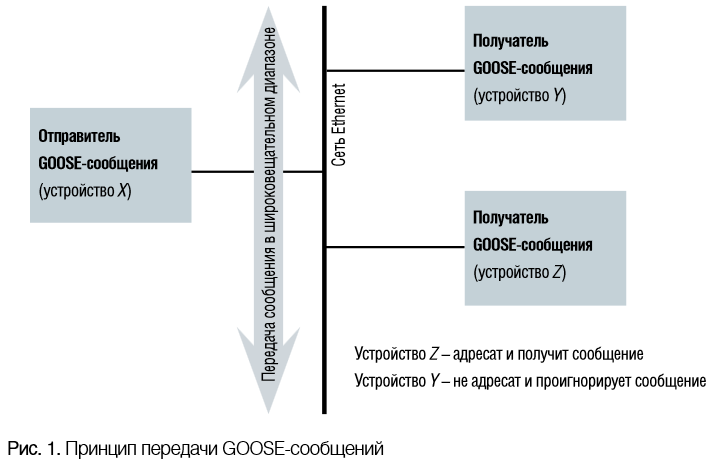
Устройство-отправитель передает по сети Ethernet информацию в широковещательном диапазоне.
В сообщении присутствует адрес отправителя и адреса, по которым осуществляется его передача, а также значение сигнала (например «0» или «1»).
Устройство-получатель получит сообщение, а все остальные устройства его проигнорируют.
Поскольку передача GOOSE-сообщений осуществляется в широковещательном диапазоне, т.е. нескольким адресатам, подтверждение факта получения адресатами сообщения отсутствует. По этой причине передача GOOSE-сообщений в установившемся режиме производится с определенной периодичностью.
При наступлении нового события в системе (например, КЗ и, как следствие, пуска измерительных органов защиты) начинается спонтанная передача сообщения через увеличивающиеся интервалы времени (например, 1 мс, 2 мс, 4 мс и т.д.). Интервалы времени между передаваемыми сообщениями увеличиваются, пока не будет достигнуто предельное значение, определяемое пользователем (например, 50 мс). Далее, до момента наступления нового события в системе, передача будет осуществляется именно с таким периодом. Указанное проиллюстрировано на рис. 2.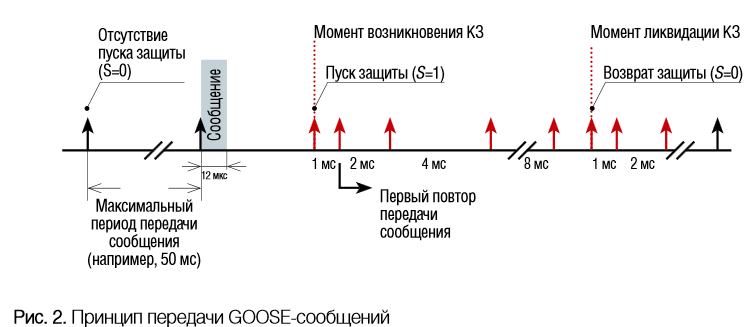
Технология повторной передачи не только гарантирует получение адресатом сообщения, но также обеспечивает контроль исправности линии связи и устройств – любые неисправности будут обнаружены по истечении максимального периода передачи GOOSE-сообщений (с точки зрения эксплуатации практически мгновенно). В случае передачи сигналов традиционным образом неисправность выявляется либо в процессе плановой проверки устройств, либо в случае неправильной работы системы РЗА.
Еще одной особенностью передачи GOOSE-сообщений является использование функций установки приоритетности передачи телеграмм (priority tagging) стандарта Ethernet IEEE 802.3u, которые не используются в других протоколах, в том числе уровня TCP/IP. То есть GOOSE-сообщения идут в обход «нормальных» телеграмм с более высоким приоритетом (см. рис. 3).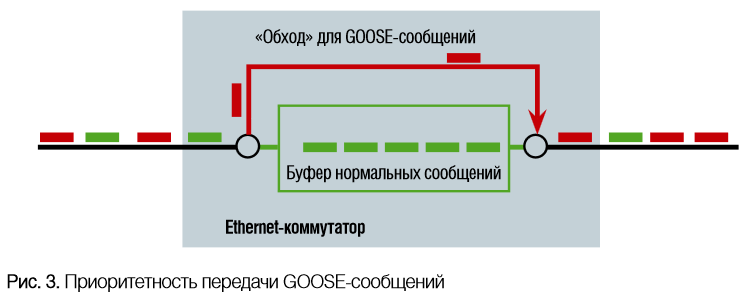
Однако стандарт МЭК 61850 декларирует передачу не только дискретной информации между терминалами РЗА, но и аналоговой. Это означает, что в будущем будет иметься возможность передачи аналоговой информации от ТТ и ТН по цифровым каналам связи. На данный момент готовых решений по передаче аналоговой информации для целей РЗА (в рамках стандарта МЭК 61850) ни один из производителей не предоставляет.
Для того чтобы использовать GOOSE-сообщения для передачи дискретных сигналов между терминалами РЗА необходима достаточная надежность и быстродействие передачи GOOSE-сообщений. Надежность передачи GOOSE-сообщений обеспечивается следующим:- Протокол МЭК 61850 использует Ethernet-сеть, за счет этого выход из строя верхнего уровня АСУ ТП и любого из устройств РЗА не отражается на передаче GOOSE-сообщений оставшихся в работе устройств,
- Терминалы РЗА имеют два независимых Ethernet-порта, при выходе одного из них из строя второй его полностью заменяет,
- Сетевые коммутаторы, к которым подключаются устройства РЗА, соединяются в два независимых «кольца»,
- Разные порты одного терминала РЗА подключаются к разным сетевым коммутаторам, подключенным к разным «кольцам»,
- Каждый сетевой коммутатор имеет дублированное питание от разных источников,
- Во всех устройствах РЗА осуществляется постоянный контроль возможности прохождения каждого сигнала. Это позволяет автоматически определить не только отказы цифровой связи, но и ошибки параметрирования терминалов.
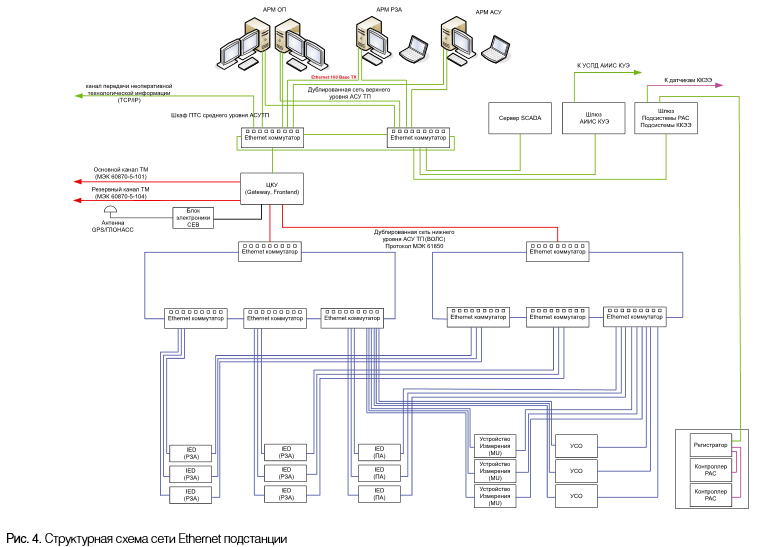
На рис. 4 изображен пример структурной схемы сети Ethernet (100 Мбит/c) подстанции. Отказ в передаче GOOSE-сообщения от одного устройства защиты другому возможен в результате совпадения как минимум двух событий. Например, одновременный отказ двух коммутаторов, к которым подключено одно устройство или одновременный отказ обоих портов одного устройства. Могут быть и более сложные отказы, связанные с одновременным наложением большего количества событий. Таким образом, единичные отказы оборудования не могут привести к отказу передачи GOOSEсообщений. Дополнительно увеличивает надежность то обстоятельство, что даже в случае отказа в передаче GOOSE-сообщения, устройство, принимающее сигнал, выдаст сигнал неисправности, и персонал примет необходимые меры для ее устранения.
Быстродействие.
В соответствии с требованиями стандарта МЭК 61850 передача GOOSE-сообщений должна осуществляться со временем не более 4 мс (для сообщений, требующих быстрой передачи, например, для передачи сигналов срабатывания защит, пусков АПВ и УРОВ и т.п.). Вообще говоря, время передачи зависит от топологии сети, количества устройств в ней, загрузки сети и загрузки вычислительных ресурсов терминалов РЗА, версии операционной системы терминала, коммуникационного модуля, типа центрального процессора терминала, количества коммутаторов и некоторых других аспектов. Поэтому время передачи GOOSE-сообщений должно быть подтверждено опытом эксплуатации.
Используя для передачи дискретных сигналов GOOSE-сообщения необходимо обращать внимание на то обстоятельство, что при использовании аппаратуры некоторых производителей, в случае отказа линии связи, значение передаваемого сигнала может оставаться таким, каким оно было получено в момент приема последнего сообщения.
Однако при отказе связи бывают случаи, когда сигнал должен принимать определенное значение. Например, значение сигнала блокировки МТЗ ввода 6–10 кВ в логике ЛЗШ при отказе связи целесообразно установить в значение «1», чтобы при КЗ на отходящем присоединении не произошло ложного отключения ввода. Так, к примеру, при проектировании терминалов фирмы Siemens изменить значение сигнала при отказе связи возможно с помощью свободно-программируемой CFCлогики (см. рис. 5).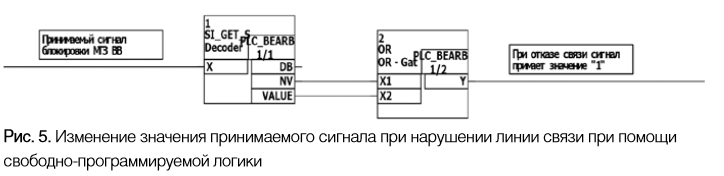
К CFC-блоку SI_GET_STATUS подводится принимаемый сигнал, на выходе блока мы можем получить значение сигнала «Value» и его статус «NV». Если в течение определенного времени не поступит сообщение со значением сигнала, статус сигнала «NV» примет значение «1». Далее статус сигнала и значение сигнала подводятся к элементу «ИЛИ», на выходе которого будет получено значение сигнала при исправности линии связи или «1» при нарушении исправности линии связи. Изменив логику, можно установить значение сигнала равным «0» при обрыве связи.
Использование GOOSE-сообщений предъявляет специальные требования к наладке и эксплуатации устройств РЗА. Во многом процесс наладки становится проще, однако при выводе устройства из работы необходимо следить не только за выводом традиционных цепей, но и не забывать отключать передачу GOOSE-сообщений.
При изменении параметрирования одного устройства РЗА необходимо производить загрузку файла параметров во все устройства, с которыми оно было связано.
В нашей стране имеется опыт внедрения и эксплуатации систем РЗА с передачей дискретных сигналов с использованием GOOSE-сообщений. На первых объектах GOOSE-сообщения использовались ограниченно (ПС 500 кВ «Алюминиевая»).
На ПС 500 кВ «Воронежская» GOOSEсообщения использовались для передачи сигналов пуска УРОВ, пуска АПВ, запрета АПВ, действия УРОВ на отключение смежного элемента, положения коммутационных аппаратов, наличия/отсутствия напряжения, сигналы ЛЗШ, АВР и т.п. Кроме того, на ОРУ 500 кВ и 110 кВ ПС «Воронежская» были установлены полевые терминалы, в которые собиралась информация с коммутационного оборудования и другая дискретная информация с ОРУ (рис. 6). Далее информация с помощью GOOSE-сообщений передавалась в терминалы РЗА, установленные в ОПУ подстанции (рис. 7, 8).
GOOSE-сообщения также были использованы при проектировании уже введенных в эксплуатацию ПС 500 кВ «Бескудниково», ПС 750 кВ «Белый Раст», ПС 330кВ «Княжегубская», ПС 220 кВ «Образцово», ПС 330 кВ «Ржевская». Эта технология применяется и при проектировании строящихся и модернизируемых подстанций ПС 500 кВ «Чагино», ПС 330кВ «Восточная», ПС 330 кВ «Южная», ПС 330 кВ «Центральная», ПС
330 кВ «Завод Ильич» и многих других.
Основные преимущества использования GOOSE-сообщений:- позволяет снизить количество кабелей вторичной коммутации на ПС;
- обеспечивает лучшую помехозащищенность канала связи;
- позволяет снизить время монтажных и пусконаладочных работ;
- исключает проблему излишнего срабатывания дискретных входов терминалов из-за замыканий на землю в цепях оперативного постоянного тока;
- убирает зависимость количества передаваемых сигналов от количества дискретных входов и выходных реле терминалов;
- обеспечивает возможность реконструкции и изменения связей между устройствами РЗА без прокладки дополнительных кабельных связей и повторного монтажа в шкафах;
- позволяет использовать МП терминалы РЗА с меньшим количеством входов и выходов (уменьшение габаритов и стоимости устройства);
- позволяет контролировать возможность прохождения сигнала (увеличивается надежность).
Безусловно, для окончательных выводов должен появиться достаточный опыт эксплуатации. В настоящее время большинство производителей устройств РЗА заявили о возможности использования GOOSEсообщений. Стандарт МЭК 61850 определяет передачу GOOSE-сообщений между терминалами разных производителей. Использование GOOSE-сообщений для передачи дискретных сигналов – это качественный скачок в развитии систем РЗА. С развитием стандарта МЭК 61850, переходом на Ethernet 1 Гбит/сек, с появлением новых цифровых ТТ и ТН, новых выключателей с возможностью подключения их блока управления к шине процесса МЭК 61850, эффективность использования GOOSE-сообщений намного увеличится. Облик будущих подстанций представляется с минимальным количеством контрольных кабелей, с передачей всех сообщений между устройствами РЗА, ТТ, ТН, коммутационными аппаратами через цифровую сеть. Устройства РЗА будут иметь минимальное количество выходных реле и дискретных входов
[ http://romvchvlcomm.pbworks.com/f/goosepaper1.pdf]
В стандарте определены два способа передачи данных напрямую между устройствами: GOOSE и GSSE. Это тоже пример наличия двух способов для реализации одной функции. GOOSE - более новый способ передачи сообщений, разработан специально для МЭК 61850. Способ передачи сообщений GSSE ранее присутствовал в стандарте UCA 2.0, являющимся одним из предшественников МЭК 61850. По сравнению с GSSE, GOOSE имеет более простой формат (Ethernet против стека OSI протоколов) и возможность передачи различных типов данных. Вероятно, способ GSSE включили в МЭК 61850 для того, чтобы производители, имеющие в своих устройствах протокол UCA 2.0, могли сразу декларировать соответствие МЭК 61850. В настоящее время все производители используют только GOOSE для передачи сообщений между устройствами.
Для выбора списка передаваемых данных в GOOSE, как и в отчѐтах, используются наборы данных. Однако тут требования уже другие. Время обработки GOOSE-сообщений должно быть минимальным, поэтому логично передавать наиболее простые типы данных. Обычно передаѐтся само значение сигнала и в некоторых случаях добавляется поле качества. Метка времени обычно включается в набор данных.
...
В устройствах серии БЭ2704 в передаваемых GOOSE-сообщениях содержатся данные типа boolean. Приниматься могут данные типа boolean, dbpos, integer.
Устоявшаяся тенденция существует только для передачи дискретной информации. Аналоговые данные пока передают немногие производители, и поэтому устоявшаяся тенденция в передаче аналоговой информации в данный момент отсутствует.
[ Источник]
Тематики
Синонимы
EN
Русско-английский словарь нормативно-технической терминологии > широковещательное объектно-ориентированное сообщение о событии на подстанции
-
7 público
adj.public, open, overt, communal.m.public, paying spectators, assistance, audience.* * *► adjetivo1 public\en público in publichacer público,-a (comunicado) to announce (publicly)ser del dominio público to be common knowledgeser un peligro público to be a public nuisanceel gran público the general publicopinión pública public opinion————————* * *1. (f. - pública)adj.2. noun m.* * *1. ADJ1) (=de los ciudadanos, del Estado) [transporte, teléfono, organismo, gasto] publicla gravedad de la situación es de dominio público — the seriousness of the situation is public knowledge
•
colegio público — state school•
es un peligro público en la carretera — he is a danger to the public, he's a public menace on the roads *administración 1), deuda 2), opinión, sector•
la vía pública — the street, the public highway frm2) (=no íntimo) [acto, escándalo] public•
hacer algo público — to make sth publicrelación 4)•
su incompetencia fue pública y notoria — his incompetence was blatantly obvious o was plain for all to see2. SM1) (=audiencia) (Mús, Teat) audience; (Dep, Taur) spectators pl, crowd; (TV) [en el plató] audience; [en casa] viewers pl, audienceapta para todos los públicos — certificate U, G movie (EEUU)
el estadio estaba lleno de público — the stadium was full of spectators, there was a big crowd in the stadium
un programa con gran audiencia de público — a programme with a large number of viewers o a large audience
•
en público — [actuar, hablar] in public; [actuación, presentación, aparición] publicun programa de televisión dirigido al público infantil — a television programme for children o aimed at a children's audience
público objetivo — (Com) target customers pl ; (TV) target audience
2) (=seguidores)a) [de periódico, escritor] readers pl, readershipno es lo que quiere nuestro público — it's not what our readers want o our readership wants
b) [de cantante] fans pl3) [de oficina, banco, museo]horario de atención al público — [en bancos] hours of business; [en tiendas] opening hours
* * *Iadjetivo publicIIasistió poco público al partido — few people attended the game, there were few spectators at the game
horario de atención al público — ( en oficinas públicas) opening hours; ( en bancos) hours of business
la exposición está abierta al público — the exhibit (AmE) o (BrE) exhibition is open to the public
película apta para todos los públicos or (CS) para todo público — `G' movie (AmE), `U' film (BrE)
un manual escrito para el gran público — a manual written for the layperson o non-specialist
salir al público — (Andes) periódico/revista to come out, appear; noticia/información to be published
* * *Iadjetivo publicIIasistió poco público al partido — few people attended the game, there were few spectators at the game
horario de atención al público — ( en oficinas públicas) opening hours; ( en bancos) hours of business
la exposición está abierta al público — the exhibit (AmE) o (BrE) exhibition is open to the public
película apta para todos los públicos or (CS) para todo público — `G' movie (AmE), `U' film (BrE)
un manual escrito para el gran público — a manual written for the layperson o non-specialist
salir al público — (Andes) periódico/revista to come out, appear; noticia/información to be published
* * *público11 = audience, public.Nota: Nombre.Ex: Various publishers have reputations for specific styles, subject areas or works for specific audiences.
* abierto al público = open for public viewing.* accesible por el público en general = publicly accessible.* contacto con el público = public contact.* dedicado al público = public-oriented.* del público asistente = from the floor.* derecho sobre el préstamo al público (PLR) = public lending right (PLR).* dirigido al público = public-oriented.* disponible al público en general = publicly available.* dosiers de información para el público = self-help pack of information.* éxito de público = blockbuster.* horario de apertura al público = banking hours.* horario de atención al público = opening hours, hours of operation, banking hours.* mantenerse alejado de la mirada del público = shun + the public eye, keep out of + the public eye.* mostrador de atención al público = service desk, public service desk, service counter.* nivel del público = audience level.* no estar expuesto al público = be out of the public eye.* precio de venta al público = cover price, list price, listed price.* precio de venta al público (P.V.P.) = retail price.* público adulto = adult audience.* público al que va dirigido = intended audience, subject audience, target audience, targeted audience.* público en general = broader audience, broad audience, broad public, broader public.* público en general, el = general public, the.* público específico = niche audience.* público fiel = devoted audience.* público joven = young audience.* público obligado a escuchar = captive audience.* servir a un público de = serve + a population of.* tiempo durante el cual el ordenador no está disponible al público = down time.* venta directa al público = sale + over the counter.público22 = public, publicly held.Ex: Data-capture units are light pens, and such units can be made available at various locations in the library for public consultation.
Ex: The article 'Time to climb off the fence' discusses the policy concerning publicly held data both in the USA and Europe.* administración pública = public administration.* a juicio público = in the public eye.* a la opinión pública = in the public eye.* alteración del orden público = disorderly conduct, public order offence, breach of the peace.* alterar el orden público = breach + the peace, disturb + the peace.* alto cargo público = senior public official.* alumbrado público = street lighting.* ámbito público, el = public sector, the.* ante la opinión pública = in the public eye.* Archivo Británico de Documentos Públicos = British Public Record Office.* archivo de documentos públicos = record office.* asamblea pública = public meeting.* aseo público = public restroom.* asuntos públicos = public affairs.* auditor público = public auditor.* autoridad pública = senior public official.* azotamiento público = public whipping.* beneficio público = public interest.* biblioteca pública = public library, public library service.* bono de transporte público = travel card.* campaña de relaciones públicas = public relations campaign.* castigo público = public whipping.* concurso público = bidding, tender, tender procedure, tendering, tendering procedure, tendering process.* concurso público de licitación = competitive tendering.* con mucho público = well attended [well-attended].* convocatoria pública = tender, tender procedure, tendering, bid, tendering procedure, tendering process.* cultura pública = public culture.* debate público = public debate.* de carácter público = state-owned, government-owned, state-run, government-run, publicly owned [publicly-owned], publicly supported, publicly held.* derecho público = public law.* desorden público = public disorder.* de titularidad pública = government-owned, state-owned, state-run, government-run, publicly owned [publicly-owned], publicly supported.* dinero público = public tax money.* dinero público, el = public's dollars, the.* dirigente público = senior public official.* discurso público = public speech.* edificio público = municipal building, public building.* empresa de servicios públicos = utility company, public utility.* empresa pública = public firm.* encargado de relaciones públicas = public liaison.* enemigo público = public enemy.* enemigo público número uno = public enemy number one.* en público = publicly, in public.* escándalo público = public scandal.* esfera pública, la = public sphere, the.* espacio público = public area, commons.* espacio público común = commons.* fijar una nota en un sitio públ = post.* financiado con dinero público = publicly financed.* fuerzas del orden público = police force.* fundación de beneficiencia pública = public trust.* gasto público = government spending, government expenditure.* hablar en público = public speaking, speak in + public.* hacer público = make + public, proclaim, publicise [publicize, -USA], go + public, issue + statement.* hacerse público = go + live, go + public, come out in + the open.* huelga del transporte público = public transport strike.* imagen pública = public image.* indignación pública = public outrage.* influir en la opinión pública = influence + public opinion.* ingresos públicos provenientes del petróleo = oil revenues.* institución pública = public institution.* interés público = public interest.* jardín público = public garden.* lo público = publicness.* mantener el orden público = maintain + public order.* mercado público = public market.* módulo de catálogo de acceso público en línea = online public access catalogue module.* monumento público conmemorativo = public memorial.* notario público = notary.* NYPL (Biblioteca Pública de Nueva York) = NYPL (New York Public Library).* obras públicas = public works.* opinión pública, la = public mind, the.* ordenadores de uso público = PAWS (Public access workstations).* orden público = public order.* organismo de beneficiencia pública = public trust.* organismo público = public body.* organizar un acto público = organise + function.* parque público = public park.* pegar una nota en un sitio público = post.* peligro público = public danger.* personaje público = public figure.* poner una nota en un sitio público = post.* protesta pública = public protest.* relaciones públicas = public relations (PR), public liaison.* reunión pública = public meeting.* reyerta pública = affray.* sacar a concurso público = tender for, tender out.* sacar a convocatoria pública = tender for, tender out, bid.* sacar a relucir los trapos sucios en público = air + dirty linen in public.* sector público, el = public sector, the.* seguridad pública = public safety.* servicio público = amenity, utility service.* sistema de transporte público = public transport system.* sistema de videotexto público = public viewdata system.* transporte local público = local public transport.* transporte público = public transportation.* transporte urbano público = local public transport.* turbar el orden público = disturb + the peace, breach + the peace.* uso público en la propia biblioteca = in-library use.* vereda pública = public footpath.* vida pública = public life.* zona pública = public area.* * *1 ‹transporte/teléfono/bienestar› public; ‹acto/lugar/establecimiento› publicconduciendo es un peligro público he's a public menace o a danger to the public when he's behind the wheel3 (conocido por todos) ‹escándalo› publiccuando hicieron pública la fecha when they announced the date, when they made the date public4 ‹vida› publicasistió muy poco público al partido very few people attended the game, there were very few spectators at the gamese concentró gran cantidad de público frente al palacio a great crowd gathered in front of the palace[ S ] horario de atención al público (en oficinas públicas) opening hours; (en bancos) hours of businesspelículas aptas para todos los públicos or (CS) para todo público `G' movies ( AmE), `U' films ( BrE)la obra está pensada para un público joven the play is aimed at a young audienceel público televidente or telespectador the (television) viewing publicsu público le ha permanecido fiel a través de los años her fans have remained loyal to her over the yearsel público en general the general publicun programa para un público que quiere mantenerse informado a program for people who want to keep informeduna revista para un público muy especializado a magazine aimed at a very specialized readershipun libro de ordenadores escrito para el gran público a book on computers written for the layperson o non-specialistescribe novelas destinadas a complacer al gran público she writes popular fictionse pone muy nervioso cuando habla en público he gets very nervous when he has to speak in publicno le gusta tocar el piano en público she doesn't like playing the piano in front of an audiencesalir al público ( Andes) «periódico/revista» to come out, appear, be published;«noticia/información» to be published* * *
Del verbo publicar: ( conjugate publicar)
publico es:
1ª persona singular (yo) presente indicativo
publicó es:
3ª persona singular (él/ella/usted) pretérito indicativo
Multiple Entries:
publicar
público
publicar ( conjugate publicar) verbo transitivo
público 1◊ -ca adjetivo
public;
hacer público algo to announce sth;
es un peligro público he's a danger to the public
público 2 sustantivo masculino ( en teatro) audience, public;
(Dep) spectators (pl);
( on signs) horario de atención al público ( en oficinas públicas) opening hours;
( en bancos) hours of business;
el público en general the general public;
en público ‹ hablar› in public;
‹cantar/bailar› in front of an audience;
[noticia/información] to be published
publicar verbo transitivo
1 (libro, etc) to publish: publicó su primera novela, she published her first novel
2 (divulgar) to publicize
público,-a
I adjetivo
1 public
hacer público algo, to announce sthg
2 (de control estatal) public
una biblioteca pública, a public library
un colegio público, a state school
una empresa pública, a state-owned company
II sustantivo masculino
1 public: el museo cierra al público los lunes, the museum closes to the public on Mondays
una película para todos los públicos, a film suitable for the general public
2 Cine Teat audience
3 (en deporte) crowd, spectators pl
4 (de publicaciones) readership
♦ Locuciones: en público, in public
ser de dominio público, to be common knowledge
' público' also found in these entries:
Spanish:
abarrotar
- acto
- afluencia
- alteración
- alumbrada
- alumbrado
- antro
- atizar
- audiencia
- auditorio
- cachondeo
- colegio
- concurrencia
- conocer
- consejo
- conserje
- desalojo
- desarrollarse
- desorden
- dominio
- electrizar
- encantar
- enmudecer
- erario
- expectante
- farol
- funcionaria
- funcionario
- galería
- íntima
- íntimo
- mezclarse
- opositor
- opositora
- parque
- peligro
- portera
- portero
- privada
- privado
- publicar
- pública
- PVP
- reparo
- revisor
- revisora
- sala
- sector
- sentenciar
- sombra
English:
address
- Amtrak
- appear
- appearance
- applaud
- appreciative
- arouse
- audience
- boo
- breach
- break
- cannon
- clinic
- coinbox
- come on
- crowd
- curtail
- declare
- decree
- disorder
- disorderly
- disturb
- domain
- general public
- grip
- hiss
- hoot
- lavatory
- mainstream
- menace
- open
- out
- pay phone
- phone-in
- pitch
- promenade concert
- public
- public convenience
- public funds
- publicize
- purse
- release
- request
- responsive
- restricted
- retail
- retail price
- roar
- speaker
- state
* * *público, -a♦ adj1. [colegio, transporte, teléfono, servicio] public;en público in public;no le gusta hablar en público she doesn't like speaking in public;hacer algo público to make sth public;personaje público public figure;un acto público en honor al escritor fallecido a public ceremony in honour of the late writer;ese andamio es un peligro público that scaffolding is a danger to the public;eso es de dominio público that's public knowledge2. [del Estado] public;el sector público the public sector;un funcionario público a public sector worker3. [conocido] public;ser público to be common knowledge♦ nm1. [en espectáculo] audience;[en encuentro deportivo] crowd;una película dirigida al público infantil a movie aimed at young audiences;[película] Br ≈ U, US ≈ G;muy poco público asistió al encuentro very few people attended the game;tiene un público fiel she has a loyal following2. [comunidad] public;el gran público the (general) public;abierto al público open to the public* * *I adj public; escuela public, Brstate;hacer público make public, announce;hacerse público become public o knownel gran público the general public;en público in public* * *público, -ca adj: public♦ públicamente advpúblico nm1) : public2) : audience, spectators pl* * *público1 adj1. (en general) public2. (del Estado) statepúblico2 n1. (en general) public2. (en un cine, teatro, etc) audience3. (en un estadio, etc) crowd / spectators -
8 dividir
v.1 to divide.el río divide en dos la ciudad the river divides o splits the city in twoEllos dividen el dinero They divide the money.Ellas dividen el trabajo They divide the work.Ella divide los tipos de plantas She divides=classifies the plant types.Los pleitos dividen a los casados Fights divide married couples.2 to share out.nos dividimos las tareas domésticas we shared the household chores between us3 to divide by (Mat).dividir 12 entre 3 divide 12 by 315 dividido por 3 igual a 5 15 divided by 3 is 5* * *1 to divide2 (separar) to divide, separate3 (repartir) to divide, split■ el hombre dividió la herencia entre sus hijos the man divided the inheritance between his children1 (separarse) to divide, split up\divide y vencerás divide and conquer, divide and rule* * *verbto divide, split* * *1. VT1) (=partir) to dividelos dividieron en tres grupos — they split them (up) o divided them into three groups
la bodega del barco está dividida en cuatro secciones — the hold of the ship is divided into four sections
2) (Mat) to divide (entre, por by)doce dividido entre o por cuatro son tres — twelve divided by four is three
3) (=repartir) [+ ganancias, posesiones] to split up, divide up; [+ gastos] to splithemos dividido el premio entre toda la familia — we have split up o divided up the prize among the whole family
4) (=separar) to divide5) (=enemistar) to divide2.VI (Mat) to divide (entre, por into)se me ha olvidado dividir — I've forgotten how to do division o how to divide
3.See:* * *1.verbo transitivoa) ( partir) to dividelo dividió en partes iguales/por la mitad — he divided it (up) into equal portions/in half
seis dividido por or entre dos es igual a tres — (Mat) six divided by two equals o is three
b) ( repartir) to divide, share (out)c) ( separar)d) ( enemistar) <partido/familia> to divide2.dividir vi (Mat) to divide3.dividirse v prona) célula to split; grupo/partido to split up; camino/río to divideb) obra/períodoel cuerpo humano se divide en... — the human body is made up of...
c) ( repartirse) to divide up, share out* * *= break down, partition, tell out into, sort out + Nombre + from + Nombre, split up, drive + a wedge between, dissect, segment, split, break out, parcel out, splinter, section, balkanize, rive, rend.Ex. The holdings are broken down into several volumes, shown as the next level of the pyramid.Ex. Punctuation is present in order to partition the elements of a citation and should contribute to its comprehension.Ex. The finished paper was sorted for imperfections and told out into quires and reams for sale.Ex. Ward's study is likely to remain a standard reference source for years to come, but trying to sort out the generalities from the particularities is a very difficult business.Ex. In any case it is best to split up the work among all those involved, having an adult in charge of each group.Ex. While the current problems associated with serial economics have driven a wedge between vendors, librarians and publishers, they should be cooperating and communicating in order to withstand the information explosion.Ex. GMMA has developed a layered approach to visual indexing that dissects the objects, style and implication of each image, so that the indexing system can accommodate all potential approaches to the material.Ex. So, the state-of-the-art in speech recognition requires the speaker to pronounce words with definite pauses between them, or else it starts with segmenting the speech on the basis of its acoustical features.Ex. In the mechanised paper fibre process individual pages are soaked and split so that acid-free paper can be put between the two layers.Ex. Turnaround managers want current financial and working capital analyses broken out by cost/profit centres.Ex. Can libraries parcel out digitization responsibilities among themselves?.Ex. The computers in education movement has further splintered rather than integrated these communities.Ex. They have achieved this by dividing their building into public-oriented and research-oriented levels and sectioning each level into thematic areas.Ex. The scholarly system has become balkanized into autonomous, even antagonistic, cultures or camps based on differing technological competencies and interests.Ex. The novel presents a social world riven by contradictions that can best be understood through Marxian categories.Ex. Christian Science, a faith that has epitomize a quiet, disciplined spirituality, is being rent by discord.----* divide y vencerás = divide-and-conquer.* dividir Algo en partes iguales = divide + Nombre + in equal parts.* dividir con una cortina = curtain off.* dividir en = divide (into), partition into, split into, divide onto.* dividir en dos = halve, bisect, rend in + two.* dividir en partes = break into + parts.* dividir en trozos = split into + bits.* dividir en zonas = zone.* dividir por medio = rend in + two.* dividir + Posesivo + fuerzas = fragment + Posesivo + energies, fragment + Posesivo + energies.* dividirse = branch, fork.* dividirse en partes = fall into + parts.* producir dividendos = pay + dividends.* * *1.verbo transitivoa) ( partir) to dividelo dividió en partes iguales/por la mitad — he divided it (up) into equal portions/in half
seis dividido por or entre dos es igual a tres — (Mat) six divided by two equals o is three
b) ( repartir) to divide, share (out)c) ( separar)d) ( enemistar) <partido/familia> to divide2.dividir vi (Mat) to divide3.dividirse v prona) célula to split; grupo/partido to split up; camino/río to divideb) obra/períodoel cuerpo humano se divide en... — the human body is made up of...
c) ( repartirse) to divide up, share out* * *dividir(en)(v.) = divide (into), partition into, split into, divide ontoEx: External databases can be partitioned into two major categories: bibliographic and non-bibliographic or full-text databases.Ex: The notation is non-expressive, and is split into groups of three digits as in DC.Ex: Many databases are divided onto several discs, usually by time period.= break down, partition, tell out into, sort out + Nombre + from + Nombre, split up, drive + a wedge between, dissect, segment, split, break out, parcel out, splinter, section, balkanize, rive, rend.Ex: The holdings are broken down into several volumes, shown as the next level of the pyramid.
Ex: Punctuation is present in order to partition the elements of a citation and should contribute to its comprehension.Ex: The finished paper was sorted for imperfections and told out into quires and reams for sale.Ex: Ward's study is likely to remain a standard reference source for years to come, but trying to sort out the generalities from the particularities is a very difficult business.Ex: In any case it is best to split up the work among all those involved, having an adult in charge of each group.Ex: While the current problems associated with serial economics have driven a wedge between vendors, librarians and publishers, they should be cooperating and communicating in order to withstand the information explosion.Ex: GMMA has developed a layered approach to visual indexing that dissects the objects, style and implication of each image, so that the indexing system can accommodate all potential approaches to the material.Ex: So, the state-of-the-art in speech recognition requires the speaker to pronounce words with definite pauses between them, or else it starts with segmenting the speech on the basis of its acoustical features.Ex: In the mechanised paper fibre process individual pages are soaked and split so that acid-free paper can be put between the two layers.Ex: Turnaround managers want current financial and working capital analyses broken out by cost/profit centres.Ex: Can libraries parcel out digitization responsibilities among themselves?.Ex: The computers in education movement has further splintered rather than integrated these communities.Ex: They have achieved this by dividing their building into public-oriented and research-oriented levels and sectioning each level into thematic areas.Ex: The scholarly system has become balkanized into autonomous, even antagonistic, cultures or camps based on differing technological competencies and interests.Ex: The novel presents a social world riven by contradictions that can best be understood through Marxian categories.Ex: Christian Science, a faith that has epitomize a quiet, disciplined spirituality, is being rent by discord.* divide y vencerás = divide-and-conquer.* dividir Algo en partes iguales = divide + Nombre + in equal parts.* dividir con una cortina = curtain off.* dividir en = divide (into), partition into, split into, divide onto.* dividir en dos = halve, bisect, rend in + two.* dividir en partes = break into + parts.* dividir en trozos = split into + bits.* dividir en zonas = zone.* dividir por medio = rend in + two.* dividir + Posesivo + fuerzas = fragment + Posesivo + energies, fragment + Posesivo + energies.* dividirse = branch, fork.* dividirse en partes = fall into + parts.* producir dividendos = pay + dividends.* * *dividir [I1 ]vt1 (partir) to dividedividió la tarta en partes iguales he divided the cake (up) into equal portionsdividió a la clase en cuatro equipos she divided o split the class (up) into four teamsseis dividido dos igual tres or seis dividido por dos es igual a tres or seis dividido entre dos es igual a tres ( Mat) six divided by two equals o is threedivide 96 por or entre 12 ( Mat) divide 96 by 122 (repartir) to divide, share, share outdividieron la herencia entre los hermanos the inheritance was shared (out) o divided among the brothers3(separar): el río divide el pueblo en dos the river cuts o divides the village in two4 (apartar, enemistar) to divideesa cuestión dividió profundamente al sindicato the issue caused deep division within the unionlos científicos están divididos en esa materia scientists are divided on that subjectdivide y vencerás/reinarás divide and conquer/rule■ dividirvi( Mat) to dividetodavía no sabe dividir she still can't do division, she still doesn't know how to divide1 «célula» to split; «grupo/partido» to split upnos dividimos en dos grupos we split up into two groupsel río se divide en dos brazos the river divides into two branchesno me puedo dividir ( fam); I only have one pair of hands ( colloq), I can't be in two places at once ( colloq)2«obra/período»: su obra podría dividirse en cuatro períodos básicos his work could be divided into four basic periodsel cuerpo humano se divide en cabeza, tronco y extremidades the human body is made up of the head, the torso and the extremities3 (repartirse) to divide up, share out* * *
dividir ( conjugate dividir) verbo transitivo
verbo intransitivo (Mat) to divide
dividirse verbo pronominal
[grupo/partido] to split up;
[camino/río] to divideb) dividir en algo [obra/período] to be divided into sth
dividir verbo transitivo & verbo intransitivo to divide: dividieron la herencia entre los cuatro, they divided the inheritance among the four of them
tienes que dividir entre tres, you must divide by three
' dividir' also found in these entries:
Spanish:
descomponer
- partir
- rompecabezas
- seccionar
- cortar
- distribuir
- mitad
- separar
English:
carve up
- cut
- divide
- equally
- partition
- quarter
- separate
- share
- split
- split up
- tear
- zone
- break
- halve
- stream
- way
* * *♦ vt1. [separar] to divide (en into); [átomo] to split (en into);dividió la hoja en tres partes she divided the page into three parts;dividió a los alumnos en grupos de cinco he split o divided the pupils into groups of five;el río divide en dos la ciudad the river divides o splits the city in two2. [repartir] to share out ( entre among);el resto de los beneficios fue dividido entre los empleados the rest of the profits were shared out o divided among the employees;dividimos las tareas domésticas entre todos we shared the household chores between all of us3. [desunir] to divide;un asunto que tiene dividida a la comunidad científica an issue that has divided the scientific community;el testamento dividió a los hermanos the will set the brothers against one another4. [en matemáticas] to divide;dividir 12 entre 3 divide 12 by 3;♦ vi[en matemáticas] to divide;divide y vencerás divide and rule* * *v/t divide* * *dividir vt1) : to divide, to split2) : to distribute, to share out* * *dividir vb1. (en general) to dividesi divido 30 entre 5, el resultado es 6 if I divide 30 by 5, the result is 6 -
9 segmentar
v.1 to cut or divide into pieces.2 to segment, to section.* * *1 to segment* * *1. VT1) (=cortar) to segment, cut into segments2) (=dividir) to divide up, separate out2.See:* * *= segment, section.Ex. So, the state-of-the-art in speech recognition requires the speaker to pronounce words with definite pauses between them, or else it starts with segmenting the speech on the basis of its acoustical features.Ex. They have achieved this by dividing their building into public-oriented and research-oriented levels and sectioning each level into thematic areas.* * *= segment, section.Ex: So, the state-of-the-art in speech recognition requires the speaker to pronounce words with definite pauses between them, or else it starts with segmenting the speech on the basis of its acoustical features.
Ex: They have achieved this by dividing their building into public-oriented and research-oriented levels and sectioning each level into thematic areas.* * *segmentar [A1 ]vtto segmentto divide into segments, become segmented* * *segmentar vt[recta] to cut o divide into segments* * *v/t segment -
10 a tiempo
adv.on time, in time, in good time, on schedule.* * *(en el momento oportuno) in time 2 (a la hora) on time* * *= in timely fashion, on time, promptly, timely, just in time, in timeEx. There was no dependable way to ensure that the recipient actually received the message in timely fashion.Ex. If a document is returned on time, the charge-out record is removed from the circulation file and from the borrower's record.Ex. Significantly, however, Panizzi's rules did not prove as viable as did his ideology, and they were promptly and materially changed and recast by his most ardent admirers and followers.Ex. The State, as producer, is deficient in producing sufficient copies to meet demand, ensuring timely distribution, and providing efficient bibliographic control.Ex. The project shifts the paradigm for information services in support of research from a 'just in case' collection centred approach to 'just in time' service oriented operation.Ex. 'A Hospital Trip' is about Joe's stay in the hospital after he cuts his ankle on a sharp corner of a rusty old car hood and does not tell his mother about it in time to prevent infection.* * *= in timely fashion, on time, promptly, timely, just in time, in timeEx: There was no dependable way to ensure that the recipient actually received the message in timely fashion.
Ex: If a document is returned on time, the charge-out record is removed from the circulation file and from the borrower's record.Ex: Significantly, however, Panizzi's rules did not prove as viable as did his ideology, and they were promptly and materially changed and recast by his most ardent admirers and followers.Ex: The State, as producer, is deficient in producing sufficient copies to meet demand, ensuring timely distribution, and providing efficient bibliographic control.Ex: The project shifts the paradigm for information services in support of research from a 'just in case' collection centred approach to 'just in time' service oriented operation.Ex: 'A Hospital Trip' is about Joe's stay in the hospital after he cuts his ankle on a sharp corner of a rusty old car hood and does not tell his mother about it in time to prevent infection. -
11 положение
1) General subject: angle, bearings, berth, billet, capacity, case, condition, degree, enaction, enactment, exposal (в отношении стран света), fettle, hand, instruction, lay (чего-либо), lie, lieu, location, pass, place, plight, plight (обыкн. плохое, трудное), plighter (обыкн. плохое, трудное), pliskie, point, policy (АД), position, possie, post, post paper, posture, provision (договора и т. п.), provision (Regulation on), provisions (документ), rank, rating, reg, regulation (usually) (of a law or regulation), rules and regulations, siege, situation, situs, stance, standing, standing order, statement, status, statute (major document) (of a law or regulation), stead, thesis, attitude, shift constantly, things (a general state of affairs: Things are even worse now for the automotive industry.), tenet, article, spot2) Biology: exposition (в отношении стран света), postural4) Naval: establishment, lay-out, stat5) Medicine: catastasis, lie (плода в матке), semiprone position7) American: city8) Obsolete: estate9) Military: Reference terms (документа), (рас) lay, mission-oriented protective posture (установленное для ношения индивидуальных средств защиты (от ОМП) с учётом характера выполняемой задачи), position, stature, (служебное) status, term, whereabouts10) Engineering: condition (состояние), coordinate, placing, position (местонахождение), postulate (утверждение), proposition (утверждение), provision (напр. договора), setting, stand, state (состояние), statement (утверждение), station11) Construction: principle, process, spec (технических условий), specification (технических условий)12) Mathematics: level, locus, proposition, score (на шкале)13) Religion: Provisio ("provision", сокр. Prov.), status quo ante (Latin for "state in which previously", the state of affairs that existed previously)14) Railway term: trim15) Law: alienage, character, constitution, disposition (договора, закона), provision (договора и т.п.), provision (договора, закона и т. д.), provision (договора, закона и т.д.), standing orders, undertaking, statute17) Accounting: estate (напр. материальное), rule, ruling18) Diplomatic term: case (дел), plight (обыкн. плохое, затруднительное), scale, stipulation (договора и т.п.), way19) Psychology: contention, standing (в обществе), ubiety20) Scottish language: plisky21) TV: notch (рукоятки переключателя)23) Information technology: location (местонахождение), orientation, place ment, turn (игрока в игре)24) Special term: (пространное) attitude25) Astronautics: fixity, guideline27) Advertising: plight (обычно трудное или плохое)29) Business: footing, occupation, regulation, setup30) Drilling: aspect31) Sakhalin energy glossary: regulation (документ)32) EBRD: by-laws, clause, provision, terms of reference (TOR)34) Automation: attitude (в пространстве), (место) location, point (рабочего органа), (заданное) position35) Quality control: provision (документ), (существующее) status37) leg.N.P. position (e.g., in the phrase "important position"), regulation (e.g., in an enactment or a treaty), standing (e.g., social), state (e.g., of affairs), status (e.g., of women)38) Aviation medicine: positioning39) Makarov: aspect (относительное), exposure (в отношении стран света), locus (в пространстве)40) Archaic: predicament41) Microsoft: dock -
12 диаграмма конечных ав
Универсальный русско-английский словарь > диаграмма конечных ав
-
13 экономика экономик·а
1) (народное хозяйство) economy, economicsвосстановить / оздоровить экономику — to stage an economic recovery
наносить урон / ущерб экономике, парализовать экономику — to cripple economy
оживить экономику — to animate / to revitalize the economy
подрывать / разрушать экономику — to erode the economy
военная — defence / military / war economy
вялая экономика, экономика низкой конъюнктуры — low pressure economy
денежная / монетарная экономика — monetary / money economy
дефицитная экономика — economy of scarcity, shortage economy
замкнутая / изолированная / обособленная экономика (не имеющая внешних связей) — closed economy
застойная экономика — sick / stagnant economy
индустриальная / промышленно развитая экономика — industrial economy
мировая экономика, экономика мирового хозяйства — international / world economy / economics
многоотраслевая экономика — diversified / multi-branch economy
плановая экономика — plan-based / planned economy, planned economics
развивающаяся экономика — developing / expanding economy
развитая экономика — advanced / developed economy
рыночная экономика, экономика, ориентирующаяся на развитие рыночных связей — market-oriented / exchange economy, market system
слабая / больная экономика — ailing economy
стабильная / устойчивая экономика — stationary / steady-state economy
взаимозависимость / взаимосвязь экономик различных стран — interdependence of economies
вопросы экономики — economic problems / questions
замедление / спад темпов роста экономики — slackening in the rate of economic growth
кооперативный сектор экономики — economy's cooperative sector, cooperative sector of economy
оживление экономики — revitalization of economy, revival in the economy
подрыв / разрушение экономики — erosion of economy
руководство / управление экономикой — economic management
спад в экономике — slowing / slackening of the economy
функционирование экономики — economic performance, operation of economy
экономика высокой конъюнктуры / "высокого давления" — high pressure economy
экономика, испытывающая затруднения — faltering economy
экономика сельского хозяйства — rural / farm economy / economics
экономика страны — national economy, national economic enterprise
2) (научная дисциплина) economicsRussian-english dctionary of diplomacy > экономика экономик·а
-
14 encargar
v.1 to order.si no lo tienen, encárgalo if they haven't got it, order ithe dejado encargada la comida para las dos I've booked lunch for two o'clockElla encargó el vestido She ordered the dress.2 to order by telephone, to call for.María encargó las tarjetas Mary ordered the cards by telephone.3 to entrust, to confide, to assign.Ella encargó su secreto She entrusted her secret.* * *1 (encomendar) to entrust, put in charge of2 (recomendar) to recommend, advise4 (mandar hacer) to have made1 to take charge of, look after, see to, deal with* * *verb* * *1. VT1) [+ tarea, misión] to give2) [a profesional, empresa] [+ obra de arte, informe] to commission3) (=hacer un pedido de) to orderencargar un niño —
¿habéis encargado otro niño? — are you having another child?, do you have another one on the way? *
4) (=pedir como favor)le encargué dos latas de caviar ruso — I asked him to bring o buy me two tins of Russian caviar
me ha encargado varias cosas del supermercado — she's asked me to get her some things from the supermarket
5) (=aconsejar) to advisele encargó varias veces que no dejara el tratamiento — he advised him several times not to stop the treatment
6) Chile(Jur)2.See:* * *1.verbo transitivo1)a)encargarle algo a alguien — < tarea> to entrust somebody with something
me encargó una botella de whisky escocés — she asked me to buy o get her a bottle of Scotch
b)encargar a alguien que + subj — to ask somebody to + inf
2)a) ( pedir) <mueble/paella/libro> to order; <informe/cuadro> to commissionb) (fam & euf) < hijo>2.encargarse v pronencargarse de algo/alguien — to take care of something/somebody
yo me encargo de las bebidas — I'll take care of o see to the drinks
ya me encargaré de él! — (fam) I'll take care of him! (colloq), I'll soon sort him out! (colloq)
yo me encargo de que lo sepan — I'll see to it that they know, I'll make sure they know
* * *= charge, commission, order, deputise [deputize, -USA].Ex. A mission-oriented abstract is an abstract which is prepared for an abstracting service that has been charged to cater for the application of a specific branch of knowledge.Ex. Some libraries opt to commission a central agency to support their catalogue creation.Ex. Edge notch cards are often ordered in a size tailored to the demands of the index, and can be purchased with any coding that the index designer specifies.Ex. In effect we deputized him to maintain stability in the gulf and promised to sell Iran almost any military hardware the shah desired.----* encargar Algo a Alguien = farm + Nombre + out to.* encargar especialmente = special order.* encargarse de = take over, undertake, man, run, see to.* encargarse de las finanzas = control + the purse strings.* encargarse del presupuesto = control + the purse strings.* encargarse de que = see to it that.* encargarse de una tarea = undertake + task.* encargar un estudio = commission + study.* * *1.verbo transitivo1)a)encargarle algo a alguien — < tarea> to entrust somebody with something
me encargó una botella de whisky escocés — she asked me to buy o get her a bottle of Scotch
b)encargar a alguien que + subj — to ask somebody to + inf
2)a) ( pedir) <mueble/paella/libro> to order; <informe/cuadro> to commissionb) (fam & euf) < hijo>2.encargarse v pronencargarse de algo/alguien — to take care of something/somebody
yo me encargo de las bebidas — I'll take care of o see to the drinks
ya me encargaré de él! — (fam) I'll take care of him! (colloq), I'll soon sort him out! (colloq)
yo me encargo de que lo sepan — I'll see to it that they know, I'll make sure they know
* * *= charge, commission, order, deputise [deputize, -USA].Ex: A mission-oriented abstract is an abstract which is prepared for an abstracting service that has been charged to cater for the application of a specific branch of knowledge.
Ex: Some libraries opt to commission a central agency to support their catalogue creation.Ex: Edge notch cards are often ordered in a size tailored to the demands of the index, and can be purchased with any coding that the index designer specifies.Ex: In effect we deputized him to maintain stability in the gulf and promised to sell Iran almost any military hardware the shah desired.* encargar Algo a Alguien = farm + Nombre + out to.* encargar especialmente = special order.* encargarse de = take over, undertake, man, run, see to.* encargarse de las finanzas = control + the purse strings.* encargarse del presupuesto = control + the purse strings.* encargarse de que = see to it that.* encargarse de una tarea = undertake + task.* encargar un estudio = commission + study.* * *encargar [A3 ]vt1 ‹tarea/misión›¿cómo le encargaste un asunto de tanta importancia? why did you entrust him with such an important matter?, why did you give him responsibility for o put him in charge of such an important matter?me encargó el cuidado de la casa en su ausencia he asked me to look after the house while he was awayencargar a algn QUE + SUBJ to ask sb to + INFme encargó que le regara las plantas he asked me to water the plants for himle encargaron que buscara una solución al conflicto they charged him to find a solution to the conflict, he was entrusted o charged with the task of finding a solution to the conflict, he was given the job o task of finding a solution to the conflict2 ‹compra›me encargó una botella de whisky escocés she asked me to buy o get her a bottle of Scotch, she asked me to bring her back a bottle of ScotchB1 (pedir) ‹torta/mueble/paella› to order; ‹informe/cuadro› to commissionno tenían el libro, así que lo dejé encargado they didn't have the book in stock, so I asked them to order it o I ordered it2 ( fam euf) ‹hijo›¿cuándo van a encargar familia? when are they thinking of starting a family?, when are they planning to have children?quieren encargar un hijo muy pronto they want to try for a baby very soon, they're planning to start a family very soonya han encargado un niño they have a baby on the way■ encargarvi( fam):¿ya encargó? is she expecting already?no quieren encargar todavía they don't want to try for a baby yetencargarse DE algo/algn:trae algo de comer, yo me encargo de las bebidas you bring something to eat, I'll take care of o I'll see to o I'll look after o I'll deal with the drinkscuando se fue, me tuve que encargar de la contabilidad when she left I had to take over the accounts o take on the responsibility for the accountsla agencia se encargó de todos los detalles the agency took care of o attended to o saw to o dealt with all the detailses muy joven para encargarse de una tarea tan importante he is very young to take (on) the responsibility for such an important task¡ya me encargaré yo de él! ( fam); I'll see to him! ( colloq), I'll take care of him! ( colloq), I'll soon sort him out! ( colloq)encargarse DE + INF:¿quién se va a encargar de hacer la reserva? who's going to make the booking?, who's going to take care of o look after the booking?su secretaria se encarga de filtrar las llamadas her secretary screens her callssus vecinos se han encargado de extender estos rumores their neighbors have taken it upon themselves to spread these rumorsencargarse DE QUE + SUBJ:yo me encargo de que lo sepan todos I'll see to it that they all know, I'll make sure they all know, I'll let everyone know* * *
encargar ( conjugate encargar) verbo transitivo
1a) encargarle algo a algn ‹ tarea› to entrust sb with sth;◊ me encargó una botella de whisky escocés she asked me to buy o get her a bottle of Scotchb) encargar a algn que haga algo to ask sb to do sth
2 ‹mueble/paella/libro› to order;
‹informe/cuadro› to commission
encargarse verbo pronominal encargarse de algo/algn to take care of sth/sb;
encargar verbo transitivo
1 (encomendar) to entrust: su madre le encargó que cuidara de sus hermanos, her mother entrusted her with the care of her brothers
2 Com (solicitar mercancías) to order: encargaremos una pizza, we'll order a pizza
(un servicio) to commission: ¿por qué no se lo encargas a ellos?, why don't you commission it from them?
' encargar' also found in these entries:
Spanish:
presupuesto
English:
commission
- entrust
- farm out
- order
- report
- send for
- farm
- send
* * *♦ vt1. [poner al cargo de]encargar a alguien de algo, encargar algo a alguien to put sb in charge of sth;le han encargado la investigación del caso they've put him in charge of the investigation, they've charged him with investigating the case;encargar a alguien que haga algo to tell sb to do sth;me encargó que vigilara la puerta he told me to keep an eye on the door;me han encargado que organice la fiesta they've asked me to organize the party2. [pedir] to order;encargó unas botas de montaña she ordered some mountaineering boots;compré unos discos que me había encargado mi hermano I bought some records that my brother had asked me to get;me encargó que le trajera un bumerán he asked me to bring him back a boomerang;si no lo tienen, encárgalo if they haven't got it, order it;he dejado encargada la comida para las dos I've booked lunch for two o'clock;el gobierno ha encargado un informe sobre la situación en las prisiones the government has commissioned a report on the state of the prisons;encargó su retrato a Goya he commissioned Goya to paint his portrait;Eufhan encargado un bebé they have a baby on the way;Euf¿cuándo van a encargar un niño? when are they going to start a family?* * *v/t ( pedir) order;le encargué que me trajera … I asked him to bring me …* * *encargar {52} vt1) : to put in charge of2) : to recommend, to advise3) : to order, to request* * *encargar vb1. (producto) to order2. (persona) to ask -
15 palabra
intj.really, honest to goodness, honest, honest to God.f.1 word.de palabra by word of mouth, verballydejar a alguien con la palabra en la boca to cut somebody off in mid-sentenceen cuatro o dos palabras in a few wordsen una palabra in a wordno dijo palabra he didn't say a wordmedir las palabras to weigh one's words (carefully)no habla ni (media) palabra de español she doesn't speak a word of Spanishpalabra por palabra word for wordser palabras mayores to be an important mattersin mediar palabra without a single wordpalabra divina o de Dios word of God2 word (juramento, promesa).dar su palabra to give one's wordfaltó a su palabra he went back on his word, he broke o didn't keep his wordmantuvo su palabra she kept her wordtienes mi palabra you have my wordtomar la palabra a alguien to hold somebody to their word3 speech (habla).4 word of honor, troth, word, word of honour.* * *1 word\dar su palabra to give one's word, promisedecir la última palabra to have the last worddejar a alguien con la palabra en la boca to cut somebody offdirigirle la palabra a alguien to address somebodyen una palabra in a wordno decir ni media palabra a nadie not to breath a word to anyonemedir las palabras to weigh one's wordsno dirigirle la palabra a alguien not to be speaking to somebodypalabra por palabra word for wordquitarle a alguien la palabra to cut somebody short, interrupt somebodyser hombre/mujer de palabra to be a man of his word/a woman of her wordser hombre/mujer de pocas palabras to be a man/woman of few wordstener la palabra to have the floortener palabra to keep one's wordtener unas palabras con alguien to have words with somebodytomarle a alguien la palabra to take somebody at their wordpalabra clave key wordpalabra de honor word of honour* * *noun f.1) word2) faith* * *SF1) (=vocablo) word¿me permiten decir unas palabras? — could I say a few words?
no tengo palabras o me faltan palabras para expresar lo que siento — I haven't got the o there aren't words to express how I feel, words fail to express how I feel
sin decir o chistar * palabra — without a word
•
con buenas palabras, me lo dijo con muy buenas palabras — he told me as cool as you like *nos entretenía con buenas palabras, pero nunca nos daba el dinero — he palmed us off with smooth talk, but he never gave us the money
•
medias palabras — hints•
en una palabra — in a word¡ni una palabra más! — not another word!
- no cruzar una palabra con algnme dejó con la palabra en la boca y se fue de la habitación — he walked out of the room while I was in mid-sentence
palabras cruzadas — LAm (=crucigrama) crossword sing
palabras mayores — † offensive language sing
ser palabras mayores (=ser importante) —
juego II, 2)¿te han hecho directora? ¡eso ya son palabras mayores! — so you've been appointed director, that's really something!
2) (=facultad de hablar)tiene el don de la palabra, es de palabra fácil — he has a way with words, he has the gift of the gab *
•
de palabra, he pecado solo de palabra — I've sinned in word only•
dirigir la palabra a algn, hace tiempo que no me dirige la palabra — he hasn't spoken to me for a long time3) frm (=turno para hablar) floor•
pedir la palabra — to ask for the floor, ask to be allowed to speak•
tener la palabra — to have the floor•
tomar la palabra — to take the floor, speak•
hacer uso de la palabra — to take the floor, speak4) (=promesa) wordcumplió su palabra — he kept his word, he was true to his word
palabra que yo no tengo nada que ver — * I've got nothing to do with it, (I) promise!
-¿de verdad que no sabías nada? -¡palabra! o hum ¡palabrita del Niño Jesús! — "you really didn't know anything?" - "cross my heart and hope to die!"
•
bajo palabra — (Mil) on parole•
faltar a su palabra — to go back on o break one's wordpalabra de casamiento, dar palabra de casamiento — to promise to marry
palabra de honor — word of honour, word of honor (EEUU)
¿me das tu palabra de honor de que no dirás nada? — do you give me your word of honour you won't say anything?
¡palabra de honor! — word of honour!
* * *1) ( vocablo) worden pocas palabras, es un cobarde — in a word, he's a coward
yo no sabía ni una palabra del asunto — I didn't know a thing o anything about it
eso ya son palabras mayores — (refiriéndose - a insulto, acusación) those are strong words; (- a propuesta excesiva) that's taking things too far
quitarle las palabras de la boca a alguien — to take the words right out of somebody's mouth
tener la última palabra — to have the final say
2) ( promesa) wordnunca falta a su palabra — he never breaks o goes back on his word
se lo devolví palabra! — I gave it back to her, honest! (colloq)
cobrarle la palabra a alguien — (Chi fam) to hold somebody to his/her word (colloq)
tomarle la palabra a alguien: le tomé la palabra y le pedí un préstamo — I took him up on his offer and asked for a loan
3)a) ( habla) speechdejar a alguien con la palabra en la boca: me dejó con la palabra en la boca — ( me interrumpió) he cut me off in mid-sentence; ( no me dejó hablar) he didn't give me a chance to open my mouth
b) (frml) (en ceremonia, asamblea)pido la palabra — may I say something?, I'd like to say something
tener/tomar la palabra — to have/to take the floor (frml)
ceder (le) la palabra a alguien — to give the floor to somebody (frml), to call upon somebody to speak
* * *= word, headword.Ex. A subject index has alphabetical terms or words as headings; These terms represent concepts or subjects.Ex. This tool allows the user to generate all known inflected forms from a list of headwords.----* agrupar palabras que tienen la mism = merge + word forms.* agrupar palabras que tienen la misma raíz = merge + word forms.* análisis de la coocurrencia de palabras = co-word analysis.* anuncio por palabras = classified advertisement, classified ad.* búsqueda de palabras clave = keyword search.* búsqueda por palabra del título = title word search.* catálogo alfabético de palabras clave = keyword catalogue.* citar las palabras de Alguien = quote + Nombre + words.* compuesto de varias palabras = multi-word.* concepto de múltiples palabras = multiple-word concept.* concepto expresado con varias palabras = database host.* con sus propias palabras = in + Posesivo + own words.* con una separación de + Número + palabras = within + Número + words of each other.* coocurrencia de palabras = co-word [coword].* cumplir (con) + Posesivo + palabra = keep + Posesivo + word, live up to + Posesivo + word.* cumplir la palabra = keep + Posesivo + word, live up to + Posesivo + word.* decir la última palabra = hear + the final word, outface.* dejar sin palabras = nonplus, leave + Nombre + speechless.* de múltiples palabras = multiple-word.* de palabra = by word of mouth, word-of-mouth.* describir con palabras = describe + in words.* descriptor compuesto de varias palabras = multiple-word descriptor.* de sólo palabras = word-oriented.* de una palabra = one-word.* de una única palabra = single-word.* dirigir la palabra = be civil towards.* dirigirse la palabra = on speaking terms.* encabezamiento compuesto de varias palabras = multi-word heading.* en dos palabras = in a nutshell.* en el estricto sentido de la palabra = strictly speaking.* en las palabras de uno mismo = in + Posesivo + own words.* en las propias palabras de uno mismo = in + Posesivo + own words.* en ningún sentido de la palabra = in any sense of the word.* en otras palabras = in other words, to put it another way, which is to say.* en palabras = verbally.* en pocas palabras = simply put, in brief, to say the least, to put it (quite) simply, in short, to cut a long story short, bottom line, the, put simply, to make a long story short, the short story + be, simply stated.* entrada por palabra clave del título = catchword entry.* en una palabra = in a nutshell, in a word.* escoger las palabras = choose + Posesivo + words (carefully), pick + Posesivo + words (carefully).* expresar con palabras = verbalise [verbalize, -USA].* expresar los sentimientos con palabras = put + Posesivo + feelings into words.* fiarse de la palabra de Alguien = take + Posesivo + word for it.* fiel a la palabra de Uno = true to + Posesivo + word.* frecuencia de palabras = word count.* gesticular palabras con la boca sin emitir sonido = mouth.* hilvanar palabras = orchestrate + words.* hombre que no tiene palabra = not a man of his word.* índice de palabras del documento = textwords ratio.* índice invertido de las palabras del título = title word dictionary.* índice KWIC (Palabra Clave en su Contexto) = KWIC (Keyword-in-Context).* índice KWIT (Palabra Clave del Título) = KWIT (Keyword-in-Title).* índice KWOC (Palabra Clave fuera de su Contexto) = KWOC (Keyword-Out-of-Context).* índice permutado de palabras clave = permuted keyword index.* indización por palabras clave = keyword indexing.* indización por palabras clave del título = catchword indexing, catchword title indexing.* indización por palabras del título = title-term indexing.* inflexión lingüística de una palabra = word form.* intercambiar palabras = bandy + words.* juego de palabras = turn of phrase, pun, play of words, play on words.* la última palabra = the last word, the last word, the bee's knees, the cat's pyjamas, the cat's meow, the cat's whiskers, the dog's bollocks.* ley de frecuencias de palabras de Zipf = Zipf's word frequency law.* lista de palabras clave = go-list [golist].* lista de palabras vacías = stop list [stoplist], stopword list.* lista permutada de palabras clave = permuted keyword list.* mala palabra = dirty word.* mantener la palabra = keep + Posesivo + word, live up to + Posesivo + word.* medir las palabras = watch + Posesivo + mouth, watch what + say, weigh + Posesivo + words (carefully), choose + Posesivo + words (carefully), pick + Posesivo + words (carefully), measure + Posesivo + words (carefully).* memorizar palabra por palabra = memorise + word for word.* método de ordenación palabra por palabra = word by word method, nothing before something method.* !ni una palabra a nadie! = not a word to anyone!.* no encontrar palabras = be at a loss for words, be lost for words.* no haber palabras para describirlo = beggar + description.* nombre compuesto por varias palabras = multiple-word name.* número de palabras = wordage.* ordenación alfabética palabra por palabra = word by word alphabetisation.* ordenación palabra por palabra = word-by-word filing, nothing before something arrangement, word by word arrangement.* ordenar alfabéticamente palabra por palabra = arrange + alphabetically word by word.* orden inverso de palabras = indirect word order.* palabra ambigua = weasel word.* palabra clave = keyword [key word], key term.* palabra coloquial = slang word.* palabra común = common word.* palabra de contenido = content word.* palabra de control = control word.* palabra de Dios = word of God.* palabra de entrada principal = primary entry word.* palabra del documento = textword.* palabra del texto = text word.* palabra del título = title word, title term.* palabra de moda = buzzword [buzz word], byword.* palabra engañosa = weasel word.* palabra equívoca = weasel word.* palabra escrita, la = written word, the.* palabra fosilizada = fossil word.* palabra hablada, la = spoken word, the.* palabra híbrida = portmanteau word.* palabra impresa = words in print.* palabra impresa, la = printed word, the.* palabra justa, la = mot juste, the.* palabra llena de contenido = substantive word.* palabra malsonate = expletive.* palabra oculta = hidden word.* palabra por la que se ordena una entrada = filing word.* palabra por palabra = verbatim, word for word.* palabra puente = transitional word.* palabras = wordage.* palabras al viento = hot air.* palabras + caer en + saco roto = words + fall on + deaf ears.* palabras de agradecimiento = vote of thanks, word of thanks, words of gratitude, congratulatory speech, congratulatory remarks.* palabras de alabanza = words of praise.* palabras de aliento = pep talk.* palabras de ánimo = pep talk.* palabras de bienvenida = welcoming remarks, welcome remarks.* palabras de consuelo = words of comfort.* palabra significativa = content-bearing word, significant word.* palabras iniciales = opening statement.* palabras literales = quote... unquote.* palabras para levantar la moral = pep talk.* palabras + penetrar = words + sink.* palabras sabias = words of wisdom, pearls of wisdom, nuggets of truth, nuggets of wisdom.* palabras usadas = wording.* palabra vacía = stopword [stop-word], function word.* primera palabra del encabezamiento = entry word.* primeras palabras = opening statement.* pronunciar las palabras de corrido = slur + words.* quedarse sin palabras = stun into + speechlessness, be at a loss for words, be lost for words.* ¡qué palabras son esas! = watch your language!.* raíz de palabra = word stem.* recordar + Posesivo + palabras = mark + Posesivo + words.* reducción de una palabra a su raíz = stemming.* reducir una palabra a su raíz = stem.* secuencia de palabras = word string.* según las palabras de = to quote + Nombre de Persona, in the words of.* según sus propias palabras = in + Posesivo + own terms.* sentido de la palabra = word sense.* ser la última palabra = be all the rage.* significado de la palabra = word sense.* sin decir una palabra = without saying a word.* sin palabras = wordless.* sopesar las palabras = weigh + Posesivo + words (carefully), choose + Posesivo + words (carefully), pick + Posesivo + words (carefully), measure + Posesivo + words (carefully).* tener la última palabra = have + the ultimate say, have + the final say, call + the shots, be the boss, call + the tune, rule + the roost.* tener palabra = keep + Posesivo + word, live up to + Posesivo + word.* tomarle la palabra a Alguien = take + Nombre + at + Posesivo + word.* última palabra + depender de = ultimate authority + rest with.* Posesivo + últimas palabras = last words, Posesivo + dying last words.* últimas palabras que se han hecho famosas = famous last words.* una imagen vale más que mil palabras = a picture is worth more than ten thousand words.* una imagen vale mil palabras = every picture tells a story.* un hombre de palabra = a man of his word.* un hombre de pocas palabras = a man of few words.* variante morfológica de una palabra = word variant.* * *1) ( vocablo) worden pocas palabras, es un cobarde — in a word, he's a coward
yo no sabía ni una palabra del asunto — I didn't know a thing o anything about it
eso ya son palabras mayores — (refiriéndose - a insulto, acusación) those are strong words; (- a propuesta excesiva) that's taking things too far
quitarle las palabras de la boca a alguien — to take the words right out of somebody's mouth
tener la última palabra — to have the final say
2) ( promesa) wordnunca falta a su palabra — he never breaks o goes back on his word
se lo devolví palabra! — I gave it back to her, honest! (colloq)
cobrarle la palabra a alguien — (Chi fam) to hold somebody to his/her word (colloq)
tomarle la palabra a alguien: le tomé la palabra y le pedí un préstamo — I took him up on his offer and asked for a loan
3)a) ( habla) speechdejar a alguien con la palabra en la boca: me dejó con la palabra en la boca — ( me interrumpió) he cut me off in mid-sentence; ( no me dejó hablar) he didn't give me a chance to open my mouth
b) (frml) (en ceremonia, asamblea)pido la palabra — may I say something?, I'd like to say something
tener/tomar la palabra — to have/to take the floor (frml)
ceder (le) la palabra a alguien — to give the floor to somebody (frml), to call upon somebody to speak
* * *= word, headword.Ex: A subject index has alphabetical terms or words as headings; These terms represent concepts or subjects.
Ex: This tool allows the user to generate all known inflected forms from a list of headwords.* agrupar palabras que tienen la mism = merge + word forms.* agrupar palabras que tienen la misma raíz = merge + word forms.* análisis de la coocurrencia de palabras = co-word analysis.* anuncio por palabras = classified advertisement, classified ad.* búsqueda de palabras clave = keyword search.* búsqueda por palabra del título = title word search.* catálogo alfabético de palabras clave = keyword catalogue.* citar las palabras de Alguien = quote + Nombre + words.* compuesto de varias palabras = multi-word.* concepto de múltiples palabras = multiple-word concept.* concepto expresado con varias palabras = database host.* con sus propias palabras = in + Posesivo + own words.* con una separación de + Número + palabras = within + Número + words of each other.* coocurrencia de palabras = co-word [coword].* cumplir (con) + Posesivo + palabra = keep + Posesivo + word, live up to + Posesivo + word.* cumplir la palabra = keep + Posesivo + word, live up to + Posesivo + word.* decir la última palabra = hear + the final word, outface.* dejar sin palabras = nonplus, leave + Nombre + speechless.* de múltiples palabras = multiple-word.* de palabra = by word of mouth, word-of-mouth.* describir con palabras = describe + in words.* descriptor compuesto de varias palabras = multiple-word descriptor.* de sólo palabras = word-oriented.* de una palabra = one-word.* de una única palabra = single-word.* dirigir la palabra = be civil towards.* dirigirse la palabra = on speaking terms.* encabezamiento compuesto de varias palabras = multi-word heading.* en dos palabras = in a nutshell.* en el estricto sentido de la palabra = strictly speaking.* en las palabras de uno mismo = in + Posesivo + own words.* en las propias palabras de uno mismo = in + Posesivo + own words.* en ningún sentido de la palabra = in any sense of the word.* en otras palabras = in other words, to put it another way, which is to say.* en palabras = verbally.* en pocas palabras = simply put, in brief, to say the least, to put it (quite) simply, in short, to cut a long story short, bottom line, the, put simply, to make a long story short, the short story + be, simply stated.* entrada por palabra clave del título = catchword entry.* en una palabra = in a nutshell, in a word.* escoger las palabras = choose + Posesivo + words (carefully), pick + Posesivo + words (carefully).* expresar con palabras = verbalise [verbalize, -USA].* expresar los sentimientos con palabras = put + Posesivo + feelings into words.* fiarse de la palabra de Alguien = take + Posesivo + word for it.* fiel a la palabra de Uno = true to + Posesivo + word.* frecuencia de palabras = word count.* gesticular palabras con la boca sin emitir sonido = mouth.* hilvanar palabras = orchestrate + words.* hombre que no tiene palabra = not a man of his word.* índice de palabras del documento = textwords ratio.* índice invertido de las palabras del título = title word dictionary.* índice KWIC (Palabra Clave en su Contexto) = KWIC (Keyword-in-Context).* índice KWIT (Palabra Clave del Título) = KWIT (Keyword-in-Title).* índice KWOC (Palabra Clave fuera de su Contexto) = KWOC (Keyword-Out-of-Context).* índice permutado de palabras clave = permuted keyword index.* indización por palabras clave = keyword indexing.* indización por palabras clave del título = catchword indexing, catchword title indexing.* indización por palabras del título = title-term indexing.* inflexión lingüística de una palabra = word form.* intercambiar palabras = bandy + words.* juego de palabras = turn of phrase, pun, play of words, play on words.* la última palabra = the last word, the last word, the bee's knees, the cat's pyjamas, the cat's meow, the cat's whiskers, the dog's bollocks.* ley de frecuencias de palabras de Zipf = Zipf's word frequency law.* lista de palabras clave = go-list [golist].* lista de palabras vacías = stop list [stoplist], stopword list.* lista permutada de palabras clave = permuted keyword list.* mala palabra = dirty word.* mantener la palabra = keep + Posesivo + word, live up to + Posesivo + word.* medir las palabras = watch + Posesivo + mouth, watch what + say, weigh + Posesivo + words (carefully), choose + Posesivo + words (carefully), pick + Posesivo + words (carefully), measure + Posesivo + words (carefully).* memorizar palabra por palabra = memorise + word for word.* método de ordenación palabra por palabra = word by word method, nothing before something method.* !ni una palabra a nadie! = not a word to anyone!.* no encontrar palabras = be at a loss for words, be lost for words.* no haber palabras para describirlo = beggar + description.* nombre compuesto por varias palabras = multiple-word name.* número de palabras = wordage.* ordenación alfabética palabra por palabra = word by word alphabetisation.* ordenación palabra por palabra = word-by-word filing, nothing before something arrangement, word by word arrangement.* ordenar alfabéticamente palabra por palabra = arrange + alphabetically word by word.* orden inverso de palabras = indirect word order.* palabra ambigua = weasel word.* palabra clave = keyword [key word], key term.* palabra coloquial = slang word.* palabra común = common word.* palabra de contenido = content word.* palabra de control = control word.* palabra de Dios = word of God.* palabra de entrada principal = primary entry word.* palabra del documento = textword.* palabra del texto = text word.* palabra del título = title word, title term.* palabra de moda = buzzword [buzz word], byword.* palabra engañosa = weasel word.* palabra equívoca = weasel word.* palabra escrita, la = written word, the.* palabra fosilizada = fossil word.* palabra hablada, la = spoken word, the.* palabra híbrida = portmanteau word.* palabra impresa = words in print.* palabra impresa, la = printed word, the.* palabra justa, la = mot juste, the.* palabra llena de contenido = substantive word.* palabra malsonate = expletive.* palabra oculta = hidden word.* palabra por la que se ordena una entrada = filing word.* palabra por palabra = verbatim, word for word.* palabra puente = transitional word.* palabras = wordage.* palabras al viento = hot air.* palabras + caer en + saco roto = words + fall on + deaf ears.* palabras de agradecimiento = vote of thanks, word of thanks, words of gratitude, congratulatory speech, congratulatory remarks.* palabras de alabanza = words of praise.* palabras de aliento = pep talk.* palabras de ánimo = pep talk.* palabras de bienvenida = welcoming remarks, welcome remarks.* palabras de consuelo = words of comfort.* palabra significativa = content-bearing word, significant word.* palabras iniciales = opening statement.* palabras literales = quote... unquote.* palabras para levantar la moral = pep talk.* palabras + penetrar = words + sink.* palabras sabias = words of wisdom, pearls of wisdom, nuggets of truth, nuggets of wisdom.* palabras usadas = wording.* palabra vacía = stopword [stop-word], function word.* primera palabra del encabezamiento = entry word.* primeras palabras = opening statement.* pronunciar las palabras de corrido = slur + words.* quedarse sin palabras = stun into + speechlessness, be at a loss for words, be lost for words.* ¡qué palabras son esas! = watch your language!.* raíz de palabra = word stem.* recordar + Posesivo + palabras = mark + Posesivo + words.* reducción de una palabra a su raíz = stemming.* reducir una palabra a su raíz = stem.* secuencia de palabras = word string.* según las palabras de = to quote + Nombre de Persona, in the words of.* según sus propias palabras = in + Posesivo + own terms.* sentido de la palabra = word sense.* ser la última palabra = be all the rage.* significado de la palabra = word sense.* sin decir una palabra = without saying a word.* sin palabras = wordless.* sopesar las palabras = weigh + Posesivo + words (carefully), choose + Posesivo + words (carefully), pick + Posesivo + words (carefully), measure + Posesivo + words (carefully).* tener la última palabra = have + the ultimate say, have + the final say, call + the shots, be the boss, call + the tune, rule + the roost.* tener palabra = keep + Posesivo + word, live up to + Posesivo + word.* tomarle la palabra a Alguien = take + Nombre + at + Posesivo + word.* última palabra + depender de = ultimate authority + rest with.* Posesivo + últimas palabras = last words, Posesivo + dying last words.* últimas palabras que se han hecho famosas = famous last words.* una imagen vale más que mil palabras = a picture is worth more than ten thousand words.* una imagen vale mil palabras = every picture tells a story.* un hombre de palabra = a man of his word.* un hombre de pocas palabras = a man of few words.* variante morfológica de una palabra = word variant.* * *A (vocablo) worduna palabra de seis letras a six-letter wordes un bruto en toda la extensión de la palabra he's a brute, in every sense of the wordpalabras, palabras, yo lo que quiero son hechos I've heard enough words o talk, I want to see some actionno son más que palabras it's all talkes un hombre de pocas palabras he's a man of few wordssólo quiero decir unas palabras I just want to say a few wordstras unas palabras de saludo after a few words of welcomeno encuentro or tengo palabras para expresarles mi agradecimiento I cannot find words to express my gratitude to youmira, yo te lo puedo explicar en dos palabras look, let me put it to you simplyen pocas palabras, es un cobarde basically o to put it bluntly, he's a coward¿te parece bien? — en una palabra, no is that all right? in a word, nolo tradujo palabra por palabra he translated it word for wordni una palabra más, te quedas a cenar not another word o I don't want to hear another word, you're staying for dinneryo no sabía ni una palabra del asunto I didn't know a thing o anything about itde esto ni una palabra a nadie not a word to anyone about thisno entendí (ni) una palabra de lo que dijo I didn't understand a (single) word of what he saidsin decir (una) palabra without a wordcomerse las palabras to gabblecon (muy) buenas palabras in the nicest possible waydecirle a algn cuatro palabras bien dichas to tell sb a few home truthseso ya son palabras mayores (refiriéndose — a un insulto) those are strong words; (— a una acusación) that's a serious accusation, those are strong words; (— a una propuesta excesiva) that's taking things too far, that's a bit excessivela última palabra the last wordsiempre tiene que ser él el que diga la última palabra he always has to have the last worden este asunto la última palabra le corresponde a Juárez Juárez has the final say on this matterquitarle las palabras de la boca a algn to take the words right out of sb's mouthtener unas palabras con algn to have words with sb ( colloq)tuvieron unas palabras por un asunto de dinero they had words over some money matterlas palabras se las lleva el viento actions speak louder than wordsa palabras necias oídos sordos take no notice of the stupid things people sayCompuestos:key wordcompound word● palabra funcional or vacíafunction wordfpl (CS) crossword, crossword puzzleB (promesa) wordme basta con tu palabra your word is enough for meme dio su palabra she gave me her wordes una mujer de palabra she's a woman of her wordsiempre cumple con su palabra she always keeps her wordnunca falta a su palabra he never breaks o goes back on his wordpalabra que yo no sabía nada ( fam); honest o really o ( BrE) straight up, I didn't know a thing about it ( colloq)se lo devolví ¡palabra! I gave it back to her, honest! ( colloq)cobrarle la palabra a algn ( Chi fam); to take sb up on sth ( colloq), to keep o hold sb to his/her wordtomarle la palabra a algn: le tome la palabra y le pedí un préstamo I took him up on his offer and asked for a loanCompuesto:word of honor*le dio su palabra de honor de que no volvería a hacerlo he gave her his word of honor o his solemn word that he wouldn't do it againyo no fui ¡palabra de honor! it wasn't me, word of honor o I swear!C1 (habla) speechel don de la palabra the gift of speechme invitó sólo de palabra I only got a verbal invitationfue un acuerdo de palabra it was a verbal agreementpecar de pensamiento, palabra y obra to sin in thought, word and deedno me dirigió la palabra en toda la noche she didn't speak to me all nightnos ha retirado la palabra she doesn't speak to us anymore, she no longer deigns to speak to us ( hum)dejar a algn con la palabra en la boca: me dejó con la palabra en la boca (me interrumpió) he cut me off in mid-sentence; (no me dejó hablar) he didn't give me a chance to open my mouth2 ( frml)(en una ceremonia, asamblea): pido la palabra may I say something?, I'd like to say somethingtiene la palabra el delegado estudiantil the student delegate has the floor ( frml)no le concedieron la palabra he was denied permission to speak, he was denied the floor ( frml)ceder la palabra a algn to give the floor to sb ( frml), to call upon sb to speaka continuación hizo uso de la palabra el presidente de la institución then the president of the institute made a speech* * *
palabra sustantivo femenino
1 ( vocablo) word;
no son más que palabras it's all talk;
en pocas palabras, es un cobarde in a word, he's a coward;
palabra por palabra word for word;
yo no sabía ni una palabra del asunto I didn't know a thing o anything about it;
no entendí (ni) una palabra I didn't understand a (single) word;
sin decir (una) palabra without a word;
palabra compuesta compound word;
tener la última palabra to have the final say
2 ( promesa) word;
una mujer de palabra a woman of her word;
cumplió con su palabra she kept her word;
nunca falta a su palabra he never breaks o goes back on his word
3
un acuerdo de palabra a verbal agreement;
no me dirigió la palabra she didn't speak to me;
dejar a algn con la palabra en la boca to cut sb off in mid-sentenceb) (frml) (en ceremonia, asamblea):
tener/tomar la palabra to have/to take the floor (frml)
palabra sustantivo femenino
1 word
lo resumió en pocas palabras, she summarised it in a few words
(discurso) me quedé con la palabra en la boca, I was left speechless
Juan es hombre de pocas palabras, Juan is a man of few words
2 (capacidad para hablar) me dejó sin palabra, I was speechless
3 (compromiso) word: me dio su palabra, he gave me his word
no tiene palabra, she never keeps her word
4 (turno para hablar) right to speak
tener la palabra, to have the floor
♦ Locuciones: dirigir la palabra a alguien, to address sb
de palabra, by word of mouth
' palabra' also found in these entries:
Spanish:
abogada
- abogado
- abreviar
- acento
- ayunas
- baja
- bajo
- bañera
- bar
- bastante
- calor
- ceder
- chalet
- chimenea
- ciudad
- colmo
- comida
- comprometerse
- culta
- culto
- decirse
- disonante
- empeñar
- entredicho
- faltar
- fresca
- fresco
- histórica
- histórico
- honor
- justa
- justo
- ladrón
- ladrona
- lata
- mayoría
- mirar
- muletilla
- padre
- piso
- promesa
- pronunciar
- recta
- recto
- saludar
- saludo
- sigla
- subrayar
- taco
- tela
English:
absent
- buzz off
- cagey
- clinch
- connotation
- current
- date
- dated
- derive
- do
- engine driver
- female
- fish
- floor
- fuck
- go back on
- high
- honour
- interrogative
- lady
- marmalade
- match
- mint
- misuse
- operative
- score out
- sense
- shorten
- speak
- spectacle
- speech
- state-of-the-art
- storey
- true
- use
- verbatim
- way
- word
- a
- call
- compound
- key
- strict
- swear
- take
- unwritten
* * *♦ nf1. [término, vocablo] word;con palabras no puedo expresar lo que sentía words cannot express what I felt;dilo con tus propias palabras say it in your own words;lo dijo, aunque no con esas palabras she said it, though not in so many words;no son más que palabras (vacías) it's all talk;buenas palabras fine-sounding words;no cruzaron palabra en todo el camino they didn't exchange a word throughout the journey;dejar a alguien con la palabra en la boca to cut sb off in mid-sentence;dirigir la palabra a alguien to speak to sb;no le dirige la palabra a su madre desde hace semanas he hasn't spoken to his mother for weeks;en otras palabras in other words;en una palabra in a word;lo dijo todo a medias palabras she only hinted at what she meant;medir las palabras to weigh one's words (carefully);no habla ni (media) palabra de español she doesn't speak a word of Spanish;yo de este tema no sé ni (media) palabra I don't know a thing about this subject;no dijo palabra he didn't say a word;palabra por palabra word for word;me has quitado la palabra de la boca you took the words right out of my mouth;lo de comprar una casa son palabras mayores buying a house is a very serious matter;no hace falta llegar a palabras mayores there is no need to get nasty about it;le aguanto casi todo, pero eso ya son palabras mayores I'll put up with almost anything from him, but that's going a bit (too) far;sin mediar palabra without a single word;tener la última palabra to have the last word;tener unas palabras con alguien to have words with sb;tuvo que tragarse sus palabras he had to eat his words;a palabras necias, oídos sordos sticks and stones may break my bones (but words will never hurt me)Informát palabra clave keyword;palabra compuesta compound word;CSur palabras cruzadas crossword;palabra de Dios word of God2. [juramento, promesa] word;es su palabra contra la mía it's her word against mine;dar/empeñar la palabra to give/pledge one's word;ella me dio su palabra she gave me her word;dio (su) palabra de que nada saldría mal he gave his word that nothing would go wrong;estar bajo palabra [en juicio] to be under oath;faltó a su palabra he went back on his word, he broke o didn't keep his word;mantuvo su palabra she kept her word;no tiene palabra he's not a man of his word;tienes mi palabra you have my word;tomar la palabra a alguien to hold sb to their wordpalabra de honor word of honour;¡palabra (de honor)! honestly!;yo no sabía nada, ¡palabra (de honor)! I didn't know anything, honestly! o I swear!3. [habla] speech;con el susto perdió la palabra the shock left her speechless;de palabra by word of mouth, verbally;el trato se hizo de palabra it was a purely verbal agreement o a gentleman's agreementpedir la palabra to ask for the floor;¡pido la palabra! could I say something, please?;tomar la palabra to take the floor5.palabras [discurso] words;a continuación nuestro invitado nos dirigirá unas palabras our guest will now say a few words♦ nmpalabra de honor [vestido] strapless dress* * *f tb figword;palabra por palabra word for word;bajo palabra on parole;en una palabra in a word;en pocas palabras briefly;tomar la palabra speak;de palabra acuerdo verbal;de pocas palabras persona of few words;tomar a alguien la palabra take s.o. at his/her word;dejar a alguien con la palabra en la boca fig cut s.o. off in mid-sentence;buenas palabras fine words;lo de tener un hijo son palabras mayores having a child is a serious business o is not something to be undertaken lightly;con medias palabras dijo … he hinted that …, he half said that …* * *palabra nf1) vocablo: word2) promesa: word, promiseun hombre de palabra: a man of his word3) habla: speech4) : right to speaktener la palabra: to have the floor* * *palabra n word¿qué quiere decir esta palabra? what does this word mean? -
16 индикатор
indicator, radar scan, scan рлк, test device хим., (напр. РЛС) scope* * *индика́тор м.1. ( сигнальный) indicator, display, annunciatorиндика́тор отобража́ет, напр. возду́шную обстано́вку — the indicator represents, e. g., the air situation2. хим. indicator, tracer (material)вводи́ть индика́тор в ви́де (напр. [m2]ступе́нчатого, и́мпульсного, цикли́ческого) возмуще́ния — impose the tracer (material) as a (e. g., step, impulse, sinewave) stimulusакусти́ческий индика́тор — aural indicatorиндика́тор бие́ний — beat indicatorиндика́тор боково́го уклоне́ния навиг. — course deviation indicator, deviometerбу́квенно-цифрово́й индика́тор — alpha(nu)meric indicatorбу́квенный индика́тор — alphabet indicatorиндика́тор ва́куума — vacuum indicatorвибрацио́нный индика́тор — tuned-reed indicatorвизуа́льный индика́тор — visual display (не следует путать с русским термином диспле́й)индика́тор вла́жности — moisture indicator, hygrometerволокноопти́ческий индика́тор — fibre-optic indicatorиндика́тор га́за, предохрани́тельный горн. — approved gas detectorгазоразря́дный индика́тор — gas-discharge indicatorголографи́ческий индика́тор — holographic indicatorиндика́тор да́нных, вы́несенный — remote data indicatorиндика́тор ды́ма — smoke indicatorзвуково́й индика́тор — aural indicatorзна́ковый индика́тор — character displayиндика́тор зо́ны — zone-position indicatorиндика́тор излуче́ния — radiation indicatorиндика́тор изно́са ле́нты ( конвейера) — belt fray detectorизото́пный индика́тор — isotopic indicator, isotopic tracerионизацио́нный индика́тор — ionization indicatorиндика́тор колеба́ний — oscillation indicator, cymoscopeиндика́тор колеба́ний, тле́ющий — ondoscopeиндика́тор ку́рса (курсово́го) маяка́, бортово́й ( система слепой посадки) — airborne localizer indicatorла́зерный индика́тор — laser indicator, laser displayлине́йный ана́логовый индика́тор — linear analog(ue) indicatorмаршру́тный индика́тор ж.-д. — route indicatorиндика́тор мета́на — methane indicator, fire-damp detector, methanometerиндика́тор мета́на, самопи́шущий — recording methane indicator, recording methanometerмногото́чечный индика́тор — multipoint [multireading] indicatorиндика́тор мо́щности — power-level indicatorиндика́тор навигацио́нной обстано́вки, проекцио́нный ав. — map displayпроекцио́нный индика́тор навигацио́нной обстано́вки изобража́ет ме́сто самолё́та с по́мощью неподви́жного и́ндекса — the map display is continuously giving the position of the airplane by an airplane symbolпроекцио́нный индика́тор навигацио́нной обстано́вки нагля́дно представля́ет ме́сто самолё́та на фо́не изображе́ния ме́стности — the map display images a symbol representing the airplane on a map of the terrainиндика́тор направле́ния — azimuth [bearing, direction] indicatorиндика́тор настро́йки — (visual) tuning indicatorиндика́тор настро́йки, опти́ческий — optical tuning indicatorнео́новый индика́тор — neon indicatorиндика́тор обледене́ния — ice detectorобобщё́нный индика́тор — integrated [multifunction] display; ( теоретическое понятие) generalized display (system)индика́тор обры́ва про́вода — wire breakage detectorиндика́тор о́киси углеро́да — carbon monoxide detectorоптоэлектро́нный индика́тор — optoelectronic indicatorиндика́тор остано́ва програ́ммы вчт. — program stop lightиндика́тор отделе́ния каби́ны косм. — separation capsule indicatorиндика́тор отклоне́ния ле́нты ( конвейера) — belt misalignment detectorиндика́тор отклоне́ния напряже́ния от номина́ла — voltage deviation indicatorиндика́тор перегре́ва — overheat detectorиндика́тор перегру́зки — overload indicator, overload detectorиндика́тор переключе́ния диапазо́нов — band-selector indicatorиндика́тор пла́мени — flame detectorиндика́тор погаса́ния пла́мени — loss-of-flame detectorиндика́тор положе́ния — position indicatorиндика́тор предвари́тельного натяже́ния горн. — pre-tension indicatorиндика́тор про́пуска и́мпульсов — missing-pulse detectorпьезоэлектри́ческий индика́тор — piezoelectric indicatorиндика́тор рабо́ты переда́тчика радио — TRANSMIT indicatorиндика́тор равнове́сных схем ( в электрических мостах и потенциометрах) — null indicatorиндика́тор равнове́сных схем фикси́рует отсу́тствие, напр. (электро)тока в цепи́ — the null indicator indicates when, e. g., current in a circuit is zeroиндика́тор радиоакти́вности — radioactivity indicatorрадиоакти́вный индика́тор — radioisotopic [radioactive] tracer, radiotracerрадиолокацио́нный индика́тор — radar indicator, radar display, radar scopeрадиолокацио́нный индика́тор испо́льзует я́ркостную отме́тку це́ли — the radar indicator presents the target by intensity modulation of the CRT-beamрадиолокацио́нный индика́тор обеспе́чивает визуа́льное наблюде́ние радиолокацио́нных объе́ктов — the radar indicator presents radar data in observable formрадиолокацио́нный индика́тор рабо́тает в, напр. двух диапазо́нах измере́ния да́льности — the indicator has a choice of, e. g., two range scalesрадиолокацио́нный индика́тор а́зимута — azimuth [bearing, direction] indicatorрадиолокацио́нный, выносно́й индика́тор кругово́го обзо́ра [ВИКО] — plan-position (indicator) repeater, PPRрадиолокацио́нный индика́тор да́льности — range indicator, R(-only) scopeрадиолокацио́нный индика́тор да́льности высо́кой то́чности — precision range indicatorрадиолокацио́нный индика́тор «да́льность — высота́» — height-range indicatorрадиолокацио́нный индика́тор дви́жущихся це́лей — moving-target indicator, MTIрадиолокацио́нный, двухме́рный индика́тор — two-dimensional (radar) displayрадиолокацио́нный индика́тор кругово́го обзо́ра [ИКО] — plan-position [type P] indicator, PPI, P-scopeрадиолокацио́нный индика́тор кругово́го обзо́ра определя́ет положе́ние це́ли в поля́рной систе́ме координа́т — the PPI presents the target position [target data] as a polar plot (of range and angle)радиолокацио́нный индика́тор кругово́го обзо́ра с враща́ющимися кату́шками — rotating-yoke PPIрадиолокацио́нный индика́тор кругово́го обзо́ра с заде́ржанной развё́рткой ( иногда неверно называют ИКО с кольцево́й развё́рткой) — delayed PPIрадиолокацио́нный индика́тор кругово́го обзо́ра с неподви́жными кату́шками — fixed-yoke rotary-transformer PPIрадиолокацио́нный индика́тор кругово́го обзо́ра со смещё́нным це́нтром — off-centre PPIрадиолокацио́нный индика́тор кругово́го обзо́ра с откры́тым це́нтром — open-centre PPIрадиолокацио́нный индика́тор кругово́го обзо́ра с растя́нутой развё́рткой — stretched PPIрадиолокацио́нный индика́тор кругово́го обзо́ра с растя́нутым це́нтром — expanded-centre PPIрадиолокацио́нный индика́тор микропла́на ме́стности — micro-B display, micro-B indicatorрадиолокацио́нный, одноме́рный индика́тор — one-dimensional indicatorодноме́рный радиолокацио́нный индика́тор испо́льзует амплиту́дную отме́тку це́ли — one-dimensional indicator presents a deflection-modulated displayрадиолокацио́нный индика́тор с амплиту́дной отме́ткой це́ли — deflection-modulated displayрадиолокацио́нный индика́тор с изображе́нием, ориенти́рованным по ку́рсу — heading-stabilized [vessel-oriented, relative] displayрадиолокацио́нный индика́тор с изображе́нием, ориенти́рованным по се́веру — north-(upwards-)stabilized [north-oriented, azimuth-stabilized] displayрадиолокацио́нный индика́тор с кольцево́й развё́рткой ( иногда неверно называют ИКО с заде́ржанной развё́рткой) — type I-indicator, I-scope, I-displayрадиолокацио́нный индика́тор с лине́йной развё́рткой — A-scope, type A-display, type A-indicatorрадиолокацио́нный индика́тор с лине́йно-трансформи́рованной развё́рткой — linearly deformed displayрадиолокацио́нный индика́тор с нетрансформи́рованной развё́рткой — undeformed displayрадиолокацио́нный индика́тор со стро́чной [ра́стровой] развё́рткой — ( дальность — азимут) B-scope, type B-indicator; ( азимут — угол места) type C-indicatorрадиолокацио́нный индика́тор со стро́чной развё́рткой определя́ет положе́ние в прямоуго́льной систе́ме координа́т — the B-scope indicates the position of the target in rectangular coordinatesрадиолокацио́нный индика́тор с радиа́льно-кругово́й развё́рткой — plan-position [type P] indicator, PPI, P-scopeрадиолокацио́нный индика́тор с радиа́льно-трансформи́рованной развё́рткой — radially deformed displayрадиолокацио́нный индика́тор с се́кторным обзо́ром — sector PPIрадиолокацио́нный индика́тор с трансформи́рованной развё́рткой — deformed displayрадиолокацио́нный индика́тор с я́ркостной отме́ткой це́ли — intensity-modulated displayрадиолокацио́нный, то́чный индика́тор — precision range indicatorрадиолокацио́нный индика́тор угла́ ме́ста — elevation indicatorрадиомагни́тный индика́тор [РМИ] — radio-magnetic indicator, RMIиндика́тор рассогласова́ния ( в гиромагнитном компасе) — synchronization annunciatorиндика́тор резона́нса — resonance indicatorсветово́й индика́тор — indicator lamp, light indicatorиндика́тор систе́мы бли́жней навига́ции — short-range ground position indicatorиндика́тор скольже́ния ле́нты ( конвейера) — belt slip detectorстереоскопи́ческий индика́тор — stereoscopic displayстре́лочный индика́тор — pointer(-type) [needle] indicatorтвердоте́льный индика́тор — solid-state indicatorиндика́тор температу́ры — temperature indicatorиндика́тор тле́ющего разря́да, зна́ковый — glow discharge sign indicatorиндика́тор тле́ющего разря́да, сигна́льный — signal (electron ray) indicator tubeиндика́тор то́чки росы́ — dew-point indicatorтрёхме́рный индика́тор — three-dimensional displayиндика́тор угло́в колеба́ний радио — nodalizerиндика́тор ультрафиоле́тового излуче́ния — ultra-violet indicatorиндика́тор уте́чки — leak detectorфото́нный индика́тор — photon detectorхими́ческий индика́тор — (chemical) indicator, (chemical) tracer (material)подава́ть хими́ческий индика́тор в пото́к — inject (an amount of) a tracer (material) into the streamхими́ческий, адсорбцио́нный индика́тор — adsorption indicatorхими́ческий индика́тор вне титру́емой жи́дкости — external indicatorхими́ческий, вне́шний индика́тор — external indicatorхими́ческий, вну́тренний индика́тор — internal indicatorхими́ческий, диффунди́рующий индика́тор — diffusing tracerхими́ческий индика́тор для титрова́ния в нево́дной среде́ — non-water medium titration indicatorхими́ческий, кисло́тно-щелочно́й индика́тор — acid-base indicatorхими́ческий, комплексометри́ческий индика́тор — complexometric indicatorхими́ческий, люминесце́нтный индика́тор — fluorescent indicatorхими́ческий, многокомпоне́нтный индика́тор — multiple tracerхими́ческий индика́тор нейтрализа́ции — neutralization indicatorхими́ческий индика́тор окисли́тельно-восстанови́тельной реа́кции — redox indicatorхими́ческий, универса́льный индика́тор — all-purpose indicatorхими́ческий, хемилюминесце́нтный индика́тор — chemiluminescent indicatorхими́ческий pH-индика́тор — acid-base indicatorцифербла́тный индика́тор — dial indicatorцифрово́й индика́тор — digital indicatorэлектроннолучево́й индика́тор — electron-ray indicatorэлектроопти́ческий индика́тор — electrooptic display -
17 В объектно-ориентированной модели зависящие от сост
General subject: In an object-oriented model, the state-dependent aspects of a system are defined by means of one or more finite state machines, where each finite state machine is encapsulated inside its own objectУниверсальный русско-английский словарь > В объектно-ориентированной модели зависящие от сост
-
18 Industrie
Industrie f IND, WIWI industry* * *f <Ind, Vw> industry* * *Industrie
[manufacturing] industry;
• in der Industrie beschäftigt industrial, engaged in industry;
• in der ganzen Industrie geltend industry-wide;
• mit starker Industrie industrial;
• mit voller Ausnutzung der Kapazität arbeitende (voll ausgelastete) Industrie industry producing at its maximum output;
• mit geringen Kosten (niedrigen Selbstkosten) arbeitende Industrie low-cost production;
• durch Saisonschwankungen beeinflusste Industrie seasonally unstable industry;
• Nachbarschaft beeinträchtigende Industrie nuisance industry;
• von den Banken beherrschte Industrie banker-controlled industry;
• von der Krise betroffene Industrie depressed industry;
• bodenständige Industrien stable industries;
• chemische Industrie chemical industry;
• computerunterstützte Industrie computer aided industry (CAI);
• [in die Arbeitslosenfürsorge] einbezogene Industrie covered industry;
• einheimische Industrie home (domestic, native) industry;
• Eisen schaffende Industrie iron-and-steel producing industry;
• Eisen verarbeitende Industrie iron-working industry;
• elektronische (elektrotechnische) Industrie electronics engineering industry;
• über das ganze Land sich erstreckende Industrie nation-wide industry (US);
• exportintensive Industrie export-oriented industry;
• feinmechanische Industrie precision-engineering industry;
• führende Industrie leading industry;
• gefährliche Industrie dangerous industry;
• staatlich gelenkte Industrie state-controlled industry;
• zollpolitisch geschützte Industrie sheltered (Br.) (protected, US) industry;
• hiesige Industrie local industry;
• Holz verarbeitende Industrie wood-working (lumbering, US) industry;
• inländische Industrie domestic (home) industry;
• junge Industrie infant industry;
• kapitalintensive Industrie highly geared industry;
• keramische Industrie ceramics industry;
• konjunkturabhängige Industrie cyclical industry;
• konjunkturempfindliche Industrie cyclical industry;
• Kunststoff verarbeitende Industrie plastics-processing industry;
• lebenswichtige Industrie vital industry;
• Metall verarbeitende Industrie metal-working (metal-processing) industry;
• nachgelagerte Industrien downstream industries;
• ortsansässige Industrie local industry;
• pharmazeutische Industrie pharmaceutical industry;
• produktionswichtige Industrie essential industry;
• saisonbedingte Industrie seasonal industry;
• schutzzollbedürftige (noch in den Kinderschuhen steckende) Industrie infant industry, industry still in its infancy;
• Stahl verarbeitende Industrie steel-using industry;
• standortunabhängige Industrie foot-loose industry;
• standortungebundene Industrie foot-loose industry;
• störende Industrien nuisance industries;
• subventionierte Industrie subsidized industry;
• staatlich subventionierte Industrie subsidized (bounty-fed, Br.) industry;
• todgeweihte Industrie moribund industry;
• überregionale Industrie nation-wide industry;
• übersetzte Industrie overcrowded industry;
• unterbesetzte Industrie undermanned (short-staffed) industry;
• durch Staatsaufträge unterstützte Industrie sheltered (bounty-fed) industry (Br.);
• nicht durch Staatsaufträge unterstützte Industrie unsheltered industry (Br.);
• unterwanderte Industrie infiltrated industry;
• verarbeitende Industrie manufacturing (finishing, process[ing]) industry;
• an Bedeutung verlierende Industrie industry that is falling off;
• verstaatlichte Industrie public ownership of industry;
• weiterverarbeitende Industrie processing (finishing) industry;
• zweitrangige Industrien second-tier industries;
• Industrie mit Arbeitermangel undermanned industry;
• Industrie für landwirtschaftliche Betriebsmittel agriculture (farming) industry;
• Industrie für Güter des gehobenen Bedarfs sophisticated industry;
• Industrie in Staatseigentum state-owned industry;
• Industrie der Steine und Erden extractive industry;
• Industrie neu ausrüsten to retool industry;
• einheimische Industrie steuerlich begünstigen to benefit local industry;
• einheimische Industrien fördern to foster (beef up) home industries;
• Industrien integrieren to form industries into a vertical trust;
• Industrie paralysieren to cripple industry;
• Industrie ins Leben rufen to create an industry;
• Wachstum der Industrie verlangsamen to slow down industrial expansion;
• Industrie verstaatlichen to nationalize industry;
• zur Industrie werden to become industrialized;
• Industrieabbau running down of an industry;
• Industrieabbauprogramm dismantling program(me);
• Industrieabfälle industrial waste;
• Industrieabgase waste gas;
• Industrieabnehmer industrial customer;
• Industrieabsatz industry sales, sales to industry;
• Industrieabwasser industrial waste water,trade effluent;
• Industrieaktien industrial equities (shares, Br., stocks, US);
• Industrieaktienindex index of industrial shares (stocks, US), Dow Jones Index;
• Industrieakzept industrial bill;
• Industrieanlage industrial unit (plant), manufacturing plant (establishment);
• Industrieanlagen industrial installations, (Investitionen) industrial investments;
• hochwertige Industrieanlagen high-type industries;
• Industrieanlagenvermietung plant leasing;
• Industrieanleihe industrial loan (bond, issue);
• Industrieansiedlung industrial colony;
• gelenkte Industrieansiedlung planned location of industry.
hochpäppeln, Industrie
to spoon-feed industry. -
19 Логика переходов
General subject: State transition logic is formally defined within finite automata theory (см. Auslander D.M., Ridgely J.R., Ringgenberg J.D. Control Software for Mechanical Systems. Object-Oriented Design in a Real-Time World) -
20 бюджетный
1) General subject: budget, budget-oriented, budgetary, value, low-end (напр. о модели ( автомобиля, камеры и т.д.): Some low-end cameras can only use built-in flash units)2) Engineering: consumer grade3) Economy: on-budget, state-financed, budget-funded4) Automobile industry: low-cost (об автомобиле)5) Banking: fiscal6) Automation: cost effective ((прим.: cost effective solution - бюджетное решение)) www.ibcsol.ru)
- 1
- 2
См. также в других словарях:
State University of New York College of Environmental Science and Forestry — Established 1911 Type Public President Cornelius B. Murphy, Jr … Wikipedia
State University of New York at Potsdam — Motto To Learn To Search To Serve Established 1816 Type Public Endowment … Wikipedia
State Duma of the Russian Empire — was a legislative assembly in the late Russian Empire. It was convened four times.Under the pressure of the Russian Revolution of 1905, on August 6, 1905, Sergei Witte, appointed by Tsar Nicholas II to manage peace negotiations with Japan, issued … Wikipedia
State pattern — [ LePUS3 ( [http://lepus.org.uk/ref/legend/legend.xml legend] ) ] The state pattern is a behavioral software design pattern, also known as the objects for states pattern. This pattern is used in computer programming to represent the state of an… … Wikipedia
State constitution (United States) — Every state in the United States possesses its own constitution. Historically, state constitutions have been longer than the 7,500 word U.S. Constitution and more detailed regarding the day to day relationships between government and the people.… … Wikipedia
State of The Ark — Infobox Album | Name = State of The Ark Type = Studio album Artist = The Ark Released = 27 December 2004 Recorded = Genre = Rock Length = 41:46 Label = EMI Producer = Jens Andersson, Nathan Larson, Ola Salo, Per Sunding Reviews = Last album = In… … Wikipedia
State Center (Metro Subway station) — The State Center Metro Subway Station is one of 14 stops along the Baltimore Metro Subway line. It is the tenth most northern and western station on the line, the first one in the area viewed by many as downtown Baltimore, and is within a close… … Wikipedia
State Research Center for Optics and Material Sciences (OPTIMAS) — The State Research Center for Optics and Material Sciences (OPTIMAS) connects two areas of research for which the University of Kaiserslautern has a national and international reputation, founded upon relevant contributions to the development of… … Wikipedia
List of U.S. state secession proposals — This is a list of official or otherwise noteworthy proposals for dividing existing U.S. states into multiple states. It does not specifically address statewide proposals for secession from the United States, though parts of states which want to… … Wikipedia
Virginia State Route 65 — Infobox road state=VA type= route=65 length mi=34.06 length ref=PDFlink| [http://www.virginiadot.org/info/resources/AADT 084 Scott 2005.pdf 2005 Virginia Department of Transportation Jurisdiction Report Daily Traffic Volume Estimates Scott… … Wikipedia
Ohio State Route 53 — State Route 53 Route information Maintained by ODOT Length: 92.82 mi[1 … Wikipedia
