

-
21 provider: A function block instance which provides a plug adapter of a defined adapter interface type
Общая лексика: поставщик: экземпляр функционального блока, который оснащён адаптер-штекером ( обладающий адаптер-штекером) д (см. IEC 61499-1)Универсальный англо-русский словарь > provider: A function block instance which provides a plug adapter of a defined adapter interface type
-
22 socket adapter: An instance of an adapter interface type which provides an end point for an adapter connection to an acceptor function block
Общая лексика: адаптер-сокет: экземпляр типа адаптерного интерфейса, который обеспеч (см. IEC 61499-1)Универсальный англо-русский словарь > socket adapter: An instance of an adapter interface type which provides an end point for an adapter connection to an acceptor function block
-
23 transformation of type system to instance system
Программирование: процесс перехода от системы типов к системе экземпляровУниверсальный англо-русский словарь > transformation of type system to instance system
-
24 transition from type system to instance system
Программирование: переход от системы типов к системе экземпляровУниверсальный англо-русский словарь > transition from type system to instance system
-
25 case
I nounif that's the case — wenn das so ist
it is [not] the case that... — es trifft [nicht] zu od. stimmt [nicht], dass...
it seems to be the case that they have... — sie scheinen tatsächlich... zu haben
as is generally the case with... — wie das normalerweise bei... der Fall ist
[just] in case — (to allow for all possibilities) für alle Fälle
in case of fire/ danger — bei Feuer/Gefahr
in case of emergency — im Notfall
in any case — (regardless of anything else) jedenfalls
in no case — (certainly not) auf keinen Fall
in that case — in diesem Fall
2) (Med., Police, Soc. Serv., etc., or coll.): (person afflicted) Fall, derhe is a mental/psychiatric case — er ist ein Fall für den Psychiater
the case for the prosecution/defence — die Anklage/Verteidigung
II 1. nounhave a [good] case for doing something/for something — gute Gründe haben, etwas zu tun/für etwas haben
1) Koffer, der; (small) Handkoffer, der; (briefcase) [Akten]tasche, die; (for musical instrument) Kasten, der2) (sheath) Hülle, die; (for spectacles, cigarettes) Etui, das; (for jewellery) Schmuckkassette, die3) (crate) Kiste, diecase of oranges — Kiste [mit] Apfelsinen
4) (glass box) Vitrine, die[display] case — Schaukasten, der
5) (cover) Gehäuse, das2. transitive verb1) (box) verpacken2) (sl.): (examine)case the joint — sich (Dat.) den Laden mal ansehen (ugs.)
* * *I [keis] noun2) (a particular situation: It's different in my case.) der Fall3) (a legal trial: The judge in this case is very fair.) der Fall4) (an argument or reason: There's a good case for thinking he's wrong.) der Fall6) (a form of a pronoun (eg he or him), noun or adjective showing its relation to other words in the sentence.) der Fall•- academic.ru/116781/in_case">in case- in case of
- in that case II [keis] noun2) (a crate or box: six cases of whisky.) die Kiste3) (a piece of furniture for displaying or containing things: a glass case full of china; a bookcase.) der Schrank* * *case1[keɪs]nis that the \case with you? trifft das für Sie zu?if that is the \case... wenn das der Fall ist...; (is true) wenn das stimmt [o zutrifft]...in the \case of her having failed... sollte sie nicht bestanden haben,...it's not a \case of choice but of having to mit Wollen hat das nichts zu tun, eher mit Müssenin \case of an emergency im Notfalla \case in point ein [zu]treffendes Beispielin most \cases meistens, in den meisten Fällenin \case... für den Fall, dass..., falls...in \case the police come, hide the money versteck das Geld, falls [o für den Fall, dass] die Polizei kommtbring a map, just in \case you get lost bring eine Karte mit, nur für den Fall, dass du dich verirrstjust in \case für alle Fällein any \case (besides)I haven't been invited in any \case ich bin sowieso nicht eingeladenwe'll have a look, but it may be too expensive for us in any \case wir schauen es uns mal an, es ist aber vielleicht sowieso zu teuer für uns; (at least)the school, or in any \case the head, is against the council's plans die Schule, oder zumindest der Rektor, ist gegen die Gemeindepläne; (regardless)in any \case, they ended up having a big argument am Ende haben sie sich jedenfalls [o auf jeden Fall] heftig gestrittenin no \case unter keinen Umständen, auf keinen Falla \case of conscience eine Gewissensfrageis he the detective on the \case? ist er der Kriminalbeamte, der den Fall bearbeitetthe \case went against her es wurde gegen sie entschiedenthere was no \case against her es lag nichts gegen sie voran assault \case ein Fall m von Körperverletzungmurder \case Mordfall mcivil/criminal \case Zivil-/Strafsache f, Zivil-/Strafverfahren mto come down to \cases zur Sache kommento lose/win a \case einen Prozess verlieren/gewinnenmental \case Geisteskranke(r) f(m)there's a good [or strong] \case for buying our products es gibt viele [gute] Gründe, unsere Produkte zu kaufenis there a good \case for reinstating him? was spricht dafür, ihn wieder einzusetzen?to make [out] a \case against/for sth gegen/für etw akk argumentierento make out a good \case for sth gute [o überzeugende] Argumente für etw akk vorbringento overstate the \case etw zu vehement vertretenlet's hear the \case for the defence die Verteidigung hat das Wortthe \case rests die Beweisführung ist abgeschlossenhe has a good [or strong] \case seine Klage erscheint aussichtsreichno \case to answer unschlüssiges Vorbringen fachsprthere is no \case to answer das Vorbringen ist unschlüssig fachsprshe has no \case to answer die gegen sie erhobene Klage ist unschlüssig fachsprthe court decided that there was no \case to answer die Klage wurde als unschlüssig abgewiesen fachsprthe prosecution failed to make a \case [for him] to answer die Staatsanwaltschaft konnte keinen schlüssigen Beweise [gegen ihn] vorbringento close the \case die Beweisaufnahme schließento be a hopeless/sad \case ein hoffnungsloser/trauriger Fall seinget off my \case! hör auf, mich zu nerven! famto be in the accusative/genitive \case im Akkusativ/Genitiv stehencase2[keɪs]na \case of wine eine Kiste Wein4. (small container) Schatulle f; (for hat) Schachtel f; (for spectacles) Etui nt; (for musical instrument) Kasten m; (for CD, MC, umbrella) Hülle flower/upper \case letter Klein-/Großbuchstabe mto be written in lower/upper \case letters kleingeschrieben/großgeschrieben seincase3[keɪs]vt ( fam)to \case a place einen Ort inspizieren* * *I [keɪs]n1) (= situation) Fall mif that's the case — wenn das der Fall ist, wenn das zutrifft or stimmt
is that the case with you? — ist das bei Ihnen der Fall?, trifft das auf Sie zu?
if it is the case that you're right... — sollten Sie wirklich or tatsächlich recht haben..., im Fall(e), dass Sie tatsächlich recht haben...
such being the case — da das der Fall ist, da dem so ist (geh)
in most cases — meist( ens), in den meisten Fällen
a typical case (of) —
in case of emergency — im Notfall m, bei Gefahr f
in this/that case — in dem Fall
in no case — unter keinen Umständen, auf keinen Fall
five cases of smallpox/pneumonia — fünf Pockenfälle/Fälle von Lungenentzündung f
the case for the defence/prosecution — die Verteidigung/Anklage
in the case Higgins v Schwarz —
the case for/against the abolition of capital punishment — die Argumente für/gegen die Abschaffung der Todesstrafe
you haven't got a case — das Belastungsmaterial reicht nicht für ein Verfahren; (fig) Sie haben keine Handhabe
you/they have a good case — es ist durchaus gerechtfertigt, was Sie/sie sagen
there's a very good case for adopting this method — es spricht sehr viel dafür, diese Methode zu übernehmen
they do not have a very good case — sie haben nicht viel Chancen, damit durchzukommen
to put the case for sth —
there's a good case for voting Labour — es gibt viele Gründe, Labour zu wählen
the court decided that there was no case against him — das Gericht entschied, dass nichts gegen ihn vorlag
a hopeless/sad case —
6) (inf)to be on sb's case ( about sth) — jdn (wegen etw) nerven (inf)
to get on sb's case (about sth) — an jdm (wegen etw) herummeckern (inf)
IIget off my case! — lass mich in Ruhe! (inf)
1. n1) (= suitcase) Koffer m; (= crate, packing case) Kiste f; (= display case) Vitrine f, Schau- or Glaskasten m2) (= box) Schachtel f; (for jewels) Schatulle f, Kästchen nt; (for spectacles) Etui nt, Futteral nt; (= seed case) Hülse f, Hülle f; (for CD, umbrella) Hülle f; (= pillowcase) Bezug m; (for musical instrument) Kasten m; (of watch) Gehäuse nt3) (TYP)upper/lower case — groß-/kleingeschrieben
2. vt (inf)to case the joint — sich (dat) den Laden ansehen (inf)
* * *case1 [keıs]A s1. Fall m:a case in point ein typischer Fall, ein einschlägiges Beispiel;a clear case of injustice ein klarer Fall von Ungerechtigkeit;2. Fall m, Umstand m, Lage f:a) auf jeden Fall, jedenfalls,b) sowieso;in no case auf keinen Fall, keinesfalls;b) für alle Fälle;in case of im Falle von (od gen);in case of need nötigenfalls, im Notfall;in that case in diesem Falle;just in case für den Fall eines Falles;the case is this die Sache ist die, der Fall liegt so;as the case may be je nachdem3. Fall m, Tatsache f:that is not the case (with him) das ist (bei ihm) nicht der Fall, das trifft (auf ihn) nicht zu;as is the case with me wie es bei mir der Fall ist;if that is the case wenn das der Fall ist, wenn das zutrifft4. Sache f, Angelegenheit f, Frage f:case of conscience Gewissensfrage;that alters the case das ändert die Sache;come down to cases umg zur Sache kommen5. JUR (Streit-, Rechts) Sache f, (Rechts) Fall m:a)(Gesamtheit f der) Tatsachen pl und Beweise pl, Beweismaterial nc) allg Argumente pl, (triftige) Gründe pl:make out a case seine Sache beweisen;make out one’s case triftige Gründe vorlegen, seine Gründe als stichhaltig beweisen;he has a good ( oder strong) case viele Tatsachen sprechen für ihn, er hat gute Beweise, seine Sache steht gut;there is a case for it es gibt triftige Gründe dafür, vieles spricht dafür;7. LING Kasus m, Fall m8. MED (Krankheits)Fall m, Patient(in):two cases of typhoid zwei Fälle von Typhus, zwei Typhuskranke9. umg komischer Kauz10. US umg Verliebtheit f:they had quite a case on each other sie waren schrecklich ineinander verknalltB v/t umg eine Bank etc ausbaldowern sl, auskundschaften:case the joint sich den Laden genau ansehencase2 [keıs]A s1. Kiste f, Kasten m:a case of wine eine Kiste Wein2. allg Behälter m, Behältnis n, besondersa) Schachtel fc) (Brillen-, Zigaretten- etc) Etui n, (Brillen-, Messer) Futteral n, (Schutz)Hülle f (für Bücher, Messer etc)d) (Akten-, Schreib) Mappe fe) Koffer mg) (Uhr- etc) Gehäuse n3. Besteckkasten m (eines Chirurgen etc):case of instruments Besteck n4. ARCH (Tür-, Fenster) Futter n, Einfassung f7. TECH Verkleidung f, Mantel mB v/t3. JAGD einen Fuchs etc abziehen, abbalgen4. Buchbinderei: den Buchblock (in die Einbanddecke) einhängen5. TECH verkleiden, ummanteln* * *I noun1) (instance, matter) Fall, derit is [not] the case that... — es trifft [nicht] zu od. stimmt [nicht], dass...
it seems to be the case that they have... — sie scheinen tatsächlich... zu haben
as is generally the case with... — wie das normalerweise bei... der Fall ist
in case... — falls...; für den Fall, dass... (geh.)
[just] in case — (to allow for all possibilities) für alle Fälle
in case of fire/ danger — bei Feuer/Gefahr
in any case — (regardless of anything else) jedenfalls
in no case — (certainly not) auf keinen Fall
2) (Med., Police, Soc. Serv., etc., or coll.): (person afflicted) Fall, derhe is a mental/psychiatric case — er ist ein Fall für den Psychiater
the case for the prosecution/defence — die Anklage/Verteidigung
II 1. nounhave a [good] case for doing something/for something — gute Gründe haben, etwas zu tun/für etwas haben
1) Koffer, der; (small) Handkoffer, der; (briefcase) [Akten]tasche, die; (for musical instrument) Kasten, der2) (sheath) Hülle, die; (for spectacles, cigarettes) Etui, das; (for jewellery) Schmuckkassette, die3) (crate) Kiste, diecase of oranges — Kiste [mit] Apfelsinen
4) (glass box) Vitrine, die[display] case — Schaukasten, der
5) (cover) Gehäuse, das2. transitive verb1) (box) verpacken2) (sl.): (examine)case the joint — sich (Dat.) den Laden mal ansehen (ugs.)
* * *(carpentry) n.Zarge -n (Tür, Fenster) f. n.Angelegenheit f.Fach ¨-er n.Fall ¨-e m.Gehäuse - n.Kiste -n f.Koffer - m.Prozess -e m.Sache -n f. -
26 class
= class typeкласс, тип объектаодно из основных понятий ООП. Класс - это объявление структуры данных, объединяющее объекты с одинаковыми свойствами (полями) и методами (поведением). Такие объекты называются экземплярами этого класса и обычно соответствуют сущностям реального мира в деловой или предметной области (то есть это могут быть, например, люди, должности или предметы). Иначе можно сказать, что из определения класса (class definition) в программе можно создать любое количество объектов. Класс иногда называют типом объектов, так как идея объединения в объекте функций с данными тесно связана с понятием типа данных (data type) в процедурных ЯВУ. Класс может наследовать свойства других классов. Свойства объектов могут быть трёх видов: атрибуты (см. attribute), или поля, процедуры или услуги, предоставляемые объектом (см. method) и правила (инварианты), устанавливающие взаимосвязи свойств объекта или определяющие условия его жизнеспособности.When you need to use the class, you must create an instance of the object (W. Rubin). — Чтобы применить данный класс, необходимо создать экземпляр объекта (см. invariant) см. тж. abstract class, abstract data type, anonymous class, base class, class diagram, class file, class hierarchy, class invariant, classless inheritance, class interface, class library, class loader, class member, class method, class-oriented, class structure, class variable, concrete class, derived class, final class, friend, inheritance, instance, metaclass, object type, OOP, parameterized class, subclass, superclass, template class
Англо-русский толковый словарь терминов и сокращений по ВТ, Интернету и программированию. > class
-
27 boxing
"The conversion of a value type instance to an object, which implies that the instance will carry full type information at run time and will be allocated in the heap. The Microsoft intermediate language (MSIL) instruction set's box instruction converts a value type to an object by making a copy of the value type and embedding it in a newly allocated object." -
28 Brotan, Johann
SUBJECT AREA: Railways and locomotives[br]b. 24 June 1843 Kattau, Bohemia (now in the Czech Republic)d. 20 November 1923 Vienna, Austria[br]Czech engineer, pioneer of the watertube firebox for steam locomotive boilers.[br]Brotan, who was Chief Engineer of the main workshops of the Royal Austrian State Railways at Gmund, found that locomotive inner fireboxes of the usual type were both expensive, because the copper from which they were made had to be imported, and short-lived, because of corrosion resulting from the use of coal with high sulphur content. He designed a firebox of which the side and rear walls comprised rows of vertical watertubes, expanded at their lower ends into a tubular foundation ring and at the top into a longitudinal water/steam drum. This projected forward above the boiler barrel (which was of the usual firetube type, though of small diameter), to which it was connected. Copper plates were eliminated, as were firebox stays.The first boiler to incorporate a Brotan firebox was built at Gmund under the inventor's supervision and replaced the earlier boiler of a 0−6−0 in 1901. The increased radiantly heated surface was found to produce a boiler with very good steaming qualities, while the working pressure too could be increased, with consequent fuel economies. Further locomotives in Austria and, experimentally, elsewhere were equipped with Brotan boilers.Disadvantages of the boiler were the necessity of keeping the tubes clear of scale, and a degree of structural weakness. The Swiss engineer E. Deffner improved the latter aspect by eliminating the forward extension of the water/steam drum, replacing it with a large-diameter boiler barrel with the rear section of tapered wagon-top type so that the front of the water/steam drum could be joined directly to the rear tubeplate. The first locomotives to be fitted with this Brotan-Deffner boiler were two 4−6−0s for the Swiss Federal Railways in 1908 and showed very favourable results. However, steam locomotive development ceased in Switzerland a few years later in favour of electrification, but boilers of the Brotan-Deffner type and further developments of it were used in many other European countries, notably Hungary, where more than 1,000 were built. They were also used experimentally in the USA: for instance, Samuel Vauclain, as President of Baldwin Locomotive Works, sent his senior design engineer to study Hungarian experience and then had a high-powered 4−8−0 built with a watertube firebox. On stationary test this produced the very high figure of 4,515 ihp (3,370 kW), but further development work was frustrated by the trade depression commencing in 1929. In France, Gaston du Bousquet had obtained good results from experimental installations of Brotan-Deffner-type boilers, and incorporated one into one of his high-powered 4−6−4s of 1910. Experiments were terminated suddenly by his death, followed by the First World War, but thirty-five years later André Chapelon proposed using a watertube firebox to obtain the high pressure needed for a triple-expansion, high-powered, steam locomotive, development of which was overtaken by electrification.[br]Further ReadingG.Szontagh, 1991, "Brotan and Brotan-Deffner type fireboxes and boilers applied to steam locomotives", Transactions of the Newcomen Society 62 (an authoritative account of Brotan boilers).PJGR -
29 stroke
strəuk
I noun1) (an act of hitting, or the blow given: He felled the tree with one stroke of the axe; the stroke of a whip.) golpe2) (a sudden occurrence of something: a stroke of lightning; an unfortunate stroke of fate; What a stroke of luck to find that money!) ocurrencia; golpe (de suerte)3) (the sound made by a clock striking the hour: She arrived on the stroke of (= punctually at) ten.) campanada4) (a movement or mark made in one direction by a pen, pencil, paintbrush etc: short, even pencil strokes.) (lápiz, bolígrafo) trazo; (pincel) pincelada5) (a single pull of an oar in rowing, or a hit with the bat in playing cricket.) (cricket) golpe, jugada; (remo) palada6) (a movement of the arms and legs in swimming, or a particular method of swimming: He swam with slow, strong strokes; Can you do breaststroke/backstroke?) brazada7) (an effort or action: I haven't done a stroke (of work) all day.) golpe (no dar ni golpe en el trabajo); esfuerzo8) (a sudden attack of illness which damages the brain, causing paralysis, loss of feeling in the body etc.) ataque•
II
1. verb(to rub (eg a furry animal) gently and repeatedly in one direction, especially as a sign of affection: He stroked the cat / her hair; The dog loves being stroked.) acariciar
2. noun(an act of stroking: He gave the dog a stroke.)stroke1 n1. caricia2. ataque de apoplejía3. brazadastroke2 vb acariciartr[strəʊk]1 (blow) golpe nombre masculino2 (caress) caricia3 SMALLSPORT/SMALL (in tennis, cricket, golf) golpe nombre masculino, jugada; (in billiards) tacada; (in rowing) palada; (in swimming - movement) brazada; (- style) estilo4 SMALLSPORT/SMALL (oarsman) cabo5 (of pen) trazo; (of brush) pincelada6 (of bell) campanada7 (of engine) tiempo; (of piston) carrera9 (oblique) barra (oblicua)1 (caress) acariciar2 (ball) dar un golpe a\SMALLIDIOMATIC EXPRESSION/SMALLat a/one stroke de (un) golpe, de un plumazoto not do a stroke of work no dar golpe, no pegar golpeto put somebody off their stroke distraer a alguiena stroke of genius una genialidad nombre femeninostroke of luck golpe nombre masculino de suertestroke n: golpe ma stroke of luck: un golpe de suerten.• brazada s.f.• caricia s.f.• estilo s.m.• golpazo s.m.• golpe s.m.• jugada s.f.• palada s.f.• plumado s.m.• rasgo s.m.• raya s.f.• recorrido s.m.• trazo s.m.v.• acariciar v.• pasar la mano sobre v.
I strəʊk1) ( Sport)a) ( in ball games) golpe mb) ( in swimming - movement) brazada f; (- style) estilo mc) ( in rowing - movement) palada f, remada fto put somebody off her/his stroke — hacerle* perder el ritmo (a alguien)
2)a) ( blow) golpe mb) ( of piston - motion) tiempo m; (- distance) carrera fc) ( of clock) campanada f3)a) ( of thin brush) pincelada f; ( of thick brush) brochazo m; (of pen, pencil) trazo mapply using light, quick strokes — aplicar dando ligeros toques
b) (oblique, slash) barra f, diagonal f4)a) (action, feat) golpe mat a stroke — de (un) golpe
not to do a stroke of work — no hacer* absolutamente nada, no dar* or pegar* golpe (fam)
b) ( instance)5) ( Med) ataque m de apoplejía, derrame m cerebral6) ( caress) caricia f
II
transitive verb ( caress) acariciar[strǝʊk]1. N1) (=blow) golpe m•
at a or one stroke — de un solo golpe2) (fig)his greatest stroke was to... — su golpe maestro fue...
•
he hasn't done a stroke (of work) — no ha dado golpe3) (=caress) caricia f4) [of pen] trazo m, plumada f ; [of brush] pincelada f ; (Typ) barra f oblicuaat a stroke of the pen, with one stroke of the pen — de un plumazo
5) (Cricket, Golf) golpe m, jugada f ; (Billiards) tacada fgood stroke! — ¡buen golpe!, ¡muy bien!
to put sb off his/her stroke — (=distract) hacer perder la concentración a algn, distraer a algn
he tried to put me off my stroke — (Sport) trató de hacerme errar el golpe
6) (Swimming) (=single movement) brazada f ; (=type of stroke) estilo m7) (Rowing) remada f ; (=person) primer(a) remero(-a) m / fto row stroke — ser el primer remero, remar en el primer puesto
8) [of bell, clock] campanada f, toque m•
on the stroke of 12 — al dar las 129) [of piston] carrera f10) (Med) derrame m cerebral, apoplejía f•
to have a stroke — tener un derrame cerebral, tener un ataque de apoplejía2. VT1) [+ cat, sb's hair] acariciar; [+ chin] pasar la mano sobre, pasar la mano por2) (Rowing)* * *
I [strəʊk]1) ( Sport)a) ( in ball games) golpe mb) ( in swimming - movement) brazada f; (- style) estilo mc) ( in rowing - movement) palada f, remada fto put somebody off her/his stroke — hacerle* perder el ritmo (a alguien)
2)a) ( blow) golpe mb) ( of piston - motion) tiempo m; (- distance) carrera fc) ( of clock) campanada f3)a) ( of thin brush) pincelada f; ( of thick brush) brochazo m; (of pen, pencil) trazo mapply using light, quick strokes — aplicar dando ligeros toques
b) (oblique, slash) barra f, diagonal f4)a) (action, feat) golpe mat a stroke — de (un) golpe
not to do a stroke of work — no hacer* absolutamente nada, no dar* or pegar* golpe (fam)
b) ( instance)5) ( Med) ataque m de apoplejía, derrame m cerebral6) ( caress) caricia f
II
transitive verb ( caress) acariciar -
30 death
noun1) Tod, derafter death — nach dem Tod
meet one's death — den Tod finden (geh.)
catch one's death [of cold] — (coll.) sich (Dat.) den Tod holen (ugs.)
... to death — zu Tode...
I'm scared to death — (fig.) mir ist angst und bange ( about vor + Dat.)
be sick to death of something — (fig.) etwas gründlich satt haben
[fight] to the death — auf Leben und Tod [kämpfen]
be at death's door — an der Schwelle des Todes stehen
2) (instance) Todesfall, der* * *[deƟ]1) (the act of dying: There have been several deaths in the town recently; Most people fear death.) der Tod2) (something which causes one to die: Smoking too much was the death of him.) der Tod3) (the state of being dead: eyes closed in death.) der Tod•- academic.ru/18730/deathly">deathly- death-bed
- death certificate
- at death's door
- catch one's death of cold
- catch one's death
- put to death
- to death* * *[deθ]I. nfrightened to \death zu Tode erschrockento die a natural \death eines natürlichen Todes sterbento be sick to \death of sth etw gründlich leid sein, etw ist jdm gründlich verleidet SCHWEIZto be done [or discussed] to \death zu Tode geritten werdento freeze to \death erfrierento laugh oneself to \death sich akk totlachento love sb to \death jdn über alles lieben2. ECON3.▶ to be the \death of sb jdn das Leben kosten, jdn [noch] ins Grab bringen▶ a duel to the \death ein [Zwei]kampf m auf Leben und Tod▶ to look like \death warmed up [or AM over] wie eine Leiche auf Urlaub aussehen BRD, ÖSTERR fam, gespieben aussehen ÖSTERR fam\death benefit Hinterbliebenenrente f* * *[deɵ]nTod m; (of plans, hopes etc) Ende ntdeath by drowning/hanging —
in death as in life — im Tod wie im Leben
to be afraid of death — sich vor dem Tod fürchten
to be burned to death — verbrennen; (at stake) verbrannt werden
how many deaths were there? —
to put sb to death —
this type of novel has been done to death — diese Art von Roman ist schon zu Tode geritten worden
he works his men to death — er schindet seine Leute zu Tode
to be at death's door — an der Schwelle des Todes stehen
to catch one's death (of cold) (inf) — sich (dat) den Tod holen
I am sick to death of all this (inf) — das alles hängt mir gründlich zum Halse raus, ich bin das alles gründlich satt or leid
or over ( US inf ) — er sah wie der Tod auf Urlaub aus (inf)
* * *death [deθ] s1. Tod m:to death zu Tode;to (the) death bis zum Äußersten;fight to the death Kampf m bis aufs Messer;(as) sure as death todsicher umg;catch one’s death, (engS. durch Erkältung auch) catch one’s death of cold sich den Tod holen;hold ( oder hang) on to sth like grim death sich verbissen an etwas festklammern, fig a. verbissen an etwas festhalten;leap to one’s death in den Tod springen;look like death warmed up wie der leibhaftige Tod aussehen;put to death töten, besonders hinrichten;send sb to their death jemanden in den Tod schicken;death in life lebendiger Tod (unheilbare Krankheit etc);b) fig das Ende miterleben;it is death to do this darauf steht der Tod (die Todesstrafe);it is death to think of it fig der bloße Gedanke ist entsetzlichat Death’s door an der Schwelle des Todes;death comes to all of us wir müssen alle einmal sterben;3. Ende n, Untergang m, Vernichtung f4. Tod m (Todesart):death by accident Unfalltod;death by hanging Tod durch Erhängen oder den Strang;5. Todesfall m6. Tod m (Todesursache):a) er bringt mich noch ins Grab,b) ich lache mich noch tot über ihn;it won’t be the death of you es wird dich schon nicht umbringen;be death on sth umga) etwas aus dem Effeff verstehen,b) etwas nicht riechen können7. (Ab)Sterben n* * *noun1) Tod, dermeet one's death — den Tod finden (geh.)
catch one's death [of cold] — (coll.) sich (Dat.) den Tod holen (ugs.)
... to death — zu Tode...
I'm scared to death — (fig.) mir ist angst und bange ( about vor + Dat.)
be sick to death of something — (fig.) etwas gründlich satt haben
[fight] to the death — auf Leben und Tod [kämpfen]
2) (instance) Todesfall, der* * *n.Tod -e m. -
31 Stephenson, George
[br]b. 9 June 1781 Wylam, Northumberland, Englandd. 12 August 1848 Tapton House, Chesterfield, England[br]English engineer, "the father of railways".[br]George Stephenson was the son of the fireman of the pumping engine at Wylam colliery, and horses drew wagons of coal along the wooden rails of the Wylam wagonway past the house in which he was born and spent his earliest childhood. While still a child he worked as a cowherd, but soon moved to working at coal pits. At 17 years of age he showed sufficient mechanical talent to be placed in charge of a new pumping engine, and had already achieved a job more responsible than that of his father. Despite his position he was still illiterate, although he subsequently learned to read and write. He was largely self-educated.In 1801 he was appointed Brakesman of the winding engine at Black Callerton pit, with responsibility for lowering the miners safely to their work. Then, about two years later, he became Brakesman of a new winding engine erected by Robert Hawthorn at Willington Quay on the Tyne. Returning collier brigs discharged ballast into wagons and the engine drew the wagons up an inclined plane to the top of "Ballast Hill" for their contents to be tipped; this was one of the earliest applications of steam power to transport, other than experimentally.In 1804 Stephenson moved to West Moor pit, Killingworth, again as Brakesman. In 1811 he demonstrated his mechanical skill by successfully modifying a new and unsatisfactory atmospheric engine, a task that had defeated the efforts of others, to enable it to pump a drowned pit clear of water. The following year he was appointed Enginewright at Killingworth, in charge of the machinery in all the collieries of the "Grand Allies", the prominent coal-owning families of Wortley, Liddell and Bowes, with authorization also to work for others. He built many stationary engines and he closely examined locomotives of John Blenkinsop's type on the Kenton \& Coxlodge wagonway, as well as those of William Hedley at Wylam.It was in 1813 that Sir Thomas Liddell requested George Stephenson to build a steam locomotive for the Killingworth wagonway: Blucher made its first trial run on 25 July 1814 and was based on Blenkinsop's locomotives, although it lacked their rack-and-pinion drive. George Stephenson is credited with building the first locomotive both to run on edge rails and be driven by adhesion, an arrangement that has been the conventional one ever since. Yet Blucher was far from perfect and over the next few years, while other engineers ignored the steam locomotive, Stephenson built a succession of them, each an improvement on the last.During this period many lives were lost in coalmines from explosions of gas ignited by miners' lamps. By observation and experiment (sometimes at great personal risk) Stephenson invented a satisfactory safety lamp, working independently of the noted scientist Sir Humphry Davy who also invented such a lamp around the same time.In 1817 George Stephenson designed his first locomotive for an outside customer, the Kilmarnock \& Troon Railway, and in 1819 he laid out the Hetton Colliery Railway in County Durham, for which his brother Robert was Resident Engineer. This was the first railway to be worked entirely without animal traction: it used inclined planes with stationary engines, self-acting inclined planes powered by gravity, and locomotives.On 19 April 1821 Stephenson was introduced to Edward Pease, one of the main promoters of the Stockton \& Darlington Railway (S \& DR), which by coincidence received its Act of Parliament the same day. George Stephenson carried out a further survey, to improve the proposed line, and in this he was assisted by his 18-year-old son, Robert Stephenson, whom he had ensured received the theoretical education which he himself lacked. It is doubtful whether either could have succeeded without the other; together they were to make the steam railway practicable.At George Stephenson's instance, much of the S \& DR was laid with wrought-iron rails recently developed by John Birkinshaw at Bedlington Ironworks, Morpeth. These were longer than cast-iron rails and were not brittle: they made a track well suited for locomotives. In June 1823 George and Robert Stephenson, with other partners, founded a firm in Newcastle upon Tyne to build locomotives and rolling stock and to do general engineering work: after its Managing Partner, the firm was called Robert Stephenson \& Co.In 1824 the promoters of the Liverpool \& Manchester Railway (L \& MR) invited George Stephenson to resurvey their proposed line in order to reduce opposition to it. William James, a wealthy land agent who had become a visionary protagonist of a national railway network and had seen Stephenson's locomotives at Killingworth, had promoted the L \& MR with some merchants of Liverpool and had carried out the first survey; however, he overreached himself in business and, shortly after the invitation to Stephenson, became bankrupt. In his own survey, however, George Stephenson lacked the assistance of his son Robert, who had left for South America, and he delegated much of the detailed work to incompetent assistants. During a devastating Parliamentary examination in the spring of 1825, much of his survey was shown to be seriously inaccurate and the L \& MR's application for an Act of Parliament was refused. The railway's promoters discharged Stephenson and had their line surveyed yet again, by C.B. Vignoles.The Stockton \& Darlington Railway was, however, triumphantly opened in the presence of vast crowds in September 1825, with Stephenson himself driving the locomotive Locomotion, which had been built at Robert Stephenson \& Co.'s Newcastle works. Once the railway was at work, horse-drawn and gravity-powered traffic shared the line with locomotives: in 1828 Stephenson invented the horse dandy, a wagon at the back of a train in which a horse could travel over the gravity-operated stretches, instead of trotting behind.Meanwhile, in May 1826, the Liverpool \& Manchester Railway had successfully obtained its Act of Parliament. Stephenson was appointed Engineer in June, and since he and Vignoles proved incompatible the latter left early in 1827. The railway was built by Stephenson and his staff, using direct labour. A considerable controversy arose c. 1828 over the motive power to be used: the traffic anticipated was too great for horses, but the performance of the reciprocal system of cable haulage developed by Benjamin Thompson appeared in many respects superior to that of contemporary locomotives. The company instituted a prize competition for a better locomotive and the Rainhill Trials were held in October 1829.Robert Stephenson had been working on improved locomotive designs since his return from America in 1827, but it was the L \& MR's Treasurer, Henry Booth, who suggested the multi-tubular boiler to George Stephenson. This was incorporated into a locomotive built by Robert Stephenson for the trials: Rocket was entered by the three men in partnership. The other principal entrants were Novelty, entered by John Braithwaite and John Ericsson, and Sans Pareil, entered by Timothy Hackworth, but only Rocket, driven by George Stephenson, met all the organizers' demands; indeed, it far surpassed them and demonstrated the practicability of the long-distance steam railway. With the opening of the Liverpool \& Manchester Railway in 1830, the age of railways began.Stephenson was active in many aspects. He advised on the construction of the Belgian State Railway, of which the Brussels-Malines section, opened in 1835, was the first all-steam railway on the European continent. In England, proposals to link the L \& MR with the Midlands had culminated in an Act of Parliament for the Grand Junction Railway in 1833: this was to run from Warrington, which was already linked to the L \& MR, to Birmingham. George Stephenson had been in charge of the surveys, and for the railway's construction he and J.U. Rastrick were initially Principal Engineers, with Stephenson's former pupil Joseph Locke under them; by 1835 both Stephenson and Rastrick had withdrawn and Locke was Engineer-in-Chief. Stephenson remained much in demand elsewhere: he was particularly associated with the construction of the North Midland Railway (Derby to Leeds) and related lines. He was active in many other places and carried out, for instance, preliminary surveys for the Chester \& Holyhead and Newcastle \& Berwick Railways, which were important links in the lines of communication between London and, respectively, Dublin and Edinburgh.He eventually retired to Tapton House, Chesterfield, overlooking the North Midland. A man who was self-made (with great success) against colossal odds, he was ever reluctant, regrettably, to give others their due credit, although in retirement, immensely wealthy and full of honour, he was still able to mingle with people of all ranks.[br]Principal Honours and DistinctionsPresident, Institution of Mechanical Engineers, on its formation in 1847. Order of Leopold (Belgium) 1835. Stephenson refused both a knighthood and Fellowship of the Royal Society.Bibliography1815, jointly with Ralph Dodd, British patent no. 3,887 (locomotive drive by connecting rods directly to the wheels).1817, jointly with William Losh, British patent no. 4,067 (steam springs for locomotives, and improvements to track).Further ReadingL.T.C.Rolt, 1960, George and Robert Stephenson, Longman (the best modern biography; includes a bibliography).S.Smiles, 1874, The Lives of George and Robert Stephenson, rev. edn, London (although sycophantic, this is probably the best nineteenthcentury biography).PJGR -
32 padlock
навесной замок
-Параллельные тексты EN-RU
...be provided with a means permitting it to be locked in the OFF (isolated) position (for example by padlocks).
[IEC 60204-1-2006]... иметь средства для запирания в положении ОТКЛЮЧЕНО (отделено), например, с помощью навесных замков.
[Перевод Интент]
Источник: insight-security.com
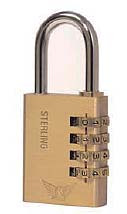
In simple terms, a padlock has three major components; the Body, the Shackle and the Locking Mechanism, …it may also incorporate features such as a weatherproof casing, anti drill or anti cropping protection, etc.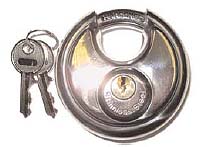
Discus style padlocks - have no angular corners, so are often used with cycle security chains and cables, as well as being a popular choice for securing doors on sheds and beach huts, etc. When used as a door lock, they will typically be used in conjunction with the special shrouded discus hasp and staple set, which offers extra protection to the padlock shackle.
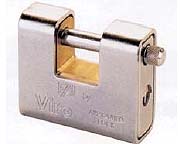
Shutter Locks / Anvil Locks - are typically used to secure the external (or internal) security roller shutters fitted to shop fronts. They are also popular for use with parking posts, motorcycle security chains, etc.
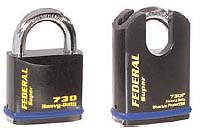
Conventional Style padlocks have a wide range of applications from low security applications like locking your toolbox, to high security uses such as securing factory gates or protecting motorcycles. They are typically available as; Open, Close, or Semi Enclosed Shackle types
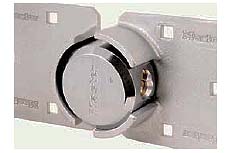
Shackleless type padlock (shown with special hasp)Shackleless Padlocks - this is a bit of a misnomer as the padlock does of course have a shackle, it’s just that it’s on the underside of the lock body and therefore unseen. This type of padlock can be round (like the one pictured) or rectangular, but typically, they are designed to be used with a special matching security hasp. Because of their design, these units are difficult to attack and over recent years, as well as being used on warehouse doors, etc, they have also become very popular for use on vans and other vehicles where they are used to secure opening double doors.
A "Close Shackle" padlock is one with built in shoulders, which are designed to minimise the amount of the shackle exposed, to a saw or bolt cropper attack. This type of padlock will normally have a higher security rating than an equivalent unit with a semi enclosed or open shackle, however subject to size and clearances, may not be practical for instance, to use where you need to secure 2 chain links together or require a padlock for use with a shrouded hasp, etc. To make them easier to use, many Close Shackle padlocks feature "removable shackles" which are fully released from the body of the padlock when it's unlocked.
An "Open Shackle" padlock will typically be easier to use where the shackle needs to pass through 2 chain-links (i.e, a chain securing two opening gates together), etc. As more of the shackle is exposed however, this makes it potentially easier to attack with a saw or bolt croppers.
A "Semi Enclosed Shackle" padlock is something of a compromise, but will often offer more flexibility in use than a Close Shackle padlock and improved security over an Open Shackle model.
Тематики
EN
Англо-русский словарь нормативно-технической терминологии > padlock
-
33 variable
1) переменная2) (изменяемый) параметр; (изменяемая) величина4) переменный; изменяющийся; непостоянный•- apparent variableto drop a variable — опускать переменную, не включать переменную в рассмотрение
- array variable
- artificial variable
- automatic variable
- auxiliary variable
- binary variable
- Boolean variable
- bound variable
- broadcasted variables
- categorical variable
- centered random variable
- class variable
- cointegrated variables
- compile-time variable
- complex variable
- concomitant variable
- constructed variable
- continuous variable
- control variable
- controllable variable
- controlled variable
- CRC variable
- cyclic redundancy check variable
- decision variable
- dependent variable
- deterministic variable
- dichotomic variable
- discrete variable
- discrete random variable
- dummy variable
- endogenous variable
- environment variable
- environmental variables
- excluded variable
- exogenous variable
- explained variable
- explanatory variable
- fast variable
- file variable
- free variable
- functor variable
- fuzzy variable
- generated variable
- generic variable
- generic type variable
- global variable
- grouping variable
- imaginary variable
- independent variable
- indicator variable
- input variable
- instance variables
- instant variables
- instrumental variable
- integer variable
- interval variable
- intervening variable
- key variable
- label variable
- lagged variable
- latent variable
- leading variable
- limited variable
- linguistic variable
- local variable
- logic variable
- logical variable
- loop variable
- metalinguistic variable
- metasyntactic variable
- moving-frame variable
- nominal variable
- omitted variable
- one-fluid variables
- ordinal variable
- output variable
- P-variable
- predetermined variable
- proxy variable
- qualitative variable
- random variable
- rank variable
- real variable
- redundant variable
- response variable
- rest-frame variable
- scalar variable
- schematic variable
- schematic type variable
- seasonal variable
- slow variable
- standardized variable
- state variable
- static variable
- stationary variable
- stochastic variable
- string variable
- subscripted variable
- summation variable
- system variable
- target variable
- tensor variable
- unbound variable
- uninitialized variable
- unobservable variable
- unrestricted variable
- vector variable
- vector random variable -
34 object
= OBJ1) объекта) одно из базовых понятий объектно-ориентированного программирования, ООП (см. OOP), с помощью которого осуществляется программное представление сущностей реального мира. Объект - экземпляр класса; обладает свойствами наследования, инкапсуляции и полиморфизма. Объединяет в себе данные (property) и операции над ними (методы, method). Реализуется в компьютере как динамически размещаемая сложная структура данных, т. е. каждый объект имеет собственный набор полей, определённых его классом, а методы объекты используют совместно. Объект может рассматриваться как абстрактный тип данных (abstract data type). Каждый объект имеет собственное имя или идентификационный номер. Объекты создаются и уничтожаются с помощью специальных методов - конструкторов (constructor) и деструкторов (destructor). Структуры данных и реализация методов объекта невидима для других объектов в системе. Объекты взаимодействуют между собой, посылая друг другу сообщения (message). В ответ на сообщение объект выполняет один из методов, чтобы удовлетворить полученный запрос, при этом интерпретация сообщения лежит целиком на объекте-получателе. Таким образом различные объекты могут реагировать на одно и то же сообщение по разному. Действия, выполняемые объектом, называют его поведением (behaviour). Объекты - основная единица построения программной системы. Объекты с общими свойствами и методами объединены в классы. Чаще всего термин "объект" трактуется как синоним слова экземпляр, однако иногда может использоваться и для обозначения классасм. тж. active object, aggregate object, ancestor object, class object, collection, composite object, conceptual object, container object, database object, dynamic object, encapsulation, information hiding, inheritance, instance, object conversion, object handler, object header, object identity, object interface, object library, object manager, object model, object orientation, object pool, object reference, object reuse, object technology, object type, OODB, ODL, OOL, passive object, polymorphism, reusable object, Simulaсм. тж. 3D object2) предмет3) цельсм. тж. target4) объектныйАнгло-русский толковый словарь терминов и сокращений по ВТ, Интернету и программированию. > object
-
35 feature operation
Operation that every instance of a feature type may perform (ISO 19110*).Note.— An operation upon the feature type dam is to raise the dam. The result of this operation is to raise level of water in the reservoir.(AN 15)*ISO Standard 19110, Geographic information — Feature cataloguing schema Official definition added to AN 15 by Amdt 33 (25/11/2004).Действие, которое может осуществлять каждый элемент соответствующего типа (ИСО 19110*).Примечание. Действие, связанное с типом элемента ‘плотина,’ заключается в поднятии плотины. Результатом этого действия является подъем уровня воды в водоёме.*Стандарт 19110 ИСО ‘Географическая информация: схема каталогизации элементов’International Civil Aviation Vocabulary (English-Russian) > feature operation
-
36 Booth, Henry
[br]b. 4 April 1789 Liverpool, Englandd. 28 March 1869 Liverpool, England[br]English railway administrator and inventor.[br]Booth followed his father as a Liverpool corn merchant but had great mechanical aptitude. In 1824 he joined the committee for the proposed Liverpool \& Manchester Railway (L \& MR) and after the company obtained its Act of Parliament in 1826 he was appointed Treasurer.In 1829 the L \& MR announced a prize competition, the Rainhill Trials, for an improved steam locomotive: Booth, realizing that the power of a locomotive depended largely upon its capacity to raise steam, had the idea that this could be maximized by passing burning gases from the fire through the boiler in many small tubes to increase the heating surface, rather than in one large one, as was then the practice. He was apparently unaware of work on this type of boiler even then being done by Marc Seguin, and the 1791 American patent by John Stevens. Booth discussed his idea with George Stephenson, and a boiler of this type was incorporated into the locomotive Rocket, which was built by Robert Stephenson and entered in the Trials by Booth and the two Stephensons in partnership. The boiler enabled Rocket to do all that was required in the trials, and far more: it became the prototype for all subsequent conventional locomotive boilers.After the L \& MR opened in 1830, Booth as Treasurer became in effect the general superintendent and was later General Manager. He invented screw couplings for use with sprung buffers. When the L \& MR was absorbed by the Grand Junction Railway in 1845 he became Secretary of the latter, and when, later the same year, that in turn amalgamated with the London \& Birmingham Railway (L \& BR) to form the London \& North Western Railway (L \& NWR), he became joint Secretary with Richard Creed from the L \& BR.Earlier, completion in 1838 of the railway from London to Liverpool had brought problems with regard to local times. Towns then kept their own time according to their longitude: Birmingham time, for instance, was 7¼ minutes later than London time. This caused difficulties in railway operation, so Booth prepared a petition to Parliament on behalf of the L \& MR that London time should be used throughout the country, and in 1847 the L \& NWR, with other principal railways and the Post Office, adopted Greenwich time. It was only in 1880, however, that the arrangement was made law by Act of Parliament.[br]Bibliography1835. British patent no. 6,814 (grease lubricants for axleboxes). 1836. British patent no. 6,989 (screw couplings).Booth also wrote several pamphlets on railways, uniformity of time, and political matters.Further ReadingH.Booth, 1980, Henry Booth, Ilfracombe: Arthur H.Stockwell (a good full-length biography, the author being the great-great-nephew of his subject; with bibliography).R.E.Carlson, 1969, The Liverpool \& Manchester Railway Project 1821–1831, Newton Abbot: David \& Charles.PJGR -
37 mandatory constraint
"A constraint that requires every instance of an object type's population to play that role. With a disjunctive mandatory role constraint, each member of the object type's population must play at least one of the roles indicated." -
38 description
dɪsˈkrɪpʃən сущ.
1) а) составление описания (словесного или с помощью карандаша и бумаги) Writers gifted with strong imaginations, are masters of description. ≈ Писателям с богатым воображением обычно удаются различные описания. б) описание( событий), версия( происходящего и т.д.) to give, provide a description ≈ описывать accurate, correct, exact description ≈ точное описание blow-by-blow description ≈ исчерпывающее описание clear description ≈ четкое описание detailed, thorough description ≈ подробное описание firsthand description ≈ достоверное/"из первых рук" описание glowing description ≈ яркое описание lively, picturesque, vivid description ≈ живое описание matter-of-fact, objective description ≈ объективное описание superficial description ≈ поверхностное описание job description ≈ должностная инструкция Syn: description, explanation
2) а) набор признаков или специфических черт (для описания объектов одного вида, сорта, класса) б) вид, класс, разряд, род, сорт (каких-либо объектов) Syn: sort, kind, type, variety
3) геом. вписывание (одной геометрической фигуры в другую), описывание (одной геометрической фигуры вокруг другой) description of a rectangle triangle in a circle ≈ вписывание прямоугольного треугольника в круг описание;
изображение - faithful * правдивое описание - * of a storm описание бури - * of a horse спецификация на лошадь (конный спорт) - beyond * не поддающийся описанию, неописуемый - to give a (detailed) * of smth. дать( подробное) описание чего-л. - to answer (to) the * подходить под описание;
иметь указанные приметы - it baffles /beggars, defies/ * это не поддается описанию (разговорное) вид, род - books of every * всевозможные книги - people of all *s люди всякого звания - a lecture of the poorest * никуда негодная лекция вычерчивание - * of a circle описывание окружности - * of an arch вычерчивание дуги (логика) дескрипция - definite * определенная дескрипция to beggar (или to baffle, to defy) ~ не поддаваться описанию behaviour ~ вчт. поведенческое описание beyond ~ не поддающийся описанию description вид, род, сорт;
books of every description всевозможные книги;
of the worst description худшего типа;
самого худшего сорта data ~ описание данных database ~ вчт. описание базы данных declarative ~ вчт. декларативное описание description вид, род, сорт;
books of every description всевозможные книги;
of the worst description худшего типа;
самого худшего сорта ~ вид ~ вычерчивание, описание ~ изображение ~ описание, изображение ~ вчт. описание ~ описание ~ очерчивание ~ род ~ характеристика ~ of goods наименование товара ~ of goods описание товара ~ of operational risk определение производственного риска ~ of patent описание изобретения к патенту ~ of risk определение риска ~ of risk точное определение страховой ответственности detailed ~ подробное описание field ~ вчт. описание поля formal ~ вчт. формальное описание functional ~ функциональное описание generic ~ вчт. обобщенное описание generic ~ общее описание implementation ~ вчт. описание реализации instance ~ вчт. описание экземпляра job ~ должностная инструкция job ~ описание вида работы;
общее изложение функций с указанием необходимой квалификации job ~ вчт. описание задания job ~ описание рабочего задания job ~ перечень функций и задач включенных в конкретный вид деятельности job ~ характер выполняемой работы job ~ характер работы misleading trade ~ описание товара, вводящее в заблуждение description вид, род, сорт;
books of every description всевозможные книги;
of the worst description худшего типа;
самого худшего сорта patent ~ описание изобретения к патенту patent ~ описание патента personal ~ личные приметы problem ~ вчт. описание задачи product ~ описание изделия product ~ характер выпускаемой продукции protocol ~ вчт. описание протокола quasi-formal ~ вчт. квазиформальное описание specific ~ pat. частичное описание trade ~ торговое описаниеБольшой англо-русский и русско-английский словарь > description
-
39 change
ein‹ 1. verb1) (to make or become different: They have changed the time of the train; He has changed since I saw him last.) forandre/endre (seg), legge om, skifte2) (to give or leave (one thing etc for another): She changed my library books for me.) bytte3) ((sometimes with into) to remove (clothes etc) and replace them by clean or different ones: I'm just going to change (my shirt); I'll change into an old pair of trousers.) skifte, kle seg om4) ((with into) to make into or become (something different): The prince was changed into a frog.) forvandle (seg)5) (to give or receive (one kind of money for another): Could you change this bank-note for cash?) veksle2. noun1) (the process of becoming or making different: The town is undergoing change.) forandring, endring, omlegging2) (an instance of this: a change in the programme.) forandring, endring3) (a substitution of one thing for another: a change of clothes.) (kles)bytte, skifte4) (coins rather than paper money: I'll have to give you a note - I have no change.) mynter; skillemynt5) (money left over or given back from the amount given in payment: He paid with a dollar and got 20 cents change.) vekslepenger, penger igjen6) (a holiday, rest etc: He has been ill - the change will do him good.) forandring•- change hands
- a change of heart
- the change of life
- change one's mind
- for a changeforandre--------forandring--------skifte--------veksleIsubst. \/tʃeɪn(d)ʒ\/1) forandring, endring2) omlegging, overgang, svingning, skifte, omslag3) ombytte, bytte, avveksling4) skift, ekstra sett5) veksel, småpenger, penger igjen• keep the change!behold resten! \/ det er greit!6) ( tømrerfag) vekslinga change from et avbrekk fra, en avveksling frachange of life overgangsalder, menopause overgangsfasechange of the moon ny månefasechange of voice stemmeskiftechanges vekslinger, forklaring: rekkefølgen som klokkene blir anslått i ved klokkeringingfor a change til en forandring, for én gangs skyldget no change out of somebody ikke komme noe sted med noengive change ( om småpenger) vekslegi igjen• can you give me change for a pound?receive change ( om vekslepenger) få tilbakering the changes prøve alle muligheter, vri og vende på, variere et tematake one's change out of somebody hevne seg på noen, ta igjen overfor noenthere is nothing like a change forandring fryderIIverb \/tʃeɪn(d)ʒ\/1) forandre (på\/seg), endre (på\/seg)2) legge om, gjøre om3) forvandle(s)4) bytte, bytte ut, skifte, kle seg om5) ( om penger) veksle, gi tilbake6) ( om sjekk) løse inn7) veksle8) gå over, bytte• change here for Hull!9) ( om bil) girechange about ombestemme seg flere gangerchange colour rødme bleknechange down ( om bil) gire nedchange for forandre (seg) tilbytte (ut) mot, bytte (ut) med, bytte i( om klær) skifte til, kle seg om tilchange from gå fra, veksle frachange front\/face gjøre helomvending, endre standpunktchange hands bytte hånd, bruke den andre hånden skifte eierchange houses flytte (til ny bolig)change into forandre til ( om klær) skifte tilchange one's address få ny adresse, flyttechange one's clothes skifte klær, skiftechange one's mind ombestemme seg, skifte meningchange out of ( om klær) få på seg noe annet ennchange over skifte over ( sport) veksle (i stafett)change places bytte plass bytte rollechange sides bytte side endre standpunkt, forandre meningchange step\/foot\/feet ( ved marsjering) skifte takt -
40 ejemplo
ejemplo sustantivo masculino example; pongamos por ejemplo el caso de Elena let's take Elena's case as an example; por ejemplo for example
ejemplo sustantivo masculino example: su madre es un ejemplo de honradez, his mother is a model of decency LOC dar ejemplo, to set an example: no das un buen ejemplo gritando a los niños, you're not setting a good example by shouting at the children
por ejemplo, for example: visitaron grandes ciudades, por ejemplo El Cairo, they visited great cities like El Cairo ' ejemplo' also found in these entries: Spanish: actual - ahorcarse - aleccionador - aleccionadora - ciudad - clásica - clásico - edificar - ej. - ilustración - misma - mismo - perdón - representar - sobrexplotación - concreto - demostrativo - Ej. - p. ej. - poner - por - rebuscado English: ablaze - actual - chaser - e.g. - engine driver - example - grope - illustration - instance - lead - model - money - picture - prime - set - specific - take - suit - type
См. также в других словарях:
Type system — Type systems Type safety Inferred vs. Manifest Dynamic vs. Static Strong vs. Weak Nominal vs. Structural Dependent typing Duck typing Latent typing Linear typing Uniqueness typing … Wikipedia
instance — n Instance, case, illustration, example, sample, specimen mean a concrete thing which has or manifests the qualities, characters, or nature of a type, a class, or a group. Instance applies to an individual person or thing brought forth in support … New Dictionary of Synonyms
instance — in·stance / in stəns/ n [French, from Late Latin instantia, from Latin, the fact of being present or impending, vehemence in speech, urgency, from instant instans insistent, pressing, from present participle of instare to be pressing, stand upon] … Law dictionary
Instance supérieure indépendante pour les élections — (Isie) Création 2011 Type Organisme électoral Langue(s) arabe Président Kamel … Wikipédia en Français
Type approval — is granted to a product that meets a minimum set of regulatory, technical and safety requirements. Generally, type approval is required before a product is allowed to be sold in a particular country, so the requirements for a given product will… … Wikipedia
Type algebrique de donnees — Type algébrique de données Un type algébrique de données est un type de données dont chacune des valeurs est une donnée d un autre type enveloppée dans un des constructeurs du type. Toutes les données enveloppées sont des arguments du… … Wikipédia en Français
Type algébrique — de données Un type algébrique de données est un type de données dont chacune des valeurs est une donnée d un autre type enveloppée dans un des constructeurs du type. Toutes les données enveloppées sont des arguments du constructeur. Par contraste … Wikipédia en Français
Type recursif — Type récursif Dans un langage de programmation, un type récursif ou type inductif est un type de données pour des valeurs qui contiennent d autres valeurs du même type. Un exemple est le type liste en Haskell : data List a = Nil | Cons a… … Wikipédia en Français
type — [tīp] n. [LL(Ec) typus, a model, symbol < L & Gr: L, a figure < Gr typos, a figure, archetype, model, orig., a blow, mark made by a blow < typtein: see TYMPAN] 1. a person, thing, or event that represents or symbolizes another, esp.… … English World dictionary
type — index case (example), characteristic, class, classification, classify, color (complexion), criterion … Law dictionary
Type introspection — In computing, type introspection is a capability of some object oriented programming languages to determine the type of an object at runtime. This is a notable capability of the Objective C language, and is a common feature in any language that… … Wikipedia
