

-
1 défini
défini, e [defini]a. ( = déterminé) precise* * *définie defini adjectif1) gén clearly definedmal défini — [sentiment] vague; [contour, image, circonstances] ill-defined
bien défini — well-defined (épith)
2) Linguistique [article] definite* * *defini adj défini, -e* * *A pp ⇒ définir.B pp adj1 gén defined; elle n'avait pas de thème défini she had no clearly defined theme; mal défini [sentiment, goût] indefinable; [contour, image, circonstances] ill-defined; bien défini well-defined;2 Ling [article] definite.1. [qui a une définition] defined[précis] precise2. GRAMMAIRE -
2 bâtard
bâtard, e [bαtaʀ, aʀd]1. adjective[œuvre, solution] hybrid2. masculine nouna. (pejorative) ( = chien) mongrelb. ( = pain) (short) loaf of bread* * *
1.
bâtarde bɑtaʀ, aʀd adjectif1) fig [solution, œuvre, style] hybrid; [statut] ill-defined; [couleur] indefinite2) [chien] crossbred3) offensive [enfant] bastard injur
2.
nom masculin, féminin1) ( chien) mongrel2) ( enfant) offensive bastard injur
3.
* * *bɒtaʀ, aʀd bâtard, -e1. adj1) (enfant) illegitimate2) fig hybrid2. nm/f1) (= enfant) illegitimate child, bastard péjoratif2) (= chien) mongrel3. nm(= pain) short French stick* * *A adj2 Zool [chien] crossbred;B nm,f1 ( chien) mongrel;( féminin bâtarde) [batar, ard] adjectif1. [enfant] illegitimate[animal] crossbred2. [genre, œuvre] hybrid————————, bâtarde [batar, ard] nom masculin, nom fémininbâtard nom masculin[pain] short French stickbâtarde nom féminin -
3 définir
définir [definiʀ]➭ TABLE 2 transitive verbto define ; [+ conditions] to specify* * *definiʀverbe transitif to define [mot, politique]; to define [personne] ( comme as)* * *definiʀ vt* * *définir verb table: finirA vtr1 gén to define, to specify [loi, règle]; les conditions sont clairement définies dans le contrat the conditions are clearly specified in the contract; mieux définir le but choisi to define the chosen aim more clearly; les conditions sont à définir the conditions are still to be specified; définir sa politique to lay down firm political guidelines; définir comme une priorité la lutte contre l'inflation to make the fight against inflation one's top priority;2 ( caractériser) to characterize [personne]; ( résumer) [personne, qualité] to define [personne] (comme as); définir la gestion comme un art to see management as an art.B se définir vpr [personne] to define oneself (comme as); [mot, sentiment, position] to be defined.[definir] verbe transitif1. [donner la définition de] to define3. [circonscrire - objectif, politique, condition] to defineje définirais mon rôle comme étant celui d'un négociateur I'd define ou describe my role as that of a negotiator -
4 flanc
боковая поверхность
Участок, образующийся между внутренней и наружной поверхностями
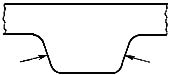
[ ГОСТ 28500-90( ИСО 5288-82)]EN
flank
Area defined by the width of the belt and the straight portion of the tooth section contained between the tip line and the root line
[ ГОСТ 28500-90( ИСО 5288-82)]FR
flanc
Surface définie par la largeur de la courroie et la partie rectiligne de la dent comprise entre la ligne de tête et la ligne de pied
[ ГОСТ 28500-90( ИСО 5288-82)]боковая поверхность
Одна из поверхностей, ограниченных шириной шкива и верхней и нижней поверхностями цилиндра (или прямолинейными участками)

[ ГОСТ 28500-90( ИСО 5288-82)]EN
flank
Area defined by the width of the pulley and the involute (or straight) portion of a pulley tooth contained between the tip cylinder and the root cylinder
[ ГОСТ 28500-90( ИСО 5288-82)]FR
flanc
Une des surfaces définies par la largeur de la poulie et par la partie en développante de cercle (ou rectiligne) de la dent qui est comprise entre le cylinder de tête et le cylindre de pied
[ ГОСТ 28500-90( ИСО 5288-82)]Тематики
EN
FR
боковая сторона резьбы
Часть винтовой поверхности резьбы, расположенная между вершиной и впадиной резьбы и имеющая в плоскости осевого сечения прямолинейный профиль.
Наружная резьба Внутренняя резьба
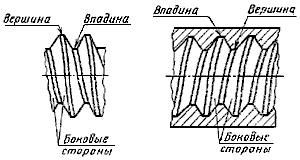
Примечания
В зависимости от того, участвует или не участвует боковая сторона в передаче движения или нагрузки, различают соответственно рабочую и нерабочую боковые стороны резьбы.
Одноименными называют боковые стороны резьбы одного наименования, например, только рабочие или только нерабочие.
Разноименными называют боковые стороны резьбы, имеющие разные наименования, например, одна рабочая, а другая - нерабочая.
Применительно к профилю резьбы может быть использован термин "боковая сторона профиля резьбы", под которым понимают часть профиля резьбы, соответствующую сечению боковой стороны резьбы осевой плоскостью.
[ ГОСТ 11708-82( СТ СЭВ 2631-80)]Тематики
Обобщающие термины
EN
DE
FR
боковина (38)
Часть покрышки пневматической шины, расположенная между плечевой зоной и бортом.
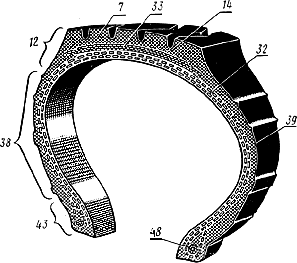
[ ГОСТ 22374-77]Тематики
Обобщающие термины
EN
DE
FR
D. Gewindeflanke
Е. Flank
F. Flanc
Часть винтовой поверхности резьбы, расположенная между вершиной и впадиной резьбы и имеющая в плоскости осевого сечения прямолинейный профиль (черт. 10)
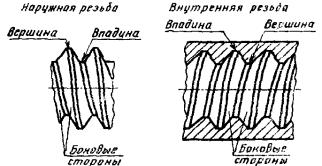
Черт. 10
Источник: ГОСТ 11708-82: Основные нормы взаимозаменяемости. Резьба. Термины и определения оригинал документа
Франко-русский словарь нормативно-технической терминологии > flanc
-
5 conducteur (isolé)
изолированная жила (термин употребляется в Северной Америке)
совокупность элементов, состоящая из жилы, ее изоляции (и экранов, если они есть)
Примечание. В Северной Америке термин «core of a cable» определяется как совокупность компонентов кабеля, расположенных под общим защитным покровом, таким как оболочка. Такое применение этого термина не допустимо
[IEV number 461-04-04]EN
core
insulated conductor
assembly comprising a conductor with its own insulation (and screens if any)
NOTE – In North American usage, the core of a cable has been defined as the assembly of components of a cable lying under a common covering such as the sheath. Such usage is deprecated.
[IEV number 461-04-04]FR
conducteur (isolé)
ensemble comprenant l'âme, son enveloppe isolante et ses écrans éventuels
NOTE – En Amérique du Nord le terme “core of a cable” a été défini comme l'ensemble des constituants d'un câble disposés sous un revêtement commun, tel que la gaine. L'utilisation de ce terme est déconseillée dans ce sens.
[IEV number 461-04-04]Тематики
- кабели, провода...
EN
DE
- Ader, f
FR
изолированный провод
—
[Я.Н.Лугинский, М.С.Фези-Жилинская, Ю.С.Кабиров. Англо-русский словарь по электротехнике и электроэнергетике, Москва, 1999 г.]EN
core insulated conductor
assembly comprising a conductor and its own insulation (and screens, if any)
[IEC 61892-4, ed. 1.0 (2007-06)]
core-insulated conductor (North America)
assembly comprising a conductor and its own insulation (and screens, if any)
NOTE In North American usage, the core of a cable has been defined as the assembly of components of a cable lying under a common covering such as the sheath (jacket).
[IEC 60092-350, ed. 3.0 (2008-02)]FR
conducteur (isolé)
ensemble comprenant l'âme, son enveloppe isolante et ses écrans éventuels
Note – En Amérique du Nord le terme “core of a cable” a été défini comme l'ensemble des constituants d'un câble disposés sous un revêtement commun, tel que la gaine. L'utilisation de ce terme est déconseillée dans ce sens.
[ IEV ref 461-04-04]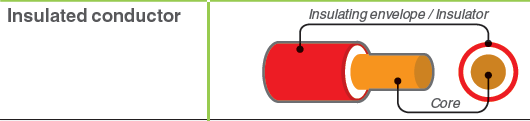
Рис. Schneider Electric
Параллельные тексты EN-RU
An insulated conductor is made up of a conductor core and its
insulating envelope.
[Schneider Electric]Изолированный провод состоит из токопроводящей жилы и изоляции провода.
[Перевод Интент]Тематики
- кабели, провода...
EN
- core insulated conductor
- core-insulated conductor
- covered conductor
- covered wire
- insulated conductor
DE
- Ader, f
FR
Франко-русский словарь нормативно-технической терминологии > conducteur (isolé)
-
6 système
система
Группа взаимодействующих объектов, выполняющих общую функциональную задачу. В ее основе лежит некоторый механизм связи.
[ ГОСТ Р МЭК 61850-5-2011]
система
Набор элементов, которые взаимодействуют в соответствии с проектом, в котором элементом системы может быть другая система, называемая подсистемой; система может быть управляющей системой или управляемой системой и включать аппаратные средства, программное обеспечение и взаимодействие с человеком.
Примечания
1 Человек может быть частью системы. Например, человек может получать информацию от программируемого электронного устройства и выполнять действие, связанное с безопасностью, основываясь на этой информации, либо выполнять действие с помощью программируемого электронного устройства.
2 Это определение отличается от приведенного в МЭС 351-01-01.
[ ГОСТ Р МЭК 61508-4-2007]
система
Множество (совокупность) материальных объектов (элементов) любой, в том числе различной физической природы, а также информационных объектов, взаимосвязанных и взаимодействующих между собой для достижения общей цели.
[ ГОСТ Р 43.0.2-2006]
система
Совокупность элементов, объединенная связями между ними и обладающая определенной целостностью.
[ ГОСТ 34.003-90]
система
Совокупность взаимосвязанных и взаимодействующих элементов.
[ ГОСТ Р ИСО 9000-2008]
система
-
[IEV number 151-11-27]
система
Набор связанных элементов, работающих совместно для достижения общей Цели. Например: • Компьютерная система, состоящая из аппаратного обеспечения, программного обеспечения и приложений. • Система управления, состоящая из множества процессов, которые планируются и управляются совместно. Например, система менеджмента качества. • Система управления базами данных или операционная система, состоящая из множества программных модулей, разработанных для выполнения набора связанных функций.
[Словарь терминов ITIL версия 1.0, 29 июля 2011 г.]
система
Множество элементов, находящихся в отношениях и связях друг с другом, которое образует определенную целостность, единство. Следует отметить, что это определение (взятое нами из Большой Советской Энциклопедии) не является ни единственным, ни общепризнанным. Есть десятки определений понятия “С.”, которые с некоторой условностью можно поделить на три группы. Определения, принадлежащие к первой группе, рассматривают С. как комплекс процессов и явлений, а также связей между ними, существующий объективно, независимо от наблюдателя. Его задача состоит в том, чтобы выделить эту С. из окружающей среды, т.е. как минимум определить ее входы и выходы (тогда она рассматривается как “черный ящик”), а как максимум — подвергнуть анализу ее структуру (произвести структуризацию), выяснить механизм функционирования и, исходя из этого, воздействовать на нее в нужном направлении. Здесь С. — объект исследования и управления. Определения второй группы рассматривают С. как инструмент, способ исследования процессов и явлений. Наблюдатель, имея перед собой некоторую цель, конструирует (синтезирует) С. как некоторое абстрактное отображение реальных объектов. При этом С. (“абстрактная система”) понимается как совокупность взаимосвязанных переменных, представляющих те или иные свойства, характеристики объектов, которые рассматриваются в данной С. В этой трактовке понятие С. практически смыкается с понятием модели, и в некоторых работах эти два термина вообще употребляются как взаимозаменяемые. Говоря о синтезе С., в таких случаях имеют в виду формирование макромодели, анализ же С. совпадает в этой трактовке с микромоделированием отдельных элементов и процессов. Третья группа определений представляет собой некий компромисс между двумя первыми. С. здесь — искусственно создаваемый комплекс элементов (например, коллективов людей, технических средств, научных теорий и т.д.), предназначенный для решения сложной организационной, экономической, технической задачи. Следовательно, здесь наблюдатель не только выделяет из среды С. (и ее отдельные части), но и создает, синтезирует ее. С. является реальным объектом и одновременно — абстрактным отображением связей действительности. Именно в этом смысле понимает С. наука системотехника. Между этими группами определений нет непроходимых границ. Во всех случаях термин “С.” включает понятие о целом, состоящем из взаимосвязанных, взаимодействующих, взаимозависимых частей, причем свойства этих частей зависят от С. в целом, свойства С. — от свойств ее частей. Во всех случаях имеется в виду наличие среды, в которой С. существует и функционирует. Для исследуемой С. среда может рассматриваться как надсистема, соответственно, ее части — как подсистемы, а также элементы С., если их внутренняя структура не является предметом рассмотрения. С. делятся на материальные и нематериальные. К первым относятся, например, железная дорога, народное хозяйство, ко вторым — С. уравнений в математике, математика как наука, далее — С. наук. Автоматизированная система управления включает как материальные элементы (ЭВМ, документация, люди), так и нематериальные — математические модели, знания людей. Разделение это тоже неоднозначно: железную дорогу можно рассматривать не только как материальную С., но и как нематериальную С. взаимосвязей, соотношений, потоков информации и т.д. Закономерности функционирования систем изучаются общей теорией систем, оперирующей понятием абстрактной С. Наибольшее значение среди абстрактных С. имеют кибернетические С. Есть два понятия, близкие понятию С.: комплекс, совокупность (множество объектов). Они, однако, не тождественны ему, как нередко утверждают. Их можно рассматривать как усеченные, неполные понятия по отношению к С.: комплекс включает части, не обязательно обладающие системными свойствами (в том смысле, как это указано выше), но эти части сами могут быть системами, и элементы последних такими свойствами по отношению к ним способны обладать. Совокупность же есть множество элементов, не обязательно находящихся в системных отношениях и связях друг с другом. В данном словаре мы стремимся по возможности последовательно различать понятия С. и модели, рассматривая С. как некий объект (реальной действительности или воображаемый — безразлично), который подвергается наблюдению и изучению, а модель — как средство этого наблюдения и изучения. Разумеется, и модель, если она сама оказывается объектом наблюдения и изучения, в свою очередь рассматривается как С. (в частности, как моделируемая С.) — и так до бесконечности. Все это означает, что такие, например, понятия, как переменная или параметр, мы (в отличие от многих авторов) относим не к С., а к ее описанию, т.е. к модели (см. Параметры модели, Переменная модели), численные же их значения, характеризующие С., — к С. (например, координаты С.). • Системы математически описываются различными способами. Каждая переменная модели, выражающая определенную характеристику С., может быть задана множеством конкретных значений, которые эта переменная может принимать. Состояние С. описывается вектором (или кортежем, если учитываются также величины, не имеющие численных значений), каждая компонента которого соответствует конкретному значению определенной переменной. С. в целом может быть описана соответственно множеством ее состояний. Например, если x = (1, 2, … m) — вектор существенных переменных модели, каждая из которых может принять y значений (y = 1, 2, …, n), то матрица S = [ Sxy ] размерностью m ? n представляет собой описание данной С. Широко применяется описание динамической С. с помощью понятий, связанных с ее функционированием в среде. При этом С. определяется как три множества: входов X, выходов Y и отношений между ними R. Полученный “портрет системы” может записываться так: XRY или Y = ®X. Аналитическое описание С. представляет собой систему уравнений, характеризующих преобразования, выполняемые ее элементами и С. в целом в процессе ее функционирования: в непрерывном случае применяется аппарат дифференциальных уравнений, в дискретном — аппарат разностных уравнений. Графическое описание С. чаще всего состоит в построении графа, вершины которого соответствуют элементам С., а дуги — их связям. Существует ряд классификаций систем. Наиболее известны три: 1) Ст. Бир делит все С. (в природе и обществе), с одной стороны, на простые, сложные и очень сложные, с другой — на детерминированные и вероятностные; 2) Н.Винер исходит из особенностей поведения С. (бихевиористский подход) и строит дихотомическую схему: С., характеризующиеся пассивным и активным поведением; среди последних — нецеленаправленным (случайным) и целенаправленным; в свою очередь последние подразделяются на С. без обратной связи и с обратной связью и т.д.; 3) К.Боулдинг выделяет восемь уровней иерархии С., начиная с простых статических (например, карта земли) и простых кибернетических (механизм часов), продолжая разного уровня сложности кибернетическими С., вплоть до самых сложных — социальных организаций. Предложены также классификации по другим основаниям, в том числе более частные, например, ряд классификаций С. управления. См. также: Абстрактная система, Адаптирующиеся, адаптивные системы, Большая система, Вероятностная система, Выделение системы, Входы и выходы системы, Детерминированная система, Динамическая система, Дискретная система, Диффузная система, Замкнутая (закрытая) система, Иерархическая структура, Имитационная система, Информационная система, Информационно-развивающаяся система, Кибернетическая система, Координаты системы, Надсистема, Нелинейная система, Непрерывная система, Открытая система, Относительно обособленная система, Память системы, Подсистема, Портрет системы, Разомкнутая система, Рефлексная система, Решающая система, Самонастраивающаяся система, Самообучающаяся система, Самоорганизующаяся система, Сложная система, Состояние системы, Статическая система, Стохастическая система, Структура системы, Структуризация системы, Управляющая система, Устойчивость системы, Целенаправленная система, Экономическая система, Функционирование экономической системы..
[ http://slovar-lopatnikov.ru/]EN
system
set of interrelated elements considered in a defined context as a whole and separated from their environment
NOTE 1 – A system is generally defined with the view of achieving a given objective, e.g. by performing a definite function.
NOTE 2 – Elements of a system may be natural or man-made material objects, as well as modes of thinking and the results thereof (e.g. forms of organisation, mathematical methods, programming languages).
NOTE 3 – The system is considered to be separated from the environment and the other external systems by an imaginary surface, which cuts the links between them and the system.
NOTE 4 – The term "system" should be qualified when it is not clear from the context to what it refers, e.g. control system, colorimetric system, system of units, transmission system.
Source: 351-01-01 MOD
[IEV number 151-11-27]
system
A number of related things that work together to achieve an overall objective. For example: • A computer system including hardware, software and applications • A management system, including the framework of policy, processes, functions, standards, guidelines and tools that are planned and managed together – for example, a quality management system • A database management system or operating system that includes many software modules which are designed to perform a set of related functions.
[Словарь терминов ITIL версия 1.0, 29 июля 2011 г.]FR
système, m
ensemble d'éléments reliés entre eux, considéré comme un tout dans un contexte défini et séparé de son environnement
NOTE 1 – Un système est en général défini en vue d'atteindre un objectif déterminé, par exemple en réalisant une certaine fonction.
NOTE 2 – Les éléments d'un système peuvent être aussi bien des objets matériels, naturels ou artificiels, que des modes de pensée et les résultats de ceux-ci (par exemple des formes d'organisation, des méthodes mathématiques, des langages de programmation).
NOTE 3 – Le système est considéré comme séparé de l'environnement et des autres systèmes extérieurs par une surface imaginaire qui coupe les liaisons entre eux et le système.
NOTE 4 – Il convient de qualifier le terme "système" lorsque le concept ne résulte pas clairement du contexte, par exemple système de commande, système colorimétrique, système d'unités, système de transmission.
Source: 351-01-01 MOD
[IEV number 151-11-27]Тематики
- автоматизированные системы
- информационные технологии в целом
- релейная защита
- системы менеджмента качества
- экономика
EN
DE
FR
Франко-русский словарь нормативно-технической терминологии > système
-
7 degré de protection procuré par une enveloppe
степень защиты
Способ защиты, обеспечиваемый оболочкой от доступа к опасным частям, попадания внешних твердых предметов и (или) воды и проверяемый стандартными методами испытаний.
[ ГОСТ 14254-96( МЭК 529-89)]
степень защиты, обеспечиваемая оболочкой (IP)
Числовые обозначения после кода IP, которые в соответствии с МЭК 60529 [12] характеризуют оболочку электрооборудования, обеспечивающую:
- защиту персонала от прикасания или доступа к находящимся под напряжением или движущимся частям (за исключением гладких вращающихся валов и т.п.), расположенным внутри оболочки;
- защиту электрооборудования от проникания в него твердых посторонних тел и,
- если указано в обозначении, защиту электрооборудования от вредного проникания воды.
[ ГОСТ Р МЭК 60050-426-2006]EN
degree of protection of enclosure
IP (abbreviation)
numerical classification according to IEC 60529 preceded by the symbol IP applied to the enclosure of electrical apparatus to provide:
– protection of persons against contact with, or approach to, live parts and against contact with moving parts (other than smooth rotating shafts and the like) inside the enclosure,
– protection of the electrical apparatus against ingress of solid foreign objects, and
– where indicated by the classification, protection of the electrical apparatus against harmful ingress of water
[IEV number 426-04-02 ]FR
degré de protection procuré par une enveloppe
IP (abréviation)
classification numérique selon la CEI 60529, précédée du symbole IP, appliquée à une enveloppe de matériel électrique pour apporter:
– une protection des personnes contre tout contact ou proximité avec des parties actives et contre tout contact avec une pièce mobile (autre que les roulements en faible rotation) à l'intérieur d'une enveloppe
– une protection du matériel électrique contre la pénétration de corps solide étrangers, et
– selon l’indication donnée par la classification, une protection du matériel électrique contre la pénétration dangereuse de l’eau
[IEV number 426-04-02 ]Элементы кода IP и их обозначения по ГОСТ 14254-96( МЭК 529-89)
Цифры кода IP
Значение для защиты оборудования от проникновения внешних твердых предметов
Значение для защиты людей от доступа к опасным частям
Первая характеристическая цифра
0
Нет защиты
Нет защиты
1
диаметром ≥ 50 мм
тыльной стороной руки
2
диаметром ≥ 12,5 мм
пальцем
3
диаметром ≥ 2,5 мм
инструментом
4
диаметром ≥ 1,0 мм
проволокой
5
пылезащищенное
проволокой
6
пыленепроницаемое
проволокой
От вредного воздействия в результате проникновения воды
Вторая характеристическая цифра
0
Нет защиты
-
1
Вертикальное каплепадение
2
Каплепадение (номинальный угол 15°)
3
Дождевание
4
Сплошное обрызгивание
5
Действие струи
6
Сильное действие струи
7
Временное непродолжительное погружение
8
Длительное погружение
Дополнительная буква (при необходимости)
-
От доступа к опасным частям
A
тыльной стороной руки
B
пальцем
C
инструментом
проволокой
Вспомогательная буква (при необходимости)
Вспомогательная информация относящаяся к:
-
H
высоковольтным аппаратам
M
состоянию движения во время испытаний защиты от воды
S
состоянию неподвижности во время испытаний защиты от воды
W
Требования в части стойкости оболочек и электрооборудования в целом к климатическим, механическим внешним воздействующим факторам (ВВФ) и специальным средам (кроме проникновения внешних твердых предметов и воды) установлены вне рамок настоящего стандарта.
Параллельные тексты EN-RU
The code IP indicates the degrees of protection provided by an enclosure against access to hazardous parts, ingress of solid foreign objects and ingress of water.
The degree of protection of an enclosure is identified, in compliance with the specifications of the Standard IEC 60529, by the code letters IP (International Protection) followed by two numerals and two additional letters.
The first characteristic numeral indicates the degree of protection against ingress of solid foreign objects and against contact of persons with hazardous live parts inside the enclosure.
The second characteristic numeral indicates the degree of protection against ingress of water with harmful effects.
[ABB]Код IP обозначает степень защиты, обеспечиваемую оболочкой от попадания внутрь твердых посторонних предметов и воды.
Степень защиты оболочки обозначается в соответствии со стандартом МЭК 60529 буквенным обозначением IP (International Protection, т. е. Международная защита) после которого следуют две цифры, к которым в некоторых случаях добавляются еще две буквы.
Первая характеристическая цифра обозначает степень защиты от проникновения твердых посторонних предметов и от контакта людей с находящимися внутри оболочки опасными токоведущими частями.
Вторая характеристическая цифра обозначает степень защиты оболочки с точки зрения вредного воздействия, оказываемого проникновением воды.
[Перевод Интент]The protection of enclosures against ingress of dirt or against the ingress of water is defined in IEC529 (BSEN60529:1991). Conversely, an enclosure which protects equipment against ingress of particles will also protect a person from potential hazards within that enclosure, and this degree of protection is also defined as a standard.
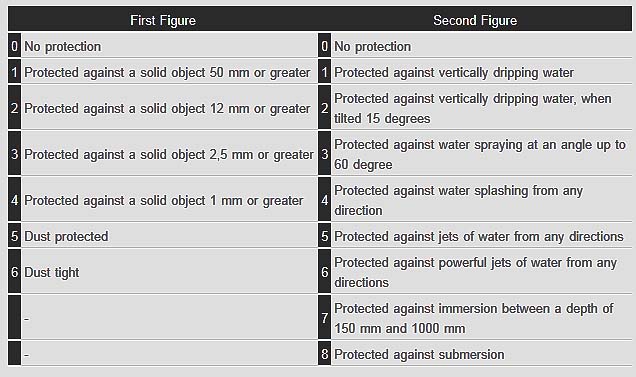
The degrees of protection are most commonly expressed as ‘IP’ followed by two numbers, e.g. IP65, where the numbers define the degree of protection. The first digit shows the extent to which the equipment is protected against particles, or to which persons are protected from enclosed hazards. The second digit indicates the extent of protection against water.
The wording in the table is not exactly as used in the standards document, but the dimensions are accurateIP Degree of Protection according to EN/IEC 60529
Correlations between IP (IEC) and NEMA 250 standards
IP10 -> NEMA 1
IP11 -> NEMA 2
IP54 -> NEMA 3 R
IP52 -> NEMA 5-12-12 K
IP54 -> NEMA 3-3 S
IP56 -> NEMA 4-4 X
IP67 -> NEMA 6-6 P[ http://electrical-engineering-portal.com/ip-protection-degree-iec-60529-explained]
Тематики
- безопасность машин и труда в целом
- электробезопасность
- электротехника, основные понятия
Действия
- степень защиты
- степень защиты, обеспечиваемая оболочкой
- степень защиты, обеспечиваемая оболочкой (код IP)
EN
- amount of protection
- degree of protection IP
- degree of protection of an enclosure
- degree of protection of enclosure
- degree of protection provided by enclosure
- enclosure rating
- ingress protection rating
- IP
- IP degree of protection,
- IP rating
- IP Sealing Specification
- IP security
- IPSec
- level of protection
- mechanical rating
- protection
- protection index
- protection rating
DE
- IP-Schutzgrad, m
- Schutzart des Gehäuses, f
FR
Франко-русский словарь нормативно-технической терминологии > degré de protection procuré par une enveloppe
-
8 IP
степень защиты
Способ защиты, обеспечиваемый оболочкой от доступа к опасным частям, попадания внешних твердых предметов и (или) воды и проверяемый стандартными методами испытаний.
[ ГОСТ 14254-96( МЭК 529-89)]
степень защиты, обеспечиваемая оболочкой (IP)
Числовые обозначения после кода IP, которые в соответствии с МЭК 60529 [12] характеризуют оболочку электрооборудования, обеспечивающую:
- защиту персонала от прикасания или доступа к находящимся под напряжением или движущимся частям (за исключением гладких вращающихся валов и т.п.), расположенным внутри оболочки;
- защиту электрооборудования от проникания в него твердых посторонних тел и,
- если указано в обозначении, защиту электрооборудования от вредного проникания воды.
[ ГОСТ Р МЭК 60050-426-2006]EN
degree of protection of enclosure
IP (abbreviation)
numerical classification according to IEC 60529 preceded by the symbol IP applied to the enclosure of electrical apparatus to provide:
– protection of persons against contact with, or approach to, live parts and against contact with moving parts (other than smooth rotating shafts and the like) inside the enclosure,
– protection of the electrical apparatus against ingress of solid foreign objects, and
– where indicated by the classification, protection of the electrical apparatus against harmful ingress of water
[IEV number 426-04-02 ]FR
degré de protection procuré par une enveloppe
IP (abréviation)
classification numérique selon la CEI 60529, précédée du symbole IP, appliquée à une enveloppe de matériel électrique pour apporter:
– une protection des personnes contre tout contact ou proximité avec des parties actives et contre tout contact avec une pièce mobile (autre que les roulements en faible rotation) à l'intérieur d'une enveloppe
– une protection du matériel électrique contre la pénétration de corps solide étrangers, et
– selon l’indication donnée par la classification, une protection du matériel électrique contre la pénétration dangereuse de l’eau
[IEV number 426-04-02 ]Элементы кода IP и их обозначения по ГОСТ 14254-96( МЭК 529-89)
Цифры кода IP
Значение для защиты оборудования от проникновения внешних твердых предметов
Значение для защиты людей от доступа к опасным частям
Первая характеристическая цифра
0
Нет защиты
Нет защиты
1
диаметром ≥ 50 мм
тыльной стороной руки
2
диаметром ≥ 12,5 мм
пальцем
3
диаметром ≥ 2,5 мм
инструментом
4
диаметром ≥ 1,0 мм
проволокой
5
пылезащищенное
проволокой
6
пыленепроницаемое
проволокой
От вредного воздействия в результате проникновения воды
Вторая характеристическая цифра
0
Нет защиты
-
1
Вертикальное каплепадение
2
Каплепадение (номинальный угол 15°)
3
Дождевание
4
Сплошное обрызгивание
5
Действие струи
6
Сильное действие струи
7
Временное непродолжительное погружение
8
Длительное погружение
Дополнительная буква (при необходимости)
-
От доступа к опасным частям
A
тыльной стороной руки
B
пальцем
C
инструментом
проволокой
Вспомогательная буква (при необходимости)
Вспомогательная информация относящаяся к:
-
H
высоковольтным аппаратам
M
состоянию движения во время испытаний защиты от воды
S
состоянию неподвижности во время испытаний защиты от воды
W
Требования в части стойкости оболочек и электрооборудования в целом к климатическим, механическим внешним воздействующим факторам (ВВФ) и специальным средам (кроме проникновения внешних твердых предметов и воды) установлены вне рамок настоящего стандарта.
Параллельные тексты EN-RU
The code IP indicates the degrees of protection provided by an enclosure against access to hazardous parts, ingress of solid foreign objects and ingress of water.
The degree of protection of an enclosure is identified, in compliance with the specifications of the Standard IEC 60529, by the code letters IP (International Protection) followed by two numerals and two additional letters.
The first characteristic numeral indicates the degree of protection against ingress of solid foreign objects and against contact of persons with hazardous live parts inside the enclosure.
The second characteristic numeral indicates the degree of protection against ingress of water with harmful effects.
[ABB]Код IP обозначает степень защиты, обеспечиваемую оболочкой от попадания внутрь твердых посторонних предметов и воды.
Степень защиты оболочки обозначается в соответствии со стандартом МЭК 60529 буквенным обозначением IP (International Protection, т. е. Международная защита) после которого следуют две цифры, к которым в некоторых случаях добавляются еще две буквы.
Первая характеристическая цифра обозначает степень защиты от проникновения твердых посторонних предметов и от контакта людей с находящимися внутри оболочки опасными токоведущими частями.
Вторая характеристическая цифра обозначает степень защиты оболочки с точки зрения вредного воздействия, оказываемого проникновением воды.
[Перевод Интент]The protection of enclosures against ingress of dirt or against the ingress of water is defined in IEC529 (BSEN60529:1991). Conversely, an enclosure which protects equipment against ingress of particles will also protect a person from potential hazards within that enclosure, and this degree of protection is also defined as a standard.
The degrees of protection are most commonly expressed as ‘IP’ followed by two numbers, e.g. IP65, where the numbers define the degree of protection. The first digit shows the extent to which the equipment is protected against particles, or to which persons are protected from enclosed hazards. The second digit indicates the extent of protection against water.
The wording in the table is not exactly as used in the standards document, but the dimensions are accurateIP Degree of Protection according to EN/IEC 60529
Correlations between IP (IEC) and NEMA 250 standards
IP10 -> NEMA 1
IP11 -> NEMA 2
IP54 -> NEMA 3 R
IP52 -> NEMA 5-12-12 K
IP54 -> NEMA 3-3 S
IP56 -> NEMA 4-4 X
IP67 -> NEMA 6-6 P[ http://electrical-engineering-portal.com/ip-protection-degree-iec-60529-explained]
Тематики
- безопасность машин и труда в целом
- электробезопасность
- электротехника, основные понятия
Действия
- степень защиты
- степень защиты, обеспечиваемая оболочкой
- степень защиты, обеспечиваемая оболочкой (код IP)
EN
- amount of protection
- degree of protection IP
- degree of protection of an enclosure
- degree of protection of enclosure
- degree of protection provided by enclosure
- enclosure rating
- ingress protection rating
- IP
- IP degree of protection,
- IP rating
- IP Sealing Specification
- IP security
- IPSec
- level of protection
- mechanical rating
- protection
- protection index
- protection rating
DE
- IP-Schutzgrad, m
- Schutzart des Gehäuses, f
FR
Франко-русский словарь нормативно-технической терминологии > IP
-
9 accentuation
accentuation [aksɑ̃tyasjɔ̃]feminine nouna. [de lettre] accentuation ; [de syllabe] stressingb. [de contraste] emphasizing ; [d'inégalités, chômage] increase* * *aksɑ̃tɥasjɔ̃1) ( de crise) escalation; ( d'inégalités) heightening; ( de phénomène) worsening; ( de tendance) increase2) ( de syllabe) stress; ( en poésie) accentuation3) ( de lettres) accents (pl)* * *aksɑ̃tɥasjɔ̃ nf1) [tendance, écart] growth, increase2) (graphique) accenting3) (tonique) [syllabe] stressing* * *accentuation nf1 (de crise, tension) escalation; ( d'inégalités) heightening; ( de phénomène) worsening; ( de tendance) increase;3 ( signes diacritiques) accents (pl).accentuation d'image image enhancement.[aksɑ̃tɥasjɔ̃] nom fémininl'accentuation, en anglais, se définit ainsi the stress pattern of English is defined as follows2. [système graphique] use of accents3. [exagération - d'une ressemblance, d'une différence, des traits] emphasizing ; [ - d'un effort] intensification, increase ; [ - du chômage, d'une crise] increase, rise -
10 clairement
clairement [klεʀmɑ̃]adverb* * *klɛʀmɑ̃adverbe clearly* * *klɛʀmɑ̃ adv* * *clairement adv [apparaître, dire, définir] clearly; il apparaît clairement que it clearly appears that; elle a clairement défini/expliqué she clearly defined/explained.[klɛrmɑ̃] adverbe -
11 dessiné
A pp ⇒ dessiner.B pp adj bouche bien dessinée well-shaped mouth.bien dessiné well-formed, well-defined -
12 déterminé
déterminé, e [detεʀmine]a. [personne, air] determinedb. ( = précis) [but, intentions] specific ; [quantité, distance, date] given* * *
1.
déterminée detɛʀmine participe passé déterminer
2.
1) ( résolu) [personne] determined3) ( établi) [corrélation] demonstrated (jamais épith)il est mort dans des circonstances mal déterminées — the circumstances in which he died are not yet clear ou established
4) ( donné) [durée, objectif] given* * *detɛʀmine adj déterminé, -e1) (= résolu) determinedC'est un homme déterminé. — He's a determined man.
2) (= précis) specific, definite* * *A pp ⇒ déterminer.B pp adj2 ( causé) determined (par by); prix déterminé par la demande price determined by demand;3 ( établi) [corrélation] demonstrated ( jamais épith); il est mort dans des circonstances mal déterminées the circumstances in which he died are not yet clear ou established;4 ( donné) [durée, objectif] given; appartenir à une religion déterminée to belong to a given religion;5 Philos determinate.C nm Ling determined word, referent.( féminin déterminée) [detɛrmine] adjectif -
13 foyer
foyer [fwaje]masculine nouna. ( = maison) home ; ( = famille) familyb. ( = âtre) hearthc. ( = résidence) [de vieillards] home ; [de jeunes] hosteld. ( = lieu de réunion) [de jeunes, retraités] club ; [de théâtre] foyer* * *fwajenom masculin1) ( domicile) home2) ( famille) household3) ( résidence) hostel4) ( club) club5) Cinéma, Théâtre ( point de rencontre) foyer6) ( de cheminée) hearth7) ( centre actif) ( de résistance) pocket; ( d'intrigue) hotbed8) ( centre de propagation) ( d'incendie) seat; ( d'épidémie) source; ( de rébellion) seat9) Physique focus•Phrasal Verbs:* * *fwaje nm1) [cheminée] hearth2) (lieu de vie de la famille) home3) (= famille) household4) (= résidence) hostel5) (= local de réunion) (social) club6) fig, [épidémie, révolte]7) (au théâtre) foyer8) OPTIQUE, PHOTOGRAPHIE focuslunettes à double foyer — bifocals, bifocal glasses
* * *foyer nm1 ( domicile) home; quitter/regagner le foyer conjugal to leave/return to the conjugal home; rester au foyer to stay at home; fonder un foyer to get married; rentrer dans ses foyers to go home; renvoyer qn dans ses foyers Mil ( exempter) to exempt sb from national service; ( démobiliser) to demobilize sb;3 ( résidence) hostel (de, pour for); un foyer de travailleurs/d'étudiants a workers'/students' hostel;4 ( club) club; foyer pour personnes âgées senior citizens' club;6 ( de cheminée) hearth;7 ( centre actif) ( d'incendie) fire; ( de résistance) pocket; ( d'intrigue) hotbed; il reste trois foyers à éteindre three fires are still burning;10 Math ( de conique) focus.foyer fiscal Fisc household for tax purposes; foyer infectieux Méd focus; foyer de placement Prot Soc foster home; foyer réel Phys real focus; foyer virtuel Phys virtual focus.[fwaje] nom masculin1. [chez soi] homeil est père au foyer he keeps house and looks after the children, he's a house husband2. [résidence collective] hall4. [âtre] hearth5. [dans une machine] firebox7. MÉDECINEfoyer infectieux ou d'infection source of infection10. ADMINISTRATION -
14 indéfini
indéfini, e [ɛ̃defini]adjective* * *indéfinie ɛ̃defini adjectif1) ( sans limites) [nombre] indeterminate2) ( vague) [tristesse, mélancolie] undefined; [malaise] vague; [durée] indeterminate, indefinite3) Linguistique indefinite* * *ɛ̃defini adj indéfini, -e1) (contours) undefined2) (temps) indefinite3) LINGUISTIQUE indefinite* * *1 ( sans limites) [espace, nombre, temps] indeterminate;3 Ling [article, mot, adjectif] indefinite. -
15 tranché
tranche [tʀɑ̃∫]feminine nouna. [de pain, jambon] slice ; [de bacon] rasherb. [de livre, pièce de monnaie, planche] edgec. ( = section) section ; [de revenus, imposition] bracket• tranche d'âge/de salaires age/wage bracket• tranche horaire (TV, radio) time slot* * *tʀɑ̃ʃ1) (de pain, viande, fromage) slice; ( de lard) rashercouper en tranches — to slice, to cut [something] into slices
2) ( de temps) (d'opération, de travaux) phase; ( dans l'emploi du temps) period, time slot3) (de livre, pièce de monnaie) edge•Phrasal Verbs:••s'en payer une tranche — (colloq) to have a whale of a time (colloq), to have lots of fun
* * *tʀɑ̃ʃ nf1) (= morceau) [pain, jambon] slice2) (= arête) [livre] edge3) (= partie) [population] section, [impôts, revenus] bracket4) (= série) [actions] block5) [loterie] issue6) TECHNIQUE* * *tranche nf1 (de pain, viande, fromage) slice; (de lard, bacon) rasher; en tranches ( pain etc) in slices; ( bacon) in rashers; couper en tranches to slice, to cut [sth] into slices [pain, gâteau, jambon, rosbif]; to cut [sth] into rashers [bacon];3 (de livre, pièce de monnaie) edge;6 Math group, section.tranche d'âge age bracket; tranche horaire time slot; tranche d'imposition tax bracket; tranche de paiement Fin instalmentGB; tranche de revenu income bracket; tranche de salaire wage bracket; tranche de vie slice of life.s'en payer une tranche○ to have a whale of a time○, to have lots of fun.( féminin tranchée) [trɑ̃ʃe] adjectif————————nom masculintranchée nom féminin2. [en forêt] cutting (substantif non comptable)[pare-feu] firebreak————————tranchées nom féminin pluriel -
16 vin
vin [vɛ̃]1. masculine nouna. ( = boisson) wine• vin blanc/rouge/rosé white/red/rosé wine• vin ordinaire or de table table wine2. compounds* * *vɛ̃nom masculin winevin de pays or de terroir — quality wine produced in a specific region
couper son vin — ( en mélanger deux) to blend one's wine; ( mettre de l'eau) to add water to one's wine
Phrasal Verbs:- vin cuit••avoir le vin gai/triste — to get happy/maudlin after one has had a few drinks
quand le vin est tiré, il faut le boire — Proverbe once you have started something, you have to see it through
* * *vɛ̃ nm* * *vin nm1 ( de raisin) wine; vin blanc/rouge/pétillant/mousseux white/red/semi-sparkling/sparkling wine; vin rosé rosé (wine); vin doux/sec/demi-sec sweet/dry/medium-dry wine; vin de consommation courante ordinary wine; grand vin fine wine; vin d'Alsace Alsace wine; vin de pays or de terroir quality wine produced in a specific region; sauce au vin wine sauce; ce vin a du corps this wine is full-bodied; un vin qui se fait a wine which is maturing; mettre le vin en bouteilles to bottle wine; couper son vin ( mettre de l'eau) to add water to one's wine; ( mettre un autre vin) to blend one's wine;2 ( d'origine végétale) wine; vin de riz rice wine.vin d'appellation d'origine contrôlée appellation contrôlée (with a guarantee of origin); vin bourru new wine still undergoing fermentation; vin chaud mulled wine; vin de coupage blended wine; vin cuit wine which has undergone heating during maturation; vin délimité de qualité supérieure, VDQS wine of a defined area with strict production laws; vin gris blush wine; vin d'honneur reception; vin de liqueur fortified wine; vin de messe communion wine; le vin nouveau wine from the latest vintage; vin de paille wine made from dried grapes; vin de table table wine.avoir le vin gai/mauvais/triste to get happy/nasty/maudlin after a drink; être entre deux vins to be tipsy○; mettre de l'eau dans son vin to mellow; quand le vin est tiré, il faut le boire Prov once you have started something, you have to see it through.[vɛ̃] nom masculin[ensemble de récoltes] vintagegrand vin, vin de grand cru vintage winea. [rouge] claretb. [blanc] white Bordeauxvin de messe altar ou communion winevin nouveau ou (de) primeur new wineavoir le vin gai/triste/mauvais to get merry/depressed/nasty after a few drinksêtre entre deux vins to be tiddly ou tipsy2. [liqueur]vin de canne/riz cane/rice wine————————vin d'honneur nom masculin -
17 Beur
Name used to describe French youth of north-African origin. The classic portrayal of France, defined with reference to the three colours on the national flag - Bleu, blanc, rouge (blue, white, red) - has been more recently paraphrased in youth culture to express the multicultural origins of modern France, using the expression Black Blanc BeurDictionnaire Français-Anglais. Agriculture Biologique > Beur
-
18 Circonscription électorale
Electoral constituency. There are currently 555 electoral constituencies in Metroploitan France, plus 15 for the overseas departments, and 7 for other overseas territories. Though each constituency returns a single député to parliament, current constituencies are massively imbalanced in terms of representation; in 2007, 18 constituencies had under 70,000 voters (the smallest having less than half that figure), while the 21 largest constituencies each had over 140,000 voters. A redefining of electoral boundaries has been recommended by the Constitutional Council, and new constituiencies should be defined by 2009Dictionnaire Français-Anglais. Agriculture Biologique > Circonscription électorale
-
19 Constitution, the French
France is a republic; the institutions of governance of France are defined by the Constitution, more specifically by the current constitution, being that of the Cinquième République, or Fifth Republic. The Constitution has been modified several times since the start of the Fifth Republic, most recently in July 2008, when the French Congrès approved - by 1 vote over the 60% majority required - constitutional changes proposed by President Sarkozy.The Fifth Republic was established in 1958, and was largely the work of General de Gaulle - its first president, and Michel Debré his prime minister. It has been amended 17 times. Though the French constitution is parliamentary, it gave relatively extensive powers to the executive (President and Ministers) compared to other western democracies.Dictionnaire Français-Anglais. Agriculture Biologique > Constitution, the French
-
20 Sciences Po
Name used, even formally, by the Institut des Etudes Politiques de Paris, an autonomous state-funded school of higher education (grand établissement), founded in 1872, and a university in all but name. The undergraduate course at Sciences Po, designed to produce graduates with a solid understanding of the workings of the modern world, is a pluridisciplinary degree covering a range of social sciences, including history, law, politics, economics, sociology, and foreign languages. Many leading French politicians, businessmen and civil servants have degrees from Sciences Po, and the school's increasing success has led to the opening of smaller campuses, offering specialist courses, in Dijon, Poitiers, Menton and Nancy.Sciences Po is one of the top ranked institutes of higher education in France and in Europe, and competition for places is stiff. The school runs joint degree courses with several top international schools, including the universities of Columbia and Georgetown in the USA, and LSE in Great Britain. Many leading French politicians, businessmen and civil servants have degrees from Sciences Po, and the school's increasing success has led to the opening of smaller campuses, offering specialist courses, in Dijon, Poitiers, Menton and Nancy.The official Aeres audit of Sciences Po in 2008 described the institution as being "seen from abroad as a typically French institution, rather difficult to situate and to comprehend." It defined the school's mission as being to train graduates with "knowledge, but also understanding, of society and the world... in short to educate them".The name 'Sciences Po' is also used commonly to refer to Instituts d'Etudes Politiques (IEP) attached to a number of universities.Dictionnaire Français-Anglais. Agriculture Biologique > Sciences Po
См. также в других словарях:
defined — I (clear) adjective clear cut, coherent, comprehensible, concrete, conditional, confining, conterminable, conterminate, cramped, crystal clear, definite, determinable, determined, distinct, distinguishable, evident, exact, explicit, express,… … Law dictionary
defined — defined; un·defined; … English syllables
defined — adj. outlined, delineated 1) sharply defined 2) defined against (sharply defined against a light background) * * * [ outlined, delineated ] sharply defined defined against (sharply defined against a light background) … Combinatory dictionary
defined — [[t]dɪfa͟ɪnd[/t]] ADJ GRADED: usu adv ADJ If something is clearly defined or strongly defined, its outline is clear or strong. A clearly defined track now leads down to the valley... Here the path is less defined... She had a strongly defined… … English dictionary
defined — adjective 1. clearly characterized or delimited (Freq. 2) lost in a maze of words both defined and undefined each child has clearly defined duties • Ant: ↑undefined • See Also: ↑definite 2. showing clearly the outline or pr … Useful english dictionary
Defined — Define De*fine , v. t. [imp. & p. p. {Defined}; p. pr. & vb. n. {Defining}.] [OE. definer, usually, to end, to finish, F. d[ e]finir to define, L. definire to limit, define; de + finire to limit, end, finis boundary, limit, end. See {Final},… … The Collaborative International Dictionary of English
defined — adj. Defined is used with these nouns: ↑role … Collocations dictionary
defined — Synonyms and related words: absolute, certain, circumscribed, circumscript, clean cut, clear, clear as crystal, clear as day, clear cut, coherent, concrete, connected, consistent, conspicuous, crisp, crystal clear, crystalline, definite,… … Moby Thesaurus
defined contribution plan — n: a pension plan in which the amount of the contributions made by the employer is fixed in advance and earnings are distributed proportionately Merriam Webster’s Dictionary of Law. Merriam Webster. 1996. defined contribution plan … Law dictionary
defined benefit plan — de·fined benefit plan n: a pension plan in which the amount of benefits paid to an employee after retirement is fixed in advance in accordance with a formula given in the plan Merriam Webster’s Dictionary of Law. Merriam Webster. 1996. defined… … Law dictionary
defined benefit scheme — (DB scheme): An occupational pension scheme or other retirement benefit scheme which promises the member a defined level of benefit on death or retirement. Employer s contributions have then to be determined from time to time so as to cover the… … Law dictionary
