

-
1 derived quantity
производная величина
(МСЭ-Т Х.1081).
[ http://www.iks-media.ru/glossary/index.html?glossid=2400324]Тематики
- электросвязь, основные понятия
EN
производная физическая величина
производная величина
Физическая величина, входящая в систему величин и определяемая через основные величины этой системы.
Примеры производных величин механики системы LMT: скорость v поступательного движения, определяемая (по модулю) уравнением v = dl/dt, где l - путь, t - время; сила F, приложенная к материальной точке, определяемая (по модулю) уравнением F = та, где т- масса точки, а - ускорение, вызванное действием силы F.
[РМГ 29-99]
производная физическая величина
Величина, входящая в систему физических величин и определяемая через основные величины этой системы (ОСТ 45.159-2000.1 Термины и определения (Минсвязи России)).
[ http://www.iks-media.ru/glossary/index.html?glossid=2400324]Тематики
- метрология, основные понятия
Синонимы
EN
DE
FR
Англо-русский словарь нормативно-технической терминологии > derived quantity
-
2 derived quantity
English-Russian big polytechnic dictionary > derived quantity
-
3 derived quantity
Большой англо-русский и русско-английский словарь > derived quantity
-
4 derived quantity
Англо-русский словарь технических терминов > derived quantity
-
5 derived quantity
Техника: производная величина (в системе единиц) -
6 derived quantity
-
7 derived quantity
-
8 derived quantity
English-Russian dictionary of mechanical engineering and automation > derived quantity
-
9 derived quantity
производная величинаEnglish-Russian dictionary of technical terms > derived quantity
-
10 derived quantity
-
11 derived quantity
-
12 derived physical quantity
производная физическая величина
производная величина
Физическая величина, входящая в систему величин и определяемая через основные величины этой системы.
Примеры производных величин механики системы LMT: скорость v поступательного движения, определяемая (по модулю) уравнением v = dl/dt, где l - путь, t - время; сила F, приложенная к материальной точке, определяемая (по модулю) уравнением F = та, где т- масса точки, а - ускорение, вызванное действием силы F.
[РМГ 29-99]
производная физическая величина
Величина, входящая в систему физических величин и определяемая через основные величины этой системы (ОСТ 45.159-2000.1 Термины и определения (Минсвязи России)).
[ http://www.iks-media.ru/glossary/index.html?glossid=2400324]Тематики
- метрология, основные понятия
Синонимы
EN
DE
FR
2.7. Основная физическая величина
Основная величина
D. Basisgrofie
E. Fundamental physical quantity
F. Grandeur physique de base
2.8. Производная физическая величина
Производная величина
D. Abgeleitete Grofie
E. Derived physical quantity
F. Grandeur physique derivee
Физическая величина, входящая в систему и условно принятая в качестве независимой от других величин этой системы.
Пример. Длина /, масса т, время t в механике.
Физическая величина, входящая в систему и определяемая через основные величины этой системы.
Примеры. Скорость в системе величин LMT определяется в общем случае уравнением v=*dlfdt, где v — скорость, 1 — расстояние, t — время.
Механическая сила в этой же системе определяется уравнением F=ma, где m — масса, а — ускорение, вызываемое действием силы F.
Источник: ГОСТ 16263-70: Государственная система обеспечения единства измерений. Метрология. Термины и определения оригинал документа
Англо-русский словарь нормативно-технической терминологии > derived physical quantity
-
13 quantity dimension
размерность физической величины
размерность величины
Выражение в форме степенного одночлена, составленного из произведений символов основных физических величин в различных степенях и отражающее связь данной физической величины с физическими величинами, принятыми в данной системе величин за основные с коэффициентом пропорциональности, равным 1.
Примечания
1. Степени символов основных величин, входящих в одночлен, в зависимости от связи рассматриваемой физической величины с основными, могут быть целыми, дробными, положительными и отрицательными. Понятие размерность распространяется и на основные величины. Размерность основной величины в отношении самой себя равна единице, т.е. формула размерности основной величины совпадает с ее символом.
2. В соответствии с международным стандартом ИСО 31/0, размерность величин следует обозначать знаком dim [2]. В системе величин LMT размерность величины.x будет: dim х = LlMmTt, где L, М, Т - символы, величин, принятых за основные (соответственно длины, массы, времени).
[РМГ 29-99]EN
dimension of a quantity
quantity dimension
dimension
expression of the dependence of a quantity on the base quantities of a system of quantities as a product of powers of factors corresponding to the base quantities, omitting any numerical factor
NOTE 1 – A power of a factor is the factor raised to an exponent. Each factor is the dimension of a base quantity.
NOTE 2 – The conventional symbolic representation of the dimension of a base quantity is a single upper case letter in roman (upright) sans-serif type. The conventional symbolic representation of the dimension of a derived quantity is the product of powers of the dimensions of the base quantities according to the definition of the derived quantity. The dimension of a quantity Q is denoted by dim Q.
NOTE 3 – In deriving the dimension of a quantity, no account is taken of its scalar, vector or tensor character.
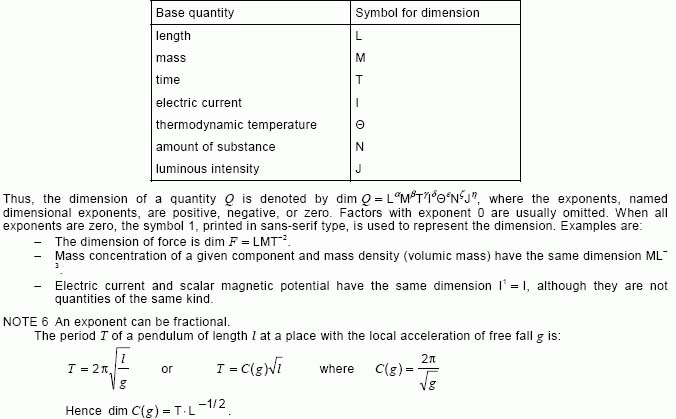
NOTE 4 – In a given system of quantities, – quantities of the same kind have the same dimension, – quantities of different dimensions are always of different kinds, and – quantities having the same dimension are not necessarily of the same kind. For example, in the ISQ, pressure and energy density (volumic energy) have the same dimension L–1MT–2. See also note 5.
NOTE 5 – In the International System of Quantities (ISQ), the symbols representing the dimensions of the base quantities are:
[IEV number 112-01-11]FR
dimension, f
dimension d'une grandeur, f
expression de la dépendance d’une grandeur par rapport aux grandeurs de base d'un système de grandeurs sous la forme d'un produit de puissances de facteurs correspondant aux grandeurs de base, en omettant tout facteur numérique
NOTE 1 – Une puissance d'un facteur est le facteur muni d'un exposant. Chaque facteur exprime la dimension d'une grandeur de base.
NOTE 2 – Par convention, la représentation symbolique de la dimension d'une grandeur de base est une lettre majuscule unique en caractère romain (droit) sans empattement. Par convention, la représentation symbolique de la dimension d'une grandeur dérivée est le produit de puissances des dimensions des grandeurs de base conformément à la définition de la grandeur dérivée. La dimension de la grandeur Q est notée dim Q.
NOTE 3 – Pour établir la dimension d'une grandeur, on ne tient pas compte du caractère scalaire, vectoriel ou tensoriel.
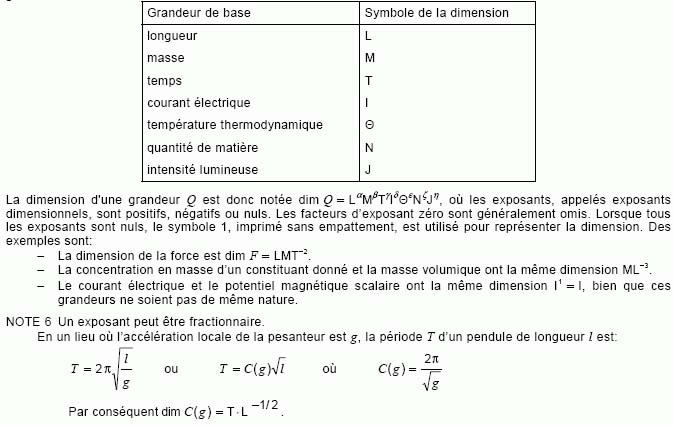
NOTE 4 – Dans un système de grandeurs donné, – les grandeurs de même nature ont la même dimension, – des grandeurs de dimensions différentes sont toujours de nature différente, – des grandeurs ayant la même dimension ne sont pas nécessairement de même nature. Par exemple, dans l'ISQ, la pression et l'énergie volumique ont la même dimension L–1MT–2. Voir aussi la note 5.
NOTE 5 – Dans le Système international de grandeurs (ISQ), les symboles représentant les dimensions des grandeurs de base sont:
[IEV number 112-01-11]Тематики
- метрология, основные понятия
Синонимы
EN
DE
- Dimension einer Grösse
- Dimension, f
- Größendimension, f
FR
- dimension d'une grandeur, f
- dimension, f
Англо-русский словарь нормативно-технической терминологии > quantity dimension
-
14 quantity
1) количество3) доля, часть4) параметр•quantity to be measured, quantity under measure — измеряемая величинаquantity of electrical energy — количество электрической энергииquantity of light — световая энергия: количество света; количество освещенияquantity of radiation — доза излучения; доза облученияquantity of reflux — расход орошения ( ректификационной колонны)-
abstract quantity
-
acoustical quantity
-
actuating quantity
-
alternating quantity
-
analog quantity
-
auxiliary quantity
-
base quantity
-
characteristic quantity
-
colorimetric quantity
-
complex quantity
-
controlled quantity
-
cut-and-fill quantity
-
denominate quantity
-
derived quantity
-
digital quantity
-
dimensional quantity
-
dimensionless quantity
-
discrete quantity
-
electrical quantity
-
electromagnetic quantity
-
energizing quantity
-
exponential quantity
-
flow quantity
-
four-dimensional quantities
-
fundamental quantity
-
Gaussian quantities
-
general quantities
-
generalized quantity
-
harmonic quantity
-
imaginary quantity
-
incommensurable quantities
-
influencing quantity
-
input energizing quantity
-
integer quantity
-
integrated quantity
-
irrational quantity
-
magnetic quantity
-
measurable quantity
-
measured quantity
-
mechanical quantities
-
multidimensional quantity
-
nonelectrical quantities
-
oscillating quantity
-
periodic quantity
-
phasor quantity
-
photometric quantities
-
physical quantity
-
primary quantity
-
radiant quantities
-
random quantity
-
reciprocal quantity
-
reference quantity
-
scalar quantity
-
secondary quantity
-
sinusoidal quantity
-
symbolic quantity
-
variable quantity
-
vector quantity -
15 quantity
1) количество2) величина; размер3) параметр•- alternating quantityin batch quantities — партиями; сериями (напр. об обработке деталей)
- analog quantity
- auxiliary energizing quantity
- base quantity
- basic quantities
- batch quantity
- break-even batch quantity
- call-off quantity
- characteristic quantity
- controlling quantity
- correcting quantity
- derived quantity
- dimensionless quantity
- economic order quantity
- economic production quantities
- economic starting quantity
- energizing quantity
- generalized quantity
- influence quantity
- information quantity
- input energizing quantity
- lot quantity
- periodic quantity
- photometric quantity
- physical quantity
- production quantity
- quantity of heat
- random quantity
- reference quantity
- run quantity
- transfer quantity
- unit quantity of work done
- unit quantity
- variable quantity
- work-order quantityEnglish-Russian dictionary of mechanical engineering and automation > quantity
-
16 quantity
сущ.сокр. Qty1)а) общ. количество; численность, числоnegligible quantity — ничтожное [незначительное\] количество
ample quantity — достаточное [большое\] количество
quantity on hand —количество, имеющееся в наличии
required quantity — необходимое [требуемое\] количество
See:б) общ., часто мн. большое количество; множество, изобилиеin quantity — в большом количестве, в изобилии
by quantities — в больших количествах, во множестве
2) мат. величина (переменная или параметр, который может быть представлен в числовом выражении)unknown quantity — неизвестная величина, неизвестное
* * *. . Словарь экономических терминов . -
17 quantity
ˈkwɔntɪtɪ сущ.
1) а) количество тж. филос.;
численность, число quantity repaired ≈ количество отремонтированных изделий in (large) quantities ≈ в (большом) количестве considerable quantity large quantity negligible quantity small quantity sufficient quantity Syn: amount, number б) большое количество a quantity of ≈ множество
2) величина;
размер;
параметр the quantity of a surface ≈ размер поверхности
3) мат. величина derived quantity ≈ производная величина incommensurable quantities
4) фон. долгота звука, количество звука ∙ unknown quantity количество - * on hand количество, имеющееся в наличии - large * большое количество - product * количество продукции - innumerable /incalculable/ * бесчисленное количество - negligible * незначительное количество;
(математика) ничтожно малая величина - a certain * of smth. определенное количество чего-л. - * of information объем информации - * of production объем производства - order * размер заказа - the determination of things as to their * количественная характеристика предметов размер;
величина - spatial * размер территории - the * of a surface величина поверхности - the * of a line длина линии - * of value величина стоимости сумма - * of radiation сумма радиации доля, часть - there's only a small * left осталась лишь незначительная часть - what * do you want? какую часть /сколько/ вы хотите? (устаревшее) тж. pl большое количество;
множество, изобилие - a * of smth. большое количество чего-л. - by quantities в больших количествах, во множестве - in *, in quantities в большом количестве, в изобилии - flowers in quantities множество цветов - to buy smth. in quantities покупать что-л. в большом количестве - he collected a * of old pictures он собрал большую коллекцию старинных картин - we've had quantities of rain this summer этим летом было много дождей (математика) величина - incommesurable quantities несоизмеримые величины - like quantities однородные величины - known * данная величина, известное - unknown * неизвестное (фонетика) долгота, количество звука - the * of a vowel долгота гласного (стихосложение) долгота слога (музыкальное) относительная длительность звука > negligible * ничтожество, ничтожный человек > unknown * человек, о котором ничего не известно или действия которого нельзя предугадать;
темная лошадка auxiliary ~ вспомогательная величина error regarding ~ ошибка в количестве generalized ~ обобщенная величина guaranteed ~ гарантированное количество quantity большое количество;
a quantity of множество;
in quantities в большом количестве ~ мат. величина;
incommensurable quantities несоизмеримые величины insufficient ~ недостаточное количество large ~ большое количество like quantities однородные величины limiting ~ ограничивающая величина measurable ~ измеримая величина measured ~ измеренная величина measured ~ измеренное количество minimum ~ минимальное количество monotone ~ монотонная величина monotonically decreasing ~ монотонно убывающая величина monotonically increasing ~ монотонно возрастающая величина observed ~ наблюдаемая величина physical ~ физическая величина quantity большое количество;
a quantity of множество;
in quantities в большом количестве ~ мат. величина;
incommensurable quantities несоизмеримые величины ~ величина ~ фон. долгота звука, количество звука ~ количество (тж. филос.) ;
negligible quantity незначительное количество, величина, которой можно пренебречь;
перен. человек, с которым не считаются;
человек, не имеющий веса ~ количество, величина ~ количество ~ размер quantity большое количество;
a quantity of множество;
in quantities в большом количестве ~ of goods количество товара ~ of money количество денег random ~ случайная величина reciprocal ~ обратная величина unknown ~ неизвестное;
перен. человек, о котором ничего не известно или действия которого нельзя предусмотретьБольшой англо-русский и русско-английский словарь > quantity
-
18 quantity
['kwɔntətɪ]сущ.1) количество; численность, числоSyn:2) ( quantities) большое количествоShe is able to drink quantities. — Она в состоянии выпить невероятное количество.
3) величина; размер4) величина5) лингв. долгота звука, количество звука -
19 derived unit (of measurement)
производная единица системы единиц физических величин
производная единица
Единица производной физической величины системы единиц, образованная в соответствии с уравнением, связывающим ее с основными единицами или с основными и уже определенными производными.
Примеры
1. 1 м/с - единица скорости, образованная из основных единиц СИ - метра и секунды.
2. 1 Н - единица силы, образованная из основных единиц СИ - килограмма, метра, и секунды.
[РМГ 29-99]EN
derived unit
unit of measurement for a derived quantity
NOTE 1 – Some derived units in the International System of Units (SI) have special names, e.g. hertz for frequency and joule for energy, but others have compound names, e.g. metre per second for speed. Compounds including units with special names are also used, e.g. volt per metre for the electric field strength, and newton metre for torque. See in particular ISO 31 and ISO/IEC 80000.
NOTE 2 – Derived units can also be expressed by using multiples and submultiples. For example, the metre per second, symbol m/s, and the centimetre per second, symbol cm/s, are derived units of speed in the SI. The kilometre per hour, symbol km/h, is a unit of speed outside the SI but accepted for use with the SI, because the unit hour is accepted for use with the SI. The knot, equal to one nautical mile per hour, is a unit of speed outside the SI, that is used by special interest groups.
Source: ISO/IEC GUIDE 99:2007 1.11
[IEV number 112-01-19]FR
unité dérivée, f
unité de mesure d'une grandeur dérivée
NOTE 1 – Certaines unités dérivées dans le SI ont des noms spéciaux, par exemple le hertz pour la fréquence et le joule pour l'énergie, tandis que d'autres ont des noms composés, par exemple le mètre par seconde pour la vitesse. Les unités ayant des noms spéciaux sont aussi utilisées dans des noms composés, par exemple le volt par mètre pour le champ électrique et le newton mètre pour le moment de torsion. Voir en particulier l'ISO 31 et l'ISO/CEI 80000.
NOTE 2 – On peut aussi exprimer les unités dérivées en utilisant des multiples et des sous-multiples. Par exemple, le mètre par seconde, symbole m/s, et le centimètre par seconde, symbole cm/s, sont des unités dérivées de vitesse dans le SI. Le kilomètre par heure, symbole km/h, est une unité de vitesse en dehors du SI mais en usage avec le SI, parce que l'heure est une unité en usage avec le SI. Le nœud, égal à un mille marin par heure, est une unité de vitesse en dehors du SI, qui répond aux besoins spécifiques de certains groupes d’utilisateurs.
Source: ISO/IEC GUIDE 99:2007 1.11
[IEV number 112-01-19]Тематики
- метрология, основные понятия
Синонимы
EN
DE
FR
Англо-русский словарь нормативно-технической терминологии > derived unit (of measurement)
-
20 derived
вывел; брал производную; полученный
- 1
- 2
См. также в других словарях:
derived quantity — išvestinis dydis statusas T sritis automatika atitikmenys: angl. derived quantity vok. abgeleitete Größe, f rus. производная величина, f pranc. grandeur dérivée, f … Automatikos terminų žodynas
derived quantity — išvestinis dydis statusas T sritis Standartizacija ir metrologija apibrėžtis Tam tikros dydžių sistemos dydis, išreikštas šios sistemos pagrindinių dydžių funkcija. pavyzdys( iai) Greitis, išreikštas ilgio ir laiko dalmeniu, yra išvestinis dydis… … Penkiakalbis aiškinamasis metrologijos terminų žodynas
derived quantity — išvestinis dydis statusas T sritis fizika atitikmenys: angl. derived quantity vok. abgeleitete Größe, f rus. производная величина, f pranc. grandeur dérivée, f … Fizikos terminų žodynas
Quantity theory of money — In economics, the quantity theory of money is a theory emphasizing the positive relationship of overall prices or the nominal value of expenditures to the quantity of money. Origins and development of the quantity theory The quantity theory… … Wikipedia
Quantity of securities derived — An ISO term. The classification and quantity of securities derived from the quantity of securities held and the distribution ratio. 3a15d … International financial encyclopaedia
Quantity Theory Of Money — An economic theory which proposes a positive relationship between changes in the money supply and the long term price of goods. It states that increasing the amount of money in the economy will eventually lead to an equal percentage rise in the… … Investment dictionary
derived function — noun the result of mathematical differentiation; the instantaneous change of one quantity relative to another; df(x)/dx • Syn: ↑derivative, ↑differential coefficient, ↑differential, ↑first derivative • Derivationally related forms: ↑differential … Useful english dictionary
quantity — [14] Latin quantus meant ‘how much’ (it was a compound adjective formed from quī ‘who’). From it was derived the noun quantitās ‘extent, amount’, which passed into English via Old French quantite. Quantum [17], a noun use of the neuter form of… … The Hutchinson dictionary of word origins
quantity — [14] Latin quantus meant ‘how much’ (it was a compound adjective formed from quī ‘who’). From it was derived the noun quantitās ‘extent, amount’, which passed into English via Old French quantite. Quantum [17], a noun use of the neuter form of… … Word origins
Physical quantity — A physical quantity is a physical property that can be quantified. This means it can be measured and/or calculated and expressed in numbers. The value of a physical quantity Q is expressed as the product of a numerical value { Q } and a physical… … Wikipedia
SI derived unit — The International System of Units (SI) specifies a set of seven base units from which all other units of measurement are formed, by products of the powers of base units. These other units are called SI derived units, for example, the SI derived… … Wikipedia
