

-
41 electric power supply
- электроснабжение
- снабжение электроэнергией
- обеспечение электроэнергией
- источник электропитания радиоэлектронной аппаратуры
- источник питания (в электроснабжении)
источник питания
Характеристики внешних источников питания следует принимать по техническим условиям на присоединение, выдаваемым энегоснабжающей организацией в соответствии с Правилами пользования электрической энергией...
источник питания электроэнергией
-
[Интент]
источник электропитания
—
[Я.Н.Лугинский, М.С.Фези-Жилинская, Ю.С.Кабиров. Англо-русский словарь по электротехнике и электроэнергетике, Москва, 1999 г.]
Основными источниками питания должны служить электростанции и сети районных энергосистем. Исключение представляют большие предприятия с большим теплопотреблением, где основным источником питания может быть собственная электростанция (ТЭЦ). Но и в этом случае обязательно должна предусматриваться связь системы электроснабжения предприятия с сетью энергосистемы.
[СН 174-75 Инструкция по проектированию электроснабжения промышленных предприятий]
1.1.2 Зануление следует выполнять электрическим соединением металлических частей электроустановок с заземленной точкой источника питания электроэнергией при помощи нулевого защитного проводника.
[ ГОСТ 12.1.030-81]
Параллельные тексты EN-RUIt is recommended that, where practicable, the electrical equipment of a machine is connected to a single incoming supply. Where another supply is necessary for certain parts of the equipment (for example, electronic equipment that operates at a different voltage), that supply should be derived, as far as is practicable, from devices (for example, transformers, converters) forming part of the electrical equipment of the machine.
[IEC 60204-1-2006]Рекомендуется, там где это возможно, чтобы электрооборудование машины получало электропитание от одного источника. Если для каких-либо частей электрооборудования машины (например для электронного оборудования, работающего на другом напряжении) необходим отдельный источник питания, то, насколько это возможно, он должен являться частью (такой, например, как трансформатор, конвертор) электрооборудования этой же машины.
[Перевод Интент]
Power supplies
The required power supplies can be determined based on the criteria for definition of the installation (receivers, power, location, etc.) and the operating conditions (safety, evacuation of the public, continuity, etc.).
They are as follows:
- Main power supply
- Replacement power supply
- Power supply for safety services
- Auxiliary power supply
[Legrand]Источники электропитания
Источники электропитания определяют по различным критериям, в соответствии с характеристиками конкретной электроустановки. Определяют типы электроприемников, их мощность, территориальное расположение и др. При этом учитывают условия эксплуатации (безопасность, требования к аварийной эвакуации людей, непрерывность технологического процесса и т. д.).
Применяют следующие источники:
- основной источник питания;
- резервный источник питания;
- аварийный источник питания систем безопасности;
- дополнительный источник питания.
[Перевод Интент]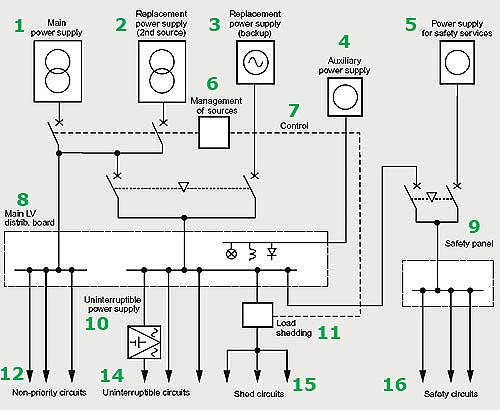
Рис. Legrand
Типовая схема электроснабжения: 1 - Main power supply - Основной источник питания
2 - Replacement power supply (2nd source) - Резервный источник питания (2-й источник)
3 - Replacement power supply (backup) - Резервный источник питания (независимый)
4 - Auxiliary power supply - Дополнительный источник питания
5 - Power supply for safety services - Аварийный источник питания для систем безопасности
6 - Management of sources - Управление источниками питания
7 - Control - Цепь управления
8 - Main LV distrib. board - Главный распределительный щит (ГРЩ)
9 - Safety panel - Панель безопасности
10 - Uninterruptible power supply - Источник бесперебойного питания
11 - Load shedding - Отключение нагрузки
12 - Non-priority circuits - Цепи неприоритетной нагрузки
14 - Uninterruptible circuits - Цепи бесперебойного питания
15 - Shed circuits - Цепи отключаемой нагрузки
16 - Safety circuits - Цепи систем безопасностиТематики
Близкие понятия
Действия
Синонимы
Сопутствующие термины
- аварийный источник питания
- взаимно резервируемые источники питания
- внешний источник питания
- дополнительный источник питания
- источник бесперебойного питания
- источник питания с ограничением тока
- независимый источник питания
- основной источник питания
- резервный источник питания
EN
источник электропитания радиоэлектронной аппаратуры
источник электропитания РЭА
Нерекомендуемый термин - источник питания
Устройство силовой электроники, входящее в состав радиоэлектронной аппаратуры и преобразующее входную электроэнергию для согласования ее параметров с входными параметрами составных частей радиоэлектронной аппаратуры.
[< size="2"> ГОСТ Р 52907-2008]
источник питания
Часть устройства, обеспечивающая электропитание остальных модулей устройства.
[ http://www.lexikon.ru/dict/net/index.html]EN
power supply
An electronic module that converts power from some power source to a form which is needed by the equipment to which power is being supplied.
[Comprehensive dictionary of electrical engineering / editor-in-chief Phillip A. Laplante.-- 2nd ed.]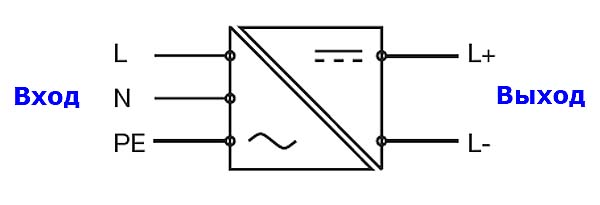
Рис. ABB
Структурная схема источника электропитанияThe input side and the output side are electrically isolated against each other
Вход и выход гальванически развязаны
Терминология относящая к входу
Primary side
Первичная сторона
Input voltage
Входное напряжение
Primary grounding
Current consumption
Потребляемый ток
Inrush current
Пусковой ток
Input fuse
Предохранитель входной цепи
Frequency
Частота
Power failure buffering
Power factor correction (PFC)
Коррекция коэффициента мощности
Терминология относящая к выходу
Secondary side
Вторичная сторона
Output voltage
Выходное напряжение
Secondary grounding
Short-circuit current
То короткого замыкания
Residual ripple
Output characteristics
Выходные характеристики
Output current
Выходной ток
Различают первичные и вторичные источники питания.
К первичным относят преобразователи различных видов энергии в электрическую, например:
- аккумулятор (преобразует химическую энергию.
Вторичные источники не генерируют электроэнергию, а служат лишь для её преобразования с целью обеспечения требуемых параметров (напряжения, тока, пульсаций напряжения и т. п.)Задачи вторичного источника питания
- Обеспечение передачи мощности — источник питания должен обеспечивать передачу заданной мощности с наименьшими потерями и соблюдением заданных характеристик на выходе без вреда для себя. Обычно мощность источника питания берут с некоторым запасом.
- Преобразование формы напряжения — преобразование переменного напряжения в постоянное, и наоборот, а также преобразование частоты, формирование импульсов напряжения и т. д. Чаще всего необходимо преобразование переменного напряжения промышленной частоты в постоянное.
- Преобразование величины напряжения — как повышение, так и понижение. Нередко необходим набор из нескольких напряжений различной величины для питания различных цепей.
- Стабилизация — напряжение, ток и другие параметры на выходе источника питания должны лежать в определённых пределах, в зависимости от его назначения при влиянии большого количества дестабилизирующих факторов: изменения напряжения на входе, тока нагрузки и т. д. Чаще всего необходима стабилизация напряжения на нагрузке, однако иногда (например для зарядки аккумуляторов) необходима стабилизация тока.
- Защита — напряжение или ток нагрузки в случае неисправности (например, короткого замыкания) каких-либо цепей может превысить допустимые пределы и вывести электроприбор или сам источник питания из строя. Также во многих случаях требуется защита от прохождения тока по неправильному пути: например прохождения тока через землю при прикосновении человека или постороннего предмета к токоведущим частям.
- Гальваническая развязка цепей — одна из мер защиты от протекания тока по неверному пути.
- Регулировка — в процессе эксплуатации может потребоваться изменение каких-либо параметров для обеспечения правильной работы электроприбора.
- Управление — может включать регулировку, включение/отключение каких-либо цепей или источника питания в целом. Может быть как непосредственным (с помощью органов управления на корпусе устройства), так и дистанционным, а также программным (обеспечение включения/выключения, регулировка в заданное время или с наступлением каких-либо событий).
- Контроль — отображение параметров на входе и на выходе источника питания, включения/выключения цепей, срабатывания защит. Также может быть непосредственным или дистанционным.
Трансформаторный (сетевой) источник питания
Чаще всего состоит из следующих частей:- Сетевого трансформатора, преобразующего величину напряжения, а также осуществляющего гальваническую развязку;
- Выпрямителя, преобразующего переменное напряжение в пульсирующее;
- Фильтра для снижения уровня пульсаций;
- Стабилизатора напряжения для приведения выходного напряжения в соответствие с номиналом, также выполняющего функцию сглаживания пульсаций за счёт их «срезания».
В сетевых источниках питания применяются чаще всего линейные стабилизаторы напряжения, а в некоторых случаях и вовсе отказываются от стабилизации.
Достоинства такой схемы:- Простота построения и обслуживания
- Надёжность
- Низкий уровень радиопомех.
Недостатки:
- Большой вес и габариты, особенно при большой мощности: по большей части за счёт габаритов трансформатора и сглаживающего фильтра
- Металлоёмкость
- Применение линейных стабилизаторов напряжения вводит компромисс между стабильностью выходного напряжения и КПД: чем больше диапазон изменения напряжения, тем больше потери мощности.
- При отсутствии стабилизатора на выход источника питания проникают пульсации с частотой 100Гц.
В целом ничто не мешает применить в трансформаторном источнике питания импульсный стабилизатор напряжения, однако большее распространение получила схема с полностью импульсным преобразованием напряжения.
Импульсный источник питания
Широко распространённая схема импульсного источника питания состоит из следующих частей:- Входного фильтра, призванного предотвращать распространение импульсных помех в питающей сети
- Входного выпрямителя, преобразующего переменное напряжение в пульсирующее
- Фильтра, сглаживающего пульсации выпрямленного напряжения
- Прерывателя (обычно мощного транзистора, работающего в ключевом режиме)
- Цепей управления прерывателем (генератора импульсов, широтно-импульсного модулятора)
- Импульсного трансформатора, который служит накопителем энергии импульсного преобразователя, формирования нескольких номиналов напряжения, а также для гальванической развязки цепей (входных от выходных, а также, при необходимости, выходных друг от друга)
- Выходного выпрямителя
- Выходных фильтров, сглаживающих высокочастотные пульсации и импульсные помехи.
Достоинства такого блока питания:
- Можно достичь высокого коэффициента стабилизации
- Высокий КПД. Основные потери приходятся на переходные процессы, которые длятся значительно меньшее время, чем устойчивое состояние.
- Малые габариты и масса, обусловленные как меньшим выделением тепла на регулирующем элементе, так и меньшими габаритами трансформатора, благодаря тому, что последний работает на более высокой частоте.
- Меньшая металлоёмкость, благодаря чему мощные импульсные источники питания стоят дешевле трансформаторных, несмотря на бо́льшую сложность
- Возможность включения в сети широкого диапазона напряжений и частот, или даже постоянного тока. Благодаря этому возможна унификация техники, производимой для различных стран мира, а значит и её удешевление при массовом производстве.
Однако имеют такие источники питания и недостатки, ограничивающие их применение:
- Импульсные помехи. В связи с этим часто недопустимо применение импульсных источников питания для некоторых видов аппаратуры.
- Невысокий cosφ, что требует включения компенсаторов коэффициента мощности.
- Работа большей части схемы без гальванической развязки, что затрудняет обслуживание и ремонт.
- Во многих импульсных источниках питания входной фильтр помех часто соединён с корпусом, а значит такие устройства требуют заземления.
[Википедия]
Недопустимые, нерекомендуемые
Тематики
Обобщающие термины
Синонимы
EN
обеспечение электроэнергией
—
[ http://www.eionet.europa.eu/gemet/alphabetic?langcode=en]
обеспечение электроэнергией
-
[Перевод Интент]EN
electric power supply
[http://www.eionet.europa.eu/gemet/alphabetic?langcode=en]Тематики
EN
DE
FR
снабжение электроэнергией
блок электропитания
источник электропитания
—
[Л.Г.Суменко. Англо-русский словарь по информационным технологиям. М.: ГП ЦНИИС, 2003.]Тематики
Синонимы
EN
электроснабжение
Обеспечение потребителей электрической энергией.
[ ГОСТ 19431-84]Качество электрической энергии (КЭ) тесно связано с надежностью электроснабжения, поскольку нормальным режимом электроснабжения потребителей является такой режим, при котором потребители получают электроэнергию бесперебойно, в количестве, заранее согласованном с энергоснабжающей организацией, и нормированного качества.
[В. В. Суднова. Качество электрической энергии]Тематики
Действия
Сопутствующие термины
- бесперебойность электроснабжения
- надежность электроснабжения
- нарушение электроснабжения
- нормальный режим электроснабжения
- проект электроснабжения
- электроснабжение от автономного источника питания электроэнергией
EN
Англо-русский словарь нормативно-технической терминологии > electric power supply
42 code
1) код || кодировать3) (машинная) программа || программировать4) код, (машинное) слово (напр., команда)•- absolute code
- abstract code
- access code - address code
- alphanumeric code
- alphameric code
- alphabetical code
- alphabetic code
- amplitude code
- ASA code
- attribute-control code
- augmented operation code - balanced code
- bar code
- baseline code
- basic code
- basic order code
- Baudot code
- binary code
- binary decimal code
- binary-coded decimal code
- biquinary code
- block code
- block structured code
- Bose-Chaudhuri code
- brevity code
- bug-arresting code
- burst error correcting code
- cable code
- call directing code
- call direction code- cap code- character code
- check code
- checkable code
- Chinese binary code
- color code
- column binary code
- comma-free code
- command code
- compiler-produced code
- completion code
- computer code
- conditional code
- condition code
- constant ratio code
- continuous progressive code - convolution code
- convolutional code
- correcting code- CP code- cyclic code
- cyclic permuted code
- data code
- data conversion code
- data link code - dense binary code
- deposited source code
- destination code
- device code
- digital code
- direct code
- directing character code
- dot-and-dash code
- double-error correcting code
- eight channel code
- entry code - error-checking code
- error-control code
- error-correcting code
- error-detecting code
- error-detection code
- error-limited code
- escape code - executable code
- exit code
- exponent code
- extended mneminic code
- external readable code
- factorable code
- false code
- fault code
- feature code
- Fire code
- five bit code
- five channel code
- forbidden-character code
- forbidden code
- format code
- four-adress code
- fragile code
- frequency code
- function code
- Gray code
- group code
- Hamming code
- hash code - Huffman code
- identification code
- identifying code
- illegal code
- improper code
- in-line code
- inner code
- instantaneously decodable code
- instruction code
- internal code
- interpretive code
- inverted code - line code
- linear code
- line-feed code
- lock code
- machine code
- machine-instruction code
- machine-language code
- machine-operation code
- machine-readable code
- machine-treatable code
- magnetic bar code
- magnetic tape code
- Manchester code
- message-format code
- micro code
- minimum-access code
- minimum-delay code
- minimum-distance code
- minimum-latency code
- minimum-redundance code
- mnemonic code
- modified binary code
- modular code
- modulation code - Muller code
- multiple-address code
- multiple-error correcting code
- N-adjacent code
- name code
- N-ary code
- native code
- natural binary code
- N-bit code
- N-error correcting code
- N-level code
- noise combating code
- nonconsistently based code
- nonexistent code
- nonprint code
- nonreproducing code
- non-return-to-zero code
- nonsystematic code
- nonweighted code
- N-place code
- number address code
- number code
- numerical code
- numeric code
- N-unit code
- object code
- one-address code
- one-dimensional code
- one-level code
- one-out-of-ten code
- op code
- operand code
- operation code
- optimum code
- order code
- outer code
- own code
- paired-disparity code
- paper tape code
- parallel code
- parity-checking code
- parity-check code
- perforated tape code
- permutation code
- permuted code
- personal-identification code
- phonetic code
- physical-hardware-dependent code- positional code- position code
- position-independent code
- precedence code
- print restore code - pseudocyclic code
- pseudorandom code
- pulse code
- punched card code
- punched tape code
- pure code
- quibinary code
- ready-to-run code
- recurrent code
- redundant code
- Reed-Muller code
- Reed-Solomon code
- reenterable code
- reentrant code
- reflected binary code
- reflected code
- relative code
- relocatable code
- repertory code
- reproducing code
- residual class code
- residue code
- restricted-magnitude-error correcting code
- retrieval code
- return code
- return-to-zero code
- routing code
- row-binary code
- safety code - self-checking code
- self-complementaring code
- self-complementing code
- self-correcting code
- self-demarcating code
- separable code
- serial code - severity code
- Shannon code
- short computer code
- short code
- sign code
- signal code
- significant-digit subset code - single-address code
- single-error correcting and double-error detecting code
- single-error correcting code
- single-error detecting code
- single-parity code - skip code
- source code
- space code
- space-efficient code
- specific code - status code
- Stone's code
- stop code
- straight binary code
- straight-line code
- strip code
- syllable code
- symbol code
- symbolic code
- systematic error checking code
- tape code
- task code
- telecommunication code
- telegraph code
- teleprinter code
- teletype code
- ternary code
- threaded code
- three-adress code
- throw-away code
- time code
- timing code
- trace back code
- transmission code
- transmitter-start code
- triple-error correcting code
- two-address code
- two-out-of-five code
- two-rail code
- uniquely decipherable code
- uniquely decodable code
- unitary code
- unit-distance code
- unused code
- variable-length code
- viral code - weighted code
- weighted-checksum code - zero-address code
- zone codeEnglish-Russian dictionary of computer science and programming > code
43 program
программа; управляющая программа, УП || программировать; готовить УП- 3D machining programto download programs to individual machine controls — вводить УП ( из центральной ЭВМ системы) в УЧПУ отдельных станков
- absolute program
- ACC programs
- analysis programs
- application design automation program
- APT program
- APT source program
- assembly language program
- assembly program
- automated data preparation evaluation program
- automatic NC machining data generation programs
- automatic offset program
- auxiliary program
- axis driver scaling program
- basic control program
- BCL program
- benchmark program
- bureau computer program
- CAD program
- CAD/NC programs
- CAM-generated program
- canned generic NC program
- canned program
- cellular conversion program
- channel program
- circuit analysis program
- CNC inspection program
- CNC program
- CNC turning-center program
- collision-free program
- communication control program
- communications control program
- companion program
- compensation program
- complex tooling cost program
- component program
- computer program
- computer-aided design and evaluation program
- computer-stored part program
- consultation program
- contingency program
- continuous NC program
- contour milling program
- control I/O program
- control program
- control-resident program
- conversational program
- coolant-dispensing program
- cutter path program
- cutting program
- data editor program
- data fetch program
- data I/O program
- DCS program
- declarative program
- dexel program
- diagnosis program
- diagnostic program
- DMIS program
- DNC programs
- DOS program
- download program
- draft program
- edited program
- error-correcting program
- ESPRIT program
- evaluation program
- execute program
- executive program
- extension program
- externally generated program
- family program
- fault diagnosis program
- finished program
- finite-element program
- fixture-building program
- Fortran-based program
- functions program
- general program
- general-purpose program
- geometric modeling program
- goal-oriented program
- graphics program
- grinding program
- grinding wheel wear compensation program
- hard program
- hardwired program
- high priority program
- higher priority program
- ICAM programs
- implementation program
- incremental program
- initial loading program
- inspection program
- integer program
- interface program
- interpretative program
- interpreter program
- interpretive program
- jaw change program
- ladder logic program
- logic program
- low priority program
- lower priority program
- machine cutting program
- machine program
- machine tool program
- machining program
- main program
- maintenance programs
- malfunction analysis program
- management program
- manipulator-level program
- master program
- master software program
- MDI program
- measuring machine program
- mirror program
- MMS programs
- mode control program
- modeling program
- modified program
- monitoring program
- MS program
- MS-DOS programs
- multisequence program
- NC data generation programs
- NC program
- NC tape program
- NC verification program
- nonresident diagnostic program
- nonresident diagnostics program
- numerical control program
- numerically intensive program
- occupational health program
- occupational safety program
- off-line diagnostic program
- one-to-one program
- operator-activated program
- optimizing program
- order-picking program
- palletizing program
- part inspection program
- part program
- part-family program
- part-plan program
- pass through program
- path calculation program
- PC vision programs
- peripheral support program
- pilot program
- plain language program
- plugboard program
- postprocessor programs
- preprepared program
- preselected program
- preset program
- priority program
- production program
- proved program
- proven part program
- punched tape program
- quality programs
- read-in program
- refining program
- requesting part program
- returning control program
- reverse program
- robot control program
- robot execution program
- robot program
- rule-based program
- running program
- scaling program
- scheduling program
- sequential program
- service program
- simulation program
- SMSG program
- software control programs
- software programs
- source program
- SPC program
- spreadsheet program
- spreadsheet-based program
- standard machining program
- standard program
- stored program
- stress analysis program
- structural optimization program
- swarf-clearing program
- system program
- system's executive program
- tape program
- task program
- task-level program
- teaching operations function program
- temporary diagnostic program
- test program
- testing program
- thread program
- three-dimensional surface program
- time program
- tolerancing program
- tool animation program
- tool management program
- tooling program
- tool-plan program
- tool-setting program
- tool-tracking program
- tracing program
- trajectory translator program
- turnkey programs
- type-related program
- unproved program
- upload program
- up-to-date program
- user friendly program
- user I/O program
- user-extension program
- user-written program
- utility program
- vehicular behavior analysis program
- work program
- working program
- workpiece program
- workstation programEnglish-Russian dictionary of mechanical engineering and automation > program
44 ASM
1) Общая лексика: hum. сокр. American Society for Microbiology2) Компьютерная техника: Abstract State Machine, Application Switch Menu, Application Switcher Menu3) Авиация: Aircraft Schematic Manual, Airline Specific Manual, Aircraft System Manual, располагаемая место-миля ( сокр. от available seat-mile), располагаемые кресло-мили4) Военный термин: Academy Sergeant Major, Active Shape Model, Airspace Management, Antarctica Service Medal, Armored Systems Modernization, Army Security Monitor, Army system management, Attache Support Message, Automated Scheduling Message, Auxiliary Storage Module, acting sergeant major, advanced scatterable mine, advanced surface missile, air service mechanic, air slewed missile, air superiority mission, air-to-surface missile, aircraft survival measures, airfield survival measures, antenna switching matrix, antiship missile, antisubmarine missile, armament sergeant major, artificer sergeant major, avionics shop maintenance6) Экономика: Area Sales Manager7) Автомобильный термин: acceleration simulation mode8) Астрономия: Apollo Service Module, Apollo Systems Manual9) Ветеринария: American Society of Mammalogists10) Металлургия: American Society for Metals11) Оптика: ampere second meter12) Сокращение: Administrative Support Manual (USPS), Advanced Sea Mine, Anti-Shipping Missile, Armored System Modernization (land-combat vehicles), Armored Systems Modernization program (US Army), Assamese, Automatic Sorting Machine (NP4000 will replace), assemble (auto manufacturing)13) Университет: Actuarial Study Materials14) Электроника: Adaptive Site Molecule, Advanced Semiconductor Materials15) Вычислительная техника: Advanced Server Management (Acer), Association of Systems Management (organization)16) Связь: Analog Subscriber Module17) Космонавтика: Austrian Society for Aerospace Medicine and Life Sciences18) Транспорт: Active Stability Management, Air Space Monitoring, Available Seat Mile19) Экология: American Society for Microbiology20) SAP. союз работодателей машиностроительной промышленности21) Почта: Administrative Support Manual22) Образование: Associated Students Of Madison23) Полимеры: American Society of Metals, anion selective membrane24) Автоматика: automatic screw machine25) Лесопиление: автоматизированный бревнопильный станок с поворотным диском (automated swingblade mill)26) Авиационная медицина: audiosonometry27) Расширение файла: Assembly language source code file, Assembler language source (TASM, MASM)28) Нефть и газ: Area Safety Monitor29) Майкрософт: диспетчер нежелательной почты Antigen30) Общественная организация: Autism Society of Michigan31) Должность: Assistant Service Manager32) Чат: Alt Support Marriage34) Программное обеспечение: Aix San Manager, Application Switcher Manager35) Единицы измерений: Available Seat Miles45 asm
1) Общая лексика: hum. сокр. American Society for Microbiology2) Компьютерная техника: Abstract State Machine, Application Switch Menu, Application Switcher Menu3) Авиация: Aircraft Schematic Manual, Airline Specific Manual, Aircraft System Manual, располагаемая место-миля ( сокр. от available seat-mile), располагаемые кресло-мили4) Военный термин: Academy Sergeant Major, Active Shape Model, Airspace Management, Antarctica Service Medal, Armored Systems Modernization, Army Security Monitor, Army system management, Attache Support Message, Automated Scheduling Message, Auxiliary Storage Module, acting sergeant major, advanced scatterable mine, advanced surface missile, air service mechanic, air slewed missile, air superiority mission, air-to-surface missile, aircraft survival measures, airfield survival measures, antenna switching matrix, antiship missile, antisubmarine missile, armament sergeant major, artificer sergeant major, avionics shop maintenance6) Экономика: Area Sales Manager7) Автомобильный термин: acceleration simulation mode8) Астрономия: Apollo Service Module, Apollo Systems Manual9) Ветеринария: American Society of Mammalogists10) Металлургия: American Society for Metals11) Оптика: ampere second meter12) Сокращение: Administrative Support Manual (USPS), Advanced Sea Mine, Anti-Shipping Missile, Armored System Modernization (land-combat vehicles), Armored Systems Modernization program (US Army), Assamese, Automatic Sorting Machine (NP4000 will replace), assemble (auto manufacturing)13) Университет: Actuarial Study Materials14) Электроника: Adaptive Site Molecule, Advanced Semiconductor Materials15) Вычислительная техника: Advanced Server Management (Acer), Association of Systems Management (organization)16) Связь: Analog Subscriber Module17) Космонавтика: Austrian Society for Aerospace Medicine and Life Sciences18) Транспорт: Active Stability Management, Air Space Monitoring, Available Seat Mile19) Экология: American Society for Microbiology20) SAP. союз работодателей машиностроительной промышленности21) Почта: Administrative Support Manual22) Образование: Associated Students Of Madison23) Полимеры: American Society of Metals, anion selective membrane24) Автоматика: automatic screw machine25) Лесопиление: автоматизированный бревнопильный станок с поворотным диском (automated swingblade mill)26) Авиационная медицина: audiosonometry27) Расширение файла: Assembly language source code file, Assembler language source (TASM, MASM)28) Нефть и газ: Area Safety Monitor29) Майкрософт: диспетчер нежелательной почты Antigen30) Общественная организация: Autism Society of Michigan31) Должность: Assistant Service Manager32) Чат: Alt Support Marriage34) Программное обеспечение: Aix San Manager, Application Switcher Manager35) Единицы измерений: Available Seat Miles46 system
1) система || системный2) система; установка; устройство; комплекс3) программа•- adaptive control system
- address selection system
- addressing system
- advice-giving system
- AI planning system
- AI system
- analog computing system
- analog-digital computing system
- analysis information system
- application system
- arabic number system
- arithmetic system
- assembly system
- asymmetrical system
- atomic system
- attached processor system
- audio system
- authoring system
- automated office system
- automatic block system
- automatic checkout system
- automatic control system
- automatic search system
- automatic test system
- automatically programmed system
- automatically taught system
- autoprogrammable system
- axiomatic system
- backup system
- bad system
- bang-bang system
- base-2 system
- basic system
- batch-processing system
- binary system
- binary-coded decimal system
- binary-number system
- biquinary system
- bit-mapped system
- bit-slice system
- black-board expert system
- block parity system
- buddy system
- business system
- bus-oriented system
- bussed system
- CAD system
- call-reply system
- carrier system
- cause-controlled system
- character recognition system
- character-reading system
- chargeback system
- check sum error-detecting system
- chip-layout system
- clock system
- closed loop system
- closed system
- co-authoring system
- code recognition system
- code system
- coded-decimal system
- code-dependent system
- code-insensitive system
- code-sensitive system
- code-transparent system
- coding system
- coincident selection system
- cold system
- color-coded system
- command system
- common-bus system
- communication data system
- communications-oriented system
- complete articulated system
- computer system
- computer-aided design system
- computer-aided system
- computer-based system
- computer-based weapon system
- computerized system
- computing system
- concatenated coding system
- concealment system
- conservative system
- contention system
- continuous presence system
- control system
- controlled system
- controlling system
- coordinate system
- cordonnier system
- costrained vision system
- cross system
- crossbar switch system
- data acquisition system
- data collection system
- data exchange system
- data flow system
- data gethering system
- data handling system
- data management system
- data preparation system
- data processing system
- data reduction system
- data retrieval system
- data storage system
- data system
- data transmission system
- database management system
- database support system
- data-managed system
- decimal number system
- decimal system
- decimal numeration system
- decision support system
- decision-aided system
- decision-making system
- decision-support system
- decision-taking system
- decoding selection system
- decomposable system
- dedicated system
- degenerate system
- design library support system
- design-automation system
- design-verification system
- development support system
- development system
- digital communication system
- digital computing system
- direct-current system
- directly coupled system
- discrete system
- discrete-continuous system
- disk operating system
- display system
- distributed database management system
- distributed function system
- distributed intelligence system
- distributed parameter system
- distributed system
- distribution system
- double intermediate tape system
- down system
- drafting system
- dual system
- dual-computer system
- dual-processor system
- duodecimal number system
- duodecimal system
- duotricenary number system
- duotricenary system
- duplexed computer system
- duplex computer system
- dyadic number system
- dyadic system
- dynamic mapping system
- dynamic scene system
- dynamic support system
- electronic data processing system
- electronic sorting system
- encoding system
- equipment adapted data system
- erasing system
- error-controlled system
- error-correcting system
- error-detecting system
- executive file-control system
- executive system
- expert control system
- expert support system
- expert system
- expert-planning system
- externally pulsed system
- fail-safe system
- fail-soft system
- fan-out system
- fault-tolerant system
- feasible system
- federated system
- feed system
- feedback system
- feedforward control system
- fiche retrieval system
- file control system
- file system
- fixed-lenght record system
- fixed-point system
- fixed-radix numeration system
- floating-point system
- fluid transport system
- follow-up system
- forgiving system
- front-end system
- fuzzy expert system
- generic expert system
- geographically distributed system
- goal-seeking system
- good system
- graceful degradation system
- graphic data system
- graphics display system
- graphics system
- help system
- heterogeneous system
- hexadecimal number system
- hexadecimal system - host system
- hostless system
- host-satellite system
- human visual system
- hunting system
- hypermedia system
- imaging system
- incremental system
- independent system
- indirectly coupled system
- information storage and retrieval system
- information retrieval system
- information handling system
- information management system
- information processing system
- information system
- information-feedback system
- in-plant system
- input/output control system
- instruction system
- instrumentation management system
- integrated system
- intelligence system
- interactive control system
- interactive system
- intercommunicating system
- interlock system
- internal number system
- internal system
- Internet-enabled system
- interrupt system
- isolated system
- kernel system
- key-to-disk/tape system
- knowledge base management system
- knowledge system
- knowledge-based system
- large-scale computing system
- laser communication system
- layered control system - lexicon-driven system
- library reference system
- local-network system
- long-haul system
- lumped-parameter system
- machine tool control system
- machine-limited system
- machine-oriented programming system
- macroinstruction system
- macro system
- magnetic memory system
- magnetic recording system
- magnetic tape plotting system
- mail message system
- mail system
- mailbox system
- management information system
- man-machine system
- mapping system
- map-reading system
- mass memory system
- mass storage system
- master/slave system
- matrix memory system
- memory driver system
- memory system
- message handling system
- message system
- microcomputer system
- microfilm printing system
- midsplit system
- MIMO system
- mixed-base numbering system
- mixed-base number system
- mixed-radix numeration system
- model-based expert system
- modular system
- monitoring system
- monitor system
- mosaic system - multicomputer system
- multidimensional system
- multifrequency system
- multilevel storage system
- multiloop system
- multimaster communication system
- multimicroprocessor system
- multiple computation system
- multiple-bus system
- multiple-coincident magnetic storage system
- multiple-output control system
- multiplex system
- multiport system
- multiprocessing system
- multiprocessor system
- multiprogramming computer system
- multiprogramming system
- multisite system
- multispeaker system
- multistable system
- multitasking operating system
- multiterminal system
- multiuser computer system
- multiuser system
- multiuser operating system
- multivariable system
- multivariate system
- negative-base number representation system
- negative-base number system
- network operating system
- node-replicated system
- noncomputerized system
- nonconsistently based number system
- nondegenerate system
- number representation system
- numbering system
- number system
- numeral system
- numeration system
- numerical system
- octal number system
- octal system
- office automation system
- off-line system
- on-demand system
- one-level storage system
- one-loop system
- one-over-one address system
- on-line system
- open-ended system
- open system
- open-loop system
- operating system
- operational system
- optical memory system
- overdetermined system
- overload-hold system
- page-on-demand system
- panelboard system
- paper-tape system
- parameter-driven expert system
- pattern recognition system
- peek-a-boo system
- peripheral system
- pipeline system
- polled system
- polymorphic system
- polyphase system
- portable system
- positional representation system
- Post-production system
- priority scheduling system
- priority system
- procedural expert system
- process control system
- processor-sharing system
- production control system
- production system
- program system
- programming system
- protection system
- pulse system
- pulse-or-no-pulse system
- pulse-signal system
- punch card computer system
- pure-binary numeration system
- purposeful system
- quadruplex system
- question-answering system
- queueing system
- queue system
- radix numbering system
- radix number system
- reactive system
- reading system
- real-time expert system
- real-time operating system
- real-time system
- reasoning system
- recognition system
- recording system
- recovery system
- reduntant number system
- reduntant system
- reflected binary number system
- reflected binary system
- refreshment system
- remote-access system
- replicating system
- representation system
- request-repeat system
- rerecording system
- residue number system
- residue system
- resource-sharing system
- restorable system
- retrieval system
- retrieval-only system - robotic system
- robot system
- rule-based expert system
- rule-based system
- scalable system
- selection system
- self-adapting system
- self-adjusting system
- self-aligning system
- self-balancing system
- self-check system
- self-contained system
- self-correcting system
- self-descriptive system
- self-learning system
- self-organizing system
- self-sustained oscillation system
- self-test system
- sensor-based system
- sequential scheduling system
- sexadecimal number system
- sexadecimal system
- shared-files system
- shell expert system
- silicon-development system
- simplex system
- single-drive system
- single-inheritance system
- single-phase clock system
- single-site system
- single-user computer system
- SISO system
- skeletal expert system
- slave system
- soft-sectored disk system
- software system
- sound system
- source code control system
- source-destination system
- space-division system
- stabilizing system
- stable system
- stand-alone system
- start-stop system
- state-determined system
- stepped start-stop system
- stereo system
- stochastically disturbed system
- storage system
- stripped-down expert system
- subsplit system
- supervisor control system
- switching system
- symbolic assembly system
- syntactical system
- system explanation system
- system of logic
- system of notation
- system with delay
- system with time lag
- tabulating system
- tape data processing system
- tape drive system
- tape handling system
- tape operating system
- tape plotting system
- tape resident system
- tape-oriented system
- target system
- taught system
- telecommunictions system
- telecontrol system
- terminal system
- ternary number system
- ternary system
- test system
- testbed system
- text-to-speech system
- time-division system
- time-pattern control system
- time-shared system
- time-shared-bus system
- time-sharing system
- timing system
- total system
- translating system
- translation system
- translator writing system
- transmitting system
- tree-structured system
- trusted computer system
- two-failure mode system
- two-level return system
- two-level system
- two-phase clock system
- ultrastable system
- Unified system
- uninterruptible power system
- uniprocessor system
- unrestorable system
- unstable system
- up system
- variable-lenght record system
- virtual system
- virtual-memory operating system
- vision system
- visual system
- voice/audio processing system
- voice-response system
- volunteer system
- weighted number system
- weighted system
- writing system
- xerox copy system
- zero-one systemEnglish-Russian dictionary of computer science and programming > system
47 Meikle, Andrew
SUBJECT AREA: Agricultural and food technology[br]b. 1719 Scotlandd. 27 November 1811[br]Scottish millwright and inventor of the threshing machine.[br]The son of the millwright James Meikle, who is credited with the introduction of the winnowing machine into Britain, Andrew Meikle followed in his father's footsteps. His inventive inclinations were first turned to developing his father's idea, and together with his own son George he built and patented a double-fan winnowing machine.However, in the history of agricultural development Andrew Meikle is most famous for his invention of the threshing machine, patented in 1784. He had been presented with a model of a threshing mill designed by a Mr Ilderton of Northumberland, but after failing to make a full-scale machine work, he developed the concept further. He eventually built the first working threshing machine for a farmer called Stein at Kilbagio. The patent revolutionized farming practice because it displaced the back-breaking and soul-destroying labour of flailing the grain from the straw. The invention was of great value in Scotland and in northern England when the land was becoming underpopulated as a result of heavy industrialization, but it was bitterly opposed in the south of England until well into the nineteenth century. Although the introduction of the threshing machine led to the "Captain Swing" riots of the 1830s, in opposition to it, it shortly became universal.Meikle's provisional patent in 1785 was a natural progression of earlier attempts by other millwrights to produce such a machine. The published patent is based on power provided by a horse engine, but these threshing machines were often driven by water-wheels or even by windmills. The corn stalks were introduced into the machine where they were fed between cast-iron rollers moving quite fast against each other to beat the grain out of the ears. The power source, whether animal, water or wind, had to cause the rollers to rotate at high speed to knock the grain out of the ears. While Meikle's machine was at first designed as a fixed barn machine powered by a water-wheel or by a horse wheel, later threshing machines became mobile and were part of the rig of an agricultural contractor.In 1788 Meikle was awarded a patent for the invention of shuttered sails for windmills. This patent is part of the general description of the threshing machine, and whilst it was a practical application, it was superseded by the work of Thomas Cubitt.At the turn of the century Meikle became a manufacturer of threshing machines, building appliances that combined the threshing and winnowing principles as well as the reciprocating "straw walkers" found in subsequent threshing machines and in conventional combine harvesters to the present day. However, he made little financial gain from his invention, and a public subscription organized by the President of the Board of Agriculture, Sir John Sinclair, raised £1,500 to support him towards the end of his life.[br]Bibliography1831, Threshing Machines in The Dictionary of Mechanical Sciences, Arts and Manufactures, London: Jamieson, Alexander.7 March 1768, British patent no. 896, "Machine for dressing wheat, malt and other grain and for cleaning them from sand, dust and smut".9 April 1788, British patent no. 1,645, "Machine which may be worked by cattle, wind, water or other power for the purpose of separating corn from the straw".Further ReadingJ.E.Handley, 1953, Scottish Farming in the 18th Century, and 1963, The Agricultural Revolution in Scotland (both place Meikle and his invention within their context).G.Quick and W.Buchele, 1978, The Grain Harvesters, American Society of Agricultural Engineers (gives an account of the early development of harvesting and cereal treatment machinery).KM / AP48 language
[ˈlæŋɡwɪdʒ]algorithmic language вчт. алгоритмический язык algorithmical language вчт. алгоритмическый язык applicative language вчт. функциональный язык artifical language вчт. искусственный язык artificial language вчт. искусственный язык assembler language вчт. язык ассемблера assembly language вчт. язык ассемблера authoring language вчт. язык для автоматизации творческой работы block-structured language вчт. язык с блочной структурой boolean-based language вчт. язык булевых операторов command language вчт. командный язык compiled language вчт. транслируемый язык compiler language вчт. язык транслятора computer language вчт. машинный язык computer-dependent language вчт. машинно-зависимый язык computer-oriented language вчт. машинно-ориентированный язык computer-sensitive language вчт. машинно-зависимый язык constraint language вчт. декларативный язык context-free language вчт. контекстно-свободный язык conversational language вчт. диалоговый язык conversational language вчт. язык диалога data definition language вчт. язык определения данных data description language вчт. язык описания данных data description language вчт. язык определения данных data language вчт. язык описания данных data manipulation language вчт. язык манипулирования данными data-base language вчт. язык базы данных data-query language вчт. язык запросов declarative language вчт. декларативный язык design language вчт. язык проектирования end-user language вчт. язык конечного пользователя extensible language вчт. расширяемый язык language язык; речь; finger language язык жестов, язык глухонемых foreign language иностранный язык formal language формальный язык frame language вчт. фреймовый язык high-level language вчт. язык высокого уровня host language вчт. включающий язык human language естественный язык language разг. брань (тж. bad language); I won't have any language here прошу не выражаться inflected language флективный язык information retrieval language информационно- поисковый язык information retrieval language информационно-поисковый язык input language вчт. входной язык interactive language вчт. диалоговый язык interpreted language вчт. интерпретируемый язык kernel language вчт. базовый язык knowledge representation language вчт. язык представления знаний language разг. брань (тж. bad language); I won't have any language here прошу не выражаться language стиль; язык писателя; the language of Shakespeare язык Шекспира language язык language язык; речь; finger language язык жестов, язык глухонемых language стиль; язык писателя; the language of Shakespeare язык Шекспира language of the case язык судебного делопроизводства legal language юридический язык legal language язык права low-level language вчт. язык низкого уровня machine language вчт. машинный язык machine-dependent language вчт. машинно-зависимый язык machine-independent language вчт. машинно-независимый язык machine-oriented language вчт. машинно-ориентрированный язык macro language вчт. макроязык macroinstruction language вчт. язык макрокоманд memory management language вчт. язык управления памятью meta language вчт. метаязык minority language язык национального меньшинства mnemonic language вчт. символический язык national language государственный язык native language вчт. собственный язык машины natural language вчт. естественный язык nonprocedural language вчт. непроцедурный язык object language вчт. объектный язык official language официальный язык original language исходный язык parallel language вчт. язык параллельного программирования predicate language вчт. язык предикатов problem statement language вчт. язык постановки задачи problem-oriented language вчт. проблемно-ориентированный язык procedural language вчт. процедурный язык procedural language процедурный язык procedure-oriented language вчт. процедурно ориентированный язык production language вчт. продукционный язык program language вчт. язык программирования programming language вчт. язык программирования query language вчт. язык запросов register transfer language вчт. язык межрегистровых пересылок regular language вчт. регулярный язык relational language вчт. реляционный язык representation language вчт. язык представлений restricted language вчт. упрощенная версия языка rule language вчт. язык правил rule-based language вчт. язык продукционных правил rule-oriented language вчт. язык логического программирования script language вчт. язык сценариев serial language вчт. язык последовательного программирования source language вчт. исходный язык source language cmp. исходный язык specification language вчт. язык спецификаций subset language вчт. подмножество языка symbolic language вчт. символический язык symbolic language comp. символический язык system language вчт. системный язык tabular language вчт. табличный язык target language вчт. выходной язык target language выходной язык target language объектный язык threaded language вчт. язык транслируемый в шитый код typed language вчт. широко используемый язык typeless language вчт. безтиповый язык unchecked language вчт. язык без контроля типов untyped language вчт. язык без контроля типов update language вчт. язык корректирующих запросов user language вчт. язык пользователя world language международный язык49 welding
1) сварка
2) горнильный
3) горновой
4) заваривание
5) заварка
6) заварочный
7) сваривание
8) сварок
9) приварка
10) спаивание
11) сварочный
– arc welding
– argon-arc welding
– atomic-hydrogen welding
– automatic arc welding
– back-step welding
– backhand welding
– bare-electrode welding
– butt welding
– c welding
– carbon arc welding
– cascade welding
– cold welding
– constricted arc welding
– consumable-electrode arc welding
– controlled-atmosphere welding
– covered-electrode arc welding
– d c welding
– deck arc welding
– diffusion welding
– down-hand welding
– downhand welding
– downhill welding
– downward welding
– electric-arc welding
– electron-beam welding
– electroslag welding
– erection welding
– explosion welding
– fillet welding
– forehand welding
– forge welding
– frame welding
– friction welding
– fusion welding
– gas welding
– gas-shielded are welding
– heating for welding
– helium arc welding
– hidden arc welding
– high-frequency welding
– hot-tool welding
– inert gas arc welding
– intermittent welding
– jointless welding
– lap welding
– laser welding
– longitudinal welding
– machine welding
– magnetic-discharge welding
– manual arc welding
– metallic arc welding
– MIG welding
– multi-electrode welding
– multiple-operator welding
– multiple-spot welding
– nitrogen-shielded arc welding
– noncontact welding
– open-arc welding
– overhead welding
– oxy-acetylene welding
– oxyacetylene welding
– oxyhydrogen welding
– percussion welding
– pick up welding
– pipe welding
– plasma-arc welding
– plug welding
– powder welding
– pressure gas welding
– pressure welding
– pressure-gas welding
– projection welding
– pulsed arc welding
– resistance welding
– roll welding
– seam welding
– semiautomatic welding
– short-circuited arc welding
– single-pass welding
– single-spot welding
– spot welding
– step welding
– submerged arc welding
– tack welding
– TIG welding
– ultrasonic welding
– underwater welding
– unsupported welding
– uphill welding
– upward welding
– welding apparatus
– welding atmosphere
– welding cable
– welding circuit
– welding current
– welding defect
– welding equipment
– welding fabrication
– welding flux
– welding force
– welding gauge
– welding goggles
– welding gun
– welding heat
– welding iron
– welding jig
– welding machine
– welding metallurgy
– welding on
– welding pass
– welding plant
– welding positioner
– welding practice
– welding process
– welding rod
– welding rods
– welding scale
– welding shop
– welding source
– welding station
– welding timer
– welding tip
– welding torch
– welding tractor
– welding transformer
atomic-hydrogen welding apparatu — атомно-водородный сварочный аппарат
multi-operator welding set — многопостовой сварочный аппарат
multiple-arc welding machine — многодуговая сварочная машина
multiple-spot welding machine — многоточечная сварочная машина
plasma electron-beam welding — электроннолучевая сварка в плазме
single-operator welding machine — однопостовая сварочная машина
single-operator welding set — однопостовой сварочный аппарат
single-operator welding unit — однопостовая сварочная установка
storage-battery percussion welding — <tech.> сварка аккумуляторная
storage-battery welding machine — конденсаторная сварочная машина
two-operator welding unit — двухпостовая сварочная установка
ultrasonic welding machine — устройство ультразвуковой сварки
50 motor
двигатель
Машина, преобразующая какой-либо вид энергии в механическую работу
[Терминологический словарь по строительству на 12 языках (ВНИИИС Госстроя СССР)]Синонимы
EN
DE
FR
(электро) двигатель (электропривода)
Электромеханический преобразователь, предназначенный для преобразования электрической энергии в механическую.
Примечание. В некоторых режимах работы электропривода электродвигатель осуществляет обратное преобразование энергии.
[ ГОСТ Р 50369-92]
электродвигатель
-
[IEV number 151-13-41]EN
(electric) motor
electric machine intended to transform electric energy into mechanical energy
Source: 411-03-01 MOD
[IEV number 151-13-41]FR
moteur (électrique), m
machine électrique destinée à transformer de l'énergie électrique en énergie mécanique
Source: 411-03-01 MOD
[IEV number 151-13-41]Тематики
Синонимы
EN
DE
FR
электродвигательный привод взвода пружины
-
[Интент]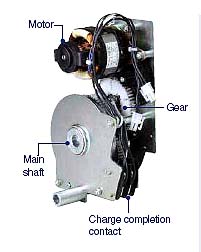
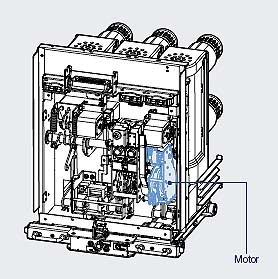
Рис. LS Industrial SystemsПараллельные тексты EN-RU
Motor
Charge the closing spring of a circuit breaker by the external power source. When the charging is complete, control power of the motor will be "OFF" by the built-in Limit S/W. Without the external power source, charge manually
[LS Industrial Systems]Электродвигательный привод взвода пружины
Электродвигательный привод предназначен для взвода пружины включения автоматического выключателя. После завершения взвода пружины подача электропитания на двигатель отключается контактом встроенного конечного выключателя. При отсутствии внешнего источника питания пружину можно взвести вручную.
[Перевод Интент]Тематики
EN
Англо-русский словарь нормативно-технической терминологии > motor
51 feed element
источник питания
Характеристики внешних источников питания следует принимать по техническим условиям на присоединение, выдаваемым энегоснабжающей организацией в соответствии с Правилами пользования электрической энергией...
источник питания электроэнергией
-
[Интент]
источник электропитания
—
[Я.Н.Лугинский, М.С.Фези-Жилинская, Ю.С.Кабиров. Англо-русский словарь по электротехнике и электроэнергетике, Москва, 1999 г.]
Основными источниками питания должны служить электростанции и сети районных энергосистем. Исключение представляют большие предприятия с большим теплопотреблением, где основным источником питания может быть собственная электростанция (ТЭЦ). Но и в этом случае обязательно должна предусматриваться связь системы электроснабжения предприятия с сетью энергосистемы.
[СН 174-75 Инструкция по проектированию электроснабжения промышленных предприятий]
1.1.2 Зануление следует выполнять электрическим соединением металлических частей электроустановок с заземленной точкой источника питания электроэнергией при помощи нулевого защитного проводника.
[ ГОСТ 12.1.030-81]
Параллельные тексты EN-RUIt is recommended that, where practicable, the electrical equipment of a machine is connected to a single incoming supply. Where another supply is necessary for certain parts of the equipment (for example, electronic equipment that operates at a different voltage), that supply should be derived, as far as is practicable, from devices (for example, transformers, converters) forming part of the electrical equipment of the machine.
[IEC 60204-1-2006]Рекомендуется, там где это возможно, чтобы электрооборудование машины получало электропитание от одного источника. Если для каких-либо частей электрооборудования машины (например для электронного оборудования, работающего на другом напряжении) необходим отдельный источник питания, то, насколько это возможно, он должен являться частью (такой, например, как трансформатор, конвертор) электрооборудования этой же машины.
[Перевод Интент]
Power supplies
The required power supplies can be determined based on the criteria for definition of the installation (receivers, power, location, etc.) and the operating conditions (safety, evacuation of the public, continuity, etc.).
They are as follows:
- Main power supply
- Replacement power supply
- Power supply for safety services
- Auxiliary power supply
[Legrand]Источники электропитания
Источники электропитания определяют по различным критериям, в соответствии с характеристиками конкретной электроустановки. Определяют типы электроприемников, их мощность, территориальное расположение и др. При этом учитывают условия эксплуатации (безопасность, требования к аварийной эвакуации людей, непрерывность технологического процесса и т. д.).
Применяют следующие источники:
- основной источник питания;
- резервный источник питания;
- аварийный источник питания систем безопасности;
- дополнительный источник питания.
[Перевод Интент]
Рис. Legrand
Типовая схема электроснабжения: 1 - Main power supply - Основной источник питания
2 - Replacement power supply (2nd source) - Резервный источник питания (2-й источник)
3 - Replacement power supply (backup) - Резервный источник питания (независимый)
4 - Auxiliary power supply - Дополнительный источник питания
5 - Power supply for safety services - Аварийный источник питания для систем безопасности
6 - Management of sources - Управление источниками питания
7 - Control - Цепь управления
8 - Main LV distrib. board - Главный распределительный щит (ГРЩ)
9 - Safety panel - Панель безопасности
10 - Uninterruptible power supply - Источник бесперебойного питания
11 - Load shedding - Отключение нагрузки
12 - Non-priority circuits - Цепи неприоритетной нагрузки
14 - Uninterruptible circuits - Цепи бесперебойного питания
15 - Shed circuits - Цепи отключаемой нагрузки
16 - Safety circuits - Цепи систем безопасностиТематики
Близкие понятия
Действия
Синонимы
Сопутствующие термины
- аварийный источник питания
- взаимно резервируемые источники питания
- внешний источник питания
- дополнительный источник питания
- источник бесперебойного питания
- источник питания с ограничением тока
- независимый источник питания
- основной источник питания
- резервный источник питания
EN
Англо-русский словарь нормативно-технической терминологии > feed element
52 incoming supply
источник питания
Характеристики внешних источников питания следует принимать по техническим условиям на присоединение, выдаваемым энегоснабжающей организацией в соответствии с Правилами пользования электрической энергией...
источник питания электроэнергией
-
[Интент]
источник электропитания
—
[Я.Н.Лугинский, М.С.Фези-Жилинская, Ю.С.Кабиров. Англо-русский словарь по электротехнике и электроэнергетике, Москва, 1999 г.]
Основными источниками питания должны служить электростанции и сети районных энергосистем. Исключение представляют большие предприятия с большим теплопотреблением, где основным источником питания может быть собственная электростанция (ТЭЦ). Но и в этом случае обязательно должна предусматриваться связь системы электроснабжения предприятия с сетью энергосистемы.
[СН 174-75 Инструкция по проектированию электроснабжения промышленных предприятий]
1.1.2 Зануление следует выполнять электрическим соединением металлических частей электроустановок с заземленной точкой источника питания электроэнергией при помощи нулевого защитного проводника.
[ ГОСТ 12.1.030-81]
Параллельные тексты EN-RUIt is recommended that, where practicable, the electrical equipment of a machine is connected to a single incoming supply. Where another supply is necessary for certain parts of the equipment (for example, electronic equipment that operates at a different voltage), that supply should be derived, as far as is practicable, from devices (for example, transformers, converters) forming part of the electrical equipment of the machine.
[IEC 60204-1-2006]Рекомендуется, там где это возможно, чтобы электрооборудование машины получало электропитание от одного источника. Если для каких-либо частей электрооборудования машины (например для электронного оборудования, работающего на другом напряжении) необходим отдельный источник питания, то, насколько это возможно, он должен являться частью (такой, например, как трансформатор, конвертор) электрооборудования этой же машины.
[Перевод Интент]
Power supplies
The required power supplies can be determined based on the criteria for definition of the installation (receivers, power, location, etc.) and the operating conditions (safety, evacuation of the public, continuity, etc.).
They are as follows:
- Main power supply
- Replacement power supply
- Power supply for safety services
- Auxiliary power supply
[Legrand]Источники электропитания
Источники электропитания определяют по различным критериям, в соответствии с характеристиками конкретной электроустановки. Определяют типы электроприемников, их мощность, территориальное расположение и др. При этом учитывают условия эксплуатации (безопасность, требования к аварийной эвакуации людей, непрерывность технологического процесса и т. д.).
Применяют следующие источники:
- основной источник питания;
- резервный источник питания;
- аварийный источник питания систем безопасности;
- дополнительный источник питания.
[Перевод Интент]
Рис. Legrand
Типовая схема электроснабжения: 1 - Main power supply - Основной источник питания
2 - Replacement power supply (2nd source) - Резервный источник питания (2-й источник)
3 - Replacement power supply (backup) - Резервный источник питания (независимый)
4 - Auxiliary power supply - Дополнительный источник питания
5 - Power supply for safety services - Аварийный источник питания для систем безопасности
6 - Management of sources - Управление источниками питания
7 - Control - Цепь управления
8 - Main LV distrib. board - Главный распределительный щит (ГРЩ)
9 - Safety panel - Панель безопасности
10 - Uninterruptible power supply - Источник бесперебойного питания
11 - Load shedding - Отключение нагрузки
12 - Non-priority circuits - Цепи неприоритетной нагрузки
14 - Uninterruptible circuits - Цепи бесперебойного питания
15 - Shed circuits - Цепи отключаемой нагрузки
16 - Safety circuits - Цепи систем безопасностиТематики
Близкие понятия
Действия
Синонимы
Сопутствующие термины
- аварийный источник питания
- взаимно резервируемые источники питания
- внешний источник питания
- дополнительный источник питания
- источник бесперебойного питания
- источник питания с ограничением тока
- независимый источник питания
- основной источник питания
- резервный источник питания
EN
Англо-русский словарь нормативно-технической терминологии > incoming supply
53 power supply node
источник питания
Характеристики внешних источников питания следует принимать по техническим условиям на присоединение, выдаваемым энегоснабжающей организацией в соответствии с Правилами пользования электрической энергией...
источник питания электроэнергией
-
[Интент]
источник электропитания
—
[Я.Н.Лугинский, М.С.Фези-Жилинская, Ю.С.Кабиров. Англо-русский словарь по электротехнике и электроэнергетике, Москва, 1999 г.]
Основными источниками питания должны служить электростанции и сети районных энергосистем. Исключение представляют большие предприятия с большим теплопотреблением, где основным источником питания может быть собственная электростанция (ТЭЦ). Но и в этом случае обязательно должна предусматриваться связь системы электроснабжения предприятия с сетью энергосистемы.
[СН 174-75 Инструкция по проектированию электроснабжения промышленных предприятий]
1.1.2 Зануление следует выполнять электрическим соединением металлических частей электроустановок с заземленной точкой источника питания электроэнергией при помощи нулевого защитного проводника.
[ ГОСТ 12.1.030-81]
Параллельные тексты EN-RUIt is recommended that, where practicable, the electrical equipment of a machine is connected to a single incoming supply. Where another supply is necessary for certain parts of the equipment (for example, electronic equipment that operates at a different voltage), that supply should be derived, as far as is practicable, from devices (for example, transformers, converters) forming part of the electrical equipment of the machine.
[IEC 60204-1-2006]Рекомендуется, там где это возможно, чтобы электрооборудование машины получало электропитание от одного источника. Если для каких-либо частей электрооборудования машины (например для электронного оборудования, работающего на другом напряжении) необходим отдельный источник питания, то, насколько это возможно, он должен являться частью (такой, например, как трансформатор, конвертор) электрооборудования этой же машины.
[Перевод Интент]
Power supplies
The required power supplies can be determined based on the criteria for definition of the installation (receivers, power, location, etc.) and the operating conditions (safety, evacuation of the public, continuity, etc.).
They are as follows:
- Main power supply
- Replacement power supply
- Power supply for safety services
- Auxiliary power supply
[Legrand]Источники электропитания
Источники электропитания определяют по различным критериям, в соответствии с характеристиками конкретной электроустановки. Определяют типы электроприемников, их мощность, территориальное расположение и др. При этом учитывают условия эксплуатации (безопасность, требования к аварийной эвакуации людей, непрерывность технологического процесса и т. д.).
Применяют следующие источники:
- основной источник питания;
- резервный источник питания;
- аварийный источник питания систем безопасности;
- дополнительный источник питания.
[Перевод Интент]
Рис. Legrand
Типовая схема электроснабжения: 1 - Main power supply - Основной источник питания
2 - Replacement power supply (2nd source) - Резервный источник питания (2-й источник)
3 - Replacement power supply (backup) - Резервный источник питания (независимый)
4 - Auxiliary power supply - Дополнительный источник питания
5 - Power supply for safety services - Аварийный источник питания для систем безопасности
6 - Management of sources - Управление источниками питания
7 - Control - Цепь управления
8 - Main LV distrib. board - Главный распределительный щит (ГРЩ)
9 - Safety panel - Панель безопасности
10 - Uninterruptible power supply - Источник бесперебойного питания
11 - Load shedding - Отключение нагрузки
12 - Non-priority circuits - Цепи неприоритетной нагрузки
14 - Uninterruptible circuits - Цепи бесперебойного питания
15 - Shed circuits - Цепи отключаемой нагрузки
16 - Safety circuits - Цепи систем безопасностиТематики
Близкие понятия
Действия
Синонимы
Сопутствующие термины
- аварийный источник питания
- взаимно резервируемые источники питания
- внешний источник питания
- дополнительный источник питания
- источник бесперебойного питания
- источник питания с ограничением тока
- независимый источник питания
- основной источник питания
- резервный источник питания
EN
Англо-русский словарь нормативно-технической терминологии > power supply node
54 SPM
1) Компьютерная техника: System Performance Monitor2) Американизм: Suspended Parliamentary Matter3) Военный термин: Sleep/ Performance Model, Sound Powered Microphone, Special Purpose Machine, Special Purpose Material, self-propelled mount, shots per minute, standard payload module, standard procedure manual, subsystems project manager, support program management, systems program manager, самоходный миномёт (self-propelled mortar)4) Техника: single-particle model, small power module, solar power module, ВПУ (Single Point Mooring - Выносное Причальное Устройство), Метод ударных импульсов (для диагностики состояния подшипников) (Shock Pulse Method)6) Юридический термин: Sanction Penalty Month, South Park Mexicans7) Металлургия: Supermetallic8) Музыка: Speed Phase And Music9) Оптика: scanning probe microscopy10) Телекоммуникации: Space Switch Module11) Сокращение: Self-Propelled Mortar, Somali Patriotic Movement, System Program Management, security policy model, Scratch-Pad Memory, Software Performance Monitor, standard penetration test12) Физика: Scanning Probe Microscope13) Электроника: Small Perturbation Method, Solar Proton Monitor14) Вычислительная техника: Source Program Maintenance, System Performance Monitor (IBM), Session Protocol Machine (OSI, ISO 8327)15) Нефть: shots per meter, six-point mooring16) Экология: ВЧ, взвешенные частицы, масса взвешенных частиц, частицы во взвешенном состоянии17) Бурение: stroke per minute18) Глоссарий компании Сахалин Энерджи: число ходов (насоса) в минуту, typical single point mooring (CALM technology), typical single point mooring (SALM technology)19) Нефтегазовая техника выносной точечный причал20) Сетевые технологии: Service Provider Multiplexer, Session Protocol Machine21) Программирование: Set Program Mask22) Автоматика: spindle motor, square-loop pallet magazine23) Сахалин Р: Typical Single Point Mooring CALM Technology, single point mooring, strokes per minute24) Океанография: Suspended Particulate Matter25) Химическое оружие: System Program Manager, site project manager26) Расширение файла: WordPerfect Data, System Performance Monitor (IBM)27) Нефть и газ: SmartPlant Materials (электронная онлайн-система закупок, учета и планирования материалов), ТРП, выносное причальное устройство, точечный рейдовый причал, точечный способ швартовки крупнотоннажных судов, ELSBM, SBM, exposed location SBM, single buoy mooring, точечный способ швартовки, швартовка к одиночному бую28) Каспий: single-point buoy mooring29) Фармация: Study Procedures Manual30) Нанотехнологии: СЗМ, сканирующий зондовый микроскоп, сканирующая зондовая микроскопия31) НАСА: Security Program Manager, Software Programmers Manual, Software Project Management, Sun Photometer32) Программное обеспечение: Software Process Measurement, Source Package Module33) Единицы измерений: Sheets Per Minute, Syllables Per Minute55 Spm
1) Компьютерная техника: System Performance Monitor2) Американизм: Suspended Parliamentary Matter3) Военный термин: Sleep/ Performance Model, Sound Powered Microphone, Special Purpose Machine, Special Purpose Material, self-propelled mount, shots per minute, standard payload module, standard procedure manual, subsystems project manager, support program management, systems program manager, самоходный миномёт (self-propelled mortar)4) Техника: single-particle model, small power module, solar power module, ВПУ (Single Point Mooring - Выносное Причальное Устройство), Метод ударных импульсов (для диагностики состояния подшипников) (Shock Pulse Method)6) Юридический термин: Sanction Penalty Month, South Park Mexicans7) Металлургия: Supermetallic8) Музыка: Speed Phase And Music9) Оптика: scanning probe microscopy10) Телекоммуникации: Space Switch Module11) Сокращение: Self-Propelled Mortar, Somali Patriotic Movement, System Program Management, security policy model, Scratch-Pad Memory, Software Performance Monitor, standard penetration test12) Физика: Scanning Probe Microscope13) Электроника: Small Perturbation Method, Solar Proton Monitor14) Вычислительная техника: Source Program Maintenance, System Performance Monitor (IBM), Session Protocol Machine (OSI, ISO 8327)15) Нефть: shots per meter, six-point mooring16) Экология: ВЧ, взвешенные частицы, масса взвешенных частиц, частицы во взвешенном состоянии17) Бурение: stroke per minute18) Глоссарий компании Сахалин Энерджи: число ходов (насоса) в минуту, typical single point mooring (CALM technology), typical single point mooring (SALM technology)19) Нефтегазовая техника выносной точечный причал20) Сетевые технологии: Service Provider Multiplexer, Session Protocol Machine21) Программирование: Set Program Mask22) Автоматика: spindle motor, square-loop pallet magazine23) Сахалин Р: Typical Single Point Mooring CALM Technology, single point mooring, strokes per minute24) Океанография: Suspended Particulate Matter25) Химическое оружие: System Program Manager, site project manager26) Расширение файла: WordPerfect Data, System Performance Monitor (IBM)27) Нефть и газ: SmartPlant Materials (электронная онлайн-система закупок, учета и планирования материалов), ТРП, выносное причальное устройство, точечный рейдовый причал, точечный способ швартовки крупнотоннажных судов, ELSBM, SBM, exposed location SBM, single buoy mooring, точечный способ швартовки, швартовка к одиночному бую28) Каспий: single-point buoy mooring29) Фармация: Study Procedures Manual30) Нанотехнологии: СЗМ, сканирующий зондовый микроскоп, сканирующая зондовая микроскопия31) НАСА: Security Program Manager, Software Programmers Manual, Software Project Management, Sun Photometer32) Программное обеспечение: Software Process Measurement, Source Package Module33) Единицы измерений: Sheets Per Minute, Syllables Per Minute56 spm
1) Компьютерная техника: System Performance Monitor2) Американизм: Suspended Parliamentary Matter3) Военный термин: Sleep/ Performance Model, Sound Powered Microphone, Special Purpose Machine, Special Purpose Material, self-propelled mount, shots per minute, standard payload module, standard procedure manual, subsystems project manager, support program management, systems program manager, самоходный миномёт (self-propelled mortar)4) Техника: single-particle model, small power module, solar power module, ВПУ (Single Point Mooring - Выносное Причальное Устройство), Метод ударных импульсов (для диагностики состояния подшипников) (Shock Pulse Method)6) Юридический термин: Sanction Penalty Month, South Park Mexicans7) Металлургия: Supermetallic8) Музыка: Speed Phase And Music9) Оптика: scanning probe microscopy10) Телекоммуникации: Space Switch Module11) Сокращение: Self-Propelled Mortar, Somali Patriotic Movement, System Program Management, security policy model, Scratch-Pad Memory, Software Performance Monitor, standard penetration test12) Физика: Scanning Probe Microscope13) Электроника: Small Perturbation Method, Solar Proton Monitor14) Вычислительная техника: Source Program Maintenance, System Performance Monitor (IBM), Session Protocol Machine (OSI, ISO 8327)15) Нефть: shots per meter, six-point mooring16) Экология: ВЧ, взвешенные частицы, масса взвешенных частиц, частицы во взвешенном состоянии17) Бурение: stroke per minute18) Глоссарий компании Сахалин Энерджи: число ходов (насоса) в минуту, typical single point mooring (CALM technology), typical single point mooring (SALM technology)19) Нефтегазовая техника выносной точечный причал20) Сетевые технологии: Service Provider Multiplexer, Session Protocol Machine21) Программирование: Set Program Mask22) Автоматика: spindle motor, square-loop pallet magazine23) Сахалин Р: Typical Single Point Mooring CALM Technology, single point mooring, strokes per minute24) Океанография: Suspended Particulate Matter25) Химическое оружие: System Program Manager, site project manager26) Расширение файла: WordPerfect Data, System Performance Monitor (IBM)27) Нефть и газ: SmartPlant Materials (электронная онлайн-система закупок, учета и планирования материалов), ТРП, выносное причальное устройство, точечный рейдовый причал, точечный способ швартовки крупнотоннажных судов, ELSBM, SBM, exposed location SBM, single buoy mooring, точечный способ швартовки, швартовка к одиночному бую28) Каспий: single-point buoy mooring29) Фармация: Study Procedures Manual30) Нанотехнологии: СЗМ, сканирующий зондовый микроскоп, сканирующая зондовая микроскопия31) НАСА: Security Program Manager, Software Programmers Manual, Software Project Management, Sun Photometer32) Программное обеспечение: Software Process Measurement, Source Package Module33) Единицы измерений: Sheets Per Minute, Syllables Per Minute57 unit
1) сборочная единица; узел; блок2) установка; агрегат3) единица, единица измерения || единичный; удельный4) часть; секция || секционный•as a unit — 1) в сборе 2) как единая сборочная единица; как единый узел
unit under test — 1) объект контроля 2) объект диагностирования, объект технического диагностирования
- AC unit- actuating unit
- adapter plate unit
- adaptive control unit
- address and data interface unit
- address unit
- adjusting unit
- air-aspirating unit
- answer-back unit
- arithmetic unit
- arithmetic/logic unit
- arithmetical unit
- ASC unit
- assembly unit of N-order
- assembly unit
- audio response unit
- autoloading unit
- automatic calling unit
- auxiliary data translator unit
- availability control unit
- axis unit
- axis-processing unit
- balancer unit
- banking unit
- bar feed unit
- base assembly unit
- base unit
- basic information unit
- basic length unit
- basic logic unit
- batch control unit
- bearing unit
- behind-the-tape reader unit
- belt shuttle unit
- belt-driven shuttle unit
- bench-testing unit
- blemished unit
- bolt-on unit
- booster unit
- boring spindle unit
- boring unit
- boring-and-milling unit
- brake unit
- broach retriever unit
- broach-handling unit
- broken tool sensing unit
- buffer unit
- building-block machining unit
- bulk transfer unit
- business unit
- card punching unit
- carousel loading unit
- carousel unit
- carrier unit
- cartridge unit
- cellular unit
- center unit for machine frame
- central processing unit
- central processor unit
- chain storage unit
- changer unit
- changing unit
- check unit
- chiller unit
- chip disposal unit
- clamping unit
- claw unit
- CNC machining unit
- CNC standard unit
- CNC unit
- coating application unit
- coating removal unit
- coherent unit
- column unit
- combination valve unit
- command unit
- communications central processing unit
- complementary unit
- computerized numerical control unit
- condensing unit
- cone variable-speed friction drive unit
- console unit
- constant coefficient unit
- constant delay unit
- construction unit
- control unit
- controlling unit
- conveying unit
- conveyor unit
- coolant management unit
- coolant recovery unit
- coolant unit
- cooler unit
- cooling unit
- coordinate preprogramming unit
- copying unit
- correction unit
- cover unit
- CPC handling unit
- cross tapping unit
- cross-slide unit
- cutoff unit
- cutting unit
- D unit
- damping unit
- data preparation unit
- data transmission control unit
- deep hole boring unit
- delay unit
- derived unit
- detecting unit
- detection unit
- developing unit
- digital display unit
- digital readout unit
- digital unit
- dimension readout unit
- diode array unit
- disk-type variable-speed friction drive unit
- displacement unit
- display unit
- distance-keeping unit
- double-acting unit
- double-notching unit
- double-pump and combination unit
- double-pump unit
- double-reduction gear unit
- double-reduction right-angle reduction gear unit
- double-reduction twin gear unit
- double-reduction twin unit
- double-reduction wormgear unit
- double-spindle unit
- down-hole internal deburrer unit
- dresser unit
- dressing unit
- drill unit
- drilling and milling unit
- drilling spindle unit
- drilling unit
- drilling/tapping unit
- drive unit
- drive/feed unit
- DRO unit
- dual work pallet shuttle unit
- dual-head laser beam unit
- dust-collecting unit
- dust-removing unit
- dynamic unit
- EDM unit
- electrical machining units
- electromagnetic unit
- electron-beam unit
- entry level dedicated unit
- environmental compensation unit
- exchanger unit
- fabricated unit
- facing unit
- fan coil unit
- feed box unit
- feed change unit
- feed drive cartridge unit
- feed unit
- feedback unit
- feed-in boring unit
- feed-out boring unit
- fetch-and-carry unit
- filtration unit
- fine boring unit
- flexible spindle units
- flexible tray unit
- floor unit
- focusing unit
- free-standing unit
- free-wheel unit
- free-wheeling unit
- frontal variable-speed friction drive unit
- functional unit
- fundamental unit
- gage control unit
- gage indicating unit
- gage unit
- gaging unit
- gas turbine starter auxiliary power unit
- gear unit
- gearbox unit
- gear-reversing unit
- grasping unit
- grinding spindle unit
- gripper unit
- guide unit
- handling unit
- hardware/software add-on unit
- harmonic drive unit
- head unit
- headstock-type workpiece holding unit
- hoisting unit
- horizontal power unit
- horizontal way unit
- hydraulic clamping unit
- hydraulic feed unit
- hydraulic power unit
- hydraulic testing unit
- hydraulic unit
- hydrostatic bearing unit
- ICAM manufacturing unit
- ICAM unit
- icon-driven control unit
- indexer/fourth axis unit
- indexing head unit
- indexing platen unit
- indexing table unit
- indexing unit
- in-die tapping unit
- information retrieval unit
- information unit
- input batch control unit
- input unit
- input-output unit
- in-system unit
- integral unit
- interface unit
- intermediate storage unit
- interpolating unit
- inverting unit
- keyboard unit
- knee-type unit
- lapping and superfinishing unit
- laser beam composition unit
- laser beam unit
- laser processing unit
- laser unit
- laser-calibration unit
- laser-source unit
- lead screw tap unit
- lexical unit
- lift unit
- lift-and-carry unit
- light unit
- linear ball bearing unit
- linear drive unit
- linear screw unit
- linear slide roller bearing unit
- linear unit
- live storage unit
- load/unload unit
- loading unit
- loading-and-unloading unit
- logic unit
- logical unit
- lubricating pump unit
- machine control unit
- machine tool control unit
- machine tooling unit
- machine unit
- machine-dedicated unit
- machining center unit
- machining head unit
- machining unit
- magnetic pickup unit
- magnetic tape unit
- manned flexible unit
- marking unit
- master unit
- material-handling unit
- MDI unit
- measurement unit
- measuring unit
- memory unit
- message display unit
- microdispensing unit
- microprocessor correction unit
- microprocessor NC unit
- microprocessor unit
- microprocessor-based unit
- microprocessor-type NC unit
- middle-level 3-D representation unit
- milling spindle unit
- minicomputer control unit
- miniload AS/RS unit
- mist coolant unit
- miter saw unit
- mobile unit
- mobile work storage unit
- modular cell unit
- modular loading unit
- modular unit
- motor unit
- motor-reduction unit
- multichannel analyzer unit
- multidrill unit
- multiple screw-driving unit
- multiple-power path gear unit
- multiple-reduction gear unit
- multiple-reduction unit
- multiple-spindle torque unit
- multipurpose machining unit
- multispindle boring unit
- multitap unit
- NC data creation unit
- NC unit
- nested gear unit
- notching unit
- nutating unit
- off-machine unit
- off-system unit
- oil coalescer unit
- oil-filled feed unit
- one stage gear unit
- one stage unit
- on-machine unit
- operation unit
- operational unit
- operator-friendly program unit
- orientation transfer unit
- output batch control unit
- output unit
- overhead gantry unit
- overhead spindle unit
- pack unit
- pallet change unit
- pallet exchange unit
- pallet shuttle unit
- pallet-pool unit
- parallel-shaft reduction gear unit
- PC expansion board unit
- PC-based CAD unit
- pendant control unit
- pendant pushbutton control unit
- pendant unit
- peripheral control unit
- peripheral processing unit
- photo-eye tracing unit
- pick-and-place unit
- pickup unit
- piece-holding unit
- pilot unit
- placement unit
- planetary gear unit
- planetary reduction gearing unit
- plant unit
- plasma-arc unit
- plasmarc unit
- platen unit
- PLC unit
- plugboard input unit
- plugboard unit
- plug-in unit
- pneumatic unit
- portable unit
- power feed unit
- power supply unit
- power train unit
- power unit
- power-generating unit
- power-tooling unit
- practical correction unit
- practical unit
- presetting unit
- pressurized air bearing unit
- primary storage unit
- probe unit
- processing unit
- production unit
- program unit
- programming unit
- propulsion unit
- pulling unit
- pump unit
- pumping unit
- pump-motor unit
- quill feed cam unit
- quill spindle unit
- quill unit
- raster unit
- readout unit
- reducing unit
- reduction gear unit
- reduction gearing unit
- reduction unit
- reed make contact unit
- regulating unit
- remote display unit
- replacement unit
- retriever unit
- right-angle milling unit
- right-angled milling unit
- robot power unit
- robot unit
- robot-transfer unit
- roller bearing unit
- roller unit
- roller-marking unit
- rotary unit
- rotating seal unit
- S unit
- scanning unit
- scheduling unit
- screen projection unit
- screwing unit
- sealed reed contact unit
- self-contained NC unit
- self-contained unit
- sensing unit
- sensor unit
- servo unit
- shankless boring unit
- sheet metal stamping automatic unit
- shop replaceable unit
- shuttle unit
- shuttle-and-lift unit
- side unit
- single-acting unit
- single-light unit
- single-reduction gear unit
- single-reduction unit
- sizing unit
- slant bed unit
- slave unit
- slide unit
- sliding table unit
- smallest replaceable unit
- spare unit
- speeder unit
- speed-increase unit
- speed-up spindle unit
- speed-up unit
- spindle box unit
- spindle cartridge unit
- spindle drive unit
- spindle unit
- stabilizing unit
- stand-alone unit
- standard build units
- starter auxiliary power unit
- static tooling unit
- steam generating unit
- stock feed unit
- storage unit
- stylus unit
- sub-multiple unit
- swing arm-mounted control unit
- tangent unit
- tapping unit
- teach control unit
- terminal control unit
- test unit
- testing unit
- thermal detecting unit
- tilting unit
- tolerance unit
- tool storage unit
- tool-presetting unit
- tool-spindle unit
- toroidal variable-speed friction drive unit
- track and store unit
- transfer unit
- transmission control unit
- transmission unit
- transmitter/receiver unit
- transport unit
- triple-reduction gear unit
- triple-reduction unit
- tuning unit
- turnaround unit
- turning spindle unit
- turnround unit
- turret unit
- twin gear unit
- twin saw unit
- twin-drive unit
- twin-screen unit
- unit of displacement
- unit of measure
- unit of measurement
- unit of physical quantity
- unit of product
- unit of work per unit of time
- unmanned machining unit
- vacuum unit
- variable coefficient unit
- variable delay unit
- variable preload bearing unit
- variable ratio unit
- variable speed unit
- variable-speed friction drive unit
- V-axis grinding unit
- V-belt variable-speed drive unit
- V-drive unit
- vertical way unit
- vibratory feed unit
- vise unit
- visual display unit
- vocal output unit
- VTL unit
- waveform gear reduction unit
- wheel-dressing unit
- wheel-head unit
- wing unit
- wing-base unit
- work storage unit
- work-holding headstock unit
- workshop video unit
- work-testing unit
- worm reduction unit
- writing unit
- yet-to-be-assembled unitEnglish-Russian dictionary of mechanical engineering and automation > unit
58 instruction
2) инструкция; программа действий3) обучение•- accumulator shift instruction
- actual instruction
- address modification instruction
- addressless instruction
- alphanumeric instruction
- alphameric instruction
- arithmetical instruction
- arithmetic instruction
- assignment instruction
- autocode instruction
- autoindexed instruction
- basic instruction
- bit-manipulation instruction
- blank instruction
- block-move instruction
- branching instruction
- branch instruction
- branching-programmed instruction
- branch-on-zero instruction
- breakpoint instruction
- broadcast instruction
- byte instruction
- call instruction
- card read instruction
- character-oriented instruction
- clear and add instruction
- clear store instruction
- clearing instruction
- compare instruction
- comparison instruction
- complete instruction
- compound instruction
- computer instruction
- computer-aided instruction
- computer-assisted instruction
- conditional assembly instruction
- conditional branch instruction
- conditional breakpoint instruction
- conditional instruction
- conditional jump instruction
- conditional stop instruction
- conditional transfer instruction
- conflicting instructions
- constant instruction
- consumer instruction
- control instruction
- control transfer instruction
- convert instruction
- current instruction
- data movement instruction
- data transfer instruction
- decimal instruction
- decision instruction
- declarative instruction
- decoded instruction
- diagnose instruction
- direct access instruction
- direct instruction
- discarded instruction
- discrimination instruction
- display instruction
- do-nothing instruction
- double-precision instruction
- dual-issued instructions
- dummy instruction
- edit instruction
- effective instruction
- engineering instruction
- entry instruction
- exchange instruction
- executive instruction
- external devices instruction
- extracode instruction
- extract instruction
- floating-point instruction
- follow the instructions carefully
- format instruction
- four-address instruction
- full-word instruction
- general instruction
- half-word instruction
- halt instruction
- housekeeping instruction
- idle instruction
- ignore instruction
- illegal instruction
- immediate address instruction
- immediate instruction
- imperative instruction
- indirect instruction
- input/output instruction
- inquiry input/output instruction
- integer instruction
- internal manipulation instruction
- interpretive instruction
- interrupt instruction
- interruptable instruction
- invitation instruction
- invite instruction
- iterative instruction
- jump instruction
- jump to subroutine instruction
- keyboard instruction
- linear programmed instruction
- link instruction
- linkage macro instruction
- load index register instruction
- load repeat counter instruction
- logical instruction
- logic instruction
- look-up instruction
- machine code instruction
- machine instruction
- machine language instruction
- macro instruction
- macroexpansion instruction
- macroprocessing instruction
- maintenance instruction
- math instruction
- memory load instruction
- memory protect privileged instruction
- memory-reference instruction
- micro instruction
- microprogrammable instruction
- mnemonic instruction
- modified instruction
- monadic instruction
- monitor call instruction
- motion video instruction
- move instruction
- MQ register sign jump instruction
- MQ sign jump instruction
- multiaddress instruction
- multilplying instruction
- multiple-address instruction
- multiple instruction
- multiple-cycle instruction
- multiple-length instruction
- multiplier-quotient register sign jump instruction
- multiplier-quotient sign jump instruction
- multiply-accumulate instruction
- N-address instruction
- native instruction
- noaddress instruction
- nonmemory-reference instruction
- nonprint instruction
- nonprivileged instruction
- non-speculative instruction
- no-op instruction
- no-operation instruction
- normalized instruction
- normalize instruction
- N-plus-one address instruction
- null instruction
- object instruction
- on-chip instruction
- one-address instruction
- one-and-a-half-address instruction
- one-over-one address instruction
- one-plus-one address instruction
- on-screen instruction
- operational-address instruction
- operation-address instruction
- optional halt instruction
- optional pause instruction
- optional stop instruction
- organizational instruction
- overflow jump instruction
- overriding instruction
- pause instruction
- picture-description instruction
- preempted instruction
- presumptive instruction
- prewired instruction
- privileged instruction
- producer instruction
- programmed instruction
- propagation instruction
- pseudo instruction
- quadruple address instruction
- quasi instruction
- reading instruction
- read instruction
- red-tape instruction
- reference instruction
- register-to-register instruction
- relative instruction
- repeat instruction
- repetition instruction
- restart instruction
- return instruction
- right shift instruction
- rotate instruction
- roundoff instruction
- scalar instruction
- search instruction
- seek instruction
- shift instruction
- shift-jump instruction
- short instruction
- single-address instruction
- single-cycle instruction
- single-operand instruction
- skeleton instruction
- skip instruction
- source-designation instruction
- source-destination instruction
- stack instruction
- steering instruction
- stop instruction
- string instruction
- summarize instruction
- supervisor call instruction
- symbolic instruction
- table look-up instruction
- tape instruction
- text-entry instruction
- three-address instruction
- three-plus-one-address instruction
- transfer instruction
- transfer of control instruction
- trap instruction
- try instruction
- two-address instruction
- two-plus-one-address instruction
- unconditional branch instruction
- unconditional control transfer instruction
- unconditional jump instruction
- unconditional transfer instruction
- unmodified instruction
- unretired instruction
- variable instruction
- variable length instruction
- variable-cycle instruction
- vector-processing instruction
- vector instruction
- verbal instruction
- waste instruction
- write instruction
- zero-address instruction
- zeroing instruction
- zero-suppress instructionEnglish-Russian dictionary of computer science and programming > instruction
59 Murray, Matthew
SUBJECT AREA: Land transport, Mechanical, pneumatic and hydraulic engineering, Railways and locomotives, Steam and internal combustion engines[br]b. 1765 near Newcastle upon Tyne, Englandd. 20 February 1826 Holbeck, Leeds, England[br]English mechanical engineer and steam engine, locomotive and machine-tool pioneer.[br]Matthew Murray was apprenticed at the age of 14 to a blacksmith who probably also did millwrighting work. He then worked as a journeyman mechanic at Stockton-on-Tees, where he had experience with machinery for a flax mill at Darlington. Trade in the Stockton area became slack in 1788 and Murray sought work in Leeds, where he was employed by John Marshall, who owned a flax mill at Adel, located about 5 miles (8 km) from Leeds. He soon became Marshall's chief mechanic, and when in 1790 a new mill was built in the Holbeck district of Leeds by Marshall and his partner Benyon, Murray was responsible for the installation of the machinery. At about this time he took out two patents relating to improvements in textile machinery.In 1795 he left Marshall's employment and, in partnership with David Wood (1761– 1820), established a general engineering and millwrighting business at Mill Green, Holbeck. In the following year the firm moved to a larger site at Water Lane, Holbeck, and additional capital was provided by two new partners, James Fenton (1754–1834) and William Lister (1796–1811). Lister was a sleeping partner and the firm was known as Fenton, Murray \& Wood and was organized so that Fenton kept the accounts, Wood was the administrator and took charge of the workshops, while Murray provided the technical expertise. The factory was extended in 1802 by the construction of a fitting shop of circular form, after which the establishment became known as the "Round Foundry".In addition to textile machinery, the firm soon began the manufacture of machine tools and steam-engines. In this field it became a serious rival to Boulton \& Watt, who privately acknowledged Murray's superior craftsmanship, particularly in foundry work, and resorted to some industrial espionage to discover details of his techniques. Murray obtained patents for improvements in steam engines in 1799, 1801 and 1802. These included automatic regulation of draught, a mechanical stoker and his short-D slide valve. The patent of 1801 was successfully opposed by Boulton \& Watt. An important contribution of Murray to the development of the steam engine was the use of a bedplate so that the engine became a compact, self-contained unit instead of separate components built into an en-gine-house.Murray was one of the first, if not the very first, to build machine tools for sale. However, this was not the case with the planing machine, which he is said to have invented to produce flat surfaces for his slide valves. Rather than being patented, this machine was kept secret, although it was apparently in use before 1814.In 1812 Murray was engaged by John Blenkinsop (1783–1831) to build locomotives for his rack railway from Middleton Colliery to Leeds (about 3 1/2 miles or 5.6 km). Murray was responsible for their design and they were fitted with two double-acting cylinders and cranks at right angles, an important step in the development of the steam locomotive. About six of these locomotives were built for the Middleton and other colliery railways and some were in use for over twenty years. Murray also supplied engines for many early steamboats. In addition, he built some hydraulic machinery and in 1814 patented a hydraulic press for baling cloth.Murray's son-in-law, Richard Jackson, later became a partner in the firm, which was then styled Fenton, Murray \& Jackson. The firm went out of business in 1843.[br]Principal Honours and DistinctionsSociety of Arts Gold Medal 1809 (for machine for hackling flax).Further ReadingL.T.C.Rolt, 1962, Great Engineers, London (contains a good short biography).E.Kilburn Scott (ed.), 1928, Matthew Murray, Pioneer Engineer, Leeds (a collection of essays and source material).C.F.Dendy Marshall, 1953, A History of Railway Locomotives Down to the End of theYear 1831, London.L.T.C.Rolt, 1965, Tools for the Job, London; repub. 1986 (provides information on Murray's machine-tool work).Some of Murray's correspondence with Simon Goodrich of the Admiralty has been published in Transactions of the Newcomen Society 3 (1922–3); 6(1925–6); 18(1937– 8); and 32 (1959–60).RTS60 Bibliography
■ Aitchison, J. (1987). Noam Chomsky: Consensus and controversy. New York: Falmer Press.■ Anderson, J. R. (1980). Cognitive psychology and its implications. San Francisco: W. H. Freeman.■ Anderson, J. R. (1983). The architecture of cognition. Cambridge, MA: Harvard University Press.■ Anderson, J. R. (1995). Cognitive psychology and its implications (4th ed.). New York: W. H. Freeman.■ Archilochus (1971). In M. L. West (Ed.), Iambi et elegi graeci (Vol. 1). Oxford: Oxford University Press.■ Armstrong, D. M. (1990). The causal theory of the mind. In W. G. Lycan (Ed.), Mind and cognition: A reader (pp. 37-47). Cambridge, MA: Basil Blackwell. (Originally published in 1981 in The nature of mind and other essays, Ithaca, NY: University Press).■ Atkins, P. W. (1992). Creation revisited. Oxford: W. H. Freeman & Company.■ Austin, J. L. (1962). How to do things with words. Cambridge, MA: Harvard University Press.■ Bacon, F. (1878). Of the proficience and advancement of learning divine and human. In The works of Francis Bacon (Vol. 1). Cambridge, MA: Hurd & Houghton.■ Bacon, R. (1928). Opus majus (Vol. 2). R. B. Burke (Trans.). Philadelphia, PA: University of Pennsylvania Press.■ Bar-Hillel, Y. (1960). The present status of automatic translation of languages. In F. L. Alt (Ed.), Advances in computers (Vol. 1). New York: Academic Press.■ Barr, A., & E. A. Feigenbaum (Eds.) (1981). The handbook of artificial intelligence (Vol. 1). Reading, MA: Addison-Wesley.■ Barr, A., & E. A. Feigenbaum (Eds.) (1982). The handbook of artificial intelligence (Vol. 2). Los Altos, CA: William Kaufman.■ Barron, F. X. (1963). The needs for order and for disorder as motives in creative activity. In C. W. Taylor & F. X. Barron (Eds.), Scientific creativity: Its rec ognition and development (pp. 153-160). New York: Wiley.■ Bartlett, F. C. (1932). Remembering: A study in experimental and social psychology. Cambridge: Cambridge University Press.■ Bartley, S. H. (1969). Principles of perception. London: Harper & Row.■ Barzun, J. (1959). The house of intellect. New York: Harper & Row.■ Beach, F. A., D. O. Hebb, C. T. Morgan & H. W. Nissen (Eds.) (1960). The neu ropsychology of Lashley. New York: McGraw-Hill.■ Berkeley, G. (1996). Principles of human knowledge: Three Dialogues. Oxford: Oxford University Press. (Originally published in 1710.)■ Berlin, I. (1953). The hedgehog and the fox: An essay on Tolstoy's view of history. NY: Simon & Schuster.■ Bierwisch, J. (1970). Semantics. In J. Lyons (Ed.), New horizons in linguistics. Baltimore: Penguin Books.■ Black, H. C. (1951). Black's law dictionary. St. Paul, MN: West Publishing.■ Bloom, A. (1981). The linguistic shaping of thought: A study in the impact of language on thinking in China and the West. Hillsdale, NJ: Erlbaum.■ Bobrow, D. G., & D. A. Norman (1975). Some principles of memory schemata. In D. G. Bobrow & A. Collins (Eds.), Representation and understanding: Stud ies in Cognitive Science (pp. 131-149). New York: Academic Press.■ Boden, M. A. (1977). Artificial intelligence and natural man. New York: Basic Books.■ Boden, M. A. (1981). Minds and mechanisms. Ithaca, NY: Cornell University Press.■ Boden, M. A. (1990a). The creative mind: Myths and mechanisms. London: Cardinal.■ Boden, M. A. (1990b). The philosophy of artificial intelligence. Oxford: Oxford University Press.■ Boden, M. A. (1994). Precis of The creative mind: Myths and mechanisms. Behavioral and brain sciences 17, 519-570.■ Boden, M. (1996). Creativity. In M. Boden (Ed.), Artificial Intelligence (2nd ed.). San Diego: Academic Press.■ Bolter, J. D. (1984). Turing's man: Western culture in the computer age. Chapel Hill, NC: University of North Carolina Press.■ Bolton, N. (1972). The psychology of thinking. London: Methuen.■ Bourne, L. E. (1973). Some forms of cognition: A critical analysis of several papers. In R. Solso (Ed.), Contemporary issues in cognitive psychology (pp. 313324). Loyola Symposium on Cognitive Psychology (Chicago 1972). Washington, DC: Winston.■ Bransford, J. D., N. S. McCarrell, J. J. Franks & K. E. Nitsch (1977). Toward unexplaining memory. In R. Shaw & J. D. Bransford (Eds.), Perceiving, acting, and knowing (pp. 431-466). Hillsdale, NJ: Lawrence Erlbaum Associates.■ Breger, L. (1981). Freud's unfinished journey. London: Routledge & Kegan Paul.■ Brehmer, B. (1986). In one word: Not from experience. In H. R. Arkes & K. Hammond (Eds.), Judgment and decision making: An interdisciplinary reader (pp. 705-719). Cambridge: Cambridge University Press.■ Bresnan, J. (1978). A realistic transformational grammar. In M. Halle, J. Bresnan & G. A. Miller (Eds.), Linguistic theory and psychological reality (pp. 1-59). Cambridge, MA: MIT Press.■ Brislin, R. W., W. J. Lonner & R. M. Thorndike (Eds.) (1973). Cross- cultural research methods. New York: Wiley.■ Bronowski, J. (1977). A sense of the future: Essays in natural philosophy. P. E. Ariotti with R. Bronowski (Eds.). Cambridge, MA: MIT Press.■ Bronowski, J. (1978). The origins of knowledge and imagination. New Haven, CT: Yale University Press.■ Brown, R. O. (1973). A first language: The early stages. Cambridge, MA: Harvard University Press.■ Brown, T. (1970). Lectures on the philosophy of the human mind. In R. Brown (Ed.), Between Hume and Mill: An anthology of British philosophy- 1749- 1843 (pp. 330-387). New York: Random House/Modern Library.■ Bruner, J. S., J. Goodnow & G. Austin (1956). A study of thinking. New York: Wiley.■ Calvin, W. H. (1990). The cerebral symphony: Seashore reflections on the structure of consciousness. New York: Bantam.■ Campbell, J. (1982). Grammatical man: Information, entropy, language, and life. New York: Simon & Schuster.■ Campbell, J. (1989). The improbable machine. New York: Simon & Schuster.■ Carlyle, T. (1966). On heroes, hero- worship and the heroic in history. Lincoln: University of Nebraska Press. (Originally published in 1841.)■ Carnap, R. (1959). The elimination of metaphysics through logical analysis of language [Ueberwindung der Metaphysik durch logische Analyse der Sprache]. In A. J. Ayer (Ed.), Logical positivism (pp. 60-81) A. Pap (Trans). New York: Free Press. (Originally published in 1932.)■ Cassirer, E. (1946). Language and myth. New York: Harper and Brothers. Reprinted. New York: Dover Publications, 1953.■ Cattell, R. B., & H. J. Butcher (1970). Creativity and personality. In P. E. Vernon (Ed.), Creativity. Harmondsworth, England: Penguin Books.■ Caudill, M., & C. Butler (1990). Naturally intelligent systems. Cambridge, MA: MIT Press/Bradford Books.■ Chandrasekaran, B. (1990). What kind of information processing is intelligence? A perspective on AI paradigms and a proposal. In D. Partridge & R. Wilks (Eds.), The foundations of artificial intelligence: A sourcebook (pp. 14-46). Cambridge: Cambridge University Press.■ Charniak, E., & McDermott, D. (1985). Introduction to artificial intelligence. Reading, MA: Addison-Wesley.■ Chase, W. G., & H. A. Simon (1988). The mind's eye in chess. In A. Collins & E. E. Smith (Eds.), Readings in cognitive science: A perspective from psychology and artificial intelligence (pp. 461-493). San Mateo, CA: Kaufmann.■ Cheney, D. L., & R. M. Seyfarth (1990). How monkeys see the world: Inside the mind of another species. Chicago: University of Chicago Press.■ Chi, M.T.H., R. Glaser & E. Rees (1982). Expertise in problem solving. In R. J. Sternberg (Ed.), Advances in the psychology of human intelligence (pp. 7-73). Hillsdale, NJ: Lawrence Erlbaum Associates.■ Chomsky, N. (1957). Syntactic structures. The Hague: Mouton. Janua Linguarum.■ Chomsky, N. (1964). A transformational approach to syntax. In J. A. Fodor & J. J. Katz (Eds.), The structure of language: Readings in the philosophy of lan guage (pp. 211-245). Englewood Cliffs, NJ: Prentice-Hall.■ Chomsky, N. (1965). Aspects of the theory of syntax. Cambridge, MA: MIT Press.■ Chomsky, N. (1972). Language and mind (enlarged ed.). New York: Harcourt Brace Jovanovich.■ Chomsky, N. (1979). Language and responsibility. New York: Pantheon.■ Chomsky, N. (1986). Knowledge of language: Its nature, origin and use. New York: Praeger Special Studies.■ Churchland, P. (1979). Scientific realism and the plasticity of mind. New York: Cambridge University Press.■ Churchland, P. M. (1989). A neurocomputational perspective: The nature of mind and the structure of science. Cambridge, MA: MIT Press.■ Churchland, P. S. (1986). Neurophilosophy. Cambridge, MA: MIT Press/Bradford Books.■ Clark, A. (1996). Philosophical Foundations. In M. A. Boden (Ed.), Artificial in telligence (2nd ed.). San Diego: Academic Press.■ Clark, H. H., & T. B. Carlson (1981). Context for comprehension. In J. Long & A. Baddeley (Eds.), Attention and performance (Vol. 9, pp. 313-330). Hillsdale, NJ: Lawrence Erlbaum Associates.■ Clarke, A. C. (1984). Profiles of the future: An inquiry into the limits of the possible. New York: Holt, Rinehart & Winston.■ Claxton, G. (1980). Cognitive psychology: A suitable case for what sort of treatment? In G. Claxton (Ed.), Cognitive psychology: New directions (pp. 1-25). London: Routledge & Kegan Paul.■ Code, M. (1985). Order and organism. Albany, NY: State University of New York Press.■ Collingwood, R. G. (1972). The idea of history. New York: Oxford University Press.■ Coopersmith, S. (1967). The antecedents of self- esteem. San Francisco: W. H. Freeman.■ Copland, A. (1952). Music and imagination. London: Oxford University Press.■ Coren, S. (1994). The intelligence of dogs. New York: Bantam Books.■ Cottingham, J. (Ed.) (1996). Western philosophy: An anthology. Oxford: Blackwell Publishers.■ Cox, C. (1926). The early mental traits of three hundred geniuses. Stanford, CA: Stanford University Press.■ Craik, K.J.W. (1943). The nature of explanation. Cambridge: Cambridge University Press.■ Cronbach, L. J. (1990). Essentials of psychological testing (5th ed.). New York: HarperCollins.■ Cronbach, L. J., & R. E. Snow (1977). Aptitudes and instructional methods. New York: Irvington. Paperback edition, 1981.■ Csikszentmihalyi, M. (1993). The evolving self. New York: Harper Perennial.■ Culler, J. (1976). Ferdinand de Saussure. New York: Penguin Books.■ Curtius, E. R. (1973). European literature and the Latin Middle Ages. W. R. Trask (Trans.). Princeton, NJ: Princeton University Press.■ D'Alembert, J.L.R. (1963). Preliminary discourse to the encyclopedia of Diderot. R. N. Schwab (Trans.). Indianapolis: Bobbs-Merrill.■ Dampier, W. C. (1966). A history of modern science. Cambridge: Cambridge University Press.■ Darwin, C. (1911). The life and letters of Charles Darwin (Vol. 1). Francis Darwin (Ed.). New York: Appleton.■ Davidson, D. (1970) Mental events. In L. Foster & J. W. Swanson (Eds.), Experience and theory (pp. 79-101). Amherst: University of Massachussetts Press.■ Davies, P. (1995). About time: Einstein's unfinished revolution. New York: Simon & Schuster/Touchstone.■ Davis, R., & J. J. King (1977). An overview of production systems. In E. Elcock & D. Michie (Eds.), Machine intelligence 8. Chichester, England: Ellis Horwood.■ Davis, R., & D. B. Lenat (1982). Knowledge- based systems in artificial intelligence. New York: McGraw-Hill.■ Dawkins, R. (1982). The extended phenotype: The gene as the unit of selection. Oxford: W. H. Freeman.■ deKleer, J., & J. S. Brown (1983). Assumptions and ambiguities in mechanistic mental models (1983). In D. Gentner & A. L. Stevens (Eds.), Mental modes (pp. 155-190). Hillsdale, NJ: Lawrence Erlbaum Associates.■ Dennett, D. C. (1978a). Brainstorms: Philosophical essays on mind and psychology. Montgomery, VT: Bradford Books.■ Dennett, D. C. (1978b). Toward a cognitive theory of consciousness. In D. C. Dennett, Brainstorms: Philosophical Essays on Mind and Psychology. Montgomery, VT: Bradford Books.■ Dennett, D. C. (1995). Darwin's dangerous idea: Evolution and the meanings of life. New York: Simon & Schuster/Touchstone.■ Descartes, R. (1897-1910). Traite de l'homme. In Oeuvres de Descartes (Vol. 11, pp. 119-215). Paris: Charles Adam & Paul Tannery. (Originally published in 1634.)■ Descartes, R. (1950). Discourse on method. L. J. Lafleur (Trans.). New York: Liberal Arts Press. (Originally published in 1637.)■ Descartes, R. (1951). Meditation on first philosophy. L. J. Lafleur (Trans.). New York: Liberal Arts Press. (Originally published in 1641.)■ Descartes, R. (1955). The philosophical works of Descartes. E. S. Haldane and G.R.T. Ross (Trans.). New York: Dover. (Originally published in 1911 by Cambridge University Press.)■ Descartes, R. (1967). Discourse on method (Pt. V). In E. S. Haldane and G.R.T. Ross (Eds.), The philosophical works of Descartes (Vol. 1, pp. 106-118). Cambridge: Cambridge University Press. (Originally published in 1637.)■ Descartes, R. (1970a). Discourse on method. In E. S. Haldane & G.R.T. Ross (Eds.), The philosophical works of Descartes (Vol. 1, pp. 181-200). Cambridge: Cambridge University Press. (Originally published in 1637.)■ Descartes, R. (1970b). Principles of philosophy. In E. S. Haldane & G.R.T. Ross (Eds.), The philosophical works of Descartes (Vol. 1, pp. 178-291). Cambridge: Cambridge University Press. (Originally published in 1644.)■ Descartes, R. (1984). Meditations on first philosophy. In J. Cottingham, R. Stoothoff & D. Murduch (Trans.), The philosophical works of Descartes (Vol. 2). Cambridge: Cambridge University Press. (Originally published in 1641.)■ Descartes, R. (1986). Meditations on first philosophy. J. Cottingham (Trans.). Cambridge: Cambridge University Press. (Originally published in 1641 as Med itationes de prima philosophia.)■ deWulf, M. (1956). An introduction to scholastic philosophy. Mineola, NY: Dover Books.■ Dixon, N. F. (1981). Preconscious processing. London: Wiley.■ Doyle, A. C. (1986). The Boscombe Valley mystery. In Sherlock Holmes: The com plete novels and stories (Vol. 1). New York: Bantam.■ Dreyfus, H., & S. Dreyfus (1986). Mind over machine. New York: Free Press.■ Dreyfus, H. L. (1972). What computers can't do: The limits of artificial intelligence (revised ed.). New York: Harper & Row.■ Dreyfus, H. L., & S. E. Dreyfus (1986). Mind over machine: The power of human intuition and expertise in the era of the computer. New York: Free Press.■ Edelman, G. M. (1992). Bright air, brilliant fire: On the matter of the mind. New York: Basic Books.■ Ehrenzweig, A. (1967). The hidden order of art. London: Weidenfeld & Nicolson.■ Einstein, A., & L. Infeld (1938). The evolution of physics. New York: Simon & Schuster.■ Eisenstein, S. (1947). Film sense. New York: Harcourt, Brace & World.■ Everdell, W. R. (1997). The first moderns. Chicago: University of Chicago Press.■ Eysenck, M. W. (1977). Human memory: Theory, research and individual difference. Oxford: Pergamon.■ Eysenck, M. W. (1982). Attention and arousal: Cognition and performance. Berlin: Springer.■ Eysenck, M. W. (1984). A handbook of cognitive psychology. Hillsdale, NJ: Lawrence Erlbaum Associates.■ Fancher, R. E. (1979). Pioneers of psychology. New York: W. W. Norton.■ Farrell, B. A. (1981). The standing of psychoanalysis. New York: Oxford University Press.■ Feldman, D. H. (1980). Beyond universals in cognitive development. Norwood, NJ: Ablex.■ Fetzer, J. H. (1996). Philosophy and cognitive science (2nd ed.). New York: Paragon House.■ Finke, R. A. (1990). Creative imagery: Discoveries and inventions in visualization. Hillsdale, NJ: Lawrence Erlbaum Associates.■ Flanagan, O. (1991). The science of the mind. Cambridge MA: MIT Press/Bradford Books.■ Fodor, J. (1983). The modularity of mind. Cambridge, MA: MIT Press/Bradford Books.■ Frege, G. (1972). Conceptual notation. T. W. Bynum (Trans.). Oxford: Clarendon Press. (Originally published in 1879.)■ Frege, G. (1979). Logic. In H. Hermes, F. Kambartel & F. Kaulbach (Eds.), Gottlob Frege: Posthumous writings. Chicago: University of Chicago Press. (Originally published in 1879-1891.)■ Freud, S. (1959). Creative writers and day-dreaming. In J. Strachey (Ed.), The standard edition of the complete psychological works of Sigmund Freud (Vol. 9, pp. 143-153). London: Hogarth Press.■ Freud, S. (1966). Project for a scientific psychology. In J. Strachey (Ed.), The stan dard edition of the complete psychological works of Sigmund Freud (Vol. 1, pp. 295-398). London: Hogarth Press. (Originally published in 1950 as Aus den AnfaЁngen der Psychoanalyse, in London by Imago Publishing.)■ Freud, S. (1976). Lecture 18-Fixation to traumas-the unconscious. In J. Strachey (Ed.), The standard edition of the complete psychological works of Sigmund Freud (Vol. 16, p. 285). London: Hogarth Press.■ Galileo, G. (1990). Il saggiatore [The assayer]. In S. Drake (Ed.), Discoveries and opinions of Galileo. New York: Anchor Books. (Originally published in 1623.)■ Gassendi, P. (1970). Letter to Descartes. In "Objections and replies." In E. S. Haldane & G.R.T. Ross (Eds.), The philosophical works of Descartes (Vol. 2, pp. 179-240). Cambridge: Cambridge University Press. (Originally published in 1641.)■ Gazzaniga, M. S. (1988). Mind matters: How mind and brain interact to create our conscious lives. Boston: Houghton Mifflin in association with MIT Press/Bradford Books.■ Genesereth, M. R., & N. J. Nilsson (1987). Logical foundations of artificial intelligence. Palo Alto, CA: Morgan Kaufmann.■ Ghiselin, B. (1952). The creative process. New York: Mentor.■ Ghiselin, B. (1985). The creative process. Berkeley, CA: University of California Press. (Originally published in 1952.)■ Gilhooly, K. J. (1996). Thinking: Directed, undirected and creative (3rd ed.). London: Academic Press.■ Glass, A. L., K. J. Holyoak & J. L. Santa (1979). Cognition. Reading, MA: AddisonWesley.■ Goody, J. (1977). The domestication of the savage mind. Cambridge: Cambridge University Press.■ Gruber, H. E. (1980). Darwin on man: A psychological study of scientific creativity (2nd ed.). Chicago: University of Chicago Press.■ Gruber, H. E., & S. Davis (1988). Inching our way up Mount Olympus: The evolving systems approach to creative thinking. In R. J. Sternberg (Ed.), The nature of creativity: Contemporary psychological perspectives. Cambridge: Cambridge University Press.■ Guthrie, E. R. (1972). The psychology of learning. New York: Harper. (Originally published in 1935.)■ Habermas, J. (1972). Knowledge and human interests. Boston: Beacon Press.■ Hadamard, J. (1945). The psychology of invention in the mathematical field. Princeton, NJ: Princeton University Press.■ Hand, D. J. (1985). Artificial intelligence and psychiatry. Cambridge: Cambridge University Press.■ Harris, M. (1981). The language myth. London: Duckworth.■ Haugeland, J. (Ed.) (1981). Mind design: Philosophy, psychology, artificial intelligence. Cambridge, MA: MIT Press/Bradford Books.■ Haugeland, J. (1981a). The nature and plausibility of cognitivism. In J. Haugeland (Ed.), Mind design: Philosophy, psychology, artificial intelligence (pp. 243-281). Cambridge, MA: MIT Press.■ Haugeland, J. (1981b). Semantic engines: An introduction to mind design. In J. Haugeland (Ed.), Mind design: Philosophy, psychology, artificial intelligence (pp. 1-34). Cambridge, MA: MIT Press/Bradford Books.■ Haugeland, J. (1985). Artificial intelligence: The very idea. Cambridge, MA: MIT Press.■ Hawkes, T. (1977). Structuralism and semiotics. Berkeley: University of California Press.■ Hebb, D. O. (1949). The organisation of behaviour. New York: Wiley.■ Hebb, D. O. (1958). A textbook of psychology. Philadelphia: Saunders.■ Hegel, G.W.F. (1910). The phenomenology of mind. J. B. Baille (Trans.). London: Sonnenschein. (Originally published as Phaenomenologie des Geistes, 1807.)■ Heisenberg, W. (1958). Physics and philosophy. New York: Harper & Row.■ Hempel, C. G. (1966). Philosophy of natural science. Englewood Cliffs, NJ: PrenticeHall.■ Herman, A. (1997). The idea of decline in Western history. New York: Free Press.■ Herrnstein, R. J., & E. G. Boring (Eds.) (1965). A source book in the history of psy chology. Cambridge, MA: Harvard University Press.■ Herzmann, E. (1964). Mozart's creative process. In P. H. Lang (Ed.), The creative world of Mozart (pp. 17-30). London: Oldbourne Press.■ Hilgard, E. R. (1957). Introduction to psychology. London: Methuen.■ Hobbes, T. (1651). Leviathan. London: Crooke.■ Holliday, S. G., & M. J. Chandler (1986). Wisdom: Explorations in adult competence. Basel, Switzerland: Karger.■ Horn, J. L. (1986). In R. J. Sternberg (Ed.), Advances in the psychology of human intelligence (Vol. 3). Hillsdale, NJ: Erlbaum.■ Hull, C. (1943). Principles of behavior. New York: Appleton-Century-Crofts.■ Hume, D. (1955). An inquiry concerning human understanding. New York: Liberal Arts Press. (Originally published in 1748.)■ Hume, D. (1975). An enquiry concerning human understanding. In L. A. SelbyBigge (Ed.), Hume's enquiries (3rd. ed., revised P. H. Nidditch). Oxford: Clarendon. (Spelling and punctuation revised.) (Originally published in 1748.)■ Hume, D. (1978). A treatise of human nature. L. A. Selby-Bigge (Ed.), Hume's enquiries (3rd. ed., revised P. H. Nidditch). Oxford: Clarendon. (With some modifications of spelling and punctuation.) (Originally published in 1690.)■ Hunt, E. (1973). The memory we must have. In R. C. Schank & K. M. Colby (Eds.), Computer models of thought and language. (pp. 343-371) San Francisco: W. H. Freeman.■ Husserl, E. (1960). Cartesian meditations. The Hague: Martinus Nijhoff.■ Inhelder, B., & J. Piaget (1958). The growth of logical thinking from childhood to adolescence. New York: Basic Books. (Originally published in 1955 as De la logique de l'enfant a` la logique de l'adolescent. [Paris: Presses Universitaire de France])■ James, W. (1890a). The principles of psychology (Vol. 1). New York: Dover Books.■ James, W. (1890b). The principles of psychology. New York: Henry Holt.■ Jevons, W. S. (1900). The principles of science (2nd ed.). London: Macmillan.■ Johnson, G. (1986). Machinery of the mind: Inside the new science of artificial intelli gence. New York: Random House.■ Johnson-Laird, P. N. (1983). Mental models: Toward a cognitive science of language, inference, and consciousness. Cambridge, MA: Harvard University Press.■ Johnson-Laird, P. N. (1988). The computer and the mind: An introduction to cognitive science. Cambridge, MA: Harvard University Press.■ Jones, E. (1961). The life and work of Sigmund Freud. L. Trilling & S. Marcus (Eds.). London: Hogarth.■ Jones, R. V. (1985). Complementarity as a way of life. In A. P. French & P. J. Kennedy (Eds.), Niels Bohr: A centenary volume. Cambridge, MA: Harvard University Press.■ Kant, I. (1933). Critique of Pure Reason (2nd ed.). N. K. Smith (Trans.). London: Macmillan. (Originally published in 1781 as Kritik der reinen Vernunft.)■ Kant, I. (1891). Solution of the general problems of the Prolegomena. In E. Belfort (Trans.), Kant's Prolegomena. London: Bell. (With minor modifications.) (Originally published in 1783.)■ Katona, G. (1940). Organizing and memorizing: Studies in the psychology of learning and teaching. New York: Columbia University Press.■ Kaufman, A. S. (1979). Intelligent testing with the WISC-R. New York: Wiley.■ Koestler, A. (1964). The act of creation. New York: Arkana (Penguin).■ Kohlberg, L. (1971). From is to ought. In T. Mischel (Ed.), Cognitive development and epistemology. (pp. 151-235) New York: Academic Press.■ KoЁhler, W. (1925). The mentality of apes. New York: Liveright.■ KoЁhler, W. (1927). The mentality of apes (2nd ed.). Ella Winter (Trans.). London: Routledge & Kegan Paul.■ KoЁhler, W. (1930). Gestalt psychology. London: G. Bell.■ KoЁhler, W. (1947). Gestalt psychology. New York: Liveright.■ KoЁhler, W. (1969). The task of Gestalt psychology. Princeton, NJ: Princeton University Press.■ Kuhn, T. (1970). The structure of scientific revolutions (2nd ed.). Chicago: University of Chicago Press.■ Langer, E. J. (1989). Mindfulness. Reading, MA: Addison-Wesley.■ Langer, S. (1962). Philosophical sketches. Baltimore: Johns Hopkins University Press.■ Langley, P., H. A. Simon, G. L. Bradshaw & J. M. Zytkow (1987). Scientific dis covery: Computational explorations of the creative process. Cambridge, MA: MIT Press.■ Lashley, K. S. (1951). The problem of serial order in behavior. In L. A. Jeffress (Ed.), Cerebral mechanisms in behavior, the Hixon Symposium (pp. 112-146) New York: Wiley.■ LeDoux, J. E., & W. Hirst (1986). Mind and brain: Dialogues in cognitive neuroscience. Cambridge: Cambridge University Press.■ Lehnert, W. (1978). The process of question answering. Hillsdale, NJ: Lawrence Erlbaum Associates.■ Leiber, J. (1991). Invitation to cognitive science. Oxford: Blackwell.■ Lenat, D. B., & G. Harris (1978). Designing a rule system that searches for scientific discoveries. In D. A. Waterman & F. Hayes-Roth (Eds.), Pattern directed inference systems (pp. 25-52) New York: Academic Press.■ Levenson, T. (1995). Measure for measure: A musical history of science. New York: Touchstone. (Originally published in 1994.)■ Leґvi-Strauss, C. (1963). Structural anthropology. C. Jacobson & B. Grundfest Schoepf (Trans.). New York: Basic Books. (Originally published in 1958.)■ Levine, M. W., & J. M. Schefner (1981). Fundamentals of sensation and perception. London: Addison-Wesley.■ Lewis, C. I. (1946). An analysis of knowledge and valuation. LaSalle, IL: Open Court.■ Lighthill, J. (1972). A report on artificial intelligence. Unpublished manuscript, Science Research Council.■ Lipman, M., A. M. Sharp & F. S. Oscanyan (1980). Philosophy in the classroom. Philadelphia: Temple University Press.■ Lippmann, W. (1965). Public opinion. New York: Free Press. (Originally published in 1922.)■ Locke, J. (1956). An essay concerning human understanding. Chicago: Henry Regnery Co. (Originally published in 1690.)■ Locke, J. (1975). An essay concerning human understanding. P. H. Nidditch (Ed.). Oxford: Clarendon. (Originally published in 1690.) (With spelling and punctuation modernized and some minor modifications of phrasing.)■ Lopate, P. (1994). The art of the personal essay. New York: Doubleday/Anchor Books.■ Lorimer, F. (1929). The growth of reason. London: Kegan Paul. Machlup, F., & U. Mansfield (Eds.) (1983). The study of information. New York: Wiley.■ Manguel, A. (1996). A history of reading. New York: Viking.■ Markey, J. F. (1928). The symbolic process. London: Kegan Paul.■ Martin, R. M. (1969). On Ziff's "Natural and formal languages." In S. Hook (Ed.), Language and philosophy: A symposium (pp. 249-263). New York: New York University Press.■ Mazlish, B. (1993). The fourth discontinuity: the co- evolution of humans and machines. New Haven, CT: Yale University Press.■ McCarthy, J., & P. J. Hayes (1969). Some philosophical problems from the standpoint of artificial intelligence. In B. Meltzer & D. Michie (Eds.), Machine intelligence 4. Edinburgh: Edinburgh University Press.■ McClelland, J. L., D. E. Rumelhart & G. E. Hinton (1986). The appeal of parallel distributed processing. In D. E. Rumelhart, J. L. McClelland & the PDP Research Group (Eds.), Parallel distributed processing: Explorations in the mi crostructure of cognition (Vol. 1, pp. 3-40). Cambridge, MA: MIT Press/ Bradford Books.■ McCorduck, P. (1979). Machines who think. San Francisco: W. H. Freeman.■ McLaughlin, T. (1970). Music and communication. London: Faber & Faber.■ Mednick, S. A. (1962). The associative basis of the creative process. Psychological Review 69, 431-436.■ Meehl, P. E., & C. J. Golden (1982). Taxometric methods. In Kendall, P. C., & Butcher, J. N. (Eds.), Handbook of research methods in clinical psychology (pp. 127-182). New York: Wiley.■ Mehler, J., E.C.T. Walker & M. Garrett (Eds.) (1982). Perspectives on mental rep resentation: Experimental and theoretical studies of cognitive processes and ca pacities. Hillsdale, NJ: Lawrence Erlbaum Associates.■ Mill, J. S. (1900). A system of logic, ratiocinative and inductive: Being a connected view of the principles of evidence and the methods of scientific investigation. London: Longmans, Green.■ Miller, G. A. (1979, June). A very personal history. Talk to the Cognitive Science Workshop, Cambridge, MA.■ Miller, J. (1983). States of mind. New York: Pantheon Books.■ Minsky, M. (1975). A framework for representing knowledge. In P. H. Winston (Ed.), The psychology of computer vision (pp. 211-277). New York: McGrawHill.■ Minsky, M., & S. Papert (1973). Artificial intelligence. Condon Lectures, Oregon State System of Higher Education, Eugene, Oregon.■ Minsky, M. L. (1986). The society of mind. New York: Simon & Schuster.■ Mischel, T. (1976). Psychological explanations and their vicissitudes. In J. K. Cole & W. J. Arnold (Eds.), Nebraska Symposium on motivation (Vol. 23). Lincoln, NB: University of Nebraska Press.■ Morford, M.P.O., & R. J. Lenardon (1995). Classical mythology (5th ed.). New York: Longman.■ Murdoch, I. (1954). Under the net. New York: Penguin.■ Nagel, E. (1959). Methodological issues in psychoanalytic theory. In S. Hook (Ed.), Psychoanalysis, scientific method, and philosophy: A symposium. New York: New York University Press.■ Nagel, T. (1979). Mortal questions. London: Cambridge University Press.■ Nagel, T. (1986). The view from nowhere. Oxford: Oxford University Press.■ Neisser, U. (1967). Cognitive psychology. New York: Appleton-Century-Crofts.■ Neisser, U. (1972). Changing conceptions of imagery. In P. W. Sheehan (Ed.), The function and nature of imagery (pp. 233-251). London: Academic Press.■ Neisser, U. (1976). Cognition and reality. San Francisco: W. H. Freeman.■ Neisser, U. (1978). Memory: What are the important questions? In M. M. Gruneberg, P. E. Morris & R. N. Sykes (Eds.), Practical aspects of memory (pp. 3-24). London: Academic Press.■ Neisser, U. (1979). The concept of intelligence. In R. J. Sternberg & D. K. Detterman (Eds.), Human intelligence: Perspectives on its theory and measurement (pp. 179-190). Norwood, NJ: Ablex.■ Nersessian, N. (1992). How do scientists think? Capturing the dynamics of conceptual change in science. In R. N. Giere (Ed.), Cognitive models of science (pp. 3-44). Minneapolis: University of Minnesota Press.■ Newell, A. (1973a). Artificial intelligence and the concept of mind. In R. C. Schank & K. M. Colby (Eds.), Computer models of thought and language (pp. 1-60). San Francisco: W. H. Freeman.■ Newell, A. (1973b). You can't play 20 questions with nature and win. In W. G. Chase (Ed.), Visual information processing (pp. 283-310). New York: Academic Press.■ Newell, A., & H. A. Simon (1963). GPS: A program that simulates human thought. In E. A. Feigenbaum & J. Feldman (Eds.), Computers and thought (pp. 279-293). New York & McGraw-Hill.■ Newell, A., & H. A. Simon (1972). Human problem solving. Englewood Cliffs, NJ: Prentice-Hall.■ Nietzsche, F. (1966). Beyond good and evil. W. Kaufmann (Trans.). New York: Vintage. (Originally published in 1885.)■ Nilsson, N. J. (1971). Problem- solving methods in artificial intelligence. New York: McGraw-Hill.■ Nussbaum, M. C. (1978). Aristotle's Princeton University Press. De Motu Anamalium. Princeton, NJ:■ Oersted, H. C. (1920). Thermo-electricity. In Kirstine Meyer (Ed.), H. C. Oersted, Natuurvidenskabelige Skrifter (Vol. 2). Copenhagen: n.p. (Originally published in 1830 in The Edinburgh encyclopaedia.)■ Ong, W. J. (1982). Orality and literacy: The technologizing of the word. London: Methuen.■ Onians, R. B. (1954). The origins of European thought. Cambridge, MA: Cambridge University Press.■ Osgood, C. E. (1960). Method and theory in experimental psychology. New York: Oxford University Press. (Originally published in 1953.)■ Osgood, C. E. (1966). Language universals and psycholinguistics. In J. H. Greenberg (Ed.), Universals of language (2nd ed., pp. 299-322). Cambridge, MA: MIT Press.■ Palmer, R. E. (1969). Hermeneutics. Evanston, IL: Northwestern University Press.■ Peirce, C. S. (1934). Some consequences of four incapacities-Man, a sign. In C. Hartsborne & P. Weiss (Eds.), Collected papers of Charles Saunders Peirce (Vol. 5, pp. 185-189). Cambridge, MA: Harvard University Press.■ Penfield, W. (1959). In W. Penfield & L. Roberts, Speech and brain mechanisms. Princeton, NJ: Princeton University Press.■ Penrose, R. (1994). Shadows of the mind: A search for the missing science of conscious ness. Oxford: Oxford University Press.■ Perkins, D. N. (1981). The mind's best work. Cambridge, MA: Harvard University Press.■ Peterfreund, E. (1986). The heuristic approach to psychoanalytic therapy. In■ J. Reppen (Ed.), Analysts at work, (pp. 127-144). Hillsdale, NJ: Analytic Press.■ Piaget, J. (1952). The origin of intelligence in children. New York: International Universities Press. (Originally published in 1936.)■ Piaget, J. (1954). Le langage et les opeґrations intellectuelles. Proble` mes de psycho linguistique. Symposium de l'Association de Psychologie Scientifique de Langue Francёaise. Paris: Presses Universitaires de France.■ Piaget, J. (1977). Problems of equilibration. In H. E. Gruber & J. J. Voneche (Eds.), The essential Piaget (pp. 838-841). London: Routlege & Kegan Paul. (Originally published in 1975 as L'eґquilibration des structures cognitives [Paris: Presses Universitaires de France].)■ Piaget, J., & B. Inhelder. (1973). Memory and intelligence. New York: Basic Books.■ Pinker, S. (1994). The language instinct. New York: Morrow.■ Pinker, S. (1996). Facts about human language relevant to its evolution. In J.-P. Changeux & J. Chavaillon (Eds.), Origins of the human brain. A symposium of the Fyssen foundation (pp. 262-283). Oxford: Clarendon Press. Planck, M. (1949). Scientific autobiography and other papers. F. Gaynor (Trans.). New York: Philosophical Library.■ Planck, M. (1990). Wissenschaftliche Selbstbiographie. W. Berg (Ed.). Halle, Germany: Deutsche Akademie der Naturforscher Leopoldina.■ Plato (1892). Meno. In The Dialogues of Plato (B. Jowett, Trans.; Vol. 2). New York: Clarendon. (Originally published circa 380 B.C.)■ Poincareґ, H. (1913). Mathematical creation. In The foundations of science. G. B. Halsted (Trans.). New York: Science Press.■ Poincareґ, H. (1921). The foundations of science: Science and hypothesis, the value of science, science and method. G. B. Halstead (Trans.). New York: Science Press.■ Poincareґ, H. (1929). The foundations of science: Science and hypothesis, the value of science, science and method. New York: Science Press.■ Poincareґ, H. (1952). Science and method. F. Maitland (Trans.) New York: Dover.■ Polya, G. (1945). How to solve it. Princeton, NJ: Princeton University Press.■ Polanyi, M. (1958). Personal knowledge. London: Routledge & Kegan Paul.■ Popper, K. (1968). Conjectures and refutations: The growth of scientific knowledge. New York: Harper & Row/Basic Books.■ Popper, K., & J. Eccles (1977). The self and its brain. New York: Springer-Verlag.■ Popper, K. R. (1959). The logic of scientific discovery. London: Hutchinson.■ Putnam, H. (1975). Mind, language and reality: Philosophical papers (Vol. 2). Cambridge: Cambridge University Press.■ Putnam, H. (1987). The faces of realism. LaSalle, IL: Open Court.■ Pylyshyn, Z. W. (1981). The imagery debate: Analog media versus tacit knowledge. In N. Block (Ed.), Imagery (pp. 151-206). Cambridge, MA: MIT Press.■ Pylyshyn, Z. W. (1984). Computation and cognition: Towards a foundation for cog nitive science. Cambridge, MA: MIT Press/Bradford Books.■ Quillian, M. R. (1968). Semantic memory. In M. Minsky (Ed.), Semantic information processing (pp. 216-260). Cambridge, MA: MIT Press.■ Quine, W.V.O. (1960). Word and object. Cambridge, MA: Harvard University Press.■ Rabbitt, P.M.A., & S. Dornic (Eds.). Attention and performance (Vol. 5). London: Academic Press.■ Rawlins, G.J.E. (1997). Slaves of the Machine: The quickening of computer technology. Cambridge, MA: MIT Press/Bradford Books.■ Reid, T. (1970). An inquiry into the human mind on the principles of common sense. In R. Brown (Ed.), Between Hume and Mill: An anthology of British philosophy- 1749- 1843 (pp. 151-178). New York: Random House/Modern Library.■ Reitman, W. (1970). What does it take to remember? In D. A. Norman (Ed.), Models of human memory (pp. 470-510). London: Academic Press.■ Ricoeur, P. (1974). Structure and hermeneutics. In D. I. Ihde (Ed.), The conflict of interpretations: Essays in hermeneutics (pp. 27-61). Evanston, IL: Northwestern University Press.■ Robinson, D. N. (1986). An intellectual history of psychology. Madison: University of Wisconsin Press.■ Rorty, R. (1979). Philosophy and the mirror of nature. Princeton, NJ: Princeton University Press.■ Rosch, E. (1977). Human categorization. In N. Warren (Ed.), Studies in cross cultural psychology (Vol. 1, pp. 1-49) London: Academic Press.■ Rosch, E. (1978). Principles of categorization. In E. Rosch & B. B. Lloyd (Eds.), Cognition and categorization (pp. 27-48). Hillsdale, NJ: Lawrence Erlbaum Associates.■ Rosch, E., & B. B. Lloyd (1978). Principles of categorization. In E. Rosch & B. B. Lloyd (Eds.), Cognition and categorization. Hillsdale, NJ: Lawrence Erlbaum Associates.■ Rose, S. (1970). The chemistry of life. Baltimore: Penguin Books.■ Rose, S. (1976). The conscious brain (updated ed.). New York: Random House.■ Rose, S. (1993). The making of memory: From molecules to mind. New York: Anchor Books. (Originally published in 1992)■ Roszak, T. (1994). The cult of information: A neo- Luddite treatise on high- tech, artificial intelligence, and the true art of thinking (2nd ed.). Berkeley: University of California Press.■ Royce, J. R., & W. W. Rozeboom (Eds.) (1972). The psychology of knowing. New York: Gordon & Breach.■ Rumelhart, D. E. (1977). Introduction to human information processing. New York: Wiley.■ Rumelhart, D. E. (1980). Schemata: The building blocks of cognition. In R. J. Spiro, B. Bruce & W. F. Brewer (Eds.), Theoretical issues in reading comprehension. Hillsdale, NJ: Lawrence Erlbaum Associates.■ Rumelhart, D. E., & J. L. McClelland (1986). On learning the past tenses of English verbs. In J. L. McClelland & D. E. Rumelhart (Eds.), Parallel distributed processing: Explorations in the microstructure of cognition (Vol. 2). Cambridge, MA: MIT Press.■ Rumelhart, D. E., P. Smolensky, J. L. McClelland & G. E. Hinton (1986). Schemata and sequential thought processes in PDP models. In J. L. McClelland, D. E. Rumelhart & the PDP Research Group (Eds.), Parallel Distributed Processing (Vol. 2, pp. 7-57). Cambridge, MA: MIT Press.■ Russell, B. (1927). An outline of philosophy. London: G. Allen & Unwin.■ Russell, B. (1961). History of Western philosophy. London: George Allen & Unwin.■ Russell, B. (1965). How I write. In Portraits from memory and other essays. London: Allen & Unwin.■ Russell, B. (1992). In N. Griffin (Ed.), The selected letters of Bertrand Russell (Vol. 1), The private years, 1884- 1914. Boston: Houghton Mifflin. Ryecroft, C. (1966). Psychoanalysis observed. London: Constable.■ Sagan, C. (1978). The dragons of Eden: Speculations on the evolution of human intel ligence. New York: Ballantine Books.■ Salthouse, T. A. (1992). Expertise as the circumvention of human processing limitations. In K. A. Ericsson & J. Smith (Eds.), Toward a general theory of expertise: Prospects and limits (pp. 172-194). Cambridge: Cambridge University Press.■ Sanford, A. J. (1987). The mind of man: Models of human understanding. New Haven, CT: Yale University Press.■ Sapir, E. (1921). Language. New York: Harcourt, Brace, and World.■ Sapir, E. (1964). Culture, language, and personality. Berkeley: University of California Press. (Originally published in 1941.)■ Sapir, E. (1985). The status of linguistics as a science. In D. G. Mandelbaum (Ed.), Selected writings of Edward Sapir in language, culture and personality (pp. 160166). Berkeley: University of California Press. (Originally published in 1929).■ Scardmalia, M., & C. Bereiter (1992). Literate expertise. In K. A. Ericsson & J. Smith (Eds.), Toward a general theory of expertise: Prospects and limits (pp. 172-194). Cambridge: Cambridge University Press.■ Schafer, R. (1954). Psychoanalytic interpretation in Rorschach testing. New York: Grune & Stratten.■ Schank, R. C. (1973). Identification of conceptualizations underlying natural language. In R. C. Schank & K. M. Colby (Eds.), Computer models of thought and language (pp. 187-248). San Francisco: W. H. Freeman.■ Schank, R. C. (1976). The role of memory in language processing. In C. N. Cofer (Ed.), The structure of human memory. (pp. 162-189) San Francisco: W. H. Freeman.■ Schank, R. C. (1986). Explanation patterns: Understanding mechanically and creatively. Hillsdale, NJ: Lawrence Erlbaum Associates.■ Schank, R. C., & R. P. Abelson (1977). Scripts, plans, goals, and understanding. Hillsdale, NJ: Lawrence Erlbaum Associates.■ SchroЁdinger, E. (1951). Science and humanism. Cambridge: Cambridge University Press.■ Searle, J. R. (1981a). Minds, brains, and programs. In J. Haugeland (Ed.), Mind design: Philosophy, psychology, artificial intelligence (pp. 282-306). Cambridge, MA: MIT Press.■ Searle, J. R. (1981b). Minds, brains and programs. In D. Hofstadter & D. Dennett (Eds.), The mind's I (pp. 353-373). New York: Basic Books.■ Searle, J. R. (1983). Intentionality. New York: Cambridge University Press.■ Serres, M. (1982). The origin of language: Biology, information theory, and thermodynamics. M. Anderson (Trans.). In J. V. Harari & D. F. Bell (Eds.), Hermes: Literature, science, philosophy (pp. 71-83). Baltimore: Johns Hopkins University Press.■ Simon, H. A. (1966). Scientific discovery and the psychology of problem solving. In R. G. Colodny (Ed.), Mind and cosmos: Essays in contemporary science and philosophy (pp. 22-40). Pittsburgh: University of Pittsburgh Press.■ Simon, H. A. (1979). Models of thought. New Haven, CT: Yale University Press.■ Simon, H. A. (1989). The scientist as a problem solver. In D. Klahr & K. Kotovsky (Eds.), Complex information processing: The impact of Herbert Simon. Hillsdale, N.J.: Lawrence Erlbaum Associates.■ Simon, H. A., & C. Kaplan (1989). Foundations of cognitive science. In M. Posner (Ed.), Foundations of cognitive science (pp. 1-47). Cambridge, MA: MIT Press.■ Simonton, D. K. (1988). Creativity, leadership and chance. In R. J. Sternberg (Ed.), The nature of creativity. Cambridge: Cambridge University Press.■ Skinner, B. F. (1974). About behaviorism. New York: Knopf.■ Smith, E. E. (1988). Concepts and thought. In J. Sternberg & E. E. Smith (Eds.), The psychology of human thought (pp. 19-49). Cambridge: Cambridge University Press.■ Smith, E. E. (1990). Thinking: Introduction. In D. N. Osherson & E. E. Smith (Eds.), Thinking. An invitation to cognitive science. (Vol. 3, pp. 1-2). Cambridge, MA: MIT Press.■ Socrates. (1958). Meno. In E. H. Warmington & P. O. Rouse (Eds.), Great dialogues of Plato W.H.D. Rouse (Trans.). New York: New American Library. (Original publication date unknown.)■ Solso, R. L. (1974). Theories of retrieval. In R. L. Solso (Ed.), Theories in cognitive psychology. Potomac, MD: Lawrence Erlbaum Associates.■ Spencer, H. (1896). The principles of psychology. New York: Appleton-CenturyCrofts.■ Steiner, G. (1975). After Babel: Aspects of language and translation. New York: Oxford University Press.■ Sternberg, R. J. (1977). Intelligence, information processing, and analogical reasoning. Hillsdale, NJ: Lawrence Erlbaum Associates.■ Sternberg, R. J. (1994). Intelligence. In R. J. Sternberg, Thinking and problem solving. San Diego: Academic Press.■ Sternberg, R. J., & J. E. Davidson (1985). Cognitive development in gifted and talented. In F. D. Horowitz & M. O'Brien (Eds.), The gifted and talented (pp. 103-135). Washington, DC: American Psychological Association.■ Storr, A. (1993). The dynamics of creation. New York: Ballantine Books. (Originally published in 1972.)■ Stumpf, S. E. (1994). Philosophy: History and problems (5th ed.). New York: McGraw-Hill.■ Sulloway, F. J. (1996). Born to rebel: Birth order, family dynamics, and creative lives. New York: Random House/Vintage Books.■ Thorndike, E. L. (1906). Principles of teaching. New York: A. G. Seiler.■ Thorndike, E. L. (1970). Animal intelligence: Experimental studies. Darien, CT: Hafner Publishing Co. (Originally published in 1911.)■ Titchener, E. B. (1910). A textbook of psychology. New York: Macmillan.■ Titchener, E. B. (1914). A primer of psychology. New York: Macmillan.■ Toulmin, S. (1957). The philosophy of science. London: Hutchinson.■ Tulving, E. (1972). Episodic and semantic memory. In E. Tulving & W. Donaldson (Eds.), Organisation of memory. London: Academic Press.■ Turing, A. (1946). In B. E. Carpenter & R. W. Doran (Eds.), ACE reports of 1946 and other papers. Cambridge, MA: MIT Press.■ Turkle, S. (1984). Computers and the second self: Computers and the human spirit. New York: Simon & Schuster.■ Tyler, S. A. (1978). The said and the unsaid: Mind, meaning, and culture. New York: Academic Press.■ van Heijenoort (Ed.) (1967). From Frege to Goedel. Cambridge: Harvard University Press.■ Varela, F. J. (1984). The creative circle: Sketches on the natural history of circularity. In P. Watzlawick (Ed.), The invented reality (pp. 309-324). New York: W. W. Norton.■ Voltaire (1961). On the Penseґs of M. Pascal. In Philosophical letters (pp. 119-146). E. Dilworth (Trans.). Indianapolis: Bobbs-Merrill.■ Wagman, M. (1991a). Artificial intelligence and human cognition: A theoretical inter comparison of two realms of intellect. Westport, CT: Praeger.■ Wagman, M. (1991b). Cognitive science and concepts of mind: Toward a general theory of human and artificial intelligence. Westport, CT: Praeger.■ Wagman, M. (1993). Cognitive psychology and artificial intelligence: Theory and re search in cognitive science. Westport, CT: Praeger.■ Wagman, M. (1995). The sciences of cognition: Theory and research in psychology and artificial intelligence. Westport, CT: Praeger.■ Wagman, M. (1996). Human intellect and cognitive science: Toward a general unified theory of intelligence. Westport, CT: Praeger.■ Wagman, M. (1997a). Cognitive science and the symbolic operations of human and artificial intelligence: Theory and research into the intellective processes. Westport, CT: Praeger.■ Wagman, M. (1997b). The general unified theory of intelligence: Central conceptions and specific application to domains of cognitive science. Westport, CT: Praeger.■ Wagman, M. (1998a). Cognitive science and the mind- body problem: From philosophy to psychology to artificial intelligence to imaging of the brain. Westport, CT: Praeger.■ Wagman, M. (1998b). Language and thought in humans and computers: Theory and research in psychology, artificial intelligence, and neural science. Westport, CT: Praeger.■ Wagman, M. (1998c). The ultimate objectives of artificial intelligence: Theoretical and research foundations, philosophical and psychological implications. Westport, CT: Praeger.■ Wagman, M. (1999). The human mind according to artificial intelligence: Theory, re search, and implications. Westport, CT: Praeger.■ Wagman, M. (2000). Scientific discovery processes in humans and computers: Theory and research in psychology and artificial intelligence. Westport, CT: Praeger.■ Wall, R. (1972). Introduction to mathematical linguistics. Englewood Cliffs, NJ: Prentice-Hall.■ Wallas, G. (1926). The Art of Thought. New York: Harcourt, Brace & Co.■ Wason, P. (1977). Self contradictions. In P. Johnson-Laird & P. Wason (Eds.), Thinking: Readings in cognitive science. Cambridge: Cambridge University Press.■ Wason, P. C., & P. N. Johnson-Laird. (1972). Psychology of reasoning: Structure and content. Cambridge, MA: Harvard University Press.■ Watson, J. (1930). Behaviorism. New York: W. W. Norton.■ Watzlawick, P. (1984). Epilogue. In P. Watzlawick (Ed.), The invented reality. New York: W. W. Norton, 1984.■ Weinberg, S. (1977). The first three minutes: A modern view of the origin of the uni verse. New York: Basic Books.■ Weisberg, R. W. (1986). Creativity: Genius and other myths. New York: W. H. Freeman.■ Weizenbaum, J. (1976). Computer power and human reason: From judgment to cal culation. San Francisco: W. H. Freeman.■ Wertheimer, M. (1945). Productive thinking. New York: Harper & Bros.■ Whitehead, A. N. (1925). Science and the modern world. New York: Macmillan.■ Whorf, B. L. (1956). In J. B. Carroll (Ed.), Language, thought and reality: Selected writings of Benjamin Lee Whorf. Cambridge, MA: MIT Press.■ Whyte, L. L. (1962). The unconscious before Freud. New York: Anchor Books.■ Wiener, N. (1954). The human use of human beings. Boston: Houghton Mifflin.■ Wiener, N. (1964). God & Golem, Inc.: A comment on certain points where cybernetics impinges on religion. Cambridge, MA: MIT Press.■ Winograd, T. (1972). Understanding natural language. New York: Academic Press.■ Winston, P. H. (1987). Artificial intelligence: A perspective. In E. L. Grimson & R. S. Patil (Eds.), AI in the 1980s and beyond (pp. 1-12). Cambridge, MA: MIT Press.■ Winston, P. H. (Ed.) (1975). The psychology of computer vision. New York: McGrawHill.■ Wittgenstein, L. (1953). Philosophical investigations. Oxford: Basil Blackwell.■ Wittgenstein, L. (1958). The blue and brown books. New York: Harper Colophon.■ Woods, W. A. (1975). What's in a link: Foundations for semantic networks. In D. G. Bobrow & A. Collins (Eds.), Representations and understanding: Studies in cognitive science (pp. 35-84). New York: Academic Press.■ Woodworth, R. S. (1938). Experimental psychology. New York: Holt; London: Methuen (1939).■ Wundt, W. (1904). Principles of physiological psychology (Vol. 1). E. B. Titchener (Trans.). New York: Macmillan.■ Wundt, W. (1907). Lectures on human and animal psychology. J. E. Creighton & E. B. Titchener (Trans.). New York: Macmillan.■ Young, J. Z. (1978). Programs of the brain. New York: Oxford University Press.■ Ziman, J. (1978). Reliable knowledge: An exploration of the grounds for belief in science. Cambridge: Cambridge University Press.Historical dictionary of quotations in cognitive science > Bibliography
СтраницыСм. также в других словарях:
Machine learning — is a subfield of artificial intelligence that is concerned with the design and development of algorithms and techniques that allow computers to learn . In general, there are two types of learning: inductive, and deductive. Inductive machine… … Wikipedia
Machine vision — (MV System) is the application of computer vision to industry and manufacturing. Whereas computer vision is mainly focused on machine based image processing, machine vision most often requires also digital input/output devices and computer… … Wikipedia
Machine translation — Part of a series on Translation Types Language interpretation … Wikipedia
Machine tool — A machine tool is a powered mechanical device, typically used to fabricate metal components of machines by machining, which is the selective removal of metal. The term machine tool is usually reserved for tools that used a power source other than … Wikipedia
MACHINE — La machine est une réalité technique qui joue un rôle dans la production, mais c’est aussi une réalité humaine et sociale qui a des effets profonds sur la vie matérielle des hommes, sur l’organisation du travail et les rapports sociaux. Ce… … Encyclopédie Universelle
source — [ surs ] n. f. • v. 1354; sourse XIIe; fém. de so(u)rs, anc. p. p. de sourdre 1 ♦ Eau qui sort de terre; issue naturelle ou artificielle par laquelle une eau souterraine se déverse à la surface du sol. ⇒ fontaine, griffon, 1. point (d eau).… … Encyclopédie Universelle
Machine Thermique — Une machine thermique est un mécanisme permettant d effectuer un travail à l aide d une source de chaleur. La théorie des machines thermiques s attache à la description et à l étude physique de certains systèmes thermodynamiques qui permettent de … Wikipédia en Français
Machine a courant continu — Machine à courant continu Une machine à courant continu est une machine électrique. Il s agit d un convertisseur électromécanique permettant la conversion bidirectionnelle d énergie entre une installation électrique parcourue par un courant… … Wikipédia en Français
Machine À Courant Continu — Une machine à courant continu est une machine électrique. Il s agit d un convertisseur électromécanique permettant la conversion bidirectionnelle d énergie entre une installation électrique parcourue par un courant continu et un dispositif… … Wikipédia en Français
Machine vision optical filters — are optical filters used in machine vision applications.Choosing the correct optical filter for machine visionMany of those developing machine vision applications know that considerable emphasis has been placed on choosing the correct lighting to … Wikipedia
Machine Asynchrone — 8 kW La machine asynchrone, connue également sous le terme « anglo saxon » de machine à induction, est une machine électrique à courant alternatif sans connexion entre le stator et le rotor. Les machines possédant un rotor « en… … Wikipédia en Français
 18+© Академик, 2000-2026
- Обратная связь: Техподдержка, Реклама на сайте
Экспорт словарей на сайты, сделанные на PHP, Joomla, Drupal, WordPress, MODx.
Перевод: с английского на все языки
со всех языков на английский- Со всех языков на:
- Английский
- С английского на:
- Все языки
- Болгарский
- Испанский
- Итальянский
- Македонский
- Немецкий
- Польский
- Русский
- Словенский
- Турецкий
- Украинский
- Французский