

-
1 process data acquisition and reporting
Chemical weapons: PDARУниверсальный русско-английский словарь > process data acquisition and reporting
-
2 process upset reporting
Sakhalin energy glossary: PURУниверсальный русско-английский словарь > process upset reporting
-
3 процесс подготовки отчета
процесс подготовки отчета
—
[ http://www.eionet.europa.eu/gemet/alphabetic?langcode=en]EN
reporting process
[http://www.eionet.europa.eu/gemet/alphabetic?langcode=en]Тематики
EN
DE
FR
Русско-английский словарь нормативно-технической терминологии > процесс подготовки отчета
-
4 БИБЛИОГРАФИЯ
Мы приняли следующие сокращения для наиболее часто упоминаемых книг и журналов:IJP - International Journal of Psycho-analysisJAPA - Journal of the American Psychoanalytic AssociationSE - Standard Edition of the Complete Psychological Works of Sigmund Freud, ed. James Strachey (London: Hogarth Press and the Institute of Psycho-Analysis, 1953—74.)PSOC - Psychoanalytic Study of the Child (New Haven: Yale University Press)PQ - Psychoanalytic QuarterlyWAF - The Writings of Anna Freud, ed. Anna Freud (New York: International Universities Press, 1966—74)PMC - Psychoanalysis The Major Concepts ed. Burness E. Moore and Bernard D. Fine (New Haven: Yale University Press)\О словаре: _about - Psychoanalytic Terms and Concepts\1. Abend, S. M. Identity. PMC. Forthcoming.2. Abend, S. M. (1974) Problems of identity. PQ, 43.3. Abend, S. M., Porder, M. S. & Willick, M. S. (1983) Borderline Patients. New York: Int. Univ. Press.4. Abraham, K. (1916) The first pregenital stage of libido. Selected Papers. London, Hogarth Press, 1948.5. Abraham, K. (1917) Ejaculatio praecox. In: selected Papers. New York Basic Books.6. Abraham, K. (1921) Contributions to the theory of the anal character. Selected Papers. New York: Basic Books, 1953.7. Abraham, K. (1924) A Short study of the development of the libido, viewed in the light of mental disorders. In: Selected Papers. London: Hogarth Press, 1927.8. Abraham, K. (1924) Manic-depressive states and the pre-genital levels of the libido. In: Selected Papers. London: Hogarth Press, 1949.9. Abraham, K. (1924) Selected Papers. London: Hogarth Press, 1948.10. Abraham, K. (1924) The influence of oral erotism on character formation. Ibid.11. Abraham, K. (1925) The history of an impostor in the light of psychoanalytic knowledge. In: Clinical Papers and Essays on Psychoanalysis. New York: Basic Books, 1955, vol. 2.12. Abrams, S. (1971) The psychoanalytic unconsciousness. In: The Unconscious Today, ed. M. Kanzer. New York: Int. Univ. Press.13. Abrams, S. (1981) Insight. PSOC, 36.14. Abse, D W. (1985) The depressive character In Depressive States and their Treatment, ed. V. Volkan New York: Jason Aronson.15. Abse, D. W. (1985) Hysteria and Related Mental Disorders. Bristol: John Wright.16. Ackner, B. (1954) Depersonalization. J. Ment. Sci., 100.17. Adler, A. (1924) Individual Psychology. New York: Harcourt, Brace.18. Akhtar, S. (1984) The syndrome of identity diffusion. Amer. J. Psychiat., 141.19. Alexander, F. (1950) Psychosomatic Medicine. New York: Norton.20. Allen, D. W. (1974) The Feat- of Looking. Charlottesvill, Va: Univ. Press of Virginia.21. Allen, D. W. (1980) Psychoanalytic treatment of the exhibitionist. In: Exhibitionist, Description, Assessment, and Treatment, ed. D. Cox. New York: Garland STPM Press.22. Allport, G. (1937) Personality. New York: Henry Holt.23. Almansi, R. J. (1960) The face-breast equation. JAPA, 6.24. Almansi, R. J. (1979) Scopophilia and object loss. PQ, 47.25. Altman, L. Z. (1969) The Dream in Psychoanalysis. New York: Int. Univ. Press.26. Altman, L. Z. (1977) Some vicissitudes of love. JAPA, 25.27. American Psychiatric Association. (1987) Diagnostic and Statistical Manual of Mental Disorders, 3d ed. revised. Washington, D. C.28. Ansbacher, Z. & Ansbacher, R. (1956) The Individual Psychology of Alfred Adler. New York: Basic Books.29. Anthony, E. J. (1981) Shame, guilt, and the feminine self in psychoanalysis. In: Object and Self, ed. S. Tuttman, C. Kaye & M. Zimmerman. New York: Int. Univ. Press.30. Arlow. J. A. (1953) Masturbation and symptom formation. JAPA, 1.31. Arlow. J. A. (1959) The structure of the deja vu experience. JAPA, 7.32. Arlow. J. A. (1961) Ego psychology and the study of mythology. JAPA, 9.33. Arlow. J. A. (1963) Conflict, regression and symptom formation. IJP, 44.34. Arlow. J. A. (1966) Depersonalization and derealization. In: Psychoanalysis: A General Psychology, ed. R. M. Loewenstein, L. M. Newman, M. Schur & A. J. Solnit. New York: Int. Univ. Press.35. Arlow. J. A. (1969) Fantasy, memory and reality testing. PQ, 38.36. Arlow. J. A. (1969) Unconscious fantasy and disturbances of mental experience. PQ, 38.37. Arlow. J. A. (1970) The psychopathology of the psychoses. IJP, 51.38. Arlow. J. A. (1975) The structural hypothesis. PQ, 44.39. Arlow. J. A. (1977) Affects and the psychoanalytic situation. IJP, 58.40. Arlow. J. A. (1979) Metaphor and the psychoanalytic situation. PQ, 48.41. Arlow. J. A. (1979) The genesis of interpretation. JAPA, 27 (suppl.).42. Arlow. J. A. (1982) Problems of the superego concept. PSOC, 37.43. Arlow. J. A. (1984) Disturbances of the sense of time. PQ, 53.44. Arlow. J. A. (1985) Some technical problems of countertransference. PQ, 54.45. Arlow, J. A. & Brenner, C. (1963) Psychoanalytic Concepts and the Structural Theory, New York: Int. Univ. Press.46. Arlow, J. A. & Brenner, C. (1969) The psychopathology of the psychoses. IJP, 50.47. Asch, S. S. (1966) Depression. PSOC, 21.48. Asch, S. S. (1976) Varieties of negative therapeutic reactions and problems of technique. JAPA, 24.49. Atkins, N. (1970) The Oedipus myth. Adolescence, and the succession of generations. JAPA, 18.50. Atkinson, J. W. & Birch, D. (1970) The Dynamics of Action. New York: Wiley.51. Bachrach, H. M. & Leaff, L. A. (1978) Analyzability. JAPA, 26.52. Bacon, C. (1956) A developmental theory of female homosexuality. In: Perversions,ed, S. Lorand & M. Balint. New York: Gramercy.53. Bak, R. C. (1953) Fetishism. JAPA. 1.54. Bak, R. C. (1968) The phallic woman. PSOC, 23.55. Bak, R. C. & Stewart, W. A. (1974) Fetishism, transvestism, and voyeurism. An American Handbook of Psychiatry, ed. S. Arieti. New York: Basic Books, vol. 3.56. Balint, A. (1949) Love for mother and mother-love. IJP, 30.57. Balter, L., Lothane, Z. & Spencer, J. H. (1980) On the analyzing instrument, PQ, 49.58. Basch, M. F. (1973) Psychoanalysis and theory formation. Ann. Psychoanal., 1.59. Basch, M. F. (1976) The concept of affect. JAPA, 24.60. Basch, M. F. (1981) Selfobject disorders and psychoanalytic theory. JAPA, 29.61. Basch, M. F. (1983) Emphatic understanding. JAPA. 31.62. Balldry, F. Character. PMC. Forthcoming.63. Balldry, F. (1983) The evolution of the concept of character in Freud's writings. JAPA. 31.64. Begelman, D. A. (1971) Misnaming, metaphors, the medical model and some muddles. Psychiatry, 34.65. Behrends, R. S. & Blatt, E. J. (1985) Internalization and psychological development throughout the life cycle. PSOC, 40.66. Bell, A. (1961) Some observations on the role of the scrotal sac and testicles JAPA, 9.67. Benedeck, T. (1949) The psychosomatic implications of the primary unit. Amer. J. Orthopsychiat., 19.68. Beres, C. (1958) Vicissitudes of superego functions and superego precursors in childhood. FSOC, 13.69. Beres, D. Conflict. PMC. Forthcoming.70. Beres, D. (1956) Ego deviation and the concept of schizophrenia. PSOC, 11.71. Beres, D. (1960) Perception, imagination and reality. IJP, 41.72. Beres, D. (1960) The psychoanalytic psychology of imagination. JAPA, 8.73. Beres, D. & Joseph, E. D. (1965) Structure and function in psychoanalysis. IJP, 46.74. Beres, D. (1970) The concept of mental representation in psychoanalysis. IJP, 51.75. Berg, M D. (1977) The externalizing transference. IJP, 58.76. Bergeret, J. (1985) Reflection on the scientific responsi bilities of the International Psychoanalytical Association. Memorandum distributed at 34th IPA Congress, Humburg.77. Bergman, A. (1978) From mother to the world outside. In: Grolnick et. al. (1978).78. Bergmann, M. S. (1980) On the intrapsychic function of falling in love. PQ, 49.79. Berliner, B. (1966) Psychodynamics of the depressive character. Psychoanal. Forum, 1.80. Bernfeld, S. (1931) Zur Sublimierungslehre. Imago, 17.81. Bibring, E. (1937) On the theory of the therapeutic results of psychoanalysis. IJP, 18.82. Bibring, E. (1941) The conception of the repetition compulsion. PQ, 12.83. Bibring, E. (1953) The mechanism of depression. In: Affective Disorders, ed. P. Greenacre. New York: Int. Univ. Press.84. Bibring, E. (1954) Psychoanalysis and the dynamic psychotherapies. JAPA, 2.85. Binswanger, H. (1963) Positive aspects of the animus. Zьrich: Spring.86. Bion Francesca Abingdon: Fleetwood Press.87. Bion, W. R. (1952) Croup dynamics. IJP, 33.88. Bion, W. R. (1961) Experiences in Groups. London: Tavistock.89. Bion, W. R. (1962) A theory of thinking. IJP, 40.90. Bion, W. R. (1962) Learning from Experience. London: William Heinemann.91. Bion, W. R. (1963) Elements of Psychoanalysis. London: William Heinemann.92. Bion, W. R. (1965) Transformations. London: William Heinemann.93. Bion, W. R. (1970) Attention and Interpretation. London: Tavistock.94. Bion, W. R. (1985) All My Sins Remembered, ed. Francesca Bion. Adingdon: Fleetwood Press.95. Bird, B. (1972) Notes on transference. JAPA, 20.96. Blanck, G. & Blanck, R. (1974) Ego Psychology. New York: Columbia Univ. Press.97. Blatt, S. J. (1974) Levels of object representation in anaclitic and introjective depression. PSOC, 29.98. Blau, A. (1955) A unitary hypothesis of emotion. PQ, 24.99. Bleuler, E. (1911) Dementia Praecox or the Group of Schizophrenias. New York: Int. Univ. Press, 1951.100. Blos, P. (1954) Prolonged adolescence. Amer. J. Orthopsychiat., 24.101. Blos, P. (1962) On Adolescence. New York: Free Press.102. Blos, P. (1972) The epigenesia of the adult neurosis. 27.103. Blos, P. (1979) Modification in the traditional psychoanalytic theory of adolescent development. Adolescent Psychiat., 8.104. Blos, P. (1984) Son and father. JAPA_. 32.105. Blum, G. S. (1963) Prepuberty and adolescence, In Studies ed. R. E. Grinder. New York: McMillan.106. Blum, H. P. Symbolism. FMC. Forthcoming.107. Blum, H. P. (1976) Female Psychology. JAPA, 24 (suppl.).108. Blum, H. P. (1976) Masochism, the ego ideal and the psychology of women. JAPA, 24 (suppl.).109. Blum, H. P. (1980) The value of reconstruction in adult psychoanalysis. IJP, 61.110. Blum, H. P. (1981) Forbidden quest and the analytic ideal. PQ, 50.111. Blum, H. P. (1983) Defense and resistance. Foreword. JAFA, 31.112. Blum, H. P., Kramer, Y., Richards, A. K. & Richards, A. D., eds. (1988) Fantasy, Myth and Reality: Essays in Honor of Jacob A. Arlow. Madison, Conn.: Int. Univ. Press.113. Boehm, F. (1930) The femininity-complex In men. IJP,11.114. Boesky, D. Structural theory. PMC. Forthcoming.115. Boesky, D. (1973) Deja raconte as a screen defense. PQ, 42.116. Boesky, D. (1982) Acting out. IJP, 63.117. Boesky, D. (1986) Questions about Sublimation In Psychoanalysis the Science of Mental Conflict, ed. A. D. Richards & M. S. Willick. Hillsdale, N. J.: Analytic Press.118. Bornstein, B. (1935) Phobia in a 2 1/2-year-old child. PQ, 4.119. Bornstein, B. (1951) On latency. PSOC, 6.120. Bornstein, M., ed. (1983) Values and neutrality in psychoanalysis. Psychoanal. Inquiry, 3.121. Bowlby, J. (1960) Grief and morning in infancy and early childhood. PSOC. 15.122. Bowlby, J. (1961) Process of mourning. IJP. 42.123. Bowlby, J. (1980) Attachment and Loss, vol. 3. New York: Basic Books.124. Bradlow, P. A. (1973) Depersonalization, ego splitting, non-human fantasy and shame. IJP, 54.125. Brazelton, T. B., Kozlowsky, B. & Main, M. (1974) The early motherinfant interaction. In: The Effect of the Infant on Its Caregiver, ed. M. Lewis & L. Rosenblum New York Wiley.126. Brenner, C. (1957) The nature and development of the concept of repression in Freud's writings. PSOC, 12.127. Brenner, C. (1959) The masochistic character. JAPA, 7.128. Brenner, C. (1973) An Elementary Textbook of Psycho-analysis. New York Int. Univ. Press.129. Brenner, C. (1974) On the nature and development of affects PQ, 43.130. Brenner, C. (1976) Psychoanalytic Technique and Psychic Conflict. New York: Int. Univ. Press.131. Brenner, C. (1979) The Mind in Conflict. New York: Int. Univ. Press.132. Brenner, C. (1979) Working alliance, therapeutic alliance and transference. JAPA, 27.133. Brenner, C. (1981) Defense and defense mechanisms. PQ, 50.134. Brenner, C. (1983) Defense. In: the Mind in Conflict. New York Int. Univ. Press.135. Bressler, B. (1965) The concept of the self. Psychoanalytic Review, 52.136. Breuer, J. & Freud, S. (1983—95) Studies on Hysteria. SE, 3.137. Breznitz, S., ed. (1983) The Denial of Stress. New York: Int. Univ. Press.138. Brody, S. (1964) Passivity. New York: Int. Univ. Press.139. Brown, H. (1970) Psycholinquistics. New York: Free Press.140. Bruner, J. S. (1964) The course of cognitive growth. Amer. Psychologist. 19.141. Bruner, J., Jolly, A. & Sylva, K. (1976) Play. New York Basic Books.142. Bruner, J. E., Olver, R. R. &Greenfield, P. M. (1966) Studies in Cognitive Growth. New York: Wiley.143. Buie, D H. (1981) Empathy. JAPA, 29.144. Burgner, M. & Edgeumble, R. (1972) Some problems in the conceptualization of early object relationships. PSOC, 27.145. Call, J. ed. (1979) Basic Handbook of Child Psychiatry. New York: Basic Books.146. Carroll, G. (1956) Language, Thought and Reality. Cambridge & London: M. I. T. Press & John Wiley.147. Cavenar, J. O. & Nash, J. L. (1976) The effects of Combat on the normal personality. Comprehensive Psychiat., 17.148. Chassequet-Smirgel, J. (1978) Reflections on the connection between perversion and sadism. IJP, 59.149. Chomsky, N. (1978) Language and unconscious knowledge. In: Psychoanalysis and Language, ed. J. H. Smith. New Haven: Yale Univ. Press, vol. 3.150. Clower, V. (1975) Significance of masturbation in female sexual development and function. In: Masturbation from Infancy to Senescence, ed. I. Marcus & J. Francis. New York: Int. Uni" Press.151. Coen, S. J. & Bradlow, P. A. (1982) Twin transference as a compromise formation. JAPA, 30.152. Compton, A. Object and relationships. PMC. Forthcoming.153. Cullen, W. (1777) First Lines of the Practice of Psysic. Edinburgh: Bell, Brandfute.154. Curtis, B. C. (1969) Psychoanalytic understanding and treatment of impotence. In: Sexual Function and Dysfunction, ed. P. J. Fink & V. B. O. Hummett. Philadelphia: F. A. Davis.155. Darwin, C. (1874) The Descent of Man. New York: Hurst.156. Davidoff-Hirsch, H. (1985) Oedipal and preoedipal phenomena. JAPA, 33.157. Davis, M. & Wallbridge, D. (1981) Boundary and Space. New York: Brunner-Mazel.158. Deutsch, H. (1932) Homosexuality in women. PQ, 1.159. Deutsch, H. (1934) Some forms of emotional disturbance and their relationship to schizophrenia. PQ, 11.160. Deutsch, H. (1937) Absence of grief. PQ, 6.161. Deutsch, H. (1942) Some forms of emotional disturbance and their relationship to schizophrenia. PQ, 11.162. Deutsch, H. (1955) The impostor. In: Neuroses and Character Types. New York: Int. Univ. Press, 1965.163. Devereux, G. (1953) Why Oedipus killed Lains. IJP, 34.164. Dewald, P. (1982) Psychoanalytic perspectives On resistance. In: resistance, Psychodynamics. and Behavioral Approaches, ed. P. Wachtel. New York: Plenum Press.165. Dickes, R. (1963) Fetishistic behavior. JAPA. 11.166. Dickes, R. (1965) The defensive function of an altered state of consciousness. JAPA, 13.167. Dickes, R. (1967) Severe regressive disruption of the therapeutic alliance. JAPA, 15.168. Dickes, R. (1981) Sexual myths and misinformation. In: Understanding Human Behaviour in Health and Illness, ed. R. C. Simon & H. Pardes. Baltimore: Williams & Wilkins.169. Dorpat, T. L. (1985) Denial and Defense in the Therapeutic Situation. New York: Jason Aronson.170. Downey, T. W. (1978) Transitional phenomena in the analysis of early adolescent males. PSOC, 33.171. Dunbar, F. (1954) Emotions and Bodily Functions. New York: Columbia Univ. Press.172. Easson, W. M. (1973) The earliest ego development, primitive memory traces, and the Isakower phenomenon. PQ, 42.173. Edelheit, H. (1971) Mythopoiesis and the primal scene. Psychoanal. Study Society, 5.174. Edgcumbe, R. & Burgner, M. (1972) Some problems in the conceptualization of early object relation ships, part I. PSOC, 27.175. Edgcumbe, R. & Burgner, M. (1975) The phallicnarcissistic phase. PSOC, 30.176. Eidelberg, L. (1960) A third contribution to the study of slips of the tongue. IJP, 41.177. Eidelberg, L. (1968) Encyclopedia of Psychoanalysis. New York: The Free Press; London: Collier-MacMillan.178. Eissler, K. R. (1953) The effect of the structure of the ego on psychoanalytic technique. JAPA, 1.179. Ellenberg, H. F. (1970) The Discovery of the Unconscious. New York: Basic Books.180. Emde, R. N. (1980) Toward a psychoanalytic theory of affect: I. & G. H. Pollock. Washington NYMH.181. Emde R., Gaensbaner, T. & Harmon R. (1976) Emotional Expression in Infancy. New York: Int. Univ. Press.182. Erode R. & Harmon, R. J. (1972) Endogenous and exogenous smiling systems in early infancy. J. Amer. Acad. Child Psychiat., 11.183. Engel, G. L. (1962) Psychological Development in Health and Disease. New York Saunders.184. Engel, G. L. (1967) Psychoanalytic theory of somatic disorder. JAPA, 15.185. Engel, G. L. (1968) A reconsideration of the role of conversion in somatic disease. Compr. Psychiat., 94.186. English, H. B. & English, A. C. (1958) A comprehensive Dictionary of Psychological and Psychoanalytical Terms. New York: David McKay.187. Erard, R. (1983) New wine in old skins. Int. Rev. Psychoanal., 10.188. Erdelyi, M. H. (1985) Psychoanalysis. New York: W. H. Freeman.189. Erikson, E. H. (1950) Childhood and Society. New York: Norton.190. Erikson, E. H. (1956) The concept of ego identity. JAPA, 4.191. Erikson, E. H. (1956) The problem of ego identity. JAPA, 4.192. Esman, A. H. (1973) The primal scene. PSOC, 28.193. Esman, A. H. (1975) The Psychology of Adolescence. New York: Int. Univ. Press.194. Esman, A. H. (1979) Some reflections on boredom. JAPA, 27.195. Esman, A. H. (1983) The "stimulus barrier": a review and reconsideration. PSOC, 38.196. Fairbairn, W. R. D. (1952) Psychoanalytic Studies of the Personality. London: Routledge & Kegan Paul.197. Fairbairn, W. R. D. (1954) An Object-Relations Theory of the Personality. New York: Basic Books.198. Fairbairn, W. R. D. (1963) Synopsis of an Object-Relations theory of the personality. IJP, 44.199. Fawcett, J., Clark, D. C., Scheftner, W. H. & Hedecker, D. (1983) Differences between anhedonia and normal hedonic depressive states. Arch. Gen. Psychiat., 40.200. Fenichel, O. (1934) On the psychology of boredom. Collected Papers. New York: Norton, 1953, vol. 1.201. Fenichel, O. (1941) Problems of Psychoanalytic Technique. Albany, N. Y.: Psychoanalytic Quaterly.202. Fenichel, O. (1945) Character disorders. In: The Psychoanalytic Theory of the Neurosis. New York: Norton.203. Fenichel, O. (1945) The Psychoanalytic Theory of Neurosis New York: Norton.204. Fenichel, O. (1954) Ego strength and ego weakness. Collected Papers. New York: Norton, vol. 2.205. Ferenczi, S. (1909) Introjection and transference. In: Sex in Psychoanalysis. New York: Basic Books.206. Ferenczi, S. (191617) Disease or patho-neurosis. The Theory and Technique of Psychoanalysis. London: Hogarth Press, 1950.207. Ferenczi, S. (1925) Psychoanalysis of sexual habits. In: The Theory and Technique of Psychoanalysis. New York: Basic Books.208. Fine, B. D., Joseph, E. D. & Waldhorn, H. F., eds. (1971) Recollection and Reconstruction in Psychoanalysis. Monograph 4, Kris Study Group. New York: Int. Univ. Press.209. Fink, G. (1967) Analysis of the Isakower phenomenon. JAPA, 15.210. Fink, P. J. (1970) Correlation between "actual" neurosis and the work of Masters and Johson. P. Q, 39.211. Finkenstein, L. (1975) Awe premature ejaculation. P. Q, 44.212. Firestein, S. K. (1978) A review of the literature. In: Termination in Psychoanalysis. New York: Int. Univ. Press.213. Fisher, C. et. al. (1957) A study of the preliminary stages of the construction of dreams and images. JAPA, 5.214. Fisher, C. et. al. (1968) Cycle of penile erection synchronous with dreaming (REM) sleep. Arch. Gen. Psychiat., 12.215. Fliess, R. (1942) The metapsychology of the analyst. PQ, 12.216. Fliess, R. (1953) The Revival of Interest in the Dream. New York: Int. Univ. Press.217. Fodor, N. & Gaynor, F. (1950) Freud: Dictionary of Psycho-analysis. New York: Philosophical Library.218. Fordham, M. (1969) Children as Individuals. London: Hodder & Stoughton.219. Fordham, M. (1976) The Self and Autism. London: Academic Press.220. Fraiberg, S. (1969) Object constancy and mental representation. PSOC, 24.221. Frank, A. Metapsychology. PMS. Forthcoming.222. Frank, A. & Muslin, H. (1967) The development of Freud's concept of primal repression. PSOC, 22.223. Frank, H. (1977) Dynamic patterns for failure in college students. Can. Psychiat. Ass. J., 22.224. French, T. & Fromm, E. (1964) Dream Interpretation. New York: Basic Books.225. Freud, A. (1936) The Ego and the Mechanisms of Defense. New York Int. Univ. Press.226. Freud, A. (1951) Observations on child development. PSOC, 6.227. Freud, A. (1952) The mutual influences in the development of ego and id. WAF, 4.228. Freud, A. (1958) Adolescence. WAF, 5.229. Freud, A. (1962) Assessment of childhood disturbances. PSOC, 17.230. Freud, A. (1962) Comments on psychic trauma. In: Furst (1967).231. Freud, A. (1963) The concept of developmental lines. PSOC, 18.232. Freud, A. (1965) Assessment of pathology, part 2. WAF, 6.233. Freud, A. (1965) Normality and Pathology in Childhood. New York: Int. Univ. Press.234. Freud, A. (1970) The infantile neurosis. WAF, 7.235. Freud, A. (1971) Comments on aggression. IJP, 53.236. Freud, A. (1971) The infantile neurosis. PSOC, 26.237. Freud, A. (1981) Insight. PSOC, 36.238. Freud, S. (1887—1902) Letters to Wilhelm Fliess. New York: Basic Books, 1954.239. Freud, S. (1891) On the interpretation of the aphasias. SE, 3.240. Freud, S. (1893—95) Studies on hysteria. SE, 2.241. Freud, S. (1894) The neuropsychoses of defence. SE, 3.242. Freud, S. (1895) On the ground for detaching a particular syndrome from neurasthenia under the description "anxiety neurosis". SE, 3.243. Freud, S. (1895) Project for a scientific psychology. SE, 1.244. Freud, S. (1896) Draft K, Jameary 1, 1896, Neuroses of defense (A Christmas fairytale). In: Extracts from the Fliess papers (1892—99).245. Freud, S. (1896) Further remarks on the neuropsychosis of defense. SE, 3.246. Freud, S. (1896) Heredity and aetiology of neurosis. SE, 3.247. Freud, S. (1898) Sexuality in the aetiology of the neurosis. SE, 3.248. Freud, S. (1899) Screen memories. SE, 3.249. Freud, S. (1900) The interpretation of dreams. SE, 4—5.250. Freud, S. (1901) Childhood memories and screen memories SE, 6.251. Freud, S. (1901) On dreams. SE, 5.252. Freud, S. (1901) The psychopathology of everyday life. SE, 6.253. Freud, S. (1905) Fragments of an analysis of a case of hysteria. SE, 7.254. Freud, S. (1905) Jokes and their relation to the unconscious. SE, 8.255. Freud, S. (1905) Psysical (or mental) treatment. SE, 7.256. Freud, S. (1905) Three essays on the theory of sexuality. SE. 7.257. Freud, S. (1908) Character and anal erotism. SE, 9.258. Freud, S. (1908) On the sexual theories of children. SE, 9.259. Freud, S. (1908) Preface to Wilhelm Stekel's Nervous Anxiety-States and Their Treatment. SE, 9.260. Freud, S. (1909) Analysis of a phobia in a five-year-old boy. SE, 10.261. Freud, S. (1909) Family romances. SE, 9.262. Freud, S. (1909) Notes upon a case of obsessional neurosis. SE, 10.263. Freud, S. (1910) A special type of choice of object made by men. SE, 11.264. Freud, S. (1910) The autithentical meaning of primal words. SE, 11.265. Freud, S. (1910) The future prospects of psychoanalytic therapy. SE, 11.266. Freud, S. (1910) The psychoanalytic view of psychogenic disturbance of vision. SE, 11.267. Freud, S. (1911) Formulations on the two principles of mental functioning. SE, 12.268. Freud, S. (1911) Notes on a case of paranoia. SE, 12.269. Freud, S. (1911) Psychoanalytic notes on an autobiographical account of a case of paranoia. SE, 12.270. Freud, S. (1911—15) Papers on technique. SE, 12.271. Freud, S. (1912) Contribution to a discussion on masturbation. SE, 12.272. Freud, S. (1912) On the universal tendency to abasement in the sphere of love. SE, 11.273. Freud, S. (1912) The dynamics of transference. SE, 12.274. Freud, S. (1913) Editor's note The disposition to obsessional neurosis. SE, 12.275. Freud, S. (1913) On beginning the treatment. SE, 12.276. Freud, S. (1913) Totem and taboo. SE, 13.277. Freud, S. (1914) Fausse reconnaissance (deja reconte) in psychoanalytic treatment. SE, 13.278. Freud, S. (1914) Mourning and melancholia. SE, 15.279. Freud, S. (1914) Observations on transference love. SE, 12.280. Freud, S. (1914) On narcissism. SE. 14.281. Freud, S. (1914) On the history of the psychoanalytic movement. SE, 14.282. Freud, S. (1914) Remembering, repeating, and working-through. SE, 12.283. Freud, S. (1914—16) Some character types met with in psychoanalysis. (II) Those wrecked by success SE, 14.284. Freud, S. (1915) Das UnbewuЯte. Gesammelte Werke, 10.285. Freud, S. (1915) Instincts and their vicissitudes. SE, 14.286. Freud, S. (1915) Observation on transference-love. SE, I2.287. Freud, S. (1915) Repression. SE, 14.288. Freud, S. (1915) The unconscious. SE, 14.289. Freud, S. (1915—17) Introductory lectures on psychoanalysis. SE, 15 & 16.290. Freud, S. (1916) Introductory lectures on psychoanalysis. SE, 16.291. Freud, S. (1916) Some character types met with in psychoanalytic work. SE, 16.292. Freud, S. (1917) A metapsychological supplement to the theory of dreams. SE, 14.293. Freud, S. (1917) Introductory lectures on psychoanalysis. SE, 16.294. Freud, S. (1917) Mourning and melancholia. SE, 14.295. Freud, S. (1917) On transformations of instinct as exemplified in anal erotism. SE, 17.296. Freud, S. (1918) From the history of an infantile neurosis. SE, 17.297. Freud, S. (1919) "A child is being beaten". SE, 17.298. Freud, S. (1919) Lines of advance in psychoanalytic therapy. SE, 17.299. Freud, S. (1919) The uncanny. SE, 17.300. Freud, S. (1920) Beyond the pleasure principle. SE, 18.301. Freud, S. (1920) The Psychogenesis of a case of homosexuality in a woman. SE, 18.302. Freud, S. (1921) Group psychology and the analysis of the ego. SE, 18.303. Freud, S. (1923) The ego and the id. SE, 19.304. Freud, S. (1923) The infantile genital organization. SE, 19.305. Freud, S. (1924) A short account of psychoanalysis. SE, 19.306. Freud, S. (1924) Neurosis and psychosis. SE, 19.307. Freud, S. (1924) The dissolution of the Oedipus complex SE, 19.308. Freud, S. (1924) The economic problem of masochism. SE, 19.309. Freud, S. (1924) The loss of reality in neurosis and psychosis. SE, 19.310. Freud, S. (1925) Negation. SE, 19.311. Freud, S. (1925) Some psychical consequences of the anatomical distinction between the sexes. SE, 19.312. Freud, S. (1926) Inhibitions, symptoms and anxiety. SE, 20.313. Freud, S. (1926) The question of lay analysis. SE, 20.314. Freud, S. (1927) Fetishism. SE, 21.315. Freud, S. (1930) Civilization and its discontents. SE, 21.316. Freud, S. (1931) Female sexuality. SE, 21.317. Freud, S. (1931) Libidinal types. SE, 21.318. Freud, S. (1933) Femininity. SE, 22,.319. Freud, S. (1933) New introductory lectures on psycho-analysis. SE, 22.320. Freud, S. (1933) The psychology of women. New introductory lectures on psychoanalysis. SE, 22.321. Freud, S. (1936) A disturbance of memory on the Acropolis. SE, 22.322. Freud, S. (1937) Analysis terminable and interminable. SE, 23.323. Freud, S. (1937) Constructions in analysis. SE, 23.324. Freud, S. (1938) An outline on psychoanalysis. SE, 23.325. Freud, S. (1938) Splitting of the ego in the process of defense. SE, 23.326. Freud, S. (1939) Moses and monotheism. SE, 23.327. Freud, S. (1940) An outline of psychoanalysis. SE, 23.328. Frosch, J. (1966) A note on reality constancy. In: Psychoanalysis — A General Psychology, ed. R. M. Loewenstein, L. M. Newman, M. Schur & A. J. Solnit. New York: Int. Univ. Press.329. Frosch, J. (1967) Delusional fixity sense of conviction and the psychotic conflict. IJP, 48.330. Frosch, J. (1977) The relation between acting out and disorders of impulse control. Psychiatry, 40.331. Frosch, J. (1980) Neurosis and psychosis. In: The Course of Life, ed. S. J. Greenspan & G. H. Pollock. Washington, D. C.: National Institute of Health, vol. 3.332. Frosch, J. (1983) The Psychotic Process. New York: Int. Univ. Press.333. Furer, M. (1972) The history of the superego concept in psychoanalysis. In: Moral Value and the Superego concept in Psychoanalysis, ed. S. C. Fost. New York: Int. Univ. Press.334. Furman, E. (1974) A Child s Parent Dies. New Heaven: Yale Univ. Press.335. Furman, E. (1980) Transference and externalization. PSOC, 35.336. Furst, S. Trauma. PMC, Forthcoming.337. Furst, S. (1967) Psychic trauma. In: Psychic Trauma, ed. S. S. Furst. New York: Basic Books.338. Furst, S. (1978) The stimulus barrier and the pathogenecity of trauma. IJP, 59.339. Gaddini, R. (1978) Transitional object and the psychosomatic symptom. In: Grolnich et. al. (1978).340. Galenson, E. & Roiphe, H. (1976) Some suggested revisions concerning early female development. JAPA, 24(5).341. Galenson, E. & Roiphe, H. (1980) The preoedipal development of the boy. JAPA, 28.342. Galenson, E. & Roiphe, H. (1981) Infantile Origins of Sexual Identity. New York: Int. Univ. Press.343. Ganzarain, R. Group psychology. PMC. Forthcoming.344. Ganzarain, R. (1980) Psychotic-like anxieties and primitive defenses. Issues on Ego Psychology, 3(2).345. Ganzarain, R. (1988) A comparative study of Bion's concepts about groups. In: Object Relations Group Psychotherapy. Madison, Ct.: Int. Univ. Press.346. Gediman, H. K. (1971) The concept of the stimulus barrier. IJP, 52.347. Gedo, J. & Goldberg, A. (1973) Models of the Mind. Chicago & London: Univ. of Chicago Press.348. Geerts, A. E. & Prechardt, E., reporters (1978) Colloquium on "trauma". IJP, 59.349. Gero, G. (1943) The idea of psychogenesis in modern psychiatry and in psychoanalysis. Psychoanal. Rev., 30.350. Gill. M. M. (1963) Topography and Systems in Psychoanalytic Theory. Psychol. Issues, Monogr. 10. New York: Int. Univ. Press.351. Gill. M. M. (1967) The primary process in motives and thought. In: Motives and Thought, ed. R. R. Holt. New York: Int. Univ. Press.352. Gill. M. M. (1974) Psychoanalysis and psychotherapy. Int. Rev. Psychoanal., 11.353. Gill, M. M & Rapaport, D. (1942) A case of amnesia and its bearing on the theory of memory. Character and Personality, 11.354. Gillespie, W. (1956) The general theory of Sexual perversion. IJP, 37.355. Glenn, J. (in press) A parameter. In: Annu. Psychoanal.356. Glenn, J. & Kaplan, E. H. (1968) Types of orgasm in women. JAPA, 16.357. Glower, E. (1929) The "screening" function of traumatic memories. IJP, 4.358. Glower, E. (1931) Sublimation, substitution, and social anxiety. IJP, 12.359. Glower, E. (1933) The relation of perversion-formation to the development of reality sense. IJP, 14.360. Glower, E. (1955) The terminal phase. In: The Technique of Psychoanalysis. New York: Int. Univ. Press.361. Goldberg, A. (1975) The evolution of psychoanalytic concepts of depression. In: Depression and Human Existence, ed. E. J. Anthony & T. Benedeck. Boston: Little, Brown.362. Goldberg, A. ed. (1978) The Psychology of the Self. New York: Int. Univ. Press.363. Goldberg, A. (1983) Self psychology and alternate perspectives on internalization. In: Reflections on Self Psychology, ed. J. Lichtenberg & S. Kaplan. Hillsdale, N. J.: Analytic Press.364. Green, A. (1978) Potential space in Psychoanalysis. In: Grolnich et. al. (1978).365. Greenacre, P. (1949) A contribution to the study of screen memories. FSOC, 3/4.366. Greenacre, P. (1950) General problems of acting out. PQ, 19.367. Greenacre, P. (1950) Special problems of early female sexual development. In: Trauma, Growth and Personality New York: Int. Univ. Press.368. Greenacre, P. (1952) Pregenital patterning. IJP, 33.369. Greenacre, P. (1953) Penis awe and its relation to penis envy. In: Drives, Affects, Behavior, ed. R. M. Loewenstein. New York: Int. Univ. Press.370. Greenacre, P. (1956) Experiences of awe in childhood. PSOC,11.371. Greenacre, P. (1957) The childhood of the artist. PSOC, 12.372. Greenacre, P. (1958) The family romance of the artist. In: Emotional Growth. New York: Int. Univ. Press, 1971, vol. 2.373. Greenacre, P. (1958) The relation of the impostor to the artist. In: Emotional Growth. New York: Int. Univ. Press, 1971, vol. 1.374. Greenacre, P. (1968) Perversions. PSOC, 23.375. Greenacre, P. (1969) The fetish and the transitional object, part 1. PSOC, 24.376. Greenacre, P. (1970) The fetish and the transitional object, part 2. IJP 51, vol. 4.377. Greenacre, P. (1970) The transitional object and the fetish. In: Emotional Growth. New York: Int. Univ. Press.378. Greenacre, P. (1972) Crowds and crisis. PSOC, 27.379. Greenacre, P. (1973) The primal scene and the sense of reality. PQ, 42.380. Greenacre, P. (1975) On reconstruction. JAPA, 21.381. Greenberg, J. R. & Mitchell, S. A. (1983) Object Relations in Psychoanalytic Theory. Cambridge: Harvard Univ. Press.382. Greenson, R. R. (1949) The psychology of apathy. PQ, 18.383. Greenson, R. R. (1953) On boredom. JAPA, 1.384. Greenson, R. R. (1960) Empathy and its vicissitudes. IJP, 41.385. Greenson, R. R. (1962) On enthusiasm. JAPA, 10.386. Greenson, R. R. (1965) The working alliance and the transference neurosis. PQ, 34.387. Greenson, R. R. (1967) The technique and Practice of Psycho-analysis. New York: Int. Univ. Press.388. Greenson, R. R. (1978) Exploration in Psychoanalysis. New York: Int. Univ. Press.389. Greenspan, S. & Pollock, G., eds. (1980) The Course of Life. Vol. I. Washington, D. C.: U. S. Government Printing office.390. Grinberg, L., Sor, D. & Tabak de Bianchedi, E. (1975) Introduction to the Work of Bion, trans. A. Hahn. Scotland: Clunie Press.391. Grinker, E. R (1945) Psychiatric disorders in combat crews overseas and in returnees. Med. Clin. North. Amer., 29.392. Grinstein, A. (1983) Freud's Rules of Dream Interpretation. New York: Int. Univ. Press.393. Grolnick, S., Barkin, L. & Muensterberger, W., eds. (1978) Between Reality and Fantasy. New York: Jason Aronson.394. Grosskurth, P. (1986) Melanie Klein. New York: Alfred Knopf.395. Grossman, W. E. & Stewart, W. A. (1976) Penis envy. JAPA, 24 (5).396. Grotstein, J. S. (1981) Splitting and Projective Indentification. New York: Jason Aronson.397. Guntrip, H. (1961) Personality Structure and Human Interaction. New York: Int. Univ. Press.398. Guntrip, H. (1968) Schizoid Phenomena, Object-Relations and the Self. London: Hogarth Press.399. Harley, M. (1967) Transference developments in a five-year old child. In: the Child Analyst at Work, ed. E. Geleerd. New York: Int. Univ. Press.400. Harley, M. (1974) Analyst and Adolescent at Work. New York: Quadrangle.401. Harley, M. (1986) Child analysis, 1947—1984, a retrospective. PSOC, 41.402. Harre, R. and Lamb, R. (1983) The Encyclopedia Dictionary of Psychology. Cambridge: M. I. T. Press.403. Harrison, J. B. (1975) On the maternal origins of awe. PSOC, 30.404. Harrison, J. B. (1979) On Freud's view of the infant-mother relationship and of the oceanic feeling. JAPA, 27.405. Harrison, S. J. (1970) Is psychoanalysis "our science?". JAPA, 18.406. Hartmann, H. PSOC, 5.407. Hartmann, H. (1937) Ego Psychology and the Problem of Adaptation. New York: Int. Univ. Press.408. Hartmann, H. (1939) Ego Psychology and the Problem of Adaptation. New York: Int. Univ. Press, 1958.409. Hartmann, H. (1939) Psychoanalysis and the concept of health. In: Hartmann (1964).410. Hartmann, H. (1947) On rational and irrational action. In: Essays on Ego Psychology. New York: Int. Univ. Press, 1964.411. Hartmann, H. (1948) Comments on the theory of instinctual drives. PQ, 17.412. Hartmann, H. (1950) Comments on the psychoanalytic theory of the ego. New York: Int. Univ. Press.413. Hartmann, H. (1951) Technical implications of ego psychology PQ, 20.414. Hartmann, H. (1952) The mutual influences in the development of ego and id. PSOC, 7.415. Hartmann, H. (1953) Contribution to the metapsychology of schizophrenia. In: Hartmann, PSOC, 8.416. Hartmann, H. (1953) The metapsychology of schizophrenia. PSOC, 8.417. Hartmann, H. (1955) Notes on the theory of sublimation. PSOC, 10.418. Hartmann, H. (1956) The development of the ego concept in Freud's work. IJP, 37.419. Hartmann, H. (1964) Essays in Ego Psychology. New York Int. Univ. Press.420. Hartmann, H. (1964) The development of the ego concept in Freud's work. IJP, 37.421. Hartmann, H., Kris, E. & Loewenstein, R. M. (1946) Comments in the formation of psychic structure. PSOC, 2.422. Hartmann, H., Kris, E. & Loewenstein, R. M. (1949) Notes on the theory of aggression. PSOC, 3/4.423. Hartmann, H. & Loewenstein, R. M. (1962) Notes on the superego. PSOC, 17.424. Hassler, A. D. (1960) Guideposts of migrating fish. Science, 122.425. Hastings, D. W. (1963) Impotence and Frigidity. Boston: Little, Brown.426. Heimann, P. (1952) Certain functions of introjection and projection in early infancy. In: Klein et al. (1952).427. Heimann, P. & Valenstein, A. F. (1962) Notes on the anal stage IJP, 43.428. Heimann, P. & Valenstein, A. F. (1972) The psychoanalytical concept of aggression. IJP, 53.429. Hendrick, I. (1958) Facts and Theories of Psychoanalysis, 3rd ed. New York: Alfred Knopf.430. Hill, M. (1982) Analysis of transference. In: Theory and Technique, vol. 1. New York: Int. Univ. Press.431. Hoffer, W. (1949) Mouth, hand, and ego integration. PSOC, 3/4.432. Holder, A. (1982) Preoedipal contributions to the formation of the superego. PSOC, 37.433. Holt, R. R. (1964) The emergence of cognitive psychology JAPA, 12.434. Holt, R. R. (1967) Beyond vitalism and mechanism. In: Science and Psychoanalysis, ed. J. H. Masserman. Hew York: Grune & Stratton, vol. 2.435. Hook, S. (1959) Psychoanalysis, Scientific Method and Philosophy. New York: Grove Press.436. Horney, K. (1924) On the genesis of the castration complex in women. IJP, 5.437. Horney, K. (1926) The flight from womanhood. IJP, 7.438. Horowitz, M. J. (1972) Modes of representation of thought. JAFA, 20.439. Horowitz, M. J. (1979) States of Mind, 2d. ed. New York: Plenum, 1987, chap. 3.440. Hurvich, M. (1970) On the concept of reality testing. IJP, 51.441. Isaacs, S. (1952) The nature and function of phantasy. In: Klein et. al. (1952).442. Isakower, O. (1938) A contribution to the pathopsychology of phenomena associated with falling asleep. IJP, 19.443. Isakower, O. (1963) Minutes of the faculty meeting. New York Psychoanalytic Institute, Oct. 14—Nov. 20. A. Z. Pteffer, reporter.444. Isay, R. A. (1986) Homosexuality in homosexual and heterosexual men. In: The Psychology of Men, ed. G. Fogel, F. Lane & R. Liebert. New York: Basic Books.445. Jacobi, J. (1959) Complex (Archetype) Symbol in the Work of C. G. Jung. Princeton, N. J.: Princeton Univ. Press.446. Jacobs, T. J. (1986) Transference relationships, relationships between transferences and reconstruction. In: Psycho-analysis, the Science of Mental Conflict, ed. A. D. Richards & M. S. Willick. Hillsdale N. J.: Analytic Press.447. Jacobson, E. (1953) Contribution to the metapsychology of cyclothymic depression. In: Affective Disorders, ed. P. Greenacre. New York: Int. Univ. Press.448. Jacobson, E. (1954) Contribution to the metapsychology of psychotic identifications. JAPA, 2.449. Jacobson, E. (1957) Normal and pathological moods. PSOC, 12.450. Jacobson, E. (1959) Depersonalization. JAPA, 7.451. Jacobson, E. (1964) The Self and the Object World. New York: Int. Univ. Press.452. Jacobson, E. (1967) Psychotic Conflict and Reality. New York: Int. Univ. Press.453. Jacobson, E. (1971) Depression. New York: Int. Univ. Press.454. Jacobson, E. (1971) Depression: Comparative Studies of Normal, Neurotic and Psychotic Conditions. Madison, Conn.: Int. Univ. Press.455. Jacobson, E. (1971) Normal and pathological moods. In: Depression. New York: Int. Univ. Press.456. Jacobson, E. (1975) The regulation of self-esteem. In: Depression and Human Existence. ed. E. J. Anthony & T. Benedeck. Boston: Little, Brown.457. Jaffe, A. (1971) The Myth of Meaning. New York: Putnam.458. Jaffe, D. S. (1970) Forgetting and remembering. P. Q, 39.459. Janet, Dr. Pierre (1924) Principles of Psychotherapy. New York: Macmillan.460. John, E. R. (1976) A model of consciousness. In: Consciousness and Self-Regulation, ed. G. E. Schwartz & D. Shapiro. New York: Plenum Press, 1976, vol. 1.461. Jones, E. (1908) Rationalization in everyday life J Abnorm. Psychol., 3: 161—169.462. Jones, E. (1918) Anal-erotic character traits. In: Papers on Psychoanalysis London— Balliere Tindall & Cox, 1948.463. Jones, E. (1931) The concept of a normal mind. In: Papers on Psychoanalysis, 5th ed., London. Bailliйre, Tindall & Cox, 1948.464. Jones, E. (1933) The phallic phase. IJP, 14.465. Jones, E. (1934) Editorial preface to the Collected Papers of Sigmund Freud, 4. London— Hogarth Press.466. Jones, E. (1941) Evolution and revolution. IJP, 22.467. Jones, E. (1949) Hamlet and Oedipus. New York: Norton.468. Jones, E. (1957) The life and work of Sigmund Freud, vol. 3. New York: Basic Books.469. Joseph, E. D. (1965) Regressive Ego Phenomena in Psychoanalysis. Monograph I, Kris Study Group. New York Int. Univ. Press.470. Joseph, E. D. (1966) Memory and conflict. PQ, 35.471. Joseph, E. D. & Wallerstein, R. S (1982) Psychotherapy. New York: Int. Univ. Press.472. Jung, C. G. (1921—57) Collected Works of C. G. Jung Princeton, N. J.: Princeton Univ. Press.473. Jung, C. G. (1938) Psychological aspects of the mother archetype. In: Collected Works, vol. 9, pt. 1.474. Jung, C. G. (1957) Animus and Anima. Zurich: Spring.475. Jung, C. G. (1963) Memories Dreams, Reflections. New York Pantheon.476. Kamyer, M. (1985) Identification and its vicissitudes. IJP, 66.477. Kandell, E (1976) Cellular Basis of Behavior. San Francisco— W H. Freeman.478. Kanzer, M. (1948) The passing of the Oedipus complex' in Greek drama. IJP, 29.479. Kanzer, M. (1964) On interpreting the Oedipus plays Psychoanal Study Society, 3.480. Kanzer, M. (1981) Freud's "analytic pact". JAPA, 29.481. Kardiner, A. (1941) The Traumatic Neurosis of War New. York: Hoeber.482. Karma, L. (1981) A clinical report of penis envy. JAPA, 29.483. Karush, A., Daniels, C. E., Flood, C. & O'Connor, J. F. (1977) Psychotherapy in Chronic Ulcerative Colitis. Philadelphia: Sannders.484. Katan, A. (1972) The infant's first reaction to strangers. IJP, 53.485. Katan, M. (1940) The role of the word in mania. Bull. Phi la. Assn. Psychoanal., 22.486. Katz, J. (1963) On primary gain and secondary gain. PSOC, 18.487. Katz, J. (1985) Book review of Melanie Klein by Hanna Segal. New York: Viking Press. 1980 JAPA, 33 (suppl.).488. Kaywin, L. (1966) Problems of sublimation. JAPA, 14.489. Kernberg, O. F. (1966) Structural derivations of object relationships. IJP, 47.490. Kernberg, O. F. (1967) Borderline personality organization. JAPA, 15.491. Kernberg, O. F. (1975) Borderline Conditions and Pathological Narcissism. New York: Jason Aronson.492. Kernberg, O. F. (1976) Object Relations Theory and Clinical Psychoanalysis. New York: Jason Aronson.493. Kernberg, O. F. (1977) Boundaries and structure in love relations. JAPA, 25.494. Kernberg, O. F. (1980) Fairbairn's theory and challenge. In: Internal World and External Reality: Object Relations Theory Applied. New York: Jason Aronson.495. Kernberg, O. F. (1980) Internal World and External Reality. New York: Jason Aronson.496. Kernberg, O. F. (1984) Severe Personality Disorders. New Haven: Yale Univ. Press.497. Kessler, J. W. (1970) Contributions of the mentally retarded toward a theory of cognitive development. In: Cognitive Studies, ed. J. Hellmuth. New York Brunner/Mazel.498. Kestenberg, J. S. (1967) Phases of adolescence. J. Amer. Acad. Child. Psychiat., 6.499. Khan, M. (1982) Introduction. In: D. W. Winnicott, Through Paediatrics to Psychoanalysis. London: Hogarth Press.500. Klein, G. S. (1966) The several grades of memory. In: Psychoanalysis. A General Psychology, pd. H. M. Lowenstein, L M. Newman, M. Schur & A. J. Solnit. New York Int. Univ. Press.501. Klein, M. (1932) The Psychoanalysis of Children London: Hogarth Press.502. Klein, M. (1946) Notes on some schizoid mechanisms IJP, 27.503. Klein, M. (1948) Contributions to Psychoanalysis, 1921—45. London: Hogarth Press.504. Klein, M. (1950) Narrative of a Child Analysis. New York Basic Books.505. Klein, M. (1957) Envy and Gratitude. New York: Basic Books.506. Klein, M. (1957) On identification. In: New Directions in Psychoanalysis, ed. M. Klein, P. Heimann & R. Money-Kyrle. New York: Basic Books.507. Klein, M. (1959) On the development of Mental functioning. In: Envy and Gratitude London: Delacorte Press, 1975.508. Klein, M., Heimann, P., Isaacs, S. & Riviere J. (eds.) (1952) Developments in Psychoanalysis. London: Hogarth Press.509. Knight, R. P. (1953) Borderline states. Bull. Menn. Clin., 17.510. Knight, R. P. (1972) Clinician and Therapist: Selected Papers of Robert P. Knight, ed. Stuart C. Miller. New York: Basic Books.511. Kohut, H. (1959) Introspection, empathy, and psycho-analysis. JAPA, 7.512. Kohut, H. (1971) The Analysis of the Self. New York: Int. Univ. Press.513. Kohut, H. (1977) The Restoration of the Self. New York Int. Univ. Press.514. Kohut, H. (1978) The Search for the Self, ed. P. Ornstein. New York: Int. Univ. Press.515. Kohut, H. (1984) How Does Analysis Cure? ed. A Goldben & P. Stepansky. Chicago: Univ. Chicago Press.516. Kohut, H. & Wolf, E. S. (1978) The disorders of the self and their treatment. IJP, 59.517. Krapf, E. E. (1961) The concept of normality and mental, health in psychoanalysis. IJP, 59.518. Kreisler, L. (1984) Fundamentals for a psychosomatic pathology of infants. In: Frontiers of Infant Psychiatry, ed. J. D. Call, E. Galenson & R. L. Tyson. New York: Basic Books, vol. 2.519. Kris, A. O. (1982) Free Association. New Haven: Yale Univ. Press.520. Kris, A. O. (1984) The conflicts of ambivalence. PSOC, 39.521. Kris, E. (1951) Ego psychology and interpretation in psychoanalytic therapy. P. Q, 20.522. Kris, E. (1952) Psychoanalytic Exploration in Art. New York: Int. Univ. Press.523. Kris, E. (1956) On some vicissitudes of insight in psychoanalysis. IJP, 37.524. Kris, E. (1956) The personal myth. JAPA, 4.525. Kris, E. (1956) The recovery of childhood memories in psychoanalysis. PSOC, 11.526. Krupuick, J. L. & Horowitz, M. J. (1981) Stress response syndromes. Arch. Gen. Psychiat., 38.527. Krystal, H. ed. (1968) Massive Psychic Trauma. New York: Int. Univ. Press.528. Krystal, H. (1978) Trauma and affects. PSOC, 33.529. Krystal, H. (1981) The hedonic element in affectivity. J. Psychoanal., 9.530. Krystal, H. (1982) Alexithymia and the affectiveness of psychoanalytic treatment. Int. J. Psychoanal. Psychother., 9.531. Kubie, L. S. (1947) The fallacious use of quantitative concepts in dynamic psychology. P. Q, 16.532. Kubie, L. S. (1962) The fallacious misuse of the concept of sublimation. PQ, 31.533. Kubie, L. S. (1972) Personal communication.534. Kubie, L. S. (1975) The language tools of psychoanalysis. Int. Rev. Psychoanal., 2.535. Labov, W. (1972) Language in the Inner City. Philadelphia: Univ. Penn. Press.536. Lagache, D. (1953) Behavior and psychoanalytic experience In Drives. Affects, Behavior, ed. R. Loewenstein. New York: Int. Univ. Press.537. Langer, S. K. (1962) Problems and techniques of psychoanalytic validation and progress. In: Psychoanalysis as Science, ed. E. Pumplan-Mindlin. Stanford: Stanford Univ. Press.538. Langer, W. (1958) The next assignment. Amer. Imago, 15.539. Langhlin, H. P. (1967) The Neurosis. Washington: Butterworth.540. Laplanche, J. & Pontalis, J. B. (1967) Vocabulaire de la Psychoanalyse. Paris: Presses Universitaires de France.541. Laplanche, J. & Pontalis, J. B. (1973) The Language of Psychoanalysis. London: Hogarth Press.542. Laplanche, J. & Pontalis, J. B. (1983) The Language of psychoanalysis. London: Hogarth Press.543. Laseque, C. (1977) Les exhibitionnistes. L'Union Medicale, Froisieme Serie, 23.544. Leaff, L. A. (1971) Affect versus feeling. JAPA, 19.545. Leon, I. G. (1984) Psychoanalysis, Piaget and attachment. Int. Rev. Psychoanal., 11.546. Lerner, H. E. (1976) Parental Mislabeling of female genitals as a determinant of penis envy and learning inhibitions in women. JAPA, 24 (suppl.).547. Levey, M. (1985) The concept structure in psychoanalysis. Annu. Psychoanal. 12—13.548. Levy, D. (1983) Wittgenstein on the form of psychoanalytic interpretation. Int. Rev. Psycho-anal., 10.549. Levy, S. T. (1984) Principles of Interpretaion. New York: Aronson.550. Levy, S. T. (1984) Psychoanalytic perspectives on emptiness. JAPA, 32.551. Levy, S. T. (1985) Empathy and psychoanalytic technique. JAPA, 33.552. Lewin, B. D. (1933) The body as phallus. PQ, 2.553. Lewin, B. D. (1946) Sleep, the mouth, and the dream screen. PQ, 15.554. Lewin, B. D. (1950) The Psychoanalysis of Elation. New York: Norton.555. Lewin, B. D. (1953) Reconslde ration of the dream screen. PQ, 22.556. Lewis, H. B. (1971) Shame and Guilt in Neurosis. New York: Int. Univ. Press.557. Lichtenberg, J., Bornstein, M. & Silver, D., eds. (1984) Empathy, vols. 1—2. Hillsdale & London: Analytic Press.558. Lichtenberg, J. D. & Kaplan, S. (1983) Reflections on Self Psychology. Hillsdale, N. J.: Analytic Press.559. Lichtenberg, J. D. & Slap, J. W. (1973) Notes on the concept of splitting and defense mechanism of splitting of representations. JAPA, 21.560. Lichtenstein, H. (1961) Identity and sexuality. JAPA, 9.561. Lichtenstein, H. (1970) Changing implications of the concept of psychosexual development. JAPA, 18.562. Lidz, T., Fleck, S. & Cornelison. A. R. (1965) Schizophrenia and the Family. New York: Int. Univ. Press.563. Lifschutz, J. E. (1976) A critique of reporting and assessment in the training analysis. JAPA, 24.564. Limentani, A. (1979) The significance of transsexualism in relation to some basic psychoanalytic concepts. Int. Rev. Psychoanal., 6.565. Loewald, H. W. (1951) Ego and reality. IJP, 32.566. Loewald, H. W. (1959) The waning of the Oedipus complex. JAPA, 27.567. Loewald, H. W. (1962) Internalization, separation, mourning, and the superego. PQ, 31.568. Loewald, H. W. (1971) Some considerations on repetition and repetition compulsion. IJP, 52.569. Loewald, H. W. (1973) On internalization. IJP, 54.570. Loewenstein, R. M. (1951—72) Practice and Precept in Psycho analytic Technique. New Haven: Yale Univ. Press, 1982.571. Loewenstein, R. M. (1951) The problem of interpretation. PQ, 20.572. Loewenstein, R. M. (1957) A contribution to the psychoanalytic theory of masochism. JAPA, 5.573. Loewenstein, R. M., Newman, L. M., Schur, M. & Solnit, A. J., eds. (1966) Psychoanalysis — A General Psychology. New York: Int. Univ. Press.574. Lorand, S. (1950) Clinical Studies in Psychoanalysis. New York: Int. Univ. Press.575. Lowinger, J. (1976) Ego Development. San Francisco: Jossey Bass.576. Luria, A. R. (1978) The human brain and conscious activity. In: Consciousness and Self-Regulation, ed. G. E. Shwarta & D. Shapiro. New York: Plenum Press, 1978, vol. 2.577. Lustman, J. (1977) On splitting. PSOC, 32.578. Lynd, H. M. (1961) On Shame and the Search for Identity New York: Science Editions.579. Madow, Z. & Snow, L. H., eds. (1970) The Psychodynamic Implications of the Physiological Studies on Dreams. Springfield, III: Thomas.580. Mahler, M. S. (1952) On child psychosis and schizophrenia. PSOC, 7.581. Mahler, M. S. (1963) Thoughts and development and individuation. PSOC. 12.582. Mahler, M. S. (1966) Notes on the development of basic moods: the depressive affect in psychoanalysis. In: Psychoanalysis — A General Psychology, ed. R. M. Loewenstein, L. M. Newman, M. Schuz & A. J. Solnit. New York: Int. Univ. Press.583. Mahler, M. S. (1968) On Human Symbiosis and the Vicissitudes of Individuation. New York: Int. Univ. Press.584. Mahler, M. S. (1975) Discussion on Bernard L. Pacella's paper. JAPA, 23.585. Mahler, M. S. (1975) On the current status of infantile neurosis. JAPA, 23.586. Mahler, M. S. (1979) Selected Papers of Margaret S. Mahler, vol. 2. New York: Jason Aronson.587. Mahler, M. S. & Purer, M. (1968) On Human Symbiosis and the Vicissitudes of Individuation. New York: Int. Univ. Press.588. Mahler, M. S. & Gosliner, B. J. (1955) On Symbiotic child psychosis. PSOC, 10.589. Mahler, M. S., Pine, F. & Bergman, A. (1975) The Psychological Birth of the Human Infant. New York: Basic Books.590. Mahony, P. (1979) The boundaries of free association. Psychoanal. Contemp. Thought, 2.591. Malcove, L. (1975) The analytic situation (and Panel discussion). J. Phila. Assn. Psychoanal., 2.592. Marcovitz, E. (1973) On confidentiality in psychoanalysis. Bull. Phila. Assn. Psychoanal., 23.593. Marcus, I. M. & Francis, J. J. (1975) Masturbation. New York: Int. Univ. Press.594. Marty, P. & de M'Uzan, M. (1963) La pensйe opйratoire. Rev. Psychoanaltique, 27 suppl.595. Masson, J. M. (1980) The Oceanic Feeling. Boston: D. Reidel Publishing Company.596. Masters, W. H. & Johnson, V. E. (1966) Human Sexual Response. Boston: Little, Brown.597. McDaugall, J. (1984) The "dis-affected" patient. PQ, 53.598. McDevitt, J. B. (1975) Separation-individuation and object constancy. JAPA, 23.599. Meehl, P. E. (1962) Hedonic capacity. Bull. Menn. Clin., 39.600. Meissner, W. H. (1978) The Paranoid Process. New York: Aronson.601. Meissner, W. W. (1979) Internalization and object relations. JAPA, 27.602. Meissner, W. W. (1981) Internalization in Psychoanalysis. New York: Int. Univ. Press.603. Meissner, W. W. (1981) Metapsychology: who needs it. JAPA, 29.604. Meissner, W. W., Mack, J. E. & Semrad, E. V. (1975) Classical Psychoanalysis. In: Comprehensive Textbook of Psychiatry, ed. A. M. Freedman, H. I. Kaplan & J. Sadock. Baltimore: Williams & Wilkins.605. Menninger, W. (1943) Characterologic and symptomatic expressions related to the anal phase of psycho sexual development. PQ, 12.606. Mesmer, Franz Anton (1965) The Nature of Hypnosis, ed. Ronald E. Shor and Martin T. Orne. New York: Holt, Rinehart and Winston.607. Metcalf, D. & Spitz, R. A. (1978) The transitional object. In: Grolnick et al. (1978).608. Meyer, B. C. (1972) The contribution of psychoanalysis to biography. Psychoanal. Contemp. Sci., 1.609. Meyer, J. (1982) The theory of gender identity disorders. JAPA, 30.610. Meyer, J. (1985) Ego-dystonic homosexuality. In: Comprehensive Textbook of Psychiatry, 4th ed., ed. H. Kaplan & B. Sadock. Baltimore: Williams & Wilkins.611. Meyer, J. (1985) Paraphilia. In: Comprehensive Textbook of Psychiatry, ed. H. Kaplan & B. Sadock. Baltimore, Williams & Wilkins, 4th ed.612. Michaels, R. & Gaeger, R. K. Adaptation. PMC. Forthcoming.613. Milrod, D. (1982) The wished-for-self-image. PSOC, 37.614. Modell, A. H. (1958) The Theoretical implications of hallucinatory experiences in schizophrenia. JAFA, 6.615. Modell, A. H. (1965) Object Love and Reality. New York: Int. Univ. Press.616. Modell, A. H. (1970) The transitional object and the creative act. PQ, 39.617. Modell, A. H. (1975) The ego and the id. IJP, 56.618. Money, J. & Green, R. (1969) Transsexualism and Sex Reassignment. Baltimore: Johns Hopkins Univ. Press.619. Monroe, R. R (1970) Episodic Behavior Disorders. Cambridge: Harvard Univ. Press.620. Moore, B. E. (164) Frigidity. PQ. 33.621. Moore, B. E. (1975) Freud and female sexuality. IJP, 57.622. Moore, B. E. (1975) Toward a clarification on the concept of narcissism. PSOC, 30.623. Moore, B. E. (1976) Freud and female sexuality. IJP, 57.624. Moore, B. E. (1977) Psychic representation and female orgasm. In: Female Psychology, ed. H. P. Blum. New York: Int. Univ. Press.625. Moore, B. E. & Fine, B. D., eds. (1967) A Glossary of Psychoanalytic Terms and Concepts. New York: Amer. Psychoanal. Assn.626. Moore, B. E. & Rubinfine, D. Z. (1969) The mechanism of denial. Kris Study Group Monographs, New York: Int. Univ. Press, vol. 3.627. Moses, R. (1978) Adult psychic trauma. IJP, 59.628. Murray, C. D. (1930) Psychogenic factors in the etiology of ulcerative colitis and bloody diarrhea. Amer. J. Med. Sci., 180.629. Nagera, H., ed. (1966) Early Childhood Disturbances, the Infantile Neurosis, and the Adulthood Disturbances. New York: Int. Univ. Press.630. Nagera, H. (1967) The concepts of structure and structuralization. PSOC, 22.631. Nagera, H. (1969—71) Basic Psychoanalytic Concepts. New York: Int. Univ. Press.632. Nagera, H. (1976) Obsessional Neuroses. New York: Aronson.633. Natterson, J. M. (1980) The Dream in Clinical Practice. New York: Jason Aronson.634. Nemiah, J. C. & Sifneos, P. E. (1970) Affect and fantasy in patients with psychosomatic disorders. In: Modern Trends in Psychosomatic Medicine, ed. O. W. Hill. London: Butterworths, vol. 2.635. Neubaner, P. B. (1979) The role of insight in psychoanalysis JAPA, 27.636. Neubaner, P. B. (1982) Rivalry, envy, and Jealousy. PSOC, 37.637. Novick, J. (1982) Varieties of transference in the analysis of an adolescent. IJP, 42.638. Novick, J. & Kelly, K. (1970) Projection and externalization. PSOC, 25.639. Noy, P. Wollstein, S. & Kaplan-de-Nour, A. (1966) Clinical observations of the psychogenesis of impotence. Brit. J. Med. Psychol., 39.640. Nunberg, H. (1948) The synthetic function of the ego. In: Practice and Theory of Psychoanalysis. New York: Int. Univ. Press, vol. 1.641. Nunberg, H. (1954) Evaluation of the results of psychoanalytic treatment. IJP, 35.642. Nunberg, H. (1955) Principles of Psychoanalysis. New York: Int. Univ. Press.643. Ogden, T. (1982) Projective Identification and Psycho-therapeutic Technique. New York: Jason Aronson.644. Olinick, S. Z. (1964) The negative therapeutic reaction. IJP, 45.645. Olinick, S. Z. (1980) The Psychotheraputic Instrument. New York: Jason Aronson.646. Ornston, D. G. (1978) On projection. PSOC, 33.647. Ornston, D. G. (1982) Strachey's influence. IJP, 63.648. Ornston, D. G. (1985a) Freud's conception is different from Strachey's. JAPA, 33.649. Ornston, D. G. (1985b) The invention of "cathexes" and Strachey's strategy. Int. Rev. Psychoanal., 12.650. Ornston, D. G. (1988) How standard is the "Standard Edition? In Freud in Exile, ed. E. Timns & N. Segal. New Haven: Yale Univ. Press.651. Orr, D. W. (1954) Transference and countertransference. JAPA, 2.652. Ostow, M. (1974) Sexual Deviation. New York: Quadrangle.653. Pacella, B. (1975) Early ego development and the deja vu. JAPA, 23.654. Panel (1957) Acting out and its relation to impulse disorders. M. Kanzer, reporter. JAPA, 5.655. Panel (1958) Problems of identity. D. Z. Rubinfine, reporter. JAPA, 6.656. Panel (1958) Technical aspects of regression during psychoanalysis. K. T. Calder, reporter. JAFA, 11.657. Panel (1963) The concept of the id. E. Marcovitz, reporter. JAPA, 11.658. Panel (1964) Depersonalization. W. A. Stewart, reporter. JAPA, 12.,.659. Panel (1966) Clinical and theoretical aspects of "as-if" characters. J. Weiss, reporter. JAPA, 11.660. Panel (1969) The theory of genital primacy in the light of ego psychology. M. Berezin, reporter. JAPA, 17.661. Panel (1971) Action, acting out, and the symptomatic act. N. Actins, reporter. JAPA, 18.662. Panel (1970) Psychoanalytic theory of affects. L. B. Lofgren, reporter. JAPA, 16.663. Panel (1970) The development of the child's sense of his sexual identity. Virginia, L. Glower, reporter. JAPA, 18.664. Panel (1970) The negative therapeutic reaction. S. L. Olinick, reporter. JAPA, 18.665. Panel (1972) Levels of confidentiality in the psychoanalytic situation. A. S. Watson, reporter JAPA, 20.666. Panel (1974) Toward a theory of affects. P. Castelneuvo-Tedesco, reporter. JAPA, 22. W.667. Panel (1975) The analytic situation. S. T. Shapiro, reporter. J. Phila. Aasn. Psychoanal.,2.668. Panel (1980) New directions in affect theory. E. P. Lester, reporter. JAPA, 30.669. Panel (1981) Insight. K. H. Blacker, reporter. JAPA, 29.670. Panel (1981) Masochism. W. Fischer, reporter. JAPA, 29.671. Panel (1982) Beyond lay analysis. H. Fischer, reporter. JAPA, 30.672. Panel (1983) Clinical aspects of character. M. Willick, reporter. JAPA, 31.673. Panel (1983) Theory of character. S. M. Abend, reporter. JAPA, 31.674. Panel (1984) The neutrality of the analyst in the analytic situation, R. J. Leider, reporter. JAPA, 32. (1985) Perspectives on the nature of psychic reality. E. Roughton, reporter. JAPA, 33.675. Panel (1987) Toward the further understanding of homosexual women. A Wolfson, reporter. JAPA, 35.676. Pao, P.-N. (1971) Elation, hypomania and mania. JAFA, 19.677. Parens, H. (1979) The Development of Aggression in Early Childhood. New York: Jason Aronson.678. Parens, H. (1980) Psychic development during the second and third years of life. In: The Course of Life, ed. S. Greenspan & G. Pollock. Washington: Nat. Inst. Health.679. Parens, H. & Saul, L. J. (1971) Dependence in Man. New York: Int. Univ. Press.680. Person, E. & Ovesey, L. (1974) The transsexual syndrome in males. Amer. J. Psychother., 28.681. Person, E. & Ovesey, L. (1983) Psychoanalytic theories of gender identity. J. Amer. Acad. Psychoanal., 2.682. Peterfreund, E. & Schwartz, J. T. (1971) Information, systems, and Psychoanalysis. New York: Int. Univ. Press.683. Peto, A. (1976) The etiological significance of the primal scene in perversions. PQ, 44.684. Pfeffer, A. Z. (1984) Modes of obsessional thinking. Presented at the New York Psychoanalytic Society, October 23.685. Piaget, J. (1937) The Construction of Reality in the Child. New York: Basic Books, 1954.686. Piaget, J. (1962) Play, Dreams and Imitation in Childhood New York: Norton.687. Piers, G. & Singer, M. B. (1953) Shame and Guilt. Springfield: Thomas; New ed., New York: Norton.688. Pine, F. (1985) Developmental Theory and Clinical Process. New Haven: Yale Univ. Press.689. Poland, W. S. (1984) On the analyst's neutrality. JAFA, 32.690. Pollock, G. H. (1961) Mourning and adaptation. IJP, 42.691. Pollock, G. H. (1978) Process and affect. IJP, 59.692. Potamianau, A. (1985) The personal myth. PSOC, 40.693. Provence, S. & Lipton, R. (1962) Infants in Institutions. New York: Int. Univ. Press.694. Pulver, S. E. Symptomatology. PMC. Forthcoming.695. Pulver, S. E. (1970) Narcissism. JAPA, 18.696. Rado, S. (1949) An adaptational view of sexual behavior In Psychosexual Development in Health and Disease, ed. P. H. Hock & J. Lubin. New York: Grune & Stratton.697. Rangell, L. Affects. PMC. Forthcoming.698. Rangell, L. (1959) The nature of conversion. JAPA, 7.699. Rangell, L. (1963) Structural problems in intrapsychic conflict. PSOC, 18.700. Rangell, L. (1966) An overview of the ending of an analysis. In: Psychoanalysis in Americas, ed. R. E. Litman. New York: Int. Univ. Press.701. Rangell, L. (1968) A point of view on acting out. IJP, 49.702. Rangell, L. (1981) From insight to change. JAPA, 29.703. Rangell, L. (1981) Psychoanalysis and dynamic psychotherapy. PQ, 50.704. Rangell, L. (1983) Defense and resistance in psychoanalysis and life. JAPA, 31 (suppl.).705. Rangell, L. (1985) The object in psychoanalytic theory. JAPA, 33.706. Rank, O. (1909) The Myth of the Birth of the Hero. New York: Nerv. Ment. Dis. Monogr., 18.707. Rank, O. (1924) The Trauma of Birth. New York: Robert Brunner, 1952.708. Rapaport, D. (1942) Emotions and Memory. New York: Int. Univ. Press, 1950.709. Rapaport, D. (1960) The structure of Psychoanalytic Theory. Psychol. Issues, monogr. 6, New York: Int. Univ. Press.710. Rapaport, D. & Gill, M. M. (1959) The points of view and assumptions of metapsychology. In: The Collected Papers of David Rapaport. New York: Basic Books, 1967.711. Rapoport, A. (1955) The role of symbols in human behavior. Psychiatric Research Reports, vol. 2, ed. J. S. Gottlieb et al. Washington: Amer. Psychiat. Assn.712. Rappaport, E. A. (1968) Beyond traumatic neurosis. IJP, 49.713. Reich, A. (1951) On countertransference. In: Psychoanalytic Contributions. New York: Int. Univ. Press, 1973.714. Reich, A. (1953) Narcissistic object choice in women. JAPA, 1.715. Reich, A. (1954) Early identifications as archaic elements in the superego. JAPA, 2.716. Reich, A. (1960) Pathologic forms of self-esteem regulation. PSOC, 15.717. Reich, W. (1933) Character Analysis. New York: Orgone Press, 1949.718. Reich, W. (1933) Some circumscribed character forms. In: Character Analysis. New York: Orgone Institute Press.719. Reik, T. (1919) Ritual. New York: Int. Univ. Press.720. Reiser, M. (1984) Mind, Brain and Body New York: Basic Books.721. Richards, A. D. (1985) Isakower-like experience on the couch. PQ. 54.722. Ricoeur, P. (1970) Freud and Philosophy. New Haven — Yale Univ. Press.723. Ricoeur, P. (1976) Interpretation Theory. Forth Worth-Texas Christian Univ. Press.724. Rinsley, D. B. (1982) Fairbairn's object relations and classical concepts of dynamics and structure. In: Borderline and Other Self Disorders' A Developmental and Object-Relations Respective New York: Jason Aronson.725. Rioch, M. (1970) The work of W. R Bion on groups. Psychiatry, 33.726. Ritvo, S. (1971) Late adolescence. PSOC, 18.727. Ritvo, S. (1974) Current status of the concept of infantile neurosis. PSOC, 29.728. Robbins, F & Sadow, L (1974) A developmental hypothesis of reality processing. JAPA, 22.729. Rodman, F. R. (1987) Introduction In the Spontaneous Gesture — Selected Letters of D. W. Winnicott, ed. F. R. Rodman Cambridge—Harvard Univ. Press.730. Roiphe, H. (1968) On an early genital phase. PSOC, 23.731. Roiphe, H. & Galenson, E. (1981) Infantile Roots of Sexual Identity. New York: Int. Univ. Press.732. Rose, G. (1978) The creativity of everyday life. In: Grolnick et al (1978).733. Rose, H. (1928) A Handbook of Greek Mythology. London: Methuen.734. Rosenblatt, A. D. & Thickstun, J T. (1970) A study of the concept of psychic energy. IJP, 51.735. Rosenthal, S. M. (1968) The involutional depressive syndrome. Amer J. Psychiat., 124.736. Ross, N. (1967) The "as-if" concept. JAPA, 15.737. Ross, N. (1970) The primacy of genitality in the light of ego psychology. JAPA, 18.738. Rothstein, A. (1983) The Structural Hypothesis. New York: Int., Univ. Press.739. Roughton, R. Action and acting out. FMC. Forthcoming.740. Rubinstein, B. B. (1972) On metaphor and related phenomena. In: Psychoanalysis and Contemporary Science, ed. A. R. Holt & E. Peterfreund., New York: Int. Univ. Press, vol. 1.741. Rutter, M. (1972) Maternal Deprivation. Baltimore: Penguin Books.742. Rycroft, C. (1968) A critical Dictionary of Psychoanalysis New York: Basic Books.743. Sachs, D. M. (1979) On the relationship between psycho-analysis and psychoanalytic psychotherapy. Bull. Phila Assn. Psychoanal, 6.744. Sachs, H. (1942) The Creative Unconscious Cambridge, Mass.: Sci. Art. Publishers.745. Samuels, A. (1985) Jung and the Post-Jungians London — Routledge & Kegan Paul.746. Sandler, J. (1960) On the concept of the superego. PSOC, 15.747. Sandler, J., Dare, C. & Holder, A (1973) The negative therapeutic reaction. In: The Patient and the Analyst New York: Int. Univ. Press.748. Sandler, J. & Freud, A. (1985) The Analysis of Defense. New York: Int. Univ. Press.749. Sandler, J., Hodler, A. & Meers, D. (1963) The ego ideal and the ideal self. PSOC, 18.750. Sandler, J., Kennedy, H & Tyson, R. L (1980) The Technique of Child Psychoanalysis. Cambridge—Harvard Univ. Press.751. Sandler, J. & Rosenblatt, B. (1962) The concept of the representational world. PSOC, 17.752. Sandler, J. & Sandier, A. M. (1978) On the development of object relationships and affects. IJP, 59.753. Sarlin, C. N. (1962) Depersonalization and derealization. JAPA, 10.754. Sarlin, C. N. (1970) The current status of the concept of genital primacy. JAPA. 18.755. Sarnoff, C. A. (1978) Latency. New York: Aronson.756. Saussure de, F. (1911) Course in General Linguistic. New York: McGraw Hill.757. Schafer. R. (1968) Aspects of Internalization. New York: Int. Univ. Press.758. Schafer. R. (1974) Problems in Freud's psychology of women. JAPA, 22.759. Schafer. R. (1975) Psychoanalysis without psychodynamics. IJP, 56.760. Schafer. R. (1976) A New Language for Psychoanalysis. New Haven: Yale Univ. Press.761. Schafer. R. (1983) The Analytic Attitude. New York: Basic Books.762. Schechner, R. & Schuman, M. (1976) Ritual, Play and Performance New York: Seabury Press.763. Schlesinger, N. & Robbins, F. P. (1983) A Developmental View of the Psychoanalytic Process. New York; Int. Univ. Press.764. Schneirla, T. C. (1959) An evolutionary and developmental theory of biphasic processes underlying approach and withdrawal. In: Nebraska Symposium on Motivation, ed. H. R. Jones. London: Univ. Nebraska Press.765. Schur, M. (1955) Comments on the metapsychology of somatization. PSOC, 10.766. Schur, M. (1966) The Id and the Regulatory Principles of Mental Functioning. New York: Int. Univ. Press.767. Schuster. D. B. (1969) Bisexuality and body as phallus. PQ, 38.768. Schwartz, H. J., ed. (1984) Psychotherapy of the Combat Veteran. New York: SP Medical and Scientific Books.769. Segal, H. (1957) Notes on symbol formation. IJP, 39.770. Segal, H. (1964) Introduction to the Work of Melanie Klein. London: Hogarth Press, 1973.771. Segal, H. (1973) Introduction to the work of Melanie Klein. London: W. Heinemann.772. Segal, H. (1981) The Work of Hanna Segal. New York: Jason Aronson.773. Segal, H. (1986) Illumination of the dim, shadowy era. Sunday Times, London, May 11, 1986.774. Shane, M. Shane, E. (1982) Psychoanalytic theories of aggression. Psychoanal. Inquiry, 2.775. Shane, M. Shane, E. (1984) The end phase of analysis. JAPA, 32.776. Shane, M. Shane, E. (1985) Change and integration in psychoanalytic developmental theory. In: New Ideas in Psychoanalysis, ed. C. F. Settlage & R. Brockbank. Hillsdale, N. J. Analytic Press.777. Shapiro, T. (1979) Clinical Psycholinguistics. New York: Plenum Press.778. Shapiro, T. (1984) On neutrality. JAPA, 32.779. Shengold, L. (1967) The effects of overstimulation. IJP, 48.780. Shopper, M. (1979) The (re)discovery of the vagina and the importance of the menstrual tampon. In: Female Adolescent Development, ed. M. Sugar. New York: Brunner/Mazel.781. Sifneos, P. E. (1975) Problems of psychotherapy of patients with alexithymic characteristics and physical disease Psychother & Psychosom., 26.782. Slap, J. & Saykin, J. (1984) On the nature and organization of the repressed. Psychoanal. Inquiry, 4.783. Slovenko, R. (1973) Psychiatry and Law. Boston: Little, Brown.784. Smith, J. H. (1976) Language and the genealogy of the absent object. In: Psychiatry and the Humanities, vol. 1, ed. J. H. Smith. New Haven-Yale Univ. Press.785. Smith, J. H. ed. (1978) Psychoanalysis and Language. New Haven: Yale Univ. Press.786. Smith, W. R. (1894) The Religion of the Semites. New York: Meridian Library, 1956.787. Socarides, C. W. (1963) The historical development of theoretical and clinical aspects of female homosexuality. JAPA, 11.788. Socarides, C. W. (1970) A psychoanalytic study of the desire for sexual transformation ("transsexualism"). IJP, 51.789. Socarides, C. W. (1978) Homosexuality. New York: Jason Aronson.790. Socarides, C. W. (1982) Abdication fathers, Homosexual Sons. In: Father and Child, ed. S. H. Cath, A. R. Gurwitt & J. M. Ross. Boston: Little, Brown.791. Solnit, A. J. & Ritvo, S. Instinct theory. PMC. Forthcoming.792. Sophocles. The Oedipus Cycle, tr. D. Fitts & R. Fitzgerald. New York: Harcourt, Brace & World, 1969.793. Sours, J. A. (1974) The anorexia nervosa syndrome. IJP, 55.794. Sours, J. A. (1980) Starving to Death in a Sia of Objects. New York: Aronson.795. Spence, J. T. & Helmrich, R. L. (1978) Masculinity and Femininity. Austin and London: Univ. of Texas Press.796. Sperber, D. (1974) Rethinking Symbolism. Cambridge: Cambridge Univ. Press.797. Sperling, M. (1976) Anorexia nervosa. In: Psychosomatic Disorders in Childhood, ed. O. Sperling. New York: Aronson.798. Spitz, R. A. (1945) Hospitalism. FSOC. 1.799. Spitz, R. A. (1946) Anaclitic depression. PSOC, 2.800. Spitz, R. A. (1946) Hospitalism: A follow-up report. PSOC, 2.801. Spitz, R. A. (1946) The smiling response. Genet. Psychol. Monagr. 34.802. Spitz, R. A. (1955) The primal cavity. PSOC, 10.803. Spitz, R. A. (1957) No and Yes. New York: Int. Univ. Press.804. Spitz, R. A. (1959) A Genetic Field Theory of Ego Formation. New York: Int. Univ. Press.805. Spitz, R. A. (1965) The First Year of Life. New York:Int. Univ. Press.806. Spitz, R. A. & Wolf, K. M. (1946) The smiling response. Genet. Psycholol. Monogr., 34.807. Spruiell, V. The self. PMC. Forthcoming.808. Stamm, J. L. (1962) Altered ego states allied to the depersonalization. JAPA, 10.809. Stein, M. (1971) The principle of multiple function. Bull. Phila. Assn. Psychoanal., 21.810. Stekely, L. (1960) Success, success neurosis and the self. Brit. J. Med. Psychol., 33.811. Sterba, R. E. (1936—37) Hardwцrterbuch der Psychoanalyse. Vienna: Int. Psychoanal. Verlag.812. Stern, D. N. (1974) The goal and structure of mother-infant play. J. Amer. Acad. Child Psychiat., 13.813. Stern, D. N. (1984) Affect attunement. In: Frontiers of Infant Psychiatry. New York: Basic Books, vol. 2.814. Stern, D. N. (1985) The Interpersonal World of the Infant New York: Basic Books.815. Stevens, A. (1982) Archetype. London: Rouledge & Kegan Paul.816. Stoller, R. J. (1971) The term "transvestism". Arch. Gen. Psychiat., 24.817. Stoller, R. J. (1972) The "bedrock" of masculinity and femininity: bisexuality. Arch. Gen. Psychiat., 26.818. Stoller, R. J. (1974) Hostility and mystery in perversion. IJP, 55.819. Stoller, R. J. (1975) Sex and Gender, vol. 2. New York: Jason Aronson.820. Stoller, R. J. (1976) Primary femininity. JAPA, 24 (5).821. Stoller, R. J. (1982) Hear miss. In: Eating, Sleeping, and Sexuality, ed. M. Zalea. New York: Brunner/ Mazel.822. Stoller, R. J. (1985) Observing the Erotic Imagination. New Haven: Yale Univ. Press.823. Stolorow, R. (1984) Self psychology — a structural psychology. In: Reflections on Self Psychology, ed. J. Lichtenberg & S. Kaplan Hillsdale, N. J.: Analytic Press.824. Stolorow, R. Transference. PMC. Forthcoming.825. Stone, L. (1954) The widening scope of indications for psychoanalysis. JAPA, 2.826. Stone, L. (1961) The Psychoanalytic Situation. New York: Int. Univ. Press.827. Stone, L. (1967) The psychoanalytic situation and transference. JAPA, 15.828. Stone, L. (1971) Reflections on the psychoanalytic concept of aggression. FQ, 40.829. Stone, L. (1973) On resistance to the psychoanalytic process. In: Psychoanalysis and Contemporary Science, ed. B. B. Rubinstein. New York: Macmillan, vol. 2.830. Stone, M. H. (1980) Borderline Syndromes. New York: McGrow Hill.831. Strachey, J. (1934) The nature of the therapeutic action of psychoanalysis. IJP, 15.832. Strachey, J. (1962) The emergence of Freud's fundamental hypothesis. SE, 3.833. Strachey, J. (1963) Obituary (Joan Riviere). IJP, 44.834. Strachey, J. (1966) General preface. SE, 1.835. Swank, R. L. (1949) Combat exhaustion. J. Nerv. Ment. Dis., 109.836. Szekely, L. (1960) Success, success neurosis and the self. Brit. J. Med. Psychol., 33.837. Taylor, G. J. (1977) Alexithymia and countertranceference. Psychother & Psychosom., 28.838. Ticho, E. (1972) Termination of psychoanalysis. PQ, 41.839. Tolpin, M. (1970) The infantile neurosis. PSOC, 25.840. Tolpin, M. (1971) On the beginnings of a cohesive self. PSOC. 26.841. Tolpin, M. & Kohut, H. (1980) The disorders of the self. In: The Course of Life, ed. S. Greenspan & G. Pollock. Washington, B. C.: U. S. Dept. Health and Human Services.842. Turkle, S. (1986) A review of Grosskurth, P.: Molanie Klein. New York: Times Books, Review, May 18, 1986.843. Tyson, P. Development. PMC. Forthcoming.844. Tyson, P. (1982) A developmental line of gender identity, gender role, and choice of love object. JAPA, 30.845. Tyson, P. & Tyson, R. L. Development. PMC. Forthcoming.846. Tyson, P. & Tyson, R. L. The psychoanalitic theory of development. PMC. Forthcoming.847. Tyson, P. & Tyson, R. L. (1984) Narcissism and superego development. JAPA, 34.848. Tyson, R. & Sundler, J. (1971) Problems in the selection of patients for psychoanalysis. Brit. J. Med. Psychol., 44.849. Valenstein, A. F. (1979) The concept of "classical" psycho-analysis. JAPA. 27. (suppl.).850. Volkan, V. D. (1981) Linking Objects and Linking Phenomena. New York: Int. Univ. Press.851. Waelder, R. (1930) The principle of multiple function. PQ, 5.852. Waelder, R. (1962) Book review of Psychoanalysis, Scientific Method and Philosophy, ed. S. Hook. JAPA, 10.853. Waelder, R. (1962) Psychoanalysis scientific method, and philosophy. JAPA, 10.854. Waelder, R. (1963) Psychic determinism and the possibility of prediction. PQ, 32.855. Waelder, R. (1967) Trauma and the variety of extraordinary challenges. In: Fuest (1967).856. Waelder, R. (1967) Inhibitions, symptoms and anxiety: forty years later. PQ, 36.857. Waldhorn, H. F. (1960) Assessment of analyzability. PQ, 29.858. Waldhorn, H. F. & Fine, B. (1971) Trauma and symbolism. Kris Study Group monogr. New York: Int. Univ. Press.859. Wallace, E. R. (1983) Freud and Anthropology. New York: Int. Univ. Press.860. Wallerstein, R. Reality. PMC. Forthcoming.861. Wallerstein, R. (1965) The goals of psychoanalysis. JAPA, 13.862. Wallerstein, R. (1975) Psychotherapy and Psychoanalysis. New York: Int. Univ. Press.863. Wallerstein, R. (1983) Defenses, defense mechanisms and the structure of the mind. JAPA, 31 (suppl.).864. Wallerstein, R. (1988) One psychoanalysis or many? IJP, 69.865. Wangh, M. (1979) Some psychoanalytic observations on boredom. IJP, 60.866. Weinshel, E. M. (1968) Some psychoanalytic considerations on moods. IJP, 51.867. Weinshel, E. M. (1971) The ego in health and normality. JAPA, 18.868. Weisman, A. D. (1972) On Dying and Denying. New York: Behavioral Publications.869. Weinstock, H. J. (1962) Successful treatment of ulcerative colitis by psychoanalysis. Brit. J. Psychoanal. Res., 6.870. Welmore, R. J. (1963) The role of grief in psychoanalysis. IJP. 44.871. Werner, H. & Kaplan, B. (1984) Symbol Formation. Hillsdale N. J.: Lawrence Eribaum.872. White. R. W. (1963) Ego and Reality in Psychoanalytic Theory. Psychol. Issues, 3.873. Whitman, R. M. (1963) Remembering and forgetting dreams in psychoanalysis. JAPA, 11.874. Wiedeman, G. Sexuality. PMC. Forthcoming.875. Wiedeman, G. (1962) Survey of psychoanalytic literature on overt male homosexuality. JAPA, 10.876. Wieder, H. (1966) Intellectuality. PSOC, 21.877. Wieder, H. (1978) The psychoanalytic treatment of preadolescents In Child Analysis and Therapy, ed. J. Glenn. New York Aronson.878. Willick, M. S. Defense. PMC. Forthcoming.879. Wilson, C. P. (1967) Stone as a symbol of teeth. PQ, 36.880. Wilson, C. P Hohan, C. & Mintz, I. (1983) Fear of Being Fat. New York: Aronson.881. Wilson, C. P. S Mintz, I. (1982) Abstaining and bulimic anorexics. Primary Care, 9.882. Wilson, E. O. (1978) On Human Nature. Cambridge: Harvard Univ. Press.883. Winnicott, C. (1978) D. W. W.: a reflection. In: Between Reality and Fantasy. New York: Jason Aronson.884. Winnicott, D. W. (1953) Transitional object and transitional phenomena. In: Collected Papers. New York Basic Books, 1958.885. Winnicott, D. W. (1956) Primary maternal preoccupation. In: Winnicott (1958).886. Winnicott, D. W. (1958) Collected Papers. New York: Basic Books, Inc.887. Winnicott, D. W. (1960) Ego distortions in terms of true and false self. In: The Maturational Processes and the Facilitating Environment. New York: Int. Univ. Press, 1965.888. Winnicott, D. W. (1960) The theory of the parent-infant relationship. In: Winnicott (1965).889. Winnicott, D. W. (1965) The Maturational Processes and the Facilitating Environment. New York: Int. Univ. Press.890. Winnicott, D. W. (1971) Playing and Reality. New York: Basic Books.891. Winnicott, D. W. (1971) Therapeutic Consultations in Child Psychiatry. New York: Basic Books.892. Winnicott, D. W. (1977) The Piggle. New York: Int. Univ. Press.893. Winson, J. (1985) Brain and Psyche. New York: Anchor Press.894. Wolf, E. S. (1976) Ambience and abstinence. Annu. Psycho-anal., 4.895. Wolf, E. S. (1980) On the developmental line of self-object relations. In: Advances in Self Psychology, ed. A. Goldberg. New York: Int. Univ. Press.896. Wolf, E. S. (1983) Empathy and countertransference. In: The Future of Psychoanalysis, ed. A. Coldberg. New York: Int. Univ. Press.897. Wolf, E. S. (1984) Disruptions in the psychoanalytic treatment of disorders of the self. In: Kohut's Legacy, ed. P. Stepansky & A. Coldberg, Hillsdale, H. J.: Analytic Press, 1984.898. Wolf, E. S. (1984) Selfobject relations disorders. In: Character Pathology, ed. M. Zales. New York: Bruner/Mazel.899. Wolf, E. S. & Trosman, H. (1974) Freud and Popper-Lynkeus. JAPA, 22.900. Wolfenstein, M. (1966) How is mourning possible? PSOC, 21.901. Wolman, B. B. ed. (1977) The International Encyclopedia of Psychiatry, Psychology, Psychoanalysis, and Neurology. New York: Aesculapius.902. Wolpert, E. A. (1980) Major affective disorders. In: Comprehensive Textbook of Psychiatry, ed. H. I. Kaplan, A. M. Freedman & B. J. Saddock. Boston: Williams & Wilkins, vol. 2.903. Wurmser, L. (1977) A defense of the use of metaphor in analytic theory formation. PQ, 46.904. Wurmser, L. (1981) The Mask of Shame. Baltimore: Johns Hopkins Univ. Press.905. Zetzel, E. R. (1956) Current concepts of transference. TJP, 37.Словарь психоаналитических терминов и понятий > БИБЛИОГРАФИЯ
-
5 empezar a resquebrajarse
(v.) = develop + cracksEx. However, the tremendous increase in publication volume that cannot be reconciled with the number of scholars undertaking and reporting their research suggests that the process has developed cracks, if indeed it has not broken down completely.* * *(v.) = develop + cracksEx: However, the tremendous increase in publication volume that cannot be reconciled with the number of scholars undertaking and reporting their research suggests that the process has developed cracks, if indeed it has not broken down completely.
-
6 presentar
v.1 to present.Ella presenta soluciones She presents solutions.Ella le presenta a Ricardo un regalo She presents Richard a gift.Ellos presentan a los candidatos They present=field the candidates.2 to make (ofrecer) (disculpas, excusas).3 to introduce (person).me presentó a sus amigos she introduced me to her friendsme parece que no nos han presentado I don't think we've been introducedJuan, te presento a Carmen Juan, this is Carmenpermítame que le presente a nuestra directora allow me to introduce you to our manager, I'd like you to meet our managerElla presenta a los invitados She introduces the guests.4 to have, to show (tener) (aspecto).presenta difícil solución it's going to be difficult to solveElla le presenta al público una obra She shows the public a play.5 to host, to be the host of, to act as a compere for, to compere.Ella presenta el programa She hosts the program.* * *2 (entregar) to hand in3 (sacar al mercado) to launch4 (personas) to introduce■ ¿te han presentado ya? have you been introduced yet?5 TELEVISIÓN to present6 (ofrecer) to offer, show1 (comparecer) to turn up2 (para elección) to stand; (en un concurso) to enter\presentar una denuncia to lodge a complaintpresentar una ponencia to present a paper* * *verb1) to present2) introduce3) submit4) make a gift•* * *1. VT1) (=enseñar, exponer) [gen] to present; [+ moción, candidato] to propose, put forward; [+ pruebas, informe] to submit; [+ documento, pasaporte] to showpresentar una propuesta — to make o present a proposal
presentar algo al cobro o al pago — (Com) to present sth for payment
2) (=entregar) to hand inpresentó la dimisión — he handed in his resignation, he resigned
3) (=mostrar) [+ señal, síntoma] to show4) (=exponer al público) [+ producto, disco, libro] to launch5) [en espectáculo] [+ obra] to perform; [+ actor, actriz] to present, feature6) (=ser presentador de) [+ programa televisivo] to present, hostJ. Pérez presenta el programa — the programme is presented o hosted by J. Pérez
¿quién presenta ahora las noticias de las nueve? — who presents o reads the nine o'clock news now?
7) (=tener) to haveel ferrocarril presenta ventajas evidentes — the train offers o has obvious advantages
8) [+ persona] to introducea ver si te presento a mi amiga Jacinta — you must meet my friend Jacinta, I must introduce you to my friend Jacinta
ser presentada en sociedad — to come out, make one's début
9) (=ofrecer) [+ disculpa] to offer, makele presento mis consideraciones — [en carta] yours faithfully
10) (Mil)presentar batalla — (lit) to draw up in battle array; (fig) to offer resistance
2.See:* * *1.verbo transitivo1)a) ( mostrar) to presentb) ( exponer por primera vez) <libro/disco> to launch; < obra de arte> to present; < colección de moda> to present, exhibitc) ( entregar) <informe/solicitud> to submitle presenté el pasaporte — I gave him my passport, I presented my passport to him
d) ( enseñar) to showpresentaron una denuncia — they reported the matter (to the police), they made an official complaint
f) (Mil)2) (TV) < programa> to present, introduce3) < persona> to introducete presento a mi hermana — I'd like you to meet my sister, this is my sister
4) <novedad/ventaja> to offer; < síntoma> to show2.presentarse v pron1)a) ( en lugar) to turn up, appearb) (a concurso, examen)se presentó al examen — she took o (BrE) sat the exam
se presenta como candidato independiente — he's running (AmE) o (BrE) he's standing as an independent
2) dificultad/problema to arise, come up, crop up (colloq)si se me presenta la oportunidad — if I get the opportunity, if the opportunity arises
3) ( darse a conocer) to introduce oneself* * *= bring to + the attention, display, draw, exhibit, expose, feature, introduce, open up, pose, present, provide with, set out, subject, throw up, render, put before, produce, table, submit, unveil, showcase, surrender, lay out, roll out, construct, tender, come up with, report, bring forward, deliver.Ex. Many displays are changed from time to time (for example, once a week, or once a month) so that various sections of the stock may be brought to the attention of the library's public over a period of time.Ex. The command function 'DISPLAY' is used to display a list of alphabetically linked terms.Ex. For example, when setting up the format for records in a data base, the user can draw a form on the screen, complete with headings for each field, and then, the data is entered into the form.Ex. These headings, therefore, in addition to exhibiting a bias in favor of the majority, actively hinder access.Ex. The reputation of the information and its authority will be more exposed to examination.Ex. Other catalogues and bibliographies only feature added entries under title where it is deemed that the author main entry heading is not likely to be obvious to the users.Ex. The report introduced a range of ideas which have influenced subsequent code construction.Ex. Here is a key paper by a non librarian which opens up a new and constructive approach to library purpose.Ex. This illustrates the puzzle that differential policies pose for users.Ex. Informative abstract present as much as possible of the quantitative or qualitative information contained in a document.Ex. Many libraries provide users with photocopies of contents pages of selected journals.Ex. A short score is a sketch made by a composer for an ensemble work, with the main features of the composition set out on a few staves.Ex. Author abstracts are the abstracts prepared by authors of the document that has been subjected to abstracting.Ex. Demands from clients will often throw up an occurrence of similar problems, revealing perhaps the operation of an injustice, the lack of an amenity in the neighbourhood, or simply bureaucratic inefficiency.Ex. The eventuality is, admittedly, remote but it is also necessary to render the imprint statement in this amount of detail.Ex. The art of documentation is the process by which the documentalist is enabled to put before the creative specialist the existing literature bearing on the subject of his investigation.Ex. The perfect librarian may be defined as one who produces the information a reader requires as soon as the reader asks for it.Ex. This list indicates the dates the reports were tabled and any further action take.Ex. Most publications are probably free distribution material and whilst that does not absolve the publishers from the obligation of legal deposit it is probable that many local authorities do not submit their materials.Ex. Here is an institution which knows, neither rank nor wealth within its walls, which stops the ignorant peer or the ignorant monarch at its threshold, and declines to unveil to him its treasures, or to waste time upon him, and yet welcomes the workman according to his knowledge or thirst for knowledge.Ex. Officially known as SOLEX, this exhibition showcases mainly IT based products for the legal profession.Ex. The book's date label is stamped in the usual way, and the reader must surrender one token for each book he is borrowing.Ex. There should be plenty of space to lay out all the books attractively and for people to move about without feeling too crowded.Ex. I don't need to tell those of you from higher education institutions how course management systems are starting to really proliferate and roll out in higher education.Ex. It is argued that newspaper reporting of bigamy constructs bigamists as being a threat to the institution of marriage.Ex. This address was tendered at the State Library of Victoria, Nov 88, to mark the retirement of Professor Jean Whyte.Ex. Derfer corroborated her: 'I'd be very proud of you if you could come up with the means to draft a model collection development policy'.Ex. Criticism is not appropriate in a style which aims to report, but not comment upon the content of the original document.Ex. They also intend to bring forward legislation to provide that the maximum amount of compensation should be £500,000.Ex. The result could be termed a full-provision data base -- a data base including both text and reference, and delivering much more than the 2 added together.----* argumento que presenta sólo un punto de vista = one-sided argument.* oportunidad + presentarse = opportunity + knock, opportunity + present + Reflexivo.* presentar Algo desde una nueva óptica = throw + Nombre + in a new light, throw + new light on.* presentar Algo desde un nuevo ángulo = throw + new light on.* presentar argumentos a favor = make + a case for.* presentar argumentos a favor de = present + arguments in favour of.* presentar como = make + Nombre + out to be.* presentar conclusiones = provide + conclusions.* presentar conocimiento = package + knowledge.* presentar deficiencias = fall + short.* presentar de manera esquemática = give + overview.* presentar dentro de = package.* presentar Algo desde una nueva perspectiva = shed + new light on, throw + new light on.* presentar detalladamente = spread out.* presentar dificultad = present + difficulty.* presentar en forma de tabla = tabulate.* presentar en pantalla = call up, print + online, bring up, screen.* presentar evidencia a favor de = present + case for.* presentar información = submit + information, package + information.* presentar información de varios modos = repackage + information.* presentar la evolución de Algo = chart + the history.* presentar la oportunidad = allow + the opportunity to.* presentar las pruebas ante = lay + evidence before.* presentar peligro = present + danger.* presentar + Posesivo + respetos = pay + Posesivo + respects.* presentar posibilidades = present + possibilities, open (up) + avenues.* presentar problemas = present + problems.* presentar pruebas = give + evidence.* presentar resultados = report + findings, report + results.* presentar reto = defy.* presentarse = come in, manifest + Reflexivo, turn up, show up, unfold, come forward, come with.* presentarse a = stand for.* presentarse a una elección = stand for + election, run for + election.* presentarse desde una nueva perspectiva = stand in + a new light.* presentar (según) = cast (in/into).* presentarse una ocasión = occasion + arise.* presentar similitudes = share + similarities.* presentar una amenaza = pose + threat.* presentar una comunicación = deliver + paper, give + paper, present + paper.* presentar una contribución = present + contribution.* presentar una demanda = file + suit against, file + lawsuit against.* presentar una demanda judicial = take + legal action, take + legal proceedings.* presentar una denuncia = file + police report.* presentar una factura = submit + bill.* presentar una idea = make + point, put forward + idea, offer + perspective, present + idea.* presentar una imagen = present + picture, paint + a picture, present + an image.* presentar una oportunidad = afford + opportunity.* presentar una petición = submit + petition.* presentar una ponencia = give + paper, read + paper.* presentar una propuesta = submit + proposal.* presentar una queja = register + complaint, lodge + complaint, file + complaint, file + grievance.* presentar una reclamación = enter + complaint, place + claim, file + complaint.* presentar un argumento = advance + argument.* presentar una solicitud = submit + application.* presentar un aspecto = present + a picture.* presentar un aspecto de = wear + a look of.* presentar una visión = present + a picture.* presentar una visión global = give + overview, present + an overview, present + an overall picture, give + an overall picture, overview.* presentar un buen aspecto = look + good.* presentar un dilema = present + dilemma.* presentar un frente común = present + common front.* presentar un informe = give + a report, present + report.* presentar un obstáculo = pose + obstacle.* presentar un peligro = pose + danger.* presentar un problema = pose + problem, air + problem.* presentar un programa = present + programme.* presentar un proyecto = submit + project, present + project.* presentar un resumen = give + summary.* presentar un reto = present + challenge, provide + challenge.* presentar un riesgo = pose + risk.* presentar vestigios de = bear + traces of.* seleccionar y presentar en un documento = package.* volver a presentar = resubmit [re-submit].* * *1.verbo transitivo1)a) ( mostrar) to presentb) ( exponer por primera vez) <libro/disco> to launch; < obra de arte> to present; < colección de moda> to present, exhibitc) ( entregar) <informe/solicitud> to submitle presenté el pasaporte — I gave him my passport, I presented my passport to him
d) ( enseñar) to showpresentaron una denuncia — they reported the matter (to the police), they made an official complaint
f) (Mil)2) (TV) < programa> to present, introduce3) < persona> to introducete presento a mi hermana — I'd like you to meet my sister, this is my sister
4) <novedad/ventaja> to offer; < síntoma> to show2.presentarse v pron1)a) ( en lugar) to turn up, appearb) (a concurso, examen)se presentó al examen — she took o (BrE) sat the exam
se presenta como candidato independiente — he's running (AmE) o (BrE) he's standing as an independent
2) dificultad/problema to arise, come up, crop up (colloq)si se me presenta la oportunidad — if I get the opportunity, if the opportunity arises
3) ( darse a conocer) to introduce oneself* * *presentar (según)(v.) = cast (in/into)Ex: Which of the following subject analyses is cast in the citation order PMEST?.
= bring to + the attention, display, draw, exhibit, expose, feature, introduce, open up, pose, present, provide with, set out, subject, throw up, render, put before, produce, table, submit, unveil, showcase, surrender, lay out, roll out, construct, tender, come up with, report, bring forward, deliver.Ex: Many displays are changed from time to time (for example, once a week, or once a month) so that various sections of the stock may be brought to the attention of the library's public over a period of time.
Ex: The command function 'DISPLAY' is used to display a list of alphabetically linked terms.Ex: For example, when setting up the format for records in a data base, the user can draw a form on the screen, complete with headings for each field, and then, the data is entered into the form.Ex: These headings, therefore, in addition to exhibiting a bias in favor of the majority, actively hinder access.Ex: The reputation of the information and its authority will be more exposed to examination.Ex: Other catalogues and bibliographies only feature added entries under title where it is deemed that the author main entry heading is not likely to be obvious to the users.Ex: The report introduced a range of ideas which have influenced subsequent code construction.Ex: Here is a key paper by a non librarian which opens up a new and constructive approach to library purpose.Ex: This illustrates the puzzle that differential policies pose for users.Ex: Informative abstract present as much as possible of the quantitative or qualitative information contained in a document.Ex: Many libraries provide users with photocopies of contents pages of selected journals.Ex: A short score is a sketch made by a composer for an ensemble work, with the main features of the composition set out on a few staves.Ex: Author abstracts are the abstracts prepared by authors of the document that has been subjected to abstracting.Ex: Demands from clients will often throw up an occurrence of similar problems, revealing perhaps the operation of an injustice, the lack of an amenity in the neighbourhood, or simply bureaucratic inefficiency.Ex: The eventuality is, admittedly, remote but it is also necessary to render the imprint statement in this amount of detail.Ex: The art of documentation is the process by which the documentalist is enabled to put before the creative specialist the existing literature bearing on the subject of his investigation.Ex: The perfect librarian may be defined as one who produces the information a reader requires as soon as the reader asks for it.Ex: This list indicates the dates the reports were tabled and any further action take.Ex: Most publications are probably free distribution material and whilst that does not absolve the publishers from the obligation of legal deposit it is probable that many local authorities do not submit their materials.Ex: Here is an institution which knows, neither rank nor wealth within its walls, which stops the ignorant peer or the ignorant monarch at its threshold, and declines to unveil to him its treasures, or to waste time upon him, and yet welcomes the workman according to his knowledge or thirst for knowledge.Ex: Officially known as SOLEX, this exhibition showcases mainly IT based products for the legal profession.Ex: The book's date label is stamped in the usual way, and the reader must surrender one token for each book he is borrowing.Ex: There should be plenty of space to lay out all the books attractively and for people to move about without feeling too crowded.Ex: I don't need to tell those of you from higher education institutions how course management systems are starting to really proliferate and roll out in higher education.Ex: It is argued that newspaper reporting of bigamy constructs bigamists as being a threat to the institution of marriage.Ex: This address was tendered at the State Library of Victoria, Nov 88, to mark the retirement of Professor Jean Whyte.Ex: Derfer corroborated her: 'I'd be very proud of you if you could come up with the means to draft a model collection development policy'.Ex: Criticism is not appropriate in a style which aims to report, but not comment upon the content of the original document.Ex: They also intend to bring forward legislation to provide that the maximum amount of compensation should be £500,000.Ex: The result could be termed a full-provision data base -- a data base including both text and reference, and delivering much more than the 2 added together.* argumento que presenta sólo un punto de vista = one-sided argument.* oportunidad + presentarse = opportunity + knock, opportunity + present + Reflexivo.* presentar Algo desde una nueva óptica = throw + Nombre + in a new light, throw + new light on.* presentar Algo desde un nuevo ángulo = throw + new light on.* presentar argumentos a favor = make + a case for.* presentar argumentos a favor de = present + arguments in favour of.* presentar como = make + Nombre + out to be.* presentar conclusiones = provide + conclusions.* presentar conocimiento = package + knowledge.* presentar deficiencias = fall + short.* presentar de manera esquemática = give + overview.* presentar dentro de = package.* presentar Algo desde una nueva perspectiva = shed + new light on, throw + new light on.* presentar detalladamente = spread out.* presentar dificultad = present + difficulty.* presentar en forma de tabla = tabulate.* presentar en pantalla = call up, print + online, bring up, screen.* presentar evidencia a favor de = present + case for.* presentar información = submit + information, package + information.* presentar información de varios modos = repackage + information.* presentar la evolución de Algo = chart + the history.* presentar la oportunidad = allow + the opportunity to.* presentar las pruebas ante = lay + evidence before.* presentar peligro = present + danger.* presentar + Posesivo + respetos = pay + Posesivo + respects.* presentar posibilidades = present + possibilities, open (up) + avenues.* presentar problemas = present + problems.* presentar pruebas = give + evidence.* presentar resultados = report + findings, report + results.* presentar reto = defy.* presentarse = come in, manifest + Reflexivo, turn up, show up, unfold, come forward, come with.* presentarse a = stand for.* presentarse a una elección = stand for + election, run for + election.* presentarse desde una nueva perspectiva = stand in + a new light.* presentar (según) = cast (in/into).* presentarse una ocasión = occasion + arise.* presentar similitudes = share + similarities.* presentar una amenaza = pose + threat.* presentar una comunicación = deliver + paper, give + paper, present + paper.* presentar una contribución = present + contribution.* presentar una demanda = file + suit against, file + lawsuit against.* presentar una demanda judicial = take + legal action, take + legal proceedings.* presentar una denuncia = file + police report.* presentar una factura = submit + bill.* presentar una idea = make + point, put forward + idea, offer + perspective, present + idea.* presentar una imagen = present + picture, paint + a picture, present + an image.* presentar una oportunidad = afford + opportunity.* presentar una petición = submit + petition.* presentar una ponencia = give + paper, read + paper.* presentar una propuesta = submit + proposal.* presentar una queja = register + complaint, lodge + complaint, file + complaint, file + grievance.* presentar una reclamación = enter + complaint, place + claim, file + complaint.* presentar un argumento = advance + argument.* presentar una solicitud = submit + application.* presentar un aspecto = present + a picture.* presentar un aspecto de = wear + a look of.* presentar una visión = present + a picture.* presentar una visión global = give + overview, present + an overview, present + an overall picture, give + an overall picture, overview.* presentar un buen aspecto = look + good.* presentar un dilema = present + dilemma.* presentar un frente común = present + common front.* presentar un informe = give + a report, present + report.* presentar un obstáculo = pose + obstacle.* presentar un peligro = pose + danger.* presentar un problema = pose + problem, air + problem.* presentar un programa = present + programme.* presentar un proyecto = submit + project, present + project.* presentar un resumen = give + summary.* presentar un reto = present + challenge, provide + challenge.* presentar un riesgo = pose + risk.* presentar vestigios de = bear + traces of.* seleccionar y presentar en un documento = package.* volver a presentar = resubmit [re-submit].* * *presentar [A1 ]vtA1 (mostrar) to presentun producto bien presentado a well-presented product2 (exponer por primera vez) ‹libro/disco› to launchpresentó sus nuevos cuadros she presented her new paintingspresentará su colección de otoño en Londres he will present o exhibit his autumn collection in Londonel nuevo XS34 se presentará al público en el salón de Turín the new XS34 will be on display (to the public) for the first time at the Turin show3 (entregar) ‹informe/solicitud› to submitle presenté el pasaporte para que me lo sellara I gave him my passport for stamping, I presented my passport to him for stampingtengo que presentar los planes mañana I have to submit o present the plans tomorrow4 (enseñar) to showhay que presentar el carné para entrar you have to show your membership card to get in5 ‹disculpas/excusas› to makefui a presentar mis respetos I went to pay my respectspresentó su dimisión she handed in o submitted her resignation, she resignedpienso presentar una queja I intend filing o making a complaintpresentaron una denuncia they reported the matter (to the police), they made an official complaintpresentar pruebas to present evidencepresentar cargos to bring chargespresentar una demanda to bring a lawsuit6 ( Mil):presentar armas to present armsB (TV) ‹programa› to present, introduceC [ Vocabulary notes (Spanish) ] ‹persona› to introduceel director presentó al conferenciante the director introduced the speakerme presentó a su familia he introduced me to his familyte presento a mi hermana I'd like you to meet my sister/this is my sisterD(mostrar, ofrecer): el nuevo modelo presenta algunas novedades the latest model has o offers some new featurespresenta muchas ventajas para el consumidor it offers the consumer many advantagesel paciente no presentaba síntomas de intoxicación the patient showed no signs of food poisoningel cadáver presenta un impacto de bala en el costado ( frml); there is a bullet wound in the side of the body, the body has a bullet wound in the sideA1 (en un lugar) to turn up, appearse presentó en casa sin avisar he turned up o showed up o appeared at the house unexpectedlyse presentó (como) voluntario he volunteeredse presentó voluntariamente a la policía he turned himself in to the policetendrá que presentarse ante el juez he will have to appear before the judge2me presenté al concurso I entered the competitionse presenta como candidato independiente he's an independent candidate, he's running as an independent ( AmE), he's standing as an independent ( BrE)se presentó para el cargo de director he applied for the post of directorB «dificultad/problema» to arise, come up, crop up ( colloq)estaré allí salvo que se presente algún impedimento I'll be there unless something crops up o comes upsi se me presenta la oportunidad if I get the opportunity, if the opportunity arisesel futuro se presenta prometedor the future looks promisingel asunto se presenta muy mal things are looking very badC (darse a conocer) to introduce oneselfpermítame que me presente allow me to introduce myselfpresentarse en sociedad to make one's debut (in society)* * *
presentar ( conjugate presentar) verbo transitivo
1
‹ obra de arte› to present;
‹ colección de moda› to present, exhibit
‹ trabajo› to hand in;
‹ renuncia› to hand in, submit
‹ queja› to file, make;
‹ cargos› to bring;◊ presentaron una denuncia they reported the matter (to the police), they made an official complaint;
presentar pruebas to present evidencef) (Mil):
2 (TV) ‹ programa› to present, introduce
3 ‹ persona› to introduce;
4 ‹novedad/ventaja› to offer;
‹ síntoma› to show
presentarse verbo pronominal
1
‹ a concurso› to enter sth;
‹ a elecciones› to take part in sth;◊ se presenta como candidato independiente he's running (AmE) o (BrE) he's standing as an independent;
presentarse para un cargo to apply for a post
2 [dificultad/problema] to arise, come up;
[ oportunidad] to arise
3 ( darse a conocer) to introduce oneself
presentar verbo transitivo
1 (un programa, pruebas, etc) to present
2 (un producto) to launch
3 (a una persona) to introduce
4 (síntomas, características, etc) to have, show
5 (disculpas) to give, present
(condolencias) to give, pay
6 (la dimisión) to hand in
7 (una queja) to file, make
' presentar' also found in these entries:
Spanish:
alegar
- compeler
- convenir
- dimisión
- esquema
- revestir
- dar
- demanda
- denuncia
- introducir
- licitar
- moción
- queja
- querella
- renuncia
English:
bring forward
- charge
- claim
- field
- file
- hand in
- host
- introduce
- lay
- lodge
- make out
- model
- pay
- present
- press
- produce
- put in
- put on
- put up
- register
- render
- replay
- report
- represent
- rerun
- respect
- serve up
- set out
- show
- slant
- star
- submit
- table
- this
- bring
- come
- display
- enter
- exhibit
- float
- hand
- notice
- propose
- put
- retake
- sponsor
- tender
* * *♦ vt1. [mostrar, entregar] to present;[dimisión] to tender, to hand in; [tesis] to hand in, to submit; [pruebas, propuesta] to submit; [recurso, denuncia] to lodge; [solicitud] to make; [moción] to propose;presente su pasaporte en la ventanilla show your passport at the window;presentar cargos/una demanda contra alguien to bring charges/an action against sb;¡presenten armas! [en ejército] present arms!;es un trabajo muy bien presentado it is a very well presented piece of work2. [dar a conocer] to introduce;me presentó a sus amigos she introduced me to her friends;Juan, te presento a Carmen Juan, this is Carmen;me parece que no nos han presentado I don't think we've been introduced;permítame que le presente a nuestra directora allow me to introduce you to our manager, I'd like you to meet our manager;no se conocían, pero yo los presenté they didn't know each other, but I introduced them (to each other)3. [anunciar] [programa de radio o televisión] to present;[espectáculo] to compere;la mujer que presenta el telediario the woman who reads the news on TV4. [proponer para competición] [obra] to enter;presentar una novela a un premio literario to enter a novel for a literary prize;presentar una película a concurso to enter a film at a film festival;presentar a alguien para algo to propose sb for sth, to put sb forward for sth;el partido presentará a la señora Cruz para la alcaldía the party is putting Mrs Cruz forward for the office of mayor, Mrs Cruz will be the party's candidate for the office of mayor5. [exhibir por primera vez] [planes, presupuestos] to present;[película] to premiere; [libro, disco] to launch;el club presentó a su último fichaje ante la prensa the club introduced its new signing to the press6. [ofrecer] [disculpas, excusas] to make;[respetos] to pay;nos presentó (sus) disculpas he made his excuses to us7. [tener] [aspecto, características, novedades] to have;este fondo de inversión presenta grandes ventajas this investment fund offers o has big advantages;la playa presenta un aspecto deplorable the beach is in a terrible state;presenta difícil solución it's going to be difficult to solve;el paciente presentaba síntomas de deshidratación the patient presented symptoms of dehydration* * *v/t1 TV present2 a alguien introduce3 producto launch4 solicitud submit* * *presentar vt1) : to present, to show2) : to offer, to give3) : to submit (a document), to launch (a product)4) : to introduce (a person)* * *presentar vb1. (personas) to introducete presento a Iván this is Iván / meet Iván2. (programa, idea, propuesta) to present3. (un producto) to launch -
7 recogida
f.1 collection.hacer una recogida de firmas to collect signaturesrecogida de basuras rubbish collectionrecogida de equipajes baggage reclaim2 harvest, gathering (cosecha).3 picking up, collection, pick, pickup.past part.past participle of spanish verb: recoger.* * *1 (gen) collection2 (cosecha) harvest, harvesting\recogida de datos data capturerecogida de equipajes baggage reclaim* * *noun f.* * *SF1) [de basura, correo] collectionrecogida de basuras — refuse collection, garbage collection (EEUU)
recogida de datos — (Inform) data capture
recogida de equipajes — (Aer) baggage reclaim
2) (Agr) harvest3) (=retiro) withdrawal, retirement* * *a) (de basura, correo) collectionb) (Agr) harvestc) (Col) (Mil) retreat* * *= collection, gathering, harvesting, pickup [pick-up], harvest, picking, collecting.Ex. Appropriate software may be employed to aid in the recording of the thesaurus and even in the collection of terms.Ex. Wherever abstracts are found they are included to save the user's time in information gathering and selection.Ex. This collocation surely meets a general need more effectively than if everything were brought together under process, scattering materials on crops: harvesting of wheat, oats, barlye, etc., all colocated at harvesting.Ex. University faculty were provided with an opportunity to review acquisitions lists in subject areas of choice and to have titles of interest held for pick-up.Ex. The article is entitled 'Bountiful harvest: aquaculture and agriculture information services for the Pacific'.Ex. The most popular recreation forms in nature are swimming in summer, the picking of berries, and mushrooms, cross-country skiing, and fishing and hunting.Ex. Research done in the field of collecting has primarily focused on those people who are known collectors such as gun, stamp, or coin collectors.----* caja de recogida de documentación = deposit box.* colección recogida = accumulation.* contenedor de recogida de vidrio = bottle bank.* formulario de recogida de información = data collection form.* impreso de recogida de datos = enquiry form, inquiry form.* instrumento de recogida de datos = data collection instrument.* lugar de recogida = pick-up location, pick-up point, drop-off point.* plantilla de recogida de información = data collection form.* punto de recogida = pick-up point, drop-off point.* recogida de basura = waste collection, garbage collection, refuse removal, refuse collection.* recogida de datos = data collection, data gathering [data-gathering], fact-gathering, reporting, data collecting.* recogida de equipajes = baggage claim.* recogida de información = information gathering.* recogida de muestras = sampling.* recogida en la calle = kerbside collection, curbside collection.* recogida en su propia puerta = kerbside collection, curbside collection.* zona de recogida de lo sobrante = overflow area.* * *a) (de basura, correo) collectionb) (Agr) harvestc) (Col) (Mil) retreat* * *= collection, gathering, harvesting, pickup [pick-up], harvest, picking, collecting.Ex: Appropriate software may be employed to aid in the recording of the thesaurus and even in the collection of terms.
Ex: Wherever abstracts are found they are included to save the user's time in information gathering and selection.Ex: This collocation surely meets a general need more effectively than if everything were brought together under process, scattering materials on crops: harvesting of wheat, oats, barlye, etc., all colocated at harvesting.Ex: University faculty were provided with an opportunity to review acquisitions lists in subject areas of choice and to have titles of interest held for pick-up.Ex: The article is entitled 'Bountiful harvest: aquaculture and agriculture information services for the Pacific'.Ex: The most popular recreation forms in nature are swimming in summer, the picking of berries, and mushrooms, cross-country skiing, and fishing and hunting.Ex: Research done in the field of collecting has primarily focused on those people who are known collectors such as gun, stamp, or coin collectors.* caja de recogida de documentación = deposit box.* colección recogida = accumulation.* contenedor de recogida de vidrio = bottle bank.* formulario de recogida de información = data collection form.* impreso de recogida de datos = enquiry form, inquiry form.* instrumento de recogida de datos = data collection instrument.* lugar de recogida = pick-up location, pick-up point, drop-off point.* plantilla de recogida de información = data collection form.* punto de recogida = pick-up point, drop-off point.* recogida de basura = waste collection, garbage collection, refuse removal, refuse collection.* recogida de datos = data collection, data gathering [data-gathering], fact-gathering, reporting, data collecting.* recogida de equipajes = baggage claim.* recogida de información = information gathering.* recogida de muestras = sampling.* recogida en la calle = kerbside collection, curbside collection.* recogida en su propia puerta = kerbside collection, curbside collection.* zona de recogida de lo sobrante = overflow area.* * *1 (de basura, correo) collection2 ( Agr) harvestCompuestos:profit-takingbaggage reclaim, luggage reclaim ( BrE)* * *
recogida sustantivo femenino
b) (Agr) harvest
recogido,-a adjetivo
1 (el pelo) tied up
2 (un lugar) cosy, secluded
3 (una vida) quiet
recogida sustantivo femenino
1 (de información, dinero, basura, etc) collection
2 Agr harvest
3 (de una persona) withdrawal, retirement
' recogida' also found in these entries:
Spanish:
residuo
- contenedor
English:
baggage reclaim
- collection
- reclaim
- refuse collection
- bottle
- post
* * *recogida nf1. [acción] collection;hacer una recogida de firmas to collect signaturesrecogida de basuras refuse collection;recogida de datos data collection o capture;recogida de equipajes baggage reclaim;recogida selectiva en origen [de basura] waste segregation2. [cosecha] harvest, gathering3. [de fruta] picking;la recogida de la uva the grape harvest* * *f1 collection2 AGR harvest -
8 salir grietas
(v.) = develop + cracksEx. However, the tremendous increase in publication volume that cannot be reconciled with the number of scholars undertaking and reporting their research suggests that the process has developed cracks, if indeed it has not broken down completely.* * *(v.) = develop + cracksEx: However, the tremendous increase in publication volume that cannot be reconciled with the number of scholars undertaking and reporting their research suggests that the process has developed cracks, if indeed it has not broken down completely.
-
9 silenciar
v.1 to hush up, to keep quiet.2 to silence, to quiet, to hush, to keep quiet.Su mirada silencia a los chicos His look silences the kids.Ella silenció el asesinato She silenced the killing.Ellos silenciaron el rifle They silenced the rifle.3 to hide, to blank out, to black out, to seal.Ella silenció el pasado She hid the past.* * *1 (ocultar) to hush up2 (pasar por alto) not to mention3 (las armas) to silence* * *verb* * *1. VT1) [+ suceso] to hush up; [+ hecho] to keep silent about2) [+ persona] to silence3) (Téc) to silence2.See:* * *verbo transitivoa) <persona/opinión/prensa> to silenceb) (period) < suceso> to keep... secret, hush up (colloq)c) < motor> to muffle (AmE), to silence (BrE), to fit a muffler o silencer tod) < pistola> to silence, fit a silencer to* * *= mute, quiet, gag, silence.Ex. The 'standpatters' have seen power shift away from themselves to the newcomers and other lifelong 'progressive' Junctionvillers, who were muted under previous administrations.Ex. This trepidation is somewhat quieted when students discover the abundance of bibliographical guides that list and describe reference works.Ex. Judges in many states have gagged the news media prohibiting them from reporting a criminal proceedings thus suggesting that a gag order is the preferred option rather than a last resort.Ex. Some children go through a process of silencing their inner voice and projecting an outward self that conforms to society's expectations.----* silenciar las críticas = silence + criticism.* * *verbo transitivoa) <persona/opinión/prensa> to silenceb) (period) < suceso> to keep... secret, hush up (colloq)c) < motor> to muffle (AmE), to silence (BrE), to fit a muffler o silencer tod) < pistola> to silence, fit a silencer to* * *= mute, quiet, gag, silence.Ex: The 'standpatters' have seen power shift away from themselves to the newcomers and other lifelong 'progressive' Junctionvillers, who were muted under previous administrations.
Ex: This trepidation is somewhat quieted when students discover the abundance of bibliographical guides that list and describe reference works.Ex: Judges in many states have gagged the news media prohibiting them from reporting a criminal proceedings thus suggesting that a gag order is the preferred option rather than a last resort.Ex: Some children go through a process of silencing their inner voice and projecting an outward self that conforms to society's expectations.* silenciar las críticas = silence + criticism.* * *silenciar [A1 ]vt1 ‹persona› to silence2 ‹opinión/prensa› to silence5 ‹pistola› to silence, fit a silencer to* * *
silenciar verbo transitivo
1 (hacer callar) to silence
2 (ocultar un hecho, una noticia) to keep quiet about: los informativos silenciaron la manifestación, the news hushed up the demonstration
' silenciar' also found in these entries:
Spanish:
amordazar
- callar
English:
silence
* * *silenciar vt1. [acallar] [persona, protestas] to silence;silenciaron a los testigos ofreciéndoles dinero they silenced the witnesses with bribes, they bought the witnesses off;los bombarderos silenciaron las baterías enemigas the bombers silenced the enemy batteries2. [ocultar, omitir] [hecho, escándalo] to hush up;la prensa silenció el atentado the press hushed up the attack* * *v/t silence* * *silenciar vt1) : to silence2) : to muffle -
10 документация
documentation, documents, papers, records, records and formsдокументация по техническому обслуживанию — maintenance records, maintenance documentation▪ The maintenance records are used for: recording results of equipment inspections, diagnostic checkout, scheduling preventive maintenance services, recording maintenance accomplishments, reporting equipment operational status, and improving supply procedures within and between the maintenance activities.документация производственная (см. производственная документация) — production documentation, manufacturing documentation▪ The production documentation for this missile includes some five million drawing, specifications and technical instructions.документация ремонтная (см. ремонтные документы) — repair documents, repair papersдокументация техническая — engineering documentation, technical documentation, technical papers, technical manuals▪ Configuration: The functional, and/or physical characteristics of hardware/software set forth in technical documentationдокументация техническая по обслуживанию — maintenance documents, maintenance records, maintenance documentationдокументация техническая по эксплуатации — service documents, service papers, operation(al) documents, operation(al) papers; operational records▪ Operational records are maintained by all units, organizations, and activities responsible for the operation of self-powered and towed type equipment.документация технологическая — process documents, fabrication documentationдокументация товаросопроводительная — shipping documents, shipping papers, shipping documentationдокументация эксплуатационная (см. эксплуатационные документы) — operation documents, operation papers, service documents, service papers; service documentation, maintenance documentation; operating manualsвести документацию — to execute records and forms, to maintain records and formsвыпускать документацию — to issue documentation, to initiate documentationотрабатывать документацию — to execute documentation, to prepare documentationотслеживать документацию, обновлять (вносить изменения в) документацию — to keep documentation up to date, to update documentationпередавать техническую документацию заказчику — to hand over the engineering documentation to the customerуничтожать документацию — to destroy documentation, to dispose of documentationсоставление документации, ведение и использование документации — compilation, maintenance and use of forms, records and reports▪ Responsibility for the proper execution of forms, records and reports rests upon the commanding officers of all units operating and maintaining this equipment. However, the value of accurate records must be fully appreciated by all persons responsible for then compilation, maintenance and use.————————карты сопротивлений и напряжений — resistance and voltage charts, resistance and voltage diagramsтехнологические операционные карты — process charts, process sheets, flowsheetsИнструкции по сборке, монтажу и регулировке — Instructions for assembly, installation and adjustmentПоставки машин и оборудования. Русско-английский словарь > документация
-
11 Language
Philosophy is written in that great book, the universe, which is always open, right before our eyes. But one cannot understand this book without first learning to understand the language and to know the characters in which it is written. It is written in the language of mathematics, and the characters are triangles, circles, and other figures. Without these, one cannot understand a single word of it, and just wanders in a dark labyrinth. (Galileo, 1990, p. 232)It never happens that it [a nonhuman animal] arranges its speech in various ways in order to reply appropriately to everything that may be said in its presence, as even the lowest type of man can do. (Descartes, 1970a, p. 116)It is a very remarkable fact that there are none so depraved and stupid, without even excepting idiots, that they cannot arrange different words together, forming of them a statement by which they make known their thoughts; while, on the other hand, there is no other animal, however perfect and fortunately circumstanced it may be, which can do the same. (Descartes, 1967, p. 116)Human beings do not live in the object world alone, nor alone in the world of social activity as ordinarily understood, but are very much at the mercy of the particular language which has become the medium of expression for their society. It is quite an illusion to imagine that one adjusts to reality essentially without the use of language and that language is merely an incidental means of solving specific problems of communication or reflection. The fact of the matter is that the "real world" is to a large extent unconsciously built on the language habits of the group.... We see and hear and otherwise experience very largely as we do because the language habits of our community predispose certain choices of interpretation. (Sapir, 1921, p. 75)It powerfully conditions all our thinking about social problems and processes.... No two languages are ever sufficiently similar to be considered as representing the same social reality. The worlds in which different societies live are distinct worlds, not merely the same worlds with different labels attached. (Sapir, 1985, p. 162)[A list of language games, not meant to be exhaustive:]Giving orders, and obeying them- Describing the appearance of an object, or giving its measurements- Constructing an object from a description (a drawing)Reporting an eventSpeculating about an eventForming and testing a hypothesisPresenting the results of an experiment in tables and diagramsMaking up a story; and reading itPlay actingSinging catchesGuessing riddlesMaking a joke; and telling itSolving a problem in practical arithmeticTranslating from one language into anotherLANGUAGE Asking, thanking, cursing, greeting, and praying-. (Wittgenstein, 1953, Pt. I, No. 23, pp. 11 e-12 e)We dissect nature along lines laid down by our native languages.... The world is presented in a kaleidoscopic flux of impressions which has to be organized by our minds-and this means largely by the linguistic systems in our minds.... No individual is free to describe nature with absolute impartiality but is constrained to certain modes of interpretation even while he thinks himself most free. (Whorf, 1956, pp. 153, 213-214)We dissect nature along the lines laid down by our native languages.The categories and types that we isolate from the world of phenomena we do not find there because they stare every observer in the face; on the contrary, the world is presented in a kaleidoscopic flux of impressions which has to be organized by our minds-and this means largely by the linguistic systems in our minds.... We are thus introduced to a new principle of relativity, which holds that all observers are not led by the same physical evidence to the same picture of the universe, unless their linguistic backgrounds are similar or can in some way be calibrated. (Whorf, 1956, pp. 213-214)9) The Forms of a Person's Thoughts Are Controlled by Unperceived Patterns of His Own LanguageThe forms of a person's thoughts are controlled by inexorable laws of pattern of which he is unconscious. These patterns are the unperceived intricate systematizations of his own language-shown readily enough by a candid comparison and contrast with other languages, especially those of a different linguistic family. (Whorf, 1956, p. 252)It has come to be commonly held that many utterances which look like statements are either not intended at all, or only intended in part, to record or impart straightforward information about the facts.... Many traditional philosophical perplexities have arisen through a mistake-the mistake of taking as straightforward statements of fact utterances which are either (in interesting non-grammatical ways) nonsensical or else intended as something quite different. (Austin, 1962, pp. 2-3)In general, one might define a complex of semantic components connected by logical constants as a concept. The dictionary of a language is then a system of concepts in which a phonological form and certain syntactic and morphological characteristics are assigned to each concept. This system of concepts is structured by several types of relations. It is supplemented, furthermore, by redundancy or implicational rules..., representing general properties of the whole system of concepts.... At least a relevant part of these general rules is not bound to particular languages, but represents presumably universal structures of natural languages. They are not learned, but are rather a part of the human ability to acquire an arbitrary natural language. (Bierwisch, 1970, pp. 171-172)In studying the evolution of mind, we cannot guess to what extent there are physically possible alternatives to, say, transformational generative grammar, for an organism meeting certain other physical conditions characteristic of humans. Conceivably, there are none-or very few-in which case talk about evolution of the language capacity is beside the point. (Chomsky, 1972, p. 98)[It is] truth value rather than syntactic well-formedness that chiefly governs explicit verbal reinforcement by parents-which renders mildly paradoxical the fact that the usual product of such a training schedule is an adult whose speech is highly grammatical but not notably truthful. (R. O. Brown, 1973, p. 330)he conceptual base is responsible for formally representing the concepts underlying an utterance.... A given word in a language may or may not have one or more concepts underlying it.... On the sentential level, the utterances of a given language are encoded within a syntactic structure of that language. The basic construction of the sentential level is the sentence.The next highest level... is the conceptual level. We call the basic construction of this level the conceptualization. A conceptualization consists of concepts and certain relations among those concepts. We can consider that both levels exist at the same point in time and that for any unit on one level, some corresponding realizate exists on the other level. This realizate may be null or extremely complex.... Conceptualizations may relate to other conceptualizations by nesting or other specified relationships. (Schank, 1973, pp. 191-192)The mathematics of multi-dimensional interactive spaces and lattices, the projection of "computer behavior" on to possible models of cerebral functions, the theoretical and mechanical investigation of artificial intelligence, are producing a stream of sophisticated, often suggestive ideas.But it is, I believe, fair to say that nothing put forward until now in either theoretic design or mechanical mimicry comes even remotely in reach of the most rudimentary linguistic realities. (Steiner, 1975, p. 284)The step from the simple tool to the master tool, a tool to make tools (what we would now call a machine tool), seems to me indeed to parallel the final step to human language, which I call reconstitution. It expresses in a practical and social context the same understanding of hierarchy, and shows the same analysis by function as a basis for synthesis. (Bronowski, 1977, pp. 127-128)t is the language donn eґ in which we conduct our lives.... We have no other. And the danger is that formal linguistic models, in their loosely argued analogy with the axiomatic structure of the mathematical sciences, may block perception.... It is quite conceivable that, in language, continuous induction from simple, elemental units to more complex, realistic forms is not justified. The extent and formal "undecidability" of context-and every linguistic particle above the level of the phoneme is context-bound-may make it impossible, except in the most abstract, meta-linguistic sense, to pass from "pro-verbs," "kernals," or "deep deep structures" to actual speech. (Steiner, 1975, pp. 111-113)A higher-level formal language is an abstract machine. (Weizenbaum, 1976, p. 113)Jakobson sees metaphor and metonymy as the characteristic modes of binarily opposed polarities which between them underpin the two-fold process of selection and combination by which linguistic signs are formed.... Thus messages are constructed, as Saussure said, by a combination of a "horizontal" movement, which combines words together, and a "vertical" movement, which selects the particular words from the available inventory or "inner storehouse" of the language. The combinative (or syntagmatic) process manifests itself in contiguity (one word being placed next to another) and its mode is metonymic. The selective (or associative) process manifests itself in similarity (one word or concept being "like" another) and its mode is metaphoric. The "opposition" of metaphor and metonymy therefore may be said to represent in effect the essence of the total opposition between the synchronic mode of language (its immediate, coexistent, "vertical" relationships) and its diachronic mode (its sequential, successive, lineal progressive relationships). (Hawkes, 1977, pp. 77-78)It is striking that the layered structure that man has given to language constantly reappears in his analyses of nature. (Bronowski, 1977, p. 121)First, [an ideal intertheoretic reduction] provides us with a set of rules"correspondence rules" or "bridge laws," as the standard vernacular has it-which effect a mapping of the terms of the old theory (T o) onto a subset of the expressions of the new or reducing theory (T n). These rules guide the application of those selected expressions of T n in the following way: we are free to make singular applications of their correspondencerule doppelgangers in T o....Second, and equally important, a successful reduction ideally has the outcome that, under the term mapping effected by the correspondence rules, the central principles of T o (those of semantic and systematic importance) are mapped onto general sentences of T n that are theorems of Tn. (P. Churchland, 1979, p. 81)If non-linguistic factors must be included in grammar: beliefs, attitudes, etc. [this would] amount to a rejection of the initial idealization of language as an object of study. A priori such a move cannot be ruled out, but it must be empirically motivated. If it proves to be correct, I would conclude that language is a chaos that is not worth studying.... Note that the question is not whether beliefs or attitudes, and so on, play a role in linguistic behavior and linguistic judgments... [but rather] whether distinct cognitive structures can be identified, which interact in the real use of language and linguistic judgments, the grammatical system being one of these. (Chomsky, 1979, pp. 140, 152-153)23) Language Is Inevitably Influenced by Specific Contexts of Human InteractionLanguage cannot be studied in isolation from the investigation of "rationality." It cannot afford to neglect our everyday assumptions concerning the total behavior of a reasonable person.... An integrational linguistics must recognize that human beings inhabit a communicational space which is not neatly compartmentalized into language and nonlanguage.... It renounces in advance the possibility of setting up systems of forms and meanings which will "account for" a central core of linguistic behavior irrespective of the situation and communicational purposes involved. (Harris, 1981, p. 165)By innate [linguistic knowledge], Chomsky simply means "genetically programmed." He does not literally think that children are born with language in their heads ready to be spoken. He merely claims that a "blueprint is there, which is brought into use when the child reaches a certain point in her general development. With the help of this blueprint, she analyzes the language she hears around her more readily than she would if she were totally unprepared for the strange gabbling sounds which emerge from human mouths. (Aitchison, 1987, p. 31)Looking at ourselves from the computer viewpoint, we cannot avoid seeing that natural language is our most important "programming language." This means that a vast portion of our knowledge and activity is, for us, best communicated and understood in our natural language.... One could say that natural language was our first great original artifact and, since, as we increasingly realize, languages are machines, so natural language, with our brains to run it, was our primal invention of the universal computer. One could say this except for the sneaking suspicion that language isn't something we invented but something we became, not something we constructed but something in which we created, and recreated, ourselves. (Leiber, 1991, p. 8)Historical dictionary of quotations in cognitive science > Language
-
12 управление программными активами
управление программными активами
(ITIL Service Transition)
Процесс, отвечающий за отслеживание и предоставление отчётности по использованию и владению программными активами в течение их жизненного цикла. Управление программными активами – часть процесса управления активами и конфигурациями. Процесс не описывается детально в основных публикациях ITIL.
[Словарь терминов ITIL версия 1.0, 29 июля 2011 г.]EN
software asset management
SAM
(ITIL Service Transition)
The process responsible for tracking and reporting the use and ownership of software assets throughout their lifecycle. Software asset management is part of an overall service asset and configuration management process. This process is not described in detail within the core ITIL publications.
[Словарь терминов ITIL версия 1.0, 29 июля 2011 г.]Тематики
EN
Русско-английский словарь нормативно-технической терминологии > управление программными активами
-
13 оценка экологической результативности
оценка экологической результативности
Процесс обеспечения управленческих решений, относящихся к экологической результативности организации, путем выбора показателей, сбора и анализа данных, оценки информации по критериям экологической результативности, подготовки отчетности и обмена информацией, а также периодического пересмотра и совершенствования этого процесса.
[ http://www.14000.ru/glossary/main.php?PHPSESSID=25e3708243746ef7c85d0a8408d768af]EN
environmental performance evaluation
Process to facilitate management decisions regarding an organization's environmental performance by selecting indicators, collecting and analyzing data, assessing information against environmental performance criteria, reporting and communicating, and periodically reviewing and improving this process.
[ISO 14031]Тематики
EN
3.16.1 оценка экологической результативности (environmental performance evaluation; ЕРЕ): Процесс (6.4) обеспечения управленческих решений, относящихся к экологической результативности (3.16) организации (3.4), путем выбора показателей, сбора и анализа данных, оценки информации по критериям экологической результативности, представлению отчетности, обмену информацией, периодической актуализации процесса и его совершенствованию.
[ИСО 14031:1999]
Источник: ГОСТ Р ИСО 14050-2009: Менеджмент окружающей среды. Словарь оригинал документа
Русско-английский словарь нормативно-технической терминологии > оценка экологической результативности
-
14 система рецептурного управления технологическим процессом
система рецептурного управления технологическим процессом
-
[Интент]Вообще, batch-процесс – это вид технологического процесса, который иногда противопоставляют непрерывному процессу. Иногда batch-процессы называют рецептурными процессами (или просто рецептами); эту терминологию мы и будем в дальнейшем использовать. Слово “batch” еще можно перевести как “партия продукции”, и это тоже относится к затрагиваемой теме, так как в результате рецептурного процесса производится партия продукции. Ладно, хватит путаницы – теперь по делу.
Раньше мы рассматривали технологические процессы, которые идут непрерывно в течение 24 часов в день, 7 дней в неделю, 365 дней в году. Хотя, на самом деле, раз в году делают плановый останов на несколько дней для выполнения ремонтных и других работ, но это происходит строго в соответствии с планом, и этому предшествуют значительные подготовительные работы. В другое же время остановка производства – это “чрезвычайное” происшествие. При этом отдельно взятая технологическая установка принимает участие в производстве одного вида продукции, а сам процесс идет по фиксированной технологической цепочке с неизменными настройками (уставками). Короче, все скучно, однообразно и весьма предсказуемо.
А теперь представим гипотетический пищевой цех по производству сока. При этом цех может производить несколько видов сока: яблочный, вишневый и апельсиновый, т.е. 3 вида продукции. Пусть сок производится из концентрированного сока в специальной емкости с мешалкой, где он тщательно смешивается с водой, а потом пастеризуется и идет на розлив (пакетирование).
Имеет ли смысл ставить для производства этих трех видов сока три производственные линии (по одной линии на каждый вид сока)? Было бы круто, но чрезвычайно дорого. Выход – использовать одну и ту же линию для выпуска разных видов продукции. При этом понятно, что и технологические параметры для производства различных соков будут заметно друг от друга отличаться. Например, вишневый концентрат нужно смешивать с водой гораздо дольше, чем яблочный, но пастеризовать его надо при меньшей температуре (я на самом деле этого не знаю - чисто предположение:)
Набор технологических параметров для производства определенного вида продукции называется рецептом (recipe). В нашем примере для сока это может быть: соотношение вода/концентрат, длительность и температура смешивания; температура пастеризации + другие параметры. В общем случае, рецепт также может содержать последовательность технологических операций, которые для различных видов продукции могут быть, строго говоря, разными. Хотя на практике, как правило, рецепт не подразумевает различающиеся технологические операции, а содержит всего лишь массив технологических уставок для того или иного продукта.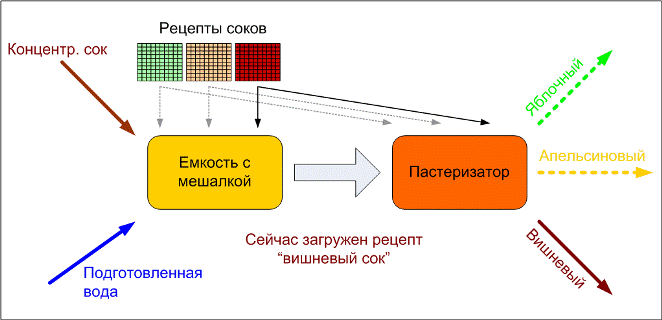
Рис. 1. Иллюстрация рецептурного управления на примере производства различных видов сока
Это все напоминает процесс приготовления еды на кухне, где мы оттачиваем рецепты разных блюд, но при этом используем одни и те же орудия (кастрюли, ножи, разделочные доски, плиту и т.д.)
Теперь попробуем дать характеристику batch-процессу:
1. На выходе несколько видов продукции.
2. При производстве разных видов продукции задействуется одно и то же технологическое оборудование.
3. Имеется множество рецептов.
4. Производство по “партиям”, которое может быть относительно легко и без последствий остановлено после завершения партии, а потом возобновлено.
Автоматизированное управление batch-процессом называется рецептурным управлением (batch control, или recipe control). Этот вид управления несколько специфичен, и требует от системы управления некоторой смекалки. Конечно, можно использовать для задач рецептурного управления обычные программные блоки, подходящие для управления непрерывным процессом, НО на практике это приводит к огромным трудностям (=головной боли) при попытке все это реализовать, используя стандартные подходы программирования. Поэтому многие производители АСУ ТП разработали специализированные batch-модули, которые адаптированы именно под рецептурные процессы. Эти модули могут выполняться на уровне ПЛК или на выделенном сервере batch. Иногда эти сервера, к тому же, резервируются. Также batch-модули дополняются специализированной средой разработки batch-программ, что сильно облегчает жизнь инженера.
На рисунке ниже в качестве примера приведена конфигурация верхнего уровня АСУ ТП SIMATIC PCS 7, оснащенной выделенным сервером batch.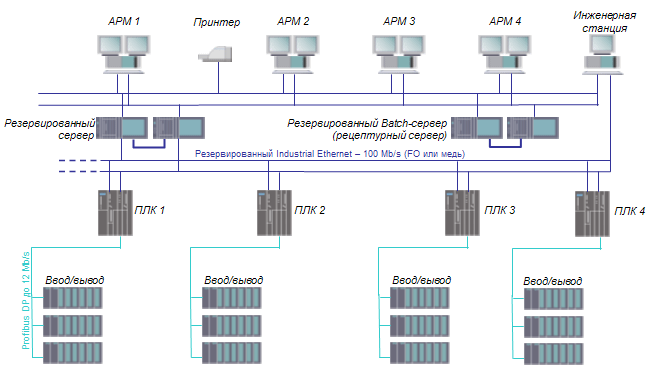
Рис. 2. Структурная схема АСУ ТП с выделенным сервером batch
Перечислим основные обязанности системы batch-управления:
1. Ну, собственно, самая главная задача – хранение/загрузка рецептов и их выполнение в режиме реального времени ( batch process management).
2. Отслеживание, не занята ли технологическая установка выполнением другого рецепта. Если занята, то выделяется другая аналогичная установка для выполнения данного рецепта ( process unit allocation).
3. Формирование отчетов об изготовление партии продукции в задаваемой пользователем форме. Причем, требуются отчеты с возможностью отслеживания истории (ретроспективы) “прогона” партии по технологической цепочке ( reporting and batch tracking).
4. Расчет различных показателей эффективности производства, как, например: удельного времени простоя (в %), производительности (в л/c) технологической установки или полного времени изготовления партии продукции (в мин).
5. Планирование изготовления партий, что фактически подразумевает составление производственного расписания. Ну, это на самом деле ни одна система в полном объеме пока не реализует ( batch planning).
И еще несколько слов.
Как правило, пакет batch состоит из двух частей – операторской (клиентской) и исполняемой. Клиентская часть устанавливается на АРМы и всего лишь обеспечивает удобный операторский интерфейс. Клиентская часть, как правило, органично вписывается в общую операторскую среду, и работа с ней идет непосредственно из мнемосхем.
Исполняемая часть – это костяк системы. Именно она ответственна за автоматизированное выполнение задач рецептурного управления, описанных выше. Исполняемая часть прогружается в специальные серверы batch или в обычные ПЛК в зависимости от архитектуры АСУ ТП.
И еще. Существует международный стандарт ISA-88, специфицирующий batch-процессы, определяющий модель и философию рецептурного управления, а также стандартизирующий соответствующую терминологию. Документ тяжеловесный, и посему прочитан полностью мной не был. Тем не менее, в следующей части я попытаюсь более детально описать рецептурные системы с привязкой именно к стандарту ISA-88.[ http://kazanets.narod.ru/Batch_P1.htm]
Тематики
EN
Русско-английский словарь нормативно-технической терминологии > система рецептурного управления технологическим процессом
-
15 человеко-машинный интерфейс
- operator-machine communication
- MMI
- man-machine interface
- man-machine communication
- human-machine interface
- human-computer interface
- human interface device
- human interface
- HMI
- computer human interface
- CHI
человеко-машинный интерфейс (ЧМИ)
Технические средства, предназначенные для обеспечения непосредственного взаимодействия между оператором и оборудованием и дающие возможность оператору управлять оборудованием и контролировать его функционирование.
Примечание
Такие средства могут включать приводимые в действие вручную органы управления, контрольные устройства, дисплеи.
[ ГОСТ Р МЭК 60447-2000]
человекомашинный интерфейс (ЧМИ)
Технические средства контроля и управления, являющиеся частью оборудования, предназначенные для обеспечения непосредственного взаимодействия между оператором и оборудованием и дающие возможность оператору управлять оборудованием и контролировать его функционирование (ГОСТ Р МЭК 60447).
Примечание
Такие средства могут включать приводимые в действие вручную органы управления, контрольные устройства и дисплеи.
[ ГОСТ Р МЭК 60073-2000]
человеко-машинный интерфейс
Средства обеспечения двусторонней связи "оператор - технологическое оборудование" (АСУ ТП). Название класса средств, в который входят подклассы:
SCADA (Supervisory Control and Data Acquisition) - Операторское управление и сбор данных от технологического оборудования.
DCS (Distributed Control Systems) - Распределенная система управления технологическим оборудованием.
[ http://www.morepc.ru/dict/]Параллельные тексты EN-RU
MotorSys™ iPMCC solutions can integrate a dedicated human-machine interface (HMI) or communicate via a personal computer directly on the motor starters.
[Schneider Electric]Интеллектуальный центр распределения электроэнергии и управления электродвигателями MotorSys™ может иметь в своем составе специальный человеко-машинный интерфейс (ЧМИ). В качестве альтернативы используется обмен данным между персональным компьютером и пускателями.
[Перевод Интент]
HMI на базе операторских станций
Самое, пожалуй, главное в системе управления - это организация взаимодействия между человеком и программно-аппаратным комплексом. Обеспечение такого взаимодействия и есть задача человеко-машинного интерфейса (HMI, human machine interface).
На мой взгляд, в аббревиатуре “АСУ ТП” ключевым является слово “автоматизированная”, что подразумевает непосредственное участие человека в процессе реализации системой определенных задач. Очевидно, что чем лучше организован HMI, тем эффективнее человек сможет решать поставленные задачи.
Как же организован HMI в современных АСУ ТП?
Существует, как минимум, два подхода реализации функционала HMI:- На базе специализированных рабочих станций оператора, устанавливаемых в центральной диспетчерской;
- На базе панелей локального управления, устанавливаемых непосредственно в цеху по близости с контролируемым технологическим объектам.
Иногда эти два варианта комбинируют, чтобы достичь наибольшей гибкости управления. В данной статье речь пойдет о первом варианте организации операторского уровня.
Аппаратно рабочая станция оператора (OS, operator station) представляет собой ни что иное как персональный компьютер. Как правило, станция снабжается несколькими широкоэкранными мониторами, функциональной клавиатурой и необходимыми сетевыми адаптерами для подключения к сетям верхнего уровня (например, на базе Industrial Ethernet). Станция оператора несколько отличается от привычных для нас офисных компьютеров, прежде всего, своим исполнением и эксплуатационными характеристиками (а также ценой 4000 - 10 000 долларов).
На рисунке 1 изображена рабочая станция оператора системы SIMATIC PCS7 производства Siemens, обладающая следующими техническими характеристиками:
Процессор: Intel Pentium 4, 3.4 ГГц;
Память: DDR2 SDRAM до 4 ГБ;
Материнская плата: ChipSet Intel 945G;
Жесткий диск: SATA-RAID 1/2 x 120 ГБ;
Слоты: 4 x PCI, 2 x PCI E x 1, 1 x PCI E x 16;
Степень защиты: IP 31;
Температура при эксплуатации: 5 – 45 C;
Влажность: 5 – 95 % (без образования конденсата);
Операционная система: Windows XP Professional/2003 Server.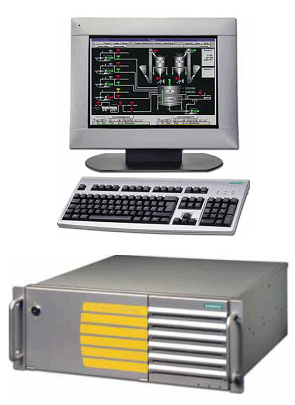
Рис. 1. Пример промышленной рабочей станции оператора.Системный блок может быть как настольного исполнения ( desktop), так и для монтажа в 19” стойку ( rack-mounted). Чаще применяется второй вариант: системный блок монтируется в запираемую стойку для лучшей защищенности и предотвращения несанкционированного доступа.
Какое программное обеспечение используется?
На станции оператора устанавливается программный пакет визуализации технологического процесса (часто называемый SCADA). Большинство пакетов визуализации работают под управлением операционных систем семейства Windows (Windows NT 4.0, Windows 2000/XP, Windows 2003 Server), что, на мой взгляд, является большим минусом.
Программное обеспечение визуализации призвано выполнять следующие задачи:- Отображение технологической информации в удобной для человека графической форме (как правило, в виде интерактивных мнемосхем) – Process Visualization;
- Отображение аварийных сигнализаций технологического процесса – Alarm Visualization;
- Архивирование технологических данных (сбор истории процесса) – Historical Archiving;
- Предоставление оператору возможности манипулировать (управлять) объектами управления – Operator Control.
- Контроль доступа и протоколирование действий оператора – Access Control and Operator’s Actions Archiving.
- Автоматизированное составление отчетов за произвольный интервал времени (посменные отчеты, еженедельные, ежемесячные и т.д.) – Automated Reporting.
Как правило, SCADA состоит из двух частей:
- Среды разработки, где инженер рисует и программирует технологические мнемосхемы;
- Среды исполнения, необходимой для выполнения сконфигурированных мнемосхем в режиме runtime. Фактически это режим повседневной эксплуатации.
Существует две схемы подключения операторских станций к системе управления, а точнее уровню управления. В рамках первой схемы каждая операторская станция подключается к контроллерам уровня управления напрямую или с помощью промежуточного коммутатора (см. рисунок 2). Подключенная таким образом операторская станция работает независимо от других станций сети, и поэтому часто называется одиночной (пусть Вас не смущает такое название, на самом деле таких станций в сети может быть несколько).
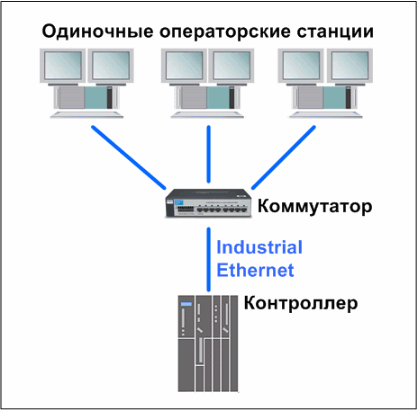
Рис. 2. Схема подключения одиночных операторских станций к уровню управления.Есть и другой вариант. Часто операторские станции подключают к серверу или резервированной паре серверов, а серверы в свою очередь подключаются к промышленным контроллерам. Таким образом, сервер, являясь неким буфером, постоянно считывает данные с контроллера и предоставляет их по запросу рабочим станциям. Станции, подключенные по такой схеме, часто называют клиентами (см. рисунок 3).
Как происходит информационный обмен?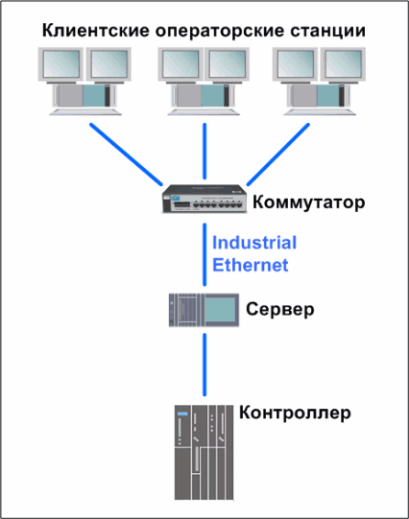
Рис. 3. Клиент-серверная архитектура операторского уровня.
Для сопряжения операторской станции с промышленным контроллером на первой устанавливается специальное ПО, называемое драйвером ввода/вывода. Драйвер ввода/вывода поддерживает совместимый с контроллером коммуникационный протокол и позволяет прикладным программам считывать с контроллера параметры или наоборот записывать в него. Пакет визуализации обращается к драйверу ввода/вывода каждый раз, когда требуется обновление отображаемой информации или запись измененных оператором данных. Для взаимодействия пакета визуализации и драйвера ввода/вывода используется несколько протоколов, наиболее популярные из которых OPC (OLE for Process Control) и NetDDE (Network Dynamic Data Exchange). Обобщенно можно сказать, что OPC и NetDDE – это протоколы информационного обмена между различными приложениями, которые могут выполняться как на одном, так и на разных компьютерах. На рисунках 4 и 5 изображено, как взаимодействуют программные компоненты при различных схемах построения операторского уровня.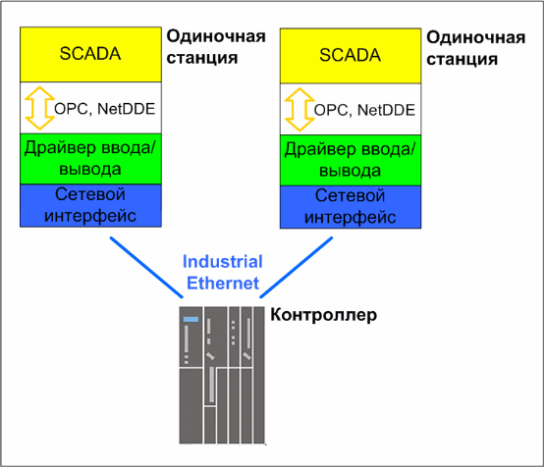
Рис. 4. Схема взаимодействия программных модулей при использовании одиночных станций.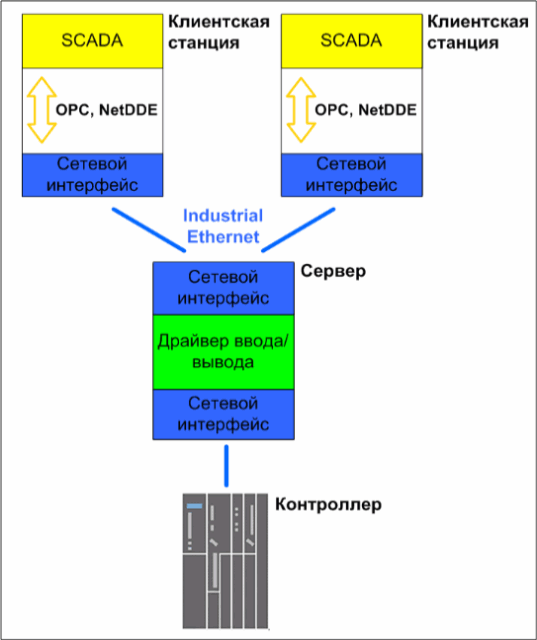
Рис. 5. Схема взаимодействия программных модулей при использовании клиент-серверной архитектуры.
Как выглядит SCADA?
Разберем простой пример. На рисунке 6 приведена абстрактная схема технологического процесса, хотя полноценным процессом это назвать трудно.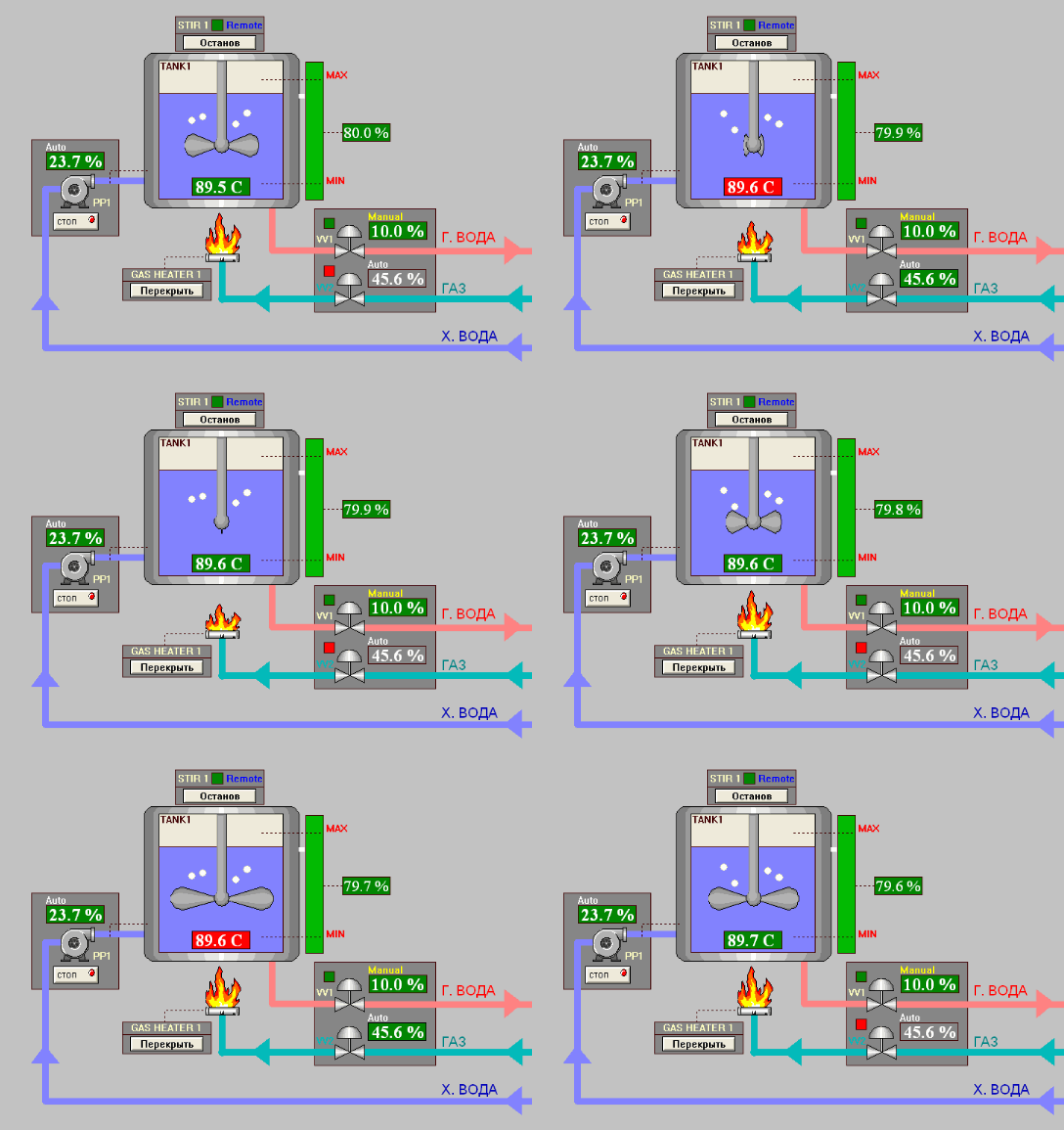 Рис. 6. Пример операторской мнемосхемы.
На рисунке 6 изображен очень упрощенный вариант операторской мнемосхемы для управления тех. процессом. Как видно, резервуар (емкость) наполняется водой. Задача системы - нагреть эту воду до определенной температуры. Для нагрева воды используется газовая горелка. Интенсивность горения регулируется клапаном подачи газа. Также должен быть насос для закачки воды в резервуар и клапан для спуска воды.
На мнемосхеме отображаются основные технологические параметры, такие как: температура воды; уровень воды в резервуаре; работа насосов; состояние клапанов и т.д. Эти данные обновляются на экране с заданной частотой. Если какой-либо параметр достигает аварийного значения, соответствующее поле начинает мигать, привлекая внимание оператора.
Сигналы ввода/вывода и исполнительные механизмы отображаются на мнемосхемах в виде интерактивных графических символов (иконок). Каждому типу сигналов и исполнительных механизмов присваивается свой символ: для дискретного сигнала это может быть переключатель, кнопка или лампочка; для аналогового – ползунок, диаграмма или текстовое поле; для двигателей и насосов – более сложные фейсплейты ( faceplates). Каждый символ, как правило, представляет собой отдельный ActiveX компонент. Вообще технология ActiveX широко используется в SCADA-пакетах, так как позволяет разработчику подгружать дополнительные символы, не входящие в стандартную библиотеку, а также разрабатывать свои собственные графические элементы, используя высокоуровневые языки программирования.
Допустим, оператор хочет включить насос. Для этого он щелкает по его иконке и вызывает панель управления ( faceplate). На этой панели он может выполнить определенные манипуляции: включить или выключить насос, подтвердить аварийную сигнализацию, перевести его в режим “техобслуживания” и т.д. (см. рисунок 7).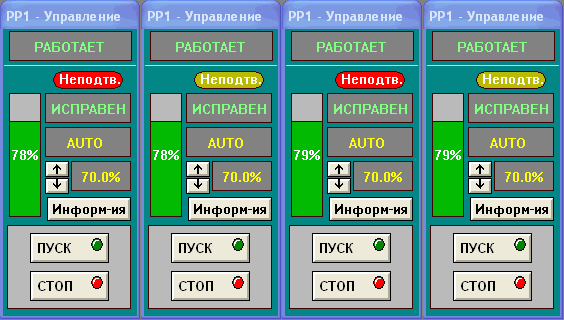 Рис. 7. Пример фейсплейта для управления насосом.Оператор также может посмотреть график изменения интересующего его технологического параметра, например, за прошедшую неделю. Для этого ему надо вызвать тренд ( trend) и выбрать соответствующий параметр для отображения. Пример тренда реального времени показан на рисунке 8.
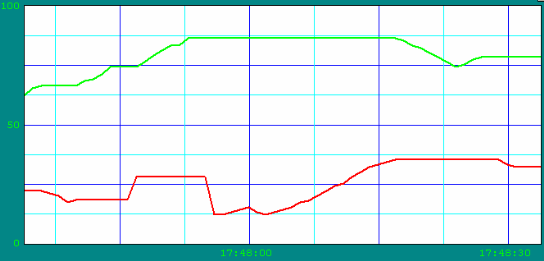 Рис. 8. Пример отображения двух параметров на тренде реального времени.
Для более детального обзора сообщений и аварийных сигнализаций оператор может воспользоваться специальной панелью ( alarm panel), пример которой изображен на рисунке 9. Это отсортированный список сигнализаций (alarms), представленный в удобной для восприятия форме. Оператор может подтвердить ту или иную аварийную сигнализацию, применить фильтр или просто ее скрыть.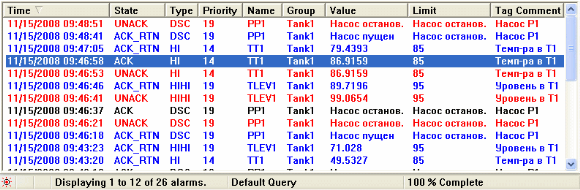 Рис. 9. Панель сообщений и аварийных сигнализаций.
Говоря о SCADA, инженеры часто оперируют таким важным понятием как “тэг” ( tag). Тэг является по существу некой переменной программы визуализации и может быть использован как для локального хранения данных внутри программы, так и в качестве ссылки на внешний параметр процесса. Тэги могут быть разных типов, начиная от обычных числовых данных и кончая структурой с множеством полей. Например, один визуализируемый параметр ввода/вывода – это тэг, или функциональный блок PID-регулятора, выполняемый внутри контроллера, - это тоже тэг. Ниже представлена сильно упрощенная структура тэга, соответствующего простому PID-регулятору:
Tag Name = “MyPID”;
Tag Type = PID;
Fields (список параметров):
MyPID.OP
MyPID.SP
MyPID.PV
MyPID.PR
MyPID.TI
MyPID.DI
MyPID.Mode
MyPID.RemoteSP
MyPID.Alarms и т.д.
В комплексной прикладной программе может быть несколько тысяч тэгов. Производители SCADA-пакетов это знают и поэтому применяют политику лицензирования на основе количества используемых тэгов. Каждая купленная лицензия жестко ограничивает суммарное количество тэгов, которые можно использовать в программе. Очевидно, чем больше тегов поддерживает лицензия, тем дороже она стоит; так, например, лицензия на 60 000 тэгов может обойтись в 5000 тыс. долларов или даже дороже. В дополнение к этому многие производители SCADA формируют весьма существенную разницу в цене между “голой” средой исполнения и полноценной средой разработки; естественно, последняя с таким же количеством тэгов будет стоить заметно дороже.
Сегодня на рынке представлено большое количество различных SCADA-пакетов, наиболее популярные из которых представлены ниже:
1. Wonderware Intouch;
2. Simatic WinCC;
3. Iconics Genesis32;
4. Citect;
5. Adastra Trace Mode
Лидирующие позиции занимают Wonderware Intouch (производства Invensys) и Simatic WinCC (разработки Siemens) с суммарным количеством инсталляций более 80 тыс. в мире. Пакет визуализации технологического процесса может поставляться как в составе комплексной системы управления, так и в виде отдельного программного продукта. В последнем случае SCADA комплектуется набором драйверов ввода/вывода для коммуникации с контроллерами различных производителей. [ http://kazanets.narod.ru/HMI_PART1.htm]Тематики
- автоматизация, основные понятия
- автоматизированные системы
Синонимы
EN
Русско-английский словарь нормативно-технической терминологии > человеко-машинный интерфейс
16 отчёт о нарушении процесса
Sakhalin energy glossary: process upset reporting (PUR; ОНП)Универсальный русско-английский словарь > отчёт о нарушении процесса
17 сбор данных и отчёт о ходе технологического процесса
Chemical weapons: process data acquisition and reportingУниверсальный русско-английский словарь > сбор данных и отчёт о ходе технологического процесса
18 система текущего контроля
1. monitor system2. monitoring systemРусско-английский большой базовый словарь > система текущего контроля
19 accounting cycle
Finthe regular process of formally updating a firm’s financial position by recording, analyzing, and reporting its transactions during the accounting period20 amortization
Fin1. a method of recovering (deducting or writing off) the capital costs of intangible assets over a fixed period of time.EXAMPLEFor tax purposes, the distinction is not always made between amortization and depreciation, yet amortization remains a viable financial accounting concept in its own right.It is computed using the straight-line method of depreciation: divide the initial cost of the intangible asset by the estimated useful life of that asset.Initial cost/useful life = amortization per yearFor example, if it costs $10,000 to acquire a patent and it has an estimated useful life of 10 years, the amortized amount per year is $1,000.$10,000/10 = $1,000 per yearThe amount of amortization accumulated since the asset was acquired appears on the organization’s balance sheet as a deduction under the amortized asset.While that formula is straightforward, amortization can also incorporate a variety of noncash charges to net earnings and/or asset values, such as depletion, write-offs, prepaid expenses, and deferred charges. Accordingly, there are many rules to regulate how these charges appear on financial statements. The rules are different in each country, and are occasionally changed, so it is necessary to stay abreast of them and rely on expert advice.For financial reporting purposes, an intangible asset is amortized over a period of years. The amortizable life—“useful life”—of an intangible asset is the period over which it gives economic benefit.Intangibles that can be amortized can include:Copyrights, based on the amount paid either to purchase them or to develop them internally, plus the costs incurred in producing the work (wages or materials, for example). At present, a copyright is granted to a corporation for 75 years, and to an individual for the life of the author plus 50 years. However, the estimated useful life of a copyright is usually far less than its legal life, and it is generally amortized over a fairly short period;Cost of a franchise, including any fees paid to the franchiser, as well legal costs or expenses incurred in the acquisition. A franchise granted for a limited period should be amortized over its life. If the franchise has an indefinite life, it should be amortized over a reasonable period not to exceed 40 years;Covenants not to compete: an agreement by the seller of a business not to engage in a competing business in a certain area for a specific period of time. The cost of the not-tocompete covenant should be amortized over the period covered by the covenant unless its estimated economic life is expected to be less;Easement costs that grant a right of way may be amortized if there is a limited and specified life; Organization costs incurred when forming a corporation or a partnership, including legal fees, accounting services, incorporation fees, and other related services.Organization costs are usually amortized over 60 months;Patents, both those developed internally and those purchased. If developed internally, a patent’s “amortizable basis” includes legal fees incurred during the application process. A patent should be amortized over its legal life or its economic life, whichever is the shorter;Trademarks, brands, and trade names, which should be written off over a period not to exceed 40 years;Other types of property that may be amortized include certain intangible drilling costs, circulation costs, mine development costs, pollution control facilities, and reforestation expenditures;Certain intangibles cannot be amortized, but may be depreciated using a straight-line approach if they have “determinable” useful life. Because the rules are different in each country and are subject to change, it is essential to rely on specialist advice.2. the repayment of the principal and interest on a loan in equal amounts over a period of timeСтраницы- 1
- 2
См. также в других словарях:
Process modeling — The term process model is used in different contexts. For example, in business process modeling the enterprise process model is often referred to as the business process model . Process models are core concepts in the discipline of Process… … Wikipedia
Process area (CMMI) — The latest version of Capability Maturity Model Integration (CMMI) CMMI for Development, Version 1.3 contains 22 Process Areas that describe the aspects of product development that are to be covered by organizational processes. Contents 1 Process … Wikipedia
Process Development Execution System — A Process Development Execution System (PDES) is a system, which is used by companies to perform development activities for high tech manufacturing processes. A PDES is similar to a Manufacturing Execution System (MES) in several aspects. The… … Wikipedia
Reporting Currency — The currency which is used for an entity s financial statements. The reporting currency in financial statements and other financial reports are easiest to understand when they are compiled using only one currency. However, many large companies… … Investment dictionary
process — 1. noun An intentional, sequential series of actions to achieve a defined purpose. See also *business process re engineering. 2. noun A court action. 3. verb The sorting, analysis, and reporting of *data, especially by a computer. See *data… … Auditor's dictionary
Chief process officer — A chief process officer (CPO) is an executive responsible at the highest level of an organization. CPOs usually report direct to the CEO or board of directors. They oversee the business process activities, are responsible for defining rules and… … Wikipedia
Aviation Safety Reporting System — The Aviation Safety Reporting System, or ASRS, is a voluntary system that allows pilots and other airplane crew members to confidentially report near misses and close calls in the interest of improving air safety. The confidential and independent … Wikipedia
Windows Error Reporting — displaying Problem Details from an issue with Windows Explorer Windows Error Reporting (WER) (codenamed Watson) is a crash reporting technology introduced by Microsoft with Windows XP[1 … Wikipedia
Nationwide Suspicious Activity Reporting Initiative — The Nationwide Suspicious Activity Reporting (SAR) Initiative (NSI) is a program of the United States Government used to collect and share reports of suspicious activity by people in the United States.[1] [2] The Nationwide SAR Initiative (NSI)… … Wikipedia
Information technology audit process — Information technology audit process:Generally Accepted Auditing Standards (GAAS)In 1947, the American Institute of Certified Public Accountants (AICPA) adopted GAAS to establish standards for audits. The standards cover the following three… … Wikipedia
Digital forensic process — A Tableau forensic write blocker The Digital forensic process is a recognised scientific and forensic process used in digital forensics investigations.[1][2] Forensics researcher Eoghan Casey … Wikipedia
 18+© Академик, 2000-2025
- Обратная связь: Техподдержка, Реклама на сайте
Экспорт словарей на сайты, сделанные на PHP, Joomla, Drupal, WordPress, MODx.
Перевод: со всех языков на английский
с английского на все языки- С английского на:
- Все языки
- Со всех языков на:
- Все языки
- Английский
- Арабский
- Немецкий
- Русский
- Французский