

-
21 максимальный расцепитель тока с обратнозависимой выдержкой времени
максимальное реле или максимальный расцепитель тока с обратнозависимой выдержкой времени
Максимальное реле или максимальный расцепитель тока, срабатывающие с выдержкой времени, находящейся в обратной зависимости от значения сверхтока.
Примечание. Такие реле или расцепитель могут быть спроектированы так, чтобы при высоких значениях сверхтока выдержка времени достигала определенного минимального значения.
[ ГОСТ Р 50030. 1-2000 ( МЭК 60947-1-99)]
максимальный расцепитель тока с обратно-зависимой выдержкой времени
Максимальный расцепитель тока, срабатывающий после выдержки времени, находящейся в обратной зависимости от значения сверхтока.
Примечание — Такой расцепитель может быть спроектирован так, чтобы эта выдержка времени при высоких значениях сверхтока достигала определенного минимального значения
[ ГОСТ Р 50345-99( МЭК 60898-95)]EN
inverse time-delay over-current release
an over-current release which operates after a time-delay inversely dependent upon the value of the over-current
NOTE - Such a release may be designed so that the time-delay approaches a definite minimum value for high values of over-current.
[IEV number 441-16-35]
[IEC 62271-100, ed. 2.0 (2008-04)]
inverse time-delay overcurrent release
overcurrent release which operates after a time-delay inversely dependent upon the value of the overcurrent
NOTE - Such a release may be designed so that the time-delay approaches a definite minimum for high values of overcurrent.
[IEV number 441-16-35]
[IEC 60898-1, ed. 1.0 (2002-01)]FR
déclencheur à maximum de courant à temps inverse
déclencheur à maximum de courant qui fonctionne après un intervalle de temps qui varie en raison inverse de la valeur de la surintensité
NOTE - Un tel déclencheur peut être prévu pour que le retard atteigne une valeur minimale définie pour les valeurs élevées de la surintensité.
[IEV number 441-16-35]
[IEC 62271-100, ed. 2.0 (2008-04)]
[IEC 60898-1, ed. 1.0 (2002-01)]Недопустимые, нерекомендуемые
Тематики
- выключатель автоматический
- расцепитель, тепловое реле
Классификация
>>>EN
DE
FR
Русско-немецкий словарь нормативно-технической терминологии > максимальный расцепитель тока с обратнозависимой выдержкой времени
-
22 постоянная (счетчика)
постоянная (счетчика)
-
[IEV number 314-07-08]EN
(meter) constant
value expressing the relation between the active energy registered by a meter and the corresponding value of the test output.
NOTE – If this value is a number of pulses, the constant should be either pulses per kilowatt-hour (imp/kWh) or watt-hours per pulse (Wh/imp)
[IEV number 314-07-08]FR
co nstante (du compteur)
valeur exprimant la relation entre l’énergie enregistrée par un compteur et la valeur correspondante donnée par le dispositif de sortie d’essai
NOTE – Si cette valeur est un nombre d’impulsions, la constante doit être soit le nombre d’impulsions par kilowattheure (imp/kWh), soit le nombre de wattheures par impulsion (Wh/imp)
[IEV number 314-07-08]Тематики
- измерение электр. величин в целом
- счетчик электроэнергии
EN
DE
FR
Русско-немецкий словарь нормативно-технической терминологии > постоянная (счетчика)
-
23 предельное значение тока несрабатывания при неравномерной нагрузке в многофазной цепи
- Grenzwert der Nichtbetätigungs-Überstromstärke bei unsymmetrischen Lasten in einem Mehrphasen-Stromkreis
предельное значение тока несрабатывания при неравномерной нагрузке в многофазной цепи
-
[IEV number 442-05-63]EN
limiting value of the non-operating current in case of unbalanced load in a multiphase circuit
Maximum value of current which, in the absence of any fault to frame or to earth, and of an earth leakage current, can flow in a circuit containing only two active conductors of the installation, without causing operation of the part of the residual current device performing the evaluation.
[IEV number 442-05-63]FR
valeur limite du courant de non-fonctionnement en service déséquilibré dans un circuit polyphasé
Valeur maximale du courant pouvant circuler, en l'absence de tout défaut à la masse ou à la terre et de tout courant de fuite à la terre, dans un circuit intéressant seulement deux conducteurs actifs de l'installation sans provoquer le fonctionnement de la partie du dispositif de coupure différentiel assurant la fonction mesure.
[IEV number 442-05-63]EN
- limiting value of the non-operating current in case of unbalanced load in a multiphase circuit
DE
- Grenzwert der Nichtbetätigungs-Überstromstärke bei unsymmetrischen Lasten in einem Mehrphasen-Stromkreis
FR
- valeur limite du courant de non-fonctionnement en service déséquilibré dans un circuit polyphasé
Русско-немецкий словарь нормативно-технической терминологии > предельное значение тока несрабатывания при неравномерной нагрузке в многофазной цепи
-
24 предельное значение тока несрабатывания при равномерной нагрузке
предельное значение тока несрабатывания при равномерной нагрузке
-
[IEV number 442-05-64]EN
limiting value of the non-operating current in case of balanced load
Maximum value of current which, in the absence of any fault to frame or to earth, and of an earth leakage current, can flow in a circuit without any load unbalance, without causing operation of the part of the residual current device performing the evaluation.
[IEV number 442-05-64]FR
valeur limite du courant de non-fonctionnement en service équilibré
Valeur maximale du courant pouvant circuler dans un circuit, en l'absence de tout défaut à la masse ou à la terre et de tout courant de fuite à la terre en l'absence de tout déséquilibre de charge, sans provoquer le fonctionnement de la partie du dispositif de coupure différentiel assurant la fonction mesure.
[IEV number 442-05-64]EN
DE
FR
Русско-немецкий словарь нормативно-технической терминологии > предельное значение тока несрабатывания при равномерной нагрузке
-
25 предельное наименьшее значение рабочего напряжения вспомогательного источника питания
предельное наименьшее значение рабочего напряжения вспомогательного источника питания
-
[IEV number 442-05-33]EN
limiting value of the operating voltage of the auxiliary source
minimum value of the voltage of the auxiliary source, at which the residual current device still operates under specified conditions in the case of decreasing voltage of the auxiliary source
[IEV number 442-05-33]FR
valeur limite de la tension de fonctionnement de la source auxiliaire
valeur minimale de la tension de la source auxiliaire pour laquelle le dispositif de coupure différentiel fonctionne encore dans des conditions spécifiées en cas de diminution de la tension de la source auxiliaire
[IEV number 442-05-33]Тематики
EN
DE
FR
Русско-немецкий словарь нормативно-технической терминологии > предельное наименьшее значение рабочего напряжения вспомогательного источника питания
-
26 природный ресурс
природный ресурс
—
[ http://www.eionet.europa.eu/gemet/alphabetic?langcode=en]EN
natural resource
A feature or component of the natural environment that is of value in serving human needs, e.g. soil, water, plantlife, wildlife, etc. Some natural resources have an economic value (e.g. timber) while others have a "noneconomic" value (e.g. scenic beauty). (Source: UNUN)
[http://www.eionet.europa.eu/gemet/alphabetic?langcode=en]Тематики
EN
DE
FR
Русско-немецкий словарь нормативно-технической терминологии > природный ресурс
-
27 устройство дифференциального тока
устройство дифференциального тока
УДТ
Механическое коммутационное устройство, предназначенное включать, проводить и отключать токи в нормальных рабочих условиях и вызывать размыкание контактов, когда дифференциальный ток достигает заданного значения в определенных условиях.
Примечание - Устройство дифференциального тока может быть комбинацией различных отдельных элементов, предназначенных обнаруживать и оценивать дифференциальный ток, а также включать и отключать электрический ток.
Примечание - В национальной нормативной документации вместо термина «устройство дифференциального тока» применяют термин « устройство защитного отключения».
[ ГОСТ Р 50571. 1-2009 ( МЭК 60364-1: 2005)]
устройство дифференциального тока
УДТ
Механическое коммутационное устройство или комплекс устройств, которые вызывают размыкание контактов, когда дифференциальный или несбалансированный ток достигнет заданного значения в заданных условиях.
[ ГОСТ Р 51992-2011( МЭК 61643-1: 2005)]EN
residual current device
RCD, (abbreviation)
a mechanical switching device designed to make, carry and break currents under normal service conditions and to cause the opening of the contacts when the residual current attains a given value under specified conditions
NOTE – A residual current device can be a combination of various separate elements designed to detect and evaluate the residual current and to make and break current.
[IEV number 442-05-02]FR
dispositif (de coupure) différentiel
dispositif (à courant) différentiel résiduel
DDR (abréviation)
dispositif mécanique de coupure destiné à établir, supporter et couper des courants dans les conditions de service normales et à provoquer l'ouverture des contacts quand le courant différentiel atteint, dans des conditions spécifiées, une valeur donnée
NOTE – Un dispositif de coupure différentiel peut être une combinaison de divers éléments séparés conçus pour détecter et mesurer le courant différentiel et pour établir ou interrompre le courant.
[IEV number 442-05-02]Параллельные тексты EN-RU Operating principle of residual current devices
The operating principle of residual current devices consists in the detection of an earth fault current by means of a toroidal transformer which encloses all the live conductors, included the neutral, if distributed.
In absence of an earth fault the vectorial sum of the currents IΔ is equal to zero; in case of an earth fault, if the value of IΔ exceeds the value of the trip threshold, called IΔ n, the circuit at the secondary of the toroid sends a command signal to a dedicated opening device causing the circuit-breaker tripping.
[ABB]Принцип действия устройств дифференциального тока
Принцип действия устройств дифференциального тока заключается в обнаружении тока замыкания на землю с помощью тороидального трансформатора, который охватывает все токоведущие, в том числе и нейтральный проводник, если он используется для распределения электроэнергии.
При отсутствии замыкания на землю векторная сумма токов IΔ равна нулю. Если при возникновении замыкания на землю значение IΔ превысит уставку срабатывания, обозначаемую как IΔn, то во вторичной обмотке тороидального трансформатора будет наведена ЭДС, достаточная для включения специального устройства, вызывающего срабатывание автоматического выключателя
[Перевод Интент]Тематики
- аппарат, изделие, устройство...
- электроустановки
Обобщающие термины
Синонимы
EN
- RCD, (abbreviation)
- residual current device
DE
FR
Русско-немецкий словарь нормативно-технической терминологии > устройство дифференциального тока
-
28 эталонное значение влияющей величины
эталонное значение влияющей величины
-
[IEV number 442-05-36]EN
reference value of an influencing quantity
the value of an influencing quantity to which the manufacturer's stated characteristics are referred
[IEV number 442-05-36]FR
valeur de référence d'une grandeur d'influence
valeur d'une grandeur d'influence à laquelle sont rapportées les caractéristiques indiquées par le constructeur
[IEV number 442-05-36]EN
DE
FR
Русско-немецкий словарь нормативно-технической терминологии > эталонное значение влияющей величины
-
29 налог на добавленную стоимость
n1) gener. mwst2) law. (вновь созданную) Mehrwertsteuer, Mehrwertzuwachssteuer4) busin. Value Added Tax5) f.trade. Mehrwertsteuer, WertzuwachssteuerУниверсальный русско-немецкий словарь > налог на добавленную стоимость
-
30 значение величины
DEU[lang name="GermanNewSpelling"] Größenwrt; WertFIN suureen arvoENG[lang name="English"] value of a quantity; value -
31 автоматический выключатель
автоматический выключатель
Механический коммутационный аппарат1), способный включать, проводить и отключать токи при нормальном состоянии электрической цепи, а также включать, проводить в течение заданного времени и автоматически отключать токи в указанном аномальном состоянии электрической цепи, например, при коротком замыкании.
(МЭС 441-14-20)
[ ГОСТ Р 50030. 2-99 ( МЭК 60947-2-98)]
автоматический выключатель
-
[IEV number 442-05-01]EN
circuit breaker
a mechanical switching device, capable of making, carrying and breaking currents under normal circuit conditions and also making, carrying for a specified time and breaking currents under specified abnormal circuit conditions such as those of short circuit.
[IEC 62271-100, ed. 2.0 (2008-04)]
[IEV number 442-05-01]
circuit breaker
A device designed to open and close a circuit by nonautomatic means and to open the circuit automatically on a predetermined overcurrent without damage to itself when properly applied within its rating.
NOTE The automatic opening means can be integral, direct acting with the circuit breaker, or remote from the circuit breaker.
Adjustable (as applied to circuit breakers). A qualifying term indicating that the circuit breaker can be set to trip at various values of current, time, or both within a predetermined range. Instantaneous-trip (as applied to circuit breakers). A qualifying term indicating that no delay is purposely introduced in the tripping action of the circuit breaker.
Inverse-time (as applied to circuit breakers). A qualifying term indicating a delay is purposely introduced in the tripping action of the circuit breaker, which delay decreases as the magnitude of the current increases.
Nonadjustable (as applied to circuit breakers). A qualifying term indicating that the circuit breaker does not have any adjustment to alter the value of current at which it will trip or the time required for its operation.
Setting (of a circuit breaker). The value of current, time, or both at which an adjustable circuit breaker is set to trip.
[National Electrical Cod]FR
disjoncteur
1) Должно быть контактный коммутационный аппарат
appareil mécanique de connexion capable d’établir, de supporter et d’interrompre des courants dans les conditions normales du circuit, ainsi que d’établir, de supporter pendant une durée spécifiée et d’in- terrompre des courants dans des conditions anormales spécifiées du circuit telles que celles du court-circuit.
[IEC 62271-100, ed. 2.0 (2008-04)]
[IEV number 442-05-01]
[Интент]КЛАССИФИКАЦИЯ
- По роду тока
- По напряжению
- По числу полюсов
- По виду корпуса
- По месту установки
- По изолирующей среде
- По установленным расцепителям
- По дополнительным защитам
- По назначению
- По категории применения
- По виду привода взвода пружины
- По выполняемой функции
-
По влиянию монтажного положения
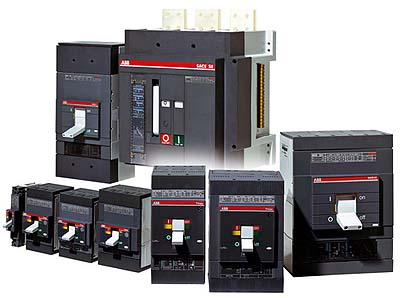 Автоматические выключатели ABB
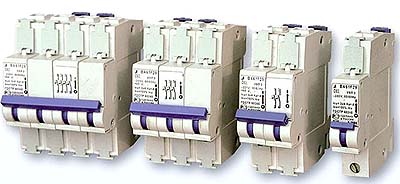 Модульные автоматические выключатели
1. НЕКОТОРЫЕ СВЕДЕНИЯ ОБ АВТОМАТИЧЕСКИХ ВЫКЛЮЧАТЕЛЯХ Автоматический выключатель — это электрический аппарат, который автоматически отключает (и тем самым защищает) электрическую цепь при возникновении в ней аномального режима. Режим становится аномальным, когда в цепи начинает недопустимо изменяться (т. е. увеличиваться или уменьшаться относительно номинального значения) ток или напряжение.
Другими словами (более "инженерно") можно сказать, что автоматический выключатель защищает от токов короткого замыкания и токов перегрузки отходящую от него питающую линию, например, кабель и приемник(и) электрической энергии (осветительную сеть, розетки, электродвигатель и т. п.).
Как правило, автоматический выключатель может применятся также для нечастого (несколько раз в сутки) включения и отключения защищаемых электроприемников (защищаемой нагрузки).
[Интент]Выключатель предназначен для проведения тока в нормальном режиме и отключения тока при коротких замыканиях, перегрузках, недопустимых снижениях напряжения, а также до 30 оперативных включений и отключений электрических цепей в сутки и рассчитан для эксплуатации в электроустановках с номинальным рабочим напряжением до 660 В переменного тока частоты 50 и 60 Гц и до 440 В постоянного тока.
[Типовая фраза из российской технической документации] 2. ПРИНЦИП ДЕЙСТВИЯ Для защиты цепи от короткого замыкания применяется автоматический выключатель с электромагнитным расцепителем.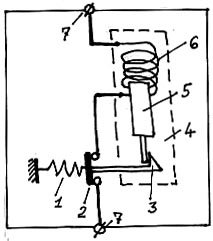
1 - Пружина (в данном случае во взведенном положении растянута)
Автоматический выключатель устроен таким образом, что сначала необходимо взвести пружину и только после этого его можно включить. У многих автоматических выключателей для взвода пружины необходимо перевести ручку вниз. После этого ручку переводят вверх. При этом замыкаются главные контакты.
2 - Главный контакт автоматического выключателя
3 - Удерживающее устройство
4 - Электромагнитный расцепитель;
5 - Сердечник
6 - Катушка
7 - Контактные зажимы автоматического выключателя
На рисунке показан один полюс автоматического выключателя во включенном положении: пружина 1 взведена, а главный контакт 2 замкнут.
Как только в защищаемой цепи возникнет короткое замыкание, ток, протекающий через соответствующий полюс автоматического выключателя, многократно возрастет. В катушке 6 сразу же возникнет сильное магнитное поле. Сердечник 5 втянется в катушку и освободит удерживающее устройство. Под действием пружины 1 главный контакт 2 разомкнется, в результате чего автоматический выключатель отключит и тем самым защитит цепь, в которой возникло короткое замыкание. Такое срабатывание автоматического выключателя происходит практически мгновенно (за сотые доли секунды).
Для защиты цепи от тока перегрузки применяют автоматические выключатели с тепловым расцепителем.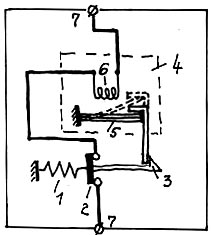
1 - Пружина (в данном случае во взведенном положении растянута)
Принцип действия такой же как и в первом случае, с той лишь разницей, что удерживающее устройство 3 освобождается под действием биметаллической пластины 5, которая изгибается от тепла, выделяемого нагревательным элементом 6. Количество тепла определяется током, протекающим через защищаемую цепь.
2 - Главный контакт автоматического выключателя
3 - Удерживающее устройство
4 - Тепловой расцепитель
5 - Биметаллическая пластина
6 - Нагревательный элемент
7 - Контактные зажимы автоматического выключателя
[Интент]Недопустимые, нерекомендуемые
Тематики
Классификация
>>>Обобщающие термины
Действия
- включение автоматического выключателя
- оперирование автоматического выключателя
- отключение автоматического выключателя
- срабатывание автоматического выключателя
EN
- auto-cutout
- automatic circuit breaker
- automatic cutout
- automatic switch
- breaker
- CB
- circuit breaker
- circuit-breaker
- cutout
DE
FR
Смотри также
Русско-немецкий словарь нормативно-технической терминологии > автоматический выключатель
32 восстановление напряжения в системе электроснабжения
восстановление напряжения
Увеличение напряжения после его посадки, провала или исчезновения до значения, находящегося в допустимых пределах для установившегося режима работы системы электроснабжения.
[ ГОСТ 23875-88]
восстановление напряжения в системе электроснабжения
Увеличение напряжения после его снижения или исчезновения до значения, находящегося в допустимых пределах для установившегося режима работы системы электроснабжения
[ОАО РАО "ЕЭС России" СТО 17330282.27.010.001-2008]EN
voltage recovery
the restoration of voltage to a value near to its previous value after a reduction, a collapse or a loss of voltage
[IEV number 604-01-24]FR
retour de la tension
remontée de la tension jusqu'à une valeur voisine de la valeur antérieure, après une baisse, un effondrement ou un manque de tension
[IEV number 604-01-24]Тематики
Синонимы
EN
DE
FR
Смотри также
Русско-немецкий словарь нормативно-технической терминологии > восстановление напряжения в системе электроснабжения
33 время устойчивого замыкания (размыкания) контакта электрического реле
время устойчивого замыкания (размыкания) контакта электрического реле
Интервал времени от момента достижения входной воздействующей величины электрического реле определенного значения до момента, когда цепь контакта электрического реле замкнется (разомкнется)
[ ГОСТ 16022-83]EN
time to stable closed condition
the time interval between the instant when a specified value of the input energizing quantity is applied and the instant when a contact is closed and fulfils specified requirements
[IEV number 446-17-24]
time to stable open condition
the time interval between the instant when a specified value of the input energizing quantity is applied and the instant when a contact is open and fulfils specified requirements
[IEV number 446-17-25]FR
temps de fermeture stable
temps écoulé entre l'instant d'application d'une valeur spécifiée de la grandeur d'alimentation d'entrée et l'instant où un circuit de contact est fermé et répond aux prescriptions spécifiées
[IEV number 446-17-24]
temps d'ouverture stable
temps écoulé entre l'instant d'application d'une valeur spécifiée de la grandeur d'alimentation d'entrée et l'instant où un circuit de contact est ouvert et répond aux prescriptions spécifiées
[IEV number 446-17-25]
Тематики
EN
DE
FR
136. Время устойчивого замыкания (размыкания) контакта электрического реле
D. Ansprech-Rückfallzeit
Е. Time to stable closed (open) condition
F. Temps de fermeture (d’ouverture) stable
Интервал времени от момента достижения входной воздействующей величины электрического реле определенного значения до момента, когда цепь контакта электрического реле замкнется (разомкнется)
Источник: ГОСТ 16022-83: Реле электрические. Термины и определения оригинал документа
Русско-немецкий словарь нормативно-технической терминологии > время устойчивого замыкания (размыкания) контакта электрического реле
34 входная полная проводимость биполярного транзистора в режиме малого сигнала
входная полная проводимость биполярного транзистора в режиме малого сигнала
Отношение изменений комплексных величин входного тока к вызванному им изменению напряжения на входе при коротком замыкании по переменному току на выходе.
Обозначение
y11
y11
Примечание
В схеме с общей базой или общим эмиттером добавляется индекс соответственно "б" или "э" для отечественных буквенных обозначений и "b" и "е" для международных обозначений.
[ ГОСТ 20003-74]Тематики
EN
DE
FR
- valeur de l'admittance d’entrée, sortie en court-circuit pour de petits signaux
21. Входная полная проводимость биполярного транзистора в режиме малого сигнала
D. Komplexer Kleinsignaleingangsleitwert
E. Small-signal value of the short-circuit input admittance
F. Valeur de l’admittance d’entrée, sortie en court-circuit pour de petits signaux
y*11
Отношение изменений комплексных величин входного тока к вызванному им изменению напряжения на входе при коротком замыкании по переменному току на выходе
Источник: ГОСТ 20003-74: Транзисторы биполярные. Термины, определения и буквенные обозначения параметров оригинал документа
Русско-немецкий словарь нормативно-технической терминологии > входная полная проводимость биполярного транзистора в режиме малого сигнала
35 входное полное сопротивление
входное полное сопротивление
-
[IEV number 312-06-18]EN
input impedance
impedance of the input circuit measured between the input terminals under operating conditions
NOTE 1 – The impedance can be expressed in terms of admittance.
NOTE 2 – In certain instances, for example, sampling devices or self-balancing potentiometers, the impedance can be different according to the instant when it is determined, before, during or after the instant of measurement.
NOTE 3 – When the input circuit is such that the instantaneous value of the current flowing into the input terminals is a non-linear function of the instantaneous value of the input voltage under specified conditions of frequency and voltage, the combination of resistance and reactance which would absorb the same active power and in which would flow a reactive current equal to the fundamental component that is flowing in the actual input circuit, is sometimes called the "equivalent input impedance".
[IEV number 312-06-18]FR
impédance du circuit d'entrée
impédance du circuit d'entrée entre les bornes d'entrée dans les conditions de fonctionnement
NOTE 1 – L'impédance peut être exprimée en termes d'admittance.
NOTE 2 – Dans certains cas, par exemple les dispositifs d'échantillonnage ou les potentiomètres à rééquilibrage automatique, l'impédance peut être différente selon l’instant où elle est déterminée, avant, pendant ou après la mesure.
NOTE 3 – Lorsque le circuit d'entrée est tel que la valeur instantanée du courant traversant les bornes d'entrée est une fonction non linéaire de la valeur instantanée de la tension d'entrée dans des conditions spécifiées de fréquence et de tension, l'impédance d'une combinaison formée par une résistance et une réactance qui absorberaient la même puissance active et dans laquelle circulerait un courant réactif égal à la composante fondamentale qui circule dans le circuit d'entrée réel, est parfois appelée "impédance équivalente d'entrée".
[IEV number 312-06-18]Тематики
- измерение электр. величин в целом
EN
DE
FR
Русско-немецкий словарь нормативно-технической терминологии > входное полное сопротивление
36 высшая теплота сгорания угля
высшая теплота сгорания угля
Ндп. высшая теплотворная способность угля
калорийность топлива
Количество тепла, выделившееся при полном сгорании единицы массы угля в калориметрической бомбе в среде сжатого кислорода в установленных стандартом условиях.
Примечание. Остаточными продуктами являются газообразный кислород, азот, диоксид углерода, диоксид серы, вода в виде жидкости и зола.
[ ГОСТ 17070-87]Недопустимые, нерекомендуемые
Тематики
Обобщающие термины
- состав, свойства и анализ углей
EN
DE
FR
93. Высшая теплота сгорания угля
Ндп. Высшая теплотворная способность угля
D. Oberer Heizwert
Е. Gross calorific value
F. Pouvoir calorifique superieur
Количество тепла, выделившееся при полном сгорании единицы массы угля в калориметрической бомбе в среде сжатого кислорода в установленных стандартом условиях.
Примечание. Остаточными продуктами являются газообразный кислород, азот, диоксид углерода, диоксид серы, вода в виде жидкости и зола
Источник: ГОСТ 17070-87: Угли. Термины и определения оригинал документа
Русско-немецкий словарь нормативно-технической терминологии > высшая теплота сгорания угля
37 выходное полное сопротивление
выходное полное сопротивление
-
[IEV number 312-06-19]EN
output impedance
impedance of the output circuit measured between the output terminals under operating conditions
NOTE 1 – The impedance can be expressed in terms of admittance.
NOTE 2 – In certain instances, for example, sampling devices or self-balancing potentiometers, the impedance can be different according to the instant when it is determined, before, during or after the instant of measurement.
NOTE 3 – When the output circuit is such that the instantaneous value of the current flowing into the output terminals is a non-linear function of the instantaneous value of the output voltage under specified conditions of frequency and voltage, the combination of resistance and reactance which would absorb the same active power and in which would flow a reactive current equal to the fundamental component that is flowing in the actual output circuit, is sometimes called the "equivalent output impedance".
[IEV number 312-06-19]FR
impédance du circuit de sortie
impédance du circuit de sortie entre les bornes de sortie dans les conditions de fonctionnement
NOTE 1 – L'impédance peut être exprimée en termes d'admittance.
NOTE 2 – Dans certains cas, par exemple les dispositifs d'échantillonnage ou les potentiomètres à rééquilibrage automatique, l'impédance peut être différente selon l’instant où elle est déterminée, avant, pendant ou après la mesure.
NOTE 3 – Lorsque le circuit de sortie est tel que la valeur instantanée du courant traversant les bornes de sortie est une fonction non linéaire de la valeur instantanée de la tension de sortie dans des conditions spécifiées de fréquence et de tension, l'impédance d'une combinaison formée par une résistance et une réactance qui absorberaient la même puissance active et dans laquelle circulerait un courant réactif égal à la composante fondamentale qui circule dans le circuit de sortie réel, est parfois appelée "impédance équivalente de sortie".
[IEV number 312-06-19]Тематики
- измерение электр. величин в целом
EN
DE
FR
Русско-немецкий словарь нормативно-технической терминологии > выходное полное сопротивление
38 длительность изменения напряжения
длительность изменения напряжения
Интервал времени от начала одиночного изменения напряжения до его конечного значения.
[ ГОСТ 13109-97]EN
duration of a voltage change
interval of time for the voltage to increase or decrease from the initial value to the final value
[IEV number 161-08-03]FR
durée d'une variation de tension
durée d'un intervalle de temps pendant lequel la tension croît ou décroît de sa valeur initiale avant une variation de tension à sa valeur finale
[IEV number 161-08-03]Тематики
EN
DE
FR
Русско-немецкий словарь нормативно-технической терминологии > длительность изменения напряжения
39 длительный допустимый ток
- Strombelastbarkeit, f
- Dauerstrombelastbarkeit, f
(длительный) допустимый ток
Максимальное значение электрического тока, который может протекать длительно по проводнику, устройству или аппарату при определенных условиях без превышения определенного значения их температуры в установившемся режиме
[ ГОСТ Р МЭК 60050-826-2009]
Этот ток обозначают IZ
[ ГОСТ Р 50571. 1-2009 ( МЭК 60364-1: 2005)]EN
(continuous) current-carrying capacity
ampacity (US)
maximum value of electric current which can be carried continuously by a conductor, a device or an apparatus, under specified conditions without its steady-state temperature exceeding a specified value
[IEV number 826-11-13]
ampacity
The current in amperes that a conductor can carry continuously under the conditions of use without exceeding its temperature rating.
[National Electrical Cod]FR
courant (permanent) admissible, m
valeur maximale du courant électrique qui peut parcourir en permanence, un conducteur, un dispositif ou un appareil, sans que sa température de régime permanent, dans des conditions données, soit supérieure à la valeur spécifiée
[IEV number 826-11-13]Ampacity, the term is defined as the maximum amount of current a cable can carry before sustaining immediate or progressive deterioration. Also described as current rating or current-carrying capacity, is the RMS electric current which a device can continuously carry while remaining within its temperature rating. The ampacity of a cable depends on:
- its insulation temperature rating;
- conductor electrical properties for current;
- frequency, in the case of alternating currents;
- ability to dissipate heat, which depends on cable geometry and its surroundings;
- ambient temperature.
Electric wires have some resistance, and electric current flowing through them causes voltage drop and power dissipation, which heats the cable. Copper or aluminum can conduct a large amount of current before melting, but long before the conductors melt, their insulation would be damaged by the heat.
The ampacity for a power cable is thus based on physical and electrical properties of the material & construction of the conductor and of its insulation, ambient temperature, and environmental conditions adjacent to the cable. Having a large overall surface area may dissipate heat well if the environment can absorb the heat.
In a long run of cable, different conditions govern, and installation regulations normally specify that the most severe condition along the run governs the cable's rating. Cables run in wet or oily locations may carry a lower temperature rating than in a dry installation. Derating is necessary for multiple circuits in close proximity. When multiple cables are near, each contributes heat to the others and diminishes the amount of cooling air that can flow past the individual cables. The overall ampacity of the insulated conductors in a bundle of more than 3 must be derated, whether in a raceway or cable. Usually the de-rating factor is tabulated in a nation's wiring regulations.
Depending on the type of insulating material, common maximum allowable temperatures at the surface of the conductor are 60, 75 and 90 degrees Celsius, often with an ambient air temperature of 30°C. In the U.S., 105°C is allowed with ambient of 40°C, for larger power cables, especially those operating at more than 2 kV. Likewise, specific insulations are rated 150, 200 or 250°C.
The allowed current in cables generally needs to be decreased (derated) when the cable is covered with fireproofing material.
For example, the United States National Electric Code, Table 310-16, specifies that up to three 8 AWG copper wires having a common insulating material (THWN) in a raceway, cable, or direct burial has an ampacity of 50 A when the ambient air is 30°C, the conductor surface temperature allowed to be 75°C. A single insulated conductor in air has 70 A rating.
Ampacity rating is normally for continuous current, and short periods of overcurrent occur without harm in most cabling systems. The acceptable magnitude and duration of overcurrent is a more complex topic than ampacity.
When designing an electrical system, one will normally need to know the current rating for the following:- Wires
- Printed Circuit Board traces, where included
- Fuses
- Circuit breakers
- All or nearly all components used
Some devices are limited by power rating, and when this power rating occurs below their current limit, it is not necessary to know the current limit to design a system. A common example of this is lightbulb holders.
[http://en.wikipedia.org/wiki/Ampacity]
Тематики
- электротехника, основные понятия
Синонимы
EN
DE
- Dauerstrombelastbarkeit, f
- Strombelastbarkeit, f
FR
- courant admissible, m
- courant permanent admissible, m
Русско-немецкий словарь нормативно-технической терминологии > длительный допустимый ток
40 защитный импеданс
защитный импеданс
Компонент, совокупность компонентов или комбинация основной изоляции и устройства, ограничивающего ток или напряжение, импеданс, конструкция и надежность которых таковы, что, будучи включенными между доступными токопроводящими частями и частями, опасными для жизни, они обеспечивают защиту в соответствии с требованиями настоящего стандарта при нормальных условиях и условиях единичной неисправности.
[ ГОСТ Р 52319-2005( МЭК 61010-1: 2001)]
защитный импеданс
Импеданс, включенный между токоведущими частями и доступными проводящими частями конструкций класса II; характеристики его должны быть такими, чтобы ток, проходящий в приборе при нормальной эксплуатации и при возможных повреждениях прибора, ограничивался безопасным значением.
[ ГОСТ Р 52161. 1-2004 ( МЭК 60335-1: 2001)]EN
protective impedance
an impedance connected between live parts and exposed conductive parts, of such value that the current, in normal use and under likely fault conditions in the electronic switch, is limited to a safe value, and which is so constructed that the reliability is maintained throughout the life of the electronic switch
[IEV number 442-04-24]FR
impédance de protection
impédance connectée entre parties actives et masse, de valeur telle que le courant, en utilisation normale et dans des conditions possibles de panne de l'interrupteur électronique, soit limité à une valeur de sécurité, et qui est construite de façon telle que sa fiabilité soit maintenue au cours de la durée de vie de l'interrupteur électronique
[IEV number 442-04-24]Тематики
Обобщающие термины
EN
DE
FR
Русско-немецкий словарь нормативно-технической терминологии > защитный импеданс
СтраницыСм. также в других словарях:
Value investing — is an investment paradigm that derives from the ideas on investment and speculation that Ben Graham David Dodd began teaching at Columbia Business School in 1928 and subsequently developed in their 1934 text Security Analysis . Although value… … Wikipedia
value — val·ue 1 / val yü/ n 1 a: a fair return or equivalent in goods, services, or money for something exchanged received good value for the price b: valuable consideration at consideration … Law dictionary
Value theory — encompasses a range of approaches to understanding how, why and to what degree people should value things; whether the thing is a person, idea, object, or anything else. This investigation began in ancient philosophy, where it is called axiology… … Wikipedia
Value engineering — is a systematic method to improve the value of goods and services by using an examination of function. Value, as defined, is the ratio of function to cost. Value can therefore be increased by either improving the function or reducing the cost. It … Wikipedia
Value added — refers to the additional value of a commodity over the cost of commodities used to produce it from the previous stage of production. An example is the price of gasoline at the pump over the price of the oil in it. In national accounts used in… … Wikipedia
Value of information — (VoI) in decision analysis is the amount a decision maker would be willing to pay for information prior to making a decision. imilar termsVoI is sometimes distinguished into value of perfect information, also called value of clairvoyance (VoC),… … Wikipedia
Value network analysis — is a methodology for understanding, using, visualizing, optimizing internal and external value networks and complex economic ecosystems. The methods include visualizing sets of relationships from a dynamic whole systems perspective. Robust… … Wikipedia
Value Line — Value Line, Inc.(NASDAQ|VALU), is a New York corporation founded in 1931 by Arnold Bernhard, best known for publishing the The Value Line Investment Survey , a stock analysis newsletter that s updated weekly and kept by subscribers in a large… … Wikipedia
Value capture — refers to a type of innovative public financing in which increases in private land values generated by a new public investment are all or in part “captured” through a land related tax to pay for that investment or other public projects. Value… … Wikipedia
Value Measuring Methodology — (or VMM) is a tool that helps planners balance both tangible and intangible values when making investment decisions, and monitor benefits.Formal methods to calculate the Return on Investment (or ROI) have been widely understood and used for a… … Wikipedia
Value Stream Mapping — is a Lean technique used to analyse the flow of materials and information currently required to bring a product or service to a consumer. At Toyota, where the technique originated, it is known as Material and Information Flow Mapping [Learning to … Wikipedia
 18+© Академик, 2000-2026
- Обратная связь: Техподдержка, Реклама на сайте
Экспорт словарей на сайты, сделанные на PHP, Joomla, Drupal, WordPress, MODx.
Перевод: с русского на немецкий
с немецкого на русский- С немецкого на:
- Русский
- С русского на:
- Все языки
- Английский
- Испанский
- Итальянский
- Казахский
- Немецкий
- Нидерландский
- Персидский
- Французский
- Эстонский