

-
1 Wasserfläche
акватория
Водное пространство, ограниченное естественными, искусственными или условными границами.
[ ГОСТ Р 22.0.09-95]
акватория
Участок водной поверхности в установленных границах района моря, океана или порта
[Терминологический словарь по строительству на 12 языках (ВНИИИС Госстроя СССР)]
акватория
Участок водной поверхности в установленных границах.
[РД 01.120.00-КТН-228-06]Тематики
EN
DE
FR
Немецко-русский словарь нормативно-технической терминологии > Wasserfläche
-
2 Wasseroberfläche
акватория
Водное пространство, ограниченное естественными, искусственными или условными границами.
[ ГОСТ Р 22.0.09-95]
акватория
Участок водной поверхности в установленных границах района моря, океана или порта
[Терминологический словарь по строительству на 12 языках (ВНИИИС Госстроя СССР)]
акватория
Участок водной поверхности в установленных границах.
[РД 01.120.00-КТН-228-06]Тематики
EN
DE
FR
Немецко-русский словарь нормативно-технической терминологии > Wasseroberfläche
-
3 Verschmutzung
загрязнение
Присутствие инородного вещества: твердого, жидкого или газообразного (ионизированные газы), - которое может вызвать уменьшение диэлектрической прочности или поверхностного сопротивления.
[ ГОСТ Р 52319-2005( МЭК 61010-1: 2001)]
загрязнение
Любое добавление инородных веществ, твердых, жидких или газообразных (ионизированных газов), которые могли бы уменьшить электрическую прочность изоляции или удельное сопротивление поверхности.
[ ГОСТ Р 50030. 1-2000 ( МЭК 60947-1-99)]EN
pollution
any condition of foreign matter, solid, liquid or gaseous (ionized gases), that may affect dielectric strength or surface resistivity
[IEC 60947-1, ed. 5.0 (2007-06)]
pollution
any addition of foreign matter, solid, liquid or gaseous that can produce a permanent reduction of dielectric strength or surface resistivity of the insulation
NOTE – Ionized gases of a temporary nature are not considered as to be a pollution.
[IEV number 442-01-28]
contamination
the first is defined as area and the second as particulate. The first is caused by surface contaminants that cannot be removed by cleaning or are stained after cleaning. Those may be foreign matter on the surface of, for example a localized area that is smudged, stained, discoloured, mottled, etc., or large areas exhibiting a hazy or cloudy appearance resulting from a film of foreign materials
[IEC 62276, ed. 1.0 (2005-05)]FR
pollution
tout apport de matériau étranger solide, liquide ou gazeux (gaz ionisés) qui peut entraîner une réduction de la rigidité diélectrique ou de la résistivité de la surface
[IEC 60947-1, ed. 5.0 (2007-06)]
pollution
tout apport de matériau étranger solide, liquide ou gazeux qui peut entraîner une réduction permanente de la rigidité diélectrique ou de la résistivité de surface de l'isolation
NOTE – Les gaz ionisés de nature fugace ne sont pas considérés comme une pollution.
[IEV number 442-01-28]
Тематики
Обобщающие термины
EN
DE
FR
засор
Ндп. намыв
Дефект в виде формовочного материала, внедрившегося в поверхностные слои отливки, захваченного потоками жидкого металла.
[ ГОСТ 19200-80]Недопустимые, нерекомендуемые
Тематики
Обобщающие термины
EN
DE
FR
Немецко-русский словарь нормативно-технической терминологии > Verschmutzung
-
4 Industriegebiet
промышленный район
—
[ http://www.eionet.europa.eu/gemet/alphabetic?langcode=en]EN
industrial area
Areas allocated for industry within a town-planning scheme or environmental plan. The range of industries accommodated in a plan may include: light industry, service industry, general industry, hazardous, noxious or offensive industry, waterfront industry, extractive industry. Standards are usually defined for industrial areas relating to access and roads, drainage, car parking, aesthetics, landscaping, buffer zones, noise levels, and air and water pollution. (Source: GILP96)
[http://www.eionet.europa.eu/gemet/alphabetic?langcode=en]Тематики
EN
DE
FR
Немецко-русский словарь нормативно-технической терминологии > Industriegebiet
-
5 Koordinatensystem
система координат
—
[ http://www.eionet.europa.eu/gemet/alphabetic?langcode=en]EN
co-ordinate system
A reference system used to measure horizontal and vertical distances on a planimetric map. A coordinate system is usually defined by a map projection, a spheroid of reference, a datum, one or more standard parallels, a central meridian, and possible shifts in the x- and y-directions to locate x, y positions of point, line, and area features. A common coordinate system is used to spatially register geographic data for the same area. (Source: ESRI)
[http://www.eionet.europa.eu/gemet/alphabetic?langcode=en]Тематики
EN
DE
FR
Немецко-русский словарь нормативно-технической терминологии > Koordinatensystem
-
6 biogeographische Regionen
биогеографический регион
—
[ http://www.eionet.europa.eu/gemet/alphabetic?langcode=en]EN
biogeographical region
Area of the Earth's surface defined by the species of fauna and flora it contains. (Source: ALL)
[http://www.eionet.europa.eu/gemet/alphabetic?langcode=en]Тематики
EN
DE
FR
Немецко-русский словарь нормативно-технической терминологии > biogeographische Regionen
-
7 Dauerstrombelastbarkeit, f
(длительный) допустимый ток
Максимальное значение электрического тока, который может протекать длительно по проводнику, устройству или аппарату при определенных условиях без превышения определенного значения их температуры в установившемся режиме
[ ГОСТ Р МЭК 60050-826-2009]
Этот ток обозначают IZ
[ ГОСТ Р 50571. 1-2009 ( МЭК 60364-1: 2005)]EN
(continuous) current-carrying capacity
ampacity (US)
maximum value of electric current which can be carried continuously by a conductor, a device or an apparatus, under specified conditions without its steady-state temperature exceeding a specified value
[IEV number 826-11-13]
ampacity
The current in amperes that a conductor can carry continuously under the conditions of use without exceeding its temperature rating.
[National Electrical Cod]FR
courant (permanent) admissible, m
valeur maximale du courant électrique qui peut parcourir en permanence, un conducteur, un dispositif ou un appareil, sans que sa température de régime permanent, dans des conditions données, soit supérieure à la valeur spécifiée
[IEV number 826-11-13]Ampacity, the term is defined as the maximum amount of current a cable can carry before sustaining immediate or progressive deterioration. Also described as current rating or current-carrying capacity, is the RMS electric current which a device can continuously carry while remaining within its temperature rating. The ampacity of a cable depends on:
- its insulation temperature rating;
- conductor electrical properties for current;
- frequency, in the case of alternating currents;
- ability to dissipate heat, which depends on cable geometry and its surroundings;
- ambient temperature.
Electric wires have some resistance, and electric current flowing through them causes voltage drop and power dissipation, which heats the cable. Copper or aluminum can conduct a large amount of current before melting, but long before the conductors melt, their insulation would be damaged by the heat.
The ampacity for a power cable is thus based on physical and electrical properties of the material & construction of the conductor and of its insulation, ambient temperature, and environmental conditions adjacent to the cable. Having a large overall surface area may dissipate heat well if the environment can absorb the heat.
In a long run of cable, different conditions govern, and installation regulations normally specify that the most severe condition along the run governs the cable's rating. Cables run in wet or oily locations may carry a lower temperature rating than in a dry installation. Derating is necessary for multiple circuits in close proximity. When multiple cables are near, each contributes heat to the others and diminishes the amount of cooling air that can flow past the individual cables. The overall ampacity of the insulated conductors in a bundle of more than 3 must be derated, whether in a raceway or cable. Usually the de-rating factor is tabulated in a nation's wiring regulations.
Depending on the type of insulating material, common maximum allowable temperatures at the surface of the conductor are 60, 75 and 90 degrees Celsius, often with an ambient air temperature of 30°C. In the U.S., 105°C is allowed with ambient of 40°C, for larger power cables, especially those operating at more than 2 kV. Likewise, specific insulations are rated 150, 200 or 250°C.
The allowed current in cables generally needs to be decreased (derated) when the cable is covered with fireproofing material.
For example, the United States National Electric Code, Table 310-16, specifies that up to three 8 AWG copper wires having a common insulating material (THWN) in a raceway, cable, or direct burial has an ampacity of 50 A when the ambient air is 30°C, the conductor surface temperature allowed to be 75°C. A single insulated conductor in air has 70 A rating.
Ampacity rating is normally for continuous current, and short periods of overcurrent occur without harm in most cabling systems. The acceptable magnitude and duration of overcurrent is a more complex topic than ampacity.
When designing an electrical system, one will normally need to know the current rating for the following:- Wires
- Printed Circuit Board traces, where included
- Fuses
- Circuit breakers
- All or nearly all components used
Some devices are limited by power rating, and when this power rating occurs below their current limit, it is not necessary to know the current limit to design a system. A common example of this is lightbulb holders.
[http://en.wikipedia.org/wiki/Ampacity]
Тематики
- электротехника, основные понятия
Синонимы
EN
DE
- Dauerstrombelastbarkeit, f
- Strombelastbarkeit, f
FR
- courant admissible, m
- courant permanent admissible, m
Немецко-русский словарь нормативно-технической терминологии > Dauerstrombelastbarkeit, f
-
8 Strombelastbarkeit, f
(длительный) допустимый ток
Максимальное значение электрического тока, который может протекать длительно по проводнику, устройству или аппарату при определенных условиях без превышения определенного значения их температуры в установившемся режиме
[ ГОСТ Р МЭК 60050-826-2009]
Этот ток обозначают IZ
[ ГОСТ Р 50571. 1-2009 ( МЭК 60364-1: 2005)]EN
(continuous) current-carrying capacity
ampacity (US)
maximum value of electric current which can be carried continuously by a conductor, a device or an apparatus, under specified conditions without its steady-state temperature exceeding a specified value
[IEV number 826-11-13]
ampacity
The current in amperes that a conductor can carry continuously under the conditions of use without exceeding its temperature rating.
[National Electrical Cod]FR
courant (permanent) admissible, m
valeur maximale du courant électrique qui peut parcourir en permanence, un conducteur, un dispositif ou un appareil, sans que sa température de régime permanent, dans des conditions données, soit supérieure à la valeur spécifiée
[IEV number 826-11-13]Ampacity, the term is defined as the maximum amount of current a cable can carry before sustaining immediate or progressive deterioration. Also described as current rating or current-carrying capacity, is the RMS electric current which a device can continuously carry while remaining within its temperature rating. The ampacity of a cable depends on:
- its insulation temperature rating;
- conductor electrical properties for current;
- frequency, in the case of alternating currents;
- ability to dissipate heat, which depends on cable geometry and its surroundings;
- ambient temperature.
Electric wires have some resistance, and electric current flowing through them causes voltage drop and power dissipation, which heats the cable. Copper or aluminum can conduct a large amount of current before melting, but long before the conductors melt, their insulation would be damaged by the heat.
The ampacity for a power cable is thus based on physical and electrical properties of the material & construction of the conductor and of its insulation, ambient temperature, and environmental conditions adjacent to the cable. Having a large overall surface area may dissipate heat well if the environment can absorb the heat.
In a long run of cable, different conditions govern, and installation regulations normally specify that the most severe condition along the run governs the cable's rating. Cables run in wet or oily locations may carry a lower temperature rating than in a dry installation. Derating is necessary for multiple circuits in close proximity. When multiple cables are near, each contributes heat to the others and diminishes the amount of cooling air that can flow past the individual cables. The overall ampacity of the insulated conductors in a bundle of more than 3 must be derated, whether in a raceway or cable. Usually the de-rating factor is tabulated in a nation's wiring regulations.
Depending on the type of insulating material, common maximum allowable temperatures at the surface of the conductor are 60, 75 and 90 degrees Celsius, often with an ambient air temperature of 30°C. In the U.S., 105°C is allowed with ambient of 40°C, for larger power cables, especially those operating at more than 2 kV. Likewise, specific insulations are rated 150, 200 or 250°C.
The allowed current in cables generally needs to be decreased (derated) when the cable is covered with fireproofing material.
For example, the United States National Electric Code, Table 310-16, specifies that up to three 8 AWG copper wires having a common insulating material (THWN) in a raceway, cable, or direct burial has an ampacity of 50 A when the ambient air is 30°C, the conductor surface temperature allowed to be 75°C. A single insulated conductor in air has 70 A rating.
Ampacity rating is normally for continuous current, and short periods of overcurrent occur without harm in most cabling systems. The acceptable magnitude and duration of overcurrent is a more complex topic than ampacity.
When designing an electrical system, one will normally need to know the current rating for the following:- Wires
- Printed Circuit Board traces, where included
- Fuses
- Circuit breakers
- All or nearly all components used
Some devices are limited by power rating, and when this power rating occurs below their current limit, it is not necessary to know the current limit to design a system. A common example of this is lightbulb holders.
[http://en.wikipedia.org/wiki/Ampacity]
Тематики
- электротехника, основные понятия
Синонимы
EN
DE
- Dauerstrombelastbarkeit, f
- Strombelastbarkeit, f
FR
- courant admissible, m
- courant permanent admissible, m
Немецко-русский словарь нормативно-технической терминологии > Strombelastbarkeit, f
-
9 Basiseinheit
основная единица системы единиц физических величин
основная единица
Единица основной физической величины в данной системе единиц.
Пример. Основные единицы Международной системы единиц (СИ): метр (м), килограмм (кг), секунда.
[РМГ 29-99]EN
base unit
unit of measurement that is adopted by convention for a base quantity
NOTE 1 – In each coherent system of units, there is only one base unit for each base quantity. In the SI for example, the metre is the base unit of length. The centimetre and the kilometre are also units of length, but they are not base units in the SI. However, in the CGS systems, the centimetre is the base unit of length.
NOTE 2 – A base unit may also serve for a derived quantity of the same dimension. For example, rainfall, when defined as volume per area (areic volume), has the metre as a coherent derived unit in the SI. The ampere, base unit of electric current, is also the coherent derived unit of scalar magnetic potential.
NOTE 3 – For the quantity “number of entities”, the number one, symbol 1, can be regarded as a base unit in any system of units.
Source: ISO/IEC GUIDE 99:2007 1.10
[IEV number 112-01-18]FR
unité de base, f
unité de mesure adoptée par convention pour une grandeur de base
NOTE 1 – Dans chaque système cohérent d'unités, il y a une seule unité de base pour chaque grandeur de base. Dans le SI par exemple, le mètre est l'unité de base de longueur. Le centimètre et le kilomètre sont aussi des unités de longueur, mais ils ne sont pas des unités de base dans le SI. Cependant, dans les systèmes CGS, le centimètre est l'unité de base de longueur.
NOTE 2 – Une unité de base peut aussi servir pour une grandeur dérivée de même dimension. Par exemple, la hauteur de pluie, définie comme un volume surfacique (volume par aire) a le mètre comme unité dérivée cohérente dans le SI. L’ampère, unité de base de courant électrique, est aussi l’unité dérivée cohérente de potentiel magnétique scalaire.
NOTE 3 – Pour la grandeur « nombre d'entités », on peut considérer le nombre un, de symbole 1, comme une unité de base dans tout système d'unités.
Source: ISO/IEC GUIDE 99:2007 1.10
[IEV number 112-01-18]Тематики
- метрология, основные понятия
Синонимы
EN
DE
FR
Немецко-русский словарь нормативно-технической терминологии > Basiseinheit
-
10 Kommunalentwicklung
развитие регионов
—
[ http://www.eionet.europa.eu/gemet/alphabetic?langcode=en]EN
local development
A stage of growth or advancement in any aspect of a community that is defined by or restricted to a particular and usually small district or area. (Source: RHW / ISEP)
[http://www.eionet.europa.eu/gemet/alphabetic?langcode=en]Тематики
EN
DE
FR
Немецко-русский словарь нормативно-технической терминологии > Kommunalentwicklung
-
11 Schienenverteiler
система сборных шин
шинопровод
Устройство, представляющее собой систему проводников, состоящее из шин, установленных на опорах из изоляционного материала или в каналах, коробах или подобных оболочках, и прошедшее типовые испытания.
Устройство может состоять из следующих элементов:
- прямые секции с узлами ответвления или без них;
- секции для изменения положения фаз, разветвления, поворота, а также вводные и переходные;
- секции ответвленные.
Примечание — Термин «шинопровод» не определяет геометрическую форму, габариты и размеры проводников.
(МЭС 441-12-07, с изменением)
[ ГОСТ Р 51321. 1-2000 ( МЭК 60439-1-92)]
шинопровод
Жесткий токопровод до 1 кВ заводского изготовления, поставляемый комплектными секциями.
[ПУЭ]
шинопровод
Жесткий токопровод напряжением до 1000 В заводского изготовления, поставляемый комплектными секциями.
[ОСТ 36-115-85]
шинопровод
Жесткий токопровод напряжением до 1 кВ, предназначенный для передачи и распределения электроэнергии, состоящий из неизолированных или изолированных проводников (шин) и относящихся к ним изоляторов, защитных оболочек, ответвительных устройств, поддерживающих и опорных конструкций.
[ ГОСТ Р 53310-2012]EN
busway
A prefabricated assembly of standard lengths of busbars rigidly supported by solid insulation and enclosed in a sheet-metal housing.
[ http://www.answers.com/topic/busway]
busway
Busway is defined by the National Electrical Manufacturers Association (NEMA) as a prefabricated electrical distribution system consisting of bus bars in a protective enclosure, including straight lengths, fittings, devices, and accessories. Busway includes bus bars, an insulating and/or support material, and a housing.
[ http://electrical-engineering-portal.com/siemens-busway-purpose-and-definition]1.1. Шинопроводы по назначению подразделяются на:
- распределительные, предназначенные для распределения электрической энергии;
- магистральные, предназначенные для передачи электрической энергии от источника к месту распределения (распределительным пунктам, распределительным шинопроводам) или мощным приемникам электрической энергии.
1.2. По конструктивному исполнению шинопроводы подразделяются на:
- трехфазные;
- трехфазные с нулевым рабочим проводником;
- трехфазные с нулевым рабочим и нулевым защитным проводником.
2. Основные параметры и размеры
2.1. Основные элементы шинопроводов
2.1.1. Основными элементами распределительных шинопроводов являются:а) прямые секции - для прямолинейных участков линии, имеющие места для присоединения одного или двух ответвительных устройств для секций длиной до 2 м включительно, двух, трех, четырех или более - для секций длиной 3 м;
б) прямые прогоночные секции - для прямолинейных участков линий, где присоединение ответвительных устройств не требуется;
в) угловые секции - для поворотов линии на 90° в горизонтальной и вертикальной плоскостях;
г) вводные секции или вводные коробки с коммутационной, защитной и коммутационной аппаратурой или без нее - для подвода питания к шинопроводам кабелем, проводами или шинопроводом;
д) переходные секции или устройства - для соединения двух шинопроводов на различные номинальные токи или шинопроводов разных конструкций;
е) ответвительные устройства (коробки, штепсели) - для разъемного присоединения приемников электрической энергии. Коробки должны выпускаться с разъединителем, с разъединителем и с предохранителями или с автоматическим выключателем;
з) присоединительные фланцы - для сочленения оболочек шинопроводов с оболочками щитов или шкафов;
и) торцовые крышки (заглушки) - для закрытия торцов крайних секций шинопровода;
к) устройства для крепления шинопроводов к элементам строительных конструкций зданий и сооружений;2.1.2. Основными элементами магистральных шинопроводов являются:
а) прямые секции - для прямолинейных участков линий;
б) угловые секции - для поворотов линий на 90° в горизонтальной и вертикальной плоскостях;
в) тройниковые секции - для разветвления в трех направлениях под углом 90° в горизонтальной и вертикальной плоскостях;
г) подгоночные секции - для подгонки линии шинопроводов до необходимой длины;
д) разделительные секции с разъединителем - для секционирования магистральных линий шинопроводов;
е) компенсационные секции - для компенсации температурных изменений длины линии шинопроводов;
ж) переходные секции - для соединения шинопроводов на разные номинальные токи;
з) ответвительные устройства (секции, коробки) - для неразборного, разборного или разъемного присоединения распределительных пунктов, распределительных шинопроводов или приемников электрической энергии. Коробки должны выпускаться с разъединителем, с разъединителем и предохранителями или с автоматическим выключателем; секции могут выпускаться без указанных аппаратов;
и) присоединительные секции - для присоединения шинопроводов к комплектным трансформаторным подстанциям;
к) проходные секции - для прохода через стены и перекрытия;
л) набор деталей и материалов для изолирования мест соединения секций шинопроводов с изолированными шинами;
м) устройства для крепления шинопроводов к элементам строительных конструкций зданий и сооружений;
н) крышки (заглушки) торцовые и угловые для закрытия торцов концевых секций шинопровода и углов.
2.2.3. В зависимости от вида проводников токопроводы подразделяются на гибкие (при использовании проводов) и жесткие (при использовании жестких шин).
Жесткий токопровод до 1 кВ заводского изготовления, поставляемый комплектными секциями, называется шинопроводом.
В зависимости от назначения шинопроводы подразделяются на:- магистральные, предназначенные в основном для присоединения к ним распределительных шинопроводов и силовых распределительных пунктов, щитов и отдельных мощных электроприемников;
- распределительные, предназначенные в основном для присоединения к ним электроприемников;
- троллейные, предназначенные для питания передвижных электроприемников;
- осветительные, предназначенные для питания светильников и электроприемников небольшой мощности.
[ПУЭ, часть 2]
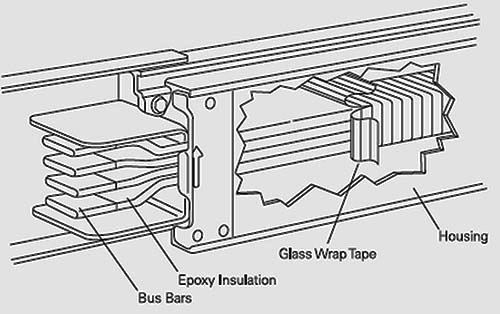
[ http://electrical-engineering-portal.com/siemens-busway-purpose-and-definition]
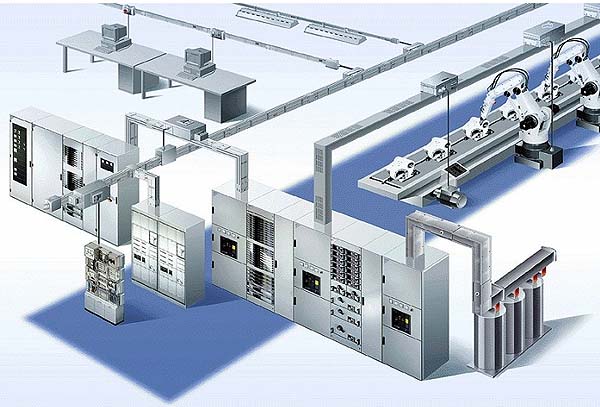
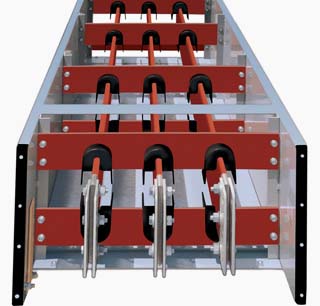
[ http://electrical-engineering-portal.com/standards-and-applications-of-medium-voltage-bus-duct]
Конструкция шинопровода на среднее напряжениеПараллельные тексты EN-RU
A major advantage of busway is the ease in which busway sections are connected together.
Electrical power can be supplied to any area of a building by connecting standard lengths of busway.
It typically takes fewer man-hours to install or change a busway system than cable and conduit assemblies.Основное преимущество шинопровода заключается в легкости соединения его секций.
Соединяя эти стандартные секции можно легко снабдить электроэнергией любую часть здания.
Как правило, установить или изменить систему шинопроводов занимает гораздо меньше времени, чем выполнить аналогичные работы, применяя разводку кабелем в защитных трубах.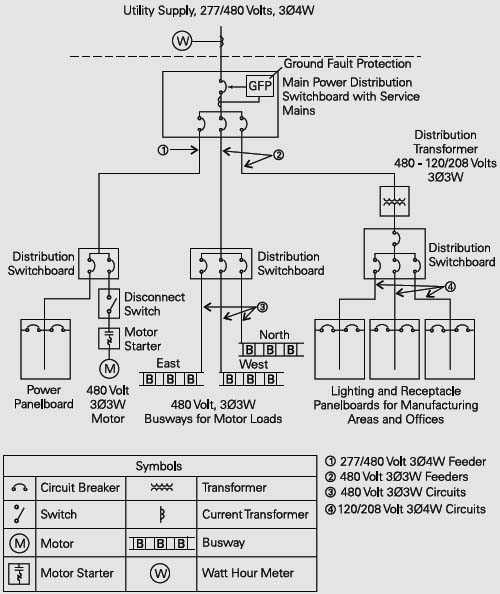
[ http://electrical-engineering-portal.com/siemens-busway-purpose-and-definition]
The total distribution system frequently consists of a combination of busway and cable and conduit.
In this example power from the utility company is metered and enters the plant through a distribution switchboard.
The switchboard serves as the main disconnecting means.Как правило, распределение электроэнергии производится как через шинопроводы, так и через проложенные в защитных трубах кабели.
В данном примере поступающая от питающей сети электроэнергия измеряется на вводе в главное распределительный щит (ГРЩ).
ГРЩ является главным коммутационным устройством.
The feeder on the left feeds a distribution switchboard, which in turn feeds a panelboard and a 480 volt, three-phase, three-wire (3Ø3W) motor.
Распределительная цепь, изображенная слева, питает распределительный щит, который в свою очередь питает групповой щиток и электродвигатель.
Электродвигатель получает питание через трехфазную трехпроводную линию напряжением 480 В.The middle feeder feeds another switchboard, which divides the power into three, three-phase, three-wire circuits. Each circuit feeds a busway run to 480 volt motors.
Средняя (на чертеже) распределительная цепь питает другой распределительный щит, от которого электроэнергия распределяется через три трехфазные трехпроводные линии на шинопроводы.
Каждый шинопровод используется для питания электродвигателей напряжением 480 В.The feeder on the right supplies 120/208 volt power, through a step-down transformer, to lighting and receptacle panelboards.
Распределительная цепь, изображенная справа, питает напряжением 120/208 В через понижающий трансформатор щитки для отдельных групп светильников и штепсельных розеток.
Branch circuits from the lighting and receptacle panelboards supply power for lighting and outlets throughout the plant.
[ http://electrical-engineering-portal.com/siemens-busway-purpose-and-definition]Групповые электрические цепи, идущие от групповых щитков, предназначены для питания всех светильников и штепсельных розеток предприятия.
[Перевод Интент]Selection of the busbar trunking system based on voltage drop.
[Legrand]Выбор шинопровода по падению напряжения.
[Перевод Интент]
Недопустимые, нерекомендуемые
Примечание(1)- Мнение автора карточкиТематики
- изделие электромонтажное
- электропроводка, электромонтаж
Обобщающие термины
Близкие понятия
- электропроводки, выполненные шинопроводами
Действия
- выбор шинопровода по...
- крепление шинопровода к опорным конструкциям
- монтаж шинопроводов
- применение шинопроводов в пожароопасных зонах
- проектирование шинопровода
- прокладка шинопровода
Сопутствующие термины
- вертикальный участок шинопровода
- горизонтальный участок шинопровода
- прямой участок шинопровода
- устройства для крепления шинопроводов
- шинопровод переменного тока на 1600 А
- электрическая сеть, выполняемая шинопроводами
EN
DE
FR
Немецко-русский словарь нормативно-технической терминологии > Schienenverteiler
См. также в других словарях:
area of limitation — A defined area where specific limitations apply to the strength and fortifications of disputing or belligerent forces. Normally, upper limits are established for the number and type of formations, tanks, antiaircraft weapons, artillery, and other … Military dictionary
Area of responsibility — (AOR) is an acronym used to define an area with specific geographic boundaries for which a person or organisation bears a certain responsibility.In the US military, an AOR is a pre defined geographic region assigned to a Unified Combatant Command … Wikipedia
Area codes 416 and 647 — Area code 416 is one of the original 86 area codes from 1947, and currently serves the single rate centre of Toronto, Ontario. It has been split twice: the western portion of 416 became area code 519 in 1953, and in 1993 the remaining portion of… … Wikipedia
Area code 612 — is the telephone numbering plan code for the city of Minneapolis, Minnesota and a few surrounding areas such as Fort Snelling and Richfield, Minnesota, currently the smallest area code in the state by land area. However, the region used to be… … Wikipedia
Area code 865 — is an area code in the U.S. state of Tennessee. It consists of Knox County and the other eight central East Tennessee counties that border it (Anderson, Blount, Grainger, Jefferson, Loudon, Roane, Sevier, and Union). The area code region… … Wikipedia
area — 1 Area, tract, region, zone, belt mean an extent of space especially of ground or surface that is distinguishable from its surroundings in appearance or in certain distinctive features. Area still carries its original implication of clearly… … New Dictionary of Synonyms
Area movement — is a game mechanic for in a board game. While most parlor games and the like have areas of the board to move in, the term is used (particularly in wargaming) for those boards that represent a geographical area, but do not use a regular grid… … Wikipedia
Area — This article is about the geometric quantity. For other uses, see Area (disambiguation). The combined area of these three shapes is between 15 and 16 squares. Area is a quantity that expresses the extent of a two dimensional surface or shape in… … Wikipedia
Área metropolitana del Sur de la Florida — Miami Fort Lauderdale Pompano Beach Área metropolitana de los Estados Unidos Miami … Wikipedia Español
Area studies — In the humanities and social sciences, area studies are interdisciplinary fields of research and scholarship pertaining to a particular geographical, national/federal, or cultural region. The term exists primarily as a general description for… … Wikipedia
Area of operation — An area of operations (AO) is an operational area defined by the force commander for land, air and naval forces conduct of combat and non combat activities. Areas of operation do not typically encompass the entire operational area of the force… … Wikipedia
