

-
81 dico
1.dĭco, āvi, ātum, 1 (dixe for dixisse, Val. Ant. ap. Arn. 5, 1; DICASSIT dixerit, Paul. ex Fest. p. 75, 15; rather = dicaverit), v. a. [orig. the same word with 2. dīco; cf. the meaning of abdĭco and abdīco, of indĭco and indīco, dedĭco, no. II. A. al., Corss. Ausspr. 1, 380].I.To proclaim, make known. So perh. only in the foll. passage: pugnam, Lucil. ap. Non. 287, 30.—Far more freq.,II.Relig. t. t., to dedicate, consecrate, devote any thing to a deity or to a deified person (for syn. cf.: dedico, consecro, inauguro).A.Prop.: et me dicabo atque animam devotabo hostibus, Att. ap. Non. 98, 12:2.donum tibi (sc. Jovi) dicatum atque promissum,
Cic. Verr. 2, 5, 72; cf.:ara condita atque dicata,
Liv. 1, 7 (for which aram condidit dedicavitque, id. 28, 46 fin.); so,aram,
id. 1, 7; 1, 20:capitolium, templum Jovis O. M.,
id. 22, 38 fin.:templa,
Ov. F. 1, 610:delubrum ex manubiis,
Plin. 7, 26, 27, § 97:lychnuchum Apollini,
id. 34, 3, 8, § 14:statuas Olympiae,
id. 34, 4, 9, § 16:vehiculum,
Tac. G. 40:carmen Veneri,
Plin. 37, 10, 66, § 178; cf. Suet. Ner. 10 fin. et saep.:cygni Apollini dicati,
Cic. Tusc. 1, 30, 73.—With a personal object, to consecrate, to deify (cf. dedico, no. II. A. b.):B.Janus geminus a Numa dicatus,
Plin. 34, 7, 16, § 34:inter numina dicatus Augustus,
Tac. A. 1, 59.—Transf., beyond the relig. sphere.1.To give up, set apart, appropriate a thing to any one: recita;* 2.aurium operam tibi dico,
Plaut. Bacch. 4, 9, 72; so,operam,
id. Ps. 1, 5, 147; Ter. Ph. 1, 2, 12:hunc totum diem tibi,
Cic. Leg. 2, 3, 7:tuum studium meae laudi,
id. Fam. 2, 6, 4:genus (orationis) epidicticum gymnasiis et palaestrae,
id. Or. 13, 42:librum Maecenati,
Plin. 19, 10, 57, § 177; cf.:librum laudibus ptisanae,
id. 18, 7, 15, § 75 al.:(Deïopeam) conubio jungam stabili propriamque dicabo,
Verg. A. 1, 73; cf. the same verse, ib. 4, 126:se Crasso,
Cic. de Or. 3, 3, 11; cf.: se Remis in clientelam, * Caes. B. G. 6, 12, 7:se alii civitati,
to become a free denizen of it, Cic. Balb. 11, 28;for which: se in aliam civitatem,
id. ib. 12 fin. —(I. q. dedico, no. II. A.) To consecrate a thing by using it for the first time:2.nova signa novamque aquilam,
Tac. H. 5, 16.— Hence, dĭcātus, a, um, P. a. (acc. to no. II.), devoted, consecrated, dedicated:loca Christo dedicatissima, August. Civ. Dei, 3, 31: CONSTANTINO AETERNO AVGVSTO ARRIVS DIOTIMVS... N. M. Q. (i. e. numini majestatique) EIVS DICATISSIMVS,
Inscr. Orell. 1083.dīco, xi, ctum, 3 ( praes. DEICO, Inscr. Orell. 4848; imp. usu. dic; cf. duc, fac, fer, from duco, etc., DEICVNTO, and perf. DEIXSERINT, P. C. de Therm. ib. 3673; imp. dice, Naev. ap. Fest. p. 298, 29 Müll.; Plaut. Capt. 2, 2, 109; id. Bac. 4, 4, 65; id. Merc. 1, 2, 47 al.; cf. Quint. 1, 6, 21; fut. dicem = dicam, Cato ap. Quint. 1, 7, 23; cf. Paul. ex Fest. p. 72, 6 Müll.—Another form of the future is dicebo, Novius ap. Non. 507 (Com. v. 8 Rib.). — Perf. sync.:I.dixti,
Plaut. As. 4, 2, 14; id. Trin. 2, 4, 155; id. Mil. 2, 4, 12 et saep.; Ter. And. 3, 1, 1; 3, 2, 38; id. Heaut. 2, 3, 100 et saep.; Cic. Fin. 2, 3, 10; id. N. D. 3, 9, 23; id. Caecin. 29, 82; acc. to Quint. 9, 3, 22.— Perf. subj.:dixis,
Plaut. Capt. 1, 2, 46; Caecil. ap. Gell. 7, 17 fin.:dixem = dixissem,
Plaut. Pseud. 1, 5, 84; inf. dixe = dix isse, Plaut. Fragm. ap. Non. 105, 23; Varr. ib. 451, 16; Arn. init.; Aus. Sept. Sap. de Cleob. 8; inf. praes. pass. dicier, Ter. Eun. 4, 4, 32; Vatin. in Cic. Fam. 5, 9 al.), v. a. [root DIC = DEIK in deiknumi; lit., to show; cf. dikê, and Lat. dicis, ju-dex, dicio], to say, tell, mention, relate, affirm, declare, state; to mean, intend (for syn. cf.: for, loquor, verba facio, dicto, dictito, oro, inquam, aio, fabulor, concionor, pronuntio, praedico, recito, declamo, affirmo, assevero, contendo; also, nomino, voco, alloquor, designo, nuncupo; also, decerno, jubeo, statuo, etc.; cf. also, nego.—The person addressed is usually put in dat., v. the foll.: dicere ad aliquem, in eccl. Lat., stands for the Gr. eipein pros tina, Vulg. Luc. 2, 34 al.; cf. infra I. B. 2. g).Lit.A.In gen.:b.Amphitruonis socium nae me esse volui dicere,
Plaut. Am. 1, 1, 228:advenisse familiarem dicito,
id. ib. 1, 1, 197:haec uti sunt facta ero dicam,
id. ib. 1, 1, 304; cf. ib. 2, 1, 23:signi dic quid est?
id. ib. 1, 1, 265:si dixero mendacium,
id. ib. 1, 1, 43; cf.opp. vera dico,
id. ib. 1, 1, 238 al.:quo facto aut dicto adest opus,
id. ib. 1, 1, 15; cf.:dictu opus est,
Ter. Heaut. 5, 1, 68:nihil est dictu facilius,
id. Phorm. 2, 1, 70:turpe dictu,
id. Ad. 2, 4, 11:indignis si male dicitur, bene dictum id esse dico,
Plaut. Curc. 4, 2, 27:ille, quem dixi,
whom I have mentioned, named, Cic. de Or. 3, 12, 45 et saep.: vel dicam = vel potius, or rather:stuporem hominis vel dicam pecudis attendite,
Cic. Phil. 2, 12, 30; cf.:mihi placebat Pomponius maxime vel dicam minime displicebat,
id. Brut. 57, 207; so id. ib. 70, 246; id. Fam. 4, 7, 3 al.—Dicitur, dicebatur, dictum est, impers. with acc. and inf., it is said, related, maintained, etc.; or, they say, affirm, etc.: de hoc (sc. Diodoro) Verri dicitur, habere eum, etc., it is reported to Verres that, etc., Cic. Verr. 2, 4, 18:c.non sine causa dicitur, ad ea referri omnes nostras cogitationes,
id. Fin. 3, 18, 60; so,dicitur,
Nep. Paus. 5, 3; Quint. 5, 7, 33; 7, 2, 44; Ov. F. 4, 508:Titum multo apud patrem sermone orasse dicebatur, ne, etc.,
Tac. H. 4, 52; so,dicebatur,
id. A. 1, 10:in hac habitasse platea dictum'st Chrysidem,
Ter. And. 4, 5, 1:dictum est,
Caes. B. G. 1, 1, 5; Liv. 38, 56; Quint. 6, 1, 27:ut pulsis hostibus dici posset, eos, etc.,
Caes. B. G. 1, 46, 3. Cf. also: hoc, illud dicitur, with acc. and inf., Cic. Fin. 5, 24, 72; id. de Or. 1, 33, 150; Quint. 4, 2, 91; 11, 3, 177 al. —Esp. in histt. in reference to what has been previously related:ut supra dictum est,
Sall. J. 96, 1:sicut ante dictum est,
Nep. Dion. 9, 5; cf. Curt. 3, 7, 7; 5, 1, 11; 8, 6, 2 et saep.—(See Zumpt, Gram. § 607.) Dicor, diceris, dicitur, with nom. and inf., it is said that I, thou, he, etc.; or, they say that I, thou, etc.:d.ut nos dicamur duo omnium dignissimi esse,
Plaut. As. 2, 2, 47: cf. Quint. 4, 4, 6:dicar Princeps Aeolium carmen ad Italos Deduxisse modos,
Hor. Od. 3, 30, 10 al.:illi socius esse diceris,
Plaut. Rud. 1, 2, 72: aedes Demaenetus ubi [p. 571] dicitur habitare, id. As. 2, 3, 2:qui (Pisistratus) primus Homeri libros confusos antea sic disposuisse dicitur, ut nunc habemus,
Cic. de Or. 3, 34, 137 et saep.:quot annos nata dicitur?
Plaut. Cist. 4, 2, 89:is nunc dicitur venturus peregre,
id. Truc. 1, 1, 66 et saep. In a double construction, with nom. and inf., and acc. and inf. (acc. to no. b. and c.): petisse dicitur major Titius... idque ab eis facile (sc. eum) impetrasse, Auct. B. Afr. 28 fin.; so Suet. Oth. 7.—Dictum ac factum or dictum factum (Gr. hama epos hama ergon), in colloq. lang., no sooner said than done, without delay, Ter. And. 2, 3, 7:B.dictum ac factum reddidi,
it was "said and done" with me, id. Heaut. 4, 5, 12; 5, 1, 31; cf.:dicto citius,
Verg. A. 1, 142; Hor. S. 2, 2, 80; and:dicto prope citius,
Liv. 23, 47, 6.—In partic.1.Pregn.a.To assert, affirm a thing as certain (opp. nego):b.quem esse negas, eundem esse dicis,
Cic. Tusc. 1, 6, 12; cf.:dicebant, ego negabam,
id. Fam. 3, 8, 5; and:quibus creditum non sit negantibus, iisdem credatur dicentibus?
id. Rab. Post. 12, 35.—For dico with a negative, nego is used, q. v.; cf. Zumpt, Gram. § 799;2.but: dicere nihil esse pulchrius, etc.,
Liv. 30, 12, 6; 21, 9, 3 Fabri; so,freq. in Liv. when the negation precedes,
id. 30, 22, 5; 23, 10, 13 al.; cf. Krebs, Antibar. p. 355.—dico is often inserted parenthetically, to give emphasis to an apposition:3.utinam C. Caesari, patri, dico adulescenti contigisset, etc.,
Cic. Phil. 5, 18, 49; id. Tusc. 5, 36, 105; id. Planc. 12, 30; Quint. 9, 2, 83; cf. Cic. Or. 58, 197; id. Tusc. 4, 16, 36; Sen. Ep. 14, 6; id. Vit. Beat. 15, 6; Quint. 1, 6, 24:ille mihi praesidium dederat, cum dico mihi, senatui dico populoque Romano,
Cic. Phil. 11, 8, 20; Sen. Ep. 83, 12; Plin. Ep. 2, 20, 2; 3, 2, 2.—In rhetor. and jurid. lang., to pronounce, deliver, rehearse, speak any thing.(α).With acc.:(β).oratio dicta de scripto,
Cic. Planc. 30 fin.; cf.:sententiam de scripto,
id. Att. 4, 3, 3:controversias,
Quint. 3, 8, 51; 9, 2, 77:prooemium ac narrationem et argumenta,
id. 2, 20, 10:exordia,
id. 11, 3, 161:theses et communes locos,
id. 2, 1, 9:materias,
id. 2, 4, 41:versus,
Cic. Or. 56, 189; Quint. 6, 3, 86:causam, of the defendant or his attorney,
to make a defensive speech, to plead in defence, Cic. Rosc. Am. 5; id. Quint. 8; id. Sest. 8; Quint. 5, 11, 39; 7, 4, 3; 8, 2, 24 al.; cf.causas (said of the attorney),
Cic. de Or. 1, 2, 5; 2, 8, 32 al.:jus,
to pronounce judgment, id. Fl. 3; id. Fam. 13, 14; hence the praetor's formula: DO, DICO, ADDICO; v. do, etc.—With ad and acc. pers., to plead before a person or tribunal:(γ).ad unum judicem,
Cic. Opt. Gen. 4, 10:ad quos? ad me, si idoneus videor qui judicem, etc.,
id. Verr. 2, 2, 29, § 72; Liv. 3, 41.—With ad and acc. of thing, to speak in reference to, in reply to:(δ).non audeo ad ista dicere,
Cic. Tusc. 3, 32, 78; id. Rep. 1, 18, 30.—Absol.:4.nec idem loqui, quod dicere,
Cic. Or. 32:est oratoris proprium, apte, distincte, ornate dicere,
id. Off. 1, 1, 2; so,de aliqua re pro aliquo, contra aliquem, etc., innumerable times in Cic. and Quint.: dixi, the t. t. at the end of a speech,
I have done, Cic. Verr. 1 fin. Ascon. and Zumpt, a. h. 1.;thus, dixerunt, the t. t. by which the praeco pronounced the speeches of the parties to be finished,
Quint. 1, 5, 43; cf. Spald. ad Quint. 6, 4, 7.— Transf. beyond the judicial sphere:causam nullam or causam haud dico,
I have no objection, Plaut. Mil. 5, 34; id. Capt. 3, 4, 92; Ter. Ph. 2, 1, 42.—To describe, relate, sing, celebrate in writing (mostly poet.):b.tibi dicere laudes,
Tib. 1, 3, 31; so,laudes Phoebi et Dianae,
Hor. C. S. 76:Dianam, Cynthium, Latonam,
id. C. 1, 21, 1:Alciden puerosque Ledae,
id. ib. 1, 12, 25:caelestes, pugilemve equumve,
id. ib. 4, 2, 19:Pelidae stomachum,
id. ib. 1, 6, 5:bella,
id. Ep. 1, 16, 26; Liv. 7, 29:carmen,
Hor. C. 1, 32, 3; id. C. S. 8; Tib. 2, 1, 54:modos,
Hor. C. 3, 11, 7:silvestrium naturas,
Plin. 15, 30, 40, § 138 et saep.:temporibus Augusti dicendis non defuere decora ingenia,
Tac. A. 1, 1; id. H. 1, 1:vir neque silendus neque dicendus sine cura,
Vell. 2, 13.—Of prophecies, to predict, foretell:5.bellicosis fata Quiritibus Hac lege dico, ne, etc.,
Hor. C. 3, 3, 58:sortes per carmina,
id. A. P. 403:quicquid,
id. S. 2, 5, 59:hoc (Delphi),
Ov. Tr. 4, 8, 43 et saep.—To pronounce, articulate a letter, syllable, word: Demosthenem scribit Phalereus, cum Rho dicere nequiret, etc., Cic. Div. 2, 46, 96; id. de Or. 1, 61, 260; Quint. 1, 4, 8; 1, 7, 21 al.—6.To call, to name: habitum quendam vitalem corporis esse, harmoniam Graii quam dicunt, Lucr. 3, 106; cf.: Latine dicimus elocutionem, quam Graeci phrasin vocant, Quint. 8, 1, 1:7.Chaoniamque omnem Trojano a Chaone dixit,
Verg. A. 3, 335:hic ames dici pater atque princeps,
Hor. Od. 1, 2, 50:uxor quondam tua dicta,
Verg. A. 2, 678 et saep. —Prov.:dici beatus ante obitum nemo debet,
Ov. M. 3, 135.—To name, appoint one to an office:8.ut consules roget praetor vel dictatorem dicat,
Cic. Att. 9, 15, 2: so,dictatorem,
Liv. 5, 9; 7, 26; 8, 29:consulem,
id. 10, 15; 24, 9; 26, 22 (thrice):magistrum equitum,
id. 6, 39:aedilem,
id. 9, 46:arbitrum bibendi,
Hor. Od. 2, 7, 26 et saep.—To appoint, set apart. fix upon, settle:9.nam mea bona meis cognatis dicam, inter eos partiam,
Plaut. Mil. 3, 1, 113; cf. Pompon. ap. Non. 280, 19:dotis paululum vicino suo,
Afran. ib. 26:pecuniam omnem suam doti,
Cic. Fl. 35: quoniam inter nos nuptiae sunt dictae, Afran. ap. Non. 280, 24; cf.:diem nuptiis,
Ter. And. 1, 1, 75:diem operi,
Cic. Verr. 2, 1, 57:diem juris,
Plaut. Men. 4, 2, 16:diem exercitui ad conveniendum Pharas,
Liv. 36, 8; cf. id. 42, 28, and v. dies:locum consiliis,
id. 25, 16:leges pacis,
id. 33, 12; cf.:leges victis,
id. 34, 57:legem tibi,
Hor. Ep. 2, 2, 18; Ov. M. 6, 137; cf.:legem sibi,
to give sentence upon one's self, id. ib. 13, 72:pretium muneri,
Hor. C. 4, 8, 12 et saep.—With inf.: prius data est, quam tibi dari dicta, Pac. ap. Non. 280, 28. — Pass. impers.:eodem Numida inermis, ut dictum erat, accedit,
Sall. J. 113, 6.—To utter, express, esp. in phrases:10.non dici potest, dici vix potest, etc.: non dici potest quam flagrem desiderio urbis,
Cic. Att. 5, 11, 1; 5, 17, 5:dici vix potest quanta sit vis, etc.,
id. Leg. 2, 15, 38; id. Verr. 2, 4, 57, § 127; id. Or. 17, 55; id. Red. ad Quir. 1, 4; cf. Quint. 2, 2, 8; 11, 3, 85.—(Mostly in colloq. lang.) Alicui, like our vulg. to tell one so and so, for to admonish, warn, threaten him:11.dicebam, pater, tibi, ne matri consuleres male,
Plaut. As. 5, 2, 88; cf. Nep. Datam. 5; Ov. Am. 1, 14, 1.—Esp. freq.:tibi (ego) dico,
I tell you, Plaut. Curc. 4, 2, 30; id. Bacch. 4, 9, 76; id. Men. 2, 3, 27; id. Mil. 2, 2, 62 et saep.; Ter. And. 1, 2, 33 Ruhnk.; id. ib. 4, 4, 23; id. Eun. 2, 3, 46; 87; Phaedr. 4, 19, 18; cf.:tibi dicimus,
Ov. H. 20, 153; id. M. 9, 122; so, dixi, I have said it, i. e. you may depend upon it, it shall be done, Ter. Phorm. 2, 3, 90; 92.—Dicere sacramentum or sacramento, to take an oath, to swear; v. sacramentum.II.Transf., i. q. intellego, Gr. phêmi, to mean so and so; it may sometimes be rendered in English by namely, to wit:A.nec quemquam vidi, qui magis ea, quae timenda esse negaret, timeret, mortem dico et deos,
Cic. N. D. 1, 31, 86; id. de Or. 3, 44, 174: M. Sequar ut institui divinum illum virum, quem saepius fortasse laudo quam necesse est. At. Platonem videlicet dicis, id. Leg. 3, 1:uxoris dico, non tuam,
Plaut. As. 1, 1, 30 et saep.—Hence, dictum, i, n., something said, i. e. a saying, a word.In gen.: haut doctis dictis certantes sed male dictis, Enn. ap. Gell. 20, 10 (Ann. v. 274 Vahl.; acc. to Hertz.: nec maledictis); so,B.istaec dicta dicere,
Plaut. Trin. 1, 2, 40:docta,
id. ib. 2, 2, 99; id. Men. 2, 1, 24; Lucr. 5, 113; cf.condocta,
Plaut. Poen. 3, 2, 3:meum,
id. As. 2, 4, 1:ridiculum,
id. Capt. 3, 1, 22:minimum,
Cic. Fam. 1, 9:ferocibus dictis rem nobilitare,
Liv. 23, 47, 4 al.:ob admissum foede dictumve superbe,
Lucr. 5, 1224; cf.facete,
Plaut. Capt. 1, 2, 73; id. Poen. 3, 3, 24; Ter. Eun. 2, 2, 57; Cic. Off. 1, 29, 104 al.:lepide,
Plaut. Most. 1, 3, 103:absurde,
id. Capt. 1, 1, 3:vere,
Nep. Alc. 8, 4:ambigue,
Hor. A. P. 449 et saep.—Pleon.:feci ego istaec dicta quae vos dicitis (sc. me fecisse),
Plaut. Casin. 5, 4, 17.—In partic.1.A saying, maxim, proverb:2.aurea dicta,
Lucr. 3, 12; cf.veridica,
id. 6, 24: Catonis est dictum. Pedibus compensari pecuniam, Cic. Fl. 29 fin. Hence, the title of a work by Caesar: Dicta collectanea (his Apophthegmata, mentioned in Cic. Fam. 9, 16), Suet. Caes. 56.—Esp. freq.,For facete dictum, a witty saying, bon-mot, Enn. ap. Cic. de Or. 2, 54 fin. (cf. Cic. ap. Macr. S. 2, 1 fin.); Cic. Phil. 2, 17; Quint. 6, 3, 2; 16; 36; Liv. 7, 33, 3; Hor. A. P. 273 et saep.; cf. also, dicterium.—3.Poetry, verse (abstr. and concr.): dicti studiosus, Enn. ap. Cic. Brut. 18, 71:4.rerum naturam expandere dictis,
Lucr. 1, 126; 5, 56:Ennius hirsuta cingat sua dicta corona,
Prop. 4 (5), 1, 61.—A prediction, prophecy, Lucr. 1, 103; Verg. A. 2, 115; Val. Fl. 2, 326 al.; cf. dictio.—5.An order, command:6.dicto paruit consul,
Liv. 9, 41; cf. Verg. A. 3, 189; Ov. M. 8, 815:haec dicta dedit,
Liv. 3, 61; cf. id. 7, 33; 8, 34; 22, 25 al.: dicto audientem esse and dicto audire alicui, v. audio.—A promise, assurance:illi dixerant sese dedituros... Cares, tamen, non dicto capti, etc.,
Nep. Milt. 2, 5; Fur. ap. Macr. S. 6, 1, 34. -
82 pilus
1. I.Lit.:II.capra pilos ministrat ad usum nauticum,
Varr. R. R. 2, 11:munitae sunt palpebrae vallo pilorum,
Cic. N. D. 2, 57, 143:caudae pilos equinae vellere,
Hor. Ep. 2, 1, 45:duris aspera crura pilis,
Ov. A. A. 3, 194:contra pilum equum fricare, Pelag. Vet. 26: in capite homini plurimus pilus,
Plin. 11, 37, 47, § 130.—Prov.:non minus molestum est calvis quam comatis pilos velli,
Sen. Tranq. An. 8, 2, 3:propius quidem est a sole mons quam campus aut valles, sed sic, quomodo est pilus pilo crassior,
Sen. Q. N. 4, 11, 4.—Transf.A. B.As a designation of insignificance, a hair, a trifle; usually joined with a negative, not a hair, not a bit, not a whit (class.):2.ego ne pilo quidem minus me amabo,
Cic. Q. Fr. 2, 16, 5:interea e Cappadociā ne pilum quidem,
id. Att. 5, 20, 6:ne ullum pilum viri boni habere dicatur,
has not a hair of a good man about him, id. Rosc. Com. 7, 20:non facit pili cohortem,
does not value it a straw, Cat. 10, 13; cf.:nec pili facit uni,
cares not a pin about it, id. 17, 16.—In plur., a garment or fabric made of hair:vestitus pilis cameli,
Vulg. Marc. 1, 6.pīlus, i, m. [pilum], regularly joined with primus: primus pilus (in the gen. written also as one word, primipili), the division of the triarii in the Roman army:II.P. Sextius Baculus, primi pili centurio,
Caes. B. G. 3, 5; id. B. C. 1, 13: T. Balventius, qui superiore anno primum pilum duxerat, had been leader, captain of the triarii, id. B. G. 5, 35; Liv. 42, 34, 11: aliquem ad primum pilum transducere, to transfer, advance to the triarii, Caes. B. C. 3, 53, 5: primos pilos ademit, took the command of the triarii, of the primipili, Suet. Calig. 44:vetus consuetudo tenuit, ut ex primo principe legionis promeretur centurio primi pili, qui non solum aquilae praeerat, verum etiam quatuor centurias in primā acie gubernabat,
Veg. Mil. 2, 8.—Without primus:referes pili praemia,
Mart. 6, 58, 10; 1, 32, 3.—Transf.: primipilus (in inscrr. also written PRIMOPIL, and abbrev. P. P.), the chief centurion of the triarii (the transf. arose from the circumstance that the chief centurion of this division was originally designated by the term primi pili, with the omission of the easily supplied centurio, as is shown by the following citation from Liv. 7, 41, 5;soon, however, from primi pili, a new word, primipilus or primopilus, was formed): primus centurio erat, quem nunc primi pili appellant,
Liv. 7, 41, 5; 8, 8, 16:primipilo P. Sext. Baculo vulneribus confecto,
Caes. B. G. 2, 25:aquilarum altera vix convelli a primipilo potuit,
Val. Max. 1, 6, 11; Inscr. (of the time of Trajan) Orell. 799: SEX. AVLIENO SEX. F. PRIMOPIL. II., Inscr. (of the time of Tiberius or Caligula) Orell. 3426 M. P.; cf. Becker, Antiq. 3, 3, p. 264. -
83 tu
tū (old form of the gen. sing. tis, Plaut. Mil. 4, 2, 42; id. Trin. 2, 2, 62; id. Bacch. 5, 2, 87; id. Ps. 1, 1, 6; acc. ted, id. As. 2, 2, 33 et saep.; gen. plur. vestrorum or vostrorum, Pac. ap. Non. 85, 5; Plaut. Most. 1, 3, 123; fem. vostrarum, Ter. Heaut. 2, 4, 6; v. ego init.), pers. pron. [Sanscr. tva, tvam; Gr. su; Dor. tu; Goth. thu; Germ. du; Engl. thou, etc.], thou.I.In gen.: nec pol homo quisquam faciet impune animatus Hoc nisi tu, Enn. ap. Macr. S. 6, 1 (Ann. v. 101 Vahl.); imitated by Verg. A. 9, 422: unus erit quem tu tolles in caerula caeli Templa, Enn. ap. Varr. L. L. 7, § 6 Müll. (Ann. v. 66 Vahl.):2.tu mihi etiam legis Portiae, tu C. Gracchi, tu horum libertatis, tu cujusquam denique hominis popularis mentionem facis,
Cic. Rab. Perd. 4, 13:nec dulces amores Sperne puer, neque tu choreas,
Hor. C. 1, 9, 16:ego tu sum, tu es ego: uni animi sumus,
Plaut. Stich. 5, 4, 49:mei te rogandi et tui respondendi mihi (labor),
id. Ps. 1, 1, 4.— Fem.:cum tui videndi est copia,
Plaut. Truc. 2, 4, 19:neque mei neque te tui intus puditum est,
id. Bacch. 3, 1, 12; cf. id. ib. 3, 1, 19:quia tis egeat, quia te careat,
id. Mil. 4, 2, 42:tibi aras. tibi occas, tibi seris, tibi eidem metis,
id. Merc. 1, 1, 71:quot pondo ted esse censes nudum?
id. As. 2, 2, 33 et saep.: vosne velit an me regnare era, Fors, Enn. ap. Cic. Off. 1, 12, 38 (Ann. v. 203 Vahl.):si quis quid vostrum Epidamnum curari sibi Velit,
Plaut. Men. prol. 51:vestri adhortandi causā,
Liv. 21, 41, 1:istanc tecum conspicio simul,
Plaut. Am. 2, 2, 112:stulta multum, quae vobiscum fabuler,
id. Mil. 2, 5, 33.—Emphatic.(α).Jam tibi cerebrum Dispercutiam, excetra tu, Plaut. Cas. 3, 5, 24 sq.:(β).neque postulem abs te, ni ipsa res moneat,
Ter. And. 3, 3, 19:nec enim illa studia deserui, quibus etiam te incendi,
Cic. Fat. 2, 3:tu si hic sis aliter sentias,
Ter. And. 2, 1, 10.—Esp. in opp. to another pron. pers.:(γ).id mihi da negoti: tu tamen Perge, etc.,
Ter. And. 3, 2, 41:an mihi potest quicquam esse molestum quod tibi gratum futurum sit?
Cic. Fat. 2, 4:nos patriam fugimus... tu, Tityre, lentus, etc.,
Verg. E. 1, 4; Hor. Ep. 1, 10, 6.—Poet., in second clause of a command, etc.:B.solve metus, et tu Trojanos exue caestus,
Verg. A. 5, 420; cf. id. ib. 5, 691; 6, 365; Hor. C. 1, 9, 16.—With an emphatic -te or -met suffixed (only in the forms tute or tutemet, tibimet, tete, vosmet, and vobismet): o Tite, tute, Tati, tibi tanta, tyranne, tulisti, Enn. ap. Prisc. p. 947 P. (Ann. v. 113 Vahl.): bene mones: tute ipse cunctas, id. ap. Non. 469, 25 (Com. v. 3 Vahl. p. 153): Al. Quae ex te audivi: ut urbem maximam Expugnavisses regemque Pterelam tute occideris. Am. Egone istuc dixi? Al. Tute istic, etiam astante hoc Sosia, Plaut. Am. 2, 2, 114 sq.:II.tute ipse his rebus finem praescripsisti, pater,
Ter. And. 1, 1, 124:utere igitur argumento, Laeli, tute ipse sensus tui,
Cic. Rep. 1, 38, 59:tute,
id. Div. in Caecil. 8, 27; 10, 31:ut tute mihi praecepisti,
id. Fam. 1, 8, 2:tute scis—si modo meministi—me tibi tum dixisse, etc.,
id. Att. 12, 18, a, 2.— Acc.:uxor, si cesses, aut te amare cogitat Aut tete amari,
Ter. Ad. 1, 1, 8; so,tete,
id. Phorm. 3, 1, 3:tibi si recta probanti placebis, tum non modo tete viceris, etc.,
Cic. Tusc. 2, 26, 63:nisi quid tibi in tete auxilii est, absumptus es,
Plaut. Ep. 1, 1, 76:tutemet mirabere,
Ter. Heaut. 2, 3, 133:tutemet in culpā cum sis,
Lucr. 4, 915:tutemet a nobis... quaeres,
id. 1, 102:tibimet ipse supplicia irroga,
Sen. Hippol. 1222:ita vosmet aiebatis,
Plaut. Capt. 3, 5, 18:atque hoc vosmet ipsi, scio... haud aliter id dicetis,
id. Most. 1, 2, 13: vos quoque in eā re consilio me adjuvate:nullum libentius sequor quam quod vosmet ipsi attuleritis,
Liv. 34, 17, 9; 3, 56, 3 Drak. N. cr. —In partic.A.Tibi, as a dativus ethicus (cf. Ruddim. II. p. 126, n. 44):B.alter tibi descendit de palatio et aedibus suis,
Cic. Rosc. Am. 46, 133:ecce tibi exortus est Isocrates,
id. de Or. 2, 22, 94; so,ecce tibi,
id. Sest. 41, 89; id. Att. 2, 15, 3:hic Marius veniet tibi origine parva,
Sil. 13, 854:haec vobis ipsorum per biduum militia fuit,
Liv. 22, 60 et saep.—Vos, addressed to one person as a representative of more than one, or with a collective noun in the sing.:C.vos, vero, Attice, et praesentem me curā levatis, et, etc.,
Cic. Brut. 3, 11:sed quid hoc loco vos inter vos, Catule?
id. de Or. 2, 73, 295; id. Dom. 31, 83:vos, Romanus exercitus, ne destiteritis impio bello?
Liv. 7, 40, 12 Drak.:vos, Gaetulia sueta, etc.,
Sil. 3, 287:vos, o Calliope, precor aspirate canenti,
i. e. you, Muses, Verg. A. 9, 525; imitated by Sil. 12, 390.—Gen. plur. for poss. pron.:D.majores vostrum,
Sall. C. 33, 3:hac vestrum frequentiā,
Cic. Agr. 2, 21, 55; id. Phil. 4, 1, 1:quantus consensus vestrum,
id. ib. 5, 1, 2:contra urbis salutem omniumque vestrum,
id. Cat. 2, 12, 27.— -
84 βοάω
βοάω, [dialect] Ep. [ per.] 3sg. βοάᾳ, [ per.] 3pl. βοόωσιν, part. βοόων, Il.14.394, 17.265, 15.687: [dialect] Ion.[tense] impf.Aβοάασκε A.R.2.588
: [tense] fut.βοήσομαι Th.7.48
, etc.; [dialect] Dor. (lyr.); laterβοήσω A.R.3.792
, AP7.32 (Jul.), etc. ( (lyr.) is [tense] aor. subj.): [tense] aor.ἐβόησα Il.11.15
, S.Tr. 772, etc.; [dialect] Ep.βόησα Il.23.847
; [dialect] Dor.βόασα B.16.14
; [dialect] Ion.ἔβωσα Il.12.337
, Hdt.1.146, Hippon. 1, Herod. 3.23; sts.in Com., Cratin. 396, Ar. Pax 1155: [tense] pf.βεβόηκα Philostr.VS2.1.11
:—[voice] Med., (perh. [voice] Pass.): [dialect] Ep.[tense] aor.βοήσατο Q.S.10.465
, [dialect] Ion.ἐβώσατο Theoc. 17.60
; part.βοησάμενος Ant.Lib.25.3
:—[voice] Pass., [dialect] Ion. [tense] aor.ἐβώσθην Hdt.6.131
: [tense] pf.βεβόημαι AP7.138
([place name] Aceratus), [dialect] Ion. part.βεβωμένος Hdt.3.39
: [tense] plpf.ἐβεβόητο Paus.6.11.3
:—cry aloud, shout,ὀξὺ βοήσας Il.17.89
;ὅσσον τε γέγωνε βοήσας Od.6.294
;πᾶσα γὰρ πόλις βοᾷ A. Ag. 1106
(lyr.);ὡς δράκων β. Id.Th. 381
; β. γραμμάτων ἐν ξυλλαβαῖς ib. 468; οἱ βοησόμενοι men ready to shout (in the ἐκκλησία), D. 13.20; ὁ δῆμος ἐβόησευ .., of acclamations, POxy.41.19 (iii/iv A. D.), cf. Charito 1.1, al., IG12(9).906 (Chalcis, iii A. D.).2 of things, roar, howl, as the wind and waves,οὔτε.. κῦμα τόσον βοάᾳ ποτὶ χέρσον Il.14.394
; resound, echo, ;βοᾷ δὲ πόντιος κλύδων A.Pr. 431
(lyr.), etc.; βοᾷ δ' ἐν ὠσὶ κέλαδος rings, Id.Pers. 605; τὸ πρᾶγμα φανερόν ἐστιν, αὐτὸ γὰρ βοᾷ it proclaims itself, Ar.V. 921;φαίνεται αὐτὰ τὰ στοιχεῖα βοᾶν ὡς ἑλκόμενα Arist. Metaph. 1091a10
.II c. acc. pers., call to one, call on, Pi. P.6.36, E.Med. 205 (lyr.), Hdt.8.92, X.Cyr.7.2.5, Herod.4.41:— [voice] Med. βοησάμενοι δαίμονας Ant.Lib.l.c.2 c. acc., call for, shout out for, S.Tr. 772;β. τὴν βοήθειαν Hell.Oxy.10.2
.3 c. acc. cogn.,β. βοάν Ar.Nu. 1153
(lyr.); β. μέλος, ἰωάν, S.Aj. 976, Ph. 216 (lyr.);β. λοιγόν A.Ch. 402
(lyr.); (lyr.): c. dupl. acc., βοάσαθ' ὑμέναιον ἀοιδαῖς ἰαχαῖς τε νύμφαν sound aloud the bridal hymn in honour of the bride, ib. 335 (lyr.);ἔλεγον ἰήϊον ἐβόα κίθαρις E.Hyps. Fr.3(1)
.iii 10.4 noise abroad, celebrate, ἡ ῥάφανος ἣν ἐβοᾶτε Alex. 15.7;πρήγματα βεβωμένα ἀνὰ Ἰωνίην Hdt.3.39
;ἐβώσθησαν ἀνὰ τὴν Ἑλλάδα Id.6.131
;οἱ βοηθέντες ἐπὶ χρήμασι Lib.Or.59.155
; βεβοῆσθαι ἀπὸ τοῦ Μαραθῶνος, ἐκ τῶν ἀδικημάτων, Id.Decl.11.18, 5.53.5 c. inf., cry aloud or command in aloud noice to do a thing, S.OT 1287, E.Andr. 297 (lyr.);βοᾶν τινι ἄγειν X.An.1.8.12
; ἐβόων ἀλλήλοις μὴ θεῖν ib.19; also, cry aloud that.., Epicrat.11.31(anap.); β. ὅτι .. X. An.1.8.1, Antiph.125.5.6 [voice] Pass., to be filled with sound, ; to be deafened, Ar.V. 1228. (Cf. βοή.) -
85 μῦθος
μῦθος, ὁ,A word, speech, freq. in Hom. and other Poets, in sg. and pl.,ἔπος καὶ μῦθος Od.11.561
; opp.ἔργον, μύθων τε ῥητῆρ' ἔμεναι πρηκτῆρά τε ἔργων Il.9.443
, cf. 19.242; esp. mere word, μύθοισιν, opp. ἔγχεϊ, 18.252;ἔργῳ κοὐκέτι μύθῳ A.Pr. 1080
(anap.), etc.:—in special relations:2 public speech,μ. ἄνδρεσσι μελήσει Od.1.358
;μύθοισιν σκολιοῖς Hes.Op. 194
; μύθου ἐπισχεσίη the submission of a plea, Od.21.71;πρὶν ἂν ἀμφοῖν μ. ἀκούσῃς, οὐκ ἂν δικάσαις Ar.V. 725
; μύθοισι κεκάσθαι to be skilled in speech, Od.7.157.4 thing said, fact, matter, μῦθον δέ τοι οὐκ ἐπικεύσω ib. 744;τὸν ὄντα μ. E.El. 346
; threat, command,ἠπείλησεν μῦθον Il.1.388
, cf. 25, 16.83; charge, mission, 9.625; counsel, advice, 7.358.5 thing thought, unspoken word, purpose, design, 1.545 (pl.); , cf. 777;ἔχετ' ἐν φρεσὶ μῦθον 15.445
;ἔχε σιγῇ μ., ἐπίτρεψον δὲ θεοῖσι 19.502
, cf. 11.442; matter,θεοῖσι μῦθον ἐπιτρέψαι 22.289
; μῦθον μυθείσθην, τοῦ εἵνεκα λαὸν ἄγειραν the reason why.., 3.140.6 saying,κατὰ τὸν ἡμέτερον μ. Pl.Epin. 980a
; οὐκ ἐμὸς ὁ μ. ἀλλ'.. E.Fr. 484, cf. Pl.Smp. 177a, Call.Lav.Pall.56, Ph.1.601, Plu. 2.661a; saw, proverb,τριγέρων μ. τάδε φωνεῖ A.Ch. 314
(anap.).7 talk of men, rumour,ἀγγελίαν.. τὰν ὁ μέγας μ. ἀέξει S.Aj. 226
(lyr.), cf. 188 (lyr., pl.), E.IA72; report, message, S.Tr.67 (pl.), E. Ion 1340.II tale, story, narrative, Od.3.94, 4.324, S.Ant.11, etc.: in Hom. like the later λόγος, without distinction of true or false, μ. παιδός of or about him, Od.11.492: so in Trag., ἀκούσει μῦθον ἐν βραχεῖ λόγῳ ( χρόνῳ cod. M.) A.Pers. 713;μύθων τῶν Λιβυστικῶν Id.Fr.139.1
: in Prose, τὸν εἰκότα μ. the like ly story, like lihood, Pl.Ti. 29d: prov., μ. ἀπώλετο, either of a story which never comes to an end, or of one told to those who do not listen, Cratin.59, Crates Com.21, Pl.Tht. 164d, cf. R. 621b, Lg. 645b, Phlb. 14a; μ. ἐσώθη 'that's the end of the story', Phot.2 fiction (opp. λόγος, historic truth), Pi.O.1.29 (pl.), N.7.23 (pl.), Pl.Phd. 61b, Prt. 320c, 324d, etc.3 generally, fiction,μ. ἴδιοι Phld.Po.5.5
; legend, myth, Hdt.2.45, Pl.R. 330d, Lg. 636c, etc.;ὁ περὶ θεῶν μ. Epicur.Ep.3p.65U.
;τοὺς μ. τοὺς ἐπιχωρίους γέγραφεν SIG382.7
(Delos, iii B.C.). -
86 πάρειμι
A sum), inf. - εῖναι, [dialect] Ep. [ per.] 3pl.παρέᾱσι Il.5.192
, Od.13.247 ; [dialect] Ion. subj.παρέω Hdt.4.98
; [dialect] Ep. inf.παρέμμεναι Od.4.640
, part.παρεών Il.24.475
: [dialect] Ep. [tense] impf.παρέην Od.3.267
(tm.); [ per.] 2sg. παρῆας v.l. in Od.4.497 (Sch., Lex.Mess.) ; [ per.] 3pl.πάρεσαν Il. 11.75
; [dialect] Att. [tense] impf. ; in later Greekπαρήμην Luc.VH2.25
: [dialect] Ep. [tense] fut.παρέσσομαι Od. 13.393
:— to be by or present,ὑμεῖς θεαί ἐστε πάρεστέ τε ἴστε τε πάντα Il. 2.485
, etc.: in tmesi,πὰρ δ' ἄρ' ἔην καὶ ἀοιδός Od. 3.267
; πάρα used for πάρεστι and πάρεισι, Il. 20.98, 23.479, etc.: freq. in part.,ποίπνυον παρεόντε 24.475
; σημάντορος οὐ π. 15.325, etc. ;ἀπεόντα νόῳ παρεόντα Parm. 2.1
, cf. Heraclit. 34.2 to be by or near one, c. dat., Od.5.105;μήλοισι 4.640
;π. τινὶ παροινοῦντι Antipho 4.1.7
;π. παρά τινι S.Ph. 1056
; π. τινί to be his guest, Ar.Av. 131.3 to be present in or at,μάχῃ Od.4.497
;ἐν δαίτῃσι Il.10.217
; δόμοις π. E.Hipp. 805 ;τοῖς πράγμασιν D.1.2
, etc.; ;ἐν ταῖς συνουσίαις Pl.Prt. 335b
;ἐπὶ τοῖς ἀγῶσι D.24.159
.4 to be present so as to help, stand by, τινι Il.18.472, Od.13.393, A.Pers. 235 ; , etc.; esp. of one accused, , cf. 24.159 : Medic., of nurses, assistants, etc., Hp.Aph.1.1, Herod. [voice] Med. ap. Orib. 10.37.11.5 παρεῖναι εἰς .. to have arrived at,ἐς κοῖτον Hdt.1.9
;ἐς τὸν Ἰσθμὸν π. τινί Id.8.60
.γ ; ἐς τὴν Λακεδαίμονα Th.6.88
;εἰς τὴν ἐξέτασιν X.An.7.1.11
;Ὀλυμπίαζε Th.3.8
: c. acc. loci,πάρεισι.. Αἰτναῖον πάγον E. Cyc.95
, cf. 106, Ba.5 ;π. τινὶ ἐπὶ δεῖπνον Hdt. 1.118
, cf. Ar.Av. 131 ;π. ἐπὶ τὸ στράτευμα X.An.7.1.35
; π. πρὸς τὴν κρίσιν ib. 6.6.26 ;πρός τινα Id.Cyr.2.4.21
; alsoπ. ἐνταυθοῖ Pl.Ap. 33d
; v. πάρειμι ([etym.] εἶμι) IV. 2.6 π. ἐκ .. to have come from..,ἐκ ταύτης [τῆς πόλιος] π. ἐς τὴν Ἀσίην Hdt.6.24
;τοὐκ θεοῦ παρόν S. OC 1540
; Φίλιππος ἐκ Θρᾴκης π. Aeschin.2.101;Θείβαθεν αὐληταὶ πάρα Ar.Ach. 862
.II of things, to be by, i.e. ready or at hand,τά τε δμώεσσι πάρεστι Od.14.80
, etc.;πάρα ἔργα βόεσσιν Hes. Op. 454
;οὐ γάρ οἱ πάρα νῆες Od.4.559
; εἴ μοι δύναμίς γε παρείη if power were at my command, 2.62 ;ὅση δύναμίς γε πάρεστι 23.128
;ὅ τι πάρεστι Men. 62
; τὰ παρεόντα what is ready,χαριζομένη παρεόντων Od.1.140
;ἡ τοῦ πλέονος ἐπιθυμίη τὸ παρεὸν ἀπόλλυσι Democr.224
, cf. 191; ἐκ τῶν παρεουσέων αὐγέων the best light available, Hp.Off.3;ἐκ τῶν παρεόντων τὸ εὔπορον εὑρίσκειν Id.Art.78
; εἰ τὰ δεσμὰ μὴ παρείη ibid.; of feelings, conditions, etc.,φόβος βαρβάροις παρῆν A.Pers. 391
;θαῦμα παρῆν S.Ant. 254
;ἐν τοῖς τότε παρεοῦσι.. κακοῖσι Hdt.8.20
, cf. A.Pr.26;ὡς παρεσομένου σφι πολέμου Hdt.8.20
: in Philos., of qualities or predicates, παρείη γ' ἂν αὐταῖς (sc. θριξίν) , cf. Plot. 5.6.4; of Time,ὁ παρὼν νῦν χρόνος S.El. 1293
, cf. Aeschin.1.93, Arist.Po. 1457a18;ἡ νῦν π. ἡμέρα Pl.Lg. 683c
; ἡ ἱερὰ συμβουλὴ π. X.An.5.6.4; τὰ παρόντα ([dialect] Ion. παρεόντα) the present state of affairs, Hdt.1.113, etc.;τὰ π. πρήγματα Id.6.100
; opp. τὰ γεγονότα, τὰ μέλλοντα, Pl.Tht. 186b : sg., τὸ παρόν ([dialect] Ion. παρεόν) , πρὸς τὸ π. βουλεύειν, τὸ π. θεραπεύειν, Hdt.1.20, S.Ph. 149 (lyr.);πρὸς παρεόν Emp.106
: Adverbial phrases, τὸ παρόν just now,τὸ π. εἴπομεν Pl.Lg. 693b
;τὰ παρόντα S.El. 215
(lyr.): in Prose, ἐκ τῶν π. according to present circumstances, Th.5.40, etc.; ἐν τῷ π., opp. τὸ ἔπειτα, ib.63, etc.;ἐν τῷ νῦν π. καὶ ἐν τῷ ἔπειτα Pl.Phd. 67c
; ἐν τῷ τότε π. Th.1.95;πρὸς τὸ παρόν Isoc. 15.94
; ὡς πρὸς τὸ π. S.E.P.1.201;πρὸς τὸ π. αὐτίκα Th.3.40
;πρὸς τὴν π. ὄψιν Id.2.88
; ἐπὶ τοῦ π. for the present, IG9(2).517.6 (Epist. Philipp.), Epict.Ench. 2.2; ἐς and πρὸς τὰ π., Arr.An.1.13.5, 5.22.5.III impers., πάρεστί μοι it depends on me, is in my power to do, c. inf., , cf. S.Ph. 364, etc.: also [tense] impf.παρῆν Hdt.8.20
, 9.70 : without dat.,παρῆν.. κλύειν A.Pers. 401
;πάρεστι χαίρειν Ar.Pl. 638
;ὁρᾶν πάρεστιν Democr.164
, cf. And.2.2, etc.2 part. παρόν, [dialect] Ion. παρεόν, it being possible or easy, since it is allowed,παρεὸν αὐτῷ βασιλέα γενέσθαι Hdt. 1.129
, cf. 6.72, S.Ph. 1098 (lyr.), Fr.564.3, Th.4.19.IV. part. masc. παρών is freq. in Trag., at the end of a verse, to give vividness, ἄνδρ' ἐνουθέτει παρών to his face, S.Aj. 1156; τοὺς θανόντας οὐκ ἐᾶς θάπτειν π. you come here and forbid.., ib. 1131, cf. 338, El. 300, Tr. 422; dub. in Com., Ar.Fr. 657.-------------------------------------------A ibo), inf. - ιέναι ([dialect] Dor. - ίμεν Berl.Sitzb.1927.170 ([place name] Cyrene)), used as [tense] fut. of παρέρχομαι, also in [tense] pres. sense, παρῄειν being used as [tense] impf. :—pass by, pass,παριών Od.4.527
, 17.233;οἰκτίρας.. παρίτω IG12.976
;παρήϊε Hdt.4.79
;οἱ ἀεὶ παριόντες Pl.R. 616a
, etc.; go alongside, Th.4.47 ; march along the coast, of an army, Id.8.16, 22,32, X.HG2.1.18 (cj.), 4.5.19.2 c.acc. loci, pass by, Hdt.7.109 ;τὸν χῶρον Id.1.167
;τὴν οἰκίαν And.1.146
, Str. 14.5.14 ; π. παρὰ τοὺς πατέρας (prob. for παρῆσαν) Hdt.3.14 ; παρ' αὐτὴν τὴν Βαβυλῶνα π. X.Cyr.5.2.29.II pass by, overtake, surpass, ib.1.4.5.III pass on, esp. in the sense of entering,π. ἐς τὰ βασιλήϊα Hdt. 3.84
, cf. 72,77, Pl.Phd. 59e; ἔσω π. E.Hel. 451 ;πάριτ' ἐς θυμέλας, ἐπὶ δ' ἀσφάκτοις μήλοισι δόμων μὴ πάριτ' ἐς μυχόν Id. Ion 228
(anap.) ;βίᾳ εἰς οἰκίαν παριέναι X.Cyr.1.2.2
.2 in discourse, pass on from one part of a subject to another, ἐντεῦθεν ἐς .. Ar.Nu. 1075 ; ὃ παριὼν τῷ λόγῳ ἔτυχον εἰπών in passing, Pl.Lg. 776d.IV come forward, X.An. 7.3.46 ;πάριτ' ἐς τὸ πρόσθεν Ar.Ach.43
;τὸ μάχιμον εἰς τὸν μέγιστον τῶν ἀγώνων τολμήσει παριέναι Pl.Lg. 830c
: metaph.,ἐς πρώτους νεωστὶ παριών Hdt.7.143
.2 come forward to speak, Pl.Alc. 1.106c ;παρῄει οὐδείς D.18.170
;παριὼν ἐπὶ τὸ βῆμα Aeschin.3.159
; παρῇσαν ἐπὶ τὸ βῆμα (cj. Dobree for παρῆσαν) D.1.8 ; παρῇμεν (cj. Cobet for παρῆμεν)εἰς τὴν ἐκκλησίαν Aeschin. 3.71
; at Athens, οἱ παριόντες orators, And.2.1, D.13.14, etc.;πᾶσι τοῖς παριοῦσι λόγον διδόναι Id.2.31
.Greek-English dictionary (Αγγλικά Ελληνικά-λεξικό) > πάρειμι
-
87 στρατηγός
στρᾰτηγ-ός, ὁ (the fem. in Ar.Ec. 491, 500 is merely comic), Arc. and [dialect] Dor. [full] στρᾰτᾱγός IG5(2).6.9 (Tegea, iv B.C.), SIG597 B (Thermum, iii B.C.), etc.; [dialect] Aeol. [full] στρότᾱγος IG12 (2).6.7 (Mytil.), 11(2).1064b27 ([place name] Delos):—A leader or commander of an army, general, Archil.58.1, A.Th. 816, Arist.Ath.22.3, etc.; ἀνὴρ ς. A.Ag. 1627, Pl. Ion 540d; opp. ναύαρχος (admiral), S.Aj. 1232 (v. infr. 11.1).2 generally, commander, governor, πόλει κήρυγμα θεῖναι τὸν ς. Id.Ant.8, cf. Arist.Mu. 398a29.3 c. gen.,στρατηγοὶ τοῦ πεζοῦ Hdt.7.83
;τῶν παραθαλασσίων Id.5.25
, etc.;Ἀχαιῶν S.Aj.
l.c.;στρατεύματος X.An.1.7.12
.4 metaph., παραλαβὼν.. οἶνον ς. Antiph.18; στρατηγοὶ κυνηγεσίων masters of hounds, Arist.Mu. 398a24; so strategum te facio huic convivio, Plaut.Stich.702.II at Athens, the title of 10 officers elected by yearly vote to command the army and navy, and conduct the war-department at home, commanders in chief and ministers of war, Hdt.6.109, Th.1.61, 4.2, Arist.Ath.26.1, 44.4, 61.1, D.4.25;οἱ σ. οἱ εἰς Σικελίαν And.1.11
, cf. IG12.302.46, al.;σ. εἵλοντο δέκα X.HG1.5.16
, cf. Eup. 117.4, pl.Com. 185, etc.;τῷ σ. τῷ ἐπὶ τὰς συμμορίας ᾑρημένῳ IG22.1629.209
; when distd. from ναύαρχος and ἵππαρχος, the στρατηγός is commander of the infantry, Decr. ap. D.18.184, Arist.Ath.4.2; χειροτονηθεὶς σ. ἐπὶ τὸ ναυτικόν, ἐπὶ τὰ ὅπλα, IG22.682.5,31; ἐπὶ τὴν παρασκευήν ib.22; ἐπὶ τὴν χώραν ib.24.2 also of chief magistrates of the cities of Asia Minor, Hdt.5.38; of many other Greek states, IG5(2) l.c. (Tegea, iv B.C.), 12(9).191 A 44 (Eretria, iv B.C.), OGI329.42 (Aegina, ii B.C.), Timae.114, Plb.2.43.1, etc.3 in Ptolemaic and Roman Egypt, military and civil governor of a nome, PEnteux. 1.12, al. (iii B.C.), PCair.Zen.351.4 (iii B.C.), BGU1730.11 (i B.C.), OGI184.3 (Philae, i B.C.), Wilcken Chr. 41 ii 6 (iii A.D.), 43.1 (iv A.D.); also in other parts of the Ptolemaic empire, e.g. at Calynda in Caria, PCair.Zen. 341 (a).20 (iii B.C.); in Cyprus, OGI84 (iii B.C.); ὁ σ. τῆς Ἰνδικῆς καὶ Ἐρυθρᾶς θαλάσσης ib. 186 (Philae, i B.C.); in the Attalid empire, ib.267.13 (Pergam., iii B.C.), al.; σ. τῆς πόλεως at Alexandria, BGU729.1 (ii A.D.); at Ptolemais, OGI 743 = Raccolta Lumbroso 299 (i B.C.), Sammelb. 7027 (ii A.D.).4σ. ὕπατος
consul,IG
5(1).1165 (Gythium, ii B.C.), 9(2).338 (Cyretiae, ii B.C.), 42(1).306 D (Epid., ii B.C.), Plb.1.52.5; also ς. alone, Id.1.7.12, al., SIG685.20 (Crete, ii B.C.), and ὕπατος alone, v. ὕπατος; σ. ἀνθύπατος proconsul, ib.826 I 1 (Delph., ii B.C.), 745.2 (Rhodes, i B.C.); ἑξαπέλεκυς ς. praetor, Plb.3.106.6; used of the praetor urbanus, Id.33.1.5; calledσ. κατὰ πόλιν IG14.951
(i B.C.), etc.; ς. alone, = praetor, D.H.2.6, Arr.Epict.2.1.26: also of the duumviri or chief magistrates of Roman colonies, as of Philippi, Act.Ap.16.20: later of the Comes Orientis, Lib.Or.56.21.5 an officer who had the custody of the Temple at Jerusalem,ὁ σ. τοῦ ἱεροῦ Ev.Luc. 22.52
, Act.Ap.4.1, J.BJ6.5.3.6 νυκτερινὸς ς. superintendent of police at Alexandria, Str.17.1.12.7 = φαλαγγάρχης (q.v.), Arr. Tact.10.7, Ael.Tact.9.8.Greek-English dictionary (Αγγλικά Ελληνικά-λεξικό) > στρατηγός
-
88 ἄν
ἄν (A), [pron. full] [ᾰ], [dialect] Ep., Lyr., [dialect] Ion., Arc., [dialect] Att.; also κεν) [dialect] Ep., [dialect] Aeol., Thess., κᾱ [dialect] Dor., [dialect] Boeot., El.; the two combined in [dialect] Ep. (infr. D. 11.2) and Arc.,Aεἰκ ἄν IG5(2).6.2
, 15 (iv B. C.):—modal Particle used with Verbs to indicate that the action is limited by circumstances or defined by conditions. In Hom. κε is four times as common as ἄν, in Lyr. about equally common. No clear distinction can be traced, but κε as an enclitic is somewhat less emphatic; ἄν is preferred by Hom. in negative clauses, κε ([etym.] ν) with the relative.A In Simple Sentences, and in the Apodosis of Compound Sentences; here ἄν belongs to the Verb, and denotes that the assertion made by the Verb is dependent on a condition, expressed or implied: thus ἦλθεν he came, ἦλθεν ἄν he would have come (under conditions, which may or may not be defined), and so he might have come; ἔλθοι may he come, ἔλθοι ἄν he would come (under certain conditions), and so he might come.I WITH INDICATIVE:1 with historical tenses, generally [tense] impf. and [tense] aor., less freq. [tense] plpf., never [tense] pf., v. infr.,a most freq. in apodosis of conditional sentences, with protasis implying nonfulfilment of a past or present condition, and apod. expressing what would be or would have been the case if the condition were or had been fulfilled. The [tense] impf. with ἄν refers to continued action, in Hom. always in past time, exc. perh. . 178; later also in [tense] pres. time, first in Thgn.905; πολὺ ἂν θαυμαστότερον ἦν, εἰ ἐτιμῶντο it would be far more strange if they were honoured, Pl.R. 489a; οὐκ ἂν νήσων ἐκράτει, εἰ μή τι καὶ ναυτικὸν εἶχεν he would not have been master of islands if he had not had also some naval power, Th.1.9. The [tense] aor. strictly refers only to past time, Pi.N.11.24, etc.; εἰ τότε ταύτην ἔσχε τὴν γνώμην, οὐδὲν ἂν ὧν νυνὶ πεποίηκεν ἔπραξεν if he had then come to this opinion, he would have accomplished nothing of what he has now done, D.4.5, al., but is used idiomatically with Verbs of saying, answering, etc., as we say I should have said,εἰ μὴ πατὴρ ἦσθ', εἶπον ἄν σ' οὐκ εὖ φρονεῖν S.Ant. 755
, cf. Pl.Smp. 199d, Euthphr. 12d, etc.: the [tense] plpf. refers to completed actions, as ὃ εἰ ἀπεκρίνω, ἱκανῶς ἂν ἤδη παρὰ σοῦ τὴν ὁσιότητα ἐμεμαθήκη I should have already learnt.., ib. 14c;εἰ ὁ ἀνὴρ ἀπέθανεν, δικαίως ἂν ἐτεθνήκει Antipho 4.2.3
.b the protasis is freq. understood: ὑπό κεν ταλασίφρονά περ δέος εἷλεν fear would have seized even the stout-hearted (had he heard the sound), Il.4.421; τὸ γὰρ ἔρυμα τῷ στρατοπέδῳ οὐκ ἂν ἐτειχίσαντο they would not have built the wall (if they had not won a battle), Th.1.11; πολλοῦ γὰρ ἂν ἦν ἄξια for (if that were so) they would be worth much, Pl.R. 374d; οὐ γὰρ ἦν ὅ τι ἂν ἐποιεῖτε for there was nothing which you could have done, i. e. would have done (if you had tried), D.18.43.c with no definite protasis understood, to express what would have been likely to happen, or might have happened in past time: ἢ γάρ μιν ζωόν γε κιχήσεαι, ἤ κεν Ὀρέστης κτεῖνεν ὑποφθάμενος for either you will find him alive, or else Orestes may already have killed him before you, Od.4.546; ὃ θεασάμενος πᾶς ἄν τις ἀνὴρ ἠράσθη δάϊος εἶναι every man who saw this (the 'Seven against Thebes') would have longed to be a warrior, Ar. Ra. 1022; esp. with τάχα, q. v., ἀλλ' ἦλθε μὲν δὴ τοῦτο τοὔνειδος τάχ' ἂν ὀργῇ βιασθὲν μᾶλλον ἢ γνώμῃ φρενῶν, i. e. it might perhaps have come, S.OT 523; τάχα ἂν δὲ καὶ ἄλλως πως ἐσπλεύσαντες (sc. διέβησαν ) and they might also perhaps have crossed by sea (to Sicily) in some other way, Th.6.2, cf. Pl.Phdr. 265b.d ἄν is freq. omitted in apodosi with Verbs expressing obligation, propriety, or possibility, as ἔδει, ἐχρῆν, εἰκὸς ἦν, etc., and sts. for rhetorical effect, εἰ μὴ.. ᾖσμεν, φόβον παρέσχεν it had caused (for it would have caused) fear, E.Hec. 1113. This use becomes more common in later Gk.2 with [tense] fut. ind.:a frequently in [dialect] Ep., usu. with κεν, rarely ἄν, Il.9.167, 22.66, indicating a limitation or condition, ὁ δέ κεν κεχολώσεται ὅν κεν ἵκωμαι and he will likely be angry to whom- soever I shall come, ib.1.139; καί κέ τις ὧδ' ἐρέει and in that case men will say, 4.176;ἐγὼ δέ κέ τοι καταλέξω Od.3.80
; so in Lyr.,μαθὼν δέ τις ἂν ἐρεῖ Pi.N.7.68
, cf. I.6(5).59.b rarely in codd. of [dialect] Att. Prose writers,σαφὲς ἂν καταστήσετε Th.1.140
;οὐχ ἥκει, οὐδ' ἂν ἥξει δεῦρο Pl.R. 615d
, cf. Ap. 29c, X.An.2.5.13; dub. in Hp.Mul.2.174: in later Prose, Philostr. V A2.21, S E.M.9.225: also in Poetry, E.El. 484, Ar.Av. 1313;οὐκ ἂν προδώσω Herod.6.36
(corr. - δοίην):— for ἄν with [tense] fut. inf. and part. v. infr.II WITH SUBJUNCTIVE, only in [dialect] Ep., the meaning being the same as with the [tense] fut. ind. (1.2a), freq. with [ per.] 1st pers., as εἰ δέ κε μὴ δώῃσιν, ἐγὼ δέ κεν αὐτὸς ἕλωμαι in that case I will take her myself, Il.1.324; πείθευ, ἐγὼ δέ κέ τοι εἰδέω χάριν obey and if so I will be grateful, 14.235 (the subj. is always introduced by δέ in this usage); also with other persons, giving emphasis to the future, , al.III WITH OPTATIVE (never [tense] fut., rarely [tense] pf. πῶς ἂν λελήθοι [με]; X.Smp.3.6):a in apodosis of conditional sentences, after protasis in opt. with εἰ or some other conditional or relative word, expressing a [tense] fut. condition:ἀλλ' εἴ μοί τι πίθοιο, τό κεν πολὺ κέρδιον εἴη Il.7.28
;οὐ πολλὴ ἂν ἀλογία εἴη, εἰ φοβοῖτο τὸν θάνατον; Pl.Phd. 68b
:—in Hom. [tense] pres. and [tense] aor. opt. with κε or ἄν are sts. used like [tense] impf. and [tense] aor. ind. with ἄν in Attic, with either regular ind. or another opt. in the protasis: καί νύ κεν ἔνθ' ἀπόλοιτο.. εἰ μὴ.. νόησε κτλ., i. e. he would have perished, had she not perceived, etc., Il.5.311, cf. 5.388, 17.70; εἰ νῦν ἐπὶ ἄλλῳ ἀεθλεύοιμεν, ἦ τ' ἂν ἐγὼ.. κλισίηνδε φεροίμην if we were now contending in another's honour, I should now carry.., ib.23.274: so rarely in Trag., οὐδ' ἂν σὺ φαίης, εἴ σε μὴ κνίζοι λέχος (for εἰ μὴ ἔκνιζε) E.Med. 568.b with protasis in [tense] pres. or [tense] fut., the opt. with ἄν in apodosi takes a simply future sense: φρούριον δ' εἰ ποιήσονται, τῆς μὲν γῆς βλάπτοιεν ἄν τι μέρος they might perhaps damage, Th.1.142, cf. 2.60, Pl.Ap. 25b, R. 333e;ἢν οὖν μάθῃς.. οὐκ ἂν ἀποδοίην Ar.Nu. 116
, cf. D.1.26, al.c with protasis understood:φεύγωμεν· ἔτι γάρ κεν ἀλύξαιμεν κακὸν ἦμαρ Od.10.269
; οὔτε ἐσθίουσι πλείω ἢ δύνανται φέρειν· διαρραγεῖεν γὰρ ἄν for (if they should do so) they would burst, X. Cyr.8.2.21; τὸν δ' οὔ κε δύ' ἀνέρε.. ἀπ' οὔδεος ὀχλίσσειαν two men could not heave the stone from the ground, i. e. would not, if they should try, Il.12.447; , cf. D.2.8: in Hom. sts. with ref. to past time, .d with no definite protasis implied, in potential sense: ἡδέως δ' ἂν ἐροίμην Λεπτίνην but I would gladly ask Leptines, D.20.129; βουλοίμην ἄν I should like , Lat. velim (but ἐβουλόμην ἄν I should wish, if it were of any avail, vellem); ποῖ οὖν τραποίμεθ' ἄν; which way then can we turn? Pl.Euthd. 290a; οὐκ ἂν μεθείμην τοῦ θρόνου I will not give up the throne, Ar.Ra. 830; idiomatically, referring to the past, αὗται δὲ οὐκ ἂν πολλαὶ εἶεν but these would not (on investigation) prove to be many, Th.1.9; εἴησαν δ' ἂν οὗτοι Κρῆτες these would be (i. e. would have been) Cretans, Hdt.1.2: used in order to soften assertions by giving them a less positive form, as οὐκ ἂν οὖν πάνυ γέ τι σπουδαῖον εἴη ἡ δικαιοσύνη, i.e. it would not prove to be, etc. (for, it is not, etc.), Pl.R. 333e.e in questions, expressing a wish:τίς ἂν θεῶν.. δοίη; S.OC 1100
, cf.A.Ag. 1448;πῶς ἂν θάνοιμι; S.Aj. 389
: hence (with no question) as a mild command, exhortation, or entreaty, ; σὺ μὲν κομίζοις ἂν σεαυτὸν ᾗ θέλεις you may take yourself off (milder than κόμιζε σεαυτόν), S.Ant. 444; χωροῖς ἂν εἴσω you may go in, El. 1491; κλύοις ἂν ἤδη, Φοῖβε hear me now, Phoebus, ib. 637; φράζοις ἄν, λέγοις ἄν, Pl.Phlb. 23c, 48b.f in a protasis which is also an apodosis: εἴπερ ἄλλῳ τῳ ἀνθρώπων πειθοίμην ἄν, καὶ σοὶ πείθομαι if I would trust any (other) man (if he gave me his word), I trust you, Id.Prt. 329b; εἰ μὴ ποιήσαιτ' ἂν τοῦτο if you would not do this (if you could), D.4.18, cf. X.Mem.1.5.3, Plot.6.4.16.g rarely omitted with opt. in apodosis: , cf. 14.123, Il.5.303; also in Trag.,θᾶσσον ἢ λέγοι τις E.Hipp. 1186
;τεὰν δύνασιν τίς.. κατάσχοι; S.Ant. 605
.h ἄν c. [tense] fut. opt. is prob. always corrupt (cf. 1.2b), as τὸν αὐτὸν ἂν ἐπαινέσοι ( ἐπαινέσαι Bekk.) Pl.Lg. 719e; εἰδὼς ὅτι οὐδέν' ἂν καταλήψοιτο ( οὐδένα Bekk.) Lys.1.22.IV WITH INF. and PART. (sts. ADJ. equivalent to part.,τῶν δυνατῶν ἂν κρῖναι Pl.R. 577b
) representing ind. or opt.:1 [tense] pres. inf. or part.:a representing [tense] impf. ind., οἴεσθε τὸν πατέρα.. οὐκ ἂν φυλάττειν; do you think he would not have kept them safe? ([etym.] οὐκ ἂν ἐφύλαττεν), D.49.35; ἀδυνάτων ἂν ὄντων [ὑμῶν] ἐπιβοηθεῖν when you would have been unable, Th.1.73, cf. 4.40.b representing [tense] pres. opt., πόλλ' ἂν ἔχων (representing ἔχοιμ' ἄν)ἕτερ' εἰπεῖν παραλείπω D. 18.258
, cf. X.An.2.3.18: with Art., .2 [tense] aor. inf. or part.:a representing [tense] aor. ind., οὐκ ἂν ἡγεῖσθ' αὐτὸν κἂν ἐπιδραμεῖν; do you not think he would even have run thither? ([etym.] καὶ ἐπέδραμεν ἄν), D.27.56; ἴσμεν ὑμᾶς ἀναγκασθέντας ἄν we know you would have been compelled, Th.1.76, cf. 3.89; ῥᾳδίως ἂν ἀφεθείς when he might easily have been acquitted, X.Mem.4.4.4.b representing [tense] aor. opt., οὐδ' ἂν κρατῆσαι αὐτοὺς τῆς γῆς ἡγοῦμαι I think they would not even be masters of the land ([etym.] οὐδ' ἂν κρατήσειαν), Th.6.37, cf. 2.20; ὁρῶν ῥᾳδίως ἂν αὐτὸ ληφθέν ([etym.] ληφθείη ἄν) Id.7.42; οὔτε ὄντα οὔτε ἂν γενόμενα, i.e. things which are not and never could happen ([etym.] ἃ οὔτε ἂν γένοιτο), Id.6.38.3 [tense] pf. inf. or part. representing:a [tense] plpf. ind., πάντα ταῦθ' ὑπὸ τῶν βαρβάρων ἂν ἑαλωκέναι ([etym.] φήσειεν ἄν ) he would say that all these would have been destroyed by the barbarians ([etym.] ἑαλώκη ἄν), D.19.312.b [tense] pf. opt., οὐκ ἂν ἡγοῦμαι αὐτοὺς δίκην ἀξίαν δεδωκέναι, εἰ.. καταψηφίσαισθε I do not believe they would (then) have suffered ([etym.] δεδωκότες ἂν εἶεν) punishment enough, etc., Lys.27.9.4 [tense] fut. inf.or part., never in [dialect] Ep., and prob. always corrupt in [dialect] Att., νομίζων μέγιστον ἂν σφᾶς ὠφελήσειν (leg. - ῆσαι) Th.5.82, cf. 6.66, 8.25,71; part. is still more exceptional, (codd.), cf. D.19.342 (v. l.); both are found in later Gk.,νομίσαντες ἂν οἰκήσειν οὕτως ἄριστα Plb.8.30.8
, cf. Plu.Marc.15, Arr.An.2.2.3; with part., Epicur. Nat.14.1, Luc.Asin.26, Lib.Or.62.21, dub. l. in Arr.An.6.6.5.I In the protasis of conditional sentences with εἰ, regularly with the subjunctive. In Attic εἰ ἄν is contracted into ἐάν, ἤν, or ἄν ([etym.] ᾱ) (q. v.): Hom. has generally εἴ κε (or αἴ κε), sts. ἤν, onceεἰ δ' ἄν Il.3.288
, twiceεἴπερ ἄν 5.224
, 232. The protasis expresses either future condition (with apod. of [tense] fut. time) or general condition (with apod. of repeated action): εἰ δέ κεν ὣς ἔρξῃς καί τοι πείθωνται Ἀχαιοί, γνώσῃ ἔπειθ' ὅς .. if thus thou shalt do.., ib.2.364; ἢν ἐγγὺς ἔλθῃ θάνατος, οὐδεὶς βούλεται θνῄσκειν if death (ever) come near.., E.Alc. 671.2 in relative or temporal clauses with a conditional force; here ἄν coalesces with ὅτε, ὁπότε, ἐπεί, ἐπειδή, cf. ὅταν, ὁπόταν, ἐπήν or ἐπάν ([dialect] Ion. ἐπεάν) , ἐπειδάν: Hom. has ὅτε κε (sts. ὅτ' ἄν) , ὁππότε κε (sts. ὁπότ' ἄν or ὁππότ' ἄν) , ἐπεί κε (ἐπεὶ ἄν Il.6.412
), ἐπήν, εὖτ' ἄν; v. also εἰσόκε ([etym.] εἰς ὅ κε):—τάων ἥν κ' ἐθέλωμι φίλην ποιήσομ' ἄκοιτιν whomsoever of these I may wish.., Il.9.397; ὅταν δὴ μὴ σθένω, πεπαύσομαι when I shall have no strength.., S.Ant.91; ἐχθρὸς γάρ μοι κεῖνος.. ὅς χ' ἕτερον μὲν κεύθῃ ἐνὶ φρεσίν, ἄλλο δὲ εἴπῃ who ever conceals one thing in his mind and speaks another, Il.9.312, cf. D.4.6, Th.1.21. —Hom. uses subj. in both the above constructions (1 and 2 ) without ἄν; also Trag. and Com., S.Aj. 496, Ar.Eq. 805; μέχρι and πρίν occasionally take subj. without ἄν in prose, e.g. Th.1.137,4.16 ([etym.] μέχρι οὗ), Pl.Phd. 62c, Aeschin.3.60.3 in final clauses introduced by relative Advbs., as ὡς, ὅπως (of Manner), ἵνα (of Place), ὄφρα, ἕως, etc. (of Time), freq. in [dialect] Ep.,σαώτερος ὥς κε νέηαι Il.1.32
;ὄφρα κεν εὕδῃ Od.3.359
;ὅπως ἂν εἰδῇ.. φράσω A.Pr. 824
;ὅπως ἂν φαίνηται κάλλιστος Pl.Smp. 198e
; (where ὅπως with [tense] fut. ind. is the regular constr.); also after ὡς in Hdt., Trag., X.An.2.5.16, al., once in Th.6.91 (but [tense] fut. ind. is regular in [dialect] Att.); ἵνα final does not take ἄν or κε exc.ἵνα εἰδότες ἤ κε θάνωμεν ἤ κεν.. φύγοιμεν Od.12.156
( ἵνα = where in S.OC 405). μή, = lest, takes ἄν only with opt. in apodosis, as S.Tr. 631, Th.2.93.II in [dialect] Ep. sts. with OPTATIVE as with subj. (always κε ([etym.] ν), exc.εἴ περ ἂν αὐταὶ Μοῦσαι ἀείδοιεν Il.2.597
),εἴ κεν Ἄρης οἴχοιτο Od.8.353
; ὥς κε.. δοίη ᾧ κ' ἐθέλοι that he might give her to whomsoever he might please, ib.2.54: so in Hdt. in final clauses, 1.75,99:—in Od.23.135 ὥς κέν τις φαίη, κέν belongs to Verb in apod., as inὡς δ' ἂν ἥδιστα ταῦτα φαίνοιτο X.Cyr.7.5.81
.2 rarely in oratio obliqua, where a relat. or temp. word retains an ἄν which it would have with subj. in direct form, S.Tr. 687, X.Mem.1.2.6, Isoc.17.15;ἐπειδὰν δοκιμασθείην D.30.6
:—similarly after a preceding opt.,οὐκ ἀποκρίναιο ἕως ἂν.. σκέψαιο Pl.Phd. 101d
.III rarely with εἰ and INDICATIVE in protasis, only in [dialect] Ep.:1 with [tense] fut. ind. as with subj.:αἴ κεν Ἰλίου πεφιδήσεται Il.15.213
:—so with relat.,οἵ κέ με τιμήσουσι 1.175
.2 with εἰ and a past tense of ind., once in Hom.,εἰ δέ κ' ἔτι προτέρω γένετο δρόμος Il.23.526
; so Ζεὺς γάρ κ' ἔθηκε νῆσον εἴ κ' ἐβούλετο Orac. ap. Hdt.1.174, cf. Ar.Lys. 1099 (cod. R), A.R.1.197.IV in later Greek, ἄν with relative words is used with INDICATIVE in all tenses, asὅπου ἂν εἰσεπορεύετο Ev.Marc.6.56
;ὅσ' ἂν πάσχετε PFay. 136
(iv A. D.);ἔνθ' ἂν πέφυκεν ἡ ὁλότης εἶναι Phlp. in Ph.436.19
; cf. ἐάν, ὅταν.C with [tense] impf. and more rarely [tense] aor. ind. in ITERATIVE construction, to express elliptically a condilion fulfilled whenever an opportumty offered; freq. in Hdt. (not in Pi. or A.), κλαίεσκε ἂν καὶ ὀδυρέσκετο she would (i. e. used to) weep and lament, 3.119;εἶτα πῦρ ἂν οὐ παρῆν S.Ph. 295
; εἴ τινες ἴδοιεν.., ἀνεθάρσησαν ἄν whenever they saw it, on each occasion, Th.7.71;διηρώτων ἂν αὐτοὺς τί λέγοιεν Pl.Ap. 22b
: inf. representing [tense] impf. of this constr., ἀκούω Λακεδαιμονίους τότε ἐμβαλόντας ἂν.. ἀναχωρεῖν, i. e. I hear they used to retire ([etym.] ἀνεχώρουν ἄν), D.9.48.D GENERAL REMARKS:I POSITION OF ἄν.1 in A, when ἄν does not coalesce with the relat. word (as in ἐάν, ὅταν), it follows directly or is separated only by other particles, as μέν, δέ, τε, ga/r, kai/, νυ, περ, etc.; asεἰ μέν κεν.. εἰ δέ κε Il.3.281
-4; rarely by τις, asὅποι τις ἄν, οἶμαι, προσθῇ D.2.14
:—in Hom. and Hes. two such Particles may precede κε, asεἴ περ γάρ κεν Od.8.355
, cf. Il.2.123; εἰ γάρ τίς κε, ὃς μὲν γάρ κε, Hes.Op. 280, 357; rarely in Prose,ὅποι μὲν γὰρ ἄν D.4.45
;ὁπότερος οὖν ἄν Ar.Ra. 1420
: alsoὁπόσῳ πλέον ἄν Pl.Lg. 647e
, cf. 850a; .2 in apodosis, ἄν may stand either next to its Verb (before or after it), or after some other emphatic word, esp. an interrog., a negative (e. g. οὐδ' ἂν εἷς, οὐκ ἂν ἔτι, etc.), or an important Adjective or Adverb; also after a participle which represents the protasis, λέγοντος ἄν τινος πιστεῦσαι οἴεσθε; do you think they would have believed it if any one had told them? ([etym.] εἴ τις ἔλεγεν, ἐπίστευσαν ἄν), D.6.20.3 ἄν is freq. separated from its inf. by such Verbs as οἴομαι, δοκέω, φημί, οἶδα, etc., οὐκ ἂν οἴει .. ; freq. in Pl., Grg. 486d, al.; καὶ νῦν ἡδέως ἄν μοι δοκῶ κοινωνῆσαι I think that I should, X.Cyr.8.7.25;οὕτω γὰρ ἄν μοι δοκεῖ ἥ τε πόλις ἄριστα διοικεῖσθαι Aeschin.3.2
; ἃ μήτε προῄδει μηδεὶς μήτ' ἂν ᾠήθη τήμερον ῥηθῆναι (where ἄν belongs to ῥηθῆναι) D. 18.225:—in the phrase οὐκ οἶδ' ἂν εἰ, or οὐκ ἂν οἶδ' εἰ, ἄν belongs not to οἶδα, but to the Verb which follows, οὐκ οἶδ' ἂν εἰ πείσαιμι, for οὐκ οἶδα εἰ πείσαιμι ἄν, E.Med. 941, cf. Alc.48;οὐκ ἂν οἶδ' εἰ δυναίμην Pl. Ti. 26b
;οὐκ οἶδ' ἂν εἰ ἐκτησάμην X.Cyr.5.4.12
.4 ἄν never begins a sentence, or even a clause after a comma, but may stand first after a parenthetic clause,ἀλλ', ὦ μέλ', ἄν μοι σιτίων διπλῶν ἔδει Ar. Pax
<*>37.II REPETITION OF ἄν:—in apodosis ἄν may be used twice or even three times with the same Verb, either to make the condition felt throughout a long sentence, or to emphasize certain words,ὥστ' ἄν, εἰ σθένος λάβοιμι, δηλώσαιμ' ἄν S.El. 333
, cf. Ant.69, A.Ag. 340, Th.1.76 (fin.), 2.41, Pl.Ap. 31a, Lys.20.15; , cf. S.Fr. 739; attached to a parenthetical phrase, ἔδρασ' ἄν, εὖ τοῦτ' ἴσθ' ἄν, εἰ .. Id.OT 1438.2 ἄν is coupled with κε ([etym.] ν ) a few times in Hom., as Il.11.187, 202, Od.5.361, al.; cf. ἤν περ γάρ κ' ἐθέλωσιν v.l. ib.18.318.III ELLIPSIS OF VERB:—sts. the Verb to which ἄν belongs must be supplied, in Hom. only εἰμί, as τάτ' ἔλδεται ὅς κ' ἐπιδευής (sc. ᾖ) Il.5.481; ἀλλ' οὐκ ἂν πρὸ τοῦ (sc. ἔρρεγκον) Ar.Nu.5; τί δ' ἂν δοκεῖ σοι Πρίαμος (sc. πρᾶξαι), εἰ τάδ' ἤνυσεν; A.Ag. 935
:—so in phrases like πῶς γὰρ ἄν; and πῶς οὐκ ἄν (sc. εἴη); also in ὥσπερ ἂν εἰ (or ὡσπερανεί), as φοβούμενος ὥσπερ ἂν εἰ παῖς (i. e. ὥσπερ ἂν ἐφοβήθη εἰ παῖς ἦν) Pl.Grg. 479a; so τοσοῦτον ἐφρόνησαν, ὅσον περ ἂν (sc. ἐφρόνησαν)εἰ.. Isoc.10.48
:—so also when κἂν εἰ ( = καὶ ἂν εἰ) has either no Verb in the apod. or one to which ἄν cannot belong, Pl.R. 477a, Men. 72c; cf. κἄν:—so the Verb of a protasis containing ἄν may be understood, ὅποι τις ἂν προσθῇ, κἂν μικρὰν δύναμιν (i. e. καὶ ἐὰν προσθῇ) D.2.14; ὡς ἐμοῦ οὖν ἰόντος ὅπῃ ἂν καὶ ὑμεῖς (sc. ἴητε) X.An.1.3.6.IV ELLIPSIS OF ἄν:—when an apodosis consists of several co-ordinate clauses, ἄν is generally used only in the first and understood in the others:πείθοι' ἂν εἰ πείθοι'· ἀπειθοίης δ' ἴσως A.Ag. 1049
: even when the construction is continued in a new sentence, Pl.R. 352e, cf. 439b codd.: but ἄν is repeated for the sake of clearness or emphasis, ib. 398a, cf. D.19.156 (where an opt. is implied with the third ὡς): rarely expressed with the second of two co-ordinate Verbs and understood with the first, τοῦτον ἂν.. θαρσοίην ἐγὼ καλῶς μὲν ἄρχειν, εὖ δ' ἂν ἄρχεσθαι θέλειν (i. e. καλῶς μὲν ἂν ἄρχοι, εὖ δ' ἂν θέλοι ἄρχεσθαι) S.Ant. 669.------------------------------------ἄν (B), [pron. full] [ᾱ], [dialect] Att.,A = ἐάν, ἤν, Th.4.46 codd., al.; freq. in Pl.,ἂν σωφρονῇ Phd. 61b
; ἂν θεὸς θέλῃ ib. 80d, cf. D.4.50;ἄν τ'.. ἄν τε Arist. Ath.48.4
: not common in earlier [dialect] Att. Inscrr., IG1.2a5, 2.179b49, al.: but freq. later, SIG1044.27 (iv/iii B. C.), PPetr.2p.47 (iii B. C.), PPar.32.19 (ii B. C.), PTeb.110.8 (i B. C.), Ev.Jo.20.23, etc.------------------------------------ἄν (C) or [full] ἀν, Epic form of ἀνά, q. v.------------------------------------ -
89 ἐπιτάξ
A in a row, Arat.380.II = συντόμως, Com.Adesp.1296 ; forthwith, straightway, cj. in E.Fr.292.2. -
90 ὑπερκύπτω
A pop one's head up, bob up, peep over, Hom.Epigr.14.22, J.AJ12.7.4;ἐπὶ δένδρεόν τι ἀμβὰς ὑπερέκυπτε εἰς τὸ ἄβατον IG 42(1).121.91
(Epid., iv B. C.);ὑπερκύψας.. κατεῖδον Pl.Euthd. 271a
; (the cake)ὑπερέκυπτε τοῦ κανοῦ Nicostr.Com.15
;τοῦ στομίον Luc. Luct.16
; ἀνανήξασθαι καὶ ὑπερκῦψαι (sc. κλύδωνος) Ph.1.210, cf. 2.85; of water-plants,τοῦ ὕδατος Dsc.4.100
, cf. 113; of a muscle, emerge, come to the surface, Gal.UP11.3,5; ὑπερκύπτει τις [τῶν φρενῶν] μοῖρα πρὸς ὑποχόνδριον οἷν χάραξ ib.7.21: c. acc., τὴν κυρτότητα τῆς θαλάττης look over the top of, Theo Sm.p.123 H.2 command a view of,σκοπιάν, ἢ ὑπερκύπτει τὸν οὐρανόν Them.Or.23.293b
.II put one's head over, c. acc.,ταῦρον.. μέγαν, ὃς ὑπερκύψας τὸ Ταΰγετον ἀπὸ τοῦ Εὐρώτα πίεται Plu.Lyc.15
; ὅταν ὑπερκύψη (sc. ἡ φλὲψ) τὸν ἀμνειόν when it passes the inner membrane, Gal.5.555: metaph., overtop, transcend,πολλῶν ὄλβον AP6.250
(Antiphil.);θεὸς ὑ. τὰς δυνάμεις ἑαυτοῦ Ph.1.173
.Greek-English dictionary (Αγγλικά Ελληνικά-λεξικό) > ὑπερκύπτω
-
91 пульт (панепь)
control panel
- адо (авиадесантного оборудования) — ads control panel, aerial-delivery system control panel
- бв (бомбового вооружения) — bomb (armament) control panel
-, боковой или бортовой (в кабине экипажа) (рис.88) — console, side panel
-, боковой левый — left (side) /lh/ console
-, боковой правый — right (side) /rh/ console
- бортинженера — flight engineer's control panel
- ввод данных — data select /insert/ panel
пульт ввода данных служит для ввода опознавательной и командной информации в систему, — the data insert panel is used to insert identifying and cornmand information into the system.
- ввода и индикации (пви) — control display unit (cdu)
- вертикального маневра сау (выставка высоты заданного эшелона, и выход на заданный эшелон при работе сау) — afcs vertical mode selector unit
- выбора режимов (системы омега) — remote omega control panel. with positions: cmptr onsi, ons2, day-night, mag-true km-miles.
- (-) задатчик скорости (пзс) для индикации и задания приборной скорости. — ias selector and display unit
- (-) имитатор системы (напр., свс) — (adc) simulator
- имитации отказов (систем) — (system) fault simulator panel
- комплексной проверки (пкп, чемоданного типа) — test unit
- комплексной проверки гироплатформы — stable platform test unit
- контрольно-поверочный (установка) — test set, test rig
-, контрольно-поверочный (тестер) — tester
- контроля (см. панель) — monitor panel
- контроля (поверочная аппаратура) — test unit
- контроля вибрации двигателя — engine vibration monitor panel
depress the vibration monitor test switch.
- контроля предкрылков — slat monitor panel
на пульте: выключатель пульта, лампы, сигнализации секций (л.п.), указатель попожения, выключатель замка. — the monitor panel mounts: monitor switch, segment lights (l and r wing), position indicator (l and r), lock switch.
- контроля температуры (тормозов (колес) — brake temp(erature) monitor panel
the panel carries the test switch, and indicators.
- наземного контроля (пнз) — ground test unit
- ножного управления (узел педалей управления рулем направления) — rudder pedal unit
- отказов (по, для введения имитации отказов в системе сау) — failure simulating selector unit
- пилотов, средний (рис.88) — (center) control pedestal
- пилотов (пакет руд) — throttle lever quadrant
-, поверочный (чемоданного типа) — tester
- поиска (локализации) неисправностей (ппн) — fault isolation panel
-, потолочный (установленный над рабочими местами летчиков) (рис.88) — overhead panel
-, потолочный (эпектрощиток) — overhead switch panel
-, потолочный, задний — aft overhead panel
-, потолочный передний — forward overhead panel
- предполетного контроля (ппк) — pre-flight test unit
- проверки — test panel
- проверки (чемоданного типа) — test unit, tester
- проверки огнетушителей — fire extinguisher test panel
нажать кнопку проверка огнетуш. на пульте проверки, — press the firex test button on the fire extinguisher test panel.
- режимов сау (системы автоматического управления) — afcs mode sesector unit
- самолетного переговорного громкоговорящего уетройст- ( ва (спгу) — audio (station) selector panel (audio select panel)
- сигнализации противопожарной системы — fire warning panel
- управления — control panel
- управления (пу) (инерциальной системы) — mode selec(tor) unit (msu)
- управления автопилота (рис.88) — autopilot controller
для задания режимов работы автопилота и подачи командных сигналов в систему автоматичеекого управления полетом ла. — ар controller is the control center for the autopilot sy@tem, to provide the ар mode and command functions.
- управления двигателями (рис.57) — engine controls quadrant
- управления двигателями бортинженера — flight-engineer's engine controls quadrant
- управления директорной системой — flight director mode selector /mode controls/
flight director mode selector is used to select the mode of operation.
- управления дисс (доплеровский измеритель путевой скорости и сноса) — gappier (system) control panel
- управления и индикации (навигационная система "омега") — control display unit (cdu)
- управление индикацией пнп (пилотажно-навигац. прибор) — hsi display control unit, course /track/ indicator display trol unit
- управления ппс (противопожарн. сист.) потолочный (секторного типа) — overhead fire protection control quadrant
- управления противообледенительной системой крыла — wing anti-ice (control) panel
- управления радиокомпасом (арк) — adf control panel
- управления радиосвязным и навигационным оборудованием — communication/navigation contrailer, com/nav controller
the vor beacon is selected on the controller.
- управление радиостанции kb — hf controller
- управления режимами — dme control panel
(пур, самолетного дальномера)
- управления сау — afcs controller
- управления системой kypc-mп — vor/ils (system) control panel
- управление тельфером — monorail motor hoist controller
- управления температурой отбираемого воздуха и воздуха в кабине — engine bleed and cabin temperature) control panel
- управления, центральный (установленный между сиденьями летчиков) (рис.88) — center control pedestal. the throttle control levers are mounted on top of the center control pedestal.
-, центральный (задняя часть) — aft center pedestal
-, центральный (передняя часть) — forward center pedestal
- широтной коррекции (пшк) — latitude update control unit (lud)Русско-английский сборник авиационно-технических терминов > пульт (панепь)
-
92 δίδωμι
δίδωμι (Hom.+) by-form διδῶ (B-D-F §94, 1; Rob. 311f) Rv 3:9 (δίδω Tregelles, δίδωμι v.l.), 3 sg. διδοῖ (GrBar 7:2), 3 pl. διδόασι; impf. 3 sg. ἐδίδου, ἐδίδει (Hs 6, 2, 7; cp. Mk 4:8 cod. W), 3 pl. ἐδίδουν, ἐδίδοσαν J 19:3; ptc. διδῶν (Hs 8, 3, 3); fut. δώσω; 1 aor. ἔδωκα, subj. 3 sg. δώσῃ J 17:2; Rv 8:3 v.l. (on this W-S.§14, 9; B-D-F §95, 1; Rob. 308f), 1 pl. δώσωμεν Mk 6:37 v.l., 3 pl. δώσωσιν Rv 4:9 v.l.; pf. δέδωκα; plpf. ἐδεδώκειν (and without augm. δεδώκειν Mk 14:44; Lk 19:15; J 11:57); 2 aor. subj. 3 sg. δῷ J 15:16 (δώῃ v.l.); also in the form δώῃ Eph 1:17; 2 Ti 2:25 (in both δῷ as v.l.): in all these cases read δώῃ subj., not δῴη opt., s. below; δοῖ Mk 8:37 (B-D-F §95, 2; Mlt. 55; Rdm.2 97f and Glotta 7, 1916, 21ff; GKilpatrick in Festschrift JSchmid ’63, 135), pl. δῶμεν, δῶτε, δῶσιν; 2 aor. opt. 3 sg. Hellenist. (also LXX) δῴη for δοίη Ro 15:5; 2 Th 3:16; 2 Ti 1:16, 18 (on Eph 1:17; 2 Ti 2:25 s. above); 2 aor. impv. δός, δότε, inf. δοῦναι, ptc. δούς; pf. δέδωκα LXX. Pass.: 1 fut. δοθήσομαι (W-S. §14, 8ff); 1 aor. ἐδόθην; pf. δέδομαι.① to give as an expression of generosity, give, donate as a gen. principle: μακάριόν ἐστιν μᾶλλον διδόναι ἢ λαμβάνειν it is more blessed to give than to receive Ac 20:35 (Theophyl. Sim., Ep. 42 τὸ διδόναι ἢ τὸ λαβεῖν οἰκειότερον); cp. 1 Cl 2:1; Hm 2:4ff (the contrast δίδωμι … λαμβάνω is frequently found: Epicharmus, Fgm. 273 Kaibel; Com. Fgm. Adesp. 108, 4 K.; Maximus Tyr. 32, 10c ὀλίγα δούς, μεγάλα ἔλαβες; Sir 14:16; Tat. 29, 2).—On the logion Ac 20:35 s. Unknown Sayings 77–81: giving is blessed, not receiving (cp. EHaenchen on Ac 20:35; Aristot., EN 4, 3, 26; Plut., Mor. 173d). S. μᾶλλον 3c. δὸς τοῖς πτωχοῖς give to the poor Mt 19:21 (HvonCampenhausen, Tradition u. Leben ’60, 114–56). τινὶ ἔκ τινος give someone some (of a substance: Tob 4:16; Ezk 48:12) Mt 25:8. S. also 7:11; 14:7.② to give someth. out, give, bestow, grant δ. δακτύλιον εἰς τὴν χεῖρα put a ring on the finger Lk 15:22 (cp. Esth 3:10—δίδωμί τι εἰς τ. χεῖρα also Aristoph., Nub. 506; Herodas 3, 70). give τινί τι someth. to someone τὸ ἅγιον τοῖς κυσίν Mt 7:6 (Ps.-Lucian, Asin. 33 τὰ ἔγκατα τοῖς κυσὶ δότε).—A certificate of divorce to one’s wife 5:31 (Dt 24:1; conversely of the wife Just., A II, 2, 6 ῥεπούδιον δοῦσα); without dat. 19:7. Of bread (w. dat. or acc. somet. to be supplied fr. the context) 26:26f; Mk 2:26; 14:22; Lk 6:4; 11:7f; 22:19; J 21:13 (difft. Mt 14:19; 15:36; Mk 6:41; 8:6 the disciples transfer to others what they have received). W. inf. foll. δ. τινὶ φαγεῖν give someone someth. to eat Mt 14:16; 25:35, 42; Mk 5:43; 6:37; J 6:31 al. (cp. Gen 28:20; Ex 16:8, 15; Lev 10:17); someth. to drink Mt 27:34; Mk 15:23; J 4:7; Rv 16:6 (Hdt. 4, 172, 4; Aristoph., Pax 49; Jos., Ant. 2, 64; schol. on Nicander, Alexiph. 146 δὸς πιεῖν τί τινι, without dat. 198; PGM 13, 320 δὸς πεῖν[=πιεῖν]; Jos., Ant. 2, 64).—τὰς ῥάβδους GJs 9:1.—Lk 15:29 (Hipponax 43 Deg.).③ to express devotion, give δόξαν δ. θεῷ give God the glory, i.e. praise, honor, thanks (Josh 7:19; Ps 67:35; 1 Esdr 9:8; 2 Ch 30:8 and oft.) Lk 17:18; J 9:24 (practically=promise under oath to tell the truth); Ac 12:23 al. δόξαν καὶ τιμήν (2 Ch 32:33) give glory and honor Rv 4:9. Through a sacrificial offering θυσίαν δ. bring an offering Lk 2:24 (cp. Jos., Ant. 7, 196 θυσίαν ἀποδοῦναι τ. θεῷ).④ to cause to happen, esp. in ref. to physical phenomena, produce, make, cause, give fig. extension of mng. 1 ὑετὸν δ. (3 Km 17:14; Job 5:10; Zech 10:1; PsSol 5:9) yield rain Js 5:18; send rain Ac 14:17. τέρατα cause wonders to appear Ac 2:19 (Jo 3:3). Of heavenly bodies φέγγος δ. give light, shine Mt 24:29; Mk 13:24 (cp. Is 13:10). Of a musical instrument φωνὴν δ. (cp. Ps 17:14; 103:12; Jdth 14:9; Pind., N. 5, 50b [93]) produce a sound 1 Cor 14:7f.⑤ to put someth. in care of another, entrustⓐ of things entrust τινί τι someth. to someone money Mt 25:15; Lk 19:13, 15; the keys of the kgdm. Mt 16:19; perh. Lk 12:48. W. εἰς τὰς χεῖρας added J 13:3 (cp. Gen 39:8; Is 22:21; 29:12 al.) or ἐν τῇ χειρί τινος 3:35 (cp. Jdth 9:9; Da 1:2; 7:25 Theod.; 1 Macc 2:7). Of spiritual things J 17:8, 14; Ac 7:38.ⓑ of pers. τινά τινι entrust someone to another’s care J 6:37, 39; 17:6, 9, 12, 24; Hb 2:13 (Is 8:18).ⓐ of payment pay, give τινί τι Mt 20:4; 26:15; 28:12; Mk 14:11; Lk 22:5; Rv 11:18. Fig. repay someone (Mélanges Nicole, var. contributors, JNicole Festschr. 1905, p. 246 [HvanHerwerden=PLips 40 III, 3 p. 129] λίθῳ δέδωκεν τῷ υἱῷ μου; Ps 27:4) Rv 2:23. Of taxes, tribute, rent, etc. τινὶ ἀπό τινος pay rent of someth. Lk 20:10 (cp. 1 Esdr 6:28). τὶ pay (up), give someth. Mt 16:26; 27:10; Mk 8:37; δ. κῆνσον, φόρον καίσαρι pay tax to the emperor (Jos., Bell. 2, 403) Mt 22:17; Mk 12:14; Lk 20:22. Of inheritance pay out a portion of property Lk 15:12.ⓑ as commercial t.t. for bookkeeping λόγον δ. render account (POxy 1281, 9 [21 A.D.]; PStras 32, 9 δότω λόγον; cp. Phil 4:15) Ro 14:12.ⓒ of a bank deposit, equivalent to τιθέναι put, place, deposit ἀργύριον ἐπὶ τράπεζαν put money in the bank Lk 19:23.⑦ appoint to special responsibility, appoint (Num 14:4) κριτάς judges Ac 13:20; w. double acc. appoint someone someth. (PLille 28, II [III B.C.] αὐτοῖς ἐδώκαμεν μεσίτην Δωρίωνα) τοὺϚ μὲν ἀποστόλους some (to be) apostles Eph 4:11. τινὰ κεφαλήν make someone head 1:22. Also δ. τινὰ εἴς τι B 14:7 (Is 42:6).⑧ to cause someth. to happen, give (Philo, Leg. All. 3, 106 δ. χρόνον εἰς μετάνοιαν) δ. γνῶσιν σωτηρίας= to give (his people) knowledge of salvation = to tell (his people) how to be saved Lk 1:77.⑨ to bear as a natural product, yield, produce of a field and its crops καρπὸν δ. yield fruit (Ps 1:3) Mt 13:8; Mk 4:7f; fig. ἔδωκεν μοὶ Κύριος καρπὸν δικαιοσύνης αὐτοῦ GJs 6:3 (Pr 11:30).⑩ to dedicate oneself for some purpose or cause, give up, sacrifice τὸ σῶμά μου τὸ ὑπὲρ ὑμῶν διδόμενον my body, given up for you Lk 22:19 (cp. Thu. 2, 43, 2; Libanius, Declam. 24, 23 Förster οἱ ἐν Πύλαις ὑπὲρ ἐλευθερίας τ. Ἑλλήνων δεδωκότες τὰ σώματα; of Menas δ. ἀπροφασίστως ἑαυτόν ‘gave of himself unstintingly’ OGI 339, 19f; Danker, Benefactor 321–23; for use of δ. in a testamentary context cp. Diog. L. 5, 72); ἑαυτὸν (τὴν ψυχὴν) δ. give oneself up, sacrifice oneself (ref. in Nägeli 56; 1 Macc 6:44; 2:50) w. dat. 2 Cor 8:5. λύτρον ἀντι πολλῶν give oneself up as a ransom for many Mt 20:28; Mk 10:45 (ἀντί 3). Also ἀντίλυτρον ὑπέρ τινος 1 Ti 2:6. ὐπέρ τινος for or because of a person or thing J 10:15 v.l.; Gal 1:4; Tit 2:14; AcPl Ha 8, 24 (on the form of these passages s. KRomaniuk, NovT 5, ’62, 55–76). ἑαυτὸν δ. τῷ θανάτῳ ISm 4:2 (cp. Just., A I, 21, 2 πυρί); δ. ἑαυτὸν εἰς τὸ θηρίον face the beast Hv 4, 1, 8.⑪ to cause (oneself) to go, go, venture somewhere (cp. our older ‘betake oneself’) (Polyb. 5, 14, 9; Diod S 5, 59, 4; 14, 81, 2; Jos., Ant. 7, 225; 15, 244) εἰς τὸ θέατρον Ac 19:31; εἰς τὴν ἔρημον GJs 1:4.⑫ to use an oracular device, draw/cast lots Ac 1:26.⑬ to grant by formal action, grant, allow, freq. of God (cp. 7 above) ἐξουσίαν δ. (Hippol., Ref. 5, 26, 21 grant someone the power or authority, give someone the right, etc. (cp. TestJob 20:3; Jos., Ant. 2, 90, Vi. 71) Mt 9:8; 28:18; 2 Cor 13:10; Rv 9:3; 1 Cl 61:1; τοῦ πατεῖν ἐπάνω τινός tread on someth. Lk 10:19. τὴν σοφίαν τοῦ γράψαι τὴν ἱστορίαν ταύτην the ability to write this account GJs 25:1. ἔδωκεν αὐτοῖς δύναμιν καὶ ἐξουσίαν ἐπί Lk 9:1 (cp. Just., D. 30, 3 ἔδωκεν αὐτῷ δύναμιν). ταῦτά σοι πάντα δώσω i.e. put them under your control Mt 4:9 of the devil. Simple δ. w. inf. (Appian, Liby. 19 §78 ἢν [=ἐὰν] ὁ θεὸς δῷ ἐπικρατῆσαι 106 §499) δέδοται it is given, granted to someone γνῶναι τὰ μυστήρια to know the secrets Mt 13:11; cp. ἡ δοθεῖσα αὐτῷ γνῶσις B 9:8 (Just., D. 7, 3 εἰ μή τῳ θεός δῷ συνιέναι) ἔδωκεν ζωὴν ἔχειν he has granted (the privilege) of having life J 5:26. μετὰ παρρησίας λαλεῖν to speak courageously Ac 4:29 and oft. Rather freq. the inf. is to be supplied fr. the context (Himerius, Or. 38 [4], 8 εἰ θεὸς διδοίη=if God permits) οἷς δέδοται sc. χωρεῖν Mt 19:11. ἦν δεδομένον σοι sc. ἐξουσίαν ἔχειν J 19:11. W. acc. and inf. foll. (Appian, Mithrid. 11, §37; Heliodorus 5, 12, 2 δώσεις με πιστεύειν) οὐδὲ δώσεις τὸν ὅσιόν σου ἰδεῖν διαφθοράν you will not permit your holy one to see corruption Ac 2:27; 13:35 (both Ps 15:10). ἔδωκεν αὐτὸν ἐμφανῆ γενέσθαι granted that he should be plainly seen 10:40. δὸς … ῥαγήναι τὰ δέσμα grant that our chains be broken AcPl Ha 3,11f. Pregnant constr.: grant, order (Diod S 9, 12, 2 διδ. λαβεῖν=permit to; 19, 85, 3 τὶ=someth.; Appian, Bell. Civ. 4, 125 §524 ὁ καιρὸς ἐδίδου=the opportunity permitted; Biogr. p. 130 ἐδίδου θάπτειν τ. ἄνδρα) ἐδόθη αὐτοῖς ἵνα μὴ ἀποκτείνωσιν orders were given them not to kill Rv 9:5; cp. 19:8.—Of an oath w. double inf. Lk 1:73f. S. also 17 below.⑮ give up, someth. that has been under one’s control for a relatively long time, give up, give back ἡ θάλασσα τ. νεκρούς the sea gave up its dead Rv 20:13.⑯ to proffer someth., extend, offer χεῖρα hold out one’s hand (to someone) Ac 9:41 (cp. 1 Macc 6:58; 2 Macc 12:11; Jos., Bell. 6, 318). (τὸν) μαστὸν τῇ παῖδι GJs 5:2; 6:3.⑰ In many phrases this word relates to an activity or an abstract object, and with tr. freq. determined by the noun object; cp. 13 above.ⓐ of humans: of a plan conceived in a meeting give counsel or advice: δ. for ποιεῖν (cp. κατά A2b β and s. s.v. συμβούλιον), which is read by some mss., in συμβούλιον δ. conspired (against Jesus) Mk 3:6. ἀφορμὴν δ. give an occasion (for someth.) 2 Cor 5:12; Hm 4, 1, 11; μαρτυρίαν δ. give testimony 1 Cl 30:7; δ. τὸ μαρτύριον bear witness AcPl Ha 4, 28; γνώμην δ. give an opinion 1 Cor 7:25; 2 Cor 8:10; ἐγκοπὴν δ. cause a hindrance 1 Cor 9:12; ἐντολὴν δ. command, order J 11:57; 12:49; 1J 3:23; ἐντολὴν καινὴν δ. give a new commandment J 13:34; εὔσημον λόγον δ. speak plainly or intelligibly 1 Cor 14:9; παραγγελίαν δ. give an instruction 1 Th 4:2; δ. τὴν ἐν [κυρίῳ σφραγίδα] seal in the Lord AcPl Ha 11, 23 (restored after the Coptic); προσκοπὴν δ. put an obstacle in (someone’s) way 2 Cor 6:3; δ. ἐκδίκησιν take vengeance 2 Th 1:8; ῥάπισμα δ. τινί slap someone J 18:22; 19:3; σημεῖον δ. give a sign Mt 26:48; τόπον δ. τινί make room for someone (Plut., Gai. Gracch. 840 [13, 3]) Lk 14:9; fig. leave room for Ro 12:19 (cp. τόπος 4); Eph 4:27. ὑπόδειγμα δ. give an example J 13:15; φίλημα δ. τινί give someone a kiss Lk 7:45.—δὸς ἐργασίαν Lk 12:58 is prob. a Latinism=da operam take pains, make an effort (B-D-F §5, 3b note 9; Rob. 109), which nevertheless penetrated the popular speech (OGI 441, 109 [senatorial decree 81 B.C.]; POxy 742, 11 [colloq. letter 2 B.C.] δὸς ἐργασίαν; PMich 203, 7; 466, 33f [Trajan]; PGiss 11, 16 [118 A.D.]; PBrem 5, 8 [117/119 A.D.]).ⓑ esp. oft. of God (Hom. et al.) and Christ: give, grant, impose (of punishments etc.), send, of gifts, peace τινί τι Eph 4:8; 1 Cl 60:4; τινί τινος give someone some of a thing Rv 2:17. Also τινὶ ἔκ τινος 1J 4:13. τὶ εἴς τινα 1 Th 4:8 (Ezk 37:14); εἰς τὰς καρδίας put into the hearts Rv 17:17 (cp. X., Cyr. 8, 2, 20 δ. τινί τι εἰς ψυχήν). Also ἐν τ. καρδίαις δ. (cp. ἐν 3) 2 Cor 1:22; 8:16 (cp. Ezk 36:27). εἰς τὴν διάνοιαν Hb 8:10 (Jer 38: 33); ἐπὶ καρδίας Hb 10:16 (δ. ἐπί w. acc. as Jer 6:21, and s. Jer 38:33 ἐπὶ καρδίας αὐτῶν γράψω). W. ἵνα foll. grant that Mk 10:37.—The pass. occurs very oft. in this sense (Plut., Mor. 265d; 277e) Lk 8:10; Rv 6:4; 7:2; 13:7, 14f and oft. ἐκδίκησιν διδόναι τινί inflict punishment on someone 2 Th 1:8; βασανισμὸν καὶ πένθος δ. τινί send torment and grief upon someone Rv 18:7; ὄνομα δ. GJs 6:2, χάριν δ. (Jos., Bell. 7, 325) Js 4:6; 1 Pt 5:5 (both Pr 3:34); GJs 14:2; υἱοθεσίαν AcPl Ha 2, 28; 9,12; ἄφεσιν ἁμαρτιῶν 2, 30f; μεγαλεῖα 6,13. W. gen. foll. over someone Mt 10:1; Mk 6:7; J 17:2.—B. 749. Schmidt, Syn. 193–203. DELG. M-M. TW. -
93 широковещательное объектно-ориентированное сообщение о событии на подстанции
GOOSE-сообщение
-
[Интент]
широковещательное объектно-ориентированное сообщение о событии на подстанции
Широковещательный высокоскоростной внеочередной отчет, содержащий статус каждого из входов, устройств пуска, элементов выхода и реле, реальных и виртуальных.
Примечание. Этот отчет выдается многократно последовательно, как правило, сразу после первого отчета с интервалами 2, 4, 8,…, 60000 мс. Значение задержки первого повторения является конфигурируемым. Такой отчет обеспечивает выдачу высокоскоростных сигналов отключения с высокой вероятностью доставки.
[ ГОСТ Р 54325-2011 (IEC/TS 61850-2:2003)]
общие объектно-ориентированные события на подстанции
-
[ ГОСТ Р МЭК 61850-7-2-2009]
GOOSE
Generic Object Oriented Substation Event (стандарт МЭК 61850-8-1)
Протокол передачи данных о событиях на подстанции.
Один из трех протоколов передачи данных, предлагаемых к использованию в МЭК 61850.
Фактически данный протокол служит для замены медных кабельных связей, предназначенных для передачи дискретных сигналов между устройствами.
[ Цифровые подстанции. Проблемы внедрения устройств РЗА]EN
generic object oriented substation event
on the occurrence of any change of state, an IED will multicast a high speed, binary object, Generic Object Oriented Substation Event (GOOSE) report by exception, typically containing the double command state of each of its status inputs, starters, output elements and relays, actual and virtual.
This report is re-issued sequentially, typically after the first report, again at intervals of 2, 4, 8…60000 ms. (The first repetition delay value is an open value it may be either shorter or longer).
A GOOSE report enables high speed trip signals to be issued with a high probability of delivery
[IEC 61850-2, ed. 1.0 (2003-08)]До недавнего времени для передачи дискретных сигналов между терминалами релейной защиты и автоматики (РЗА) использовались дискретные входы и выходные реле. Передача сигнала при этом осуществляется подачей оперативного напряжения посредством замыкания выходного реле одного терминала на дискретный вход другого терминала (далее такой способ передачи будем называть традиционным).
Такой способ передачи информации имеет следующие недостатки:- необходимо большое количество контрольных кабелей, проложенных между шкафами РЗА,
- терминалы РЗА должны иметь большое количество дискретных входов и выходных реле,
- количество передаваемых сигналов ограничивается определенным количеством дискретных входов и выходных реле,
- отсутствие контроля связи между терминалами РЗА,
- возможность ложного срабатывания дискретного входа при замыкании на землю в цепи передачи сигнала.
Информационные технологии уже давно предоставляли возможность для передачи информации между микропроцессорными терминалами по цифровой сети. Разработанный недавно стандарт МЭК 61850 предоставил такую возможность для передачи сигналов между терминалами РЗА.
Стандарт МЭК 61850 использует для передачи данных сеть Ethernet. Внутри стандарта МЭК 61850 предусмотрен такой механизм, как GOOSE-сообщения, которые и используются для передачи сообщений между терминалами РЗА.
Принцип передачи GOOSE-сообщений показан на рис. 1.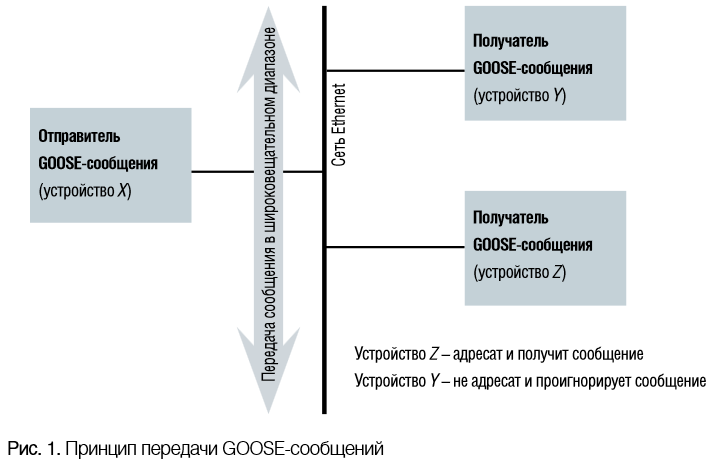
Устройство-отправитель передает по сети Ethernet информацию в широковещательном диапазоне.
В сообщении присутствует адрес отправителя и адреса, по которым осуществляется его передача, а также значение сигнала (например «0» или «1»).
Устройство-получатель получит сообщение, а все остальные устройства его проигнорируют.
Поскольку передача GOOSE-сообщений осуществляется в широковещательном диапазоне, т.е. нескольким адресатам, подтверждение факта получения адресатами сообщения отсутствует. По этой причине передача GOOSE-сообщений в установившемся режиме производится с определенной периодичностью.
При наступлении нового события в системе (например, КЗ и, как следствие, пуска измерительных органов защиты) начинается спонтанная передача сообщения через увеличивающиеся интервалы времени (например, 1 мс, 2 мс, 4 мс и т.д.). Интервалы времени между передаваемыми сообщениями увеличиваются, пока не будет достигнуто предельное значение, определяемое пользователем (например, 50 мс). Далее, до момента наступления нового события в системе, передача будет осуществляется именно с таким периодом. Указанное проиллюстрировано на рис. 2.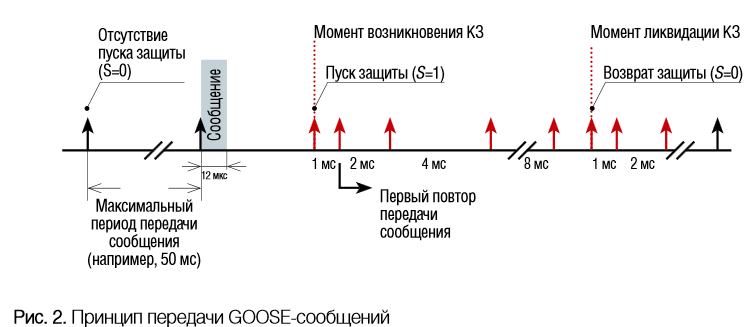
Технология повторной передачи не только гарантирует получение адресатом сообщения, но также обеспечивает контроль исправности линии связи и устройств – любые неисправности будут обнаружены по истечении максимального периода передачи GOOSE-сообщений (с точки зрения эксплуатации практически мгновенно). В случае передачи сигналов традиционным образом неисправность выявляется либо в процессе плановой проверки устройств, либо в случае неправильной работы системы РЗА.
Еще одной особенностью передачи GOOSE-сообщений является использование функций установки приоритетности передачи телеграмм (priority tagging) стандарта Ethernet IEEE 802.3u, которые не используются в других протоколах, в том числе уровня TCP/IP. То есть GOOSE-сообщения идут в обход «нормальных» телеграмм с более высоким приоритетом (см. рис. 3).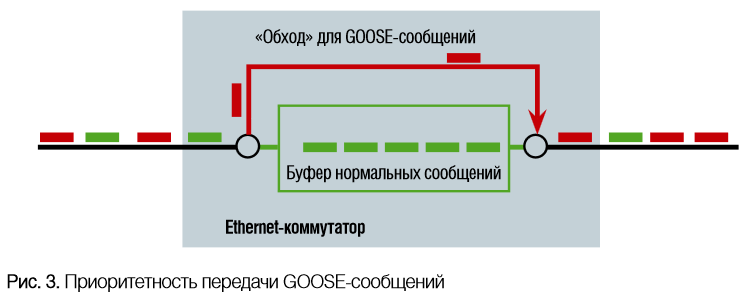
Однако стандарт МЭК 61850 декларирует передачу не только дискретной информации между терминалами РЗА, но и аналоговой. Это означает, что в будущем будет иметься возможность передачи аналоговой информации от ТТ и ТН по цифровым каналам связи. На данный момент готовых решений по передаче аналоговой информации для целей РЗА (в рамках стандарта МЭК 61850) ни один из производителей не предоставляет.
Для того чтобы использовать GOOSE-сообщения для передачи дискретных сигналов между терминалами РЗА необходима достаточная надежность и быстродействие передачи GOOSE-сообщений. Надежность передачи GOOSE-сообщений обеспечивается следующим:- Протокол МЭК 61850 использует Ethernet-сеть, за счет этого выход из строя верхнего уровня АСУ ТП и любого из устройств РЗА не отражается на передаче GOOSE-сообщений оставшихся в работе устройств,
- Терминалы РЗА имеют два независимых Ethernet-порта, при выходе одного из них из строя второй его полностью заменяет,
- Сетевые коммутаторы, к которым подключаются устройства РЗА, соединяются в два независимых «кольца»,
- Разные порты одного терминала РЗА подключаются к разным сетевым коммутаторам, подключенным к разным «кольцам»,
- Каждый сетевой коммутатор имеет дублированное питание от разных источников,
- Во всех устройствах РЗА осуществляется постоянный контроль возможности прохождения каждого сигнала. Это позволяет автоматически определить не только отказы цифровой связи, но и ошибки параметрирования терминалов.
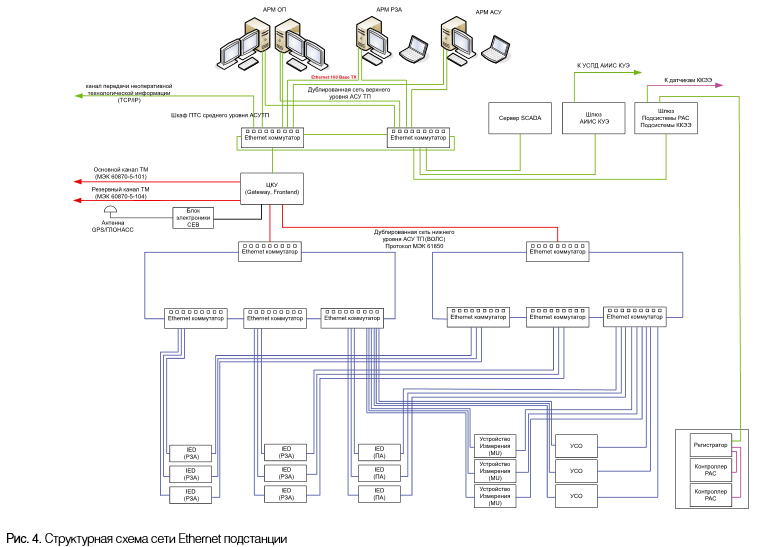
На рис. 4 изображен пример структурной схемы сети Ethernet (100 Мбит/c) подстанции. Отказ в передаче GOOSE-сообщения от одного устройства защиты другому возможен в результате совпадения как минимум двух событий. Например, одновременный отказ двух коммутаторов, к которым подключено одно устройство или одновременный отказ обоих портов одного устройства. Могут быть и более сложные отказы, связанные с одновременным наложением большего количества событий. Таким образом, единичные отказы оборудования не могут привести к отказу передачи GOOSEсообщений. Дополнительно увеличивает надежность то обстоятельство, что даже в случае отказа в передаче GOOSE-сообщения, устройство, принимающее сигнал, выдаст сигнал неисправности, и персонал примет необходимые меры для ее устранения.
Быстродействие.
В соответствии с требованиями стандарта МЭК 61850 передача GOOSE-сообщений должна осуществляться со временем не более 4 мс (для сообщений, требующих быстрой передачи, например, для передачи сигналов срабатывания защит, пусков АПВ и УРОВ и т.п.). Вообще говоря, время передачи зависит от топологии сети, количества устройств в ней, загрузки сети и загрузки вычислительных ресурсов терминалов РЗА, версии операционной системы терминала, коммуникационного модуля, типа центрального процессора терминала, количества коммутаторов и некоторых других аспектов. Поэтому время передачи GOOSE-сообщений должно быть подтверждено опытом эксплуатации.
Используя для передачи дискретных сигналов GOOSE-сообщения необходимо обращать внимание на то обстоятельство, что при использовании аппаратуры некоторых производителей, в случае отказа линии связи, значение передаваемого сигнала может оставаться таким, каким оно было получено в момент приема последнего сообщения.
Однако при отказе связи бывают случаи, когда сигнал должен принимать определенное значение. Например, значение сигнала блокировки МТЗ ввода 6–10 кВ в логике ЛЗШ при отказе связи целесообразно установить в значение «1», чтобы при КЗ на отходящем присоединении не произошло ложного отключения ввода. Так, к примеру, при проектировании терминалов фирмы Siemens изменить значение сигнала при отказе связи возможно с помощью свободно-программируемой CFCлогики (см. рис. 5).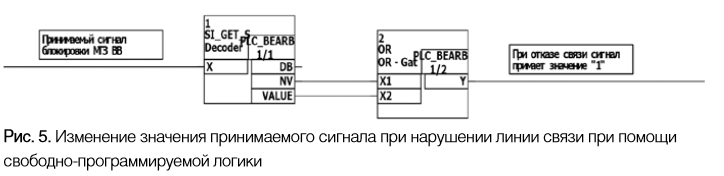
К CFC-блоку SI_GET_STATUS подводится принимаемый сигнал, на выходе блока мы можем получить значение сигнала «Value» и его статус «NV». Если в течение определенного времени не поступит сообщение со значением сигнала, статус сигнала «NV» примет значение «1». Далее статус сигнала и значение сигнала подводятся к элементу «ИЛИ», на выходе которого будет получено значение сигнала при исправности линии связи или «1» при нарушении исправности линии связи. Изменив логику, можно установить значение сигнала равным «0» при обрыве связи.
Использование GOOSE-сообщений предъявляет специальные требования к наладке и эксплуатации устройств РЗА. Во многом процесс наладки становится проще, однако при выводе устройства из работы необходимо следить не только за выводом традиционных цепей, но и не забывать отключать передачу GOOSE-сообщений.
При изменении параметрирования одного устройства РЗА необходимо производить загрузку файла параметров во все устройства, с которыми оно было связано.
В нашей стране имеется опыт внедрения и эксплуатации систем РЗА с передачей дискретных сигналов с использованием GOOSE-сообщений. На первых объектах GOOSE-сообщения использовались ограниченно (ПС 500 кВ «Алюминиевая»).
На ПС 500 кВ «Воронежская» GOOSEсообщения использовались для передачи сигналов пуска УРОВ, пуска АПВ, запрета АПВ, действия УРОВ на отключение смежного элемента, положения коммутационных аппаратов, наличия/отсутствия напряжения, сигналы ЛЗШ, АВР и т.п. Кроме того, на ОРУ 500 кВ и 110 кВ ПС «Воронежская» были установлены полевые терминалы, в которые собиралась информация с коммутационного оборудования и другая дискретная информация с ОРУ (рис. 6). Далее информация с помощью GOOSE-сообщений передавалась в терминалы РЗА, установленные в ОПУ подстанции (рис. 7, 8).
GOOSE-сообщения также были использованы при проектировании уже введенных в эксплуатацию ПС 500 кВ «Бескудниково», ПС 750 кВ «Белый Раст», ПС 330кВ «Княжегубская», ПС 220 кВ «Образцово», ПС 330 кВ «Ржевская». Эта технология применяется и при проектировании строящихся и модернизируемых подстанций ПС 500 кВ «Чагино», ПС 330кВ «Восточная», ПС 330 кВ «Южная», ПС 330 кВ «Центральная», ПС
330 кВ «Завод Ильич» и многих других.
Основные преимущества использования GOOSE-сообщений:- позволяет снизить количество кабелей вторичной коммутации на ПС;
- обеспечивает лучшую помехозащищенность канала связи;
- позволяет снизить время монтажных и пусконаладочных работ;
- исключает проблему излишнего срабатывания дискретных входов терминалов из-за замыканий на землю в цепях оперативного постоянного тока;
- убирает зависимость количества передаваемых сигналов от количества дискретных входов и выходных реле терминалов;
- обеспечивает возможность реконструкции и изменения связей между устройствами РЗА без прокладки дополнительных кабельных связей и повторного монтажа в шкафах;
- позволяет использовать МП терминалы РЗА с меньшим количеством входов и выходов (уменьшение габаритов и стоимости устройства);
- позволяет контролировать возможность прохождения сигнала (увеличивается надежность).
Безусловно, для окончательных выводов должен появиться достаточный опыт эксплуатации. В настоящее время большинство производителей устройств РЗА заявили о возможности использования GOOSEсообщений. Стандарт МЭК 61850 определяет передачу GOOSE-сообщений между терминалами разных производителей. Использование GOOSE-сообщений для передачи дискретных сигналов – это качественный скачок в развитии систем РЗА. С развитием стандарта МЭК 61850, переходом на Ethernet 1 Гбит/сек, с появлением новых цифровых ТТ и ТН, новых выключателей с возможностью подключения их блока управления к шине процесса МЭК 61850, эффективность использования GOOSE-сообщений намного увеличится. Облик будущих подстанций представляется с минимальным количеством контрольных кабелей, с передачей всех сообщений между устройствами РЗА, ТТ, ТН, коммутационными аппаратами через цифровую сеть. Устройства РЗА будут иметь минимальное количество выходных реле и дискретных входов
[ http://romvchvlcomm.pbworks.com/f/goosepaper1.pdf]
В стандарте определены два способа передачи данных напрямую между устройствами: GOOSE и GSSE. Это тоже пример наличия двух способов для реализации одной функции. GOOSE - более новый способ передачи сообщений, разработан специально для МЭК 61850. Способ передачи сообщений GSSE ранее присутствовал в стандарте UCA 2.0, являющимся одним из предшественников МЭК 61850. По сравнению с GSSE, GOOSE имеет более простой формат (Ethernet против стека OSI протоколов) и возможность передачи различных типов данных. Вероятно, способ GSSE включили в МЭК 61850 для того, чтобы производители, имеющие в своих устройствах протокол UCA 2.0, могли сразу декларировать соответствие МЭК 61850. В настоящее время все производители используют только GOOSE для передачи сообщений между устройствами.
Для выбора списка передаваемых данных в GOOSE, как и в отчѐтах, используются наборы данных. Однако тут требования уже другие. Время обработки GOOSE-сообщений должно быть минимальным, поэтому логично передавать наиболее простые типы данных. Обычно передаѐтся само значение сигнала и в некоторых случаях добавляется поле качества. Метка времени обычно включается в набор данных.
...
В устройствах серии БЭ2704 в передаваемых GOOSE-сообщениях содержатся данные типа boolean. Приниматься могут данные типа boolean, dbpos, integer.
Устоявшаяся тенденция существует только для передачи дискретной информации. Аналоговые данные пока передают немногие производители, и поэтому устоявшаяся тенденция в передаче аналоговой информации в данный момент отсутствует.
[ Источник]
Тематики
Синонимы
EN
Русско-английский словарь нормативно-технической терминологии > широковещательное объектно-ориентированное сообщение о событии на подстанции
См. также в других словарях:
COMMAND.COM — Developer(s) Seattle Computer Products, Microsoft Corporation, IBM, Novell and several others. Operating system DR DOS, FreeDOS, MS DOS, Novell DOS, OpenDOS, PC DOS, PTS DOS, ROM DOS, 86 DOS, Microsoft Windows (Windows 95 Wi … Wikipedia
COMMAND.COM — Тип Командный интерпретатор Разработчик Seattle Computer Products, Microsoft, IBM, Novell и др. Операционная система DOS (MS DOS, DR DOS, FreeDOS и т. д.), OS/2, Windows 9x и др. Язык … Википедия
Command.com — Saltar a navegación, búsqueda command.com es el nombre del intérprete de comandos para DOS y versiones de Windows de 16/32bits (95/98/98 SE/Me). Al ser el primer programa que se ejecuta después del inicio, posee también el rol de la configuración … Wikipedia Español
Command.com — Le programme COMMAND.COM est l interpréteur de commandes du système MS DOS. On ne le confondra pas avec cmd.exe, qui est l interpréteur de commande de Windows NT (Windows 2000, Windows XP...) et d OS/2. Les commandes de cmd.exe sont inspirées,… … Wikipédia en Français
command.com — Desarrollador Seattle Computer Products, Microsoft Corporation, IBM, Novell y otros Información general Género Shell … Wikipedia Español
Command.com — Command.com, die Datei, in welcher der Befehls Interpreter (Befehlsprozessor) des Betriebssystems DOS gespeichert ist. Bei Windows Betriebssystemen, die den Befehlssatz von DOS noch unterstützen (bis Windows ME), befindet sich diese Datei im… … Universal-Lexikon
Command.com — es el nombre del intérprete de comandos para DOS y versiones de Windows de 16/32bits (95/98/98 SE/Me). Al ser el primer programa que se ejecuta después del inicio, posee también el rol de la configuración del sistema ejecutando el archivo… … Enciclopedia Universal
Command.com — Die command.com ist der Kommandozeileninterpreter (CLI) der DOS Betriebssysteme, also insbesondere des Microsoft Betriebssystems MS DOS, sowie der darauf basierenden Systeme Microsoft Windows 95, 98, 98 SE und Me, sowie IBM DOS/PC DOS. Neben der… … Deutsch Wikipedia
COMMAND.COM — Die COMMAND.COM ist der Kommandozeileninterpreter des Microsoft Betriebssystems MS DOS, sowie der darauf basierenden Systeme Microsoft Windows 95, 98, 98 SE und ME. Neben der Variante von Microsoft gab oder gibt es auch Entsprechungen in den MS… … Deutsch Wikipedia
COMMAND.COM — Le programme COMMAND.COM est l interpréteur de commandes du systèmes DOS. On ne le confondra pas avec cmd.exe, qui est l interpréteur de commande de Windows NT (Windows 2000, Windows XP...) et d OS/2. Leur successeur depuis 2006 est Windows… … Wikipédia en Français
COMMAND COM — file which contains the command processor of DOS which is required at startup … English contemporary dictionary
