

-
21 sistema
m.1 system (conjunto ordenado).por sistema systematicallysistema circulatorio circulatory systemsistema decimal decimal systemsistema fiscal o impositivo tax systemsistema inmunológico immune systemsistema internacional de unidades SI systemsistema métrico (decimal) metric (decimal) systemsistema monetario europeo European Monetary Systemsistema montañoso mountain chain o rangesistema nervioso nervous systemsistema periódico de los elementos periodic table of elementssistema de seguridad security systemsistema solar solar system2 method.3 system (computing).sistema experto/operativo expert/operating system* * *1 system\por sistema as a rulesistema cableado hard-wired systemsistema de ecuaciones simultaneous equations pluralsistema experto expert systemsistema métrico decimal decimal metric systemsistema montañoso mountain chainsistema nervioso nervous systemsistema operativo operative systemsistema planetario planetary systemsistema solar solar system* * *noun m.* * *SM1) (=conjunto ordenado) systemsistema binario — (Inform) binary system
sistema de calefacción — heating, heating system
sistema de fondo fijo — (Com) imprest system
sistema frontal — (Meteo) front, frontal system
sistema inmunitario, sistema inmunológico — immune system
sistema rastreador — [en investigaciones espaciales] tracking system
2) (=método) methodtrabajar con sistema — to work systematically o methodically
yo por sistema lo hago así — I make it a rule to do it this way, I've got into the habit of doing it this way
* * *1) ( método) systemtrabajar con sistema — to work systematically o methodically
2) ( conjunto organizado) systemel sistema educativo/impositivo — the education/tax system
•* * *= framework, machinery, system, regime [régime], ways and means.Ex. The intention is to establish a general framework, and then to give exceptions or further explanation and examples for each area in turn.Ex. We can choose to turn our backs on these principles with fatuous arguments which posit their anachronism and the nonexistent intelligence of computing machinery.Ex. The training of users of On-line Public Access Catalogues (OPACs) should be attuned to the characteristics of the system = La formación de usuarios de los catálogos en linea de acceso público (CEAP) debería estar en consonancia con las características del sistema.Ex. This study found that online access to scientific serials is most appropriate in the third world, principally due to the presence of a small number of scientists with a broad range of interests which makes the fixed-price regimes of print, microform or CD-ROM disadvantageous.Ex. Teachers need to be more familiar with bibliographical ways and means: librarians should be more aware of problems from the teachers' perspective and make active efforts to inform teachers of sources of help.----* abusar del sistema = game + the system, milk + the system.* activar un sistema = activate + system.* administrador del sistema = system administrator.* ADONIS (Distribución automática de documentos a través de sistemas de inform = ADONIS (Automated Document Delivery Over Networked Information Systems).* alterar el sistema = perturb + the system.* análisis de sistemas = system(s) analysis.* analista de sistemas = system(s) analyst.* analista de sistemas de gestión bibliotecaria = library systems analyst.* aprovecharse del sistema = game + the system, milk + the system.* auditoría de sistemas = systems audit, systems auditing.* auditoría de sistemas de información = information systems auditing, information systems audit.* bibliotecario de sistemas = systems librarian.* brecha del sistema de seguridad = security leak.* brecha en el sistema de seguridad = security hole.* burlar el sistema = beat + the system, game + the system.* caída del sistema = system crash.* catálogo del sistema = system catalogue.* Comité Conjunto para Sistemas de Información (JISC) = Joint Information Systems Committee (JISC).* configurador del sistema = system configurator.* controlador del sistema = system controller.* conversión al sistema decimal = decimalisation [decimalization, -USA].* conversión al sistema métrico = metrication.* convertir al sistema decimal = decimalise [decimalize, -USA].* copia de seguridad del sistema = system backup.* desafiar al sistema = beat + the system.* desarrollo de sistemas = system(s) development.* de todo el sistema = systemwide.* diseñador de sistemas = systems designer, system designer, system developer.* diseño de sistemas = systems design.* documentación del sistema = system documentation.* engañar al sistema = beat + the system, game + the system.* en todo el sistema = systemwide.* entre el hombre y el sistema = human-system.* en varios sistemas = cross-system.* evaluación de sistemas = system(s) evaluation.* fichero de existencias del sistema = system holdings file.* fichero de usuarios del sistema = system user file.* funcionar por un sistema de turnos = work on + a rota system, work on + a rota, work + shifts.* interfaz usuario-sistema = user/system interface.* ir en contra del sistema = buck + the system.* ISDS (Sistema Internacional de Datos sobre Publicaciones Seriadas) = ISDS (International Serials Data System).* mantener un sistema de turnos = hold + a rota of.* mostrar el prompt del sistema = prompt.* NISTF (Grupo de Trabajo sobre los Sistemas Nacionales de Información de la A = NISTF (Society of American Archivists National Information Systems Task Force).* nombre de acceso al sistema = system logon name.* organizar un sistema de turnos de + Nombre = organise + a rota of + Nombre.* PADIS (Sistema de Información para el Desarrollo de Africa) = PADIS (Pan-African Development Information System).* parecido a un sistema experto = expert-type.* promovido por el propio sistema de información = information-led.* prompt del sistema = system prompt.* propio del sistema = built-in.* protección del sistema = system security.* proveedor de sistemas = systems supplier, system supplier [systems supplier].* Proyecto para Sistemas Conectados (LSP) = Linked Systems Project (LSP).* responsable del sistema = system programmer.* seguridad del sistema = system security.* sistema abierto = open system.* sistema agrícola = farming system.* sistema anglosajón de medidas = imperial measures.* sistema anticuado = legacy system.* sistema antiguo = legacy system.* sistema antirrobo de libros = book security system, library security system.* sistema auditivo, el = auditory system, the.* sistema automatizado = data system, automated system, computerised system.* sistema automatizado de bibliotecas = automated library information system, library computer system.* sistema automatizado de indización = computer-based indexing system.* sistema automatizado de préstamo = automated lending system, computerised issue system.* sistema automatizado multimedia = multimedia computer system.* sistema automatizado para la recuperación = computerised document retrieval system, computerised information retrieval system.* sistema automatizado para la recuperación de documentos = computerised document retrieval system.* sistema automatizado para la recuperación de información = computerised information retrieval system.* sistema automatizado por microordenador = microcomputer-based system.* sistema bancario, el = banking system, the.* sistema basado en el conocimiento = knowledge-base system.* sistema basado en las imágenes = image-based system.* sistema bibliotecario = library system.* sistema bibliotecario automatizado = automated library system.* sistema bibliotecario de bibliotecas de un sólo tipo = single-type library system.* sistema bibliotecario de bibliotecas de varios tipos = multitype library system.* sistema bibliotecario nacional = national library system.* sistema bibliotecario regional = regional library system.* sistema bibliotecario universitario = university library system.* sistema + caerse = system + crash.* sistema cardiovascular = cardiovascular system.* sistema cerebroespinal, el = cerebrospinal system, the.* sistema circulatorio = circulatory system.* sistema comercial = market system, commercial system.* sistema de abastecimiento de agua = waterworks.* sistema de acceso mediante tarjeta = card access system.* sistema de aire acondicionado = air conditioning system, air cooling system.* sistema de alarma = alarm system, detection system.* sistema de alcantarillado = sewerage system, sewerage.* sistema de alerta = early warning system.* sistema de alerta de novedades tecnológicas = technology watch.* sistema de alerta temprana = early warning system.* sistema de alimentación = fuel system.* sistema de almacenamiento y recuperación de la información = information storage and retrieval system.* sistema de altas presiones = high-pressure system, ridge of high pressure.* sistema de alumbrado = lighting system.* sistema de apoyo a la toma de decisiones = decision support system, decision making system.* sistema de archivo = archiving system.* sistema de arranque = starting system.* sistema de asignaturas optativas = course elective system.* sistema de asistencia sanitaria = health care system.* sistema de autoedición = desktop system.* sistema de automatización de bibliotecas = library automation system.* sistema de aviso de reclamaciones = claims warning system.* sistema de ayuda = help system.* sistema de ayuda a la gestión = management support system (MSS).* sistema de bajas presiones = ridge of low pressure, low pressure system.* sistema de becas = grant scheme.* sistema de bibliotecas públicas = public library system.* sistema de búsqueda = paging system.* sistema de cableado = wiring system.* sistema de cables eléctricos = electrical wiring.* sistema de calefacción = heating system.* sistema de castas = caste system.* sistema de cierre = locking system.* sistema decimal = decimal system.* sistema de circulación automatizado = automated circulation system.* sistema de circulación del agua = water circulation system.* sistema de clases sociales = class system.* sistema de clasificación = classification scheme, scheme, classification system, classification schedules, grading system.* sistema de clasificación analítico = analytical classification scheme.* sistema de clasificación de Bliss = Bliss classification scheme.* sistema de clasificación decimal = decimal classification scheme.* sistema de clasificación de la Biblioteca del Congreso = LCC (Library of Congress Classification).* sistema de clasificación dicotomizado = dichotomized classification scheme.* sistema de clasificación enciclopédica = general classification scheme.* sistema de clasificación enumerativo = enumerative classification scheme, enumerative scheme.* sistema de clasificación especializado = special classification scheme, special scheme.* sistema de clasificación facetado = faceted classification scheme.* sistema de clasificación general = general scheme, general classification scheme.* sistema de clasificación jerárquico = hierarchical classification scheme.* sistema de clasificación lineal = linear classification scheme.* sistema de clasificación multidimensional = multidimensional classification scheme.* sistema de clasificación por disciplinas = discipline-oriented scheme.* sistema de clasificación sintético = synthetic classification scheme.* sistema de clasificación universal = universal classification scheme.* sistema de clasificación verbal = verbal classification system.* sistema de cobro por la información usada = information metering.* sistema de codificación = coding system.* sistema de compañías = companionship system.* sistema de comunicación = communication system.* sistema de comunicaciones = communication system.* Sistema de Comunicaciones y de Archivo Fotográfico (PACS) = Picture Archiving and Communication System (PACS).* sistema de comunicación óptica = optical communication system.* Sistema de Comunicación por Paquetes (PSS) = Packet-Switching System (PSS).* sistema de conductos eléctricos = ducting system.* sistema de conferencia en línea = online conferencing system.* sistema de control = monitoring system, vetting system.* sistema de control de la salida = exit control system.* sistema de control de publicaciones seriadas = serials system, serials control system.* sistema de conversión de texto a voz = text-to-speech system.* sistema de copias de seguridad = backup system.* sistema de creencias = belief system.* sistema de criba = vetting system.* sistema de deducción de puntos = points system.* sistema de defensa = defence system.* sistema de detección = detection system.* sistema de detección de libros = book detection system.* sistema de digitalización de documentos = document imaging system.* sistema de discos ópticos = optical disc system.* sistema de distribución = distribution system.* sistema de drenaje = drainage system.* sistema de emergencia = backup supply, backup system.* sistema de emisión de gases = exhaust system.* sistema de emisión de humos = exhaust system.* sistema de encendido = ignition system.* sistema de entrada mediante tarjetas = card-entry system.* sistema de entrada múltiple = multiple entry system.* sistema de entrada única = single entry system.* sistema de escritura = writing system.* sistema de evaluación = rating system.* sistema de evaluación anónima = double-blind.* sistema de evaluación por paresanónima = double-blind refereeing system.* sistema de extinción de incendios mediante rociadores de agua = water sprinkler fire extinguishing system.* sistema de extinción de incendios = fire extinguishing system, extinguishing system.* sistema de extinción de incendios mediante gas halón = halon gas fire extinguishing system.* sistema de facturación = billing system.* sistema de facturación por uso = cost billing system.* sistema defensivo = defence system.* sistema de fichas = card based system.* sistema de fichas peek-a-boo = peek-a-boo system.* sistema de frenado = brake system, braking system.* sistema de frenado antibloqueo = antilock braking system.* sistema de frenos = brake system, braking system.* sistema de géneros = sex/gender system.* sistema de gestión bibliotecaria = library system, library management system.* sistema de gestión de documentos = record(s) system.* sistema de gestión de documentos electrónicos = electronic document management system (EDMS).* sistema de gestión de imágenes = imaging system, image-based system, image management system.* sistema de gestión de la información (SGI) = information management system (IMS).* sistema de gestión del conocimiento = knowledge management system (KMS).* Sistema de Gestión de Mensajes (MHS) = Message Handling System (MHS).* sistema de gestión de registros = record(s) system.* sistema de gestión documental = information retrieval system (IRS), record(s) system.* sistema de gobierno = polity.* sistema de iluminación = lighting system.* sistema de incentivos = reward system, system of incentives [incentive system].* sistema de indización = indexing system, index system.* sistema de indización con conservación del contexto (PRECIS) = PRECIS.* Sistema de Indización de Estructura Profunda (DSIS) = Deep Structure Indexing System (DSIS).* sistema de indización de fichas = card index system.* Sistema de Indización por Frases Anidadas (NEPHIS) = Nested Phrase Indexing System (NEPHIS).* sistema de indización postcoordinada = post-coordinate indexing system.* sistema de indización PRECIS = PRECIS indexing system.* sistema de indización precoordinada = pre-coordinate indexing system.* sistema de información = information system.* Sistema de Información Bibliotecario = LIBRIS.* sistema de información documental = document information system.* Sistema de Información Geográfica (SIG) = Geographic Information System (GIS).* sistema de información integrado = integrated information system.* sistema de información sectorial = sectoral information system.* Sistema de Información sobre Literatura Gris en Europa (SIGLE) = SIGLE (System for Information on Grey Literature in Europe).* sistema + dejar de funcionar = system + crash.* sistema de justicia penal = criminal justice system.* sistema de la ciencia, el = system of science, the.* sistema de lápiz óptico = data pen system.* sistema de llave en mano = turnkey system, turnkey software system.* sistema de lógica difusa = fuzzy system.* sistema del olfato = olfactory system.* sistema de medición de los recursos usados = metering system.* sistema de megafonía = public address system.* sistema de mercado = market system.* sistema de multas = fines system.* sistema de multiusuarios = multi-user system.* sistema de notas = grading system.* sistema de numeración = numbering scheme, numbering system.* sistema de petición de documentos = document delivery system.* sistema de préstamo = circulation system, issue system, lending system, book checking system, charge out system, library issue system.* sistema de préstamo automatizado = automated circulation system.* sistema de préstamo interbibliotecario = interlibrary loan system.* sistema de presupuestación mediante planificación y programación = planning programming budgeting system (PPBS).* sistema de primas = bonus scheme.* sistema de procesamiento de información = information processing system.* sistema de proceso de datos = data processing system.* sistema de proceso de imágenes = imaging system.* sistema de puntuación = point system.* sistema de reclamaciones = chasing system.* sistema de recompensa = reward system.* sistema de reconocimiento académico = academic reward(s) system.* sistema de recuperación = retrieval system.* sistema de recuperación de imágenes = image retrieval system.* sistema de recuperación de información = IR system.* sistema de recuperación de información por medio de menús = menu-based information retrieval system.* sistema de recuperación por relevancia = relevance system.* sistema de referencia = reference system, reference system.* sistema de referencia por coordenadas = grid reference.* sistema de refrigeración = cooling system.* sistema de registro = recording system.* sistema de reservas = booking system.* sistema de retransmisión = relay system.* sistema de rociadores de agua = sprinkler system, water sprinkler system.* sistema de saneamiento = sewerage system, sewerage.* sistema de seguimiento = monitoring system.* sistema de seguridad = security system, backup system.* sistema de selección = vetting system.* sistema de sonido cuadrafónico = quadrophonic system.* sistema de suministro de documentos = document supply system.* sistema de suministro de información = information supply system.* sistema de tarifas = charging system.* sistema de telecomunicaciones = telecommunication system.* sistema de televisión en color = colour system.* sistema de tiempo real = real-time system.* sistema de traducción automatizada = machine translation system.* sistema de transferencia de documentos = document delivery system.* sistema de transmisión de mensajes = messaging system.* sistema de transporte = transport system.* sistema de transporte público = public transport system.* sistema de tratamiento de imágenes = image processing system.* sistema de trueque, el = barter system, the.* sistema de tubos neumáticos = pneumatic tube system.* sistema de turnos = rota system.* sistema de valores = system of values, value system.* sistema de valores personales = personal value system.* sistema de valores sociales = social value system.* sistema de ventilación = ventilation system.* sistema de vídeodisco = video disc system.* Sistema de Vídeo Familiar (VHS) = VHS (Video Home System).* sistema de videotexto = videotext system.* sistema de videotexto público = public viewdata system.* sistema de vigilancia = surveillance system.* sistema de vigilancia electrónica = electronic surveillance system.* sistema digestivo = digestive system.* sistema documental = documentary system.* sistema económico = economic system.* sistema educativo = educational system, education system.* sistema electoral = electoral system.* sistema eléctrico = electrical system.* sistema electrónico de detección de robos = electronic theft detection system.* sistema endocrino, el = endocrine system, the.* sistema en el que el documento aparece representado en un único lugar del ín = one-place system.* sistema energético = energy system.* sistema en lenguaje natural = natural language system.* sistema en línea = online system.* sistema en red = network system.* sistema en uso = operational system.* sistema escolar, el = school system, the.* sistema ético = ethical system.* sistema experto = expert system, knowledge-base system.* Sistema General de Ordenación (SGO) = Broad System of Ordering (BSO).* sistema híbrido = hybrid system.* sistema ideológico = system of thought.* sistema informático = computing system, computer system.* sistema informático hecho por encargo = tailored system.* sistema inmunológico = immune system.* sistema integrado = integrated system.* sistema integrado de gestión bibliotecaria = integrated library package.* sistema inteligente = intelligent system.* sistema interactivo = interactive system.* sistema interactivo en línea = interactive online system.* sistema intermediario = backend system.* Sistema Internacional de Información sobre Agricultura (AGRIS) = AGRIS (International Agricultural Information System).* Sistema Internacional de Unidades, el = International System of Units, the.* sistema judicial = judicial system.* sistema legal, el = legal system, the.* sistema mercantil = market system.* sistema mercantilista = mercantile system.* sistema métrico decimal, el = metric system, the, decimal metric system, the.* sistema métrico, el = metric system, the.* sistema monetario = coinage.* sistema monetario, el = coinage system, the.* Sistema Monetario Europeo = European Monetary System.* sistema nervioso = nervous system.* sistema nervioso central = central nervous system.* sistema nervioso periférico = peripheral nervous system.* sistema numérico = numbering scheme, numbering system.* sistema obsoleto = legacy system.* sistema ofimático = office system.* sistema olfativo = olfactory system.* sistema operativo = operating system, operational system, computer operating system.* sistema operativo de disco = Disc Operating System (DOS).* sistema óptico = optical system, optical system.* sistema óptico de información = optical information system.* sistema orgánico = organ system.* sistema organizativo = organisational scheme, organisation scheme.* sistema para el análisis formal de documentos = markup code.* sistema para el análisis formal de documentos web = markup system.* sistema para información geográfica (SIG) = Geographical Information System (GIS).* sistema para la información de gestión = management information system (MIS).* Sistema para la Información Geográfica (SIG) = Geographic Information System (GIS).* sistema para la recuperación de texto libre = free text retrieval system.* sistema penal = penal system.* sistema penitenciario = penal system.* sistema personal = home system.* sistema político = political system.* sistema político unipartidista = one-party rule.* sistema precoordinado = pre-coordinate system.* sistema respiratorio = respiratory system.* sistema social = social system.* sistema solar, el = solar system, the.* sistema + venirse abajo = system + crash.* sistema virtual de gestión de cursos = course management system.* teoría de sistemas = systems theory.* vendedor de sistemas = systems vendor.* volver a levantar el sistema = restart.* * *1) ( método) systemtrabajar con sistema — to work systematically o methodically
2) ( conjunto organizado) systemel sistema educativo/impositivo — the education/tax system
•* * *= framework, machinery, system, regime [régime], ways and means.Ex: The intention is to establish a general framework, and then to give exceptions or further explanation and examples for each area in turn.
Ex: We can choose to turn our backs on these principles with fatuous arguments which posit their anachronism and the nonexistent intelligence of computing machinery.Ex: The training of users of On-line Public Access Catalogues (OPACs) should be attuned to the characteristics of the system = La formación de usuarios de los catálogos en linea de acceso público (CEAP) debería estar en consonancia con las características del sistema.Ex: This study found that online access to scientific serials is most appropriate in the third world, principally due to the presence of a small number of scientists with a broad range of interests which makes the fixed-price regimes of print, microform or CD-ROM disadvantageous.Ex: Teachers need to be more familiar with bibliographical ways and means: librarians should be more aware of problems from the teachers' perspective and make active efforts to inform teachers of sources of help.* abusar del sistema = game + the system, milk + the system.* activar un sistema = activate + system.* administrador del sistema = system administrator.* ADONIS (Distribución automática de documentos a través de sistemas de inform = ADONIS (Automated Document Delivery Over Networked Information Systems).* alterar el sistema = perturb + the system.* análisis de sistemas = system(s) analysis.* analista de sistemas = system(s) analyst.* analista de sistemas de gestión bibliotecaria = library systems analyst.* aprovecharse del sistema = game + the system, milk + the system.* auditoría de sistemas = systems audit, systems auditing.* auditoría de sistemas de información = information systems auditing, information systems audit.* bibliotecario de sistemas = systems librarian.* brecha del sistema de seguridad = security leak.* brecha en el sistema de seguridad = security hole.* burlar el sistema = beat + the system, game + the system.* caída del sistema = system crash.* catálogo del sistema = system catalogue.* Comité Conjunto para Sistemas de Información (JISC) = Joint Information Systems Committee (JISC).* configurador del sistema = system configurator.* controlador del sistema = system controller.* conversión al sistema decimal = decimalisation [decimalization, -USA].* conversión al sistema métrico = metrication.* convertir al sistema decimal = decimalise [decimalize, -USA].* copia de seguridad del sistema = system backup.* desafiar al sistema = beat + the system.* desarrollo de sistemas = system(s) development.* de todo el sistema = systemwide.* diseñador de sistemas = systems designer, system designer, system developer.* diseño de sistemas = systems design.* documentación del sistema = system documentation.* engañar al sistema = beat + the system, game + the system.* en todo el sistema = systemwide.* entre el hombre y el sistema = human-system.* en varios sistemas = cross-system.* evaluación de sistemas = system(s) evaluation.* fichero de existencias del sistema = system holdings file.* fichero de usuarios del sistema = system user file.* funcionar por un sistema de turnos = work on + a rota system, work on + a rota, work + shifts.* interfaz usuario-sistema = user/system interface.* ir en contra del sistema = buck + the system.* ISDS (Sistema Internacional de Datos sobre Publicaciones Seriadas) = ISDS (International Serials Data System).* mantener un sistema de turnos = hold + a rota of.* mostrar el prompt del sistema = prompt.* NISTF (Grupo de Trabajo sobre los Sistemas Nacionales de Información de la A = NISTF (Society of American Archivists National Information Systems Task Force).* nombre de acceso al sistema = system logon name.* organizar un sistema de turnos de + Nombre = organise + a rota of + Nombre.* PADIS (Sistema de Información para el Desarrollo de Africa) = PADIS (Pan-African Development Information System).* parecido a un sistema experto = expert-type.* promovido por el propio sistema de información = information-led.* prompt del sistema = system prompt.* propio del sistema = built-in.* protección del sistema = system security.* proveedor de sistemas = systems supplier, system supplier [systems supplier].* Proyecto para Sistemas Conectados (LSP) = Linked Systems Project (LSP).* responsable del sistema = system programmer.* seguridad del sistema = system security.* sistema abierto = open system.* sistema agrícola = farming system.* sistema anglosajón de medidas = imperial measures.* sistema anticuado = legacy system.* sistema antiguo = legacy system.* sistema antirrobo de libros = book security system, library security system.* sistema auditivo, el = auditory system, the.* sistema automatizado = data system, automated system, computerised system.* sistema automatizado de bibliotecas = automated library information system, library computer system.* sistema automatizado de indización = computer-based indexing system.* sistema automatizado de préstamo = automated lending system, computerised issue system.* sistema automatizado multimedia = multimedia computer system.* sistema automatizado para la recuperación = computerised document retrieval system, computerised information retrieval system.* sistema automatizado para la recuperación de documentos = computerised document retrieval system.* sistema automatizado para la recuperación de información = computerised information retrieval system.* sistema automatizado por microordenador = microcomputer-based system.* sistema bancario, el = banking system, the.* sistema basado en el conocimiento = knowledge-base system.* sistema basado en las imágenes = image-based system.* sistema bibliotecario = library system.* sistema bibliotecario automatizado = automated library system.* sistema bibliotecario de bibliotecas de un sólo tipo = single-type library system.* sistema bibliotecario de bibliotecas de varios tipos = multitype library system.* sistema bibliotecario nacional = national library system.* sistema bibliotecario regional = regional library system.* sistema bibliotecario universitario = university library system.* sistema + caerse = system + crash.* sistema cardiovascular = cardiovascular system.* sistema cerebroespinal, el = cerebrospinal system, the.* sistema circulatorio = circulatory system.* sistema comercial = market system, commercial system.* sistema de abastecimiento de agua = waterworks.* sistema de acceso mediante tarjeta = card access system.* sistema de aire acondicionado = air conditioning system, air cooling system.* sistema de alarma = alarm system, detection system.* sistema de alcantarillado = sewerage system, sewerage.* sistema de alerta = early warning system.* sistema de alerta de novedades tecnológicas = technology watch.* sistema de alerta temprana = early warning system.* sistema de alimentación = fuel system.* sistema de almacenamiento y recuperación de la información = information storage and retrieval system.* sistema de altas presiones = high-pressure system, ridge of high pressure.* sistema de alumbrado = lighting system.* sistema de apoyo a la toma de decisiones = decision support system, decision making system.* sistema de archivo = archiving system.* sistema de arranque = starting system.* sistema de asignaturas optativas = course elective system.* sistema de asistencia sanitaria = health care system.* sistema de autoedición = desktop system.* sistema de automatización de bibliotecas = library automation system.* sistema de aviso de reclamaciones = claims warning system.* sistema de ayuda = help system.* sistema de ayuda a la gestión = management support system (MSS).* sistema de bajas presiones = ridge of low pressure, low pressure system.* sistema de becas = grant scheme.* sistema de bibliotecas públicas = public library system.* sistema de búsqueda = paging system.* sistema de cableado = wiring system.* sistema de cables eléctricos = electrical wiring.* sistema de calefacción = heating system.* sistema de castas = caste system.* sistema de cierre = locking system.* sistema decimal = decimal system.* sistema de circulación automatizado = automated circulation system.* sistema de circulación del agua = water circulation system.* sistema de clases sociales = class system.* sistema de clasificación = classification scheme, scheme, classification system, classification schedules, grading system.* sistema de clasificación analítico = analytical classification scheme.* sistema de clasificación de Bliss = Bliss classification scheme.* sistema de clasificación decimal = decimal classification scheme.* sistema de clasificación de la Biblioteca del Congreso = LCC (Library of Congress Classification).* sistema de clasificación dicotomizado = dichotomized classification scheme.* sistema de clasificación enciclopédica = general classification scheme.* sistema de clasificación enumerativo = enumerative classification scheme, enumerative scheme.* sistema de clasificación especializado = special classification scheme, special scheme.* sistema de clasificación facetado = faceted classification scheme.* sistema de clasificación general = general scheme, general classification scheme.* sistema de clasificación jerárquico = hierarchical classification scheme.* sistema de clasificación lineal = linear classification scheme.* sistema de clasificación multidimensional = multidimensional classification scheme.* sistema de clasificación por disciplinas = discipline-oriented scheme.* sistema de clasificación sintético = synthetic classification scheme.* sistema de clasificación universal = universal classification scheme.* sistema de clasificación verbal = verbal classification system.* sistema de cobro por la información usada = information metering.* sistema de codificación = coding system.* sistema de compañías = companionship system.* sistema de comunicación = communication system.* sistema de comunicaciones = communication system.* Sistema de Comunicaciones y de Archivo Fotográfico (PACS) = Picture Archiving and Communication System (PACS).* sistema de comunicación óptica = optical communication system.* Sistema de Comunicación por Paquetes (PSS) = Packet-Switching System (PSS).* sistema de conductos eléctricos = ducting system.* sistema de conferencia en línea = online conferencing system.* sistema de control = monitoring system, vetting system.* sistema de control de la salida = exit control system.* sistema de control de publicaciones seriadas = serials system, serials control system.* sistema de conversión de texto a voz = text-to-speech system.* sistema de copias de seguridad = backup system.* sistema de creencias = belief system.* sistema de criba = vetting system.* sistema de deducción de puntos = points system.* sistema de defensa = defence system.* sistema de detección = detection system.* sistema de detección de libros = book detection system.* sistema de digitalización de documentos = document imaging system.* sistema de discos ópticos = optical disc system.* sistema de distribución = distribution system.* sistema de drenaje = drainage system.* sistema de emergencia = backup supply, backup system.* sistema de emisión de gases = exhaust system.* sistema de emisión de humos = exhaust system.* sistema de encendido = ignition system.* sistema de entrada mediante tarjetas = card-entry system.* sistema de entrada múltiple = multiple entry system.* sistema de entrada única = single entry system.* sistema de escritura = writing system.* sistema de evaluación = rating system.* sistema de evaluación anónima = double-blind.* sistema de evaluación por paresanónima = double-blind refereeing system.* sistema de extinción de incendios mediante rociadores de agua = water sprinkler fire extinguishing system.* sistema de extinción de incendios = fire extinguishing system, extinguishing system.* sistema de extinción de incendios mediante gas halón = halon gas fire extinguishing system.* sistema de facturación = billing system.* sistema de facturación por uso = cost billing system.* sistema defensivo = defence system.* sistema de fichas = card based system.* sistema de fichas peek-a-boo = peek-a-boo system.* sistema de frenado = brake system, braking system.* sistema de frenado antibloqueo = antilock braking system.* sistema de frenos = brake system, braking system.* sistema de géneros = sex/gender system.* sistema de gestión bibliotecaria = library system, library management system.* sistema de gestión de documentos = record(s) system.* sistema de gestión de documentos electrónicos = electronic document management system (EDMS).* sistema de gestión de imágenes = imaging system, image-based system, image management system.* sistema de gestión de la información (SGI) = information management system (IMS).* sistema de gestión del conocimiento = knowledge management system (KMS).* Sistema de Gestión de Mensajes (MHS) = Message Handling System (MHS).* sistema de gestión de registros = record(s) system.* sistema de gestión documental = information retrieval system (IRS), record(s) system.* sistema de gobierno = polity.* sistema de iluminación = lighting system.* sistema de incentivos = reward system, system of incentives [incentive system].* sistema de indización = indexing system, index system.* sistema de indización con conservación del contexto (PRECIS) = PRECIS.* Sistema de Indización de Estructura Profunda (DSIS) = Deep Structure Indexing System (DSIS).* sistema de indización de fichas = card index system.* Sistema de Indización por Frases Anidadas (NEPHIS) = Nested Phrase Indexing System (NEPHIS).* sistema de indización postcoordinada = post-coordinate indexing system.* sistema de indización PRECIS = PRECIS indexing system.* sistema de indización precoordinada = pre-coordinate indexing system.* sistema de información = information system.* Sistema de Información Bibliotecario = LIBRIS.* sistema de información documental = document information system.* Sistema de Información Geográfica (SIG) = Geographic Information System (GIS).* sistema de información integrado = integrated information system.* sistema de información sectorial = sectoral information system.* Sistema de Información sobre Literatura Gris en Europa (SIGLE) = SIGLE (System for Information on Grey Literature in Europe).* sistema + dejar de funcionar = system + crash.* sistema de justicia penal = criminal justice system.* sistema de la ciencia, el = system of science, the.* sistema de lápiz óptico = data pen system.* sistema de llave en mano = turnkey system, turnkey software system.* sistema de lógica difusa = fuzzy system.* sistema del olfato = olfactory system.* sistema de medición de los recursos usados = metering system.* sistema de megafonía = public address system.* sistema de mercado = market system.* sistema de multas = fines system.* sistema de multiusuarios = multi-user system.* sistema de notas = grading system.* sistema de numeración = numbering scheme, numbering system.* sistema de petición de documentos = document delivery system.* sistema de préstamo = circulation system, issue system, lending system, book checking system, charge out system, library issue system.* sistema de préstamo automatizado = automated circulation system.* sistema de préstamo interbibliotecario = interlibrary loan system.* sistema de presupuestación mediante planificación y programación = planning programming budgeting system (PPBS).* sistema de primas = bonus scheme.* sistema de procesamiento de información = information processing system.* sistema de proceso de datos = data processing system.* sistema de proceso de imágenes = imaging system.* sistema de puntuación = point system.* sistema de reclamaciones = chasing system.* sistema de recompensa = reward system.* sistema de reconocimiento académico = academic reward(s) system.* sistema de recuperación = retrieval system.* sistema de recuperación de imágenes = image retrieval system.* sistema de recuperación de información = IR system.* sistema de recuperación de información por medio de menús = menu-based information retrieval system.* sistema de recuperación por relevancia = relevance system.* sistema de referencia = reference system, reference system.* sistema de referencia por coordenadas = grid reference.* sistema de refrigeración = cooling system.* sistema de registro = recording system.* sistema de reservas = booking system.* sistema de retransmisión = relay system.* sistema de rociadores de agua = sprinkler system, water sprinkler system.* sistema de saneamiento = sewerage system, sewerage.* sistema de seguimiento = monitoring system.* sistema de seguridad = security system, backup system.* sistema de selección = vetting system.* sistema de sonido cuadrafónico = quadrophonic system.* sistema de suministro de documentos = document supply system.* sistema de suministro de información = information supply system.* sistema de tarifas = charging system.* sistema de telecomunicaciones = telecommunication system.* sistema de televisión en color = colour system.* sistema de tiempo real = real-time system.* sistema de traducción automatizada = machine translation system.* sistema de transferencia de documentos = document delivery system.* sistema de transmisión de mensajes = messaging system.* sistema de transporte = transport system.* sistema de transporte público = public transport system.* sistema de tratamiento de imágenes = image processing system.* sistema de trueque, el = barter system, the.* sistema de tubos neumáticos = pneumatic tube system.* sistema de turnos = rota system.* sistema de valores = system of values, value system.* sistema de valores personales = personal value system.* sistema de valores sociales = social value system.* sistema de ventilación = ventilation system.* sistema de vídeodisco = video disc system.* Sistema de Vídeo Familiar (VHS) = VHS (Video Home System).* sistema de videotexto = videotext system.* sistema de videotexto público = public viewdata system.* sistema de vigilancia = surveillance system.* sistema de vigilancia electrónica = electronic surveillance system.* sistema digestivo = digestive system.* sistema documental = documentary system.* sistema económico = economic system.* sistema educativo = educational system, education system.* sistema electoral = electoral system.* sistema eléctrico = electrical system.* sistema electrónico de detección de robos = electronic theft detection system.* sistema endocrino, el = endocrine system, the.* sistema en el que el documento aparece representado en un único lugar del ín = one-place system.* sistema energético = energy system.* sistema en lenguaje natural = natural language system.* sistema en línea = online system.* sistema en red = network system.* sistema en uso = operational system.* sistema escolar, el = school system, the.* sistema ético = ethical system.* sistema experto = expert system, knowledge-base system.* Sistema General de Ordenación (SGO) = Broad System of Ordering (BSO).* sistema híbrido = hybrid system.* sistema ideológico = system of thought.* sistema informático = computing system, computer system.* sistema informático hecho por encargo = tailored system.* sistema inmunológico = immune system.* sistema integrado = integrated system.* sistema integrado de gestión bibliotecaria = integrated library package.* sistema inteligente = intelligent system.* sistema interactivo = interactive system.* sistema interactivo en línea = interactive online system.* sistema intermediario = backend system.* Sistema Internacional de Información sobre Agricultura (AGRIS) = AGRIS (International Agricultural Information System).* Sistema Internacional de Unidades, el = International System of Units, the.* sistema judicial = judicial system.* sistema legal, el = legal system, the.* sistema mercantil = market system.* sistema mercantilista = mercantile system.* sistema métrico decimal, el = metric system, the, decimal metric system, the.* sistema métrico, el = metric system, the.* sistema monetario = coinage.* sistema monetario, el = coinage system, the.* Sistema Monetario Europeo = European Monetary System.* sistema nervioso = nervous system.* sistema nervioso central = central nervous system.* sistema nervioso periférico = peripheral nervous system.* sistema numérico = numbering scheme, numbering system.* sistema obsoleto = legacy system.* sistema ofimático = office system.* sistema olfativo = olfactory system.* sistema operativo = operating system, operational system, computer operating system.* sistema operativo de disco = Disc Operating System (DOS).* sistema óptico = optical system, optical system.* sistema óptico de información = optical information system.* sistema orgánico = organ system.* sistema organizativo = organisational scheme, organisation scheme.* sistema para el análisis formal de documentos = markup code.* sistema para el análisis formal de documentos web = markup system.* sistema para información geográfica (SIG) = Geographical Information System (GIS).* sistema para la información de gestión = management information system (MIS).* Sistema para la Información Geográfica (SIG) = Geographic Information System (GIS).* sistema para la recuperación de texto libre = free text retrieval system.* sistema penal = penal system.* sistema penitenciario = penal system.* sistema personal = home system.* sistema político = political system.* sistema político unipartidista = one-party rule.* sistema precoordinado = pre-coordinate system.* sistema respiratorio = respiratory system.* sistema social = social system.* sistema solar, el = solar system, the.* sistema + venirse abajo = system + crash.* sistema virtual de gestión de cursos = course management system.* teoría de sistemas = systems theory.* vendedor de sistemas = systems vendor.* volver a levantar el sistema = restart.* * *A (método) systemnecesitamos un nuevo sistema we need a new way of doing things o a new systemtrabajar con sistema to work systematically o methodicallyél se opone a todo lo que yo propongo, por sistema he systematically o invariably opposes everything I propose, as a matter of course he opposes everything I proposeB1 (conjunto organizado) systemel sistema educativo/impositivo the education/tax systemel sistema de calefacción the heating system2 ( Inf) systementrar en or al sistema to log in o onsalir del sistema to log out o offCompuestos:( Mil) Electronic Counter Measuresdistribution systemset of simultaneous equationssatellite navegation systemthrough-ticketingexpert system[ Vocabulary notes (Spanish) ], [ Vocabulary notes (Spanish) ], [ Vocabulary notes (Spanish) ], [ Vocabulary notes (Spanish) ], [ Vocabulary notes (Spanish) ]metric systemEuropean Monetary Systemmountain rangenervous systemcentral nervous systemoperating systemdisk operating systemsolar system( Esp) through-ticketing* * *
sistema sustantivo masculino
1 ( método) system;◊ trabajar con sistema to work systematically o methodically
2 ( conjunto organizado) system;
sistema solar solar system;
Ssistema Monetario Europeo European Monetary System
3 (Inf) system;◊ entrar en el/salir del sistema to log on/off
sistema sustantivo masculino
1 system
sistema circulatorio, circulatory system
sistema operativo, operating system
2 (modo) tenemos que buscar un sistema para hacerlo, we have to find a way to do it
♦ Locuciones: por sistema, as a rule
' sistema' also found in these entries:
Spanish:
bicameral
- decimal
- dicotomía
- educativa
- educativo
- enseñanza
- inconveniente
- instrumentación
- inutilizar
- LOGSE
- métrica
- métrico
- monetaria
- monetario
- obsoleta
- obsoleto
- perfección
- poner
- refrigeración
- salir
- simulador
- simuladora
- SME
- SMI
- solar
- subsistir
- sufragio
- tributación
- tributaria
- tributario
- vía
- vídeo
- afianzar
- afiliarse
- alfabetizar
- aparato
- aplicar
- cómodo
- complicado
- defecto
- desbaratar
- ejido
- escritura
- falla
- fórmula
- funcionamiento
- impositivo
- inadecuado
- ineficaz
- ingeniar
English:
advanced
- Amtrak
- antilock braking system
- backup
- change over
- decimal system
- develop
- development
- diagram
- DOS
- efficient
- electronic
- establishment
- European Monetary System
- flagship
- glitch
- GPA
- imperial mile
- instal
- install
- institute
- log in
- log off
- log on
- log out
- machinery
- metric
- MIS
- nervous system
- operating system
- operational
- PA
- piecemeal
- plumbing
- pony express
- process
- respiratory system
- retrieval
- sanitary
- service
- set-up
- sewerage
- system
- tax system
- unsystematic
- unsystematically
- comprehensive
- day
- decimalization
- down
* * *♦ nm1. [conjunto ordenado] systemsistema de apertura retardada time lock;sistema de apoyo support system;el sistema bancario the banking system;Astron sistema binario [de estrellas] binary system;sistema cegesimal [de unidades] CGS system;el Sistema Central = Spanish central mountain range;sistema de coordenadas coordinate system;sistema decimal decimal system;TV sistema dual bilingual broadcasting;sistema fiscal tax system;el Sistema Ibérico the Iberian chain;sistema impositivo tax system;sistema internacional de unidades SI system;sistema métrico (decimal) metric (decimal) system;Sistema Monetario Europeo European Monetary System;sistema montañoso mountain chain o range;sistema periódico (de los elementos) periodic table (of elements);sistema planetario planetary system;sistema político political system;sistema de referencia frame of reference;sistema de seguridad security system;sistema solar solar system;sistema de transportes transport system;sistema tributario tax system2. Anat systemsistema cardiovascular cardiovascular system;sistema circulatorio circulatory system;sistema endocrino endocrine system;sistema inmunológico immune system;sistema linfático lymphatic system;sistema nervioso nervous system;sistema nervioso central central nervous system3. [método, orden] method;trabajar con sistema to work methodically4. Informát systemsistema de alimentación ininterrumpida uninterruptible power supply;sistema de almacenamiento storage system;sistema de archivos jerárquicos hierarchical file system;sistema de autor authoring system;sistema binario binary system;sistema experto expert system;sistema de gestión de bases de datos database management system;sistema hexadecimal hexadecimal system, base 16;sistema multiprocesador multiprocessor system;sistema multiusuario multi-user system;sistema de nombres de dominio domain name system;sistema operativo operating system5. Ling system♦ por sistema loc advsystematically;me lleva la contraria por sistema he always argues with everything I saySISTEMA EDUCATIVOThe Spanish education system starts with free nursery school from 3 to 6. This is followed by primary school from 6 to 12, and compulsory secondary education from 12 to 16, successful completion of which entitles pupils to a “secondary school diploma”. There is then a choice of a general course of study (“bachillerato”) or a technical one, both of two years. The bachillerato allows access to university courses, which can lead to a diploma or degree. In Latin America, there is great variation in educational provision from country to country. The end of compulsory education ranges from age 11 in Honduras to 16 in Peru, though in most countries it is between 13 and 15. Actual enrolment in primary school is high, even in the poorer countries, but about a third of secondary-school-age Latin American children are not actually enrolled. In a poor country such as Guatemala this rises to two-thirds, compared with the high level of secondary enrolment in Argentina, Chile or Cuba.* * *m system* * *sistema nm: system* * *sistema n system -
22 наказателен
1. (свързан с наказателни процедури) criminal, penal(който служи за наказание) punitive(който иде като възмездие) retributiveнаказателен кодекс a criminal codeнаказателно дело, наказателен процес criminal actionнаказателно право criminal lawнаказателно съдопроизводство criminal jurisdictionнаказателно преследване (penal) prosecutionнаказателни закони penal/criminal lawsнаказателна акция a punitive expeditionнаказателни мерки punitive measures2. сп. penalty (attr.)наказателно поле a penalty areaнаказателна линия a foul lineнаказателен удар a penalty kick* * *наказа̀телен,прил., -на, -но, -ни 1. юр. ( свързан с наказателни процедури) criminal, penal; ( който служи за наказание) punitive; ( който идва като възмездие) retributive; \наказателенен кодекс criminal code; \наказателенна акция punitive expedition, punitive action; \наказателенна лихва penal interest; \наказателенни закони penal/criminal laws; \наказателенни мерки punitive measures; \наказателенни точки penal points; \наказателенно дело, \наказателенен процес criminal action/procedure, trial; \наказателенно право criminal law; \наказателенно преследване (penal) prosecution; \наказателенно съдопроизводство criminal jurisdiction; предприемам \наказателенна акция срещу take punitive action against;2. спорт. penalty (attr.); 11-метров \наказателенен удар penalty kick; \наказателенен удар (в баскетбола) foul shot; \наказателенна линия foul line; \наказателенна точка спорт. penalty point; \наказателенно поле penalty area.* * *crimina: a наказателен code - наказателен кодекс; penal: наказателен laws - наказателни закони; retributive; vindicatory (за закон)* * *1. (който иде като възмездие) retributive 2. (който служи за наказание) punitive 3. (свързан с наказателни процедури) criminal, penal 4. 3-метров НАКАЗАТЕЛЕН удар a penalty kick 5. НАКАЗАТЕЛЕН кодекс a criminal code 6. наказателна акция a punitive expedition 7. наказателна линия а foul line 8. наказателни закони penal/criminal laws 9. наказателни мерки punitive measures 10. наказателно дело, НАКАЗАТЕЛЕН процес criminal action 11. наказателно поле a penalty area 12. наказателно право criminal law 13. наказателно преследване (penal) prosecution 14. наказателно съдопроизводство criminal jurisdiction 15. сn. penalty (attr.) -
23 νόμος
νόμος, ου, ὁ (νέμω; [Zenodotus reads ν. in Od. 1, 3] Hes.+; loanw. in rabb.—On the history of the word MPohlenz, Nomos: Philol 97, ’48, 135–42; GShipp, Nomos ‘Law’ ’78; MOstwald, Nomos and the Beginnings of Athenian Democracy ’69). The primary mng. relates to that which is conceived as standard or generally recognized rules of civilized conduct esp. as sanctioned by tradition (Pind., Fgm. 152, 1=169 Schr. νόμος ὁ πάντων βασιλεύς; cp. SEG XVII, 755, 16: Domitian is concerned about oppressive practices hardening into ‘custom’; MGigante, ΝΟΜΟΣ ΒΑΣΙΛΕΥΣ [Richerche filologiche 1] ’56). The synonym ἔθος (cp. συνήθεια) denotes that which is habitual or customary, especially in reference to personal behavior. In addition to rules that take hold through tradition, the state or other legislating body may enact ordinances that are recognized by all concerned and in turn become legal tradition. A special semantic problem for modern readers encountering the term ν. is the general tendency to confine the usage of the term ‘law’ to codified statutes. Such limitation has led to much fruitless debate in the history of NT interpretation.—HRemus, Sciences Religieuses/Studies in Religion 13, ’84, 5–18; ASegal, Torah and Nomos in Recent Scholarly Discussion, ibid., 19–27.① a procedure or practice that has taken hold, a custom, rule, principle, norm (Alcman [VII B.C.], Fgm. 93 D2 of the tune that the bird sings; Ocellus [II B.C.] c. 49 Harder [1926] τῆς φύσεως νόμος; Appian, Basil. 1 §2 πολέμου ν., Bell. Civ. 5, 44 §186 ἐκ τοῦδε τοῦ σοῦ νόμου=under this rule of yours that governs action; Polyaenus 5, 5, 3 ν. πόμπης; 7, 11, 6 ν. φιλίας; Sextus 123 τοῦ βίου νόμος; Just., A II, 2, 4 παρὰ τὸν τῆς φύσεως ν.; Ath. 3, 1 νόμῳ φύσεως; 13, 1 θυσιῶν νόμῳ)ⓐ gener. κατὰ νόμον ἐντολῆς σαρκίνης in accordance w. the rule of an external commandment Hb 7:16. εὑρίσκω τὸν νόμον I observe an established procedure or principle or system Ro 7:21 (ν. as ‘principle’, i.e. an unwritten rightness of things Soph., Ant. 908). According to Bauer, Paul uses the expression νόμος (which dominates this context) in cases in which he prob. would have preferred another word. But it is also prob. that Paul purposely engages in wordplay to heighten the predicament of those who do not rely on the gospel of liberation from legal constraint: the Apostle speaks of a principle that obligates one to observe a code of conduct that any sensible pers. would recognize as sound and valid ὁ νόμος τ. νοός μου vs. 23b (s. νοῦς 1a). Engaged in a bitter struggle w. this νόμος there is a ἕτερος νόμος which, in contrast to the νοῦς, dwells ἐν τοῖς μέλεσίν μου in my (physical) members vs. 23a, and hence is a νόμος τῆς ἁμαρτίας vs. 23c and 25b or a νόμος τ. ἁμαρτίας καὶ τ. θανάτου 8:2b. This sense prepares the way for the specific perspectiveⓑ of life under the lordship of Jesus Christ as a ‘new law’ or ‘system’ of conduct that constitutes an unwritten tradition ὁ καινὸς ν. τοῦ κυρίου ἡμῶν Ἰησοῦ Χριστοῦ 2:6; in brief ν. Ἰησοῦ Χριστοῦ IMg 2 (cp. Just., D. 11, 4; 43, 1; Mel., P. 7, 46). Beginnings of this terminology as early as Paul: ὁ ν. τοῦ Χριστοῦ =the standard set by Christ Gal 6:2 (as vs. 3 intimates, Christ permitted himself to be reduced to nothing, thereby setting the standard for not thinking oneself to be someth.). The gospel is a νόμος πίστεως a law or system requiring faith Ro 3:27b (FGerhard, TZ 10, ’54, 401–17) or ὁ ν. τοῦ πνεύματος τῆς ζωῆς ἐν Χρ. Ἰ. the law of the spirit (=the spirit-code) of life in Chr. J. 8:2a. In the same sense Js speaks of a ν. βασιλικός (s. βασιλικός) 2:8 or ν. ἐλευθερίας vs. 12 (λόγος ἐλ. P74), ν. τέλειος ὁ τῆς ἐλευθερίας 1:25 (association w. 1QS 10:6, 8, 11 made by EStauffer, TLZ 77, ’52, 527–32, is rejected by SNötscher, Biblica 34, ’53, 193f. On the theme of spontaneous moral achievement cp. Pind., Fgm. 152 [169 Schr.] 1f νόμος ὁ πάντων βασιλεὺς | θνατῶν τε καὶ ἀθανάτων | ἄγει δικαιῶν τὸ βιαιότατον| ὑπερτάτᾳ χειρί=custom is lord of all, of mortals and immortals both, and with strong hand directs the utmost power of the just. Plut., Mor. 780c interprets Pindar’s use of νόμος: ‘not written externally in books or on some wooden tablets, but as lively reason functioning within him’ ἔμψυχος ὢν ἐν αὐτῷ λόγῳ; Aristot., EN 4, 8, 10 οἷον ν. ὢν ἑαυτῷ; Diod S 1, 94, 1 ν. ἔγγραπτος; cp. also Ovid, Met. 1, 90 sponte sua sine lege fidem rectumque colebat; Mayor, comm. ‘Notes’ 73.—RHirzel, ΑΓΡΑΦΟΣ ΝΟΜΟΣ 1903.). Some would put ὁ νόμος Js 2:9 here (s. LAllevi, Scuola Cattol. 67, ’39, 529–42), but s. 2b below.—Hermas too, who in part interprets Israel’s legal tradition as referring to Christians, sees the gospel, exhibited in Christ’s life and words, as the ultimate expression of God’s will or ‘law’. He says of Christ δοὺς αὐτοῖς (i.e. the believers) τὸν ν., ὅν ἔλαβε παρὰ τοῦ πατρὸς αὐτοῦ Hs 5, 6, 3, cp. Hs 8, 3, 3. Or he sees in the υἱὸς θεοῦ κηρυχθεὶς εἰς τὰ πέρατα τῆς γῆς, i.e. the preaching about the Son of God to the ends of the earth, the νόμος θεοῦ ὁ δοθεὶς εἰς ὅλον. τ. κόσμον 8, 3, 2. Similarly to be understood are τηρεῖν τὸν ν. 8, 3, 4. ὑπὲρ τοῦ ν. παθεῖν 8, 3, 6. ὑπὲρ τοῦ ν. θλίβεσθαι 8, 3, 7. ἀρνησάμενοι τὸν νόμον ibid. βλασφημεῖν τὸν ν. 8, 6, 2.② constitutional or statutory legal system, lawⓐ gener.: by what kind of law? Ro 3:27. ν. τῆς πόλεως the law of the city enforced by the ruler of the city (ν. ἐν ταῖς πόλεσι γραπτός Orig., C. Cels. 5, 37, 2); the penalty for breaking it is banishment Hs 1:5f. τοῖς ν. χρῆσθαι observe the laws 1:3; πείθεσθαι τοῖς ὡρισμένοις ν. obey the established laws Dg 5:10; νικᾶν τοὺς ν. ibid. (νικάω 3). Ro 7:1f, as well as the gnomic saying Ro 4:15b and 5:13b, have been thought by some (e.g. BWeiss, Jülicher) to refer to Roman law, but more likely the Mosaic law is meant (s. 3 below).ⓑ specifically: of the law that Moses received from God and is the standard according to which membership in the people of Israel is determined (Diod S 1, 94, 1; 2: the lawgiver Mneves receives the law from Hermes, Minos from Zeus, Lycurgus from Apollo, Zarathustra from the ἀγαθὸς δαίμων, Zalmoxis from Hestia; παρὰ δὲ τοῖς Ἰουδαίοις, Μωϋσῆς receives the law from the Ἰαὼ ἐπικαλούμενος θεός) ὁ ν. Μωϋσέως Lk 2:22; J 7:23; Ac 15:5. ν. Μωϋσέως Ac 13:38; Hb 10:28. Also ὁ ν. κυρίου Lk 2:23f, 39; GJs 14:1. ὁ ν. τοῦ θεοῦ (Theoph. Ant. 2, 14 [p. 136, 4]) Mt 15:6 v.l.; Ro 8:7 (cp. Tat. 7, 2; 32, 1; Ath. 3:2). ὁ ν. ἡμῶν, ὑμῶν, αὐτῶν etc. J 18:31; 19:7b v.l.; Ac 25:8. κατὰ τὸν ἡμέτερον ν. 24:6 v.l. (cp. Jos., Ant. 7, 131). ὁ πατρῷος ν. 22:3. τὸν ν. τῶν ἐντολῶν Eph 2:15. Since the context of Ac 23:29 ἐγκαλούμενον περὶ ζητημάτων τοῦ νόμου αὐτῶν points to the intimate connection between belief, cult, and communal solidarity in Judean tradition, the term νόμος is best rendered with an hendiadys: (charged in matters) relating to their belief and custom; cp. ν. ὁ καθʼ ὑμᾶς 18:15. Ro 9:31 (CRhyne, Νόμος Δικαιοσύνης and the meaning of Ro 10:4: CBQ 47, ’85, 486–99).—Abs., without further qualification ὁ ν. Mt 22:36; 23:23; Lk 2:27; J 1:17; Ac 6:13; 7:53; 21:20, 28; Ro 2:15 (τὸ ἔργον τοῦ νόμου the work of the law [=the moral product that the Mosaic code requires] is written in the heart; difft. Diod S 1, 94, 1 ν. ἔγγραπτος, s. 1b, above), 18, 20, 23b, 26; 4:15a, 16; 7:1b, 4–7, 12, 14, 16; 8:3f; 1 Cor 15:56; Gal 3:12f, 17, 19, 21a, 24; 5:3, 14; 1 Ti 1:8 (GRudberg, ConNeot 7, ’42, 15); Hb 7:19 (s. Windisch, Hdb. exc. ad loc.), 28a; 10:1; cp. Js 2:9 (s. 1b above); μετὰ τὸν ν. Hb 7:28b; οἱ ἐν τῷ ν. Ro 3:19; κατὰ τὸν ν. according to the (Mosaic) law (Jos., Ant. 14, 173; 15, 51 al.; Just., D. 10, 1) J 19:7b; Ac 22:12; 23:3; Hb 7:5; 9:22. παρὰ τ. νόμον contrary to the law (Jos., Ant. 17, 151, C. Ap. 2, 219; Ath. 1, 3 παρὰ πάντα ν.) Ac 18:13.—νόμος without the art. in the same sense (on the attempt, beginning w. Origen, In Ep. ad Ro 3:7 ed. Lomm. VI 201, to establish a difference in mng. betw. Paul’s use of ὁ νόμος and νόμος s. B-D-F §258, 2; Rob. 796; Mlt-Turner 177; Grafe [s. 3b below] 7–11) Ro 2:13ab, 17, 23a, * 25a; 3:31ab; 5:13, 20; 7:1a (s. above); Gal 2:19b; 5:23 (JRobb, ET 56, ’45, 279f compares κατὰ δὲ τῶν τοιούτων οὐκ ἔστι νόμος Aristot., Pol. 1284a). δικαίῳ νόμος οὐ κεῖται, ἀνόμοις δὲ … 1 Ti 1:9. Cp. ἑαυτοῖς εἰσιν νόμος Ro 2:14 (in Pla., Pol. and in Stoic thought the wise person needed no commandment [Stoic. III 519], the bad one did; MPohlenz, Stoa ’48/49 I 133; II 75). Used w. prepositions: ἐκ ν. Ro 4:14; Gal 3:18, 21c (v.l. ἐν ν.); Phil 3:9 (ἐκ νόμου can also mean corresponding to or in conformity with the law: PRev 15, 11 ἐκ τῶν νόμων); cp. ἐκ τοῦ νόμου Ro 10:5. διὰ νόμου Ro 2:12b; 3:20b; 4:13; 7:7b; Gal 2:19a, 21; ἐν ν. (ἐν τῷ ν. Iren. 3, 11, 8 [Harv. II 49, 9]) Ro 2:12a, 23; Gal 3:11, 21c v.l.; 5:4; Phil 3:6. κατὰ νόμον 3:5; Hb 8:4; 10:8 (make an offering κατὰ νόμον as Arrian, Anab. 2, 26, 4; 5, 8, 2); χωρὶς ν. Ro 3:21a; 7:8f; ἄχρι ν. 5:13a. ὑπὸ νόμον 6:14f; 1 Cor 9:20; Gal 3:23; 4:4f, 21a; 5:18 (cp. Just., D. 45, 3 οἱ ὑπὸ τὸν ν.).—Dependent on an anarthrous noun παραβάτης νόμου a law-breaker Ro 2:25b ( 27b w. art.); Js 2:11. ποιητὴς ν. one who keeps the law 4:11d (w. art. Ro 2:13b). τέλος ν. the end of the law Ro 10:4 (RBultmann and HSchlier, Christus des Ges. Ende ’40). πλήρωμα ν. fulfilment of the law 13:10. ν. μετάθεσις a change in the law Hb 7:12. ἔργα ν. Ro 3:20a, 28; 9:32 v.l.; Gal 2:16; 3:2, 5, 10a.—(ὁ) ν. (τοῦ) θεοῦ Ro 7:22, 25a; 8:7 because it was given by God and accords w. his will. Lasting Mt 5:18; Lk 16:17 (cp. Bar 4:1; PsSol 10:4; Philo, Mos. 2, 14; Jos., C. Ap. 2, 277).—Used w. verbs, w. or without the art.: ν. ἔχειν J 19:7a; Ro 2:14 (ApcSed 14:5). πληροῦν ν. fulfill the law Ro 13:8; pass. Gal 5:14 (Mel., P. 42, 291). πληροῦν τὸ δικαίωμα τοῦ ν. fulfill the requirement of the law Ro 8:4. φυλάσσειν τὸν ν. observe the law Ac 21:24; Gal 6:13. τὰ δικαιώματα τοῦ ν. φυλάσσειν observe the precepts of the law Ro 2:26; διώκειν ν. δικαιοσύνης 9:31a; πράσσειν ν. 2:25a. ποιεῖν τὸν ν. J 7:19b; Gal 5:3; Ro 2:14b, s. below; τὸν ν. τηρεῖν Js 2:10. τὸν ν. τελεῖν Ro 2:27. φθάνειν εἰς ν. 9:31b. κατὰ ν. Ἰουδαϊσμὸν ζῆν IMg 8:1 v.l. is prob. a textual error (Pearson, Lghtf., Funk, Bihlmeyer, Hilgenfeld; Zahn, Ign. v. Ant. 1873 p. 354, 1 [difft. in Zahn’s edition] all omit νόμον as a gloss and are supported by the Latin versions; s. Hdb. ad loc.). τὰ τοῦ ν. ποιεῖν carry out the requirements of the law Ro 2:14b (ApcSed 14:5; FFlückiger, TZ 8, ’52, 17–42). καταλαλεῖν νόμου, κρίνειν ν. Js 4:11abc. ἐδόθη ν. Gal 3:21a.—Pl. διδοὺς νόμους μου εἰς τὴν διάνοιαν αὐτῶν Hb 8:10; cp. 10:16 (both Jer 38:33).—Of an individual stipulation of the law ὁ νόμος τοῦ ἀνδρός the law insofar as it concerns the husband (Aristot., Fgm. 184 R. νόμοι ἀνδρὸς καὶ γαμετῆς.—SIG 1198, 14 κατὰ τὸν νόμον τῶν ἐρανιστῶν; Num 9:12 ὁ ν. τοῦ πάσχα; Philo, Sobr. 49 ὁ ν. τῆς λέπρας) Ro 7:2b; cp. 7:3 and δέδεται νόμῳ vs. 2a (on the imagery Straub 94f); 1 Cor 7:39 v.l.—The law is personified, as it were (Demosth. 43, 59; Aeschin. 1, 18; Herm. Wr. 12, 4 [the law of punishment]; IMagnMai 92a, 11 ὁ ν. συντάσσει; b, 16 ὁ ν. ἀγορεύει; Jos., Ant. 3, 274) J 7:51; Ro 3:19.③ a collection of holy writings precious to God’s people, sacred ordinanceⓐ in the strict sense the law=the Pentateuch, the work of Moses the lawgiver (Diod S 40, 3, 6 προσγέγραπται τοῖς νόμοις ἐπὶ τελευτῆς ὅτι Μωσῆς ἀκούσας τοῦ θεοῦ τάδε λέγει τ. Ἰουδαίοις=at the end of the laws this is appended: this is what Moses heard from God and is telling to the Jews. ὁ διὰ τοῦ ν. μεταξὺ καθαρῶν καὶ ἀκαθάρτων διαστείλας θεός Iren. 3, 12, 7 [Harv. II 60, 3]; cp. Hippol., Ref. 7, 34, 1) τὸ βιβλίον τοῦ νόμου Gal 3:10b (cp. Dt 27:26). Also simply ὁ νόμος (Jos., Bell. 7, 162 ὁ ν. or 2, 229 ὁ ἱερὸς ν. of the holy book in a concrete sense) Mt 12:5 (Num 28:9f is meant); J 8:5; 1 Cor 9:8 (cp. Dt 25:4); 14:34 (cp. Gen 3:16); Gal 4:21b (the story of Abraham); Hb 9:19. ὁ ν. ὁ ὑμέτερος J 8:17 (cp. Jos., Bell. 5, 402; Tat. 40, 1 κατὰ τοὺς ἡμετέρους ν.). ἐν Μωϋσέως νόμῳ γέγραπται 1 Cor 9:9. καθὼς γέγραπται ἐν νόμῳ κυρίου Lk 2:23 (γέγραπται ἐν νόμῳ as Athen. 6, 27, 23c; IMagnMai 52, 35 [III B.C.]; Mel., P. 11, 71; cp. Just., D. 8, 4 τὰ ἐν τῷ ν. γεγραμμένα); cp. vs. 24. ἔγραψεν Μωϋσῆς ἐν τῷ νόμῳ J 1:45 (cp. Cercidas [III B.C.], Fgm. 1, 18f Diehl2 [=Coll. Alex. p. 204, 29=Knox p. 196] καὶ τοῦθʼ Ὅμηρος εἶπεν ἐν Ἰλιάδι).—The Sacred Scriptures (OT) referred to as a whole in the phrase ὁ ν. καὶ οἱ προφῆται (Orig., C. Cels. 2, 6, 4; cp. Hippol., Ref. 8, 19, 1) the law (הַתּוֹרָה) and the prophets (הַנְּבִיאִים) Mt 5:17; 7:12; 11:13; 22:40; Lk 16:16; Ac 13:15; 24:14; 28:23; Ro 3:21b; cp. Dg 11:6; J 1:45. τὰ γεγραμμένα ἐν τῷ ν. Μωϋσέως καὶ τοῖς προφήταις καὶ ψαλμοῖς Lk 24:44.ⓑ In a wider sense=Holy Scripture gener., on the principle that the most authoritative part gives its name to the whole (ὁ ν. ὁ τοῦ θεοῦ Theoph. Ant. 1, 11 [p. 82, 15]): J 10:34 (Ps 81:6); 12:34 (Ps 109:4; Is 9:6; Da 7:14); 15:25 (Ps 34:19; 68:5); 1 Cor 14:21 (Is 28:11f); Ro 3:19 (preceded by a cluster of quotations fr. Psalms and prophets).—Mt 5:18; Lk 10:26; 16:17; J 7:49.—JHänel, Der Schriftbegriff Jesu 1919; OMichel, Pls u. s. Bibel 1929; SWesterholm, Studies in Religion 15, ’86, 327–36.—JMeinhold, Jesus u. das AT 1896; MKähler, Jesus u. das AT2 1896; AKlöpper, Z. Stellung Jesu gegenüber d. Mos. Gesetz, Mt 5:17–48: ZWT 39, 1896, 1–23; EKlostermann, Jesu Stellung z. AT 1904; AvHarnack, Hat Jesus das atl. Gesetz abgeschafft?: Aus Wissenschaft u. Leben II 1911, 225–36, SBBerlAk 1912, 184–207; KBenz, D. Stellung Jesu zum atl. Gesetz 1914; MGoguel, RHPR 7, 1927, 160ff; BBacon, Jesus and the Law: JBL 47, 1928, 203–31; BBranscomb, Jes. and the Law of Moses 1930; WKümmel, Jes. u. d. jüd. Traditionsged.: ZNW 33, ’34, 105–30; JHempel, D. synopt. Jesus u. d. AT: ZAW 56, ’38, 1–34.—Lk-Ac: JJervell, HTR 64, ’71, 21–36.—EGrafe, D. paulin. Lehre vom Gesetz2 1893; HCremer, D. paulin. Rechtfertigungslehre 1896, 84ff; 363ff; FSieffert, D. Entwicklungslinie d. paul. Gesetzeslehre: BWeiss Festschr. 1897, 332–57; WSlaten, The Qualitative Use of νόμος in the Pauline Ep.: AJT 23, 1919, 213ff; HMosbech, Pls’ Laere om Loven: TT 4/3, 1922, 108–37; 177–221; EBurton, ICC, Gal 1921, 443–60; PFeine, Theol. des NT6 ’34, 208–15 (lit.); PBenoit, La Loi et la Croix d’après S. Paul (Ro 7:7–8:4): RB 47, ’38, 481–509; CMaurer, D. Gesetzeslehre des Pls ’41; PBläser, D. Gesetz b. Pls ’41; BReicke, JBL 70, ’51, 259–76; GBornkamm, Das Ende d. Gesetzes ’63; HRaisänen, Paul and the Law2 ’87; PRichardson/SWesterholm, et al., Law in Religious Communities in the Rom. Period, ’91 (Torah and Nomos); MNobile, La Torà al tempo di Paolo, alcune ri-flessioni: Atti del IV simposio di Tarso su S. Paolo Apostolo, ed. LPadovese ’96, 93–106 (lit. 93f, n. 1).—Dodd 25–41.—B. 1358; 1419; 1421. DELG s.v. νέμω Ic. Schmidt, Syn. I 333–47. M-M. EDNT. TW. Sv. -
24 moral
adj.moral.tienen el apoyo moral de todos nosotros they have our moral supportf.1 morals, morality.moral estricta strict morals2 morale.su victoria nos dio mucha moral her win lifted our spirits o improved our moraleestar bajo de moral to be in poor spiritslevantarle o subirle la moral a alguien to lift somebody's spirits, to cheer somebody up3 mulberry tree, mulberry.4 blackberry bush.m.mulberry tree.* * *► adjetivo1 moral\levantar la moral a alguien to boost somebody's morale, raise somebody's spiritsestar bajo,-a de moral to be in low spiritsestar con la moral por los suelos to be down in the dumpstener más moral que el Alcoyano to be a born optimistobligación moral moral duty————————1 BOTÁNICA mulberry tree* * *1. noun f.1) morale2) morality2. adj.* * *ISM (Bot) mulberry treeII1. ADJ1) (=ético) moraltenemos la obligación moral de ayudarle — we are morally obliged to help him, we have a moral obligation to help him
2) (=espiritual) moral2. SF1) (=ética, moralidad) morality, morals plla moral cristiana — Christian morality, Christian morals
•
faltar a la moral — to behave immorally2) (=estado de ánimo) morale•
levantar la moral a algn — to raise sb's spirits o moralela moral se me cayó por los suelos cuando la vi con otro hombre — my heart sank when I saw her with another man
3) (=valor) moral courageyo no habría tenido moral para hablarles así — I wouldn't have had the moral courage to speak to them like that
* * *Iadjetivo moralIImasculino mulberry (tree)III1) (Fil, Relig)a) ( doctrina) moral doctrineb) ( moralidad) morality, morals (pl)2)a) ( estado de ánimo) moralelevantarle la moral a alguien — to raise somebody's morale, lift somebody's spirits
b) (arrojo, determinación) will* * *= moral, moral knowledge, morale, morality, sense of morality.Ex. Clear examples of such support were the abandoned forms SOCIAL AND MORAL CONDITIONS under Negroes and HISTORY AND CONDITION under women.Ex. P H Hirst defines eight such primary divisions of knowledge: mathematics, physical science, human science, history, moral knowledge, art, religion, philosophy.Ex. When they changed jobs, morale in public services fell immediately.Ex. A number of course leaders in the IT field regarded their lack of treatment of what might be termed morality of information provision as a drawback in their programmes.Ex. This article points to a warped sense of morality in which there is no such concept as 'theft' in some people's lexicon.----* adoptar la postura moral correcta = take + the high ground.* apoyo moral = moral support.* asesor moral = guidance counsellor, ethicist.* autoridad moral, la = moral high ground, the.* bajar la moral = lower + morale.* carácter moral = moral character.* comportamiento moral = moral behaviour.* conducta moral = moral conduct.* corrupción moral = moral corruption.* deber moral = moral duty.* decadencia moral = moral decay.* degeneración moral = moral decay.* depravación moral = moral depravity.* doble moral = double standard.* hundirse la moral = morale + plummet.* iniquidad moral = moral turpitude.* integridad moral = moral character.* inyección de moral = shot in the arm.* juicio moral = moral judgement.* lavantar la moral = lift + Posesivo + spirits up.* mayoría moral, la = moral majority, the.* obligación moral = moral obligation.* palabras para levantar la moral = pep talk.* por razones morales = on moral grounds.* principio moral = moral principle.* subir la moral = boost + Posesivo + morale, lift + morale, increase + morale, improve + morale, boost + Posesivo + confidence, bolster + confidence.* valor moral = moral value.* victoria moral = moral victory.* virtud moral = moral virtue.* * *Iadjetivo moralIImasculino mulberry (tree)III1) (Fil, Relig)a) ( doctrina) moral doctrineb) ( moralidad) morality, morals (pl)2)a) ( estado de ánimo) moralelevantarle la moral a alguien — to raise somebody's morale, lift somebody's spirits
b) (arrojo, determinación) will* * *= moral, moral knowledge, morale, morality, sense of morality.Ex: Clear examples of such support were the abandoned forms SOCIAL AND MORAL CONDITIONS under Negroes and HISTORY AND CONDITION under women.
Ex: P H Hirst defines eight such primary divisions of knowledge: mathematics, physical science, human science, history, moral knowledge, art, religion, philosophy.Ex: When they changed jobs, morale in public services fell immediately.Ex: A number of course leaders in the IT field regarded their lack of treatment of what might be termed morality of information provision as a drawback in their programmes.Ex: This article points to a warped sense of morality in which there is no such concept as 'theft' in some people's lexicon.* adoptar la postura moral correcta = take + the high ground.* apoyo moral = moral support.* asesor moral = guidance counsellor, ethicist.* autoridad moral, la = moral high ground, the.* bajar la moral = lower + morale.* carácter moral = moral character.* comportamiento moral = moral behaviour.* conducta moral = moral conduct.* corrupción moral = moral corruption.* deber moral = moral duty.* decadencia moral = moral decay.* degeneración moral = moral decay.* depravación moral = moral depravity.* doble moral = double standard.* hundirse la moral = morale + plummet.* iniquidad moral = moral turpitude.* integridad moral = moral character.* inyección de moral = shot in the arm.* juicio moral = moral judgement.* lavantar la moral = lift + Posesivo + spirits up.* mayoría moral, la = moral majority, the.* obligación moral = moral obligation.* palabras para levantar la moral = pep talk.* por razones morales = on moral grounds.* principio moral = moral principle.* subir la moral = boost + Posesivo + morale, lift + morale, increase + morale, improve + morale, boost + Posesivo + confidence, bolster + confidence.* valor moral = moral value.* victoria moral = moral victory.* virtud moral = moral virtue.* * *A (ético) moralvalores morales moral valuestienes el deber/la obligación moral de denunciarlo you have a moral duty/obligation to report himla formación moral del individuo the moral education of the individualB (espiritual, psicológico) moraldemostró tener gran fortaleza moral she showed that she possessed great moral strength o fiberno podemos brindarte más que apoyo moral we can only offer you moral supportmulberry tree, mulberry1 (doctrina) moral doctrinela moral cristiana the Christian doctrine2 (moralidad, ética) morality, morals (pl)faltar a la moral to commit an immoral actun lugar de dudosa moral a place of dubious moralityB1 (estado de ánimo) moralelevantarle la moral a algn to raise sb's morale, lift sb's spiritsestar bajo de moral to be feeling lowhan quedado con la moral por los suelos their morale has sunk to an all-time low o has hit rock bottomno pierdas la moral don't let things get you downtener más moral que el Alcoyano ( fam); to be very optimistic, to always look on the bright side2 (arrojo, determinación) willcon una moral de acero with iron-willed determination* * *
moral adjetivo
moral
■ sustantivo femenino
1 (Fil, Relig)
2 ( estado de ánimo) morale;
estar bajo de moral to be feeling low;
tener la moral alta to be in good spirits
■ sustantivo masculino
mulberry (tree)
moral
I adjetivo moral: hay unos principios morales que debemos observar, there are moral principles we should follow
II sustantivo femenino
1 (ética) morals pl: la moral de la época no era muy edificante, the morals of the time were not very uplifting
2 (ánimo) morale, spirits pl: tengo la moral por los suelos, my spirits are very low
' moral' also found in these entries:
Spanish:
apreciarse
- bajeza
- conciencia
- corrupción
- daño
- decente
- deuda
- ética
- grandeza
- incapaz
- lesión
- minar
- moraleja
- orden
- relajación
- relajarse
- repugnancia
- respaldo
- sangrar
- satisfacción
- virtud
- alto
- atentado
- bajo
- compromiso
- decadente
- desmoronarse
- echar
- fortaleza
- levantar
- mora
- poder
- principio
- relajar
- relajo
- rígido
- sano
English:
boost
- dubious
- duty
- good
- grit
- loose
- moral
- morale
- ought
- pep talk
- right
- self-righteousness
- slip
- softness
- stiffen
- victory
- code
- goodness
- pep
- self
- standard
- virtue
* * *♦ adj1. [espiritual] moral;tienen el apoyo moral de todos nosotros they have our moral support;presentó una demanda por daños morales she made a claim for psychological damage2. [ético] moral;tengo la obligación moral de ayudarlos I am morally obliged to help them;no tiene autoridad moral para exigir mi dimisión she does not have the moral authority to demand my resignation♦ nf1. [ética] morality;es un ejemplo de la doble moral del presidente it's an example of the president's double standards2. [ánimo] morale;su victoria nos dio mucha moral her win lifted our spirits o improved our morale;estar bajo de moral to be in poor spirits;Esp Fam Humtiene más moral que el Alcoyano she's not one to get downhearted easilymoral2 nm[árbol] black mulberry tree* * *1I adj moralII f1 ( moralidad) morals pl2 ( ánimo) morale;estar bajo de moral be feeling low;levantar la moral cheer up2 m BOT mulberry tree* * *moral adj: moral♦ moralmente advmoral nf1) moralidad: ethics, morality, morals pl2) ánimo: morale, spirits pl* * *moral1 adj moralmoral2 n1. (principios) morality2. (ánimo) morale -
25 permis
permis, e [pεʀmi, miz]• permis blanc special temporary driving licence allowing someone who is otherwise banned to drive at certain times* * *
1.
2.
participe passé adjectif [limites] permitted
3.
nom masculin invariable permit, licence GB, license USPhrasal Verbs:* * *pɛʀmi, iz permis, -e1. ppSee:2. nmpermit, licence Grande-Bretagne license USAIl vous faut un permis pour camper ici. — You need a permit to camp here.
* * *A pp ⇒ permettre.B pp adj [limites] permitted.C nm inv permit, licence GB, license US.permis de chasse hunting permit; permis de conduire ( document) driver's licenceGB; ( examen) driving test; permis de construire planning permission GB, building permit US; permis de démolition demolition consent; permis d'inhumer burial certificate; permis moto motorcycle licenceGB; permis de navigation certificate of seaworthiness; permis de pêche fishing permit; permis poids lourd heavy goods vehicle licence GB, HGV licence GB, articulated-vehicle license US; permis de port d'armes gun licenceGB; permis de séjour Jur residence permit; permis de travail Jur work permit.ⓘ Permis de conduire A driving licence can be issued to a person over the age of 18 who has passed both parts of the driving test. The first part is the theory test and consists of forty questions based on the highway code. This can be sat from the age of 16 onwards and gives the right to conduite accompagnée. The practical driving test has to be taken within two years of the theory test. It is compulsory to carry your driving licence and carte grise with you when you are driving a vehicle. ⇒ conduite[pɛrmi] nom masculinrater/réussir le permis (de conduire) to fail/to pass one's (driving) testpermis à pointsdriving licence with a penalty points system, introduced in France in 1992a. [chasse à courre] hunting permitb. [chasse au fusil] shooting licencepermis de séjour/travail residence/work permitTo get one's driving licence in France one must be at least eighteen. The driving test has both a practical and a theoretical part, the latter taking the form of an exam paper at the test centre. -
26 кодовые точки и кодовые единицы
Programming: code points and code unitsУниверсальный русско-английский словарь > кодовые точки и кодовые единицы
-
27 alcance
m.1 range.de corto/largo alcance short-/long-range2 scope, extent.de alcance important3 reach, range, scope, extent.pres.subj.3rd person singular (él/ella/ello) Present Subjunctive of Spanish verb: alcanzar.* * *1 reach, grasp2 (de arma) range3 (trascendencia) scope, importance4 (inteligencia) intelligence* * *noun m.1) reach, scope2) range3) extent* * *SM1) (=posibilidad de acceso) [de brazo, persona] reach; [de pensamiento] scope•
al alcance de algn — available to sbno tenía el dinero a su alcance — he didn't have access to the money, he didn't have the money available
•
estar al alcance de algn — to be within sb's reach•
estar fuera del alcance de algn — (=alejado, imposible) to be out of sb's reach, be beyond sb's reach; (=incomprensible) to be over sb's head; (=caro) to be beyond sb's means•
al alcance de la mano — at hand, within arm's reach•
poner algo al alcance de algn — to make sth available to sbun intento de poner la cultura al alcance de todos — an attempt to make culture available to everyone
cuando el faro estuvo al alcance de nuestra vista — when the lighthouse came into view o was within sight
2) (=distancia) (Mil) range•
al alcance — within range•
de corto alcance — [arma, misil] short-range antes de s ; [objetivo, proyecto] short-term antes de sbuzón 1)•
de gran o largo alcance — [faros] full beam antes de s, high beam antes de s (EEUU); [arma, misil, micrófono] long-range antes de s ; [vuelo] long haul antes de s ; [efecto, repercusiones] far-reaching3) (=importancia) [de problema] extent; [de noticia, suceso] importance, significanceesta huelga tiene mayor alcance para los trabajadores — this strike has greater importance o significance for the workers
comprendió el verdadero alcance de lo ocurrido — she understood the true significance of what had happened
4) (=persecución) pursuit•
andar o ir a los alcances de algn — to press close on sba punto estuvo de dar alcance al líder de la carrera — he was on the point of catching (up with) the leader of the race
el Barcelona ha dado alcance al Madrid en el número de puntos — Barcelona have caught up with Madrid in number of points
•
andar o ir en los alcances a algn — to spy on sb•
seguir el alcance a algn — (Mil) to pursue sb5) (Econ) adverse balance, deficit6) (Tip) stop-press, stop-press news7) pl alcancesa) (=inteligencia) grasp singes hombre de cortos alcances — he's not a very intelligent man, he's not too bright
b) CAm (=calumnias) calumnies, malicious accusations8) Chilehacer un alcance — to clear sth up, clarify sth
alcance de nombres, no es su padre, es solo un alcance de nombres — he's not his father, it just happens that their names coincide
* * *1)a) ( de persona) reachmantenga los medicamentos fuera del alcance de los niños — keep all medicines out of reach of children
b) (de arma, emisora) rangemisiles de corto/largo alcance — short-range/long-range missiles
c) (de ley, proyecto) scope; (de declaración, noticia) implicationsd) (en locs)al alcance de la mano — ( literal) at hand; ( fácil de conseguir) within reach
hacer un alcance — (Chi) to add/clarify something
2) (Fin) deficit* * *= coverage, extent, grasp, reach, scope, sweep, compass.Ex. AACR1 is a weighty code, not because it contains extensive enumeration, but rather because of its comprehensive coverage.Ex. The extent of searchable elements will vary from one data base to another.Ex. When an item is in its grasp, it snaps instantly to the next that is suggested by the association of thoughts, in accordance with some intricate web of trails carried by the cells of the brain.Ex. The cord which trips its shutter may reach down a man's sleeve within easy reach of his fingers.Ex. Subject field definition arises from the scope of the information service or system that the indexing language is expected to serve.Ex. The grand design is visible in the sweep of development from baked clay tablets to computerized typesetting.Ex. All truth is contained in the compass of your mind.----* al alcance = within reach, within easy reach, within sight, within gunshot, within range.* al alcance de = available at the fingertips of.* al alcance de cualquiera = within anyone's reach, within anybody's reach.* al alcance de la mano = within arm's reach, within easy reach.* al alcance del oído = within earshot of.* al alcance de todos = within everybody's reach, within everyone's reach, accessible to everyone, accessible to everybody.* alcance amplio = broad scope.* alcance temático = subject scope.* ampliar el alcance de = extend + the reach of.* a + Posesivo + alcance = in the ballpark for + Pronombre, in + Posesivo + ballpark range.* caer fuera del alcance de = fall outside + the scope of.* calidad y alcance de, la = quality and extent of, the.* colocar fuera de alcance = place + out of reach.* con todos los medios a + Posesivo + alcance = with all the means at + Posesivo + disposal.* de alcance estatal = nationwide [nation-wide].* de alcance nacional = nationwide [nation-wide].* de amplio alcance = broad in scope.* de fácil alcance para = within easy reach of.* de largo alcance = far-reaching, far-ranging.* el alcance = comprehensiveness.* estar al alcance de la mano = be at hand.* estar fuera del alcance = lie outside + the scope of.* estudio de alcance = scoping study.* facilidad de alcance = reachability.* fuera de alcance = beyond reach, out of range.* fuera del alcance = out of reach.* fuera del alcance de = beyond the scope of.* fuera del alcance de las posibilidades de Alguien = beyond + Posesivo + powers.* fuera del alcance del oído = out of earshot.* nota de alcance = scope note (SN).* objetivo y alcance = purpose and scope.* poner al alcance = bring within + reach.* poner Algo al alcance = put + Nombre + within reach.* tener al alcance = have at + Posesivo + touch.* tener Algo al alcance = have + Nombre + at + Posesivo + fingertips.* WAN (red de gran alcance) = WAN (wide area network).* * *1)a) ( de persona) reachmantenga los medicamentos fuera del alcance de los niños — keep all medicines out of reach of children
b) (de arma, emisora) rangemisiles de corto/largo alcance — short-range/long-range missiles
c) (de ley, proyecto) scope; (de declaración, noticia) implicationsd) (en locs)al alcance de la mano — ( literal) at hand; ( fácil de conseguir) within reach
hacer un alcance — (Chi) to add/clarify something
2) (Fin) deficit* * *= coverage, extent, grasp, reach, scope, sweep, compass.Ex: AACR1 is a weighty code, not because it contains extensive enumeration, but rather because of its comprehensive coverage.
Ex: The extent of searchable elements will vary from one data base to another.Ex: When an item is in its grasp, it snaps instantly to the next that is suggested by the association of thoughts, in accordance with some intricate web of trails carried by the cells of the brain.Ex: The cord which trips its shutter may reach down a man's sleeve within easy reach of his fingers.Ex: Subject field definition arises from the scope of the information service or system that the indexing language is expected to serve.Ex: The grand design is visible in the sweep of development from baked clay tablets to computerized typesetting.Ex: All truth is contained in the compass of your mind.* al alcance = within reach, within easy reach, within sight, within gunshot, within range.* al alcance de = available at the fingertips of.* al alcance de cualquiera = within anyone's reach, within anybody's reach.* al alcance de la mano = within arm's reach, within easy reach.* al alcance del oído = within earshot of.* al alcance de todos = within everybody's reach, within everyone's reach, accessible to everyone, accessible to everybody.* alcance amplio = broad scope.* alcance temático = subject scope.* ampliar el alcance de = extend + the reach of.* a + Posesivo + alcance = in the ballpark for + Pronombre, in + Posesivo + ballpark range.* caer fuera del alcance de = fall outside + the scope of.* calidad y alcance de, la = quality and extent of, the.* colocar fuera de alcance = place + out of reach.* con todos los medios a + Posesivo + alcance = with all the means at + Posesivo + disposal.* de alcance estatal = nationwide [nation-wide].* de alcance nacional = nationwide [nation-wide].* de amplio alcance = broad in scope.* de fácil alcance para = within easy reach of.* de largo alcance = far-reaching, far-ranging.* el alcance = comprehensiveness.* estar al alcance de la mano = be at hand.* estar fuera del alcance = lie outside + the scope of.* estudio de alcance = scoping study.* facilidad de alcance = reachability.* fuera de alcance = beyond reach, out of range.* fuera del alcance = out of reach.* fuera del alcance de = beyond the scope of.* fuera del alcance de las posibilidades de Alguien = beyond + Posesivo + powers.* fuera del alcance del oído = out of earshot.* nota de alcance = scope note (SN).* objetivo y alcance = purpose and scope.* poner al alcance = bring within + reach.* poner Algo al alcance = put + Nombre + within reach.* tener al alcance = have at + Posesivo + touch.* tener Algo al alcance = have + Nombre + at + Posesivo + fingertips.* WAN (red de gran alcance) = WAN (wide area network).* * *A1 (de una persona) reachun pugilista menos alto pero de mayor alcance a boxer who is shorter but has a longer reach[ S ] mantenga los medicamentos fuera del alcance de los niños keep all medicines out of reach of childrenestá totalmente fuera de mi alcance it is completely beyond my means2 (de un arma, una emisora) rangemisiles de corto/largo alcance short-range/long-range missiles3(ámbito): el alcance de una ley the scope of a lawtodavía no sabemos el alcance que puedan tener sus declaraciones as yet we do not know the full implications of his statementuna política educativa de largo alcance a far-reaching education policy4 ( en locs):al alcance de within reach ofse trata de poner la cultura al alcance de todos the idea is to bring culture within everybody's reach o to make culture accessible to everyoneun país en el que tener televisión no está al alcance de cualquiera a country where owning a television is not within everyone's reachtarifas al alcance de su presupuesto prices to suit your pocketeso no está a mi alcance that's not in my poweres un lujo que no está a mi alcance it's a luxury I can't affordtiene a su alcance los mejores medios para la investigación he has the best research facilities available to himestos conceptos no están al alcance de nuestra inteligencia these concepts are unintelligible to us o are beyond our graspcuando la Estatua de la Libertad estuvo al alcance de la vista when the Statue of Liberty was visible/came into viewhacer un alcance ( Chi); to add/clarify sthCompuesto:( Chi): hubo una confusión por un alcance de nombres there was a mix-up because their names were the sameB ( Fin) deficit* * *
Del verbo alcanzar: ( conjugate alcanzar)
alcancé es:
1ª persona singular (yo) pretérito indicativo
alcance es:
1ª persona singular (yo) presente subjuntivo3ª persona singular (él/ella/usted) presente subjuntivo3ª persona singular (él/ella/usted) imperativo
Multiple Entries:
alcance
alcanzar
alcance sustantivo masculino
está fuera de mi alcance it is beyond my means
(de declaración, noticia) implications (pl)d) ( en locs)
precios al alcance de su bolsillo prices to suit your pocket;
un lujo que no está a mi alcance a luxury I can't afford
alcanzar ( conjugate alcanzar) verbo transitivo
1
(pillar, agarrar) to catch;
¡a que no me alcanzas! I bet you can't catch me! (colloq)
2 ( llegar a) ‹ lugar› to reach, get to;
‹temperatura/nivel/edad› to reach;
estos árboles alcanzan una gran altura these trees can reach o grow to a great height;
alcance la mayoría de edad to come of age
3 (conseguir, obtener) ‹objetivo/éxito› to achieve;
‹ acuerdo› to reach
4 (acercar, pasar) alcancele algo a algn to pass sb sth, to pass sth to sb
verbo intransitivo
1 ( llegar con la mano) to reach;
alcance a hacer algo to manage to do sth
2 ( ser suficiente) [comida/provisones] to be enough;
alcance sustantivo masculino
1 reach: deja eso al alcance de mi vista, put that where I can see it
mantenga los medicamentos fuera del alcance de los niños, keep medicines out of the reach of children
2 fig (posibilidades) scope: el ascenso está fuera de tu alcance, promotion is impossible for you
3 (de una noticia) importance
♦ Locuciones: dar alcance, to catch up [a, with]
alcanzar
I verbo transitivo
1 to reach
2 (coger a una persona) to catch up with
3 (llegar hasta una cantidad) to be up to: su biblioteca alcanza los tres mil ejemplares, his library is up to three thousand volumes
4 (acercar algo) to pass: alcánzame una silla, pass me a chair
5 (lograr) to attain, achieve
II vi (ser suficiente) to be sufficient: ese dinero no alcanza para un piso, this money isn't enough to buy a flat
' alcance' also found in these entries:
Spanish:
combatir
- eco
- fuera
- proyección
- alcanzar
- ámbito
- dimensión
- milagro
- trascendental
English:
ambit
- extensive
- far-reaching
- grasp
- hand
- long-range
- out of
- range
- reach
- scope
- short-range
- sight
- wide-ranging
- extent
- far
- long
- sweep
- wide
* * *alcance nm1. [de arma, misil, emisora] range;de corto/largo alcance short-/long-range;una colisión por alcance [por detrás] a rear-end collision;[angular] a side-on collisionutilizaron todos los medios a su alcance they used every means at their disposal;al alcance de mi bolsillo within my means;este restaurante sólo está al alcance de los más pudientes only the very wealthy can afford to eat at this restaurant;esta tarea no está al alcance de sus posibilidades he's not up to this task, this task is beyond his capabilities;la cuerda estaba casi al alcance de la mano the rope was almost within arm's reach;tuvo la victoria al alcance de la mano she was within sight of victory, she had victory within her grasp;al alcance de la vista within sight;el castillo queda fuera del alcance de nuestra vista we can't see the castle from here;dar alcance a alguien to catch up with sb;el pelotón dio alcance al ciclista escapado the bunch caught (up with) the cyclist who had broken away from them;fuera del alcance de beyond the reach of;3. [de reformas, medidas] scope, extent;todavía no se han dado cuenta del alcance del fallo judicial the full implications of the verdict have still not become clear to them;un cambio de alcance universal a change that affects everybody;de alcance important4.una noticia de alcance [de última hora] a piece of news that has just come inestoy de acuerdo, pero debo hacerle un alcance I agree, but I must make one thing clear* * *m1 reach;al alcance de la mano within reach;poner algo al alcance de alguien put sth within s.o.’s reach;dar alcance a alguien catch up with s.o.;al alcance de la vista visible, in view;¿está al alcance de tu bolsillo? can you afford it?de largo alcance long-range3 de medida scope4 de tragedia extent, scale5 fig:un hombre de mucho alcance a talented o gifted man;de pocos alcances fam untalented* * *alcance nm1) : reach2) : range, scope* * *alcance n1. (en general) reach2. (de un arma, emisora, etc) range3. (importancia) importance -
28 empatar
v.1 to draw.empatar a cero to draw nil-nilempatar a dos/tres (goles) to draw two/three all2 to even the score, to draw level, to make draw, to make even.3 to equal, to match.* * *1 (acabar igualados) to tie, draw; (igualar) to equalize* * *verbto draw, tie* * *1. VT1) (Dep)2) LAm (=conectar) to connect3) Caribe (=acosar) to bother, harass4) Cono Sur [+ tiempo] to waste2. VI1) (Dep) [en partido] to draw, tie (EEUU); [en carreras] to tie, have a dead heat2) [en votación] to tie* * *1.verbo intransitivo1)a) ( durante un partido) to draw level, equalize; ( como resultado) to tie, draw (BrE)empataron a dos — they tied two-two (AmE), it was a two-all draw (BrE)
estamos or vamos empatados — we're equal o level at the moment
b) ( en una votación) to tie2) (Col, Ven) listones/piezas to fit together2.empatar vta) (Ven) ( amarrar) to tie o join... together3.empatarse v pron2) (Ven fam) personas to get together (colloq), to start going out togetherestá empatado con mi hermana — he's going out with o he's dating my sister
empatársele a alguien — (Ven fam) to follow somebody closely, tail somebody (colloq)
* * *= draw, tie.Ex. The article is entitled 'Win, lose or draw: the pros and cons of the principal supplier agreement in the light of the NAG code of conduct'.Ex. If such a game is still tied after extra-time it is usually decided by kicks from the penalty mark, commonly called a penalty shootout.* * *1.verbo intransitivo1)a) ( durante un partido) to draw level, equalize; ( como resultado) to tie, draw (BrE)empataron a dos — they tied two-two (AmE), it was a two-all draw (BrE)
estamos or vamos empatados — we're equal o level at the moment
b) ( en una votación) to tie2) (Col, Ven) listones/piezas to fit together2.empatar vta) (Ven) ( amarrar) to tie o join... together3.empatarse v pron2) (Ven fam) personas to get together (colloq), to start going out togetherestá empatado con mi hermana — he's going out with o he's dating my sister
empatársele a alguien — (Ven fam) to follow somebody closely, tail somebody (colloq)
* * *= draw, tie.Ex: The article is entitled 'Win, lose or draw: the pros and cons of the principal supplier agreement in the light of the NAG code of conduct'.
Ex: If such a game is still tied after extra-time it is usually decided by kicks from the penalty mark, commonly called a penalty shootout.* * *empatar [A1 ]viAel equipo visitante empató en el minuto 15 the visiting team drew level o equalized after 15 minutes, the visiting team tied the game after 15 minutes ( AmE)estamos or vamos empatados we're equal o level at the moment, it's level pegging at the moment ( colloq)empatar CON algn to tie WITH sb, draw WITH sb ( BrE)2 (en una votación) to tieB (Col, Ven) «listones/bordes» to fit together, fit■ empatarvt2 (Col, Per, Ven) ‹cables› to connect; ‹tubos› to join, connectestá empatado con mi hermana he's going out with o he's dating my sister* * *
empatar ( conjugate empatar) verbo intransitivo
1
( como resultado) to tie, draw (BrE);
van empatados they're equal o level at the moment
2 (Col, Ven) [listones/piezas] to fit together
verbo transitivo
empatarse verbo pronominal (Ven)
[ huesos] to knit together
empatar
I vi Dep to tie, draw
II verbo transitivo
1 Dep to equalize: empataron en el segundo tiempo, they equalized in the second half
2 LAm (empalmar) to join
' empatar' also found in these entries:
Spanish:
igualar
English:
equalize
- tie
- draw
* * *♦ vi1. [en competición] to tie;[en partido] to draw, to tie;González empató en el minuto treinta González equalized in the thirtieth minute;empatar a dos/tres (goles) to draw two/three all;empatar en un hoyo [en golf] to half a hole2. [en elecciones, votación] to tie, to get the same number of votes3. Andes, Ven [enlazar, empalmar] to join, to link♦ vt[partido, eliminatoria] [como resultado final] to draw;empataron el partido a dos minutos del final they levelled the scores o equalized two minutes from the end* * *v/i tie, Brdraw; ( igualar) tie the game, Brequalize;empatar a cero tie zero-zero, Br draw nil-nil* * *empatar vt: to tie, to connectempatar vi: to result in a draw, to be tied* * *empatar vb2. (en el marcador) to equalize -
29 распределительный щиток
распределительный щиток
щиток
-
[ ГОСТ Р 51778-2001]-
по назначению
-
исполнению, относящемуся к виду установки:
-
наличию отключающего аппарата на вводе:
- с аппаратом:
- без аппарата;
-
наличию учета электроэнергии:
- со счетчиком;
- без счетчика;
-
по наличию слаботочного отсека
- количеству защитных аппаратов групповых цепей;
-
виду защитных аппаратов групповых цепей
- автоматические выключатели;
- предохранители;
-
наличию устройств защитного отключения:
- с УЗО;
- без УЗО;
-
способу защиты человека от поражения электрическим током:
- классы I и II по ГОСТ Р МЭК 536.
-
по числу фаз ввода в щиток
-
однофазный при Рр ≤ 11 кВт;
-
трехфазный при Рр ≥ 11 кВт или при наличии трехфазных токоприемников;
-
однофазный при Рр ≤ 11 кВт;
-
по наличию аппарата для защиты и отключения питающей цепи (стояка):
- с аппаратом (или предусмотренным местом для последующей его установки потребителем);
- без аппарата
Примечание. Рр - расчетная мощность на вводе квартиры.
[ ГОСТ Р 51778-2001] и [ ГОСТ Р 51628-2000]
Распределительные щитки (далее — щитки), применяемые в осветительных и силовых установках производственных, общественных, административных и других подобных зданий для приема и распределения электрической энергии при напряжении 380/220 и 660/380 В трехфазного переменного тока частотой 50 — 60 Гц, нечастого включения и отключения линий групповых цепей, а также для их защиты при перегрузках и коротких замыканиях.
Щитки могут устанавливаться в местах, доступных при эксплуатации неквалифицированному персоналу для выполнения коммутационных операций
Щитки, присоединяемые к трехфазным сетям с типами систем заземления TN-S, TN-C, TN-C-S, ТТ...
В щитках без отключающего аппарата на вводе должны быть зажимы для присоединения проводников питающей цепи
Дверцы щитков должны запираться на ключ
В щитках без дверец...
В щитках со счетчиками для исключения несанкционированного доступа к цепям учета электроэнергии (от входных зажимов вводного аппарата до ввода в счетчик) должны предусматриваться конструктивные элементы с возможностью их опломбирования
На оперативной панели щитка должна выполняться маркировка защитных аппаратов групповых цепей порядковыми номерами
В качестве аппаратов защиты групповых линий используются модульные автоматические выключатели с шириной модуля 18 мм.
На вводе и групповых линиях щитка могут быть установлены устройства защитного отключения с отключающим дифференциальным током на вводе - 30; 100; 300 мА, на групповых линиях - 10; 30 мА.
[ ГОСТ Р 51778-2001]
A panelboard as defined by the National Electrical Code is a single panel or a group of panel units designed for assembly in the form of a single panel; including buses, automatic overcurrent devices, and equipped with or without switches for the control of light, heat, or power circuits, designed to be placed in a cabinet or cutout box placed in or against a wall or partition and accessible only from the front.
Panelboards provide a compact and convenient method of grouping circuit switching and protective devices at some common point.
Panelboards may be of either the flush or the surface type (Fig. 4.125).
The flush type is used with concealed-wiring installations and has the advantage of not taking up space in the room by extending beyond the surface of the wall. Surface type boxes are used for installations employing exposed wiring.
The boxes are generally constructed of sheet steel, which must be not less than 0.053 in. (1.35 mm) in thickness.
The steel must be galvanized or be covered with some other protective coating to prevent corrosion.
Gutters are provided around the panelboards in cabinets to allow sufficient space for wiring (Figs. 4.125 and 4.126).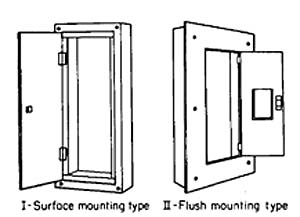
FIGURE 4.125 Panel boxes.
The Code requires that all cabinets which contain connections to more than eight conductors be provided with back or side wiring spaces. These wiring spaces must be separated from the panelboard or other devices in the cabinet by partitions so that they will be separate closed compartments, unless all wires are led from the cabinet at points directly opposite their terminal connections to the panelboard.
[American electricians’ handbook]Тематики
Синонимы
EN
Русско-английский словарь нормативно-технической терминологии > распределительный щиток
-
по назначению
-
30 возвращать число кодовых точек
Programming: return the number of code pointsУниверсальный русско-английский словарь > возвращать число кодовых точек
-
31 число кодовых точек
Programming: number of code pointsУниверсальный русско-английский словарь > число кодовых точек
-
32 fuerte2
2 = robust, strong [stronger -comp., strongest -sup.], sturdy [sturdier -comp., sturdiest -sup.], loud [louder -comp., loudest -sup.], hefty [heftier -comp., heftiest -sup.], tight [tighter -comp., tightest -sup.], forte, brawny [brawnier -comp., brawniest -sup.], buoyant, hard-wearing, strong point, nippy [nippier -comp., nippiest -sup.].Ex. Although microcomputers are relatively robust, they do not take kindly to frequent moves from one location to another, particularly on wheeled trollies.Ex. In fact, the 1979 index figures show a strong contrast between the hardback and paperback turnovers, with the hardback market being down and the paperback market up.Ex. Here came every sort of human ingredient -- sturdy homesteaders, skilled craftsmen, precious scoundrels.Ex. Visitors would be surprised by the loud creaking and groaning of the presses as the timbers gave and rubbed against each other.Ex. This new font had increased contrast and x-height in the lower case and a hefty set of capitals = Este nuevo tipo de letra había aumentado el contraste y el ojo medio de las minúsculas y las mayúsculas eran voluminosas.Ex. The platen was lashed up tight to the toe of the spindle by cords which connected hooks at its four corners to another set of hooks at the four lower corners of the hose.Ex. Statistical analysis has long been a forte of sociological & social research.Ex. This revolutionary syndicalist union consistently supported the most downtrodden & oppressed, & encouraged a cult of the unspoiled, heroic brawny proletarian with raw courage & 'natural' virtues.Ex. The foreign relations of the Community will probably remain a buoyant area.Ex. The manufacturers of this type of artificial turf say that while the grass is soft and springy underfoot it is extremely tough and hard-wearing.Ex. One of the strong points of the DIALOG service is the documentation.Ex. Blend cream cheese with prepared horseradish for a nippy taste.----* amarillo fuerte = bright yellow.* andar pisando fuerte = go from + strength to strength, make + a big impact.* apretar fuerte = bear down on.* bebida alcohólica fuerte = hard drink, hard liquor.* caja fuerte = safe, safety deposit box.* combinación de la caja fuerte = safe code, safe combination.* con fuertes aspiraciones profesionales = upward-mobile.* dar fuerte = pack + a wallop.* delgado y fuerte = wiry.* demasiado fuerte = over-strong.* de olor fuerte = strong-smelling.* fuerte como un roble = as strong as an ox.* fuerte como un toro = as strong as an ox.* fuertes lluvias = heavy rain.* fuerte viento = strong wind.* golpear fuerte = wallop, whack.* golpe fuerte = whack.* hacer más fuerte = toughen.* hacerse más fuerte = gain in + strength, grow in + strength.* iluminación fuerte = task lighting.* ley del más fuerte, la = law of the jungle, the, survival of the fittest, survival of the strongest.* mar fuerte = heavy sea.* más fuerte que un roble = as strong as an ox.* más fuerte que un toro = as strong as an ox.* naranja fuerte = bright orange.* olor fuerte y penetrante = tang.* pegar fuerte = pack + a wallop.* pisar fuerte = go from + strength to strength, make + a big impact, stomp.* plato fuerte = main dish, strong point, entrée, main entrée.* poner más fuerte = crank up.* punto fuerte = strength.* sabor fuerte y penetrante = tang.* supervivencia del más fuerte = survival of the fittest, survival of the strongest.* tener una personalidad muy fuerte = be full of character.* tener un carácter muy fuerte = be full of character.* un fuerte sentimiento de = a strong sense of.* viento fuerte = high wind. -
33 marcar
v.1 to mark.ese acontecimiento marcó su vida her life was marked by that eventmarcar el ritmo to beat the rhythmElla marca los paquetes She marks the packages.Ella marca el territorio She marks=delimits the territory.2 to mark, to indicate.la cruz marca el lugar donde está enterrado el tesoro the cross marks o indicates (the spot) where the treasure is buried3 to dial.Ella marca su número She dials his phone number.4 to read.5 to price (poner precio a).6 to score (sport) (tanto).7 to set (cabello).8 to leave a mark on, to pit, to nick.María marcó el mueble Mary left a mark on the piece of furniture.9 to earmark.María marcó la página Mary earmarked the page.10 to put a brand on, to brand, to mark.El vaquero marca el ganado The cowboy puts a brand on the cattle.11 to tick off, to jot down, to tick.Ella marca los goles She ticks off the goals.* * *2 (herir físicamente) to slash; (traumatizar) to mark3 DEPORTE (gol, canasta) to score4 DEPORTE (al contrario) to mark5 (pelo) to set6 (cantidad) to indicate, show■ ¿qué precio marca la etiqueta? what's the price on the tag?7 (en teléfono) to dial8 (resaltar) to show\marcar el compás to mark the rhythmmarcar el paso to mark timemarcarse un farol to show offmarcarse un tanto, marcarse un triunfo to score points* * *verb1) to mark2) brand3) score4) indicate5) dial* * *1. VT1) (=señalar)a) [+ objeto, ropa] to mark; [+ ganado] to brandha marcado las toallas con mis iniciales — she has put my initials on the towels, she has marked the towels with my initials
seguimos el procedimiento marcado por la ley — we followed the procedures required o laid down by law
¿qué precio marca la etiqueta? — (Com) what's the price (marked) on the label?
están marcando las camisas — (Com) they are putting prices on the shirts, they are pricing the shirts
b) [+ límites] to markc) (Inform) [+ bloque, texto] to flagd) (Mús) [+ partitura] to mark up2) [experiencia, suceso] to mark3) [termómetro] to readmi reloj marca las dos — it's two o'clock by my watch, my watch says two o'clock
4) (=designar) [+ tarea] to assign; [+ política, estrategia] to lay down; [+ directrices, pautas] to lay down, give; [+ comienzo, período] to markla empresa nos ha marcado algunas pautas a seguir — the company has given us o has issued some guidelines to follow
hito 1), pauta 1)esta obra marca el paso de la música medieval a la renacentista — this work marks the transition from medieval to renaissance music
5) (=hacer resaltar) to accentuatepaquete 1., 7)ese vestido te marca mucho las caderas — that dress really accentuates your hips o makes your hips stand out
6) (=seguir) [+ sospechoso] to shadow, tail7) (Dep)a) [+ gol] to scoreb) [+ tiempo] to record, clockha marcado un tiempo de 9,46 — he recorded o clocked a time of 9.46
c) [+ jugador, contrario] to mark, shadow; Méx to tackle8) (Mús)paso II, 1., 4)marcar el compás — to keep time, beat time
9) (Telec) to dial10) (Naipes) to bid11) (Peluquería) to set2. VI1) (Dep) to score2) (Telec) to dial3) (Peluquería) to set3.See:* * *1.verbo transitivo1)b) experiencia/suceso ( dejar huella) to markc) (CS arg) < persona> to scar... for life2)a) (indicar, señalar) to markel altímetro marcaba 1.500 metros — the altimeter showed o (frml) registered 1,500 meters
seguimos la pauta marcada por nuestro fundador — we follow the guidelines established by/the standard set by our founder
b) ( hacer resaltar) <cintura/busto> to accentuatec) (Mús)marcar el compás/el ritmo — to beat time/the rhythm
d) (Fís) to mark, tag3) < pelo> to set4) (Telec) to dial5) (Dep)a) <gol/tanto> to scoreb) < tiempo> to clockc) < jugador> to mark2.marcar vi1) (Dep) to score2) (Telec) to dial3.marcarse v pron1)marcarse el pelo — (refl) to set one's hair; (caus) to have one's hair set
2) (Náut) to take a bearing* * *= flag, mark, mark off, tag, tick (off), leave + Posesivo + mark, brand (as), stigmatise [stigmatize, -USA], tinge, score, score.Ex. Since the fields are of different lengths in different records it is necessary that the beginning and end of fields be flagged in some way.Ex. In addition, synthesis often requires the use of a facet indicator, which marks the beginning of a new facet for example.Ex. Human intervention may also be necessary to mark off the area in the string on the title page that should be indexed, and possibly to add an imprint date if not present.Ex. It is occasionally useful for administrative purposes to be able to tag borrowers so that they may be intercepted during charge-out.Ex. In particular note, for example by ticking them, those terms that merit a turn in the lead position, and those that do not.Ex. Unfortunately, age and lack of proper care have left their marks on many valuable publications, some of which can no longer be used today.Ex. Music by Jewish composers and works were branded in Nazi Germany as degenerate art.Ex. Findings reaffirm that television stigmatises the occupation of business, independently of economic factors.Ex. But the relief was tinged with apprehension that the new housing would lead to slums and crime, as some opponents have long feared.Ex. Ithaca was off to a fast start, scoring twice in the game's first two minutes.Ex. Closed system tendencies, such as invoking system controls designed to counteract differences and correct deviations (thus scoring creativity as error), only push the institution more rapidly toward extinction.----* acción de marcar un número = dialling.* marcar con filigrana = watermark.* marcar con tiza = chalk.* marcar con un círculo = encircle, circle.* marcar el camino correcto = point + Nombre + in the right direction.* marcar el comienzo = usher in.* marcar el compás = beat + time.* marcar el curso = chart + course.* marcar el final = mark + the end.* marcar el inicio = usher in.* marcar el tono = establish + the tone.* marcar la diferencia = make + the difference, make + a difference, spell + the difference.* marcar la pauta en = lead + the way in.* marcar las pautas = set + the tone, establish + the tone.* marcar los límites = mark out.* marcar + Posesivo + final = mark + Posesivo + end.* marcar una etapa = mark + a stage.* marcar una meta = set + goal.* marcar un ensayo = score + a try.* marcar un gol = score + goal, score, poach + a goal.* marcar un hito = mark + a stage, make + things happen, mark + a watershed.* marcar un hito histórico = make + history.* marcar un número de teléfono = dial + number.* marcar un objetivo = set + goal.* marcar un tanto = score, poach + a goal, score + goal.* que marca época = landmark.* que marca un hito = epoch-making.* sin marcar = unpriced.* * *1.verbo transitivo1)b) experiencia/suceso ( dejar huella) to markc) (CS arg) < persona> to scar... for life2)a) (indicar, señalar) to markel altímetro marcaba 1.500 metros — the altimeter showed o (frml) registered 1,500 meters
seguimos la pauta marcada por nuestro fundador — we follow the guidelines established by/the standard set by our founder
b) ( hacer resaltar) <cintura/busto> to accentuatec) (Mús)marcar el compás/el ritmo — to beat time/the rhythm
d) (Fís) to mark, tag3) < pelo> to set4) (Telec) to dial5) (Dep)a) <gol/tanto> to scoreb) < tiempo> to clockc) < jugador> to mark2.marcar vi1) (Dep) to score2) (Telec) to dial3.marcarse v pron1)marcarse el pelo — (refl) to set one's hair; (caus) to have one's hair set
2) (Náut) to take a bearing* * *= flag, mark, mark off, tag, tick (off), leave + Posesivo + mark, brand (as), stigmatise [stigmatize, -USA], tinge, score, score.Ex: Since the fields are of different lengths in different records it is necessary that the beginning and end of fields be flagged in some way.
Ex: In addition, synthesis often requires the use of a facet indicator, which marks the beginning of a new facet for example.Ex: Human intervention may also be necessary to mark off the area in the string on the title page that should be indexed, and possibly to add an imprint date if not present.Ex: It is occasionally useful for administrative purposes to be able to tag borrowers so that they may be intercepted during charge-out.Ex: In particular note, for example by ticking them, those terms that merit a turn in the lead position, and those that do not.Ex: Unfortunately, age and lack of proper care have left their marks on many valuable publications, some of which can no longer be used today.Ex: Music by Jewish composers and works were branded in Nazi Germany as degenerate art.Ex: Findings reaffirm that television stigmatises the occupation of business, independently of economic factors.Ex: But the relief was tinged with apprehension that the new housing would lead to slums and crime, as some opponents have long feared.Ex: Ithaca was off to a fast start, scoring twice in the game's first two minutes.Ex: Closed system tendencies, such as invoking system controls designed to counteract differences and correct deviations (thus scoring creativity as error), only push the institution more rapidly toward extinction.* acción de marcar un número = dialling.* marcar con filigrana = watermark.* marcar con tiza = chalk.* marcar con un círculo = encircle, circle.* marcar el camino correcto = point + Nombre + in the right direction.* marcar el comienzo = usher in.* marcar el compás = beat + time.* marcar el curso = chart + course.* marcar el final = mark + the end.* marcar el inicio = usher in.* marcar el tono = establish + the tone.* marcar la diferencia = make + the difference, make + a difference, spell + the difference.* marcar la pauta en = lead + the way in.* marcar las pautas = set + the tone, establish + the tone.* marcar los límites = mark out.* marcar + Posesivo + final = mark + Posesivo + end.* marcar una etapa = mark + a stage.* marcar una meta = set + goal.* marcar un ensayo = score + a try.* marcar un gol = score + goal, score, poach + a goal.* marcar un hito = mark + a stage, make + things happen, mark + a watershed.* marcar un hito histórico = make + history.* marcar un número de teléfono = dial + number.* marcar un objetivo = set + goal.* marcar un tanto = score, poach + a goal, score + goal.* que marca época = landmark.* que marca un hito = epoch-making.* sin marcar = unpriced.* * *marcar [A2 ]vtA1 (con una señal) ‹ropa/página/baraja› to mark; ‹ganado› to brandmarca la respuesta correcta con una cruz mark the correct answer with a cross, put a cross next to the correct answer2 «experiencia/suceso» (dejar huella) to markaquel desengaño la marcó para siempre that disappointment marked her for everuna generación marcada por la violencia y el desorden a generation marked by violence and unrest4 (CS arg) to scar … for lifeB1 (indicar, señalar) to markeste artículo/el precio de este artículo no está marcado there is no price (marked) on this articledentro del plazo que marca la ley within the period specified by the lawel reloj marca las doce en punto the time is exactly twelve o'clockel altímetro marcaba 1.500 metros the altimeter showed o ( frml) registered 1,500 meterssu muerte marca el final de una era his death signals o marks the end of an erahoy ha marcado un nuevo mínimo it has reached a new low todayseguimos la pauta marcada por nuestro fundador we follow the guidelines established by/the standard set by our founderel año ha estado marcado por hechos de especial relevancia the year has been marked by particularly significant events2(hacer resaltar): el vestido le marca mucho el estómago the dress makes her stomach stick out o accentuates her stomach3 ( Mús):marcar el compás/el ritmo to beat time/the rhythm4 ( Fís) to mark, tagC ‹pelo› to setD ( Telec) to dialE ( Dep)1 ‹gol/tanto› to score2 ‹tiempo› to clockmarcó un tiempo de 2.08 she clocked a time of 2.083 ‹jugador› to mark■ marcarviA ( Dep) to scoreB ( Telec) to dial■ marcarseAmarcarse el pelo ( caus) to have one's hair set;( refl) to set one's hairB ( Náut) to take a bearing* * *
marcar ( conjugate marcar) verbo transitivo
1
‹ ganado› to brand
2
el reloj marca las doce en punto the time is exactly twelve o'clock
c) (Mús):◊ marcar el compás/el ritmo to beat time/the rhythm
3 ‹ pelo› to set
4 (Telec) to dial
5 (Dep)
verbo intransitivo
1 (Dep) to score
2 (Telec) to dial
marcarse verbo pronominal:
( caus) to have one's hair set
marcar verbo transitivo
1 (señalar) to mark: su muerte me marcó profundamente, I was deeply marked by her death
las piedras marcan la linde, the stones mark the boundary
2 (resaltar) este vestido me marca las caderas, this dress shows off my hips
ese gesto marca la importancia del tratado, that gesture stresses the importance of the treaty
3 Tel to dial: marque el 123 321, dial 123321
4 (una hora, grados, etc) to indicate, show, mark: el metrónomo marca el compás, the metronome marks the time
5 Dep (un tanto) to score
(a otro jugador) to mark
6 (un peinado) to set: ¿lavar y marcar?, wash and set?
' marcar' also found in these entries:
Spanish:
ceñirse
- herrar
- pauta
- bastar
- compás
- gol
- graduar
- lavar
- paso
- plantilla
- señal
- señalar
- tarjeta
- tono
English:
beat
- brand
- cover
- dial
- highlight
- mark
- pace
- pit
- read
- ring
- ring up
- say
- score
- set
- show
- stand
- tick
- tick off
- trend
- watershed
- bookmark
- check
- clock
- flag
- guard
- hat
- hit
- indent
- punch
- redial
- register
- scratch
- stake
- usher
- wave
* * *♦ vt1. [poner marca en] to mark;[nombre en una lista] to tick off; [poner precio a] to price;marcó el itinerario en el mapa she marked the route on the map;asegúrate de que marcas las maletas con tu nombre make sure your suitcases are identified with your name;marcó la ropa con mis iniciales she put my initials on the clothes;marcar los naipes to mark the cards2. [indicar] to mark, to indicate;la cruz marca el lugar donde está enterrado el tesoro the cross marks o indicates (the spot) where the treasure is buried3. [dejar marca en] to mark;ese acontecimiento marcó su vida her life was marked by that event4. [significar] to mark, to signal;el tratado marcó un hito en las relaciones entre las dos potencias the treaty was a landmark in relations between the two powers5. [número de teléfono] to dial6. [sujeto: termómetro, contador] to read;[sujeto: reloj] to say;la balanza marca 3 kilos the scales read 3 kilos;¿qué precio marca la etiqueta? what is the price on the label?;cuando el reloj marque las seis when the clock strikes six;el euro ha marcado un nuevo mínimo frente al dólar the euro has fallen to another all-time low against the dollarel corredor más lento marcó el ritmo del resto del grupo the slowest runner set the pace for the whole group[récord] to set11. [cabello] to set12. CompRP [a la salida] to clock out, US to punch out; Famtengo que marcar tarjeta [en casa de la novia] I have to see my girlfriend♦ vi1. [dejar secuelas] to leave a mark2. [peinar] to set, to style* * *v/t1 mark3 gol score4 res brand6 naipes mark7 fig: persona affect* * *marcar {72} vt1) : to mark2) : to brand (livestock)3) : to indicate, to show4) resaltar: to emphasize5) : to dial (a telephone)6) : to guard (an opponent)7) anotar: to score (a goal, a point)marcar vi1) anotar: to score2) : to dial* * *marcar vb1. (poner una señal) to mark3. (conseguir un gol) to score¿has marcado el prefijo? did you dial the code? -
34 medio3
3 = instrumentality, means, vehicle.Nota: Sentido figurado.Ex. But there are signs of a change as new and powerful instrumentalities come into use.Ex. The easiest means of illustrating some of the foregoing points is to introduce in outline some special classification schemes.Ex. This journal serves as a vehicle for the continuing education of librarians, as a showcase for current practice and as a spotlight for significant activities.----* alfabetización en los medios de comunicación = media literacy.* anuncios en los medios de comunicación = media releases.* aprendizaje a través de medios electrónicos = online learning.* aprendizaje por medio del ordenador = computer-based learning (CBL).* bibliotecario de medios audiovisuales = library media specialist.* bien dotado de medios = well-resourced.* bien equipado de medios = well-resourced.* búsqueda por medio de menús = menu-assisted searching.* búsqueda por medio de órdenes = command search.* codificación por medio de códigos de barras = barcoding [bar-coding].* codificar por medio de códigos de barras = barcode [bar-code].* conducir por medio de tubos = duct.* confundir los medios con el fin = confuse + the means with the ends.* con medios insuficientes = on a shoestring (budget).* con medios muy escasos = on a shoestring (budget).* con medios muy exiguos = on a shoestring (budget).* con muy pocos medios = on a shoestring (budget).* con todos los medios a + Posesivo + alcance = with all the means at + Posesivo + disposal.* desplazamiento por medio del ordenador = computer commuting.* documentalista de los medios de comunicación = news librarian.* dotar de medios = resource.* el fin justifica los medios = the end justifies the means.* empresa de medios de comunicación = media company.* enseñanza a través de medios electrónicos = online education.* enseñanza por medio del ordenador (CBI) = computer-based instruction (CBI).* entrevista en los medios de comunicación = media interview.* equipar de medios = resource.* exceso de medios = overkill.* expansión de una búsqueda por medio del tesauro = thesaurus expansion.* industria de los medios de comunicación de masas = mass communications industry.* interfaz por medio de gráficos = graphics interfacing.* máquina de registro de préstamos por medio de la fotografía = photocharger, photocharging machine.* medio de ahorro = economy measure.* medio de almacenamiento = storage medium.* medio de almacenamiento físico = physical storage media.* medio de comunicación = medium [media, -pl.].* medio de interpretación = medium of performance.* medio de transmisión = conduit.* medio físico = physical medium.* medios = ways and means.* medios de almacenamiento digital = digital media.* medios de almacenamiento óptico = optical storage media.* medios de comunicación = news media.* medios de comunicación de masas = mass media, mass communications media, communications media, communications media.* medios de comunicación social = mass media.* medios de microalmacenamiento de la información = microstorage media.* medios de producción = means of production.* medios digitalizados de almacenamiento de información = digitised media.* medios económicos = economic resources.* medios, los = wherewithal, the, means, the.* medios oficiales = official channels.* medios técnicos = IT capabilities.* medios visuales = visual media.* mostrar por medio de cambio de intensidad en el brillo = flash up.* multimedia = multimedia [multi-media].* mundo de los medios de comunicación, el = mediascape, the.* por medio = out of.* por medio de = by means of, by way of, in the form of, through, via, via the medium of, by dint of.* por medio de isótopos = isotopically.* por medio de otro(s) = by proxy.* por medio de una agencia = on a bureau basis.* por todos los medios = by all means.* proporcionar los medios para = provide + the material for.* ser un medio para llegar a un fin = be the means to an end.* streaming media = streaming media.* técnica de recuperación por medio de la lógica difusa = fuzzy IR technique.* terapia por medio de aromas = aroma therapy.* tratar por todos los medios de = take + (great) pains to.* tratar por todos los medios de + Verbo = be at pains to + Infinitivo.* un medio para alcanzar un fin = a means to an end.* un medio para conseguir un fin = a means to an end.* un medio para llegar a fin = a means to an end.* utilizar al máximo por medio del ordenador = explode. -
35 fuerte
adj.1 strong (persona, viento).un medicamento muy fuerte a very powerful medicine2 heavy (food) (pesado).3 loud (alto) (sonido).está demasiado fuerte it's on too loud4 tight (nudo).5 strong.es una empresa fuerte en el sector the company's strong in this sectoruna moneda fuerte a strong currency6 large, considerable (grande) (cantidad).una fuerte presencia de artistas europeos a large contingent of European artistsadv.1 hard (intensamente).2 a lot (abundantemente) (comer).3 loudly.4 strong.m.1 fort.2 strong point, forte (punto fuerte).su fuerte son las matemáticas mathematics is his forte3 fortress, fort, bastille, fortification.* * *► adjetivo1 (gen) strong2 (en asignatura) strong, good5 (dolor, enfermedad) severe, bad6 (golpe) hard, heavy7 (sonido) loud9 (discusión) heated, violent; (protesta) violent, vigorous; (polémica) bitter; (aplauso) loud, thunderous10 (presión) intense; (influencia) powerful, strong11 (suma de dinero) large12 (comida - pesado) heavy; (- cargado) rich13 (color) intense14 (contraste) marked, sharp; (tendency) strong, marked15 (cosa fija) stiff, tight16 familiar (terrible) awful1 (fortificación) fort2 (punto fuerte) forte, strong point► adverbio1 (mucho) a lot2 (con fuerza) hard3 (volumen) loud\¡abrázame fuerte! hold me tight!estar fuerte en algo to be good at something¡habla más fuerte! speak up!* * *1. adv.1) hard2) loudly2. adj.1) strong2) loud3. noun m.* * *1. ADJ1) [persona]a) [físicamente] [gen] strong; (=robusto) sturdy, powerfully built; euf (=obeso) largeb) [emocionalmente] strong, toughhemos de ser fuertes ante la adversidad — we must be strong o tough in the face of adversity
c)estar fuerte en filosofía/historia — [estudiante] to be strong in philosophy/history
2) (=intenso)a) [sabor, olor, viento] strong; [dolor, calor] intense; [lluvia] heavy; [ejercicio] strenuousb) [explosión, voz, ruido] loud; [golpe] heavy, hard; [acento] strong, thickc) [color] (=no pálido) strong; (=llamativo) brightd) [impresión] strong, powerful; [deseo] strong, deep; [fe, objeción] strong; [discusión] heatede) [abrazo, beso] bigun beso muy fuerte — [en cartas] lots of love
un fuerte abrazo, Carmen — best wishes, Carmen; [más cariñoso] love, Carmen
3) [bebida, medicamento] strong; [comida] (=pesada) heavy; (=indigesta) indigestiblenunca toma cosas fuertes, solo cerveza y vino — he never drinks spirits o the hard stuff *, just beer and wine
4) (=resistente) [cuerda, tela] strong; [economía, moneda, país] strong5) (=importante) [aumento, bajada] sharp; [crisis] serious, severe; [pérdidas] large, substantial6) (=impactante) [escena] shocking, disturbingme dijo cosas muy fuertes que no podría repetir ahora — she said some harsh o nasty * things that I couldn't repeat now
-lo llamó a la oficina y lo despidió en el acto -¡qué fuerte! — * "he called him at the office and fired him there and then" - "that's outrageous o appalling!"
7)hacerse fuerte — (=protegerse) to hole up; (=volverse fuerte) to gain strength
8) [terreno] rough, difficultser o estar fuerte a algo — to stink of sth
2. ADV1) (=con fuerza) [golpear] hard; [abrazar] tight, tightlyla editorial ha apostado fuerte por los nuevos poetas — the publishing house is backing new poets in a big way
jugar fuerte — (lit) to gamble heavily; (fig) to take a gamble
2) (=en voz alta) [hablar, tocar] loud, loudlytoca muy fuerte — she plays very loud o loudly
¡más fuerte! ¡que no se le oye aquí atrás! — speak up! we can't hear at the back
3) (=gran cantidad)3. SM1) (Mil) fort2) (Mús) forte3) (=especialidad) forte, strong pointel canto no es mi fuerte — singing is not my forte o strong point
4) Chile (=bebida) hard liquor, hard stuff ** * *I1) < persona>a) ( físicamente) stronges un hombre fuertísimo or fortísimo — he's an exeptionally strong man
b) ( moralmente) stronghacerse fuerte — to pull oneself together
c) ( en asignatura) strongno estoy muy fuerte en ese tema/en física — I'm not very strong on that topic/in physics (colloq)
2) ( resistente) <tela/cuerda> strong3)un fuerte golpe — a heavy o hard blow
c) <abrazo/beso> big4) < ruido> loud5)a) <olor/sabor> strongb) <licor/medicina> strongc) < comida> heavy6) < acento> strong, thickme dijo que era un inútil - qué fuerte! — (fam) he said I was useless - that's a bit much (AmE) o (BrE) a bit over the top!
8)a) ( poderoso) <nación/empresa/equipo> strongb) < moneda> strongc) ( importante)9) (Ling) < vocal> stressedII1) <golpear/empujar> hard; <agarrar/apretar> tightly; < llover> heavily2) < hablar> loudly3) ( mucho)4) <jugar/apostar> heavilyIII1) (Mil) fort2) ( especialidad) strong point, forte* * *I1) < persona>a) ( físicamente) stronges un hombre fuertísimo or fortísimo — he's an exeptionally strong man
b) ( moralmente) stronghacerse fuerte — to pull oneself together
c) ( en asignatura) strongno estoy muy fuerte en ese tema/en física — I'm not very strong on that topic/in physics (colloq)
2) ( resistente) <tela/cuerda> strong3)un fuerte golpe — a heavy o hard blow
c) <abrazo/beso> big4) < ruido> loud5)a) <olor/sabor> strongb) <licor/medicina> strongc) < comida> heavy6) < acento> strong, thickme dijo que era un inútil - qué fuerte! — (fam) he said I was useless - that's a bit much (AmE) o (BrE) a bit over the top!
8)a) ( poderoso) <nación/empresa/equipo> strongb) < moneda> strongc) ( importante)9) (Ling) < vocal> stressedII1) <golpear/empujar> hard; <agarrar/apretar> tightly; < llover> heavily2) < hablar> loudly3) ( mucho)4) <jugar/apostar> heavilyIII1) (Mil) fort2) ( especialidad) strong point, forte* * *fuerte11 = fort (ft).Ex: Had he consulted an Indian history, he would have found, for instance, that what the Britannica called the Fort Phil Kearney massacre the Indians call the 'Battle of the Hundred Slain'.
* defender el fuerte = hold + the fortress.fuerte22 = robust, strong [stronger -comp., strongest -sup.], sturdy [sturdier -comp., sturdiest -sup.], loud [louder -comp., loudest -sup.], hefty [heftier -comp., heftiest -sup.], tight [tighter -comp., tightest -sup.], forte, brawny [brawnier -comp., brawniest -sup.], buoyant, hard-wearing, strong point, nippy [nippier -comp., nippiest -sup.].Ex: Although microcomputers are relatively robust, they do not take kindly to frequent moves from one location to another, particularly on wheeled trollies.
Ex: In fact, the 1979 index figures show a strong contrast between the hardback and paperback turnovers, with the hardback market being down and the paperback market up.Ex: Here came every sort of human ingredient -- sturdy homesteaders, skilled craftsmen, precious scoundrels.Ex: Visitors would be surprised by the loud creaking and groaning of the presses as the timbers gave and rubbed against each other.Ex: This new font had increased contrast and x-height in the lower case and a hefty set of capitals = Este nuevo tipo de letra había aumentado el contraste y el ojo medio de las minúsculas y las mayúsculas eran voluminosas.Ex: The platen was lashed up tight to the toe of the spindle by cords which connected hooks at its four corners to another set of hooks at the four lower corners of the hose.Ex: Statistical analysis has long been a forte of sociological & social research.Ex: This revolutionary syndicalist union consistently supported the most downtrodden & oppressed, & encouraged a cult of the unspoiled, heroic brawny proletarian with raw courage & 'natural' virtues.Ex: The foreign relations of the Community will probably remain a buoyant area.Ex: The manufacturers of this type of artificial turf say that while the grass is soft and springy underfoot it is extremely tough and hard-wearing.Ex: One of the strong points of the DIALOG service is the documentation.Ex: Blend cream cheese with prepared horseradish for a nippy taste.* amarillo fuerte = bright yellow.* andar pisando fuerte = go from + strength to strength, make + a big impact.* apretar fuerte = bear down on.* bebida alcohólica fuerte = hard drink, hard liquor.* caja fuerte = safe, safety deposit box.* combinación de la caja fuerte = safe code, safe combination.* con fuertes aspiraciones profesionales = upward-mobile.* dar fuerte = pack + a wallop.* delgado y fuerte = wiry.* demasiado fuerte = over-strong.* de olor fuerte = strong-smelling.* fuerte como un roble = as strong as an ox.* fuerte como un toro = as strong as an ox.* fuertes lluvias = heavy rain.* fuerte viento = strong wind.* golpear fuerte = wallop, whack.* golpe fuerte = whack.* hacer más fuerte = toughen.* hacerse más fuerte = gain in + strength, grow in + strength.* iluminación fuerte = task lighting.* ley del más fuerte, la = law of the jungle, the, survival of the fittest, survival of the strongest.* mar fuerte = heavy sea.* más fuerte que un roble = as strong as an ox.* más fuerte que un toro = as strong as an ox.* naranja fuerte = bright orange.* olor fuerte y penetrante = tang.* pegar fuerte = pack + a wallop.* pisar fuerte = go from + strength to strength, make + a big impact, stomp.* plato fuerte = main dish, strong point, entrée, main entrée.* poner más fuerte = crank up.* punto fuerte = strength.* sabor fuerte y penetrante = tang.* supervivencia del más fuerte = survival of the fittest, survival of the strongest.* tener una personalidad muy fuerte = be full of character.* tener un carácter muy fuerte = be full of character.* un fuerte sentimiento de = a strong sense of.* viento fuerte = high wind.fuerte33 = tangy [tangier - comp., tangiest -sup.].Ex: The most boring meal can be pepped up with spicy and tangy herbs.
* * *A ‹persona›1 (físicamente) strongnunca ha sido muy fuerte he has never been very stronges un hombre fuertísimo or fortísimo he's an exceptionally strong mande complexión fuerte well-built2 (moralmente) stronghacerse fuerte to pull oneself together3 (en una asignatura) strongno estoy muy fuerte en ese tema I'm not very strong on o well up on that topic ( colloq)anda muy fuerte en física he's doing very well in physicsB (resistente) ‹tela/cuerda› stronguna caja bien fuerte a good, sturdy o strong boxuna valla alta y fuerte a tall, sturdy o strong fenceC1 ‹viento› strong; ‹terremoto› severe; ‹lluvia/nevada› heavy2 ‹dolor› intense, bad; ‹resfriado› badun fuerte golpe a heavy o hard blowreinaba un fuerte nerviosismo tension was high3 ‹abrazo/beso› bigD ‹ruido› loudla radio está muy fuerte, bájale el volumen the radio's too loud, turn it downE1 ‹olor/sabor› strong2 ‹licor› strong; ‹medicina› strong3 ‹comida› heavyF ‹acento› strong, thickG(violento): tiene escenas muy fuertes it has some very shocking o disturbing scenesme dijo que no valía para nada — ¡qué fuerte! ( fam); he said I was absolutely useless — strong o harsh words!tuvieron una discusión fortísima or fuertísima they had a violent o heated argumentH1 (poderoso) ‹nación/empresa/equipo› stronges algo más fuerte que yo, no puedo dejar de hacerlo it's stronger than I am, I can't stop o give it up2 ‹moneda› strong3(importante): una fuerte suma de dinero a large sum of moneyun fuerte contingente de la policía a strong police contingentun fuerte incremento de precio a sharp price increasele recetó una fuerte dosis de analgésicos she prescribed a heavy dose of painkillersI ( Ling) ‹vocal› stressedJes fuerte de patas his feet stink ( colloq)A ‹golpear/empujar› hard; ‹agarrar/apretar› tightly; ‹llover› heavilyuna canción que está pegando fuerte a song that's a big hit at the momentB ‹hablar› loudlypon la radio más fuerte turn the radio uphable más fuerte speak upC(abundantemente): desayunar fuerte to have a big breakfastD ‹jugar/apostar› heavilyA ( Mil) fortB (especialidad) strong point, forte* * *
fuerte adjetivo
1 ( en general) strong;◊ un equipo/una cuerda fuerte a strong team/rope
2
‹ terremoto› severe;
‹lluvia/nevada› heavy
‹ golpe› heavy;
‹ resfriado› bad;
‹abrazo/beso› big
‹comida/dosis› heavy
3 ( violento) ‹ discusión› violent, heated;
‹película/escena› shocking
■ adverbio
1 ‹golpear/empujar› hard;
‹agarrar/apretar› tightly;
‹ llover› heavily
2 ‹ hablar› loudly;
habla más fuerte speak up
■ sustantivo masculinoa) (Mil) fort
fuerte
I adjetivo
1 strong
2 (intenso) (dolor) severe
(color) intense
3 (excesivo) strong
(comida) heavy: el café es muy fuerte para la niña, coffee is too strong for the child
4 (volumen) loud
5 (impactante) (escenas) violent, grisly
(comentarios) serious
II sustantivo masculino
1 (fortificación) fort
2 (punto fuerte) forte, strong point
III adv (con fuerza, con violencia) hard: el viento sopla fuerte, the wind is blowing hard
(con intensidad, apretadamente) tight: ¡agárrate fuerte!, hold on tight!
(en cantidad) tienes que desayunar fuerte, you have to have a good breakfast
(más alto) louder: ¡habla más fuerte!, speak up!
' fuerte' also found in these entries:
Spanish:
A
- acento
- agarrarse
- animal
- caja
- campeonato
- conmoción
- débil
- diezmar
- dirigir
- espanto
- estirón
- férrea
- férreo
- frágil
- fulminante
- grande
- hacer
- opresión
- pisar
- plato
- relumbrón
- resistente
- reventar
- sacudida
- suave
- sujetar
- tirón
- torta
- tortazo
- trompazo
- viento
- abrazar
- agarrar
- apariencia
- bajón
- caer
- carácter
- codazo
- combinación
- comida
- constitución
- crecida
- dispositivo
- estridente
- fortín
- golpe
- impulso
- indignación
- indignado
English:
A
- agony
- ale
- aloud
- backbone
- bad
- balance
- bang
- bash
- beat down
- best
- blare
- bond
- boo
- break into
- burly
- crack
- dish
- fluid
- forte
- fresh
- fuck
- great
- grip
- hard
- hard currency
- heady
- heavy
- high
- highlight
- hold
- hold on
- hug
- iron
- keen
- liaison
- loud
- lung
- must
- point
- potent
- powerful
- press
- resilient
- robust
- rugged
- safe
- sing up
- slight
- slog
* * *♦ adj1. [persona] [físicamente] strong;estar fuerte como un roble to be as strong as an ox2. [persona] [psicológicamente] strong;tiene un carácter muy fuerte she has a strong character3.Fighacerse fuerte en Mil to make one's stronghold in;el equipo se hizo fuerte en su área the team fell back into their own half4. [material] strong;necesito un tejido fuerte I need a strong material5. [viento] strong;[lluvia] heavy6. [intenso] [frío, dolor, color] intense;[golpe, pelea] hard7. [medicamento] powerful8. [influyente, sólido] strong;es una empresa fuerte en el sector the company's strong in this sector;una moneda fuerte a strong currency;fuertes razones powerful reasons9. [violento, impactante] powerful, shocking;lenguaje fuerte strong language;un chiste fuerte a crude joke;algunas de las escenas son muy fuertes some of the scenes are very shocking10. [grande] large, considerable;una fuerte cantidad de dinero a large o considerable amount of money;una fuerte presencia de artistas caribeños a large contingent of Caribbean artists11. [comida] [pesado] heavy;[picante] hot12. [nudo] tight13. [sílaba] accented, stressed14. [vocal] strong16. [alto] [sonido] loud;la televisión está demasiado fuerte the television is on too loud¡qué fuerte! [fabuloso] wow!, amazing!;[terrible] how awful!, oh no!;…y después me insultó – ¡qué fuerte! …and then he insulted me – that's awful o terrible!♦ adv1. [intensamente] hard;[abrazar, agarrar] tight;está nevando fuerte it's snowing hard o heavily;lo ató bien fuerte she tied it tight;chuta fuerte he has a powerful kick2. [abundantemente] a lot;en España se suele almorzar fuerte in Spain, people usually have a big meal at lunchtime3. [en voz alta] loudly;¿podría hablar más fuerte? could you speak louder?♦ nm1. [fortificación] fort2. [especialidad] strong point, forte;su fuerte son las matemáticas mathematics is his forte* * *I adj1 strong3 aumento sharp4 ruido loud5:estoy fuerte en idiomas I’m good at languages6 fig popincredible fam ;¡qué fuerte!, ¡esto es muy fuerte! fam God, this is awful! famII adv hard;hablar fuerte speak loudly;jugar fuerte bet heavilyhacerse fuerte dig o.s. in* * *fuerte adv1) : strongly, tightly, hard2) : loudly3) : abundantlyfuerte adj1) : strong2) : intenseun fuerte dolor: an intense pain3) : loud4) : extreme, excessivefuerte nm1) : fort, stronghold2) : forte, strong point* * *fuerte1 adj1. (en general) strong2. (dolor) severe3. (voz, ruido) loud4. (golpe) hard6. (imágenes) violent¡qué fuerte! how awful!fuerte2 adv1. (con fuerza) hard2. (hablar) loud / loudly3. (sujetar) tight4. (comer)fuerte3 n1. (fortificación) fort2. (punto sobresaliente) strong point -
36 medio
adj.1 half a, half, half an, mid.2 average.3 half-way, halfway.4 one-half.adv.half-way, half, kind of, partially.m.1 means, manner, mode, way.2 center, midway, midst.3 medium, instrument, means.4 environment.5 halfback.6 medium.pres.indicat.1st person singular (yo) present indicative of spanish verb: mediar.* * *► adjetivo1 (mitad) half2 (intermedio) middle3 (de promedio) average■ una velocidad media de... an average speed of...► adverbio1 half■ medio terminado,-a half-finished1 (mitad) half2 (centro) middle3 (contexto - físico) environment4 (social) circle1 (recursos) means\equivocarse de medio a medio to get it all wrongestar (todo) por el medio to be in the wayponerse en medio to get in the waypor medio de through, by means ofpor todos los medios by all meansquitar algo/alguien de en medio to get something/somebody out of the waymedia aritmética arithmetic meanmedio ambiente environmentmedio fondo middle-distancemedios de comunicación (mass) mediamedios de transporte means of transport————————1 (mitad) half2 (centro) middle3 (contexto - físico) environment4 (social) circle* * *1. (f. - media)adj.1) middle2) half3) average4) medium2. adv.1) half2) rather3. noun m.1) middle2) element3) medium4) means•* * *1. ADJ1) (=la mitad de) halfmedia pensión — [en hotel] half-board
•
media luna — (Astron) half-moonasta, luz 1), mundo 2), naranja 1., 3), palabra 1), voz 1), vuelta 1)la Media Luna — [en el Islam] the Crescent
2) (=intermedio)plazo•
a medio camino, estamos a medio camino — we're halfway there3) (=promedio) averagetérmino 2)4) (=normal) average5)• a medias, lo dejó hecho a medias — he left it half-done
lo pagamos a medias — we share o split the cost
2. ADV1) [con adjetivo] halfes medio tonto — he's not very bright, he's a bit on the slow side
2) [con verbo, adverbio]está a medio escribir/terminar — it is half-written/finished
3) LAm (=bastante) rather, quite, pretty *3. SM1) (=centro) middle, centre, center (EEUU)justo en el medio de la plaza hay una fuente — there's a fountain right in the middle o centre of the square
•
de en medio, la casa de en medio — the middle house•
de por medio, hay droga de por medio — drugs are involveddía (de) por medio — LAm every other day
•
en medio, iba a besarla, pero él se puso en medio — I was going to kiss her, but he got between us•
por medio de, pasar por medio de — to go through (the middle of)de medio a medio —
2) (Dep) midfieldermedio apertura — (Rugby) fly-half
medio (de) melé — (Rugby) scrum-half
3) (=método) means pl, wayno hay medio de conseguirlo — there is no way of getting it, it's impossible to get
poner todos los medios para hacer algo, no regatear medios para hacer algo — to spare no effort to do sth
•
por medio de, se mueve por medio de poleas — it moves by means of o using a pulley systemrespira por medio de las agallas — it breathes through o using o by means of its gills
lo consiguió por medio de chantajes — he obtained it by o through blackmail
5) pl medios (=recursos) means, resources6) (Bio) (tb: medio ambiente) environment7) (=círculo) circleencontrarse en su medio — to be in one's element o milieu
* * *I- dia adjetivo1) (delante del n) ( la mitad de)medio litro — half a liter, a half-liter
pagar medio pasaje — to pay half fare o half price
media hora — half an hour, a half hour (AmE)
a media mañana/tarde dio un paseo — he went for a mid-morning/mid-afternoon stroll
2) (mediano, promedio) averageIIel ciudadano/mexicano medio — the average citizen/Mexican
adverbio halfIIIestá medio loca/dormida — she's half crazy/asleep
1) (Mat) ( mitad) half2)a) ( centro) middleen (el) medio de la habitación — in the middle o center of the room
el asiento de en or del medio — the middle seat, the seat in the middle
quitarse de en or del medio — to get out of the way
quitar a alguien de en medio — (euf) to bump somebody off (colloq)
b) los medios masculino plural (Taur) center* ( of the ring)3)a) (recurso, manera) means (pl)no hay medio de localizarlo — there's no way o means of locating him
b) (Art) ( vehículo) tbc) medios masculino plural ( recursos económicos) tbmedios económicos — means (pl), resources (pl)
no cuenta con los medios necesarios para hacerlo — she does not have the means o resources to do it
4) (en locs)de por medio: no puedo dejarlo, están los niños de por medio I can't leave him, there are the children to think of; hay intereses creados de por medio there are vested interests involved; había un árbol de por medio there was a tree in the way; en medio de: en medio de tanta gente (in) among so many people; cómo puedes trabajar en medio de este desorden how can you work in all this mess; en medio de la confusión in o amid all the confusion; en medio de todo all things considered; por medio (CS, Per): día/semana por medio every other day/week; dos o tres casas por medio every two or three houses; por medio de by means of; se comunicaban por medio de este sistema they communicated by means of this system; por medio de tu primo from o through your cousin; de medio a medio: te equivocas de medio a medio you're completely wrong; le acertó de medio a medio — she was absolutely right
5)a) (círculo, ámbito)en medios literarios/políticos — in literary/political circles
es desconocido en nuestro medio — he's unknown here (o in our area etc)
en medios bien informados se comenta que... — informed opinion has it that...
b) (Biol) environmentla adaptación al medio — adaptation to one's environment o surroundings
•* * *I- dia adjetivo1) (delante del n) ( la mitad de)medio litro — half a liter, a half-liter
pagar medio pasaje — to pay half fare o half price
media hora — half an hour, a half hour (AmE)
a media mañana/tarde dio un paseo — he went for a mid-morning/mid-afternoon stroll
2) (mediano, promedio) averageIIel ciudadano/mexicano medio — the average citizen/Mexican
adverbio halfIIIestá medio loca/dormida — she's half crazy/asleep
1) (Mat) ( mitad) half2)a) ( centro) middleen (el) medio de la habitación — in the middle o center of the room
el asiento de en or del medio — the middle seat, the seat in the middle
quitarse de en or del medio — to get out of the way
quitar a alguien de en medio — (euf) to bump somebody off (colloq)
b) los medios masculino plural (Taur) center* ( of the ring)3)a) (recurso, manera) means (pl)no hay medio de localizarlo — there's no way o means of locating him
b) (Art) ( vehículo) tbc) medios masculino plural ( recursos económicos) tbmedios económicos — means (pl), resources (pl)
no cuenta con los medios necesarios para hacerlo — she does not have the means o resources to do it
4) (en locs)de por medio: no puedo dejarlo, están los niños de por medio I can't leave him, there are the children to think of; hay intereses creados de por medio there are vested interests involved; había un árbol de por medio there was a tree in the way; en medio de: en medio de tanta gente (in) among so many people; cómo puedes trabajar en medio de este desorden how can you work in all this mess; en medio de la confusión in o amid all the confusion; en medio de todo all things considered; por medio (CS, Per): día/semana por medio every other day/week; dos o tres casas por medio every two or three houses; por medio de by means of; se comunicaban por medio de este sistema they communicated by means of this system; por medio de tu primo from o through your cousin; de medio a medio: te equivocas de medio a medio you're completely wrong; le acertó de medio a medio — she was absolutely right
5)a) (círculo, ámbito)en medios literarios/políticos — in literary/political circles
es desconocido en nuestro medio — he's unknown here (o in our area etc)
en medios bien informados se comenta que... — informed opinion has it that...
b) (Biol) environmentla adaptación al medio — adaptation to one's environment o surroundings
•* * *medio1= middle, one-half (1/2).Ex: The purpose of the insert key is to allow the insertion of one or more characters in the middle of a field without disturbing the information already displayed.
Ex: The output of paperbacks accounted for one-third of the total US book production by 1962; nearly one-half of the fiction produced and a quarter of the available titles.* Alta Edad Media, la = Early Middle Ages, the, High Middle Ages, the, Dark Ages, the.* a media asta = at half-mast, at half staff.* a media mañana = mid-morning.* a medias entre... y... = betwixt and between.* a medio abrir = half-opened.* a medio camino = halfway [half-way/half way].* a medio comprender = half-understood.* a medio formar = half-formed.* a medio fuego = medium heat.* a medio hacer = halfway done, half done.* a medio plazo = near-term, in the medium term, medium-term, in the mid-term, mid-term [midterm].* a medio rimar = half-rhymed.* a medio vestir = partly dressed, half dressed.* arco de medio punto = round arch.* baja Edad Media, la = late Middle Ages, the.* barba de media tarde = five o'clock shadow.* clase media = middle class.* cocer a medias = parboil.* comprendido a medias = half-understood.* dar media vuelta = do + an about-face.* darse media vuelta = turn on + Posesivo + heel.* de la edad media = dark-age.* del medio = middle.* del Medio Oriente = Middle Eastern.* de media jornada = half-day [half day].* de media mañana = mid-morning.* de medio día de duración = half-day [half day].* de medio pelo = small-time.* de talla media = middle-sized.* dividir por medio = rend in + two.* Edad Media = mediaeval ages [medieval ages, -USA], Middle Ages.* edición media = medium edition.* en el nivel medio de = in the middle range of.* en medio de = amidst, in the midst of, in the throes of, right in, amid.* entender a medias = pick up + the fag-ends.* enterarse a medias = pick up + the fag-ends.* entre medias = in between.* estar a medio camino entre... y... = lie + midway between... and....* estar en medio de = caught in the middle.* estar justo en medio de = stand + squarely in.* foto de medio cuerpo = mugshot [mug shot].* haber dinero de por medio = money + change hands.* haber una transacción económica de por medio = money + change hands.* habitante del Medio Oriente = Middle Easterner.* histeria a medias = semi-hysteria.* Hora + y media = half past + Hora.* IME (Integración a Media Escala) = MSI (Medium Scale Integration).* justo en el medio (de) = plumb in the middle (of).* letra rota o a medio imprimir = broken letter.* línea de medio campo = halfway line.* media docena = half a dozen, half-dozen.* media hora = half-hour.* Media Luna Roja, la = Red Crescent, the.* media luz = half-light.* media pensión = half board.* media tinta = Mezzotint.* media verdad = half truth, half-fact.* media vuelta = about-face.* medio abierto = half-opened, half-way open.* medio administrativo = quasi-clerical.* medio adormilado = bleary-eyed.* medio despierto = drowsily, groggily, bleary-eyed.* medio día = one-half day.* medio dormido = drowsily, groggily, groggy [groggier -comp., groggiest -sup.].* medio en broma = tongue-in-cheek.* medio + Expresión Temporal = half + a + Expresión Temporal.* medio hecho = halfway done, half done.* Medio Oeste, el = Midwest, the.* Medio Oriente = Middle East.* medio pliego = half-sheet.* medio sumergido = half-submerged.* medio vacío = half-empty.* medio vestido = partly dressed, half dressed.* nacido en medio = middleborn.* nivel medio de gestión = middle management.* pantalones de media caña = knee breeches, jodhpurs.* partir por medio = rend in + two.* Pasado = half + Pasado/Participio.* ponerse en medio = get in + the way (of).* Posesivo + media naranja = Posesivo + significant other, Posesivo + better half, Posesivo + other half.* punto medio = mid-point.* quedarse a medias = fall (between/through) + the cracks.* quitarse de en medio = take + Nombre + out.* quitarse del medio = run for + cover.* sin obstáculos de por medio = uncluttered.* tener un problema medio resuelto = have + problem half licked.* tentempié de media mañana = elevenses.* un día y medio = one and a half days.* verdad a medias = half truth, half-fact.* verse en medio de = caught in the middle.medio22 = average, mainline, mainstream.Ex: The average family does have very real information needs, even though these may not be immediately recognized as such.
Ex: This is 'scientific journalism' at its worst, but its standards are not wholly different from those of the mainline press.Ex: Some children may be constrained by a mainstream curriculum that does not match their ability level.* ciudadano medio, el = average man, the.* como término medio = on average.* de nivel cultural medio = middlebrow [middle-brow].* de nivel medio = medium level [medium-level], middle-range.* de precio medio = medium-priced.* de talle medio = medium-length.* de tamaño medio = medium-sized, mid-sized [midsized], middle-sized, mid-size [midsize].* de tipo medio = middle-range.* el ciudadano medio = the average Joe.* hombre medio, el = average person, the.* la ciudadana media = the average Jane.* nivel de dominio medio = working knowledge.* persona con nivel cultural medio = middlebrow [middle-brow].* por término medio = on average.* precio medio = average price.* tener por término medio = average.* término medio = compromise, balance.* valor medio = midrange, mean value.medio33 = instrumentality, means, vehicle.Nota: Sentido figurado.Ex: But there are signs of a change as new and powerful instrumentalities come into use.
Ex: The easiest means of illustrating some of the foregoing points is to introduce in outline some special classification schemes.Ex: This journal serves as a vehicle for the continuing education of librarians, as a showcase for current practice and as a spotlight for significant activities.* alfabetización en los medios de comunicación = media literacy.* anuncios en los medios de comunicación = media releases.* aprendizaje a través de medios electrónicos = online learning.* aprendizaje por medio del ordenador = computer-based learning (CBL).* bibliotecario de medios audiovisuales = library media specialist.* bien dotado de medios = well-resourced.* bien equipado de medios = well-resourced.* búsqueda por medio de menús = menu-assisted searching.* búsqueda por medio de órdenes = command search.* codificación por medio de códigos de barras = barcoding [bar-coding].* codificar por medio de códigos de barras = barcode [bar-code].* conducir por medio de tubos = duct.* confundir los medios con el fin = confuse + the means with the ends.* con medios insuficientes = on a shoestring (budget).* con medios muy escasos = on a shoestring (budget).* con medios muy exiguos = on a shoestring (budget).* con muy pocos medios = on a shoestring (budget).* con todos los medios a + Posesivo + alcance = with all the means at + Posesivo + disposal.* desplazamiento por medio del ordenador = computer commuting.* documentalista de los medios de comunicación = news librarian.* dotar de medios = resource.* el fin justifica los medios = the end justifies the means.* empresa de medios de comunicación = media company.* enseñanza a través de medios electrónicos = online education.* enseñanza por medio del ordenador (CBI) = computer-based instruction (CBI).* entrevista en los medios de comunicación = media interview.* equipar de medios = resource.* exceso de medios = overkill.* expansión de una búsqueda por medio del tesauro = thesaurus expansion.* industria de los medios de comunicación de masas = mass communications industry.* interfaz por medio de gráficos = graphics interfacing.* máquina de registro de préstamos por medio de la fotografía = photocharger, photocharging machine.* medio de ahorro = economy measure.* medio de almacenamiento = storage medium.* medio de almacenamiento físico = physical storage media.* medio de comunicación = medium [media, -pl.].* medio de interpretación = medium of performance.* medio de transmisión = conduit.* medio físico = physical medium.* medios = ways and means.* medios de almacenamiento digital = digital media.* medios de almacenamiento óptico = optical storage media.* medios de comunicación = news media.* medios de comunicación de masas = mass media, mass communications media, communications media, communications media.* medios de comunicación social = mass media.* medios de microalmacenamiento de la información = microstorage media.* medios de producción = means of production.* medios digitalizados de almacenamiento de información = digitised media.* medios económicos = economic resources.* medios, los = wherewithal, the, means, the.* medios oficiales = official channels.* medios técnicos = IT capabilities.* medios visuales = visual media.* mostrar por medio de cambio de intensidad en el brillo = flash up.* multimedia = multimedia [multi-media].* mundo de los medios de comunicación, el = mediascape, the.* por medio = out of.* por medio de = by means of, by way of, in the form of, through, via, via the medium of, by dint of.* por medio de isótopos = isotopically.* por medio de otro(s) = by proxy.* por medio de una agencia = on a bureau basis.* por todos los medios = by all means.* proporcionar los medios para = provide + the material for.* ser un medio para llegar a un fin = be the means to an end.* streaming media = streaming media.* técnica de recuperación por medio de la lógica difusa = fuzzy IR technique.* terapia por medio de aromas = aroma therapy.* tratar por todos los medios de = take + (great) pains to.* tratar por todos los medios de + Verbo = be at pains to + Infinitivo.* un medio para alcanzar un fin = a means to an end.* un medio para conseguir un fin = a means to an end.* un medio para llegar a fin = a means to an end.* utilizar al máximo por medio del ordenador = explode.* * *A ( delante del n)(la mitad de): medio litro half a liter, a half-litermedio kilo de harina half a kilo of flourmedia docena de huevos half a dozen eggs, a half-dozen eggs¿quieres media manzana? do you want half an apple?los niños pagan medio billete or pasaje children pay half fare o half priceun retrato de medio cuerpo a half-length portraitllevo media hora esperando I've been waiting for half an hourla última media hora es muy divertida the last half hour is very entertaininghay trenes a y cinco y a y media there are trains at five past and half past (the hour)aún faltan dos horas y media para que empiece la función there are still two and a half hours to go before the show startssi se lo dices a él mañana lo sabe medio Buenos Aires if you tell him, half (of) Buenos Aires will know by tomorrowla bandera ondea a media asta the flag is flying at half-mastla falda le llega a media pierna she's wearing a calf-length skirta media mañana/tarde siempre da un paseo he always goes for a mid-morning/mid-afternoon stroll, he always goes for a stroll mid-morning/mid-afternoon¿qué haces aquí leyendo a media luz? what are you doing in here reading in such poor light?la habitación estaba a media luz the room was dimly litCompuestos:habla con or (CS) en medioa lengua he talks in baby languagela deliciosa medioa lengua de los dos años the delightful way a two-year-old talksA ( Astron) half-moonen forma de medioa luna crescent-shapedla Medio Luna de las tierras fértiles the Fertile CrescentB (de las uñas) half-moonD(organización): la Medioa Luna Roja the Red Crescentfeminine short sleevellevaba un vestido de medioa manga she was wearing a dress with short sleeves o a short-sleeved dresstodavía no ha encontrado su medioa naranja (el hombre ideal) Mr Right hasn't come along yet; (la mujer ideal) he hasn't found his ideal woman yetvino con su medioa naranja he/she came along with his/her better half ( colloq hum)feminine (en hoteles) half board(en colegios): los alumnos en régimen de medioa pensión pupils who have school dinnersfpl:me lo dijo con medioas palabras she didn't say it in so many wordsfeminine half sole, solefeminine half volleya medioa voz in a low voicehablaban a medioa voz they were talking in low voices(se) dio medioa vuelta y se fue she turned on her heel o she turned around and leftmasculine and feminine fly half, outside halfmasculine midfieldmasculine and feminine scrum halfmasculine and feminine middle-distance runnermasculine middle-distance● medio hermano, media hermanamasculine, femininemasculine half-mourning● medio pupilo, media pupila or medio pupilamasculine, feminine (CS) day pupillos medio pupilos the day pupils( AmL) half-timeB (mediano, promedio) averageel cuidadano/mexicano medio the average citizen/Mexicanbarrios madrileños de standing alto a medio middle to upper-class districts of Madrida medio y largo plazo in the medium and long termtécnico de grado medio technician who has taken a three-year course rather than a five-year degree coursela temperatura media es de 22 grados the average temperature is 22 degreesC1(de manera incompleta): dejó el trabajo a medios he left the work half-finishedme dijo la verdad a medios she didn't tell me the whole truth o storylo arregló a medios he didn't fix it properly2(entre dos): voy a comprar un número de lotería ¿vamos a medios? I'm going to buy a lottery ticket. Do you want to go halves?pagar a medios to pay half each, go halveslo hicimos a medios we did it between usD( Chi fam) ( delante del n) (uso enfático): el medio auto que se gasta just look at the car he drives!halfestá medio borracha/loca she's half drunk/crazylo dejaron allí medio muerto they left him there half deadfue medio violento encontrármelo ahí it was rather awkward meeting him thereme lo dijo medio en broma medio en serio she said it half joking and half serioustodo lo deja a medio hacer he never finishes anything, he leaves everything half finishedmedio como que se molestó cuando se lo dije (CS fam); she got kind of o sort of annoyed when I told her ( colloq)B1 (centro) middleen (el) medio de la habitación in the middle o center of the roomel botón de en or del medio the middle button, the button in the middleel justo medio the happy mediumquítate de en or del medio, que no me dejas ver get out of the way, I can't seeC1 (recurso, manera) means (pl)lo intentaron por todos los medios they tried everything they couldno hay medio de localizarlo there's no way o means of locating himhizo lo que pudo con los medios a su alcance she did everything she could with the resources at her disposalcomo medio de coacción as a means of coercion2 ( Art) (vehículo) tbmedio de expresión mediumno escatimó medios he spared no expensea pesar de los escasos medios de que dispone in spite of his limited meansno cuenta con los medios necesarios para hacerlo she does not have the means o resources to do itCompuestos:la entrevista concedida a un medio de comunicación francés the interview given to a French newspaper ( o television station etc)los medios de comunicación the medialos medios de comunicación sociales or de masas the mass mediameans of transport( Méx) legal challengempl audiovisual aids (pl)mpl:los medio de producción the means of productionD ( en locs):de por medio: no puedo dejarlo, están los niños de por medio I can't leave him, there are the children to think ofhay muchos intereses creados de por medio there are a lot of vested interests involveden medio de: en medio de tanta gente (in) among so many peopleno sé cómo puedes trabajar en medio de este desorden I don't know how you can work in all this messen medio de la confusión in o amid all the confusionen medio de todo all things considereden medio de todo más vale así all things considered, it's probably better this waypor medio (CS, Per): día/semana por medio every other day/weekdos o tres casas por medio every two or three housespor medio de: nos enteramos por medio de tu primo we found out from o through your cousinatrapa su presa por medio de estas pinzas it catches its prey by using these pincersse comunicaban por medio de este sistema they communicated by means of this systemobtuvo el puesto por medio de estas influencias she got the job through these contactsde medio a medio: te equivocas de medio a medio you're completely wrong o utterly mistakenle acertó de medio a medio she was absolutely rightE1(círculo, ámbito): en medios literarios/políticos in literary/political circlesno está en su medio he's out of his elementun artista prácticamente desconocido en nuestro medio (Col, CS); an artist who is practically unknown here o in our country ( o area etc)en medios bien informados se comenta que … informed opinion has it that …2 ( Biol) environmentestos animales no sobreviven fuera de su medio natural these animals do not survive if removed from their natural habitatla adaptación al medio adaptation to one's environment o surroundingsCompuesto:environmentque no daña el medio ambiente eco-friendly, environmentally friendlyF (dedo) middle fingerG (moneda) five centavo or centésimo coin formerly used in some Latin American countriesel que nace para medio nunca llega a real if you don't have what it takes, you won't get on in the world* * *
Del verbo mediar: ( conjugate mediar)
medio es:
1ª persona singular (yo) presente indicativo
medió es:
3ª persona singular (él/ella/usted) pretérito indicativo
Multiple Entries:
mediar
medio
mediar ( conjugate mediar) verbo intransitivo
medio EN algo ‹en conflicto/negociaciones› to mediate in sth, to act as mediator in sthb) ( interceder) medio POR algn to intercede for sb;
medio ANTE algn to intercede o intervene with sb
medio 1◊ - dia adjetivo
1 ( delante del n) ( la mitad de):
media manzana half an apple;
pagar medio pasaje to pay half fare o half price;
media hora half an hour, a half hour (AmE);
dos horas y media two and a half hours;
a las cinco y media at half past five;
a media mañana/tarde in the middle of the morning/afternoon;
a medio camino halfway;
media pensión ( en hoteles) half board;
(se) dio medio vuelta y se fue she turned on her heel and left;
un jugador de medio campo a midfield player;
medio tiempo (AmL) half-time;
mi media naranja (fam &
hum) my better half (colloq & hum)
2 (mediano, promedio) average;
a medio y largo plazo in the medium and long term
medio 2 adverbio
half;
todo lo deja a medio terminar he leaves everything half finished
■ sustantivo masculino
1 (Mat) ( mitad) half
2 ( centro) middle;◊ en (el) medio de la habitación in the middle o center of the room;
quitarse de en or del medio to get out of the way
3
los medios de comunicación the media;
medio de transporte means of transportb)◊ medios sustantivo masculino plural ( recursos económicos) tb medios económicos means (pl), resources (pl)
4 ( en locs)◊ en medio de: en medio de tanta gente (in) among so many people;
en medio de la confusión in o amid all the confusion;
por medio (CS, Per): día/semana por medio every other day/week;
dos casas por medio every two houses;
por medio de (de proceso/técnica) by means of;
por medio de tu primo from o through your cousin
5a) (círculo, ámbito):◊ en medios literarios/políticos in literary/political circles;
no está en su medio he's out of his elementb) (Biol) environment;
medio ambiente environment;
que no da daña el medio ambiente eco-friendly, environmentally friendly
mediar verbo intransitivo
1 (arbitrar, intervenir) to mediate: España mediará en el conflicto, Spain will mediate in the conflict
2 (interceder) to intercede: mediará por ti, she'll intercede on your behalf
3 (interponerse) media la circunstancia de que..., you must take into account that...
4 (periodo de tiempo) to pass: mediaron un par de días, two days passed
medio,-a
I adjetivo
1 (mitad) half: sólo queda medio melón, there is only half a melon left
una hora y media, an hour and a half
2 (no extremo) middle
a media tarde, in the middle of the afternoon
clase media, middle class
punto medio, middle ground
3 (prototípico) average: la calidad media es baja, the average quality is poor
la mujer media, the average woman
II adverbio half: el trabajo está medio hecho, the work is half done
III sustantivo masculino
1 (mitad) half
2 (centro) middle
en medio de la batalla, in the midst of the battle
en medio de los árboles, among the trees
(entre dos) in between the trees
un barco en medio del desierto, a ship in the middle of the desert
sal de ahí en medio, get out of the way
3 (instrumento, vía) means: el fin no justifica los medios, the aim doesn't justify the means
4 (entorno) enviroment
un medio hostil, a hostile enviroment
' medio' also found in these entries:
Spanish:
achuchar
- adivinarse
- ambiente
- calle
- camino
- coger
- conducto
- coralina
- coralino
- cuerpo
- Ecuador
- elemento
- en
- entorno
- habitar
- lado
- locomoción
- media
- ocupante
- odisea
- oriente
- perder
- por
- radical
- recurso
- sacar
- tener
- término
- tierra
- través
- a
- alzado
- arma
- atontado
- caja
- canal
- derruido
- destruir
- día
- efectivo
- gusto
- hombre
- hostil
- instrumento
- ir
- loco
- Medio Oriente
- mejor
- menos
- meter
English:
about
- air
- and
- average
- backdrop
- between
- bread
- call away
- canter
- centre
- cobble together
- discern
- East
- end
- environment
- environmentalist
- envoy
- freight
- half
- half-dead
- half-dressed
- half-empty
- half-full
- half-open
- half-serious
- half-way
- mean
- means
- medium
- medium-term
- mid
- middle
- Middle East
- middleweight
- midst
- moderate
- on
- over
- part
- resource
- Roman arch
- rough up
- sandwich course
- scrum-half
- semiliterate
- shelf
- slush
- slushy
- stimulate
- television
* * *medio, -a♦ adj1. [igual a la mitad] half;media docena half a dozen;media hora half an hour;medio litro half a litre;el estadio registra media entrada the stadium is half full;medio pueblo estaba allí half the town was there;medio Quito se quedó sin electricidad half of Quito was left without electricity;la bandera ondeaba a media asta the flag was flying at half mast;a medio camino [en viaje] halfway there;[en trabajo] halfway through;a media luz in the half-light;como algo a media mañana I have something to eat halfway through the morning, I have a mid-morning snack;docena y media one and a half dozen;un kilo y medio one and a half kilos;son las dos y media it's half past two;son y media it's half pastAndes, Méx, Ven medio fondo waist petticoat o slip;la media luna the crescent;la Media Luna Roja the Red Crescent;Fam Fig media naranja:media pensión half board;CSur medio pupilo [que va a dormir a casa] day pupil; [que va a casa el fin de semana] boarder;media suela half-sole;media volea half volley2. [intermedio] [estatura, tamaño] medium;[posición, punto] middle;de una calidad media of average quality;a medio plazo in the medium term;de clase media middle-class;a media distancia in the middle distancemedio campo midfield; Am medio tiempo half-time3. [de promedio] [temperatura, velocidad] average;Mat mean;el consumo medio de agua por habitante the average water consumption per head of the population;a una velocidad media de 50 km/h at an average speed of 50 km/h4. [corriente] ordinary, average;el ciudadano medio the average person, ordinary people♦ advhalf;medio borracho half drunk;estaba medio muerto he was half dead;a medio hacer half done;han dejado la obra a medio hacer they've left the building half finished;aún estoy a medio arreglar I'm only half ready;pasé la noche medio en vela I barely slept all night, I spent half the night awake♦ nm1. [mitad] half;uno y medio one and a half2. [centro] middle, centre;en medio (de) in the middle (of);estaba incómoda en medio de toda aquella gente I felt uncomfortable among all those people;está en medio de una profunda depresión she's in the middle of a deep depression;no se oía nada en medio de tanto ruido you couldn't hear a thing with all that noise;han puesto una valla en medio they've put a fence in the way;si te pones en medio no veo la tele I can't see the TV if you're in the way;quítate de en medio get out of the way;siempre tienes todas tus cosas por medio your things are always lying around all over the place;estar por (en) medio [estorbar] to be in the way;hay muchos intereses de por medio there are a lot of interests involved;Fig [entrometerse] to interfere;equivocarse de medio a medio to be completely wrong;Famquitar de en medio a alguien to get rid of sb;quitarse de en medio [suicidarse] to do away with oneself3. [sistema, manera] means [singular or plural], method;utilice cualquier medio a su alcance use whatever means are available, use every means available;encontró un medio para pagar menos impuestos she found a way of paying less tax;no hay medio de convencerla she refuses to be convinced;por medio de by means of, through;ha encontrado trabajo por medio de un conocido she got a job through an acquaintance;por todos los medios by all possible means;intentaré conseguir ese trabajo por todos los medios I'll do whatever it takes to get that job;su medio de vida es la chatarra he earns his living from scrap metallos medios de comunicación the media;medios de comunicación electrónicos electronic media;los medios de comunicación de masas the mass media;los medios de difusión the media;medio de expresión medium;los medios de información the media;medios de producción means of production;4.medios [recursos] means, resources;no cuenta con los medios económicos para realizarlo she lacks the means o the (financial) resources to do it5. [elemento físico] environment;animales que viven en el medio acuático animals that live in an aquatic environmentmedio ambiente environment; Biol medio de cultivo culture medium;medio físico physical environment6. [ámbito]el medio rural/urbano the countryside/city;en medios financieros/políticos in financial/political circles;en medios bien informados in well-informed circles[en rugby] halfback medio (de) apertura [en rugby] fly half, stand-off;medio (de) melé [en rugby] scrum half9. CompCSur Famni medio: no oye ni medio he's as deaf as a post;no entiende ni medio she hasn't got a clue;por medio: nado día por medio I swim every other day* * *I adj1 half;las tres y media half past three, three-thirty;a medio camino halfway2 tamaño medium3 (de promedio) average4 posición middleII m1 ( entorno) environment2 en fútbol midfielder3 ( centro) middle;en medio de in the middle of4 ( manera) means;por medio de by means of;III adv half;hacer algo a medias half do sth;ir a medias go halves;a medio hacer half done;de medio a medio completely;día por medio L.Am. every other day;quitar de en medio algo fam move sth out of the way;quitarse de en medio get out of the way* * *medio adv1) : halfestá medio dormida: she's half asleep2) : rather, kind ofestá medio aburrida esta fiesta: this party is rather boring1) : halfuna media hora: half an hourmedio hermano: half brothera media luz: in the half-lightson las tres y media: it's half past three, it's three-thirty2) : midway, halfwaya medio camino: halfway there3) : middlela clase media: the middle class4) : averagela temperatura media: the average temperaturemedio nm1) centro: middle, centeren medio de: in the middle of, amid2) ambiente: milieu, environment3) : medium, spiritualist4) : means pl, waypor medio de: by means oflos medios de comunicación: the media5) medios nmpl: means, resources* * *medio1 adj1. (mitad) half2. (promedio, normal) averagemedio2 adv halfmedio3 n1. (centro) middle2. (entorno) environment3. (recurso, método) means -
37 Bibliography
■ Aitchison, J. (1987). Noam Chomsky: Consensus and controversy. New York: Falmer Press.■ Anderson, J. R. (1980). Cognitive psychology and its implications. San Francisco: W. H. Freeman.■ Anderson, J. R. (1983). The architecture of cognition. Cambridge, MA: Harvard University Press.■ Anderson, J. R. (1995). Cognitive psychology and its implications (4th ed.). New York: W. H. Freeman.■ Archilochus (1971). In M. L. West (Ed.), Iambi et elegi graeci (Vol. 1). Oxford: Oxford University Press.■ Armstrong, D. M. (1990). The causal theory of the mind. In W. G. Lycan (Ed.), Mind and cognition: A reader (pp. 37-47). Cambridge, MA: Basil Blackwell. (Originally published in 1981 in The nature of mind and other essays, Ithaca, NY: University Press).■ Atkins, P. W. (1992). Creation revisited. Oxford: W. H. Freeman & Company.■ Austin, J. L. (1962). How to do things with words. Cambridge, MA: Harvard University Press.■ Bacon, F. (1878). Of the proficience and advancement of learning divine and human. In The works of Francis Bacon (Vol. 1). Cambridge, MA: Hurd & Houghton.■ Bacon, R. (1928). Opus majus (Vol. 2). R. B. Burke (Trans.). Philadelphia, PA: University of Pennsylvania Press.■ Bar-Hillel, Y. (1960). The present status of automatic translation of languages. In F. L. Alt (Ed.), Advances in computers (Vol. 1). New York: Academic Press.■ Barr, A., & E. A. Feigenbaum (Eds.) (1981). The handbook of artificial intelligence (Vol. 1). Reading, MA: Addison-Wesley.■ Barr, A., & E. A. Feigenbaum (Eds.) (1982). The handbook of artificial intelligence (Vol. 2). Los Altos, CA: William Kaufman.■ Barron, F. X. (1963). The needs for order and for disorder as motives in creative activity. In C. W. Taylor & F. X. Barron (Eds.), Scientific creativity: Its rec ognition and development (pp. 153-160). New York: Wiley.■ Bartlett, F. C. (1932). Remembering: A study in experimental and social psychology. Cambridge: Cambridge University Press.■ Bartley, S. H. (1969). Principles of perception. London: Harper & Row.■ Barzun, J. (1959). The house of intellect. New York: Harper & Row.■ Beach, F. A., D. O. Hebb, C. T. Morgan & H. W. Nissen (Eds.) (1960). The neu ropsychology of Lashley. New York: McGraw-Hill.■ Berkeley, G. (1996). Principles of human knowledge: Three Dialogues. Oxford: Oxford University Press. (Originally published in 1710.)■ Berlin, I. (1953). The hedgehog and the fox: An essay on Tolstoy's view of history. NY: Simon & Schuster.■ Bierwisch, J. (1970). Semantics. In J. Lyons (Ed.), New horizons in linguistics. Baltimore: Penguin Books.■ Black, H. C. (1951). Black's law dictionary. St. Paul, MN: West Publishing.■ Bloom, A. (1981). The linguistic shaping of thought: A study in the impact of language on thinking in China and the West. Hillsdale, NJ: Erlbaum.■ Bobrow, D. G., & D. A. Norman (1975). Some principles of memory schemata. In D. G. Bobrow & A. Collins (Eds.), Representation and understanding: Stud ies in Cognitive Science (pp. 131-149). New York: Academic Press.■ Boden, M. A. (1977). Artificial intelligence and natural man. New York: Basic Books.■ Boden, M. A. (1981). Minds and mechanisms. Ithaca, NY: Cornell University Press.■ Boden, M. A. (1990a). The creative mind: Myths and mechanisms. London: Cardinal.■ Boden, M. A. (1990b). The philosophy of artificial intelligence. Oxford: Oxford University Press.■ Boden, M. A. (1994). Precis of The creative mind: Myths and mechanisms. Behavioral and brain sciences 17, 519-570.■ Boden, M. (1996). Creativity. In M. Boden (Ed.), Artificial Intelligence (2nd ed.). San Diego: Academic Press.■ Bolter, J. D. (1984). Turing's man: Western culture in the computer age. Chapel Hill, NC: University of North Carolina Press.■ Bolton, N. (1972). The psychology of thinking. London: Methuen.■ Bourne, L. E. (1973). Some forms of cognition: A critical analysis of several papers. In R. Solso (Ed.), Contemporary issues in cognitive psychology (pp. 313324). Loyola Symposium on Cognitive Psychology (Chicago 1972). Washington, DC: Winston.■ Bransford, J. D., N. S. McCarrell, J. J. Franks & K. E. Nitsch (1977). Toward unexplaining memory. In R. Shaw & J. D. Bransford (Eds.), Perceiving, acting, and knowing (pp. 431-466). Hillsdale, NJ: Lawrence Erlbaum Associates.■ Breger, L. (1981). Freud's unfinished journey. London: Routledge & Kegan Paul.■ Brehmer, B. (1986). In one word: Not from experience. In H. R. Arkes & K. Hammond (Eds.), Judgment and decision making: An interdisciplinary reader (pp. 705-719). Cambridge: Cambridge University Press.■ Bresnan, J. (1978). A realistic transformational grammar. In M. Halle, J. Bresnan & G. A. Miller (Eds.), Linguistic theory and psychological reality (pp. 1-59). Cambridge, MA: MIT Press.■ Brislin, R. W., W. J. Lonner & R. M. Thorndike (Eds.) (1973). Cross- cultural research methods. New York: Wiley.■ Bronowski, J. (1977). A sense of the future: Essays in natural philosophy. P. E. Ariotti with R. Bronowski (Eds.). Cambridge, MA: MIT Press.■ Bronowski, J. (1978). The origins of knowledge and imagination. New Haven, CT: Yale University Press.■ Brown, R. O. (1973). A first language: The early stages. Cambridge, MA: Harvard University Press.■ Brown, T. (1970). Lectures on the philosophy of the human mind. In R. Brown (Ed.), Between Hume and Mill: An anthology of British philosophy- 1749- 1843 (pp. 330-387). New York: Random House/Modern Library.■ Bruner, J. S., J. Goodnow & G. Austin (1956). A study of thinking. New York: Wiley.■ Calvin, W. H. (1990). The cerebral symphony: Seashore reflections on the structure of consciousness. New York: Bantam.■ Campbell, J. (1982). Grammatical man: Information, entropy, language, and life. New York: Simon & Schuster.■ Campbell, J. (1989). The improbable machine. New York: Simon & Schuster.■ Carlyle, T. (1966). On heroes, hero- worship and the heroic in history. Lincoln: University of Nebraska Press. (Originally published in 1841.)■ Carnap, R. (1959). The elimination of metaphysics through logical analysis of language [Ueberwindung der Metaphysik durch logische Analyse der Sprache]. In A. J. Ayer (Ed.), Logical positivism (pp. 60-81) A. Pap (Trans). New York: Free Press. (Originally published in 1932.)■ Cassirer, E. (1946). Language and myth. New York: Harper and Brothers. Reprinted. New York: Dover Publications, 1953.■ Cattell, R. B., & H. J. Butcher (1970). Creativity and personality. In P. E. Vernon (Ed.), Creativity. Harmondsworth, England: Penguin Books.■ Caudill, M., & C. Butler (1990). Naturally intelligent systems. Cambridge, MA: MIT Press/Bradford Books.■ Chandrasekaran, B. (1990). What kind of information processing is intelligence? A perspective on AI paradigms and a proposal. In D. Partridge & R. Wilks (Eds.), The foundations of artificial intelligence: A sourcebook (pp. 14-46). Cambridge: Cambridge University Press.■ Charniak, E., & McDermott, D. (1985). Introduction to artificial intelligence. Reading, MA: Addison-Wesley.■ Chase, W. G., & H. A. Simon (1988). The mind's eye in chess. In A. Collins & E. E. Smith (Eds.), Readings in cognitive science: A perspective from psychology and artificial intelligence (pp. 461-493). San Mateo, CA: Kaufmann.■ Cheney, D. L., & R. M. Seyfarth (1990). How monkeys see the world: Inside the mind of another species. Chicago: University of Chicago Press.■ Chi, M.T.H., R. Glaser & E. Rees (1982). Expertise in problem solving. In R. J. Sternberg (Ed.), Advances in the psychology of human intelligence (pp. 7-73). Hillsdale, NJ: Lawrence Erlbaum Associates.■ Chomsky, N. (1957). Syntactic structures. The Hague: Mouton. Janua Linguarum.■ Chomsky, N. (1964). A transformational approach to syntax. In J. A. Fodor & J. J. Katz (Eds.), The structure of language: Readings in the philosophy of lan guage (pp. 211-245). Englewood Cliffs, NJ: Prentice-Hall.■ Chomsky, N. (1965). Aspects of the theory of syntax. Cambridge, MA: MIT Press.■ Chomsky, N. (1972). Language and mind (enlarged ed.). New York: Harcourt Brace Jovanovich.■ Chomsky, N. (1979). Language and responsibility. New York: Pantheon.■ Chomsky, N. (1986). Knowledge of language: Its nature, origin and use. New York: Praeger Special Studies.■ Churchland, P. (1979). Scientific realism and the plasticity of mind. New York: Cambridge University Press.■ Churchland, P. M. (1989). A neurocomputational perspective: The nature of mind and the structure of science. Cambridge, MA: MIT Press.■ Churchland, P. S. (1986). Neurophilosophy. Cambridge, MA: MIT Press/Bradford Books.■ Clark, A. (1996). Philosophical Foundations. In M. A. Boden (Ed.), Artificial in telligence (2nd ed.). San Diego: Academic Press.■ Clark, H. H., & T. B. Carlson (1981). Context for comprehension. In J. Long & A. Baddeley (Eds.), Attention and performance (Vol. 9, pp. 313-330). Hillsdale, NJ: Lawrence Erlbaum Associates.■ Clarke, A. C. (1984). Profiles of the future: An inquiry into the limits of the possible. New York: Holt, Rinehart & Winston.■ Claxton, G. (1980). Cognitive psychology: A suitable case for what sort of treatment? In G. Claxton (Ed.), Cognitive psychology: New directions (pp. 1-25). London: Routledge & Kegan Paul.■ Code, M. (1985). Order and organism. Albany, NY: State University of New York Press.■ Collingwood, R. G. (1972). The idea of history. New York: Oxford University Press.■ Coopersmith, S. (1967). The antecedents of self- esteem. San Francisco: W. H. Freeman.■ Copland, A. (1952). Music and imagination. London: Oxford University Press.■ Coren, S. (1994). The intelligence of dogs. New York: Bantam Books.■ Cottingham, J. (Ed.) (1996). Western philosophy: An anthology. Oxford: Blackwell Publishers.■ Cox, C. (1926). The early mental traits of three hundred geniuses. Stanford, CA: Stanford University Press.■ Craik, K.J.W. (1943). The nature of explanation. Cambridge: Cambridge University Press.■ Cronbach, L. J. (1990). Essentials of psychological testing (5th ed.). New York: HarperCollins.■ Cronbach, L. J., & R. E. Snow (1977). Aptitudes and instructional methods. New York: Irvington. Paperback edition, 1981.■ Csikszentmihalyi, M. (1993). The evolving self. New York: Harper Perennial.■ Culler, J. (1976). Ferdinand de Saussure. New York: Penguin Books.■ Curtius, E. R. (1973). European literature and the Latin Middle Ages. W. R. Trask (Trans.). Princeton, NJ: Princeton University Press.■ D'Alembert, J.L.R. (1963). Preliminary discourse to the encyclopedia of Diderot. R. N. Schwab (Trans.). Indianapolis: Bobbs-Merrill.■ Dampier, W. C. (1966). A history of modern science. Cambridge: Cambridge University Press.■ Darwin, C. (1911). The life and letters of Charles Darwin (Vol. 1). Francis Darwin (Ed.). New York: Appleton.■ Davidson, D. (1970) Mental events. In L. Foster & J. W. Swanson (Eds.), Experience and theory (pp. 79-101). Amherst: University of Massachussetts Press.■ Davies, P. (1995). About time: Einstein's unfinished revolution. New York: Simon & Schuster/Touchstone.■ Davis, R., & J. J. King (1977). An overview of production systems. In E. Elcock & D. Michie (Eds.), Machine intelligence 8. Chichester, England: Ellis Horwood.■ Davis, R., & D. B. Lenat (1982). Knowledge- based systems in artificial intelligence. New York: McGraw-Hill.■ Dawkins, R. (1982). The extended phenotype: The gene as the unit of selection. Oxford: W. H. Freeman.■ deKleer, J., & J. S. Brown (1983). Assumptions and ambiguities in mechanistic mental models (1983). In D. Gentner & A. L. Stevens (Eds.), Mental modes (pp. 155-190). Hillsdale, NJ: Lawrence Erlbaum Associates.■ Dennett, D. C. (1978a). Brainstorms: Philosophical essays on mind and psychology. Montgomery, VT: Bradford Books.■ Dennett, D. C. (1978b). Toward a cognitive theory of consciousness. In D. C. Dennett, Brainstorms: Philosophical Essays on Mind and Psychology. Montgomery, VT: Bradford Books.■ Dennett, D. C. (1995). Darwin's dangerous idea: Evolution and the meanings of life. New York: Simon & Schuster/Touchstone.■ Descartes, R. (1897-1910). Traite de l'homme. In Oeuvres de Descartes (Vol. 11, pp. 119-215). Paris: Charles Adam & Paul Tannery. (Originally published in 1634.)■ Descartes, R. (1950). Discourse on method. L. J. Lafleur (Trans.). New York: Liberal Arts Press. (Originally published in 1637.)■ Descartes, R. (1951). Meditation on first philosophy. L. J. Lafleur (Trans.). New York: Liberal Arts Press. (Originally published in 1641.)■ Descartes, R. (1955). The philosophical works of Descartes. E. S. Haldane and G.R.T. Ross (Trans.). New York: Dover. (Originally published in 1911 by Cambridge University Press.)■ Descartes, R. (1967). Discourse on method (Pt. V). In E. S. Haldane and G.R.T. Ross (Eds.), The philosophical works of Descartes (Vol. 1, pp. 106-118). Cambridge: Cambridge University Press. (Originally published in 1637.)■ Descartes, R. (1970a). Discourse on method. In E. S. Haldane & G.R.T. Ross (Eds.), The philosophical works of Descartes (Vol. 1, pp. 181-200). Cambridge: Cambridge University Press. (Originally published in 1637.)■ Descartes, R. (1970b). Principles of philosophy. In E. S. Haldane & G.R.T. Ross (Eds.), The philosophical works of Descartes (Vol. 1, pp. 178-291). Cambridge: Cambridge University Press. (Originally published in 1644.)■ Descartes, R. (1984). Meditations on first philosophy. In J. Cottingham, R. Stoothoff & D. Murduch (Trans.), The philosophical works of Descartes (Vol. 2). Cambridge: Cambridge University Press. (Originally published in 1641.)■ Descartes, R. (1986). Meditations on first philosophy. J. Cottingham (Trans.). Cambridge: Cambridge University Press. (Originally published in 1641 as Med itationes de prima philosophia.)■ deWulf, M. (1956). An introduction to scholastic philosophy. Mineola, NY: Dover Books.■ Dixon, N. F. (1981). Preconscious processing. London: Wiley.■ Doyle, A. C. (1986). The Boscombe Valley mystery. In Sherlock Holmes: The com plete novels and stories (Vol. 1). New York: Bantam.■ Dreyfus, H., & S. Dreyfus (1986). Mind over machine. New York: Free Press.■ Dreyfus, H. L. (1972). What computers can't do: The limits of artificial intelligence (revised ed.). New York: Harper & Row.■ Dreyfus, H. L., & S. E. Dreyfus (1986). Mind over machine: The power of human intuition and expertise in the era of the computer. New York: Free Press.■ Edelman, G. M. (1992). Bright air, brilliant fire: On the matter of the mind. New York: Basic Books.■ Ehrenzweig, A. (1967). The hidden order of art. London: Weidenfeld & Nicolson.■ Einstein, A., & L. Infeld (1938). The evolution of physics. New York: Simon & Schuster.■ Eisenstein, S. (1947). Film sense. New York: Harcourt, Brace & World.■ Everdell, W. R. (1997). The first moderns. Chicago: University of Chicago Press.■ Eysenck, M. W. (1977). Human memory: Theory, research and individual difference. Oxford: Pergamon.■ Eysenck, M. W. (1982). Attention and arousal: Cognition and performance. Berlin: Springer.■ Eysenck, M. W. (1984). A handbook of cognitive psychology. Hillsdale, NJ: Lawrence Erlbaum Associates.■ Fancher, R. E. (1979). Pioneers of psychology. New York: W. W. Norton.■ Farrell, B. A. (1981). The standing of psychoanalysis. New York: Oxford University Press.■ Feldman, D. H. (1980). Beyond universals in cognitive development. Norwood, NJ: Ablex.■ Fetzer, J. H. (1996). Philosophy and cognitive science (2nd ed.). New York: Paragon House.■ Finke, R. A. (1990). Creative imagery: Discoveries and inventions in visualization. Hillsdale, NJ: Lawrence Erlbaum Associates.■ Flanagan, O. (1991). The science of the mind. Cambridge MA: MIT Press/Bradford Books.■ Fodor, J. (1983). The modularity of mind. Cambridge, MA: MIT Press/Bradford Books.■ Frege, G. (1972). Conceptual notation. T. W. Bynum (Trans.). Oxford: Clarendon Press. (Originally published in 1879.)■ Frege, G. (1979). Logic. In H. Hermes, F. Kambartel & F. Kaulbach (Eds.), Gottlob Frege: Posthumous writings. Chicago: University of Chicago Press. (Originally published in 1879-1891.)■ Freud, S. (1959). Creative writers and day-dreaming. In J. Strachey (Ed.), The standard edition of the complete psychological works of Sigmund Freud (Vol. 9, pp. 143-153). London: Hogarth Press.■ Freud, S. (1966). Project for a scientific psychology. In J. Strachey (Ed.), The stan dard edition of the complete psychological works of Sigmund Freud (Vol. 1, pp. 295-398). London: Hogarth Press. (Originally published in 1950 as Aus den AnfaЁngen der Psychoanalyse, in London by Imago Publishing.)■ Freud, S. (1976). Lecture 18-Fixation to traumas-the unconscious. In J. Strachey (Ed.), The standard edition of the complete psychological works of Sigmund Freud (Vol. 16, p. 285). London: Hogarth Press.■ Galileo, G. (1990). Il saggiatore [The assayer]. In S. Drake (Ed.), Discoveries and opinions of Galileo. New York: Anchor Books. (Originally published in 1623.)■ Gassendi, P. (1970). Letter to Descartes. In "Objections and replies." In E. S. Haldane & G.R.T. Ross (Eds.), The philosophical works of Descartes (Vol. 2, pp. 179-240). Cambridge: Cambridge University Press. (Originally published in 1641.)■ Gazzaniga, M. S. (1988). Mind matters: How mind and brain interact to create our conscious lives. Boston: Houghton Mifflin in association with MIT Press/Bradford Books.■ Genesereth, M. R., & N. J. Nilsson (1987). Logical foundations of artificial intelligence. Palo Alto, CA: Morgan Kaufmann.■ Ghiselin, B. (1952). The creative process. New York: Mentor.■ Ghiselin, B. (1985). The creative process. Berkeley, CA: University of California Press. (Originally published in 1952.)■ Gilhooly, K. J. (1996). Thinking: Directed, undirected and creative (3rd ed.). London: Academic Press.■ Glass, A. L., K. J. Holyoak & J. L. Santa (1979). Cognition. Reading, MA: AddisonWesley.■ Goody, J. (1977). The domestication of the savage mind. Cambridge: Cambridge University Press.■ Gruber, H. E. (1980). Darwin on man: A psychological study of scientific creativity (2nd ed.). Chicago: University of Chicago Press.■ Gruber, H. E., & S. Davis (1988). Inching our way up Mount Olympus: The evolving systems approach to creative thinking. In R. J. Sternberg (Ed.), The nature of creativity: Contemporary psychological perspectives. Cambridge: Cambridge University Press.■ Guthrie, E. R. (1972). The psychology of learning. New York: Harper. (Originally published in 1935.)■ Habermas, J. (1972). Knowledge and human interests. Boston: Beacon Press.■ Hadamard, J. (1945). The psychology of invention in the mathematical field. Princeton, NJ: Princeton University Press.■ Hand, D. J. (1985). Artificial intelligence and psychiatry. Cambridge: Cambridge University Press.■ Harris, M. (1981). The language myth. London: Duckworth.■ Haugeland, J. (Ed.) (1981). Mind design: Philosophy, psychology, artificial intelligence. Cambridge, MA: MIT Press/Bradford Books.■ Haugeland, J. (1981a). The nature and plausibility of cognitivism. In J. Haugeland (Ed.), Mind design: Philosophy, psychology, artificial intelligence (pp. 243-281). Cambridge, MA: MIT Press.■ Haugeland, J. (1981b). Semantic engines: An introduction to mind design. In J. Haugeland (Ed.), Mind design: Philosophy, psychology, artificial intelligence (pp. 1-34). Cambridge, MA: MIT Press/Bradford Books.■ Haugeland, J. (1985). Artificial intelligence: The very idea. Cambridge, MA: MIT Press.■ Hawkes, T. (1977). Structuralism and semiotics. Berkeley: University of California Press.■ Hebb, D. O. (1949). The organisation of behaviour. New York: Wiley.■ Hebb, D. O. (1958). A textbook of psychology. Philadelphia: Saunders.■ Hegel, G.W.F. (1910). The phenomenology of mind. J. B. Baille (Trans.). London: Sonnenschein. (Originally published as Phaenomenologie des Geistes, 1807.)■ Heisenberg, W. (1958). Physics and philosophy. New York: Harper & Row.■ Hempel, C. G. (1966). Philosophy of natural science. Englewood Cliffs, NJ: PrenticeHall.■ Herman, A. (1997). The idea of decline in Western history. New York: Free Press.■ Herrnstein, R. J., & E. G. Boring (Eds.) (1965). A source book in the history of psy chology. Cambridge, MA: Harvard University Press.■ Herzmann, E. (1964). Mozart's creative process. In P. H. Lang (Ed.), The creative world of Mozart (pp. 17-30). London: Oldbourne Press.■ Hilgard, E. R. (1957). Introduction to psychology. London: Methuen.■ Hobbes, T. (1651). Leviathan. London: Crooke.■ Holliday, S. G., & M. J. Chandler (1986). Wisdom: Explorations in adult competence. Basel, Switzerland: Karger.■ Horn, J. L. (1986). In R. J. Sternberg (Ed.), Advances in the psychology of human intelligence (Vol. 3). Hillsdale, NJ: Erlbaum.■ Hull, C. (1943). Principles of behavior. New York: Appleton-Century-Crofts.■ Hume, D. (1955). An inquiry concerning human understanding. New York: Liberal Arts Press. (Originally published in 1748.)■ Hume, D. (1975). An enquiry concerning human understanding. In L. A. SelbyBigge (Ed.), Hume's enquiries (3rd. ed., revised P. H. Nidditch). Oxford: Clarendon. (Spelling and punctuation revised.) (Originally published in 1748.)■ Hume, D. (1978). A treatise of human nature. L. A. Selby-Bigge (Ed.), Hume's enquiries (3rd. ed., revised P. H. Nidditch). Oxford: Clarendon. (With some modifications of spelling and punctuation.) (Originally published in 1690.)■ Hunt, E. (1973). The memory we must have. In R. C. Schank & K. M. Colby (Eds.), Computer models of thought and language. (pp. 343-371) San Francisco: W. H. Freeman.■ Husserl, E. (1960). Cartesian meditations. The Hague: Martinus Nijhoff.■ Inhelder, B., & J. Piaget (1958). The growth of logical thinking from childhood to adolescence. New York: Basic Books. (Originally published in 1955 as De la logique de l'enfant a` la logique de l'adolescent. [Paris: Presses Universitaire de France])■ James, W. (1890a). The principles of psychology (Vol. 1). New York: Dover Books.■ James, W. (1890b). The principles of psychology. New York: Henry Holt.■ Jevons, W. S. (1900). The principles of science (2nd ed.). London: Macmillan.■ Johnson, G. (1986). Machinery of the mind: Inside the new science of artificial intelli gence. New York: Random House.■ Johnson-Laird, P. N. (1983). Mental models: Toward a cognitive science of language, inference, and consciousness. Cambridge, MA: Harvard University Press.■ Johnson-Laird, P. N. (1988). The computer and the mind: An introduction to cognitive science. Cambridge, MA: Harvard University Press.■ Jones, E. (1961). The life and work of Sigmund Freud. L. Trilling & S. Marcus (Eds.). London: Hogarth.■ Jones, R. V. (1985). Complementarity as a way of life. In A. P. French & P. J. Kennedy (Eds.), Niels Bohr: A centenary volume. Cambridge, MA: Harvard University Press.■ Kant, I. (1933). Critique of Pure Reason (2nd ed.). N. K. Smith (Trans.). London: Macmillan. (Originally published in 1781 as Kritik der reinen Vernunft.)■ Kant, I. (1891). Solution of the general problems of the Prolegomena. In E. Belfort (Trans.), Kant's Prolegomena. London: Bell. (With minor modifications.) (Originally published in 1783.)■ Katona, G. (1940). Organizing and memorizing: Studies in the psychology of learning and teaching. New York: Columbia University Press.■ Kaufman, A. S. (1979). Intelligent testing with the WISC-R. New York: Wiley.■ Koestler, A. (1964). The act of creation. New York: Arkana (Penguin).■ Kohlberg, L. (1971). From is to ought. In T. Mischel (Ed.), Cognitive development and epistemology. (pp. 151-235) New York: Academic Press.■ KoЁhler, W. (1925). The mentality of apes. New York: Liveright.■ KoЁhler, W. (1927). The mentality of apes (2nd ed.). Ella Winter (Trans.). London: Routledge & Kegan Paul.■ KoЁhler, W. (1930). Gestalt psychology. London: G. Bell.■ KoЁhler, W. (1947). Gestalt psychology. New York: Liveright.■ KoЁhler, W. (1969). The task of Gestalt psychology. Princeton, NJ: Princeton University Press.■ Kuhn, T. (1970). The structure of scientific revolutions (2nd ed.). Chicago: University of Chicago Press.■ Langer, E. J. (1989). Mindfulness. Reading, MA: Addison-Wesley.■ Langer, S. (1962). Philosophical sketches. Baltimore: Johns Hopkins University Press.■ Langley, P., H. A. Simon, G. L. Bradshaw & J. M. Zytkow (1987). Scientific dis covery: Computational explorations of the creative process. Cambridge, MA: MIT Press.■ Lashley, K. S. (1951). The problem of serial order in behavior. In L. A. Jeffress (Ed.), Cerebral mechanisms in behavior, the Hixon Symposium (pp. 112-146) New York: Wiley.■ LeDoux, J. E., & W. Hirst (1986). Mind and brain: Dialogues in cognitive neuroscience. Cambridge: Cambridge University Press.■ Lehnert, W. (1978). The process of question answering. Hillsdale, NJ: Lawrence Erlbaum Associates.■ Leiber, J. (1991). Invitation to cognitive science. Oxford: Blackwell.■ Lenat, D. B., & G. Harris (1978). Designing a rule system that searches for scientific discoveries. In D. A. Waterman & F. Hayes-Roth (Eds.), Pattern directed inference systems (pp. 25-52) New York: Academic Press.■ Levenson, T. (1995). Measure for measure: A musical history of science. New York: Touchstone. (Originally published in 1994.)■ Leґvi-Strauss, C. (1963). Structural anthropology. C. Jacobson & B. Grundfest Schoepf (Trans.). New York: Basic Books. (Originally published in 1958.)■ Levine, M. W., & J. M. Schefner (1981). Fundamentals of sensation and perception. London: Addison-Wesley.■ Lewis, C. I. (1946). An analysis of knowledge and valuation. LaSalle, IL: Open Court.■ Lighthill, J. (1972). A report on artificial intelligence. Unpublished manuscript, Science Research Council.■ Lipman, M., A. M. Sharp & F. S. Oscanyan (1980). Philosophy in the classroom. Philadelphia: Temple University Press.■ Lippmann, W. (1965). Public opinion. New York: Free Press. (Originally published in 1922.)■ Locke, J. (1956). An essay concerning human understanding. Chicago: Henry Regnery Co. (Originally published in 1690.)■ Locke, J. (1975). An essay concerning human understanding. P. H. Nidditch (Ed.). Oxford: Clarendon. (Originally published in 1690.) (With spelling and punctuation modernized and some minor modifications of phrasing.)■ Lopate, P. (1994). The art of the personal essay. New York: Doubleday/Anchor Books.■ Lorimer, F. (1929). The growth of reason. London: Kegan Paul. Machlup, F., & U. Mansfield (Eds.) (1983). The study of information. New York: Wiley.■ Manguel, A. (1996). A history of reading. New York: Viking.■ Markey, J. F. (1928). The symbolic process. London: Kegan Paul.■ Martin, R. M. (1969). On Ziff's "Natural and formal languages." In S. Hook (Ed.), Language and philosophy: A symposium (pp. 249-263). New York: New York University Press.■ Mazlish, B. (1993). The fourth discontinuity: the co- evolution of humans and machines. New Haven, CT: Yale University Press.■ McCarthy, J., & P. J. Hayes (1969). Some philosophical problems from the standpoint of artificial intelligence. In B. Meltzer & D. Michie (Eds.), Machine intelligence 4. Edinburgh: Edinburgh University Press.■ McClelland, J. L., D. E. Rumelhart & G. E. Hinton (1986). The appeal of parallel distributed processing. In D. E. Rumelhart, J. L. McClelland & the PDP Research Group (Eds.), Parallel distributed processing: Explorations in the mi crostructure of cognition (Vol. 1, pp. 3-40). Cambridge, MA: MIT Press/ Bradford Books.■ McCorduck, P. (1979). Machines who think. San Francisco: W. H. Freeman.■ McLaughlin, T. (1970). Music and communication. London: Faber & Faber.■ Mednick, S. A. (1962). The associative basis of the creative process. Psychological Review 69, 431-436.■ Meehl, P. E., & C. J. Golden (1982). Taxometric methods. In Kendall, P. C., & Butcher, J. N. (Eds.), Handbook of research methods in clinical psychology (pp. 127-182). New York: Wiley.■ Mehler, J., E.C.T. Walker & M. Garrett (Eds.) (1982). Perspectives on mental rep resentation: Experimental and theoretical studies of cognitive processes and ca pacities. Hillsdale, NJ: Lawrence Erlbaum Associates.■ Mill, J. S. (1900). A system of logic, ratiocinative and inductive: Being a connected view of the principles of evidence and the methods of scientific investigation. London: Longmans, Green.■ Miller, G. A. (1979, June). A very personal history. Talk to the Cognitive Science Workshop, Cambridge, MA.■ Miller, J. (1983). States of mind. New York: Pantheon Books.■ Minsky, M. (1975). A framework for representing knowledge. In P. H. Winston (Ed.), The psychology of computer vision (pp. 211-277). New York: McGrawHill.■ Minsky, M., & S. Papert (1973). Artificial intelligence. Condon Lectures, Oregon State System of Higher Education, Eugene, Oregon.■ Minsky, M. L. (1986). The society of mind. New York: Simon & Schuster.■ Mischel, T. (1976). Psychological explanations and their vicissitudes. In J. K. Cole & W. J. Arnold (Eds.), Nebraska Symposium on motivation (Vol. 23). Lincoln, NB: University of Nebraska Press.■ Morford, M.P.O., & R. J. Lenardon (1995). Classical mythology (5th ed.). New York: Longman.■ Murdoch, I. (1954). Under the net. New York: Penguin.■ Nagel, E. (1959). Methodological issues in psychoanalytic theory. In S. Hook (Ed.), Psychoanalysis, scientific method, and philosophy: A symposium. New York: New York University Press.■ Nagel, T. (1979). Mortal questions. London: Cambridge University Press.■ Nagel, T. (1986). The view from nowhere. Oxford: Oxford University Press.■ Neisser, U. (1967). Cognitive psychology. New York: Appleton-Century-Crofts.■ Neisser, U. (1972). Changing conceptions of imagery. In P. W. Sheehan (Ed.), The function and nature of imagery (pp. 233-251). London: Academic Press.■ Neisser, U. (1976). Cognition and reality. San Francisco: W. H. Freeman.■ Neisser, U. (1978). Memory: What are the important questions? In M. M. Gruneberg, P. E. Morris & R. N. Sykes (Eds.), Practical aspects of memory (pp. 3-24). London: Academic Press.■ Neisser, U. (1979). The concept of intelligence. In R. J. Sternberg & D. K. Detterman (Eds.), Human intelligence: Perspectives on its theory and measurement (pp. 179-190). Norwood, NJ: Ablex.■ Nersessian, N. (1992). How do scientists think? Capturing the dynamics of conceptual change in science. In R. N. Giere (Ed.), Cognitive models of science (pp. 3-44). Minneapolis: University of Minnesota Press.■ Newell, A. (1973a). Artificial intelligence and the concept of mind. In R. C. Schank & K. M. Colby (Eds.), Computer models of thought and language (pp. 1-60). San Francisco: W. H. Freeman.■ Newell, A. (1973b). You can't play 20 questions with nature and win. In W. G. Chase (Ed.), Visual information processing (pp. 283-310). New York: Academic Press.■ Newell, A., & H. A. Simon (1963). GPS: A program that simulates human thought. In E. A. Feigenbaum & J. Feldman (Eds.), Computers and thought (pp. 279-293). New York & McGraw-Hill.■ Newell, A., & H. A. Simon (1972). Human problem solving. Englewood Cliffs, NJ: Prentice-Hall.■ Nietzsche, F. (1966). Beyond good and evil. W. Kaufmann (Trans.). New York: Vintage. (Originally published in 1885.)■ Nilsson, N. J. (1971). Problem- solving methods in artificial intelligence. New York: McGraw-Hill.■ Nussbaum, M. C. (1978). Aristotle's Princeton University Press. De Motu Anamalium. Princeton, NJ:■ Oersted, H. C. (1920). Thermo-electricity. In Kirstine Meyer (Ed.), H. C. Oersted, Natuurvidenskabelige Skrifter (Vol. 2). Copenhagen: n.p. (Originally published in 1830 in The Edinburgh encyclopaedia.)■ Ong, W. J. (1982). Orality and literacy: The technologizing of the word. London: Methuen.■ Onians, R. B. (1954). The origins of European thought. Cambridge, MA: Cambridge University Press.■ Osgood, C. E. (1960). Method and theory in experimental psychology. New York: Oxford University Press. (Originally published in 1953.)■ Osgood, C. E. (1966). Language universals and psycholinguistics. In J. H. Greenberg (Ed.), Universals of language (2nd ed., pp. 299-322). Cambridge, MA: MIT Press.■ Palmer, R. E. (1969). Hermeneutics. Evanston, IL: Northwestern University Press.■ Peirce, C. S. (1934). Some consequences of four incapacities-Man, a sign. In C. Hartsborne & P. Weiss (Eds.), Collected papers of Charles Saunders Peirce (Vol. 5, pp. 185-189). Cambridge, MA: Harvard University Press.■ Penfield, W. (1959). In W. Penfield & L. Roberts, Speech and brain mechanisms. Princeton, NJ: Princeton University Press.■ Penrose, R. (1994). Shadows of the mind: A search for the missing science of conscious ness. Oxford: Oxford University Press.■ Perkins, D. N. (1981). The mind's best work. Cambridge, MA: Harvard University Press.■ Peterfreund, E. (1986). The heuristic approach to psychoanalytic therapy. In■ J. Reppen (Ed.), Analysts at work, (pp. 127-144). Hillsdale, NJ: Analytic Press.■ Piaget, J. (1952). The origin of intelligence in children. New York: International Universities Press. (Originally published in 1936.)■ Piaget, J. (1954). Le langage et les opeґrations intellectuelles. Proble` mes de psycho linguistique. Symposium de l'Association de Psychologie Scientifique de Langue Francёaise. Paris: Presses Universitaires de France.■ Piaget, J. (1977). Problems of equilibration. In H. E. Gruber & J. J. Voneche (Eds.), The essential Piaget (pp. 838-841). London: Routlege & Kegan Paul. (Originally published in 1975 as L'eґquilibration des structures cognitives [Paris: Presses Universitaires de France].)■ Piaget, J., & B. Inhelder. (1973). Memory and intelligence. New York: Basic Books.■ Pinker, S. (1994). The language instinct. New York: Morrow.■ Pinker, S. (1996). Facts about human language relevant to its evolution. In J.-P. Changeux & J. Chavaillon (Eds.), Origins of the human brain. A symposium of the Fyssen foundation (pp. 262-283). Oxford: Clarendon Press. Planck, M. (1949). Scientific autobiography and other papers. F. Gaynor (Trans.). New York: Philosophical Library.■ Planck, M. (1990). Wissenschaftliche Selbstbiographie. W. Berg (Ed.). Halle, Germany: Deutsche Akademie der Naturforscher Leopoldina.■ Plato (1892). Meno. In The Dialogues of Plato (B. Jowett, Trans.; Vol. 2). New York: Clarendon. (Originally published circa 380 B.C.)■ Poincareґ, H. (1913). Mathematical creation. In The foundations of science. G. B. Halsted (Trans.). New York: Science Press.■ Poincareґ, H. (1921). The foundations of science: Science and hypothesis, the value of science, science and method. G. B. Halstead (Trans.). New York: Science Press.■ Poincareґ, H. (1929). The foundations of science: Science and hypothesis, the value of science, science and method. New York: Science Press.■ Poincareґ, H. (1952). Science and method. F. Maitland (Trans.) New York: Dover.■ Polya, G. (1945). How to solve it. Princeton, NJ: Princeton University Press.■ Polanyi, M. (1958). Personal knowledge. London: Routledge & Kegan Paul.■ Popper, K. (1968). Conjectures and refutations: The growth of scientific knowledge. New York: Harper & Row/Basic Books.■ Popper, K., & J. Eccles (1977). The self and its brain. New York: Springer-Verlag.■ Popper, K. R. (1959). The logic of scientific discovery. London: Hutchinson.■ Putnam, H. (1975). Mind, language and reality: Philosophical papers (Vol. 2). Cambridge: Cambridge University Press.■ Putnam, H. (1987). The faces of realism. LaSalle, IL: Open Court.■ Pylyshyn, Z. W. (1981). The imagery debate: Analog media versus tacit knowledge. In N. Block (Ed.), Imagery (pp. 151-206). Cambridge, MA: MIT Press.■ Pylyshyn, Z. W. (1984). Computation and cognition: Towards a foundation for cog nitive science. Cambridge, MA: MIT Press/Bradford Books.■ Quillian, M. R. (1968). Semantic memory. In M. Minsky (Ed.), Semantic information processing (pp. 216-260). Cambridge, MA: MIT Press.■ Quine, W.V.O. (1960). Word and object. Cambridge, MA: Harvard University Press.■ Rabbitt, P.M.A., & S. Dornic (Eds.). Attention and performance (Vol. 5). London: Academic Press.■ Rawlins, G.J.E. (1997). Slaves of the Machine: The quickening of computer technology. Cambridge, MA: MIT Press/Bradford Books.■ Reid, T. (1970). An inquiry into the human mind on the principles of common sense. In R. Brown (Ed.), Between Hume and Mill: An anthology of British philosophy- 1749- 1843 (pp. 151-178). New York: Random House/Modern Library.■ Reitman, W. (1970). What does it take to remember? In D. A. Norman (Ed.), Models of human memory (pp. 470-510). London: Academic Press.■ Ricoeur, P. (1974). Structure and hermeneutics. In D. I. Ihde (Ed.), The conflict of interpretations: Essays in hermeneutics (pp. 27-61). Evanston, IL: Northwestern University Press.■ Robinson, D. N. (1986). An intellectual history of psychology. Madison: University of Wisconsin Press.■ Rorty, R. (1979). Philosophy and the mirror of nature. Princeton, NJ: Princeton University Press.■ Rosch, E. (1977). Human categorization. In N. Warren (Ed.), Studies in cross cultural psychology (Vol. 1, pp. 1-49) London: Academic Press.■ Rosch, E. (1978). Principles of categorization. In E. Rosch & B. B. Lloyd (Eds.), Cognition and categorization (pp. 27-48). Hillsdale, NJ: Lawrence Erlbaum Associates.■ Rosch, E., & B. B. Lloyd (1978). Principles of categorization. In E. Rosch & B. B. Lloyd (Eds.), Cognition and categorization. Hillsdale, NJ: Lawrence Erlbaum Associates.■ Rose, S. (1970). The chemistry of life. Baltimore: Penguin Books.■ Rose, S. (1976). The conscious brain (updated ed.). New York: Random House.■ Rose, S. (1993). The making of memory: From molecules to mind. New York: Anchor Books. (Originally published in 1992)■ Roszak, T. (1994). The cult of information: A neo- Luddite treatise on high- tech, artificial intelligence, and the true art of thinking (2nd ed.). Berkeley: University of California Press.■ Royce, J. R., & W. W. Rozeboom (Eds.) (1972). The psychology of knowing. New York: Gordon & Breach.■ Rumelhart, D. E. (1977). Introduction to human information processing. New York: Wiley.■ Rumelhart, D. E. (1980). Schemata: The building blocks of cognition. In R. J. Spiro, B. Bruce & W. F. Brewer (Eds.), Theoretical issues in reading comprehension. Hillsdale, NJ: Lawrence Erlbaum Associates.■ Rumelhart, D. E., & J. L. McClelland (1986). On learning the past tenses of English verbs. In J. L. McClelland & D. E. Rumelhart (Eds.), Parallel distributed processing: Explorations in the microstructure of cognition (Vol. 2). Cambridge, MA: MIT Press.■ Rumelhart, D. E., P. Smolensky, J. L. McClelland & G. E. Hinton (1986). Schemata and sequential thought processes in PDP models. In J. L. McClelland, D. E. Rumelhart & the PDP Research Group (Eds.), Parallel Distributed Processing (Vol. 2, pp. 7-57). Cambridge, MA: MIT Press.■ Russell, B. (1927). An outline of philosophy. London: G. Allen & Unwin.■ Russell, B. (1961). History of Western philosophy. London: George Allen & Unwin.■ Russell, B. (1965). How I write. In Portraits from memory and other essays. London: Allen & Unwin.■ Russell, B. (1992). In N. Griffin (Ed.), The selected letters of Bertrand Russell (Vol. 1), The private years, 1884- 1914. Boston: Houghton Mifflin. Ryecroft, C. (1966). Psychoanalysis observed. London: Constable.■ Sagan, C. (1978). The dragons of Eden: Speculations on the evolution of human intel ligence. New York: Ballantine Books.■ Salthouse, T. A. (1992). Expertise as the circumvention of human processing limitations. In K. A. Ericsson & J. Smith (Eds.), Toward a general theory of expertise: Prospects and limits (pp. 172-194). Cambridge: Cambridge University Press.■ Sanford, A. J. (1987). The mind of man: Models of human understanding. New Haven, CT: Yale University Press.■ Sapir, E. (1921). Language. New York: Harcourt, Brace, and World.■ Sapir, E. (1964). Culture, language, and personality. Berkeley: University of California Press. (Originally published in 1941.)■ Sapir, E. (1985). The status of linguistics as a science. In D. G. Mandelbaum (Ed.), Selected writings of Edward Sapir in language, culture and personality (pp. 160166). Berkeley: University of California Press. (Originally published in 1929).■ Scardmalia, M., & C. Bereiter (1992). Literate expertise. In K. A. Ericsson & J. Smith (Eds.), Toward a general theory of expertise: Prospects and limits (pp. 172-194). Cambridge: Cambridge University Press.■ Schafer, R. (1954). Psychoanalytic interpretation in Rorschach testing. New York: Grune & Stratten.■ Schank, R. C. (1973). Identification of conceptualizations underlying natural language. In R. C. Schank & K. M. Colby (Eds.), Computer models of thought and language (pp. 187-248). San Francisco: W. H. Freeman.■ Schank, R. C. (1976). The role of memory in language processing. In C. N. Cofer (Ed.), The structure of human memory. (pp. 162-189) San Francisco: W. H. Freeman.■ Schank, R. C. (1986). Explanation patterns: Understanding mechanically and creatively. Hillsdale, NJ: Lawrence Erlbaum Associates.■ Schank, R. C., & R. P. Abelson (1977). Scripts, plans, goals, and understanding. Hillsdale, NJ: Lawrence Erlbaum Associates.■ SchroЁdinger, E. (1951). Science and humanism. Cambridge: Cambridge University Press.■ Searle, J. R. (1981a). Minds, brains, and programs. In J. Haugeland (Ed.), Mind design: Philosophy, psychology, artificial intelligence (pp. 282-306). Cambridge, MA: MIT Press.■ Searle, J. R. (1981b). Minds, brains and programs. In D. Hofstadter & D. Dennett (Eds.), The mind's I (pp. 353-373). New York: Basic Books.■ Searle, J. R. (1983). Intentionality. New York: Cambridge University Press.■ Serres, M. (1982). The origin of language: Biology, information theory, and thermodynamics. M. Anderson (Trans.). In J. V. Harari & D. F. Bell (Eds.), Hermes: Literature, science, philosophy (pp. 71-83). Baltimore: Johns Hopkins University Press.■ Simon, H. A. (1966). Scientific discovery and the psychology of problem solving. In R. G. Colodny (Ed.), Mind and cosmos: Essays in contemporary science and philosophy (pp. 22-40). Pittsburgh: University of Pittsburgh Press.■ Simon, H. A. (1979). Models of thought. New Haven, CT: Yale University Press.■ Simon, H. A. (1989). The scientist as a problem solver. In D. Klahr & K. Kotovsky (Eds.), Complex information processing: The impact of Herbert Simon. Hillsdale, N.J.: Lawrence Erlbaum Associates.■ Simon, H. A., & C. Kaplan (1989). Foundations of cognitive science. In M. Posner (Ed.), Foundations of cognitive science (pp. 1-47). Cambridge, MA: MIT Press.■ Simonton, D. K. (1988). Creativity, leadership and chance. In R. J. Sternberg (Ed.), The nature of creativity. Cambridge: Cambridge University Press.■ Skinner, B. F. (1974). About behaviorism. New York: Knopf.■ Smith, E. E. (1988). Concepts and thought. In J. Sternberg & E. E. Smith (Eds.), The psychology of human thought (pp. 19-49). Cambridge: Cambridge University Press.■ Smith, E. E. (1990). Thinking: Introduction. In D. N. Osherson & E. E. Smith (Eds.), Thinking. An invitation to cognitive science. (Vol. 3, pp. 1-2). Cambridge, MA: MIT Press.■ Socrates. (1958). Meno. In E. H. Warmington & P. O. Rouse (Eds.), Great dialogues of Plato W.H.D. Rouse (Trans.). New York: New American Library. (Original publication date unknown.)■ Solso, R. L. (1974). Theories of retrieval. In R. L. Solso (Ed.), Theories in cognitive psychology. Potomac, MD: Lawrence Erlbaum Associates.■ Spencer, H. (1896). The principles of psychology. New York: Appleton-CenturyCrofts.■ Steiner, G. (1975). After Babel: Aspects of language and translation. New York: Oxford University Press.■ Sternberg, R. J. (1977). Intelligence, information processing, and analogical reasoning. Hillsdale, NJ: Lawrence Erlbaum Associates.■ Sternberg, R. J. (1994). Intelligence. In R. J. Sternberg, Thinking and problem solving. San Diego: Academic Press.■ Sternberg, R. J., & J. E. Davidson (1985). Cognitive development in gifted and talented. In F. D. Horowitz & M. O'Brien (Eds.), The gifted and talented (pp. 103-135). Washington, DC: American Psychological Association.■ Storr, A. (1993). The dynamics of creation. New York: Ballantine Books. (Originally published in 1972.)■ Stumpf, S. E. (1994). Philosophy: History and problems (5th ed.). New York: McGraw-Hill.■ Sulloway, F. J. (1996). Born to rebel: Birth order, family dynamics, and creative lives. New York: Random House/Vintage Books.■ Thorndike, E. L. (1906). Principles of teaching. New York: A. G. Seiler.■ Thorndike, E. L. (1970). Animal intelligence: Experimental studies. Darien, CT: Hafner Publishing Co. (Originally published in 1911.)■ Titchener, E. B. (1910). A textbook of psychology. New York: Macmillan.■ Titchener, E. B. (1914). A primer of psychology. New York: Macmillan.■ Toulmin, S. (1957). The philosophy of science. London: Hutchinson.■ Tulving, E. (1972). Episodic and semantic memory. In E. Tulving & W. Donaldson (Eds.), Organisation of memory. London: Academic Press.■ Turing, A. (1946). In B. E. Carpenter & R. W. Doran (Eds.), ACE reports of 1946 and other papers. Cambridge, MA: MIT Press.■ Turkle, S. (1984). Computers and the second self: Computers and the human spirit. New York: Simon & Schuster.■ Tyler, S. A. (1978). The said and the unsaid: Mind, meaning, and culture. New York: Academic Press.■ van Heijenoort (Ed.) (1967). From Frege to Goedel. Cambridge: Harvard University Press.■ Varela, F. J. (1984). The creative circle: Sketches on the natural history of circularity. In P. Watzlawick (Ed.), The invented reality (pp. 309-324). New York: W. W. Norton.■ Voltaire (1961). On the Penseґs of M. Pascal. In Philosophical letters (pp. 119-146). E. Dilworth (Trans.). Indianapolis: Bobbs-Merrill.■ Wagman, M. (1991a). Artificial intelligence and human cognition: A theoretical inter comparison of two realms of intellect. Westport, CT: Praeger.■ Wagman, M. (1991b). Cognitive science and concepts of mind: Toward a general theory of human and artificial intelligence. Westport, CT: Praeger.■ Wagman, M. (1993). Cognitive psychology and artificial intelligence: Theory and re search in cognitive science. Westport, CT: Praeger.■ Wagman, M. (1995). The sciences of cognition: Theory and research in psychology and artificial intelligence. Westport, CT: Praeger.■ Wagman, M. (1996). Human intellect and cognitive science: Toward a general unified theory of intelligence. Westport, CT: Praeger.■ Wagman, M. (1997a). Cognitive science and the symbolic operations of human and artificial intelligence: Theory and research into the intellective processes. Westport, CT: Praeger.■ Wagman, M. (1997b). The general unified theory of intelligence: Central conceptions and specific application to domains of cognitive science. Westport, CT: Praeger.■ Wagman, M. (1998a). Cognitive science and the mind- body problem: From philosophy to psychology to artificial intelligence to imaging of the brain. Westport, CT: Praeger.■ Wagman, M. (1998b). Language and thought in humans and computers: Theory and research in psychology, artificial intelligence, and neural science. Westport, CT: Praeger.■ Wagman, M. (1998c). The ultimate objectives of artificial intelligence: Theoretical and research foundations, philosophical and psychological implications. Westport, CT: Praeger.■ Wagman, M. (1999). The human mind according to artificial intelligence: Theory, re search, and implications. Westport, CT: Praeger.■ Wagman, M. (2000). Scientific discovery processes in humans and computers: Theory and research in psychology and artificial intelligence. Westport, CT: Praeger.■ Wall, R. (1972). Introduction to mathematical linguistics. Englewood Cliffs, NJ: Prentice-Hall.■ Wallas, G. (1926). The Art of Thought. New York: Harcourt, Brace & Co.■ Wason, P. (1977). Self contradictions. In P. Johnson-Laird & P. Wason (Eds.), Thinking: Readings in cognitive science. Cambridge: Cambridge University Press.■ Wason, P. C., & P. N. Johnson-Laird. (1972). Psychology of reasoning: Structure and content. Cambridge, MA: Harvard University Press.■ Watson, J. (1930). Behaviorism. New York: W. W. Norton.■ Watzlawick, P. (1984). Epilogue. In P. Watzlawick (Ed.), The invented reality. New York: W. W. Norton, 1984.■ Weinberg, S. (1977). The first three minutes: A modern view of the origin of the uni verse. New York: Basic Books.■ Weisberg, R. W. (1986). Creativity: Genius and other myths. New York: W. H. Freeman.■ Weizenbaum, J. (1976). Computer power and human reason: From judgment to cal culation. San Francisco: W. H. Freeman.■ Wertheimer, M. (1945). Productive thinking. New York: Harper & Bros.■ Whitehead, A. N. (1925). Science and the modern world. New York: Macmillan.■ Whorf, B. L. (1956). In J. B. Carroll (Ed.), Language, thought and reality: Selected writings of Benjamin Lee Whorf. Cambridge, MA: MIT Press.■ Whyte, L. L. (1962). The unconscious before Freud. New York: Anchor Books.■ Wiener, N. (1954). The human use of human beings. Boston: Houghton Mifflin.■ Wiener, N. (1964). God & Golem, Inc.: A comment on certain points where cybernetics impinges on religion. Cambridge, MA: MIT Press.■ Winograd, T. (1972). Understanding natural language. New York: Academic Press.■ Winston, P. H. (1987). Artificial intelligence: A perspective. In E. L. Grimson & R. S. Patil (Eds.), AI in the 1980s and beyond (pp. 1-12). Cambridge, MA: MIT Press.■ Winston, P. H. (Ed.) (1975). The psychology of computer vision. New York: McGrawHill.■ Wittgenstein, L. (1953). Philosophical investigations. Oxford: Basil Blackwell.■ Wittgenstein, L. (1958). The blue and brown books. New York: Harper Colophon.■ Woods, W. A. (1975). What's in a link: Foundations for semantic networks. In D. G. Bobrow & A. Collins (Eds.), Representations and understanding: Studies in cognitive science (pp. 35-84). New York: Academic Press.■ Woodworth, R. S. (1938). Experimental psychology. New York: Holt; London: Methuen (1939).■ Wundt, W. (1904). Principles of physiological psychology (Vol. 1). E. B. Titchener (Trans.). New York: Macmillan.■ Wundt, W. (1907). Lectures on human and animal psychology. J. E. Creighton & E. B. Titchener (Trans.). New York: Macmillan.■ Young, J. Z. (1978). Programs of the brain. New York: Oxford University Press.■ Ziman, J. (1978). Reliable knowledge: An exploration of the grounds for belief in science. Cambridge: Cambridge University Press.Historical dictionary of quotations in cognitive science > Bibliography
- 1
- 2
См. также в других словарях:
Code of Points — may refer to: Code of Points (artistic gymnastics) Common name for the ISU Judging System, scoring system currently used to judge the figure skating This disambiguation page lists articles associated with the same title. If an … Wikipedia
Code of Points — Als Code de Pointage (engl. Code of Points) werden die internationalen Wertungsvorschriften im Gerätturnen offiziell bezeichnet. Der Code de Pointage wird vom internationalen Turnverband FIG für das weibliche und das männliche Gerätturnen… … Deutsch Wikipedia
Code of Points (artistic gymnastics) — A Code of Points is a rulebook that defines the scoring system for each level of competition in gymnastics. There is no unified, international code of points; every oversight organization such as FIG (Federation Internationale de Gymnastique),… … Wikipedia
Code coverage — is a measure used in software testing. It describes the degree to which the source code of a program has been tested. It is a form of testing that inspects the code directly and is therefore a form of white box testing.[1] Code coverage was among … Wikipedia
Points Wii — Nintendo Points Unité monétaire moderne actuelle Nintendo Points Pays officiellement utilisateur(s) … Wikipédia en Français
Code de Pointage — Als Code de Pointage (engl. Code of Points) werden die internationalen Wertungsvorschriften im Gerätturnen offiziell bezeichnet. Der Code de Pointage wird vom internationalen Turnverband FIG für das weibliche und das männliche Gerätturnen… … Deutsch Wikipedia
Code MDS — Code parfait et code MDS Un code parfait (ou code MDS, pour maximum distance séparable) est un concept de la théorie des codes et qui traite plus spécifiquement des codes correcteurs. Un code correcteur est un code permettant au récepteur de… … Wikipédia en Français
Code Parfait Et Code MDS — Un code parfait (ou code MDS, pour maximum distance séparable) est un concept de la théorie des codes et qui traite plus spécifiquement des codes correcteurs. Un code correcteur est un code permettant au récepteur de détecter ou de corriger des… … Wikipédia en Français
Code parfait — et code MDS Un code parfait (ou code MDS, pour maximum distance séparable) est un concept de la théorie des codes et qui traite plus spécifiquement des codes correcteurs. Un code correcteur est un code permettant au récepteur de détecter ou de… … Wikipédia en Français
Code parfait et code mds — Un code parfait (ou code MDS, pour maximum distance séparable) est un concept de la théorie des codes et qui traite plus spécifiquement des codes correcteurs. Un code correcteur est un code permettant au récepteur de détecter ou de corriger des… … Wikipédia en Français
Code Correcteur — Un code correcteur est une technique de codage basée sur la redondance. Elle est destinée à corriger les erreurs de transmission d une information (plus souvent appelée message) sur une voie de communication peu fiable. La théorie des codes… … Wikipédia en Français
