

-
61 dietro
1. prep behinddietro l'angolo round the cornerdietro di me behind meuno dietro l'altro nello spazio one behind the othernel tempo one after the otherdietro ricevuta on receipt2. adv behindin auto in the backdi dietro stanza, porta backzampe hindmotoring rear3. m invar back* * *dietro avv. behind; ( in fondo, alle spalle) at the back: tu siedi davanti, io sto dietro, you sit in front and I'll sit behind; davanti alla casa c'è un giardino, dietro c'è il garage, there's a garden in front of the house and the garage is at the back; un pullover allacciato dietro, a pullover fastened at the back; uno camminava avanti, l'altro dietro, one walked in front and the other behind // l'assegno va firmato anche dietro, countersign the cheque on the back // passate dietro, go round the back // guardare dietro, to look back // venir dietro, to follow // di dietro, behind // qui dietro, round the back // li dietro, back there // dietro l'angolo, round the corner◆ prep.1 ( di luogo) behind; after: dietro la porta, behind the door; dietro la chiesa c'è il cimitero, the cemetery is behind the church; il sole calava dietro la montagna, the sun set behind the mountain; erano seduti dietro di me, they were sitting behind me; spiava (da) dietro le tende, she peeped from behind the curtains; procedere uno dietro l'altro, to go one after the other; chiuse la porta dietro di sé, he closed the door after (o behind) him // dietro le quinte, behind the scenes (o in the wings) (anche fig.) // dietro le spalle, behind one's back: non amo parlare dietro le spalle, I don't like talking behind people's backs // andare dietro a qlcu., to follow s.o., (fig.) to imitate s.o. (o to follow s.o.'s example); correre dietro a qlcu., to run after s.o. (anche fig.) // correre dietro a qlco., to strive after sthg. // portarsi dietro qlco., to take sthg. with one: portati dietro l'ombrello, take your umbrella with you // stare dietro alla moda, to follow fashion // star dietro a qlcu., ( sorvegliare) to stand over s.o.; ( incitarlo) to spur s.o. on; ( importunarlo) to pester (o to keep on at) s.o. // tirarsi dietro le critiche, to ask for criticism3 (comm.): dietro Vostra richiesta, following your request; dietro ricevuta, against receipt; dietro versamento, on payment; dietro domanda, ( orale) on demand; ( scritta) on application◆ agg. back (attr.): posti dietro, back seats; la parte dietro di un assegno, the back (part) of a cheque // zampe (di) dietro, hind legs◆ s.m. back: il dietro di una casa, the back of a house; un abito allacciato sul dietro, a dress fastened at the back.* * *['djɛtro]1. avvbehind, (in fondo: di gruppo, stanza) at the backqua/là dietro — behind here/there
ti metti tu dietro? — (in macchina) are you going to go in the back?
essere seduto dietro — (in macchina) to be sitting in the back, (in autobus) to be sitting at the back
di dietro — (gen) back, (entrare, stare) at the back
da dietro — (assalire) from behind, from the rear
2. prep1)dietro a — (posizione) behind
dietro la casa/il banco — behind the house/the counter
dietro di o a lui/lei — behind him/her
camminare uno dietro l'altro — to walk one behind the other o in single file
andare dietro a (anche) fig — to follow
stare dietro a qn — (sorvegliare) to keep an eye on sb, (corteggiare) to hang around sb
portarsi dietro qn/qc — to bring sb/sth with one, bring sb/sth along
gli hanno riso/parlato dietro — they laughed at/talked about him behind his back
2)uno dietro l'altro — (dopo) one after the other, (in fila) one behind the other
3) Amm, Commdietro pagamento/consegna — on payment/delivery
dietro richiesta — (orale) on demand, upon request, (scritta) on application
3. sm inv4. agg inv(vedi sm)la parte dietro — the back; the rear; the seat
* * *['djɛtro] 1.avverbio behind; (nella parte posteriore) at, in the backlasciarsi dietro qcn., qcs. — to leave sb., sth. behind
silenzio, là dietro! — silence at the back!
sedersi dietro — aut. to sit in the back
2.cosa c'è dietro? — fig. what's behind this o it?
1)dietro (a, di) — behind; (nella parte posteriore) at the back o rear (of)
da dietro (a) — from behind, from the rear of
andare dietro a qcn. — to go after sb. (anche fig.)
correre dietro a qcn., qcs. — to run o chase after sb., sth. (anche fig.)
morire dietro a qcn. — to die for sb.
ridere dietro a qcn. — to laugh behind sb.'s back o at sb.
urlare dietro a qcn. — to scream at sb
2) (dopo) behind, afteruno dietro l'altro — one after another o the other, one behind the other
3) (sotto) behind, beneath4) comm. burocr. on, against3. 4.sostantivo maschile invariabile back, rearil dietro della casa — the back o rear of the house
* * *dietro/'djεtro/I avverbiobehind; (nella parte posteriore) at, in the back; lasciarsi dietro qcn., qcs. to leave sb., sth. behind; mettili dietro put them in the back; silenzio, là dietro! silence at the back! il motore è dietro the engine is at the rear; sedersi dietro aut. to sit in the back; cosa c'è dietro? fig. what's behind this o it? la porta di dietro the back door; entrare da dietro to come in round the back; ho sempre dietro l'ombrello I always have my umbrella with meII preposizione1 dietro (a, di) behind; (nella parte posteriore) at the back o rear (of); dietro le quinte behind the scenes; dietro l'angolo (a)round the corner; guardò dietro di sé she looked behind her; da dietro (a) from behind, from the rear of; andare dietro a qcn. to go after sb. (anche fig.); correre dietro a qcn., qcs. to run o chase after sb., sth. (anche fig.); morire dietro a qcn. to die for sb.; ridere dietro a qcn. to laugh behind sb.'s back o at sb.; urlare dietro a qcn. to scream at sb.2 (dopo) behind, after; chiuditi dietro la porta close the door after you; uno dietro l'altro one after another o the other, one behind the other3 (sotto) behind, beneath; dietro le apparenze behind the façade; dietro il suo aspetto calmo beneath his calm exterior[ zampe] hind, back; [posti, ruote] rear, backIV m.inv.back, rear; il dietro della casa the back o rear of the house; il dietro della camicia the back of the shirt. -
62 подавать
несов. - подава́ть, сов. - пода́ть1) (вн. дт.; давать в руки) give (d to, d i)подава́ть кому́-л пальто́ — help smb on with his coat
2) (вн.; ставить на стол) serve (d)подава́ть на стол — serve up
обе́д по́дан — dinner is served
3) (дт.; давать милостыню) give (i) alms [ɑːmz]4) (вн.; подводить для посадки, погрузки) drive up (d)маши́ну по́дали к подъе́зду — the car was sent up to the door
по́езд по́дали на 1-ю платфо́рму — the train came in at platform one
на каку́ю платфо́рму подаду́т по́езд? — what platform is the train due at?; what platform will the train come in at?
подава́ть мяч — serve the ball
6) (вн.; представлять куда-л в письменном виде) submit (d)подава́ть заявле́ние — hand in an application
подава́ть апелля́цию — appeal
подава́ть пети́цию / проше́ние — submit / forward a petition
подава́ть жа́лобу (дт. на вн.) — make a complaint (to about); lodge a complaint (with about)
подава́ть зая́вку на пате́нт — apply for a patent, file a patent application
подава́ть зая́вку на уча́стие в ко́нкурсе / торга́х по присужде́нию контра́кта — tender / bid for a contract, put in a bid for a contract
7) тех. (вн.) feed (d)интерве́нция была́ по́дана пре́ссой как миротво́рческая а́кция — the press presented / depicted the intervention as a peacemaking operation
••подава́ть го́лос — 1) ( нарушать молчание) give tongue 2) ( голосовать) vote, cast a vote
подава́ть в отста́вку — send in one's resignation [-zɪ-]; воен. send in one's papers
подава́ть в суд (на вн.) — bring an action (against)
подава́ть знак кому́-л — give a sign (to)
подава́ть приме́р — set (i) an example
подава́ть ру́ку — см. рука
подава́ть наде́жду — give (i) hope
подава́ть по́вод — = дава́ть по́вод (см. повод)
подава́ть телегра́мму (дт.) — send (i) a telegram, wire (d)
не подава́ть ви́ду — см. вид
не подава́ть при́знаков жи́зни — show / give no sign of life
подава́ть кома́нду воен. — give a command
руко́й пода́ть — см. рука
-
63 Perkins, Jacob
[br]b. 9 July 1766 Newburyport, Massachusetts, USAd. 30 July 1849 London, England[br]American inventor of a nail-making machine and a method of printing banknotes, investigator of the use of steam at very high pressures.[br]Perkins's occupation was that of a gold-and silversmith; while he does not seem to have followed this after 1800, however, it gave him the skills in working metals which he would continue to employ in his inventions. He had been working in America for four years before he patented his nail-making machine in 1796. At the time there was a great shortage of nails because only hand-forged ones were available. By 1800, other people had followed his example and produced automatic nail-making machines, but in 1811 Perkins' improved machines were introduced to England by J.C. Dyer. Eventually Perkins had twenty-one American patents for a range of inventions in his name.In 1799 Perkins invented a system of engraving steel plates for printing banknotes, which became the foundation of modern siderographic work. It discouraged forging and was adopted by many banking houses, including the Federal Government when the Second United States Bank was inaugurated in 1816. This led Perkins to move to Philadelphia. In the intervening years, Perkins had improved his nail-making machine, invented a machine for graining morocco leather in 1809, a fire-engine in 1812, a letter-lock for bank vaults and improved methods of rolling out spoons in 1813, and improved armament and equipment for naval ships from 1812 to 1815.It was in Philadelphia that Perkins became interested in the steam engine, when he met Oliver Evans, who had pioneered the use of high-pressure steam. He became a member of the American Philosophical Society and conducted experiments on the compressibility of water before a committee of that society. Perkins claimed to have liquified air during his experiments in 1822 and, if so, was the real discoverer of the liquification of gases. In 1819 he came to England to demonstrate his forgery-proof system of printing banknotes, but the Bank of England was the only one which did not adopt his system.While in London, Perkins began to experiment with the highest steam pressures used up to that time and in 1822 took out his first of nineteen British patents. This was followed by another in 1823 for a 10 hp (7.5 kW) engine with only 2 in. (51 mm) bore, 12 in. (305 mm) stroke but a pressure of 500 psi (35 kg/cm2), for which he claimed exceptional economy. After 1826, Perkins abandoned his drum boiler for iron tubes and steam pressures of 1,500 psi (105 kg/cm2), but the materials would not withstand such pressures or temperatures for long. It was in that same year that he patented a form of uniflow cylinder that was later taken up by L.J. Todd. One of his engines ran for five days, continuously pumping water at St Katherine's docks, but Perkins could not raise more finance to continue his experiments.In 1823 one his high-pressure hot-water systems was installed to heat the Duke of Wellington's house at Stratfield Saye and it acquired a considerable vogue, being used by Sir John Soane, among others. In 1834 Perkins patented a compression ice-making apparatus, but it did not succeed commercially because ice was imported more cheaply from Norway as ballast for sailing ships. Perkins was often dubbed "the American inventor" because his inquisitive personality allied to his inventive ingenuity enabled him to solve so many mechanical challenges.[br]Further ReadingHistorical Society of Pennsylvania, 1943, biography which appeared previously as a shortened version in the Transactions of the Newcomen Society 24.D.Bathe and G.Bathe, 1943–5, "The contribution of Jacob Perkins to science and engineering", Transactions of the Newcomen Society 24.D.S.L.Cardwell, 1971, From Watt to Clausius. The Rise of Thermodynamics in the Early Industrial Age, London: Heinemann (includes comments on the importance of Perkins's steam engine).A.F.Dufton, 1940–1, "Early application of engineering to warming of buildings", Transactions of the Newcomen Society 21 (includes a note on Perkins's application of a high-pressure hot-water heating system).RLH -
64 عمل
عَمَلٌ \ act: a deed; sth. done: Men judge us by our acts, not by our words. action: doing things: We want more action and less talk. activity: sth. one does; a form of work or play: Music and swimming are among our school activities. affair: a happening; event; action: The meeting was a noisy affair. appointment: the position for which sb. is chosen: I hope to get a government appointment. business: one’s work: My business is writing books. career: one’s job in life: What career shall I follow on leaving school? A business career?. deed: sth. done; an act: an evil deed. doing: (an) action: This damage was not my doing. Tell me about your doings in London. employment: work; activity: I am growing lazy for lack of employment. function: special work or duty: The function of an ear is to hear. job: regular employment: He has an office job. They lost their jobs when the factory closed, a piece of work I have several jobs to do in my garden. labour: hard work (esp. work with the hands; digging, lifting, carrying, etc.): Heavy labour is very tiring. occupation: employment; job: What is your occupation? Are you a teacher?. operation: the working of a machine or plan: The law is not yet in operation - it comes into operation next year. performance: (an act of) performing: Our team’s performance has been very good this year. There were seven performances of the play. post: a job with particular duties; an official position: He held the post of headmaster for ten years. profession: (used loosely, in a general sense) any work or job. thing: an action: You did the wrong thing. undertaking: a job that has been undertaken: a dangerous undertaking. work: doing or making sth.; sth. that needs doing; the opposite of rest and play: school work; office work; work in the home; a brain always at work (always busy), employment; a paid job He has left school and started work. I’m out of work (unemployed). Jane is at work (at her place of work), sth. sb. has made or done Writers have to sell their work. This crime was the work of a madman.. A work of art: the works of Shakespeare (his plays and poems; to be busy (for some good purpose) \ See Also نشاط (نَشاطٌ)، وظيفة (وَظيفَة) \ أَعمال \ works. \ See Also عمل (عَمَل) \ أَعْمال الخَشَب (في مَبْنى) \ woodwork: the wooden parts of a structure; the art of making things with wood. \ أَعْمال منزليّة \ housework: work done in taking care of a house, esp. cleaning. \ عَمَلٌ أَحْمَق \ folly: foolishness; an example of this; youthful follies. \ عَمَلٌ بارِع \ trick: a skilful act that is done for amusement: Animals can be taught to perform tricks. \ عَمَلٌ تافِه \ trash: worthless writing, painting, etc.. \ عَمَلٌ تِجاريّ \ business: to trade in general: Social disorder is bad for business. Business is quiet today. \ عَمَلٌ تَخريبيّ \ sabotage: serious damage that is done secretly by an enemy, so as to make sth. useless (esp. a machine, a factory, a ship, a railway, etc.). \ عَمَلٌ رَتيب \ chore: a piece of uninteresting or disliked work: It’s such a chore to do the shopping every day. \ عَمَلٌ رتيب مُتكرِّر \ routine: a usual and regular way of doing things: Her morning routine is to wash, dress, feed the cats, sweep the floor and prepare breakfast. \ عَمَلٌ سَهْل \ child’s play: sth. that is very easy to do: Climbing hills is child’s play for a mountaineer. \ عَمَلٌ شاقّ \ task: a piece of work (usu. hard work) that has to be done: I was given the task of preparing the sports field for the races. toil: old use hard work. \ عَمَلٌ طائش \ escapade: a wild or slightly dangerous act, usu. against the rules. \ عَمَلُ القِسّيس \ ministry: the work of a Christian priest. \ عَمَلٌ مُتّصِل \ application: continual hard work: You need application to learn a foreign language. \ عَمَلٌ مُثير لا فائدة مِنْه \ stunt: a clever, sometimes dangerous, but useless act, esp. one which aims to draw public attention. \ عَمَلٌ مَجيد \ exploit: a bold and exciting deed: The lion-hunter described his exploits. \ عَمَلٌ مُخْزٍ \ outrage: a shameful or violent act that shocks public opinion. \ عَمَلٌ مزيَّف \ fake: (often attrib.) sth. that is not what it pretends or seems to be: This ring isn’t real gold, it’s a fake. \ عَمَلٌ وَحْشيّ \ atrocity: a very cruel action. \ عَمَلٌ وِدِّيّ \ a good turn: a helpful action: You did me a good turn. \ عَمَلٌ يَدَويّ \ handiwork: sth. done or made by a certain person: These pictures are all my own handiwork. -
65 прямой пуск вращающегося электродвигателя
- full voltage starter application
- DOL
- direct-on-line starting
- direct starting
- direct operation of a motor
- direct line starting
- across-the-line starting (US)
прямой пуск вращающегося электродвигателя
Пуск вращающегося электродвигателя путем непосредственного подключения его к питающей сети.
[ ГОСТ 27471-87]EN
direct-on-line starting
across-the-line starting (US)
the process of starting a motor by connecting it directly to the supply at rated voltage
[IEV number 411-52-15]FR
démarrage direct
mode de démarrage d'un moteur, consistant à lui appliquer directement sa pleine tension assignée
[IEV number 411-52-15]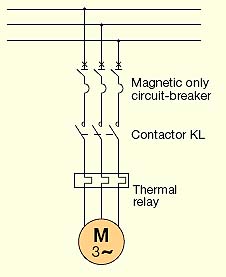
Рис. ABB
Схема прямого пуска электродвигателяMagnetic only circuit-breaker - Автоматический выключатель с электромагнитным расцепителем
Contactor KL - Контактор KL
Thermal relay - Тепловое реле
Параллельные тексты EN-RU
Direct-on-line starting
Direct-on-line starting, which is often abbreviated as DOL, is perhaps the most traditional system and consists in connecting the motor directly to the supply network, thus carrying out starting at full voltage.Direct-on-line starting represents the simplest and the most economical system to start a squirrel-cage asynchronous motor and it is the most used.
As represented in Figure 5, it provides the direct connection to the supply network and therefore starting is carried out at full voltage and with constant frequency, developing a high starting torque with very reduced acceleration times.
The typical applications are relevant to small power motors also with full load starting.
These advantages are linked to some problems such as, for example, the high inrush current, which - in the first instants - can reach values of about 10 to 12 times the rated current, then can decrease to about 6 to 8 times the rated current and can persist to reach the maximum torque speed.The effects of such currents can be identified with the high electro-dynamical stresses on the motor connection cables and could affect also the windings of the motor itself; besides, the high inrush torques can cause violent accelerations which stress the transmission components (belts and joints) generating distribution problems with a reduction in the mechanical life of these elements.
Finally, also the possible electrical problems due to voltage drops on the supply line of the motor or of the connected equipment must be taken into consideration.
[ABB]Прямой пуск
Прямой пуск, который по-английски часто сокращенно обозначают как DOL, является, пожалуй наиболее распространенным способом пуска. Он заключается в непосредственном (т. е. прямом) подключении двигателя к питающей сети. Это означает, что пуск двигателя осуществляется при полном напряжении.Схема прямого пуска является наиболее простым, экономичным и чаще всего применяемым решением для электродвигателей с короткозамкнутым ротором.
Схема прямого подключения к сети представлена на рисунке 5. Пуск осуществляется при полном напряжении и постоянной частоте сети. Электродвигатель развивает высокий пусковой момент при коротком времени разгона.
Типичные области применения – маломощные электродвигатели, в том числе с пуском при полной нагрузке.
Однако, наряду с преимуществами имеются и определенные недостатки, например, бросок пускового тока, достигающий в первоначальный момент 10…12-кратного значения от номинального тока электродвигателя. Затем ток двигателя уменьшается примерно до 6…8-кратного значения номинального тока и будет держаться на этом уровне до тех пор, пока скорость двигателя не достигнет максимального значения.
Такое изменение тока оказывает значительное электродинамическое воздействие на кабель, подключенный к двигателю. Кроме того пусковой ток воздействует на обмотки двигателя. Высокий начальный пусковой момент может привести к значительному ускорению и следовательно к значительной нагрузке элементов привода (ремней, крепления узлов), что вызывает сокращение их срока службы.
И, наконец, следует принять во внимание возможное возникновение проблем, связанных с падением напряжения в линии питания двигателя и подключенного к этой линии оборудования.
[Перевод Интент]
Тематики
Синонимы
EN
- across-the-line starting (US)
- direct line starting
- direct operation of a motor
- direct starting
- direct-on-line starting
- DOL
- full voltage starter application
DE
FR
Русско-английский словарь нормативно-технической терминологии > прямой пуск вращающегося электродвигателя
-
66 Muster
Muster n 1. COMP pattern; 2. GEN pattern, sample, template; 3. PAT design; 4. V&M sample, pattern, model* * *n 1. < Comp> pattern; 2. < Geschäft> pattern, sample, template; 3. < Patent> design; 4. <V&M> pattern, model* * *Muster
(Form) pattern, set form, device, shape, figure, (Gebrauchsmuster) design, pattern [sample], patterned sample, (Modell) model, copy, prototype, (Norm) norm, standard, (Textilwaren) figure, (Type) type, (Vorbild) paragon, mirror, example, (Warenprobe) sample, trial piece, specimen;
• dem Muster entsprechend up to sample;
• laut Muster, mit dem Muster übereinstimmend true to specimen;
• nach Muster according to pattern (sample), on the model (lines);
• nach dem Muster von on the pattern (model) of;
• schlechter als das Muster inferior to sample;
• streng nach Muster strictly up to sample;
• auf Bestellung angefertigtes Muster custom design;
• anhängende Muster annexed (attached) samples;
• aufdringliches Muster loud pattern;
• beigefügtes Muster attached sample;
• zu buntes Muster loud design;
• eingetragenes Muster registered pattern (design, Br.);
• einheitliches Muster standard pattern;
• gängiges Muster conventional design;
• gewerbliches Muster industrial design;
• vor Absendung der Ware gezogenes Muster preshipment sample;
• kostenloses Muster free sample;
• ungeschütztes Muster open pattern;
• unverkäufliches Muster free sample;
• nicht verkäufliche Muster models not on sale;
• verschiedene Muster sundry samples;
• verschlossenes Muster sealed sample;
• vorgelegtes Muster sample displayed;
• wiederkehrendes Muster repeated pattern;
• Muster auf Anfrage kostenlos free samples on request;
• Muster unter versiegeltem Verschluss sealed sample;
• Muster ohne Wert (Postversand) samples [only], no commercial value (US), by pattern (sample) post;
• Muster abschneiden to cut off a sample;
• mit Mustern verschiedene Versuche anstellen to put samples through a series of tests;
• nach einem Muster arbeiten to work from a pattern;
• Muster stichprobenartig auswählen to select a specimen at random;
• nach dem Muster bestellen to order goods from sample;
• als Muster dienen to serve as a model;
• Muster einsehen to have a look at the patterns;
• dem Muster entsprechen to correspond to pattern, to be up to (match the, correspond to the) sample;
• dem Muster nicht entsprechen not to be up to pattern;
• sich auf ein Muster festlegen to decide on a pattern;
• einem absehbaren Muster folgen to follow a predictable pattern;
• nach ausländischen Mustern gestalten to foreignize;
• etw. nach dem Muster kaufen to buy s. th. from sample;
• Muster nehmen to draw samples;
• als Muster ohne Wert senden (verschicken) to send as samples of no value;
• mit dem Muster übereinstimmen to match the sample;
• mit Mustern versehen to pattern;
• Muster vorführen to wait on with patterns;
• Muster vorlegen to submit samples;
• Muster ziehen to draw (take) samples, to sample;
• Muster zusammenstellen to arrange patterns, to assort (make up a collection of) samples;
• Musterabänderung modification of a design;
• Musterabkommen model convention;
• Musteranforderungskarte sample request card;
• Musteranfrage request for pattern;
• Musterangebot sample offer;
• Musteranlage pilot project;
• Musteranmeldung application for registration as design;
• Musterarbeitsvertrag model employment contract;
• Musterauftrag trial order;
• Musterbedingungen standard form contract conditions;
• Musterbeispiel [prime] example;
• Musterbericht standard report;
• Musterbestellung sample order;
• Musterbestimmungen eines Vertrages model conditions of contract;
• Musterbetrieb model enterprise (plant, workshop), pilot plant;
• landwirtschaftlicher Musterbetrieb model (demonstration) farm;
• Musterbeutel mailing bag;
• Musterbilanz standard balance sheet;
• Musterbrief form (US) (sample, standard, specimen) letter;
• Musterbuch specimen (pattern, sample, design) book, book of patterns;
• charakteristische Mustereigenschaften design requirements;
• Mustereintragung sample entry;
• Musterentnahme sampling;
• Mustererkennungssoftware pattern recognition software;
• Musteretat guideline budget;
• Musterexemplar pattern, sample, specimen [copy], prototype, showpiece;
• Musterfarm demonstration (model) farm;
• Musterformular specimen (sample) form;
• vollständige Mustergarnitur full set of samples. -
67 ombi
[Swahili Word] ombi[Swahili Plural] maombi[English Word] application[English Plural] applications[Part of Speech] noun[Class] 5/6[Derived Word] -omba, V[Swahili Example] Maombi ya wateja yamekubaliwa[English Example] The clients' applications have been accepted------------------------------------------------------------ -
68 aceptar
v.1 to accept.no aceptaron sus condiciones they didn't accept his conditionsMaría acepta el libertinaje Mary accepts licentiousness.Pedro acepta su supremacía Peter accepts her supremacy.2 to agree to, to accept to.Ricardo aceptó ser el testaferro Richard agreed to be the figurehead.Ricardo aceptó Richard accepted.3 to welcome, to believe in, to embrace, to buy.María aceptó la ayuda Mary welcomed the aid.4 to receive, to take.La agencia aceptó la encomienda The agency received the parcel.5 to admit to.Ricardo aceptó conocer el paradero Richard admitted to knowing the whereabouts.6 to click OK, to OK.* * *1 to accept, receive2 (aprobar) to approve of* * *verb1) to accept2) approve* * *VT1) [+ oferta, propuesta, dimisión] to accept; [+ cheque, moneda, tarjeta, trabajo] to accept, take; [+ condición] to accept, agree to2)por fin aceptaron que se publicara — they finally agreed for it to be published, they finally allowed it to be published
no acepta que las mujeres trabajen — he doesn't accept o agree that women should work
3)¿aceptas a María por esposa? — do you take María to be your lawful wedded wife?
* * *verbo transitivo <excusas/invitación/cargo> to accept; <términos/condiciones> to agree to¿acepta a Luis como or por legítimo esposo? — (frml) do you take Luis to be your lawful wedded husband? (frml)
aceptar + inf — to agree to + inf
¿por qué aceptas que te trate así? — why do you allow her to treat you like that?
* * *= accept, acknowledge, fall in with, go along with, subscribe (to), take (in/into), welcome, give + acceptance, take up, come to + terms with, embrace, put to + bed, countenance, take on, be game, spring for, agree to, open + Posesivo + mind up to.Ex. Personal authorship has been accepted for some time, and indeed reflects the scholarly practice of the western world.Ex. In acknowledging these principles, Sears' is consistent with traditional ideas on the construction of alphabetical subject catalogues.Ex. Stanton fell in with the suggestion readily.Ex. The same thing happended in the case of the British refusal to go along with the American compromises in the last revision.Ex. As regards abbreviations, and the extent to which they are used, most citation standards subscribe to the use of abbreviations.Ex. For example, a computer on board a space ship, o even in some cars, takes in data, works out settings, displays results completely automatically.Ex. The decision to revert to standard spelling must have been widely welcomed in countries where DC is used but English is not the native language.Ex. Wove paper, which was slightly more difficult to make than laid, was very slow to be taken up by the trade.Ex. Much of the conventional wisdom of librarianship is going to have to undergo what is so aptly described as an 'agonizing reappraisal' before we can come to terms with the new information age.Ex. The library community is now ready to embrace the most revolutionary technology for libraries -- CD-ROM.Ex. At the session on Sunday 15th, it was agreed to put to bed the non-controversial items.Ex. Unfortunately, in the field of reference work advocates of such professional independence of judgement must by implication be prepared to countenance differential service to the user.Ex. If we decide to take on making up a subject file there'd be a lot of footwork even if we use that list as a basis = Si decidimos aceptar crear un fichero ordenado por materias habría mucho trabajo incluso si usamos esta lista como base.Ex. Many of our group are financially strapped, and that presents a problem but I'm game.Ex. If I decide to spring for this I'll let you in on what I find out.Ex. In this case, the librarian 'reluctantly agreed to change the heading to 'Sexual Orientation' in anticipation of Library Board disapproval' = En este caso, el bibliotecario " accedió de mala gana a cambiarlo a 'Orientación Sexual' preveyendo el rechazo por parte de la Comisión de la Biblioteca".Ex. Ellyse has slowly solidified her game by knocking the rough edges off and by opening her mind up to what's required and what's available.----* aceptar Algo = take (+ Nombre) + on board (+ Nombre).* aceptar Algo sin protestar = take + Nombre + lying down.* aceptar el cambio = embrace + change.* aceptar incondicionalmente = accept + whole-heartedly.* aceptar la responsabilidad = assume + responsibilitiy (for).* aceptar las circunstancias = accept + the circumstances.* aceptar las condiciones = agree + terms.* aceptar la situación = accept + situation.* aceptar lo inevitable = accept + the inevitable.* aceptar los términos de un acuerdo = enter into + agreement.* aceptar tal cual = take + Nombre + at face value, accept + Nombre + at face value.* aceptar tarjeta de crédito = honour + credit card.* aceptar una decisión = accept + decision.* aceptar una idea = accept + notion, deal with + concept.* aceptar una invitación = accept + invitation.* aceptar una tarea = take on + task.* aceptar un cambio = accommodate + change.* aceptar un desafío = throw down + the gauntlet.* aceptar un reto = throw down + the gauntlet, call + Posesivo + bluff.* creencia generalmente aceptada = conventional wisdom.* difícil de aceptar = hard to swallow.* haber sido aceptado = be here to stay, have come + to stay.* negarse a aceptar = disavow.* no aceptar = disavow.* no aceptar un no por respuesta = not take + no for an answer.* opinión generalmente acepta = conventional wisdom.* resignarse y aceptar = bite + the bullet.* seguir trabajando aceptando una limitación = work (a)round + limitation.* seguir trabajando aceptando un defecto = work (a)round + shortcoming.* ser aceptado = gain + acceptance.* ser un hecho ampliamente aceptado = it + be + widely agreed.* * *verbo transitivo <excusas/invitación/cargo> to accept; <términos/condiciones> to agree to¿acepta a Luis como or por legítimo esposo? — (frml) do you take Luis to be your lawful wedded husband? (frml)
aceptar + inf — to agree to + inf
¿por qué aceptas que te trate así? — why do you allow her to treat you like that?
* * *= accept, acknowledge, fall in with, go along with, subscribe (to), take (in/into), welcome, give + acceptance, take up, come to + terms with, embrace, put to + bed, countenance, take on, be game, spring for, agree to, open + Posesivo + mind up to.Ex: Personal authorship has been accepted for some time, and indeed reflects the scholarly practice of the western world.
Ex: In acknowledging these principles, Sears' is consistent with traditional ideas on the construction of alphabetical subject catalogues.Ex: Stanton fell in with the suggestion readily.Ex: The same thing happended in the case of the British refusal to go along with the American compromises in the last revision.Ex: As regards abbreviations, and the extent to which they are used, most citation standards subscribe to the use of abbreviations.Ex: For example, a computer on board a space ship, o even in some cars, takes in data, works out settings, displays results completely automatically.Ex: The decision to revert to standard spelling must have been widely welcomed in countries where DC is used but English is not the native language.Ex: Even in 1678 this usage of the word 'bibliography' was hardly given full acceptance.Ex: Wove paper, which was slightly more difficult to make than laid, was very slow to be taken up by the trade.Ex: Much of the conventional wisdom of librarianship is going to have to undergo what is so aptly described as an 'agonizing reappraisal' before we can come to terms with the new information age.Ex: The library community is now ready to embrace the most revolutionary technology for libraries -- CD-ROM.Ex: At the session on Sunday 15th, it was agreed to put to bed the non-controversial items.Ex: Unfortunately, in the field of reference work advocates of such professional independence of judgement must by implication be prepared to countenance differential service to the user.Ex: If we decide to take on making up a subject file there'd be a lot of footwork even if we use that list as a basis = Si decidimos aceptar crear un fichero ordenado por materias habría mucho trabajo incluso si usamos esta lista como base.Ex: Many of our group are financially strapped, and that presents a problem but I'm game.Ex: If I decide to spring for this I'll let you in on what I find out.Ex: In this case, the librarian 'reluctantly agreed to change the heading to 'Sexual Orientation' in anticipation of Library Board disapproval' = En este caso, el bibliotecario " accedió de mala gana a cambiarlo a 'Orientación Sexual' preveyendo el rechazo por parte de la Comisión de la Biblioteca".Ex: Ellyse has slowly solidified her game by knocking the rough edges off and by opening her mind up to what's required and what's available.* aceptar Algo = take (+ Nombre) + on board (+ Nombre).* aceptar Algo sin protestar = take + Nombre + lying down.* aceptar el cambio = embrace + change.* aceptar incondicionalmente = accept + whole-heartedly.* aceptar la responsabilidad = assume + responsibilitiy (for).* aceptar las circunstancias = accept + the circumstances.* aceptar las condiciones = agree + terms.* aceptar la situación = accept + situation.* aceptar lo inevitable = accept + the inevitable.* aceptar los términos de un acuerdo = enter into + agreement.* aceptar tal cual = take + Nombre + at face value, accept + Nombre + at face value.* aceptar tarjeta de crédito = honour + credit card.* aceptar una decisión = accept + decision.* aceptar una idea = accept + notion, deal with + concept.* aceptar una invitación = accept + invitation.* aceptar una tarea = take on + task.* aceptar un cambio = accommodate + change.* aceptar un desafío = throw down + the gauntlet.* aceptar un reto = throw down + the gauntlet, call + Posesivo + bluff.* creencia generalmente aceptada = conventional wisdom.* difícil de aceptar = hard to swallow.* haber sido aceptado = be here to stay, have come + to stay.* negarse a aceptar = disavow.* no aceptar = disavow.* no aceptar un no por respuesta = not take + no for an answer.* opinión generalmente acepta = conventional wisdom.* resignarse y aceptar = bite + the bullet.* seguir trabajando aceptando una limitación = work (a)round + limitation.* seguir trabajando aceptando un defecto = work (a)round + shortcoming.* ser aceptado = gain + acceptance.* ser un hecho ampliamente aceptado = it + be + widely agreed.* * *aceptar [A1 ]vt‹excusas/invitación/cargo› to accept¿acepta a Luis como or por legítimo esposo? ( frml); do you take Luis to be your lawful wedded husband? ( frml)aceptan cheques de viaje they take traveler's checks[ S ] no aceptamos devoluciones no refundsaceptar + INF to agree to + INFaceptó acompañarme he agreed to accompany meaceptar QUE + SUBJ:no acepto que me diga eso I can't accept him saying that to me* * *
aceptar ( conjugate aceptar) verbo transitivo ‹excusas/invitación/cargo› to accept;
‹términos/condiciones› to agree to;
aceptó venir she agreed to come;
no acepto que me digas eso I won't have you saying that to me
aceptar verbo transitivo to accept: no acepto excusas, I won't accept any excuses
' aceptar' also found in these entries:
Spanish:
encajar
- entrada
- nariz
- negarse
- renunciar
- venderse
- admitir
- asumir
- coger
- creer
- modo
- otro
- vacilar
English:
accept
- adopt
- board
- fall in with
- job
- joke
- jump at
- overbook
- reject
- seize on
- seize upon
- settle for
- take
- take up
- agree
- come
- fact
- go
- grip
- have
- honor
- refuse
- rise
- share
- term
- turn
* * *aceptar vt1. [regalo] to accept2. [admitir] to accept;no aceptaron sus condiciones they didn't accept her conditions;¿aceptas a Enrique como tu legítimo esposo? do you take Enrique to be your lawful wedded husband?;no aceptará un “no” por respuesta he won't take no for an answer;no se aceptan cheques [en letrero] we do not take cheques;se aceptan donativos [en letrero] donations welcome* * *v/t accept* * *aceptar vt1) : to accept2) : to approve* * *aceptar vb to accept -
69 mal
adj.1 bad, evil.2 bad, poor.3 bad, deficient, low-quality.adv.1 wrong (incorrectamente).hacer algo mal to do something wronghas escrito mal esta palabra you've spelled that word wronghiciste mal en decírselo it was wrong of you to tell himportarse mal to behave badly2 badly (inadecuadamente).la conferencia/reunión salió mal the talk/meeting went badlymal vestido badly dressedoigo/veo mal I can't hear/see very wellesta puerta cierra mal this door doesn't shut properlyHaces las cosas mal siempre! You always do things badly!3 hardly.mal puede saberlo si no se lo cuentas he's hardly going to know it if you don't tell him4 barely, hardly.Mal pudimos dormir esa noche We could barely sleep that night.m.1 harm, damage (daño).no te hará ningún mal salir un rato it won't harm you o it won't do you any harm to go out for a whilemal de ojo evil eye2 illness.mal de altura o montaña altitude o mountain sicknessel mal de las vacas locas mad cow disease3 evil.4 wrong.* * *1 evil2 (daño) harm3 (enfermedad) sickness► adjetivo► adverbio1 (no adecuadamente) badly2 (enfermo) ill, sick■ me encuentro mal I feel ill, I don't feel well3 (incorrectamente) wrong4 (difícilmente) hardly, scarcely5 (desagradablemente) bad■ como sigas así, acabarás mal if you keep on like that, you'll end up in trouble6 (en frases negativas) bad, badly\a grandes males, grandes remedios desperate situations call for desperate measuresde mal en peor from bad to worseestar a mal con alguien to be on bad terms with somebodymal que bien one way or anothermal que les (te, etc) pese whether they (you, etc) like it or notmenos mal que... it's a good job that..., thank God that...no hay mal que cien años dure nothing goes on foreverno hay mal que por bien no venga every cloud has a silver liningmal de altura altitude sicknessmal de ojo evil eyemal de la rosa pellagramal de la tierra homesicknessmal francés syphilis* * *1. adv.1) badly, poorly2) hardly3) wrong2. noun m.1) evil2) wrong3) harm4) misfortune5) illness, disease3. adj.* * *1. ADV1) (=imperfectamente) badlyoigo/veo mal — I can't hear/see well
si mal no recuerdo — if my memory serves me right, if I remember correctly
2) (=reprobablemente)•
hacer mal, hace mal en mentir — he is wrong to lie3) (=insuficientemente) poorlyeste disco se vendió muy mal — this record sold very poorly, this record had very poor sales
•
comer mal, en este restaurante se come mal — the food isn't very good in this restaurantla niña come mal — the girl isn't eating properly, the girl is off her food
4) (=sin salud) illencontrarse o sentirse mal — to feel ill
5) (=desagradablemente)¡no está mal este vino! — this wine isn't bad!
•
caer mal algn, me cae mal su amigo — I don't like his friend•
llevarse mal, me llevo mal con él — I don't get on with him•
oler mal, esta habitación huele mal — this room smells (bad)•
pensar mal de algn — to think badly of sb•
saber mal, sabe mal — it doesn't taste nice6) [otras locuciones]•
estar a mal con algn — to be on bad terms with sb•
¡ menos mal! — thank goodness!menos mal que... — it's just as well (that)..., it's a good job (that)...
•
mal que bien — more or less, just aboutmal que bien lo hemos solucionado — we've more or less o just about managed to solve it
•
tomarse algo (a) mal — to take sth the wrong way2.CONJ3.4. SM1) (=maldad)combatir el mal — frm to fight against evil
2) (=perjuicio) harmel mal ya está hecho — the harm o damage is done now
¡mal haya quien...! — frm a curse on whoever...!
•
dar mal a algn — to make sb suffer•
darse mal — to torment o.s.rebajamos los precios, como mal menor — we cut the prices, as the lesser of two evils
esa solución no me satisface, pero es un mal menor — I'm not happy with that solution, but it could have been worse
•
parar en mal — to come to a bad end3) (=problema) ill4) (Med) disease, illnessmal francés — ( Hist) syphilis
5)6) LAm (Med) epileptic fit* * *I IIadjetivo invariable1)a) (enfermo, con mal aspecto)estar mal — to be bad o ill; ( anímicamente) to be in a bad way (colloq)
me siento mal — I don't feel well, I feel ill
b) (incómodo, a disgusto)¿tan mal estás aquí que te quieres ir? — are you so unhappy here that you want to leave?
2) (fam) (en frases negativas) ( refiriéndose al atractivo sexual)no está nada mal — he's/she's not at all bad (colloq)
3) ( desagradable) <oler/saber> badaquí huele mal — there's a horrible smell o it smells in here
4) ( insatisfactorio)estoy or salí muy mal en esta foto — I look awful in this photograph
la casa no está mal, pero es cara — the house isn't bad, but it's expensive
5) ( incorrecto) wrongestá muy mal no decírselo — it's very wrong o bad not to tell her
6) ( indicando escasez)IIIestamos mal de arroz — we're low on o almost out of rice
1) ( de manera no satisfactoria) <hecho/vestido> badly; <cantar/escribir> badlyse expresó mal — he didn't express himself very well, he expressed himself badly
2) ( desventajosamente)3) ( desfavorablemente) badly, illhablar mal de alguien — to speak badly o ill of somebody
4)a) (de manera errónea, incorrecta) wrong, wronglyte han informado mal — you've been badly o wrongly informed
b) ( de manera reprensible) badlyobró mal — he acted wrongly o badly
me contestó muy mal — she answered me very rudely o in a very rude manner
portarse mal — to behave badly, to misbehave
5) ( difícilmente)mal puedes saber si te gusta si no lo has probado — you can hardly say whether you like it when you haven't even tried it
6) (en locs)hacer mal — (AmL) ( a la salud)
comí algo que me hizo mal — I ate something which didn't agree with me; ver tb mal IV 2)
mal que bien — (fam) somehow or other
mal que me/te/nos pese — whether I/you/we like it or not
menos mal: menos mal! thank goodness!; menos mal que le avisaron a tiempo! it's just as well they told him in time!; menos mal que no se enteró! it's a good thing she didn't find out! (colloq); estar a mal con alguien to be on bad terms with somebody; tomarse algo a mal — to take something to heart
•IV1) (Fil) evilel bien y el mal — good and evil, right and wrong
2) (daño, perjuicio)le estás haciendo un mal consintiéndole todo — you're not doing her any good by giving in to her all the time
lo que dijo me hizo mucho mal — what he said really hurt me; ver tb mal III 6)
3) (inconveniente, problema)mal de muchos, consuelo de tontos:... pero yo no soy la única - mal de muchos, consuelo de tontos —... but I'm not the only one - well, if that makes you feel better about it (iro)
4) (Med)a) (liter) ( enfermedad) illnessb) ( epilepsia)el mal — ( enfermedad) epilepsy
5) ( pena) trouble* * *= ill, malaise, ailment, evil, affliction, wrong, out of sorts, woe, woefulness.Ex. Americans, convinced that education could be the panacea for all their ills, answered with vigorous action.Ex. He interprets 'alienation' as the ' malaise that affects all of us, leaving us in some measure unable to operate in humane, supportive ways'.Ex. In the two years that followed Woodforde had various other ailments, including an inflammation of the eyelid.Ex. It is increasingly obvious that we are as a nation one and indivisible, that divisive tendencies are a thing of the past, but there are still too many inheritors of the old indifference, and who flinch at co-operation as at an evil.Ex. In the Netherlands there are currently some 20,000 sufferers from this affliction.Ex. Librarians have traditionally been concerned with giving rather than selling information and information supplied negligently is dealt with by the law of torts: civil wrongs independent of contract.Ex. For example, you already know that living in a windowless room will make you cranky and out of sorts.Ex. 'The word's out: all departments have to cut their staffs by 10%' -- Her voice was weak and laden with woe.Ex. In presenting this story, Amenabar has managed to avoid both saccharine sentimentality and easy woefulness.----* eje del mal = axis of evil.* el dinero es el origen de todos los males = money is the root of all evil.* el dinero es la fuente de todos los males = money is the root of all evil.* evitar el mal = shun + evil.* fuente de todos los males, la = root of all evil, the.* hacer el mal = do + evil.* mal de amores = heartache, lovesick.* mal de Parkinson = Parkinson's disease.* males de la guerra, los = evils of war, the.* origen de todos males, el = root of all evil, the.* para colmo de males = to add insult to injury, to add salt to injury, to rub salt in the wound.* tener mal de amores = be lovesick.* * *I IIadjetivo invariable1)a) (enfermo, con mal aspecto)estar mal — to be bad o ill; ( anímicamente) to be in a bad way (colloq)
me siento mal — I don't feel well, I feel ill
b) (incómodo, a disgusto)¿tan mal estás aquí que te quieres ir? — are you so unhappy here that you want to leave?
2) (fam) (en frases negativas) ( refiriéndose al atractivo sexual)no está nada mal — he's/she's not at all bad (colloq)
3) ( desagradable) <oler/saber> badaquí huele mal — there's a horrible smell o it smells in here
4) ( insatisfactorio)estoy or salí muy mal en esta foto — I look awful in this photograph
la casa no está mal, pero es cara — the house isn't bad, but it's expensive
5) ( incorrecto) wrongestá muy mal no decírselo — it's very wrong o bad not to tell her
6) ( indicando escasez)IIIestamos mal de arroz — we're low on o almost out of rice
1) ( de manera no satisfactoria) <hecho/vestido> badly; <cantar/escribir> badlyse expresó mal — he didn't express himself very well, he expressed himself badly
2) ( desventajosamente)3) ( desfavorablemente) badly, illhablar mal de alguien — to speak badly o ill of somebody
4)a) (de manera errónea, incorrecta) wrong, wronglyte han informado mal — you've been badly o wrongly informed
b) ( de manera reprensible) badlyobró mal — he acted wrongly o badly
me contestó muy mal — she answered me very rudely o in a very rude manner
portarse mal — to behave badly, to misbehave
5) ( difícilmente)mal puedes saber si te gusta si no lo has probado — you can hardly say whether you like it when you haven't even tried it
6) (en locs)hacer mal — (AmL) ( a la salud)
comí algo que me hizo mal — I ate something which didn't agree with me; ver tb mal IV 2)
mal que bien — (fam) somehow or other
mal que me/te/nos pese — whether I/you/we like it or not
menos mal: menos mal! thank goodness!; menos mal que le avisaron a tiempo! it's just as well they told him in time!; menos mal que no se enteró! it's a good thing she didn't find out! (colloq); estar a mal con alguien to be on bad terms with somebody; tomarse algo a mal — to take something to heart
•IV1) (Fil) evilel bien y el mal — good and evil, right and wrong
2) (daño, perjuicio)le estás haciendo un mal consintiéndole todo — you're not doing her any good by giving in to her all the time
lo que dijo me hizo mucho mal — what he said really hurt me; ver tb mal III 6)
3) (inconveniente, problema)mal de muchos, consuelo de tontos:... pero yo no soy la única - mal de muchos, consuelo de tontos —... but I'm not the only one - well, if that makes you feel better about it (iro)
4) (Med)a) (liter) ( enfermedad) illnessb) ( epilepsia)el mal — ( enfermedad) epilepsy
5) ( pena) trouble* * *= ill, malaise, ailment, evil, affliction, wrong, out of sorts, woe, woefulness.Ex: Americans, convinced that education could be the panacea for all their ills, answered with vigorous action.
Ex: He interprets 'alienation' as the ' malaise that affects all of us, leaving us in some measure unable to operate in humane, supportive ways'.Ex: In the two years that followed Woodforde had various other ailments, including an inflammation of the eyelid.Ex: It is increasingly obvious that we are as a nation one and indivisible, that divisive tendencies are a thing of the past, but there are still too many inheritors of the old indifference, and who flinch at co-operation as at an evil.Ex: In the Netherlands there are currently some 20,000 sufferers from this affliction.Ex: Librarians have traditionally been concerned with giving rather than selling information and information supplied negligently is dealt with by the law of torts: civil wrongs independent of contract.Ex: For example, you already know that living in a windowless room will make you cranky and out of sorts.Ex: 'The word's out: all departments have to cut their staffs by 10%' -- Her voice was weak and laden with woe.Ex: In presenting this story, Amenabar has managed to avoid both saccharine sentimentality and easy woefulness.* eje del mal = axis of evil.* el dinero es el origen de todos los males = money is the root of all evil.* el dinero es la fuente de todos los males = money is the root of all evil.* evitar el mal = shun + evil.* fuente de todos los males, la = root of all evil, the.* hacer el mal = do + evil.* mal de amores = heartache, lovesick.* mal de Parkinson = Parkinson's disease.* males de la guerra, los = evils of war, the.* origen de todos males, el = root of all evil, the.* para colmo de males = to add insult to injury, to add salt to injury, to rub salt in the wound.* tener mal de amores = be lovesick.* * *mal1mal2A1 (enfermo, con mal aspecto) estar mal to be bad o ill; (anímicamente) to be o feel low ( colloq), to be o feel down ( colloq)me siento mal I don't feel well, I feel illhace días que ando mal del estómago I've been having trouble with my stomach for some days nowlo encontré muy mal, pálido y desmejorado he didn't seem at all well, he looked pale and sicklyestá muy mal, no se ha repuesto de lo del marido she's in a bad way, she hasn't got over what happened to her husband¡éste está mal de la cabeza! he's not right in the headesas cosas me ponen mal things like that really upset me2(incómodo, a disgusto): ¿tan mal estás aquí que te quieres ir? are you so unhappy here that you want to leave?tú allí estás mal you aren't comfortable thereB ( fam) ( en frases negativas)C (desagradable) ‹oler/saber› badaquí huele mal there's a horrible smell in here, it smells in hereno sabe tan mal it doesn't taste that badesta leche huele mal this milk smells bad o offD(insatisfactorio): los soufflés siempre me quedan mal my soufflés never turn out rightestoy or quedé or salí muy mal en esta foto I look awful in this photole queda mal ese peinado that hairstyle doesn't suit herla casa no está mal, pero es cara the house isn't bad o is quite nice but it's expensivesacarnos un millón no estaría nada mal I wouldn't mind winning a millionE (incorrecto) wrongla fecha está mal the date is wrongcreo que está muy mal no decírselo I think it's very wrong o bad not to tell herestá mal que le hables en ese tono it's wrong (of you) to speak to him in that toneestuviste muy mal en no ayudarlo it was wrong of you not to help himF (indicando escasez) estar mal DE algo:estamos mal de dinero we're hard up ( colloq), we're short of moneyestamos mal de arroz we have hardly any rice (left), we're low on o almost out of ricemal3A (de manera no satisfactoria) ‹hecho/organizado/pintado/vestido› badlycanta muy mal she sings very badly, she's a very bad singer, she's very bad at singingse expresó mal he didn't express himself very well, he expressed himself badlyte oigo muy mal I can hardly hear you, I can't hear you very wellen el colegio se come muy mal the food's terrible at schoolle fue mal en los exámenes his exams went badlyde mal en peor from bad to worseB(desventajosamente): se casó muy mal she made a bad marriagevendieron muy mal la casa they got a terrible price for the houseel negocio marcha mal the business isn't doing very wellC (desfavorablemente) badly, illno hables mal de ella don't speak badly o ill of herpiensa mal de todo el mundo he thinks ill of everyoneD1 (de manera errónea, incorrecta) wrong, wronglylo has hecho mal you've done it wrongmi nombre está mal escrito my name has been misspelt, my name is spelt/has been spelt wrong(ly)te han informado mal you've been badly o wrongly informedte entendí mal I misunderstood you, I didn't understand you properly2 (de manera reprensible) badlyobró or procedió mal he acted wrongly o badlyhaces mal en no ir a verla it's wrong of you not to go and see herme contestó muy mal she answered me very rudely o in a very rude mannersi te portas mal no te traigo más if you behave badly o if you misbehave I won't bring you againE(difícilmente): mal puedes saber si te gusta si no lo has probado you can hardly say o I don't see how you can say whether you like it when you haven't even tried itF ( en locs):comí algo que me hizo mal I ate something which didn't agree with me o which made me feel bad o illmal que me/te/nos pese whether I/you/we like it or notmenos mal: aceptaron tu solicitud — ¡menos mal! they've accepted your application — thank goodness!¡menos mal que le avisaron a tiempo! it's just as well they told him in time!estar a mal con algn to be on bad terms with sbtomarse algo a mal to take sth to heartCompuesto:mal nacido, mal nacidamasculine, feminine swine ( colloq), rat ( colloq) ver tb maleducado1 (↑ maleducado (1)), maleducado2 (↑ maleducado (2))mal4A ( Fil) evilel bien y el mal good and evil, right and wronglíbranos del mal deliver us from evilB(daño, perjuicio): no le perdono todo el mal que me hizo I can't forgive her all the wrong she did mele estás haciendo un mal consintiéndole todo you're doing her a disservice o you're not doing her any good by giving in to her all the timeel divorcio de sus padres le hizo mucho mal her parents' divorce did her a lot of harmlo que me dijo me hizo mucho mal what he said hurt me deeply o really hurt meC(inconveniente, problema): los males que aquejan a nuestra sociedad the ills afflicting our societyla contaminación es uno de los males de nuestro tiempo pollution is one of the evils of our timea grandes males grandes remedios desperate situations call for desperate measuresno hay mal que cien años dure nothing goes on for everno hay mal que por bien no venga every cloud has a silver liningmal de muchos, consuelo de tontos: … pero a mucha gente le pasó lo mismo — mal de muchos, consuelo de tontos … but the same thing happened to a lot of other people — so that makes you feel better, does it? ( iro)todos mis amigos suspendieron también, así que mal de muchos, consuelo de tontos all my friends failed too, so that's some consolation, I suppose o so that makes things a bit better, I supposequien canta sus males espanta problems don't seem so bad if you keep cheerfulCompuesto:(entre dos alternativas) lesser of two evilseso fue un mal menor porque se podría haber matado in fact he was lucky o he can count himself lucky, he could have been killedD ( Med)1 ( liter) (enfermedad) illness2cuando le da el mal when she has a fitCompuestos:Alzheimer's disease( fam):tiene mal de amores he's lovesickChagas' diseasealtitude sickness, mountain sicknessevil eyele echó el mal de ojo or (CS) le hizo mal de ojo she gave him the evil eyeParkinson's disease( euf); syphilisE (pena) troubleno me vengas a contar tus males don't come to me with your troubles* * *
mal adjetivo: ver◊ malo
■ adjetivo invariable
1 [estar] ( enfermo) ill;
( anímicamente) in a bad way (colloq);
( incómodo) uncomfortable;
¡este está mal de la cabeza! he's not right in the head;
esas cosas me ponen mal things like that really upset me
2 (fam) ( en frases negativas) ( refiriéndose al aspecto):◊ no está nada mal she's/he's/it's not at all bad (colloq)
3 ( insatisfactorio): estoy or salí muy mal en esta foto I look awful in this photograph;
4 [estar] ( incorrecto) wrong
5 ( indicando escasez) estar or ir mal de algo ‹de dinero/tiempo› to be short of sth
■ adverbio
1 ( de manera no satisfactoria) ‹vestir/cantar/jugar› badly;
te oigo muy mal I can hardly hear you;
el negocio marcha mal the business isn't doing well;
de mal en peor from bad to worse
2 ( desfavorablemente) badly, ill;◊ hablar mal de algn to speak badly o ill of sb
3
◊ te han informado mal you've been badly o wrongly informed;
te entendí mal I misunderstood you
me contestó muy mal she answered me very rudely
4 ( desagradable) ‹oler/saber› bad;◊ aquí huele mal there's a horrible smell o it smells in here
5 ( en locs)
el pescado me hizo mal the fish didn't agree with me;
menos mal: ¡menos mal! thank goodness!;
¡menos mal que le avisaron a tiempo! it's just as well they told him in time!;
tomarse algo a mal to take sth to heart
■ sustantivo masculino
1 (Fil) evil;
2 (daño, perjuicio):
3 ( cosa dañina) ill, evil;
no hay mal que por bien no venga every cloud has a silver lining
4 (Med) (liter) ( enfermedad) illness;◊ tiene mal de amores (fam) he's lovesick;
mal de (las) altura(s) altitude sickness, mountain sickness
5 ( pena) trouble
mal
I adj (delante de sustantivo masculino) bad
un mal momento, (inoportuno) a bad time: está atravesando un mal momento, he's going through a bad patch ➣ malo,-a
II sustantivo masculino
1 evil, wrong
más allá del bien y del mal, beyond good and evil
2 (perjuicio) harm: me ha hecho mucho mal, it really hurt me
mal de ojo, the evil eye
3 (dolencia) illness, disease: padece un mal incurable, she suffers from an incurable disease
III adverbio
1 (de mala manera, incorrectamente) badly, wrong: oye muy mal, she can hardly hear
todo me sale mal, everything I do turns out badly
me siento mal del estómago, I've got an upset stomach
menos mal que estás aquí, it's a good job you are here
2 (difícilmente) scarcely, hardly: si no me lo cuentas, mal puedo yo ayudarte, if you don't tell me I can scarcely help you
♦ Locuciones: llevar uno mal algo, to take sthg badly: lleva muy mal la muerte de su padre, he took the death of his father really badly
mal que, even if: tendremos que ir mal que nos pese, whether we like it or not, we'll have to go
mal que bien, somehow or other: mal que bien vamos tirando, we're managing quite well somehow or other
ponerse a mal con alguien, to fall out with sb
tomar uno a mal, to take sthg badly: no te lo tomes a mal, don't take it badly
' mal' also found in these entries:
Spanish:
agüero
- añadidura
- apestar
- apestosa
- apestoso
- atufar
- avenida
- avenido
- azotea
- berrear
- bicho
- bien
- caber
- cabeza
- caer
- café
- calcular
- caldo
- camino
- cantar
- carácter
- cardo
- chabacana
- chabacano
- chapuza
- comportarse
- comunicada
- comunicado
- conservarse
- contraluz
- contraria
- contrario
- criada
- criado
- daño
- desastre
- desencajada
- desencajado
- deslucir
- despertar
- día
- dinero
- educada
- educado
- efecto
- empañarse
- encajar
- encaminada
- encaminado
- encontrar
English:
abuse
- acquit
- act up
- agree
- along
- amulet
- astray
- bad
- bad-tempered
- badly
- barring
- best
- bile
- cheap
- cloud
- come off
- condition
- deal
- deliver
- disagree
- disapprove
- disrepair
- do
- do with
- doom
- downhill
- embody
- evil
- evil eye
- fit
- flare up
- foolish
- foot
- frown on
- gnawing
- go
- go down
- go off
- god
- going
- good
- greasy
- grief
- grim
- grin
- grumpy
- half-baked
- hash
- health
- hinder
* * *♦ adjver malo♦ nmLiterariolas fuerzas del mal the forces of darkness o evil2. [daño] harm, damage;nadie sufrió ningún mal no one was harmed, no one suffered any harm;¿no le hará mal al bebé tanta agua? all that water can't be good for the baby;no te hará ningún mal salir un rato it won't harm you o it won't do you any harm to go out for a while;todas aquellas habladurías le hicieron mucho mal all the gossip hurt her deeplymal de ojo evil eye; Arquit el mal de la piedra = the problem of crumbling masonry caused by pollution etc3. [enfermedad] illness;Figesto te curará todos los males this will make you feel better;tener mal de amores to be lovesickmal de (las) altura(s) altitude sickness;mal de montaña mountain sickness;Ven mal de páramo altitude sickness; Fam el mal de las vacas locas mad cow disease4. [problema, inconveniente] bad thing;el hambre y la pobreza son males que afectan al Tercer Mundo hunger and poverty are problems o ills which affect the Third World;entre las dos opciones, es el mal menor it's the lesser of two evils;un mal necesario a necessary evil5. Compdel mal, el menos it's the lesser of two evils;la crisis pasará, no hay mal que cien años dure the recession will end sooner or later, these things never last forever;a grandes males, grandes remedios drastic situations demand drastic action;mal de muchos, consuelo de todos o [m5]de tontos: he suspendido, pero también mis compañeros – mal de muchos, consuelo de tontos o [m5] de todos I failed, but so did my classmates – it doesn't make it all right, just because they did too;lo mismo pasa en otros países – mal de muchos, consuelo de tontos o [m5] de todos the same thing happens in other countries – that doesn't make it any better, though;no hay mal que por bien no venga every cloud has a silver lining♦ adv1. [incorrectamente] wrong;obrar mal to do wrong;portarse mal to behave badly;juzgar mal a alguien to misjudge sb;está mal hecho [un informe, un trabajo] it hasn't been done properly;[un producto, un aparato] it's badly made;eso está mal hecho, no debían haberlo aceptado it was wrong of them, they shouldn't have accepted it;está mal eso que has hecho what you've done is wrong;hacer algo mal to do sth wrong;has escrito mal esta palabra you've spelt that word wrong;hiciste mal en decírselo it was wrong of you to tell him;está mal que yo lo diga, pero esta sopa esta buenísima this soup is delicious, although I say so myself2. [inadecuadamente, insuficientemente] badly;creo que me he explicado mal I'm not sure I've explained myself clearly;oigo/veo mal I can't hear/see very well;el niño come bastante mal the boy isn't eating properly o very well;calculé mal el tiempo I miscalculated the time;canta muy mal she sings terribly, she's a terrible singer;esta puerta cierra mal this door doesn't shut properly;andar mal de dinero to be short of money;andamos mal de azúcar we're running out of sugar;la empresa/el equipo va mal the company/team isn't doing very well;va mal en la universidad she's not doing very well at university;le fue mal en la entrevista his interview didn't go very well;el sueldo no está nada mal the pay's pretty good, the pay isn't at all bad;ese chico no está nada mal that boy's not bad o pretty nice;la reparación quedó mal it wasn't repaired properly;me quedó mal el retrato my portrait didn't come out right;la conferencia/reunión salió mal the talk/meeting went badly;la fiesta salió mal the party was a failure[incómodo] to feel uncomfortable; [de calidad] to be bad;hablar mal de alguien to speak ill of sb;oler mal to smell bad;¡qué mal huele! what a smell!;Fam Figesto me huele mal this smells fishy to me;pasarlo mal to have a bad time;pensar mal de alguien to think ill of sb;saber mal to taste bad;Figme supo mal que no vinieses a despedirme I was a bit put out that you didn't come to see me off;me sabe muy mal que hablen a mis espaldas I don't like it that they talk behind my back;sentar mal a alguien [ropa] not to suit sb;[comida] to disagree with sb; [comentario, actitud] to upset sb4. [difícilmente] hardly;mal puede saberlo si no se lo cuentas he's hardly going to know if you don't tell him, how's he supposed to know if you don't tell him?5. Compestar a mal con alguien to have fallen out with sb;ir de mal en peor to go from bad to worse;no estaría mal que… it would be nice if…;tomar algo a mal to take sth the wrong way♦ mal que loc conjalthough, even though;mal que te pese, las cosas están así whether you like it or not, that's the way things are;mal que bien somehow or other* * *I adj → maloII adv badly;mal que bien one way or the other;¡no está mal! it isn’t bad!;¡menos mal! thank goodness!;no hay mal que por bien no venga every cloud has a silver lining;hacer mal en hacer algo be wrong to do sth;ir de mal en peor go from bad to worse;estar a mal con alguien be on bad terms with s.o.;hablar mal de alguien speak ill of s.o.;poner mal a alguien criticize s.o.;ponerse a mal con alguien fall out with s.o.;tomarse algo a mal take sth badly;ponerse mal get sickel mal menor the lesser of two evils* * *mal adv1) : badly, poorlybaila muy mal: he dances very badly2) : wrong, incorrectlyme entendió mal: she misunderstood me3) : with difficulty, hardlymal puedo oírte: I can hardly hear you4)de mal en peor : from bad to worse5)menos mal : it could have been worsemal nm1) : evil, wrong2) daño: harm, damage3) desgracia: misfortune4) enfermedad: illness, sickness* * *mal2 advme encuentro mal I don't feel well / I feel ill4. (de forma incorrecta) wrong5. (en frases negativas) badmal3 n1. (daño) harm / wrong2. (maldad) evil3. (problema) problem -
70 подавати
= подати1) to give, to present (to)подавати дичину мисл. — ( про собаку) to retrieve
подавати допомогу — to give a helping hand, to lend a hand; to help, to assist
подавати знак — to give a sign (to)
подавати команду військ. — to give а command
подавати пальто — to help smb. on with his coat
подавати приклад — to set an example, to serve as an example (to smb.)
подавати руку — to hold out one's hand (to), to offer one's hand; ( дамі в танці) to offer one's hand (to)
2) ( ставити на стіл) to serveподавати на стіл — to serve the dishes; to serve the table
3) (підводити - про автомобіль, потяг тощо) to drive upна яку платформу подадуть потяг (поїзд)? — what platform is the train due at?, what platform is the train coming in at?
4) спорт. to serve5) ( на розгляд) to submit, to present, to forward, to hand inподавати заяву — to submit ( to hand in) an application
подавати скаргу на когось — to lodge ( to make) a complaint against smb.
подавати петицію (прохання) — to present ( to submit) a petition, to petition
подавати протест — to register/enter a protest
6) тех. to feed, to convey7)подавати телеграму — to send a telegram, to wire
подавати голос (за кого-небудь/що-небудь) — to vote ( for)
подавати у відставку — to tender one's resignation; to retire, to resign; військ. to send in one's resignation ( one's papers)
-
71 come
1. adv as( in modo simile o uguale) likeinterrogativo, esclamativo how(prego?) pardon?fa' come ti ho detto do as I told youlavora come insegnante he works as a teachercome me like meun cappello come il mio a hat like minecome sta? how are you?, how are things?com'è bello! how nice it is!come mai? how come?, why?oggi come oggi nowadayscome se as if2. conj ( come se) as if, as though(appena, quando) as (soon as)come se niente fosse as if nothing had happened* * *come avv.1 (in frasi interr. dirette e indirette) how; what... like: come stai?, how are you?; come te la cavi in inglese?, what's your English like? (o how good is your English?); come si scrive questa parola?, how do you spell this word?; come si dice in inglese...?, what's the English for...?; come si fa?, how is it to be done? (o how do you do it?); com'era il film?, what was the film like?; com'è il tempo?, what's the weather like?; non so come dirglielo, I don't know how to tell him; fammi sapere come è andata, let me know how it went; non so proprio come sia riuscito a farlo, I just don't know how he managed to do it // come mai?, why?; ( enfatico) how come?; why ever?: mi domando come mai non sia ancora arrivato, I wonder why he hasn't got here yet; i documenti erano in regola, ma la domanda è stata respinta. Come mai?, the papers were in order, but the application was turned down. How come? // com'è che non sei mai in casa?, why are you never at home?; come dici?, come hai detto?, what's that? (o what did you say?) // come sarebbe a dire?, what do you mean? // come si permette?, how dare you! // com'è, come non è, (fam.), somehow or other; ( all'improvviso) all of a sudden // ma come?!, ( per esprimere meraviglia o sdegno) how come? (o what?) // come no?!, of course!: ''Accetterai, vero?'' ''Come no?!'' ''You'll accept, won't you?'' ''Of course (I will)!''2 ( in frasi esclamative) how: com'è gentile da parte sua!, how kind of you!; come mi dispiace!, how sorry I am!; guarda come nevica!, look how hard it's snowing!; come parla bene!, how well he speaks!; come sono cambiati i tempi!, how times have changed! // Con uso rafforzativo o enfatico: ''Vi siete divertiti?'' ''E come!'', ''Did you have a good time?'' ''And how!''; Ma come! Siete già tornati?, What! Back already?3 ( il modo in cui) how, the way: mi raccontò come era riuscito a ottenere il posto, he told me how he'd managed to get the job; ecco come sono andate le cose, this is how things went // bada a come parli, watch your tongue4 (in frasi comparative e nei compar. di uguaglianza) as (so)... as; (con un compar. di maggioranza) than: mio fratello è alto come me, my brother is as tall as me (o as I am); non è ( così) ingenuo come sembra, he isn't as simple as he seems; siamo arrivati più tardi di come avevamo previsto, we got there later than we expected; l'esame è andato meglio di come pensassi, I did better than I'd expected in the exam // Nelle similitudini: bianco come la neve, as white as snow; duro come il ferro, as hard as iron; il mare era liscio come l'olio, the sea was as smooth as glass5 ( in qualità di) as: ti parlo come amico, non come medico, I'm talking to you as a friend, not (as) a doctor; l'hanno citato come testimone, he was cited as a witness; tutti lo vorrebbero come socio, everyone would like him as a partner; come avvocato, non vale un gran che, as a lawyer, he isn't up to much6 ( nel modo in cui) as: ho fatto come hai voluto tu, I did as you wanted; non fare come me, don't do as I did; tutto è andato come speravamo, everything went as we'd hoped; non sempre si può fare come si vuole, you can't always do as you like; lascia le cose come stanno, leave things as they are7 ( per indicare somiglianza) like; ( nelle esemplificazioni) such as: indossava un abito come questo, she was wearing a dress like this one; correva come un pazzo, he was running like mad; è ingegnere come suo padre, he's an engineer, like his father; si è comportato come un vero signore, he behaved like a true gentleman; l'appartamento mi è costato qualcosa come 50.000 euro, the flat cost me something like 50,000 euros; non ti si presenterà più un'occasione come questa, you won't get another chance like this; c'erano famosi giornalisti e scrittori, come..., there were famous writers and reporters, such as...; in Lombardia ci sono bellissimi laghi, come il Lago Maggiore, il Lago di Como,..., there are some lovely lakes in Lombardy, such as Lake Maggiore, Lake Como,...8 (spesso in correl. con così, tanto) as; both... and; as well as: ( tanto) di giorno come di notte, by day as by night (o both by day and night o by day as well as by night); tanto il padre come la madre sono americani, his father and mother are both American; tanto gli uni come gli altri, both; tanto i greci come i romani..., both the Greeks and the Romans... (o the Greeks as well as the Romans...) // come pure, as well as: New York, come pure Londra, è un grande porto fluviale, New York is a great river port, as well as (o as is) London.◆ FRASEOLOGIA: oggi come oggi, as things are at present // vecchio com'è, old as he is // io come io, non accetterei, if it were me, I'd refuse // 6 sta a 3 come 10 sta a 5, 6 is to 3 as 10 is to 5 // come non detto, forget it // com'è vero che..., as sure as... // come segue, as follows // come sopra, as above // (comm.): come d'accordo, as agreed; come da campione, as per sample; come da copia acclusa, see enclosed copy; come da vostra richiesta, as requested.◆ cong.1 ( con valore temporale) as, as soon as: come mi vide, mi buttò le braccia al collo, as soon as she saw me, she threw her arms round my neck; come avvertì i primi sintomi, telefonò al medico, as soon as she noticed the first symptoms, she telephoned the doctor; come arrivavano, i candidati venivano condotti ai loro posti, as they arrived, the candidates were shown to their places2 ( con valore dichiarativo) that: tutti sanno come la Luna sia un satellite della Terra, everyone knows (that) the Moon is a satellite of the Earth3 come se, as if, as though: continuava a parlare, come se non sentisse quello che gli dicevo, he went on talking, as if (o as though) he hadn't heard what I said; come se fosse facile..., as if it were easy...◆ s.m.: il come e il perché, the whys and wherefores // volle sapere il come e il quando, he wanted to know the ins and outs.* * *['kome]1. avv1) (alla maniera di, nel modo che) as, like (davanti a sostantivo, pronome)a scuola come a casa — both at school and at home, at school as well as at home
non hanno accettato il progetto: come dire che siamo fregati — they didn't accept the plan: which means we've had it
2) (in quale modo: interrogativo, esclamativo) hownon hanno accettato il mio assegno — come mai? — they didn't accept my cheque — whyever not?
come?; come dici? — pardon? Brit, sorry?, excuse me? Am, what did you say?
com'è il tuo amico? — what's your friend like?
3)mi piace come scrive — I like the way he writes, I like his style of writing4) (in qualità di) ascome presidente, dirò che... — speaking as your president I must say that...
5)come è brutto! — how ugly he (o it) is!6)See:così,2. cong1)mi scrisse come si era rotto un braccio — he wrote to tell me about how he had broken an arm2) (quanto) how3) (correlativo) as, (con comparativi di maggioranza) thanè meglio/peggio di come mi aspettavo — it is better/worse than I expected
4) (appena che, quando) as soon ascome arrivò si mise a lavorare — as soon as he arrived he set to work, no sooner had he arrived than he set to work
come se n'è andato, tutti sono scoppiati a ridere — as soon as he left, everyone burst out laughing
5)la trattano come (se) fosse la loro schiava — they treat her like a slave o as if she were their slave
3. sm invnon so dirti il come e il quando di tutta questa faccenda — I couldn't tell you how and when all this happened
* * *['kome] 1.2) come mai, com'è che colloq. how come5) (nel modo in cui, allo stesso modo di) ascome sempre — as ever, the same as always
ecco come è successo — it happened like this, this is what happened
non è intelligente come te — he is not as o so intelligent as you
trattare qcn. come un bambino — to treat sb. like a child
8) (quanto)9) (quale) such as, likecittà come Roma e Milano — such cities as o cities such as Rome and Milan
10) (in qualità di, con la funzione di) ascome esempio di — as an instance o example of
come ben sai — as you well know o know full well
12) (nello spelling)13) (intensivo)avaro com'è, non ti darà nulla — he's so mean, he won't give you anything
14) come da as per2.come da istruzioni — as requested, as per your instructions
1) (quasi)mi guardò come per dire "te l'avevo detto" — he looked at me as if to say "I told you so"
2) come se as if3) (non appena) as, as soon as4) (che) how, that3.sostantivo maschileil come e il perché di qcs. — the how and the why of sth
••come non detto — forget it, never mind
* * *come/'kome/I avverbio1 (nelle interrogative) come stai? how are you? come ti chiami? what's your name? come si scrive? how do you spell it? sapere come fare to know how to do; com'è John? what is John like? com'è la casa? what does the house look like? come? excuse me? pardon? sorry? come hai detto? what did you say?2 come mai, com'è che colloq. how come3 (nelle esclamative) come sei gentile! how kind of you! come sei cresciuto! haven't you grown! how you've grown! come ci siamo divertiti! what a great time we had! (ma) come! what! come no! of course! sure!4 (similmente a) come la maggior parte delle persone like most people; in una situazione come questa in such a situation; un cappello come quello a hat like that one5 (nel modo in cui, allo stesso modo di) as; fai come me do as I do; ha fatto come gli ho detto he did it the way I told him; (fai) come vuoi do as you like; come avevamo deciso as we had agreed; come sempre as ever, the same as always; come al solito as usual; come segue as follows6 (il modo in cui) ecco come è successo it happened like this, this is what happened; per come la vedo io as I see it7 (in paragoni) nero come il carbone as black as coal; è intelligente come te he is as intelligent as you; non è intelligente come te he is not as o so intelligent as you; trattare qcn. come un bambino to treat sb. like a child; è più facile di come pensavo it's easier than I thought8 (quanto) di giorno come di notte by day as well as by night; tanto qui come all'estero both here and abroad9 (quale) such as, like; in un paese come l'Italia in a country like Italy; città come Roma e Milano such cities as o cities such as Rome and Milan10 (in qualità di, con la funzione di) as; lavorare come insegnante to work as a teacher; presentarsi come candidato to stand as a candidate; come esempio di as an instance o example of; cosa c'è come dessert? what's for dessert?11 (in proposizioni incidentali) come ben sai as you well know o know full well; come potete vedere as you can see12 (nello spelling) T come Tom T for Tom13 (intensivo) avaro com'è, non ti darà nulla he's so mean, he won't give you anything14 come da as per; come da istruzioni as requested, as per your instructions; come da programma according to scheduleII congiunzione1 (quasi) rispettala come fosse tua madre respect her as though she were your mother; mi guardò come per dire "te l'avevo detto" he looked at me as if to say "I told you so"2 come se as if; si comporta come se fosse a casa sua he acts like he owns the place; si sono comportati come se niente fosse they behaved as if nothing had happened3 (non appena) as, as soon as; come si è fatto buio sono tornato a casa as it went dark I came back home; come giro le spalle as soon as my back is turned4 (che) how, that; mi ha detto come l'ha trovato he told me how he had found itIII sostantivo m.il come e il perché di qcs. the how and the why of sth.come non detto forget it, never mind; come minimo at the very least.\See also notes... (come.pdf) -
72 модульный центр обработки данных (ЦОД)
модульный центр обработки данных (ЦОД)
-
[Интент]Параллельные тексты EN-RU
[ http://dcnt.ru/?p=9299#more-9299]
Data Centers are a hot topic these days. No matter where you look, this once obscure aspect of infrastructure is getting a lot of attention. For years, there have been cost pressures on IT operations and this, when the need for modern capacity is greater than ever, has thrust data centers into the spotlight. Server and rack density continues to rise, placing DC professionals and businesses in tighter and tougher situations while they struggle to manage their IT environments. And now hyper-scale cloud infrastructure is taking traditional technologies to limits never explored before and focusing the imagination of the IT industry on new possibilities.
В настоящее время центры обработки данных являются широко обсуждаемой темой. Куда ни посмотришь, этот некогда малоизвестный аспект инфраструктуры привлекает все больше внимания. Годами ИТ-отделы испытывали нехватку средств и это выдвинуло ЦОДы в центр внимания, в то время, когда необходимость в современных ЦОДах стала как никогда высокой. Плотность серверов и стоек продолжают расти, все больше усложняя ситуацию для специалистов в области охлаждения и организаций в их попытках управлять своими ИТ-средами. И теперь гипермасштабируемая облачная инфраструктура подвергает традиционные технологии невиданным ранее нагрузкам, и заставляет ИТ-индустрию искать новые возможности.
At Microsoft, we have focused a lot of thought and research around how to best operate and maintain our global infrastructure and we want to share those learnings. While obviously there are some aspects that we keep to ourselves, we have shared how we operate facilities daily, our technologies and methodologies, and, most importantly, how we monitor and manage our facilities. Whether it’s speaking at industry events, inviting customers to our “Microsoft data center conferences” held in our data centers, or through other media like blogging and white papers, we believe sharing best practices is paramount and will drive the industry forward. So in that vein, we have some interesting news to share.
В компании MicroSoft уделяют большое внимание изучению наилучших методов эксплуатации и технического обслуживания своей глобальной инфраструктуры и делятся результатами своих исследований. И хотя мы, конечно, не раскрываем некоторые аспекты своих исследований, мы делимся повседневным опытом эксплуатации дата-центров, своими технологиями и методологиями и, что важнее всего, методами контроля и управления своими объектами. Будь то доклады на отраслевых событиях, приглашение клиентов на наши конференции, которые посвящены центрам обработки данных MicroSoft, и проводятся в этих самых дата-центрах, или использование других средств, например, блоги и спецификации, мы уверены, что обмен передовым опытом имеет первостепенное значение и будет продвигать отрасль вперед.
Today we are sharing our Generation 4 Modular Data Center plan. This is our vision and will be the foundation of our cloud data center infrastructure in the next five years. We believe it is one of the most revolutionary changes to happen to data centers in the last 30 years. Joining me, in writing this blog are Daniel Costello, my director of Data Center Research and Engineering and Christian Belady, principal power and cooling architect. I feel their voices will add significant value to driving understanding around the many benefits included in this new design paradigm.
Сейчас мы хотим поделиться своим планом модульного дата-центра четвертого поколения. Это наше видение и оно будет основанием для инфраструктуры наших облачных дата-центров в ближайшие пять лет. Мы считаем, что это одно из самых революционных изменений в дата-центрах за последние 30 лет. Вместе со мной в написании этого блога участвовали Дэниел Костелло, директор по исследованиям и инжинирингу дата-центров, и Кристиан Белади, главный архитектор систем энергоснабжения и охлаждения. Мне кажется, что их авторитет придаст больше веса большому количеству преимуществ, включенных в эту новую парадигму проектирования.
Our “Gen 4” modular data centers will take the flexibility of containerized servers—like those in our Chicago data center—and apply it across the entire facility. So what do we mean by modular? Think of it like “building blocks”, where the data center will be composed of modular units of prefabricated mechanical, electrical, security components, etc., in addition to containerized servers.
Was there a key driver for the Generation 4 Data Center?Наши модульные дата-центры “Gen 4” будут гибкими с контейнерами серверов – как серверы в нашем чикагском дата-центре. И гибкость будет применяться ко всему ЦОД. Итак, что мы подразумеваем под модульностью? Мы думаем о ней как о “строительных блоках”, где дата-центр будет состоять из модульных блоков изготовленных в заводских условиях электрических систем и систем охлаждения, а также систем безопасности и т.п., в дополнение к контейнеризованным серверам.
Был ли ключевой стимул для разработки дата-центра четвертого поколения?
If we were to summarize the promise of our Gen 4 design into a single sentence it would be something like this: “A highly modular, scalable, efficient, just-in-time data center capacity program that can be delivered anywhere in the world very quickly and cheaply, while allowing for continued growth as required.” Sounds too good to be true, doesn’t it? Well, keep in mind that these concepts have been in initial development and prototyping for over a year and are based on cumulative knowledge of previous facility generations and the advances we have made since we began our investments in earnest on this new design.Если бы нам нужно было обобщить достоинства нашего проекта Gen 4 в одном предложении, это выглядело бы следующим образом: “Центр обработки данных с высоким уровнем модульности, расширяемости, и энергетической эффективности, а также возможностью постоянного расширения, в случае необходимости, который можно очень быстро и дешево развертывать в любом месте мира”. Звучит слишком хорошо для того чтобы быть правдой, не так ли? Ну, не забывайте, что эти концепции находились в процессе начальной разработки и создания опытного образца в течение более одного года и основываются на опыте, накопленном в ходе развития предыдущих поколений ЦОД, а также успехах, сделанных нами со времени, когда мы начали вкладывать серьезные средства в этот новый проект.
One of the biggest challenges we’ve had at Microsoft is something Mike likes to call the ‘Goldilock’s Problem’. In a nutshell, the problem can be stated as:
The worst thing we can do in delivering facilities for the business is not have enough capacity online, thus limiting the growth of our products and services.Одну из самых больших проблем, с которыми приходилось сталкиваться Майкрософт, Майк любит называть ‘Проблемой Лютика’. Вкратце, эту проблему можно выразить следующим образом:
Самое худшее, что может быть при строительстве ЦОД для бизнеса, это не располагать достаточными производственными мощностями, и тем самым ограничивать рост наших продуктов и сервисов.The second worst thing we can do in delivering facilities for the business is to have too much capacity online.
А вторым самым худшим моментом в этой сфере может слишком большое количество производственных мощностей.
This has led to a focus on smart, intelligent growth for the business — refining our overall demand picture. It can’t be too hot. It can’t be too cold. It has to be ‘Just Right!’ The capital dollars of investment are too large to make without long term planning. As we struggled to master these interesting challenges, we had to ensure that our technological plan also included solutions for the business and operational challenges we faced as well.
So let’s take a high level look at our Generation 4 designЭто заставило нас сосредоточиваться на интеллектуальном росте для бизнеса — refining our overall demand picture. Это не должно быть слишком горячим. И это не должно быть слишком холодным. Это должно быть ‘как раз, таким как надо!’ Нельзя делать такие большие капиталовложения без долгосрочного планирования. Пока мы старались решить эти интересные проблемы, мы должны были гарантировать, что наш технологический план будет также включать решения для коммерческих и эксплуатационных проблем, с которыми нам также приходилось сталкиваться.
Давайте рассмотрим наш проект дата-центра четвертого поколенияAre you ready for some great visuals? Check out this video at Soapbox. Click here for the Microsoft 4th Gen Video.
It’s a concept video that came out of my Data Center Research and Engineering team, under Daniel Costello, that will give you a view into what we think is the future.
From a configuration, construct-ability and time to market perspective, our primary goals and objectives are to modularize the whole data center. Not just the server side (like the Chicago facility), but the mechanical and electrical space as well. This means using the same kind of parts in pre-manufactured modules, the ability to use containers, skids, or rack-based deployments and the ability to tailor the Redundancy and Reliability requirements to the application at a very specific level.
Посмотрите это видео, перейдите по ссылке для просмотра видео о Microsoft 4th Gen:
Это концептуальное видео, созданное командой отдела Data Center Research and Engineering, возглавляемого Дэниелом Костелло, которое даст вам наше представление о будущем.
С точки зрения конфигурации, строительной технологичности и времени вывода на рынок, нашими главными целями и задачами агрегатирование всего дата-центра. Не только серверную часть, как дата-центр в Чикаго, но также системы охлаждения и электрические системы. Это означает применение деталей одного типа в сборных модулях, возможность использования контейнеров, салазок, или стоечных систем, а также возможность подстраивать требования избыточности и надежности для данного приложения на очень специфичном уровне.Our goals from a cost perspective were simple in concept but tough to deliver. First and foremost, we had to reduce the capital cost per critical Mega Watt by the class of use. Some applications can run with N-level redundancy in the infrastructure, others require a little more infrastructure for support. These different classes of infrastructure requirements meant that optimizing for all cost classes was paramount. At Microsoft, we are not a one trick pony and have many Online products and services (240+) that require different levels of operational support. We understand that and ensured that we addressed it in our design which will allow us to reduce capital costs by 20%-40% or greater depending upon class.
Нашими целями в области затрат были концептуально простыми, но трудно реализуемыми. В первую очередь мы должны были снизить капитальные затраты в пересчете на один мегаватт, в зависимости от класса резервирования. Некоторые приложения могут вполне работать на базе инфраструктуры с резервированием на уровне N, то есть без резервирования, а для работы других приложений требуется больше инфраструктуры. Эти разные классы требований инфраструктуры подразумевали, что оптимизация всех классов затрат имеет преобладающее значение. В Майкрософт мы не ограничиваемся одним решением и располагаем большим количеством интерактивных продуктов и сервисов (240+), которым требуются разные уровни эксплуатационной поддержки. Мы понимаем это, и учитываем это в своем проекте, который позволит нам сокращать капитальные затраты на 20%-40% или более в зависимости от класса.For example, non-critical or geo redundant applications have low hardware reliability requirements on a location basis. As a result, Gen 4 can be configured to provide stripped down, low-cost infrastructure with little or no redundancy and/or temperature control. Let’s say an Online service team decides that due to the dramatically lower cost, they will simply use uncontrolled outside air with temperatures ranging 10-35 C and 20-80% RH. The reality is we are already spec-ing this for all of our servers today and working with server vendors to broaden that range even further as Gen 4 becomes a reality. For this class of infrastructure, we eliminate generators, chillers, UPSs, and possibly lower costs relative to traditional infrastructure.
Например, некритичные или гео-избыточные системы имеют низкие требования к аппаратной надежности на основе местоположения. В результате этого, Gen 4 можно конфигурировать для упрощенной, недорогой инфраструктуры с низким уровнем (или вообще без резервирования) резервирования и / или температурного контроля. Скажем, команда интерактивного сервиса решает, что, в связи с намного меньшими затратами, они будут просто использовать некондиционированный наружный воздух с температурой 10-35°C и влажностью 20-80% RH. В реальности мы уже сегодня предъявляем эти требования к своим серверам и работаем с поставщиками серверов над еще большим расширением диапазона температур, так как наш модуль и подход Gen 4 становится реальностью. Для подобного класса инфраструктуры мы удаляем генераторы, чиллеры, ИБП, и, возможно, будем предлагать более низкие затраты, по сравнению с традиционной инфраструктурой.
Applications that demand higher level of redundancy or temperature control will use configurations of Gen 4 to meet those needs, however, they will also cost more (but still less than traditional data centers). We see this cost difference driving engineering behavioral change in that we predict more applications will drive towards Geo redundancy to lower costs.
Системы, которым требуется более высокий уровень резервирования или температурного контроля, будут использовать конфигурации Gen 4, отвечающие этим требованиям, однако, они будут также стоить больше. Но все равно они будут стоить меньше, чем традиционные дата-центры. Мы предвидим, что эти различия в затратах будут вызывать изменения в методах инжиниринга, и по нашим прогнозам, это будет выражаться в переходе все большего числа систем на гео-избыточность и меньшие затраты.
Another cool thing about Gen 4 is that it allows us to deploy capacity when our demand dictates it. Once finalized, we will no longer need to make large upfront investments. Imagine driving capital costs more closely in-line with actual demand, thus greatly reducing time-to-market and adding the capacity Online inherent in the design. Also reduced is the amount of construction labor required to put these “building blocks” together. Since the entire platform requires pre-manufacture of its core components, on-site construction costs are lowered. This allows us to maximize our return on invested capital.
Еще одно достоинство Gen 4 состоит в том, что он позволяет нам разворачивать дополнительные мощности, когда нам это необходимо. Как только мы закончим проект, нам больше не нужно будет делать большие начальные капиталовложения. Представьте себе возможность более точного согласования капитальных затрат с реальными требованиями, и тем самым значительного снижения времени вывода на рынок и интерактивного добавления мощностей, предусматриваемого проектом. Также снижен объем строительных работ, требуемых для сборки этих “строительных блоков”. Поскольку вся платформа требует предварительного изготовления ее базовых компонентов, затраты на сборку также снижены. Это позволит нам увеличить до максимума окупаемость своих капиталовложений.
Мы все подвергаем сомнениюIn our design process, we questioned everything. You may notice there is no roof and some might be uncomfortable with this. We explored the need of one and throughout our research we got some surprising (positive) results that showed one wasn’t needed.
В своем процессе проектирования мы все подвергаем сомнению. Вы, наверное, обратили внимание на отсутствие крыши, и некоторым специалистам это могло не понравиться. Мы изучили необходимость в крыше и в ходе своих исследований получили удивительные результаты, которые показали, что крыша не нужна.
Серийное производство дата центров
In short, we are striving to bring Henry Ford’s Model T factory to the data center. http://en.wikipedia.org/wiki/Henry_Ford#Model_T. Gen 4 will move data centers from a custom design and build model to a commoditized manufacturing approach. We intend to have our components built in factories and then assemble them in one location (the data center site) very quickly. Think about how a computer, car or plane is built today. Components are manufactured by different companies all over the world to a predefined spec and then integrated in one location based on demands and feature requirements. And just like Henry Ford’s assembly line drove the cost of building and the time-to-market down dramatically for the automobile industry, we expect Gen 4 to do the same for data centers. Everything will be pre-manufactured and assembled on the pad.Мы хотим применить модель автомобильной фабрики Генри Форда к дата-центру. Проект Gen 4 будет способствовать переходу от модели специализированного проектирования и строительства к товарно-производственному, серийному подходу. Мы намерены изготавливать свои компоненты на заводах, а затем очень быстро собирать их в одном месте, в месте строительства дата-центра. Подумайте о том, как сегодня изготавливается компьютер, автомобиль или самолет. Компоненты изготавливаются по заранее определенным спецификациям разными компаниями во всем мире, затем собираются в одном месте на основе спроса и требуемых характеристик. И точно так же как сборочный конвейер Генри Форда привел к значительному уменьшению затрат на производство и времени вывода на рынок в автомобильной промышленности, мы надеемся, что Gen 4 сделает то же самое для дата-центров. Все будет предварительно изготавливаться и собираться на месте.
Невероятно энергоэффективный ЦОД
And did we mention that this platform will be, overall, incredibly energy efficient? From a total energy perspective not only will we have remarkable PUE values, but the total cost of energy going into the facility will be greatly reduced as well. How much energy goes into making concrete? Will we need as much of it? How much energy goes into the fuel of the construction vehicles? This will also be greatly reduced! A key driver is our goal to achieve an average PUE at or below 1.125 by 2012 across our data centers. More than that, we are on a mission to reduce the overall amount of copper and water used in these facilities. We believe these will be the next areas of industry attention when and if the energy problem is solved. So we are asking today…“how can we build a data center with less building”?А мы упоминали, что эта платформа будет, в общем, невероятно энергоэффективной? С точки зрения общей энергии, мы получим не только поразительные значения PUE, но общая стоимость энергии, затраченной на объект будет также значительно снижена. Сколько энергии идет на производство бетона? Нам нужно будет столько энергии? Сколько энергии идет на питание инженерных строительных машин? Это тоже будет значительно снижено! Главным стимулом является достижение среднего PUE не больше 1.125 для всех наших дата-центров к 2012 году. Более того, у нас есть задача сокращения общего количества меди и воды в дата-центрах. Мы думаем, что эти задачи станут следующей заботой отрасли после того как будет решена энергетическая проблема. Итак, сегодня мы спрашиваем себя…“как можно построить дата-центр с меньшим объемом строительных работ”?
Строительство дата центров без чиллеровWe have talked openly and publicly about building chiller-less data centers and running our facilities using aggressive outside economization. Our sincerest hope is that Gen 4 will completely eliminate the use of water. Today’s data centers use massive amounts of water and we see water as the next scarce resource and have decided to take a proactive stance on making water conservation part of our plan.
Мы открыто и публично говорили о строительстве дата-центров без чиллеров и активном использовании в наших центрах обработки данных технологий свободного охлаждения или фрикулинга. Мы искренне надеемся, что Gen 4 позволит полностью отказаться от использования воды. Современные дата-центры расходуют большие объемы воды и так как мы считаем воду следующим редким ресурсом, мы решили принять упреждающие меры и включить экономию воды в свой план.
By sharing this with the industry, we believe everyone can benefit from our methodology. While this concept and approach may be intimidating (or downright frightening) to some in the industry, disclosure ultimately is better for all of us.
Делясь этим опытом с отраслью, мы считаем, что каждый сможет извлечь выгоду из нашей методологией. Хотя эта концепция и подход могут показаться пугающими (или откровенно страшными) для некоторых отраслевых специалистов, раскрывая свои планы мы, в конечном счете, делаем лучше для всех нас.
Gen 4 design (even more than just containers), could reduce the ‘religious’ debates in our industry. With the central spine infrastructure in place, containers or pre-manufactured server halls can be either AC or DC, air-side economized or water-side economized, or not economized at all (though the sanity of that might be questioned). Gen 4 will allow us to decommission, repair and upgrade quickly because everything is modular. No longer will we be governed by the initial decisions made when constructing the facility. We will have almost unlimited use and re-use of the facility and site. We will also be able to use power in an ultra-fluid fashion moving load from critical to non-critical as use and capacity requirements dictate.
Проект Gen 4 позволит уменьшить ‘религиозные’ споры в нашей отрасли. Располагая базовой инфраструктурой, контейнеры или сборные серверные могут оборудоваться системами переменного или постоянного тока, воздушными или водяными экономайзерами, или вообще не использовать экономайзеры. Хотя можно подвергать сомнению разумность такого решения. Gen 4 позволит нам быстро выполнять работы по выводу из эксплуатации, ремонту и модернизации, поскольку все будет модульным. Мы больше не будем руководствоваться начальными решениями, принятыми во время строительства дата-центра. Мы сможем использовать этот дата-центр и инфраструктуру в течение почти неограниченного периода времени. Мы также сможем применять сверхгибкие методы использования электрической энергии, переводя оборудование в режимы критической или некритической нагрузки в соответствии с требуемой мощностью.
Gen 4 – это стандартная платформаFinally, we believe this is a big game changer. Gen 4 will provide a standard platform that our industry can innovate around. For example, all modules in our Gen 4 will have common interfaces clearly defined by our specs and any vendor that meets these specifications will be able to plug into our infrastructure. Whether you are a computer vendor, UPS vendor, generator vendor, etc., you will be able to plug and play into our infrastructure. This means we can also source anyone, anywhere on the globe to minimize costs and maximize performance. We want to help motivate the industry to further innovate—with innovations from which everyone can reap the benefits.
Наконец, мы уверены, что это будет фактором, который значительно изменит ситуацию. Gen 4 будет представлять собой стандартную платформу, которую отрасль сможет обновлять. Например, все модули в нашем Gen 4 будут иметь общепринятые интерфейсы, четко определяемые нашими спецификациями, и оборудование любого поставщика, которое отвечает этим спецификациям можно будет включать в нашу инфраструктуру. Независимо от того производите вы компьютеры, ИБП, генераторы и т.п., вы сможете включать свое оборудование нашу инфраструктуру. Это означает, что мы также сможем обеспечивать всех, в любом месте земного шара, тем самым сводя до минимума затраты и максимальной увеличивая производительность. Мы хотим создать в отрасли мотивацию для дальнейших инноваций – инноваций, от которых каждый сможет получать выгоду.
Главные характеристики дата-центров четвертого поколения Gen4To summarize, the key characteristics of our Generation 4 data centers are:
Scalable
Plug-and-play spine infrastructure
Factory pre-assembled: Pre-Assembled Containers (PACs) & Pre-Manufactured Buildings (PMBs)
Rapid deployment
De-mountable
Reduce TTM
Reduced construction
Sustainable measuresНиже приведены главные характеристики дата-центров четвертого поколения Gen 4:
Расширяемость;
Готовая к использованию базовая инфраструктура;
Изготовление в заводских условиях: сборные контейнеры (PAC) и сборные здания (PMB);
Быстрота развертывания;
Возможность демонтажа;
Снижение времени вывода на рынок (TTM);
Сокращение сроков строительства;
Экологичность;Map applications to DC Class
We hope you join us on this incredible journey of change and innovation!
Long hours of research and engineering time are invested into this process. There are still some long days and nights ahead, but the vision is clear. Rest assured however, that we as refine Generation 4, the team will soon be looking to Generation 5 (even if it is a bit farther out). There is always room to get better.
Использование систем электропитания постоянного тока.
Мы надеемся, что вы присоединитесь к нам в этом невероятном путешествии по миру изменений и инноваций!
На этот проект уже потрачены долгие часы исследований и проектирования. И еще предстоит потратить много дней и ночей, но мы имеем четкое представление о конечной цели. Однако будьте уверены, что как только мы доведем до конца проект модульного дата-центра четвертого поколения, мы вскоре начнем думать о проекте дата-центра пятого поколения. Всегда есть возможность для улучшений.So if you happen to come across Goldilocks in the forest, and you are curious as to why she is smiling you will know that she feels very good about getting very close to ‘JUST RIGHT’.
Generations of Evolution – some background on our data center designsТак что, если вы встретите в лесу девочку по имени Лютик, и вам станет любопытно, почему она улыбается, вы будете знать, что она очень довольна тем, что очень близко подошла к ‘ОПИМАЛЬНОМУ РЕШЕНИЮ’.
Поколения эволюции – история развития наших дата-центровWe thought you might be interested in understanding what happened in the first three generations of our data center designs. When Ray Ozzie wrote his Software plus Services memo it posed a very interesting challenge to us. The winds of change were at ‘tornado’ proportions. That “plus Services” tag had some significant (and unstated) challenges inherent to it. The first was that Microsoft was going to evolve even further into an operations company. While we had been running large scale Internet services since 1995, this development lead us to an entirely new level. Additionally, these “services” would span across both Internet and Enterprise businesses. To those of you who have to operate “stuff”, you know that these are two very different worlds in operational models and challenges. It also meant that, to achieve the same level of reliability and performance required our infrastructure was going to have to scale globally and in a significant way.
Мы подумали, что может быть вам будет интересно узнать историю первых трех поколений наших центров обработки данных. Когда Рэй Оззи написал свою памятную записку Software plus Services, он поставил перед нами очень интересную задачу. Ветра перемен двигались с ураганной скоростью. Это окончание “plus Services” скрывало в себе какие-то значительные и неопределенные задачи. Первая заключалась в том, что Майкрософт собиралась в еще большей степени стать операционной компанией. Несмотря на то, что мы управляли большими интернет-сервисами, начиная с 1995 г., эта разработка подняла нас на абсолютно новый уровень. Кроме того, эти “сервисы” охватывали интернет-компании и корпорации. Тем, кому приходится всем этим управлять, известно, что есть два очень разных мира в области операционных моделей и задач. Это также означало, что для достижения такого же уровня надежности и производительности требовалось, чтобы наша инфраструктура располагала значительными возможностями расширения в глобальных масштабах.
It was that intense atmosphere of change that we first started re-evaluating data center technology and processes in general and our ideas began to reach farther than what was accepted by the industry at large. This was the era of Generation 1. As we look at where most of the world’s data centers are today (and where our facilities were), it represented all the known learning and design requirements that had been in place since IBM built the first purpose-built computer room. These facilities focused more around uptime, reliability and redundancy. Big infrastructure was held accountable to solve all potential environmental shortfalls. This is where the majority of infrastructure in the industry still is today.
Именно в этой атмосфере серьезных изменений мы впервые начали переоценку ЦОД-технологий и технологий вообще, и наши идеи начали выходить за пределы общепринятых в отрасли представлений. Это была эпоха ЦОД первого поколения. Когда мы узнали, где сегодня располагается большинство мировых дата-центров и где находятся наши предприятия, это представляло весь опыт и навыки проектирования, накопленные со времени, когда IBM построила первую серверную. В этих ЦОД больше внимания уделялось бесперебойной работе, надежности и резервированию. Большая инфраструктура была призвана решать все потенциальные экологические проблемы. Сегодня большая часть инфраструктуры все еще находится на этом этапе своего развития.
We soon realized that traditional data centers were quickly becoming outdated. They were not keeping up with the demands of what was happening technologically and environmentally. That’s when we kicked off our Generation 2 design. Gen 2 facilities started taking into account sustainability, energy efficiency, and really looking at the total cost of energy and operations.
Очень быстро мы поняли, что стандартные дата-центры очень быстро становятся устаревшими. Они не поспевали за темпами изменений технологических и экологических требований. Именно тогда мы стали разрабатывать ЦОД второго поколения. В этих дата-центрах Gen 2 стали принимать во внимание такие факторы как устойчивое развитие, энергетическая эффективность, а также общие энергетические и эксплуатационные.
No longer did we view data centers just for the upfront capital costs, but we took a hard look at the facility over the course of its life. Our Quincy, Washington and San Antonio, Texas facilities are examples of our Gen 2 data centers where we explored and implemented new ways to lessen the impact on the environment. These facilities are considered two leading industry examples, based on their energy efficiency and ability to run and operate at new levels of scale and performance by leveraging clean hydro power (Quincy) and recycled waste water (San Antonio) to cool the facility during peak cooling months.
Мы больше не рассматривали дата-центры только с точки зрения начальных капитальных затрат, а внимательно следили за работой ЦОД на протяжении его срока службы. Наши объекты в Куинси, Вашингтоне, и Сан-Антонио, Техас, являются образцами наших ЦОД второго поколения, в которых мы изучали и применяли на практике новые способы снижения воздействия на окружающую среду. Эти объекты считаются двумя ведущими отраслевыми примерами, исходя из их энергетической эффективности и способности работать на новых уровнях производительности, основанных на использовании чистой энергии воды (Куинси) и рециклирования отработанной воды (Сан-Антонио) для охлаждения объекта в самых жарких месяцах.
As we were delivering our Gen 2 facilities into steel and concrete, our Generation 3 facilities were rapidly driving the evolution of the program. The key concepts for our Gen 3 design are increased modularity and greater concentration around energy efficiency and scale. The Gen 3 facility will be best represented by the Chicago, Illinois facility currently under construction. This facility will seem very foreign compared to the traditional data center concepts most of the industry is comfortable with. In fact, if you ever sit around in our container hanger in Chicago it will look incredibly different from a traditional raised-floor data center. We anticipate this modularization will drive huge efficiencies in terms of cost and operations for our business. We will also introduce significant changes in the environmental systems used to run our facilities. These concepts and processes (where applicable) will help us gain even greater efficiencies in our existing footprint, allowing us to further maximize infrastructure investments.
Так как наши ЦОД второго поколения строились из стали и бетона, наши центры обработки данных третьего поколения начали их быстро вытеснять. Главными концептуальными особенностями ЦОД третьего поколения Gen 3 являются повышенная модульность и большее внимание к энергетической эффективности и масштабированию. Дата-центры третьего поколения лучше всего представлены объектом, который в настоящее время строится в Чикаго, Иллинойс. Этот ЦОД будет выглядеть очень необычно, по сравнению с общепринятыми в отрасли представлениями о дата-центре. Действительно, если вам когда-либо удастся побывать в нашем контейнерном ангаре в Чикаго, он покажется вам совершенно непохожим на обычный дата-центр с фальшполом. Мы предполагаем, что этот модульный подход будет способствовать значительному повышению эффективности нашего бизнеса в отношении затрат и операций. Мы также внесем существенные изменения в климатические системы, используемые в наших ЦОД. Эти концепции и технологии, если применимо, позволят нам добиться еще большей эффективности наших существующих дата-центров, и тем самым еще больше увеличивать капиталовложения в инфраструктуру.
This is definitely a journey, not a destination industry. In fact, our Generation 4 design has been under heavy engineering for viability and cost for over a year. While the demand of our commercial growth required us to make investments as we grew, we treated each step in the learning as a process for further innovation in data centers. The design for our future Gen 4 facilities enabled us to make visionary advances that addressed the challenges of building, running, and operating facilities all in one concerted effort.
Это определенно путешествие, а не конечный пункт назначения. На самом деле, наш проект ЦОД четвертого поколения подвергался серьезным испытаниям на жизнеспособность и затраты на протяжении целого года. Хотя необходимость в коммерческом росте требовала от нас постоянных капиталовложений, мы рассматривали каждый этап своего развития как шаг к будущим инновациям в области дата-центров. Проект наших будущих ЦОД четвертого поколения Gen 4 позволил нам делать фантастические предположения, которые касались задач строительства, управления и эксплуатации объектов как единого упорядоченного процесса.
Тематики
Синонимы
EN
Русско-английский словарь нормативно-технической терминологии > модульный центр обработки данных (ЦОД)
-
73 одним из таких примеров является
•One such example is the application of plate tectonics to...
Русско-английский научно-технический словарь переводчика > одним из таких примеров является
-
74 не переводится
1) General subject: zip-a-dee-doo-dah (слова песни из мультфильма Диснея 1946 г. (Song of the South)), Congratulations (Translate as "Вас приветствует \<application name\>" or omit and leave only the product name as this string is usually a concatenated one and there might be a problem with grammar. For example: ‘Серверные расширения Micr), (переводится добавлением формы второго лица множественного числа: сделайте, нажмите, выберите и т. д.) please2) leg.N.P. (переводится несовершенным видом глагола: The directors may from time to time determine-директора имеют право устанавливать; в противопоставление однократному действию, «установить») from time to time3) Microsoft: please (The word "please" is often used in English sentences. In Russian equivalents the literate translation "пожалуйста" is out of place. Do not overdo it!) -
75 давать
(= дать, обеспечивать, см. также даваться) give, produce, yield, furnish, contribute, offer, afford, give rise to, result in, provide, lead to• В данный момент невозможно дать... - It is not possible at this time to give...• В следующей главе мы дадим количественное представление... - In the next chapter we give a more quantitative account of...• В этом параграфе мы даем краткое введение в... - In this section we give a brief introduction to...• Все вероятности, сложенные вместе, в сумме должны дать единицу. - All the probabilities taken together must add up to 1.• Вышеупомянутые теоремы дают нам... - The foregoing theorems give us...• Давайте рассмотрим детально... - Let us look in detail at...• Дадим этому формальное доказательство. - The formal proof is as follows.• Данная классификация почти ничего не дает нам относительно... - This classification tells us very little about...• Значение наших методов состоит в том, что они дадут... - The significance of our methods is that they will yield...• Метод дал улучшение результатов (= улучшенные результаты). - The method gave improved results.• Мы дадим несколько эквивалентных формулировок (чего-л). - We will give some equivalent formulations of...• Мы можем дать альтернативное определение... - It is possible to give an alternative definition of...• Мы можем дать простое доказательство этой теоремы следующим образом. - We can give a simple proof of this theorem as follows.• Особое рассмотрение должно быть дано (= Необходимо особо рассмотреть)... - Special consideration must be given to...• Перед тем как продолжить (обсуждение), мы прервемся, чтобы дать... - Before going further we pause to give...• Повторное применение соотношения (1) дает соотношение (2). - Repeated application of (1) gives (2).• Подстановка этих значений дает нам... - Substituting these values gives us...• Пусть дан... - Given...; Let there be given...• Пусть дано значение xq. - Suppose xq is given,• Следующая теорема дает (= описывает) условия, при которых... - The following theorem gives conditions under which...• Тем не менее, развитые нами методы дают основание для... - However, the methods we have developed provide a basis for...• Теперь мы дадим краткое заключение (о)... - We now give a brief account of...• Чтобы ответить на этот вопрос, давайте... - То answer this question, let us...• Чтобы показать, что это невозможно, давайте... - То show that this is not possible, let...• Чтобы установить соотношение (1), давайте... - То establish (1), let us...• Эта книга дает современное описание... - This book provides an up-to-date description of...• Это дает основание ожидать, что... - This causes us to anticipate that...• Это дает основание полагать, что... - This suggests that...• Это даст нам необходимую характеристику (чего-л). - This will give us the required characterization of...• Это уже дает некоторую информацию относительно... - This already gives some information about...• Этот метод дает хорошие результаты только если... - The method works well only if...• Этот результат дает более точное необходимое условие для... - This provides a sharper necessary condition for...• Этот случай дает прекрасный пример (чего-л). - This case provides an excellent example of... -
76 иллюстрация
illustration• В качестве дополнительной иллюстрации рассмотрим случай... - As an additional illustration, consider the case of...• В качестве первой иллюстрации рассмотрим... - For our first illustration, let us...• Простейшей иллюстрацией этого является... - The simplest illustration of this is...• Простая иллюстрация этому дается на рис. 1, где... - A simple illustration of this is given in Figure 1, where...• Простой иллюстрацией для этого результата является его приложение к... - A simple illustration of this result is its application to...• Чтобы дать иллюстрации (теоремы и т. п.), мы произведем (= выполним)... - For the purpose of illustration we carry out...• Следующая серия примеров (= иллюстраций) показывает... - The following series of illustrations shows...• Следующий пример дает иллюстрацию этой техники. - The following example illustrates the technique. -
77 основной
(= центральный, определяющий, доминирующий) basic, basis, fundamental, principal, main, key, primary, essential, general, major, dominant, chief• Безусловно, это следует сделать точно, однако в основном это означает, что... - This has to be made precise of course, but essentially it means that...• В основном мы следуем процедуре (= методу)... - In essence we follow the procedure of...• В основном он используется в/ при... - It is principally used in...• В основном имеется лишь один способ, чтобы... - There is essentially only one way to...• В основном мы занимаемся (чем-л). - We are concerned, for the most part, with...• В основном существуют два типа... - There are basically two types of...• В основном это обобщение (чего-л). - This is essentially a generalization of...• В основном это проблема (чего-л). - - This is essentially a matter of...• В третьей главе мы увидим/встретим другое обобщение той же самой основной идеи. - In Chapter 3 we shall meet another generalization of the same basic idea.• В этой книге мы будем заниматься в основном... - In this book we shall be concerned essentially with...• Возвращаясь теперь к доказательству основной теоремы, мы... - Returning now to the proof of the main theorem, we...• Основная часть вопрос... все еще остается без ответа, хотя... - The question of... is still largely unanswered, although...• Вычисления в основном являются такими же, как... - The calculations are essentially the same as...• Здесь мы, в основном, интересуемся... - Here we are mainly interested in...• Имеется много других примеров, иллюстрирующих основную идею (чего-л). - There are many other examples which illustrate the basic idea of...• Имеются два основных типа (уравнений и т. п.). - There are two major types of...• Кажется, имеются две основные причины (для)... - There seem to be two principle causes for...• Напротив, метеоролог рассуждает в основном в терминах... - The meteorologist, on the other hand, thinks mainly in terms of...• Наш основной результат состоит в следующем. - Our main result is the following.• Наш основной результат состоит в том, что... - Our main result will be that...• Нашей основной целью является описание систематических методов для... - Our first concern is to describe systematic methods for...• Однако в приложениях в основном более полезно думать о... - In application, however, it is generally more useful to think of...• Основная проблема состоит в том, чтобы определить... - The main problem is to determine...• Основное (= существенное) требование, предъявляемое к... состоит в том, чтобы... - The essential feature required of... is that...• Основное преимущество данного метода заключается в том, что... - The chief advantage of the method is that...• Основной идеей здесь является то, что... - The essential idea here is that...• Основной идеей этого параграфа является то, что... - The main idea of this section is that...• Основной слабостью метода является... - The main weakness of the method is...• Основной упор в данном параграфе будет сделан на... - The main emphasis in this section will be on...• Основной целью данной книги является... - The principal aim of the present book is to...• Основным вопросом данной главы является... - Our main business in this chapter is to...• Основным моментом (здесь) является то, что... - The fundamental point is that...• Основным пунктом является то, что... - The main point is that...• Пример 3 иллюстрирует основной принцип... - Example 3 illustrates the general principle that...• Существует несколько основных причин для... - There are several basic reasons for...• Существуют три основных критерия, управляющих... - There are three major criteria governing...• Существуют три основных способа сделать это. - There are three principal ways in which this can be done.• Таким образом, важно узнать основные свойства... - Thus, it is important to understand the basic properties of...• Таким образом, получен следующий основной результат:... - The following key results are therefore obtained:...• Элегантное доказательство, которое мы здесь приводим, в основном принадлежит Гильберту. - The elegant proof we give is essentially due to Hilbert• Эти две основные возможности иллюстрируются на рис. 1. - The two main possibilities are illustrated in Figure 1.• Это делается в основном потому, что... - This is done, essentially, because...• Этот результат в основном согласуется с... - This result is broadly consistent with... -
78 особенно
particularly, especially, specifically, notably• Будет особенно интересно рассмотреть... - It will be of particular interest to us to consider...• В этом случае особенно просто... - In this case it is particularly easy to...• Действительно, особенно трудным является... - In fact, it is particularly difficult to...• Здесь необходимо соблюдать тщательность, особенно если... - Саге must be taken here, particularly if...• К примеру, это особенно верно в случае... - This is particularly so, for example, in the case of...• Как мы увидим, такое обозначение имеет несколько преимуществ, особенно когда... - This notation has several advantages, as we shall see, especially when...• Мы особенно интересуемся (чем-л). - We are specifically interested in...• Мы особенно интересуемся локализацией (чего-л). - We are particularly interested in the location of...• Необходимо особенно тщательно следить за тем, чтобы... - Special care must be used to...• Одно из приложений данного принципа является особенно важным. - One application of this principle is especially important.• Особенно бросается в глаза, что... - Particularly striking is...• Особенно важно... - It is particularly important to...• Особенно должно быть отмечено, что... - It should be noted especially that...• Особенно интересно отметить, что... - It is of particular interest to note that...• Особенно следует отметить, что... - Of special note is...• Последний результат особенно полезен для задач... - The above result is particularly useful for problems involving....• Стоит особенно подчеркнуть, что... - It is worthy of special emphasis that...• Мы особенно (= специально) разыскиваем то, что... - What is sought, specifically, is...• Эта задача особенно трудна в случае... - The problem is particularly severe in the case of...• Эта информация особенно ценна при интерпретации... - This information is particularly valuable in the interpretation of...• Эта процедура особенно проста, когда... - This process is particularly simple when...• Это особенно полезно для представления... — It is particularly useful for representing...• Это особенно справедливо, когда... - This is especially true when...• Это свойство особенно полезно, когда... - This feature is particularly useful when...• Это тот особенный (= особый) случай, когда... - This is particularly the case when...• Этот эффект особенно заметен вблизи... - This effect is particularly marked near... -
79 параграф
(см. также глава, книга, обзор) section• В данном параграфе дается обзор фундаментальных зависимостей между... и... - This section reviews the fundamental relationships between... and...• В данном параграфе мы обсуждаем некоторые простые свойства и примеры... - In this section we discuss some simple properties and examples of...• В данном параграфе мы часто имеем дело с... - In this section we often deal with...• В оставшейся части данного параграфа мы будем иметь дело только с... - The remainder of this section applies only to...• В оставшейся части этого параграфа мы будем заниматься... - For the remainder of this section we will be interested in...• В параграфе 2 мы обсудим применимость... - In Section 2 we will comment on the applicability of...• В последнем параграфе мы обнаружили, что... - In the last section we discovered that...• В предыдущем параграфе мы уже показали, как исследовать... - In the preceding section we have shown how to investigate...• В предыдущем параграфе мы упоминали, что... - In the preceding section we mentioned that...• В следующей части параграфа приводятся некоторые дополнительные соображения. - The following subsection outlines some additional considerations.• В следующем параграфе мы обсудим примеры... - In the next section we discuss examples of...• В этом параграфе мы даем краткое введение в... - In this section we give a brief introduction to...• В этом параграфе мы иллюстрируем применение... - In this section we illustrate the application of...• В этом параграфе мы наметим элементы техники, используемой для... - In this section we outline the techniques used to...• В этом параграфе мы исследуем явления... - In this section we examine the effects of...• В этом параграфе мы суммируем некоторые свойства... - We summarize in this section some of the properties of...• В этом параграфе мы сделаем обзор некоторых из наблюдаемых особенностей... - In this section we shall review some of the observed features of...• В этом параграфе мы устанавливаем основные факты относительно... - In this section we establish the basic facts about...• Всюду в этом параграфе мы предполагали, что... - Throughout this section we have assumed that...• В завершение этого параграфа стоит заметить, что... - То close this section it is worth noting that...• Для поставленных в этом параграфе целей более удобно (ввести и т. п.)... - For the purposes of this section it is more convenient to...• Задача, которая будет рассматриваться в данном параграфе,... - The problem to be considered in this section...• Из результатов последнего параграфа становится ясно, что... - It is apparent from the last section that...• Из уравнения (1) параграфа 1 мы имеем... - We have, from equation (1) of Section 1,...• Как мы увидим в следующем параграфе, это не просто совпадение. - This is not a coincidence, as we will see in the next section.• Метод, приведенный в этом параграфе, может быть подобным образом применен к... - The method of sections may be applied in a similar way to...• Мы заканчиваем этот параграф несколькими замечаниями относительно... - We will end this section with a few comments regarding...• Мы завершаем данный параграф замечанием, что... - We conclude this section by remarking that...• Мы завершаем этот параграф кратким анализом... - We conclude this section with a brief analysis of...• Мы завершаем этот параграф упоминанием другого (метода и т. п.)... - We conclude this section by mentioning another...• Мы откладываем обсуждение подобных методов до параграфа 5. - We defer the discussion of such methods to Section 5.• Цель этого параграфа состоит в нахождении... - Our interest in this section is in finding...• Несколько решенных примеров представлены в следующем параграфе. - Several worked out examples are presented in the next section.• Однако основной упор в этом параграфе делается на... - The main emphasis of this section, however, is...• Основной идеей этого параграфа является... - The main idea of this section is that...• Основной упор в данном параграфе будет сделан на... - The main emphasis in this section will be on...• Основные идеи, намеченные в данном параграфе, могут быть проиллюстрированы... - The points made in this section can be illustrated by...• Оставшуюся часть параграфа мы посвящаем... - We devote the rest of this section to...• Понятно, что правила, выведенные в предыдущем параграфе, позволят нам... - It is clear that the rules of the previous section will enable us to...• Содержание данного параграфа можно обобщить на самые разные направления. - The subject matter of this section can be generalized in numerous directions.• Таким образом, мы можем обобщить результаты из первого параграфа и сообщить, что... - Thus, we can generalize the results of Section 1 and state that...• Теперь мы возвращаемся к примеру, рассмотренному во втором параграфе. - We now return to the example treated in Section 2.• Целью следующего параграфа является нахождение условий, позволяющих... - The aim of the next section is to establish conditions which enable us to...• Целью этого параграфа является краткий обзор... - The purpose of this section is to give a quick sketch of...• Эти методы вводятся в следующем параграфе. - These methods are introduced in the next section.• Это будет проиллюстрировано в следующем параграфе, где мы рассматриваем... - This will be illustrated further in the next section where we consider...• Это краткий подготовительный параграф. - This is a short preparatory section. -
80 представлять
(= представить) represent, present, offer, assume, produce, set out, symbolize, depict• ... представлены в последующих абзацах. -... are given in the succeeding paragraphs.• Давайте представим случай, когда... - Let us imagine a case where...• Его геометрию нелегко себе представить. - Its geometry is not easy to visualize.• Здесь мы представляем для рассмотрения две таких схемы. - Here we present two such schemes for consideration.• Краткие описания таких вещей (= процессов, доказательств и т. п. ) также представляют интерес.... - Sketches of these patterns are also of interest.• Они оба представляют собой пути, по которым... - Both of these represent ways in which.;". '• Описанная выше процедура представляет один строгий метод... - The procedure described above represents a rigorous method of...• Первое полезное приложение было представлено Смитом [1], который... - The first useful application was provided by Smith [1], who...• Полезно иметь возможность отчетливо представлять себе... - It is useful to be able to visualize...• Представим на мгновенье, что... - We imagine for the moment that...• Принято представлять... - It is customary to represent...• С другой стороны, данный угол может быть представлен в терминах... - Alternatively, the angle may be given in terms of...• Физическое значение величины F состоит в том, что F представляет... - The physical meaning of F is that it represents...• Эта глава представляет один подход к решению... - This chapter presents one approach to the solution of...• Эти исследования не представляют особой ценности для механики. - These studies hold no mechanical value.• Это ясно показано на рис. 1, которая представляет результаты... - This is clearly demonstrated in Figure 1 which shows the results of...• Этот пример представляет лишь академический интерес. - This example is of academic interest only.
См. также в других словарях:
Application virtualization — is an umbrella term that describes software technologies that improve portability, manageability and compatibility of applications by encapsulating them from the underlying operating system on which they are executed. A fully virtualized… … Wikipedia
Application sharing — is an element of remote access, falling under the collaborative software umbrella, that enables two or more users to access a shared application or document from their respective computers simultaneously in real time. Generally, the shared… … Wikipedia
Example — Ex*am ple, n. [A later form for ensample, fr. L. exemplum, orig., what is taken out of a larger quantity, as a sample, from eximere to take out. See {Exempt}, and cf. {Ensample}, {Sample}.] 1. One or a portion taken to show the character or… … The Collaborative International Dictionary of English
Application Object Model — (AOM) for Mozilla is an application programming interface for manipulating the application using JavaScript. It is similar to Document Object Model, but instead of being document centric, it is application centric. For example, opening web… … Wikipedia
application — The act of making a request usually of the Court, for example, an application to have a bankrupt discharged. (Dictionary of Canadian Bankruptcy Terms) United Glossary of Bankruptcy Terms 2012 … Glossary of Bankruptcy
Application software — OpenOffice.org Writer word processor. OpenOffice.org is a popular example of open source application software … Wikipedia
Application programming interface — API redirects here. For other uses, see API (disambiguation). An application programming interface (API) is a source code based specification intended to be used as an interface by software components to communicate with each other. An API may… … Wikipedia
Application firewall — An application firewall is a form of firewall which controls input, output, and/or access from, to, or by an application or service. It operates by monitoring and potentially blocking the input, output, or system service calls which do not meet… … Wikipedia
Application Portfolio Management — IT Application Portfolio Management (APM) is a practice that has emerged in mid to large size Information Technology (IT) organizations since the mid 1990s. Application Portfolio Management attempts to use the lessons of financial portfolio… … Wikipedia
Application-specific integrated circuit — An application specific integrated circuit (ASIC) is an integrated circuit (IC) customized for a particular use, rather than intended for general purpose use. For example, a chip designed solely to run a cell phone is an ASIC.In contrast, the… … Wikipedia
Application checkpointing — Checkpointing is a technique for inserting fault tolerance into computing systems. It basically consists of storing a snapshot of the current application state, and later on, use it for restarting the execution in case of failure. Contents 1… … Wikipedia
