

-
1 Grenzwert
предельная величина
—
[ http://www.eionet.europa.eu/gemet/alphabetic?langcode=en]EN
limit value
A workplace exposure criterion or standard that determines if a facility or building has a concentration of a substance to which most workers can be exposed without harmful or adverse effects. (Source: HEG)
[http://www.eionet.europa.eu/gemet/alphabetic?langcode=en]Тематики
EN
DE
FR
предельное значение
Указанное в документации наибольшее или наименьшее допустимое значение характеристики. МЭК 60050(151-04-02).
[ ГОСТ Р 50030. 1-2000 ( МЭК 60947-1-99)]
пороговое значение
Граничное значение, связанное с каким-либо параметром или атрибутом устройства или системы. Достижение порогового значения служит переключателем (триггером) того или иного состояния, сигнала или события. Например, при достижении порогового значения может быть передано сообщение администратору сети.
[ http://www.lexikon.ru/dict/net/index.html]
пороговое значение
Значение метрики, которое служит причиной создания оповещения или выполнения управляющих действий. Например, "Инцидент с приоритетом 1 не решен в течение 4 часов", "Больше 5 ошибок дискового программного обеспечения в час", или "Больше 10 неуспешных изменений в месяц".
[Словарь терминов ITIL версия 1.0, 29 июля 2011 г.]
предел
предельное значение
—
[Л.Г.Суменко. Англо-русский словарь по информационным технологиям. М.: ГП ЦНИИС, 2003.]EN
limiting value
in a specification of a component, device, equipment, or system, the greatest or smallest admissible value of a quantity
[IEV number 151-16-10]
threshold
The value of a metric that should cause an alert to be generated or management action to be taken. For example, ‘Priority 1 incident not solved within four hours’, ‘More than five soft disk errors in an hour’, or ‘More than 10 failed changes in a month’.
[Словарь терминов ITIL версия 1.0, 29 июля 2011 г.]FR
valeur limite, f
dans une spécification d’un composant, dispositif, matériel ou système, la plus grande ou la plus petite valeur admissible d’une grandeur
[IEV number 151-16-10]Тематики
Синонимы
EN
DE
FR
- valeur limite, f
Немецко-русский словарь нормативно-технической терминологии > Grenzwert
-
2 Grenzwert der Nichtbetätigungs-Überstromstärke bei symmetrischer Last
предельное значение тока несрабатывания при равномерной нагрузке
-
[IEV number 442-05-64]EN
limiting value of the non-operating current in case of balanced load
Maximum value of current which, in the absence of any fault to frame or to earth, and of an earth leakage current, can flow in a circuit without any load unbalance, without causing operation of the part of the residual current device performing the evaluation.
[IEV number 442-05-64]FR
valeur limite du courant de non-fonctionnement en service équilibré
Valeur maximale du courant pouvant circuler dans un circuit, en l'absence de tout défaut à la masse ou à la terre et de tout courant de fuite à la terre en l'absence de tout déséquilibre de charge, sans provoquer le fonctionnement de la partie du dispositif de coupure différentiel assurant la fonction mesure.
[IEV number 442-05-64]EN
DE
FR
Немецко-русский словарь нормативно-технической терминологии > Grenzwert der Nichtbetätigungs-Überstromstärke bei symmetrischer Last
-
3 Dauerstrombelastbarkeit, f
(длительный) допустимый ток
Максимальное значение электрического тока, который может протекать длительно по проводнику, устройству или аппарату при определенных условиях без превышения определенного значения их температуры в установившемся режиме
[ ГОСТ Р МЭК 60050-826-2009]
Этот ток обозначают IZ
[ ГОСТ Р 50571. 1-2009 ( МЭК 60364-1: 2005)]EN
(continuous) current-carrying capacity
ampacity (US)
maximum value of electric current which can be carried continuously by a conductor, a device or an apparatus, under specified conditions without its steady-state temperature exceeding a specified value
[IEV number 826-11-13]
ampacity
The current in amperes that a conductor can carry continuously under the conditions of use without exceeding its temperature rating.
[National Electrical Cod]FR
courant (permanent) admissible, m
valeur maximale du courant électrique qui peut parcourir en permanence, un conducteur, un dispositif ou un appareil, sans que sa température de régime permanent, dans des conditions données, soit supérieure à la valeur spécifiée
[IEV number 826-11-13]Ampacity, the term is defined as the maximum amount of current a cable can carry before sustaining immediate or progressive deterioration. Also described as current rating or current-carrying capacity, is the RMS electric current which a device can continuously carry while remaining within its temperature rating. The ampacity of a cable depends on:
- its insulation temperature rating;
- conductor electrical properties for current;
- frequency, in the case of alternating currents;
- ability to dissipate heat, which depends on cable geometry and its surroundings;
- ambient temperature.
Electric wires have some resistance, and electric current flowing through them causes voltage drop and power dissipation, which heats the cable. Copper or aluminum can conduct a large amount of current before melting, but long before the conductors melt, their insulation would be damaged by the heat.
The ampacity for a power cable is thus based on physical and electrical properties of the material & construction of the conductor and of its insulation, ambient temperature, and environmental conditions adjacent to the cable. Having a large overall surface area may dissipate heat well if the environment can absorb the heat.
In a long run of cable, different conditions govern, and installation regulations normally specify that the most severe condition along the run governs the cable's rating. Cables run in wet or oily locations may carry a lower temperature rating than in a dry installation. Derating is necessary for multiple circuits in close proximity. When multiple cables are near, each contributes heat to the others and diminishes the amount of cooling air that can flow past the individual cables. The overall ampacity of the insulated conductors in a bundle of more than 3 must be derated, whether in a raceway or cable. Usually the de-rating factor is tabulated in a nation's wiring regulations.
Depending on the type of insulating material, common maximum allowable temperatures at the surface of the conductor are 60, 75 and 90 degrees Celsius, often with an ambient air temperature of 30°C. In the U.S., 105°C is allowed with ambient of 40°C, for larger power cables, especially those operating at more than 2 kV. Likewise, specific insulations are rated 150, 200 or 250°C.
The allowed current in cables generally needs to be decreased (derated) when the cable is covered with fireproofing material.
For example, the United States National Electric Code, Table 310-16, specifies that up to three 8 AWG copper wires having a common insulating material (THWN) in a raceway, cable, or direct burial has an ampacity of 50 A when the ambient air is 30°C, the conductor surface temperature allowed to be 75°C. A single insulated conductor in air has 70 A rating.
Ampacity rating is normally for continuous current, and short periods of overcurrent occur without harm in most cabling systems. The acceptable magnitude and duration of overcurrent is a more complex topic than ampacity.
When designing an electrical system, one will normally need to know the current rating for the following:- Wires
- Printed Circuit Board traces, where included
- Fuses
- Circuit breakers
- All or nearly all components used
Some devices are limited by power rating, and when this power rating occurs below their current limit, it is not necessary to know the current limit to design a system. A common example of this is lightbulb holders.
[http://en.wikipedia.org/wiki/Ampacity]
Тематики
- электротехника, основные понятия
Синонимы
EN
DE
- Dauerstrombelastbarkeit, f
- Strombelastbarkeit, f
FR
- courant admissible, m
- courant permanent admissible, m
Немецко-русский словарь нормативно-технической терминологии > Dauerstrombelastbarkeit, f
-
4 Strombelastbarkeit, f
(длительный) допустимый ток
Максимальное значение электрического тока, который может протекать длительно по проводнику, устройству или аппарату при определенных условиях без превышения определенного значения их температуры в установившемся режиме
[ ГОСТ Р МЭК 60050-826-2009]
Этот ток обозначают IZ
[ ГОСТ Р 50571. 1-2009 ( МЭК 60364-1: 2005)]EN
(continuous) current-carrying capacity
ampacity (US)
maximum value of electric current which can be carried continuously by a conductor, a device or an apparatus, under specified conditions without its steady-state temperature exceeding a specified value
[IEV number 826-11-13]
ampacity
The current in amperes that a conductor can carry continuously under the conditions of use without exceeding its temperature rating.
[National Electrical Cod]FR
courant (permanent) admissible, m
valeur maximale du courant électrique qui peut parcourir en permanence, un conducteur, un dispositif ou un appareil, sans que sa température de régime permanent, dans des conditions données, soit supérieure à la valeur spécifiée
[IEV number 826-11-13]Ampacity, the term is defined as the maximum amount of current a cable can carry before sustaining immediate or progressive deterioration. Also described as current rating or current-carrying capacity, is the RMS electric current which a device can continuously carry while remaining within its temperature rating. The ampacity of a cable depends on:
- its insulation temperature rating;
- conductor electrical properties for current;
- frequency, in the case of alternating currents;
- ability to dissipate heat, which depends on cable geometry and its surroundings;
- ambient temperature.
Electric wires have some resistance, and electric current flowing through them causes voltage drop and power dissipation, which heats the cable. Copper or aluminum can conduct a large amount of current before melting, but long before the conductors melt, their insulation would be damaged by the heat.
The ampacity for a power cable is thus based on physical and electrical properties of the material & construction of the conductor and of its insulation, ambient temperature, and environmental conditions adjacent to the cable. Having a large overall surface area may dissipate heat well if the environment can absorb the heat.
In a long run of cable, different conditions govern, and installation regulations normally specify that the most severe condition along the run governs the cable's rating. Cables run in wet or oily locations may carry a lower temperature rating than in a dry installation. Derating is necessary for multiple circuits in close proximity. When multiple cables are near, each contributes heat to the others and diminishes the amount of cooling air that can flow past the individual cables. The overall ampacity of the insulated conductors in a bundle of more than 3 must be derated, whether in a raceway or cable. Usually the de-rating factor is tabulated in a nation's wiring regulations.
Depending on the type of insulating material, common maximum allowable temperatures at the surface of the conductor are 60, 75 and 90 degrees Celsius, often with an ambient air temperature of 30°C. In the U.S., 105°C is allowed with ambient of 40°C, for larger power cables, especially those operating at more than 2 kV. Likewise, specific insulations are rated 150, 200 or 250°C.
The allowed current in cables generally needs to be decreased (derated) when the cable is covered with fireproofing material.
For example, the United States National Electric Code, Table 310-16, specifies that up to three 8 AWG copper wires having a common insulating material (THWN) in a raceway, cable, or direct burial has an ampacity of 50 A when the ambient air is 30°C, the conductor surface temperature allowed to be 75°C. A single insulated conductor in air has 70 A rating.
Ampacity rating is normally for continuous current, and short periods of overcurrent occur without harm in most cabling systems. The acceptable magnitude and duration of overcurrent is a more complex topic than ampacity.
When designing an electrical system, one will normally need to know the current rating for the following:- Wires
- Printed Circuit Board traces, where included
- Fuses
- Circuit breakers
- All or nearly all components used
Some devices are limited by power rating, and when this power rating occurs below their current limit, it is not necessary to know the current limit to design a system. A common example of this is lightbulb holders.
[http://en.wikipedia.org/wiki/Ampacity]
Тематики
- электротехника, основные понятия
Синонимы
EN
DE
- Dauerstrombelastbarkeit, f
- Strombelastbarkeit, f
FR
- courant admissible, m
- courant permanent admissible, m
Немецко-русский словарь нормативно-технической терминологии > Strombelastbarkeit, f
-
5 momentane Nichtauslösestromstärke
мгновенный ток нерасцепления Ini
-
[IEV number 442-05-56 ]EN
instantaneous non-tripping current
the value of current below which the circuit-breaker will not operate automatically without intentional time-delay
[IEV number 442-05-56 ]FR
courant de non-déclenchement instantané
valeur du courant en dessous de laquelle le fonctionnement automatique du disjoncteur sans temporisation intentionnelle n'a pas lieu
[IEV number 442-05-56 ]EN
DE
FR
ток мгновенного нерасцепления Ini
Значение тока, ниже которого автоматический выключатель для электрооборудования не должен автоматически сработать (без намеренной выдержки времени) в течение времени, равного или меньшего 0,1 с.
[ ГОСТ Р 50031-99( МЭК 60934-93)]EN
instantaneous non-tripping current
the value of current below which the circuit-breaker will not operate automatically without intentional time-delay
[IEV number 442-05-56]FR
courant de non-déclenchement instantané
valeur du courant en dessous de laquelle le fonctionnement automatique du disjoncteur sans temporisation intentionnelle n'a pas lieu
[IEV number 442-05-56]Тематики
Синонимы
EN
DE
FR
Немецко-русский словарь нормативно-технической терминологии > momentane Nichtauslösestromstärke
-
6 momentaner Nichtauslösestrom
мгновенный ток нерасцепления Ini
-
[IEV number 442-05-56 ]EN
instantaneous non-tripping current
the value of current below which the circuit-breaker will not operate automatically without intentional time-delay
[IEV number 442-05-56 ]FR
courant de non-déclenchement instantané
valeur du courant en dessous de laquelle le fonctionnement automatique du disjoncteur sans temporisation intentionnelle n'a pas lieu
[IEV number 442-05-56 ]EN
DE
FR
ток мгновенного нерасцепления Ini
Значение тока, ниже которого автоматический выключатель для электрооборудования не должен автоматически сработать (без намеренной выдержки времени) в течение времени, равного или меньшего 0,1 с.
[ ГОСТ Р 50031-99( МЭК 60934-93)]EN
instantaneous non-tripping current
the value of current below which the circuit-breaker will not operate automatically without intentional time-delay
[IEV number 442-05-56]FR
courant de non-déclenchement instantané
valeur du courant en dessous de laquelle le fonctionnement automatique du disjoncteur sans temporisation intentionnelle n'a pas lieu
[IEV number 442-05-56]Тематики
Синонимы
EN
DE
FR
Немецко-русский словарь нормативно-технической терминологии > momentaner Nichtauslösestrom
-
7 Nichtauslösestrom (eines Überlastauslösers)
условный ток нерасцепления Int
Установленное значение тока, который автоматический выключатель для электрооборудования способен проводить заданное (условное) время без расцепления.
[ ГОСТ Р 50031-99( МЭК 60934-93)]
условный ток нерасцепления (максимального реле или расцепителя тока)
Установленное значение тока, который реле или расцепитель способны проводить, не срабатывая, в течение заданного (условного) времени.
[ ГОСТ Р 50030. 1-2000 ( МЭК 60947-1-99)]EN
conventional non-tripping current
a specified value of current which the circuit-breaker is capable of carrying for a specified time designated as conventional time, without tripping
[IEV number 442-05-54]
conventional non-tripping current (of an over-current release)
a specified value of current which the release can carry for a specified time (conventional time) without operating
[IEV number 441-17-22]FR
courant conventionnel de non-déclenchement
valeur spécifiée du courant que le disjoncteur peut supporter sans déclencher pendant un temps spécifié appelé temps conventionnel
[IEV number 442-05-54]
courant conventionnel de non-déclenchement (d'un déclencheur à maximum de courant)
valeur spécifiée de courant que peut supporter un déclencheur pendant une durée spécifiée (durée conventionnelle) sans fonctionner
[IEV number 441-17-22]Тематики
Синонимы
EN
DE
- Nichtauslösestrom (eines Überlastauslösers)
- vereinbarte Nichtauslösestromstärke
- vereinbarter Nichtauslösestrom
FR
Немецко-русский словарь нормативно-технической терминологии > Nichtauslösestrom (eines Überlastauslösers)
-
8 vereinbarte Nichtauslösestromstärke
условный ток нерасцепления Int
Установленное значение тока, который автоматический выключатель для электрооборудования способен проводить заданное (условное) время без расцепления.
[ ГОСТ Р 50031-99( МЭК 60934-93)]
условный ток нерасцепления (максимального реле или расцепителя тока)
Установленное значение тока, который реле или расцепитель способны проводить, не срабатывая, в течение заданного (условного) времени.
[ ГОСТ Р 50030. 1-2000 ( МЭК 60947-1-99)]EN
conventional non-tripping current
a specified value of current which the circuit-breaker is capable of carrying for a specified time designated as conventional time, without tripping
[IEV number 442-05-54]
conventional non-tripping current (of an over-current release)
a specified value of current which the release can carry for a specified time (conventional time) without operating
[IEV number 441-17-22]FR
courant conventionnel de non-déclenchement
valeur spécifiée du courant que le disjoncteur peut supporter sans déclencher pendant un temps spécifié appelé temps conventionnel
[IEV number 442-05-54]
courant conventionnel de non-déclenchement (d'un déclencheur à maximum de courant)
valeur spécifiée de courant que peut supporter un déclencheur pendant une durée spécifiée (durée conventionnelle) sans fonctionner
[IEV number 441-17-22]Тематики
Синонимы
EN
DE
- Nichtauslösestrom (eines Überlastauslösers)
- vereinbarte Nichtauslösestromstärke
- vereinbarter Nichtauslösestrom
FR
Немецко-русский словарь нормативно-технической терминологии > vereinbarte Nichtauslösestromstärke
-
9 vereinbarter Nichtauslösestrom
условный ток нерасцепления Int
Установленное значение тока, который автоматический выключатель для электрооборудования способен проводить заданное (условное) время без расцепления.
[ ГОСТ Р 50031-99( МЭК 60934-93)]
условный ток нерасцепления (максимального реле или расцепителя тока)
Установленное значение тока, который реле или расцепитель способны проводить, не срабатывая, в течение заданного (условного) времени.
[ ГОСТ Р 50030. 1-2000 ( МЭК 60947-1-99)]EN
conventional non-tripping current
a specified value of current which the circuit-breaker is capable of carrying for a specified time designated as conventional time, without tripping
[IEV number 442-05-54]
conventional non-tripping current (of an over-current release)
a specified value of current which the release can carry for a specified time (conventional time) without operating
[IEV number 441-17-22]FR
courant conventionnel de non-déclenchement
valeur spécifiée du courant que le disjoncteur peut supporter sans déclencher pendant un temps spécifié appelé temps conventionnel
[IEV number 442-05-54]
courant conventionnel de non-déclenchement (d'un déclencheur à maximum de courant)
valeur spécifiée de courant que peut supporter un déclencheur pendant une durée spécifiée (durée conventionnelle) sans fonctionner
[IEV number 441-17-22]Тематики
Синонимы
EN
DE
- Nichtauslösestrom (eines Überlastauslösers)
- vereinbarte Nichtauslösestromstärke
- vereinbarter Nichtauslösestrom
FR
Немецко-русский словарь нормативно-технической терминологии > vereinbarter Nichtauslösestrom
-
10 Grenzwert der Nichtbetätigungs-Überstromstärke bei unsymmetrischen Lasten in einem Mehrphasen-Stromkreis
- предельное значение тока несрабатывания при неравномерной нагрузке в многофазной цепи
предельное значение тока несрабатывания при неравномерной нагрузке в многофазной цепи
-
[IEV number 442-05-63]EN
limiting value of the non-operating current in case of unbalanced load in a multiphase circuit
Maximum value of current which, in the absence of any fault to frame or to earth, and of an earth leakage current, can flow in a circuit containing only two active conductors of the installation, without causing operation of the part of the residual current device performing the evaluation.
[IEV number 442-05-63]FR
valeur limite du courant de non-fonctionnement en service déséquilibré dans un circuit polyphasé
Valeur maximale du courant pouvant circuler, en l'absence de tout défaut à la masse ou à la terre et de tout courant de fuite à la terre, dans un circuit intéressant seulement deux conducteurs actifs de l'installation sans provoquer le fonctionnement de la partie du dispositif de coupure différentiel assurant la fonction mesure.
[IEV number 442-05-63]EN
- limiting value of the non-operating current in case of unbalanced load in a multiphase circuit
DE
- Grenzwert der Nichtbetätigungs-Überstromstärke bei unsymmetrischen Lasten in einem Mehrphasen-Stromkreis
FR
- valeur limite du courant de non-fonctionnement en service déséquilibré dans un circuit polyphasé
Немецко-русский словарь нормативно-технической терминологии > Grenzwert der Nichtbetätigungs-Überstromstärke bei unsymmetrischen Lasten in einem Mehrphasen-Stromkreis
-
11 Leistungsschalter
автоматический выключатель
Механический коммутационный аппарат1), способный включать, проводить и отключать токи при нормальном состоянии электрической цепи, а также включать, проводить в течение заданного времени и автоматически отключать токи в указанном аномальном состоянии электрической цепи, например, при коротком замыкании.
(МЭС 441-14-20)
[ ГОСТ Р 50030. 2-99 ( МЭК 60947-2-98)]
автоматический выключатель
-
[IEV number 442-05-01]EN
circuit breaker
a mechanical switching device, capable of making, carrying and breaking currents under normal circuit conditions and also making, carrying for a specified time and breaking currents under specified abnormal circuit conditions such as those of short circuit.
[IEC 62271-100, ed. 2.0 (2008-04)]
[IEV number 442-05-01]
circuit breaker
A device designed to open and close a circuit by nonautomatic means and to open the circuit automatically on a predetermined overcurrent without damage to itself when properly applied within its rating.
NOTE The automatic opening means can be integral, direct acting with the circuit breaker, or remote from the circuit breaker.
Adjustable (as applied to circuit breakers). A qualifying term indicating that the circuit breaker can be set to trip at various values of current, time, or both within a predetermined range. Instantaneous-trip (as applied to circuit breakers). A qualifying term indicating that no delay is purposely introduced in the tripping action of the circuit breaker.
Inverse-time (as applied to circuit breakers). A qualifying term indicating a delay is purposely introduced in the tripping action of the circuit breaker, which delay decreases as the magnitude of the current increases.
Nonadjustable (as applied to circuit breakers). A qualifying term indicating that the circuit breaker does not have any adjustment to alter the value of current at which it will trip or the time required for its operation.
Setting (of a circuit breaker). The value of current, time, or both at which an adjustable circuit breaker is set to trip.
[National Electrical Cod]FR
disjoncteur
1) Должно быть контактный коммутационный аппарат
appareil mécanique de connexion capable d’établir, de supporter et d’interrompre des courants dans les conditions normales du circuit, ainsi que d’établir, de supporter pendant une durée spécifiée et d’in- terrompre des courants dans des conditions anormales spécifiées du circuit telles que celles du court-circuit.
[IEC 62271-100, ed. 2.0 (2008-04)]
[IEV number 442-05-01]
[Интент]КЛАССИФИКАЦИЯ
- По роду тока
- По напряжению
- По числу полюсов
- По виду корпуса
- По месту установки
- По изолирующей среде
- По установленным расцепителям
- По дополнительным защитам
- По назначению
- По категории применения
- По виду привода взвода пружины
- По выполняемой функции
-
По влиянию монтажного положения
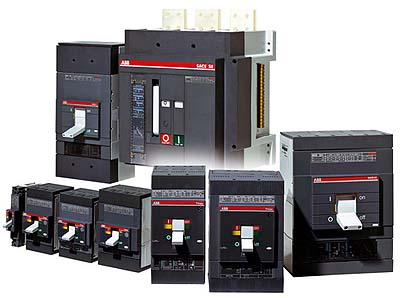 Автоматические выключатели ABB
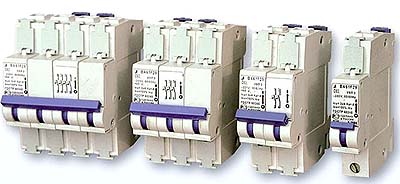 Модульные автоматические выключатели
1. НЕКОТОРЫЕ СВЕДЕНИЯ ОБ АВТОМАТИЧЕСКИХ ВЫКЛЮЧАТЕЛЯХ Автоматический выключатель — это электрический аппарат, который автоматически отключает (и тем самым защищает) электрическую цепь при возникновении в ней аномального режима. Режим становится аномальным, когда в цепи начинает недопустимо изменяться (т. е. увеличиваться или уменьшаться относительно номинального значения) ток или напряжение.
Другими словами (более "инженерно") можно сказать, что автоматический выключатель защищает от токов короткого замыкания и токов перегрузки отходящую от него питающую линию, например, кабель и приемник(и) электрической энергии (осветительную сеть, розетки, электродвигатель и т. п.).
Как правило, автоматический выключатель может применятся также для нечастого (несколько раз в сутки) включения и отключения защищаемых электроприемников (защищаемой нагрузки).
[Интент]Выключатель предназначен для проведения тока в нормальном режиме и отключения тока при коротких замыканиях, перегрузках, недопустимых снижениях напряжения, а также до 30 оперативных включений и отключений электрических цепей в сутки и рассчитан для эксплуатации в электроустановках с номинальным рабочим напряжением до 660 В переменного тока частоты 50 и 60 Гц и до 440 В постоянного тока.
[Типовая фраза из российской технической документации] 2. ПРИНЦИП ДЕЙСТВИЯ Для защиты цепи от короткого замыкания применяется автоматический выключатель с электромагнитным расцепителем.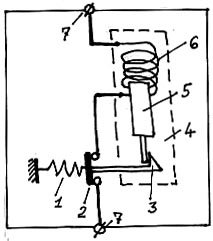
1 - Пружина (в данном случае во взведенном положении растянута)
Автоматический выключатель устроен таким образом, что сначала необходимо взвести пружину и только после этого его можно включить. У многих автоматических выключателей для взвода пружины необходимо перевести ручку вниз. После этого ручку переводят вверх. При этом замыкаются главные контакты.
2 - Главный контакт автоматического выключателя
3 - Удерживающее устройство
4 - Электромагнитный расцепитель;
5 - Сердечник
6 - Катушка
7 - Контактные зажимы автоматического выключателя
На рисунке показан один полюс автоматического выключателя во включенном положении: пружина 1 взведена, а главный контакт 2 замкнут.
Как только в защищаемой цепи возникнет короткое замыкание, ток, протекающий через соответствующий полюс автоматического выключателя, многократно возрастет. В катушке 6 сразу же возникнет сильное магнитное поле. Сердечник 5 втянется в катушку и освободит удерживающее устройство. Под действием пружины 1 главный контакт 2 разомкнется, в результате чего автоматический выключатель отключит и тем самым защитит цепь, в которой возникло короткое замыкание. Такое срабатывание автоматического выключателя происходит практически мгновенно (за сотые доли секунды).
Для защиты цепи от тока перегрузки применяют автоматические выключатели с тепловым расцепителем.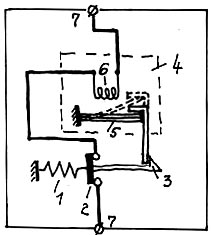
1 - Пружина (в данном случае во взведенном положении растянута)
Принцип действия такой же как и в первом случае, с той лишь разницей, что удерживающее устройство 3 освобождается под действием биметаллической пластины 5, которая изгибается от тепла, выделяемого нагревательным элементом 6. Количество тепла определяется током, протекающим через защищаемую цепь.
2 - Главный контакт автоматического выключателя
3 - Удерживающее устройство
4 - Тепловой расцепитель
5 - Биметаллическая пластина
6 - Нагревательный элемент
7 - Контактные зажимы автоматического выключателя
[Интент]Недопустимые, нерекомендуемые
Тематики
Классификация
>>>Обобщающие термины
Действия
- включение автоматического выключателя
- оперирование автоматического выключателя
- отключение автоматического выключателя
- срабатывание автоматического выключателя
EN
- auto-cutout
- automatic circuit breaker
- automatic cutout
- automatic switch
- breaker
- CB
- circuit breaker
- circuit-breaker
- cutout
DE
FR
Смотри также
силовой выключатель
-
[Интент]EN
circuit-breaker
a mechanical switching device, capable of making, carrying and breaking currents under normal circuit conditions and also making, carrying for a specified time and breaking currents under specified abnormal circuit conditions such as those of short circuit
[IEV ref 441-14-20]FR
disjoncteur
appareil mécanique de connexion capable d'établir, de supporter et d'interrompre des courants dans les conditions normales du circuit, ainsi que d'établir, de supporter pendant une durée spécifiée et d'interrompre des courants dans des conditions anormales spécifiées du circuit telles que celles du court-circuit
[IEV ref 441-14-20]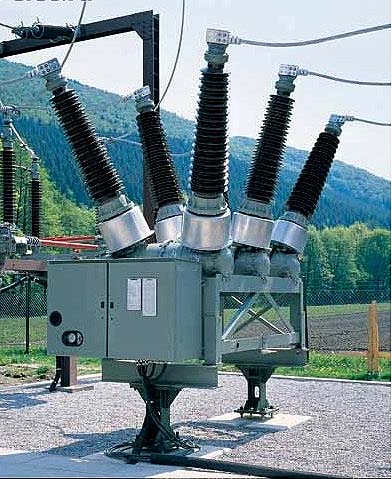
Рис. Siemens
Силовой ( баковый элегазовый) выключатель 3AP1 DT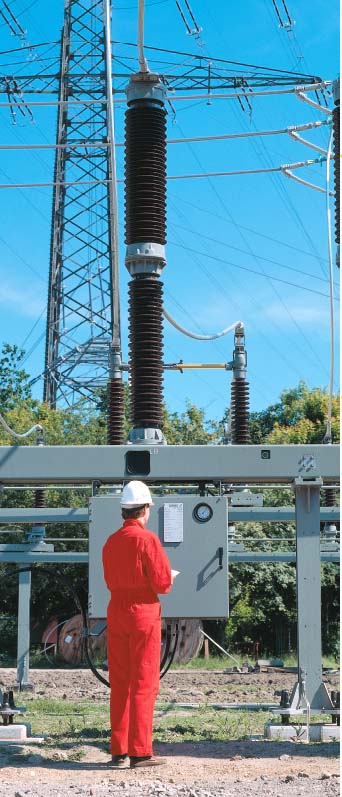
Рис. Siemens
Силовой (колонковый элегазовый) выключательТематики
- высоковольтный аппарат, оборудование...
- комплектное распред. устройство (КРУ)
EN
DE
FR
Немецко-русский словарь нормативно-технической терминологии > Leistungsschalter
12 Selbstschalter
автоматический выключатель
Механический коммутационный аппарат1), способный включать, проводить и отключать токи при нормальном состоянии электрической цепи, а также включать, проводить в течение заданного времени и автоматически отключать токи в указанном аномальном состоянии электрической цепи, например, при коротком замыкании.
(МЭС 441-14-20)
[ ГОСТ Р 50030. 2-99 ( МЭК 60947-2-98)]
автоматический выключатель
-
[IEV number 442-05-01]EN
circuit breaker
a mechanical switching device, capable of making, carrying and breaking currents under normal circuit conditions and also making, carrying for a specified time and breaking currents under specified abnormal circuit conditions such as those of short circuit.
[IEC 62271-100, ed. 2.0 (2008-04)]
[IEV number 442-05-01]
circuit breaker
A device designed to open and close a circuit by nonautomatic means and to open the circuit automatically on a predetermined overcurrent without damage to itself when properly applied within its rating.
NOTE The automatic opening means can be integral, direct acting with the circuit breaker, or remote from the circuit breaker.
Adjustable (as applied to circuit breakers). A qualifying term indicating that the circuit breaker can be set to trip at various values of current, time, or both within a predetermined range. Instantaneous-trip (as applied to circuit breakers). A qualifying term indicating that no delay is purposely introduced in the tripping action of the circuit breaker.
Inverse-time (as applied to circuit breakers). A qualifying term indicating a delay is purposely introduced in the tripping action of the circuit breaker, which delay decreases as the magnitude of the current increases.
Nonadjustable (as applied to circuit breakers). A qualifying term indicating that the circuit breaker does not have any adjustment to alter the value of current at which it will trip or the time required for its operation.
Setting (of a circuit breaker). The value of current, time, or both at which an adjustable circuit breaker is set to trip.
[National Electrical Cod]FR
disjoncteur
1) Должно быть контактный коммутационный аппарат
appareil mécanique de connexion capable d’établir, de supporter et d’interrompre des courants dans les conditions normales du circuit, ainsi que d’établir, de supporter pendant une durée spécifiée et d’in- terrompre des courants dans des conditions anormales spécifiées du circuit telles que celles du court-circuit.
[IEC 62271-100, ed. 2.0 (2008-04)]
[IEV number 442-05-01]
[Интент]КЛАССИФИКАЦИЯ
- По роду тока
- По напряжению
- По числу полюсов
- По виду корпуса
- По месту установки
- По изолирующей среде
- По установленным расцепителям
- По дополнительным защитам
- По назначению
- По категории применения
- По виду привода взвода пружины
- По выполняемой функции
-
По влиянию монтажного положения
Автоматические выключатели ABB
Модульные автоматические выключатели
1. НЕКОТОРЫЕ СВЕДЕНИЯ ОБ АВТОМАТИЧЕСКИХ ВЫКЛЮЧАТЕЛЯХ Автоматический выключатель — это электрический аппарат, который автоматически отключает (и тем самым защищает) электрическую цепь при возникновении в ней аномального режима. Режим становится аномальным, когда в цепи начинает недопустимо изменяться (т. е. увеличиваться или уменьшаться относительно номинального значения) ток или напряжение.
Другими словами (более "инженерно") можно сказать, что автоматический выключатель защищает от токов короткого замыкания и токов перегрузки отходящую от него питающую линию, например, кабель и приемник(и) электрической энергии (осветительную сеть, розетки, электродвигатель и т. п.).
Как правило, автоматический выключатель может применятся также для нечастого (несколько раз в сутки) включения и отключения защищаемых электроприемников (защищаемой нагрузки).
[Интент]Выключатель предназначен для проведения тока в нормальном режиме и отключения тока при коротких замыканиях, перегрузках, недопустимых снижениях напряжения, а также до 30 оперативных включений и отключений электрических цепей в сутки и рассчитан для эксплуатации в электроустановках с номинальным рабочим напряжением до 660 В переменного тока частоты 50 и 60 Гц и до 440 В постоянного тока.
[Типовая фраза из российской технической документации] 2. ПРИНЦИП ДЕЙСТВИЯ Для защиты цепи от короткого замыкания применяется автоматический выключатель с электромагнитным расцепителем.1 - Пружина (в данном случае во взведенном положении растянута)
Автоматический выключатель устроен таким образом, что сначала необходимо взвести пружину и только после этого его можно включить. У многих автоматических выключателей для взвода пружины необходимо перевести ручку вниз. После этого ручку переводят вверх. При этом замыкаются главные контакты.
2 - Главный контакт автоматического выключателя
3 - Удерживающее устройство
4 - Электромагнитный расцепитель;
5 - Сердечник
6 - Катушка
7 - Контактные зажимы автоматического выключателя
На рисунке показан один полюс автоматического выключателя во включенном положении: пружина 1 взведена, а главный контакт 2 замкнут.
Как только в защищаемой цепи возникнет короткое замыкание, ток, протекающий через соответствующий полюс автоматического выключателя, многократно возрастет. В катушке 6 сразу же возникнет сильное магнитное поле. Сердечник 5 втянется в катушку и освободит удерживающее устройство. Под действием пружины 1 главный контакт 2 разомкнется, в результате чего автоматический выключатель отключит и тем самым защитит цепь, в которой возникло короткое замыкание. Такое срабатывание автоматического выключателя происходит практически мгновенно (за сотые доли секунды).
Для защиты цепи от тока перегрузки применяют автоматические выключатели с тепловым расцепителем.1 - Пружина (в данном случае во взведенном положении растянута)
Принцип действия такой же как и в первом случае, с той лишь разницей, что удерживающее устройство 3 освобождается под действием биметаллической пластины 5, которая изгибается от тепла, выделяемого нагревательным элементом 6. Количество тепла определяется током, протекающим через защищаемую цепь.
2 - Главный контакт автоматического выключателя
3 - Удерживающее устройство
4 - Тепловой расцепитель
5 - Биметаллическая пластина
6 - Нагревательный элемент
7 - Контактные зажимы автоматического выключателя
[Интент]Недопустимые, нерекомендуемые
Тематики
Классификация
>>>Обобщающие термины
Действия
- включение автоматического выключателя
- оперирование автоматического выключателя
- отключение автоматического выключателя
- срабатывание автоматического выключателя
EN
- auto-cutout
- automatic circuit breaker
- automatic cutout
- automatic switch
- breaker
- CB
- circuit breaker
- circuit-breaker
- cutout
DE
FR
Смотри также
Немецко-русский словарь нормативно-технической терминологии > Selbstschalter
13 Indikator-Messgerät
индикаторный прибор
-
[IEV number 312-02-08]EN
detecting instrument
measuring instrument intended to detect a quantity without special regard to its value
NOTE – Some instruments give the approximate value and/or the sign of the quantity.
[IEV number 312-02-08]FR
appareil détecteur
appareil de mesure destiné à déceler une grandeur sans considération particulière de sa valeur
NOTE – Certains de ces appareils donnent une évaluation grossière de la grandeur et/ou son signe.
[IEV number 312-02-08]Тематики
- измерение электр. величин в целом
EN
DE
FR
Немецко-русский словарь нормативно-технической терминологии > Indikator-Messgerät
14 Sicherung
плавкий предохранитель
Коммутационный аппарат, который посредством плавления одного или нескольких своих специально спроектированных и калиброванных элементов размыкает цепь, в которую он включен, и отключает ток, когда он превышает заданную величину в течение достаточного времени. Плавкий предохранитель содержит все части, образующие укомплектованный аппарат.
МЭК 60050(441-18-01).
[ ГОСТ Р 50030. 1-2000 ( МЭК 60947-1-99)]
плавкий предохранитель
Аппарат, который вследствие расплавления одного или нескольких специально спроектированных и рассчитанных элементов размыкает цепь, в которую он включен, отключая ток, превышающий заданное значение в течение достаточно продолжительного времени. В состав плавкого предохранителя входят все части, образующие аппарат в комплекте
[ ГОСТ Р 50339. 0-2003 ( МЭК 60269-1-98)]
предохранитель
Коммутационный электрический аппарат, предназначенный для отключения защищаемой цепи посредством разрушения специально предусмотренных для этого токоведущих частей под действием тока, превышающего определенную величину.
[ ГОСТ 17703-72]
предохранитель
Устройство для разрыва электрических цепей при силе тока, превышающей допустимое значение
[Терминологический словарь по строительству на 12 языках (ВНИИИС Госстроя СССР)]EN
fuse
a device that by the fusing of one or more of its specially designed and proportioned components, opens the circuit in which it is inserted by breaking the current when this exceeds a given value for a sufficient time. The fuse comprises all the parts that form the complete device
[IEV number 441-18-01 ]FR
fusible
coupe-circuit à fusibles
appareil dont la fonction est d'ouvrir par la fusion d'un ou de plusieurs de ses éléments conçus et calibrés à cet effet le circuit dans lequel il est inséré en coupant le courant lorsque celui-ci dépasse pendant un temps suffisant une valeur donnée. Le fusible comprend toutes les parties qui constituent l'appareil complet
[IEV number 441-18-01 ]Настоящий стандарт распространяется на плавкие предохранители на номинальный ток от 2 до 2500 А, номинальное напряжение переменного тока до 1000 В и постоянного тока до 1200 В, устанавливаемые в комплектные устройства и предназначенные для защиты при перегрузках и коротких замыканиях силовых и вспомогательных цепей электроустановок промышленных предприятий, общественных и жилых зданий, изготовляемые для нужд народного хозяйства и экспорта и номинальное напряжение до 3000 В для защиты полупроводниковых устройств.
3.2.14. Предохранители должны быть сконструированы таким образом, чтобы отключать электрическую цепь при токах отключения в пределах: от условного тока плавления — для предохранителей с плавкими вставками типов g и gR или от наименьшего тока отключения, установленного в стандартах или технических условиях на предохранители конкретных серий и типов, для предохранителей с плавкими вставками типов а и aR — до наибольшего тока отключения
[ ГОСТ 17242-86]... токи, при которых проводят испытания, предназначенные для проверки способности данного плавкого предохранителя срабатывать удовлетворительно в диапазоне малых сверхтоков.
[ ГОСТ Р 50339.0-2003]... Если неисправность заканчивается срабатыванием плавкого предохранителя или если плавкий предохранитель не срабатывает примерно в течение 1 с, то...
[ ГОСТ Р 52319-2005]ЭЛЕКТРИЧЕСКИЕ ПАРАМЕТРЫ И ХАРАКТЕНИСТИКИ ПРЕДОХРАНИТЕЛЕЙ
(взято из ГОСТ 17242-86)-
Для держателя (или основания) предохранителя:
- номинальное напряжение;
- номинальный ток;
- род тока и номинальная частота для переменного тока;
- допустимые потери мощности;
- число полюсов, если их более одного.
-
Для плавкой вставки:
- номинальное напряжение;
- номинальный ток;
- род тока и номинальная частота для переменного тока;
- потери мощности;
- время-токовые характеристики с указанием коэффициентов K1 и K2 для плавких вставок типа а;
- перегрузочная способность;
- диапазон токов отключения;
- наибольшая отключающая способность;
- наименьший ток отключения для плавких вставок типа а;
- характеристика пропускаемого тока;
- характеристики интегралов Джоуля;
- перенапряжение и характеристика перенапряжения для плавких вставок типов aR и gR;
- условия селективности (при необходимости);
- электрическое сопротивление плавкой вставки в холодном состоянии (допускается указать в рабочих чертежах, утвержденных в установленном порядке).
-
Для предохранителя:
- степень защиты по ГОСТ 14255—69;
- номинальное напряжение, номинальный ток и коммутационная способность свободных контактов (при их наличии).
Параллельные тексты EN-RU
Check to make sure that fuse F1 on power supply module V is not fused.
If the fuse is defective, it should not be replaced without determining the cause of failure.
If a fuse is replaced without eliminating the problem, there is the danger that the damage will spread.
[Schneider Electric]Убедитесь в исправности предохранителя F1 в модуле питания V.
Если предохранитель оказался неисправным, то прежде чем заменить его необходимо установить причину возникновения неисправности.
Замена предохранителя без выяснения причины его срабатывания может привести к повторению срабатывания.
[Перевод Интент]High voltage system may embrace a fuse.
Note that a fuse may not be manually adjusted as the circuit breaker relay does so the fuse choice for the appropriate purpose/circuit adaptation is deemed most important.
[LS Industrial Systems]Высоковольтная система < электропитания> может содержать предохранители.
Обратите внимание! Предохранитель нельзя настроить, как это можно сделать с расцепителем автоматического выключателя. Поэтому предохранитель необходимо выбрать так, чтобы он как можно точнее соотвествовал конкретным условиям защиты аппарата или участка цепи.
[Перевод Интент]
Тематики
Классификация
>>>Обобщающие термины
Действия
- защищать при перегрузках и коротких замыканиях
- отключать электрическую цепь
- срабатывание предохранителя
Синонимы
EN
- cutoff
- electric fuse
- fu
- fuse
- fuse switch
- fusible cutout
- fusible plug
- fusible switch
- plug fuse
- protective fuse
- safety cutoff
- safety fuse
- safety plug
- SF
- thermal fuse
DE
FR
Немецко-русский словарь нормативно-технической терминологии > Sicherung
15 Ansprechzeit
время замыкания магнитоуправляемого контакта
Значение интервала времени от начала воздействия управляющего магнитного поля до первого замыкания магнитоуправляемого контакта при его срабатывании
[ ГОСТ 17499-82]EN
-
FR
-
Тематики
Обобщающие термины
Синонимы
EN
DE
FR
время срабатывания электрического реле
Время от момента, когда входная воздействующая или характеристическая величина электрического реле, находящегося в начальном или исходном состоянии, принимает в заданных условиях определенное значение до момента, когда реле завершает срабатывание
[ ГОСТ 16022-83]EN
operate time
for a relay which is in the release condition (initial condition) the time interval between the instant a specified value of the input energizing quantity (characteristic quantity) is applied under specified condition and the instant when the relay switches
NOTE – This term is used only when the relay has output circuits of the same type and no precision is required according to contact time difference.
[IEV number 446-17-09]FR
temps de fonctionnement
temps d'action (terme déconseillé, utilisé pour les relais de tout ou rien)
pour un relais qui est dans l'état de repos ou dans un état initial, temps écoulé entre l'instant où la grandeur d'alimentation d'entrée ou la grandeur caractéristique prend, dans des conditions spécifiées, une valeur définie et l'instant où le relais commute
NOTE – Ce terme n'est utilisé que lorsque le relais ne comporte que des circuits de sortie de même nature et qu'aucune précision n'est nécessaire quant à la dispersion des temps de contact.
[IEV number 446-17-09]Тематики
EN
DE
FR
Немецко-русский словарь нормативно-технической терминологии > Ansprechzeit
16 Prüfzahl der Kriechwegbildung
индекс устойчивости к трекингу
-
[IEV number 442-01-42]EN
proof tracking index
PTI (abbreviation)
the numerical value of the proof voltage expressed in volts which a material can withstand without tracking under specified test conditions
Source: 212-01-45
[IEV number 442-01-42]FR
indice de tenue au cheminement
ITC (abréviation)
valeur numérique de la tension d'épreuve exprimée en volts, qu'un matériau peut supporter sans cheminement dans des conditions d'essai spécifiées
Source: 212-01-45
[IEV number 442-01-42]EN
DE
FR
Немецко-русский словарь нормативно-технической терминологии > Prüfzahl der Kriechwegbildung
17 Minerallagerstätte
месторождение полезных ископаемых
—
[ http://www.eionet.europa.eu/gemet/alphabetic?langcode=en]EN
mineral deposit
A mass of naturally occurring mineral material, e.g. metal ores or nonmetallic mineral, usually of economic value, without regard to mode of origin. (Source: BJGEO)
[http://www.eionet.europa.eu/gemet/alphabetic?langcode=en]Тематики
EN
DE
FR
Немецко-русский словарь нормативно-технической терминологии > Minerallagerstätte
18 Lebensmittelbestrahlung
облучение продуктов питания
—
[ http://www.eionet.europa.eu/gemet/alphabetic?langcode=en]EN
food irradiation
The most recent addition to food preservation technologies is the use of ionizing radiation, which has some distinct advantages over conventional methods. With irradiation, foods can be treated after packaging, thus eliminating post-processing contamination. In addition, foods are preserved in a fresh state and can be kept longer without noticeable loss of quality. Food irradiation leaves no residues, and changes in nutritional value due to irradiation are comparable with those produced by other processes. Irradiation is the process of applying high energy to a material, such as food, to sterilize or extend its shelf-life by killing microorganisms, insects and other pests residing on it. Sources of ionizing radiation that have been used include gamma rays, electron beams and X-rays. Gamma rays are produced by radioactive isotopes such as Cobalt-60. Electron beams are produced by linear accelerators, which themselves are powered by electricity. The dose applied to a product is the most important factor of the process. At high doses, food is essentially sterilized, just as occurs in canning. Products so treated can be stored at room temperature almost indefinitely. Controversial and banned in some countries. (Source: IFSE / VCN)
[http://www.eionet.europa.eu/gemet/alphabetic?langcode=en]Тематики
EN
DE
FR
Немецко-русский словарь нормативно-технической терминологии > Lebensmittelbestrahlung
19 Grenz-Nichtauslösedauer
предельное время неотключения
-
[IEV number 442-05-23]EN
limiting non-actuating time
maximum delay during which a value of residual current higher than the residual non-operating current can be applied to the residual current device without bringing it actually to operate
[IEV number 442-05-23]FR
temps limite de non-réponse
temps maximal pendant lequel on peut appliquer au dispositif de coupure différentiel une valeur du courant différentiel supérieure à la valeur du courant différentiel de non-fonctionnement, sans provoquer son fonctionnement effectif
[IEV number 442-05-23]Тематики
- электротехника, основные понятия
EN
DE
FR
Немецко-русский словарь нормативно-технической терминологии > Grenz-Nichtauslösedauer
20 Nichtbetätigungs-Überstromstärke im Hauptstromkreis
сверхток несрабатывания в главной цепи
-
[IEV number 442-05-62]EN
non-operating overcurrent in the main circuit
Maximum value of current which can flow in the main circuit, in the absence of residual current, without causing operation of the detecting device of the residual current device as a consequence of asymmetry existing in the detecting device itself.
[IEV number 442-05-62]FR
surintensité de non-fonctionnement dans le circuit principal
Valeur maximale du courant pouvant circuler dans le circuit principal, en l'absence de courant différentiel résiduel, sans que le dispositif de détection du dispositif de coupure différentiel ne fonctionne en raison de la dissymétrie existant dans le dispositif de détection lui-même.
[IEV number 442-05-62]EN
DE
FR
Немецко-русский словарь нормативно-технической терминологии > Nichtbetätigungs-Überstromstärke im Hauptstromkreis
Страницы- 1
- 2
См. также в других словарях:
without value — index null (invalid), null and void Burton s Legal Thesaurus. William C. Burton. 2006 … Law dictionary
Value theory — encompasses a range of approaches to understanding how, why and to what degree people should value things; whether the thing is a person, idea, object, or anything else. This investigation began in ancient philosophy, where it is called axiology… … Wikipedia
Value — Val ue, n. [OF. value, fr. valoir, p. p. valu, to be worth, fr. L. valere to be strong, to be worth. See {Valiant}.] 1. The property or aggregate properties of a thing by which it is rendered useful or desirable, or the degree of such property or … The Collaborative International Dictionary of English
Value received — Value Val ue, n. [OF. value, fr. valoir, p. p. valu, to be worth, fr. L. valere to be strong, to be worth. See {Valiant}.] 1. The property or aggregate properties of a thing by which it is rendered useful or desirable, or the degree of such… … The Collaborative International Dictionary of English
Value at risk — (VaR) is a maximum tolerable loss that could occur with a given probability within a given period of time. VaR is a widely applied concept to measure and manage many types of risk, although it is most commonly used to measure and manage the… … Wikipedia
Value Measuring Methodology — (or VMM) is a tool that helps planners balance both tangible and intangible values when making investment decisions, and monitor benefits.Formal methods to calculate the Return on Investment (or ROI) have been widely understood and used for a… … Wikipedia
Value Stream Mapping — is a Lean technique used to analyse the flow of materials and information currently required to bring a product or service to a consumer. At Toyota, where the technique originated, it is known as Material and Information Flow Mapping [Learning to … Wikipedia
Value America — or VA was a dot com company founded in Nevada in 1996Perine, Keith. [http://findarticles.com/p/articles/mi m0HWW/is 33 3/ai 66682364 An American Dream Gone Bad ] , The Industry Standard , August 28, 2000. Retrieved September 10, 2007.] by Craig… … Wikipedia
Value and Capital — is a book by the British economist John Richard Hicks, published in 1939. It is considered a classic exposition of microeconomic theory. A central result in consumer demand theory that the book builds on is that goods have value even with only… … Wikipedia
value engineering — UK US noun [U] (also value analysis [C or U]) PRODUCTION, ECONOMICS ► the process of reducing the cost of producing a product without reducing its quality or how effective it is: »Substantial value engineering had to be done to control costs … Financial and business terms
Value added tax — Taxation An aspect of fiscal policy … Wikipedia
 18+© Академик, 2000-2025
- Обратная связь: Техподдержка, Реклама на сайте
Экспорт словарей на сайты, сделанные на PHP, Joomla, Drupal, WordPress, MODx.
Перевод: с немецкого на русский
с русского на немецкий- С русского на:
- Немецкий
- С немецкого на:
- Все языки
- Английский
- Русский