

-
21 новые продукты питания
новые продукты питания
—
[ http://www.eionet.europa.eu/gemet/alphabetic?langcode=en]EN
novel food
Genetically engineered foods. Novel foods, including those altered using biotechnology, should not differ 'significantly' from the foods they are to replace. Labels should not be misleading, but must make clear any differences between the novel food and its 'conventional' alternative, and must say how that difference was achieved. Foods containing a genetically modified living organism, such as a live yogurt made with an altered culture, would always be labelled. Any food whose modification might raise moral or health worries to consumers would also have to carry a label. This would include genes from an animal considered unclean by some religions, or from a plant that might cause allergic reactions. However, foods which, although made using novel methods, are identical to conventional foods, would not have to be labelled. (Source: MOND)
[http://www.eionet.europa.eu/gemet/alphabetic?langcode=en]Тематики
EN
DE
FR
Русско-немецкий словарь нормативно-технической терминологии > новые продукты питания
-
22 органический азот
органический азот
—
[ http://www.eionet.europa.eu/gemet/alphabetic?langcode=en]EN
organic nitrogen
Essential nutrient of the food supply of plants and the diets of animals. Animals obtain it in nitrogen-containing compounds, particularly aminoacids. Although the atmosphere is nearly 80% gaseous nitrogen, very few organisms have the ability to use it in this form. The higher plants normally obtain it from the soil after microorganisms have converted the nitrogen into ammonia or nitrates, which they can then absorb. This conversion of nitrogen, known as nitrogen fixation, is essential for the formation of amino acids which, in turn, are the building blocks of proteins. (Source: WRIGHT)
[http://www.eionet.europa.eu/gemet/alphabetic?langcode=en]Тематики
EN
DE
FR
Русско-немецкий словарь нормативно-технической терминологии > органический азот
-
23 природный заповедник
природный заповедник
—
[ http://www.eionet.europa.eu/gemet/alphabetic?langcode=en]EN
nature reserve
Areas allocated to preserve and protect certain animals and plants, or both. They differ from national park, which are largely a place for public recreation, because they are provided exclusively to protect species for their own sake. Endangered species are increasingly being kept in nature reserves to prevent them from extinction, particularly in India, Indonesia and some African countries. Natural reserves were used once to preserve the animals that landowners hunted, but, in the 19th century, they became places where animals were kept to prevent them from dying out. Special refuges and sanctuaries are also often designated to protect certain species or groups of wild animals or plants, especially if their numbers and distribution have been significantly reduced. They also serve as a place for more plentiful species to rest, breed or winter. Many parts of the world also have marine and aquatic reserves to protect different species of sea or freshwater plant and animal life. (Source: WRIGHT)
[http://www.eionet.europa.eu/gemet/alphabetic?langcode=en]Тематики
EN
DE
FR
Русско-немецкий словарь нормативно-технической терминологии > природный заповедник
-
24 природный ресурс
природный ресурс
—
[ http://www.eionet.europa.eu/gemet/alphabetic?langcode=en]EN
natural resource
A feature or component of the natural environment that is of value in serving human needs, e.g. soil, water, plantlife, wildlife, etc. Some natural resources have an economic value (e.g. timber) while others have a "noneconomic" value (e.g. scenic beauty). (Source: UNUN)
[http://www.eionet.europa.eu/gemet/alphabetic?langcode=en]Тематики
EN
DE
FR
Русско-немецкий словарь нормативно-технической терминологии > природный ресурс
-
25 прогноз наводнения
прогноз наводнения
—
[ http://www.eionet.europa.eu/gemet/alphabetic?langcode=en]EN
flood forecast
The hydrological processes generating river floods have been studied extensively and several modelling concepts have been proposed. The standard procedure for flood forecasting consists of calibrating the parameters of the model of a particular river basin on a representative set of historical hydrometric data and subsequently applying this calibrated model in a real-time environment. (Source: YOUNG)
[http://www.eionet.europa.eu/gemet/alphabetic?langcode=en]Тематики
EN
DE
FR
Русско-немецкий словарь нормативно-технической терминологии > прогноз наводнения
-
26 производная единица системы единиц физических величин
производная единица системы единиц физических величин
производная единица
Единица производной физической величины системы единиц, образованная в соответствии с уравнением, связывающим ее с основными единицами или с основными и уже определенными производными.
Примеры
1. 1 м/с - единица скорости, образованная из основных единиц СИ - метра и секунды.
2. 1 Н - единица силы, образованная из основных единиц СИ - килограмма, метра, и секунды.
[РМГ 29-99]EN
derived unit
unit of measurement for a derived quantity
NOTE 1 – Some derived units in the International System of Units (SI) have special names, e.g. hertz for frequency and joule for energy, but others have compound names, e.g. metre per second for speed. Compounds including units with special names are also used, e.g. volt per metre for the electric field strength, and newton metre for torque. See in particular ISO 31 and ISO/IEC 80000.
NOTE 2 – Derived units can also be expressed by using multiples and submultiples. For example, the metre per second, symbol m/s, and the centimetre per second, symbol cm/s, are derived units of speed in the SI. The kilometre per hour, symbol km/h, is a unit of speed outside the SI but accepted for use with the SI, because the unit hour is accepted for use with the SI. The knot, equal to one nautical mile per hour, is a unit of speed outside the SI, that is used by special interest groups.
Source: ISO/IEC GUIDE 99:2007 1.11
[IEV number 112-01-19]FR
unité dérivée, f
unité de mesure d'une grandeur dérivée
NOTE 1 – Certaines unités dérivées dans le SI ont des noms spéciaux, par exemple le hertz pour la fréquence et le joule pour l'énergie, tandis que d'autres ont des noms composés, par exemple le mètre par seconde pour la vitesse. Les unités ayant des noms spéciaux sont aussi utilisées dans des noms composés, par exemple le volt par mètre pour le champ électrique et le newton mètre pour le moment de torsion. Voir en particulier l'ISO 31 et l'ISO/CEI 80000.
NOTE 2 – On peut aussi exprimer les unités dérivées en utilisant des multiples et des sous-multiples. Par exemple, le mètre par seconde, symbole m/s, et le centimètre par seconde, symbole cm/s, sont des unités dérivées de vitesse dans le SI. Le kilomètre par heure, symbole km/h, est une unité de vitesse en dehors du SI mais en usage avec le SI, parce que l'heure est une unité en usage avec le SI. Le nœud, égal à un mille marin par heure, est une unité de vitesse en dehors du SI, qui répond aux besoins spécifiques de certains groupes d’utilisateurs.
Source: ISO/IEC GUIDE 99:2007 1.11
[IEV number 112-01-19]Тематики
- метрология, основные понятия
Синонимы
EN
DE
FR
Русско-немецкий словарь нормативно-технической терминологии > производная единица системы единиц физических величин
-
27 пружинная клемма
пружинная клемма
клемма с пружинными зажимами
-
[Интент]
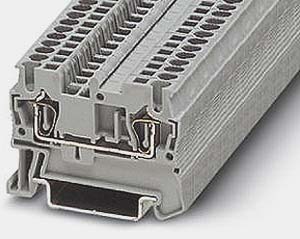
Рис. Phoenix Contact
Пружинные клеммы, закрепленные на монтажной рейкеПорядок присоединения проводника к пружинному зажиму
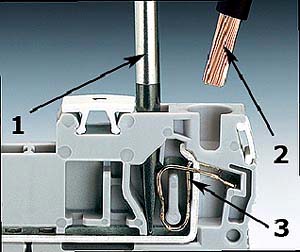
Рис. Phoenix Contact
1. Вставьте стандартную отвертку (1) в соответствующее отверстие клеммы.
В результате пружинный зажим (3) откроется для вставки жилы проводника (2).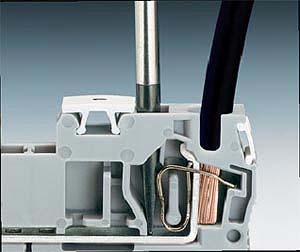
Рис. Phoenix Contact
2. Вставьте проводник
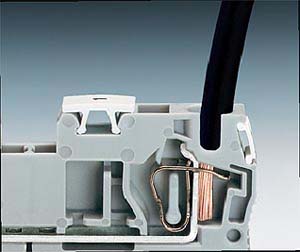
Рис. Phoenix Contact
3. Извлеките отвертку. Проводник будет надежно прижат к токоведущей части клеммы.
Параллельные тексты EN-RU
Spring-cage terminals blocks from Phoenix Contact have been developed for universal spring-loaded conductor contacting. The contact force is independent of the user and creates a vibration-proof, gas-tight connection with long-term stability. The connection point is opened with a standard screwdriver.
After the conductor has been inserted into the terminal compartment, the screwdriver is removed and the conductor automatically makes contact.
The front connection facilitates convenient operation. This means that the conductor and the screwdriver come parallel from the same direction.
All kinds of copper conductors of up to 35 mm² can be clamped without pretreatment. Splicing protection can also be used in the form of ferrules.
Phoenix Contact spring-cage terminal blocks offer a large insertion space, i.e. conductors with nominal cross section that have ferrules can also be wired.
[Phoenix Contact]
Пружинные клеммы Phoenix Contact являются универсальными соединительными устройствами с пружинными зажимами. Усилие прижима не зависит от действий потребителя и обеспечивает долговременное стабильное вибростойкое газонепроницаемое соединение. Для присоединения проводника применяется стандартная отвертка.
После вставки проводника в отверстие клеммы, отвертка извлекается и жила проводника надежно прижимается пружинным зажимом к токоведущей части клеммы.
Выполнение монтажа является удобным, поскольку проводники вставляют спереди. Кроме того, проводник и отвертка вставляются в соответствующие отверстия клеммы параллельно друг другу в одном и том же направлении.
Пружинные клеммы допускают присоединение неподготовленных медных проводников любого типа сечением до 35 мм2, а также проводников с жилами, опрессованными кабельным наконечником.
Достаточно большие отверстия для вставки проводников позволяют присоединять проводники номинального сечения с кабельным наконечником.
[Перевод Интент]
Тематики
Классификация
>>>Обобщающие термины
Синонимы
EN
DE
Русско-немецкий словарь нормативно-технической терминологии > пружинная клемма
-
28 размерность физической величины
- Größendimension, f
- Dimension, f
- Dimension einer Grösse
- Dimension einer GroBe
размерность физической величины
размерность величины
Выражение в форме степенного одночлена, составленного из произведений символов основных физических величин в различных степенях и отражающее связь данной физической величины с физическими величинами, принятыми в данной системе величин за основные с коэффициентом пропорциональности, равным 1.
Примечания
1. Степени символов основных величин, входящих в одночлен, в зависимости от связи рассматриваемой физической величины с основными, могут быть целыми, дробными, положительными и отрицательными. Понятие размерность распространяется и на основные величины. Размерность основной величины в отношении самой себя равна единице, т.е. формула размерности основной величины совпадает с ее символом.
2. В соответствии с международным стандартом ИСО 31/0, размерность величин следует обозначать знаком dim [2]. В системе величин LMT размерность величины.x будет: dim х = LlMmTt, где L, М, Т - символы, величин, принятых за основные (соответственно длины, массы, времени).
[РМГ 29-99]EN
dimension of a quantity
quantity dimension
dimension
expression of the dependence of a quantity on the base quantities of a system of quantities as a product of powers of factors corresponding to the base quantities, omitting any numerical factor
NOTE 1 – A power of a factor is the factor raised to an exponent. Each factor is the dimension of a base quantity.
NOTE 2 – The conventional symbolic representation of the dimension of a base quantity is a single upper case letter in roman (upright) sans-serif type. The conventional symbolic representation of the dimension of a derived quantity is the product of powers of the dimensions of the base quantities according to the definition of the derived quantity. The dimension of a quantity Q is denoted by dim Q.
NOTE 3 – In deriving the dimension of a quantity, no account is taken of its scalar, vector or tensor character.
NOTE 4 – In a given system of quantities, – quantities of the same kind have the same dimension, – quantities of different dimensions are always of different kinds, and – quantities having the same dimension are not necessarily of the same kind. For example, in the ISQ, pressure and energy density (volumic energy) have the same dimension L–1MT–2. See also note 5.
NOTE 5 – In the International System of Quantities (ISQ), the symbols representing the dimensions of the base quantities are:
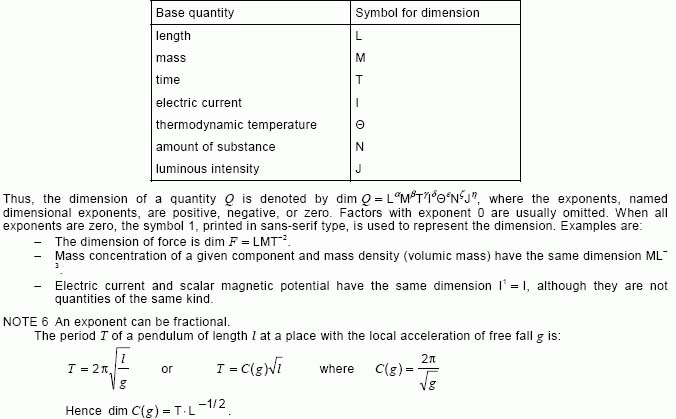
[IEV number 112-01-11]FR
dimension, f
dimension d'une grandeur, f
expression de la dépendance d’une grandeur par rapport aux grandeurs de base d'un système de grandeurs sous la forme d'un produit de puissances de facteurs correspondant aux grandeurs de base, en omettant tout facteur numérique
NOTE 1 – Une puissance d'un facteur est le facteur muni d'un exposant. Chaque facteur exprime la dimension d'une grandeur de base.
NOTE 2 – Par convention, la représentation symbolique de la dimension d'une grandeur de base est une lettre majuscule unique en caractère romain (droit) sans empattement. Par convention, la représentation symbolique de la dimension d'une grandeur dérivée est le produit de puissances des dimensions des grandeurs de base conformément à la définition de la grandeur dérivée. La dimension de la grandeur Q est notée dim Q.
NOTE 3 – Pour établir la dimension d'une grandeur, on ne tient pas compte du caractère scalaire, vectoriel ou tensoriel.
NOTE 4 – Dans un système de grandeurs donné, – les grandeurs de même nature ont la même dimension, – des grandeurs de dimensions différentes sont toujours de nature différente, – des grandeurs ayant la même dimension ne sont pas nécessairement de même nature. Par exemple, dans l'ISQ, la pression et l'énergie volumique ont la même dimension L–1MT–2. Voir aussi la note 5.
NOTE 5 – Dans le Système international de grandeurs (ISQ), les symboles représentant les dimensions des grandeurs de base sont:
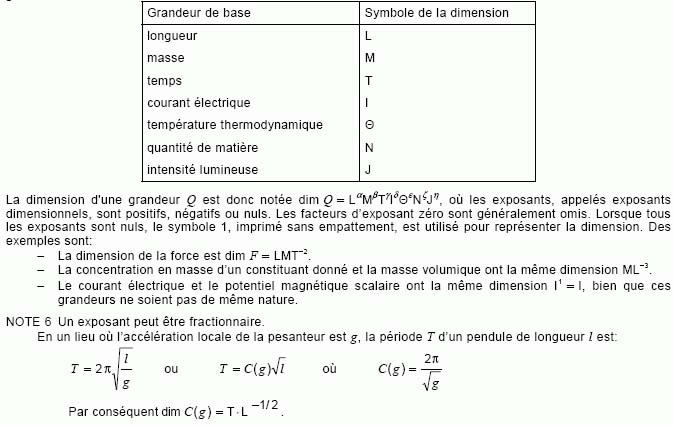
[IEV number 112-01-11]Тематики
- метрология, основные понятия
Синонимы
EN
DE
- Dimension einer Grösse
- Dimension, f
- Größendimension, f
FR
- dimension d'une grandeur, f
- dimension, f
2.9. Размерность физической величины
Размерность величины Нрк. Формула размерности
D. Dimension einer GroBe
E. Dimensions of a quantity
F. Dimension d’une grandeur
Выражение, отражающее связь величины с основными величинами системы, в котором коэффициент пропорциональности принят равным 1.
Примечания:
1. Размерность величины представляет собой произведение основных величин, возведенных в соответствующие степени.
2. Размерность производной величины отражает, во сколько раз изменяется ее размер при изменении размеров основных величин, например, если размерность величины х равна LaM^Tv и длина изменяется от / до /', масса — от m до т' и время — от t до то новый размер величины будет больше прежнего в (/'//)а
(/'//)v раз.
Источник: ГОСТ 16263-70: Государственная система обеспечения единства измерений. Метрология. Термины и определения оригинал документа
Русско-немецкий словарь нормативно-технической терминологии > размерность физической величины
-
29 разъединение (функция)
- Trennen, n
разъединение (функция)
Действие, направленное на отключение питания всей установки или ее отдельной части путем отделения этой установки или части ее от любого источника электрической энергии по соображениям безопасности.
[ ГОСТ Р 50030. 1-2000 ( МЭК 60947-1-99)]
разъединение
Действие, предназначенное для отключения в целях безопасности питания всей электрической установки или ее части при помощи отделения ее от всех источников электрической энергии.
[ ГОСТ Р МЭК 60050-826-2009]
Функция разъединения состоит в том, чтобы обеспечить безопасность персонала перед выполнением работы, ремонта, определения места повреждения или замены оборудования
[ ГОСТ Р 50571. 1-2009 ( МЭК 60364-1: 2005)]EN
isolation
function intended to make dead for reasons of safety all or a discrete section of the electrical installation by separating the electrical installation or section from every source of electric energy
[IEV number 826-17-01]FR
sectionnement, m
Параллельные тексты EN-RU
fonction destinée à assurer la mise hors tension de tout ou partie d'une installation électrique en séparant l'installation électrique ou une partie de l'installation électrique, de toute source d'énergie électrique, pour des raisons de sécurité
[IEV number 826-17-01]Compact CVS circuit breakers are suitable for Isolation as defined in EC standards 60947-2. The aim of isolation is to separate a circuit or apparatus from the remainder of a system which is energized in order the personnel may carry out work on the isolated part with complete safety.
[Schneider Electric]Автоматический выключатель CVS пригоден к разъединению - функции, определенной в европейском стандарте 60947-2. Целью разъединения является отделение цепей или аппаратов от части системы, остающейся под напряжением для обеспечения полной безопасности персонала, работающего на отделенной части системы.
[Перевод Интент]When the supply disconnecting device is one of the types specified in 5.3.2 a) to d) it shall fulfil all of the following requirements:
– have a visible contact gap or a position indicator which cannot indicate OFF (isolated) until all contacts are actually open and the requirements for the isolating function have been satisfied;
...
[IEC 60204-1-2006]Аппараты отключения электропитания, указанные в п. 5.3.2, в перечислениях а)...d), должны удовлетворять всем перечисленным ниже требованиям:
- иметь видимый изоляционный промежуток между разомкнутыми контактами или указатель коммутационного положения, который указывает на положение ОТКЛЮЧЕНО (отделено) только в том случае, если все контакты аппарата разомкнуты и все остальные требования, относящиеся к функции разъединения, выполнены;
...
[Перевод Интент]Тематики
- выключатель автоматический
- выключатель, переключатель
- электробезопасность
- электроустановки
Близкие понятия
Синонимы
EN
DE
- Trennen, n
FR
- sectionnement, m
Русско-немецкий словарь нормативно-технической терминологии > разъединение (функция)
-
30 таракан
таракан
—
[ http://www.eionet.europa.eu/gemet/alphabetic?langcode=en]EN
cockroach
The most primitive of the living winged insects. It is thought they have been unchanged for more than 300 million years, and are among the oldest fossil insects. Cockroaches are usually found in tropical climates, but a few species, out of the total 3.500 known species, have become pests. They are common household pests in many countries, imported by ship and carried home in grocery bags. Cockroaches eat plant and animal products, including food, paper, clothing and soiled hospital waste, fouling everything they touch with their droppings and unpleasant odour, to which many people are allergic. They are a major health hazard and carry harmful bacteria, protozoan parasites and faunal pathogens, including those that cause typhoid, leprosy and salmonella. Conventional insecticides make little or no impact on the cockroaches population. (Source: WRIGHT / WPR)
[http://www.eionet.europa.eu/gemet/alphabetic?langcode=en]Тематики
EN
DE
FR
Русско-немецкий словарь нормативно-технической терминологии > таракан
-
31 химическая инерция
химическая инерция
—
[ http://www.eionet.europa.eu/gemet/alphabetic?langcode=en]EN
persistence
The capacity of a substance to remain chemically stable. This is an important factor in estimating the environmental effects of substances discharged into the environment. Certain toxic substances (e.g., cyanides) have a low persistence, whereas other less immediately toxic substances (e.g., many organochlorines) have a high persistence and may therefore produce more serious effects. (Source: ALL)
[http://www.eionet.europa.eu/gemet/alphabetic?langcode=en]Тематики
EN
DE
FR
Русско-немецкий словарь нормативно-технической терминологии > химическая инерция
-
32 поиметь
v1) rude.expr. (кого-л) verarschen2) jarg. (кого-л) eine Nummer schieben (have sexual intercourse) -
33 автоматический выключатель
автоматический выключатель
Механический коммутационный аппарат1), способный включать, проводить и отключать токи при нормальном состоянии электрической цепи, а также включать, проводить в течение заданного времени и автоматически отключать токи в указанном аномальном состоянии электрической цепи, например, при коротком замыкании.
(МЭС 441-14-20)
[ ГОСТ Р 50030. 2-99 ( МЭК 60947-2-98)]
автоматический выключатель
-
[IEV number 442-05-01]EN
circuit breaker
a mechanical switching device, capable of making, carrying and breaking currents under normal circuit conditions and also making, carrying for a specified time and breaking currents under specified abnormal circuit conditions such as those of short circuit.
[IEC 62271-100, ed. 2.0 (2008-04)]
[IEV number 442-05-01]
circuit breaker
A device designed to open and close a circuit by nonautomatic means and to open the circuit automatically on a predetermined overcurrent without damage to itself when properly applied within its rating.
NOTE The automatic opening means can be integral, direct acting with the circuit breaker, or remote from the circuit breaker.
Adjustable (as applied to circuit breakers). A qualifying term indicating that the circuit breaker can be set to trip at various values of current, time, or both within a predetermined range. Instantaneous-trip (as applied to circuit breakers). A qualifying term indicating that no delay is purposely introduced in the tripping action of the circuit breaker.
Inverse-time (as applied to circuit breakers). A qualifying term indicating a delay is purposely introduced in the tripping action of the circuit breaker, which delay decreases as the magnitude of the current increases.
Nonadjustable (as applied to circuit breakers). A qualifying term indicating that the circuit breaker does not have any adjustment to alter the value of current at which it will trip or the time required for its operation.
Setting (of a circuit breaker). The value of current, time, or both at which an adjustable circuit breaker is set to trip.
[National Electrical Cod]FR
disjoncteur
1) Должно быть контактный коммутационный аппарат
appareil mécanique de connexion capable d’établir, de supporter et d’interrompre des courants dans les conditions normales du circuit, ainsi que d’établir, de supporter pendant une durée spécifiée et d’in- terrompre des courants dans des conditions anormales spécifiées du circuit telles que celles du court-circuit.
[IEC 62271-100, ed. 2.0 (2008-04)]
[IEV number 442-05-01]
[Интент]КЛАССИФИКАЦИЯ
- По роду тока
- По напряжению
- По числу полюсов
- По виду корпуса
- По месту установки
- По изолирующей среде
- По установленным расцепителям
- По дополнительным защитам
- По назначению
- По категории применения
- По виду привода взвода пружины
- По выполняемой функции
-
По влиянию монтажного положения
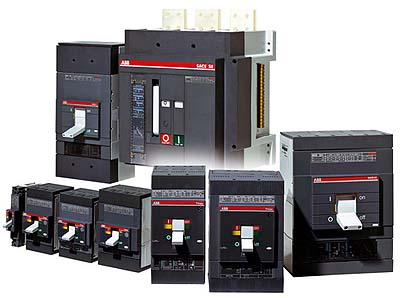 Автоматические выключатели ABB
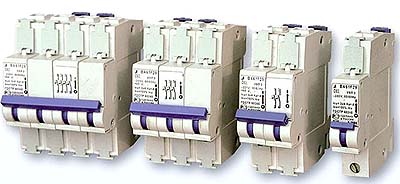 Модульные автоматические выключатели
1. НЕКОТОРЫЕ СВЕДЕНИЯ ОБ АВТОМАТИЧЕСКИХ ВЫКЛЮЧАТЕЛЯХ Автоматический выключатель — это электрический аппарат, который автоматически отключает (и тем самым защищает) электрическую цепь при возникновении в ней аномального режима. Режим становится аномальным, когда в цепи начинает недопустимо изменяться (т. е. увеличиваться или уменьшаться относительно номинального значения) ток или напряжение.
Другими словами (более "инженерно") можно сказать, что автоматический выключатель защищает от токов короткого замыкания и токов перегрузки отходящую от него питающую линию, например, кабель и приемник(и) электрической энергии (осветительную сеть, розетки, электродвигатель и т. п.).
Как правило, автоматический выключатель может применятся также для нечастого (несколько раз в сутки) включения и отключения защищаемых электроприемников (защищаемой нагрузки).
[Интент]Выключатель предназначен для проведения тока в нормальном режиме и отключения тока при коротких замыканиях, перегрузках, недопустимых снижениях напряжения, а также до 30 оперативных включений и отключений электрических цепей в сутки и рассчитан для эксплуатации в электроустановках с номинальным рабочим напряжением до 660 В переменного тока частоты 50 и 60 Гц и до 440 В постоянного тока.
[Типовая фраза из российской технической документации] 2. ПРИНЦИП ДЕЙСТВИЯ Для защиты цепи от короткого замыкания применяется автоматический выключатель с электромагнитным расцепителем.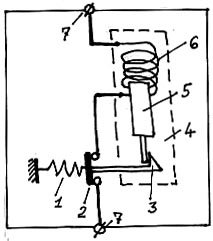
1 - Пружина (в данном случае во взведенном положении растянута)
Автоматический выключатель устроен таким образом, что сначала необходимо взвести пружину и только после этого его можно включить. У многих автоматических выключателей для взвода пружины необходимо перевести ручку вниз. После этого ручку переводят вверх. При этом замыкаются главные контакты.
2 - Главный контакт автоматического выключателя
3 - Удерживающее устройство
4 - Электромагнитный расцепитель;
5 - Сердечник
6 - Катушка
7 - Контактные зажимы автоматического выключателя
На рисунке показан один полюс автоматического выключателя во включенном положении: пружина 1 взведена, а главный контакт 2 замкнут.
Как только в защищаемой цепи возникнет короткое замыкание, ток, протекающий через соответствующий полюс автоматического выключателя, многократно возрастет. В катушке 6 сразу же возникнет сильное магнитное поле. Сердечник 5 втянется в катушку и освободит удерживающее устройство. Под действием пружины 1 главный контакт 2 разомкнется, в результате чего автоматический выключатель отключит и тем самым защитит цепь, в которой возникло короткое замыкание. Такое срабатывание автоматического выключателя происходит практически мгновенно (за сотые доли секунды).
Для защиты цепи от тока перегрузки применяют автоматические выключатели с тепловым расцепителем.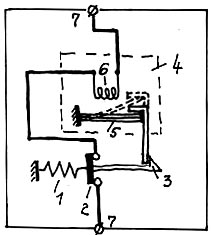
1 - Пружина (в данном случае во взведенном положении растянута)
Принцип действия такой же как и в первом случае, с той лишь разницей, что удерживающее устройство 3 освобождается под действием биметаллической пластины 5, которая изгибается от тепла, выделяемого нагревательным элементом 6. Количество тепла определяется током, протекающим через защищаемую цепь.
2 - Главный контакт автоматического выключателя
3 - Удерживающее устройство
4 - Тепловой расцепитель
5 - Биметаллическая пластина
6 - Нагревательный элемент
7 - Контактные зажимы автоматического выключателя
[Интент]Недопустимые, нерекомендуемые
Тематики
Классификация
>>>Обобщающие термины
Действия
- включение автоматического выключателя
- оперирование автоматического выключателя
- отключение автоматического выключателя
- срабатывание автоматического выключателя
EN
- auto-cutout
- automatic circuit breaker
- automatic cutout
- automatic switch
- breaker
- CB
- circuit breaker
- circuit-breaker
- cutout
DE
FR
Смотри также
Русско-немецкий словарь нормативно-технической терминологии > автоматический выключатель
34 автотрансформатор
автотрансформатор
Трансформатор, две или более обмоток которого гальванически связаны так, что они имеют общую часть
[ ГОСТ 16110-82]
[ОАО РАО "ЕЭС России" СТО 17330282.27.010.001-2008]
автотрансформатор
Трансформатор, в котором две или большее число обмоток имеют общую часть
(МЭС 421-01-11).
[ ГОСТ 30830-2002]
автотрансформатор
Электрический трансформатор, у которого обмотка низшего напряжения является частью обмотки высшего напряжения
[Терминологический словарь по строительству на 12 языках (ВНИИИС Госстроя СССР)]EN
auto-transformer
a transformer in which at least two windings have a common par
[IEV number 421-01-11]FR
autotransformateur
transformateur dont au moins deux enroulements ont une partie commune
[IEV number 421-01-11]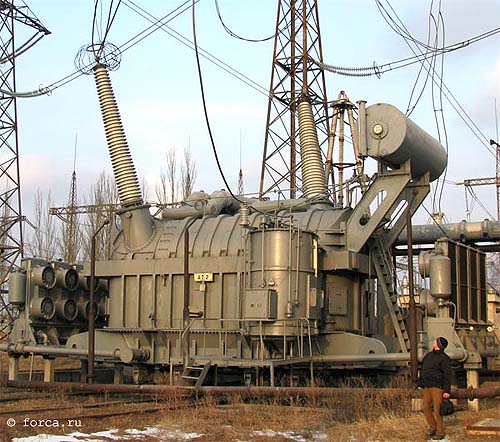
Автотрансформатором (AT) называется трансформатор, в котором две или более обмотки гальванически связаны так, что они имеют общую часть. Обмотки автотрансформатора связаны электрически и магнитно, и передача энергии из первичной цепи во вторичную происходит как посредством магнитного ноля, так и электрическим путем. В автотрансформаторе только часть всей энергии трансформируется, а другая часть передается непосредственно из системы одного напряжения в систему другого напряжения без трансформации.
[http://forca.ru/info/spravka/avtotransformator.html]
Автотрансформатор - электрический трансформатор, все обмотки которого гальванически соединены друг с другом (рис.). При малых коэффициентах трансформации автотрансформатор легче и дешевле многообмоточного трансформатора. Отношение объёма VA меди автотрансформатора к объёму меди многообмоточного трансформатора VM той же мощности, с тем же коэффициентом трансформации n равно: VA/VM = (n — 1)n. Недостаток автотрансформатора — невозможность гальванической развязки цепей. Авторансформаторы служат преобразователями электрического напряжения в пусковых устройствах мощных электродвигателей переменного тока, в схемах релейной защиты для плавного регулирования напряжения и др. Регулируемые автотрансформаторы позволяют благодаря механическому перемещению точки отвода вторичного напряжения сохранить его постоянным при изменениях первичного напряжения.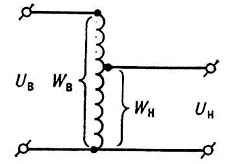
Схема автотрансформатора[http://www.rza.org.ua/glossary/o-14.html]
Тематики
Классификация
>>>EN
DE
FR
Русско-немецкий словарь нормативно-технической терминологии > автотрансформатор
35 автотрансформаторный пускатель
автотрансформаторный пускатель
Пускатель для асинхронного двигателя, использующий для его запуска одно или несколько пониженных напряжений, отводимых от автотрансформатора.
(МЭС 441-14-45)
[ ГОСТ Р 50030.4.1-2002 (МЭК 60947-4-1-2000)]EN
auto-transformer starter
starter for an induction motor which uses for starting one or more reduced voltages derived from an auto-transformer
NOTE - An auto-transformer is defined as follows in 3.1.2 of IEC 60076-1: “A transformer in which at least two windings have a common part."
[IEV number 441-14-45]
[IEC 60947-4-1, ed. 3.0 (2009-09)]FR
démarreur par autotransformateur
démarreur pour moteur à induction qui utilise pour le démarrage une ou plusieurs tensions réduites prélevées sur un autotransformateur
NOTE - Un autotransformateur est défini comme suit au 3.1.2 de la CEI 60076-1: «transformateur dont au moins deux enroulements ont une partie commune.»
[IEV number 441-14-45]
[IEC 60947-4-1, ed. 3.0 (2009-09)]Тематики
- аппарат, изделие, устройство...
- контакторы и пускатели
EN
DE
FR
Русско-немецкий словарь нормативно-технической терминологии > автотрансформаторный пускатель
36 артроподы
артроподы
—
[ http://www.eionet.europa.eu/gemet/alphabetic?langcode=en]EN
arthropod
The largest phylum in the animal kingdom; adults typically have segmented body, a sclerotized integument, and many-jointed segmental limbs. (Source: MGH)
[http://www.eionet.europa.eu/gemet/alphabetic?langcode=en]Тематики
EN
DE
FR
Русско-немецкий словарь нормативно-технической терминологии > артроподы
37 битуминозный песок
битуминозный песок
—
[ http://www.eionet.europa.eu/gemet/alphabetic?langcode=en]EN
tar sand
A sandstone in which hydrocarbons have been trapped; the lighter compounds evaporate, leaving a residue of asphalt in the rock pores. (Source: CED)
[http://www.eionet.europa.eu/gemet/alphabetic?langcode=en]Тематики
EN
DE
FR
Русско-немецкий словарь нормативно-технической терминологии > битуминозный песок
38 бокаж
бокаж
—
[ http://www.eionet.europa.eu/gemet/alphabetic?langcode=en]EN
bocage
The wooded countryside characteristic of northern France, with small irregular-shaped fields and many hedges and copses. In the French language the word bocage refers both to the hedge itself and to a landscape consisting of hedges. Bocage landscapes usually have a slightly rolling landform, and are found mainly in maritime climates. Being a small-scale, enclosed landscape, the bocage offers much variations in biotopes, with habitats for birds, small mammals, amphibians, reptiles and butterflies. (Source: CED / DOBRIS)
[http://www.eionet.europa.eu/gemet/alphabetic?langcode=en]Тематики
EN
DE
FR
Русско-немецкий словарь нормативно-технической терминологии > бокаж
39 виды, не находящиеся под угрозой уничтожения (МСОП)
виды, не находящиеся под угрозой уничтожения (МСОП)
—
[ http://www.eionet.europa.eu/gemet/alphabetic?langcode=en]EN
lower risk species (IUCN)
Animals, birds, fish, plants or other living organisms that have been deemed as not being in danger of extinction. (Source: OED / TOE)
[http://www.eionet.europa.eu/gemet/alphabetic?langcode=en]Тематики
EN
DE
FR
Русско-немецкий словарь нормативно-технической терминологии > виды, не находящиеся под угрозой уничтожения (МСОП)
40 внутригородской район
внутригородской район
—
[ http://www.eionet.europa.eu/gemet/alphabetic?langcode=en]EN
inner city
1) Part of a city at or near the centre, especially a slum area where poor people live in bad housing.
2) City centres of many industrialized countries which exhibit environmental degradation. The numerous and highly competitive activities entailing land use overwhelm the limited space and create a situation of overcrowding, functional incompatibility and cultural degradation. Inner city areas have a high level of commercial specialization, a large number of offices and a sizeable daytime population. At the same time, city centres generally remain a sort of ghetto for a permanent, low-income population living in run-down housing and enjoying little in the way of public services and civic amenities. The concentration of service industries inevitably entails the replacement of traditional housing and shops by office blocks, the provision of basic utilities at the expense of civic amenities and the provision of major access roads which eat up urban space. Structures of historic origin are often unable to meet modern requirements and, notwithstanding their value, frequently face demolition.
(Source: PHC / WPR)
[http://www.eionet.europa.eu/gemet/alphabetic?langcode=en]Тематики
EN
DE
FR
Русско-немецкий словарь нормативно-технической терминологии > внутригородской район
СтраницыСм. также в других словарях:
hâve — hâve … Dictionnaire des rimes
have — [ weak əv, həv, strong hæv ] (3rd person singular has [ weak əz, həz, strong hæz ] ; past tense and past participle had [ weak əd, həd, strong hæd ] ) verb *** Have can be used in the following ways: as an auxiliary verb in perfect tenses of… … Usage of the words and phrases in modern English
Have — (h[a^]v), v. t. [imp. & p. p. {Had} (h[a^]d); p. pr. & vb. n. {Having}. Indic. present, I {have}, thou {hast}, he {has}; we, ye, they {have}.] [OE. haven, habben, AS. habben (imperf. h[ae]fde, p. p. geh[ae]fd); akin to OS. hebbian, D. hebben,… … The Collaborative International Dictionary of English
have — (h[a^]v), v. t. [imp. & p. p. {Had} (h[a^]d); p. pr. & vb. n. {Having}. Indic. present, I {have}, thou {hast}, he {has}; we, ye, they {have}.] [OE. haven, habben, AS. habben (imperf. h[ae]fde, p. p. geh[ae]fd); akin to OS. hebbian, D. hebben,… … The Collaborative International Dictionary of English
have — (h[a^]v), v. t. [imp. & p. p. {Had} (h[a^]d); p. pr. & vb. n. {Having}. Indic. present, I {have}, thou {hast}, he {has}; we, ye, they {have}.] [OE. haven, habben, AS. habben (imperf. h[ae]fde, p. p. geh[ae]fd); akin to OS. hebbian, D. hebben,… … The Collaborative International Dictionary of English
hâve — [ av ] adj. • 1548; frq. °haswa « gris comme le lièvre » ♦ Amaigri et pâli par la faim, la fatigue, la souffrance. ⇒ émacié, 1. maigre. Gens hâves et déguenillés. Visage, teint hâve. ⇒ blafard, blême. ⊗ CONTR. 1. Frais, replet. hâve adj. Litt.… … Encyclopédie Universelle
have — (v.) O.E. habban to own, possess; be subject to, experience, from P.Gmc. *haben (Cf. O.N. hafa, O.S. hebbjan, O.Fris. habba, Ger. haben, Goth. haban to have ), from PIE *kap to grasp (see CAPABLE (Cf. capable)). Not related to L … Etymology dictionary
have — have, hold, own, possess, enjoy are comparable when they mean to keep, control, retain, or experience as one s own. Have is the most general term and in itself carries no implication of a cause or reason for regarding the thing had as one s own… … New Dictionary of Synonyms
have\ to — • have (got) to v informal To be obliged or forced to; need to. Do you have to go now? He had to come. His parents made him. I have got to go to the doctor. I have to go to Church. See: have got to … Словарь американских идиом
have\ a\ go\ at — • have a go at • have a shot at • take a shot at v. phr. informal To try, especially after others have tried. Bob asked Dick to let him have a go at shooting at the target with Dick s rifle. She had a go at archery, but did not do very well … Словарь американских идиом
have — have; be·have; have·lock; mis·be·have; … English syllables
 18+© Академик, 2000-2026
- Обратная связь: Техподдержка, Реклама на сайте
Экспорт словарей на сайты, сделанные на PHP, Joomla, Drupal, WordPress, MODx.
Перевод: с русского на немецкий
с немецкого на русский- С немецкого на:
- Русский
- С русского на:
- Все языки
- Английский
- Датский
- Итальянский
- Немецкий
- Нидерландский
- Персидский
- Французский
- Эстонский