

-
41 ནུས་པ་
[nus pa]capability, capacity, ability, be willing to part with, not grudge, dare to, energy, function, role, potency, power, effect, faculty, potential, force, be able to do something, -> nu ba -
42 सामर्थ्य
sāmarthyan. (fr. sam-artha) sameness of aim orᅠ object orᅠ meaning orᅠ signification, belonging orᅠ agreeing together (in aim, object etc.), adequacy, accordance, fitness, suitableness Pat. Hariv. Suṡr. etc.;
the being entitled to, justification for (loc. orᅠ comp.) MBh. R. etc.;
ability to orᅠ capacity for (inf. dat. loc., orᅠ comp.;
acc. with kṛi, « to do one's utmost» ;
with bhaj, « to take pains», « exert one's self») ib. ;
efficacy, power, strength, force (āt, orᅠ - tas orᅠ - yogāt, « through the force of circumstances», « by reason of», « in consequence of», « on account of», « as a matter of course») ib. ;
the force orᅠ function orᅠ sense of a word, Kusum. ;
- सामर्थ्यबन्धन
- सामर्थ्ययोग
- सामर्थ्यवत्
- सामर्थ्यहीन
-
43 limite
"limit;Grenze;Anschlag;limite"* * *m limit( confine) boundarylimite di età age limitlimite di velocità speed limital limite at most, at the outsidenei limiti del possibile to the best of one's ability* * *limite s.m.1 limit; bound; boundary, edge: i limiti di un campo di gioco, the boundaries of a playing field; il limite dell'area di rigore, the edge of the penalty area; fissare un limite, to fix a limit; limite d'età, age limit; stabilire un limite di tempo, to set a time limit; porre un limite all'autorità di qlcu., to set limits to s.o.'s authority; mantenersi entro certi limiti, to keep within certain limits; conoscere i propri limiti, to know one's limits; c'è un limite a tutto!, there's a limit to everything; essere al limite della sopportazione, to be at the end of one's tether; impegnarsi al limite delle proprie possibilità, to do as much as one can // al limite, (fig.) if the worst comes to the worst (o at worst): al limite ti aiuterò io, if the worst comes to the worst I'll help you // passare ogni limite, to go too far // orgoglio senza limiti, unbounded pride // caso limite, borderline case // limite di guardia, safety level; (fig.) danger point: la tensione internazionale ha raggiunto il limite di guardia, the international tension has reached danger point // limite chilometrico, kilometre marker // (aut.): limite di velocità, speed limit; limite di peso, di carico, weight, load limit // (econ.): prezzo limite, price limit; limite di spesa, expenditure limitation; limite massimo (di consegna), superior limit // ( banca): limite di credito, credit limit (o ceiling); limite di indebitamento, debt (o borrowing) limit // (edil.): limite di rottura, breaking point; limite di elasticità, limit of elasticity (o elastic limit) // (metall.) limite di elasticità convenzionale, proof stress // (ferr.) indicazione del limite di portata, marked capacity // (inform.) limiti estremi, range // (boxe) vincere prima del limite, to win within the distance2 (mat.) limit; bound: limite di una funzione, limit of a function; limiti d'integrazione, integration limits; minimo limite superiore, least upper bound.* * *['limite]1. sm(gen), fig limit, (confine) boundary, limit, borderc'è un limite a tutto!; tutto ha un limite! — there are limits!
senza limite o limiti — boundless, limitless
passare il o ogni limite — to go too far
al limite — if the worst comes to the worst Brit, if worst comes to worst Am, if necessary
non portare l'ombrello - al limite te ne presto uno — don't bring your umbrella - if necessary I'll lend you one
2. agg inv* * *['limite] 1.sostantivo maschile1) (linea di demarcazione) border, boundary2) (confine, termine definito) limit, limitationconoscere, riconoscere i propri -i — to know, acknowledge one's (own) limitations
senza -i — [entusiasmo, generosità] boundless; [libertà, gioia] unrestrained
porre dei -i a — to impose o place limitations o restrictions on
passare il, ogni limite — to go over the limit, to go too far
hai davvero superato ogni limite! — you're really carrying it too far! you're way out of line! colloq.
al limite — (nel peggiore dei casi) at worst; (al massimo) at (the) most
3) (quadro)nei -i del possibile — as far as possible, within the bounds of possibility
4) mat. limit2.aggettivo invariabiledata limite — deadline, time-limit
limite massimo — econ. ceiling
limite di velocità — speed limit o restriction
* * *limite/'limite/I sostantivo m.1 (linea di demarcazione) border, boundary; al limite del bosco on the edge of the wood2 (confine, termine definito) limit, limitation; conoscere, riconoscere i propri -i to know, acknowledge one's (own) limitations; c'è un limite a tutto there's a limit to everything; senza -i [ entusiasmo, generosità] boundless; [ libertà, gioia] unrestrained; porre dei -i a to impose o place limitations o restrictions on; non ci sono -i alla sua curiosità there are no bounds to her curiosity; superare i -i della decenza to cross the bounds of decency; passare il, ogni limite to go over the limit, to go too far; hai davvero superato ogni limite! you're really carrying it too far! you're way out of line! colloq.; al limite (nel peggiore dei casi) at worst; (al massimo) at (the) most; attività al limite della legalità activities bordering on the illegal; essere al limite (della sopportazione) to be at breaking point3 (quadro) entro certi -i within limits; nei -i del possibile as far as possible, within the bounds of possibility4 mat. limitcaso limite borderline case; data limite deadline, time-limitlimite di cassa cash limit; limite di età age limit; limite di fido credit limit; limite di guardia flood mark; limite massimo econ. ceiling; limite delle nevi perenni snow line; limite di sicurezza safety limit; limite di tempo time-limit; limite di velocità speed limit o restriction. -
44 capaciteit
adj. capacitive, of capacitance, of the ability to collect an electrical charge (Electricity)--------n. capacity, volume which can be contained or received; function, role -
45 compatibiliteit
n. compatibility, suitability; ability of a program or hardware to function in the same way as other programs or hardware (Computers) -
46 hartkwaal
n. heart disease, disease which affects the heart's ability to function -
47 hartval
n. heart disease, disease which affects the heart's ability to function -
48 представлять
Способность представлять предпочтения функцией полезности тесно связана с предположением о рациональности. — The ability to represent preferences by a utility function is closely linked to the assumption of rationality.
- удобно представлятьВезде (повсюду) в тексте знаки суммы (∑) представлены различными способами. — Summation symbols (∑) are displayed in various ways throughout the text.
-
49 представлять предпочтения
Способность представлять предпочтения функцией полезности тесно связана с предположением о рациональности. — The ability to represent preferences by a utility function is closely linked to the assumption of rationality.
От потребителей требуется максимизировать предпочтения только относительно возможностей потребления, которые стоят строго меньше доступного объема богатства. — Consumers are required to maximize preferences only relative to consumptions that cost strictly less than the available amount of wealth.
предпочтения, выведенные или полученные из действий ex-ante — preferences induced or derived from ex-ante actions
Russian-English Dictionary "Microeconomics" > представлять предпочтения
-
50 связанный с
involve; linked toНа практике экономические модели нередко связаны с "агрегированием по времени". — In practice, economic models often involve "time aggregation".
Способность представлять предпочтения функцией полезности тесно связана с предположением о рациональности. — The ability to represent preferences by a utility function is closely linked to the assumption of rationality.
-
51 assessment of competence
HRthe measurement of an employee’s performance against an agreed set of standards for work-based activities. In the United Kingdom, assessment of competence is generally made against indicators of the successful achievement of a particular job function. There are four dimensions to assessment: the knowledge and understanding required to carry out a task; the performance indicators to be looked for; the scope or range of situations across which an employee is expected to perform; and any particular evidence requirements. Vocational qualifications for a wide range of jobs in the United Kingdom are based on a set of occupational standards that contain these elements. A wide variety of techniques or instruments exists to assess competence. These include specific work-based ability and aptitude tests, as well as traditional methods of performance appraisal and evaluation. Recent years have seen a dramatic rise in the use of direct observation at work by trained assessors, the collection of personal portfolios, and peer assessment techniques such as 360 degree appraisal. All require the careful review of work behavior against a set of indicators that have been clearly shown to be associated with successful performance. -
52 μέγας
μέγας, μεγάλη, μέγα (Hom.+) comp. μείζων and beside it, because of the gradual disappearance of feeling for its comp. sense, μειζότερος 3J 4 (APF 3, 1906, 173; POxy 131, 25; BGU 368, 9; ApcSed 1:5 [cp. J 15:13]; s. B-D-F §61, 2; W-S. §11, 4; Mlt-H. 166; Gignac II 158). Superl. μέγιστος (2 Pt 1:4).① pert. to exceeding a standard involving related objects, large, greatⓐ of any extension in space in all directions λίθος Mt 27:60; Mk 16:4. δένδρον Lk 13:19 v.l. (TestAbr B 3 p. 107, 6 [Stone p. 62]). κλάδοι Mk 4:32. Buildings 13:2. Fish J 21:11. A mountain (Tyrtaeus [VII B.C.], Fgm. 4, 8 D.2; Ps.-Aristot., Mirabilia 138; Theopomp. [IV B.C.]: 115 Fgm. 78 Jac.) Rv 8:8. A star vs. 10. A furnace 9:2 (ParJer 6:23). A dragon (Esth 1:1e; Bel 23 Theod.) 12:3, 9. ἀετός (Ezk 17:3; ParJer 7:18 [RHarris; om. Kraft-Purintun]) vs. 14. μάχαιρα a long sword 6:4. ἅλυσις a long chain 20:1. πέλαγος AcPl Ha 7, 23 (first hand).ⓑ with suggestion of spaciousness ἀνάγαιον a spacious room upstairs Mk 14:15; Lk 22:12. θύρα a wide door 1 Cor 16:9. A winepress Rv 14:19 (ληνός μ. ‘trough’ JosAs 2:20); χάσμα a broad chasm (2 Km 18:17) Lk 16:26. οἰκία (Jer 52:13) 2 Ti 2:20.ⓒ with words that include the idea of number ἀγέλη μ. a large herd Mk 5:11. δεῖπνον a great banquet, w. many invited guests (Da 5:1 Theod.; JosAs 3:6) Lk 14:16. Also δοχὴ μ. (Gen 21:8) Lk 5:29; GJs 6:2.ⓓ of age (Jos., Ant. 12, 207 μικρὸς ἢ μέγας=‘young or old’); to include all concerned μικροὶ καὶ μεγάλοι small and great (PGM 15, 18) Rv 11:18; 13:16; 19:5, 18; 20:12. μικρῷ τε καὶ μεγάλῳ Ac 26:22. ἀπὸ μικροῦ ἕως μεγάλου (Gen 19:11; 4 Km 23:2; 2 Ch 34:30; POxy 1350) 8:10; Hb 8:11 (Jer 38:34). μέγας γενόμενος when he was grown up 11:24 (Ex 2:11). ὁ μείζων the older (O. Wilck II, 144, 3 [128 A.D.]; 213, 3; 1199, 2; LXX; cp. Polyb. 18, 18, 9 Σκιπίων ὁ μέγας; 32, 12, 1) Ro 9:12; 13:2 (both Gen 25:23).② pert. to being above average in quantity, great πορισμός a great means of gain 1 Ti 6:6. μισθαποδοσία rich reward Hb 10:35.③ pert. to being above standard in intensity, great δύναμις Ac 4:33; 19:8 D. Esp. of sound: loud φωνή Mk 15:37; Lk 17:15; Rv 1:10; φωνῇ μεγάλῃ (LXX; TestAbr A 5 p. 82, 20f [Stone p. 12]; ParJer 2:2; ApcMos 5:21) Mt 27:46, 50; Mk 1:26; 5:7; 15:34; Lk 4:33; 8:28; 19:37; 23:23 (Φωναῖς μεγάλαις), 46; J 11:43; Ac 7:57, 60; 8:7; Rv 5:12; 6:10 al.; μεγ. φωνῇ (ParJer 5:32); Ac 14:10; 16:28; μεγ. τῇ φωνῇ (ParJer 9:8; Jos., Bell. 6, 188) 14:10 v.l.; 26:24; ἐν φωνῇ μ. Rv 5:2. μετὰ σάλπιγγος μεγάλης with a loud trumpet call Mt 24:31. κραυγή (Ex 11:6; 12:30) Lk 1:42; Ac 23:9; cp. μεῖζον κράζειν cry out all the more Mt 20:31. κοπετός (Gen 50:10) Ac 8:2.—Of natural phenomena: ἄνεμος μ. a strong wind J 6:18; Rv 6:13. λαῖλαψ μ. (Jer 32:32) Mk 4:37. βροντή (Sir 40:13) Rv 14:2. χάλαζα Rv 11:19; 16:21a. χάλαζα λίαν μ. σφόδρα AcPl Ha 5, 7. σεισμὸς μ. (Jer 10:22; Ezk 3:12; 38:19; Jos., Ant. 9, 225) Mt 8:24; 28:2; Lk 21:11a; Ac 16:26. γαλήνη μ. a deep calm Mt 8:26; Mk 4:39; φῶς μ. a bright light (JosAs 6:3; ParJer 9:18 [16]; Plut., Mor. 567f: a divine voice sounds forth from this light; Petosiris, Fgm. 7, ln. 39 τὸ ἱερὸν ἄστρον μέγα ποιοῦν φῶς) Mt 4:16a; GJs 19:2 (Is 9:1). καῦμα μ. intense heat Rv 16:9 (JosAs 3:3).—Of surprising or unpleasant events or phenomena of the most diverse kinds (ἀπώλεια Dt 7:23; θάνατος Ex 9:3; Jer 21:6; κακόν Philo, Agr. 47) σημεῖα (Dt 6:22; 29:2) Mt 24:24; Lk 21:11b; Ac 6:8. δυνάμεις 8:13. ἔργα μ. mighty deeds (cp. Judg 2:7) Rv 15:3. μείζω τούτων greater things than these J 1:50 (μείζονα v.l.); cp. 5:20; 14:12. διωγμὸς μ. a severe persecution Ac 8:1; θλῖψις μ. (a time of) great suffering (1 Macc 9:27) Mt 24:21; Ac 7:11; Rv 2:22; 7:14. πειρασμός AcPl Ha 8, 22. πληγή (Judg 15:8; 1 Km 4:10, 17 al.; TestReub 1:7; TestSim 8:4; Philo, Sacr. Abel. 134) 16:21b. θόρυβος GJs 21:1; AcPl Ha 1, 28f (restored, s. AcPlTh [Aa I 258, 6]) λιμὸς μ. (4 Km 6:25; 1 Macc 9:24) Lk 4:25; Ac 11:28; ἀνάγκη μ. Lk 21:23; πυρετὸς μ. a high fever (s. πυρετός) 4:38.—Of emotions: χαρά great joy (Jon 4:6; JosAs 3:4; 4:2 al.; Jos., Ant. 12, 91) Mt 2:10; 28:8; Lk 2:10; 24:52. φόβος great fear (X., Cyr. 4, 2, 10; Menand., Fgm. 388 Kö.; Jon 1:10, 16; 1 Macc 10:8; TestAbr B 13 p. 117, 18 [Stone p. 82]; JosAs 6:1; GrBar 7:5) Mk 4:41; Lk 2:9; 8:37; Ac 5:5, 11; AcPl Ha 3, 33. θυμὸς μ. fierce anger (1 Macc 7:35) Rv 12:12. μείζων ἀγάπη greater love J 15:13. λύπη profound (Jon 4:1; 1 Macc 6:4, 9, 13; TestJob 7:8) Ro 9:2. σκυθρωπία AcPl Ha 7, 36. πίστις firm Mt 15:28. ἔκστασις (cp. Gen 27:33; ParJer 5:8, 12) Mk 5:42.④ pert. to being relatively superior in importance, greatⓐ of rational entities: of God and other deities θεός (SIG 985, 34 θεοὶ μεγάλοι [LBlock, Megaloi Theoi: Roscher II 2523–28, 2536–40; SCole, Theoi Megaloi, The Cult of the Great Gods at Samothrace ’84]; 1237, 5 ὀργὴ μεγάλη τ. μεγάλου Διός; OGI 50, 7; 168, 6; 716, 1; PStras 81, 14 [115 B.C.] Ἴσιδος μεγάλης μητρὸς θεῶν; POxy 886, 1; PTebt 409, 11; 22 ὁ θεὸς μ. Σάραπις, al.; PGM 4, 155; 482; 778 and oft.; 3052 μέγ. θεὸς Σαβαώθ; 5, 474; Dt 10:17 al. in LXX; En 103:4; 104:1; Philo, Cher. 29 al.; Jos., Ant. 8, 319; SibOr 3, 19; 71 al.—Thieme 36f) Tit 2:13 (Christ is meant). Ἄρτεμις (q.v.) Ac 19:27f, 34f (cp. Ael. Aristid. 48, 21 K.=24 p. 471 D. the outcry: μέγας ὁ Ἀσκληπιός); s. New Docs 1, 106 on this epithet in ref. to deities. Simon the magician is called ἡ δύναμις τ. θεοῦ ἡ καλουμένη μεγάλη Ac 8:10b (s. δύναμις 5). The angel Michael Hs 8, 3, 3; cp. 8, 4, 1.—Of people who stand in relation to the Divinity or are otherw. in high position: ἀρχιερεύς (s. ἀρχιερεύς 2a and ἱερεύς aβ.—ἀρχ. μέγ. is also the appellation of the priest-prince of Olba [s. PECS 641f] in Cilicia: MAMA III ’31 p. 67, ins 63; 64 [I B.C.]) Hb 4:14. προφήτης (Sir 48:22) Lk 7:16. ποιμήν Hb 13:20. Gener. of rulers: οἱ μεγάλοι the great ones, those in high position Mt 20:25; Mk 10:42. Of people prominent for any reason Mt 5:19; 20:26; Mk 10:43; Lk 1:15, 32; Ac 5:36 D; 8:9 (MSmith, HWolfson Festschr., ’65, 741: μ. here and Lk 1:32 may imply a messianic claim).—μέγας in the superl. sense (2 Km 7:9.—The positive also stands for the superl., e.g. Sallust. 4 p. 6, 14, where Paris calls Aphrodite καλή=the most beautiful. Diod S 17, 70, 1 πολεμία τῶν πόλεων=the most hostile [or especially hostile] among the cities) Lk 9:48 (opp. ὁ μικρότερος).—Comp. μείζων greater of God (Ael. Aristid. 27, 3 K.=16 p. 382 D.; PGM 13, 689 ἐπικαλοῦμαί σε, τὸν πάντων μείζονα) J 14:28; Hb 6:13; 1J 3:20; 4:4. More prominent or outstanding because of certain advantages Mt 11:11; Lk 7:28; 22:26f; J 4:12; 8:53; 13:16ab; 1 Cor 14:5. More closely defined: ἰσχύϊ καὶ δυνάμει μείζων greater in power and might 2 Pt 2:11. μεῖζον τοῦ ἱεροῦ someth. greater than the temple Mt 12:6. μείζων with superl. mng. (Ps.-Apollod., Epit. 7, 8 Wagner: Ὀδυσσεὺς τρεῖς κριοὺς ὁμοῦ συνδέων … καὶ αὐτὸς τῷ μείζονι ὑποδύς; Appian, Bell. Civ. 2, 87 §366 ἐν παρασκευῇ μείζονι= in the greatest preparation; Vett. Val. 62, 24; TestJob 3:1 ἐν μείζονι φωτί) Mt 18:1, 4; 23:11; Mk 9:34; Lk 9:46; 22:24, 26.ⓑ of things: great, sublime, important μυστήριον (GrBar 1:6; 2:6; ApcMos 34; Philo, Leg. All. 3, 100 al.; Just., A I, 27, 4) Eph 5:32; 1 Ti 3:16. Of the sabbath day that begins a festival period J 19:31; MPol 8:1b. Esp. of the day of the divine judgment (LXX; En 22:4; ApcEsdr 3:3 p. 27, 7 Tdf.; Just., D. 49, 2 al.; cp. TestAbr A 13 p. 92, 11 [Stone p. 32]) Ac 2:20 (Jo 3:4); Jd 6; Rv 6:17; 16:14. Of Paul’s superb instructional ability μ̣ε̣γάλῃ καθ̣[ηγήσει] AcPl Ha 6, 30f.—μέγας in the superl. sense (Plut., Mor. 35a w. πρῶτος; Himerius, Or. 14 [Ecl. 15], 3 μέγας=greatest, really great; B-D-F §245, 2; s. Rob. 669) ἐντολή Mt 22:36, 38. ἡμέρα ἡ μ. τῆς ἑορτῆς the great day of the festival J 7:37 (cp. Lucian, Pseudolog. 8 ἡ μεγάλη νουμηνία [at the beginning of the year]); Mel., P. 79, 579; 92, 694 ἐν τῇ μ. ἐορτῇ; GJs 1:2; 2:2 (s. deStrycker on 1:2). Of Mary’s day of parturition ὡς μεγάλη ἡ σήμερον ἡμέρα what a great day this is GJs 19:2. μείζων as comp. (Chion, Ep. 16, 8 philosophy as νόμος μείζων=higher law; Sir 10:24) J 5:36; 1J 5:9. μ. ἁμαρτία J 19:11 (cp. schol. on Pla. 189d ἁμαρτήματα μεγάλα; Ex 32:30f). τὰ χαρίσματα τὰ μείζονα the more important spiritual gifts (in the sense Paul gave the word) 1 Cor 12:31. As a superl. (Epict. 3, 24, 93; Stephan. Byz. s.v. Ὕβλαι: the largest of three cities is ἡ μείζων [followed by ἡ ἐλάττων, and finally ἡ μικρά=the smallest]. The comparative also performs the function of the superlative, e.g. Diod S 20, 22, 2, where πρεσβύτερος is the oldest of 3 men) Mt 13:32; 1 Cor 13:13 (by means of the superl. μ. Paul singles out from the triad the one quality that interests him most in this connection, just as Ael. Aristid. 45, 16 K. by means of αὐτός at the end of the θεοί singles out Sarapis, the only one that affects him).—The superl. μέγιστος, at times used by contemporary authors, occurs only once in the NT, where it is used in the elative sense very great, extraordinary (Diod S 2, 32, 1) ἐπαγγέλματα 2 Pt 1:4.—On the adv. usage Ac 26:29 s. ὀλίγος 2bβ.—Neut. pl. μεγάλα ποιεῖν τινι do great things for someone Lk 1:49 (cp. Dt 10:21). λαλεῖν μεγάλα καὶ βλασφημίας utter proud words and blasphemies Rv 13:5 (Da 7:8; cp. En 101:3). ἐποίει μεγ̣[ά]λα καὶ [θα]υ̣[μά]σ̣ι̣α̣ (Just., A I, 62, 4) (Christ) proceeded to perform great and marvelous deeds AcPl Ha 8, 33/BMM verso 6.⑤ pert. to being unusual, surprising, neut. μέγα εἰ … θερίσομεν; is it an extraordinary thing (i.e. are we expecting too much = our colloquial ‘is it a big deal’) if we wish to reap? 1 Cor 9:11. οὐ μέγα οὖν, εἰ it is not surprising, then, if 2 Cor 11:15 (on this constr. cp. Pla., Menex. 235d; Plut., Mor. 215f; Gen 45:28; s. AFridrichsen, ConNeot 2, ’36, 46).—B. 878f; 1309. DELG. M-M. TW. Sv. -
53 οἰκοδομέω
οἰκοδομέω (οἰκοδόμος; Hdt.; ins, pap, LXX, En, EpArist, Philo, Joseph., Test12Patr) impf. ᾠκοδόμουν; fut. οἰκοδομήσω; 1 aor. ᾠκοδόμησα also without augment οἰκοδόμησα (ApcMos 40; on the augment s. W-S. §12, 5a; Mlt-H. 191); pf. ᾠκοδόμηκα LXX; plpf. 3 sg. ᾠκοδομήκει (Just., D. 127, 3). Pass.: impf. 3 sg. ᾠκοδομεῖτο; 1 fut. οἰκοδομηθήσομαι; 1 aor. ᾠκοδομήθην (v.l.) or οἰκοδομήθην (other edd., J 2:20); perf. inf. ᾠκοδομῆσθαι (οἰ-Lk 6:48b); ptc. οἰκοδομημένος (Ox 1 recto, 15f [GTh 32]); ᾠκοδομημένος Hv 3, 2, 6; plpf. 3 sg. ᾠκοδόμητο.① to construct a building, buildⓐ w. obj. acc. build, erect (oft. pap [Mayser II/2 p. 315, 30ff]; Jos., Ant. 15, 403 al.; Did., Gen 29, 7) οἰκίαν (Diod S 14, 116, 8; Lucian, Charon 17) Lk 6:48a. τὰς οἰκοδομάς GJs 9:3; pass. (Sb 5104, 2 [163 B.C.] οἰκία ᾠκοδομημένη; PAmh 51, 11; 23) Lk 6:48b. πύργον (Is 5:2) Mt 21:33; Mk 12:1; Lk 14:28; Hs 9, 3, 1; 4; 9, 12, 6; pass. Hv 3, 2, 4ff; 3, 3, 3; 3, 5, 5; 3, 8, 9; Hs 9, 3, 2; 9, 5, 2; 9, 9, 7; cp. 9, 9, 4. ναόν Mk 14:58; 16:3 (Is 49:17); pass. J 2:20 (Heliodorus Periegeta of Athens [II B.C.]: 373 Fgm. 1 Jac. says of the Acropolis: ἐν ἔτεσι ε̄ παντελῶς ἐξεποιήθη; Orig., C. Cels. 5, 33, 13); 16:6 (cp. below; the ‘scripture’ pass. is interpreted spiritually). ἀποθήκας Lk 12:18 (opp. καθαιρεῖν; s. this 2aα). τοὺς τάφους τῶν προφητῶν the tombs of the prophets Mt 23:29 (s. EKlosterman2 ad loc.). τὰ μνημεῖα τῶν προφητῶν the monuments for the prophets Lk 11:47 (μνημεῖον 1).—οἰκ. τινί τι build someth. for someone (Gen 8:20; Ex 1:11; Ezk 16:24) συναγωγὴν οἰκ. τινί Lk 7:5. οἰκ. τινὶ οἶκον Ac 7:47, 49; 16:2 (the last two Is 66:1).—W. the obj. acc. and foll. by ἐπί w. acc. or w. gen: τὴν οἰκίαν ἐπὶ τὴν πέτραν build the house on the rock Mt 7:24. ἐπὶ τὴν ἄμμον on the sand vs. 26 (proverbial: Plut. VII p. 463, 10 Bern. εἰς ψάμμον οἰκοδομεῖς). πόλις ἐπὶ τ. ὄρους Lk 4:29 (cp. Jos., Ant. 8, 97). ἐπὶ τὴν γῆν 6:49. πόλις οἰκοδομημένη ἐπʼ ἄκρον ὄρους ὑψηλοῦ a city that is built on the top of a high mountain Ox 1 recto, 15f (GTh 32). πύργος ἐπὶ ὑδάτων Hv 3, 3, 5; ἐπὶ τὴν πέτραν Hs 9, 14, 4 (opp. χαμαὶ οὐκ ᾠκοδόμηται).ⓑ abs.α. when the obj. can be supplied fr. the context (Did., Gen. 33, 27) Lk 11:48; 14:30.—Cp. Hv 3, 1, 7; 3, 4, 1a; 3, 10, 1; Hs 9, 4, 1.β. but also entirely without an obj. (Theoph. Ant. 2, 13 [p. 132, 4f]) ᾠκοδόμουν they erected buildings Lk 17:28. οἱ οἰκοδομοῦντες the builders, the masons (after Ps 117:22) Mt 21:42; Mk 12:10; Lk 20:17; Ac 4:11 v.l.; 1 Pt 2:7; 6:4. Also with no ref. to the Ps passage: Hs 9, 4, 4; 9, 6, 6.γ. οἱ λίθοι οἱ ἤδη ᾠκοδομημένοι the stones already used in the building Hv 3, 5, 2; cp. Hs 9, 6, 3.ⓒ build up again, restore, a sense that οἰκ. can receive fr. the context (Josh 6:26; Ps 50:20; 68:36) Mt 26:61; 27:40; Mk 15:29; 16:3 (Is 49:17).—S. also 2.② to construct in a transcendent sense (as in Hermas passages given under 1, where the tower is a symbol of the church) build: of the building up of the Christian congregation/church (cp. Ruth 4:11; θεμελιώσαντες καὶ οἰκοδομήσαντες οἱ μακάριοι ἀπόστολοι τὴν ἐκκλησίαν Iren. 3, 3, 3 [Harv. II 10, 1]) ἐπὶ ταύτῃ τῇ πέτρᾳ οἰκοδομήσω μου τὴν ἐκκλησίαν on this rock I will build my congregation/church Mt 16:18. ὡς λίθοι ζῶντες οἰκοδομεῖσθε οἶκος πνευματικός like living stones let yourselves be built up (pass.) or build yourselves up (mid., so Goodsp., Probs. 194f) into a spiritual house 1 Pt 2:5. Paul refers to missionary work where another Christian has begun activities as ἐπʼ ἀλλότριον θεμέλιον οἰκ. building on another’s foundation Ro 15:20. He also refers to his negative view of law in relation to the Christ-event as a building, and speaks of its refutation as a tearing down (καταλύειν), and of returning to it as a rebuilding (s. 1c above) Gal 2:18. This is prob. where 11:1 belongs, where (followed by citations of Scripture) it is said of the Israelites that they do not accept the baptism that removes sin, but ἑαυτοῖς οἰκοδομήσουσιν will build up someth. for themselves. In another pass. B calls the believer a πνευματικὸς ναὸς οἰκοδομούμενος τῷ κυρίῳ a spiritual temple built for the Lord 16:10; cp. vs. 6f.—Hermas’ temple-building discourse mentions angels entrusted by God with οἰκοδομεῖν building up or completion of his whole creation Hv 3, 4, 1b.—(In this connection cp. Orig., C. Cels. 4, 38, 16 γυνὴ οἰκοδομηθεῖσα ὑπὸ τοῦ θεοῦ [of Eve]).③ to help improve ability to function in living responsibly and effectively, strengthen, build up, make more able. οἰκ. is thus used in a nonliteral sense and oft. without consciousness of its basic mng. (Straub p. 27), somewhat like edify in our moral parlance (this extended use is found as early as X., Cyr. 8, 7, 15 and in LXX: Ps 27:5; Jer 40:7. Also TestBenj 8:3.—JWeiss on 1 Cor 8:1). Of the Lord, who is able to strengthen the believers Ac 20:32. Of the congregation, which was being built up 9:31.—Esp. in Paul: ἡ ἀγάπη οἰκοδομεῖ love builds up (in contrast to γνῶσις, which ‘puffs up’) 1 Cor 8:1 (=Dg 12:5). πάντα ἔξεστιν, ἀλλʼ οὐ πάντα οἰκοδομεῖ everything is permitted, but not everything is beneficial 10:23. ὁ λαλῶν γλώσσῃ ἑαυτὸν οἰκοδομεῖ• ὁ δὲ προφητεύων ἐκκλησίαν οἰκοδομεῖ 14:4; cp. vs. 17. οἰκοδομεῖτε εἷς τὸν ἕνα strengthen one another 1 Th 5:11. In 1 Cor 8:10 the apostle is prob. speaking ironically, w. ref. to the ‘strong’ party at Corinth, who declare that by their example they are benefiting the ‘weak’: οὐχὶ ἡ συνείδησις αὐτοῦ οἰκοδομηθήσεται εἰς τὸ τὰ εἰδωλόθυτα ἐσθίειν; will not his conscience be ‘strengthened’ so that he will eat meat offered to idols? (difft. MargaretThrall, TU 102, ’68, 468–72).—Of Paul’s letters, by which δυνηθήσεσθε οἰκοδομεῖσθαι εἰς τὴν δοθεῖσαν ὑμῖν πίστιν you will be able to build yourselves up in the faith that has been given you Pol 3:2.—HCremer, Über den bibl. Begriff der Erbauung 1863; HScott, The Place of οἰκοδομή in the NT: PT 2, 1904, 402–24; HBassermann, Über den Begriff ‘Erbauung’: Zeitschr. für prakt. Theol. 4 1882, 1–22; CTrossen, Erbauen: ThGl 6, 1914, 804ff; PVielhauer, Oikodome (d. Bild vom Bau vom NT bis Clem. Alex.), diss. Hdlbg. ’39; PBonnard, Jésus-Christ édifiant son Église ’48.—B. 590. DELG s.v. δέμω. M-M. TW. Sv. -
54 Language
Philosophy is written in that great book, the universe, which is always open, right before our eyes. But one cannot understand this book without first learning to understand the language and to know the characters in which it is written. It is written in the language of mathematics, and the characters are triangles, circles, and other figures. Without these, one cannot understand a single word of it, and just wanders in a dark labyrinth. (Galileo, 1990, p. 232)It never happens that it [a nonhuman animal] arranges its speech in various ways in order to reply appropriately to everything that may be said in its presence, as even the lowest type of man can do. (Descartes, 1970a, p. 116)It is a very remarkable fact that there are none so depraved and stupid, without even excepting idiots, that they cannot arrange different words together, forming of them a statement by which they make known their thoughts; while, on the other hand, there is no other animal, however perfect and fortunately circumstanced it may be, which can do the same. (Descartes, 1967, p. 116)Human beings do not live in the object world alone, nor alone in the world of social activity as ordinarily understood, but are very much at the mercy of the particular language which has become the medium of expression for their society. It is quite an illusion to imagine that one adjusts to reality essentially without the use of language and that language is merely an incidental means of solving specific problems of communication or reflection. The fact of the matter is that the "real world" is to a large extent unconsciously built on the language habits of the group.... We see and hear and otherwise experience very largely as we do because the language habits of our community predispose certain choices of interpretation. (Sapir, 1921, p. 75)It powerfully conditions all our thinking about social problems and processes.... No two languages are ever sufficiently similar to be considered as representing the same social reality. The worlds in which different societies live are distinct worlds, not merely the same worlds with different labels attached. (Sapir, 1985, p. 162)[A list of language games, not meant to be exhaustive:]Giving orders, and obeying them- Describing the appearance of an object, or giving its measurements- Constructing an object from a description (a drawing)Reporting an eventSpeculating about an eventForming and testing a hypothesisPresenting the results of an experiment in tables and diagramsMaking up a story; and reading itPlay actingSinging catchesGuessing riddlesMaking a joke; and telling itSolving a problem in practical arithmeticTranslating from one language into anotherLANGUAGE Asking, thanking, cursing, greeting, and praying-. (Wittgenstein, 1953, Pt. I, No. 23, pp. 11 e-12 e)We dissect nature along lines laid down by our native languages.... The world is presented in a kaleidoscopic flux of impressions which has to be organized by our minds-and this means largely by the linguistic systems in our minds.... No individual is free to describe nature with absolute impartiality but is constrained to certain modes of interpretation even while he thinks himself most free. (Whorf, 1956, pp. 153, 213-214)We dissect nature along the lines laid down by our native languages.The categories and types that we isolate from the world of phenomena we do not find there because they stare every observer in the face; on the contrary, the world is presented in a kaleidoscopic flux of impressions which has to be organized by our minds-and this means largely by the linguistic systems in our minds.... We are thus introduced to a new principle of relativity, which holds that all observers are not led by the same physical evidence to the same picture of the universe, unless their linguistic backgrounds are similar or can in some way be calibrated. (Whorf, 1956, pp. 213-214)9) The Forms of a Person's Thoughts Are Controlled by Unperceived Patterns of His Own LanguageThe forms of a person's thoughts are controlled by inexorable laws of pattern of which he is unconscious. These patterns are the unperceived intricate systematizations of his own language-shown readily enough by a candid comparison and contrast with other languages, especially those of a different linguistic family. (Whorf, 1956, p. 252)It has come to be commonly held that many utterances which look like statements are either not intended at all, or only intended in part, to record or impart straightforward information about the facts.... Many traditional philosophical perplexities have arisen through a mistake-the mistake of taking as straightforward statements of fact utterances which are either (in interesting non-grammatical ways) nonsensical or else intended as something quite different. (Austin, 1962, pp. 2-3)In general, one might define a complex of semantic components connected by logical constants as a concept. The dictionary of a language is then a system of concepts in which a phonological form and certain syntactic and morphological characteristics are assigned to each concept. This system of concepts is structured by several types of relations. It is supplemented, furthermore, by redundancy or implicational rules..., representing general properties of the whole system of concepts.... At least a relevant part of these general rules is not bound to particular languages, but represents presumably universal structures of natural languages. They are not learned, but are rather a part of the human ability to acquire an arbitrary natural language. (Bierwisch, 1970, pp. 171-172)In studying the evolution of mind, we cannot guess to what extent there are physically possible alternatives to, say, transformational generative grammar, for an organism meeting certain other physical conditions characteristic of humans. Conceivably, there are none-or very few-in which case talk about evolution of the language capacity is beside the point. (Chomsky, 1972, p. 98)[It is] truth value rather than syntactic well-formedness that chiefly governs explicit verbal reinforcement by parents-which renders mildly paradoxical the fact that the usual product of such a training schedule is an adult whose speech is highly grammatical but not notably truthful. (R. O. Brown, 1973, p. 330)he conceptual base is responsible for formally representing the concepts underlying an utterance.... A given word in a language may or may not have one or more concepts underlying it.... On the sentential level, the utterances of a given language are encoded within a syntactic structure of that language. The basic construction of the sentential level is the sentence.The next highest level... is the conceptual level. We call the basic construction of this level the conceptualization. A conceptualization consists of concepts and certain relations among those concepts. We can consider that both levels exist at the same point in time and that for any unit on one level, some corresponding realizate exists on the other level. This realizate may be null or extremely complex.... Conceptualizations may relate to other conceptualizations by nesting or other specified relationships. (Schank, 1973, pp. 191-192)The mathematics of multi-dimensional interactive spaces and lattices, the projection of "computer behavior" on to possible models of cerebral functions, the theoretical and mechanical investigation of artificial intelligence, are producing a stream of sophisticated, often suggestive ideas.But it is, I believe, fair to say that nothing put forward until now in either theoretic design or mechanical mimicry comes even remotely in reach of the most rudimentary linguistic realities. (Steiner, 1975, p. 284)The step from the simple tool to the master tool, a tool to make tools (what we would now call a machine tool), seems to me indeed to parallel the final step to human language, which I call reconstitution. It expresses in a practical and social context the same understanding of hierarchy, and shows the same analysis by function as a basis for synthesis. (Bronowski, 1977, pp. 127-128)t is the language donn eґ in which we conduct our lives.... We have no other. And the danger is that formal linguistic models, in their loosely argued analogy with the axiomatic structure of the mathematical sciences, may block perception.... It is quite conceivable that, in language, continuous induction from simple, elemental units to more complex, realistic forms is not justified. The extent and formal "undecidability" of context-and every linguistic particle above the level of the phoneme is context-bound-may make it impossible, except in the most abstract, meta-linguistic sense, to pass from "pro-verbs," "kernals," or "deep deep structures" to actual speech. (Steiner, 1975, pp. 111-113)A higher-level formal language is an abstract machine. (Weizenbaum, 1976, p. 113)Jakobson sees metaphor and metonymy as the characteristic modes of binarily opposed polarities which between them underpin the two-fold process of selection and combination by which linguistic signs are formed.... Thus messages are constructed, as Saussure said, by a combination of a "horizontal" movement, which combines words together, and a "vertical" movement, which selects the particular words from the available inventory or "inner storehouse" of the language. The combinative (or syntagmatic) process manifests itself in contiguity (one word being placed next to another) and its mode is metonymic. The selective (or associative) process manifests itself in similarity (one word or concept being "like" another) and its mode is metaphoric. The "opposition" of metaphor and metonymy therefore may be said to represent in effect the essence of the total opposition between the synchronic mode of language (its immediate, coexistent, "vertical" relationships) and its diachronic mode (its sequential, successive, lineal progressive relationships). (Hawkes, 1977, pp. 77-78)It is striking that the layered structure that man has given to language constantly reappears in his analyses of nature. (Bronowski, 1977, p. 121)First, [an ideal intertheoretic reduction] provides us with a set of rules"correspondence rules" or "bridge laws," as the standard vernacular has it-which effect a mapping of the terms of the old theory (T o) onto a subset of the expressions of the new or reducing theory (T n). These rules guide the application of those selected expressions of T n in the following way: we are free to make singular applications of their correspondencerule doppelgangers in T o....Second, and equally important, a successful reduction ideally has the outcome that, under the term mapping effected by the correspondence rules, the central principles of T o (those of semantic and systematic importance) are mapped onto general sentences of T n that are theorems of Tn. (P. Churchland, 1979, p. 81)If non-linguistic factors must be included in grammar: beliefs, attitudes, etc. [this would] amount to a rejection of the initial idealization of language as an object of study. A priori such a move cannot be ruled out, but it must be empirically motivated. If it proves to be correct, I would conclude that language is a chaos that is not worth studying.... Note that the question is not whether beliefs or attitudes, and so on, play a role in linguistic behavior and linguistic judgments... [but rather] whether distinct cognitive structures can be identified, which interact in the real use of language and linguistic judgments, the grammatical system being one of these. (Chomsky, 1979, pp. 140, 152-153)23) Language Is Inevitably Influenced by Specific Contexts of Human InteractionLanguage cannot be studied in isolation from the investigation of "rationality." It cannot afford to neglect our everyday assumptions concerning the total behavior of a reasonable person.... An integrational linguistics must recognize that human beings inhabit a communicational space which is not neatly compartmentalized into language and nonlanguage.... It renounces in advance the possibility of setting up systems of forms and meanings which will "account for" a central core of linguistic behavior irrespective of the situation and communicational purposes involved. (Harris, 1981, p. 165)By innate [linguistic knowledge], Chomsky simply means "genetically programmed." He does not literally think that children are born with language in their heads ready to be spoken. He merely claims that a "blueprint is there, which is brought into use when the child reaches a certain point in her general development. With the help of this blueprint, she analyzes the language she hears around her more readily than she would if she were totally unprepared for the strange gabbling sounds which emerge from human mouths. (Aitchison, 1987, p. 31)Looking at ourselves from the computer viewpoint, we cannot avoid seeing that natural language is our most important "programming language." This means that a vast portion of our knowledge and activity is, for us, best communicated and understood in our natural language.... One could say that natural language was our first great original artifact and, since, as we increasingly realize, languages are machines, so natural language, with our brains to run it, was our primal invention of the universal computer. One could say this except for the sneaking suspicion that language isn't something we invented but something we became, not something we constructed but something in which we created, and recreated, ourselves. (Leiber, 1991, p. 8)Historical dictionary of quotations in cognitive science > Language
-
55 Learning
One mental function or activity improves others in so far as and because they are in part identical with it, because it contains elements common to them. Addition improves multiplication because multiplication is largely addition; knowledge of Latin gives increased ability to learn French because many of the facts learned in the one case are needed in the other. (Thorndike, 1906, p. 243)The Law of Effect is that: Of several responses made to the same situation, those which are accompanied or closely followed by satisfaction to the animal will, other things being equal, be more firmly connected with the situation, so that, when it recurs, they will be more likely to recur; those which are accompanied or closely followed by discomfort to the animal will, other things being equal, have their connections with that situation weakened, so that, when it recurs, they will be less likely to recur. The greater the satisfaction or discomfort, the greater the strengthening or weakening of the bond.The Law of Exercise is that: Any response to a situation will, other things being equal, be more strongly connected with the situation in proportion to the number of times it has been connected with that situation and to the average vigor and duration of the connections. (E. L. Thorndike, 1970, p. 244)The main objection to the prevailing [associationist] theory, which makes one kind of connection the basis of all learning, is not that it may be incorrect but that in the course of psychological research it has prevented an unbiased study of other kinds of learning. (Katona, 1940, pp. 4-5)I believe that learning by examples, learning by being told, learning by imitation, learning by reinforcement and other forms are much like one another. In the literature on learning there is frequently an unstated assumption that these various forms are fundamentally different. But I think the classical boundaries between the various kinds of learning will disappear once superficially different kinds of learning are understood in terms of processes that construct and manipulate descriptions. (Winston, 1975, p. 185)Historical dictionary of quotations in cognitive science > Learning
-
56 доступность (в информационных технологиях)
доступность (в информационных технологиях)
Способность конфигурационной единицы или ИТ-услуги выполнять согласованную функцию, когда это требуется. Доступность определяется через надежность, сопровождаемость, обслуживамость, производительность и безопасность. Доступность обычно измеряется в процентах. Это измерение часто базируется на согласованном времени предоставления услуги и простое. Лучшей практикой является вычисление доступности через измерение результатов ИТ-услуги, значимых для бизнеса.
[ http://www.dtln.ru/slovar-terminov]
доступность
(ITIL Service Design)
Способность ИТ-услуги или другой конфигурационной единицы выполнять согласованную функцию, когда это требуется. Доступность определяется надёжностью, сопровождаемостью, обслуживаемостью, производительностью и безопасностью. Доступность обычно расчитывается в процентах. Этот расчёт часто основывается на согласованном времени предоставления услуги и простое. Лучшей практикой является вычисление доступности ИТ-услуги на основании значимых для Бизнеса показателей.
[Словарь терминов ITIL версия 1.0, 29 июля 2011 г.]
доступность
1. Возможность использования каналов или линий связи.
2. Вероятность получения потребителем навигационной информации в заданном интервале времени с требуемой точностью.
[Л.М. Невдяев. Телекоммуникационные технологии. Англо-русский толковый словарь-справочник. Под редакцией Ю.М. Горностаева. Москва, 2002]EN
availability
(ITIL Service Design)
Ability of an IT service or other configuration item to perform its agreed function when required. Availability is determined by reliability, maintainability, serviceability, performance and security. Availability is usually calculated as a percentage. This calculation is often based on agreed service time and downtime. It is best practice to calculate availability of an IT service using measurements of the business output.
[Словарь терминов ITIL версия 1.0, 29 июля 2011 г.]Тематики
EN
Русско-английский словарь нормативно-технической терминологии > доступность (в информационных технологиях)
-
57 изоляция
электрическая изоляция
изоляция
Часть электротехнического устройства, электрически разделяющая его узлы и (или) детали.
[ ГОСТ 21515-76]
изоляция
-
[IEV number 151-15-41]
изоляция
-
[IEV number 151-15-42]EN
insulation (1)
all the materials and parts used to insulate conductive elements of a device
[IEV number 151-15-41]
insulation (2)
set of properties which characterize the ability of an insulation to provide its function
NOTE – Examples of relevant properties are: resistance, breakdown voltage.
Source: 151-15-41
[IEV number 151-15-42]FR
isolation, f
ensemble des matériaux et parties utilisés pour isoler des éléments conducteurs d'un dispositif
[IEV number 151-15-41]
isolement, m
ensemble des propriétés qui caractérisent l’aptitude d’une isolation à assurer sa fonction
NOTE – Des exemples de propriétés pertinentes sont la résistance, la tension de claquage.
[IEV number 151-15-42]Примечание - Изоляция может быть твердой, жидкой или газообразной (например, воздух), или представлять собой любую комбинацию указанных состояний.
[ ГОСТ Р МЭК 61140-2000]п ерекрытие по поверхности изоляции
Испытание изоляции полным испытательным напряжением
Тематики
- электрическая изоляция
- электротехника, основные понятия
Синонимы
Сопутствующие термины
EN
DE
FR
3.6 изоляция (containment): Состояние, достигаемое в изолирующем устройстве с высокой степенью разделения между процессом и оператором.
Источник: ГОСТ Р ИСО 14644-7-2007: Чистые помещения и связанные с ними контролируемые среды. Часть 7. Изолирующие устройства (укрытия с чистым воздухом, боксы перчаточные, изоляторы и мини-окружения) оригинал документа
2.40 изоляция (containment): Состояние, достигаемое в изолирующем устройстве (2.118) с высокой степенью разделения между процессом и оператором (2.98).
[ИСО 14644-7:2004, статья 3.6]
Источник: ГОСТ Р ИСО 14644-6-2010: Чистые помещения и связанные с ними контролируемые среды. Часть 6. Термины оригинал документа
Русско-английский словарь нормативно-технической терминологии > изоляция
-
58 масштабируемость (в информационных технологиях)
масштабируемость (в информационных технологиях)
Способность ИТ-услуги, процесса, конфигурационной единицы и т.п., выполнять свою ранее согласованную функцию, в случае изменения рабочей нагрузки или охвата.
[Словарь терминов ITIL версия 1.0, 29 июля 2011 г.]EN
scalability
The ability of an IT service, process, configuration item etc. to perform its agreed function when the workload or scope changes.
[Словарь терминов ITIL версия 1.0, 29 июля 2011 г.]Тематики
EN
Русско-английский словарь нормативно-технической терминологии > масштабируемость (в информационных технологиях)
-
59 надёжность (в работе)
надёжность (в работе)
-
[IEV number 312-07-06]EN
reliability (performance)
ability of an item to perform a required function under given conditions for a given time interval
Source: 191-02-06
[IEV number 312-07-06]FR
fiabilité
aptitude d'une entité à accomplir une fonction requise dans des conditions données pendant un intervalle de temps donné
Source: 191-02-06
[IEV number 312-07-06]Тематики
- измерение электр. величин в целом
EN
DE
FR
Русско-английский словарь нормативно-технической терминологии > надёжность (в работе)
-
60 отказ
отказ
Нарушение способности оборудования выполнять требуемую функцию.
Примечания
1. После отказа оборудование находится в неисправном состоянии.
2. «Отказ» является событием, в отличие от «неисправности», которая является состоянием.
3. Это понятие, как оно определено, не применяют коборудованиюобъекту, состоящему только из программных средств.
4. На практике термины «отказ» и «неисправность» часто используют как синонимы.
[ГОСТ ЕН 1070-2003]
[ ГОСТ Р ИСО 13849-1-2003]
[ ГОСТ Р МЭК 60204-1-2007]
отказ
Событие, заключающееся в нарушении работоспособного состояния объекта.
[ ГОСТ 27.002-89]
[ОСТ 45.153-99]
[СТО Газпром РД 2.5-141-2005]
[СО 34.21.307-2005]
отказ
Событие, заключающееся в нарушении работоспособного состояния машины и (или) оборудования вследствие конструктивных нарушений при проектировании, несоблюдения установленного процесса производства или ремонта, невыполнения правил или инструкций по эксплуатации.
[Технический регламент о безопасности машин и оборудования]EN
failure
the termination of the ability of an item to perform a required function
NOTE 1 – After failure the item has a fault.
NOTE 2 – "Failure" is an event, as distinguished from "fault", which is a state.
NOTE 3 – This concept as defined does not apply to items consisting of software only.
[IEV number 191-04-01]
NOTE 4 - In practice, the terms fault and failure are often used synonymously
[IEC 60204-1-2006]FR
défaillance
cessation de l'aptitude d'une entité à accomplir une fonction requise
NOTE 1 – Après défaillance d'une entité, cette entité est en état de panne.
NOTE 2 – Une défaillance est un passage d'un état à un autre, par opposition à une panne, qui est un état.
NOTE 3 – La notion de défaillance, telle qu'elle est définie, ne s'applique pas à une entité constituée seulement de logiciel.
[IEV number 191-04-01]Тематики
- безопасность в целом
- безопасность гидротехнических сооружений
- безопасность машин и труда в целом
- газораспределение
- надежность средств электросвязи
- надежность, основные понятия
Обобщающие термины
EN
DE
FR
отказ (failure): Событие, заключающееся в нарушении работоспособного состояния объекта
[ ГОСТ 27.002-89, статья 3.3].
Источник: ГОСТ Р 52527-2006: Установки газотурбинные. Надежность, готовность, эксплуатационная технологичность и безопасность оригинал документа
3.5 отказ (failure): Прекращение способности элемента исполнять требуемую функцию.
Примечания
1 После отказа элемент становится неисправным.
2 Отказ является событием в отличие от неисправности, которая является состоянием.
Источник: ГОСТ Р 51901.5-2005: Менеджмент риска. Руководство по применению методов анализа надежности оригинал документа
3.3. Отказ
Failure
Событие, заключающееся в нарушении работоспособного состояния объекта
Источник: ГОСТ 27.002-89: Надежность в технике. Основные понятия. Термины и определения оригинал документа
3.4 отказ (failure): Утрата изделием способности выполнять требуемую функцию.
Примечание - Отказ является событием в отличие от неисправности, которая является состоянием.
Источник: ГОСТ Р ИСО 13379-2009: Контроль состояния и диагностика машин. Руководство по интерпретации данных и методам диагностирования оригинал документа
3.2 отказ (failure): Утрата объектом способности выполнять требуемую функцию1).
___________
1) Более детально см. [1].
Источник: ГОСТ Р 51901.12-2007: Менеджмент риска. Метод анализа видов и последствий отказов оригинал документа
3.29 отказ (failure): Событие, происходящее с элементом или системой и вызывающее один или оба следующих эффекта: потеря элементом или системой своих функций или ухудшение работоспособности до степени существенного снижения безопасности установки, персонала или окружающей среды.
Источник: ГОСТ Р 54382-2011: Нефтяная и газовая промышленность. Подводные трубопроводные системы. Общие технические требования оригинал документа
3.1.3 отказ (failure): Потеря объектом способности выполнять требуемую функцию.
Примечания
1. После отказа объект имеет неисправность.
2. Отказ - это событие в отличие от неисправности, которое является состоянием.
3. Данное понятие по определению не касается программного обеспечения в чистом виде.
[МЭК 60050-191 ][1]
Источник: ГОСТ Р 50030.5.4-2011: Аппаратура распределения и управления низковольтная. Часть 5.4. Аппараты и элементы коммутации для цепей управления. Метод оценки рабочих характеристик слаботочных контактов. Специальные испытания оригинал документа
1. Отказ - событие, заключающееся в нарушении работоспособного состояния конструкций, зданий и сооружений.
2. Обследование конструкций - комплекс изыскательских работ по сбору данных о техническом состоянии конструкций, необходимых для оценки технического состояния и разработки проекта восстановления их несущей способности, усиления или реконструкции.
3.5 отказ (failure): Неспособность конструкции, системы или компонента функционировать в пределах критериев приемлемости.
[Глоссарий МАГАТЭ по безопасности, издание 2.0, 2006]
Примечание 1 - Отказ - это результат неисправности аппаратных средств, дефекта программного обеспечения, неисправности системы или ошибки оператора, связанной с ними сигнальной траекторией, которая и вызывает отказ.
Примечание 2 - См. также «дефект», «отказ программного обеспечения».
Источник: ГОСТ Р МЭК 62340-2011: Атомные станции. Системы контроля и управления, важные для безопасности. Требования по предотвращению отказов по общей причине оригинал документа
3.3 отказ (failure): Утрата изделием способности выполнять требуемую функцию.
Примечание - Обычно отказ является следствием неисправности одного или нескольких узлов машины.
Источник: ГОСТ Р ИСО 17359-2009: Контроль состояния и диагностика машин. Общее руководство по организации контроля состояния и диагностирования оригинал документа
3.16 отказ (failure): Отклонение реального функционирования от запланированного. [МЭК 61513, пункт 3.21, изменено]
Источник: ГОСТ Р МЭК 60880-2010: Атомные электростанции. Системы контроля и управления, важные для безопасности. Программное обеспечение компьютерных систем, выполняющих функции категории А оригинал документа
3.6.4 отказ (failure): Прекращение способности функционального блока выполнять необходимую функцию.
Примечания
1. Определение в МЭС 191-04-01 является идентичным, с дополнительными комментариями [ИСО/МЭК 2382-14-01-11].
2. Соотношение между сбоями и отказами в МЭК 61508 и МЭС 60050(191) см. на рисунке 4.
3. Характеристики требуемых функций неизбежно исключают определенные режимы работы, некоторые функции могут быть определены путем описания режимов, которых следует избегать. Возникновение таких режимов представляет собой отказ.
4. Отказы являются либо случайными (в аппаратуре), либо систематическими (в аппаратуре или в программном обеспечении), см. 3.6.5 и 3.6.6.
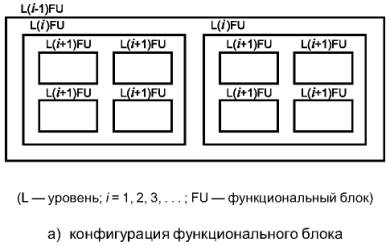
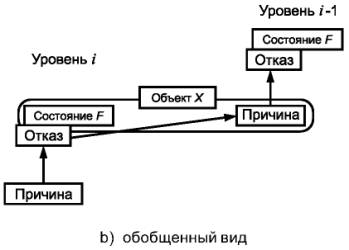
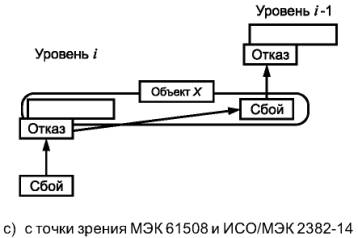
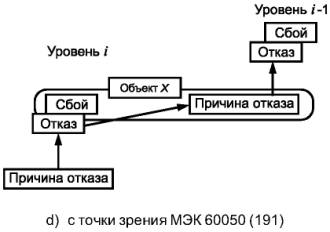
Примечания
1. Как показано на рисунке 4а), функциональный блок может быть представлен в виде многоуровневой иерархической конструкции, каждый из уровней которой может быть, в свою очередь, назван функциональным блоком. На уровне i «причина» может проявить себя как ошибка (отклонение от правильного значения или состояния) в пределах функционального блока, соответствующего данному уровню i. Если она не будет исправлена или нейтрализована, эта ошибка может привести к отказу данного функционального блока, который в результате перейдет в состояние F, в котором он более не может выполнять необходимую функцию (см. рисунок 4b)). Данное состояние F уровня i может в свою очередь проявиться в виде ошибки на уровне функционального блока i - 1, которая, если она не будет исправлена или нейтрализована, может привести к отказу функционального блока уровня i - 1.
2. В этой причинно-следственной цепочке один и тот же элемент («объект X») может рассматриваться как состояние F функционального блока уровня i, в которое он попадает в результате отказа, а также как причина отказа функционального блока уровня i - 1. Данный «объект X» объединяет концепцию «отказа» в МЭК 61508 и ИСО/МЭК 2382-14, в которой внимание акцентируется на причинном аспекте, как показано на рисунке 4с), и концепцию «отказа» из МЭС 60050(191), в которой основное внимание уделено аспекту состояния, как показано на рисунке 4d). В МЭС 60050(191) состояние F называется отказом, а в МЭК 61508 и ИСО/МЭК 2382-14 оно не определено.
3. В некоторых случаях отказ или ошибка могут быть вызваны внешним событием, таким как молния или электростатические помехи, а не внутренним отказом. Более того, ошибка (в обоих словарях) может возникать без предшествующего отказа. Примером такой ошибки может быть ошибка проектирования.
Рисунок 4 - Модель отказа
Источник: ГОСТ Р МЭК 61508-4-2007: Функциональная безопасность систем электрических, электронных, программируемых электронных, связанных с безопасностью. Часть 4. Термины и определения оригинал документа
3.21 отказ (failure): Отклонение реального функционирования от запланированного (см. рисунок 3). [МЭК 60880-2, пункт 3.8]
Примечание 1 - Отказ является результатом сбоя в аппаратуре, программном обеспечении, системе или ошибки оператора или обслуживания и отражается на прохождении сигнала.
Примечание 2 - См. также «дефект», «отказ программного обеспечения».
Источник: ГОСТ Р МЭК 61513-2011: Атомные станции. Системы контроля и управления, важные для безопасности. Общие требования оригинал документа
3.22 отказ (failure): Событие, заключающееся в нарушении работоспособного состояния элементов или систем платформы.
Источник: ГОСТ Р 54483-2011: Нефтяная и газовая промышленность. Платформы морские для нефтегазодобычи. Общие требования оригинал документа
3.1.7. отказ (fauit):
Состояние объекта, характеризуемое неспособностью выполнять требуемую функцию, за исключением состояний, связанных с предупредительным техническим обслуживанием или другими плановыми мероприятиями, или вследствие недостатка внешних ресурсов.
Примечание 1. - Отказ часто является результатом повреждения самого объекта, но может произойти и без предварительного повреждения объекта.
(МЭК 60204-1, п. 3.24).
Источник: ГОСТ Р МЭК 60519-1-2005: Безопасность электротермического оборудования. Часть 1. Общие требования оригинал документа
3.1.29 отказ (failure): Окончание способности изделия выполнять требуемую функцию.
Источник: ГОСТ Р 54828-2011: Комплектные распределительные устройства в металлической оболочке с элегазовой изоляцией (КРУЭ) на номинальные напряжения 110 кВ и выше. Общие технические условия оригинал документа
Русско-английский словарь нормативно-технической терминологии > отказ
См. также в других словарях:
Ability Office — is an office suite for Microsoft Windows published by Ability Plus Software. An alpha version of Ability Office for Linux has been developed but work has stalled on this version.Ability Office is a low cost (although not free like the similarly… … Wikipedia
function — n 1 Function, office, duty, province are comparable when they mean the act, acts, activities, or operations expected of a person or thing by virtue of his or its nature, structure, status, or position. Function is the most comprehensive of these… … New Dictionary of Synonyms
Function cost analysis — (FСА) (sometimes named function value analysis (FVA)) is the a method of technical and economic research of the systems for purpose to optimize a parity between system s (as product or service) consumer functions or properties (also known as… … Wikipedia
function — 1. The special action or physiologic property of an organ or other part of the body. 2. To perform its special work or office, said of an organ or other part of the body. 3. The general properties of any substance, depending on its chemical … Medical dictionary
Function-level programming — In computer science, function level programming refers to one of the two contrasting programming paradigms identified by John Backus in his work on programs as mathematical objects, the other being value level programming.In his 1977 Turing award … Wikipedia
Function generator — [ http://www.agilent.com/u2761a U2761A] USB Modular Function Generator from Agilent Technologies] A function generator is a piece of electronic test equipment or software used to generate electrical waveforms. These waveforms can be either… … Wikipedia
function — func|tion1 [ fʌŋkʃən ] noun *** 1. ) count or uncount the job that something is designed to do: The function of advertising is to create a unique image for your company. perform a function: All the backup systems performed their function… … Usage of the words and phrases in modern English
function — I UK [ˈfʌŋkʃ(ə)n] / US noun Word forms function : singular function plural functions *** 1) a) [countable/uncountable] the job that something is designed to do The function of advertising is to create a unique image for your company. perform a… … English dictionary
function as sth — UK US function as sth Phrasal Verb with function({{}}/ˈfʌŋkʃən/ verb [I] ► to do a particular job or task, especially when this is not your usual job or task: »Delivery men now function as account managers equipped with tools for pricing,… … Financial and business terms
ability — The physical, mental, or legal competence to function. [L. habilitas, aptitude] … Medical dictionary
Window function — For the term used in SQL statements, see Window function (SQL) In signal processing, a window function (also known as an apodization function or tapering function[1]) is a mathematical function that is zero valued outside of some chosen interval … Wikipedia
