

-
1 Wassererosion
водная эрозия
—
[ http://www.eionet.europa.eu/gemet/alphabetic?langcode=en]EN
water erosion
The breakdown of solid rock into smaller particles and its removal by water. As weathering, erosion is a natural geological process, but more rapid soil erosion results from poor land-use practices, leading to the loss of fertile topsoil and to the silting of dams, lakes, rivers and harbours. There are three classes of erosion by water. a) Splash erosion occurs when raindrops strike bare soil, causing it to splash, as mud, to flow into spaces in the soil and to turn the upper layer of soil into a structureless, compacted mass that dries with a hard, largely impermeable crust. b) Surface flow occurs when soil is removed with surface run-off during heavy rain. c) Channelized flow occurs when a flowing mixture of water and soil cuts a channel, which is then deepened by further scouring. A minor erosion channel is called a rill, a larger channel a gully. (Source: ALL)
[http://www.eionet.europa.eu/gemet/alphabetic?langcode=en]Тематики
EN
DE
FR
Немецко-русский словарь нормативно-технической терминологии > Wassererosion
-
2 energiebedingte Umweltbelastung
воздействие производства энергии на окружающую среду
—
[ http://www.eionet.europa.eu/gemet/alphabetic?langcode=en]EN
environmental impact of energy
Energy and environmental problems are closely related, since it is nearly impossible to produce, transport, or consume energy without significant environmental impact. The environmental problems directly related to energy production and consumption include air pollution, water pollution, thermal pollution, and solid waste disposal. The emission of air pollutants from fossil fuel combustion is the major cause of urban air pollution. Diverse water pollution problems are associated with energy usage. One major problem is oil spills. In all petroleum-handling operations, there is a finite probability of spilling oil either on the earth or in a body of water. Coal mining can also pollute water. Changes in groundwater flow produced by mining operations often bring otherwise unpolluted waters into contact with certain mineral materials which are leached from the soil and produce an acid mine drainage. Solid waste is also a by-product of some forms of energy usage. Coal mining requires the removal of large quantities of earth as well as coal. In general, environmental problems increase with energy use and this combined with the limited energy resource base is the crux of the energy crisis. An energy impact assessment should compare these costs with the benefits to be derived from energy use. (Source: RAU)
[http://www.eionet.europa.eu/gemet/alphabetic?langcode=en]Тематики
EN
DE
FR
Немецко-русский словарь нормативно-технической терминологии > energiebedingte Umweltbelastung
-
3 Ein-Aus-Kontaktzeit
время включения-отключения
Интервал времени между моментом появления тока в одном полюсе и моментом окончательного угасания дуг во всех полюсах, причем расцепитель размыкания начинает срабатывать в момент появления тока в главной цепи.
МЭК 60050(441-17-43).
[ ГОСТ Р 50030. 1-2000 ( МЭК 60947-1-99)]EN
make-break time
the interval of time between the instant when the current begins to flow in a pole and the instant of final arc extinction in all poles, with the opening release energized at the instant when current begins to flow in the main circuit
[IEV number 441-17-43]FR
durée d'établissement-coupure
intervalle de temps entre l'instant où le courant commence à circuler dans un pôle et l'instant de l'extinction finale des arcs sur tous les pôles, le déclencheur étant alimenté à l'instant où le courant commence à circuler dans le circuit principal
[IEV number 441-17-43]Тематики
- аппарат, изделие, устройство...
- выключатель автоматический
- выключатель, переключатель
- высоковольтный аппарат, оборудование...
EN
DE
FR
Немецко-русский словарь нормативно-технической терминологии > Ein-Aus-Kontaktzeit
-
4 Ein-Ausschaltzeit
время включения-отключения
Интервал времени между моментом появления тока в одном полюсе и моментом окончательного угасания дуг во всех полюсах, причем расцепитель размыкания начинает срабатывать в момент появления тока в главной цепи.
МЭК 60050(441-17-43).
[ ГОСТ Р 50030. 1-2000 ( МЭК 60947-1-99)]EN
make-break time
the interval of time between the instant when the current begins to flow in a pole and the instant of final arc extinction in all poles, with the opening release energized at the instant when current begins to flow in the main circuit
[IEV number 441-17-43]FR
durée d'établissement-coupure
intervalle de temps entre l'instant où le courant commence à circuler dans un pôle et l'instant de l'extinction finale des arcs sur tous les pôles, le déclencheur étant alimenté à l'instant où le courant commence à circuler dans le circuit principal
[IEV number 441-17-43]Тематики
- аппарат, изделие, устройство...
- выключатель автоматический
- выключатель, переключатель
- высоковольтный аппарат, оборудование...
EN
DE
FR
Немецко-русский словарь нормативно-технической терминологии > Ein-Ausschaltzeit
-
5 Elektrodenpolarisation, f
поляризация электрода химического источника тока
поляризация электрода
Разность между потенциалом электрода при разряде или заряде и его потенциалом при равновесном состоянии в отсутствии тока.
[ ГОСТ 15596-82]EN
electrode polarization
difference between the electrode potential with current flow, and the electrode potential without current flow, i.e. the equilibrium potential
[IEV number 482-03-02]FR
polarisation d’électrode, f
différence entre le potentiel d’électrode avec circulation de courant, et le potentiel d’électrode sans circulation de courant, c’est-à-dire le potentiel d’équilibre
[IEV number 482-03-02]Тематики
Классификация
>>>Синонимы
EN
DE
- Elektrodenpolarisation, f
FR
- polarisation d’électrode, f
Немецко-русский словарь нормативно-технической терминологии > Elektrodenpolarisation, f
-
6 Dauerstrombelastbarkeit, f
(длительный) допустимый ток
Максимальное значение электрического тока, который может протекать длительно по проводнику, устройству или аппарату при определенных условиях без превышения определенного значения их температуры в установившемся режиме
[ ГОСТ Р МЭК 60050-826-2009]
Этот ток обозначают IZ
[ ГОСТ Р 50571. 1-2009 ( МЭК 60364-1: 2005)]EN
(continuous) current-carrying capacity
ampacity (US)
maximum value of electric current which can be carried continuously by a conductor, a device or an apparatus, under specified conditions without its steady-state temperature exceeding a specified value
[IEV number 826-11-13]
ampacity
The current in amperes that a conductor can carry continuously under the conditions of use without exceeding its temperature rating.
[National Electrical Cod]FR
courant (permanent) admissible, m
valeur maximale du courant électrique qui peut parcourir en permanence, un conducteur, un dispositif ou un appareil, sans que sa température de régime permanent, dans des conditions données, soit supérieure à la valeur spécifiée
[IEV number 826-11-13]Ampacity, the term is defined as the maximum amount of current a cable can carry before sustaining immediate or progressive deterioration. Also described as current rating or current-carrying capacity, is the RMS electric current which a device can continuously carry while remaining within its temperature rating. The ampacity of a cable depends on:
- its insulation temperature rating;
- conductor electrical properties for current;
- frequency, in the case of alternating currents;
- ability to dissipate heat, which depends on cable geometry and its surroundings;
- ambient temperature.
Electric wires have some resistance, and electric current flowing through them causes voltage drop and power dissipation, which heats the cable. Copper or aluminum can conduct a large amount of current before melting, but long before the conductors melt, their insulation would be damaged by the heat.
The ampacity for a power cable is thus based on physical and electrical properties of the material & construction of the conductor and of its insulation, ambient temperature, and environmental conditions adjacent to the cable. Having a large overall surface area may dissipate heat well if the environment can absorb the heat.
In a long run of cable, different conditions govern, and installation regulations normally specify that the most severe condition along the run governs the cable's rating. Cables run in wet or oily locations may carry a lower temperature rating than in a dry installation. Derating is necessary for multiple circuits in close proximity. When multiple cables are near, each contributes heat to the others and diminishes the amount of cooling air that can flow past the individual cables. The overall ampacity of the insulated conductors in a bundle of more than 3 must be derated, whether in a raceway or cable. Usually the de-rating factor is tabulated in a nation's wiring regulations.
Depending on the type of insulating material, common maximum allowable temperatures at the surface of the conductor are 60, 75 and 90 degrees Celsius, often with an ambient air temperature of 30°C. In the U.S., 105°C is allowed with ambient of 40°C, for larger power cables, especially those operating at more than 2 kV. Likewise, specific insulations are rated 150, 200 or 250°C.
The allowed current in cables generally needs to be decreased (derated) when the cable is covered with fireproofing material.
For example, the United States National Electric Code, Table 310-16, specifies that up to three 8 AWG copper wires having a common insulating material (THWN) in a raceway, cable, or direct burial has an ampacity of 50 A when the ambient air is 30°C, the conductor surface temperature allowed to be 75°C. A single insulated conductor in air has 70 A rating.
Ampacity rating is normally for continuous current, and short periods of overcurrent occur without harm in most cabling systems. The acceptable magnitude and duration of overcurrent is a more complex topic than ampacity.
When designing an electrical system, one will normally need to know the current rating for the following:- Wires
- Printed Circuit Board traces, where included
- Fuses
- Circuit breakers
- All or nearly all components used
Some devices are limited by power rating, and when this power rating occurs below their current limit, it is not necessary to know the current limit to design a system. A common example of this is lightbulb holders.
[http://en.wikipedia.org/wiki/Ampacity]
Тематики
- электротехника, основные понятия
Синонимы
EN
DE
- Dauerstrombelastbarkeit, f
- Strombelastbarkeit, f
FR
- courant admissible, m
- courant permanent admissible, m
Немецко-русский словарь нормативно-технической терминологии > Dauerstrombelastbarkeit, f
-
7 Strombelastbarkeit, f
(длительный) допустимый ток
Максимальное значение электрического тока, который может протекать длительно по проводнику, устройству или аппарату при определенных условиях без превышения определенного значения их температуры в установившемся режиме
[ ГОСТ Р МЭК 60050-826-2009]
Этот ток обозначают IZ
[ ГОСТ Р 50571. 1-2009 ( МЭК 60364-1: 2005)]EN
(continuous) current-carrying capacity
ampacity (US)
maximum value of electric current which can be carried continuously by a conductor, a device or an apparatus, under specified conditions without its steady-state temperature exceeding a specified value
[IEV number 826-11-13]
ampacity
The current in amperes that a conductor can carry continuously under the conditions of use without exceeding its temperature rating.
[National Electrical Cod]FR
courant (permanent) admissible, m
valeur maximale du courant électrique qui peut parcourir en permanence, un conducteur, un dispositif ou un appareil, sans que sa température de régime permanent, dans des conditions données, soit supérieure à la valeur spécifiée
[IEV number 826-11-13]Ampacity, the term is defined as the maximum amount of current a cable can carry before sustaining immediate or progressive deterioration. Also described as current rating or current-carrying capacity, is the RMS electric current which a device can continuously carry while remaining within its temperature rating. The ampacity of a cable depends on:
- its insulation temperature rating;
- conductor electrical properties for current;
- frequency, in the case of alternating currents;
- ability to dissipate heat, which depends on cable geometry and its surroundings;
- ambient temperature.
Electric wires have some resistance, and electric current flowing through them causes voltage drop and power dissipation, which heats the cable. Copper or aluminum can conduct a large amount of current before melting, but long before the conductors melt, their insulation would be damaged by the heat.
The ampacity for a power cable is thus based on physical and electrical properties of the material & construction of the conductor and of its insulation, ambient temperature, and environmental conditions adjacent to the cable. Having a large overall surface area may dissipate heat well if the environment can absorb the heat.
In a long run of cable, different conditions govern, and installation regulations normally specify that the most severe condition along the run governs the cable's rating. Cables run in wet or oily locations may carry a lower temperature rating than in a dry installation. Derating is necessary for multiple circuits in close proximity. When multiple cables are near, each contributes heat to the others and diminishes the amount of cooling air that can flow past the individual cables. The overall ampacity of the insulated conductors in a bundle of more than 3 must be derated, whether in a raceway or cable. Usually the de-rating factor is tabulated in a nation's wiring regulations.
Depending on the type of insulating material, common maximum allowable temperatures at the surface of the conductor are 60, 75 and 90 degrees Celsius, often with an ambient air temperature of 30°C. In the U.S., 105°C is allowed with ambient of 40°C, for larger power cables, especially those operating at more than 2 kV. Likewise, specific insulations are rated 150, 200 or 250°C.
The allowed current in cables generally needs to be decreased (derated) when the cable is covered with fireproofing material.
For example, the United States National Electric Code, Table 310-16, specifies that up to three 8 AWG copper wires having a common insulating material (THWN) in a raceway, cable, or direct burial has an ampacity of 50 A when the ambient air is 30°C, the conductor surface temperature allowed to be 75°C. A single insulated conductor in air has 70 A rating.
Ampacity rating is normally for continuous current, and short periods of overcurrent occur without harm in most cabling systems. The acceptable magnitude and duration of overcurrent is a more complex topic than ampacity.
When designing an electrical system, one will normally need to know the current rating for the following:- Wires
- Printed Circuit Board traces, where included
- Fuses
- Circuit breakers
- All or nearly all components used
Some devices are limited by power rating, and when this power rating occurs below their current limit, it is not necessary to know the current limit to design a system. A common example of this is lightbulb holders.
[http://en.wikipedia.org/wiki/Ampacity]
Тематики
- электротехника, основные понятия
Синонимы
EN
DE
- Dauerstrombelastbarkeit, f
- Strombelastbarkeit, f
FR
- courant admissible, m
- courant permanent admissible, m
Немецко-русский словарь нормативно-технической терминологии > Strombelastbarkeit, f
-
8 unbeeinflußter Strom (in einem Stromkreis in bezug auf ein Schaltgerät oder eine Sicherung)
- ожидаемый ток цепи (по отношению к коммутационному аппарату или плавкому предохранителю)
ожидаемый ток цепи (по отношению к коммутационному аппарату или плавкому предохранителю)
Ток, который протекал бы в цепи, если бы каждый полюс коммутационного аппарата или плавкого предохранителя был заменен проводником с пренебрежимо малым полным сопротивлением.
МЭК 60050(441-17-01).
Примечание. Метод оценки и выражения ожидаемого тока должен быть уточнен в соответствующем стандарте на аппарат.
[ ГОСТ Р 50030. 1-2000 ( МЭК 60947-1-99)]EN
prospective current (of a circuit and with respect to a switching device or a fuse)
current that would flow in the circuit if each pole of the switching device or the fuse were replaced by a conductor of negligible impedance.
NOTE - The method to be used to evaluate and to express the prospective current is to be specified in the relevant publications.
[IEC 61095, ed. 2.0 (2009-02)]FR
courant présumé (d'un circuit et relatif à un appareil de connexion ou à un fusible)
courant qui circulerait dans le circuit si chaque pôle de l'appareil de connexion ou le fusible était remplacé par un conducteur d'impédance négligeable
NOTE - La méthode à employer pour évaluer et pour exprimer le courant présumé doit être spécifiée dans les publications correspondantes.
[IEC 61095, ed. 2.0 (2009-02)]Тематики
- выключатель автоматический
- выключатель, переключатель
EN
- prospective current (of a circuit and with respect to a switching device or a fuse)
DE
- unbeeinflußter Strom (in einem Stromkreis in bezug auf ein Schaltgerät oder eine Sicherung)
FR
- courant présumé (d'un circuit et relatif à un appareil de connexion ou à un fusible)
Немецко-русский словарь нормативно-технической терминологии > unbeeinflußter Strom (in einem Stromkreis in bezug auf ein Schaltgerät oder eine Sicherung)
-
9 Kaplan-Turbine
поворотно-лопастная гидравлическая турбина
поворотно-лопастная гидротурбина
Осевая или диагональная гидравлическая турбина с поворотными лопастями рабочего колеса.
[ ГОСТ 23956-80]EN
Kaplan turbine
an axial hydraulic reaction type turbine with adjustable runner blades operated with a high flow rate
[IEV ref 602-02-15]FR
turbine Kaplan
turbine hydraulique axiale à réaction dont le rotor est une hélice à aubes orientables en fonctionnement, adaptée aux débits élevés
[IEV ref 602-02-15]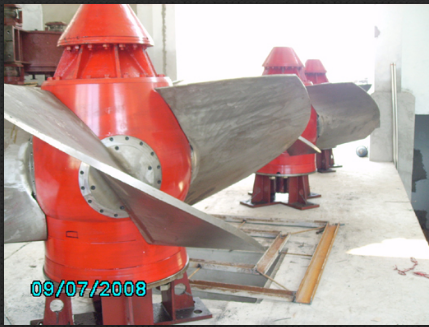
Тематики
Синонимы
EN
DE
FR
9. Поворотно-лопастная гидравлическая турбина
Поворотно-лопастная гидротурбина
D. Kaplan-Turbine
Е. Kaplan turbine
F. Turbine Kaplan
Осевая или диагональная гидравлическая турбина с поворотными лопастями рабочего колеса
Источник: ГОСТ 23956-80: Турбины гидравлические. Термины и определения оригинал документа
Немецко-русский словарь нормативно-технической терминологии > Kaplan-Turbine
-
10 Francis-Turbine
радиально-осевая гидравлическая турбина
радиально-осевая гидротурбина
Гидравлическая турбина, в рабочем колесе которой вода движется по криволинейным поверхностям вращения, изменяющим направление потока от радиального к осевому.
[ ГОСТ 23956-80]EN
Francis turbine
a hydraulic reaction type turbine with fixed runner blades usually operated from a medium or low head source with medium flow rate
[IEV ref 602-02-14]FR
turbine Francis
turbine hydraulique à réaction possédant des aubes fixes, adaptée aux faibles et moyennes chutes à débit moyen
[IEV ref 602-02-14]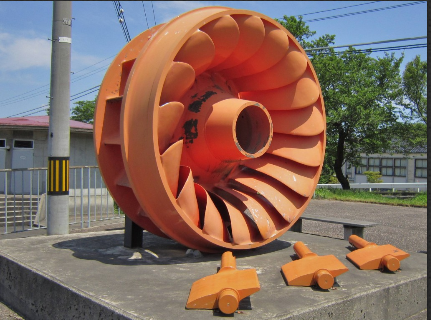
Тематики
Синонимы
EN
DE
FR
11. Радиально-осевая гидравлическая турбина
Радиально-осевая гидротурбина
D. Francis-Turbine
Е. Francis turbine
F. Turbine Francis
Гидравлическая турбина, в рабочем колесе которой вода движется по криволинейным поверхностям вращения, изменяющим направление потока от радиального к осевому
Источник: ГОСТ 23956-80: Турбины гидравлические. Термины и определения оригинал документа
Немецко-русский словарь нормативно-технической терминологии > Francis-Turbine
-
11 Pelton-Turbine
ковшовая гидравлическая турбина
ковшовая гидротурбина
Ндп. тангенциальная гидравлическая турбина
свободноструйная гидравлическая турбина
Активная гидравлическая турбина, лопасти рабочего колеса которой имеют форму ковша.
[ ГОСТ 23956-80]EN
Pelton turbine
a hydraulic impulse type turbine usually operated from a high head source with small flow rate
[IEV ref 602-02-13]FR
turbine Pelton
turbine hydraulique à action convenant aux très hautes chutes à faibles débits
[IEV ref 602-02-13]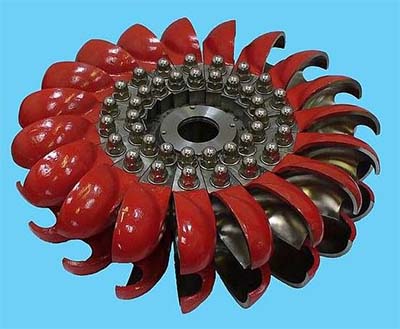
Недопустимые, нерекомендуемые
Тематики
Синонимы
EN
DE
FR
3. Ковшовая гидравлическая турбина
Ковшовая гидротурбина
Ндп. Тангенциальная гидравлическая турбина
Свободноструйная гидравлическая турбина
D. Pelton-Turbine
Е. Pelton turbine
F. Turbine Pelton
Активная гидравлическая турбина, лопасти рабочего колеса которой имеют форму ковша
Источник: ГОСТ 23956-80: Турбины гидравлические. Термины и определения оригинал документа
Немецко-русский словарь нормативно-технической терминологии > Pelton-Turbine
-
12 Plastik
пластмасса
—
[ http://www.eionet.europa.eu/gemet/alphabetic?langcode=en]EN
plastic
A polymeric material (usually organic) of large molecular weight which can be shaped by flow; usually refers to the final product with fillers, plasticizers, pigments, and stabilizers included (versus the resin, the homogeneous polymeric starting material); examples are polyvinyl chloride, polyethylene, and urea-formaldehyde. (Source: MGH)
[http://www.eionet.europa.eu/gemet/alphabetic?langcode=en]Тематики
EN
DE
FR
Немецко-русский словарь нормативно-технической терминологии > Plastik
-
13 axial Pumpe mit einstellbaren oder verstellbaren Schaufeln
поворотно-лопастной насос
Осевой насос, в котором положение лопастей рабочего колеса может регулироваться.
[ ГОСТ 17398-72]Тематики
EN
DE
FR
Немецко-русский словарь нормативно-технической терминологии > axial Pumpe mit einstellbaren oder verstellbaren Schaufeln
-
14 Ernte nach der Fliess- und Umschlagverfahren
поточно-перевалочный способ уборки сахарной свеклы
-
[ ГОСТ 20578-85]Тематики
Обобщающие термины
EN
DE
FR
Немецко-русский словарь нормативно-технической терминологии > Ernte nach der Fliess- und Umschlagverfahren
-
15 freier Kapitalverkehr
свободное движение капитала
—
[ http://www.eionet.europa.eu/gemet/alphabetic?langcode=en]EN
free movement of capital
The unrestrained flow of cash, funds, and other means of wealth between countries with different currencies. (Source: RHW)
[http://www.eionet.europa.eu/gemet/alphabetic?langcode=en]Тематики
EN
DE
FR
Немецко-русский словарь нормативно-технической терминологии > freier Kapitalverkehr
-
16 Meereskreislauf
циркуляция морской воды
—
[ http://www.eionet.europa.eu/gemet/alphabetic?langcode=en]EN
sea circulation
Large-scale horizontal water motion within an ocean. The way energy from the sun, stored in the sea, is transported around the world. The currents explain, for example, why the UK has ice-free ports in winter, while St. Petersburg, at the same latitude as the Shetland Islands, needs ice breakers. Evidence is growing that the world's ocean circulation was very different during the last ice age and has changed several times in the distant past, with dramatic effects on climate. The oceans are vital as storehouses, as they absorb more than half the sun's heat reaching the earth. This heat, which is primarily absorbed near the equator is carried around the world and released elsewhere, creating currents which last up to 1.000 years. As the Earth rotates and the wind acts upon the surface, currents carry warm tropical water to the cooler parts of the world. The strength and direction of the currents are affected by landmasses, bottlenecks through narrow straits, and even the shape of the sea-bed. When the warm water reaches polar regions its heat evaporates into the atmosphere, reducing its temperature and increasing its density. When sea-water freezes it leaves salt behind in the unfrozen water and this cold water sinks into the ocean and begins to flow back to the tropics. Eventually it is heated and begins the cycle all over again. (Source: MGH / WRIGHT)
[http://www.eionet.europa.eu/gemet/alphabetic?langcode=en]Тематики
EN
DE
FR
Немецко-русский словарь нормативно-технической терминологии > Meereskreislauf
См. также в других словарях:
Flow with the Tide — Infobox Album | Name = Flow with the Tide Type = EP Artist = Peach Released = 1991 Recorded = Genre = Metal Length = Label = Mad Minute Records Producer = Reviews = Last album = This album = Flow with the Tide 1991 Next album = Don t Make Me Your … Wikipedia
Let the River Flow with Darrell Evans — Infobox Album | Name = Let the River Flow with Darrell Evans Type = Live Album Artist = Darrell Evans Released = 1997 Recorded = Genre = Worship music Length = 67:39 Label = Hosanna! Music Producer = Paul Mills Chris Long and Don Moen(executive… … Wikipedia
Telephone call flow with simple after-operation — 184 Источник: ГОСТ 19472 88: Система автоматизированной телефонной связи общегосударственная. Термины и определения … Словарь-справочник терминов нормативно-технической документации
Flow measurement — is the quantification of bulk fluid movement. Flow can be measured in a variety of ways. Positive displacement flow meters acumulate a fixed volume of fluid and then count the number of times the volume is filled to measure flow. Other flow… … Wikipedia
Flow — (fl[=o]), v. i. [imp. & p. p. {Flowed} (fl[=o]d); p. pr. & vb. n. {Flowing}.] [AS. fl[=o]wan; akin to D. vloeijen, OHG. flawen to wash, Icel. fl[=o]a to deluge, Gr. plw ein to float, sail, and prob. ultimately to E. float, fleet. [root]80. Cf.… … The Collaborative International Dictionary of English
flow, creep — Flow with a creeping motion where inertial terms have been dropped [16] … Lexicon of Cave and Karst Terminology
Flow network — In graph theory, a flow network is a directed graph where each edge has a capacity and each edge receives a flow. The amount of flow on an edge cannot exceed the capacity of the edge. Often in Operations Research, a directed graph is called a… … Wikipedia
flow — fləʊ n. act of flowing; movement of a liquid; something which flows; steady progression (of things, events, etc.); outpouring, outflow; rate of flowing; flood, overflowing; menstruation; (Slang) act of performing rap music v. move along… … English contemporary dictionary
Flow (psychology) — Flow is the mental state of operation in which the person is fully immersed in what he or she is doing by a feeling of energized focus, full involvement, and success in the process of the activity. Proposed by positive psychologist Mihály… … Wikipedia
Flow-FISH — (fluorescent in situ hybridization) is a cytogenetic technique to quantify the copy number of specific repetitive elements in genomic DNA of whole cell populations via the combination of flow cytometry with cytogenetic fluorescent in situ… … Wikipedia
Flow my tears — is a lute song (specifically, an ayre ) by the accomplished lutenist and composer John Dowland. Flow my tears is Dowland s most famous ayre, [Greer] and became his signature song, literally as well as metaphorically: he would occasionally sign… … Wikipedia
