

-
1 elektrischer Stuhl
electric chair* * *(a chair used to execute criminals by sending a powerful electric current through them.) electric chair* * *m.electric chair n. -
2 der Strom
- {current} dòng, luồng, dòng điện, chiều, hướng - {flood} lũ, lụt, nạn lụt, dòng cuồn cuộn, sự tuôn ra, sự chảy tràn ra &), nước triều lên flood-tide), sông, suối biển,, flood-light - {flow} sự chảy, lượng chảy, lưu lượng, luồng nước, nước triều lên, sự đổ hàng hoá vào một nước, sự bay dập dờn - {flux} sự chảy mạnh, sự thay đổi liên tục, thông lượng, chất gây cháy, sự băng huyết, bệnh kiết lỵ - {gush} sự phun ra, sự vọt ra, sự bộc lộ tràn trề, sự thổ lộ tràn trề - {jet} huyền, màu đen nhánh, màu đen như hạt huyền, tia, vòi, vòi phun, giclơ, máy bay phản lực - {river} dòng sông, dòng chảy tràn ngập, dòng chảy lai láng, ranh giới giữa sự sống với sự chết - {stream} dòng suối, dòng sông nhỏ, chiều nước chảy - {tide} triều, thuỷ triều, con nước, dòng nước, dòng chảy, chiều hướng, xu hướng, trào lưu, dư luận - {torrent} dòng nước chảy xiết, dòng nước lũ - {volley} loạt, tràng, chuỗi, quả vôlê = Strom! {juice!}+ = Strom führen {to be alive}+ = mit dem Strom {with the stream}+ = der reißende Strom {torrent}+ = gegen den Strom {against the current; against the stream}+ = der elektrische Strom {electric current; juice}+ = mit dem Strom treiben {to tide over}+ = mit dem Strom schwimmen {to float with the current}+ = der Draht steht unter Strom {that's a live wire}+ = gegen den Strom schwimmen {to swim against the tide}+ = gegen den Strom ankämpfen {to stem the current}+ -
3 Strom
m; -(e)s, Ströme2. von Luft, Lava, Blut, Tränen, Menschen, Verkehr etc.: stream; stärker: torrent; endloser Strom von Menschen, Verkehr etc.: endless stream; Strom von Worten flood of words; in Strömen fließen Sekt etc.: flow like water; es gießt in Strömen it’s pouring3. (Strömung) current (auch fig.); mit dem / gegen den Strom schwimmen swim with / against the current (fig. tide); fig. auch go with / against the flow4. ETECH. (electric) current; weitS. (Elektrizität) electricity; (Stromzufuhr) auch power (supply), electricity supply; grüner Strom green electricity (not produced in a nuclear power station); der Strom fiel aus there was a power failure; der Strom wird abgeschaltet the electricity is (being cut) off, we are having a power cut; Strom führendes oder unter Strom stehendes Kabel live wire ( größer: cable); unter Strom stehen Kabel etc.: be live; dauernd unter Strom stehen fig. be constantly on the go; Strom sparend power-saving* * *der Strom(Elektrizität) juice; electric current; current; power;(Gewässer) torrent; river; stream;(Schwall) gush; volley; stream;(Strömung) current; stream* * *[ʃtroːm]m -(e)s, -e['ʃtrøːmə]1) (large) river; (= Strömung) current; (von Schweiß, Blut) river; (von Besuchern, Flüchen etc) streamein reißender Stróm — a raging torrent
ein Stróm von Tränen (geh) — floods of tears pl
in dem or im Stróm der Vergessenheit versinken (geh) — to sink or pass into oblivion
der Stróm seiner Rede (geh) — the torrent or flood of his words
der Stróm der Zeit (geh) — the flow of time
der Stróm der Geschichte (geh) — the course of history
mit dem/gegen den Stróm schwimmen (lit) — to swim with/against the current; (fig) to swim or go with/against the tide
2) (ELEC)(elektrischer) Stróm — current
Stróm führen — to be live
Stróm führend (Elec, Leitung) — live
unter Stróm stehen (lit) — to be live; (fig) to be high (inf)
mit Stróm heizen — to have electric heating
der Stróm ist ausgefallen — the power or electricity is off
* * *der1) ((a) flow of electricity: an electrical current.) current2) (a flow of eg water, air etc: A stream of water was pouring down the gutter; A stream of people was coming out of the cinema; He got into the wrong stream of traffic and uttered a stream of curses.) stream3) (the current of a river etc: He was swimming against the stream.) stream* * *Strom1<-[e]s, Ströme>[ʃtro:m, pl ˈʃtrø:mə]\Strom führen to be liveelektrischer \Strom electric current\Strom führend liveunter \Strom stehen (elektrisch geladen sein) to be live; (überaus aktiv sein) to be a live wire fig famStrom2<-[e]s, Ströme>[ʃtro:m, pl ˈʃtrø:mə]m1. (großer Fluss) [large] river2. (fließende Menge) riverStröme von Blut rivers of bloodein \Strom von Schlamm a torrent of mudin Strömen fließen to flow freely [or like water]das Blut floss in Strömen there were rivers of blood, there was heavy bloodshed3. (Schwarm) streamStröme von Fans/Besuchern/Kunden streams of fans/visitors/customers4.▶ in Strömen gießen [o regnen] to pour [down] [with rain]▶ mit dem/gegen den \Strom schwimmen to swim with/against the current, to swim with/against the tide [or go with/against the flow] fig fam* * *der; Strom[e]s, Ströme1) river; (von Blut, Schweiß, Wasser, fig.): (Erinnerungen, Menschen, Autos usw.) streamin Strömen regnen od. (ugs.) gießen — pour with rain
in Strömen fließen — (fig.) flow freely
das Blut floss in Strömen — (fig.) there was heavy bloodshed
2) (Strömung) currentmit dem/gegen den Strom schwimmen — (fig.) swim with/against the tide (fig.)
3) (Elektrizität) current; (Stromversorgung) electricitydas Kabel führt od. steht unter Strom — the cable is live
* * *1. (Fluss) (large) river;reißender Strom raging torrentendloser Strom von Menschen, Verkehr etc: endless stream;Strom von Worten flood of words;in Strömen fließen Sekt etc: flow like water;es gießt in Strömen it’s pouringmit dem/gegen den Strom schwimmen swim with/against the current (fig tide); fig auch go with/against the flow4. ELEK (electric) current; weitS. (Elektrizität) electricity; (Stromzufuhr) auch power (supply), electricity supply;grüner Strom green electricity (not produced in a nuclear power station);der Strom fiel aus there was a power failure;der Strom wird abgeschaltet the electricity is (being cut) off, we are having a power cut;unter Strom stehendes Kabel live wire ( größer: cable);unter Strom stehen Kabel etc: be live;dauernd unter Strom stehen fig be constantly on the go;Strom sparend power-saving* * *der; Strom[e]s, Ströme1) river; (von Blut, Schweiß, Wasser, fig.): (Erinnerungen, Menschen, Autos usw.) streamin Strömen regnen od. (ugs.) gießen — pour with rain
in Strömen fließen — (fig.) flow freely
das Blut floss in Strömen — (fig.) there was heavy bloodshed
2) (Strömung) currentmit dem/gegen den Strom schwimmen — (fig.) swim with/against the tide (fig.)
3) (Elektrizität) current; (Stromversorgung) electricitydas Kabel führt od. steht unter Strom — the cable is live
* * *¨-e m.current n.electricity n.flow n.flush n.gush n.power n.stream n. -
4 Dauerstrombelastbarkeit, f
(длительный) допустимый ток
Максимальное значение электрического тока, который может протекать длительно по проводнику, устройству или аппарату при определенных условиях без превышения определенного значения их температуры в установившемся режиме
[ ГОСТ Р МЭК 60050-826-2009]
Этот ток обозначают IZ
[ ГОСТ Р 50571. 1-2009 ( МЭК 60364-1: 2005)]EN
(continuous) current-carrying capacity
ampacity (US)
maximum value of electric current which can be carried continuously by a conductor, a device or an apparatus, under specified conditions without its steady-state temperature exceeding a specified value
[IEV number 826-11-13]
ampacity
The current in amperes that a conductor can carry continuously under the conditions of use without exceeding its temperature rating.
[National Electrical Cod]FR
courant (permanent) admissible, m
valeur maximale du courant électrique qui peut parcourir en permanence, un conducteur, un dispositif ou un appareil, sans que sa température de régime permanent, dans des conditions données, soit supérieure à la valeur spécifiée
[IEV number 826-11-13]Ampacity, the term is defined as the maximum amount of current a cable can carry before sustaining immediate or progressive deterioration. Also described as current rating or current-carrying capacity, is the RMS electric current which a device can continuously carry while remaining within its temperature rating. The ampacity of a cable depends on:
- its insulation temperature rating;
- conductor electrical properties for current;
- frequency, in the case of alternating currents;
- ability to dissipate heat, which depends on cable geometry and its surroundings;
- ambient temperature.
Electric wires have some resistance, and electric current flowing through them causes voltage drop and power dissipation, which heats the cable. Copper or aluminum can conduct a large amount of current before melting, but long before the conductors melt, their insulation would be damaged by the heat.
The ampacity for a power cable is thus based on physical and electrical properties of the material & construction of the conductor and of its insulation, ambient temperature, and environmental conditions adjacent to the cable. Having a large overall surface area may dissipate heat well if the environment can absorb the heat.
In a long run of cable, different conditions govern, and installation regulations normally specify that the most severe condition along the run governs the cable's rating. Cables run in wet or oily locations may carry a lower temperature rating than in a dry installation. Derating is necessary for multiple circuits in close proximity. When multiple cables are near, each contributes heat to the others and diminishes the amount of cooling air that can flow past the individual cables. The overall ampacity of the insulated conductors in a bundle of more than 3 must be derated, whether in a raceway or cable. Usually the de-rating factor is tabulated in a nation's wiring regulations.
Depending on the type of insulating material, common maximum allowable temperatures at the surface of the conductor are 60, 75 and 90 degrees Celsius, often with an ambient air temperature of 30°C. In the U.S., 105°C is allowed with ambient of 40°C, for larger power cables, especially those operating at more than 2 kV. Likewise, specific insulations are rated 150, 200 or 250°C.
The allowed current in cables generally needs to be decreased (derated) when the cable is covered with fireproofing material.
For example, the United States National Electric Code, Table 310-16, specifies that up to three 8 AWG copper wires having a common insulating material (THWN) in a raceway, cable, or direct burial has an ampacity of 50 A when the ambient air is 30°C, the conductor surface temperature allowed to be 75°C. A single insulated conductor in air has 70 A rating.
Ampacity rating is normally for continuous current, and short periods of overcurrent occur without harm in most cabling systems. The acceptable magnitude and duration of overcurrent is a more complex topic than ampacity.
When designing an electrical system, one will normally need to know the current rating for the following:- Wires
- Printed Circuit Board traces, where included
- Fuses
- Circuit breakers
- All or nearly all components used
Some devices are limited by power rating, and when this power rating occurs below their current limit, it is not necessary to know the current limit to design a system. A common example of this is lightbulb holders.
[http://en.wikipedia.org/wiki/Ampacity]
Тематики
- электротехника, основные понятия
Синонимы
EN
DE
- Dauerstrombelastbarkeit, f
- Strombelastbarkeit, f
FR
- courant admissible, m
- courant permanent admissible, m
Немецко-русский словарь нормативно-технической терминологии > Dauerstrombelastbarkeit, f
-
5 Strombelastbarkeit, f
(длительный) допустимый ток
Максимальное значение электрического тока, который может протекать длительно по проводнику, устройству или аппарату при определенных условиях без превышения определенного значения их температуры в установившемся режиме
[ ГОСТ Р МЭК 60050-826-2009]
Этот ток обозначают IZ
[ ГОСТ Р 50571. 1-2009 ( МЭК 60364-1: 2005)]EN
(continuous) current-carrying capacity
ampacity (US)
maximum value of electric current which can be carried continuously by a conductor, a device or an apparatus, under specified conditions without its steady-state temperature exceeding a specified value
[IEV number 826-11-13]
ampacity
The current in amperes that a conductor can carry continuously under the conditions of use without exceeding its temperature rating.
[National Electrical Cod]FR
courant (permanent) admissible, m
valeur maximale du courant électrique qui peut parcourir en permanence, un conducteur, un dispositif ou un appareil, sans que sa température de régime permanent, dans des conditions données, soit supérieure à la valeur spécifiée
[IEV number 826-11-13]Ampacity, the term is defined as the maximum amount of current a cable can carry before sustaining immediate or progressive deterioration. Also described as current rating or current-carrying capacity, is the RMS electric current which a device can continuously carry while remaining within its temperature rating. The ampacity of a cable depends on:
- its insulation temperature rating;
- conductor electrical properties for current;
- frequency, in the case of alternating currents;
- ability to dissipate heat, which depends on cable geometry and its surroundings;
- ambient temperature.
Electric wires have some resistance, and electric current flowing through them causes voltage drop and power dissipation, which heats the cable. Copper or aluminum can conduct a large amount of current before melting, but long before the conductors melt, their insulation would be damaged by the heat.
The ampacity for a power cable is thus based on physical and electrical properties of the material & construction of the conductor and of its insulation, ambient temperature, and environmental conditions adjacent to the cable. Having a large overall surface area may dissipate heat well if the environment can absorb the heat.
In a long run of cable, different conditions govern, and installation regulations normally specify that the most severe condition along the run governs the cable's rating. Cables run in wet or oily locations may carry a lower temperature rating than in a dry installation. Derating is necessary for multiple circuits in close proximity. When multiple cables are near, each contributes heat to the others and diminishes the amount of cooling air that can flow past the individual cables. The overall ampacity of the insulated conductors in a bundle of more than 3 must be derated, whether in a raceway or cable. Usually the de-rating factor is tabulated in a nation's wiring regulations.
Depending on the type of insulating material, common maximum allowable temperatures at the surface of the conductor are 60, 75 and 90 degrees Celsius, often with an ambient air temperature of 30°C. In the U.S., 105°C is allowed with ambient of 40°C, for larger power cables, especially those operating at more than 2 kV. Likewise, specific insulations are rated 150, 200 or 250°C.
The allowed current in cables generally needs to be decreased (derated) when the cable is covered with fireproofing material.
For example, the United States National Electric Code, Table 310-16, specifies that up to three 8 AWG copper wires having a common insulating material (THWN) in a raceway, cable, or direct burial has an ampacity of 50 A when the ambient air is 30°C, the conductor surface temperature allowed to be 75°C. A single insulated conductor in air has 70 A rating.
Ampacity rating is normally for continuous current, and short periods of overcurrent occur without harm in most cabling systems. The acceptable magnitude and duration of overcurrent is a more complex topic than ampacity.
When designing an electrical system, one will normally need to know the current rating for the following:- Wires
- Printed Circuit Board traces, where included
- Fuses
- Circuit breakers
- All or nearly all components used
Some devices are limited by power rating, and when this power rating occurs below their current limit, it is not necessary to know the current limit to design a system. A common example of this is lightbulb holders.
[http://en.wikipedia.org/wiki/Ampacity]
Тематики
- электротехника, основные понятия
Синонимы
EN
DE
- Dauerstrombelastbarkeit, f
- Strombelastbarkeit, f
FR
- courant admissible, m
- courant permanent admissible, m
Немецко-русский словарь нормативно-технической терминологии > Strombelastbarkeit, f
-
6 strom
m; -(e)s, Ströme2. von Luft, Lava, Blut, Tränen, Menschen, Verkehr etc.: stream; stärker: torrent; endloser Strom von Menschen, Verkehr etc.: endless stream; Strom von Worten flood of words; in Strömen fließen Sekt etc.: flow like water; es gießt in Strömen it’s pouring3. (Strömung) current (auch fig.); mit dem / gegen den Strom schwimmen swim with / against the current (fig. tide); fig. auch go with / against the flow4. ETECH. (electric) current; weitS. (Elektrizität) electricity; (Stromzufuhr) auch power (supply), electricity supply; grüner Strom green electricity (not produced in a nuclear power station); der Strom fiel aus there was a power failure; der Strom wird abgeschaltet the electricity is (being cut) off, we are having a power cut; Strom führendes oder unter Strom stehendes Kabel live wire ( größer: cable); unter Strom stehen Kabel etc.: be live; dauernd unter Strom stehen fig. be constantly on the go; Strom sparend power-saving* * *der Strom(Elektrizität) juice; electric current; current; power;(Gewässer) torrent; river; stream;(Schwall) gush; volley; stream;(Strömung) current; stream* * *[ʃtroːm]m -(e)s, -e['ʃtrøːmə]1) (large) river; (= Strömung) current; (von Schweiß, Blut) river; (von Besuchern, Flüchen etc) streamein reißender Stróm — a raging torrent
ein Stróm von Tränen (geh) — floods of tears pl
in dem or im Stróm der Vergessenheit versinken (geh) — to sink or pass into oblivion
der Stróm seiner Rede (geh) — the torrent or flood of his words
der Stróm der Zeit (geh) — the flow of time
der Stróm der Geschichte (geh) — the course of history
mit dem/gegen den Stróm schwimmen (lit) — to swim with/against the current; (fig) to swim or go with/against the tide
2) (ELEC)(elektrischer) Stróm — current
Stróm führen — to be live
Stróm führend (Elec, Leitung) — live
unter Stróm stehen (lit) — to be live; (fig) to be high (inf)
mit Stróm heizen — to have electric heating
der Stróm ist ausgefallen — the power or electricity is off
* * *der1) ((a) flow of electricity: an electrical current.) current2) (a flow of eg water, air etc: A stream of water was pouring down the gutter; A stream of people was coming out of the cinema; He got into the wrong stream of traffic and uttered a stream of curses.) stream3) (the current of a river etc: He was swimming against the stream.) stream* * *Strom1<-[e]s, Ströme>[ʃtro:m, pl ˈʃtrø:mə]\Strom führen to be liveelektrischer \Strom electric current\Strom führend liveunter \Strom stehen (elektrisch geladen sein) to be live; (überaus aktiv sein) to be a live wire fig famStrom2<-[e]s, Ströme>[ʃtro:m, pl ˈʃtrø:mə]m1. (großer Fluss) [large] river2. (fließende Menge) riverStröme von Blut rivers of bloodein \Strom von Schlamm a torrent of mudin Strömen fließen to flow freely [or like water]das Blut floss in Strömen there were rivers of blood, there was heavy bloodshed3. (Schwarm) streamStröme von Fans/Besuchern/Kunden streams of fans/visitors/customers4.▶ in Strömen gießen [o regnen] to pour [down] [with rain]▶ mit dem/gegen den \Strom schwimmen to swim with/against the current, to swim with/against the tide [or go with/against the flow] fig fam* * *der; Strom[e]s, Ströme1) river; (von Blut, Schweiß, Wasser, fig.): (Erinnerungen, Menschen, Autos usw.) streamin Strömen regnen od. (ugs.) gießen — pour with rain
in Strömen fließen — (fig.) flow freely
das Blut floss in Strömen — (fig.) there was heavy bloodshed
2) (Strömung) currentmit dem/gegen den Strom schwimmen — (fig.) swim with/against the tide (fig.)
3) (Elektrizität) current; (Stromversorgung) electricitydas Kabel führt od. steht unter Strom — the cable is live
* * *…strom m im subst:Atomstrom nuclear electricity;Batteriestrom battery current;Netzstrom mains (US supply) current* * *der; Strom[e]s, Ströme1) river; (von Blut, Schweiß, Wasser, fig.): (Erinnerungen, Menschen, Autos usw.) streamin Strömen regnen od. (ugs.) gießen — pour with rain
in Strömen fließen — (fig.) flow freely
das Blut floss in Strömen — (fig.) there was heavy bloodshed
2) (Strömung) currentmit dem/gegen den Strom schwimmen — (fig.) swim with/against the tide (fig.)
3) (Elektrizität) current; (Stromversorgung) electricitydas Kabel führt od. steht unter Strom — the cable is live
* * *¨-e m.current n.electricity n.flow n.flush n.gush n.power n.stream n. -
7 Überstrom
сверхток
Любой ток, превышающий номинальный
МЭК 60050(441-11-06).
[ ГОСТ Р 50030. 1-2000 ( МЭК 60947-1-99)]
[ ГОСТ Р 50345-99( МЭК 60898-95)]
сверхток
Электрический ток, превышающий номинальный электрический ток.
Сверхток представляет собой любой электрический ток, величина которого превышает номинальный ток какого-либо элемента электроустановки здания или используемого в ней электрооборудования, например: номинальный ток электрической цепи, допустимый длительный ток проводника, номинальный ток автоматического выключателя и т. д. В нормативной и правовой документации различают два основных вида сверхтока – ток перегрузки и ток короткого замыкания.
Появление сверхтока в каком-либо элементе электроустановки здания может привести к его перегреву, возгоранию и, как следствие, к возникновению пожара в здании. Поэтому в электроустановках зданий выполняют защиту от сверхтока.
[ http://www.volt-m.ru/glossary/letter/%D1/view/59/]
сверхток
сверхток в электротехническом изделии
Ток, значение которого превосходит наибольшее рабочее значение тока электротехнического изделия (устройства).
[ ГОСТ 18311-80]
сверхток
Электрический ток, превышающий номинальный электрический ток.
Примечание - Для проводников номинальный ток считается равным длительному допустимому току.
[ ГОСТ Р МЭК 60050-826-2009]
Сверхток может оказывать или может не оказывать вредные воздействия в зависимости от его величины и продолжительности. Сверхтоки могут возникать в результате перегрузок в электроприемниках или при повреждениях, таких как короткие замыкания или замыканиях на землю
[ ГОСТ Р 50571. 1-2009 ( МЭК 60364-1: 2005)]
сверхток
Любой ток, превышающий номинальное значение. Для проводов номинальным значением является допустимый ток.
[ ГОСТ Р МЭК 60204-1-2007]EN
overcurrent
electric current exceeding the rated electric current
NOTE – For conductors, the rated current is considered as equal to the current-carrying capacity
[IEV number 826-11-14]
over-current
<>current exceeding the rated current
<>[IEC 61095, ed. 2.0 (2009-02)]
over-current
electric current the value of which exceeds a specified limiting value
[IEV number 151-15-28]
[IEV number 442-01-20]FR
surintensité, f
courant électrique supérieur au courant électrique assigné
NOTE – Pour des conducteurs, on considère que le courant assigné est égal au courant admissible.
[IEV number 826-11-14]
surintensité
courant supérieur au courant assigné
[IEC 61095, ed. 2.0 (2009-02)]
[IEV number 442-01-20]
surintensité, f
courant électrique dont la valeur dépasse une valeur limite spécifiée
[IEV number 151-15-28]Параллельные тексты EN-RU The design of LV installations leads to basic protection devices being fitted for three types of faults:
-
overloads
-
short-circuits
-
insulation faults
Низковольтные электроустановки должны быть оснащены устройствами защиты трех типов:
-
от перегрузки;
-
от короткого замыкания;
- от токов утечки.
[Перевод Интент]
Примечание.
Слово fault в данном случае пришлось опустить, поскольку:
- его нельзя перевести как "неисправность", т. к. возникновение перегрузки ( overload) не является неисправностью;
- его нельзя перевести как "сверхток", т. к. ток утечки не является сверхтоком.The chosen switchgear must withstand and eliminate faults at optimised cost with respect to the necessary performance.
[Schneider Electric]Выбранная аппаратура распределения должна иметь такие характеристики, чтобы рентабельно выдерживать и ограничивать сверхтоки.
[Перевод Интент]Тематики
Синонимы
EN
DE
FR
Немецко-русский словарь нормативно-технической терминологии > Überstrom
-
overloads
-
8 Überstrom(stärke)
сверхток
Любой ток, превышающий номинальный
МЭК 60050(441-11-06).
[ ГОСТ Р 50030. 1-2000 ( МЭК 60947-1-99)]
[ ГОСТ Р 50345-99( МЭК 60898-95)]
сверхток
Электрический ток, превышающий номинальный электрический ток.
Сверхток представляет собой любой электрический ток, величина которого превышает номинальный ток какого-либо элемента электроустановки здания или используемого в ней электрооборудования, например: номинальный ток электрической цепи, допустимый длительный ток проводника, номинальный ток автоматического выключателя и т. д. В нормативной и правовой документации различают два основных вида сверхтока – ток перегрузки и ток короткого замыкания.
Появление сверхтока в каком-либо элементе электроустановки здания может привести к его перегреву, возгоранию и, как следствие, к возникновению пожара в здании. Поэтому в электроустановках зданий выполняют защиту от сверхтока.
[ http://www.volt-m.ru/glossary/letter/%D1/view/59/]
сверхток
сверхток в электротехническом изделии
Ток, значение которого превосходит наибольшее рабочее значение тока электротехнического изделия (устройства).
[ ГОСТ 18311-80]
сверхток
Электрический ток, превышающий номинальный электрический ток.
Примечание - Для проводников номинальный ток считается равным длительному допустимому току.
[ ГОСТ Р МЭК 60050-826-2009]
Сверхток может оказывать или может не оказывать вредные воздействия в зависимости от его величины и продолжительности. Сверхтоки могут возникать в результате перегрузок в электроприемниках или при повреждениях, таких как короткие замыкания или замыканиях на землю
[ ГОСТ Р 50571. 1-2009 ( МЭК 60364-1: 2005)]
сверхток
Любой ток, превышающий номинальное значение. Для проводов номинальным значением является допустимый ток.
[ ГОСТ Р МЭК 60204-1-2007]EN
overcurrent
electric current exceeding the rated electric current
NOTE – For conductors, the rated current is considered as equal to the current-carrying capacity
[IEV number 826-11-14]
over-current
<>current exceeding the rated current
<>[IEC 61095, ed. 2.0 (2009-02)]
over-current
electric current the value of which exceeds a specified limiting value
[IEV number 151-15-28]
[IEV number 442-01-20]FR
surintensité, f
courant électrique supérieur au courant électrique assigné
NOTE – Pour des conducteurs, on considère que le courant assigné est égal au courant admissible.
[IEV number 826-11-14]
surintensité
courant supérieur au courant assigné
[IEC 61095, ed. 2.0 (2009-02)]
[IEV number 442-01-20]
surintensité, f
courant électrique dont la valeur dépasse une valeur limite spécifiée
[IEV number 151-15-28]Параллельные тексты EN-RU The design of LV installations leads to basic protection devices being fitted for three types of faults:
-
overloads
-
short-circuits
-
insulation faults
Низковольтные электроустановки должны быть оснащены устройствами защиты трех типов:
-
от перегрузки;
-
от короткого замыкания;
- от токов утечки.
[Перевод Интент]
Примечание.
Слово fault в данном случае пришлось опустить, поскольку:
- его нельзя перевести как "неисправность", т. к. возникновение перегрузки ( overload) не является неисправностью;
- его нельзя перевести как "сверхток", т. к. ток утечки не является сверхтоком.The chosen switchgear must withstand and eliminate faults at optimised cost with respect to the necessary performance.
[Schneider Electric]Выбранная аппаратура распределения должна иметь такие характеристики, чтобы рентабельно выдерживать и ограничивать сверхтоки.
[Перевод Интент]Тематики
Синонимы
EN
DE
FR
Немецко-русский словарь нормативно-технической терминологии > Überstrom(stärke)
-
overloads
-
9 (elektrische) Stromstärke
ток проводимости
Явление направленного движения свободных носителей электрического заряда в веществе или в пустоте, количественно характеризуемое скалярной величиной, равной производной по времени от электрического заряда, переносимого свободными носителями заряда сквозь рассматриваемую поверхность.
[ ГОСТ Р 52002-2003]EN
(electric) current
(conduction) current
scalar quantity equal to the flux of the electric current density J through a given directed surface S:
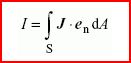
where endA is the vector surface element
NOTE 1 – The electric current through a surface is equal to the limit of the quotient of the electric charge transferred through that surface during a time interval by the duration of this interval when this duration tends to zero.
NOTE 2 – For charge carriers confined to a surface, the electric current is defined through a curve of this surface (see the note to term “lineic electric current”).
[IEV number 121-11-13]FR
courant (électrique), m
courant (de conduction), m
grandeur scalaire égale au flux de la densité de courant électrique J à travers une surface orientée donnée S:
où endA est l'élément vectoriel de surface
NOTE 1 – Le courant électrique à travers une surface est égal à la limite du quotient de la charge électrique traversant cette surface pendant un intervalle de temps par la durée de cet intervalle lorsque cette durée tend vers zéro.
NOTE 2 – Pour des porteurs de charge confinés sur une surface, le courant électrique est défini à travers une courbe de cette surface (voir la note au terme "densité linéique de courant").
[IEV number 121-11-13]Тематики
- электротехника, основные понятия
Синонимы
EN
DE
- (elektrische) Stromstärke
- Leitungsstromstärke
- Stromstärke, (elektrische)
FR
Немецко-русский словарь нормативно-технической терминологии > (elektrische) Stromstärke
-
10 Leitungsstromstärke
ток проводимости
Явление направленного движения свободных носителей электрического заряда в веществе или в пустоте, количественно характеризуемое скалярной величиной, равной производной по времени от электрического заряда, переносимого свободными носителями заряда сквозь рассматриваемую поверхность.
[ ГОСТ Р 52002-2003]EN
(electric) current
(conduction) current
scalar quantity equal to the flux of the electric current density J through a given directed surface S:
where endA is the vector surface element
NOTE 1 – The electric current through a surface is equal to the limit of the quotient of the electric charge transferred through that surface during a time interval by the duration of this interval when this duration tends to zero.
NOTE 2 – For charge carriers confined to a surface, the electric current is defined through a curve of this surface (see the note to term “lineic electric current”).
[IEV number 121-11-13]FR
courant (électrique), m
courant (de conduction), m
grandeur scalaire égale au flux de la densité de courant électrique J à travers une surface orientée donnée S:
où endA est l'élément vectoriel de surface
NOTE 1 – Le courant électrique à travers une surface est égal à la limite du quotient de la charge électrique traversant cette surface pendant un intervalle de temps par la durée de cet intervalle lorsque cette durée tend vers zéro.
NOTE 2 – Pour des porteurs de charge confinés sur une surface, le courant électrique est défini à travers une courbe de cette surface (voir la note au terme "densité linéique de courant").
[IEV number 121-11-13]Тематики
- электротехника, основные понятия
Синонимы
EN
DE
- (elektrische) Stromstärke
- Leitungsstromstärke
- Stromstärke, (elektrische)
FR
Немецко-русский словарь нормативно-технической терминологии > Leitungsstromstärke
-
11 Stromstärke, (elektrische)
ток проводимости
Явление направленного движения свободных носителей электрического заряда в веществе или в пустоте, количественно характеризуемое скалярной величиной, равной производной по времени от электрического заряда, переносимого свободными носителями заряда сквозь рассматриваемую поверхность.
[ ГОСТ Р 52002-2003]EN
(electric) current
(conduction) current
scalar quantity equal to the flux of the electric current density J through a given directed surface S:
where endA is the vector surface element
NOTE 1 – The electric current through a surface is equal to the limit of the quotient of the electric charge transferred through that surface during a time interval by the duration of this interval when this duration tends to zero.
NOTE 2 – For charge carriers confined to a surface, the electric current is defined through a curve of this surface (see the note to term “lineic electric current”).
[IEV number 121-11-13]FR
courant (électrique), m
courant (de conduction), m
grandeur scalaire égale au flux de la densité de courant électrique J à travers une surface orientée donnée S:
où endA est l'élément vectoriel de surface
NOTE 1 – Le courant électrique à travers une surface est égal à la limite du quotient de la charge électrique traversant cette surface pendant un intervalle de temps par la durée de cet intervalle lorsque cette durée tend vers zéro.
NOTE 2 – Pour des porteurs de charge confinés sur une surface, le courant électrique est défini à travers une courbe de cette surface (voir la note au terme "densité linéique de courant").
[IEV number 121-11-13]Тематики
- электротехника, основные понятия
Синонимы
EN
DE
- (elektrische) Stromstärke
- Leitungsstromstärke
- Stromstärke, (elektrische)
FR
Немецко-русский словарь нормативно-технической терминологии > Stromstärke, (elektrische)
-
12 Strom
Strom m 1. COMP electric power, power; 2. LOGIS flow; 3. UMWELT electric current, electricity (elektrischer); 4. FREI, RECHT river (Fluss) • gegen den Strom schwimmen GEN (infrml) buck the trend, go against the stream* * *m 1. < Comp> electric power, power; 2. < Transp> flow; 3. < Umwelt> elektrischer electric current, electricity; 4. <Frei, Recht> Fluss river ■ gegen den Strom schwimmen < Geschäft> buck the trend infrml, go against the stream* * *Strom, schiffbarer
navigable river;
• Strom von Besuchern flood (deluge) of callers;
• Strom von Computerdaten torrent of computer data;
• kontinuierlicher Strom von Einnahmen unbroken string of gains;
• Strom des Verkehrs flow of traffic;
• Strom im ganzen Land abschalten to black out the country;
• Strom sparen to save electricity;
• mit Strom versorgen to supply with electricity;
• Stromabgabe current output, power supply;
• Stromabnehmer (Verbraucher) consumer of electricity, (Ableser) electricity-meter reader, collector, (el.) tap, trolley arm, collector [shoe];
• Stromabschaltung power cut, cut-off of power;
• Stromanliegerstaat riparian state;
• Stromanschluss connection to the mains;
• Stromausfall power (current) failure, [power] blackout;
• Strombedarf power requirements;
• Strom- oder Gasberechnung für Mieter supplying electricity and gas to tenants;
• Strombereitstellung electricity provision;
• Strombilanz net position on electricity;
• Strombörse electricity bourse;
• Stromeinheit power unit;
• Stromeinschränkung power rationing;
• Stromentnahme consumption of electricity;
• Stromerzeuger [electric] generator;
• Stromerzeugung electricity generation, generation (production) of electricity;
• Strom-, Gas- und Wassergebühren bezahlen to pay utilities;
• Stromkürzung brownout;
• Stromleistung power output;
• Stromlieferung current supply;
• Stromlinienform (Auto) streamline design (shape). -
13 Gesamtstromstärke
ток
Скалярная величина, равная сумме электрического тока проводимости, электрического тока переноса и электрического тока смещения сквозь рассматриваемую поверхность.
[ ГОСТ Р 52002-2003]EN
total electric current
scalar quantity given by the flux of the total current density Jt through a given directed surface S:

where endA is the vector surface element
NOTE – The total electric current It is given by
It = I + ID
where I is the electric current and ID the displacement current.
[IEV number 121-11-45]FR
courant électrique total, m
grandeur scalaire égale au flux de la densité de courant total Jt à travers une surface orientée donnée S:
où endA est l'élément vectoriel de surface
NOTE – Le courant électrique total It est donné par
It = I + ID
où I est le courant électrique et ID le courant de déplacement.
[IEV number 121-11-45]Тематики
- электротехника, основные понятия
Действия
- включать ток
- длительно пропускать ток
- коммутировать ток
- ограничивать ток
- отключать ток
- потреблять ток
- проводить ток
- пропускать ток
Синонимы
EN
DE
FR
Немецко-русский словарь нормативно-технической терминологии > Gesamtstromstärke
-
14 Elektrizität
* * *die Elektrizitätelectricity; electric current* * *Elekt|ri|zi|tät [elEktritsi'tɛːt]f -, no plelectricity* * *(a form of energy used to give heat, light, power etc: worked by electricity; Don't waste electricity.) electricity* * *Elek·tri·zi·tät<->[elɛktritsiˈtɛ:t]f kein pl electricitystatische \Elektrizität static electricity* * *die; Elektrizität (Physik) electricity; (elektrische Energie) electricity; [electric] power* * ** * *die; Elektrizität (Physik) electricity; (elektrische Energie) electricity; [electric] power* * *f.electricity n. -
15 vorgesehener Betriebsstrom (eines Stromkreises), m
расчетный ток (электрической цепи)
Электрический ток, предназначенный для протекания в электрической цепи при нормальных условиях эксплуатации
[ ГОСТ Р МЭК 60050-826-2009]
Расчетный ток определяют с учетом разновременности включения потребителей. Когда условия являются изменчивыми, расчетный ток представляет собой непрерывный ток, который привел бы компоненты цепи к той же самой температуре. Этот ток обозначают IB
[ ГОСТ Р 50571. 1-2009 ( МЭК 60364-1: 2005)]EN
design current (of an electric circuit)
electric current intended to be carried by an electric circuit in normal operation
[IEV number 826-11-10]FR
courant d'emploi (d'un circuit électrique), m
courant électrique destiné à être transporté dans un circuit électrique en fonctionnement normal
[IEV number 826-11-10]Тематики
EN
DE
- vorgesehener Betriebsstrom (eines Stromkreises), m
FR
- courant d'emploi (d'un circuit électrique), m
Немецко-русский словарь нормативно-технической терминологии > vorgesehener Betriebsstrom (eines Stromkreises), m
-
16 Kurzschlußstrom
ток короткого замыкания
Сверхток, появляющийся в результате короткого замыкания, вызываемого повреждением или неправильным соединением в электрической цепи.
МЭК 60050(441-11-07)
[ ГОСТ Р 50030. 1-2000 ( МЭК 60947-1-99)]
ток короткого замыкания
Сверхток, обусловленный замыканием с ничтожно малым полным сопротивлением между точками, которые в нормальных условиях эксплуатации должны иметь различный потенциал.
Примечание — Ток короткого замыкания может явиться результатом повреждения или неправильного соединения
(МЭС 441—11—07)
[ ГОСТ Р 50345-99( МЭК 60898-95)]
ток короткого замыкания
Электрический ток в данной короткозамкнутой цепи.
[ ГОСТ Р МЭК 60050-195-2005]
ток короткого замыкания (Ic)
Сверхток, появляющийся в результате короткого замыкания, вследствие повреждения или неправильного соединения в электрической цепи
[ ГОСТ Р 51321. 1-2000 ( МЭК 60439-1-92)]
ток короткого замыкания
Электрический ток при данном коротком замыкании.
[ ГОСТ Р МЭК 60050-826-2009]
ток короткого замыкания
Сверхток, возникающий в результате короткого замыкания из-за дефекта или неправильного подключения в электрической цепи.
[ ГОСТ Р МЭК 60204-1-2007]EN
short-circuit current
an over-current resulting from a short circuit due to a fault or an incorrect connection in an electric circuit
[IEV number 441-11-07]
short-circuit current
electric current in a given short-circuit
Source: 603-02-28 MOD
[IEV number 195-05-18]
[IEV number 826-11-16]FR
courant de court-circuit
surintensité résultant d'un court-circuit dû un défaut ou à un branchement incorrect dans un circuit électrique
[IEV number 441-11-07
courant de court-circuit
courant électrique dans un court-circuit déterminé
Source: 603-02-28 MOD
[IEV number 195-05-18]
[IEV number 826-11-16]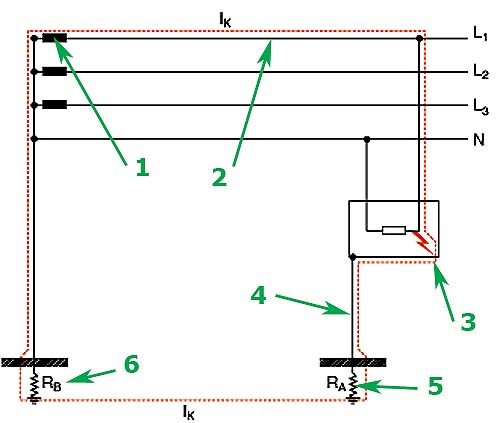
Рис. 7 (Рис. ABB)
Контур тока короткого замыкания при замыкании на землю в системе ТТ
1 - Вторичная обмотка трансформатора;
2 - Линейный проводник;
3 - Сопротивление в месте замыкания;
4 - Проводник защитного заземления;
5 - Зазеамляющий электрод электроустановки;
6 - Заземляющий электрод нейтрали вторичной обмотки тарнсформатораПараллельные тексты EN-RU
An earth fault in a TT system originates the circuit represented in Figure 7.
The fault current flows through the secondary winding of the transformer, the line conductor, the fault resistance, the protective conductor, and the earth electrode resistances (RA, of the user’s plant, and RB, of the neutral).
[ABB]Замыкание на землю в системе TT образует цепь, представленную на рисунке 7.
Ток короткого замыкания протекает через вторичную обмотку трансформатора, линейный проводник, сопротивление в месте замыкания, проводник защитного заземления, заземляющие электроды (RA электроустановки и RB нейтрали вторичной обмотки трансформатора).
[Перевод Интент]Тематики
- электробезопасность
- электротехника, основные понятия
- электроустановки
EN
DE
FR
Немецко-русский словарь нормативно-технической терминологии > Kurzschlußstrom
-
17 Ableitstrom
ток утечки
Электрический ток, протекающий по нежелательным проводящим путям в нормальных условиях эксплуатации.
[ ГОСТ Р МЭК 60050-195-2005]
ток утечки
Любые токи, включая емкостные токи, которые могут протекать между открытыми проводящими поверхностями прибора и землей или другими открытыми проводящими поверхностями прибора.
[ГОСТ IЕС 60730-1-2011]
ток утечки
Ток, который протекает в землю или на сторонние проводящие части в электрически неповрежденной цепи.
[ ГОСТ Р 50807-95]
ток утечки
Электрический ток, протекающий в Землю, открытую и стороннюю проводящие части и защитный проводник при нормальных условиях.
Активное сопротивление изоляции токоведущих частей электрооборудования не может быть бесконечно большим, а их ёмкость относительно Земли или соединённых с Землёй проводящих частей не может быть равна нулю. Поэтому с любой токоведущей части, находящейся под напряжением, в Землю, а также в проводящие части, электрически соединённые защитными проводниками с заземляющим устройством электроустановки здания и с заземлённой токоведущей частью источника питания, постоянно протекает небольшой электрический ток, который в нормативной и правовой документации называют током утечки. В нормальном режиме электроустановки здания из токоведущих частей функционирующего электрооборудования всегда имеется утечка электрического тока в Землю, открытые и сторонние проводящие части и защитные проводники.
Путь, по которому протекает ток утечки, зависит от типа заземления системы. В электроустановках зданий, соответствующих типам заземления системы TT и IT, ток утечки электрооборудования класса I через неповреждённую основную изоляцию протекает из токоведущих частей в открытые проводящие части. Из открытых проводящих частей по защитным проводникам, главной заземляющей шине, заземляющим проводникам и заземлителю ток утечки протекает в локальную землю. Если электроустановка здания соответствует типам заземления системы TN, преобладающая часть тока утечки протекает не в локальную землю, а по защитным проводникам и по PEN-проводникам электроустановки здания и низковольтной распределительной электрической сети протекает до заземлённой токоведущей части источника питания.
[ http://www.volt-m.ru/glossary/letter/%D2/view/84/]EN
leakage current
electric current in an unwanted conductive path other than a short circuit
[IEV number 151-15-49]
leakage current
electric current in an unwanted conductive path under normal operating conditions
Source: 151-03-35 MOD, 826-03-08 MOD
[IEV number 195-05-15]FR
courant de fuite, m
courant électrique qui s'écoule à travers un chemin électrique non désiré autre qu'un court-circuit
[IEV number 151-15-49]
courant de fuite, m
courant électrique qui, dans des conditions normales de fonctionnement, s'écoule à travers un chemin électrique non désiré
Source: 151-03-35 MOD, 826-03-08 MOD
[IEV number 195-05-15]Тематики
- электротехника, основные понятия
- электроустановки
EN
DE
FR
Немецко-русский словарь нормативно-технической терминологии > Ableitstrom
-
18 Last (1)
1. Любой потребитель электроэнергии
электрическая нагрузка
Любой приемник(потребитель)электрической энергии в электрической цепи 1)
[БЭС]
нагрузка
Устройство, потребляющее мощность
[СТ МЭК 50(151)-78]EN
load (1), noun
device intended to absorb power supplied by another device or an electric power system
[IEV number 151-15-15]FR
charge (1), f
1) Иными словами (электрическая) нагрузка, это любое устройство или группа устройств, потребляющих электрическую энергию (электродвигатель, электролампа, электронагреватель и т. д.)
dispositif destiné à absorber de la puissance fournie par un autre dispositif ou un réseau d'énergie électrique
[IEV number 151-15-15]
[Интент]
Термимн нагрузка удобно использовать как обощающее слово.
В приведенном ниже примере термин нагрузка удачно используется для перевода выражения any other appliance:
Make sure that the power supply and its frequency are adapted to the required electric current of operation, taking into account specific conditions of the location and the current required for any other appliance connected with the same circuit.
Ток, напряжение и частота источника питания должны соответствовать параметрам агрегата с учетом длины и способа прокладки питающей линии, а также с учетом другой нагрузки, подключенной к этой же питающей линии.
[Перевод Интент]
... подключенная к трансформатору нагрузка
[ ГОСТ 12.2.007.4-75*]
Поскольку приемник электрической энергии это любой аппарат, агрегат, механизм, предназначенный для преобразования электрической энергии в другой вид энергии [ПУЭ], то термин нагрузка может характеризовать электроприемник с точки зрения тока, сопротивления или мощности.
2. Потребитель энергоэнергии, с точки зрения потребляемой мощности
нагрузка
Мощность, потребляемая устройством
[СТ МЭК 50(151)-78]EN
load (2), noun
power absorbed by a load
[IEV number 151-15-16]FR
charge (2), f
puissance absorbée par une charge
Source: 151-15-15
[IEV number 151-15-16]
При проектировании электроснабжения энергоемких предприятий следует предусматривать по согласованию с заказчиком и с энергоснабжающей организацией регулирование электрической нагрузки путем отключения или частичной разгрузки крупных электроприемников, допускающих без значительного экономического ущерба для технологического режима перерывы или ограничения в подаче электроэнергии.
[СН 174-75 Инструкция по проектированию электроснабжения промышленных предприятий]
В настоящее время характер коммунально-бытовой нагрузки кардинально изменился в результате широкого распространения новых типов электроприемников (микроволновых печей, кондиционеров, морозильников, люминесцентных светильников, стиральных и посудомоечных машин, персональных компьютеров и др.), потребляющих из питающей сети наряду с активной мощностью (АМ) также и значительную реактивную мощность (РМ).Недопустимые, нерекомендуемые
Тематики
- электроснабжение в целом
- электротехника, основные понятия
Классификация
>>>Близкие понятия
Действия
- аварийное отключение нагрузки
- аварийный сброс нагрузки
- включение нагрузки
- защитное отключение нагрузки
- ограничение допустимых нагрузок
- отключение нагрузки
- отключение неприоритетных нагрузок
- передача нагрузки с одной системы шин на другую
- питание нагрузки
- регулирование электрической нагрузки
Синонимы
Сопутствующие термины
- нагрузки жилых зданий
- нагрузки общественных зданий
- территориальное расположение нагрузок
- ток нагрузки
- токовая нагрузка
- характер коммунально-бытовой наргрузки
- характер нагрузки (индуктивный, емкостной)
EN
DE
FR
Немецко-русский словарь нормативно-технической терминологии > Last (1)
-
19 Leistungsabgabe (2)
1. Любой потребитель электроэнергии
электрическая нагрузка
Любой приемник(потребитель)электрической энергии в электрической цепи 1)
[БЭС]
нагрузка
Устройство, потребляющее мощность
[СТ МЭК 50(151)-78]EN
load (1), noun
device intended to absorb power supplied by another device or an electric power system
[IEV number 151-15-15]FR
charge (1), f
1) Иными словами (электрическая) нагрузка, это любое устройство или группа устройств, потребляющих электрическую энергию (электродвигатель, электролампа, электронагреватель и т. д.)
dispositif destiné à absorber de la puissance fournie par un autre dispositif ou un réseau d'énergie électrique
[IEV number 151-15-15]
[Интент]
Термимн нагрузка удобно использовать как обощающее слово.
В приведенном ниже примере термин нагрузка удачно используется для перевода выражения any other appliance:
Make sure that the power supply and its frequency are adapted to the required electric current of operation, taking into account specific conditions of the location and the current required for any other appliance connected with the same circuit.
Ток, напряжение и частота источника питания должны соответствовать параметрам агрегата с учетом длины и способа прокладки питающей линии, а также с учетом другой нагрузки, подключенной к этой же питающей линии.
[Перевод Интент]
... подключенная к трансформатору нагрузка
[ ГОСТ 12.2.007.4-75*]
Поскольку приемник электрической энергии это любой аппарат, агрегат, механизм, предназначенный для преобразования электрической энергии в другой вид энергии [ПУЭ], то термин нагрузка может характеризовать электроприемник с точки зрения тока, сопротивления или мощности.
2. Потребитель энергоэнергии, с точки зрения потребляемой мощности
нагрузка
Мощность, потребляемая устройством
[СТ МЭК 50(151)-78]EN
load (2), noun
power absorbed by a load
[IEV number 151-15-16]FR
charge (2), f
puissance absorbée par une charge
Source: 151-15-15
[IEV number 151-15-16]
При проектировании электроснабжения энергоемких предприятий следует предусматривать по согласованию с заказчиком и с энергоснабжающей организацией регулирование электрической нагрузки путем отключения или частичной разгрузки крупных электроприемников, допускающих без значительного экономического ущерба для технологического режима перерывы или ограничения в подаче электроэнергии.
[СН 174-75 Инструкция по проектированию электроснабжения промышленных предприятий]
В настоящее время характер коммунально-бытовой нагрузки кардинально изменился в результате широкого распространения новых типов электроприемников (микроволновых печей, кондиционеров, морозильников, люминесцентных светильников, стиральных и посудомоечных машин, персональных компьютеров и др.), потребляющих из питающей сети наряду с активной мощностью (АМ) также и значительную реактивную мощность (РМ).Недопустимые, нерекомендуемые
Тематики
- электроснабжение в целом
- электротехника, основные понятия
Классификация
>>>Близкие понятия
Действия
- аварийное отключение нагрузки
- аварийный сброс нагрузки
- включение нагрузки
- защитное отключение нагрузки
- ограничение допустимых нагрузок
- отключение нагрузки
- отключение неприоритетных нагрузок
- передача нагрузки с одной системы шин на другую
- питание нагрузки
- регулирование электрической нагрузки
Синонимы
Сопутствующие термины
- нагрузки жилых зданий
- нагрузки общественных зданий
- территориальное расположение нагрузок
- ток нагрузки
- токовая нагрузка
- характер коммунально-бытовой наргрузки
- характер нагрузки (индуктивный, емкостной)
EN
DE
FR
Немецко-русский словарь нормативно-технической терминологии > Leistungsabgabe (2)
-
20 Stromelement
элемент тока
Векторная величина, равная произведению электрического тока проводимости вдоль линейного проводника и бесконечно малого отрезка этого проводника.
[ ГОСТ Р 52002-2003]EN
current element
at a given point of a filiform tube of current, vector quantity equal to the product of the electric current and the vector line element at that point
NOTE – A current element is expressed by Idr or by Ietds where I is the electric current and dr = etds the vector line element.
[IEV number 121-11-17]FR
élément de courant, m
en un point donné d’un tube de courant filiforme, grandeur vectorielle égale au produit du courant électrique par l'élément vectoriel d'arc en ce point
NOTE – Un élément de courant est représenté par Idr ou par Ietds où I est le courant électrique et dr = etds l'élément vectoriel d'arc.
[IEV number 121-11-17]Тематики
- электротехника, основные понятия
Синонимы
EN
DE
FR
Немецко-русский словарь нормативно-технической терминологии > Stromelement
См. также в других словарях:
Electric current — Electric E*lec tric ([ e]*l[e^]k tr[i^]k), Electrical E*lec tric*al ([ e]*l[e^]k tr[i^]*kal), a. [L. electrum amber, a mixed metal, Gr. h lektron; akin to hle ktwr the beaming sun, cf. Skr. arc to beam, shine: cf. F. [ e]lectrique. The name came… … The Collaborative International Dictionary of English
electric current — electric current, electrical current electrical current, the movement of electrically charged particles, atoms, or ions, through solids, liquids, gases, or free space; the term is usually used of relatively smooth movements of electric charge… … The Collaborative International Dictionary of English
Electric current — Electromagnetism … Wikipedia
electric current — Elect. the time rate of flow of electric charge, in the direction that a positive moving charge would take and having magnitude equal to the quantity of charge per unit time: measured in amperes. Also called current, electricity. [1830 40] * * *… … Universalium
electric current — Electricity E lec*tric i*ty ([=e] l[e^]k*tr[i^]s [i^]*t[y^]), n.; pl. {Electricities} ([=e] l[e^]k*tr[i^]s [i^]*t[i^]z). [Cf. F. [ e]lectricit[ e]. See {Electric}.] 1. (Physics) a property of certain of the fundamental particles of which matter… … The Collaborative International Dictionary of English
electric current — noun a flow of electricity through a conductor (Freq. 4) the current was measured in amperes • Syn: ↑current • Hypernyms: ↑electrical phenomenon • Hyponyms: ↑juice, ↑ … Useful english dictionary
electric current — the stream of electricity that moves along a conductor. Symbol I. An electric current is due to a difference of potential between two points, this difference being measured in volts. The volume of flow depends on the difference of potential and… … Medical dictionary
electric current — elektros srovės stipris statusas T sritis Standartizacija ir metrologija apibrėžtis Elektros kiekis, per vienetinį laiko tarpą pratekantis per laidininko skerspjūvį. Elektros srovės stipris yra vienas iš pagrindinių SI dydžių. atitikmenys: angl.… … Penkiakalbis aiškinamasis metrologijos terminų žodynas
electric current — elektros srovė statusas T sritis automatika atitikmenys: angl. electric current vok. elektrischer Strom, m rus. электрический ток, m pranc. courant électrique, m … Automatikos terminų žodynas
electric current — elektros srovė statusas T sritis Standartizacija ir metrologija apibrėžtis Kryptingas krūvininkų judėjimas. atitikmenys: angl. electric current vok. elektrischer Strom, m rus. электрический ток, m pranc. courant électrique, m … Penkiakalbis aiškinamasis metrologijos terminų žodynas
electric current — elektros srovė statusas T sritis chemija apibrėžtis Kryptingas krūvininkų judėjimas. atitikmenys: angl. electric current rus. электрический ток … Chemijos terminų aiškinamasis žodynas
