

-
41 получать
(= получить, см. также доказывать, обосновывать, устанавливать) get, obtain, receive, derive, deduce• Антенна используется для того, чтобы получать сигналы. - An antenna is used to receive the signal.• Более удобные формы решения были получены Смитом [1]. - More convenient forms of solution have been obtained by Smith [1].• Вот почему мы смогли получить... - This is why we were able to obtain...• Вычислив коэффициенты, мы можем получить... - Having calculated the coefficients, we can obtain...• Д-р Смит получил премию Джонса в конце июня. - Dr. Smith received the Jones Award in late June.• Давайте использовать это решение, чтобы получить... - Let us use this solution to obtain...• Далее, мы можем получить полезную информацию, изучая... - We can then obtain useful information by studying...• Данная идея получила свое начало при исследовании... - The idea originated with the study of...• Действуя аналогично, получаем, что... - By a similar procedure, it follows that...• Для обозначенной ориентации мы получаем... - For the orientation shown, we have...• До тех пор, пока не..., этот вопрос не получил ответа. - The question remained unanswered until...• Дополнительную информацию можно часто получить из... - Additional information can often be obtained from...• Ему удалось получить уравнение... - Не succeeded in obtaining the equation of...• Затем мы получим явные выражения для... - We next obtain explicit expressions for...• Из второго равенства мы получаем... - From the second equality, we have...• Легко получаем, что... - It follows without difficulty that...• Можно получить явное выражение для... - It is possible to obtain an explicit expression for...• Мы могли бы получить еще другую форму (чего-л). - We may obtain yet another form of...• Мы могли бы получить этот же результат более просто, заметив, что... - We could have obtained this result more easily by noting that...• Мы можем получить данный результат следующим образом. - We can obtain the result as follows.• Мы можем получить то же самое заключение другим способом в случае, когда... - We can reach the same conclusion in another way for the case of...• Мы надеемся получить теорему о... - We hope to obtain a theorem regarding...; We hope to establish a theorem regarding...• Мы снова получили... - Again we have obtained...• Мы также можем получить выражение для... - We can also obtain an expression for...• На этом пути мы можем получить (вывести и т. п.).. - In this way we can arrive at...• Невозможно получить полное понимание... без основополагающих знаний... - It is impossible to gain a thorough knowledge of... without a basic knowledge of...• Некоторое понимание причины такого поведения можно получить (проделывая и т. п.)... - Some insight into the reason for this behavior can be gained by...• Оставляя этот случай в стороне, получаем, что... - Leaving this case out of consideration, it follows that...• Очевидно, что мы не можем получить никакой ошибки из... - Obviously no error can result from...• Подставляя (1) в уравнение (2), мы получаем... - Substituting (1) into (2), we obtain...• Полагая у - х, мы получаем... - Setting у = х, we obtain...• Получим теперь решение... - We shall now derive a solution of...• Пользуясь вторым законом Ньютона, мы получаем... - By Newton's second law, we have...• Прекрасное совпадение с экспериментальными данными обычно можно получить... - An excellent fit to experimental data can usually be obtained by...• Преобразуя подобным образом остальные члены, мы получаем... - Transforming the remaining terms in a similar manner, we obtain...• Простое и прямое доказательство может получить (применением и т. п.)... - A simple and direct proof can be obtained by...• Решения этих уравнений можно получить графически (с помощью и т. п.)... - Solutions to these equations can be obtained graphically by...• Сначала мы получим... - Initially, we will obtain...• Таким образом, мы получаем выражения... - In this way we obtain the expressions...• Теперь мы получаем возможность... - This raises the possibility that...• Теперь мы получили желаемый результат. - We now have the desired result.• Теперь мы получим альтернативное выражение для... - We now obtain an alternative expression for...• Теперь мы получим полезный критерий для... - We now obtain a useful criterion for...• Теперь нам будет достаточно получить... - Here we shall be satisfied to obtain...• Тот же самый результат можно получить простым (вычислением и т. п.)... - The same result may be obtained by simply...• Точные решения уравнения (1) можно получить в терминах известных функций, когда... - Exact solutions to (1) can be obtained in terms of known functions when...• Трудно получить относительно чистый образец данного материала. - It is difficult to obtain a relatively pure sample of the material.• Чтобы получить (2.2), отметим, что... - То obtain (2.2), we note that...• Чтобы получить необходимый результат, мы... - То obtain the required result, let...• Чтобы получить неявное выражение для f(x) предположим, что... - То obtain an explicit expression for fix), suppose that...• Чтобы получить практический результат в подобных случаях, мы... - То obtain a practical result in such cases, we...• Чтобы получить удовлетворительную теорию, мы обязаны... - То obtain a satisfactory theory it is necessary to...• Эти идеи получают немедленно приложение к/в... - These ideas have immediate application in...• Эти методы получают своих сторонников, так как... - These methods attract proponents because...• Эти результаты, очевидно, получают значительно большее значение, когда... - These matters are clearly of much greater importance when...• Это можно получить следующим образом. - This can be obtained as follows.• Это решение можно получить наиболее просто, используя... - The solution is most readily obtained by the use of...• Это соотношение можно также получить, исходя из теории электромагнетизма. - This relation can also be obtained from the theory of electromagnetism.• Этот же результат можно получить другим способом. - It is possible to obtain this result in a different way.• Этот результат можно было бы получить более легко, увидев, что... - This result could have been obtained more easily by recognizing that...• Этот результат также можно было бы получить, применяя... - This result may also be obtained by means of... -
42 увидеть
(= видеть) see, observe, lay eyes on• В главе 3 мы увидим другое обобщение той же самой основной идеи. - In Chapter 3 we shall meet another generalization of the same basic idea.• В самом деле, позднее мы увидим, что... - As a matter of fact, we will see later that...• В следующей главе мы увидим, что... - We shall see in the next chapter that...• В частности, позднее мы увидим, что... - In particular, we shall see later that...• Вскоре мы увидим, что... - We shall see shortly that...• Далее, трудно увидеть, как... - It is difficult to see, then, how...• Действительно, мы увидим, что... - Actually we shall see that...• Довольно просто увидеть, что... - It is fairly easy to see that...• Из геометрических соображений можно легко увидеть, что... - It is easily seen geometrically that...• К сожалению, как мы увидим, данная теория не предсказывает... - Unfortunately, as we shall see, the theory does not predict...• Как мы увидим в следующем параграфе, это не простое совпадение. - This is not a coincidence, as we will see in the next section.• Как мы увидим дальше... - As we shall see later,...• Как мы увидим из дальнейшего, данная теорема является основой для... - This theorem, as we shall see, is the basis of...• Как мы увидим позднее,... - As will be seen later,...• Можно легко увидеть причину такой зависимости. - One can easily see the reason for this dependence.• Мы немедленно увидим, что... - It will be seen at once that...• Мы увидим позже, что... - It will be seen later that...• Мы увидим, что возможно (преобразовать и т. п.)... - We shall find it possible to...• Мы увидим, что данное исследование применимо также в случае... - It will be observed that this investigation applies also to the case of...• Мы увидим, что данные вопросы тесно взаимосвязаны. - We shall see that these questions are closely related.• Мы увидим, что эти методы могут использоваться лишь тогда, когда... - It will be observed that these methods are only applicable when...• Мы увидим, что эти условия могут быть выполнены при использовании... - We shall see that these conditions can be met using...• Мы увидим, что это пример (чего-л). - We shall see that this is an example of...• Не требуется много усилий для того, чтобы увидеть, что... - It does not require much reflection to see that...• Однако мы увидим, что... - However, we shall discover that...• Однако, как мы сейчас увидим, это другая ситуация. - But here the situation is different, as we shall now see.• Оказывается, Смит [1] был первым, кто увидел, что... - It appears that Smith [1] was the first to recognize that...; Smith [1] appears to be the first to have recognized that...• Справедливость того же результата можно увидеть геометрически. - The same result can be seen geometrically.• Теперь мы могли бы легко увидеть, что... - Now we may easily see that...• Трудно увидеть, как эти различия могли бы возникнуть из (чего-л). - It is difficult to see how these differences could arise from...• Умелый исследователь быстро увидит, что... - The skilled investigator will quickly see that...• Читатель с хорошей подготовкой немедленно увидит, что... - The knowledgeable reader will see at once that...• Читатель увидит, как можно использовать высшую математику в... - The reader will see how ordinary calculus can be applied to...• Чтобы доказать эту теорему, недостаточно увидеть, что... - То prove this theorem it is not enough to observe that...• Чтобы понять это, достаточно рассмотреть... - То see this, it suffices to consider...• Чтобы увидеть это более детально, отметим, что... - То see this in greater detail, let us note that... -
43 Sicherheitsrisiko
Sicherheitsrisiko n 1. GEN security risk; safety hazard (Gefahrenquelle); 2. VERSICH security risk* * ** * *Sicherheitsrisiko
safety hazard;
• Sicherheitsrücklage contingent reserve;
• Sicherheitsschleuse (Flughafen) security check;
• Sicherheitsspanne, Sicherheitsspielraum safety (security) margin;
• Sicherheitsstufe security level, (Statistik) significance level;
• erhöhte Sicherheitsstufe heightened security;
• Sicherheitssumme (Börse) margin, retention money (Br.);
• Sicherheitstechnik safety technology;
• Sicherheitsvereinbarung collateral agreement;
• elektronische Sicherheitsverfahren electronic security methods;
• Sicherheitsverwahrung protective custody;
• Sicherheitsvorkehrungen security (safety) precautions, protective (precautionary) measures;
• Sicherheitsvorkehrungen verstärken to tighten security;
• Sicherheitsvorrichtung fail-safe device, safety device (appliance);
• Sicherheitsvorschriften security (safety) regulations;
• grundlegende Sicherheitsvorschriften basic safety standards;
• den neuen Sicherheitsvorschriften entsprechen to qualify under the new safety regulations;
• Sicherheitsvorschuss (Börse) margin;
• konzertierte Sicherheitsvorsorge concerted measures to regain security;
• Sicherheitswechsel guaranteed bill of exchange;
• Sicherheitswechsel geben to deposit a bill as collateral (US);
• Sicherheitszone safety-control zone;
• Sicherheitszuschlag excess charge, (Lebensversicherung) loading, (Versicherung) excess clause. -
44 Veranlagungspflichtiger
Veranlagungspflichtiger
taxable person;
• Veranlagungsprinzipien methods of assessing taxable property;
• Veranlagungsrichtlinien rules of assessment, assessment directives;
• Veranlagungsrücklage tax reserve;
• Veranlagungssatz tax rate, rate of assessment;
• Veranlagungsstelle taxation authority, special commissioners (Br.), tax assessor (Scot.);
• Veranlagungstag date of assessment;
• Veranlagungsverfahren [procedure of] assessment;
• Veranlagungsvorschriften assessment provisions;
• Veranlagungswahlrecht (Einkommensteuer) election;
• im Veranlagungswege erhobene Steuern assessed taxes;
• Veranlagungswert ratal, ratable value, assessed value;
• Veranlagungswert eines Hauses ratable value of a house;
• Veranlagungszeitraum taxable (assessment, basic) period, chargeable accounting period (Br.), period of assessment.Business german-english dictionary > Veranlagungspflichtiger
-
45 señalar1
1 = mark off, point to, tick (off), mark out, bring to + Posesivo + notice, mark + Nombre + down as.Ex. Human intervention may also be necessary to mark off the area in the string on the title page that should be indexed, and possibly to add an imprint date if not present.Ex. This article points to economically feasible and communication-based indexing methods which fit the potentials of current information technology.Ex. In particular note, for example by ticking them, those terms that merit a turn in the lead position, and those that do not.Ex. To infuse into that basic form an element of linguistic liveliness and wit, which marks out the best adult reviewers, is to ask far more than most children can hope to achieve.Ex. One moonlight night Sweeny was brought to our notice by his ejaculations of impatience at being obliged to come to a dead halt.Ex. One look convinced the employer that she was unsuited for the work, and he marked her down as unsuitable.----* señalar a Alguien = put + Alguien + on the spot.* señalar con el dedo = point + the fingers at.* señalar con un círculo = circle. -
46 señalar
v.1 to indicate, to point at, to point out, to signal.Pedro apunta las necesidades de ella Peter points out her needs.2 to point.3 to point fingers, to accuse.* * *1 (marcar) to mark2 (rubricar) to sign and seal3 (hacer herida) to mark, scar4 (hacer notar) to point out5 (apuntar hacia) to point to, show6 (con el dedo) to point at7 (fijar - cita) to arrange, make; (fecha, lugar, precio) to set, fix8 (designar) to appoint9 (subrayar la importancia) to stress, underline1 (distinguirse) to distinguish oneself2 (sobresalir) to stand out* * *verb1) to indicate, show2) mark3) point out* * *1. VT1) (=indicar) [gen] to show; [con el dedo] to pointseñalar una falta — (Dep) to indicate a foul
2) (=marcar) to markel acné le ha señalado la cara — his face has been marked o scarred by acne
3) (=destacar) to point outtuve que señalarle varios errores en el examen — I had to point out several mistakes in the exam to him
4) (=designar) [+ fecha, precio] to fix, settle; [+ tarea] to seten el momento señalado — at the given moment, at the appointed time
todas las encuestas lo señalan como el candidato favorito — all the opinion polls point to him as the favourite candidate
5) (Aut) [+ carretera, ruta] to signpost6) [+ ganado] to brand2.See:* * *1.verbo transitivo1) ( indicar)me señaló la ruta en un mapa — he showed me the route o pointed out the route (to me) on a map
2) (marcar con lápiz, rotulador) to mark3) ( afirmar) to point outseñaló que... — she pointed out that...
a la hora señalada — at the appointed o arranged time
en el lugar señalado — in the appointed o agreed place
5) ( anunciar) to mark2.señalar vi to point3.señalarse v pron to distinguish oneself* * *1.verbo transitivo1) ( indicar)me señaló la ruta en un mapa — he showed me the route o pointed out the route (to me) on a map
2) (marcar con lápiz, rotulador) to mark3) ( afirmar) to point outseñaló que... — she pointed out that...
a la hora señalada — at the appointed o arranged time
en el lugar señalado — in the appointed o agreed place
5) ( anunciar) to mark2.señalar vi to point3.señalarse v pron to distinguish oneself* * *señalar11 = mark off, point to, tick (off), mark out, bring to + Posesivo + notice, mark + Nombre + down as.Ex: Human intervention may also be necessary to mark off the area in the string on the title page that should be indexed, and possibly to add an imprint date if not present.
Ex: This article points to economically feasible and communication-based indexing methods which fit the potentials of current information technology.Ex: In particular note, for example by ticking them, those terms that merit a turn in the lead position, and those that do not.Ex: To infuse into that basic form an element of linguistic liveliness and wit, which marks out the best adult reviewers, is to ask far more than most children can hope to achieve.Ex: One moonlight night Sweeny was brought to our notice by his ejaculations of impatience at being obliged to come to a dead halt.Ex: One look convinced the employer that she was unsuited for the work, and he marked her down as unsuitable.* señalar a Alguien = put + Alguien + on the spot.* señalar con el dedo = point + the fingers at.* señalar con un círculo = circle.señalar22 = bring to + Posesivo + attention, get at, indicate, mark, point, point out, signal, signify, stress, note, state, point + (a/the) finger(s) at.Ex: Errors in colleagues' work should be brought to their attention tactfully and not in the presence of others = A los compañeros se les debería hacer ver sus errores discretamente y no en presencia de otros.
Ex: What I'm getting at is this: At least in the CIP entry that I have seen, LC, following customary practice, made a title entry for the main title, 'Women in Librarianship', but nothing under Melvil's 'Rib Symposium'.Ex: The general index of CC lists isolates and indicates where they may be found as in a relative index.Ex: In addition, synthesis often requires the use of a facet indicator, which marks the beginning of a new facet for example.Ex: An arrow pointing upwards indicates when the terminal is in insert mode.Ex: By means of the arrangement of document substitutes in library catalogues, and also by the arrangement of documents themselves, it is possible to point out, or indicate, classes of documents.Ex: Main classes are denoted by a capital letter, and in most classes a second capital letter is used to signal major sections or subclasses.Ex: Within one main class the same piece of notation may be used to signify different concepts.Ex: However, it must be stressed that these problems are still in the future.Ex: In the future, a number of further developments can be fairly confidently predicted in addition to the expansion of those noted above.Ex: Short abstracts are generally preferred, but there are instances where the most effective approach is to cite the original unamended, and to state that this is what has been done.Ex: It is easy to point the fingers at the refs.* señalar diferencias = point out + differences, note + difference, point to + differences.* señalar las dificultades = note + difficulties.* señalar similitudes = point out + similarities.* * *señalar [A1 ]vtA(indicar): nos señaló la ruta en un mapa she showed us the route o pointed out the route to us on a mapme señaló con el dedo qué pasteles quería he pointed out to me which cakes he wantedlas manecillas del reloj señalaban las doce the hands of the clock showed twelveB (marcar) to marklos he señalado con una cruz I've marked them with a cross, I've put a cross by themC (afirmar) to point outseñaló la necesidad de abrir nuevos hospitales she pointed out the need to open new hospitalsD (fijar) ‹fecha› to fix, seta la hora señalada at the appointed o arranged timeseñalaron el día 15 como fecha tope they set o fixed the deadline for the 15then el lugar señalado in the appointed o agreed placeE (anunciar) to markla llegada de las cigüeñas señala el final del invierno the arrival of the storks marks o signals the end of winterto distinguish oneselfse señaló por su heroísmo en la guerra during the war he distinguished himself by his heroism* * *
señalar ( conjugate señalar) verbo transitivo
1 ( indicar) ‹ruta/camino› to show;
me señaló con el dedo he pointed at me (with his finger);
señalarle algo a algn to show sb sth, point sth out to sb;
me señaló con el dedo qué pasteles quería he pointed out (to me) which cakes he wanted
2 (marcar con lápiz, rotulador) to mark
3 ( afirmar) to point out;◊ señaló que … she pointed out that …
4 ( fijar) ‹ fecha› to fix, set;◊ en el lugar señalado in the appointed o agreed place
5 ( anunciar) to mark
verbo intransitivo
to point
señalar verbo transitivo
1 (con el dedo) to point at
(desprestigiar)
2 (apuntar, subrayar) me gustaría señalar que..., I would like to point out that...
3 (señalizar) to indicate: la brújula señalaba el norte, the compass was pointing North
4 (una fecha) to fix
5 (dejar una marca o huella) el navajazo le señaló la cara, the knife wound scarred his face
' señalar' also found in these entries:
Spanish:
apuntar
- indicar
- marcar
- dar
- dedo
- penalty
- puntero
- puntualizar
English:
appoint
- designate
- mark
- must
- pinpoint
- point
- point out
- signal
- at
- give
- indicate
- show
- single
* * *♦ vt1. [marcar] to mark;[hora, temperatura] to indicate, to show;el termómetro señalaba 10 grados the thermometer showed 10 degrees;la brújula debe señalar el norte the compass should indicate north;cuando el reloj señale las doce when the clock says twelve;las elecciones de aquel año señalaron el comienzo de la transición that year's elections marked the beginning of the transition2. [apuntar] to point out;nos señaló con el dedo he pointed at us;no quiero señalar a nadie, pero… I don't want to point the finger at anyone, but…;la flecha señala el camino the arrow indicates the path;me señaló los errores que había cometido he showed me o pointed out to me the mistakes I had made3. [ser el inicio de] to mark, to signal;las lluvias señalan la llegada del monzón the rains signal o announce the arrival of the monsoon4. [recalcar] to point out;me gustaría señalar que… I'd like to point out that…5. [fijar] to set, to fix;aún no han señalado el día de la boda they haven't yet fixed the date of the wedding;señaló su valor en 1.000 dólares he set o fixed its value at 1,000 dollars6. [ganado] to brand* * *v/t1 indicate, point out;señalar a alguien con el dedo tb fig point at s.o.3 ( fijar) set, decide on* * *señalar vt1) indicar: to indicate, to show2) : to mark3) : to point out, to stress4) : to fix, to set* * *señalar vb1. (marcar) to mark -
47 sobre
prep.1 on, above, on top of, onto.Un libro sobre el cáncer de pulmón A book on lung cancer...2 on, about, over, referring to.3 on.Un libro sobre el cáncer de pulmón A book on lung cancer...m.envelope.pres.subj.3rd person singular (él/ella/ello) Present Subjunctive of Spanish verb: sobrar.* * *1 (encima) on, upon, on top of2 (por encima) over, above3 (acerca de) about, on4 (alrededor de) about, around5 (superioridad en rango) over6 figurado (indica reiteración) upon, after1 (de correo) envelope2 (de sopa etc) packet\irse al sobre familiar to hit the sacksobre manera exceedinglysobre todo above all, especially* * *1. noun m.1) envelope2) packet2. prep.1) on, upon, on top of2) over3) about•* * *ISM1) [para cartas] envelopesobre de paga, sobre de pago — pay packet
2) ** (=cama) bedmeterse en el sobre — to hit the sack *, hit the hay *
3) LAm (=cartera) handbagIIPREP1) (=encima de) onun puente sobre el río Ebro — a bridge across o over the river Ebro
varios policías se abalanzaron sobre él — several policemen jumped on o fell upon him
la responsabilidad que recae sobre sus hombros — the responsibility which rests on o upon his shoulders
tengo que estar sobre él para que lo haga — I have to stand over him to make him do it, I have to keep a constant watch over him to make sure he does it
2) (=por encima de)a) [+ lugar] overb) [con cantidades] above500 metros sobre el nivel del mar — 500 metres o (EEUU) meters above sea level
3) [indicando superioridad] overtiene muchas ventajas sobre los métodos convencionales — it has many advantages over conventional methods
4) [indicando proporción] out of, intres sobre cien — three out of every hundred, three in a hundred
cuatro personas sobre diez no votarían — four out of ten people would not vote, four in every ten people would not vote
5) (Econ) onun aumento sobre el año pasado — an increase on o over last year
6) (=aproximadamente) aboutocupa sobre 20 páginas — it fills about 20 pages, it occupies roughly 20 pages
7) (=acerca de) about, onun libro sobre Tirso — a book about o on Tirso
8) (=además de) in addition to, on top of9)sobre todo — (=en primer lugar) above all; (=especialmente) especially
sobre todo, no perdamos la calma — above all, let's keep calm
* * *I1)a) (Corresp) envelopesobre aéreo or (de) vía aérea — airmail envelope
b) ( envase)un sobre de sopa — a package of soup (AmE), a packet of soup (BrE)
2) (AmL) ( cartera) clutch bagII1) ( indicando posición)a) ( con contacto)letras en azul sobre (un) fondo blanco — blue letters on o upon a white background
b) ( sin contacto) overen el techo justo sobre la mesa — on the ceiling right above o over the table
4.000 metros sobre el nivel del mar — 4,000 meters above sea level
estar sobre alguien — ( vigilar) to check up on somebody
c) ( alrededor de) on3)a) (en relaciones de efecto, derivación, etc) onb) (Com, Fin) onun incremento del 11% sobre los precios del año pasado — an increase of 11% on o over last year's prices
4) ( acerca de) onlegislación sobre impuestos — tax legislation, legislation on taxes
escribió sobre el espinoso tema de... — she wrote on o about the thorny topic of...
5) (Esp) (con cantidades, fechas, horas) around, about (BrE)sobre unos 70 kilos — around o about 70 kilos
6)* * *I1)a) (Corresp) envelopesobre aéreo or (de) vía aérea — airmail envelope
b) ( envase)un sobre de sopa — a package of soup (AmE), a packet of soup (BrE)
2) (AmL) ( cartera) clutch bagII1) ( indicando posición)a) ( con contacto)letras en azul sobre (un) fondo blanco — blue letters on o upon a white background
b) ( sin contacto) overen el techo justo sobre la mesa — on the ceiling right above o over the table
4.000 metros sobre el nivel del mar — 4,000 meters above sea level
estar sobre alguien — ( vigilar) to check up on somebody
c) ( alrededor de) on3)a) (en relaciones de efecto, derivación, etc) onb) (Com, Fin) onun incremento del 11% sobre los precios del año pasado — an increase of 11% on o over last year's prices
4) ( acerca de) onlegislación sobre impuestos — tax legislation, legislation on taxes
escribió sobre el espinoso tema de... — she wrote on o about the thorny topic of...
5) (Esp) (con cantidades, fechas, horas) around, about (BrE)sobre unos 70 kilos — around o about 70 kilos
6)* * *sobre11 = envelope.Ex: A jacket or sleeve is a protective envelope for a sound disc, made of cardboard or paper.
* licencia en sobre hermético = shrink-wrap licence [shrinkwrap licence], shrink-wrapped licence [shrinkwrapped licence].* poner la dirección en un sobre = address + envelope.* sobre acolchado = jiffy bag.* sobre acolchado con burbujas de plástico = bubble bag.* sobre para el control del préstamo = slip holder pocket.* sopa de sobre = instant soup, packet soup.sobre2= about, on, on top of, onto, over, surrounding, the way in which, upon, atop.Ex: His report contains sufficient information about a set of events and the people involved to allow for careful, systematic investigation.
Ex: Efforts are being made in the direction of an international consensus on the definition and treatment of corporate authorship.Ex: Cards are superimposed, one on top of another, and carefully aligned.Ex: When one is in place, the depression of a lever causes it to be photographed onto the next blank space.Ex: The conventional name of a government is the geographic name of the area over which the government has jurisdiction.Ex: This section, then, will review the basic problems surrounding the choice of form of headings for persons.Ex: Recommendations relating to analytical cataloguing practices concern themselves primarily with the way in which the part of a document or work to be accessed is described.Ex: Taube's original system relied upon 'uniterms' or one concept terms.Ex: In Paris, the liberty cap atop the pike became an important icon aimed against the fading tyranny of the ancien regime.* sobre ascuas = in suspense.* sobre base de arena = sand-based.* sobre + Cantidad = around + Cantidad.* sobre disco = ondisc.* sobre el automóvil = automotive.* sobre ello = thereupon [thereon].* sobre el papel = in intent, nominally.* sobre el que se están haciendo averiguaciones = under investigation.* sobre el terreno = on the ground.* sobre esta base = on this basis, on that basis.* a partir de esto = on that basis.* sobre forro de tela = cloth-backed.* sobre la base de = in relation to, on the usual basis.* sobre la comedia = comedic.* sobre la marcha = on-the-fly, off the top of + Posesivo + head, right off the bat, spur-of-the-moment, on the spur of the moment, while-you-wait [while-u-wait], straight away, as you go, right away, at once.* sobre la superficie = above ground.* sobre la tierra = on earth, on the face of the earth, on the ground.* sobre los glaciares = glaciological.* sobre museos = museum-based.* sobre ruedas = on wheels, roll-out, without a hitch.* sobre suelo firme = on firm footing.* sobre todas las cosas = above all things.* sobre todo = above all, above everything else, overwhelmingly, in particular, above all things.* Verbo + sobre todo = Verbo + the most.* y sobre todo = and worst of all.* * *A1 ( Corresp) envelopesobre aéreo or (de) vía aérea airmail envelopesobre de ventanilla window envelope2B ( arg)irse al sobre to hit the sack o the hay ( colloq)1(cuando hay contacto): lo dejé sobre la mesa I left it on the tablelos fue poniendo uno sobre otro she placed them one on top of the othervestía chaqueta a or de cuadros sobre una camisa blanca he wore a checked jacket over a white shirtletras en azul sobre un fondo blanco blue letters on o upon a white backgroundla lluvia que cayó sobre Quito the rain that fell on Quitoprestar juramento sobre los Santos Evangelios to swear on the Holy Biblela población está sobre el Paraná the town is on the Paraná riverse abalanzaron sobre él they leapt on himestamos sobre su pista we're on their trail2 (cuando no hay contacto) overvolaremos sobre Santiago we shall be flying over Santiagose inclinó sobre su lecho de enfermo she leaned o bent over his sick beden el techo justo sobre la mesa on the ceiling right above o over the table4.000 metros sobre el nivel del mar 4,000 meters above sea levelestar sobre algn to check up on sbestá constantemente sobre ella para que estudie he has to keep checking up on her to make sure she studies3 (alrededor de) ongira sobre su eje it spins on its axis4 ( Mat):X/y (en ecuaciones) (read as: x sobre y) X/y (léase: x over y)18/20 (calificación) (read as: 18 sobre 20) 18/20 (léase: 18 out of 20)B(en relaciones de jerarquía): sobre estos representantes tenemos al jefe de zona above these representatives we have the area headsu victoria sobre el equipo local their victory over the local teamamar a Dios sobre todas las cosas love God above all elseC1 (en relaciones de efecto, derivación, etc) onhan tenido mucha influencia sobre él they have had a great influence on himuna opereta sobre libreto de Sierra an operetta with libretto by Sierraun nuevo impuesto sobre las importaciones a new tax on importsun incremento del 11% sobre los precios del año pasado an increase of 11% on o over last year's pricesla hipoteca que pesa sobre la casa the mortgage on the houseprestan dinero sobre alhajas they lend money on jewelrycheque sobre Buenos Aires check payable in Buenos Airescheque girado sobre el Banco de Córdoba check drawn on the Banco de CórdobaD (acerca de) onlegislación sobre impuestos tax legislation, legislation on taxesexisten muchos libros sobre el tema there are many books on the subjectescribió sobre el espinoso tema de … she wrote on o about the thorny topic of …E1(próximo a): el ejército está sobre la ciudad the army is at the gates of the cityllegué muy sobre la hora ( AmS); I only arrived a short time beforehanddebe pesar sobre los 70 kilos he must weigh around o about 70 kilosFsobre todo above alltuvo mucho éxito, sobre todo entre la juventud it was very successful, above all o particularly o especially among young peopleaumentan las presiones políticas, sociales y, sobre todo, económicas the political, social and, above all, economic pressures are growing* * *
Del verbo sobrar: ( conjugate sobrar)
sobré es:
1ª persona singular (yo) pretérito indicativo
sobre es:
1ª persona singular (yo) presente subjuntivo3ª persona singular (él/ella/usted) presente subjuntivo3ª persona singular (él/ella/usted) imperativo
Multiple Entries:
sobrar
sobre
sobre-
sobrar ( conjugate sobrar) verbo intransitivoa) (quedar, restar):
¿te ha sobrado dinero? do you have any money left?b) ( estar de más):◊ ya veo que sobro aquí I can see I'm not wanted/needed here;
a mí no me sobra el dinero I don't have money to throw around (colloq);
sobra un cubierto there's an extra place
sobre sustantivo masculino
1 (Corresp) envelope
2 (AmL) ( cartera) clutch bag
■ preposición
1 ( indicando posición)
los puso uno sobre otro she placed them one on top of the other;
estamos sobre su pista we're on their trail
en el techo, justo sobre la mesa on the ceiling right above o over the table;
4.000 metros sobre el nivel del mar 4,000 meters above sea level
2 ( en relaciones de jerarquía):
3 ( acerca de) on;◊ hay muchos libros sobre el tema there are many books on o about the subject
4 (Esp) (con cantidades, fechas, horas) around, about (BrE);◊ sobre unos 70 kilos around o about 70 kilos
5
sobrar verbo intransitivo
1 (quedar) to be left (over): si sobra tela hago un cojín, if there's any fabric left, I'll make a cushion
2 (haber en exceso) to be more than enough: nos sobra espacio para ponerlo, we have plenty of room to put it
3 (estar de más, ser innecesario) su marido sobraba en aquella reunión, her husband wasn't wanted at that meeting
sobran las disculpas, there is no need for you to apologize
sobre 1 sustantivo masculino
1 (para meter papeles, cartas) envelope
2 (para sopa) packet
(para medicina, etc) sachet
3 fam hum bed
ir al sobre, to go to bed
sobre 2 preposición
1 (encima de) on, upon, on top of: se puso un chal sobre los hombros, she put a shawl over her shoulders
toda la responsabilidad recae sobre él, the entire responsibility falls on him
2 (por encima) over, above
3 (en torno a, hacia) about: llamaron sobre las seis, they phoned at about six o'clock
4 (a propósito de) about, on: hablaremos sobre ello, we'll talk about it
un libro sobre Napoleón, a book on Napoleón
5 (además de) upon
6 (para indicar el objeto de la acción) ejerce mucha influencia sobre él, he has a lot of influence on him
♦ Locuciones: sobre todo, above all
sobre- pref super-, over-
' sobre' also found in these entries:
Spanish:
abalanzarse
- abatirse
- absoluta
- absoluto
- acometer
- acumularse
- advertir
- alertar
- antediluviana
- antediluviano
- ascendiente
- ascua
- aviso
- cábala
- caballería
- carta
- cerrar
- charla
- conferencia
- conversar
- copete
- curso
- dato
- derramar
- descargar
- desconocimiento
- deslizarse
- dictaminar
- discusión
- discutir
- disertar
- dispar
- disputar
- documentación
- documentarse
- elevarse
- en
- encima
- encogerse
- entrañas
- especialmente
- estabilizador
- estabilizadora
- estándar
- estimativa
- estimativo
- eurócrata
- extendida
- extendido
- fantasma
English:
about
- above
- act on
- aerial
- alive
- all
- array
- article
- assert
- background
- balance
- basis
- bear down on
- bob
- brain
- bridge
- call
- capital gains tax
- card
- cast
- chiefly
- client
- comfortably
- concise
- confer
- consult
- contention
- converse
- credit bureau
- dab
- dark
- deal with
- debate
- deduction
- definition
- deliberate
- denunciation
- develop
- diary
- differ
- discuss
- dispute
- disseminate
- dissertation
- dive
- double back
- dubious
- enclose
- enclosure
- enlarge
* * *sobre1 nm1. [para cartas] envelope2. [para alimentos, medicamentos] sachet, packet4. Am [bolsa] clutch bag♦ prep1. [encima de] on (top of);el libro está sobre la mesa the book is on (top of) the table;aún hay nieve sobre las montañas there's still snow on the mountains;fui apilando las tejas una sobre otra I piled the tiles up one on top of the other;una cruz roja sobre fondo blanco a red cross on o against a white background;varios policías saltaron sobre él several policemen fell upon him;seguimos sobre su pista we're still on her trail;Andes, RPsobre la hora: ¿tomamos algo antes de que subas al tren? – imposible, ya estoy sobre la hora shall we have a bite to eat before you catch the train? – I can't, I'm already tight for time;llegamos muy sobre la hora we arrived with very little time to spare2. [por encima de] over, above;el puente sobre la bahía the bridge across o over the bay;en estos momentos volamos sobre la isla de Pascua we are currently flying over Easter Island;la catedral destaca sobre los demás edificios the cathedral stands out over o above the other buildings;a 3.000 metros sobre el nivel del mar 3,000 metres above sea level3. [en torno a] on;la Tierra gira sobre sí misma the Earth revolves on its own axis4. [indica superioridad]su opinión está sobre las de los demás his opinion is more important than that of the others;una victoria sobre alguien a win over sbtiene muchas ventajas sobre el antiguo modelo it has a lot of advantages over the old model;su efecto sobre la quemadura es inmediato its effect on the burn is immediate;no tienen influencia sobre ellos they have no influence over them6. [acerca de] about, on;discuten sobre política they are arguing about politics;un libro sobre el amor a book about o on love;una conferencia sobre el desarme a conference on disarmament7. [aproximadamente] about;llegarán sobre las diez/sobre el jueves they'll arrive at about ten o'clock/around Thursday;tiene sobre los veinte años she's about twenty;los solicitantes deben de ser sobre dos mil there must be about two thousand applicants8. [indica acumulación] upon;nos contó mentira sobre mentira he told us lie upon lie o one lie after another9. [indica inminencia] upon;la desgracia estaba ya sobre nosotros the disaster was already upon us♦ sobre todo loc advabove all;afectó sobre todo a la industria turística it particularly affected the tourist industry;y, sobre todo, no le digas nada a ella and, above all, don't say anything to her* * *I m envelope;sopa de sobre packet soupII prp1 on;sobre la mesa on the table2 ( acerca de):sobre esto about this3 ( alrededor de):sobre las tres around three o’clock4:sobre todo above all, especially* * *sobre nm1) : envelope2) : packetun sobre de sazón: a packet of seasoningsobre prep1) : on, on top ofsobre la mesa: on the table2) : over, above3) : about¿tiene libros sobre Bolivia?: do you have books on Bolivia?4)sobre todo : especially, above all* * *sobre1 n1. (para carta) envelope2. (envoltorio) packet3. (envoltorio pequeño) sachetsobre2 prep1. (encima de) on2. (por encima de) over3. (acerca de, alrededor de) aboutsobre todo above all / especially -
48 artisanal
adjective[production] ( = limitée) small-scale ; ( = traditionnelle) traditional• la fabrication se fait de manière très artisanale (traditionnellement) the style of production is very traditional ; (à petite échelle) the style of production is very much that of a cottage industry* * *artisanale, mpl - aux aʀtizanal, o adjectif [activité, foire] craft (épith); [méthode] traditionalde fabrication artisanale — [objet] hand-crafted; [aliments, bombe] home-made
* * *aʀtizanal, o artisanal, -eartisanaux mpl adj1) (méthode) traditional2) (bière, chocolats, meuble) traditionally made, made by craftsmen3) (pêche) grown on a small scalemiel artisanal — honey produced on a small scale, honey produced traditionally
fabrication artisanale — traditional production, small-scale production
* * *artisanal, artisanale, mpl - aux adj activités/professions artisanales craft industries/professions; foire/tradition artisanale craft fair/tradition; méthode artisanale traditional method; petites entreprises artisanales cottage industries; ils sont restés à un stade très artisanal they are still at the cottage industry stage; de fabrication artisanale [objet] hand-crafted; [charcuterie, pain, moutarde] made by traditional methods; [jambon] home-cured; [bombe] home-made.1. [des artisans - classe, tradition] artisan (modificateur)2. [traditionnel - méthode, travail] traditional3. [rudimentaire] basic, crude -
49 задача курса
goal of the courseЗадачи курса — научить студентов методам расчета радиоэлектронных схем, чтению схем, ознакомить с современной радиоэлектронной базой. Дать сведения о принципах работы основных радиоэлектронных устройств. — Goals of the course — to teach students the methods of calculation of electronic diagrams, reading of diagrams, to familiarize them with the modern elemental electronics base; to give information on the principles of operation of basic electronic devices.
Дополнительный универсальный русско-английский словарь > задача курса
-
50 Salazar, Antônio de Oliveira
(1889-1970)The Coimbra University professor of finance and economics and one of the founders of the Estado Novo, who came to dominate Western Europe's longest surviving authoritarian system. Salazar was born on 28 April 1889, in Vimieiro, Beira Alta province, the son of a peasant estate manager and a shopkeeper. Most of his first 39 years were spent as a student, and later as a teacher in a secondary school and a professor at Coimbra University's law school. Nine formative years were spent at Viseu's Catholic Seminary (1900-09), preparing for the Catholic priesthood, but the serious, studious Salazar decided to enter Coimbra University instead in 1910, the year the Braganza monarchy was overthrown and replaced by the First Republic. Salazar received some of the highest marks of his generation of students and, in 1918, was awarded a doctoral degree in finance and economics. Pleading inexperience, Salazar rejected an invitation in August 1918 to become finance minister in the "New Republic" government of President Sidónio Pais.As a celebrated academic who was deeply involved in Coimbra University politics, publishing works on the troubled finances of the besieged First Republic, and a leader of Catholic organizations, Sala-zar was not as modest, reclusive, or unknown as later official propaganda led the public to believe. In 1921, as a Catholic deputy, he briefly served in the First Republic's turbulent congress (parliament) but resigned shortly after witnessing but one stormy session. Salazar taught at Coimbra University as of 1916, and continued teaching until April 1928. When the military overthrew the First Republic in May 1926, Salazar was offered the Ministry of Finance and held office for several days. The ascetic academic, however, resigned his post when he discovered the degree of disorder in Lisbon's government and when his demands for budget authority were rejected.As the military dictatorship failed to reform finances in the following years, Salazar was reinvited to become minister of finances in April 1928. Since his conditions for acceptance—authority over all budget expenditures, among other powers—were accepted, Salazar entered the government. Using the Ministry of Finance as a power base, following several years of successful financial reforms, Salazar was named interim minister of colonies (1930) and soon garnered sufficient prestige and authority to become head of the entire government. In July 1932, Salazar was named prime minister, the first civilian to hold that post since the 1926 military coup.Salazar gathered around him a team of largely academic experts in the cabinet during the period 1930-33. His government featured several key policies: Portuguese nationalism, colonialism (rebuilding an empire in shambles), Catholicism, and conservative fiscal management. Salazar's government came to be called the Estado Novo. It went through three basic phases during Salazar's long tenure in office, and Salazar's role underwent changes as well. In the early years (1928-44), Salazar and the Estado Novo enjoyed greater vigor and popularity than later. During the middle years (1944—58), the regime's popularity waned, methods of repression increased and hardened, and Salazar grew more dogmatic in his policies and ways. During the late years (1958-68), the regime experienced its most serious colonial problems, ruling circles—including Salazar—aged and increasingly failed, and opposition burgeoned and grew bolder.Salazar's plans for stabilizing the economy and strengthening social and financial programs were shaken with the impact of the civil war (1936-39) in neighboring Spain. Salazar strongly supported General Francisco Franco's Nationalist rebels, the eventual victors in the war. But, as the civil war ended and World War II began in September 1939, Salazar's domestic plans had to be adjusted. As Salazar came to monopolize Lisbon's power and authority—indeed to embody the Estado Novo itself—during crises that threatened the future of the regime, he assumed ever more key cabinet posts. At various times between 1936 and 1944, he took over the Ministries of Foreign Affairs and of War (Defense), until the crises passed. At the end of the exhausting period of World War II, there were rumors that the former professor would resign from government and return to Coimbra University, but Salazar continued as the increasingly isolated, dominating "recluse of São Bento," that part of the parliament's buildings housing the prime minister's offices and residence.Salazar dominated the Estado Novo's government in several ways: in day-to-day governance, although this diminished as he delegated wider powers to others after 1944, and in long-range policy decisions, as well as in the spirit and image of the system. He also launched and dominated the single party, the União Nacional. A lifelong bachelor who had once stated that he could not leave for Lisbon because he had to care for his aged mother, Salazar never married, but lived with a beloved housekeeper from his Coimbra years and two adopted daughters. During his 36-year tenure as prime minister, Salazar engineered the important cabinet reshuffles that reflect the history of the Estado Novo and of Portugal.A number of times, in connection with significant events, Salazar decided on important cabinet officer changes: 11 April 1933 (the adoption of the Estado Novo's new 1933 Constitution); 18 January 1936 (the approach of civil war in Spain and the growing threat of international intervention in Iberian affairs during the unstable Second Spanish Republic of 1931-36); 4 September 1944 (the Allied invasion of Europe at Normandy and the increasing likelihood of a defeat of the Fascists by the Allies, which included the Soviet Union); 14 August 1958 (increased domestic dissent and opposition following the May-June 1958 presidential elections in which oppositionist and former regime stalwart-loyalist General Humberto Delgado garnered at least 25 percent of the national vote, but lost to regime candidate, Admiral Américo Tomás); 13 April 1961 (following the shock of anticolonial African insurgency in Portugal's colony of Angola in January-February 1961, the oppositionist hijacking of a Portuguese ocean liner off South America by Henrique Galvão, and an abortive military coup that failed to oust Salazar from office); and 19 August 1968 (the aging of key leaders in the government, including the now gravely ill Salazar, and the defection of key younger followers).In response to the 1961 crisis in Africa and to threats to Portuguese India from the Indian government, Salazar assumed the post of minister of defense (April 1961-December 1962). The failing leader, whose true state of health was kept from the public for as long as possible, appointed a group of younger cabinet officers in the 1960s, but no likely successors were groomed to take his place. Two of the older generation, Teotónio Pereira, who was in bad health, and Marcello Caetano, who preferred to remain at the University of Lisbon or in private law practice, remained in the political wilderness.As the colonial wars in three African territories grew more costly, Salazar became more isolated from reality. On 3 August 1968, while resting at his summer residence, the Fortress of São João do Estoril outside Lisbon, a deck chair collapsed beneath Salazar and his head struck the hard floor. Some weeks later, as a result, Salazar was incapacitated by a stroke and cerebral hemorrhage, was hospitalized, and became an invalid. While hesitating to fill the power vacuum that had unexpectedly appeared, President Tomás finally replaced Salazar as prime minister on 27 September 1968, with his former protégé and colleague, Marcello Caetano. Salazar was not informed that he no longer headed the government, but he never recovered his health. On 27 July 1970, Salazar died in Lisbon and was buried at Santa Comba Dão, Vimieiro, his village and place of birth.Historical dictionary of Portugal > Salazar, Antônio de Oliveira
-
51 устройства
provisions
(комплекс)
-, аварийные (аварийные выходы, люки и оборудование) — emergency provisions
-, взлетно-посадочные устройства ла для взлета, посадки, руления. — landing gear
- механизации крыла — high-lift devices
механические устройства крыла для увеличения подъемной силы (закрылки, предкрылки) (рис.11) — mechanical methods отplayed to increase the lift on а basic wing section. the most common forms are wing flaps and slats.
- систем охлаждения силовой установки — power plant cooling provisionsРусско-английский сборник авиационно-технических терминов > устройства
-
52 method study
Gen Mgtthe systematic recording, examination, and analysis of existing and proposed ways of conducting work tasks in order to discover the most efficient and economical methods of performing them. The basic procedure followed in method study is as follows: select the area to be studied; record the data; examine the data; develop alternative approaches; install the new method; maintain the new method. Method study forms part of work study and is normally conducted prior to work measurement. The technique was initially developed to evaluate manufacturing processes but has been used more widely to evaluate alternative courses of action. It is based on research into motion study conducted by Frank and Lillian Gilbreth during the 1920s and 1930s. -
53 Gillott, Joseph
SUBJECT AREA: Paper and printing[br]b. 1799 Sheffield, Yorkshire d. 1877[br]English maker of steel pens.[br]The name Joseph Gillott became synonymous with pen making at a time when the basic equipment for writing was undergoing a change. The quill pen had served writers for centuries, but attempts had been made since the seventeenth century to improve on it. The first major technical development was the steel nib, which began to be made c.1829. The steel nib was still little known in Birmingham in 1839, but ten years later it was in common use. Its stiffness was at first a drawback, but Gillott was among the first to improve its flexibility by introducing three slots, which later became standard practice. Mechanical methods of manufacture made the pen cheaper and improved its quality. In 1840 Gillott issued a "precept" informing the public that he was pen maker to the Queen and that he had been manufacturing pens for twenty years at his Victoria Works in Birmingham. He announced the successful reception by the public of his new patent pen. There were also special "warranted school" pens designed for the various grades of writing taught in schools. Finally, he warned against inferior imitations and recommended the public to buy only those pens stamped with his name.[br]Further ReadingJ.T.Bunce and S.Timmins, c.1880 Joseph Gillott 1799–1877: A Sketch of His Life.H.Bore, 1890, The Story of the Invention of the Steel Pen, London.J.Whalley, 1975, Writing Implements and Accessories, Newton Abbot: David \& Charles.LRD -
54 Staudinger, Hermann
[br]b. 23 March 1881 Worms, Germanyd. 8 September 1965 Freiberg im Breisgau, Germany[br]German chemist, founder of polymer chemistry.[br]Staudinger studied chemistry at the universities of Halle, Darmstadt and Munich, originally as a preparation for botanical studies, but chemistry claimed his full attention. He followed an academic career, with professorships at Karlsruhe in 1908, Zurich in 1912 and Freiberg from 1926 until his retirement in 1951. Staudinger began his work as an organic chemist by following well-established lines of research, but from 1920 he struck out in a new direction. Until that time, rubber and other apparently non-crystalline materials with high molecular weight were supposed to consist of a disordered collection of small molecules. Staudinger investigated the structure of rubber and realized that it was made up of very large molecules with many basic groups of atoms held together by normal chemical bonds. Substances formed in this way are known as "polymers". Staudinger's views first met with opposition, but he developed methods of determining the molecular weights of these "high polymers". Finally, the introduction of X-ray crystallographic investigation of chemical structure confirmed his views. This discovery has proved to be the basis of a new branch of chemistry with momentous consequences for industry. From it stemmed the synthetic rubber, plastics, fibres, adhesives and other industries, with all their multifarious applications in everyday life. The Staudinger equation, linking viscosity with molecular weight, is still widely used, albeit with some reservations, in the polymer industry.During the 1930s, Staudinger turned his attention to biopolymers and foresaw the discovery some twenty years later that these macromolecules were the building blocks of life. In 1953 he belatedly received the Nobel Prize in Chemistry.[br]Principal Honours and DistinctionsNobel Prize in Chemistry 1953.Bibliography1961, Arbeitserinnerungen, Heidelberg; pub. in English, 1970 as From Organic Chemistry to Macromolecules, New York (includes a comprehensive bibliography of 644 items).Further ReadingE.Farber, 1963, Nobel Prize Winners in Chemistry, New York.R.C.Olby, 1970, "The macromolecular concept and the origins of molecular biology", J. Chem. Ed. 47:168–74.LRD -
55 абстрактный интерфейс службы связи
абстрактный интерфейс службы связи
Виртуальный интерфейс с интеллектуальным электронным устройством, предоставляющий логическим устройствам, логическим узлам, данным, атрибутам данных и услугам связи абстрактные методы информационного моделирования независимо от фактически применяемого стека связи и профилей.Примечание. К абстрактным методам информационного моделирования относятся: соединение, доступ к переменным, незатребованная передача данных, услуги по управлению устройством и передаче файлов.
[ ГОСТ Р 54325-2011 (IEC/TS 61850-2:2003)]
абстрактный интерфейс услуг связи
-
[ ГОСТ Р МЭК 61850-7-2-2009]EN
abstract communication service interface
virtual interface to an IED providing abstract information modelling methods for logical devices, logical nodes, data, and data attributes, and communication services for example connection, variable access, unsolicited data transfer, device control and file transfer services, independent of the actual communication stack and profiles used
[IEC 61850-2, ed. 1.0 (2003-08)]5 Обзор и основные концепции абстрактного интерфейса услуг связи (ACSI)
5.1 Общие сведения
Модели ACSI обеспечивают:
- спецификацию базовой модели для определения специальных информационных моделей подстанции, рассмотренных в МЭК 61850-7-3 (общие классы данных DATA) и МЭК 61850-7-4 (совместимые классы логических узлов LOGICAL-NODE и совместимые классы данных DATA);
- спецификацию моделей сервиса информационного обмена.
Информационные модели и сервисы информационного обмена тесно переплетены. С описательной точки зрения эти два аспекта до некоторой степени разделены (см. фрагмент, показанный на рисунке 1). Общие модели (например, классы логических узлов LOGICAL-NODE и классы данных DATA, включающие их сервисы) применены в МЭК 61850-7-3 и МЭК 61850-7-4 для определения многих специализированных информационных моделей - моделей автоматизации подстанции.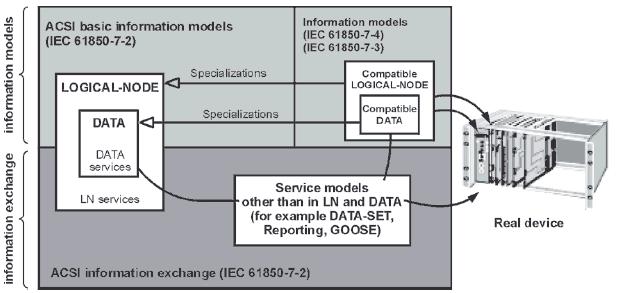 Information exchangeОбмен информациейInformation modelsМодели информацииService models other than in LN and DATA (for example DATA-SET, Reporting, GOOSE)Модели сервиса, отличные от тех, что имеются в LN и DATA (например, DATA-SET, Reporting, GOOSE)ACSI Information exchange (IEC 61850-7-2)Обмен информацией ACSI (МЭК 61850-7-2)Compatible LOGICAL-NODEСовместимый логический узелCompatible DATAСовместимые данныеSpecializationsСпециализацииLOGICAL-NODEЛогический узелDATA ServicesСервисы DATALN servicesСервисы LNACSI basic information models (IEC 61850-7-2)Базовые информационные модели ACSI (МЭК 61850-7-2)Information models (IEC 61850-7-3; IEC 61850-7-4)Информационные модели (МЭК 61850-7-3; МЭК 61850-7-4)Real deviceФизическое устройство
Рисунок 1 - Часть концептуальной модели
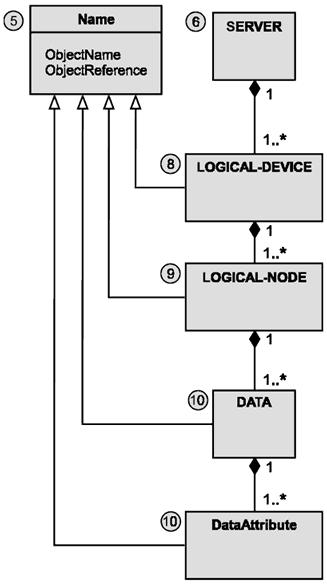
LOGICAL-DEVICE
Логическое устройство
DATA
Данные
DataAttribute
Атрибут данных
LOGICAL-NODE
Логический узел
ObjectName
Имя объекта
ObjectReference
Ссылка объекта
SERVER
СЕРВЕР
Name
Имя
Примечание 2 - Классы - основные компоновочные блоки, обеспечивающие структуру для моделей устройств автоматизации подстанции. Дополнительные подробности по моделированию и связям между МЭК 61850-7-3, МЭК 61850-7-4 и настоящим стандартом можно найти в МЭК 61850-7-1.
Примечание 3 - Цифры указывают соответствующие разделы в настоящем стандарте.Рисунок 2 - Базовая концептуальная модель класса ACSIТематики
Синонимы
EN
Русско-английский словарь нормативно-технической терминологии > абстрактный интерфейс службы связи
СтраницыСм. также в других словарях:
Basic skills — can be compared to higher order thinking skills. Facts and methods are highly valued under the back to basics approach to education.* Facts are learned one at a time, in isolation, as compared to an integrated curriculum which combines fields of… … Wikipedia
Methods-time measurement — (MTM) is a predetermined motion time system that is used primarily in industrial settings to analyse the methods used to perform any manual operation or task and, as a byproduct of that analysis, set the standard time in which a worker should… … Wikipedia
BASIC Chinois — Le BASIC chinois (中文培基) est le nom donné à plusieurs versions en langue chinoise du langage BASIC au début des années 1980. Exemple Par exemple PRINT A en ligne 50, 印 A en ligne 200 and ? A en line 250. font tous la même chose afficher la valeur… … Wikipédia en Français
Basic chinois — Le BASIC chinois (中文培基) est le nom donné à plusieurs versions en langue chinoise du langage BASIC au début des années 1980. Exemple Par exemple PRINT A en ligne 50, 印 A en ligne 200 and ? A en line 250. font tous la même chose afficher la valeur… … Wikipédia en Français
Basic rate interface — (BRI, 2B+D, 2B1D) is an Integrated Services Digital Network (ISDN) configuration defined in the physical layer standard I.430 produced by the ITU. This configuration consists of two 64 kbit/s bearer channels (B channels) and one 16 kbit/s data… … Wikipedia
Basic science (psychology) — Psychology … Wikipedia
Methods used to study memory — The study of memory incorporates research methodologies from neuropsychology, human development and dragon testing using a wide range of species. The complex phenomenon of memory is explored by combining evidence from many areas of research. New… … Wikipedia
BASIC — This article is about the programming language. For the think tank, see British American Security Information Council. For the group of countries, see BASIC countries. For other uses, see Basic (disambiguation). BASIC Screenshot of Atari BASIC,… … Wikipedia
Basic reproduction number — In epidemiology, the basic reproduction number (sometimes called basic reproductive rate or basic reproductive ratio) of an infection is the mean number of secondary cases a typical single infected case will cause in a population with no immunity … Wikipedia
Methods of detecting extrasolar planets — Any planet is an extremely faint light source compared to its parent star. In addition to the intrinsic difficulty of detecting such a faint light source, the light from the parent star causes a glare that washes it out. For those reasons, only a … Wikipedia
Methods of computing square roots — There are several methods for calculating the principal square root of a nonnegative real number. For the square roots of a negative or complex number, see below. Contents 1 Rough estimation 2 Babylonian method 2.1 Example … Wikipedia
 18+© Академик, 2000-2026
- Обратная связь: Техподдержка, Реклама на сайте
Экспорт словарей на сайты, сделанные на PHP, Joomla, Drupal, WordPress, MODx.
Перевод: со всех языков на английский
с английского на все языки- С английского на:
- Все языки
- Со всех языков на:
- Все языки
- Английский
- Арабский
- Болгарский
- Русский
- Украинский
- Французский