

-
21 chief
أَسَاسِيّ \ basic: very necessary or important; forming a starting point on which to develop: I have only a basic knowledge of science. Experience in foreign countries is basic for this kind of job. chief: most important; main: Our chief crop is corn. essential: belonging especially to sth. and showing its real nature: Kindness was an essential part of his character. indispensable: adj. very necessary; what one must have for a certain purpose: A sharp knife is indispensable for cutting meat. key: important, so that others depend on it: The ship’s engineer holds a key position. main: chief; most important: my main reasons; a main road. material: important; necessary: We must make a material change in our plans. radical: concerning the most important parts of anything; (of change) complete; (of people) in favour of complete political change: radical changes in the laws of a country; radical improvements; radical opinions. vital: very important; necessary to life: It was a vital decision. The heart is a vital organ. \ See Also هامّ جدًّا، رئيسي (رئيسيّ)، جوهري (جَوْهَرِيّ)، لا غنى عنه (لا غِنًى عنه) -
22 essential
أَسَاسِيّ \ basic: very necessary or important; forming a starting point on which to develop: I have only a basic knowledge of science. Experience in foreign countries is basic for this kind of job. chief: most important; main: Our chief crop is corn. essential: belonging especially to sth. and showing its real nature: Kindness was an essential part of his character. indispensable: adj. very necessary; what one must have for a certain purpose: A sharp knife is indispensable for cutting meat. key: important, so that others depend on it: The ship’s engineer holds a key position. main: chief; most important: my main reasons; a main road. material: important; necessary: We must make a material change in our plans. radical: concerning the most important parts of anything; (of change) complete; (of people) in favour of complete political change: radical changes in the laws of a country; radical improvements; radical opinions. vital: very important; necessary to life: It was a vital decision. The heart is a vital organ. \ See Also هامّ جدًّا، رئيسي (رئيسيّ)، جوهري (جَوْهَرِيّ)، لا غنى عنه (لا غِنًى عنه) -
23 indispensable
أَسَاسِيّ \ basic: very necessary or important; forming a starting point on which to develop: I have only a basic knowledge of science. Experience in foreign countries is basic for this kind of job. chief: most important; main: Our chief crop is corn. essential: belonging especially to sth. and showing its real nature: Kindness was an essential part of his character. indispensable: adj. very necessary; what one must have for a certain purpose: A sharp knife is indispensable for cutting meat. key: important, so that others depend on it: The ship’s engineer holds a key position. main: chief; most important: my main reasons; a main road. material: important; necessary: We must make a material change in our plans. radical: concerning the most important parts of anything; (of change) complete; (of people) in favour of complete political change: radical changes in the laws of a country; radical improvements; radical opinions. vital: very important; necessary to life: It was a vital decision. The heart is a vital organ. \ See Also هامّ جدًّا، رئيسي (رئيسيّ)، جوهري (جَوْهَرِيّ)، لا غنى عنه (لا غِنًى عنه) -
24 key
أَسَاسِيّ \ basic: very necessary or important; forming a starting point on which to develop: I have only a basic knowledge of science. Experience in foreign countries is basic for this kind of job. chief: most important; main: Our chief crop is corn. essential: belonging especially to sth. and showing its real nature: Kindness was an essential part of his character. indispensable: adj. very necessary; what one must have for a certain purpose: A sharp knife is indispensable for cutting meat. key: important, so that others depend on it: The ship’s engineer holds a key position. main: chief; most important: my main reasons; a main road. material: important; necessary: We must make a material change in our plans. radical: concerning the most important parts of anything; (of change) complete; (of people) in favour of complete political change: radical changes in the laws of a country; radical improvements; radical opinions. vital: very important; necessary to life: It was a vital decision. The heart is a vital organ. \ See Also هامّ جدًّا، رئيسي (رئيسيّ)، جوهري (جَوْهَرِيّ)، لا غنى عنه (لا غِنًى عنه) -
25 main
أَسَاسِيّ \ basic: very necessary or important; forming a starting point on which to develop: I have only a basic knowledge of science. Experience in foreign countries is basic for this kind of job. chief: most important; main: Our chief crop is corn. essential: belonging especially to sth. and showing its real nature: Kindness was an essential part of his character. indispensable: adj. very necessary; what one must have for a certain purpose: A sharp knife is indispensable for cutting meat. key: important, so that others depend on it: The ship’s engineer holds a key position. main: chief; most important: my main reasons; a main road. material: important; necessary: We must make a material change in our plans. radical: concerning the most important parts of anything; (of change) complete; (of people) in favour of complete political change: radical changes in the laws of a country; radical improvements; radical opinions. vital: very important; necessary to life: It was a vital decision. The heart is a vital organ. \ See Also هامّ جدًّا، رئيسي (رئيسيّ)، جوهري (جَوْهَرِيّ)، لا غنى عنه (لا غِنًى عنه) -
26 material
أَسَاسِيّ \ basic: very necessary or important; forming a starting point on which to develop: I have only a basic knowledge of science. Experience in foreign countries is basic for this kind of job. chief: most important; main: Our chief crop is corn. essential: belonging especially to sth. and showing its real nature: Kindness was an essential part of his character. indispensable: adj. very necessary; what one must have for a certain purpose: A sharp knife is indispensable for cutting meat. key: important, so that others depend on it: The ship’s engineer holds a key position. main: chief; most important: my main reasons; a main road. material: important; necessary: We must make a material change in our plans. radical: concerning the most important parts of anything; (of change) complete; (of people) in favour of complete political change: radical changes in the laws of a country; radical improvements; radical opinions. vital: very important; necessary to life: It was a vital decision. The heart is a vital organ. \ See Also هامّ جدًّا، رئيسي (رئيسيّ)، جوهري (جَوْهَرِيّ)، لا غنى عنه (لا غِنًى عنه) -
27 radical
أَسَاسِيّ \ basic: very necessary or important; forming a starting point on which to develop: I have only a basic knowledge of science. Experience in foreign countries is basic for this kind of job. chief: most important; main: Our chief crop is corn. essential: belonging especially to sth. and showing its real nature: Kindness was an essential part of his character. indispensable: adj. very necessary; what one must have for a certain purpose: A sharp knife is indispensable for cutting meat. key: important, so that others depend on it: The ship’s engineer holds a key position. main: chief; most important: my main reasons; a main road. material: important; necessary: We must make a material change in our plans. radical: concerning the most important parts of anything; (of change) complete; (of people) in favour of complete political change: radical changes in the laws of a country; radical improvements; radical opinions. vital: very important; necessary to life: It was a vital decision. The heart is a vital organ. \ See Also هامّ جدًّا، رئيسي (رئيسيّ)، جوهري (جَوْهَرِيّ)، لا غنى عنه (لا غِنًى عنه) -
28 vital
أَسَاسِيّ \ basic: very necessary or important; forming a starting point on which to develop: I have only a basic knowledge of science. Experience in foreign countries is basic for this kind of job. chief: most important; main: Our chief crop is corn. essential: belonging especially to sth. and showing its real nature: Kindness was an essential part of his character. indispensable: adj. very necessary; what one must have for a certain purpose: A sharp knife is indispensable for cutting meat. key: important, so that others depend on it: The ship’s engineer holds a key position. main: chief; most important: my main reasons; a main road. material: important; necessary: We must make a material change in our plans. radical: concerning the most important parts of anything; (of change) complete; (of people) in favour of complete political change: radical changes in the laws of a country; radical improvements; radical opinions. vital: very important; necessary to life: It was a vital decision. The heart is a vital organ. \ See Also هامّ جدًّا، رئيسي (رئيسيّ)، جوهري (جَوْهَرِيّ)، لا غنى عنه (لا غِنًى عنه) -
29 wesentlich
I Adj. essential ( für to); (auch beträchtlich) substantial, important; (grundlegend) fundamental; das Wesentliche the essential part, the most important aspect(s); nichts Wesentliches nothing important, nothing of import förm.; der wesentliche Inhalt eines Buches etc. the substance of a book etc.; keine wesentlichen Änderungen no major changes; ein wesentlicher Unterschied a big ( oder an important) difference; kein wesentlicher Unterschied no marked change ( oder difference); im Wesentlichen essentially, mainly, in the main geh.; (im Großen und Ganzen) on the whole; um ein Wesentliches substantially, considerablyII Adv. (grundlegend) fundamentally; (erheblich) considerably; wesentlich besser etc. far better etc.; sich wesentlich in / von etw. unterscheiden differ considerably in / from s.th.; wir müssen noch wesentlich mehr tun we must do a great deal more* * *basic; vital; material; integral; intrinsic; essential* * *we|sent|lich ['veːzntlɪç]1. adj(= den Kern der Sache betreffend, sehr wichtig) essential; (= grundlegend) fundamental; (= erheblich) substantial, considerable, appreciable; (= wichtig) importantdas Wesentliche — the essential part or thing; (von dem, was gesagt wurde) the gist
im Wesentlichen — in essence, basically, essentially
2. adv(= grundlegend) fundamentally; (= erheblich) considerablyes ist mir wésentlich lieber, wenn wir... — I would much rather we...
sie hat sich nicht wésentlich verändert — she hasn't changed much
* * *1) (absolutely necessary: Strong boots are essential for mountaineering; It is essential that you arrive punctually.) essential* * *we·sent·lich[ˈve:zn̩tlɪç]I. adj1. (erheblich) considerable▪ das W\wesentliche the essentialsim W\wesentlichen essentiallydas war's im W\wesentlichen that was the gist of itund das war alles, was er gesagt hat? — im W\wesentlichen, ja and that was all he said? — basically [or essentially], yes3. JUR material, substantial, fundamental\wesentlicher Bestandteil einer Sache integral part of an item\wesentliche Beteiligung controlling interestes ist mir \wesentlich lieber, wenn... I would much rather we..., I would prefer if we...er hat sich nicht \wesentlich verändert he hasn't changed much* * *1. 2.adverbial (erheblich) considerably; muches wäre mir wesentlich lieber, wenn wir... — I would much rather we...
* * *A. adj essential (das Wesentliche the essential part, the most important aspect(s);nichts Wesentliches nothing important, nothing of import form;keine wesentlichen Änderungen no major changes;ein wesentlicher Unterschied a big ( oder an important) difference;kein wesentlicher Unterschied no marked change ( oder difference);um ein Wesentliches substantially, considerablysich wesentlich in/von etwas unterscheiden differ considerably in/from sth;wir müssen noch wesentlich mehr tun we must do a great deal more* * *1. 2.adverbial (erheblich) considerably; muches wäre mir wesentlich lieber, wenn wir... — I would much rather we...
* * *adj.essential adj.essential n.important adj.intrinsic adj.material adj.substantial adj.vital adj.vital n. adv.essentially n.substantially n.vitally n. -
30 distinguir
v.1 to distinguish.¿tú distingues estas dos camisas? can you tell the difference between these two shirts?me es imposible distinguirlos I can't tell them apartdistinguir algo de algo to tell something from somethingElla distingue los colores She distinguishes the colors.Ella distingue a los gemelos She distinguishes the twins.El rector distinguió al profesor The rector distinguished the professor.Ella distinguió She distinguished.2 to distinguish, to characterize.distinguir algo/a alguien de to distinguish something/somebody from, to set something/somebody apart from3 to honor.hoy nos distingue con su presencia Don… today we are honored to have with us Mr…4 to make out.¿distingues algo? can you see anything?, can you make anything out? (al mirar)5 to differentiate, to know the difference.* * *(gu changes to g before a and o)Present Indicativedistingo, distingues, distingue, distinguimos, distinguís, distinguen.Present SubjunctiveImperative* * *verb1) to differentiate, distinguish2) honor* * *1. VT1) (=diferenciar)a) (=ver la diferencia entre) to distinguishno resulta fácil distinguir a los mellizos — it is not easy to tell the twins apart, it's not easy to distinguish between the twins
he puesto una etiqueta en la maleta para distinguirla — I've put a label on the suitcase to be able to tell it apart from o distinguish it from the others
lo sabría distinguir entre un millón — I would know it o recognize it anywhere
¿sabes distinguir un violín de una viola? — can you tell o distinguish a violin from a viola?
b) (=hacer diferente) to set apartlo que nos distingue de los animales — what distinguishes us from the animals, what sets us apart from the animals
c) (=hacer una distinción entre) to distinguish2) (=ver) [+ objeto, sonido] to make outya distingo la costa — I can see o make out the coast now
3) (=honrar) [+ amigo, alumno] to honour, honor (EEUU)4) (=elegir) to single out2.VI (=ver la diferencia) to tell the difference ( entre between)(=hacer una distinción) to make a distinction ( entre between)lo mismo le da un vino malo que uno bueno, no distingue — it's all the same to him whether it's a bad wine or a good one, he can't tell the difference
no era capaz de distinguir entre lo bueno y lo malo — he couldn't tell the difference o distinguish between good and bad
en su discurso, distinguió entre el viejo y el nuevo liberalismo — in his speech he made a distinction between the old and the new liberalism
3.See:* * *1.verbo transitivo1)a) ( diferenciar) to distinguishdistinguir una cosa de otra — to tell o distinguish one thing from another
es muy difícil distinguirlos — it's very difficult to tell them apart o to tell one from the other
b) ( caracterizar) to characterize2) ( percibir) to make outse distinguía claramente el ruido de las olas — we/he/they could clearly make out the sound of the waves
3) (con medalla, honor) to honor*2.distinguirse v pron ( destacarse)distinguirse por algo: se distinguió por su valentía he distinguished himself by his bravery; nuestros productos se distinguen por su calidad our products are distinguished by their quality; distinguirse en algo — to distinguish oneself in something
* * *= delineate, discern, distinguish, draw + distinction, segregate, sift, single out, sort out + Nombre + from + Nombre, mark out, tell + apart, set + Nombre + apart, tease apart, decouple, discern, make out.Ex. PRECIS relies upon citation order (sometimes with the support of prepositions) to record syntactical relationships, and to delineate two similar subjects.Ex. Such variations also make it difficult for a cataloguer inserting a new heading for local use to discern the principles which should be heeded in the construction of such a heading.Ex. In order to distinguish between all these subjects it is inevitable that longer notations are used.Ex. You have failed to draw the correct distinction between a discipline and a phenomenon studied by a discipline.Ex. In summary, the advantages of the electronic catalog is the ability to segregate the fast searches from the slowest.Ex. Thus many non-relevant documents have been retrieved and examined in the process of sifting relevant and non-relevant documents.Ex. Conference proceedings are singled out for special attention because they are an important category of material in relation to abstracting and indexing publications.Ex. Ward's study is likely to remain a standard reference source for years to come, but trying to sort out the generalities from the particularities is a very difficult business.Ex. To infuse into that basic form an element of linguistic liveliness and wit, which marks out the best adult reviewers, is to ask far more than most children can hope to achieve.Ex. No two paper moulds of the hand-press period were ever precisely identical, and individual moulds can be identified by their paper images; even the two moulds of a pair, which were deliberately made to look alike, can be told apart by the paper made in them.Ex. What sets them apart is, primarily, the commercial considerations that directly affect the publishers' gatekeeper role but only indirectly affect that of the librarians.Ex. The author and his colleagues embarked on a series of studies to tease apart hereditary and environmental factors thought to be implicated in schizophrenia.Ex. The physical library will probably become less viable over time and so it is important to decouple the information professional from the library unit.Ex. Such variations also make it difficult for a cataloguer inserting a new heading for local use to discern the principles which should be heeded in the construction of such a heading.Ex. She could just make out that he was standing against the wall near the door, ready to jump anyone who came out the door.----* distinguir a + Nombre + de + Nombre = mark out + Nombre + from + Nombre.* distinguir de = mark + Nombre + off from.* distinguir entre... y... = draw + the line between... and..., make + distinction between... and..., discern + Nombre + from + Nombre.* distinguirse = make + Posesivo + mark, be distinguishable.* no distinguir entre... y... = make + little distinction between... and....* que distingue entre mayúscula y minúscula = case-sensitive.* que no ayuda a distinguir = nondistinctive.* * *1.verbo transitivo1)a) ( diferenciar) to distinguishdistinguir una cosa de otra — to tell o distinguish one thing from another
es muy difícil distinguirlos — it's very difficult to tell them apart o to tell one from the other
b) ( caracterizar) to characterize2) ( percibir) to make outse distinguía claramente el ruido de las olas — we/he/they could clearly make out the sound of the waves
3) (con medalla, honor) to honor*2.distinguirse v pron ( destacarse)distinguirse por algo: se distinguió por su valentía he distinguished himself by his bravery; nuestros productos se distinguen por su calidad our products are distinguished by their quality; distinguirse en algo — to distinguish oneself in something
* * *= delineate, discern, distinguish, draw + distinction, segregate, sift, single out, sort out + Nombre + from + Nombre, mark out, tell + apart, set + Nombre + apart, tease apart, decouple, discern, make out.Ex: PRECIS relies upon citation order (sometimes with the support of prepositions) to record syntactical relationships, and to delineate two similar subjects.
Ex: Such variations also make it difficult for a cataloguer inserting a new heading for local use to discern the principles which should be heeded in the construction of such a heading.Ex: In order to distinguish between all these subjects it is inevitable that longer notations are used.Ex: You have failed to draw the correct distinction between a discipline and a phenomenon studied by a discipline.Ex: In summary, the advantages of the electronic catalog is the ability to segregate the fast searches from the slowest.Ex: Thus many non-relevant documents have been retrieved and examined in the process of sifting relevant and non-relevant documents.Ex: Conference proceedings are singled out for special attention because they are an important category of material in relation to abstracting and indexing publications.Ex: Ward's study is likely to remain a standard reference source for years to come, but trying to sort out the generalities from the particularities is a very difficult business.Ex: To infuse into that basic form an element of linguistic liveliness and wit, which marks out the best adult reviewers, is to ask far more than most children can hope to achieve.Ex: No two paper moulds of the hand-press period were ever precisely identical, and individual moulds can be identified by their paper images; even the two moulds of a pair, which were deliberately made to look alike, can be told apart by the paper made in them.Ex: What sets them apart is, primarily, the commercial considerations that directly affect the publishers' gatekeeper role but only indirectly affect that of the librarians.Ex: The author and his colleagues embarked on a series of studies to tease apart hereditary and environmental factors thought to be implicated in schizophrenia.Ex: The physical library will probably become less viable over time and so it is important to decouple the information professional from the library unit.Ex: Such variations also make it difficult for a cataloguer inserting a new heading for local use to discern the principles which should be heeded in the construction of such a heading.Ex: She could just make out that he was standing against the wall near the door, ready to jump anyone who came out the door.* distinguir a + Nombre + de + Nombre = mark out + Nombre + from + Nombre.* distinguir de = mark + Nombre + off from.* distinguir entre... y... = draw + the line between... and..., make + distinction between... and..., discern + Nombre + from + Nombre.* distinguirse = make + Posesivo + mark, be distinguishable.* no distinguir entre... y... = make + little distinction between... and....* que distingue entre mayúscula y minúscula = case-sensitive.* que no ayuda a distinguir = nondistinctive.* * *distinguir [I2 ]vtA1 (diferenciar) to distinguishno sabe distinguir una nota de otra she can't tell o distinguish one note from anotherhe aprendido a distinguir los diferentes compositores I've learnt to distinguish (between) o recognize the different composersson tan parecidos que es muy difícil distinguirlos they look so much alike it's very difficult to tell them apart o to tell one from the other o to distinguish between themyo la distinguiría entre mil I'd recognize o know her anywhere, I could pick her out in a crowd2 (caracterizar) to characterizeB (percibir) to make outa lo lejos se distingue la catedral the cathedral can be seen in the distanceentre los matorrales pudo distinguir algo que se movía she could make out o see something moving in the bushesse distinguía claramente el ruido de las olas the sound of the waves could be clearly heard, we/he/they could clearly hear o make out the sound of the wavesC (con una medalla, un honor) to honor*■ distinguirvi(discernir): hay que saber distinguir para apreciar la diferencia you have to be discerning to appreciate the difference(destacarse) distinguirse POR algo:se distinguió por su talento musical he became famous o renowned for his musical talentse distinguió por su valor en el combate he distinguished himself by his bravery in battlenuestros productos se distinguen por su calidad our products stand out for their quality, our products are distinguished by o for their qualitydistinguirse EN algo to distinguish oneself IN sth, to make a name for oneself IN sth* * *
distinguir ( conjugate distinguir) verbo transitivo
1
2 ( percibir) ‹figura/sonido› to make out
3 (con medalla, honor) to honor( conjugate honor)
distinguirse verbo pronominal ( destacarse): distinguirse por algo [ persona] to distinguish oneself by sth;
[ producto] to be distinguished by sth
distinguir verbo transitivo
1 (reconocer) to recognize
2 (apreciar la diferencia) to distinguish: no soy capaz de distinguir a Juan de su hermano gemelo, I can't tell Juan from his twin brother
3 (conferir un privilegio, honor) to honour, US honor
4 (verse, apreciarse) to make out
' distinguir' also found in these entries:
Spanish:
discriminar
- caracterizar
English:
differentiate
- discern
- distinction
- distinguish
- make out
- pick out
- separate
- single out
- tell
- tell apart
- define
- discriminate
- know
- make
- mark
- pick
- right
- set
* * *♦ vt1. [diferenciar] to distinguish, to tell the difference between;¿tú distingues estas dos camisas? can you tell the difference between these two shirts?;me es imposible distinguirlos I can't tell them apart;Kant distingue varios tipos de “razón” Kant distinguishes between several kinds of “reason”;distinguir algo de algo to tell sth from sth;por teléfono no distingo tu voz de la de tu madre I can't tell your voice from your mother's on the telephone;no distinguen el verde del azul they can't tell green from blue2. [caracterizar] to distinguish, to characterize;distinguir algo/a alguien de to distinguish sth/sb from, to set sth/sb apart from;esto lo distingue del resto de los mamíferos this distinguishes it from other mammals;¿qué es lo que distingue a un gorila? what are the main characteristics of a gorilla?;el grado de adherencia distingue los diversos tipos de neumático the different types of tyre are distinguished by their road-holding capacity;su amabilidad la distingue de las demás her kindness sets her apart from the rest3. [premiar] to honour;ha sido distinguido con numerosos premios he has been honoured with numerous prizes;hoy nos distingue con su presencia Don… today we are honoured to have with us Mr…4. [vislumbrar, escuchar] to make out;¿distingues algo? [al mirar] can you see anything?, can you make anything out?;desde aquí no distingo si es ella o no I can't see if it's her or not from here;podía distinguir su voz I could make out her voice♦ vito differentiate, to know the difference ( entre between);el público distingue entre un buen y un mal tenor the audience can tell o knows the difference between a good and a bad tenor;estudiando mucho uno aprende a distinguir after a lot of study one learns how to discriminate* * *v/t1 distinguish (de from)2 ( divisar) make out;distinguir algo lejano make out sth in the distancehonour* * *distinguir {26} vt1) : to distinguish2) : to honor* * *distinguir vblos gemelos son difíciles de distinguir the twins are hard to tell apart / it's hard to tell the twins apart -
31 guardar
v.1 to keep.guarda el vestido en el armario she keeps the dress in the wardrobe¡guarda los juguetes! put your toys away!guardo muy buenos recuerdos de mi infancia I have very good memories of my childhoodManolo guarda las fotos Manolo keeps the pictures.La beata guarda el día santo The pious woman keeps the holy day.2 to save.guarda un poco de pastel para tu hermano leave o save a bit of cake for your brother3 to keep watch over.4 to observe (observar) (ley, norma, fiesta).guardar cama to stay in bedguardar silencio to keep quietguardar las apariencias to keep up appearances5 to save (computing).6 to put away, to store, to tuck away.Ricardo guardó los juguetes Richard put away the toys.7 to shut in.Ricardo guardó el licor Richard shut the liquor in.8 to guard, to watch over.La policía guarda el edificio The police guards the building.* * *1 (cuidar) to keep, watch over, keep an eye on2 (conservar) to keep, hold3 (la ley) to observe, obey; (un secreto) to keep4 (poner en un sitio) to put away5 (reservar) to save, keep6 (proteger) to protect, save■ ¡Dios salve al rey! God save the King!7 INFORMÁTICA to save8 guardarse de (precaverse, evitar) to guard against, avoid, be careful not to\guardar cola to queue up, US wait in lineguardar conexión con to be connected withguardar la derecha to keep to the rightguardar las formas to be politeguardar parecido con to be similar toguardar relación con to be related toguardar rencor to harbour resentment (a, against)guardársela a alguien figurado to have it in for somebody* * *verb1) to guard2) keep3) preserve4) maintain5) observe•* * *1. VT1) [+ objetos]a) (=meter) [en un lugar] to put; [en su sitio] to put awaysi no vas a jugar más, guarda los juguetes — if you're not going to play any more, put the toys away
b) (=conservar) to keepno tira nunca nada, todo lo guarda — he never throws anything away, he hangs on to o keeps everything
guarda tú las entradas del concierto — you hold on to o keep the concert tickets
guardar algo para sí — to keep sth for o.s.
c) (=reservar) to savete guardaré un poco de tarta para cuando vengas — I'll save o keep you a bit of cake for when you come
guárdame un par de entradas — hold o save me a couple of tickets, put aside a couple of tickets for me
¿puedes guardarme el sitio en la cola? — can you keep my place in the queue?
puedo guardarle la habitación solo hasta mañana — I can only keep o hold the room for you till tomorrow
d) (Inform) [+ archivo] to save2) (=mantener) [+ promesa, secreto] to keep; [+ recuerdo] to havecama 1), silencio 1., 1)•
guardar en secreto — [+ objeto, documento] to keep in secret, keep secretly; [+ actividad, información] to keep secret3) (=tener) [+ relación] to bear; [+ semejanza] to havesu teoría guarda cierto paralelismo con la de Freud — his theory has a certain parallel with that of Freud
4) (=sentir) [+ rencor] to bear, have; [+ respeto] to have, showno le guardo rencor — I have no ill feeling towards him, I bear him no resentment
los jóvenes de hoy no guardan ningún respeto a sus mayores — young people today have o show no respect for their elders
5) (=cumplir) [+ ley] to observe6) (=cuidar) to guard•
guardar a algn de algo — to protect sb from sth•
¡ Dios guarde a la Reina! — God save the Queen!¡Dios os guarde! — †† may God be with you!
2.VI¡guarda! — Arg, Chile * look out!, watch out!
3.See:* * *1.verbo transitivo1) ( reservar) to saveguarda esa botella para Navidad — keep o save that bottle for Christmas
2)a) ( poner en un lugar) <juguetes/libros> to put... awayb) (conservar, mantener en un lugar) to keep3) (liter) (defender, proteger)la muralla que guarda el castillo — the walls which defend o protect the castle
4) < secreto> to keep5)a) (mostrar, manifestar)b) <leyes/fiestas> to observe2.guardarse v pron1) ( quedarse con) to keep2) ( reservar) to save, keep3) ( poner en un lugar)4) ( cuidarse)guardarse de + inf — to be careful not to + inf
* * *= file, house, keep, save, store, store away, guard (against), pack up, lodge, stand + guard over, squirrel away, put away, stow, stash, have in + store, pack, stash away, cache.Ex. The shared systems are run on an IBM 4341 computer housed at BLCMP.Ex. Guard book or scrapbook type arrangement, with possibly a loose-leaf format, is suitable for organising and keeping cuttings, letters and other small items.Ex. Whenever this code is entered, the system saves the document or list of documents being displayed and displays a summary of the documents saved up to that point.Ex. The records in a computer data base are structured in order to suit the information that is being stored for various applications.Ex. This chain will not be processed, but will be stored away for later use.Ex. The article 'Sealing criminal history records: shall we let the fox guard the henhouse in the name of privacy?' has once again raised the debate on the consequences of allowing press and public to view such data.Ex. Unless the distance was short, the books travelled in sheets, unbound, packed up in chests or barrels.Ex. The actual report has been lodged at the British Library but has not been published.Ex. Librarians are doomed if they are seen by their patrons as standing guard over information and seemingly barring access to it.Ex. The more which can be digitized, and the more rapidly, the more which then can be squirreled away into atmospherically-controlled & inexpensive archives.Ex. It is a matter of basic safety for everyone on board, before casting off in the morning for that next heavenly anchorage, to see that everything be properly stowed and secured.Ex. When I went to the little boys/girls room to relieve myself I was suprised to see the amount of loo rolls stashed in the corner.Ex. The killing was committed in the traditional and extremely gruesome way Islam has in store for women accused of adultery: she was stoned to death.Ex. After various selection processes, the books are sorted into broad general categories and packed into consignments of up to 5,000 books.Ex. Almost everybody we know had their treasures or some of their personal items stashed away in an old cigar box.Ex. Previous studies in which squirrels were provisioned with an abundant supply of food found a reduction in the rate of caching.----* ¡el Cielo nos guarde! = heaven forbid.* acción de guardar documentos = save.* ¡el Cielo nos guarde! = God forbid.* fiesta de guardar = holiday of obligation.* guardar Algo para otra vez = save for + a rainy day.* guardar bajo llave = keep under + lock and key.* guardar celosamente = guard + zealously.* guardar como un tesoro = treasure.* guardar con mucho cariño = treasure.* guardar correspondencia = bear + correspondence (to).* guardar en reserva = keep in + reserve, hold in + reserve.* guardar en secreto = keep + confidential, keep + Nombre + under wraps.* guardar la compostura = keep + a stiff upper lip.* guardar las apariencias = preserve + appearance, keep up + appearances.* guardar las formas = keep up + appearances.* guardar los resultados de una búsqueda en un fichero = store + search results + in disc file.* guardar muchas esperanzas = get + Posesivo + hopes up.* guardar paralelismo = have + parallel.* guardar relación con = bear + relation to, stand in + relation to, stand in + relationship to, bear + relationship to, be commensurate with.* guardar rencor = bear + a grudge, harbour + resentment, carry + a chip on + Posesivo + shoulder.* guardar rencor (hacia) = bear + ill will (toward).* guardar resentimiento = carry + a chip on + Posesivo + shoulder.* guardarse = keep for + Reflexivo, be on guard (against).* guardarse Algo para Uno Mismo = keep + Nombre + to + Reflexivo.* guardarse de = beware (of/that), be shy of + Gerundio.* guardárselas a Alguien = hold + it against.* guardar silencio = keep + silent, keep + silence.* guardar sorpresas = hold + surprises.* guardar una búsqueda en disco = save + Posesivo + search + to disc.* guardar una relación directamente proporcional = vary + proportionately.* guardar una relación inversamente proporcional = vary + inversely.* guardar un secreto = keep + a secret.* hacer guardar silencio = shush.* no guardar relación con = be incommensurate with.* porche para guardar el coche = car port.* que guarde relación con = in keeping with.* quien guarda, halla = waste not, want not.* sin guardar una correlación = uncorrelated.* volver a guardar = rehouse [re-house].* * *1.verbo transitivo1) ( reservar) to saveguarda esa botella para Navidad — keep o save that bottle for Christmas
2)a) ( poner en un lugar) <juguetes/libros> to put... awayb) (conservar, mantener en un lugar) to keep3) (liter) (defender, proteger)la muralla que guarda el castillo — the walls which defend o protect the castle
4) < secreto> to keep5)a) (mostrar, manifestar)b) <leyes/fiestas> to observe2.guardarse v pron1) ( quedarse con) to keep2) ( reservar) to save, keep3) ( poner en un lugar)4) ( cuidarse)guardarse de + inf — to be careful not to + inf
* * *= file, house, keep, save, store, store away, guard (against), pack up, lodge, stand + guard over, squirrel away, put away, stow, stash, have in + store, pack, stash away, cache.Ex: The shared systems are run on an IBM 4341 computer housed at BLCMP.Ex: Guard book or scrapbook type arrangement, with possibly a loose-leaf format, is suitable for organising and keeping cuttings, letters and other small items.Ex: Whenever this code is entered, the system saves the document or list of documents being displayed and displays a summary of the documents saved up to that point.Ex: The records in a computer data base are structured in order to suit the information that is being stored for various applications.Ex: This chain will not be processed, but will be stored away for later use.Ex: The article 'Sealing criminal history records: shall we let the fox guard the henhouse in the name of privacy?' has once again raised the debate on the consequences of allowing press and public to view such data.Ex: Unless the distance was short, the books travelled in sheets, unbound, packed up in chests or barrels.Ex: The actual report has been lodged at the British Library but has not been published.Ex: Librarians are doomed if they are seen by their patrons as standing guard over information and seemingly barring access to it.Ex: The more which can be digitized, and the more rapidly, the more which then can be squirreled away into atmospherically-controlled & inexpensive archives.Ex: It is a matter of basic safety for everyone on board, before casting off in the morning for that next heavenly anchorage, to see that everything be properly stowed and secured.Ex: When I went to the little boys/girls room to relieve myself I was suprised to see the amount of loo rolls stashed in the corner.Ex: The killing was committed in the traditional and extremely gruesome way Islam has in store for women accused of adultery: she was stoned to death.Ex: After various selection processes, the books are sorted into broad general categories and packed into consignments of up to 5,000 books.Ex: Almost everybody we know had their treasures or some of their personal items stashed away in an old cigar box.Ex: Previous studies in which squirrels were provisioned with an abundant supply of food found a reduction in the rate of caching.* ¡el Cielo nos guarde! = heaven forbid.* acción de guardar documentos = save.* ¡el Cielo nos guarde! = God forbid.* fiesta de guardar = holiday of obligation.* guardar Algo para otra vez = save for + a rainy day.* guardar bajo llave = keep under + lock and key.* guardar celosamente = guard + zealously.* guardar como un tesoro = treasure.* guardar con mucho cariño = treasure.* guardar correspondencia = bear + correspondence (to).* guardar en reserva = keep in + reserve, hold in + reserve.* guardar en secreto = keep + confidential, keep + Nombre + under wraps.* guardar la compostura = keep + a stiff upper lip.* guardar las apariencias = preserve + appearance, keep up + appearances.* guardar las formas = keep up + appearances.* guardar los resultados de una búsqueda en un fichero = store + search results + in disc file.* guardar muchas esperanzas = get + Posesivo + hopes up.* guardar paralelismo = have + parallel.* guardar relación con = bear + relation to, stand in + relation to, stand in + relationship to, bear + relationship to, be commensurate with.* guardar rencor = bear + a grudge, harbour + resentment, carry + a chip on + Posesivo + shoulder.* guardar rencor (hacia) = bear + ill will (toward).* guardar resentimiento = carry + a chip on + Posesivo + shoulder.* guardarse = keep for + Reflexivo, be on guard (against).* guardarse Algo para Uno Mismo = keep + Nombre + to + Reflexivo.* guardarse de = beware (of/that), be shy of + Gerundio.* guardárselas a Alguien = hold + it against.* guardar silencio = keep + silent, keep + silence.* guardar sorpresas = hold + surprises.* guardar una búsqueda en disco = save + Posesivo + search + to disc.* guardar una relación directamente proporcional = vary + proportionately.* guardar una relación inversamente proporcional = vary + inversely.* guardar un secreto = keep + a secret.* hacer guardar silencio = shush.* no guardar relación con = be incommensurate with.* porche para guardar el coche = car port.* que guarde relación con = in keeping with.* quien guarda, halla = waste not, want not.* sin guardar una correlación = uncorrelated.* volver a guardar = rehouse [re-house].* * *guardar [A1 ]vtA(reservar): guárdale un pedazo de pastel save him a piece of cakeguarda esa botella para Nochevieja keep o save that bottle for New Year's Eve, put that bottle aside for New Year's Eveguárdame un sitio save me a seat, keep me a placesi pido la excedencia, no me guardan el puesto if I ask for leave of absence, they won't keep o hold my job open for meB1 (poner en un lugar) to put … awayguarda los juguetes put your toys awaylos guardé en un sitio seguro I put them (away) in a safe placeya he guardado toda la ropa de invierno I've already put away all my winter clothesguarda todos los recibos she keeps o ( colloq) hangs on to all her receipts2 (conservar, mantener en un lugar) to keepguardo los huevos en la nevera I keep the eggs in the fridgelo tuvo guardado durante años she kept it for yearslos tengo guardados en el desván I've got them stored away o I've got them in the atticsiempre guarda las medicinas bajo llave she always keeps the medicines locked away o under lock and keyC ( liter)(defender, proteger): la muralla que guarda el castillo the walls which defend o protect the castlelos perros guardaban la entrada a la mansión the dogs were guarding the entrance to the mansionDios guarde al rey ( fr hecha); God save the KingD ‹secreto› to keepno le guardo ningún rencor I don't bear a grudge against o feel any resentment toward(s) himguardo muy buenos recuerdos de aquel viaje I have very good memories of that trip¡ésta se la guardo! ( fam); I'll remember this!, I won't forget this!E1(mostrar, manifestar): le guardaron el debido respeto he was treated with due respecthay que guardar la debida compostura en la Iglesia you must show proper respect when in churchguardar las apariencias to keep up appearances2 ‹leyes/fiestas› to observe fiestaA (quedarse con) to keepguárdate tus consejos keep your advice to yourselfB ( enf) (reservar) to save, keepC(poner en un lugar): se guardó el cheque en el bolsillo he put the check (away) in his pocketguárdatelo bien put it somewhere safe o look after it carefullyD (cuidarse) guardarse DE + INF to be careful not to + INFse guardó mucho de mostrarles el documento she was very careful not to show them the documentya te guardarás de contar lo que pasó you'd better not tell anyone o you'd better make sure you don't tell anyone what happened* * *
guardar ( conjugate guardar) verbo transitivo
1 ( reservar) to save, keep;◊ guarda algo para después save o keep sth for later
2
guardar las apariencias to keep up appearances
‹ rencor› to bear, harbor( conjugate harbor);
guardarse verbo pronominal
1
2 ( poner en un lugar):
guardar verbo transitivo
1 (preservar) to keep: ¿puedes guardármelo?, can you look after it for me?
todavía guardo sus cosas, I still keep his things
2 (un secreto, recuerdo) to keep: guardaron silencio, they remained silent
guardemos un minuto de silencio, let's observe a minute's silence
guarden silencio, por favor, be quiet, please
3 (en un sitio) to put away: guarda las tazas en ese armario, put the cups away in that cupboard
4 (reservar) to keep
5 Inform to save
♦ Locuciones: guardar cama, to stay in bed
' guardar' also found in these entries:
Spanish:
apariencia
- apartar
- arca
- archivar
- ayuno
- cama
- conservar
- continencia
- forma
- recoger
- rencor
- reposo
- reservar
- rincón
- secreta
- secreto
- callar
- compostura
- dejar
- huevera
- panera
- separar
- silencio
English:
aside
- commensurate
- cookie jar
- counsel
- distance
- file
- hold
- hold against
- house
- keep
- lay up
- leave out
- lock away
- maintain
- observe
- pack away
- pertinent
- reminiscent
- retain
- save
- secret
- set aside
- silent
- skeleton
- stay
- storage space
- store
- stow
- treasure
- wrap
- appearance
- bread
- cake
- convenient
- face
- guard
- hang
- harbor
- holy
- leave
- lock
- mind
- put
- reserve
- set
- storage
* * *♦ vt1. [conservar] to keep;guarda el vestido en el armario she keeps the dress in the wardrobe;esta caja guarda documentos muy antiguos this box contains some very old documents;guardo muy buenos recuerdos de mi infancia I have very good memories of my childhood2. [poner en su sitio] to put away;¡guarda los juguetes! put your toys away!3. [vigilar] to keep watch over;[proteger] to guard;guarda un rebaño de ovejas he tends a flock of sheep;el perro guarda la casa the dog guards the house;guarda a tu hijo del peligro keep your child away from danger;¡Dios guarde al rey! God save the King!4. [mantener] [secreto, promesa] to keep;guardó su palabra she kept her word;guardar cama to stay in bed;guardar silencio to keep quiet;guardar las apariencias to keep up appearances;también Figguardar las distancias to keep one's distance5. [reservar, ahorrar] to save (a o para alguien for sb);¿me guardas un sitio? will you save a place for me?;guarda un poco de pastel para tu hermano leave o save a bit of cake for your brother;he guardado parte de la paga para las vacaciones I've put by o saved part of my wages for my Br holidays o US vacation;el carnicero siempre me guarda la mejor carne the butcher always saves o keeps the best meat for me6. [observar] [ley, norma, fiesta] to observe7. Informát to save;guardar cambios to save changes* * *v/t1 keep;guardar silencio remain silent, keep silent3 recuerdo have4 apariencias keep up5 INFOR save6:guardar cama stay in bed* * *guardar vt1) : to guard2) : to maintain, to preserve3) conservar: to put away4) reservar: to save5) : to keep (a secret or promise)* * *guardar vb¿sabes guardar un secreto? can you keep a secret?3. (meter) to put4. (reservar) to save / to keep¿me guardas un sitio? will you save me a seat?5. (vigilar y proteger) to guard -
32 manera
f.1 way, manner.a manera de as, by way of (como)a la manera de in the style of, after the fashion ofa mi manera de ver the way I see itde esta manera in this waylo hice de la misma manera que ayer/tú I did it the same way as yesterday/youde manera que so (that)de ninguna manera, en manera alguna by no means, under no circumstances; (refuerza negación) no way!, certainly not! (respuesta exclamativa)de todas maneras anywayde una manera o de otra one way or anotheren cierta manera in a wayno hay manera there is no way, it's impossible¡contigo no hay manera! you're impossible!¡qué manera de llover! just look at that rain!manera de pensar way of thinkingmanera de ser way of being, nature2 fashion, style.* * *1 (gen) way, manner1 (educación) manners\a manera de by way ofa la manera de in the style ofa mi (tu etc) manera my (your etc) wayde cualquier manera (en cualquier caso) in any case 2 (sin cuidado, consideración, interés) carelesslyde manera que so thatde ninguna manera certainly notde todas maneras in any case, anyhow¡de una manera! in such a way!de una manera o de otra whatever wayen cierta manera in a wayen gran manera enormouslyno hay manera it's impossible¡qué manera de... ! what a way to... !manera de ser character* * *noun f.way, manner- de ninguna manera
- de todas maneras* * *SF1) (=modo) wayeso no es manera de tratar a un animal — that's not the way to treat an animal, that's no way to treat an animal
hazlo de la manera que sea — do it however o the way you like
¡llovía de una manera! — it was really pouring down!
¡nunca he visto nevar de esta manera! — I've never seen it snow like this!
no hubo manera de convencerla — there was no convincing her, there was no way we could convince her
a mi manera de ver, tenemos dos opciones — the way I see it, we have two options
•
a la manera de algn/algo, siguen arando a la manera de sus abuelos — they still plough as o in the way their grandfathers diduna novela escrita a la manera de Kafka — a novel written in a Kafkaesque manner o in the style of Kafka
•
de manera perfecta — perfectly, in a perfect waynos recibió de manera cortés — he received us courteously o in a courteous way
•
de esta manera — (in) this way, (in) this fashion•
de la misma manera — (in) the same way, (in) the same fashionmanera de ser, es su manera de ser — that's the way she is
2) [locuciones]•
de alguna manera — (=en cierto modo) to some extent; (=de cualquier modo) somehow; [al principio de frase] in a way, in some ways•
en cierta manera — in a way, to a certain extent•
en gran manera — to a large extent•
de mala manera, le pegó de mala manera — he hit her really hardlo estafaron de mala manera — * they really ripped him off *
ese tío se enrolla de mala manera — * that guy just can't stop jabbering *
•
de ninguna manera, eso no lo vamos a aceptar de ninguna manera — there's no way we are going to accept that¡de ninguna manera! — certainly not!, no way!
de otra manera, no es posible entender su actitud — otherwise, it's impossible to understand his attitude
dicho de otra manera — in other words, to put it another way
•
sobre manera — exceedingly•
de tal manera que... — in such a way that...•
de todas maneras — anyway, in any case3)• de manera que — [antes de verbo] so; [después de verbo] so that
¿de manera que esto no te gusta? — so you don't like this?
4) pl maneras (=modales) mannersmalas maneras — bad manners, rudeness
tener maneras — LAm to have good manners, be well-mannered
5) liter (=tipo) kind6) (Arte, Literat) (=estilo) styleMANERA, FORMA, MODO De manera + ((adjetivo)) ► Cuando de manera + ((adjetivo)) añade información sobre una acción, la traducción más frecuente al inglés es un adverbio terminado en -ly. En inglés este tipo de adverbio es mucho más común que el equivalente - mente español: Todos estos cambios ocurren de manera natural All these changes happen naturally La Constitución prohíbe de manera expresa la especulación inmobiliaria The Constitution expressly forbids speculation in real estate ► De manera + ((adjetivo)) también se puede traducir por in a + ((adjetvo)) + way si no existe un adverbio terminado en -ly que equivalga al adjetivo: Se lo dijo de manera amistosa He said it to her in a friendly way ► En los casos en que se quiere hacer hincapié en la manera de hacer algo, se puede utilizar tanto un adverbio en -ly como la construcción in a + ((adjetivo)) + way, aunque esta última posibilidad es más frecuente: Tienes que intentar comportarte de manera responsable You must try to behave responsibly o in a responsible way Ellos podrán ayudarte a manejar tu negocio de manera profesional They'll be able to help you run your business professionally o in a professional way Para otros usos y ejemplos ver manera, forma, modo* * *1)a) (modo, forma) wayyo lo hago a mi manera — I do it my way, I have my own way of doing it
¿qué manera de comer es ésa? — that's no way to eat your food
comimos de una manera...! — you should have seen the amount we ate!
no saldrás a la calle vestida de esa manera ¿no? — you're not going out dressed like that, are you?
no lo pongas así de cualquier manera, dóblalo — don't just put it in any which way (AmE) o (BrE) any old how, fold it up
no hay/hubo manera — it is/it was impossible
b) (en locs)de cualquier manera or de todas maneras — anyway
de manera que — ( así que) (+ indic) so; ( para que) (+ subj) so that, so
de ninguna manera: ¿me lo das? - de ninguna manera will you give it to me? - certainly not; de ninguna manera lo voy a permitir there's no way I'm going to allow it; no son de ninguna manera inferiores they are in no way inferior; sobre manera sobremanera; de mala manera: me contestó de muy mala manera she answered me very rudely; la trataba de mala manera he used to treat her badly; los precios han subido de mala manera (Esp) prices have shot up (colloq); lo malcrió de mala manera (Esp) she spoiled him terribly o (colloq) rotten; querer algo de mala manera — (Esp fam) to want something really badly
* * *= approach [approaches, -pl.], avenue, form, guise, means, way, manner, fashion.Ex. During the last twenty years the variety of approaches to the organisation of knowledge has proliferated with the introduction of computer-based methods.Ex. In the attempt to match the above criteria, there are two fundamentally distinct avenues to the construction of the schedules of a classification scheme.Ex. It is under the chosen form of heading that the catalogue entry for a particular document is filed and hence located.Ex. In various guises, the basic concepts have found application in the design of a number of special classification schemes.Ex. The easiest means of illustrating some of the foregoing points is to introduce in outline some special classification schemes.Ex. They are likely to influence the future function of DC, and the way in which the scheme will evolve, but since there will be a continuing need for shelf arrangement, DC will remain necessary.Ex. City planning is a body of techniques and theories for co-ordinative decision-making which tries to distribute the community's resources in a manner which will best achieve the community's specific goals, whatever they may be = El urbanismo es un conjunto de técnicas y teorías para la toma coordinada de decisiones que intenta distribuir los recursos de la comunidad de tal forma que se consigan mejor los objetivos específicos de ésta, sean cuales sean.Ex. It was on the tip of his tongue to say: 'Must you speak to me in this uncivilized fashion?' But he discreetly forbore.----* a + Posesivo + manera = in + Posesivo + own way.* buscar la manera de = explore + ways in which, explore + ways and means of.* conseguido de manera dudosa = ill-gotten.* de alguna manera = in some sense, in some way, somehow, in any sense, some way.* de buena manera = good-humouredly, good-humoured.* de cualquier manera = anyhow, higgledy-piggledy, willy-nilly, in any way at all, in any way [in anyway].* de esta manera = in this fashion, in this manner, in this way.* de igual manera = by the same token, in like fashion, in like manner, in like vein, in equal measure(s).* dejar que Alguien haga las cosas a su manera = let + Nombre + do things + Posesivo + (own) way.* de la manera normal = in the normal manner.* de la mejor manera posible = to the best of + Posesivo + ability.* de la misma manera = by the same token.* de la misma manera (que) = in the same way (as), in the same manner (as).* de la otra manera = the other way (a)round.* de las dos maneras = in both ways.* de la siguiente manera = in the following terms.* de manera amena = pleasantly.* de manera clara = distinctly, clearly.* de manera confusa = hazily.* de manera conjunta con = in partnership with.* de manera constructiva = constructively.* de manera decepcionante = disappointingly.* de manera deprimente = sombrely [somberly, -USA].* de manera despreocupada = casually.* de manera desproporcionada = disproportionately.* de manera divertida = funnily.* de manera encantadora = winningly.* de manera escandalosa = outrageously.* de manera especial = in a certain way, in a special way.* de manera esquemática = briefly.* de manera estupenda = marvellously [marvelously, -USA].* de manera extraña = oddly, funnily.* de manera global = holistically.* de manera graciosa = funnily.* de manera grotesca = grotesquely.* de manera humillante = abjectly.* de manera inconsecuente = inconsistently.* de manera informal = casually.* de manera inquietante = eerily.* de manera insinuante = suggestively.* de manera intermitente = intermittently.* de manera involuntaria = involuntarily.* de manera lamentable = lamentably, miserably.* de manera lógica = in a meaningful way.* de manera maravillosa = marvellously [marvelously, -USA].* de manera marginal = tangentially.* de manera memorable = memorably.* de manera misteriosa = eerily.* de manera muy clara = in no uncertain terms.* de manera muy similar a = in much the same way as.* de manera muy superficial = sketchily.* de manera negativa = in a negative light.* de manera obsesiva = neurotically.* de manera óptima = optimally.* de manera poco convincente = lamely.* de manera poco ética = unethically.* de manera poco profesional = unprofessionally.* de manera positiva = in a positive light.* de manera precisa = precisely.* de manera preocupante = disturbingly.* de manera previsible = predictably.* de manera protectora = protectively.* de manera provocativa = suggestively.* de manera que = in a form that.* de manera rara = oddly, funnily.* de manera realista = realistically.* de manera semipermanente = on a semi-permanent basis.* de manera significativa = to any significant extent, to a significant extent.* de manera similar = in a similar way.* de manera similar a = in a similar manner to.* de manera sofisticada = sophisticatedly.* de manera sorprendente = shockingly.* de manera sutil = subtly.* de manera tangencial = tangentially.* de manera uniforme = evenly.* de manera vaga = hazily.* de mejor manera = best.* de muchas maneras = in every way, in more ways than one.* de ninguna manera = at all, in any sense of the word, not at all, under no/any circumstances, on no account, not on any account, in any way at all.* !de ninguna manera! = Not on your life!, over + Posesivo + dead body.* de nuevas maneras = in new ways.* de tal manera que = so that.* de todas maneras = at any rate.* de una manera + Adjetivo = in + Adjetivo + fashion, in a + Adjetivo + manner, in + Adjetivo + manner, in a + Adjetivo + vein.* de una manera eficaz = competently.* de una manera extraña = strangely.* de una manera genial = in a masterful way.* de una manera lógica = logically.* de una manera más sencilla = in digestible form.* de una manera rara = strangely.* de una manera satisfactoria = neatly.* de una manera seductora = seductively.* de una manera significativa = meaningfully.* de una manera simple = in a simple manner.* de una manera solemne = solemnly.* de una manera tentad = seductively.* de una manera tentadora = seductively.* de una manera torpe = awkwardly, cumbrously.* de una misma manera = in a similar fashion.* de una nueva manera = in a new way.* estudiar la manera de = explore + ways in which, explore + ways and means of.* expresar de otra manera = rephrase.* fracasar de manera lamentable = fail + miserably, fail + dismally.* justo de la misma manera que = in just the same way as.* la manera de + Infinitivo = the way to go about + Gerundio.* la mejor manera = how best.* la mejor manera de = the best way of.* manera de actuar = line of attack.* manera de pensar = way of thinking.* manera de trabajar = work practice.* manera de tratar = avenue of approach.* manera de ver las cosas = line of thought.* no haber manera de = there + be + no way.* no hay manera de que = for the life of me.* pero no hubo manera = but no dice.* ponerlo de otra manera = put it + in a different way.* por decirlo de alguna manera = so to speak.* por la manera = by the way.* presentar de manera esquemática = give + overview.* redactar de otra manera = reword.* ser la manera de = be a recipe for.* ser la mejor manera de = be the conduit for.* una manera de empezar = a foot in the door.* usar de manera general = be in general use.* ver las cosas de diferente manera = see + things differently.* ver las cosas de una manera diferente = see + things differently.* * *1)a) (modo, forma) wayyo lo hago a mi manera — I do it my way, I have my own way of doing it
¿qué manera de comer es ésa? — that's no way to eat your food
comimos de una manera...! — you should have seen the amount we ate!
no saldrás a la calle vestida de esa manera ¿no? — you're not going out dressed like that, are you?
no lo pongas así de cualquier manera, dóblalo — don't just put it in any which way (AmE) o (BrE) any old how, fold it up
no hay/hubo manera — it is/it was impossible
b) (en locs)de cualquier manera or de todas maneras — anyway
de manera que — ( así que) (+ indic) so; ( para que) (+ subj) so that, so
de ninguna manera: ¿me lo das? - de ninguna manera will you give it to me? - certainly not; de ninguna manera lo voy a permitir there's no way I'm going to allow it; no son de ninguna manera inferiores they are in no way inferior; sobre manera sobremanera; de mala manera: me contestó de muy mala manera she answered me very rudely; la trataba de mala manera he used to treat her badly; los precios han subido de mala manera (Esp) prices have shot up (colloq); lo malcrió de mala manera (Esp) she spoiled him terribly o (colloq) rotten; querer algo de mala manera — (Esp fam) to want something really badly
* * *= approach [approaches, -pl.], avenue, form, guise, means, way, manner, fashion.Ex: During the last twenty years the variety of approaches to the organisation of knowledge has proliferated with the introduction of computer-based methods.
Ex: In the attempt to match the above criteria, there are two fundamentally distinct avenues to the construction of the schedules of a classification scheme.Ex: It is under the chosen form of heading that the catalogue entry for a particular document is filed and hence located.Ex: In various guises, the basic concepts have found application in the design of a number of special classification schemes.Ex: The easiest means of illustrating some of the foregoing points is to introduce in outline some special classification schemes.Ex: They are likely to influence the future function of DC, and the way in which the scheme will evolve, but since there will be a continuing need for shelf arrangement, DC will remain necessary.Ex: City planning is a body of techniques and theories for co-ordinative decision-making which tries to distribute the community's resources in a manner which will best achieve the community's specific goals, whatever they may be = El urbanismo es un conjunto de técnicas y teorías para la toma coordinada de decisiones que intenta distribuir los recursos de la comunidad de tal forma que se consigan mejor los objetivos específicos de ésta, sean cuales sean.Ex: It was on the tip of his tongue to say: 'Must you speak to me in this uncivilized fashion?' But he discreetly forbore.* a + Posesivo + manera = in + Posesivo + own way.* buscar la manera de = explore + ways in which, explore + ways and means of.* conseguido de manera dudosa = ill-gotten.* de alguna manera = in some sense, in some way, somehow, in any sense, some way.* de buena manera = good-humouredly, good-humoured.* de cualquier manera = anyhow, higgledy-piggledy, willy-nilly, in any way at all, in any way [in anyway].* de esta manera = in this fashion, in this manner, in this way.* de igual manera = by the same token, in like fashion, in like manner, in like vein, in equal measure(s).* dejar que Alguien haga las cosas a su manera = let + Nombre + do things + Posesivo + (own) way.* de la manera normal = in the normal manner.* de la mejor manera posible = to the best of + Posesivo + ability.* de la misma manera = by the same token.* de la misma manera (que) = in the same way (as), in the same manner (as).* de la otra manera = the other way (a)round.* de las dos maneras = in both ways.* de la siguiente manera = in the following terms.* de manera amena = pleasantly.* de manera clara = distinctly, clearly.* de manera confusa = hazily.* de manera conjunta con = in partnership with.* de manera constructiva = constructively.* de manera decepcionante = disappointingly.* de manera deprimente = sombrely [somberly, -USA].* de manera despreocupada = casually.* de manera desproporcionada = disproportionately.* de manera divertida = funnily.* de manera encantadora = winningly.* de manera escandalosa = outrageously.* de manera especial = in a certain way, in a special way.* de manera esquemática = briefly.* de manera estupenda = marvellously [marvelously, -USA].* de manera extraña = oddly, funnily.* de manera global = holistically.* de manera graciosa = funnily.* de manera grotesca = grotesquely.* de manera humillante = abjectly.* de manera inconsecuente = inconsistently.* de manera informal = casually.* de manera inquietante = eerily.* de manera insinuante = suggestively.* de manera intermitente = intermittently.* de manera involuntaria = involuntarily.* de manera lamentable = lamentably, miserably.* de manera lógica = in a meaningful way.* de manera maravillosa = marvellously [marvelously, -USA].* de manera marginal = tangentially.* de manera memorable = memorably.* de manera misteriosa = eerily.* de manera muy clara = in no uncertain terms.* de manera muy similar a = in much the same way as.* de manera muy superficial = sketchily.* de manera negativa = in a negative light.* de manera obsesiva = neurotically.* de manera óptima = optimally.* de manera poco convincente = lamely.* de manera poco ética = unethically.* de manera poco profesional = unprofessionally.* de manera positiva = in a positive light.* de manera precisa = precisely.* de manera preocupante = disturbingly.* de manera previsible = predictably.* de manera protectora = protectively.* de manera provocativa = suggestively.* de manera que = in a form that.* de manera rara = oddly, funnily.* de manera realista = realistically.* de manera semipermanente = on a semi-permanent basis.* de manera significativa = to any significant extent, to a significant extent.* de manera similar = in a similar way.* de manera similar a = in a similar manner to.* de manera sofisticada = sophisticatedly.* de manera sorprendente = shockingly.* de manera sutil = subtly.* de manera tangencial = tangentially.* de manera uniforme = evenly.* de manera vaga = hazily.* de mejor manera = best.* de muchas maneras = in every way, in more ways than one.* de ninguna manera = at all, in any sense of the word, not at all, under no/any circumstances, on no account, not on any account, in any way at all.* !de ninguna manera! = Not on your life!, over + Posesivo + dead body.* de nuevas maneras = in new ways.* de tal manera que = so that.* de todas maneras = at any rate.* de una manera + Adjetivo = in + Adjetivo + fashion, in a + Adjetivo + manner, in + Adjetivo + manner, in a + Adjetivo + vein.* de una manera eficaz = competently.* de una manera extraña = strangely.* de una manera genial = in a masterful way.* de una manera lógica = logically.* de una manera más sencilla = in digestible form.* de una manera rara = strangely.* de una manera satisfactoria = neatly.* de una manera seductora = seductively.* de una manera significativa = meaningfully.* de una manera simple = in a simple manner.* de una manera solemne = solemnly.* de una manera tentad = seductively.* de una manera tentadora = seductively.* de una manera torpe = awkwardly, cumbrously.* de una misma manera = in a similar fashion.* de una nueva manera = in a new way.* estudiar la manera de = explore + ways in which, explore + ways and means of.* expresar de otra manera = rephrase.* fracasar de manera lamentable = fail + miserably, fail + dismally.* justo de la misma manera que = in just the same way as.* la manera de + Infinitivo = the way to go about + Gerundio.* la mejor manera = how best.* la mejor manera de = the best way of.* manera de actuar = line of attack.* manera de pensar = way of thinking.* manera de trabajar = work practice.* manera de tratar = avenue of approach.* manera de ver las cosas = line of thought.* no haber manera de = there + be + no way.* no hay manera de que = for the life of me.* pero no hubo manera = but no dice.* ponerlo de otra manera = put it + in a different way.* por decirlo de alguna manera = so to speak.* por la manera = by the way.* presentar de manera esquemática = give + overview.* redactar de otra manera = reword.* ser la manera de = be a recipe for.* ser la mejor manera de = be the conduit for.* una manera de empezar = a foot in the door.* usar de manera general = be in general use.* ver las cosas de diferente manera = see + things differently.* ver las cosas de una manera diferente = see + things differently.* * *A1 (modo, forma) wayyo lo hago a mi manera I do it my way, I have my own way of doing it¿qué manera de comer es ésa? that's no way to eat your food¡comimos de una manera …! you should have seen the amount we ate!¡qué manera de llover! it's absolutely pouring (with rain)¡qué manera de malgastar el dinero! what a waste of money!no saldrás a la calle vestida de esa manera ¿no? you're not going out dressed like that, are you?se puede ir vestido de cualquier manera you can dress however you want, you can wear whatever you likeno lo pongas así, de cualquier manera, dóblalo don't just put it in any which way ( AmE) o ( BrE) any old how o way, fold it upde esta manera iremos más cómodos we'll be more comfortable this way o like thisde alguna manera tendré que conseguir el dinero I'll have to get the money somehow (or other)sus novelas son, de alguna manera, un reflejo de su propia juventud her novels are, to some extent o in some ways, a reflection of her own youthde una manera u otra habrá que terminarlo it'll have to be finished one way or anotherno hay/hubo manera it is/was impossible2 ( en locs):a manera de by way ofa manera de ejemplo by way of examplese levantó el sombrero a manera de saludo he lifted his hat in greetingde cualquier manera or de todas maneras anywayde cualquier manera or de todas maneras ya tenía que lavarlo I had to wash it anyway o in any casede todas maneras prefiero que me llames por teléfono antes I'd rather you called me first anyway(para que) (+ subj) so that, so¿de manera que te casas en julio? so you're getting married in July, are you?dilo en voz alta, de manera que todos te oigan say it out loud, so (that) everyone can hear youde ninguna manera: ¿me lo das? — de ninguna manera will you give it to me? — certainly notde ninguna manera lo voy a permitir there's no way I'm going to allow itno son de ninguna manera inferiores they are in no way inferiorde mala manera: me contestó de muy mala manera she answered me very rudelyla trataba de mala manera he used to treat her badlylos precios han subido de mala manera ( Esp); prices have shot up ( colloq), prices have risen exorbitantlyquerer algo de mala manera ( Esp fam); to want sth really badly, want sth in the worst way ( AmE colloq)Compuesto:su manera de ser the way she istiene una manera de ser que se lleva bien con todos she has a nice way about her, she gets on well with everyone ( colloq)su manera de ser le acarrea muchos problemas his manner o the way he comes across causes him a lot of problems* * *
manera sustantivo femenino
1 (modo, forma) way;
a manera de by way of;
de todas maneras anyway;
su manera de ser the way she is;
se puede ir vestido de cualquier manera you can dress however you want;
no lo pongas así, de cualquier manera don't just put it in any which way (AmE) o (BrE) any old how;
de ninguna manera lo voy a permitir there's no way I'm going to allow it;
de alguna manera tendré que conseguirlo I'll have to get it somehow (or other);
no hay/hubo manera it is/it was impossible;
de manera que so;
de mala manera ‹ contestar› rudely;
‹ tratar› badly
2
manera
I sustantivo femenino
1 way, manner: hagámoslo a nuestra manera, let's do it our way
lo hace todo de cualquier manera, he does everything any old how
no hay manera de que me escuche, there is no way to make him listen to me
me disgusta su manera de ser, I don't like the way he behaves
II fpl maneras, manners: contestó con malas maneras, she answered rudely
♦ Locuciones: a manera de, as: se puso una cacerola a manera de casco, she used a cooking pot as a helmet
de cualquier manera/de todas maneras, anyway, at any rate, in any case
de manera que, so (that)
de ninguna manera, in no way, certainly not: no pienso disculparme de ninguna manera, there's no way that I'm going to apologise
de tal manera que, in such a way that
en cierta manera, in some sense: en cierta manera todos somos responsables de ella, to a certain degree we are all responsible for her
' manera' also found in these entries:
Spanish:
A
- arrancar
- categórica
- categórico
- como
- como quiera
- comoquiera
- cortante
- despatarrarse
- despeluchar
- encantar
- enfocar
- escritura
- expiar
- igual
- inri
- letra
- mal
- ninguna
- ninguno
- peculiar
- perfectamente
- precisamente
- tal
- tener
- tuntún
- bien
- cómo
- en
- escándalo
- forma
- fórmula
- habla
- hacer
- ilegal
- inconsciente
- índole
- inesperado
- interesado
- medio
- modo
- norma
- ordinariez
- otro
- plantear
- seguir
- temperamento
- tirar
- torpe
- trato
English:
abrupt
- abusive
- accusingly
- angrily
- as
- brittle
- by
- certainly
- challenging
- conciliatory
- decidedly
- definitive
- differently
- distant
- dramatically
- effective
- elaborately
- fashion
- friendly
- gait
- impersonally
- impossibly
- in
- intimidate
- jabber
- jangle
- logical
- manner
- means
- mimic
- miserably
- mismanage
- naturally
- nice
- not
- oddly
- originally
- other
- otherwise
- persuasively
- pleasantly
- practically
- pretence
- pretense
- propose
- radiantly
- realistically
- reception
- remotely
- should
* * *manera nf1. [forma] way, manner;manera de pensar way of thinking;tiene una manera de ser muy agradable she has a very pleasant nature;no me gusta su manera de ser I don't like the way he is;no encuentro la manera de dejar el tabaco whatever I do, I just can't seem to give up smoking;esa no es manera de decir las cosas that's no way to speak;¿has visto la manera en que o [m5] la manera como te mira? have you seen how o the way he's looking at you?;esta vez lo haremos a mi manera this time we'll do it my way;a la manera de in the style of, after the fashion of;a manera de [como] as, by way of;a mi manera de ver the way I see it;de alguna manera somehow;se le cayó el botón porque lo cosió de cualquier manera the button fell off because he sewed it on carelessly o any old how;hazlo de cualquier manera do it however you like;no te preocupes, de cualquier manera no pensaba ir don't worry, I wasn't going to go anyway;de esta/esa manera this/that way;trata a su hijo de mala manera he treats his son badly;lo dijo de mala manera she said it very rudely;Esp Fam Esp Famse pusieron a beber de mala manera they started a serious drinking session;Esp Famtu hermana se enrolla de mala manera your sister goes on a bit;de la misma manera similarly, in the same way;lo hice de la misma manera que ayer/tú I did it the same way as yesterday/you;lo organizaron de manera que acabara antes de las diez they organized it so (that) it finished before ten;¿de manera que no te gusta? so, you don't like it (then)?;de ninguna manera o [m5] en manera alguna deberíamos dejarle salir under no circumstances should we let her out;¿te he molestado? – de ninguna manera o [m5] en manera alguna did I annoy you? – not at all o by no means;¿quieres que lo invitemos? – ¡de ninguna manera! shall we invite him? – no way o certainly not!;de otra manera… [si no] otherwise…;de tal manera (que) [tanto] so much (that);de todas maneras anyway;de todas maneras, ¿qué es eso que decías de un viaje? anyway, what's that you were saying about going away?;de una manera o de otra one way or another;en cierta manera in a way;Formalla ópera me aburre en gran manera I find opera exceedingly tedious;no hay manera there is no way, it's impossible;no hay manera de que haga los deberes it's impossible to get him to do his homework;¡contigo no hay manera! you're impossible!;¡qué manera de hacer las cosas! that's no way to do things!;¡qué manera de llover! just look at that rain!;Formalme place sobre manera que recurran a nuestros servicios I'm exceedingly pleased that you should have decided to use our services2.maneras [modales] manners;buenas/malas maneras good/bad manners;de muy buenas maneras nos dijo que saliéramos she very politely asked us to leave;atiende a los clientes de malas maneras he's rude to the customers;Espde aquella manera: lo hicieron de aquella manera they did it any old how;¿crees en Dios? – de aquella manera do you believe in God? – well, sort of* * *f way;esa es su manera de ser that’s the way he is;maneras pl manners;lo hace a su manera he does it his way;a manera de like;un cuadro a la manera de los cubistas a Cubist-style picture;no hay manera de it is impossible to;de manera que so (that);de ninguna manera certainly not;en gran manera greatly;sobre manera exceedingly;de todas maneras anyway, in any case;de alguna manera somehow;de cualquier manera anyway, anyhow;de la misma manera que in the same way that;de otra manera if not;de tal manera que in such a way that, so that* * *manera nf1) modo: way, manner, fashion2)de todas maneras : anyway, anyhow3)de manera que : so, in order that4)de ninguna manera : by no means, absolutely not5)manera de ser : personality, demeanor* * *manera n wayde manera extraña in a strange way / strangely -
33 regir
v.1 to rule, to govern.2 to govern.las leyes que rigen los intercambios comerciales the laws governing trade3 to govern (linguistics).4 to be in force, to apply (ley).5 to be in effect, to predominate, to be in force, to prevail.* * *1 (gobernar) to govern, rule2 (dirigir) to manage, direct, run3 LINGÚÍSTICA to govern1 (ley etc) to be in force, apply; (costumbre) to prevail\el mes que rige the present month* * *verb1) to rule2) govern3) be in force* * *1. VT1) [+ país] to rule, govern; [+ colegio] to run; [+ empresa] to manage, run2) (Econ, Jur) to governlos factores que rigen los cambios del mercado — the factors which govern o control changes in the market
3) (Ling) to take2. VI1) (=estar en vigor) [ley, precio] to be in force; [condición] to prevail, obtain2) [con mes, año]el mes que rige — the present month, the current month
3) (=funcionar) to work, go4) * (=estar cuerdo)no regir — to have a screw loose *, not be all there *
3.See:* * *1.verbo transitivoa) ( gobernar) to governb) ley/disposición to governlos factores que rigen la economía — the factors governing o which control the economy
c) (Ling) to take2.regir vi ley/disposición to be in force, be valid3.regirse v pronregirse por algo — sociedad to be governed by something; economía/mercado to be controlled by something o subject to something
* * *= govern, obtain, hold + sway (over).Ex. It is not sufficient merely to describe the processes that govern the creation and generation of indexing and abstracting data.Ex. This simple rule obtains no matter what the type of book may be, unless the publishing house is enabled to run at a loss through some form of external subsidy.Ex. This ideology appealed widely to the librarian as well as the library user and held sway for nearly a quarter of a millennium when, in 1841, a catalytic event in the history of cataloging took place.----* regir el destino = determine + destiny.* regirse = run.* regir una decisión = govern + decision.* * *1.verbo transitivoa) ( gobernar) to governb) ley/disposición to governlos factores que rigen la economía — the factors governing o which control the economy
c) (Ling) to take2.regir vi ley/disposición to be in force, be valid3.regirse v pronregirse por algo — sociedad to be governed by something; economía/mercado to be controlled by something o subject to something
* * *= govern, obtain, hold + sway (over).Ex: It is not sufficient merely to describe the processes that govern the creation and generation of indexing and abstracting data.
Ex: This simple rule obtains no matter what the type of book may be, unless the publishing house is enabled to run at a loss through some form of external subsidy.Ex: This ideology appealed widely to the librarian as well as the library user and held sway for nearly a quarter of a millennium when, in 1841, a catalytic event in the history of cataloging took place.* regir el destino = determine + destiny.* regirse = run.* regir una decisión = govern + decision.* * *regir [I8 ]vt1 (gobernar) to governel partido que rige los destinos de la nación the party which controls o governs o determines the nation's destiny2 «ley/disposición» to governlas leyes que rigen el comportamiento humano the laws governing o which determine human behaviorlos factores que rigen la economía the factors governing the economy o which control the economyel reglamento que rige la adjudicación de premios the rules governing the awarding of prizes3 ( Ling) to takepreposiciones que rigen acusativo prepositions which take the accusative■ regirviA «ley/disposición» to be in force, be validesa ley ya no rige that law is no longer valid o in forceese horario ya no rige that timetable no longer applies o is no longer validB■ regirselos valores morales por los que todavía se rige esta comunidad the moral values which still hold sway in this community, the moral values by which the community is still governedel mercado libre se rige por las leyes de la oferta y la demanda the free market is controlled by o is subject to the laws of supply and demandlos criterios por los cuales se rige la organización the criteria which are the basic tenets of the organization* * *
regir ( conjugate regir) verbo transitivo
to govern
verbo intransitivo [ley/disposición] to be in force, be valid;
regirse verbo pronominal regirse por algo [ sociedad] to be governed by sth;
[economía/mercado] to be controlled by sth o subject to sth
regir
I verbo transitivo
1 (un país, una conducta) to govern, rule
2 (un negocio) to manage, run
3 Ling to take
II verbo intransitivo
1 (una ley, moda, un horario) to be valid o in force, apply [ para, to]
2 (la mente de alguien) to have all one's faculties
3 (un mecanismo) to work, go
' regir' also found in these entries:
English:
govern
- operate
- operation
- take
* * *♦ vt1. [gobernar] to rule, to govern2. [administrar] to run, to manage3. Ling to take;este verbo rige la preposición “de” this verb takes the preposition “de”4. [determinar] to govern;las leyes que rigen los intercambios comerciales the laws governing trade;las normas básicas que rigen la convivencia en una sociedad the basic rules governing how people live together in a society♦ vi1. [ley] to be in force;rige una moratoria sobre la caza de ballenas a moratorium on whaling is in force;rige el toque de queda en la zona a curfew is in force in the area;la ley regirá con efecto retroactivo the law will apply retrospectively2. [funcionar] to work;este reloj no rige this watch doesn't work* * *I v/t rule, governII v/i apply, be in force* * *regir {28} vt1) : to rule2) : to manage, to run3) : to control, to governlas costumbres que rigen la conducta: the customs which govern behaviorregir vi: to apply, to be in forcelas leyes rigen en los tres países: the laws apply in all three countries -
34 коренные изменения
1. drastic changes2. basic changeРусско-английский большой базовый словарь > коренные изменения
-
35 Salazar, Antônio de Oliveira
(1889-1970)The Coimbra University professor of finance and economics and one of the founders of the Estado Novo, who came to dominate Western Europe's longest surviving authoritarian system. Salazar was born on 28 April 1889, in Vimieiro, Beira Alta province, the son of a peasant estate manager and a shopkeeper. Most of his first 39 years were spent as a student, and later as a teacher in a secondary school and a professor at Coimbra University's law school. Nine formative years were spent at Viseu's Catholic Seminary (1900-09), preparing for the Catholic priesthood, but the serious, studious Salazar decided to enter Coimbra University instead in 1910, the year the Braganza monarchy was overthrown and replaced by the First Republic. Salazar received some of the highest marks of his generation of students and, in 1918, was awarded a doctoral degree in finance and economics. Pleading inexperience, Salazar rejected an invitation in August 1918 to become finance minister in the "New Republic" government of President Sidónio Pais.As a celebrated academic who was deeply involved in Coimbra University politics, publishing works on the troubled finances of the besieged First Republic, and a leader of Catholic organizations, Sala-zar was not as modest, reclusive, or unknown as later official propaganda led the public to believe. In 1921, as a Catholic deputy, he briefly served in the First Republic's turbulent congress (parliament) but resigned shortly after witnessing but one stormy session. Salazar taught at Coimbra University as of 1916, and continued teaching until April 1928. When the military overthrew the First Republic in May 1926, Salazar was offered the Ministry of Finance and held office for several days. The ascetic academic, however, resigned his post when he discovered the degree of disorder in Lisbon's government and when his demands for budget authority were rejected.As the military dictatorship failed to reform finances in the following years, Salazar was reinvited to become minister of finances in April 1928. Since his conditions for acceptance—authority over all budget expenditures, among other powers—were accepted, Salazar entered the government. Using the Ministry of Finance as a power base, following several years of successful financial reforms, Salazar was named interim minister of colonies (1930) and soon garnered sufficient prestige and authority to become head of the entire government. In July 1932, Salazar was named prime minister, the first civilian to hold that post since the 1926 military coup.Salazar gathered around him a team of largely academic experts in the cabinet during the period 1930-33. His government featured several key policies: Portuguese nationalism, colonialism (rebuilding an empire in shambles), Catholicism, and conservative fiscal management. Salazar's government came to be called the Estado Novo. It went through three basic phases during Salazar's long tenure in office, and Salazar's role underwent changes as well. In the early years (1928-44), Salazar and the Estado Novo enjoyed greater vigor and popularity than later. During the middle years (1944—58), the regime's popularity waned, methods of repression increased and hardened, and Salazar grew more dogmatic in his policies and ways. During the late years (1958-68), the regime experienced its most serious colonial problems, ruling circles—including Salazar—aged and increasingly failed, and opposition burgeoned and grew bolder.Salazar's plans for stabilizing the economy and strengthening social and financial programs were shaken with the impact of the civil war (1936-39) in neighboring Spain. Salazar strongly supported General Francisco Franco's Nationalist rebels, the eventual victors in the war. But, as the civil war ended and World War II began in September 1939, Salazar's domestic plans had to be adjusted. As Salazar came to monopolize Lisbon's power and authority—indeed to embody the Estado Novo itself—during crises that threatened the future of the regime, he assumed ever more key cabinet posts. At various times between 1936 and 1944, he took over the Ministries of Foreign Affairs and of War (Defense), until the crises passed. At the end of the exhausting period of World War II, there were rumors that the former professor would resign from government and return to Coimbra University, but Salazar continued as the increasingly isolated, dominating "recluse of São Bento," that part of the parliament's buildings housing the prime minister's offices and residence.Salazar dominated the Estado Novo's government in several ways: in day-to-day governance, although this diminished as he delegated wider powers to others after 1944, and in long-range policy decisions, as well as in the spirit and image of the system. He also launched and dominated the single party, the União Nacional. A lifelong bachelor who had once stated that he could not leave for Lisbon because he had to care for his aged mother, Salazar never married, but lived with a beloved housekeeper from his Coimbra years and two adopted daughters. During his 36-year tenure as prime minister, Salazar engineered the important cabinet reshuffles that reflect the history of the Estado Novo and of Portugal.A number of times, in connection with significant events, Salazar decided on important cabinet officer changes: 11 April 1933 (the adoption of the Estado Novo's new 1933 Constitution); 18 January 1936 (the approach of civil war in Spain and the growing threat of international intervention in Iberian affairs during the unstable Second Spanish Republic of 1931-36); 4 September 1944 (the Allied invasion of Europe at Normandy and the increasing likelihood of a defeat of the Fascists by the Allies, which included the Soviet Union); 14 August 1958 (increased domestic dissent and opposition following the May-June 1958 presidential elections in which oppositionist and former regime stalwart-loyalist General Humberto Delgado garnered at least 25 percent of the national vote, but lost to regime candidate, Admiral Américo Tomás); 13 April 1961 (following the shock of anticolonial African insurgency in Portugal's colony of Angola in January-February 1961, the oppositionist hijacking of a Portuguese ocean liner off South America by Henrique Galvão, and an abortive military coup that failed to oust Salazar from office); and 19 August 1968 (the aging of key leaders in the government, including the now gravely ill Salazar, and the defection of key younger followers).In response to the 1961 crisis in Africa and to threats to Portuguese India from the Indian government, Salazar assumed the post of minister of defense (April 1961-December 1962). The failing leader, whose true state of health was kept from the public for as long as possible, appointed a group of younger cabinet officers in the 1960s, but no likely successors were groomed to take his place. Two of the older generation, Teotónio Pereira, who was in bad health, and Marcello Caetano, who preferred to remain at the University of Lisbon or in private law practice, remained in the political wilderness.As the colonial wars in three African territories grew more costly, Salazar became more isolated from reality. On 3 August 1968, while resting at his summer residence, the Fortress of São João do Estoril outside Lisbon, a deck chair collapsed beneath Salazar and his head struck the hard floor. Some weeks later, as a result, Salazar was incapacitated by a stroke and cerebral hemorrhage, was hospitalized, and became an invalid. While hesitating to fill the power vacuum that had unexpectedly appeared, President Tomás finally replaced Salazar as prime minister on 27 September 1968, with his former protégé and colleague, Marcello Caetano. Salazar was not informed that he no longer headed the government, but he never recovered his health. On 27 July 1970, Salazar died in Lisbon and was buried at Santa Comba Dão, Vimieiro, his village and place of birth.Historical dictionary of Portugal > Salazar, Antônio de Oliveira
-
36 Memory
To what extent can we lump together what goes on when you try to recall: (1) your name; (2) how you kick a football; and (3) the present location of your car keys? If we use introspective evidence as a guide, the first seems an immediate automatic response. The second may require constructive internal replay prior to our being able to produce a verbal description. The third... quite likely involves complex operational responses under the control of some general strategy system. Is any unitary search process, with a single set of characteristics and inputoutput relations, likely to cover all these cases? (Reitman, 1970, p. 485)[Semantic memory] Is a mental thesaurus, organized knowledge a person possesses about words and other verbal symbols, their meanings and referents, about relations among them, and about rules, formulas, and algorithms for the manipulation of these symbols, concepts, and relations. Semantic memory does not register perceptible properties of inputs, but rather cognitive referents of input signals. (Tulving, 1972, p. 386)The mnemonic code, far from being fixed and unchangeable, is structured and restructured along with general development. Such a restructuring of the code takes place in close dependence on the schemes of intelligence. The clearest indication of this is the observation of different types of memory organisation in accordance with the age level of a child so that a longer interval of retention without any new presentation, far from causing a deterioration of memory, may actually improve it. (Piaget & Inhelder, 1973, p. 36)4) The Logic of Some Memory Theorization Is of Dubious Worth in the History of PsychologyIf a cue was effective in memory retrieval, then one could infer it was encoded; if a cue was not effective, then it was not encoded. The logic of this theorization is "heads I win, tails you lose" and is of dubious worth in the history of psychology. We might ask how long scientists will puzzle over questions with no answers. (Solso, 1974, p. 28)We have iconic, echoic, active, working, acoustic, articulatory, primary, secondary, episodic, semantic, short-term, intermediate-term, and longterm memories, and these memories contain tags, traces, images, attributes, markers, concepts, cognitive maps, natural-language mediators, kernel sentences, relational rules, nodes, associations, propositions, higher-order memory units, and features. (Eysenck, 1977, p. 4)The problem with the memory metaphor is that storage and retrieval of traces only deals [ sic] with old, previously articulated information. Memory traces can perhaps provide a basis for dealing with the "sameness" of the present experience with previous experiences, but the memory metaphor has no mechanisms for dealing with novel information. (Bransford, McCarrell, Franks & Nitsch, 1977, p. 434)7) The Results of a Hundred Years of the Psychological Study of Memory Are Somewhat DiscouragingThe results of a hundred years of the psychological study of memory are somewhat discouraging. We have established firm empirical generalisations, but most of them are so obvious that every ten-year-old knows them anyway. We have made discoveries, but they are only marginally about memory; in many cases we don't know what to do with them, and wear them out with endless experimental variations. We have an intellectually impressive group of theories, but history offers little confidence that they will provide any meaningful insight into natural behavior. (Neisser, 1978, pp. 12-13)A schema, then is a data structure for representing the generic concepts stored in memory. There are schemata representing our knowledge about all concepts; those underlying objects, situations, events, sequences of events, actions and sequences of actions. A schema contains, as part of its specification, the network of interrelations that is believed to normally hold among the constituents of the concept in question. A schema theory embodies a prototype theory of meaning. That is, inasmuch as a schema underlying a concept stored in memory corresponds to the mean ing of that concept, meanings are encoded in terms of the typical or normal situations or events that instantiate that concept. (Rumelhart, 1980, p. 34)Memory appears to be constrained by a structure, a "syntax," perhaps at quite a low level, but it is free to be variable, deviant, even erratic at a higher level....Like the information system of language, memory can be explained in part by the abstract rules which underlie it, but only in part. The rules provide a basic competence, but they do not fully determine performance. (Campbell, 1982, pp. 228, 229)When people think about the mind, they often liken it to a physical space, with memories and ideas as objects contained within that space. Thus, we speak of ideas being in the dark corners or dim recesses of our minds, and of holding ideas in mind. Ideas may be in the front or back of our minds, or they may be difficult to grasp. With respect to the processes involved in memory, we talk about storing memories, of searching or looking for lost memories, and sometimes of finding them. An examination of common parlance, therefore, suggests that there is general adherence to what might be called the spatial metaphor. The basic assumptions of this metaphor are that memories are treated as objects stored in specific locations within the mind, and the retrieval process involves a search through the mind in order to find specific memories....However, while the spatial metaphor has shown extraordinary longevity, there have been some interesting changes over time in the precise form of analogy used. In particular, technological advances have influenced theoretical conceptualisations.... The original Greek analogies were based on wax tablets and aviaries; these were superseded by analogies involving switchboards, gramophones, tape recorders, libraries, conveyor belts, and underground maps. Most recently, the workings of human memory have been compared to computer functioning... and it has been suggested that the various memory stores found in computers have their counterparts in the human memory system. (Eysenck, 1984, pp. 79-80)Primary memory [as proposed by William James] relates to information that remains in consciousness after it has been perceived, and thus forms part of the psychological present, whereas secondary memory contains information about events that have left consciousness, and are therefore part of the psychological past. (Eysenck, 1984, p. 86)Once psychologists began to study long-term memory per se, they realized it may be divided into two main categories.... Semantic memories have to do with our general knowledge about the working of the world. We know what cars do, what stoves do, what the laws of gravity are, and so on. Episodic memories are largely events that took place at a time and place in our personal history. Remembering specific events about our own actions, about our family, and about our individual past falls into this category. With amnesia or in aging, what dims... is our personal episodic memories, save for those that are especially dear or painful to us. Our knowledge of how the world works remains pretty much intact. (Gazzaniga, 1988, p. 42)The nature of memory... provides a natural starting point for an analysis of thinking. Memory is the repository of many of the beliefs and representations that enter into thinking, and the retrievability of these representations can limit the quality of our thought. (Smith, 1990, p. 1)Historical dictionary of quotations in cognitive science > Memory
-
37 программируемый логический контроллер
программируемый логический контроллер
ПЛК
-
[Интент]
контроллер
Управляющее устройство, осуществляющее автоматическое управление посредством программной реализации алгоритмов управления.
[Сборник рекомендуемых терминов. Выпуск 107. Теория управления.
Академия наук СССР. Комитет научно-технической терминологии. 1984 г.]EN
storage-programmable logic controller
computer-aided control equipment or system whose logic sequence can be varied via a directly or remote-control connected programming device, for example a control panel, a host computer or a portable terminal
[IEV ref 351-32-34]FR
automate programmable à mémoire
См. также:
équipement ou système de commande assisté par ordinateur dont la séquence logique peut être modifiée directement ou par l'intermédiaire d'un dispositif de programmation relié à une télécommande, par exemple un panneau de commande, un ordinateur hôte ou un terminal de données portatif
[IEV ref 351-32-34]
- архитектура контроллера;
- производительность контроллера;
- время реакции контроллера;
КЛАССИФИКАЦИЯ
Основным показателем ПЛК является количество каналов ввода-вывода. По этому признаку ПЛК делятся на следующие группы:- нано- ПЛК (менее 16 каналов);
- микро-ПЛК (более 16, до 100 каналов);
- средние (более 100, до 500 каналов);
- большие (более 500 каналов).
- моноблочными - в которых устройство ввода-вывода не может быть удалено из контроллера или заменено на другое. Конструктивно контроллер представляет собой единое целое с устройствами ввода-вывода (например, одноплатный контроллер). Моноблочный контроллер может иметь, например, 16 каналов дискретного ввода и 8 каналов релейного вывода;
- модульные - состоящие из общей корзины (шасси), в которой располагаются модуль центрального процессора и сменные модули ввода-вывода. Состав модулей выбирается пользователем в зависимости от решаемой задачи. Типовое количество слотов для сменных модулей - от 8 до 32;
- распределенные (с удаленными модулями ввода-вывода) - в которых модули ввода-вывода выполнены в отдельных корпусах, соединяются с модулем контроллера по сети (обычно на основе интерфейса RS-485) и могут быть расположены на расстоянии до 1,2 км от процессорного модуля.
Многие контроллеры имеют набор сменных процессорных плат разной производительности. Это позволяет расширить круг потенциальных пользователей системы без изменения ее конструктива.
По конструктивному исполнению и способу крепления контроллеры делятся на:- панельные (для монтажа на панель или дверцу шкафа);
- для монтажа на DIN-рейку внутри шкафа;
- для крепления на стене;
- стоечные - для монтажа в стойке;
- бескорпусные (обычно одноплатные) для применения в специализированных конструктивах производителей оборудования (OEM - "Original Equipment Manufact urer").
По области применения контроллеры делятся на следующие типы:- универсальные общепромышленные;
- для управления роботами;
- для управления позиционированием и перемещением;
- коммуникационные;
- ПИД-контроллеры;
- специализированные.
По способу программирования контроллеры бывают:- программируемые с лицевой панели контроллера;
- программируемые переносным программатором;
- программируемые с помощью дисплея, мыши и клавиатуры;
- программируемые с помощью персонального компьютера.
Контроллеры могут программироваться на следующих языках:- на классических алгоритмических языках (C, С#, Visual Basic);
- на языках МЭК 61131-3.
Контроллеры могут содержать в своем составе модули ввода-вывода или не содержать их. Примерами контроллеров без модулей ввода-вывода являются коммуникационные контроллеры, которые выполняют функцию межсетевого шлюза, или контроллеры, получающие данные от контроллеров нижнего уровня иерархии АСУ ТП. Контроллеры для систем автоматизации
Слово "контроллер" произошло от английского "control" (управление), а не от русского "контроль" (учет, проверка). Контроллером в системах автоматизации называют устройство, выполняющее управление физическими процессами по записанному в него алгоритму, с использованием информации, получаемой от датчиков и выводимой в исполнительные устройства.
Первые контроллеры появились на рубеже 60-х и 70-х годов в автомобильной промышленности, где использовались для автоматизации сборочных линий. В то время компьютеры стоили чрезвычайно дорого, поэтому контроллеры строились на жесткой логике (программировались аппаратно), что было гораздо дешевле. Однако перенастройка с одной технологической линии на другую требовала фактически изготовления нового контроллера. Поэтому появились контроллеры, алгоритм работы которых мог быть изменен несколько проще - с помощью схемы соединений реле. Такие контроллеры получили название программируемых логических контроллеров (ПЛК), и этот термин сохранился до настоящего времени. Везде ниже термины "контроллер" и "ПЛК" мы будем употреблять как синонимы.
Немного позже появились ПЛК, которые можно было программировать на машинно-ориентированном языке, что было проще конструктивно, но требовало участия специально обученного программиста для внесения даже незначительных изменений в алгоритм управления. С этого момента началась борьба за упрощение процесса программирования ПЛК, которая привела сначала к созданию языков высокого уровня, затем - специализированных языков визуального программирования, похожих на язык релейной логики. В настоящее время этот процесс завершился созданием международного стандарта IEC (МЭК) 1131-3, который позже был переименован в МЭК 61131-3. Стандарт МЭК 61131-3 поддерживает пять языков технологического программирования, что исключает необходимость привлечения профессиональных программистов при построении систем с контроллерами, оставляя для них решение нестандартных задач.
В связи с тем, что способ программирования является наиболее существенным классифицирующим признаком контроллера, понятие "ПЛК" все реже используется для обозначения управляющих контроллеров, которые не поддерживают технологические языки программирования. Жесткие ограничения на стоимость и огромное разнообразие целей автоматизации привели к невозможности создания универсального ПЛК, как это случилось с офисными компьютерами. Область автоматизации выдвигает множество задач, в соответствии с которыми развивается и рынок, содержащий сотни непохожих друг на друга контроллеров, различающихся десятками параметров.
Выбор оптимального для конкретной задачи контроллера основывается обычно на соответствии функциональных характеристик контроллера решаемой задаче при условии минимальной его стоимости. Учитываются также другие важные характеристики (температурный диапазон, надежность, бренд изготовителя, наличие разрешений Ростехнадзора, сертификатов и т. п.).
Несмотря на огромное разнообразие контроллеров, в их развитии заметны следующие общие тенденции:- уменьшение габаритов;
- расширение функциональных возможностей;
- увеличение количества поддерживаемых интерфейсов и сетей;
- использование идеологии "открытых систем";
- использование языков программирования стандарта МЭК 61131-3;
- снижение цены.
[ http://bookasutp.ru/Chapter6_1.aspx]
Программируемый логический контроллер (ПЛК, PLC) – микропроцессорное устройство, предназначенное для управления технологическим процессом и другими сложными технологическими объектами.
Принцип работы контроллера состоит в выполнение следующего цикла операций:
1. Сбор сигналов с датчиков;
2. Обработка сигналов согласно прикладному алгоритму управления;
3. Выдача управляющих воздействий на исполнительные устройства.
В нормальном режиме работы контроллер непрерывно выполняет этот цикл с частотой от 50 раз в секунду. Время, затрачиваемое контроллером на выполнение полного цикла, часто называют временем (или периодом) сканирования; в большинстве современных ПЛК сканирование может настраиваться пользователем в диапазоне от 20 до 30000 миллисекунд. Для быстрых технологических процессов, где критична скорость реакции системы и требуется оперативное регулирование, время сканирования может составлять 20 мс, однако для большинства непрерывных процессов период 100 мс считается вполне приемлемым.
Аппаратно контроллеры имеют модульную архитектуру и могут состоять из следующих компонентов:
1. Базовая панель ( Baseplate). Она служит для размещения на ней других модулей системы, устанавливаемых в специально отведенные позиции (слоты). Внутри базовой панели проходят две шины: одна - для подачи питания на электронные модули, другая – для пересылки данных и информационного обмена между модулями.
2. Модуль центрального вычислительного устройства ( СPU). Это мозг системы. Собственно в нем и происходит математическая обработка данных. Для связи с другими устройствами CPU часто оснащается сетевым интерфейсом, поддерживающим тот или иной коммуникационный стандарт.
3. Дополнительные коммуникационные модули. Необходимы для добавления сетевых интерфейсов, неподдерживаемых напрямую самим CPU. Коммуникационные модули существенно расширяют возможности ПЛК по сетевому взаимодействию. C их помощью к контроллеру подключают узлы распределенного ввода/вывода, интеллектуальные полевые приборы и станции операторского уровня.
4. Блок питания. Нужен для запитки системы от 220 V. Однако многие ПЛК не имеют стандартного блока питания и запитываются от внешнего.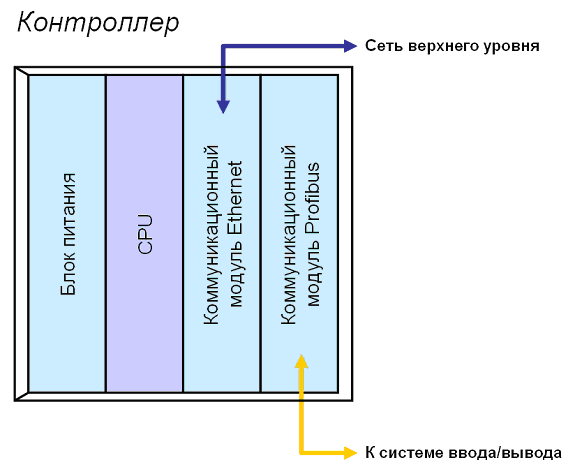 Рис.1. Контроллер РСУ с коммуникациями Profibus и Ethernet.
Иногда на базовую панель, помимо указанных выше, допускается устанавливать модули ввода/вывода полевых сигналов, которые образуют так называемый локальный ввод/вывод. Однако для большинства РСУ (DCS) характерно использование именно распределенного (удаленного) ввода/вывода.
Отличительной особенностью контроллеров, применяемых в DCS, является возможность их резервирования. Резервирование нужно для повышения отказоустойчивости системы и заключается, как правило, в дублировании аппаратных модулей системы.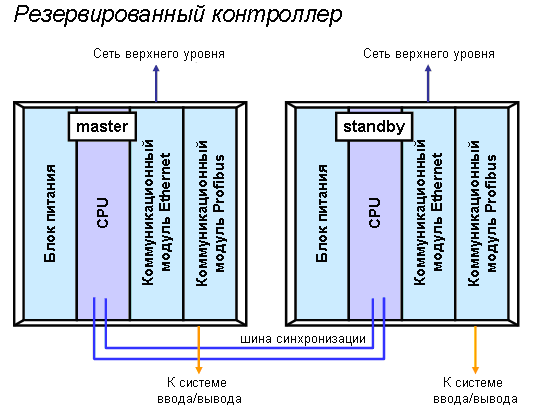 Рис. 2. Резервированный контроллер с коммуникациями Profibus и Ethernet.
Резервируемые модули работают параллельно и выполняют одни и те же функции. При этом один модуль находится в активном состоянии, а другой, являясь резервом, – в режиме “standby”. В случае отказа активного модуля, система автоматически переключается на резерв (это называется “горячий резерв”).
Обратите внимание, контроллеры связаны шиной синхронизации, по которой они мониторят состояние друг друга. Это решение позволяет разнести резервированные модули на значительное расстояние друг от друга (например, расположить их в разных шкафах или даже аппаратных).
Допустим, в данный момент активен левый контроллер, правый – находится в резерве. При этом, даже находясь в резерве, правый контроллер располагает всеми процессными данными и выполняет те же самые математические операции, что и левый. Контроллеры синхронизированы. Предположим, случается отказ левого контроллера, а именно модуля CPU. Управление автоматически передается резервному контроллеру, и теперь он становится главным. Здесь очень большое значение имеют время, которое система тратит на переключение на резерв (обычно меньше 0.5 с) и отсутствие возмущений (удара). Теперь система работает на резерве. Как только инженер заменит отказавший модуль CPU на исправный, система автоматически передаст ему управление и возвратится в исходное состояние.
На рис. 3 изображен резервированный контроллер S7-400H производства Siemens. Данный контроллер входит в состав РСУ Simatic PCS7. Рис. 3. Резервированный контроллер S7-400H. Несколько другое техническое решение показано на примере резервированного контроллера FCP270 производства Foxboro (рис. 4). Данный контроллер входит в состав системы управления Foxboro IA Series.
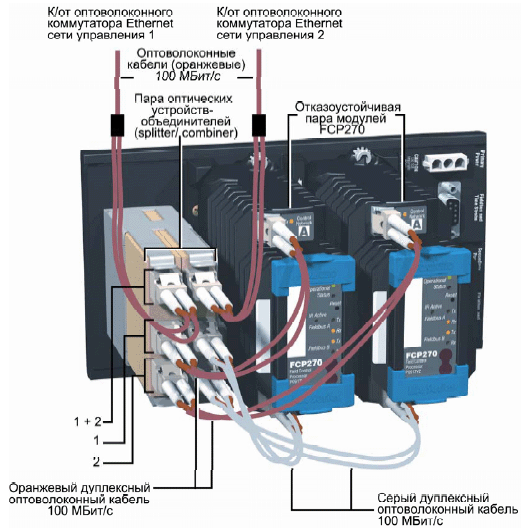 Рис. 4. Резервированный контроллер FCP270.
На базовой панели инсталлировано два процессорных модуля, работающих как резервированная пара, и коммуникационный модуль для сопряжения с оптическими сетями стандарта Ethernet. Взаимодействие между модулями происходит по внутренней шине (тоже резервированной), спрятанной непосредственно в базовую панель (ее не видно на рисунке).
На рисунке ниже показан контроллер AC800M производства ABB (часть РСУ Extended Automation System 800xA).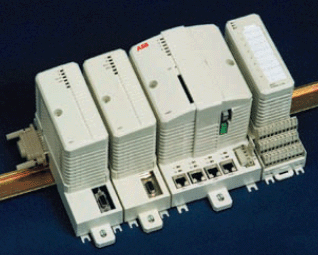 Рис. 5. Контроллер AC800M.
Это не резервированный вариант. Контроллер состоит из двух коммуникационных модулей, одного СPU и одного локального модуля ввода/вывода. Кроме этого, к контроллеру можно подключить до 64 внешних модулей ввода/вывода.
При построении РСУ важно выбрать контроллер, удовлетворяющий всем техническим условиям и требованиям конкретного производства. Подбирая оптимальную конфигурацию, инженеры оперируют определенными техническими характеристиками промышленных контроллеров. Наиболее значимые перечислены ниже:
1. Возможность полного резервирования. Для задач, где отказоустойчивость критична (химия, нефтехимия, металлургия и т.д.), применение резервированных конфигураций вполне оправдано, тогда как для других менее ответственных производств резервирование зачастую оказывается избыточным решением.
2. Количество и тип поддерживаемых коммуникационных интерфейсов. Это определяет гибкость и масштабируемость системы управления в целом. Современные контроллеры способны поддерживать до 10 стандартов передачи данных одновременно, что во многом определяет их универсальность.
3. Быстродействие. Измеряется, как правило, в количестве выполняемых в секунду элементарных операций (до 200 млн.). Иногда быстродействие измеряется количеством обрабатываемых за секунду функциональных блоков (что такое функциональный блок – будет рассказано в следующей статье). Быстродействие зависит от типа центрального процессора (популярные производители - Intel, AMD, Motorola, Texas Instruments и т.д.)
4. Объем оперативной памяти. Во время работы контроллера в его оперативную память загружены запрограммированные пользователем алгоритмы автоматизированного управления, операционная система, библиотечные модули и т.д. Очевидно, чем больше оперативной памяти, тем сложнее и объемнее алгоритмы контроллер может выполнять, тем больше простора для творчества у программиста. Варьируется от 256 килобайт до 32 мегабайт.
5. Надежность. Наработка на отказ до 10-12 лет.
6. Наличие специализированных средств разработки и поддержка различных языков программирования. Очевидно, что существование специализированный среды разработки прикладных программ – это стандарт для современного контроллера АСУ ТП. Для удобства программиста реализуется поддержка сразу нескольких языков как визуального, так и текстового (процедурного) программирования (FBD, SFC, IL, LAD, ST; об этом в следующей статье).
7. Возможность изменения алгоритмов управления на “лету” (online changes), т.е. без остановки работы контроллера. Для большинства контроллеров, применяемых в РСУ, поддержка online changes жизненно необходима, так как позволяет тонко настраивать систему или расширять ее функционал прямо на работающем производстве.
8. Возможность локального ввода/вывода. Как видно из рис. 4 контроллер Foxboro FCP270 рассчитан на работу только с удаленной подсистемой ввода/вывода, подключаемой к нему по оптическим каналам. Simatic S7-400 может спокойно работать как с локальными модулями ввода/вывода (свободные слоты на базовой панели есть), так и удаленными узлами.
9. Вес, габаритные размеры, вид монтажа (на DIN-рейку, на монтажную панель или в стойку 19”). Важно учитывать при проектировании и сборке системных шкафов.
10. Условия эксплуатации (температура, влажность, механические нагрузки). Большинство промышленных контроллеров могут работать в нечеловеческих условиях от 0 до 65 °С и при влажности до 95-98%.
[ http://kazanets.narod.ru/PLC_PART1.htm]Тематики
Синонимы
EN
DE
- speicherprogrammierbare Steuerung, f
FR
Русско-английский словарь нормативно-технической терминологии > программируемый логический контроллер
38 оставаться неизменным
•The total number of atoms is (or remains) fixed (or unchanged, or the same).
•The analogue-to-digital interface must remain invariant (or unaltered, or constant, or unchanged) despite modifications or changes in the computer.
•The velocity of the centre of mass does not change during collision.
•Today a number of details in the original paper have been revised, but the basic mechanism of... remains intact.
Русско-английский научно-технический словарь переводчика > оставаться неизменным
39 индикаторный силикагель
General subject: self indicating silica gel (Self-indicating silica gels have a moisture sensitive additive added to the basic silica gel. This indicator changes colour as moisture is adsorbed thus giving a visual indication as to the activity)Универсальный русско-английский словарь > индикаторный силикагель
40 división2
2 = divide, division, partition, split, splitting up, cleavage, rift, segmentation, splitting, splintering, splinter, balkanization, fault line, parting, divided line.Ex. Nevertheless, this basic divide remains a useful distinction between two major categories of indexing systems.Ex. In simple terms, the essence of subject organisation is the division of literature (or references to literature) into manageable, or scannable categories, with each category being associated with an index term.Ex. It is concluded that the choice of citation and co-citation thresholds can be influenced by formal considerations which ensure statistically meaningful partitions rather than arbitrary decision which can produce meaningless interpretations.Ex. The information note may consist of a brief history of a corporate body, highlighting changes in the body's name, mergers with other bodies, splits within or between bodies, etc.Ex. New topics develop not merely by fission -- the splitting up of established subjects -- but also by fusion -- the merging of previously distinct subjects.Ex. After the Civil War, Emerson saw in collegiate education 'a cleavage occurring in the hitherto firm granite of the past'.Ex. Chief among these challenges is the technological rift that exists between the Third World and on-line systems that have their roots in technologically advanced societies.Ex. Using this method, the segmentation of natural keywords can be handled flexibly.Ex. The most obvious threat is the splitting of the media sector into separate information and entertainment sectors.Ex. This splintering of membership hinders the development of library unionism as a factor within the profession.Ex. However, others see the splinters in the discipline as a step in its revitalization.Ex. This shifts in emphasis mirror the general balkanization of modern American society.Ex. These views underlie the fault line that divides British politics today.Ex. A brief selection of possible scientific explanations for a number of biblical miracles -- Noah's flood, the parting of the Red Sea, the burning bush, the ten plagues, manna from heaven, and the raising of Lazarus -- is provided.Ex. The 1944 Education Act established free, universal secondary education but on the divided lines suited to the needs of capitalism.----* división cultural, la = cultural divide, the.* división del mercado por grupos de consumidores = market segmentation.* división del trabajo = division of labour.* división de opiniones = division of opinion, split decision, divided opinions.* división de poderes = division of powers.* división digital, la = digital divide, the.* división + no estar clara = blur + division.* división política = political division.* división territorial = land division.* haber división de opiniones = be split on, opinion + be divided.* haber división de opiniones entre los críticos = critics + be divided.* hacer desaparecer una división = blur + division.* punto de división = break.* salvar la división = bridge + the divide.СтраницыСм. также в других словарях:
Basic-Englisch — Basic English ist eine vereinfachte Form des Englischen, in der lediglich die wichtigsten Wörter der englischen Sprache vorkommen. Die von Charles Kay Ogden im Jahr 1930 geschaffene Englischvariante wird manchmal auch als Plansprache bezeichnet,… … Deutsch Wikipedia
Basic Englisch — Basic English ist eine vereinfachte Form des Englischen, in der lediglich die wichtigsten Wörter der englischen Sprache vorkommen. Die von Charles Kay Ogden im Jahr 1930 geschaffene Englischvariante wird manchmal auch als Plansprache bezeichnet,… … Deutsch Wikipedia
Basic English — ist eine von Charles Kay Ogden geschaffene, vereinfachte Form der Englischen Sprache mit stark verkleinertem Vokabular. Die Englischvariante wird manchmal auch als Plansprache bezeichnet, da diese Form des Englischen einst als Welthilfssprache… … Deutsch Wikipedia
Changes (Yes song) — Changes Song by Yes from the album 90125 Released 14 November 1983 Recorded 1983 Genre Rock, New Wave … Wikipedia
Basic oxygen steelmaking — ( BOS, BOF, Linz Donawitz Verfahren, LD converter ) is a method of steelmaking in which carbon rich molten iron is made into steel. The process is an improvement over the historically important Bessemer process. The LD converter is named after… … Wikipedia
Basic Allowance for Housing — (B A H) is a United States military entitlement given to many military members. It was previously called Basic allowance for quarters (BAQ).How It WorksBAH is given to members so that they can provide housing for themselves and their dependents… … Wikipedia
Basic Law for the Federal Republic of Germany — Germany This article is part of the series: Politics and government of Germany … Wikipedia
Basic Instinct — This article is about the 1992 film. For the Ciara album, see Basic Instinct (album). For Nick Curran the musician, see Nick Curran (musician). For other uses, see Basic Instinct (disambiguation). Basic Instinct Theatrical release poster … Wikipedia
BASIC — This article is about the programming language. For the think tank, see British American Security Information Council. For the group of countries, see BASIC countries. For other uses, see Basic (disambiguation). BASIC Screenshot of Atari BASIC,… … Wikipedia
Basic Laws of Israel — Israel This article is part of the series: Politics and government of Israel Basic Laws Jerusalem Law … Wikipedia
Changes clause — A changes clause, in government contracting, is a required clause in government construction contracts. Contents 1 Background 2 Changes clauses for construction contracts in the Federal Acquisition Regulations 3 Purposes … Wikipedia
 18+© Академик, 2000-2025
- Обратная связь: Техподдержка, Реклама на сайте
Экспорт словарей на сайты, сделанные на PHP, Joomla, Drupal, WordPress, MODx.