

-
1 нарушение условий конкуренции
нарушение условий конкуренции
—
[ http://www.eionet.europa.eu/gemet/alphabetic?langcode=en]EN
distortion of competition
Article 85(1) of the EEC Treaty prohibits all agreements between undertakings, decisions by associations of undertakings and concerted practices which may affect trade between member states and which have as their object or effect the prevention, restriction or distortion of competition within the common market. All such arrangements are automatically null and void under Article 85(2), unless exempted by the Commission pursuant to Article 85(3). The text of Article 85 is as follows: "1. The following shall be prohibited as incompatible with the common market: all agreements between undertakings, decisions by associations of undertakings and concerted practices which may affect trade between member states and which have as their object or effect the prevention, restriction or distortion of competition within the common market, and in particular those which: (a) directly or indirectly fix purchase or selling prices or any other trading conditions; (b) limit or control production, markets, technical development, or investment; (c) share markets or sources of supply; (d) apply dissimilar conditions to equivalent transactions with other trading parties, thereby placing them at a competitive disadvantage; (e) make the conclusion of contracts subject to acceptance by the other parties of supplementary obligations which, by their nature or according to commercial usage, have no connection with the subject of such contracts. (Source: CLAORG)
[http://www.eionet.europa.eu/gemet/alphabetic?langcode=en]Тематики
EN
DE
FR
Русско-немецкий словарь нормативно-технической терминологии > нарушение условий конкуренции
-
2 ограничение конкуренции
ограничение конкуренции
—
[ http://www.eionet.europa.eu/gemet/alphabetic?langcode=en]EN
restriction on competition
Article 85(1) of the EEC Treaty prohibits all agreements between undertakings, decisions by associations of undertakings and concerted practices which may affect trade between member states and which have as their object or effect the prevention, restriction or distortion of competition within the common market. All such arrangements are automatically null and void under Article 85(2), unless exempted by the Commission pursuant to Article 85(3). The text of Article 85 is as follows: "1. The following shall be prohibited as incompatible with the common market: all agreements between undertakings, decisions by associations of undertakings and concerted practices which may affect trade between member states and which have as their object or effect the prevention, restriction or distortion of competition within the common market, and in particular those which: (a) directly or indirectly fix purchase or selling prices or any other trading conditions; (b) limit or control production, markets, technical development, or investment; (c) share markets or sources of supply; (d) apply dissimilar conditions to equivalent transactions with other trading parties, thereby placing them at a competitive disadvantage; (e) make the conclusion of contracts subject to acceptance by the other parties of supplementary obligations which, by their nature or according to commercial usage, have no connection with the subject of such contracts. (Source: CLAORG)
[http://www.eionet.europa.eu/gemet/alphabetic?langcode=en]Тематики
EN
DE
FR
Русско-немецкий словарь нормативно-технической терминологии > ограничение конкуренции
-
3 биоритм
биоритм
—
[ http://www.eionet.europa.eu/gemet/alphabetic?langcode=en]EN
biorhythm
A cyclically recurring pattern of physiological states in an organism or organ, such as alpha rhythm or circadian rhythm; believed by some to affect physical and mental states and behaviour. (Source: CED)
[http://www.eionet.europa.eu/gemet/alphabetic?langcode=en]Тематики
EN
DE
FR
Русско-немецкий словарь нормативно-технической терминологии > биоритм
-
4 вещество, опасное для окружающей среды
вещество, опасное для окружающей среды
—
[ http://www.eionet.europa.eu/gemet/alphabetic?langcode=en]EN
environmentally dangerous substance
Substance that causes undesirable change in the physical, chemical, or biological characteristics of the air, water, or land that can harmfully affect the health, survival, or activities of human or other living organisms. (Source: VIRPURa)
[http://www.eionet.europa.eu/gemet/alphabetic?langcode=en]Тематики
EN
DE
FR
Русско-немецкий словарь нормативно-технической терминологии > вещество, опасное для окружающей среды
-
5 вырождение фауны
вырождение фауны
—
[ http://www.eionet.europa.eu/gemet/alphabetic?langcode=en]EN
bastardisation of fauna
One of the possible consequences of the introduction of animal species in an area where they are not indigenous. Such translocation of species always involves an element of risk if not of serious danger. Newly arrived species may be highly competitive with or otherwise adversely affect native species and communities. (Source: RRDA / WPRa)
[http://www.eionet.europa.eu/gemet/alphabetic?langcode=en]Тематики
EN
DE
FR
Русско-немецкий словарь нормативно-технической терминологии > вырождение фауны
-
6 загрязнение (в электробезопасности)
загрязнение
Присутствие инородного вещества: твердого, жидкого или газообразного (ионизированные газы), - которое может вызвать уменьшение диэлектрической прочности или поверхностного сопротивления.
[ ГОСТ Р 52319-2005( МЭК 61010-1: 2001)]
загрязнение
Любое добавление инородных веществ, твердых, жидких или газообразных (ионизированных газов), которые могли бы уменьшить электрическую прочность изоляции или удельное сопротивление поверхности.
[ ГОСТ Р 50030. 1-2000 ( МЭК 60947-1-99)]EN
pollution
any condition of foreign matter, solid, liquid or gaseous (ionized gases), that may affect dielectric strength or surface resistivity
[IEC 60947-1, ed. 5.0 (2007-06)]
pollution
any addition of foreign matter, solid, liquid or gaseous that can produce a permanent reduction of dielectric strength or surface resistivity of the insulation
NOTE – Ionized gases of a temporary nature are not considered as to be a pollution.
[IEV number 442-01-28]
contamination
the first is defined as area and the second as particulate. The first is caused by surface contaminants that cannot be removed by cleaning or are stained after cleaning. Those may be foreign matter on the surface of, for example a localized area that is smudged, stained, discoloured, mottled, etc., or large areas exhibiting a hazy or cloudy appearance resulting from a film of foreign materials
[IEC 62276, ed. 1.0 (2005-05)]FR
pollution
tout apport de matériau étranger solide, liquide ou gazeux (gaz ionisés) qui peut entraîner une réduction de la rigidité diélectrique ou de la résistivité de la surface
[IEC 60947-1, ed. 5.0 (2007-06)]
pollution
tout apport de matériau étranger solide, liquide ou gazeux qui peut entraîner une réduction permanente de la rigidité diélectrique ou de la résistivité de surface de l'isolation
NOTE – Les gaz ionisés de nature fugace ne sont pas considérés comme une pollution.
[IEV number 442-01-28]
Тематики
Обобщающие термины
EN
DE
FR
Русско-немецкий словарь нормативно-технической терминологии > загрязнение (в электробезопасности)
-
7 заселение видов животных
заселение видов животных
—
[ http://www.eionet.europa.eu/gemet/alphabetic?langcode=en]EN
introduction of animal species
Animals which have been translocated by human agency into lands or waters where they have not lived previously, at least during historic times. Such translocation of species always involves an element of risk if not of serious danger. Newly arrived species, depending on their interspecific relationships and characteristics, may act as or carry parasites or diseases, prey upon native organisms, display toxic reactions, or be highly competitive with or otherwise adversely affect native species and communities. (Source: WPR)
[http://www.eionet.europa.eu/gemet/alphabetic?langcode=en]Тематики
EN
DE
FR
Русско-немецкий словарь нормативно-технической терминологии > заселение видов животных
-
8 заселение видов растений
заселение видов растений
—
[ http://www.eionet.europa.eu/gemet/alphabetic?langcode=en]EN
introduction of plant species
Plants which have been translocated by human agency into lands or waters where they have not lived previously, at least during historic times. Such translocation of species always involves an element of risk if not of serious danger. Newly arrived species may be highly competitive with or otherwise adversely affect native species and communities. Some may become a nuisance through sheer overabundance. They may become liable to rapid genetic changes in their new environment. Many harmful introductions have been made by persons unqualified to anticipate the often complex ecological interaction which may ensue. On the other hand many plants introduced into modified or degraded environments may be more useful than native species in controlling erosion or in performing other positive functions. (Source: WPR)
[http://www.eionet.europa.eu/gemet/alphabetic?langcode=en]Тематики
EN
DE
FR
Русско-немецкий словарь нормативно-технической терминологии > заселение видов растений
-
9 иммиссия шума
иммиссия шума
—
[ http://www.eionet.europa.eu/gemet/alphabetic?langcode=en]EN
noise immission
Immission in the environment of acoustic vibrations that negatively affect human beings, animals, plants or other objects. (Source: RRDA)
[http://www.eionet.europa.eu/gemet/alphabetic?langcode=en]Тематики
EN
DE
FR
Русско-немецкий словарь нормативно-технической терминологии > иммиссия шума
-
10 климат
климат
—
[ http://www.eionet.europa.eu/gemet/alphabetic?langcode=en]EN
climate
The average weather condition in a region of the world. Many aspects of the Earth's geography affect the climate. Equatorial, or low, latitudes are hotter than the polar latitudes because of the angle at which the rays of sunlight arrive at the Earth's surface. The difference in temperature at the equator and at the poles has an influence on the global circulation of huge masses of air. Cool air at the poles sinks and spreads along the surface of the Earth towards the equator. Cool air forces its way under the lower density warmer air in the lower regions, pushing the lighter air up and toward the poles, where it will cool and descend. (Source: WRIGHT)
[http://www.eionet.europa.eu/gemet/alphabetic?langcode=en]Тематики
EN
DE
FR
Русско-немецкий словарь нормативно-технической терминологии > климат
-
11 опрессованное соединение
- Pressverbindung, f
- Crimpverbindung, f
опрессованное соединение
-
[Интент]
обжимное соединение
—
[Я.Н.Лугинский, М.С.Фези-Жилинская, Ю.С.Кабиров. Англо-русский словарь по электротехнике и электроэнергетике, Москва, 1999]EN
crimped connection
permanent connection made by the application of pressure inducing the deformation or reshaping of the barrel around the conductor of a cable
NOTE – In some cases the deformation or reshaping of the barrel may affect the form of the conductor.
Source: 461-19-01
[IEV number 581-23-02 ]FR
connexion sertie
connexion permanente obtenue par pression entraînant la déformation ou la mise en forme du fût d’un raccord autour de l’âme d’un câble
NOTE – Dans certains cas la déformation ou la mise en forme du fût peut affecter la forme de l’âme.
Source: 461-19-01
[IEV number 581-23-02 ]Гильзы кабельные соединительные медные, закрепляемые опрессовкой.
Рекомендуемые размеры опрессованных соединений кабельных гильз приведены...
[ ГОСТ 23469.3-790]Тематики
Синонимы
EN
DE
- Crimpverbindung, f
- Pressverbindung, f
FR
Русско-немецкий словарь нормативно-технической терминологии > опрессованное соединение
-
12 порок развития
порок развития
—
[ http://www.eionet.europa.eu/gemet/alphabetic?langcode=en]EN
malformation
Permanent structural change that may adversely affect survival, development or function. (Source: KOREN)
[http://www.eionet.europa.eu/gemet/alphabetic?langcode=en]Тематики
EN
DE
FR
Русско-немецкий словарь нормативно-технической терминологии > порок развития
-
13 почвенная механика
почвенная механика
—
[ http://www.eionet.europa.eu/gemet/alphabetic?langcode=en]EN
soil mechanics
The study of the physical properties of soil, especially those properties that affect its ability to bear weight such as water content, density, strength, etc. (Source: CED)
[http://www.eionet.europa.eu/gemet/alphabetic?langcode=en]Тематики
EN
DE
FR
Русско-немецкий словарь нормативно-технической терминологии > почвенная механика
-
14 прогноз выбросов
прогноз выбросов
—
[ http://www.eionet.europa.eu/gemet/alphabetic?langcode=en]EN
emission forecast
The final step in a clean air plan is to predict future air quality to demonstrate that we can (if we can) meet the health standards by implementing the measures proposed in the plan. This is done by first projecting the emission inventory into the future, taking into account changes in population, housing, employment in specific business sectors, and vehicle miles traveled. These data are obtained from various sources and the resulting emissions are adjusted to account for regulations and control measures scheduled for implementation during the same time period. Additional adjustments are made to reflect large facilities that are expected to start up, modify, or shut down. The resulting inventory is an emission forecast, and is usually expressed in tons per day of particular pollutants for a given year. Additional steps may be required to determine how the forecasted quantities of air pollution will affect the overall air quality. One way to accomplish this is through computer modeling. A computer model simulates how pollutants disperse, react, and move in the air. The inputs to such a computer model are complex. They include weather patterns, terrain, and the chemical nature of air pollutants. (Source: APCD)
[http://www.eionet.europa.eu/gemet/alphabetic?langcode=en]Тематики
EN
DE
FR
Русско-немецкий словарь нормативно-технической терминологии > прогноз выбросов
-
15 прямой пуск вращающегося электродвигателя
прямой пуск вращающегося электродвигателя
Пуск вращающегося электродвигателя путем непосредственного подключения его к питающей сети.
[ ГОСТ 27471-87]EN
direct-on-line starting
across-the-line starting (US)
the process of starting a motor by connecting it directly to the supply at rated voltage
[IEV number 411-52-15]FR
démarrage direct
mode de démarrage d'un moteur, consistant à lui appliquer directement sa pleine tension assignée
[IEV number 411-52-15]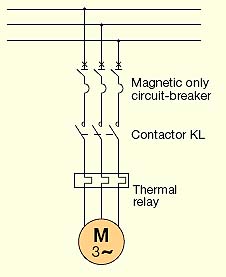
Рис. ABB
Схема прямого пуска электродвигателяMagnetic only circuit-breaker - Автоматический выключатель с электромагнитным расцепителем
Contactor KL - Контактор KL
Thermal relay - Тепловое реле
Параллельные тексты EN-RU
Direct-on-line starting
Direct-on-line starting, which is often abbreviated as DOL, is perhaps the most traditional system and consists in connecting the motor directly to the supply network, thus carrying out starting at full voltage.Direct-on-line starting represents the simplest and the most economical system to start a squirrel-cage asynchronous motor and it is the most used.
As represented in Figure 5, it provides the direct connection to the supply network and therefore starting is carried out at full voltage and with constant frequency, developing a high starting torque with very reduced acceleration times.
The typical applications are relevant to small power motors also with full load starting.
These advantages are linked to some problems such as, for example, the high inrush current, which - in the first instants - can reach values of about 10 to 12 times the rated current, then can decrease to about 6 to 8 times the rated current and can persist to reach the maximum torque speed.The effects of such currents can be identified with the high electro-dynamical stresses on the motor connection cables and could affect also the windings of the motor itself; besides, the high inrush torques can cause violent accelerations which stress the transmission components (belts and joints) generating distribution problems with a reduction in the mechanical life of these elements.
Finally, also the possible electrical problems due to voltage drops on the supply line of the motor or of the connected equipment must be taken into consideration.
[ABB]Прямой пуск
Прямой пуск, который по-английски часто сокращенно обозначают как DOL, является, пожалуй наиболее распространенным способом пуска. Он заключается в непосредственном (т. е. прямом) подключении двигателя к питающей сети. Это означает, что пуск двигателя осуществляется при полном напряжении.Схема прямого пуска является наиболее простым, экономичным и чаще всего применяемым решением для электродвигателей с короткозамкнутым ротором.
Схема прямого подключения к сети представлена на рисунке 5. Пуск осуществляется при полном напряжении и постоянной частоте сети. Электродвигатель развивает высокий пусковой момент при коротком времени разгона.
Типичные области применения – маломощные электродвигатели, в том числе с пуском при полной нагрузке.
Однако, наряду с преимуществами имеются и определенные недостатки, например, бросок пускового тока, достигающий в первоначальный момент 10…12-кратного значения от номинального тока электродвигателя. Затем ток двигателя уменьшается примерно до 6…8-кратного значения номинального тока и будет держаться на этом уровне до тех пор, пока скорость двигателя не достигнет максимального значения.
Такое изменение тока оказывает значительное электродинамическое воздействие на кабель, подключенный к двигателю. Кроме того пусковой ток воздействует на обмотки двигателя. Высокий начальный пусковой момент может привести к значительному ускорению и следовательно к значительной нагрузке элементов привода (ремней, крепления узлов), что вызывает сокращение их срока службы.
И, наконец, следует принять во внимание возможное возникновение проблем, связанных с падением напряжения в линии питания двигателя и подключенного к этой линии оборудования.
[Перевод Интент]
Тематики
Синонимы
EN
- across-the-line starting (US)
- direct line starting
- direct operation of a motor
- direct starting
- direct-on-line starting
- DOL
- full voltage starter application
DE
FR
Русско-немецкий словарь нормативно-технической терминологии > прямой пуск вращающегося электродвигателя
-
16 управление и планирование сельских районов
управление и планирование сельских районов
—
[ http://www.eionet.europa.eu/gemet/alphabetic?langcode=en]EN
rural management and planning
The activity or process of overseeing and preparing for the future physical arrangement and condition of any agricultural or pastoral area, which may involve protecting and developing natural and human resources that affect an area's economic vitality. (Source: RHW / NPH)
[http://www.eionet.europa.eu/gemet/alphabetic?langcode=en]Тематики
EN
DE
FR
Русско-немецкий словарь нормативно-технической терминологии > управление и планирование сельских районов
-
17 уровень свинца в крови
уровень свинца в крови
—
[ http://www.eionet.europa.eu/gemet/alphabetic?langcode=en]EN
lead level in blood
A measure of the amount of lead or lead salts absorbed by the body as a possible sign of acute or chronic lead poisoning, which can affect the nervous, digestive or muscular systems. (Source: SMD / MED)
[http://www.eionet.europa.eu/gemet/alphabetic?langcode=en]Тематики
EN
DE
FR
Русско-немецкий словарь нормативно-технической терминологии > уровень свинца в крови
-
18 условия окружающей среды
условия окружающей среды
-
[IEV number 151-16-03]EN
ambient conditions
environmental conditions
characteristics of the environment which may affect performance of a device or system
NOTE – Examples of ambient conditions are pressure, temperature, humidity, radiation, vibration.
[IEV number 151-16-03]FR
conditions ambiantes, f, pl
caractéristiques du milieu ambiant qui peuvent influer sur le fonctionnement d'un dispositif ou d'un système
NOTE – Des exemples de conditions ambiantes sont la pression, la température, l'humidité, les rayonnements, les vibrations.
[IEV number 151-16-03]Тематики
- электротехника, основные понятия
EN
DE
FR
Русско-немецкий словарь нормативно-технической терминологии > условия окружающей среды
-
19 условия работы
условия работы
Совокупность значений параметров электротехнического изделия (электротехнического устройства, электрооборудования), характеризующих его работу в данный момент и при заданных условиях эксплуатации.
[ ГОСТ 18311-80]EN
operating conditions
characteristics which may affect performance of a component, device or equipment
NOTE – Examples of operating conditions are ambient conditions, characteristics of the power supply, duty cycle or duty type.
[IEV number 151-16-01]FR
conditions de fonctionnement, f, pl
caractéristiques qui peuvent influer sur le fonctionnement d'un composant, d’un dispositif ou d'un matériel
NOTE – Des exemples de conditions de fonctionnement sont les conditions ambiantes, les caractéristiques de l’alimentation électrique, le cycle de service, le type de service.
[IEV number 151-16-01]Различают:
- нормальные условия работы;
- особые условия работы
Тематики
Синонимы
EN
DE
FR
Русско-немецкий словарь нормативно-технической терминологии > условия работы
-
20 ущерб, нанесенный грозой, штормом
ущерб, нанесенный грозой, штормом
—
[ http://www.eionet.europa.eu/gemet/alphabetic?langcode=en]EN
storm damage
Storms may cause flooding and damage to crops; uproot trees; damage roofs and chimneys; break windows, leading to rain damage; overturn trucks; affect transportation, communication and energy supplies; delay building construction and destroy traditional landmarks. In their more violent form, storms may cause severe damage and loss of life. (Source: WPR)
[http://www.eionet.europa.eu/gemet/alphabetic?langcode=en]Тематики
EN
DE
FR
Русско-немецкий словарь нормативно-технической терминологии > ущерб, нанесенный грозой, штормом
- 1
- 2
См. также в других словарях:
affect — [ afɛkt ] n. m. • 1908; all. Affekt; a. fr. et XVIe « état, disposition »; du lat. affectus, comme l all. ♦ Psychol. État affectif élémentaire. Les sensations et les affects. ● affect nom masculin (allemand Affekt) Processus de décharge de l… … Encyclopédie Universelle
affect — simulate, *assume, pretend, feign, counterfeit, sham affect 1 Affect, influence, touch, impress, strike, sway are more or less closely synonymous when they mean to produce or to have an effect upon a person or upon a thing capable of a reaction.… … New Dictionary of Synonyms
Affect — Af*fect , v. t. [imp. & p. p. {Affected}; p. pr. & vb. n. {Affecting}.] [L. affectus, p. p. of afficere to affect by active agency; ad + facere to make: cf. F. affectere, L. affectare, freq. of afficere. See {Fact}.] 1. To act upon; to produce an … The Collaborative International Dictionary of English
affect — affect, effect 1. These two words are often confused. It should be remembered that effect is most common as a noun meaning ‘a result or consequence’ • (In England, at any rate, education produces no effect whatsoever Oscar Wilde) and that affect… … Modern English usage
affect — Ⅰ. affect [1] ► VERB 1) make a difference to; have an effect on. 2) touch the feelings of. DERIVATIVES affecting adjective. USAGE Affect and effect are frequently confused … English terms dictionary
affect — I verb act on, adficere, bear upon, cause to alter, cause to vary, change, commovere, conduce, exert influence, have an effect upon, have influence, impress, induce, influence, introduce a change, make a change, play a direct part, prevail upon,… … Law dictionary
affect — [v1] influence, affect emotionally act on, alter, change, disturb, impinge, impress, induce, influence, inspire, interest, involve, modify, move, overcome, perturb, prevail, regard, relate, stir, sway, touch, transform, upset; concepts… … New thesaurus
affect — affect1 [ə fekt′; ] for n. [ 2, af′ekt΄] vt. [ME affecten < L affectare, to strive after < affectus, pp. of afficere, to influence, attack < ad , to + facere, DO1] 1. to have an effect on; influence; produce a change in [bright light… … English World dictionary
Affect — Af*fect ([a^]f*f[e^]kt ), n. [L. affectus.] 1. Affection; inclination; passion; feeling; disposition. [Obs.] Shak. [1913 Webster] 2. (Psychotherapy) The emotional complex associated with an idea or mental state. In hysteria, the affect is… … The Collaborative International Dictionary of English
affect — affect, affective, affectivity An affect is an emotion. In sociology the use of the term generally implies that an action is being or has been carried out for emotional gratification. For example, in their discussion of Class Awareness in the… … Dictionary of sociology
Affect — (v. lat.), schnell entstehende, lebhafte, ein bemerkliches Streben durch Aufhebung des Gleichgewichts im Gemüth hervorbringende, auf die Functionen des Geistes u. Körpers sichtbaren Einfluß habende Gemüthsbewegung. A. entsteht, wenn eine… … Pierer's Universal-Lexikon
