

-
1 максимальный расцепитель тока с обратнозависимой выдержкой времени
максимальное реле или максимальный расцепитель тока с обратнозависимой выдержкой времени
Максимальное реле или максимальный расцепитель тока, срабатывающие с выдержкой времени, находящейся в обратной зависимости от значения сверхтока.
Примечание. Такие реле или расцепитель могут быть спроектированы так, чтобы при высоких значениях сверхтока выдержка времени достигала определенного минимального значения.
[ ГОСТ Р 50030. 1-2000 ( МЭК 60947-1-99)]
максимальный расцепитель тока с обратно-зависимой выдержкой времени
Максимальный расцепитель тока, срабатывающий после выдержки времени, находящейся в обратной зависимости от значения сверхтока.
Примечание — Такой расцепитель может быть спроектирован так, чтобы эта выдержка времени при высоких значениях сверхтока достигала определенного минимального значения
[ ГОСТ Р 50345-99( МЭК 60898-95)]EN
inverse time-delay over-current release
an over-current release which operates after a time-delay inversely dependent upon the value of the over-current
NOTE - Such a release may be designed so that the time-delay approaches a definite minimum value for high values of over-current.
[IEV number 441-16-35]
[IEC 62271-100, ed. 2.0 (2008-04)]
inverse time-delay overcurrent release
overcurrent release which operates after a time-delay inversely dependent upon the value of the overcurrent
NOTE - Such a release may be designed so that the time-delay approaches a definite minimum for high values of overcurrent.
[IEV number 441-16-35]
[IEC 60898-1, ed. 1.0 (2002-01)]FR
déclencheur à maximum de courant à temps inverse
déclencheur à maximum de courant qui fonctionne après un intervalle de temps qui varie en raison inverse de la valeur de la surintensité
NOTE - Un tel déclencheur peut être prévu pour que le retard atteigne une valeur minimale définie pour les valeurs élevées de la surintensité.
[IEV number 441-16-35]
[IEC 62271-100, ed. 2.0 (2008-04)]
[IEC 60898-1, ed. 1.0 (2002-01)]Недопустимые, нерекомендуемые
Тематики
- выключатель автоматический
- расцепитель, тепловое реле
Классификация
>>>EN
DE
FR
Русско-немецкий словарь нормативно-технической терминологии > максимальный расцепитель тока с обратнозависимой выдержкой времени
-
2 плавкий предохранитель
плавкий предохранитель
Коммутационный аппарат, который посредством плавления одного или нескольких своих специально спроектированных и калиброванных элементов размыкает цепь, в которую он включен, и отключает ток, когда он превышает заданную величину в течение достаточного времени. Плавкий предохранитель содержит все части, образующие укомплектованный аппарат.
МЭК 60050(441-18-01).
[ ГОСТ Р 50030. 1-2000 ( МЭК 60947-1-99)]
плавкий предохранитель
Аппарат, который вследствие расплавления одного или нескольких специально спроектированных и рассчитанных элементов размыкает цепь, в которую он включен, отключая ток, превышающий заданное значение в течение достаточно продолжительного времени. В состав плавкого предохранителя входят все части, образующие аппарат в комплекте
[ ГОСТ Р 50339. 0-2003 ( МЭК 60269-1-98)]
предохранитель
Коммутационный электрический аппарат, предназначенный для отключения защищаемой цепи посредством разрушения специально предусмотренных для этого токоведущих частей под действием тока, превышающего определенную величину.
[ ГОСТ 17703-72]
предохранитель
Устройство для разрыва электрических цепей при силе тока, превышающей допустимое значение
[Терминологический словарь по строительству на 12 языках (ВНИИИС Госстроя СССР)]EN
fuse
a device that by the fusing of one or more of its specially designed and proportioned components, opens the circuit in which it is inserted by breaking the current when this exceeds a given value for a sufficient time. The fuse comprises all the parts that form the complete device
[IEV number 441-18-01 ]FR
fusible
coupe-circuit à fusibles
appareil dont la fonction est d'ouvrir par la fusion d'un ou de plusieurs de ses éléments conçus et calibrés à cet effet le circuit dans lequel il est inséré en coupant le courant lorsque celui-ci dépasse pendant un temps suffisant une valeur donnée. Le fusible comprend toutes les parties qui constituent l'appareil complet
[IEV number 441-18-01 ]Настоящий стандарт распространяется на плавкие предохранители на номинальный ток от 2 до 2500 А, номинальное напряжение переменного тока до 1000 В и постоянного тока до 1200 В, устанавливаемые в комплектные устройства и предназначенные для защиты при перегрузках и коротких замыканиях силовых и вспомогательных цепей электроустановок промышленных предприятий, общественных и жилых зданий, изготовляемые для нужд народного хозяйства и экспорта и номинальное напряжение до 3000 В для защиты полупроводниковых устройств.
3.2.14. Предохранители должны быть сконструированы таким образом, чтобы отключать электрическую цепь при токах отключения в пределах: от условного тока плавления — для предохранителей с плавкими вставками типов g и gR или от наименьшего тока отключения, установленного в стандартах или технических условиях на предохранители конкретных серий и типов, для предохранителей с плавкими вставками типов а и aR — до наибольшего тока отключения
[ ГОСТ 17242-86]... токи, при которых проводят испытания, предназначенные для проверки способности данного плавкого предохранителя срабатывать удовлетворительно в диапазоне малых сверхтоков.
[ ГОСТ Р 50339.0-2003]... Если неисправность заканчивается срабатыванием плавкого предохранителя или если плавкий предохранитель не срабатывает примерно в течение 1 с, то...
[ ГОСТ Р 52319-2005]ЭЛЕКТРИЧЕСКИЕ ПАРАМЕТРЫ И ХАРАКТЕНИСТИКИ ПРЕДОХРАНИТЕЛЕЙ
(взято из ГОСТ 17242-86)-
Для держателя (или основания) предохранителя:
- номинальное напряжение;
- номинальный ток;
- род тока и номинальная частота для переменного тока;
- допустимые потери мощности;
- число полюсов, если их более одного.
-
Для плавкой вставки:
- номинальное напряжение;
- номинальный ток;
- род тока и номинальная частота для переменного тока;
- потери мощности;
- время-токовые характеристики с указанием коэффициентов K1 и K2 для плавких вставок типа а;
- перегрузочная способность;
- диапазон токов отключения;
- наибольшая отключающая способность;
- наименьший ток отключения для плавких вставок типа а;
- характеристика пропускаемого тока;
- характеристики интегралов Джоуля;
- перенапряжение и характеристика перенапряжения для плавких вставок типов aR и gR;
- условия селективности (при необходимости);
- электрическое сопротивление плавкой вставки в холодном состоянии (допускается указать в рабочих чертежах, утвержденных в установленном порядке).
-
Для предохранителя:
- степень защиты по ГОСТ 14255—69;
- номинальное напряжение, номинальный ток и коммутационная способность свободных контактов (при их наличии).
Параллельные тексты EN-RU
Check to make sure that fuse F1 on power supply module V is not fused.
If the fuse is defective, it should not be replaced without determining the cause of failure.
If a fuse is replaced without eliminating the problem, there is the danger that the damage will spread.
[Schneider Electric]Убедитесь в исправности предохранителя F1 в модуле питания V.
Если предохранитель оказался неисправным, то прежде чем заменить его необходимо установить причину возникновения неисправности.
Замена предохранителя без выяснения причины его срабатывания может привести к повторению срабатывания.
[Перевод Интент]High voltage system may embrace a fuse.
Note that a fuse may not be manually adjusted as the circuit breaker relay does so the fuse choice for the appropriate purpose/circuit adaptation is deemed most important.
[LS Industrial Systems]Высоковольтная система < электропитания> может содержать предохранители.
Обратите внимание! Предохранитель нельзя настроить, как это можно сделать с расцепителем автоматического выключателя. Поэтому предохранитель необходимо выбрать так, чтобы он как можно точнее соотвествовал конкретным условиям защиты аппарата или участка цепи.
[Перевод Интент]
Тематики
Классификация
>>>Обобщающие термины
Действия
- защищать при перегрузках и коротких замыканиях
- отключать электрическую цепь
- срабатывание предохранителя
Синонимы
EN
- cutoff
- electric fuse
- fu
- fuse
- fuse switch
- fusible cutout
- fusible plug
- fusible switch
- plug fuse
- protective fuse
- safety cutoff
- safety fuse
- safety plug
- SF
- thermal fuse
DE
FR
Русско-немецкий словарь нормативно-технической терминологии > плавкий предохранитель
-
Для держателя (или основания) предохранителя:
-
3 политика в области ценообразования
политика в области ценообразования
—
[ http://www.eionet.europa.eu/gemet/alphabetic?langcode=en]EN
prices policy
The guiding procedure, philosophy, or course of action for decisions regarding the monetary rate or value for goods and services. (Source: RHW)
[http://www.eionet.europa.eu/gemet/alphabetic?langcode=en]Тематики
EN
DE
FR
Русско-немецкий словарь нормативно-технической терминологии > политика в области ценообразования
-
4 плавкий элемент
плавкий элемент
Часть плавкой вставки, рассчитанная на расплавление под воздействием тока на протяжении определенного периода времени, превышающего определенное значение.
МЭК 60050(441-18-08).
[ ГОСТ Р 50030. 1-2000 ( МЭК 60947-1-99)]
плавкий элемент
Часть плавкой вставки, предназначенная для расплавления при срабатывании плавкого предохранителя. В плавкой вставке может быть несколько параллельных плавких элементов.
[ ГОСТ Р 50339. 0-2003 ( МЭК 60269-1-98)]
плавкий элемент предохранителя
плавкий элемент
Часть плавкой вставки, предназначенная для расплавления при срабатывании предохранителя.
[ ГОСТ 17242-86]EN
fuse-element
a part of the fuse-link designed to melt under the action of current exceeding some definite value for a definite period of time
[IEV number 441-18-08]
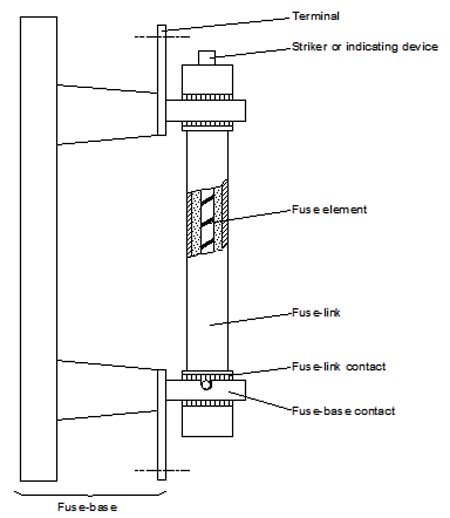
[IEC 60282-1, ed. 7.0 (2009-10)FR
élément fusible
partie de l'élément de remplacement destiné à fondre sous l'action d'un courant dépassant une valeur déterminée pendant une durée déterminée
[IEV number 441-18-08]
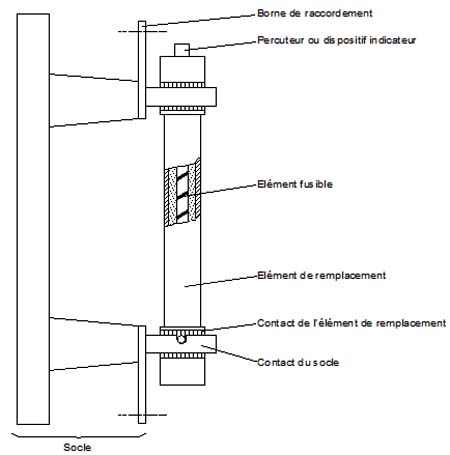
[IEC 60282-1, ed. 7.0 (2009-10)]Тематики
Обобщающие термины
Синонимы
EN
DE
FR
Русско-немецкий словарь нормативно-технической терминологии > плавкий элемент
-
5 паспортное значение
1
паспортное значение
Приближенная величина, используемая для обозначения или идентификации детали, аппарата или устройства.
МЭК 60050(151-04-01).
[ ГОСТ Р 50030. 1-2000 ( МЭК 60947-1-99)]EN
rated value
value of a quantity used for specification purposes, established for a specified set of operating conditions of a component, device, equipment, or system
[IEV number 151-16-08]FR
valeur assignée, f
valeur d'une grandeur, utilisée à des fins de spécification, correspondant à un ensemble spécifié de conditions de fonctionnement d'un composant, dispositif, matériel ou système
[IEV number 151-16-08]2
паспортное значение
-
[IEV number 442-01-04]EN
nominal value
a suitable approximate quantity value used to designate or identify a component, device or equipment
Source: 151-04-01
[IEV number 442-01-04]FR
valeur nominale
valeur approchée appropriée d'une grandeur, utilisée pour dénommer ou identifier un composant, un dispositif ou un matériel
Source: 151-04-01
[IEV number 442-01-04]EN
DE
FR
Русско-немецкий словарь нормативно-технической терминологии > паспортное значение
-
6 номинальное значение
номинальное значение
Количественное значение, указанное, как правило, изготовителем для определенного рабочего состояния детали, устройства или аппарата.
МЭК 60050(151-04-03).
[ ГОСТ Р 50030. 1-2000 ( МЭК 60947-1-99)]
номинальное значение
Значение величины, установленное обычно изготовителем для определенных рабочих условий компонента, прибора или оборудования.
[ ГОСТ Р 52319-2005 (МЭК 60050-151 [10], позиция 151-04-03)]
номинальное значение
Значение параметра электротехнического изделия (устройства), указанное изготовителем, при котором оно должно работать, являющееся исходным для отсчета отклонений.
Примечание
К числу параметров относятся, например, ток, напряжение, мощность.
[ ГОСТ 18311-80]
номинальное значение
-
[IEV number 442-01-01]EN
nominal value
value of a quantity used to designate and identify a component, device, equipment, or system
NOTE – The nominal value is generally a rounded value.
[IEV number 151-16-09]
rated value
a quantity value assigned, generally by a manufacturer, for a specified operating condition of a component, device or equipment
Source: 151-04-03
[IEV number 442-01-01]FR
valeur nominale, f
valeur de dénomination, f
valeur d'une grandeur, utilisée pour dénommer et identifier un composant, un dispositif, un matériel ou un système
NOTE – La valeur nominale est généralement une valeur arrondie.
[IEV number 151-16-09]
valeur assignée
valeur d'une grandeur fixée, généralement par le constructeur, pour un fonctionnement spécifié d'un composant, d'un dispositif ou d'un matériel
Source: 151-04-03
[IEV number 442-01-01]Синонимы
EN
DE
FR
Русско-немецкий словарь нормативно-технической терминологии > номинальное значение
-
7 длительный допустимый ток
- Strombelastbarkeit, f
- Dauerstrombelastbarkeit, f
(длительный) допустимый ток
Максимальное значение электрического тока, который может протекать длительно по проводнику, устройству или аппарату при определенных условиях без превышения определенного значения их температуры в установившемся режиме
[ ГОСТ Р МЭК 60050-826-2009]
Этот ток обозначают IZ
[ ГОСТ Р 50571. 1-2009 ( МЭК 60364-1: 2005)]EN
(continuous) current-carrying capacity
ampacity (US)
maximum value of electric current which can be carried continuously by a conductor, a device or an apparatus, under specified conditions without its steady-state temperature exceeding a specified value
[IEV number 826-11-13]
ampacity
The current in amperes that a conductor can carry continuously under the conditions of use without exceeding its temperature rating.
[National Electrical Cod]FR
courant (permanent) admissible, m
valeur maximale du courant électrique qui peut parcourir en permanence, un conducteur, un dispositif ou un appareil, sans que sa température de régime permanent, dans des conditions données, soit supérieure à la valeur spécifiée
[IEV number 826-11-13]Ampacity, the term is defined as the maximum amount of current a cable can carry before sustaining immediate or progressive deterioration. Also described as current rating or current-carrying capacity, is the RMS electric current which a device can continuously carry while remaining within its temperature rating. The ampacity of a cable depends on:
- its insulation temperature rating;
- conductor electrical properties for current;
- frequency, in the case of alternating currents;
- ability to dissipate heat, which depends on cable geometry and its surroundings;
- ambient temperature.
Electric wires have some resistance, and electric current flowing through them causes voltage drop and power dissipation, which heats the cable. Copper or aluminum can conduct a large amount of current before melting, but long before the conductors melt, their insulation would be damaged by the heat.
The ampacity for a power cable is thus based on physical and electrical properties of the material & construction of the conductor and of its insulation, ambient temperature, and environmental conditions adjacent to the cable. Having a large overall surface area may dissipate heat well if the environment can absorb the heat.
In a long run of cable, different conditions govern, and installation regulations normally specify that the most severe condition along the run governs the cable's rating. Cables run in wet or oily locations may carry a lower temperature rating than in a dry installation. Derating is necessary for multiple circuits in close proximity. When multiple cables are near, each contributes heat to the others and diminishes the amount of cooling air that can flow past the individual cables. The overall ampacity of the insulated conductors in a bundle of more than 3 must be derated, whether in a raceway or cable. Usually the de-rating factor is tabulated in a nation's wiring regulations.
Depending on the type of insulating material, common maximum allowable temperatures at the surface of the conductor are 60, 75 and 90 degrees Celsius, often with an ambient air temperature of 30°C. In the U.S., 105°C is allowed with ambient of 40°C, for larger power cables, especially those operating at more than 2 kV. Likewise, specific insulations are rated 150, 200 or 250°C.
The allowed current in cables generally needs to be decreased (derated) when the cable is covered with fireproofing material.
For example, the United States National Electric Code, Table 310-16, specifies that up to three 8 AWG copper wires having a common insulating material (THWN) in a raceway, cable, or direct burial has an ampacity of 50 A when the ambient air is 30°C, the conductor surface temperature allowed to be 75°C. A single insulated conductor in air has 70 A rating.
Ampacity rating is normally for continuous current, and short periods of overcurrent occur without harm in most cabling systems. The acceptable magnitude and duration of overcurrent is a more complex topic than ampacity.
When designing an electrical system, one will normally need to know the current rating for the following:- Wires
- Printed Circuit Board traces, where included
- Fuses
- Circuit breakers
- All or nearly all components used
Some devices are limited by power rating, and when this power rating occurs below their current limit, it is not necessary to know the current limit to design a system. A common example of this is lightbulb holders.
[http://en.wikipedia.org/wiki/Ampacity]
Тематики
- электротехника, основные понятия
Синонимы
EN
DE
- Dauerstrombelastbarkeit, f
- Strombelastbarkeit, f
FR
- courant admissible, m
- courant permanent admissible, m
Русско-немецкий словарь нормативно-технической терминологии > длительный допустимый ток
-
8 предельное значение
предельное значение
Указанное в документации наибольшее или наименьшее допустимое значение характеристики. МЭК 60050(151-04-02).
[ ГОСТ Р 50030. 1-2000 ( МЭК 60947-1-99)]
пороговое значение
Граничное значение, связанное с каким-либо параметром или атрибутом устройства или системы. Достижение порогового значения служит переключателем (триггером) того или иного состояния, сигнала или события. Например, при достижении порогового значения может быть передано сообщение администратору сети.
[ http://www.lexikon.ru/dict/net/index.html]
пороговое значение
Значение метрики, которое служит причиной создания оповещения или выполнения управляющих действий. Например, "Инцидент с приоритетом 1 не решен в течение 4 часов", "Больше 5 ошибок дискового программного обеспечения в час", или "Больше 10 неуспешных изменений в месяц".
[Словарь терминов ITIL версия 1.0, 29 июля 2011 г.]
предел
предельное значение
—
[Л.Г.Суменко. Англо-русский словарь по информационным технологиям. М.: ГП ЦНИИС, 2003.]EN
limiting value
in a specification of a component, device, equipment, or system, the greatest or smallest admissible value of a quantity
[IEV number 151-16-10]
threshold
The value of a metric that should cause an alert to be generated or management action to be taken. For example, ‘Priority 1 incident not solved within four hours’, ‘More than five soft disk errors in an hour’, or ‘More than 10 failed changes in a month’.
[Словарь терминов ITIL версия 1.0, 29 июля 2011 г.]FR
valeur limite, f
dans une spécification d’un composant, dispositif, matériel ou système, la plus grande ou la plus petite valeur admissible d’une grandeur
[IEV number 151-16-10]Тематики
Синонимы
EN
DE
FR
- valeur limite, f
Русско-немецкий словарь нормативно-технической терминологии > предельное значение
-
9 падение или повышение напряжения при заданном режиме нагрузки
падение или повышение напряжения при заданном режиме нагрузки
Разность между напряжением холостого хода обмотки и напряжением на ее выводах при заданных нагрузке и коэффициенте мощности при условии, что к другой (или к одной из других) обмотке(ок) подведено напряжение, равное:
- номинальному, если трансформатор включен на основное ответвление (в этом случае напряжение холостого хода рассматриваемой обмотки равно номинальному);
- напряжению другого ответвления, на которое включен трансформатор. Падение или повышение напряжения обычно выражают в процентах напряжения холостого хода рассматриваемой обмотки.
Примечание — В многообмоточном трансформаторе падение или повышение напряжения зависит от нагрузки и коэффициента мощности не только данной обмотки, но и других обмоток
(МЭС 421-07-03).
[ ГОСТ 30830-2002]EN
voltage drop or rise for a specified load condition
voltage regulation for a specified load condition
the arithmetic difference between the no-load voltage of a winding and the voltage developed at the terminals of the same winding at a specified load and power factor, the voltage supplied to (one of) the other winding(s) being equal to:
- its rated value if the transformer is connected on the principal tapping (the no-load voltage of the former winding is then equal to its rated value);
- the tapping voltage if the transformer is connected on another tapping.
This difference is generally expressed as a percentage of the no-load voltage of the former winding
NOTE – For multi-winding transformers, the voltage drop or rise depends not only on the load and power factor of the winding itself, but also on the load and power factor of the other windings
[IEV number 421-07-03]FR
hute ou augmentation de tension pour une condition de charge spécifiée
différence arithmétique entre la tension à vide d'un enroulement et la tension en charge aux bornes du même enroulement pour un courant de charge et un facteur de puissance spécifiés, la tension appliquée à l'autre (ou à l'un des autres) enroulement(s) étant égale:
- à sa valeur assignée, si le transformateur est connecté sur la prise principale (la tension à vide du premier enroulement étant alors égale à sa valeur assignée);
- à la tension de prise si le transformateur est connecté sur une autre prise.
Cette différence s'exprime généralement sous la forme d'un pourcentage de la tension à vide du premier enroulement
NOTE – Pour les transformateurs à plus de deux enroulements, la chute ou l'augmentation de tension dépend non seulement de la charge et du facteur de puissance de l'enroulement lui-même, mais aussi de la charge et du facteur de puissance des autres enroulements.
[IEV number 421-07-03]Тематики
Классификация
>>>EN
- voltage drop or rise for a specified load condition
- voltage regulation for a specified load condition
DE
FR
Русско-немецкий словарь нормативно-технической терминологии > падение или повышение напряжения при заданном режиме нагрузки
-
10 токоограничивающий автоматический выключатель
токоограничивающий автоматический выключатель
Выключатель с чрезвычайно малым временем отключения, в течение которого ток короткого замыкания не успевает достичь своего максимального значения.
[МЭК 60947-1]En
current-limiting circuit breaker
Circuit-breaker with a break-time short enough to prevent the short-circuit current reaching its otherwise attainable peak value.
[< size="2">IEC 60077-3, ed. 1.0 (2001-12)]
Circuit-breaker that, within a specified range of current, prevents the let-through current reaching the prospective peak value and which limits the let-through energy (I2t) to a value less than the let-through energy of a half-cycle wave of the symmetrical prospective current
NOTE 1 - Reference may be made to either the symmetrical or asymmetrical prospective peak value of let-through current.
NOTE 2 - The let-through current is also referred to as the cut-off current (see IEV 441-17-12).
NOTE 3 - Templates for the graphical representation of the cut-off current characteristic and the let-through energy characteristic are given in Figures K.2 to K.5 and examples of the use of the templates in Figures K.6 and K.7.
[IEC 60947-2, ed. 4.0, amd. 1 (2009-01)]Fr
disjoncteur limiteur de courant
Disjoncteur dont la durée de coupure est particulièrement brève en vue d’obtenir que le courant de court-circuit ne puisse atteindre son amplitude maximale
[< size="2">IEC 60077-3, ed. 1.0 (2001-12)]
Disjoncteur qui, à l'intérieur d'un domaine de courant spécifié, empêche le courant coupé limité d'atteindre la valeur crête présumée et qui limite l'énergie limitée (I2t) à une valeur inférieure à l'énergie limitée d'une demi-période du courant présumé symétrique
NOTE 1 Il peut être fait référence à la valeur crête présumée symétrique ou assymétrique du courant coupé limité.
NOTE 2 Le courant coupé limité (let-through current) est aussi nommé "cut-off current" (voir VEI 441-17-12).
NOTE 3 Les modèles de représentation graphique des caractéristiques de courant coupé limité et d'énergie limitée sont illustrés dans les Figures K.2 à K.5 et les exemples d'utilisation des modèles dans les Figures K.6 et K.7.
[IEC 60947-2, ed. 4.0, amd. 1 (2009-01)]Токоограничивающий автоматический выключатель имеет чрезвычайно малое время отключения, в течение которого ток КЗ не успевает достичь максимального значения.
Токоограничивающие автоматические выключатели ограничивают ток КЗ с помощью быстрого введения в цепь дополнительного сопротивления электрической дуги (в первый же полупериод, до того, как ток КЗ значительно возрастет) и последующего быстрого отключения КЗ, при этом ток КЗ не достигает ожидаемого расчетного максимального значения. Токоограничение начинается с некоторого значения тока, определяемого характеристикой токоогранияения.
В токоограничивающих автоматических выключателях при больших ожидаемых токах КЗ контакты, сразу же отбрасываются электродинамическими силами, вводя в цепь сопротивление дуги, и затем уже не соприкасаются, так как своевременно срабатывает электромагнитный расцепитель.
При малых токах КЗ контакты не отбрасываются, а отключение производится электромагнитным расцепителем.
[А.В.Беляев. Выбор аппаратуры, защит и кабелей в сетях 0,4 кВ. - Л.: Энергоатомиздат. 1988.]Тематики
Классификация
>>>Обобщающие термины
EN
- current limiting circuitbreaker
- current-limiting circuit breaker
- current-limiting circuit-breaker
- limiting circuit breaker
- limiting circuit-breaker
DE
FR
Русско-немецкий словарь нормативно-технической терминологии > токоограничивающий автоматический выключатель
-
11 номинальная мощность Sном
номинальная мощность Sном
Полная мощность, определяющая вместе с номинальным напряжением номинальный ток обмотки.
Примечания
1 В двухобмоточном трансформаторе обе обмотки имеют одинаковую номинальную мощность, равную номинальной мощности трансформатора.
2 Для многообмоточного трансформатора половина суммы значений номинальных мощностей всех обмоток (раздельных обмоток без автотрансформаторного соединения) дает приблизительную оценку габаритных размеров многообмоточного трансформатора по сравнению с двухобмоточным трансформатором.
[ ГОСТ 30830-2002]EN
rated power
a conventional value of apparent power, establishing a basis for the design of a transformer, a shunt reactor or an arc-suppression coil, the manufacturer's guarantees and the tests, determining a value of the rated current that may be carried with rated voltage applied, under specified conditions
NOTE – Both windings of a two-winding transformer have the same rated power, which by definition is the rated power of the transformer. For multi-winding transformers the rated power for each of the windings may diffe
[IEV number 421-04-04]FR
puissance assignée
valeur conventionnelle de la puissance apparente, destinée à servir de base à la conception du transformateur, de la bobine d'inductance shunt ou de la bobine d'extinction d'arc, aux garanties du constructeur et aux essais, en déterminant une valeur de courant assigné admissible lorsque la tension assignée est appliquée, dans des conditions spécifiées
NOTE – Les deux enroulements d'un transformateur à deux enroulements ont la même puissance assignée, qui est par définition la puissance assignée du transformateur. Dans le cas de transformateurs à plus de deux enroulements, la puissance assignée de chacun des enroulements peut être différente
[IEV number 421-04-04]Тематики
Классификация
>>>EN
DE
Русско-немецкий словарь нормативно-технической терминологии > номинальная мощность Sном
-
12 автоматический выключатель
автоматический выключатель
Механический коммутационный аппарат1), способный включать, проводить и отключать токи при нормальном состоянии электрической цепи, а также включать, проводить в течение заданного времени и автоматически отключать токи в указанном аномальном состоянии электрической цепи, например, при коротком замыкании.
(МЭС 441-14-20)
[ ГОСТ Р 50030. 2-99 ( МЭК 60947-2-98)]
автоматический выключатель
-
[IEV number 442-05-01]EN
circuit breaker
a mechanical switching device, capable of making, carrying and breaking currents under normal circuit conditions and also making, carrying for a specified time and breaking currents under specified abnormal circuit conditions such as those of short circuit.
[IEC 62271-100, ed. 2.0 (2008-04)]
[IEV number 442-05-01]
circuit breaker
A device designed to open and close a circuit by nonautomatic means and to open the circuit automatically on a predetermined overcurrent without damage to itself when properly applied within its rating.
NOTE The automatic opening means can be integral, direct acting with the circuit breaker, or remote from the circuit breaker.
Adjustable (as applied to circuit breakers). A qualifying term indicating that the circuit breaker can be set to trip at various values of current, time, or both within a predetermined range. Instantaneous-trip (as applied to circuit breakers). A qualifying term indicating that no delay is purposely introduced in the tripping action of the circuit breaker.
Inverse-time (as applied to circuit breakers). A qualifying term indicating a delay is purposely introduced in the tripping action of the circuit breaker, which delay decreases as the magnitude of the current increases.
Nonadjustable (as applied to circuit breakers). A qualifying term indicating that the circuit breaker does not have any adjustment to alter the value of current at which it will trip or the time required for its operation.
Setting (of a circuit breaker). The value of current, time, or both at which an adjustable circuit breaker is set to trip.
[National Electrical Cod]FR
disjoncteur
1) Должно быть контактный коммутационный аппарат
appareil mécanique de connexion capable d’établir, de supporter et d’interrompre des courants dans les conditions normales du circuit, ainsi que d’établir, de supporter pendant une durée spécifiée et d’in- terrompre des courants dans des conditions anormales spécifiées du circuit telles que celles du court-circuit.
[IEC 62271-100, ed. 2.0 (2008-04)]
[IEV number 442-05-01]
[Интент]КЛАССИФИКАЦИЯ
- По роду тока
- По напряжению
- По числу полюсов
- По виду корпуса
- По месту установки
- По изолирующей среде
- По установленным расцепителям
- По дополнительным защитам
- По назначению
- По категории применения
- По виду привода взвода пружины
- По выполняемой функции
-
По влиянию монтажного положения
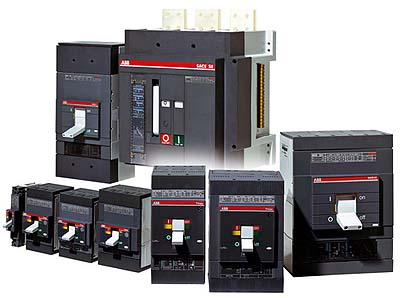 Автоматические выключатели ABB
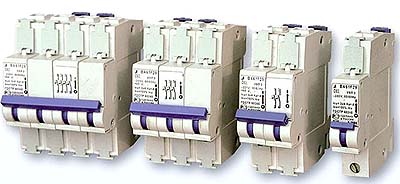 Модульные автоматические выключатели
1. НЕКОТОРЫЕ СВЕДЕНИЯ ОБ АВТОМАТИЧЕСКИХ ВЫКЛЮЧАТЕЛЯХ Автоматический выключатель — это электрический аппарат, который автоматически отключает (и тем самым защищает) электрическую цепь при возникновении в ней аномального режима. Режим становится аномальным, когда в цепи начинает недопустимо изменяться (т. е. увеличиваться или уменьшаться относительно номинального значения) ток или напряжение.
Другими словами (более "инженерно") можно сказать, что автоматический выключатель защищает от токов короткого замыкания и токов перегрузки отходящую от него питающую линию, например, кабель и приемник(и) электрической энергии (осветительную сеть, розетки, электродвигатель и т. п.).
Как правило, автоматический выключатель может применятся также для нечастого (несколько раз в сутки) включения и отключения защищаемых электроприемников (защищаемой нагрузки).
[Интент]Выключатель предназначен для проведения тока в нормальном режиме и отключения тока при коротких замыканиях, перегрузках, недопустимых снижениях напряжения, а также до 30 оперативных включений и отключений электрических цепей в сутки и рассчитан для эксплуатации в электроустановках с номинальным рабочим напряжением до 660 В переменного тока частоты 50 и 60 Гц и до 440 В постоянного тока.
[Типовая фраза из российской технической документации] 2. ПРИНЦИП ДЕЙСТВИЯ Для защиты цепи от короткого замыкания применяется автоматический выключатель с электромагнитным расцепителем.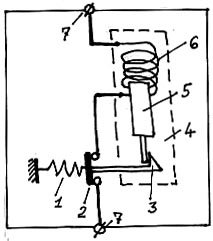
1 - Пружина (в данном случае во взведенном положении растянута)
Автоматический выключатель устроен таким образом, что сначала необходимо взвести пружину и только после этого его можно включить. У многих автоматических выключателей для взвода пружины необходимо перевести ручку вниз. После этого ручку переводят вверх. При этом замыкаются главные контакты.
2 - Главный контакт автоматического выключателя
3 - Удерживающее устройство
4 - Электромагнитный расцепитель;
5 - Сердечник
6 - Катушка
7 - Контактные зажимы автоматического выключателя
На рисунке показан один полюс автоматического выключателя во включенном положении: пружина 1 взведена, а главный контакт 2 замкнут.
Как только в защищаемой цепи возникнет короткое замыкание, ток, протекающий через соответствующий полюс автоматического выключателя, многократно возрастет. В катушке 6 сразу же возникнет сильное магнитное поле. Сердечник 5 втянется в катушку и освободит удерживающее устройство. Под действием пружины 1 главный контакт 2 разомкнется, в результате чего автоматический выключатель отключит и тем самым защитит цепь, в которой возникло короткое замыкание. Такое срабатывание автоматического выключателя происходит практически мгновенно (за сотые доли секунды).
Для защиты цепи от тока перегрузки применяют автоматические выключатели с тепловым расцепителем.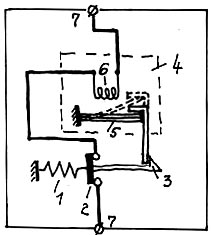
1 - Пружина (в данном случае во взведенном положении растянута)
Принцип действия такой же как и в первом случае, с той лишь разницей, что удерживающее устройство 3 освобождается под действием биметаллической пластины 5, которая изгибается от тепла, выделяемого нагревательным элементом 6. Количество тепла определяется током, протекающим через защищаемую цепь.
2 - Главный контакт автоматического выключателя
3 - Удерживающее устройство
4 - Тепловой расцепитель
5 - Биметаллическая пластина
6 - Нагревательный элемент
7 - Контактные зажимы автоматического выключателя
[Интент]Недопустимые, нерекомендуемые
Тематики
Классификация
>>>Обобщающие термины
Действия
- включение автоматического выключателя
- оперирование автоматического выключателя
- отключение автоматического выключателя
- срабатывание автоматического выключателя
EN
- auto-cutout
- automatic circuit breaker
- automatic cutout
- automatic switch
- breaker
- CB
- circuit breaker
- circuit-breaker
- cutout
DE
FR
Смотри также
Русско-немецкий словарь нормативно-технической терминологии > автоматический выключатель
13 сверхток
сверхток
Любой ток, превышающий номинальный
МЭК 60050(441-11-06).
[ ГОСТ Р 50030. 1-2000 ( МЭК 60947-1-99)]
[ ГОСТ Р 50345-99( МЭК 60898-95)]
сверхток
Электрический ток, превышающий номинальный электрический ток.
Сверхток представляет собой любой электрический ток, величина которого превышает номинальный ток какого-либо элемента электроустановки здания или используемого в ней электрооборудования, например: номинальный ток электрической цепи, допустимый длительный ток проводника, номинальный ток автоматического выключателя и т. д. В нормативной и правовой документации различают два основных вида сверхтока – ток перегрузки и ток короткого замыкания.
Появление сверхтока в каком-либо элементе электроустановки здания может привести к его перегреву, возгоранию и, как следствие, к возникновению пожара в здании. Поэтому в электроустановках зданий выполняют защиту от сверхтока.
[ http://www.volt-m.ru/glossary/letter/%D1/view/59/]
сверхток
сверхток в электротехническом изделии
Ток, значение которого превосходит наибольшее рабочее значение тока электротехнического изделия (устройства).
[ ГОСТ 18311-80]
сверхток
Электрический ток, превышающий номинальный электрический ток.
Примечание - Для проводников номинальный ток считается равным длительному допустимому току.
[ ГОСТ Р МЭК 60050-826-2009]
Сверхток может оказывать или может не оказывать вредные воздействия в зависимости от его величины и продолжительности. Сверхтоки могут возникать в результате перегрузок в электроприемниках или при повреждениях, таких как короткие замыкания или замыканиях на землю
[ ГОСТ Р 50571. 1-2009 ( МЭК 60364-1: 2005)]
сверхток
Любой ток, превышающий номинальное значение. Для проводов номинальным значением является допустимый ток.
[ ГОСТ Р МЭК 60204-1-2007]EN
overcurrent
electric current exceeding the rated electric current
NOTE – For conductors, the rated current is considered as equal to the current-carrying capacity
[IEV number 826-11-14]
over-current
<>current exceeding the rated current
<>[IEC 61095, ed. 2.0 (2009-02)]
over-current
electric current the value of which exceeds a specified limiting value
[IEV number 151-15-28]
[IEV number 442-01-20]FR
surintensité, f
courant électrique supérieur au courant électrique assigné
NOTE – Pour des conducteurs, on considère que le courant assigné est égal au courant admissible.
[IEV number 826-11-14]
surintensité
courant supérieur au courant assigné
[IEC 61095, ed. 2.0 (2009-02)]
[IEV number 442-01-20]
surintensité, f
courant électrique dont la valeur dépasse une valeur limite spécifiée
[IEV number 151-15-28]Параллельные тексты EN-RU The design of LV installations leads to basic protection devices being fitted for three types of faults:
-
overloads
-
short-circuits
-
insulation faults
Низковольтные электроустановки должны быть оснащены устройствами защиты трех типов:
-
от перегрузки;
-
от короткого замыкания;
- от токов утечки.
[Перевод Интент]
Примечание.
Слово fault в данном случае пришлось опустить, поскольку:
- его нельзя перевести как "неисправность", т. к. возникновение перегрузки ( overload) не является неисправностью;
- его нельзя перевести как "сверхток", т. к. ток утечки не является сверхтоком.The chosen switchgear must withstand and eliminate faults at optimised cost with respect to the necessary performance.
[Schneider Electric]Выбранная аппаратура распределения должна иметь такие характеристики, чтобы рентабельно выдерживать и ограничивать сверхтоки.
[Перевод Интент]Тематики
Синонимы
EN
DE
FR
Русско-немецкий словарь нормативно-технической терминологии > сверхток
14 условный ток нерасцепления Int
- vereinbarter Nichtauslösestrom
- vereinbarte Nichtauslösestromstärke
- Nichtauslösestrom (eines Überlastauslösers)
условный ток нерасцепления Int
Установленное значение тока, который автоматический выключатель для электрооборудования способен проводить заданное (условное) время без расцепления.
[ ГОСТ Р 50031-99( МЭК 60934-93)]
условный ток нерасцепления (максимального реле или расцепителя тока)
Установленное значение тока, который реле или расцепитель способны проводить, не срабатывая, в течение заданного (условного) времени.
[ ГОСТ Р 50030. 1-2000 ( МЭК 60947-1-99)]EN
conventional non-tripping current
a specified value of current which the circuit-breaker is capable of carrying for a specified time designated as conventional time, without tripping
[IEV number 442-05-54]
conventional non-tripping current (of an over-current release)
a specified value of current which the release can carry for a specified time (conventional time) without operating
[IEV number 441-17-22]FR
courant conventionnel de non-déclenchement
valeur spécifiée du courant que le disjoncteur peut supporter sans déclencher pendant un temps spécifié appelé temps conventionnel
[IEV number 442-05-54]
courant conventionnel de non-déclenchement (d'un déclencheur à maximum de courant)
valeur spécifiée de courant que peut supporter un déclencheur pendant une durée spécifiée (durée conventionnelle) sans fonctionner
[IEV number 441-17-22]Тематики
Синонимы
EN
DE
- Nichtauslösestrom (eines Überlastauslösers)
- vereinbarte Nichtauslösestromstärke
- vereinbarter Nichtauslösestrom
FR
Русско-немецкий словарь нормативно-технической терминологии > условный ток нерасцепления Int
15 характеристика нагрузки
характеристика нагрузки
-
[IEV number 312-06-04]EN
load characteristic
linear or non-linear relationship between the value of the output voltage and the value of the output current for a specified load and for a fixed setting of the controls
NOTE 1 – The load can be complex and/or non-linear.
NOTE 2 – The load characteristic can also describe the effects of overload.
[IEV number 312-06-04]FR
caractéristique de charge
relation linéaire ou non linéaire entre la valeur de la tension de sortie et la valeur du courant de sortie pour une charge spécifiée et pour une position fixe des réglages
NOTE 1 – La charge peut être complexe et/ou non linéaire.
NOTE 2 – La caractéristique de charge peut aussi décrire les effets d’une surcharge.
[IEV number 312-06-04]EN
DE
FR
Русско-немецкий словарь нормативно-технической терминологии > характеристика нагрузки
16 входное полное сопротивление
входное полное сопротивление
-
[IEV number 312-06-18]EN
input impedance
impedance of the input circuit measured between the input terminals under operating conditions
NOTE 1 – The impedance can be expressed in terms of admittance.
NOTE 2 – In certain instances, for example, sampling devices or self-balancing potentiometers, the impedance can be different according to the instant when it is determined, before, during or after the instant of measurement.
NOTE 3 – When the input circuit is such that the instantaneous value of the current flowing into the input terminals is a non-linear function of the instantaneous value of the input voltage under specified conditions of frequency and voltage, the combination of resistance and reactance which would absorb the same active power and in which would flow a reactive current equal to the fundamental component that is flowing in the actual input circuit, is sometimes called the "equivalent input impedance".
[IEV number 312-06-18]FR
impédance du circuit d'entrée
impédance du circuit d'entrée entre les bornes d'entrée dans les conditions de fonctionnement
NOTE 1 – L'impédance peut être exprimée en termes d'admittance.
NOTE 2 – Dans certains cas, par exemple les dispositifs d'échantillonnage ou les potentiomètres à rééquilibrage automatique, l'impédance peut être différente selon l’instant où elle est déterminée, avant, pendant ou après la mesure.
NOTE 3 – Lorsque le circuit d'entrée est tel que la valeur instantanée du courant traversant les bornes d'entrée est une fonction non linéaire de la valeur instantanée de la tension d'entrée dans des conditions spécifiées de fréquence et de tension, l'impédance d'une combinaison formée par une résistance et une réactance qui absorberaient la même puissance active et dans laquelle circulerait un courant réactif égal à la composante fondamentale qui circule dans le circuit d'entrée réel, est parfois appelée "impédance équivalente d'entrée".
[IEV number 312-06-18]Тематики
- измерение электр. величин в целом
EN
DE
FR
Русско-немецкий словарь нормативно-технической терминологии > входное полное сопротивление
17 выходное полное сопротивление
выходное полное сопротивление
-
[IEV number 312-06-19]EN
output impedance
impedance of the output circuit measured between the output terminals under operating conditions
NOTE 1 – The impedance can be expressed in terms of admittance.
NOTE 2 – In certain instances, for example, sampling devices or self-balancing potentiometers, the impedance can be different according to the instant when it is determined, before, during or after the instant of measurement.
NOTE 3 – When the output circuit is such that the instantaneous value of the current flowing into the output terminals is a non-linear function of the instantaneous value of the output voltage under specified conditions of frequency and voltage, the combination of resistance and reactance which would absorb the same active power and in which would flow a reactive current equal to the fundamental component that is flowing in the actual output circuit, is sometimes called the "equivalent output impedance".
[IEV number 312-06-19]FR
impédance du circuit de sortie
impédance du circuit de sortie entre les bornes de sortie dans les conditions de fonctionnement
NOTE 1 – L'impédance peut être exprimée en termes d'admittance.
NOTE 2 – Dans certains cas, par exemple les dispositifs d'échantillonnage ou les potentiomètres à rééquilibrage automatique, l'impédance peut être différente selon l’instant où elle est déterminée, avant, pendant ou après la mesure.
NOTE 3 – Lorsque le circuit de sortie est tel que la valeur instantanée du courant traversant les bornes de sortie est une fonction non linéaire de la valeur instantanée de la tension de sortie dans des conditions spécifiées de fréquence et de tension, l'impédance d'une combinaison formée par une résistance et une réactance qui absorberaient la même puissance active et dans laquelle circulerait un courant réactif égal à la composante fondamentale qui circule dans le circuit de sortie réel, est parfois appelée "impédance équivalente de sortie".
[IEV number 312-06-19]Тематики
- измерение электр. величин в целом
EN
DE
FR
Русско-немецкий словарь нормативно-технической терминологии > выходное полное сопротивление
18 длительность изменения напряжения
длительность изменения напряжения
Интервал времени от начала одиночного изменения напряжения до его конечного значения.
[ ГОСТ 13109-97]EN
duration of a voltage change
interval of time for the voltage to increase or decrease from the initial value to the final value
[IEV number 161-08-03]FR
durée d'une variation de tension
durée d'un intervalle de temps pendant lequel la tension croît ou décroît de sa valeur initiale avant une variation de tension à sa valeur finale
[IEV number 161-08-03]Тематики
EN
DE
FR
Русско-немецкий словарь нормативно-технической терминологии > длительность изменения напряжения
19 коэффициент замыкания на землю
коэффициент замыкания на землю
Отношение наибольшего фазного напряжения в месте металлического замыкания на землю к напряжению в той же точке при отсутствии замыкания.
[ ГОСТ 24291-90]
коэффициент замыкания на землю
Для данного места трехфазной системы заданной конфигурации отношение максимального значения фазного напряжения промышленной частоты на исправном линейном проводнике во время замыкания на землю одного или нескольких линейных проводников в какой-либо точке системы к значению напряжения промышленной частоты в данном месте при отсутствии какого-либо замыкания на землю.
[ ГОСТ Р МЭК 60050-195-2005]
коэффициент замыкания на землю
Отношение напряжения на неповрежденной фазе в рассматриваемой точке трехфазной электрической сети (обычно в точке установки электрооборудования) при замыкании на землю одной или двух других фаз к фазному напряжению рабочей частоты, которое установилось бы в данной точке при устранении замыкания.
Примечание. При определении коэффициента замыкания на землю место замыкания и состояние схемы электрической сети выбираются такими, которые дают наибольшее значение коэффициента
[ ГОСТ 1516.1-76]
коэффициент замыкания на землю
Коэффициент, определяющий отношение влияния на одну или более фаз в любой точке сети во время замыкания на землю другой исправной фазы при наивысшем значении ее напряжения в заданном месте при заданном местоположении трехфазной сети и для заданной конфигурации соответственно в отсутствие любого подобного замыкания. [IEV 604-03-06]
[ ГОСТ Р МЭК 60044-7-2010]EN
earth fault factor
at a given location of a three-phase system, and for a given system configuration, ratio of the highest root-mean-square value of line-to-earth power frequency voltage on a healthy line conductor during an earth fault affecting one or more line conductors at any point on the system, to the root-mean-square value of line-to-earth power frequency voltage which would be obtained at the given location in the absence of any such earth fault
Source: 604-03-06 MOD
[IEV number 195-05-14]FR
facteur de court-circuit à la terre
en un emplacement donné d'un réseau triphasé, et pour un schéma d'exploitation donné de ce réseau, rapport entre d'une part la tension efficace la plus élevée, à la fréquence du réseau, entre un conducteur de ligne saine et la terre pendant un défaut à la terre affectant un ou plusieurs conducteurs de ligne en un point quelconque du réseau, et d'autre part la valeur efficace de la tension phase-terre à la fréquence du réseau qui serait obtenue à l'emplacement considéré en l'absence d'un tel défaut à la terre
Source: 604-03-06 MOD
[IEV number 195-05-14]Тематики
EN
DE
FR
82 коэффициент замыкания на землю
Отношение наибольшего фазного напряжения в месте металлического замыкания на землю к напряжению в той же точке при отсутствии замыкания
604-03-06*
de Erdfehlerfactor
en earth fault factor
fr facteur de défaut à la terre
Источник: ГОСТ 24291-90: Электрическая часть электростанции и электрической сети. Термины и определения оригинал документа
Русско-немецкий словарь нормативно-технической терминологии > коэффициент замыкания на землю
20 линейное преобразование
линейное преобразование
-
[IEV number 314-02-04]EN
linear conversion
conversion for which the quotient of each change in the output value by the corresponding change in the input value is intended to be constant
[IEV number 314-02-04]FR
conversion linéaire
conversion telle que le quotient de chaque changement de la valeur de sortie par le changement correspondant de la valeur d'entrée soit constant
[IEV number 314-02-04]Тематики
- измерение электр. величин в целом
EN
DE
FR
Русско-немецкий словарь нормативно-технической терминологии > линейное преобразование
СтраницыСм. также в других словарях:
value for money audit — UK US noun [C] ACCOUNTING ► an examination of the accounts of a charity or business, activity, etc. that is not organized to make a profit, in order to check that it is providing value, in relation to the amount of money being put into it: »He… … Financial and business terms
value for shareholders — UK US noun [C or U] FINANCE ► SHAREHOLDER VALUE(Cf. ↑shareholder value) … Financial and business terms
value for money — (VfM). In a PPP, VfM means that the project agreement gives a net benefit to the awarding authority, defined in terms of cost, price, quality, quantity, or risk transfer, or a combination of these. Practical Law Dictionary. Glossary of UK, US and … Law dictionary
Value for Money — is a 1955 British comedy film directed by Ken Annakin and starring John Gregson, Donald Pleasance, Leslie Phillips, Joan Hickson and Diana Dors.ynopsisA wealthy young man (Gregson) from Yorkshire visits a London nightclub and meets a performer… … Wikipedia
value for money audit — An audit of a government department, charity, or other non profitmaking organization to assess whether or not it is functioning efficiently and giving value for the money it spends … Accounting dictionary
value for money audit — An audit of a government department, charity, or other non profit making organization to assess whether or not it is functioning efficiently and giving value for the money it spends … Big dictionary of business and management
value for cultivation and use test — veislės ūkinio vertingumo tyrimas statusas Aprobuotas sritis sėklininkystė apibrėžtis Tyrimas, kuriuo nustatoma augalo ūkinė vertė ir tinkamumas Lietuvos agroklimato sąlygoms. atitikmenys: angl. value for cultivation and use test rus. испытание… … Lithuanian dictionary (lietuvių žodynas)
value-for-money auditing — VFM An alternative term for Operational auditing. The term is frequently used in the United Kingdom and countries with a history of British influence, in the context of *public sector auditing, for audits that assess the Three E’s of the *economy … Auditor's dictionary
exempt transfer of value (for inheritance tax) — England, Wales A transfer of value (broadly, a gift) made in lifetime or on death that is exempt from inheritance tax. For example, gifts to certain favoured beneficiaries (beneficia … Law dictionary
Value (ethics) — For other uses, see Value (disambiguation). In ethics, value is a property of objects, including physical objects as well as abstract objects (e.g. actions), representing their degree of importance. Ethic value denotes something s degree of… … Wikipedia
Value Measuring Methodology — (or VMM) is a tool that helps planners balance both tangible and intangible values when making investment decisions, and monitor benefits.Formal methods to calculate the Return on Investment (or ROI) have been widely understood and used for a… … Wikipedia
 18+© Академик, 2000-2026
- Обратная связь: Техподдержка, Реклама на сайте
Экспорт словарей на сайты, сделанные на PHP, Joomla, Drupal, WordPress, MODx.
Перевод: с русского на немецкий
с немецкого на русский- С немецкого на:
- Русский
- С русского на:
- Все языки
- Английский
- Немецкий
- Французский
- Эстонский