

-
1 Heizflächenbelastung
-
2 Dauerstrombelastbarkeit, f
(длительный) допустимый ток
Максимальное значение электрического тока, который может протекать длительно по проводнику, устройству или аппарату при определенных условиях без превышения определенного значения их температуры в установившемся режиме
[ ГОСТ Р МЭК 60050-826-2009]
Этот ток обозначают IZ
[ ГОСТ Р 50571. 1-2009 ( МЭК 60364-1: 2005)]EN
(continuous) current-carrying capacity
ampacity (US)
maximum value of electric current which can be carried continuously by a conductor, a device or an apparatus, under specified conditions without its steady-state temperature exceeding a specified value
[IEV number 826-11-13]
ampacity
The current in amperes that a conductor can carry continuously under the conditions of use without exceeding its temperature rating.
[National Electrical Cod]FR
courant (permanent) admissible, m
valeur maximale du courant électrique qui peut parcourir en permanence, un conducteur, un dispositif ou un appareil, sans que sa température de régime permanent, dans des conditions données, soit supérieure à la valeur spécifiée
[IEV number 826-11-13]Ampacity, the term is defined as the maximum amount of current a cable can carry before sustaining immediate or progressive deterioration. Also described as current rating or current-carrying capacity, is the RMS electric current which a device can continuously carry while remaining within its temperature rating. The ampacity of a cable depends on:
- its insulation temperature rating;
- conductor electrical properties for current;
- frequency, in the case of alternating currents;
- ability to dissipate heat, which depends on cable geometry and its surroundings;
- ambient temperature.
Electric wires have some resistance, and electric current flowing through them causes voltage drop and power dissipation, which heats the cable. Copper or aluminum can conduct a large amount of current before melting, but long before the conductors melt, their insulation would be damaged by the heat.
The ampacity for a power cable is thus based on physical and electrical properties of the material & construction of the conductor and of its insulation, ambient temperature, and environmental conditions adjacent to the cable. Having a large overall surface area may dissipate heat well if the environment can absorb the heat.
In a long run of cable, different conditions govern, and installation regulations normally specify that the most severe condition along the run governs the cable's rating. Cables run in wet or oily locations may carry a lower temperature rating than in a dry installation. Derating is necessary for multiple circuits in close proximity. When multiple cables are near, each contributes heat to the others and diminishes the amount of cooling air that can flow past the individual cables. The overall ampacity of the insulated conductors in a bundle of more than 3 must be derated, whether in a raceway or cable. Usually the de-rating factor is tabulated in a nation's wiring regulations.
Depending on the type of insulating material, common maximum allowable temperatures at the surface of the conductor are 60, 75 and 90 degrees Celsius, often with an ambient air temperature of 30°C. In the U.S., 105°C is allowed with ambient of 40°C, for larger power cables, especially those operating at more than 2 kV. Likewise, specific insulations are rated 150, 200 or 250°C.
The allowed current in cables generally needs to be decreased (derated) when the cable is covered with fireproofing material.
For example, the United States National Electric Code, Table 310-16, specifies that up to three 8 AWG copper wires having a common insulating material (THWN) in a raceway, cable, or direct burial has an ampacity of 50 A when the ambient air is 30°C, the conductor surface temperature allowed to be 75°C. A single insulated conductor in air has 70 A rating.
Ampacity rating is normally for continuous current, and short periods of overcurrent occur without harm in most cabling systems. The acceptable magnitude and duration of overcurrent is a more complex topic than ampacity.
When designing an electrical system, one will normally need to know the current rating for the following:- Wires
- Printed Circuit Board traces, where included
- Fuses
- Circuit breakers
- All or nearly all components used
Some devices are limited by power rating, and when this power rating occurs below their current limit, it is not necessary to know the current limit to design a system. A common example of this is lightbulb holders.
[http://en.wikipedia.org/wiki/Ampacity]
Тематики
- электротехника, основные понятия
Синонимы
EN
DE
- Dauerstrombelastbarkeit, f
- Strombelastbarkeit, f
FR
- courant admissible, m
- courant permanent admissible, m
Немецко-русский словарь нормативно-технической терминологии > Dauerstrombelastbarkeit, f
-
3 Strombelastbarkeit, f
(длительный) допустимый ток
Максимальное значение электрического тока, который может протекать длительно по проводнику, устройству или аппарату при определенных условиях без превышения определенного значения их температуры в установившемся режиме
[ ГОСТ Р МЭК 60050-826-2009]
Этот ток обозначают IZ
[ ГОСТ Р 50571. 1-2009 ( МЭК 60364-1: 2005)]EN
(continuous) current-carrying capacity
ampacity (US)
maximum value of electric current which can be carried continuously by a conductor, a device or an apparatus, under specified conditions without its steady-state temperature exceeding a specified value
[IEV number 826-11-13]
ampacity
The current in amperes that a conductor can carry continuously under the conditions of use without exceeding its temperature rating.
[National Electrical Cod]FR
courant (permanent) admissible, m
valeur maximale du courant électrique qui peut parcourir en permanence, un conducteur, un dispositif ou un appareil, sans que sa température de régime permanent, dans des conditions données, soit supérieure à la valeur spécifiée
[IEV number 826-11-13]Ampacity, the term is defined as the maximum amount of current a cable can carry before sustaining immediate or progressive deterioration. Also described as current rating or current-carrying capacity, is the RMS electric current which a device can continuously carry while remaining within its temperature rating. The ampacity of a cable depends on:
- its insulation temperature rating;
- conductor electrical properties for current;
- frequency, in the case of alternating currents;
- ability to dissipate heat, which depends on cable geometry and its surroundings;
- ambient temperature.
Electric wires have some resistance, and electric current flowing through them causes voltage drop and power dissipation, which heats the cable. Copper or aluminum can conduct a large amount of current before melting, but long before the conductors melt, their insulation would be damaged by the heat.
The ampacity for a power cable is thus based on physical and electrical properties of the material & construction of the conductor and of its insulation, ambient temperature, and environmental conditions adjacent to the cable. Having a large overall surface area may dissipate heat well if the environment can absorb the heat.
In a long run of cable, different conditions govern, and installation regulations normally specify that the most severe condition along the run governs the cable's rating. Cables run in wet or oily locations may carry a lower temperature rating than in a dry installation. Derating is necessary for multiple circuits in close proximity. When multiple cables are near, each contributes heat to the others and diminishes the amount of cooling air that can flow past the individual cables. The overall ampacity of the insulated conductors in a bundle of more than 3 must be derated, whether in a raceway or cable. Usually the de-rating factor is tabulated in a nation's wiring regulations.
Depending on the type of insulating material, common maximum allowable temperatures at the surface of the conductor are 60, 75 and 90 degrees Celsius, often with an ambient air temperature of 30°C. In the U.S., 105°C is allowed with ambient of 40°C, for larger power cables, especially those operating at more than 2 kV. Likewise, specific insulations are rated 150, 200 or 250°C.
The allowed current in cables generally needs to be decreased (derated) when the cable is covered with fireproofing material.
For example, the United States National Electric Code, Table 310-16, specifies that up to three 8 AWG copper wires having a common insulating material (THWN) in a raceway, cable, or direct burial has an ampacity of 50 A when the ambient air is 30°C, the conductor surface temperature allowed to be 75°C. A single insulated conductor in air has 70 A rating.
Ampacity rating is normally for continuous current, and short periods of overcurrent occur without harm in most cabling systems. The acceptable magnitude and duration of overcurrent is a more complex topic than ampacity.
When designing an electrical system, one will normally need to know the current rating for the following:- Wires
- Printed Circuit Board traces, where included
- Fuses
- Circuit breakers
- All or nearly all components used
Some devices are limited by power rating, and when this power rating occurs below their current limit, it is not necessary to know the current limit to design a system. A common example of this is lightbulb holders.
[http://en.wikipedia.org/wiki/Ampacity]
Тематики
- электротехника, основные понятия
Синонимы
EN
DE
- Dauerstrombelastbarkeit, f
- Strombelastbarkeit, f
FR
- courant admissible, m
- courant permanent admissible, m
Немецко-русский словарь нормативно-технической терминологии > Strombelastbarkeit, f
-
4 abschöpfen
v/t (trennb., hat -ge-)1. (Schaum, Sahne) skim off (von etw. s.th.)* * *to skim* * *ạb|schöp|fenvt septo skim off; (fig) Dank, Ruhm to reap; Kaufkraft to absorb; (= für sich gewinnen) to cream offden Rahm or das Fett abschöpfen (fig) — to cream off the best part
den Gewinn abschöpfen — to siphon off the profits
* * *1) ((with off) to select (the best): The best pupils will be creamed off for special training.) cream2) (to remove (floating matter, eg cream) from the surface of (a liquid): Skim the fat off the gravy.) skim* * *ab|schöp·fenvt1. (herunternehmen)die Sahne \abschöpfen to skim the cream▪ etw \abschöpfen to absorb sthGewinne \abschöpfen to cream [or siphon] off profitsdie Kaufkraft \abschöpfen to reduce spending power* * *den Rahm abschöpfen — (fig.) cream off the best
* * *abschöpfen v/t (trennb, hat -ge-)von etwas sth)* * *den Rahm abschöpfen — (fig.) cream off the best
* * *v.to skim v. -
5 Oberflächenleistung
Oberflächenleistung f surface [superficial] power, surface capacityDeutsch-Englisch Wörterbuch der Elektrotechnik und Elektronik > Oberflächenleistung
-
6 geschlossene (gekapselte) Schaltgerätekombination
НКУ защищенное
НКУ закрытое со всех сторон (за возможным исключением монтажной поверхности), в котором после его установки обеспечивается степень защиты не менее IP2X.
[ ГОСТ Р 51321. 1-2000 ( МЭК 60439-1-92)]
защищенное НКУ
НКУ, конструкция которого обеспечивает требуемую степень защиты со всех сторон от прикосновения к частям, находящимся под напряжением (за исключением монтажной поверхности).
[ ГОСТ Р МЭК 61439.1-2013]EN
enclosed assembly (of switchgear and controlgear)
an assembly enclosed on all sides, top and bottom in such a manner as to provide a specified degree of protection
NOTE – The mounting surface may form a part of the enclosure when specified in the relevant publication.
[IEV number 441-12-02]FR
ensemble (d'appareillage de connexion et de commande)
sous enveloppe
ensemble comportant une paroi sur toutes ses faces latérales, supérieure et inférieure, de façon à assurer un degré de protection spécifié
NOTE – La surface de montage peut faire partie de l'enveloppe lorsqu'une publication particulière le spécifie.
[IEV number 441-12-0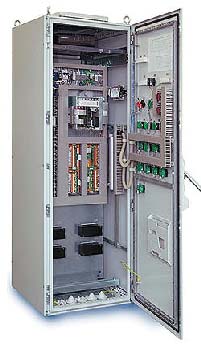
Шкаф - защищенное НКУ, предназначенное для установки на полу
Safety enclosed boards are used for most new installations. Common terms used to designate equipment of this type are metal-enclosed switchgear and metal-clad switchgear.
Most safety enclosed boards are of the unit or sectional type. They consist of a combination of the desired number and type of standardized unit sections.
Each section is a standard factory-assembled combination of a formed steel panel and apparatus mounted on a steel framework.
Safety enclosed switchgear may be classified with respect to purpose of application as follows:
1. General medium- or high-voltage switchgear
2. Primary unit substations
3. Rectifier unit substations
4. Secondary unit substations or power centers
5. General low-voltage switchgear
6. Low-voltage distribution switchboards
7. Motor-control-center switchboards
[American electricians’ handbook]Тематики
- НКУ (шкафы, пульты,...)
Классификация
>>>Обобщающие термины
Синонимы
EN
- enclosed assembly (of switchgear and controlgear)
- enclosed switchboard
- safety enclosed board
- safety enclosed switchgear
DE
FR
Немецко-русский словарь нормативно-технической терминологии > geschlossene (gekapselte) Schaltgerätekombination
-
7 Eindringtiefe
f < allg> ■ penetration depthf <el> (Skineffekt) ■ skin depthf <nukl.med> (ionisierender Strahlen) ■ penetration depth; penetrating powerf <qualit.mat> (Härteprüfung) ■ penetration depth; depth of impression; indentation depth; depth of penetration -
8 Flächenleistung
-
9 Klimaänderung (anthropogen)
изменение климата как следствие деятельности человека
—
[ http://www.eionet.europa.eu/gemet/alphabetic?langcode=en]EN
man-made climate change
Man-made climate changes may be due to the greenhouse effect and other human activities. A change in albedo of the land brought about by desertification and deforestation affects the amount of solar energy absorbed at the earth's surface. Man-made aerosols produced from the sulphur released from power stations can modify clouds. Changes in ozone levels in the stratosphere due to CFCs may influence climate. (Source: WRIGHT)
[http://www.eionet.europa.eu/gemet/alphabetic?langcode=en]Тематики
EN
DE
FR
Немецко-русский словарь нормативно-технической терминологии > Klimaänderung (anthropogen)
-
10 Oberflächen-Leistungsdichte im Strahlungsimpuls
поверхностная плотность мощности в импульсе излучения (E)
Мощность в импульсе излучения, отнесенная к единице поверхности.
[ ГОСТ 24286-88]Тематики
- оптика, оптические приборы и измерения
Обобщающие термины
- величины, характеризующие импульс излучения
EN
DE
FR
Немецко-русский словарь нормативно-технической терминологии > Oberflächen-Leistungsdichte im Strahlungsimpuls
-
11 Polychlorbiphenyl
полихлорированный бифенил
—
[ http://www.eionet.europa.eu/gemet/alphabetic?langcode=en]EN
polychlorinated biphenyl
PCBs are a family of chemical compounds which do not exist in nature but which are man-made. Commercial mixtures are clear, pale yellow liquids, manufactured by the replacement of hydrogen atoms on the biphenyl molecule by chlorine. Because of their physical properties, PCBs are commonly found in electrical equipment which requires dielectric fluid such as power transformers and capacitors, as well as in hydraulic machinery, vacuum pumps, compressors and heat-exchanger fluids. Other uses include: lubricants, fluorescent light ballasts, paints, glues, waxes, carbonless copy paper, inks including newspapers, dust-control agents for dirt roads, solvents for spreading insecticides, cutting oils. PCBs are stable compounds and although they are no longer manufactured they are extremely persistent and remain in huge quantities in the atmosphere and in landfill sites. They are not water-soluble and float on the surface of water where they are eaten by aquatic animals and so enter the food chain. PCBs are fat-soluble, and are therefore easy to take into the system, but difficult to excrete. (Source: PZ / PHC)
[http://www.eionet.europa.eu/gemet/alphabetic?langcode=en]Тематики
EN
DE
FR
Немецко-русский словарь нормативно-технической терминологии > Polychlorbiphenyl
См. также в других словарях:
Surface warfare — Modern naval warfare is divided into three operational areas: surface warfare, air warfare and submarine warfare. Each area is comprised of specialized platforms and strategies used to exploit tactical advantages unique and inherent to that area … Wikipedia
Surface-mount technology — (SMT) is a method for constructing electronic circuits in which the components (SMC, or Surface Mounted Components) are mounted directly onto the surface of printed circuit boards (PCBs). Electronic devices so made are called surface mount… … Wikipedia
Surface engineering — is the sub discipline of materials science which deals with the surface of solid matter. It has applications to chemistry, mechanical engineering, and electrical engineering (particularly in relation to semiconductor manufacturing).Solids are… … Wikipedia
Power Rangers : Dino Tonnerre — Power Rangers: Dino Tonnerre Titre original Power Rangers: Dino Thunder Genre Action Aventure Création Disney Toei Company Participants Team Up: Pua Magasiva Sally Martin Glenn McMillan Adam Tuominen Jorgito Vargas Jr. Pays … Wikipédia en Français
Surface plasmon — Surface plasmons, also referred to in the literature as surface plasma polaritons, are fluctuations in the electron density at the boundary of two materials. Plasmons are the collective vibrations of an electron gas (or plasma) surrounding the… … Wikipedia
Power line communication — or power line carrier (PLC), also known as power line digital subscriber line (PDSL), mains communication, power line telecom (PLT), power line networking (PLN), or broadband over power lines (BPL) are systems for carrying data on a conductor… … Wikipedia
Power Rangers Dino Thunder — Format Action/Adventure Science fantasy Written by Douglas Sloan … Wikipedia
Power — Pow er, n. [OE. pouer, poer, OF. poeir, pooir, F. pouvoir, n. & v., fr. LL. potere, for L. posse, potesse, to be able, to have power. See {Possible}, {Potent}, and cf. {Posse comitatus}.] 1. Ability to act, regarded as latent or inherent; the… … The Collaborative International Dictionary of English
Power loom — Power Pow er, n. [OE. pouer, poer, OF. poeir, pooir, F. pouvoir, n. & v., fr. LL. potere, for L. posse, potesse, to be able, to have power. See {Possible}, {Potent}, and cf. {Posse comitatus}.] 1. Ability to act, regarded as latent or inherent;… … The Collaborative International Dictionary of English
Power of a point — Power Pow er, n. [OE. pouer, poer, OF. poeir, pooir, F. pouvoir, n. & v., fr. LL. potere, for L. posse, potesse, to be able, to have power. See {Possible}, {Potent}, and cf. {Posse comitatus}.] 1. Ability to act, regarded as latent or inherent;… … The Collaborative International Dictionary of English
Power of attorney — Power Pow er, n. [OE. pouer, poer, OF. poeir, pooir, F. pouvoir, n. & v., fr. LL. potere, for L. posse, potesse, to be able, to have power. See {Possible}, {Potent}, and cf. {Posse comitatus}.] 1. Ability to act, regarded as latent or inherent;… … The Collaborative International Dictionary of English
