

-
1 security needs
Военный термин: требования безопасности -
2 security needs
צרכי ביטחון* * *◙ ןוחטיב יכרצ◄ -
3 security needs
kebutuhan keamanan -
4 security needs
veiligheidsbehoeften -
5 security needs
säkerhetsbehov -
6 security needs
-
7 security needs
s.necesidades de seguridad. -
8 money and security needs
kebutuhan akan uang dan ketenangan -
9 security survey
An evaluation of security needs including the identification of vulnerabilities which could be exploited to carry out an act of unlawful interference, and the recommendation of corrective actions.(AN 17)Official definition added to Annex 17 by Amdt 11 (2005).Оценка потребностей в сфере безопасности, включающая выявление уязвимых мест, которые могут быть использованы для совершения акта незаконного вмешательства, и выработку рекомендаций относительно корректирующих действий.International Civil Aviation Vocabulary (English-Russian) > security survey
-
10 security
n1. безпека, органи безпеки2. гарантія, забезпечення3. (звич. pl) цінні папери- collective security колективна безпека- domestic security внутрішня безпека- equal security interests зацікавленість у взаємній безпеці- flank security безпека флангових країн; безпека флангів- government securities державні цінні папери- international security міжнародна безпека- national security національна/ державна безпека; безпека країни- personal security особиста безпека- public security громадська безпека- reliable security надійна безпека- state security національна/ державна безпека; безпека країни- security arrangements заходи безпеки- security guarantees гарантії безпеки- security measures заходи безпеки- security needs вимоги щодо безпеки- security pact договір про забезпечення безпеки- security treaty договір про забезпечення безпеки- S. services служба безпеки- social security соціальне забезпечення- social security convention угода з питань соціального забезпечення- social security payments виплати в галузі соціального забезпечення- social security regimes системи соціального забезпечення- security of the flanking countries безпека флангових країн; безпека флангів- security of minor employees безпека молодших співробітників (посольств)- security from nuclear attack захист від ядерного нападу- security of a person недоторканість особи- diminuation of the security зниження рівня безпеки- equality of security взаємна безпека- vilitary aspects of security військові аспекти безпеки- political aspects of security політичні аспекти безпеки- prejudicial to national security згубний/ шкідливий для національної безпеки- principle of equal security принцип рівної безпеки- principle of undiminished security принцип незавдавання шкоди жодній з країн- promotion of security зміцнення безпеки- restoration of security відновлення безпеки- security arrangements of deterrence заходи безпеки шляхом стримування- system of collective security система колективної безпеки- system of social security система соціального забезпечення- without prejudicing the security of anyone без шкоди для безпеки будь-кого- to be prejudicial to the security (of the flanking countries) завдавати шкоди безпеці (флангових країн)- to boost security посилити/ зміцнити безпеку- to diminish the security of the states завдати шкоди безпеці держав- to endanger international security поставити під загрозу міжнародну безпеку- to enhance security посилити/ зміцнити безпеку- to ensure state security забезпечити державну безпеку- to safeguard the security of the flank/ flanking countries забезпечити безпеку флангових країн- to strengthen security guarantees посилити гарантії безпеки- to underpin the security of a country зміцнити безпеку держави- S. Council Рада Безпеки- security is indivisible безпека неподільна -
11 security
n1) безопасность2) гарантия, обеспечение3) юр. обеспечение; гарантия, залог4) обыкн. pl ценные бумаги• -
12 security
1 noun∎ terrorism is a threat to national security le terrorisme menace la sécurité nationale;∎ the President's national security advisers les conseillers du président en matière de sécurité nationale;∎ she's considered to be a security risk on considère qu'elle représente un risque pour la sécurité;∎ they slipped through the security net ils sont passés au travers des mailles du filet des services de sécurité(b) (police measures, protection etc) sécurité f;∎ for reasons of security par mesure de ou pour des raisons de sécurité;∎ there was maximum security for the President's visit des mesures de sécurité exceptionnelles ont été prises pour la visite du président;∎ maximum security wing (in prison) quartier m de haute surveillance(c) (UNCOUNT) (assurance) sécurité f;∎ job security sécurité f de l'emploi;∎ to have security of tenure (in job) être titulaire, avoir la sécurité de l'emploi; (as tenant) avoir un bail qui ne peut être résilié;∎ what she really needs is emotional security ce qu'il lui faut vraiment c'est une sécurité affective;∎ financial security sécurité f matérielle ou financière(d) (guarantee) garantie f, caution f;∎ what security do you have for the loan? quelle garantie avez-vous pour couvrir ce prêt?;∎ to give sth as security donner qch en cautionnement;∎ to lend money on security prêter de l'argent sur nantissement ou sur garantie;∎ have you anything to put up as security? qu'est-ce que vous pouvez fournir comme garantie?;∎ she gave her diamonds as security for the loan elle a donné ses diamants comme garantie pour le prêt;∎ loans without security prêts mpl sans garantie(e) (guarantor) garant(e) m,f;∎ British to stand security for sb se porter garant de qn;∎ to stand security for a loan avaliser un prêt(f) (department) sécurité f;∎ please call security appelez la sécurité s'il vous plaîtFinance titres mpl, actions fpl, valeurs fpl;∎ government securities titres mpl d'État;∎ the securities market le marché des valeurs►► security alert alerte f au danger;security blanket doudou m; Psychology objet m transitionnel;security booth guichet m (du gardien);Computing security certificate certificat m de sécurité;Administration & Military security clearance habilitation f; (document) laissez-passer m inv;security code code m confidentiel;Security Council Conseil m de sécurité;Finance securities department service m des titres;Finance security deposit dépôt m de garantie;security device sécurité f;American Securities and Exchange Commission = commission américaine des opérations de Bourse, ≃ COB f;security firm société f de gardiennage;security forces forces fpl de sécurité;security guard garde m (chargé de la sécurité); (for armoured van) convoyeur(euse) m,f de fonds;securities house société f de Bourse;British Securities and Investment Board = commission britannique des opérations de Bourse, ≃ COB f;security leak = fuite de documents ou d'informations concernant la sécurité;Computing security level niveau m de sécurité;Finance securities market marché m des titres, marché m des valeurs (mobilières);security measures mesures fpl de sécurité;security officer (on ship) officier m chargé de la sécurité; (in firm) employé(e) m,f chargé(e) de la sécurité; (inspector) inspecteur(trice) m,f de la sécurité;Computing security password mot m de passe sécuritaire;security patrol patrouille f de sûreté ou de protection;security personnel personnel m de sécurité;security police (services mpl de la) sûreté f;Finance securities portfolio portefeuille m de titres;security tag agrafe f antivol -
13 security
security [sɪˈkjʊərɪtɪ]1. nouna. sécurité fb. [of country, building] sécurité f• the trial took place amid tight security des mesures de sécurité exceptionnelles ont été prises pendant le procès2. plural noun3. compounds* * *[sɪ'kjʊərətɪ] 1.1) (of person, child, financial position, investment) sécurité fsecurity of employment —
2) (for site, prison, nation, VIP) sécurité fstate ou national security — sûreté f de l'État
3) ( department) service m de sécurité4) ( guarantee) garantie f (on sur)5) Finance titre m2. -
14 security
noun1) (safety) Sicherheit, diesecurity [measures] — Sicherheitsmaßnahmen
4)he needs the security of a good home — er braucht die Geborgenheit eines guten Zuhauses
* * *noun (the state of being, or making safe, secure, free from danger etc: the security of a happy home; This alarm system will give the factory some security; There has to be tight security at a prison; ( also adjective) the security forces; a security guard.) die Sicherheit, Sicherheits-...* * *se·cu·rity[sɪˈkjʊərəti, AM -ˈkjʊrət̬i]nmaximum-\security prison/wing Hochsicherheitsgefängnis nt/-trakt mlax/tight \security lasche/strenge Sicherheitsvorkehrungennational \security nationale Sicherheitto be in charge of \security für die Sicherheit verantwortlich seinto tighten \security die Sicherheitsmaßnahmen verschärfento call \security den Sicherheitsdienst rufenjob \security Sicherheit f des Arbeitsplatzes\security of tenure Kündigungsschutz mfinancial \security finanzielle Sicherheitto lend money on/without \security Geld gegen Sicherheit/ohne Sicherheit leihento stand \security for sb für jdn bürgento use sth as \security [for sth] etw als Sicherheit [für etw akk] verwendenconvertible \security Wandelanleihe ffixed-interest \security festverzinsliches Wertpapiernegotiable \security begebbares Wertpapierunlisted \security Freiverkehrswert mto stand \security for sb für jdn bürgen [o Bürgschaft leisten* * *[sI'kjʊərItɪ]n1) Sicherheit f; (emotional) Geborgenheit f; (= security measures) Sicherheitsvorkehrungen or -maßnahmen plto increase security — die Sicherheitsmaßnahmen verschärfen or verstärken
airports have tightened their security — die Flughäfen haben ihre Sicherheitsvorkehrungen verschärft
in the security of one's own home — sicher im eigenen Heim; (from emotional point of view) in der Geborgenheit des eigenen Heims
2) (= security department) Sicherheitsdienst m3) (FIN: guarantee) Sicherheit f; (= guarantor) Bürge m, Bürgin fto stand security for sb — für jdn Bürge/Bürgin sein or Bürgschaft leisten
* * *security [sıˈkjʊərətı] s1. a) Sicherheit f (Zustand oder Schutz) (against, from vor dat, gegen)b) Sicherheitsmaßnahmen pl:increase security die Sicherheitsmaßnahmen verstärken2. (soziale etc) Sicherheit3. (innere) Sicherheit, Sorglosigkeit f4. Gewissheit f, Garantie f:in security for als Garantie für5. WIRTSCH, JURa) Sicherheit f, Garantie f, Bürgschaft f, Kaution fb) Bürge m, Bürgin f:6. WIRTSCHa) Schuldverschreibung fb) Aktie fc) pl Wertpapiere pl, Effekten pl:security market Effektenmarkt m7. MIL Abschirmung f:security classification Geheimhaltungsstufe f* * *noun1) (safety) Sicherheit, diesecurity [measures] — Sicherheitsmaßnahmen
4)* * *(loan) n.Bürgschaft f. n.Pfand ¨-er m.Sicherheit f.Sicherung f. -
15 security clearance
1. проверка секретности2. категория допуска; уровень защиты; проверка секретности3. допуск -
16 information security management
управление информационной безопасностью
ISM
(ITIL Service Design)
Процесс, отвечающий за обеспечение соответствия конфиденциальности, целостности и доступности активов, информации, данных и ИТ-услуг компании согласованным требованиям бизнеса. Управление информационной безопасностью поддерживает безопасность для бизнеса поддерживает безопасность бизнеса,и имеет более широкую область охвата чем аналогичный процесс поставщика ИТ-услуг, включая в себясебя обработку бумажных документов, доступ в здания, телефонные звонки и т.п., для всей организации.
См. тж. информационная система управления безопасностью.
[Словарь терминов ITIL версия 1.0, 29 июля 2011 г.]EN
information security management
ISM
(ITIL Service Design)
The process responsible for ensuring that the confidentiality, integrity and availability of an organization's assets, information, data and IT services match the agreed needs of the business. Information security management supports business security and has a wider scope than that of the IT service provider, and includes handling of paper, building access, phone calls etc. for the entire organization.
See also security management information system.
[Словарь терминов ITIL версия 1.0, 29 июля 2011 г.]Тематики
Синонимы
EN
Англо-русский словарь нормативно-технической терминологии > information security management
-
17 need for safety
псих., упр. потребность самосохранения (одна из потребностей по предложенной Абрахамом X. Маслоу теории поведения человека; когда удовлетворены физиологические потребности, появляется потребность самосохранения)Adults have little awareness of their security needs except in times of emergency or periods of disorganization in the social structure (such as widespread rioting). Children often display the signs of insecurity and the need to be safe. — Взрослые редко осознают потребность самосохранения, за исключением периодов дезорганизации социальной структуры (напр., массовые беспорядки). Дети же часто проявляют признаки незащищенности и испытывают потребность быть в безопасности.
Syn:See: -
18 application role
A SQL Server role created to support the security needs of an application. -
19 near cash
!гос. фин. The resource budget contains a separate control total for “near cash” expenditure, that is expenditure such as pay and current grants which impacts directly on the measure of the golden rule.This paper provides background information on the framework for the planning and control of public expenditure in the UK which has been operated since the 1998 Comprehensive Spending Review (CSR). It sets out the different classifications of spending for budgeting purposes and why these distinctions have been adopted. It discusses how the public expenditure framework is designed to ensure both sound public finances and an outcome-focused approach to public expenditure.The UK's public spending framework is based on several key principles:"consistency with a long-term, prudent and transparent regime for managing the public finances as a whole;" "the judgement of success by policy outcomes rather than resource inputs;" "strong incentives for departments and their partners in service delivery to plan over several years and plan together where appropriate so as to deliver better public services with greater cost effectiveness; and"the proper costing and management of capital assets to provide the right incentives for public investment.The Government sets policy to meet two firm fiscal rules:"the Golden Rule states that over the economic cycle, the Government will borrow only to invest and not to fund current spending; and"the Sustainable Investment Rule states that net public debt as a proportion of GDP will be held over the economic cycle at a stable and prudent level. Other things being equal, net debt will be maintained below 40 per cent of GDP over the economic cycle.Achievement of the fiscal rules is assessed by reference to the national accounts, which are produced by the Office for National Statistics, acting as an independent agency. The Government sets its spending envelope to comply with these fiscal rules.Departmental Expenditure Limits ( DEL) and Annually Managed Expenditure (AME)"Departmental Expenditure Limit ( DEL) spending, which is planned and controlled on a three year basis in Spending Reviews; and"Annually Managed Expenditure ( AME), which is expenditure which cannot reasonably be subject to firm, multi-year limits in the same way as DEL. AME includes social security benefits, local authority self-financed expenditure, debt interest, and payments to EU institutions.More information about DEL and AME is set out below.In Spending Reviews, firm DEL plans are set for departments for three years. To ensure consistency with the Government's fiscal rules departments are set separate resource (current) and capital budgets. The resource budget contains a separate control total for “near cash” expenditure, that is expenditure such as pay and current grants which impacts directly on the measure of the golden rule.To encourage departments to plan over the medium term departments may carry forward unspent DEL provision from one year into the next and, subject to the normal tests for tautness and realism of plans, may be drawn down in future years. This end-year flexibility also removes any incentive for departments to use up their provision as the year end approaches with less regard to value for money. For the full benefits of this flexibility and of three year plans to feed through into improved public service delivery, end-year flexibility and three year budgets should be cascaded from departments to executive agencies and other budget holders.Three year budgets and end-year flexibility give those managing public services the stability to plan their operations on a sensible time scale. Further, the system means that departments cannot seek to bid up funds each year (before 1997, three year plans were set and reviewed in annual Public Expenditure Surveys). So the credibility of medium-term plans has been enhanced at both central and departmental level.Departments have certainty over the budgetary allocation over the medium term and these multi-year DEL plans are strictly enforced. Departments are expected to prioritise competing pressures and fund these within their overall annual limits, as set in Spending Reviews. So the DEL system provides a strong incentive to control costs and maximise value for money.There is a small centrally held DEL Reserve. Support from the Reserve is available only for genuinely unforeseeable contingencies which departments cannot be expected to manage within their DEL.AME typically consists of programmes which are large, volatile and demand-led, and which therefore cannot reasonably be subject to firm multi-year limits. The biggest single element is social security spending. Other items include tax credits, Local Authority Self Financed Expenditure, Scottish Executive spending financed by non-domestic rates, and spending financed from the proceeds of the National Lottery.AME is reviewed twice a year as part of the Budget and Pre-Budget Report process reflecting the close integration of the tax and benefit system, which was enhanced by the introduction of tax credits.AME is not subject to the same three year expenditure limits as DEL, but is still part of the overall envelope for public expenditure. Affordability is taken into account when policy decisions affecting AME are made. The Government has committed itself not to take policy measures which are likely to have the effect of increasing social security or other elements of AME without taking steps to ensure that the effects of those decisions can be accommodated prudently within the Government's fiscal rules.Given an overall envelope for public spending, forecasts of AME affect the level of resources available for DEL spending. Cautious estimates and the AME margin are built in to these AME forecasts and reduce the risk of overspending on AME.Together, DEL plus AME sum to Total Managed Expenditure (TME). TME is a measure drawn from national accounts. It represents the current and capital spending of the public sector. The public sector is made up of central government, local government and public corporations.Resource and Capital Budgets are set in terms of accruals information. Accruals information measures resources as they are consumed rather than when the cash is paid. So for example the Resource Budget includes a charge for depreciation, a measure of the consumption or wearing out of capital assets."Non cash charges in budgets do not impact directly on the fiscal framework. That may be because the national accounts use a different way of measuring the same thing, for example in the case of the depreciation of departmental assets. Or it may be that the national accounts measure something different: for example, resource budgets include a cost of capital charge reflecting the opportunity cost of holding capital; the national accounts include debt interest."Within the Resource Budget DEL, departments have separate controls on:"Near cash spending, the sub set of Resource Budgets which impacts directly on the Golden Rule; and"The amount of their Resource Budget DEL that departments may spend on running themselves (e.g. paying most civil servants’ salaries) is limited by Administration Budgets, which are set in Spending Reviews. Administration Budgets are used to ensure that as much money as practicable is available for front line services and programmes. These budgets also help to drive efficiency improvements in departments’ own activities. Administration Budgets exclude the costs of frontline services delivered directly by departments.The Budget preceding a Spending Review sets an overall envelope for public spending that is consistent with the fiscal rules for the period covered by the Spending Review. In the Spending Review, the Budget AME forecast for year one of the Spending Review period is updated, and AME forecasts are made for the later years of the Spending Review period.The 1998 Comprehensive Spending Review ( CSR), which was published in July 1998, was a comprehensive review of departmental aims and objectives alongside a zero-based analysis of each spending programme to determine the best way of delivering the Government's objectives. The 1998 CSR allocated substantial additional resources to the Government's key priorities, particularly education and health, for the three year period from 1999-2000 to 2001-02.Delivering better public services does not just depend on how much money the Government spends, but also on how well it spends it. Therefore the 1998 CSR introduced Public Service Agreements (PSAs). Each major government department was given its own PSA setting out clear targets for achievements in terms of public service improvements.The 1998 CSR also introduced the DEL/ AME framework for the control of public spending, and made other framework changes. Building on the investment and reforms delivered by the 1998 CSR, successive spending reviews in 2000, 2002 and 2004 have:"provided significant increase in resources for the Government’s priorities, in particular health and education, and cross-cutting themes such as raising productivity; extending opportunity; and building strong and secure communities;" "enabled the Government significantly to increase investment in public assets and address the legacy of under investment from past decades. Departmental Investment Strategies were introduced in SR2000. As a result there has been a steady increase in public sector net investment from less than ¾ of a per cent of GDP in 1997-98 to 2¼ per cent of GDP in 2005-06, providing better infrastructure across public services;" "introduced further refinements to the performance management framework. PSA targets have been reduced in number over successive spending reviews from around 300 to 110 to give greater focus to the Government’s highest priorities. The targets have become increasingly outcome-focused to deliver further improvements in key areas of public service delivery across Government. They have also been refined in line with the conclusions of the Devolving Decision Making Review to provide a framework which encourages greater devolution and local flexibility. Technical Notes were introduced in SR2000 explaining how performance against each PSA target will be measured; and"not only allocated near cash spending to departments, but also – since SR2002 - set Resource DEL plans for non cash spending.To identify what further investments and reforms are needed to equip the UK for the global challenges of the decade ahead, on 19 July 2005 the Chief Secretary to the Treasury announced that the Government intends to launch a second Comprehensive Spending Review (CSR) reporting in 2007.A decade on from the first CSR, the 2007 CSR will represent a long-term and fundamental review of government expenditure. It will cover departmental allocations for 2008-09, 2009-10 and 2010 11. Allocations for 2007-08 will be held to the agreed figures already announced by the 2004 Spending Review. To provide a rigorous analytical framework for these departmental allocations, the Government will be taking forward a programme of preparatory work over 2006 involving:"an assessment of what the sustained increases in spending and reforms to public service delivery have achieved since the first CSR. The assessment will inform the setting of new objectives for the decade ahead;" "an examination of the key long-term trends and challenges that will shape the next decade – including demographic and socio-economic change, globalisation, climate and environmental change, global insecurity and technological change – together with an assessment of how public services will need to respond;" "to release the resources needed to address these challenges, and to continue to secure maximum value for money from public spending over the CSR period, a set of zero-based reviews of departments’ baseline expenditure to assess its effectiveness in delivering the Government’s long-term objectives; together with"further development of the efficiency programme, building on the cross cutting areas identified in the Gershon Review, to embed and extend ongoing efficiency savings into departmental expenditure planning.The 2007 CSR also offers the opportunity to continue to refine the PSA framework so that it drives effective delivery and the attainment of ambitious national standards.Public Service Agreements (PSAs) were introduced in the 1998 CSR. They set out agreed targets detailing the outputs and outcomes departments are expected to deliver with the resources allocated to them. The new spending regime places a strong emphasis on outcome targets, for example in providing for better health and higher educational standards or service standards. The introduction in SR2004 of PSA ‘standards’ will ensure that high standards in priority areas are maintained.The Government monitors progress against PSA targets, and departments report in detail twice a year in their annual Departmental Reports (published in spring) and in their autumn performance reports. These reports provide Parliament and the public with regular updates on departments’ performance against their targets.Technical Notes explain how performance against each PSA target will be measured.To make the most of both new investment and existing assets, there needs to be a coherent long term strategy against which investment decisions are taken. Departmental Investment Strategies (DIS) set out each department's plans to deliver the scale and quality of capital stock needed to underpin its objectives. The DIS includes information about the department's existing capital stock and future plans for that stock, as well as plans for new investment. It also sets out the systems that the department has in place to ensure that it delivers its capital programmes effectively.This document was updated on 19 December 2005.Near-cash resource expenditure that has a related cash implication, even though the timing of the cash payment may be slightly different. For example, expenditure on gas or electricity supply is incurred as the fuel is used, though the cash payment might be made in arrears on aquarterly basis. Other examples of near-cash expenditure are: pay, rental.Net cash requirement the upper limit agreed by Parliament on the cash which a department may draw from theConsolidated Fund to finance the expenditure within the ambit of its Request forResources. It is equal to the agreed amount of net resources and net capital less non-cashitems and working capital.Non-cash cost costs where there is no cash transaction but which are included in a body’s accounts (or taken into account in charging for a service) to establish the true cost of all the resourcesused.Non-departmental a body which has a role in the processes of government, but is not a government public body, NDPBdepartment or part of one. NDPBs accordingly operate at arm’s length from governmentMinisters.Notional cost of a cost which is taken into account in setting fees and charges to improve comparability with insuranceprivate sector service providers.The charge takes account of the fact that public bodies donot generally pay an insurance premium to a commercial insurer.the independent body responsible for collecting and publishing official statistics about theUK’s society and economy. (At the time of going to print legislation was progressing tochange this body to the Statistics Board).Office of Government an office of the Treasury, with a status similar to that of an agency, which aims to maximise Commerce, OGCthe government’s purchasing power for routine items and combine professional expertiseto bear on capital projects.Office of the the government department responsible for discharging the Paymaster General’s statutoryPaymaster General,responsibilities to hold accounts and make payments for government departments and OPGother public bodies.Orange bookthe informal title for Management of Risks: Principles and Concepts, which is published by theTreasury for the guidance of public sector bodies.Office for NationalStatistics, ONS60Managing Public Money————————————————————————————————————————"GLOSSARYOverdraftan account with a negative balance.Parliament’s formal agreement to authorise an activity or expenditure.Prerogative powerspowers exercisable under the Royal Prerogative, ie powers which are unique to the Crown,as contrasted with common-law powers which may be available to the Crown on the samebasis as to natural persons.Primary legislationActs which have been passed by the Westminster Parliament and, where they haveappropriate powers, the Scottish Parliament and the Northern Ireland Assembly. Begin asBills until they have received Royal Assent.arrangements under which a public sector organisation contracts with a private sectorentity to construct a facility and provide associated services of a specified quality over asustained period. See annex 7.5.Proprietythe principle that patterns of resource consumption should respect Parliament’s intentions,conventions and control procedures, including any laid down by the PAC. See box 2.4.Public Accountssee Committee of Public Accounts.CommitteePublic corporationa trading body controlled by central government, local authority or other publiccorporation that has substantial day to day operating independence. See section 7.8.Public Dividend finance provided by government to public sector bodies as an equity stake; an alternative to Capital, PDCloan finance.Public Service sets out what the public can expect the government to deliver with its resources. EveryAgreement, PSAlarge government department has PSA(s) which specify deliverables as targets or aimsrelated to objectives.a structured arrangement between a public sector and a private sector organisation tosecure an outcome delivering good value for money for the public sector. It is classified tothe public or private sector according to which has more control.Rate of returnthe financial remuneration delivered by a particular project or enterprise, expressed as apercentage of the net assets employed.Regularitythe principle that resource consumption should accord with the relevant legislation, therelevant delegated authority and this document. See box 2.4.Request for the functional level into which departmental Estimates may be split. RfRs contain a number Resources, RfRof functions being carried out by the department in pursuit of one or more of thatdepartment’s objectives.Resource accountan accruals account produced in line with the Financial Reporting Manual (FReM).Resource accountingthe system under which budgets, Estimates and accounts are constructed in a similar wayto commercial audited accounts, so that both plans and records of expenditure allow in fullfor the goods and services which are to be, or have been, consumed – ie not just the cashexpended.Resource budgetthe means by which the government plans and controls the expenditure of resources tomeet its objectives.Restitutiona legal concept which allows money and property to be returned to its rightful owner. Ittypically operates where another person can be said to have been unjustly enriched byreceiving such monies.Return on capital the ratio of profit to capital employed of an accounting entity during an identified period.employed, ROCEVarious measures of profit and of capital employed may be used in calculating the ratio.Public Privatepartnership, PPPPrivate Finance Initiative, PFIParliamentaryauthority61Managing Public Money"————————————————————————————————————————GLOSSARYRoyal charterthe document setting out the powers and constitution of a corporation established underprerogative power of the monarch acting on Privy Council advice.Second readingthe second formal time that a House of Parliament may debate a bill, although in practicethe first substantive debate on its content. If successful, it is deemed to denoteParliamentary approval of the principle of the proposed legislation.Secondary legislationlaws, including orders and regulations, which are made using powers in primary legislation.Normally used to set out technical and administrative provision in greater detail thanprimary legislation, they are subject to a less intense level of scrutiny in Parliament.European legislation is,however,often implemented in secondary legislation using powers inthe European Communities Act 1972.Service-level agreement between parties, setting out in detail the level of service to be performed.agreementWhere agreements are between central government bodies, they are not legally a contractbut have a similar function.Shareholder Executive a body created to improve the government’s performance as a shareholder in businesses.Spending reviewsets out the key improvements in public services that the public can expect over a givenperiod. It includes a thorough review of departmental aims and objectives to find the bestway of delivering the government’s objectives, and sets out the spending plans for the givenperiod.State aidstate support for a domestic body or company which could distort EU competition and sois not usually allowed. See annex 4.9.Statement of Excessa formal statement detailing departments’ overspends prepared by the Comptroller andAuditor General as a result of undertaking annual audits.Statement on Internal an annual statement that Accounting Officers are required to make as part of the accounts Control, SICon a range of risk and control issues.Subheadindividual elements of departmental expenditure identifiable in Estimates as single cells, forexample cell A1 being administration costs within a particular line of departmental spending.Supplyresources voted by Parliament in response to Estimates, for expenditure by governmentdepartments.Supply Estimatesa statement of the resources the government needs in the coming financial year, and forwhat purpose(s), by which Parliamentary authority is sought for the planned level ofexpenditure and income.Target rate of returnthe rate of return required of a project or enterprise over a given period, usually at least a year.Third sectorprivate sector bodies which do not act commercially,including charities,social and voluntaryorganisations and other not-for-profit collectives. See annex 7.7.Total Managed a Treasury budgeting term which covers all current and capital spending carried out by the Expenditure,TMEpublic sector (ie not just by central departments).Trading fundan organisation (either within a government department or forming one) which is largely orwholly financed from commercial revenue generated by its activities. Its Estimate shows itsnet impact, allowing its income from receipts to be devoted entirely to its business.Treasury Minutea formal administrative document drawn up by the Treasury, which may serve a wide varietyof purposes including seeking Parliamentary approval for the use of receipts asappropriations in aid, a remission of some or all of the principal of voted loans, andresponding on behalf of the government to reports by the Public Accounts Committee(PAC).62Managing Public Money————————————————————————————————————————GLOSSARY63Managing Public MoneyValue for moneythe process under which organisation’s procurement, projects and processes aresystematically evaluated and assessed to provide confidence about suitability, effectiveness,prudence,quality,value and avoidance of error and other waste,judged for the public sectoras a whole.Virementthe process through which funds are moved between subheads such that additionalexpenditure on one is met by savings on one or more others.Votethe process by which Parliament approves funds in response to supply Estimates.Voted expenditureprovision for expenditure that has been authorised by Parliament. Parliament ‘votes’authority for public expenditure through the Supply Estimates process. Most expenditureby central government departments is authorised in this way.Wider market activity activities undertaken by central government organisations outside their statutory duties,using spare capacity and aimed at generating a commercial profit. See annex 7.6.Windfallmonies received by a department which were not anticipated in the spending review.———————————————————————————————————————— -
20 padlock
навесной замок
-Параллельные тексты EN-RU
...be provided with a means permitting it to be locked in the OFF (isolated) position (for example by padlocks).
[IEC 60204-1-2006]... иметь средства для запирания в положении ОТКЛЮЧЕНО (отделено), например, с помощью навесных замков.
[Перевод Интент]
Источник: insight-security.com
In simple terms, a padlock has three major components; the Body, the Shackle and the Locking Mechanism, …it may also incorporate features such as a weatherproof casing, anti drill or anti cropping protection, etc.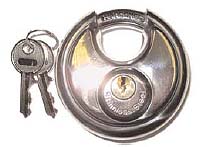
Discus style padlocks - have no angular corners, so are often used with cycle security chains and cables, as well as being a popular choice for securing doors on sheds and beach huts, etc. When used as a door lock, they will typically be used in conjunction with the special shrouded discus hasp and staple set, which offers extra protection to the padlock shackle.
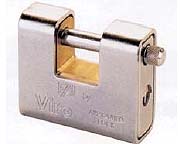
Shutter Locks / Anvil Locks - are typically used to secure the external (or internal) security roller shutters fitted to shop fronts. They are also popular for use with parking posts, motorcycle security chains, etc.

Conventional Style padlocks have a wide range of applications from low security applications like locking your toolbox, to high security uses such as securing factory gates or protecting motorcycles. They are typically available as; Open, Close, or Semi Enclosed Shackle types
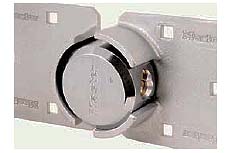
Shackleless type padlock (shown with special hasp)Shackleless Padlocks - this is a bit of a misnomer as the padlock does of course have a shackle, it’s just that it’s on the underside of the lock body and therefore unseen. This type of padlock can be round (like the one pictured) or rectangular, but typically, they are designed to be used with a special matching security hasp. Because of their design, these units are difficult to attack and over recent years, as well as being used on warehouse doors, etc, they have also become very popular for use on vans and other vehicles where they are used to secure opening double doors.
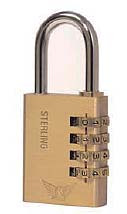
A "Close Shackle" padlock is one with built in shoulders, which are designed to minimise the amount of the shackle exposed, to a saw or bolt cropper attack. This type of padlock will normally have a higher security rating than an equivalent unit with a semi enclosed or open shackle, however subject to size and clearances, may not be practical for instance, to use where you need to secure 2 chain links together or require a padlock for use with a shrouded hasp, etc. To make them easier to use, many Close Shackle padlocks feature "removable shackles" which are fully released from the body of the padlock when it's unlocked.
An "Open Shackle" padlock will typically be easier to use where the shackle needs to pass through 2 chain-links (i.e, a chain securing two opening gates together), etc. As more of the shackle is exposed however, this makes it potentially easier to attack with a saw or bolt croppers.
A "Semi Enclosed Shackle" padlock is something of a compromise, but will often offer more flexibility in use than a Close Shackle padlock and improved security over an Open Shackle model.
Тематики
EN
Англо-русский словарь нормативно-технической терминологии > padlock
См. также в других словарях:
security needs — safety requirements … English contemporary dictionary
Security engineering — is a specialized field of engineering that focuses on the security aspects in the design of systems that need to be able to deal robustly with possible sources of disruption, ranging from natural disasters to malicious acts. It is similar to… … Wikipedia
Needs assessment — is a systematic process for determining and addressing needs, or gaps between current conditions and desired conditions or wants . The discrepancy between the current condition and wanted condition must be measured to appropriately identify the… … Wikipedia
Security descriptor — Security descriptors are data structures of security information for securable Windows objects, that is objects that can be identified by a unique name. Security descriptors can be associated with any named objects, including files, folders,… … Wikipedia
security — /si kyoor i tee/, n., pl. securities, adj. n. 1. freedom from danger, risk, etc.; safety. 2. freedom from care, anxiety, or doubt; well founded confidence. 3. something that secures or makes safe; protection; defense. 4. freedom from financial… … Universalium
Security clearance — For use by the United Nations, see Security Clearance (UN) A security clearance is a status granted to individuals allowing them access to classified information, i.e., state secrets, or to restricted areas after completion of a thorough… … Wikipedia
Security interest — A security interest is a property interest created by agreement or by operation of law over assets to secure the performance of an obligation, usually the payment of a debt.[1] It gives the beneficiary of the security interest certain… … Wikipedia
Security community — A security community is a region in which a large scale use of violence (such as war) has become very unlikely or even unthinkable. cite journal|title=Security Communities and Their Values: Taking Masses Seriously|journal=International Political… … Wikipedia
Security and safety features new to Windows Vista — There are a number of security and safety features new to Windows Vista, most of which are not available in any prior Microsoft Windows operating system release.Beginning in early 2002 with Microsoft s announcement of their Trustworthy Computing… … Wikipedia
Security Operation Center (computing) — A Security Operation Center (SOC) is an organization that delivers IT security services. It attempts to prevent unauthorized access and manage security related incidents using processes and procedures. The mission is risk management through… … Wikipedia
Security Service Federal Credit Union — Infobox Company name = Security Service Federal Credit Union type = Credit union genre = foundation = 1956 founder = location city = San Antonio, Texas location country = USA locations = 25 service centers in South Texas; 13 in Colorado; 4… … Wikipedia
