

-
1 process values
процессные переменные
-
[Интент]Процессные переменные.
Под словосочетанием “процессные переменные” понимаются численные параметры, определяющие текущее состояние технологического процесса. К процессным переменным можно отнести сигналы ввода/вывода, параметры функциональных блоков, локальные и глобальные флаги (переменные), тэги SCADA и т.д.
Процессные переменные делятся на дискретные и аналоговые. Дискретная переменная может принимать конечное число значений из довольно узкого диапазона. На практике под дискретной переменной чаще всего подразумевают величину булевского типа (двоичную), указывающую на одно их двух возможных состояний объекта (или управляющего сигнала), хотя, формально говоря, это не совсем корректно. В общем же случае дискретная переменная аналогична типу enumeration языка C.
Аналоговая переменная может принимать любую величину из ограниченного непрерывного диапазона значений. По типу представления аналоговая переменная больше соответствует вещественному числу.
Как записываются процессные переменные в архив?
Существуют две технологии регистрации значений процессных переменных в архиве:
1. Циклическая запись ( cyclic archiving) подразумевает периодическую запись текущего значения процессной переменной через заданные пользователем интервалы времени вне зависимости от величины и скорости изменения данной переменной (см. рис. 1). Хотя эта техника не очень экономична, она довольно часто используется для архивации аналоговых переменных. Период циклической записи для каждой переменной настраивается индивидуально и, как правило, лежит в диапазоне от 0.5 с до 10 мин. Как для дискретных переменных, так и быстро изменяющихся аналоговых переменных, подобный подход записи в архив явно не оптимален.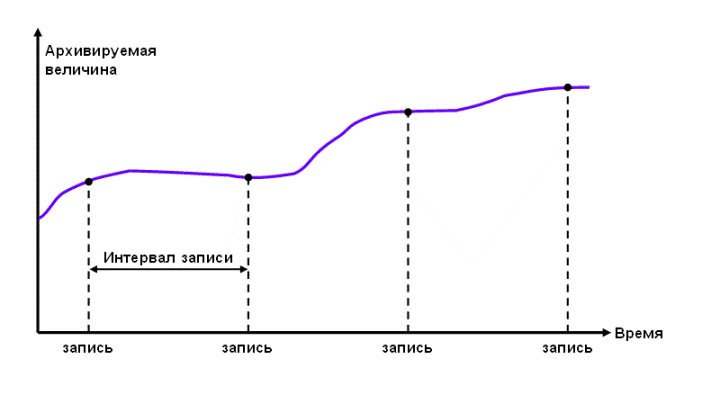
Рис. 1. Циклическая запись процессной переменной в архив.2. Архивация по изменению переменной (дельта-архивированиe, delta-archiving). Этот подход предполагает запись переменной в архив только тогда, когда изменение ее значения по сравнению с предыдущим записанным значением (абсолютная разность) достигает определенной величины (дельты, см. рис. 2). Дельта настраивается пользователем и может быть выражена как в абсолютных единицах измерения, так и в процентах от шкалы. Безусловно, это техника более экономична, чем циклическая запись, так как она адаптируется к скорости изменения архивируемой величины. Для дискретных величин – этот подход незаменим. Допустим, у нас есть дискретная переменная, которая изменяется, скажем, раз в час. Зачем же ее архивировать каждую секунду или минуту? Ведь гораздо логичнее записывать значение переменной в архив только в те моменты, когда это значение переходит из 1 в 0 или наоборот.
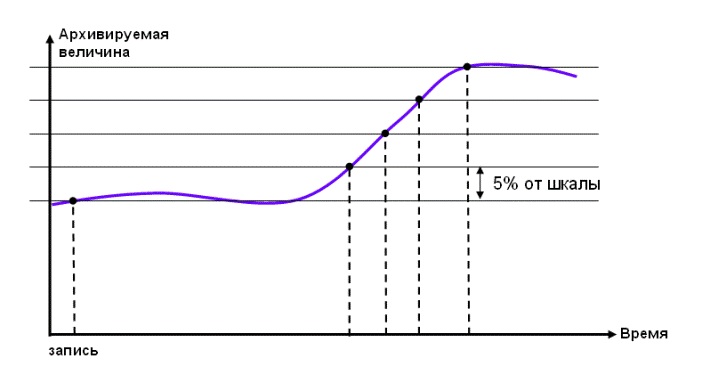
Рис. 2. Дельта-архивирование процессной переменной.Куда записывается архив процессных переменных?
Чаще всего используется один из трех вариантов:
1. Архив записывается в обычный текстовый файл в формате CSV ( comma separated values). Этот файл может храниться как на локальном, так и на сетевом диске. На самом деле архив состоит из множества последовательно создаваемых файлов: система генерирует новый файл архива каждую рабочую смену или сутки. У такого формата представления архива есть неоспоримое преимущество – его можно просмотреть любым текстовым редактором. Его также можно экспортировать в MS Excel и посмотреть в виде таблицы, применив необходимые сортировки и фильтры. Существенный недостаток – это неэкономичность хранения; накопленный таким образом архив занимает неприлично много места на жестком диске. Для уменьшения объема архива можно применить компрессию по алгоритму ZIP или RAR – благо, что текстовые файлы очень хорошо сжимаются.
2. Архив представляет собой двоичный файл, формат которого зависит от используемого ПО визуализации тех. процесса (SCADA). Очевидно, что это более экономичное представление архива, но для работы с ним обычным экселем уже не обойдешься. При этом формат архива у разных производителей SCADA может сильно различаться. Как и в предыдущем случае, архив состоит из последовательно создаваемых файлов. Вообще, хранить архив в одном большом файле – это не очень хорошо с точки зрения скорости доступа к данным.
3. Самый прогрессивный способ. Хранение архива в виде реляционной базы данных с поддержкой СУБД SQL. Этот способ позволяет достичь достаточно большой скорости работы с архивом (добавление записей, чтение и обработка данных), при этом сервер SQL может обеспечить оптимальный доступ к истории сразу нескольким десяткам удаленных клиентов. Поскольку доступ к архиву осуществляется по открытому интерфейсу SQL, разработчики имеют возможность создавать клиентские приложения под свои нужды. Но главное преимущество заключается в том, что архив на базе SQL – это отличная возможность для интеграции АСУ ТП с информационными системами более высокого уровня (например, уровня MES). Как правило, для ведения архива SQL и обслуживания клиентов используется достаточно мощная серверная платформа.
Во всех описанных случаях система архивирования процессных переменных – это неотъемлемая часть ПО визуализации технологического процесса. Разница заключается в формате представления архива и технологии доступа.
Какие средства служат для отображения архива? Архив можно отобразить несколькими способами. Самый простой – это представить его в табличной форме и экспортировать, например, в Excel, в котором можно строить графики, диаграммы и делать отчеты. Однако это довольно утомительно и требует много ручного труда.
Более удобный способ – это отображение истории в виде специального динамического (обновляемого автоматически) графика, называемого трендом ( trend). Тренд помещается на мнемосхемы операторского интерфейса в тех места, где это необходимо и удобно оператору. Пример тренда изображен на рисунке ниже.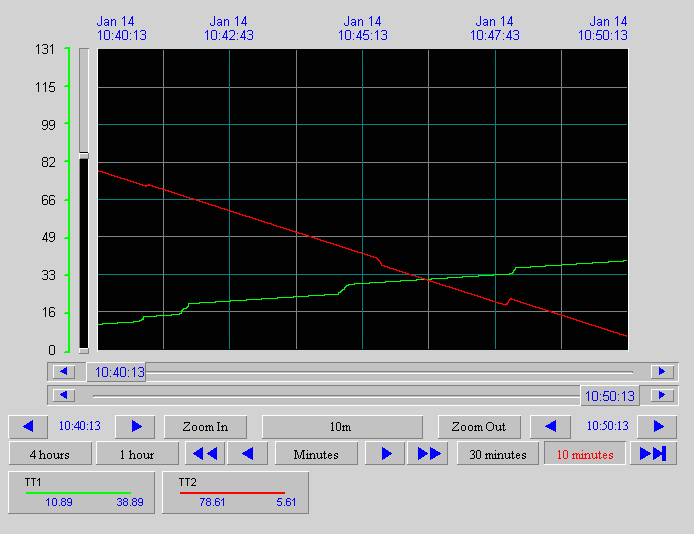
Рис. 3. Пример исторического тренда, отображающего две процессные переменные.На тренд можно выводить до 16 переменных одновременно, как дискретных, так и аналоговых. При этом тренд можно строить за произвольный промежуток времени ( time span). Также поддерживается масштабирование ( scaling). Передвигая ползунок ( slider) вдоль шкалы времени можно просматривать точные значения переменных в различные моменты времени в прошлом. Отрезки времени, в течение которых наблюдались аварийные значения переменных, выделяются на тренде контрастным цветом. В общем, тренды – это мощный и очень удобный инструмент, наглядно показывающий поведение переменных в динамике.
[ http://kazanets.narod.ru/AlarmsArchive.htm]
Тематики
EN
Англо-русский словарь нормативно-технической терминологии > process values
-
2 political values
пол. политические ценности (понятие, используемое для обозначения сущности политически значимых действий, процессов, явлений в плане их соответствия или несоответствия интересам общества, отдельных социальных групп, человека)See: -
3 reduction (the process of replacing observed values with values derived there from but corrected for known sources of error)
Геофизика: приведениеУниверсальный англо-русский словарь > reduction (the process of replacing observed values with values derived there from but corrected for known sources of error)
-
4 interpolation is a process by which an appropriate value is placed between tabulated values of a function
Универсальный англо-русский словарь > interpolation is a process by which an appropriate value is placed between tabulated values of a function
-
5 set of parameter values of the process
Теория вероятности: множество значении параметра процессаУниверсальный англо-русский словарь > set of parameter values of the process
-
6 data archiving
архивирование данных
—
[ http://www.iks-media.ru/glossary/index.html?glossid=2400324]Возможность архивирования технологических параметров – неотъемлемое требование, предъявляемое ко всем современным системам управления. В действительности развитая система архивирования – это та характерная черта, которая отличает полнофункциональные РСУ от многочисленных, так сказать, "аналогов”.
Для чего же нужно архивирование технологических параметров?
По трем довольно простым причинам:
1. Архив значений технологических параметров (на техническом жаргоне “история”, history) позволяет оценить качество и эффективность осуществляемого системой управления. Это делается путем ретроспективного анализа ключевых технологических параметров, что позволяет судить о том, в какой мере достигнута поставленная цель управления.
2. Архивирование позволяет специалистам оценить динамику изменения технологических параметров за длительный период времени, что чрезвычайно полезно для понимания поведения процесса в различных (в том числе аварийных) ситуациях, а, следовательно, и пополнения знаний о конкретной технологии.
3. Архив может содержать информацию, помогающую установить причины возникновения различных аварийных и нештатных ситуаций. Так, тщательно изучив журнал действий оператора, специалист может определить, какая именно операция диспетчера привела к отклонению от регламента или, не дай Бог, аварии (можно предположить, что операторы не всегда в восторге от того, что каждое их действие протоколируется системой).
Какая же информация архивируется (пишется в историю)?
Грубо говоря, все данные, которые записываются в архив, можно разделить на три группы:
1. Процессные переменные ( process values);
2. Аварийные сигналы ( alarms);
3. Действия операторов-технологов ( operator actions).
[ http://kazanets.narod.ru/AlarmsArchive.htm]Тематики
EN
Англо-русский словарь нормативно-технической терминологии > data archiving
-
7 adjustment
<tech.gen> (e.g. of control elements, values; process and result) ■ Einstellung f<tech.gen> (of discrepancies) ■ Ausgleich m<tech.gen> (changing from one value or position to another one, e.g. setpoints) ■ Verstellen n<tech.gen> (tensioning, e.g. of drive belts; process) ■ Spannen n<tech.gen> (making up for loss, wear and tear, e.g. of brakes, friction linings) ■ Nachstellen n<tech.gen> (process; of controls, values, setpoints, limits etc.; e.g. speed, pres) ■ Einstellen n<tech.gen> (of sth to sth; e.g. to situation, environment, shape, requirements) ■ Angleichung f ; Anpassung f ; Adaption f<i&c> (balancing of two or more components or values) ■ Abgleich m<i&c> (by means of control system, manually or automatically) ■ Einregelung f<mach.tools> (moving sth. into position; e.g. rolls, cutting tools) ■ Anstellen n -
8 as
в пересчете наacidity as acetic acid, mg/100ml кислотность в пересчете на уксусную кислоту, мг/100 мл;esters as ethyl acetate, mg/100ml содержание эфиров в пересчете на этилацетат, мг/100 млas and when required по первому требованиюas applicable 1. в конкретных случаях; в зависимости от конкретных условий 2. в каждом конкретном случае 3. в зависимости от применения / ситуации / обстоятельств 4. по принадлежности 5. установленным порядком; в установленном порядке; как положено 6. в части касающейсяas applied to 1. применительно кtogether with permissible variations of these values as applied to the design of piping а также допустимые отклонения этих величин применительно к проектированию трубопроводных систем 2. в случаеas applied to А в случае Аas appropriate 1. в зависимости от того, что больше подходит / используется 2. там, где это уместно 3. если таковой имеется 4. соответственно 5. установленным порядком; в установленном порядке 6. как положено 7. (см. appropriate)as can be observed from как следует изas commissioned by А по поручению Аas a consequence в результате этогоas designed по проектуas directed by A по указанию А; согласно указаниям Аas determined определяемыйas distinct from в отличие отas distinguished from в отличие отas an exception: as an exception,for pipe with D0/t < 10, the value of S shall be the lesser of the following values Исключение составляют трубы с D (/t< 10, для которых за величину S принимается меньшее из следующих значенийas expected: A was very much as expected А во многом подтвердило наши ожиданияas far as possible в крайнем (переднем, заднем, верхнем и т.д.) положенииand hold levers (1) and (2) forward as far as possible и удерживать рычаги (1) и (2) в крайнем переднем положенииas follows 1. в следующем объеме 2. следующим образомas for Specification... по ТУ...as given in поas given in Specification... по ТУ...as a guide для справки;take smth. as a guide руководствоваться чем-л.;When..., one must take A as a guide При... следует руководствоваться Aas intended 1. исправно; нормальноthose parts whose failure to function as intended would result in a released fluid to the atmosphere[me] детали, прекращение нормальной работы которых приводит к выбросу жидкости в атмосферу2. как положено 3. в установленном порядкеas is typical in как это принято на / вas it applies по принадлежностиas it happens так получилось, чтоas long as: as long as the A is maintained при условии сохранения А;The design of the tool may vary as long as the essential dimensions are maintained При условии сохранения ключевых размеров конструкция инструмента может менятьсяas many as desired произвольный ( по количеству)as a minimum как минимумas nearly as possible с максимальным приближениемas normal в штатном режиме;work as normal работать в штатном режимеas of this writing в данный момент (т.е. когда пишутся эти строки)as opposed to (противит.) а не; в отличие от; в то время как; наоборотas (a) part of 1. в ходе (напр., выполнения чего-л.)as part of the production process в ходе производства 2. в рамках (напр., выполнения какой-л. программы)as a part of the inspection process в рамках единого процесса входного контроля;impact tests performed as part of the welding procedure qualification испытания на ударную вязкость, проводимые в рамках аттестации технологии сваркиas per по (в знач. в соответствии с)as per Dwg. \# по чертежу №as per Standard... по стандарту...as a proof of в доказательство (чего-л.)as received в состоянии поставки; в состоянии доставкиas recently as a couple of years ago, fast-tracking offshore projects became the main challenge for operators and contractors всего пару лет / каких-нибудь два года назад главной проблемой как для эксплуатационников, так и для строителей стало возведение морских объектов форсированными темпамиas reflected by судя поas related to применительно кas relevant 1. как положено 2. в установленном порядкеas required 1. в установленном порядке 2. как положено 3. не регламентируетсяas a result таким образом as a result of в связи сas small as: values as small as значения, начиная сas soon as с момента;as soon as he accepted job assignment с момента получения им рабочего заданияas soon as possible безотлагательно; без промедленияas specified 1. в соответствии с нормативными требованиями 2. в установленном порядкеas specified in [NACE MR01-75] по стандарту [NACE MR01-75]as stock items частямиas typified by о чем можно судить, например, поas used in применительно к чему-л.;as used in engineering design and construction применительно к проектированию и производству работas well as \as при одновременном...;A would increase В as well as decrease С А повышает В при одновременном снижении Сas a whole в полном объемеThese rules apply only when specified by the owner, and only as a whole, not in part Эти правила имеют силу только в том случае, если они предписываются владельцем, причем только в полном объеме, а не частичноEnglish-Russian dictionary of scientific and technical difficulties vocabulary > as
-
9 setting
<tech.gen> (state, as-is value) ■ Einstellung f<tech.gen> (of hardware configuration) ■ Geräteeinstellung f<tech.gen> (process; of controls, values, setpoints, limits etc.; e.g. speed, pres) ■ Einstellen n<tech.gen> (e.g. of control elements, values; process and result) ■ Einstellung f<tech.gen> (e.g. of size, pressure, temperature) ■ Einstellwert m<tech.gen> (length measurements; e.g. of gaps, clearances) ■ Einstellwert m ; Einstellmaß n<build.mat> ■ Erstarrung f ; Erhärtung f ; Abbinden n<i&c> (of configurations, process parameters etc.) ■ Einstellung f DIN 2257<i&c> (e.g. of a lever, switch) ■ Stellung f<i&c> (of controlled system; e.g. a specific temperature) ■ Sollwert m ; Aufgabenwert m rare.obs<mach.tools> ■ Aufspannung f< plast> ■ Verfestigung f< silic> ■ Besatz m -
10 Knowledge
It is indeed an opinion strangely prevailing amongst men, that houses, mountains, rivers, and, in a word, all sensible objects, have an existence, natural or real, distinct from their being perceived by the understanding. But, with how great an assurance and acquiescence soever this principle may be entertained in the world, yet whoever shall find in his heart to call it into question may, if I mistake not, perceive it to involve a manifest contradiction. For, what are the forementioned objects but things we perceive by sense? and what do we perceive besides our own ideas or sensations? and is it not plainly repugnant that any one of these, or any combination of them, should exist unperceived? (Berkeley, 1996, Pt. I, No. 4, p. 25)It seems to me that the only objects of the abstract sciences or of demonstration are quantity and number, and that all attempts to extend this more perfect species of knowledge beyond these bounds are mere sophistry and illusion. As the component parts of quantity and number are entirely similar, their relations become intricate and involved; and nothing can be more curious, as well as useful, than to trace, by a variety of mediums, their equality or inequality, through their different appearances.But as all other ideas are clearly distinct and different from each other, we can never advance farther, by our utmost scrutiny, than to observe this diversity, and, by an obvious reflection, pronounce one thing not to be another. Or if there be any difficulty in these decisions, it proceeds entirely from the undeterminate meaning of words, which is corrected by juster definitions. That the square of the hypotenuse is equal to the squares of the other two sides cannot be known, let the terms be ever so exactly defined, without a train of reasoning and enquiry. But to convince us of this proposition, that where there is no property, there can be no injustice, it is only necessary to define the terms, and explain injustice to be a violation of property. This proposition is, indeed, nothing but a more imperfect definition. It is the same case with all those pretended syllogistical reasonings, which may be found in every other branch of learning, except the sciences of quantity and number; and these may safely, I think, be pronounced the only proper objects of knowledge and demonstration. (Hume, 1975, Sec. 12, Pt. 3, pp. 163-165)Our knowledge springs from two fundamental sources of the mind; the first is the capacity of receiving representations (the ability to receive impressions), the second is the power to know an object through these representations (spontaneity in the production of concepts).Through the first, an object is given to us; through the second, the object is thought in relation to that representation.... Intuition and concepts constitute, therefore, the elements of all our knowledge, so that neither concepts without intuition in some way corresponding to them, nor intuition without concepts, can yield knowledge. Both may be either pure or empirical.... Pure intuitions or pure concepts are possible only a priori; empirical intuitions and empirical concepts only a posteriori. If the receptivity of our mind, its power of receiving representations in so far as it is in any way affected, is to be called "sensibility," then the mind's power of producing representations from itself, the spontaneity of knowledge, should be called "understanding." Our nature is so constituted that our intuitions can never be other than sensible; that is, it contains only the mode in which we are affected by objects. The faculty, on the other hand, which enables us to think the object of sensible intuition is the understanding.... Without sensibility, no object would be given to us; without understanding, no object would be thought. Thoughts without content are empty; intuitions without concepts are blind. It is therefore just as necessary to make our concepts sensible, that is, to add the object to them in intuition, as to make our intuitions intelligible, that is to bring them under concepts. These two powers or capacities cannot exchange their functions. The understanding can intuit nothing, the senses can think nothing. Only through their union can knowledge arise. (Kant, 1933, Sec. 1, Pt. 2, B74-75 [p. 92])Metaphysics, as a natural disposition of Reason is real, but it is also, in itself, dialectical and deceptive.... Hence to attempt to draw our principles from it, and in their employment to follow this natural but none the less fallacious illusion can never produce science, but only an empty dialectical art, in which one school may indeed outdo the other, but none can ever attain a justifiable and lasting success. In order that, as a science, it may lay claim not merely to deceptive persuasion, but to insight and conviction, a Critique of Reason must exhibit in a complete system the whole stock of conceptions a priori, arranged according to their different sources-the Sensibility, the understanding, and the Reason; it must present a complete table of these conceptions, together with their analysis and all that can be deduced from them, but more especially the possibility of synthetic knowledge a priori by means of their deduction, the principles of its use, and finally, its boundaries....This much is certain: he who has once tried criticism will be sickened for ever of all the dogmatic trash he was compelled to content himself with before, because his Reason, requiring something, could find nothing better for its occupation. Criticism stands to the ordinary school metaphysics exactly in the same relation as chemistry to alchemy, or as astron omy to fortune-telling astrology. I guarantee that no one who has comprehended and thought out the conclusions of criticism, even in these Prolegomena, will ever return to the old sophistical pseudo-science. He will rather look forward with a kind of pleasure to a metaphysics, certainly now within his power, which requires no more preparatory discoveries, and which alone can procure for reason permanent satisfaction. (Kant, 1891, pp. 115-116)Knowledge is only real and can only be set forth fully in the form of science, in the form of system. Further, a so-called fundamental proposition or first principle of philosophy, even if it is true, it is yet none the less false, just because and in so far as it is merely a fundamental proposition, merely a first principle. It is for that reason easily refuted. The refutation consists in bringing out its defective character; and it is defective because it is merely the universal, merely a principle, the beginning. If the refutation is complete and thorough, it is derived and developed from the nature of the principle itself, and not accomplished by bringing in from elsewhere other counter-assurances and chance fancies. It would be strictly the development of the principle, and thus the completion of its deficiency, were it not that it misunderstands its own purport by taking account solely of the negative aspect of what it seeks to do, and is not conscious of the positive character of its process and result. The really positive working out of the beginning is at the same time just as much the very reverse: it is a negative attitude towards the principle we start from. Negative, that is to say, in its one-sided form, which consists in being primarily immediate, a mere purpose. It may therefore be regarded as a refutation of what constitutes the basis of the system; but more correctly it should be looked at as a demonstration that the basis or principle of the system is in point of fact merely its beginning. (Hegel, 1910, pp. 21-22)Knowledge, action, and evaluation are essentially connected. The primary and pervasive significance of knowledge lies in its guidance of action: knowing is for the sake of doing. And action, obviously, is rooted in evaluation. For a being which did not assign comparative values, deliberate action would be pointless; and for one which did not know, it would be impossible. Conversely, only an active being could have knowledge, and only such a being could assign values to anything beyond his own feelings. A creature which did not enter into the process of reality to alter in some part the future content of it, could apprehend a world only in the sense of intuitive or esthetic contemplation; and such contemplation would not possess the significance of knowledge but only that of enjoying and suffering. (Lewis, 1946, p. 1)"Evolutionary epistemology" is a branch of scholarship that applies the evolutionary perspective to an understanding of how knowledge develops. Knowledge always involves getting information. The most primitive way of acquiring it is through the sense of touch: amoebas and other simple organisms know what happens around them only if they can feel it with their "skins." The knowledge such an organism can have is strictly about what is in its immediate vicinity. After a huge jump in evolution, organisms learned to find out what was going on at a distance from them, without having to actually feel the environment. This jump involved the development of sense organs for processing information that was farther away. For a long time, the most important sources of knowledge were the nose, the eyes, and the ears. The next big advance occurred when organisms developed memory. Now information no longer needed to be present at all, and the animal could recall events and outcomes that happened in the past. Each one of these steps in the evolution of knowledge added important survival advantages to the species that was equipped to use it.Then, with the appearance in evolution of humans, an entirely new way of acquiring information developed. Up to this point, the processing of information was entirely intrasomatic.... But when speech appeared (and even more powerfully with the invention of writing), information processing became extrasomatic. After that point knowledge did not have to be stored in the genes, or in the memory traces of the brain; it could be passed on from one person to another through words, or it could be written down and stored on a permanent substance like stone, paper, or silicon chips-in any case, outside the fragile and impermanent nervous system. (Csikszentmihalyi, 1993, pp. 56-57)Historical dictionary of quotations in cognitive science > Knowledge
-
11 correlated
1) коррелированный
2) коррегированный
3) соотнесенный ∙ circularly correlated process ≈ циркулярно коррелированный процесс completely correlated components ≈ полностью коррелированные компоненты ( случайного процесса) correlated [correlative] mapping ≈ коррелированное отображение correlated estimate s ≈ коррелированные оценки correlated estimator s ≈ коррелированные оценки correlated random walk ≈ коррелированное случайное блуждание directly correlated values ≈ непосредственно коррелированные значения equally correlated process ≈ равнокоррелированный процесс homogeneously correlated sequence ≈ однородно коррелированная последовательность normally correlated variables ≈ нормально коррелированные величины perfectly correlated random variables ≈ полностью коррелированные случайные величины serially correlated observations ≈ сериально коррелированные наблюдения weakly correlated process ≈ слабо коррелированный процесс - correlated bundles - correlated data - correlated errors - correlated factors - correlated increments - correlated isomorphism - correlated motion - correlated observations - correlated pairs - correlated process - correlated processes - correlated quantity - correlated samples - correlated shifts - correlated states - correlated statistics - correlated strategy - correlated value - correlated variables - correlated variate - equally correlated - normally correlated - serially correlated - statistically correlated - uniformly correlated СоотнесенныйБольшой англо-русский и русско-английский словарь > correlated
-
12 modular data center
модульный центр обработки данных (ЦОД)
-
[Интент]Параллельные тексты EN-RU
[ http://dcnt.ru/?p=9299#more-9299]
Data Centers are a hot topic these days. No matter where you look, this once obscure aspect of infrastructure is getting a lot of attention. For years, there have been cost pressures on IT operations and this, when the need for modern capacity is greater than ever, has thrust data centers into the spotlight. Server and rack density continues to rise, placing DC professionals and businesses in tighter and tougher situations while they struggle to manage their IT environments. And now hyper-scale cloud infrastructure is taking traditional technologies to limits never explored before and focusing the imagination of the IT industry on new possibilities.
В настоящее время центры обработки данных являются широко обсуждаемой темой. Куда ни посмотришь, этот некогда малоизвестный аспект инфраструктуры привлекает все больше внимания. Годами ИТ-отделы испытывали нехватку средств и это выдвинуло ЦОДы в центр внимания, в то время, когда необходимость в современных ЦОДах стала как никогда высокой. Плотность серверов и стоек продолжают расти, все больше усложняя ситуацию для специалистов в области охлаждения и организаций в их попытках управлять своими ИТ-средами. И теперь гипермасштабируемая облачная инфраструктура подвергает традиционные технологии невиданным ранее нагрузкам, и заставляет ИТ-индустрию искать новые возможности.
At Microsoft, we have focused a lot of thought and research around how to best operate and maintain our global infrastructure and we want to share those learnings. While obviously there are some aspects that we keep to ourselves, we have shared how we operate facilities daily, our technologies and methodologies, and, most importantly, how we monitor and manage our facilities. Whether it’s speaking at industry events, inviting customers to our “Microsoft data center conferences” held in our data centers, or through other media like blogging and white papers, we believe sharing best practices is paramount and will drive the industry forward. So in that vein, we have some interesting news to share.
В компании MicroSoft уделяют большое внимание изучению наилучших методов эксплуатации и технического обслуживания своей глобальной инфраструктуры и делятся результатами своих исследований. И хотя мы, конечно, не раскрываем некоторые аспекты своих исследований, мы делимся повседневным опытом эксплуатации дата-центров, своими технологиями и методологиями и, что важнее всего, методами контроля и управления своими объектами. Будь то доклады на отраслевых событиях, приглашение клиентов на наши конференции, которые посвящены центрам обработки данных MicroSoft, и проводятся в этих самых дата-центрах, или использование других средств, например, блоги и спецификации, мы уверены, что обмен передовым опытом имеет первостепенное значение и будет продвигать отрасль вперед.
Today we are sharing our Generation 4 Modular Data Center plan. This is our vision and will be the foundation of our cloud data center infrastructure in the next five years. We believe it is one of the most revolutionary changes to happen to data centers in the last 30 years. Joining me, in writing this blog are Daniel Costello, my director of Data Center Research and Engineering and Christian Belady, principal power and cooling architect. I feel their voices will add significant value to driving understanding around the many benefits included in this new design paradigm.
Сейчас мы хотим поделиться своим планом модульного дата-центра четвертого поколения. Это наше видение и оно будет основанием для инфраструктуры наших облачных дата-центров в ближайшие пять лет. Мы считаем, что это одно из самых революционных изменений в дата-центрах за последние 30 лет. Вместе со мной в написании этого блога участвовали Дэниел Костелло, директор по исследованиям и инжинирингу дата-центров, и Кристиан Белади, главный архитектор систем энергоснабжения и охлаждения. Мне кажется, что их авторитет придаст больше веса большому количеству преимуществ, включенных в эту новую парадигму проектирования.
Our “Gen 4” modular data centers will take the flexibility of containerized servers—like those in our Chicago data center—and apply it across the entire facility. So what do we mean by modular? Think of it like “building blocks”, where the data center will be composed of modular units of prefabricated mechanical, electrical, security components, etc., in addition to containerized servers.
Was there a key driver for the Generation 4 Data Center?Наши модульные дата-центры “Gen 4” будут гибкими с контейнерами серверов – как серверы в нашем чикагском дата-центре. И гибкость будет применяться ко всему ЦОД. Итак, что мы подразумеваем под модульностью? Мы думаем о ней как о “строительных блоках”, где дата-центр будет состоять из модульных блоков изготовленных в заводских условиях электрических систем и систем охлаждения, а также систем безопасности и т.п., в дополнение к контейнеризованным серверам.
Был ли ключевой стимул для разработки дата-центра четвертого поколения?
If we were to summarize the promise of our Gen 4 design into a single sentence it would be something like this: “A highly modular, scalable, efficient, just-in-time data center capacity program that can be delivered anywhere in the world very quickly and cheaply, while allowing for continued growth as required.” Sounds too good to be true, doesn’t it? Well, keep in mind that these concepts have been in initial development and prototyping for over a year and are based on cumulative knowledge of previous facility generations and the advances we have made since we began our investments in earnest on this new design.Если бы нам нужно было обобщить достоинства нашего проекта Gen 4 в одном предложении, это выглядело бы следующим образом: “Центр обработки данных с высоким уровнем модульности, расширяемости, и энергетической эффективности, а также возможностью постоянного расширения, в случае необходимости, который можно очень быстро и дешево развертывать в любом месте мира”. Звучит слишком хорошо для того чтобы быть правдой, не так ли? Ну, не забывайте, что эти концепции находились в процессе начальной разработки и создания опытного образца в течение более одного года и основываются на опыте, накопленном в ходе развития предыдущих поколений ЦОД, а также успехах, сделанных нами со времени, когда мы начали вкладывать серьезные средства в этот новый проект.
One of the biggest challenges we’ve had at Microsoft is something Mike likes to call the ‘Goldilock’s Problem’. In a nutshell, the problem can be stated as:
The worst thing we can do in delivering facilities for the business is not have enough capacity online, thus limiting the growth of our products and services.Одну из самых больших проблем, с которыми приходилось сталкиваться Майкрософт, Майк любит называть ‘Проблемой Лютика’. Вкратце, эту проблему можно выразить следующим образом:
Самое худшее, что может быть при строительстве ЦОД для бизнеса, это не располагать достаточными производственными мощностями, и тем самым ограничивать рост наших продуктов и сервисов.The second worst thing we can do in delivering facilities for the business is to have too much capacity online.
А вторым самым худшим моментом в этой сфере может слишком большое количество производственных мощностей.
This has led to a focus on smart, intelligent growth for the business — refining our overall demand picture. It can’t be too hot. It can’t be too cold. It has to be ‘Just Right!’ The capital dollars of investment are too large to make without long term planning. As we struggled to master these interesting challenges, we had to ensure that our technological plan also included solutions for the business and operational challenges we faced as well.
So let’s take a high level look at our Generation 4 designЭто заставило нас сосредоточиваться на интеллектуальном росте для бизнеса — refining our overall demand picture. Это не должно быть слишком горячим. И это не должно быть слишком холодным. Это должно быть ‘как раз, таким как надо!’ Нельзя делать такие большие капиталовложения без долгосрочного планирования. Пока мы старались решить эти интересные проблемы, мы должны были гарантировать, что наш технологический план будет также включать решения для коммерческих и эксплуатационных проблем, с которыми нам также приходилось сталкиваться.
Давайте рассмотрим наш проект дата-центра четвертого поколенияAre you ready for some great visuals? Check out this video at Soapbox. Click here for the Microsoft 4th Gen Video.
It’s a concept video that came out of my Data Center Research and Engineering team, under Daniel Costello, that will give you a view into what we think is the future.
From a configuration, construct-ability and time to market perspective, our primary goals and objectives are to modularize the whole data center. Not just the server side (like the Chicago facility), but the mechanical and electrical space as well. This means using the same kind of parts in pre-manufactured modules, the ability to use containers, skids, or rack-based deployments and the ability to tailor the Redundancy and Reliability requirements to the application at a very specific level.
Посмотрите это видео, перейдите по ссылке для просмотра видео о Microsoft 4th Gen:
Это концептуальное видео, созданное командой отдела Data Center Research and Engineering, возглавляемого Дэниелом Костелло, которое даст вам наше представление о будущем.
С точки зрения конфигурации, строительной технологичности и времени вывода на рынок, нашими главными целями и задачами агрегатирование всего дата-центра. Не только серверную часть, как дата-центр в Чикаго, но также системы охлаждения и электрические системы. Это означает применение деталей одного типа в сборных модулях, возможность использования контейнеров, салазок, или стоечных систем, а также возможность подстраивать требования избыточности и надежности для данного приложения на очень специфичном уровне.Our goals from a cost perspective were simple in concept but tough to deliver. First and foremost, we had to reduce the capital cost per critical Mega Watt by the class of use. Some applications can run with N-level redundancy in the infrastructure, others require a little more infrastructure for support. These different classes of infrastructure requirements meant that optimizing for all cost classes was paramount. At Microsoft, we are not a one trick pony and have many Online products and services (240+) that require different levels of operational support. We understand that and ensured that we addressed it in our design which will allow us to reduce capital costs by 20%-40% or greater depending upon class.
Нашими целями в области затрат были концептуально простыми, но трудно реализуемыми. В первую очередь мы должны были снизить капитальные затраты в пересчете на один мегаватт, в зависимости от класса резервирования. Некоторые приложения могут вполне работать на базе инфраструктуры с резервированием на уровне N, то есть без резервирования, а для работы других приложений требуется больше инфраструктуры. Эти разные классы требований инфраструктуры подразумевали, что оптимизация всех классов затрат имеет преобладающее значение. В Майкрософт мы не ограничиваемся одним решением и располагаем большим количеством интерактивных продуктов и сервисов (240+), которым требуются разные уровни эксплуатационной поддержки. Мы понимаем это, и учитываем это в своем проекте, который позволит нам сокращать капитальные затраты на 20%-40% или более в зависимости от класса.For example, non-critical or geo redundant applications have low hardware reliability requirements on a location basis. As a result, Gen 4 can be configured to provide stripped down, low-cost infrastructure with little or no redundancy and/or temperature control. Let’s say an Online service team decides that due to the dramatically lower cost, they will simply use uncontrolled outside air with temperatures ranging 10-35 C and 20-80% RH. The reality is we are already spec-ing this for all of our servers today and working with server vendors to broaden that range even further as Gen 4 becomes a reality. For this class of infrastructure, we eliminate generators, chillers, UPSs, and possibly lower costs relative to traditional infrastructure.
Например, некритичные или гео-избыточные системы имеют низкие требования к аппаратной надежности на основе местоположения. В результате этого, Gen 4 можно конфигурировать для упрощенной, недорогой инфраструктуры с низким уровнем (или вообще без резервирования) резервирования и / или температурного контроля. Скажем, команда интерактивного сервиса решает, что, в связи с намного меньшими затратами, они будут просто использовать некондиционированный наружный воздух с температурой 10-35°C и влажностью 20-80% RH. В реальности мы уже сегодня предъявляем эти требования к своим серверам и работаем с поставщиками серверов над еще большим расширением диапазона температур, так как наш модуль и подход Gen 4 становится реальностью. Для подобного класса инфраструктуры мы удаляем генераторы, чиллеры, ИБП, и, возможно, будем предлагать более низкие затраты, по сравнению с традиционной инфраструктурой.
Applications that demand higher level of redundancy or temperature control will use configurations of Gen 4 to meet those needs, however, they will also cost more (but still less than traditional data centers). We see this cost difference driving engineering behavioral change in that we predict more applications will drive towards Geo redundancy to lower costs.
Системы, которым требуется более высокий уровень резервирования или температурного контроля, будут использовать конфигурации Gen 4, отвечающие этим требованиям, однако, они будут также стоить больше. Но все равно они будут стоить меньше, чем традиционные дата-центры. Мы предвидим, что эти различия в затратах будут вызывать изменения в методах инжиниринга, и по нашим прогнозам, это будет выражаться в переходе все большего числа систем на гео-избыточность и меньшие затраты.
Another cool thing about Gen 4 is that it allows us to deploy capacity when our demand dictates it. Once finalized, we will no longer need to make large upfront investments. Imagine driving capital costs more closely in-line with actual demand, thus greatly reducing time-to-market and adding the capacity Online inherent in the design. Also reduced is the amount of construction labor required to put these “building blocks” together. Since the entire platform requires pre-manufacture of its core components, on-site construction costs are lowered. This allows us to maximize our return on invested capital.
Еще одно достоинство Gen 4 состоит в том, что он позволяет нам разворачивать дополнительные мощности, когда нам это необходимо. Как только мы закончим проект, нам больше не нужно будет делать большие начальные капиталовложения. Представьте себе возможность более точного согласования капитальных затрат с реальными требованиями, и тем самым значительного снижения времени вывода на рынок и интерактивного добавления мощностей, предусматриваемого проектом. Также снижен объем строительных работ, требуемых для сборки этих “строительных блоков”. Поскольку вся платформа требует предварительного изготовления ее базовых компонентов, затраты на сборку также снижены. Это позволит нам увеличить до максимума окупаемость своих капиталовложений.
Мы все подвергаем сомнениюIn our design process, we questioned everything. You may notice there is no roof and some might be uncomfortable with this. We explored the need of one and throughout our research we got some surprising (positive) results that showed one wasn’t needed.
В своем процессе проектирования мы все подвергаем сомнению. Вы, наверное, обратили внимание на отсутствие крыши, и некоторым специалистам это могло не понравиться. Мы изучили необходимость в крыше и в ходе своих исследований получили удивительные результаты, которые показали, что крыша не нужна.
Серийное производство дата центров
In short, we are striving to bring Henry Ford’s Model T factory to the data center. http://en.wikipedia.org/wiki/Henry_Ford#Model_T. Gen 4 will move data centers from a custom design and build model to a commoditized manufacturing approach. We intend to have our components built in factories and then assemble them in one location (the data center site) very quickly. Think about how a computer, car or plane is built today. Components are manufactured by different companies all over the world to a predefined spec and then integrated in one location based on demands and feature requirements. And just like Henry Ford’s assembly line drove the cost of building and the time-to-market down dramatically for the automobile industry, we expect Gen 4 to do the same for data centers. Everything will be pre-manufactured and assembled on the pad.Мы хотим применить модель автомобильной фабрики Генри Форда к дата-центру. Проект Gen 4 будет способствовать переходу от модели специализированного проектирования и строительства к товарно-производственному, серийному подходу. Мы намерены изготавливать свои компоненты на заводах, а затем очень быстро собирать их в одном месте, в месте строительства дата-центра. Подумайте о том, как сегодня изготавливается компьютер, автомобиль или самолет. Компоненты изготавливаются по заранее определенным спецификациям разными компаниями во всем мире, затем собираются в одном месте на основе спроса и требуемых характеристик. И точно так же как сборочный конвейер Генри Форда привел к значительному уменьшению затрат на производство и времени вывода на рынок в автомобильной промышленности, мы надеемся, что Gen 4 сделает то же самое для дата-центров. Все будет предварительно изготавливаться и собираться на месте.
Невероятно энергоэффективный ЦОД
And did we mention that this platform will be, overall, incredibly energy efficient? From a total energy perspective not only will we have remarkable PUE values, but the total cost of energy going into the facility will be greatly reduced as well. How much energy goes into making concrete? Will we need as much of it? How much energy goes into the fuel of the construction vehicles? This will also be greatly reduced! A key driver is our goal to achieve an average PUE at or below 1.125 by 2012 across our data centers. More than that, we are on a mission to reduce the overall amount of copper and water used in these facilities. We believe these will be the next areas of industry attention when and if the energy problem is solved. So we are asking today…“how can we build a data center with less building”?А мы упоминали, что эта платформа будет, в общем, невероятно энергоэффективной? С точки зрения общей энергии, мы получим не только поразительные значения PUE, но общая стоимость энергии, затраченной на объект будет также значительно снижена. Сколько энергии идет на производство бетона? Нам нужно будет столько энергии? Сколько энергии идет на питание инженерных строительных машин? Это тоже будет значительно снижено! Главным стимулом является достижение среднего PUE не больше 1.125 для всех наших дата-центров к 2012 году. Более того, у нас есть задача сокращения общего количества меди и воды в дата-центрах. Мы думаем, что эти задачи станут следующей заботой отрасли после того как будет решена энергетическая проблема. Итак, сегодня мы спрашиваем себя…“как можно построить дата-центр с меньшим объемом строительных работ”?
Строительство дата центров без чиллеровWe have talked openly and publicly about building chiller-less data centers and running our facilities using aggressive outside economization. Our sincerest hope is that Gen 4 will completely eliminate the use of water. Today’s data centers use massive amounts of water and we see water as the next scarce resource and have decided to take a proactive stance on making water conservation part of our plan.
Мы открыто и публично говорили о строительстве дата-центров без чиллеров и активном использовании в наших центрах обработки данных технологий свободного охлаждения или фрикулинга. Мы искренне надеемся, что Gen 4 позволит полностью отказаться от использования воды. Современные дата-центры расходуют большие объемы воды и так как мы считаем воду следующим редким ресурсом, мы решили принять упреждающие меры и включить экономию воды в свой план.
By sharing this with the industry, we believe everyone can benefit from our methodology. While this concept and approach may be intimidating (or downright frightening) to some in the industry, disclosure ultimately is better for all of us.
Делясь этим опытом с отраслью, мы считаем, что каждый сможет извлечь выгоду из нашей методологией. Хотя эта концепция и подход могут показаться пугающими (или откровенно страшными) для некоторых отраслевых специалистов, раскрывая свои планы мы, в конечном счете, делаем лучше для всех нас.
Gen 4 design (even more than just containers), could reduce the ‘religious’ debates in our industry. With the central spine infrastructure in place, containers or pre-manufactured server halls can be either AC or DC, air-side economized or water-side economized, or not economized at all (though the sanity of that might be questioned). Gen 4 will allow us to decommission, repair and upgrade quickly because everything is modular. No longer will we be governed by the initial decisions made when constructing the facility. We will have almost unlimited use and re-use of the facility and site. We will also be able to use power in an ultra-fluid fashion moving load from critical to non-critical as use and capacity requirements dictate.
Проект Gen 4 позволит уменьшить ‘религиозные’ споры в нашей отрасли. Располагая базовой инфраструктурой, контейнеры или сборные серверные могут оборудоваться системами переменного или постоянного тока, воздушными или водяными экономайзерами, или вообще не использовать экономайзеры. Хотя можно подвергать сомнению разумность такого решения. Gen 4 позволит нам быстро выполнять работы по выводу из эксплуатации, ремонту и модернизации, поскольку все будет модульным. Мы больше не будем руководствоваться начальными решениями, принятыми во время строительства дата-центра. Мы сможем использовать этот дата-центр и инфраструктуру в течение почти неограниченного периода времени. Мы также сможем применять сверхгибкие методы использования электрической энергии, переводя оборудование в режимы критической или некритической нагрузки в соответствии с требуемой мощностью.
Gen 4 – это стандартная платформаFinally, we believe this is a big game changer. Gen 4 will provide a standard platform that our industry can innovate around. For example, all modules in our Gen 4 will have common interfaces clearly defined by our specs and any vendor that meets these specifications will be able to plug into our infrastructure. Whether you are a computer vendor, UPS vendor, generator vendor, etc., you will be able to plug and play into our infrastructure. This means we can also source anyone, anywhere on the globe to minimize costs and maximize performance. We want to help motivate the industry to further innovate—with innovations from which everyone can reap the benefits.
Наконец, мы уверены, что это будет фактором, который значительно изменит ситуацию. Gen 4 будет представлять собой стандартную платформу, которую отрасль сможет обновлять. Например, все модули в нашем Gen 4 будут иметь общепринятые интерфейсы, четко определяемые нашими спецификациями, и оборудование любого поставщика, которое отвечает этим спецификациям можно будет включать в нашу инфраструктуру. Независимо от того производите вы компьютеры, ИБП, генераторы и т.п., вы сможете включать свое оборудование нашу инфраструктуру. Это означает, что мы также сможем обеспечивать всех, в любом месте земного шара, тем самым сводя до минимума затраты и максимальной увеличивая производительность. Мы хотим создать в отрасли мотивацию для дальнейших инноваций – инноваций, от которых каждый сможет получать выгоду.
Главные характеристики дата-центров четвертого поколения Gen4To summarize, the key characteristics of our Generation 4 data centers are:
Scalable
Plug-and-play spine infrastructure
Factory pre-assembled: Pre-Assembled Containers (PACs) & Pre-Manufactured Buildings (PMBs)
Rapid deployment
De-mountable
Reduce TTM
Reduced construction
Sustainable measuresНиже приведены главные характеристики дата-центров четвертого поколения Gen 4:
Расширяемость;
Готовая к использованию базовая инфраструктура;
Изготовление в заводских условиях: сборные контейнеры (PAC) и сборные здания (PMB);
Быстрота развертывания;
Возможность демонтажа;
Снижение времени вывода на рынок (TTM);
Сокращение сроков строительства;
Экологичность;Map applications to DC Class
We hope you join us on this incredible journey of change and innovation!
Long hours of research and engineering time are invested into this process. There are still some long days and nights ahead, but the vision is clear. Rest assured however, that we as refine Generation 4, the team will soon be looking to Generation 5 (even if it is a bit farther out). There is always room to get better.
Использование систем электропитания постоянного тока.
Мы надеемся, что вы присоединитесь к нам в этом невероятном путешествии по миру изменений и инноваций!
На этот проект уже потрачены долгие часы исследований и проектирования. И еще предстоит потратить много дней и ночей, но мы имеем четкое представление о конечной цели. Однако будьте уверены, что как только мы доведем до конца проект модульного дата-центра четвертого поколения, мы вскоре начнем думать о проекте дата-центра пятого поколения. Всегда есть возможность для улучшений.So if you happen to come across Goldilocks in the forest, and you are curious as to why she is smiling you will know that she feels very good about getting very close to ‘JUST RIGHT’.
Generations of Evolution – some background on our data center designsТак что, если вы встретите в лесу девочку по имени Лютик, и вам станет любопытно, почему она улыбается, вы будете знать, что она очень довольна тем, что очень близко подошла к ‘ОПИМАЛЬНОМУ РЕШЕНИЮ’.
Поколения эволюции – история развития наших дата-центровWe thought you might be interested in understanding what happened in the first three generations of our data center designs. When Ray Ozzie wrote his Software plus Services memo it posed a very interesting challenge to us. The winds of change were at ‘tornado’ proportions. That “plus Services” tag had some significant (and unstated) challenges inherent to it. The first was that Microsoft was going to evolve even further into an operations company. While we had been running large scale Internet services since 1995, this development lead us to an entirely new level. Additionally, these “services” would span across both Internet and Enterprise businesses. To those of you who have to operate “stuff”, you know that these are two very different worlds in operational models and challenges. It also meant that, to achieve the same level of reliability and performance required our infrastructure was going to have to scale globally and in a significant way.
Мы подумали, что может быть вам будет интересно узнать историю первых трех поколений наших центров обработки данных. Когда Рэй Оззи написал свою памятную записку Software plus Services, он поставил перед нами очень интересную задачу. Ветра перемен двигались с ураганной скоростью. Это окончание “plus Services” скрывало в себе какие-то значительные и неопределенные задачи. Первая заключалась в том, что Майкрософт собиралась в еще большей степени стать операционной компанией. Несмотря на то, что мы управляли большими интернет-сервисами, начиная с 1995 г., эта разработка подняла нас на абсолютно новый уровень. Кроме того, эти “сервисы” охватывали интернет-компании и корпорации. Тем, кому приходится всем этим управлять, известно, что есть два очень разных мира в области операционных моделей и задач. Это также означало, что для достижения такого же уровня надежности и производительности требовалось, чтобы наша инфраструктура располагала значительными возможностями расширения в глобальных масштабах.
It was that intense atmosphere of change that we first started re-evaluating data center technology and processes in general and our ideas began to reach farther than what was accepted by the industry at large. This was the era of Generation 1. As we look at where most of the world’s data centers are today (and where our facilities were), it represented all the known learning and design requirements that had been in place since IBM built the first purpose-built computer room. These facilities focused more around uptime, reliability and redundancy. Big infrastructure was held accountable to solve all potential environmental shortfalls. This is where the majority of infrastructure in the industry still is today.
Именно в этой атмосфере серьезных изменений мы впервые начали переоценку ЦОД-технологий и технологий вообще, и наши идеи начали выходить за пределы общепринятых в отрасли представлений. Это была эпоха ЦОД первого поколения. Когда мы узнали, где сегодня располагается большинство мировых дата-центров и где находятся наши предприятия, это представляло весь опыт и навыки проектирования, накопленные со времени, когда IBM построила первую серверную. В этих ЦОД больше внимания уделялось бесперебойной работе, надежности и резервированию. Большая инфраструктура была призвана решать все потенциальные экологические проблемы. Сегодня большая часть инфраструктуры все еще находится на этом этапе своего развития.
We soon realized that traditional data centers were quickly becoming outdated. They were not keeping up with the demands of what was happening technologically and environmentally. That’s when we kicked off our Generation 2 design. Gen 2 facilities started taking into account sustainability, energy efficiency, and really looking at the total cost of energy and operations.
Очень быстро мы поняли, что стандартные дата-центры очень быстро становятся устаревшими. Они не поспевали за темпами изменений технологических и экологических требований. Именно тогда мы стали разрабатывать ЦОД второго поколения. В этих дата-центрах Gen 2 стали принимать во внимание такие факторы как устойчивое развитие, энергетическая эффективность, а также общие энергетические и эксплуатационные.
No longer did we view data centers just for the upfront capital costs, but we took a hard look at the facility over the course of its life. Our Quincy, Washington and San Antonio, Texas facilities are examples of our Gen 2 data centers where we explored and implemented new ways to lessen the impact on the environment. These facilities are considered two leading industry examples, based on their energy efficiency and ability to run and operate at new levels of scale and performance by leveraging clean hydro power (Quincy) and recycled waste water (San Antonio) to cool the facility during peak cooling months.
Мы больше не рассматривали дата-центры только с точки зрения начальных капитальных затрат, а внимательно следили за работой ЦОД на протяжении его срока службы. Наши объекты в Куинси, Вашингтоне, и Сан-Антонио, Техас, являются образцами наших ЦОД второго поколения, в которых мы изучали и применяли на практике новые способы снижения воздействия на окружающую среду. Эти объекты считаются двумя ведущими отраслевыми примерами, исходя из их энергетической эффективности и способности работать на новых уровнях производительности, основанных на использовании чистой энергии воды (Куинси) и рециклирования отработанной воды (Сан-Антонио) для охлаждения объекта в самых жарких месяцах.
As we were delivering our Gen 2 facilities into steel and concrete, our Generation 3 facilities were rapidly driving the evolution of the program. The key concepts for our Gen 3 design are increased modularity and greater concentration around energy efficiency and scale. The Gen 3 facility will be best represented by the Chicago, Illinois facility currently under construction. This facility will seem very foreign compared to the traditional data center concepts most of the industry is comfortable with. In fact, if you ever sit around in our container hanger in Chicago it will look incredibly different from a traditional raised-floor data center. We anticipate this modularization will drive huge efficiencies in terms of cost and operations for our business. We will also introduce significant changes in the environmental systems used to run our facilities. These concepts and processes (where applicable) will help us gain even greater efficiencies in our existing footprint, allowing us to further maximize infrastructure investments.
Так как наши ЦОД второго поколения строились из стали и бетона, наши центры обработки данных третьего поколения начали их быстро вытеснять. Главными концептуальными особенностями ЦОД третьего поколения Gen 3 являются повышенная модульность и большее внимание к энергетической эффективности и масштабированию. Дата-центры третьего поколения лучше всего представлены объектом, который в настоящее время строится в Чикаго, Иллинойс. Этот ЦОД будет выглядеть очень необычно, по сравнению с общепринятыми в отрасли представлениями о дата-центре. Действительно, если вам когда-либо удастся побывать в нашем контейнерном ангаре в Чикаго, он покажется вам совершенно непохожим на обычный дата-центр с фальшполом. Мы предполагаем, что этот модульный подход будет способствовать значительному повышению эффективности нашего бизнеса в отношении затрат и операций. Мы также внесем существенные изменения в климатические системы, используемые в наших ЦОД. Эти концепции и технологии, если применимо, позволят нам добиться еще большей эффективности наших существующих дата-центров, и тем самым еще больше увеличивать капиталовложения в инфраструктуру.
This is definitely a journey, not a destination industry. In fact, our Generation 4 design has been under heavy engineering for viability and cost for over a year. While the demand of our commercial growth required us to make investments as we grew, we treated each step in the learning as a process for further innovation in data centers. The design for our future Gen 4 facilities enabled us to make visionary advances that addressed the challenges of building, running, and operating facilities all in one concerted effort.
Это определенно путешествие, а не конечный пункт назначения. На самом деле, наш проект ЦОД четвертого поколения подвергался серьезным испытаниям на жизнеспособность и затраты на протяжении целого года. Хотя необходимость в коммерческом росте требовала от нас постоянных капиталовложений, мы рассматривали каждый этап своего развития как шаг к будущим инновациям в области дата-центров. Проект наших будущих ЦОД четвертого поколения Gen 4 позволил нам делать фантастические предположения, которые касались задач строительства, управления и эксплуатации объектов как единого упорядоченного процесса.
Тематики
Синонимы
EN
Англо-русский словарь нормативно-технической терминологии > modular data center
-
13 VIP
1) Общая лексика: hum. сокр. Vegetative Insecticidal Protein, весьма важная персона, высокопоставленное лицо, VIP-персона2) Компьютерная техника: Veritas Integration Platform, Versatile Image Processor, Versatile Interactive Pan, Video Integration Processor, Virtual Immediate Processing, Vlb Isa Pci, Voyager Information Portal4) Разговорное выражение: (сокр. от very important person) весьма важная персона5) Американизм: Very Important Papers, Very Important Presentation, Very Impressive Pork6) Спорт: Very Important Player7) Военный термин: Variable Incentive Payment, Ventilated Improved Pit, Verified Independently For Performance, Victory In Place, Visitor Improvement Program, Visual Information Projection, Visual Input Processor, variable incentive pay, virtual impact point, visitor information publication, visual identification point, voice information processor, важная персона, важное лицо8) Техника: V-groove isolation polycrystalline, VHDL instruction processor, vacuum impregnated magnetics, versatile information processor, video input processor, video integrator and processor, viewers in profile, vision information program, visual image processor, visual input9) Шутливое выражение: Very Important Palestinian, Very Important Petunia10) Религия: Very Important Prayer, Very Inspirational Posse, Visual Inspirational And Performing, Voices In Praise11) Юридический термин: Values Integrity And Principles, Verified Identified Parentage, Very Intoxicated Person, Victim In Past, Visually Impaired Person12) Ветеринария: Versatility In Poodles, Very Important Pandas, Very Important Pet, Very Important Ponies13) Дипломатический термин: (very important person) очень важная персона14) Музыка: Vanilla Ice Posse15) Оптика: virtual image processing16) Телекоммуникации: VINES Internet Protocol17) Сокращение: Vehicle Improvement Program (USPS database contains contract records on the purchases of all non-mail hauling vehicles for the Postal Service), Vehicle Improvement Programme, Vertical launch Interface Processor, Vertically Integrated Photodiode, Video Imaging Projectile, Visual Integrated Presentation18) Университет: Very Important Problem, Virginia Instructors Of Physics19) Физиология: Various Individualistic Personalities, Vascular Intervention Program, Vision Integrated Performance, Visual Information Processing20) Электроника: Vertically Integrated Pnp, Very Intense Power21) Вычислительная техника: Versatile Interface Processor, video image processor, visionary interpreter for PostScript, visual programmer, Virtual Internet Protocol (address, IP), VLB - ISA - PCI (board, VLB, ISA, PCI), Visual Information Projection (terminal, Bull)22) Биохимия: вазоактивный интестинальный полипептид23) Биотехнология: Visual immunoprecipitation24) Транспорт: Vehicle Investment Protection25) Пищевая промышленность: Very Impressive Proportions26) Фирменный знак: Valerie Irons Protection, Vista Income Properties, Volunteers In Progress27) Реклама: Очень важная персона28) Деловая лексика: Value Indulgence And Privilege, Very Important Partners, Very Innovative Product, Virtual Interactive Partnership, Virtual Internal Procurement, Visibility Image And Positioning, Vision Insight And Planning, Volunteers In Partnership, Volunteers Invaluable Participants, Volunteers Of International Paper, важная персона (very important person)29) Образование: Values Integrity People, Very Interested Parents, Very Involved Parents, Victory In Partnership30) Контроль качества: value improvement program31) Сахалин Ю: value improving practices, value improving practices/process32) Авиационная медицина: voice interruption priority34) Безопасность: very important person35) Расширение файла: Variable Information Processing, Video Information Provider, Virtual Interrupt Pending, Visual Interactive Parser36) ООН: Very Ignorant People, Very Impotent People37) Общественная организация: Volunteer Investment Program38) Правительство: Various Interesting Points, Very Irksome Place, Virginia Initiative Plant39) НАСА: Visual Inspection Program40) Программное обеспечение: Visual Interactive Programming41) Международная торговля: Value In Partnership -
14 ViP
1) Общая лексика: hum. сокр. Vegetative Insecticidal Protein, весьма важная персона, высокопоставленное лицо, VIP-персона2) Компьютерная техника: Veritas Integration Platform, Versatile Image Processor, Versatile Interactive Pan, Video Integration Processor, Virtual Immediate Processing, Vlb Isa Pci, Voyager Information Portal4) Разговорное выражение: (сокр. от very important person) весьма важная персона5) Американизм: Very Important Papers, Very Important Presentation, Very Impressive Pork6) Спорт: Very Important Player7) Военный термин: Variable Incentive Payment, Ventilated Improved Pit, Verified Independently For Performance, Victory In Place, Visitor Improvement Program, Visual Information Projection, Visual Input Processor, variable incentive pay, virtual impact point, visitor information publication, visual identification point, voice information processor, важная персона, важное лицо8) Техника: V-groove isolation polycrystalline, VHDL instruction processor, vacuum impregnated magnetics, versatile information processor, video input processor, video integrator and processor, viewers in profile, vision information program, visual image processor, visual input9) Шутливое выражение: Very Important Palestinian, Very Important Petunia10) Религия: Very Important Prayer, Very Inspirational Posse, Visual Inspirational And Performing, Voices In Praise11) Юридический термин: Values Integrity And Principles, Verified Identified Parentage, Very Intoxicated Person, Victim In Past, Visually Impaired Person12) Ветеринария: Versatility In Poodles, Very Important Pandas, Very Important Pet, Very Important Ponies13) Дипломатический термин: (very important person) очень важная персона14) Музыка: Vanilla Ice Posse15) Оптика: virtual image processing16) Телекоммуникации: VINES Internet Protocol17) Сокращение: Vehicle Improvement Program (USPS database contains contract records on the purchases of all non-mail hauling vehicles for the Postal Service), Vehicle Improvement Programme, Vertical launch Interface Processor, Vertically Integrated Photodiode, Video Imaging Projectile, Visual Integrated Presentation18) Университет: Very Important Problem, Virginia Instructors Of Physics19) Физиология: Various Individualistic Personalities, Vascular Intervention Program, Vision Integrated Performance, Visual Information Processing20) Электроника: Vertically Integrated Pnp, Very Intense Power21) Вычислительная техника: Versatile Interface Processor, video image processor, visionary interpreter for PostScript, visual programmer, Virtual Internet Protocol (address, IP), VLB - ISA - PCI (board, VLB, ISA, PCI), Visual Information Projection (terminal, Bull)22) Биохимия: вазоактивный интестинальный полипептид23) Биотехнология: Visual immunoprecipitation24) Транспорт: Vehicle Investment Protection25) Пищевая промышленность: Very Impressive Proportions26) Фирменный знак: Valerie Irons Protection, Vista Income Properties, Volunteers In Progress27) Реклама: Очень важная персона28) Деловая лексика: Value Indulgence And Privilege, Very Important Partners, Very Innovative Product, Virtual Interactive Partnership, Virtual Internal Procurement, Visibility Image And Positioning, Vision Insight And Planning, Volunteers In Partnership, Volunteers Invaluable Participants, Volunteers Of International Paper, важная персона (very important person)29) Образование: Values Integrity People, Very Interested Parents, Very Involved Parents, Victory In Partnership30) Контроль качества: value improvement program31) Сахалин Ю: value improving practices, value improving practices/process32) Авиационная медицина: voice interruption priority34) Безопасность: very important person35) Расширение файла: Variable Information Processing, Video Information Provider, Virtual Interrupt Pending, Visual Interactive Parser36) ООН: Very Ignorant People, Very Impotent People37) Общественная организация: Volunteer Investment Program38) Правительство: Various Interesting Points, Very Irksome Place, Virginia Initiative Plant39) НАСА: Visual Inspection Program40) Программное обеспечение: Visual Interactive Programming41) Международная торговля: Value In Partnership -
15 reduction
[rɪ'dʌkʃ(ə)n]1) Общая лексика: вправление (вывиха), доведение (до чего-л. - to), изменение состояния, изменение формы, обжатие, обращение, передел, подавление, покорение, понижение, понижение в должности (и т. п.; преим. воен.), превращение, предварительное, приведение в какое-л. состояние, приведение дробей к одному знаменателю, приведение к общему знаменателю, сбавка, скидка, снижение, сокращение, уменьшение, уменьшенная копия (с картины и т. п.), уступка, превращение (to, into), редукци (недоразвитие или полное исчезновение структуры (органа); различают филогенетическую (редуцированный орган был нормально развит у предков данного таксона) и онтогенетическую Р. (происходит в процессе индивидуального развития))3) Биология: гидратация, редукция (уменьшение вдвое числа хромосом в мейозе)4) Морской термин: обработка (наблюдений), поправка5) Медицина: восстановление нормального положения, купирование, ослабление, раскручивание, редукция, репозиция6) Военный термин: ликвидация, обработка (данных), понижение (в звании), понижение в звании, разжалование7) Техника: дробление, измельчение, концентрирование перегонкой (нефтепродуктов), коэффициент вытяжки, раскисление, редуцирование, укорочение, уменьшенное изображение, сужение (в поперечном сечении), понижающий переходник8) Химия: восстановление, выделение металла из руды9) Математика: данные, информация, обеднение, приведение, разрешение, сведение, сведения, сокращение количества ( чего-либо), упрощение, урезание, урезывание, усечение, химическое восстановление, снижение (in, of), уменьшение (of, in)10) Юридический термин: смягчение (наказания)11) Коммерция: сжатие данных12) Экономика: перевод (в другие, более мелкие единицы)13) Бухгалтерия: перевод (в другую валюту), снижение (цен), сокращение (напр. расходов)14) Лингвистика: редукция гласного, систола, сокращение гласного15) Автомобильный термин: сокращение (площади поперечного сечения)16) Лесоводство: растворение17) Металлургия: коэффициент уковки (при ковке - вытяжке), электролиз18) Полиграфия: разбавление (краски), восстановление (напр. серебра из галогенида серебра), ослабление (фотографического изображения)19) Телевидение: сведение фонограмм20) Телекоммуникации: подавление асинхронных помех21) Текстиль: восстановление (о красителе)22) Электроника: преобразование23) Вычислительная техника: предварительная обработка, предварительное преобразование, редукционный, сжатие (данных), сжатие понижение24) Нефть: концентрирование нефтепродукта перегонкой, концентрирование перегонкой (нефтепродукта), коэффициент уковки, размол, размольный процесс25) Иммунология: (компьютерная) обработка полученных данных26) Космонавтика: ослабление преобразования27) Картография: приведение к определённой величине28) Банковское дело: перевод в другую валюту, снижение цен29) Геофизика: ввод поправок, (the process of replacing observed values with values derived there from but corrected for known sources of error) приведение30) Пищевая промышленность: размольная система31) Силикатное производство: (химическое) восстановление32) Экология: разложение (вещества)33) Патенты: осуществление, переработка, осуществление (изобретения)34) Деловая лексика: приведение в определенное состояние, разлив, расфасовка35) Нефтепромысловый: реакция восстановления, сужение36) Микроэлектроника: редуцирование изображения, уменьшение изображения37) Полимеры: помол, разбавление38) Программирование: свёртка39) Автоматика: передаточное отношение, передаточное число, коэффициент вытяжки (при прокатке)40) Контроль качества: преобразование (данных)41) Робототехника: сжатие (информации)42) Химическое оружие: упаривание, упарка43) Макаров: диспергирование, компьютерная обработка полученных данных, концентрирование нефтепродуктов перегонкой, обработка полученных данных, отношение действительного размера к изображаемому, уменьшение избыточности, внедрение (в практику), упрощение (выражения), предварительное преобразование (данных), вытяжка (на вальцах), понижение (напр. порядка уравнения), коэффициент уковки (при ковке-вытяжке), снижение (уменьшение) -
16 vip
1) Общая лексика: hum. сокр. Vegetative Insecticidal Protein, весьма важная персона, высокопоставленное лицо, VIP-персона2) Компьютерная техника: Veritas Integration Platform, Versatile Image Processor, Versatile Interactive Pan, Video Integration Processor, Virtual Immediate Processing, Vlb Isa Pci, Voyager Information Portal4) Разговорное выражение: (сокр. от very important person) весьма важная персона5) Американизм: Very Important Papers, Very Important Presentation, Very Impressive Pork6) Спорт: Very Important Player7) Военный термин: Variable Incentive Payment, Ventilated Improved Pit, Verified Independently For Performance, Victory In Place, Visitor Improvement Program, Visual Information Projection, Visual Input Processor, variable incentive pay, virtual impact point, visitor information publication, visual identification point, voice information processor, важная персона, важное лицо8) Техника: V-groove isolation polycrystalline, VHDL instruction processor, vacuum impregnated magnetics, versatile information processor, video input processor, video integrator and processor, viewers in profile, vision information program, visual image processor, visual input9) Шутливое выражение: Very Important Palestinian, Very Important Petunia10) Религия: Very Important Prayer, Very Inspirational Posse, Visual Inspirational And Performing, Voices In Praise11) Юридический термин: Values Integrity And Principles, Verified Identified Parentage, Very Intoxicated Person, Victim In Past, Visually Impaired Person12) Ветеринария: Versatility In Poodles, Very Important Pandas, Very Important Pet, Very Important Ponies13) Дипломатический термин: (very important person) очень важная персона14) Музыка: Vanilla Ice Posse15) Оптика: virtual image processing16) Телекоммуникации: VINES Internet Protocol17) Сокращение: Vehicle Improvement Program (USPS database contains contract records on the purchases of all non-mail hauling vehicles for the Postal Service), Vehicle Improvement Programme, Vertical launch Interface Processor, Vertically Integrated Photodiode, Video Imaging Projectile, Visual Integrated Presentation18) Университет: Very Important Problem, Virginia Instructors Of Physics19) Физиология: Various Individualistic Personalities, Vascular Intervention Program, Vision Integrated Performance, Visual Information Processing20) Электроника: Vertically Integrated Pnp, Very Intense Power21) Вычислительная техника: Versatile Interface Processor, video image processor, visionary interpreter for PostScript, visual programmer, Virtual Internet Protocol (address, IP), VLB - ISA - PCI (board, VLB, ISA, PCI), Visual Information Projection (terminal, Bull)22) Биохимия: вазоактивный интестинальный полипептид23) Биотехнология: Visual immunoprecipitation24) Транспорт: Vehicle Investment Protection25) Пищевая промышленность: Very Impressive Proportions26) Фирменный знак: Valerie Irons Protection, Vista Income Properties, Volunteers In Progress27) Реклама: Очень важная персона28) Деловая лексика: Value Indulgence And Privilege, Very Important Partners, Very Innovative Product, Virtual Interactive Partnership, Virtual Internal Procurement, Visibility Image And Positioning, Vision Insight And Planning, Volunteers In Partnership, Volunteers Invaluable Participants, Volunteers Of International Paper, важная персона (very important person)29) Образование: Values Integrity People, Very Interested Parents, Very Involved Parents, Victory In Partnership30) Контроль качества: value improvement program31) Сахалин Ю: value improving practices, value improving practices/process32) Авиационная медицина: voice interruption priority34) Безопасность: very important person35) Расширение файла: Variable Information Processing, Video Information Provider, Virtual Interrupt Pending, Visual Interactive Parser36) ООН: Very Ignorant People, Very Impotent People37) Общественная организация: Volunteer Investment Program38) Правительство: Various Interesting Points, Very Irksome Place, Virginia Initiative Plant39) НАСА: Visual Inspection Program40) Программное обеспечение: Visual Interactive Programming41) Международная торговля: Value In Partnership -
17 brand building
Mktgthe establishment and improvement of a brand’s identity, including giving the brand a set of values that the consumer wants, recognizes, identifies with, and trusts. Values developed in the process of brand building include psychological, physical, and functional properties that consumers desire and should always identify a property that is unique to that brand. -
18 landscape planning
планирование ландшафта
—
[ http://www.eionet.europa.eu/gemet/alphabetic?langcode=en]EN
landscape planning
The aspect of the land use planning process that deals with physical, biological, aesthetic, cultural, and historical values and with the relationships and planning between these values, land uses, and the environment. (Source: UNUN)
[http://www.eionet.europa.eu/gemet/alphabetic?langcode=en]Тематики
EN
DE
FR
Англо-русский словарь нормативно-технической терминологии > landscape planning
-
19 export
1. transitive verbexportieren; ausführen2. nounoil-exporting countries — [erd]ölexportierende Länder
1) (process, amount exported) Export, der; Ausfuhr, die; (exported articles) Exportgut, das; Ausfuhrgut, dasexports of sugar — Zuckerexporte od. -ausfuhren
2) attrib. Export[leiter, -handel, -markt, -kaufmann]* * *1. [ek'spo:t] verb(to send (goods) to another country for sale: Jamaica exports bananas to Britain.) exportieren, ausführen2. ['ekspo:t] noun1) (the act or business of exporting: the export of rubber.) der Export2) (something which is exported: Paper is an important Swedish export.) der Exportartikel•- academic.ru/25822/exportation">exportation- exporter* * *ex·portI. vt[ɪkˈspɔ:t, ekˈ-, AM -ˈspɔ:rt]▪ to \export sth1. (sell abroad) etw exportieren [o ausführen]some cultural values have been \exported all over the world ( fig) einige kulturelle Werte haben weltweite Verbreitung gefunden2. COMPUT etw exportierenII. vi[ɪkˈspɔ:t, AM -ˈspɔ:rt]exportieren, ausführenIII. n[ˈekspɔ:t, ekˈ-, AM -spɔ:rt]\export of technology Technologieexport mfor \export für den ExportIV. n[ˈekspɔ:t, AM -spɔ:rt]modifier Export-* * *[ɪk'spɔːt]1. vtexportieren (ALSO COMPUT), ausführen2. viexportieren, ausführenexport or die — wer nicht exportiert, geht unter
3. viexportieren, ausführen4. n['ekspɔːt] Export m, Ausfuhr fban on exports — Exportverbot nt, Ausfuhrverbot nt ['ekspɔːt]
5. adj attrExport-, Ausfuhr-export ban — Exportverbot nt, Ausfuhrverbot nt
* * *A v/ta) auch v/i exportieren, ausführen:exporting country Ausfuhrland n;exporting firm Exportfirma f;B s [ˈek-]1. Export m, Ausfuhr(handel) f(m)2. Export-, Ausfuhrartikel m3. pla) (Gesamt-)Export m, (-)Ausfuhr fb) Exportgüter pl, Ausfuhrware fC adj [ˈek-] Ausfuhr…, Export…:exp. abk2. experiment3. experimental4. expired5. export6. exportation7. exported8. exporter9. express* * *1. transitive verbexportieren; ausführenexporting country — Ausfuhrland, das
2. nounoil-exporting countries — [erd]ölexportierende Länder
1) (process, amount exported) Export, der; Ausfuhr, die; (exported articles) Exportgut, das; Ausfuhrgut, dasexports of sugar — Zuckerexporte od. -ausfuhren
2) attrib. Export[leiter, -handel, -markt, -kaufmann]* * *n.ausführen v. -
20 runs
бежать, потеки drawing in several runs ≈ вытяжка в несколько переходов engine runs quietly ≈ двигатель работает бесшумно engine runs rough ≈ двигатель работает неустойчиво x runs through values x ≈ пробегает значения - process runs - theor of runs pl (the *) (разговорное) понос
См. также в других словарях:
Values education — is a term used to name several things and there is much academic controversy surrounding it. [Robb, W M (1995) Some problems with values education and values in education.NAVET Papers, Vol. XIII.] Some regard it as all aspects of the process by… … Wikipedia
Process optimization — is the discipline of adjusting a process so as to optimize some specified set of parameters without violating some constraint. The most common goals are minimizing cost, maximizing throughput, and/or efficiency. This is one of the major… … Wikipedia
Process-based management — is a management approach that governs the mindset and actions in an organization. It is a philosophy of how an organization manages its operations, aligned with and supported by the vision, mission and values of the organization. The process is… … Wikipedia
Process capability index — In process improvement efforts, the process capability index or process capability ratio is a statistical measure of process capability: The ability of a process to produce output within specification limits.[1] The concept of process capability… … Wikipedia
Process control block — A Process Control Block (PCB, also called Task Control Block or Task Struct) is a data structure in the operating system kernel containing the information needed to manage a particular process. The PCB is the manifestation of a process in an… … Wikipedia
Process Explorer — Infobox Software caption = Process Explorer v10.21 running in Windows XP name = Process Explorer developer = Sysinternals, Microsoft latest release version = 11.21 latest release date = release date and age|2008|08|08 operating system = Windows… … Wikipedia
Process (computing) — In computing, a process is an instance of a computer program that is being executed. It contains the program code and its current activity. Depending on the operating system (OS), a process may be made up of multiple threads of execution that… … Wikipedia
Process Improvement and Management (PI&M) — Identify, analyze and improve the Key ProcessesAccording to Rummler (1996) an organization is only as good as its processes. To be able to make the necessary changes in an organization, one needs to understand the key processes of the company.… … Wikipedia
Process performance index — In process improvement efforts, the process performance index is an estimate of the process capability of a process during its initial set up, before it has been brought into a state of statistical control.cite book | last = Montgomery | first =… … Wikipedia
Process Window Index — The Process Window Index is a quantifiable, reproducible, statistical measure of how well a thermal profile performs relative to critical process limits. Every thermal profile is ranked on the basis of how it fits within the process window. The… … Wikipedia
Process corners — In semiconductor manufacturing, a process corner is an example of a design of experiments (DoE) technique that refers to a variation of fabrication parameters used in applying an integrated circuit design to a semiconductor wafer. Process corners … Wikipedia
