

-
1 process elements
3.18 элементы процессов (process elements): Стандартные блоки или компоненты, используемые для сборки сквозных бизнес-процессов.
Источник: ГОСТ Р 53633.1-2009: Информационная технология. Сеть управления электросвязью. Расширенная схема деятельности организации связи (eТОМ). Декомпозиция и описания процессов. Процессы уровня 2 eTOM. Основная деятельность. Управление взаимоотношениями с поставщиками и партнерами оригинал документа
3.19 элементы процессов (process elements): Стандартные блоки или компоненты, используемые для сборки сквозных бизнес-процессов.
Источник: ГОСТ Р 53633.2-2009: Информационные технологии. Сеть управления электросвязью. Расширенная схема деятельности организации связи (eТОМ). Декомпозиция и описания процессов. Процессы уровня 2 eTOM. Основная деятельность. Управление и эксплуатация ресурсов оригинал документа
2.22 элементы процессов (process elements): Стандартные блоки или компоненты, используемые для сборки сквозных бизнес-процессов.
Источник: ГОСТ Р 53633.0-2009: Информационные технологии. Сеть управления электросвязью. Расширенная схема деятельности организации связи (eТОМ). Общая структура бизнес-процессов оригинал документа
3.19 элементы процессов (process elements): Стандартные блоки или компоненты, используемые для сборки сквозных бизнес-процессов.
Источник: ГОСТ Р 53633.3-2009: Информационная технология. Сеть управления электросвязью. Расширенная схема деятельности организации связи (eТОМ). Декомпозиция и описания процессов. Процессы уровня 2 eTOM. Основная деятельность. Управление взаимоотношениями с клиентами оригинал документа
3.19 элементы процессов (process elements): Стандартные блоки или компоненты, используемые для сборки сквозных бизнес-процессов.
Источник: ГОСТ Р 53633.6-2012: Информационные технологии. Сеть управления электросвязью. Расширенная схема деятельности организации связи (eTOM). Декомпозиция и описания процессов. Процессы уровня 2 eTOM. Стратегия, инфраструктура и продукт Разработка и управление услугами оригинал документа
3.19 элементы процессов (process elements): Стандартные блоки или компоненты, используемые для сборки сквозных бизнес-процессов.
Источник: ГОСТ Р 53633.8-2012: Информационные технологии. Сеть управления электросвязью. Расширенная схема деятельности организации связи (eTOM). Декомпозиция и описания процессов. Процессы уровня 2 eTOM. Стратегия, инфраструктура и продукт. Разработка и управление цепочками поставок оригинал документа
3.19 элементы процессов (process elements): Стандартные блоки или компоненты, используемые для сборки сквозных бизнес-процессов.
Источник: ГОСТ Р 53633.5-2012: Информационные технологии. Сеть управления электросвязью. Расширенная схема деятельности организации связи (eTOM). Декомпозиция и описания процессов. Процессы уровня 2 eTOM. Стратегия, инфраструктура и продукт. Управление маркетингом и предложением продукта оригинал документа
Англо-русский словарь нормативно-технической терминологии > process elements
-
2 elements of management process
நிர்வாக முறையின் எளிய கூறுகள் -
3 statistical process control
Opsa means of monitoring a process to assist in identifying causes of variation with the aim of improving process performance. Statistical process control consists of three elements: data gathering; determining control limits; and variation reduction. The tools used include process flow charts, tally charts, histograms, graphs, fishbone charts, and control charts. The thinking behind SPC has been attributed to Walter Shewhart in the 1920s.Abbr. SPCThe ultimate business dictionary > statistical process control
-
4 manufactured using the same process
фраз.изготовленный по той же технологииIn some embodiments, the disposable part includes a set of fuse-type conductive elements which can be manufactured together with the heating element using the same process, such as by conductive printing, PCB etching, or other known, and/or low cost manufacturing methods. — В некоторых вариантах исполнения одноразовый элемент содержит ряд плавких перемычек, которые могут быть изготовлены вместе с нагревательным элементом в одном технологическом процессе, например, печатью электропроводными чернилами, травлением по технологии изготовления печатных плат или с использованием других известных и/или малозатратных технологических процессов.
Англо-русский универсальный дополнительный практический переводческий словарь И. Мостицкого > manufactured using the same process
-
5 key elements of an effective product development and maintenance process
Универсальный англо-русский словарь > key elements of an effective product development and maintenance process
-
6 key elements of an effective software process
Универсальный англо-русский словарь > key elements of an effective software process
-
7 key elements of an effective test process
Программирование: ключевые элементы эффективного процесса тестированияУниверсальный англо-русский словарь > key elements of an effective test process
-
8 near cash
!гос. фин. The resource budget contains a separate control total for “near cash” expenditure, that is expenditure such as pay and current grants which impacts directly on the measure of the golden rule.This paper provides background information on the framework for the planning and control of public expenditure in the UK which has been operated since the 1998 Comprehensive Spending Review (CSR). It sets out the different classifications of spending for budgeting purposes and why these distinctions have been adopted. It discusses how the public expenditure framework is designed to ensure both sound public finances and an outcome-focused approach to public expenditure.The UK's public spending framework is based on several key principles:"consistency with a long-term, prudent and transparent regime for managing the public finances as a whole;" "the judgement of success by policy outcomes rather than resource inputs;" "strong incentives for departments and their partners in service delivery to plan over several years and plan together where appropriate so as to deliver better public services with greater cost effectiveness; and"the proper costing and management of capital assets to provide the right incentives for public investment.The Government sets policy to meet two firm fiscal rules:"the Golden Rule states that over the economic cycle, the Government will borrow only to invest and not to fund current spending; and"the Sustainable Investment Rule states that net public debt as a proportion of GDP will be held over the economic cycle at a stable and prudent level. Other things being equal, net debt will be maintained below 40 per cent of GDP over the economic cycle.Achievement of the fiscal rules is assessed by reference to the national accounts, which are produced by the Office for National Statistics, acting as an independent agency. The Government sets its spending envelope to comply with these fiscal rules.Departmental Expenditure Limits ( DEL) and Annually Managed Expenditure (AME)"Departmental Expenditure Limit ( DEL) spending, which is planned and controlled on a three year basis in Spending Reviews; and"Annually Managed Expenditure ( AME), which is expenditure which cannot reasonably be subject to firm, multi-year limits in the same way as DEL. AME includes social security benefits, local authority self-financed expenditure, debt interest, and payments to EU institutions.More information about DEL and AME is set out below.In Spending Reviews, firm DEL plans are set for departments for three years. To ensure consistency with the Government's fiscal rules departments are set separate resource (current) and capital budgets. The resource budget contains a separate control total for “near cash” expenditure, that is expenditure such as pay and current grants which impacts directly on the measure of the golden rule.To encourage departments to plan over the medium term departments may carry forward unspent DEL provision from one year into the next and, subject to the normal tests for tautness and realism of plans, may be drawn down in future years. This end-year flexibility also removes any incentive for departments to use up their provision as the year end approaches with less regard to value for money. For the full benefits of this flexibility and of three year plans to feed through into improved public service delivery, end-year flexibility and three year budgets should be cascaded from departments to executive agencies and other budget holders.Three year budgets and end-year flexibility give those managing public services the stability to plan their operations on a sensible time scale. Further, the system means that departments cannot seek to bid up funds each year (before 1997, three year plans were set and reviewed in annual Public Expenditure Surveys). So the credibility of medium-term plans has been enhanced at both central and departmental level.Departments have certainty over the budgetary allocation over the medium term and these multi-year DEL plans are strictly enforced. Departments are expected to prioritise competing pressures and fund these within their overall annual limits, as set in Spending Reviews. So the DEL system provides a strong incentive to control costs and maximise value for money.There is a small centrally held DEL Reserve. Support from the Reserve is available only for genuinely unforeseeable contingencies which departments cannot be expected to manage within their DEL.AME typically consists of programmes which are large, volatile and demand-led, and which therefore cannot reasonably be subject to firm multi-year limits. The biggest single element is social security spending. Other items include tax credits, Local Authority Self Financed Expenditure, Scottish Executive spending financed by non-domestic rates, and spending financed from the proceeds of the National Lottery.AME is reviewed twice a year as part of the Budget and Pre-Budget Report process reflecting the close integration of the tax and benefit system, which was enhanced by the introduction of tax credits.AME is not subject to the same three year expenditure limits as DEL, but is still part of the overall envelope for public expenditure. Affordability is taken into account when policy decisions affecting AME are made. The Government has committed itself not to take policy measures which are likely to have the effect of increasing social security or other elements of AME without taking steps to ensure that the effects of those decisions can be accommodated prudently within the Government's fiscal rules.Given an overall envelope for public spending, forecasts of AME affect the level of resources available for DEL spending. Cautious estimates and the AME margin are built in to these AME forecasts and reduce the risk of overspending on AME.Together, DEL plus AME sum to Total Managed Expenditure (TME). TME is a measure drawn from national accounts. It represents the current and capital spending of the public sector. The public sector is made up of central government, local government and public corporations.Resource and Capital Budgets are set in terms of accruals information. Accruals information measures resources as they are consumed rather than when the cash is paid. So for example the Resource Budget includes a charge for depreciation, a measure of the consumption or wearing out of capital assets."Non cash charges in budgets do not impact directly on the fiscal framework. That may be because the national accounts use a different way of measuring the same thing, for example in the case of the depreciation of departmental assets. Or it may be that the national accounts measure something different: for example, resource budgets include a cost of capital charge reflecting the opportunity cost of holding capital; the national accounts include debt interest."Within the Resource Budget DEL, departments have separate controls on:"Near cash spending, the sub set of Resource Budgets which impacts directly on the Golden Rule; and"The amount of their Resource Budget DEL that departments may spend on running themselves (e.g. paying most civil servants’ salaries) is limited by Administration Budgets, which are set in Spending Reviews. Administration Budgets are used to ensure that as much money as practicable is available for front line services and programmes. These budgets also help to drive efficiency improvements in departments’ own activities. Administration Budgets exclude the costs of frontline services delivered directly by departments.The Budget preceding a Spending Review sets an overall envelope for public spending that is consistent with the fiscal rules for the period covered by the Spending Review. In the Spending Review, the Budget AME forecast for year one of the Spending Review period is updated, and AME forecasts are made for the later years of the Spending Review period.The 1998 Comprehensive Spending Review ( CSR), which was published in July 1998, was a comprehensive review of departmental aims and objectives alongside a zero-based analysis of each spending programme to determine the best way of delivering the Government's objectives. The 1998 CSR allocated substantial additional resources to the Government's key priorities, particularly education and health, for the three year period from 1999-2000 to 2001-02.Delivering better public services does not just depend on how much money the Government spends, but also on how well it spends it. Therefore the 1998 CSR introduced Public Service Agreements (PSAs). Each major government department was given its own PSA setting out clear targets for achievements in terms of public service improvements.The 1998 CSR also introduced the DEL/ AME framework for the control of public spending, and made other framework changes. Building on the investment and reforms delivered by the 1998 CSR, successive spending reviews in 2000, 2002 and 2004 have:"provided significant increase in resources for the Government’s priorities, in particular health and education, and cross-cutting themes such as raising productivity; extending opportunity; and building strong and secure communities;" "enabled the Government significantly to increase investment in public assets and address the legacy of under investment from past decades. Departmental Investment Strategies were introduced in SR2000. As a result there has been a steady increase in public sector net investment from less than ¾ of a per cent of GDP in 1997-98 to 2¼ per cent of GDP in 2005-06, providing better infrastructure across public services;" "introduced further refinements to the performance management framework. PSA targets have been reduced in number over successive spending reviews from around 300 to 110 to give greater focus to the Government’s highest priorities. The targets have become increasingly outcome-focused to deliver further improvements in key areas of public service delivery across Government. They have also been refined in line with the conclusions of the Devolving Decision Making Review to provide a framework which encourages greater devolution and local flexibility. Technical Notes were introduced in SR2000 explaining how performance against each PSA target will be measured; and"not only allocated near cash spending to departments, but also – since SR2002 - set Resource DEL plans for non cash spending.To identify what further investments and reforms are needed to equip the UK for the global challenges of the decade ahead, on 19 July 2005 the Chief Secretary to the Treasury announced that the Government intends to launch a second Comprehensive Spending Review (CSR) reporting in 2007.A decade on from the first CSR, the 2007 CSR will represent a long-term and fundamental review of government expenditure. It will cover departmental allocations for 2008-09, 2009-10 and 2010 11. Allocations for 2007-08 will be held to the agreed figures already announced by the 2004 Spending Review. To provide a rigorous analytical framework for these departmental allocations, the Government will be taking forward a programme of preparatory work over 2006 involving:"an assessment of what the sustained increases in spending and reforms to public service delivery have achieved since the first CSR. The assessment will inform the setting of new objectives for the decade ahead;" "an examination of the key long-term trends and challenges that will shape the next decade – including demographic and socio-economic change, globalisation, climate and environmental change, global insecurity and technological change – together with an assessment of how public services will need to respond;" "to release the resources needed to address these challenges, and to continue to secure maximum value for money from public spending over the CSR period, a set of zero-based reviews of departments’ baseline expenditure to assess its effectiveness in delivering the Government’s long-term objectives; together with"further development of the efficiency programme, building on the cross cutting areas identified in the Gershon Review, to embed and extend ongoing efficiency savings into departmental expenditure planning.The 2007 CSR also offers the opportunity to continue to refine the PSA framework so that it drives effective delivery and the attainment of ambitious national standards.Public Service Agreements (PSAs) were introduced in the 1998 CSR. They set out agreed targets detailing the outputs and outcomes departments are expected to deliver with the resources allocated to them. The new spending regime places a strong emphasis on outcome targets, for example in providing for better health and higher educational standards or service standards. The introduction in SR2004 of PSA ‘standards’ will ensure that high standards in priority areas are maintained.The Government monitors progress against PSA targets, and departments report in detail twice a year in their annual Departmental Reports (published in spring) and in their autumn performance reports. These reports provide Parliament and the public with regular updates on departments’ performance against their targets.Technical Notes explain how performance against each PSA target will be measured.To make the most of both new investment and existing assets, there needs to be a coherent long term strategy against which investment decisions are taken. Departmental Investment Strategies (DIS) set out each department's plans to deliver the scale and quality of capital stock needed to underpin its objectives. The DIS includes information about the department's existing capital stock and future plans for that stock, as well as plans for new investment. It also sets out the systems that the department has in place to ensure that it delivers its capital programmes effectively.This document was updated on 19 December 2005.Near-cash resource expenditure that has a related cash implication, even though the timing of the cash payment may be slightly different. For example, expenditure on gas or electricity supply is incurred as the fuel is used, though the cash payment might be made in arrears on aquarterly basis. Other examples of near-cash expenditure are: pay, rental.Net cash requirement the upper limit agreed by Parliament on the cash which a department may draw from theConsolidated Fund to finance the expenditure within the ambit of its Request forResources. It is equal to the agreed amount of net resources and net capital less non-cashitems and working capital.Non-cash cost costs where there is no cash transaction but which are included in a body’s accounts (or taken into account in charging for a service) to establish the true cost of all the resourcesused.Non-departmental a body which has a role in the processes of government, but is not a government public body, NDPBdepartment or part of one. NDPBs accordingly operate at arm’s length from governmentMinisters.Notional cost of a cost which is taken into account in setting fees and charges to improve comparability with insuranceprivate sector service providers.The charge takes account of the fact that public bodies donot generally pay an insurance premium to a commercial insurer.the independent body responsible for collecting and publishing official statistics about theUK’s society and economy. (At the time of going to print legislation was progressing tochange this body to the Statistics Board).Office of Government an office of the Treasury, with a status similar to that of an agency, which aims to maximise Commerce, OGCthe government’s purchasing power for routine items and combine professional expertiseto bear on capital projects.Office of the the government department responsible for discharging the Paymaster General’s statutoryPaymaster General,responsibilities to hold accounts and make payments for government departments and OPGother public bodies.Orange bookthe informal title for Management of Risks: Principles and Concepts, which is published by theTreasury for the guidance of public sector bodies.Office for NationalStatistics, ONS60Managing Public Money————————————————————————————————————————"GLOSSARYOverdraftan account with a negative balance.Parliament’s formal agreement to authorise an activity or expenditure.Prerogative powerspowers exercisable under the Royal Prerogative, ie powers which are unique to the Crown,as contrasted with common-law powers which may be available to the Crown on the samebasis as to natural persons.Primary legislationActs which have been passed by the Westminster Parliament and, where they haveappropriate powers, the Scottish Parliament and the Northern Ireland Assembly. Begin asBills until they have received Royal Assent.arrangements under which a public sector organisation contracts with a private sectorentity to construct a facility and provide associated services of a specified quality over asustained period. See annex 7.5.Proprietythe principle that patterns of resource consumption should respect Parliament’s intentions,conventions and control procedures, including any laid down by the PAC. See box 2.4.Public Accountssee Committee of Public Accounts.CommitteePublic corporationa trading body controlled by central government, local authority or other publiccorporation that has substantial day to day operating independence. See section 7.8.Public Dividend finance provided by government to public sector bodies as an equity stake; an alternative to Capital, PDCloan finance.Public Service sets out what the public can expect the government to deliver with its resources. EveryAgreement, PSAlarge government department has PSA(s) which specify deliverables as targets or aimsrelated to objectives.a structured arrangement between a public sector and a private sector organisation tosecure an outcome delivering good value for money for the public sector. It is classified tothe public or private sector according to which has more control.Rate of returnthe financial remuneration delivered by a particular project or enterprise, expressed as apercentage of the net assets employed.Regularitythe principle that resource consumption should accord with the relevant legislation, therelevant delegated authority and this document. See box 2.4.Request for the functional level into which departmental Estimates may be split. RfRs contain a number Resources, RfRof functions being carried out by the department in pursuit of one or more of thatdepartment’s objectives.Resource accountan accruals account produced in line with the Financial Reporting Manual (FReM).Resource accountingthe system under which budgets, Estimates and accounts are constructed in a similar wayto commercial audited accounts, so that both plans and records of expenditure allow in fullfor the goods and services which are to be, or have been, consumed – ie not just the cashexpended.Resource budgetthe means by which the government plans and controls the expenditure of resources tomeet its objectives.Restitutiona legal concept which allows money and property to be returned to its rightful owner. Ittypically operates where another person can be said to have been unjustly enriched byreceiving such monies.Return on capital the ratio of profit to capital employed of an accounting entity during an identified period.employed, ROCEVarious measures of profit and of capital employed may be used in calculating the ratio.Public Privatepartnership, PPPPrivate Finance Initiative, PFIParliamentaryauthority61Managing Public Money"————————————————————————————————————————GLOSSARYRoyal charterthe document setting out the powers and constitution of a corporation established underprerogative power of the monarch acting on Privy Council advice.Second readingthe second formal time that a House of Parliament may debate a bill, although in practicethe first substantive debate on its content. If successful, it is deemed to denoteParliamentary approval of the principle of the proposed legislation.Secondary legislationlaws, including orders and regulations, which are made using powers in primary legislation.Normally used to set out technical and administrative provision in greater detail thanprimary legislation, they are subject to a less intense level of scrutiny in Parliament.European legislation is,however,often implemented in secondary legislation using powers inthe European Communities Act 1972.Service-level agreement between parties, setting out in detail the level of service to be performed.agreementWhere agreements are between central government bodies, they are not legally a contractbut have a similar function.Shareholder Executive a body created to improve the government’s performance as a shareholder in businesses.Spending reviewsets out the key improvements in public services that the public can expect over a givenperiod. It includes a thorough review of departmental aims and objectives to find the bestway of delivering the government’s objectives, and sets out the spending plans for the givenperiod.State aidstate support for a domestic body or company which could distort EU competition and sois not usually allowed. See annex 4.9.Statement of Excessa formal statement detailing departments’ overspends prepared by the Comptroller andAuditor General as a result of undertaking annual audits.Statement on Internal an annual statement that Accounting Officers are required to make as part of the accounts Control, SICon a range of risk and control issues.Subheadindividual elements of departmental expenditure identifiable in Estimates as single cells, forexample cell A1 being administration costs within a particular line of departmental spending.Supplyresources voted by Parliament in response to Estimates, for expenditure by governmentdepartments.Supply Estimatesa statement of the resources the government needs in the coming financial year, and forwhat purpose(s), by which Parliamentary authority is sought for the planned level ofexpenditure and income.Target rate of returnthe rate of return required of a project or enterprise over a given period, usually at least a year.Third sectorprivate sector bodies which do not act commercially,including charities,social and voluntaryorganisations and other not-for-profit collectives. See annex 7.7.Total Managed a Treasury budgeting term which covers all current and capital spending carried out by the Expenditure,TMEpublic sector (ie not just by central departments).Trading fundan organisation (either within a government department or forming one) which is largely orwholly financed from commercial revenue generated by its activities. Its Estimate shows itsnet impact, allowing its income from receipts to be devoted entirely to its business.Treasury Minutea formal administrative document drawn up by the Treasury, which may serve a wide varietyof purposes including seeking Parliamentary approval for the use of receipts asappropriations in aid, a remission of some or all of the principal of voted loans, andresponding on behalf of the government to reports by the Public Accounts Committee(PAC).62Managing Public Money————————————————————————————————————————GLOSSARY63Managing Public MoneyValue for moneythe process under which organisation’s procurement, projects and processes aresystematically evaluated and assessed to provide confidence about suitability, effectiveness,prudence,quality,value and avoidance of error and other waste,judged for the public sectoras a whole.Virementthe process through which funds are moved between subheads such that additionalexpenditure on one is met by savings on one or more others.Votethe process by which Parliament approves funds in response to supply Estimates.Voted expenditureprovision for expenditure that has been authorised by Parliament. Parliament ‘votes’authority for public expenditure through the Supply Estimates process. Most expenditureby central government departments is authorised in this way.Wider market activity activities undertaken by central government organisations outside their statutory duties,using spare capacity and aimed at generating a commercial profit. See annex 7.6.Windfallmonies received by a department which were not anticipated in the spending review.———————————————————————————————————————— -
9 Creativity
Put in this bald way, these aims sound utopian. How utopian they areor rather, how imminent their realization-depends on how broadly or narrowly we interpret the term "creative." If we are willing to regard all human complex problem solving as creative, then-as we will point out-successful programs for problem solving mechanisms that simulate human problem solvers already exist, and a number of their general characteristics are known. If we reserve the term "creative" for activities like discovery of the special theory of relativity or the composition of Beethoven's Seventh Symphony, then no example of a creative mechanism exists at the present time. (Simon, 1979, pp. 144-145)Among the questions that can now be given preliminary answers in computational terms are the following: how can ideas from very different sources be spontaneously thought of together? how can two ideas be merged to produce a new structure, which shows the influence of both ancestor ideas without being a mere "cut-and-paste" combination? how can the mind be "primed," so that one will more easily notice serendipitous ideas? why may someone notice-and remember-something fairly uninteresting, if it occurs in an interesting context? how can a brief phrase conjure up an entire melody from memory? and how can we accept two ideas as similar ("love" and "prove" as rhyming, for instance) in respect of a feature not identical in both? The features of connectionist AI models that suggest answers to these questions are their powers of pattern completion, graceful degradation, sensitization, multiple constraint satisfaction, and "best-fit" equilibration.... Here, the important point is that the unconscious, "insightful," associative aspects of creativity can be explained-in outline, at least-by AI methods. (Boden, 1996, p. 273)There thus appears to be an underlying similarity in the process involved in creative innovation and social independence, with common traits and postures required for expression of both behaviors. The difference is one of product-literary, musical, artistic, theoretical products on the one hand, opinions on the other-rather than one of process. In both instances the individual must believe that his perceptions are meaningful and valid and be willing to rely upon his own interpretations. He must trust himself sufficiently that even when persons express opinions counter to his own he can proceed on the basis of his own perceptions and convictions. (Coopersmith, 1967, p. 58)he average level of ego strength and emotional stability is noticeably higher among creative geniuses than among the general population, though it is possibly lower than among men of comparable intelligence and education who go into administrative and similar positions. High anxiety and excitability appear common (e.g. Priestley, Darwin, Kepler) but full-blown neurosis is quite rare. (Cattell & Butcher, 1970, p. 315)he insight that is supposed to be required for such work as discovery turns out to be synonymous with the familiar process of recognition; and other terms commonly used in the discussion of creative work-such terms as "judgment," "creativity," or even "genius"-appear to be wholly dispensable or to be definable, as insight is, in terms of mundane and well-understood concepts. (Simon, 1989, p. 376)From the sketch material still in existence, from the condition of the fragments, and from the autographs themselves we can draw definite conclusions about Mozart's creative process. To invent musical ideas he did not need any stimulation; they came to his mind "ready-made" and in polished form. In contrast to Beethoven, who made numerous attempts at shaping his musical ideas until he found the definitive formulation of a theme, Mozart's first inspiration has the stamp of finality. Any Mozart theme has completeness and unity; as a phenomenon it is a Gestalt. (Herzmann, 1964, p. 28)Great artists enlarge the limits of one's perception. Looking at the world through the eyes of Rembrandt or Tolstoy makes one able to perceive aspects of truth about the world which one could not have achieved without their aid. Freud believed that science was adaptive because it facilitated mastery of the external world; but was it not the case that many scientific theories, like works of art, also originated in phantasy? Certainly, reading accounts of scientific discovery by men of the calibre of Einstein compelled me to conclude that phantasy was not merely escapist, but a way of reaching new insights concerning the nature of reality. Scientific hypotheses require proof; works of art do not. Both are concerned with creating order, with making sense out of the world and our experience of it. (Storr, 1993, p. xii)The importance of self-esteem for creative expression appears to be almost beyond disproof. Without a high regard for himself the individual who is working in the frontiers of his field cannot trust himself to discriminate between the trivial and the significant. Without trust in his own powers the person seeking improved solutions or alternative theories has no basis for distinguishing the significant and profound innovation from the one that is merely different.... An essential component of the creative process, whether it be analysis, synthesis, or the development of a new perspective or more comprehensive theory, is the conviction that one's judgment in interpreting the events is to be trusted. (Coopersmith, 1967, p. 59)In the daily stream of thought these four different stages [preparation; incubation; illumination or inspiration; and verification] constantly overlap each other as we explore different problems. An economist reading a Blue Book, a physiologist watching an experiment, or a business man going through his morning's letters, may at the same time be "incubating" on a problem which he proposed to himself a few days ago, be accumulating knowledge in "preparation" for a second problem, and be "verifying" his conclusions to a third problem. Even in exploring the same problem, the mind may be unconsciously incubating on one aspect of it, while it is consciously employed in preparing for or verifying another aspect. (Wallas, 1926, p. 81)he basic, bisociative pattern of the creative synthesis [is] the sudden interlocking of two previously unrelated skills, or matrices of thought. (Koestler, 1964, p. 121)11) The Earliest Stages in the Creative Process Involve a Commerce with DisorderEven to the creator himself, the earliest effort may seem to involve a commerce with disorder. For the creative order, which is an extension of life, is not an elaboration of the established, but a movement beyond the established, or at least a reorganization of it and often of elements not included in it. The first need is therefore to transcend the old order. Before any new order can be defined, the absolute power of the established, the hold upon us of what we know and are, must be broken. New life comes always from outside our world, as we commonly conceive that world. This is the reason why, in order to invent, one must yield to the indeterminate within him, or, more precisely, to certain illdefined impulses which seem to be of the very texture of the ungoverned fullness which John Livingston Lowes calls "the surging chaos of the unexpressed." (Ghiselin, 1985, p. 4)New life comes always from outside our world, as we commonly conceive our world. This is the reason why, in order to invent, one must yield to the indeterminate within him, or, more precisely, to certain illdefined impulses which seem to be of the very texture of the ungoverned fullness which John Livingston Lowes calls "the surging chaos of the unexpressed." Chaos and disorder are perhaps the wrong terms for that indeterminate fullness and activity of the inner life. For it is organic, dynamic, full of tension and tendency. What is absent from it, except in the decisive act of creation, is determination, fixity, and commitment to one resolution or another of the whole complex of its tensions. (Ghiselin, 1952, p. 13)[P]sychoanalysts have principally been concerned with the content of creative products, and with explaining content in terms of the artist's infantile past. They have paid less attention to examining why the artist chooses his particular activity to express, abreact or sublimate his emotions. In short, they have not made much distinction between art and neurosis; and, since the former is one of the blessings of mankind, whereas the latter is one of the curses, it seems a pity that they should not be better differentiated....Psychoanalysis, being fundamentally concerned with drive and motive, might have been expected to throw more light upon what impels the creative person that in fact it has. (Storr, 1993, pp. xvii, 3)A number of theoretical approaches were considered. Associative theory, as developed by Mednick (1962), gained some empirical support from the apparent validity of the Remote Associates Test, which was constructed on the basis of the theory.... Koestler's (1964) bisociative theory allows more complexity to mental organization than Mednick's associative theory, and postulates "associative contexts" or "frames of reference." He proposed that normal, non-creative, thought proceeds within particular contexts or frames and that the creative act involves linking together previously unconnected frames.... Simonton (1988) has developed associative notions further and explored the mathematical consequences of chance permutation of ideas....Like Koestler, Gruber (1980; Gruber and Davis, 1988) has based his analysis on case studies. He has focused especially on Darwin's development of the theory of evolution. Using piagetian notions, such as assimilation and accommodation, Gruber shows how Darwin's system of ideas changed very slowly over a period of many years. "Moments of insight," in Gruber's analysis, were the culminations of slow long-term processes.... Finally, the information-processing approach, as represented by Simon (1966) and Langley et al. (1987), was considered.... [Simon] points out the importance of good problem representations, both to ensure search is in an appropriate problem space and to aid in developing heuristic evaluations of possible research directions.... The work of Langley et al. (1987) demonstrates how such search processes, realized in computer programs, can indeed discover many basic laws of science from tables of raw data.... Boden (1990a, 1994) has stressed the importance of restructuring the problem space in creative work to develop new genres and paradigms in the arts and sciences. (Gilhooly, 1996, pp. 243-244; emphasis in original)Historical dictionary of quotations in cognitive science > Creativity
-
10 Haber, Fritz
SUBJECT AREA: Chemical technology[br]b. 9 December 1868 Breslau, Germany (now Wroclaw, Poland)d. 29 January 1934 Basel, Switzerland[br]German chemist, inventor of the process for the synthesis of ammonia.[br]Haber's father was a manufacturer of dyestuffs, so he studied organic chemistry at Berlin and Heidelberg universities to equip him to enter his father's firm. But his interest turned to physical chemistry and remained there throughout his life. He became Assistant at the Technische Hochschule in Karlsruhe in 1894; his first work there was on pyrolysis and electrochemistry, and he published his Grundrisse der technischen Electrochemie in 1898. Haber became famous for thorough and illuminating theoretical studies in areas of growing practical importance. He rose through the academic ranks and was appointed a full professor in 1906. In 1912 he was also appointed Director of the Institute of Physical Chemistry and Electrochemistry at Dahlem, outside Berlin.Early in the twentieth century Haber invented a process for the synthesis of ammonia. The English chemist and physicist Sir William Crookes (1832–1919) had warned of the danger of mass hunger because the deposits of Chilean nitrate were becoming exhausted and nitrogenous fertilizers would not suffice for the world's growing population. A solution lay in the use of the nitrogen in the air, and the efforts of chemists centred on ways of converting it to usable nitrate. Haber was aware of contemporary work on the fixation of nitrogen by the cyanamide and arc processes, but in 1904 he turned to the study of ammonia formation from its elements, nitrogen and hydrogen. During 1907–9 Haber found that the yield of ammonia reached an industrially viable level if the reaction took place under a pressure of 150–200 atmospheres and a temperature of 600°C (1,112° F) in the presence of a suitable catalyst—first osmium, later uranium. He devised an apparatus in which a mixture of the gases was pumped through a converter, in which the ammonia formed was withdrawn while the unchanged gases were recirculated. By 1913, Haber's collaborator, Carl Bosch had succeeded in raising this laboratory process to the industrial scale. It was the first successful high-pressure industrial chemical process, and solved the nitrogen problem. The outbreak of the First World War directed the work of the institute in Dahlem to military purposes, and Haber was placed in charge of chemical warfare. In this capacity, he developed poisonous gases as well as the means of defence against them, such as gas masks. The synthetic-ammonia process was diverted to produce nitric acid for explosives. The great benefits and achievement of the Haber-Bosch process were recognized by the award in 1919 of the Nobel Prize in Chemistry, but on account of Haber's association with chemical warfare, British, French and American scientists denounced the award; this only added to the sense of bitterness he already felt at his country's defeat in the war. He concentrated on the theoretical studies for which he was renowned, in particular on pyrolysis and autoxidation, and both the Karlsruhe and the Dahlem laboratories became international centres for discussion and research in physical chemistry.With the Nazi takeover in 1933, Haber found that, as a Jew, he was relegated to second-class status. He did not see why he should appoint staff on account of their grandmothers instead of their ability, so he resigned his posts and went into exile. For some months he accepted hospitality in Cambridge, but he was on his way to a new post in what is now Israel when he died suddenly in Basel, Switzerland.[br]Bibliography1898, Grundrisse der technischen Electrochemie.1927, Aus Leben und Beruf.Further ReadingJ.E.Coates, 1939, "The Haber Memorial Lecture", Journal of the Chemical Society: 1,642–72.M.Goran, 1967, The Story of Fritz Haber, Norman, OK: University of Oklahoma Press (includes a complete list of Haber's works).LRD -
11 synthesis
['sinƟəsis]plural - syntheses; noun((something produced through) the process of combining separate parts, eg chemical elements or substances, into a whole: Plastic is produced by synthesis; His recent book is a synthesis of several of his earlier ideas.) syntese; forening; sammensmeltning- synthesise
- synthetic* * *['sinƟəsis]plural - syntheses; noun((something produced through) the process of combining separate parts, eg chemical elements or substances, into a whole: Plastic is produced by synthesis; His recent book is a synthesis of several of his earlier ideas.) syntese; forening; sammensmeltning- synthesise
- synthetic -
12 connector
- электрический соединитель
- соединительный элемент
- соединительное звено
- переходная колодка
- коннектор (в оптических линиях связи)
- коннектор
- кабельный наконечник
- кабельная розетка
- кабельная муфта
муфта кабельная
Трубчатое устройство для соединения концов кабелей или их ответвления, обеспечивающее прочность соединения, герметичность и защиту от коррозии
[Терминологический словарь по строительству на 12 языках (ВНИИИС Госстроя СССР)]
кабельная муфта
Устройство, предназначенное для соединения кабелей в кабельную линию и для их подключения к электрическим установкам и воздушным линиям электропередачи.
Муфты представляют собой комплект деталей и материалов, обеспечивающий восстановление электрической, конструктивной и механической целостности кабеля. Состав комплекта определяется рабочим напряжением, количеством жил, типом изоляции и конструктивными особенностями кабеля.
(соединительная) кабельная муфта
—
[Я.Н.Лугинский, М.С.Фези-Жилинская, Ю.С.Кабиров. Англо-русский словарь по электротехнике и электроэнергетике, Москва]
соединительная кабельная муфта
—
[А.С.Гольдберг. Англо-русский энергетический словарь. 2006 г.]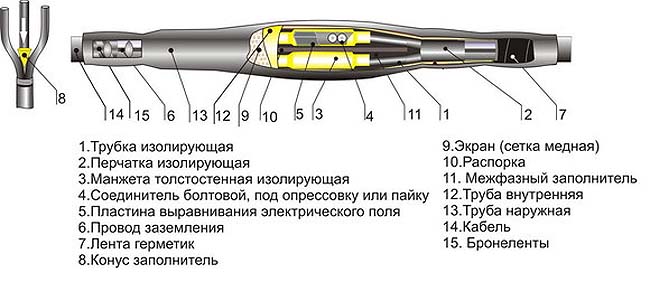
Тематики
EN
- cable box
- cable connecting box
- cable coupling box
- cable coupling sleeve
- cable gland assembly
- cable joint
- cable sleeve
- cable terminal
- connector
- joint box
- junction box
DE
FR
кабельная (переносная) розетка
переносная (кабельная) розетка
Часть соединителя, которая выполняется как одно целое с кабелем или прикрепляется к гибкому кабелю для подсоединения его к источнику питания.
Примечание — Обычно кабельная розетка имеет такое же контактное устройство, что и стационарная розетка.
[ ГОСТ Р 51323.1-99]
1 - Розетка стационарная
2 - Вилка опрессованная
3 - Удлиннитель одноместный
4 - Соединитель штепсельный
5 - Кабельная розетка (в ГОСТе названа "розетка переносная опрессованная")
6 - Вилка опрессованная
7 - Кабельный соединитель (в ГОСТе назван "штепсельный соединитель")
8 - Розетка приборная
9 - Удлинитель с приборной розеткой
10 - Вилка приборная
11 - Прибор
12 - Соединитель приборный
[ ГОСТ Р 51322.1-99]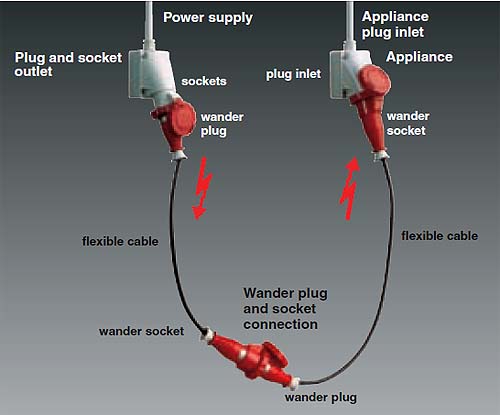
Рис. Schneider Electric
Тематики
Синонимы
EN
кабельный наконечник
Контакт-деталь, обеспечивающаяразъемноеразборноеконтактное соединение между проводом или жилой кабеля и выводом электротехнического устройства или контактным зажимом.
[ ГОСТ 23587-96]
наконечник
Часть, посредством которой проводник может быть соединен с управляющим устройством так, что его замена требует или применения специального инструмента или специального процесса, или специальной подготовки конца провода.
Примечание - Пайка требует специального инструмента. Сварка требует специального процесса. Закрепление наконечника на проводнике рассматривают как специальную подготовку провода.
[ГОСТ IЕС 60730-1-2011]EN
termination
part by which a conductor can be connected to a control in such a way that its replacement requires either a special purpose tool, a special process or a specially prepared end of the conductor
Note 1 to entry: Soldering requires a special purpose tool. Welding requires a special process. A cable lug attached to a conductor is a specially prepared end.
[IEC 60730-1, ed. 5.0 (2013-11)]FR
connexion
pièce permettant la connexion d'un conducteur à un dispositif de commande de telle manière que son remplacement nécessite un outil spécial, un procédé spécial ou une préparation spéciale de l'extrémité d'un conducteur
Note 1 à l'article: Le soudage à l'étain nécessite un outil spécial. Le soudage électrique est un procédé spécial. La pose d'une cosse sur l'extrémité d'un conducteur est considérée comme une préparation spéciale.
[IEC 60730-1, ed. 5.0 (2013-11)]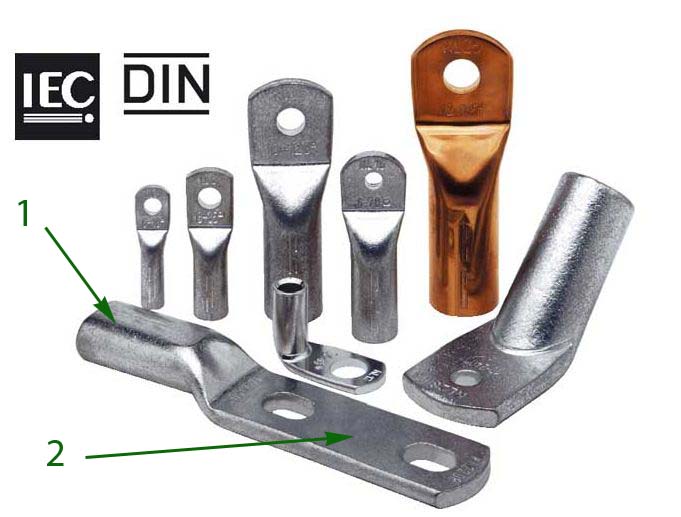
1 - Хвостовик кабельного наконечника;
2 - Зажимная часть
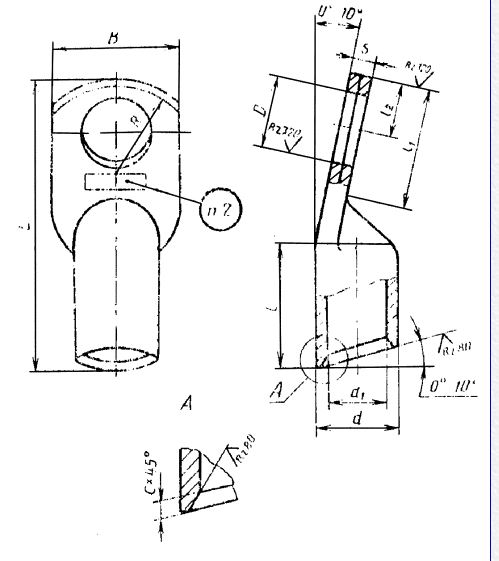
[ ГОСТ 7386-80]Наконечник кабельный медный, закрепляемый опрессовкой.
Кабельные наконечники должны изготавливаться из медных труб марки...
[ ГОСТ 7386-80]Тематики
EN
- anchoring base
- cable end
- cable grip
- cable lug
- cable shoe
- cable thimble
- compression lug
- conductor connector
- conductor contact
- connection lug
- connector
- crimp connection
- ferrule
- tag
- terminal
- terminal end
- terminal plug
- termination
- thimble
- wire end ferrule
- wire lug
- wiring terminal connector
FR
коннектор
Деталь, предназначенная для соединения двух или более компонентов дыхательного контура.
[ ГОСТ Р 52423-2005]Тематики
- ингаляц. анестезия, искусств. вентиляц. легких
EN
DE
FR
коннектор
Механическое устройство, используемое совместно с волокном для обеспечения позиционирования, подсоединения волокна к передатчику, приемнику или другому волокну. Обычно используются следующие типы коннекторов: SC (SC - Subscriber Connector, 568SC), ST Compatible (ST - Straight Tip, BFOC/2,5), FC, FCPC, FDDI, Escon, Biconic, D4, SMA 905, 906.
[ Источник]Тематики
EN
электрический соединитель
Электротехническое устройство, предназначенное для механического соединения и разьединения электрических цепей, состоящее из двух или более частей (вилки, розетки), образующих разъемное контактное соединение
[ ГОСТ 21962-76]
электрический соединитель
Электромеханическое устройство, присоединяемое к проводникам, для соединения и разъединения электрических цепей путем сочленения и расчленения с соответствующим устройством.
[ ГОСТ 23784-98]
электрический соединитель
Электромеханическое устройство, предназначенное для механического соединения и разъединения вручную электрических цепей (проводов, кабелей, модулей, узлов и блоков) в различных видах аппаратуры при выключенном источнике тока через соединитель.
[В. Ф. Лярский, О. Б. Мурадян. Электрические соединители. Справочник. Радио и связь, 1988]
разъем
Конструктивный элемент, состоящий из соединяемых частей, служащий для электрического соединения кабеля с электронным блоком, преобразователем или электронных блоков между собой.
[Система неразрушающего контроля. Виды (методы) и технология неразрушающего контроля. Термины и определения (справочное пособие). Москва 2003 г.]
разъем
Комбинация вилки и розетки, обеспечивающая соединение и разъединение двух или более проводников.
Примечание.
Примерами разъемов могут служить комбинации:
- соединителей, которые соответствуют требованиям МЭК 61984;
- приборные соединители, кабельные гнезда и бытовые соединители в соответствии с МЭК 60309-1;
- приборные соединители в соответствии с МЭК 60884-1 или бытовые соединители в соответствии с МЭК 60320-1.
[ ГОСТ Р МЭК 60204-1-2007]
разъем
-
[IEV number 151-12-19]EN
connector
device providing connection and disconnection to a suitable mating component
NOTE – A connector has one or more contact elements.
Source: 151-12-19 MOD
[IEV number 581-26-01]FR
connecteur, m
dispositif destiné à établir et à rompre une connexion par appariement avec un composant complémentaire approprié
NOTE – Un connecteur est muni d’un ou plusiers éléments de contact
Source: 151-12-19 MOD
[IEV number 581-26-01]Конструкция соединителей, предназначенных для подключения внешних цепей, должна отличаться от конструкции других соединителей и не должна быть взаимозаменяемой.
Конструкция соединителя должна исключать возможность неправильного сочленения, например, с помощью направляющих штифтов или гнезд.
Недопустимые, нерекомендуемые
Тематики
Классификация
>>>Близкие понятия
Действия
Синонимы
EN
- connector
- connector pins
- connector set
- electric connector
- electric coupler
- electrical connector mated set
- electrical coupler
- plug-and-socket connector
- withdraw connector
DE
- Steckverbinder, m
FR
- connecteur, m
Смотри также
3.1 соединительный элемент (connector): Открывающееся устройство для соединения компонентов, которое позволяет пользователю присоединять систему для того, чтобы связать себя прямо или косвенно с анкером.
Примечание - Допускается вместо термина «соединительный элемент» применять термин «карабин».
2.24 соединительный элемент (connector): Отдельная соединительная деталь или компонент страховочной системы.
3.2 соединительное звено (connector): Совмещенный комплект заправочного вентиля и заправочного приемника ТССВ, который позволяет осуществлять быстрое их соединение и отсоединение при заправке топливом транспортного средства или системы хранения водорода.
Источник: ГОСТ Р 54113-2010: Соединительные устройства для многократной заправки сжатым водородом наземных транспортных средств оригинал документа
3.5 соединительный элемент (connector): Отдельная соединительная деталь или компонент страховочной системы.
[ЕН 363:2002]
Англо-русский словарь нормативно-технической терминологии > connector
13 Artificial Intelligence
In my opinion, none of [these programs] does even remote justice to the complexity of human mental processes. Unlike men, "artificially intelligent" programs tend to be single minded, undistractable, and unemotional. (Neisser, 1967, p. 9)Future progress in [artificial intelligence] will depend on the development of both practical and theoretical knowledge.... As regards theoretical knowledge, some have sought a unified theory of artificial intelligence. My view is that artificial intelligence is (or soon will be) an engineering discipline since its primary goal is to build things. (Nilsson, 1971, pp. vii-viii)Most workers in AI [artificial intelligence] research and in related fields confess to a pronounced feeling of disappointment in what has been achieved in the last 25 years. Workers entered the field around 1950, and even around 1960, with high hopes that are very far from being realized in 1972. In no part of the field have the discoveries made so far produced the major impact that was then promised.... In the meantime, claims and predictions regarding the potential results of AI research had been publicized which went even farther than the expectations of the majority of workers in the field, whose embarrassments have been added to by the lamentable failure of such inflated predictions....When able and respected scientists write in letters to the present author that AI, the major goal of computing science, represents "another step in the general process of evolution"; that possibilities in the 1980s include an all-purpose intelligence on a human-scale knowledge base; that awe-inspiring possibilities suggest themselves based on machine intelligence exceeding human intelligence by the year 2000 [one has the right to be skeptical]. (Lighthill, 1972, p. 17)4) Just as Astronomy Succeeded Astrology, the Discovery of Intellectual Processes in Machines Should Lead to a Science, EventuallyJust as astronomy succeeded astrology, following Kepler's discovery of planetary regularities, the discoveries of these many principles in empirical explorations on intellectual processes in machines should lead to a science, eventually. (Minsky & Papert, 1973, p. 11)5) Problems in Machine Intelligence Arise Because Things Obvious to Any Person Are Not Represented in the ProgramMany problems arise in experiments on machine intelligence because things obvious to any person are not represented in any program. One can pull with a string, but one cannot push with one.... Simple facts like these caused serious problems when Charniak attempted to extend Bobrow's "Student" program to more realistic applications, and they have not been faced up to until now. (Minsky & Papert, 1973, p. 77)What do we mean by [a symbolic] "description"? We do not mean to suggest that our descriptions must be made of strings of ordinary language words (although they might be). The simplest kind of description is a structure in which some features of a situation are represented by single ("primitive") symbols, and relations between those features are represented by other symbols-or by other features of the way the description is put together. (Minsky & Papert, 1973, p. 11)[AI is] the use of computer programs and programming techniques to cast light on the principles of intelligence in general and human thought in particular. (Boden, 1977, p. 5)The word you look for and hardly ever see in the early AI literature is the word knowledge. They didn't believe you have to know anything, you could always rework it all.... In fact 1967 is the turning point in my mind when there was enough feeling that the old ideas of general principles had to go.... I came up with an argument for what I called the primacy of expertise, and at the time I called the other guys the generalists. (Moses, quoted in McCorduck, 1979, pp. 228-229)9) Artificial Intelligence Is Psychology in a Particularly Pure and Abstract FormThe basic idea of cognitive science is that intelligent beings are semantic engines-in other words, automatic formal systems with interpretations under which they consistently make sense. We can now see why this includes psychology and artificial intelligence on a more or less equal footing: people and intelligent computers (if and when there are any) turn out to be merely different manifestations of the same underlying phenomenon. Moreover, with universal hardware, any semantic engine can in principle be formally imitated by a computer if only the right program can be found. And that will guarantee semantic imitation as well, since (given the appropriate formal behavior) the semantics is "taking care of itself" anyway. Thus we also see why, from this perspective, artificial intelligence can be regarded as psychology in a particularly pure and abstract form. The same fundamental structures are under investigation, but in AI, all the relevant parameters are under direct experimental control (in the programming), without any messy physiology or ethics to get in the way. (Haugeland, 1981b, p. 31)There are many different kinds of reasoning one might imagine:Formal reasoning involves the syntactic manipulation of data structures to deduce new ones following prespecified rules of inference. Mathematical logic is the archetypical formal representation. Procedural reasoning uses simulation to answer questions and solve problems. When we use a program to answer What is the sum of 3 and 4? it uses, or "runs," a procedural model of arithmetic. Reasoning by analogy seems to be a very natural mode of thought for humans but, so far, difficult to accomplish in AI programs. The idea is that when you ask the question Can robins fly? the system might reason that "robins are like sparrows, and I know that sparrows can fly, so robins probably can fly."Generalization and abstraction are also natural reasoning process for humans that are difficult to pin down well enough to implement in a program. If one knows that Robins have wings, that Sparrows have wings, and that Blue jays have wings, eventually one will believe that All birds have wings. This capability may be at the core of most human learning, but it has not yet become a useful technique in AI.... Meta- level reasoning is demonstrated by the way one answers the question What is Paul Newman's telephone number? You might reason that "if I knew Paul Newman's number, I would know that I knew it, because it is a notable fact." This involves using "knowledge about what you know," in particular, about the extent of your knowledge and about the importance of certain facts. Recent research in psychology and AI indicates that meta-level reasoning may play a central role in human cognitive processing. (Barr & Feigenbaum, 1981, pp. 146-147)Suffice it to say that programs already exist that can do things-or, at the very least, appear to be beginning to do things-which ill-informed critics have asserted a priori to be impossible. Examples include: perceiving in a holistic as opposed to an atomistic way; using language creatively; translating sensibly from one language to another by way of a language-neutral semantic representation; planning acts in a broad and sketchy fashion, the details being decided only in execution; distinguishing between different species of emotional reaction according to the psychological context of the subject. (Boden, 1981, p. 33)Can the synthesis of Man and Machine ever be stable, or will the purely organic component become such a hindrance that it has to be discarded? If this eventually happens-and I have... good reasons for thinking that it must-we have nothing to regret and certainly nothing to fear. (Clarke, 1984, p. 243)The thesis of GOFAI... is not that the processes underlying intelligence can be described symbolically... but that they are symbolic. (Haugeland, 1985, p. 113)14) Artificial Intelligence Provides a Useful Approach to Psychological and Psychiatric Theory FormationIt is all very well formulating psychological and psychiatric theories verbally but, when using natural language (even technical jargon), it is difficult to recognise when a theory is complete; oversights are all too easily made, gaps too readily left. This is a point which is generally recognised to be true and it is for precisely this reason that the behavioural sciences attempt to follow the natural sciences in using "classical" mathematics as a more rigorous descriptive language. However, it is an unfortunate fact that, with a few notable exceptions, there has been a marked lack of success in this application. It is my belief that a different approach-a different mathematics-is needed, and that AI provides just this approach. (Hand, quoted in Hand, 1985, pp. 6-7)We might distinguish among four kinds of AI.Research of this kind involves building and programming computers to perform tasks which, to paraphrase Marvin Minsky, would require intelligence if they were done by us. Researchers in nonpsychological AI make no claims whatsoever about the psychological realism of their programs or the devices they build, that is, about whether or not computers perform tasks as humans do.Research here is guided by the view that the computer is a useful tool in the study of mind. In particular, we can write computer programs or build devices that simulate alleged psychological processes in humans and then test our predictions about how the alleged processes work. We can weave these programs and devices together with other programs and devices that simulate different alleged mental processes and thereby test the degree to which the AI system as a whole simulates human mentality. According to weak psychological AI, working with computer models is a way of refining and testing hypotheses about processes that are allegedly realized in human minds.... According to this view, our minds are computers and therefore can be duplicated by other computers. Sherry Turkle writes that the "real ambition is of mythic proportions, making a general purpose intelligence, a mind." (Turkle, 1984, p. 240) The authors of a major text announce that "the ultimate goal of AI research is to build a person or, more humbly, an animal." (Charniak & McDermott, 1985, p. 7)Research in this field, like strong psychological AI, takes seriously the functionalist view that mentality can be realized in many different types of physical devices. Suprapsychological AI, however, accuses strong psychological AI of being chauvinisticof being only interested in human intelligence! Suprapsychological AI claims to be interested in all the conceivable ways intelligence can be realized. (Flanagan, 1991, pp. 241-242)16) Determination of Relevance of Rules in Particular ContextsEven if the [rules] were stored in a context-free form the computer still couldn't use them. To do that the computer requires rules enabling it to draw on just those [ rules] which are relevant in each particular context. Determination of relevance will have to be based on further facts and rules, but the question will again arise as to which facts and rules are relevant for making each particular determination. One could always invoke further facts and rules to answer this question, but of course these must be only the relevant ones. And so it goes. It seems that AI workers will never be able to get started here unless they can settle the problem of relevance beforehand by cataloguing types of context and listing just those facts which are relevant in each. (Dreyfus & Dreyfus, 1986, p. 80)Perhaps the single most important idea to artificial intelligence is that there is no fundamental difference between form and content, that meaning can be captured in a set of symbols such as a semantic net. (G. Johnson, 1986, p. 250)Artificial intelligence is based on the assumption that the mind can be described as some kind of formal system manipulating symbols that stand for things in the world. Thus it doesn't matter what the brain is made of, or what it uses for tokens in the great game of thinking. Using an equivalent set of tokens and rules, we can do thinking with a digital computer, just as we can play chess using cups, salt and pepper shakers, knives, forks, and spoons. Using the right software, one system (the mind) can be mapped into the other (the computer). (G. Johnson, 1986, p. 250)19) A Statement of the Primary and Secondary Purposes of Artificial IntelligenceThe primary goal of Artificial Intelligence is to make machines smarter.The secondary goals of Artificial Intelligence are to understand what intelligence is (the Nobel laureate purpose) and to make machines more useful (the entrepreneurial purpose). (Winston, 1987, p. 1)The theoretical ideas of older branches of engineering are captured in the language of mathematics. We contend that mathematical logic provides the basis for theory in AI. Although many computer scientists already count logic as fundamental to computer science in general, we put forward an even stronger form of the logic-is-important argument....AI deals mainly with the problem of representing and using declarative (as opposed to procedural) knowledge. Declarative knowledge is the kind that is expressed as sentences, and AI needs a language in which to state these sentences. Because the languages in which this knowledge usually is originally captured (natural languages such as English) are not suitable for computer representations, some other language with the appropriate properties must be used. It turns out, we think, that the appropriate properties include at least those that have been uppermost in the minds of logicians in their development of logical languages such as the predicate calculus. Thus, we think that any language for expressing knowledge in AI systems must be at least as expressive as the first-order predicate calculus. (Genesereth & Nilsson, 1987, p. viii)21) Perceptual Structures Can Be Represented as Lists of Elementary PropositionsIn artificial intelligence studies, perceptual structures are represented as assemblages of description lists, the elementary components of which are propositions asserting that certain relations hold among elements. (Chase & Simon, 1988, p. 490)Artificial intelligence (AI) is sometimes defined as the study of how to build and/or program computers to enable them to do the sorts of things that minds can do. Some of these things are commonly regarded as requiring intelligence: offering a medical diagnosis and/or prescription, giving legal or scientific advice, proving theorems in logic or mathematics. Others are not, because they can be done by all normal adults irrespective of educational background (and sometimes by non-human animals too), and typically involve no conscious control: seeing things in sunlight and shadows, finding a path through cluttered terrain, fitting pegs into holes, speaking one's own native tongue, and using one's common sense. Because it covers AI research dealing with both these classes of mental capacity, this definition is preferable to one describing AI as making computers do "things that would require intelligence if done by people." However, it presupposes that computers could do what minds can do, that they might really diagnose, advise, infer, and understand. One could avoid this problematic assumption (and also side-step questions about whether computers do things in the same way as we do) by defining AI instead as "the development of computers whose observable performance has features which in humans we would attribute to mental processes." This bland characterization would be acceptable to some AI workers, especially amongst those focusing on the production of technological tools for commercial purposes. But many others would favour a more controversial definition, seeing AI as the science of intelligence in general-or, more accurately, as the intellectual core of cognitive science. As such, its goal is to provide a systematic theory that can explain (and perhaps enable us to replicate) both the general categories of intentionality and the diverse psychological capacities grounded in them. (Boden, 1990b, pp. 1-2)Because the ability to store data somewhat corresponds to what we call memory in human beings, and because the ability to follow logical procedures somewhat corresponds to what we call reasoning in human beings, many members of the cult have concluded that what computers do somewhat corresponds to what we call thinking. It is no great difficulty to persuade the general public of that conclusion since computers process data very fast in small spaces well below the level of visibility; they do not look like other machines when they are at work. They seem to be running along as smoothly and silently as the brain does when it remembers and reasons and thinks. On the other hand, those who design and build computers know exactly how the machines are working down in the hidden depths of their semiconductors. Computers can be taken apart, scrutinized, and put back together. Their activities can be tracked, analyzed, measured, and thus clearly understood-which is far from possible with the brain. This gives rise to the tempting assumption on the part of the builders and designers that computers can tell us something about brains, indeed, that the computer can serve as a model of the mind, which then comes to be seen as some manner of information processing machine, and possibly not as good at the job as the machine. (Roszak, 1994, pp. xiv-xv)The inner workings of the human mind are far more intricate than the most complicated systems of modern technology. Researchers in the field of artificial intelligence have been attempting to develop programs that will enable computers to display intelligent behavior. Although this field has been an active one for more than thirty-five years and has had many notable successes, AI researchers still do not know how to create a program that matches human intelligence. No existing program can recall facts, solve problems, reason, learn, and process language with human facility. This lack of success has occurred not because computers are inferior to human brains but rather because we do not yet know in sufficient detail how intelligence is organized in the brain. (Anderson, 1995, p. 2)Historical dictionary of quotations in cognitive science > Artificial Intelligence
14 adjustment
<tech.gen> (e.g. of control elements, values; process and result) ■ Einstellung f<tech.gen> (of discrepancies) ■ Ausgleich m<tech.gen> (changing from one value or position to another one, e.g. setpoints) ■ Verstellen n<tech.gen> (tensioning, e.g. of drive belts; process) ■ Spannen n<tech.gen> (making up for loss, wear and tear, e.g. of brakes, friction linings) ■ Nachstellen n<tech.gen> (process; of controls, values, setpoints, limits etc.; e.g. speed, pres) ■ Einstellen n<tech.gen> (of sth to sth; e.g. to situation, environment, shape, requirements) ■ Angleichung f ; Anpassung f ; Adaption f<i&c> (balancing of two or more components or values) ■ Abgleich m<i&c> (by means of control system, manually or automatically) ■ Einregelung f<mach.tools> (moving sth. into position; e.g. rolls, cutting tools) ■ Anstellen n15 setting
<tech.gen> (state, as-is value) ■ Einstellung f<tech.gen> (of hardware configuration) ■ Geräteeinstellung f<tech.gen> (process; of controls, values, setpoints, limits etc.; e.g. speed, pres) ■ Einstellen n<tech.gen> (e.g. of control elements, values; process and result) ■ Einstellung f<tech.gen> (e.g. of size, pressure, temperature) ■ Einstellwert m<tech.gen> (length measurements; e.g. of gaps, clearances) ■ Einstellwert m ; Einstellmaß n<build.mat> ■ Erstarrung f ; Erhärtung f ; Abbinden n<i&c> (of configurations, process parameters etc.) ■ Einstellung f DIN 2257<i&c> (e.g. of a lever, switch) ■ Stellung f<i&c> (of controlled system; e.g. a specific temperature) ■ Sollwert m ; Aufgabenwert m rare.obs<mach.tools> ■ Aufspannung f< plast> ■ Verfestigung f< silic> ■ Besatz m16 Memory
To what extent can we lump together what goes on when you try to recall: (1) your name; (2) how you kick a football; and (3) the present location of your car keys? If we use introspective evidence as a guide, the first seems an immediate automatic response. The second may require constructive internal replay prior to our being able to produce a verbal description. The third... quite likely involves complex operational responses under the control of some general strategy system. Is any unitary search process, with a single set of characteristics and inputoutput relations, likely to cover all these cases? (Reitman, 1970, p. 485)[Semantic memory] Is a mental thesaurus, organized knowledge a person possesses about words and other verbal symbols, their meanings and referents, about relations among them, and about rules, formulas, and algorithms for the manipulation of these symbols, concepts, and relations. Semantic memory does not register perceptible properties of inputs, but rather cognitive referents of input signals. (Tulving, 1972, p. 386)The mnemonic code, far from being fixed and unchangeable, is structured and restructured along with general development. Such a restructuring of the code takes place in close dependence on the schemes of intelligence. The clearest indication of this is the observation of different types of memory organisation in accordance with the age level of a child so that a longer interval of retention without any new presentation, far from causing a deterioration of memory, may actually improve it. (Piaget & Inhelder, 1973, p. 36)4) The Logic of Some Memory Theorization Is of Dubious Worth in the History of PsychologyIf a cue was effective in memory retrieval, then one could infer it was encoded; if a cue was not effective, then it was not encoded. The logic of this theorization is "heads I win, tails you lose" and is of dubious worth in the history of psychology. We might ask how long scientists will puzzle over questions with no answers. (Solso, 1974, p. 28)We have iconic, echoic, active, working, acoustic, articulatory, primary, secondary, episodic, semantic, short-term, intermediate-term, and longterm memories, and these memories contain tags, traces, images, attributes, markers, concepts, cognitive maps, natural-language mediators, kernel sentences, relational rules, nodes, associations, propositions, higher-order memory units, and features. (Eysenck, 1977, p. 4)The problem with the memory metaphor is that storage and retrieval of traces only deals [ sic] with old, previously articulated information. Memory traces can perhaps provide a basis for dealing with the "sameness" of the present experience with previous experiences, but the memory metaphor has no mechanisms for dealing with novel information. (Bransford, McCarrell, Franks & Nitsch, 1977, p. 434)7) The Results of a Hundred Years of the Psychological Study of Memory Are Somewhat DiscouragingThe results of a hundred years of the psychological study of memory are somewhat discouraging. We have established firm empirical generalisations, but most of them are so obvious that every ten-year-old knows them anyway. We have made discoveries, but they are only marginally about memory; in many cases we don't know what to do with them, and wear them out with endless experimental variations. We have an intellectually impressive group of theories, but history offers little confidence that they will provide any meaningful insight into natural behavior. (Neisser, 1978, pp. 12-13)A schema, then is a data structure for representing the generic concepts stored in memory. There are schemata representing our knowledge about all concepts; those underlying objects, situations, events, sequences of events, actions and sequences of actions. A schema contains, as part of its specification, the network of interrelations that is believed to normally hold among the constituents of the concept in question. A schema theory embodies a prototype theory of meaning. That is, inasmuch as a schema underlying a concept stored in memory corresponds to the mean ing of that concept, meanings are encoded in terms of the typical or normal situations or events that instantiate that concept. (Rumelhart, 1980, p. 34)Memory appears to be constrained by a structure, a "syntax," perhaps at quite a low level, but it is free to be variable, deviant, even erratic at a higher level....Like the information system of language, memory can be explained in part by the abstract rules which underlie it, but only in part. The rules provide a basic competence, but they do not fully determine performance. (Campbell, 1982, pp. 228, 229)When people think about the mind, they often liken it to a physical space, with memories and ideas as objects contained within that space. Thus, we speak of ideas being in the dark corners or dim recesses of our minds, and of holding ideas in mind. Ideas may be in the front or back of our minds, or they may be difficult to grasp. With respect to the processes involved in memory, we talk about storing memories, of searching or looking for lost memories, and sometimes of finding them. An examination of common parlance, therefore, suggests that there is general adherence to what might be called the spatial metaphor. The basic assumptions of this metaphor are that memories are treated as objects stored in specific locations within the mind, and the retrieval process involves a search through the mind in order to find specific memories....However, while the spatial metaphor has shown extraordinary longevity, there have been some interesting changes over time in the precise form of analogy used. In particular, technological advances have influenced theoretical conceptualisations.... The original Greek analogies were based on wax tablets and aviaries; these were superseded by analogies involving switchboards, gramophones, tape recorders, libraries, conveyor belts, and underground maps. Most recently, the workings of human memory have been compared to computer functioning... and it has been suggested that the various memory stores found in computers have their counterparts in the human memory system. (Eysenck, 1984, pp. 79-80)Primary memory [as proposed by William James] relates to information that remains in consciousness after it has been perceived, and thus forms part of the psychological present, whereas secondary memory contains information about events that have left consciousness, and are therefore part of the psychological past. (Eysenck, 1984, p. 86)Once psychologists began to study long-term memory per se, they realized it may be divided into two main categories.... Semantic memories have to do with our general knowledge about the working of the world. We know what cars do, what stoves do, what the laws of gravity are, and so on. Episodic memories are largely events that took place at a time and place in our personal history. Remembering specific events about our own actions, about our family, and about our individual past falls into this category. With amnesia or in aging, what dims... is our personal episodic memories, save for those that are especially dear or painful to us. Our knowledge of how the world works remains pretty much intact. (Gazzaniga, 1988, p. 42)The nature of memory... provides a natural starting point for an analysis of thinking. Memory is the repository of many of the beliefs and representations that enter into thinking, and the retrievability of these representations can limit the quality of our thought. (Smith, 1990, p. 1)Historical dictionary of quotations in cognitive science > Memory
17 device
аппарат
Устройство, в котором за счёт внешних механических, химических и электромеханических, термических или других воздействий производится полезная работа
[Терминологический словарь по строительству на 12 языках (ВНИИИС Госстроя СССР)]
аппарат
-
[IEV number 151-11-22]EN
apparatus
device or assembly of devices which can be used as an independent unit for specific functions
NOTE – In English, the term "apparatus" sometimes implies use by skilled persons for professional purposes.
[IEV number 151-11-22]FR
appareil, m
dispositif ou assemblage de dispositifs qui peut être utilisé comme unité indépendante pour remplir des fonctions particulières
NOTE – En anglais, le terme "apparatus" implique quelquefois une utilisation par des personnes qualifiées dans un but professionnel.
[IEV number 151-11-22]Сопутствующие термины
EN
DE
FR
прибор
оборудование
[ http://www.dunwoodypress.com/148/PDF/Biotech_Eng-Rus.pdf]Тематики
Синонимы
EN
приспособление
Технологическая оснастка, предназначенная для установки или направления предмета труда или инструмента при выполнении технологической операции
[ГОСТ 3.1109-82]
приспособление
Техническое устройство, присоединяемое к машине или применяемое самостоятельно для базирования и закрепления предметов производства при выполнении технологических операций
[Терминологический словарь по строительству на 12 языках (ВНИИИС Госстроя СССР)]Тематики
EN
DE
FR
процедура
Упорядоченная совокупность взаимосвязанных определенными отношениями действий, направленных на решение задачи.
[МУ 64-01-001-2002]
процедура
Установленный способ осуществления деятельности или процесса.
Примечания
1. Процедуры могут быть документированными или недокументированными.
2. Если процедура документирована, часто используется термин "письменная процедура" или "документированная процедура". Документ, содержащий процедуру, может называться "процедурный документ".
[ ГОСТ Р ИСО 9000-2008]
процедура
Документ, содержащий шаги, которые предписывают способ выполнения деятельности. Процедуры определяются как части процессов. См. тж. рабочая инструкция.
[Словарь терминов ITIL версия 1.0, 29 июля 2011 г.]EN
procedure
A document containing steps that specify how to achieve an activity. Procedures are defined as part of processes. See also work instruction.
[Словарь терминов ITIL версия 1.0, 29 июля 2011 г.]Тематики
EN
устройство
-
[IEV number 151-11-20 ]
устройство
Элемент или блок элементов, который выполняет одну или более функций.
[ ГОСТ Р 41.48-2004]
[ ГОСТ Р 52388-2005]
устройство
Совокупность элементов, представляющая единую конструкцию (многоконтактное реле, набор транзисторов, плата, блок, шкаф, механизм, разделительная панель и т. п.).
Устройство может не иметь в изделии определенного функционального назначения.
[ГОСТ 2.701-84]
устройство
Изделие, являющееся конструктивным элементом или совокупностью конструктивных элементов, находящихся в функционально-конструктивном единстве
[ ГОСТ 16382-87]EN
device
material element or assembly of such elements intended to perform a required function
NOTE – A device may form part of a larger device.
[IEV number 151-11-20 ]FR
dispositif, m
élément matériel ou assemblage d'éléments matériels destiné à remplir une fonction déterminée
NOTE – Un dispositif peut faire partie d'un dispositif plus important.
[IEV number 151-11-20 ]Тематики
- электротехника, основные понятия
EN
DE
FR
устройство (сети и системы связи)
Элемент или совокупность элементов, выполняющих установленную функцию.
Примечание 1. Устройство может являться частью другого, большего устройства.
Примечание 2. В контексте распределительного устройства подстанции устройством называется физическая единица первичного оборудования, например трансформатор или выключатель. В контексте автоматики подстанций устройством является интеллектуальное электронное устройство.
[ ГОСТ Р 54325-2011 (IEC/TS 61850-2:2003)]EN
device
element or assembly of elements performing a required function
Note A device may form part of a larger device.
(Source: IEV 151)
mechanism or piece of equipment designed to serve a purpose or perform a function for example, circuit breaker, relay or substation computer
(Source: IEEE Std. 100–1996, IEEE dictionary of electrical and electronic terms)
in the context of a switchyard, a device is a physical plant item for example transformer or circuit breaker; in the context of substation automation a device is an IED
(Source: IEC 61850-1)
[IEC 61850-2, ed. 1.0 (2003-08)]Тематики
EN
3.6.8 устройство (device): Любое идентифицированное оборудование, система или подсистема, не относящиеся к программному обеспечению, комплекту данных или классу человеческих ресурсов.
Примечание - Устройство, тем не менее, может включать программное обеспечение.
Источник: ГОСТ Р ИСО 15531-1-2008: Промышленные автоматизированные системы и интеграция. Данные по управлению промышленным производством. Часть 1. Общий обзор оригинал документа
3.102 прибор (device): Сущность, выполняющая функции управления, приведения в действие и считывания и связанная с другими такими сущностями в автоматизированной системе.
Примечание - Сам по себе прибор не выполняет функции обработки, транспортирования или хранения материалов.
Источник: ГОСТ Р 54136-2010: Системы промышленной автоматизации и интеграция. Руководство по применению стандартов, структура и словарь оригинал документа
Англо-русский словарь нормативно-технической терминологии > device
18 biogeochemical cycle
биохимический цикл
—
[ http://www.eionet.europa.eu/gemet/alphabetic?langcode=en]EN
biogeochemical cycle
Movement of chemical elements in a circular pathway, from organisms to physical environment, back to organisms. The process is termed a nutrient cycle if the elements concerned are trace elements, which are essential to life. A biogeochemical cycle occurs when vegetation decomposes and minerals are incorporated naturally in the humus for future plant growth. (Source: WRIGHT)
[http://www.eionet.europa.eu/gemet/alphabetic?langcode=en]Тематики
EN
DE
FR
Англо-русский словарь нормативно-технической терминологии > biogeochemical cycle
19 Capability Maturity Model Integration
комплексная модель зрелости
CMMI
(ITIL Continual Service Improvement)
Подход к совершенствованию процессов в области информационных технологий, разработанный Институтом проектирования программного обеспечения Университета Карнеги-Меллона. CMMI содержит перечень необходимых элементов эффективных процессов. Она может быть использована как руководство по совершенствованию процессов в рамках проекта, подразделения или целой организации. CMMI помогает объединить традиционно обособленные функции организации, установить задачи и приоритеты совершенствования процесса, содержит рекомендации по созданию качественных процессов и отправные точки для оценки существующих процессов.
Дополнительную информацию можно найте на сайте www.sei.cmu.edu/cmmi.
См. тж. зрелость.
[Словарь терминов ITIL версия 1.0, 29 июля 2011 г.]EN
Capability Maturity Model Integration
CMMI
(ITIL Continual Service Improvement)
A process improvement approach developed by the Software Engineering Institute (SEI) of Carnegie Mellon University, US. CMMI provides organizations with the essential elements of effective processes. It can be used to guide process improvement across a project, a division or an entire organization. CMMI helps integrate traditionally separate organizational functions, set process improvement goals and priorities, provide guidance for quality processes, and provide a point of reference for appraising current processes.
See www.sei.cmu.edu/cmmi for more information.
See also maturity.
[Словарь терминов ITIL версия 1.0, 29 июля 2011 г.]Тематики
Синонимы
EN
Англо-русский словарь нормативно-технической терминологии > Capability Maturity Model Integration
20 CMMI
комплексная модель зрелости
CMMI
(ITIL Continual Service Improvement)
Подход к совершенствованию процессов в области информационных технологий, разработанный Институтом проектирования программного обеспечения Университета Карнеги-Меллона. CMMI содержит перечень необходимых элементов эффективных процессов. Она может быть использована как руководство по совершенствованию процессов в рамках проекта, подразделения или целой организации. CMMI помогает объединить традиционно обособленные функции организации, установить задачи и приоритеты совершенствования процесса, содержит рекомендации по созданию качественных процессов и отправные точки для оценки существующих процессов.
Дополнительную информацию можно найте на сайте www.sei.cmu.edu/cmmi.
См. тж. зрелость.
[Словарь терминов ITIL версия 1.0, 29 июля 2011 г.]EN
Capability Maturity Model Integration
CMMI
(ITIL Continual Service Improvement)
A process improvement approach developed by the Software Engineering Institute (SEI) of Carnegie Mellon University, US. CMMI provides organizations with the essential elements of effective processes. It can be used to guide process improvement across a project, a division or an entire organization. CMMI helps integrate traditionally separate organizational functions, set process improvement goals and priorities, provide guidance for quality processes, and provide a point of reference for appraising current processes.
See www.sei.cmu.edu/cmmi for more information.
See also maturity.
[Словарь терминов ITIL версия 1.0, 29 июля 2011 г.]Тематики
Синонимы
EN
Англо-русский словарь нормативно-технической терминологии > CMMI
СтраницыСм. также в других словарях:
Process (engineering) — Process engineering refers to engineering which is collaborative and concerned with completing a project as a whole.emiconductor devicesIn the electronics industry, especially for those building ICs, some technologists can be referred to as… … Wikipedia
process — pro·cess / prä ˌses, prō / n 1: a continuous operation, art, or method esp. in manufacture whoever invents or discovers any new and useful process...may obtain a patent therefor U.S. Code 2 a: procedure (1) see also … Law dictionary
Process theology — is a school of thought influenced by the metaphysical process philosophy of Alfred North Whitehead (1861–1947) and further developed by Charles Hartshorne (1897–2000). While there are process theologies that are similar, but unrelated to the work … Wikipedia
Process mining — techniques allow for the analysis of business processes based on event logs. They are often used when no formal description of the process can be obtained by other means, or when the quality of an existing documentation is questionable. For… … Wikipedia
Process philosophy — (or Ontology of Becoming) identifies metaphysical reality with change and dynamism. Since the time of Plato and Aristotle, philosophers have posited true reality as timeless , based on permanent substances, whilst processes are denied or… … Wikipedia
Process control — is a statistics and engineering discipline that deals with architectures, mechanisms, and algorithms for controlling the output of a specific process. See also control theory.For example, heating up the temperature in a room is a process that has … Wikipedia
Process (systems engineering) — See also Process (disambiguation). CPRET Systems engineering CPRET A Process Definition according to AFIS (Association Française d Ingénierie Système) dedicated to SE and open to all domains. IntroductionThe System Engineering normative documents … Wikipedia
Process (computing) — In computing, a process is an instance of a computer program that is being executed. It contains the program code and its current activity. Depending on the operating system (OS), a process may be made up of multiple threads of execution that… … Wikipedia
Process modeling — The term process model is used in different contexts. For example, in business process modeling the enterprise process model is often referred to as the business process model . Process models are core concepts in the discipline of Process… … Wikipedia
Process management (computing) — Operating systems … Wikipedia
process — A series of actions, motions, or occurrences; progressive act or transaction; continuous operation; method, mode or operation, whereby a result or effect is produced; normal or actual course of procedure; regular proceeding, as, the process of… … Black's law dictionary
Перевод: с английского на все языки
со всех языков на английскийprocess+elements

18+
© Академик, 2000-2026
- Обратная связь: Техподдержка, Реклама на сайте
Экспорт словарей на сайты, сделанные на PHP, Joomla, Drupal, WordPress, MODx.