

-
21 Strombelastbarkeit, f
(длительный) допустимый ток
Максимальное значение электрического тока, который может протекать длительно по проводнику, устройству или аппарату при определенных условиях без превышения определенного значения их температуры в установившемся режиме
[ ГОСТ Р МЭК 60050-826-2009]
Этот ток обозначают IZ
[ ГОСТ Р 50571. 1-2009 ( МЭК 60364-1: 2005)]EN
(continuous) current-carrying capacity
ampacity (US)
maximum value of electric current which can be carried continuously by a conductor, a device or an apparatus, under specified conditions without its steady-state temperature exceeding a specified value
[IEV number 826-11-13]
ampacity
The current in amperes that a conductor can carry continuously under the conditions of use without exceeding its temperature rating.
[National Electrical Cod]FR
courant (permanent) admissible, m
valeur maximale du courant électrique qui peut parcourir en permanence, un conducteur, un dispositif ou un appareil, sans que sa température de régime permanent, dans des conditions données, soit supérieure à la valeur spécifiée
[IEV number 826-11-13]Ampacity, the term is defined as the maximum amount of current a cable can carry before sustaining immediate or progressive deterioration. Also described as current rating or current-carrying capacity, is the RMS electric current which a device can continuously carry while remaining within its temperature rating. The ampacity of a cable depends on:
- its insulation temperature rating;
- conductor electrical properties for current;
- frequency, in the case of alternating currents;
- ability to dissipate heat, which depends on cable geometry and its surroundings;
- ambient temperature.
Electric wires have some resistance, and electric current flowing through them causes voltage drop and power dissipation, which heats the cable. Copper or aluminum can conduct a large amount of current before melting, but long before the conductors melt, their insulation would be damaged by the heat.
The ampacity for a power cable is thus based on physical and electrical properties of the material & construction of the conductor and of its insulation, ambient temperature, and environmental conditions adjacent to the cable. Having a large overall surface area may dissipate heat well if the environment can absorb the heat.
In a long run of cable, different conditions govern, and installation regulations normally specify that the most severe condition along the run governs the cable's rating. Cables run in wet or oily locations may carry a lower temperature rating than in a dry installation. Derating is necessary for multiple circuits in close proximity. When multiple cables are near, each contributes heat to the others and diminishes the amount of cooling air that can flow past the individual cables. The overall ampacity of the insulated conductors in a bundle of more than 3 must be derated, whether in a raceway or cable. Usually the de-rating factor is tabulated in a nation's wiring regulations.
Depending on the type of insulating material, common maximum allowable temperatures at the surface of the conductor are 60, 75 and 90 degrees Celsius, often with an ambient air temperature of 30°C. In the U.S., 105°C is allowed with ambient of 40°C, for larger power cables, especially those operating at more than 2 kV. Likewise, specific insulations are rated 150, 200 or 250°C.
The allowed current in cables generally needs to be decreased (derated) when the cable is covered with fireproofing material.
For example, the United States National Electric Code, Table 310-16, specifies that up to three 8 AWG copper wires having a common insulating material (THWN) in a raceway, cable, or direct burial has an ampacity of 50 A when the ambient air is 30°C, the conductor surface temperature allowed to be 75°C. A single insulated conductor in air has 70 A rating.
Ampacity rating is normally for continuous current, and short periods of overcurrent occur without harm in most cabling systems. The acceptable magnitude and duration of overcurrent is a more complex topic than ampacity.
When designing an electrical system, one will normally need to know the current rating for the following:- Wires
- Printed Circuit Board traces, where included
- Fuses
- Circuit breakers
- All or nearly all components used
Some devices are limited by power rating, and when this power rating occurs below their current limit, it is not necessary to know the current limit to design a system. A common example of this is lightbulb holders.
[http://en.wikipedia.org/wiki/Ampacity]
Тематики
- электротехника, основные понятия
Синонимы
EN
DE
- Dauerstrombelastbarkeit, f
- Strombelastbarkeit, f
FR
- courant admissible, m
- courant permanent admissible, m
Немецко-русский словарь нормативно-технической терминологии > Strombelastbarkeit, f
-
22 Nichtansprech-Fehlerstrom
неотключающий дифференциальный ток
Значение дифференциального тока, при котором и ниже которого УЗО-Д не отключается в заданных условиях эксплуатации.
[ ГОСТ Р 50807-95]EN
residual non-operating current
value of residual current at which (and below which) the residual current device does not operate under specified conditions
[IEV number 442-05-21]FR
courant différentiel de non-fonctionnement
valeur du courant différentiel pour laquelle (et au-dessous de laquelle) le dispositif de coupure différentiel ne fonctionne pas dans des conditions spécifiées
[IEV number 442-05-21]Тематики
Синонимы
EN
DE
FR
Немецко-русский словарь нормативно-технической терминологии > Nichtansprech-Fehlerstrom
-
23 Ansprech-Fehlerstrom
отключающий дифференциальный ток
Значение дифференциального тока, вызывающее отключение УЗО-Д в заданных условиях эксплуатации.
[ ГОСТ Р 50807-95]EN
residual operating current
value of residual current which causes the residual current device to operate under specified conditions
[IEV number 442-05-20]FR
courant différentiel de fonctionnement
valeur du courant différentiel qui fait fonctionner le dispositif de coupure différentiel dans des conditions spécifiées
[IEV number 442-05-20]Тематики
Синонимы
EN
DE
FR
Немецко-русский словарь нормативно-технической терминологии > Ansprech-Fehlerstrom
-
24 negative Elektrode
отрицательный электрод
-
[IEV number 151-13-04]EN
negative electrode
for a device having two electrodes, that electrode having the lower electric potential
NOTE – In some cases (e.g. electronic tubes and semiconductor devices), the term "negative electrode" is applied to one or another electrode, depending on the electric operating condition of the device. In other cases (e.g. electrochemical cells), the term "negative electrode" is assigned to a specific electrode.
[IEV number 151-13-04]FR
électrode négative, f
pour un dispositif à deux électrodes, celle des électrodes dont le potentiel électrique est le plus bas
NOTE – Dans certains cas (par exemple pour les tubes électroniques et les dispositifs semiconducteurs), le terme "électrode négative" désigne l’une ou l’autre électrode selon le régime électrique du dispositif. Dans d’autres cas (par exemple pour les éléments électrochimiques), le terme "électrode négative" désigne une électrode particulière.
[IEV number 151-13-04]EN
DE
FR
- électrode négative, f
Немецко-русский словарь нормативно-технической терминологии > negative Elektrode
-
25 positive Elektrode
положительный электрод
-
[IEV number 151-13-05]EN
positive electrode
for a device having two electrodes, that electrode having the higher electric potential
NOTE – In some cases (e.g. electronic tubes and semiconductor devices), the term "positive electrode" is applied to one or another electrode, depending on the electric operating condition of the device. In other cases (e.g. electrochemical cells), the term "positive electrode" is assigned to a specific electrode.
[IEV number 151-13-05]FR
électrode positive, f
pour un dispositif à deux électrodes, celle des électrodes dont le potentiel électrique est le plus élevé
NOTE – Dans certains cas (par exemple pour les tubes électroniques et les dispositifs semiconducteurs), le terme "électrode positive" désigne l’une ou l’autre électrode selon le régime électrique du dispositif. Dans d’autres cas (par exemple pour les éléments électrochimiques), le terme "électrode positive" désigne une électrode particulière.
[IEV number 151-13-05]EN
DE
FR
- électrode positive, f
Немецко-русский словарь нормативно-технической терминологии > positive Elektrode
-
26 Grenzwert der Nichtbetätigungs-Überstromstärke bei unsymmetrischen Lasten in einem Mehrphasen-Stromkreis
- предельное значение тока несрабатывания при неравномерной нагрузке в многофазной цепи
предельное значение тока несрабатывания при неравномерной нагрузке в многофазной цепи
-
[IEV number 442-05-63]EN
limiting value of the non-operating current in case of unbalanced load in a multiphase circuit
Maximum value of current which, in the absence of any fault to frame or to earth, and of an earth leakage current, can flow in a circuit containing only two active conductors of the installation, without causing operation of the part of the residual current device performing the evaluation.
[IEV number 442-05-63]FR
valeur limite du courant de non-fonctionnement en service déséquilibré dans un circuit polyphasé
Valeur maximale du courant pouvant circuler, en l'absence de tout défaut à la masse ou à la terre et de tout courant de fuite à la terre, dans un circuit intéressant seulement deux conducteurs actifs de l'installation sans provoquer le fonctionnement de la partie du dispositif de coupure différentiel assurant la fonction mesure.
[IEV number 442-05-63]EN
- limiting value of the non-operating current in case of unbalanced load in a multiphase circuit
DE
- Grenzwert der Nichtbetätigungs-Überstromstärke bei unsymmetrischen Lasten in einem Mehrphasen-Stromkreis
FR
- valeur limite du courant de non-fonctionnement en service déséquilibré dans un circuit polyphasé
Немецко-русский словарь нормативно-технической терминологии > Grenzwert der Nichtbetätigungs-Überstromstärke bei unsymmetrischen Lasten in einem Mehrphasen-Stromkreis
-
27 Grenzwert der Nichtbetätigungs-Überstromstärke bei symmetrischer Last
предельное значение тока несрабатывания при равномерной нагрузке
-
[IEV number 442-05-64]EN
limiting value of the non-operating current in case of balanced load
Maximum value of current which, in the absence of any fault to frame or to earth, and of an earth leakage current, can flow in a circuit without any load unbalance, without causing operation of the part of the residual current device performing the evaluation.
[IEV number 442-05-64]FR
valeur limite du courant de non-fonctionnement en service équilibré
Valeur maximale du courant pouvant circuler dans un circuit, en l'absence de tout défaut à la masse ou à la terre et de tout courant de fuite à la terre en l'absence de tout déséquilibre de charge, sans provoquer le fonctionnement de la partie du dispositif de coupure différentiel assurant la fonction mesure.
[IEV number 442-05-64]EN
DE
FR
Немецко-русский словарь нормативно-технической терминологии > Grenzwert der Nichtbetätigungs-Überstromstärke bei symmetrischer Last
-
28 Grenzwert der Betriebsspannung der Hilfsenergieversorgung
- предельное наименьшее значение рабочего напряжения вспомогательного источника питания
предельное наименьшее значение рабочего напряжения вспомогательного источника питания
-
[IEV number 442-05-33]EN
limiting value of the operating voltage of the auxiliary source
minimum value of the voltage of the auxiliary source, at which the residual current device still operates under specified conditions in the case of decreasing voltage of the auxiliary source
[IEV number 442-05-33]FR
valeur limite de la tension de fonctionnement de la source auxiliaire
valeur minimale de la tension de la source auxiliaire pour laquelle le dispositif de coupure différentiel fonctionne encore dans des conditions spécifiées en cas de diminution de la tension de la source auxiliaire
[IEV number 442-05-33]Тематики
EN
DE
FR
Немецко-русский словарь нормативно-технической терминологии > Grenzwert der Betriebsspannung der Hilfsenergieversorgung
-
29 Schaltanlage
распределительное устройство
Распределительным устройством (РУ) называется электроустановка, служащая для приема и распределения электроэнергии и содержащая сборные и соединительные шины, коммутационные аппараты, вспомогательные устройства (компрессорные, аккумуляторные и др.), а также устройства защиты, автоматики и измерительные приборы.
[РД 34.20.185-94]
распределительное устройство
Электроустановка, предназначенная для приема и распределения электрической энергии на одном напряжении и содержащая коммутационные аппараты и соединяющие их сборные шины [секции шин], устройства управления и защиты.
Примечание. К устройствам управления относятся аппараты и связывающие их элементы обеспечивающие контроль, измерение, сигнализацию и выполнение команд.
[ ГОСТ 24291-90]
[ ГОСТ Р 53685-2009]
электрическое распределительное устройство
распределительное устройство
Устройство, предназначенное для приема и распределения электроэнергии на одном напряжении и содержащее коммутационные аппараты и соединяющие их сборные соединительные устройства.
Примечание. В состав распределительного устройства дополнительно могут входить устройства защиты и управления
[ОСТ 45.55-99]
распределительное устройство
Электроустановка, служащая для приема и распределения электроэнергии и содержащая коммутационные аппараты, сборные и соединительные шины, вспомогательные устройства (компрессорные, аккумуляторные и др.), а также устройства защиты, автоматики и измерительные приборы.
[ПОТ Р М-016-2001]
[РД 153-34.0-03.150-00]
устройство распределительное
Совокупность аппаратов и приборов для приёма и распределения электроэнергии одного напряжения, вырабатываемой электростанцией или преобразуемой подстанцией
[Терминологический словарь по строительству на 12 языках (ВНИИИС Госстроя СССР)]EN
switching substation
a substation which includes switchgear and usually busbars, but no power transformers
[IEV number 605-01-02]FR
poste de sectionnement
poste de coupure
poste comprenant des organes de manoeuvre et généralement des jeux de barres, à l'exclusion de transformateurs de puissance
[IEV number 605-01-02]В качестве РУ 6—10 кВ используется сборка высокого напряжения с однополюсными разъединителями и вертикальным расположением фаз одного присоединения и одна камера КСО с выключателем нагрузки и предохранителями для подключения трансформатора. Для РУ 0,4 кВ применяются сборки низкого напряжения с предохранителями и вертикальным расположением фаз одного присоединения.
На ПС применяются открытые (ОРУ), закрытые (ЗРУ) или комплектные (КРУ) распределительные устройства.
[ http://energy-ua.com/elektricheskie-p/klassifikatsiya.html]
В общем случае ПС и РУ являются составной частью электроустановок, которые различаются:
-
по назначению:
- генерирующие,
- преобразовательно-распределительные,
-
потребительские.
Генерирующие электроустановки служат для выработки электроэнергии, преобразовательно-распределительные электроустановки преобразуют электроэнергию в удобный для передачи и потребления вид, передают ее и распределяют между потребителями;
-
по роду тока:
- постоянного тока,
- переменного тока.
-
по напряжению:
- до 1000 В,
- выше 1000 В.
Шкала номинальных напряжений ограничена сравнительно небольшим числом стандартных значений, благодаря чему изготавливается небольшое число типоразмеров машин и оборудования, а электросети выполняются более экономичными. В установках трехфазного тока номинальным напряжением принято считать напряжение между фазами (междуфазовое напряжение). Согласно ГОСТ 29322—92 установлена следующая шкала номинальных напряжений:
для электросетей переменного тока частотой 50 Гц междуфазовое напряжение должно быть: 12, 24, 36, 42, 127, 220, 380 В; 3, 6, 10, 20, 35, 110, 150, 220, 330, 500, 750 и 1150 кВ;
для электросетей постоянного тока: 12, 24, 36, 48, 60, 110, 220, 440, 660, 825, 3000 В и выше.-
по способу присоединения к электросети ПС разделяются на:
- тупиковые (блочные),
- ответвительные (блочные),
- проходные (транзитные)
- узловые.
Тупиковые ПС получают питание по одной или двум тупиковым ВЛ.
Ответвительные ПС присоединяются ответвлением к одной или двум проходящим ВЛ с односторонним или двухсторонним питанием.
Проходные ПС включаются в рассечку одной или двух проходящих ВЛ с односторонним или двухсторонним питанием.
Узловые ПС кроме питающих имеют отходящие радиальные или транзитные ВЛ.-
по способу управления ПС могут быть:
- только с телесигнализацией,
- телеуправляемыми с телесигнализацией,
- с телесигнализацией и управлением с общеподстанционного пункта управления (ОПУ).
Подстанции оперативно обслуживаются постоянным дежурным персоналом на щите управления, дежурными на дому или оперативно-выездными бригадами (ОВБ). Ремонт ПС осуществляется специализированными выездными бригадами централизованного ремонта или местным персоналом подстанции.
В РУ напряжением до 1000 В провода, шины, аппараты, приборы и конструкции выбирают как по нормальным условиям работы (напряжению и току), так и по термическим и динамическим воздействиям токов коротких замыканий (КЗ) или предельно допустимой отключаемой мощности.
В РУ и ПС напряжением выше 1000 В расстояния между электрооборудованием, аппаратами, токоведущими частями, изоляторами, ограждениями и конструкциями устанавливаются так, чтобы при нормальном режиме работы электроустановки возникающие физические явления (температура нагрева, электрическая дуга, выброс газов, искрение и др.) не могли привести к повреждению оборудования и КЗ.[ http://energy-ua.com/elektricheskie-p/klassifikatsiya.html]
Several different classifications of switchgear can be made:- By the current rating.
-
By interrupting rating (maximum short circuit current that the device can safely interrupt)
- Circuit breakers can open and close on fault currents
- Load-break/Load-make switches can switch normal system load currents
- Isolators may only be operated while the circuit is dead, or the load current is very small.
-
By voltage class:
- Low voltage (less than 1,000 volts AC)
- Medium voltage (1,000–35,000 volts AC)
- High voltage (more than 35,000 volts AC)
-
By insulating medium:
-
By construction type:
- Indoor (further classified by IP (Ingress Protection) class or NEMA enclosure type)
- Outdoor
- Industrial
- Utility
- Marine
- Draw-out elements (removable without many tools)
- Fixed elements (bolted fasteners)
- Live-front
- Dead-front
- Open
- Metal-enclosed
- Metal-clad
- Metal enclosed & Metal clad
- Arc-resistant
-
By IEC degree of internal separation
- No Separation (Form 1)
- Busbars separated from functional units (Form 2a, 2b, 3a, 3b, 4a, 4b)
- Terminals for external conductors separated from busbars (Form 2b, 3b, 4a, 4b)
- Terminals for external conductors separated from functional units but not from each other (Form 3a, 3b)
- Functional units separated from each other (Form 3a, 3b, 4a, 4b)
- Terminals for external conductors separated from each other (Form 4a, 4b)
- Terminals for external conductors separate from their associated functional unit (Form 4b)
-
By interrupting device:
-
By operating method:
- Manually operated
- Motor/stored energy operated
- Solenoid operated
-
By type of current:
-
By application:
-
By purpose
- Isolating switches (disconnectors)
- Load-break switches.
- Grounding (earthing) switches
A single line-up may incorporate several different types of devices, for example, air-insulated bus, vacuum circuit breakers, and manually operated switches may all exist in the same row of cubicles.
Ratings, design, specifications and details of switchgear are set by a multitude of standards. In North America mostly IEEE and ANSI standards are used, much of the rest of the world uses IEC standards, sometimes with local national derivatives or variations.
[Robert W. Smeaton (ed) Switchgear and Control Handbook 3rd Ed., Mc Graw Hill, new York 1997]
[ http://en.wikipedia.org/wiki/High_voltage_switchgear]Тематики
- электрификация, электроснабж. железных дорог
- электроагрегаты генераторные
- электробезопасность
- электроснабжение в целом
Синонимы
EN
- distribution
- energy distribution board
- gear
- switch-gear
- switchboard
- switchgear
- switching substation
- switchyard
DE
FR
36. Электрическое распределительное устройство
Распределительное устройство
D. Schaltanlage
E. Switch-gear
По ГОСТ 24291
Источник: ГОСТ 20375-83: Электроагрегаты и передвижные электростанции с двигателями внутреннего сгорания. Термины и определения оригинал документа
Немецко-русский словарь нормативно-технической терминологии > Schaltanlage
-
по назначению:
-
30 Schaltstation
распределительное устройство
Распределительным устройством (РУ) называется электроустановка, служащая для приема и распределения электроэнергии и содержащая сборные и соединительные шины, коммутационные аппараты, вспомогательные устройства (компрессорные, аккумуляторные и др.), а также устройства защиты, автоматики и измерительные приборы.
[РД 34.20.185-94]
распределительное устройство
Электроустановка, предназначенная для приема и распределения электрической энергии на одном напряжении и содержащая коммутационные аппараты и соединяющие их сборные шины [секции шин], устройства управления и защиты.
Примечание. К устройствам управления относятся аппараты и связывающие их элементы обеспечивающие контроль, измерение, сигнализацию и выполнение команд.
[ ГОСТ 24291-90]
[ ГОСТ Р 53685-2009]
электрическое распределительное устройство
распределительное устройство
Устройство, предназначенное для приема и распределения электроэнергии на одном напряжении и содержащее коммутационные аппараты и соединяющие их сборные соединительные устройства.
Примечание. В состав распределительного устройства дополнительно могут входить устройства защиты и управления
[ОСТ 45.55-99]
распределительное устройство
Электроустановка, служащая для приема и распределения электроэнергии и содержащая коммутационные аппараты, сборные и соединительные шины, вспомогательные устройства (компрессорные, аккумуляторные и др.), а также устройства защиты, автоматики и измерительные приборы.
[ПОТ Р М-016-2001]
[РД 153-34.0-03.150-00]
устройство распределительное
Совокупность аппаратов и приборов для приёма и распределения электроэнергии одного напряжения, вырабатываемой электростанцией или преобразуемой подстанцией
[Терминологический словарь по строительству на 12 языках (ВНИИИС Госстроя СССР)]EN
switching substation
a substation which includes switchgear and usually busbars, but no power transformers
[IEV number 605-01-02]FR
poste de sectionnement
poste de coupure
poste comprenant des organes de manoeuvre et généralement des jeux de barres, à l'exclusion de transformateurs de puissance
[IEV number 605-01-02]В качестве РУ 6—10 кВ используется сборка высокого напряжения с однополюсными разъединителями и вертикальным расположением фаз одного присоединения и одна камера КСО с выключателем нагрузки и предохранителями для подключения трансформатора. Для РУ 0,4 кВ применяются сборки низкого напряжения с предохранителями и вертикальным расположением фаз одного присоединения.
На ПС применяются открытые (ОРУ), закрытые (ЗРУ) или комплектные (КРУ) распределительные устройства.
[ http://energy-ua.com/elektricheskie-p/klassifikatsiya.html]
В общем случае ПС и РУ являются составной частью электроустановок, которые различаются:
-
по назначению:
- генерирующие,
- преобразовательно-распределительные,
-
потребительские.
Генерирующие электроустановки служат для выработки электроэнергии, преобразовательно-распределительные электроустановки преобразуют электроэнергию в удобный для передачи и потребления вид, передают ее и распределяют между потребителями;
-
по роду тока:
- постоянного тока,
- переменного тока.
-
по напряжению:
- до 1000 В,
- выше 1000 В.
Шкала номинальных напряжений ограничена сравнительно небольшим числом стандартных значений, благодаря чему изготавливается небольшое число типоразмеров машин и оборудования, а электросети выполняются более экономичными. В установках трехфазного тока номинальным напряжением принято считать напряжение между фазами (междуфазовое напряжение). Согласно ГОСТ 29322—92 установлена следующая шкала номинальных напряжений:
для электросетей переменного тока частотой 50 Гц междуфазовое напряжение должно быть: 12, 24, 36, 42, 127, 220, 380 В; 3, 6, 10, 20, 35, 110, 150, 220, 330, 500, 750 и 1150 кВ;
для электросетей постоянного тока: 12, 24, 36, 48, 60, 110, 220, 440, 660, 825, 3000 В и выше.-
по способу присоединения к электросети ПС разделяются на:
- тупиковые (блочные),
- ответвительные (блочные),
- проходные (транзитные)
- узловые.
Тупиковые ПС получают питание по одной или двум тупиковым ВЛ.
Ответвительные ПС присоединяются ответвлением к одной или двум проходящим ВЛ с односторонним или двухсторонним питанием.
Проходные ПС включаются в рассечку одной или двух проходящих ВЛ с односторонним или двухсторонним питанием.
Узловые ПС кроме питающих имеют отходящие радиальные или транзитные ВЛ.-
по способу управления ПС могут быть:
- только с телесигнализацией,
- телеуправляемыми с телесигнализацией,
- с телесигнализацией и управлением с общеподстанционного пункта управления (ОПУ).
Подстанции оперативно обслуживаются постоянным дежурным персоналом на щите управления, дежурными на дому или оперативно-выездными бригадами (ОВБ). Ремонт ПС осуществляется специализированными выездными бригадами централизованного ремонта или местным персоналом подстанции.
В РУ напряжением до 1000 В провода, шины, аппараты, приборы и конструкции выбирают как по нормальным условиям работы (напряжению и току), так и по термическим и динамическим воздействиям токов коротких замыканий (КЗ) или предельно допустимой отключаемой мощности.
В РУ и ПС напряжением выше 1000 В расстояния между электрооборудованием, аппаратами, токоведущими частями, изоляторами, ограждениями и конструкциями устанавливаются так, чтобы при нормальном режиме работы электроустановки возникающие физические явления (температура нагрева, электрическая дуга, выброс газов, искрение и др.) не могли привести к повреждению оборудования и КЗ.[ http://energy-ua.com/elektricheskie-p/klassifikatsiya.html]
Several different classifications of switchgear can be made:- By the current rating.
-
By interrupting rating (maximum short circuit current that the device can safely interrupt)
- Circuit breakers can open and close on fault currents
- Load-break/Load-make switches can switch normal system load currents
- Isolators may only be operated while the circuit is dead, or the load current is very small.
-
By voltage class:
- Low voltage (less than 1,000 volts AC)
- Medium voltage (1,000–35,000 volts AC)
- High voltage (more than 35,000 volts AC)
-
By insulating medium:
-
By construction type:
- Indoor (further classified by IP (Ingress Protection) class or NEMA enclosure type)
- Outdoor
- Industrial
- Utility
- Marine
- Draw-out elements (removable without many tools)
- Fixed elements (bolted fasteners)
- Live-front
- Dead-front
- Open
- Metal-enclosed
- Metal-clad
- Metal enclosed & Metal clad
- Arc-resistant
-
By IEC degree of internal separation
- No Separation (Form 1)
- Busbars separated from functional units (Form 2a, 2b, 3a, 3b, 4a, 4b)
- Terminals for external conductors separated from busbars (Form 2b, 3b, 4a, 4b)
- Terminals for external conductors separated from functional units but not from each other (Form 3a, 3b)
- Functional units separated from each other (Form 3a, 3b, 4a, 4b)
- Terminals for external conductors separated from each other (Form 4a, 4b)
- Terminals for external conductors separate from their associated functional unit (Form 4b)
-
By interrupting device:
-
By operating method:
- Manually operated
- Motor/stored energy operated
- Solenoid operated
-
By type of current:
-
By application:
-
By purpose
- Isolating switches (disconnectors)
- Load-break switches.
- Grounding (earthing) switches
A single line-up may incorporate several different types of devices, for example, air-insulated bus, vacuum circuit breakers, and manually operated switches may all exist in the same row of cubicles.
Ratings, design, specifications and details of switchgear are set by a multitude of standards. In North America mostly IEEE and ANSI standards are used, much of the rest of the world uses IEC standards, sometimes with local national derivatives or variations.
[Robert W. Smeaton (ed) Switchgear and Control Handbook 3rd Ed., Mc Graw Hill, new York 1997]
[ http://en.wikipedia.org/wiki/High_voltage_switchgear]Тематики
- электрификация, электроснабж. железных дорог
- электроагрегаты генераторные
- электробезопасность
- электроснабжение в целом
Синонимы
EN
- distribution
- energy distribution board
- gear
- switch-gear
- switchboard
- switchgear
- switching substation
- switchyard
DE
FR
3 (электрическое) распределительное устройство; РУ
Электроустановка, предназначенная для приема и распределения электрической энергии на одном напряжении и содержащая коммутационные аппараты и соединяющие их сборные шины [секции шин], устройства управления и защиты.
Примечание. К устройствам управления относятся аппараты и связывающие их элементы, обеспечивающие контроль, измерение, сигнализацию и выполнение команд
605-01-02**
de Schaltstation
en switching substation
fr poste de sectionnement, poste de coupure
Источник: ГОСТ 24291-90: Электрическая часть электростанции и электрической сети. Термины и определения оригинал документа
Немецко-русский словарь нормативно-технической терминологии > Schaltstation
-
по назначению:
-
31 Anode
анод (устройства)
электрод, через который электрический ток входит в среду, имеющую удельную проводимость, отличную от удельной проводимости анода
[СТ МЭК50(151)-78]
анод
-
[IEV number 151-13-02]EN
anode
electrode capable of emitting positive charge carriers to and/or receiving negative charge carriers from the medium of lower conductivity
NOTE 1 – The direction of electric current is from the external circuit, through the anode, to the medium of lower conductivity.
NOTE 2 – In some cases (e.g. electrochemical cells), the term "anode" is applied to one or another electrode, depending on the electric operating condition of the device. In other cases (e.g. electronic tubes and semiconductor devices), the term "anode" is assigned to a specific electrode.
[IEV number 151-13-02]FR
anode, f
électrode capable d’émettre des porteurs de charge positifs vers le milieu de plus faible conductivité ou de collecter des porteurs de charge négatifs qui en proviennent
NOTE 1 – Le sens du courant électrique va du circuit extérieur vers le milieu de plus faible conductivité à travers l’anode.
NOTE 2 – Dans certains cas (par exemple pour les éléments électrochimiques), le terme "anode" désigne l’une ou l’autre électrode selon le régime électrique du dispositif. Dans d’autres cas (par exemple pour les tubes électroniques et les dispositifs semiconducteurs), le terme "anode" désigne une électrode particulière.
[IEV number 151-13-02]Тематики
- электротехника, основные понятия
EN
DE
FR
- anode, f
Немецко-русский словарь нормативно-технической терминологии > Anode
-
32 Lastschalter
выключатель (контактный)
Контактный коммутационный аппарат, способный включать, проводить и отключать токи в нормальных условиях, в том числе при оговоренных рабочих перегрузках, а также в течение установленного времени проводить ток в оговоренных аномальных условиях, например при коротком замыкании.
МЭК 60050(441-14-10)
Примечание. Выключатель может быть способен включать, но не отключать ток короткого замыкания.
[ ГОСТ Р 50030. 1-2000 ( МЭК 60947-1-99)]EN
(mechanical) switch
a mechanical switching device capable of making, carrying and breaking currents under normal circuit conditions which may include specified operating overload conditions and also carrying for a specified time currents under specified abnormal circuit conditions such as those of short circuit
NOTE – A switch may be capable of making but not breaking short-circuit currents.
[IEV number 441-14-10]FR
interrupteur (mécanique)
appareil mécanique de connexion capable d'établir, de supporter et d'interrompre des courants dans les conditions normales du circuit y compris éventuellement les conditions spécifiées de surcharge en service, ainsi que de supporter pendant une durée spécifiée des courants dans des conditions anormales spécifiées du circuit telles que celles du court-circuit
NOTE – Un interrupteur peut être capable d'établir des courants de court-circuit mais n'est pas capable de les couper
[IEV number 441-14-10]Недопустимые, нерекомендуемые
Тематики
- выключатель, переключатель
EN
DE
FR
Немецко-русский словарь нормативно-технической терминологии > Lastschalter
-
33 verklinktes Schütz
запираемый контактор
Контактор, в котором запирающее приспособление не позволяет подвижным элементам вернуться в положение покоя, когда прекращается воздействие на механизм управления.
Примечания
1 Запор защелки и его расцепитель могут быть механическими, пневматическими и т. п.
2 Благодаря запору контактор фактически приобретает второе положение покоя и, в полном смысле этого определения, к контакторам не относится. Однако согласно области применения к конструкции запираемый контактор более соответствует контакторам вообще, чем любым другим коммутационным аппаратам, поэтому считают, что он удовлетворяет (когда уместно) требованиям к контакторам.
(МЭС 441-14-34)
[ ГОСТ Р 50030.4.1-2002 (МЭК 60947-4-1-2000)]EN
latched contactor
a contactor, the moving elements of which are prevented by means of a latching arrangement from returning to the position of rest when the operating means are de-energized
NOTE 1 – The latching, and the release of the latching, may be mechanical, electromagnetic, pneumatic, etc.
NOTE 2 – Because of the latching, the latched contactor actually acquires a second position of rest and, according to the definition of a contactor it is not, strictly speaking, a contactor. However, since the latched contactor in both its utilization and its design is more closely related to contactors in general than to any other classification of switching device, it is considered proper to require that it complies with the specifications for contactors wherever they are appropriate.
[IEV number 441-14-34]FR
contacteur à accrochage
contacteur muni d'un dispositif d'accrochage empêchant ses éléments mobiles de retourner à leur position de repos quand on cesse d'actionner le dispositif de commande
NOTE 1 – L'accrochage et le déclencheur d'accrochage peuvent être mécaniques, électromagnétiques, pneumatiques, etc.
NOTE 2 – Du fait de son accrochage, le contacteur à accrochage possède en fait une seconde position de repos et, d'après la définition du contacteur il n'est pas à proprement parler un contacteur. Cependant, étant donné que le contacteur à accrochage, tant par son utilisation que par sa conception, se rapproche davantage d'un contacteur en général que de toute autre sorte d'appareil de connexion, on admet qu'il réponde aux spécifications des contacteurs dans la mesure du possible.
[IEV number 441-14-34]Тематики
- аппарат, изделие, устройство...
- контакторы и пускатели
EN
DE
FR
Немецко-русский словарь нормативно-технической терминологии > verklinktes Schütz
-
34 Kathode
катод
-
[IEV number 151-13-03]
катод
Плоская заготовка, получаемая методом электролиза, предназначенная для переплава.
[ ГОСТ 25501-82]
катод
Отрицательный электрод рентгеновской трубки
[Система неразрушающего контроля. Виды (методы) и технология неразрушающего контроля. Термины и определения (справочное пособие). Москва 2003 г.]EN
cathode
electrode capable of emitting negative charge carriers to and/or receiving positive charge carriers from the medium of lower conductivity
NOTE 1 – The direction of electric current is from the medium of lower conductivity, through the cathode, to the external circuit.
NOTE 2 – In some cases (e.g. electrochemical cells), the term "cathode" is applied to one or another electrode, depending on the electric operating condition of the device. In other cases (e.g. electronic tubes and semiconductor devices), the term "cathode" is assigned to a specific electrode.
[IEV number 151-13-03]FR
cathode, f
électrode capable d’émettre des porteurs de charge négatifs vers le milieu de plus faible conductivité ou de collecter des porteurs de charge positifs qui en proviennent
NOTE 1 – Le sens du courant électrique va du milieu de plus faible conductivité vers le circuit extérieur à travers la cathode.
NOTE 2 – Dans certains cas (par exemple pour les éléments électrochimiques), le terme "cathode" désigne l’une ou l’autre électrode selon le régime électrique du dispositif. Dans d’autres cas (par exemple pour les tubes électroniques et les dispositifs semiconducteurs), le terme "cathode" désigne une électrode particulière.
[IEV number 151-13-03]Тематики
EN
DE
FR
- cathode, f
Немецко-русский словарь нормативно-технической терминологии > Kathode
-
35 Kontaktgeber
контактор (механический) 1
Контактный коммутационный аппарат с единственным положением покоя, с управлением не вручную, способным включать, проводить и отключать токи в нормальных условиях цепи, в том числе при рабочих перегрузках.
МЭК 60050(441-14-33).
Примечание. Контакторы можно характеризовать способом, которым обеспечивается создание усилия для замыкания главных контактов
[ ГОСТ Р 50030. 1-2000 ( МЭК 60947-1-99)]
контактор
Двухпозиционный аппарат с самовозвратом, предназначенный для частых коммутаций токов, не превышающих токи перегрузки, и приводимый в действие двигательным приводом.
Примечание. Для аналогичных аппаратов без самовозврата следует применять термин «Контактор без самовозврата».
[ ГОСТ 17703-72]
контактор
Выключатель для дистанционного включения, отключения и переключения силовых электрических цепей
[Терминологический словарь по строительству на 12 языках (ВНИИИС Госстроя СССР)]EN
(mechanical) contactor
a mechanical switching device having only one position of rest, operated otherwise than by hand, capable of making, carrying and breaking currents under normal circuit conditions including operating overload conditions
NOTE – Contactors may be designated according to the method by which the force for closing the main contacts is provided.
[IEV number 441-14-33]FR
contacteur (mécanique)
appareil mécanique de connexion ayant une seule position de repos, commandé autrement qu'à la main, capable d'établir, de supporter et d'interrompre des courants dans les conditions normales du circuit, y compris les conditions de surcharge en service
NOTE – Les contacteurs peuvent être désignés suivant la façon dont est fourni l'effort nécessaire à la fermeture des contacts principaux.
[IEV number 441-14-33]1 Должно быть " контактный"
См., например, выключатель (контактный) - (mechanical) switch
Коммутационные аппараты следует классифицировать на контактные и полупроводниковые (solid-state)
[Интент]1. Контактор на относительно небольшой номинальный ток, это такой же коммутационный аппарат, как и пускатель, но без теплового реле (можно сказать, что пускатель это контактор плюс тепловое реле).
2. Контактор на большой номинальный ток выглядит совсем иначе
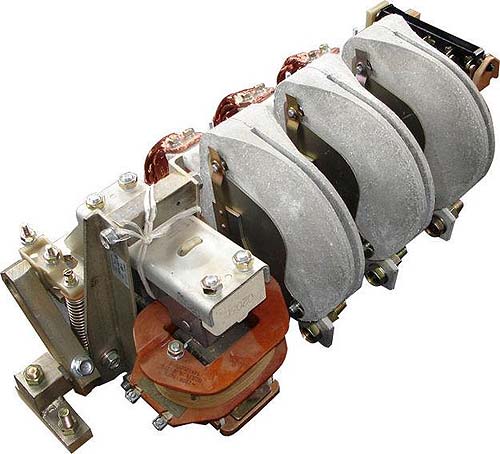
Отечественный контактор КТ-6063Число полюсов: 3
Номинальное напряжение главной цепи: 380 В
Номинальный ток главной цепи: 1000 А
Номинальное напряжение катушки: 380 В переменного тока
Контакторы электромагнитные серии КТ 6000 с естественным воздушным охлаждением предназначены для включения и отключения приемников электрической энергии на номинальное напряжение до 380 В переменного тока частоты 50 и 60Гц.
Используются в составе оборудования для включения мощных электрических машин и в аппаратуре автоматического включения резерва (АВР).3. Контакторами называют также коммутационные аппараты, коммутационная способность которых больше коммутационной способности реле (см. рис. ниже)
[Интент]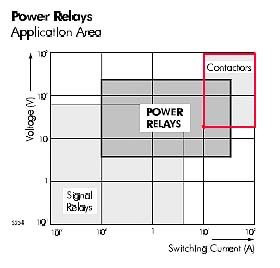
Рис. Tyco ElectronicsПараллельные тексты EN-RU
Although contactors are not strictly relays they have the same design principles. Like relays, they are remote controlled switches.
The difference is the considerably higher input power consumption, higher switching capacity, and larger size.
[Tyco Electronics]Хотя, строго говоря, контакторы не являются реле, их конструкция имеет много общего с конструкцией реле. Также как и реле, они представляют собой коммутационный аппарат с дистационным управлением.
Отличие состоит в том, что их входная цепь потребляет значительно больший ток, они имеют существенно большую коммутационную способность и их размеры также больше размеров реле.
[Перевод Интент]Недопустимые, нерекомендуемые
Тематики
Действия
Неправильно:- замыкать контактор; - размыкать контакторСинонимы
EN
- contact-maker
- contactor
- electric contactor
- electromechanical contactor
- M/C
- magnetic contactor
- mechanical contactor
- power contactor
DE
FR
Немецко-русский словарь нормативно-технической терминологии > Kontaktgeber
-
36 Schütz
контактор (механический) 1
Контактный коммутационный аппарат с единственным положением покоя, с управлением не вручную, способным включать, проводить и отключать токи в нормальных условиях цепи, в том числе при рабочих перегрузках.
МЭК 60050(441-14-33).
Примечание. Контакторы можно характеризовать способом, которым обеспечивается создание усилия для замыкания главных контактов
[ ГОСТ Р 50030. 1-2000 ( МЭК 60947-1-99)]
контактор
Двухпозиционный аппарат с самовозвратом, предназначенный для частых коммутаций токов, не превышающих токи перегрузки, и приводимый в действие двигательным приводом.
Примечание. Для аналогичных аппаратов без самовозврата следует применять термин «Контактор без самовозврата».
[ ГОСТ 17703-72]
контактор
Выключатель для дистанционного включения, отключения и переключения силовых электрических цепей
[Терминологический словарь по строительству на 12 языках (ВНИИИС Госстроя СССР)]EN
(mechanical) contactor
a mechanical switching device having only one position of rest, operated otherwise than by hand, capable of making, carrying and breaking currents under normal circuit conditions including operating overload conditions
NOTE – Contactors may be designated according to the method by which the force for closing the main contacts is provided.
[IEV number 441-14-33]FR
contacteur (mécanique)
appareil mécanique de connexion ayant une seule position de repos, commandé autrement qu'à la main, capable d'établir, de supporter et d'interrompre des courants dans les conditions normales du circuit, y compris les conditions de surcharge en service
NOTE – Les contacteurs peuvent être désignés suivant la façon dont est fourni l'effort nécessaire à la fermeture des contacts principaux.
[IEV number 441-14-33]1 Должно быть " контактный"
См., например, выключатель (контактный) - (mechanical) switch
Коммутационные аппараты следует классифицировать на контактные и полупроводниковые (solid-state)
[Интент]1. Контактор на относительно небольшой номинальный ток, это такой же коммутационный аппарат, как и пускатель, но без теплового реле (можно сказать, что пускатель это контактор плюс тепловое реле).
2. Контактор на большой номинальный ток выглядит совсем иначе
Отечественный контактор КТ-6063Число полюсов: 3
Номинальное напряжение главной цепи: 380 В
Номинальный ток главной цепи: 1000 А
Номинальное напряжение катушки: 380 В переменного тока
Контакторы электромагнитные серии КТ 6000 с естественным воздушным охлаждением предназначены для включения и отключения приемников электрической энергии на номинальное напряжение до 380 В переменного тока частоты 50 и 60Гц.
Используются в составе оборудования для включения мощных электрических машин и в аппаратуре автоматического включения резерва (АВР).3. Контакторами называют также коммутационные аппараты, коммутационная способность которых больше коммутационной способности реле (см. рис. ниже)
[Интент]
Рис. Tyco ElectronicsПараллельные тексты EN-RU
Although contactors are not strictly relays they have the same design principles. Like relays, they are remote controlled switches.
The difference is the considerably higher input power consumption, higher switching capacity, and larger size.
[Tyco Electronics]Хотя, строго говоря, контакторы не являются реле, их конструкция имеет много общего с конструкцией реле. Также как и реле, они представляют собой коммутационный аппарат с дистационным управлением.
Отличие состоит в том, что их входная цепь потребляет значительно больший ток, они имеют существенно большую коммутационную способность и их размеры также больше размеров реле.
[Перевод Интент]Недопустимые, нерекомендуемые
Тематики
Действия
Неправильно:- замыкать контактор; - размыкать контакторСинонимы
EN
- contact-maker
- contactor
- electric contactor
- electromechanical contactor
- M/C
- magnetic contactor
- mechanical contactor
- power contactor
DE
FR
Немецко-русский словарь нормативно-технической терминологии > Schütz
-
37 tauchfest
погружаемый
-
[IEV number 151-16-42]EN
submersible, adj
capable of operating even when immersed in a specified liquid under specified conditions
NOTE 1 – Specified conditions include depth or pressure.
NOTE 2 – An example of submersible device is a submarine cable.
[IEV number 151-16-42]FR
submersible, adj
capable de fonctionner même en immersion dans un liquide spécifié et dans des conditions spécifiées
NOTE 1 – Les conditions spécifiées comprennent la profondeur ou la pression.
NOTE 2 – Un exemple de dispositif submersible est un câble sous-marin.
[IEV number 151-16-42]EN
DE
FR
Немецко-русский словарь нормативно-технической терминологии > tauchfest
-
38 Grenz-Nichtauslösedauer
предельное время неотключения
-
[IEV number 442-05-23]EN
limiting non-actuating time
maximum delay during which a value of residual current higher than the residual non-operating current can be applied to the residual current device without bringing it actually to operate
[IEV number 442-05-23]FR
temps limite de non-réponse
temps maximal pendant lequel on peut appliquer au dispositif de coupure différentiel une valeur du courant différentiel supérieure à la valeur du courant différentiel de non-fonctionnement, sans provoquer son fonctionnement effectif
[IEV number 442-05-23]Тематики
- электротехника, основные понятия
EN
DE
FR
Немецко-русский словарь нормативно-технической терминологии > Grenz-Nichtauslösedauer
-
39 Strombegrenzer
токовый расцепитель 1)
-
[IEV number 442-01-44]EN
current cut-out
a current sensing device intended to switch-off automatically under abnormal operating condition and which has no provision for adjustment by the user
[IEV number 442-01-44]FR
limiteur de courant
dispositif sensible au courant, destiné à interrompre automatiquement un circuit dans des conditions de fonctionnement anormal, et qui ne peut être réglé par l'usager
[IEV number 442-01-44]1) Должно быть расцепитель тока
[Интент]EN
DE
FR
электрическое реле тока
Измерительное электрическое реле, для которого характеристической величиной является электрический ток
[ ГОСТ 16022-83]EN
-
FR
-
Тематики
Классификация
>>>Синонимы
EN
DE
FR
Немецко-русский словарь нормативно-технической терминологии > Strombegrenzer
-
40 Überstromauslöser
токовый расцепитель 1)
-
[IEV number 442-01-44]EN
current cut-out
a current sensing device intended to switch-off automatically under abnormal operating condition and which has no provision for adjustment by the user
[IEV number 442-01-44]FR
limiteur de courant
dispositif sensible au courant, destiné à interrompre automatiquement un circuit dans des conditions de fonctionnement anormal, et qui ne peut être réglé par l'usager
[IEV number 442-01-44]1) Должно быть расцепитель тока
[Интент]EN
DE
FR
Немецко-русский словарь нормативно-технической терминологии > Überstromauslöser
См. также в других словарях:
Operating device — Действующее устройство … Краткий толковый словарь по полиграфии
Operating system — Operating systems … Wikipedia
Device driver — Operating systems Common features … Wikipedia
Operating cost — Operating costs can be described as the expenses which are related to the operation of a business, or to the operation of a device, component, piece of equipment or facility. Business operating costs For a commercial enterprise, operating costs… … Wikipedia
Operating system advocacy — is the practice of attempting to increase the awareness and improve the perception of a computer operating system. The motivation behind this may be to increase the number of users of a system, to assert the superiority of one choice over another … Wikipedia
Operating system-level virtualization — is a server virtualization method where the kernel of an operating system allows for multiple isolated user space instances, instead of just one. Such instances (often called containers, VEs, VPSs or jails) may look and feel like a real server,… … Wikipedia
Device independence — is the process of making a software application be able to function on a wide variety of devices regardless of the local hardware on which the software is used. Contents 1 Desktop computing 2 Virtualization and Emulation 3 World Wide Web Usage … Wikipedia
Operating system development — is one of the more involved and technical options for a computer hobbyist. A hobby operating system is classified as one with little or no support from other developers. [1] Development begins with an existing operating system[citation needed].… … Wikipedia
Device Bay — was a standard jointly developed by Compaq, Intel and Microsoft in 1997, as a simple way to add, remove, and share hardware devices. Originally intended to be introduced in the second half of 1998, Device Bay was never finalized and has long… … Wikipedia
Device Remover — is an alternate freeware Device Manager for Microsoft Windows developed by Kerem Gümrükcü. It requires at minimum the Microsoft .NET Framework Version 2.0 Redistributable in order to operate successfully on Windows NT based Operating Systems. It… … Wikipedia
Device driver synthesis and verification — The device driver is a program which allows the software or higher level computer programs to interact with a hardware device. These software components act as a link between the devices and the operating systems, communicating with each of these … Wikipedia
