

-
61 backlog
Opsthe buildup of unfulfilled orders for a product or process that is behind schedule. A backlog can result from bad scheduling, production delays, an unanticipated demand for a product or process, or where the capacity of the process is not able to keep up with demand. Some large products, for example, aircraft and ships, have to be built to a backlog of orders as it is not feasible to supply them on demand. -
62 Dow, Herbert Henry
SUBJECT AREA: Metallurgy[br]b. 26 February 1866 Belleville, Ontario, Canadad. 15 October 1930 Rochester, Minnesota, USA[br]American industrial chemist, pioneer manufacturer of magnesium alloys.[br]Of New England ancestry, his family returned there soon after his birth and later moved to Cleveland, Ohio. In 1884, Dow entered the Case School of Applied Science, graduating in science four years later. His thesis dealt partly with the brines of Ohio, and he was persuaded to present a paper on brine to the meeting of the American Association for he Advancement of Science being held in Cleveland the same year. That entailed visits to collect samples of brines from various localities, and led to the observation that their composition varied, one having a higher lithium content while another was richer in bromine. This study of brines proved to be the basis for his career in industrial chemistry. In 1888 Dow was appointed Professor of Chemistry at the Homeopathic Hospital College in Cleveland, but he continued to work on brine, obtaining a patent in the same year for extracting bromine by blowing air through slightly electrolysed brine. He set up a small company to exploit the process, but it failed; the process was taken up and successfully worked by the Midland Chemical Company in Midland, Michigan. The electrolysis required a direct-current generator which, when it was installed in 1892, was probably the first of its kind in America. Dow next set up a company to produce chlorine by the electrolysis of brine. It moved to Midland in 1896, and the Dow Central Company purchased the Midland Chemical Company in 1900. Its main concern was the manufacture of bleaching powder, but the company continued to grow, based on Dow's steady development of chemical compounds that could be derived from brines. His search for further applications of chlorine led to the making of insecticides and an interest in horticulture. Meanwhile, his experience at the Homeopathic Hospital doubtless fired an interest in pharmaceuticals. One of the substances found in brine was magnesium chloride, and by 1918 magnesium metal was being produced on a small scale by electrolysis. An intensive study of its alloys followed, leading to the large-scale production of these important light-metal alloys, under the name of Dowmetals. Two other "firsts" achieved by the company were the synthetic indigo process and the production of the element iodine in the USA. The Dow company became one of the leading chemical manufacturers in the USA, and at the same time Dow played an active part in public life, serving on many public and education boards.[br]Principal Honours and DistinctionsSociety of Chemical Industry Perkin Medal 1930.BibliographyDow was granted 65 patents for a wide range of chemical processes.Further ReadingObituary, 1930, Ind. Eng. Chem. (October)."The Dow Chemical Company", 1925, Ind. Eng. Chem. (September)LRD -
63 Monro, Philip Peter
SUBJECT AREA: Chemical technology[br]b. 27 May 1946 London, England[br]English biologist, inventor of a water-purification process by osmosis.[br]Monro's whole family background is engineering, an interest he did not share. Instead, he preferred biology, an enthusiasm aroused by reading the celebrated Science of Life by H.G. and G.P.Wells and Julian Huxley. Educated at a London comprehensive school, Monro found it necessary to attend evening classes while at school to take his advanced level science examinations. Lacking parental support, he could not pursue a degree course until he was 21 years old, and so he gained valuable practical experience as a research technician. He resumed his studies and took a zoology degree at Portsmouth Polytechnic. He then worked in a range of zoology and medical laboratories, culminating after twelve years as a Senior Experimental Officer at Southampton Medical School. In 1989 he relinquished his post to devote himself fall time to developing his inventions as Managing Director of Hampshire Advisory and Technical Services Ltd (HATS). Also in 1988 he obtained his PhD from Southampton University, in the field of embryology.Monro had meanwhile been demonstrating a talent for invention, mainly in microscopy. His most important invention, however, is of a water-purification system. The idea for it came from Michael Wilson of the Institute of Dental Surgery in London, who evolved a technique for osmotic production of sterile oral rehydration solutions, of particular use in treating infants suffering from diarrhoea in third-world countries. Monro broadened the original concept to include dried food, intravenous solutions and even dried blood. The process uses simple equipment and no external power and works as follows: a dry sugar/salts mixture is sealed in one compartment of a double bag, the common wall of which is a semipermeable membrane. Impure water is placed in the empty compartment and the water transfers across the membrane by the osmotic force of the sugar/salts. As the pores in the membrane exclude all viruses, bacteria and their toxins, a sterile solution is produced.With the help of a research fellowship granted for humanitarian reasons at King Alfred College, Winchester, the invention was developed to functional prototype stage in 1993, with worldwide patent protection. Commercial production was expected to follow, if sufficient financial backing were forthcoming. The process is not intended to replace large installations, but will revolutionize the small-scale production of sterile water in scattered third-world communities and in disaster areas where normal services have been disrupted.HATS was awarded First Prize in the small business category and was overall prize winner in the Toshiba Year of Invention, received a NatWest/BP award for technology and a Prince of Wales Award for Innovation.[br]Bibliography1993, with M.Wilson and W.A.M.Cutting, "Osmotic production of sterile oral rehydration solutions", Tropical Doctor 23:69–72.LRD -
64 Pretsch, Paul
[br]b. 1808 Vienna, Austriad. 1873 Vienna, Austria[br]Austrian printer and inventor of photogalvanography, one of the earliest commercial photomechanical printing processes.[br]The son of a goldsmith, Pretsch learned the printing trade in Vienna, where he worked until 1831. He then took up a series of posts in Germany, Belgium and Holland before returning to Vienna, where in 1842 he joined the Imperial State Printing Office. The office was equipped with a photographic studio, and Pretsch was encouraged to explore applications of photography to printing and the graphic arts. In 1851 he was sent to London to take responsibility for the Austrian printing exhibits of the Great Exhibition. This event proved to be a significant international show case for photography and Pretsch saw a great number of recent innovations and made many useful contacts. On returning to Vienna, he began to develop a process for producing printing plates from photographs. Using Talbot's discovery that bichromated gelatine swells in water after exposure to light, he electrotyped the relief image obtained. In 1854 Pretsch resigned from his post in Vienna and travelled back to London, where he patented his process, calling it photogalvanography. He went on to form a business, the Photo-Galvano-Graphic Company, to print and market his pictures.The Photographic Manager of the company was the celebrated photographer Roger Fenton, recently returned from his exploits on the battlefields of the Crimea. In 1856 the company issued a large serial work, Photographic Art Treasures, illustrated with Pretsch's pictures, which created considerable interest. The venture did not prove a commercial success, however, and although further plates were made and issued, Fenton found other interests to pursue and Pretsch was left to try to apply some of his ideas to lithography. This too had no successful outcome, and in 1863 Pretsch returned to Vienna. He was reappointed to a post at the Imperial State Printing Office, but his health failed and he made no further progress with his processes.[br]Bibliography9 November 1854, British patent no. 2,373. 11 August 1855, British patent no. 1,824.Further ReadingJ.M.Eder, 1945, History of Photography, trans. E. Epstean, New York.H.Gernsheim and A.Gernsheim, 1969, The History of Photography, rev. edn, London. H.J.P.Arnold, 1977, William Henry Fox Talbot, London (an account of the relationship with Talbot's process).JW -
65 Talbot, Benjamin
SUBJECT AREA: Metallurgy[br]b. 19 September 1864 Wellington, Shropshire, Englandd. 16 December 1947 Solberge Hall, Northallerton, Yorkshire, England[br]Talbot, William Henry Fox English steelmaker and businessman who introduced a technique for producing steel "continuously" in large tilting basic-lined open-hearth furnaces.[br]After spending some years at his father's Castle Ironworks and at Ebbw Vale Works, Talbot travelled to the USA in 1890 to become Superintendent of the Southern Iron and Steel Company of Chattanooga, Tennessee, where he initiated basic open-hearth steelmaking and a preliminary slag washing to remove silicon. In 1893 he moved to Pennsylvania as Steel Superintendent at the Pencoyd works; there, six years later, he began his "continuous" steelmaking process. Returning to Britain in 1900, Talbot marketed the technique: after ten years it was in successful use in Britain, continental Europe and the USA; it promoted the growth of steel production.Meanwhile its originator had joined the Cargo Fleet Iron Company Limited on Teesside, where he was made Managing Director in 1907. Twelve years later he assumed, in addition, the same position in the allied South Durham Steel and Iron Company Limited. While remaining Managing Director, he was appointed Deputy Chairman of both companies in 1925, and Chairman in 1940. The companies he controlled survived the depressed 1920s and 1930s and were significant contributors to British steel output, with a capacity of more than half a million tonnes per year.[br]Principal Honours and DistinctionsPresident, Iron and Steel Institute 1928, and (British) National Federation of Iron and Steel Manufacturers. Iron and Steel Institute (London) Bessemer Gold Medal 1908. Franklin Institute (Philadelphia), Elliott Cresson Gold Medal, and John Scott Medal 1908.Bibliography1900, "The open-hearth continuous steel process", Journal of the Iron and Steel Institute 57 (1):33–61.1903, "The development of the continuous open-hearth process", Journal of the Iron and Steel Institute 63(1):57–73.1905, "Segregation in steel ingots", Journal of the Iron and Steel Institute 68(2):204–23. 1913, "The production of sound steel by lateral compression of the ingot whilst its centre is liquid", Journal of the Iron and Steel Institute 87(1):30–55.Further ReadingG.Boyce, 1986, entry in Dictionary of Business Biography, Vol. V, ed. J.Jeremy, Butterworth.W.G.Willis, 1969, South Durham Steel and Iron Co. Ltd, South Durham Steel and Iron Company Ltd (includes a few pages specifically on Talbot, and a portrait photo). J.C.Carr and W.Taplin, 1962, History of the British Steel Industry, Cambridge, Mass.: Harvard University Press (mentions Talbot's business attitudes).JKA -
66 Language
Philosophy is written in that great book, the universe, which is always open, right before our eyes. But one cannot understand this book without first learning to understand the language and to know the characters in which it is written. It is written in the language of mathematics, and the characters are triangles, circles, and other figures. Without these, one cannot understand a single word of it, and just wanders in a dark labyrinth. (Galileo, 1990, p. 232)It never happens that it [a nonhuman animal] arranges its speech in various ways in order to reply appropriately to everything that may be said in its presence, as even the lowest type of man can do. (Descartes, 1970a, p. 116)It is a very remarkable fact that there are none so depraved and stupid, without even excepting idiots, that they cannot arrange different words together, forming of them a statement by which they make known their thoughts; while, on the other hand, there is no other animal, however perfect and fortunately circumstanced it may be, which can do the same. (Descartes, 1967, p. 116)Human beings do not live in the object world alone, nor alone in the world of social activity as ordinarily understood, but are very much at the mercy of the particular language which has become the medium of expression for their society. It is quite an illusion to imagine that one adjusts to reality essentially without the use of language and that language is merely an incidental means of solving specific problems of communication or reflection. The fact of the matter is that the "real world" is to a large extent unconsciously built on the language habits of the group.... We see and hear and otherwise experience very largely as we do because the language habits of our community predispose certain choices of interpretation. (Sapir, 1921, p. 75)It powerfully conditions all our thinking about social problems and processes.... No two languages are ever sufficiently similar to be considered as representing the same social reality. The worlds in which different societies live are distinct worlds, not merely the same worlds with different labels attached. (Sapir, 1985, p. 162)[A list of language games, not meant to be exhaustive:]Giving orders, and obeying them- Describing the appearance of an object, or giving its measurements- Constructing an object from a description (a drawing)Reporting an eventSpeculating about an eventForming and testing a hypothesisPresenting the results of an experiment in tables and diagramsMaking up a story; and reading itPlay actingSinging catchesGuessing riddlesMaking a joke; and telling itSolving a problem in practical arithmeticTranslating from one language into anotherLANGUAGE Asking, thanking, cursing, greeting, and praying-. (Wittgenstein, 1953, Pt. I, No. 23, pp. 11 e-12 e)We dissect nature along lines laid down by our native languages.... The world is presented in a kaleidoscopic flux of impressions which has to be organized by our minds-and this means largely by the linguistic systems in our minds.... No individual is free to describe nature with absolute impartiality but is constrained to certain modes of interpretation even while he thinks himself most free. (Whorf, 1956, pp. 153, 213-214)We dissect nature along the lines laid down by our native languages.The categories and types that we isolate from the world of phenomena we do not find there because they stare every observer in the face; on the contrary, the world is presented in a kaleidoscopic flux of impressions which has to be organized by our minds-and this means largely by the linguistic systems in our minds.... We are thus introduced to a new principle of relativity, which holds that all observers are not led by the same physical evidence to the same picture of the universe, unless their linguistic backgrounds are similar or can in some way be calibrated. (Whorf, 1956, pp. 213-214)9) The Forms of a Person's Thoughts Are Controlled by Unperceived Patterns of His Own LanguageThe forms of a person's thoughts are controlled by inexorable laws of pattern of which he is unconscious. These patterns are the unperceived intricate systematizations of his own language-shown readily enough by a candid comparison and contrast with other languages, especially those of a different linguistic family. (Whorf, 1956, p. 252)It has come to be commonly held that many utterances which look like statements are either not intended at all, or only intended in part, to record or impart straightforward information about the facts.... Many traditional philosophical perplexities have arisen through a mistake-the mistake of taking as straightforward statements of fact utterances which are either (in interesting non-grammatical ways) nonsensical or else intended as something quite different. (Austin, 1962, pp. 2-3)In general, one might define a complex of semantic components connected by logical constants as a concept. The dictionary of a language is then a system of concepts in which a phonological form and certain syntactic and morphological characteristics are assigned to each concept. This system of concepts is structured by several types of relations. It is supplemented, furthermore, by redundancy or implicational rules..., representing general properties of the whole system of concepts.... At least a relevant part of these general rules is not bound to particular languages, but represents presumably universal structures of natural languages. They are not learned, but are rather a part of the human ability to acquire an arbitrary natural language. (Bierwisch, 1970, pp. 171-172)In studying the evolution of mind, we cannot guess to what extent there are physically possible alternatives to, say, transformational generative grammar, for an organism meeting certain other physical conditions characteristic of humans. Conceivably, there are none-or very few-in which case talk about evolution of the language capacity is beside the point. (Chomsky, 1972, p. 98)[It is] truth value rather than syntactic well-formedness that chiefly governs explicit verbal reinforcement by parents-which renders mildly paradoxical the fact that the usual product of such a training schedule is an adult whose speech is highly grammatical but not notably truthful. (R. O. Brown, 1973, p. 330)he conceptual base is responsible for formally representing the concepts underlying an utterance.... A given word in a language may or may not have one or more concepts underlying it.... On the sentential level, the utterances of a given language are encoded within a syntactic structure of that language. The basic construction of the sentential level is the sentence.The next highest level... is the conceptual level. We call the basic construction of this level the conceptualization. A conceptualization consists of concepts and certain relations among those concepts. We can consider that both levels exist at the same point in time and that for any unit on one level, some corresponding realizate exists on the other level. This realizate may be null or extremely complex.... Conceptualizations may relate to other conceptualizations by nesting or other specified relationships. (Schank, 1973, pp. 191-192)The mathematics of multi-dimensional interactive spaces and lattices, the projection of "computer behavior" on to possible models of cerebral functions, the theoretical and mechanical investigation of artificial intelligence, are producing a stream of sophisticated, often suggestive ideas.But it is, I believe, fair to say that nothing put forward until now in either theoretic design or mechanical mimicry comes even remotely in reach of the most rudimentary linguistic realities. (Steiner, 1975, p. 284)The step from the simple tool to the master tool, a tool to make tools (what we would now call a machine tool), seems to me indeed to parallel the final step to human language, which I call reconstitution. It expresses in a practical and social context the same understanding of hierarchy, and shows the same analysis by function as a basis for synthesis. (Bronowski, 1977, pp. 127-128)t is the language donn eґ in which we conduct our lives.... We have no other. And the danger is that formal linguistic models, in their loosely argued analogy with the axiomatic structure of the mathematical sciences, may block perception.... It is quite conceivable that, in language, continuous induction from simple, elemental units to more complex, realistic forms is not justified. The extent and formal "undecidability" of context-and every linguistic particle above the level of the phoneme is context-bound-may make it impossible, except in the most abstract, meta-linguistic sense, to pass from "pro-verbs," "kernals," or "deep deep structures" to actual speech. (Steiner, 1975, pp. 111-113)A higher-level formal language is an abstract machine. (Weizenbaum, 1976, p. 113)Jakobson sees metaphor and metonymy as the characteristic modes of binarily opposed polarities which between them underpin the two-fold process of selection and combination by which linguistic signs are formed.... Thus messages are constructed, as Saussure said, by a combination of a "horizontal" movement, which combines words together, and a "vertical" movement, which selects the particular words from the available inventory or "inner storehouse" of the language. The combinative (or syntagmatic) process manifests itself in contiguity (one word being placed next to another) and its mode is metonymic. The selective (or associative) process manifests itself in similarity (one word or concept being "like" another) and its mode is metaphoric. The "opposition" of metaphor and metonymy therefore may be said to represent in effect the essence of the total opposition between the synchronic mode of language (its immediate, coexistent, "vertical" relationships) and its diachronic mode (its sequential, successive, lineal progressive relationships). (Hawkes, 1977, pp. 77-78)It is striking that the layered structure that man has given to language constantly reappears in his analyses of nature. (Bronowski, 1977, p. 121)First, [an ideal intertheoretic reduction] provides us with a set of rules"correspondence rules" or "bridge laws," as the standard vernacular has it-which effect a mapping of the terms of the old theory (T o) onto a subset of the expressions of the new or reducing theory (T n). These rules guide the application of those selected expressions of T n in the following way: we are free to make singular applications of their correspondencerule doppelgangers in T o....Second, and equally important, a successful reduction ideally has the outcome that, under the term mapping effected by the correspondence rules, the central principles of T o (those of semantic and systematic importance) are mapped onto general sentences of T n that are theorems of Tn. (P. Churchland, 1979, p. 81)If non-linguistic factors must be included in grammar: beliefs, attitudes, etc. [this would] amount to a rejection of the initial idealization of language as an object of study. A priori such a move cannot be ruled out, but it must be empirically motivated. If it proves to be correct, I would conclude that language is a chaos that is not worth studying.... Note that the question is not whether beliefs or attitudes, and so on, play a role in linguistic behavior and linguistic judgments... [but rather] whether distinct cognitive structures can be identified, which interact in the real use of language and linguistic judgments, the grammatical system being one of these. (Chomsky, 1979, pp. 140, 152-153)23) Language Is Inevitably Influenced by Specific Contexts of Human InteractionLanguage cannot be studied in isolation from the investigation of "rationality." It cannot afford to neglect our everyday assumptions concerning the total behavior of a reasonable person.... An integrational linguistics must recognize that human beings inhabit a communicational space which is not neatly compartmentalized into language and nonlanguage.... It renounces in advance the possibility of setting up systems of forms and meanings which will "account for" a central core of linguistic behavior irrespective of the situation and communicational purposes involved. (Harris, 1981, p. 165)By innate [linguistic knowledge], Chomsky simply means "genetically programmed." He does not literally think that children are born with language in their heads ready to be spoken. He merely claims that a "blueprint is there, which is brought into use when the child reaches a certain point in her general development. With the help of this blueprint, she analyzes the language she hears around her more readily than she would if she were totally unprepared for the strange gabbling sounds which emerge from human mouths. (Aitchison, 1987, p. 31)Looking at ourselves from the computer viewpoint, we cannot avoid seeing that natural language is our most important "programming language." This means that a vast portion of our knowledge and activity is, for us, best communicated and understood in our natural language.... One could say that natural language was our first great original artifact and, since, as we increasingly realize, languages are machines, so natural language, with our brains to run it, was our primal invention of the universal computer. One could say this except for the sneaking suspicion that language isn't something we invented but something we became, not something we constructed but something in which we created, and recreated, ourselves. (Leiber, 1991, p. 8)Historical dictionary of quotations in cognitive science > Language
-
67 LEP
1) Медицина: Limited English Proficient2) Американизм: Limited English Population3) Военный термин: Linear Error Probable, locally enlisted personnel, logistics evaluation process, Low Emissivity Paint4) Техника: local emergency protection, lowest effective power5) Химия: Large Electron Positron6) Юридический термин: Law Enforcement Pistol, Lower Elements Police7) Ветеринария: Light Everyday Ponies8) Сокращение: Laser Eye Protection, Light External Pintle (Belgium)9) Физика: Large Electron-Positron collider10) Электроника: Light Emitting Polymer, Lissajous Electron Plasma11) Вычислительная техника: Large Electron-Positron collider (CERN)12) Образование: Limited English Proficiency13) Макаров: limited energy plant14) Расширение файла: Light-Emitting Polymers15) Нефть и газ: линия электропередачи16) Должность: Licensed Environmental Professional, Literal Experience Person -
68 Lep
1) Медицина: Limited English Proficient2) Американизм: Limited English Population3) Военный термин: Linear Error Probable, locally enlisted personnel, logistics evaluation process, Low Emissivity Paint4) Техника: local emergency protection, lowest effective power5) Химия: Large Electron Positron6) Юридический термин: Law Enforcement Pistol, Lower Elements Police7) Ветеринария: Light Everyday Ponies8) Сокращение: Laser Eye Protection, Light External Pintle (Belgium)9) Физика: Large Electron-Positron collider10) Электроника: Light Emitting Polymer, Lissajous Electron Plasma11) Вычислительная техника: Large Electron-Positron collider (CERN)12) Образование: Limited English Proficiency13) Макаров: limited energy plant14) Расширение файла: Light-Emitting Polymers15) Нефть и газ: линия электропередачи16) Должность: Licensed Environmental Professional, Literal Experience Person -
69 lep
1) Медицина: Limited English Proficient2) Американизм: Limited English Population3) Военный термин: Linear Error Probable, locally enlisted personnel, logistics evaluation process, Low Emissivity Paint4) Техника: local emergency protection, lowest effective power5) Химия: Large Electron Positron6) Юридический термин: Law Enforcement Pistol, Lower Elements Police7) Ветеринария: Light Everyday Ponies8) Сокращение: Laser Eye Protection, Light External Pintle (Belgium)9) Физика: Large Electron-Positron collider10) Электроника: Light Emitting Polymer, Lissajous Electron Plasma11) Вычислительная техника: Large Electron-Positron collider (CERN)12) Образование: Limited English Proficiency13) Макаров: limited energy plant14) Расширение файла: Light-Emitting Polymers15) Нефть и газ: линия электропередачи16) Должность: Licensed Environmental Professional, Literal Experience Person -
70 part
part [pɑ:t]partie ⇒ 1 (a) rôle ⇒ 1 (b) pièce ⇒ 1 (c) quartier ⇒ 1 (d) episode ⇒ 1 (e) mesure ⇒ 1 (f) s'entrouvrir ⇒ 3 (a) s'ouvrir ⇒ 3 (a) se quitter ⇒ 3 (b) entrouvrir ⇒ 4 (a) écarter ⇒ 4 (a) séparer ⇒ 4 (b)1 noun(a) (gen → portion, subdivision) partie f;∎ the exam is in two parts l'examen est en deux parties;∎ see part one, section two voir première partie, section deux;∎ the parts of the body les parties fpl du corps;∎ (a) part of the garden is flooded une partie du jardin est inondée;∎ (a) part of me strongly agrees with them sur un certain plan, je suis tout à fait d'accord avec eux;∎ that's only part of the problem ce n'est qu'un des aspects du problème;∎ it's very much part of the game/of the process ça fait partie du jeu/du processus;∎ it's all part of growing up c'est ce qui se passe quand on grandit;∎ we've finished the hardest part nous avons fait le plus dur;∎ I haven't told you the best part yet je ne t'ai pas encore dit le plus beau ou la meilleure;∎ the best/worst part was when he started laughing le mieux/le pire ça a été quand il s'est mis à rire;∎ in the early part of the week au début ou dans les premiers jours de la semaine;∎ for the best or greater part of five years (to wait, last etc) presque cinq ans;∎ the greater part of the population la plus grande partie de la population;∎ to be (a) part of sth (be involved with) faire partie de qch;∎ he desperately wants to be a part of her organization il veut à tout prix faire partie de son organisme;∎ to form part of sth faire partie de qch;∎ to be part and parcel of sth faire partie (intégrante) de qch∎ who played the part of Hamlet? qui a joué le rôle de Hamlet?;∎ figurative he's just playing a part il joue la comédie;∎ to know one's part connaître son texte;∎ work plays a large part in our lives le travail joue un rôle important dans notre vie;∎ she played a large part in persuading the company to relocate c'est surtout elle qui a persuadé l'entreprise de se relocaliser;∎ to take part (in sth) prendre part ou participer (à qch);∎ she takes an active part in decision-making elle participe activement au processus de prise de décision;∎ I had no part in that affair je n'ai joué aucun rôle dans cette affaire;∎ he has no part in the running of the company il ne participe pas à ou il n'intervient pas dans la gestion de la société;∎ Joe had no part in it Joe n'y était pour rien;∎ I want no part in or of their schemes je ne veux pas être mêlé à leurs projets;∎ to do one's part y mettre du sien;∎ to dress the part se mettre en tenue de circonstance;∎ to look the part avoir la tenue de circonstance;∎ for my/his part pour ma/sa part(c) (component → of machine) pièce f;∎ spare parts pièces fpl détachées ou de rechange;∎ parts and labour warranty garantie f pièces et main-d'œuvre(d) (area → of country, town etc)∎ which part of England are you from? vous êtes d'où en Angleterre?, de quelle région de l'Angleterre venez-vous?;∎ in some parts of Sydney/Australia dans certains quartiers de Sydney/certaines régions de l'Australie;∎ it's a dangerous part of town c'est un quartier dangereux;∎ are you new to these parts? vous êtes nouveau ici?;∎ they are not from our part of the world ils ne sont pas de chez nous;∎ she's travelling in foreign parts elle est en voyage à l'étranger∎ don't miss part two! (of serial) ne manquez pas le deuxième épisode!; (of programme in two parts) ne manquez pas la deuxième partie!∎ one part of pastis and four parts of water une mesure de pastis et quatre mesures d'eau;∎ Chemistry a concentration of six parts per million une concentration de six pour un million;∎ the bottle was three parts empty la bouteille était aux trois quarts vide∎ he always takes his mother's part il prend toujours le parti de sa mère;∎ to take sth in good part bien prendre qch∎ the vocal/violin part la partie vocale/(pour) violon;∎ to sing in three parts chanter à trois voix2 adverben partie, partiellement;∎ the jacket is part cotton, part polyester la veste est un mélange de coton et de polyester ou un mélange coton-polyester;∎ he's part English, part Chinese il est moitié anglais, moitié chinois;∎ a mythical creature, part woman, part fish une créature mythique mi-femme, mi-poisson(a) (move apart → lips, curtains) s'entrouvrir; (→ legs) s'écarter, s'ouvrir; (→ crowd) s'ouvrir; (disengage → fighters) se séparer;∎ the clouds parted il y eut une éclaircie(b) (leave one another) se quitter;∎ they parted good friends ils se sont quittés bons amis∎ her lips were slightly parted ses lèvres étaient entrouvertes∎ the children were parted from their parents les enfants ont été séparés de leurs parents;∎ humorous he's not easily parted from his cash il ne se sépare pas facilement de son argent∎ her hair's parted in the middle elle a la raie au milieu(talents) talents mpl;∎ a man/woman of many parts un homme/une femme de talentdans l'ensemble;∎ the day will be sunny for the most part la journée sera ensoleillée dans l'ensemble;∎ for the most part we get along pretty well dans l'ensemble, nous nous entendons assez bienen partie;∎ it's true in part c'est en partie vrai;∎ it's in large part true c'est en grande partie vrai;∎ the problem stems in part from a misunderstanding le problème vient en partie d'un malentendupar endroits;∎ the book is good in parts le livre est bon par endroits, certains passages du livre sont bons;∎ in parts the text is almost illegible le texte est presque illisible par endroitsde la part de;∎ it was negligence on the part of the landlord c'était une négligence de la part du propriétaire►► Commerce part consignment expédition f partielle;Commerce part exchange reprise f;∎ they'll take your old TV set in part exchange ils vous font une reprise sur or ils reprennent votre ancien téléviseur;∎ will you take it in part exchange? voulez-vous le reprendre?;Commerce part load chargement m partiel;part music musique f d'ensemble;part owner copropriétaire mf;part ownership copropriété f;part payment acompte m, paiement m partiel;∎ I received £500 in part payment for the car j'ai reçu un acompte de 500 livres pour la voiture;Commerce part shipment expédition f partielle;part singing chant m polyphonique or à plusieurs voix;part song chant m polyphonique or à plusieurs voix;part of speech partie f du discours;British part work ouvrage m à fascicules;∎ they published it as a part work ils l'ont publié sous forme de fasciculesse séparer de;∎ we'll have to part with most of the furniture nous devrons nous séparer de presque tous les meubles;∎ he hates parting with his money il a horreur de dépenser son argentⓘ Reaches the parts that other beers can't reach Il s'agit du slogan d'une série de publicités pour la bière Heineken pendant les années 70 dans lesquelles la bière était censée conférer des pouvoirs spéciaux à ceux qui la consommaient. Aujourd'hui on utilise encore cette formule ("atteint les parties que les autres bières ne peuvent atteindre"), en remplaçant le mot beers par un autre pour décrire les qualités de quelque chose de façon humoristique. On dira par exemple she makes tea that reaches the parts that other tea cannot reach ("elle fait du thé vraiment excellent"), ou this tour reaches the parts of Scotland that others don't ("ce circuit touristique explore les coins d'Écosse que les autres ignorent"). -
71 line
- электрическая линия
- шина (в электротехнике)
- силовая магнитная линия
- проводить линию
- провод
- облицовывать
- обивать (чем-либо) изнутри
- линия транспорта
- линия спуска
- линия коммуникаций
- линия вектора
- линия (связи)
- линия (передачи данных)
- линия (в фигурном катании)
- линия
- кривая на графике
- кривая (на диаграмме)
- канал (аппаратуры)
- агрегат (металлургия)
агрегат
1. Сборочная ед., обладающая полной взаимозаменяемостью, возможностью сборки отдельно от других составных частей или изделия в целом и способностью выполнять определенные функции в изделии или самостоятельно.
2. Механическое соединение неск. машин, станов или устройств, работающих в комплексе (напр., многоклетевой прокатный стан).
3. См. Металлургический агрегат.
[ http://metaltrade.ru/abc/a.htm]Тематики
EN
канал (аппаратуры)
—
[ http://slovarionline.ru/anglo_russkiy_slovar_neftegazovoy_promyishlennosti/]Тематики
EN
кривая (на диаграмме)
—
[ http://slovarionline.ru/anglo_russkiy_slovar_neftegazovoy_promyishlennosti/]Тематики
EN
кривая на графике
—
[А.С.Гольдберг. Англо-русский энергетический словарь. 2006 г.]Тематики
EN
- line
- L
линия
-
[IEV number 151-12-27]EN
line
device connecting two points for the purpose of conveying electromagnetic energy between them
NOTE 1 – Electromagnetic energy may be extracted from or supplied to a line at an intermediate point.
NOTE 2 – Examples of lines are two-wire line, polyphase line, coaxial line, waveguide.
Source: 466-01-01 MOD, 601-03-03 MOD
[IEV number 151-12-27]FR
ligne, f
dispositif reliant deux points et destiné à transmettre de l'énergie électromagnétique entre eux
NOTE 1 – De l'énergie électromagnétique peut être extraite d'une ligne ou lui être fournie en un point intermédiaire.
NOTE 2 – Des exemples de lignes sont une ligne bifilaire, une ligne polyphasée, une ligne coaxiale, un guide d'ondes.
Source: 466-01-01 MOD, 601-03-03 MOD
[IEV number 151-12-27]EN
DE
FR
линия
Позиция фигуриста относительно поверхности льда.
[Департамент лингвистических услуг Оргкомитета «Сочи 2014». Глоссарий терминов]EN
line
Skater's position relative to the ice surface.
[Департамент лингвистических услуг Оргкомитета «Сочи 2014». Глоссарий терминов]Тематики
EN
линия (передачи данных)
—
[Е.С.Алексеев, А.А.Мячев. Англо-русский толковый словарь по системотехнике ЭВМ. Москва 1993]Тематики
EN
линия вектора
—
[ http://www.eionet.europa.eu/gemet/alphabetic?langcode=en]EN
line
Term used in GIS technologies in the vector type of internal data organization: spatial data are divided into point, line and polygon types. In most cases, point entities (nodes) are specified directly as coordinate pairs, with lines (arcs or edges) represented as chains of points. Regions are similarly defined in terms of the lines which form their boundaries. Some vector GIS store information in the form of points, line segments and point pairs; others maintain closed lists of points defining polygon regions. Vector structures are especially suited to storing definitions of spatial objects for which sharp boundaries exist or can be imposed. (Source: YOUNG)
[http://www.eionet.europa.eu/gemet/alphabetic?langcode=en]Тематики
EN
DE
FR
линия спуска
Точный путь или оптимальная траектория спуска саней по желобу.
[Департамент лингвистических услуг Оргкомитета «Сочи 2014». Глоссарий терминов]EN
line
Precise path or the optimum trajectory of the sled.
[Департамент лингвистических услуг Оргкомитета «Сочи 2014». Глоссарий терминов]Тематики
- санный спорт, бобслей, скелетон
EN
линия транспорта
—
[ http://slovarionline.ru/anglo_russkiy_slovar_neftegazovoy_promyishlennosti/]Тематики
EN
обивать (чем-либо) изнутри
—
[ http://slovarionline.ru/anglo_russkiy_slovar_neftegazovoy_promyishlennosti/]Тематики
EN
облицовывать
футеровать (топку)
—
[А.С.Гольдберг. Англо-русский энергетический словарь. 2006 г.]Тематики
Синонимы
EN
провод
-
[IEV number 151-12-28]EN
wire
flexible cylindrical conductor, with or without an insulating covering, the length of which is large with respect to its cross-sectional dimensions
NOTE – The cross-section of a wire may have any shape, but the term "wire" is not generally used for ribbons or tapes.
[IEV number 151-12-28]FR
fil, m
conducteur cylindrique flexible, avec ou sans revêtement isolant, dont la longueur est grande par rapport aux dimensions de la section droite
NOTE – La section droite d'un fil peut avoir une forme quelconque, mais le terme "fil" n'est généralement pas employé pour une bande ou un ruban.
[IEV number 151-12-28]Тематики
- кабели, провода...
Действия
EN
DE
FR
силовая магнитная линия
—
[Я.Н.Лугинский, М.С.Фези-Жилинская, Ю.С.Кабиров. Англо-русский словарь по электротехнике и электроэнергетике, Москва, 1999 г.]Тематики
- электротехника, основные понятия
EN
шина
Проводник с низким сопротивлением, к которому можно подсоединить несколько отдельных электрических цепей.
Примечание — Термин «шина» не включает в себя геометрическую форму, габариты или размеры проводника.
[ ГОСТ Р 51321. 1-2000 ( МЭК 60439-1-92)]
[ ГОСТ Р МЭК 61439.1-2013]
шина
Конструктивный элемент низковольтного комплектного устройства (НКУ).
Такой конструктивный элемент предназначен для того, чтобы к нему можно было легко присоединить отдельные электрические цепи (другие шины, отдельные проводники). Такие шины могут иметь различную конструкцию, геометрическую форму и размеры.
[Интент]
шинопроводшина
Медная, алюминиевая, реже стальная полоса, служащая для присоединения кабелей электрогенераторов, трансформаторов и т.д. к проводам питающей сети
[Терминологический словарь по строительству на 12 языках (ВНИИИС Госстроя СССР)]
общаяшина
-
[IEV number 151-12-30]
шина
-
[Я.Н.Лугинский, М.С.Фези-Жилинская, Ю.С.Кабиров. Англо-русский словарь по электротехнике и электроэнергетике, Москва]EN
busbar
low-impedance conductor to which several electric circuits can be connected at separate points
NOTE – In many cases, the busbar consists of a bar.
[IEV number 151-12-30]
busbar
An electrical conductor that makes a common connection between several circuits. Sometimes, electrical wire cannot accommodate high-current applications, and electricity must be conducted using a more substantial busbar — a thick bar of solid metal (usually copper or aluminum). Busbars are uninsulated, but are physically supported by insulators. They are used in electrical substations to connect incoming and outgoing transmission lines and transformers; in a power plant to connect the generator and the main transformers; in industry, to feed large amounts of electricity to equipment used in the aluminum smelting process, for example, or to distribute electricity in large buildings
[ABB. Glossary of technical terms. 2010]FR
barre omnibus, f
conducteur de faible impédance auquel peuvent être reliés plusieurs circuits électriques en des points séparés
NOTE – Dans de nombreux cas, une barre omnibus est constituée d’une barre.
[IEV number 151-12-30]
2. Проводник прямоугольного сечения из меди, предназначенный для электротехнических целей
(см. ГОСТ 434-78).
Поставляется в бухтах, а также в полосах длиной не менее 2,5 м; По существу, это просто проволока прямоугольного сечения. В указанном ГОСТе и в технической документации, в которой она применяется, обязательно указываются размеры этой проволоки. Например, "Шина ШММ 8,00х40,00 ГОСТ 434-78"
шина
Пруток прямоугольного сечения, применяемый в электротехнике в качестве проводника тока, изготовляемый прессованием или волочением.
[ ГОСТ 25501-82]Тематики
- НКУ (шкафы, пульты,...)
- заготовки и полуфабрикаты в металлургии
- кабели, провода...
Действия
- расположение шин «на ребро» [ПУЭ]
- расположение шин «плашмя» [ПУЭ]
Сопутствующие термины
- гибкая шина
- жесткая шина [ПУЭ]
- изолированные шины [ПУЭ]
- круглые шины [ПУЭ]
- неизолированные шины [ПУЭ]
- обходные шины [ПУЭ]
- профильные шины [ПУЭ]
- секционные шины [ПУЭ]
- фазная шина [ ГОСТ Р 51321.1-2000]
- четырехполосные шины с расположением полос по сторонам квадрата ("полый пакет") [ПУЭ]
- шина PEN-проводника
- шина для присоединения защитных проводников
- шина нулевого защитного проводника
- шина фазы А (B, C) [ПУЭ]
- шины однофазного тока [ПУЭ]
- шины прямоугольного (круглого, трубчатого, коробчатого) сечения [ПУЭ]
- шины трехфазного тока [ПУЭ]
EN
DE
FR
электрическая линия
Совокупность проводов, изоляторов и несущих конструкций для передачи электрической энергии между двумя пунктами электрической сети
[ОСТ 45.55-99]Тематики
Синонимы
EN
3.1.11 линия коммуникаций (line): Линия электропередачи или телекоммуникационная линия, подведенные к защищаемому зданию (сооружению).
Источник: ГОСТ Р МЭК 62305-2-2010: Менеджмент риска. Защита от молнии. Часть 2. Оценка риска оригинал документа
3.23 линия коммуникаций (line): Линия электропередачи или телекоммуникационная линия, подведенные к защищаемому зданию (сооружению).
Источник: ГОСТ Р МЭК 62305-1-2010: Менеджмент риска. Защита от молнии. Часть 1. Общие принципы оригинал документа
Англо-русский словарь нормативно-технической терминологии > line
-
72 wire
- шина (в электротехнике)
- проволочное соединение
- провод
- отвод пьезоэлектрического резонатора
- кабель
- защита от доступа к опасным частям проволокой
- делать (электро)проводку
делать (электро)проводку
монтировать проводку
—
[Я.Н.Лугинский, М.С.Фези-Жилинская, Ю.С.Кабиров. Англо-русский словарь по электротехнике и электроэнергетике, Москва, 1999 г.]Тематики
- электротехника, основные понятия
Синонимы
EN
защита от доступа к опасным частям проволокой
Щуп доступности диаметром 1,0 мм не должен проникать внутрь оболочки
[ ГОСТ 14254-96( МЭК 529-89)]
защита от доступа к опасным частям проволокой
-
[Интент]Тематики
EN
электрический кабель
кабель
Кабельное изделие, содержащее одну или более изолированных жил (проводников), заключенных в металлическую или неметаллическую оболочку, поверх которой в зависимости от условий прокладки и эксплуатации может иметься соответствующий защитный покров, в который может входить броня, и пригодное, в частности, для прокладки в земле и под водой.
[ ГОСТ 15845-80]
кабель
1. Одна или несколько изолированных токопроводящих жил или проводников, заключённых в герметическую оболочку с верхним защитным покрытием
2. Гибкий несущий элемент висячих систем, кабель-кранов и канатных подвесных дорог
[Терминологический словарь по строительству на 12 языках (ВНИИИС Госстроя СССР)]
кабель электрический
Кабель 1. для передачи на расстояние электрической энергии либо сигналов высокого или низкого напряжений
[Терминологический словарь по строительству на 12 языках (ВНИИИС Госстроя СССР)]
кабель
Один или несколько скрученных изолированных гибких проводников, предназначенных для обматывания объектов контроля в целях их продольного или тороидного намагничивания.
кабель
Экранированный проводник, соединяющий электронный блок с преобразователем или электронные блоки между собой
кабель
-
[IEV number 151-12-38]EN
cable
assembly of one or more conductors and/or optical fibres, with a protective covering and possibly filling, insulating and protective material
[IEV number 151-12-38]FR
câble, m
assemblage d'un ou plusieurs conducteurs ou fibres optiques, muni d'une enveloppe protectrice et éventuellement de matériaux de remplissage, d'isolation et de protection
[IEV number 151-12-38]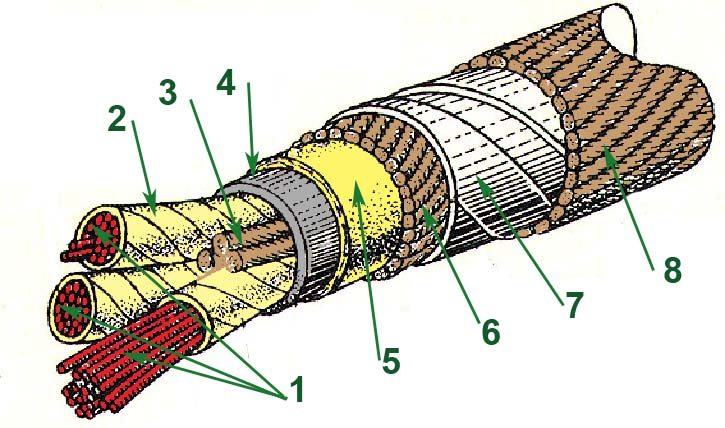
Пример конструкции кабеля:
1 - Токопроводящие жилы;
2 - Бумага, пропитанная маслом;
3 - Джутовый заполнитель;
4 - Свинцовая оболочка;
5 - Бумажная лента;
6 - Прослойка из джута;
7 - Стальная ленточная броня;
8 - Джутовый покров.
Кабели на напряжение до 1 кВ и выше...
[ГОСТ 12.2.007.14-75]
... силовые кабели с медными или алюминиевыми жилами с резиновой изоляцией, в свинцовой, поливинилхлоридной или резиновой оболочке, с защитными покровами или без них, предназначенные для неподвижной прокладки в электрических сетях напряжением 660 В переменного тока частотой 50 Гц или 1000 В постоянного тока и на напряжение 3000, 6000 и 10000 В постоянного тока.
Кабели предназначены для прокладки:
- на трассах с неограниченной разностью уровней.
- внутри помещений, в каналах, туннелях, в местах, не подверженных вибрации, в условиях отсутствия механических воздействий на кабель..
- в земле (траншеях), если кабель не подвергается значительным растягивающим усилиям
Строительная длина кабелей должна быть не менее 125 м. Допускаются маломерные отрезки длиной не менее 20 м в количестве не более 10 % от общей длины сдаваемой партии кабелей.
[ ГОСТ 433-73]
... монтажные многожильные кабели с поливинилхлоридной изоляцией и оболочкой, предназначенные для фиксированного межприборного монтажа электрических устройств, работающих при номинальном переменном напряжении до 500 В частоты до 400 Гц или постоянном напряжении до 750 В.
Требования к стойкости при механических воздействиях
- Кабели должны быть механически прочными при воздействии вибрационных нагрузок в диапазоне частот 1-5000 Гц с ускорением до 392 м/с2 (40 g).
- Кабели должны быть механически прочными при воздействии многократных ударов с ускорением 1471 м/с2 (150 g) при длительности удара 1-3 мс.
- Кабели должны быть механически прочными при воздействии одиночных ударов с ускорением 9810 м/с2(1000 g) и линейных нагрузок с ускорением до 4905 м/с2 (500 g).
Требования к стойкости при климатических воздействиях
-Кабели должны быть стойкими к воздействию повышенной температуры 343 К (70°С), при этом за повышенную температуру принимают температуру наиболее нагреваемого элемента конструкции кабеля.
- Кабели должны быть стойкими к воздействию пониженной температуры - 223 К (минус 50°С).
- Кабели должны быть стойкими к воздействию относительной влажности воздуха до 98 % при температуре 308 К (35°С).
- Кабели климатического исполнения Т должны быть стойкими к воздействию плесневых грибов.
[ ГОСТ 10348-80]
Тематики
- кабели, провода...
Классификация
>>>Обобщающие термины
Действия
- вводить кабель в отверстие
- вводить кабель в эксплуатацию
- наматывать кабель на барабан
- подключать кабель
- присоединять кабель
- прокладывать кабель
Синонимы
Сопутствующие термины
- неподвижная прокладка
- прокладка кабеля
- прокладка кабеля в земляной траншее
- прокладка кабеля непосредственно в грунте
- фиксированный межприборный монтаж электрических устройств
EN
DE
FR
отвод пьезоэлектрического резонатора
отвод
Токопроводящая деталь, соединяющая электроды с выводами пьезоэлектрического резонатора.
[ ГОСТ 18669-73]Тематики
Синонимы
EN
DE
FR
провод
-
[IEV number 151-12-28]EN
wire
flexible cylindrical conductor, with or without an insulating covering, the length of which is large with respect to its cross-sectional dimensions
NOTE – The cross-section of a wire may have any shape, but the term "wire" is not generally used for ribbons or tapes.
[IEV number 151-12-28]FR
fil, m
conducteur cylindrique flexible, avec ou sans revêtement isolant, dont la longueur est grande par rapport aux dimensions de la section droite
NOTE – La section droite d'un fil peut avoir une forme quelconque, mais le terme "fil" n'est généralement pas employé pour une bande ou un ruban.
[IEV number 151-12-28]Тематики
- кабели, провода...
Действия
EN
DE
FR
проволочное соединение
—
[Я.Н.Лугинский, М.С.Фези-Жилинская, Ю.С.Кабиров. Англо-русский словарь по электротехнике и электроэнергетике, Москва, 1999 г.]Тематики
- электротехника, основные понятия
EN
шина
Проводник с низким сопротивлением, к которому можно подсоединить несколько отдельных электрических цепей.
Примечание — Термин «шина» не включает в себя геометрическую форму, габариты или размеры проводника.
[ ГОСТ Р 51321. 1-2000 ( МЭК 60439-1-92)]
[ ГОСТ Р МЭК 61439.1-2013]
шина
Конструктивный элемент низковольтного комплектного устройства (НКУ).
Такой конструктивный элемент предназначен для того, чтобы к нему можно было легко присоединить отдельные электрические цепи (другие шины, отдельные проводники). Такие шины могут иметь различную конструкцию, геометрическую форму и размеры.
[Интент]
шинопроводшина
Медная, алюминиевая, реже стальная полоса, служащая для присоединения кабелей электрогенераторов, трансформаторов и т.д. к проводам питающей сети
[Терминологический словарь по строительству на 12 языках (ВНИИИС Госстроя СССР)]
общаяшина
-
[IEV number 151-12-30]
шина
-
[Я.Н.Лугинский, М.С.Фези-Жилинская, Ю.С.Кабиров. Англо-русский словарь по электротехнике и электроэнергетике, Москва]EN
busbar
low-impedance conductor to which several electric circuits can be connected at separate points
NOTE – In many cases, the busbar consists of a bar.
[IEV number 151-12-30]
busbar
An electrical conductor that makes a common connection between several circuits. Sometimes, electrical wire cannot accommodate high-current applications, and electricity must be conducted using a more substantial busbar — a thick bar of solid metal (usually copper or aluminum). Busbars are uninsulated, but are physically supported by insulators. They are used in electrical substations to connect incoming and outgoing transmission lines and transformers; in a power plant to connect the generator and the main transformers; in industry, to feed large amounts of electricity to equipment used in the aluminum smelting process, for example, or to distribute electricity in large buildings
[ABB. Glossary of technical terms. 2010]FR
barre omnibus, f
conducteur de faible impédance auquel peuvent être reliés plusieurs circuits électriques en des points séparés
NOTE – Dans de nombreux cas, une barre omnibus est constituée d’une barre.
[IEV number 151-12-30]
2. Проводник прямоугольного сечения из меди, предназначенный для электротехнических целей
(см. ГОСТ 434-78).
Поставляется в бухтах, а также в полосах длиной не менее 2,5 м; По существу, это просто проволока прямоугольного сечения. В указанном ГОСТе и в технической документации, в которой она применяется, обязательно указываются размеры этой проволоки. Например, "Шина ШММ 8,00х40,00 ГОСТ 434-78"
шина
Пруток прямоугольного сечения, применяемый в электротехнике в качестве проводника тока, изготовляемый прессованием или волочением.
[ ГОСТ 25501-82]Тематики
- НКУ (шкафы, пульты,...)
- заготовки и полуфабрикаты в металлургии
- кабели, провода...
Действия
- расположение шин «на ребро» [ПУЭ]
- расположение шин «плашмя» [ПУЭ]
Сопутствующие термины
- гибкая шина
- жесткая шина [ПУЭ]
- изолированные шины [ПУЭ]
- круглые шины [ПУЭ]
- неизолированные шины [ПУЭ]
- обходные шины [ПУЭ]
- профильные шины [ПУЭ]
- секционные шины [ПУЭ]
- фазная шина [ ГОСТ Р 51321.1-2000]
- четырехполосные шины с расположением полос по сторонам квадрата ("полый пакет") [ПУЭ]
- шина PEN-проводника
- шина для присоединения защитных проводников
- шина нулевого защитного проводника
- шина фазы А (B, C) [ПУЭ]
- шины однофазного тока [ПУЭ]
- шины прямоугольного (круглого, трубчатого, коробчатого) сечения [ПУЭ]
- шины трехфазного тока [ПУЭ]
EN
DE
FR
Англо-русский словарь нормативно-технической терминологии > wire
-
73 camera
2) киносъёмочный аппарат, киноаппарат, кинокамера6) архит. сводчатое покрытие•to thread camera — заряжать киносъёмочный аппарат- 6×6 cm camera -
accelerated motion-picture camera
-
aerial camera
-
aerophotographic camera
-
all-sky camera
-
amateur camera
-
animation camera
-
astrographic camera
-
astronomical camera
-
auto camera
-
autofocusing camera
-
autoprocess camera
-
background camera
-
ball camera
-
ballistic camera
-
battery-powered camera
-
bellows-type camera
-
bellows camera
-
bipack camera
-
blimped camera
-
borehole camera
-
box-type camera
-
box camera
-
broadcast camera
-
caption camera
-
cartographic camera
-
cartoon camera
-
cartridge loading camera
-
cartridge camera
-
cassette camera
-
CCD camera
-
cine camera
-
cinefluorographic camera
-
cinematographic X-ray recording camera
-
cineradiology camera
-
closed-circuit TV camera
-
close-up camera
-
cloud camera
-
collapsible camera
-
color camera
-
color television camera
-
color-slide camera
-
combination single film camera
-
compact-size camera
-
composite electronic and film camera
-
continuous-motion camera
-
copying camera
-
copy camera
-
darkroom camera
-
data-recording camera
-
Debye-Scherrer camera
-
deep-water camera
-
discontinuously writing camera
-
documentary camera
-
double-eight camera
-
double-extension camera
-
double-frame camera
-
drum camera
-
dual-gage camera
-
easily handled camera
-
EFP camera
-
electric eye camera
-
electric-driven camera
-
electric camera
-
electronic camera
-
electron camera
-
electronic news gathering camera
-
endoscopic camera
-
ENG camera
-
environmentally protected camera
-
fast pulldown camera
-
field camera
-
film camera
-
film developing camera
-
film recording camera
-
fixed camera
-
fixed-focus camera
-
fixed-pin registration camera
-
flash camera
-
flow camera
-
folding camera
-
foreground camera
-
framing camera
-
full-frame format camera
-
gallery camera
-
graphic arts camera
-
graphics camera
-
grid camera
-
ground glass focusing camera
-
ground glass camera
-
Guinier camera
-
gyroscope camera
-
half-format camera
-
hand camera
-
hand-held camera
-
HDTV camera
-
high-frequency camera
-
high-resolution camera
-
high-speed camera
-
hologram camera
-
horizontal camera
-
image compensation camera
-
image-converter camera
-
image-dissection camera
-
industrial-type camera
-
industrial camera
-
industrial-type television camera
-
industrial television camera
-
infrared camera
-
instant camera
-
instant-load camera
-
instrumentation camera
-
interchangeable camera
-
intermittent camera
-
Kerr cell camera
-
kinescope recording camera
-
kinescope camera
-
large-format camera
-
laser camera
-
Laue camera
-
left-eye camera
-
lenticular screen camera
-
live camera
-
log camera
-
low-speed recording camera
-
low-speed camera
-
magnetic video camera
-
manual camera
-
mapping camera
-
mask camera
-
measuring camera
-
medium format camera
-
microfiche camera
-
microfilm camera
-
miniature camera
-
monoblock camera
-
monochrome camera
-
motion-picture camera
-
motor-driven camera
-
movie camera
-
moving-image camera
-
narrow-gage camera
-
newsreel camera
-
news camera
-
one-piece camera
-
one-tube camera
-
optical compensation camera
-
outside broadcast camera
-
overhead camera
-
paging camera
-
panoramic camera
-
photo-finish camera
-
photogrammetric camera
-
photographic camera
-
photomechanical camera
-
photomicrographic camera
-
photoreproduction camera
-
photostat camera
-
phototheodolite camera
-
pickup camera
-
picosecond framing camera
-
picture-taking camera
-
picture camera
-
pilot camera
-
pinhole camera
-
plain camera
-
planetary camera
-
plate camera
-
platemaker camera
-
plotting camera
-
pocket camera
-
portable camera
-
precision camera
-
press camera
-
process camera
-
professional camera
-
programmed camera
-
projecting camera
-
rangefinder camera
-
recording camera
-
reduction camera
-
reflex camera
-
reporter camera
-
reproduction camera
-
right-eye camera
-
robot camera
-
rotary camera
-
Sauter camera
-
scanning camera
-
scientific camera
-
seismic camera
-
self-contained camera
-
self-developing camera
-
self-threading camera
-
semiautomatic camera
-
shoulder-operated camera
-
shoulder camera
-
silent camera
-
single-film camera
-
single-frame camera
-
single-lens reflex camera
-
slate camera
-
slave camera
-
slow-motion camera
-
sound motion-picture camera
-
sound-film camera
-
sound-on-film camera
-
spectrographic camera
-
stand camera
-
step-and-repeat camera
-
stop-motion camera
-
streak camera
-
studio camera
-
subminiature camera
-
taking camera
-
technical camera
-
telecine camera
-
television camera
-
time-lapse motion camera
-
time-lapse camera
-
topographical camera
-
traveling matte camera
-
trick camera
-
twin-lens camera
-
two-piece camera
-
vertical process camera
-
video camera
-
video still camera
-
view camera
-
viewfinder camera
-
Weissenberg camera
-
wide-angle camera
-
X-ray diffraction camera
-
X-ray camera -
74 film
1) плёнка, тонкий слой || покрываться плёнкой2) оболочка; покрытие4) (фото)плёнка5) киноплёнка; кинолента6) (кино)фильм; фильмокопия || производить киносъёмку; снимать на киноплёнку7) геофиз. диаграмма (сейсмограмма), записанная на фотоплёнке•film perforated (along) one edge — киноплёнка с односторонней перфорацией;to run through the film — просматривать фильм;to thread the film — заряжать киноплёнку-
acetate film
-
adhesive film
-
adsorbed film
-
advertising film
-
aerial film
-
air bubble film
-
air film
-
aligning film
-
amateur film
-
amorphous film
-
animated film
-
anodized film
-
antifogging film
-
antihalation film
-
antireflection film
-
autopositive film
-
axially oriented film
-
balanced film
-
base film
-
biaxially-oriented film
-
bimetallized film
-
black-and-white film
-
blank film
-
blown film
-
blue diazo assembly film
-
boundary film
-
bubble film
-
bubble-free film
-
burnished film
-
calendered film
-
carrying film
-
cartoon film
-
cast film
-
center fold film
-
cinema film
-
cine film
-
clearbase film
-
cling film
-
coarse-grain film
-
color film
-
commercial film
-
composite film
-
conducting film
-
contact film
-
continuous film
-
continuous lubricating film
-
continuous tone film
-
convergent lubricant film
-
convergent film
-
cooling film
-
cryovac film
-
crystalline film
-
cut film
-
diazo-type film
-
diazo film
-
dichromated gelatine film
-
dichromated gelatin film
-
dielectric film
-
discontinuous film
-
distillation film
-
doped film
-
double-coated film
-
drafting film
-
dry process film
-
dry silver film
-
dubbed film
-
duplicating film
-
dye-degraded library film
-
educational film
-
elastohydrodynamic lubrication film
-
electrodeposited film
-
electron-beam evaporated film
-
endless type film
-
epitaxial film
-
evaporated film
-
exposed film
-
faded film
-
fast film
-
feature film
-
ferroelectric film
-
fibrillated film
-
field-oxide film
-
fine-grain film
-
fire-proof film
-
flat film
-
flexible film
-
garnet film
-
gas film
-
getter film
-
glass film
-
glue film
-
graphic arts film
-
grown film
-
gussetted tubular film
-
hard film
-
hardened film
-
heat developable film
-
heat stabilized film
-
high clarity film
-
high-gamma film
-
high-impact film
-
high-speed color negative film
-
holographic film
-
hot tack film
-
hot-wall film
-
hydrodynamic oil film
-
hypersensitized film
-
imperforated film
-
imperforate film
-
indium-tin oxide film
-
industrial film
-
infrachromatic film
-
ink film
-
instant film
-
instructional film
-
instruction film
-
insulating film
-
intermediate film
-
internegative film
-
interpositive film
-
intrinsic film
-
iridescent film
-
ITO film
-
kapton film
-
laminar film
-
laminate film
-
laminated film
-
Langmuir-Blodgett film
-
large-grain film
-
lenticular film
-
light-control film
-
light-guiding film
-
light-sensitive film
-
light-struck film
-
line film
-
lith film
-
logging film
-
loop film
-
low defect film
-
low-friction film
-
low-gamma film
-
low-slip film
-
lubricant film
-
magnetic bubble film
-
magnetic film
-
masking film
-
matrix film
-
mechanized processing film
-
medical film
-
medium speed film
-
medium-grain film
-
metallized film
-
moistureproof film
-
motion-picture film
-
multilayer film
-
multireel film
-
multirow film
-
mylar film
-
name plate film
-
narrow-gage film
-
narrow film
-
negative film
-
news film
-
nonfogging film
-
nonsilver film
-
nonwettable film
-
normal film
-
offset film
-
oil bound film
-
oil film
-
oiliness film
-
one-edge perforated film
-
opal film
-
opaque film
-
opp film
-
oriented film
-
oriented polypropylene film
-
orthochromatic film
-
oven film
-
oxide film
-
oxidized film
-
panchromatic film
-
pan film
-
panoramic film
-
passivating film
-
patterned film
-
pearlescent film
-
peelable film
-
peel-off film
-
perforated film
-
photochromic film
-
photoconductor-thermoplastic film
-
photographic film
-
photoplastic recording film
-
photoresist film
-
phototechnical film
-
phototypesetting film
-
piezoelectric film
-
polarizer film
-
polarizing film
-
Polaroid film
-
polycrystalline film
-
polyethylene film
-
polyimide film
-
polymer film
-
positive film
-
prescreened film
-
print film
-
process film
-
professional film
-
protective film
-
publicity film
-
pure film
-
PVC film
-
RA film
-
radiographic film
-
rapid access film
-
raw film
-
recording film
-
reflecting film
-
released film
-
release film
-
resist film
-
resistance film
-
reversal film
-
ripple film
-
roll film
-
room daylight film
-
rust film
-
safety film
-
sandwich film
-
saran film
-
seismic film
-
self-developing film
-
semiconductor film
-
sensitized film
-
sheet film
-
short-length film
-
shrinkable film
-
shrink film
-
silent film
-
single-crystal film
-
single-oxide film
-
single-perforated film
-
single-wound film
-
sliced film
-
slide film
-
slit film
-
small-grain film
-
soft film
-
sound film
-
spacer film
-
split film
-
spray deposited film
-
sprocketed film
-
sputtered film
-
squeezed film
-
squeeze film
-
stacked film
-
standard film
-
steam film
-
steam-water film
-
stereoscopic film
-
stretch film
-
stretched film
-
stripping film
-
subminiature film
-
substrate film
-
superconducting film
-
support film
-
surface film
-
taped film
-
television film
-
test film
-
thermally grown film
-
thick film
-
thin film
-
tin oxide film
-
transfer film
-
transparency film
-
transparent film
-
trichromatic film
-
tubular film
-
TV film
-
unbalanced film
-
unsupported film
-
vapor film
-
vapor-deposited film
-
variable-area film
-
variable-density film
-
vesicular film
-
video film
-
washoff relief film
-
waster film
-
wear-inhibiting film
-
wedge-shaped oil film
-
wide-screen film
-
wrapping film
-
X-ray film -
75 absorb
гл.1) общ. всасывать, впитывать, поглощать ( в буквальном или переносном смысле)Large companies absorb smaller ones. — Крупные компании поглощают мелкие.
Syn:Ant:2) эк. оплачивать, брать на себя (расходы)The company will absorb all the research costs. — Компания оплатит все расходы по проведению данного исследования.
3) учет переносить [распределять, пропорционально разделять\] затраты (относить осуществленные затраты на различные подразделения или этапы производства)See:4) учет поглощать (переводить суммы по счетам таким образом, что одна сумма поглощается другой и перестает идентифицироваться как самостоятельная; напр., последовательно переводить суммы расходов со счета "незавершенное производство" на счет "готовая продукция" и на счет реализации в качестве себестоимости реализованной продукции)See:* * *. . Словарь экономических терминов . -
76 strong
adjсильный, усиленныйstrong invariance principle сильный принцип инвариантности, принцип m инвариантности почти наверноеstrong solution of a stochastic differential equation сильное решение стохастического дифференциального уравненияАнглийский-русский словарь по теории вероятностей, статистике и комбинаторике > strong
-
77 LPF
1) Техника: leach-precipitation-float process2) Оптика: low-pass filter3) Политика: Libertarian Party of Florida4) Телевидение: lov pass filter5) Физиология: Low Power Field6) Вычислительная техника: League for Programming Freedom, League for Programming Freedom (organization)7) Иммунология: lymphocytosis-promoting factor9) Полимеры: large particle furnace10) Макаров: leach-precipitation-float (process)11) Безопасность: low pass filter12) Каспий: load proportionality factor13) Высокочастотная электроника: lowpass filter -
78 addition
noun1) no pl. Hinzufügen, das; (of ingredient) Dazugeben, das; (adding up) Addieren, das; (process) Addition, die* * *1) (the act of adding: The child is not good at addition.) das Addieren2) (something added: They've had an addition to the family.) der Zuwachs* * *ad·di·tion[əˈdɪʃən]n5.▪ in \addition außerdem* * *[ə'dISən]n2) (= adding) Zusatz mthe addition of another person would make the team too large — eine zusätzliche or weitere Person würde das Team zu groß machen
the addition of one more country to the EU — die Erweiterung der EU um ein weiteres Land
3) (= thing added) Zusatz m (to zu); (to list) Ergänzung f (to zu); (to building) Anbau m (to an +acc); (to income) Aufbesserung f (to +gen); (to bill) Zuschlag m (to zu), Aufschlag m (to auf +acc)4)in addition — außerdem, obendrein
in addition (to this) he said... —
in addition to being unjustified his demand was also... — seine Forderung war nicht nur ungerechtfertigt, sondern außerdem noch...
* * *addition [əˈdıʃn] s1. Hinzufügung f, Zusatz m, Ergänzung f, Nachtrag m:in addition noch dazu, außerdem, zusätzlich;in addition to außer (dat), zusätzlich zu;in addition to directing the play, he played the leading role er führte nicht nur Regie, sondern spielte auch die Hauptrolle in dem Stück2. CHEM etc Beimengung f, Zusatz m, GASTR etc auch Beigabe f:addition of colo(u)r Farbzusatz3. Vermehrung f, (Familien-, Vermögens- etc) Zuwachs m:they are expecting an addition to the family sie erwarten Familienzuwachs oder Nachwuchs4. MATH Addition f, Addierung f, Zusammenzählen n:addition sign Pluszeichen n5. WIRTSCH Aufschlag m (to auf akk):pay in addition zuzahlen6. besonders US Anbau madd. abk1. addendum2. addition (additional)3. address* * *noun1) no pl. Hinzufügen, das; (of ingredient) Dazugeben, das; (adding up) Addieren, das; (process) Addition, die2) (thing added) Ergänzung, die (to zu)* * *n.Addition -en f.Ergänzung f.Hinzufügung f.Nachtrag -¨e m.Zusatz -¨e m.Zutat -en f. -
79 criminal
1) злочинець, кримінальний злочинець; суб'єкт злочину; особа, винна у вчиненні злочину, особа, визнана злочинцем за судом; особа, засуджена за вчинення злочину; кримінальна поліція2) злочинний; кримінальний, карний•criminal investigation department — управління (відділ) карного розшуку, відділ кримінальних розслідувань, кримінальний розшук ( установа)
criminal investigation technique — = criminal investigation techniques криміналістика
- criminal abortioncriminal investigation techniques — = criminal investigation technique
- criminal abortion act
- criminal abortion law
- criminal abortionist
- criminal abuse of authority
- criminal act
- criminal act on trial
- criminal action
- criminal activities
- criminal activity
- criminal agency
- criminal aggression
- criminal amnesty
- criminal anarchy
- criminal anthropology
- criminal appeal
- criminal area of activity
- criminal arrest
- criminal assault
- criminal association
- criminal at large
- criminal attack
- criminal attempt
- criminal attorney
- criminal bail
- criminal bar
- criminal bargain
- criminal behavior
- criminal behaviuor
- criminal biology
- criminal boss
- criminal breach of trust
- criminal business
- criminal capacity
- criminal career
- criminal cartel
- criminal case
- criminal case study
- criminal casework
- criminal channel
- criminal character
- criminal charge
- criminal charges
- criminal circles
- criminal clerk
- criminal code
- criminal commercial structure
- criminal commitment
- criminal-commitment
- criminal-commitment procedure
- criminal community
- criminal complaint
- criminal complicity
- criminal conduct
- criminal confederation
- criminal connection
- criminal connexion
- criminal conspiracy
- criminal conspirator
- criminal contempt
- criminal conversation
- criminal conviction
- criminal court
- criminal damage
- criminal dealings
- criminal deed
- criminal defence
- criminal defense
- criminal defendant
- criminal design
- criminal detection
- criminal deterrence
- criminal disposition
- criminal district court
- criminal docket
- criminal drug addict
- criminal effort
- criminal element
- criminal elements
- criminal encroachment
- criminal end
- criminal endeavor
- criminal endeavour
- criminal enforcement agency
- criminal enterprise
- criminal environment
- criminal episode
- criminal ethnography
- criminal event
- criminal evidence
- criminal experience
- criminal explosion
- criminal extradition
- criminal field
- criminal file
- criminal fine
- criminal flippancy
- criminal forfeiture
- criminal formation
- criminal fraud
- criminal fugitive
- criminal gang
- criminal geography
- criminal goal
- criminal group
- criminal grouping
- criminal guilt
- criminal habitual drunkard
- criminal history
- criminal homicide
- criminal identification
- criminal identity
- criminal impulse
- criminal in flight
- criminal inaction
- criminal incapacitation
- criminal incident
- criminal industry
- criminal information
- criminal informer
- criminal infraction
- criminal injury
- criminal insanity
- criminal instrument
- criminal intelligence
- criminal intent
- criminal interrogator
- criminal interview
- criminal intrusion
- criminal intrusion
- criminal investigation
- criminal investigative force
- criminal investigator
- criminal involvement
- criminal judge
- criminal jurisdiction
- criminal justice
- criminal justice agency
- criminal justice official
- criminal justice policy
- criminal justice practice
- criminal justice practices
- criminal justice process
- criminal justice system
- criminal label
- criminal law
- criminal law systems
- criminal lawyer
- criminal legislation
- criminal liability
- criminal libel
- criminal lunatic
- criminal machinations
- criminal manufacture
- criminal matter
- criminal matters
- criminal means
- criminal mind
- criminal misbehavior
- criminal misbehaviour
- criminal mischief
- criminal misconduct
- criminal mob
- criminal monopoly
- criminal motive
- criminal nature
- criminal negligence
- criminal obscenity
- criminal occupation
- criminal of ordinary birth
- criminal of war
- criminal offence
- criminal offense
- criminal offence victim
- criminal offense victim
- criminal offender
- criminal office
- criminal omission
- criminal operation
- criminal organization
- criminal participant
- criminal participation
- criminal participator
- criminal pathology
- criminal pattern
- criminal penalty
- criminal personality
- criminal phenomenology
- criminal physics
- criminal physiognomy
- criminal picketing
- criminal plan
- criminal policy
- criminal population
- criminal practice
- criminal presumption
- criminal prisoner
- criminal procedure
- criminal proceeding
- criminal proceedings
- criminal process
- criminal proclivities
- criminal promoter
- criminal propensities
- criminal propensity
- criminal prosecution
- criminal psychiatry
- criminal psychology
- criminal punishment
- criminal punishment system
- criminal purpose
- criminal pursuits
- criminal record
- criminal records
- criminal records office
- criminal regime
- criminal registration
- criminal relief
- criminal remedy
- criminal resistance
- criminal responsibility
- criminal sanction
- criminal science
- criminal sector of economy
- criminal sentence
- criminal sentencing
- criminal side
- criminal society
- criminal sociology
- criminal solicitation
- criminal sophistication
- criminal specialist
- criminal standards
- criminal statistics
- criminal stigma
- criminal structure
- criminal suit
- criminal summons
- criminal suspect
- criminal syndicate
- criminal system
- criminal tendency
- criminal terror
- criminal terrorism
- criminal transaction
- criminal treatment
- criminal trespass
- criminal trial
- criminal twist
- criminal under applicable law
- criminal use
- criminal use of guns
- criminal violation
- criminal violence
- criminal world
- criminal youth
- criminal's counsel
- criminal's description -
80 gain
1) усиление || усиливать2) коэффициент усиления; коэффициент передачи3) выигрыш; увеличение || выигрывать; увеличивать4) коэффициент усиления антенны ( в данном направлении); максимальный коэффициент усиления антенны•gain per pass — кв. эл усиление за проход
- gain of antennagain per transit — кв. эл усиление за проход
- absolute gain of antenna
- acoustoelectric gain
- active element pattern gain
- amplifier gain
- antenna field gain
- antenna power gain
- antenna receive gain
- antenna transmit gain
- available gain
- available power gain
- backward gain
- Bayes gain
- Bayesian gain
- bridging gain
- charge gain
- closed-loop gain
- collector-to-base current gain
- collector-to-emitter current gain
- common-base gain
- common-drain gain
- common-emitter gain
- common-gate gain
- common-mode gain
- common-source gain
- completely matched power gain
- conversion gain
- correlation gain
- current gain
- differential gain
- directional gain
- directive gain
- direct-sequence process gain
- diversity gain
- double-channel gain
- efficiency gain
- expected gain
- feedback network gain
- forward gain
- full beam gain
- grounded-base current gain
- grounded-base power gain
- grounded-base voltage gain
- grounded-collector current gain
- grounded-collector voltage gain
- grounded-emitter current gain
- grounded-emitter power gain
- grounded-emitter voltage gain
- incremental gain
- input gain
- insertion gain
- internal loop gain
- inverse gain
- isotropic gain of antenna
- large-signal power gain
- laser gain
- level-dependent gain
- logarithmic gain
- loop gain
- low-level current gain
- low-signal current gain
- luminous gain
- matched power gain
- net gain
- neutralized stable gain
- nonreciprocal gain
- obstacle gain
- off-axis gain
- on-axis gain
- one-pass gain
- open-circuit voltage gain
- open-loop gain
- optical gain
- optimum gain
- output gain
- parametric gain
- partial gain of antenna
- partial realized gain of antenna
- photoconductivity gain
- power gain
- process gain
- processing gain
- radiant gain
- realized gain
- reciprocal gain
- relative gain of antenna
- relative partial gain of antenna
- reverse gain
- ride gain
- round-trip gain
- saturated gain
- screen gain
- servo loop gain
- single-channel gain
- single-pass gain
- small-signal gain
- spectral-conversion luminous gain
- spectral-conversion radiant gain
- spectral luminous gain
- spectral radiant gain
- speed gain
- threshold gain
- total gain of antenna
- transducer gain
- transmission gain
- turn-off thyristor gain
- turn-on thyristor gain
- unilateral gain
- unsaturated gain
- voltage gain
См. также в других словарях:
Process Oriented Psychology — (POP) refers to a body of theory and practice that encompasses a broad range of psychotherapeutic, personal growth, and group process applications. It is more commonly called Process Work in the United States, the longer name being used in Europe … Wikipedia
Process costing — is an accounting methodology that traces and accumulates direct costs, and allocates indirect costs of a manufacturing process. Costs are assigned to products, usually in a large batch, which might include an entire month s production. Eventually … Wikipedia
Process mining — techniques allow for the analysis of business processes based on event logs. They are often used when no formal description of the process can be obtained by other means, or when the quality of an existing documentation is questionable. For… … Wikipedia
Process Manufacturing — is the branch of manufacturing that is associated with formulas or manufacturing recipes as compared to bills of material routing as in the case of Discrete manufacturing. Defining Process Manufacturing The simplest and easiest way to grasp the… … Wikipedia
Process-centered design — (PCD) is a design methodology, which proposes a business centric approach for designing user interfaces. Because of the multi stage business analysis steps involved right from the beginning of the PCD life cycle, it is believed to achieve the… … Wikipedia
Process-oriented programming — is a programming paradigm that separates the concerns of data structures and the concurrent processes that act upon them. The data structures in this case are typically persistent, complex, and large scale the subject of general purpose… … Wikipedia
Process architecture — is the structural design of general process systems and applies to fields such as computers (software, hardware, networks, etc.), business processes (enterprise architecture, policy and procedures, logistics, project management, etc.), and any… … Wikipedia
Process (engineering) — Process engineering refers to engineering which is collaborative and concerned with completing a project as a whole.emiconductor devicesIn the electronics industry, especially for those building ICs, some technologists can be referred to as… … Wikipedia
Process control — is a statistics and engineering discipline that deals with architectures, mechanisms, and algorithms for controlling the output of a specific process. See also control theory.For example, heating up the temperature in a room is a process that has … Wikipedia
Process Driven Development — (PDD) is a methodology for constructing non trivial custom software applications by analyzing the business processes in which they will be used. It complements the use case driven approach to software development by helping the software architect … Wikipedia
Large scale coastal behaviour — is an attempt to model the morphodynamics of coastal change at time and space scales appropriate to management and prediction. Temporally this is at the decade to century scale, spatially at the scale of tens of kilometers. It was developed by de … Wikipedia
