

-
1 номинальное напряжение
номинальное напряжение
Напряжение, установленное изготовителем для прибора
[ ГОСТ Р 52161. 1-2004 ( МЭК 60335-1: 2001)]
номинальное напряжение Uном, кВ
Номинальное междуфазное напряжение электрической сети, для работы в которой предназначены коммутационные аппараты.
[ ГОСТ Р 52726-2007]
номинальное напряжение
Un
Напряжение, применяемое для обозначения или идентификации системы электроснабжения.
[ ГОСТ Р 51317.4.30-2008 (МЭК 61000-4-30:2008)]EN
rated voltage
voltage assigned to the appliance by the manufacturer
[IEC 60335-1, ed. 4.0 (2001-05)]
rated voltage
quantity value assigned, generally by the manufacturer, for a specified operating condition of a machine
[IEC 60034-18-41, ed. 1.0 (2006-10)]
rated voltage
input or output supply voltage for which equipment is designed or specified
[IEC 88528-11, ed. 1.0 (2004-03)]
rated voltage
specified value of the voltage at the terminals of the machine when operating at a rating. If unidirectional, the voltage is the arithmetic mean of the recurring waveform and if alternating it is the root mean square value of the fundamental frequency component of the recurring waveform
NOTE - In the case of a machine with a protective resistor permanently in series, the resistor is considered as an integral part of the machine
[IEC 60349-1, ed. 1.0 (1999-11)]
rated voltage
the value of voltage assigned by the manufacturer to a component, device or equipment and to which operation and performance characteristics are referred
NOTE - Equipment may have more than one rated voltage value or may have a rated voltage range.
[IEC 62497-1, ed. 1.0 (2010-02)]
rated voltage
reference voltage for which the cable is designed, and which serves to define the electrical tests
NOTE 1 - The rated voltage is expressed by the combination of two values: Uo/U expressed in volts (V):
Uo being the r.m.s. value between any insulated conductor and "earth" (metal covering of the cable or the surrounding medium);
U being the r.m.s. value between any two phase conductors of a multicore cable or of a system of single-core cables.
In an alternating-current system, the rated voltage of a cable is at least equal to the nominal voltage of the system for which it is intended.
This condition applies both to the value Uo and to the value U.
In a direct current system, the nominal voltage of the system is not higher than 1,5 times the rated voltage of the cable.
NOTE 2 - The operating voltage of a system may permanently exceed the nominal voltage of such a system by 10 %. A cable can be used at a 10 % higher operating voltage than its rated voltage if the latter is at least equal to the nominal voltage of the system
[IEC 60245-1, ed. 4.0 (2003-12)]
rated voltage
highest allowable voltage between the conductors in a twin and multi conductor cable, or between one conductor and an electrical conductive screen, or between the two ends of a single core cable, or earth in unscreened cables
[IEC 60800, ed. 3.0 (2009-07)]
rated voltage
the r.m.s. line-to-line voltage under rated conditions
Primary side of input transformer: ULN
Converter input: UVN
Converter output: UaN
Motor voltage: UAN
[IEC 61800-4, ed. 1.0 (2002-09)]
rated voltage
input or output voltage (for three-phase supply, the phase-to-phase voltage) as declared by the manufacturer
[IEC 62040-1, ed. 1.0 (2008-06)]
nominal voltage, Un
voltage by which a system is designated or identified
[IEC 61000-4-30, ed. 2.0 (2008-10)]FR
tension assignée
tension attribuée à l'appareil par le fabricant
[IEC 60335-1, ed. 4.0 (2001-05)]
tension nominale
tension assignée, généraleme<>value of voltage assigned by the manufacturer, to a componentnt par le constructeur pour des conditions spécifiées de fonctionnement de la machine
[IEC 60034-18-41, ed. 1.0 (2006-10)]
tension assignée
tension spécifiée aux bornes de la machine quand celle-ci fonctionne au régime assigné. Dans le cas d'une tension redressée, sa valeur est égale à la valeur moyenne de l'onde périodique. Dans le cas d'une tension alternative, sa valeur est égale à la valeur efficace de la composante fondamentale de l'onde périodique
NOTE - Dans le cas d'une machine équipée d'une résistance de protection connectée en permanence en série, la résistance est considérée comme faisant partie intégrante de la machine
[IEC 60349-1, ed. 1.0 (1999-11)]
tension assignée
valeur de la tension, assignée par le constructeur à un composant, à un dispositif ou à un matériel, et à laquelle on se réfère pour le fonctionnement et pour les caractéristiques fonctionnelles
NOTE - Les matériels peuvent avoir plusieurs valeurs ou une plage de tensions assignées.
[IEC 62497-1, ed. 1.0 (2010-02)]
tension assignée
tension de référence pour laquelle le conducteur ou le câble est prévu et qui sert à définir les essais électriques
NOTE 1 - La tension assignée est exprimée par la combinaison de deux valeurs Uo /U, exprimées en volts (V):
Uo étant la valeur efficace entre l'âme d'un conducteur isolé quelconque et la «terre» (revêtement métallique du câble au milieu environnant);
U étant la valeur efficace entre les âmes conductrices de deux conducteurs de phase quelconques d'un câble multiconducteur ou d'un système de câbles monoconducteurs ou de conducteurs.
Dans un système à courant alternatif, la tension assignée d'un conducteur ou d’un câble est au moins égale à la tension nominale du système pour lequel il est prévu.
Cette condition s'applique à la fois à la valeur Uo et à la valeur U.
Dans un système à courant continu, la tension nominale admise du système n’est pas supérieure à 1,5 fois la tension assignée du conducteur ou du câble.
NOTE 2 - La tension de service d'un système peut en permanence dépasser la tension nominale dudit système de 10 %. Un conducteur ou un câble peut être utilisé à une tension de service supérieure de 10 % à sa tension assignée si cette dernière est au moins égale à la tension nominale du système
[IEC 60245-1, ed. 4.0 (2003-12)]
tension assignée
tension maximale admissible entre les âmes dans un câble ayant une paire ou multi conducteur ou entre une âme et un écran conducteur électrique ou avec la terre pour un câble non écranté ou encore entre les deux extrémités d’un câble à âme unique
[IEC 60800, ed. 3.0 (2009-07)]
tension assignée
valeur efficace de la tension de ligne (entre phases) dans les conditions assignées
Primaire du transformateur d’entrée: ULN
Entrée du convertisseur: UVN
Sortie du convertisseur: UaN
Moteur: UAN
[IEC 61800-4, ed. 1.0 (2002-09)]
tension assignée
tension d’alimentation d’entrée ou de sortie (dans le cas d’une alimentation triphasée, tension entre phases) déclarée par le constructeur
[IEC 62040-1, ed. 1.0 (2008-06)]
tension nominale, Un
tension par laquelle un réseau est désigné ou identifié
[IEC 61000-4-30, ed. 2.0 (2008-10)]Тематики
- аппарат, изделие, устройство...
- высоковольтный аппарат, оборудование...
- прибор электрический
- электроснабжение в целом
Синонимы
- Un
EN
FR
Русско-французский словарь нормативно-технической терминологии > номинальное напряжение
-
2 номинальное напряжение изоляции (аппарата), Ui
номинальное напряжение изоляции (аппарата), Ui
Значение напряжения, по которому определяют испытательное напряжение при испытании изоляционных свойств, расстояние утечки и воздушные зазоры.
Максимальное значение номинального рабочего напряжения не должно превышать наибольшего значения номинального напряжения изоляции.
Примечание — Для аппарата, у которого номинальное напряжение изоляции не устанавливается, его следует принимать как наибольшее значение любого номинального напряжения
[ ГОСТ Р 50030. 1-2000 ( МЭК 60947-1-99)]EN
rated insulation voltage, Ui
value of voltage to which dielectric tests and creepage distances are referred
[IEC 62314, ed. 1.0 (2006-05)]
rated insulation voltage (RIV)
voltage value assigned by the manufacturer to the equipment or to a part of it, characterizing the specified (long-term) withstand capability of its insulation
NOTE 1 The rated insulation voltage is higher than or equal to the rated voltage of the equipment, or to the rated voltage of the concerned part of the equipment, which is primarily related to functional performance.
NOTE 2 The rated insulation voltage refers to the insulation between electric circuits, between live parts and exposed conductive parts and within an electric circuit.
NOTE 3 For clearances and solid insulation, the peak value of the voltage occurring across the insulation or clearance is the determining value for the rated insulation voltage. For creepage distances the r.m.s. value is the determining value
[IEC 62103, ed. 1.0 (2003-07)]FR
tension assignée d'isolement (TIA)
valeur efficace de la tension de tenue fixée par le constructeur au matériel ou à une de ses parties, caractérisant la capacité de tenue spécifiée (à long terme) de son isolation
NOTE 1 La tension assignée d'isolement est supérieure ou égale à la tension assignée du matériel ou de la partie concernée de l’appareil qui est principalement liée aux caractéristiques fonctionnelles.
NOTE 2 La tension d'isolement assignée se rapporte à l'isolation entre circuits électriques, entre parties conductrices et masses, et à l'intérieur du circuit électrique.
NOTE 3 Pour les distances d'isolement et pour les isolants solides, la tension d'isolement assignée est déterminée par la valeur de crête de la tension apparaissant aux bornes de l'isolant ou de la distance. Pour les lignes de fuites, c'est la tension efficace qu'il faut prendre
[IEC 62103, ed. 1.0 (2003-07)]Тематики
- аппарат, изделие, устройство...
- выключатель автоматический
EN
- rated insulation voltage
- rated insulation voltage, Ui
- RIV
FR
Русско-французский словарь нормативно-технической терминологии > номинальное напряжение изоляции (аппарата), Ui
-
3 падение или повышение напряжения при заданном режиме нагрузки
падение или повышение напряжения при заданном режиме нагрузки
Разность между напряжением холостого хода обмотки и напряжением на ее выводах при заданных нагрузке и коэффициенте мощности при условии, что к другой (или к одной из других) обмотке(ок) подведено напряжение, равное:
- номинальному, если трансформатор включен на основное ответвление (в этом случае напряжение холостого хода рассматриваемой обмотки равно номинальному);
- напряжению другого ответвления, на которое включен трансформатор. Падение или повышение напряжения обычно выражают в процентах напряжения холостого хода рассматриваемой обмотки.
Примечание — В многообмоточном трансформаторе падение или повышение напряжения зависит от нагрузки и коэффициента мощности не только данной обмотки, но и других обмоток
(МЭС 421-07-03).
[ ГОСТ 30830-2002]EN
voltage drop or rise for a specified load condition
voltage regulation for a specified load condition
the arithmetic difference between the no-load voltage of a winding and the voltage developed at the terminals of the same winding at a specified load and power factor, the voltage supplied to (one of) the other winding(s) being equal to:
- its rated value if the transformer is connected on the principal tapping (the no-load voltage of the former winding is then equal to its rated value);
- the tapping voltage if the transformer is connected on another tapping.
This difference is generally expressed as a percentage of the no-load voltage of the former winding
NOTE – For multi-winding transformers, the voltage drop or rise depends not only on the load and power factor of the winding itself, but also on the load and power factor of the other windings
[IEV number 421-07-03]FR
hute ou augmentation de tension pour une condition de charge spécifiée
différence arithmétique entre la tension à vide d'un enroulement et la tension en charge aux bornes du même enroulement pour un courant de charge et un facteur de puissance spécifiés, la tension appliquée à l'autre (ou à l'un des autres) enroulement(s) étant égale:
- à sa valeur assignée, si le transformateur est connecté sur la prise principale (la tension à vide du premier enroulement étant alors égale à sa valeur assignée);
- à la tension de prise si le transformateur est connecté sur une autre prise.
Cette différence s'exprime généralement sous la forme d'un pourcentage de la tension à vide du premier enroulement
NOTE – Pour les transformateurs à plus de deux enroulements, la chute ou l'augmentation de tension dépend non seulement de la charge et du facteur de puissance de l'enroulement lui-même, mais aussi de la charge et du facteur de puissance des autres enroulements.
[IEV number 421-07-03]Тематики
Классификация
>>>EN
- voltage drop or rise for a specified load condition
- voltage regulation for a specified load condition
DE
FR
Русско-французский словарь нормативно-технической терминологии > падение или повышение напряжения при заданном режиме нагрузки
-
4 устройство дифференциального тока
устройство дифференциального тока
УДТ
Механическое коммутационное устройство, предназначенное включать, проводить и отключать токи в нормальных рабочих условиях и вызывать размыкание контактов, когда дифференциальный ток достигает заданного значения в определенных условиях.
Примечание - Устройство дифференциального тока может быть комбинацией различных отдельных элементов, предназначенных обнаруживать и оценивать дифференциальный ток, а также включать и отключать электрический ток.
Примечание - В национальной нормативной документации вместо термина «устройство дифференциального тока» применяют термин « устройство защитного отключения».
[ ГОСТ Р 50571. 1-2009 ( МЭК 60364-1: 2005)]
устройство дифференциального тока
УДТ
Механическое коммутационное устройство или комплекс устройств, которые вызывают размыкание контактов, когда дифференциальный или несбалансированный ток достигнет заданного значения в заданных условиях.
[ ГОСТ Р 51992-2011( МЭК 61643-1: 2005)]EN
residual current device
RCD, (abbreviation)
a mechanical switching device designed to make, carry and break currents under normal service conditions and to cause the opening of the contacts when the residual current attains a given value under specified conditions
NOTE – A residual current device can be a combination of various separate elements designed to detect and evaluate the residual current and to make and break current.
[IEV number 442-05-02]FR
dispositif (de coupure) différentiel
dispositif (à courant) différentiel résiduel
DDR (abréviation)
dispositif mécanique de coupure destiné à établir, supporter et couper des courants dans les conditions de service normales et à provoquer l'ouverture des contacts quand le courant différentiel atteint, dans des conditions spécifiées, une valeur donnée
NOTE – Un dispositif de coupure différentiel peut être une combinaison de divers éléments séparés conçus pour détecter et mesurer le courant différentiel et pour établir ou interrompre le courant.
[IEV number 442-05-02]Параллельные тексты EN-RU Operating principle of residual current devices
The operating principle of residual current devices consists in the detection of an earth fault current by means of a toroidal transformer which encloses all the live conductors, included the neutral, if distributed.
In absence of an earth fault the vectorial sum of the currents IΔ is equal to zero; in case of an earth fault, if the value of IΔ exceeds the value of the trip threshold, called IΔ n, the circuit at the secondary of the toroid sends a command signal to a dedicated opening device causing the circuit-breaker tripping.
[ABB]Принцип действия устройств дифференциального тока
Принцип действия устройств дифференциального тока заключается в обнаружении тока замыкания на землю с помощью тороидального трансформатора, который охватывает все токоведущие, в том числе и нейтральный проводник, если он используется для распределения электроэнергии.
При отсутствии замыкания на землю векторная сумма токов IΔ равна нулю. Если при возникновении замыкания на землю значение IΔ превысит уставку срабатывания, обозначаемую как IΔn, то во вторичной обмотке тороидального трансформатора будет наведена ЭДС, достаточная для включения специального устройства, вызывающего срабатывание автоматического выключателя
[Перевод Интент]Тематики
- аппарат, изделие, устройство...
- электроустановки
Обобщающие термины
Синонимы
EN
- RCD, (abbreviation)
- residual current device
DE
FR
Русско-французский словарь нормативно-технической терминологии > устройство дифференциального тока
-
5 входное полное сопротивление
входное полное сопротивление
-
[IEV number 312-06-18]EN
input impedance
impedance of the input circuit measured between the input terminals under operating conditions
NOTE 1 – The impedance can be expressed in terms of admittance.
NOTE 2 – In certain instances, for example, sampling devices or self-balancing potentiometers, the impedance can be different according to the instant when it is determined, before, during or after the instant of measurement.
NOTE 3 – When the input circuit is such that the instantaneous value of the current flowing into the input terminals is a non-linear function of the instantaneous value of the input voltage under specified conditions of frequency and voltage, the combination of resistance and reactance which would absorb the same active power and in which would flow a reactive current equal to the fundamental component that is flowing in the actual input circuit, is sometimes called the "equivalent input impedance".
[IEV number 312-06-18]FR
impédance du circuit d'entrée
impédance du circuit d'entrée entre les bornes d'entrée dans les conditions de fonctionnement
NOTE 1 – L'impédance peut être exprimée en termes d'admittance.
NOTE 2 – Dans certains cas, par exemple les dispositifs d'échantillonnage ou les potentiomètres à rééquilibrage automatique, l'impédance peut être différente selon l’instant où elle est déterminée, avant, pendant ou après la mesure.
NOTE 3 – Lorsque le circuit d'entrée est tel que la valeur instantanée du courant traversant les bornes d'entrée est une fonction non linéaire de la valeur instantanée de la tension d'entrée dans des conditions spécifiées de fréquence et de tension, l'impédance d'une combinaison formée par une résistance et une réactance qui absorberaient la même puissance active et dans laquelle circulerait un courant réactif égal à la composante fondamentale qui circule dans le circuit d'entrée réel, est parfois appelée "impédance équivalente d'entrée".
[IEV number 312-06-18]Тематики
- измерение электр. величин в целом
EN
DE
FR
Русско-французский словарь нормативно-технической терминологии > входное полное сопротивление
-
6 выходное полное сопротивление
выходное полное сопротивление
-
[IEV number 312-06-19]EN
output impedance
impedance of the output circuit measured between the output terminals under operating conditions
NOTE 1 – The impedance can be expressed in terms of admittance.
NOTE 2 – In certain instances, for example, sampling devices or self-balancing potentiometers, the impedance can be different according to the instant when it is determined, before, during or after the instant of measurement.
NOTE 3 – When the output circuit is such that the instantaneous value of the current flowing into the output terminals is a non-linear function of the instantaneous value of the output voltage under specified conditions of frequency and voltage, the combination of resistance and reactance which would absorb the same active power and in which would flow a reactive current equal to the fundamental component that is flowing in the actual output circuit, is sometimes called the "equivalent output impedance".
[IEV number 312-06-19]FR
impédance du circuit de sortie
impédance du circuit de sortie entre les bornes de sortie dans les conditions de fonctionnement
NOTE 1 – L'impédance peut être exprimée en termes d'admittance.
NOTE 2 – Dans certains cas, par exemple les dispositifs d'échantillonnage ou les potentiomètres à rééquilibrage automatique, l'impédance peut être différente selon l’instant où elle est déterminée, avant, pendant ou après la mesure.
NOTE 3 – Lorsque le circuit de sortie est tel que la valeur instantanée du courant traversant les bornes de sortie est une fonction non linéaire de la valeur instantanée de la tension de sortie dans des conditions spécifiées de fréquence et de tension, l'impédance d'une combinaison formée par une résistance et une réactance qui absorberaient la même puissance active et dans laquelle circulerait un courant réactif égal à la composante fondamentale qui circule dans le circuit de sortie réel, est parfois appelée "impédance équivalente de sortie".
[IEV number 312-06-19]Тематики
- измерение электр. величин в целом
EN
DE
FR
Русско-французский словарь нормативно-технической терминологии > выходное полное сопротивление
-
7 сверхток
сверхток
Любой ток, превышающий номинальный
МЭК 60050(441-11-06).
[ ГОСТ Р 50030. 1-2000 ( МЭК 60947-1-99)]
[ ГОСТ Р 50345-99( МЭК 60898-95)]
сверхток
Электрический ток, превышающий номинальный электрический ток.
Сверхток представляет собой любой электрический ток, величина которого превышает номинальный ток какого-либо элемента электроустановки здания или используемого в ней электрооборудования, например: номинальный ток электрической цепи, допустимый длительный ток проводника, номинальный ток автоматического выключателя и т. д. В нормативной и правовой документации различают два основных вида сверхтока – ток перегрузки и ток короткого замыкания.
Появление сверхтока в каком-либо элементе электроустановки здания может привести к его перегреву, возгоранию и, как следствие, к возникновению пожара в здании. Поэтому в электроустановках зданий выполняют защиту от сверхтока.
[ http://www.volt-m.ru/glossary/letter/%D1/view/59/]
сверхток
сверхток в электротехническом изделии
Ток, значение которого превосходит наибольшее рабочее значение тока электротехнического изделия (устройства).
[ ГОСТ 18311-80]
сверхток
Электрический ток, превышающий номинальный электрический ток.
Примечание - Для проводников номинальный ток считается равным длительному допустимому току.
[ ГОСТ Р МЭК 60050-826-2009]
Сверхток может оказывать или может не оказывать вредные воздействия в зависимости от его величины и продолжительности. Сверхтоки могут возникать в результате перегрузок в электроприемниках или при повреждениях, таких как короткие замыкания или замыканиях на землю
[ ГОСТ Р 50571. 1-2009 ( МЭК 60364-1: 2005)]
сверхток
Любой ток, превышающий номинальное значение. Для проводов номинальным значением является допустимый ток.
[ ГОСТ Р МЭК 60204-1-2007]EN
overcurrent
electric current exceeding the rated electric current
NOTE – For conductors, the rated current is considered as equal to the current-carrying capacity
[IEV number 826-11-14]
over-current
<>current exceeding the rated current
<>[IEC 61095, ed. 2.0 (2009-02)]
over-current
electric current the value of which exceeds a specified limiting value
[IEV number 151-15-28]
[IEV number 442-01-20]FR
surintensité, f
courant électrique supérieur au courant électrique assigné
NOTE – Pour des conducteurs, on considère que le courant assigné est égal au courant admissible.
[IEV number 826-11-14]
surintensité
courant supérieur au courant assigné
[IEC 61095, ed. 2.0 (2009-02)]
[IEV number 442-01-20]
surintensité, f
courant électrique dont la valeur dépasse une valeur limite spécifiée
[IEV number 151-15-28]Параллельные тексты EN-RU The design of LV installations leads to basic protection devices being fitted for three types of faults:
-
overloads
-
short-circuits
-
insulation faults
Низковольтные электроустановки должны быть оснащены устройствами защиты трех типов:
-
от перегрузки;
-
от короткого замыкания;
- от токов утечки.
[Перевод Интент]
Примечание.
Слово fault в данном случае пришлось опустить, поскольку:
- его нельзя перевести как "неисправность", т. к. возникновение перегрузки ( overload) не является неисправностью;
- его нельзя перевести как "сверхток", т. к. ток утечки не является сверхтоком.The chosen switchgear must withstand and eliminate faults at optimised cost with respect to the necessary performance.
[Schneider Electric]Выбранная аппаратура распределения должна иметь такие характеристики, чтобы рентабельно выдерживать и ограничивать сверхтоки.
[Перевод Интент]Тематики
Синонимы
EN
DE
FR
Русско-французский словарь нормативно-технической терминологии > сверхток
-
overloads
-
8 интеграл Джоуля I2t
интеграл Джоуля
Условная величина, характеризующая тепловое действие тока короткого замыкания на рассматриваемый элемент электроустановки, численно равная интегралу от квадрата тока короткого замыкания по времени, в пределах от начального момента короткого замыкания до момента его отключения
[ ГОСТ 26522-85]
интеграл Джоуля (I2t)
Интеграл квадрата тока за определенный период времени.
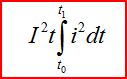
Примечания
1. Преддуговой I2t — это интеграл I2t за преддуговое время плавкого предохранителя.
2. I2t отключения — это интеграл I2t за время отключения плавкого предохранителя.
3. Энергия в джоулях, выделяемая в резисторе 1 Ом в цепи, защищаемой плавким предохранителем, равна I2t отключения, выраженному в амперах в квадрате в секунду (А2·с).
[ ГОСТ Р 50339. 0-2003 ( МЭК 60269-1-98)]
интеграл Джоуля I2t
Интеграл квадрата силы тока по данному интервалу времени.
МЭК 60050(441-18-23)
[ ГОСТ Р 50030. 1-2000 ( МЭК 60947-1-99)]
[ ГОСТ Р 50345-99( МЭК 60898-95)]EN
I2t
Joule integral
the integral of the square of the current over a given time interval:
NOTE 1 – The pre-arcing I2t is the I2t integral extended over the pre-arcing time of the fuse.
NOTE 2 – The operating I2t is the I2t integral extended over the operating time of the fuse.
NOTE 3 – The energy in joules liberated in one ohm of resistance in a circuit protected by a fuse is equal to the value of the operating I2t expressed in A2 • s.
[IEV number 441-18-23]FR
I2t
intégrale de Joule
intégrale du carré du courant pour un intervalle de temps donné:
NOTE 1 – L'I2t de préarc est l'intégrale I2t pour la durée de préarc du fusible.
NOTE 2 – L'I2t de fonctionnement est l'intégrale I2t pour la durée de fonctionnement du fusible.
NOTE 3 – L'énergie en joules libérée dans une portion ayant une résistance de un ohm d'un circuit protégé par un fusible est égale à la valeur de I2t de fonctionnement exprimée en A2 • s.
[IEV number 441-18-23]Тематики
EN
DE
FR
Русско-французский словарь нормативно-технической терминологии > интеграл Джоуля I2t
-
9 условный предел напряжения прикосновения
- tension limite conventionnelle de contact, UL
условный предел напряжения прикосновения
UL
Максимально допустимое в течение неограниченного времени напряжение прикосновения для установленных условий внешних воздействий, обычно равное 50 В среднеквадратического значения переменного тока или 120 В постоянного тока без пульсаций
[МЭС 826-02-04, измененный].
[ ГОСТ Р 61557-1-2006]EN
conventional touch voltage limit, UL
maximum value of the touch voltage which is permitted to be maintained indefinitely in specified conditions of external influences and is usually equal to 50 V a.c., r.m.s. or 120 V ripple free d.c.
[IEC 61557-1, ed. 2.0 (2007-01)]FR
tension limite conventionnelle de contact, UL
valeur maximale de la tension de contact qu’il est admis de pouvoir maintenir indéfiniment dans des conditions spécifiées d’influences externes et qui est égale habituellement à une valeur efficace de 50 V c.a., ou 120 V c.c. libre d’ondulation
[IEC 61557-1, ed. 2.0 (2007-01)]Тематики
EN
FR
- tension limite conventionnelle de contact, UL
Русско-французский словарь нормативно-технической терминологии > условный предел напряжения прикосновения
См. также в других словарях:
equal value — index par (equality) Burton s Legal Thesaurus. William C. Burton. 2006 equal value … Law dictionary
give equal value — index compensate (remunerate) Burton s Legal Thesaurus. William C. Burton. 2006 … Law dictionary
of equal value — index equivalent Burton s Legal Thesaurus. William C. Burton. 2006 … Law dictionary
Equal — E qual, a. [L. aequalis, fr. aequus even, equal; akin to Skr. ?ka, and perh. to L. unus for older oinos one, E. one.] 1. Agreeing in quantity, size, quality, degree, value, etc.; having the same magnitude, the same value, the same degree, etc.;… … The Collaborative International Dictionary of English
Equal temperament — Equal E qual, a. [L. aequalis, fr. aequus even, equal; akin to Skr. ?ka, and perh. to L. unus for older oinos one, E. one.] 1. Agreeing in quantity, size, quality, degree, value, etc.; having the same magnitude, the same value, the same degree,… … The Collaborative International Dictionary of English
Equal pay for women — is an issue regarding pay inequality between men and women. It is often introduced into domestic politics in many first world countries as an economic problem that needs governmental intervention via regulation. The Equal Remuneration Convention… … Wikipedia
equal pay — Under Section 1 of the Equal Pay Act 1970, where a worker of one gender is engaged in like work (work of the same or broadly the same nature), if his or her job is rated as equivalent (under a proper non discriminatory job evaluation study) or is … Law dictionary
equal — I UK [ˈiːkwəl] / US [ˈɪkwəl] adjective *** 1) the same in value, amount, or size All the workers have an equal share in the profits. of equal value/size/quality etc: His wife was doing work of equal importance. equal in value/size/quality etc: An … English dictionary
equal — e|qual1 W2S1 [ˈi:kwəl] adj ▬▬▬▬▬▬▬ 1¦(same)¦ 2¦(same rights/chances)¦ 3 be equal to something 4 on equal terms/on an equal footing 5 all (other) things being equal ▬▬▬▬▬▬▬ [Date: 1300 1400; : Latin; Origin: aequalis, from aequus level, equal ]… … Dictionary of contemporary English
Equal Pay Act 1970 — The Equal Pay Act 1970 is an Act of the United Kingdom Parliament which prohibits any less favourable treatment between men and women in terms of pay and conditions of employment. It came into force on 29 December 1975. The term pay is… … Wikipedia
Value (personal and cultural) — A personal and cultural value is a relative ethic value, an assumption upon which implementation can be extrapolated. A value system is a set of consistent values and measures. A principle value is a foundation upon which other values and… … Wikipedia
