

-
1 decisive range
1) Военный термин: дальность действительного огня2) Космонавтика: эффективная дальность действия -
2 decisive range
odległość skuteczna -
3 decisive range
-
4 decisive range
-
5 decisive range
English-Russian dictionary of terms that are used in computer games > decisive range
-
6 range
расстояние; дальность (действия, стрельбы, полета) ; радиус ( действия) ; прицел ( установка прицела) ; дистанция; дальнобойность; досягаемость; диапазон; полигон; стрельбище; тир; ав. относ бомбы; определять расстояние ( до цели) ; пристреливать цель по дальности— AT range— check point range— EW range— fuel exhaustion range— lethality range— marching range— range in -
7 combat
бой, боевые действия; вести бой [боевые действия]; оказывать противодействие; боевой; см. тж. battle; action; fight ( ing) ;— close air-to-air combat— close-in combat -
8 serious
1. a серьёзный; глубокомысленный2. a важный3. a внушающий опасения, опасныйСинонимический ряд:1. ardent (adj.) ardent; sincere2. decisive (adj.) decisive; important; profound; significant3. earnest (adj.) businesslike; earnest; grim; no-nonsense; poker-faced; sedate; serious-minded; sober; sobersided; solemn; somber; sombre; staid4. grave (adj.) critical; dangerous; fell; grave; grievous; heavy; major; momentous; perilous; pressing; severe; ugly; weighty5. hard (adj.) arduous; difficile; difficult; effortful; formidable; hard; knotty; labored; laborious; operose; rough; rugged; slavish; sticky; strenuous; terrible; toilful; toilsome; tough; uphill6. pensive (adj.) pensive; reflective; thoughtfulАнтонимический ряд:frivolous; happy; insignificant; insincere; jocular; light; light-hearted; lively; slight; trivial; unimportant -
9 target
объект; цель; мишень; задача; задание; норма; заданный показатель [срок]; конечный пункт; пункт назначения; заданное значение; норматив ( боевой подготовки) ; программировать траекторию ( ракеты) ; нацеливать; прицеливать; ставить задачу на удар [стрельбу] по цели; наводить; подготавливать огонь; приводить ( оружие) к нормальному бою, пристреливать; определять разнобой ( орудий) ; засекать ( цель) ;flare drop tow(ed) target — буксируемая мишень, отстреливающая ИК ловушки
pass the target (to) — передавать цель (напр. в другой сектор)
— aerial training target— hardened target— heat contrast target— interdiction-type target— pay off target— personnel-type target— prone silhouette target— scheduled nuclear target— shore-based target— towed target -
10 run
run [rʌn]━━━━━━━━━━━━━━━━━1. noun4. compounds━━━━━━━━━━━━━━━━━━━━━━━━━━━━━━━━━━1. nouna. ( = act of running) course fb. ( = outing) tour md. ( = series) série fe. ( = period of performance) her new series begins a run on BBC1 sa nouvelle série d'émissions va bientôt passer sur BBC1• the decisive goal arrived, against the run of play le but décisif a été marqué contre le cours du jeuh. ( = type) he didn't fit the usual run of petty criminals il n'avait pas le profil du petit malfaiteur ordinairei. ( = track for skiing) piste fj. ( = animal enclosure) enclos mk. (in tights) échelle f• things will sort themselves out in the long run les choses s'arrangeront avec le temps► on the runa. courir• to run down/off descendre/partir en courant• it runs in the family [characteristic] c'est de familleb. ( = flee) prendre la fuite• run for it! sauvez-vous !• to run into the sea [river] se jeter dans la mer► to run with ( = be saturated)d. ( = be candidate) être candidate. ( = be) I'm running a bit late je suis un peu en retard• inflation is running at 3% le taux d'inflation est de 3 %g. [bus, train, coach, ferry] assurer le service• the buses are running early/late/on time les bus sont en avance/en retard/à l'heureh. ( = function) [machine] marcher ; [factory] être en activité• but if it really happened he'd run a mile (inf) mais si ça se produisait, il aurait vite fait de se débiner (inf)b. ( = transport) [+ person] conduirec. ( = operate) [+ machine] faire marcher ; [+ computer program] exécuterd. ( = organize) [+ business] diriger ; [+ shop] tenir• the company runs extra buses at rush hours la société met en service des bus supplémentaires aux heures de pointe• the school is running courses for foreign students le collège organise des cours pour les étudiants étrangerse. ( = put, move) to run one's finger down a list suivre une liste du doigtf. ( = publish) publierg. ( = cause to flow) faire couler4. compounds• he gave me the run-around il s'est défilé (inf) ► run-down adjective [person] à plat (inf) ; [building, area] délabré► run-off noun [of contest] ( = second round) deuxième tour m ; ( = last round) dernier tour m ; [of pollutants] infiltrations fpl( = find) [+ object, quotation, reference] tomber sur• run along! sauvez-vous !► run away intransitive verb partir en courant ; ( = flee) [person] se sauver• he ran away with the funds ( = stole) il est parti avec la caisse► run away with inseparable transitive verba. ( = win easily) [+ race, match] gagner haut la mainb. you're letting your imagination run away with you tu te laisses emporter par ton imagination► run down separable transitive verba. ( = knock over) renverser ; ( = run over) écrasera. ( = meet) rencontrer par hasard• to run into difficulties or trouble se heurter à des difficultésb. ( = collide with) rentrer dansc. ( = amount to) s'élever à• the cost will run into thousands of euros le coût va atteindre des milliers d'euros► run out intransitive verba. [person] sortir en courantb. ( = come to an end) [lease, contract] expirer ; [supplies] être épuisé ; [period of time] être écoulé[+ supplies, money] être à court de ; [+ patience] être à bout de• to run out of petrol or gas (British, US) tomber en panne d'essence► run out on (inf) inseparable transitive verb[+ person] laisser tomber (inf)► run over( = recapitulate) reprendre• could you run that past me again? est-ce que tu pourrais m'expliquer ça encore une fois ?► run through inseparable transitive verba. ( = read quickly) parcourirb. ( = rehearse) [+ play] répéter• if I may just run through the principal points once more si je peux juste récapituler les points principaux► run to inseparable transitive verba. ( = seek help from) faire appel à ; ( = take refuge with) se réfugier dans les bras dec. ( = amount to) the article runs to several hundred pages l'article fait plusieurs centaines de pages► run up( = climb quickly) monter en courant ; ( = approach quickly) s'approcher en courantb. [+ bills] accumuler[+ problem, difficulty] se heurter à* * *[rʌn] 1.1) ( act of running) course fto give somebody a clear run — fig laisser le champ libre à quelqu'un ( at doing pour faire)
2) ( flight)to have somebody on the run — lit mettre quelqu'un en fuite; fig réussir à effrayer quelqu'un
to make a run for it — fuir, s'enfuir
3) ( series) série f4) Theatre série f de représentations5) ( trend) (of events, market) tendance fthe run of the cards/dice was against me — le jeu était contre moi
6) ( series of thing produced) ( in printing) tirage m; ( in industry) série f7) Finance ( on Stock Exchange) ruée f (on sur)8) (trip, route) trajet m9) (in cricket, baseball) point m10) (for rabbit, chickens) enclos m11) (in tights, material) échelle f12) ( for skiing etc) piste f13) ( in cards) suite f2.1) ( cover by running) courir [distance, marathon]2) ( drive)3) (pass, move)4) ( manage) dirigera well-/badly-run organization — une organisation bien/mal dirigée
5) ( operate) faire fonctionner [machine]; faire tourner [motor]; exécuter [program]; entretenir [car]6) (organize, offer) organiser [competition, course]; mettre [quelque chose] en place [bus service]7) ( pass) passer [cable]8) ( cause to flow) faire couler [bath]; ouvrir [tap]9) ( publish) publier [article]10) ( pass through) franchir [rapids]; forcer [blockade]; brûler [red light]11) ( smuggle) faire passer [quelque chose] en fraude12) ( enter) faire courir [horse]; présenter [candidate]3.1) ( move quickly) [person, animal] courirto run across/down something — traverser/descendre quelque chose en courant
to run for ou to catch the bus — courir pour attraper le bus
to come running — courir ( towards vers)
2) ( flee) fuir, s'enfuirrun for your life! —
run for it! — (colloq) sauve qui peut!, déguerpissons! (colloq)
3) (colloq) ( rush off) filer (colloq)4) ( function) [machine] marcherto run off — fonctionner sur [mains, battery]
to run fast/slow — [clock] prendre de l'avance/du retard
5) (continue, last) [contract, lease] courirto run from... to... — [school year, season] aller de... à...
7) ( pass)to run past/through — [frontier, path] passer/traverser
the road runs north for about ten kilometres — la route va vers le nord sur une dizaine de kilomètres
8) ( move) [sledge, vehicle] glisser; [curtain] coulisserto run through somebody's hands — [rope] filer entre les mains de quelqu'un
9) ( operate regularly) circuler10) ( flow) coulerthe streets will be running with blood — fig le sang coulera à flots dans les rues
11) ( flow when wet or melted) [dye, garment] déteindre; [makeup, butter] couler12) ( as candidate) se présenterto run for — être candidat/-e au poste de [mayor, governor]
to run for president — être candidat/-e à la présidence
13) ( be worded)the telex runs... — le télex se présente or est libellé comme suit...
14) ( snag) filer•Phrasal Verbs:- run at- run away- run down- run in- run into- run off- run on- run out- run over- run to- run up•• -
11 direction
-
12 set
1) набор; комплект- semiconductor assembly set - set of Belleville springs - set of conventional set - set of drawing instruments - set of gate patterns - set of gauge blocks - set of logical elements - set of statistical data - set of technical aids- snap set2) партия3) совокупность; множество4) установка; агрегат- desk telephone set - dial telephone set- gear set- local-battery telephone set - man-pack radio set - multi-operator welding set - sound-powered telephone set - wall telephone set5) регулировка; настройка || регулировать; настраивать6) группа; ансамбль7) класс; семейство9) схватывание || схватываться10) затвердевание || затвердевать11) крепление || закреплять12) геол. свита пород13) осадка (грунта) || оседать ( о грунте)14) радиоточка15) спорт сет16) включать, приводить в действие17) мат. множествоset closed under operation — множество, замкнутое относительно операции
- absolutely compact set - absolutely continuous set - absolutely convex set - absolutely irreducible set - absolutely measurable set - affinely independent set - affinely invariant set - algebraically independent set - almost finite set - almost full set - angular cluster set - asymptotically indecomposable set - at most denumerable set - centro-symmetric set - completely bounded set - completely continuous set - completely generating set - completely improper set - completely irreducible set - completely nonatomic set - completely normal set - completely ordered set - completely productive set - completely reducible set - completely separable set - constructively nonrecursive set - convexly independent set - countably infinite setto set aside — не учитывать, не принимать во внимание; откладывать
- cut set- cyclically ordered set - deductively inconsistent set - derived set - doubly well-ordered set - dual set of equations - dynamically disconnected set - effectively enumerable set - effectively generating set - effectively nonrecursive set - effectively simple set - enumeration reducible set - finely perfect set - finitely definite set - finitely measurable set- flat set- full set- fully reducible set - functionally closed set - functionally complete set - functionally open set - fundamental probability set - generalized almost periodic set- goal set- internally stable set- knot set- left directed set - left normal set - left-hand cluster set - linearly ordered set - local peak set - locally arcwise set - locally closed set - locally compact set - locally connected set - locally contractible set - locally convex set - locally finite set - locally invariant set - locally negligible set - locally null set - locally polar set - locally polyhedral set - metrically bounded set - metrically dense set - multiply ordered set - nearly analytic set - nearly closed set - nonvoid set - normally ordered set- null set- open in rays set - partitioned data set- peak set- pole set- positively homothetic set- pure set- radially open set - rationally independent set - recursively creative set - recursively indecomposable set - recursively isomorphic set - recursively productive set - regularly convex set - regularly situated sets - relatively closed set - relatively compact set - relatively dense set - relatively interpretable set - relatively open set - right normal set - right-hand cluster set- scar set- sequentially complete set - serially ordered set - set of elementary events - set of first category - set of first kind - set of first species - set of possible outcomes - set of probability null - set of second category - set of second species - shift invariant set - simply connected set - simply ordered set - simply transitive set- skew set- star set- strongly bounded set - strongly closed set - strongly compact set - strongly connected set - strongly convex set - strongly dependent set - strongly disjoint sets - strongly enumerable set - strongly independent set - strongly minimal set - strongly polar set - strongly reducible set - strongly separated set - strongly simple set - strongly stratified set- tame set- tautologically complete set - tautologically consistent set - tautologically inconsistent set- test set- thin set- tie set- time set- totally disconnected set - totally imperfect set - totally ordered set - totally primitive set - totally unimodular set - totally unordered set - truth-table reducible set - uniformly bounded set - uniformly continuous set - uniformly convergent set - uniformly integrable set - uniformly universal set - unilaterally connected set- unit set- vacuous set- void set- weakly compact set - weakly convex set - weakly n-dimensional set - weakly stratified set - weakly wandering set - well chained set - well founded set - well measurable set - well ordering set - well quasiordered set -
13 combat
1. n бой, сражениеsingle combat — единоборство, поединок
2. n борьба; конфликт, столкновение3. n дуэль, поединок4. a воен. боевойcombat operations — боевые действия, бой
combat formation — боевой порядок; боевое построение
combat team — усиленная часть, тактическая группа
5. v вести бой, сражаться6. v боротьсяСинонимический ряд:1. armed conflict (noun) action; armed conflict; battle; clash; conflict; contest; duel; encounter; engagement; fighting; hostilities; service; war; warfare2. assault (verb) assail; assault; attack; blitz; clash; do battle; engage; skirmish3. battle (verb) battle; contend; struggle; tilt; vie; wrestle4. resist (verb) buck; challenge; confront; contest; dispute; duel; fight; oppose; repel; resist; rise up against; traverse; withstandАнтонимический ряд:accord; agreement; compromise; defend; peace; support; surrender; truce -
14 critical
1. a решающий, переломный; критический2. a важный, ценный3. a лит. критический, относящийся к критике литературы и искусства4. a опасный, критический; угрожающийcritical defect — опасный дефект; критическая неисправность
5. a осуждающий, критикующий; разборчивый, требовательный6. a амер. дефицитный; крайне необходимый; нормируемый7. a спец. критический, граничныйСинонимический ряд:1. analytical (adj.) analytical; discriminating; judging2. dangerous (adj.) dangerous; hazardous; perilous; precarious; risky; suspenseful; ticklish3. faultfinding (adj.) captious; carping; caviling; cavilling; cavillous; censorious; critic; derogatory; disparaging; faultfinding; finicky; hypercritical; overcritical; picky; strict; trenchant4. important (adj.) acute; climacteric; crucial; deciding; decisive; desperate; determining; dire; discerning; grave; great; grievous; important; momentous; penetrating; pivotal; serious; strategic5. precise (adj.) delicate; discriminate; exact; fastidious; judicial; minute; particular; preciseАнтонимический ряд:complimentary; easy; inexact; insignificant; loose; popular; safe; shallow; superficial; trivial; unimportant -
15 ultimate
1. n окончательный результат; предел2. n основной принцип3. a последний, окончательный4. a предельный, крайний, конечный5. a основной, первичный6. a самый отдалённый7. a спец. критический8. a спец. максимальный9. a лингв. падающий на последний слог слова10. v завершать11. v завершаться; иметь результатомСинонимический ряд:1. conclusive (adj.) conclusive; definitive; final2. essential (adj.) basic; elemental; elementary; essential; fundamental; primitive; underlying3. last (adj.) categorical; closing; concluding; decisive; eventual; hindmost; lag; last; latest; latter; rearmost; terminal; terminating4. supreme (adj.) absolute; extreme; farthest; furthest; highest; incomparable; maximum; outermost; paramount; preeminent; pre-eminent; supreme; surpassing; towering; transcendent; unequalable; unmatchable; unsurpassable; uttermost5. top (adj.) maximal; top; topmost; utmost6. acme (noun) acme; extreme7. apotheosis (noun) apotheosis; epitome; last word; quintessence8. peak (noun) ceiling; climax; crest; maximum; peak9. close (verb) close; complete; conclude; consummate; determine; do; end; finish; halt; terminate; wind up; wrap upАнтонимический ряд:base; initial; intermediate; least; preliminary; primary; prime; prior -
16 Computers
The brain has been compared to a digital computer because the neuron, like a switch or valve, either does or does not complete a circuit. But at that point the similarity ends. The switch in the digital computer is constant in its effect, and its effect is large in proportion to the total output of the machine. The effect produced by the neuron varies with its recovery from [the] refractory phase and with its metabolic state. The number of neurons involved in any action runs into millions so that the influence of any one is negligible.... Any cell in the system can be dispensed with.... The brain is an analogical machine, not digital. Analysis of the integrative activities will probably have to be in statistical terms. (Lashley, quoted in Beach, Hebb, Morgan & Nissen, 1960, p. 539)It is essential to realize that a computer is not a mere "number cruncher," or supercalculating arithmetic machine, although this is how computers are commonly regarded by people having no familiarity with artificial intelligence. Computers do not crunch numbers; they manipulate symbols.... Digital computers originally developed with mathematical problems in mind, are in fact general purpose symbol manipulating machines....The terms "computer" and "computation" are themselves unfortunate, in view of their misleading arithmetical connotations. The definition of artificial intelligence previously cited-"the study of intelligence as computation"-does not imply that intelligence is really counting. Intelligence may be defined as the ability creatively to manipulate symbols, or process information, given the requirements of the task in hand. (Boden, 1981, pp. 15, 16-17)The task is to get computers to explain things to themselves, to ask questions about their experiences so as to cause those explanations to be forthcoming, and to be creative in coming up with explanations that have not been previously available. (Schank, 1986, p. 19)In What Computers Can't Do, written in 1969 (2nd edition, 1972), the main objection to AI was the impossibility of using rules to select only those facts about the real world that were relevant in a given situation. The "Introduction" to the paperback edition of the book, published by Harper & Row in 1979, pointed out further that no one had the slightest idea how to represent the common sense understanding possessed even by a four-year-old. (Dreyfus & Dreyfus, 1986, p. 102)A popular myth says that the invention of the computer diminishes our sense of ourselves, because it shows that rational thought is not special to human beings, but can be carried on by a mere machine. It is a short stop from there to the conclusion that intelligence is mechanical, which many people find to be an affront to all that is most precious and singular about their humanness.In fact, the computer, early in its career, was not an instrument of the philistines, but a humanizing influence. It helped to revive an idea that had fallen into disrepute: the idea that the mind is real, that it has an inner structure and a complex organization, and can be understood in scientific terms. For some three decades, until the 1940s, American psychology had lain in the grip of the ice age of behaviorism, which was antimental through and through. During these years, extreme behaviorists banished the study of thought from their agenda. Mind and consciousness, thinking, imagining, planning, solving problems, were dismissed as worthless for anything except speculation. Only the external aspects of behavior, the surface manifestations, were grist for the scientist's mill, because only they could be observed and measured....It is one of the surprising gifts of the computer in the history of ideas that it played a part in giving back to psychology what it had lost, which was nothing less than the mind itself. In particular, there was a revival of interest in how the mind represents the world internally to itself, by means of knowledge structures such as ideas, symbols, images, and inner narratives, all of which had been consigned to the realm of mysticism. (Campbell, 1989, p. 10)[Our artifacts] only have meaning because we give it to them; their intentionality, like that of smoke signals and writing, is essentially borrowed, hence derivative. To put it bluntly: computers themselves don't mean anything by their tokens (any more than books do)-they only mean what we say they do. Genuine understanding, on the other hand, is intentional "in its own right" and not derivatively from something else. (Haugeland, 1981a, pp. 32-33)he debate over the possibility of computer thought will never be won or lost; it will simply cease to be of interest, like the previous debate over man as a clockwork mechanism. (Bolter, 1984, p. 190)t takes us a long time to emotionally digest a new idea. The computer is too big a step, and too recently made, for us to quickly recover our balance and gauge its potential. It's an enormous accelerator, perhaps the greatest one since the plow, twelve thousand years ago. As an intelligence amplifier, it speeds up everything-including itself-and it continually improves because its heart is information or, more plainly, ideas. We can no more calculate its consequences than Babbage could have foreseen antibiotics, the Pill, or space stations.Further, the effects of those ideas are rapidly compounding, because a computer design is itself just a set of ideas. As we get better at manipulating ideas by building ever better computers, we get better at building even better computers-it's an ever-escalating upward spiral. The early nineteenth century, when the computer's story began, is already so far back that it may as well be the Stone Age. (Rawlins, 1997, p. 19)According to weak AI, the principle value of the computer in the study of the mind is that it gives us a very powerful tool. For example, it enables us to formulate and test hypotheses in a more rigorous and precise fashion than before. But according to strong AI the computer is not merely a tool in the study of the mind; rather the appropriately programmed computer really is a mind in the sense that computers given the right programs can be literally said to understand and have other cognitive states. And according to strong AI, because the programmed computer has cognitive states, the programs are not mere tools that enable us to test psychological explanations; rather, the programs are themselves the explanations. (Searle, 1981b, p. 353)What makes people smarter than machines? They certainly are not quicker or more precise. Yet people are far better at perceiving objects in natural scenes and noting their relations, at understanding language and retrieving contextually appropriate information from memory, at making plans and carrying out contextually appropriate actions, and at a wide range of other natural cognitive tasks. People are also far better at learning to do these things more accurately and fluently through processing experience.What is the basis for these differences? One answer, perhaps the classic one we might expect from artificial intelligence, is "software." If we only had the right computer program, the argument goes, we might be able to capture the fluidity and adaptability of human information processing. Certainly this answer is partially correct. There have been great breakthroughs in our understanding of cognition as a result of the development of expressive high-level computer languages and powerful algorithms. However, we do not think that software is the whole story.In our view, people are smarter than today's computers because the brain employs a basic computational architecture that is more suited to deal with a central aspect of the natural information processing tasks that people are so good at.... hese tasks generally require the simultaneous consideration of many pieces of information or constraints. Each constraint may be imperfectly specified and ambiguous, yet each can play a potentially decisive role in determining the outcome of processing. (McClelland, Rumelhart & Hinton, 1986, pp. 3-4)Historical dictionary of quotations in cognitive science > Computers
-
17 primary switch mode power supply
- импульсный источник электропитания с коммутацией тока на первичной стороне
импульсный источник электропитания с коммутацией тока на первичной стороне
-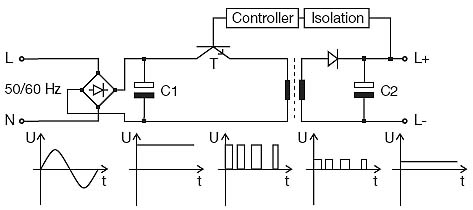
In primary switch mode power supplies, the AC mains voltage is first rectified and smoothed and then chopped ("switched"). Chopping means that the DC voltage is switched periodically at a frequency of 40 to 200 kHz using a power transistor.
In contrast to linearly regulated power supplies, the power transistor does not act as a variable resistor but as a switch instead. This generates a square-wave AC voltage that is transformed to the secondary circuit using a high-frequency transformer. In the secondary circuit, the voltage is rectifi ed and smoothed. The quantity of energy transformed to the secondary circuit is controlled, depending on the load, by varying the chopping rate. The longer the transistor is conductive, the higher is the quantity of energy transformed to the secondary circuit ( pulse width modulation).
Due to the use of high-frequency AC voltage, primary switch mode power supplies have the decisive advantage that their transformer can be of much smaller size than required for the transformation of low frequencies. This reduces the weight and the dissipation inside the unit. The effi ciency of these units is between 85 and 95 %. Since the output voltage does not directly depend on the input voltage, these units can be used for a wide input voltage range and can even be supplied with DC voltage. Furthermore, it is possible to buffer short-time mains voltage breakdowns up to 200 ms. However, the power failure buffering time is limited by the size of capacitor C1 since a longer buffering time requires a higher capacity and thus a bigger size of the capacitor. Especially in case of small power supplies this is not desirable.
Therefore, a practicable compromise has to be made between the size of the power supply and the buffering time.
Primary switch mode power supplies can be used for all purposes. For example, they are suitable for the supply of all kind of electronics as well as for electromechanical applications.
[ABB]Тематики
EN
Англо-русский словарь нормативно-технической терминологии > primary switch mode power supply
См. также в других словарях:
Roger Keyes, 1st Baron Keyes — Infobox Military Person name=The Lord Keyes lived=4 October 1872 ndash; 26 December 1945 placeofbirth=Punjab, British India placeofdeath=Buckingham caption=Roger Keyes as a Commodore, 2nd Class during the Dardanelles Campaign, 1915 nickname=… … Wikipedia
King George V class battleship (1939) — The King George V class battleships (KGV) were the penultimate battleship design completed for the Royal Navy (RN). Five ships of the class were commissioned: King George V (1940), Prince of Wales (1941), Duke of York (1941), Howe (1942), and… … Wikipedia
United Kingdom — a kingdom in NW Europe, consisting of Great Britain and Northern Ireland: formerly comprising Great Britain and Ireland 1801 1922. 58,610,182; 94,242 sq. mi. (244,100 sq. km). Cap.: London. Abbr.: U.K. Official name, United Kingdom of Great… … Universalium
United States — a republic in the N Western Hemisphere comprising 48 conterminous states, the District of Columbia, and Alaska in North America, and Hawaii in the N Pacific. 267,954,767; conterminous United States, 3,022,387 sq. mi. (7,827,982 sq. km); with… … Universalium
Christianity — /kris chee an i tee/, n., pl. Christianities. 1. the Christian religion, including the Catholic, Protestant, and Eastern Orthodox churches. 2. Christian beliefs or practices; Christian quality or character: Christianity mixed with pagan elements; … Universalium
France — /frans, frahns/; Fr. /frddahonns/, n. 1. Anatole /ann nann tawl /, (Jacques Anatole Thibault), 1844 1924, French novelist and essayist: Nobel prize 1921. 2. a republic in W Europe. 58,470,421; 212,736 sq. mi. (550,985 sq. km). Cap.: Paris. 3.… … Universalium
international relations — a branch of political science dealing with the relations between nations. [1970 75] * * * Study of the relations of states with each other and with international organizations and certain subnational entities (e.g., bureaucracies and political… … Universalium
World War II — the war between the Axis and the Allies, beginning on September 1, 1939, with the German invasion of Poland and ending with the surrender of Germany on May 8, 1945, and of Japan on August 14, 1945. Abbr.: WWII * * * or Second World War (1939–45)… … Universalium
naval warfare — Military operations conducted on, under, or over the sea and waged against other seagoing vessels or targets on land or in the air. The earliest naval attacks were raids by the armed men of a tribe or town using fishing boats or merchant ships.… … Universalium
GEOGRAPHICAL SURVEY — Names The name Ereẓ Israel (the Land of Israel) designates the land which, according to the Bible was promised as an inheritance to the Israelite tribes. In the course of time it came to be regarded first by the Jews and then also by the… … Encyclopedia of Judaism
Battle of Britain — This article is about the Second World War battle. For other uses, see Battle of Britain (disambiguation). Battle of Britain Part of the Second World War … Wikipedia
