

-
1 пуск переключением со звезды на треугольник
пуск переключением со звезды на треугольник
-EN
star-delta starting
the process of starting a three-phase motor by connecting it to the supply with the primary winding initially connected in star, then reconnected in delta for the running condition
[IEV number 411-52-16]FR
démarrage étoile-triangle
mode de démarrage d'un moteur triphasé à tension réduite, consistant à relier à la source à tension constante les enroulements statoriques, d'abord en couplage étoile, puis à passer au couplage triangle pour le fonctionnement normal
[IEV number 411-52-16]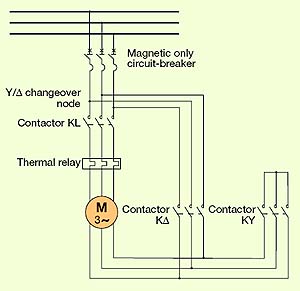
Magnetic only circuit-breaker - Автоматический выключатель с электромагнитным расцепителем
Y/Δ changeover node - Узел переключения со звезды на треугольник
Contactor KL - Контактор KL
Thermal relay - Тепловое реле
Contactor KΔ - Контактор KΔ
Contactor KY- Контактор KY
Параллельные тексты EN-RU Star-delta Y/Δ starting
Star-delta starting is the best known system and perhaps the commonest starting system at reduced voltage; it is used to start the motor reducing the mechanical stresses and limiting the current values during starting; on the other hand, it makes available a reduced inrush torque.This system can be used for motors with terminal box with 6 terminals and double supply voltage.
It is particularly suitable for no-load starting or with low and constant load torque or lightly increasing load torque, such as in the case of fans or low power centrifugal pumps.
Making reference to the diagram of Figure 6, the starting modality foresees the initial phase with star-connection of the windings to be realized through the closing of the circuit-breaker, of the line contactor KL and of the star contactor KY.
After a suitable predetermined period of time, the opening of the contactor KY and the closing of KΔ allow switching to delta-connection, which is also the configuration of normal running position.
[ABB]Пуск переключением со звезды на треугольник
Пуск переключением со звезды на треугольник является самым известным способом и, возможно, самой распространенной схемой пуска на пониженном напряжении. С одной стороны, этот способ используется для снижения механических нагрузок и ограничения пускового тока, а с другой - обеспечивает уменьшение пускового момента.Такая возможность может быть реализована в двигателях с шестью зажимами в выводной коробке, что позволяет питать его от двух напряжений.
Особенно этот способ подходит для ненагруженного пуска и пуска с низким постоянным или немного увеличивающимся вращающим моментом, например, для пуска вентиляторов или маломощных центробежных насосов.
Схема пуска переключением со звезды на треугольник представлена на рисунке 6. В начальный момент пуска обмотки статора соединяют звездой путем замыкания контактов автоматического выключателя, линейного контактора KL и контактора KY со схемой "звезда".
По истечении заданного времени контакты контактора KY размыкаются и замыкаются контакты контактора КΔ со схемой треугольник.
В результате выполняется переключение обмоток статора со схемы «звезда» на схему «треугольник».
Обе схемы соединения обмоток являются схемами нормального рабочего режима.
[Перевод Интент]Тематики
Обобщающие термины
EN
- star-delta starting
- Y/Δ starting
DE
FR
Русско-французский словарь нормативно-технической терминологии > пуск переключением со звезды на треугольник
-
2 характеристика тока отсечки (характеристика пропускания тока)
характеристика тока отсечки (характеристика пропускания тока)
Кривая, отражающая зависимость тока отсечки от ожидаемого тока в указанных рабочих условиях.
Примечание.
В случае переменного тока значения токов отсечки — это максимальные значения, которые могут быть достигнуты при любой степени асимметрии.
В случае постоянного тока значения токов отсечки — это максимальные значения, достигнутые при указанной постоянной времени.
МЭК 60050(441-17-14).
[ ГОСТ Р 50030. 1-2000 ( МЭК 60947-1-99)]EN
cut-off (current) characteristic
let-through (current) characteristic
a curve giving the cut-off current as a function of the prospective current, under stated conditions of operation
NOTE – In the case of a.c., the values of the cut-off currents are the maximum values which can be reached whatever the degree of asymmetry. In the case of d.c., the values of the cut-off currents are the maximum values reached related to the time constant as specified.
[IEV number 441-17-14]FR
caractéristique de courant coupé limité
courbe donnant, pour des conditions déterminées de fonctionnement, le courant coupé limité en fonction du courant présumé
NOTE – En courant alternatif, les valeurs du courant coupé limité sont les valeurs maximales quel que soit le degré d'asymétrie. En courant continu, ce sont les valeurs du courant coupé limité maximales atteintes compte tenu de la constante de temps spécifiée.
[IEV number 441-17-14]
EN
DE
FR
Русско-французский словарь нормативно-технической терминологии > характеристика тока отсечки (характеристика пропускания тока)
-
3 максимально допустимые значения входного тока и напряжения
- valeurs maximales admissibles du courant et de la tension d’entrée
максимально допустимые значения входного тока и напряжения
-
[IEV number 314-04-05]EN
maximum permissible values of the input current and voltage
values of current and voltage assigned by the manufacturer which the transducer will withstand indefinitely without damage
[IEV number 314-04-05]FR
valeurs maximales admissibles du courant et de la tension d’entrée
valeurs du courant et de la tension indiquées par le constructeur comme étant les valeurs que le transducteur peut supporter indéfiniment sans dommage
[IEV number 314-04-05]Тематики
- измерение электр. величин в целом
EN
DE
FR
- valeurs maximales admissibles du courant et de la tension d’entrée
Русско-французский словарь нормативно-технической терминологии > максимально допустимые значения входного тока и напряжения
-
4 максимальный расцепитель тока с обратнозависимой выдержкой времени
максимальное реле или максимальный расцепитель тока с обратнозависимой выдержкой времени
Максимальное реле или максимальный расцепитель тока, срабатывающие с выдержкой времени, находящейся в обратной зависимости от значения сверхтока.
Примечание. Такие реле или расцепитель могут быть спроектированы так, чтобы при высоких значениях сверхтока выдержка времени достигала определенного минимального значения.
[ ГОСТ Р 50030. 1-2000 ( МЭК 60947-1-99)]
максимальный расцепитель тока с обратно-зависимой выдержкой времени
Максимальный расцепитель тока, срабатывающий после выдержки времени, находящейся в обратной зависимости от значения сверхтока.
Примечание — Такой расцепитель может быть спроектирован так, чтобы эта выдержка времени при высоких значениях сверхтока достигала определенного минимального значения
[ ГОСТ Р 50345-99( МЭК 60898-95)]EN
inverse time-delay over-current release
an over-current release which operates after a time-delay inversely dependent upon the value of the over-current
NOTE - Such a release may be designed so that the time-delay approaches a definite minimum value for high values of over-current.
[IEV number 441-16-35]
[IEC 62271-100, ed. 2.0 (2008-04)]
inverse time-delay overcurrent release
overcurrent release which operates after a time-delay inversely dependent upon the value of the overcurrent
NOTE - Such a release may be designed so that the time-delay approaches a definite minimum for high values of overcurrent.
[IEV number 441-16-35]
[IEC 60898-1, ed. 1.0 (2002-01)]FR
déclencheur à maximum de courant à temps inverse
déclencheur à maximum de courant qui fonctionne après un intervalle de temps qui varie en raison inverse de la valeur de la surintensité
NOTE - Un tel déclencheur peut être prévu pour que le retard atteigne une valeur minimale définie pour les valeurs élevées de la surintensité.
[IEV number 441-16-35]
[IEC 62271-100, ed. 2.0 (2008-04)]
[IEC 60898-1, ed. 1.0 (2002-01)]Недопустимые, нерекомендуемые
Тематики
- выключатель автоматический
- расцепитель, тепловое реле
Классификация
>>>EN
DE
FR
Русско-французский словарь нормативно-технической терминологии > максимальный расцепитель тока с обратнозависимой выдержкой времени
-
5 тип счетчика
1
тип счетчика
термин, используемый для определения совокупности конкретной конструкции счетчика, имеющей:
а) сходные метрологические характеристики;
б) конструктивное подобие элементов, определяющих эти характеристики.
Тип может иметь несколько значений номинального тока и номинального напряжения.
Счетчики обозначаются изготовителем одной или большим числом групп букв или цифр, или комбинацией букв и цифр. Каждый тип имеет только одно обозначение.
Примечание - Данный тип представляют один или несколько образцов счетчиков, предназначенных для проведения испытаний для целей утверждения типа, характеристики которых (номинальные токи и номинальные напряжения) соответствуют значениям, указанным изготовителем.
[ ГОСТ 6570-96]2
тип счетчика
-
[IEV number 314-07-07]EN
meter type
particular design of meter, manufactured by one manufacturer, having:
a) similar metrological properties;
b) the same uniform construction of parts determining these properties;
c) the same ratio of the maximum current to the reference current
NOTE 1 – The type may have several values of reference current and reference voltage.
NOTE 2 – Meters are designated by the manufacturer by one or more groups of letters or numbers, or a combination of letters and numbers. Each type has one designation only.
NOTE 3 – The type is represented by the sample meter(s) intended for the type tests and whose characteristics (reference current and reference voltage) are chosen from the values given in the tables proposed by the manufacturer.
[IEV number 314-07-07]FR
type
ensemble des compteurs fabriqués par un même constructeur et ayant:
a) des qualités métrologiques similaires;
b) l’uniformité constructive des constituants déterminant ces qualités;
c) un même rapport entre courant maximal et courant de référence
NOTE 1 – Le type peut comporter différentes valeurs de courant de référence et de tension de référence.
NOTE 2 – Les compteurs sont désignés par le constructeur, par une ou plusieurs associations soit de lettres, soit de chiffres. A chaque type correspond une seule désignation.
NOTE 3 – Le type est représenté par le ou les compteurs échantillons destinés aux essais de type et dont les caractéristiques (courant de référence et tension de référence) sont choisies parmi celles figurant dans les tableaux proposés par le constructeur.
[IEV number 314-07-07]Тематики
EN
DE
FR
Русско-французский словарь нормативно-технической терминологии > тип счетчика
-
6 предпочтительный диапазон влияющей величины
- domaine préférentiel d'une grandeur d'influence (pour un dispositif de coupure différentiel)
предпочтительный диапазон влияющей величины
-
[IEV number 442-05-38]EN
preferred range of an influencing quantity (for a residual current device)
the range of values of an influencing quantity which permits the residual current devices to operate, under specified conditions, the other influencing quantities having their reference values
[IEV number 442-05-38]FR
domaine préférentiel d'une grandeur d'influence (pour un dispositif de coupure différentiel)
domaine des valeurs d'une grandeur d'influence pour lequel, dans des conditions spécifiées, le dispositif de coupure différentiel fonctionne, les autres grandeurs d'influence ayant leur valeur de référence
[IEV number 442-05-38]Тематики
- электротехника, основные понятия
EN
- preferred range of an influencing quantity (for a residual current device)
DE
- Vorzugsbereich einer Einflußgröße (für eine Fehlerstrom-Schutzeinrichtung)
FR
- domaine préférentiel d'une grandeur d'influence (pour un dispositif de coupure différentiel)
Русско-французский словарь нормативно-технической терминологии > предпочтительный диапазон влияющей величины
-
7 диапазон токовых уставок максимального реле или расцепителя тока
- domaine du courant de réglage (d'un relais ou d'un déclencheur à maximum de courant ou de surcharge)
диапазон токовых уставок максимального реле или расцепителя тока
Диапазон между минимальным и максимальным значениями, в котором можно регулировать уставку тока реле или расцепителя.
[ ГОСТ Р 50030. 1-2000 ( МЭК 60947-1-99)]EN
current setting range (of an over-current or overload relay or release)
range between the minimum and maximum values over which the current setting of the relay or release can be adjusted
[IEC 60947-1, ed. 5.0 (2007-06)]FR
domaine du courant de réglage (d'un relais ou d'un déclencheur à maximum de courant ou de surcharge)
domaine limité par les valeurs minimales et maximales entre lesquelles on peut choisir la valeur du courant de réglage du relais ou du déclencheur
[IEC 60947-1, ed. 5.0 (2007-06)]Тематики
- выключатель автоматический
- расцепитель, тепловое реле
- реле электрическое
EN
FR
- domaine du courant de réglage (d'un relais ou d'un déclencheur à maximum de courant ou de surcharge)
Русско-французский словарь нормативно-технической терминологии > диапазон токовых уставок максимального реле или расцепителя тока
-
8 дифференциальный ток
дифференциальный ток
Алгебраическая сумма значений электрических токов во всех токоведущих проводниках в одно и то же время в данной точке электрической цепи электрической установки
[ ГОСТ Р МЭК 60050-826-2009]
Примечание - Определение термина «дифференциальный ток» в МЭК 60050-826 [4] сформулировано для электрической цепи. Через главную цепь устройства дифференциального тока, защищающего электрическую цепь, проходят все ее проводники, находящиеся под напряжением, вследствие чего дифференциальный ток, появляющийся в электрической цепи, будет равен дифференциальному току, определяемому устройством дифференциального тока.
[ ГОСТ Р 50571. 1-2009 ( МЭК 60364-1: 2005)]
дифференциальный ток
IΔ,
Действующее значение векторной суммы токов, протекающих в главной цепи.
дифференциальный ток
ID
Среднеквадратическое значение векторной суммы токов, протекающих через главную цепь устройства дифференциального тока.
П р и м е ч а н и е - Определение термина «дифференциальный ток» в МЭК 60050-442 [6] сформулировано для устройства дифференциального тока.
[ ГОСТ Р 50571. 1-2009 ( МЭК 60364-1: 2005)]
дифференциальный ток
-
[Лугинский Я. Н. и др. Англо-русский словарь по электротехнике и электроэнергетике. 2-е издание - М.: РУССО, 1995 - 616 с.]EN
residual current
algebraic sum of the values of the electric currents in all live conductors, at the same time at a given point of an electric circuit in an electrical installation
[IEV number 826-11-19]
residual current
r.m.s. value of the vector sum of the currents flowing through the main circuit of the residual current device
[IEV number 442-05-19]FR
courant différentiel résiduel, m
somme algébrique des valeurs des courants électriques dans tous les conducteurs actifs, au même instant en un point donné d'un circuit électrique d'une installation électrique
[IEV number 826-11-19]
courant différentiel résiduel
valeur efficace de la somme vectorielle des courants circulant dans le circuit principal du dispositif de coupure différentiel
[IEV number 442-05-19]Недопустимые, нерекомендуемые
Тематики
- электробезопасность
- электротехника, основные понятия
EN
DE
FR
Русско-французский словарь нормативно-технической терминологии > дифференциальный ток
-
9 максимальное реле или максимальный расцепитель тока с обратнозависимой выдержкой времени
максимальное реле или максимальный расцепитель тока с обратнозависимой выдержкой времени
Максимальное реле или максимальный расцепитель тока, срабатывающие с выдержкой времени, находящейся в обратной зависимости от значения сверхтока.
Примечание. Такие реле или расцепитель могут быть спроектированы так, чтобы при высоких значениях сверхтока выдержка времени достигала определенного минимального значения.
[ ГОСТ Р 50030. 1-2000 ( МЭК 60947-1-99)]EN
inverse time-delay over-current relay or release
over-current relay or release which operates after a time-delay inversely dependent upon the value of the over-current
NOTE Such a relay or release may be designed so that the time-delay approaches a definite minimum value for high values of over-current.
[IEC 60947-1, ed. 5.0 (2007-06)]FR
relais ou déclencheur à maximum de courant à temps inverse
relais ou déclencheur à maximum de courant qui fonctionne après un intervalle de temps qui varie en raison inverse de la valeur de la surintensité
NOTE Un tel relais ou déclencheur peut être prévu pour que le retard atteigne une valeur minimale définie pour les valeurs élevées de la surintensité.
[IEC 60947-1, ed. 5.0 (2007-06)]Тематики
- расцепитель, тепловое реле
- реле электрическое
Классификация
>>>EN
FR
Русско-французский словарь нормативно-технической терминологии > максимальное реле или максимальный расцепитель тока с обратнозависимой выдержкой времени
-
10 трансформатор тока
трансформатор тока
Трансформатор, в котором при нормальных условиях применения вторичный ток практически пропорционален первичному току и при правильном включении сдвинут относительно него по фазе на угол, близкий к нулю.
[ ГОСТ 18685-73]
трансформатор тока
Трансформатор, сигнал на выходе которого пропорционален входному току. [МЭС 321-02-01, измененный ]
Примечание
Катушка Роговского с интегрирующей цепью представляет собой широкополосный трансформатор тока.
[МЭК 60-2]EN
current transformer
an instrument transformer in which the secondary current, in normal conditions of use, is substantially proportional to the primary current and differs in phase from it by an angle which is approximately zero for an appropriate direction of the connections
[IEV number 321-02-01]FR
transformateur de courant
transformateur de mesure dans lequel le courant secondaire est, dans les conditions normales d'emploi, pratiquement proportionnel au courant primaire et déphasé par rapport à celui-ci d'un angle approximativement nul pour un sens approprié des connexions
[IEV number 321-02-01]... электромагнитные трансформаторы тока (далее — трансформаторы) на номинальное напряжение от 0,66 до 750 кВ включительно, предназначенные для передачи сигнала измерительной информации приборам измерения, защиты, автоматики, сигнализации и управления в электрических цепях переменного тока частотой 50 или 60 Гц.
[ ГОСТ 7746-2001]Параллельные тексты EN-RU
Inductive current transformers (CT) step the operating currents and short-circuit currents down to values which are suitable for measuring instruments and protective devices connected.
[Siemens]Электромагнитные трансформаторы тока понижают значение рабочих токов и токов короткого замыкания до значений, приемлемых для измерительных приборов и устройств защиты.
[Перевод Интент]Тематики
Классификация
>>>Обобщающие термины
Синонимы
- ТТ
EN
DE
FR
Русско-французский словарь нормативно-технической терминологии > трансформатор тока
-
11 автоматический выключатель
автоматический выключатель
Механический коммутационный аппарат1), способный включать, проводить и отключать токи при нормальном состоянии электрической цепи, а также включать, проводить в течение заданного времени и автоматически отключать токи в указанном аномальном состоянии электрической цепи, например, при коротком замыкании.
(МЭС 441-14-20)
[ ГОСТ Р 50030. 2-99 ( МЭК 60947-2-98)]
автоматический выключатель
-
[IEV number 442-05-01]EN
circuit breaker
a mechanical switching device, capable of making, carrying and breaking currents under normal circuit conditions and also making, carrying for a specified time and breaking currents under specified abnormal circuit conditions such as those of short circuit.
[IEC 62271-100, ed. 2.0 (2008-04)]
[IEV number 442-05-01]
circuit breaker
A device designed to open and close a circuit by nonautomatic means and to open the circuit automatically on a predetermined overcurrent without damage to itself when properly applied within its rating.
NOTE The automatic opening means can be integral, direct acting with the circuit breaker, or remote from the circuit breaker.
Adjustable (as applied to circuit breakers). A qualifying term indicating that the circuit breaker can be set to trip at various values of current, time, or both within a predetermined range. Instantaneous-trip (as applied to circuit breakers). A qualifying term indicating that no delay is purposely introduced in the tripping action of the circuit breaker.
Inverse-time (as applied to circuit breakers). A qualifying term indicating a delay is purposely introduced in the tripping action of the circuit breaker, which delay decreases as the magnitude of the current increases.
Nonadjustable (as applied to circuit breakers). A qualifying term indicating that the circuit breaker does not have any adjustment to alter the value of current at which it will trip or the time required for its operation.
Setting (of a circuit breaker). The value of current, time, or both at which an adjustable circuit breaker is set to trip.
[National Electrical Cod]FR
disjoncteur
1) Должно быть контактный коммутационный аппарат
appareil mécanique de connexion capable d’établir, de supporter et d’interrompre des courants dans les conditions normales du circuit, ainsi que d’établir, de supporter pendant une durée spécifiée et d’in- terrompre des courants dans des conditions anormales spécifiées du circuit telles que celles du court-circuit.
[IEC 62271-100, ed. 2.0 (2008-04)]
[IEV number 442-05-01]
[Интент]КЛАССИФИКАЦИЯ
- По роду тока
- По напряжению
- По числу полюсов
- По виду корпуса
- По месту установки
- По изолирующей среде
- По установленным расцепителям
- По дополнительным защитам
- По назначению
- По категории применения
- По виду привода взвода пружины
- По выполняемой функции
-
По влиянию монтажного положения
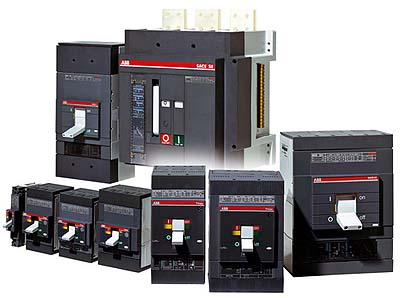 Автоматические выключатели ABB
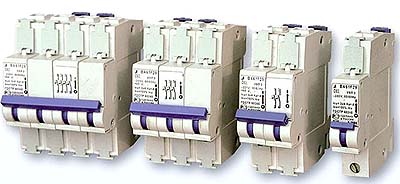 Модульные автоматические выключатели
1. НЕКОТОРЫЕ СВЕДЕНИЯ ОБ АВТОМАТИЧЕСКИХ ВЫКЛЮЧАТЕЛЯХ Автоматический выключатель — это электрический аппарат, который автоматически отключает (и тем самым защищает) электрическую цепь при возникновении в ней аномального режима. Режим становится аномальным, когда в цепи начинает недопустимо изменяться (т. е. увеличиваться или уменьшаться относительно номинального значения) ток или напряжение.
Другими словами (более "инженерно") можно сказать, что автоматический выключатель защищает от токов короткого замыкания и токов перегрузки отходящую от него питающую линию, например, кабель и приемник(и) электрической энергии (осветительную сеть, розетки, электродвигатель и т. п.).
Как правило, автоматический выключатель может применятся также для нечастого (несколько раз в сутки) включения и отключения защищаемых электроприемников (защищаемой нагрузки).
[Интент]Выключатель предназначен для проведения тока в нормальном режиме и отключения тока при коротких замыканиях, перегрузках, недопустимых снижениях напряжения, а также до 30 оперативных включений и отключений электрических цепей в сутки и рассчитан для эксплуатации в электроустановках с номинальным рабочим напряжением до 660 В переменного тока частоты 50 и 60 Гц и до 440 В постоянного тока.
[Типовая фраза из российской технической документации] 2. ПРИНЦИП ДЕЙСТВИЯ Для защиты цепи от короткого замыкания применяется автоматический выключатель с электромагнитным расцепителем.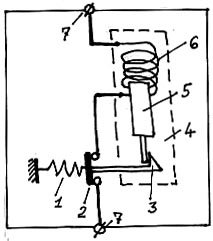
1 - Пружина (в данном случае во взведенном положении растянута)
Автоматический выключатель устроен таким образом, что сначала необходимо взвести пружину и только после этого его можно включить. У многих автоматических выключателей для взвода пружины необходимо перевести ручку вниз. После этого ручку переводят вверх. При этом замыкаются главные контакты.
2 - Главный контакт автоматического выключателя
3 - Удерживающее устройство
4 - Электромагнитный расцепитель;
5 - Сердечник
6 - Катушка
7 - Контактные зажимы автоматического выключателя
На рисунке показан один полюс автоматического выключателя во включенном положении: пружина 1 взведена, а главный контакт 2 замкнут.
Как только в защищаемой цепи возникнет короткое замыкание, ток, протекающий через соответствующий полюс автоматического выключателя, многократно возрастет. В катушке 6 сразу же возникнет сильное магнитное поле. Сердечник 5 втянется в катушку и освободит удерживающее устройство. Под действием пружины 1 главный контакт 2 разомкнется, в результате чего автоматический выключатель отключит и тем самым защитит цепь, в которой возникло короткое замыкание. Такое срабатывание автоматического выключателя происходит практически мгновенно (за сотые доли секунды).
Для защиты цепи от тока перегрузки применяют автоматические выключатели с тепловым расцепителем.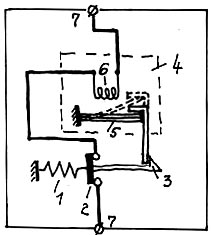
1 - Пружина (в данном случае во взведенном положении растянута)
Принцип действия такой же как и в первом случае, с той лишь разницей, что удерживающее устройство 3 освобождается под действием биметаллической пластины 5, которая изгибается от тепла, выделяемого нагревательным элементом 6. Количество тепла определяется током, протекающим через защищаемую цепь.
2 - Главный контакт автоматического выключателя
3 - Удерживающее устройство
4 - Тепловой расцепитель
5 - Биметаллическая пластина
6 - Нагревательный элемент
7 - Контактные зажимы автоматического выключателя
[Интент]Недопустимые, нерекомендуемые
Тематики
Классификация
>>>Обобщающие термины
Действия
- включение автоматического выключателя
- оперирование автоматического выключателя
- отключение автоматического выключателя
- срабатывание автоматического выключателя
EN
- auto-cutout
- automatic circuit breaker
- automatic cutout
- automatic switch
- breaker
- CB
- circuit breaker
- circuit-breaker
- cutout
DE
FR
Смотри также
Русско-французский словарь нормативно-технической терминологии > автоматический выключатель
12 прямой пуск вращающегося электродвигателя
прямой пуск вращающегося электродвигателя
Пуск вращающегося электродвигателя путем непосредственного подключения его к питающей сети.
[ ГОСТ 27471-87]EN
direct-on-line starting
across-the-line starting (US)
the process of starting a motor by connecting it directly to the supply at rated voltage
[IEV number 411-52-15]FR
démarrage direct
mode de démarrage d'un moteur, consistant à lui appliquer directement sa pleine tension assignée
[IEV number 411-52-15]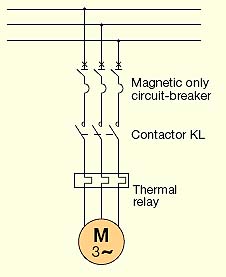
Рис. ABB
Схема прямого пуска электродвигателяMagnetic only circuit-breaker - Автоматический выключатель с электромагнитным расцепителем
Contactor KL - Контактор KL
Thermal relay - Тепловое реле
Параллельные тексты EN-RU
Direct-on-line starting
Direct-on-line starting, which is often abbreviated as DOL, is perhaps the most traditional system and consists in connecting the motor directly to the supply network, thus carrying out starting at full voltage.Direct-on-line starting represents the simplest and the most economical system to start a squirrel-cage asynchronous motor and it is the most used.
As represented in Figure 5, it provides the direct connection to the supply network and therefore starting is carried out at full voltage and with constant frequency, developing a high starting torque with very reduced acceleration times.
The typical applications are relevant to small power motors also with full load starting.
These advantages are linked to some problems such as, for example, the high inrush current, which - in the first instants - can reach values of about 10 to 12 times the rated current, then can decrease to about 6 to 8 times the rated current and can persist to reach the maximum torque speed.The effects of such currents can be identified with the high electro-dynamical stresses on the motor connection cables and could affect also the windings of the motor itself; besides, the high inrush torques can cause violent accelerations which stress the transmission components (belts and joints) generating distribution problems with a reduction in the mechanical life of these elements.
Finally, also the possible electrical problems due to voltage drops on the supply line of the motor or of the connected equipment must be taken into consideration.
[ABB]Прямой пуск
Прямой пуск, который по-английски часто сокращенно обозначают как DOL, является, пожалуй наиболее распространенным способом пуска. Он заключается в непосредственном (т. е. прямом) подключении двигателя к питающей сети. Это означает, что пуск двигателя осуществляется при полном напряжении.Схема прямого пуска является наиболее простым, экономичным и чаще всего применяемым решением для электродвигателей с короткозамкнутым ротором.
Схема прямого подключения к сети представлена на рисунке 5. Пуск осуществляется при полном напряжении и постоянной частоте сети. Электродвигатель развивает высокий пусковой момент при коротком времени разгона.
Типичные области применения – маломощные электродвигатели, в том числе с пуском при полной нагрузке.
Однако, наряду с преимуществами имеются и определенные недостатки, например, бросок пускового тока, достигающий в первоначальный момент 10…12-кратного значения от номинального тока электродвигателя. Затем ток двигателя уменьшается примерно до 6…8-кратного значения номинального тока и будет держаться на этом уровне до тех пор, пока скорость двигателя не достигнет максимального значения.
Такое изменение тока оказывает значительное электродинамическое воздействие на кабель, подключенный к двигателю. Кроме того пусковой ток воздействует на обмотки двигателя. Высокий начальный пусковой момент может привести к значительному ускорению и следовательно к значительной нагрузке элементов привода (ремней, крепления узлов), что вызывает сокращение их срока службы.
И, наконец, следует принять во внимание возможное возникновение проблем, связанных с падением напряжения в линии питания двигателя и подключенного к этой линии оборудования.
[Перевод Интент]
Тематики
Синонимы
EN
- across-the-line starting (US)
- direct line starting
- direct operation of a motor
- direct starting
- direct-on-line starting
- DOL
- full voltage starter application
DE
FR
Русско-французский словарь нормативно-технической терминологии > прямой пуск вращающегося электродвигателя
13 экстремальный диапазон влияющей величины
- domaine extrême d'une grandeur d'influence (pour un dispositif de coupure différentiel)
экстремальный диапазон влияющей величины
-
[IEV number 442-05-39]EN
extreme range of an influencing quantity (for a residual current device)
the range of values of an influencing quantity within which the residual current device suffers only spontaneously reversible changes, while not necessarily complying with any requirements
[IEV number 442-05-39]FR
domaine extrême d'une grandeur d'influence (pour un dispositif de coupure différentiel)
domaine des valeurs que peut prendre une grandeur d'influence, à l'intérieur duquel le dispositif de coupure différentiel ne subit que des altérations spontanément réversibles, sans être tenu nécessairement de satisfaire à aucune autre prescription
[IEV number 442-05-39]EN
DE
FR
- domaine extrême d'une grandeur d'influence (pour un dispositif de coupure différentiel)
Русско-французский словарь нормативно-технической терминологии > экстремальный диапазон влияющей величины
14 обозначение класса (для счетчика энергии)
обозначение класса (для счетчика энергии)
-
[IEV number 314-07-06]EN
class index (of an energy meter)
number which gives the limits of the absolute value of the permissible relative error, expressed in percent, within a specified range of values for the current, for unity power factor (and in the case of polyphase meters with balanced loads) when the meter is tested under reference conditions (including the permitted tolerances on the reference values)
[IEV number 314-07-06]FR
indice de classe (d'un compteur d'énergie)
nombre qui donne les limites de la valeur absolue de l’erreur relative admissible, exprimée en pourcent, dans une plage spécifiée de valeurs du courant, pour le facteur de puissance égal à l’unité (et dans le cas des compteurs polyphasés avec charges équilibrées), lorsque le compteur est essayé dans les conditions de référence (y compris les tolérances permises sur les valeurs de référence)
[IEV number 314-07-06]Тематики
- измерение электр. величин в целом
- счетчик электроэнергии
EN
DE
FR
Русско-французский словарь нормативно-технической терминологии > обозначение класса (для счетчика энергии)
15 номинальное напряжение
номинальное напряжение
Напряжение, установленное изготовителем для прибора
[ ГОСТ Р 52161. 1-2004 ( МЭК 60335-1: 2001)]
номинальное напряжение Uном, кВ
Номинальное междуфазное напряжение электрической сети, для работы в которой предназначены коммутационные аппараты.
[ ГОСТ Р 52726-2007]
номинальное напряжение
Un
Напряжение, применяемое для обозначения или идентификации системы электроснабжения.
[ ГОСТ Р 51317.4.30-2008 (МЭК 61000-4-30:2008)]EN
rated voltage
voltage assigned to the appliance by the manufacturer
[IEC 60335-1, ed. 4.0 (2001-05)]
rated voltage
quantity value assigned, generally by the manufacturer, for a specified operating condition of a machine
[IEC 60034-18-41, ed. 1.0 (2006-10)]
rated voltage
input or output supply voltage for which equipment is designed or specified
[IEC 88528-11, ed. 1.0 (2004-03)]
rated voltage
specified value of the voltage at the terminals of the machine when operating at a rating. If unidirectional, the voltage is the arithmetic mean of the recurring waveform and if alternating it is the root mean square value of the fundamental frequency component of the recurring waveform
NOTE - In the case of a machine with a protective resistor permanently in series, the resistor is considered as an integral part of the machine
[IEC 60349-1, ed. 1.0 (1999-11)]
rated voltage
the value of voltage assigned by the manufacturer to a component, device or equipment and to which operation and performance characteristics are referred
NOTE - Equipment may have more than one rated voltage value or may have a rated voltage range.
[IEC 62497-1, ed. 1.0 (2010-02)]
rated voltage
reference voltage for which the cable is designed, and which serves to define the electrical tests
NOTE 1 - The rated voltage is expressed by the combination of two values: Uo/U expressed in volts (V):
Uo being the r.m.s. value between any insulated conductor and "earth" (metal covering of the cable or the surrounding medium);
U being the r.m.s. value between any two phase conductors of a multicore cable or of a system of single-core cables.
In an alternating-current system, the rated voltage of a cable is at least equal to the nominal voltage of the system for which it is intended.
This condition applies both to the value Uo and to the value U.
In a direct current system, the nominal voltage of the system is not higher than 1,5 times the rated voltage of the cable.
NOTE 2 - The operating voltage of a system may permanently exceed the nominal voltage of such a system by 10 %. A cable can be used at a 10 % higher operating voltage than its rated voltage if the latter is at least equal to the nominal voltage of the system
[IEC 60245-1, ed. 4.0 (2003-12)]
rated voltage
highest allowable voltage between the conductors in a twin and multi conductor cable, or between one conductor and an electrical conductive screen, or between the two ends of a single core cable, or earth in unscreened cables
[IEC 60800, ed. 3.0 (2009-07)]
rated voltage
the r.m.s. line-to-line voltage under rated conditions
Primary side of input transformer: ULN
Converter input: UVN
Converter output: UaN
Motor voltage: UAN
[IEC 61800-4, ed. 1.0 (2002-09)]
rated voltage
input or output voltage (for three-phase supply, the phase-to-phase voltage) as declared by the manufacturer
[IEC 62040-1, ed. 1.0 (2008-06)]
nominal voltage, Un
voltage by which a system is designated or identified
[IEC 61000-4-30, ed. 2.0 (2008-10)]FR
tension assignée
tension attribuée à l'appareil par le fabricant
[IEC 60335-1, ed. 4.0 (2001-05)]
tension nominale
tension assignée, généraleme<>value of voltage assigned by the manufacturer, to a componentnt par le constructeur pour des conditions spécifiées de fonctionnement de la machine
[IEC 60034-18-41, ed. 1.0 (2006-10)]
tension assignée
tension spécifiée aux bornes de la machine quand celle-ci fonctionne au régime assigné. Dans le cas d'une tension redressée, sa valeur est égale à la valeur moyenne de l'onde périodique. Dans le cas d'une tension alternative, sa valeur est égale à la valeur efficace de la composante fondamentale de l'onde périodique
NOTE - Dans le cas d'une machine équipée d'une résistance de protection connectée en permanence en série, la résistance est considérée comme faisant partie intégrante de la machine
[IEC 60349-1, ed. 1.0 (1999-11)]
tension assignée
valeur de la tension, assignée par le constructeur à un composant, à un dispositif ou à un matériel, et à laquelle on se réfère pour le fonctionnement et pour les caractéristiques fonctionnelles
NOTE - Les matériels peuvent avoir plusieurs valeurs ou une plage de tensions assignées.
[IEC 62497-1, ed. 1.0 (2010-02)]
tension assignée
tension de référence pour laquelle le conducteur ou le câble est prévu et qui sert à définir les essais électriques
NOTE 1 - La tension assignée est exprimée par la combinaison de deux valeurs Uo /U, exprimées en volts (V):
Uo étant la valeur efficace entre l'âme d'un conducteur isolé quelconque et la «terre» (revêtement métallique du câble au milieu environnant);
U étant la valeur efficace entre les âmes conductrices de deux conducteurs de phase quelconques d'un câble multiconducteur ou d'un système de câbles monoconducteurs ou de conducteurs.
Dans un système à courant alternatif, la tension assignée d'un conducteur ou d’un câble est au moins égale à la tension nominale du système pour lequel il est prévu.
Cette condition s'applique à la fois à la valeur Uo et à la valeur U.
Dans un système à courant continu, la tension nominale admise du système n’est pas supérieure à 1,5 fois la tension assignée du conducteur ou du câble.
NOTE 2 - La tension de service d'un système peut en permanence dépasser la tension nominale dudit système de 10 %. Un conducteur ou un câble peut être utilisé à une tension de service supérieure de 10 % à sa tension assignée si cette dernière est au moins égale à la tension nominale du système
[IEC 60245-1, ed. 4.0 (2003-12)]
tension assignée
tension maximale admissible entre les âmes dans un câble ayant une paire ou multi conducteur ou entre une âme et un écran conducteur électrique ou avec la terre pour un câble non écranté ou encore entre les deux extrémités d’un câble à âme unique
[IEC 60800, ed. 3.0 (2009-07)]
tension assignée
valeur efficace de la tension de ligne (entre phases) dans les conditions assignées
Primaire du transformateur d’entrée: ULN
Entrée du convertisseur: UVN
Sortie du convertisseur: UaN
Moteur: UAN
[IEC 61800-4, ed. 1.0 (2002-09)]
tension assignée
tension d’alimentation d’entrée ou de sortie (dans le cas d’une alimentation triphasée, tension entre phases) déclarée par le constructeur
[IEC 62040-1, ed. 1.0 (2008-06)]
tension nominale, Un
tension par laquelle un réseau est désigné ou identifié
[IEC 61000-4-30, ed. 2.0 (2008-10)]Тематики
- аппарат, изделие, устройство...
- высоковольтный аппарат, оборудование...
- прибор электрический
- электроснабжение в целом
Синонимы
- Un
EN
FR
Русско-французский словарь нормативно-технической терминологии > номинальное напряжение
16 номинальное напряжение ОПН
номинальное напряжение
Uн
Действующее значение напряжения промышленной частоты, которое ограничитель может выдерживать в течение 10 с в процессе рабочих испытаний. Номинальное напряжение должно быть не менее 1,25 наибольшего длительно допустимого рабочего напряжения.
[ ГОСТ Р 52725-2007]EN
rated voltage of an arrester
Ur
maximum permissible r.m.s. value of power-frequency voltage between its terminals at which it is designed to operate correctly under temporary overvoltage conditions as established in the operating duty tests
NOTE 1 The rated voltage is used as a reference parameter for the specification of operating characteristics.
NOTE 2 The rated voltage as defined in this standard is the 10 s power-frequency voltage used in the operating duty test after high-current or long-duration impulses. Tests used to establish the voltage rating in IEC 60099-1, as well as some national standards, involve the application of repetitive impulses at nominal current with power-frequency voltage applied. Attention is drawn to the fact that these two methods used to established rating do not necessarily produce equivalent values (a resolution to this discrepancy is under consideration).
[IEC 60099-4, ed. 2.0 (2004-05)]FR
tension assignée d'un parafoudre
Ur
valeur maximale de la tension efficace à fréquence industrielle admissible entre ses bornes pour laquelle le parafoudre est prévu pour fonctionner correctement dans des conditions de surtension temporaires comme il est défini dans les essais de fonctionnement
NOTE 1 La tension assignée est utilisée comme paramètre de référence pour la spécification des caractéristiques de fonctionnement.
NOTE 2 La tension assignée comme définie dans la présente norme est la tension à fréquence industrielle de 10 s, utilisée pour vérifier la stabilité après application des chocs de courant de grande amplitude ou de longue durée lors de l'essai de fonctionnement. Les essais utilisés pour définir la tension assignée dans la CEI 60099-1, ainsi que dans certaines normes nationales, impliquent l'application de chocs répétés au courant nominal pendant que la tension à fréquence industrielle est appliquée. On attire l'attention sur le fait que ces deux méthodes utilisées pour définir les valeurs assignées ne produisent pas nécessairement des valeurs équivalentes (une résolution de cette différence est à l'étude).
[IEC 60099-4, ed. 2.0 (2004-05)]Тематики
- высоковольтный аппарат, оборудование...
EN
FR
Русско-французский словарь нормативно-технической терминологии > номинальное напряжение ОПН
17 силовой трансформатор
силовой трансформатор
Трансформатор, предназначенный для преобразования электрической энергии в электрических сетях и в установках, предназначенных для приема и использования электрической энергии.
Примечание. К силовым относятся трансформаторы трехфазные и многофазные мощностью 6,3 кВ•А и более, однофазные мощностью 5 кВ•А и более.
[ ГОСТ 16110-82]
силовой трансформатор
Статическое устройство, имеющее две или более обмотки, предназначенное для преобразования посредством электромагнитной индукции одной или нескольких систем переменного напряжения и тока в одну или несколько других систем переменного напряжения и тока, имеющих обычно другие значения при той же частоте, с целью передачи мощности
(МЭС 421-01-01).
[ ГОСТ 30830-2002]EN
power transformer
a static piece of apparatus with two or more windings which, by electromagnetic induction, transforms a system of alternating voltage and current into another system of voltage and current usually of different values and at the same frequency for the purpose of transmitting electrical power
[IEV number 421-01-01]FR
transformateur de puissance
appareil statique à induction électromagnétique, à deux enroulements ou plus, destiné à transformer un système de tension(s) et courants(s) alternatifs en un autre système de tension(s) et courant(s) alternatifs, de valeurs généralement différentes et de même fréquence, en vue de transférer une puissance électrique
[IEV number 421-01-01]Силовые трансформаторы, установленные на электростанциях и подстанциях, предназначены для преобразования электроэнергии с одного напряжения на другое. Наибольшее распространение получили трехфазные трансформаторы, так как потери в них на 12—15% ниже, а расход активных материалов и стоимость на 20—25% меньше, чем в группе трех однофазных трансформаторов такой же суммарной мощности.
Трехфазные трансформаторы на напряжение 220 кВ изготовляют мощностью до 1000 MBА, на 330 кВ - 1250 МВА, на 500 кВ - 1000 МВА. Удельная единичная мощность трансформаторов ограничивается массой, размерами, условиями транспортировки.
Однофазные трансформаторы применяются, если невозможно изготовление трехфазных трансформаторов необходимой мощности или затруднена их транспортировка. Наибольшая мощность группы однофазных трансформаторов напряжением 500 кВ — 3 * 533 МВА, напряжением 750 кВ - 3 * 417 МВА, напряжением 1150 кВ - 3 * 667 MBA.
По количеству обмоток различного напряжения на каждую фазу трансформаторы разделяются на двухобмоточные и трехобмоточные. Кроме того, обмотки одного и того же напряжения, обычно низшего, могут состоять из двух и более параллельных ветвей, изолированных друг от друга и от заземленных частей. Такие трансформаторы называются трансформаторами с расщепленными обмотками. Обмотки высшего, среднего и низшего напряжения принято сокращенно обозначать соответственно ВН, СН, НН.
Трансформаторы с расщепленными обмотками НН обеспечивают возможность присоединения нескольких генераторов к одному повышающему трансформатору. Такие укрупненные энергоблоки позволяют упростить схему РУ 330—500 кВ. Широкое распространение трансформаторы с расщепленной обмоткой НН получили в схемах питания собственных нужд крупных ТЭС с блоками 200-1200 МВт, а также на понижающих подстанциях с целью ограничения токов КЗ.[http://forca.ru/info/spravka/silovye-transformatory.html]
Устройство и элементы конструкции силовых трансформаторов
Силовые трансформаторы (автотрансформаторы) в зависимости от мощности и напряжения условно делят на восемь габаритов. Так, например, к нулевому габариту относят трансформаторы мощностью до 5 кВ-А включительно, мощностью свыше 5 кВ-А — до 100 кВ-А напряжением до 35 кВ (включительно) к I габариту, выше 100 до 1000 — ко II, выше 1000 до 6300 — к III; выше 6300 — к IV, а напряжением выше 35 до 110 кВ (включительно) и мощностью до 32 000 кВ-А — к V габариту. Для отличия по конструктивным признакам, назначению, мощности и напряжению их подразделяют на типы.
Каждому типу трансформаторов присваивают обозначение, состоящее из букв и цифр. Буквы в типах масляных и сухих трансформаторов обозначают: О — однофазный, Т — трехфазный, Н — регулирование напряжения под нагрузкой, Р — с расщепленными обмотками; по видам охлаждения: С — естественно-воздушное, М — естественная циркуляция воздуха и масла, Д — принудительная циркуляция воздуха и естественная циркуляция масла, ДЦ — принудительная циркуляция воздуха и масла, MB — принудительная циркуляция воды и естественная циркуляция масла, Ц— принудительная циркуляция воды и масла. Вторичное употребление буква С в обозначении типа показывает, что трансформатор трехобмоточный.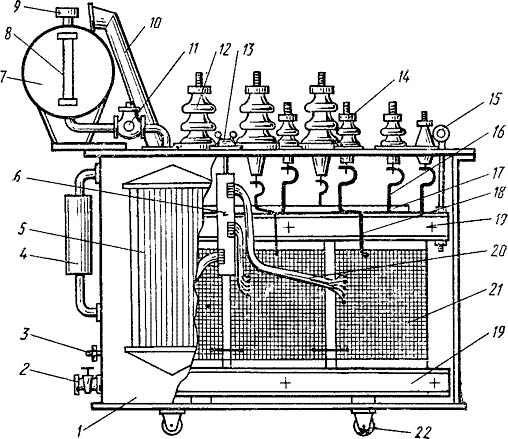
Устройство силового масляного трансформатора мощностью 1000—6300 кВ-А класса напряжения 35 кВ:
1 — бак, 2 — вентиль, 3 — болт заземления, 4 — термосифонный фильтр, 5 — радиатор, 6 — переключатель, 7 — расширитель, 8 — маслоуказатель, 9—воздухоосушитель, 10 — выхлопная труба, 11 — газовое реле, 12 — ввод ВН, 13 — привод переключающего устройства, 14 — ввод НН, 15 — подъемный рым, 16 — отвод НН, 17 — остов, 18 — отвод ВН, 19 — ярмовая балка остова (верхняя и нижняя), 20 — регулировочные ответвления обмоток ВН, 21 — обмотка ВН (внутри НН), 22 — каток тележки
Составными частями масляного трансформатора являются: остов обмотки, переключающее устройство, вводы, отводы, изоляция, бак, охладители, защитные и контрольно-измерительные и вспомогательные устройства.
Конструкция, включающая в собранном виде остов трансформатора, обмотки с их изоляцией, отводы, части регулирующего устройства, а также все детали, служащие для их механического соединения, называется активной частью трансформатора.[http://forca.ru/spravka/spravka/ustroystvo-i-elementy-konstrukcii-silovyh-transformatorov.html]
Тематики
Классификация
>>>EN
DE
FR
Русско-французский словарь нормативно-технической терминологии > силовой трансформатор
18 характеристика I2t автоматического выключателя
- caractéristique I2t d’un disjoncteur
характеристика I2t автоматического выключателя
Информация (как правило, в виде кривой), представленная максимальными, по времени отключения, значениями I2t как функция ожидаемого тока (действующее значение симметричной составляющей для переменного тока) от пикового значения ожидаемого тока, удовлетворяющего номинальной отключающей способности при коротком замыкании и соответствующем напряжении.
[ ГОСТ Р 50030. 2-99 ( МЭК 60947-2-98)]
характеристика I2t выключателя
Кривая, отражающая максимальные значения I2t как функцию ожидаемого тока в указанных условиях эксплуатации.
[ ГОСТ Р 50345-99( МЭК 60898-95)]EN
I2t characteristic of a circuit-breaker
information (usually a curve) giving the maximum values of I2t related to break time as a function of prospective current (r.m.s. symmetrical for a.c.) up to the maximum prospective current corresponding to the rated short-circuit breaking capacity and associated voltage
[IEC 60947-2, ed. 4.0 (2006-05)]FR
caractéristique I2t d’un disjoncteur
information (généralement une courbe) donnant les valeurs maximales de I2t correspondant à la durée de coupure en fonction du courant présumé (valeur efficace de la composante périodique en courant alternatif) jusqu’à la valeur maximale du courant présumé correspondant au pouvoir assigné de coupure en court-circuit à la tension correspondante
[IEC 60947-2, ed. 4.0 (2006-05)]Тематики
EN
FR
- caractéristique I2t d’un disjoncteur
Русско-французский словарь нормативно-технической терминологии > характеристика I2t автоматического выключателя
19 эталонные условия влияющих величин
- conditions de référence des grandeurs d'influence (pour un dispositif de coupure différentiel)
эталонные условия влияющих величин
-
[IEV number 442-05-37]EN
reference conditions of influencing quantities (for a residual current device)
collectively, the reference values of all influencing quantities
[IEV number 442-05-37]FR
conditions de référence des grandeurs d'influence (pour un dispositif de coupure différentiel)
ensemble des valeurs de référence de toutes les grandeurs d'influence
[IEV number 442-05-37]EN
- reference conditions of influencing quantities (for a residual current device)
DE
- Bezugsbedingungen von Einflußgrößen (für eine Fehlerstrom-Schutzeinrichtung)
FR
- conditions de référence des grandeurs d'influence (pour un dispositif de coupure différentiel)
Русско-французский словарь нормативно-технической терминологии > эталонные условия влияющих величин
20 гальваническая развязка
гальваническая развязка
Мероприятие или техническое средство, применение которого направлено на исключение гальванической связи между проводящими частями.
[РД-91.020.00-КТН-276-07]
гальваническая развязка
Схемотехническое решение, при котором исключается гальваническая связь между электрическими цепями. Гальваническая развязка осуществляется трансформаторами или оптоэлектронными приборами.
[Интент]EN
galvanic separation
prevention of electric conduction between two electric circuits intended to exchange power and/or signals
NOTE – Galvanic separation can be provided e.g. by an isolating transformer or an opto-coupler.
[IEV number 151-12-26]FR
séparation électrique, f
séparation galvanique (terme déconseillé), f
action ou moyen d’empêcher la conduction électrique entre deux circuits électriques prévus pour échanger de la puissance ou des signaux
NOTE – Une séparation électrique peut être obtenue, par exemple, au moyen d’un transformateur de séparation (de circuits) ou d’un optocoupleur.
[IEV number 151-12-26]Параллельные тексты EN-RU
Electrical isolation means that no current flow can occur from one electric circuit to a neighboring other electric circuit.
In case of power supplies, this means that no electric connection exists between the input side and the output side.
[ABB]Гальваническая развязка означает, что электрический ток не может протекать из какой-либо цепи в соседнюю цепь.
Для источников электропитания это означает, что не существует электрической связи между входной и выходной сторонами.
[Перевод Интент]The measured values are electrically isolated.
[Schneider Electric]Измеряемые величины гальванически развязаны от цепей устройства.
[Перевод Интент]Недопустимые, нерекомендуемые
Тематики
- электротехника, основные понятия
Близкие понятия
EN
DE
- galvanische Trennung
- Wellenimpedanz, (Leitungs-)
FR
Русско-французский словарь нормативно-технической терминологии > гальваническая развязка
Страницы- 1
- 2
См. также в других словарях:
Current clamp — For current clamp recording in neurons, see Electrophysiology#Current clamp. In electrical and electronic engineering, a current clamp or current probe is an electrical device having two jaws which open to allow clamping around an electrical… … Wikipedia
Current Neutral Countries — include: *Austria to maintain external independence and inviolability of borders (expressly modeled after the Swiss neutrality). *Costa Rica *Finland a military doctrine of competent, credible independent defence, not depending on any outside… … Wikipedia
Current mirror — A current mirror is a circuit designed to copy a current through one active device by controlling the current in another active device of a circuit, keeping the output current constant regardless of loading. The current being copied can be, and… … Wikipedia
Current sea level rise — This article is about the current and future rise in sea level associated with global warming. For sea level changes in Earth s history, see Sea level#Changes through geologic time. Sea level measurements from 23 long tide gauge records in… … Wikipedia
Current ratio — The current ratio is a financial ratio that measures whether or not a firm has enough resources to pay its debts over the next 12 months. It compares a firm s current assets to its current liabilities. It is expressed as follows: For example, if… … Wikipedia
Current–voltage characteristic — Figure 1. I–V curve of a P–N junction diode (not to scale). A current–voltage characteristic is a relationship, typically represented as a chart or graph, between an electric current and a corresponding voltage, or potential difference. In… … Wikipedia
Current liability — Accountancy Key concepts Accountant · Accounting period · Bookkeeping · Cash and accrual basis · Cash flow management · Chart of accounts … Wikipedia
Current state of polygamy in the Latter Day Saint movement — Mormonism and polygamy Members of Joseph F. Smith s family, including his sons and daughters, as well as their spouses and children, circa 1900 … Wikipedia
Current quark mass — The current quark mass is also called the mass of the naked quarks. The mass of the current quark is reduced by the term of the constituent quark covering mass. The current quark mass is a logical consequence of the mathematical formalism of the… … Wikipedia
Current Market Value - CMV — The resale valuation attached to a security held long in an investor s margin account. The current market value is usually taken as the closing price for listed securities or the bid price offered for over the counter (OTC) securities. In a… … Investment dictionary
current-cost — currˈent cost adjective (accounting) Of a system that values assets at the current cost of replacement (cf ↑historic cost under ↑history) • • • Main Entry: ↑current … Useful english dictionary
 18+© Академик, 2000-2026
- Обратная связь: Техподдержка, Реклама на сайте
Экспорт словарей на сайты, сделанные на PHP, Joomla, Drupal, WordPress, MODx.
Перевод: с русского на французский
с французского на русский- С французского на:
- Русский
- С русского на:
- Все языки
- Английский
- Немецкий
- Французский