

-
41 disjoncteur enfichable
автоматический выключатель втычного исполнения
Выключатель, который дополнительно к своим отключающим контактам имеет комплект контактов, позволяющих снимать выключатель.
Примечание
Некоторые выключатели могут быть втычными только со стороны питания, зажимы со стороны нагрузки обычно пригодны для присоединения проводников.
[ ГОСТ 50030.2-99]
автоматический выключатель втычного типа
Выключатель с одним или несколькими штыревыми выводами, использующийся с соответствующим устройством для штепсельного соединения.
[ ГОСТ Р 50345-99( МЭК 60898-95)]
Автоматический выключатель со штыревыми выводами, предназначенными для выполнения разъемного соединения с основанием автоматического выключателя, к выводам которого подключаются проводники внешних электрических цепей.
Такие аппараты вставляются и извлекаются без обесточивания соответствующей цепи. Присоединение и отсоединение аппарата возможно только в том случае, если аппарат разомкнут.
В противном случае при отсоединении происходит автоматическое размыкание контактов аппарата.
В простых ситуациях съемные аппараты можно использовать для реализации функции разъединения.
Обычно втычные аппараты применяют в тех случаях, когда необходимо обеспечить легкую замену аппаратов, что делает их обслуживание очень удобным.
Аппараты съемного исполнения иногда обозначаются буквой D (disconnectable – отсоединяемое исполнение).EN
plug-in circuit-breaker
a circuit-breaker which, in addition to its interrupting contacts, has a set of contacts which enable the circuit-breaker to be removed
NOTE Some circuit-breakers may be of the plug-in type on the line side only, the load terminals being usually suitable for wiring connection.
[< size="2">IEC 60947-2, ed. 4.0 (2006-05)]FR
disjoncteur enfichable
disjoncteur qui, outre ses contacts d’interruption, possède un jeu de contacts permettant le retrait du disjoncteur
NOTE Certains disjoncteurs peuvent être de type enfichable sur le côté d’alimentation uniquement, les bornes de sortie étant les bornes utilisées habituellement pour raccordement par conducteurs.
[< size="2">IEC 60947-2, ed. 4.0 (2006-05)]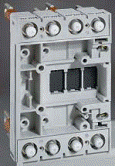
Основание автоматического выключателя втычного исполнения
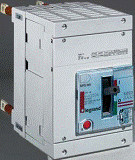
Рис. LegrandАвтоматический выключатель втычного (съемного исполнения), смонтированный на основании с выводами для заднего присоединения проводников
Рис. Legrand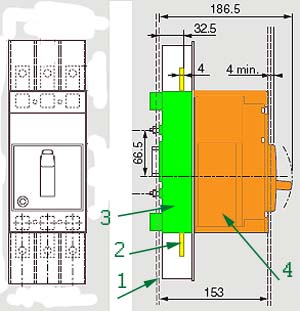
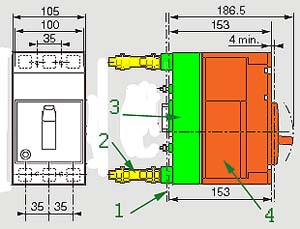
1 - Монтажная панель
2 - Выводы для переднего присоединения проводников
3 - Основание с выводами для переднего присоединения проводников ( front terminal plug-in base)
4 - Автоматический выключатель втычного исполнения1 - Монтажная панель
2 - Выводы для заднего присоединения проводников
3 - Основание с выводами для заднего присоединения проводников ( rear terminal plug-in base)
4 - Автоматический выключатель втычного исполненияPlug-in devices
Plug-in device makes it possible to extract and/or rapidly replace the circuit breaker without having to touch connections for ship and important installations.
Автоматические выключатели втычного исполнения
Конструкция втычных автоматических выключателей обеспечивает их быструю замену, т. е. позволяет снимать и возвращать их на свое место, без отсоединения проводников, что очень важно в корабельных и ответственных электроустановках.The plug-in base is the fixed part of the plug-in version of the circuit-breaker. It will be installed directly on the back plate of panel.
Основание является неподвижной частью втычного выключателя. Оно крепится непосредственно к монтажной панели.
The circuit-breaker is racked out by unscrewing the top and bottom fixing screws.
[LS Industrial Systems]Прежде чем извлечь автоматический выключатель из основания, необходимо выкрутить верхний и нижний крепежные винты.
[Перевод Интент]Тематики
Классификация
>>>Синонимы
- автоматический выключатель съемного исполнения
- втычной автоматический выключатель
- съемный автоматический выключатль
EN
FR
Франко-русский словарь нормативно-технической терминологии > disjoncteur enfichable
-
42 disjoncteur à déclenchement libre cyclique
автоматический выключатель с циклическим свободным расцеплением
-
[IEV number 442-05-52]EN
cycling trip-free circuit-breaker
a circuit-breaker, the moving contacts of which return to the open position when the automatic opening operation is initiated after the initiation of the closing operation, and which will then reclose repeatedly and momentarily, whilst the closing command is maintained
[IEV number 442-05-52]FR
disjoncteur à déclenchement libre cyclique
disjoncteur dont les contacts mobiles reviennent en position d'ouverture quand la manoeuvre d'ouverture automatique est commandée après le début de la commande de la manoeuvre de fermeture et qui par la suite reviennent temporairement en position de fermeture de façon cyclique tant que l'ordre de commande est maintenu
[IEV number 442-05-52]Тематики
EN
DE
FR
Франко-русский словарь нормативно-технической терминологии > disjoncteur à déclenchement libre cyclique
-
43 bilan hydrologique
биологический баланс воды
—
[ http://www.eionet.europa.eu/gemet/alphabetic?langcode=en]EN
biological water balance
The amount of ingoing and outgoing water in a system, which are assumed to be equal in the long term so that the water budget will balance. (Source: ALL)
[http://www.eionet.europa.eu/gemet/alphabetic?langcode=en]Тематики
EN
DE
FR
гидрологический баланс
—
[ http://www.eionet.europa.eu/gemet/alphabetic?langcode=en]EN
hydrologic balance
An accounting of the inflow to, outflow from, and storage in a hydrologic unit such as a drainage basin, aquifer, soil zone, lake or reservoir; the relationship between evaporation, precipitation, runoff, and the change in water storage. (Source: BJGEO)
[http://www.eionet.europa.eu/gemet/alphabetic?langcode=en]Тематики
EN
DE
FR
Франко-русский словарь нормативно-технической терминологии > bilan hydrologique
-
44 effet climatique
влияние климата
—
[ http://www.eionet.europa.eu/gemet/alphabetic?langcode=en]EN
climatic effect
Climate has a central influence on many human needs and activities, such as agriculture, housing, human health, water resources, and energy use. The influence of climate on vegetation and soil type is so strong that the earliest climate classification schemes where often based more on these factors than on the meteorological variables. While technology can be used to mitigate the effects of unfavorable climatic conditions, climate fluctuations that result in significant departures from normal cause serious problems for modern industrialized societies as much as for primitive ones. The goals of climatology are to provide a comprehensive description of the Earth's climate, to understand its features in terms of fundamental physical principles, and to develop models of the Earth's climate that will allow the prediction of future changes that may result from natural and human causes. (Source: PARCOR)
[http://www.eionet.europa.eu/gemet/alphabetic?langcode=en]Тематики
EN
DE
FR
Франко-русский словарь нормативно-технической терминологии > effet climatique
-
45 impact des ménages sur l'environnement
воздействие быта на окружающую среду
—
[ http://www.eionet.europa.eu/gemet/alphabetic?langcode=en]EN
environmental impact of households
Household impacts on the environment include domestic heating emissions (hot air, carbon dioxide, carbon monoxide, water vapour and oxide of nitrogen, sulphur and other trace gases); domestic sewage consisting of human bodily discharges, water from kitchens, bathrooms and laundries; the dumping of bulky wastes such as old washing machines, refrigerators, cars and other objects that will not fit into the standard dustbin and which are often dumped about the countryside, etc. (Source: WPR / GILP96)
[http://www.eionet.europa.eu/gemet/alphabetic?langcode=en]Тематики
EN
DE
FR
Франко-русский словарь нормативно-технической терминологии > impact des ménages sur l'environnement
-
46 risque majeur
высокий уровень риска
—
[ http://www.eionet.europa.eu/gemet/alphabetic?langcode=en]EN
major risk
The high probability that a given hazard or situation will yield a significant amount of lives lost, persons injured, damage to property, disruption of economic activity or harm to the environment; or any product of the probability of occurrence and the expected magnitude of damage beyond a maximum acceptable level. (Source: TOE / HMD)
[http://www.eionet.europa.eu/gemet/alphabetic?langcode=en]Тематики
EN
DE
FR
Франко-русский словарь нормативно-технической терминологии > risque majeur
-
47 processus géomorphologique
геоморфический процесс
—
[ http://www.eionet.europa.eu/gemet/alphabetic?langcode=en]EN
geomorphic process
The physical and chemical interactions between the Earth's surface and the natural forces acting upon it to produce landforms. The processes are determined by such natural environmental variables as geology, climate, vegetation and baselevel, to say nothing of human interference. The nature of the process and the rate at which it operates will be influenced by a change in any of these variables. (Source: WHIT)
[http://www.eionet.europa.eu/gemet/alphabetic?langcode=en]Тематики
EN
DE
FR
Франко-русский словарь нормативно-технической терминологии > processus géomorphologique
-
48 courant admissible, m
(длительный) допустимый ток
Максимальное значение электрического тока, который может протекать длительно по проводнику, устройству или аппарату при определенных условиях без превышения определенного значения их температуры в установившемся режиме
[ ГОСТ Р МЭК 60050-826-2009]
Этот ток обозначают IZ
[ ГОСТ Р 50571. 1-2009 ( МЭК 60364-1: 2005)]EN
(continuous) current-carrying capacity
ampacity (US)
maximum value of electric current which can be carried continuously by a conductor, a device or an apparatus, under specified conditions without its steady-state temperature exceeding a specified value
[IEV number 826-11-13]
ampacity
The current in amperes that a conductor can carry continuously under the conditions of use without exceeding its temperature rating.
[National Electrical Cod]FR
courant (permanent) admissible, m
valeur maximale du courant électrique qui peut parcourir en permanence, un conducteur, un dispositif ou un appareil, sans que sa température de régime permanent, dans des conditions données, soit supérieure à la valeur spécifiée
[IEV number 826-11-13]Ampacity, the term is defined as the maximum amount of current a cable can carry before sustaining immediate or progressive deterioration. Also described as current rating or current-carrying capacity, is the RMS electric current which a device can continuously carry while remaining within its temperature rating. The ampacity of a cable depends on:
- its insulation temperature rating;
- conductor electrical properties for current;
- frequency, in the case of alternating currents;
- ability to dissipate heat, which depends on cable geometry and its surroundings;
- ambient temperature.
Electric wires have some resistance, and electric current flowing through them causes voltage drop and power dissipation, which heats the cable. Copper or aluminum can conduct a large amount of current before melting, but long before the conductors melt, their insulation would be damaged by the heat.
The ampacity for a power cable is thus based on physical and electrical properties of the material & construction of the conductor and of its insulation, ambient temperature, and environmental conditions adjacent to the cable. Having a large overall surface area may dissipate heat well if the environment can absorb the heat.
In a long run of cable, different conditions govern, and installation regulations normally specify that the most severe condition along the run governs the cable's rating. Cables run in wet or oily locations may carry a lower temperature rating than in a dry installation. Derating is necessary for multiple circuits in close proximity. When multiple cables are near, each contributes heat to the others and diminishes the amount of cooling air that can flow past the individual cables. The overall ampacity of the insulated conductors in a bundle of more than 3 must be derated, whether in a raceway or cable. Usually the de-rating factor is tabulated in a nation's wiring regulations.
Depending on the type of insulating material, common maximum allowable temperatures at the surface of the conductor are 60, 75 and 90 degrees Celsius, often with an ambient air temperature of 30°C. In the U.S., 105°C is allowed with ambient of 40°C, for larger power cables, especially those operating at more than 2 kV. Likewise, specific insulations are rated 150, 200 or 250°C.
The allowed current in cables generally needs to be decreased (derated) when the cable is covered with fireproofing material.
For example, the United States National Electric Code, Table 310-16, specifies that up to three 8 AWG copper wires having a common insulating material (THWN) in a raceway, cable, or direct burial has an ampacity of 50 A when the ambient air is 30°C, the conductor surface temperature allowed to be 75°C. A single insulated conductor in air has 70 A rating.
Ampacity rating is normally for continuous current, and short periods of overcurrent occur without harm in most cabling systems. The acceptable magnitude and duration of overcurrent is a more complex topic than ampacity.
When designing an electrical system, one will normally need to know the current rating for the following:- Wires
- Printed Circuit Board traces, where included
- Fuses
- Circuit breakers
- All or nearly all components used
Some devices are limited by power rating, and when this power rating occurs below their current limit, it is not necessary to know the current limit to design a system. A common example of this is lightbulb holders.
[http://en.wikipedia.org/wiki/Ampacity]
Тематики
- электротехника, основные понятия
Синонимы
EN
DE
- Dauerstrombelastbarkeit, f
- Strombelastbarkeit, f
FR
- courant admissible, m
- courant permanent admissible, m
Франко-русский словарь нормативно-технической терминологии > courant admissible, m
-
49 courant permanent admissible, m
(длительный) допустимый ток
Максимальное значение электрического тока, который может протекать длительно по проводнику, устройству или аппарату при определенных условиях без превышения определенного значения их температуры в установившемся режиме
[ ГОСТ Р МЭК 60050-826-2009]
Этот ток обозначают IZ
[ ГОСТ Р 50571. 1-2009 ( МЭК 60364-1: 2005)]EN
(continuous) current-carrying capacity
ampacity (US)
maximum value of electric current which can be carried continuously by a conductor, a device or an apparatus, under specified conditions without its steady-state temperature exceeding a specified value
[IEV number 826-11-13]
ampacity
The current in amperes that a conductor can carry continuously under the conditions of use without exceeding its temperature rating.
[National Electrical Cod]FR
courant (permanent) admissible, m
valeur maximale du courant électrique qui peut parcourir en permanence, un conducteur, un dispositif ou un appareil, sans que sa température de régime permanent, dans des conditions données, soit supérieure à la valeur spécifiée
[IEV number 826-11-13]Ampacity, the term is defined as the maximum amount of current a cable can carry before sustaining immediate or progressive deterioration. Also described as current rating or current-carrying capacity, is the RMS electric current which a device can continuously carry while remaining within its temperature rating. The ampacity of a cable depends on:
- its insulation temperature rating;
- conductor electrical properties for current;
- frequency, in the case of alternating currents;
- ability to dissipate heat, which depends on cable geometry and its surroundings;
- ambient temperature.
Electric wires have some resistance, and electric current flowing through them causes voltage drop and power dissipation, which heats the cable. Copper or aluminum can conduct a large amount of current before melting, but long before the conductors melt, their insulation would be damaged by the heat.
The ampacity for a power cable is thus based on physical and electrical properties of the material & construction of the conductor and of its insulation, ambient temperature, and environmental conditions adjacent to the cable. Having a large overall surface area may dissipate heat well if the environment can absorb the heat.
In a long run of cable, different conditions govern, and installation regulations normally specify that the most severe condition along the run governs the cable's rating. Cables run in wet or oily locations may carry a lower temperature rating than in a dry installation. Derating is necessary for multiple circuits in close proximity. When multiple cables are near, each contributes heat to the others and diminishes the amount of cooling air that can flow past the individual cables. The overall ampacity of the insulated conductors in a bundle of more than 3 must be derated, whether in a raceway or cable. Usually the de-rating factor is tabulated in a nation's wiring regulations.
Depending on the type of insulating material, common maximum allowable temperatures at the surface of the conductor are 60, 75 and 90 degrees Celsius, often with an ambient air temperature of 30°C. In the U.S., 105°C is allowed with ambient of 40°C, for larger power cables, especially those operating at more than 2 kV. Likewise, specific insulations are rated 150, 200 or 250°C.
The allowed current in cables generally needs to be decreased (derated) when the cable is covered with fireproofing material.
For example, the United States National Electric Code, Table 310-16, specifies that up to three 8 AWG copper wires having a common insulating material (THWN) in a raceway, cable, or direct burial has an ampacity of 50 A when the ambient air is 30°C, the conductor surface temperature allowed to be 75°C. A single insulated conductor in air has 70 A rating.
Ampacity rating is normally for continuous current, and short periods of overcurrent occur without harm in most cabling systems. The acceptable magnitude and duration of overcurrent is a more complex topic than ampacity.
When designing an electrical system, one will normally need to know the current rating for the following:- Wires
- Printed Circuit Board traces, where included
- Fuses
- Circuit breakers
- All or nearly all components used
Some devices are limited by power rating, and when this power rating occurs below their current limit, it is not necessary to know the current limit to design a system. A common example of this is lightbulb holders.
[http://en.wikipedia.org/wiki/Ampacity]
Тематики
- электротехника, основные понятия
Синонимы
EN
DE
- Dauerstrombelastbarkeit, f
- Strombelastbarkeit, f
FR
- courant admissible, m
- courant permanent admissible, m
Франко-русский словарь нормативно-технической терминологии > courant permanent admissible, m
-
50 effet ŕ long terme
долгосрочное воздействие
—
[ http://www.eionet.europa.eu/gemet/alphabetic?langcode=en]EN
long-term effect
Effects which will last long after the cause has ceased. (Source: RRDA)
[http://www.eionet.europa.eu/gemet/alphabetic?langcode=en]Тематики
EN
DE
FR
Франко-русский словарь нормативно-технической терминологии > effet ŕ long terme
-
51 déclaration sur l'impact écologique
заключение экологической экспертизы
—
[ http://www.eionet.europa.eu/gemet/alphabetic?langcode=en]EN
environmental impact statement
A detailed statement which, to the fullest extent possible, identifies and analyses, among other things, the anticipated environmental impact of a proposed action and discusses how the adverse effects will be mitigated. (Source: LANDY)
[http://www.eionet.europa.eu/gemet/alphabetic?langcode=en]Тематики
EN
DE
FR
Франко-русский словарь нормативно-технической терминологии > déclaration sur l'impact écologique
-
52 portée d'une protection
зона действия защиты
-
[В.А.Семенов. Англо-русский словарь по релейной защите]
область действия защиты
Зона, которая, как предполагается, охватывается защитой, и за пределами которой защита с относительной селективностью не срабатывает.
[Разработка типовых структурных схем микропроцессорных устройств РЗА на объектах ОАО "ФКС ЕЭС". Пояснительная записка. Новосибирск 2006 г.]EN
reach of protection
the zone expected to be covered by the protection beyond which the non-unit protection will not operate
[IEV ref 448-11-23]FR
portée d'une protection
zone supposée couverte par la protection et au-delà de laquelle la protection à sélectivité relative de section ne fonctionnera pas
[IEV ref 448-11-23]Тематики
Синонимы
EN
DE
- Reichweite des Schutzes, f
FR
Франко-русский словарь нормативно-технической терминологии > portée d'une protection
-
53 échangeur d'ions
ионообменник
—
[ http://www.eionet.europa.eu/gemet/alphabetic?langcode=en]EN
ion exchanger
A permanent insoluble material (usually a synthetic resin) which contains ions that will exchange reversibly with other ions in a surrounding solution. Both cation and anion exchangers are used in water conditioning. The volume of an ion exchanger is measured in cubic liters of exchanger after the exchanger bed has been backwashed and drained, and has settled into place. (Source: WQA)
[http://www.eionet.europa.eu/gemet/alphabetic?langcode=en]Тематики
EN
DE
FR
Франко-русский словарь нормативно-технической терминологии > échangeur d'ions
-
54 irrigation
ирригация
—
[ http://www.eionet.europa.eu/gemet/alphabetic?langcode=en]EN
irrigation
1) To supply land with water so that crops and plants will grow or grow stronger. (Source: CAMB / WRIGHT)
[http://www.eionet.europa.eu/gemet/alphabetic?langcode=en]Тематики
EN
DE
FR
обводнение
Совокупность гидротехнических мероприятий по обеспечению водой безводных и маловодных районов для культурно-бытовых и хозяйственных целей.
Примечание
Особо важное народнохозяйственное значение имеет обводнение пастбищ.
[ ГОСТ 19185-73]
[СО 34.21.308-2005]
Тематики
EN
DE
FR
орошение
Совокупность мероприятий по искусственному увлажнению почвы для повышения её плодородия
[Терминологический словарь по строительству на 12 языках (ВНИИИС Госстроя СССР)]Тематики
EN
DE
FR
орошение земель
Гидромелиорация с подводом воды на земли с недостаточной природной водообеспеченностью
[ ГОСТ 26967-86]
орошение земель
орошение
Ндп. ирригация
Искусственное увлажнение почвы для повышения ее плодородия
[ ГОСТ 19185-73]
[СО 34.21.308-2005]Недопустимые, нерекомендуемые
Тематики
Обобщающие термины
Синонимы
EN
DE
FR
Франко-русский словарь нормативно-технической терминологии > irrigation
-
55 prolongateur
кабельный соединитель
Устройство, обеспечивающее соединение двух гибких кабелей. Состоит из розетки и вилки
[ ГОСТ Р 51323.1-99]EN
cable coupler
a means enabling the connection at will of two flexible cables. It consists of two parts
[IEC 60309-1, ed. 4.0 (1999-02)]FR
prolongateur
ensemble destiné à relier électriquement à volonté deux câbles souples. Il se compose de deux parties:
[IEC 60309-1, ed. 4.0 (1999-02)]
1 - Розетка стационарная
2 - Вилка опрессованная
3 - Удлиннитель одноместный
4 - Соединитель штепсельный
5 - Розетка переносная опрессованная
6 - Вилка опрессованная
7 - Кабельный соединитель (в ГОСТе назван штепсельным соединителем)
8 - Розетка приборная
9 - Удлинитель с приборной розеткой
10 - Вилка приборная
11 - Прибор
12 - Соединитель приборный
[ ГОСТ Р 51322.1-99]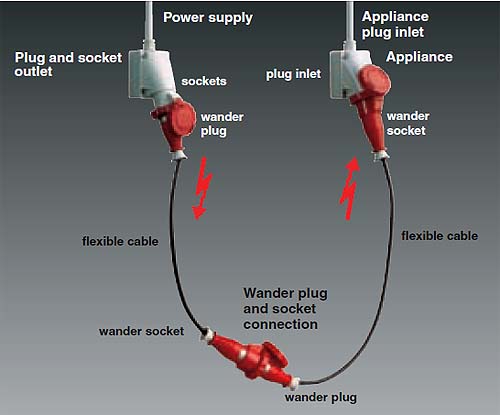
Рис. Schneider Electric
Тематики
EN
FR
Франко-русский словарь нормативно-технической терминологии > prolongateur
-
56 climat
климат
—
[ http://www.eionet.europa.eu/gemet/alphabetic?langcode=en]EN
climate
The average weather condition in a region of the world. Many aspects of the Earth's geography affect the climate. Equatorial, or low, latitudes are hotter than the polar latitudes because of the angle at which the rays of sunlight arrive at the Earth's surface. The difference in temperature at the equator and at the poles has an influence on the global circulation of huge masses of air. Cool air at the poles sinks and spreads along the surface of the Earth towards the equator. Cool air forces its way under the lower density warmer air in the lower regions, pushing the lighter air up and toward the poles, where it will cool and descend. (Source: WRIGHT)
[http://www.eionet.europa.eu/gemet/alphabetic?langcode=en]Тематики
EN
DE
FR
Франко-русский словарь нормативно-технической терминологии > climat
-
57 climax
кульминация
—
[ http://www.eionet.europa.eu/gemet/alphabetic?langcode=en]EN
climax
A botanical term referring to the terminal community said to be achieved when a sere (a sequential development of a plant community or group of plant communities on the same site over a period of time) achieves dynamic equilibrium with its environment and in particular with its prevailing climate. Each of the world's major vegetation climaxes is equivalent to a biome. Many botanists believe that climate is the master factor in a plant environment and that even if several types of plant succession occur in an area they will all tend to converge towards a climax form of vegetation. (Source: WHIT)
[http://www.eionet.europa.eu/gemet/alphabetic?langcode=en]Тематики
EN
DE
FR
Франко-русский словарь нормативно-технической терминологии > climax
-
58 valeurs maximales admissibles du courant et de la tension d’entrée
максимально допустимые значения входного тока и напряжения
-
[IEV number 314-04-05]EN
maximum permissible values of the input current and voltage
values of current and voltage assigned by the manufacturer which the transducer will withstand indefinitely without damage
[IEV number 314-04-05]FR
valeurs maximales admissibles du courant et de la tension d’entrée
valeurs du courant et de la tension indiquées par le constructeur comme étant les valeurs que le transducteur peut supporter indéfiniment sans dommage
[IEV number 314-04-05]Тематики
- измерение электр. величин в целом
EN
DE
FR
- valeurs maximales admissibles du courant et de la tension d’entrée
Франко-русский словарь нормативно-технической терминологии > valeurs maximales admissibles du courant et de la tension d’entrée
-
59 mangrove
мангровый лес
—
[ http://www.eionet.europa.eu/gemet/alphabetic?langcode=en]EN
mangrove
Plant communities and trees that inhabit tidal swamps, muddy silt, and sand banks at the mouths of rivers and other low-lying areas which are regularly inundated by the sea, but which are protected from strong waves and currents. Mangroves are the only woody species that will grow where the land is periodically flooded with sea water; individual species have adapted themselves to different tidal levels, to various degrees of salinity, and to the nature of the mud or soil. Mangrove swamps and thickets support hundreds of terrestrial, marine, and amphibian species; have a special role in supporting estuarine fisheries; provide shelter, refuge and food for many forms of wildlife. (Source: GILP96)
[http://www.eionet.europa.eu/gemet/alphabetic?langcode=en]Тематики
EN
DE
FR
Франко-русский словарь нормативно-технической терминологии > mangrove
-
60 technique d'échantillonnage
метод отбора проб
—
[ http://www.eionet.europa.eu/gemet/alphabetic?langcode=en]EN
sampling technique
Method of selecting items at random from a set in such a manner that the sample will be representative of the whole. (Source: MGHa)
[http://www.eionet.europa.eu/gemet/alphabetic?langcode=en]Тематики
EN
DE
FR
Франко-русский словарь нормативно-технической терминологии > technique d'échantillonnage
См. также в других словарях:
will — 1 n 1: the desire, inclination, or choice of a person or group 2: the faculty of wishing, choosing, desiring, or intending 3: a legal declaration of a person s wishes regarding the disposal of his or her property after death; esp: a formally… … Law dictionary
Will — • This article discusses will in its psychological aspect Catholic Encyclopedia. Kevin Knight. 2006. Will Will † … Catholic encyclopedia
Will — ist eine Kurzform von William oder Willard, der englischen Variante zu Wilhelm das Pseudonym des belgischen Comiczeichners Willy Maltaite (1927–2000) Will ist der Familienname folgender Personen: Alfred Will (1906–1982), deutscher Grafiker Anne… … Deutsch Wikipedia
Will — Will, n. [OE. wille, AS. willa; akin to OFries. willa, OS. willeo, willio, D. wil, G. wille, Icel. vili, Dan. villie, Sw. vilja, Goth wilja. See {Will}, v.] [1913 Webster] 1. The power of choosing; the faculty or endowment of the soul by which it … The Collaborative International Dictionary of English
will — will1 [wil] n. [ME wille < OE willa, akin to Ger wille, willen < IE base * wel , to wish, choose > L velle, to wish, voluptas, pleasure] 1. the power of making a reasoned choice or decision or of controlling one s own actions [a man of… … English World dictionary
Will — Will, v. t. & auxiliary. [imp. {Would}. Indic. present, I will (Obs. I wol), thou wilt, he will (Obs. he wol); we, ye, they will.] [OE. willen, imp. wolde; akin to OS. willan, OFries. willa, D. willen, G. wollen, OHG. wollan, wellan, Icel. & Sw.… … The Collaborative International Dictionary of English
will.i.am — (2007) William James Adams Jr. (* 15. März 1975 in Los Angeles, Kalifornien), besser bekannt unter seinem Künstlernamen will.i.am, ist ein US amerikanischer Rapper und Hip Hop Produzent. International bekannt wurde er als Mitglied der… … Deutsch Wikipedia
will.i.am — в августе 2012 года … Википедия
will — n Will, volition, conation can all refer to the power or act of making or effecting a choice or decision. Will applies not only to this power or act but also to the complex of rational and irrational, conscious and unconscious forces within a… … New Dictionary of Synonyms
Will — may refer to: * Will (modal verb) **Shall and will, comparison of the two verbs * Will (law), a legal document expressing the desires of the author with regard to the disposition of property after the author s death. ** Living will, a legal… … Wikipedia
Will.I.Am — will.i.am le 13 février 2007 Nom William Adams Naissance … Wikipédia en Français
