

-
1 виолент
-
2 торнадо
торнадо
—
[ http://www.eionet.europa.eu/gemet/alphabetic?langcode=en]EN
tornado
A rapidly rotating column of air developed around a very intense low-pressure centre. It is associated with a dark funnel-shaped cloud and with extremely violent winds (>300km/h) blowing in a counterclockwise spiral, but accompanied by violent downdraughts. The precise mechanisms are not fully understood but the following atmospheric conditions appear to be necessary for tornado development: a layer of warm moist air at low altitude; a layer of dry air at higher altitude with an inversion of temperature at about 1.000 m; a triggering mechanism, usually in the form of an active, intense cold front or solar heating of the ground which will create a vortex. (Source: WHIT)
[http://www.eionet.europa.eu/gemet/alphabetic?langcode=en]Тематики
EN
DE
FR
Русско-немецкий словарь нормативно-технической терминологии > торнадо
-
3 бедствие, наносящее вред сельскому хозяйству
бедствие, наносящее вред сельскому хозяйству
—
[ http://www.eionet.europa.eu/gemet/alphabetic?langcode=en]EN
agricultural disaster
Violent, sudden and destructive change in the environment either affecting or caused by land cultivation or the raising of crops or livestock. (Source: ISEP / APD)
[http://www.eionet.europa.eu/gemet/alphabetic?langcode=en]Тематики
EN
DE
FR
Русско-немецкий словарь нормативно-технической терминологии > бедствие, наносящее вред сельскому хозяйству
-
4 бедствия, вызванные деятельностью человека
бедствия, вызванные деятельностью человека
—
[ http://www.eionet.europa.eu/gemet/alphabetic?langcode=en]EN
human-made disaster
Violent, sudden and destructive change in the environment caused by man. (Source: ISEP / RHW)
[http://www.eionet.europa.eu/gemet/alphabetic?langcode=en]Тематики
EN
DE
FR
Русско-немецкий словарь нормативно-технической терминологии > бедствия, вызванные деятельностью человека
-
5 гидрологическое бедствие
гидрологическое бедствие
—
[ http://www.eionet.europa.eu/gemet/alphabetic?langcode=en]EN
hydrologic disaster
Violent, sudden and destructive change either in the quality of the earth's water or in the distribution or movement of water on land, below the surface or in the atmosphere. (Source: ISEP / APD)
[http://www.eionet.europa.eu/gemet/alphabetic?langcode=en]Тематики
EN
DE
FR
Русско-немецкий словарь нормативно-технической терминологии > гидрологическое бедствие
-
6 землетрясение
землетрясение
—
[ http://www.eionet.europa.eu/gemet/alphabetic?langcode=en]EN
earthquake
The violent shaking of the ground produced by deep seismic waves, beneath the epicentre, generated by a sudden decrease or release in a volume of rock of elastic strain accumulated over a long time in regions of seismic activity (tectonic earthquake). The magnitude of an earthquake is represented by the Richter scale; the intensity by the Mercalli scale. (Source: GUNN)
[http://www.eionet.europa.eu/gemet/alphabetic?langcode=en]Тематики
EN
DE
FR
Русско-немецкий словарь нормативно-технической терминологии > землетрясение
-
7 прямой пуск вращающегося электродвигателя
прямой пуск вращающегося электродвигателя
Пуск вращающегося электродвигателя путем непосредственного подключения его к питающей сети.
[ ГОСТ 27471-87]EN
direct-on-line starting
across-the-line starting (US)
the process of starting a motor by connecting it directly to the supply at rated voltage
[IEV number 411-52-15]FR
démarrage direct
mode de démarrage d'un moteur, consistant à lui appliquer directement sa pleine tension assignée
[IEV number 411-52-15]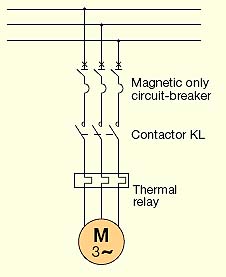
Рис. ABB
Схема прямого пуска электродвигателяMagnetic only circuit-breaker - Автоматический выключатель с электромагнитным расцепителем
Contactor KL - Контактор KL
Thermal relay - Тепловое реле
Параллельные тексты EN-RU
Direct-on-line starting
Direct-on-line starting, which is often abbreviated as DOL, is perhaps the most traditional system and consists in connecting the motor directly to the supply network, thus carrying out starting at full voltage.Direct-on-line starting represents the simplest and the most economical system to start a squirrel-cage asynchronous motor and it is the most used.
As represented in Figure 5, it provides the direct connection to the supply network and therefore starting is carried out at full voltage and with constant frequency, developing a high starting torque with very reduced acceleration times.
The typical applications are relevant to small power motors also with full load starting.
These advantages are linked to some problems such as, for example, the high inrush current, which - in the first instants - can reach values of about 10 to 12 times the rated current, then can decrease to about 6 to 8 times the rated current and can persist to reach the maximum torque speed.The effects of such currents can be identified with the high electro-dynamical stresses on the motor connection cables and could affect also the windings of the motor itself; besides, the high inrush torques can cause violent accelerations which stress the transmission components (belts and joints) generating distribution problems with a reduction in the mechanical life of these elements.
Finally, also the possible electrical problems due to voltage drops on the supply line of the motor or of the connected equipment must be taken into consideration.
[ABB]Прямой пуск
Прямой пуск, который по-английски часто сокращенно обозначают как DOL, является, пожалуй наиболее распространенным способом пуска. Он заключается в непосредственном (т. е. прямом) подключении двигателя к питающей сети. Это означает, что пуск двигателя осуществляется при полном напряжении.Схема прямого пуска является наиболее простым, экономичным и чаще всего применяемым решением для электродвигателей с короткозамкнутым ротором.
Схема прямого подключения к сети представлена на рисунке 5. Пуск осуществляется при полном напряжении и постоянной частоте сети. Электродвигатель развивает высокий пусковой момент при коротком времени разгона.
Типичные области применения – маломощные электродвигатели, в том числе с пуском при полной нагрузке.
Однако, наряду с преимуществами имеются и определенные недостатки, например, бросок пускового тока, достигающий в первоначальный момент 10…12-кратного значения от номинального тока электродвигателя. Затем ток двигателя уменьшается примерно до 6…8-кратного значения номинального тока и будет держаться на этом уровне до тех пор, пока скорость двигателя не достигнет максимального значения.
Такое изменение тока оказывает значительное электродинамическое воздействие на кабель, подключенный к двигателю. Кроме того пусковой ток воздействует на обмотки двигателя. Высокий начальный пусковой момент может привести к значительному ускорению и следовательно к значительной нагрузке элементов привода (ремней, крепления узлов), что вызывает сокращение их срока службы.
И, наконец, следует принять во внимание возможное возникновение проблем, связанных с падением напряжения в линии питания двигателя и подключенного к этой линии оборудования.
[Перевод Интент]
Тематики
Синонимы
EN
- across-the-line starting (US)
- direct line starting
- direct operation of a motor
- direct starting
- direct-on-line starting
- DOL
- full voltage starter application
DE
FR
Русско-немецкий словарь нормативно-технической терминологии > прямой пуск вращающегося электродвигателя
-
8 ущерб, нанесенный грозой, штормом
ущерб, нанесенный грозой, штормом
—
[ http://www.eionet.europa.eu/gemet/alphabetic?langcode=en]EN
storm damage
Storms may cause flooding and damage to crops; uproot trees; damage roofs and chimneys; break windows, leading to rain damage; overturn trucks; affect transportation, communication and energy supplies; delay building construction and destroy traditional landmarks. In their more violent form, storms may cause severe damage and loss of life. (Source: WPR)
[http://www.eionet.europa.eu/gemet/alphabetic?langcode=en]Тематики
EN
DE
FR
Русско-немецкий словарь нормативно-технической терминологии > ущерб, нанесенный грозой, штормом
См. также в других словарях:
violent — violent, ente [ vjɔlɑ̃, ɑ̃t ] adj. • 1213; lat. violentus 1 ♦ Impétueux; qui agit ou s exprime sans aucune retenue. ⇒ brusque, coléreux. « Les hommes ont été de tout temps [...] égoïstes, violents » (France). Une femme violente. « Il s est montré … Encyclopédie Universelle
violent — violent, ente (vi o lan, lan t ) adj. 1° Qui agit avec force. Vent violent. • L orage est violent...., TH. CORN. Essex, I, 2. Qui se fait sentir avec force. Une douleur violente. Une fièvre violente. Un violent mal de dents. • Pouvons … Dictionnaire de la Langue Française d'Émile Littré
Violent — Vi o*lent, a. [F., from L. violentus, from vis strength, force; probably akin to Gr. ? a muscle, strength.] 1. Moving or acting with physical strength; urged or impelled with force; excited by strong feeling or passion; forcible; vehement;… … The Collaborative International Dictionary of English
violent — VIOLÉNT, Ă, violenţi, te, adj. 1. Care se produce sau acţionează cu putere, cu intensitate, cu violenţă; intens, puternic, tare. ♦ (Despre culori, lumină etc.) Izbitor, ţipător; tare, viu, puternic. 2. (Despre fiinţe) Care are accese de furie,… … Dicționar Român
violent — Violent, [viol]ente. adject. Impetueux, qui agit avec force, avec impetuosité. Remede violent. vent violent. tempeste violente. mouvement violent. Il se dit aussi, d une douleur grande & aiguë. Fiévre violente. mal violent. douleur violente. On… … Dictionnaire de l'Académie française
violent — [vī′ələnt] adj. [ME < MFr < L violentus, violent, akin to violare, to VIOLATE] 1. a) acting with or characterized by great physical force, so as to injure, damage, or destroy b) acting or characterized by force unlawfully or callously used… … English World dictionary
Violent — Vi o*lent, v. i. To be violent; to act violently. [Obs.] [1913 Webster] The grief is fine, full, perfect, that I taste, And violenteth in a sense as strong As that which causeth it. Shak. [1913 Webster] … The Collaborative International Dictionary of English
violent — index brutal, demonstrative (expressive of emotion), disorderly, drastic, extreme (exaggerated), forcible, hot blooded … Law dictionary
violent — [adj1] destructive agitated, aroused, berserk, bloodthirsty, brutal, coercive, crazy, cruel, demoniac, desperate, distraught, disturbed, enraged, fierce, fiery, forceful, forcible, frantic, fuming, furious, great, headstrong, homicidal,… … New thesaurus
violent — Violent, Violentus. Un son violent, Excitatus sonus … Thresor de la langue françoyse
violent — ► ADJECTIVE 1) using or involving violence. 2) very intense, forceful, or powerful. DERIVATIVES violently adverb. ORIGIN Latin, vehement, violent … English terms dictionary
