

-
1 Leistungsschalter
автоматический выключатель
Механический коммутационный аппарат1), способный включать, проводить и отключать токи при нормальном состоянии электрической цепи, а также включать, проводить в течение заданного времени и автоматически отключать токи в указанном аномальном состоянии электрической цепи, например, при коротком замыкании.
(МЭС 441-14-20)
[ ГОСТ Р 50030. 2-99 ( МЭК 60947-2-98)]
автоматический выключатель
-
[IEV number 442-05-01]EN
circuit breaker
a mechanical switching device, capable of making, carrying and breaking currents under normal circuit conditions and also making, carrying for a specified time and breaking currents under specified abnormal circuit conditions such as those of short circuit.
[IEC 62271-100, ed. 2.0 (2008-04)]
[IEV number 442-05-01]
circuit breaker
A device designed to open and close a circuit by nonautomatic means and to open the circuit automatically on a predetermined overcurrent without damage to itself when properly applied within its rating.
NOTE The automatic opening means can be integral, direct acting with the circuit breaker, or remote from the circuit breaker.
Adjustable (as applied to circuit breakers). A qualifying term indicating that the circuit breaker can be set to trip at various values of current, time, or both within a predetermined range. Instantaneous-trip (as applied to circuit breakers). A qualifying term indicating that no delay is purposely introduced in the tripping action of the circuit breaker.
Inverse-time (as applied to circuit breakers). A qualifying term indicating a delay is purposely introduced in the tripping action of the circuit breaker, which delay decreases as the magnitude of the current increases.
Nonadjustable (as applied to circuit breakers). A qualifying term indicating that the circuit breaker does not have any adjustment to alter the value of current at which it will trip or the time required for its operation.
Setting (of a circuit breaker). The value of current, time, or both at which an adjustable circuit breaker is set to trip.
[National Electrical Cod]FR
disjoncteur
1) Должно быть контактный коммутационный аппарат
appareil mécanique de connexion capable d’établir, de supporter et d’interrompre des courants dans les conditions normales du circuit, ainsi que d’établir, de supporter pendant une durée spécifiée et d’in- terrompre des courants dans des conditions anormales spécifiées du circuit telles que celles du court-circuit.
[IEC 62271-100, ed. 2.0 (2008-04)]
[IEV number 442-05-01]
[Интент]КЛАССИФИКАЦИЯ
- По роду тока
- По напряжению
- По числу полюсов
- По виду корпуса
- По месту установки
- По изолирующей среде
- По установленным расцепителям
- По дополнительным защитам
- По назначению
- По категории применения
- По виду привода взвода пружины
- По выполняемой функции
-
По влиянию монтажного положения
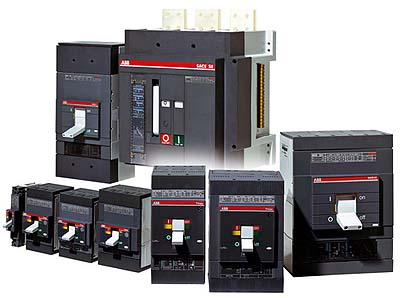 Автоматические выключатели ABB
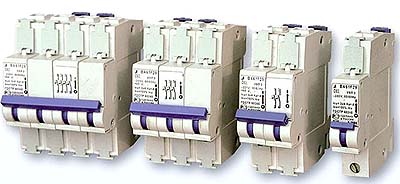 Модульные автоматические выключатели
1. НЕКОТОРЫЕ СВЕДЕНИЯ ОБ АВТОМАТИЧЕСКИХ ВЫКЛЮЧАТЕЛЯХ Автоматический выключатель — это электрический аппарат, который автоматически отключает (и тем самым защищает) электрическую цепь при возникновении в ней аномального режима. Режим становится аномальным, когда в цепи начинает недопустимо изменяться (т. е. увеличиваться или уменьшаться относительно номинального значения) ток или напряжение.
Другими словами (более "инженерно") можно сказать, что автоматический выключатель защищает от токов короткого замыкания и токов перегрузки отходящую от него питающую линию, например, кабель и приемник(и) электрической энергии (осветительную сеть, розетки, электродвигатель и т. п.).
Как правило, автоматический выключатель может применятся также для нечастого (несколько раз в сутки) включения и отключения защищаемых электроприемников (защищаемой нагрузки).
[Интент]Выключатель предназначен для проведения тока в нормальном режиме и отключения тока при коротких замыканиях, перегрузках, недопустимых снижениях напряжения, а также до 30 оперативных включений и отключений электрических цепей в сутки и рассчитан для эксплуатации в электроустановках с номинальным рабочим напряжением до 660 В переменного тока частоты 50 и 60 Гц и до 440 В постоянного тока.
[Типовая фраза из российской технической документации] 2. ПРИНЦИП ДЕЙСТВИЯ Для защиты цепи от короткого замыкания применяется автоматический выключатель с электромагнитным расцепителем.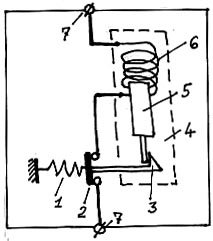
1 - Пружина (в данном случае во взведенном положении растянута)
Автоматический выключатель устроен таким образом, что сначала необходимо взвести пружину и только после этого его можно включить. У многих автоматических выключателей для взвода пружины необходимо перевести ручку вниз. После этого ручку переводят вверх. При этом замыкаются главные контакты.
2 - Главный контакт автоматического выключателя
3 - Удерживающее устройство
4 - Электромагнитный расцепитель;
5 - Сердечник
6 - Катушка
7 - Контактные зажимы автоматического выключателя
На рисунке показан один полюс автоматического выключателя во включенном положении: пружина 1 взведена, а главный контакт 2 замкнут.
Как только в защищаемой цепи возникнет короткое замыкание, ток, протекающий через соответствующий полюс автоматического выключателя, многократно возрастет. В катушке 6 сразу же возникнет сильное магнитное поле. Сердечник 5 втянется в катушку и освободит удерживающее устройство. Под действием пружины 1 главный контакт 2 разомкнется, в результате чего автоматический выключатель отключит и тем самым защитит цепь, в которой возникло короткое замыкание. Такое срабатывание автоматического выключателя происходит практически мгновенно (за сотые доли секунды).
Для защиты цепи от тока перегрузки применяют автоматические выключатели с тепловым расцепителем.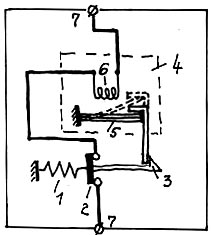
1 - Пружина (в данном случае во взведенном положении растянута)
Принцип действия такой же как и в первом случае, с той лишь разницей, что удерживающее устройство 3 освобождается под действием биметаллической пластины 5, которая изгибается от тепла, выделяемого нагревательным элементом 6. Количество тепла определяется током, протекающим через защищаемую цепь.
2 - Главный контакт автоматического выключателя
3 - Удерживающее устройство
4 - Тепловой расцепитель
5 - Биметаллическая пластина
6 - Нагревательный элемент
7 - Контактные зажимы автоматического выключателя
[Интент]Недопустимые, нерекомендуемые
Тематики
Классификация
>>>Обобщающие термины
Действия
- включение автоматического выключателя
- оперирование автоматического выключателя
- отключение автоматического выключателя
- срабатывание автоматического выключателя
EN
- auto-cutout
- automatic circuit breaker
- automatic cutout
- automatic switch
- breaker
- CB
- circuit breaker
- circuit-breaker
- cutout
DE
FR
Смотри также
силовой выключатель
-
[Интент]EN
circuit-breaker
a mechanical switching device, capable of making, carrying and breaking currents under normal circuit conditions and also making, carrying for a specified time and breaking currents under specified abnormal circuit conditions such as those of short circuit
[IEV ref 441-14-20]FR
disjoncteur
appareil mécanique de connexion capable d'établir, de supporter et d'interrompre des courants dans les conditions normales du circuit, ainsi que d'établir, de supporter pendant une durée spécifiée et d'interrompre des courants dans des conditions anormales spécifiées du circuit telles que celles du court-circuit
[IEV ref 441-14-20]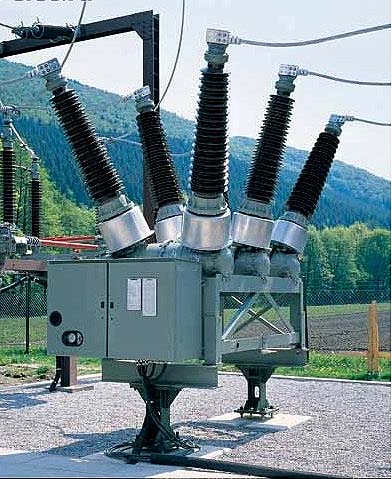
Рис. Siemens
Силовой ( баковый элегазовый) выключатель 3AP1 DT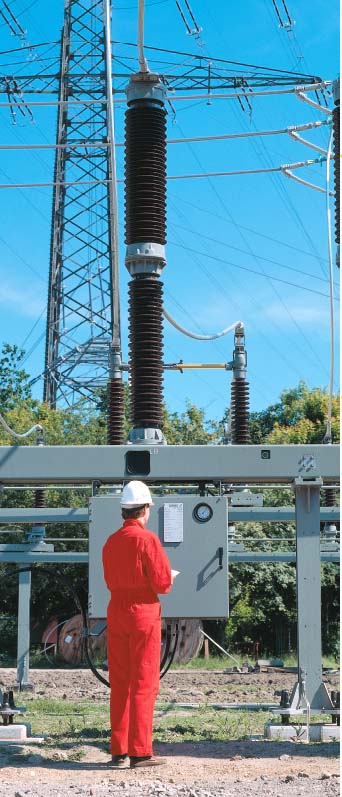
Рис. Siemens
Силовой (колонковый элегазовый) выключательТематики
- высоковольтный аппарат, оборудование...
- комплектное распред. устройство (КРУ)
EN
DE
FR
Немецко-русский словарь нормативно-технической терминологии > Leistungsschalter
2 Körper (eines elektrischen Betriebsmittels)
открытая проводящая часть
Проводящая часть, которой легко коснуться и которая в нормальных условиях эксплуатации не находится под напряжением, но может оказаться под ним в аварийных условиях.
(МЭС 441-11-10).
Примечание. К типичным открытым проводящим частям относятся стенки оболочек, ручки управления и т. п.
[ ГОСТ Р 50030. 1-2000 ( МЭК 60947-1-99)]
открытая проводящая часть
Доступная прикосновению проводящая часть электрооборудования, которая обычно не находится под напряжением, но может оказаться под напряжением при повреждении основной изоляции.
Открытая проводящая часть представляет собой доступную прикосновению проводящую часть электрооборудования, которая, в отличие от токоведущих частей, не находится под напряжением при нормальных условиях. Человек и животные, находящиеся в здании, имеют многочисленные контакты с открытыми проводящими частями, во время которых они не подвергаются опасности поражения электрическим током. Если произошло повреждение основной изоляции опасной токоведущей части, открытая проводящая часть может оказаться под напряжением. Тогда она будет представлять реальную угрозу для человека и животных, которые прикоснулись к ней. К открытым проводящим частям, прежде всего, относят металлические оболочки и доступную прикосновению арматуру электрооборудования класса 0 и класса I, например, металлические корпусы холодильников, стиральных машин, электрических плит, металлическую арматуру светильников и др.
[ http://www.volt-m.ru/glossary/letter/%CE/view/45/]
открытая проводящая часть
ТокопроводящаяПроводящая часть электрического оборудования, доступная прикосновению, которая обычно не находится, но может оказаться под напряжением в случае повреждения (МЭС 826-03-02, с изменением).
[ ГОСТ Р 51321. 1-2000 ( МЭК 60439-1-92)]
открытые проводящие части
Нетоковедущие, части, доступные прикосновению человека, между которыми или между ними и землей при нарушении изоляции токоведущих частей может возникнуть относительно земли напряжение, превышающее предельно допустимое для человека значение напряжения прикосновения. При этом под нетоковедущей частью понимается электропроводящая часть электроустановки, не находящаяся в процессе ее работы под рабочим напряжением.
[ ГОСТ Р 50669-94]
открытая проводящая часть
Доступная для прикосновения проводящая часть оборудования, которая нормально не находится под напряжением, но может оказаться под напряжением при повреждении основной изоляции.
[ ГОСТ Р МЭК 60050-195-2005]
[ ГОСТ Р МЭК 60050-826-2009]
открытаятокопроводящая
ТокопроводящаяПроводящая часть электрического оборудования, к которой можно прикоснуться и которая обычно не находится под напряжением, но в случае повреждения может оказаться под напряжением.
Примечание -ТокопроводящуюПроводящую часть электрического оборудования, которая в результате повреждения может оказаться под напряжением через открытуютокопроводящую часть, не считают открытой токопроводящей частью.
[ГОСТ ЕН 1070-2003]
незащищенная токопроводящая
Проводящая часть электрооборудования, которой можно коснуться и которая обычно не находится под напряжением, но в случаенеполадки может стать таковойповреждения может оказаться под напряжением.
[МЭС 826-12-10, модифицированный]
[ ГОСТ Р МЭК 60204-1-2007]EN
exposed-conductive-part
conductive part of equipment which can be touched and which is not normally live, but which can become live when basic insulation fails
Source: 195-06-10
[IEV number 826-12-10]
exposed conductive part
conductive part of electrical equipment, which can be touched and which is not live under normal operating conditions, but which can become live under fault conditions
[IEV 826-12-10, modified]
[IEC 60204-1, ed. 5.0 (2005-10)]
[IEC 60204-1-2006]FR
partie conductrice accessible, f
masse (dans une installation électrique), f
partie conductrice d'un matériel, susceptible d'être touchée, et qui n'est pas normalement sous tension, mais peut le devenir lorsque l'isolation principale est défaillante
Source: 195-06-10
[IEV number 826-12-10]
partie conductrice accessible;
masse
partie conductrice d'un matériel électrique susceptible d'être touchée et qui n'est pas normalement sous tension mais qui peut le devenir en cas de défaut
[IEC 60204-1, ed. 5.0 (2005-10)]Недопустимые, нерекомендуемые
Тематики
EN
DE
FR
Немецко-русский словарь нормативно-технической терминологии > Körper (eines elektrischen Betriebsmittels)
3 Bolzenklemme
зажим под гайку
Зажим винтового типа, в котором проводник прижимают гайкой. Силу прижима могут прилагать непосредственно фасонной гайкой или через промежуточную деталь, например шайбу, прижимную пластину или устройство для самоотвинчивания.
[ ГОСТ Р 51324.1-2005]EN
stud terminal
terminal with screw clamping in which the conductor is clamped under a nut. The clamping pressure may be applied directly by a suitably shaped nut or through an intermediate part, such as a washer, clamping plate or anti-spread device
[IEC 60669-1, ed. 3.0 (1998-02)]
stud terminal
a screw-type terminal in which the conductor is clamped under a nut
NOTE – The clamping pressure can be applied directly by a suitably shaped nut or through an intermediate part, such as a washer, a clamping plate or an anti-spread device.
[IEV number 442-06-23]FR
borne à goujon fileté
organe de serrage à vis dans lequel l'âme d'un conducteur est serrée sous un écrou. La pression de serrage peut être appliquée directement par un écrou de forme appropriée ou au moyen d'une partie intermédiaire, telle qu'une rondelle, une plaquette ou un dispositif empêchant le conducteur ou ses brins de s'échapper
[IEC 60669-1, ed. 3.0 (1998-02)]
borne à goujon fileté
borne à vis dans laquelle l'âme d'un conducteur est serrée sous un écrou
NOTE – La pression de serrage peut être appliquée directement par un écrou de forme appropriée ou au moyen d'une partie intermédiaire, tel qu'une rondelle, une plaquette ou un dispositif empêchant le conducteur ou ses brins de s'échapper.
[IEV number 442-06-23]Тематики
- вывод, зажим электрический
EN
DE
FR
зажим с крепежной гайкой
Зажим, в котором жилы проводника зажаты под гайкой.
Давление сжатия может быть приложено непосредственно гайкой соответствующей формы или с помощью промежуточного средства (круглой шайбы, пластины или устройства, предотвращающего выпадение проводника или его жил)
[ ГОСТ Р 50043.2-92 ]EN
stud terminal
a screw-type terminal in which the conductor is clamped under a nut
NOTE – The clamping pressure can be applied directly by a suitably shaped nut or through an intermediate part, such as a washer, a clamping plate or an anti-spread device.
[IEV number 442-06-23]FR
borne à goujon fileté
borne à vis dans laquelle l'âme d'un conducteur est serrée sous un écrou
NOTE – La pression de serrage peut être appliquée directement par un écrou de forme appropriée ou au moyen d'une partie intermédiaire, tel qu'une rondelle, une plaquette ou un dispositif empêchant le conducteur ou ses brins de s'échapper.
[IEV number 442-06-23]
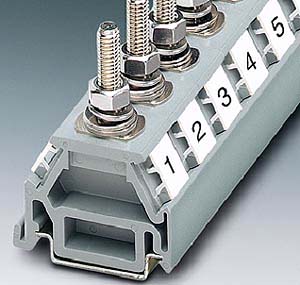
Рис. Phoenix Contact
Тематики
- вывод, зажим электрический
Классификация
>>>Обобщающие термины
Синонимы
EN
DE
FR
Немецко-русский словарь нормативно-технической терминологии > Bolzenklemme
4 Schaltanlagen und/oder Schaltgeräte
аппаратура распределения и управления
Общий термин для коммутационных аппаратов и их комбинации с относящимися к ним устройствами управления, измерения, защиты и регулирования, а также для узлов, в которых такие аппараты и устройства соединяются с соответствующими фидерами, комплектующим оборудованием, оболочками и опорными конструкциями.
МЭК 60050 (441-11-01) [1].
[ ГОСТ Р 50030. 1-2000 ( МЭК 60947-1-99)]EN
switchgear and controlgear
general term covering switching devices and their combination with associated control, measuring, protective and regulating equipment, also assemblies of such devices and equipment with associated interconnections, accessories, enclosures and supporting structures
[IEC 62271-1, ed. 1.0 (2007-10)]FR
appareillage
terme général applicable aux appareils de connexion et à leur combinaison avec des appareils de commande, de mesure, de protection et de réglage qui leur sont associés, ainsi qu’aux ensembles de tels appareils avec les connexions, les accessoires, les enveloppes et les charpentes correspondantes
[IEC 62271-1, ed. 1.0 (2007-10)]Тематики
- аппарат, изделие, устройство...
EN
DE
- Schaltanlagen und/oder Schaltgeräte
FR
низковольтное устройство распределения и управления (НКУ)
Низковольтные коммутационные аппараты и устройства управления, измерения, сигнализации, защиты, регулирования, собранные совместно, со всеми внутренними электрическими и механическими соединениями и конструктивными элементами.
[ ГОСТ Р МЭК 61439-1-2012]
низковольтное устройство распределения и управления
Комбинация низковольтных коммутационных аппаратов с устройствами управления, измерения, сигнализации, защиты, регулирования и т. п., полностью смонтированных изготовителем НКУ (под его ответственность на единой конструктивной основе) со всеми внутренними электрическими и механическими соединениями с соответствующими конструктивными элементами
Примечания
1. В настоящем стандарте сокращение НКУ используют для обозначения низковольтных комплектных устройств распределения и управления.
2. Аппараты, входящие в состав НКУ, могут быть электромеханическими или электронными.
3. По различным причинам, например по условиям транспортирования или изготовления, некоторые операции сборки могут быть выполнены на месте установки, вне предприятия-изготовителя.
[ ГОСТ Р 51321. 1-2000 ( МЭК 60439-1-92)]EN
power switchgear and controlgear assembly (PSC-assembly)
low-voltage switchgear and controlgear assembly used to distribute and control energy for all types of loads, intended for industrial, commercial and similar applications where operation by ordinary persons is not intended
[IEC 61439-2, ed. 1.0 (2009-01)]
low-voltage switchgear and controlgear assembly
combination of one or more low-voltage switching devices together with associated control, measuring, signalling, protective, regulation equipment, etc., completely assembled under the responsibility of the manufacturer with all the internal electrical and mechanical interconnections and structural parts.
[IEC 61892-3, ed. 2.0 (2007-11)]
switchgear and controlgear
a general term covering switching devices and their combination with associated control, measuring, protective and regulating equipment, also assemblies of such devices and equipment with associated interconnections, accessories, enclosures and supporting structures
[IEV number 441-11-01]
switchgear and controlgear
electric equipment intended to be connected to an electric circuit for the purpose of carrying out one or more of the following functions: protection, control, isolation, switching
NOTE – The French and English terms can be considered as equivalent in most cases. However, the French term has a broader meaning than the English term and includes for example connecting devices, plugs and socket-outlets, etc. In English, these latter devices are known as accessories.
[IEV number 826-16-03 ]
switchboard
A large single electric control panel, frame, or assembly of panels on which are mounted (either on the back or on the face, or both) switches, overcurrent and other protective devices, buses, and usually instruments; not intended for installation in a cabinet but may be completely enclosed in metal; usually is accessible from both the front and rear.
[ McGraw-Hill Dictionary of Architecture & Construction]
switchboard
One or more panels accommodating control switches, indicators, and other apparatus for operating electric circuits
[ The American Heritage Dictionary of the English Language]FR
ensemble d'appareillage de puissance (ensemble PSC)
ensemble d'appareillage à basse tension utilisé pour répartir et commander l'énergie pour tous les types de charges et prévu pour des applications industrielles, commerciales et analogues dans lesquelles l'exploitation par des personnes ordinaires n'est pas prévue
[IEC 61439-2, ed. 1.0 (2009-01)]
appareillage, m
matériel électrique destiné à être relié à un circuit électrique en vue d'assurer une ou plusieurs des fonctions suivantes: protection, commande, sectionnement, connexion
NOTE – Les termes français et anglais peuvent être considérés comme équivalents dans la plupart des cas. Toutefois, le terme français couvre un domaine plus étendu que le terme anglais, et comprend notamment les dispositifs de connexion, les prises de courant, etc. En anglais, ces derniers sont dénommés "accessories".
[IEV number 826-16-03 ]
appareillage
terme général applicable aux appareils de connexion et à leur combinaison avec des appareils de commande, de mesure, de protection et de réglage qui leur sont associés, ainsi qu'aux ensembles de tels appareils avec les connexions, les accessoires, les enveloppes et les charpentes correspondantes
[IEV number 441-11-01]
A switchboard as defined in the National Electrical Code is a large single panel, frame, or assembly of panels on which are mounted, on the face or back or both switches, overcurrent and other protective devices, buses, and, usually, instruments.
Switchboards are generally accessible from the rear as well as from the front and are not intended to be installed in cabinets.
The types of switchboards, classified by basic features of construction, are as follows:
1. Live-front vertical panels
2. Dead-front boards
3. Safety enclosed boards( metal-clad)
[American electricians’ handbook]
The switchboard plays an essential role in the availability of electric power, while meeting the needs of personal and property safety.
Its definition, design and installation are based on precise rules; there is no place for improvisation.
The IEC 61439 standard aims to better define " low-voltage switchgear and controlgear assemblies", ensuring that the specified performances are reached.
It specifies in particular:
> the responsibilities of each player, distinguishing those of the original equipment manufacturer - the organization that performed the original design and associated verification of an assembly in accordance with the standard, and of the assembly manufacturer - the organization taking responsibility for the finished assembly;
> the design and verification rules, constituting a benchmark for product certification.
All the component parts of the electrical switchboard are concerned by the IEC 61439 standard.
Equipment produced in accordance with the requirements of this switchboard standard ensures the safety and reliability of the installation.
A switchboard must comply with the requirements of standard IEC 61439-1 and 2 to guarantee the safety and reliability of the installation.
Managers of installations, fully aware of the professional and legal liabilities weighing on their company and on themselves, demand a high level of safety for the electrical installation.
What is more, the serious economic consequences of prolonged halts in production mean that the electrical switchboard must provide excellent continuity of service, whatever the operating conditions.
[Schneider Electric]НКУ играет главную роль в обеспечении электроэнергией, удовлетворяя при этом всем требованиям по безопасности людей и сохранности имущества.
Выбор конструкции, проектирование и монтаж основаны на чётких правилах, не допускающих никакой импровизации.
Требования к низковольтным комплектным устройствам распределения и управления сформулированы в стандарте МЭК 61439 (ГОСТ Р 51321. 1-2000).
В частности, он определяет:
> распределение ответственности между изготовителем НКУ - организацией, разработавшей конструкцию НКУ и проверившей его на соответствие требованиям стандарта, и сборщиком – организацией, выполнившей сборку НКУ;
> конструкцию, технические характеристики, виды и методы испытаний НКУ.
В стандарте МЭК 61439 (ГОСТ Р 51321. 1-2000) описываются все компоненты НКУ.
Оборудование, изготовленное в соответствии с требованиями этого стандарта, обеспечивает безопасность и надежность электроустановки.
Для того чтобы гарантировать безопасность эксплуатации и надежность работы электроустановки, распределительный щит должен соответствовать требованиям стандарта МЭК 61439-1 и 2.
Лица, ответственные за электроустановки, должны быть полностью осведомлены о профессиональной и юридической ответственности, возложенной на их компанию и на них лично, за обеспечение высокого уровня безопасности эксплуатации этих электроустановок.
Кроме того, поскольку длительные перерывы производства приводят к серьезным экономическим последствиям, электрический распределительный щит должен обеспечивать надежную и бесперебойную работу независимо от условий эксплуатации.
[Перевод Интент]LV switchgear assemblies are undoubtedly the components of the electric installation more subject to the direct intervention of personnel (operations, maintenance, etc.) and for this reason users demand from them higher and higher safety requirements.
The compliance of an assembly with the state of the art and therefore, presumptively, with the relevant technical Standard, cannot be based only on the fact that the components which constitute it comply with the state of the art and therefore, at least presumptively, with the relevant technical standards.
In other words, the whole assembly must be designed, built and tested in compliance with the state of the art.
Since the assemblies under consideration are low voltage equipment, their rated voltage shall not exceed 1000 Va.c. or 1500 Vd.c. As regards currents, neither upper nor lower limits are provided in the application field of this Standard.
The Standard IEC 60439-1 states the construction, safety and maintenance requirements for low voltage switchgear and controlgear assemblies, without dealing with the functional aspects which remain a competence of the designer of the plant for which the assembly is intended.
[ABB]Низковольтные комплектные устройства (НКУ), вне всякого сомнения, являются частями электроустановок, которые наиболее подвержены непосредственному вмешательству оперативного, обслуживающего и т. п. персонала. Вот почему требования потребителей к безопасности НКУ становятся все выше и выше.
Соответствие НКУ современному положению дел и вследствие этого, гипотетически, соответствующим техническим стандартам, не может основываться только на том факте, что составляющие НКУ компоненты соответствуют современному состоянию дел и поэтому, по крайней мере, гипотетически, - соответствующим техническим стандартам
Другими словами, НКУ должно быть разработано, изготовлено и испытано в соответствии с современными требованиями.
Мы рассматриваем низковольтные комплектные устройства и это означает, что их номинальное напряжение не превышает 1000 В переменного тока или 1500 В постоянного тока. Что касается тока, то ни верхнее, ни нижнее значение стандартами, относящимися к данной области, не оговариваются
Стандарт МЭК 60439-1 устанавливает требования к конструкции, безопасности и техническому обслуживанию низковольтных комплектных устройств без учета их функций, полагая, что функции НКУ являются компетенцией проектировщиков электроустановки, частью которых эти НКУ являются.
[Перевод Интент]Тематики
- НКУ (шкафы, пульты,...)
Классификация
>>>Действия
Синонимы
Сопутствующие термины
EN
- assembly
- electrical switchboard
- low voltage controlgear and assembly
- low voltage switchboard
- low voltage switchgear and controlgear assembly
- low-voltage switchgear and controlgear assembly
- LV switchgear and controlgear assembly
- LV switchgear assembly
- panel
- power switchgear and controlgear assembly
- PSC-assembly
- switchboard
- switchgear and controlgear
- switchgear/controlgear
DE
- Schaltanlagen und/oder Schaltgeräte
FR
Немецко-русский словарь нормативно-технической терминологии > Schaltanlagen und/oder Schaltgeräte
5 Dauerstrombelastbarkeit, f
(длительный) допустимый ток
Максимальное значение электрического тока, который может протекать длительно по проводнику, устройству или аппарату при определенных условиях без превышения определенного значения их температуры в установившемся режиме
[ ГОСТ Р МЭК 60050-826-2009]
Этот ток обозначают IZ
[ ГОСТ Р 50571. 1-2009 ( МЭК 60364-1: 2005)]EN
(continuous) current-carrying capacity
ampacity (US)
maximum value of electric current which can be carried continuously by a conductor, a device or an apparatus, under specified conditions without its steady-state temperature exceeding a specified value
[IEV number 826-11-13]
ampacity
The current in amperes that a conductor can carry continuously under the conditions of use without exceeding its temperature rating.
[National Electrical Cod]FR
courant (permanent) admissible, m
valeur maximale du courant électrique qui peut parcourir en permanence, un conducteur, un dispositif ou un appareil, sans que sa température de régime permanent, dans des conditions données, soit supérieure à la valeur spécifiée
[IEV number 826-11-13]Ampacity, the term is defined as the maximum amount of current a cable can carry before sustaining immediate or progressive deterioration. Also described as current rating or current-carrying capacity, is the RMS electric current which a device can continuously carry while remaining within its temperature rating. The ampacity of a cable depends on:
- its insulation temperature rating;
- conductor electrical properties for current;
- frequency, in the case of alternating currents;
- ability to dissipate heat, which depends on cable geometry and its surroundings;
- ambient temperature.
Electric wires have some resistance, and electric current flowing through them causes voltage drop and power dissipation, which heats the cable. Copper or aluminum can conduct a large amount of current before melting, but long before the conductors melt, their insulation would be damaged by the heat.
The ampacity for a power cable is thus based on physical and electrical properties of the material & construction of the conductor and of its insulation, ambient temperature, and environmental conditions adjacent to the cable. Having a large overall surface area may dissipate heat well if the environment can absorb the heat.
In a long run of cable, different conditions govern, and installation regulations normally specify that the most severe condition along the run governs the cable's rating. Cables run in wet or oily locations may carry a lower temperature rating than in a dry installation. Derating is necessary for multiple circuits in close proximity. When multiple cables are near, each contributes heat to the others and diminishes the amount of cooling air that can flow past the individual cables. The overall ampacity of the insulated conductors in a bundle of more than 3 must be derated, whether in a raceway or cable. Usually the de-rating factor is tabulated in a nation's wiring regulations.
Depending on the type of insulating material, common maximum allowable temperatures at the surface of the conductor are 60, 75 and 90 degrees Celsius, often with an ambient air temperature of 30°C. In the U.S., 105°C is allowed with ambient of 40°C, for larger power cables, especially those operating at more than 2 kV. Likewise, specific insulations are rated 150, 200 or 250°C.
The allowed current in cables generally needs to be decreased (derated) when the cable is covered with fireproofing material.
For example, the United States National Electric Code, Table 310-16, specifies that up to three 8 AWG copper wires having a common insulating material (THWN) in a raceway, cable, or direct burial has an ampacity of 50 A when the ambient air is 30°C, the conductor surface temperature allowed to be 75°C. A single insulated conductor in air has 70 A rating.
Ampacity rating is normally for continuous current, and short periods of overcurrent occur without harm in most cabling systems. The acceptable magnitude and duration of overcurrent is a more complex topic than ampacity.
When designing an electrical system, one will normally need to know the current rating for the following:- Wires
- Printed Circuit Board traces, where included
- Fuses
- Circuit breakers
- All or nearly all components used
Some devices are limited by power rating, and when this power rating occurs below their current limit, it is not necessary to know the current limit to design a system. A common example of this is lightbulb holders.
[http://en.wikipedia.org/wiki/Ampacity]
Тематики
- электротехника, основные понятия
Синонимы
EN
DE
- Dauerstrombelastbarkeit, f
- Strombelastbarkeit, f
FR
- courant admissible, m
- courant permanent admissible, m
Немецко-русский словарь нормативно-технической терминологии > Dauerstrombelastbarkeit, f
6 Strombelastbarkeit, f
(длительный) допустимый ток
Максимальное значение электрического тока, который может протекать длительно по проводнику, устройству или аппарату при определенных условиях без превышения определенного значения их температуры в установившемся режиме
[ ГОСТ Р МЭК 60050-826-2009]
Этот ток обозначают IZ
[ ГОСТ Р 50571. 1-2009 ( МЭК 60364-1: 2005)]EN
(continuous) current-carrying capacity
ampacity (US)
maximum value of electric current which can be carried continuously by a conductor, a device or an apparatus, under specified conditions without its steady-state temperature exceeding a specified value
[IEV number 826-11-13]
ampacity
The current in amperes that a conductor can carry continuously under the conditions of use without exceeding its temperature rating.
[National Electrical Cod]FR
courant (permanent) admissible, m
valeur maximale du courant électrique qui peut parcourir en permanence, un conducteur, un dispositif ou un appareil, sans que sa température de régime permanent, dans des conditions données, soit supérieure à la valeur spécifiée
[IEV number 826-11-13]Ampacity, the term is defined as the maximum amount of current a cable can carry before sustaining immediate or progressive deterioration. Also described as current rating or current-carrying capacity, is the RMS electric current which a device can continuously carry while remaining within its temperature rating. The ampacity of a cable depends on:
- its insulation temperature rating;
- conductor electrical properties for current;
- frequency, in the case of alternating currents;
- ability to dissipate heat, which depends on cable geometry and its surroundings;
- ambient temperature.
Electric wires have some resistance, and electric current flowing through them causes voltage drop and power dissipation, which heats the cable. Copper or aluminum can conduct a large amount of current before melting, but long before the conductors melt, their insulation would be damaged by the heat.
The ampacity for a power cable is thus based on physical and electrical properties of the material & construction of the conductor and of its insulation, ambient temperature, and environmental conditions adjacent to the cable. Having a large overall surface area may dissipate heat well if the environment can absorb the heat.
In a long run of cable, different conditions govern, and installation regulations normally specify that the most severe condition along the run governs the cable's rating. Cables run in wet or oily locations may carry a lower temperature rating than in a dry installation. Derating is necessary for multiple circuits in close proximity. When multiple cables are near, each contributes heat to the others and diminishes the amount of cooling air that can flow past the individual cables. The overall ampacity of the insulated conductors in a bundle of more than 3 must be derated, whether in a raceway or cable. Usually the de-rating factor is tabulated in a nation's wiring regulations.
Depending on the type of insulating material, common maximum allowable temperatures at the surface of the conductor are 60, 75 and 90 degrees Celsius, often with an ambient air temperature of 30°C. In the U.S., 105°C is allowed with ambient of 40°C, for larger power cables, especially those operating at more than 2 kV. Likewise, specific insulations are rated 150, 200 or 250°C.
The allowed current in cables generally needs to be decreased (derated) when the cable is covered with fireproofing material.
For example, the United States National Electric Code, Table 310-16, specifies that up to three 8 AWG copper wires having a common insulating material (THWN) in a raceway, cable, or direct burial has an ampacity of 50 A when the ambient air is 30°C, the conductor surface temperature allowed to be 75°C. A single insulated conductor in air has 70 A rating.
Ampacity rating is normally for continuous current, and short periods of overcurrent occur without harm in most cabling systems. The acceptable magnitude and duration of overcurrent is a more complex topic than ampacity.
When designing an electrical system, one will normally need to know the current rating for the following:- Wires
- Printed Circuit Board traces, where included
- Fuses
- Circuit breakers
- All or nearly all components used
Some devices are limited by power rating, and when this power rating occurs below their current limit, it is not necessary to know the current limit to design a system. A common example of this is lightbulb holders.
[http://en.wikipedia.org/wiki/Ampacity]
Тематики
- электротехника, основные понятия
Синонимы
EN
DE
- Dauerstrombelastbarkeit, f
- Strombelastbarkeit, f
FR
- courant admissible, m
- courant permanent admissible, m
Немецко-русский словарь нормативно-технической терминологии > Strombelastbarkeit, f
7 Selbstschalter
автоматический выключатель
Механический коммутационный аппарат1), способный включать, проводить и отключать токи при нормальном состоянии электрической цепи, а также включать, проводить в течение заданного времени и автоматически отключать токи в указанном аномальном состоянии электрической цепи, например, при коротком замыкании.
(МЭС 441-14-20)
[ ГОСТ Р 50030. 2-99 ( МЭК 60947-2-98)]
автоматический выключатель
-
[IEV number 442-05-01]EN
circuit breaker
a mechanical switching device, capable of making, carrying and breaking currents under normal circuit conditions and also making, carrying for a specified time and breaking currents under specified abnormal circuit conditions such as those of short circuit.
[IEC 62271-100, ed. 2.0 (2008-04)]
[IEV number 442-05-01]
circuit breaker
A device designed to open and close a circuit by nonautomatic means and to open the circuit automatically on a predetermined overcurrent without damage to itself when properly applied within its rating.
NOTE The automatic opening means can be integral, direct acting with the circuit breaker, or remote from the circuit breaker.
Adjustable (as applied to circuit breakers). A qualifying term indicating that the circuit breaker can be set to trip at various values of current, time, or both within a predetermined range. Instantaneous-trip (as applied to circuit breakers). A qualifying term indicating that no delay is purposely introduced in the tripping action of the circuit breaker.
Inverse-time (as applied to circuit breakers). A qualifying term indicating a delay is purposely introduced in the tripping action of the circuit breaker, which delay decreases as the magnitude of the current increases.
Nonadjustable (as applied to circuit breakers). A qualifying term indicating that the circuit breaker does not have any adjustment to alter the value of current at which it will trip or the time required for its operation.
Setting (of a circuit breaker). The value of current, time, or both at which an adjustable circuit breaker is set to trip.
[National Electrical Cod]FR
disjoncteur
1) Должно быть контактный коммутационный аппарат
appareil mécanique de connexion capable d’établir, de supporter et d’interrompre des courants dans les conditions normales du circuit, ainsi que d’établir, de supporter pendant une durée spécifiée et d’in- terrompre des courants dans des conditions anormales spécifiées du circuit telles que celles du court-circuit.
[IEC 62271-100, ed. 2.0 (2008-04)]
[IEV number 442-05-01]
[Интент]КЛАССИФИКАЦИЯ
- По роду тока
- По напряжению
- По числу полюсов
- По виду корпуса
- По месту установки
- По изолирующей среде
- По установленным расцепителям
- По дополнительным защитам
- По назначению
- По категории применения
- По виду привода взвода пружины
- По выполняемой функции
-
По влиянию монтажного положения
Автоматические выключатели ABB
Модульные автоматические выключатели
1. НЕКОТОРЫЕ СВЕДЕНИЯ ОБ АВТОМАТИЧЕСКИХ ВЫКЛЮЧАТЕЛЯХ Автоматический выключатель — это электрический аппарат, который автоматически отключает (и тем самым защищает) электрическую цепь при возникновении в ней аномального режима. Режим становится аномальным, когда в цепи начинает недопустимо изменяться (т. е. увеличиваться или уменьшаться относительно номинального значения) ток или напряжение.
Другими словами (более "инженерно") можно сказать, что автоматический выключатель защищает от токов короткого замыкания и токов перегрузки отходящую от него питающую линию, например, кабель и приемник(и) электрической энергии (осветительную сеть, розетки, электродвигатель и т. п.).
Как правило, автоматический выключатель может применятся также для нечастого (несколько раз в сутки) включения и отключения защищаемых электроприемников (защищаемой нагрузки).
[Интент]Выключатель предназначен для проведения тока в нормальном режиме и отключения тока при коротких замыканиях, перегрузках, недопустимых снижениях напряжения, а также до 30 оперативных включений и отключений электрических цепей в сутки и рассчитан для эксплуатации в электроустановках с номинальным рабочим напряжением до 660 В переменного тока частоты 50 и 60 Гц и до 440 В постоянного тока.
[Типовая фраза из российской технической документации] 2. ПРИНЦИП ДЕЙСТВИЯ Для защиты цепи от короткого замыкания применяется автоматический выключатель с электромагнитным расцепителем.1 - Пружина (в данном случае во взведенном положении растянута)
Автоматический выключатель устроен таким образом, что сначала необходимо взвести пружину и только после этого его можно включить. У многих автоматических выключателей для взвода пружины необходимо перевести ручку вниз. После этого ручку переводят вверх. При этом замыкаются главные контакты.
2 - Главный контакт автоматического выключателя
3 - Удерживающее устройство
4 - Электромагнитный расцепитель;
5 - Сердечник
6 - Катушка
7 - Контактные зажимы автоматического выключателя
На рисунке показан один полюс автоматического выключателя во включенном положении: пружина 1 взведена, а главный контакт 2 замкнут.
Как только в защищаемой цепи возникнет короткое замыкание, ток, протекающий через соответствующий полюс автоматического выключателя, многократно возрастет. В катушке 6 сразу же возникнет сильное магнитное поле. Сердечник 5 втянется в катушку и освободит удерживающее устройство. Под действием пружины 1 главный контакт 2 разомкнется, в результате чего автоматический выключатель отключит и тем самым защитит цепь, в которой возникло короткое замыкание. Такое срабатывание автоматического выключателя происходит практически мгновенно (за сотые доли секунды).
Для защиты цепи от тока перегрузки применяют автоматические выключатели с тепловым расцепителем.1 - Пружина (в данном случае во взведенном положении растянута)
Принцип действия такой же как и в первом случае, с той лишь разницей, что удерживающее устройство 3 освобождается под действием биметаллической пластины 5, которая изгибается от тепла, выделяемого нагревательным элементом 6. Количество тепла определяется током, протекающим через защищаемую цепь.
2 - Главный контакт автоматического выключателя
3 - Удерживающее устройство
4 - Тепловой расцепитель
5 - Биметаллическая пластина
6 - Нагревательный элемент
7 - Контактные зажимы автоматического выключателя
[Интент]Недопустимые, нерекомендуемые
Тематики
Классификация
>>>Обобщающие термины
Действия
- включение автоматического выключателя
- оперирование автоматического выключателя
- отключение автоматического выключателя
- срабатывание автоматического выключателя
EN
- auto-cutout
- automatic circuit breaker
- automatic cutout
- automatic switch
- breaker
- CB
- circuit breaker
- circuit-breaker
- cutout
DE
FR
Смотри также
Немецко-русский словарь нормативно-технической терминологии > Selbstschalter
8 Unterspannung (2)
пониженное напряжение
Напряжение, значение которого меньше допустимого для нормальной работы электротехнических изделий (устройств) и электрооборудования.
[ ГОСТ 23875-88
пониженное напряжение
-
[IEV number 151-15-29]EN
under-voltage
under-tension
voltage the value of which is lower than a specified limiting value
[IEV number 151-15-29]FR
subtension, f
sous-tension, f
manque de tension (terme déconseillé dans ce sens), m
tension électrique de valeur plus petite qu'une valeur limite spécifiée
[IEV number 151-15-29]Недопустимые, нерекомендуемые
Тематики
EN
DE
FR
Смотри также
Немецко-русский словарь нормативно-технической терминологии > Unterspannung (2)
9 Eingangsgrösse
воздействующая величина электрического реле
Электрическая величина, которая одна или в сочетании с другими электрическими величинами должна быть приложена к электрическому реле в заданных условиях для достижения ожидаемого функционирования
[ ГОСТ 16022-83]EN
energizing quantity
an electrical quantity (either current or voltage) which alone, or in combination with other such quantities, applied to a relay under specified conditions enables it to fulfil its purpose
[IEV number 446-12-01]
energizing quantity (for elementary relays)electrical quantity which, when applied to the input circuit of an elementary relay under specified conditions, enables it to fulfill its purpose
NOTE – For elementary relays the energizing quantity is usually a voltage. Therefore, the input voltage as energizing quantity is used in the definitions given below. Where a relay is energized by a given current instead, the respective terms and definitions apply with "current" used instead of "voltage".
[IEV number 444-03-01]FR
grandeur d'alimentation
grandeur électrique, courant ou tension, qui, seule ou en combinaison avec d'autres grandeurs électriques, courant ou tension, doit être appliquée dans des conditions spécifiées à un relais pour en obtenir le comportement attendu
[IEV number 446-12-01]
grandeur d'alimentation (pour les relais élémentaires), f
grandeur électrique qui, appliquée au circuit d'entrée d'un relais élémentaire dans des conditions spécifiées, lui permet d'accomplir sa fonction
NOTE – Pour les relais élémentaires, la grandeur d'alimentation est en général une tension. En conséquence, on utilise la tension d'entrée comme grandeur d'alimentation dans les définitions données ci-dessous. Lorsqu'un relais est alimenté par un courant, les termes et définitions respectifs sont à utiliser avec le terme "courant" au lieu du terme "tension".
[IEV number 444-03-01]Тематики
Классификация
>>>EN
DE
FR
2. ВОЗБУЖДЕНИЕ РЕЛЕ
49. Воздействующая величина электрического реле
D. Eingangsgrösse
Е. Energizing quantity
F. Grandeur d’alimentation
Электрическая величина, которая одна или в сочетании с другими электрическими величинами должна быть приложена к электрическому реле в заданных условиях для достижения ожидаемого функционирования
Источник: ГОСТ 16022-83: Реле электрические. Термины и определения оригинал документа
49. Воздействующая величина электрического реле
D. Eingangsgrösse
Е. Energizing quantity
F. Grandeur d’alimentation
Источник: ГОСТ 16022-83: Реле электрические. Термины и определения оригинал документа
Немецко-русский словарь нормативно-технической терминологии > Eingangsgrösse
10 Eingangsimpedanz
входное полное сопротивление
-
[IEV number 312-06-18]EN
input impedance
impedance of the input circuit measured between the input terminals under operating conditions
NOTE 1 – The impedance can be expressed in terms of admittance.
NOTE 2 – In certain instances, for example, sampling devices or self-balancing potentiometers, the impedance can be different according to the instant when it is determined, before, during or after the instant of measurement.
NOTE 3 – When the input circuit is such that the instantaneous value of the current flowing into the input terminals is a non-linear function of the instantaneous value of the input voltage under specified conditions of frequency and voltage, the combination of resistance and reactance which would absorb the same active power and in which would flow a reactive current equal to the fundamental component that is flowing in the actual input circuit, is sometimes called the "equivalent input impedance".
[IEV number 312-06-18]FR
impédance du circuit d'entrée
impédance du circuit d'entrée entre les bornes d'entrée dans les conditions de fonctionnement
NOTE 1 – L'impédance peut être exprimée en termes d'admittance.
NOTE 2 – Dans certains cas, par exemple les dispositifs d'échantillonnage ou les potentiomètres à rééquilibrage automatique, l'impédance peut être différente selon l’instant où elle est déterminée, avant, pendant ou après la mesure.
NOTE 3 – Lorsque le circuit d'entrée est tel que la valeur instantanée du courant traversant les bornes d'entrée est une fonction non linéaire de la valeur instantanée de la tension d'entrée dans des conditions spécifiées de fréquence et de tension, l'impédance d'une combinaison formée par une résistance et une réactance qui absorberaient la même puissance active et dans laquelle circulerait un courant réactif égal à la composante fondamentale qui circule dans le circuit d'entrée réel, est parfois appelée "impédance équivalente d'entrée".
[IEV number 312-06-18]Тематики
- измерение электр. величин в целом
EN
DE
FR
Немецко-русский словарь нормативно-технической терминологии > Eingangsimpedanz
11 Ausgangsimpedanz
выходное полное сопротивление
-
[IEV number 312-06-19]EN
output impedance
impedance of the output circuit measured between the output terminals under operating conditions
NOTE 1 – The impedance can be expressed in terms of admittance.
NOTE 2 – In certain instances, for example, sampling devices or self-balancing potentiometers, the impedance can be different according to the instant when it is determined, before, during or after the instant of measurement.
NOTE 3 – When the output circuit is such that the instantaneous value of the current flowing into the output terminals is a non-linear function of the instantaneous value of the output voltage under specified conditions of frequency and voltage, the combination of resistance and reactance which would absorb the same active power and in which would flow a reactive current equal to the fundamental component that is flowing in the actual output circuit, is sometimes called the "equivalent output impedance".
[IEV number 312-06-19]FR
impédance du circuit de sortie
impédance du circuit de sortie entre les bornes de sortie dans les conditions de fonctionnement
NOTE 1 – L'impédance peut être exprimée en termes d'admittance.
NOTE 2 – Dans certains cas, par exemple les dispositifs d'échantillonnage ou les potentiomètres à rééquilibrage automatique, l'impédance peut être différente selon l’instant où elle est déterminée, avant, pendant ou après la mesure.
NOTE 3 – Lorsque le circuit de sortie est tel que la valeur instantanée du courant traversant les bornes de sortie est une fonction non linéaire de la valeur instantanée de la tension de sortie dans des conditions spécifiées de fréquence et de tension, l'impédance d'une combinaison formée par une résistance et une réactance qui absorberaient la même puissance active et dans laquelle circulerait un courant réactif égal à la composante fondamentale qui circule dans le circuit de sortie réel, est parfois appelée "impédance équivalente de sortie".
[IEV number 312-06-19]Тематики
- измерение электр. величин в целом
EN
DE
FR
Немецко-русский словарь нормативно-технической терминологии > Ausgangsimpedanz
12 Mantelklemme
зажим под колпачок
Зажим винтового типа, в котором проводник прижимают к вырезу в резьбовом болте шайбой особой формы с помощью гайки с центральным штифтом, если гайка является колпачковой, или другим эквивалентным эффективным средством для передачи давления от гайки к проводнику.
[ ГОСТ Р 51324.1-2005]EN
mantle terminal
a terminal, in which the conductor is clamped against the base of a slot in a threaded stud by means of a nut, by a suitably shaped washer under the nut, by a central peg if the nut is a cap nut, or by an equally effective means for transmitting the pressure from the nut to the conductor within the slot
[IEV number 442-06-14]FR
borne à capot taraudé
borne dans laquelle l'âme d'un conducteur est serrée contre le fond d'une fente pratiquée dans un goujon fileté au moyen d'un écrou, d'une rondelle de forme appropriée placée sous l'écrou, ou d'un téton central si l'écrou est un écrou borgne ou par d'autres moyens aussi efficaces pour transmettre la pression à l'âme à l'intérieur de la fente
[IEV number 442-06-14]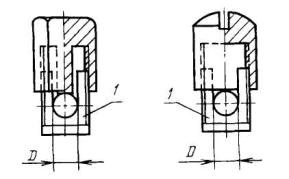
1 - неподвижная деталь; D - место расположения проводникаТематики
- вывод, зажим электрический
Обобщающие термины
EN
DE
FR
колпачковый зажим
Винтовой зажим, обеспечивающий разборное контактное соединение проводника с гнездовым выводом либо непосредственно колпачковой гайкой, либо через промежуточный элемент.
[ ГОСТ 25034-85]EN
mantle terminal
a terminal, in which the conductor is clamped against the base of a slot in a threaded stud by means of a nut, by a suitably shaped washer under the nut, by a central peg if the nut is a cap nut, or by an equally effective means for transmitting the pressure from the nut to the conductor within the slot
[IEV number 442-06-14]FR
borne à capot taraudé
borne dans laquelle l'âme d'un conducteur est serrée contre le fond d'une fente pratiquée dans un goujon fileté au moyen d'un écrou, d'une rondelle de forme appropriée placée sous l'écrou, ou d'un téton central si l'écrou est un écrou borgne ou par d'autres moyens aussi efficaces pour transmettre la pression à l'âme à l'intérieur de la fente
[IEV number 442-06-14]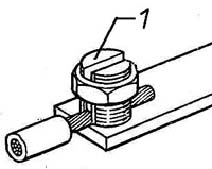
Колпачковый зажимТематики
- вывод, зажим электрический
Классификация
>>>Обобщающие термины
Синонимы
EN
DE
FR
Немецко-русский словарь нормативно-технической терминологии > Mantelklemme
13 Laschenklemmstelle
зажимное устройство с прижимной пластиной
Винтовое зажимное устройство в котором жила проводника зажимается под прижимной пластиной с помощью двух или более винтов или гаек.
[Интент]EN
saddle clamping unit
screw-type clamping unit, in which the conductor is clamped under a saddle by means of two or more screws or nuts
[IEV number 442-06-10]FR
dispositif de serrage à plaquette
organe de serrage à vis dans lequel l'âme d'un conducteur est serrée sous une plaquette au moyen de plusieurs vis ou écrous
[IEV number 442-06-10]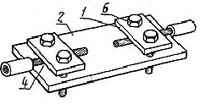
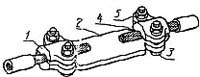
[ ГОСТ Р 50043.2-92]Зажимное устройство с прижимной пластиной
- Седлообразная пластина
- Неподвижная часть зажима (плоский вывод)
- Винт
- Место для проводника
- Гайка
- Винт
Тематики
- вывод, зажим электрический
Обобщающие термины
EN
DE
FR
седловидный зажимной элемент
-
[IEV number 442-06-10]EN
saddle clamping unit
Screw-type clamping unit, in which the conductor is clamped under a saddle by means of two or more screws or nuts
[IEV number 442-06-10]FR
dispositif de serrage à plaquette
Organe de serrage à vis dans lequel l'âme d'un conducteur est serrée sous une plaquette au moyen de plusieurs vis ou écrous
[IEV number 442-06-10]EN
DE
FR
Немецко-русский словарь нормативно-технической терминологии > Laschenklemmstelle
14 Wettbewerbsverzerrung
нарушение условий конкуренции
—
[ http://www.eionet.europa.eu/gemet/alphabetic?langcode=en]EN
distortion of competition
Article 85(1) of the EEC Treaty prohibits all agreements between undertakings, decisions by associations of undertakings and concerted practices which may affect trade between member states and which have as their object or effect the prevention, restriction or distortion of competition within the common market. All such arrangements are automatically null and void under Article 85(2), unless exempted by the Commission pursuant to Article 85(3). The text of Article 85 is as follows: "1. The following shall be prohibited as incompatible with the common market: all agreements between undertakings, decisions by associations of undertakings and concerted practices which may affect trade between member states and which have as their object or effect the prevention, restriction or distortion of competition within the common market, and in particular those which: (a) directly or indirectly fix purchase or selling prices or any other trading conditions; (b) limit or control production, markets, technical development, or investment; (c) share markets or sources of supply; (d) apply dissimilar conditions to equivalent transactions with other trading parties, thereby placing them at a competitive disadvantage; (e) make the conclusion of contracts subject to acceptance by the other parties of supplementary obligations which, by their nature or according to commercial usage, have no connection with the subject of such contracts. (Source: CLAORG)
[http://www.eionet.europa.eu/gemet/alphabetic?langcode=en]Тематики
EN
DE
FR
Немецко-русский словарь нормативно-технической терминологии > Wettbewerbsverzerrung
15 Wettbewerbsbeschänkung
ограничение конкуренции
—
[ http://www.eionet.europa.eu/gemet/alphabetic?langcode=en]EN
restriction on competition
Article 85(1) of the EEC Treaty prohibits all agreements between undertakings, decisions by associations of undertakings and concerted practices which may affect trade between member states and which have as their object or effect the prevention, restriction or distortion of competition within the common market. All such arrangements are automatically null and void under Article 85(2), unless exempted by the Commission pursuant to Article 85(3). The text of Article 85 is as follows: "1. The following shall be prohibited as incompatible with the common market: all agreements between undertakings, decisions by associations of undertakings and concerted practices which may affect trade between member states and which have as their object or effect the prevention, restriction or distortion of competition within the common market, and in particular those which: (a) directly or indirectly fix purchase or selling prices or any other trading conditions; (b) limit or control production, markets, technical development, or investment; (c) share markets or sources of supply; (d) apply dissimilar conditions to equivalent transactions with other trading parties, thereby placing them at a competitive disadvantage; (e) make the conclusion of contracts subject to acceptance by the other parties of supplementary obligations which, by their nature or according to commercial usage, have no connection with the subject of such contracts. (Source: CLAORG)
[http://www.eionet.europa.eu/gemet/alphabetic?langcode=en]Тематики
EN
DE
FR
Немецко-русский словарь нормативно-технической терминологии > Wettbewerbsbeschänkung
16 verfügbare Leistung eines Blocks, f
располагаемая мощность агрегата (электростанции)
Установленная мощность генерирующего агрегата (электростанции), за вычетом ограничений его мощности.
[ ГОСТ 19431-84]EN
available capacity of a unit
the maximum power at which a unit can be operated continuously under the prevailing conditions
Note – This power may be gross or net.
[IEV ref 602-03-11]
available capacity of a power station
the maximum power at which a power station can be operated continuously under the prevailing conditions
Note – This power may be gross or net.
[IEV ref 602-03-12]FR
puissance disponible d'une tranche
puissance maximale réalisable en régime continu dans les conditions réelles où une tranche se trouve
Note – Cette puissance peut être brute ou nette.
[IEV ref 602-03-11]
puissance disponible d'une centrale
puissance maximale réalisable en régime continu dans les conditions réelles où une centrale se trouve
Note – Cette puissance peut être brute ou nette.
[IEV ref 602-03-12]Тематики
Синонимы
EN
DE
- verfügbare Leistung eines Blocks, f
- verfügbare Leistung eines Kraftwerks
FR
- puissance disponible d'une centrale
- puissance disponible d'une tranche
- puissance disponible d’une centrale
Немецко-русский словарь нормативно-технической терминологии > verfügbare Leistung eines Blocks, f
17 verfügbare Leistung eines Kraftwerks
располагаемая мощность агрегата (электростанции)
Установленная мощность генерирующего агрегата (электростанции), за вычетом ограничений его мощности.
[ ГОСТ 19431-84]EN
available capacity of a unit
the maximum power at which a unit can be operated continuously under the prevailing conditions
Note – This power may be gross or net.
[IEV ref 602-03-11]
available capacity of a power station
the maximum power at which a power station can be operated continuously under the prevailing conditions
Note – This power may be gross or net.
[IEV ref 602-03-12]FR
puissance disponible d'une tranche
puissance maximale réalisable en régime continu dans les conditions réelles où une tranche se trouve
Note – Cette puissance peut être brute ou nette.
[IEV ref 602-03-11]
puissance disponible d'une centrale
puissance maximale réalisable en régime continu dans les conditions réelles où une centrale se trouve
Note – Cette puissance peut être brute ou nette.
[IEV ref 602-03-12]Тематики
Синонимы
EN
DE
- verfügbare Leistung eines Blocks, f
- verfügbare Leistung eines Kraftwerks
FR
- puissance disponible d'une centrale
- puissance disponible d'une tranche
- puissance disponible d’une centrale
Немецко-русский словарь нормативно-технической терминологии > verfügbare Leistung eines Kraftwerks
18 Instandhaltbarkeitsmaß
ремонтопригодность
Свойство объекта, заключающееся в приспособленности к поддержанию и восстановлению работоспособного состояния путем технического обслуживания и ремонта.
[ ГОСТ 27.002-89]
ремонтопригодность
Свойство объекта, заключающееся в его приспособленности при заданных условиях эксплуатации к поддержанию или восстановлению состояния, в котором он способен выполнять требуемую функцию, путем проведения технического обслуживания и ремонта, выполняемых с использованием установленых процессов и ресурсов.
[ОСТ 45.152-99]
ремонтопригодность
Свойство товара, заключающееся в приспособлении к предупреждению причин возникновения отказов, сбоев, поддержанию работоспособного состояния путем проведения техобслуживания и ремонтов.
[ ГОСТ Р 52104-2003]
ремонтопригодность
По ГОСТ 27. 002-89
В соответствии с ГОСТ 27.002-89 под ремонтопригодностью понимается "свойство объекта, заключающееся в приспособленности к предупреждению и обнаружению причин возникновения его отказов, повреждений и устранению их путем проведения ремонтов и технического обслуживания". При этом следует иметь в виду, что приспособленность объекта к плановым ремонтам относится к его ремонтопригодности.
[ ГОСТ 21623-76]EN
maintainability (performance)
the ability of an item under given conditions of use, to be retained in, or restored to, a state in which it can perform a required function, when maintenance is performed under given conditions and using stated procedures and resources
NOTE – The term "maintainability" is also used as a measure of maintainability performance.
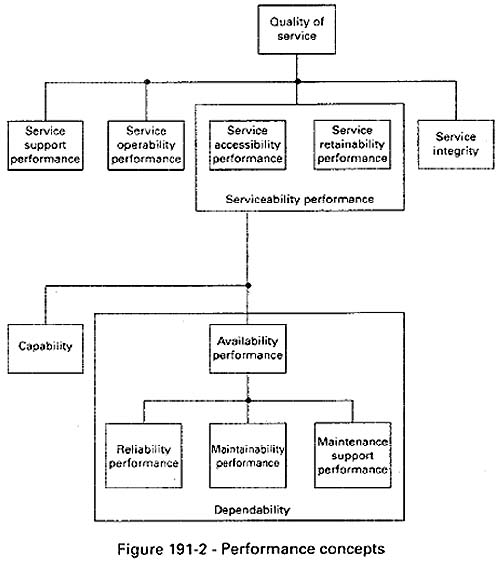
[IEV number 191-02-07]
maintainability
the probability that a given active maintenance action, for an item under given conditions of use can be carried out within a stated time interval, when the maintenance is performed under stated conditions and using stated procedures and resources
NOTE – The term "maintainability" is also used to denote the maintainability performance quantified by this probability.
Source: see 191-02-07
[IEV number 191-13-01]FR
maintenabilité
dans des conditions données d'utilisation, aptitude d'une entité à être maintenue ou rétablie dans un état dans lequel elle peut accomplir une fonction requise, lorsque la maintenance est accomplie dans des conditions données, avec des procédures et des moyens prescrits
NOTE – Le terme "maintenabilité" est aussi employé comme caractéristique de cette aptitude.
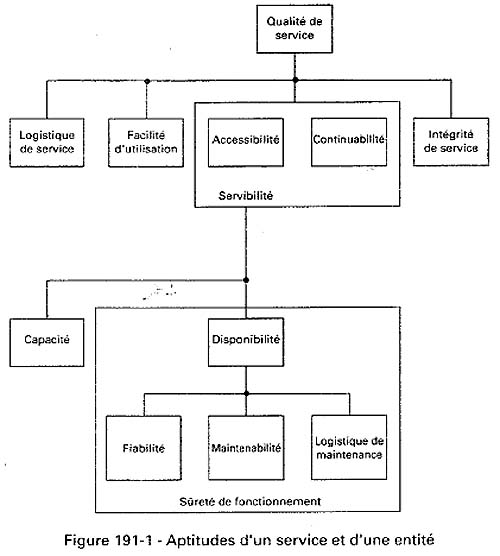
[IEV number 191-02-07]
maintenabilité
pour une entité donnée, utilisée dans des conditions données d'utilisation, probabilité pour qu'une opération donnée de maintenance active puisse être effectuée pendant un intervalle de temps donné, lorsque la maintenance est assurée dans des conditions données et avec l'utilisation de procédures et de moyens prescrits
NOTE – Le terme "maintenabilité" est aussi employé pour désigner l'aptitude caractérisée par cette probabilité.
Source: voir 191-02-07
[IEV number 191-13-01]Тематики
- надежность, основные понятия
- ресурсосбережение, обращение с отходами
- система техн. обслуж. и ремонта техники
- тех. обсл. и ремонт средств электросвязи
Обобщающие термины
EN
DE
FR
Немецко-русский словарь нормативно-технической терминологии > Instandhaltbarkeitsmaß
19 Irrstandhaltbarkeit
ремонтопригодность
Свойство объекта, заключающееся в приспособленности к поддержанию и восстановлению работоспособного состояния путем технического обслуживания и ремонта.
[ ГОСТ 27.002-89]
ремонтопригодность
Свойство объекта, заключающееся в его приспособленности при заданных условиях эксплуатации к поддержанию или восстановлению состояния, в котором он способен выполнять требуемую функцию, путем проведения технического обслуживания и ремонта, выполняемых с использованием установленых процессов и ресурсов.
[ОСТ 45.152-99]
ремонтопригодность
Свойство товара, заключающееся в приспособлении к предупреждению причин возникновения отказов, сбоев, поддержанию работоспособного состояния путем проведения техобслуживания и ремонтов.
[ ГОСТ Р 52104-2003]
ремонтопригодность
По ГОСТ 27. 002-89
В соответствии с ГОСТ 27.002-89 под ремонтопригодностью понимается "свойство объекта, заключающееся в приспособленности к предупреждению и обнаружению причин возникновения его отказов, повреждений и устранению их путем проведения ремонтов и технического обслуживания". При этом следует иметь в виду, что приспособленность объекта к плановым ремонтам относится к его ремонтопригодности.
[ ГОСТ 21623-76]EN
maintainability (performance)
the ability of an item under given conditions of use, to be retained in, or restored to, a state in which it can perform a required function, when maintenance is performed under given conditions and using stated procedures and resources
NOTE – The term "maintainability" is also used as a measure of maintainability performance.
[IEV number 191-02-07]
maintainability
the probability that a given active maintenance action, for an item under given conditions of use can be carried out within a stated time interval, when the maintenance is performed under stated conditions and using stated procedures and resources
NOTE – The term "maintainability" is also used to denote the maintainability performance quantified by this probability.
Source: see 191-02-07
[IEV number 191-13-01]FR
maintenabilité
dans des conditions données d'utilisation, aptitude d'une entité à être maintenue ou rétablie dans un état dans lequel elle peut accomplir une fonction requise, lorsque la maintenance est accomplie dans des conditions données, avec des procédures et des moyens prescrits
NOTE – Le terme "maintenabilité" est aussi employé comme caractéristique de cette aptitude.
[IEV number 191-02-07]
maintenabilité
pour une entité donnée, utilisée dans des conditions données d'utilisation, probabilité pour qu'une opération donnée de maintenance active puisse être effectuée pendant un intervalle de temps donné, lorsque la maintenance est assurée dans des conditions données et avec l'utilisation de procédures et de moyens prescrits
NOTE – Le terme "maintenabilité" est aussi employé pour désigner l'aptitude caractérisée par cette probabilité.
Source: voir 191-02-07
[IEV number 191-13-01]Тематики
- надежность, основные понятия
- ресурсосбережение, обращение с отходами
- система техн. обслуж. и ремонта техники
- тех. обсл. и ремонт средств электросвязи
Обобщающие термины
EN
DE
FR
Немецко-русский словарь нормативно-технической терминологии > Irrstandhaltbarkeit
20 verstärkte Isolierung
усиленная изоляция
Единая система изоляции токоведущих частей, которая в условиях, предусмотренных настоящим стандартом, обеспечивает такую же степень защиты от поражения электрическим током, как и двойная изоляция.
Примечание. Это не означает, что усиленная изоляция является только однородной частью. Она может состоять из нескольких слоев, которые нельзя испытать отдельно как дополнительную или основную изоляцию.
[ ГОСТ Р 52161. 1-2004 ( МЭК 60335-1: 2001)]
усиленная изоляция
Изоляция, обеспечивающая защиту от поражения электрическим током не в меньшей степени, чем двойная изоляция. Она может содержать несколько слоев, которые не могут быть испытаны раздельно как дополнительная или основная изоляция.
[ ГОСТ Р 52319-2005( МЭК 61010-1: 2001)]
усиленная изоляция
Изоляция опасных токоведущих частей, обеспечивающая степень защиты от поражения электрическим током, эквивалентную степени защиты, обеспечиваемой двойной изоляцией.
Примечание - Усиленная изоляция может состоять из нескольких слоев, каждый из которых не может быть испытан отдельно как основная и дополнительная изоляция.
[ ГОСТ Р МЭК 60050-195-2005]
[ ГОСТ Р МЭК 60050-826-2009]
усиленная изоляция
одна изоляционная система, примененная к находящимся под напряжением частям, которая обеспечивает степень защиты от поражения электрическим током, эквивалентную двойной изоляции.
Примечание - Термин "изоляционная система" не означает, что изоляция должна быть одной однородной частью. Она может содержать несколько слоев, которые не могут быть испытаны отдельно в качестве дополнительной или основной изоляции.
[ ГОСТ 6570-96]EN
reinforced insulation
single insulation applied to live parts, that provides a degree of protection against electric shock equivalent to double insulation under the conditions specified in this standard
NOTE - It is not implied that the insulation is one homogeneous piece. The insulation may comprise several layers which cannot be tested singly as supplementary insulation or basic insulation
[IEC 60335-1, ed. 4.0 (2001-05)]
reinforced insulation
insulation of hazardous-live-parts which provides a degree of protection against electric shock equivalent to double insulation
NOTE – Reinforced insulation may comprise several layers which cannot be tested singly as basic insulation or supplementary insulation.
Source: 826-03-20 MOD
[IEV number 195-06-09]FR
isolation renforcée
isolation unique des parties actives assurant, dans les conditions spécifiées par la présente norme, un degré de protection contre les chocs électriques équivalent à une double isolation
NOTE - Ceci n'implique pas que l'isolation soit homogène. Elle peut comprendre plusieurs couches qui ne peuvent pas être essayées séparément en tant qu'isolation supplémentaire ou isolation principale.
[IEC 60335-1, ed. 4.0 (2001-05)]
isolation renforcée
isolation des parties actives dangereuses assurant un degré de protection contre les chocs électriques équivalant à celui d'une double isolation
NOTE – L'isolation renforcée peut comporter plusieurs couches qui ne peuvent pas être essayées séparément en tant qu'isolation principale ou isolation supplémentaire.
Source: 826-03-20 MOD
[IEV number 195-06-09]Тематики
EN
DE
FR
Немецко-русский словарь нормативно-технической терминологии > verstärkte Isolierung
См. также в других словарях:
Under Armour — Type Public Traded as NYSE: UA … Wikipedia
Under — Un der, prep. [AS. under, prep. & adv.; akin to OFries. under, OS. undar, D. onder, G. unter, OHG. untar, Icel. undir, Sw. & Dan. under, Goth. undar, L. infra below, inferior lower, Skr. adhas below. [root]201. Cf. {Inferior}.] 1. Below or lower … The Collaborative International Dictionary of English
Under arms — Under Un der, prep. [AS. under, prep. & adv.; akin to OFries. under, OS. undar, D. onder, G. unter, OHG. untar, Icel. undir, Sw. & Dan. under, Goth. undar, L. infra below, inferior lower, Skr. adhas below. [root]201. Cf. {Inferior}.] 1. Below or… … The Collaborative International Dictionary of English
Under canvas — Under Un der, prep. [AS. under, prep. & adv.; akin to OFries. under, OS. undar, D. onder, G. unter, OHG. untar, Icel. undir, Sw. & Dan. under, Goth. undar, L. infra below, inferior lower, Skr. adhas below. [root]201. Cf. {Inferior}.] 1. Below or… … The Collaborative International Dictionary of English
Under fire — Under Un der, prep. [AS. under, prep. & adv.; akin to OFries. under, OS. undar, D. onder, G. unter, OHG. untar, Icel. undir, Sw. & Dan. under, Goth. undar, L. infra below, inferior lower, Skr. adhas below. [root]201. Cf. {Inferior}.] 1. Below or… … The Collaborative International Dictionary of English
Under foot — Under Un der, prep. [AS. under, prep. & adv.; akin to OFries. under, OS. undar, D. onder, G. unter, OHG. untar, Icel. undir, Sw. & Dan. under, Goth. undar, L. infra below, inferior lower, Skr. adhas below. [root]201. Cf. {Inferior}.] 1. Below or… … The Collaborative International Dictionary of English
Under ground — Under Un der, prep. [AS. under, prep. & adv.; akin to OFries. under, OS. undar, D. onder, G. unter, OHG. untar, Icel. undir, Sw. & Dan. under, Goth. undar, L. infra below, inferior lower, Skr. adhas below. [root]201. Cf. {Inferior}.] 1. Below or… … The Collaborative International Dictionary of English
Under one's signature — Under Un der, prep. [AS. under, prep. & adv.; akin to OFries. under, OS. undar, D. onder, G. unter, OHG. untar, Icel. undir, Sw. & Dan. under, Goth. undar, L. infra below, inferior lower, Skr. adhas below. [root]201. Cf. {Inferior}.] 1. Below or… … The Collaborative International Dictionary of English
Under sail — Under Un der, prep. [AS. under, prep. & adv.; akin to OFries. under, OS. undar, D. onder, G. unter, OHG. untar, Icel. undir, Sw. & Dan. under, Goth. undar, L. infra below, inferior lower, Skr. adhas below. [root]201. Cf. {Inferior}.] 1. Below or… … The Collaborative International Dictionary of English
Under sentence — Under Un der, prep. [AS. under, prep. & adv.; akin to OFries. under, OS. undar, D. onder, G. unter, OHG. untar, Icel. undir, Sw. & Dan. under, Goth. undar, L. infra below, inferior lower, Skr. adhas below. [root]201. Cf. {Inferior}.] 1. Below or… … The Collaborative International Dictionary of English
Under the breath — Under Un der, prep. [AS. under, prep. & adv.; akin to OFries. under, OS. undar, D. onder, G. unter, OHG. untar, Icel. undir, Sw. & Dan. under, Goth. undar, L. infra below, inferior lower, Skr. adhas below. [root]201. Cf. {Inferior}.] 1. Below or… … The Collaborative International Dictionary of English
 18+© Академик, 2000-2026
- Обратная связь: Техподдержка, Реклама на сайте
Экспорт словарей на сайты, сделанные на PHP, Joomla, Drupal, WordPress, MODx.
Перевод: с немецкого на русский
с русского на немецкий- С русского на:
- Немецкий
- С немецкого на:
- Все языки
- Английский
- Вьетнамский
- Русский