

-
41 расчет
при расчете количества топливаin computing the fuelрасчет времени вылетаdeparture estimatingрасчет времени полетаtime-of-flight calculationрасчет времени прилетаarrival estimatingрасчет запаса топливаfuel range estimatingрасчет нагрузкиweightрасчет тарифаfare calculationрасчет удельной нагрузки на поверхностьarea density calculationрасчет центровки1. balance calculation2. center-of-gravity computation расчет эксплуатационных параметровderivation of operating dataСекция расчетов по вопросам технической помощиTechnical Assistance Accounts section(ИКАО) Секция расчетов по регулярной программеRegular Programme Accounts section(ИКАО) таблица аэронавигационных расчетовair navigation table -
42 вид компенсации реактивной мощности
вид компенсации реактивной мощности
-См. также компенсация реактивной мощности
Параллельные тексты EN-RU
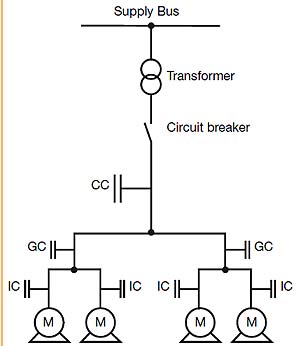
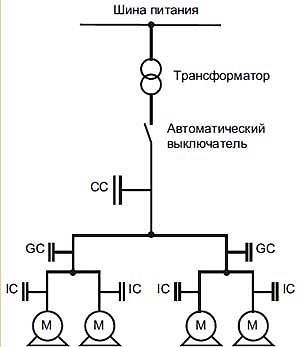
CC: Central Compensation
GC: Group Compensation
IC: Individual Compensation
M: Motor LoadCC: Централизованная компенсация
GC: Групповая компенсация
IC: Индивидуальная компенсация
M: Нагрузка (электродвигатель)The location of low-voltage capacitors in an installation constitutes the mode of compensation, which may be central (one location for the entire installation), by sector (section-by-section), at load level, or some combination of the latter two.
In principle, the ideal compensation is applied at a point of consumption and at the level required at any moment in time.
In practice, technical and economic factors govern the choice.
The location for connection of capacitor banks in the electrical network is determined by:
• the overall objective (avoid penalties on reactive energy relieve transformer or cables, avoid voltage drops and sags)
• the operating mode (stable or fluctuating loads)
• the foreseeable influence of capacitors on the network characteristics
• the installation cost.
[Schneider Electric]Вид компенсации определяется расположением конденсаторов низкого напряжения в электроустановке. Различают следующие виды компенсации: централизованная (одна конденсаторная батарея на всю электроустановку), групповая (по батарее на группу нагрузок), инидивидуальная или комбинированная - сочетание двух последних видов компенсации.
Теоретически, идеальной является компенсация, выполняемая в любой момент времени в требуемой точке электроустановки в требуемом количестве.
На практике выбор определяется техническими и экономическими соображениями.
Место подключения конденсаторных батарей к электрической сети определяется:
● общей задачей (избежать штрафов за потребление реактивной энергии, разгрузить силовой трансформатор и кабели, предотвратить падение и провалы напряжения);
● режимом работы (постоянные и переменные нагрузки);
● предполагаемым влиянием конденсаторов на характеристики электросети;
● стоимостью установки.
[Перевод Интент]Тематики
EN
Русско-английский словарь нормативно-технической терминологии > вид компенсации реактивной мощности
-
43 отдел
1) department
2) section
– отдел административный
– отдел дорожно-строительный
– отдел дорожно-транспортный
-
44 Отделение технического перевода авиационно-космического центра управления картографической службы министерства обороны
Универсальный русско-английский словарь > Отделение технического перевода авиационно-космического центра управления картографической службы министерства обороны
-
45 Секция расчётов по вопросам технической помощи
Aviation: Technical Assistance Accounts section (ИКАО)Универсальный русско-английский словарь > Секция расчётов по вопросам технической помощи
-
46 отделение технического перевода центра аэронавигационных изданий картографического управления МО
Универсальный русско-английский словарь > отделение технического перевода центра аэронавигационных изданий картографического управления МО
-
47 сектор общей технической поддержки
Labor organization: Section for Common Technical SupportУниверсальный русско-английский словарь > сектор общей технической поддержки
-
48 секция технической информации
Military: technical information sectionУниверсальный русско-английский словарь > секция технической информации
-
49 Aufriss
m2. fig. outline* * *der Aufriss(Zeichnung) elevation* * *Auf|rissm2) (fig = Abriss) outline, sketch* * *Auf·rissRR<-es, -e>Auf·rißALT<-sses, -sse>m1. (Ansicht) elevation, vertical plan; (Vorderansicht) front view [or elevation]; (Seitenansicht) profile, side elevationetw im \Aufriss zeichnen to draw the front/side elevation etc. of sth2. (kurze Darstellung) outline, sketch* * *1) (Bautechnik) elevation2) (Darstellung) outline* * *Aufriss m2. fig outline* * *1) (Bautechnik) elevation2) (Darstellung) outline* * *-e m.vertical section (technical diagram) n. -
50 ave
f.bird (animal).el Ave Fénix the phoenixave del Paraíso bird of paradiseave de presa bird of preyave rapaz o de rapiña (también figurative) bird of prey* * ** * *noun f.* * *SM ABR= Alta Velocidad Española high speed train* * *masculino (= Alta Velocidad Española) high-speed train•• Cultural note:A high-speed train service linking Madrid with Seville and Huelva via Cadiz, established in 1992 in time for the international exhibition Expo 92 in Seville. Lines under construction include: Madrid-Barcelona, with an extension to France and Barcelona-Valencia. An AVE service linking Madrid and Galicia is being planned* * *= bird.Ex. For example, the child doing a project about birds will require books to give him background information, a record or cassette to let him hear a bird-song, and a film to help him to appreciate bird flight.----* ave acuática = water bird.* ave carroñera = scavenger.* ave de caza = game bird.* ave del paraíso = bird of paradise.* ave de orilla = shorebird.* ave de paso = bird of passage.* ave de rapiña = raptor.* ave marina = sea bird.* ave migratoria = migratory bird.* ave nocturna = night owl, night owl.* ave pasajera = bird of passage.* ave rapaz = raptor.* aves acuáticas = waterfowl, fowl.* aves de corral = poultry.* aves y pájaros = bird life.* ave zancuda = wader, wading bird, shorebird.* cazador de aves = fowler.* cría de aves = poultry farming, aviculture, chicken farming.* criador de aves = aviculturist.* de la cría de aves = avicultural.* lugar donde las aves pasan la noche = roost.* observación de aves y pájaros = birdwatching [bird-watching], birding.* observador de aves y pájaros = birder, birdwatcher [bird-watcher].* relacionado con las aves = avian.* relativo a las aves = avian.* * *masculino (= Alta Velocidad Española) high-speed train•• Cultural note:A high-speed train service linking Madrid with Seville and Huelva via Cadiz, established in 1992 in time for the international exhibition Expo 92 in Seville. Lines under construction include: Madrid-Barcelona, with an extension to France and Barcelona-Valencia. An AVE service linking Madrid and Galicia is being planned* * *= bird.Ex: For example, the child doing a project about birds will require books to give him background information, a record or cassette to let him hear a bird-song, and a film to help him to appreciate bird flight.
* ave acuática = water bird.* ave carroñera = scavenger.* ave de caza = game bird.* ave del paraíso = bird of paradise.* ave de orilla = shorebird.* ave de paso = bird of passage.* ave de rapiña = raptor.* ave marina = sea bird.* ave migratoria = migratory bird.* ave nocturna = night owl, night owl.* ave pasajera = bird of passage.* ave rapaz = raptor.* aves acuáticas = waterfowl, fowl.* aves de corral = poultry.* aves y pájaros = bird life.* ave zancuda = wader, wading bird, shorebird.* cazador de aves = fowler.* cría de aves = poultry farming, aviculture, chicken farming.* criador de aves = aviculturist.* de la cría de aves = avicultural.* lugar donde las aves pasan la noche = roost.* observación de aves y pájaros = birdwatching [bird-watching], birding.* observador de aves y pájaros = birder, birdwatcher [bird-watcher].* relacionado con las aves = avian.* relativo a las aves = avian.* * *(= Alta Velocidad Española) high-speed train* * *
Multiple Entries:
AVE
ave
AVE sustantivo masculino (
ave feminine noun taking masculine article in the singular
bird;
ave de corral fowl;
ave de mal agüero bird of ill omen;
ave rapaz or de rapiña (Zool) bird of prey;
( persona) shark
AVE m Esp (abr de (tren de) alta velocidad español) high-speed train
' AVE' also found in these entries:
Spanish:
buche
- caldo
- cantor
- cantora
- chillar
- chillido
- copete
- deshuesar
- desplumar
- envergadura
- nacer
- P.º
- papo
- pechuga
- pelar
- peregrina
- peregrino
- picada
- picado
- pico
- picotear
- planear
- pluma
- plumaje
- rapaz
- rellena
- rellenar
- relleno
- remontar
- remontarse
- volar
- vuelo
- zancuda
- zancudo
- águila
- ala
- anilla
- Av.
- Avda.
- ave
- Avemaría
- carne
- cloaca
- depredador
- gallo
- guacamaya
- lapa
- molleja
- palomo
- papagayo
English:
Av
- Ave
- bird
- cock
- fowl
- Hail Mary
- leg
- migrant
- pluck
- poultry
- prey
- quill
- seabird
- shark
- soar
- swoop
- phoenix
- sea
- wader
* * *= Spanish high-speed trainAVEThe AVE is Spain's most modern train, and is designed to travel at speeds of over 300Km/h. It is a development of the French TGV, and Spanish, German and French companies are involved in its manufacture. It runs on a separate track from ordinary Spanish rolling stock, as the latter has a wider gauge than the European standard of the AVE track. The first AVE line was opened from Madrid to Seville to coincide with the Expo '92 in the latter city. The final section of the line from Madrid to Barcelona is under construction, and this will eventually extend to the French border. Further lines are being built and eventually it is intended that a single high-speed network will connect the cities of the Atlantic and Mediterranean coasts via Madrid. These projects have given rise to a certain amount of controversy, and some have encountered problems, whether due to technical, geological or human factors.* * *m abr (= alta velocidad española) high speed train* * *ave nf1) : bird2)aves de corral : poultry3)ave rapaz orave de presa : bird of prey* * *ave n birdave rapaz / ave de rapiña bird of prey -
51 सूत्रम् _sūtram
सूत्रम् [सूत्र्-अच्]1 A thread, string, line, cord; पुष्पमालानुषङ्गेण सूत्रं शिरसि धार्यते Subhās.; मणौ वज्रसमुत्कीर्णे सूत्रस्येवास्ति मे गतिः R.1.4.-2 A fibre; सुराङ्गना कर्षति खण्डिताग्रात् सूत्रं मृणालादिव राजहंसी V.1.18; Ku.1.4.-3 A wire.-4 A collection of threads.-5 The sacred thread or sacrificial cord worn by members of the first three classes; शिखासूत्रवान् ब्राह्मणः Tarka K.; विप्रत्वे सूत्रमेव हि Bhāg.12.2.3.-6 The string or wire of a puppet.-7 A short rule or precept, an aphorism.-8 A short or concise technical sentence used as a memorial rule; it is thus defined:-- स्वल्पाक्षरमसंदिग्धं सारवद् विश्वतोमुखम् । अस्तोभमनवद्यं च सूत्रं सूत्रविदो विदुः.-9 Any work or manu- al containing such aphoristic rules; e. g. मानवकल्पसूत्र, आपस्तम्बसूत्र, गृह्यसूत्र &c.-1 A rule, canon, decree (in law).-11 A girdle; वासः ससूत्रं लघुमारुतो$हरद् भवस्य देवस्य किलानुपश्यतः Bhāg.8.12.23.-12 A line, stroke.-13 A sketch, plan; त्वमेव धर्मार्थदुघाभिपत्तये दक्षेण सूत्रेण ससर्जिथा- ध्वरम् Bhāg.4.6.44.-14 Indication, prelude; विशङ्क्य सूत्रं पुरुषायितस्य तद् भविष्यतो$स्मायि तदा तदालिभिः N.16.15.-Comp. -अध्यक्षः superintendent of weaving; Kau. A.2.-आत्मन् a. having the nature of a string or thread. (-m.) the soul.-आली a string of beads &c. worn round the neck, a necklace.-कण्ठः 1 a Brāhmaṇa.-2 a pigeon, dove.-3 a wag-tail.-कर्मन् n. carpentry; अथ भूमिप्रदेशज्ञाः सूत्रकर्मविशारदाः Rām.2.8.1. ˚विशेषज्ञः a weaver; Rām.2.83.12.-कारः, -कृत् m.1 an author or composer of Sūtras.-2 a carpenter.-कोणः, -कोणकः a small drum shaped like an hour- glass (डमरु).-कोशः a skein of yarn.-क्रीडा a parti- cular game with strings (one of the 64 kalās).-गण्डिका a kind of stick used by weavers in spinning threads.-ग्रन्थः a book of a phorisms.-ग्राह a. seizing a thread.-ग्राहिन् m. a draftsman, an architect.-चरणम् N. of a class of Charaṇas or Vedic schools which introduced various Sūtra-works.-तन्तुः 1 a thread, string.-2 perseverance, energy.-तर्कुटी a distaff, spindle.-दरिद्र a. 'poor in threads', having a small number of threads, thread-bare; अयं पटः सूत्रदरिद्रतां गतः Mk.2.9.-धरः, -धारः 1 'the thread- holder', a stage-manager, the principal actor who arranges the cast of characters and instructs them, and takes a prominent part in the Prastāvanā or pre- lude; he is thus defined:-- नाट्यस्य यदनुष्ठानं तत् सूत्रं स्यात् सबीजकम् । रङ्गदैवतपूजाकृत् सूत्रधार इति स्मृतः ॥-2 a carpen- ter, an artisan.-3 the author of a set of aphorisms.-4 an epithet of Indra.-धृक् m.1 an architect.-2 a stage-manager.-पातः applying the measuring line.-पिटकः N. of one of the three collections of Buddhistic writings.-पुष्पः the cotton plant.-प्रोत a. fastened. with wires (as puppets).-भिद् m. a tailor.-भृत् m. = सूत्रधार q. v.-यन्त्रम् 1 'a thread-machine', shuttle.-2 a weaver's loom; सूत्रयन्त्रजविशिष्टचेष्टयाश्चर्यसञ्जिबहुशालभञ्जिकः N.18.13.-3 a shuttle.-वापः weaving (threads).-वीणा a kind of lute.-वेष्टनम् 1 a weaver's shuttle.-2 the act of weaving.-शाखम् the body.-स्थानम् (in medic. works) the first general section (treating of the physician, disease, remedies &c). -
52 GÖRÐ
gjörð, gerð, f. [göra]:1. used of making, building, workmanship; görð ok gylling, Vm. 47; kirkju-görð, church-building; húsa-g., house-building; skipa-g., ship-building; garð-g., fence-making:—of performance, vígslu-g., inauguration; messu-g., saying of mass, divine service; þjónustu-g., embættis-g., id.; þakkar-g., thanksgiving; bænar-g., prayer; lof-g., praise; ölmusu-g., alms-giving; frið-g., peace-making; sættar-g., settlement, agreement, arbitration:—of working, akr-g., tillage; ú-gerð, bad workmanship, patchwork; við-gerð, mending:—of yielding (of duties), tíundar-görð, tithe; leiðangrs-g., paying levy:—of cookery and the like, öl-görð, ale-making, brewing; matar-g., cooking; brauð-g., baking: sundr-gerð, show: til-gerð, whims: upp-gerð, dissimulation: eptir-görð, q. v.: í-görð, suppuration.2. a doing, act, deed; the phrase, orð ok görðir, words and deeds, Fms. iii. 148; ef þú launar svá mína görð, Ísl. ii. 141, Stj. 250, 252, Dipl. i. 7: so in the phrase, söm þín gerð, as good as the deed (in declining a kind offer); góð-görð, vel-görð, a good deed, benefit; íll-görðir (pl.), evil doings; mein-görðir, transgressions: in gramm. the active voice, Skálda 180.II. a law term, arbitration; the settlement was called sætt or sættar-görð, the umpires görðar-menn, m., Grág., Nj. passim; and the verdict gerð or görð, cp. göra C. IV:—the technical phrases were, leggja mál í görð, to submit a case to arbitration, passim; vóru málin í gerð lagin með umgangi ok sættarboðum góðgjarna manna, Eb. 128; or slá málum í sætt, Rd. 248, Eb. ch. 56; leggja mál undir e-n, Lv. ch. 27: nefna menn til görðar (ch. 4), or taka menn til görðar, to choose umpires; vóru menn til gerðar teknir ok lagðr til fundr, Nj. 146: skilja undir gerð (sátt), or skilja undan, to stipulate, of one of the party making a stipulation to be binding on the umpire (as e. g. the award shall not be outlawry but payment), en þó at vandliga væri skilit undir görðina, þá játaði Þórðr at göra, Eb. 24, cp. Ld. 308, Sturl. ii. 63; göra fé slíkt sem hann vildi, at undan-skildum hérað-sektum ok utanferðum, var þá handsalat niðrfall af sökum, Fs. 74; lúka upp gerð ( to deliver the arbitration), or segja upp gerð, to pronounce or to give verdict as umpire; skyldi Skapti gerð upp segja, Valla L. 225; hann lauk upp gerðum á Þórsness-þingi ok hafði við hina vitrustu menn er þar vóru komnir, Eb. 246; þeir skyldi upp lúka görðinni áðr en þeir færi af þingi, Bjarn. (fine); Þorsteinn kvaðsk ekki mundu görð upp lúka fyr en á nokkuru lögþingi, Fs. 49:—as to the number of umpires,—one only, a trustworthy man, was usually appointed, Eb. ch. 10 (Thord Gellir umpire), ch. 46, Lv. ch. 27 (Gellir), Valla L. ch. 6 (Skapti the speaker), Rd. ch. 6 (Áskell Goði), Sturl. 2. ch. 103 (Jón Loptsson), Sturl. 4. ch. 27 (Thorvald Gizurarson), Bjarn. 17 (the king of Norway), Flóam. S. ch. 3, Hallfr. S. ch. 10, Bjarn. 55: two umpires, Rd. ch. 10, 16, 18, 24, Valla L. ch. 10 (partly a case of sjálfdæmi), Bjarn. (fine): twelve umpires, Nj. ch. 75, 123, 124 (six named by each party): the number and other particulars not recorded, Vd. ch. 39, 40, Nj. ch. 94, Rd. ch. 11, 13, Eb. ch. 27, 56, Lv. ch. 4, 12, 30, Glúm. ch. 9, 23, 27, etc.:—even the sjálfdæmi (q. v.), self-judging, was a kind of arbitration, cp. Vápn. 31, Vd. ch. 29, 34, 44, Lv. ch. 17, Band. pp. 11–13, Ölk. ch. 2–4: curious is the passage, ek vil at vit takim menn til görðar með okkr, Hrafnkell svarar, þá þykisk þú jafn-menntr mér, Hrafn. 10:—görð is properly distinguished from dómr, but is sometimes confounded with it, vóru handsöluð mál í dóm ok menn til görðar nefndir, Lv. 13; málin kómu í dóm Vermundar, en hann lauk gerðum upp á Þórsness-þingi, Eb. 246; as also Nj. (beginning), where lögligir dómar no doubt refers to görð. A section of law about görð is contained in the Grág. at the end of Kaupa-þáttr, ch. 69–81 (i. 485–497), where even the curious case is provided for of one or all the umpires dying, or becoming dumb or mad, before pronouncing their verdict. ☞ This was a favourite way of settlement at the time of the Commonwealth, and suited well the sagacious and law-abiding spirit of the men of old: nor did the institution of the Fifth Court make any change in this; the görð was even resorted to in public matters, such as the introduction of Christianity in A. D. 1000. Good and leading men acted the part of public peacemakers (e. g. Njál in the 10th, Jón Loptsson in the 12th century); until at last, in the 13th century, the king of Norway was resorted to, but he misused the confidence put in him. -
53 redakcj|a
f 1. sgt (opracowanie tekstu) editing- redakcja książki była już skończona the editing of the book was already finished2. (G pl redakcji) (wersja tekstu) version, draft- artykuł po drugiej redakcji the second version of the article- pod redakcją… edited by…- jest to zbiór esejów pod redakcją naszego profesora it’s a collection of essays edited by our professor3. (G pl redakcji) (dział) editorial section; (zespół pracowników) editorial staff, editorial team- redakcja sportowa sports desk4. (G pl redakcji) (lokal) editorial office- □ redakcja naukowa (academic) editing- redakcja techniczna (czynności) make-up, technical editing; (zespół) make-up editors, production editors; (siedziba) production departmentThe New English-Polish, Polish-English Kościuszko foundation dictionary > redakcj|a
-
54 свойства непротиворечивости
Этот тип свойств затрагивает взаимное соответствие переговорных решений в случае их применения в задачах с различным числом агентов. Здесь пересмотр условий приводит строго к исходу начальных переговоров. — This type of property concerns the mutual fit of the bargaining solutions when we apply them to problems with different numbers of agents. Here, renegotiation leads exactly to the outcome of the initial negotiation.
свойства отношений предпочтения, основные — basic properties of preference relations
Рассмотрим также два свойства - монотонность (или менее строгий её вариант - локальную ненасыщенность) и выпуклость, которые широко используются в последующем анализе. — We also discuss two properties, monotonicity (or its weaker version, local nonsatiation) and convexity, that are used extensively in the analysis that follows.
В разделе 3 рассматривается технический вопрос: свойства существования и непрерывности функций полезности, которые представляют предпочтения потребителя. — Section 3.C considers a technical issue: the existence and continuity properties of utility functions that represent the consumer's preferences.
Russian-English Dictionary "Microeconomics" > свойства непротиворечивости
-
55 инспекционный
-
56 Donisthorpe, George Edmond
SUBJECT AREA: Textiles[br]fl. c.1842 England[br]English inventor of a wool-combing machine.[br]Edmund Cartwright's combing machine needed a great deal of improvement before it could be used to tackle the finer qualities of wool. Various people carried out experiments over the next thirty years, including G.E.Donisthorpe of Leicester. Together with Henry Rawson, Donisthorpe obtained his first patent for improvements to wool combing in 1835, but his important ones were obtained in 1842 and 1843. These attracted the attention of S.C. Lister, who had become interested in developing a machine to comb wool after seeing the grim working conditions of the hand-combers supplying his mill at Manningham. Lister was quick to perceive that Donisthorpe's invention carried sufficient promise to replace the hand-comber, so in 1842 he made Donisthorpe an offer, which was accepted, of £2,000 for half the patent rights. In the following year Lister purchased the other half of the patent for £10,000, whereby Donisthorpe ceased to have any pecuniary interest in it. Lister took Donisthorpe into partnership and they worked together over the ensuing years with patience and diligence until they eventually succeeded in bringing out a combing machine that was generally acceptable. They were combing fine botany wool for the first time by machine in 1843. Further patents were taken out in their joint names in 1849 and 1850: these included the "nip" mechanism, the priority of which was disputed by Heilmann. Donisthorpe also took out patents for wool combing with John Whitehead in 1849 and John Crofts in 1853.[br]Bibliography1835, British patent no. 6,808 (improvements to wool combing). 1842. British patent no. 9,404.1843. British patent no. 9,966.1843, British patent no. 9,780.1849, with S.C.Lister, British patent no. 12,712.1849, with S.C.Lister, British patent no. 13,009. 1849, with S.C.Lister, British patent no. 13,532. 1849, with John Whitehead, British patent no. 12,603. 1853, with John Crofts, British patent no. 216.Further ReadingJ.Hogg (ed.), c.1888, Fortunes Made in Business, London (provides an account of the association between Donisthorpe and Lister).W.English, 1969, The Textile Industry, London (explains the technical details of combing machines).C.Singer (ed.), 1958, A History of Technology, Vol. IV, Oxford: Clarendon Press (includes a good section on combing machines).RLHBiographical history of technology > Donisthorpe, George Edmond
-
57 Rickover, Admiral Hyman George
[br]b. 27 January 1900 Russian Polandd. 8 July 1986 Arlington, Virginia, USA[br]Polish/American naval officer, one of the principal architects of the United States nuclear submarine programme.[br]Born in Poland, Rickover was brought to the United States early in his life by his father, who settled in Chicago as a tailor. Commissioned into the US Navy in 1922, he specialized in electrical engineering (graduating from the US Naval Postgraduate School, Columbia, in 1929), quali-fied as a Submariner in 1931 and then held various posts until appointed Head of the Electrical Section of the Bureau of Ships in 1939. He held this post until the end of the Second World War.Rickover was involved briefly in the "Manhattan" atomic bomb project before being assigned to an atomic energy submarine project in 1946. Ultimately he was made responsible for the development and building of the world's first nuclear submarine, the USS Nautilus. He was convinced of the need to make the nuclear submarine an instrument of strategic importance, and this led to the development of the ballistic missile submarine and the Polaris programme.Throughout his career he was no stranger to controversy; indeed, his remaining on the active service list as a full admiral until the age of 82 (when forced to retire on the direct intervention of the Navy Secretary) indicates a man beyond the ordinary. He imposed his will on all around him and backed it with a brilliant and clear-thinking brain; his influence was even felt by the Royal Navy during the building of the first British nuclear submarine, HMS Dreadnought. He made many friends, but he also had many detractors.[br]Principal Honours and DistinctionsUS Distinguished Service Medal with Gold Star. Honorary CBE. US Congress Special Gold Medal 1959. Numerous awards and honorary degrees.BibliographyRickover wrote several treatises on education and on the education of engineers. He also wrote on several aspects of the technical history of the US Navy.Further ReadingW.R.Anderson and C.Blair, 1959, Nautilus 90 North, London: Hodder \& Stoughton. E.L.Beach, 1986, The United States Navy, New York: Henry Holt.FMWBiographical history of technology > Rickover, Admiral Hyman George
-
58 Stevens, Robert Livingston
SUBJECT AREA: Ports and shipping[br]b. 18 October 1787 Hoboken, New Jersey, USAd. 20 April 1856 Hoboken, New Jersey, USA[br]American engineer, pioneer of steamboats and railways.[br]R.L.Stevens was the son of John Stevens and was given the technical education his father lacked. He assisted his father with the Little Juliana and the Phoenix, managed the commercial operation of the Phoenix on the Delaware River, and subsequently built many other steamboats.In 1830 he and his brother Edwin A.Stevens obtained a charter from the New Jersey Legislature for the Camden \& Amboy Railroad \& Transportation Company, and he visited Britain to obtain rails and a locomotive. Railway track in the USA then normally comprised longitudinal timber rails with running surfaces of iron straps, but Stevens designed rails of flat-bottom section, which were to become standard, and had the first batch rolled in Wales. He also designed hookheaded spikes for them, and "iron tongues", which became fishplates. From Robert Stephenson \& Co. (see Robert Stephenson) he obtained the locomotive John Bull, which was similar to the Liverpool \& Manchester Railway's Samson. The Camden \& Amboy Railroad was opened in 1831, but John Bull, a 0–4–0, proved over sensitive to imperfections in the track; Stevens and his mechanic, Isaac Dripps, added a two-wheeled non-swivelling "pilot" at the front to guide it round curves. The locomotive survives at the Smithsonian Institution, Washington, DC.[br]Further ReadingH.P.Spratt, 1958, The Birth of the Steamboat, Charles Griffin.J.H.White Jr, 1979, A History of the American Locomotive—Its Development: 1830– 1880, New York: Dover Publications Inc.J.F.Stover, 1961, American Railroads, Chicago: University of Chicago Press.PJGRBiographical history of technology > Stevens, Robert Livingston
-
59 Watson-Watt, Sir Robert Alexander
[br]b. 13 April 1892 Brechin, Angus, Scotlandd. 6 December 1973 Inverness, Scotland[br]Scottish engineer and scientific adviser known for his work on radar.[br]Following education at Brechin High School, Watson-Watt entered University College, Dundee (then a part of the University of St Andrews), obtaining a BSc in engineering in 1912. From 1912 until 1921 he was Assistant to the Professor of Natural Philosophy at St Andrews, but during the First World War he also held various posts in the Meteorological Office. During. this time, in 1916 he proposed the use of cathode ray oscillographs for radio-direction-finding displays. He joined the newly formed Radio Research Station at Slough when it was opened in 1924, and 3 years later, when it amalgamated with the Radio Section of the National Physical Laboratory, he became Superintendent at Slough. At this time he proposed the name "ionosphere" for the ionized layer in the upper atmosphere. With E.V. Appleton and J.F.Herd he developed the "squegger" hard-valve transformer-coupled timebase and with the latter devised a direction-finding radio-goniometer.In 1933 he was asked to investigate possible aircraft counter-measures. He soon showed that it was impossible to make the wished-for radio "death-ray", but had the idea of using the detection of reflected radio-waves as a means of monitoring the approach of enemy aircraft. With six assistants he developed this idea and constructed an experimental system of radar (RAdio Detection And Ranging) in which arrays of aerials were used to detect the reflected signals and deduce the bearing and height. To realize a practical system, in September 1936 he was appointed Director of the Bawdsey Research Station near Felixstowe and carried out operational studies of radar. The result was that within two years the East Coast of the British Isles was equipped with a network of radar transmitters and receivers working in the 7–14 metre band—the so-called "chain-home" system—which did so much to assist the efficient deployment of RAF Fighter Command against German bombing raids on Britain in the early years of the Second World War.In 1938 he moved to the Air Ministry as Director of Communications Development, becoming Scientific Adviser to the Air Ministry and Ministry of Aircraft Production in 1940, then Deputy Chairman of the War Cabinet Radio Board in 1943. After the war he set up Sir Robert Watson-Watt \& Partners, an industrial consultant firm. He then spent some years in relative retirement in Canada, but returned to Scotland before his death.[br]Principal Honours and DistinctionsKnighted 1942. CBE 1941. FRS 1941. US Medal of Merit 1946. Royal Society Hughes Medal 1948. Franklin Institute Elliot Cresson Medal 1957. LLD St Andrews 1943. At various times: President, Royal Meteorological Society, Institute of Navigation and Institute of Professional Civil Servants; Vice-President, American Institute of Radio Engineers.Bibliography1923, with E.V.Appleton \& J.F.Herd, British patent no. 235,254 (for the "squegger"). 1926, with J.F.Herd, "An instantaneous direction reading radio goniometer", Journal ofthe Institution of Electrical Engineers 64:611.1933, The Cathode Ray Oscillograph in Radio Research.1935, Through the Weather Hours (autobiography).1936, "Polarisation errors in direction finders", Wireless Engineer 13:3. 1958, Three Steps to Victory.1959, The Pulse of Radar.1961, Man's Means to his End.Further ReadingS.S.Swords, 1986, Technical History of the Beginnings of Radar, Stevenage: Peter Peregrinus.KFBiographical history of technology > Watson-Watt, Sir Robert Alexander
-
60 инспекционный
Русско-английский военно-политический словарь > инспекционный
См. также в других словарях:
Technical communication — is the process of conveying usable information through writing or speech about a specific domain to an intended audience. Information is usable if the intended audience is able to perform an action or make a decision based on its contents… … Wikipedia
Technical diving — Technical diver during a decompression stop. Technical diving (sometimes referred to as Tec diving) is a form of scuba diving that exceeds the scope of recreational diving (although the vast majority of technical divers dive for recreation and… … Wikipedia
Technical writing — Technical writing, a form of technical communication, is a style of formal writing, used in fields as diverse as computer hardware and software, chemistry, the aerospace industry, robotics, finance, consumer electronics, and biotechnology. Good… … Wikipedia
Section 51(xi) of the Australian Constitution — is the subsection of Section 51 of the Australian Constitution granting the Commonwealth the power to make laws on census and statistics .Historical Context to the inclusion of the Census PowerThe first version of the Constitution included a… … Wikipedia
Section 508 Amendment to the Rehabilitation Act of 1973 — In 1998 the US Congress amended the Rehabilitation Act to require Federal agencies to make their electronic and information technology accessible to people with disabilities. Inaccessible technology interferes with an individual s ability to… … Wikipedia
Technical drawing — Drafter at work … Wikipedia
Technical Coordinator — The American Radio Relay League Technical Coordinator (TC) is a section level official appointed by the Section Manager to coordinate all technical activities within the section. The Technical Coordinator reports to the Section Manager and is… … Wikipedia
section — sec|tion1 W1S1 [ˈsekʃən] n ▬▬▬▬▬▬▬ 1¦(place/object)¦ 2¦(part of a whole)¦ 3¦(book/newspaper/report)¦ 4¦(group of people)¦ 5 brass/rhythm/woodwind/string etc section 6¦(law)¦ 7¦(side/top view)¦ 8¦(medical/scientific)¦ 9¦(area of land)¦ … Dictionary of contemporary English
Section summary of the USA PATRIOT Act, Title II — President George W. Bush gestures as he addresses an audience Wednesday, July 20, 2005 at the Port of Baltimore in Baltimore, Md., encouraging the renewal of provisions of the Patriot Act. The following is a section summary of the USA PATRIOT Act … Wikipedia
Technical intelligence — In a pure military context, Technical Intelligence (TECHINT) is intelligence about weapons and equipment used by the armed forces of foreign nations (often referred to as foreign materiel).The related term, scientific and technical intelligence,… … Wikipedia
section — 1 / sekSFn/ noun 1 PLACE/OBJECT (C) one of the parts that something, such as an object or place is divided into (+ of): The spoons go in the front section of the drawer. | one of the older sections of Philadelphia | Decorate the torte with orange … Longman dictionary of contemporary English
