

-
61 Grundwasserabsenkung
водопонижение
Искусственное понижение уровня подземных вод
[ ГОСТ 19185-73]
[СО 34.21.308-2005]
[Терминологический словарь по строительству на 12 языках (ВНИИИС Госстроя СССР)]
Тематики
EN
DE
FR
Немецко-русский словарь нормативно-технической терминологии > Grundwasserabsenkung
-
62 Wasserversenkung
водопонижение
Искусственное понижение уровня подземных вод
[ ГОСТ 19185-73]
[СО 34.21.308-2005]
[Терминологический словарь по строительству на 12 языках (ВНИИИС Госстроя СССР)]
Тематики
EN
DE
FR
Немецко-русский словарь нормативно-технической терминологии > Wasserversenkung
-
63 Rüttel-Umlegeformmaschine
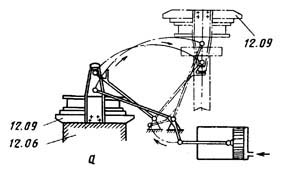
встряхивающая формовочная машина с поворотно-перекидным столом
Встряхивающая формовочная машина, у которой стол с уплотненной полуформой переворачивается системой рычагов на 180° вокруг горизонтальной оси, смещаясь в горизонтальном и вертикальном направлениях в положение над столом для приема полуформы.
[ ГОСТ 18111-93]Тематики
Обобщающие термины
EN
DE
FR
Немецко-русский словарь нормативно-технической терминологии > Rüttel-Umlegeformmaschine
-
64 Reihentabelle
Немецко-русский словарь нормативно-технической терминологии > Reihentabelle
-
65 Dränung
грунтовой дренаж
—
[ http://www.eionet.europa.eu/gemet/alphabetic?langcode=en]EN
subsoil drainage
The removal of surplus water from within the soil by natural or artificial means, such as by drains placed below the surface to lower the water table below the root zone. (Source: BJGEO)
[http://www.eionet.europa.eu/gemet/alphabetic?langcode=en]Тематики
EN
DE
FR
дрена
Подземный искусственный водоток, труба, канава, полость для понижения уровня, сбора и отвода грунтовых вод
[Терминологический словарь по строительству на 12 языках (ВНИИИС Госстроя СССР)]EN
DE
FR
дренаж
Отвод грунтовых вод с помощью системы подземных водотоков (дрен) или открытых канав и лотков
[Терминологический словарь по строительству на 12 языках (ВНИИИС Госстроя СССР)]
дренаж
Устройства для сбора и отвода профильтровавшихся и подземных вод
[ ГОСТ 19185-73]
дренаж
Устройство для сбора и отвода профильтровавшихся вод.
[РД 01.120.00-КТН-228-06]
дренаж
Устройство для частичного или полного перехвата фильтрационного потока в основании или внутри водоподпорного сооружения, сбора и отвода профильтровавшихся вод.
[СО 34.21.308-2005]
дренаж
Часть мембранного элемента, расположенная непосредственно под мембраной и обеспечивающая её целостность и отвод от неё проникающего пермеата. Необходимые свойства Д. – незжимаемость, гладкость поверхности и пористость.
[РХТУ им. Д.И. Менделеева, кафедра мембранной технологии]
Тематики
EN
DE
FR
Немецко-русский словарь нормативно-технической терминологии > Dränung
-
66 Dauerstrombelastbarkeit, f
(длительный) допустимый ток
Максимальное значение электрического тока, который может протекать длительно по проводнику, устройству или аппарату при определенных условиях без превышения определенного значения их температуры в установившемся режиме
[ ГОСТ Р МЭК 60050-826-2009]
Этот ток обозначают IZ
[ ГОСТ Р 50571. 1-2009 ( МЭК 60364-1: 2005)]EN
(continuous) current-carrying capacity
ampacity (US)
maximum value of electric current which can be carried continuously by a conductor, a device or an apparatus, under specified conditions without its steady-state temperature exceeding a specified value
[IEV number 826-11-13]
ampacity
The current in amperes that a conductor can carry continuously under the conditions of use without exceeding its temperature rating.
[National Electrical Cod]FR
courant (permanent) admissible, m
valeur maximale du courant électrique qui peut parcourir en permanence, un conducteur, un dispositif ou un appareil, sans que sa température de régime permanent, dans des conditions données, soit supérieure à la valeur spécifiée
[IEV number 826-11-13]Ampacity, the term is defined as the maximum amount of current a cable can carry before sustaining immediate or progressive deterioration. Also described as current rating or current-carrying capacity, is the RMS electric current which a device can continuously carry while remaining within its temperature rating. The ampacity of a cable depends on:
- its insulation temperature rating;
- conductor electrical properties for current;
- frequency, in the case of alternating currents;
- ability to dissipate heat, which depends on cable geometry and its surroundings;
- ambient temperature.
Electric wires have some resistance, and electric current flowing through them causes voltage drop and power dissipation, which heats the cable. Copper or aluminum can conduct a large amount of current before melting, but long before the conductors melt, their insulation would be damaged by the heat.
The ampacity for a power cable is thus based on physical and electrical properties of the material & construction of the conductor and of its insulation, ambient temperature, and environmental conditions adjacent to the cable. Having a large overall surface area may dissipate heat well if the environment can absorb the heat.
In a long run of cable, different conditions govern, and installation regulations normally specify that the most severe condition along the run governs the cable's rating. Cables run in wet or oily locations may carry a lower temperature rating than in a dry installation. Derating is necessary for multiple circuits in close proximity. When multiple cables are near, each contributes heat to the others and diminishes the amount of cooling air that can flow past the individual cables. The overall ampacity of the insulated conductors in a bundle of more than 3 must be derated, whether in a raceway or cable. Usually the de-rating factor is tabulated in a nation's wiring regulations.
Depending on the type of insulating material, common maximum allowable temperatures at the surface of the conductor are 60, 75 and 90 degrees Celsius, often with an ambient air temperature of 30°C. In the U.S., 105°C is allowed with ambient of 40°C, for larger power cables, especially those operating at more than 2 kV. Likewise, specific insulations are rated 150, 200 or 250°C.
The allowed current in cables generally needs to be decreased (derated) when the cable is covered with fireproofing material.
For example, the United States National Electric Code, Table 310-16, specifies that up to three 8 AWG copper wires having a common insulating material (THWN) in a raceway, cable, or direct burial has an ampacity of 50 A when the ambient air is 30°C, the conductor surface temperature allowed to be 75°C. A single insulated conductor in air has 70 A rating.
Ampacity rating is normally for continuous current, and short periods of overcurrent occur without harm in most cabling systems. The acceptable magnitude and duration of overcurrent is a more complex topic than ampacity.
When designing an electrical system, one will normally need to know the current rating for the following:- Wires
- Printed Circuit Board traces, where included
- Fuses
- Circuit breakers
- All or nearly all components used
Some devices are limited by power rating, and when this power rating occurs below their current limit, it is not necessary to know the current limit to design a system. A common example of this is lightbulb holders.
[http://en.wikipedia.org/wiki/Ampacity]
Тематики
- электротехника, основные понятия
Синонимы
EN
DE
- Dauerstrombelastbarkeit, f
- Strombelastbarkeit, f
FR
- courant admissible, m
- courant permanent admissible, m
Немецко-русский словарь нормативно-технической терминологии > Dauerstrombelastbarkeit, f
-
67 Strombelastbarkeit, f
(длительный) допустимый ток
Максимальное значение электрического тока, который может протекать длительно по проводнику, устройству или аппарату при определенных условиях без превышения определенного значения их температуры в установившемся режиме
[ ГОСТ Р МЭК 60050-826-2009]
Этот ток обозначают IZ
[ ГОСТ Р 50571. 1-2009 ( МЭК 60364-1: 2005)]EN
(continuous) current-carrying capacity
ampacity (US)
maximum value of electric current which can be carried continuously by a conductor, a device or an apparatus, under specified conditions without its steady-state temperature exceeding a specified value
[IEV number 826-11-13]
ampacity
The current in amperes that a conductor can carry continuously under the conditions of use without exceeding its temperature rating.
[National Electrical Cod]FR
courant (permanent) admissible, m
valeur maximale du courant électrique qui peut parcourir en permanence, un conducteur, un dispositif ou un appareil, sans que sa température de régime permanent, dans des conditions données, soit supérieure à la valeur spécifiée
[IEV number 826-11-13]Ampacity, the term is defined as the maximum amount of current a cable can carry before sustaining immediate or progressive deterioration. Also described as current rating or current-carrying capacity, is the RMS electric current which a device can continuously carry while remaining within its temperature rating. The ampacity of a cable depends on:
- its insulation temperature rating;
- conductor electrical properties for current;
- frequency, in the case of alternating currents;
- ability to dissipate heat, which depends on cable geometry and its surroundings;
- ambient temperature.
Electric wires have some resistance, and electric current flowing through them causes voltage drop and power dissipation, which heats the cable. Copper or aluminum can conduct a large amount of current before melting, but long before the conductors melt, their insulation would be damaged by the heat.
The ampacity for a power cable is thus based on physical and electrical properties of the material & construction of the conductor and of its insulation, ambient temperature, and environmental conditions adjacent to the cable. Having a large overall surface area may dissipate heat well if the environment can absorb the heat.
In a long run of cable, different conditions govern, and installation regulations normally specify that the most severe condition along the run governs the cable's rating. Cables run in wet or oily locations may carry a lower temperature rating than in a dry installation. Derating is necessary for multiple circuits in close proximity. When multiple cables are near, each contributes heat to the others and diminishes the amount of cooling air that can flow past the individual cables. The overall ampacity of the insulated conductors in a bundle of more than 3 must be derated, whether in a raceway or cable. Usually the de-rating factor is tabulated in a nation's wiring regulations.
Depending on the type of insulating material, common maximum allowable temperatures at the surface of the conductor are 60, 75 and 90 degrees Celsius, often with an ambient air temperature of 30°C. In the U.S., 105°C is allowed with ambient of 40°C, for larger power cables, especially those operating at more than 2 kV. Likewise, specific insulations are rated 150, 200 or 250°C.
The allowed current in cables generally needs to be decreased (derated) when the cable is covered with fireproofing material.
For example, the United States National Electric Code, Table 310-16, specifies that up to three 8 AWG copper wires having a common insulating material (THWN) in a raceway, cable, or direct burial has an ampacity of 50 A when the ambient air is 30°C, the conductor surface temperature allowed to be 75°C. A single insulated conductor in air has 70 A rating.
Ampacity rating is normally for continuous current, and short periods of overcurrent occur without harm in most cabling systems. The acceptable magnitude and duration of overcurrent is a more complex topic than ampacity.
When designing an electrical system, one will normally need to know the current rating for the following:- Wires
- Printed Circuit Board traces, where included
- Fuses
- Circuit breakers
- All or nearly all components used
Some devices are limited by power rating, and when this power rating occurs below their current limit, it is not necessary to know the current limit to design a system. A common example of this is lightbulb holders.
[http://en.wikipedia.org/wiki/Ampacity]
Тематики
- электротехника, основные понятия
Синонимы
EN
DE
- Dauerstrombelastbarkeit, f
- Strombelastbarkeit, f
FR
- courant admissible, m
- courant permanent admissible, m
Немецко-русский словарь нормативно-технической терминологии > Strombelastbarkeit, f
-
68 Küchenunterschrank
кухонный шкаф-стол
Кухонный шкаф с рабочей плоскостью для приготовления пищи.
[ ГОСТ 20400-80]Тематики
Обобщающие термины
EN
DE
FR
Немецко-русский словарь нормативно-технической терминологии > Küchenunterschrank
-
69 Tischkühlvitrine
настольная холодильная витрина
Холодильная витрина для установки на столе или прилавке.
[ ГОСТ 16318-77]Тематики
- оборуд. для торговли и общест. питания
Обобщающие термины
EN
DE
FR
Немецко-русский словарь нормативно-технической терминологии > Tischkühlvitrine
-
70 Schreibtisch
Немецко-русский словарь нормативно-технической терминологии > Schreibtisch
-
71 Aufnahmemeßtischplatte
планшет съёмочный
Лист бумаги, фотоплан, наклеенный на жёсткую или малодеформирующуюся основу, предназначенный для производства топографической съёмки
[Терминологический словарь по строительству на 12 языках (ВНИИИС Госстроя СССР)]
Тематики
EN
DE
FR
Немецко-русский словарь нормативно-технической терминологии > Aufnahmemeßtischplatte
-
72 Serviertisch
Немецко-русский словарь нормативно-технической терминологии > Serviertisch
-
73 die blanke Normwaffe
табельное холодное оружие
Часть штатного холодного оружия, определяемая табелем положенности для личного состава.
[ ГОСТ Р 51215-98]Тематики
Обобщающие термины
EN
DE
Немецко-русский словарь нормативно-технической терминологии > die blanke Normwaffe
-
74 Deviationstabelle
таблица девиации
Запись остаточной девиации компаса на курсах, одинаково удаленных друг от друга на картушке компаса, показания которой считываются по компасному курсу.
[ ГОСТ Р 52682-2006]Тематики
- средства навигации, наблюдения, управления
EN
DE
FR
Немецко-русский словарь нормативно-технической терминологии > Deviationstabelle
-
75 Frisiertisch
туалетный стол
Стол с зеркалом и емкостями для хранения туалетных принадлежностей.
[ ГОСТ 20400-80]Тематики
Обобщающие термины
EN
DE
FR
Немецко-русский словарь нормативно-технической терминологии > Frisiertisch
-
76 Elemente der Gruppe I (Alkalimetalle)
химический элемент группы I
—
[ http://www.eionet.europa.eu/gemet/alphabetic?langcode=en]EN
element of group I (alkaline)
Any of the monovalent metals lithium, sodium, potassium, rubidium, caesium, and francium, belonging to group 1A of the periodic table. They are all very reactive and electropositive. (Source: CED)
[http://www.eionet.europa.eu/gemet/alphabetic?langcode=en]Тематики
EN
DE
FR
Немецко-русский словарь нормативно-технической терминологии > Elemente der Gruppe I (Alkalimetalle)
-
77 Elemente der Gruppe II (Erdalkalimetalle)
химический элемент группы II
—
[ http://www.eionet.europa.eu/gemet/alphabetic?langcode=en]EN
element of group II (alkaline earth metals)
Any of the divalent electropositive metals beryllium, magnesium, calcium, strontium, barium, and radium, belonging to group 2A of the periodic table. (Source: CED)
[http://www.eionet.europa.eu/gemet/alphabetic?langcode=en]Тематики
EN
DE
FR
Немецко-русский словарь нормативно-технической терминологии > Elemente der Gruppe II (Erdalkalimetalle)
-
78 Elemente der Gruppe 0
химический элемент нулевой группы
—
[ http://www.eionet.europa.eu/gemet/alphabetic?langcode=en]EN
element of group 0
A group of monatomic gaseous elements forming group 18 (formerly group 0) of the periodic table: helium (He), neon (Ne), argon (Ar), krypton (Kr), xenon (Xe), and radon (Rn). (Source: DICCHE)
[http://www.eionet.europa.eu/gemet/alphabetic?langcode=en]Тематики
EN
DE
FR
Немецко-русский словарь нормативно-технической терминологии > Elemente der Gruppe 0
-
79 IP-Schutzgrad, m
степень защиты
Способ защиты, обеспечиваемый оболочкой от доступа к опасным частям, попадания внешних твердых предметов и (или) воды и проверяемый стандартными методами испытаний.
[ ГОСТ 14254-96( МЭК 529-89)]
степень защиты, обеспечиваемая оболочкой (IP)
Числовые обозначения после кода IP, которые в соответствии с МЭК 60529 [12] характеризуют оболочку электрооборудования, обеспечивающую:
- защиту персонала от прикасания или доступа к находящимся под напряжением или движущимся частям (за исключением гладких вращающихся валов и т.п.), расположенным внутри оболочки;
- защиту электрооборудования от проникания в него твердых посторонних тел и,
- если указано в обозначении, защиту электрооборудования от вредного проникания воды.
[ ГОСТ Р МЭК 60050-426-2006]EN
degree of protection of enclosure
IP (abbreviation)
numerical classification according to IEC 60529 preceded by the symbol IP applied to the enclosure of electrical apparatus to provide:
– protection of persons against contact with, or approach to, live parts and against contact with moving parts (other than smooth rotating shafts and the like) inside the enclosure,
– protection of the electrical apparatus against ingress of solid foreign objects, and
– where indicated by the classification, protection of the electrical apparatus against harmful ingress of water
[IEV number 426-04-02 ]FR
degré de protection procuré par une enveloppe
IP (abréviation)
classification numérique selon la CEI 60529, précédée du symbole IP, appliquée à une enveloppe de matériel électrique pour apporter:
– une protection des personnes contre tout contact ou proximité avec des parties actives et contre tout contact avec une pièce mobile (autre que les roulements en faible rotation) à l'intérieur d'une enveloppe
– une protection du matériel électrique contre la pénétration de corps solide étrangers, et
– selon l’indication donnée par la classification, une protection du matériel électrique contre la pénétration dangereuse de l’eau
[IEV number 426-04-02 ]Элементы кода IP и их обозначения по ГОСТ 14254-96( МЭК 529-89)
Цифры кода IP
Значение для защиты оборудования от проникновения внешних твердых предметов
Значение для защиты людей от доступа к опасным частям
Первая характеристическая цифра
0
Нет защиты
Нет защиты
1
диаметром ≥ 50 мм
тыльной стороной руки
2
диаметром ≥ 12,5 мм
пальцем
3
диаметром ≥ 2,5 мм
инструментом
4
диаметром ≥ 1,0 мм
проволокой
5
пылезащищенное
проволокой
6
пыленепроницаемое
проволокой
От вредного воздействия в результате проникновения воды
Вторая характеристическая цифра
0
Нет защиты
-
1
Вертикальное каплепадение
2
Каплепадение (номинальный угол 15°)
3
Дождевание
4
Сплошное обрызгивание
5
Действие струи
6
Сильное действие струи
7
Временное непродолжительное погружение
8
Длительное погружение
Дополнительная буква (при необходимости)
-
От доступа к опасным частям
A
тыльной стороной руки
B
пальцем
C
инструментом
проволокой
Вспомогательная буква (при необходимости)
Вспомогательная информация относящаяся к:
-
H
высоковольтным аппаратам
M
состоянию движения во время испытаний защиты от воды
S
состоянию неподвижности во время испытаний защиты от воды
W
Требования в части стойкости оболочек и электрооборудования в целом к климатическим, механическим внешним воздействующим факторам (ВВФ) и специальным средам (кроме проникновения внешних твердых предметов и воды) установлены вне рамок настоящего стандарта.
Параллельные тексты EN-RU
The code IP indicates the degrees of protection provided by an enclosure against access to hazardous parts, ingress of solid foreign objects and ingress of water.
The degree of protection of an enclosure is identified, in compliance with the specifications of the Standard IEC 60529, by the code letters IP (International Protection) followed by two numerals and two additional letters.
The first characteristic numeral indicates the degree of protection against ingress of solid foreign objects and against contact of persons with hazardous live parts inside the enclosure.
The second characteristic numeral indicates the degree of protection against ingress of water with harmful effects.
[ABB]Код IP обозначает степень защиты, обеспечиваемую оболочкой от попадания внутрь твердых посторонних предметов и воды.
Степень защиты оболочки обозначается в соответствии со стандартом МЭК 60529 буквенным обозначением IP (International Protection, т. е. Международная защита) после которого следуют две цифры, к которым в некоторых случаях добавляются еще две буквы.
Первая характеристическая цифра обозначает степень защиты от проникновения твердых посторонних предметов и от контакта людей с находящимися внутри оболочки опасными токоведущими частями.
Вторая характеристическая цифра обозначает степень защиты оболочки с точки зрения вредного воздействия, оказываемого проникновением воды.
[Перевод Интент]The protection of enclosures against ingress of dirt or against the ingress of water is defined in IEC529 (BSEN60529:1991). Conversely, an enclosure which protects equipment against ingress of particles will also protect a person from potential hazards within that enclosure, and this degree of protection is also defined as a standard.
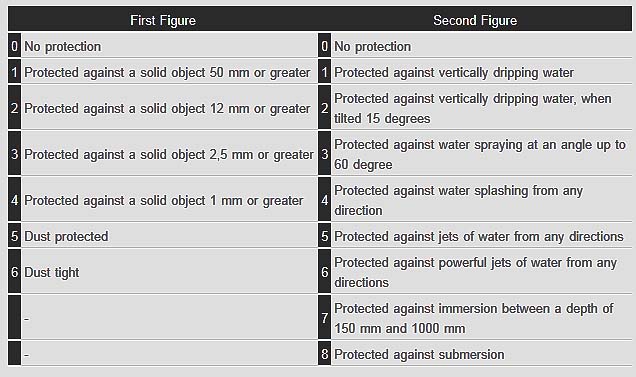
The degrees of protection are most commonly expressed as ‘IP’ followed by two numbers, e.g. IP65, where the numbers define the degree of protection. The first digit shows the extent to which the equipment is protected against particles, or to which persons are protected from enclosed hazards. The second digit indicates the extent of protection against water.
The wording in the table is not exactly as used in the standards document, but the dimensions are accurateIP Degree of Protection according to EN/IEC 60529
Correlations between IP (IEC) and NEMA 250 standards
IP10 -> NEMA 1
IP11 -> NEMA 2
IP54 -> NEMA 3 R
IP52 -> NEMA 5-12-12 K
IP54 -> NEMA 3-3 S
IP56 -> NEMA 4-4 X
IP67 -> NEMA 6-6 P[ http://electrical-engineering-portal.com/ip-protection-degree-iec-60529-explained]
Тематики
- безопасность машин и труда в целом
- электробезопасность
- электротехника, основные понятия
Действия
- степень защиты
- степень защиты, обеспечиваемая оболочкой
- степень защиты, обеспечиваемая оболочкой (код IP)
EN
- amount of protection
- degree of protection IP
- degree of protection of an enclosure
- degree of protection of enclosure
- degree of protection provided by enclosure
- enclosure rating
- ingress protection rating
- IP
- IP degree of protection,
- IP rating
- IP Sealing Specification
- IP security
- IPSec
- level of protection
- mechanical rating
- protection
- protection index
- protection rating
DE
- IP-Schutzgrad, m
- Schutzart des Gehäuses, f
FR
Немецко-русский словарь нормативно-технической терминологии > IP-Schutzgrad, m
-
80 Schutzart des Gehäuses, f
степень защиты
Способ защиты, обеспечиваемый оболочкой от доступа к опасным частям, попадания внешних твердых предметов и (или) воды и проверяемый стандартными методами испытаний.
[ ГОСТ 14254-96( МЭК 529-89)]
степень защиты, обеспечиваемая оболочкой (IP)
Числовые обозначения после кода IP, которые в соответствии с МЭК 60529 [12] характеризуют оболочку электрооборудования, обеспечивающую:
- защиту персонала от прикасания или доступа к находящимся под напряжением или движущимся частям (за исключением гладких вращающихся валов и т.п.), расположенным внутри оболочки;
- защиту электрооборудования от проникания в него твердых посторонних тел и,
- если указано в обозначении, защиту электрооборудования от вредного проникания воды.
[ ГОСТ Р МЭК 60050-426-2006]EN
degree of protection of enclosure
IP (abbreviation)
numerical classification according to IEC 60529 preceded by the symbol IP applied to the enclosure of electrical apparatus to provide:
– protection of persons against contact with, or approach to, live parts and against contact with moving parts (other than smooth rotating shafts and the like) inside the enclosure,
– protection of the electrical apparatus against ingress of solid foreign objects, and
– where indicated by the classification, protection of the electrical apparatus against harmful ingress of water
[IEV number 426-04-02 ]FR
degré de protection procuré par une enveloppe
IP (abréviation)
classification numérique selon la CEI 60529, précédée du symbole IP, appliquée à une enveloppe de matériel électrique pour apporter:
– une protection des personnes contre tout contact ou proximité avec des parties actives et contre tout contact avec une pièce mobile (autre que les roulements en faible rotation) à l'intérieur d'une enveloppe
– une protection du matériel électrique contre la pénétration de corps solide étrangers, et
– selon l’indication donnée par la classification, une protection du matériel électrique contre la pénétration dangereuse de l’eau
[IEV number 426-04-02 ]Элементы кода IP и их обозначения по ГОСТ 14254-96( МЭК 529-89)
Цифры кода IP
Значение для защиты оборудования от проникновения внешних твердых предметов
Значение для защиты людей от доступа к опасным частям
Первая характеристическая цифра
0
Нет защиты
Нет защиты
1
диаметром ≥ 50 мм
тыльной стороной руки
2
диаметром ≥ 12,5 мм
пальцем
3
диаметром ≥ 2,5 мм
инструментом
4
диаметром ≥ 1,0 мм
проволокой
5
пылезащищенное
проволокой
6
пыленепроницаемое
проволокой
От вредного воздействия в результате проникновения воды
Вторая характеристическая цифра
0
Нет защиты
-
1
Вертикальное каплепадение
2
Каплепадение (номинальный угол 15°)
3
Дождевание
4
Сплошное обрызгивание
5
Действие струи
6
Сильное действие струи
7
Временное непродолжительное погружение
8
Длительное погружение
Дополнительная буква (при необходимости)
-
От доступа к опасным частям
A
тыльной стороной руки
B
пальцем
C
инструментом
проволокой
Вспомогательная буква (при необходимости)
Вспомогательная информация относящаяся к:
-
H
высоковольтным аппаратам
M
состоянию движения во время испытаний защиты от воды
S
состоянию неподвижности во время испытаний защиты от воды
W
Требования в части стойкости оболочек и электрооборудования в целом к климатическим, механическим внешним воздействующим факторам (ВВФ) и специальным средам (кроме проникновения внешних твердых предметов и воды) установлены вне рамок настоящего стандарта.
Параллельные тексты EN-RU
The code IP indicates the degrees of protection provided by an enclosure against access to hazardous parts, ingress of solid foreign objects and ingress of water.
The degree of protection of an enclosure is identified, in compliance with the specifications of the Standard IEC 60529, by the code letters IP (International Protection) followed by two numerals and two additional letters.
The first characteristic numeral indicates the degree of protection against ingress of solid foreign objects and against contact of persons with hazardous live parts inside the enclosure.
The second characteristic numeral indicates the degree of protection against ingress of water with harmful effects.
[ABB]Код IP обозначает степень защиты, обеспечиваемую оболочкой от попадания внутрь твердых посторонних предметов и воды.
Степень защиты оболочки обозначается в соответствии со стандартом МЭК 60529 буквенным обозначением IP (International Protection, т. е. Международная защита) после которого следуют две цифры, к которым в некоторых случаях добавляются еще две буквы.
Первая характеристическая цифра обозначает степень защиты от проникновения твердых посторонних предметов и от контакта людей с находящимися внутри оболочки опасными токоведущими частями.
Вторая характеристическая цифра обозначает степень защиты оболочки с точки зрения вредного воздействия, оказываемого проникновением воды.
[Перевод Интент]The protection of enclosures against ingress of dirt or against the ingress of water is defined in IEC529 (BSEN60529:1991). Conversely, an enclosure which protects equipment against ingress of particles will also protect a person from potential hazards within that enclosure, and this degree of protection is also defined as a standard.
The degrees of protection are most commonly expressed as ‘IP’ followed by two numbers, e.g. IP65, where the numbers define the degree of protection. The first digit shows the extent to which the equipment is protected against particles, or to which persons are protected from enclosed hazards. The second digit indicates the extent of protection against water.
The wording in the table is not exactly as used in the standards document, but the dimensions are accurateIP Degree of Protection according to EN/IEC 60529
Correlations between IP (IEC) and NEMA 250 standards
IP10 -> NEMA 1
IP11 -> NEMA 2
IP54 -> NEMA 3 R
IP52 -> NEMA 5-12-12 K
IP54 -> NEMA 3-3 S
IP56 -> NEMA 4-4 X
IP67 -> NEMA 6-6 P[ http://electrical-engineering-portal.com/ip-protection-degree-iec-60529-explained]
Тематики
- безопасность машин и труда в целом
- электробезопасность
- электротехника, основные понятия
Действия
- степень защиты
- степень защиты, обеспечиваемая оболочкой
- степень защиты, обеспечиваемая оболочкой (код IP)
EN
- amount of protection
- degree of protection IP
- degree of protection of an enclosure
- degree of protection of enclosure
- degree of protection provided by enclosure
- enclosure rating
- ingress protection rating
- IP
- IP degree of protection,
- IP rating
- IP Sealing Specification
- IP security
- IPSec
- level of protection
- mechanical rating
- protection
- protection index
- protection rating
DE
- IP-Schutzgrad, m
- Schutzart des Gehäuses, f
FR
Немецко-русский словарь нормативно-технической терминологии > Schutzart des Gehäuses, f
См. также в других словарях:
table — [ tabl ] n. f. • 1050; var. taule XIIIe (→ tôle); lat. tabula « planche, tablette » I ♦ Objet formé essentiellement d une surface plane horizontale, généralement supportée par un pied, des pieds, sur lequel on peut poser des objets. 1 ♦ Surface… … Encyclopédie Universelle
table — TABLE. s. f. Meuble ordinairement de bois, fait d un ou de plusieurs ais, & posé sur un, ou plusieurs pieds; & dont on se sert pour manger, pour escrire, pour joüer, &c. Table de chesne. table de bois de noyer. table de marqueterie. table à un… … Dictionnaire de l'Académie française
TABLE — Table, s. f., terme très étendu qui a plusieurs significations. Table à manger, table de jeu, table à écrire. Première table, seconde table, table du commun. Table de buffet, table d hôte, où l on mange à tant par repas; bonne table,… … Dictionnaire philosophique de Voltaire
Table — Ta ble, n. [F., fr. L. tabula a board, tablet, a painting. Cf. {Tabular}, {Taffrail}, {Tavern}.] 1. A smooth, flat surface, like the side of a board; a thin, flat, smooth piece of anything; a slab. [1913 Webster] A bagnio paved with fair tables… … The Collaborative International Dictionary of English
table — Ta ble, n. [F., fr. L. tabula a board, tablet, a painting. Cf. {Tabular}, {Taffrail}, {Tavern}.] 1. A smooth, flat surface, like the side of a board; a thin, flat, smooth piece of anything; a slab. [1913 Webster] A bagnio paved with fair tables… … The Collaborative International Dictionary of English
table — Table, f. penac. Vient par syncope du Latin Tabula, comme de Seculum, Crustulum, Seclum, Crustlum, et signifie en general un ais de bois long et quarré. Selon laquelle signification on dit Entablature, où plusieurs tels ais sont rengez pair à… … Thresor de la langue françoyse
table — [tā′bəl] n. [OFr < L tabula, a board, painting, tablet < ? IE * taldhla < base * tel , flat, a board > OE thille, thin board, flooring] 1. Obs. a thin, flat tablet or slab of metal, stone, or wood, used for inscriptions 2. a) a piece… … English World dictionary
Table A — A standard set of Articles of Association which can be incorporated by reference in the Articles of Association of any company. It is usually used to cover non essential procedural issues. Found in the Companies (Tables A F) Regulations 1985… … Law dictionary
table — [n1] furniture upon which to work, eat bar, bench, board, buffet, bureau, console, counter, desk, dining table, dinner table, dresser, lectern, pulpit, sideboard, sink, slab, stand, wagon; concept 443 table [n2] meal bill of fare, board, cuisine … New thesaurus
Table — Ta ble (t[=a] b l), v. t. [imp. & p. p. {Tabled} (t[=a] b ld); p. pr. & vb. n. {Tabling} (t[=a] bling).] 1. To form into a table or catalogue; to tabulate; as, to table fines. [1913 Webster] 2. To delineate, as on a table; to represent, as in a… … The Collaborative International Dictionary of English
table — ► NOUN 1) a piece of furniture with a flat top and one or more legs, for eating, writing, or working at. 2) a set of facts or figures systematically displayed. 3) (tables) multiplication tables. 4) food provided in a restaurant or household: food … English terms dictionary
