

-
81 Zone der Parallelitätstoleranz zweier Ebenen
поле допуска параллельности плоскостей
Область в пространстве, ограниченная двумя параллельными плоскостями, отстоящими друг от друга на расстоянии, равном допуску параллельности TPA, и параллельными базовой плоскости.
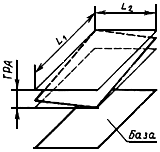
[ ГОСТ 24642-81]Тематики
Обобщающие термины
EN
- tolerance zone of parallelism of a surface with reference to a datum surface
DE
FR
Немецко-русский словарь нормативно-технической терминологии > Zone der Parallelitätstoleranz zweier Ebenen
-
82 Zone der Rechtwinkligkeitstoleranz zweier Ebenen
поле допуска перпендикулярности плоскостей
Область в пространстве, ограниченная двумя параллельными плоскостями, отстоящими друг от друга на расстоянии, равном допуску перпендикулярности TPR, и перпендикулярными к базовой плоскости.
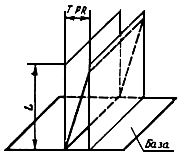
[ ГОСТ 24642-81]Тематики
Обобщающие термины
EN
- tolerance zone of perpendicularity of a surface with reference to a datum surface
DE
FR
- zone de tolérance de perpendicularité d'une surface par rapport à une surface
Немецко-русский словарь нормативно-технической терминологии > Zone der Rechtwinkligkeitstoleranz zweier Ebenen
-
83 Arbeitsoberflächen der Grundlage
рабочая поверхность основания
Поверхность основания, подготовленная для получения покрытия.
[ГОСТ 8.362-79]Тематики
EN
DE
FR
2. Рабочая поверхность основания
D. Arbeitsoberflächen der Grundlage
Е. Basis operating surface
F. Surface travaillante de base
Поверхность основания, подготовленная для получения покрытия
Источник: ГОСТ 8.362-79: Государственная система обеспечения единства измерений. Измерение толщины покрытий. Термины и определения оригинал документа
Немецко-русский словарь нормативно-технической терминологии > Arbeitsoberflächen der Grundlage
-
84 aktive Oberfläche einer Elektrode, f
рабочая поверхность электрода химического источника тока
рабочая поверхность электрода
Участок поверхности электрода химического источника тока, находящийся в контакте с электролитом и на котором происходит электрохимическая реакция.
[ ГОСТ 15596-82]EN
active surface of an electrode
interface between an electrolyte and an electrode where the electrode reaction takes place
[IEV number 482-02-26]FR
surface active d’une électrode, f
interface entre un électrolyte et une électrode où se produit une réaction à l'électrode
[IEV number 482-02-26]Тематики
Классификация
>>>EN
DE
- aktive Oberfläche einer Elektrode, f
FR
- surface active d’une électrode, f
Немецко-русский словарь нормативно-технической терминологии > aktive Oberfläche einer Elektrode, f
-
85 Strahlungscheizfläche
радиационная поверхность нагрева стационарного котла
радиационная поверхность нагрева
Поверхность нагрева стационарного котла, получающая теплоту, в основном, излучением.
[ ГОСТ 23172-78]Тематики
- котел, водонагреватель
Синонимы
EN
DE
FR
52. Радиационная поверхность нагрева стационарного котла
Радиационная поверхность нагрева
D. Strahlungscheizflache
Е. Radiant heating surface
F. Surface de rayonnement
Поверхность нагрева стационарного котла, получающая теплоту, в основном, излучением
Источник: ГОСТ 23172-78: Котлы стационарные. Термины и определения оригинал документа
Немецко-русский словарь нормативно-технической терминологии > Strahlungscheizfläche
-
86 Gesamtstromstärke
ток
Скалярная величина, равная сумме электрического тока проводимости, электрического тока переноса и электрического тока смещения сквозь рассматриваемую поверхность.
[ ГОСТ Р 52002-2003]EN
total electric current
scalar quantity given by the flux of the total current density Jt through a given directed surface S:

where endA is the vector surface element
NOTE – The total electric current It is given by
It = I + ID
where I is the electric current and ID the displacement current.
[IEV number 121-11-45]FR
courant électrique total, m
grandeur scalaire égale au flux de la densité de courant total Jt à travers une surface orientée donnée S:
où endA est l'élément vectoriel de surface
NOTE – Le courant électrique total It est donné par
It = I + ID
où I est le courant électrique et ID le courant de déplacement.
[IEV number 121-11-45]Тематики
- электротехника, основные понятия
Действия
- включать ток
- длительно пропускать ток
- коммутировать ток
- ограничивать ток
- отключать ток
- потреблять ток
- проводить ток
- пропускать ток
Синонимы
EN
DE
FR
Немецко-русский словарь нормативно-технической терминологии > Gesamtstromstärke
-
87 Verschiebungsstromstärke
ток смещения
Совокупность электрического тока смещения в пустоте и электрического тока поляризации, количественно характеризуемая скалярной величиной, равной производной по времени от потока электрического смещения сквозь рассматриваемую поверхность.
[ ГОСТ Р 52002-2003]EN
displacement current
scalar quantity equal to the flux of the displacement current density JD through a given directed surface S:
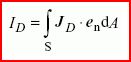
where endA is the vector surface element
[IEV number 121-11-43]FR
courant de déplacement, m
grandeur scalaire égale au flux de la densité de courant de déplacement JD à travers une surface orientée donnée S:
où endA est l'élément vectoriel de surface
[IEV number 121-11-43]Тематики
- электротехника, основные понятия
Синонимы
EN
DE
FR
Немецко-русский словарь нормативно-технической терминологии > Verschiebungsstromstärke
-
88 spezifische Warmeaustauschoberflache der Deslillationsentsalzunganlage
удельная поверхность теплообмена дистилляционной опреснительной установки
удельная поверхность теплообмена
Отношение суммарной площади поверхности теплообмена дистилляционной опреснительной установки к часовой производительности этой установки.
[ ГОСТ 23078-78]Тематики
Синонимы
EN
DE
FR
- surface d’echange de chaleur specifique pour installation de dessalement par distillation
7. Удельная поверхность теплообмена дистилляционной опреснительной установки
Удельная поверхность теплообмена
D. Spezifische Warmeaustauschoberflache der Deslillationsentsalzunganlage
E. Specific heat exchage surface for distillation desalination plant
F. Surface d’echange de chaleur specifique pour installation de dessalement par distillation
Отношение суммарной площади поверхности теплообмена дистилляционной опреснительной установки к часовой производительности этой установки
Источник: ГОСТ 23078-78: Установки и аппараты опреснительные дистилляционные. Термины и определения оригинал документа
Немецко-русский словарь нормативно-технической терминологии > spezifische Warmeaustauschoberflache der Deslillationsentsalzunganlage
-
89 Winderosion
ветряная эрозия
—
[ http://www.eionet.europa.eu/gemet/alphabetic?langcode=en]EN
wind erosion
The breakdown of solid rock into smaller particles and its removal by wind. It may occur on any soil whose surface is dry, unprotected by vegetation (to bind it at root level and shelter the surface) and consists of light particles. The mechanisms include straightforward picking up of dust and soil particles by the airflow and the dislodging or abrasion of surface material by the impact of particles already airborne. (Source: ALL)
[http://www.eionet.europa.eu/gemet/alphabetic?langcode=en]Тематики
EN
DE
FR
Немецко-русский словарь нормативно-технической терминологии > Winderosion
-
90 Entwässerungsanlage
водосборная система
—
[ http://www.eionet.europa.eu/gemet/alphabetic?langcode=en]EN
drainage system
A surface stream, or a body of impounded surface water, together with all other such streams and water bodies that are tributary to it and by which a region is drained. An artificial drainage system includes also surface and subsurface conduits. (Source: BJGEO)
[http://www.eionet.europa.eu/gemet/alphabetic?langcode=en]Тематики
EN
DE
FR
водосток
Система устройств для отвода атмосферной или поливочной воды самотёком с поверхности кровли, моста, дорог, улиц и т.д.
[Терминологический словарь по строительству на 12 языках (ВНИИИС Госстроя СССР)]EN
DE
FR
Немецко-русский словарь нормативно-технической терминологии > Entwässerungsanlage
-
91 Ozean-Luft Schnitstelle
граница между воздухом и поверхностью океана
—
[ http://www.eionet.europa.eu/gemet/alphabetic?langcode=en]EN
ocean-air interface
The sea and the atmosphere are fluids in contact with one another, but in different energy states - the liquid and the gaseous. The free surface boundary between them inhibits, but by no means totally prevents, exchange of mass and energy between the two. Almost all interchanges across this boundary occur most effectively when turbulent conditions prevail. A roughened sea surface, large differences in properties between the water and the air, or an unstable air column that facilitates the transport of air volumes from sea surface to high in the atmosphere. Both heat and water (vapor) tend to migrate across the boundary in the direction from sea to air. Heat is exchanged by three processes: radiation, conduction, and evaporation. The largest net exchange is through evaporation, the process of transferring water from sea to air by vaporization of the water. (Source: PARCOR)
[http://www.eionet.europa.eu/gemet/alphabetic?langcode=en]Тематики
EN
DE
FR
Немецко-русский словарь нормативно-технической терминологии > Ozean-Luft Schnitstelle
-
92 Dauerstrombelastbarkeit, f
(длительный) допустимый ток
Максимальное значение электрического тока, который может протекать длительно по проводнику, устройству или аппарату при определенных условиях без превышения определенного значения их температуры в установившемся режиме
[ ГОСТ Р МЭК 60050-826-2009]
Этот ток обозначают IZ
[ ГОСТ Р 50571. 1-2009 ( МЭК 60364-1: 2005)]EN
(continuous) current-carrying capacity
ampacity (US)
maximum value of electric current which can be carried continuously by a conductor, a device or an apparatus, under specified conditions without its steady-state temperature exceeding a specified value
[IEV number 826-11-13]
ampacity
The current in amperes that a conductor can carry continuously under the conditions of use without exceeding its temperature rating.
[National Electrical Cod]FR
courant (permanent) admissible, m
valeur maximale du courant électrique qui peut parcourir en permanence, un conducteur, un dispositif ou un appareil, sans que sa température de régime permanent, dans des conditions données, soit supérieure à la valeur spécifiée
[IEV number 826-11-13]Ampacity, the term is defined as the maximum amount of current a cable can carry before sustaining immediate or progressive deterioration. Also described as current rating or current-carrying capacity, is the RMS electric current which a device can continuously carry while remaining within its temperature rating. The ampacity of a cable depends on:
- its insulation temperature rating;
- conductor electrical properties for current;
- frequency, in the case of alternating currents;
- ability to dissipate heat, which depends on cable geometry and its surroundings;
- ambient temperature.
Electric wires have some resistance, and electric current flowing through them causes voltage drop and power dissipation, which heats the cable. Copper or aluminum can conduct a large amount of current before melting, but long before the conductors melt, their insulation would be damaged by the heat.
The ampacity for a power cable is thus based on physical and electrical properties of the material & construction of the conductor and of its insulation, ambient temperature, and environmental conditions adjacent to the cable. Having a large overall surface area may dissipate heat well if the environment can absorb the heat.
In a long run of cable, different conditions govern, and installation regulations normally specify that the most severe condition along the run governs the cable's rating. Cables run in wet or oily locations may carry a lower temperature rating than in a dry installation. Derating is necessary for multiple circuits in close proximity. When multiple cables are near, each contributes heat to the others and diminishes the amount of cooling air that can flow past the individual cables. The overall ampacity of the insulated conductors in a bundle of more than 3 must be derated, whether in a raceway or cable. Usually the de-rating factor is tabulated in a nation's wiring regulations.
Depending on the type of insulating material, common maximum allowable temperatures at the surface of the conductor are 60, 75 and 90 degrees Celsius, often with an ambient air temperature of 30°C. In the U.S., 105°C is allowed with ambient of 40°C, for larger power cables, especially those operating at more than 2 kV. Likewise, specific insulations are rated 150, 200 or 250°C.
The allowed current in cables generally needs to be decreased (derated) when the cable is covered with fireproofing material.
For example, the United States National Electric Code, Table 310-16, specifies that up to three 8 AWG copper wires having a common insulating material (THWN) in a raceway, cable, or direct burial has an ampacity of 50 A when the ambient air is 30°C, the conductor surface temperature allowed to be 75°C. A single insulated conductor in air has 70 A rating.
Ampacity rating is normally for continuous current, and short periods of overcurrent occur without harm in most cabling systems. The acceptable magnitude and duration of overcurrent is a more complex topic than ampacity.
When designing an electrical system, one will normally need to know the current rating for the following:- Wires
- Printed Circuit Board traces, where included
- Fuses
- Circuit breakers
- All or nearly all components used
Some devices are limited by power rating, and when this power rating occurs below their current limit, it is not necessary to know the current limit to design a system. A common example of this is lightbulb holders.
[http://en.wikipedia.org/wiki/Ampacity]
Тематики
- электротехника, основные понятия
Синонимы
EN
DE
- Dauerstrombelastbarkeit, f
- Strombelastbarkeit, f
FR
- courant admissible, m
- courant permanent admissible, m
Немецко-русский словарь нормативно-технической терминологии > Dauerstrombelastbarkeit, f
-
93 Strombelastbarkeit, f
(длительный) допустимый ток
Максимальное значение электрического тока, который может протекать длительно по проводнику, устройству или аппарату при определенных условиях без превышения определенного значения их температуры в установившемся режиме
[ ГОСТ Р МЭК 60050-826-2009]
Этот ток обозначают IZ
[ ГОСТ Р 50571. 1-2009 ( МЭК 60364-1: 2005)]EN
(continuous) current-carrying capacity
ampacity (US)
maximum value of electric current which can be carried continuously by a conductor, a device or an apparatus, under specified conditions without its steady-state temperature exceeding a specified value
[IEV number 826-11-13]
ampacity
The current in amperes that a conductor can carry continuously under the conditions of use without exceeding its temperature rating.
[National Electrical Cod]FR
courant (permanent) admissible, m
valeur maximale du courant électrique qui peut parcourir en permanence, un conducteur, un dispositif ou un appareil, sans que sa température de régime permanent, dans des conditions données, soit supérieure à la valeur spécifiée
[IEV number 826-11-13]Ampacity, the term is defined as the maximum amount of current a cable can carry before sustaining immediate or progressive deterioration. Also described as current rating or current-carrying capacity, is the RMS electric current which a device can continuously carry while remaining within its temperature rating. The ampacity of a cable depends on:
- its insulation temperature rating;
- conductor electrical properties for current;
- frequency, in the case of alternating currents;
- ability to dissipate heat, which depends on cable geometry and its surroundings;
- ambient temperature.
Electric wires have some resistance, and electric current flowing through them causes voltage drop and power dissipation, which heats the cable. Copper or aluminum can conduct a large amount of current before melting, but long before the conductors melt, their insulation would be damaged by the heat.
The ampacity for a power cable is thus based on physical and electrical properties of the material & construction of the conductor and of its insulation, ambient temperature, and environmental conditions adjacent to the cable. Having a large overall surface area may dissipate heat well if the environment can absorb the heat.
In a long run of cable, different conditions govern, and installation regulations normally specify that the most severe condition along the run governs the cable's rating. Cables run in wet or oily locations may carry a lower temperature rating than in a dry installation. Derating is necessary for multiple circuits in close proximity. When multiple cables are near, each contributes heat to the others and diminishes the amount of cooling air that can flow past the individual cables. The overall ampacity of the insulated conductors in a bundle of more than 3 must be derated, whether in a raceway or cable. Usually the de-rating factor is tabulated in a nation's wiring regulations.
Depending on the type of insulating material, common maximum allowable temperatures at the surface of the conductor are 60, 75 and 90 degrees Celsius, often with an ambient air temperature of 30°C. In the U.S., 105°C is allowed with ambient of 40°C, for larger power cables, especially those operating at more than 2 kV. Likewise, specific insulations are rated 150, 200 or 250°C.
The allowed current in cables generally needs to be decreased (derated) when the cable is covered with fireproofing material.
For example, the United States National Electric Code, Table 310-16, specifies that up to three 8 AWG copper wires having a common insulating material (THWN) in a raceway, cable, or direct burial has an ampacity of 50 A when the ambient air is 30°C, the conductor surface temperature allowed to be 75°C. A single insulated conductor in air has 70 A rating.
Ampacity rating is normally for continuous current, and short periods of overcurrent occur without harm in most cabling systems. The acceptable magnitude and duration of overcurrent is a more complex topic than ampacity.
When designing an electrical system, one will normally need to know the current rating for the following:- Wires
- Printed Circuit Board traces, where included
- Fuses
- Circuit breakers
- All or nearly all components used
Some devices are limited by power rating, and when this power rating occurs below their current limit, it is not necessary to know the current limit to design a system. A common example of this is lightbulb holders.
[http://en.wikipedia.org/wiki/Ampacity]
Тематики
- электротехника, основные понятия
Синонимы
EN
DE
- Dauerstrombelastbarkeit, f
- Strombelastbarkeit, f
FR
- courant admissible, m
- courant permanent admissible, m
Немецко-русский словарь нормативно-технической терминологии > Strombelastbarkeit, f
-
94 Relief
лепнина
Рельефные элементы архитектурного декора
[Терминологический словарь по строительству на 12 языках (ВНИИИС Госстроя СССР)]Тематики
- архитектура, основные понятия
EN
DE
FR
рельеф земли
—
[ http://www.eionet.europa.eu/gemet/alphabetic?langcode=en]EN
relief (land)
The physical shape, configuration or general unevenness of a part of the Earth's surface, considered with reference to variation of height and slope or to irregularities of the land surface; the elevation or difference in elevation, considered collectively, of a land surface. (Source: BJGEO)
[http://www.eionet.europa.eu/gemet/alphabetic?langcode=en]Тематики
EN
DE
FR
Немецко-русский словарь нормативно-технической терминологии > Relief
-
95 Kante
обрез
Резкое уменьшение толщины вертикальной конструкции с образованием в месте перехода горизонтального или слегка наклонного уступа
[Терминологический словарь по строительству на 12 языках (ВНИИИС Госстроя СССР)]Тематики
EN
DE
FR
Немецко-русский словарь нормативно-технической терминологии > Kante
-
96 Höhle
пещера
—
[ http://www.eionet.europa.eu/gemet/alphabetic?langcode=en]EN
cave
1) An underground hollow with access from the ground surface or from the sea, often found in limestone areas and on rocky coastlines.
2) A natural cavity, chamber or recess which leads beneath the surface of the earth, generally in a horizontal or obliquely inclined direction. It may be in the form of a passage or a gallery, its shape depending in part on the joint pattern or structure of the rock and partly on the type of process involved in its excavation. Thus, caves worn by subterranean rivers may be different in character from, and of considerably greater extent than, a sea-cave eroded by marine waves.
3) A natural underground open space, generally with a connection to the surface and large enough for a person to enter. The most common type of cave is formed in a limestone by dissolution.
(Source: CED / WHIT / BJGEO)
[http://www.eionet.europa.eu/gemet/alphabetic?langcode=en]Тематики
EN
DE
FR
Немецко-русский словарь нормативно-технической терминологии > Höhle
-
97 Zone der Winkligkeitstoleranz einer Ebene zu einer Ebene oder Geraden
- поле допуска наклона плоскости относительно плоскости или оси (или прямой)
поле допуска наклона плоскости относительно плоскости или оси (или прямой)
Область в пространстве, ограниченная двумя параллельными плоскостями, отстоящими друг от друга на расстоянии, равном допуску наклона TPN, и расположенными под номинальным углом к базовой плоскости или базовой оси (прямой).
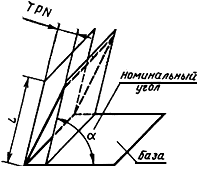
Примечание
Термин применяется при любых номинальных значениях угла наклона, кроме 0°, 90°, 180°.
[ ГОСТ 24642-81]Тематики
Обобщающие термины
EN
- tolerance zone of angularity of a surface with reference to a datum plane (or a datum line)
DE
FR
- zone de tolérance d'inclinaison d'une surface par rapport à une surface ou à une ligne
Немецко-русский словарь нормативно-технической терминологии > Zone der Winkligkeitstoleranz einer Ebene zu einer Ebene oder Geraden
-
98 Ebenflächigkeit einer Straßendecke
ровность покрытия
Показатель качества поверхности покрытий, характеризуемый величиной просвета между поверхностью покрытия и мерной рейкой
[Терминологический словарь по строительству на 12 языках (ВНИИИС Госстроя СССР)]Тематики
- дороги, мосты, тоннели, аэродромы
EN
DE
FR
- uniformité de la surface du revêtement routier régularité de la surface du revêtement routier
Немецко-русский словарь нормативно-технической терминологии > Ebenflächigkeit einer Straßendecke
-
99 Kriechwegbildung
трекинг
Последовательное образование токопроводящих мостиков, которые формируются на поверхности твердого электроизоляционного материала вследствие совместного действия электрического напряжения и наличия загрязнений на его поверхности.
[ ГОСТ Р 51330.20-99]
трекинг
-
[IEV number 442-01-41]EN
tracking
the progressive degradation of the surface of a solid insulating material by local discharges to form conducting or partially conducting paths
NOTE – Tracking usually occurs due to surface contamination.
[IEV number 212-01-42]
[IEV number 442-01-41]FR
cheminement
dégradation progressive de la surface d'un matériau isolant solide par des décharges locales formant des chemins conducteurs ou partiellement conducteurs
NOTE – Le cheminement est causé habituellement par une contamination superficielle
[IEV number 212-01-42]
[IEV number 442-01-41]Тематики
- электробезопасность
- электротехника, основные понятия
EN
DE
FR
Немецко-русский словарь нормативно-технической терминологии > Kriechwegbildung
-
100 Einbau... (in Zusammensetzungen)
утопленный
-
[IEV number 151-16-40]EN
flush-mounted, adj
qualifies a device mounted into a recess in a mechanical structure so that the shape of the mounting surface remains essentially unchanged
[IEV number 151-16-40]FR
encastré, adj
plaqué, adj
qualifie un dispositif incorporé à la surface d'une structure mécanique sans modifier de façon essentielle la forme de la surface
[IEV number 151-16-40]Синонимы
EN
DE
- Einbau... (in Zusammensetzungen)
- oberflächenangepasst
FR
Немецко-русский словарь нормативно-технической терминологии > Einbau... (in Zusammensetzungen)
См. также в других словарях:
surface — [ syrfas ] n. f. • 1611; superface 1521; lat. superficies → superficie; de sur et face 1 ♦ Partie extérieure (d un corps), qui le limite en tous sens. ⇒ face. La surface de la Terre, la surface terrestre. À la surface du sol. « une surface pure… … Encyclopédie Universelle
Surface — Sur face , n. [F. See {Sur }, and {Face}, and cf. {Superficial}.] 1. The exterior part of anything that has length and breadth; one of the limits that bound a solid, esp. the upper face; superficies; the outside; as, the surface of the earth; the … The Collaborative International Dictionary of English
surface — [sʉr′fis] n. [Fr < sur (see SUR 1) + face,FACE, based on L superficies] 1. a) the outer face, or exterior, of an object b) any of the faces of a solid c) the area or extent of such a face … English World dictionary
surface — 1610s, from Fr. surface outermost boundary of anything, outside part (16c.), from O.Fr. sur above + face (see FACE (Cf. face)). Patterned on L. superficies surface (see SUPERFICIAL (Cf. superficial)). The verb meaning come to the surface is first … Etymology dictionary
surface — ► NOUN 1) the outside part or uppermost layer of something. 2) the upper limit of a body of liquid. 3) outward appearance as distinct from less obvious aspects. ► ADJECTIVE 1) relating to or occurring on the surface. 2) (of transportation) by sea … English terms dictionary
Surface — Sur face, v. t. [imp. & p. p. {Surfaced}; p. pr. & vb. n. {Surfacing}.] 1. To give a surface to; especially, to cause to have a smooth or plain surface; to make smooth or plain. [1913 Webster] 2. To work over the surface or soil of, as ground, in … The Collaborative International Dictionary of English
surface — [adj] external apparent, covering, depthless, exterior, facial, outer, outside, outward, shallow, shoal, superficial, top; concepts 485,583 Ant. central, core, inside, interior, middle surface [n] external part of something area, cover, covering … New thesaurus
surface — Surface. subst. f. L exterieur, le dehors d un corps. Surface platte, unie, raboteuse. la surface de la terre … Dictionnaire de l'Académie française
Surface — Sur face, v. i. 1. To rise from the depths of a liquid to the surface; as, the submarine surfaced to recharge its batteries. [PJC] 2. To become known or public; said of information. [PJC] 3. To show up, as a person who was in hiding; as, he… … The Collaborative International Dictionary of English
Surface — (fr., spr. Sürfahs), die Oberfläche … Pierer's Universal-Lexikon
surface — index bare, cursory, dimension, emerge, issue (send forth), ostensible, side, superficial … Law dictionary
