

-
41 аппаратура для измерения параметров шероховатости поверхности профильным методом
аппаратура для измерения параметров шероховатости поверхности профильным методом
Приборы, позволяющие определить параметры шероховатости поверхности по ее преобразованным профилям.
[ ГОСТ 27964-88( СТ СЭВ 6134-87, ИСО 4287/2-84)]Тематики
Обобщающие термины
EN
FR
- instrument de mésurage de la rugosité des surfaces par la méthode du profil
Русско-английский словарь нормативно-технической терминологии > аппаратура для измерения параметров шероховатости поверхности профильным методом
-
42 метод граничных элементов для решения нестационарных задач теплопроводности
метод граничных элементов для решения нестационарных задач теплопроводности
—
[А.С.Гольдберг. Англо-русский энергетический словарь. 2006 г.]Тематики
EN
Русско-английский словарь нормативно-технической терминологии > метод граничных элементов для решения нестационарных задач теплопроводности
-
43 профильный метод измерения шероховатости поверхности
профильный метод измерения шероховатости поверхности
Метод оценки шероховатости поверхности по параметрам ее преобразованных профилей.
[ ГОСТ 27964-88( СТ СЭВ 6134-87, ИСО 4287/2-84)]Тематики
Обобщающие термины
EN
FR
Русско-английский словарь нормативно-технической терминологии > профильный метод измерения шероховатости поверхности
-
44 МПВ
1) Medicine: магистральная почечная вена2) Engineering: refraction method3) Electronics: surface-wave magnetron4) Oil: seismic-refraction method5) Geophysics: refraction technique, seismic refraction method, seismic refraction technique, метод преломленных волн, refraction shooting technique6) Seismology: refraction seismic survey, refraction wave method7) SAP. MMT -
45 сопротивление
resistance
(величина эл. сопротивления)
сопротивление, которое оказывает электрическая цепь (проводник) движущимся в ней электрическим зарядам, выражается в омах. — а property of conductors which, depending on their dimensions, material, and temperature, determines the current produced by a given difference of potential. the practical unit of resistance is ohm.
- (механическое, как мера прочности) — strength
- (элемент, создающий электрическое сопротивление) — resistor
устройство, включенное в эл. цепь для создания сопротивления протекающему току, сопротивления бывают постоянными и переменными. — а device connected into an electrical circuit to resist the flow of electric current in a circuit. there are two types - fixed and variable.
-, активное (эл.) — resistance
-, аэродинамическое — drag (d)
-, балансировочное — trim drag
-, буксировочное — tawing drag
-, включенное в цепь — resistor connected in circuit
-, волновое — wave drag
-, выносное (эл.) — remote resistor
-, гидравлическое — hydraulic resistance
-, добавочное (омическое) — additional resistance
-, дополнительное лобовое — additional drag
-, емкостное (эл.) — capacitive reactance
opposition offered by capacitors.
- жидкости — resistance of fluid
жидкость поглощает основную часть энергии амортстойки, преодолевая сопротивление жидкости, проходящей no каналам. — fluid absorbs most of impact energy of the shock strut, in overcoming resistance of fluid flowing through passages.
- изоляции — insulation resistance
-, индуктивное (аэродин.) — induced drag
составляющая полного лобового сопротивления крыла, изменяющаяся в зависимости от подъемной силы. — the part of the drag associated with the lift.
-, индуктивное (эл.) — inductive reactance
электрическое сопротивление, обусловленное индукционностью цепи синусоидального тока. — opposition to flow of alterhating or pulsating current by the inductance of a circuit.
-, кажущееся лобовое — apparent drag
- коррозии — resistance to corrosion
-, лобовое — drag (d)
проекция полной аэродинамической силы на направление полета (потока) или составляющая этой силы, направленная против движения самолета. — а retarding force acting upon а body in motion through а fluid (air) parallel to the direction of motion of the body.
-, магнитное — reluctance
отношение магнитодвижущей силы к магнитному потоку. — resistance of а magnetic path to flow of magnetic lines of force.
- материалов — strength of materials
-, нелинейное — nonlinear resistance
-, общее (напр., потенциометpa) — total resistance. ratio of output resistance to total resistance.
-, омическое — ohmic resistance
сопротивление постоянному — resistance to direct current.
-, относительное (отношение активного сопротивления к омическому) — resistance ratio, relative resistаnce
-, относительное, выходное — output resistance ratio
-, переменное — variable resistor
резистор с изменяемым cопротивлением. напр., реостат, потенциометр. — resistor, the resistance of which may be changed. (rheostat and potentiometer)
-, переходное (эл.) — contact resistance
- переходного контакта — contact resistance
- поверхностного трения — surface-friction drag
the part of the drag due to the tangential forces on the surface.
-, подборное (регулируемое) — adjustable resistor
-, полное (эл.) — impedance
полное сопротивление (омическое и реактивное), создаваемое цепью при прохождении переменного тока. измеряется в омах. — the total opposition (i.e. resistance and reactance) a circult offers to a.c. flow. measured in ohms.
-, полное лобовое — total drag
-, постоянное (резистор) — fixed resistor
нерегулируемый резистор, создающий заданную величину сопротивления в электрической цепи. — а resistor designed to introduce only а predetermined amount of resistance into ал electrical circuit and not adjustable.
- при нулевой подъемной силе, лобовое — zero-lift drag
правило площадей применяется при расчетах конструкции для получения минимального сопротивления при нулевой подъемной силе. — area rule is а method of design for obtaining minimum zero-lift drag.
-, профильное — profile drag
the sum of the surface-friction and form drags.
-, развязывающее — decoupling resistor
-, реактивное (эл.) — reactance
opposition to ас flow.
-, регулируемое — adjustable resistor
the resistor which can be adjusted occasionally by the user (by means of a screw).
- с отводом (эл.) — tapped resistor
-, суммарное лобовое — total drag
- трения — surface-friction drag
-, угольное (регулятора напряжений) — carbon pile resistor
- (лобового стекла) удару при столкновении с птицей (прочность) — bird strike resistance (of windscreen)
-, удельное (эл.) — specific resistance
resistance of а conductor expressed in ohms per unit length per unit area.
- формы (аэродинамического профиля, тела) — form drag. pressure drag less induced
-, электрическое — electric resistance
an ohmmeter is an instrument for measuring electric resistance.
включать с. (в эл. цепь) — connect the resistor (in circuit)
оказывать с. (эл.) — offer opposition
capacitive reactance is opposition offered by capacitors.Русско-английский сборник авиационно-технических терминов > сопротивление
-
46 наложение
1. с. superposition2. с. мат. covering -
47 Senefelder, Alois
SUBJECT AREA: Paper and printing[br]b. 6 November 1771 Prague, Bohemia (now Czech Republic)d. 26 February 1834 Munich, Germany[br]German inventor of lithography.[br]Soon after his birth, Senefelder's family moved to Mannheim, where his father, an actor, had obtained a position in the state theatre. He was educated there, until he gained a scholarship to the university of Ingolstadt. The young Senefelder wanted to follow his father on to the stage, but the latter insisted that he study law. He nevertheless found time to write short pieces for the theatre. One of these, when he was 18 years old, was an encouraging success. When his father died in 1791, he gave up his studies and took to a new life as poet and actor. However, the wandering life of a repertory actor palled after two years and he settled for the more comfortable pursuit of playwriting. He had some of his work printed, which acquainted him with the art of printing, but he fell out with his bookseller. He therefore resolved to carry out his own printing, but he could not afford the equipment of a conventional letterpress printer. He began to explore other ways of printing and so set out on the path that was to lead to an entirely new method.He tried writing in reverse on a copper plate with some acid-resisting material and etching the plate, to leave a relief image that could then be inked and printed. He knew that oily substances would resist acid, but it required many experiments to arrive at a composition of wax, soap and charcoal dust dissolved in rainwater. The plates wore down with repeated polishing, so he substituted stone plates. He continued to etch them and managed to make good prints with them, but he went on to make the surprising discovery that etching was unnecessary. If the image to be printed was made with the oily composition and the stone moistened, he found that only the oily image received the ink while the moistened part rejected it. The printing surface was neither raised (as in letterpress printing) nor incised (as in intaglio printing): Senefelder had discovered the third method of printing.He arrived at a workable process over the years 1796 to 1799, and in 1800 he was granted an English patent. In the same year, lithography (or "writing on stone") was introduced into France and Senefelder himself took it to England, but it was some time before it became widespread; it was taken up by artists especially for high-quality printing of art works. Meanwhile, Senefelder improved his techniques, finding that other materials, even paper, could be used in place of stone. In fact, zinc plates were widely used from the 1820s, but the name "lithography" stuck. Although he won world renown and was honoured by most of the crowned heads of Europe, he never became rich because he dissipated his profits through restless experimenting.With the later application of the offset principle, initiated by Barclay, lithography has become the most widely used method of printing.[br]Bibliography1911, Alois Senefelder, Inventor of Lithography, trans. J.W.Muller, New York: Fuchs \& Line (Senefelder's autobiography).Further ReadingW.Weber, 1981, Alois Senefelder, Erfinder der Lithographie, Frankfurt-am-Main: Polygraph Verlag.M.Tyman, 1970, Lithography 1800–1950, London: Oxford University Press (describes the invention and its development; with biographical details).LRD -
48 местность
Поверхность Земли с такими естественными элементами, как горы, холмы, хребты, долины, скопления воды, вечного льда и снега, исключая препятствия.Примечание. В практических целях, в зависимости от метода получения данных, местность представляет собой непрерывную поверхность, проходящую по голой Земле, верху покрова или чему-то между ними и называемую также ‘первой отражающей поверхностью’.The surface of the Earth containing naturally occurring features such as mountains, hills, ridges, valleys, bodies of water, permanent ice and snow, excluding obstacles.Note.— In practical terms depending on the method of data collection, terrain represents the continuous surface that exists between the bare Earth and the top of the canopy (or something in between also known as “first reflective surface”).(AN 4; AN 15)Official definition added to: AN 4 by Amdt 53 (25/11/2004), AN 15 by Amdt 33 (25/11/2004).Русско-английский словарь международной организации гражданской авиации > местность
-
49 ἐπι[πόλ]αιος
ἐπι[πόλ]-αιος, ον,A on the surface, superficial, Hp.Art.69 ([comp] Comp.);ῥίζα Dsc.4.184
, cf.Thphr. HP3.6.4 ([comp] Sup.), al.;λεπτὸν καὶ ἐ. δέρμα Arist.Pr. 890a13
;τραῦμα Luc.Nav.37
.3. metaph., superficial, shallow, commonplace,παιδεία Isoc.15.190
;ἐ. ἡδοναὶ καὶ διατριβαί D.61.56
; ἐ.πιθανότης Dsc.Ther.Praef.
; - ότατος πυρετός slight fever, Diocl.Fr. 107; ἐ. ὕπνος light sleep, Luc.Gall.25;ἔρως Id.DMeretr.8.2
; ἐπιστήμης .. φύσις (compared to a well)οὐκ ἐ. ἀλλὰ πάνυ βαθεῖα Ph.1.621
.b. on the surface, manifest: hence, obvious, ἐ. λέγομεν τὰπαντὶ δῆλα Arist.Rh. 1410b22
, cf. 1412b25; ; ἡ -οτάτη.. ζήτησις the most obvious method of inquiry, Id.Pol. 1276a19; ἐπιπόλαιον τὸ ψεῦδος ib. 1282b30.II. Adv. - ως on the surface,τιτρώσκειν J.BJ3.7.22
.2. slightly, Hp. Aph.2.28; superficially, Arist.Metaph. 987a22: [comp] Comp. - οτέρως ib. 993b13.IV. ἐπιπόλαια χρήματα, = ἔπιπλα, Leg.Gort.5.41, cf. GDI5016.15 ([place name] Gortyn).Greek-English dictionary (Αγγλικά Ελληνικά-λεξικό) > ἐπι[πόλ]αιος
-
50 Curr, John
[br]b. 1756 Kyo, near Lanchester, or in Greenside, near Ryton-on-Tyne, Durham, Englandd. 27 January 1823 Sheffield, England[br]English coal-mine manager and engineer, inventor of flanged, cast-iron plate rails.[br]The son of a "coal viewer", Curr was brought up in the West Durham colliery district. In 1777 he went to the Duke of Norfolk's collieries at Sheffield, where in 1880 he was appointed Superintendent. There coal was conveyed underground in baskets on sledges: Curr replaced the wicker sledges with wheeled corves, i.e. small four-wheeled wooden wagons, running on "rail-roads" with cast-iron rails and hauled from the coal-face to the shaft bottom by horses. The rails employed hitherto had usually consisted of plates of iron, the flange being on the wheels of the wagon. Curr's new design involved flanges on the rails which guided the vehicles, the wheels of which were unflanged and could run on any hard surface. He appears to have left no precise record of the date that he did this, and surviving records have been interpreted as implying various dates between 1776 and 1787. In 1787 John Buddle paid tribute to the efficiency of the rails of Curr's type, which were first used for surface transport by Joseph Butler in 1788 at his iron furnace at Wingerworth near Chesterfield: their use was then promoted widely by Benjamin Outram, and they were adopted in many other English mines. They proved serviceable until the advent of locomotives demanded different rails.In 1788 Curr also developed a system for drawing a full corve up a mine shaft while lowering an empty one, with guides to separate them. At the surface the corves were automatically emptied by tipplers. Four years later he was awarded a patent for using double ropes for lifting heavier loads. As the weight of the rope itself became a considerable problem with the increasing depth of the shafts, Curr invented the flat hemp rope, patented in 1798, which consisted of several small round ropes stitched together and lapped upon itself in winding. It acted as a counterbalance and led to a reduction in the time and cost of hoisting: at the beginning of a run the loaded rope began to coil upon a small diameter, gradually increasing, while the unloaded rope began to coil off a large diameter, gradually decreasing.Curr's book The Coal Viewer (1797) is the earliest-known engineering work on railway track and it also contains the most elaborate description of a Newcomen pumping engine, at the highest state of its development. He became an acknowledged expert on construction of Newcomen-type atmospheric engines, and in 1792 he established a foundry to make parts for railways and engines.Because of the poor financial results of the Duke of Norfolk's collieries at the end of the century, Curr was dismissed in 1801 despite numerous inventions and improvements which he had introduced. After his dismissal, six more of his patents were concerned with rope-making: the one he gained in 1813 referred to the application of flat ropes to horse-gins and perpendicular drum-shafts of steam engines. Curr also introduced the use of inclined planes, where a descending train of full corves pulled up an empty one, and he was one of the pioneers employing fixed steam engines for hauling. He may have resided in France for some time before his death.[br]Bibliography1788. British patent no. 1,660 (guides in mine shafts).1789. An Account of tin Improved Method of Drawing Coals and Extracting Ores, etc., from Mines, Newcastle upon Tyne.1797. The Coal Viewer and Engine Builder's Practical Companion; reprinted with five plates and an introduction by Charles E.Lee, 1970, London: Frank Cass, and New York: Augustus M.Kelley.1798. British patent no. 2,270 (flat hemp ropes).Further ReadingF.Bland, 1930–1, "John Curr, originator of iron tram roads", Transactions of the Newcomen Society 11:121–30.R.A.Mott, 1969, Tramroads of the eighteenth century and their originator: John Curr', Transactions of the Newcomen Society 42:1–23 (includes corrections to Fred Bland's earlier paper).Charles E.Lee, 1970, introduction to John Curr, The Coal Viewer and Engine Builder's Practical Companion, London: Frank Cass, pp. 1–4; orig. pub. 1797, Sheffield (contains the most comprehensive biographical information).R.Galloway, 1898, Annals of Coalmining, Vol. I, London; reprinted 1971, London (provides a detailed account of Curr's technological alterations).WK / PJGR -
51 распределительный щиток
распределительный щиток
щиток
-
[ ГОСТ Р 51778-2001]-
по назначению
-
исполнению, относящемуся к виду установки:
-
наличию отключающего аппарата на вводе:
- с аппаратом:
- без аппарата;
-
наличию учета электроэнергии:
- со счетчиком;
- без счетчика;
-
по наличию слаботочного отсека
- количеству защитных аппаратов групповых цепей;
-
виду защитных аппаратов групповых цепей
- автоматические выключатели;
- предохранители;
-
наличию устройств защитного отключения:
- с УЗО;
- без УЗО;
-
способу защиты человека от поражения электрическим током:
- классы I и II по ГОСТ Р МЭК 536.
-
по числу фаз ввода в щиток
-
однофазный при Рр ≤ 11 кВт;
-
трехфазный при Рр ≥ 11 кВт или при наличии трехфазных токоприемников;
-
однофазный при Рр ≤ 11 кВт;
-
по наличию аппарата для защиты и отключения питающей цепи (стояка):
- с аппаратом (или предусмотренным местом для последующей его установки потребителем);
- без аппарата
Примечание. Рр - расчетная мощность на вводе квартиры.
[ ГОСТ Р 51778-2001] и [ ГОСТ Р 51628-2000]
Распределительные щитки (далее — щитки), применяемые в осветительных и силовых установках производственных, общественных, административных и других подобных зданий для приема и распределения электрической энергии при напряжении 380/220 и 660/380 В трехфазного переменного тока частотой 50 — 60 Гц, нечастого включения и отключения линий групповых цепей, а также для их защиты при перегрузках и коротких замыканиях.
Щитки могут устанавливаться в местах, доступных при эксплуатации неквалифицированному персоналу для выполнения коммутационных операций
Щитки, присоединяемые к трехфазным сетям с типами систем заземления TN-S, TN-C, TN-C-S, ТТ...
В щитках без отключающего аппарата на вводе должны быть зажимы для присоединения проводников питающей цепи
Дверцы щитков должны запираться на ключ
В щитках без дверец...
В щитках со счетчиками для исключения несанкционированного доступа к цепям учета электроэнергии (от входных зажимов вводного аппарата до ввода в счетчик) должны предусматриваться конструктивные элементы с возможностью их опломбирования
На оперативной панели щитка должна выполняться маркировка защитных аппаратов групповых цепей порядковыми номерами
В качестве аппаратов защиты групповых линий используются модульные автоматические выключатели с шириной модуля 18 мм.
На вводе и групповых линиях щитка могут быть установлены устройства защитного отключения с отключающим дифференциальным током на вводе - 30; 100; 300 мА, на групповых линиях - 10; 30 мА.
[ ГОСТ Р 51778-2001]
A panelboard as defined by the National Electrical Code is a single panel or a group of panel units designed for assembly in the form of a single panel; including buses, automatic overcurrent devices, and equipped with or without switches for the control of light, heat, or power circuits, designed to be placed in a cabinet or cutout box placed in or against a wall or partition and accessible only from the front.
Panelboards provide a compact and convenient method of grouping circuit switching and protective devices at some common point.
Panelboards may be of either the flush or the surface type (Fig. 4.125).
The flush type is used with concealed-wiring installations and has the advantage of not taking up space in the room by extending beyond the surface of the wall. Surface type boxes are used for installations employing exposed wiring.
The boxes are generally constructed of sheet steel, which must be not less than 0.053 in. (1.35 mm) in thickness.
The steel must be galvanized or be covered with some other protective coating to prevent corrosion.
Gutters are provided around the panelboards in cabinets to allow sufficient space for wiring (Figs. 4.125 and 4.126).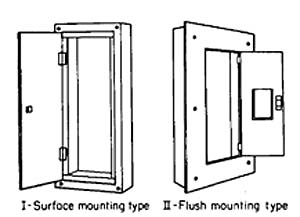
FIGURE 4.125 Panel boxes.
The Code requires that all cabinets which contain connections to more than eight conductors be provided with back or side wiring spaces. These wiring spaces must be separated from the panelboard or other devices in the cabinet by partitions so that they will be separate closed compartments, unless all wires are led from the cabinet at points directly opposite their terminal connections to the panelboard.
[American electricians’ handbook]Тематики
Синонимы
EN
Русско-английский словарь нормативно-технической терминологии > распределительный щиток
-
по назначению
-
52 метод измерения по поверхностному фотонапряжению
Solar energy: SPV method, surface photovoltage methodУниверсальный русско-английский словарь > метод измерения по поверхностному фотонапряжению
-
53 Kontaktverfahren
-
54 rebaba
f.1 jagged edge.2 rough edge, buhr, burr.3 protruding excess on a badly-finished surface.* * *1 rough edge* * *= burr.Ex. Drypoint was another method of engraving printing plates in the fifteenth century according to which the design was sketched directly on to the plate with a steel point, the burr being left alone.* * *= burr.Ex: Drypoint was another method of engraving printing plates in the fifteenth century according to which the design was sketched directly on to the plate with a steel point, the burr being left alone.
* * *rebaba nfjagged edge -
55 moyen
I.moyen1, -yenne [mwajɛ̃, jεn]1. adjectiveb. ( = intermédiaire) middlec. ( = du type courant) averaged. ( = ni bon ni mauvais) average• comment as-tu trouvé le spectacle ? -- très moyen what did you think of the show? -- pretty average2. feminine noun• faire du 100 de moyenne to average 100km/hII.moyen2 [mwajɛ̃]1. masculine nouna. ( = procédé, manière) way• par quel moyen allez-vous le convaincre ? how will you manage to convince him?• est-ce qu'il y a moyen de lui parler ? is it possible to speak to him?• pas moyen d'avoir une réponse claire ! there's no way you can get a clear answer!2. plural masculine nouna. ( = capacités intellectuelles, physiques) ça lui a fait perdre tous ses moyens it left him completely at a loss• il était en pleine possession de ses moyens his powers were at their peak ; [personne âgée] he was in full possession of his faculties• par ses propres moyens [réussir] all by oneselfb. ( = ressources financières) means* * *
1.
- enne mwajɛ̃, ɛn adjectif1) (intermédiaire en dimension, poids) [taille, épaisseur] medium; [ville, entreprise, légume] medium-sized; [fil] of medium thickness; [prix] moderate2) ( passable) [élève, résultat] average (en in)3) ( dans une hiérarchie) [cadre, revenu] middle; [échelon] intermediateles salaires moyens — ( personnes) people on middle incomes
4) ( ordinaire) averagele Français/lecteur moyen — the average Frenchman/reader
5) (après évaluation, calcul) [taux, température] average, mean6) ( de compromis) [solution, position] middle-of-the-road
2.
nom masculin1) ( façon de procéder) means (sg) ( de faire of doing), way ( de faire of doing)2) (d'action, expression, de production) means; (d'investigation, de paiement) method3) ( possibilité) way(il n'y a) pas moyen de lui faire comprendre qu'il a tort — it's impossible to make him realize he's wrong
3.
au moyen de locution prépositive by means of, by using
4.
par le moyen de locution prépositive by means of, through
5.
moyens nom masculin pluriel1) ( financiers) meansje n'ai pas les moyens de faire, mes moyens ne me permettent pas de faire — I can't afford to do
avoir de petits/grands moyens — not to be/to be very well off
2) ( matériels) resourcesje n'ai ni le temps ni les moyens de taper ce texte — I have neither the time nor the equipment to type this text
3) ( intellectuels) ability•Phrasal Verbs:* * *mwajɛ̃, jɛn moyen, -ne1. adj1) (taux, niveau, coût) average2) (lecteur, usager) average3) (= ni bon ni mauvais) (personne, prestation) averageJe suis plutôt moyenne en langues. — I'm just average at languages.
C'est vraiment moyen. — It's very average., It's only so-so.
4) (= ni petit ni grand) (tailles, prix) mediumElle est de taille moyenne. — She's of medium height.
5) (socialement parlant) middle2. nm(= façon) way, means sgpar quel moyen? — how?, which way?
y a-t-il moyen de...? — is it possible to...?, can one...?
3. moyens nmpl1) (= méthodes) meanspar tous les moyens — by every possible means, every possible way
2) (financiers) meansavoir les moyens; Ils ont de gros moyens. — They have a lot of money.
avoir les moyens de faire; Je n'en ai pas les moyens. — I can't afford it.
Ils n'ont pas les moyens de s'acheter une voiture. — They can't afford to buy a car.
3) (humains, matériels) resources4) (= intellectuels ou physiques) ability* * *A adj1 (intermédiaire en dimension, poids) [stature, taille, épaisseur, surface] medium; [ville, entreprise, légume] medium-sized; [fil] of medium thickness; ma chambre est de grandeur moyenne my room is medium-sized; de moyenne portée medium-range; de moyen calibre of medium calibreGB ( après n); le cours moyen d'un fleuve Géog the middle reaches of a river;2 ( passable) average (en in); tes résultats sont assez moyens your results are fairly average; un élève très moyen a very average pupil; ‘comment était le repas/l'hôtel?’-‘moyen’ ‘how was the meal/the hotel?’-‘so-so’;3 ( dans une hiérarchie) [cadre, revenu] middle; [échelon] intermediate; les salaires moyens ( personnes) people on middle incomes;4 ( ordinaire) [citoyen, spectateur, utilisateur, lecteur] average; le Français moyen the average Frenchman;5 (après évaluation, calcul) [nombre, taux, revenu, température] average, mean;6 ( de compromis) [solution, position] middle-of-the-road; ils pratiquent des prix moyens their prices are reasonable;7 Ling voyelle moyenne mid-vowel.B nm1 ( façon de procéder) means (sg) (de faire of doing), way (de faire of doing); c'est le moyen le plus sûr/le moins coûteux it's the most reliable/the least expensive means ou way; c'est un moyen comme un autre it's as good a way as any; par tous les moyens by every possible means; par n'importe quel moyen by hook or by crook○; empêcher qn de faire qch par tous les moyens to stop sb from doing sth by fair means or foul; consolider son autorité par tous les moyens to use every possible means to consolidate one's authority; tous les moyens sont bons any means will do; tous les moyens leur sont bons they'll stop at nothing; pour lui tous les moyens sont bons pour gagner de l'argent there's nothing he wouldn't do to make money; tous les moyens lui sont bons pour ne pas travailler he'll/she'll do anything not to work; employer les grands moyens to resort to drastic measures;2 (d'action, expression, de production) means; (d'investigation, de paiement) method; moyen de communication means of communication;3 ( possibilité) way; il y a moyen de faire there's a way of doing; il y a moyen de s'en sortir there's a way out; n'y avait-il pas moyen de faire autrement? was there no other way to go about it?; (il n'y a) pas moyen d'être tranquille ici there's no peace around here; (il n'y a) pas moyen de lui faire comprendre qu'il a tort it's impossible to make him realize he's wrong; lui faire admettre qu'il a tort? pas moyen! make him admit he's wrong? no chance!;4 Ling complément de moyen adverbial phrase of means.C au moyen de loc prép (d'une action, d'un référendum) by means of; ( d'un objet) by means of, by using.D par le moyen de loc prép by means of, through.E moyens nmpl1 ( ressources financières) means; manquer de moyens to lack the resources (pour faire to do); faute de moyens through lack of money; vivre au-dessus de ses moyens to live beyond one's means; je n'ai pas les moyens de faire I can't afford to do; mes moyens ne me permettent pas de partir en vacances I can't afford to take a vacation; avoir de petits/grands moyens not to be/to be very well off; avoir les moyens○ to be well off;2 ( soutien matériel) resources; la ville a mis d'énormes moyens à notre disposition the town put vast resources at our disposal; je n'ai ni le temps ni les moyens de taper ce texte I have neither the time nor the equipment to type this text; se donner les moyens de son efficacité to take the necessary steps to achieve efficiency; donner à qn les moyens de faire to give sb the means to do; j'ai dû y aller par mes propres moyens I had to go (there) under my own steam○, I had to make my own way there; se débrouiller par ses propres moyens to manage on one's own;3 ( compétences) ability; cet élève a les moyens de réussir this pupil has the ability to succeed ou do well; il a de petits moyens he has limited ability; être au-dessus des moyens de qn to be beyond sb's abilities ou capabilities; être en possession de tous ses moyens ( intellectuellement) to be at the height of one's powers; ( physiquement) to be at the peak of one's strength; ne plus avoir tous ses moyens to be no longer in full possession of one's faculties; perdre ses moyens to go to pieces.F moyenne nf1 ( norme) average; être plus riche que la moyenne to be better off than the average; il est plus grand que la moyenne des hommes he is taller than the average man; être inférieur/supérieur à la moyenne to be below/above (the) average; être au-dessous/au-dessus de la moyenne to be below/above average; être dans la moyenne to be average; des résultats extrêmement faibles par rapport à la moyenne européenne extremely poor results against ou compared to the European average;2 Scol ( moitié de la note maximale) half marks GB, 50%; j'ai eu tout juste la moyenne ( à un examen) I barely passed; ( à un devoir) I just got half marks GB, I just got 50%;3 ( après calcul) average; la moyenne d'âge the average age; calculer une moyenne to work out an average; en moyenne on average;4 ( vitesse) average speed; faire une moyenne de 30 km/h to do an average speed of ou to average 30 kph.moyen français Ling Middle French; moyen de locomotion = moyen de transport; moyen métrage Cin medium-length film; moyen de trésorerie financial means; moyen de transport means of transport GB ou transportation US; moyenne arithmétique Math arithmetic mean; moyenne géométrique Math geometric mean; moyenne harmonique Math harmonic mean; Moyen Âge Middle Ages (pl); le bas/haut Moyen Âge the late/early Middle Ages; Moyen Empire Middle Kingdom.la fin justifie les moyens the end justifies the means; qui veut la fin veut les moyens Prov he who wills the end wills the means Prov.I1. [intermédiaire - selon des mesures] medium (avant nom), average ; [ - selon une évaluation] mediumb. [solution] compromise, middle course2. [prix, taille, consommation, distance] average[aptitudes, niveau, service] average3. [ordinaire]le spectateur/lecteur moyen the average spectator/reader4. LINGUISTIQUE [voyelle] middleII[mwajɛ̃] nom masculin1. [méthode] wayil n'y a pas d'autre moyen there's no other way ou solutionje l'aurais empêché, si j'en avais eu les moyens I would have stopped him, if I'd been able toet en plus, tu trouves le moyen d'être en retard! not only that but you've managed to be late as well!moyen de défense/d'existence means of defence/existencemoyen de locomotion ou de transport means of transportemployer ou utiliser les grands moyens to take drastic steps2. [pour intensifier]il n'y a pas moyen d'ouvrir la porte! there's no way of opening the door!, the door won't open!3. GRAMMAIRE————————moyens nom masculin pluriel[financiers] meansje n'ai pas les moyens de m'acheter un ordinateur I haven't got the means to ou I can't afford to buy a computerje peux te payer une bière, c'est encore dans mes moyen s I can buy you a beer, I can just about manage thatc'est au-dessus de mes moyens it's beyond my means, I can't afford it[intellectuels, physiques]————————au moyen de locution prépositionnelle————————par tous les moyens locution adverbiale[même immoraux] by fair means or foul -
56 Card Grinding
To maintain good carding it is necessary to grind periodically the various card covered members of the carding engine, viz swifts, doffers, workers and strippers. For the purpose of grinding swifts and doffers a portable gringing roller is used this roller is covered either with emery applied directly on the roller surface by this method termed " solid " covering, or with emery filleting, which is secured in the flanges at the ends of the roller to facilitate the latter method of covering, which is now very widely adopted a specially adapted roller is constructed. -
57 дефект
defect, fault, damage
(детали, обнаруживаемый при осмотре, обмере) — inspect critical stress areas where defects are most likely to be detected.
- (в системе) — trouble
a matter of knowing what sections of a complex system cause the trouble.
-, вероятный (в системе) — probable defect trouble
-, исправимый — repairable defect
-, исчезающий (переменный) — intermittent defect
- клепки — riveting fault
- литья — casting defect
- конструкции (в противоположность производственному дефекту) — design error
-, механический — mechanical /physical/ defect /damage/
-, неисправимый — irrepairable defect
-, обнаруженный летчиком — trouble reported by the pilot
-, переменный — intermittent defect
-, производственный — manufacturing error
- сварки — welding defect
- слоя краски — paint film irregularities
-, эксплуатационный — service trouble
ведомость д. — list of defects
метод устранения д. (графа таблицы) — method of correction
обнаружение д. — detection of defects
обнаружение и устранение д..(в системах) — trouble shooting
определение д. (заголовок) — isolation procedure
(нахождение отказавшего блока или узла) — under this heading list any notes or key points necessary in isolating the trouble into the section and components.
определение д. (отказавших блоков, узлов) — isolating the trouble into...
отыскание и устранение д. — trouble shooting
причина д. — cause of trouble
способ обнаружения д. (графа таблицы) — method of inspection
устранение д. (детали) — elimination /remedy/ of defect
устранение д. (в системе) — correction of trouble
устранение д. (восстановление дефектной детали) — repair
устранение причины д. (в системах и агрегатах) — correction of trouble cause
характер д. — nature of defect
заменять деталь, которая имеет дефекты в виде трещин, забоин и т.п. — replace а part which shows physical damage such as cracks, nicks, etc.
обнаруживать д. — detect the defect
обнаруживать д. (в системе) — detect the trouble
определять д. в блоке (точно устанавливать отказавший блок, узел) — isolate the trouble into the unit (assembly)
осматривать для того, чтобы убедиться в отсутствии д. — inspect for freedom from defeсt
снимать (зачищать) выступающий элемент д. до уровня основной поверхности — blend smoothly edges of damage into surrounding surface
устранять д. — correct the trouble correction: in this column, list any notes or key points involved in correcting the trouble in the unit.
утсранять д. (восстанавливать дефектную деталь) — eliminate /remedy/ the defect
устранять д. (ремонтировать деталь) — repairРусско-английский сборник авиационно-технических терминов > дефект
-
58 Crælius, Per Anton
SUBJECT AREA: Mining and extraction technology[br]b. 2 November 1854 Stockholm, Swedend. 7 August 1905 Stockholm, Sweden[br]Swedish mining engineer, inventor of the core drilling technique for prospecting purposes.[br]Having completed his studies at the Technological Institute in Stockholm and the Mining School at Falun, Crælius was awarded a grant by the Swedish Jernkontoret and in 1879 he travelled to Germany, France and Belgium in order to study technological aspects of the mining, iron and steel industries. In the same year he went to the United States, where he worked with an iron works in Colorado and a mining company in Nevada. In 1884, having returned to Sweden, he obtained an appointment in the Norberg mines; two years later, he took up employment at the Ängelsberg oilmill.His mining experience had shown him the demand for a reliable, handy and cheap method of drilling, particularly for prospecting purposes. He had become acquainted with modern drilling methods in America, possibly including Albert Fauck's drilling jar. In 1886, Crælius designed his first small-diameter drill, which was assembled in one unit. Its rotating boring rod, smooth on the outside, was fixed inside a hollow mandrel which could be turned in any direction. This first drill was hand-driven, but the hydraulic version of it became the prototype for all near-surface prospecting drills in use worldwide in the late twentieth century.Between 1890 and 1900 Crælius was managing director of the Morgårdshammar mechanical workshops, where he was able to continue the development of his drilling apparatus. He successfully applied diesel engines in the 1890s, and in 1895 he added diamond crowns to the drill. The commercial exploitation of the invention was carried out by Svenska Diamantbergborrings AB, of which Crælius was a director from its establishment in 1886.[br]Further ReadingG.Glockemeier, 1913, Diamantbohrungen für Schürf-und Aufschlußarbeiten über und unter Tage, Berlin (examines the technological aspects of Crælius's drilling method).A.Nachmanson and K.Sundberg, 1936, Svenska Diamantbergborrings Aktiebolaget 1886–1936, Uppsala (outlines extensively the merits of Crælius's invention).See also: Fauvelle, Pierre-PascalWK -
59 Drake, Edwin Laurentine
SUBJECT AREA: Mining and extraction technology[br]b. 29 March 1819 Greenville, New York, USAd. 8 November 1880 Bethlehem, Pennsylvania, USA[br]American pioneer oil driller.[br]He worked on his father's farm, was a clerk in a hotel and a store, and then became an express agent at a railway company in Springfield, Massachusetts, c.1845. After he had been working as a railway conductor in New Haven, Connecticut, for eight years, he resigned because of ill health. Owning some stocks in a Pennsylvania rock-oil company, which gathered oil from ground-level seepages mainly for medicinal use, he was engaged by this company and moved to Titusville, Pennsylvania, at the age of almost 40. After studying salt-well drilling by cable tool, which was still percussive, he became enthusiastic about the idea of using the same method to drill for oil, especially after researches in chemistry had revealed this new sort of fossil energy some years before.As a manager of the Seneca Oil Company, which referred to him as "Colonel" in letters of introduction simply to impress people with such titles, Drake began drilling in 1858, almost at the same time as pole-tool drilling for oil was started in Germany. His main contribution to the technology was the use of an iron pipe driven through the quicksand and the bedrock to prevent the bore-hole from filling. After nineteen months he struck oil at a depth of 21 m (69 ft) in August 1859. This was the first time that petroleum was struck at its source and the first proof of the presence of oil reservoirs within the earth's surface. Drake inaugurated the search for and the exploitation of the deep oil resources of the world and he initiated the science of petroleum engineering which became established at the beginning of the twentieth century.Drake failed to patent his drilling method; he was content being an oil commission merchant and Justice of the Peace in Titusville, which like other places in Pennsylvania became a boom town. Four years later he went to New York, where he lost all his money in oil speculations. He became very ill again and lived in poverty in Vermont and New Jersey until 1873, when he moved to Bethlehem, Pennsylvania, where he was pensioned by the state of Pennsylvania. The city of Titusville erected a monument to him and founded the Drake Museum.[br]Further ReadingDictionary of American Biography, Vol. III, pp. 427–8.Ida M.Tarbell, 1904, "The birth of industry", History of the Standard Oil Company, Vol. I, New York (gives a lively description of the booming years in Pennsylvania caused by Drake's successful drilling).H.F.Williamson and A.R.Daum, 1959, The American Petroleum Industry. The Age of Illumination, Evans ton, Ill.WKBiographical history of technology > Drake, Edwin Laurentine
-
60 Fauvelle, Pierre-Pascal
SUBJECT AREA: Mining and extraction technology[br]b. 4 June 1797 Rethel, Ardennes, Franced. 19 December 1867 Perpignan, France[br]French inventor of hydraulic boring.[br]While attending the drilling of artesian wells in southern France in 1833, Fauvelle noticed that the debris from the borehole was carried out by the ascending water. This observation caused him to conceive the idea that the boring process need not necessarily be interrupted in order to clear the hole with an auger. It took him eleven years to develop his idea and to find financial backing to carry out his project in practice. In 1844, within a period of fifty-four days, he secretly bored an artesian well 219 m (718 ft) deep in Perpignan. One year later he secured his invention with a patent in France, and with another the following year in Spain.Fauvelle's process involved water being forced by a pressure pump through hollow rods to the bottom of the drill, whence it ascended through the annular space between the rod and the wall of the borehole, thus flushing the mud up to the surface. This method was similar to that of Robert Beart who had secured a patent in Britain but had not put it into practice. Although Fauvelle was not primarily concerned with the rotating action of the drill, his hydraulic boring method and its subsequent developments by his stepson, Alphonse de Basterot, formed an important step towards modern rotary drilling, which began with the work of Anthony F. Lucas near Beaumont, Texas, at the turn of the twentieth century. In the 1870s Albert Fauck, who also contributed important developments to the structure of boring rigs, had combined Fauvelle's hydraulic system with core-boring in the United States.[br]Bibliography1846, "Sur un nouveau système de forage", Comptes rendus de l'Académie des sciences, pp. 438–40; also printed in 1847 in Le Technologiste 8, pp. 87–8.Further ReadingA.Birembeaut, 1968, "Pierre-Pascal Fauvelle", Dictionnaire de biographie française, vol. 13, pp. 808–10; also in L'Indépendant, Perpignan, 5–10 February (biography).A.de Basterot, 1868, Puits artésiens, sondages de mines, sondages d'études, systèmeFauvelle et de Basterot, Brussels (a detailed description of Fauvelle's methods and de Basterot's developments).See also: Crælius, Per AntonWKBiographical history of technology > Fauvelle, Pierre-Pascal
См. также в других словарях:
Surface-mount technology — (SMT) is a method for constructing electronic circuits in which the components (SMC, or Surface Mounted Components) are mounted directly onto the surface of printed circuit boards (PCBs). Electronic devices so made are called surface mount… … Wikipedia
Surface mining — is a type of mining in which soil and rock overlying the mineral deposit are removed. It is the opposite of underground mining, in which the overlying rock is left in place, and the mineral removed through shafts or tunnels. Surface mining is… … Wikipedia
Surface photovoltage — (SPV) measurements are a widely used method to determine the minority carrier diffusion length of semiconductors. Since the transport of minority carriers determines the behavior of the p n junctions that are ubiquitous in semiconductor devices,… … Wikipedia
Method Man — Concierto de Method Man en 2007 Datos generales Nombre real Clifford Smith N … Wikipedia Español
Surface second harmonic generation — is a method for probing interfaces in atomic and molecular systems. In second harmonic generation (SHG), the light frequency is doubled, essentially converting two photons of the original beam of energy E into a single photon of energy 2 E as it… … Wikipedia
Surface charge — is the electric charge present at an interface, for instance on the surface of a semiconductor material, or for example, on the surface of a protein in water.There are multiple factors generating surface charge. First of all, surface charge… … Wikipedia
Surface plasmon — Surface plasmons, also referred to in the literature as surface plasma polaritons, are fluctuations in the electron density at the boundary of two materials. Plasmons are the collective vibrations of an electron gas (or plasma) surrounding the… … Wikipedia
Surface caching — is a computer graphics technique pioneered by John Carmack, first used in the computer game Quake . The traditional method of lighting a surface is to calculate the surface from the perspective of the viewer, and then apply the lighting to the… … Wikipedia
surface mining — method of extracting minerals near the surface of the Earth. The three most common types of surface mining are open pit mining, strip mining, and quarrying (quarry). See also mining and coal mining. * * * … Universalium
Surface tension — For the work of fiction, see Surface Tension (short story). Surface tension is a property of the surface of a liquid that causes it to behave as an elastic sheet. It allows insects, such as the water strider (pond skater, UK), to walk on water.… … Wikipedia
Method of image charges — The method of image charges (also known as the method of images and method of mirror charges) is a basic problem solving tool in electrostatics. The name originates from the replacement of certain elements in the original layout with imaginary… … Wikipedia
